Cambridge IGCSE Portuguese - Foreign Language 0540 — 2015 May/June Paper 2 · Variant 1
0540/21/M/J/15 · 45 marks · ≈51 min
The question paper and its mark scheme, free to read here and free to download. This is Cambridge’s own paper, exactly as it was sat.
Question paper16 pages



Mark scheme9 pages
Answers below. Sit the paper first if you are practising.
Paper as text
Question paper, page 1
This document consists of 13 printed pages and 3 blank pages. DC (AC/CGW) 100608/5 © UCLES 2015 [Turn over Cambridge International Examinations Cambridge International General Certificate of Secondary Education * 3 8 5 0 0 4 3 4 8 8 * PORTUGUESE 0540/02 Paper 2 Reading May/June 2015 1 hour Candidates answer on the Question Paper. No Additional Materials are required. READ THESE INSTRUCTIONS FIRST Write your Centre number, candidate number and name on all the work you hand in. Write in dark blue or black pen. Do not use staples, paper clips, glue or correction fluid. DO NOT WRITE IN ANY BARCODES. Answer all questions. The number of marks is given in brackets [ ] at the end of each question or part question. For Examiner’s Use Section 1 Section 2 Section 3 Total
Question paper, page 2
2 0540/02/M/J/15 © UCLES 2015 BLANK PAGE
Question paper, page 3
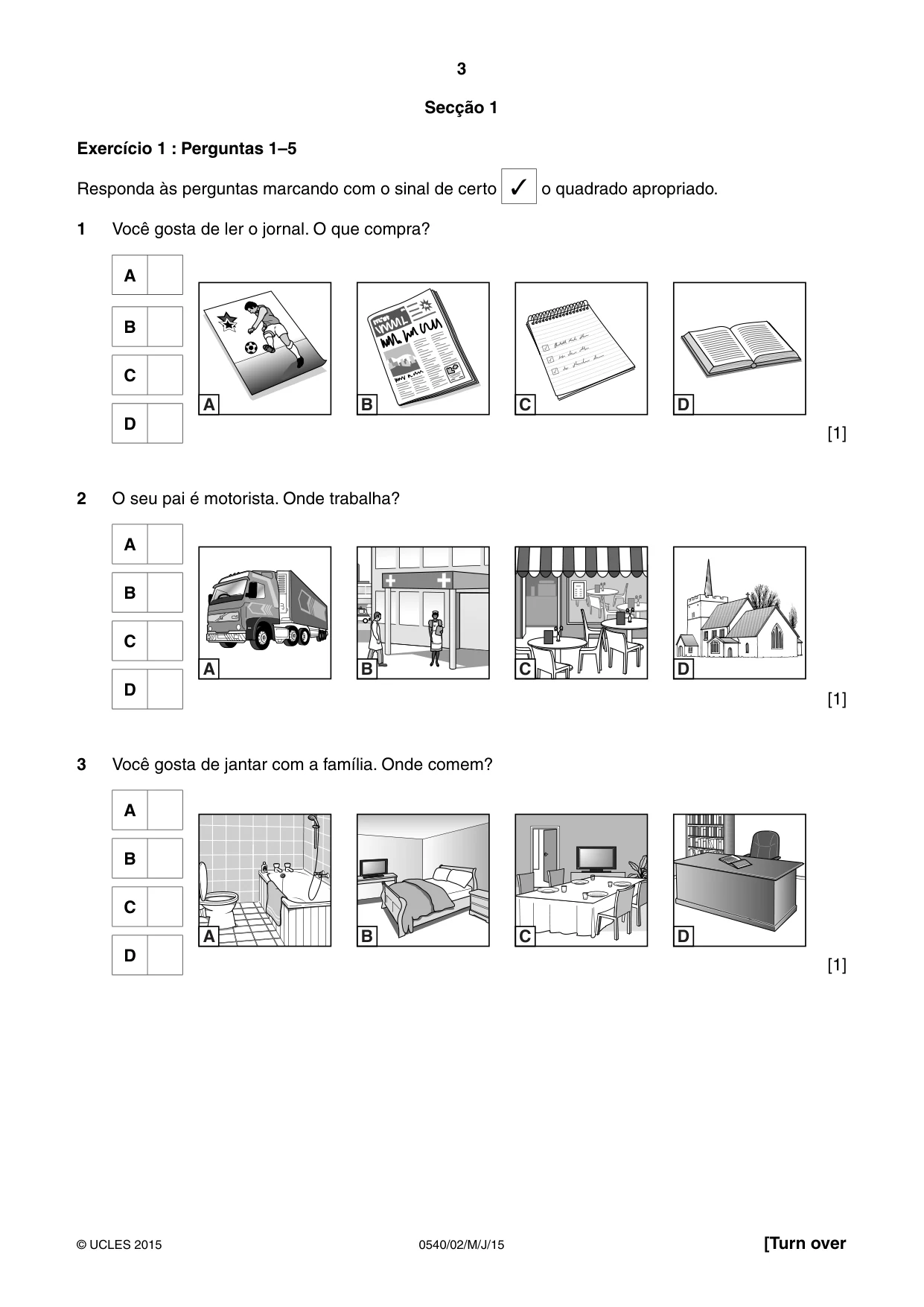
3 0540/02/M/J/15 © UCLES 2015 [Turn over Secção 1 Exercício 1 : Perguntas 1–5 Responda às perguntas marcando com o sinal de certo ✓ o quadrado apropriado. 1 Você gosta de ler o jornal. O que compra? A A B C D [1] B C D 2 O seu pai é motorista. Onde trabalha? A A B C D [1] B C D 3 Você gosta de jantar com a família. Onde comem? A A B C D [1] B C D
Question paper, page 4
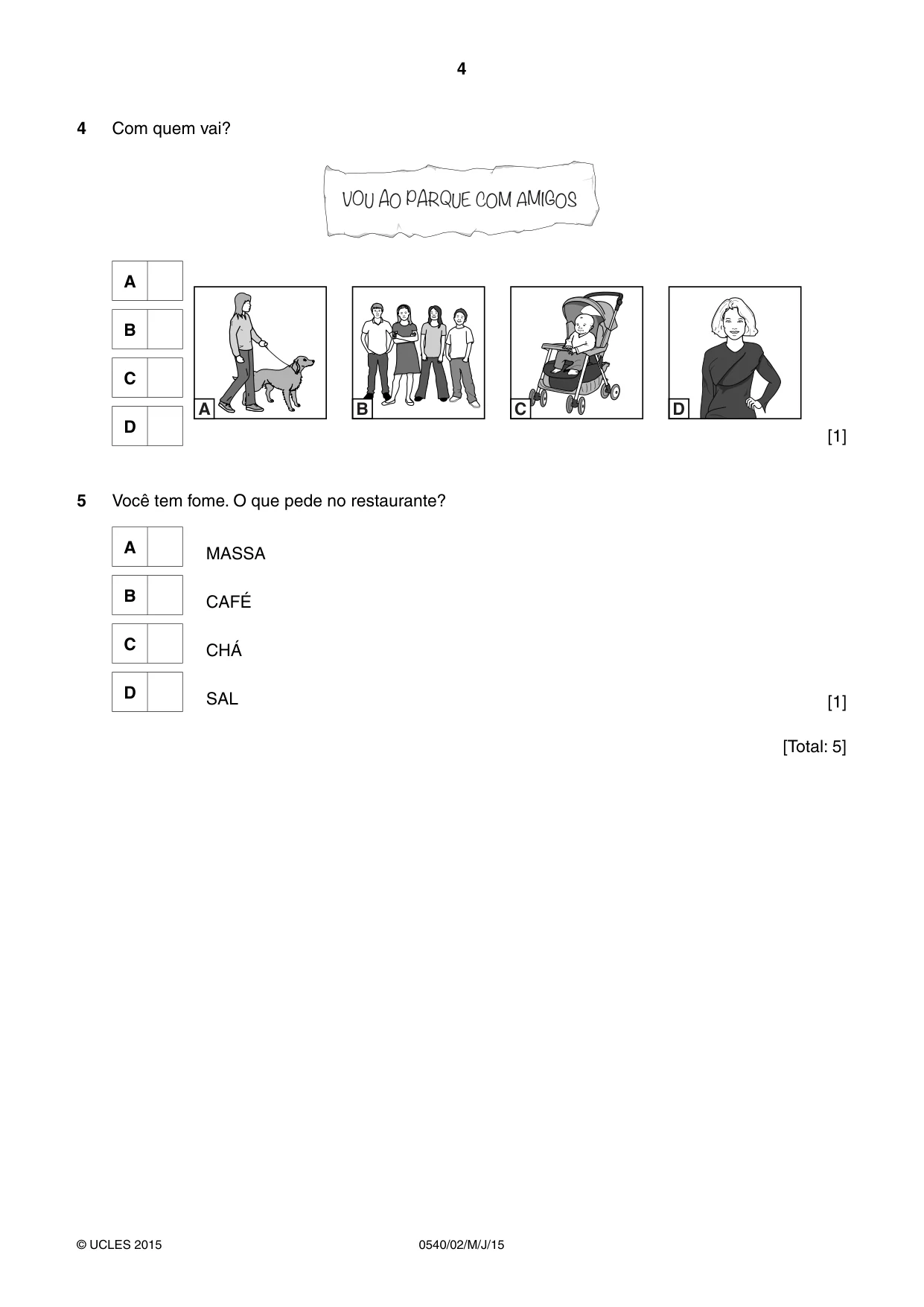
4 0540/02/M/J/15 © UCLES 2015 4 Com quem vai? VOU AO PARQUE COM AMIGOS A A B C D [1] B C D 5 Você tem fome. O que pede no restaurante? A [1] B C D [Total: 5] MASSA CAFÉ CHÁ SAL
Question paper, page 5
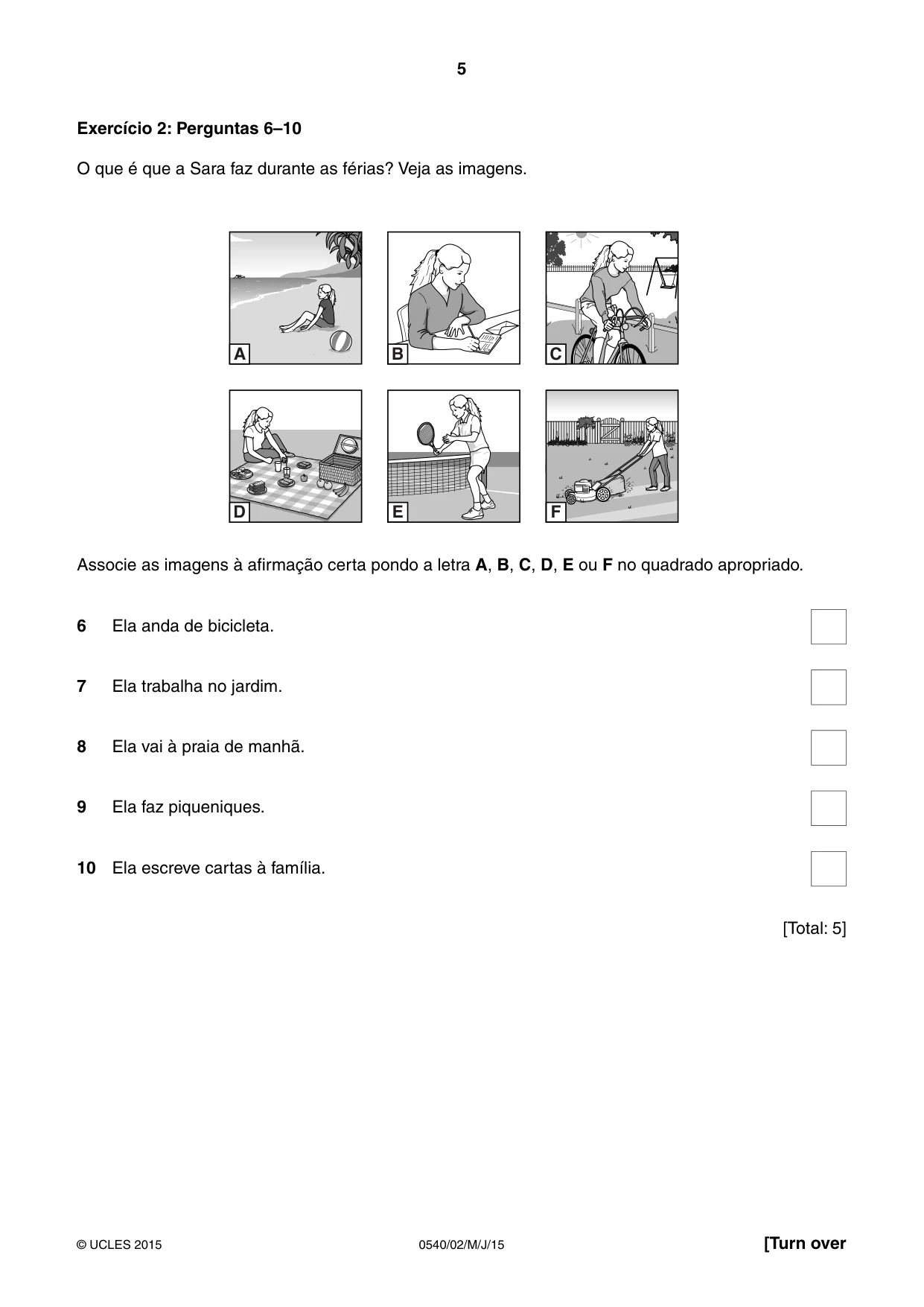
5 0540/02/M/J/15 © UCLES 2015 [Turn over Exercício 2: Perguntas 6–10 O que é que a Sara faz durante as férias? Veja as imagens. A B C D E F Associe as imagens à afirmação certa pondo a letra A, B, C, D, E ou F no quadrado apropriado. 6 Ela anda de bicicleta. 7 Ela trabalha no jardim. 8 Ela vai à praia de manhã. 9 Ela faz piqueniques. 10 Ela escreve cartas à família. [Total: 5]
Question paper, page 6
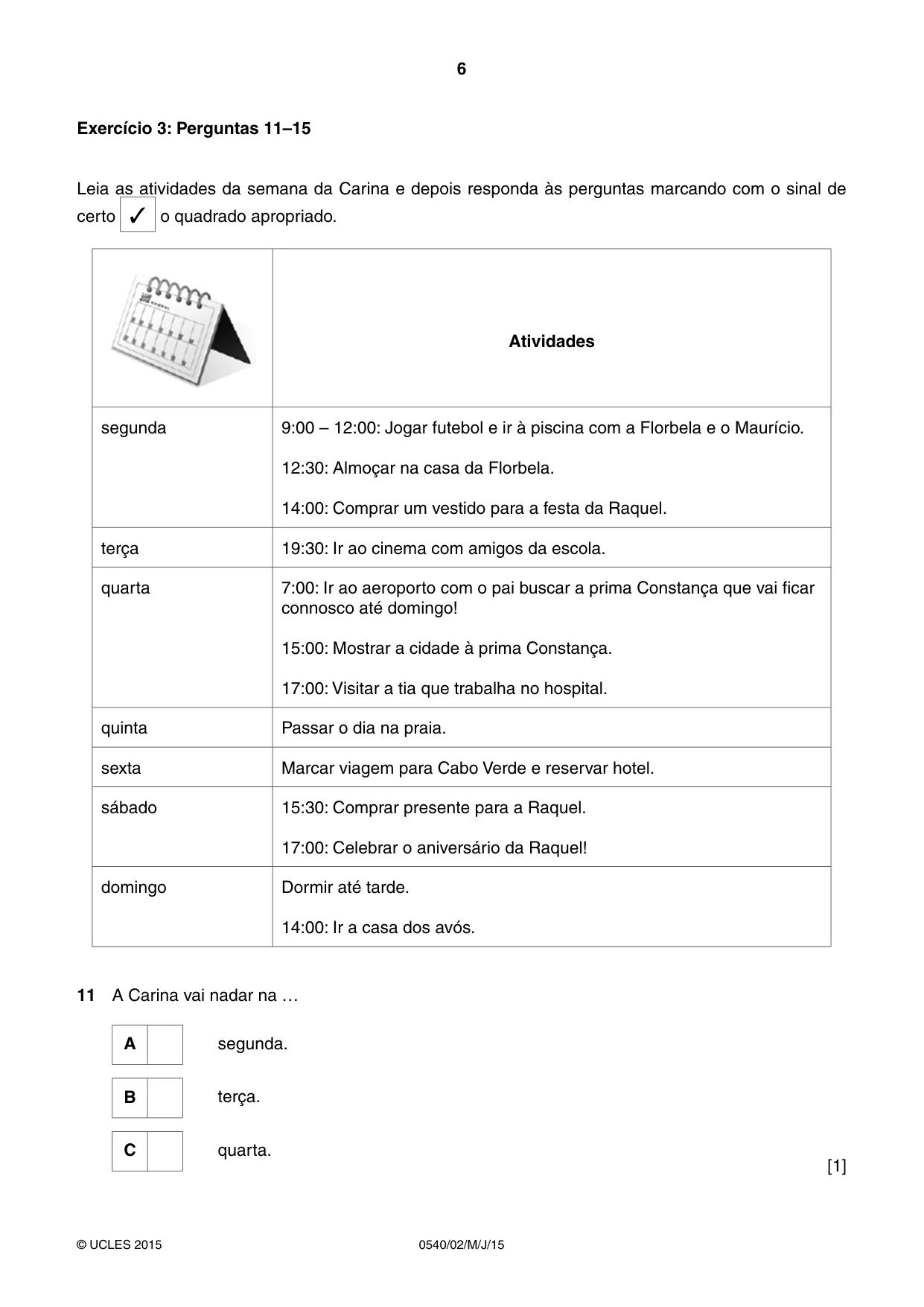
6 0540/02/M/J/15 © UCLES 2015 Exercício 3: Perguntas 11–15 Leia as atividades da semana da Carina e depois responda às perguntas marcando com o sinal de certo ✓ o quadrado apropriado. Atividades segunda 9:00 – 12:00: Jogar futebol e ir à piscina com a Florbela e o Maurício. 12:30: Almoçar na casa da Florbela. 14:00: Comprar um vestido para a festa da Raquel. terça 19:30: Ir ao cinema com amigos da escola. quarta 7:00: Ir ao aeroporto com o pai buscar a prima Constança que vai ficar connosco até domingo! 15:00: Mostrar a cidade à prima Constança. 17:00: Visitar a tia que trabalha no hospital. quinta Passar o dia na praia. sexta Marcar viagem para Cabo Verde e reservar hotel. sábado 15:30: Comprar presente para a Raquel. 17:00: Celebrar o aniversário da Raquel! domingo Dormir até tarde. 14:00: Ir a casa dos avós. 11 A Carina vai nadar na … A segunda. B terça. C quarta. [1]
Question paper, page 7
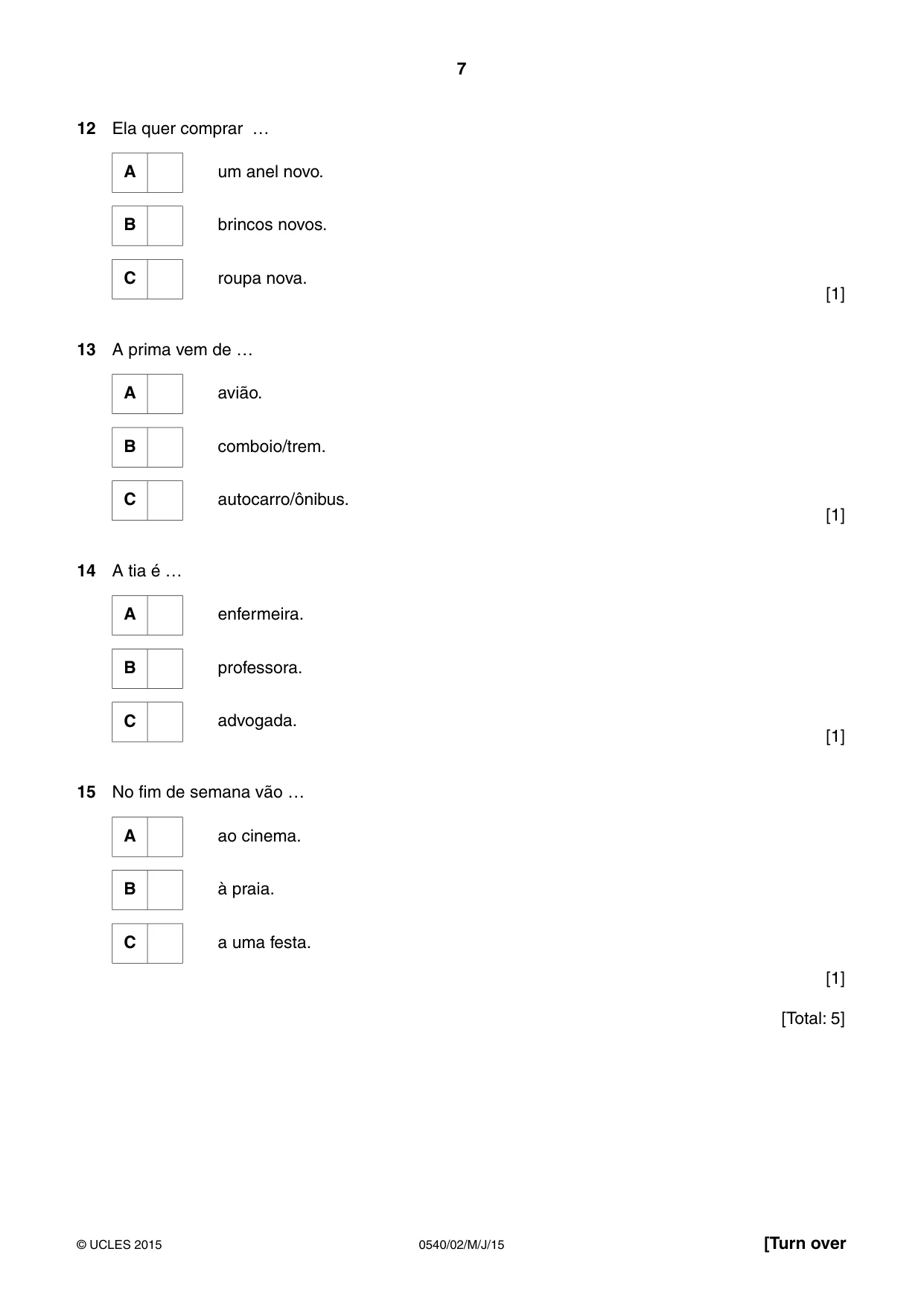
7 0540/02/M/J/15 © UCLES 2015 [Turn over 12 Ela quer comprar … A um anel novo. B brincos novos. C roupa nova. [1] 13 A prima vem de … A avião. B comboio/trem. C autocarro/ônibus. [1] 14 A tia é … A enfermeira. B professora. C advogada. [1] 15 No fim de semana vão … A ao cinema. B à praia. C a uma festa. [1] [Total: 5]
Question paper, page 8
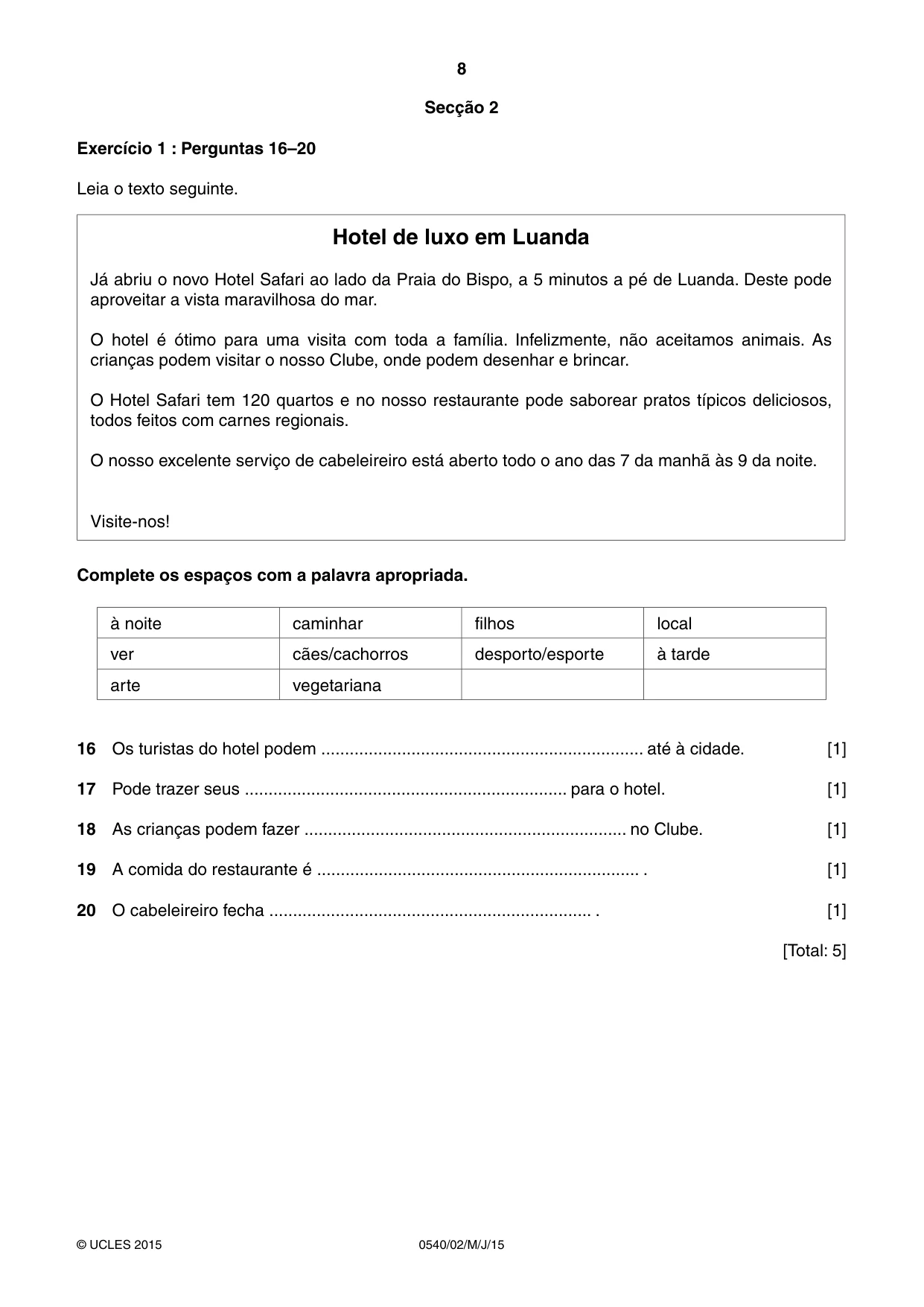
8 0540/02/M/J/15 © UCLES 2015 Secção 2 Exercício 1 : Perguntas 16–20 Leia o texto seguinte. Hotel de luxo em Luanda Já abriu o novo Hotel Safari ao lado da Praia do Bispo, a 5 minutos a pé de Luanda. Deste pode aproveitar a vista maravilhosa do mar. O hotel é ótimo para uma visita com toda a família. Infelizmente, não aceitamos animais. As crianças podem visitar o nosso Clube, onde podem desenhar e brincar. O Hotel Safari tem 120 quartos e no nosso restaurante pode saborear pratos típicos deliciosos, todos feitos com carnes regionais. O nosso excelente serviço de cabeleireiro está aberto todo o ano das 7 da manhã às 9 da noite. Visite-nos! Complete os espaços com a palavra apropriada. à noite caminhar filhos local ver cães/cachorros desporto/esporte à tarde arte vegetariana 16 Os turistas do hotel podem … até à cidade. [1] 17 Pode trazer seus … para o hotel. [1] 18 As crianças podem fazer … no Clube. [1] 19 A comida do restaurante é … . [1] 20 O cabeleireiro fecha … . [1] [Total: 5]
Question paper, page 9
9 0540/02/M/J/15 © UCLES 2015 [Turn over BLANK PAGE
Question paper, page 10
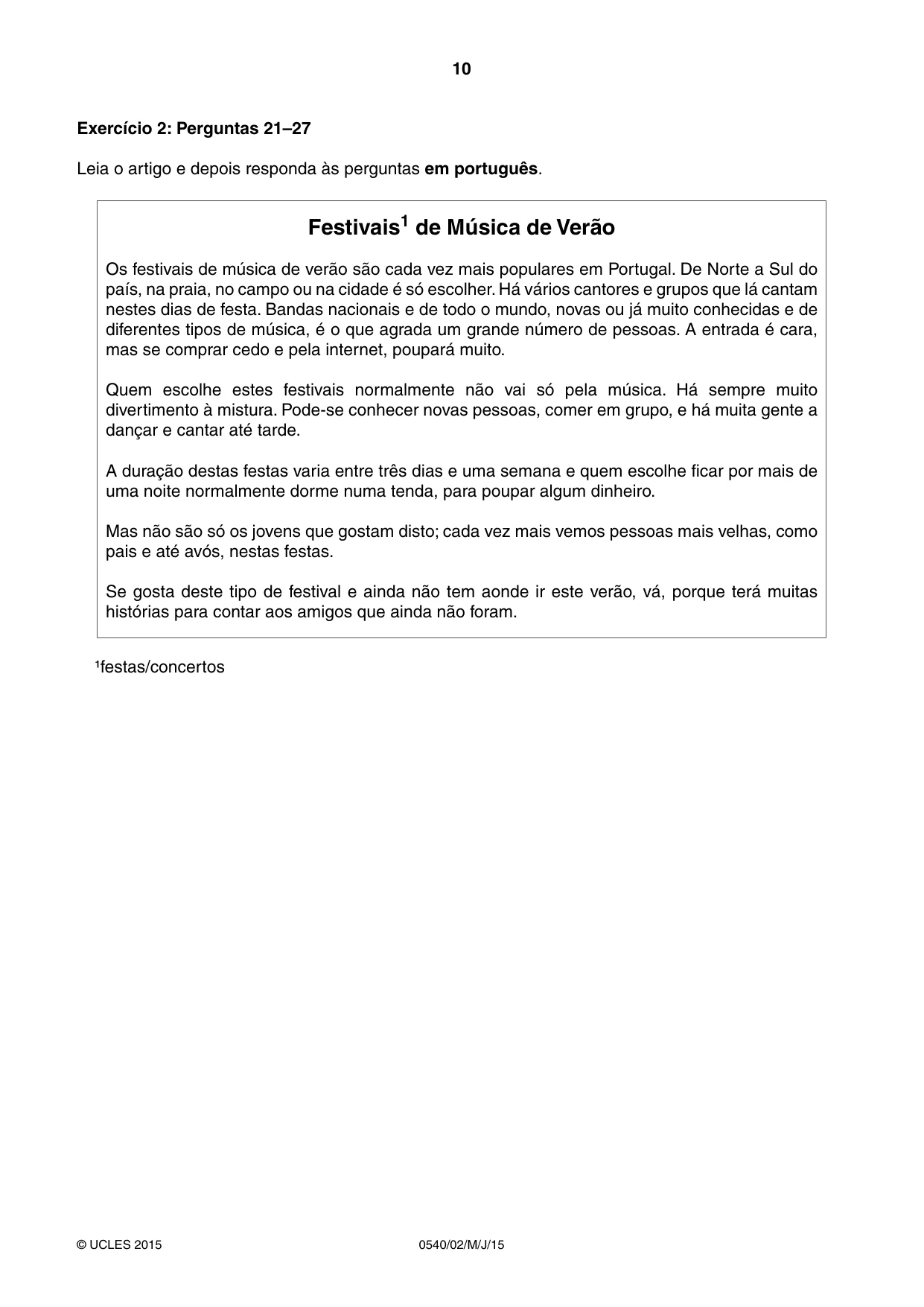
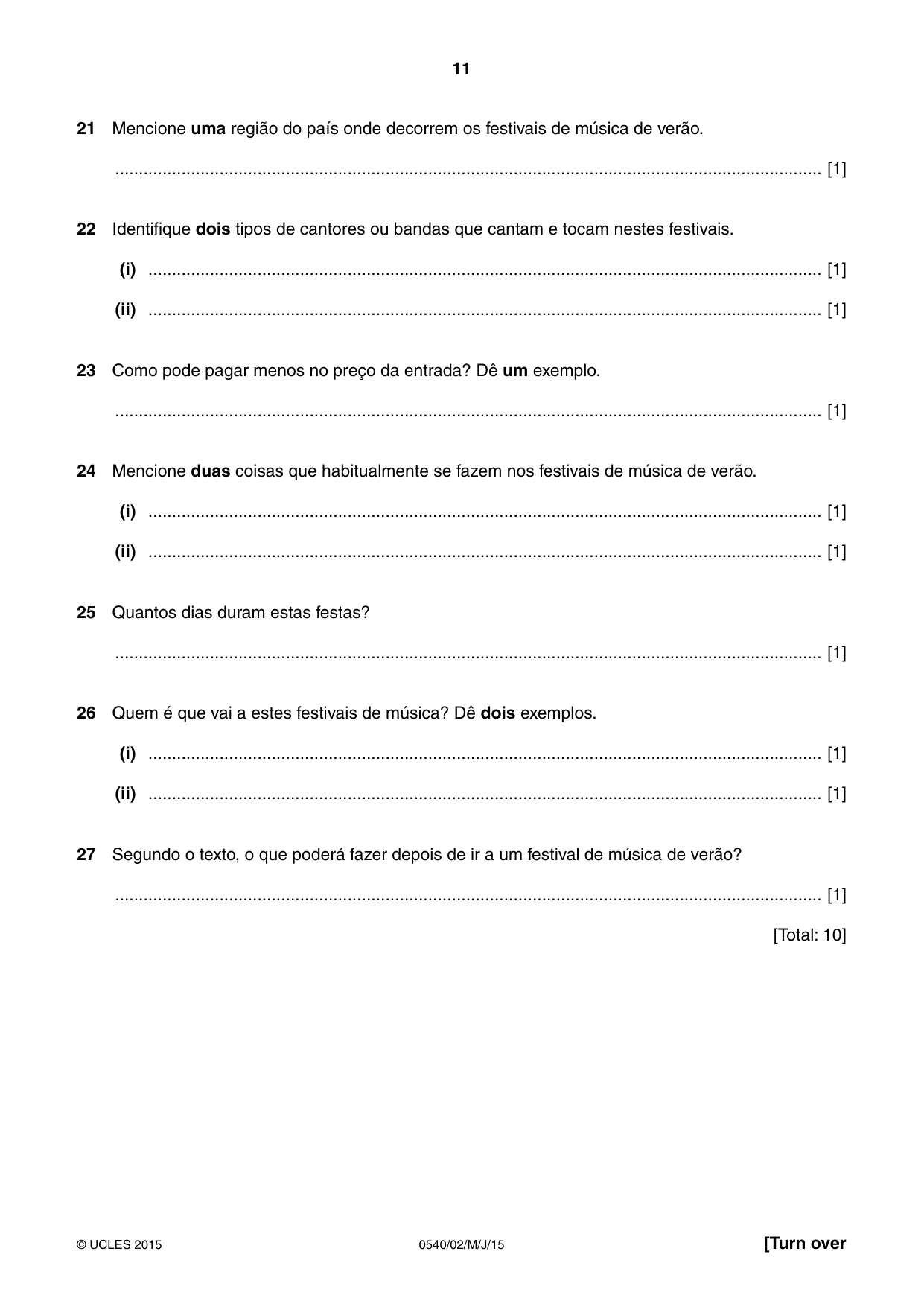
10 0540/02/M/J/15 © UCLES 2015 Exercício 2: Perguntas 21–27 Leia o artigo e depois responda às perguntas em português. Festivais1 de Música de Verão Os festivais de música de verão são cada vez mais populares em Portugal. De Norte a Sul do país, na praia, no campo ou na cidade é só escolher. Há vários cantores e grupos que lá cantam nestes dias de festa. Bandas nacionais e de todo o mundo, novas ou já muito conhecidas e de diferentes tipos de música, é o que agrada um grande número de pessoas. A entrada é cara, mas se comprar cedo e pela internet, poupará muito. Quem escolhe estes festivais normalmente não vai só pela música. Há sempre muito divertimento à mistura. Pode-se conhecer novas pessoas, comer em grupo, e há muita gente a dançar e cantar até tarde. A duração destas festas varia entre três dias e uma semana e quem escolhe ficar por mais de uma noite normalmente dorme numa tenda, para poupar algum dinheiro. Mas não são só os jovens que gostam disto; cada vez mais vemos pessoas mais velhas, como pais e até avós, nestas festas. Se gosta deste tipo de festival e ainda não tem aonde ir este verão, vá, porque terá muitas histórias para contar aos amigos que ainda não foram. ¹festas/concertos
Question paper, page 11
11 0540/02/M/J/15 © UCLES 2015 [Turn over 21 Mencione uma região do país onde decorrem os festivais de música de verão. … [1] 22 Identifique dois tipos de cantores ou bandas que cantam e tocam nestes festivais. (i) … [1] (ii) … [1] 23 Como pode pagar menos no preço da entrada? Dê um exemplo. … [1] 24 Mencione duas coisas que habitualmente se fazem nos festivais de música de verão. (i) … [1] (ii) … [1] 25 Quantos dias duram estas festas? … [1] 26 Quem é que vai a estes festivais de música? Dê dois exemplos. (i) … [1] (ii) … [1] 27 Segundo o texto, o que poderá fazer depois de ir a um festival de música de verão? … [1] [Total: 10]
Question paper, page 12
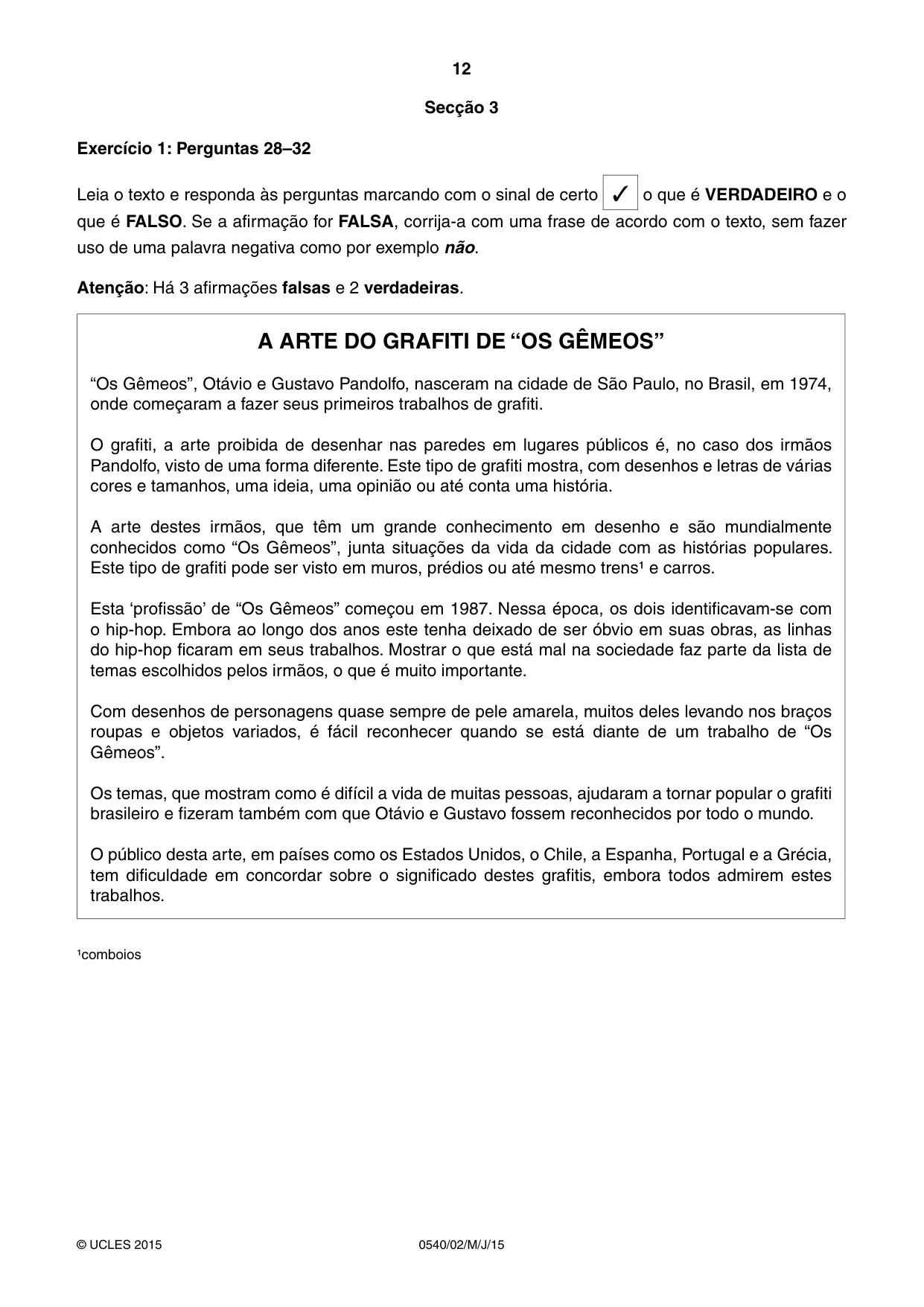
12 0540/02/M/J/15 © UCLES 2015 Secção 3 Exercício 1: Perguntas 28–32 Leia o texto e responda às perguntas marcando com o sinal de certo ✓ o que é VERDADEIRO e o que é FALSO. Se a afirmação for FALSA, corrija-a com uma frase de acordo com o texto, sem fazer uso de uma palavra negativa como por exemplo não. Atenção: Há 3 afirmações falsas e 2 verdadeiras. A ARTE DO GRAFITI DE “OS GÊMEOS” “Os Gêmeos”, Otávio e Gustavo Pandolfo, nasceram na cidade de São Paulo, no Brasil, em 1974, onde começaram a fazer seus primeiros trabalhos de grafiti. O grafiti, a arte proibida de desenhar nas paredes em lugares públicos é, no caso dos irmãos Pandolfo, visto de uma forma diferente. Este tipo de grafiti mostra, com desenhos e letras de várias cores e tamanhos, uma ideia, uma opinião ou até conta uma história. A arte destes irmãos, que têm um grande conhecimento em desenho e são mundialmente conhecidos como “Os Gêmeos”, junta situações da vida da cidade com as histórias populares. Este tipo de grafiti pode ser visto em muros, prédios ou até mesmo trens¹ e carros. Esta ‘profissão’ de “Os Gêmeos” começou em 1987. Nessa época, os dois identificavam-se com o hip-hop. Embora ao longo dos anos este tenha deixado de ser óbvio em suas obras, as linhas do hip-hop ficaram em seus trabalhos. Mostrar o que está mal na sociedade faz parte da lista de temas escolhidos pelos irmãos, o que é muito importante. Com desenhos de personagens quase sempre de pele amarela, muitos deles levando nos braços roupas e objetos variados, é fácil reconhecer quando se está diante de um trabalho de “Os Gêmeos”. Os temas, que mostram como é difícil a vida de muitas pessoas, ajudaram a tornar popular o grafiti brasileiro e fizeram também com que Otávio e Gustavo fossem reconhecidos por todo o mundo. O público desta arte, em países como os Estados Unidos, o Chile, a Espanha, Portugal e a Grécia, tem dificuldade em concordar sobre o significado destes grafitis, embora todos admirem estes trabalhos. ¹comboios
Question paper, page 13
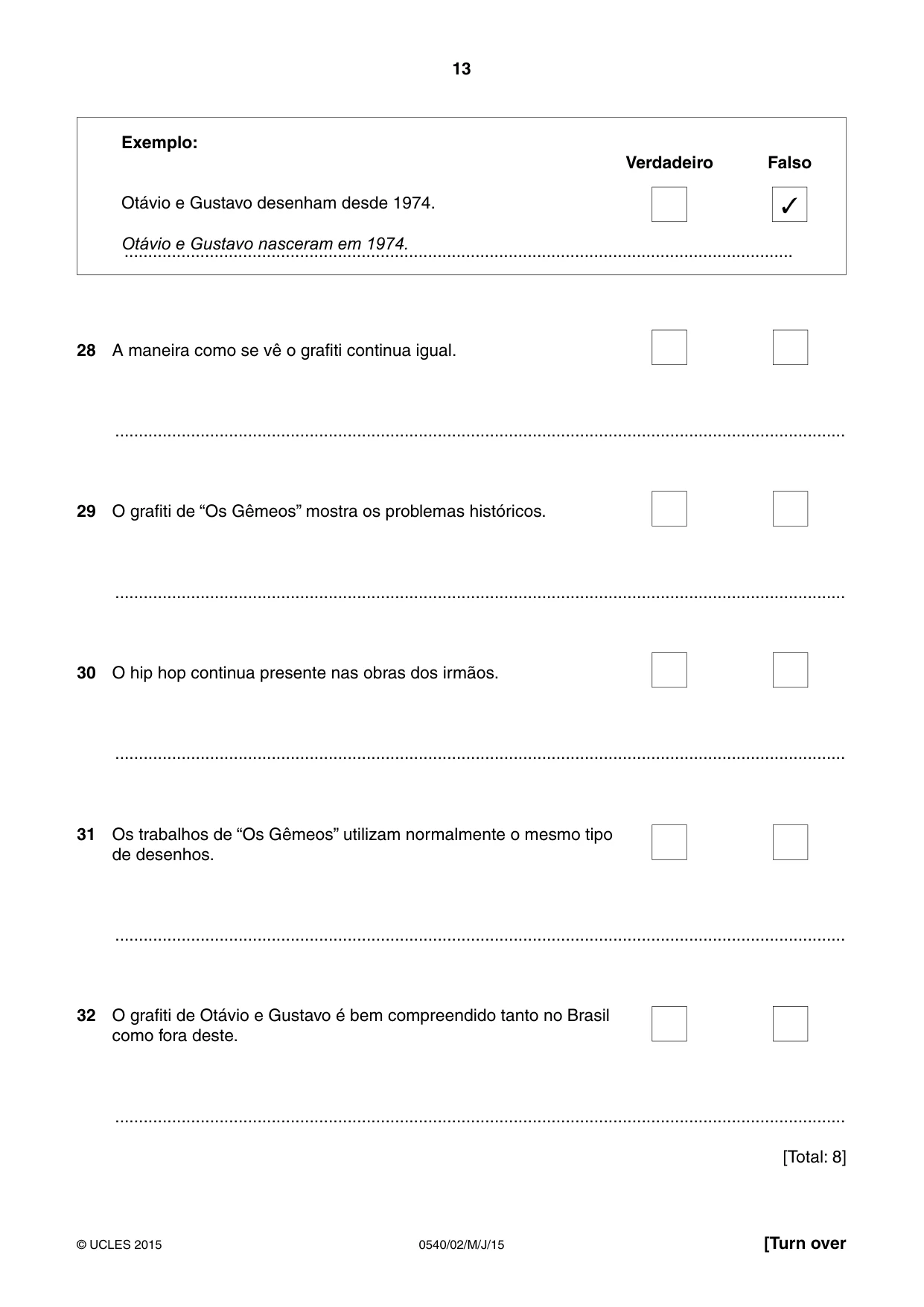
13 0540/02/M/J/15 © UCLES 2015 [Turn over Exemplo: Verdadeiro Falso Otávio e Gustavo desenham desde 1974. ✓ Otávio e Gustavo nasceram em 1974. … 28 A maneira como se vê o grafiti continua igual. … 29 O grafiti de “Os Gêmeos” mostra os problemas históricos. … 30 O hip hop continua presente nas obras dos irmãos. … 31 Os trabalhos de “Os Gêmeos” utilizam normalmente o mesmo tipo de desenhos. … 32 O grafiti de Otávio e Gustavo é bem compreendido tanto no Brasil como fora deste. … [Total: 8]
Question paper, page 14
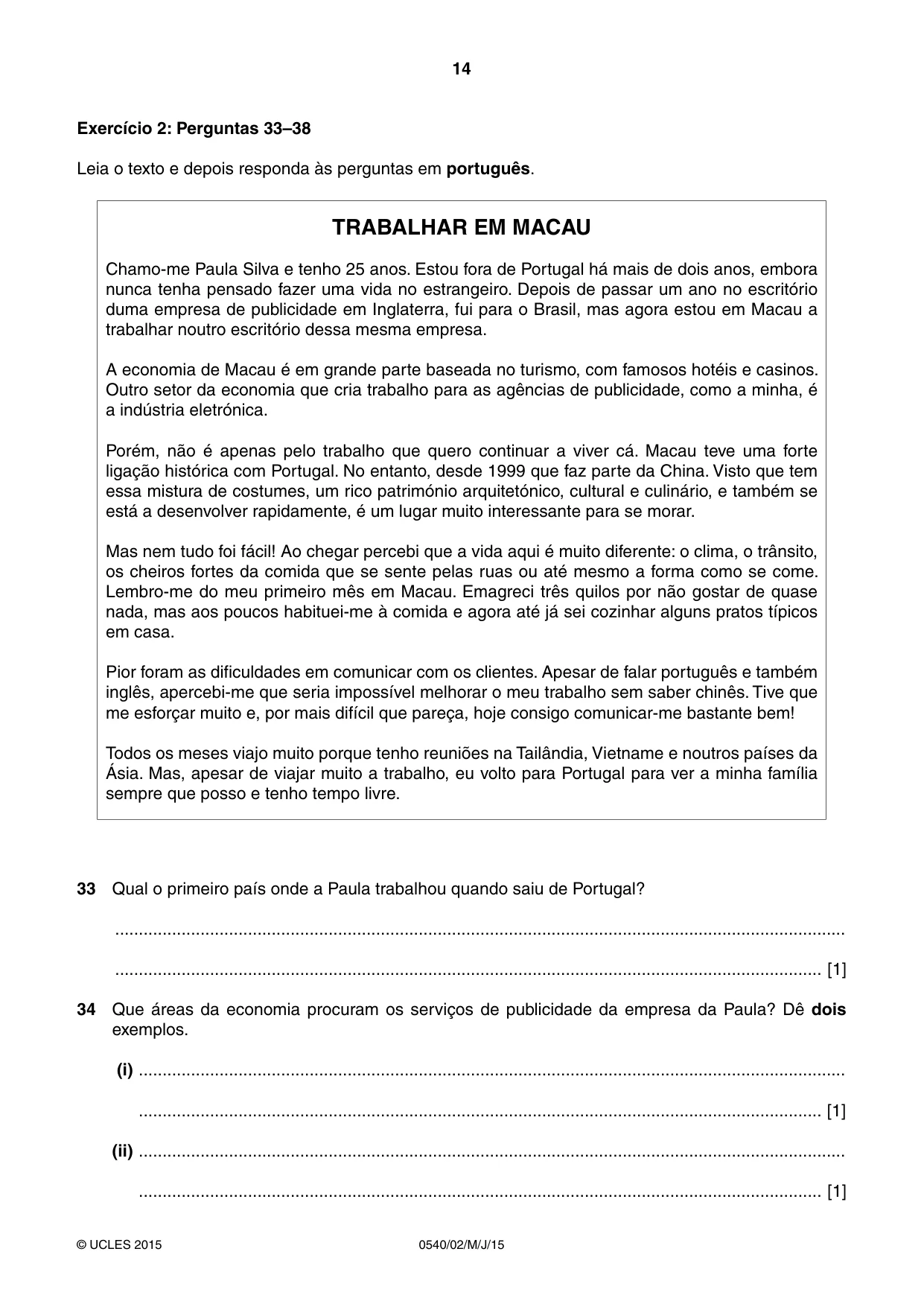
14 0540/02/M/J/15 © UCLES 2015 Exercício 2: Perguntas 33–38 Leia o texto e depois responda às perguntas em português. TRABALHAR EM MACAU Chamo-me Paula Silva e tenho 25 anos. Estou fora de Portugal há mais de dois anos, embora nunca tenha pensado fazer uma vida no estrangeiro. Depois de passar um ano no escritório duma empresa de publicidade em Inglaterra, fui para o Brasil, mas agora estou em Macau a trabalhar noutro escritório dessa mesma empresa. A economia de Macau é em grande parte baseada no turismo, com famosos hotéis e casinos. Outro setor da economia que cria trabalho para as agências de publicidade, como a minha, é a indústria eletrónica. Porém, não é apenas pelo trabalho que quero continuar a viver cá. Macau teve uma forte ligação histórica com Portugal. No entanto, desde 1999 que faz parte da China. Visto que tem essa mistura de costumes, um rico património arquitetónico, cultural e culinário, e também se está a desenvolver rapidamente, é um lugar muito interessante para se morar. Mas nem tudo foi fácil! Ao chegar percebi que a vida aqui é muito diferente: o clima, o trânsito, os cheiros fortes da comida que se sente pelas ruas ou até mesmo a forma como se come. Lembro-me do meu primeiro mês em Macau. Emagreci três quilos por não gostar de quase nada, mas aos poucos habituei-me à comida e agora até já sei cozinhar alguns pratos típicos em casa. Pior foram as dificuldades em comunicar com os clientes. Apesar de falar português e também inglês, apercebi-me que seria impossível melhorar o meu trabalho sem saber chinês. Tive que me esforçar muito e, por mais difícil que pareça, hoje consigo comunicar-me bastante bem! Todos os meses viajo muito porque tenho reuniões na Tailândia, Vietname e noutros países da Ásia. Mas, apesar de viajar muito a trabalho, eu volto para Portugal para ver a minha família sempre que posso e tenho tempo livre. 33 Qual o primeiro país onde a Paula trabalhou quando saiu de Portugal? … … [1] 34 Que áreas da economia procuram os serviços de publicidade da empresa da Paula? Dê dois exemplos. (i) … … [1] (ii) … … [1]
Question paper, page 15
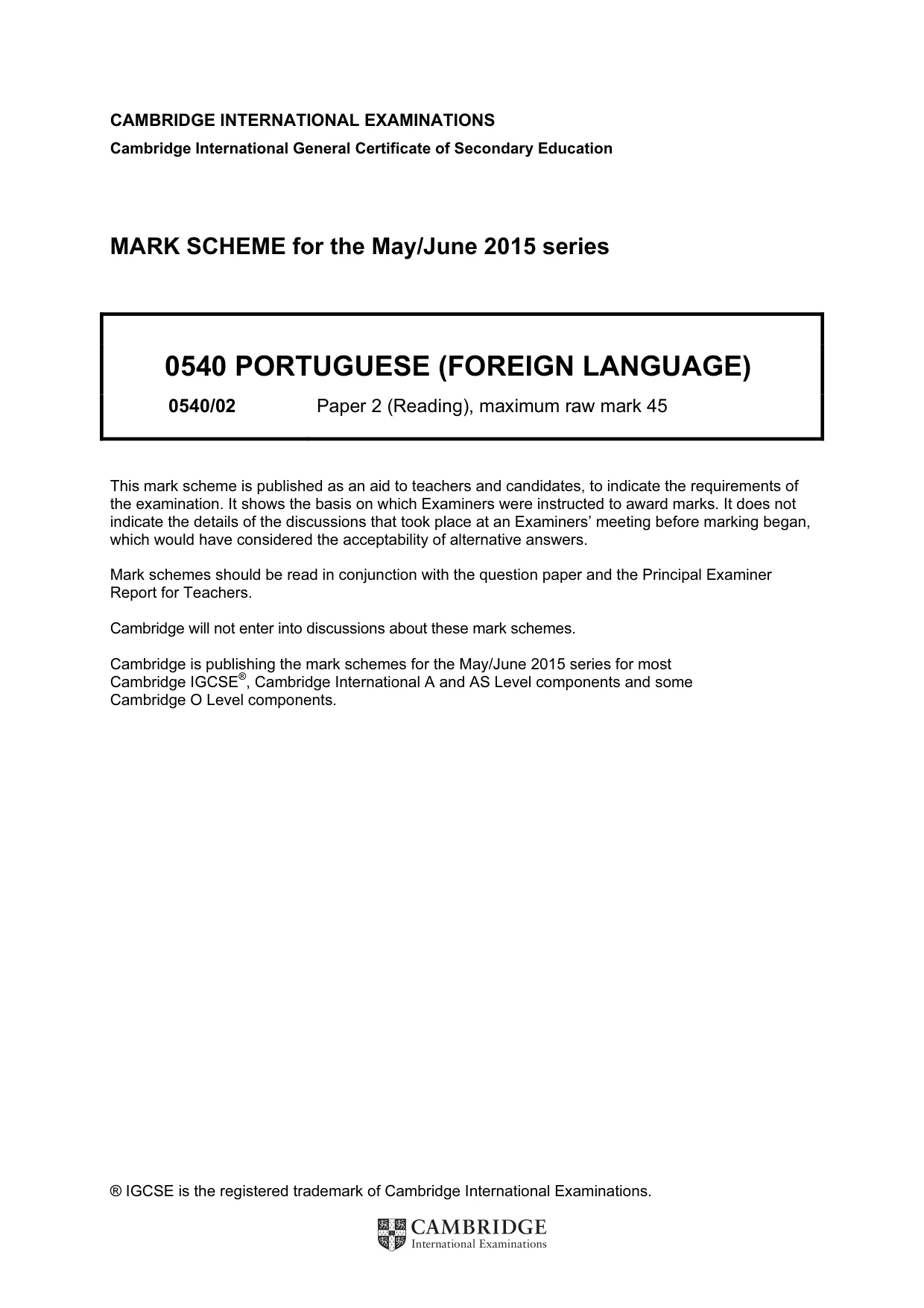
15 0540/02/M/J/15 © UCLES 2015 35 A Paula gosta de trabalhar em Macau. Dê outro motivo para ela querer ficar em Macau. … [1] 36 Porque é que a Paula perdeu peso logo depois de chegar a Macau? … [1] 37 O que foi que a Paula teve que aprender para o seu trabalho? … [1] 38 Para onde vai a Paula nas férias? … [1] [Total: 7]
Question paper, page 16
16 0540/02/M/J/15 © UCLES 2015 Permission to reproduce items where third-party owned material protected by copyright is included has been sought and cleared where possible. Every reasonable effort has been made by the publisher (UCLES) to trace copyright holders, but if any items requiring clearance have unwittingly been included, the publisher will be pleased to make amends at the earliest possible opportunity. To avoid the issue of disclosure of answer-related information to candidates, all copyright acknowledgements are reproduced online in the Cambridge International Examinations Copyright Acknowledgements Booklet. This is produced for each series of examinations and is freely available to download at www.cie.org.uk after the live examination series. Cambridge International Examinations is part of the Cambridge Assessment Group. Cambridge Assessment is the brand name of University of Cambridge Local Examinations Syndicate (UCLES), which is itself a department of the University of Cambridge. BLANK PAGE
Mark scheme, page 1
® IGCSE is the registered trademark of Cambridge International Examinations. CAMBRIDGE INTERNATIONAL EXAMINATIONS Cambridge International General Certificate of Secondary Education MARK SCHEME for the May/June 2015 series 0540 PORTUGUESE (FOREIGN LANGUAGE) 0540/02 Paper 2 (Reading), maximum raw mark 45 This mark scheme is published as an aid to teachers and candidates, to indicate the requirements of the examination. It shows the basis on which Examiners were instructed to award marks. It does not indicate the details of the discussions that took place at an Examiners’ meeting before marking began, which would have considered the acceptability of alternative answers. Mark schemes should be read in conjunction with the question paper and the Principal Examiner Report for Teachers. Cambridge will not enter into discussions about these mark schemes. Cambridge is publishing the mark schemes for the May/June 2015 series for most Cambridge IGCSE®, Cambridge International A and AS Level components and some Cambridge O Level components.
Mark scheme, page 2
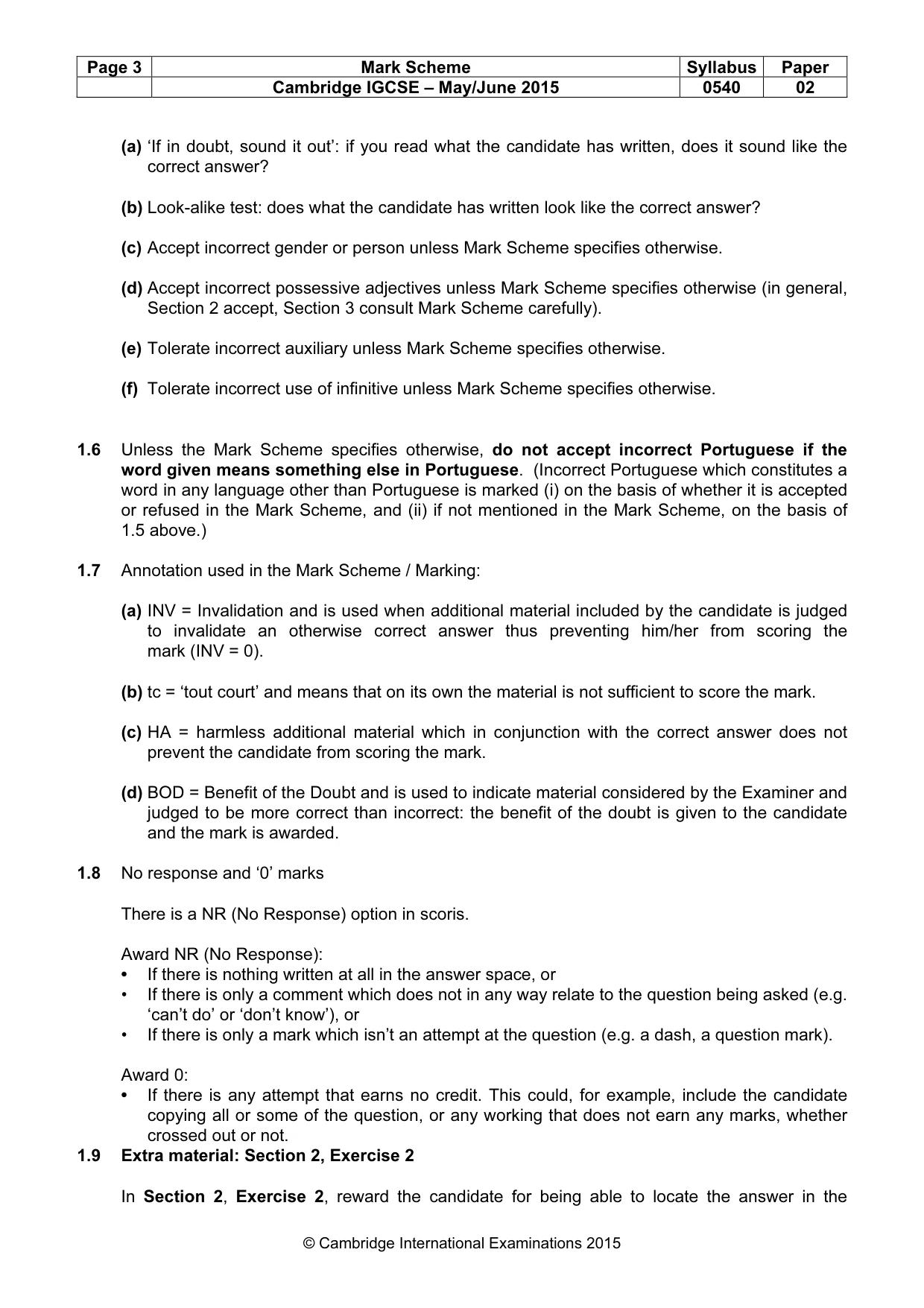
Page 2 Mark Scheme Syllabus Paper Cambridge IGCSE – May/June 2015 0540 02 © Cambridge International Examinations 2015 1 General Marking Principles 1.1 Please note that it is not possible to list all acceptable alternatives in the Detailed Mark Scheme provided in Section 2. You will need to consider all alternative answers and unexpected approaches in candidates’ scripts, make a decision on whether they communicate the required elements, in consultation with your Team Leader if necessary (or with your Product Manager if you are a single Examiner), and award marks accordingly. The following marking principles underpin the detailed instructions provided in Section 2 of the Mark Scheme. Where a decision is taken to deviate from these principles for a particular question, this will be specified in the Mark Scheme. 1.2 Crossing out: (a) If a candidate changes his/her mind over an answer and crosses out an attempt, award a mark if the final attempt is correct. (b) If a candidate crosses out an answer to a whole question but makes no second attempt at it, mark the crossed out work. 1.3 More than the stipulated number of boxes ticked/crossed by the candidate: (a) If more than one attempt is visible, but the candidate has clearly indicated which attempt is his/her final answer (e.g. by crossing out other attempts or by annotating the script in some way), mark in the usual way. (b) If two attempts are visible (e.g. 2 boxes ticked instead of the 1 box stipulated), and neither has been crossed out/discounted by the candidate, no mark can be awarded. (c) In questions where candidates are required to tick a number of boxes (e.g. tick the 6 true statements) the general rule to be applied is as follows: the number of ‘extra’ answers indicated by the candidate is deducted from the number of correct answers and the remaining number is the mark awarded. For example, the candidate is required to tick 6 true statements, but instead ticks 8 statements. 5 of the ticks are correctly placed, but there are 2 ‘extra’ ticks (8 ticks placed by candidate minus 6 ticks required by rubric = 2 ‘extras’). Therefore the candidate is awarded a mark of 3 number of correct ticks: 5 minus number of extra ticks: –2 mark awarded: 3 (d) Answers in pen do not take precedence over answers in pencil, e.g. if a candidate is asked to tick 1 box and ticks 2, one in pen and the other in pencil, the mark cannot be awarded unless there is some explicit indication from the candidate as to which is his/her final answer. 1.4 For questions requiring more than one element for the answer, (i) and (ii), where the answers are interchangeable: Both correct answers on line 1, and line 2 blank = 2 Both correct answers on line 1, and line 2 wrong = 1 (or vice-versa) 1.5 Answers requiring the use of Portuguese (rather than a non-verbal response) should be marked for communication. Tolerate inaccuracies, provided the message is clear.
Mark scheme, page 3
Page 3 Mark Scheme Syllabus Paper Cambridge IGCSE – May/June 2015 0540 02 © Cambridge International Examinations 2015 (a) ‘If in doubt, sound it out’: if you read what the candidate has written, does it sound like the correct answer? (b) Look-alike test: does what the candidate has written look like the correct answer? (c) Accept incorrect gender or person unless Mark Scheme specifies otherwise. (d) Accept incorrect possessive adjectives unless Mark Scheme specifies otherwise (in general, Section 2 accept, Section 3 consult Mark Scheme carefully). (e) Tolerate incorrect auxiliary unless Mark Scheme specifies otherwise. (f) Tolerate incorrect use of infinitive unless Mark Scheme specifies otherwise. 1.6 Unless the Mark Scheme specifies otherwise, do not accept incorrect Portuguese if the word given means something else in Portuguese. (Incorrect Portuguese which constitutes a word in any language other than Portuguese is marked (i) on the basis of whether it is accepted or refused in the Mark Scheme, and (ii) if not mentioned in the Mark Scheme, on the basis of 1.5 above.) 1.7 Annotation used in the Mark Scheme / Marking: (a) INV = Invalidation and is used when additional material included by the candidate is judged to invalidate an otherwise correct answer thus preventing him/her from scoring the mark (INV = 0). (b) tc = ‘tout court’ and means that on its own the material is not sufficient to score the mark. (c) HA = harmless additional material which in conjunction with the correct answer does not prevent the candidate from scoring the mark. (d) BOD = Benefit of the Doubt and is used to indicate material considered by the Examiner and judged to be more correct than incorrect: the benefit of the doubt is given to the candidate and the mark is awarded. 1.8 No response and ‘0’ marks There is a NR (No Response) option in scoris. Award NR (No Response): • If there is nothing written at all in the answer space, or • If there is only a comment which does not in any way relate to the question being asked (e.g. ‘can’t do’ or ‘don’t know’), or • If there is only a mark which isn’t an attempt at the question (e.g. a dash, a question mark). Award 0: • If there is any attempt that earns no credit. This could, for example, include the candidate copying all or some of the question, or any working that does not earn any marks, whether crossed out or not. 1.9 Extra material: Section 2, Exercise 2 In Section 2, Exercise 2, reward the candidate for being able to locate the answer in the
Mark scheme, page 4
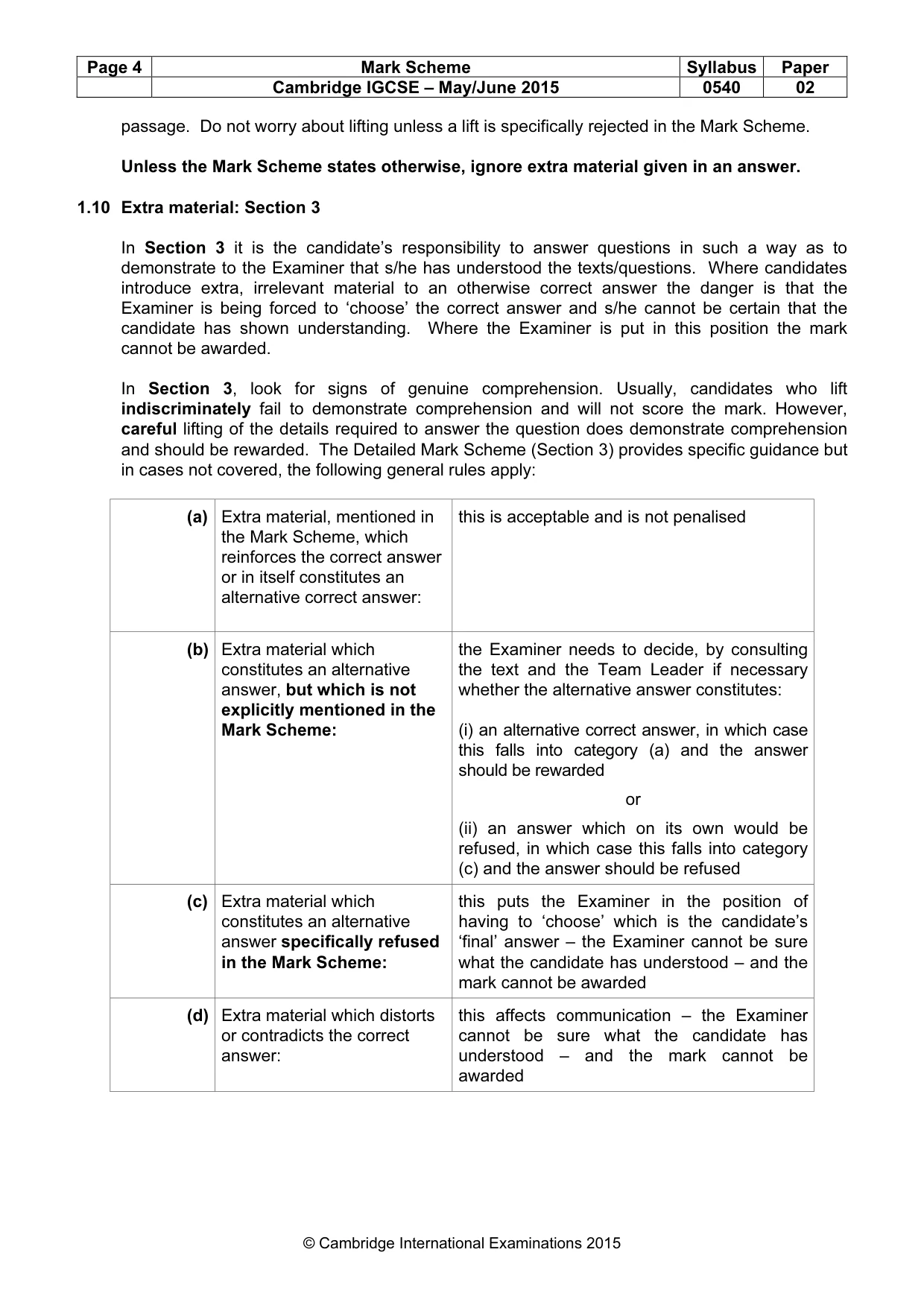
Page 4 Mark Scheme Syllabus Paper Cambridge IGCSE – May/June 2015 0540 02 © Cambridge International Examinations 2015 passage. Do not worry about lifting unless a lift is specifically rejected in the Mark Scheme. Unless the Mark Scheme states otherwise, ignore extra material given in an answer. 1.10 Extra material: Section 3 In Section 3 it is the candidate’s responsibility to answer questions in such a way as to demonstrate to the Examiner that s/he has understood the texts/questions. Where candidates introduce extra, irrelevant material to an otherwise correct answer the danger is that the Examiner is being forced to ‘choose’ the correct answer and s/he cannot be certain that the candidate has shown understanding. Where the Examiner is put in this position the mark cannot be awarded. In Section 3, look for signs of genuine comprehension. Usually, candidates who lift indiscriminately fail to demonstrate comprehension and will not score the mark. However, careful lifting of the details required to answer the question does demonstrate comprehension and should be rewarded. The Detailed Mark Scheme (Section 3) provides specific guidance but in cases not covered, the following general rules apply: (a) Extra material, mentioned in the Mark Scheme, which reinforces the correct answer or in itself constitutes an alternative correct answer: this is acceptable and is not penalised (b) Extra material which constitutes an alternative answer, but which is not explicitly mentioned in the Mark Scheme: the Examiner needs to decide, by consulting the text and the Team Leader if necessary whether the alternative answer constitutes: (i) an alternative correct answer, in which case this falls into category (a) and the answer should be rewarded or (ii) an answer which on its own would be refused, in which case this falls into category (c) and the answer should be refused (c) Extra material which constitutes an alternative answer specifically refused in the Mark Scheme: this puts the Examiner in the position of having to ‘choose’ which is the candidate’s ‘final’ answer – the Examiner cannot be sure what the candidate has understood – and the mark cannot be awarded (d) Extra material which distorts or contradicts the correct answer: this affects communication – the Examiner cannot be sure what the candidate has understood – and the mark cannot be awarded
Mark scheme, page 5
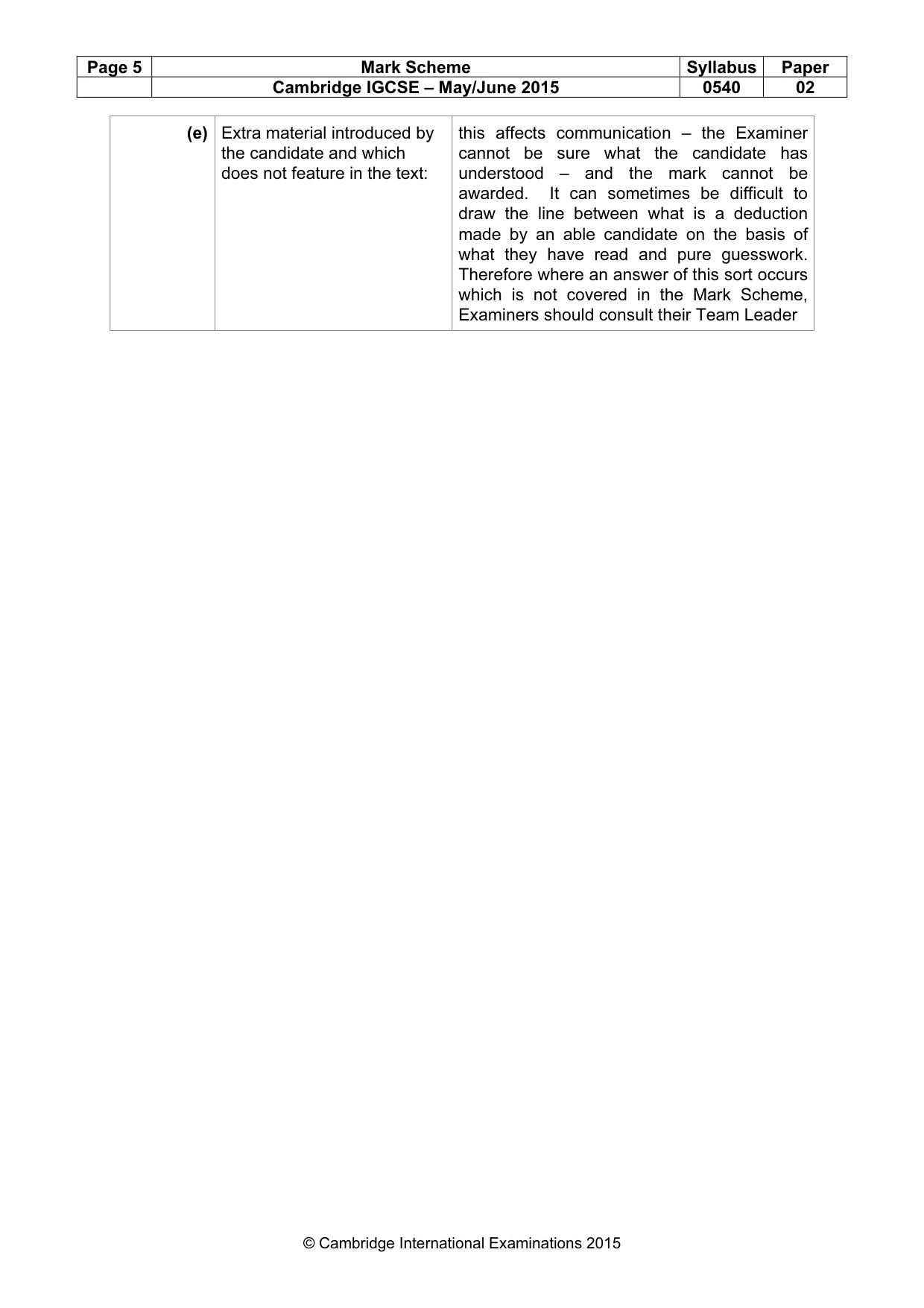
Page 5 Mark Scheme Syllabus Paper Cambridge IGCSE – May/June 2015 0540 02 © Cambridge International Examinations 2015 (e) Extra material introduced by the candidate and which does not feature in the text: this affects communication – the Examiner cannot be sure what the candidate has understood – and the mark cannot be awarded. It can sometimes be difficult to draw the line between what is a deduction made by an able candidate on the basis of what they have read and pure guesswork. Therefore where an answer of this sort occurs which is not covered in the Mark Scheme, Examiners should consult their Team Leader
Mark scheme, page 6
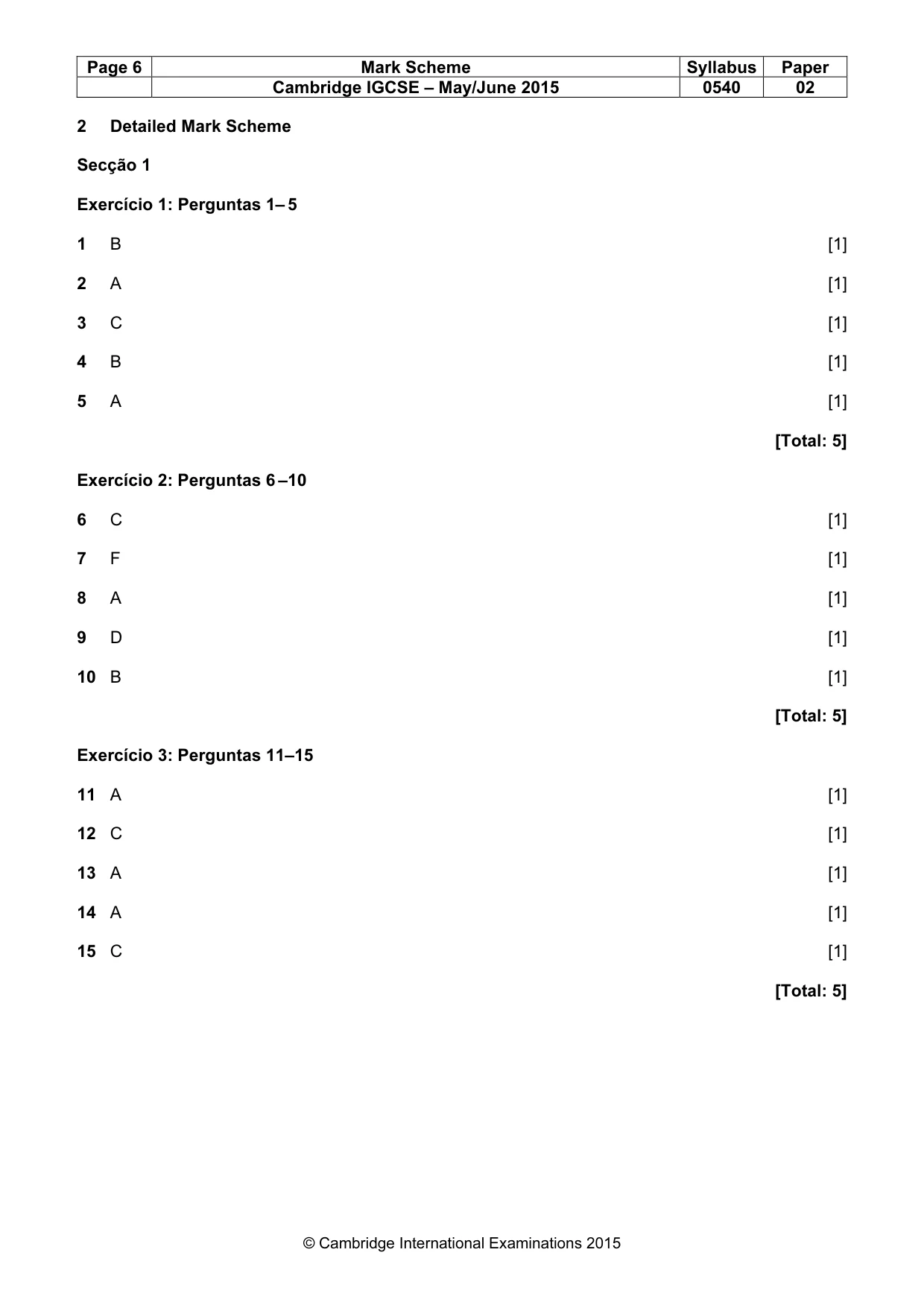
Page 6 Mark Scheme Syllabus Paper Cambridge IGCSE – May/June 2015 0540 02 © Cambridge International Examinations 2015 2 Detailed Mark Scheme Secção 1 Exercício 1: Perguntas 1– 5 1 B [1] 2 A [1] 3 C [1] 4 B [1] 5 A [1] [Total: 5] Exercício 2: Perguntas 6 –10 6 C [1] 7 F [1] 8 A [1] 9 D [1] 10 B [1] [Total: 5] Exercício 3: Perguntas 11–15 11 A [1] 12 C [1] 13 A [1] 14 A [1] 15 C [1] [Total: 5]
Mark scheme, page 7
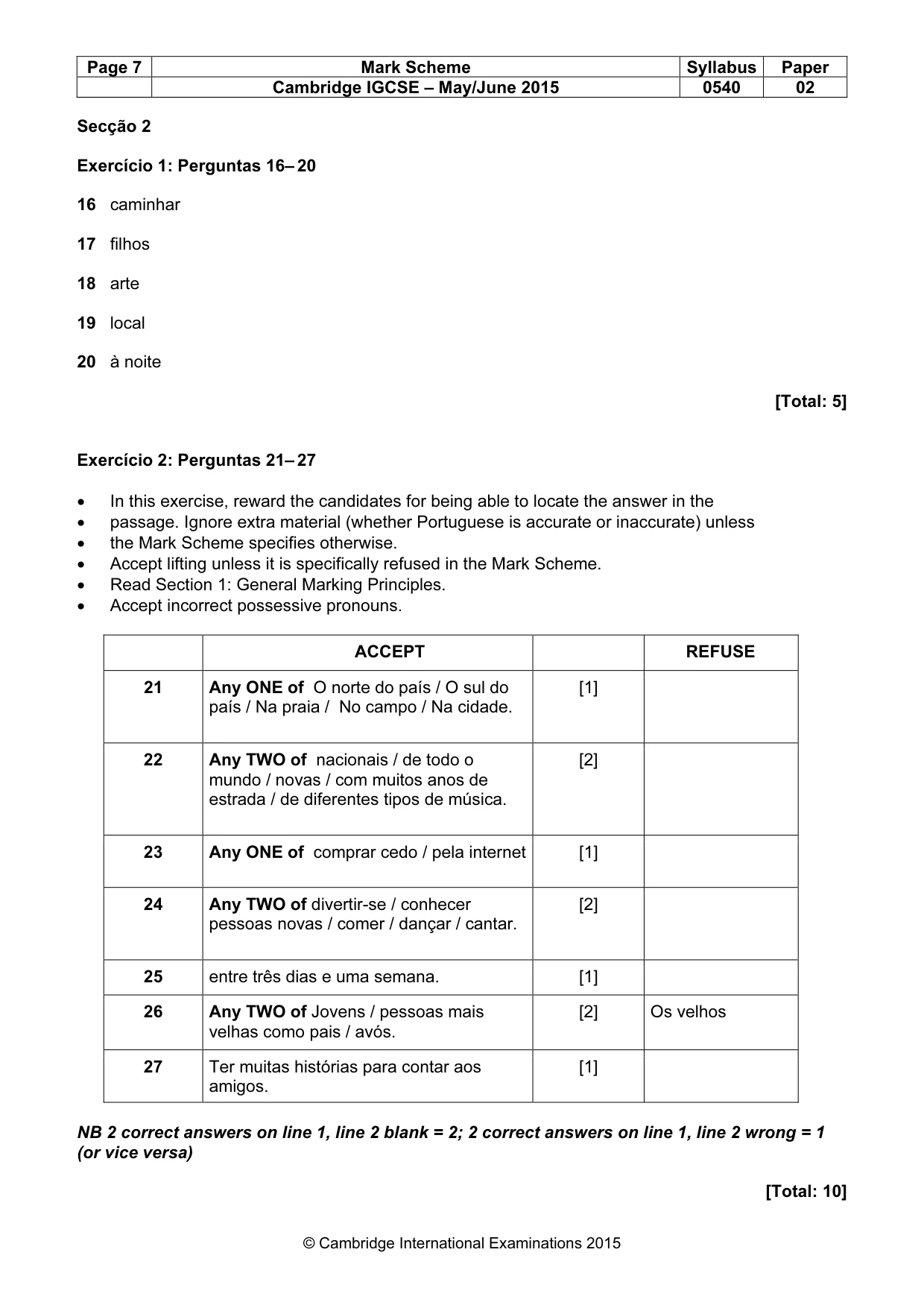
Page 7 Mark Scheme Syllabus Paper Cambridge IGCSE – May/June 2015 0540 02 © Cambridge International Examinations 2015 Secção 2 Exercício 1: Perguntas 16– 20 16 caminhar 17 filhos 18 arte 19 local 20 à noite [Total: 5] Exercício 2: Perguntas 21– 27 • In this exercise, reward the candidates for being able to locate the answer in the • passage. Ignore extra material (whether Portuguese is accurate or inaccurate) unless • the Mark Scheme specifies otherwise. • Accept lifting unless it is specifically refused in the Mark Scheme. • Read Section 1: General Marking Principles. • Accept incorrect possessive pronouns. ACCEPT REFUSE 21 Any ONE of O norte do país / O sul do país / Na praia / No campo / Na cidade. [1] 22 Any TWO of nacionais / de todo o mundo / novas / com muitos anos de estrada / de diferentes tipos de música. [2] 23 Any ONE of comprar cedo / pela internet [1] 24 Any TWO of divertir-se / conhecer pessoas novas / comer / dançar / cantar. [2] 25 entre três dias e uma semana. [1] 26 Any TWO of Jovens / pessoas mais velhas como pais / avós. [2] Os velhos 27 Ter muitas histórias para contar aos amigos. [1] NB 2 correct answers on line 1, line 2 blank = 2; 2 correct answers on line 1, line 2 wrong = 1 (or vice versa) [Total: 10]
Mark scheme, page 8
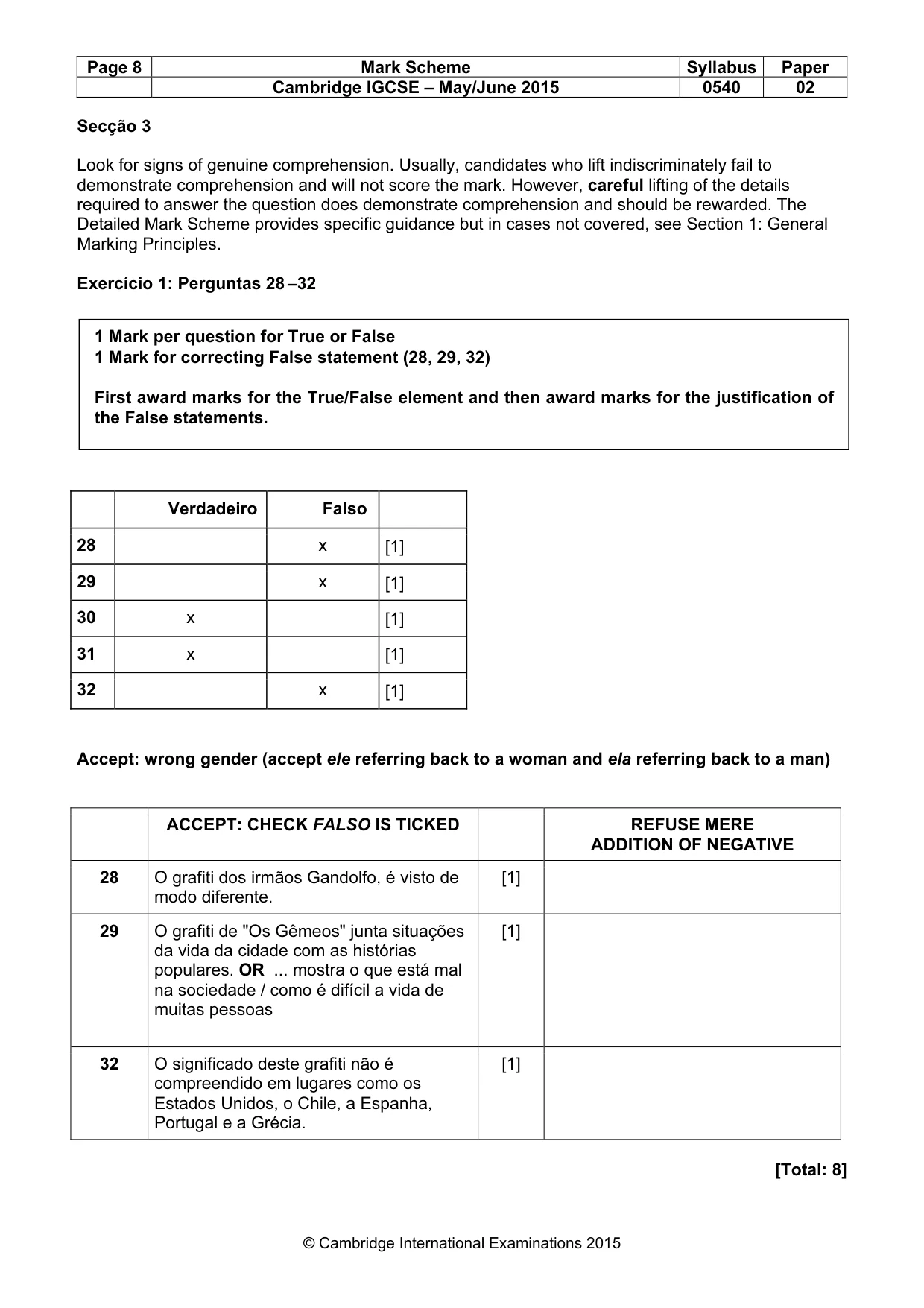
Page 8 Mark Scheme Syllabus Paper Cambridge IGCSE – May/June 2015 0540 02 © Cambridge International Examinations 2015 Secção 3 Look for signs of genuine comprehension. Usually, candidates who lift indiscriminately fail to demonstrate comprehension and will not score the mark. However, careful lifting of the details required to answer the question does demonstrate comprehension and should be rewarded. The Detailed Mark Scheme provides specific guidance but in cases not covered, see Section 1: General Marking Principles. Exercício 1: Perguntas 28 –32 Verdadeiro Falso 28 x [1] 29 x [1] 30 x [1] 31 x [1] 32 x [1] Accept: wrong gender (accept ele referring back to a woman and ela referring back to a man) ACCEPT: CHECK FALSO IS TICKED REFUSE MERE ADDITION OF NEGATIVE 28 O grafiti dos irmãos Gandolfo, é visto de modo diferente. [1] 29 O grafiti de "Os Gêmeos" junta situações da vida da cidade com as histórias populares. OR ... mostra o que está mal na sociedade / como é difícil a vida de muitas pessoas [1] 32 O significado deste grafiti não é compreendido em lugares como os Estados Unidos, o Chile, a Espanha, Portugal e a Grécia. [1] [Total: 8] 1 Mark per question for True or False 1 Mark for correcting False statement (28, 29, 32) First award marks for the True/False element and then award marks for the justification of the False statements.
Mark scheme, page 9
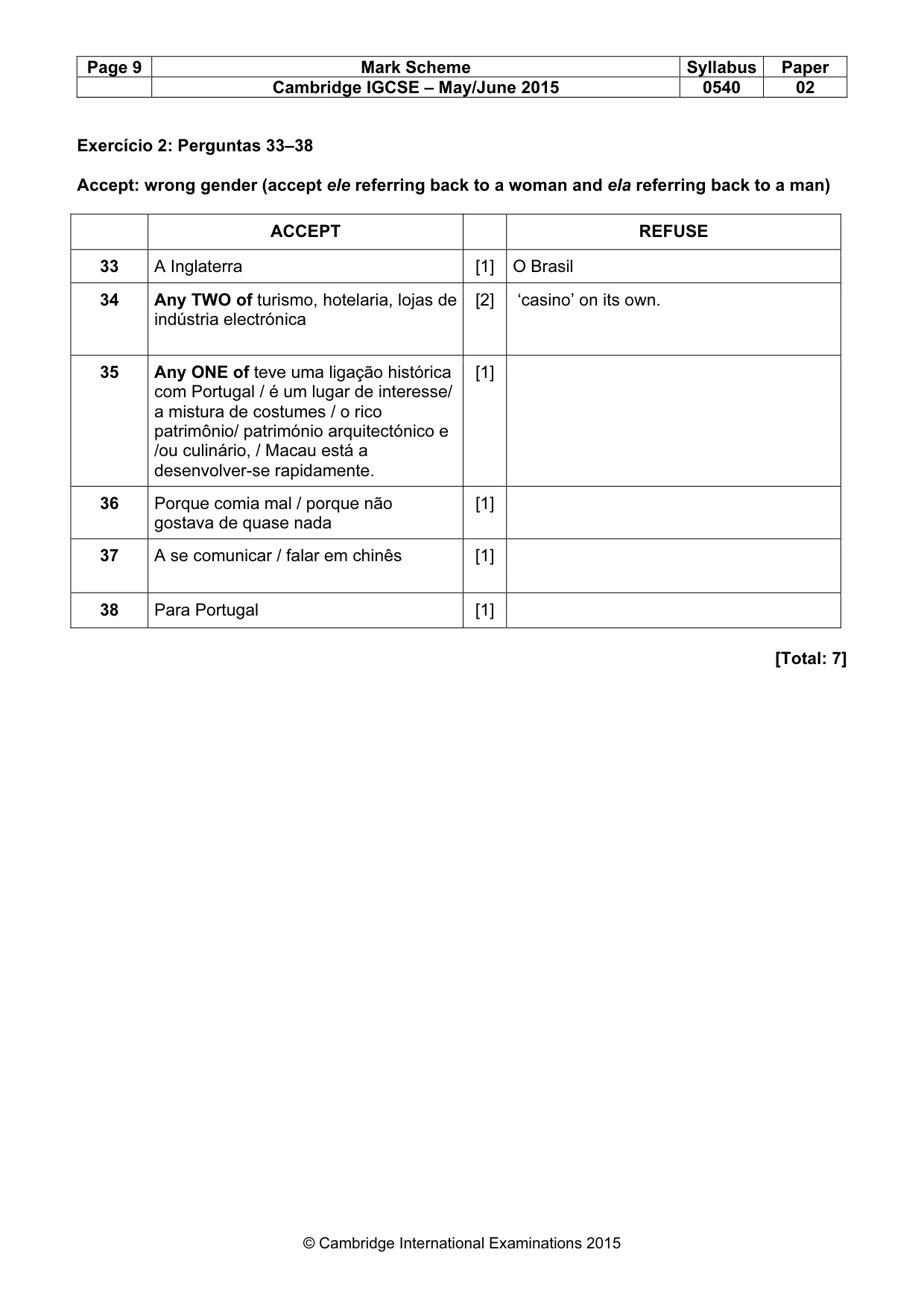
Page 9 Mark Scheme Syllabus Paper Cambridge IGCSE – May/June 2015 0540 02 © Cambridge International Examinations 2015 Exercício 2: Perguntas 33–38 Accept: wrong gender (accept ele referring back to a woman and ela referring back to a man) ACCEPT REFUSE 33 A Inglaterra [1] O Brasil 34 Any TWO of turismo, hotelaria, lojas de indústria electrónica [2] ‘casino’ on its own. 35 Any ONE of teve uma ligação histórica com Portugal / é um lugar de interesse/ a mistura de costumes / o rico patrimônio/ património arquitectónico e /ou culinário, / Macau está a desenvolver-se rapidamente. [1] 36 Porque comia mal / porque não gostava de quase nada [1] 37 A se comunicar / falar em chinês [1] 38 Para Portugal [1] [Total: 7]
What you needed in this session
Cambridge’s own grade thresholds for 2015 May/June, Paper 2 · Variant 1. A higher threshold means an easier paper — the bar moves with how the cohort did.