Cambridge IGCSE Portuguese - Foreign Language 0540 — 2010 May/June Paper 2 · Variant 1
0540/21/M/J/10 · 65 marks · ≈73 min
The question paper and its mark scheme, free to read here and free to download. This is Cambridge’s own paper, exactly as it was sat.
Question paper16 pages


Mark scheme11 pages
Answers below. Sit the paper first if you are practising.
Paper as text
Question paper, page 1
This document consists of 14 printed pages and 2 blank pages. DC (AC/SW) 17370/6 © UCLES 2010 [Turn over UNIVERSITY OF CAMBRIDGE INTERNATIONAL EXAMINATIONS International General Certificate of Secondary Education READ THESE INSTRUCTIONS FIRST Write your Centre number, candidate number and name on all the work you hand in. Write in dark blue or black pen. Do not use staples, paper clips, highlighters, glue or correction fluid. DO NOT WRITE IN ANY BARCODES. Answer all questions in Section 1, Section 2 and Section 3. At the end of the examination, fasten all your work securely together. The number of marks is given in brackets [ ] at the end of each question or part question. * 6 1 4 4 3 7 5 2 4 4 * CANDIDATE NAME CENTRE NUMBER CANDIDATE NUMBER PORTUGUESE 0540/02 Paper 2 Reading and Directed Writing May/June 2010 1 hour 30 minutes Candidates answer on the Question Paper. No Additional Materials are required. For Examiner’s Use Section 1 Section 2 Sub-Total Section 3 Total www.XtremePapers.com
Question paper, page 2
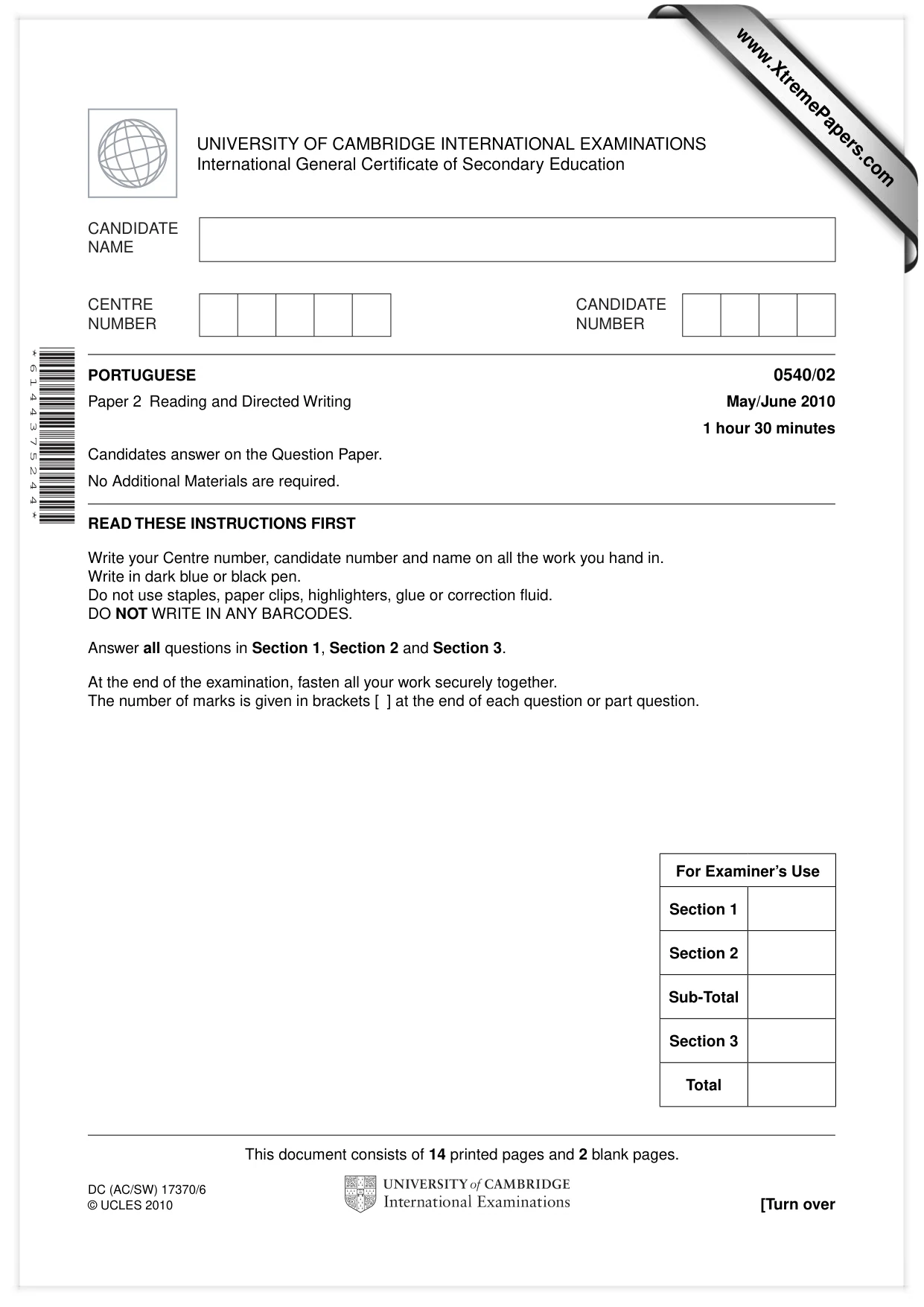
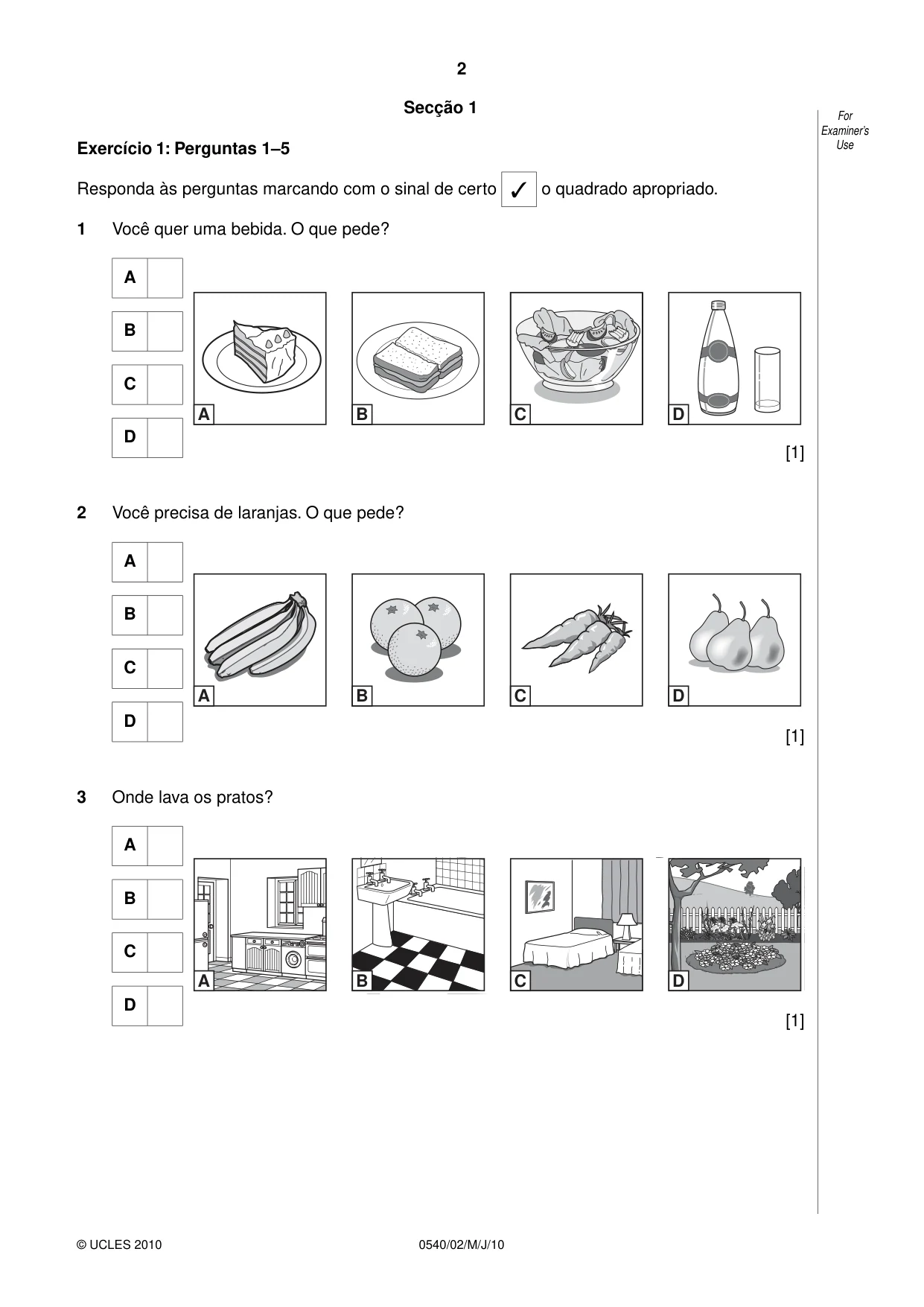
2 © UCLES 2010 0540/02/M/J/10 For Examiner’s Use Secção 1 Exercício 1: Perguntas 1–5 Responda às perguntas marcando com o sinal de certo ✓ o quadrado apropriado. 1 Você quer uma bebida. O que pede? A B C D [1] 2 Você precisa de laranjas. O que pede? A B C D [1] 3 Onde lava os pratos? A B C D [1] A B C D A B C D A B C D
Question paper, page 3
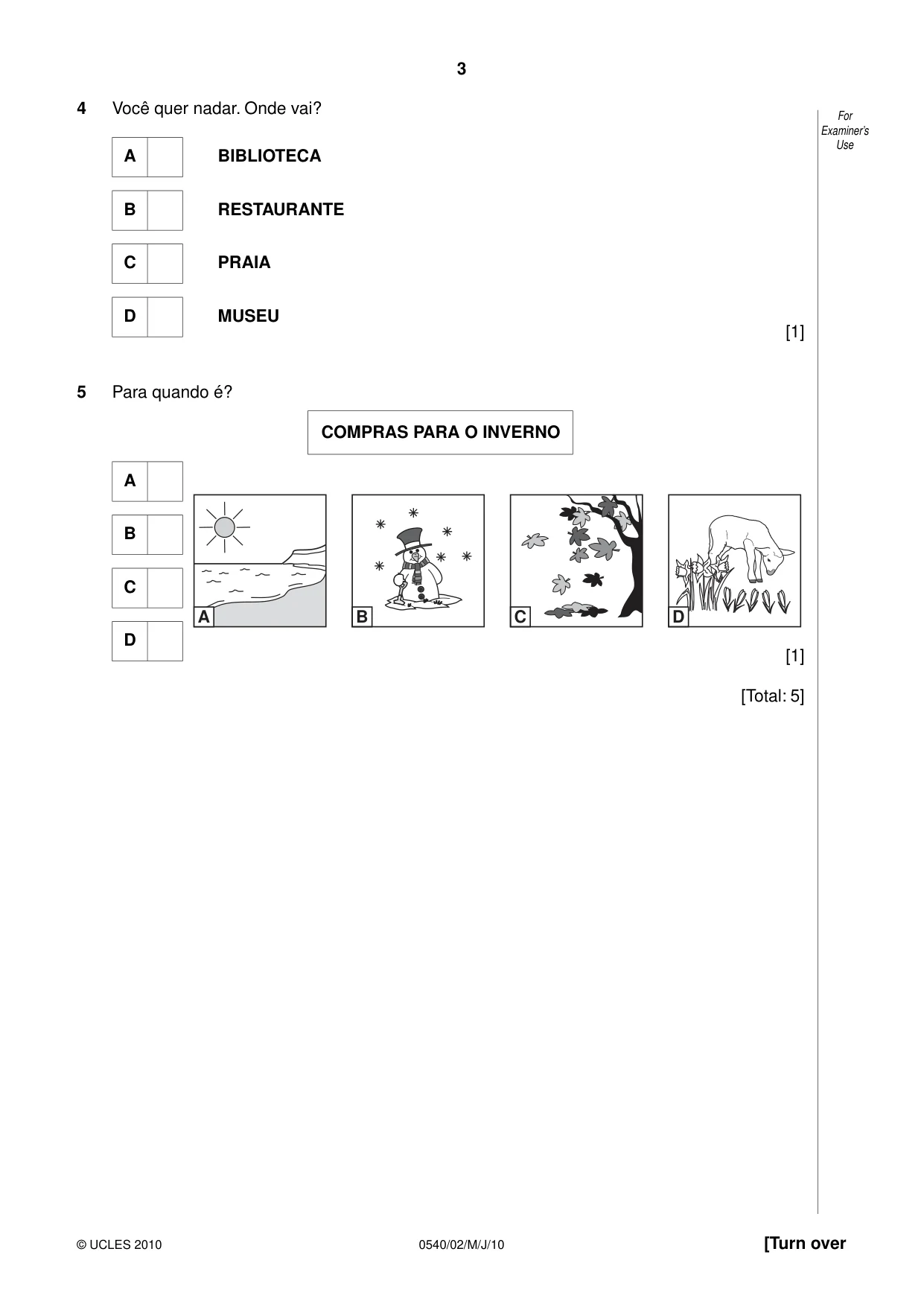
3 0540/02/M/J/10 © UCLES 2010 [Turn over For Examiner’s Use 4 Você quer nadar. Onde vai? A BIBLIOTECA B RESTAURANTE C PRAIA D MUSEU [1] 5 Para quando é? COMPRAS PARA O INVERNO A B C D [1] [Total: 5] A B C D
Question paper, page 4
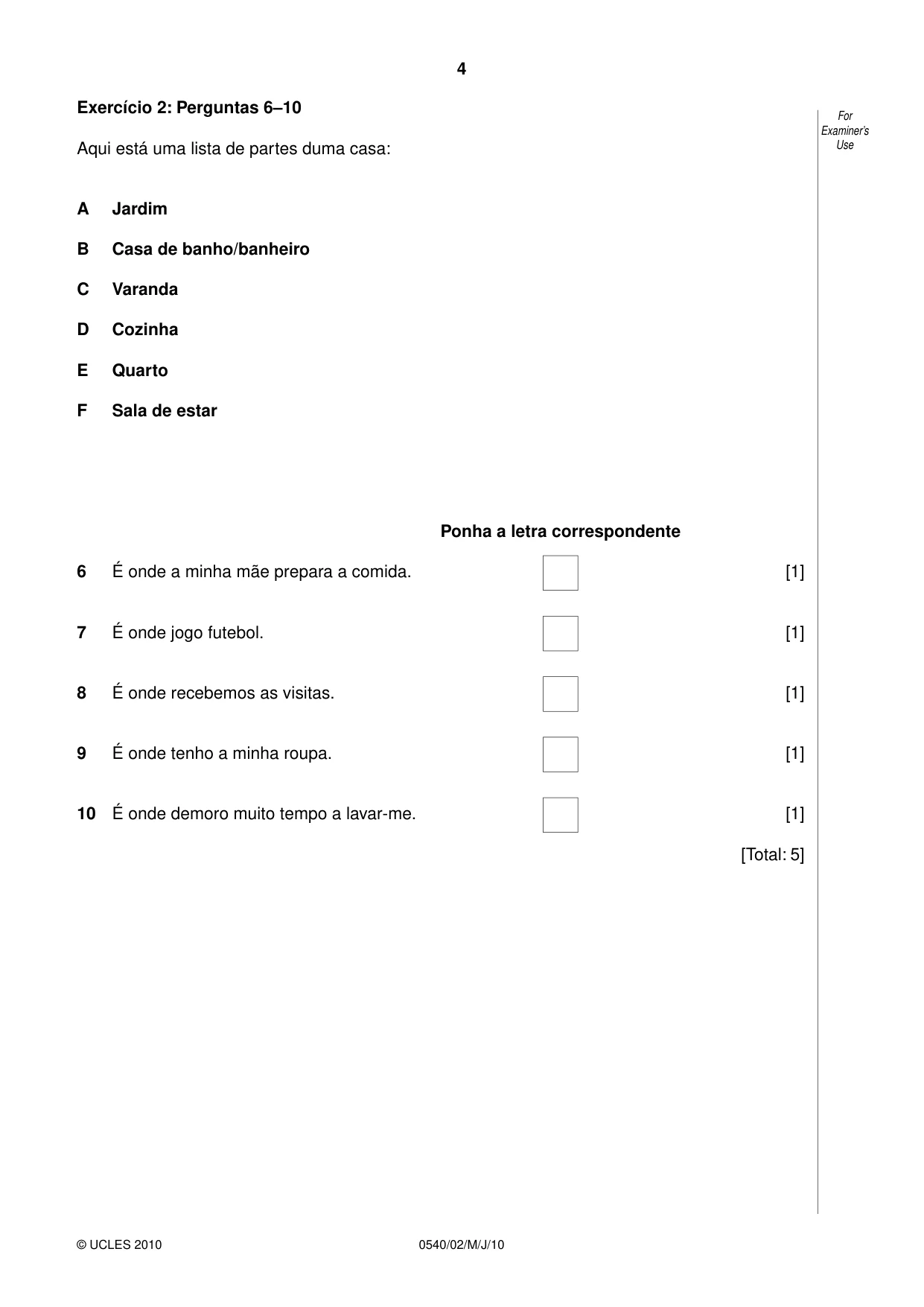
4 © UCLES 2010 0540/02/M/J/10 For Examiner’s Use Exercício 2: Perguntas 6–10 Aqui está uma lista de partes duma casa: A Jardim B Casa de banho/banheiro C Varanda D Cozinha E Quarto F Sala de estar Ponha a letra correspondente 6 É onde a minha mãe prepara a comida. [1] 7 É onde jogo futebol. [1] 8 É onde recebemos as visitas. [1] 9 É onde tenho a minha roupa. [1] 10 É onde demoro muito tempo a lavar-me. [1] [Total: 5]
Question paper, page 5
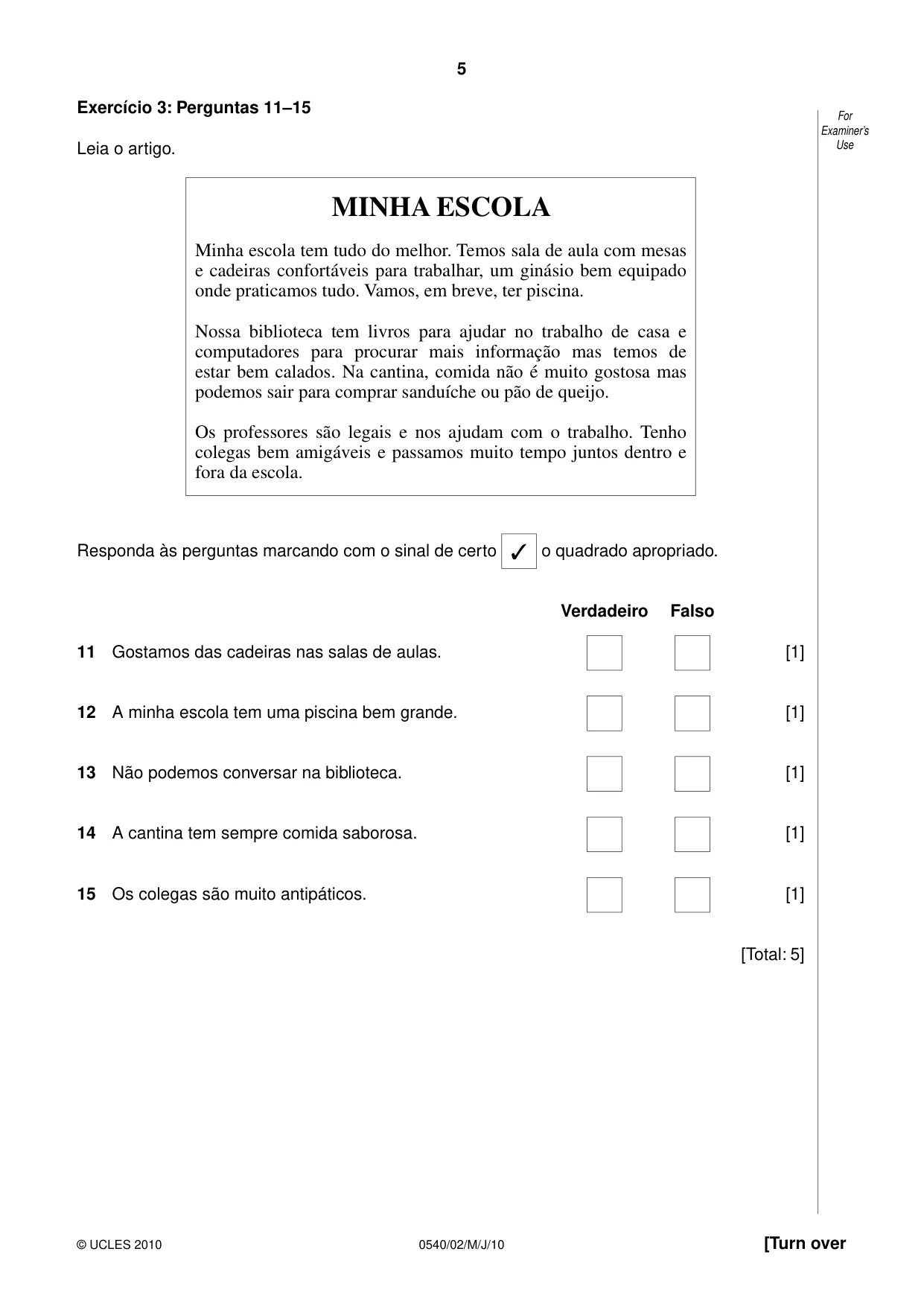
5 0540/02/M/J/10 © UCLES 2010 [Turn over For Examiner’s Use Exercício 3: Perguntas 11–15 Leia o artigo. MINHA ESCOLA Minha escola tem tudo do melhor. Temos sala de aula com mesas e cadeiras confortáveis para trabalhar, um ginásio bem equipado onde praticamos tudo. Vamos, em breve, ter piscina. Nossa biblioteca tem livros para ajudar no trabalho de casa e computadores para procurar mais informação mas temos de estar bem calados. Na cantina, comida não é muito gostosa mas podemos sair para comprar sanduíche ou pão de queijo. Os professores são legais e nos ajudam com o trabalho. Tenho colegas bem amigáveis e passamos muito tempo juntos dentro e fora da escola. Responda às perguntas marcando com o sinal de certo ✓ o quadrado apropriado. Verdadeiro Falso 11 Gostamos das cadeiras nas salas de aulas. [1] 12 A minha escola tem uma piscina bem grande. [1] 13 Não podemos conversar na biblioteca. [1] 14 A cantina tem sempre comida saborosa. [1] 15 Os colegas são muito antipáticos. [1] [Total: 5]
Question paper, page 6
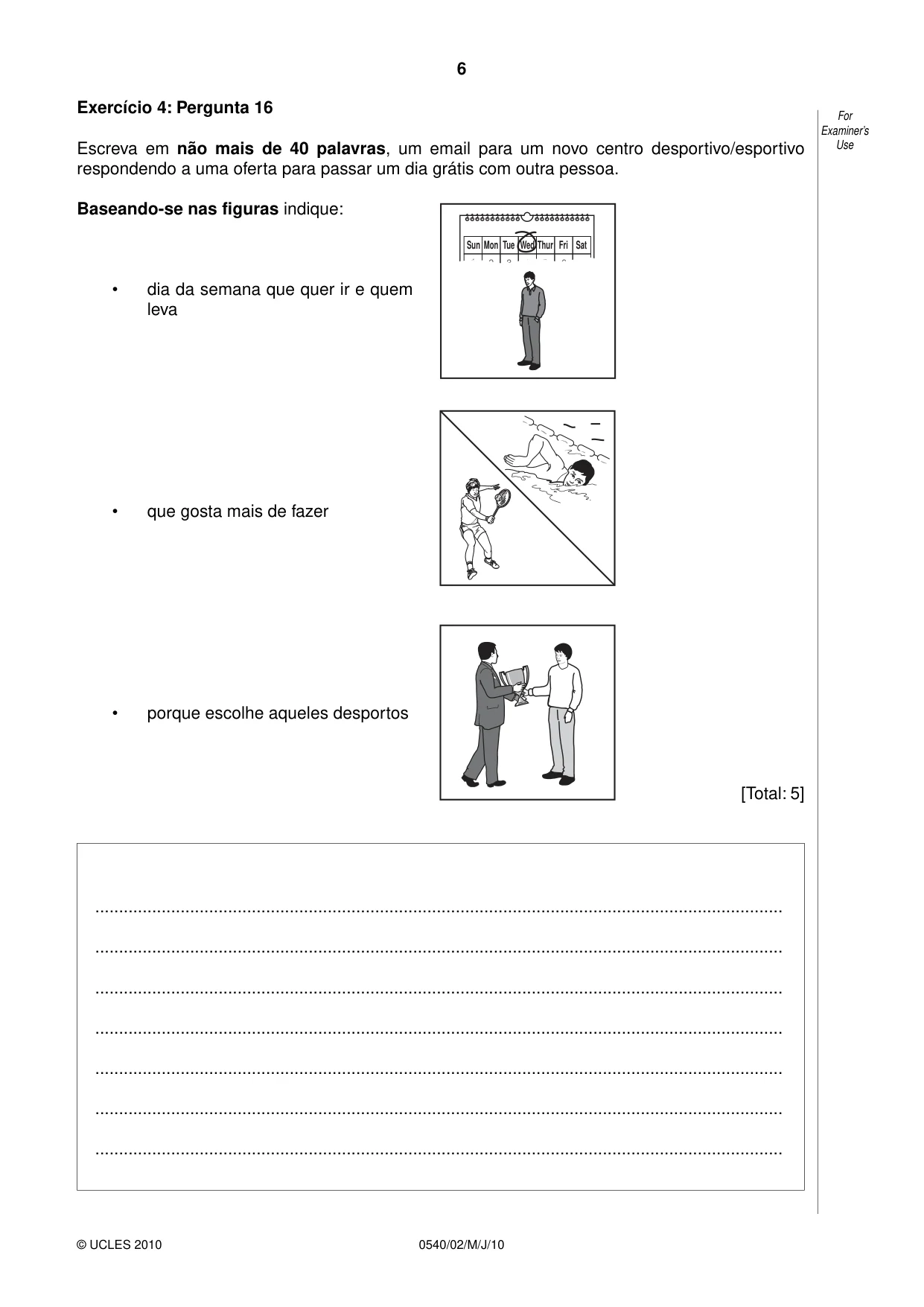
6 © UCLES 2010 0540/02/M/J/10 For Examiner’s Use Exercício 4: Pergunta 16 Escreva em não mais de 40 palavras, um email para um novo centro desportivo/esportivo respondendo a uma oferta para passar um dia grátis com outra pessoa. Baseando-se nas figuras indique: • dia da semana que quer ir e quem leva • que gosta mais de fazer • porque escolhe aqueles desportos [Total: 5] … … … … … … … Sun Mon Tue Wed Thur Fri Sat
Question paper, page 7
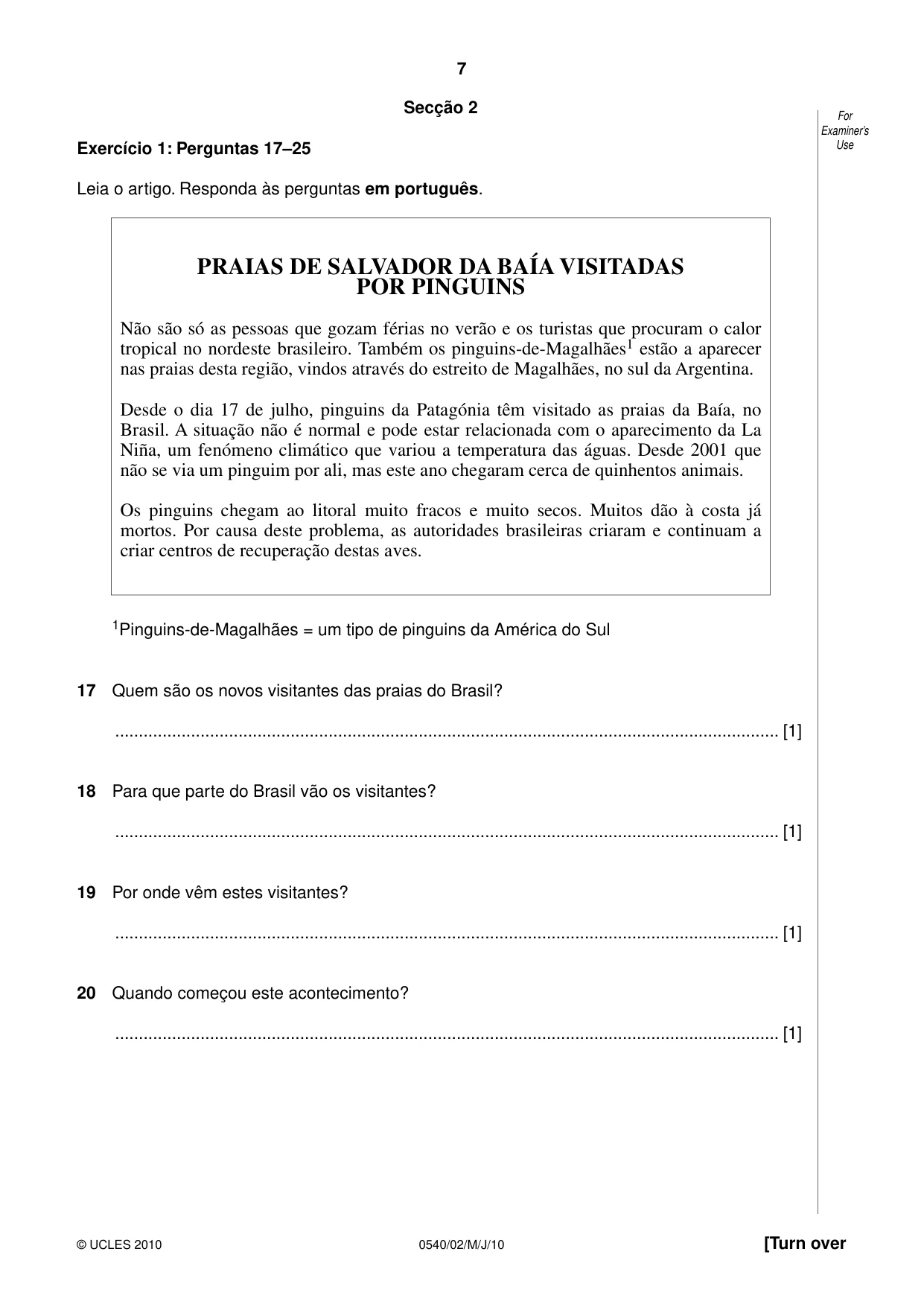
7 0540/02/M/J/10 © UCLES 2010 [Turn over For Examiner’s Use Secção 2 Exercício 1: Perguntas 17–25 Leia o artigo. Responda às perguntas em português. PRAIAS DE SALVADOR DA BAÍA VISITADAS POR PINGUINS Não são só as pessoas que gozam férias no verão e os turistas que procuram o calor tropical no nordeste brasileiro. Também os pinguins-de-Magalhães1 estão a aparecer nas praias desta região, vindos através do estreito de Magalhães, no sul da Argentina. Desde o dia 17 de julho, pinguins da Patagónia têm visitado as praias da Baía, no Brasil. A situação não é normal e pode estar relacionada com o aparecimento da La Niña, um fenómeno climático que variou a temperatura das águas. Desde 2001 que não se via um pinguim por ali, mas este ano chegaram cerca de quinhentos animais. Os pinguins chegam ao litoral muito fracos e muito secos. Muitos dão à costa já mortos. Por causa deste problema, as autoridades brasileiras criaram e continuam a criar centros de recuperação destas aves. 1Pinguins-de-Magalhães = um tipo de pinguins da América do Sul 17 Quem são os novos visitantes das praias do Brasil? … [1] 18 Para que parte do Brasil vão os visitantes? … [1] 19 Por onde vêm estes visitantes? … [1] 20 Quando começou este acontecimento? … [1]
Question paper, page 8
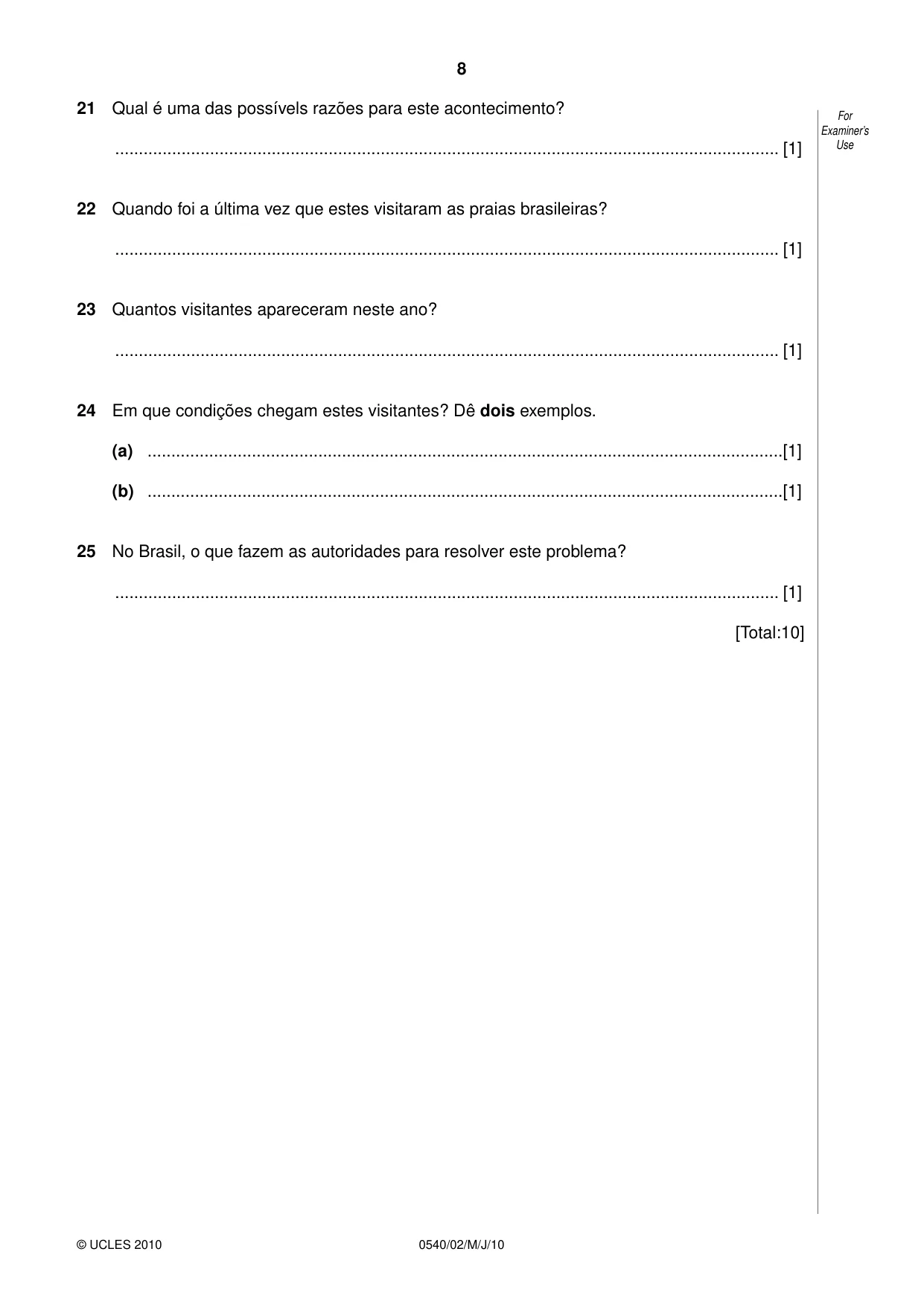
8 © UCLES 2010 0540/02/M/J/10 For Examiner’s Use 21 Qual é uma das possívels razões para este acontecimento? … [1] 22 Quando foi a última vez que estes visitaram as praias brasileiras? … [1] 23 Quantos visitantes apareceram neste ano? … [1] 24 Em que condições chegam estes visitantes? Dê dois exemplos. (a) …[1] (b) …[1] 25 No Brasil, o que fazem as autoridades para resolver este problema? … [1] [Total:10]
Question paper, page 9
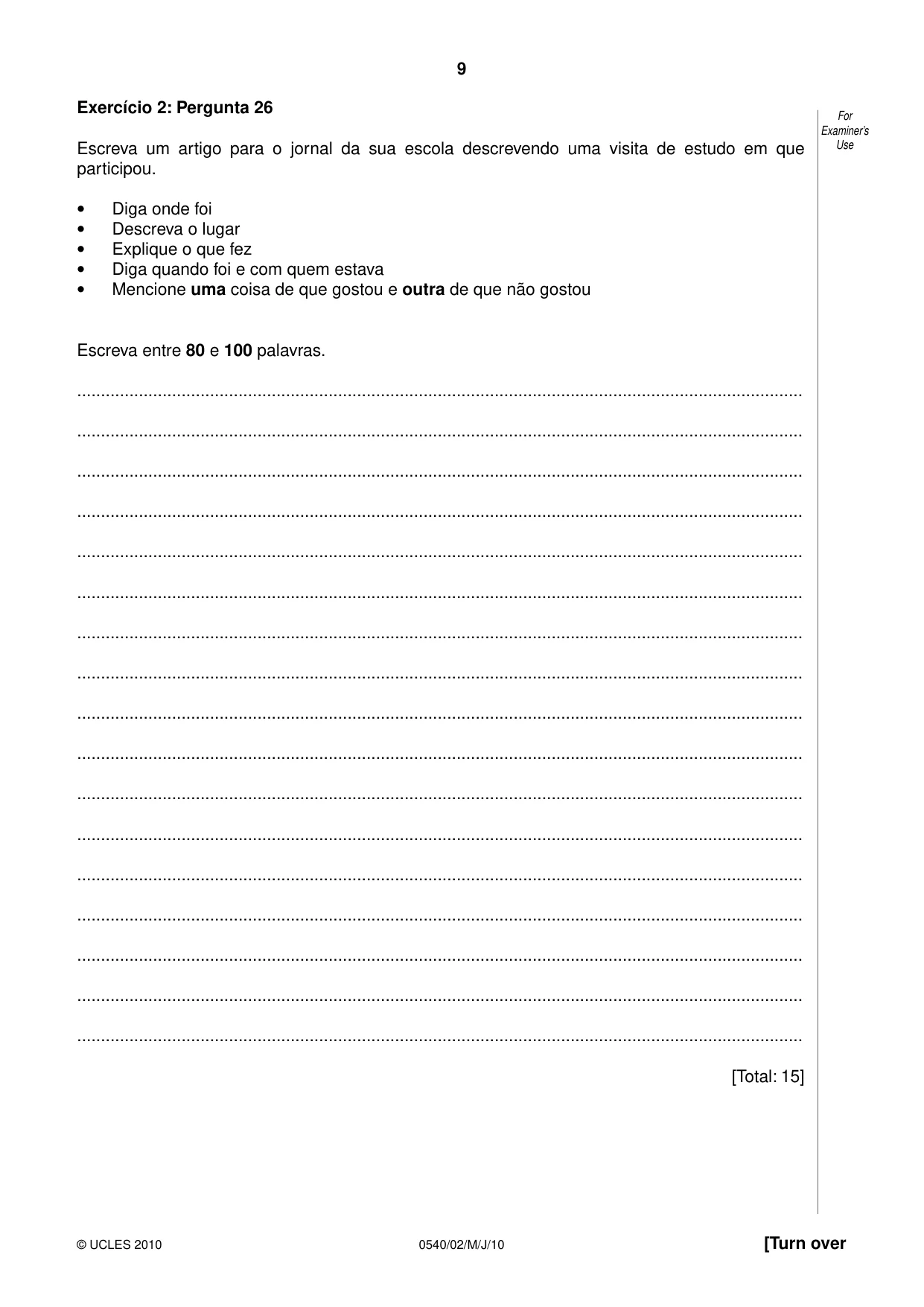
9 0540/02/M/J/10 © UCLES 2010 [Turn over For Examiner’s Use Exercício 2: Pergunta 26 Escreva um artigo para o jornal da sua escola descrevendo uma visita de estudo em que participou. • Diga onde foi • Descreva o lugar • Explique o que fez • Diga quando foi e com quem estava • Mencione uma coisa de que gostou e outra de que não gostou Escreva entre 80 e 100 palavras. … … … … … … … … … … … … … … … … … [Total: 15]
Question paper, page 10
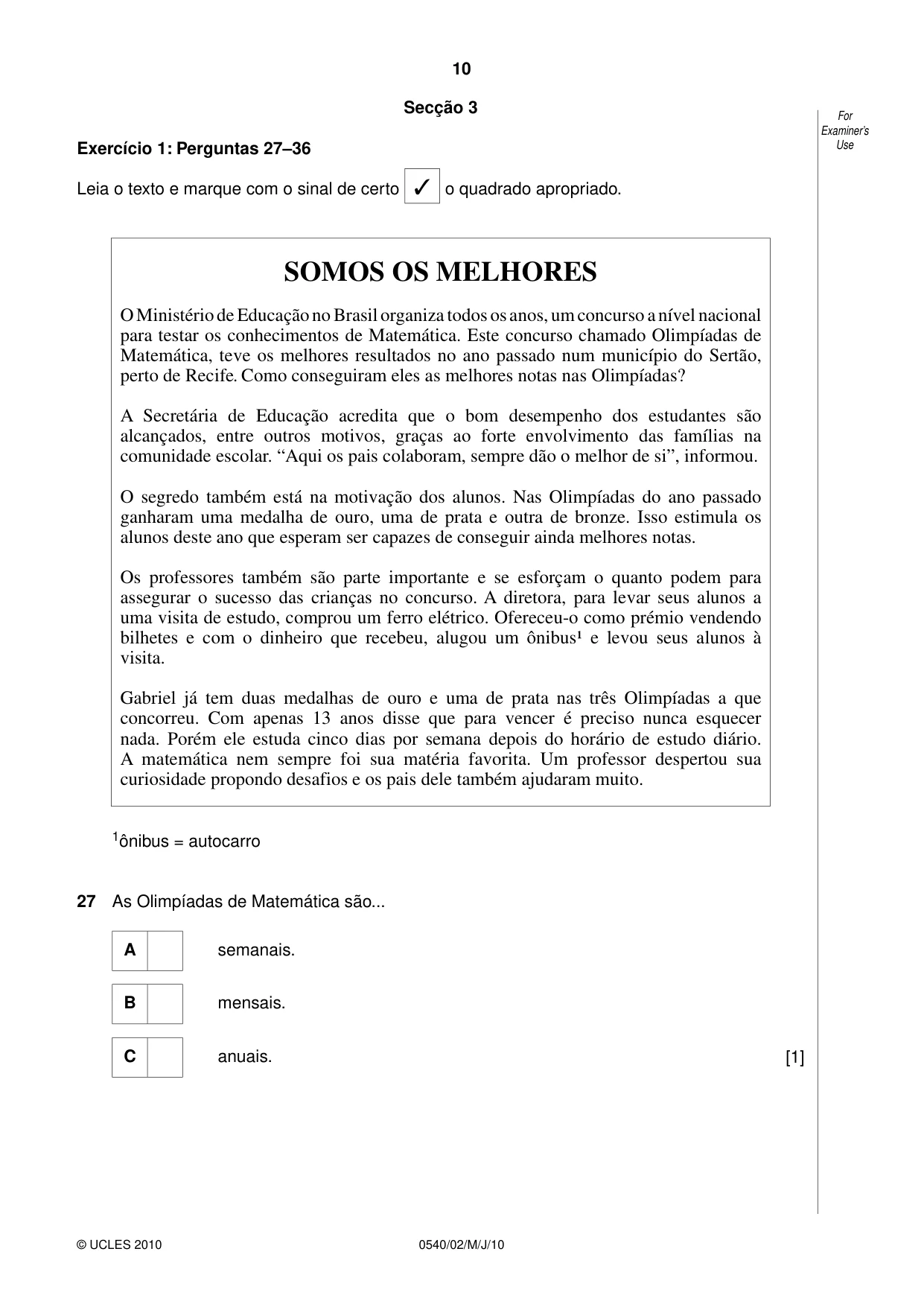
10 © UCLES 2010 0540/02/M/J/10 For Examiner’s Use Secção 3 Exercício 1: Perguntas 27–36 Leia o texto e marque com o sinal de certo ✓ o quadrado apropriado. SOMOS OS MELHORES O Ministério de Educação no Brasil organiza todos os anos, um concurso a nível nacional para testar os conhecimentos de Matemática. Este concurso chamado Olimpíadas de Matemática, teve os melhores resultados no ano passado num município do Sertão, perto de Recife. Como conseguiram eles as melhores notas nas Olimpíadas? A Secretária de Educação acredita que o bom desempenho dos estudantes são alcançados, entre outros motivos, graças ao forte envolvimento das famílias na comunidade escolar. “Aqui os pais colaboram, sempre dão o melhor de si”, informou. O segredo também está na motivação dos alunos. Nas Olimpíadas do ano passado ganharam uma medalha de ouro, uma de prata e outra de bronze. Isso estimula os alunos deste ano que esperam ser capazes de conseguir ainda melhores notas. Os professores também são parte importante e se esforçam o quanto podem para assegurar o sucesso das crianças no concurso. A diretora, para levar seus alunos a uma visita de estudo, comprou um ferro elétrico. Ofereceu-o como prémio vendendo bilhetes e com o dinheiro que recebeu, alugou um ônibus¹ e levou seus alunos à visita. Gabriel já tem duas medalhas de ouro e uma de prata nas três Olimpíadas a que concorreu. Com apenas 13 anos disse que para vencer é preciso nunca esquecer nada. Porém ele estuda cinco dias por semana depois do horário de estudo diário. A matemática nem sempre foi sua matéria favorita. Um professor despertou sua curiosidade propondo desafios e os pais dele também ajudaram muito. 1ônibus = autocarro 27 As Olimpíadas de Matemática são... A semanais. B mensais. C anuais. [1]
Question paper, page 11
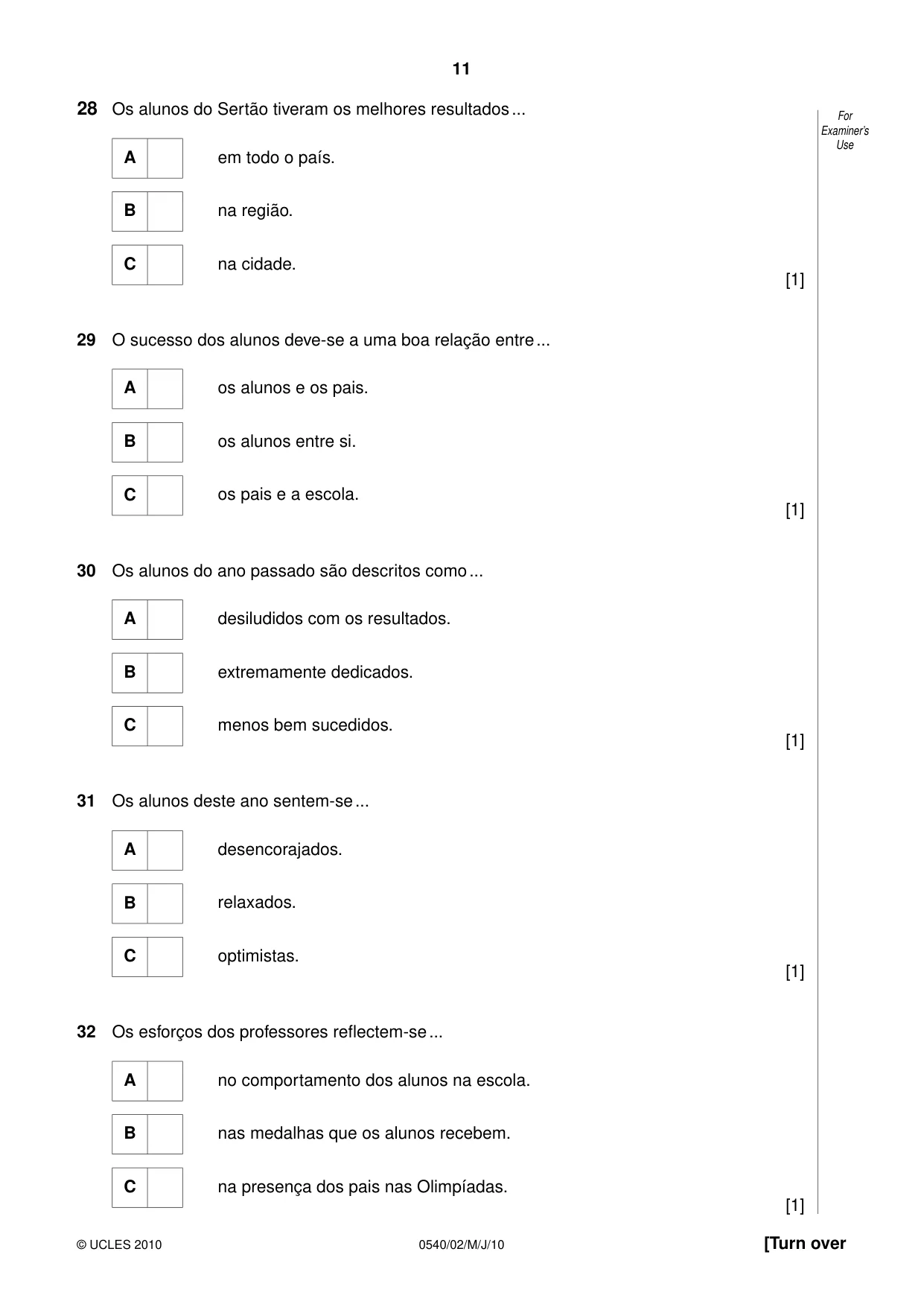
11 0540/02/M/J/10 © UCLES 2010 [Turn over For Examiner’s Use 28 Os alunos do Sertão tiveram os melhores resultados ... A em todo o país. B na região. C na cidade. [1] 29 O sucesso dos alunos deve-se a uma boa relação entre ... A os alunos e os pais. B os alunos entre si. C os pais e a escola. [1] 30 Os alunos do ano passado são descritos como ... A desiludidos com os resultados. B extremamente dedicados. C menos bem sucedidos. [1] 31 Os alunos deste ano sentem-se ... A desencorajados. B relaxados. C optimistas. [1] 32 Os esforços dos professores reflectem-se ... A no comportamento dos alunos na escola. B nas medalhas que os alunos recebem. C na presença dos pais nas Olimpíadas. [1]
Question paper, page 12
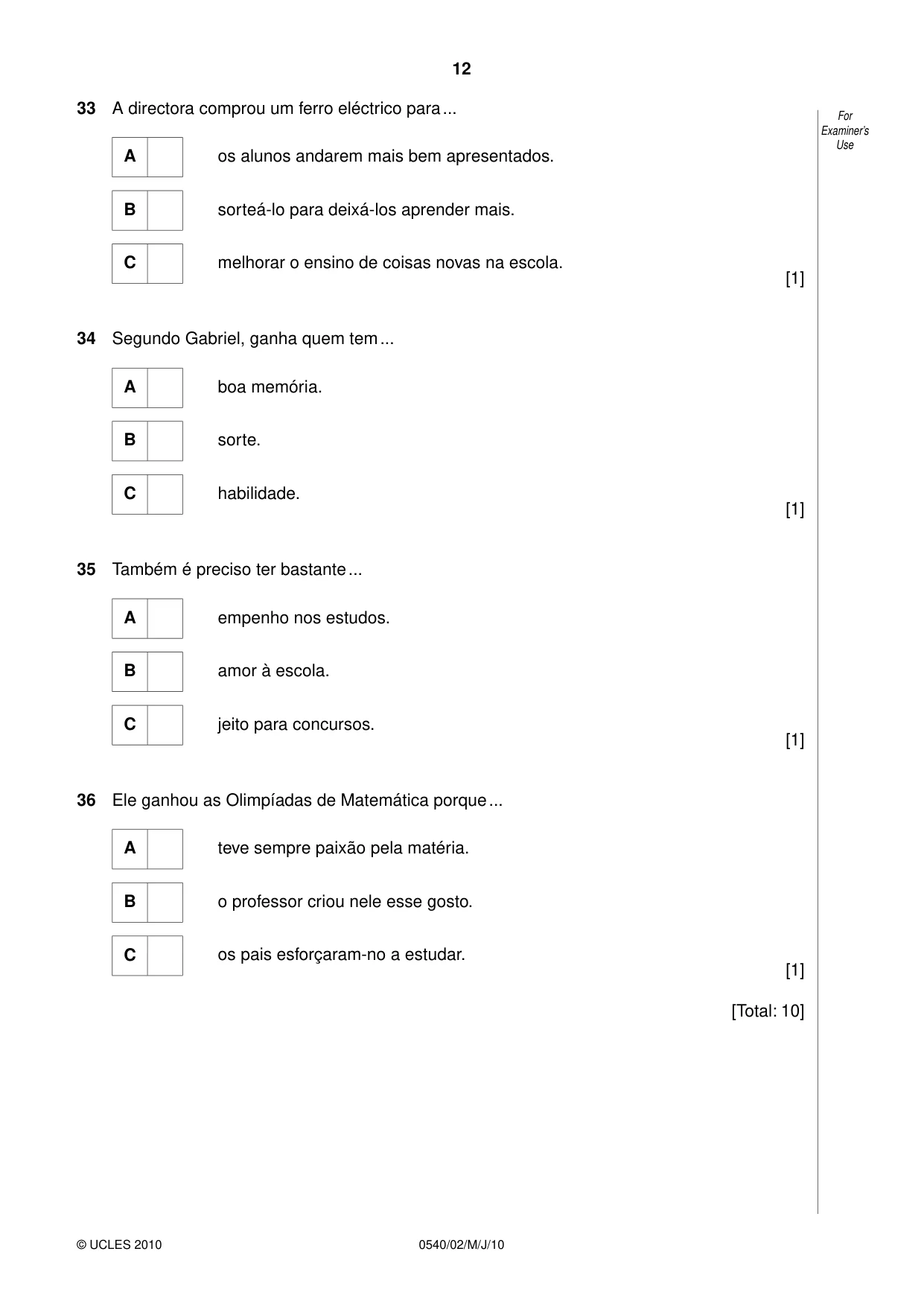
12 © UCLES 2010 0540/02/M/J/10 For Examiner’s Use 33 A directora comprou um ferro eléctrico para ... A os alunos andarem mais bem apresentados. B sorteá-lo para deixá-los aprender mais. C melhorar o ensino de coisas novas na escola. [1] 34 Segundo Gabriel, ganha quem tem ... A boa memória. B sorte. C habilidade. [1] 35 Também é preciso ter bastante ... A empenho nos estudos. B amor à escola. C jeito para concursos. [1] 36 Ele ganhou as Olimpíadas de Matemática porque ... A teve sempre paixão pela matéria. B o professor criou nele esse gosto. C os pais esforçaram-no a estudar. [1] [Total: 10]
Question paper, page 13
13 0540/02/M/J/10 © UCLES 2010 [Turn over BLANK PAGE TURN OVER FOR EXERCISE 2
Question paper, page 14
14 © UCLES 2010 0540/02/M/J/10 For Examiner’s Use Exercício 2: Perguntas 37–45 Leia o texto e responda às perguntas. ÉS UM DONO PERFEITO? Se sempre desejaste ter um animal de estimação, então agora que és um adolescente convence a tua família de que já és suficientemente responsável para tomares conta de um. No entanto deves pensar muito bem nalgumas responsabilidades que irás ter. Estás preparado para dar-lhe de comer uma ou duas vezes por dia, conforme o animal que for? Já pensaste que tens de tratar da cama regularmente e de limpar o que fica sujo? Tens dinheiro para as contas do veterinário, para o equipamento que o animal precise e para a sua alimentação? Tens espaço para ele – sabes o quanto ele vai crescer? Sabes quanto tempo ele pode viver? E se tiver bebés? Alguém da tua família tem alergia a animais? Tens a certeza que queres ser responsável pela saúde de outro ser vivo? Se a tua resposta foi sim a tudo, podes na verdade ser um dono perfeito. Mas qual será o melhor? O cão – o melhor amigo do Homem? Eles são muito divertidos, muito boa companhia e dão-nos muito prazer mas só se nós tivermos tempo para eles. Precisa de casota, treino, cuidados, alimentação e exercício diário, mas principalmente tens de passar pelo menos uma ou duas horas por dia com teu cão. Pensaste num gato? Estes são criaturas maravilhosas, queridas mas podem ser muito independentes. Podem sentir-se sós e por isso pensa na hipótese de teres dois. Primeiro pensa se estás preparado para o teu gato trazer para casa à noite ofertas meio mortas, afiar as garras na tua mobília e espalhar pêlo que pode provocar alergias. Ou preferias um animal diferente? Um papagaio falador ou uma iguana? Se pensas que seria engraçado ter uma iguana, elas podem crescer muito e dormem a maior parte do dia. Um papagaio deve ser comprado já com uma certa idade assim já poderá saber falar; a sua manutenção não é cara e pode viver, se for bem tratado, mais tempo do que tu. 37 Porque a adolescência é uma boa altura para ter um animal de estimação? … [1] 38 Porque é que esta é uma decisão que se deve tomar com muito cuidado? … [1] 39 Que responsabilidade se deve ter quanto à sua alimentação? … [1]
Question paper, page 15
15 0540/02/M/J/10 © UCLES 2010 For Examiner’s Use 40 Porque é necessário pensar no dinheiro? Dê dois exemplos. (a) …[1] (b) …[1] 41 Explique porque é importante considerar a família. … [1] 42 Se se decidir escolher um cão, o que é o mais importante para ele? … [1] 43 Quais os inconvenientes de ter um gato como animal de estimação? Dê um exemplo. … [1] 44 Se quisesse uma iguana, qual poderia ser um lado negativo dessa decisão? … [1] 45 Porque não se deve adquirir um papagaio muito novo? … [1] [Total:10]
Question paper, page 16
16 0540/02/M/J/10 © UCLES 2010 BLANK PAGE Copyright Acknowledgements: Section 2, Exercise 1, Questions 17-25 © Praias de Salvador da Bahia invadidas por pinguins (adapted); 21/8/08; Ciberia http://www.ciberia.aeiou.pt Section 3, Exercise 1, Questions 27-36 © Mirella Marques; Quixaba: educação nota 10! (adapted); 01/09/08; www.diariodepernambuco.com.br/ Section 3, Exercise 2, Questions 37-45 © Helen Greathead; O dono perfeito (adapted); Pensamentos e Sentimentos; Porto Editora; Jan. 2008. Permission to reproduce items where third-party owned material protected by copyright is included has been sought and cleared where possible. Every reasonable effort has been made by the publisher (UCLES) to trace copyright holders, but if any items requiring clearance have unwittingly been included, the publisher will be pleased to make amends at the earliest possible opportunity. University of Cambridge International Examinations is part of the Cambridge Assessment Group. Cambridge Assessment is the brand name of University of Cambridge Local Examinations Syndicate (UCLES), which is itself a department of the University of Cambridge.
Mark scheme, page 1
UNIVERSITY OF CAMBRIDGE INTERNATIONAL EXAMINATIONS International General Certificate of Secondary Education MARK SCHEME for the May/June 2010 question paper for the guidance of teachers 0540 PORTUGUESE 0540/02 Paper 2 (Reading and Directed Writing), maximum raw mark 65 This mark scheme is published as an aid to teachers and candidates, to indicate the requirements of the examination. It shows the basis on which Examiners were instructed to award marks. It does not indicate the details of the discussions that took place at an Examiners’ meeting before marking began, which would have considered the acceptability of alternative answers. Mark schemes must be read in conjunction with the question papers and the report on the examination. • CIE will not enter into discussions or correspondence in connection with these mark schemes. CIE is publishing the mark schemes for the May/June 2010 question papers for most IGCSE, GCE Advanced Level and Advanced Subsidiary Level syllabuses and some Ordinary Level syllabuses. www.XtremePapers.com
Mark scheme, page 2
Page 2 Mark Scheme: Teachers’ version Syllabus Paper IGCSE – May/June 2010 0540 02 © UCLES 2010 The following structure should be adopted for IGCSE Foreign Language Reading & Directed Writing Mark Schemes to ensure that Examiners across languages follow a common approach in cases where the nature of the language makes it appropriate. Section 1 General Marking Principles contains the underlying principles that inform the decisions taken by Senior Examiners (including Single Examiners) when they prepare the Detailed Mark Scheme. These principles also provide Assistant Examiners with a set of ‘rules’ to apply when making decisions on answers not covered by the Detailed Mark Scheme, for which they have to use their judgement. Section 2 contains the session-specific Detailed Mark Scheme.
Mark scheme, page 3
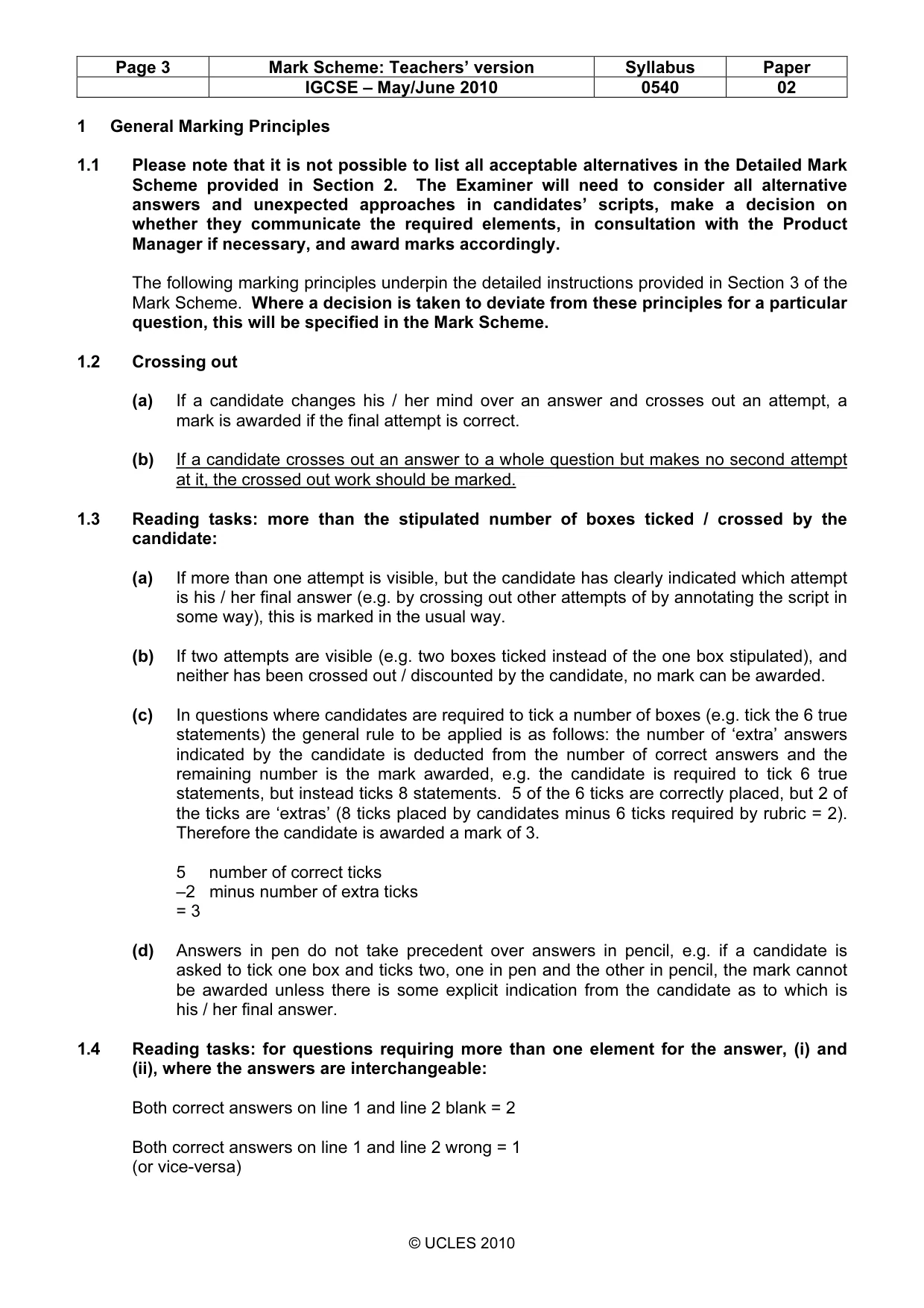
Page 3 Mark Scheme: Teachers’ version Syllabus Paper IGCSE – May/June 2010 0540 02 © UCLES 2010 1 General Marking Principles 1.1 Please note that it is not possible to list all acceptable alternatives in the Detailed Mark Scheme provided in Section 2. The Examiner will need to consider all alternative answers and unexpected approaches in candidates’ scripts, make a decision on whether they communicate the required elements, in consultation with the Product Manager if necessary, and award marks accordingly. The following marking principles underpin the detailed instructions provided in Section 3 of the Mark Scheme. Where a decision is taken to deviate from these principles for a particular question, this will be specified in the Mark Scheme. 1.2 Crossing out (a) If a candidate changes his / her mind over an answer and crosses out an attempt, a mark is awarded if the final attempt is correct. (b) If a candidate crosses out an answer to a whole question but makes no second attempt at it, the crossed out work should be marked. 1.3 Reading tasks: more than the stipulated number of boxes ticked / crossed by the candidate: (a) If more than one attempt is visible, but the candidate has clearly indicated which attempt is his / her final answer (e.g. by crossing out other attempts of by annotating the script in some way), this is marked in the usual way. (b) If two attempts are visible (e.g. two boxes ticked instead of the one box stipulated), and neither has been crossed out / discounted by the candidate, no mark can be awarded. (c) In questions where candidates are required to tick a number of boxes (e.g. tick the 6 true statements) the general rule to be applied is as follows: the number of ‘extra’ answers indicated by the candidate is deducted from the number of correct answers and the remaining number is the mark awarded, e.g. the candidate is required to tick 6 true statements, but instead ticks 8 statements. 5 of the 6 ticks are correctly placed, but 2 of the ticks are ‘extras’ (8 ticks placed by candidates minus 6 ticks required by rubric = 2). Therefore the candidate is awarded a mark of 3. 5 number of correct ticks –2 minus number of extra ticks = 3 (d) Answers in pen do not take precedent over answers in pencil, e.g. if a candidate is asked to tick one box and ticks two, one in pen and the other in pencil, the mark cannot be awarded unless there is some explicit indication from the candidate as to which is his / her final answer. 1.4 Reading tasks: for questions requiring more than one element for the answer, (i) and (ii), where the answers are interchangeable: Both correct answers on line 1 and line 2 blank = 2 Both correct answers on line 1 and line 2 wrong = 1 (or vice-versa)
Mark scheme, page 4
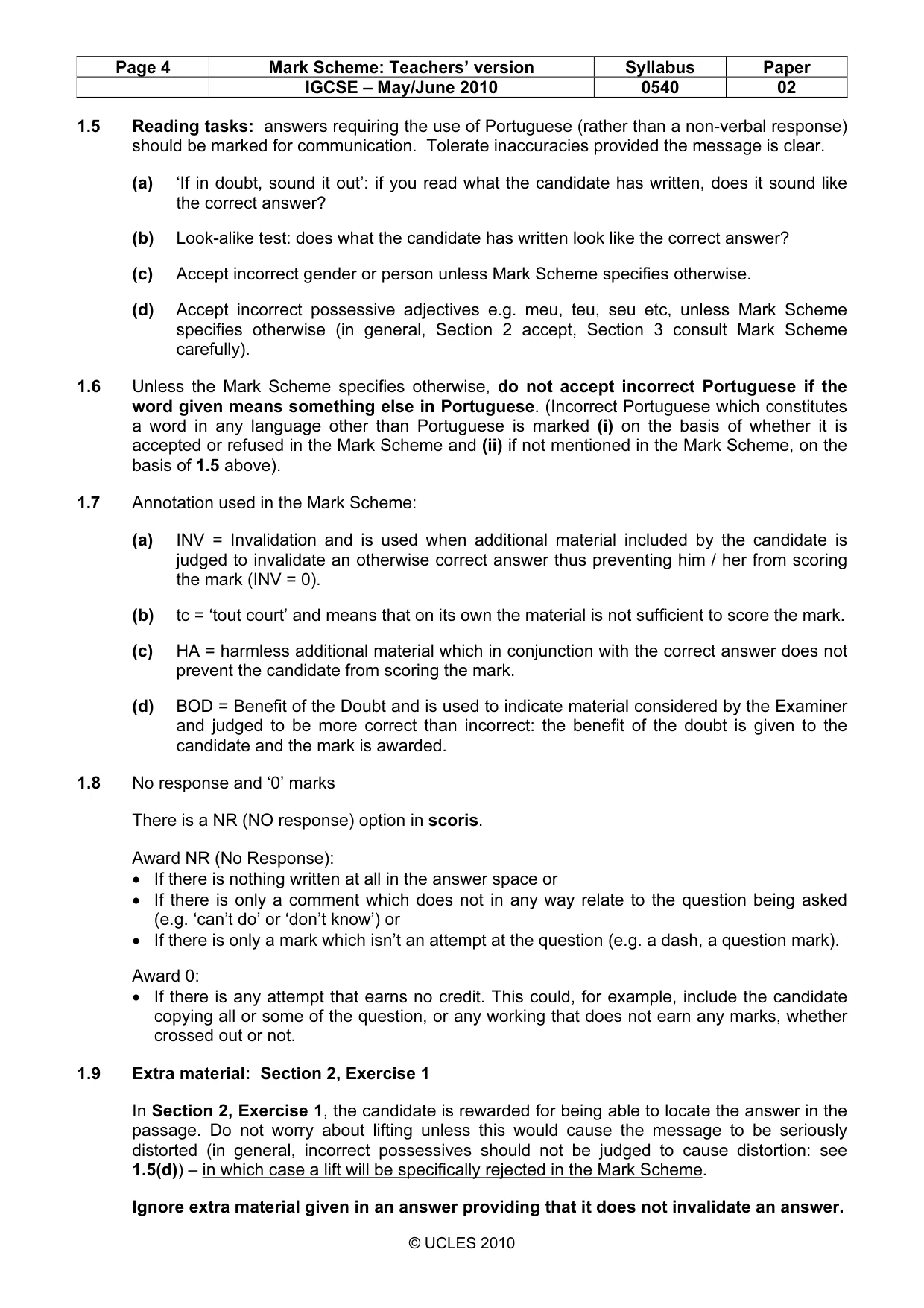
Page 4 Mark Scheme: Teachers’ version Syllabus Paper IGCSE – May/June 2010 0540 02 © UCLES 2010 1.5 Reading tasks: answers requiring the use of Portuguese (rather than a non-verbal response) should be marked for communication. Tolerate inaccuracies provided the message is clear. (a) ‘If in doubt, sound it out’: if you read what the candidate has written, does it sound like the correct answer? (b) Look-alike test: does what the candidate has written look like the correct answer? (c) Accept incorrect gender or person unless Mark Scheme specifies otherwise. (d) Accept incorrect possessive adjectives e.g. meu, teu, seu etc, unless Mark Scheme specifies otherwise (in general, Section 2 accept, Section 3 consult Mark Scheme carefully). 1.6 Unless the Mark Scheme specifies otherwise, do not accept incorrect Portuguese if the word given means something else in Portuguese. (Incorrect Portuguese which constitutes a word in any language other than Portuguese is marked (i) on the basis of whether it is accepted or refused in the Mark Scheme and (ii) if not mentioned in the Mark Scheme, on the basis of 1.5 above). 1.7 Annotation used in the Mark Scheme: (a) INV = Invalidation and is used when additional material included by the candidate is judged to invalidate an otherwise correct answer thus preventing him / her from scoring the mark (INV = 0). (b) tc = ‘tout court’ and means that on its own the material is not sufficient to score the mark. (c) HA = harmless additional material which in conjunction with the correct answer does not prevent the candidate from scoring the mark. (d) BOD = Benefit of the Doubt and is used to indicate material considered by the Examiner and judged to be more correct than incorrect: the benefit of the doubt is given to the candidate and the mark is awarded. 1.8 No response and ‘0’ marks There is a NR (NO response) option in scoris. Award NR (No Response): • If there is nothing written at all in the answer space or • If there is only a comment which does not in any way relate to the question being asked (e.g. ‘can’t do’ or ‘don’t know’) or • If there is only a mark which isn’t an attempt at the question (e.g. a dash, a question mark). Award 0: • If there is any attempt that earns no credit. This could, for example, include the candidate copying all or some of the question, or any working that does not earn any marks, whether crossed out or not. 1.9 Extra material: Section 2, Exercise 1 In Section 2, Exercise 1, the candidate is rewarded for being able to locate the answer in the passage. Do not worry about lifting unless this would cause the message to be seriously distorted (in general, incorrect possessives should not be judged to cause distortion: see 1.5(d)) – in which case a lift will be specifically rejected in the Mark Scheme. Ignore extra material given in an answer providing that it does not invalidate an answer.
Mark scheme, page 5
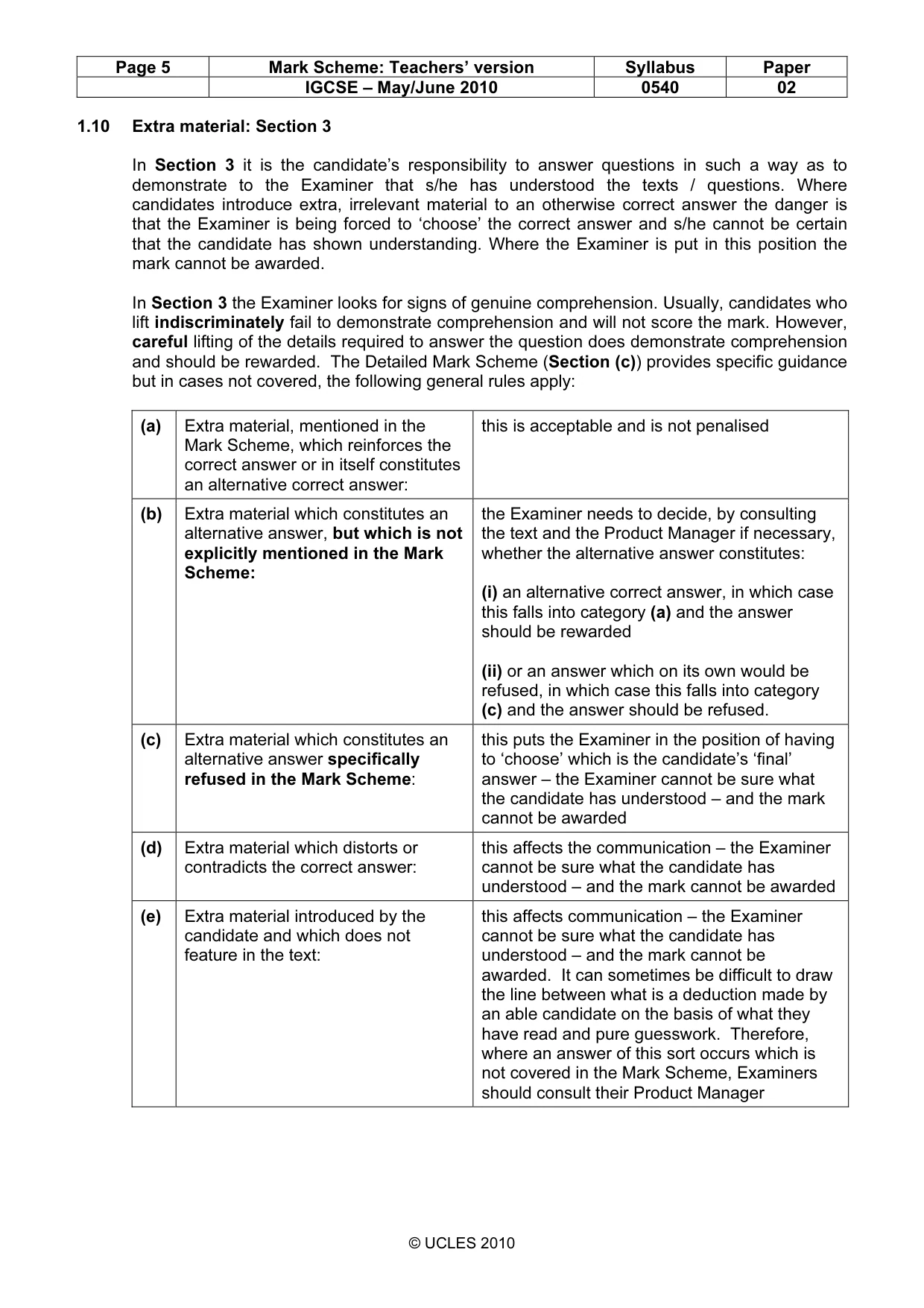
Page 5 Mark Scheme: Teachers’ version Syllabus Paper IGCSE – May/June 2010 0540 02 © UCLES 2010 1.10 Extra material: Section 3 In Section 3 it is the candidate’s responsibility to answer questions in such a way as to demonstrate to the Examiner that s/he has understood the texts / questions. Where candidates introduce extra, irrelevant material to an otherwise correct answer the danger is that the Examiner is being forced to ‘choose’ the correct answer and s/he cannot be certain that the candidate has shown understanding. Where the Examiner is put in this position the mark cannot be awarded. In Section 3 the Examiner looks for signs of genuine comprehension. Usually, candidates who lift indiscriminately fail to demonstrate comprehension and will not score the mark. However, careful lifting of the details required to answer the question does demonstrate comprehension and should be rewarded. The Detailed Mark Scheme (Section (c)) provides specific guidance but in cases not covered, the following general rules apply: (a) Extra material, mentioned in the Mark Scheme, which reinforces the correct answer or in itself constitutes an alternative correct answer: this is acceptable and is not penalised (b) Extra material which constitutes an alternative answer, but which is not explicitly mentioned in the Mark Scheme: the Examiner needs to decide, by consulting the text and the Product Manager if necessary, whether the alternative answer constitutes: (i) an alternative correct answer, in which case this falls into category (a) and the answer should be rewarded (ii) or an answer which on its own would be refused, in which case this falls into category (c) and the answer should be refused. (c) Extra material which constitutes an alternative answer specifically refused in the Mark Scheme: this puts the Examiner in the position of having to ‘choose’ which is the candidate’s ‘final’ answer – the Examiner cannot be sure what the candidate has understood – and the mark cannot be awarded (d) Extra material which distorts or contradicts the correct answer: this affects the communication – the Examiner cannot be sure what the candidate has understood – and the mark cannot be awarded (e) Extra material introduced by the candidate and which does not feature in the text: this affects communication – the Examiner cannot be sure what the candidate has understood – and the mark cannot be awarded. It can sometimes be difficult to draw the line between what is a deduction made by an able candidate on the basis of what they have read and pure guesswork. Therefore, where an answer of this sort occurs which is not covered in the Mark Scheme, Examiners should consult their Product Manager
Mark scheme, page 6
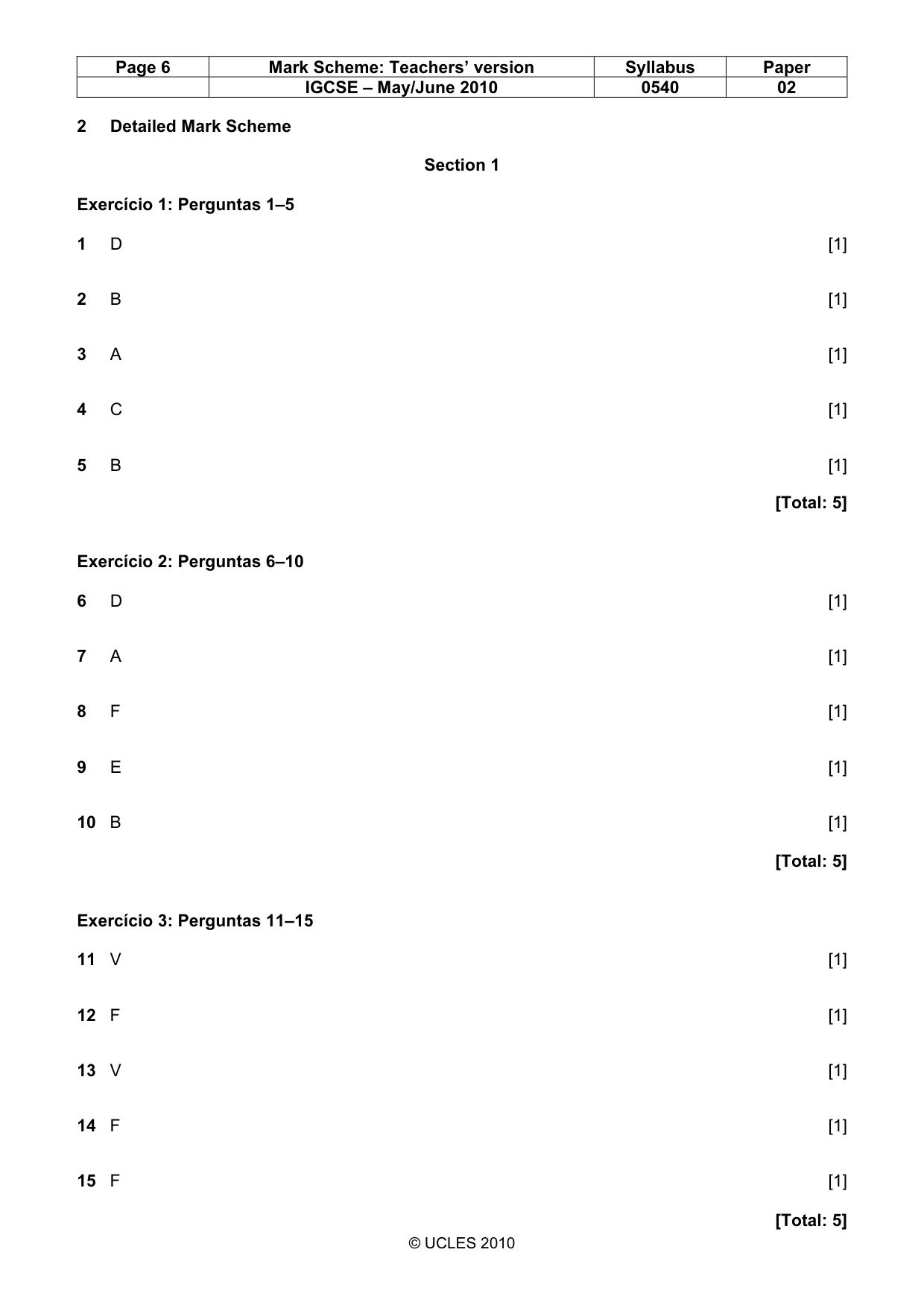
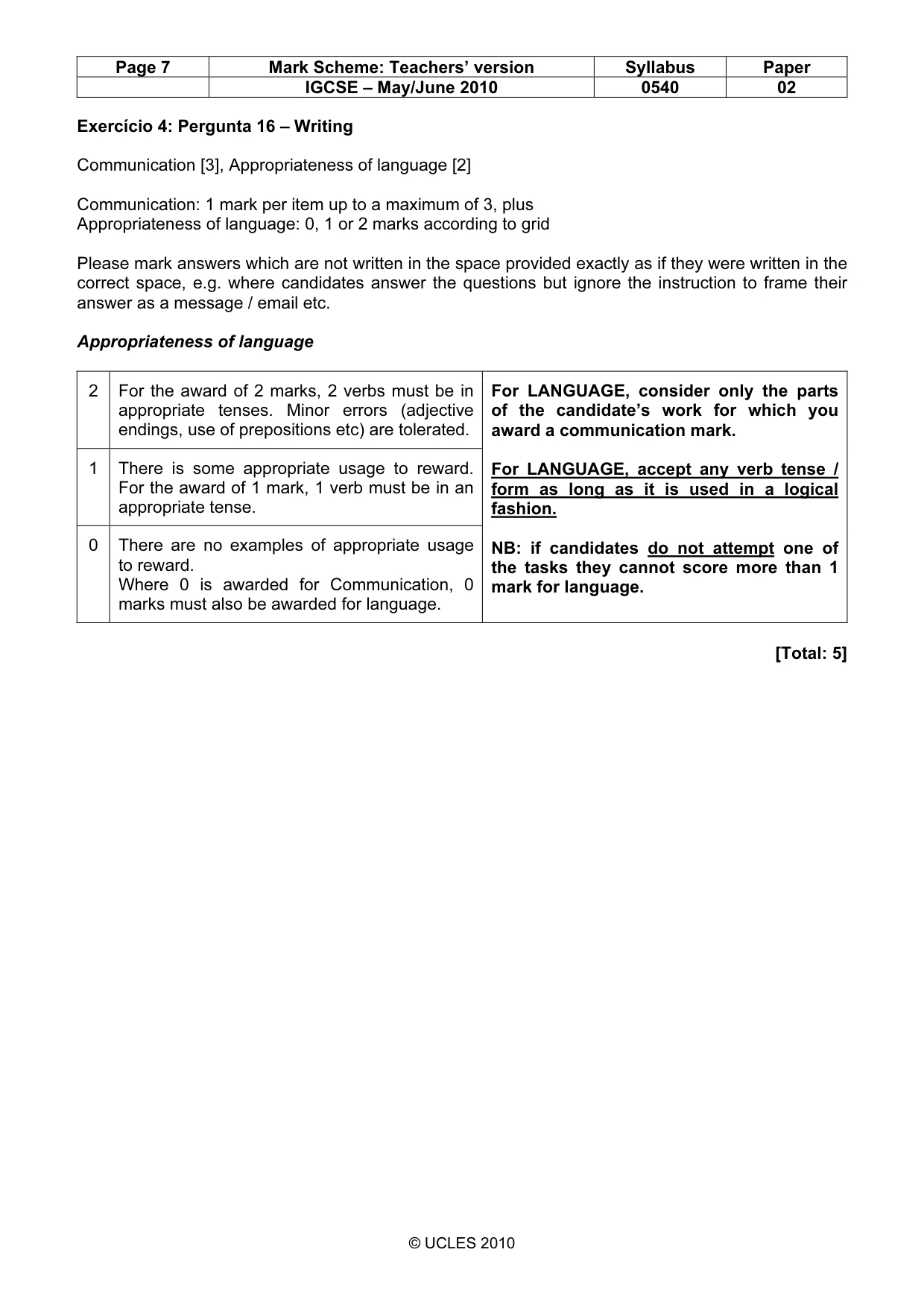
Page 6 Mark Scheme: Teachers’ version Syllabus Paper IGCSE – May/June 2010 0540 02 © UCLES 2010 2 Detailed Mark Scheme Section 1 Exercício 1: Perguntas 1–5 1 D [1] 2 B [1] 3 A [1] 4 C [1] 5 B [1] [Total: 5] Exercício 2: Perguntas 6–10 6 D [1] 7 A [1] 8 F [1] 9 E [1] 10 B [1] [Total: 5] Exercício 3: Perguntas 11–15 11 V [1] 12 F [1] 13 V [1] 14 F [1] 15 F [1] [Total: 5]
Mark scheme, page 7
Page 7 Mark Scheme: Teachers’ version Syllabus Paper IGCSE – May/June 2010 0540 02 © UCLES 2010 Exercício 4: Pergunta 16 – Writing Communication [3], Appropriateness of language [2] Communication: 1 mark per item up to a maximum of 3, plus Appropriateness of language: 0, 1 or 2 marks according to grid Please mark answers which are not written in the space provided exactly as if they were written in the correct space, e.g. where candidates answer the questions but ignore the instruction to frame their answer as a message / email etc. Appropriateness of language 2 For the award of 2 marks, 2 verbs must be in appropriate tenses. Minor errors (adjective endings, use of prepositions etc) are tolerated. 1 There is some appropriate usage to reward. For the award of 1 mark, 1 verb must be in an appropriate tense. 0 There are no examples of appropriate usage to reward. Where 0 is awarded for Communication, 0 marks must also be awarded for language. For LANGUAGE, consider only the parts of the candidate’s work for which you award a communication mark. For LANGUAGE, accept any verb tense / form as long as it is used in a logical fashion. NB: if candidates do not attempt one of the tasks they cannot score more than 1 mark for language. [Total: 5]
Mark scheme, page 8
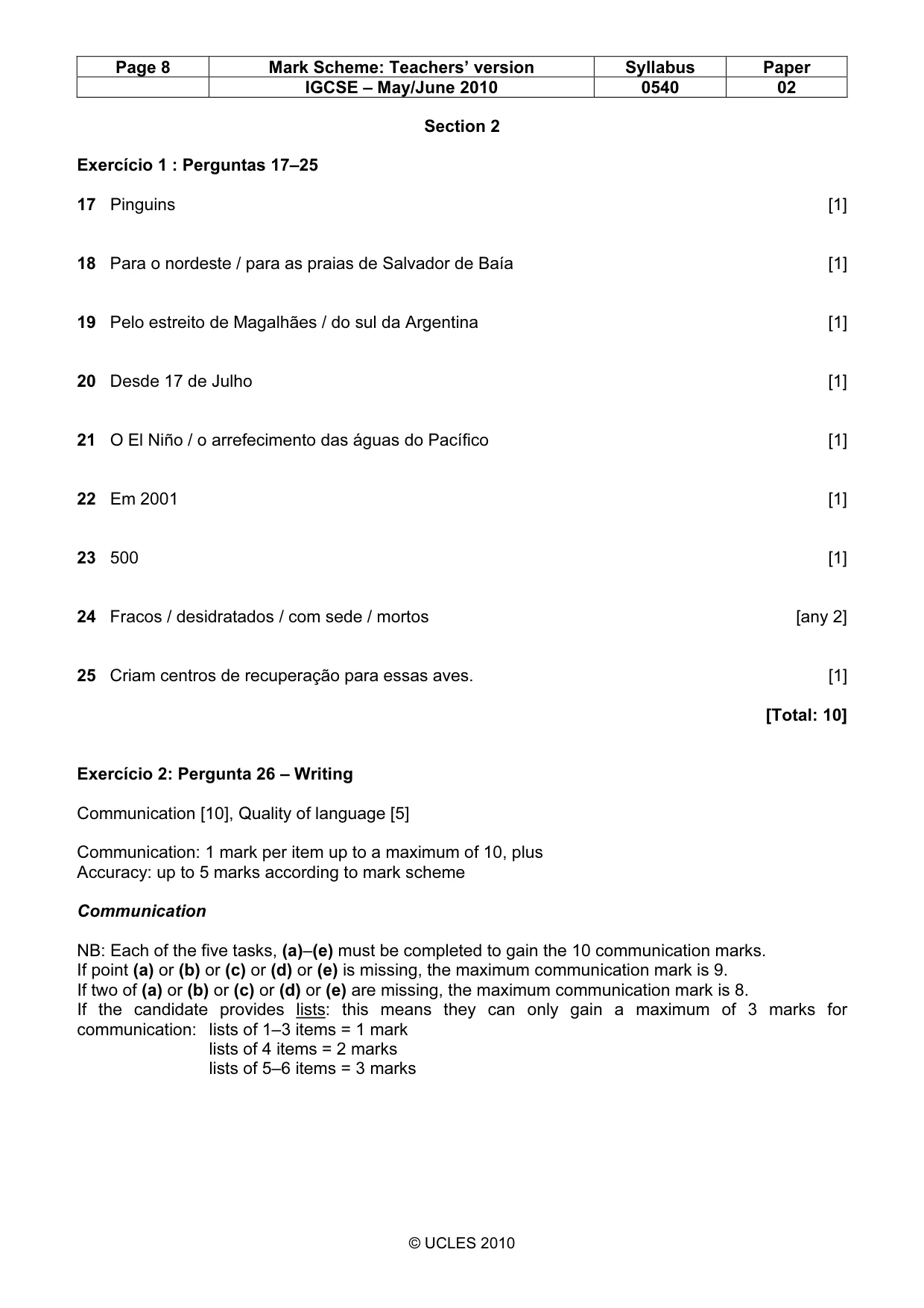
Page 8 Mark Scheme: Teachers’ version Syllabus Paper IGCSE – May/June 2010 0540 02 © UCLES 2010 Section 2 Exercício 1 : Perguntas 17–25 17 Pinguins [1] 18 Para o nordeste / para as praias de Salvador de Baía [1] 19 Pelo estreito de Magalhães / do sul da Argentina [1] 20 Desde 17 de Julho [1] 21 O El Niño / o arrefecimento das águas do Pacífico [1] 22 Em 2001 [1] 23 500 [1] 24 Fracos / desidratados / com sede / mortos [any 2] 25 Criam centros de recuperação para essas aves. [1] [Total: 10] Exercício 2: Pergunta 26 – Writing Communication [10], Quality of language [5] Communication: 1 mark per item up to a maximum of 10, plus Accuracy: up to 5 marks according to mark scheme Communication NB: Each of the five tasks, (a)–(e) must be completed to gain the 10 communication marks. If point (a) or (b) or (c) or (d) or (e) is missing, the maximum communication mark is 9. If two of (a) or (b) or (c) or (d) or (e) are missing, the maximum communication mark is 8. If the candidate provides lists: this means they can only gain a maximum of 3 marks for communication: lists of 1–3 items = 1 mark lists of 4 items = 2 marks lists of 5–6 items = 3 marks
Mark scheme, page 9
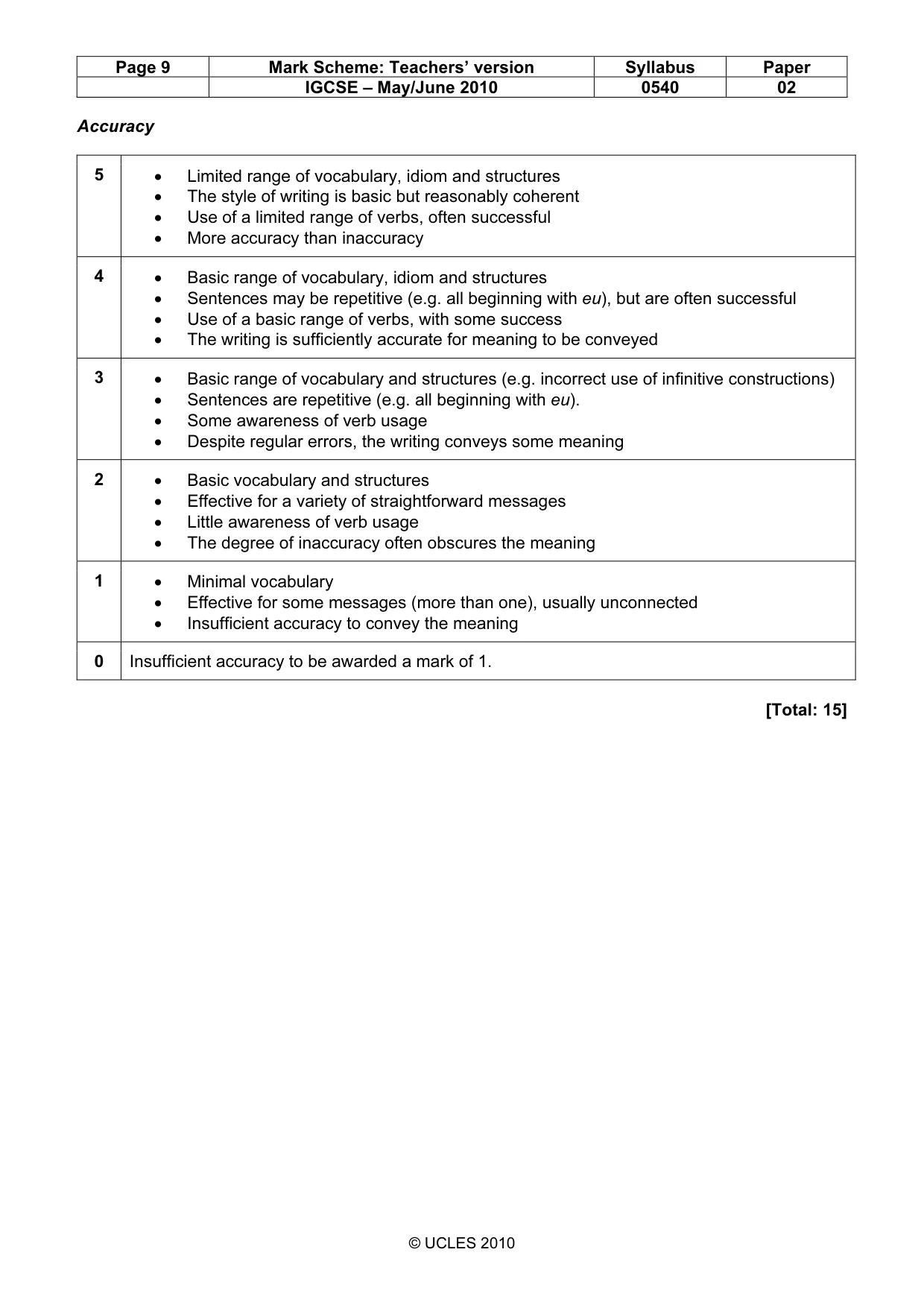
Page 9 Mark Scheme: Teachers’ version Syllabus Paper IGCSE – May/June 2010 0540 02 © UCLES 2010 Accuracy 5 • Limited range of vocabulary, idiom and structures • The style of writing is basic but reasonably coherent • Use of a limited range of verbs, often successful • More accuracy than inaccuracy 4 • Basic range of vocabulary, idiom and structures • Sentences may be repetitive (e.g. all beginning with eu), but are often successful • Use of a basic range of verbs, with some success • The writing is sufficiently accurate for meaning to be conveyed 3 • Basic range of vocabulary and structures (e.g. incorrect use of infinitive constructions) • Sentences are repetitive (e.g. all beginning with eu). • Some awareness of verb usage • Despite regular errors, the writing conveys some meaning 2 • Basic vocabulary and structures • Effective for a variety of straightforward messages • Little awareness of verb usage • The degree of inaccuracy often obscures the meaning 1 • Minimal vocabulary • Effective for some messages (more than one), usually unconnected • Insufficient accuracy to convey the meaning 0 Insufficient accuracy to be awarded a mark of 1. [Total: 15]
Mark scheme, page 10
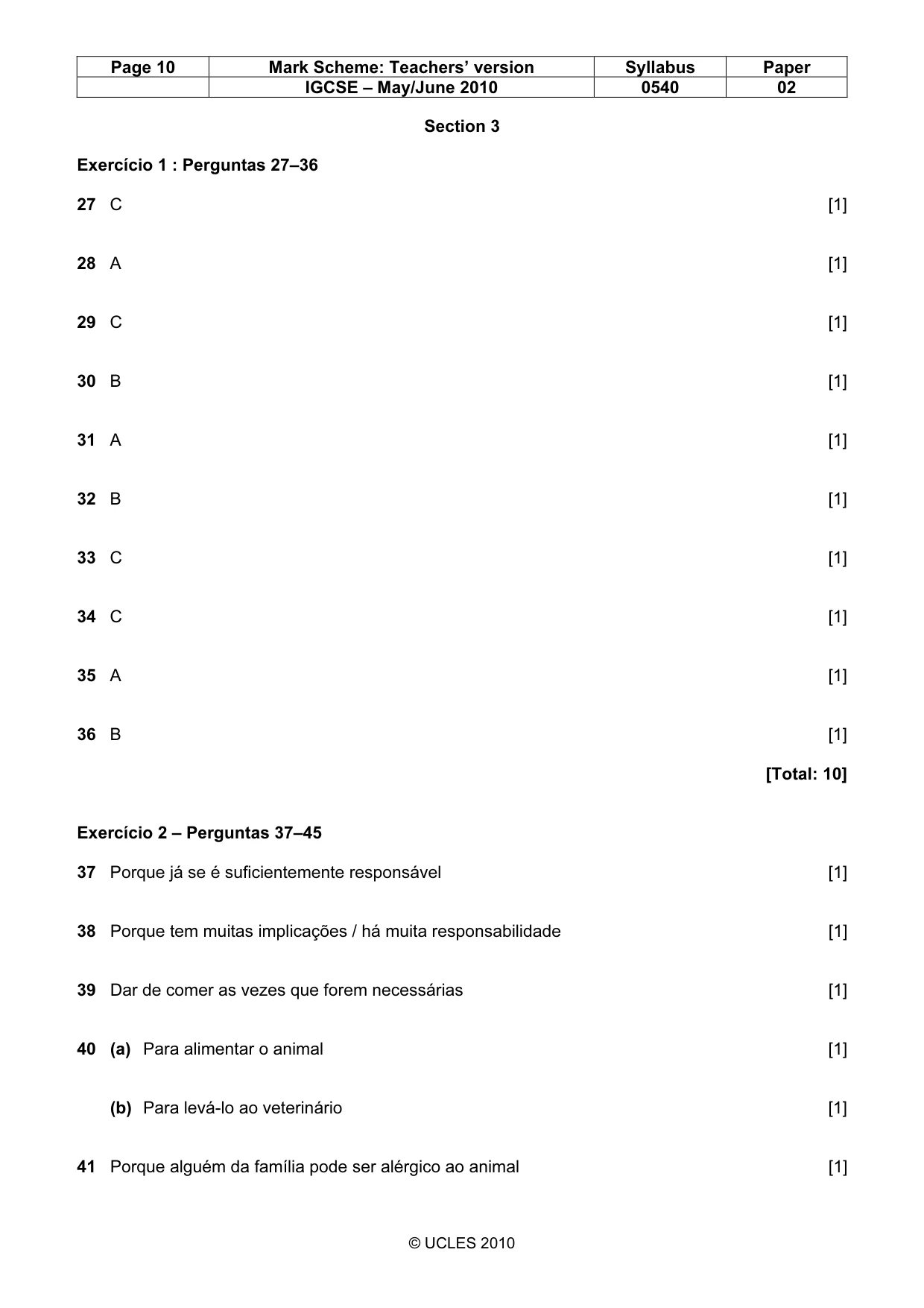
Page 10 Mark Scheme: Teachers’ version Syllabus Paper IGCSE – May/June 2010 0540 02 © UCLES 2010 Section 3 Exercício 1 : Perguntas 27–36 27 C [1] 28 A [1] 29 C [1] 30 B [1] 31 A [1] 32 B [1] 33 C [1] 34 C [1] 35 A [1] 36 B [1] [Total: 10] Exercício 2 – Perguntas 37–45 37 Porque já se é suficientemente responsável [1] 38 Porque tem muitas implicações / há muita responsabilidade [1] 39 Dar de comer as vezes que forem necessárias [1] 40 (a) Para alimentar o animal [1] (b) Para levá-lo ao veterinário [1] 41 Porque alguém da família pode ser alérgico ao animal [1]
Mark scheme, page 11
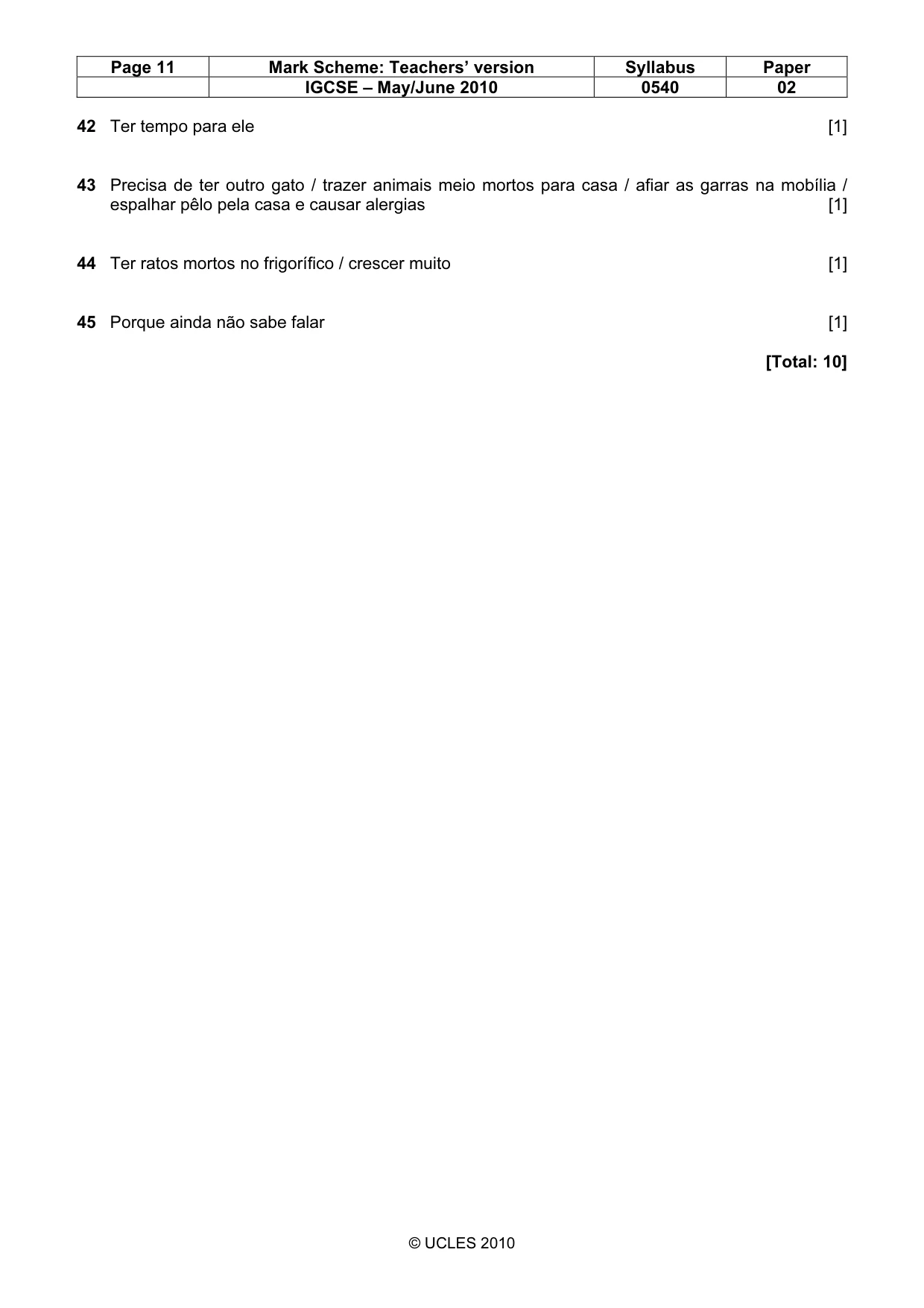
Page 11 Mark Scheme: Teachers’ version Syllabus Paper IGCSE – May/June 2010 0540 02 © UCLES 2010 42 Ter tempo para ele [1] 43 Precisa de ter outro gato / trazer animais meio mortos para casa / afiar as garras na mobília / espalhar pêlo pela casa e causar alergias [1] 44 Ter ratos mortos no frigorífico / crescer muito [1] 45 Porque ainda não sabe falar [1] [Total: 10]
What you needed in this session
Cambridge’s own grade thresholds for 2010 May/June, Paper 2 · Variant 1. A higher threshold means an easier paper — the bar moves with how the cohort did.