Questions as text
Q1 · Which statement about α-particles and β-particles is correct? 0972/11 May/June 2018
39 Which statement about α-particles and β-particles is correct? A α-particles are less ionising than β-particles. B α-particles are more penetrating than β-particles. C α-particles have greater mass than β-particles. D α-particles have the same charge as β-particles.
1 marks
Answer: C
This question in 0972/11 May/June 2018
Q2 · An explosion in a nuclear reactor spread the isotope caesium-137 across a large area 0972/11 May/June 2018
40 An explosion in a nuclear reactor spread the isotope caesium-137 across a large area. Ninety years after the explosion, the quantity of caesium-137 present will be 12.5% of its original level. What is the half-life of caesium-137? A 11.25 years B 22.5 years C 30.0 years D 45.0 years
1 marks
Answer: C
This question in 0972/11 May/June 2018
Q3 · A student measures the level of radiation emitted from a radioactive substance 0972/11 May/June 2019
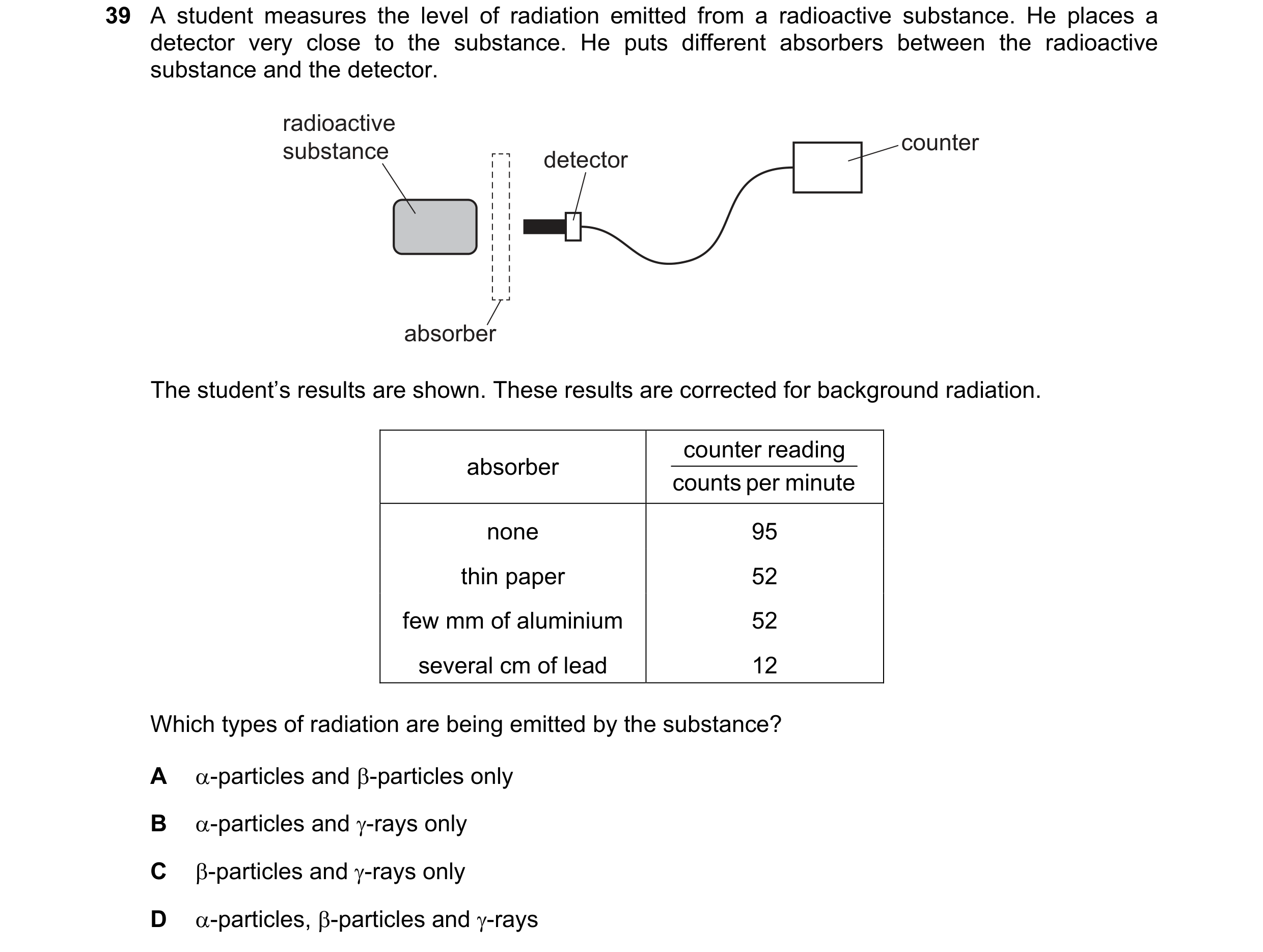
39 A student measures the level of radiation emitted from a radioactive substance. He places a detector very close to the substance. He puts different absorbers between the radioactive substance and the detector. radioactive substance counter detector absorber The student’s results are shown. These results are corrected for background radiation. counter reading absorber counts per minute none 95 thin paper 52 few mm of aluminium 52 several cm of lead 12 Which types of radiation are being emitted by the substance? A α-particles and β-particles only B α-particles and γ-rays only C β-particles and γ-rays only D α-particles, β-particles and γ-rays
1 marks
Answer: B
This question in 0972/11 May/June 2019
Q4 · The nuclei of the atoms in a substance are changing randomly and emitting radiation 0972/11 May/June 2019
40 The nuclei of the atoms in a substance are changing randomly and emitting radiation. What is happening to the substance? A It is undergoing electromagnetic induction. B It is undergoing magnetisation. C It is undergoing solidification. D It is undergoing radioactive decay.
1 marks
Answer: D
This question in 0972/11 May/June 2019
Q5 · A nuclide of cobalt contains 27 protons and 32 neutrons 0972/11 Oct/Nov 2019
38 A nuclide of cobalt contains 27 protons and 32 neutrons. Which symbol represents this nuclide? 27 59Co 27Co 32 59Co 32 59 27Co A B C D
1 marks
Answer: D
This question in 0972/11 Oct/Nov 2019
Q6 · An isotope of radon is radioactive 0972/11 Oct/Nov 2019
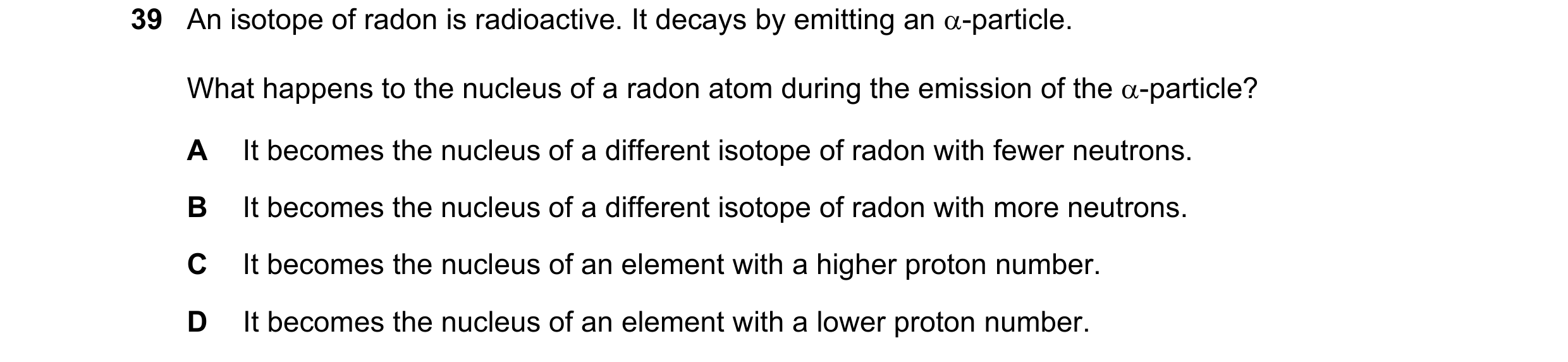
39 An isotope of radon is radioactive. It decays by emitting an α-particle. What happens to the nucleus of a radon atom during the emission of the α-particle? A It becomes the nucleus of a different isotope of radon with fewer neutrons. B It becomes the nucleus of a different isotope of radon with more neutrons. C It becomes the nucleus of an element with a higher proton number. D It becomes the nucleus of an element with a lower proton number.
1 marks
Answer: D
This question in 0972/11 Oct/Nov 2019
Q7 · Why are some radioactive sources stored in boxes made from lead? 0972/11 Oct/Nov 2019
40 Why are some radioactive sources stored in boxes made from lead? A Lead absorbs emissions from the radioactive sources. B Lead decreases the half-life of radioactive sources. C Lead increases the half-life of radioactive sources. D Lead repels emissions from the radioactive sources.
1 marks
Answer: A
This question in 0972/11 Oct/Nov 2019
Q8 · A thin sheet of paper is placed between a radioactive source and a radiation detector 0972/11 May/June 2020
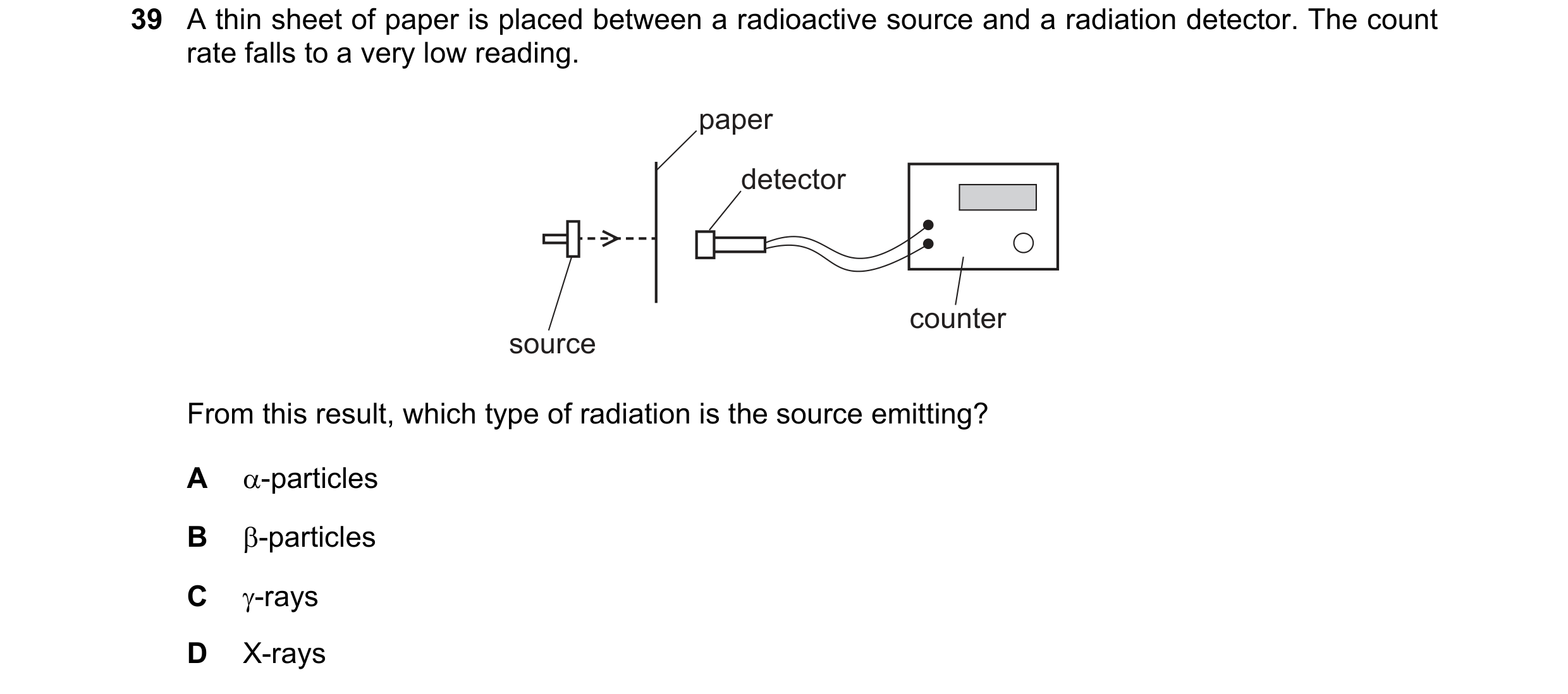
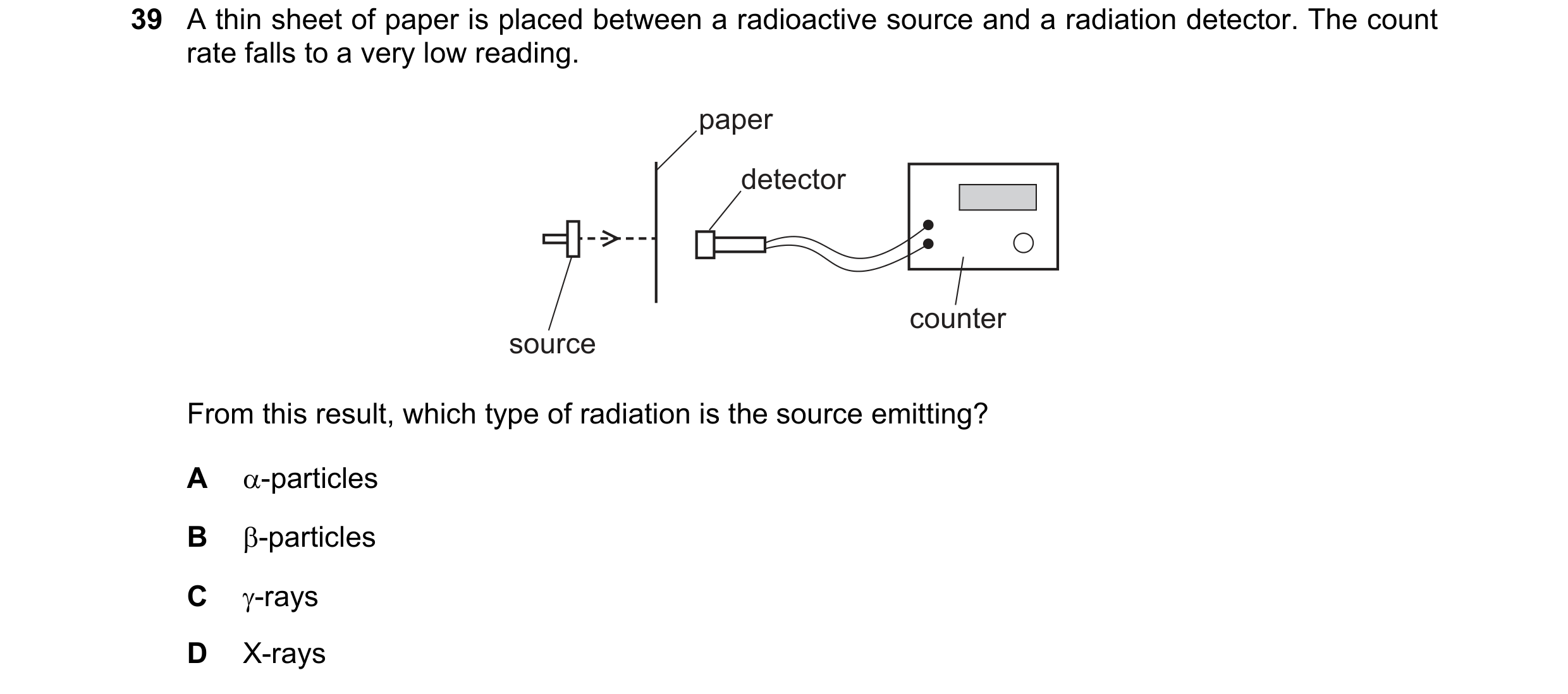
39 A thin sheet of paper is placed between a radioactive source and a radiation detector. The count rate falls to a very low reading. paper detector counter source From this result, which type of radiation is the source emitting? A α-particles B β-particles C γ-rays D X-rays
1 marks
Answer: A
This question in 0972/11 May/June 2020
Q9 · In 1986 the Chernobyl nuclear power station in Ukraine suffered a meltdown 0972/11 May/June 2020
40 In 1986 the Chernobyl nuclear power station in Ukraine suffered a meltdown. This caused background radiation in many countries, thousands of kilometres from Chernobyl, to increase. What was transported in the atmosphere to these countries to cause this rise in background radiation? A α-particles B β-particles C γ-rays D radioactive isotopes
1 marks
Answer: D
This question in 0972/11 May/June 2020
Q10 · A thin sheet of paper is placed between a radioactive source and a radiation detector 0972/12 May/June 2020
39 A thin sheet of paper is placed between a radioactive source and a radiation detector. The count rate falls to a very low reading. paper detector counter source From this result, which type of radiation is the source emitting? A α-particles B β-particles C γ-rays D X-rays
1 marks
Answer: A
This question in 0972/12 May/June 2020
Q11 · A radioactive isotope has a half-life of 120 minutes 0972/12 May/June 2020
40 A radioactive isotope has a half-life of 120 minutes. It emits radiation at a rate of 100 particles per second. How long does it take for the rate of emission to fall to 25 particles per second? A 30 minutes B 45 minutes C 90 minutes D 240 minutes
1 marks
Answer: D
This question in 0972/12 May/June 2020
Q12 · A radiation detector records a low reading even when no radioactive source is close 0972/11 Oct/Nov 2020
39 A radiation detector records a low reading even when no radioactive source is close. This is due to background radiation. What does not contribute to this background radiation? A rocks on Earth B cosmic rays from the Sun C satellite TV signals D waste from nuclear power stations
1 marks
Answer: C
This question in 0972/11 Oct/Nov 2020
Q13 · The graph shows the radioactive decay curve of a substance 0972/11 Oct/Nov 2020
40 The graph shows the radioactive decay curve of a substance. 1000 count rate counts / s 750 500 250 0 0 5 10 15 20 25 30 time / years What is the half-life of this substance? A 0.5 years B 5 years C 15 years D 30 years
1 marks
Answer: B
This question in 0972/11 Oct/Nov 2020
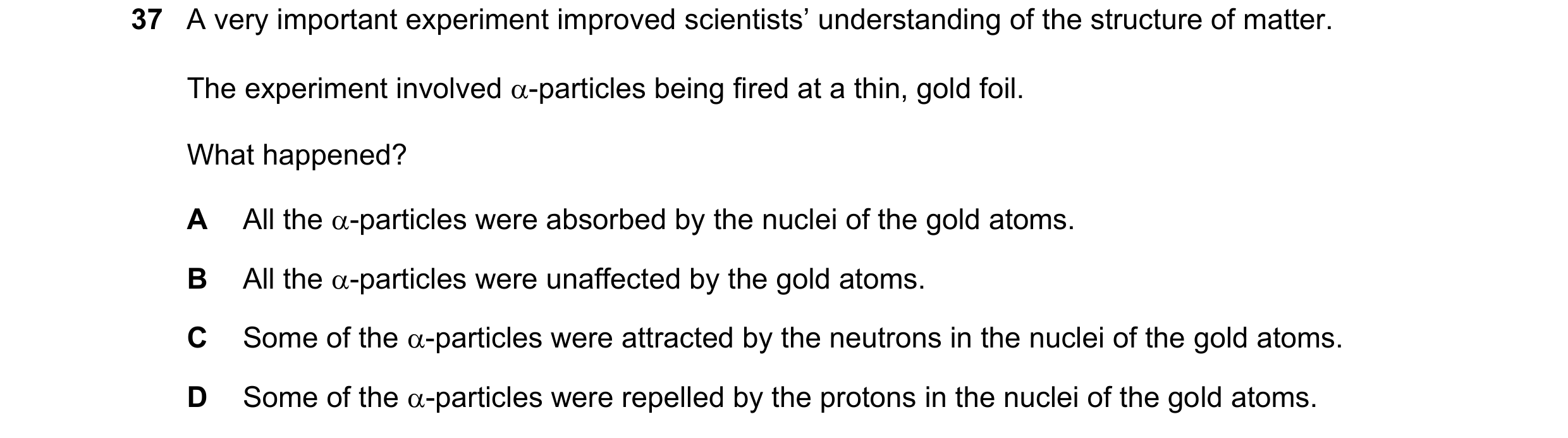
Q14 · A very important experiment improved scientists’ understanding of the structure of matter 0972/11 Oct/Nov 2021
37 A very important experiment improved scientists’ understanding of the structure of matter. The experiment involved -particles being fired at a thin, gold foil. What happened? A All the -particles were absorbed by the nuclei of the gold atoms. B All the -particles were unaffected by the gold atoms. C Some of the -particles were attracted by the neutrons in the nuclei of the gold atoms. D Some of the -particles were repelled by the protons in the nuclei of the gold atoms.
1 marks
Answer: D
This question in 0972/11 Oct/Nov 2021
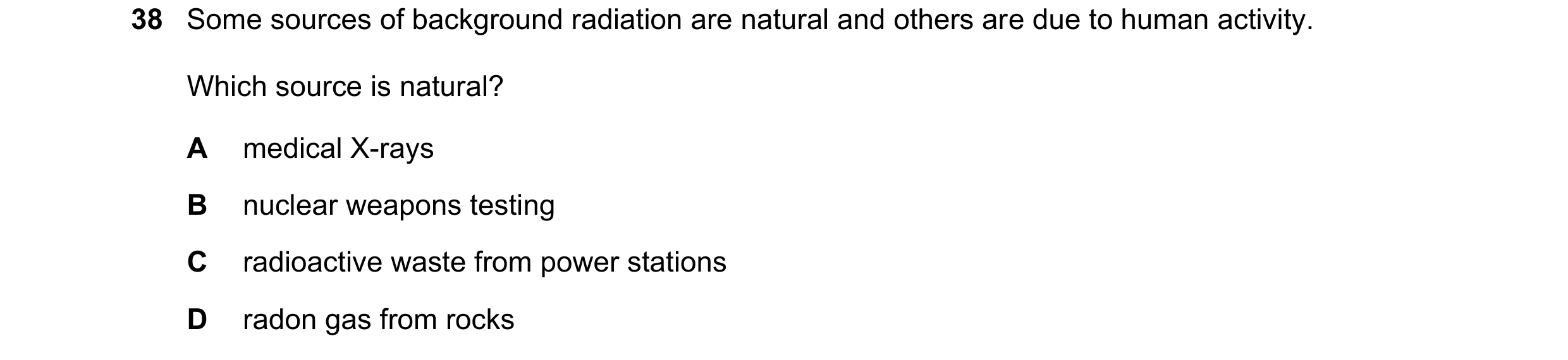
Q15 · Some sources of background radiation are natural and others are due to human activity 0972/11 Oct/Nov 2021
38 Some sources of background radiation are natural and others are due to human activity. Which source is natural? A medical X-rays B nuclear weapons testing C radioactive waste from power stations D radon gas from rocks
1 marks
Answer: D
This question in 0972/11 Oct/Nov 2021
Q16 · A radioactive material is placed near a detector 0972/11 Oct/Nov 2021
39 A radioactive material is placed near a detector. The detector shows a count rate of 28 000 counts / min. When a piece of card is put between the material and the counter, the reading decreases to 25 000 counts / min. When an aluminium sheet is put between the material and the counter, the reading remains at 25 000 counts / min. When a sheet of lead is put between the material and the counter, the reading decreases to 19 000 counts / min. What is being emitted by the radioactive material? A , and -radiation B and -radiation only C and -radiation only D and -radiation only
1 marks
Answer: C
This question in 0972/11 Oct/Nov 2021
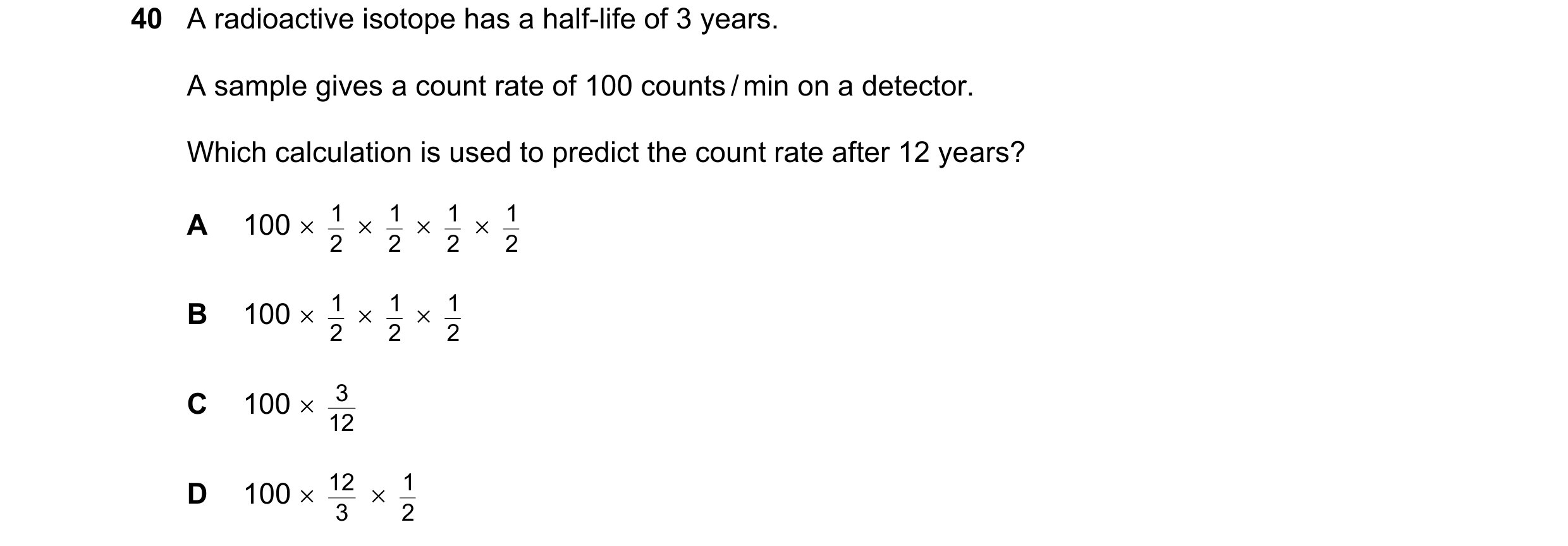
Q17 · A radioactive isotope has a half-life of 3 years 0972/11 Oct/Nov 2021
40 A radioactive isotope has a half-life of 3 years. A sample gives a count rate of 100 counts / min on a detector. Which calculation is used to predict the count rate after 12 years? A 100 1 2 1 2 1 2 1 2 B 100 1 2 1 2 1 2 C 100 3 12 D 100 12 3 1 2
1 marks
Answer: A
This question in 0972/11 Oct/Nov 2021
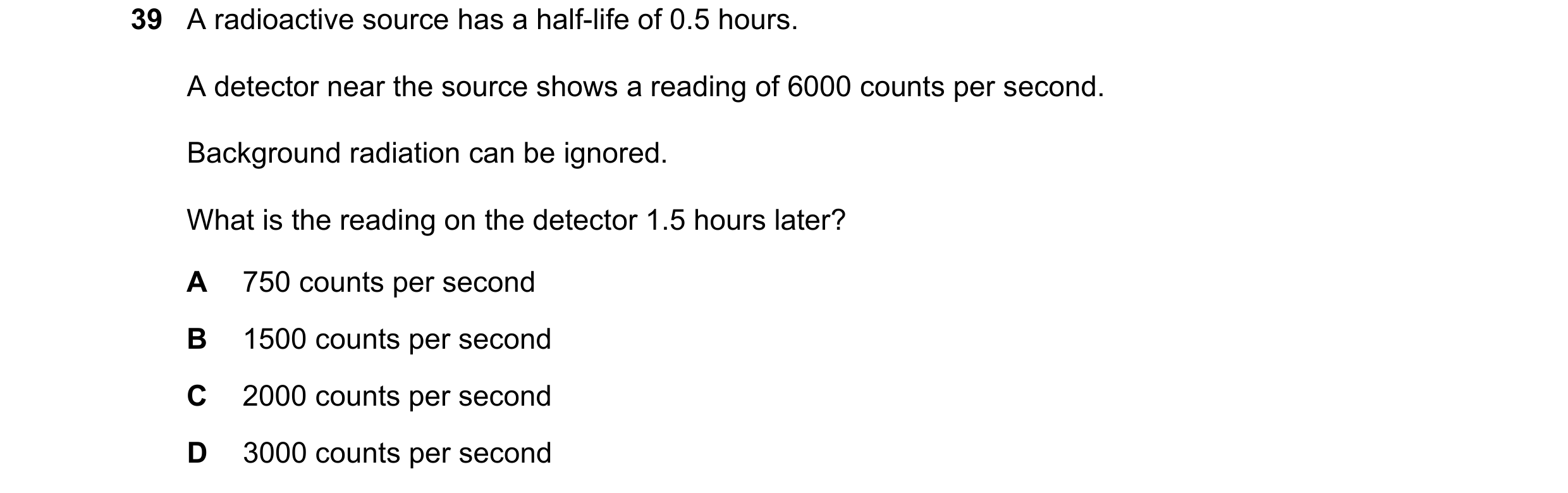
Q18 · A radioactive source has a half-life of 0.5 hours 0972/11 May/June 2022
39 A radioactive source has a half-life of 0.5 hours. A detector near the source shows a reading of 6000 counts per second. Background radiation can be ignored. What is the reading on the detector 1.5 hours later? A 750 counts per second B 1500 counts per second C 2000 counts per second D 3000 counts per second
1 marks
Answer: A
This question in 0972/11 May/June 2022
Q19 · Which statement about the radioactive decay of a substance is correct? 0972/11 May/June 2022
40 Which statement about the radioactive decay of a substance is correct? A It cannot be predicted when a particular nucleus will decay. B Placing a radioactive substance inside a lead-lined box prevents it from decaying. C The decay always produces poisonous gases. D The rate of decay increases if the substance is dissolved in water.
1 marks
Answer: A
This question in 0972/11 May/June 2022
Q20 · A radioactive source has a half-life of 0.5 hours 0972/12 May/June 2022
39 A radioactive source has a half-life of 0.5 hours. A detector near the source shows a reading of 6000 counts per second. Background radiation can be ignored. What is the reading on the detector 1.5 hours later? A 750 counts per second B 1500 counts per second C 2000 counts per second D 3000 counts per second
1 marks
Answer: A
This question in 0972/12 May/June 2022
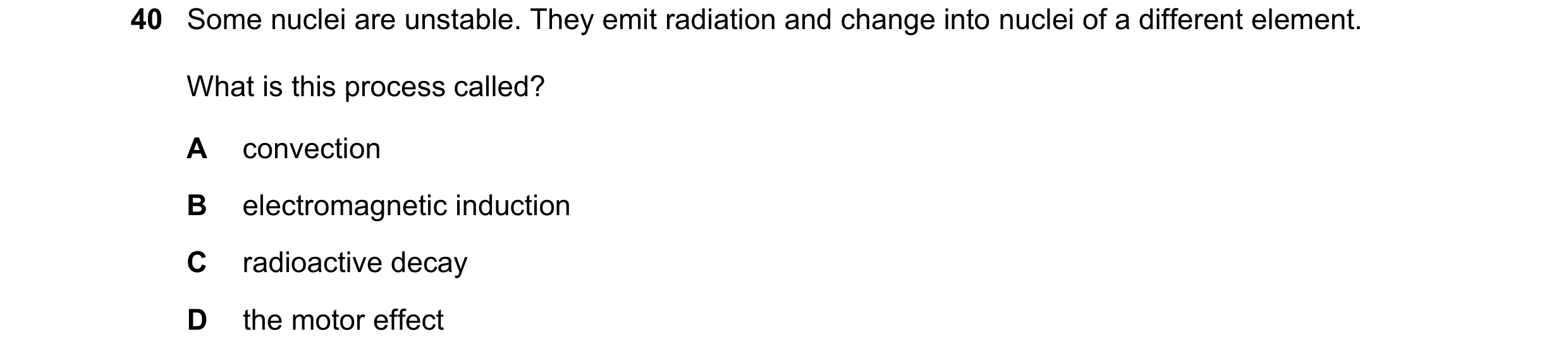
Q21 · Some nuclei are unstable 0972/12 May/June 2022
40 Some nuclei are unstable. They emit radiation and change into nuclei of a different element. What is this process called? A convection B electromagnetic induction C radioactive decay D the motor effect
1 marks
Answer: C
This question in 0972/12 May/June 2022
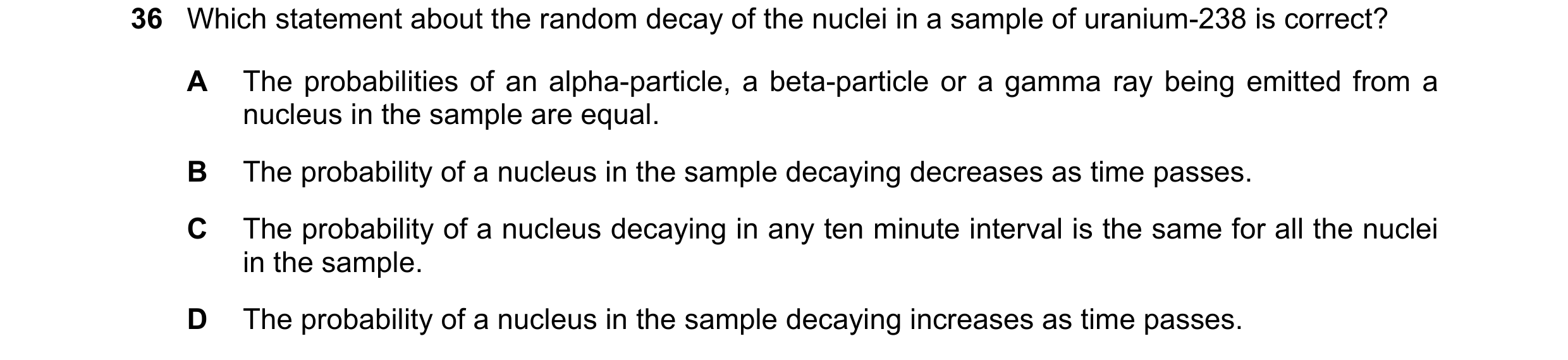
Q22 · Which statement about the random decay of the nuclei in a sample of uranium-238 is… 0972/11 May/June 2023
36 Which statement about the random decay of the nuclei in a sample of uranium-238 is correct? A The probabilities of an alpha-particle, a beta-particle or a gamma ray being emitted from a nucleus in the sample are equal. B The probability of a nucleus in the sample decaying decreases as time passes. C The probability of a nucleus decaying in any ten minute interval is the same for all the nuclei in the sample. D The probability of a nucleus in the sample decaying increases as time passes.
1 marks
Answer: C
This question in 0972/11 May/June 2023
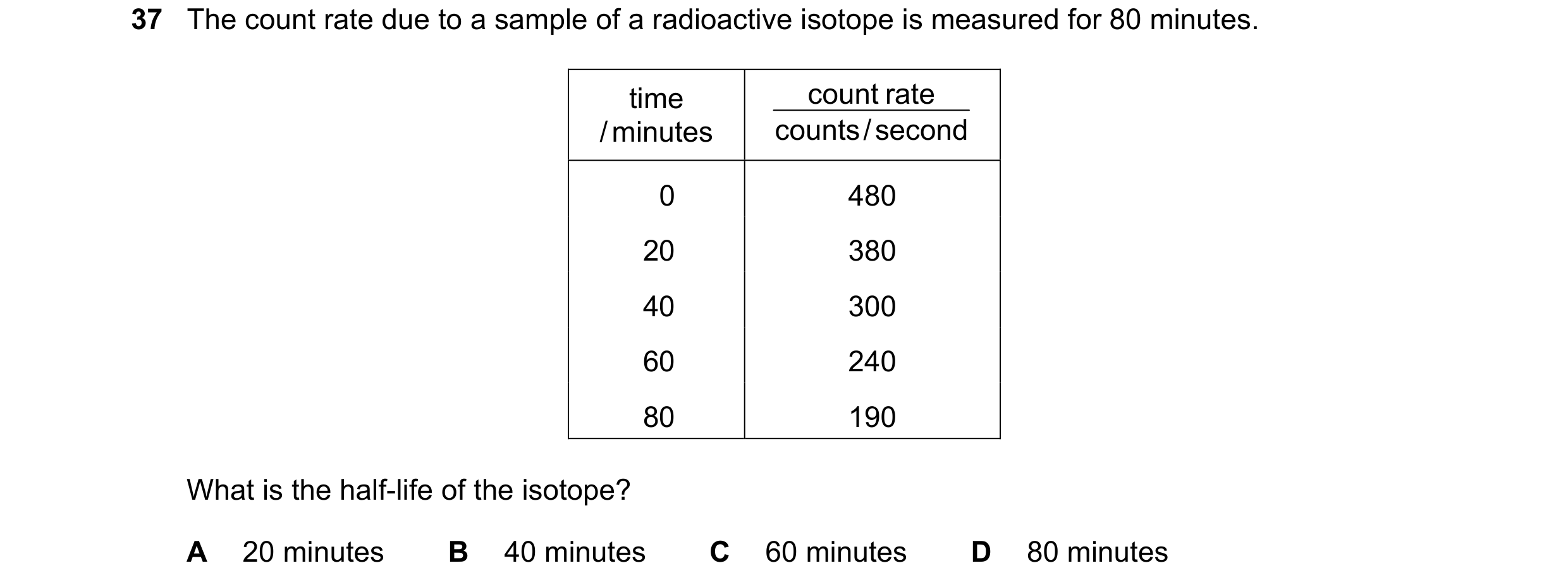
Q23 · The count rate due to a sample of a radioactive isotope is measured for 80 minutes 0972/11 May/June 2023
37 The count rate due to a sample of a radioactive isotope is measured for 80 minutes. time count rate / minutes counts / second 0 480 20 380 40 300 60 240 80 190 What is the half-life of the isotope? A 20 minutes B 40 minutes C 60 minutes D 80 minutes
1 marks
Answer: C
This question in 0972/11 May/June 2023
Q24 · The table shows the composition of three different nuclei 0972/12 May/June 2023
35 The table shows the composition of three different nuclei. number of number of nucleus protons neutrons X 3 3 Y 3 4 Z 4 3 Which nuclei are isotopes of the same element? A X, Y and Z B X and Y only C X and Z only D Y and Z only
1 marks
Answer: B
This question in 0972/12 May/June 2023
Q25 · A sample of a radioactive isotope emits 9600 -particles per second 0972/12 May/June 2023
36 A sample of a radioactive isotope emits 9600 -particles per second. After 40 hours the rate of emission has fallen to 600 -particles per second. What is the half-life of this isotope? A 4.0 hours B 8.0 hours C 10 hours D 20 hours
1 marks
Answer: C
This question in 0972/12 May/June 2023
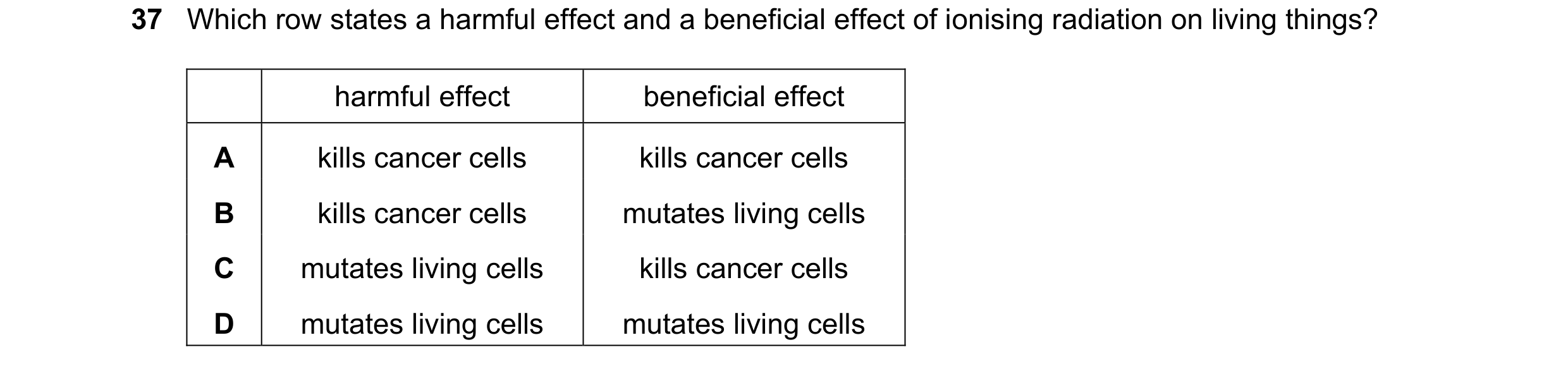
Q26 · Which row states a harmful effect and a beneficial effect of ionising radiation on living… 0972/12 May/June 2023
37 Which row states a harmful effect and a beneficial effect of ionising radiation on living things? harmful effect beneficial effect A kills cancer cells kills cancer cells B kills cancer cells mutates living cells C mutates living cells kills cancer cells D mutates living cells mutates living cells
1 marks
Answer: C
This question in 0972/12 May/June 2023
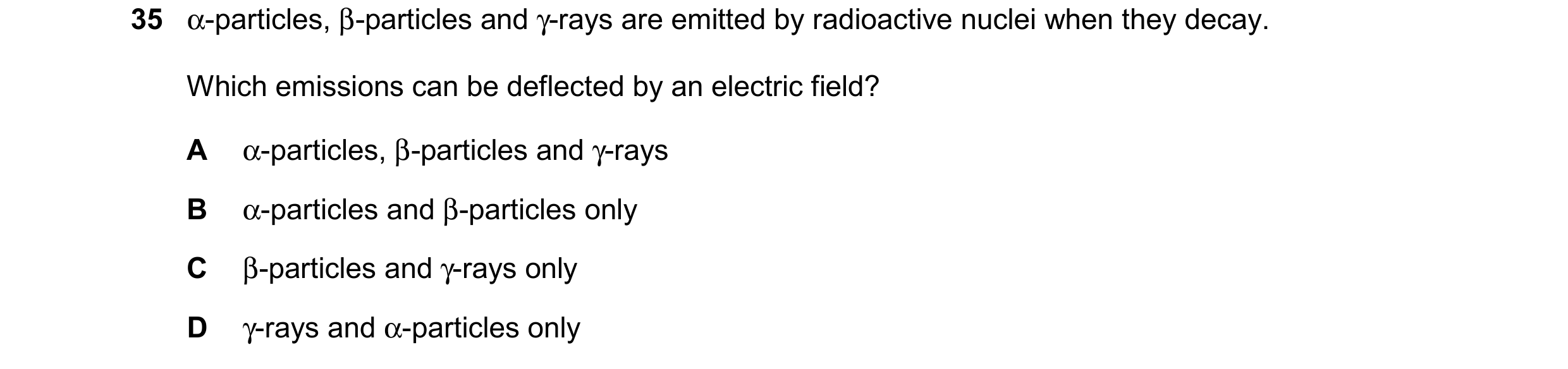
Q27 · Α-particles, β-particles and γ-rays are emitted by radioactive nuclei when they decay 0972/11 Oct/Nov 2023
35 α-particles, β-particles and γ-rays are emitted by radioactive nuclei when they decay. Which emissions can be deflected by an electric field? A α-particles, β-particles and γ-rays B α-particles and β-particles only C β-particles and γ-rays only D γ-rays and α-particles only
1 marks
Answer: B
This question in 0972/11 Oct/Nov 2023
Q28 · The graph shows the count rate from a radioactive source over a period of time 0972/11 Oct/Nov 2023
36 The graph shows the count rate from a radioactive source over a period of time. 2000 count rate counts / s 1500 1000 500 0 0 1 2 3 time / hours What is the half-life of the source? A 0.5 hour B 1.0 hour C 1.5 hours D 3.0 hours
1 marks
Answer: B
This question in 0972/11 Oct/Nov 2023
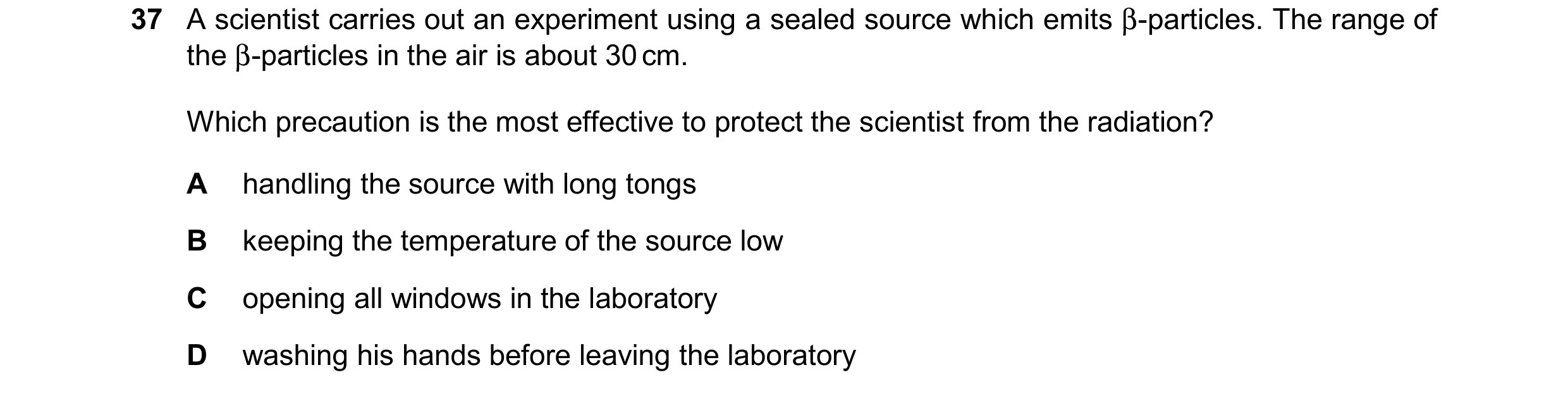
Q29 · A scientist carries out an experiment using a sealed source which emits β-particles 0972/11 Oct/Nov 2023
37 A scientist carries out an experiment using a sealed source which emits β-particles. The range of the β-particles in the air is about 30 cm. Which precaution is the most effective to protect the scientist from the radiation? A handling the source with long tongs B keeping the temperature of the source low C opening all windows in the laboratory D washing his hands before leaving the laboratory
1 marks
Answer: A
This question in 0972/11 Oct/Nov 2023
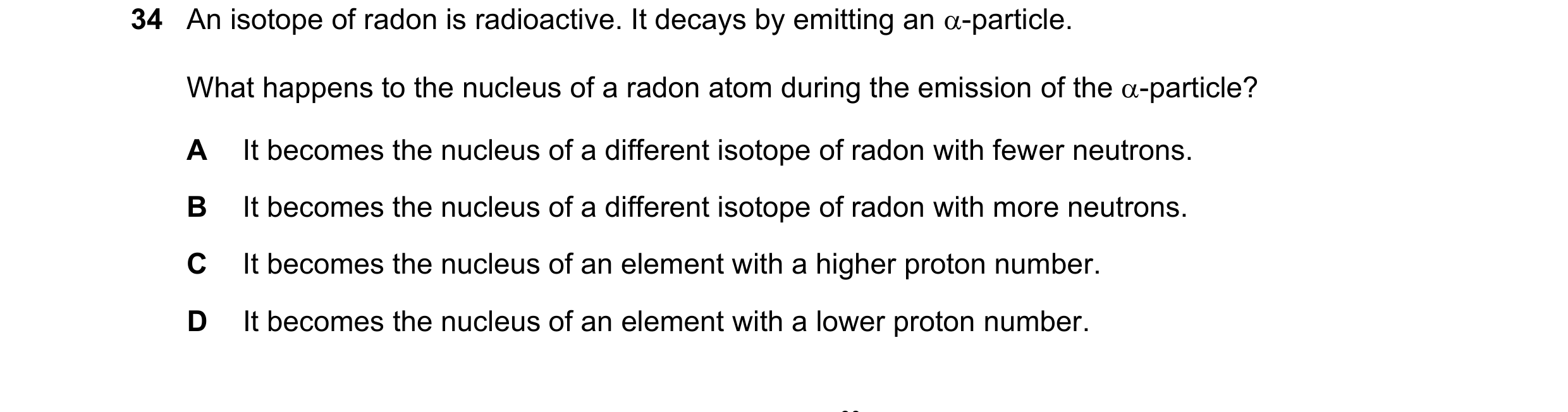
Q30 · An isotope of radon is radioactive 0972/11 May/June 2024
34 An isotope of radon is radioactive. It decays by emitting an -particle. What happens to the nucleus of a radon atom during the emission of the -particle? A It becomes the nucleus of a different isotope of radon with fewer neutrons. B It becomes the nucleus of a different isotope of radon with more neutrons. C It becomes the nucleus of an element with a higher proton number. D It becomes the nucleus of an element with a lower proton number.
1 marks
Answer: D
This question in 0972/11 May/June 2024
Q31 · The nuclide notation of the isotope strontium-90 is 90 Sr 0972/11 May/June 2024
35 The nuclide notation of the isotope strontium-90 is 90 Sr. 38 Which statement is correct? A A nucleus of strontium-90 has 38 neutrons. B A nucleus of strontium-90 has 52 neutrons. C A nucleus of strontium-90 has 90 electrons. D A nucleus of strontium-90 has 90 neutrons.
1 marks
Answer: B
This question in 0972/11 May/June 2024
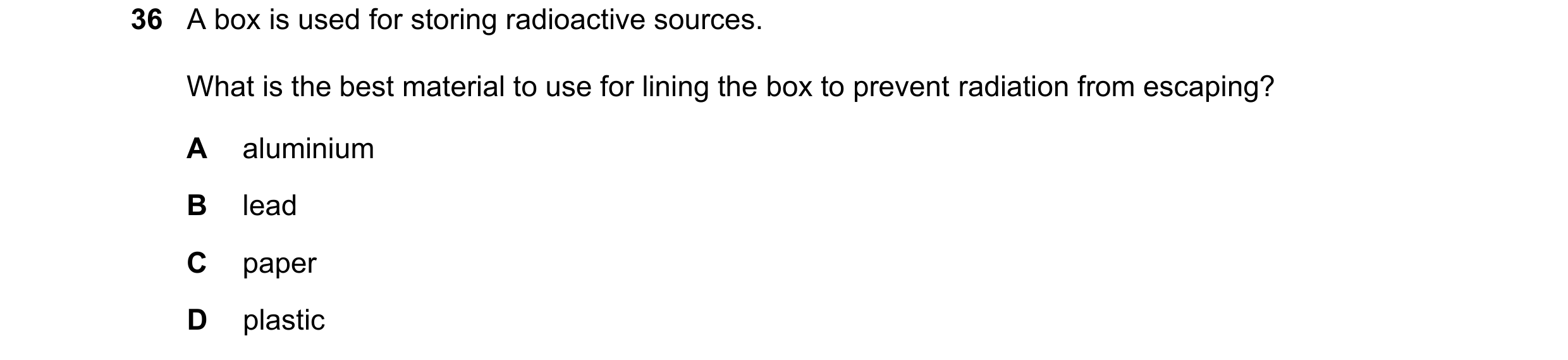
Q32 · A box is used for storing radioactive sources 0972/11 May/June 2024
36 A box is used for storing radioactive sources. What is the best material to use for lining the box to prevent radiation from escaping? A aluminium B lead C paper D plastic
1 marks
Answer: B
This question in 0972/11 May/June 2024
Q33 · Four statements about isotopes of a certain element are listed 0972/12 May/June 2024
33 Four statements about isotopes of a certain element are listed. Which statement about the isotopes must be correct? A They are radioactive. B They are unstable. C They have the same number of neutrons. D They have the same number of protons.
1 marks
Answer: D
This question in 0972/12 May/June 2024
Q34 · What makes a contribution to a person’s annual dose of ionising radiation? 0972/12 May/June 2024
34 What makes a contribution to a person’s annual dose of ionising radiation? A food and drink B greenhouse gases C mobile phone masts D radio and TV transmissions
1 marks
Answer: A
This question in 0972/12 May/June 2024
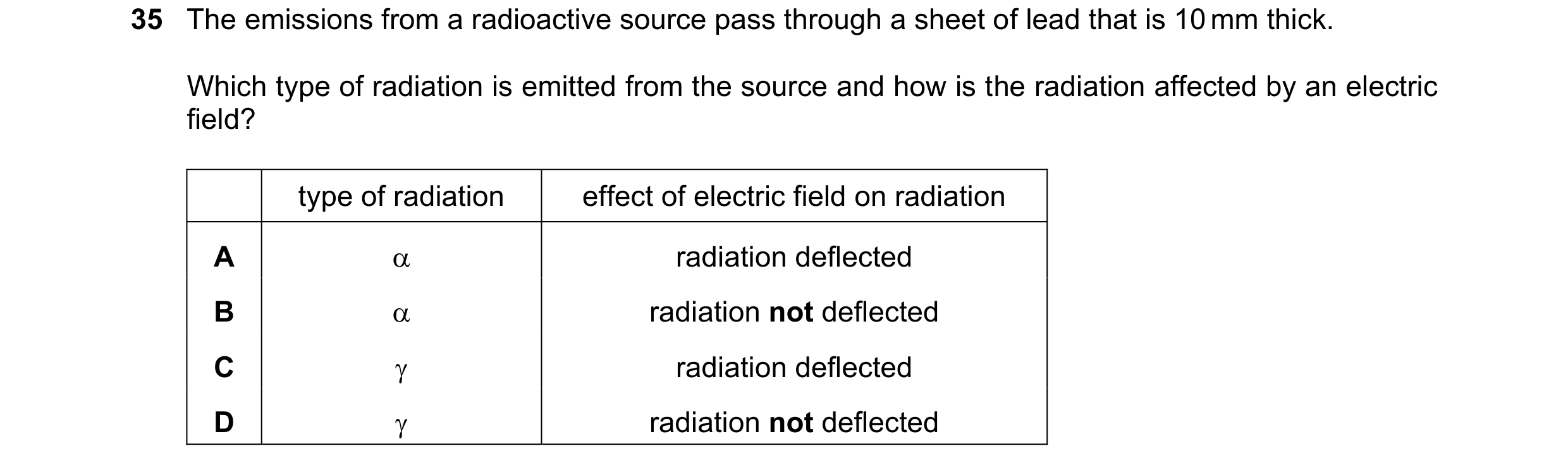
Q35 · The emissions from a radioactive source pass through a sheet of lead that is 10 mm thick 0972/12 May/June 2024
35 The emissions from a radioactive source pass through a sheet of lead that is 10 mm thick. Which type of radiation is emitted from the source and how is the radiation affected by an electric field? type of radiation effect of electric field on radiation A radiation deflected B radiation not deflected C radiation deflected D radiation not deflected
1 marks
Answer: D
This question in 0972/12 May/June 2024
Q36 · Radioactive waste is often mixed with liquid glass 0972/12 May/June 2024
36 Radioactive waste is often mixed with liquid glass. This mixture solidifies and is stored in steel drums. Why is this process used to store radioactive waste? A It reduces the decay rate. B It reduces the half-life of the waste. C The waste is contained in a solid block so it cannot leak out. D The glass is transparent so the waste can be seen.
1 marks
Answer: C
This question in 0972/12 May/June 2024
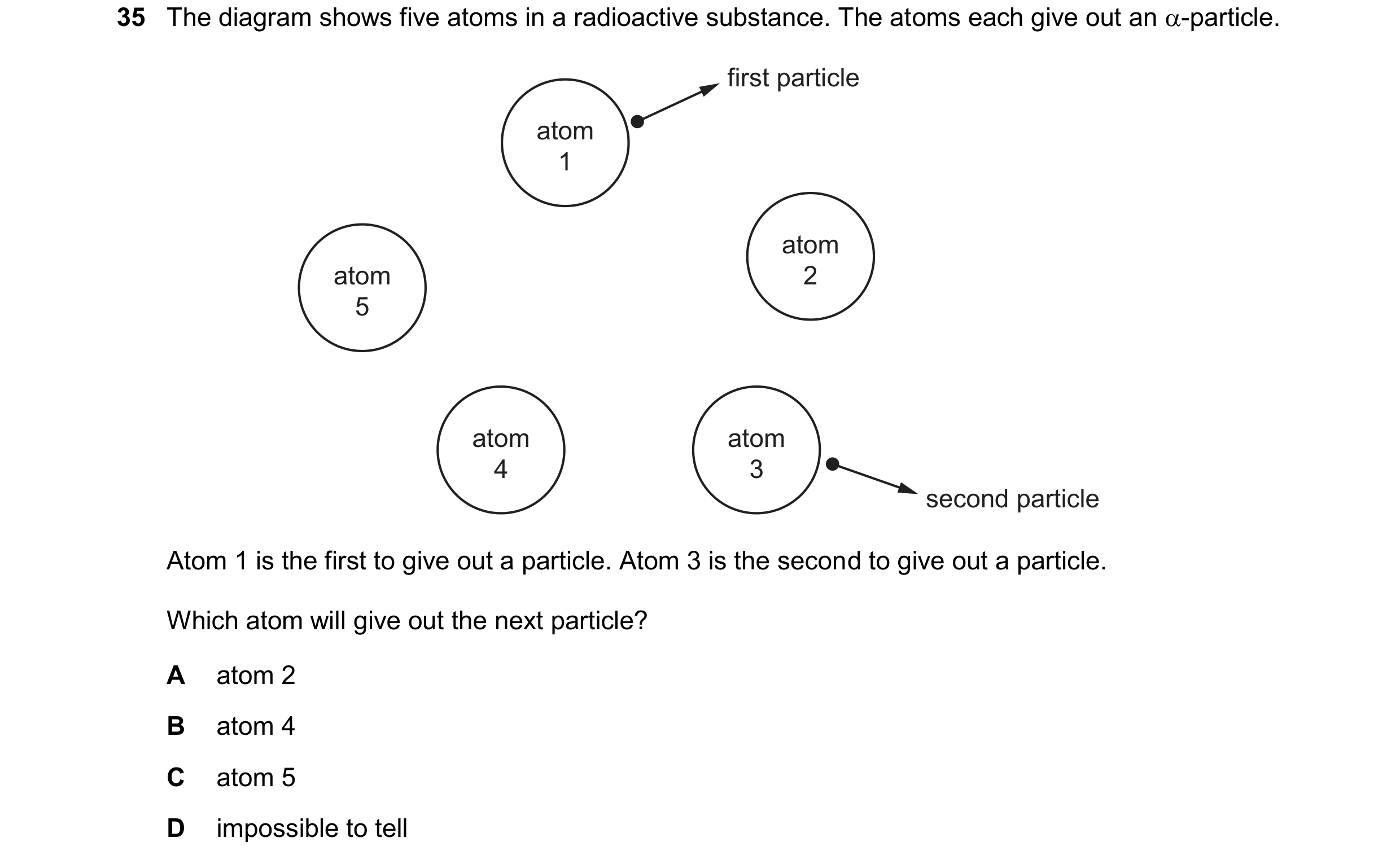
Q37 · The diagram shows five atoms in a radioactive substance 0972/11 Oct/Nov 2024
35 The diagram shows five atoms in a radioactive substance. The atoms each give out an -particle. first particle atom 1 atom atom 2 5 atom atom 4 3 second particle Atom 1 is the first to give out a particle. Atom 3 is the second to give out a particle. Which atom will give out the next particle? A atom 2 B atom 4 C atom 5 D impossible to tell
1 marks
Answer: D
This question in 0972/11 Oct/Nov 2024
Q38 · The diagram shows a radioactive source, a thick aluminium sheet and a radiation detector 0972/11 Oct/Nov 2024
36 The diagram shows a radioactive source, a thick aluminium sheet and a radiation detector. radioactive thick aluminium radiation detector source sheet The radiation detector shows a reading greater than the background reading. Which type of radiation is being emitted by the source and detected by the detector? A -radiation B -radiation C -radiation D infrared radiation
1 marks
Answer: C
This question in 0972/11 Oct/Nov 2024
Q39 · The half-life of the radioactive isotope caesium 137 Cs is 30 years 0972/11 Oct/Nov 2024
37 The half-life of the radioactive isotope caesium 137 Cs is 30 years. 55 Starting with 30 g of the isotope, which mass of the isotope remains after 90 years? A 10.0 g B 7.50 g C 3.75 g D 1.25 g
1 marks
Answer: C
This question in 0972/11 Oct/Nov 2024
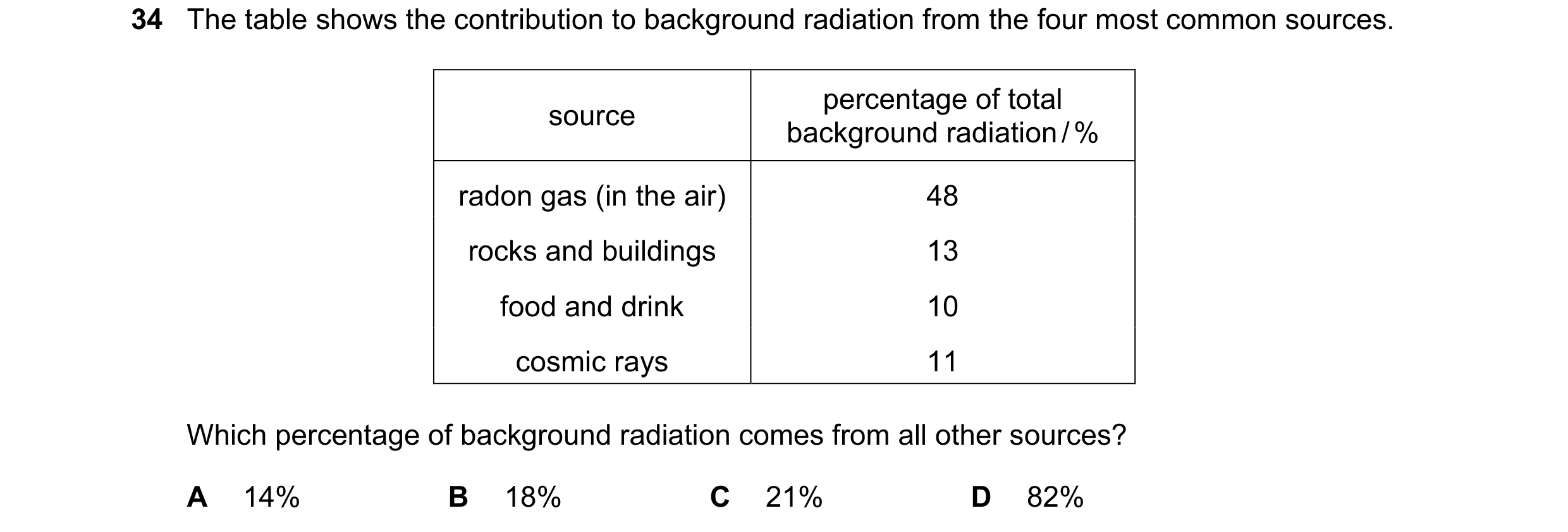
Q40 · The table shows the contribution to background radiation from the four most common sources 0972/11 May/June 2025
34 The table shows the contribution to background radiation from the four most common sources. percentage of total source background radiation / % radon gas (in the air) 48 rocks and buildings 13 food and drink 10 cosmic rays 11 Which percentage of background radiation comes from all other sources? A 14% B 18% C 21% D 82%
1 marks
Answer: B
This question in 0972/11 May/June 2025
Q41 · The unstable nucleus of an element undergoes radioactive decay 0972/11 May/June 2025
35 The unstable nucleus of an element undergoes radioactive decay. The proton number remains unchanged. Which description of this radioactive decay event is correct? A The nucleus emits an -particle. B The nucleus emits a -particle. C The nucleus emits -radiation. D The nucleus emits an -particle, a -particle and -radiation together.
1 marks
Answer: C
This question in 0972/11 May/June 2025
Q42 · A person exposed to excessive radiation from certain parts of the electromagnetic… 0972/12 May/June 2025
22 A person exposed to excessive radiation from certain parts of the electromagnetic spectrum is likely to suffer cell damage. Which radiations cause cell damage? A gamma rays and ultraviolet B gamma rays only C green light and red light D radio waves and green light
1 marks
Answer: A
This question in 0972/12 May/June 2025
Q43 · Which list only includes sources of naturally occurring background radiation? 0972/12 May/June 2025
35 Which list only includes sources of naturally occurring background radiation? A cosmic rays, radon gas, nuclear power stations B food and drink, mobile phones, cosmic rays C rocks and buildings, food and drink, radon gas D rocks and buildings, mobile phones, nuclear power stations
1 marks
Answer: C
This question in 0972/12 May/June 2025
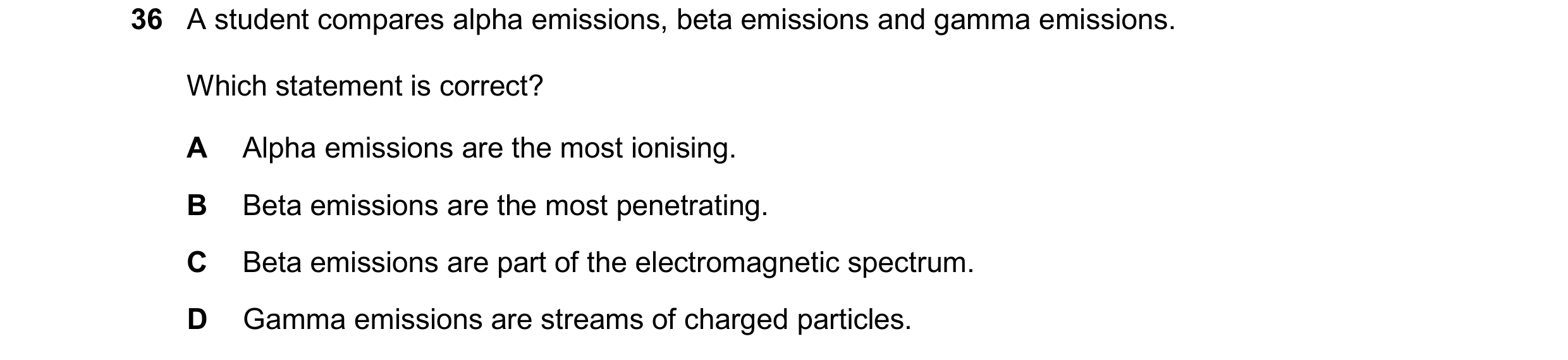
Q44 · A student compares alpha emissions, beta emissions and gamma emissions 0972/12 May/June 2025
36 A student compares alpha emissions, beta emissions and gamma emissions. Which statement is correct? A Alpha emissions are the most ionising. B Beta emissions are the most penetrating. C Beta emissions are part of the electromagnetic spectrum. D Gamma emissions are streams of charged particles.
1 marks
Answer: A
This question in 0972/12 May/June 2025
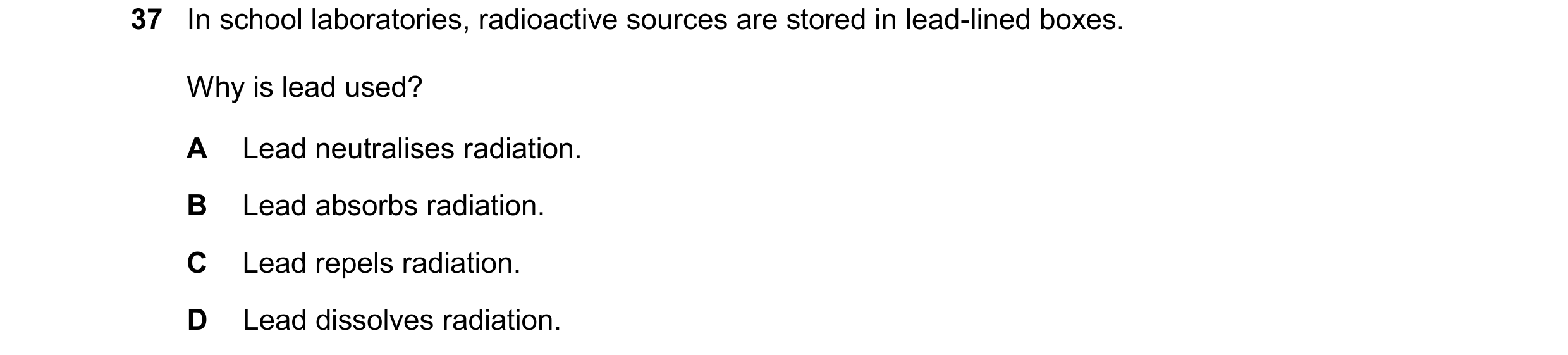
Q45 · In school laboratories, radioactive sources are stored in lead-lined boxes 0972/12 May/June 2025
37 In school laboratories, radioactive sources are stored in lead-lined boxes. Why is lead used? A Lead neutralises radiation. B Lead absorbs radiation. C Lead repels radiation. D Lead dissolves radiation.
1 marks
Answer: B
This question in 0972/12 May/June 2025


 1 / 12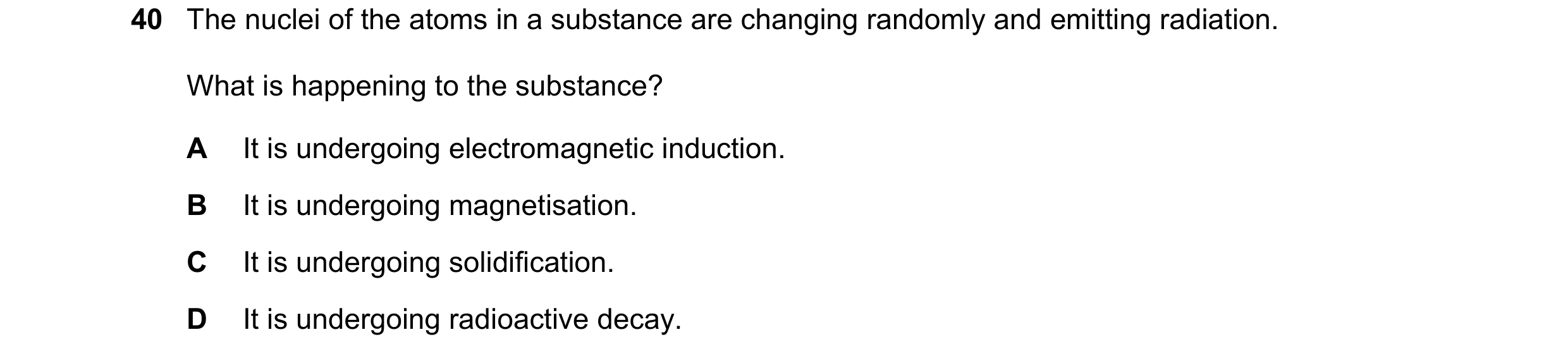


 2 / 12

 3 / 12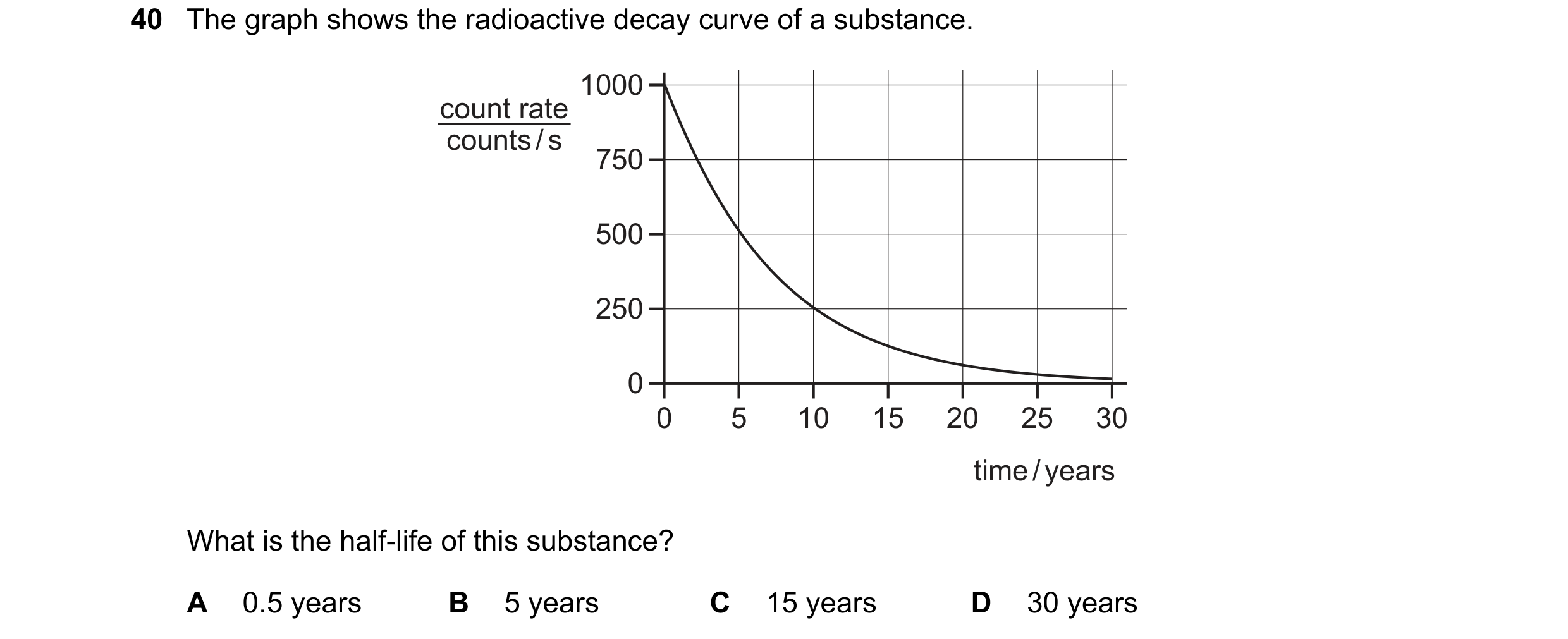
 4 / 12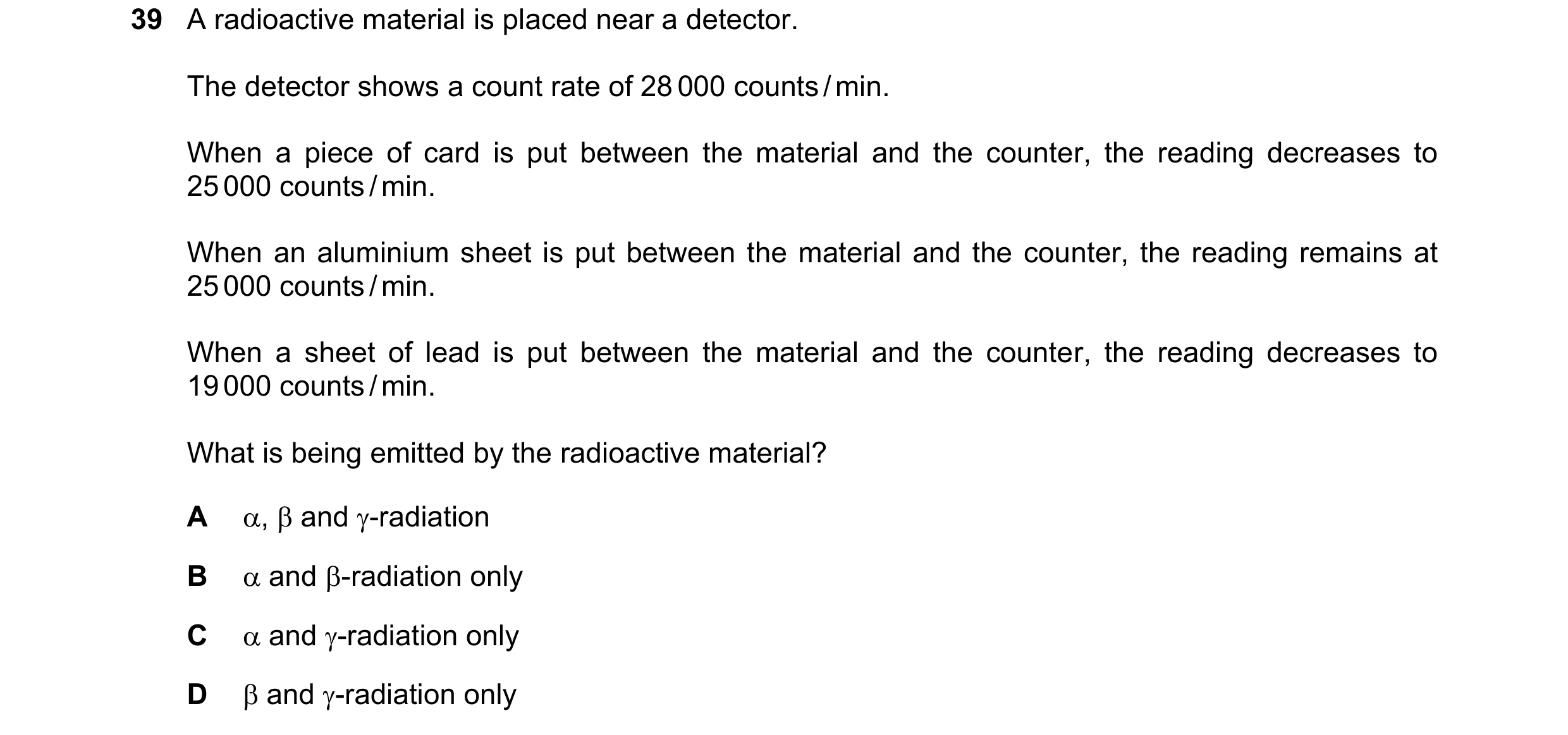
 5 / 12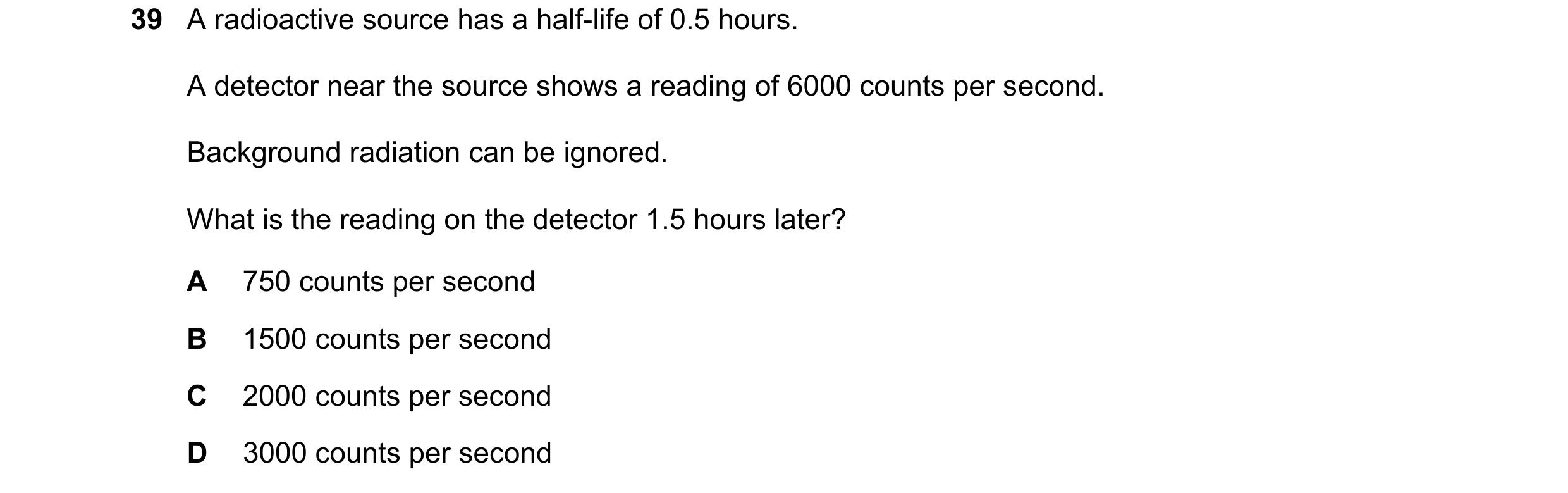
 6 / 12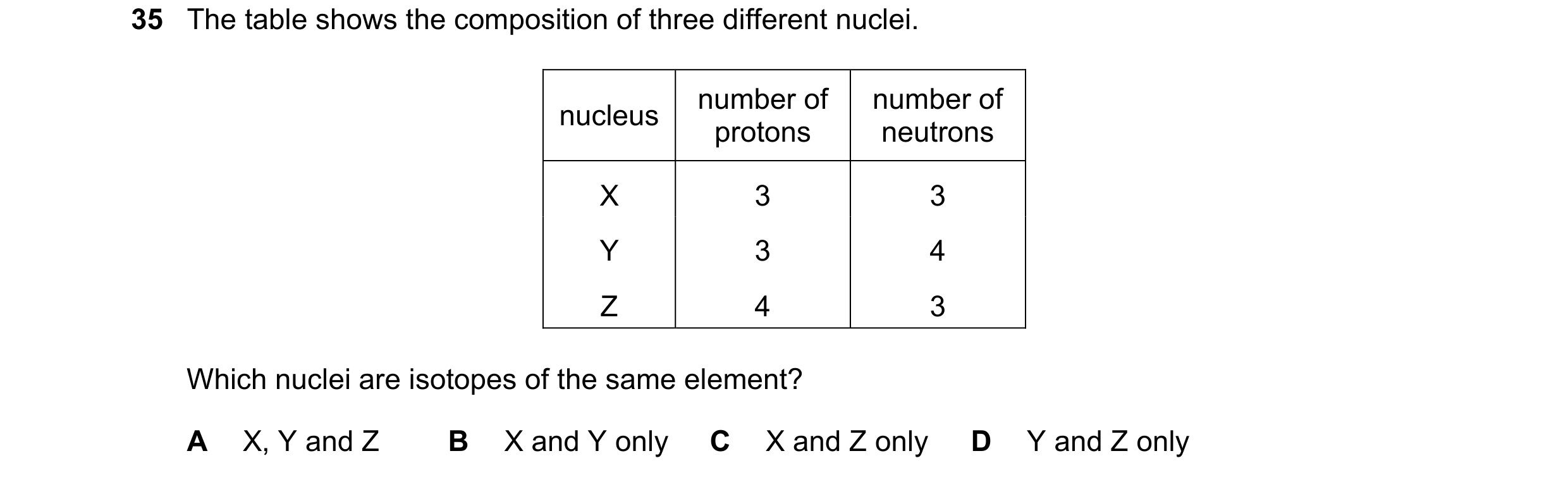

 7 / 12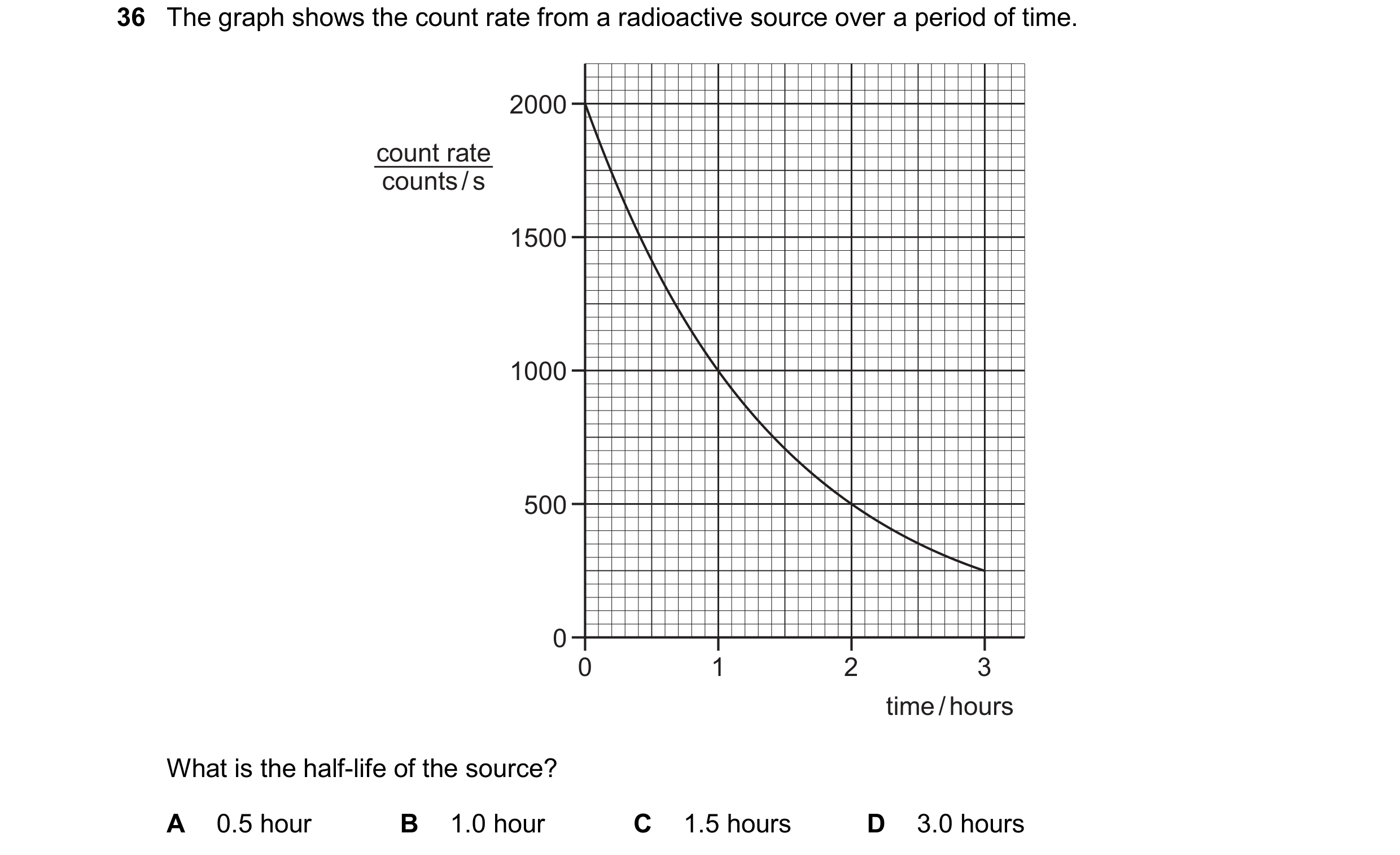
 8 / 12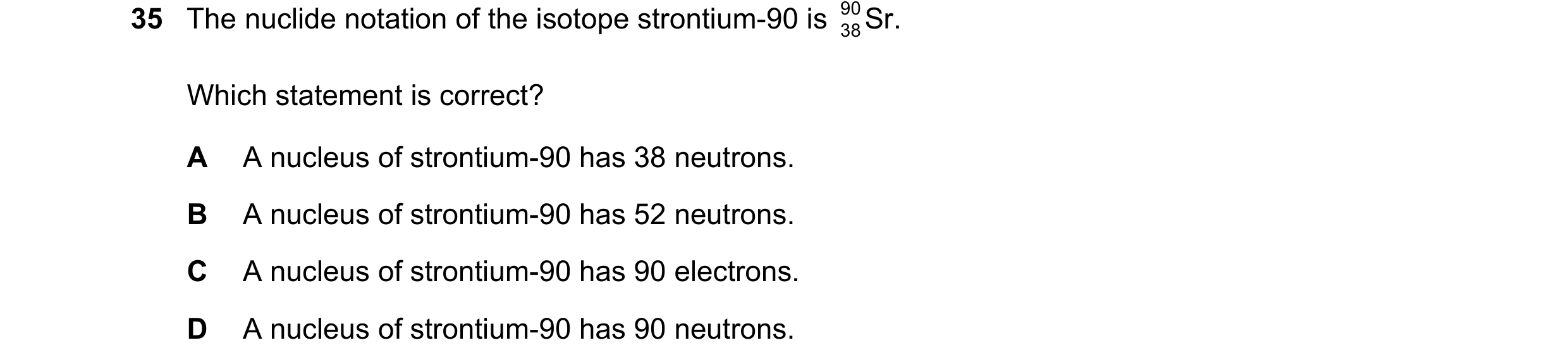


 9 / 12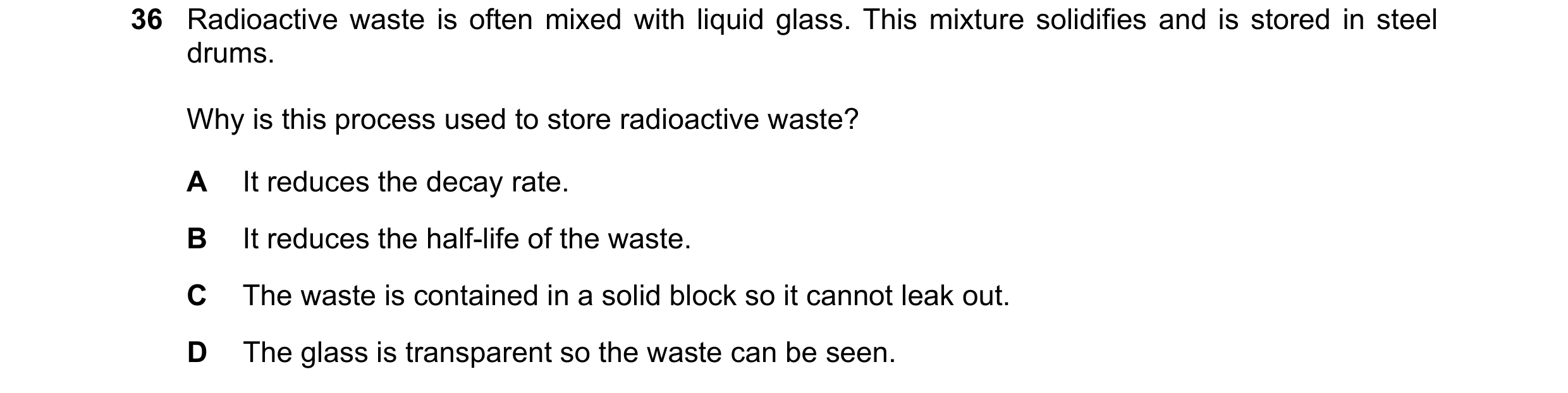
 10 / 12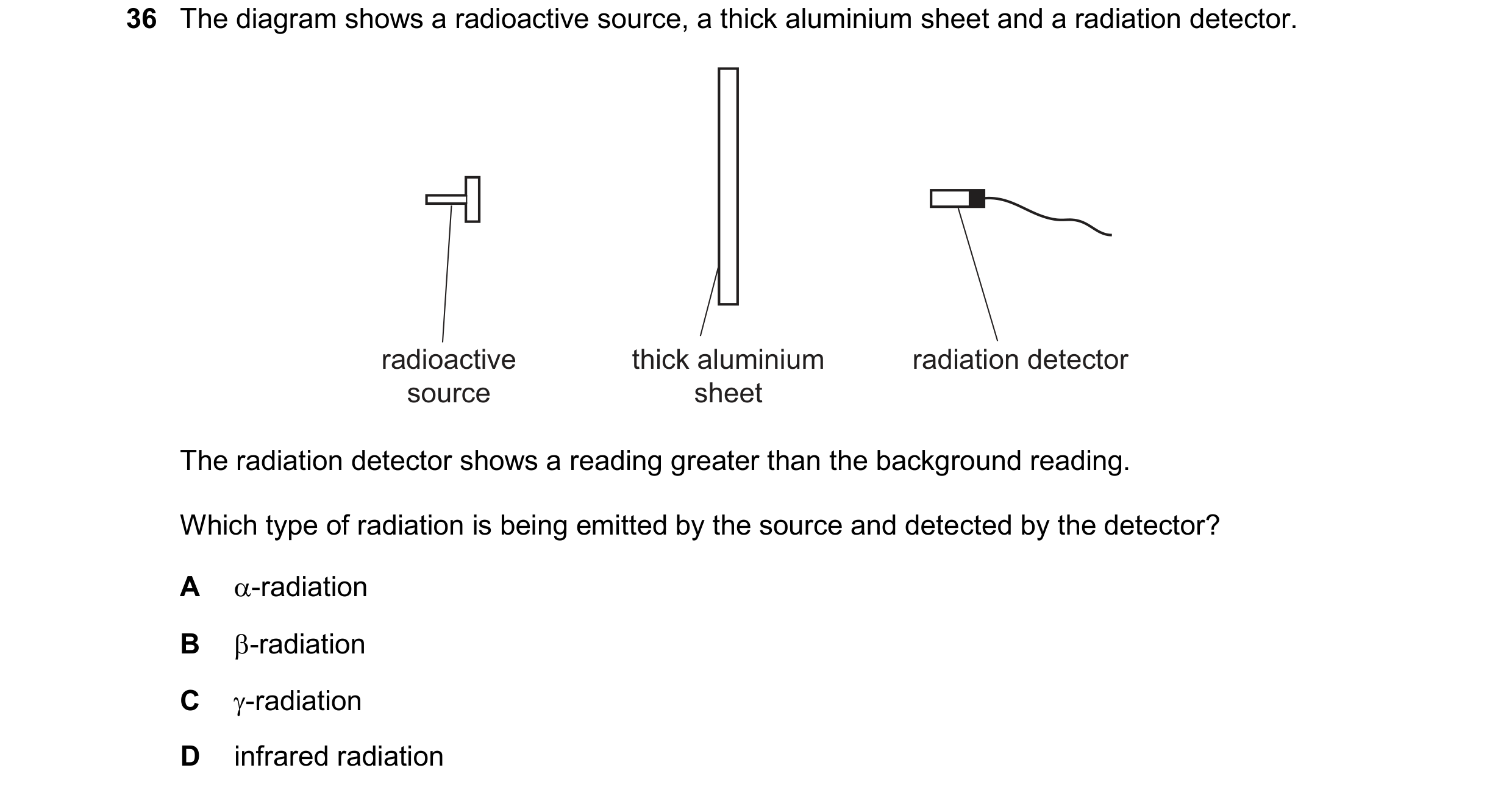

 11 / 12

 12 / 12