Questions as text
Q1 · On a warm day, a carton of fresh milk is covered with a wet cloth 0972/11 May/June 2018
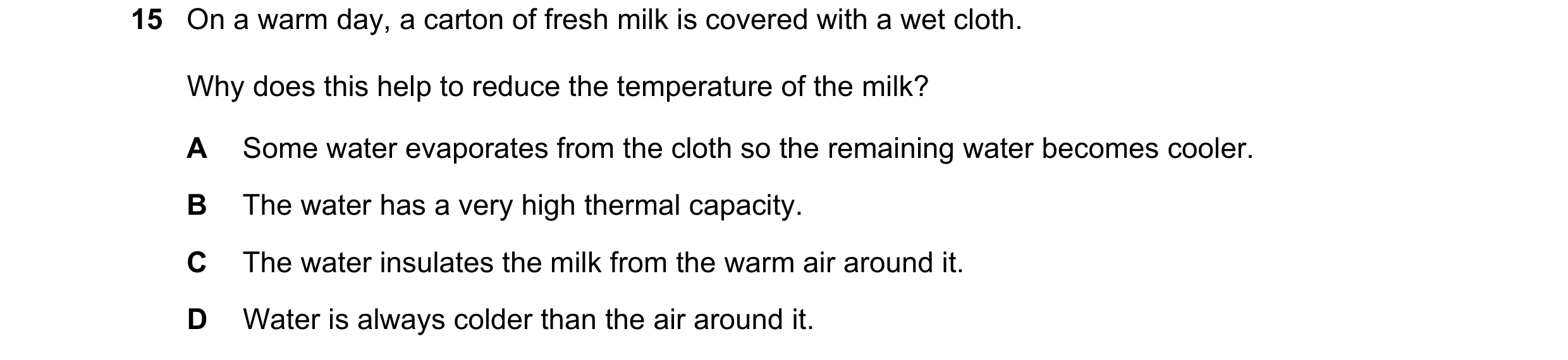
15 On a warm day, a carton of fresh milk is covered with a wet cloth. Why does this help to reduce the temperature of the milk? A Some water evaporates from the cloth so the remaining water becomes cooler. B The water has a very high thermal capacity. C The water insulates the milk from the warm air around it. D Water is always colder than the air around it.
1 marks
Answer: A
This question in 0972/11 May/June 2018
Q2 · Air is trapped in a cylinder by a piston 0972/11 May/June 2018
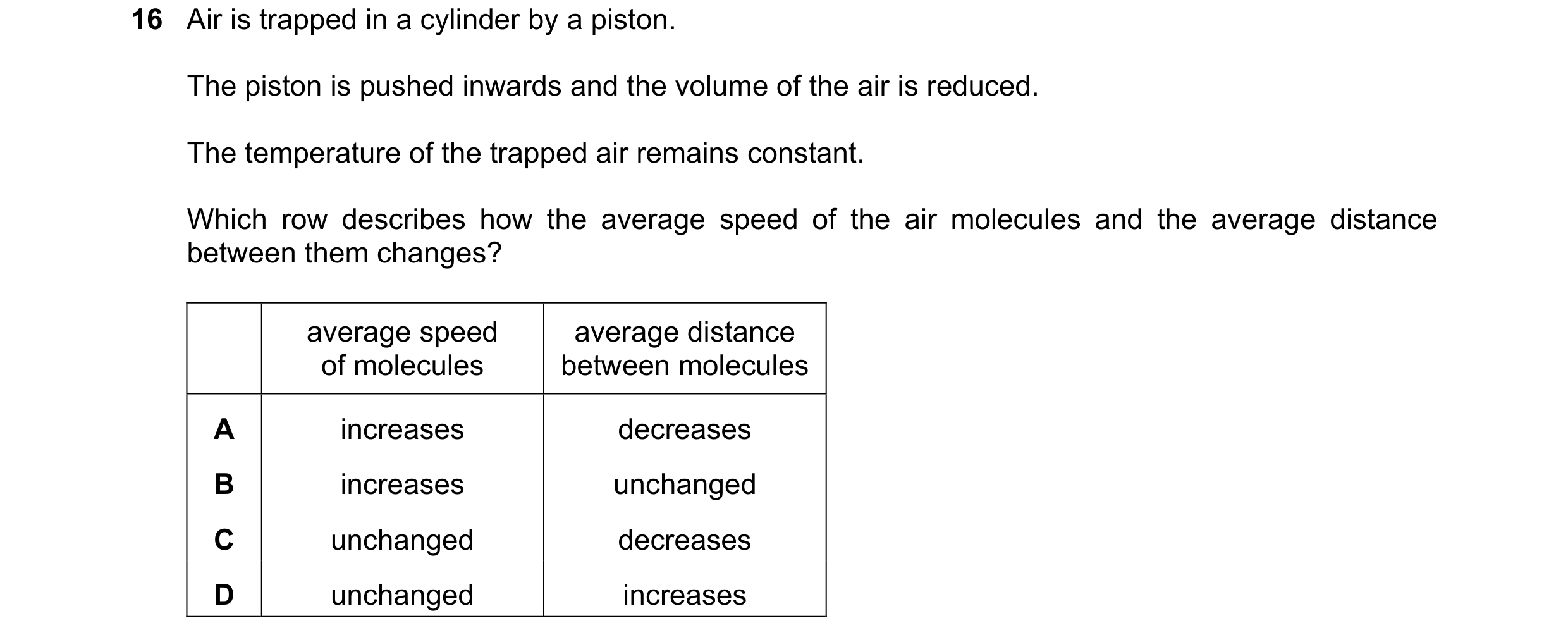
16 Air is trapped in a cylinder by a piston. The piston is pushed inwards and the volume of the air is reduced. The temperature of the trapped air remains constant. Which row describes how the average speed of the air molecules and the average distance between them changes? average speed average distance of molecules between molecules A increases decreases B increases unchanged C unchanged decreases D unchanged increases
1 marks
Answer: C
This question in 0972/11 May/June 2018
Q3 · Which row gives the correct name for each change of state shown? 0972/11 May/June 2018
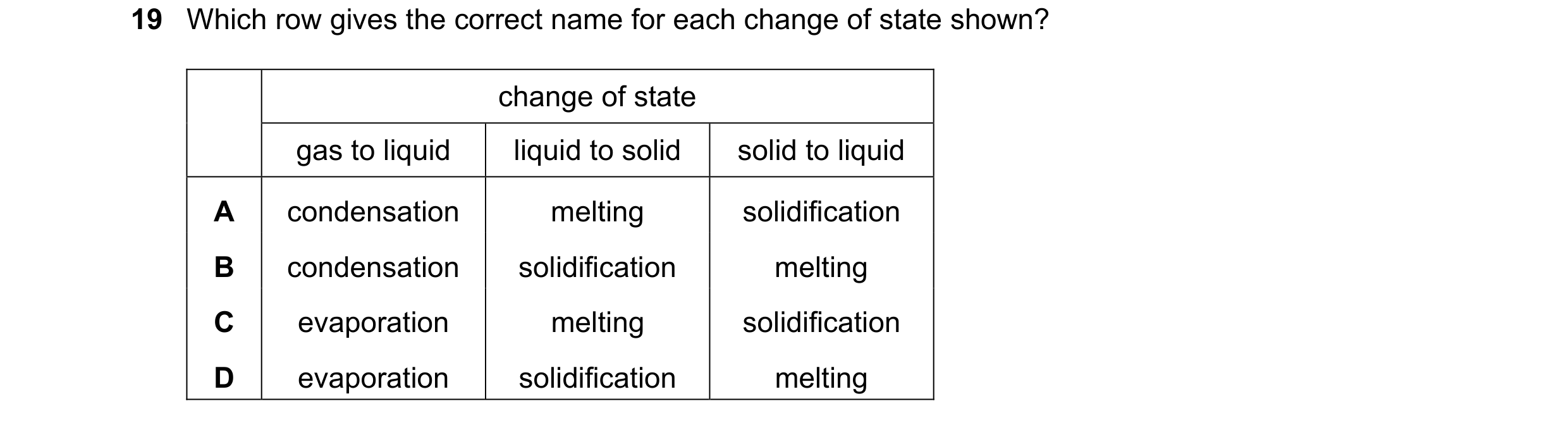
19 Which row gives the correct name for each change of state shown? change of state gas to liquid liquid to solid solid to liquid A condensation melting solidification B condensation solidification melting C evaporation melting solidification D evaporation solidification melting
1 marks
Answer: B
This question in 0972/11 May/June 2018
Q4 · Why can a gas be compressed easily into a smaller volume? 0972/11 May/June 2019
14 Why can a gas be compressed easily into a smaller volume? A The molecules are far apart. B The molecules do not attract each other. C The molecules move randomly. D The volume of each molecule can be reduced.
1 marks
Answer: A
This question in 0972/11 May/June 2019
Q5 · When a liquid evaporates, some molecules escape 0972/11 May/June 2019
15 When a liquid evaporates, some molecules escape. The temperature of the remaining liquid changes. What is the effect on the temperature and from where do the molecules escape? temperature of liquid molecules escape from A decreases everywhere within the liquid B decreases the surface only C increases everywhere within the liquid D increases the surface only
1 marks
Answer: B
This question in 0972/11 May/June 2019
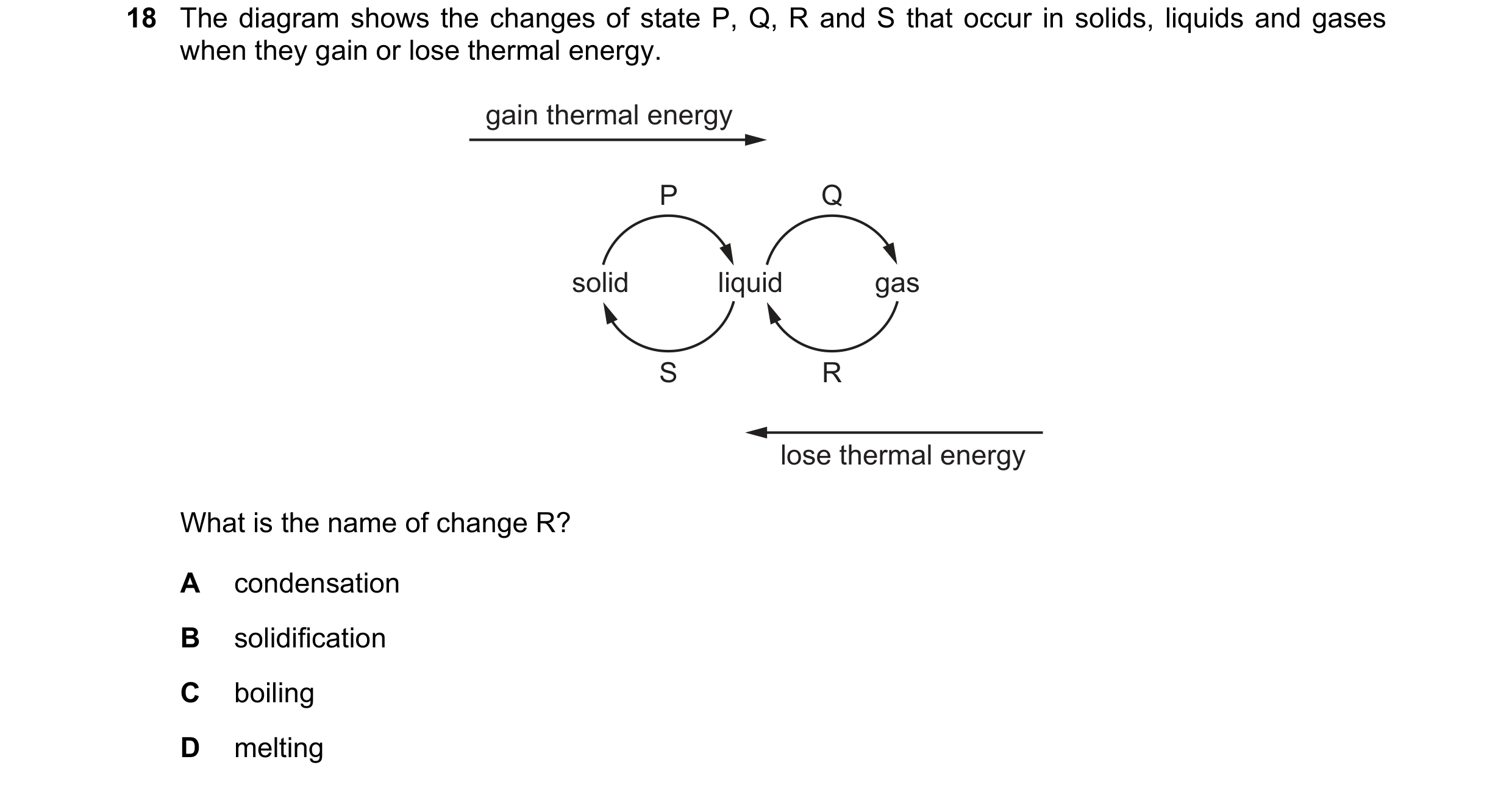
Q6 · The diagram shows the changes of state P, Q, R and S that occur in solids, liquids and… 0972/11 May/June 2019
18 The diagram shows the changes of state P, Q, R and S that occur in solids, liquids and gases when they gain or lose thermal energy. gain thermal energy P Q solid liquid gas S R lose thermal energy What is the name of change R? A condensation B solidification C boiling D melting
1 marks
Answer: A
This question in 0972/11 May/June 2019
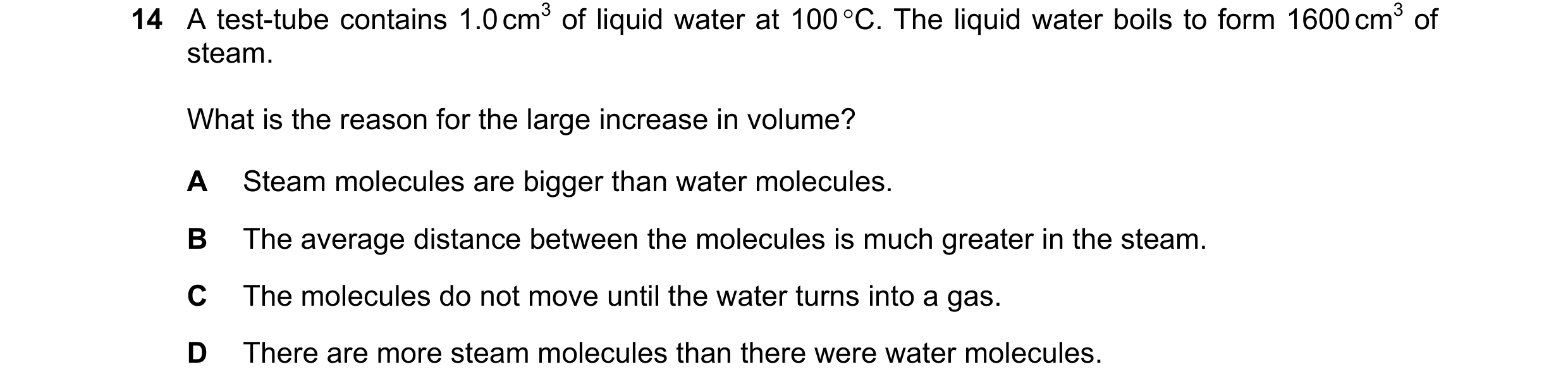
Q7 · A test-tube contains 1.0 cm3 of liquid water at 100 °C 0972/11 Oct/Nov 2019
14 A test-tube contains 1.0 cm3 of liquid water at 100 °C. The liquid water boils to form 1600 cm3 of steam. What is the reason for the large increase in volume? A Steam molecules are bigger than water molecules. B The average distance between the molecules is much greater in the steam. C The molecules do not move until the water turns into a gas. D There are more steam molecules than there were water molecules.
1 marks
Answer: B
This question in 0972/11 Oct/Nov 2019
Q8 · The diagram shows four labelled changes of state between solid, liquid and gas 0972/11 Oct/Nov 2019
18 The diagram shows four labelled changes of state between solid, liquid and gas. P Q solid liquid gas S R Which changes need an energy input? A P and Q B Q and R C R and S D S and P
1 marks
Answer: A
This question in 0972/11 Oct/Nov 2019
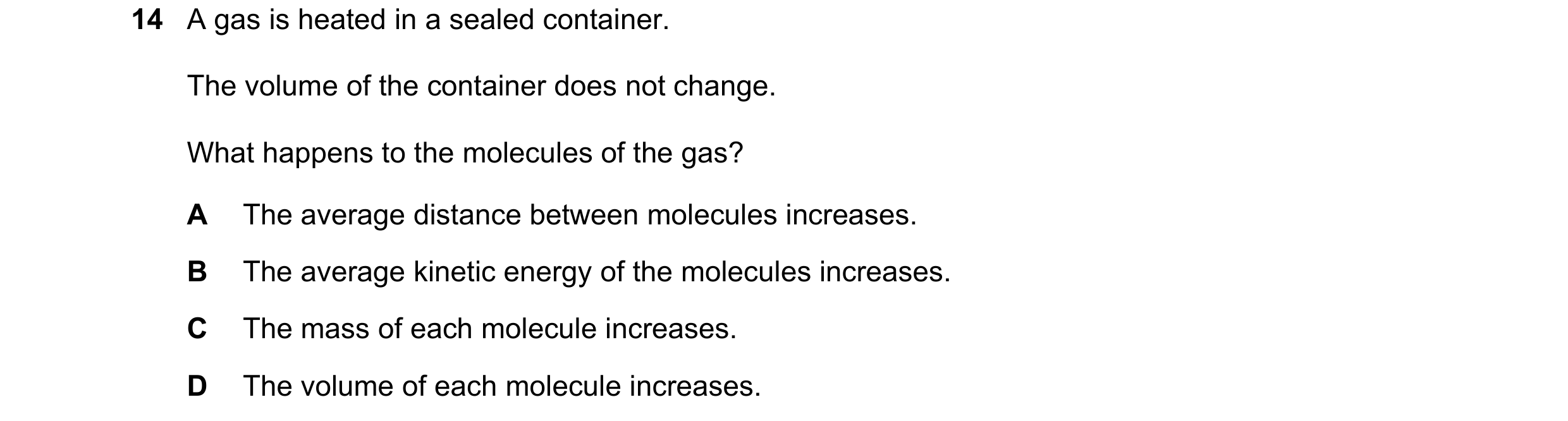
Q9 · A gas is heated in a sealed container 0972/11 May/June 2020
14 A gas is heated in a sealed container. The volume of the container does not change. What happens to the molecules of the gas? A The average distance between molecules increases. B The average kinetic energy of the molecules increases. C The mass of each molecule increases. D The volume of each molecule increases.
1 marks
Answer: B
This question in 0972/11 May/June 2020
Q10 · A student is investigating evaporation 0972/11 May/June 2020
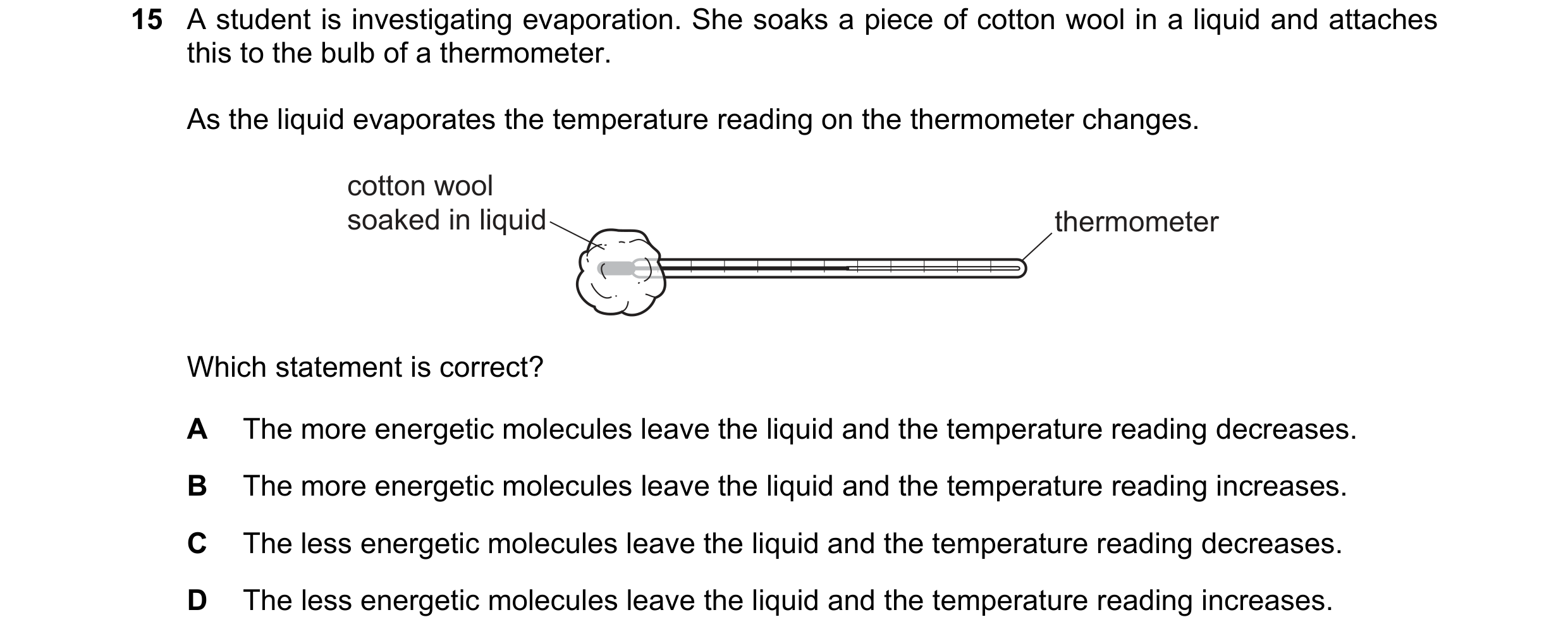
15 A student is investigating evaporation. She soaks a piece of cotton wool in a liquid and attaches this to the bulb of a thermometer. As the liquid evaporates the temperature reading on the thermometer changes. cotton wool soaked in liquid thermometer Which statement is correct? A The more energetic molecules leave the liquid and the temperature reading decreases. B The more energetic molecules leave the liquid and the temperature reading increases. C The less energetic molecules leave the liquid and the temperature reading decreases. D The less energetic molecules leave the liquid and the temperature reading increases.
1 marks
Answer: A
This question in 0972/11 May/June 2020
Q11 · When a hot gas is left to cool, its internal energy decreases 0972/11 May/June 2020
17 When a hot gas is left to cool, its internal energy decreases. What causes this? A a decrease in the kinetic energy of the gas particles B a decrease in the gravitational potential energy of the gas particles C an increase in the average speed of the gas particles D an increase in the average distance of separation of the gas particles
1 marks
Answer: A
This question in 0972/11 May/June 2020
Q12 · Evaporation occurs from the surface of a pool of water 0972/12 May/June 2020
14 Evaporation occurs from the surface of a pool of water. Which statement describes this change of state? A Electrons move from the liquid and become a gas. B Molecules that move from the liquid have the same energy as those that stay in the liquid. C The more energetic molecules escape the liquid. D The more energetic molecules remain in the liquid.
1 marks
Answer: C
This question in 0972/12 May/June 2020
Q13 · A gas, in a sealed container, is compressed slowly so that its temperature does not change 0972/12 May/June 2020
15 A gas, in a sealed container, is compressed slowly so that its temperature does not change. What happens to the molecules of the gas as a result of this compression? A The average speed of the molecules increases. B The average force in a collision between a molecule and the container increases. C There are more frequent collisions between molecules and the container. D The volume of each molecule decreases.
1 marks
Answer: C
This question in 0972/12 May/June 2020
Q14 · On a warm day, a driver checks the air pressure in a car tyre 0972/11 Oct/Nov 2020
14 On a warm day, a driver checks the air pressure in a car tyre. At night, the temperature drops and the air pressure in the tyre decreases. There are no air leaks in the tyre. Why does the pressure decrease? A The air molecules in the tyre move more slowly. B The air molecules in the tyre stop moving. C The volume of the air in the tyre decreases. D The volume of the air in the tyre increases.
1 marks
Answer: A
This question in 0972/11 Oct/Nov 2020
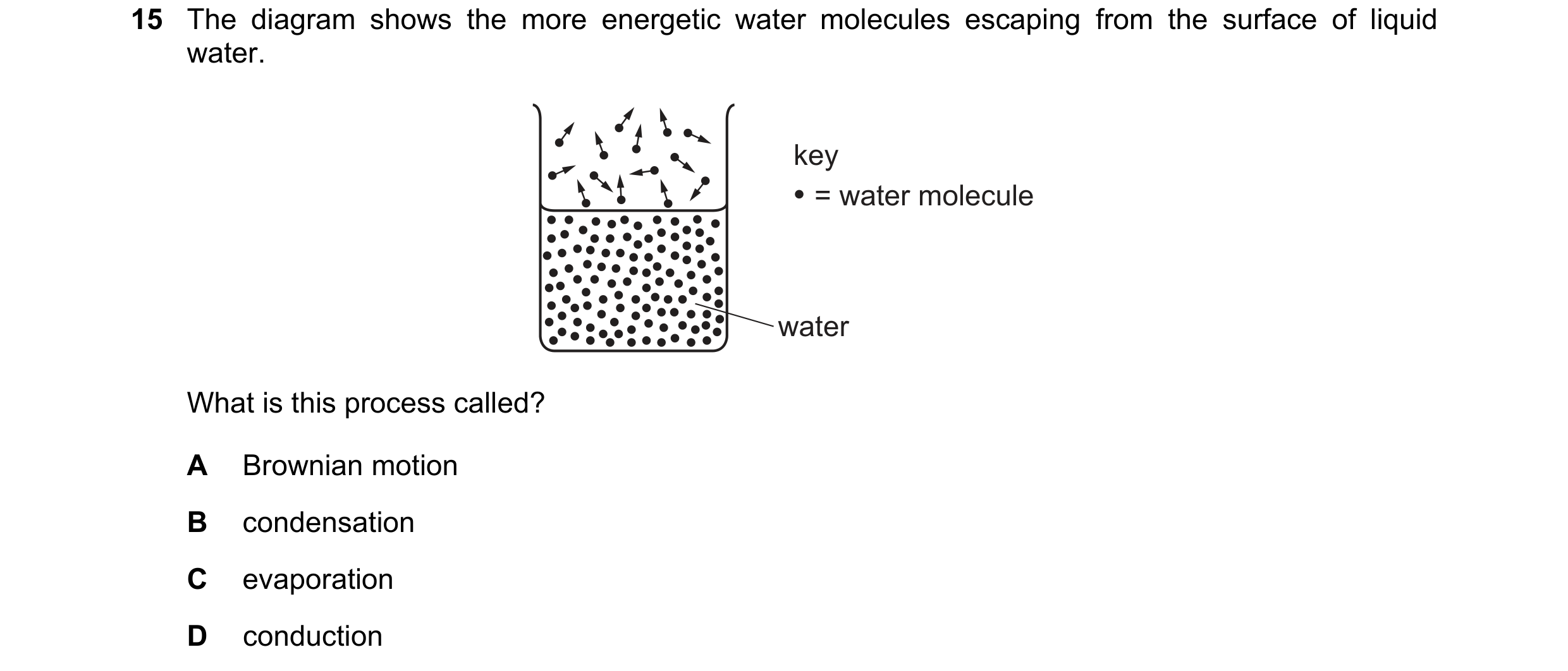
Q15 · The diagram shows the more energetic water molecules escaping from the surface of liquid… 0972/11 Oct/Nov 2020
15 The diagram shows the more energetic water molecules escaping from the surface of liquid water. key = water molecule water What is this process called? A Brownian motion B condensation C evaporation D conduction
1 marks
Answer: C
This question in 0972/11 Oct/Nov 2020
Q16 · A liquid is evaporating 0972/11 Oct/Nov 2021
12 A liquid is evaporating. The liquid is not boiling. Which statement about the liquid is correct at an instant in time? A Any molecule can escape, and from any part of the liquid. B Any molecule can escape, but only from the liquid’s surface. C Only molecules with enough energy can escape, and only from the liquid’s surface. D Only molecules with enough energy can escape, but from any part of the liquid.
1 marks
Answer: C
This question in 0972/11 Oct/Nov 2021
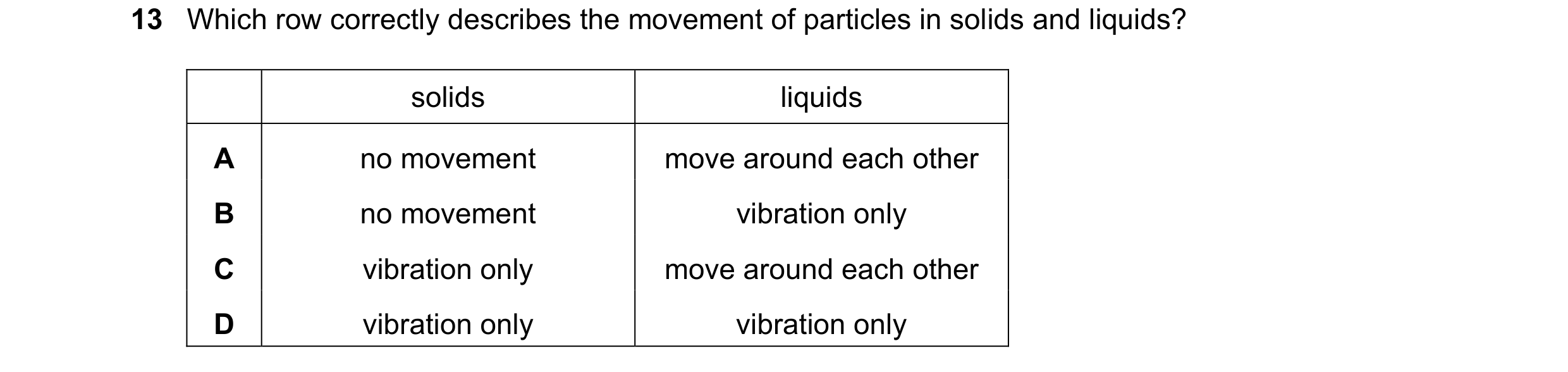
Q17 · Which row correctly describes the movement of particles in solids and liquids? 0972/11 Oct/Nov 2021
13 Which row correctly describes the movement of particles in solids and liquids? solids liquids A no movement move around each other B no movement vibration only C vibration only move around each other D vibration only vibration only
1 marks
Answer: C
This question in 0972/11 Oct/Nov 2021
Q18 · The list gives three properties of different states of matter 0972/11 May/June 2022
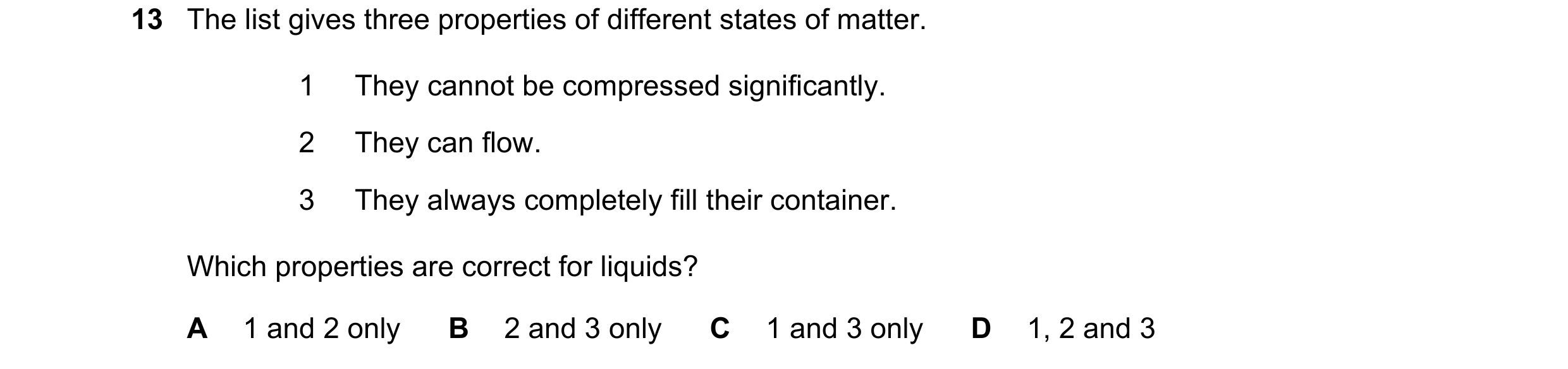
13 The list gives three properties of different states of matter. 1 They cannot be compressed significantly. 2 They can flow. 3 They always completely fill their container. Which properties are correct for liquids? A 1 and 2 only B 2 and 3 only C 1 and 3 only D 1, 2 and 3
1 marks
Answer: A
This question in 0972/11 May/June 2022
Q19 · What happens to the volumes of liquid metal and of solid metal when heated at constant… 0972/11 May/June 2022
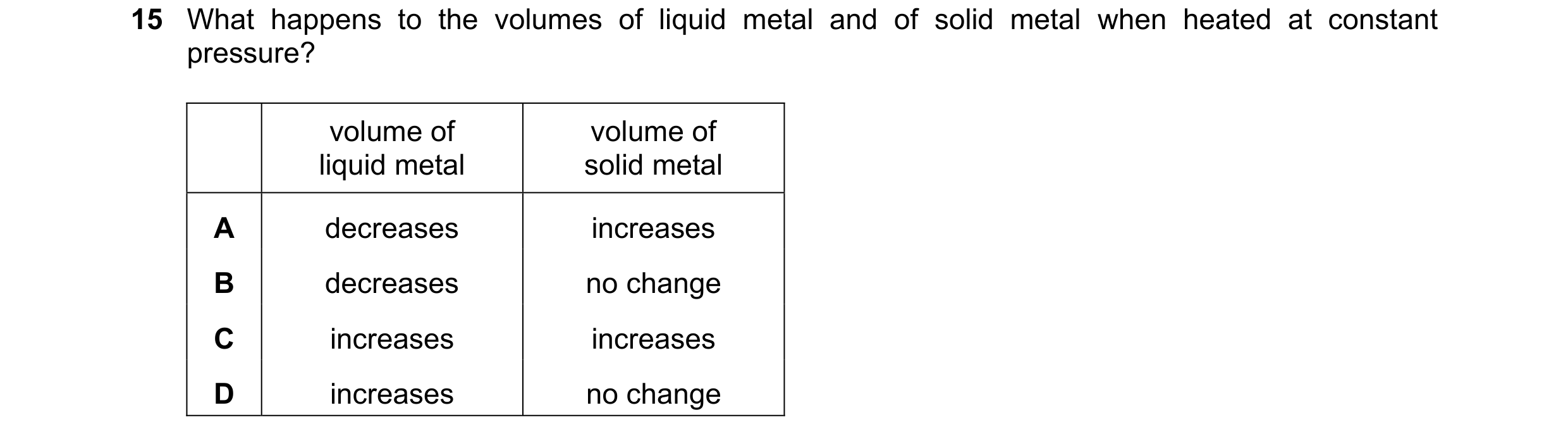
15 What happens to the volumes of liquid metal and of solid metal when heated at constant pressure? volume of volume of liquid metal solid metal A decreases increases B decreases no change C increases increases D increases no change
1 marks
Answer: C
This question in 0972/11 May/June 2022
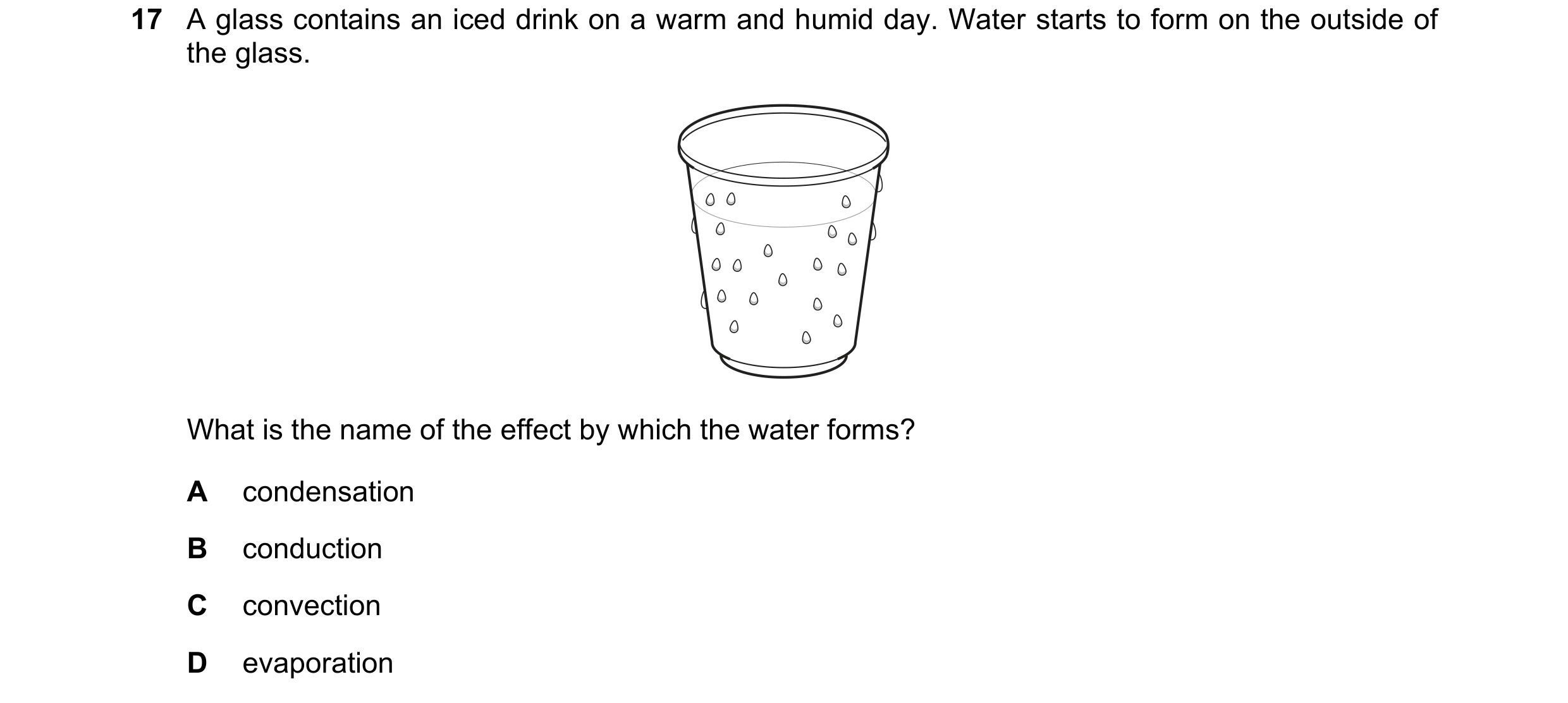
Q20 · A glass contains an iced drink on a warm and humid day 0972/11 May/June 2022
17 A glass contains an iced drink on a warm and humid day. Water starts to form on the outside of the glass. What is the name of the effect by which the water forms? A condensation B conduction C convection D evaporation
1 marks
Answer: A
This question in 0972/11 May/June 2022
Q21 · The diagram shows a convection current caused by a piece of ice placed in a beaker of… 0972/11 May/June 2022
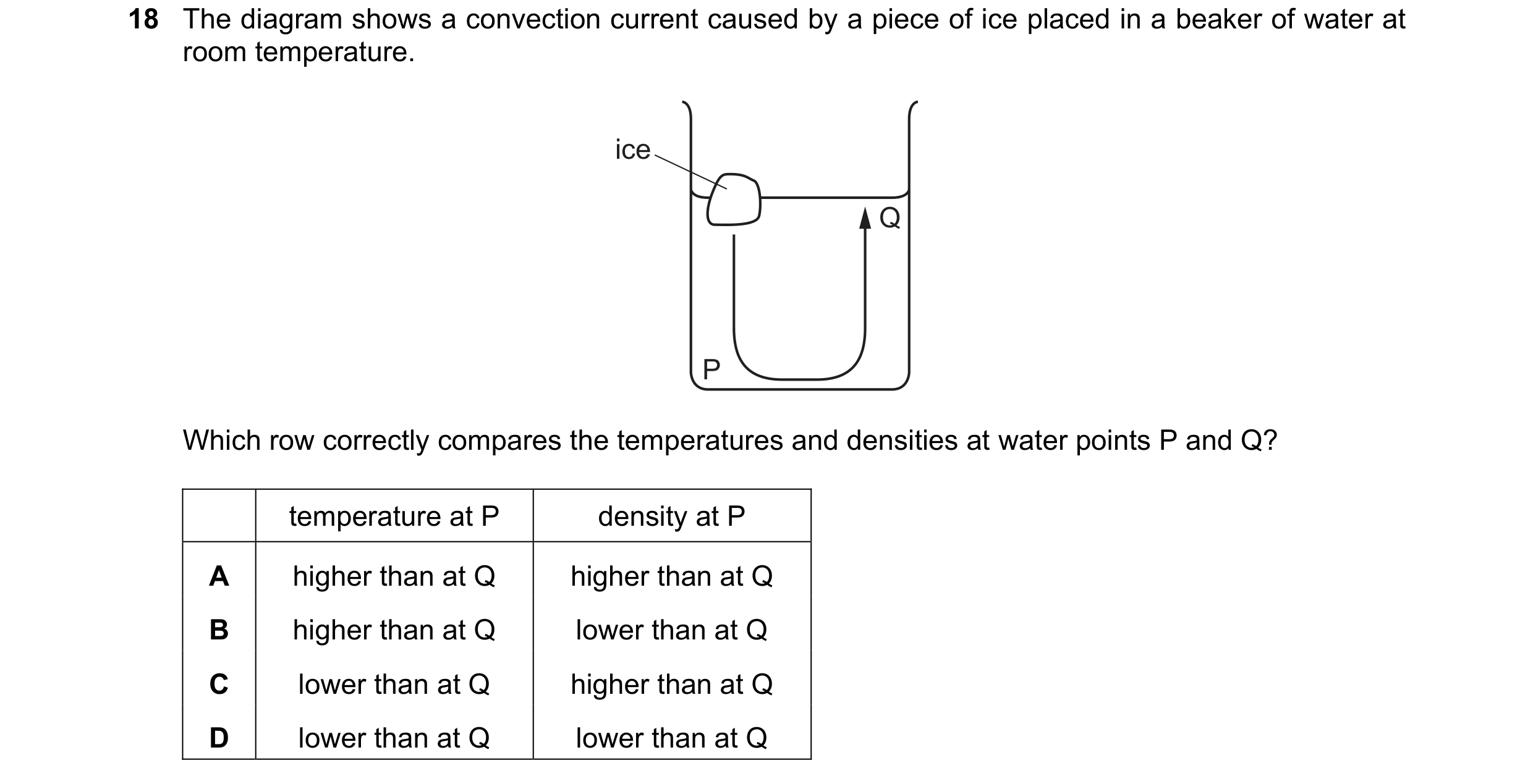
18 The diagram shows a convection current caused by a piece of ice placed in a beaker of water at room temperature. ice Q P Which row correctly compares the temperatures and densities at water points P and Q? temperature at P density at P A higher than at Q higher than at Q B higher than at Q lower than at Q C lower than at Q higher than at Q D lower than at Q lower than at Q
1 marks
Answer: C
This question in 0972/11 May/June 2022
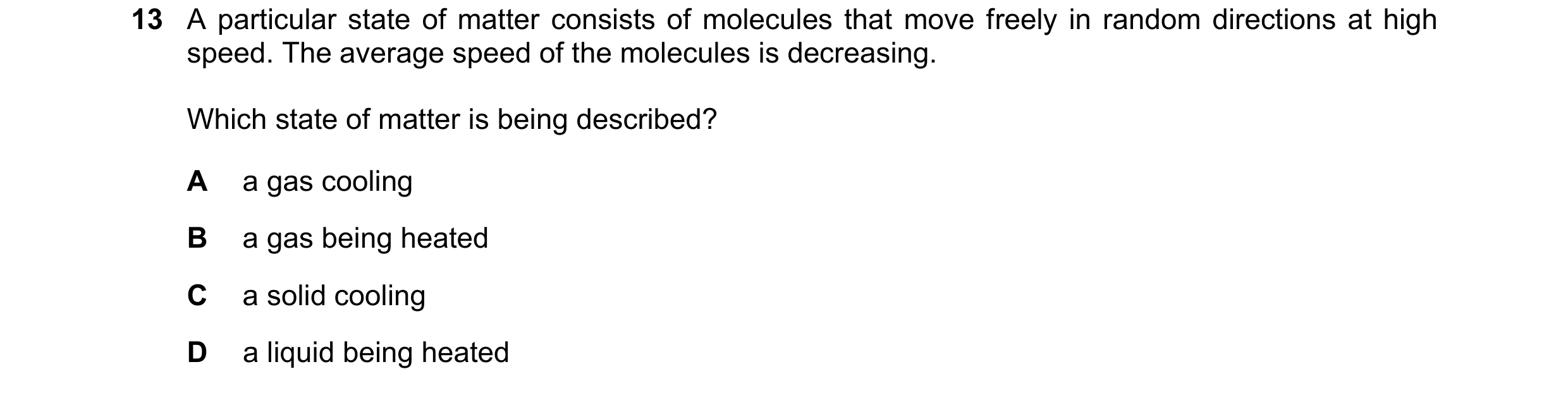
Q22 · A particular state of matter consists of molecules that move freely in random directions… 0972/12 May/June 2022
13 A particular state of matter consists of molecules that move freely in random directions at high speed. The average speed of the molecules is decreasing. Which state of matter is being described? A a gas cooling B a gas being heated C a solid cooling D a liquid being heated
1 marks
Answer: A
This question in 0972/12 May/June 2022
Q23 · Small pollen particles are suspended in water 0972/12 May/June 2022
14 Small pollen particles are suspended in water. When viewed with a microscope, the pollen particles can be seen to be moving about irregularly. What causes this movement? A The pollen particles are being bombarded by the heavier particles of the water. B The pollen particles are being bombarded by the lighter particles of the water. C The temperature of the water is higher than that of the pollen particles. D The temperature of the water is lower than that of the pollen particles.
1 marks
Answer: B
This question in 0972/12 May/June 2022
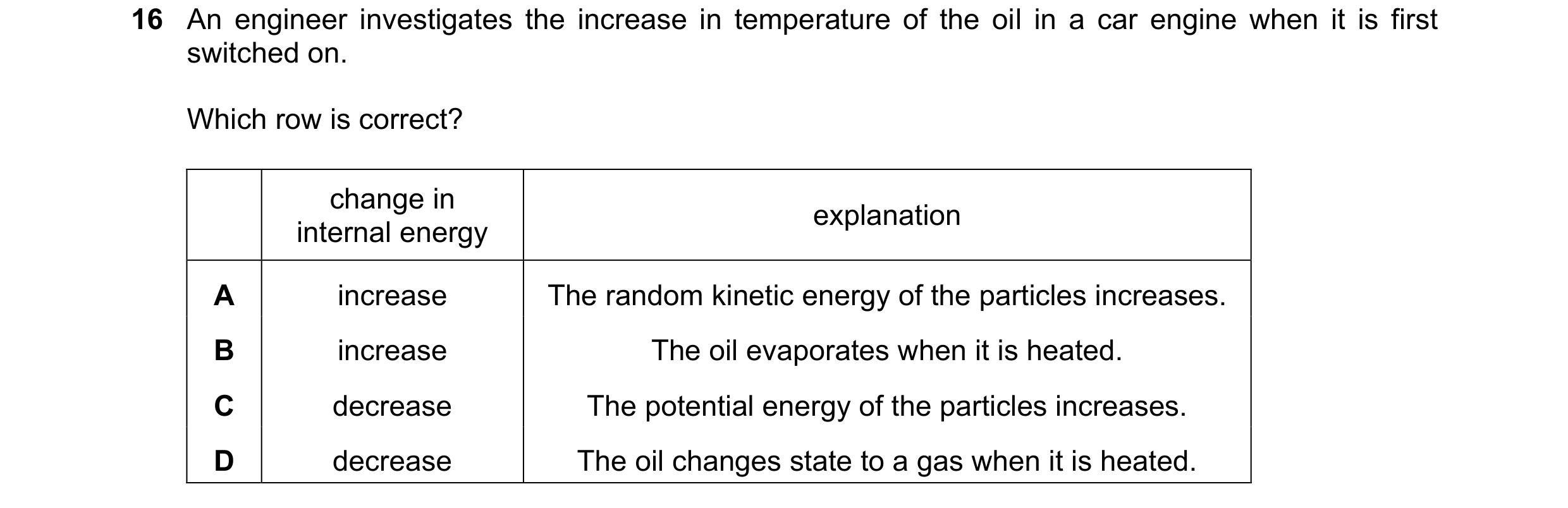
Q24 · An engineer investigates the increase in temperature of the oil in a car engine when it… 0972/12 May/June 2022
16 An engineer investigates the increase in temperature of the oil in a car engine when it is first switched on. Which row is correct? change in explanation internal energy A increase The random kinetic energy of the particles increases. B increase The oil evaporates when it is heated. C decrease The potential energy of the particles increases. D decrease The oil changes state to a gas when it is heated.
1 marks
Answer: A
This question in 0972/12 May/June 2022
Q25 · A glass contains an iced drink on a warm and humid day 0972/12 May/June 2022
17 A glass contains an iced drink on a warm and humid day. Water starts to form on the outside of the glass. What is the name of the effect by which the water forms? A condensation B conduction C convection D evaporation
1 marks
Answer: A
This question in 0972/12 May/June 2022
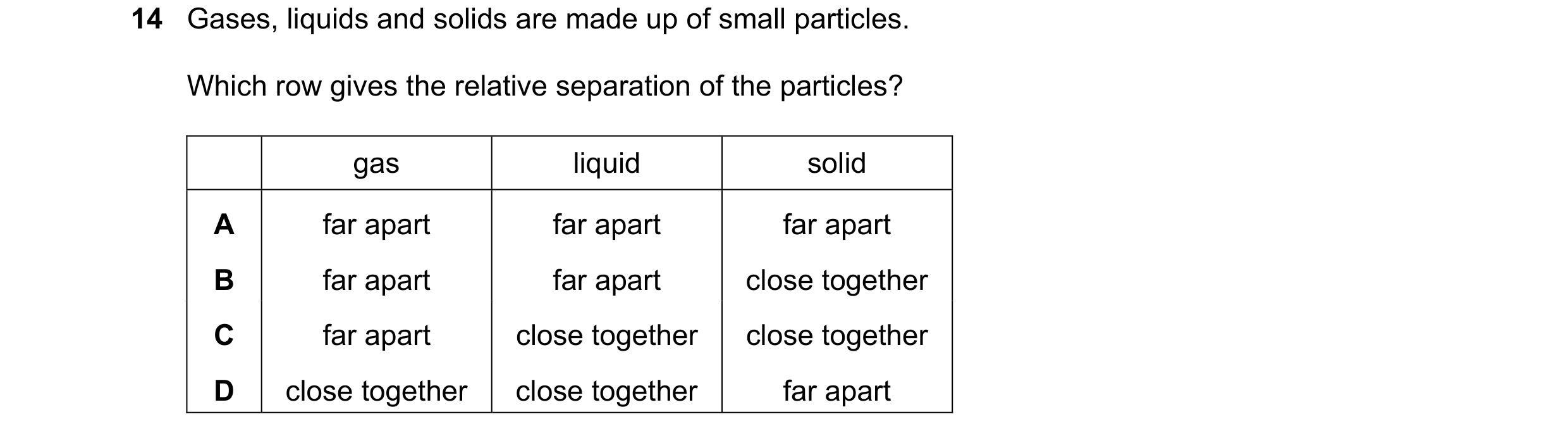
Q26 · Gases, liquids and solids are made up of small particles 0972/11 May/June 2023
14 Gases, liquids and solids are made up of small particles. Which row gives the relative separation of the particles? gas liquid solid A far apart far apart far apart B far apart far apart close together C far apart close together close together D close together close together far apart
1 marks
Answer: C
This question in 0972/11 May/June 2023
Q27 · Which statements about evaporation of water are correct? 0972/11 May/June 2023
15 Which statements about evaporation of water are correct? 1 Evaporation causes the remaining liquid to cool. 2 During evaporation, the more energetic particles escape from the surface of the liquid. 3 Evaporation only happens at 100 °C. A 1, 2 and 3 B 1 and 2 only C 1 and 3 only D 2 and 3 only
1 marks
Answer: B
This question in 0972/11 May/June 2023
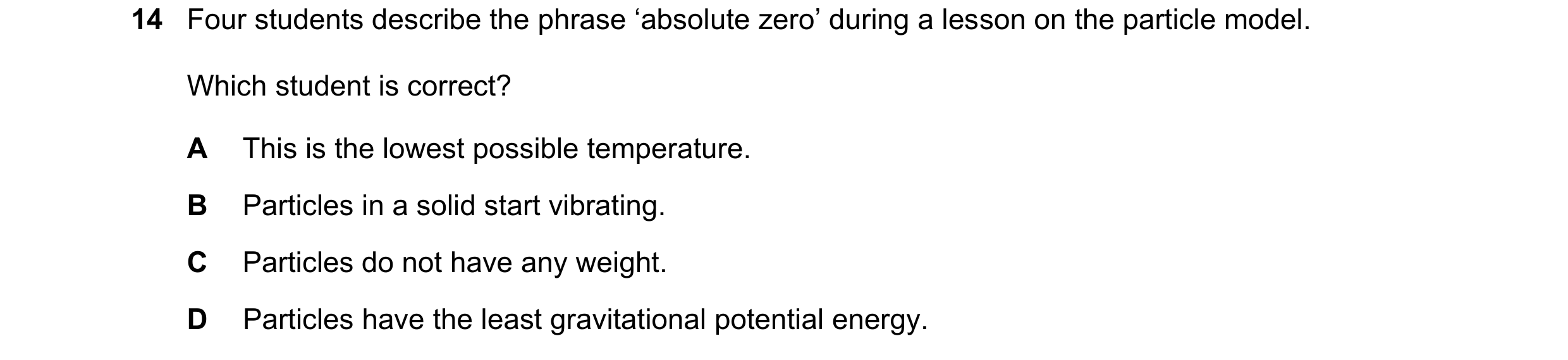
Q28 · Four students describe the phrase ‘absolute zero’ during a lesson on the particle model 0972/12 May/June 2023
14 Four students describe the phrase ‘absolute zero’ during a lesson on the particle model. Which student is correct? A This is the lowest possible temperature. B Particles in a solid start vibrating. C Particles do not have any weight. D Particles have the least gravitational potential energy.
1 marks
Answer: A
This question in 0972/12 May/June 2023
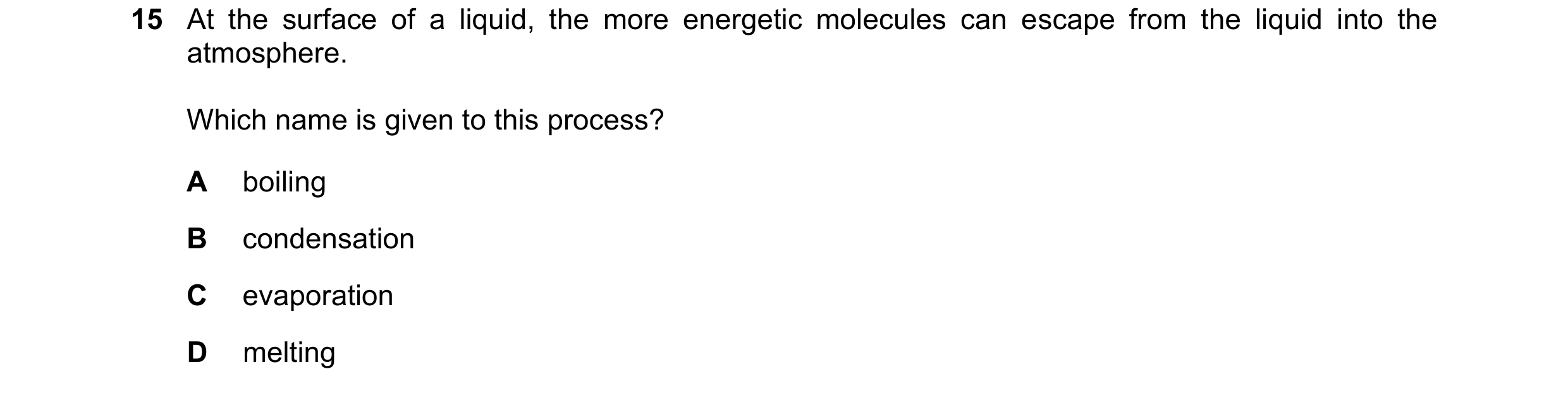
Q29 · At the surface of a liquid, the more energetic molecules can escape from the liquid into… 0972/12 May/June 2023
15 At the surface of a liquid, the more energetic molecules can escape from the liquid into the atmosphere. Which name is given to this process? A boiling B condensation C evaporation D melting
1 marks
Answer: C
This question in 0972/12 May/June 2023
Q30 · Why can a gas be compressed easily into a smaller volume? 0972/11 Oct/Nov 2023
12 Why can a gas be compressed easily into a smaller volume? A The particles are far apart. B The particles do not attract each other. C The particles move randomly. D The volume of each particle can be reduced.
1 marks
Answer: A
This question in 0972/11 Oct/Nov 2023
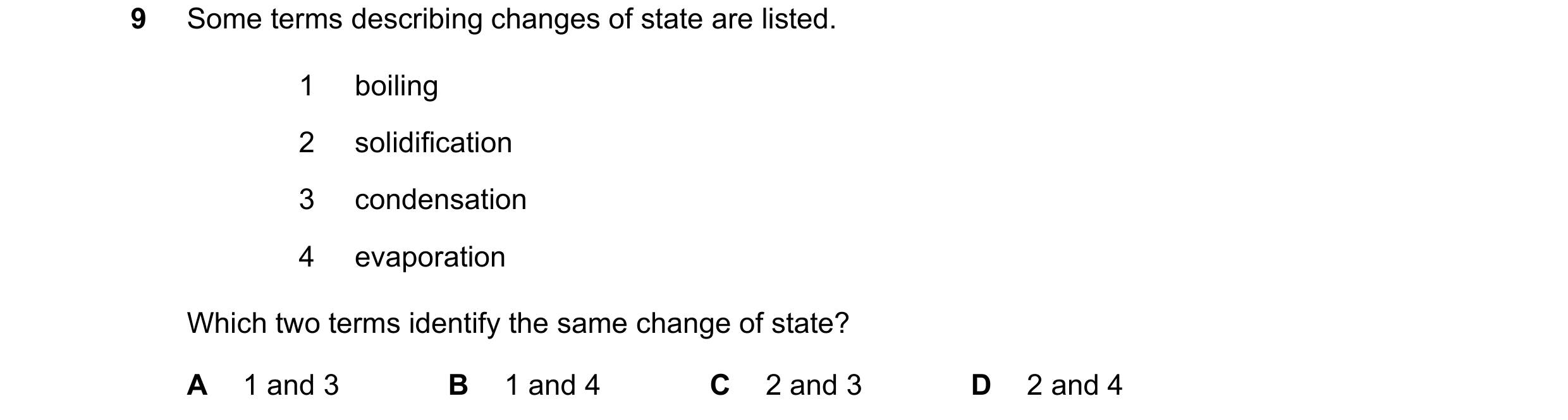
Q31 · Some terms describing changes of state are listed 0972/11 May/June 2024
9 Some terms describing changes of state are listed. 1 boiling 2 solidification 3 condensation 4 evaporation Which two terms identify the same change of state? A 1 and 3 B 1 and 4 C 2 and 3 D 2 and 4
1 marks
Answer: B
This question in 0972/11 May/June 2024
Q32 · Apparatus being used to observe smoke particles 0972/11 May/June 2024
10 Diagram 1 shows apparatus being used to observe smoke particles. Diagram 2 shows how a smoke particle moves randomly. diagram 1 diagram 2 eye random movement microscope air particles light and smoke particles Why do the smoke particles move randomly? A They are hit by air particles. B They are less dense than air. C They are moved by convection currents. D They gain energy from the light.
1 marks
Answer: A
This question in 0972/11 May/June 2024
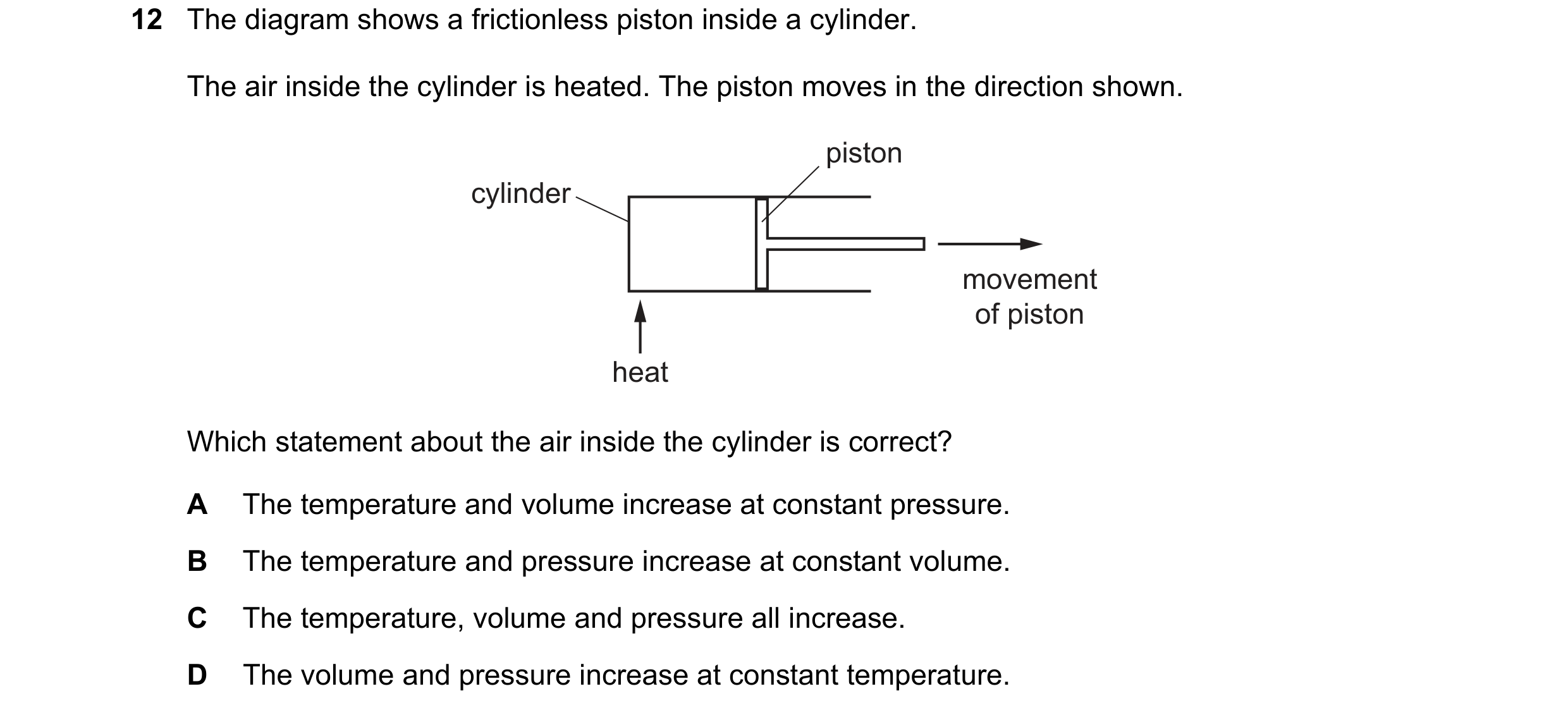
Q33 · The diagram shows a frictionless piston inside a cylinder 0972/11 May/June 2024
12 The diagram shows a frictionless piston inside a cylinder. The air inside the cylinder is heated. The piston moves in the direction shown. piston cylinder movement of piston heat Which statement about the air inside the cylinder is correct? A The temperature and volume increase at constant pressure. B The temperature and pressure increase at constant volume. C The temperature, volume and pressure all increase. D The volume and pressure increase at constant temperature.
1 marks
Answer: A
This question in 0972/11 May/June 2024
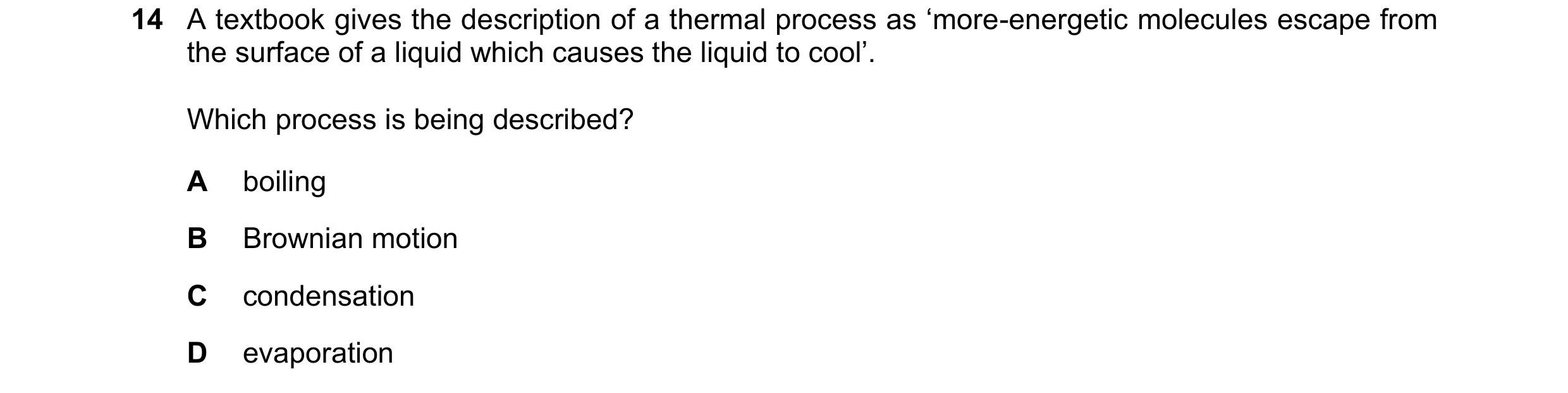
Q34 · A textbook gives the description of a thermal process as ‘more-energetic molecules escape… 0972/11 May/June 2024
14 A textbook gives the description of a thermal process as ‘more-energetic molecules escape from the surface of a liquid which causes the liquid to cool’. Which process is being described? A boiling B Brownian motion C condensation D evaporation
1 marks
Answer: D
This question in 0972/11 May/June 2024
Q35 · The diagram shows the changes in state, 1, 2, 3 and 4, between solids, liquids and gases 0972/12 May/June 2024
9 The diagram shows the changes in state, 1, 2, 3 and 4, between solids, liquids and gases. 1 2 solid liquid gas 3 4 What are processes 2 and 3? 2 3 A condensation melting B condensation freezing C evaporation melting D evaporation freezing
1 marks
Answer: A
This question in 0972/12 May/June 2024
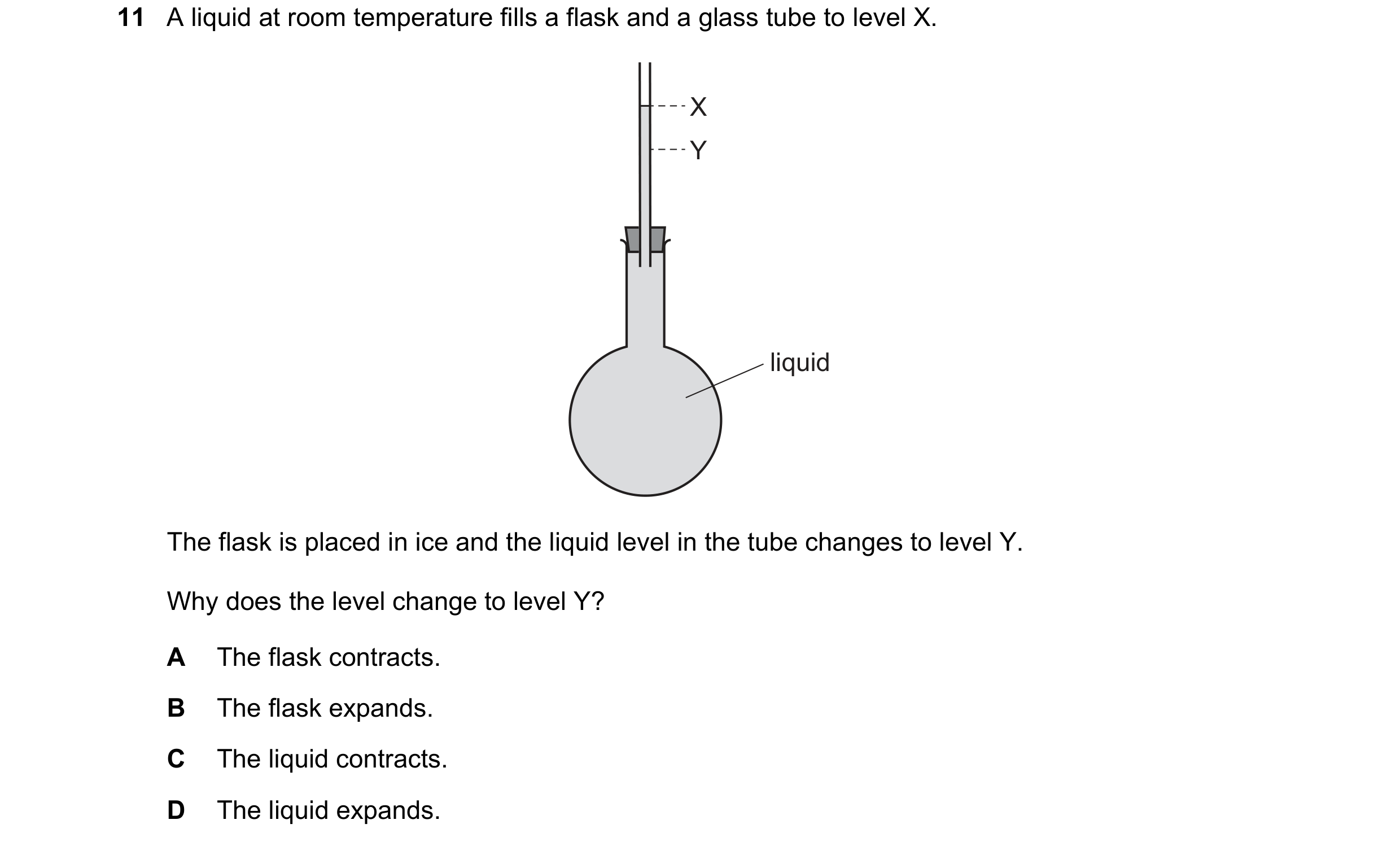
Q36 · A liquid at room temperature fills a flask and a glass tube to level X 0972/12 May/June 2024
11 A liquid at room temperature fills a flask and a glass tube to level X. X Y liquid The flask is placed in ice and the liquid level in the tube changes to level Y. Why does the level change to level Y? A The flask contracts. B The flask expands. C The liquid contracts. D The liquid expands.
1 marks
Answer: C
This question in 0972/12 May/June 2024
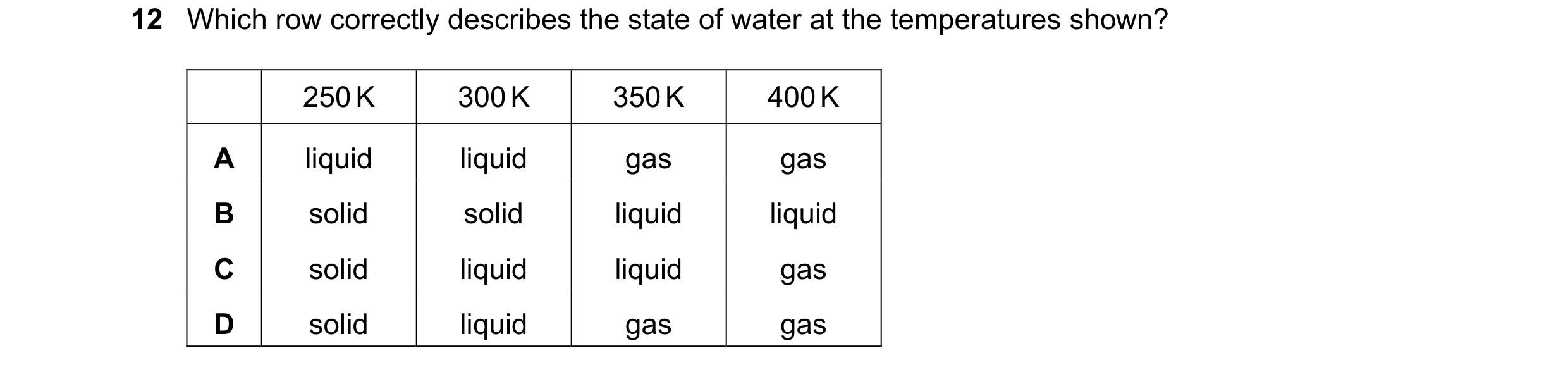
Q37 · Which row correctly describes the state of water at the temperatures shown? 0972/12 May/June 2024
12 Which row correctly describes the state of water at the temperatures shown? 250 K 300 K 350 K 400 K A liquid liquid gas gas B solid solid liquid liquid C solid liquid liquid gas D solid liquid gas gas
1 marks
Answer: C
This question in 0972/12 May/June 2024
Q38 · A liquid is evaporating 0972/12 May/June 2024
13 A liquid is evaporating. The liquid is not boiling. Which statement about the liquid at an instant in time is correct? A Any molecule can escape and from any part of the liquid. B Any molecule can escape, but only from the liquid’s surface. C Only molecules with enough energy can escape and only from the liquid’s surface. D Only molecules with enough energy can escape, but from any part of the liquid.
1 marks
Answer: C
This question in 0972/12 May/June 2024
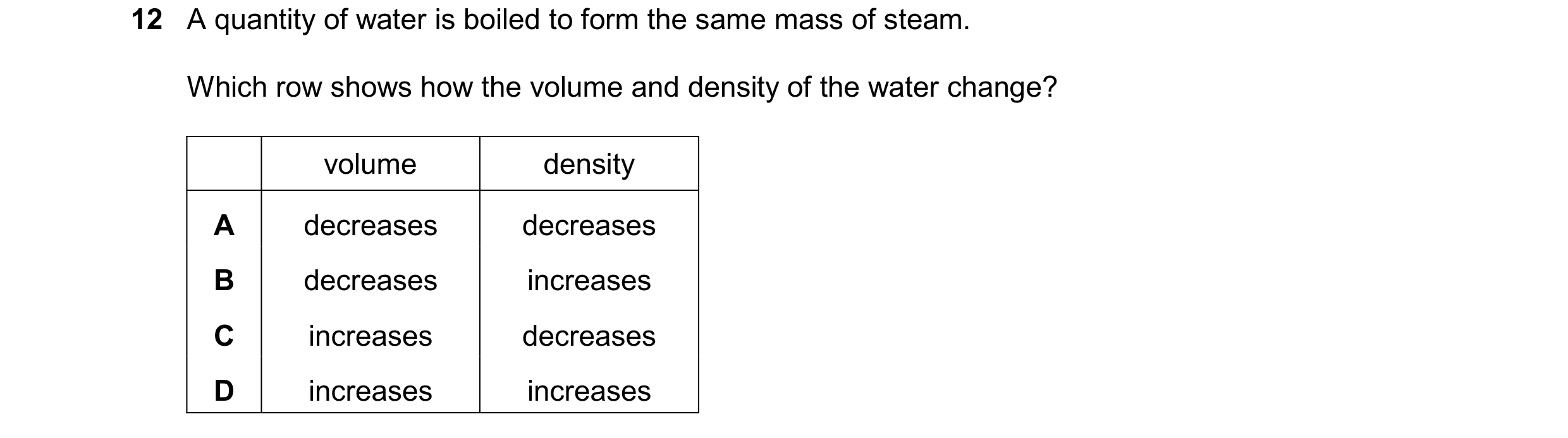
Q39 · A quantity of water is boiled to form the same mass of steam 0972/11 Oct/Nov 2024
12 A quantity of water is boiled to form the same mass of steam. Which row shows how the volume and density of the water change? volume density A decreases decreases B decreases increases C increases decreases D increases increases
1 marks
Answer: C
This question in 0972/11 Oct/Nov 2024
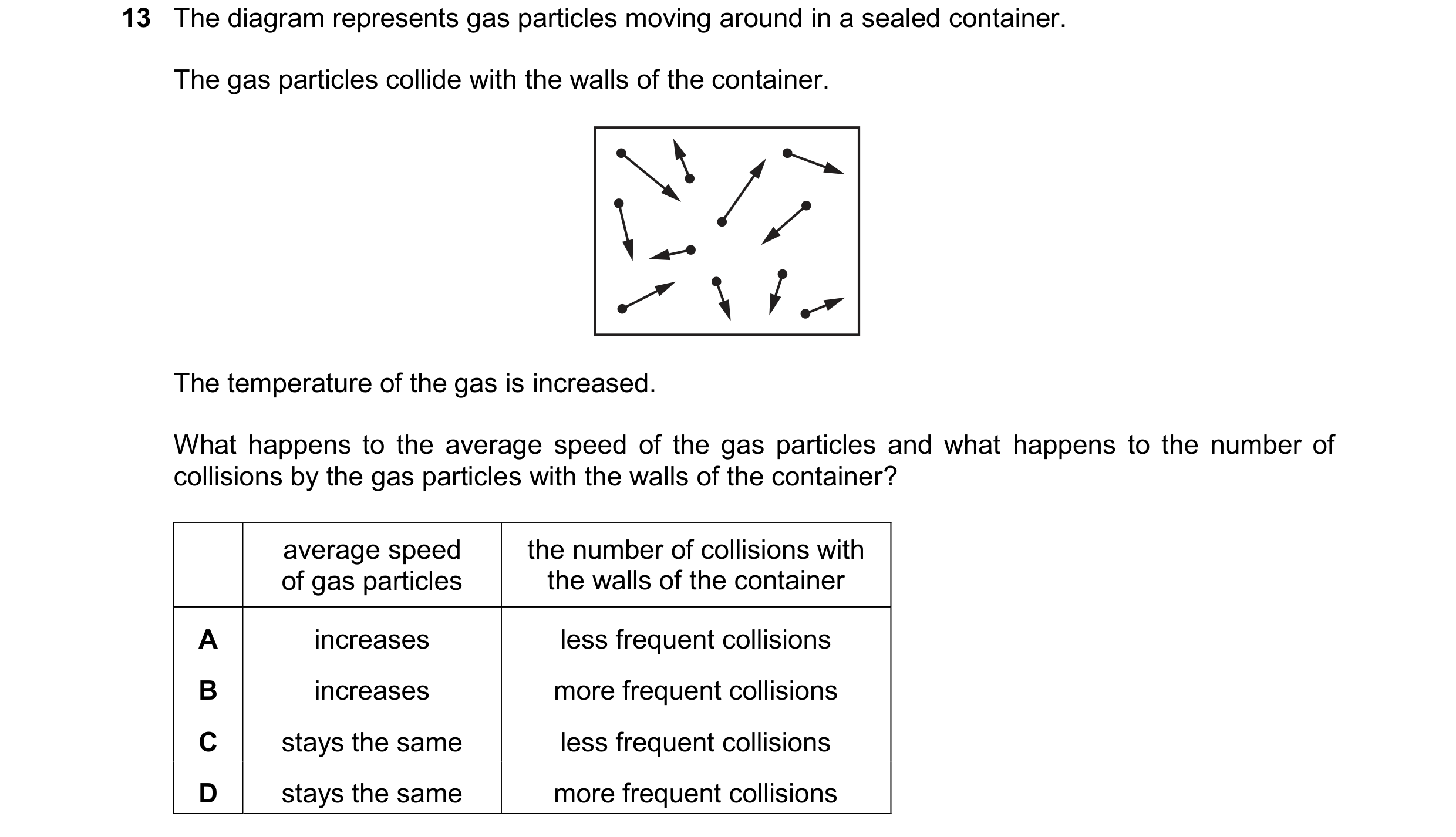
Q40 · The diagram represents gas particles moving around in a sealed container 0972/11 Oct/Nov 2024
13 The diagram represents gas particles moving around in a sealed container. The gas particles collide with the walls of the container. The temperature of the gas is increased. What happens to the average speed of the gas particles and what happens to the number of collisions by the gas particles with the walls of the container? average speed the number of collisions with of gas particles the walls of the container A increases less frequent collisions B increases more frequent collisions C stays the same less frequent collisions D stays the same more frequent collisions
1 marks
Answer: B
This question in 0972/11 Oct/Nov 2024
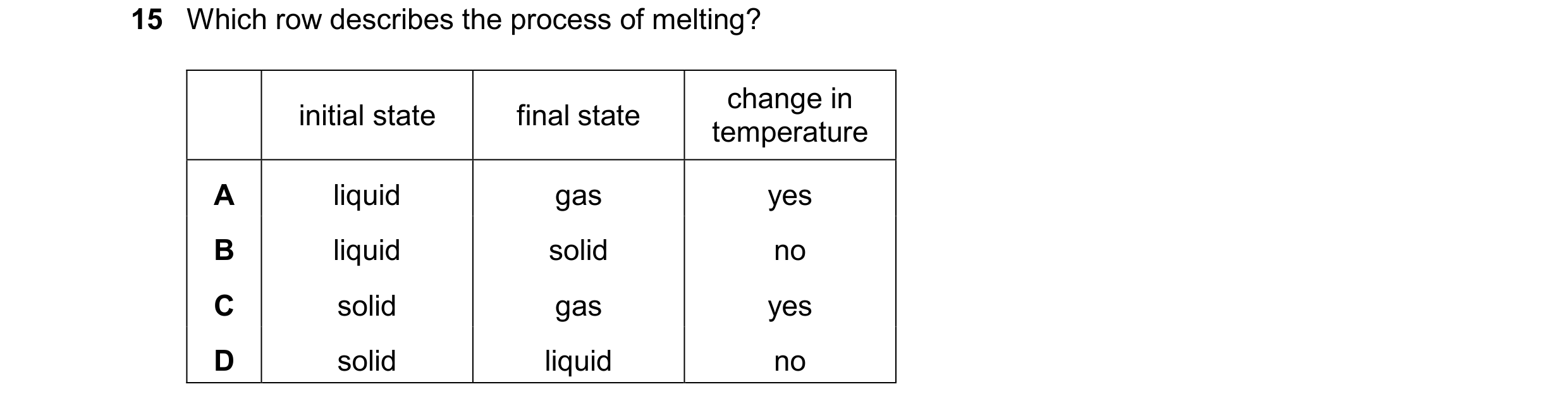
Q41 · Which row describes the process of melting? 0972/11 Oct/Nov 2024
15 Which row describes the process of melting? change in initial state final state temperature A liquid gas yes B liquid solid no C solid gas yes D solid liquid no
1 marks
Answer: D
This question in 0972/11 Oct/Nov 2024
Q42 · Two different pure substances, X and Y, are heated 0972/11 May/June 2025
11 Two different pure substances, X and Y, are heated. Both substance X and substance Y are initially in the solid state. The graph shows how the temperature of each substance changes with time. substance X temperature substance Y 0 0 time What does the graph tell us about the substances? A Substance X has a lower boiling point than substance Y. B Substance X has a lower melting point than substance Y. C Substance Y has a lower boiling point than substance X. D Substance Y has a lower melting point than substance X.
1 marks
Answer: D
This question in 0972/11 May/June 2025
Q43 · A liquid substance changes into a gas 0972/11 May/June 2025
12 A liquid substance changes into a gas. Which property of the substance remains the same? A ability to flow B compressibility C shape D volume
1 marks
Answer: A
This question in 0972/11 May/June 2025
Q44 · At room temperature, iron is difficult to compress 0972/11 May/June 2025
13 At room temperature, iron is difficult to compress. At the same temperature, oxygen is much easier to compress. Which comparison of the particles in iron and the particles in oxygen explains this? A The iron particles are closer together. B The iron particles have a greater mass. C The iron particles can be magnetised. D The iron particles have less average kinetic energy.
1 marks
Answer: A
This question in 0972/11 May/June 2025
Q45 · A teacher has a gas in a sealed syringe with a movable plunger 0972/11 May/June 2025
14 A teacher has a gas in a sealed syringe with a movable plunger. gas plunger syringe The teacher slowly moves the plunger out of the syringe. The temperature of the gas remains constant. Which row explains what happens to the pressure of the gas in the syringe? pressure of gas explanation A decreases gas particles collide with the syringe wall less frequently B decreases gas particles collide with the syringe wall more frequently C increases gas particles collide with the syringe wall less frequently D increases gas particles collide with the syringe wall more frequently
1 marks
Answer: A
This question in 0972/11 May/June 2025
Q46 · Evaporation occurs from the surface of a pool of water 0972/11 May/June 2025
15 Evaporation occurs from the surface of a pool of water. Which statement describes this change of state? A Electrons move from the liquid and become a gas. B Molecules that move from the liquid have the same energy as the molecules that stay in the liquid. C The more-energetic molecules escape the liquid. D The more-energetic molecules remain in the liquid.
1 marks
Answer: C
This question in 0972/11 May/June 2025
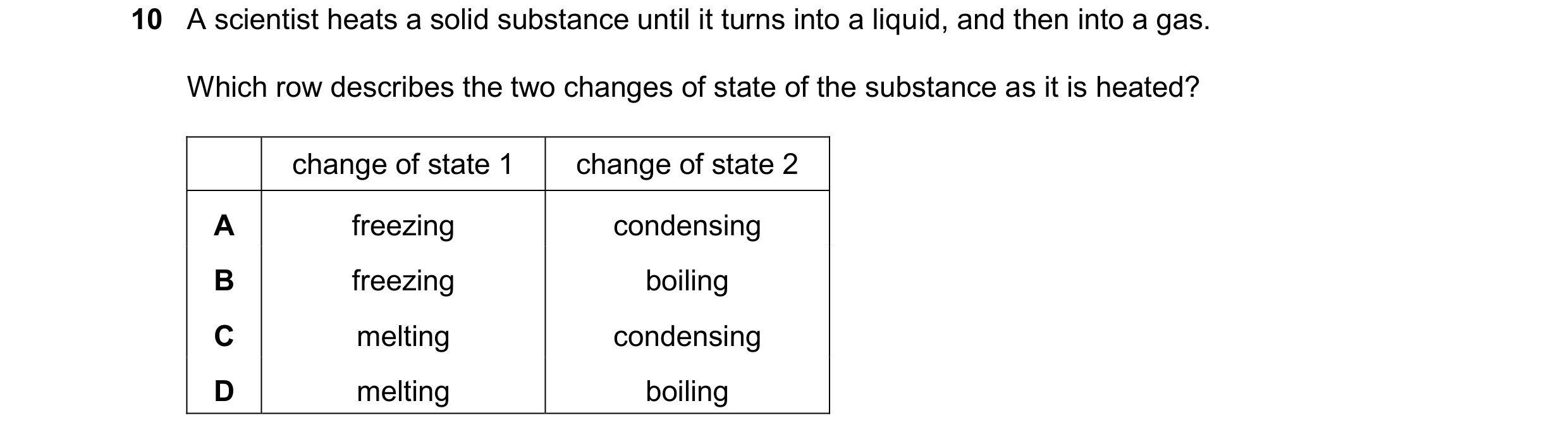
Q47 · A scientist heats a solid substance until it turns into a liquid, and then into a gas 0972/12 May/June 2025
10 A scientist heats a solid substance until it turns into a liquid, and then into a gas. Which row describes the two changes of state of the substance as it is heated? change of state 1 change of state 2 A freezing condensing B freezing boiling C melting condensing D melting boiling
1 marks
Answer: D
This question in 0972/12 May/June 2025
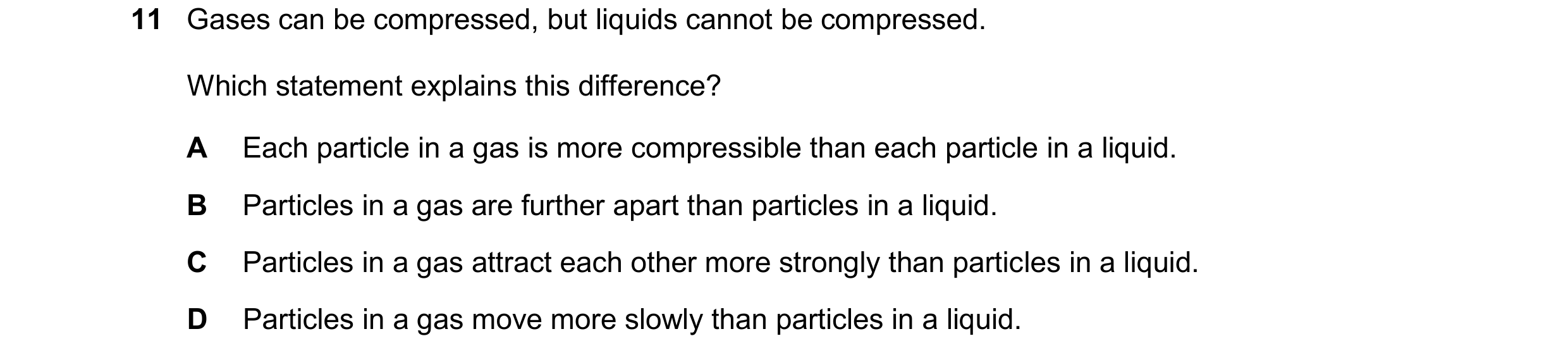
Q48 · Gases can be compressed, but liquids cannot be compressed 0972/12 May/June 2025
11 Gases can be compressed, but liquids cannot be compressed. Which statement explains this difference? A Each particle in a gas is more compressible than each particle in a liquid. B Particles in a gas are further apart than particles in a liquid. C Particles in a gas attract each other more strongly than particles in a liquid. D Particles in a gas move more slowly than particles in a liquid.
1 marks
Answer: B
This question in 0972/12 May/June 2025
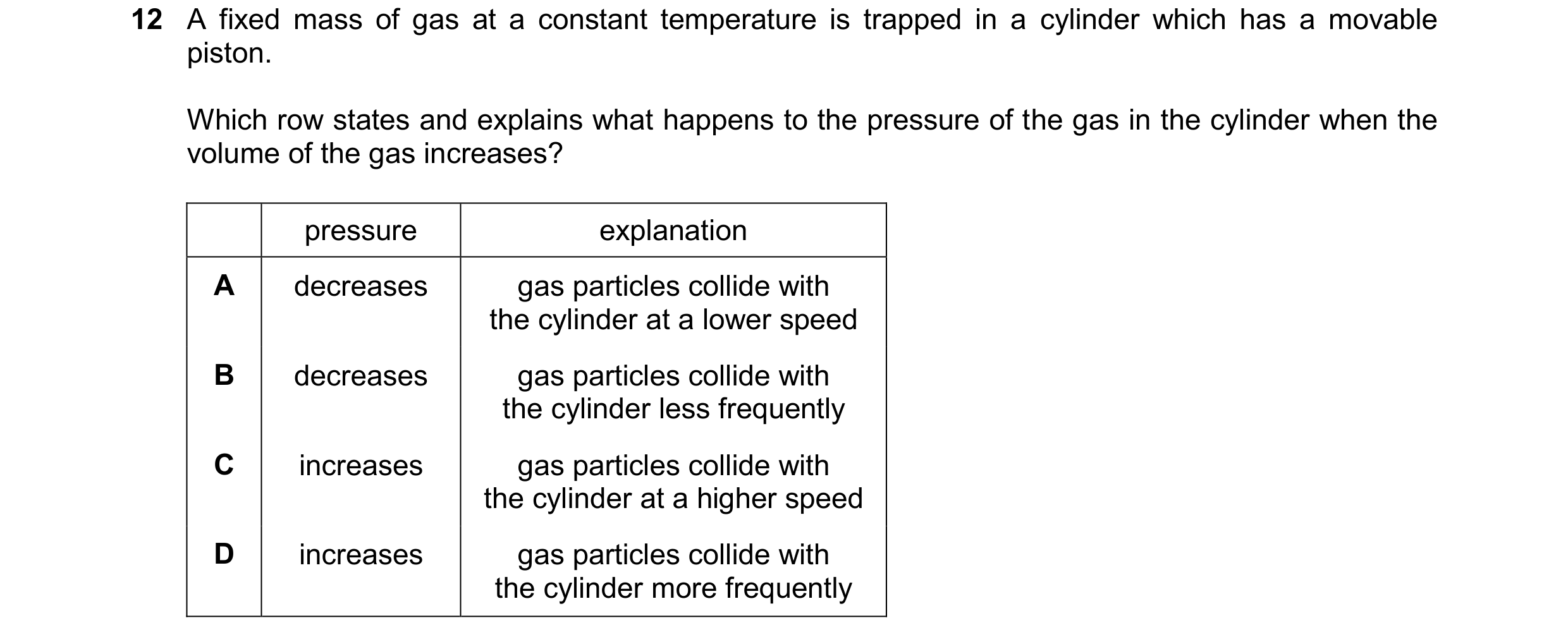
Q49 · A fixed mass of gas at a constant temperature is trapped in a cylinder which has a… 0972/12 May/June 2025
12 A fixed mass of gas at a constant temperature is trapped in a cylinder which has a movable piston. Which row states and explains what happens to the pressure of the gas in the cylinder when the volume of the gas increases? pressure explanation A decreases gas particles collide with the cylinder at a lower speed B decreases gas particles collide with the cylinder less frequently C increases gas particles collide with the cylinder at a higher speed D increases gas particles collide with the cylinder more frequently
1 marks
Answer: B
This question in 0972/12 May/June 2025
 1 / 14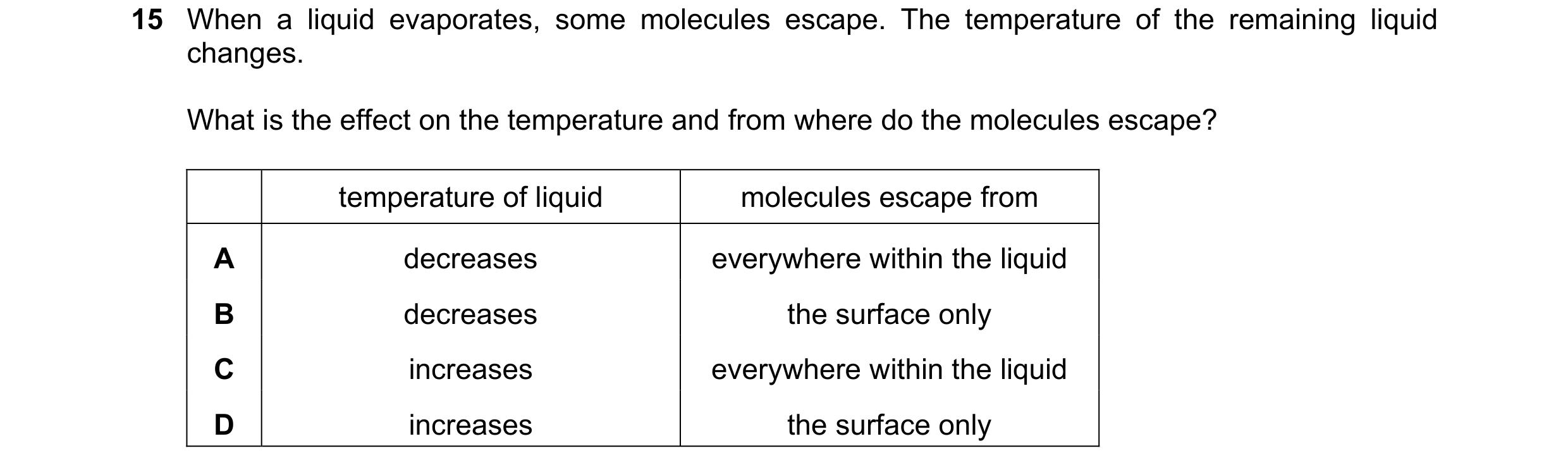
 2 / 14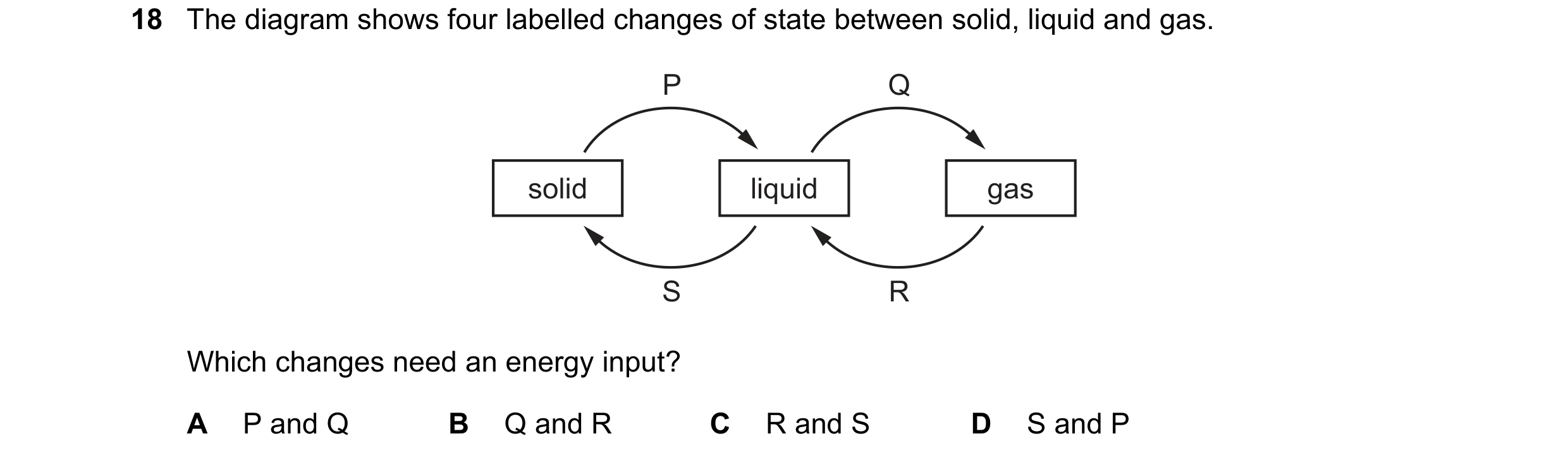
 3 / 14
 4 / 14
 5 / 14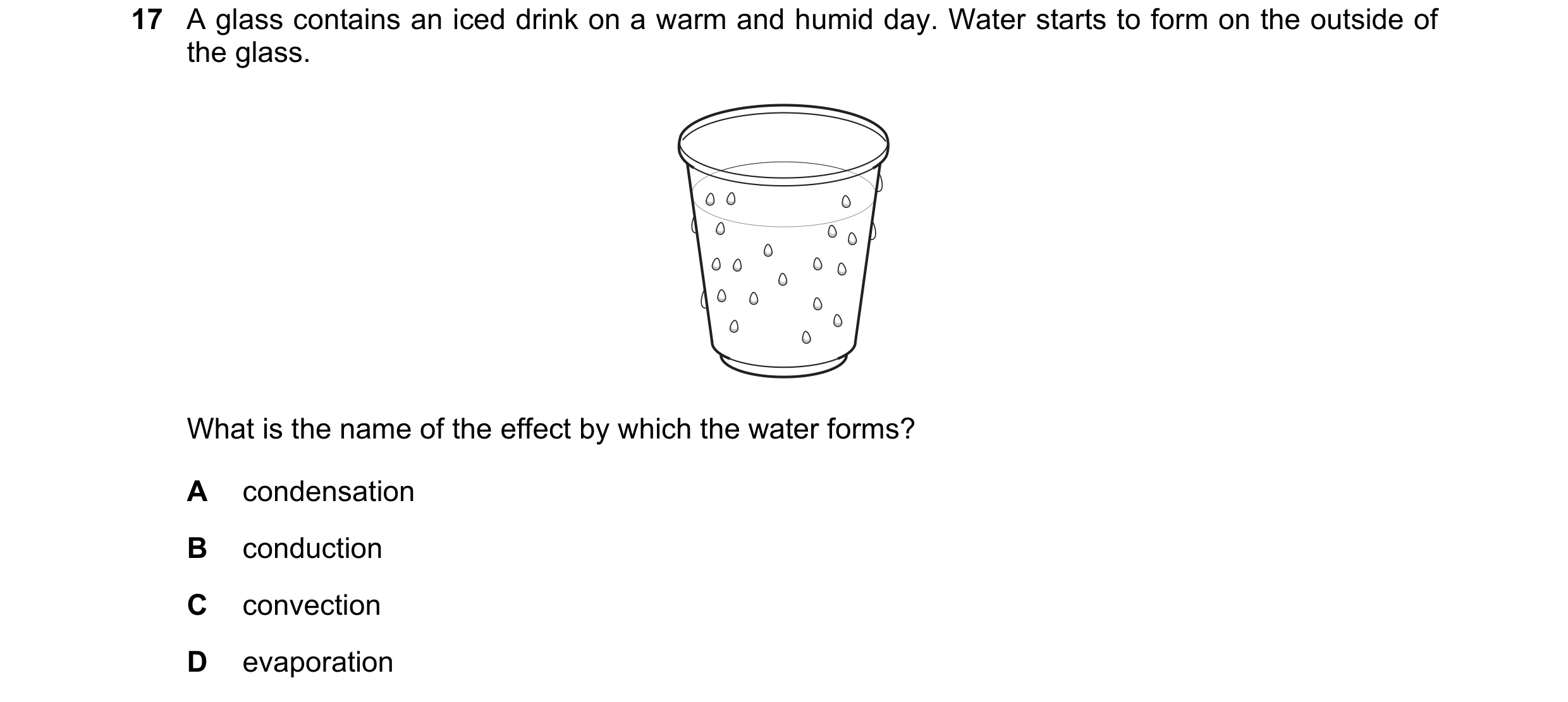
 6 / 14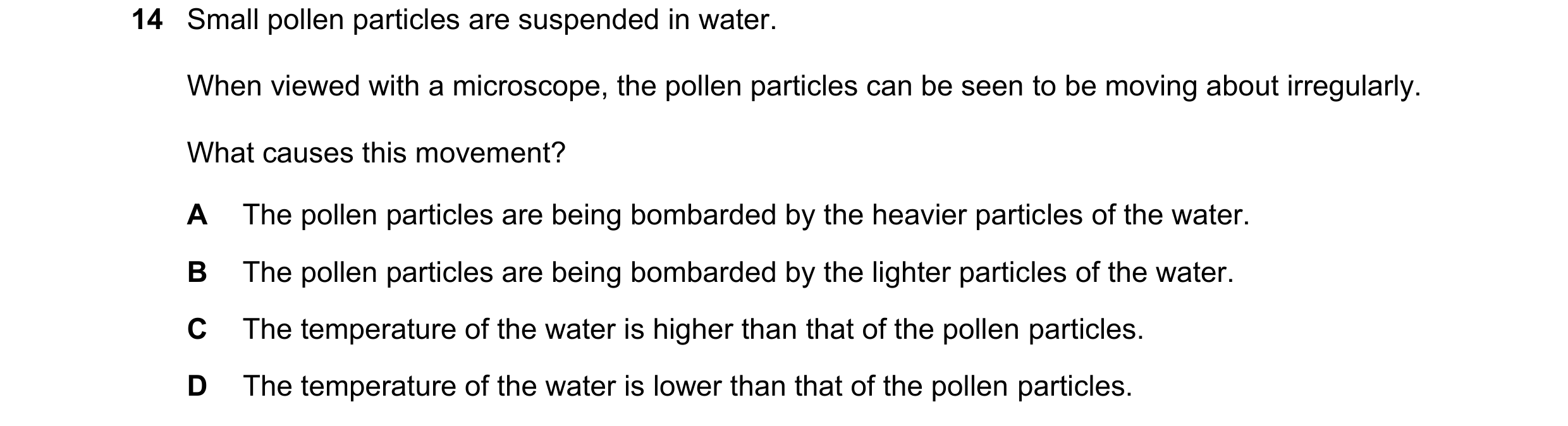
 7 / 14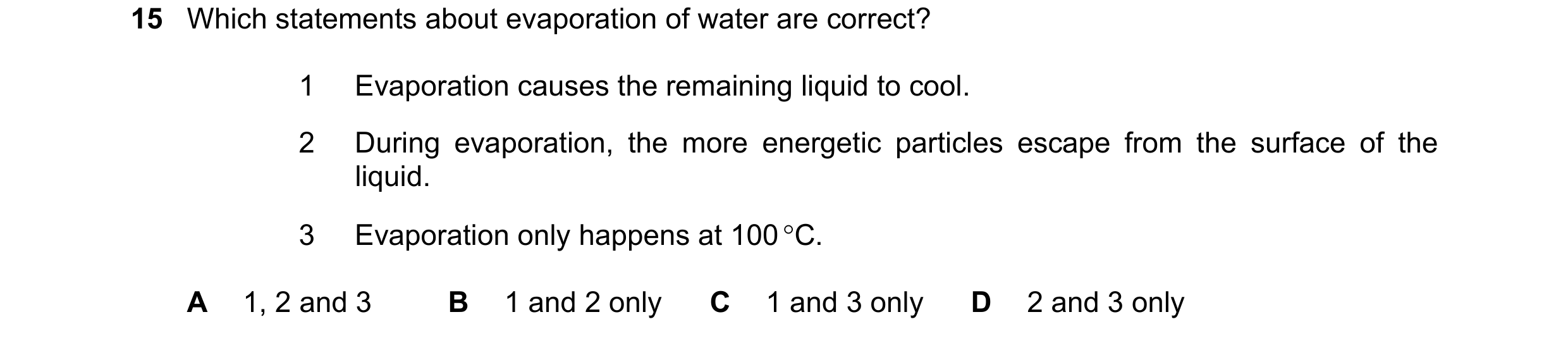

 8 / 14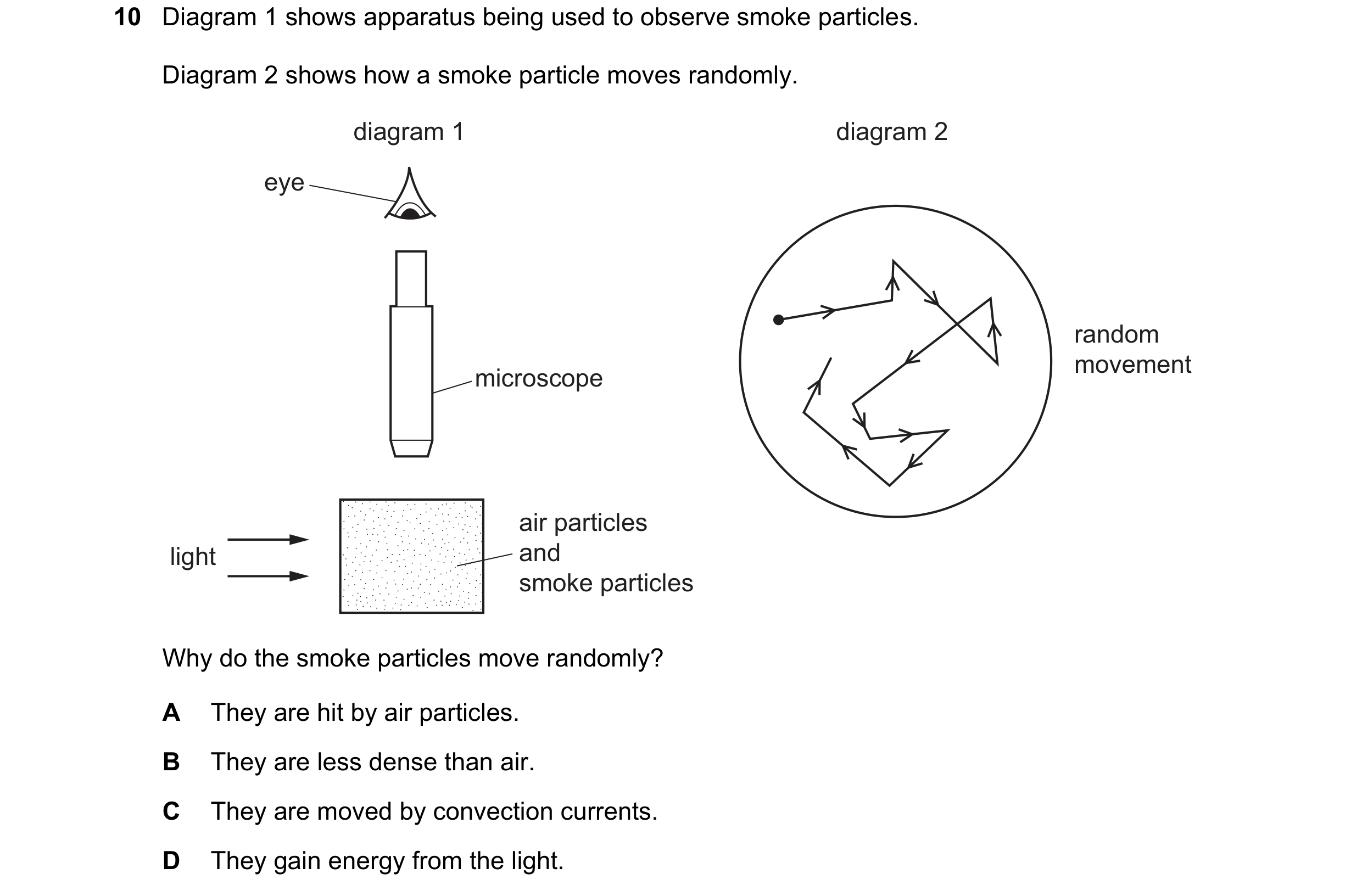
 9 / 14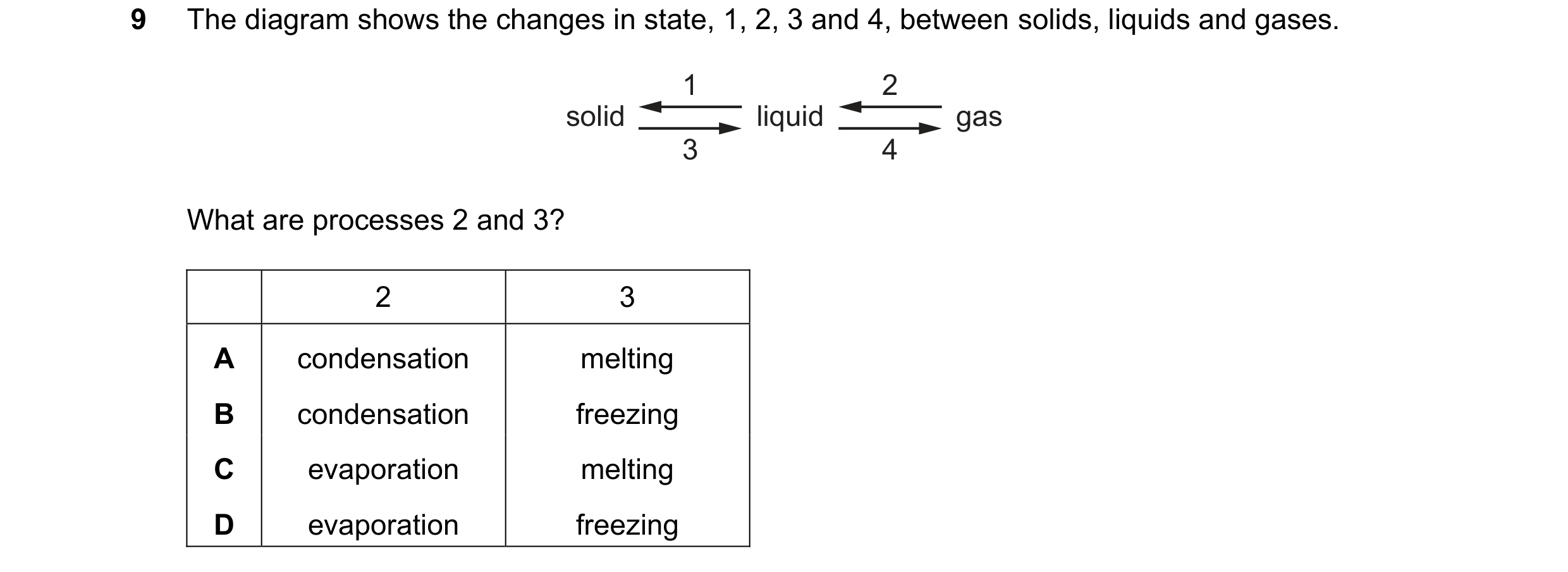
 10 / 14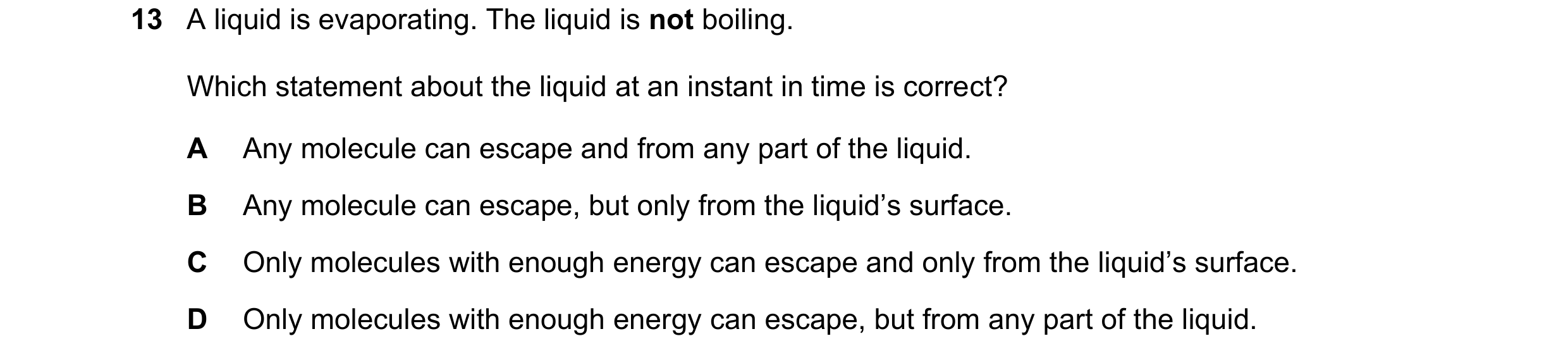
 11 / 14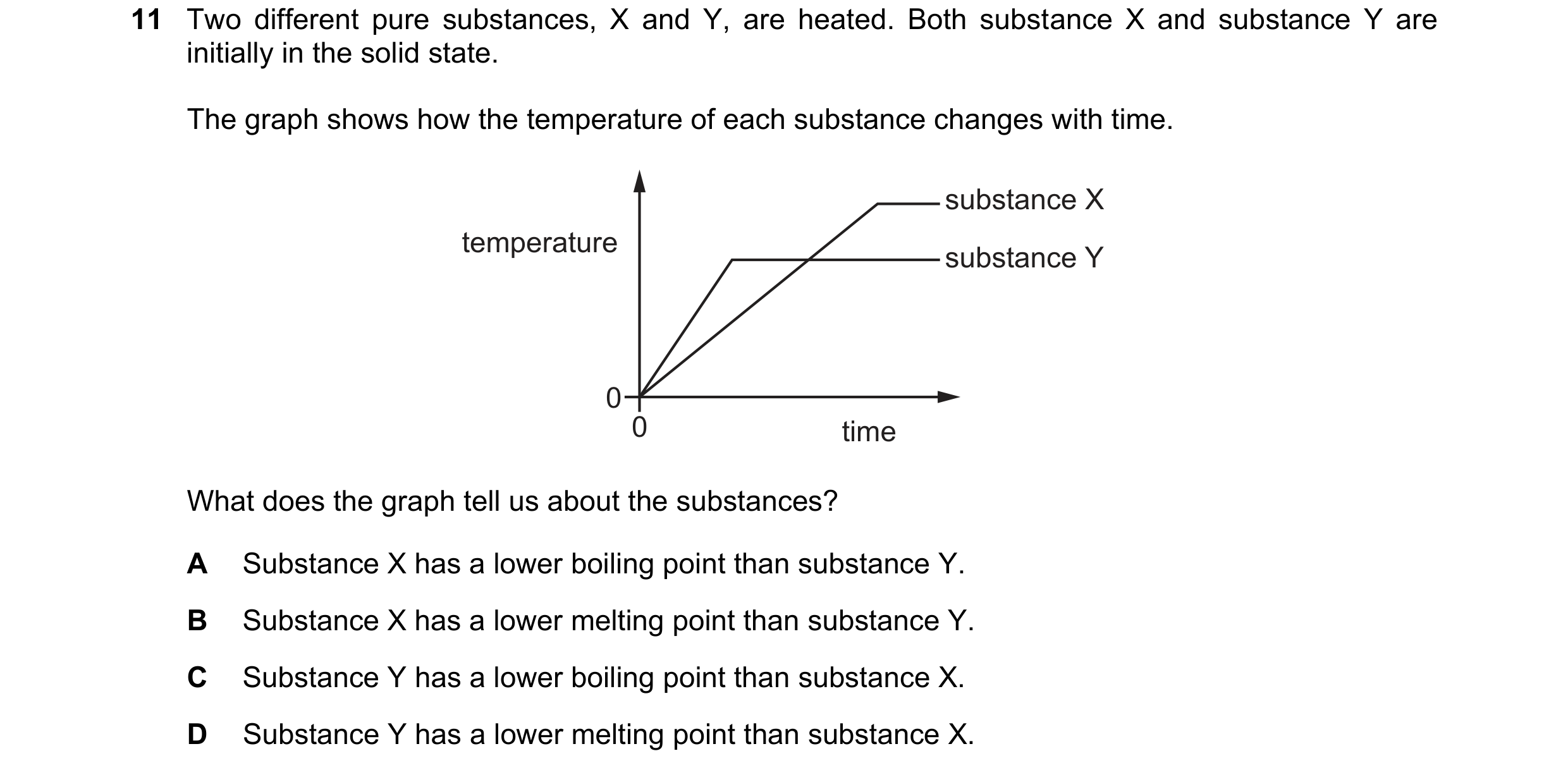
 12 / 14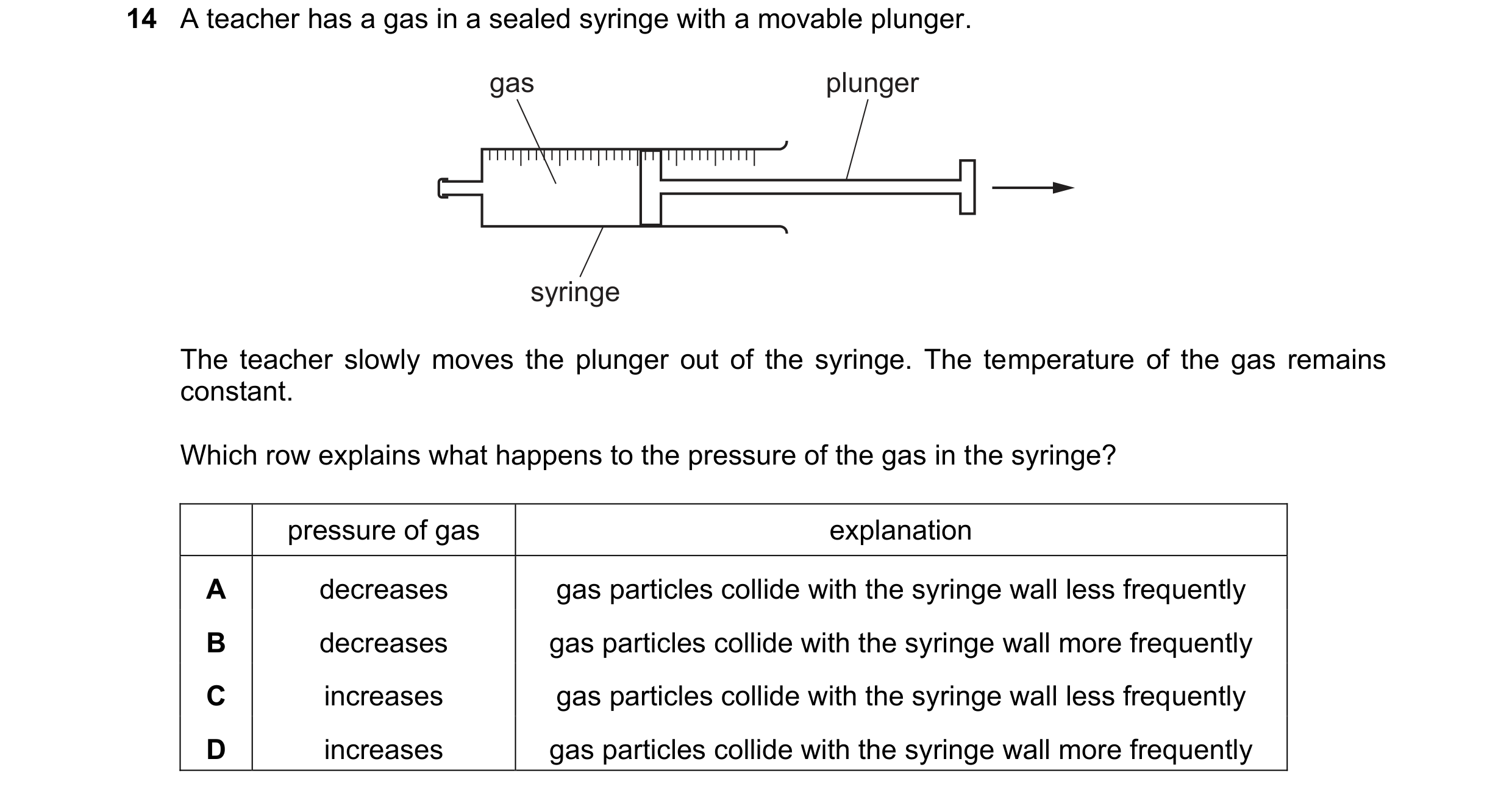
 13 / 14
 14 / 14