Questions as text
Question 1 0972/11 May/June 2018
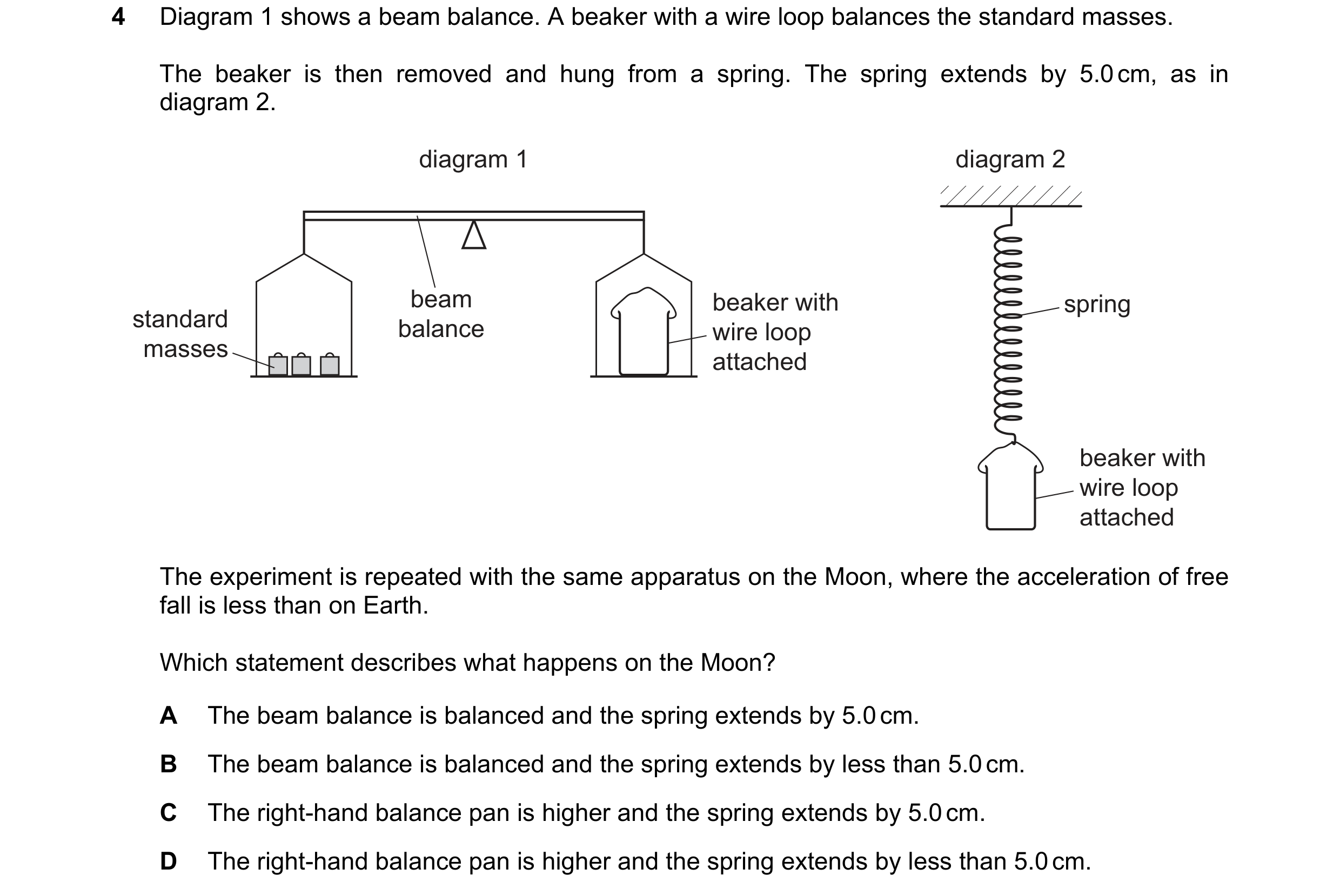
4 Diagram 1 shows a beam balance. A beaker with a wire loop balances the standard masses. The beaker is then removed and hung from a spring. The spring extends by 5.0 cm, as in diagram 2. diagram 1 diagram 2 beam beaker with spring standard balance wire loop masses attached beaker with wire loop attached The experiment is repeated with the same apparatus on the Moon, where the acceleration of free fall is less than on Earth. Which statement describes what happens on the Moon? A The beam balance is balanced and the spring extends by 5.0 cm. B The beam balance is balanced and the spring extends by less than 5.0 cm. C The right-hand balance pan is higher and the spring extends by 5.0 cm. D The right-hand balance pan is higher and the spring extends by less than 5.0 cm.
1 marks
Answer: B
This question in 0972/11 May/June 2018
Q2 · A car is moving in a straight line on a level road 0972/11 May/June 2018
8 A car is moving in a straight line on a level road. Its engine provides a forward force on the car. A second force of equal size acts on the car due to resistive forces. Which statement describes what happens? A The car changes direction. B The car moves at a constant speed. C The car slows down. D The car speeds up.
1 marks
Answer: B
This question in 0972/11 May/June 2018
Q3 · A hole is drilled in a square tile 0972/11 May/June 2018
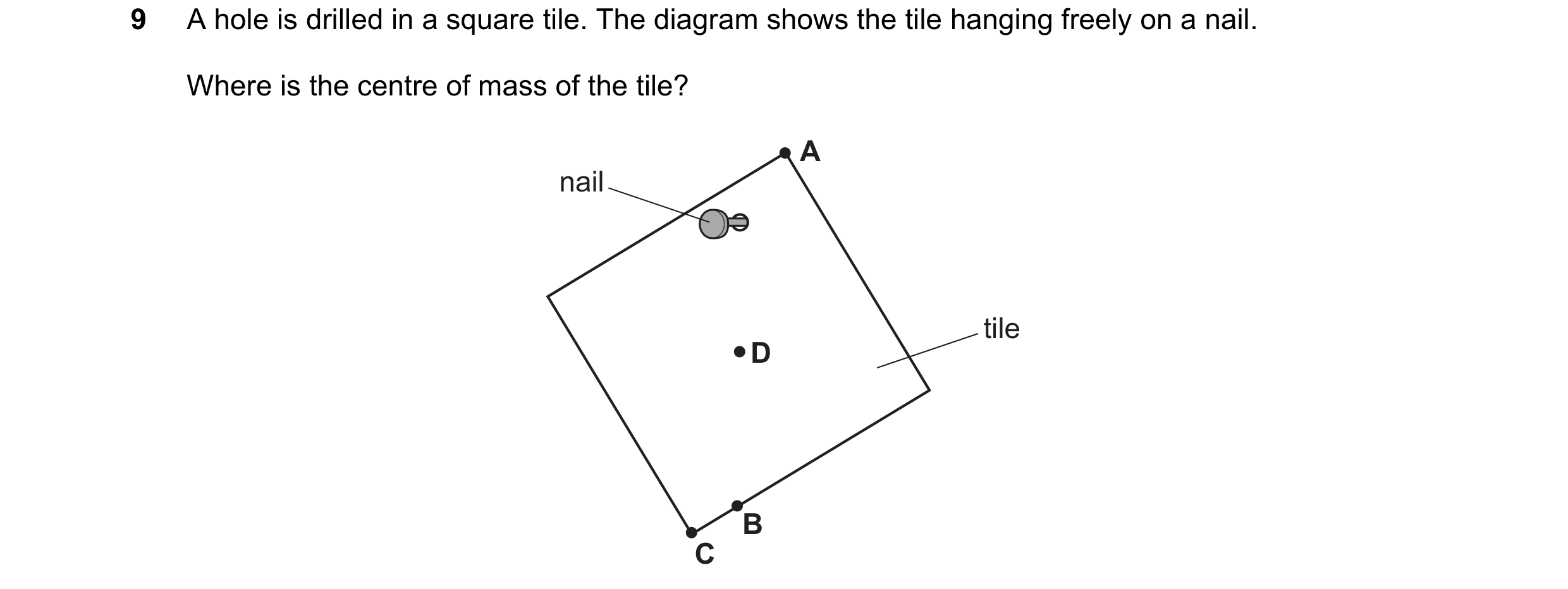
9 A hole is drilled in a square tile. The diagram shows the tile hanging freely on a nail. Where is the centre of mass of the tile? A nail tile D B C
1 marks
Answer: D
This question in 0972/11 May/June 2018
Q4 · Two rectangular blocks consist of different materials 0972/11 May/June 2019
5 Two rectangular blocks consist of different materials. Four different methods are suggested to compare the two masses. 1 Compare the accelerations with which they fall freely. 2 Compare the values of their lengths × breadths × heights. 3 Hang each in turn from the same spring. Compare the extensions. 4 Place one in the right-hand pan of a beam balance and the other in the left-hand pan. Which methods give a comparison of the two masses? A 1, 2 and 3 B 1 and 2 only C 3 and 4 only D 4 only
1 marks
Answer: C
This question in 0972/11 May/June 2019
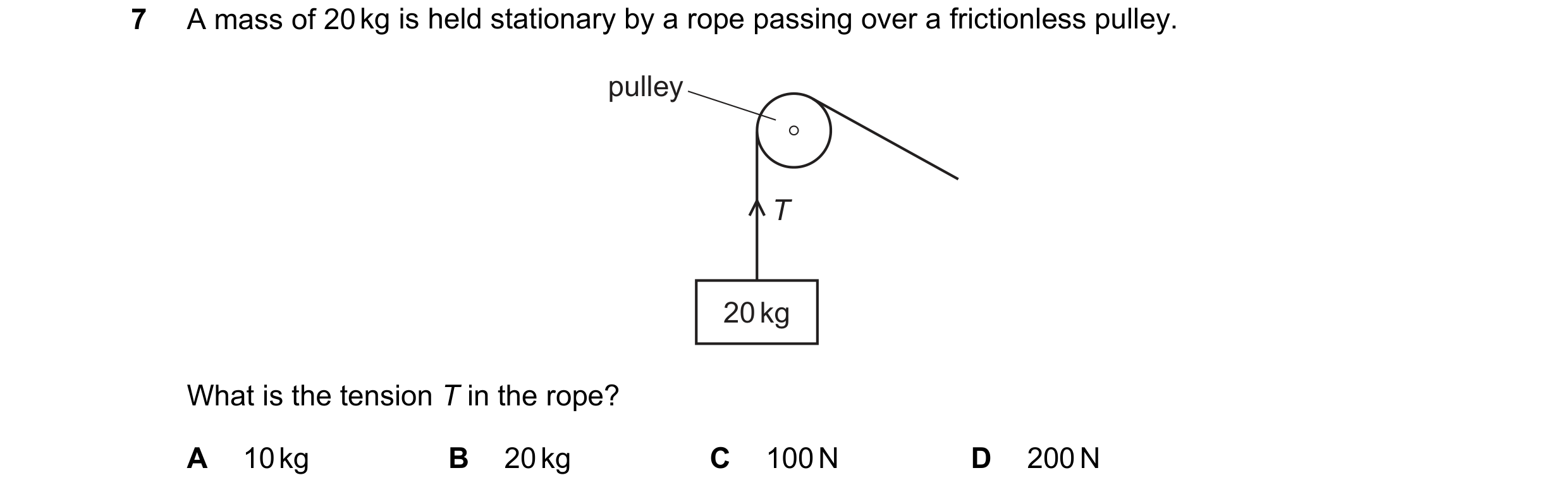
Q5 · A mass of 20 kg is held stationary by a rope passing over a frictionless pulley 0972/11 May/June 2019
7 A mass of 20 kg is held stationary by a rope passing over a frictionless pulley. pulley T 20 kg What is the tension T in the rope? A 10 kg B 20 kg C 100 N D 200 N
1 marks
Answer: D
This question in 0972/11 May/June 2019
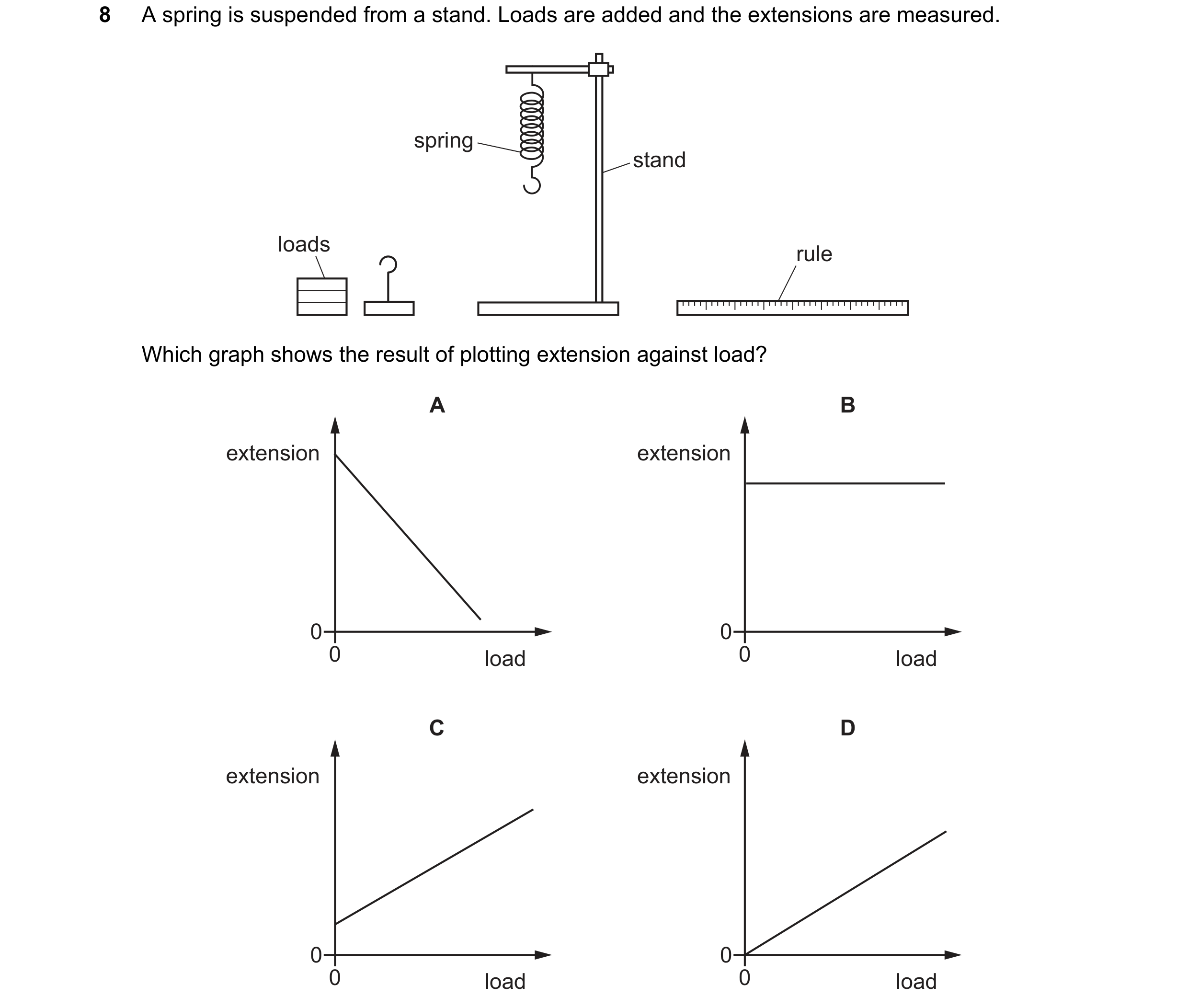
Q6 · A spring is suspended from a stand 0972/11 May/June 2019
8 A spring is suspended from a stand. Loads are added and the extensions are measured. spring stand loads rule Which graph shows the result of plotting extension against load? A B extension extension 0 0 0 load 0 load C D extension extension 0 0 0 load 0 load
1 marks
Answer: D
This question in 0972/11 May/June 2019
Q7 · A wooden bar is pivoted at its centre so that it can rotate freely 0972/11 May/June 2019
9 A wooden bar is pivoted at its centre so that it can rotate freely. Two equal forces F are applied to the bar. In which diagram is the turning effect greatest? A B pivot pivot F F F F C D F pivot pivot F F F
1 marks
Answer: A
This question in 0972/11 May/June 2019
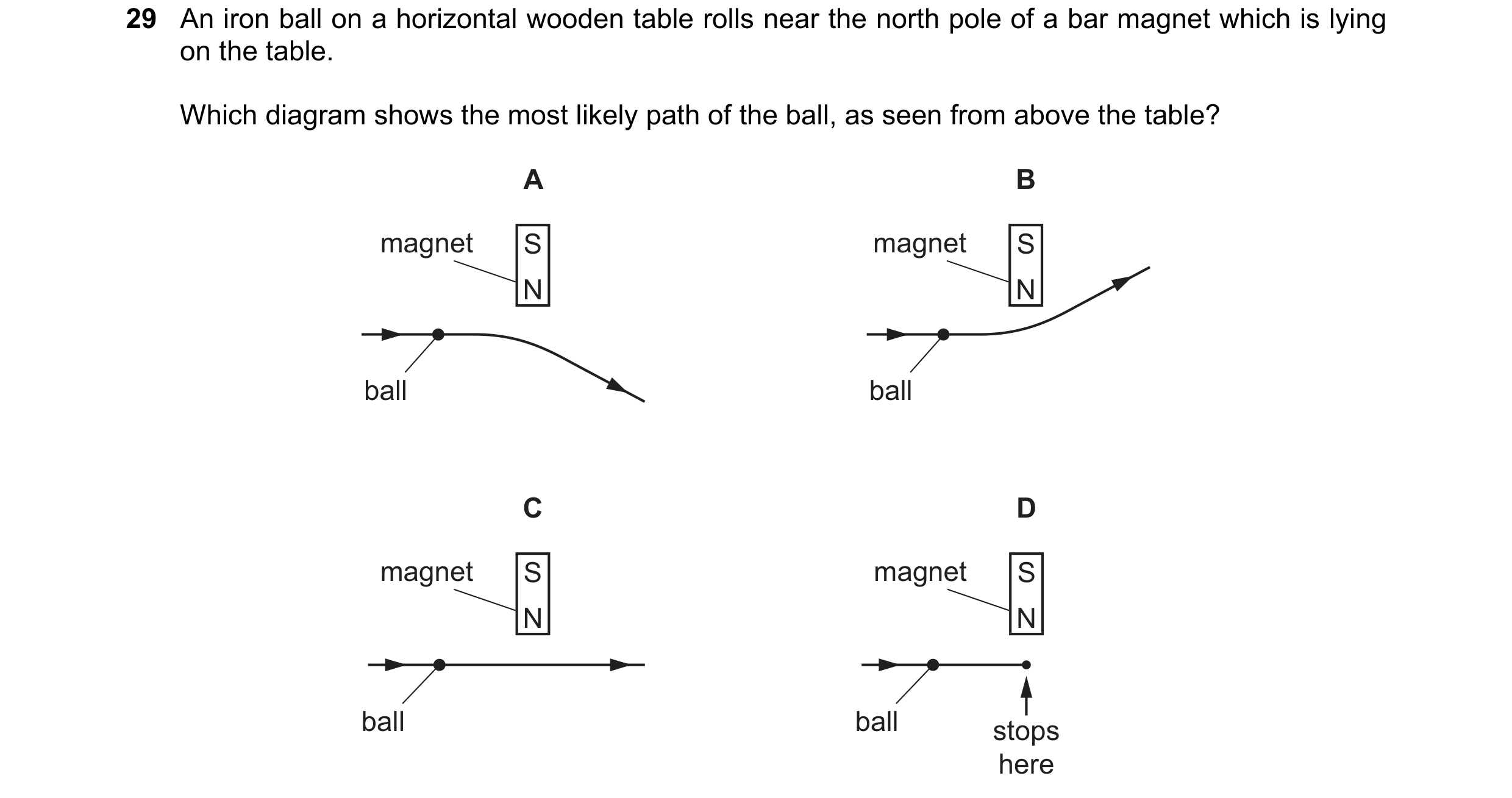
Q8 · An iron ball on a horizontal wooden table rolls near the north pole of a bar magnet which… 0972/11 May/June 2019
29 An iron ball on a horizontal wooden table rolls near the north pole of a bar magnet which is lying on the table. Which diagram shows the most likely path of the ball, as seen from above the table? A B magnet S magnet S N N ball ball C D magnet S magnet S N N ball ball stops here
1 marks
Answer: B
This question in 0972/11 May/June 2019
Q9 · Two thin, uncharged strips of plastic 0972/11 May/June 2019
30 Diagram 1 shows two thin, uncharged strips of plastic. Diagram 2 shows the same strips after they have been rubbed with a dry cloth. strips strips of plastic of plastic diagram 1 diagram 2 Which row describes the charge on the strips after rubbing, and the force between the strips after rubbing? charge on strips force between strips A opposite attraction B opposite repulsion C the same attraction D the same repulsion
1 marks
Answer: D
This question in 0972/11 May/June 2019
Q10 · Which quantity is a force due to a gravitational field? 0972/11 Oct/Nov 2019
4 Which quantity is a force due to a gravitational field? A density B mass C weight D volume
1 marks
Answer: C
This question in 0972/11 Oct/Nov 2019
Q11 · A student measures the length of a spring 0972/11 Oct/Nov 2019
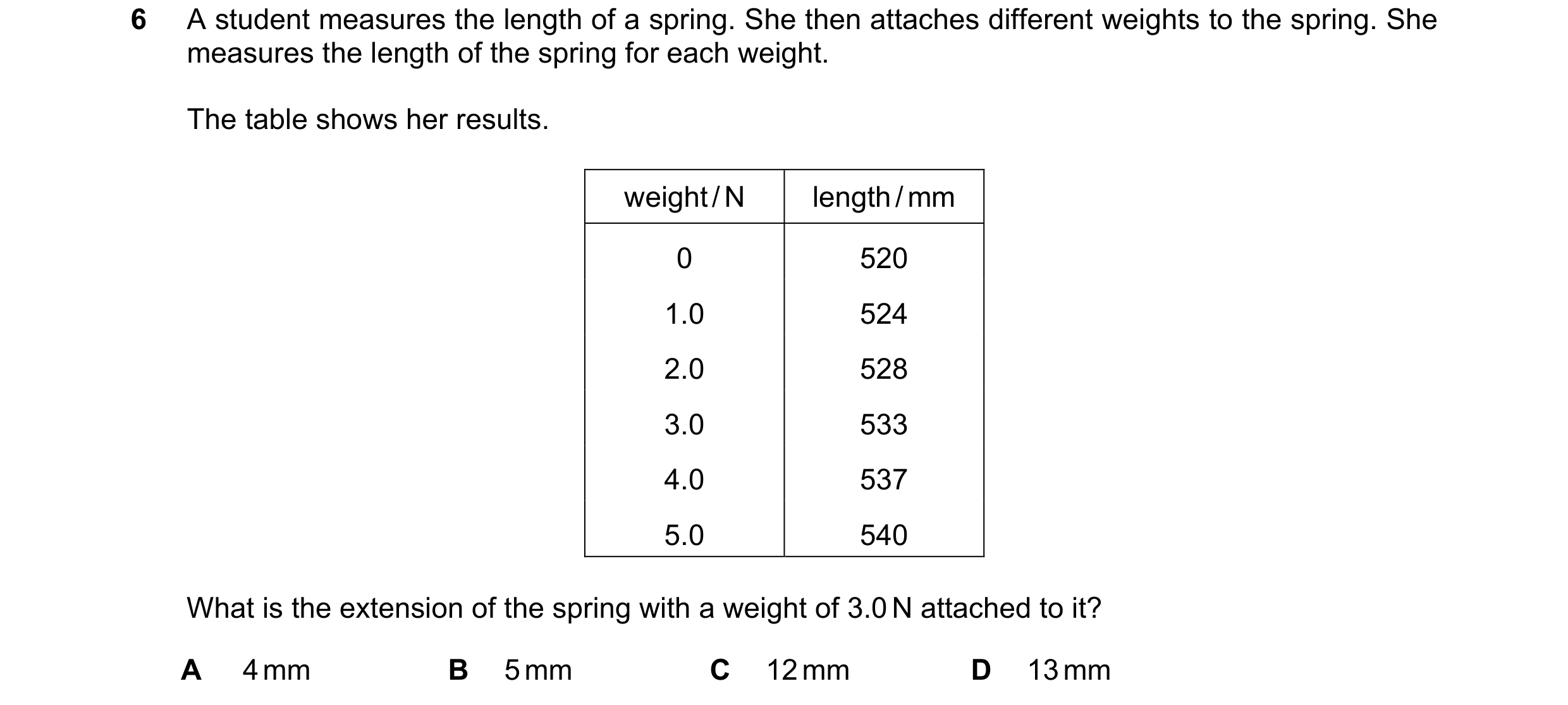
6 A student measures the length of a spring. She then attaches different weights to the spring. She measures the length of the spring for each weight. The table shows her results. weight / N length / mm 0 520 1.0 524 2.0 528 3.0 533 4.0 537 5.0 540 What is the extension of the spring with a weight of 3.0 N attached to it? A 4 mm B 5 mm C 12 mm D 13 mm
1 marks
Answer: D
This question in 0972/11 Oct/Nov 2019
Q12 · Which statement gives a complete description of any object that is in equilibrium? 0972/11 Oct/Nov 2019
7 Which statement gives a complete description of any object that is in equilibrium? A There are no forces acting. B There is no resultant force. C There is no resultant force and no resultant turning effect. D There is no resultant turning effect.
1 marks
Answer: C
This question in 0972/11 Oct/Nov 2019
Q13 · The diagram shows a lamp 0972/11 Oct/Nov 2019
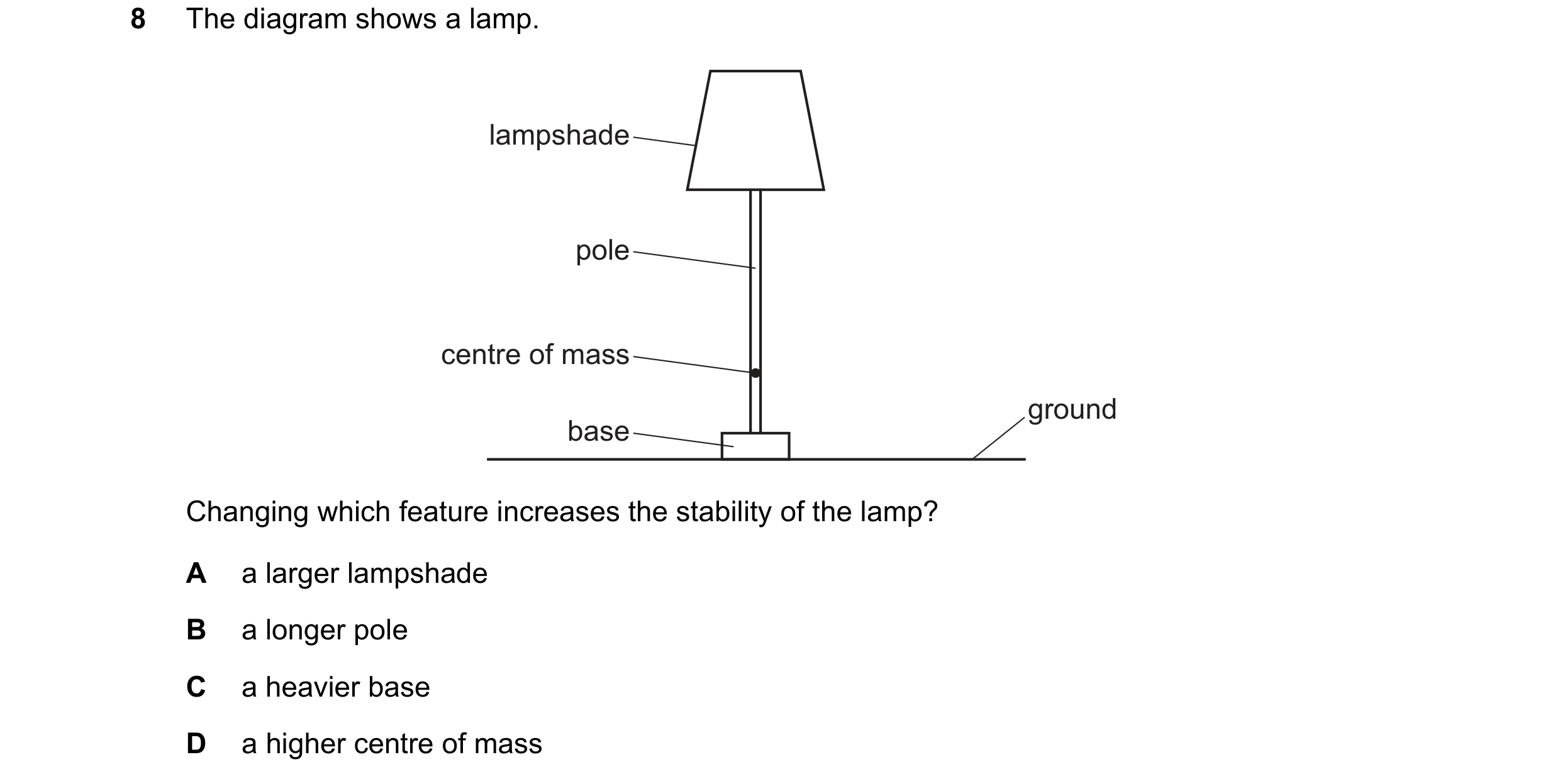
8 The diagram shows a lamp. lampshade pole centre of mass ground base Changing which feature increases the stability of the lamp? A a larger lampshade B a longer pole C a heavier base D a higher centre of mass
1 marks
Answer: C
This question in 0972/11 Oct/Nov 2019
Q14 · A drawing pin (thumb tack) has a sharp point at one end and a flat surface at the other… 0972/11 Oct/Nov 2019
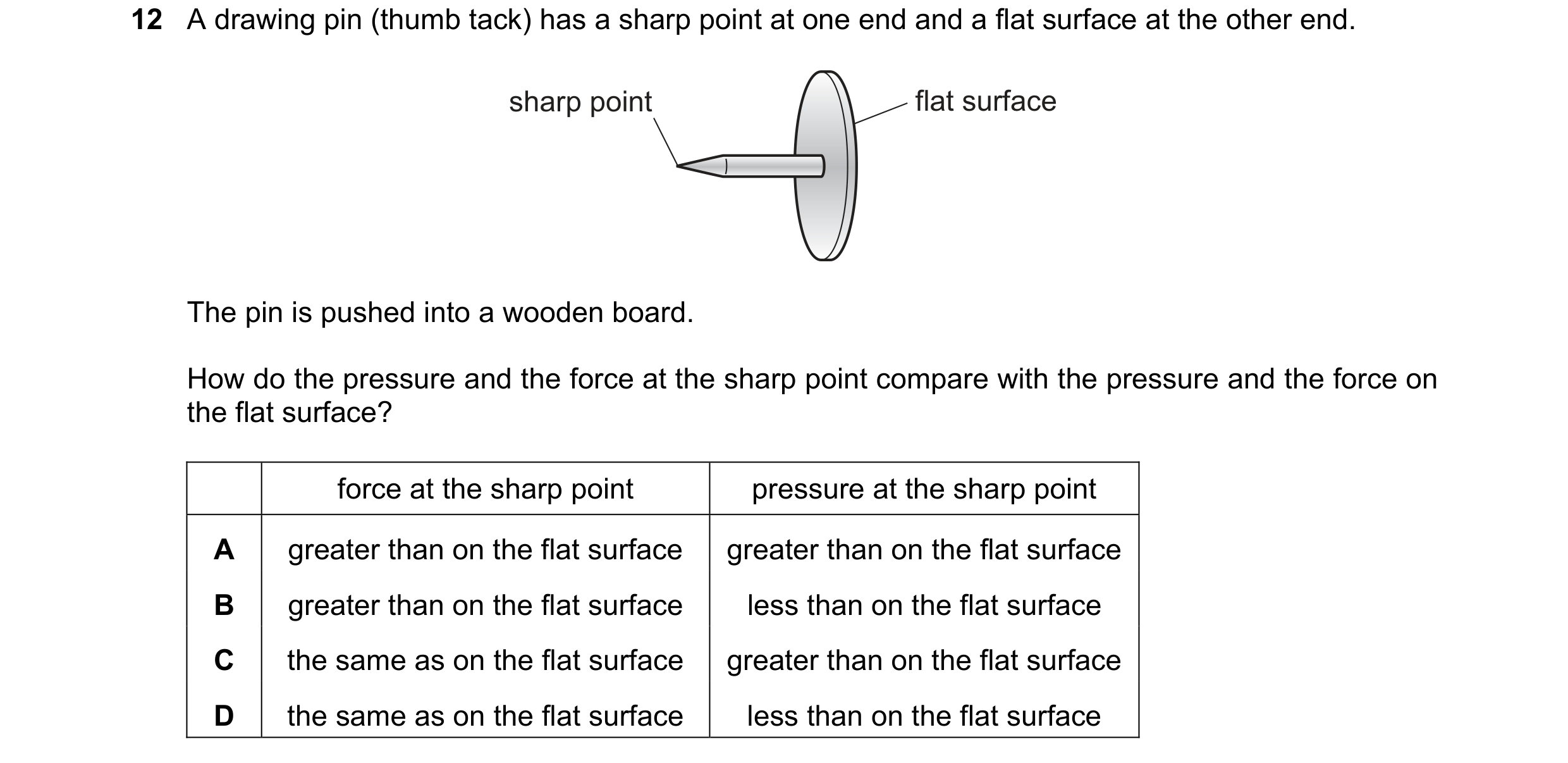
12 A drawing pin (thumb tack) has a sharp point at one end and a flat surface at the other end. sharp point flat surface The pin is pushed into a wooden board. How do the pressure and the force at the sharp point compare with the pressure and the force on the flat surface? force at the sharp point pressure at the sharp point A greater than on the flat surface greater than on the flat surface B greater than on the flat surface less than on the flat surface C the same as on the flat surface greater than on the flat surface D the same as on the flat surface less than on the flat surface
1 marks
Answer: C
This question in 0972/11 Oct/Nov 2019
Q15 · The table shows four forces 0972/11 Oct/Nov 2019
13 The table shows four forces. Each force acts on a different surface. Which row shows the least pressure? size of the area of the surface force / N / m2 A 0.30 0.040 B 10 2.0 C 60 15 D 1200 40
1 marks
Answer: C
This question in 0972/11 Oct/Nov 2019
Q16 · A sledge is pulled in a straight line by dogs, as shown 0972/11 May/June 2020
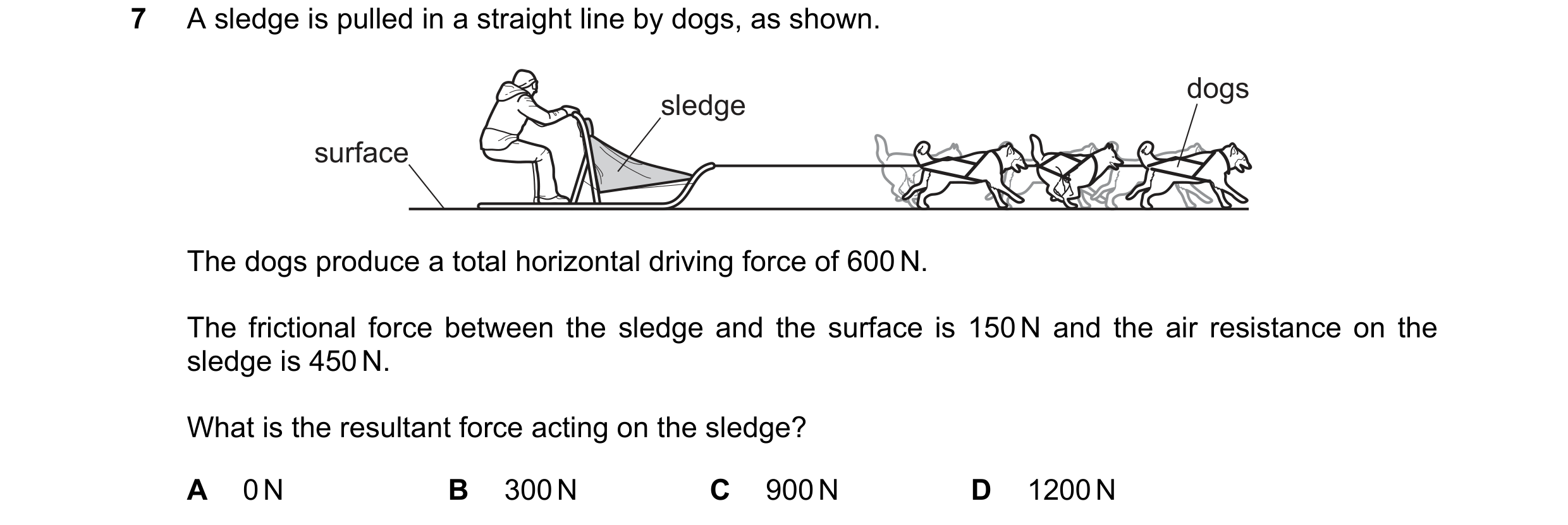
7 A sledge is pulled in a straight line by dogs, as shown. dogs sledge surface The dogs produce a total horizontal driving force of 600 N. The frictional force between the sledge and the surface is 150 N and the air resistance on the sledge is 450 N. What is the resultant force acting on the sledge? A 0 N B 300 N C 900 N D 1200 N
1 marks
Answer: A
This question in 0972/11 May/June 2020
Q17 · Forces are applied to four identical objects 0972/11 May/June 2020
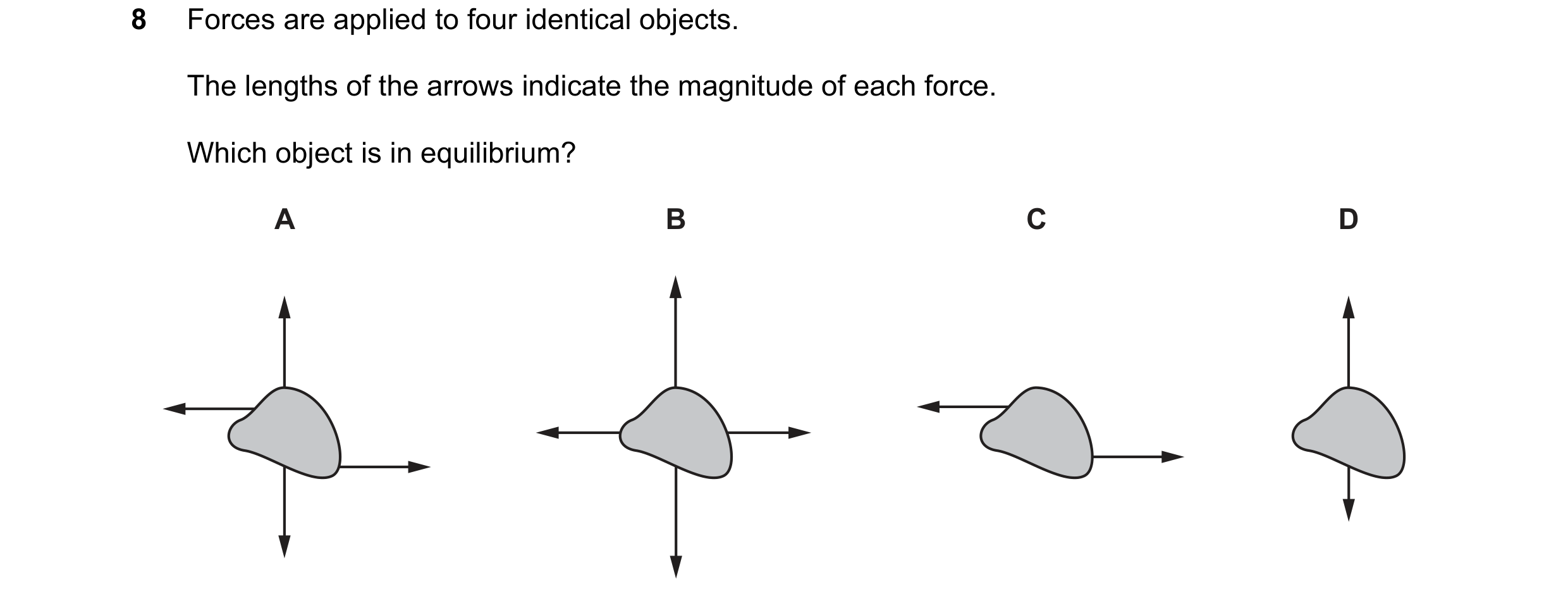
8 Forces are applied to four identical objects. The lengths of the arrows indicate the magnitude of each force. Which object is in equilibrium? A B C D
1 marks
Answer: B
This question in 0972/11 May/June 2020
Q18 · The diagram shows an extension–load graph for a spring 0972/12 May/June 2020
7 The diagram shows an extension–load graph for a spring. 10.0 extension / cm 9.0 8.0 7.0 6.0 5.0 4.0 3.0 2.0 1.0 0 0 2.0 4.0 6.0 8.0 10.0 12.0 14.0 16.0 18.0 20.0 load / N An empty can of weight 3.0 N is suspended from the spring. Liquid is poured into the can until the extension is 8.0 cm. What is the weight of the liquid? A 4.0 N B 10.0 N C 13.0 N D 16.0 N
1 marks
Answer: C
This question in 0972/12 May/June 2020
Q19 · What is meant by the moment of a force on an object? 0972/12 May/June 2020
8 What is meant by the moment of a force on an object? A the magnitude of the force on the object B the direction of the force on the object C the time for which the force acts on the object D the turning effect of the force on the object
1 marks
Answer: D
This question in 0972/12 May/June 2020
Q20 · The diagram shows a solid block resting on a bench 0972/12 May/June 2020
12 The diagram shows a solid block resting on a bench. The dimensions of the block are shown. 40 cm 20 cm Q R bench 80 cm P On which labelled surface should the block rest to produce the smallest pressure on the bench? A P B Q C R D P, Q and R produce the same pressure
1 marks
Answer: A
This question in 0972/12 May/June 2020
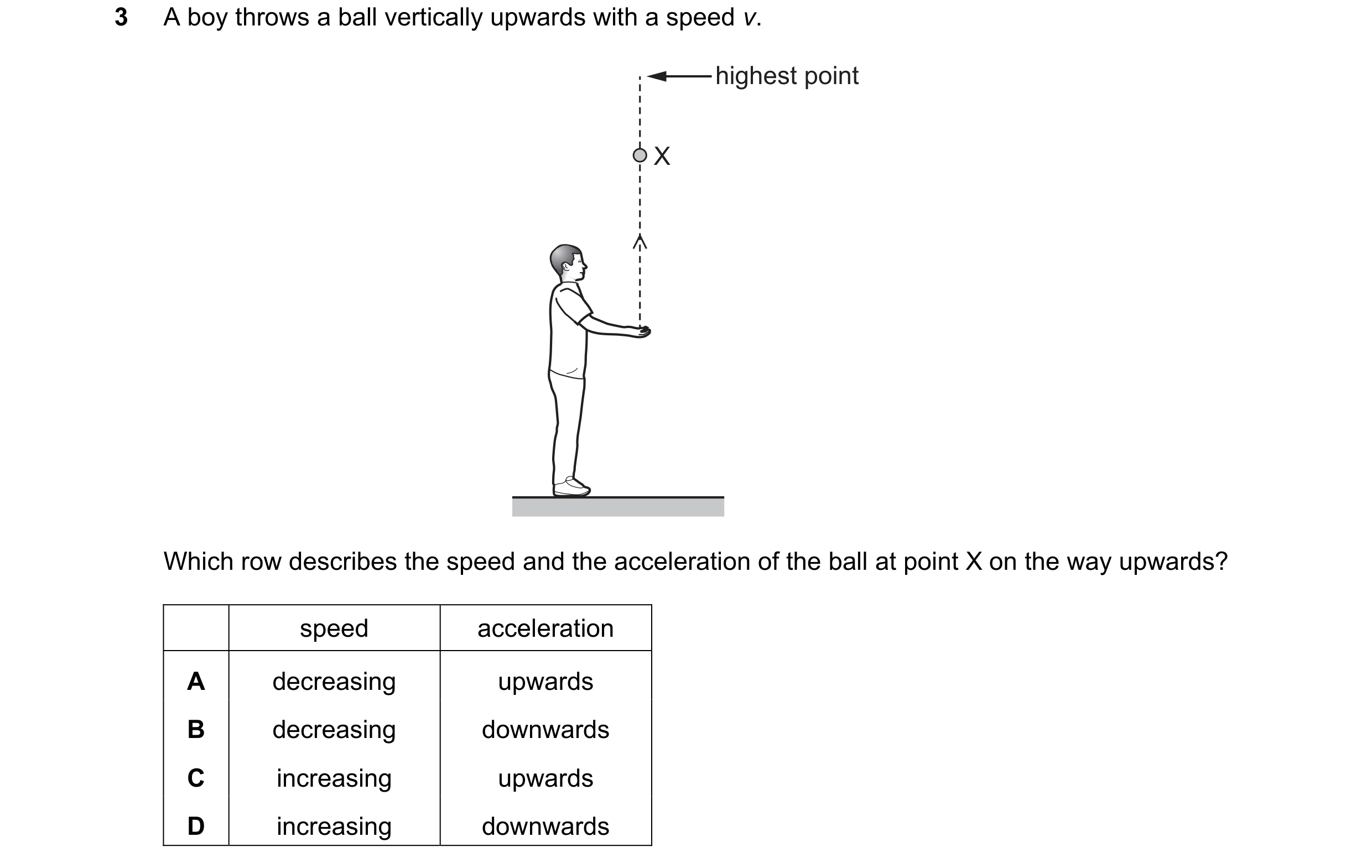
Q21 · A boy throws a ball vertically upwards with a speed v 0972/11 Oct/Nov 2020
3 A boy throws a ball vertically upwards with a speed v. highest point X Which row describes the speed and the acceleration of the ball at point X on the way upwards? speed acceleration A decreasing upwards B decreasing downwards C increasing upwards D increasing downwards
1 marks
Answer: B
This question in 0972/11 Oct/Nov 2020
Q22 · Which quantity is weight an example of? 0972/11 Oct/Nov 2020
5 Which quantity is weight an example of? A acceleration B force C mass D pressure
1 marks
Answer: B
This question in 0972/11 Oct/Nov 2020
Q23 · A uniform plank rests on a pivot at its centre 0972/11 Oct/Nov 2020
7 A uniform plank rests on a pivot at its centre. Two children P and Q sit on the plank in the positions shown. 1.2 m 1.5 m child P child Q pivot The mass of child P is 25 kg. The plank is balanced. What is the mass of child Q? A 20 kg B 25 kg C 31 kg D 45 kg
1 marks
Answer: A
This question in 0972/11 Oct/Nov 2020
Q24 · An object is in equilibrium on the Earth 0972/11 Oct/Nov 2020
8 An object is in equilibrium on the Earth. Which statement is correct? A All the forces acting on the object are in the same direction. B All the forces acting on the object have the same value. C The object is weightless. D The resultant force acting on the object is zero.
1 marks
Answer: D
This question in 0972/11 Oct/Nov 2020
Q25 · A man jumps from a stationary balloon 0972/11 Oct/Nov 2020
9 A man jumps from a stationary balloon. After falling several hundred metres, he opens his parachute. At which position is his kinetic energy greatest? A just after he jumps from the balloon B just before he opens his parachute C just after his parachute opens D just before he lands
1 marks
Answer: B
This question in 0972/11 Oct/Nov 2020
Q26 · A 100 cm beam balances as shown 0972/11 Oct/Nov 2021
5 A 100 cm beam balances as shown. 4.0 kg 3.0 kg 0 10 20 30 40 60 70 80 90 100 pivot The pivot is moved 10 cm to the left. 4.0 kg 3.0 kg 0 10 20 30 50 60 70 80 90 100 pivot What will be the effect of this change on the anticlockwise and clockwise moments about the pivot? anticlockwise clockwise moment moment A decreases decreases B decreases increases C increases decreases D increases increases
1 marks
Answer: B
This question in 0972/11 Oct/Nov 2021
Q27 · A spacecraft is travelling in space with no resultant force and no resultant moment… 0972/11 Oct/Nov 2021
6 A spacecraft is travelling in space with no resultant force and no resultant moment acting on it. Which statement about the spacecraft is correct? A Its direction is changing. B It is in equilibrium. C Its speed is decreasing. D Its speed is increasing.
1 marks
Answer: B
This question in 0972/11 Oct/Nov 2021
Q28 · Which pieces of apparatus are the most appropriate for an experiment to plot an… 0972/11 May/June 2022
6 Which pieces of apparatus are the most appropriate for an experiment to plot an extension–load graph of a spring? A ruler, newton meter, clamp and stand B balance, stop-watch, ruler C light gate, ruler, newton meter D stop-watch, balance, measuring cylinder
1 marks
Answer: A
This question in 0972/11 May/June 2022
Q29 · A beam is pivoted at one end, as shown 0972/11 May/June 2022
7 A beam is pivoted at one end, as shown. 40 cm beam X pivot 6.0 N The beam weighs 6.0 N and its weight acts at a point X 40 cm from the pivot. A force of 4.0 N is applied to the beam causing it to balance horizontally. In which direction and where is the 4.0 N force applied? A vertically downwards at 20 cm to the left of X B vertically downwards at 20 cm to the right of X C vertically upwards at 20 cm to the left of X D vertically upwards at 20 cm to the right of X
1 marks
Answer: D
This question in 0972/11 May/June 2022
Q30 · The diagrams show the forces acting on four moving objects 0972/11 May/June 2022
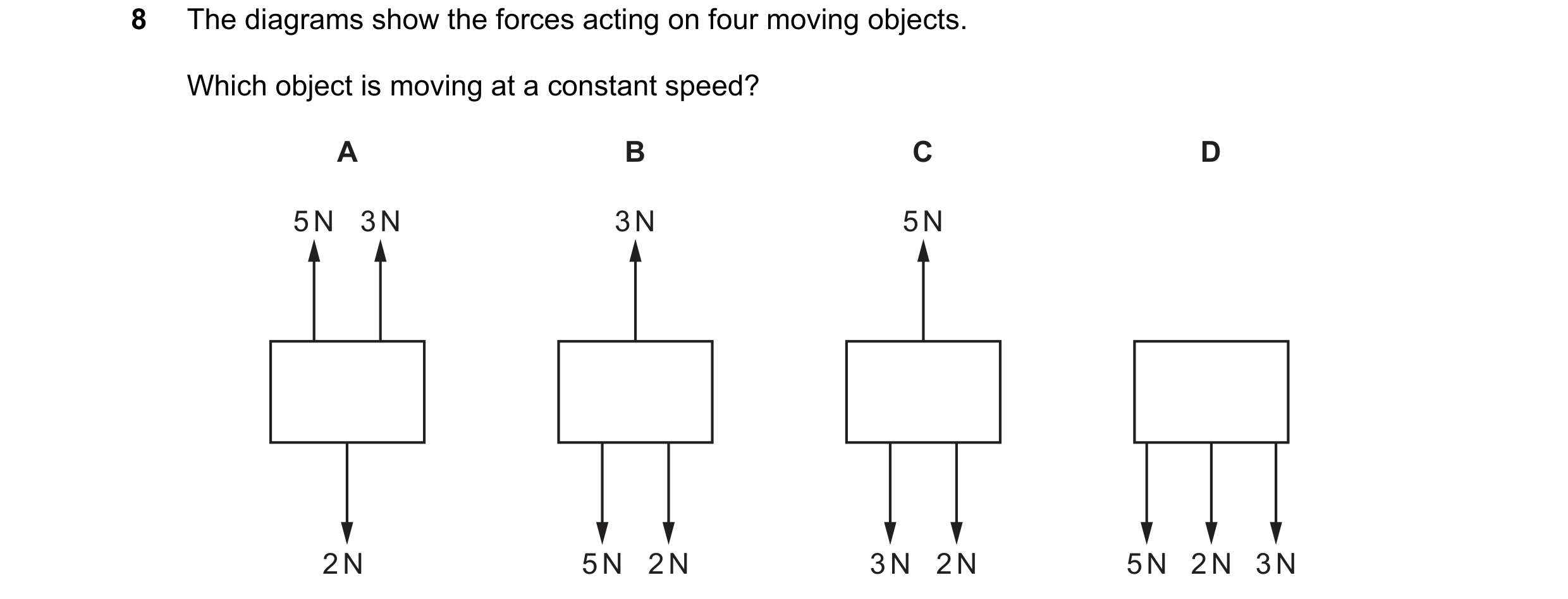
8 The diagrams show the forces acting on four moving objects. Which object is moving at a constant speed? A B C D 5 N 3 N 3 N 5 N 2 N 5 N 2 N 3 N 2 N 5 N 2 N 3 N
1 marks
Answer: C
This question in 0972/11 May/June 2022
Q31 · A spaceship approaches and passes a planet 0972/12 May/June 2022
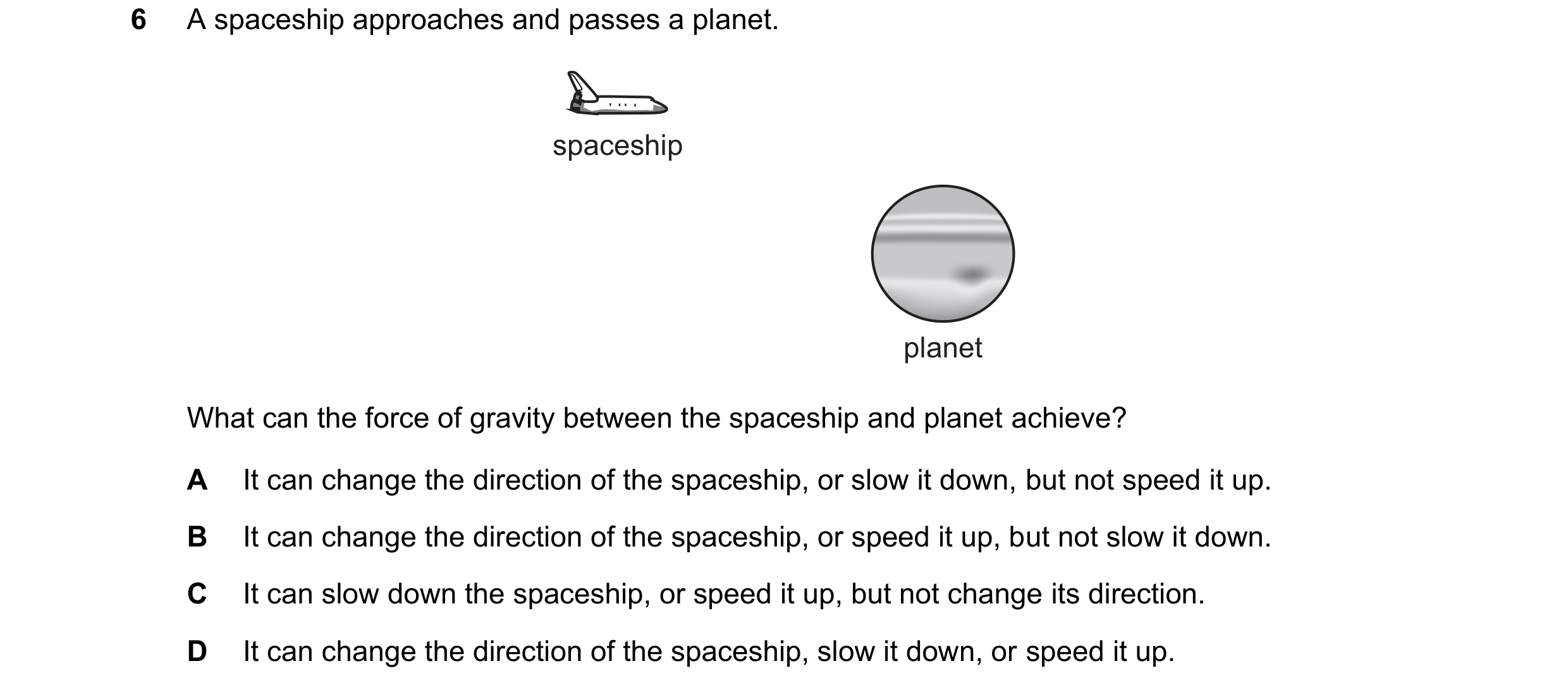
6 A spaceship approaches and passes a planet. spaceship planet What can the force of gravity between the spaceship and planet achieve? A It can change the direction of the spaceship, or slow it down, but not speed it up. B It can change the direction of the spaceship, or speed it up, but not slow it down. C It can slow down the spaceship, or speed it up, but not change its direction. D It can change the direction of the spaceship, slow it down, or speed it up.
1 marks
Answer: D
This question in 0972/12 May/June 2022
Q32 · A beam is pivoted at one end, as shown 0972/12 May/June 2022
7 A beam is pivoted at one end, as shown. 40 cm beam X pivot 6.0 N The beam weighs 6.0 N and its weight acts at a point X 40 cm from the pivot. A force of 4.0 N is applied to the beam causing it to balance horizontally. In which direction and where is the 4.0 N force applied? A vertically downwards at 20 cm to the left of X B vertically downwards at 20 cm to the right of X C vertically upwards at 20 cm to the left of X D vertically upwards at 20 cm to the right of X
1 marks
Answer: D
This question in 0972/12 May/June 2022
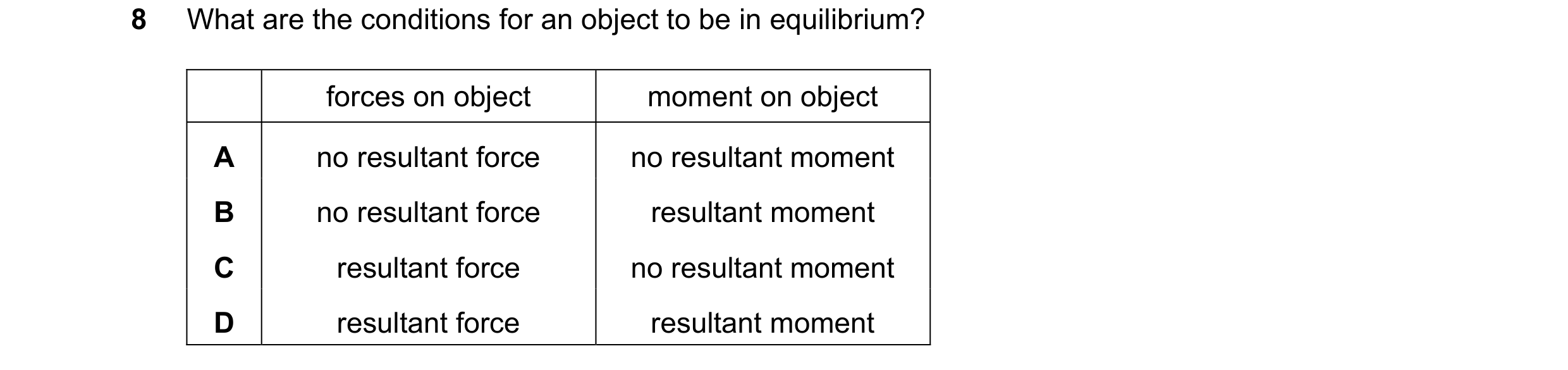
Q33 · What are the conditions for an object to be in equilibrium? 0972/12 May/June 2022
8 What are the conditions for an object to be in equilibrium? forces on object moment on object A no resultant force no resultant moment B no resultant force resultant moment C resultant force no resultant moment D resultant force resultant moment
1 marks
Answer: A
This question in 0972/12 May/June 2022
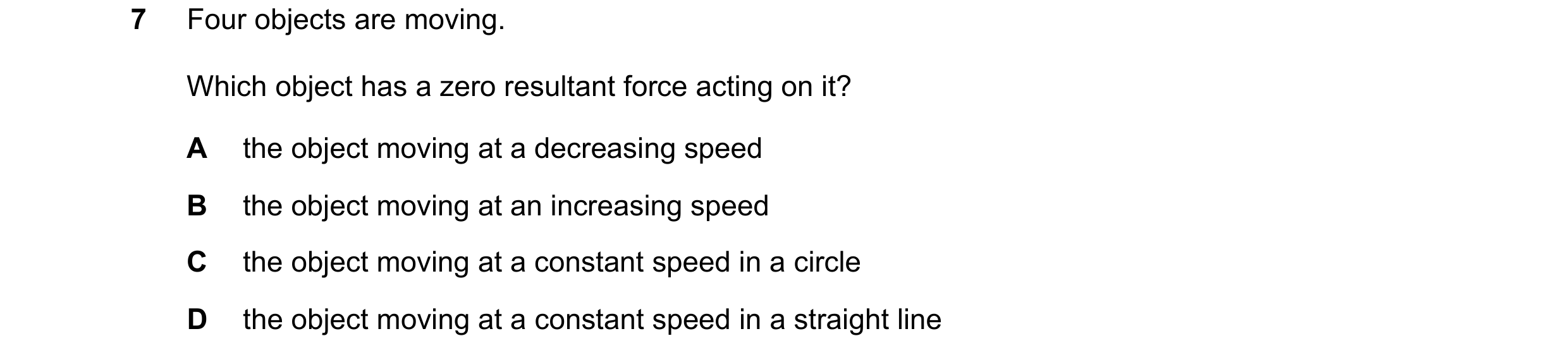
Q34 · Four objects are moving 0972/11 May/June 2023
7 Four objects are moving. Which object has a zero resultant force acting on it? A the object moving at a decreasing speed B the object moving at an increasing speed C the object moving at a constant speed in a circle D the object moving at a constant speed in a straight line
1 marks
Answer: D
This question in 0972/11 May/June 2023
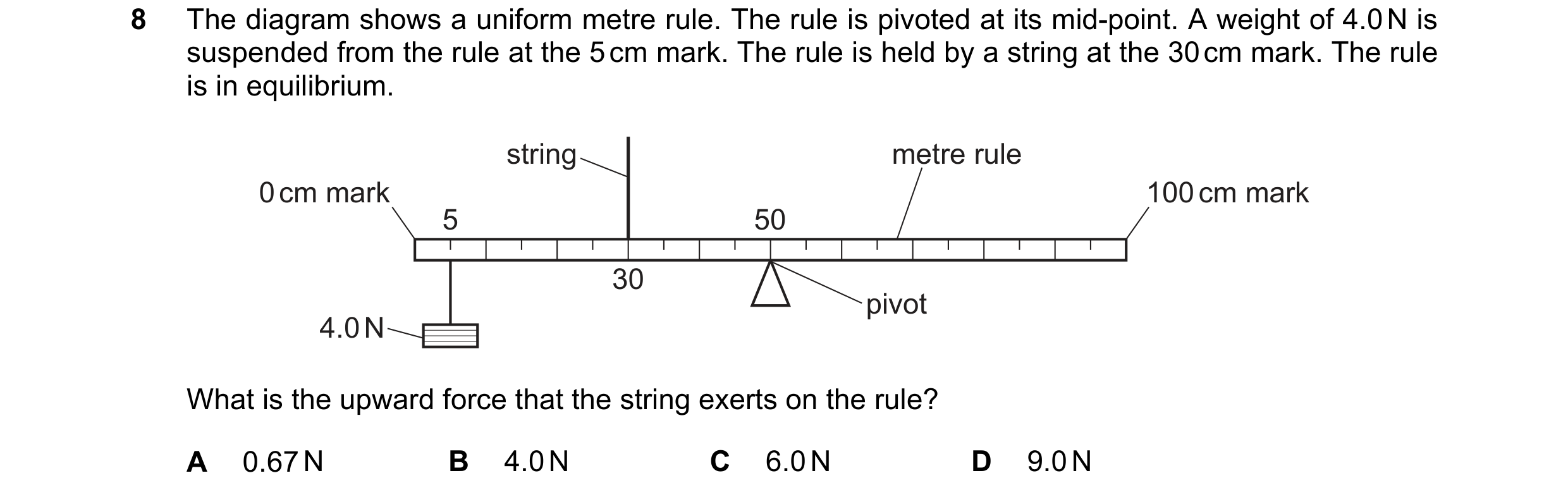
Q35 · The diagram shows a uniform metre rule 0972/11 May/June 2023
8 The diagram shows a uniform metre rule. The rule is pivoted at its mid-point. A weight of 4.0 N is suspended from the rule at the 5 cm mark. The rule is held by a string at the 30 cm mark. The rule is in equilibrium. string metre rule 0 cm mark 100 cm mark 5 50 30 pivot 4.0 N What is the upward force that the string exerts on the rule? A 0.67 N B 4.0 N C 6.0 N D 9.0 N
1 marks
Answer: D
This question in 0972/11 May/June 2023
Q36 · An irregularly shaped metal plate is freely suspended from a point P and is in… 0972/11 May/June 2023
9 An irregularly shaped metal plate is freely suspended from a point P and is in equilibrium, as shown. Point Q is vertically below P. P Q Which statement about the position of the centre of gravity of the metal plate is correct? A It is at P. B It is at Q. C It is halfway between P and Q. D Further investigation is needed to determine its position.
1 marks
Answer: D
This question in 0972/11 May/June 2023
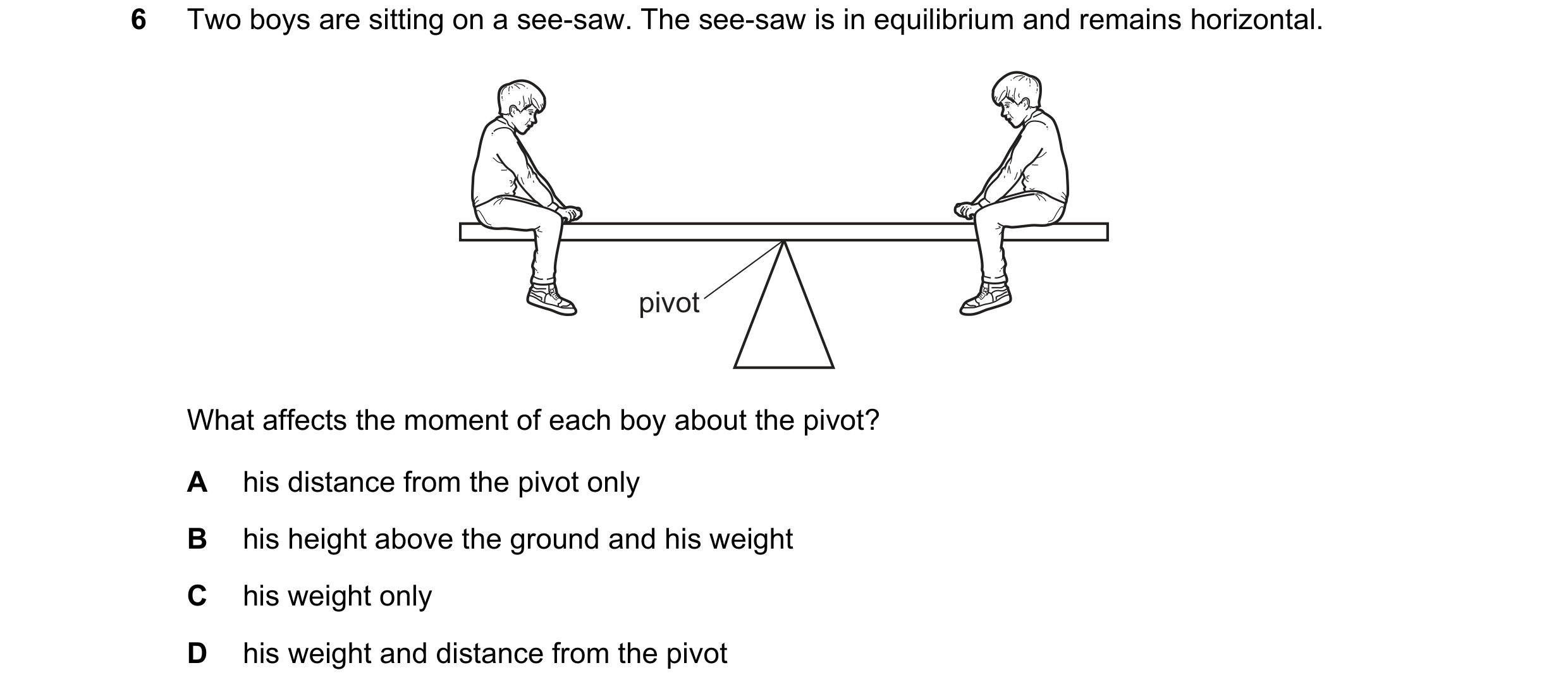
Q37 · Two boys are sitting on a see-saw 0972/12 May/June 2023
6 Two boys are sitting on a see-saw. The see-saw is in equilibrium and remains horizontal. pivot What affects the moment of each boy about the pivot? A his distance from the pivot only B his height above the ground and his weight C his weight only D his weight and distance from the pivot
1 marks
Answer: D
This question in 0972/12 May/June 2023
Q38 · A uniform metre rule is pivoted in equilibrium at the 50 cm mark 0972/12 May/June 2023
7 A uniform metre rule is pivoted in equilibrium at the 50 cm mark. A mass of 25 g is placed at the 30 cm mark on the rule. What is the smallest mass that can be placed on the rule to restore equilibrium? A 5 g B 10 g C 15 g D 25 g
1 marks
Answer: B
This question in 0972/12 May/June 2023
Q39 · A uniform beam XY is 100 cm long and weighs 4.0 N 0972/12 May/June 2023
8 A uniform beam XY is 100 cm long and weighs 4.0 N. 80 cm 60 cm 10 cm X Y centre pivot of beam F 8.0 N The beam rests on a pivot 60 cm from end X. A load of 8.0 N hangs from the beam 10 cm from end X. The beam is kept balanced by a force F acting on the beam 80 cm from end X. What is the magnitude of force F ? A 8.0 N B 18 N C 22 N D 44 N
1 marks
Answer: C
This question in 0972/12 May/June 2023
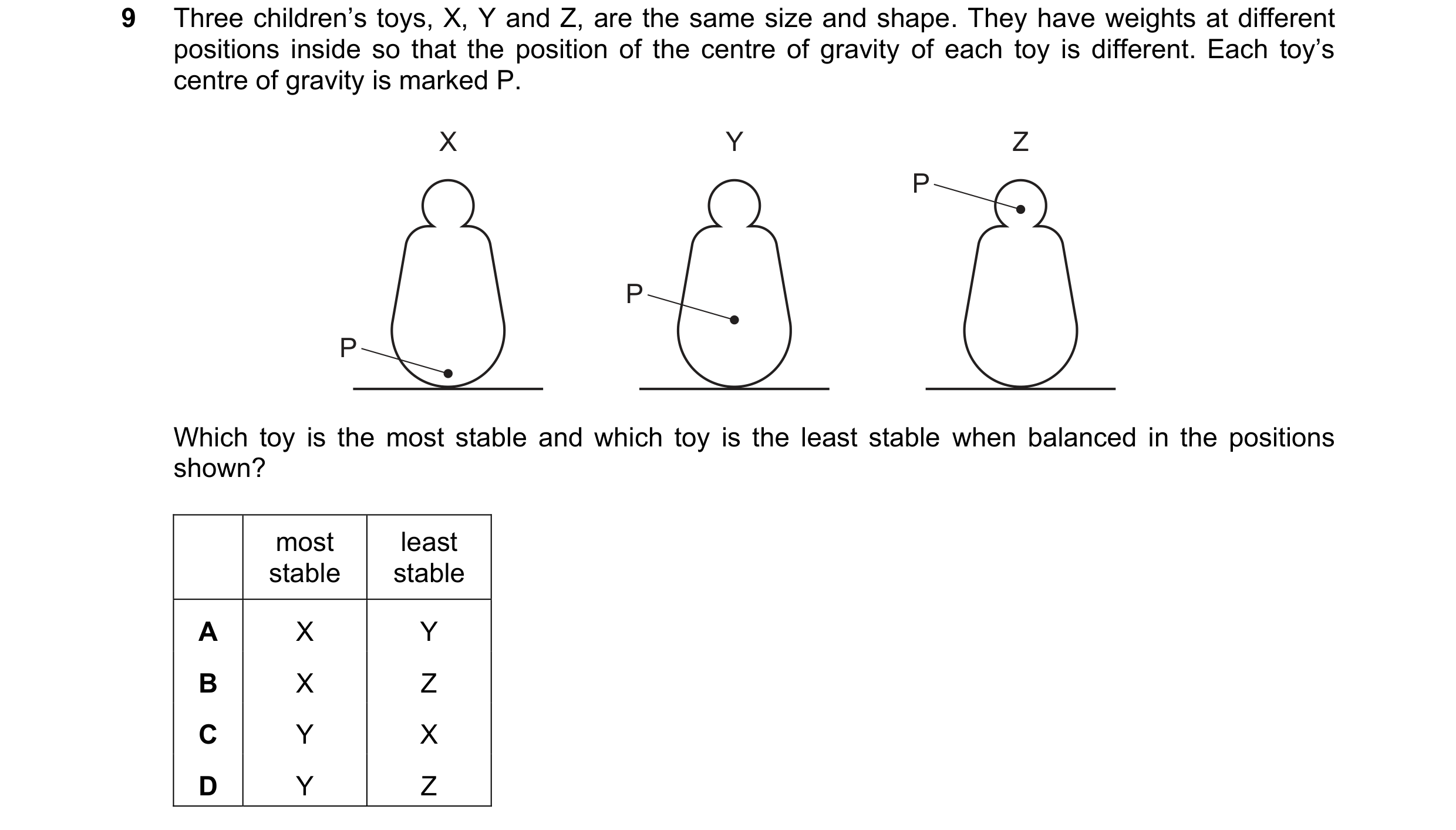
Q40 · Three children’s toys, X, Y and Z, are the same size and shape 0972/12 May/June 2023
9 Three children’s toys, X, Y and Z, are the same size and shape. They have weights at different positions inside so that the position of the centre of gravity of each toy is different. Each toy’s centre of gravity is marked P. X Y Z P P P Which toy is the most stable and which toy is the least stable when balanced in the positions shown? most least stable stable A X Y B X Z C Y X D Y Z
1 marks
Answer: B
This question in 0972/12 May/June 2023
Q41 · An object is suspended from a spring balance on the Earth 0972/11 Oct/Nov 2023
4 An object is suspended from a spring balance on the Earth. The same object is suspended from the same spring balance on another planet. 0 0 1 1 2 2 3 3 4 4 reading on reading on Earth other planet Which statement explains the difference between the two readings? A Both the mass and the weight of the object are greater on the other planet. B The mass of the object is greater on the other planet than on the Earth, but the weight is unchanged. C The spring stretches more easily when on the other planet. D The weight of the object is greater on the other planet than on the Earth, but the mass is unchanged.
1 marks
Answer: D
This question in 0972/11 Oct/Nov 2023
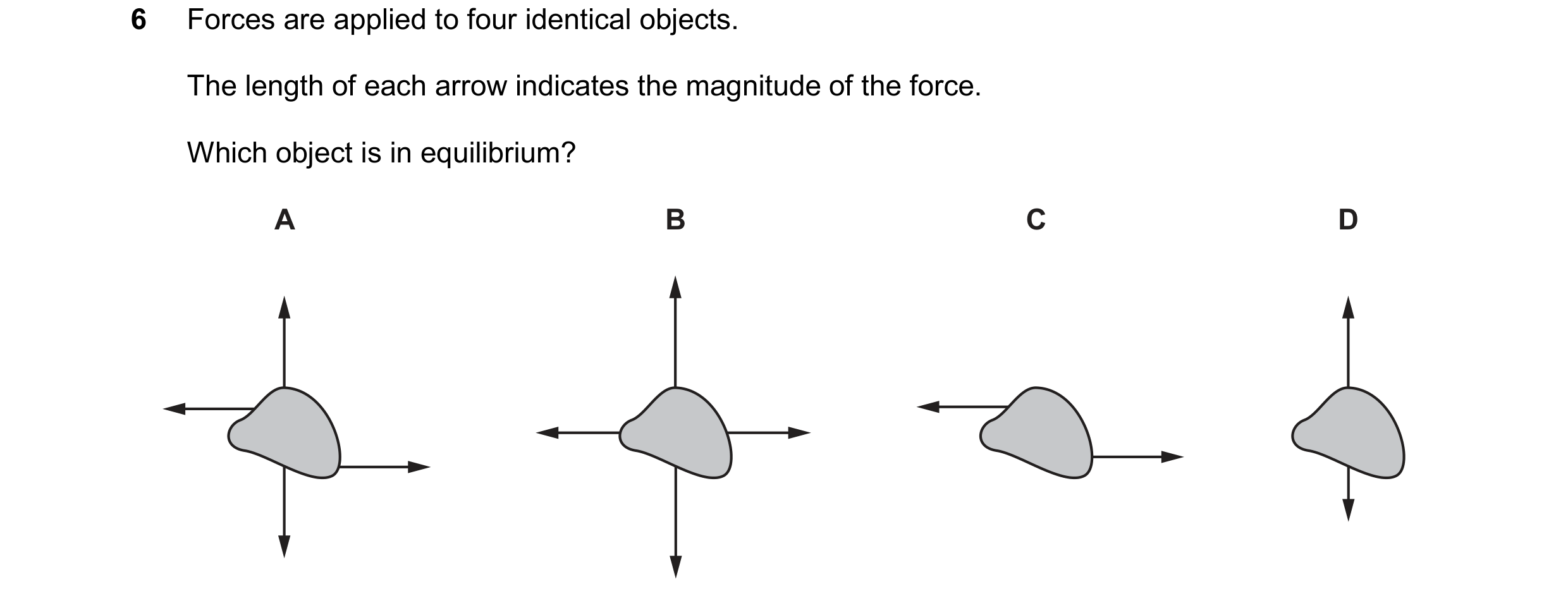
Q42 · Forces are applied to four identical objects 0972/11 Oct/Nov 2023
6 Forces are applied to four identical objects. The length of each arrow indicates the magnitude of the force. Which object is in equilibrium? A B C D
1 marks
Answer: B
This question in 0972/11 Oct/Nov 2023
Q43 · The diagram shows a wooden beam PQ which is attached to a wall by a pivot at P and kept… 0972/11 Oct/Nov 2023
7 The diagram shows a wooden beam PQ which is attached to a wall by a pivot at P and kept in a horizontal position by a vertical rope attached at Q. A box has been placed on the beam. rope box beam P Q pivot Which changes must reduce the tension in the rope at Q? A Decrease the mass of the box and move it towards P. B Decrease the mass of the box and move it towards Q. C Increase the mass of the box and move it towards P. D Increase the mass of the box and move it towards Q.
1 marks
Answer: A
This question in 0972/11 Oct/Nov 2023
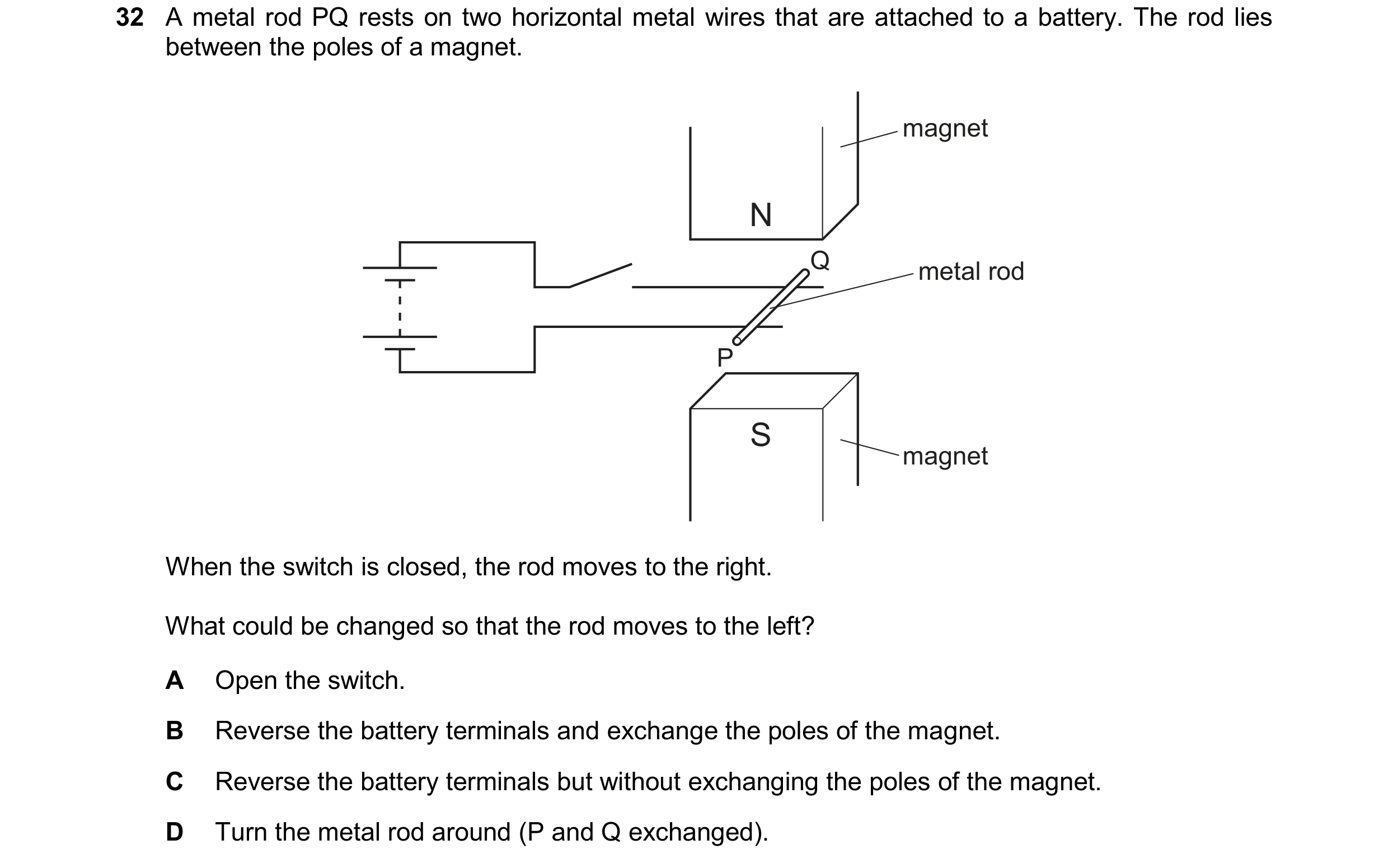
Q44 · A metal rod PQ rests on two horizontal metal wires that are attached to a battery 0972/11 Oct/Nov 2023
32 A metal rod PQ rests on two horizontal metal wires that are attached to a battery. The rod lies between the poles of a magnet. magnet N Q metal rod P S magnet When the switch is closed, the rod moves to the right. What could be changed so that the rod moves to the left? A Open the switch. B Reverse the battery terminals and exchange the poles of the magnet. C Reverse the battery terminals but without exchanging the poles of the magnet. D Turn the metal rod around (P and Q exchanged).
1 marks
Answer: C
This question in 0972/11 Oct/Nov 2023
Q45 · The extension–load graph for a spring is shown 0972/11 May/June 2024
4 The extension–load graph for a spring is shown. The unstretched length of the spring is 15.0 cm. 3 extension / cm 2 1 0 0 1 2 3 4 5 load / N When an object of unknown weight is suspended on the spring, the length of the spring is 16.4 cm. What is the weight of the object? A 0.55 N B 0.67 N C 3.5 N D 4.1 N
1 marks
Answer: C
This question in 0972/11 May/June 2024
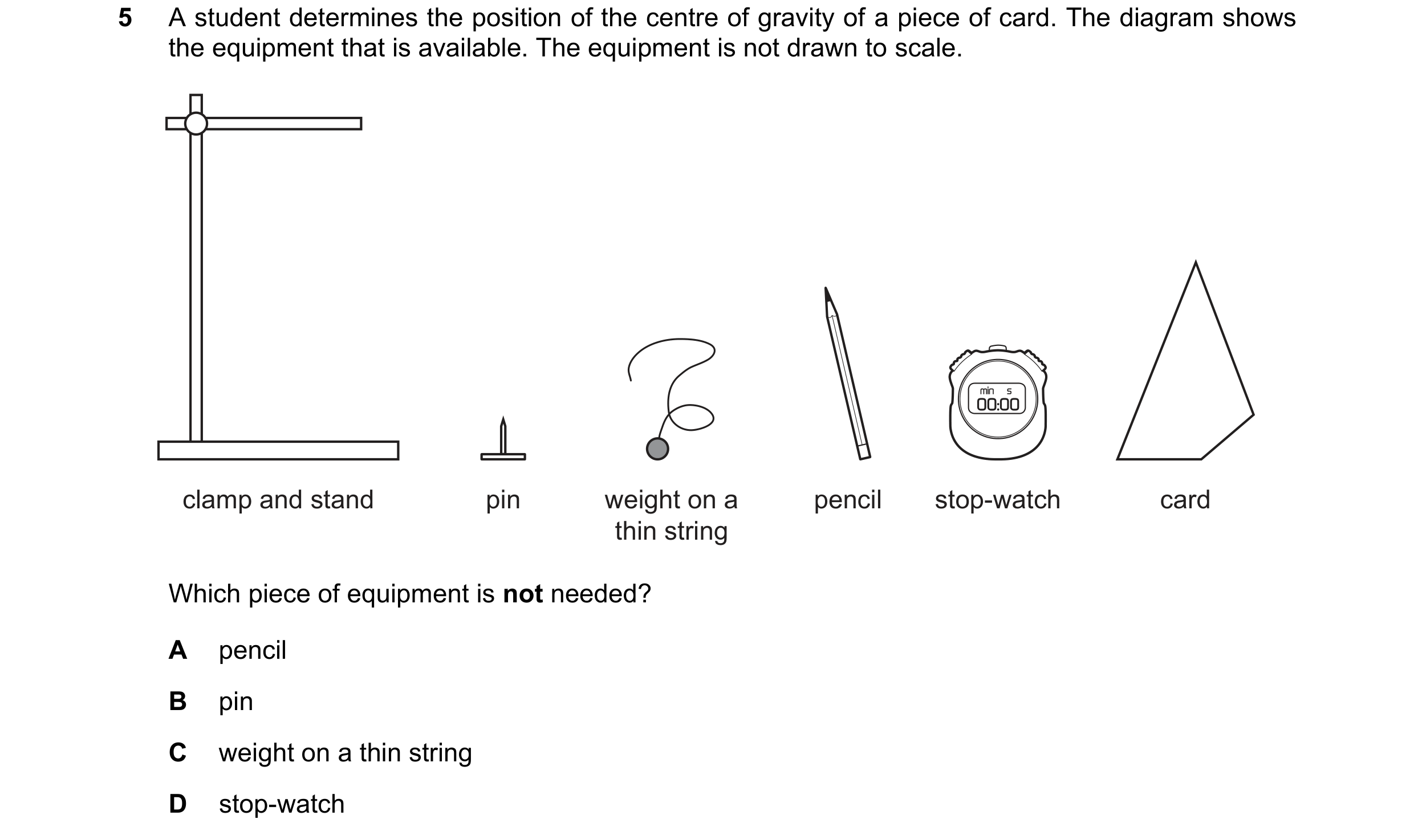
Q46 · A student determines the position of the centre of gravity of a piece of card 0972/11 May/June 2024
5 A student determines the position of the centre of gravity of a piece of card. The diagram shows the equipment that is available. The equipment is not drawn to scale. clamp and stand pin weight on a pencil stop-watch card thin string Which piece of equipment is not needed? A pencil B pin C weight on a thin string D stop-watch
1 marks
Answer: D
This question in 0972/11 May/June 2024
Q47 · The diagram shows a load–extension graph for a steel spring 0972/12 May/June 2024
5 The diagram shows a load–extension graph for a steel spring. The length of the spring with no load attached is 2.0 cm. 2.0 1.8 load / N 1.6 1.4 1.2 1.0 0.8 0.6 0.4 0.2 0 0 1.0 2.0 3.0 4.0 5.0 6.0 7.0 8.0 extension / cm Which load increases the length of the spring to 6.0 cm? A 0.5 N B 1.0 N C 1.5 N D 2.0 N
1 marks
Answer: B
This question in 0972/12 May/June 2024
Q48 · Which force between two solid surfaces opposes motion? 0972/12 May/June 2024
6 Which force between two solid surfaces opposes motion? A friction B gravity C kinetic D weight
1 marks
Answer: A
This question in 0972/12 May/June 2024
Q49 · An object begins to fall close to the Earth’s surface 0972/11 Oct/Nov 2024
3 An object begins to fall close to the Earth’s surface. Air resistance can be ignored. Which statement about the object’s acceleration is correct? A The acceleration is constant. B The acceleration decreases as the body falls. C The acceleration increases as the body falls. D The acceleration is zero.
1 marks
Answer: A
This question in 0972/11 Oct/Nov 2024
Q50 · What is measured by the moment of a force? 0972/11 Oct/Nov 2024
6 What is measured by the moment of a force? A the acceleration produced by the force B the turning effect of the force C the time for which the force acts D the increase in energy caused by the force
1 marks
Answer: B
This question in 0972/11 Oct/Nov 2024
Q51 · Two identical containers, P and Q, are partly filled with different quantities of sand 0972/11 Oct/Nov 2024
7 Two identical containers, P and Q, are partly filled with different quantities of sand. The position of the centre of gravity for each container is labelled X. X X P Q Which container is more stable and what is the reason why it is more stable? A P is more stable because it has a lower centre of gravity. B P is more stable because it has a smaller mass. C Q is more stable because it has a greater depth of sand. D Q is more stable because it has a higher centre of gravity.
1 marks
Answer: A
This question in 0972/11 Oct/Nov 2024
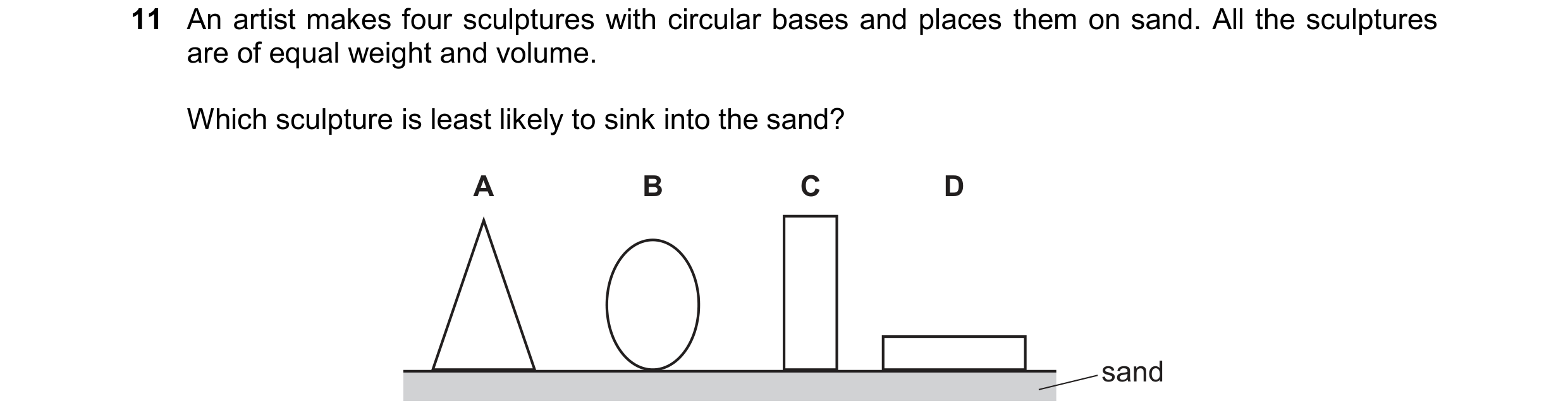
Q52 · An artist makes four sculptures with circular bases and places them on sand 0972/11 Oct/Nov 2024
11 An artist makes four sculptures with circular bases and places them on sand. All the sculptures are of equal weight and volume. Which sculpture is least likely to sink into the sand? A B C D sand
1 marks
Answer: D
This question in 0972/11 Oct/Nov 2024
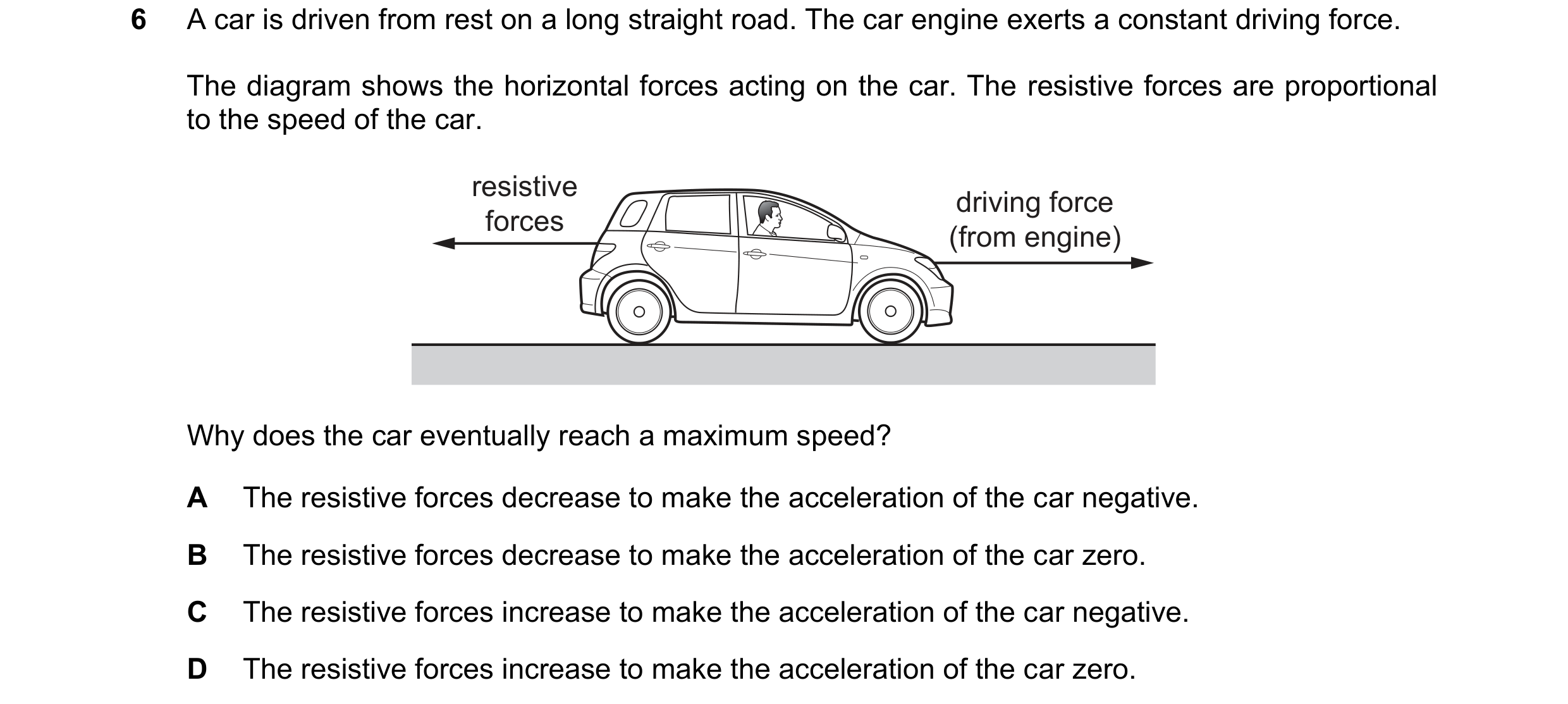
Q53 · A car is driven from rest on a long straight road 0972/11 May/June 2025
6 A car is driven from rest on a long straight road. The car engine exerts a constant driving force. The diagram shows the horizontal forces acting on the car. The resistive forces are proportional to the speed of the car. resistive driving force forces (from engine) Why does the car eventually reach a maximum speed? A The resistive forces decrease to make the acceleration of the car negative. B The resistive forces decrease to make the acceleration of the car zero. C The resistive forces increase to make the acceleration of the car negative. D The resistive forces increase to make the acceleration of the car zero.
1 marks
Answer: D
This question in 0972/11 May/June 2025
Q54 · Which pair of changes, applied at the same time, always increases the pressure that a… 0972/11 May/June 2025
10 Which pair of changes, applied at the same time, always increases the pressure that a brick exerts on the ground? area of brick in weight of brick contact with ground A increase increase B increase decrease C decrease increase D decrease decrease
1 marks
Answer: B
This question in 0972/11 May/June 2025
Q55 · Which quantity is an example of a force? 0972/12 May/June 2025
4 Which quantity is an example of a force? A density B mass C volume D weight
1 marks
Answer: D
This question in 0972/12 May/June 2025
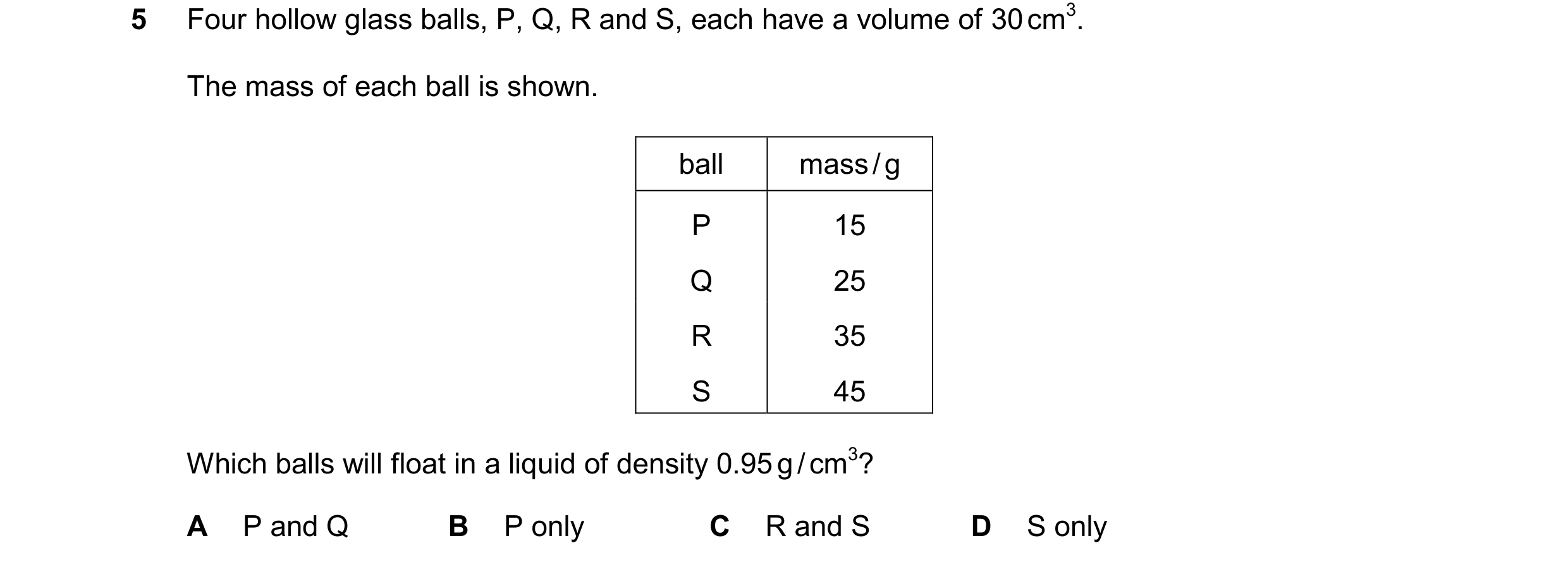
Q56 · Four hollow glass balls, P, Q, R and S, each have a volume of 30 cm3 0972/12 May/June 2025
5 Four hollow glass balls, P, Q, R and S, each have a volume of 30 cm3. The mass of each ball is shown. ball mass / g P 15 Q 25 R 35 S 45 Which balls will float in a liquid of density 0.95 g / cm3? A P and Q B P only C R and S D S only
1 marks
Answer: A
This question in 0972/12 May/June 2025
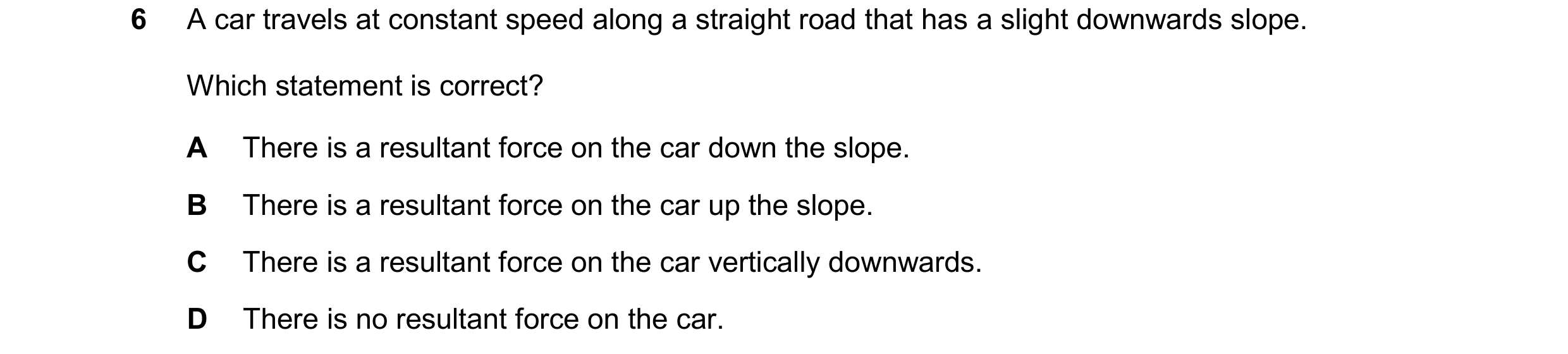
Q57 · A car travels at constant speed along a straight road that has a slight downwards slope 0972/12 May/June 2025
6 A car travels at constant speed along a straight road that has a slight downwards slope. Which statement is correct? A There is a resultant force on the car down the slope. B There is a resultant force on the car up the slope. C There is a resultant force on the car vertically downwards. D There is no resultant force on the car.
1 marks
Answer: D
This question in 0972/12 May/June 2025
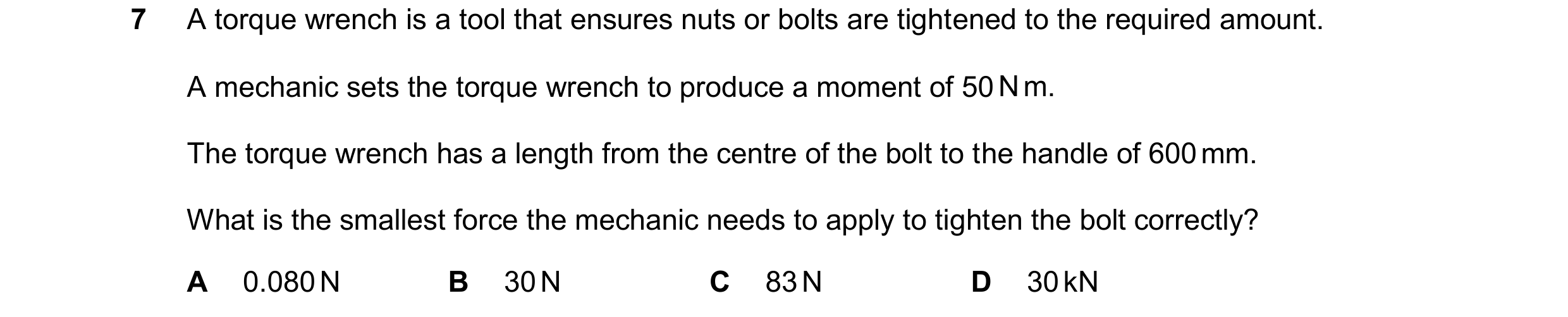
Q58 · A torque wrench is a tool that ensures nuts or bolts are tightened to the required amount 0972/12 May/June 2025
7 A torque wrench is a tool that ensures nuts or bolts are tightened to the required amount. A mechanic sets the torque wrench to produce a moment of 50 N m. The torque wrench has a length from the centre of the bolt to the handle of 600 mm. What is the smallest force the mechanic needs to apply to tighten the bolt correctly? A 0.080 N B 30 N C 83 N D 30 kN
1 marks
Answer: C
This question in 0972/12 May/June 2025
Q59 · The work done W by a force is related to the magnitude F of the force and the distance d… 0972/12 May/June 2025
8 The work done W by a force is related to the magnitude F of the force and the distance d moved in the direction of the force. Which equation for W is correct? A W = d F B W = d + F C W = F d D W = F d
1 marks
Answer: D
This question in 0972/12 May/June 2025
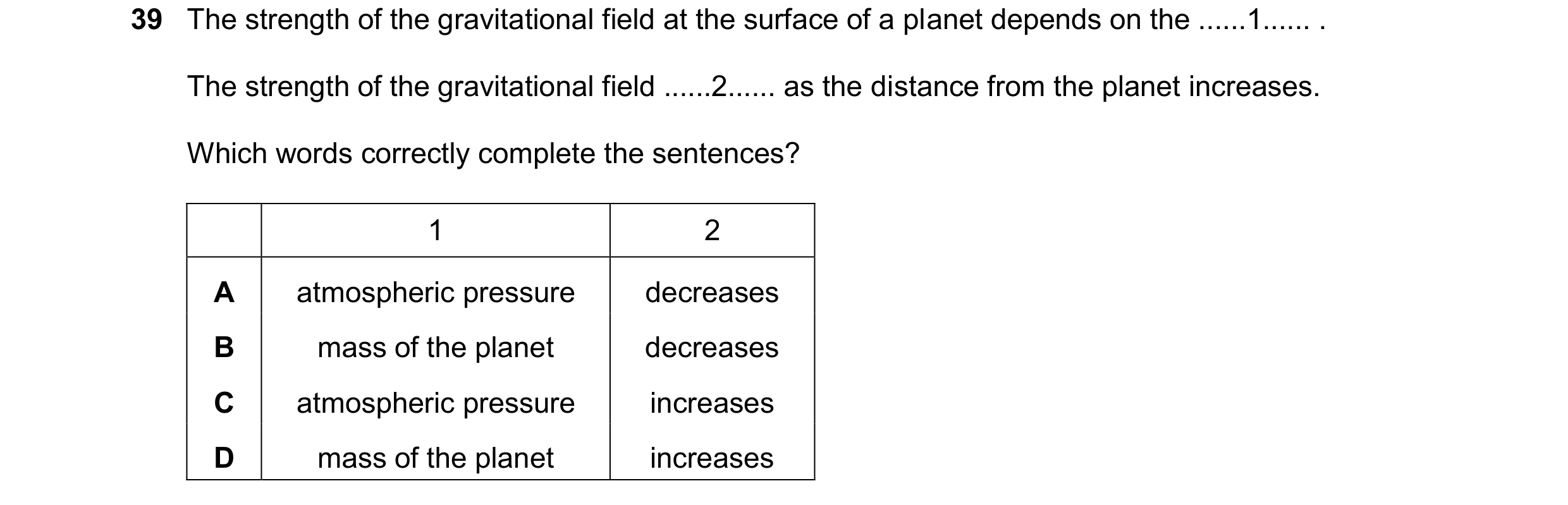
Q60 · The strength of the gravitational field at the surface of a planet depends on the … 1 … 0972/12 May/June 2025
39 The strength of the gravitational field at the surface of a planet depends on the … 1 … . The strength of the gravitational field … 2 … as the distance from the planet increases. Which words correctly complete the sentences? 1 2 A atmospheric pressure decreases B mass of the planet decreases C atmospheric pressure increases D mass of the planet increases
1 marks
Answer: B
This question in 0972/12 May/June 2025
 1 / 22
 2 / 22
 3 / 22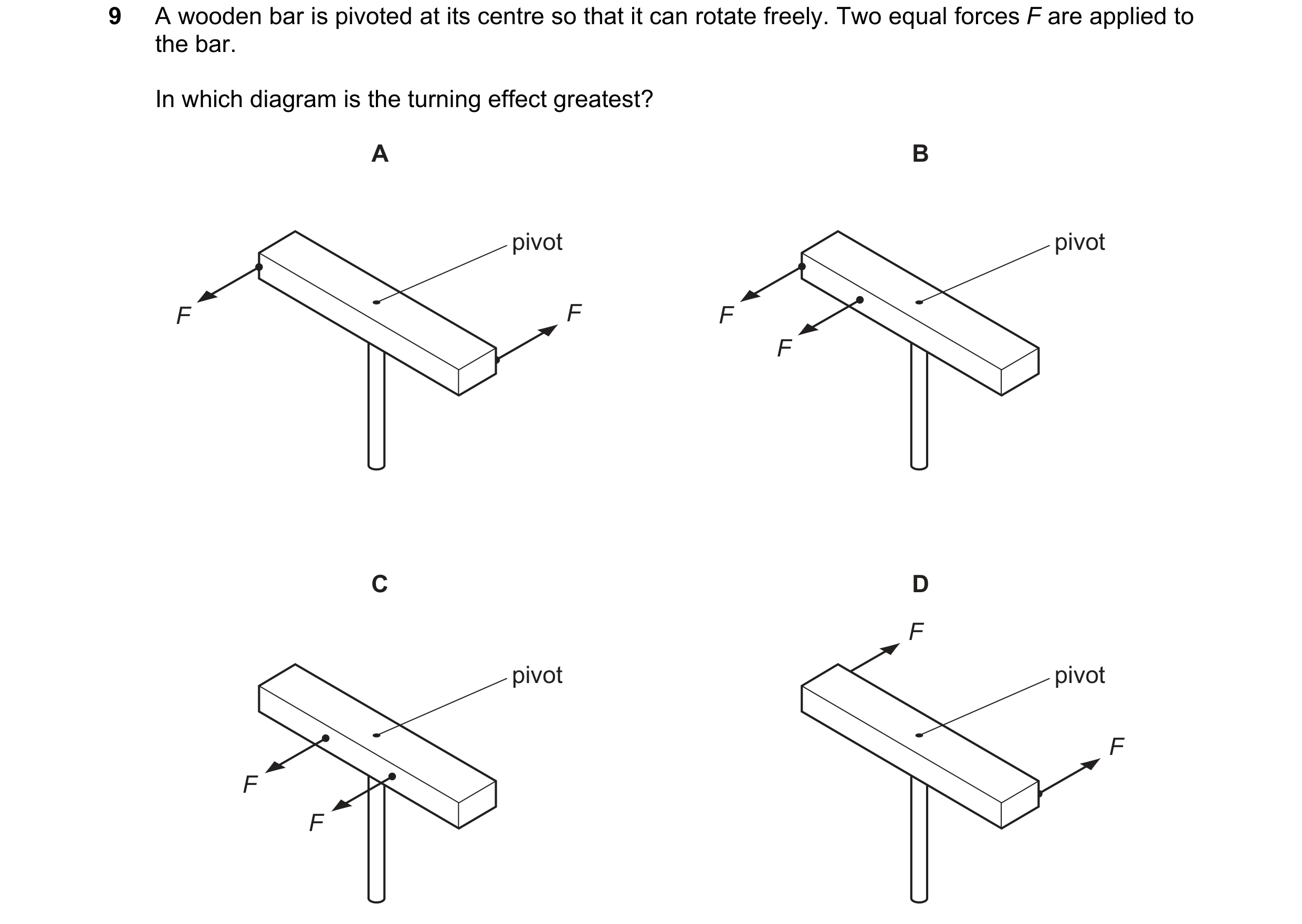
 4 / 22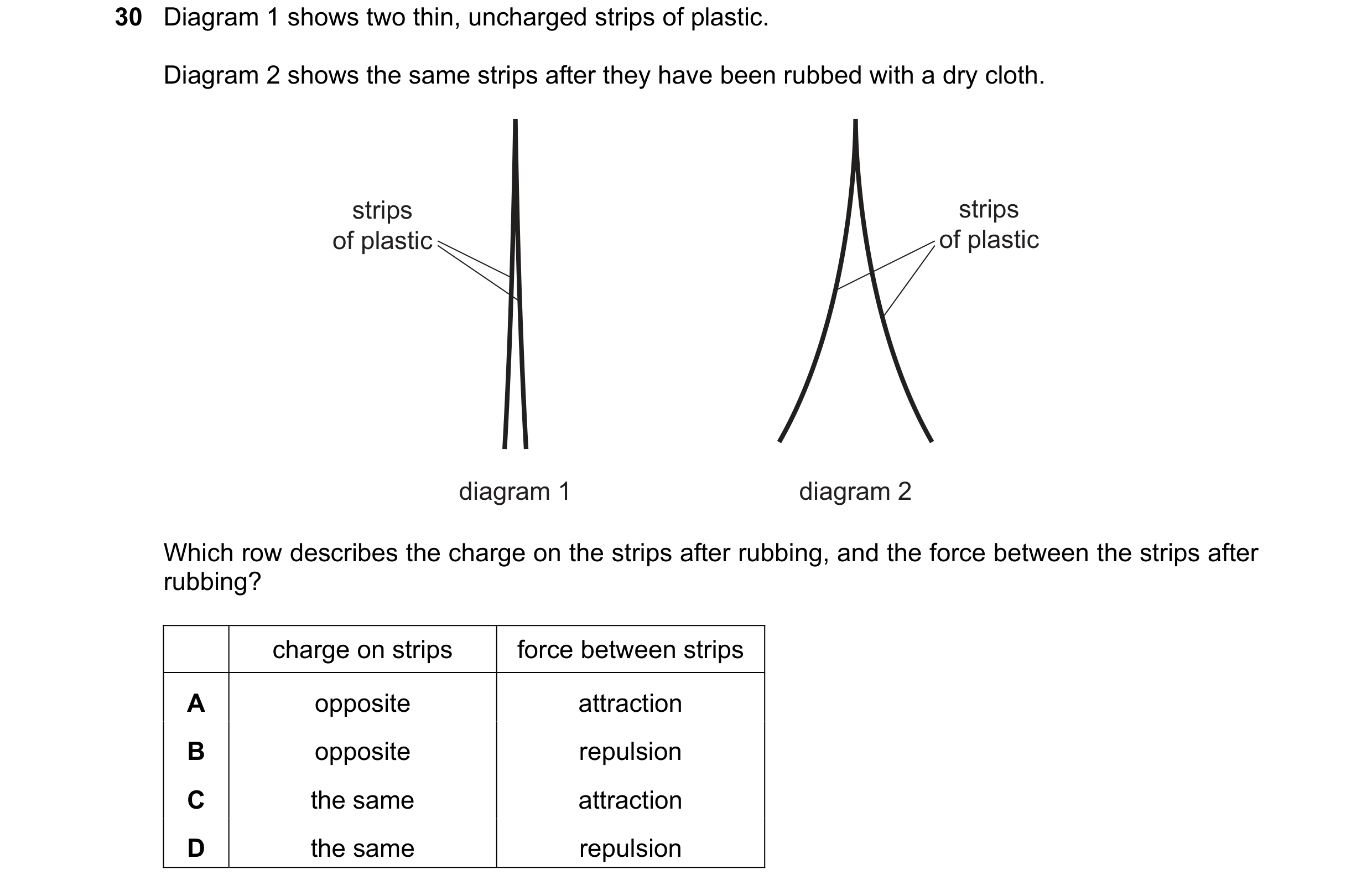

 5 / 22
 6 / 22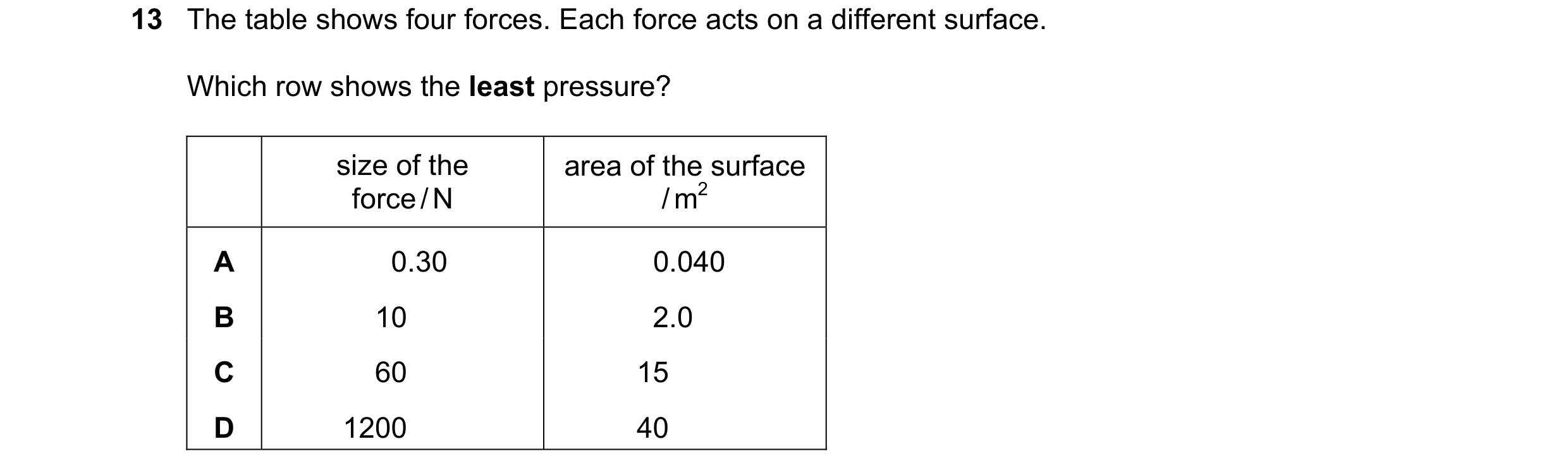
 7 / 22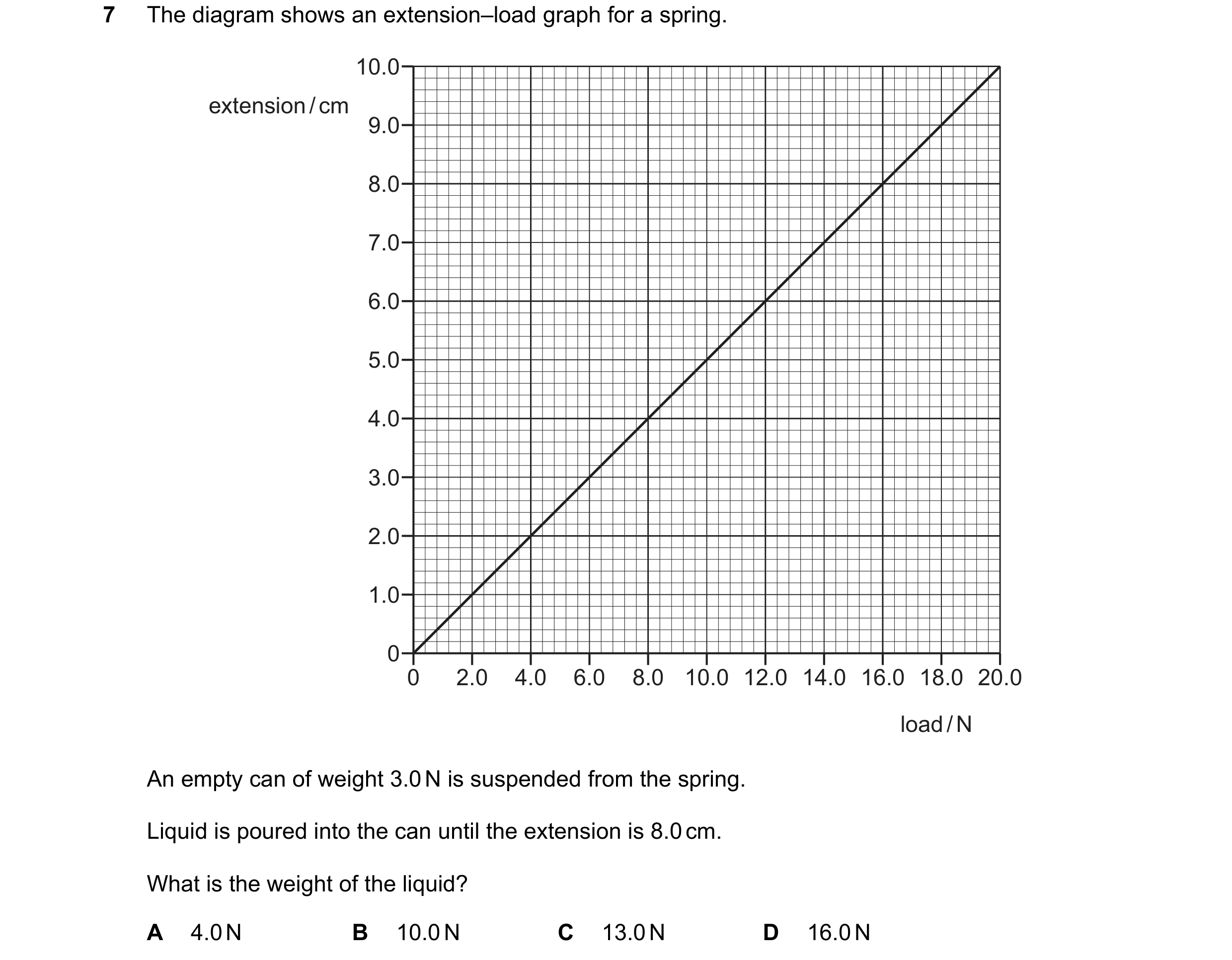
 8 / 22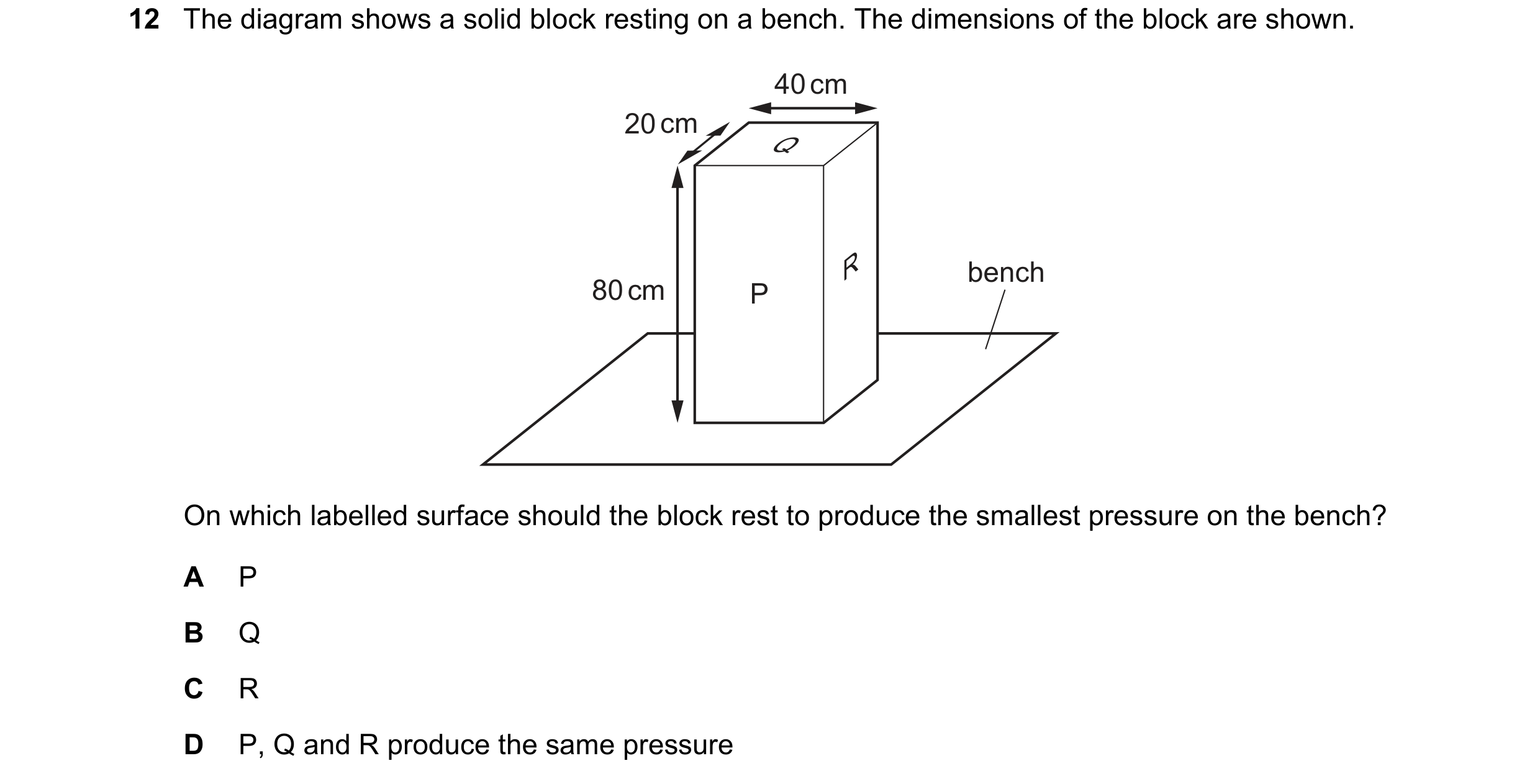
 9 / 22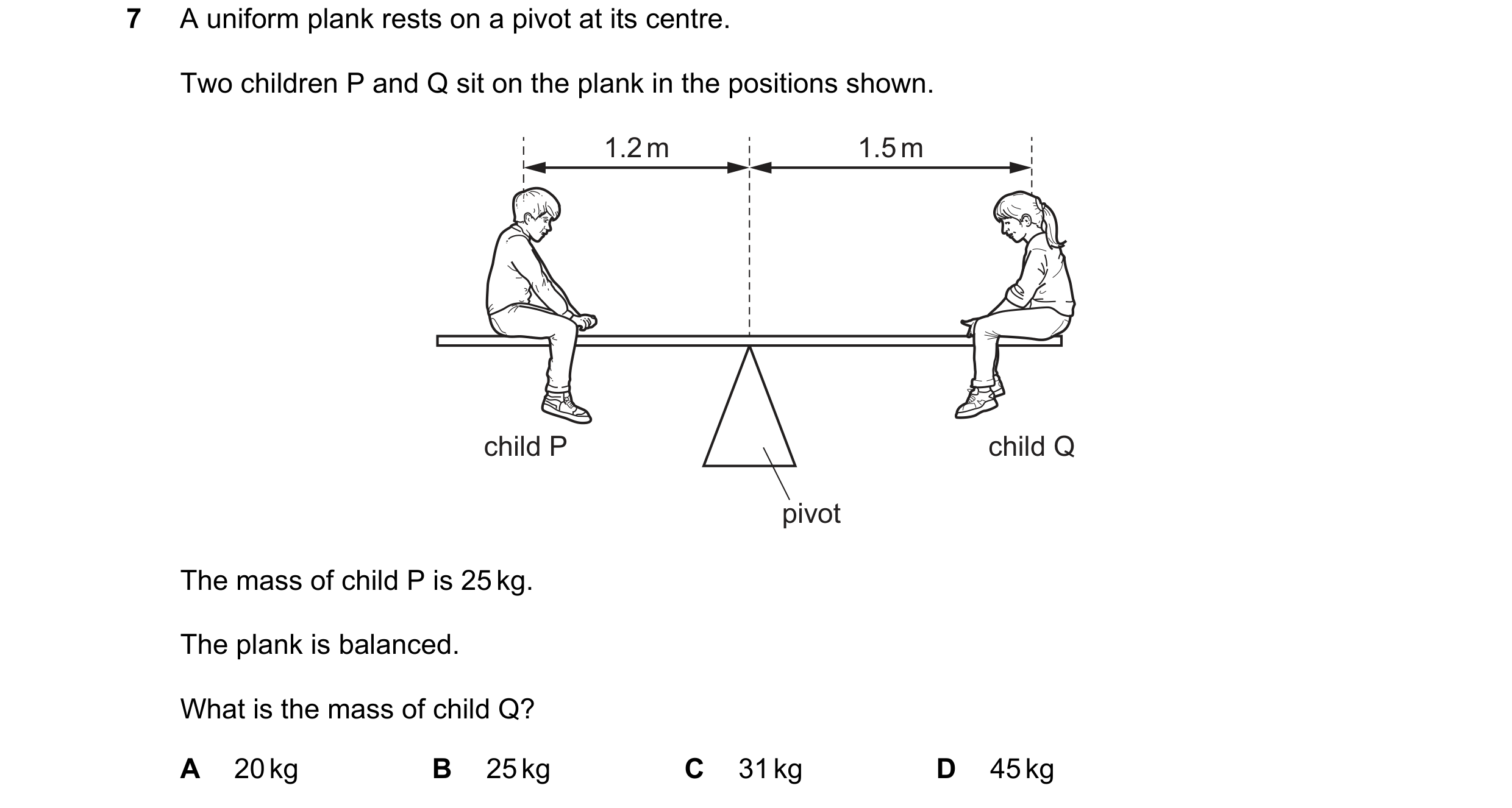
 10 / 22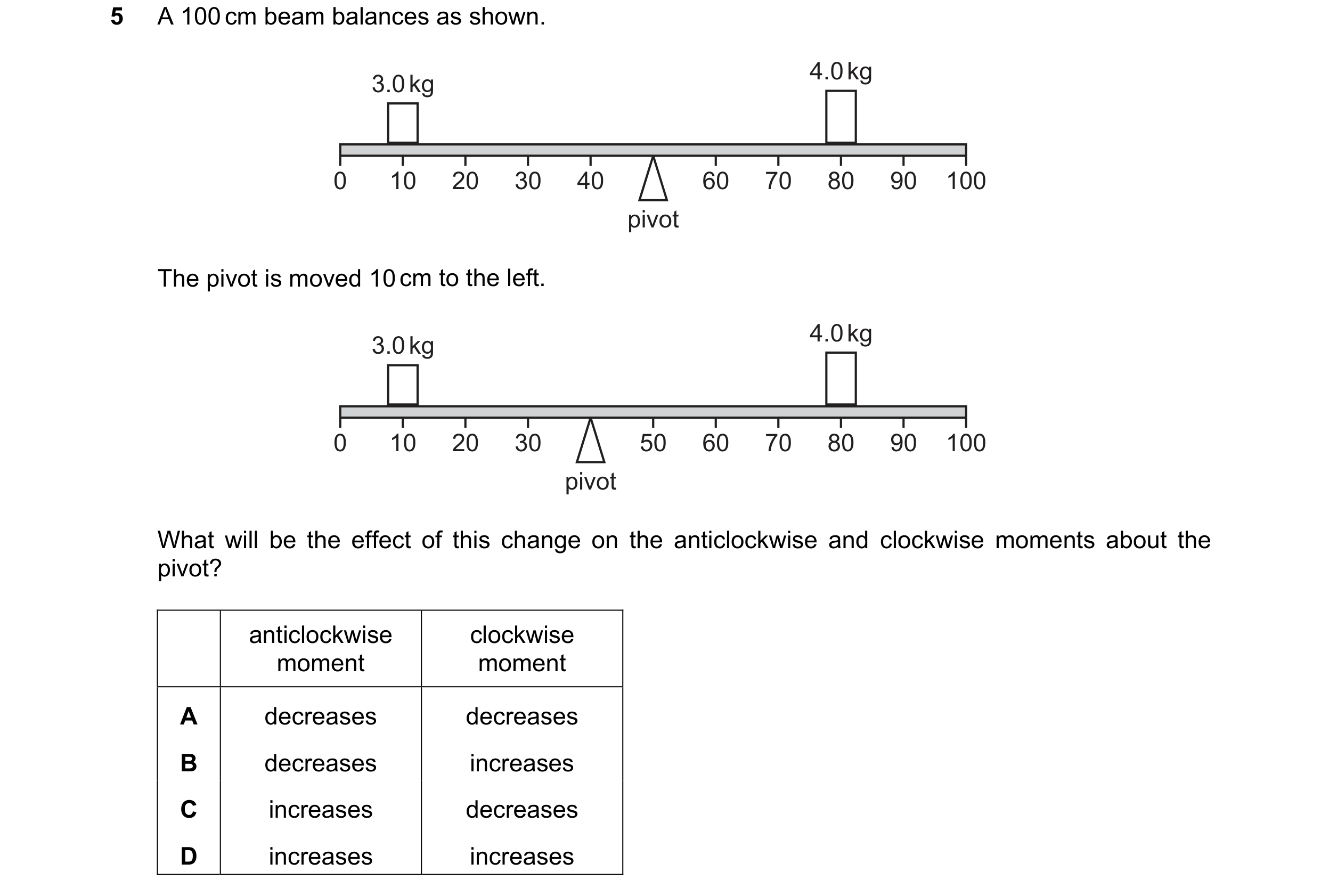
 11 / 22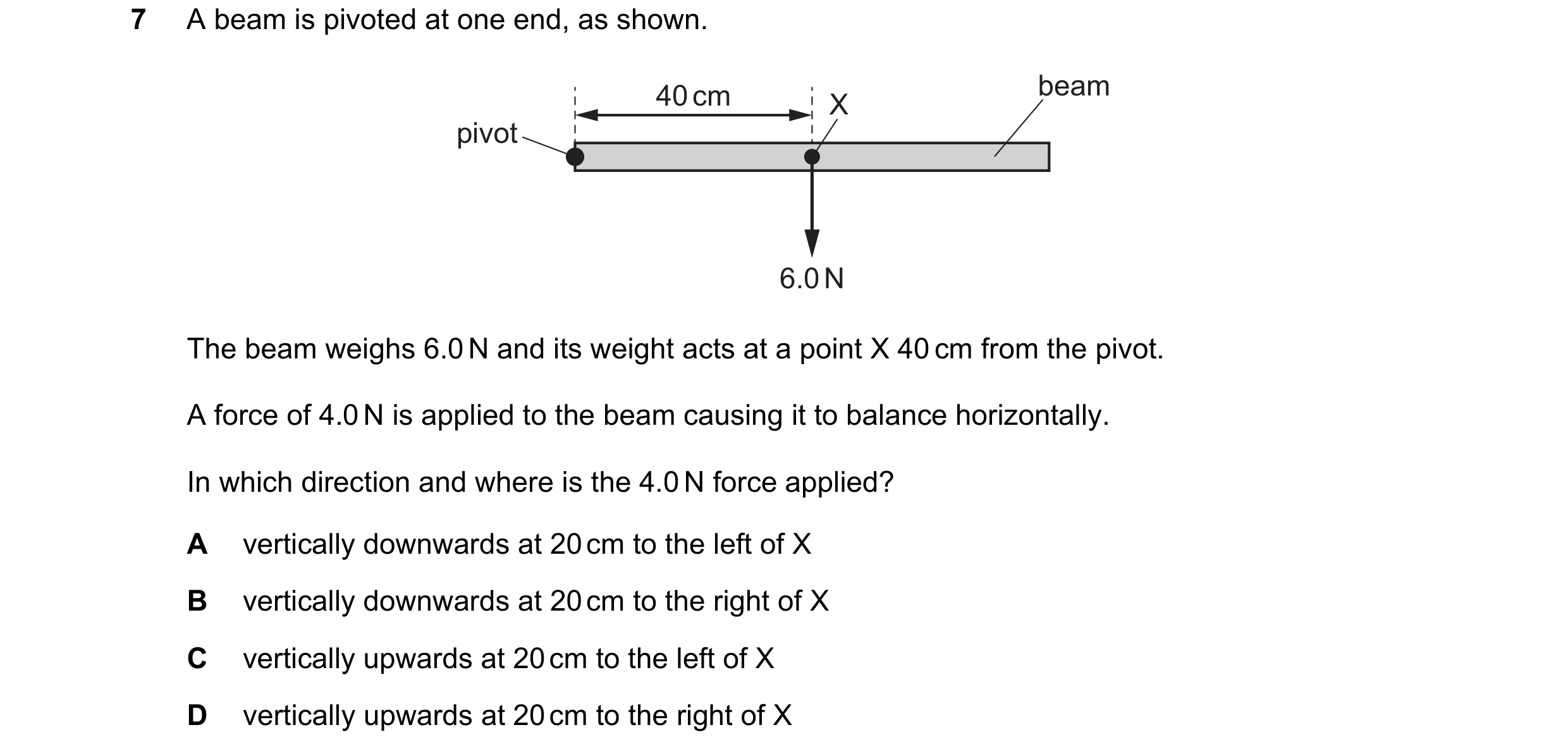
 12 / 22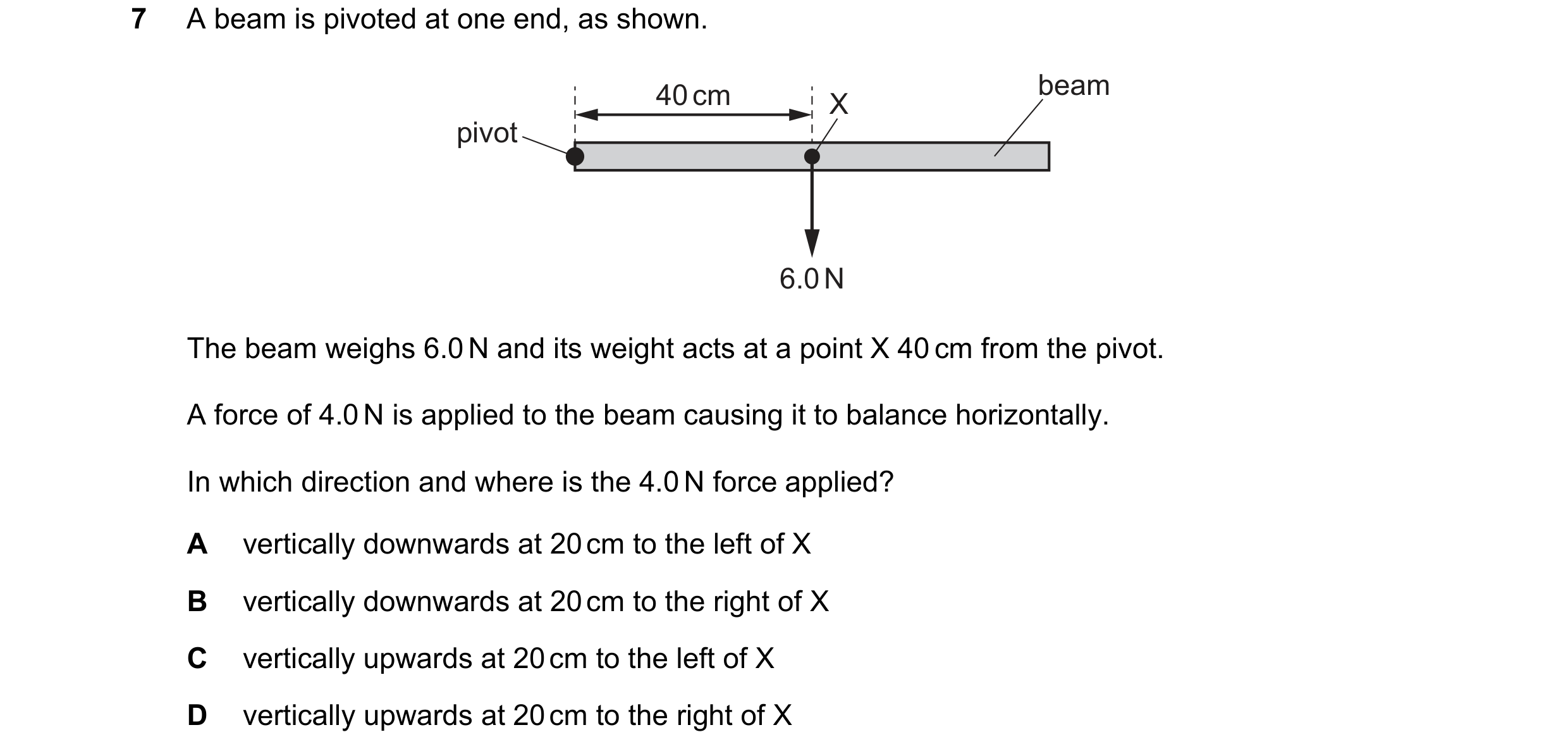
 13 / 22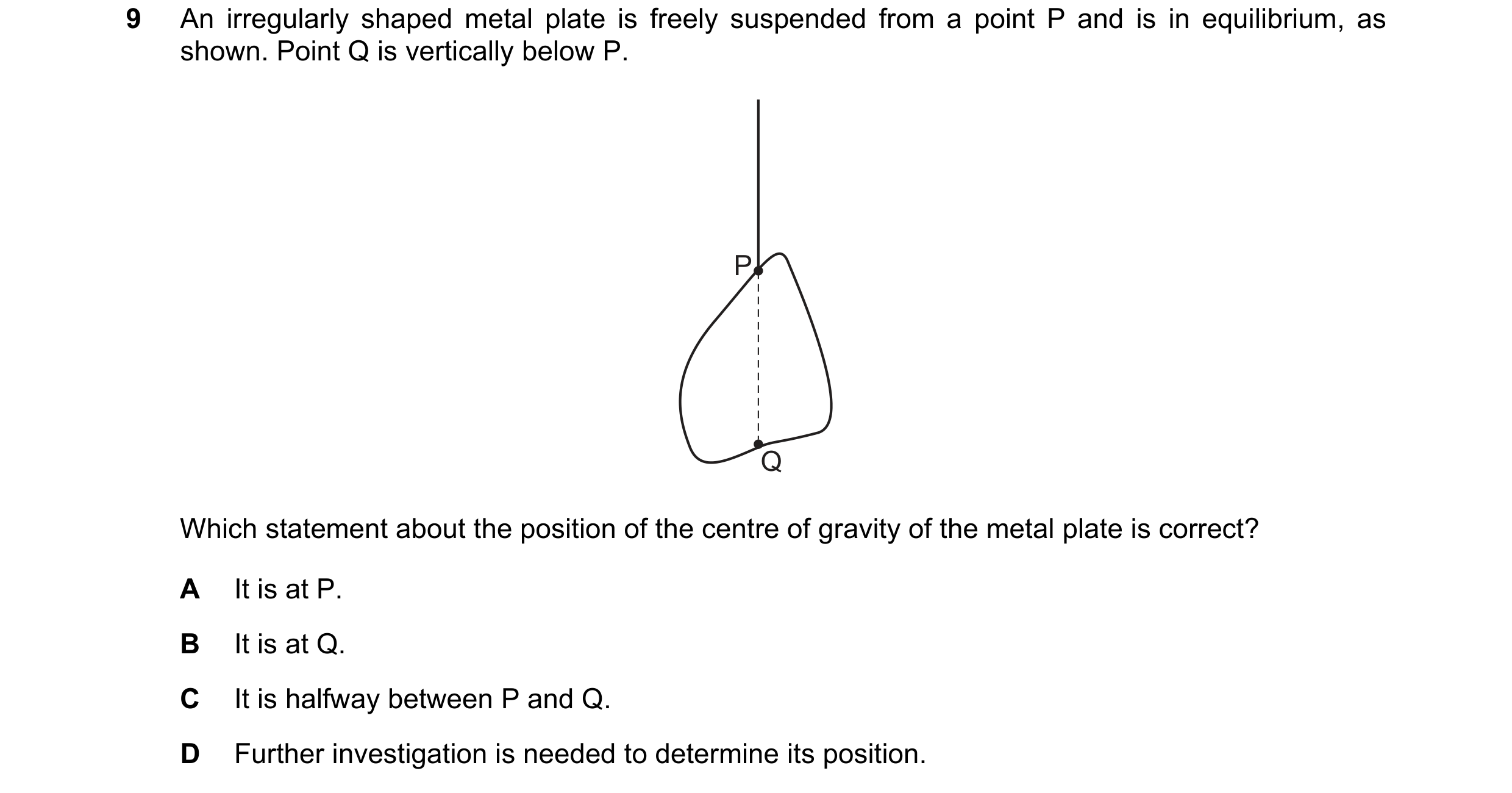
 14 / 22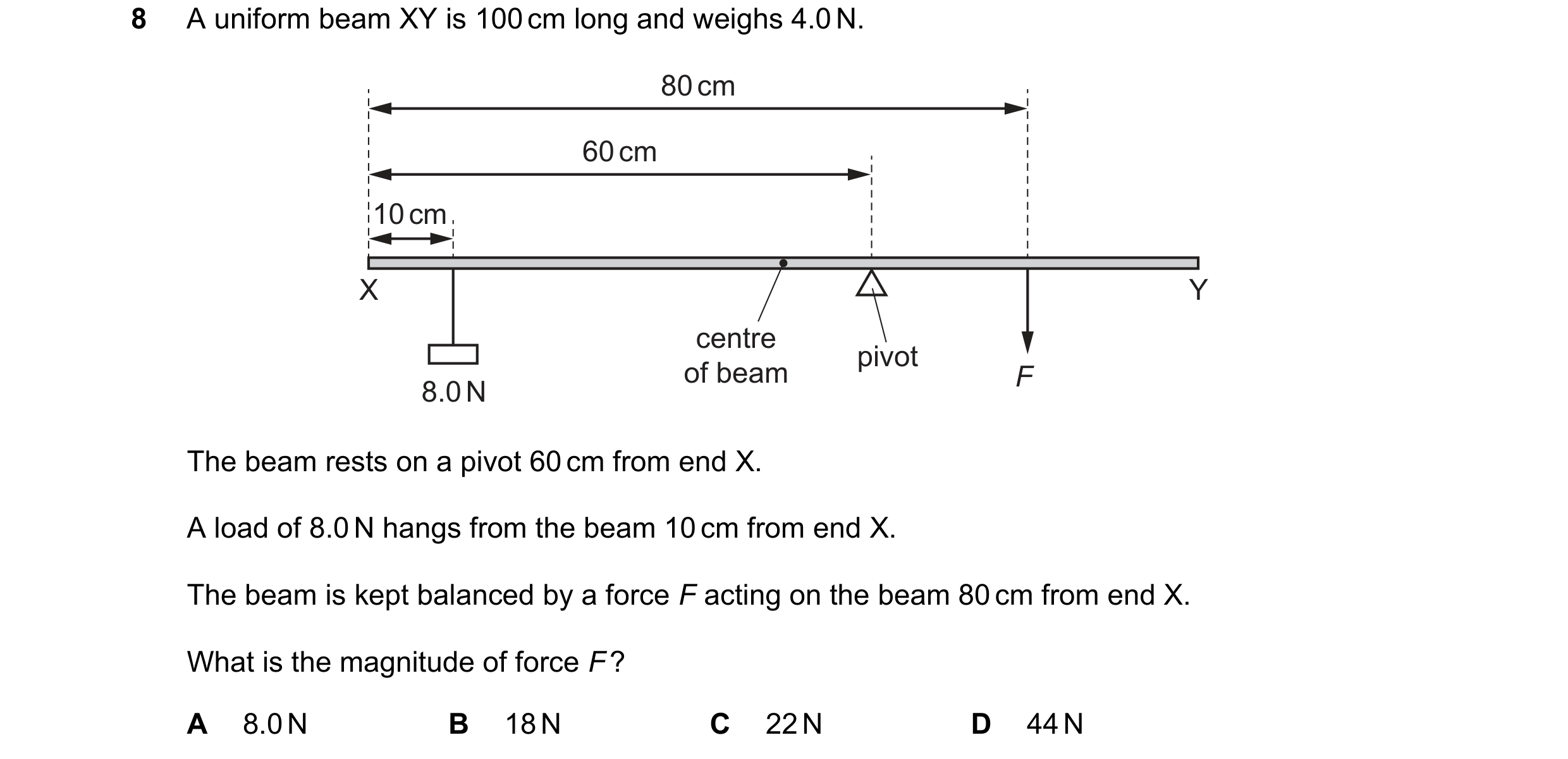
 15 / 22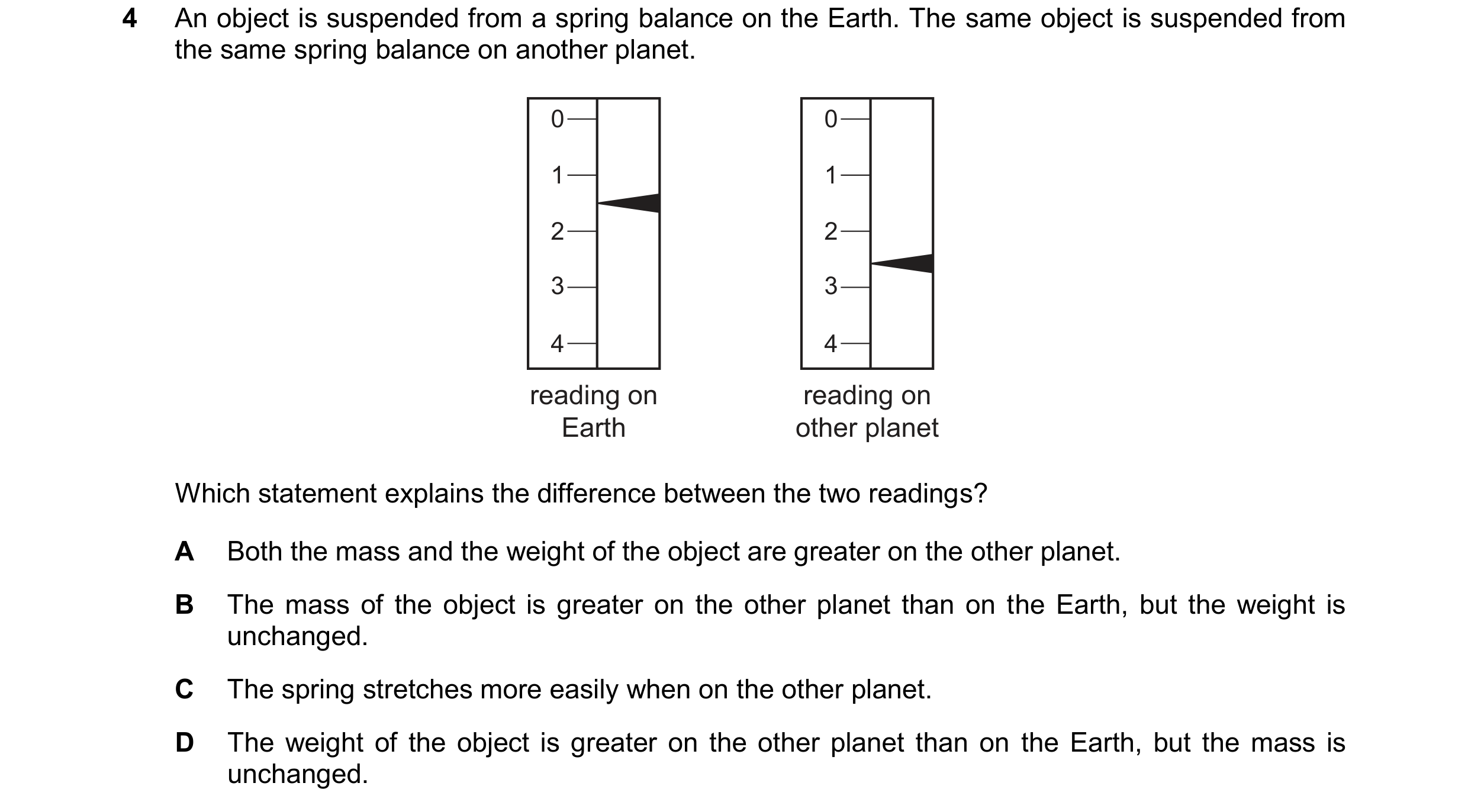
 16 / 22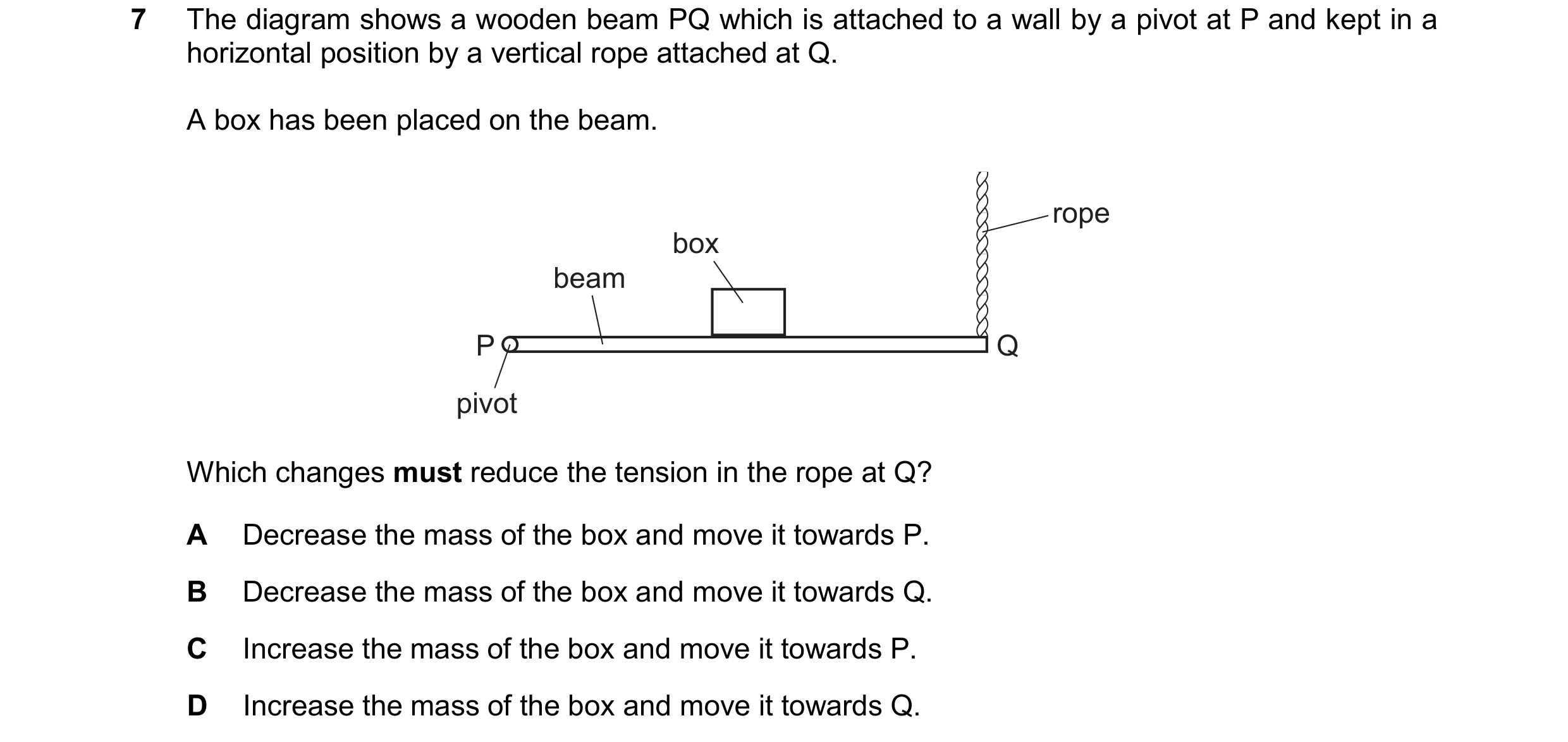
 17 / 22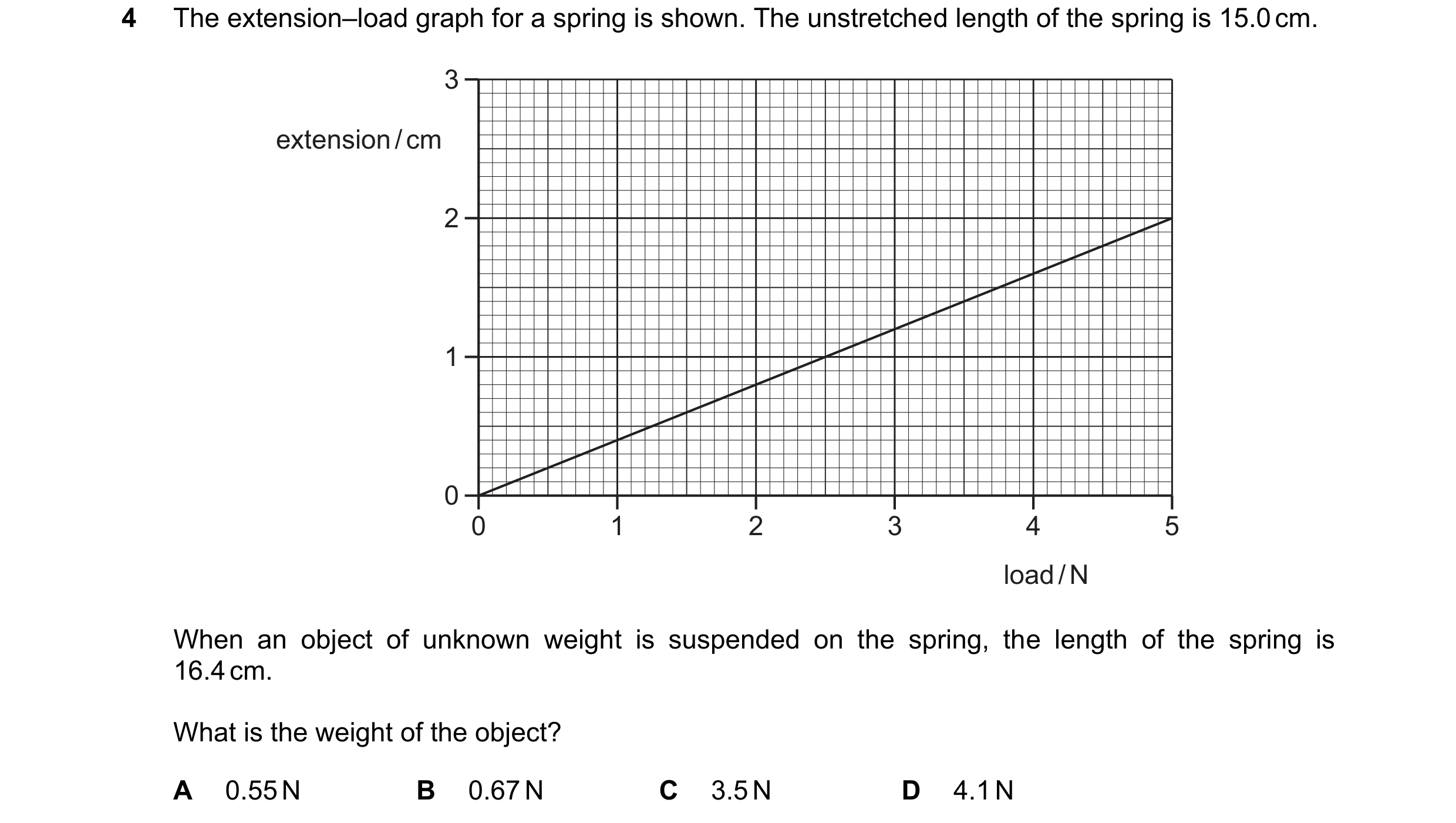
 18 / 22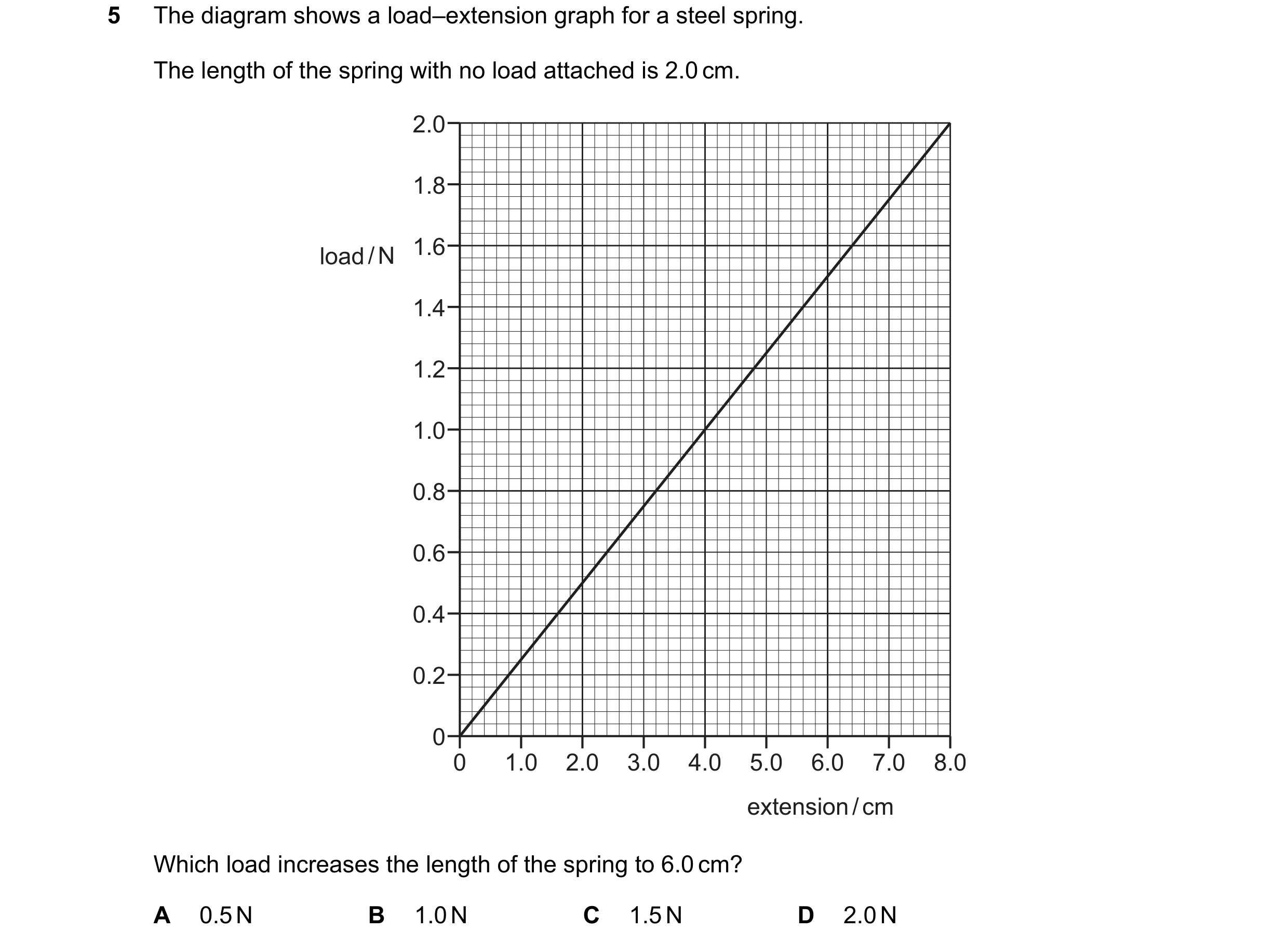

 19 / 22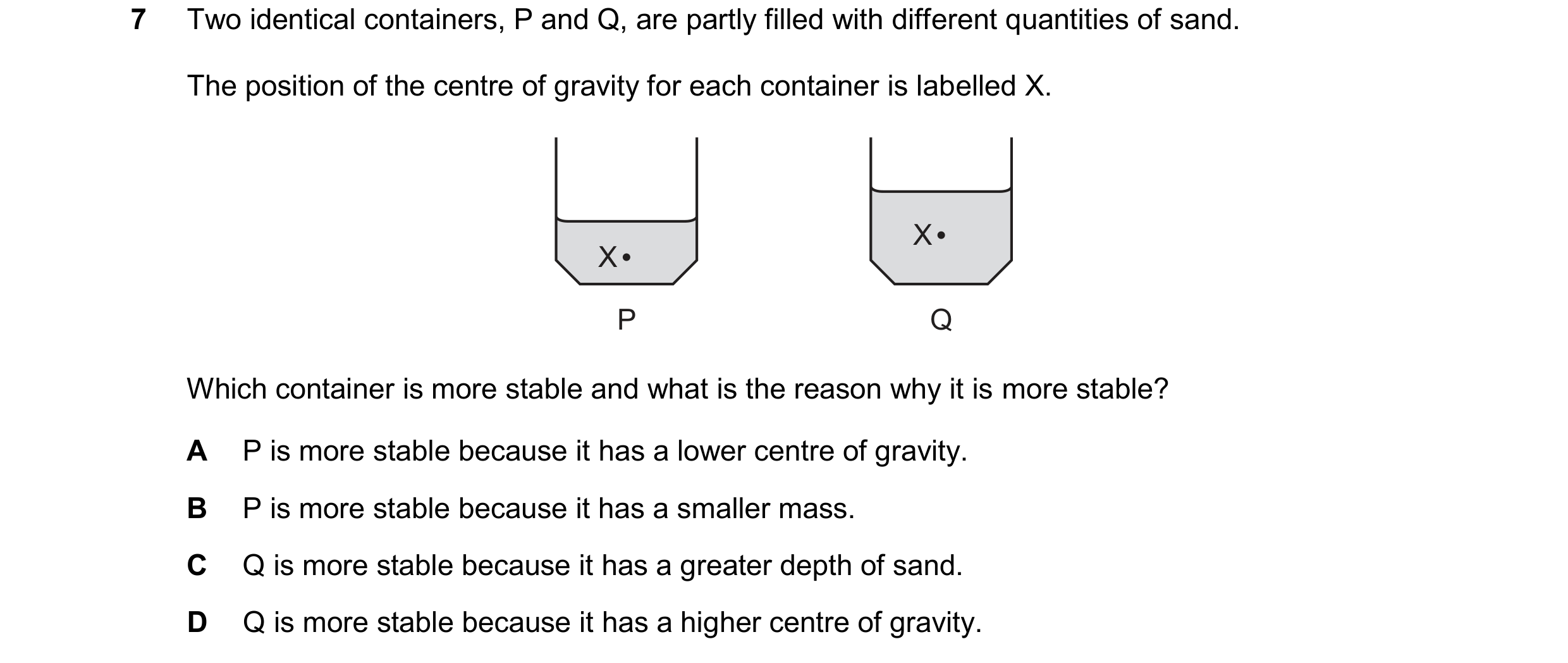
 20 / 22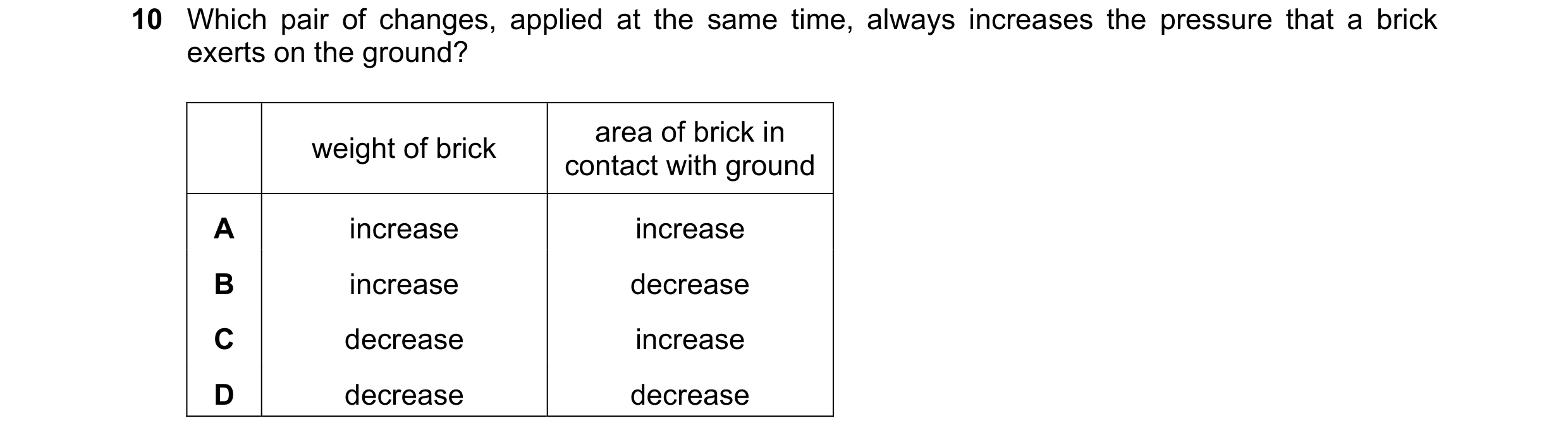

 21 / 22
 22 / 22