Cambridge IGCSE Physics 0625 — 2015 Oct/Nov Paper 2 · Variant 3
0625/23/O/N/15 · 80 marks · ≈90 min
The question paper and its mark scheme, free to read here and free to download. This is Cambridge’s own paper, exactly as it was sat.
Question paper24 pages


Mark scheme7 pages
Answers below. Sit the paper first if you are practising.
Paper as text
Question paper, page 1
This document consists of 21 printed pages and 3 blank pages. DC (CW/CGW) 116361 © UCLES 2015 [Turn over Cambridge International Examinations Cambridge International General Certificate of Secondary Education * 2 0 0 5 0 3 5 5 8 4 * PHYSICS 0625/23 Paper 2 Core October/November 2015 1 hour 15 minutes Candidates answer on the Question Paper. No Additional Materials are required. READ THESE INSTRUCTIONS FIRST Write your Centre number, candidate number and name on all the work you hand in. Write in dark blue or black pen. You may use an HB pencil for any diagrams or graphs. Do not use staples, paper clips, glue or correction fluid. DO NOT WRITE IN ANY BARCODES. Answer all questions. Electronic calculators may be used. You may lose marks if you do not show your working or if you do not use appropriate units. Take the weight of 1 kg to be 10 N (i.e. acceleration of free fall = 10 m / s2). At the end of the examination, fasten all your work securely together. The number of marks is given in brackets [ ] at the end of each question or part question. The syllabus is approved for use in England, Wales and Northern Ireland as a Cambridge International Level 1/Level 2 Certificate.
Question paper, page 2
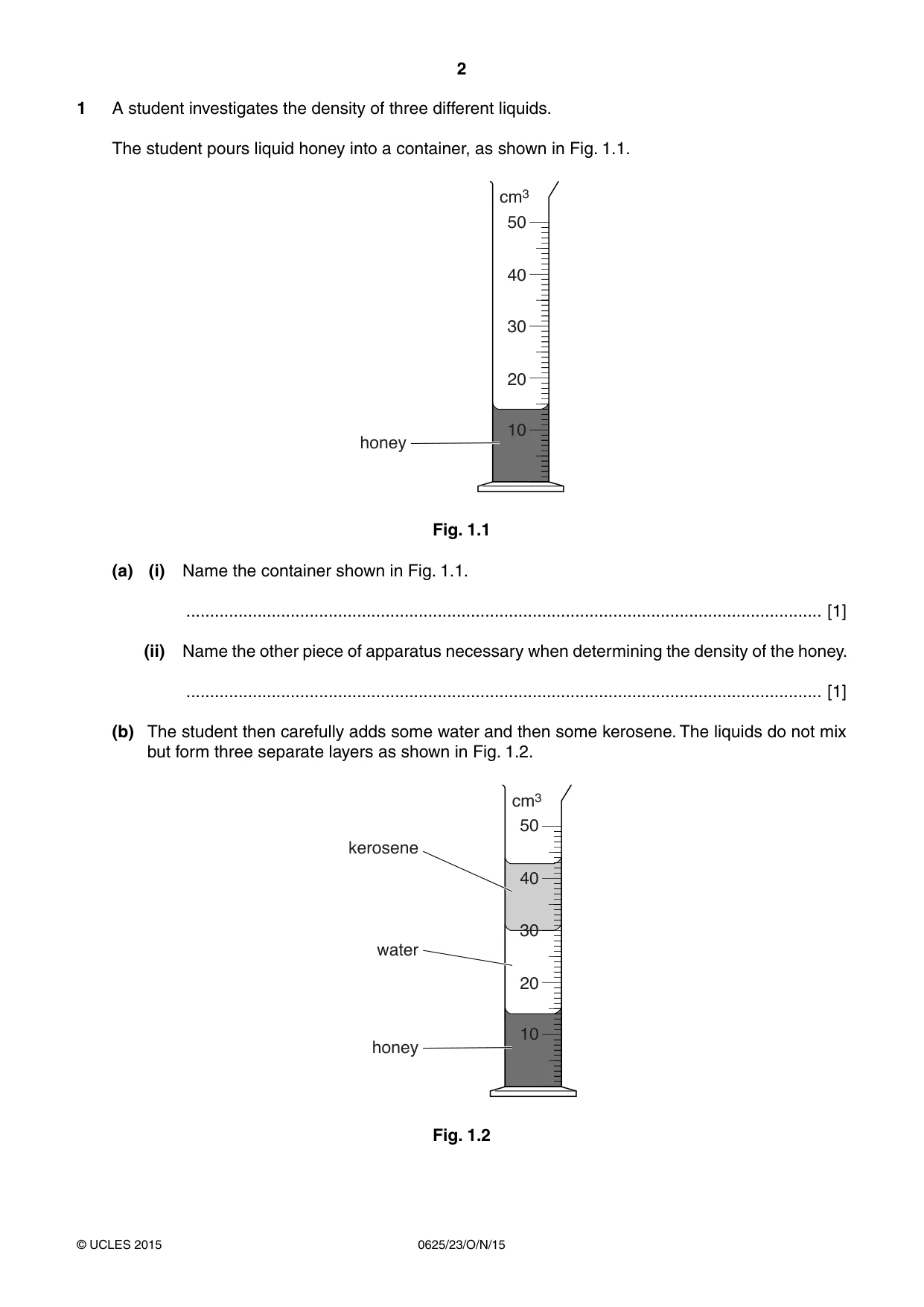
2 0625/23/O/N/15 © UCLES 2015 1 A student investigates the density of three different liquids. The student pours liquid honey into a container, as shown in Fig. 1.1. 10 20 30 40 honey 50 cm3 Fig. 1.1 (a) (i) Name the container shown in Fig. 1.1. … [1] (ii) Name the other piece of apparatus necessary when determining the density of the honey. … [1] (b) The student then carefully adds some water and then some kerosene. The liquids do not mix but form three separate layers as shown in Fig. 1.2. 10 20 30 40 kerosene water honey 50 cm3 Fig. 1.2
Question paper, page 3
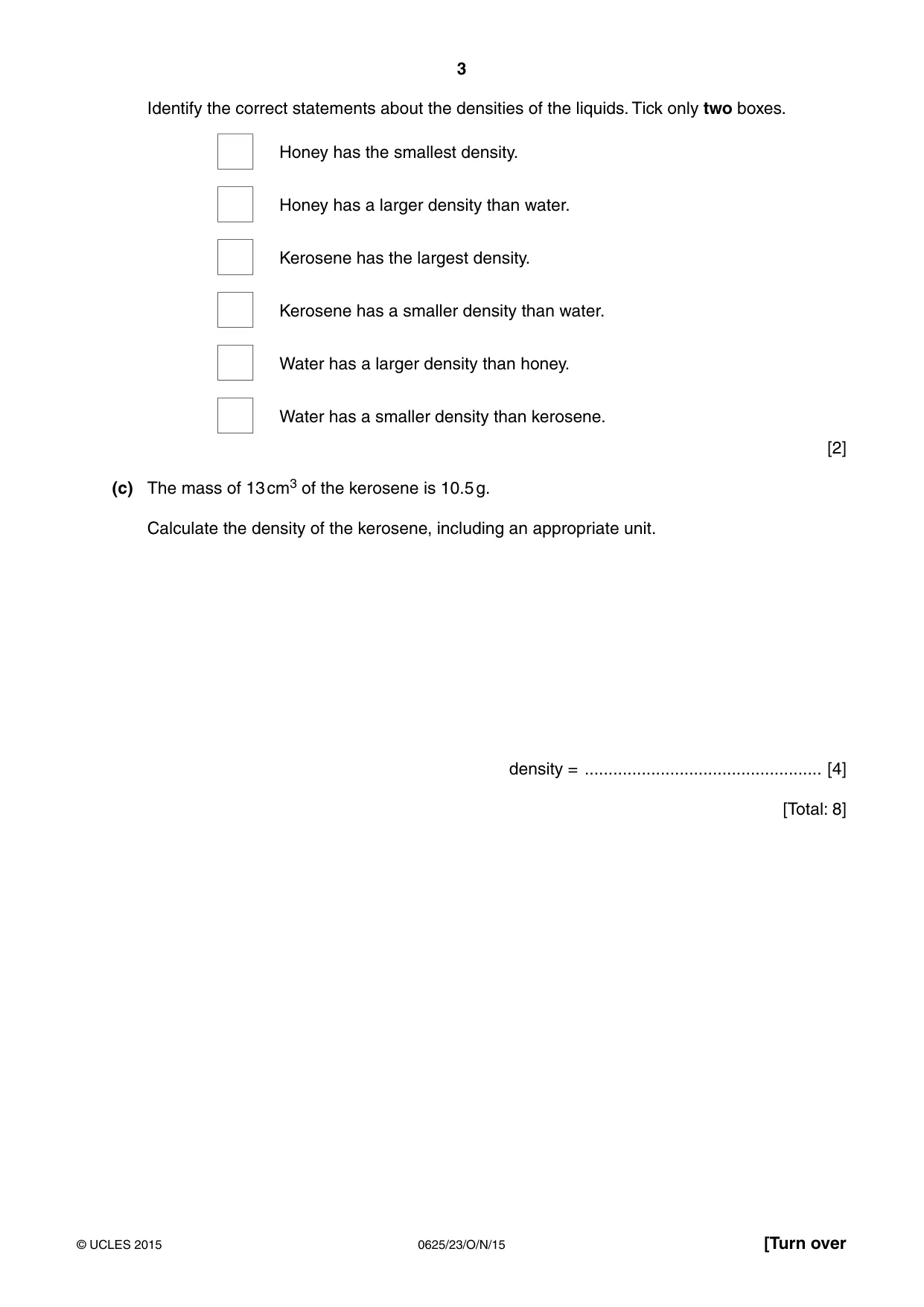
3 0625/23/O/N/15 © UCLES 2015 [Turn over Identify the correct statements about the densities of the liquids. Tick only two boxes. Honey has the smallest density. Honey has a larger density than water. Kerosene has the largest density. Kerosene has a smaller density than water. Water has a larger density than honey. Water has a smaller density than kerosene. [2] (c) The mass of 13 cm3 of the kerosene is 10.5 g. Calculate the density of the kerosene, including an appropriate unit. density = … [4] [Total: 8]
Question paper, page 4
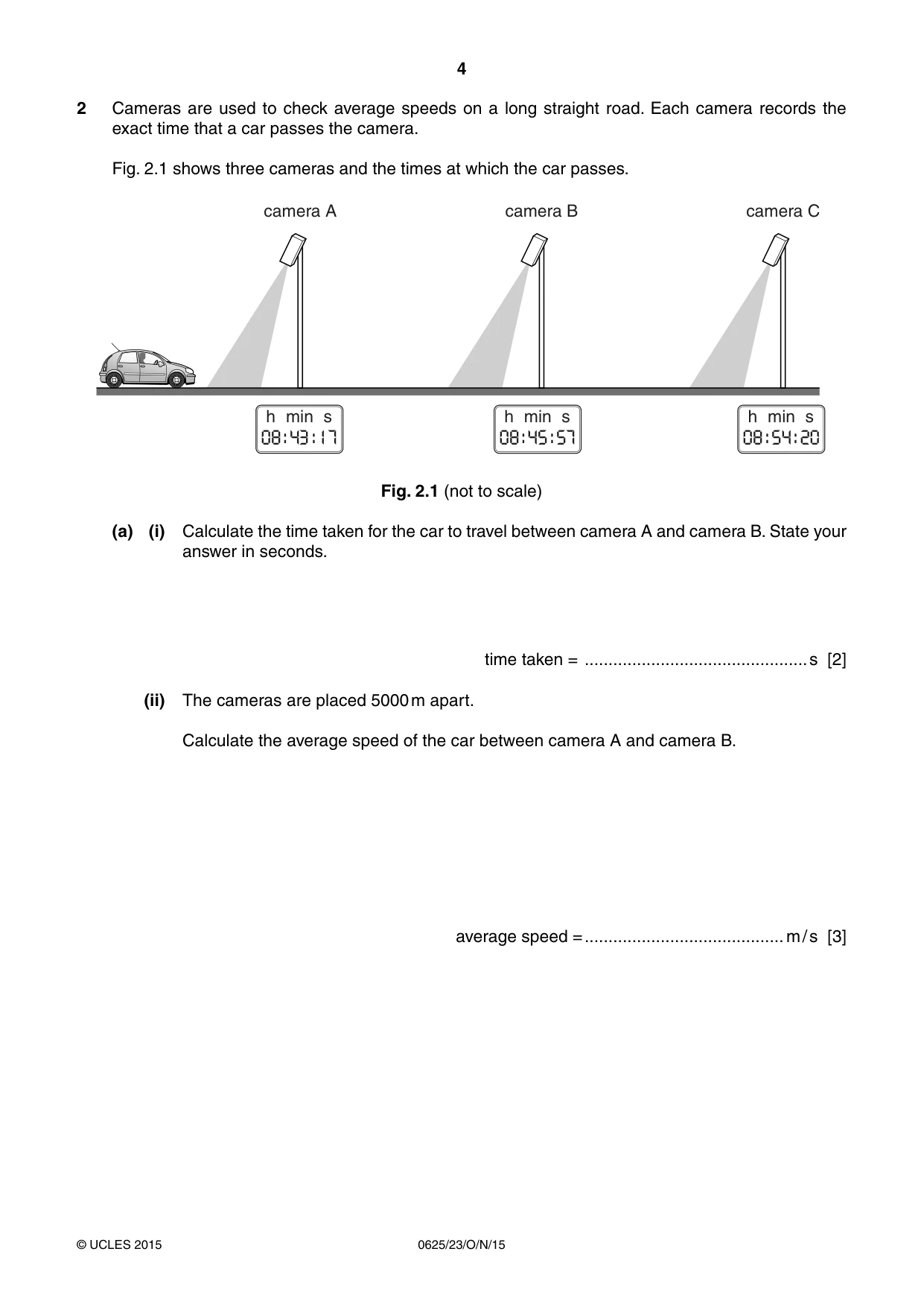
4 0625/23/O/N/15 © UCLES 2015 2 Cameras are used to check average speeds on a long straight road. Each camera records the exact time that a car passes the camera. Fig. 2.1 shows three cameras and the times at which the car passes. camera A camera B camera C min s h 08 : 54 : 20 min s h 08 : 45 : 57 min s h 08 : 43 : 17 Fig. 2.1 (not to scale) (a) (i) Calculate the time taken for the car to travel between camera A and camera B. State your answer in seconds. time taken = … s [2] (ii) The cameras are placed 5000 m apart. Calculate the average speed of the car between camera A and camera B. average speed = … m / s [3]
Question paper, page 5
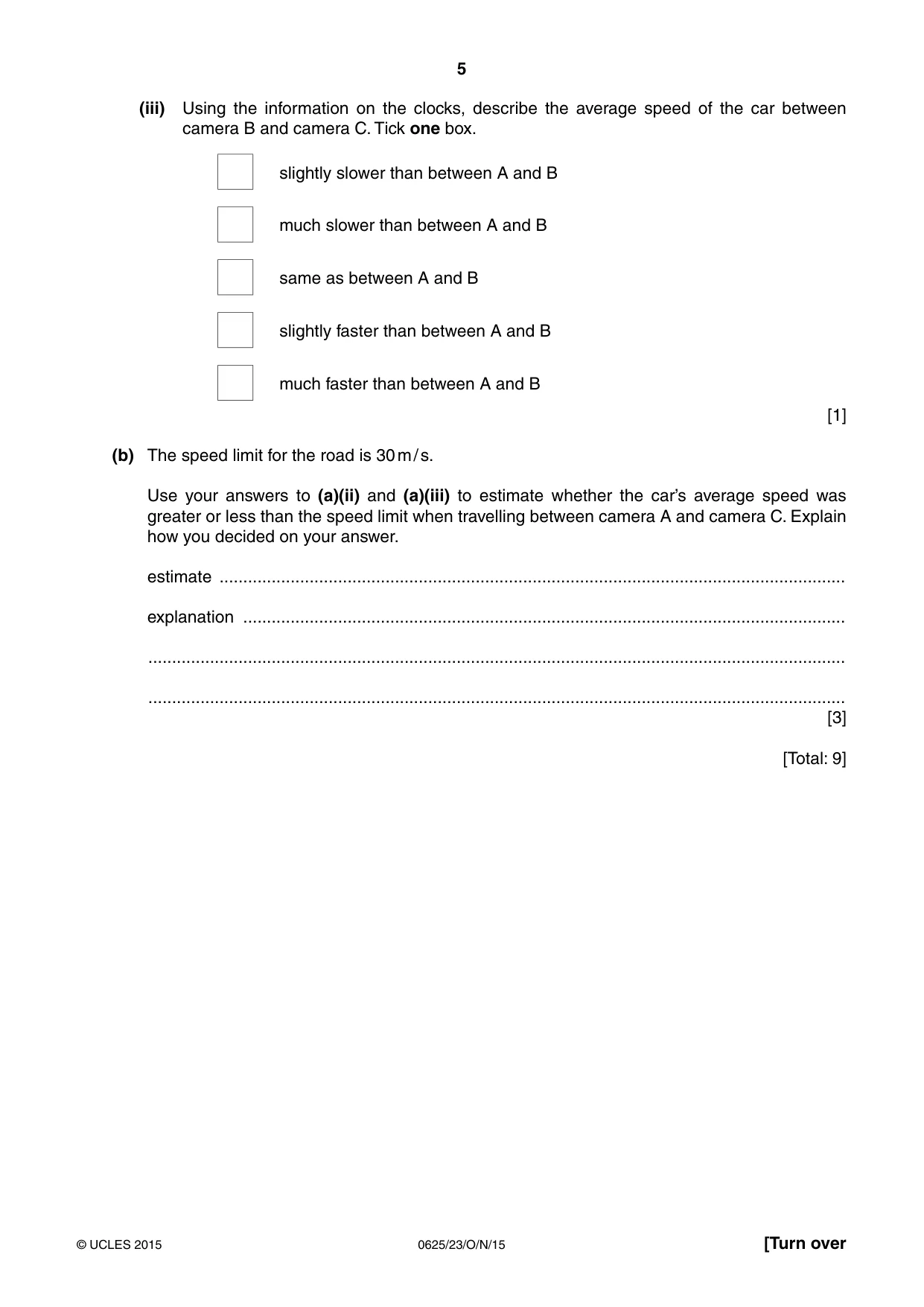
5 0625/23/O/N/15 © UCLES 2015 [Turn over (iii) Using the information on the clocks, describe the average speed of the car between camera B and camera C. Tick one box. slightly slower than between A and B much slower than between A and B same as between A and B slightly faster than between A and B much faster than between A and B [1] (b) The speed limit for the road is 30 m / s. Use your answers to (a)(ii) and (a)(iii) to estimate whether the car’s average speed was greater or less than the speed limit when travelling between camera A and camera C. Explain how you decided on your answer. estimate … explanation … … … [3] [Total: 9]
Question paper, page 6
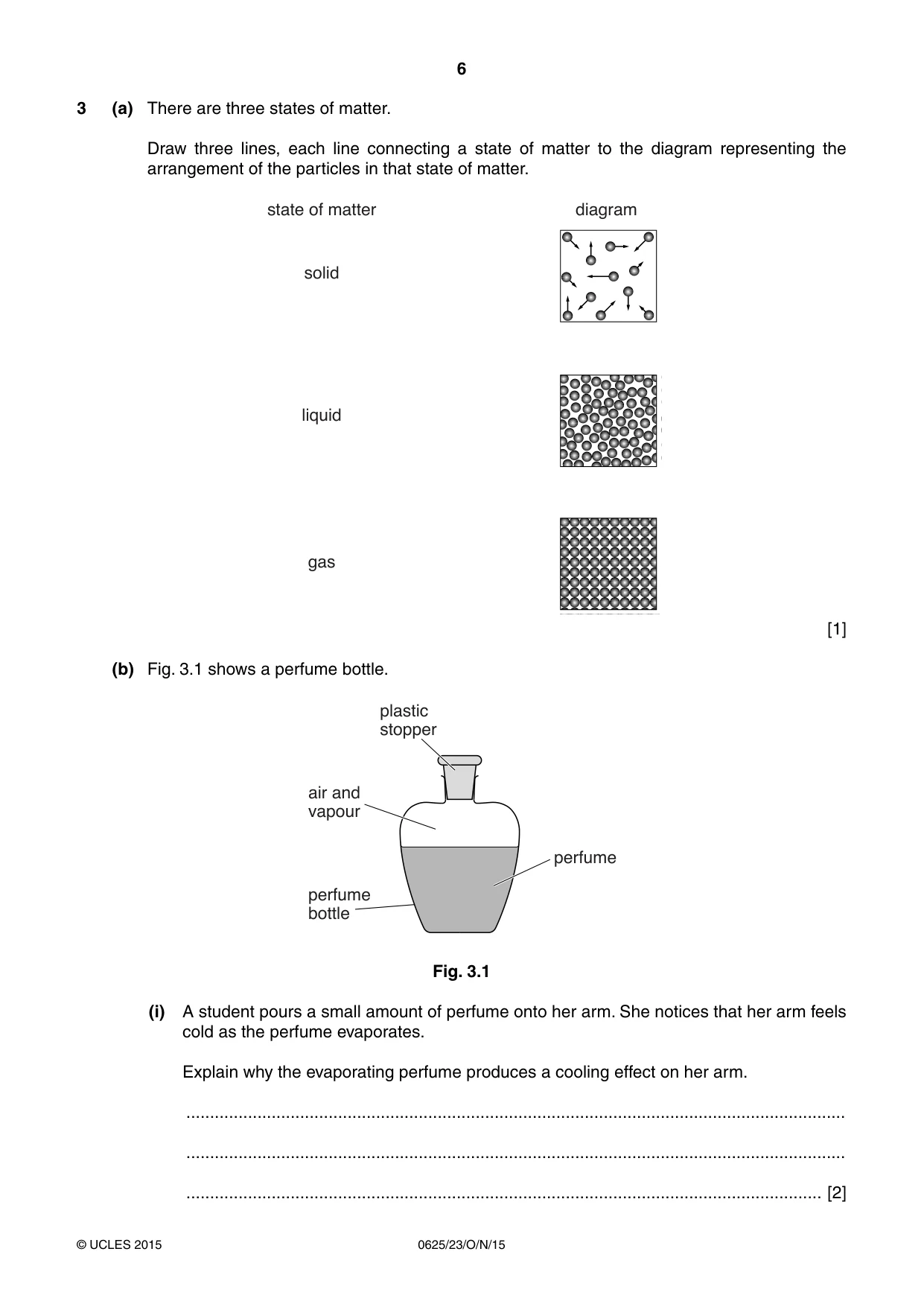
6 0625/23/O/N/15 © UCLES 2015 3 (a) There are three states of matter. Draw three lines, each line connecting a state of matter to the diagram representing the arrangement of the particles in that state of matter. diagram state of matter solid liquid gas [1] (b) Fig. 3.1 shows a perfume bottle. air and vapour perfume bottle perfume plastic stopper Fig. 3.1 (i) A student pours a small amount of perfume onto her arm. She notices that her arm feels cold as the perfume evaporates. Explain why the evaporating perfume produces a cooling effect on her arm. … … … [2]
Question paper, page 7
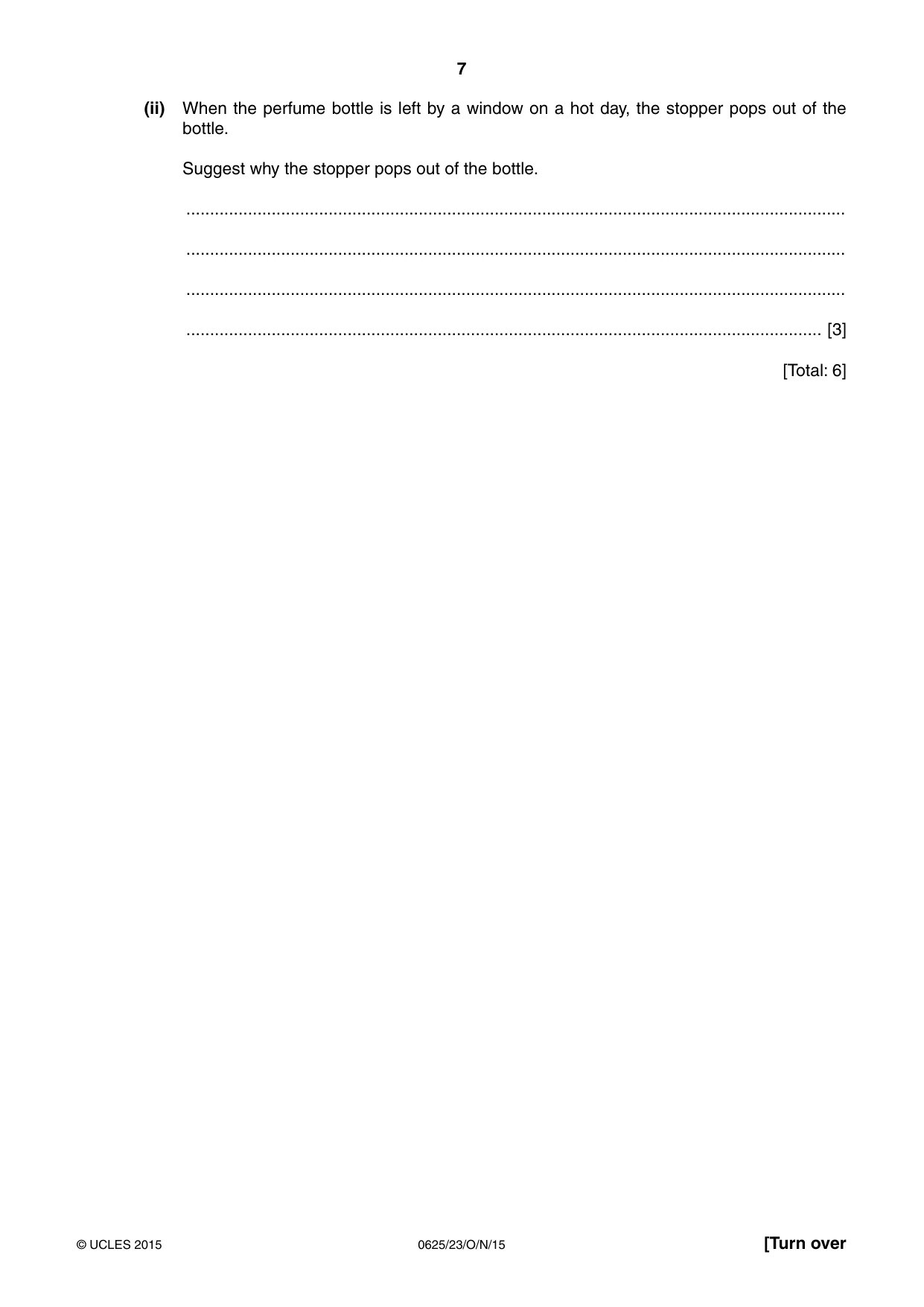
7 0625/23/O/N/15 © UCLES 2015 [Turn over (ii) When the perfume bottle is left by a window on a hot day, the stopper pops out of the bottle. Suggest why the stopper pops out of the bottle. … … … … [3] [Total: 6]
Question paper, page 8
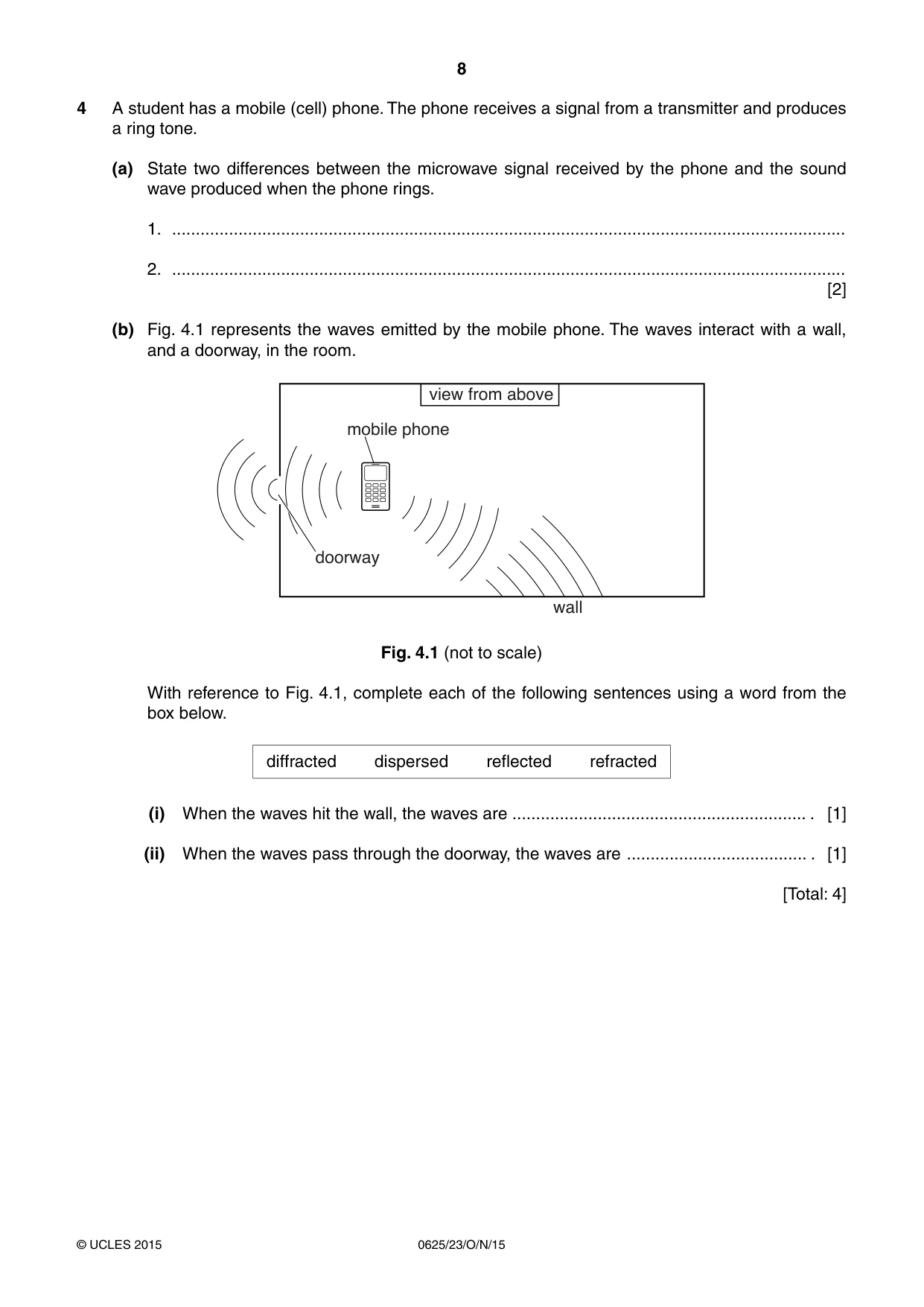
8 0625/23/O/N/15 © UCLES 2015 4 A student has a mobile (cell) phone. The phone receives a signal from a transmitter and produces a ring tone. (a) State two differences between the microwave signal received by the phone and the sound wave produced when the phone rings. 1. … 2. … [2] (b) Fig. 4.1 represents the waves emitted by the mobile phone. The waves interact with a wall, and a doorway, in the room. mobile phone view from above wall doorway Fig. 4.1 (not to scale) With reference to Fig. 4.1, complete each of the following sentences using a word from the box below. diffracted dispersed reflected refracted (i) When the waves hit the wall, the waves are … . [1] (ii) When the waves pass through the doorway, the waves are … . [1] [Total: 4]
Question paper, page 9
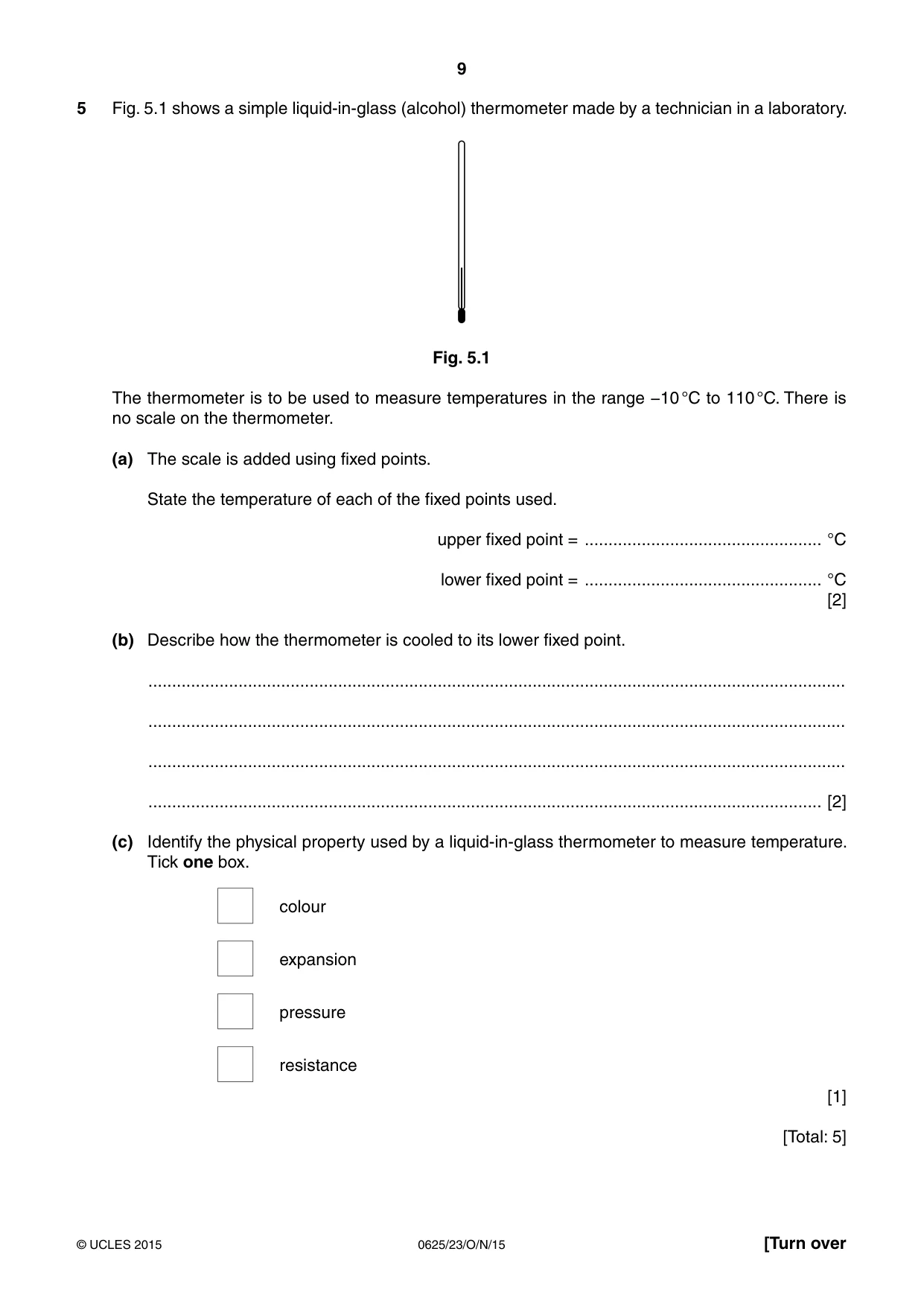
9 0625/23/O/N/15 © UCLES 2015 [Turn over 5 Fig. 5.1 shows a simple liquid-in-glass (alcohol) thermometer made by a technician in a laboratory. Fig. 5.1 The thermometer is to be used to measure temperatures in the range −10 °C to 110 °C. There is no scale on the thermometer. (a) The scale is added using fixed points. State the temperature of each of the fixed points used. upper fixed point = … °C lower fixed point = … °C [2] (b) Describe how the thermometer is cooled to its lower fixed point. … … … … [2] (c) Identify the physical property used by a liquid-in-glass thermometer to measure temperature. Tick one box. colour expansion pressure resistance [1] [Total: 5]
Question paper, page 10
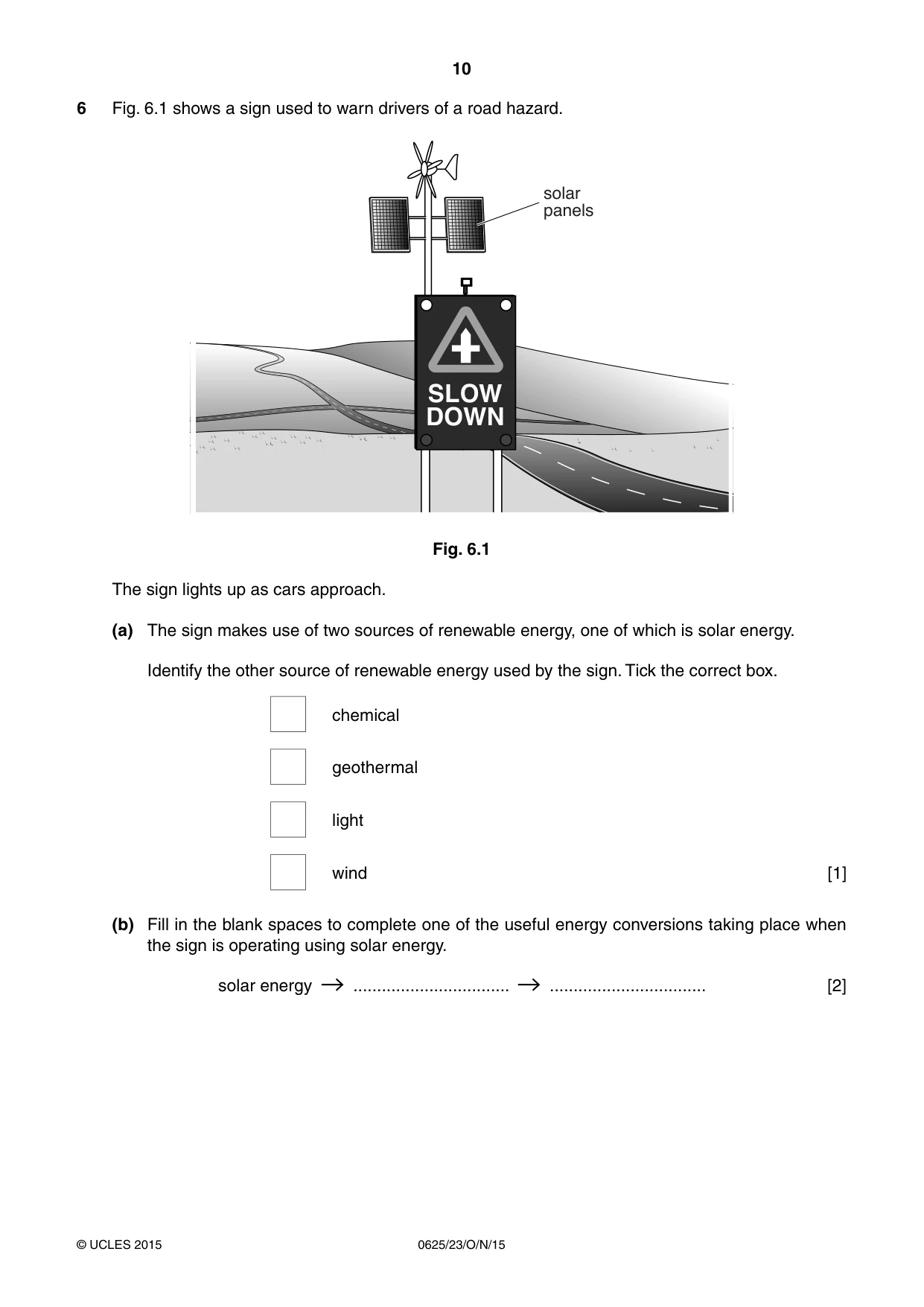
10 0625/23/O/N/15 © UCLES 2015 6 Fig. 6.1 shows a sign used to warn drivers of a road hazard. SLOW DOWN solar panels Fig. 6.1 The sign lights up as cars approach. (a) The sign makes use of two sources of renewable energy, one of which is solar energy. Identify the other source of renewable energy used by the sign. Tick the correct box. chemical geothermal light wind [1] (b) Fill in the blank spaces to complete one of the useful energy conversions taking place when the sign is operating using solar energy. solar energy … … [2]
Question paper, page 11
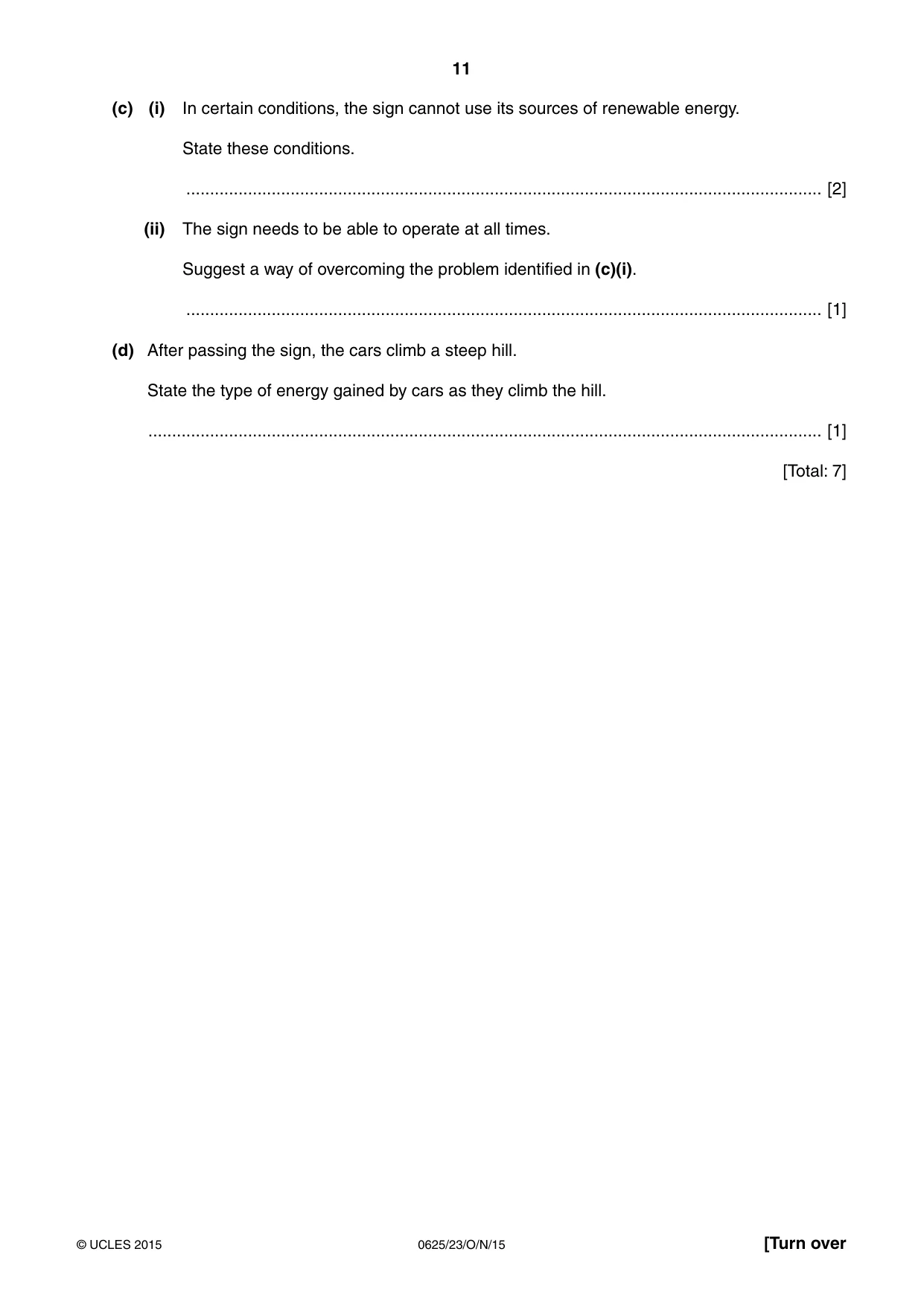
11 0625/23/O/N/15 © UCLES 2015 [Turn over (c) (i) In certain conditions, the sign cannot use its sources of renewable energy. State these conditions. … [2] (ii) The sign needs to be able to operate at all times. Suggest a way of overcoming the problem identified in (c)(i). … [1] (d) After passing the sign, the cars climb a steep hill. State the type of energy gained by cars as they climb the hill. … [1] [Total: 7]
Question paper, page 12
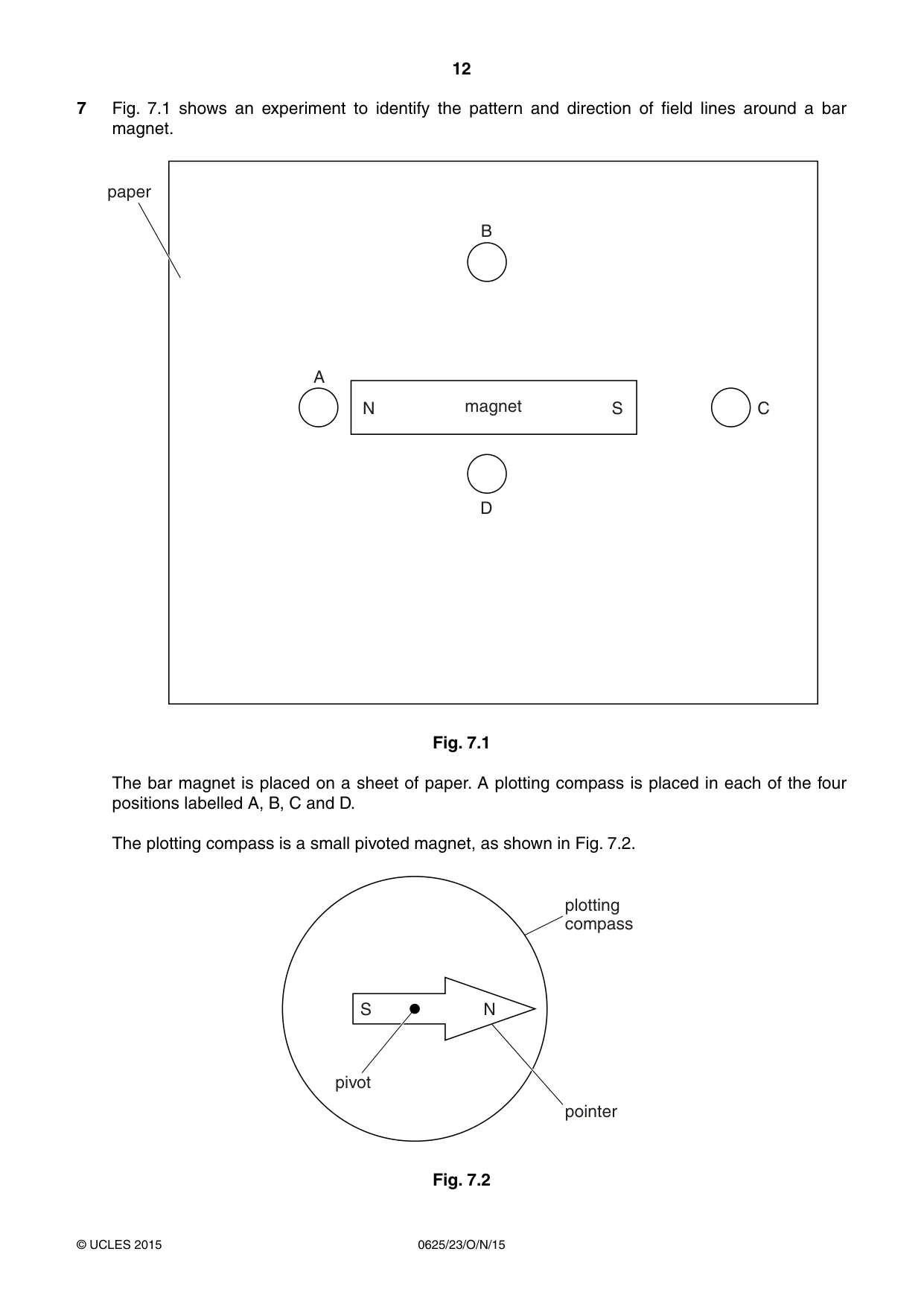
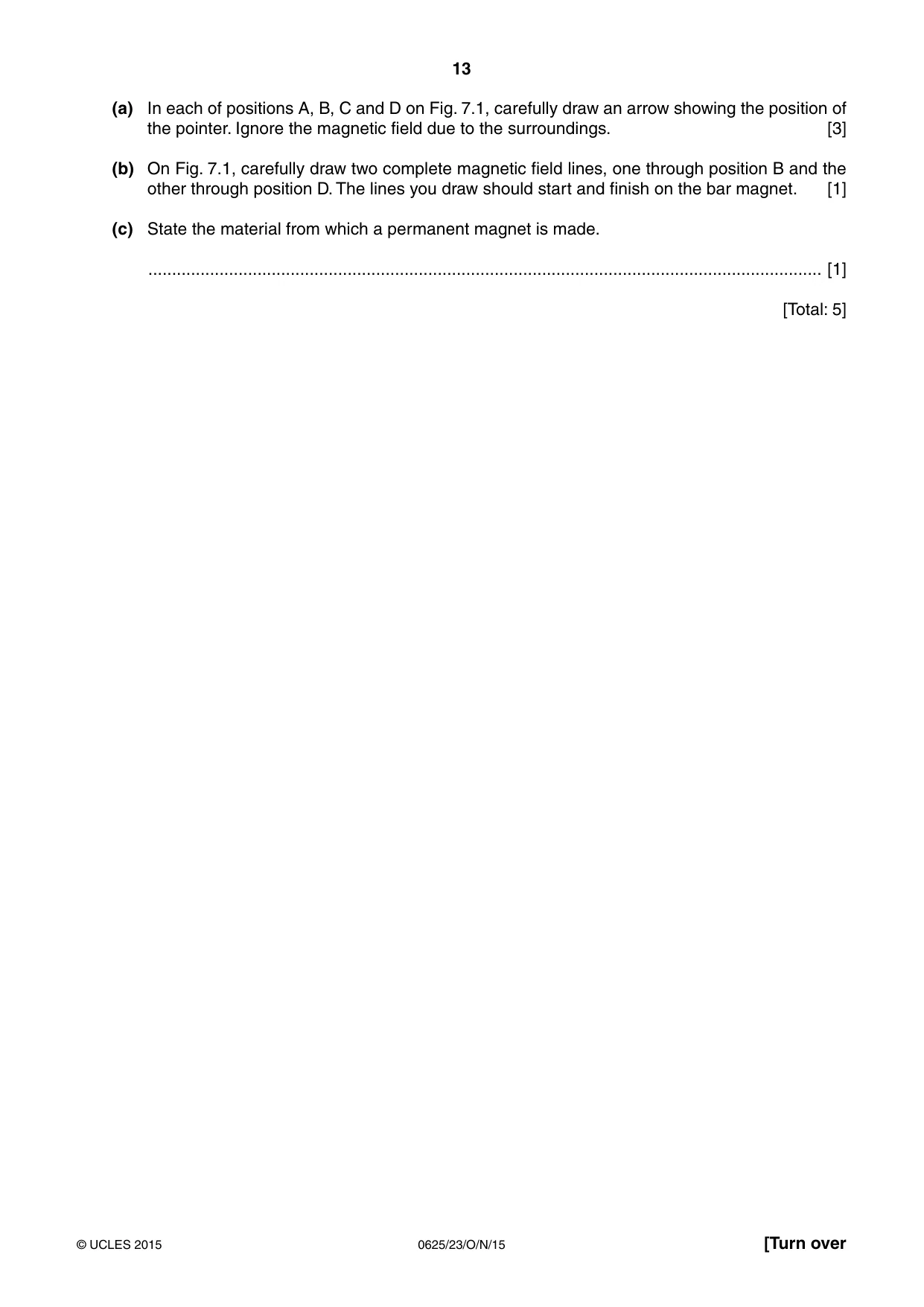
12 0625/23/O/N/15 © UCLES 2015 7 Fig. 7.1 shows an experiment to identify the pattern and direction of field lines around a bar magnet. paper A B D C magnet N S Fig. 7.1 The bar magnet is placed on a sheet of paper. A plotting compass is placed in each of the four positions labelled A, B, C and D. The plotting compass is a small pivoted magnet, as shown in Fig. 7.2. S N pivot pointer plotting compass Fig. 7.2
Question paper, page 13
13 0625/23/O/N/15 © UCLES 2015 [Turn over (a) In each of positions A, B, C and D on Fig. 7.1, carefully draw an arrow showing the position of the pointer. Ignore the magnetic field due to the surroundings. [3] (b) On Fig. 7.1, carefully draw two complete magnetic field lines, one through position B and the other through position D. The lines you draw should start and finish on the bar magnet. [1] (c) State the material from which a permanent magnet is made. … [1] [Total: 5]
Question paper, page 14
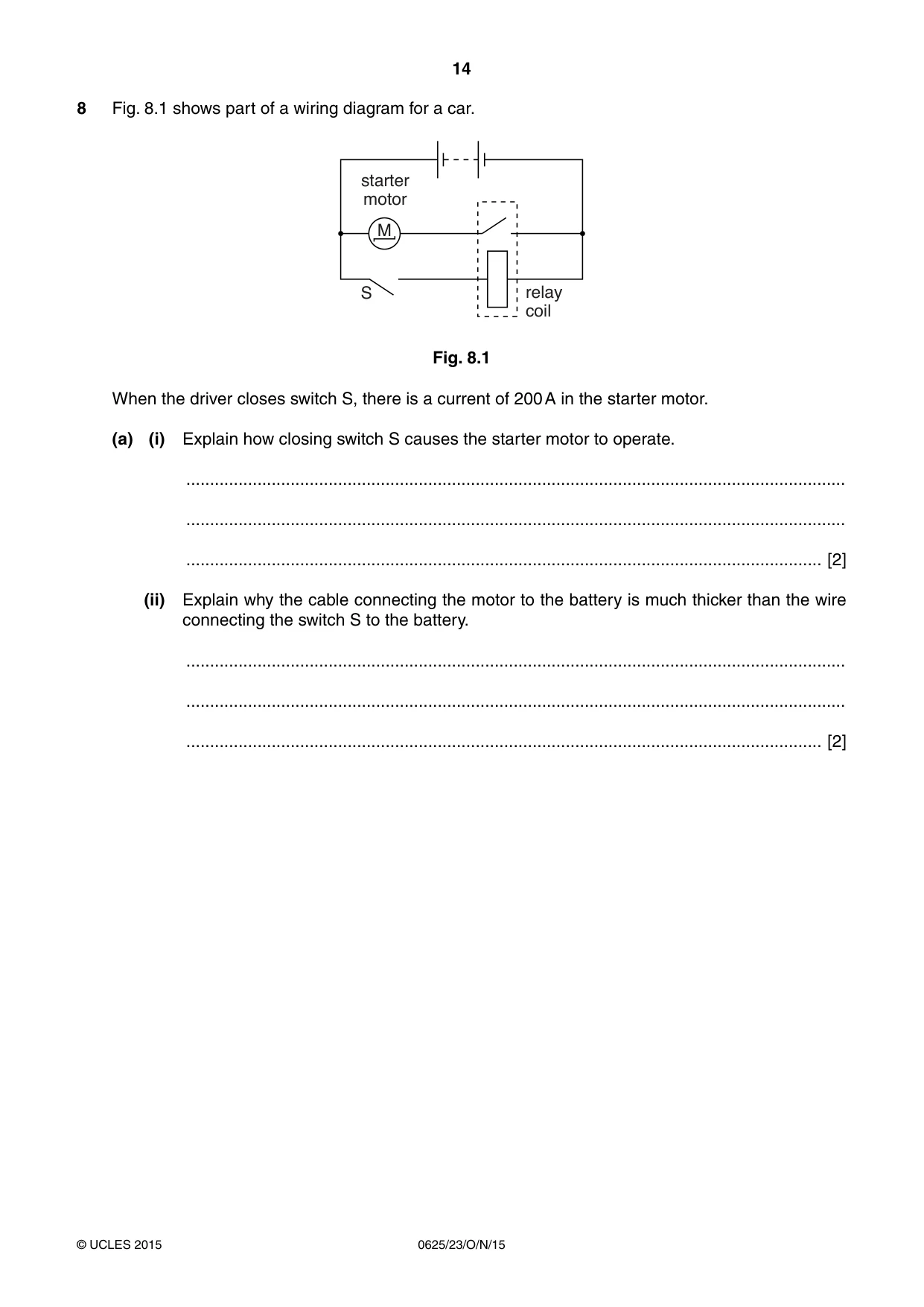
14 0625/23/O/N/15 © UCLES 2015 8 Fig. 8.1 shows part of a wiring diagram for a car. relay coil S starter motor M Fig. 8.1 When the driver closes switch S, there is a current of 200 A in the starter motor. (a) (i) Explain how closing switch S causes the starter motor to operate. … … … [2] (ii) Explain why the cable connecting the motor to the battery is much thicker than the wire connecting the switch S to the battery. … … … [2]
Question paper, page 15
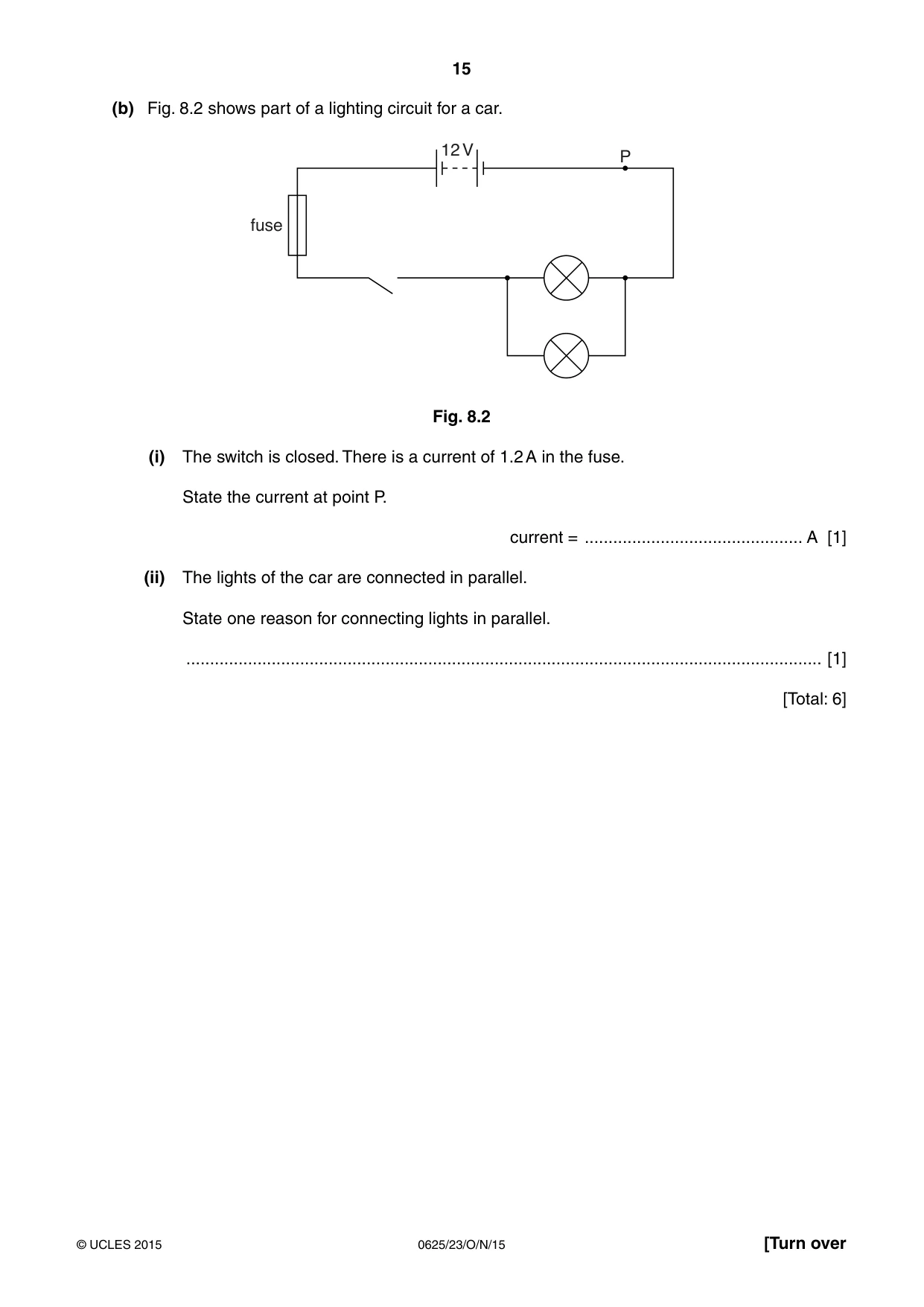
15 0625/23/O/N/15 © UCLES 2015 [Turn over (b) Fig. 8.2 shows part of a lighting circuit for a car. fuse 12 V P Fig. 8.2 (i) The switch is closed. There is a current of 1.2 A in the fuse. State the current at point P. current = … A [1] (ii) The lights of the car are connected in parallel. State one reason for connecting lights in parallel. … [1] [Total: 6]
Question paper, page 16
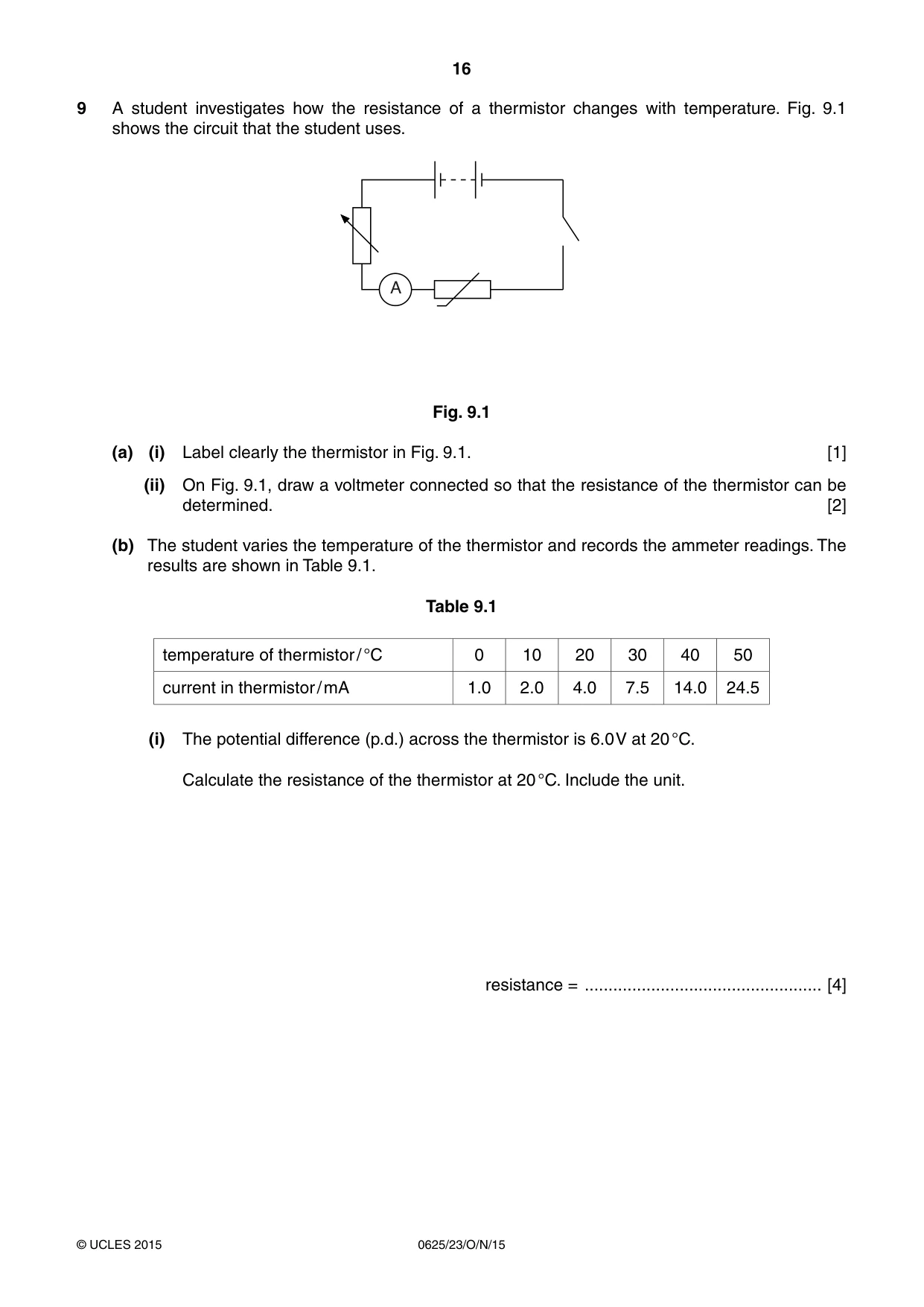
16 0625/23/O/N/15 © UCLES 2015 9 A student investigates how the resistance of a thermistor changes with temperature. Fig. 9.1 shows the circuit that the student uses. A Fig. 9.1 (a) (i) Label clearly the thermistor in Fig. 9.1. [1] (ii) On Fig. 9.1, draw a voltmeter connected so that the resistance of the thermistor can be determined. [2] (b) The student varies the temperature of the thermistor and records the ammeter readings. The results are shown in Table 9.1. Table 9.1 temperature of thermistor / °C 0 10 20 30 40 50 current in thermistor / mA 1.0 2.0 4.0 7.5 14.0 24.5 (i) The potential difference (p.d.) across the thermistor is 6.0 V at 20 °C. Calculate the resistance of the thermistor at 20 °C. Include the unit. resistance = … [4]
Question paper, page 17
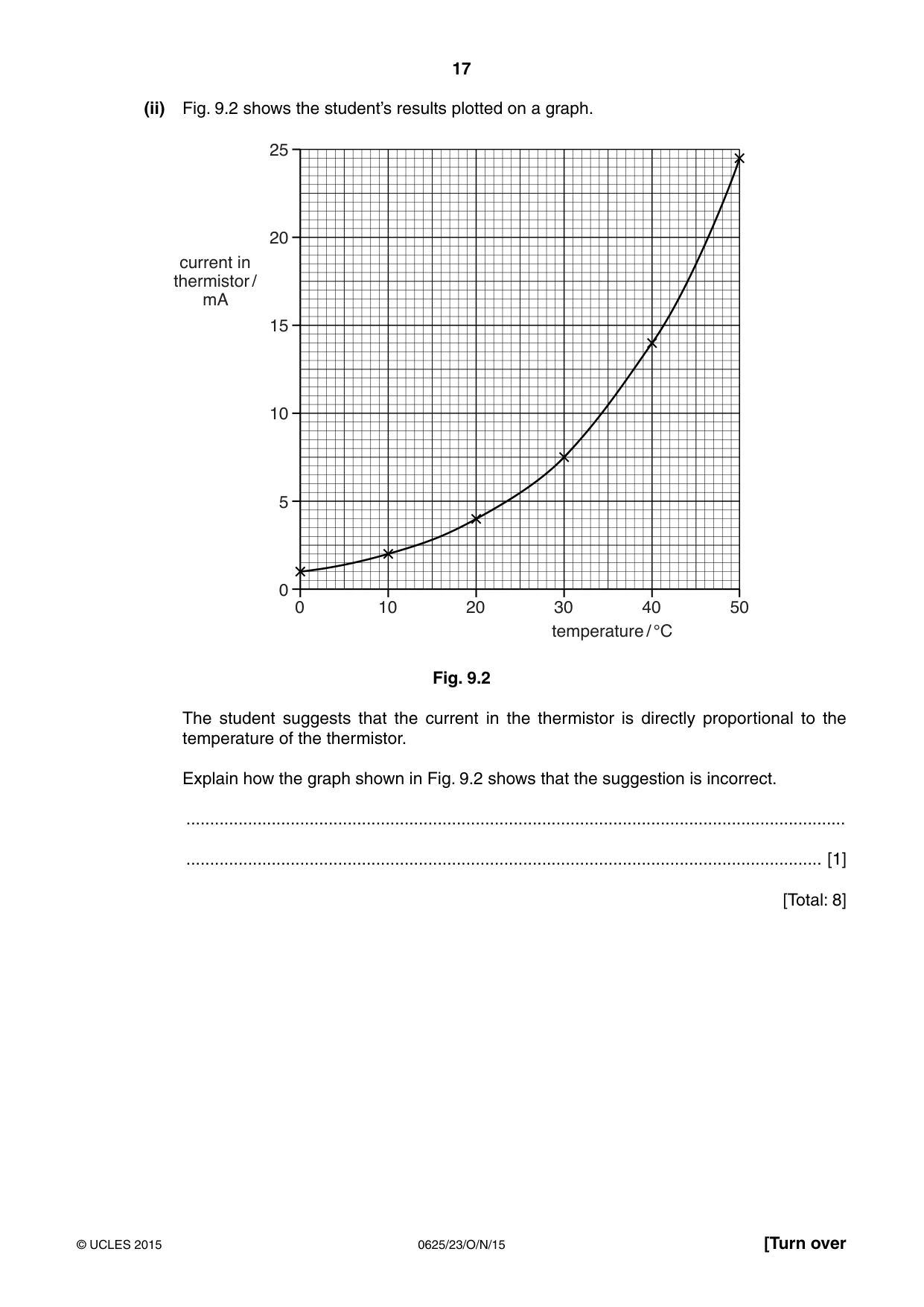
17 0625/23/O/N/15 © UCLES 2015 [Turn over (ii) Fig. 9.2 shows the student’s results plotted on a graph. 25 20 15 10 0 10 20 30 temperature / °C 40 50 current in thermistor / mA 5 0 Fig. 9.2 The student suggests that the current in the thermistor is directly proportional to the temperature of the thermistor. Explain how the graph shown in Fig. 9.2 shows that the suggestion is incorrect. … … [1] [Total: 8]
Question paper, page 18
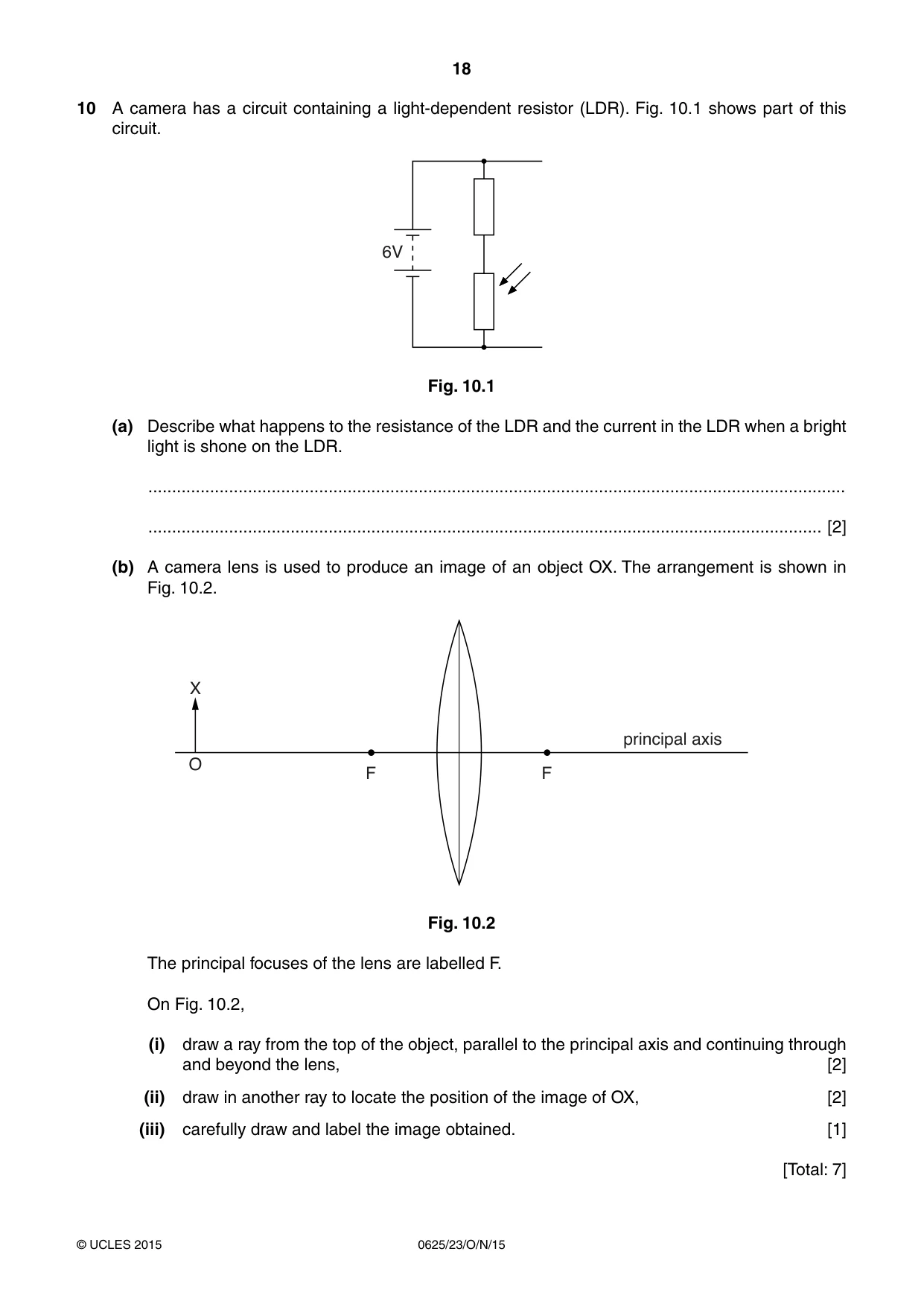
18 0625/23/O/N/15 © UCLES 2015 10 A camera has a circuit containing a light-dependent resistor (LDR). Fig. 10.1 shows part of this circuit. 6V Fig. 10.1 (a) Describe what happens to the resistance of the LDR and the current in the LDR when a bright light is shone on the LDR. … … [2] (b) A camera lens is used to produce an image of an object OX. The arrangement is shown in Fig. 10.2. F principal axis X O F Fig. 10.2 The principal focuses of the lens are labelled F. On Fig. 10.2, (i) draw a ray from the top of the object, parallel to the principal axis and continuing through and beyond the lens, [2] (ii) draw in another ray to locate the position of the image of OX, [2] (iii) carefully draw and label the image obtained. [1] [Total: 7]
Question paper, page 19
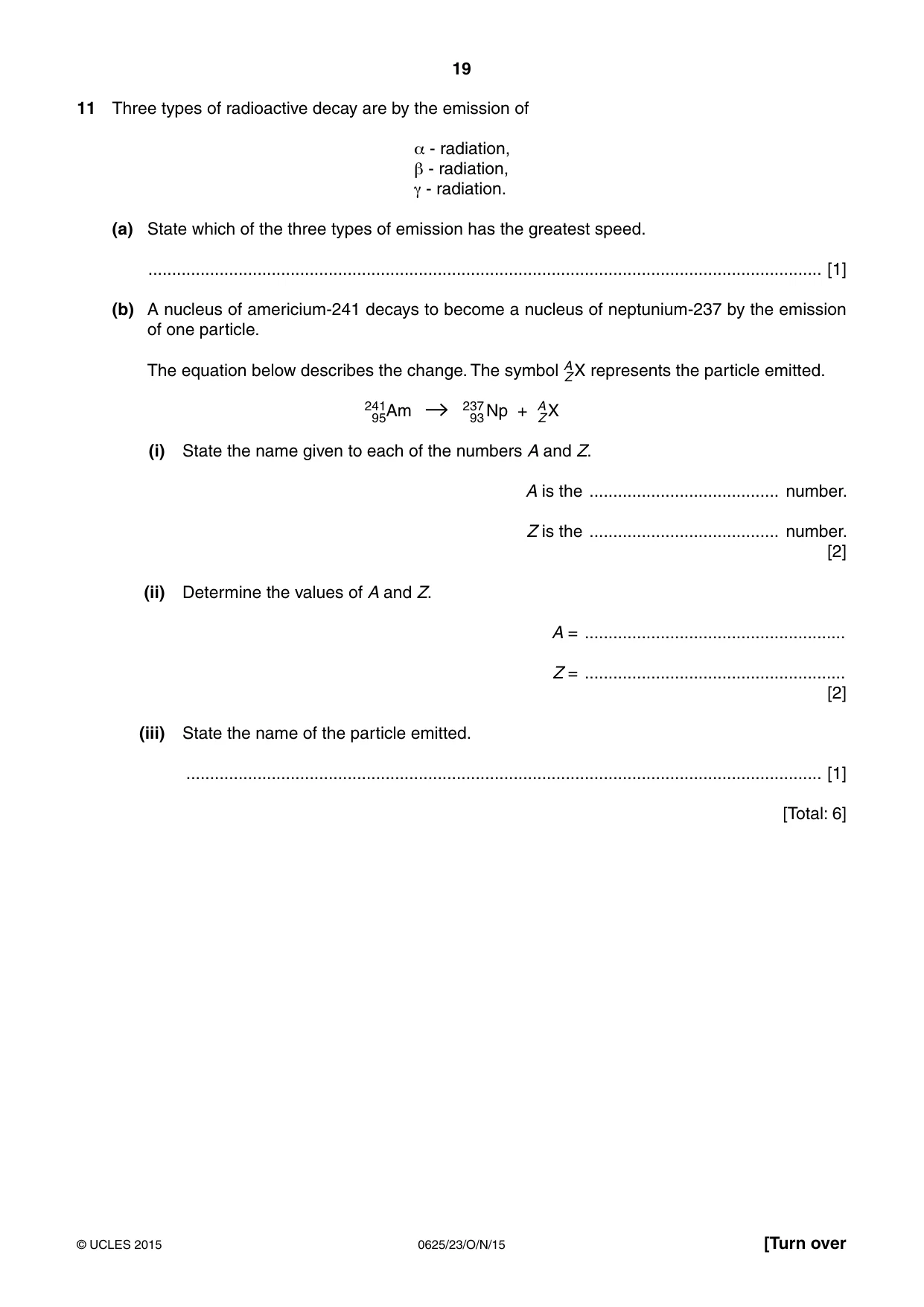
19 0625/23/O/N/15 © UCLES 2015 [Turn over 11 Three types of radioactive decay are by the emission of α - radiation, β - radiation, γ - radiation. (a) State which of the three types of emission has the greatest speed. … [1] (b) A nucleus of americium-241 decays to become a nucleus of neptunium-237 by the emission of one particle. The equation below describes the change. The symbol A Z X represents the particle emitted. 241 95Am 237 93 Np + A Z X (i) State the name given to each of the numbers A and Z. A is the … number. Z is the … number. [2] (ii) Determine the values of A and Z. A = … Z = … [2] (iii) State the name of the particle emitted. … [1] [Total: 6]
Question paper, page 20
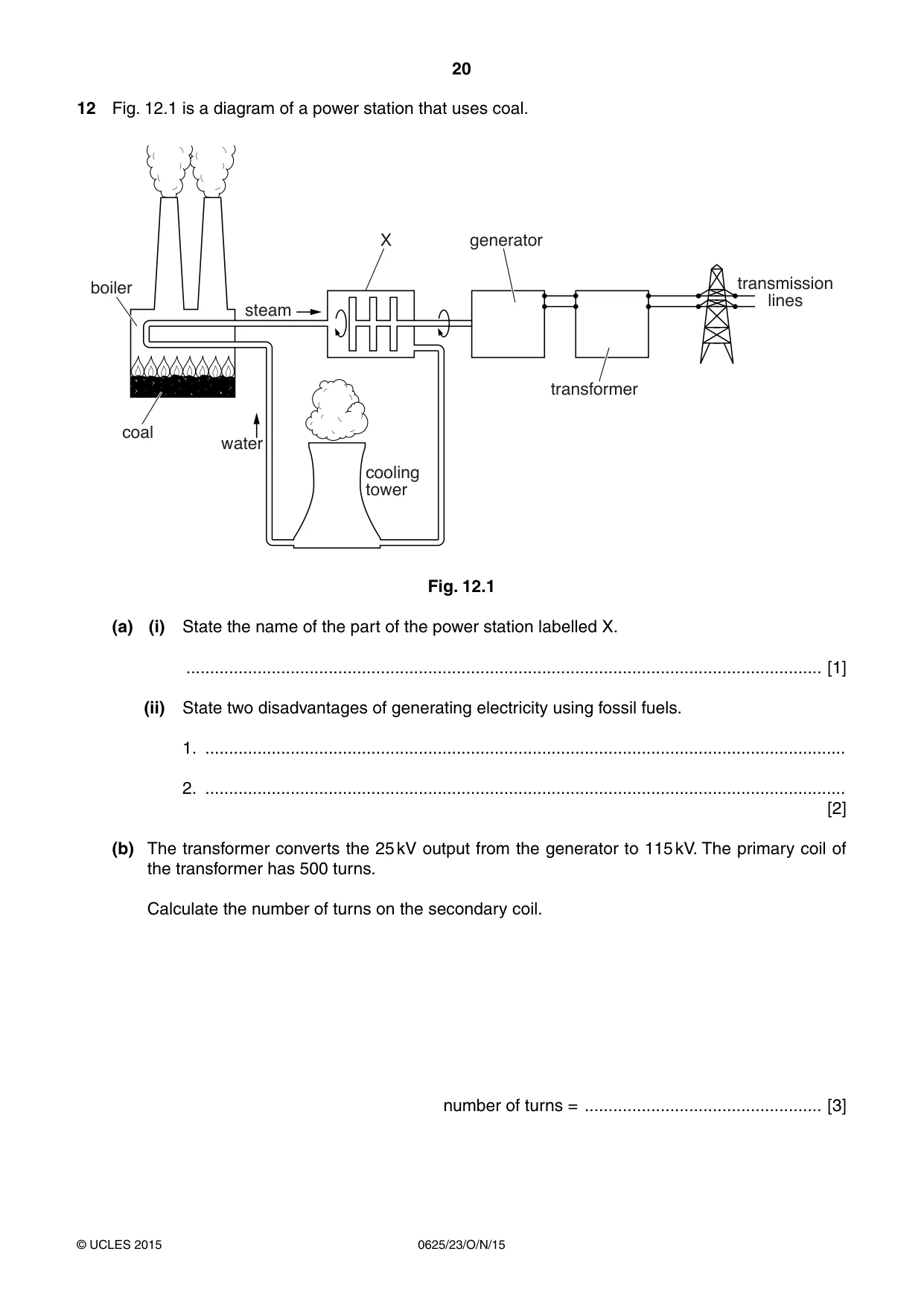
20 0625/23/O/N/15 © UCLES 2015 12 Fig. 12.1 is a diagram of a power station that uses coal. boiler coal water steam cooling tower transformer generator transmission lines X Fig. 12.1 (a) (i) State the name of the part of the power station labelled X. … [1] (ii) State two disadvantages of generating electricity using fossil fuels. 1. … 2. … [2] (b) The transformer converts the 25 kV output from the generator to 115 kV. The primary coil of the transformer has 500 turns. Calculate the number of turns on the secondary coil. number of turns = … [3]
Question paper, page 21
21 0625/23/O/N/15 © UCLES 2015 (c) Explain the advantages of transmitting electricity at high voltages such as 115 kV. … … … [3] [Total: 9]
Question paper, page 22
22 0625/23/O/N/15 © UCLES 2015 BLANK PAGE
Question paper, page 23
23 0625/23/O/N/15 © UCLES 2015 BLANK PAGE
Question paper, page 24
24 0625/23/O/N/15 © UCLES 2015 BLANK PAGE Permission to reproduce items where third-party owned material protected by copyright is included has been sought and cleared where possible. Every reasonable effort has been made by the publisher (UCLES) to trace copyright holders, but if any items requiring clearance have unwittingly been included, the publisher will be pleased to make amends at the earliest possible opportunity. To avoid the issue of disclosure of answer-related information to candidates, all copyright acknowledgements are reproduced online in the Cambridge International Examinations Copyright Acknowledgements Booklet. This is produced for each series of examinations and is freely available to download at www.cie.org.uk after the live examination series. Cambridge International Examinations is part of the Cambridge Assessment Group. Cambridge Assessment is the brand name of University of Cambridge Local Examinations Syndicate (UCLES), which is itself a department of the University of Cambridge.
Mark scheme, page 1
® IGCSE is the registered trademark of Cambridge International Examinations. CAMBRIDGE INTERNATIONAL EXAMINATIONS Cambridge International General Certificate of Secondary Education MARK SCHEME for the October/November 2015 series 0625 PHYSICS 0625/23 Paper 2 (Core Theory), maximum raw mark 80 This mark scheme is published as an aid to teachers and candidates, to indicate the requirements of the examination. It shows the basis on which Examiners were instructed to award marks. It does not indicate the details of the discussions that took place at an Examiners’ meeting before marking began, which would have considered the acceptability of alternative answers. Mark schemes should be read in conjunction with the question paper and the Principal Examiner Report for Teachers. Cambridge will not enter into discussions about these mark schemes. Cambridge is publishing the mark schemes for the October/November 2015 series for most Cambridge IGCSE®, Cambridge International A and AS Level components and some Cambridge O Level components.
Mark scheme, page 2
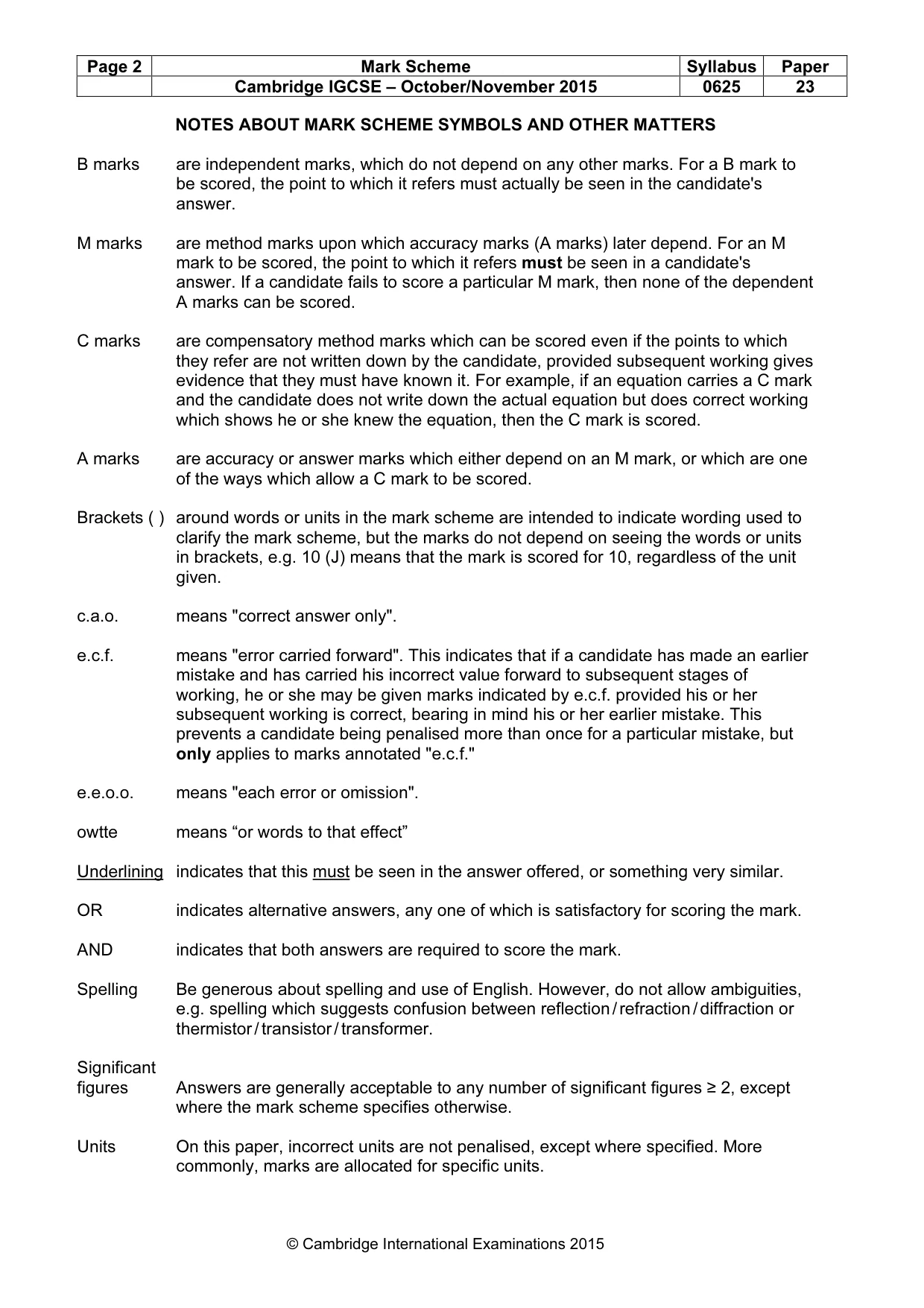
Page 2 Mark Scheme Syllabus Paper Cambridge IGCSE – October/November 2015 0625 23 © Cambridge International Examinations 2015 NOTES ABOUT MARK SCHEME SYMBOLS AND OTHER MATTERS B marks are independent marks, which do not depend on any other marks. For a B mark to be scored, the point to which it refers must actually be seen in the candidate's answer. M marks are method marks upon which accuracy marks (A marks) later depend. For an M mark to be scored, the point to which it refers must be seen in a candidate's answer. If a candidate fails to score a particular M mark, then none of the dependent A marks can be scored. C marks are compensatory method marks which can be scored even if the points to which they refer are not written down by the candidate, provided subsequent working gives evidence that they must have known it. For example, if an equation carries a C mark and the candidate does not write down the actual equation but does correct working which shows he or she knew the equation, then the C mark is scored. A marks are accuracy or answer marks which either depend on an M mark, or which are one of the ways which allow a C mark to be scored. Brackets ( ) around words or units in the mark scheme are intended to indicate wording used to clarify the mark scheme, but the marks do not depend on seeing the words or units in brackets, e.g. 10 (J) means that the mark is scored for 10, regardless of the unit given. c.a.o. means "correct answer only". e.c.f. means "error carried forward". This indicates that if a candidate has made an earlier mistake and has carried his incorrect value forward to subsequent stages of working, he or she may be given marks indicated by e.c.f. provided his or her subsequent working is correct, bearing in mind his or her earlier mistake. This prevents a candidate being penalised more than once for a particular mistake, but only applies to marks annotated "e.c.f." e.e.o.o. means "each error or omission". owtte means “or words to that effect” Underlining indicates that this must be seen in the answer offered, or something very similar. OR indicates alternative answers, any one of which is satisfactory for scoring the mark. AND indicates that both answers are required to score the mark. Spelling Be generous about spelling and use of English. However, do not allow ambiguities, e.g. spelling which suggests confusion between reflection / refraction / diffraction or thermistor / transistor / transformer. Significant figures Answers are generally acceptable to any number of significant figures ≥ 2, except where the mark scheme specifies otherwise. Units On this paper, incorrect units are not penalised, except where specified. More commonly, marks are allocated for specific units.
Mark scheme, page 3
Page 3 Mark Scheme Syllabus Paper Cambridge IGCSE – October/November 2015 0625 23 © Cambridge International Examinations 2015 Fractions These are only acceptable where specified. NOT indicates that an incorrect answer is not to be disregarded, but cancels another otherwise correct alternative offered by the candidate. i.e. right plus wrong penalty applies.
Mark scheme, page 4
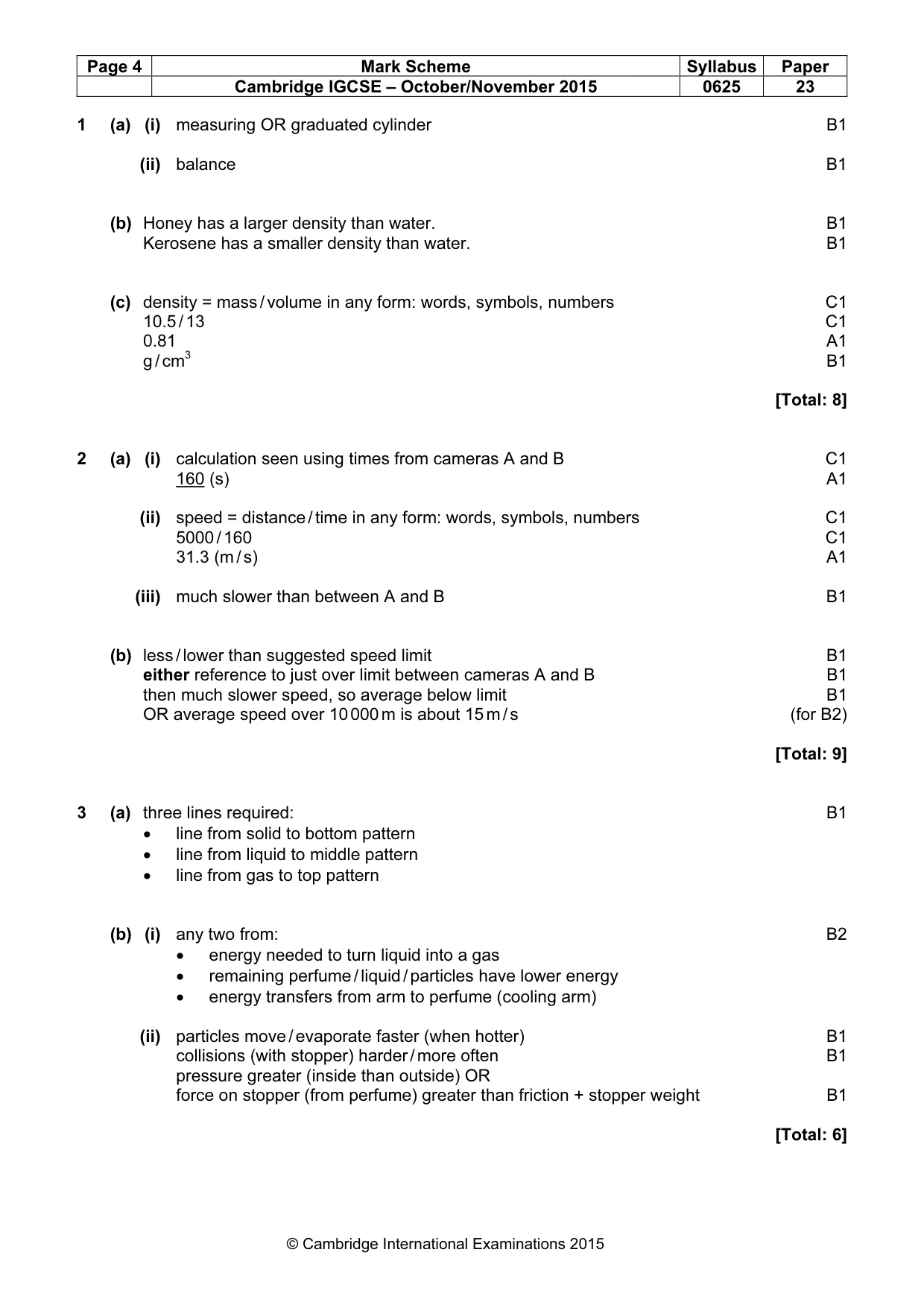
Page 4 Mark Scheme Syllabus Paper Cambridge IGCSE – October/November 2015 0625 23 © Cambridge International Examinations 2015 1 (a) (i) measuring OR graduated cylinder B1 (ii) balance B1 (b) Honey has a larger density than water. B1 Kerosene has a smaller density than water. B1 (c) density = mass / volume in any form: words, symbols, numbers C1 10.5 / 13 C1 0.81 A1 g / cm3 B1 [Total: 8] 2 (a) (i) calculation seen using times from cameras A and B C1 160 (s) A1 (ii) speed = distance / time in any form: words, symbols, numbers C1 5000 / 160 C1 31.3 (m / s) A1 (iii) much slower than between A and B B1 (b) less / lower than suggested speed limit B1 either reference to just over limit between cameras A and B B1 then much slower speed, so average below limit B1 OR average speed over 10 000 m is about 15 m / s (for B2) [Total: 9] 3 (a) three lines required: B1 • line from solid to bottom pattern • line from liquid to middle pattern • line from gas to top pattern (b) (i) any two from: B2 • energy needed to turn liquid into a gas • remaining perfume / liquid / particles have lower energy • energy transfers from arm to perfume (cooling arm) (ii) particles move / evaporate faster (when hotter) B1 collisions (with stopper) harder / more often B1 pressure greater (inside than outside) OR force on stopper (from perfume) greater than friction + stopper weight B1 [Total: 6]
Mark scheme, page 5
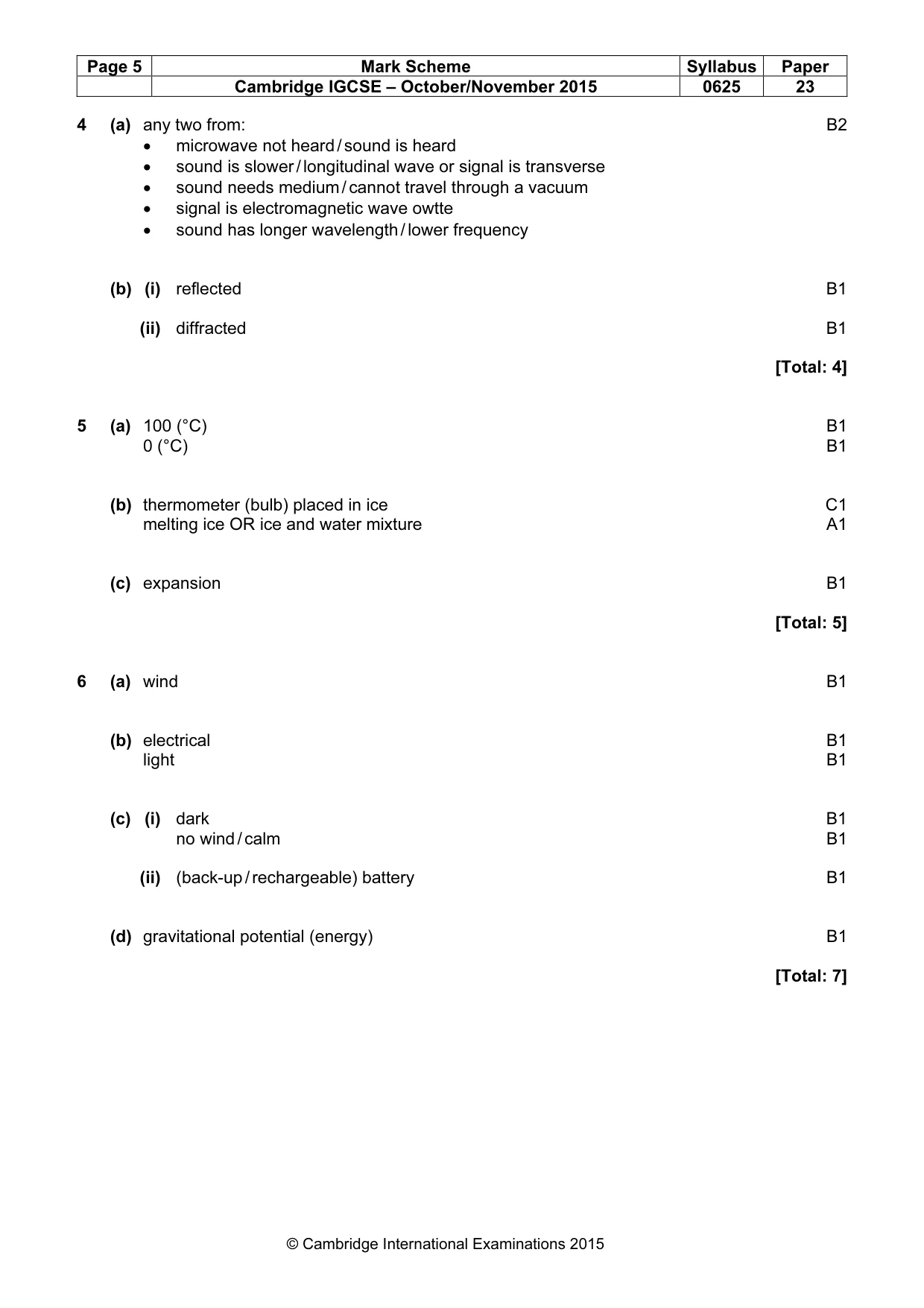
Page 5 Mark Scheme Syllabus Paper Cambridge IGCSE – October/November 2015 0625 23 © Cambridge International Examinations 2015 4 (a) any two from: B2 • microwave not heard / sound is heard • sound is slower / longitudinal wave or signal is transverse • sound needs medium / cannot travel through a vacuum • signal is electromagnetic wave owtte • sound has longer wavelength / lower frequency (b) (i) reflected B1 (ii) diffracted B1 [Total: 4] 5 (a) 100 (°C) B1 0 (°C) B1 (b) thermometer (bulb) placed in ice C1 melting ice OR ice and water mixture A1 (c) expansion B1 [Total: 5] 6 (a) wind B1 (b) electrical B1 light B1 (c) (i) dark B1 no wind / calm B1 (ii) (back-up / rechargeable) battery B1 (d) gravitational potential (energy) B1 [Total: 7]
Mark scheme, page 6
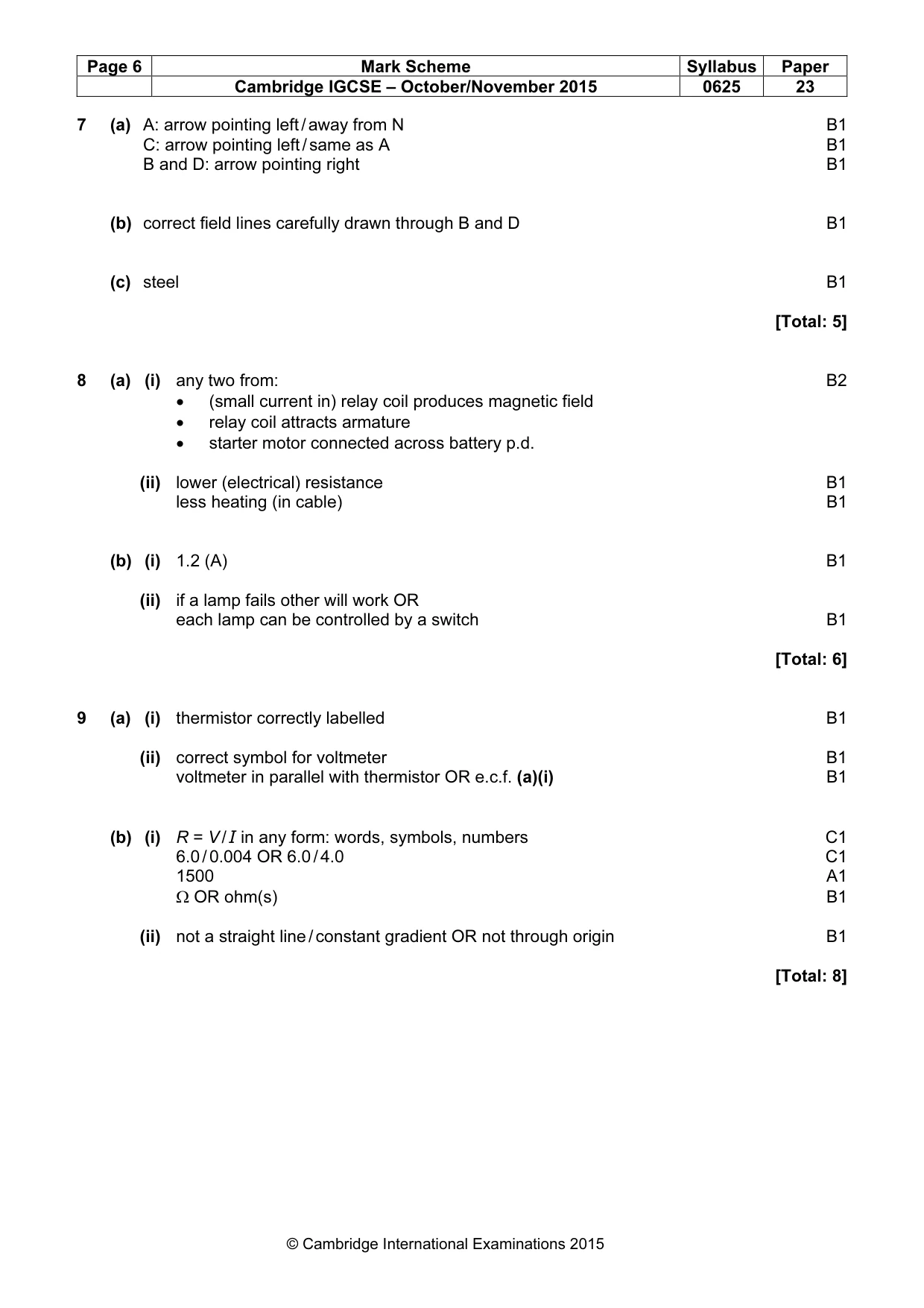
Page 6 Mark Scheme Syllabus Paper Cambridge IGCSE – October/November 2015 0625 23 © Cambridge International Examinations 2015 7 (a) A: arrow pointing left / away from N B1 C: arrow pointing left / same as A B1 B and D: arrow pointing right B1 (b) correct field lines carefully drawn through B and D B1 (c) steel B1 [Total: 5] 8 (a) (i) any two from: B2 • (small current in) relay coil produces magnetic field • relay coil attracts armature • starter motor connected across battery p.d. (ii) lower (electrical) resistance B1 less heating (in cable) B1 (b) (i) 1.2 (A) B1 (ii) if a lamp fails other will work OR each lamp can be controlled by a switch B1 [Total: 6] 9 (a) (i) thermistor correctly labelled B1 (ii) correct symbol for voltmeter B1 voltmeter in parallel with thermistor OR e.c.f. (a)(i) B1 (b) (i) R = V / I in any form: words, symbols, numbers C1 6.0 / 0.004 OR 6.0 / 4.0 C1 1500 A1 Ω OR ohm(s) B1 (ii) not a straight line / constant gradient OR not through origin B1 [Total: 8]
Mark scheme, page 7
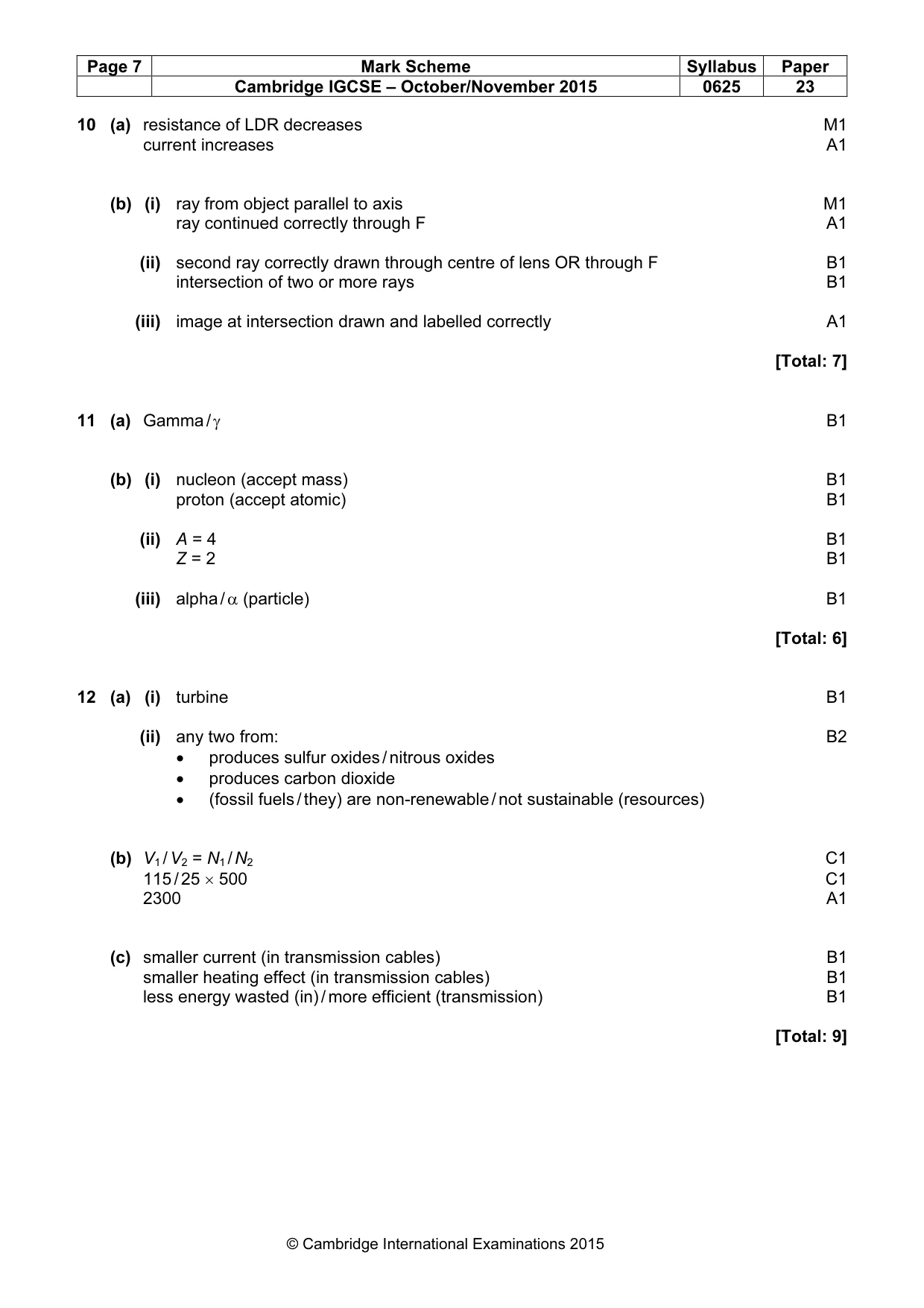
Page 7 Mark Scheme Syllabus Paper Cambridge IGCSE – October/November 2015 0625 23 © Cambridge International Examinations 2015 10 (a) resistance of LDR decreases M1 current increases A1 (b) (i) ray from object parallel to axis M1 ray continued correctly through F A1 (ii) second ray correctly drawn through centre of lens OR through F B1 intersection of two or more rays B1 (iii) image at intersection drawn and labelled correctly A1 [Total: 7] 11 (a) Gamma / γ B1 (b) (i) nucleon (accept mass) B1 proton (accept atomic) B1 (ii) A = 4 B1 Z = 2 B1 (iii) alpha / α (particle) B1 [Total: 6] 12 (a) (i) turbine B1 (ii) any two from: B2 • produces sulfur oxides / nitrous oxides • produces carbon dioxide • (fossil fuels / they) are non-renewable / not sustainable (resources) (b) V1 / V2 = N1 / N2 C1 115 / 25 × 500 C1 2300 A1 (c) smaller current (in transmission cables) B1 smaller heating effect (in transmission cables) B1 less energy wasted (in) / more efficient (transmission) B1 [Total: 9]
What you needed in this session
Cambridge’s own grade thresholds for 2015 Oct/Nov, Paper 2 · Variant 3. A higher threshold means an easier paper — the bar moves with how the cohort did.