Cambridge IGCSE Physics 0625 — 2015 Oct/Nov Paper 2 · Variant 2
0625/22/O/N/15 · 80 marks · ≈90 min
The question paper and its mark scheme, free to read here and free to download. This is Cambridge’s own paper, exactly as it was sat.
Question paper20 pages
Mark scheme7 pages
Answers below. Sit the paper first if you are practising.
Paper as text
Question paper, page 1
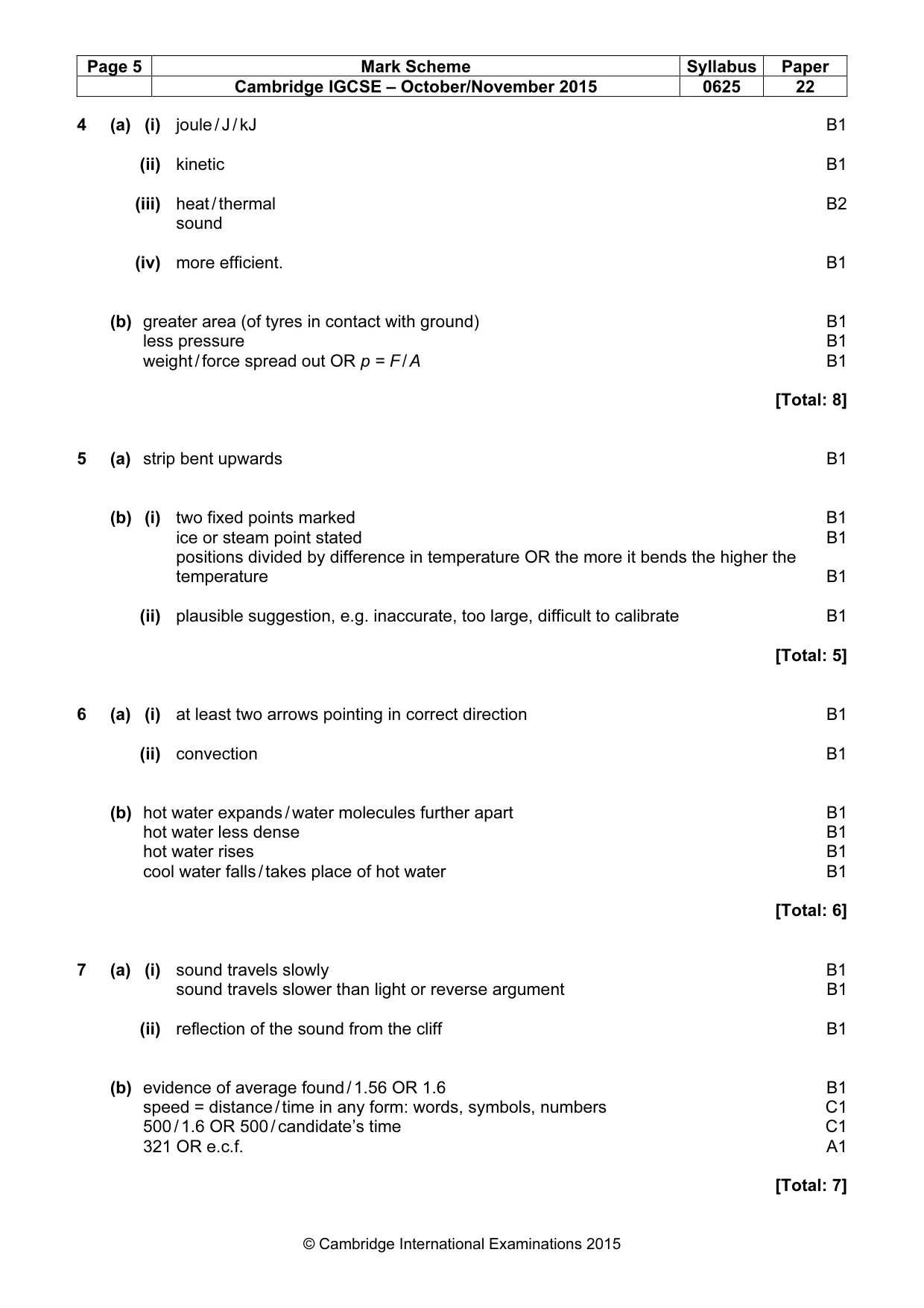
This document consists of 18 printed pages and 2 blank pages. DC (NF/CGW) 96017/4 © UCLES 2015 [Turn over Cambridge International Examinations Cambridge International General Certificate of Secondary Education * 9 1 7 1 7 6 2 9 3 4 * PHYSICS 0625/22 Paper 2 Core October/November 2015 1 hour 15 minutes Candidates answer on the Question Paper. No Additional Materials are required. READ THESE INSTRUCTIONS FIRST Write your Centre number, candidate number and name on all the work you hand in. Write in dark blue or black pen. You may use an HB pencil for any diagrams or graphs. Do not use staples, paper clips, glue or correction fluid. DO NOT WRITE IN ANY BARCODES. Answer all questions. Electronic calculators may be used. You may lose marks if you do not show your working or if you do not use appropriate units. Take the weight of 1 kg to be 10 N (i.e. acceleration of free fall = 10 m / s2). At the end of the examination, fasten all your work securely together. The number of marks is given in brackets [ ] at the end of each question or part question. The syllabus is approved for use in England, Wales and Northern Ireland as a Cambridge International Level 1/Level 2 Certificate.
Question paper, page 2
2 0625/22/O/N/15 © UCLES 2015 BLANK PAGE
Question paper, page 3
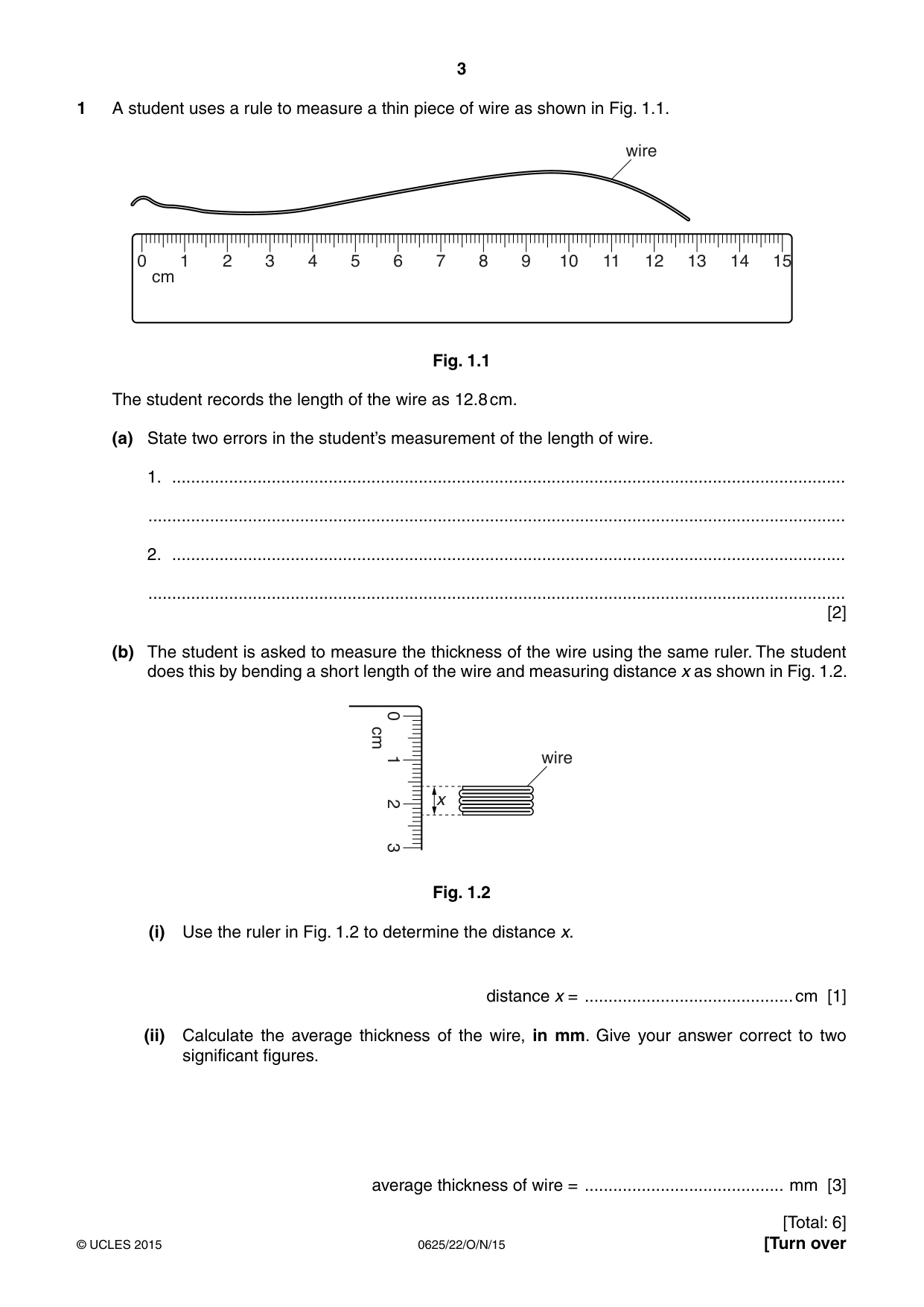
3 0625/22/O/N/15 © UCLES 2015 [Turn over 1 A student uses a rule to measure a thin piece of wire as shown in Fig. 1.1. 0 cm 1 2 3 4 5 6 7 8 9 10 11 wire 12 13 14 15 Fig. 1.1 The student records the length of the wire as 12.8 cm. (a) State two errors in the student’s measurement of the length of wire. 1. … … 2. … … [2] (b) The student is asked to measure the thickness of the wire using the same ruler. The student does this by bending a short length of the wire and measuring distance x as shown in Fig. 1.2. 0 cm 1 2 3 x wire Fig. 1.2 (i) Use the ruler in Fig. 1.2 to determine the distance x. distance x = … cm [1] (ii) Calculate the average thickness of the wire, in mm. Give your answer correct to two significant figures. average thickness of wire = … mm [3] [Total: 6]
Question paper, page 4
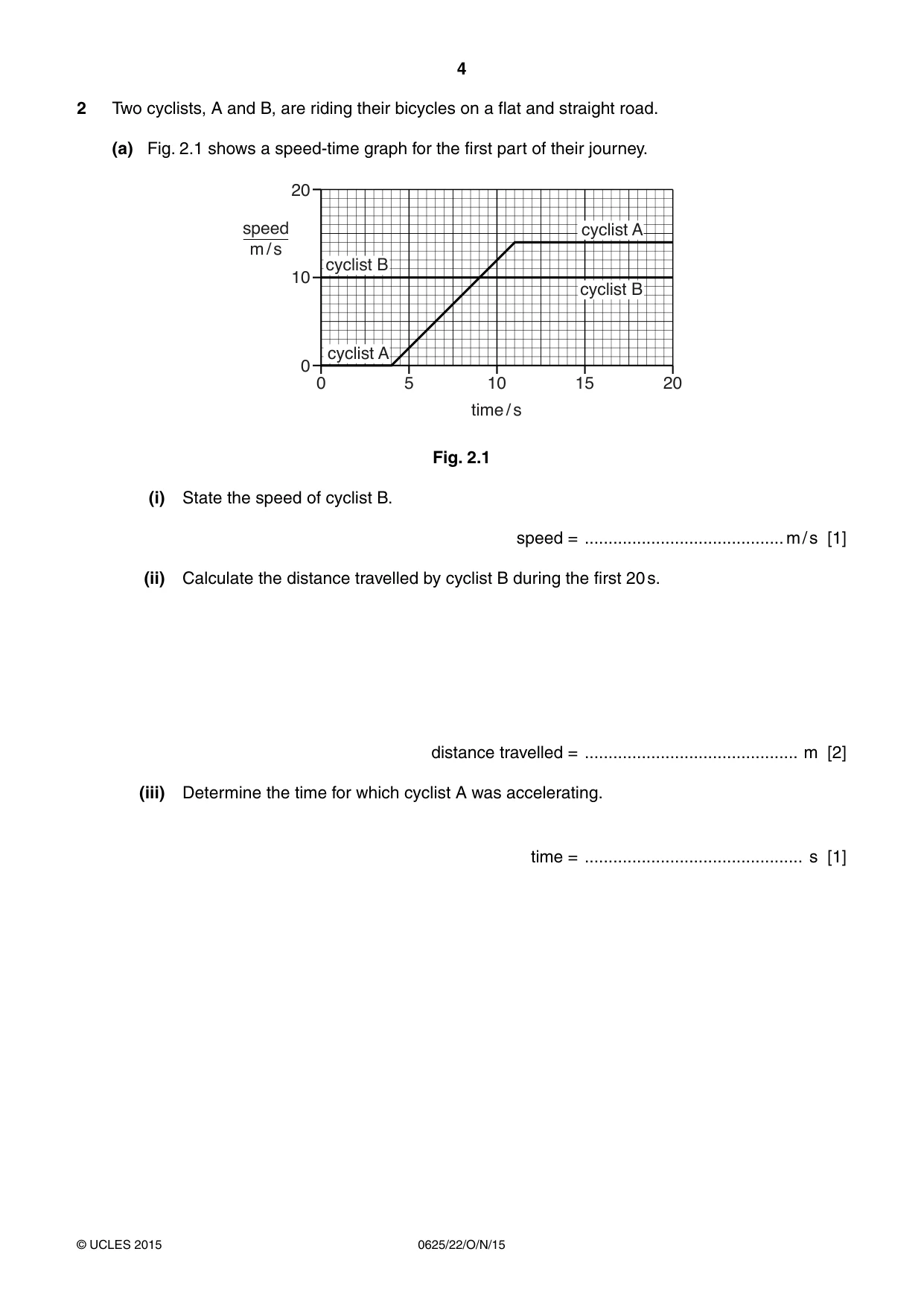
4 0625/22/O/N/15 © UCLES 2015 2 Two cyclists, A and B, are riding their bicycles on a flat and straight road. (a) Fig. 2.1 shows a speed-time graph for the first part of their journey. 0 5 20 10 0 10 time / s speed m / s 15 20 cyclist A cyclist A cyclist B cyclist B Fig. 2.1 (i) State the speed of cyclist B. speed = … m / s [1] (ii) Calculate the distance travelled by cyclist B during the first 20 s. distance travelled = … m [2] (iii) Determine the time for which cyclist A was accelerating. time = … s [1]
Question paper, page 5
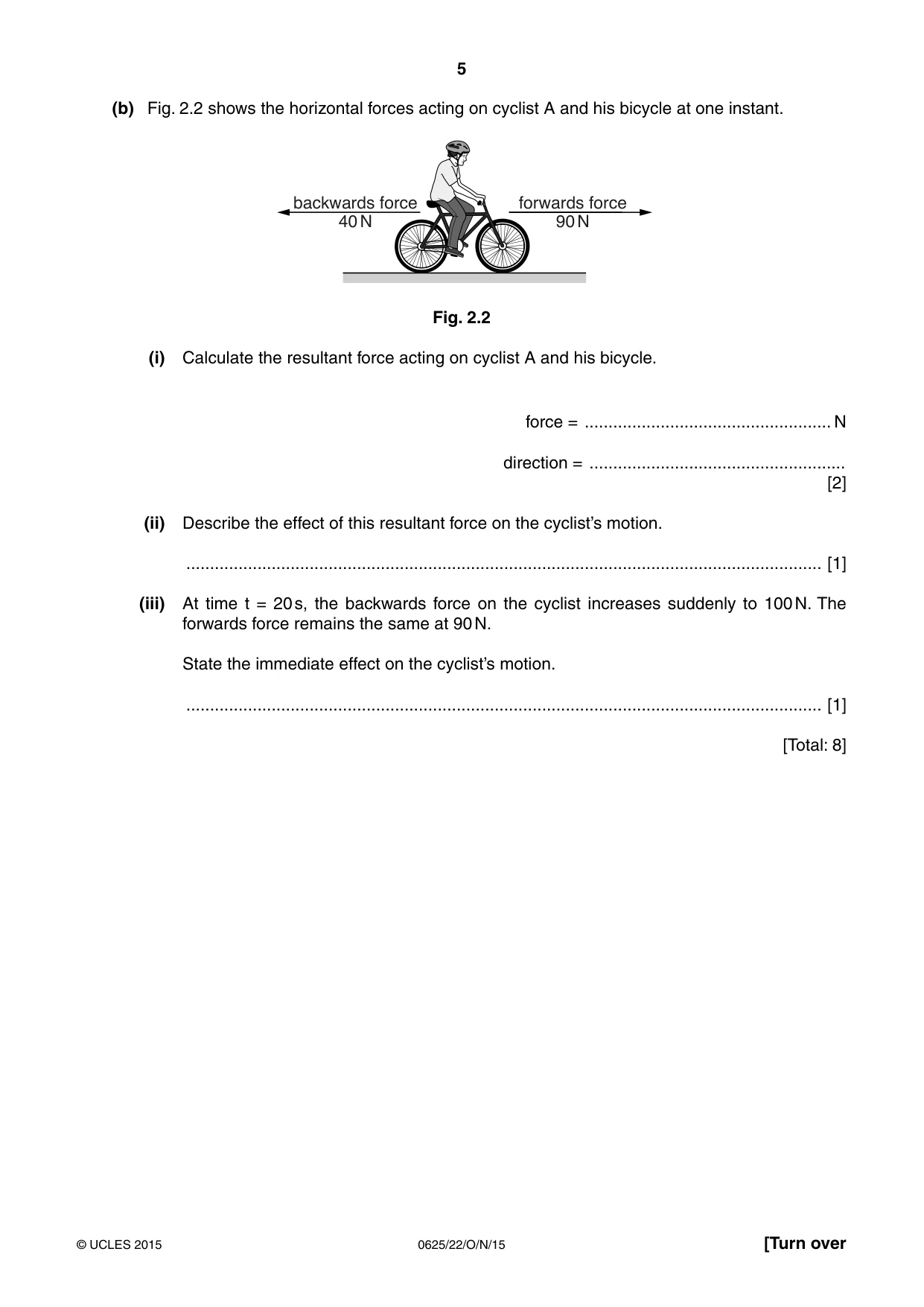
5 0625/22/O/N/15 © UCLES 2015 [Turn over (b) Fig. 2.2 shows the horizontal forces acting on cyclist A and his bicycle at one instant. forwards force 90 N backwards force 40 N Fig. 2.2 (i) Calculate the resultant force acting on cyclist A and his bicycle. force = … N direction = … [2] (ii) Describe the effect of this resultant force on the cyclist’s motion. … [1] (iii) At time t = 20 s, the backwards force on the cyclist increases suddenly to 100 N. The forwards force remains the same at 90 N. State the immediate effect on the cyclist’s motion. … [1] [Total: 8]
Question paper, page 6
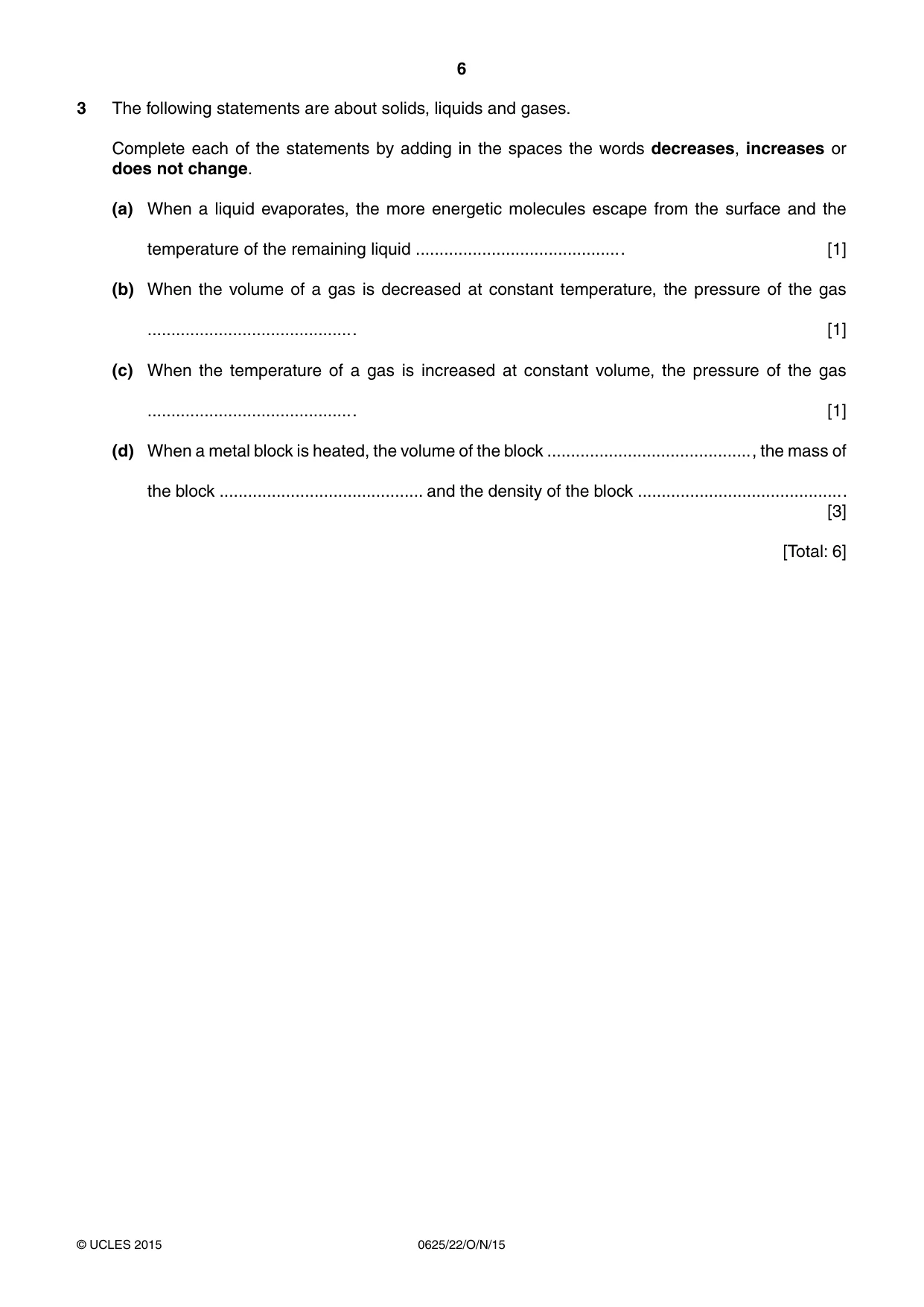
6 0625/22/O/N/15 © UCLES 2015 3 The following statements are about solids, liquids and gases. Complete each of the statements by adding in the spaces the words decreases, increases or does not change. (a) When a liquid evaporates, the more energetic molecules escape from the surface and the temperature of the remaining liquid … . [1] (b) When the volume of a gas is decreased at constant temperature, the pressure of the gas … . [1] (c) When the temperature of a gas is increased at constant volume, the pressure of the gas … . [1] (d) When a metal block is heated, the volume of the block … , the mass of the block … and the density of the block … . [3] [Total: 6]
Question paper, page 7
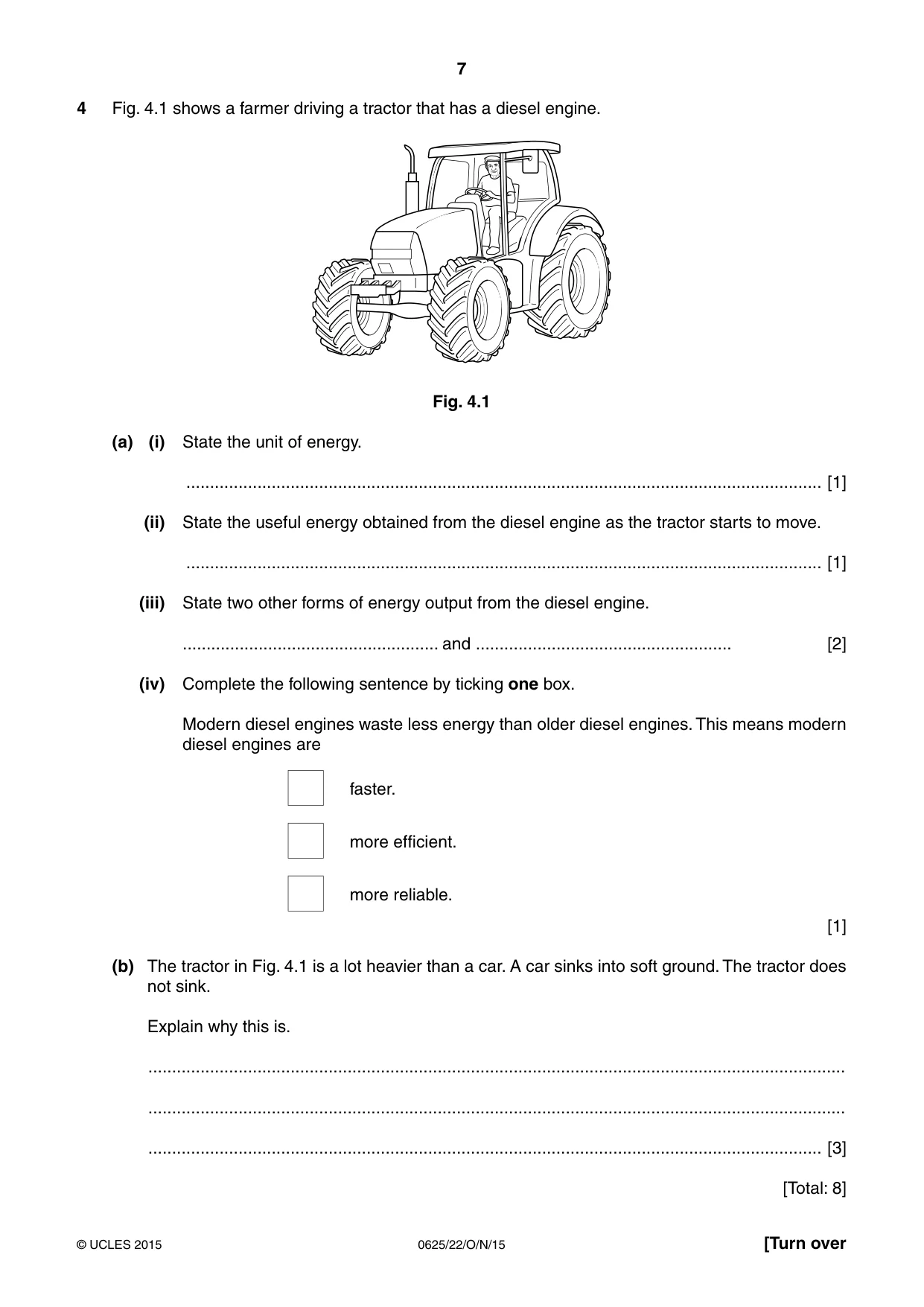
7 0625/22/O/N/15 © UCLES 2015 [Turn over 4 Fig. 4.1 shows a farmer driving a tractor that has a diesel engine. Fig. 4.1 (a) (i) State the unit of energy. … [1] (ii) State the useful energy obtained from the diesel engine as the tractor starts to move. … [1] (iii) State two other forms of energy output from the diesel engine. … and … [2] (iv) Complete the following sentence by ticking one box. Modern diesel engines waste less energy than older diesel engines. This means modern diesel engines are faster. more efficient. more reliable. [1] (b) The tractor in Fig. 4.1 is a lot heavier than a car. A car sinks into soft ground. The tractor does not sink. Explain why this is. … … … [3] [Total: 8]
Question paper, page 8
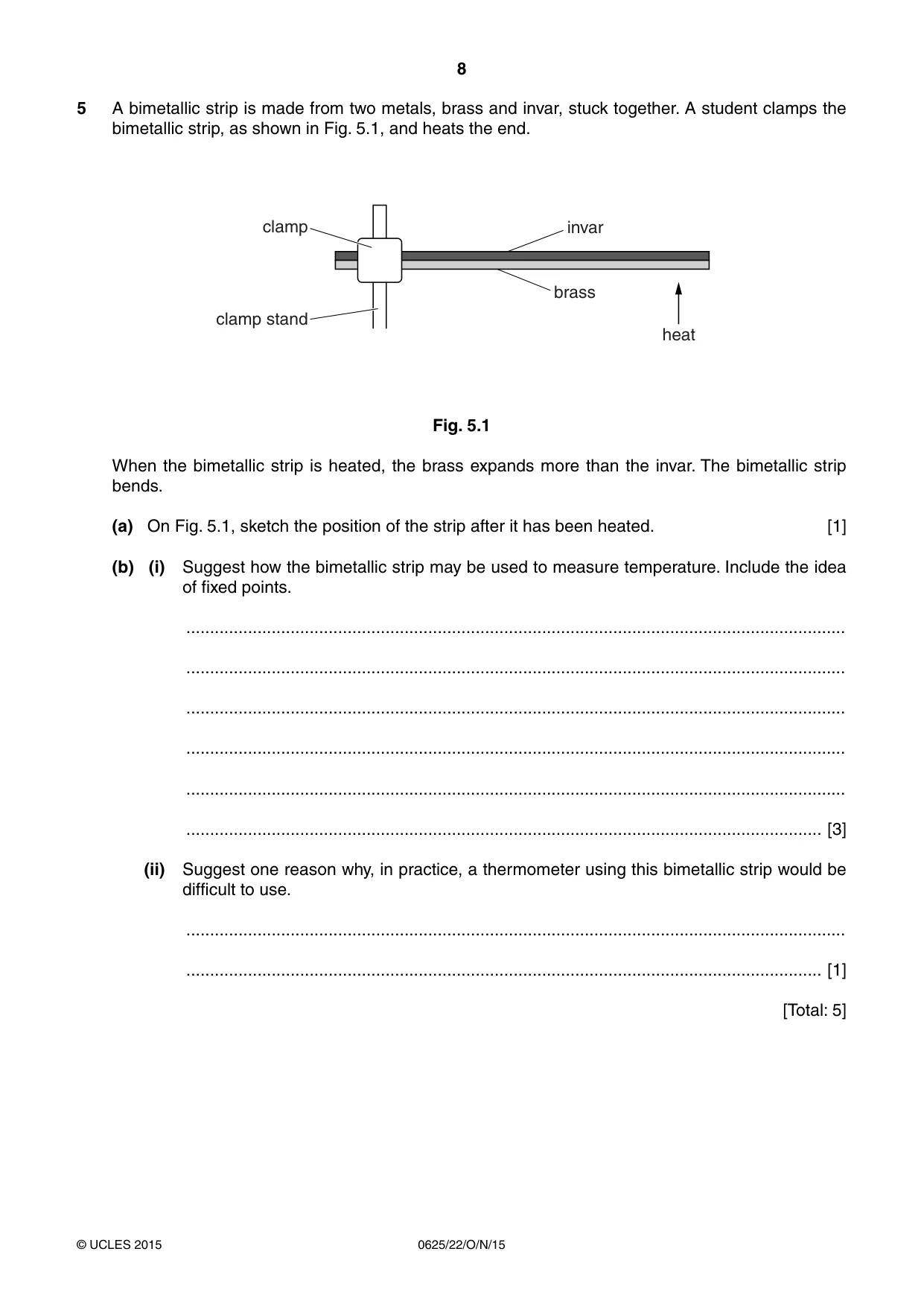
8 0625/22/O/N/15 © UCLES 2015 5 A bimetallic strip is made from two metals, brass and invar, stuck together. A student clamps the bimetallic strip, as shown in Fig. 5.1, and heats the end. clamp stand clamp invar heat brass Fig. 5.1 When the bimetallic strip is heated, the brass expands more than the invar. The bimetallic strip bends. (a) On Fig. 5.1, sketch the position of the strip after it has been heated. [1] (b) (i) Suggest how the bimetallic strip may be used to measure temperature. Include the idea of fixed points. … … … … … … [3] (ii) Suggest one reason why, in practice, a thermometer using this bimetallic strip would be difficult to use. … … [1] [Total: 5]
Question paper, page 9
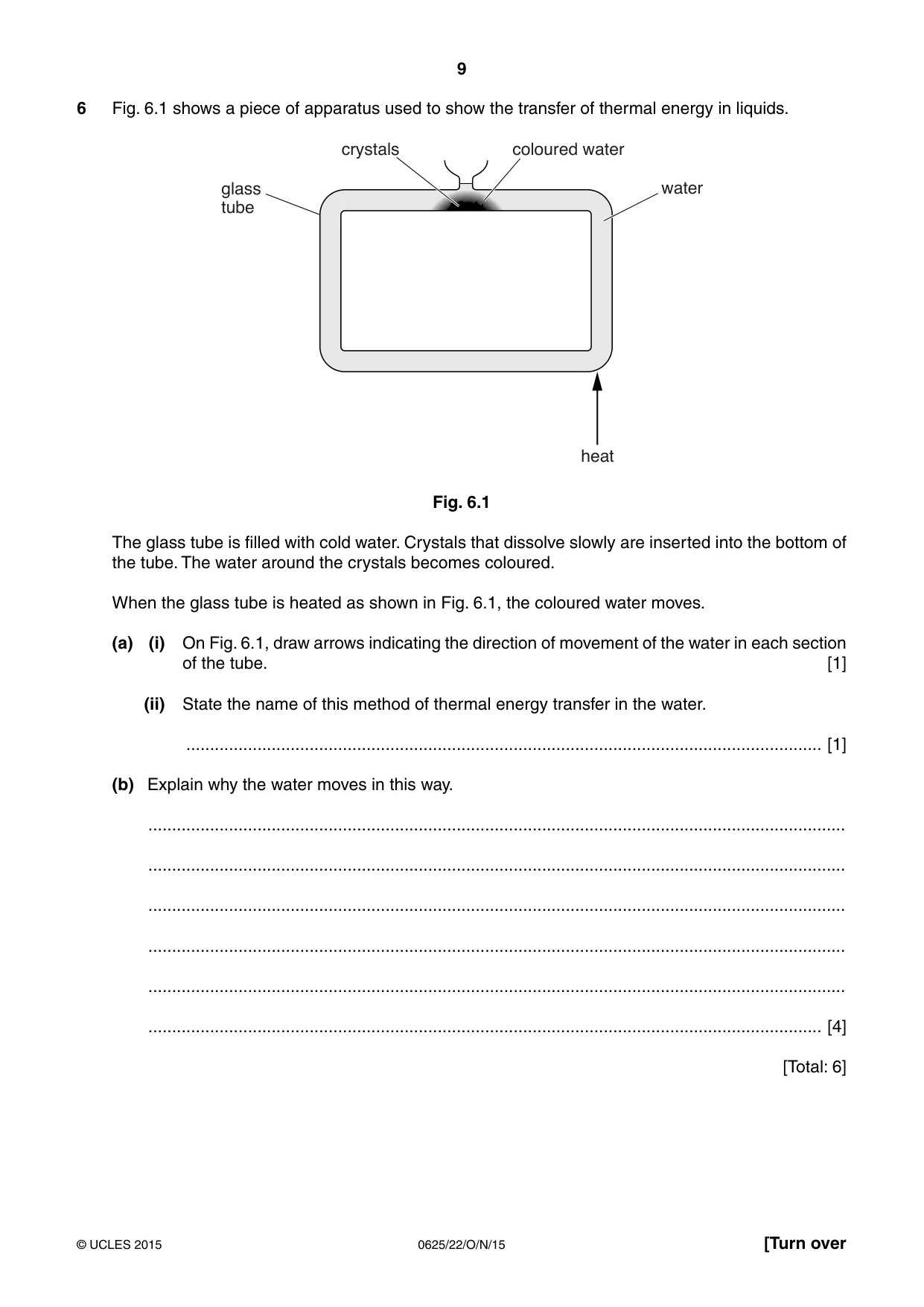
9 0625/22/O/N/15 © UCLES 2015 [Turn over 6 Fig. 6.1 shows a piece of apparatus used to show the transfer of thermal energy in liquids. water glass tube crystals heat coloured water Fig. 6.1 The glass tube is filled with cold water. Crystals that dissolve slowly are inserted into the bottom of the tube. The water around the crystals becomes coloured. When the glass tube is heated as shown in Fig. 6.1, the coloured water moves. (a) (i) On Fig. 6.1, draw arrows indicating the direction of movement of the water in each section of the tube. [1] (ii) State the name of this method of thermal energy transfer in the water. … [1] (b) Explain why the water moves in this way. … … … … … … [4] [Total: 6]
Question paper, page 10
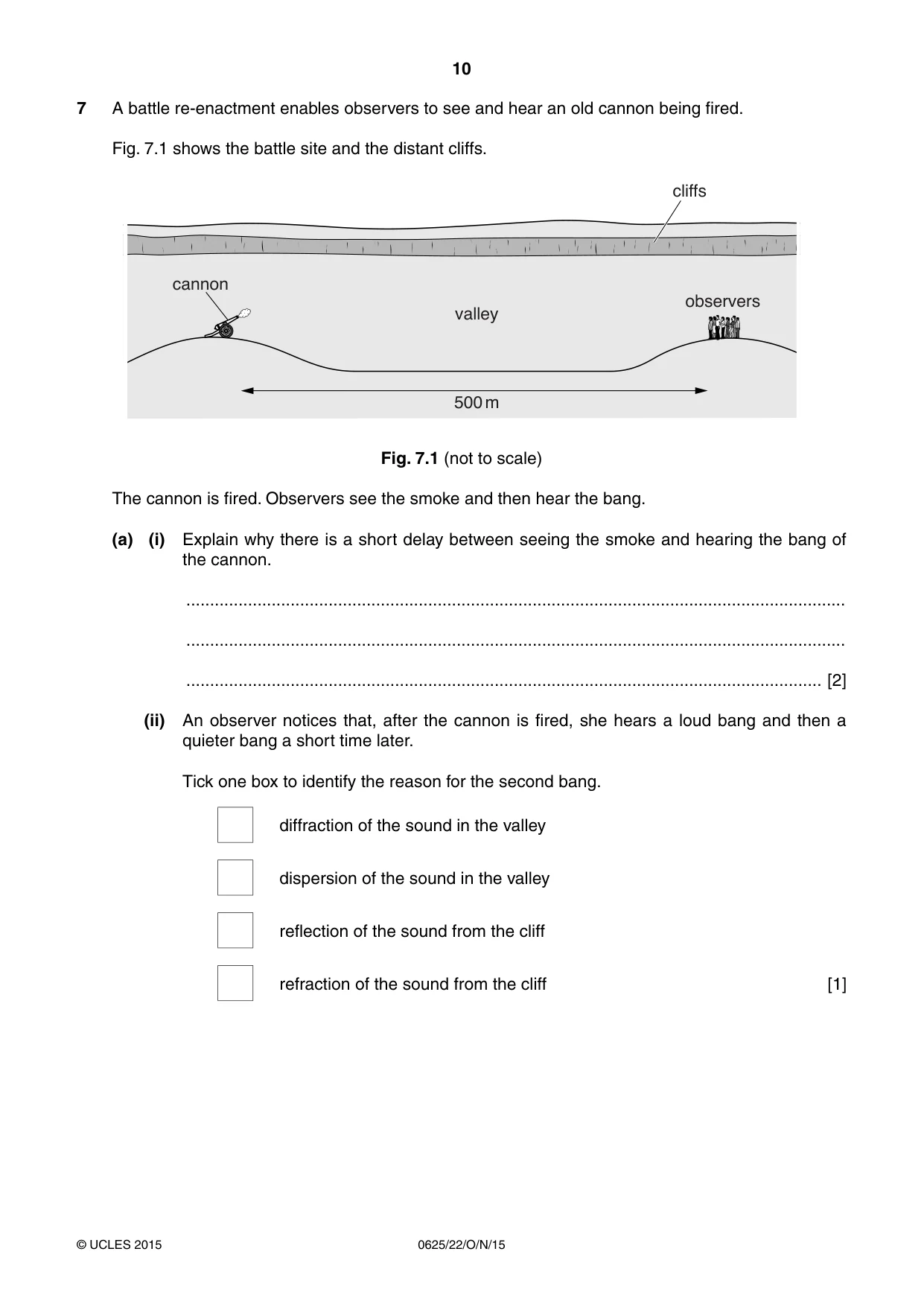
10 0625/22/O/N/15 © UCLES 2015 7 A battle re-enactment enables observers to see and hear an old cannon being fired. Fig. 7.1 shows the battle site and the distant cliffs. 500 m valley cliffs observers cannon Fig. 7.1 (not to scale) The cannon is fired. Observers see the smoke and then hear the bang. (a) (i) Explain why there is a short delay between seeing the smoke and hearing the bang of the cannon. … … … [2] (ii) An observer notices that, after the cannon is fired, she hears a loud bang and then a quieter bang a short time later. Tick one box to identify the reason for the second bang. diffraction of the sound in the valley dispersion of the sound in the valley reflection of the sound from the cliff refraction of the sound from the cliff [1]
Question paper, page 11
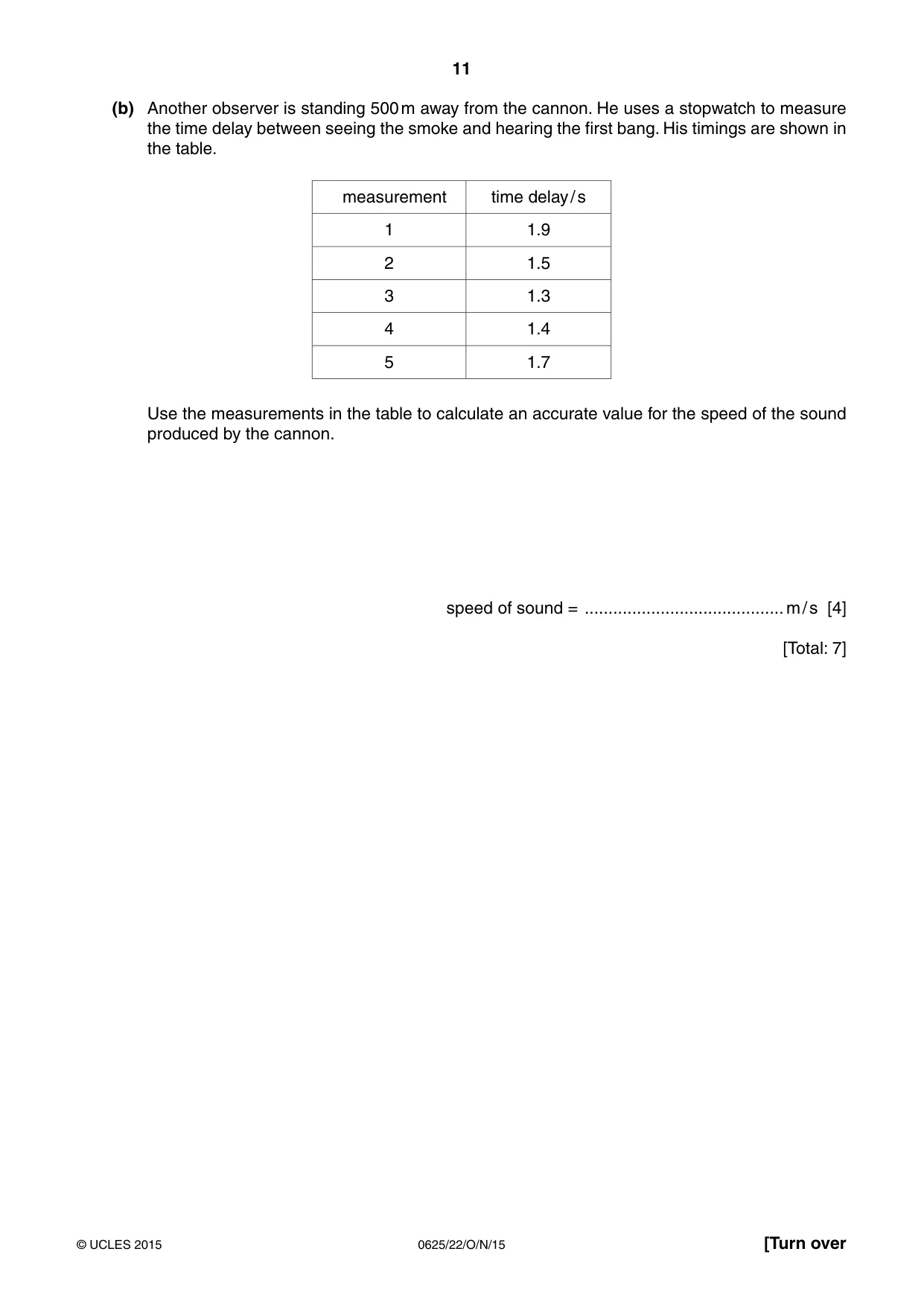
11 0625/22/O/N/15 © UCLES 2015 [Turn over (b) Another observer is standing 500 m away from the cannon. He uses a stopwatch to measure the time delay between seeing the smoke and hearing the first bang. His timings are shown in the table. measurement time delay / s 1 1.9 2 1.5 3 1.3 4 1.4 5 1.7 Use the measurements in the table to calculate an accurate value for the speed of the sound produced by the cannon. speed of sound = … m / s [4] [Total: 7]
Question paper, page 12
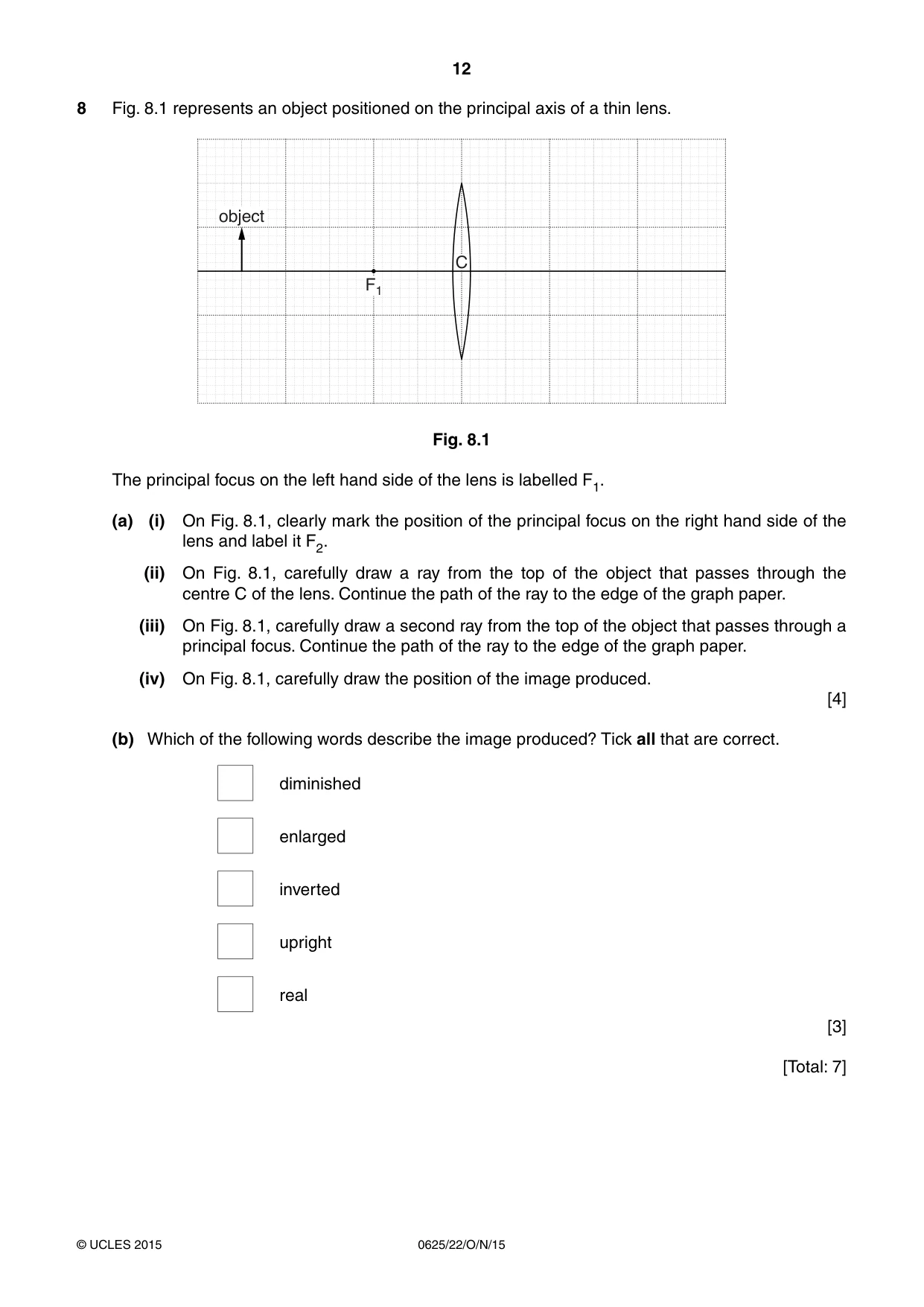
12 0625/22/O/N/15 © UCLES 2015 8 Fig. 8.1 represents an object positioned on the principal axis of a thin lens. F1 object C Fig. 8.1 The principal focus on the left hand side of the lens is labelled F1. (a) (i) On Fig. 8.1, clearly mark the position of the principal focus on the right hand side of the lens and label it F2. (ii) On Fig. 8.1, carefully draw a ray from the top of the object that passes through the centre C of the lens. Continue the path of the ray to the edge of the graph paper. (iii) On Fig. 8.1, carefully draw a second ray from the top of the object that passes through a principal focus. Continue the path of the ray to the edge of the graph paper. (iv) On Fig. 8.1, carefully draw the position of the image produced. [4] (b) Which of the following words describe the image produced? Tick all that are correct. diminished enlarged inverted upright real [3] [Total: 7]
Question paper, page 13
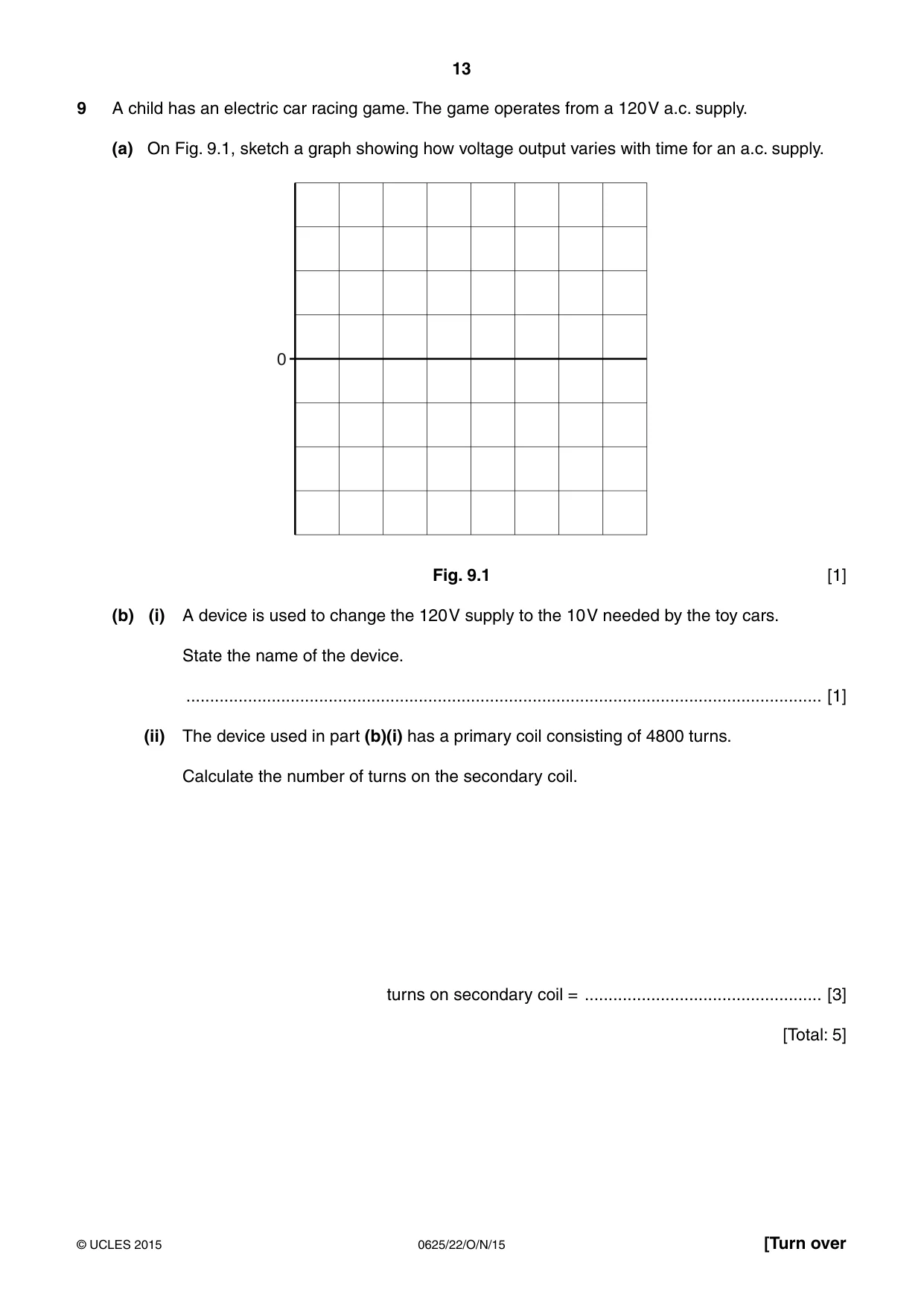
13 0625/22/O/N/15 © UCLES 2015 [Turn over 9 A child has an electric car racing game. The game operates from a 120 V a.c. supply. (a) On Fig. 9.1, sketch a graph showing how voltage output varies with time for an a.c. supply. 0 Fig. 9.1 [1] (b) (i) A device is used to change the 120 V supply to the 10 V needed by the toy cars. State the name of the device. … [1] (ii) The device used in part (b)(i) has a primary coil consisting of 4800 turns. Calculate the number of turns on the secondary coil. turns on secondary coil = … [3] [Total: 5]
Question paper, page 14
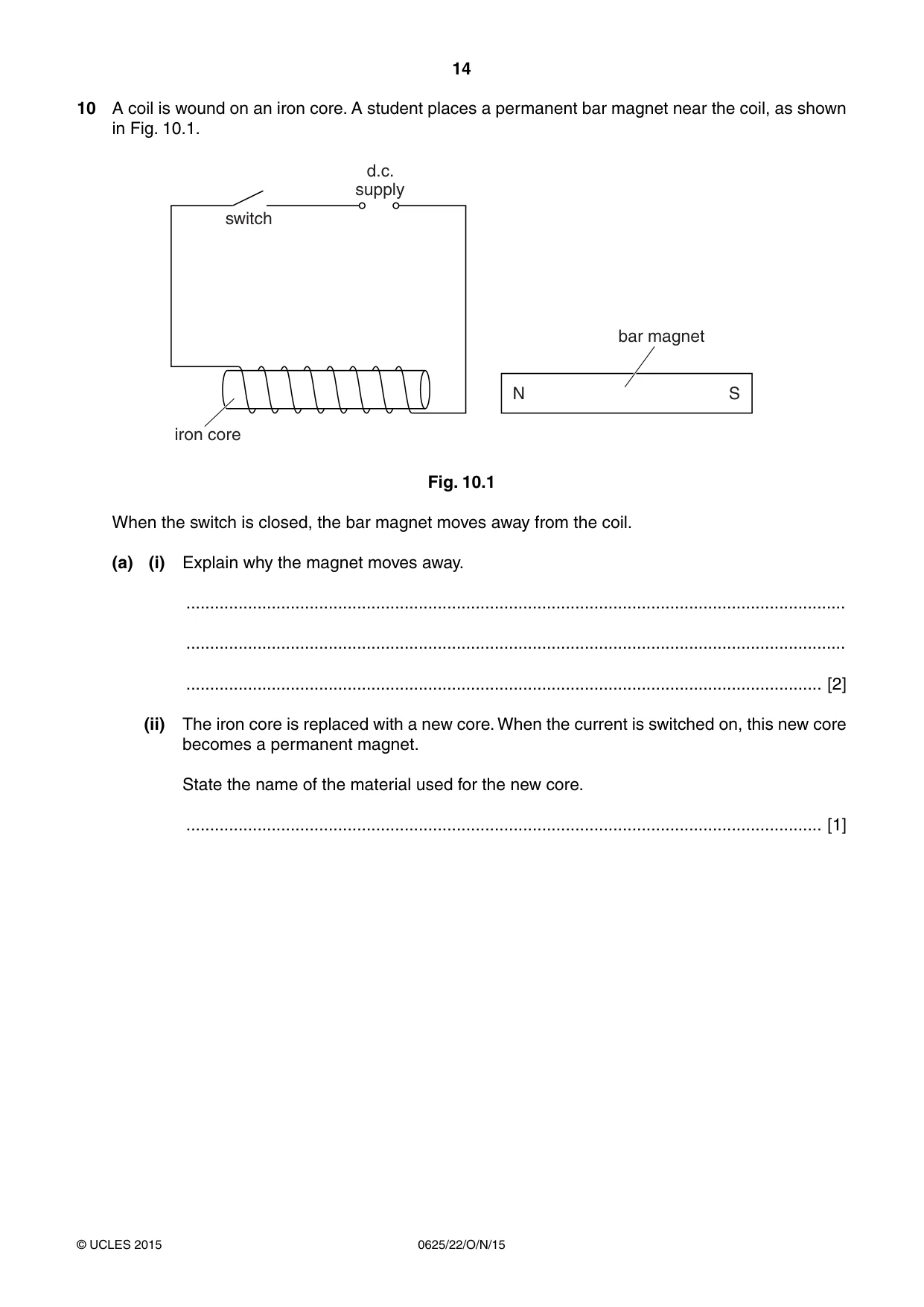
14 0625/22/O/N/15 © UCLES 2015 10 A coil is wound on an iron core. A student places a permanent bar magnet near the coil, as shown in Fig. 10.1. switch d.c. supply N S iron core bar magnet Fig. 10.1 When the switch is closed, the bar magnet moves away from the coil. (a) (i) Explain why the magnet moves away. … … … [2] (ii) The iron core is replaced with a new core. When the current is switched on, this new core becomes a permanent magnet. State the name of the material used for the new core. … [1]
Question paper, page 15
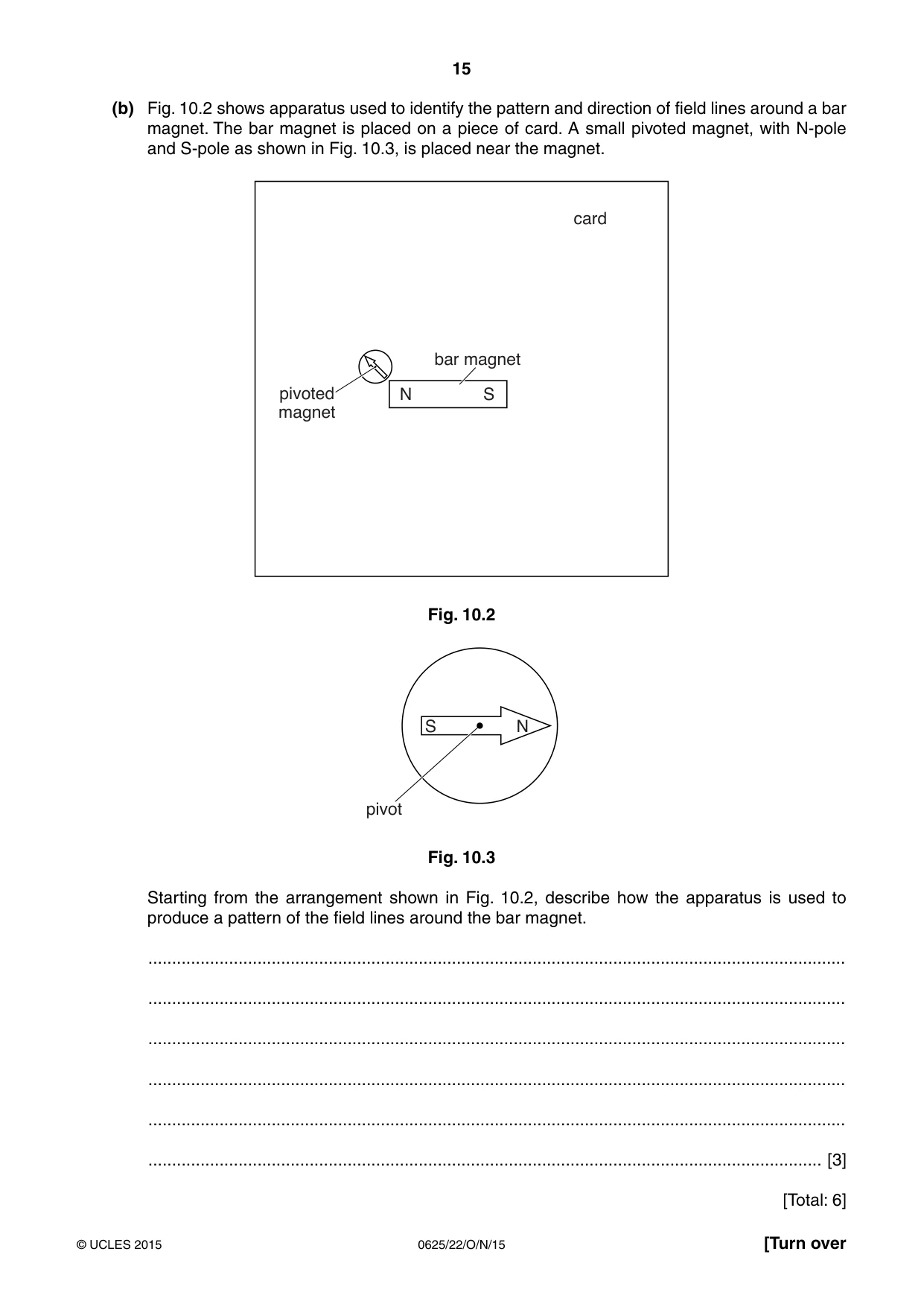
15 0625/22/O/N/15 © UCLES 2015 [Turn over (b) Fig. 10.2 shows apparatus used to identify the pattern and direction of field lines around a bar magnet. The bar magnet is placed on a piece of card. A small pivoted magnet, with N-pole and S-pole as shown in Fig. 10.3, is placed near the magnet. card bar magnet pivoted magnet N S Fig. 10.2 pivot N S Fig. 10.3 Starting from the arrangement shown in Fig. 10.2, describe how the apparatus is used to produce a pattern of the field lines around the bar magnet. … … … … … … [3] [Total: 6]
Question paper, page 16
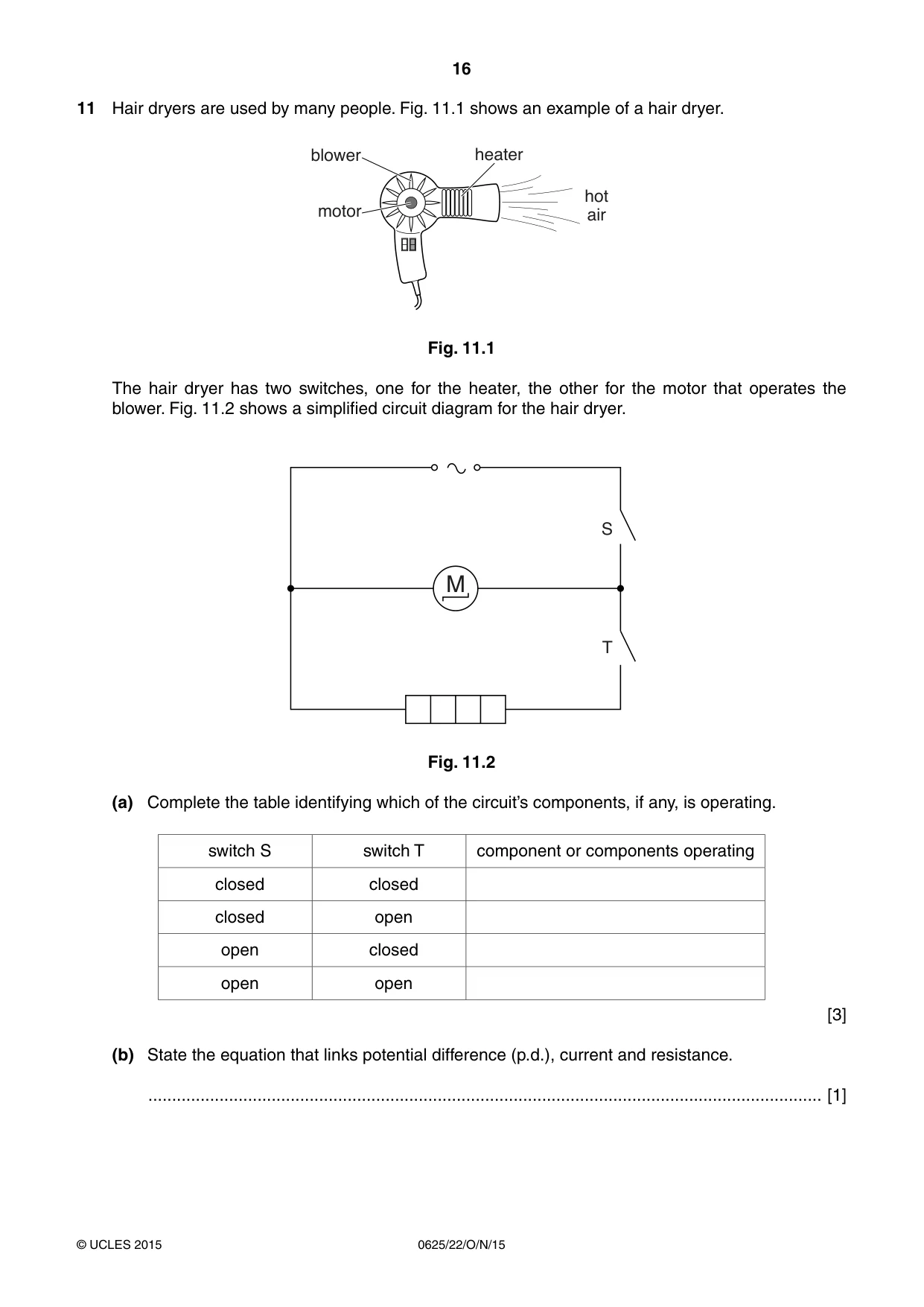
16 0625/22/O/N/15 © UCLES 2015 11 Hair dryers are used by many people. Fig. 11.1 shows an example of a hair dryer. blower heater hot air motor Fig. 11.1 The hair dryer has two switches, one for the heater, the other for the motor that operates the blower. Fig. 11.2 shows a simplified circuit diagram for the hair dryer. S T M Fig. 11.2 (a) Complete the table identifying which of the circuit’s components, if any, is operating. switch S switch T component or components operating closed closed closed open open closed open open [3] (b) State the equation that links potential difference (p.d.), current and resistance. … [1]
Question paper, page 17
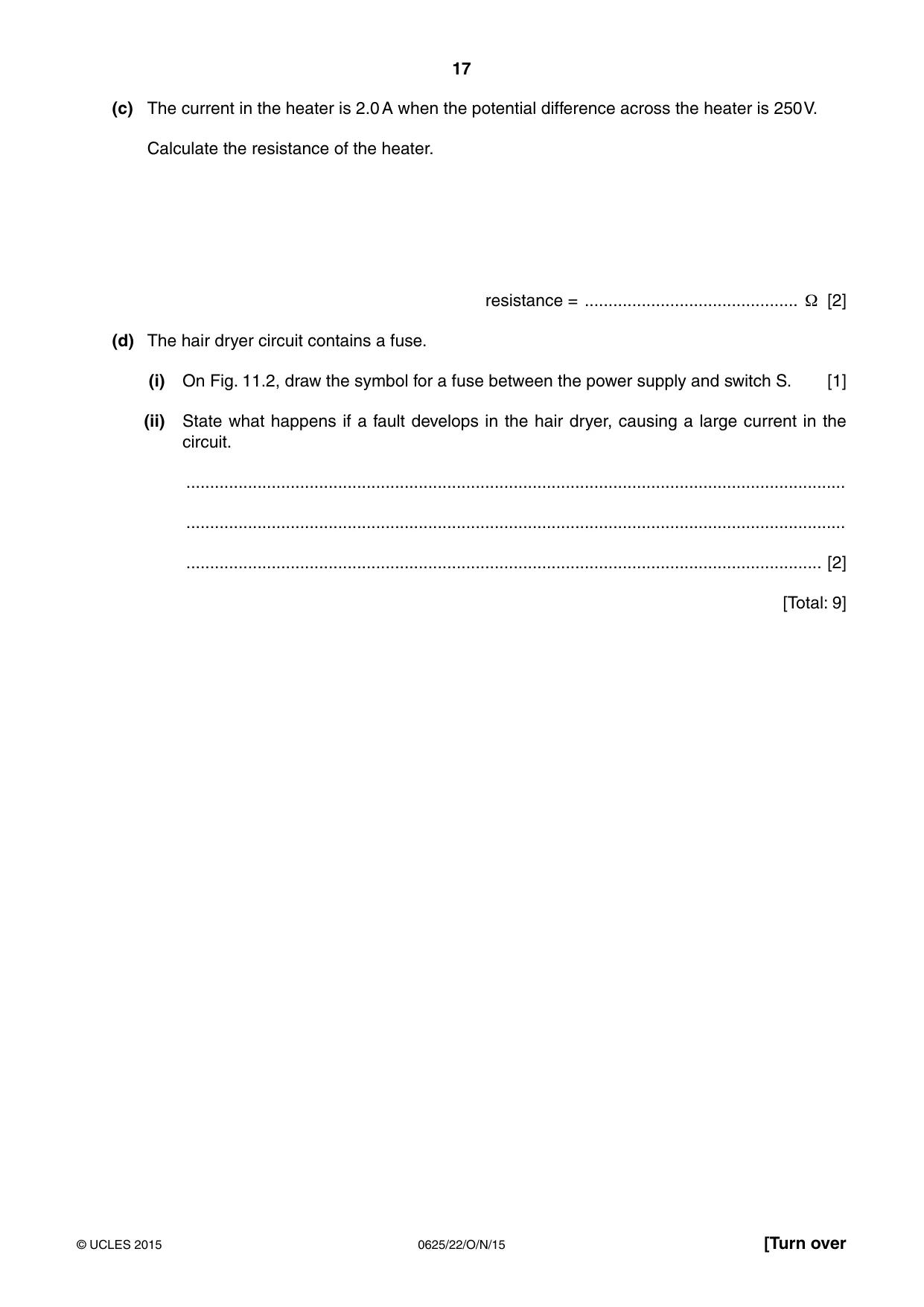
17 0625/22/O/N/15 © UCLES 2015 [Turn over (c) The current in the heater is 2.0 A when the potential difference across the heater is 250 V. Calculate the resistance of the heater. resistance = … Ω [2] (d) The hair dryer circuit contains a fuse. (i) On Fig. 11.2, draw the symbol for a fuse between the power supply and switch S. [1] (ii) State what happens if a fault develops in the hair dryer, causing a large current in the circuit. … … … [2] [Total: 9]
Question paper, page 18
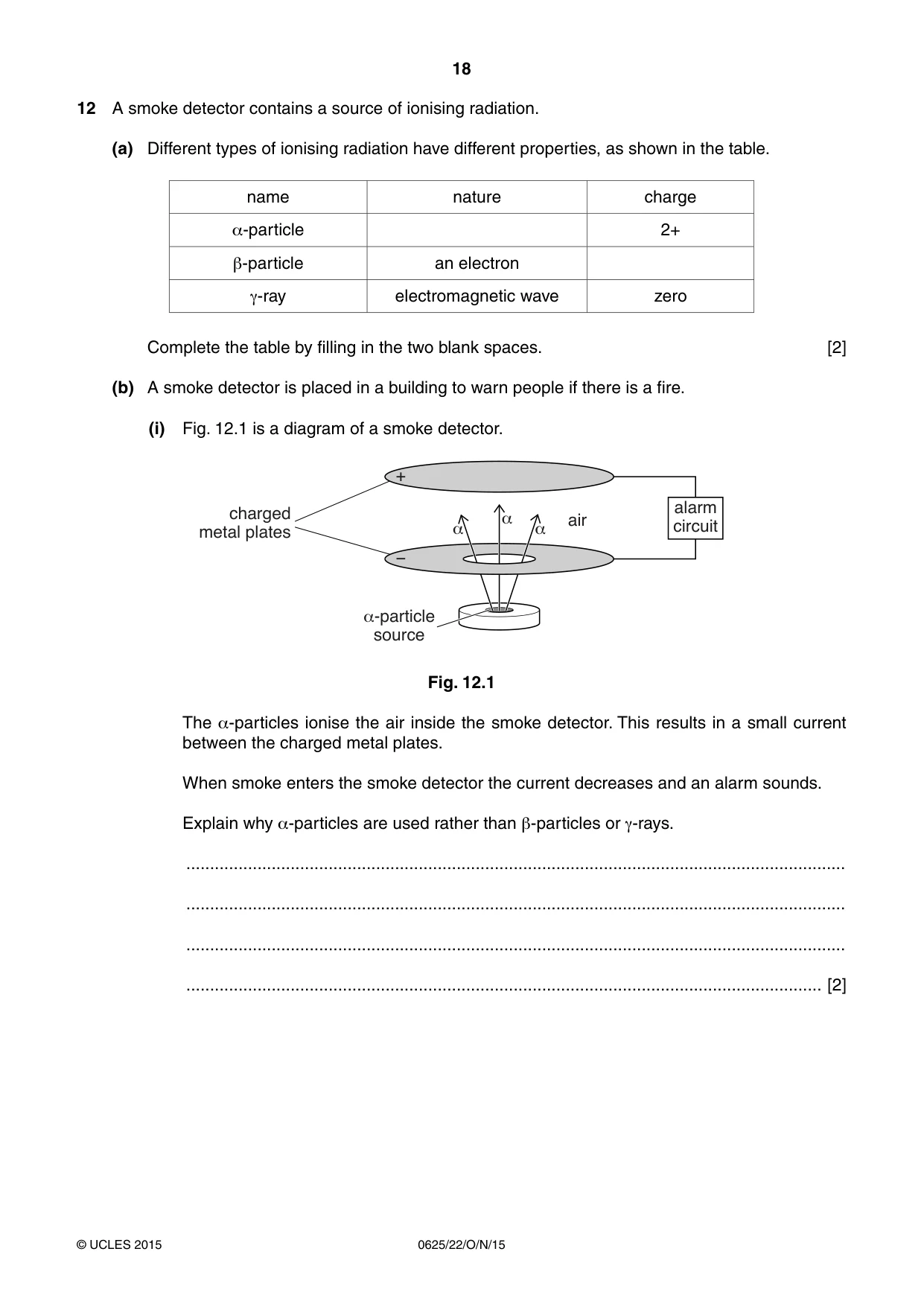
18 0625/22/O/N/15 © UCLES 2015 12 A smoke detector contains a source of ionising radiation. (a) Different types of ionising radiation have different properties, as shown in the table. name nature charge α-particle 2+ β-particle an electron γ-ray electromagnetic wave zero Complete the table by filling in the two blank spaces. [2] (b) A smoke detector is placed in a building to warn people if there is a fire. (i) Fig. 12.1 is a diagram of a smoke detector. ï charged metal plates air _-particle source _ _ _ + alarm circuit Fig. 12.1 The α-particles ionise the air inside the smoke detector. This results in a small current between the charged metal plates. When smoke enters the smoke detector the current decreases and an alarm sounds. Explain why α-particles are used rather than β-particles or γ-rays. … … … … [2]
Question paper, page 19
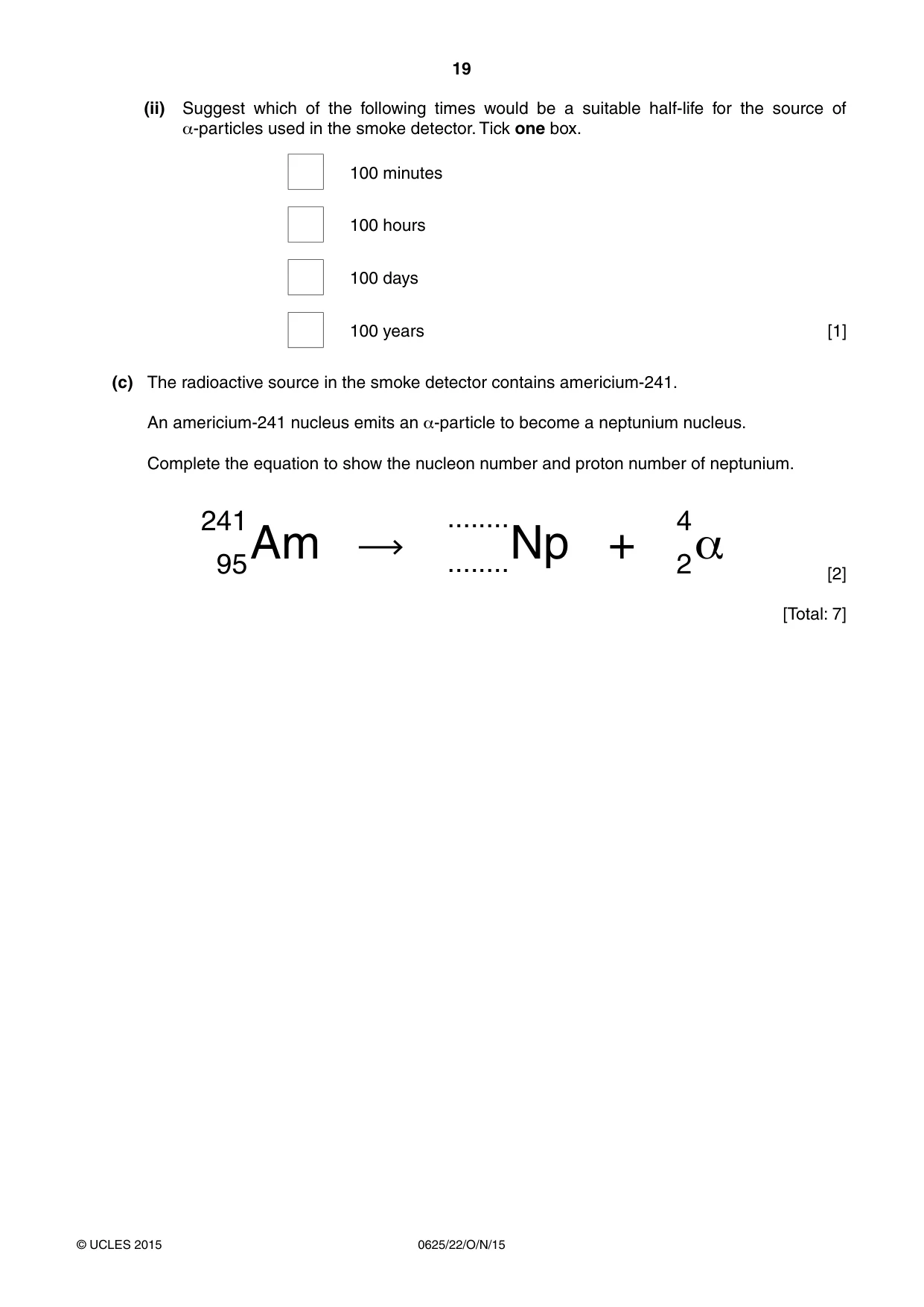
19 0625/22/O/N/15 © UCLES 2015 (ii) Suggest which of the following times would be a suitable half-life for the source of α-particles used in the smoke detector. Tick one box. 100 minutes 100 hours 100 days 100 years [1] (c) The radioactive source in the smoke detector contains americium-241. An americium-241 nucleus emits an α-particle to become a neptunium nucleus. Complete the equation to show the nucleon number and proton number of neptunium. 241 95 Am … … Np + 4 2 α [2] [Total: 7]
Question paper, page 20
20 0625/22/O/N/15 © UCLES 2015 BLANK PAGE Permission to reproduce items where third-party owned material protected by copyright is included has been sought and cleared where possible. Every reasonable effort has been made by the publisher (UCLES) to trace copyright holders, but if any items requiring clearance have unwittingly been included, the publisher will be pleased to make amends at the earliest possible opportunity. To avoid the issue of disclosure of answer-related information to candidates, all copyright acknowledgements are reproduced online in the Cambridge International Examinations Copyright Acknowledgements Booklet. This is produced for each series of examinations and is freely available to download at www.cie.org.uk after the live examination series. Cambridge International Examinations is part of the Cambridge Assessment Group. Cambridge Assessment is the brand name of University of Cambridge Local Examinations Syndicate (UCLES), which is itself a department of the University of Cambridge.
Mark scheme, page 1
® IGCSE is the registered trademark of Cambridge International Examinations. CAMBRIDGE INTERNATIONAL EXAMINATIONS Cambridge International General Certificate of Secondary Education MARK SCHEME for the October/November 2015 series 0625 PHYSICS 0625/22 Paper 2 (Core Theory), maximum raw mark 80 This mark scheme is published as an aid to teachers and candidates, to indicate the requirements of the examination. It shows the basis on which Examiners were instructed to award marks. It does not indicate the details of the discussions that took place at an Examiners’ meeting before marking began, which would have considered the acceptability of alternative answers. Mark schemes should be read in conjunction with the question paper and the Principal Examiner Report for Teachers. Cambridge will not enter into discussions about these mark schemes. Cambridge is publishing the mark schemes for the October/November 2015 series for most Cambridge IGCSE®, Cambridge International A and AS Level components and some Cambridge O Level components.
Mark scheme, page 2
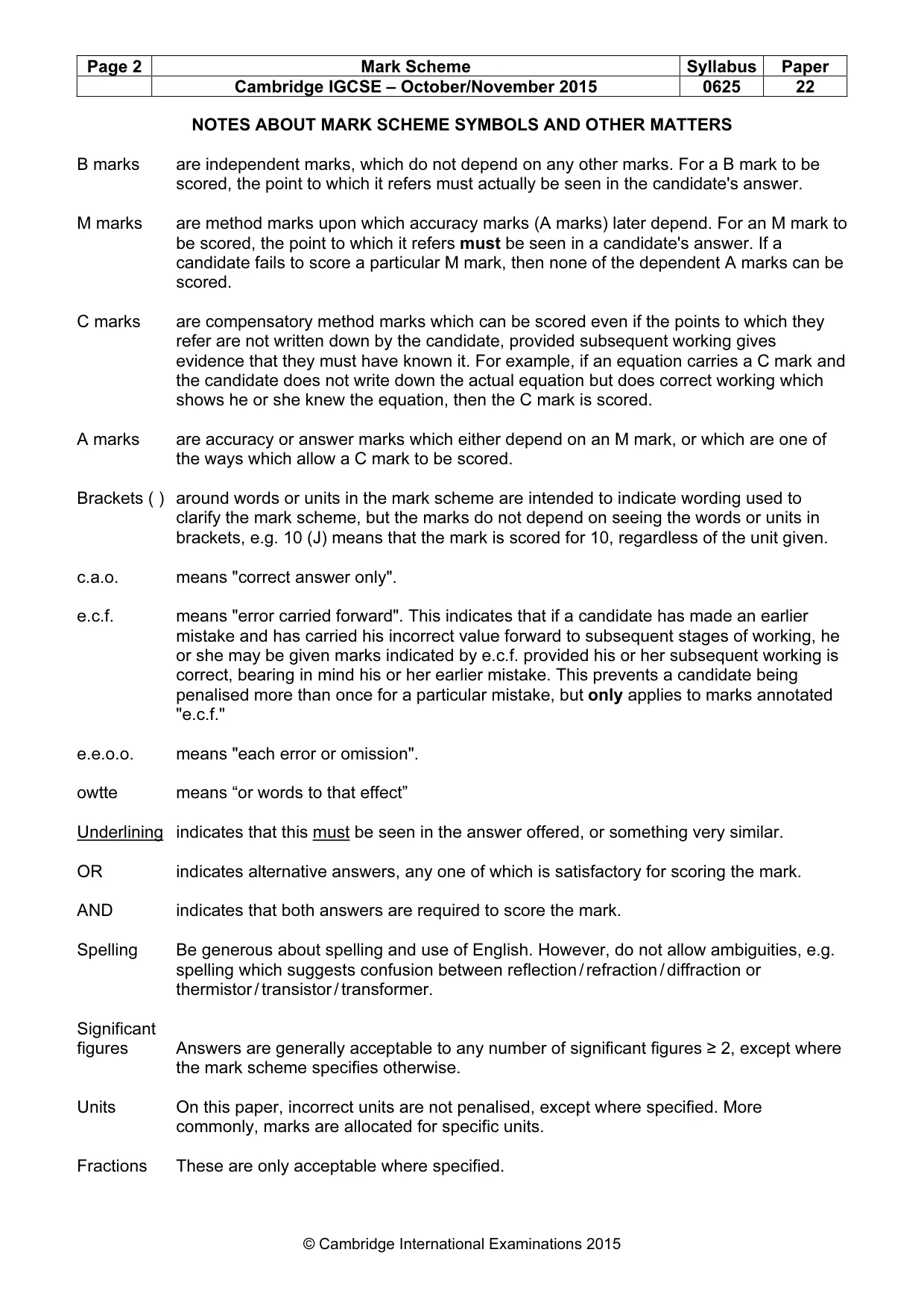
Page 2 Mark Scheme Syllabus Paper Cambridge IGCSE – October/November 2015 0625 22 © Cambridge International Examinations 2015 NOTES ABOUT MARK SCHEME SYMBOLS AND OTHER MATTERS B marks are independent marks, which do not depend on any other marks. For a B mark to be scored, the point to which it refers must actually be seen in the candidate's answer. M marks are method marks upon which accuracy marks (A marks) later depend. For an M mark to be scored, the point to which it refers must be seen in a candidate's answer. If a candidate fails to score a particular M mark, then none of the dependent A marks can be scored. C marks are compensatory method marks which can be scored even if the points to which they refer are not written down by the candidate, provided subsequent working gives evidence that they must have known it. For example, if an equation carries a C mark and the candidate does not write down the actual equation but does correct working which shows he or she knew the equation, then the C mark is scored. A marks are accuracy or answer marks which either depend on an M mark, or which are one of the ways which allow a C mark to be scored. Brackets ( ) around words or units in the mark scheme are intended to indicate wording used to clarify the mark scheme, but the marks do not depend on seeing the words or units in brackets, e.g. 10 (J) means that the mark is scored for 10, regardless of the unit given. c.a.o. means "correct answer only". e.c.f. means "error carried forward". This indicates that if a candidate has made an earlier mistake and has carried his incorrect value forward to subsequent stages of working, he or she may be given marks indicated by e.c.f. provided his or her subsequent working is correct, bearing in mind his or her earlier mistake. This prevents a candidate being penalised more than once for a particular mistake, but only applies to marks annotated "e.c.f." e.e.o.o. means "each error or omission". owtte means “or words to that effect” Underlining indicates that this must be seen in the answer offered, or something very similar. OR indicates alternative answers, any one of which is satisfactory for scoring the mark. AND indicates that both answers are required to score the mark. Spelling Be generous about spelling and use of English. However, do not allow ambiguities, e.g. spelling which suggests confusion between reflection / refraction / diffraction or thermistor / transistor / transformer. Significant figures Answers are generally acceptable to any number of significant figures ≥ 2, except where the mark scheme specifies otherwise. Units On this paper, incorrect units are not penalised, except where specified. More commonly, marks are allocated for specific units. Fractions These are only acceptable where specified.
Mark scheme, page 3
Page 3 Mark Scheme Syllabus Paper Cambridge IGCSE – October/November 2015 0625 22 © Cambridge International Examinations 2015 NOT indicates that an incorrect answer is not to be disregarded, but cancels another otherwise correct alternative offered by the candidate. i.e. right plus wrong penalty applies.
Mark scheme, page 4
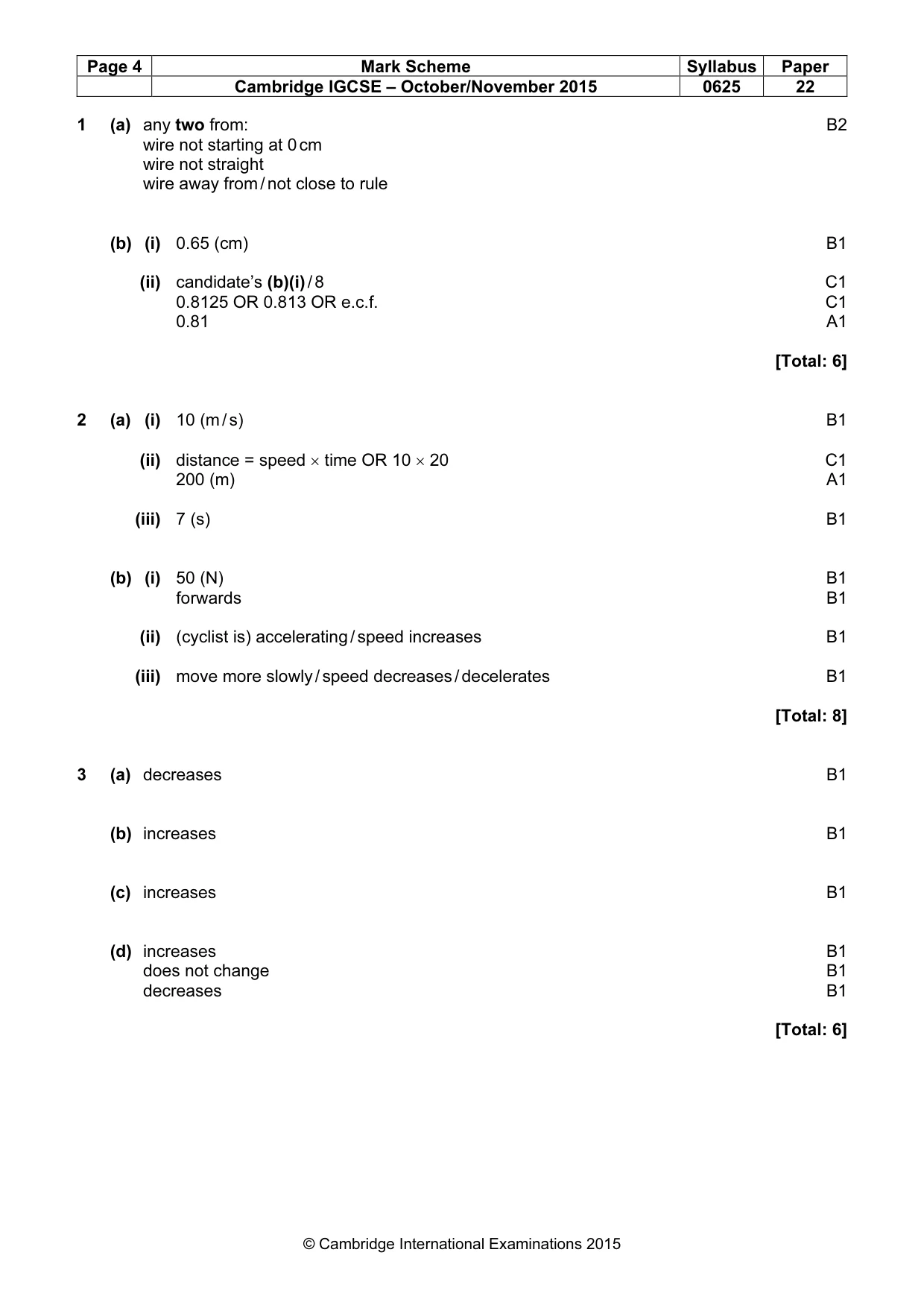
Page 4 Mark Scheme Syllabus Paper Cambridge IGCSE – October/November 2015 0625 22 © Cambridge International Examinations 2015 1 (a) any two from: B2 wire not starting at 0 cm wire not straight wire away from / not close to rule (b) (i) 0.65 (cm) B1 (ii) candidate’s (b)(i) / 8 C1 0.8125 OR 0.813 OR e.c.f. C1 0.81 A1 [Total: 6] 2 (a) (i) 10 (m / s) B1 (ii) distance = speed × time OR 10 × 20 C1 200 (m) A1 (iii) 7 (s) B1 (b) (i) 50 (N) B1 forwards B1 (ii) (cyclist is) accelerating / speed increases B1 (iii) move more slowly / speed decreases / decelerates B1 [Total: 8] 3 (a) decreases B1 (b) increases B1 (c) increases B1 (d) increases B1 does not change B1 decreases B1 [Total: 6]
Mark scheme, page 5
Page 5 Mark Scheme Syllabus Paper Cambridge IGCSE – October/November 2015 0625 22 © Cambridge International Examinations 2015 4 (a) (i) joule / J / kJ B1 (ii) kinetic B1 (iii) heat / thermal B2 sound (iv) more efficient. B1 (b) greater area (of tyres in contact with ground) B1 less pressure B1 weight / force spread out OR p = F / A B1 [Total: 8] 5 (a) strip bent upwards B1 (b) (i) two fixed points marked B1 ice or steam point stated B1 positions divided by difference in temperature OR the more it bends the higher the temperature B1 (ii) plausible suggestion, e.g. inaccurate, too large, difficult to calibrate B1 [Total: 5] 6 (a) (i) at least two arrows pointing in correct direction B1 (ii) convection B1 (b) hot water expands / water molecules further apart B1 hot water less dense B1 hot water rises B1 cool water falls / takes place of hot water B1 [Total: 6] 7 (a) (i) sound travels slowly B1 sound travels slower than light or reverse argument B1 (ii) reflection of the sound from the cliff B1 (b) evidence of average found / 1.56 OR 1.6 B1 speed = distance / time in any form: words, symbols, numbers C1 500 / 1.6 OR 500 / candidate’s time C1 321 OR e.c.f. A1 [Total: 7]
Mark scheme, page 6
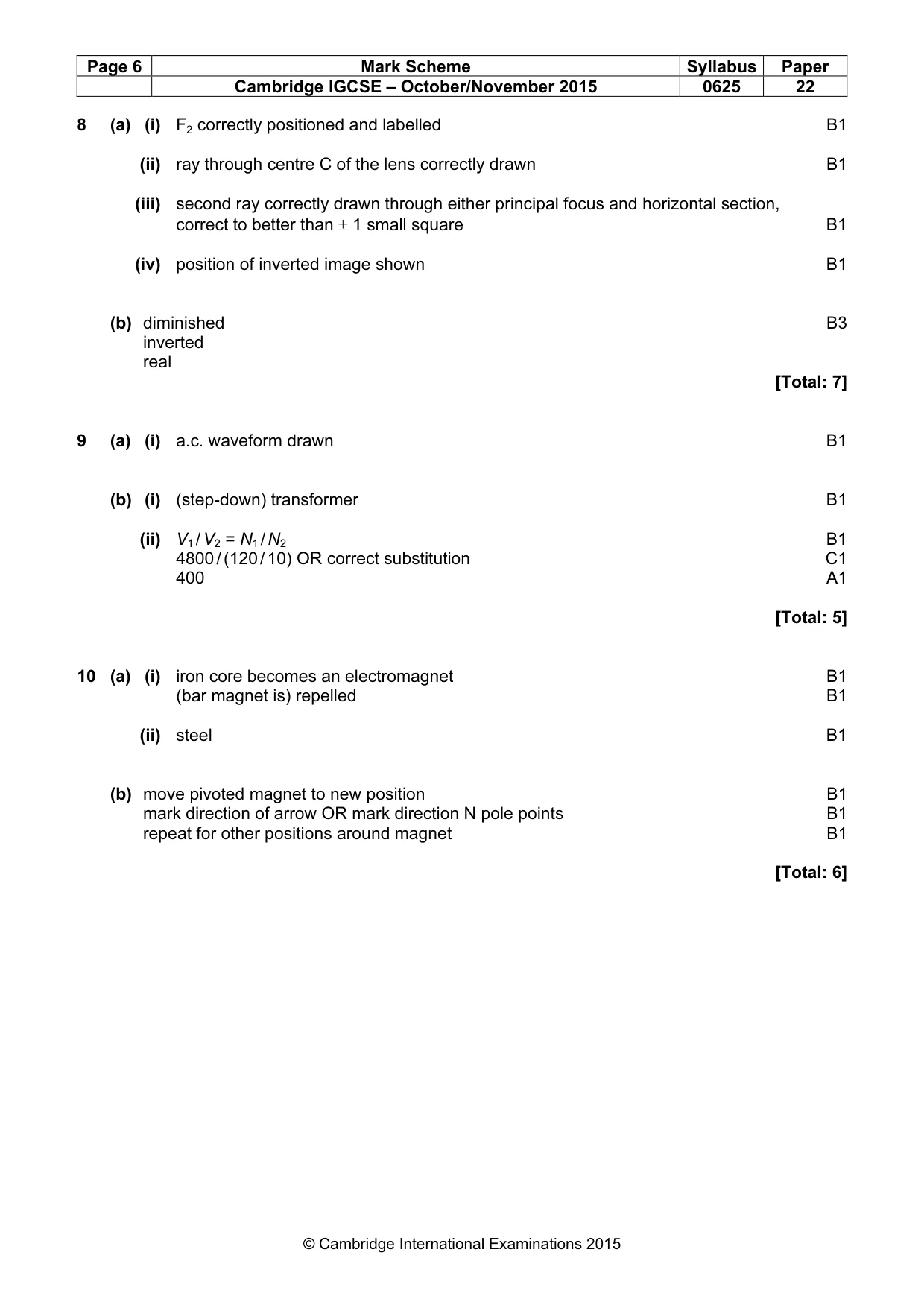
Page 6 Mark Scheme Syllabus Paper Cambridge IGCSE – October/November 2015 0625 22 © Cambridge International Examinations 2015 8 (a) (i) F2 correctly positioned and labelled B1 (ii) ray through centre C of the lens correctly drawn B1 (iii) second ray correctly drawn through either principal focus and horizontal section, correct to better than ± 1 small square B1 (iv) position of inverted image shown B1 (b) diminished B3 inverted real [Total: 7] 9 (a) (i) a.c. waveform drawn B1 (b) (i) (step-down) transformer B1 (ii) V1 / V2 = N1 / N2 B1 4800 / (120 / 10) OR correct substitution C1 400 A1 [Total: 5] 10 (a) (i) iron core becomes an electromagnet B1 (bar magnet is) repelled B1 (ii) steel B1 (b) move pivoted magnet to new position B1 mark direction of arrow OR mark direction N pole points B1 repeat for other positions around magnet B1 [Total: 6]
Mark scheme, page 7
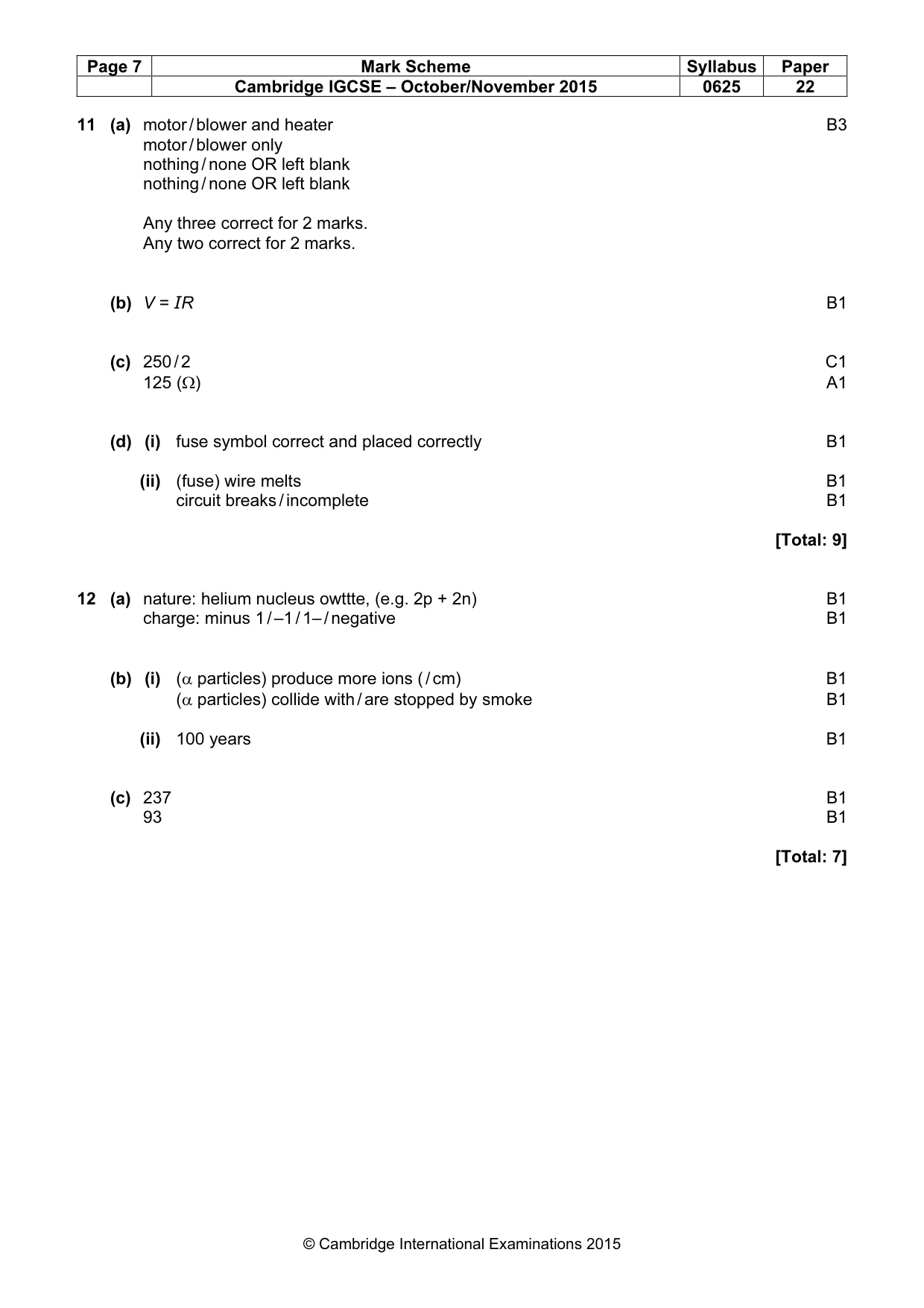
Page 7 Mark Scheme Syllabus Paper Cambridge IGCSE – October/November 2015 0625 22 © Cambridge International Examinations 2015 11 (a) motor / blower and heater B3 motor / blower only nothing / none OR left blank nothing / none OR left blank Any three correct for 2 marks. Any two correct for 2 marks. (b) V = IR B1 (c) 250 / 2 C1 125 (Ω) A1 (d) (i) fuse symbol correct and placed correctly B1 (ii) (fuse) wire melts B1 circuit breaks / incomplete B1 [Total: 9] 12 (a) nature: helium nucleus owttte, (e.g. 2p + 2n) B1 charge: minus 1 / –1 / 1– / negative B1 (b) (i) (α particles) produce more ions ( / cm) B1 (α particles) collide with / are stopped by smoke B1 (ii) 100 years B1 (c) 237 B1 93 B1 [Total: 7]
What you needed in this session
Cambridge’s own grade thresholds for 2015 Oct/Nov, Paper 2 · Variant 2. A higher threshold means an easier paper — the bar moves with how the cohort did.