Cambridge IGCSE Physics 0625 — 2015 May/June Paper 2 · Variant 2
0625/22/M/J/15 · 80 marks · ≈90 min
The question paper and its mark scheme, free to read here and free to download. This is Cambridge’s own paper, exactly as it was sat.
Question paper16 pages
Mark scheme8 pages
Answers below. Sit the paper first if you are practising.
Paper as text
Question paper, page 1
This document consists of 16 printed pages. DC (NH/SW) 90331/4 © UCLES 2015 [Turn over * 2 8 4 3 4 2 9 8 5 8 * PHYSICS 0625/22 Paper 2 Core May/June 2015 1 hour 15 minutes Candidates answer on the Question Paper. No Additional Materials are required. READ THESE INSTRUCTIONS FIRST Write your Centre number, candidate number and name on all the work you hand in. Write in dark blue or black pen. You may use an HB pencil for any diagrams or graphs. Do not use staples, paper clips, glue or correction fluid. DO NOT WRITE IN ANY BARCODES. Answer all questions. Electronic calculators may be used. You may lose marks if you do not show your working or if you do not use appropriate units. Take the weight of 1 kg to be 10 N (i.e. acceleration of free fall = 10 m / s2). At the end of the examination, fasten all your work securely together. The number of marks is given in brackets [ ] at the end of each question or part question. The syllabus is approved for use in England, Wales and Northern Ireland as a Cambridge International Level 1/Level 2 Certificate. Cambridge International Examinations Cambridge International General Certificate of Secondary Education
Question paper, page 2
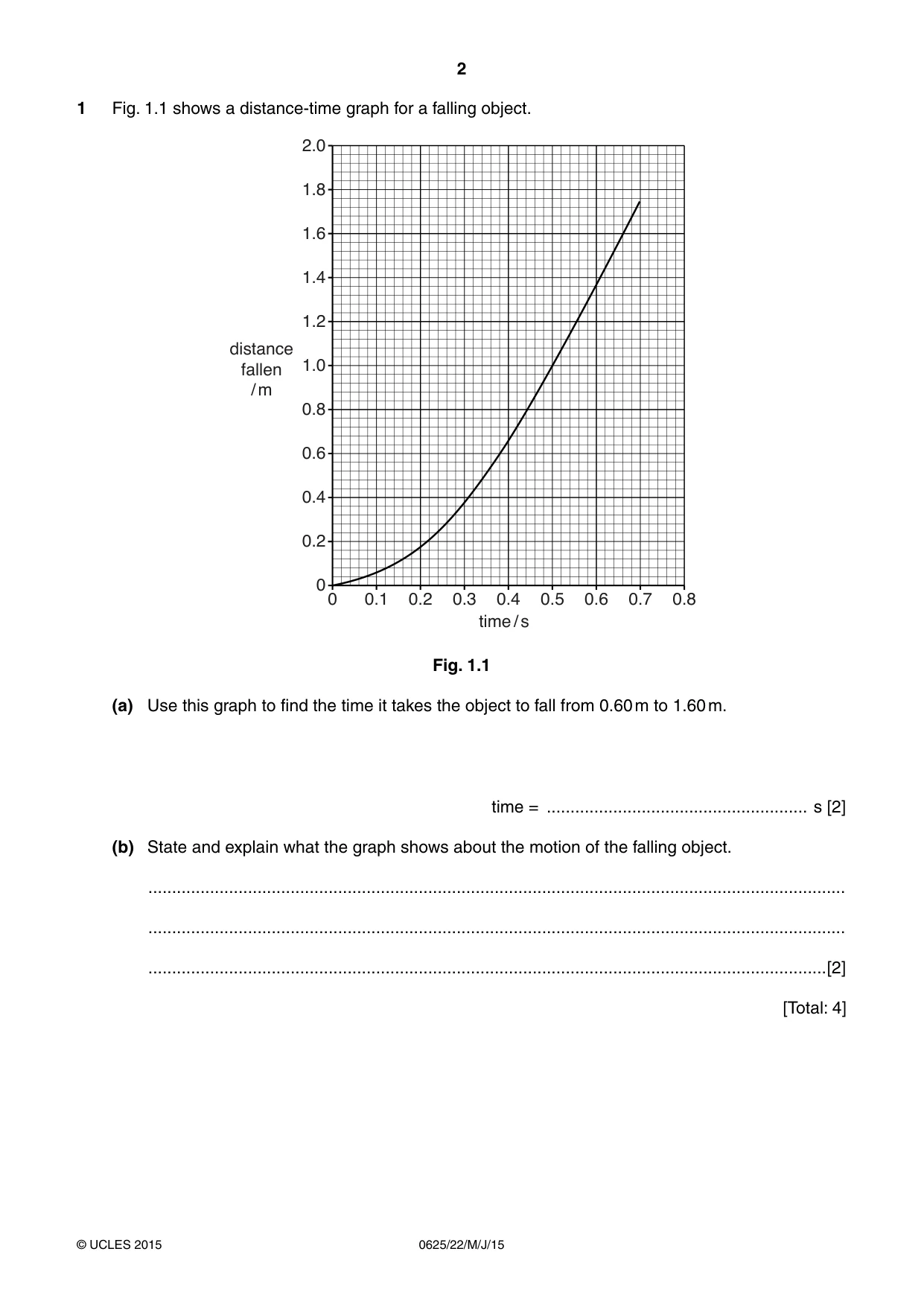
2 0625/22/M/J/15 © UCLES 2015 1 Fig. 1.1 shows a distance-time graph for a falling object. 0 0.2 0.4 0.6 0.8 1.0 1.2 1.4 1.6 1.8 2.0 distance fallen / m 0 0.1 0.2 0.3 0.4 time / s 0.5 0.6 0.7 0.8 Fig. 1.1 (a) Use this graph to find the time it takes the object to fall from 0.60 m to 1.60 m. time = … s [2] (b) State and explain what the graph shows about the motion of the falling object. … … …[2] [Total: 4]
Question paper, page 3
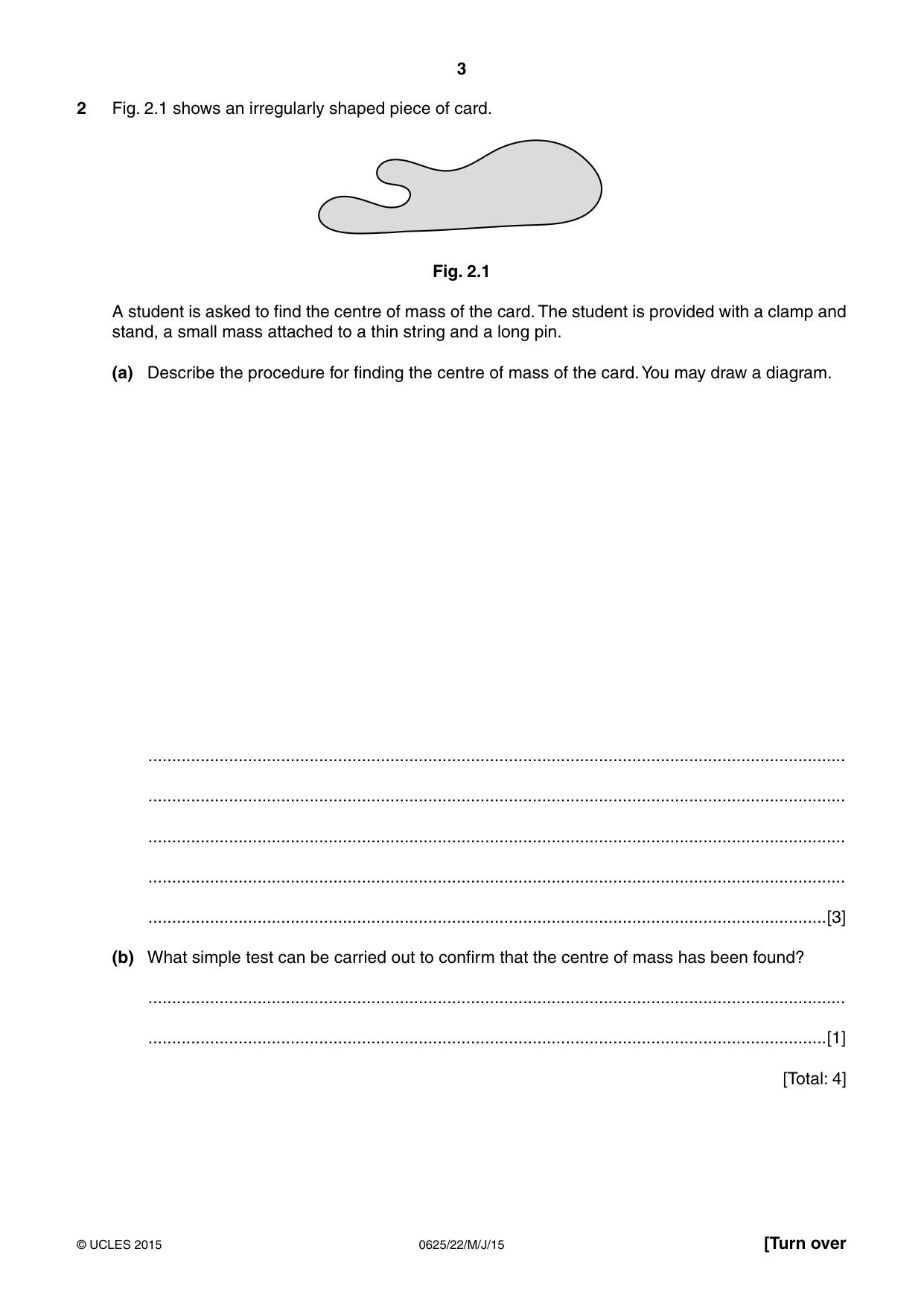
3 0625/22/M/J/15 © UCLES 2015 [Turn over 2 Fig. 2.1 shows an irregularly shaped piece of card. Fig. 2.1 A student is asked to find the centre of mass of the card. The student is provided with a clamp and stand, a small mass attached to a thin string and a long pin. (a) Describe the procedure for finding the centre of mass of the card. You may draw a diagram. … … … … …[ 3] (b) What simple test can be carried out to confirm that the centre of mass has been found? … …[1] [Total: 4]
Question paper, page 4
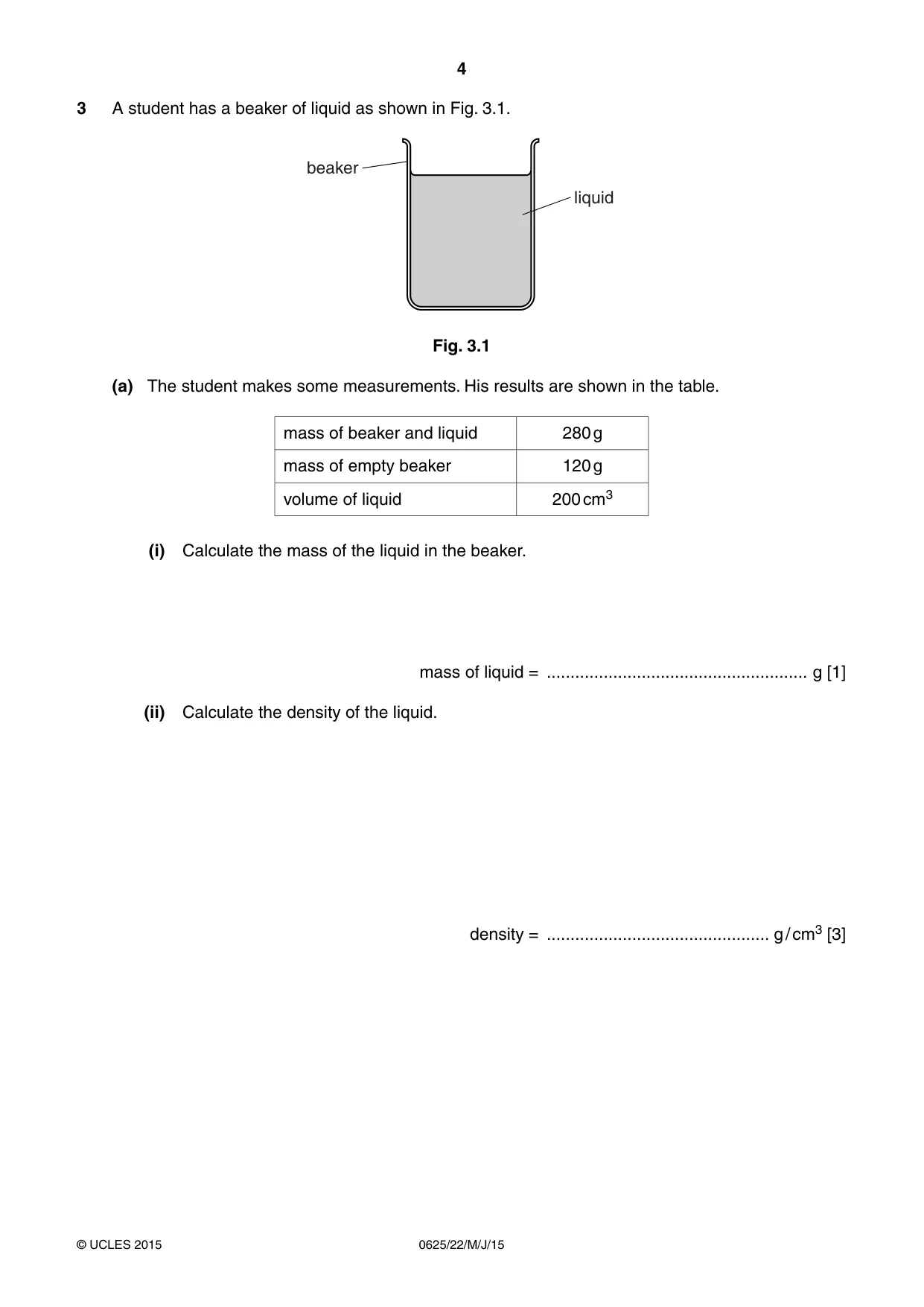
4 0625/22/M/J/15 © UCLES 2015 3 A student has a beaker of liquid as shown in Fig. 3.1. beaker liquid Fig. 3.1 (a) The student makes some measurements. His results are shown in the table. mass of beaker and liquid 280 g mass of empty beaker 120 g volume of liquid 200 cm3 (i) Calculate the mass of the liquid in the beaker. mass of liquid = … g [1] (ii) Calculate the density of the liquid. density = … g / cm3 [3]
Question paper, page 5
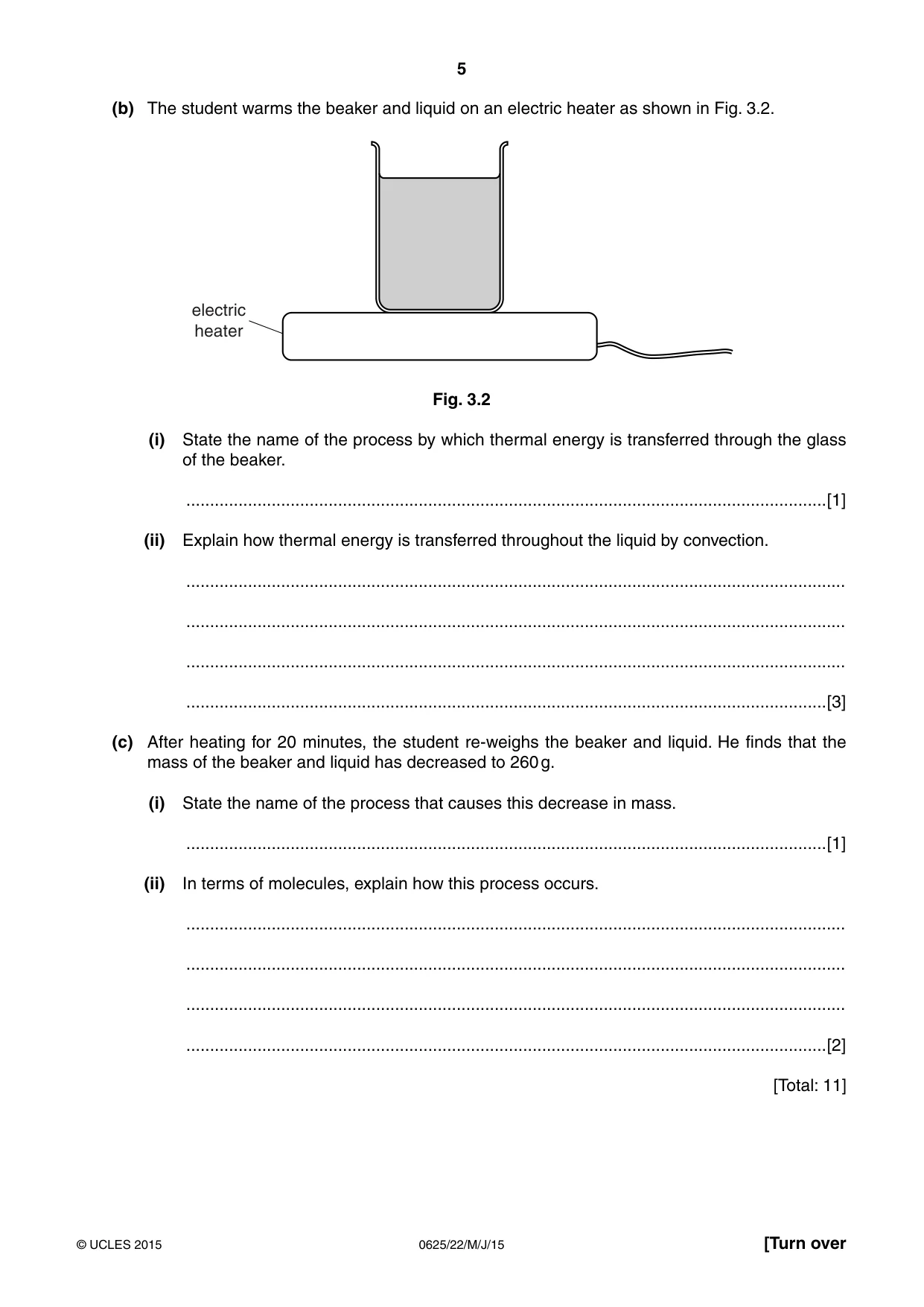
5 0625/22/M/J/15 © UCLES 2015 [Turn over (b) The student warms the beaker and liquid on an electric heater as shown in Fig. 3.2. electric heater Fig. 3.2 (i) State the name of the process by which thermal energy is transferred through the glass of the beaker. …[1] (ii) Explain how thermal energy is transferred throughout the liquid by convection. … … … …[3] (c) After heating for 20 minutes, the student re-weighs the beaker and liquid. He finds that the mass of the beaker and liquid has decreased to 260 g. (i) State the name of the process that causes this decrease in mass. …[1] (ii) In terms of molecules, explain how this process occurs. … … … …[2] [Total: 11]
Question paper, page 6
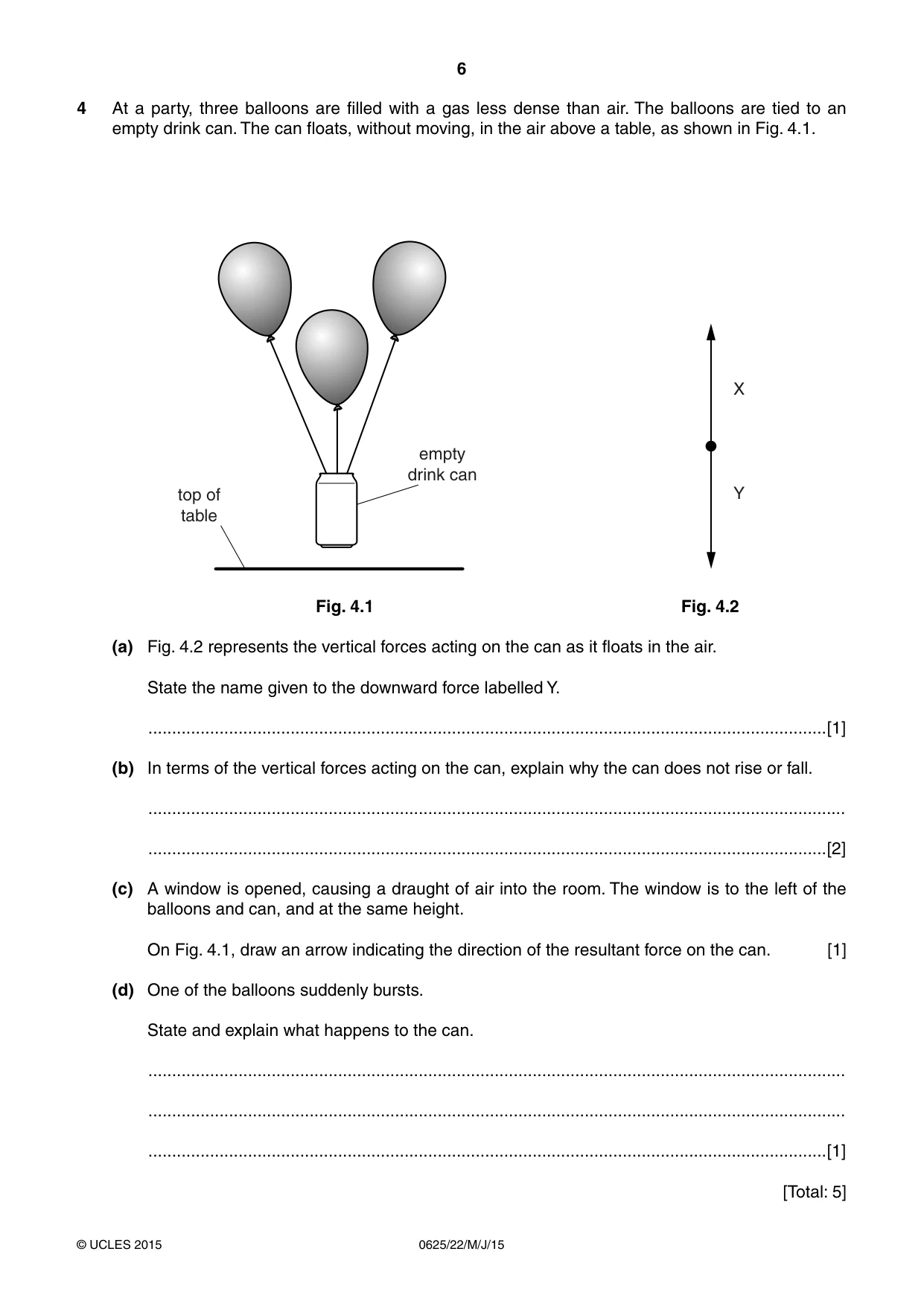
6 0625/22/M/J/15 © UCLES 2015 4 At a party, three balloons are filled with a gas less dense than air. The balloons are tied to an empty drink can. The can floats, without moving, in the air above a table, as shown in Fig. 4.1. top of table empty drink can X Y Fig. 4.1 Fig. 4.2 (a) Fig. 4.2 represents the vertical forces acting on the can as it floats in the air. State the name given to the downward force labelled Y. …[1] (b) In terms of the vertical forces acting on the can, explain why the can does not rise or fall. … …[2] (c) A window is opened, causing a draught of air into the room. The window is to the left of the balloons and can, and at the same height. On Fig. 4.1, draw an arrow indicating the direction of the resultant force on the can. [1] (d) One of the balloons suddenly bursts. State and explain what happens to the can. … … …[1] [Total: 5]
Question paper, page 7
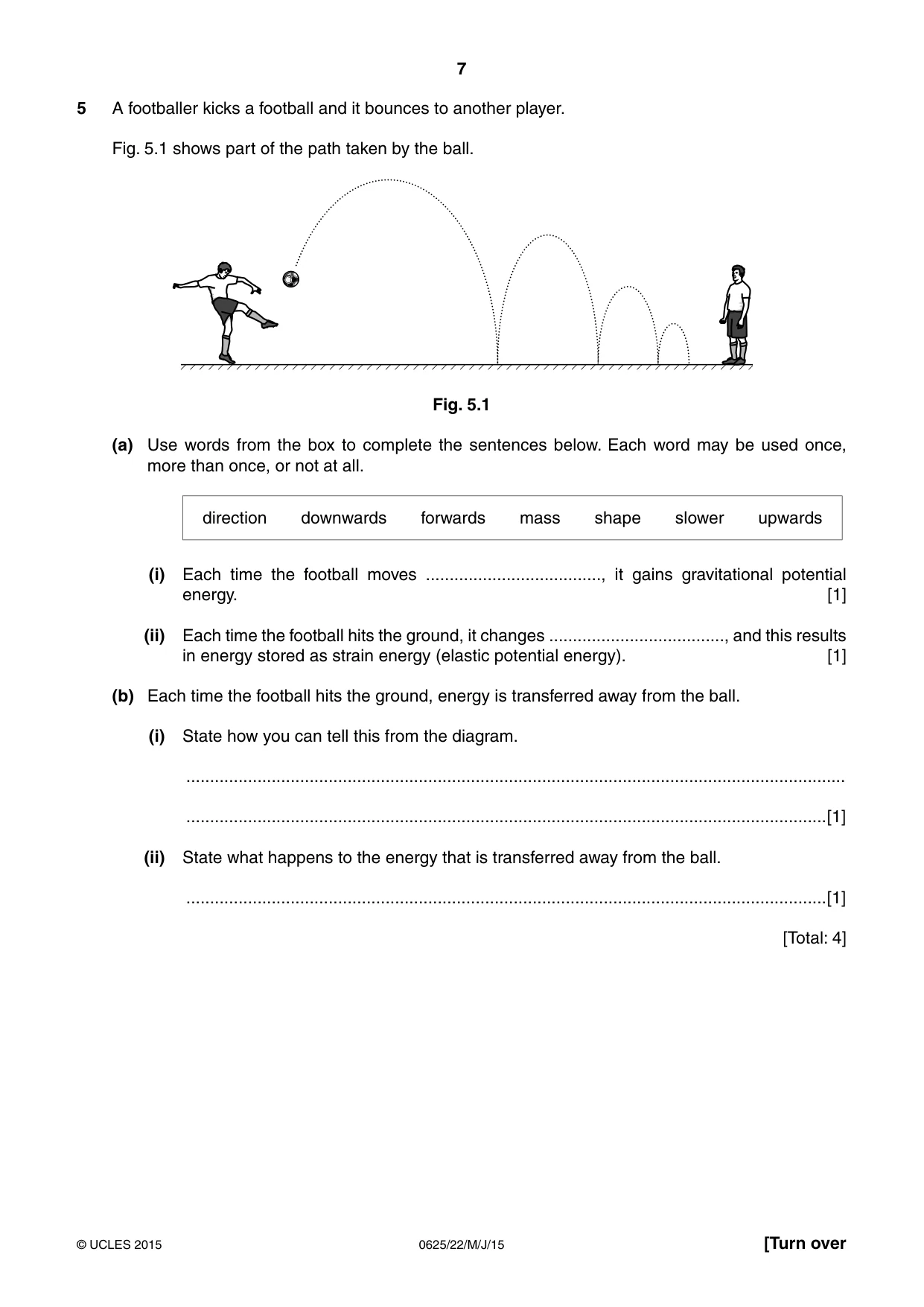
7 0625/22/M/J/15 © UCLES 2015 [Turn over 5 A footballer kicks a football and it bounces to another player. Fig. 5.1 shows part of the path taken by the ball. Fig. 5.1 (a) Use words from the box to complete the sentences below. Each word may be used once, more than once, or not at all. direction downwards forwards mass shape slower upwards (i) Each time the football moves …, it gains gravitational potential energy. [1] (ii) Each time the football hits the ground, it changes …, and this results in energy stored as strain energy (elastic potential energy). [1] (b) Each time the football hits the ground, energy is transferred away from the ball. (i) State how you can tell this from the diagram. … …[1] (ii) State what happens to the energy that is transferred away from the ball. …[1] [Total: 4]
Question paper, page 8
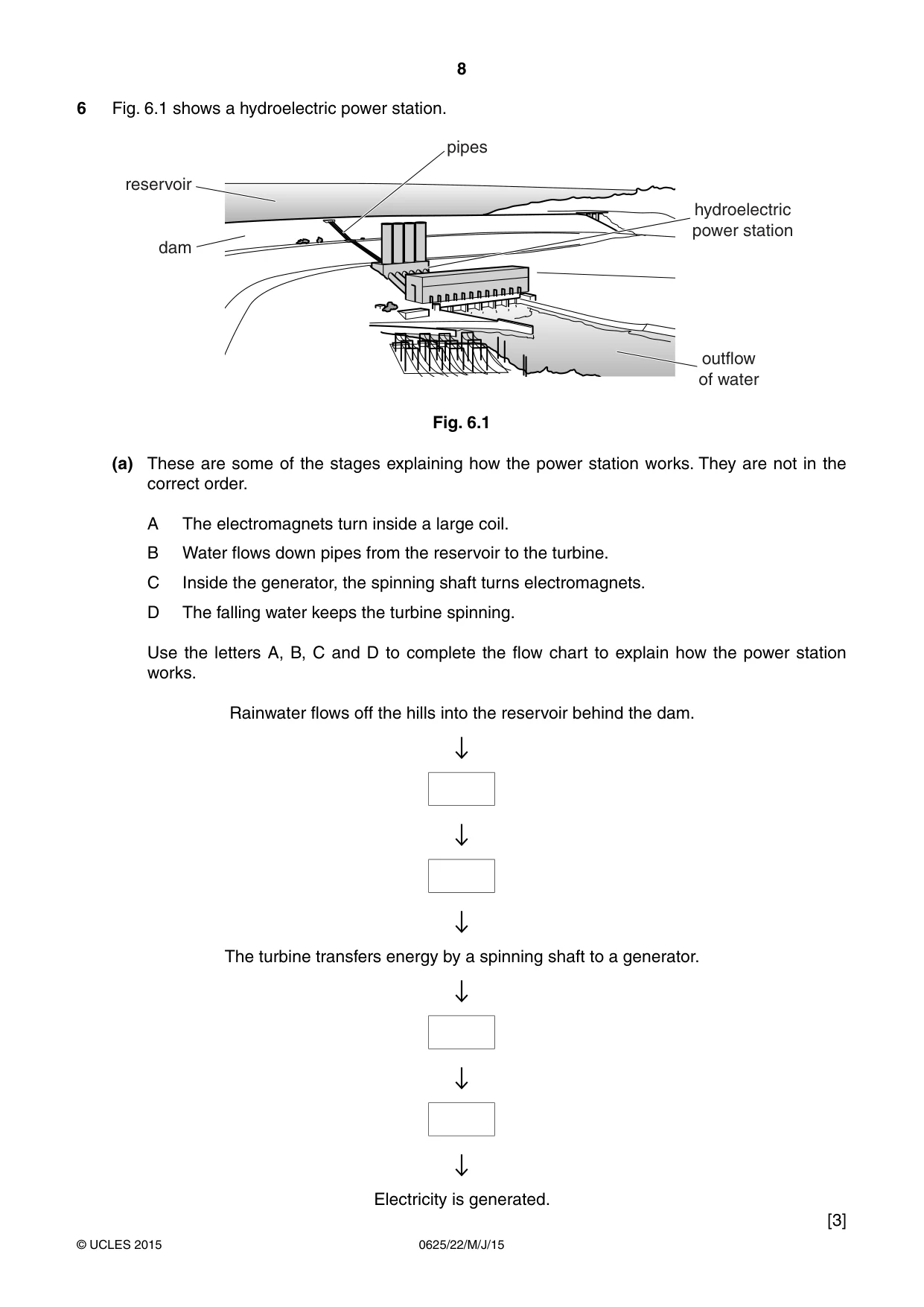
8 0625/22/M/J/15 © UCLES 2015 6 Fig. 6.1 shows a hydroelectric power station. reservoir dam hydroelectric power station outflow of water pipes Fig. 6.1 (a) These are some of the stages explaining how the power station works. They are not in the correct order. A The electromagnets turn inside a large coil. B Water flows down pipes from the reservoir to the turbine. C Inside the generator, the spinning shaft turns electromagnets. D The falling water keeps the turbine spinning. Use the letters A, B, C and D to complete the flow chart to explain how the power station works. Rainwater flows off the hills into the reservoir behind the dam. The turbine transfers energy by a spinning shaft to a generator. Electricity is generated. [3]
Question paper, page 9
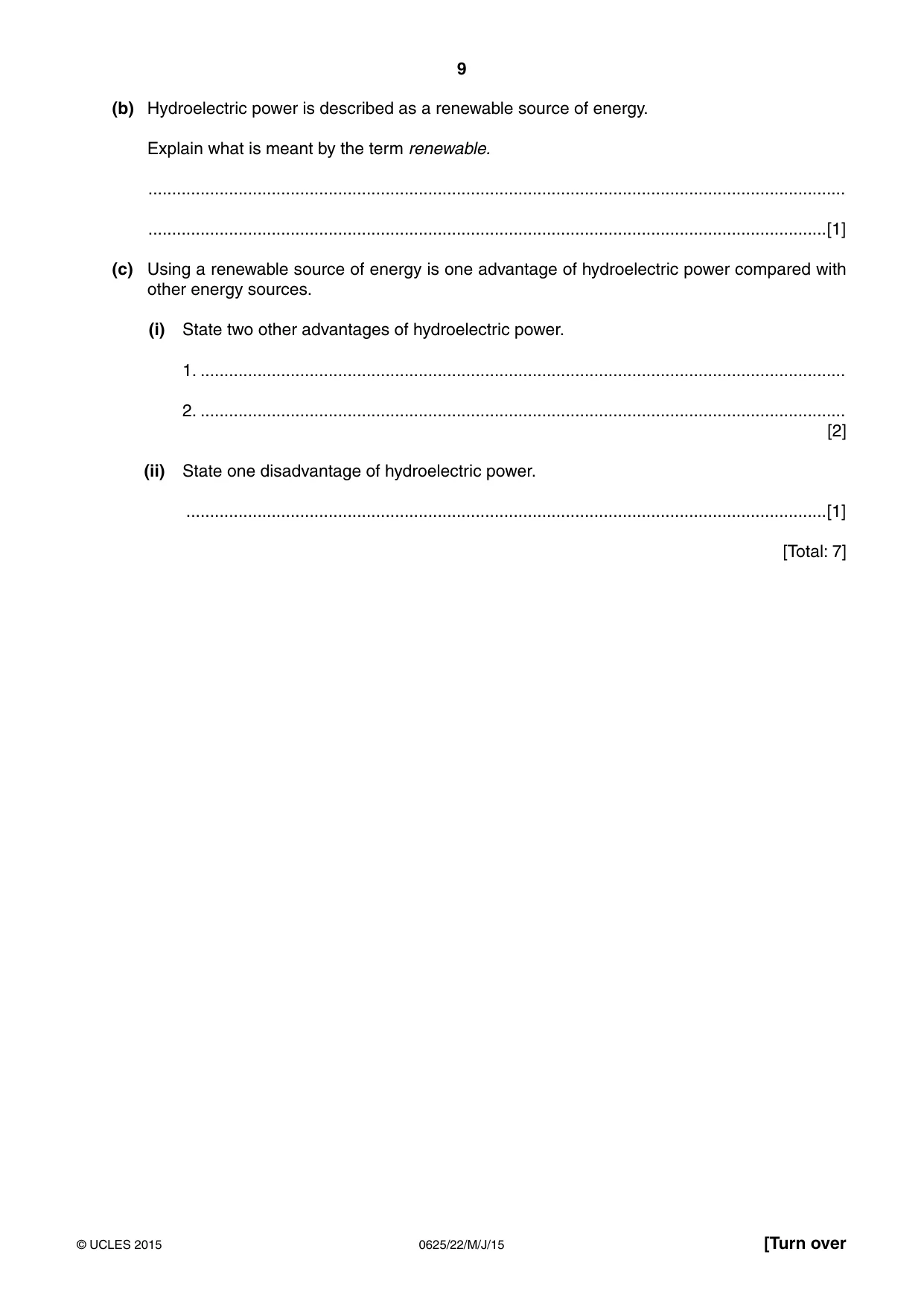
9 0625/22/M/J/15 © UCLES 2015 [Turn over (b) Hydroelectric power is described as a renewable source of energy. Explain what is meant by the term renewable. … …[1] (c) Using a renewable source of energy is one advantage of hydroelectric power compared with other energy sources. (i) State two other advantages of hydroelectric power. 1. … 2. … [2] (ii) State one disadvantage of hydroelectric power. …[1] [Total: 7]
Question paper, page 10
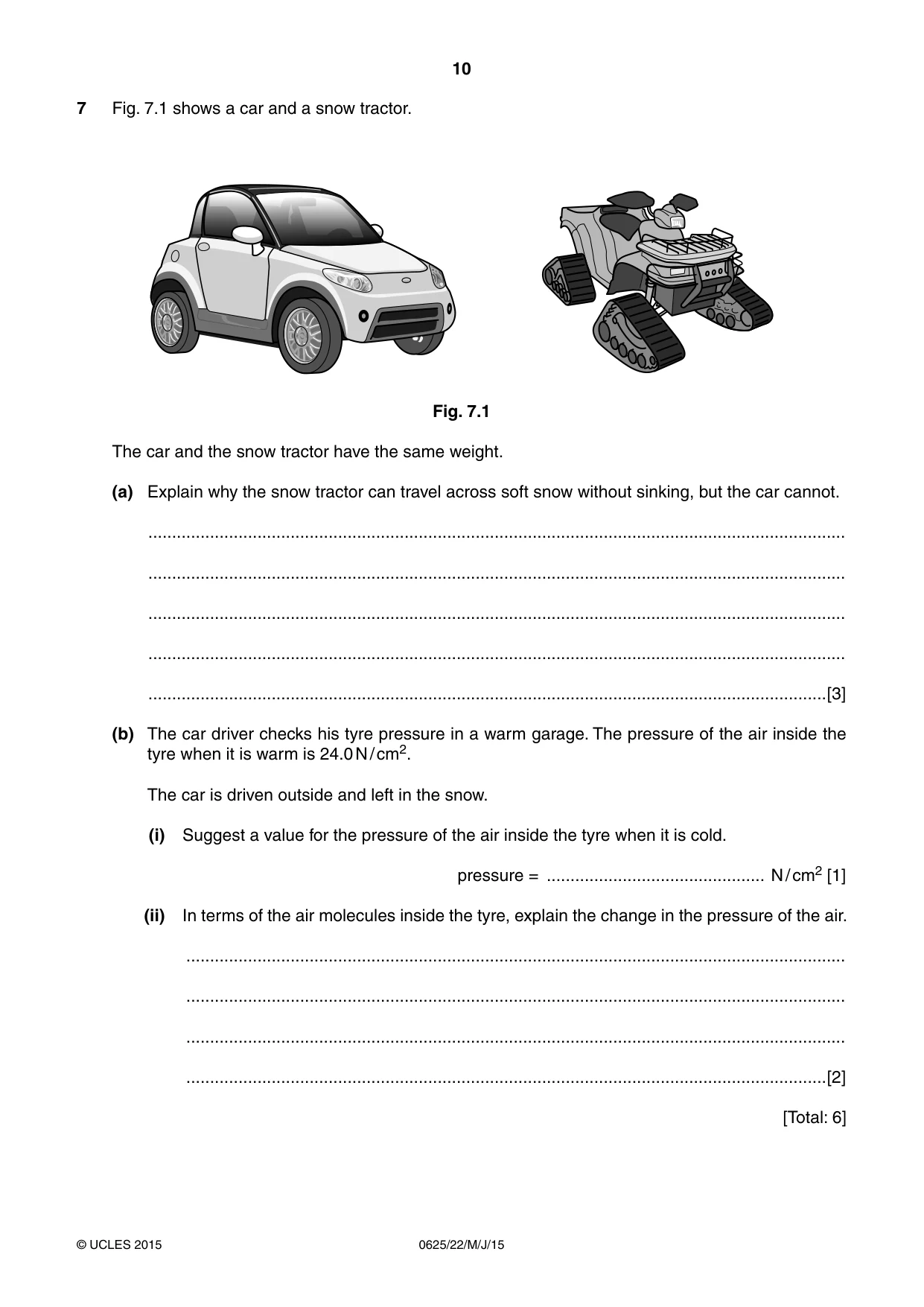
10 0625/22/M/J/15 © UCLES 2015 7 Fig. 7.1 shows a car and a snow tractor. Fig. 7.1 The car and the snow tractor have the same weight. (a) Explain why the snow tractor can travel across soft snow without sinking, but the car cannot. … … … … …[3] (b) The car driver checks his tyre pressure in a warm garage. The pressure of the air inside the tyre when it is warm is 24.0 N / cm2. The car is driven outside and left in the snow. (i) Suggest a value for the pressure of the air inside the tyre when it is cold. pressure = … N / cm2 [1] (ii) In terms of the air molecules inside the tyre, explain the change in the pressure of the air. … … … …[2] [Total: 6]
Question paper, page 11
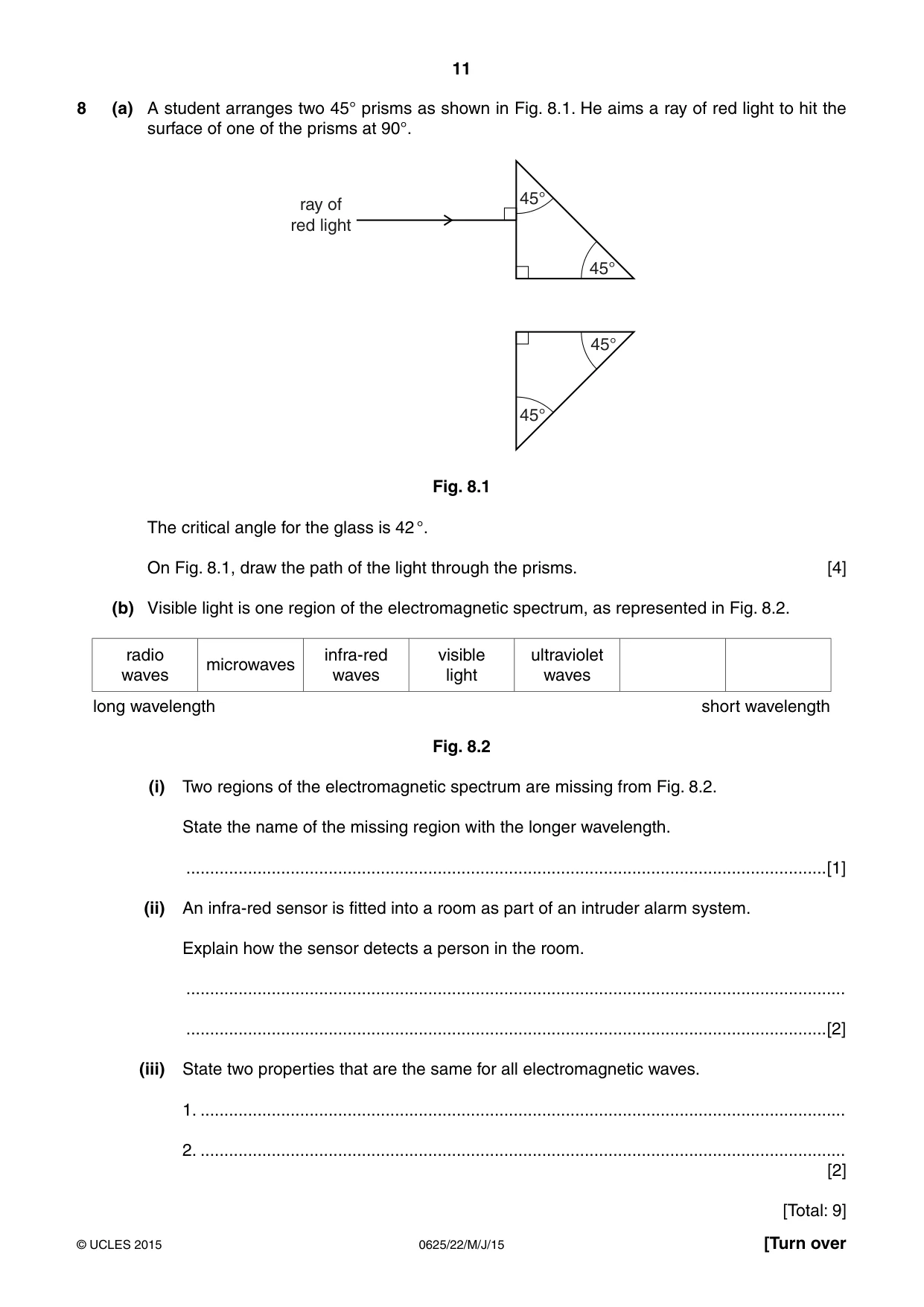
11 0625/22/M/J/15 © UCLES 2015 [Turn over 8 (a) A student arranges two 45° prisms as shown in Fig. 8.1. He aims a ray of red light to hit the surface of one of the prisms at 90°. 45° 45° 45° 45° ray of red light Fig. 8.1 The critical angle for the glass is 42 °. On Fig. 8.1, draw the path of the light through the prisms. [4] (b) Visible light is one region of the electromagnetic spectrum, as represented in Fig. 8.2. radio waves microwaves infra-red waves visible light ultraviolet waves long wavelength short wavelength Fig. 8.2 (i) Two regions of the electromagnetic spectrum are missing from Fig. 8.2. State the name of the missing region with the longer wavelength. …[1] (ii) An infra-red sensor is fitted into a room as part of an intruder alarm system. Explain how the sensor detects a person in the room. … …[2] (iii) State two properties that are the same for all electromagnetic waves. 1. … 2. … [2] [Total: 9]
Question paper, page 12
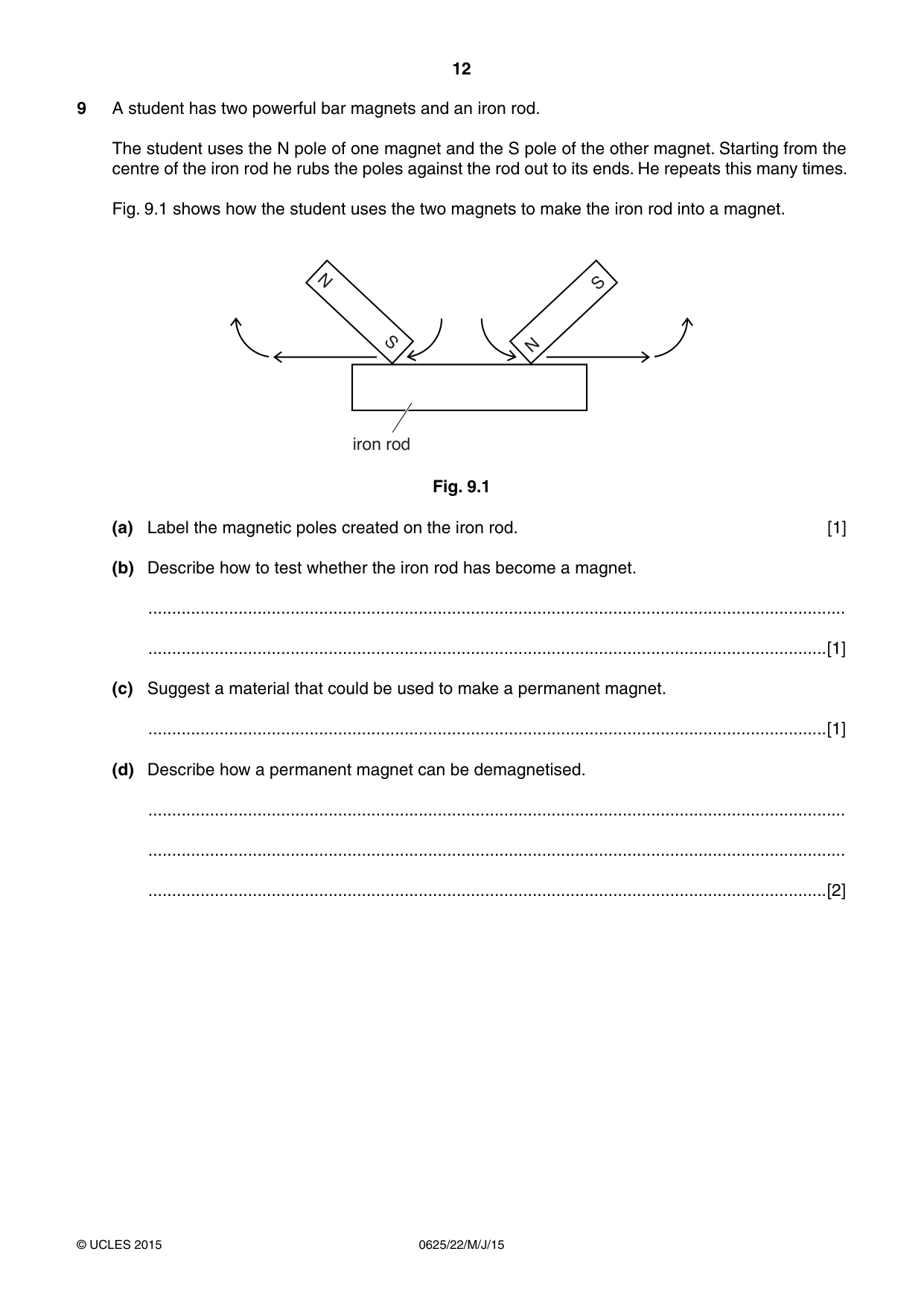
12 0625/22/M/J/15 © UCLES 2015 9 A student has two powerful bar magnets and an iron rod. The student uses the N pole of one magnet and the S pole of the other magnet. Starting from the centre of the iron rod he rubs the poles against the rod out to its ends. He repeats this many times. Fig. 9.1 shows how the student uses the two magnets to make the iron rod into a magnet. N S N S iron rod Fig. 9.1 (a) Label the magnetic poles created on the iron rod. [1] (b) Describe how to test whether the iron rod has become a magnet. … …[1] (c) Suggest a material that could be used to make a permanent magnet. …[1] (d) Describe how a permanent magnet can be demagnetised. … … …[2]
Question paper, page 13
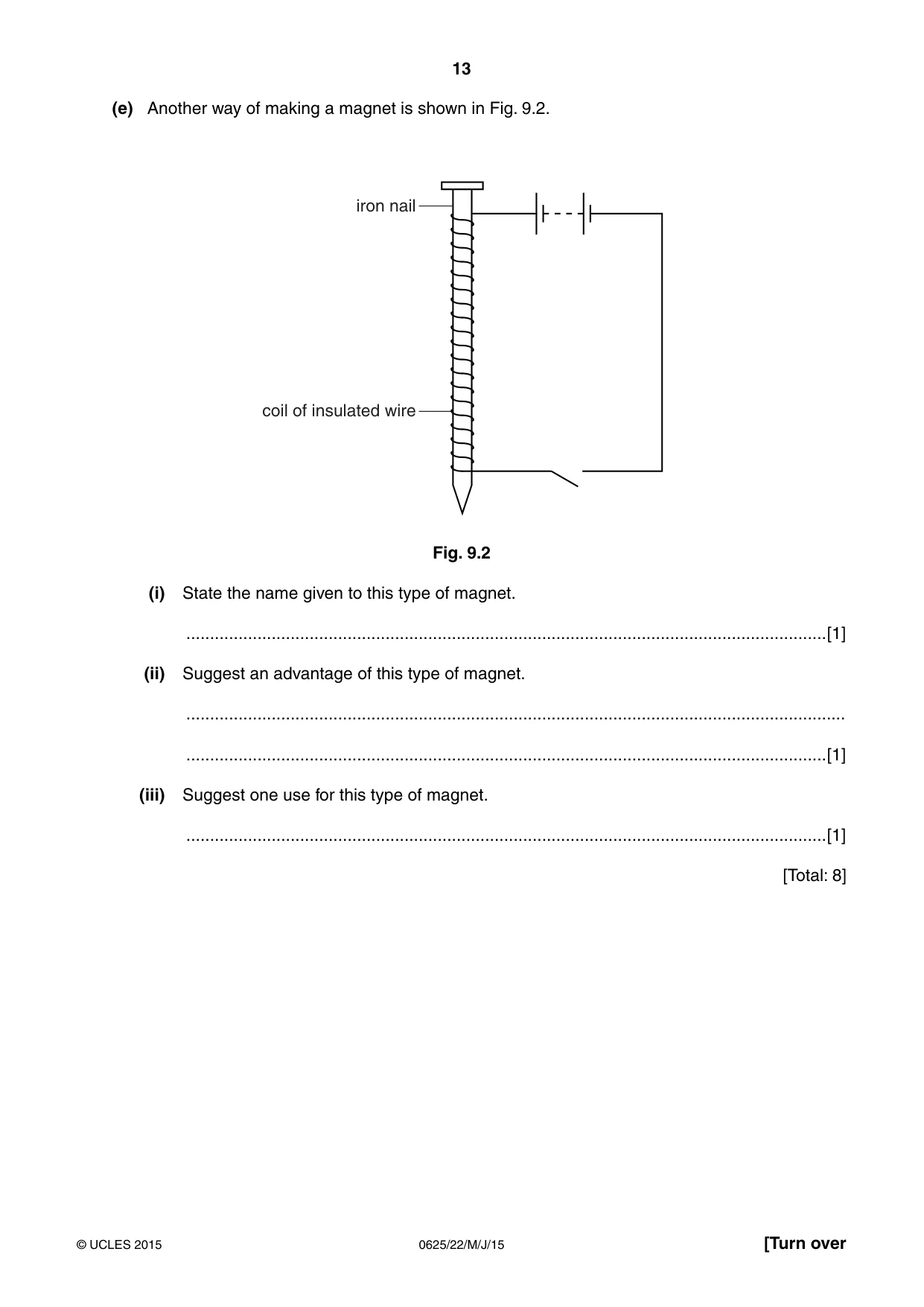
13 0625/22/M/J/15 © UCLES 2015 [Turn over (e) Another way of making a magnet is shown in Fig. 9.2. iron nail coil of insulated wire Fig. 9.2 (i) State the name given to this type of magnet. …[1] (ii) Suggest an advantage of this type of magnet. … …[1] (iii) Suggest one use for this type of magnet. …[1] [Total: 8]
Question paper, page 14
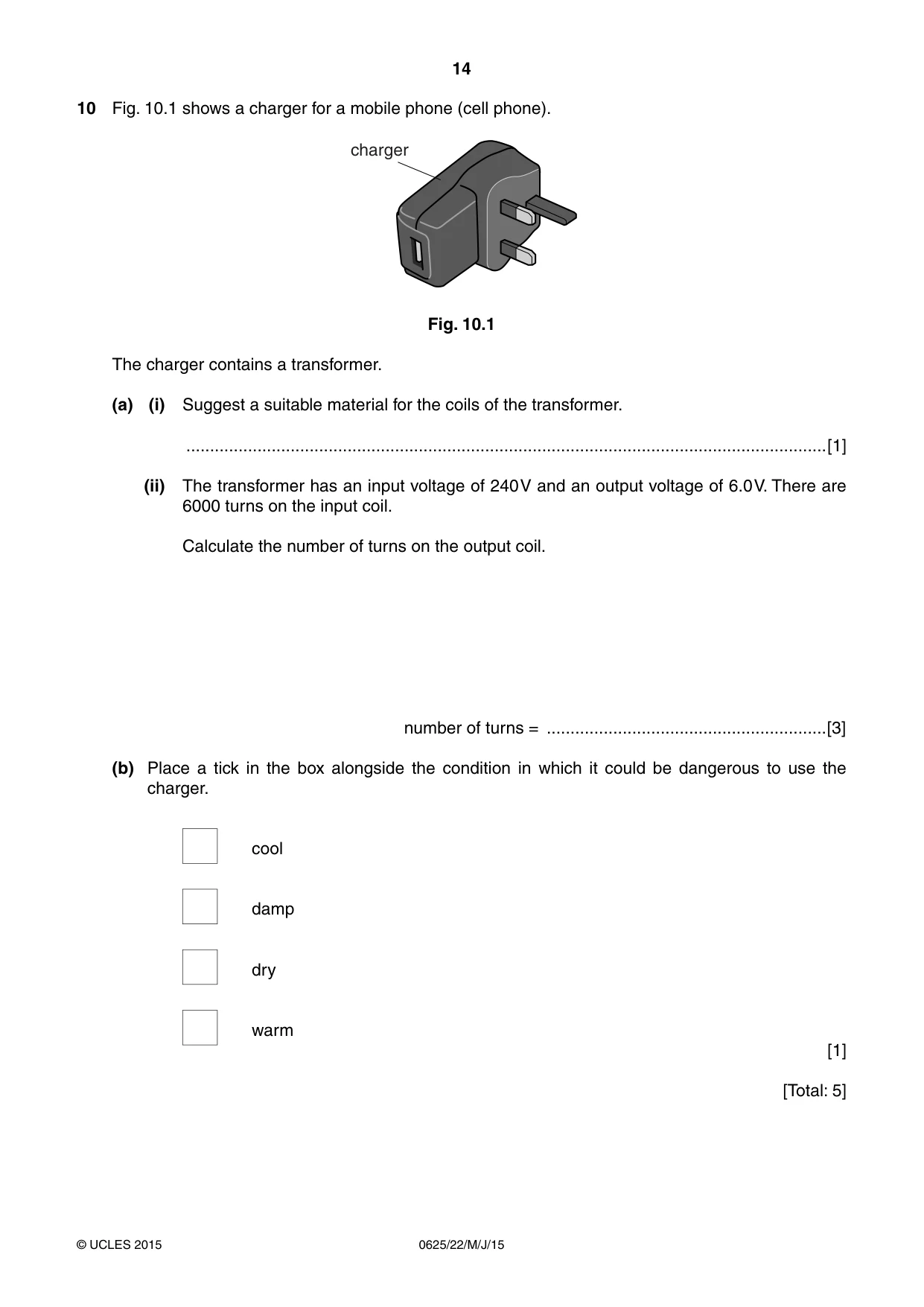
14 0625/22/M/J/15 © UCLES 2015 10 Fig. 10.1 shows a charger for a mobile phone (cell phone). charger Fig. 10.1 The charger contains a transformer. (a) (i) Suggest a suitable material for the coils of the transformer. …[1] (ii) The transformer has an input voltage of 240 V and an output voltage of 6.0 V. There are 6000 turns on the input coil. Calculate the number of turns on the output coil. number of turns = …[3] (b) Place a tick in the box alongside the condition in which it could be dangerous to use the charger. cool damp dry warm [1] [Total: 5]
Question paper, page 15
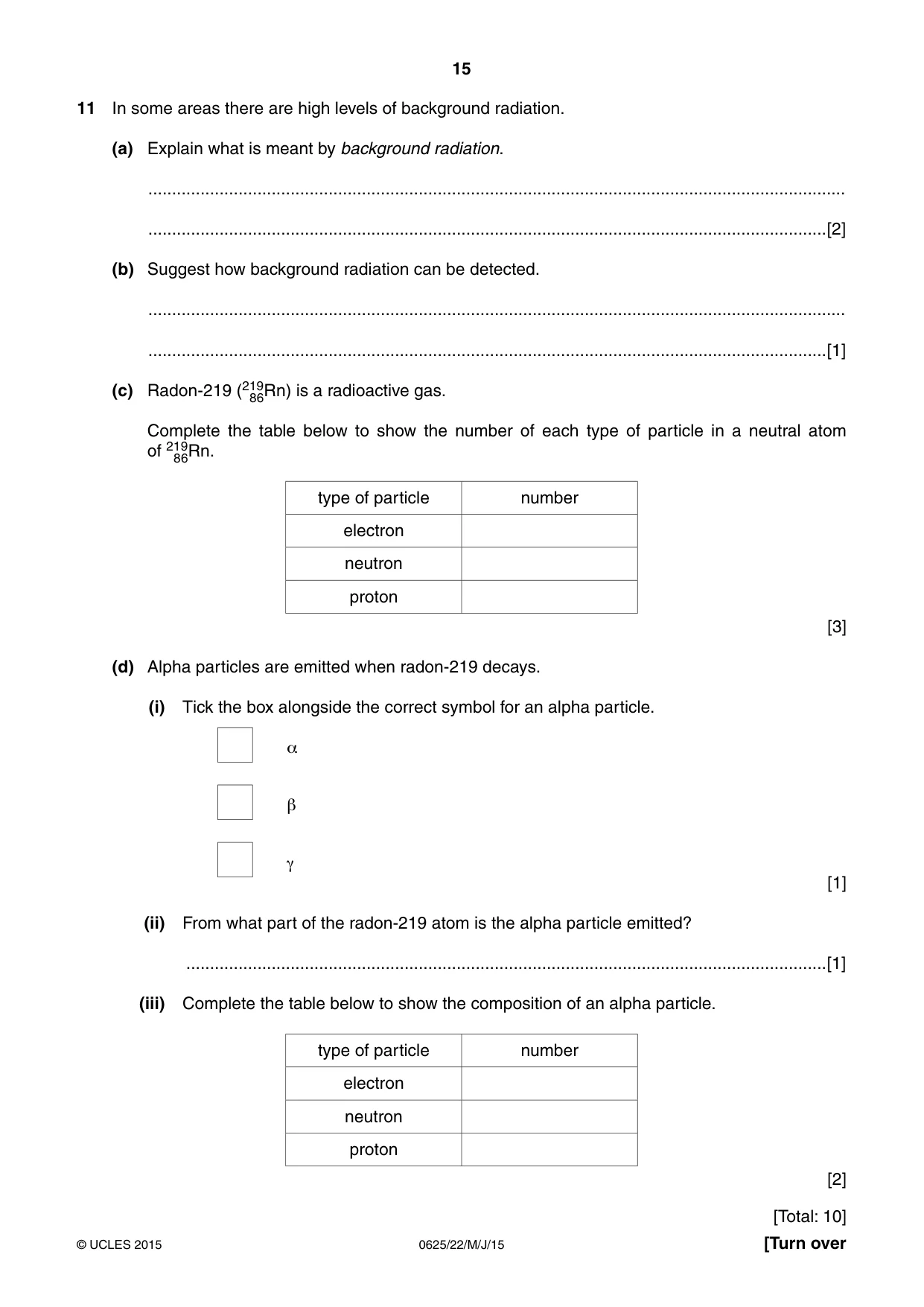
15 0625/22/M/J/15 © UCLES 2015 [Turn over 11 In some areas there are high levels of background radiation. (a) Explain what is meant by background radiation. … …[2] (b) Suggest how background radiation can be detected. … …[1] (c) Radon-219 (21 8 9 6Rn) is a radioactive gas. Complete the table below to show the number of each type of particle in a neutral atom of 21 8 9 6Rn. type of particle number electron neutron proton [3] (d) Alpha particles are emitted when radon-219 decays. (i) Tick the box alongside the correct symbol for an alpha particle. α β γ [1] (ii) From what part of the radon-219 atom is the alpha particle emitted? …[1] (iii) Complete the table below to show the composition of an alpha particle. type of particle number electron neutron proton [2] [Total: 10]
Question paper, page 16
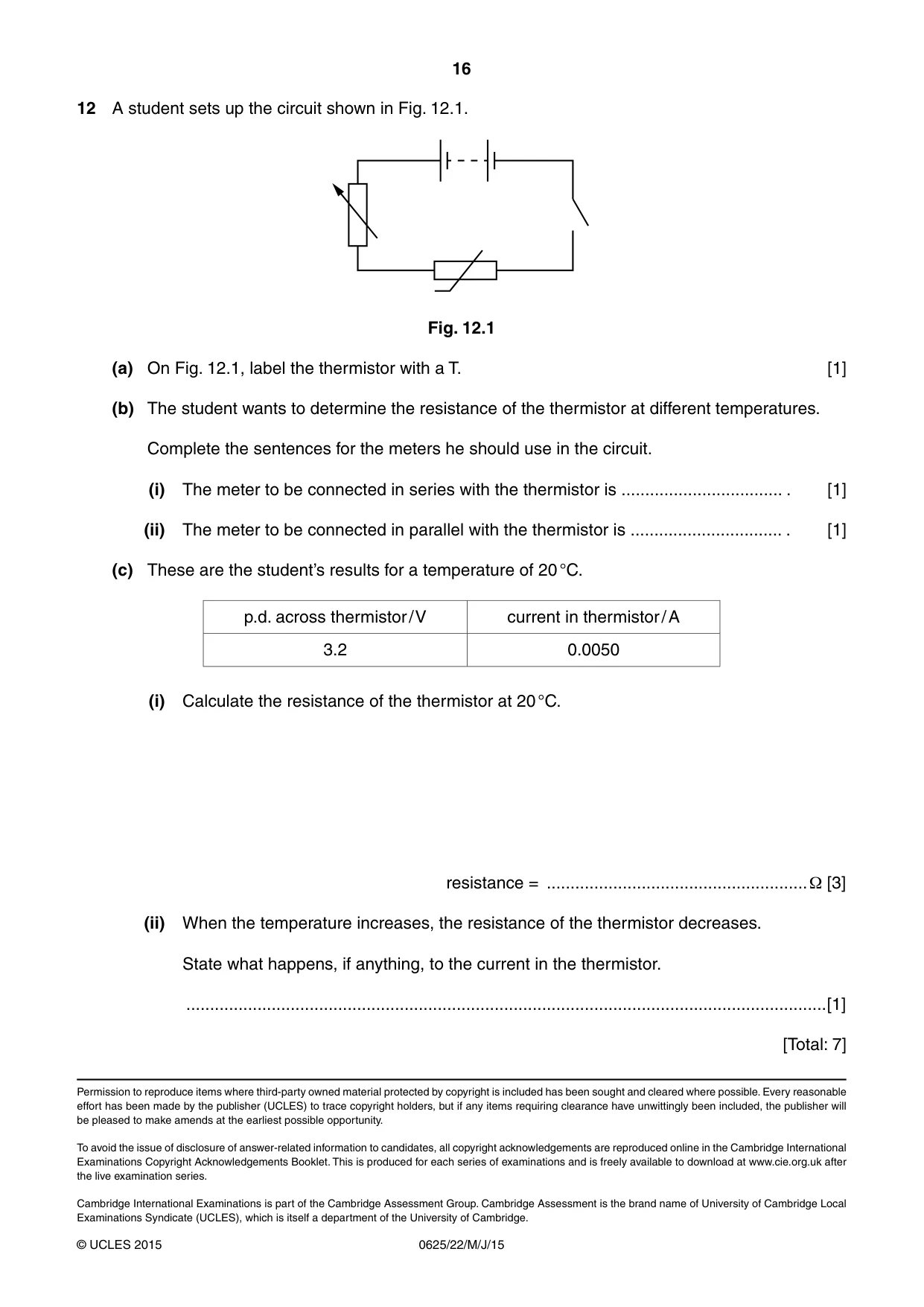
16 0625/22/M/J/15 © UCLES 2015 12 A student sets up the circuit shown in Fig. 12.1. Fig. 12.1 (a) On Fig. 12.1, label the thermistor with a T. [1] (b) The student wants to determine the resistance of the thermistor at different temperatures. Complete the sentences for the meters he should use in the circuit. (i) The meter to be connected in series with the thermistor is … . [1] (ii) The meter to be connected in parallel with the thermistor is … . [1] (c) These are the student’s results for a temperature of 20 °C. p.d. across thermistor / V current in thermistor / A 3.2 0.0050 (i) Calculate the resistance of the thermistor at 20 °C. resistance = …Ω [3] (ii) When the temperature increases, the resistance of the thermistor decreases. State what happens, if anything, to the current in the thermistor. …[1] [Total: 7] Permission to reproduce items where third-party owned material protected by copyright is included has been sought and cleared where possible. Every reasonable effort has been made by the publisher (UCLES) to trace copyright holders, but if any items requiring clearance have unwittingly been included, the publisher will be pleased to make amends at the earliest possible opportunity. To avoid the issue of disclosure of answer-related information to candidates, all copyright acknowledgements are reproduced online in the Cambridge International Examinations Copyright Acknowledgements Booklet. This is produced for each series of examinations and is freely available to download at www.cie.org.uk after the live examination series. Cambridge International Examinations is part of the Cambridge Assessment Group. Cambridge Assessment is the brand name of University of Cambridge Local Examinations Syndicate (UCLES), which is itself a department of the University of Cambridge.
Mark scheme, page 1
® IGCSE is the registered trademark of Cambridge International Examinations. CAMBRIDGE INTERNATIONAL EXAMINATIONS Cambridge International General Certificate of Secondary Education MARK SCHEME for the May/June 2015 series 0625 PHYSICS 0625/22 Paper 2 (Core Theory), maximum raw mark 80 This mark scheme is published as an aid to teachers and candidates, to indicate the requirements of the examination. It shows the basis on which Examiners were instructed to award marks. It does not indicate the details of the discussions that took place at an Examiners’ meeting before marking began, which would have considered the acceptability of alternative answers. Mark schemes should be read in conjunction with the question paper and the Principal Examiner Report for Teachers. Cambridge will not enter into discussions about these mark schemes. Cambridge is publishing the mark schemes for the May/June 2015 series for most Cambridge IGCSE®, Cambridge International A and AS Level components and some Cambridge O Level components.
Mark scheme, page 2
Page 2 Mark Scheme Syllabus Paper Cambridge IGCSE – May/June 2015 0625 22 © Cambridge International Examinations 2015 NOTES ABOUT MARK SCHEME SYMBOLS & OTHER MATTERS B marks are independent marks, which do not depend on any other marks. For a B mark to be scored, the point to which it refers must actually be seen in the candidate's answer. M marks are method marks upon which accuracy marks (A marks) later depend. For an M mark to be scored, the point to which it refers must be seen in a candidate's answer. If a candidate fails to score a particular M mark, then none of the dependent A marks can be scored. C marks are compensatory method marks which can be scored even if the points to which they refer are not written down by the candidate, provided subsequent working gives evidence that they must have known it. For example, if an equation carries a C mark and the candidate does not write down the actual equation but does correct working which shows he knew the equation, then the C mark is scored. A marks are accuracy or answer marks which either depend on an M mark, or which are one of the ways which allow a C mark to be scored. Brackets ( ) around words or units in the mark scheme are intended to indicate wording used to clarify the mark scheme, but the marks do not depend on seeing the words or units in brackets, e.g. 10 (J) means that the mark is scored for 10, regardless of the unit given. c.a.o. means “correct answer only”. e.c.f. means “error carried forward”. This indicates that if a candidate has made an earlier mistake and has carried his incorrect value forward to subsequent stages of working, he may be given marks indicated by e.c.f. provided his subsequent working is correct, bearing in mind his earlier mistake. This prevents a candidate being penalised more than once for a particular mistake, but only applies to marks annotated “e.c.f.” e.e.o.o. means “each error or omission”. Underlining indicates that this must be seen in the answer offered, or something very similar. OR / or indicates alternative answers, any one of which is satisfactory for scoring the marks. AND indicates that both answers are required to score the mark. Spelling Be generous with spelling and use of English. However, do not allow ambiguities e.g. spelling which suggests confusion between reflection/refraction/diffraction or thermistor/transistor/transformer. Sig. figs. On this paper, answers are generally acceptable to any number of significant figures ≥2, except where the mark scheme specifies otherwise or gives an answer to only 1 significant figure. Units On this paper, incorrect units are not penalised, except where specified. More commonly, marks are awarded for specific units. Fractions Fractions are only acceptable where specified.
Mark scheme, page 3
Page 3 Mark Scheme Syllabus Paper Cambridge IGCSE – May/June 2015 0625 22 © Cambridge International Examinations 2015 Extras If a candidate gives more answers than required, irrelevant extras are ignored; for extras which contradict an otherwise correct response, or are forbidden by the mark scheme, use right plus wrong = 0. Ignore indicates that something which is not correct is disregarded and does not cause a right plus wrong penalty. NOT indicates that an incorrect answer is not to be disregarded, but cancels another otherwise correct alternative offered by the candidate i.e. right plus wrong penalty applies.
Mark scheme, page 4
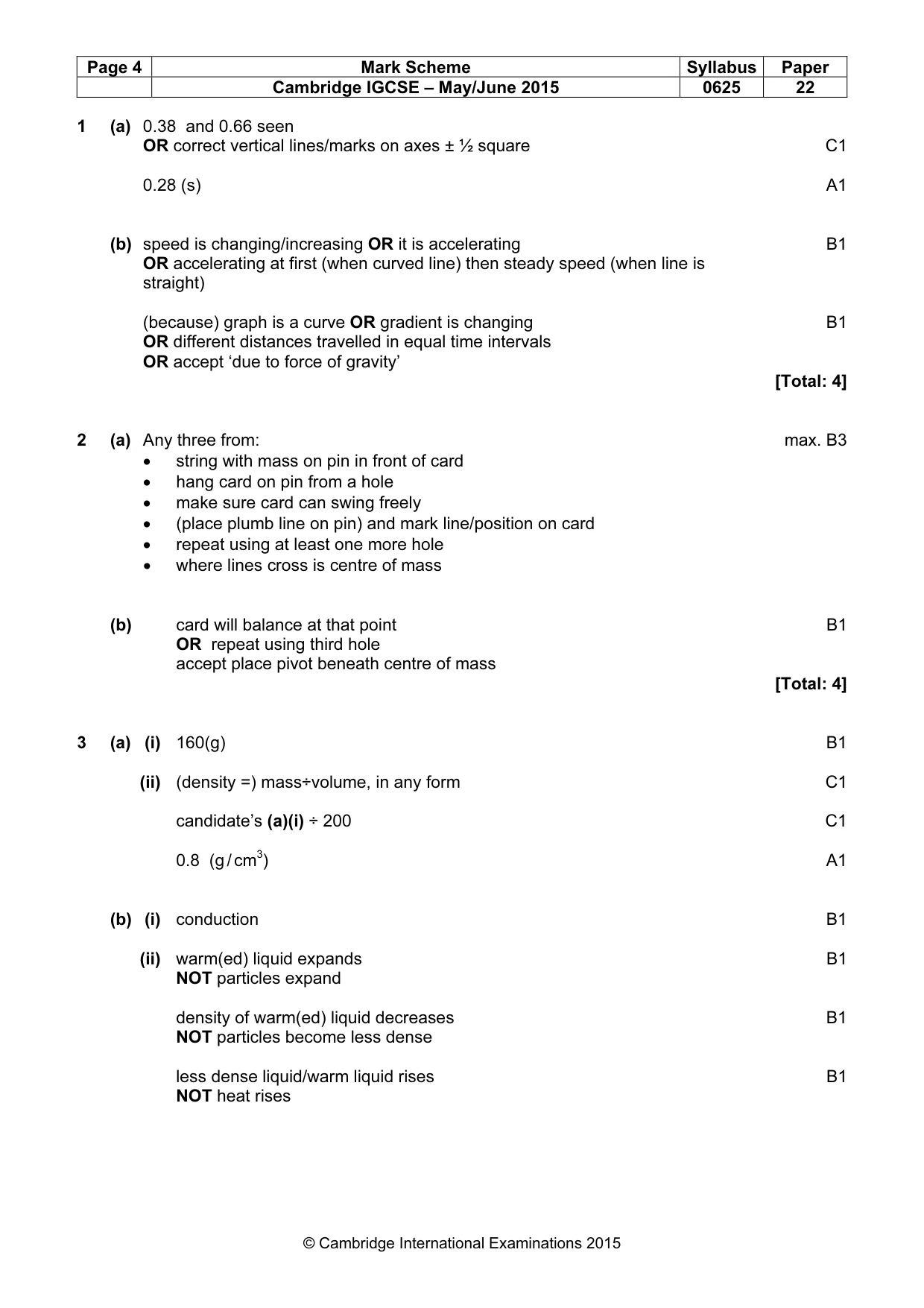
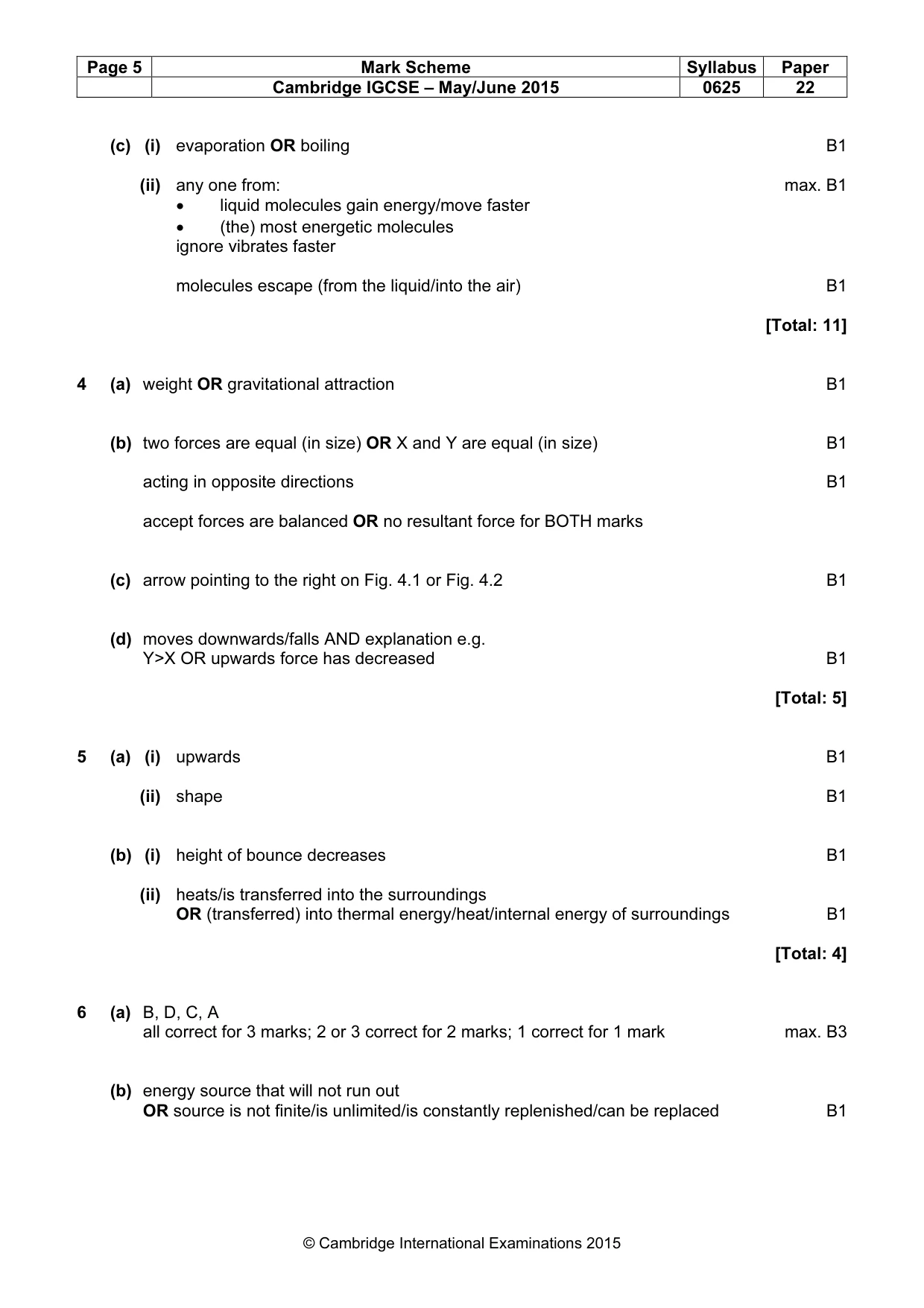
Page 4 Mark Scheme Syllabus Paper Cambridge IGCSE – May/June 2015 0625 22 © Cambridge International Examinations 2015 1 (a) 0.38 and 0.66 seen OR correct vertical lines/marks on axes ± ½ square C1 0.28 (s) A1 (b) speed is changing/increasing OR it is accelerating B1 OR accelerating at first (when curved line) then steady speed (when line is straight) (because) graph is a curve OR gradient is changing B1 OR different distances travelled in equal time intervals OR accept ‘due to force of gravity’ [Total: 4] 2 (a) Any three from: max. B3 • string with mass on pin in front of card • hang card on pin from a hole • make sure card can swing freely • (place plumb line on pin) and mark line/position on card • repeat using at least one more hole • where lines cross is centre of mass (b) card will balance at that point B1 OR repeat using third hole accept place pivot beneath centre of mass [Total: 4] 3 (a) (i) 160(g) B1 (ii) (density =) mass÷volume, in any form C1 candidate’s (a)(i) ÷ 200 C1 0.8 (g / cm3) A1 (b) (i) conduction B1 (ii) warm(ed) liquid expands B1 NOT particles expand density of warm(ed) liquid decreases B1 NOT particles become less dense less dense liquid/warm liquid rises B1 NOT heat rises
Mark scheme, page 5
Page 5 Mark Scheme Syllabus Paper Cambridge IGCSE – May/June 2015 0625 22 © Cambridge International Examinations 2015 (c) (i) evaporation OR boiling B1 (ii) any one from: max. B1 • liquid molecules gain energy/move faster • (the) most energetic molecules ignore vibrates faster molecules escape (from the liquid/into the air) B1 [Total: 11] 4 (a) weight OR gravitational attraction B1 (b) two forces are equal (in size) OR X and Y are equal (in size) B1 acting in opposite directions B1 accept forces are balanced OR no resultant force for BOTH marks (c) arrow pointing to the right on Fig. 4.1 or Fig. 4.2 B1 (d) moves downwards/falls AND explanation e.g. Y>X OR upwards force has decreased B1 [Total: 5] 5 (a) (i) upwards B1 (ii) shape B1 (b) (i) height of bounce decreases B1 (ii) heats/is transferred into the surroundings OR (transferred) into thermal energy/heat/internal energy of surroundings B1 [Total: 4] 6 (a) B, D, C, A all correct for 3 marks; 2 or 3 correct for 2 marks; 1 correct for 1 mark max. B3 (b) energy source that will not run out OR source is not finite/is unlimited/is constantly replenished/can be replaced B1
Mark scheme, page 6
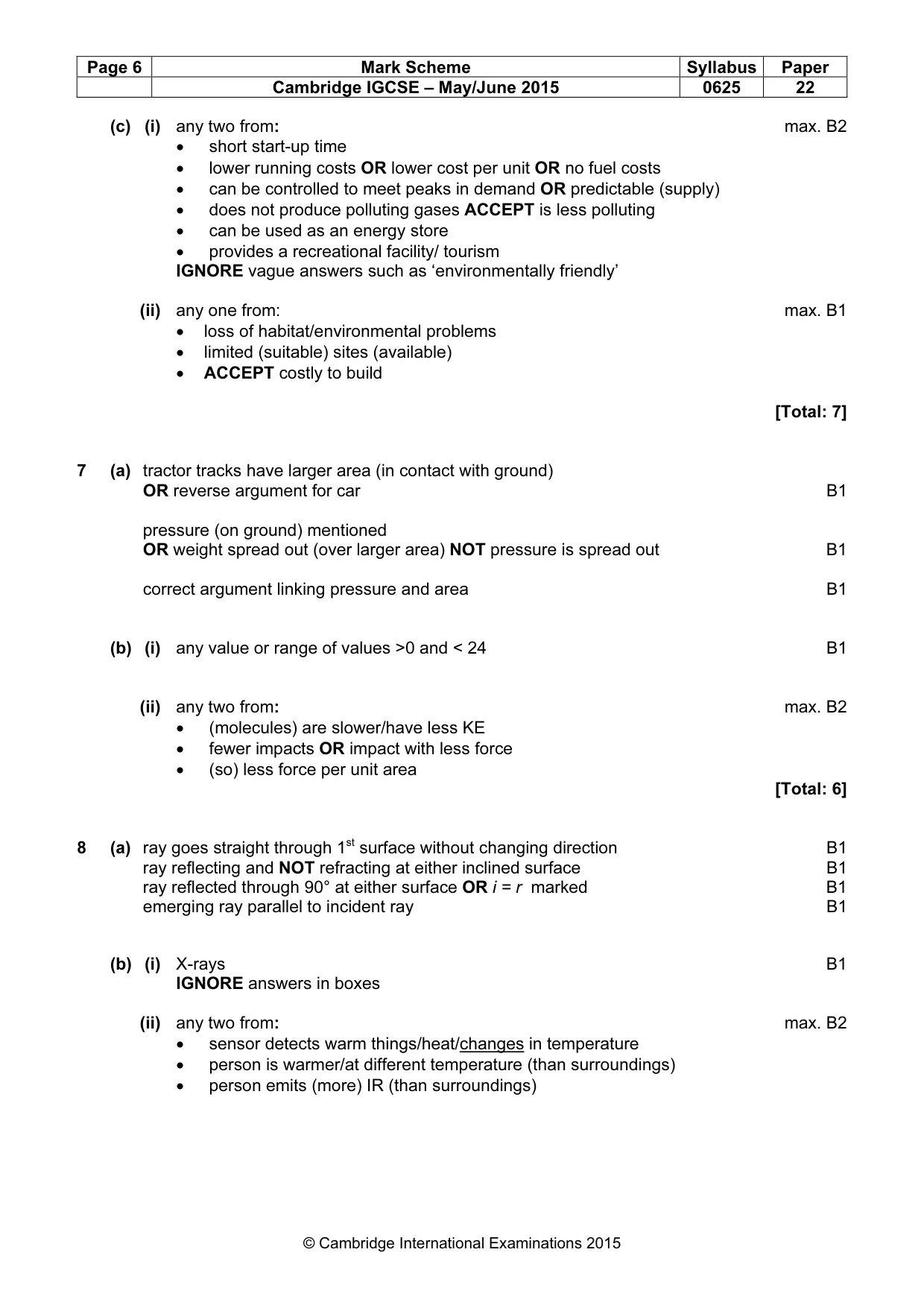
Page 6 Mark Scheme Syllabus Paper Cambridge IGCSE – May/June 2015 0625 22 © Cambridge International Examinations 2015 (c) (i) any two from: max. B2 • short start-up time • lower running costs OR lower cost per unit OR no fuel costs • can be controlled to meet peaks in demand OR predictable (supply) • does not produce polluting gases ACCEPT is less polluting • can be used as an energy store • provides a recreational facility/ tourism IGNORE vague answers such as ‘environmentally friendly’ (ii) any one from: max. B1 • loss of habitat/environmental problems • limited (suitable) sites (available) • ACCEPT costly to build [Total: 7] 7 (a) tractor tracks have larger area (in contact with ground) OR reverse argument for car B1 pressure (on ground) mentioned OR weight spread out (over larger area) NOT pressure is spread out B1 correct argument linking pressure and area B1 (b) (i) any value or range of values >0 and < 24 B1 (ii) any two from: max. B2 • (molecules) are slower/have less KE • fewer impacts OR impact with less force • (so) less force per unit area [Total: 6] 8 (a) ray goes straight through 1st surface without changing direction B1 ray reflecting and NOT refracting at either inclined surface B1 ray reflected through 90° at either surface OR i = r marked B1 emerging ray parallel to incident ray B1 (b) (i) X-rays B1 IGNORE answers in boxes (ii) any two from: max. B2 • sensor detects warm things/heat/changes in temperature • person is warmer/at different temperature (than surroundings) • person emits (more) IR (than surroundings)
Mark scheme, page 7
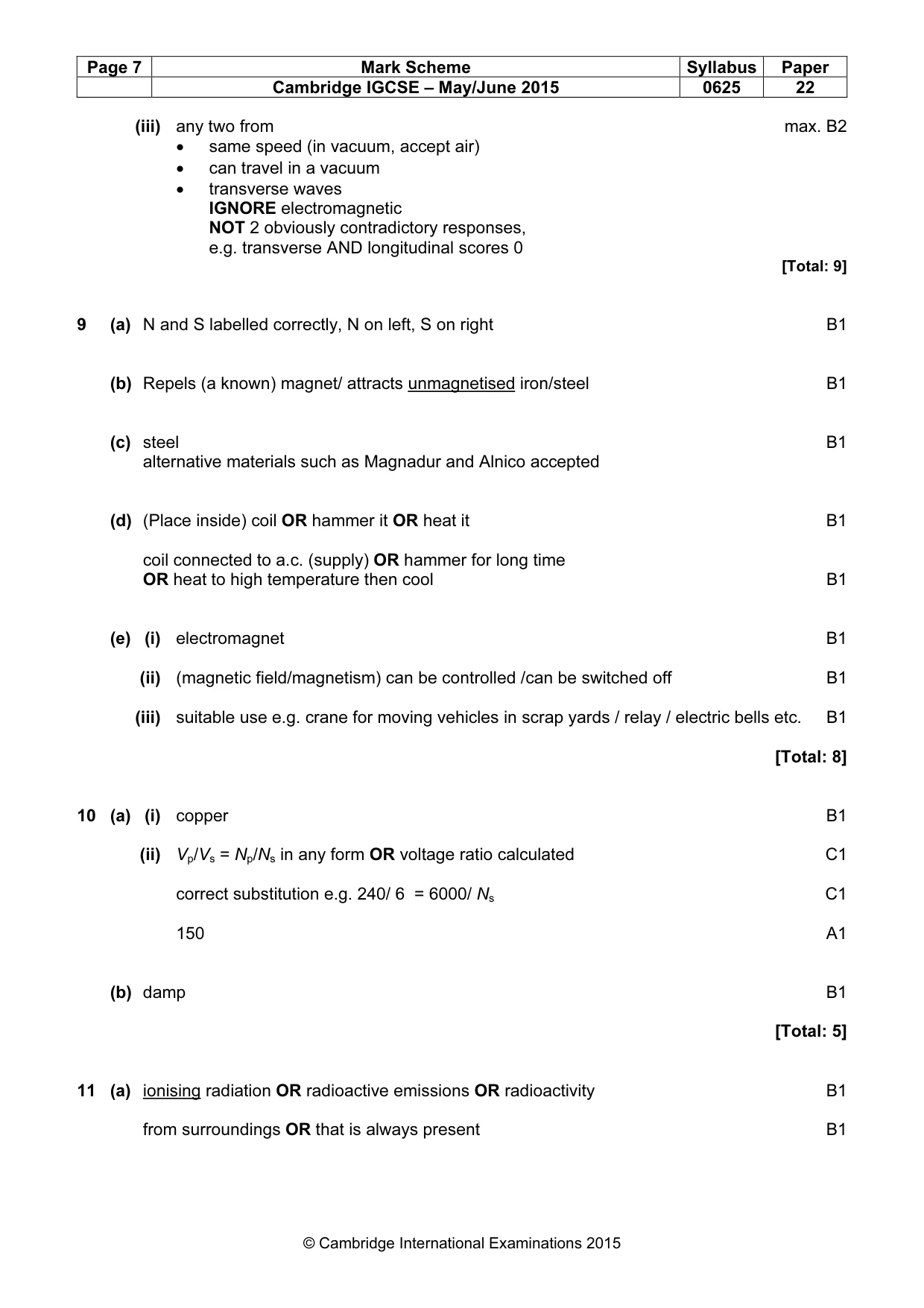
Page 7 Mark Scheme Syllabus Paper Cambridge IGCSE – May/June 2015 0625 22 © Cambridge International Examinations 2015 (iii) any two from max. B2 • same speed (in vacuum, accept air) • can travel in a vacuum • transverse waves IGNORE electromagnetic NOT 2 obviously contradictory responses, e.g. transverse AND longitudinal scores 0 [Total: 9] 9 (a) N and S labelled correctly, N on left, S on right B1 (b) Repels (a known) magnet/ attracts unmagnetised iron/steel B1 (c) steel B1 alternative materials such as Magnadur and Alnico accepted (d) (Place inside) coil OR hammer it OR heat it B1 coil connected to a.c. (supply) OR hammer for long time OR heat to high temperature then cool B1 (e) (i) electromagnet B1 (ii) (magnetic field/magnetism) can be controlled /can be switched off B1 (iii) suitable use e.g. crane for moving vehicles in scrap yards / relay / electric bells etc. B1 [Total: 8] 10 (a) (i) copper B1 (ii) Vp/Vs = Np/Ns in any form OR voltage ratio calculated C1 correct substitution e.g. 240/ 6 = 6000/ Ns C1 150 A1 (b) damp B1 [Total: 5] 11 (a) ionising radiation OR radioactive emissions OR radioactivity B1 from surroundings OR that is always present B1
Mark scheme, page 8
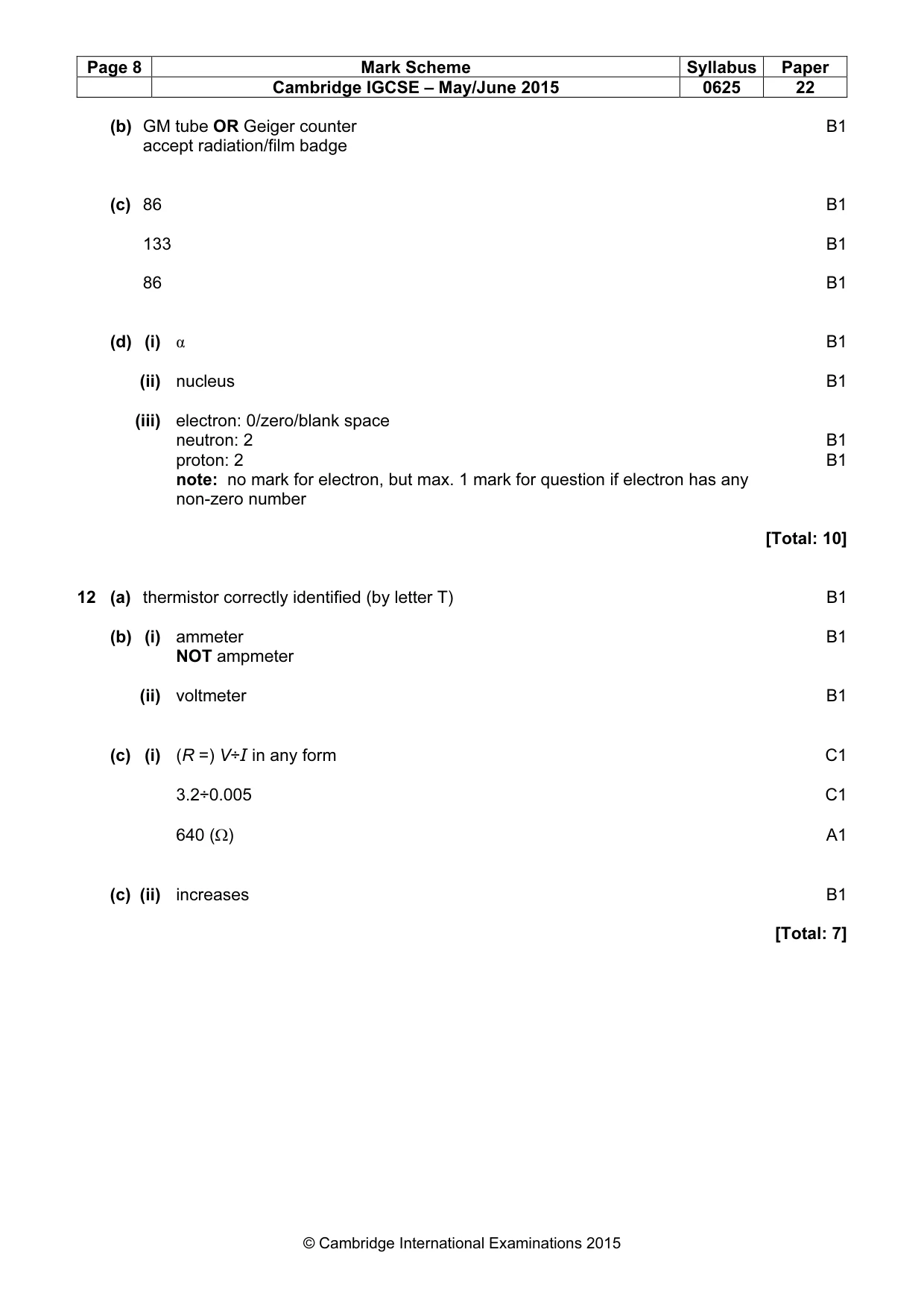
Page 8 Mark Scheme Syllabus Paper Cambridge IGCSE – May/June 2015 0625 22 © Cambridge International Examinations 2015 (b) GM tube OR Geiger counter B1 accept radiation/film badge (c) 86 B1 133 B1 86 B1 (d) (i) α B1 (ii) nucleus B1 (iii) electron: 0/zero/blank space neutron: 2 B1 proton: 2 B1 note: no mark for electron, but max. 1 mark for question if electron has any non-zero number [Total: 10] 12 (a) thermistor correctly identified (by letter T) B1 (b) (i) ammeter B1 NOT ampmeter (ii) voltmeter B1 (c) (i) (R =) V÷I in any form C1 3.2÷0.005 C1 640 (Ω) A1 (c) (ii) increases B1 [Total: 7]
What you needed in this session
Cambridge’s own grade thresholds for 2015 May/June, Paper 2 · Variant 2. A higher threshold means an easier paper — the bar moves with how the cohort did.