Cambridge IGCSE Physics 0625 — 2015 May/June Paper 2 · Variant 1
0625/21/M/J/15 · 80 marks · ≈90 min
The question paper and its mark scheme, free to read here and free to download. This is Cambridge’s own paper, exactly as it was sat.
Question paper20 pages
Mark scheme7 pages
Answers below. Sit the paper first if you are practising.
Paper as text
Question paper, page 1
This document consists of 18 printed pages and 2 blank pages. DC (NF/SW) 90323/2 © UCLES 2015 [Turn over Cambridge International Examinations Cambridge International General Certificate of Secondary Education * 0 9 3 0 7 9 3 0 0 9 * PHYSICS 0625/21 Paper 2 Core May/June 2015 1 hour 15 minutes Candidates answer on the Question Paper. No Additional Materials are required. READ THESE INSTRUCTIONS FIRST Write your Centre number, candidate number and name on all the work you hand in. Write in dark blue or black pen. You may use an HB pencil for any diagrams or graphs. Do not use staples, paper clips, glue or correction fluid. DO NOT WRITE IN ANY BARCODES. Answer all questions. Electronic calculators may be used. You may lose marks if you do not show your working or if you do not use appropriate units. Take the weight of 1 kg to be 10 N (i.e. acceleration of free fall = 10 m / s2). At the end of the examination, fasten all your work securely together. The number of marks is given in brackets [ ] at the end of each question or part question. The syllabus is approved for use in England, Wales and Northern Ireland as a Cambridge International Level 1/Level 2 Certificate.
Question paper, page 2
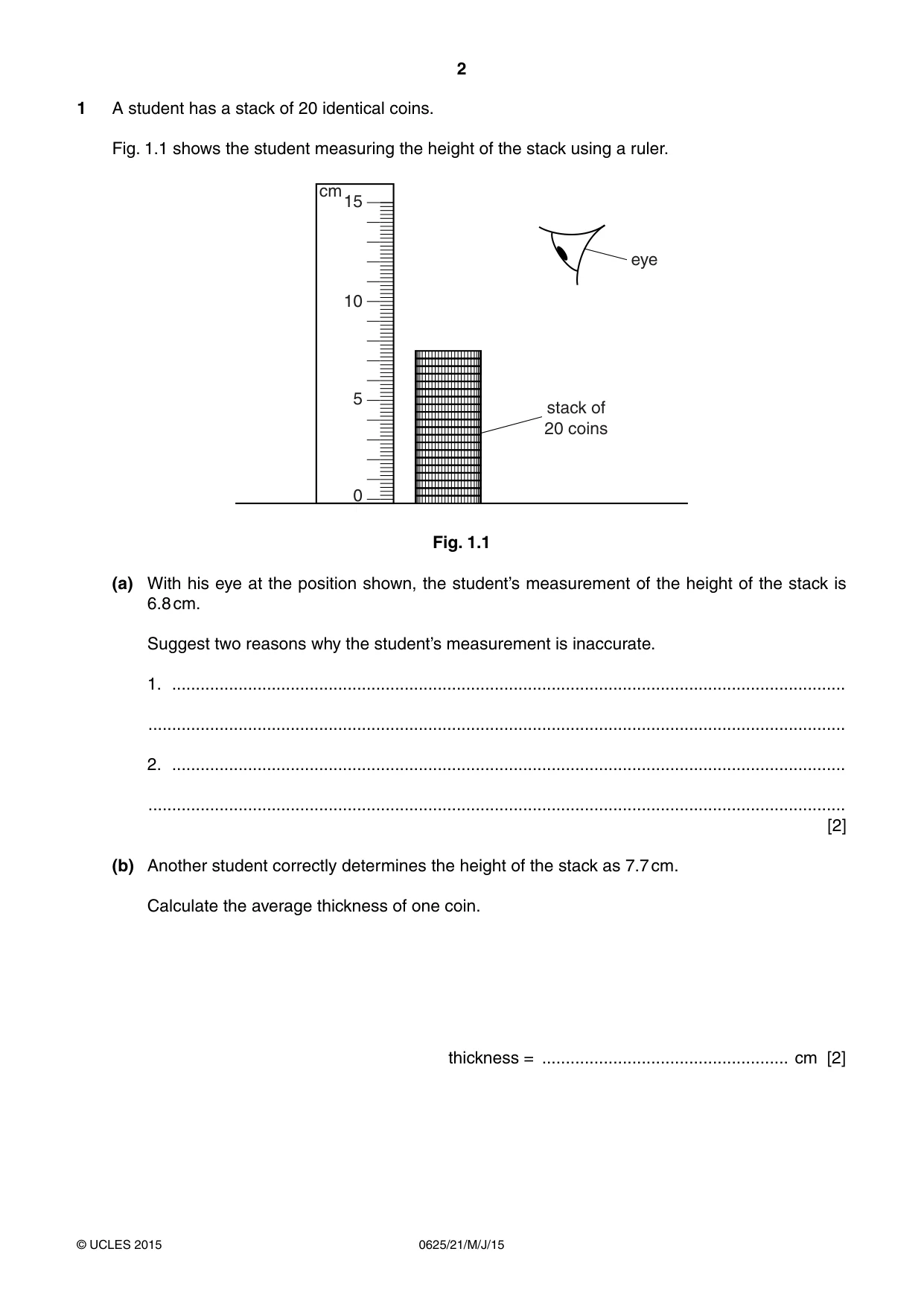
2 0625/21/M/J/15 © UCLES 2015 1 A student has a stack of 20 identical coins. Fig. 1.1 shows the student measuring the height of the stack using a ruler. 15 cm 10 5 0 eye stack of 20 coins Fig. 1.1 (a) With his eye at the position shown, the student’s measurement of the height of the stack is 6.8 cm. Suggest two reasons why the student’s measurement is inaccurate. 1. … … 2. … … [2] (b) Another student correctly determines the height of the stack as 7.7 cm. Calculate the average thickness of one coin. thickness = … cm [2]
Question paper, page 3
3 0625/21/M/J/15 © UCLES 2015 [Turn over (c) The mass of a single coin is 12 g. State this mass in kg. mass = … kg [1] [Total: 5]
Question paper, page 4
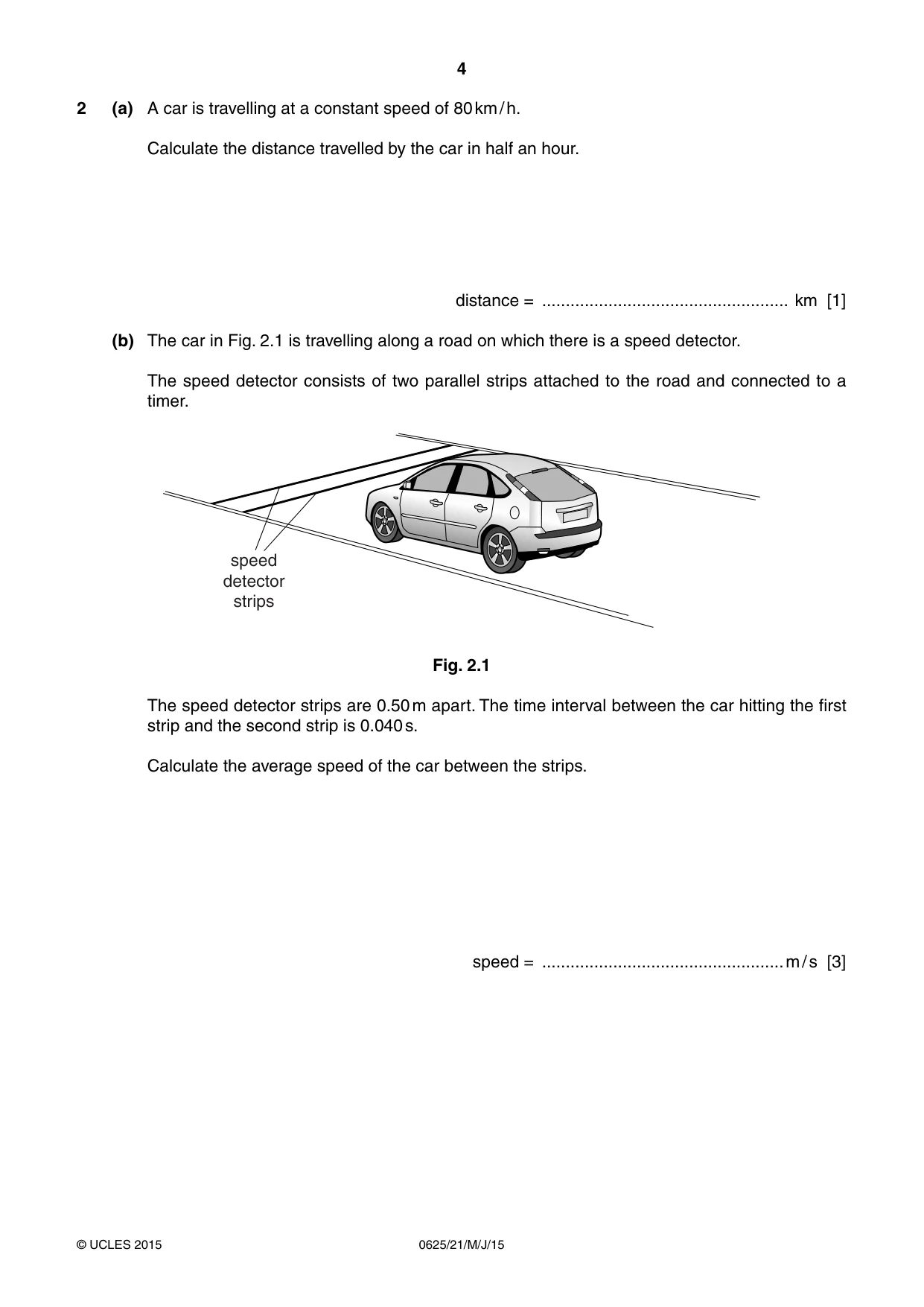
4 0625/21/M/J/15 © UCLES 2015 2 (a) A car is travelling at a constant speed of 80 km / h. Calculate the distance travelled by the car in half an hour. distance = … km [1] (b) The car in Fig. 2.1 is travelling along a road on which there is a speed detector. The speed detector consists of two parallel strips attached to the road and connected to a timer. speed detector strips Fig. 2.1 The speed detector strips are 0.50 m apart. The time interval between the car hitting the first strip and the second strip is 0.040 s. Calculate the average speed of the car between the strips. speed = … m / s [3]
Question paper, page 5
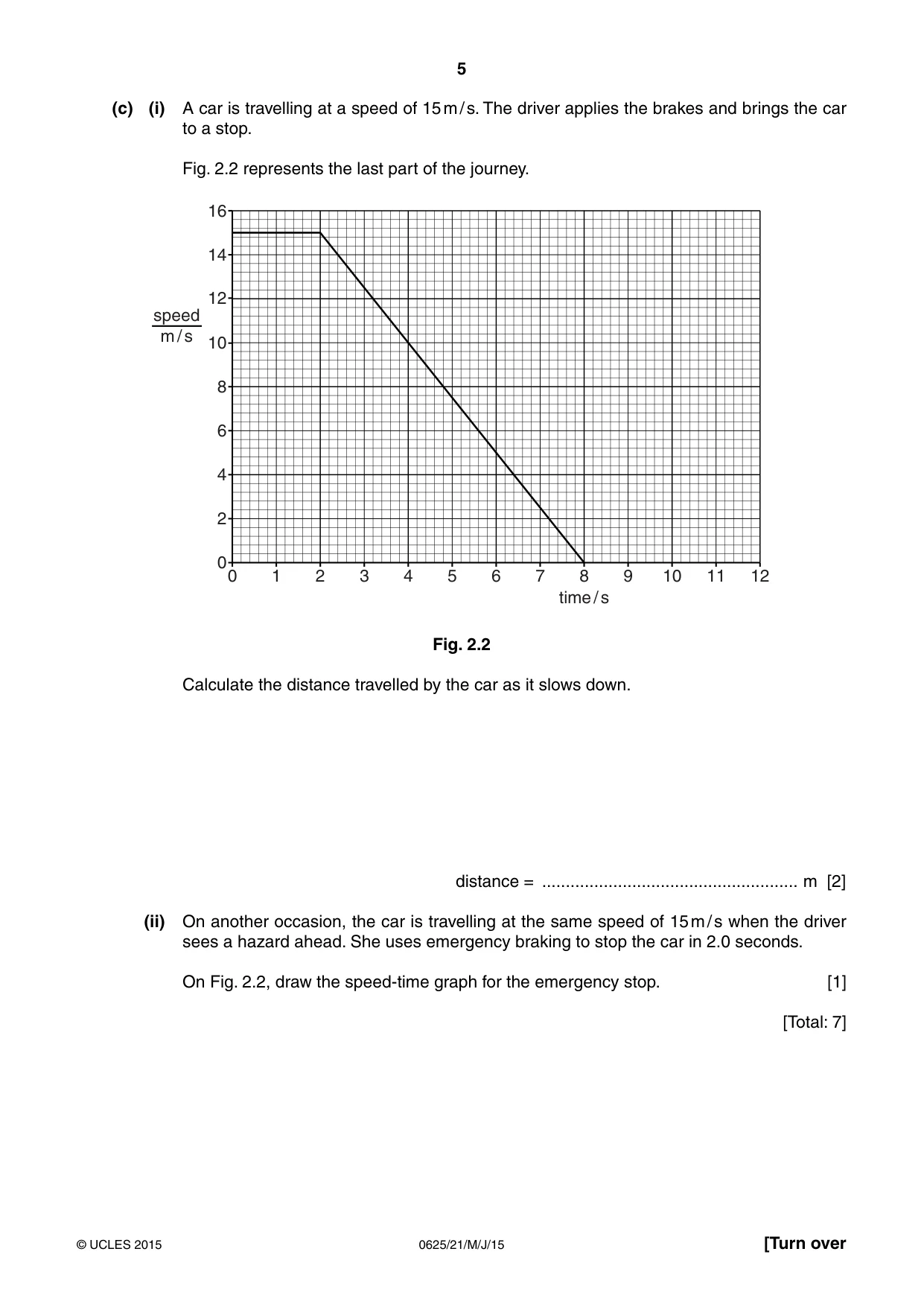
5 0625/21/M/J/15 © UCLES 2015 [Turn over (c) (i) A car is travelling at a speed of 15 m / s. The driver applies the brakes and brings the car to a stop. Fig. 2.2 represents the last part of the journey. 0 0 2 4 6 8 10 12 14 16 1 2 3 4 5 6 time / s speed m / s 7 8 9 10 11 12 Fig. 2.2 Calculate the distance travelled by the car as it slows down. distance = … m [2] (ii) On another occasion, the car is travelling at the same speed of 15 m / s when the driver sees a hazard ahead. She uses emergency braking to stop the car in 2.0 seconds. On Fig. 2.2, draw the speed-time graph for the emergency stop. [1] [Total: 7]
Question paper, page 6
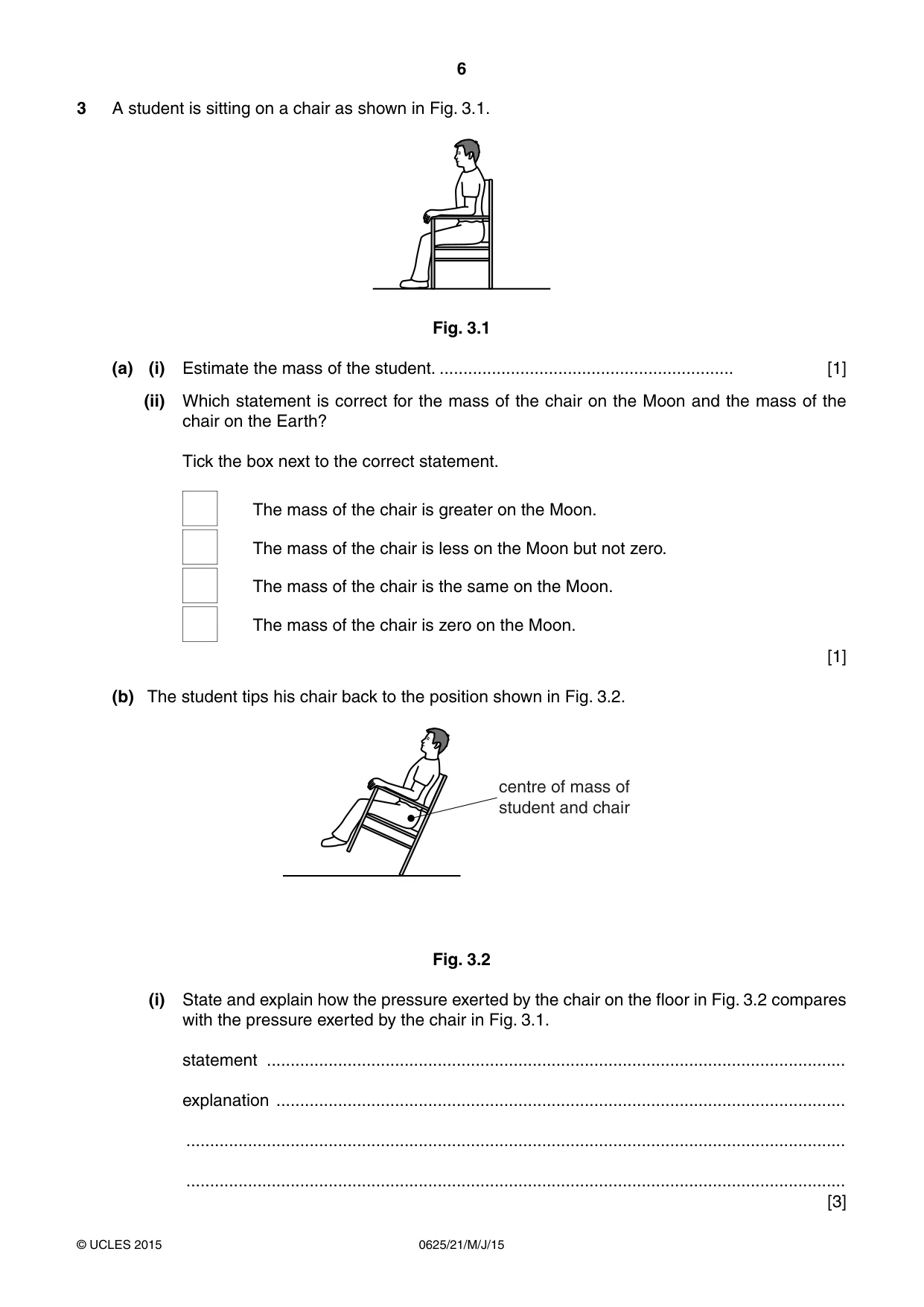
6 0625/21/M/J/15 © UCLES 2015 3 A student is sitting on a chair as shown in Fig. 3.1. Fig. 3.1 (a) (i) Estimate the mass of the student. … [1] (ii) Which statement is correct for the mass of the chair on the Moon and the mass of the chair on the Earth? Tick the box next to the correct statement. The mass of the chair is greater on the Moon. The mass of the chair is less on the Moon but not zero. The mass of the chair is the same on the Moon. The mass of the chair is zero on the Moon. [1] (b) The student tips his chair back to the position shown in Fig. 3.2. centre of mass of student and chair Fig. 3.2 (i) State and explain how the pressure exerted by the chair on the floor in Fig. 3.2 compares with the pressure exerted by the chair in Fig. 3.1. statement … explanation … … … [3]
Question paper, page 7
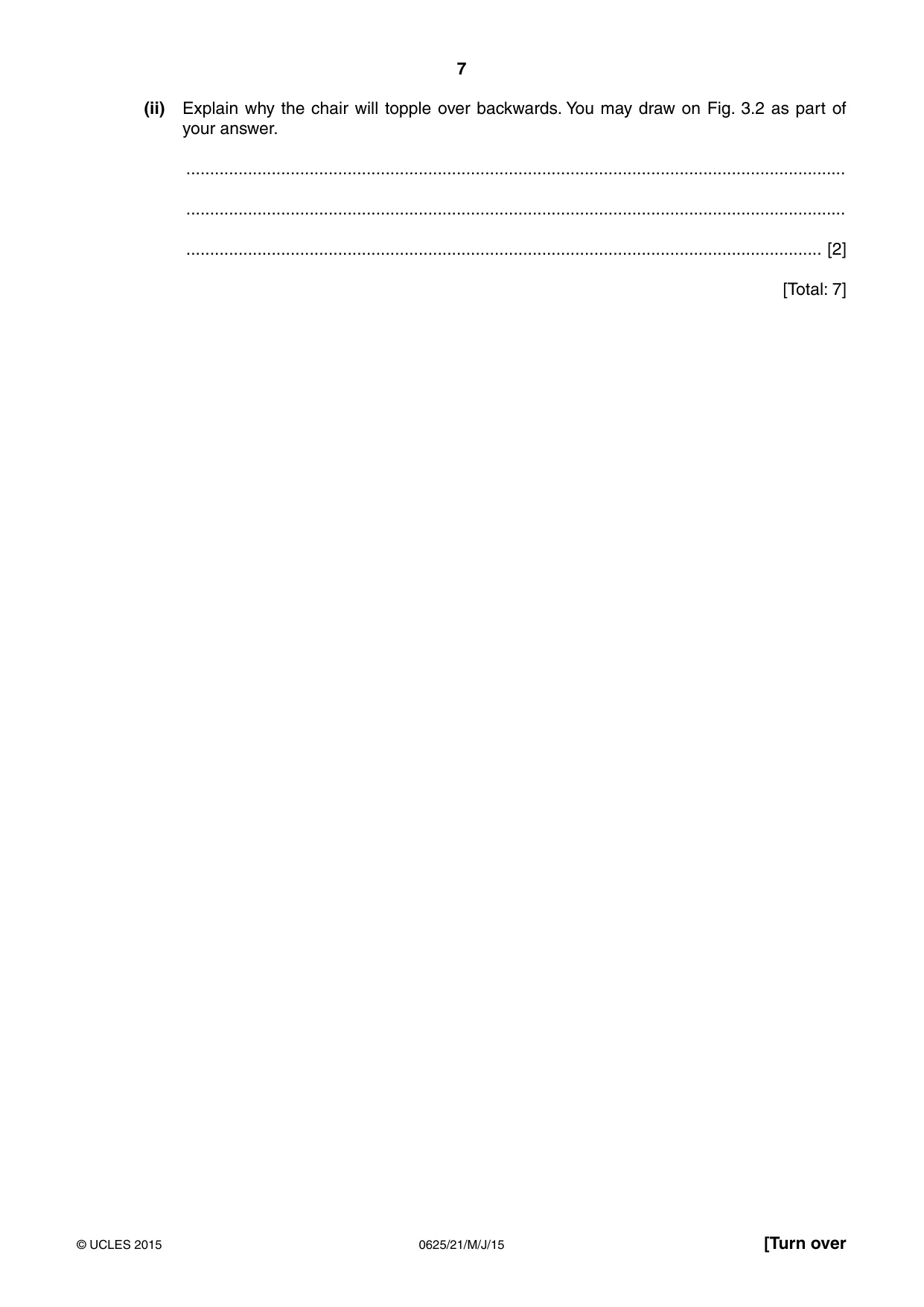
7 0625/21/M/J/15 © UCLES 2015 [Turn over (ii) Explain why the chair will topple over backwards. You may draw on Fig. 3.2 as part of your answer. … … … [2] [Total: 7]
Question paper, page 8
8 0625/21/M/J/15 © UCLES 2015 BLANK PAGE
Question paper, page 9
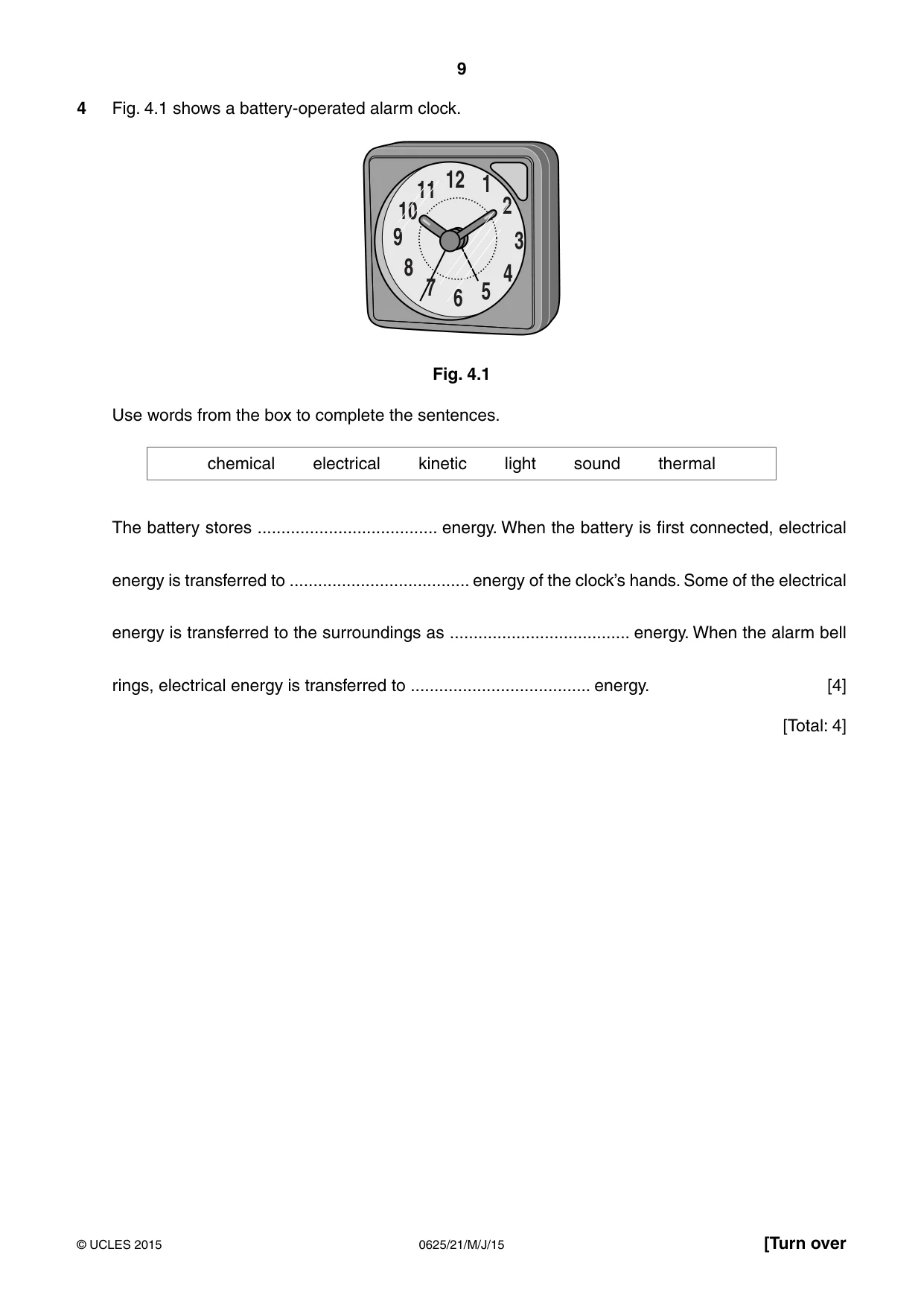
9 0625/21/M/J/15 © UCLES 2015 [Turn over 4 Fig. 4.1 shows a battery-operated alarm clock. 12 11 10 9 8 7 6 5 4 3 2 1 Fig. 4.1 Use words from the box to complete the sentences. chemical electrical kinetic light sound thermal The battery stores … energy. When the battery is first connected, electrical energy is transferred to … energy of the clock’s hands. Some of the electrical energy is transferred to the surroundings as … energy. When the alarm bell rings, electrical energy is transferred to … energy. [4] [Total: 4]
Question paper, page 10
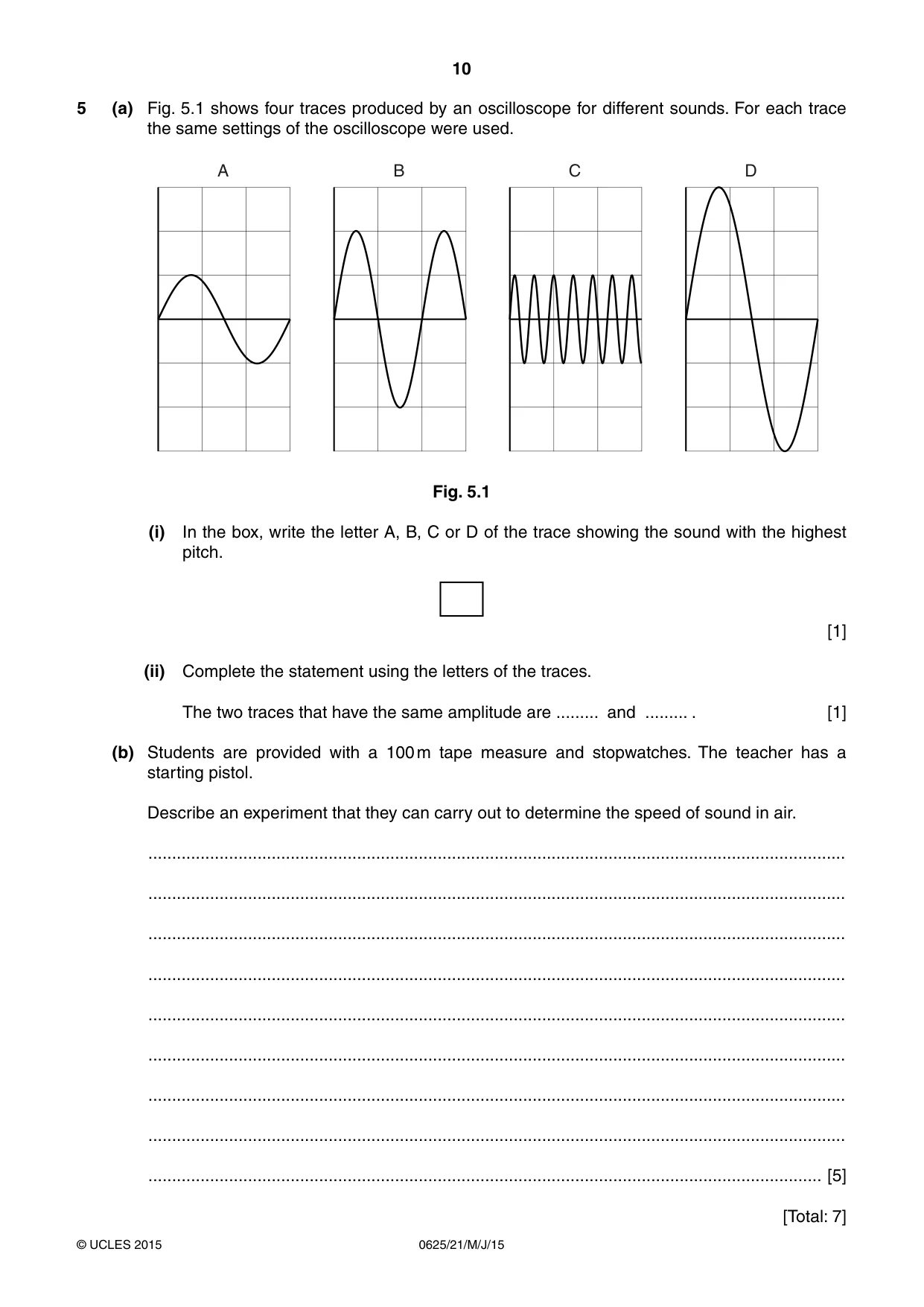
10 0625/21/M/J/15 © UCLES 2015 5 (a) Fig. 5.1 shows four traces produced by an oscilloscope for different sounds. For each trace the same settings of the oscilloscope were used. A B C D Fig. 5.1 (i) In the box, write the letter A, B, C or D of the trace showing the sound with the highest pitch. [1] (ii) Complete the statement using the letters of the traces. The two traces that have the same amplitude are … and … . [1] (b) Students are provided with a 100 m tape measure and stopwatches. The teacher has a starting pistol. Describe an experiment that they can carry out to determine the speed of sound in air. … … … … … … … … … [5] [Total: 7]
Question paper, page 11
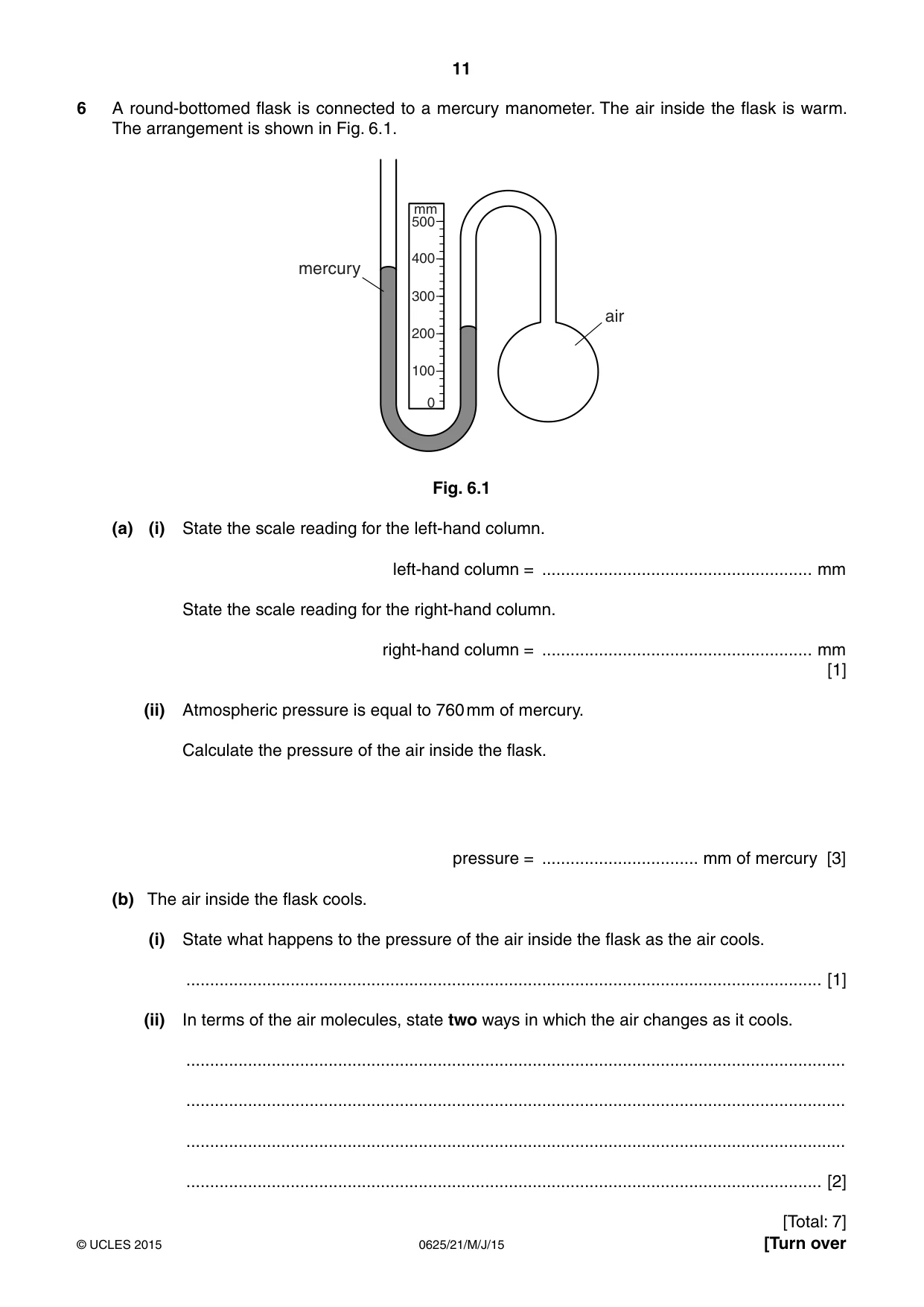
11 0625/21/M/J/15 © UCLES 2015 [Turn over 6 A round-bottomed flask is connected to a mercury manometer. The air inside the flask is warm. The arrangement is shown in Fig. 6.1. 500 mm 400 300 200 100 0 air mercury Fig. 6.1 (a) (i) State the scale reading for the left-hand column. left-hand column = … mm State the scale reading for the right-hand column. right-hand column = … mm [1] (ii) Atmospheric pressure is equal to 760 mm of mercury. Calculate the pressure of the air inside the flask. pressure = … mm of mercury [3] (b) The air inside the flask cools. (i) State what happens to the pressure of the air inside the flask as the air cools. … [1] (ii) In terms of the air molecules, state two ways in which the air changes as it cools. … … … … [2] [Total: 7]
Question paper, page 12
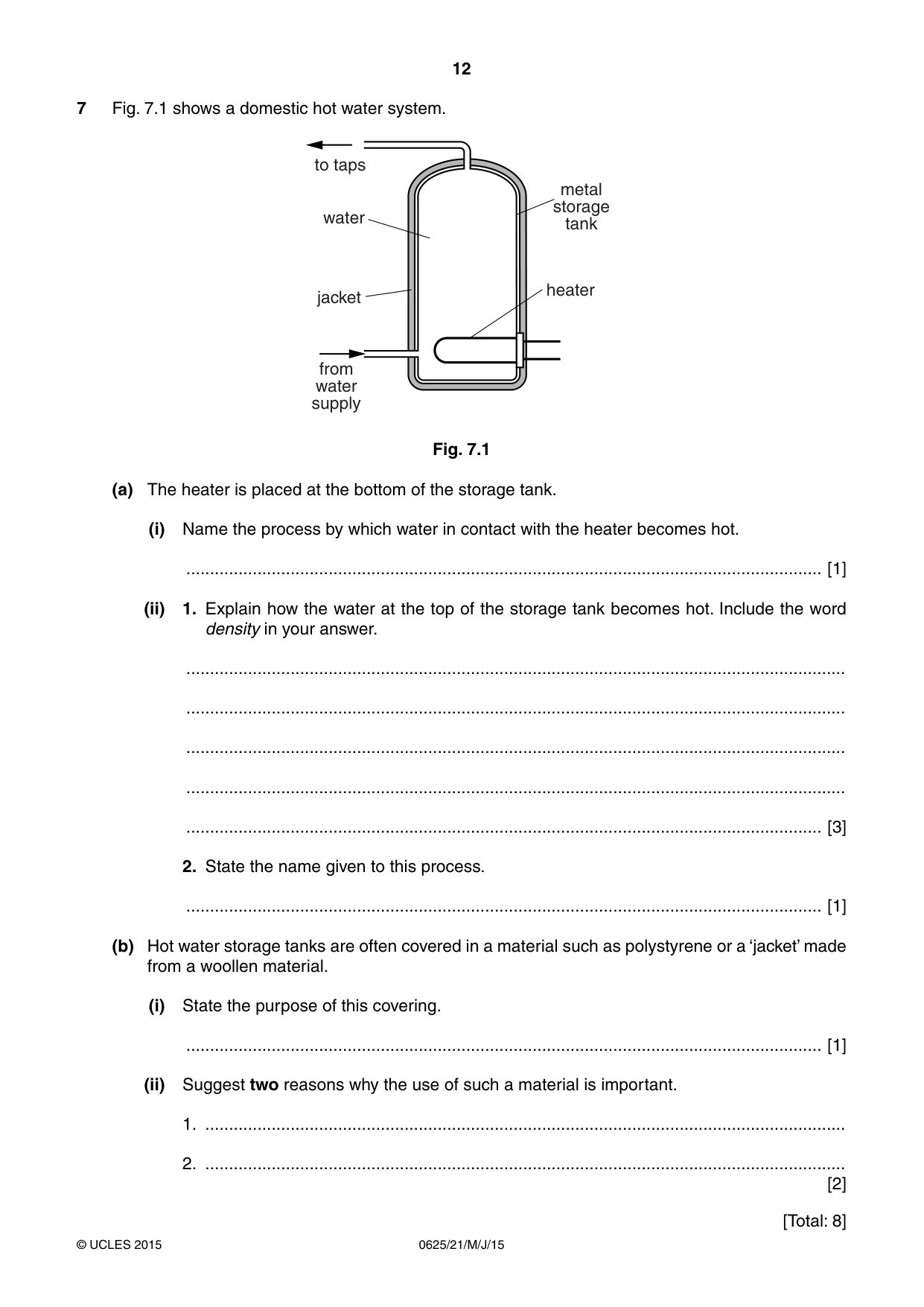
12 0625/21/M/J/15 © UCLES 2015 7 Fig. 7.1 shows a domestic hot water system. heater metal storage tank water jacket from water supply to taps Fig. 7.1 (a) The heater is placed at the bottom of the storage tank. (i) Name the process by which water in contact with the heater becomes hot. … [1] (ii) 1. Explain how the water at the top of the storage tank becomes hot. Include the word density in your answer. … … … … … [3] 2. State the name given to this process. … [1] (b) Hot water storage tanks are often covered in a material such as polystyrene or a ‘jacket’ made from a woollen material. (i) State the purpose of this covering. … [1] (ii) Suggest two reasons why the use of such a material is important. 1. … 2. … [2] [Total: 8]
Question paper, page 13
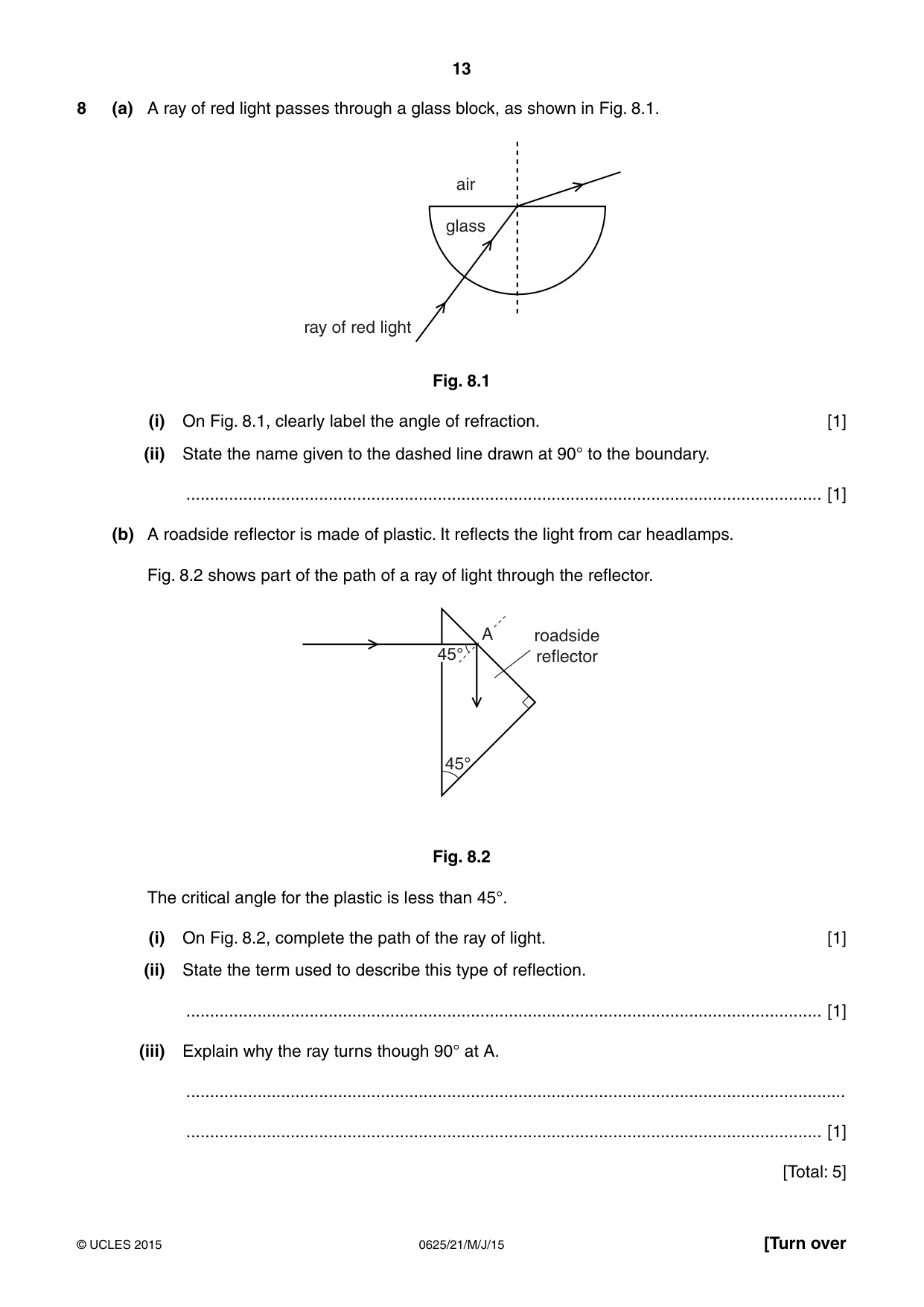
13 0625/21/M/J/15 © UCLES 2015 [Turn over 8 (a) A ray of red light passes through a glass block, as shown in Fig. 8.1. air glass ray of red light Fig. 8.1 (i) On Fig. 8.1, clearly label the angle of refraction. [1] (ii) State the name given to the dashed line drawn at 90° to the boundary. … [1] (b) A roadside reflector is made of plastic. It reflects the light from car headlamps. Fig. 8.2 shows part of the path of a ray of light through the reflector. A 45° 45° roadside reflector Fig. 8.2 The critical angle for the plastic is less than 45°. (i) On Fig. 8.2, complete the path of the ray of light. [1] (ii) State the term used to describe this type of reflection. … [1] (iii) Explain why the ray turns though 90° at A. … … [1] [Total: 5]
Question paper, page 14
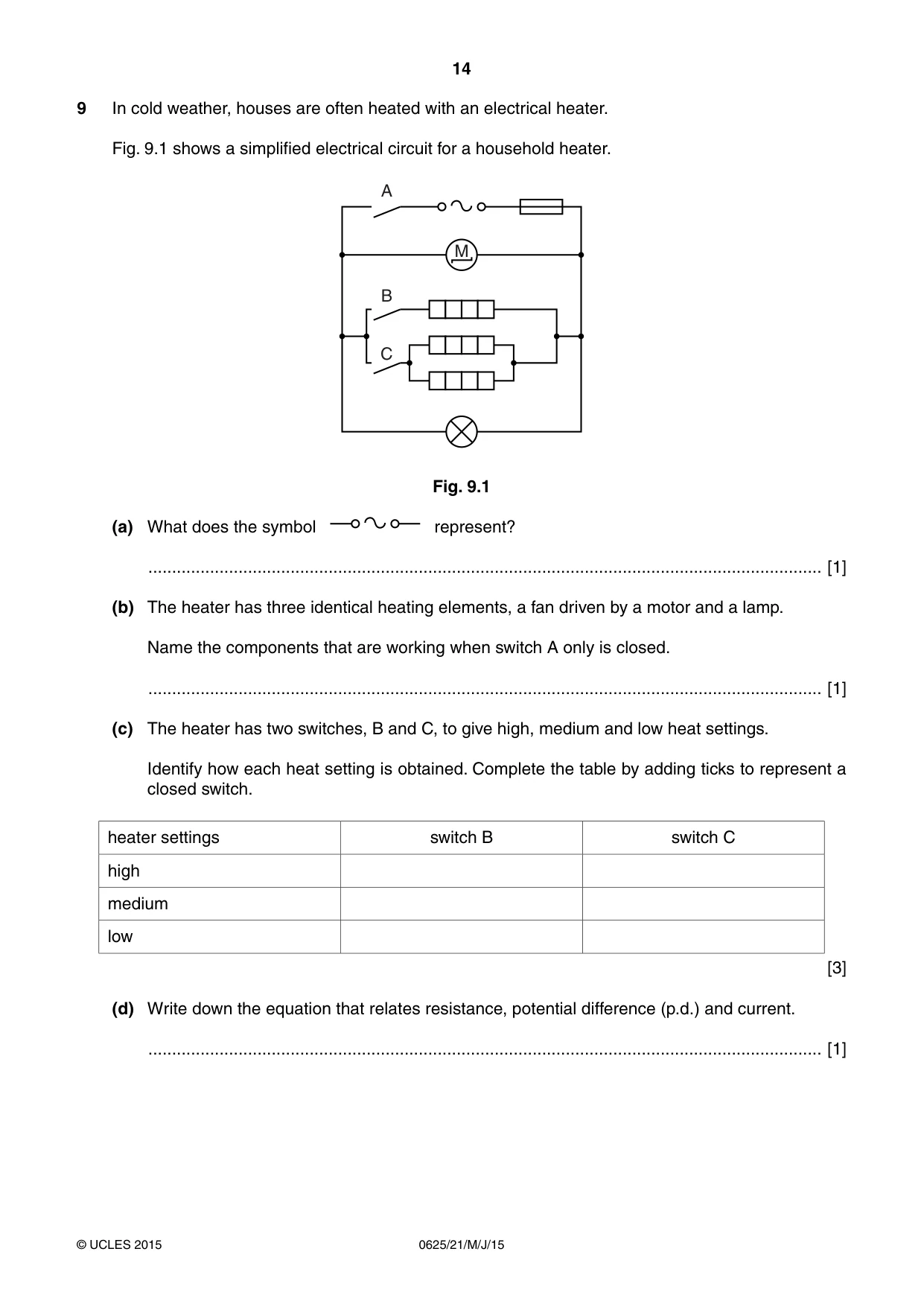
14 0625/21/M/J/15 © UCLES 2015 9 In cold weather, houses are often heated with an electrical heater. Fig. 9.1 shows a simplified electrical circuit for a household heater. M A B C Fig. 9.1 (a) What does the symbol represent? … [1] (b) The heater has three identical heating elements, a fan driven by a motor and a lamp. Name the components that are working when switch A only is closed. … [1] (c) The heater has two switches, B and C, to give high, medium and low heat settings. Identify how each heat setting is obtained. Complete the table by adding ticks to represent a closed switch. heater settings switch B switch C high medium low [3] (d) Write down the equation that relates resistance, potential difference (p.d.) and current. … [1]
Question paper, page 15
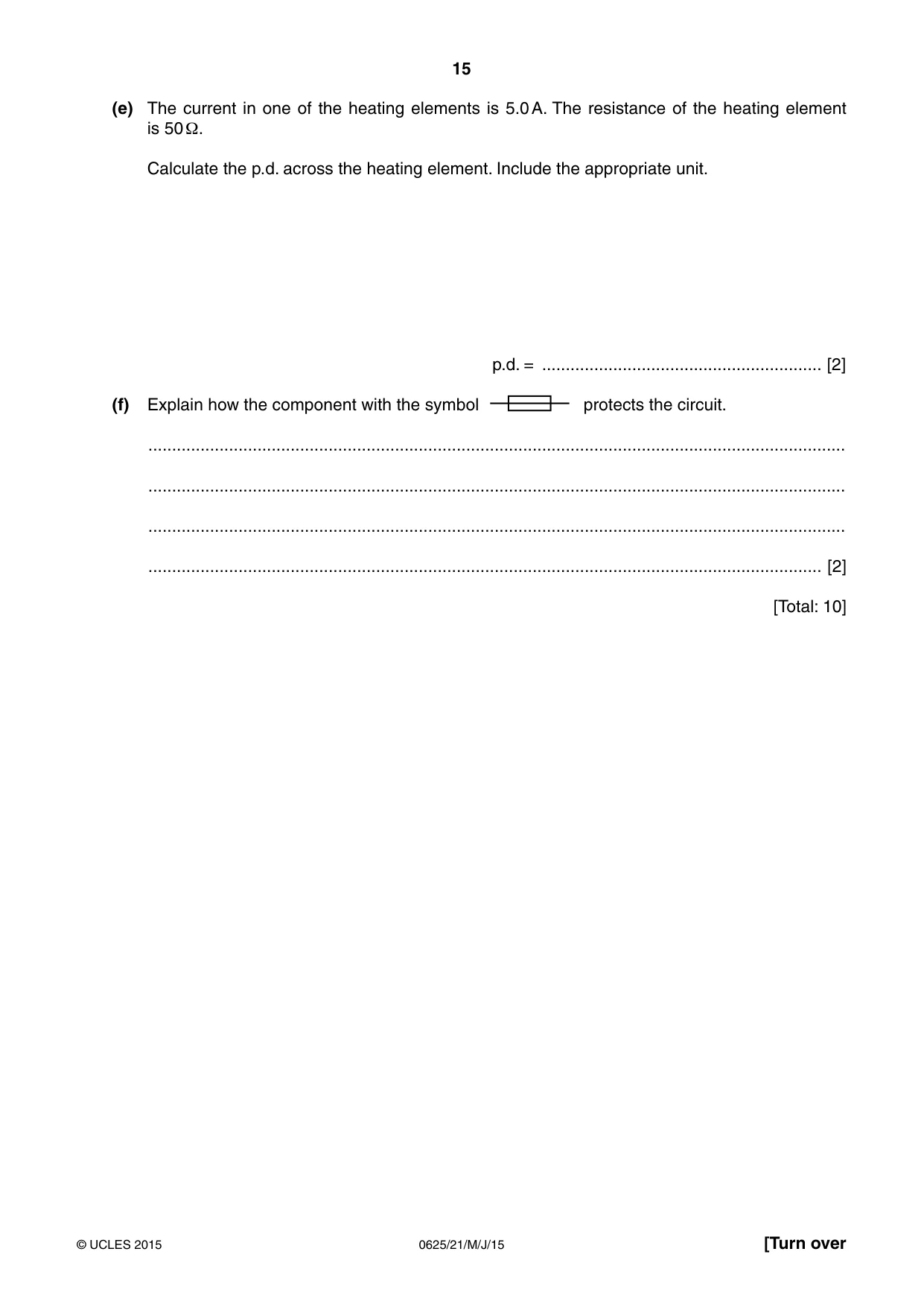
15 0625/21/M/J/15 © UCLES 2015 [Turn over (e) The current in one of the heating elements is 5.0 A. The resistance of the heating element is 50 Ω. Calculate the p.d. across the heating element. Include the appropriate unit. p.d. = … [2] (f) Explain how the component with the symbol protects the circuit. … … … … [2] [Total: 10]
Question paper, page 16
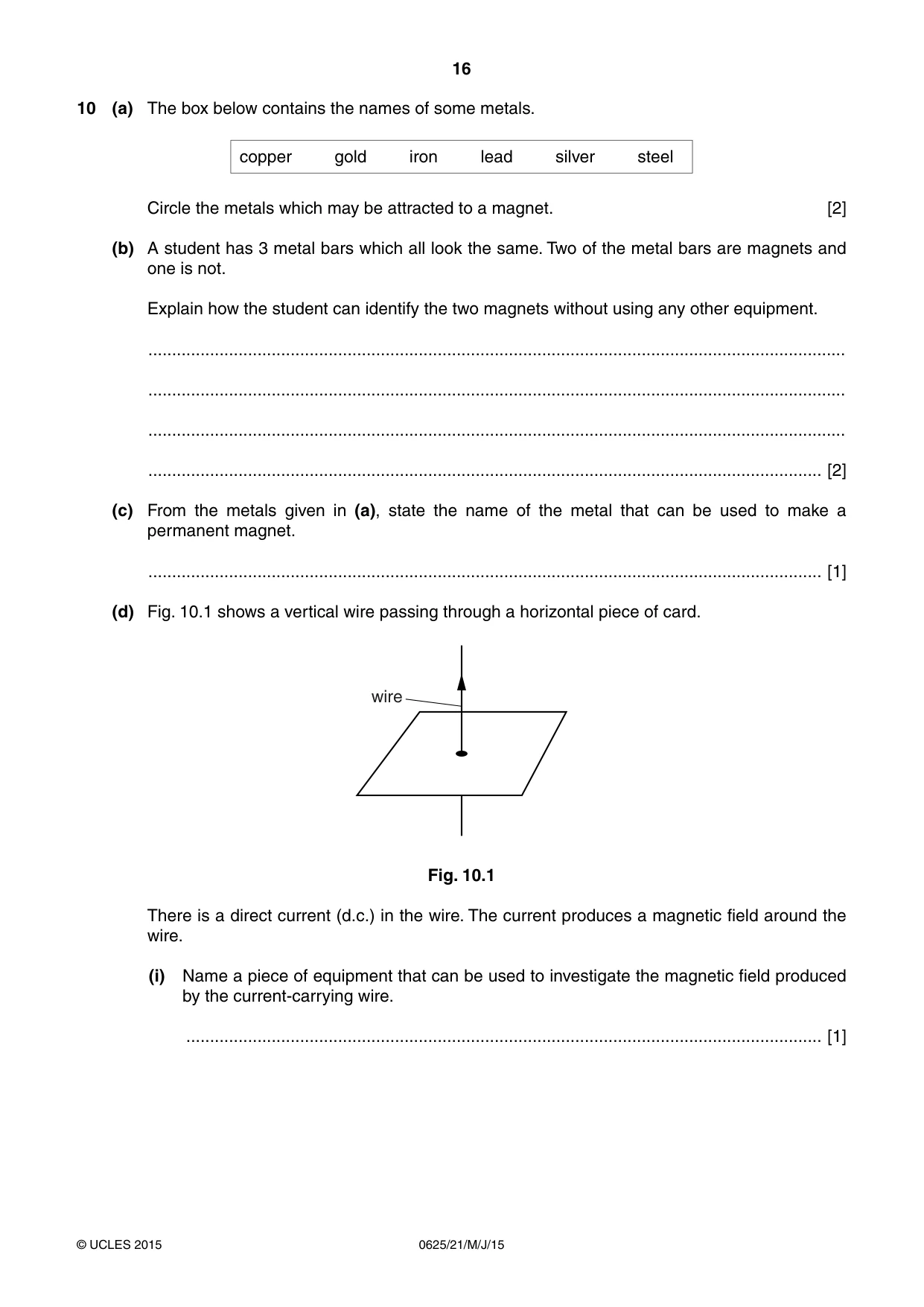
16 0625/21/M/J/15 © UCLES 2015 10 (a) The box below contains the names of some metals. copper gold iron lead silver steel Circle the metals which may be attracted to a magnet. [2] (b) A student has 3 metal bars which all look the same. Two of the metal bars are magnets and one is not. Explain how the student can identify the two magnets without using any other equipment. … … … … [2] (c) From the metals given in (a), state the name of the metal that can be used to make a permanent magnet. … [1] (d) Fig. 10.1 shows a vertical wire passing through a horizontal piece of card. wire Fig. 10.1 There is a direct current (d.c.) in the wire. The current produces a magnetic field around the wire. (i) Name a piece of equipment that can be used to investigate the magnetic field produced by the current-carrying wire. … [1]
Question paper, page 17
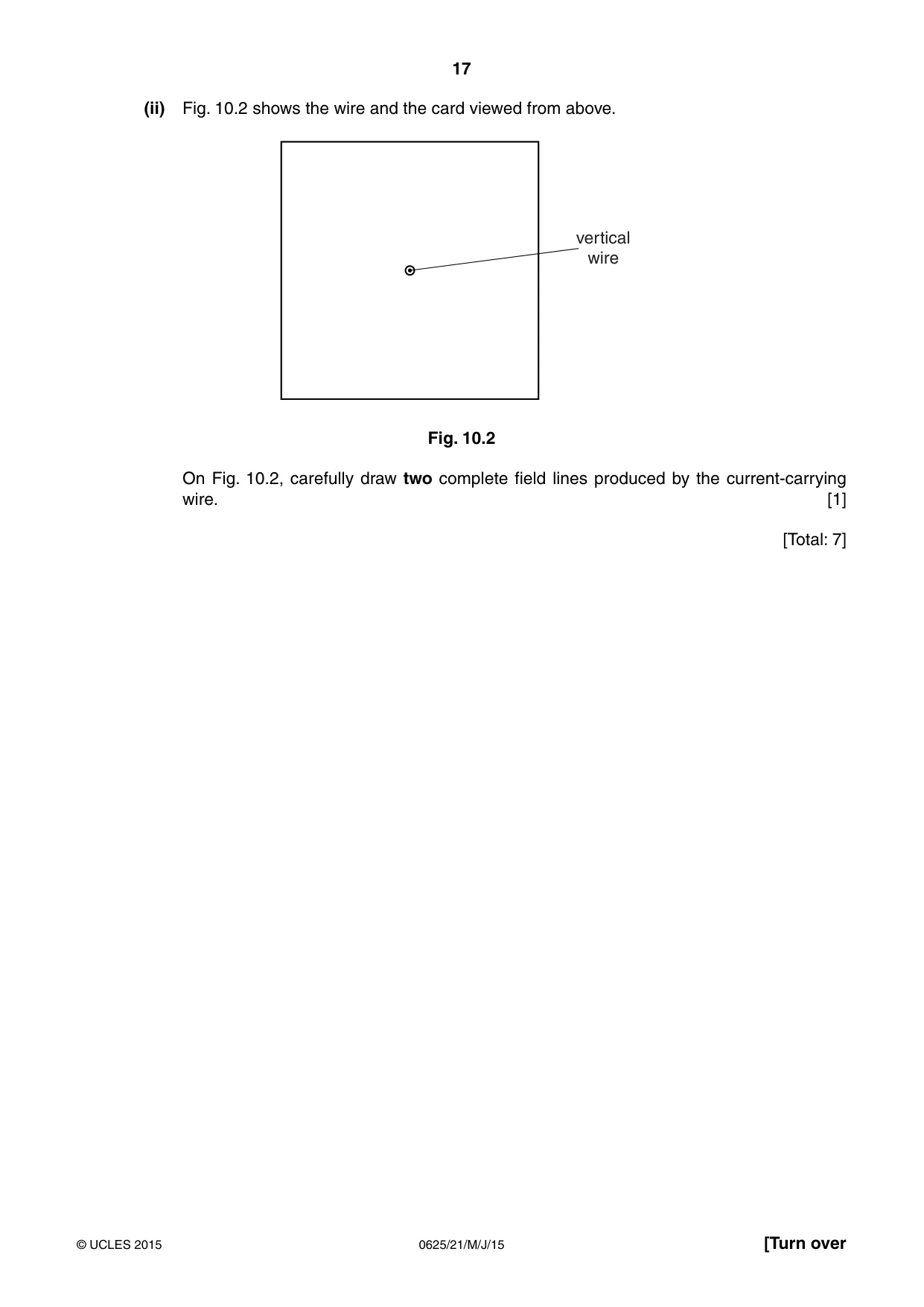
17 0625/21/M/J/15 © UCLES 2015 [Turn over (ii) Fig. 10.2 shows the wire and the card viewed from above. vertical wire Fig. 10.2 On Fig. 10.2, carefully draw two complete field lines produced by the current-carrying wire. [1] [Total: 7]
Question paper, page 18
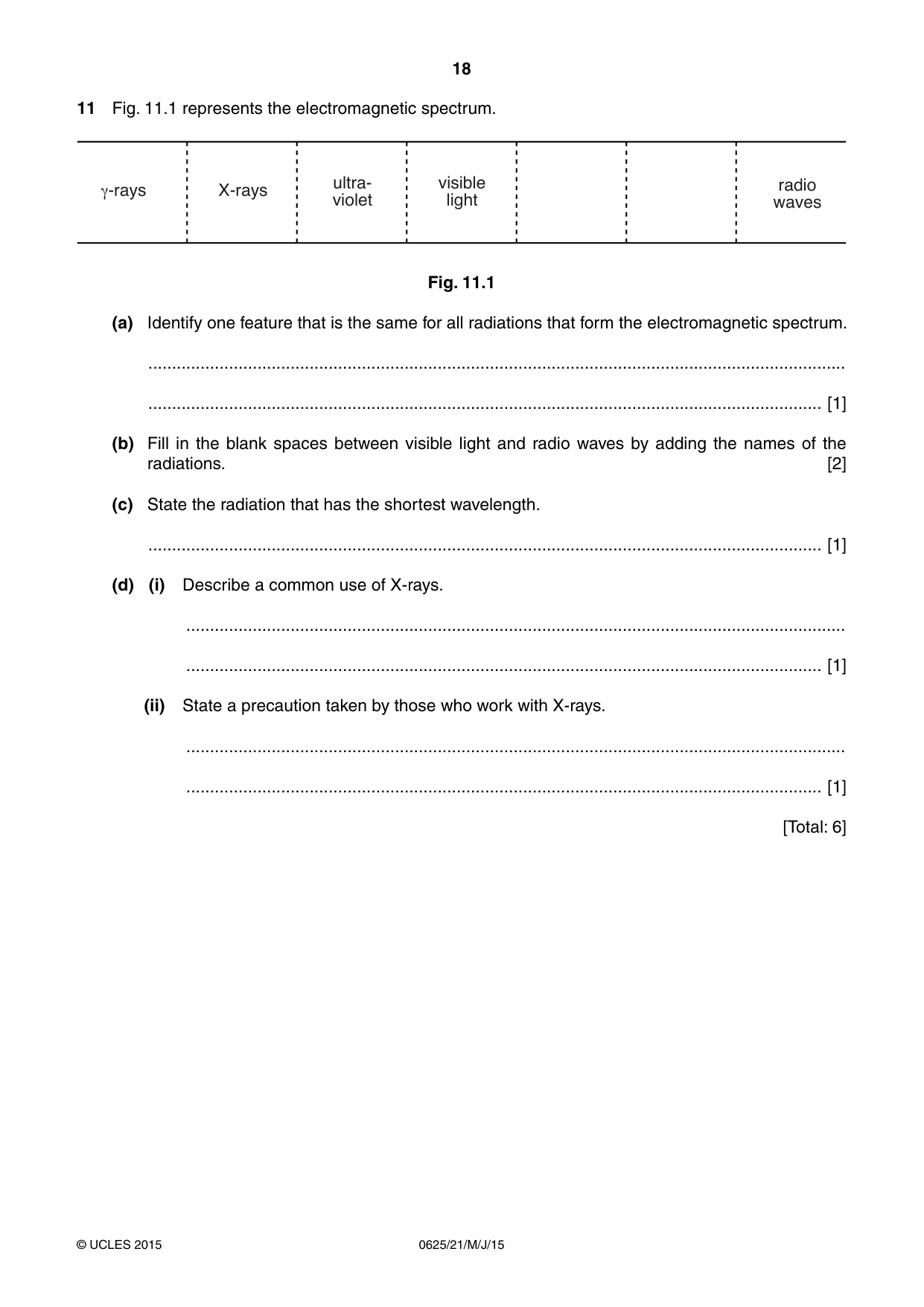
18 0625/21/M/J/15 © UCLES 2015 11 Fig. 11.1 represents the electromagnetic spectrum. visible light radio waves X-rays ultra- violet a-rays Fig. 11.1 (a) Identify one feature that is the same for all radiations that form the electromagnetic spectrum. … … [1] (b) Fill in the blank spaces between visible light and radio waves by adding the names of the radiations. [2] (c) State the radiation that has the shortest wavelength. … [1] (d) (i) Describe a common use of X-rays. … … [1] (ii) State a precaution taken by those who work with X-rays. … … [1] [Total: 6]
Question paper, page 19
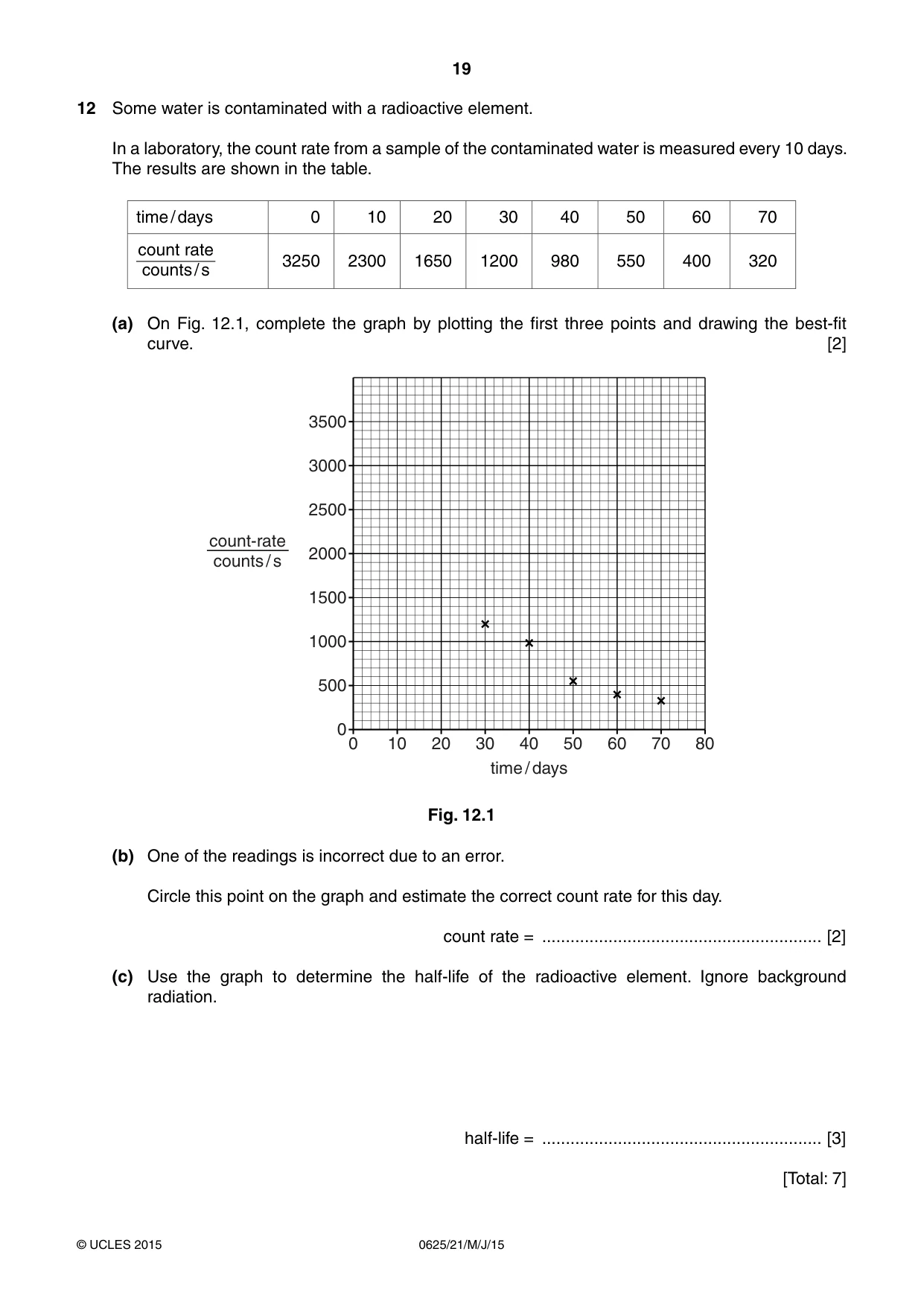
19 0625/21/M/J/15 © UCLES 2015 12 Some water is contaminated with a radioactive element. In a laboratory, the count rate from a sample of the contaminated water is measured every 10 days. The results are shown in the table. time / days 0 10 20 30 40 50 60 70 count rate counts / s 3250 2300 1650 1200 980 550 400 320 (a) On Fig. 12.1, complete the graph by plotting the first three points and drawing the best-fit curve. [2] 0 0 500 1000 1500 2000 2500 3000 3500 10 20 30 40 time / days count-rate counts / s 50 60 70 80 Fig. 12.1 (b) One of the readings is incorrect due to an error. Circle this point on the graph and estimate the correct count rate for this day. count rate = … [2] (c) Use the graph to determine the half-life of the radioactive element. Ignore background radiation. half-life = … [3] [Total: 7]
Question paper, page 20
20 0625/21/M/J/15 © UCLES 2015 Permission to reproduce items where third-party owned material protected by copyright is included has been sought and cleared where possible. Every reasonable effort has been made by the publisher (UCLES) to trace copyright holders, but if any items requiring clearance have unwittingly been included, the publisher will be pleased to make amends at the earliest possible opportunity. To avoid the issue of disclosure of answer-related information to candidates, all copyright acknowledgements are reproduced online in the Cambridge International Examinations Copyright Acknowledgements Booklet. This is produced for each series of examinations and is freely available to download at www.cie.org.uk after the live examination series. Cambridge International Examinations is part of the Cambridge Assessment Group. Cambridge Assessment is the brand name of University of Cambridge Local Examinations Syndicate (UCLES), which is itself a department of the University of Cambridge. BLANK PAGE
Mark scheme, page 1
® IGCSE is the registered trademark of Cambridge International Examinations. CAMBRIDGE INTERNATIONAL EXAMINATIONS Cambridge International General Certificate of Secondary Education MARK SCHEME for the May/June 2015 series 0625 PHYSICS 0625/21 Paper 2 (Core Theory), maximum raw mark 80 This mark scheme is published as an aid to teachers and candidates, to indicate the requirements of the examination. It shows the basis on which Examiners were instructed to award marks. It does not indicate the details of the discussions that took place at an Examiners’ meeting before marking began, which would have considered the acceptability of alternative answers. Mark schemes should be read in conjunction with the question paper and the Principal Examiner Report for Teachers. Cambridge will not enter into discussions about these mark schemes. Cambridge is publishing the mark schemes for the May/June 2015 series for most Cambridge IGCSE®, Cambridge International A and AS Level components and some Cambridge O Level components.
Mark scheme, page 2
Page 2 Mark Scheme Syllabus Paper Cambridge IGCSE – May/June 2015 0625 21 © Cambridge International Examinations 2015 NOTES ABOUT MARK SCHEME SYMBOLS & OTHER MATTERS B marks are independent marks, which do not depend on any other marks. For a B mark to be scored, the point to which it refers must actually be seen in the candidate's answer. M marks are method marks upon which accuracy marks (A marks) later depend. For an M mark to be scored, the point to which it refers must be seen in a candidate's answer. If a candidate fails to score a particular M mark, then none of the dependent A marks can be scored. C marks are compensatory method marks which can be scored even if the points to which they refer are not written down by the candidate, provided subsequent working gives evidence that they must have known it. For example, if an equation carries a C mark and the candidate does not write down the actual equation but does correct working which shows he knew the equation, then the C mark is scored. A marks are accuracy or answer marks which either depend on an M mark, or which are one of the ways which allow a C mark to be scored. Brackets ( ) around words or units in the mark scheme are intended to indicate wording used to clarify the mark scheme, but the marks do not depend on seeing the words or units in brackets, e.g. 10 (J) means that the mark is scored for 10, regardless of the unit given. c.a.o. means “correct answer only”. e.c.f. means “error carried forward”. This indicates that if a candidate has made an earlier mistake and has carried his incorrect value forward to subsequent stages of working, he may be given marks indicated by e.c.f. provided his subsequent working is correct, bearing in mind his earlier mistake. This prevents a candidate being penalised more than once for a particular mistake, but only applies to marks annotated “e.c.f.” e.e.o.o. means “each error or omission”. Underlining indicates that this must be seen in the answer offered, or something very similar. OR / or indicates alternative answers, any one of which is satisfactory for scoring the mark. AND indicates that both answers are required to score the mark. Spelling Be generous with spelling and use of English. However, do not allow ambiguities e.g. spelling which suggests confusion between reflection/refraction/diffraction or thermistor/transistor/transformer. Sig. figs. On this paper, answers are generally acceptable to any number of significant figures ≥2, except where the mark scheme specifies otherwise or gives an answer to only 1 significant figure. Units On this paper, incorrect units are not penalised, except where specified. More commonly, marks are awarded for specific units. Fractions Fractions are only acceptable where specified.
Mark scheme, page 3
Page 3 Mark Scheme Syllabus Paper Cambridge IGCSE – May/June 2015 0625 21 © Cambridge International Examinations 2015 Extras If a candidate gives more answers than required, irrelevant extras are ignored; for extras which contradict an otherwise correct response, or are forbidden by the mark scheme, use right plus wrong = 0. Ignore indicates that something which is not correct is disregarded and does not cause a right plus wrong penalty. NOT indicates that an incorrect answer is not to be disregarded, but cancels another otherwise correct alternative offered by the candidate i.e. right plus wrong penalty applies.
Mark scheme, page 4
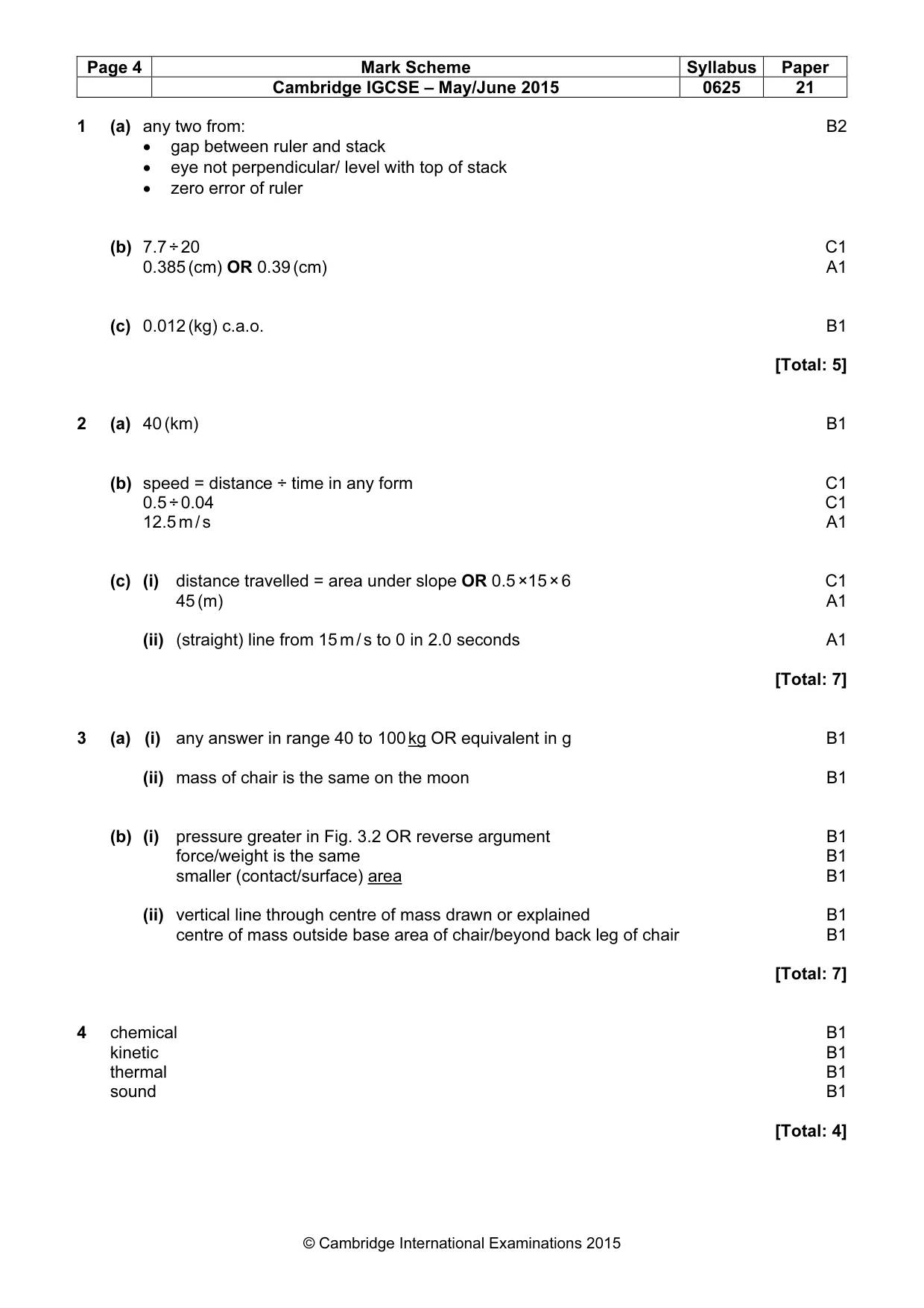
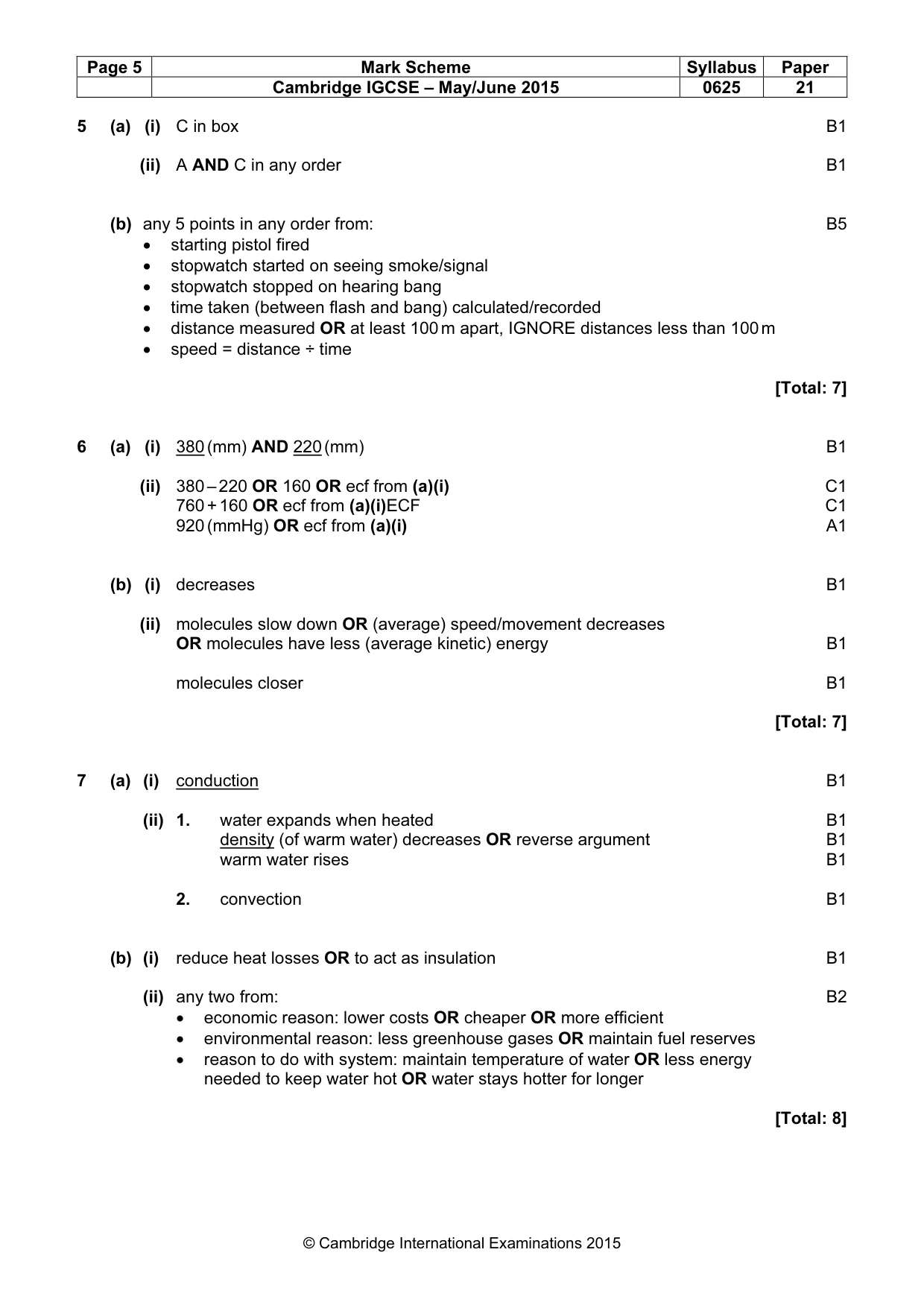
Page 4 Mark Scheme Syllabus Paper Cambridge IGCSE – May/June 2015 0625 21 © Cambridge International Examinations 2015 1 (a) any two from: B2 • gap between ruler and stack • eye not perpendicular/ level with top of stack • zero error of ruler (b) 7.7 ÷ 20 C1 0.385 (cm) OR 0.39 (cm) A1 (c) 0.012 (kg) c.a.o. B1 [Total: 5] 2 (a) 40 (km) B1 (b) speed = distance ÷ time in any form C1 0.5 ÷ 0.04 C1 12.5 m / s A1 (c) (i) distance travelled = area under slope OR 0.5 ×15 × 6 C1 45 (m) A1 (ii) (straight) line from 15 m / s to 0 in 2.0 seconds A1 [Total: 7] 3 (a) (i) any answer in range 40 to 100 kg OR equivalent in g B1 (ii) mass of chair is the same on the moon B1 (b) (i) pressure greater in Fig. 3.2 OR reverse argument B1 force/weight is the same B1 smaller (contact/surface) area B1 (ii) vertical line through centre of mass drawn or explained B1 centre of mass outside base area of chair/beyond back leg of chair B1 [Total: 7] 4 chemical B1 kinetic B1 thermal B1 sound B1 [Total: 4]
Mark scheme, page 5
Page 5 Mark Scheme Syllabus Paper Cambridge IGCSE – May/June 2015 0625 21 © Cambridge International Examinations 2015 5 (a) (i) C in box B1 (ii) A AND C in any order B1 (b) any 5 points in any order from: B5 • starting pistol fired • stopwatch started on seeing smoke/signal • stopwatch stopped on hearing bang • time taken (between flash and bang) calculated/recorded • distance measured OR at least 100 m apart, IGNORE distances less than 100 m • speed = distance ÷ time [Total: 7] 6 (a) (i) 380 (mm) AND 220 (mm) B1 (ii) 380 – 220 OR 160 OR ecf from (a)(i) C1 760 + 160 OR ecf from (a)(i)ECF C1 920 (mmHg) OR ecf from (a)(i) A1 (b) (i) decreases B1 (ii) molecules slow down OR (average) speed/movement decreases OR molecules have less (average kinetic) energy B1 molecules closer B1 [Total: 7] 7 (a) (i) conduction B1 (ii) 1. water expands when heated B1 density (of warm water) decreases OR reverse argument B1 warm water rises B1 2. convection B1 (b) (i) reduce heat losses OR to act as insulation B1 (ii) any two from: B2 • economic reason: lower costs OR cheaper OR more efficient • environmental reason: less greenhouse gases OR maintain fuel reserves • reason to do with system: maintain temperature of water OR less energy needed to keep water hot OR water stays hotter for longer [Total: 8]
Mark scheme, page 6
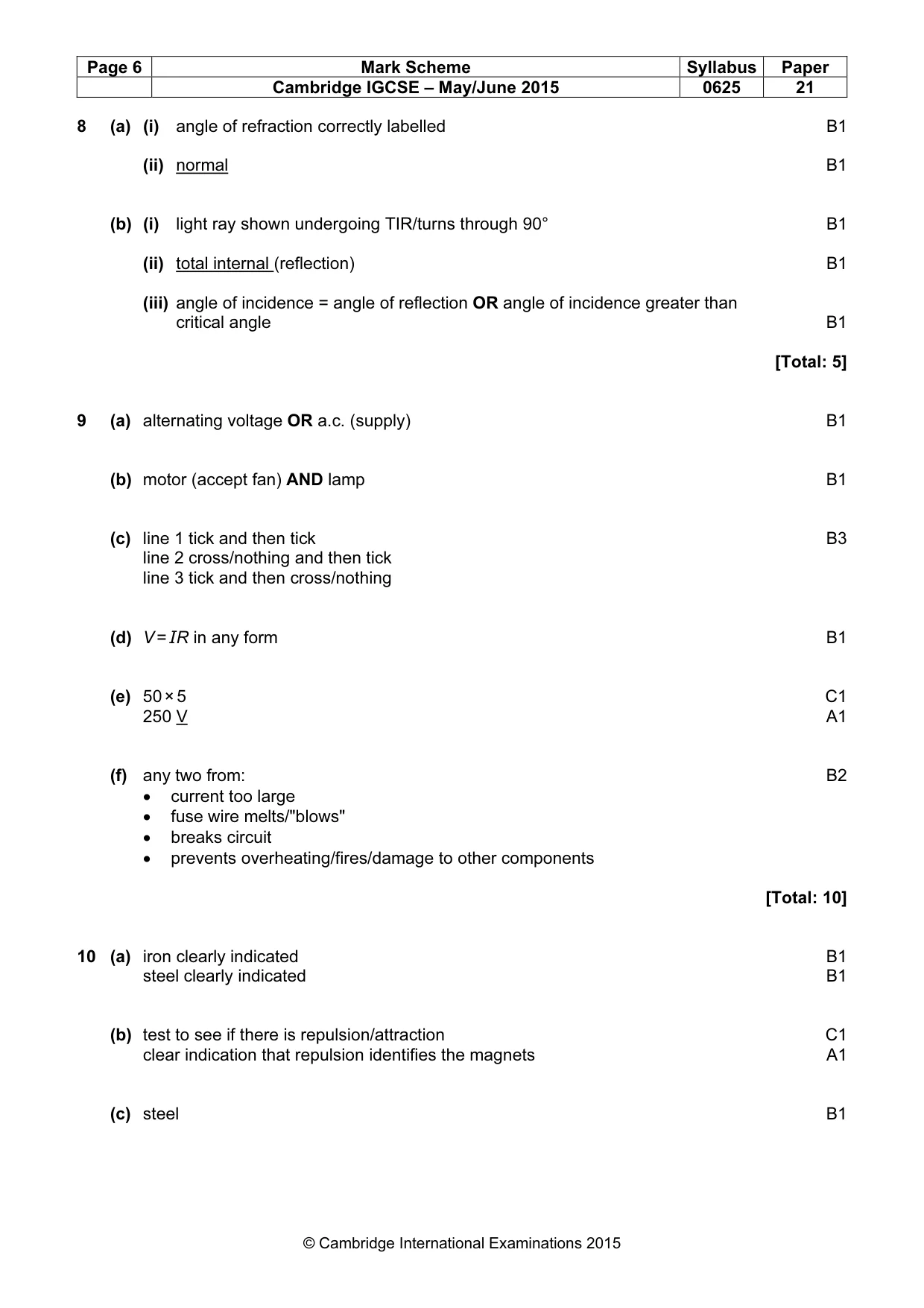
Page 6 Mark Scheme Syllabus Paper Cambridge IGCSE – May/June 2015 0625 21 © Cambridge International Examinations 2015 8 (a) (i) angle of refraction correctly labelled B1 (ii) normal B1 (b) (i) light ray shown undergoing TIR/turns through 90° B1 (ii) total internal (reflection) B1 (iii) angle of incidence = angle of reflection OR angle of incidence greater than critical angle B1 [Total: 5] 9 (a) alternating voltage OR a.c. (supply) B1 (b) motor (accept fan) AND lamp B1 (c) line 1 tick and then tick B3 line 2 cross/nothing and then tick line 3 tick and then cross/nothing (d) V = IR in any form B1 (e) 50 × 5 C1 250 V A1 (f) any two from: B2 • current too large • fuse wire melts/"blows" • breaks circuit • prevents overheating/fires/damage to other components [Total: 10] 10 (a) iron clearly indicated B1 steel clearly indicated B1 (b) test to see if there is repulsion/attraction C1 clear indication that repulsion identifies the magnets A1 (c) steel B1
Mark scheme, page 7
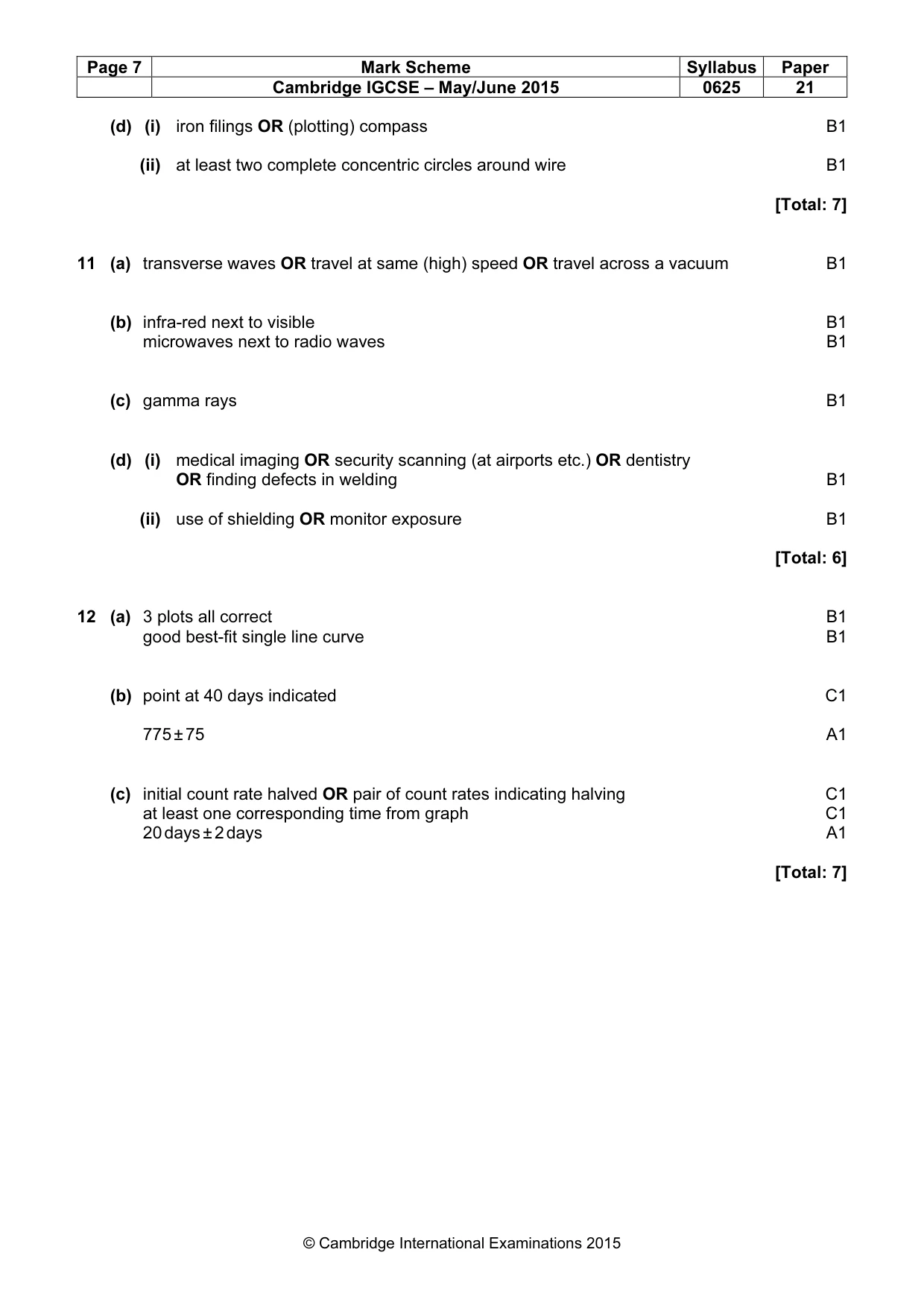
Page 7 Mark Scheme Syllabus Paper Cambridge IGCSE – May/June 2015 0625 21 © Cambridge International Examinations 2015 (d) (i) iron filings OR (plotting) compass B1 (ii) at least two complete concentric circles around wire B1 [Total: 7] 11 (a) transverse waves OR travel at same (high) speed OR travel across a vacuum B1 (b) infra-red next to visible B1 microwaves next to radio waves B1 (c) gamma rays B1 (d) (i) medical imaging OR security scanning (at airports etc.) OR dentistry OR finding defects in welding B1 (ii) use of shielding OR monitor exposure B1 [Total: 6] 12 (a) 3 plots all correct B1 good best-fit single line curve B1 (b) point at 40 days indicated C1 775 ± 75 A1 (c) initial count rate halved OR pair of count rates indicating halving C1 at least one corresponding time from graph C1 20 days ± 2 days A1 [Total: 7]
What you needed in this session
Cambridge’s own grade thresholds for 2015 May/June, Paper 2 · Variant 1. A higher threshold means an easier paper — the bar moves with how the cohort did.