Cambridge IGCSE Physics 0625 — 2013 May/June Paper 2 · Variant 3
0625/23/M/J/13 · 80 marks · ≈90 min
The question paper and its mark scheme, free to read here and free to download. This is Cambridge’s own paper, exactly as it was sat.
Question paper16 pages
Mark scheme6 pages
Answers below. Sit the paper first if you are practising.
Paper as text
Question paper, page 1
This document consists of 16 printed pages. DC (LEO/JG) 58286/4 © UCLES 2013 [Turn over UNIVERSITY OF CAMBRIDGE INTERNATIONAL EXAMINATIONS International General Certificate of Secondary Education * 3 6 9 4 1 4 9 8 2 1 * PHYSICS 0625/23 Paper 2 Core May/June 2013 1 hour 15 minutes Candidates answer on the Question Paper. No Additional Materials are required. READ THESE INSTRUCTIONS FIRST Write your Centre number, candidate number and name on all the work you hand in. Write in dark blue or black pen. You may use a pencil for any diagrams or graphs. Do not use staples, paper clips, highlighters, glue or correction fluid. DO NOT WRITE IN ANY BARCODES. Answer all questions. Electronic calculators may be used. You may lose marks if you do not show your working or if you do not use appropriate units. Take the weight of 1 kg to be 10 N (i.e. acceleration of free fall = 10 m / s2). At the end of the examination, fasten all your work securely together. The number of marks is given in brackets [ ] at the end of each question or part question. For Examiner’s Use 1 2 3 4 5 6 7 8 9 10 11 12 Total www.XtremePapers.com
Question paper, page 2
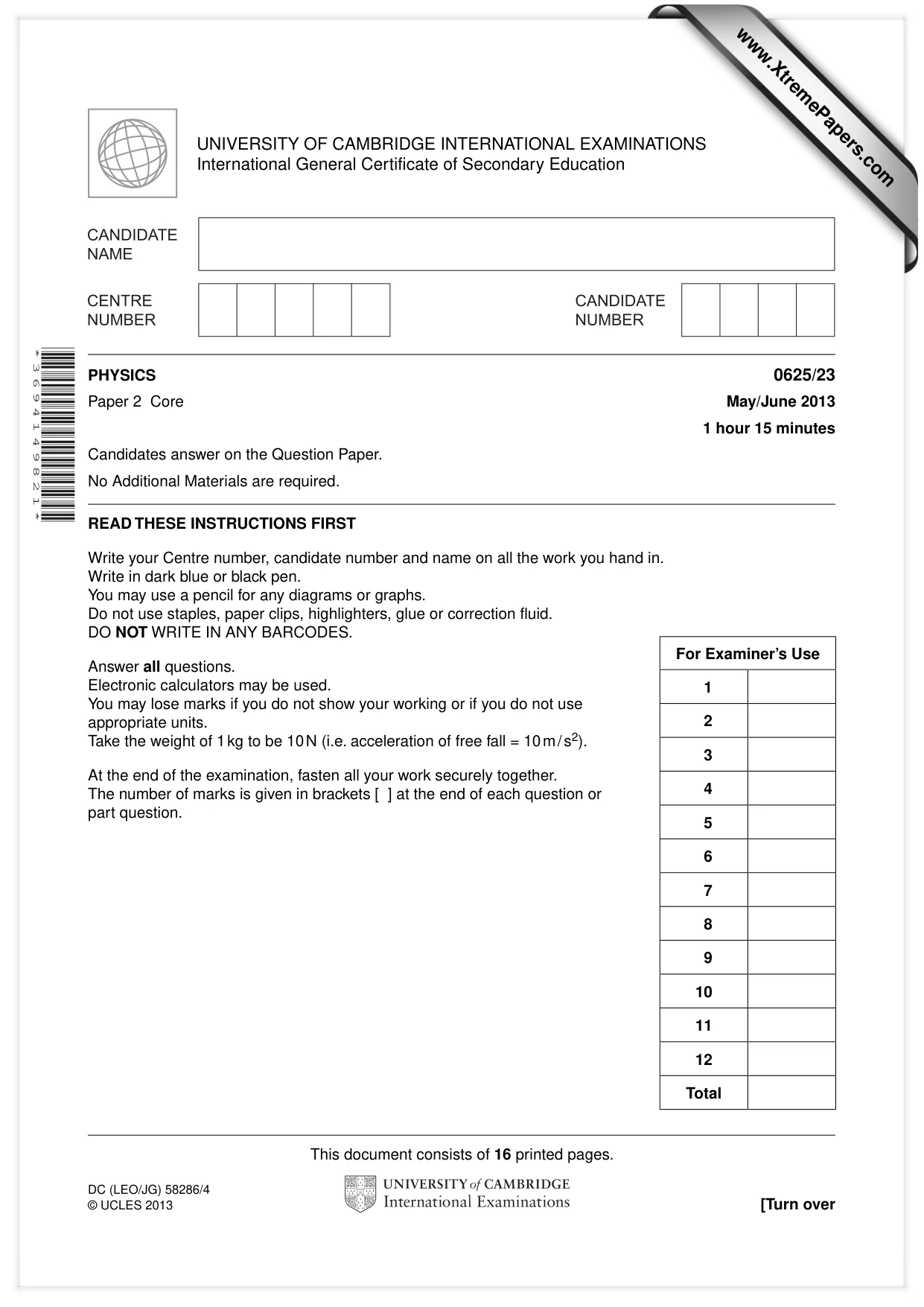
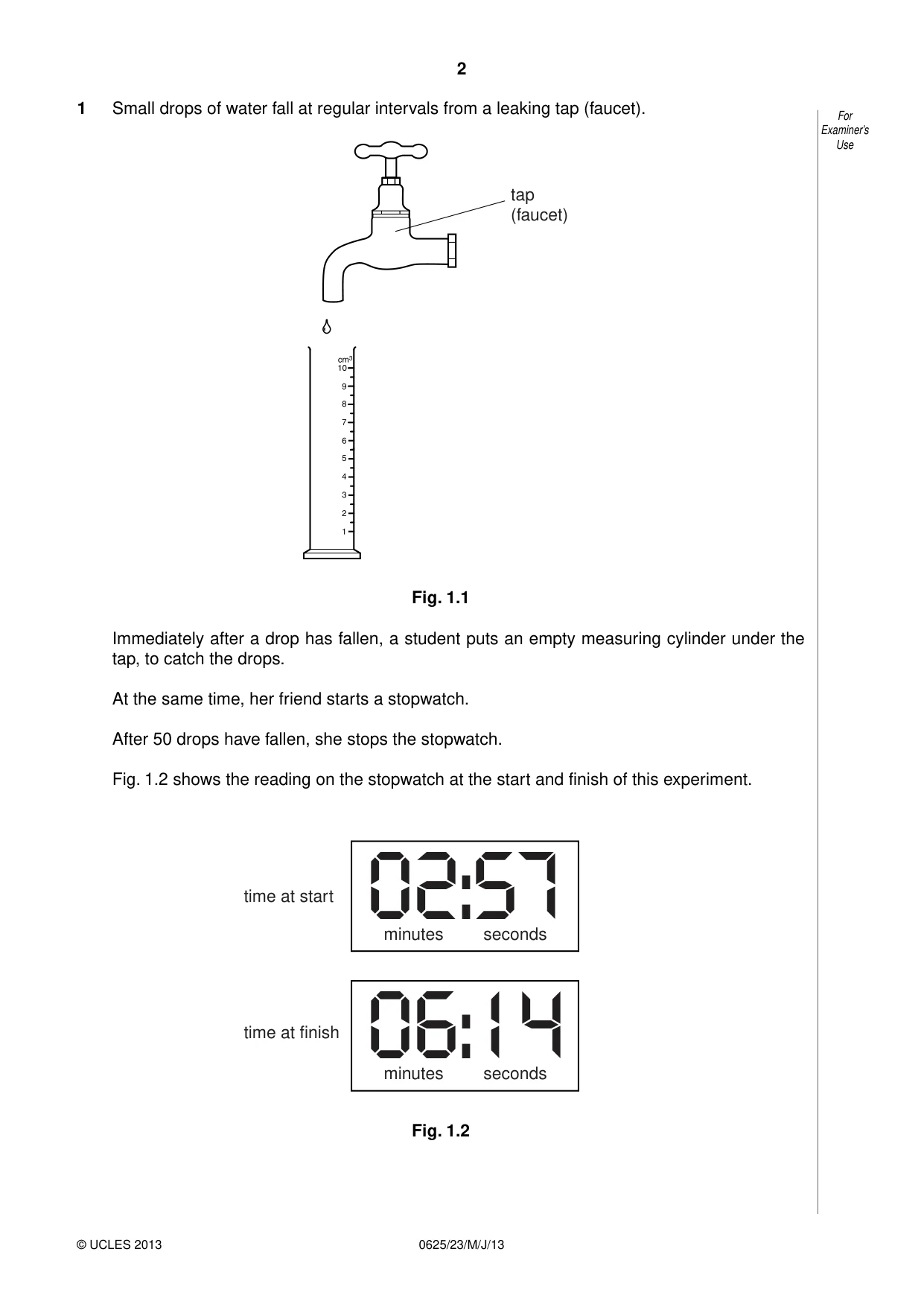
2 0625/23/M/J/13 © UCLES 2013 For Examiner’s Use 1 Small drops of water fall at regular intervals from a leaking tap (faucet). tap (faucet) Fig. 1.1 Immediately after a drop has fallen, a student puts an empty measuring cylinder under the tap, to catch the drops. At the same time, her friend starts a stopwatch. After 50 drops have fallen, she stops the stopwatch. Fig. 1.2 shows the reading on the stopwatch at the start and finish of this experiment. minutes seconds 02:57 minutes seconds 06:14 time at start time at finish Fig. 1.2
Question paper, page 3
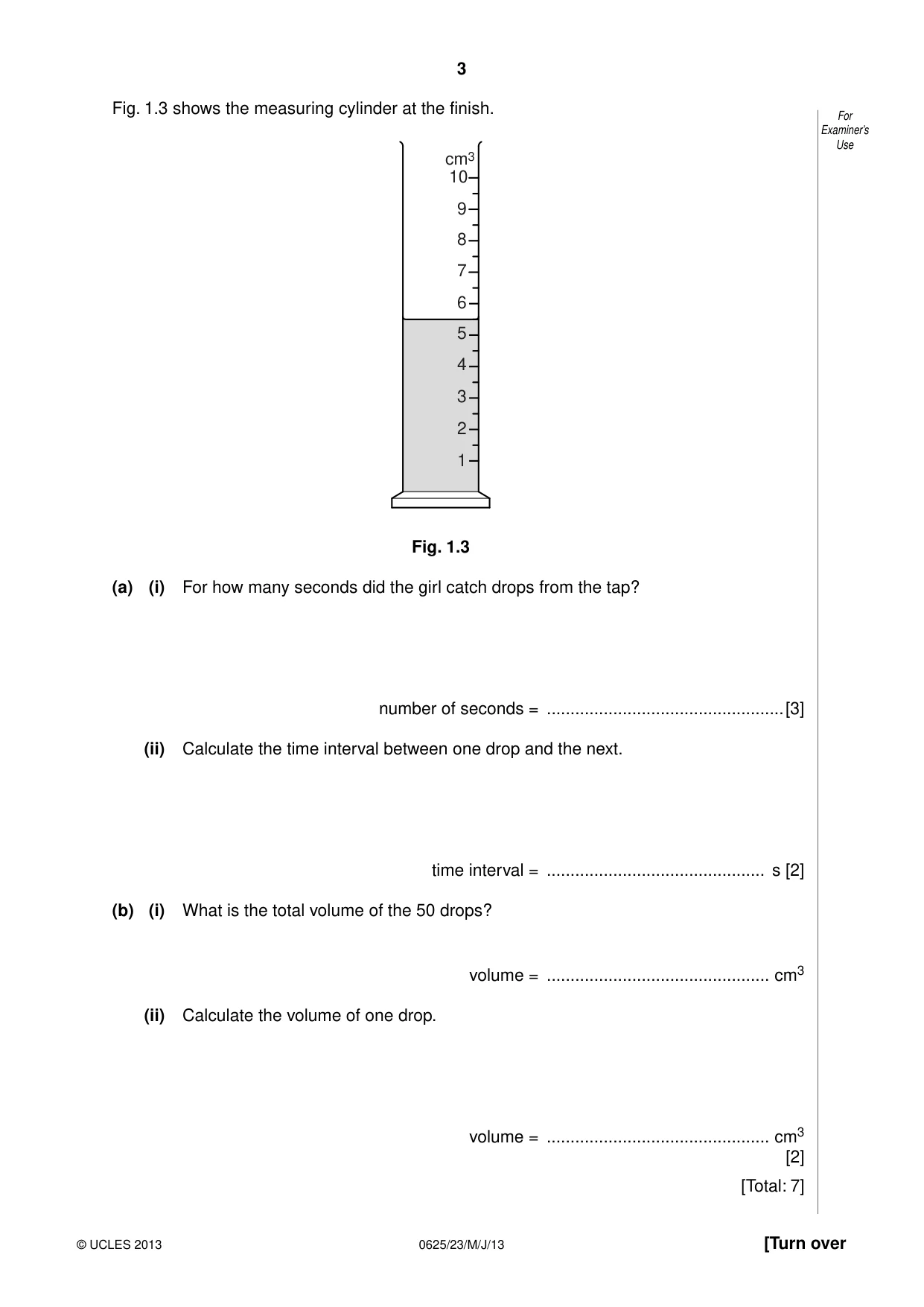
3 0625/23/M/J/13 © UCLES 2013 [Turn over For Examiner’s Use Fig. 1.3 shows the measuring cylinder at the finish. 1 2 3 4 5 6 7 8 9 10 cm3 Fig. 1.3 (a) (i) For how many seconds did the girl catch drops from the tap? number of seconds = …[3] (ii) Calculate the time interval between one drop and the next. time interval = … s [2] (b) (i) What is the total volume of the 50 drops? volume = … cm3 (ii) Calculate the volume of one drop. volume = … cm3 [2] [Total: 7]
Question paper, page 4
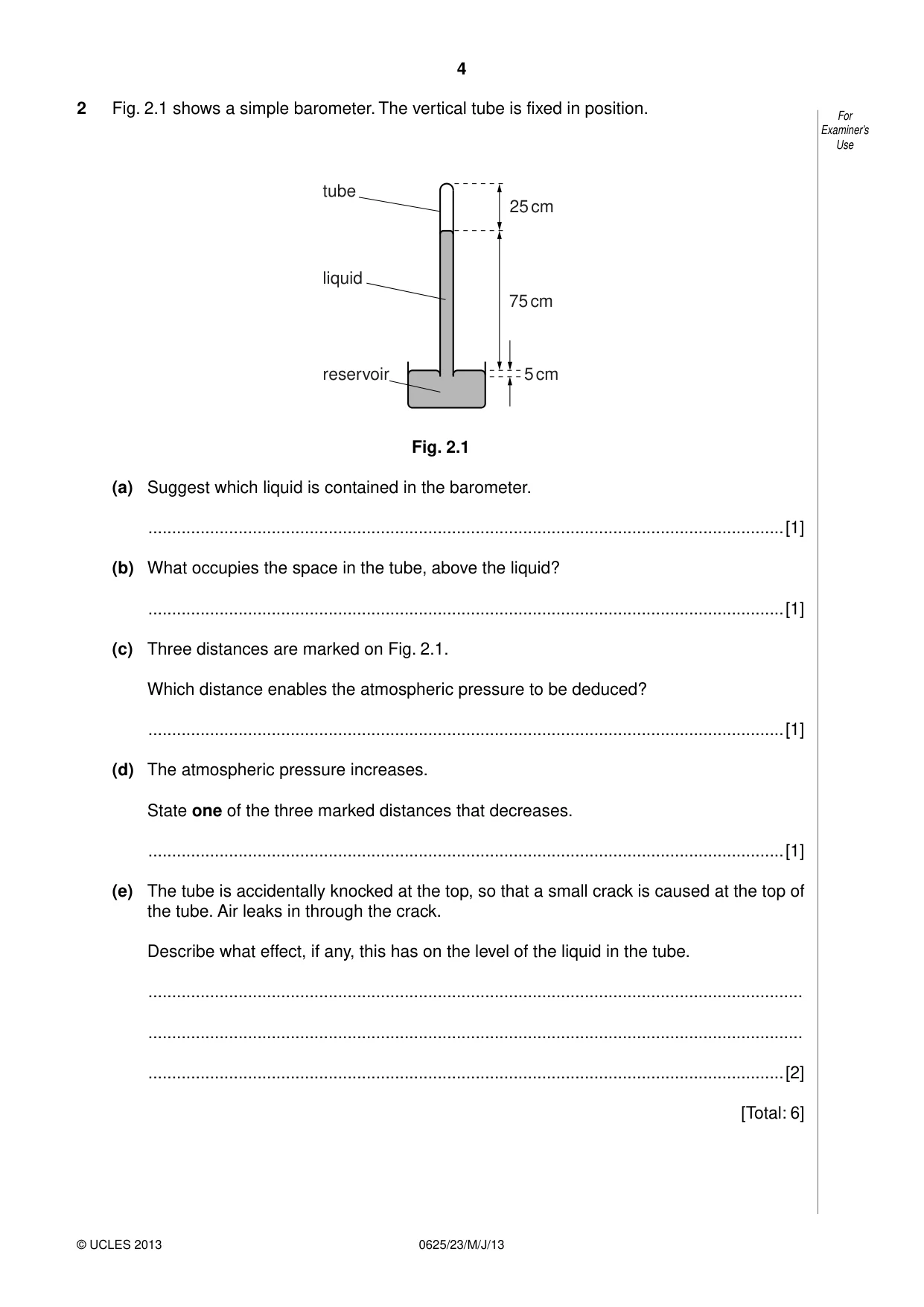
4 0625/23/M/J/13 © UCLES 2013 For Examiner’s Use 2 Fig. 2.1 shows a simple barometer. The vertical tube is fixed in position. 25 cm 75 cm 5 cm tube liquid reservoir Fig. 2.1 (a) Suggest which liquid is contained in the barometer. …[1] (b) What occupies the space in the tube, above the liquid? …[1] (c) Three distances are marked on Fig. 2.1. Which distance enables the atmospheric pressure to be deduced? …[1] (d) The atmospheric pressure increases. State one of the three marked distances that decreases. …[1] (e) The tube is accidentally knocked at the top, so that a small crack is caused at the top of the tube. Air leaks in through the crack. Describe what effect, if any, this has on the level of the liquid in the tube. … … …[2] [Total: 6]
Question paper, page 5
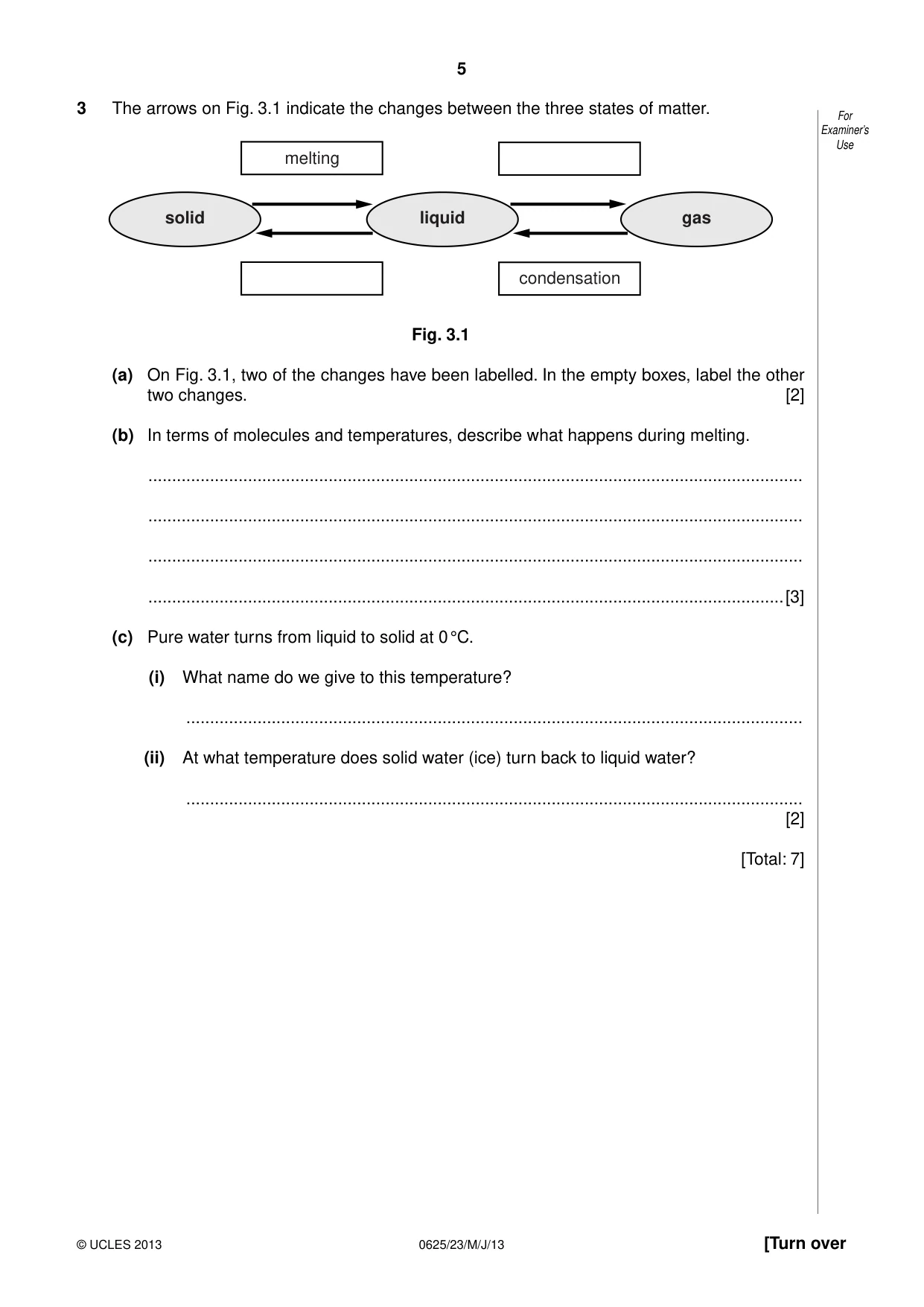
5 0625/23/M/J/13 © UCLES 2013 [Turn over For Examiner’s Use 3 The arrows on Fig. 3.1 indicate the changes between the three states of matter. solid liquid gas melting condensation Fig. 3.1 (a) On Fig. 3.1, two of the changes have been labelled. In the empty boxes, label the other two changes. [2] (b) In terms of molecules and temperatures, describe what happens during melting. … … … …[3] (c) Pure water turns from liquid to solid at 0 °C. (i) What name do we give to this temperature? … (ii) At what temperature does solid water (ice) turn back to liquid water? … [2] [Total: 7]
Question paper, page 6
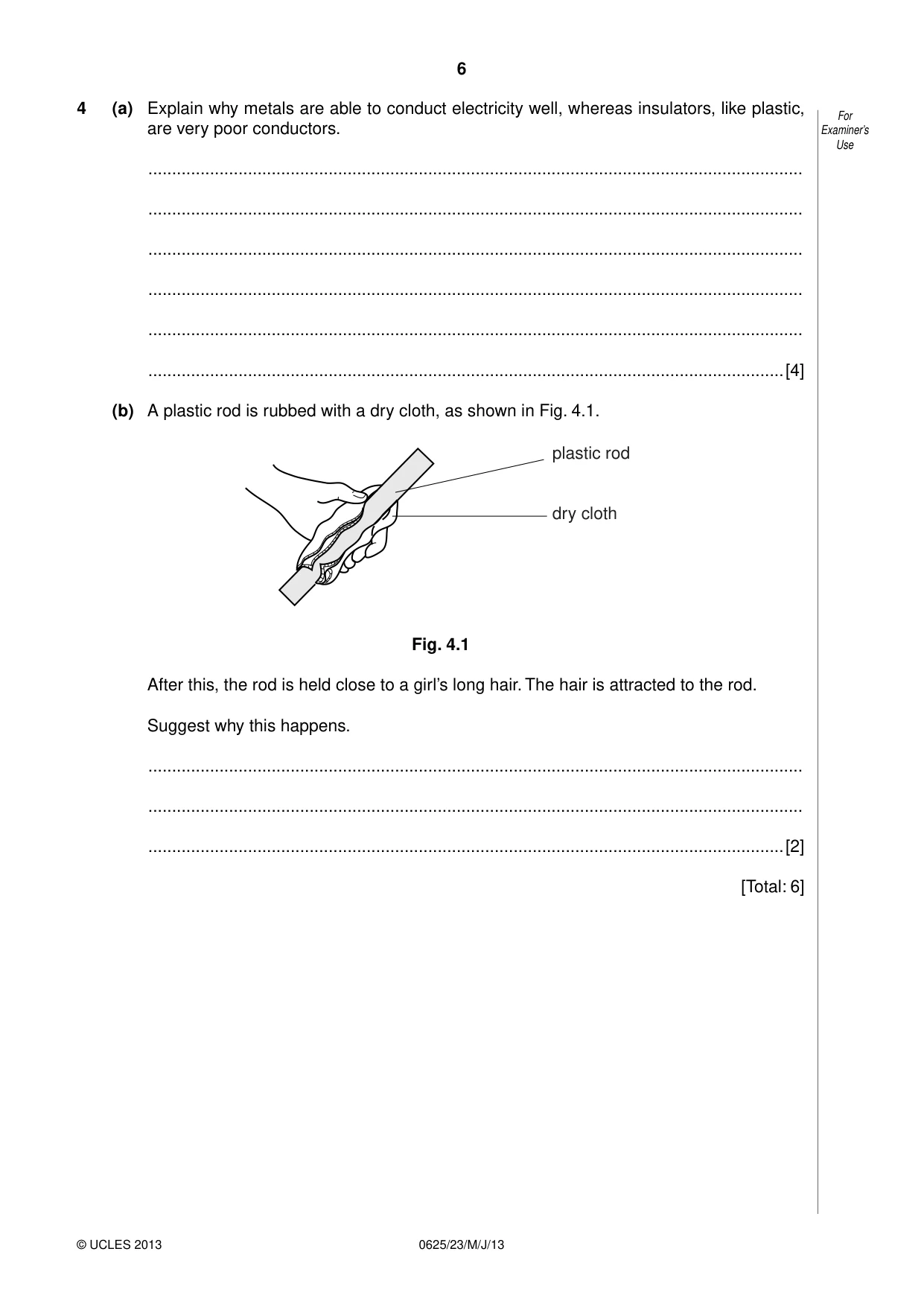
6 0625/23/M/J/13 © UCLES 2013 For Examiner’s Use 4 (a) Explain why metals are able to conduct electricity well, whereas insulators, like plastic, are very poor conductors. … … … … … …[4] (b) A plastic rod is rubbed with a dry cloth, as shown in Fig. 4.1. plastic rod dry cloth Fig. 4.1 After this, the rod is held close to a girl’s long hair. The hair is attracted to the rod. Suggest why this happens. … … …[2] [Total: 6]
Question paper, page 7
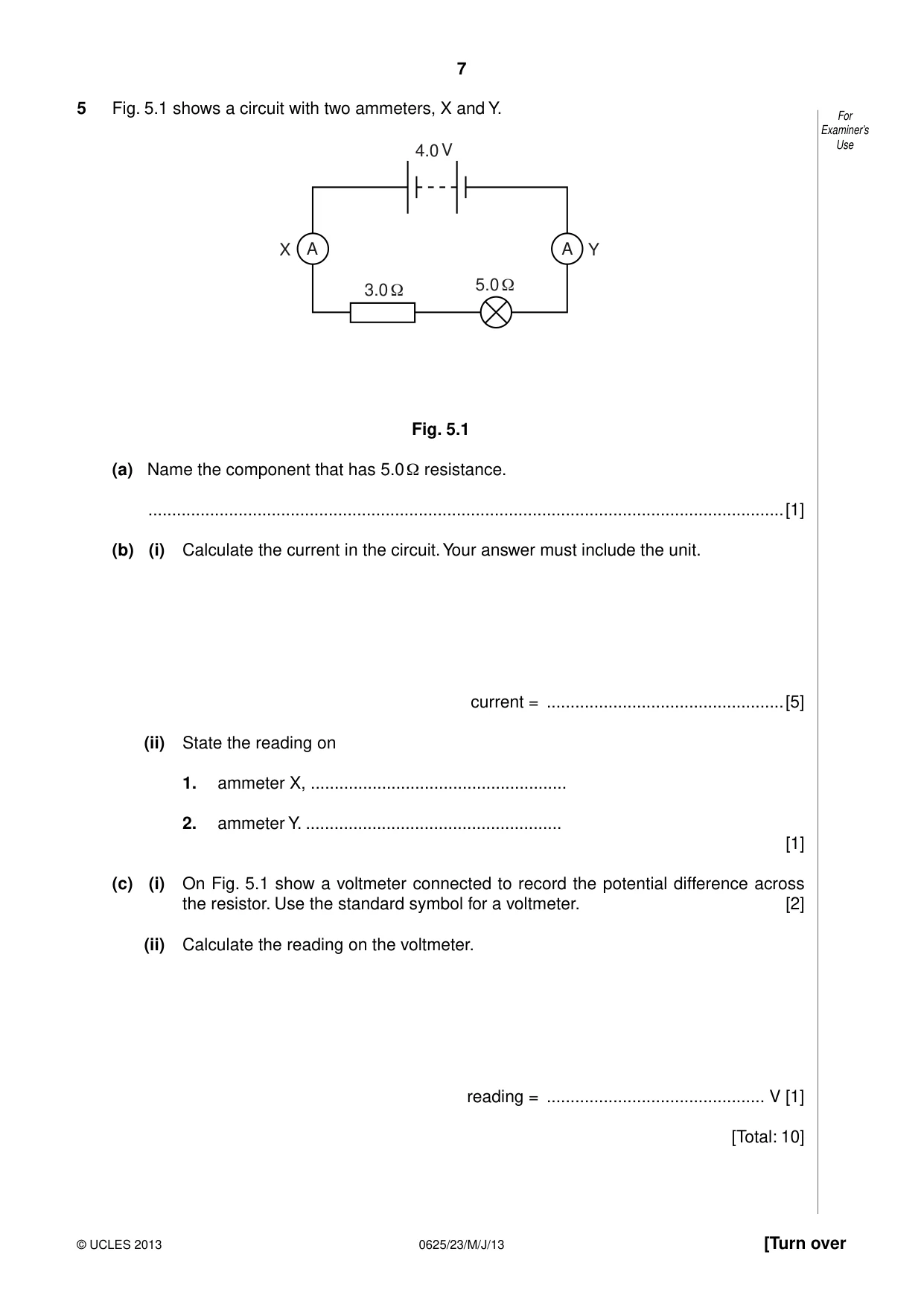
7 0625/23/M/J/13 © UCLES 2013 [Turn over For Examiner’s Use 5 Fig. 5.1 shows a circuit with two ammeters, X and Y. A A Y X 5.0 1 3.0 1 4.0 V Fig. 5.1 (a) Name the component that has 5.0 Ω resistance. …[1] (b) (i) Calculate the current in the circuit. Your answer must include the unit. current = …[5] (ii) State the reading on 1. ammeter X, … 2. ammeter Y. … [1] (c) (i) On Fig. 5.1 show a voltmeter connected to record the potential difference across the resistor. Use the standard symbol for a voltmeter. [2] (ii) Calculate the reading on the voltmeter. reading = … V [1] [Total: 10]
Question paper, page 8
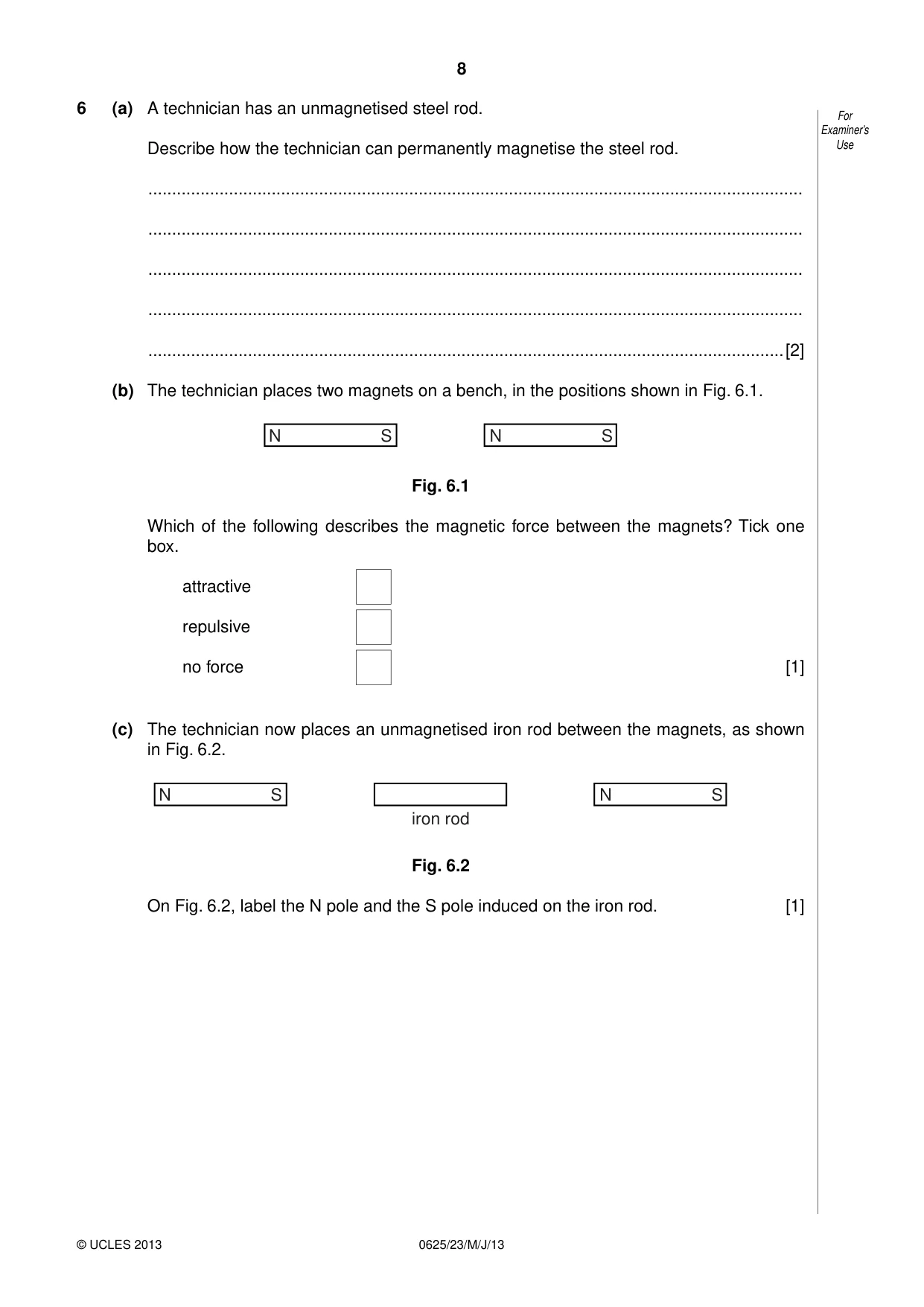
8 0625/23/M/J/13 © UCLES 2013 For Examiner’s Use 6 (a) A technician has an unmagnetised steel rod. Describe how the technician can permanently magnetise the steel rod. … … … … …[2] (b) The technician places two magnets on a bench, in the positions shown in Fig. 6.1. N S N S Fig. 6.1 Which of the following describes the magnetic force between the magnets? Tick one box. attractive repulsive no force [1] (c) The technician now places an unmagnetised iron rod between the magnets, as shown in Fig. 6.2. N S N S iron rod Fig. 6.2 On Fig. 6.2, label the N pole and the S pole induced on the iron rod. [1]
Question paper, page 9
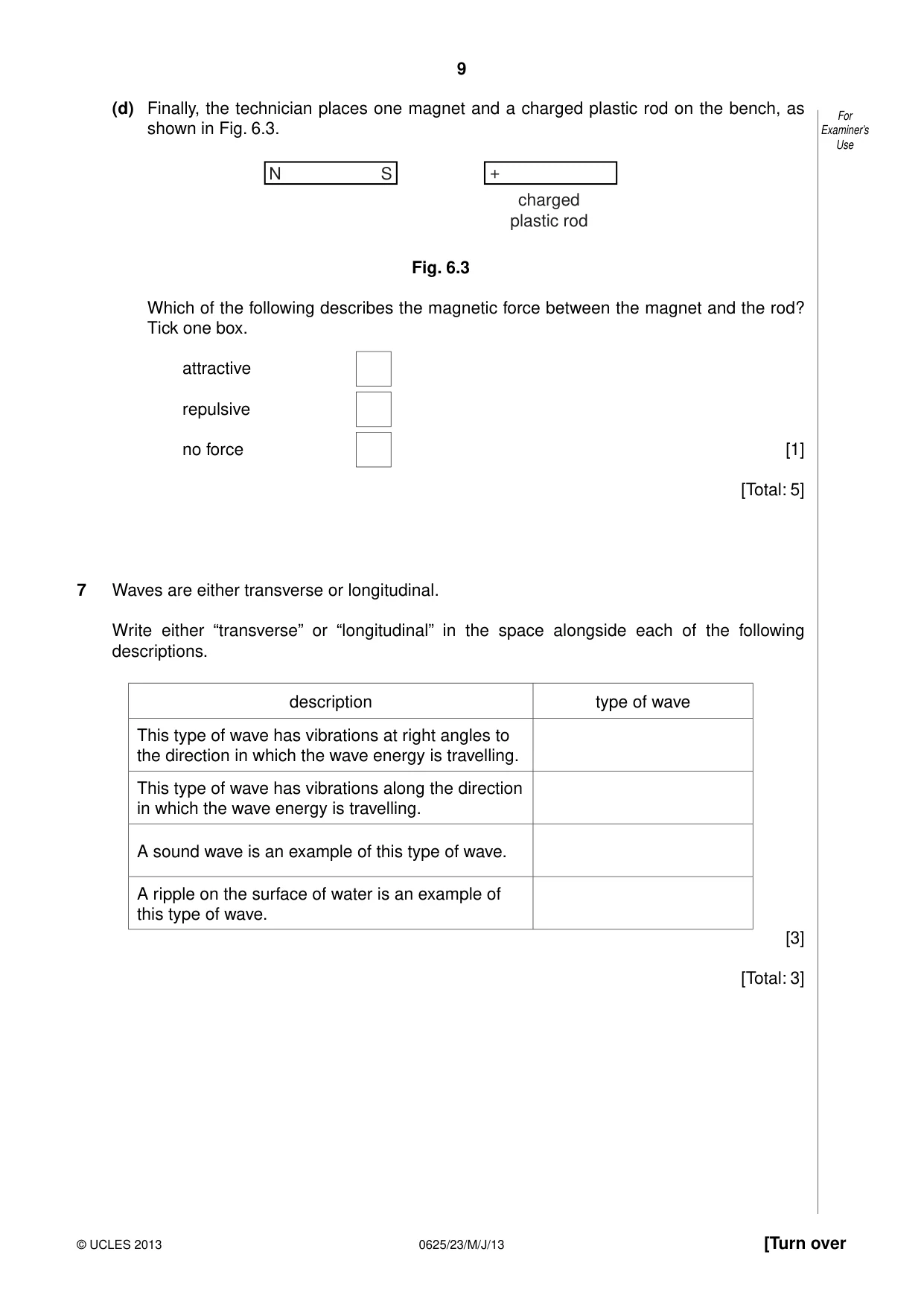
9 0625/23/M/J/13 © UCLES 2013 [Turn over For Examiner’s Use (d) Finally, the technician places one magnet and a charged plastic rod on the bench, as shown in Fig. 6.3. N S + charged plastic rod Fig. 6.3 Which of the following describes the magnetic force between the magnet and the rod? Tick one box. attractive repulsive no force [1] [Total: 5] 7 Waves are either transverse or longitudinal. Write either “transverse” or “longitudinal” in the space alongside each of the following descriptions. description type of wave This type of wave has vibrations at right angles to the direction in which the wave energy is travelling. This type of wave has vibrations along the direction in which the wave energy is travelling. A sound wave is an example of this type of wave. A ripple on the surface of water is an example of this type of wave. [3] [Total: 3]
Question paper, page 10
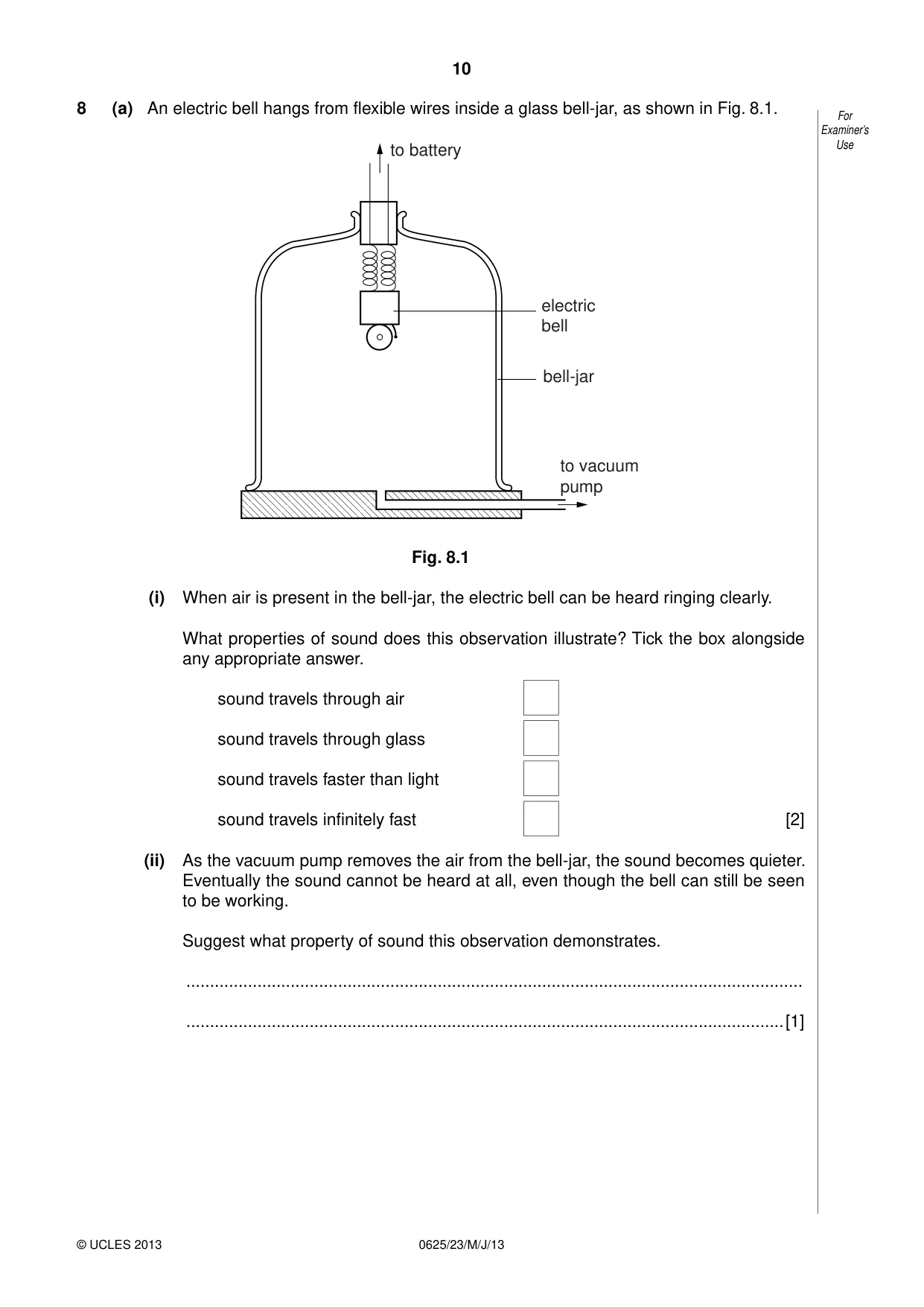
10 0625/23/M/J/13 © UCLES 2013 For Examiner’s Use 8 (a) An electric bell hangs from flexible wires inside a glass bell-jar, as shown in Fig. 8.1. to battery electric bell bell-jar to vacuum pump Fig. 8.1 (i) When air is present in the bell-jar, the electric bell can be heard ringing clearly. What properties of sound does this observation illustrate? Tick the box alongside any appropriate answer. sound travels through air sound travels through glass sound travels faster than light sound travels infinitely fast [2] (ii) As the vacuum pump removes the air from the bell-jar, the sound becomes quieter. Eventually the sound cannot be heard at all, even though the bell can still be seen to be working. Suggest what property of sound this observation demonstrates. … …[1]
Question paper, page 11
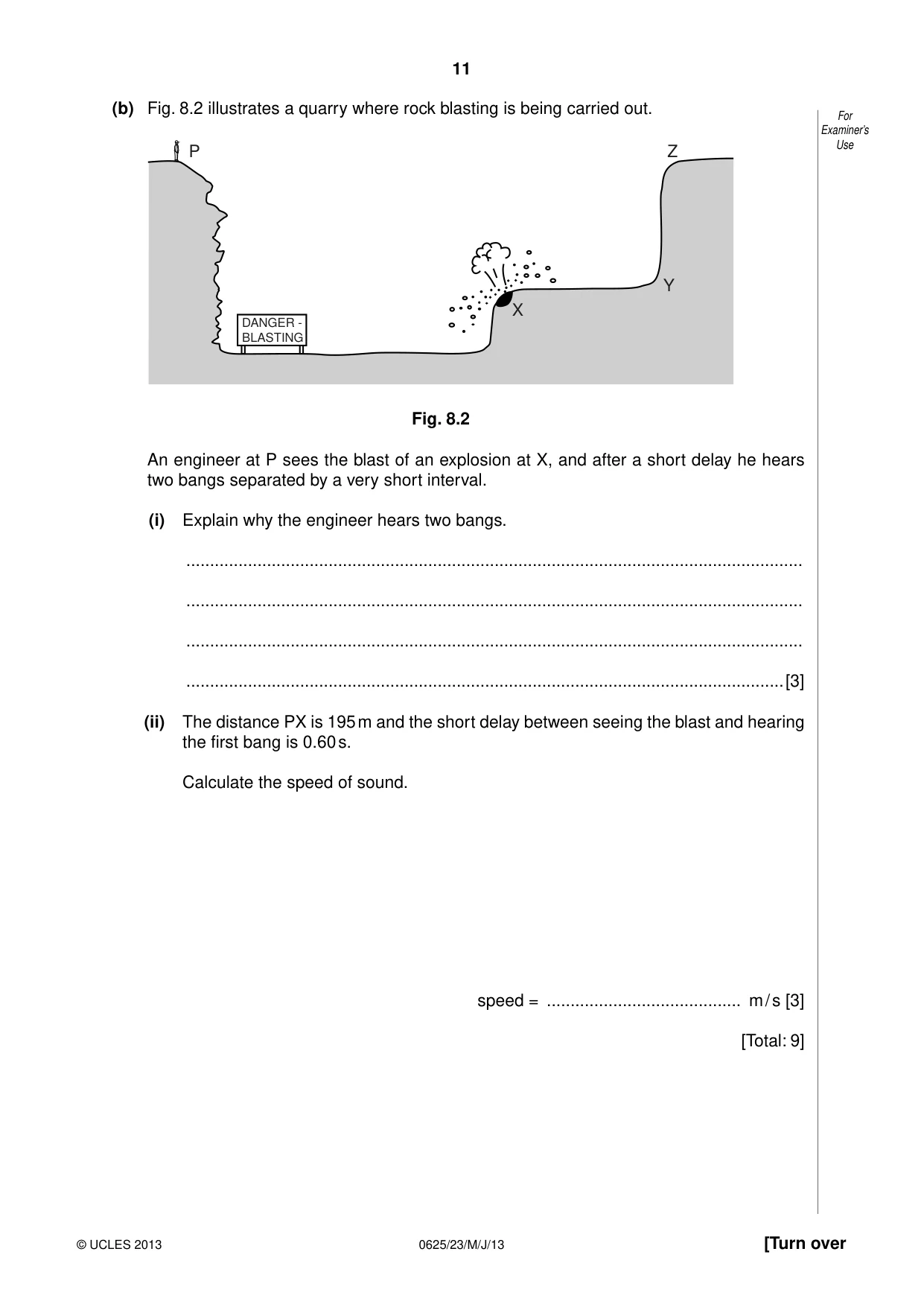
11 0625/23/M/J/13 © UCLES 2013 [Turn over For Examiner’s Use (b) Fig. 8.2 illustrates a quarry where rock blasting is being carried out. P X Y Z DANGER - BLASTING Fig. 8.2 An engineer at P sees the blast of an explosion at X, and after a short delay he hears two bangs separated by a very short interval. (i) Explain why the engineer hears two bangs. … … … …[3] (ii) The distance PX is 195 m and the short delay between seeing the blast and hearing the first bang is 0.60 s. Calculate the speed of sound. speed = … m / s [3] [Total: 9]
Question paper, page 12
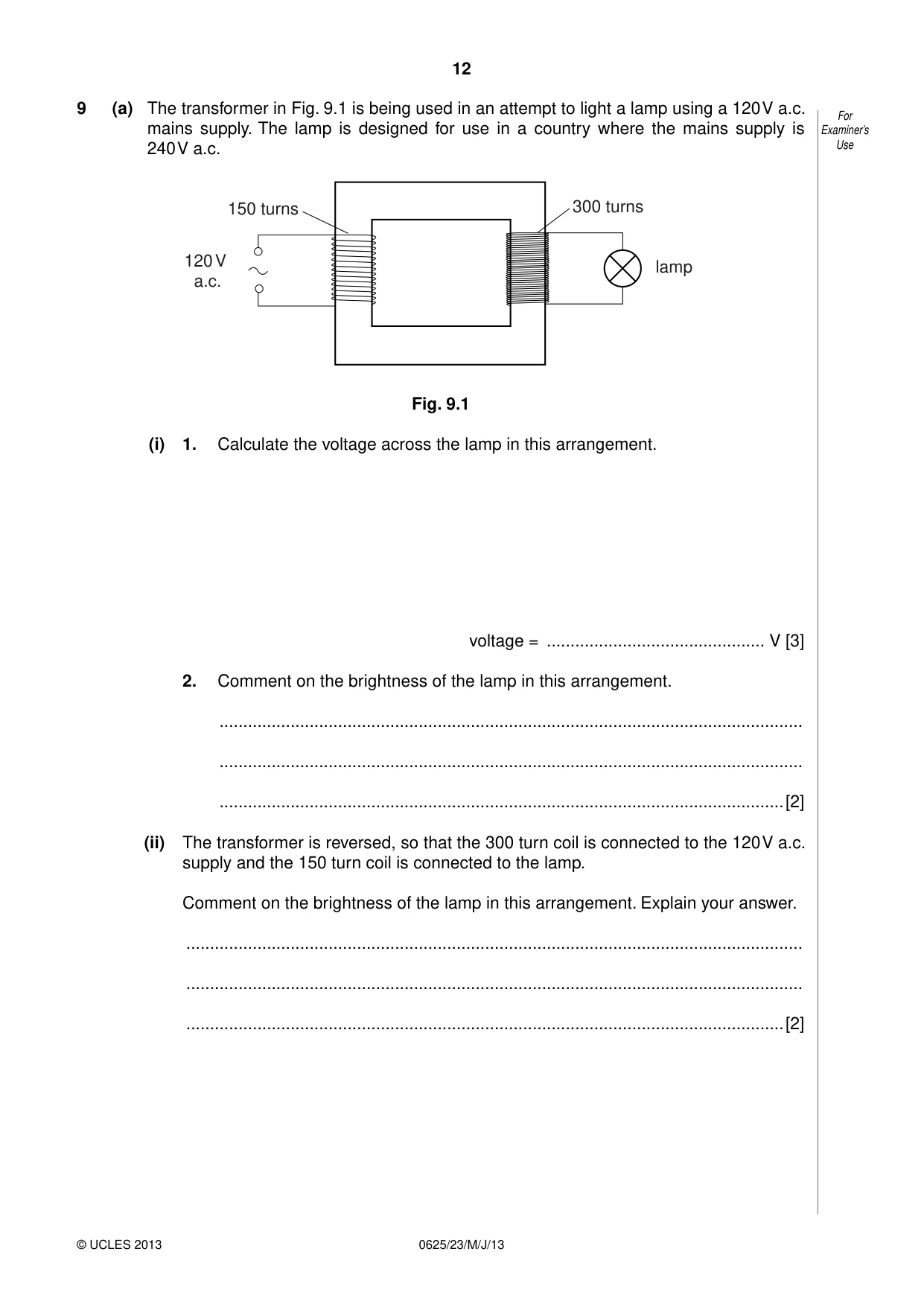
12 0625/23/M/J/13 © UCLES 2013 For Examiner’s Use 9 (a) The transformer in Fig. 9.1 is being used in an attempt to light a lamp using a 120 V a.c. mains supply. The lamp is designed for use in a country where the mains supply is 240 V a.c. 150 turns 300 turns lamp 120 V a.c. Fig. 9.1 (i) 1. Calculate the voltage across the lamp in this arrangement. voltage = … V [3] 2. Comment on the brightness of the lamp in this arrangement. … … …[2] (ii) The transformer is reversed, so that the 300 turn coil is connected to the 120 V a.c. supply and the 150 turn coil is connected to the lamp. Comment on the brightness of the lamp in this arrangement. Explain your answer. … … …[2]
Question paper, page 13
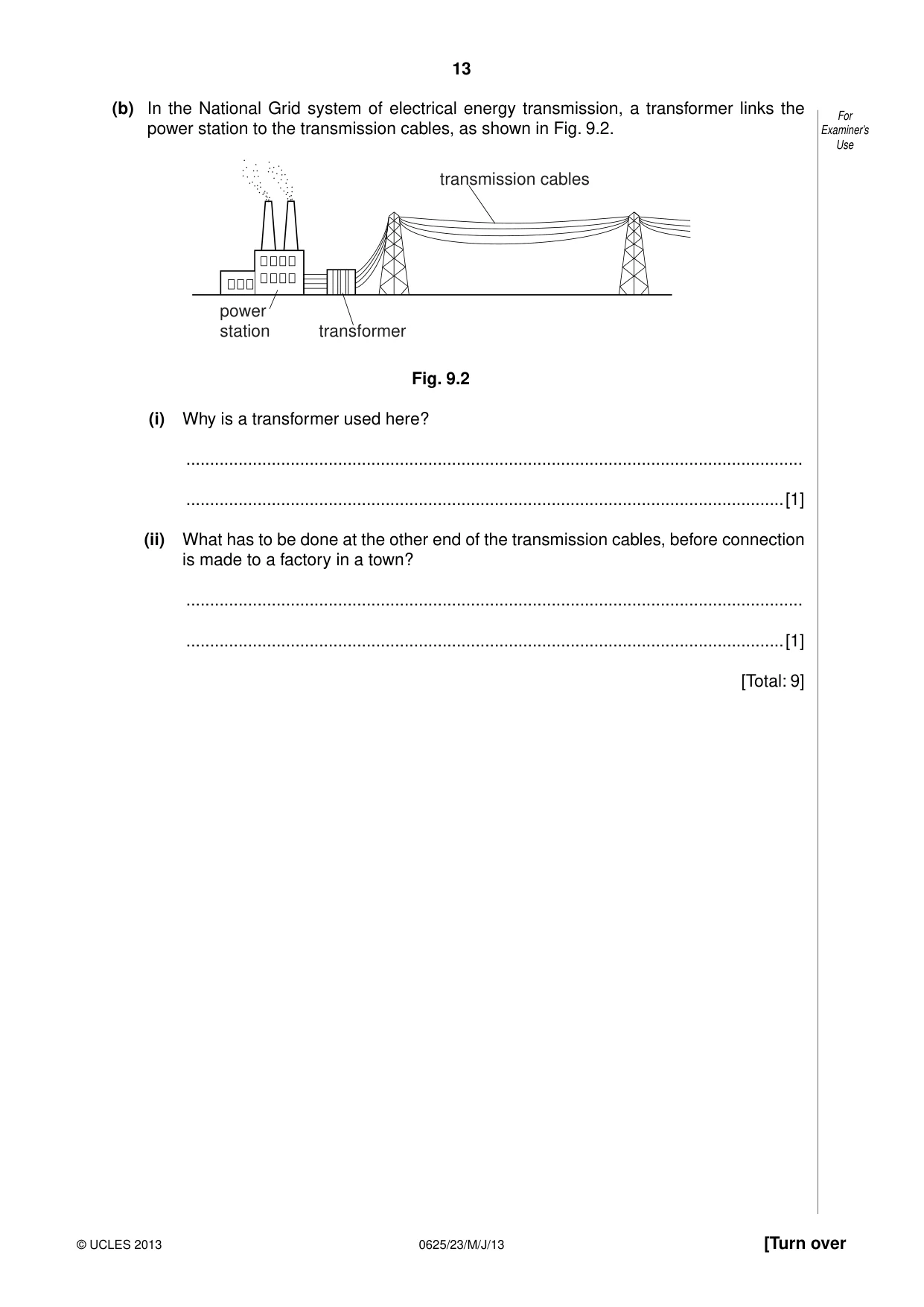
13 0625/23/M/J/13 © UCLES 2013 [Turn over For Examiner’s Use (b) In the National Grid system of electrical energy transmission, a transformer links the power station to the transmission cables, as shown in Fig. 9.2. power station transformer transmission cables Fig. 9.2 (i) Why is a transformer used here? … …[1] (ii) What has to be done at the other end of the transmission cables, before connection is made to a factory in a town? … …[1] [Total: 9]
Question paper, page 14
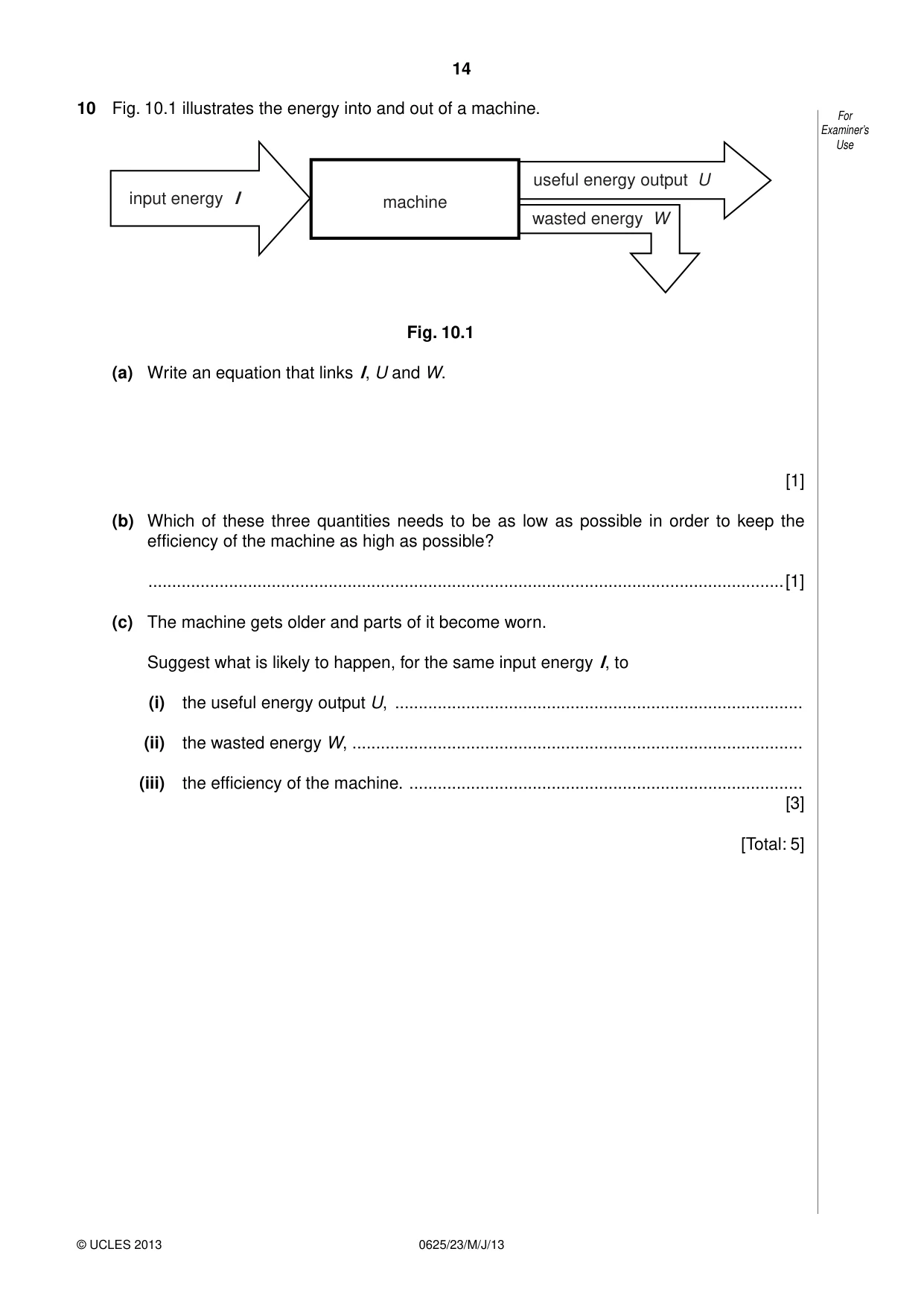
14 0625/23/M/J/13 © UCLES 2013 For Examiner’s Use 10 Fig. 10.1 illustrates the energy into and out of a machine. input energy I machine useful energy output U wasted energy W Fig. 10.1 (a) Write an equation that links I, U and W. [1] (b) Which of these three quantities needs to be as low as possible in order to keep the efficiency of the machine as high as possible? …[1] (c) The machine gets older and parts of it become worn. Suggest what is likely to happen, for the same input energy I, to (i) the useful energy output U, … (ii) the wasted energy W, … (iii) the efficiency of the machine. … [3] [Total: 5]
Question paper, page 15
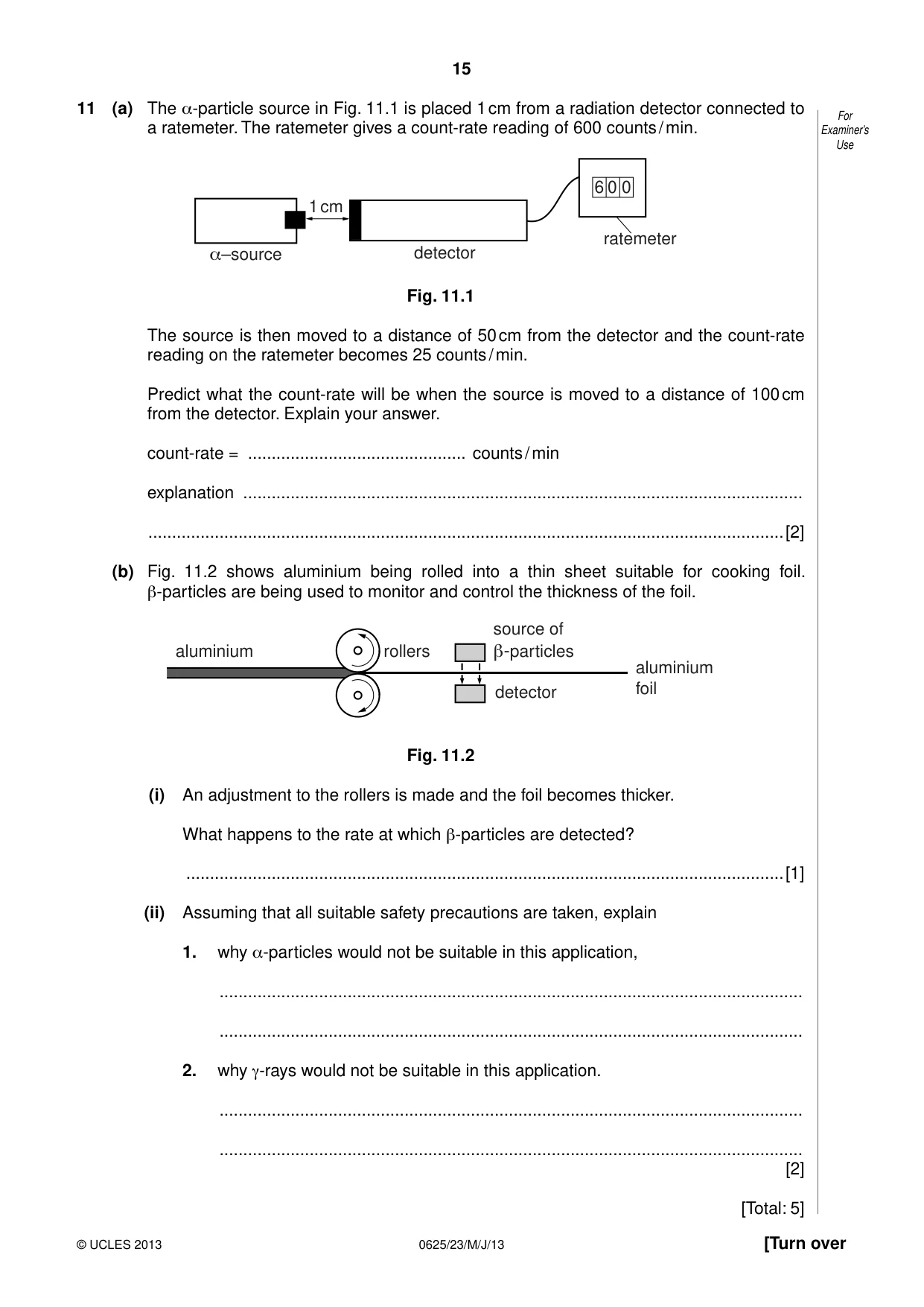
15 0625/23/M/J/13 © UCLES 2013 [Turn over For Examiner’s Use 11 (a) The α-particle source in Fig. 11.1 is placed 1 cm from a radiation detector connected to a ratemeter. The ratemeter gives a count-rate reading of 600 counts / min. 6 0 0 detector ratemeter _–source 1 cm Fig. 11.1 The source is then moved to a distance of 50 cm from the detector and the count-rate reading on the ratemeter becomes 25 counts / min. Predict what the count-rate will be when the source is moved to a distance of 100 cm from the detector. Explain your answer. count-rate = … counts / min explanation … …[2] (b) Fig. 11.2 shows aluminium being rolled into a thin sheet suitable for cooking foil. β-particles are being used to monitor and control the thickness of the foil. aluminium rollers aluminium foil source of `-particles detector Fig. 11.2 (i) An adjustment to the rollers is made and the foil becomes thicker. What happens to the rate at which β-particles are detected? …[1] (ii) Assuming that all suitable safety precautions are taken, explain 1. why α-particles would not be suitable in this application, … … 2. why γ-rays would not be suitable in this application. … … [2] [Total: 5]
Question paper, page 16
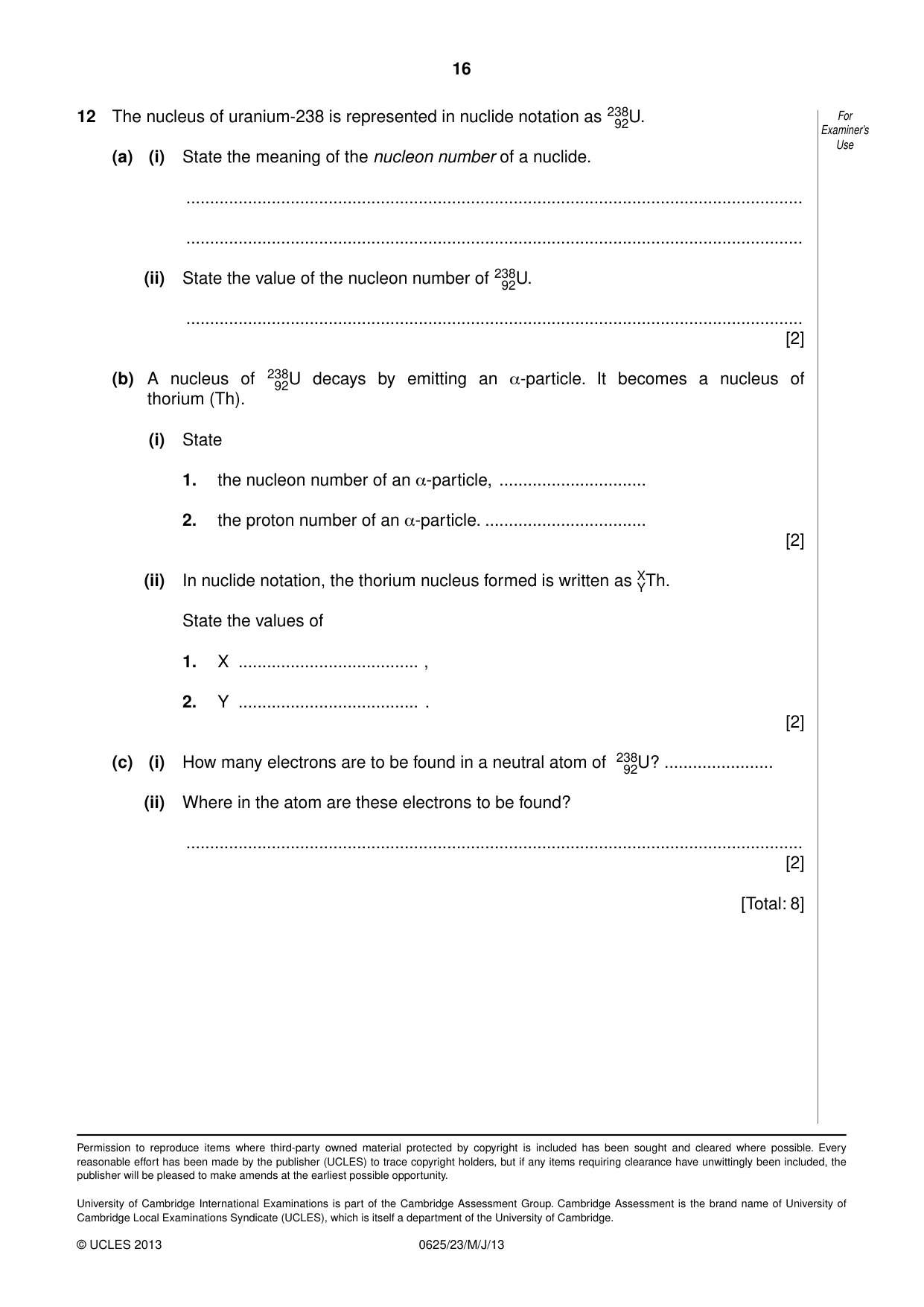
16 0625/23/M/J/13 © UCLES 2013 For Examiner’s Use 12 The nucleus of uranium-238 is represented in nuclide notation as 238 92U. (a) (i) State the meaning of the nucleon number of a nuclide. … … (ii) State the value of the nucleon number of 238 92U. … [2] (b) A nucleus of 238 92U decays by emitting an α-particle. It becomes a nucleus of thorium (Th). (i) State 1. the nucleon number of an α-particle, … 2. the proton number of an α-particle. … [2] (ii) In nuclide notation, the thorium nucleus formed is written as X YTh. State the values of 1. X … , 2. Y … . [2] (c) (i) How many electrons are to be found in a neutral atom of 238 92U? … (ii) Where in the atom are these electrons to be found? … [2] [Total: 8] Permission to reproduce items where third-party owned material protected by copyright is included has been sought and cleared where possible. Every reasonable effort has been made by the publisher (UCLES) to trace copyright holders, but if any items requiring clearance have unwittingly been included, the publisher will be pleased to make amends at the earliest possible opportunity. University of Cambridge International Examinations is part of the Cambridge Assessment Group. Cambridge Assessment is the brand name of University of Cambridge Local Examinations Syndicate (UCLES), which is itself a department of the University of Cambridge.
Mark scheme, page 1
CAMBRIDGE INTERNATIONAL EXAMINATIONS International General Certificate of Secondary Education MARK SCHEME for the May/June 2013 series 0625 PHYSICS 0625/23 Paper 2 (Core Theory), maximum raw mark 80 This mark scheme is published as an aid to teachers and candidates, to indicate the requirements of the examination. It shows the basis on which Examiners were instructed to award marks. It does not indicate the details of the discussions that took place at an Examiners’ meeting before marking began, which would have considered the acceptability of alternative answers. Mark schemes should be read in conjunction with the question paper and the Principal Examiner Report for Teachers. Cambridge will not enter into discussions about these mark schemes. Cambridge is publishing the mark schemes for the May/June 2013 series for most IGCSE, GCE Advanced Level and Advanced Subsidiary Level components and some Ordinary Level components. www.XtremePapers.com
Mark scheme, page 2
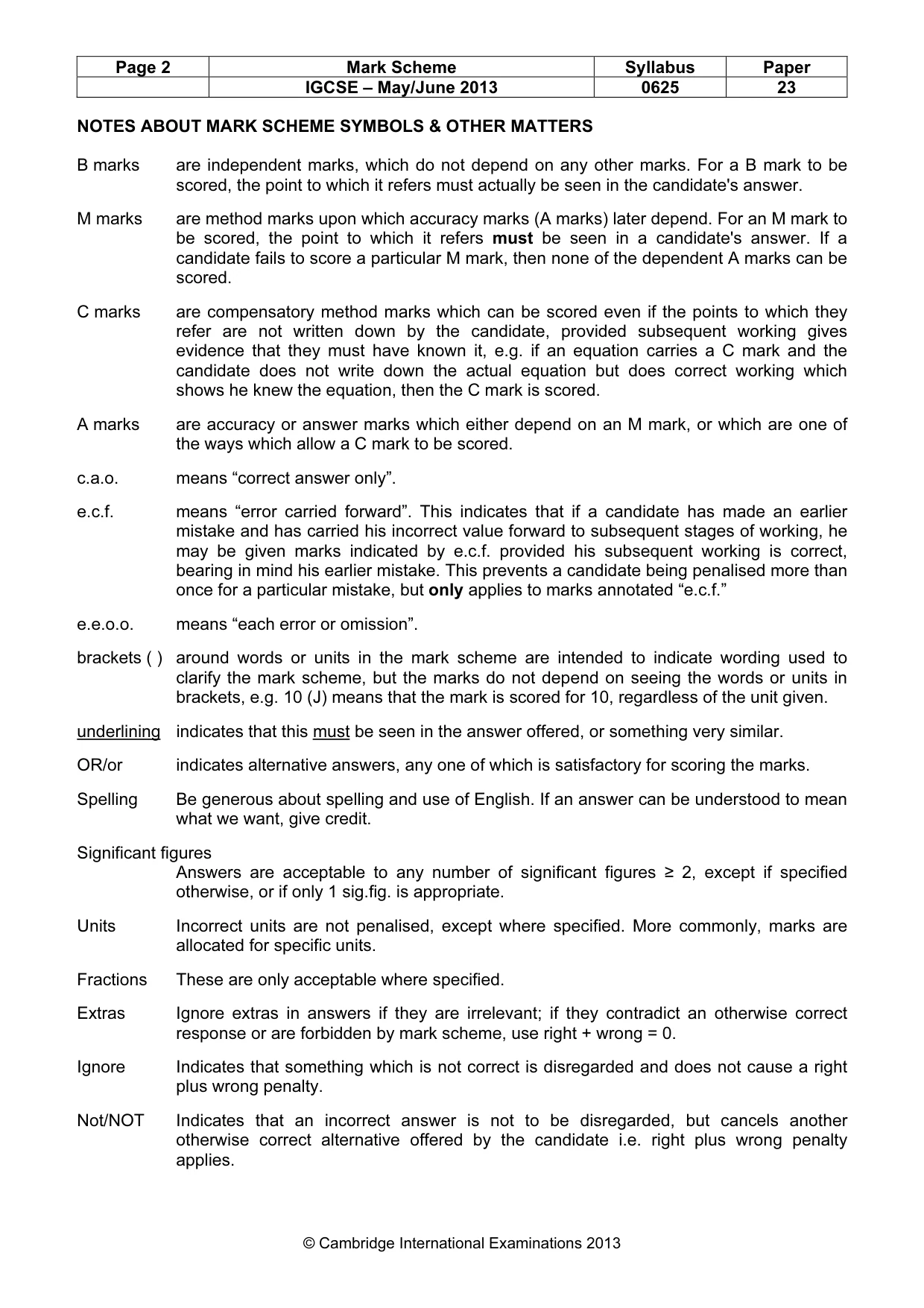
Page 2 Mark Scheme Syllabus Paper IGCSE – May/June 2013 0625 23 © Cambridge International Examinations 2013 NOTES ABOUT MARK SCHEME SYMBOLS & OTHER MATTERS B marks are independent marks, which do not depend on any other marks. For a B mark to be scored, the point to which it refers must actually be seen in the candidate's answer. M marks are method marks upon which accuracy marks (A marks) later depend. For an M mark to be scored, the point to which it refers must be seen in a candidate's answer. If a candidate fails to score a particular M mark, then none of the dependent A marks can be scored. C marks are compensatory method marks which can be scored even if the points to which they refer are not written down by the candidate, provided subsequent working gives evidence that they must have known it, e.g. if an equation carries a C mark and the candidate does not write down the actual equation but does correct working which shows he knew the equation, then the C mark is scored. A marks are accuracy or answer marks which either depend on an M mark, or which are one of the ways which allow a C mark to be scored. c.a.o. means “correct answer only”. e.c.f. means “error carried forward”. This indicates that if a candidate has made an earlier mistake and has carried his incorrect value forward to subsequent stages of working, he may be given marks indicated by e.c.f. provided his subsequent working is correct, bearing in mind his earlier mistake. This prevents a candidate being penalised more than once for a particular mistake, but only applies to marks annotated “e.c.f.” e.e.o.o. means “each error or omission”. brackets ( ) around words or units in the mark scheme are intended to indicate wording used to clarify the mark scheme, but the marks do not depend on seeing the words or units in brackets, e.g. 10 (J) means that the mark is scored for 10, regardless of the unit given. underlining indicates that this must be seen in the answer offered, or something very similar. OR/or indicates alternative answers, any one of which is satisfactory for scoring the marks. Spelling Be generous about spelling and use of English. If an answer can be understood to mean what we want, give credit. Significant figures Answers are acceptable to any number of significant figures ≥ 2, except if specified otherwise, or if only 1 sig.fig. is appropriate. Units Incorrect units are not penalised, except where specified. More commonly, marks are allocated for specific units. Fractions These are only acceptable where specified. Extras Ignore extras in answers if they are irrelevant; if they contradict an otherwise correct response or are forbidden by mark scheme, use right + wrong = 0. Ignore Indicates that something which is not correct is disregarded and does not cause a right plus wrong penalty. Not/NOT Indicates that an incorrect answer is not to be disregarded, but cancels another otherwise correct alternative offered by the candidate i.e. right plus wrong penalty applies.
Mark scheme, page 3
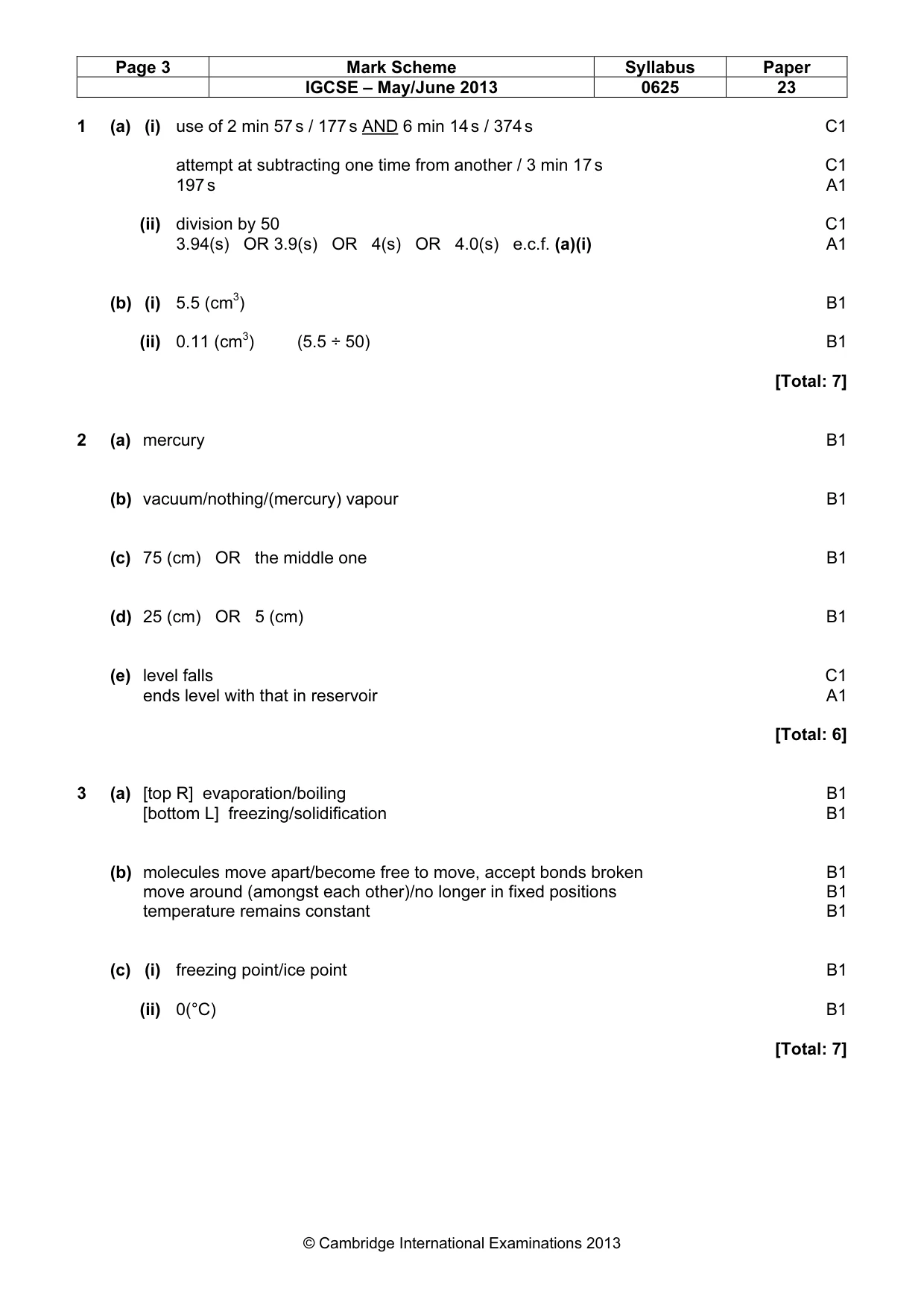
Page 3 Mark Scheme Syllabus Paper IGCSE – May/June 2013 0625 23 © Cambridge International Examinations 2013 1 (a) (i) use of 2 min 57 s / 177 s AND 6 min 14 s / 374 s C1 attempt at subtracting one time from another / 3 min 17 s C1 197 s A1 (ii) division by 50 C1 3.94(s) OR 3.9(s) OR 4(s) OR 4.0(s) e.c.f. (a)(i) A1 (b) (i) 5.5 (cm3) B1 (ii) 0.11 (cm3) (5.5 ÷ 50) B1 [Total: 7] 2 (a) mercury B1 (b) vacuum/nothing/(mercury) vapour B1 (c) 75 (cm) OR the middle one B1 (d) 25 (cm) OR 5 (cm) B1 (e) level falls C1 ends level with that in reservoir A1 [Total: 6] 3 (a) [top R] evaporation/boiling B1 [bottom L] freezing/solidification B1 (b) molecules move apart/become free to move, accept bonds broken B1 move around (amongst each other)/no longer in fixed positions B1 temperature remains constant B1 (c) (i) freezing point/ice point B1 (ii) 0(°C) B1 [Total: 7]
Mark scheme, page 4
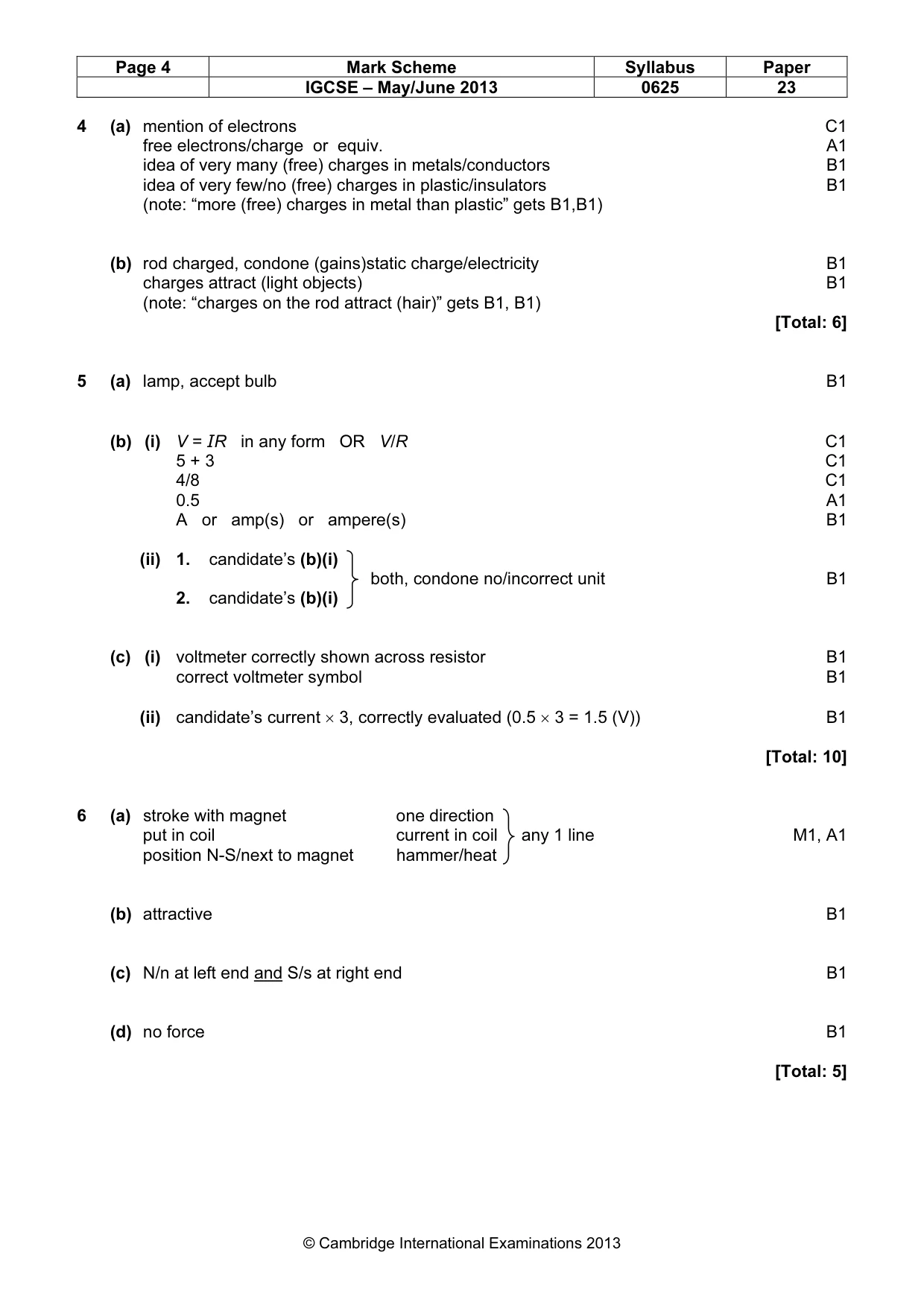
Page 4 Mark Scheme Syllabus Paper IGCSE – May/June 2013 0625 23 © Cambridge International Examinations 2013 4 (a) mention of electrons C1 free electrons/charge or equiv. A1 idea of very many (free) charges in metals/conductors B1 idea of very few/no (free) charges in plastic/insulators B1 (note: “more (free) charges in metal than plastic” gets B1,B1) (b) rod charged, condone (gains)static charge/electricity B1 charges attract (light objects) B1 (note: “charges on the rod attract (hair)” gets B1, B1) [Total: 6] 5 (a) lamp, accept bulb B1 (b) (i) V = IR in any form OR V/R C1 5 + 3 C1 4/8 C1 0.5 A1 A or amp(s) or ampere(s) B1 (ii) 1. candidate’s (b)(i) both, condone no/incorrect unit B1 2. candidate’s (b)(i) (c) (i) voltmeter correctly shown across resistor B1 correct voltmeter symbol B1 (ii) candidate’s current × 3, correctly evaluated (0.5 × 3 = 1.5 (V)) B1 [Total: 10] 6 (a) stroke with magnet one direction put in coil current in coil any 1 line M1, A1 position N-S/next to magnet hammer/heat (b) attractive B1 (c) N/n at left end and S/s at right end B1 (d) no force B1 [Total: 5]
Mark scheme, page 5
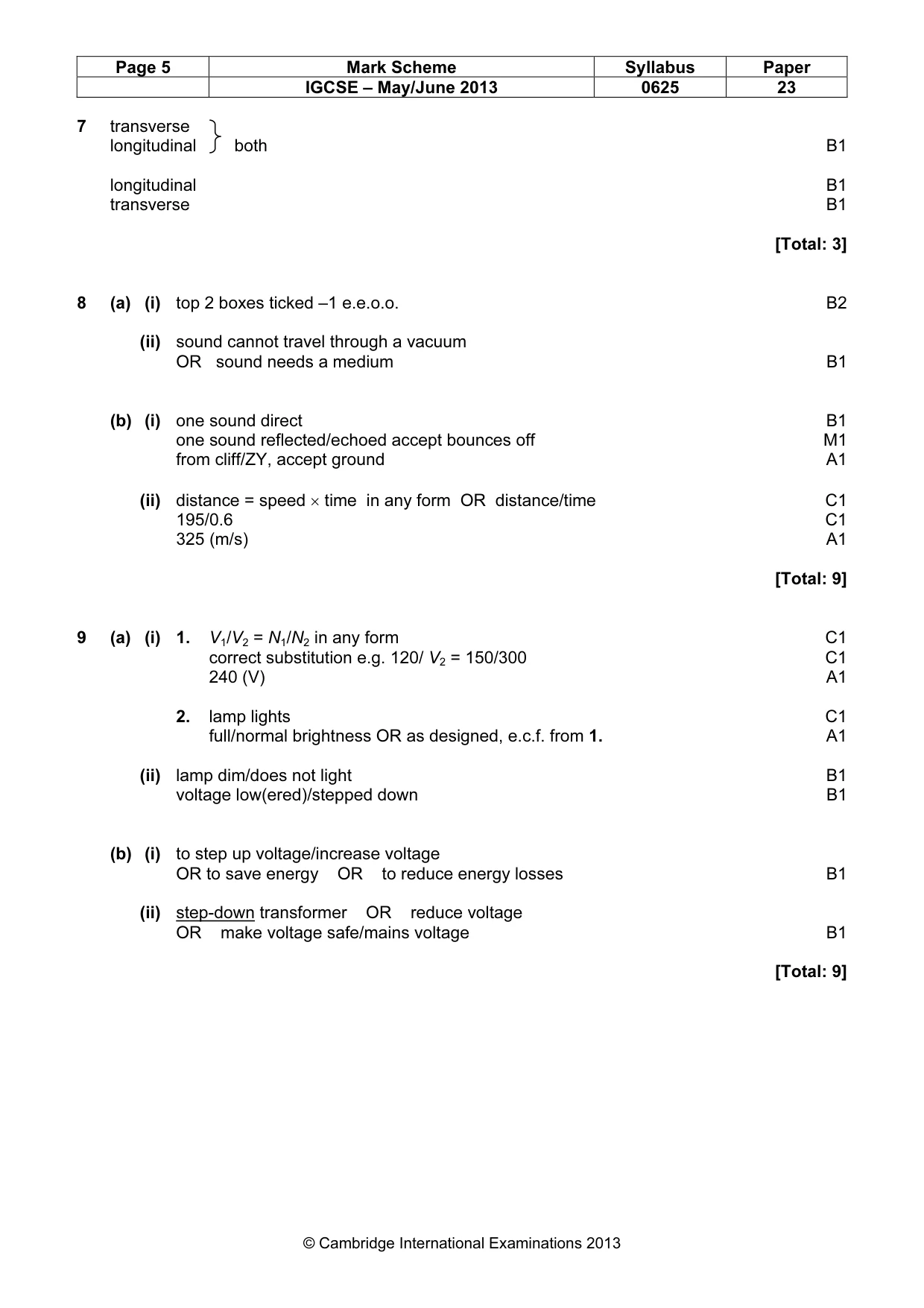
Page 5 Mark Scheme Syllabus Paper IGCSE – May/June 2013 0625 23 © Cambridge International Examinations 2013 7 transverse longitudinal both B1 longitudinal B1 transverse B1 [Total: 3] 8 (a) (i) top 2 boxes ticked –1 e.e.o.o. B2 (ii) sound cannot travel through a vacuum OR sound needs a medium B1 (b) (i) one sound direct B1 one sound reflected/echoed accept bounces off M1 from cliff/ZY, accept ground A1 (ii) distance = speed × time in any form OR distance/time C1 195/0.6 C1 325 (m/s) A1 [Total: 9] 9 (a) (i) 1. V1/V2 = N1/N2 in any form C1 correct substitution e.g. 120/ V2 = 150/300 C1 240 (V) A1 2. lamp lights C1 full/normal brightness OR as designed, e.c.f. from 1. A1 (ii) lamp dim/does not light B1 voltage low(ered)/stepped down B1 (b) (i) to step up voltage/increase voltage OR to save energy OR to reduce energy losses B1 (ii) step-down transformer OR reduce voltage OR make voltage safe/mains voltage B1 [Total: 9]
Mark scheme, page 6
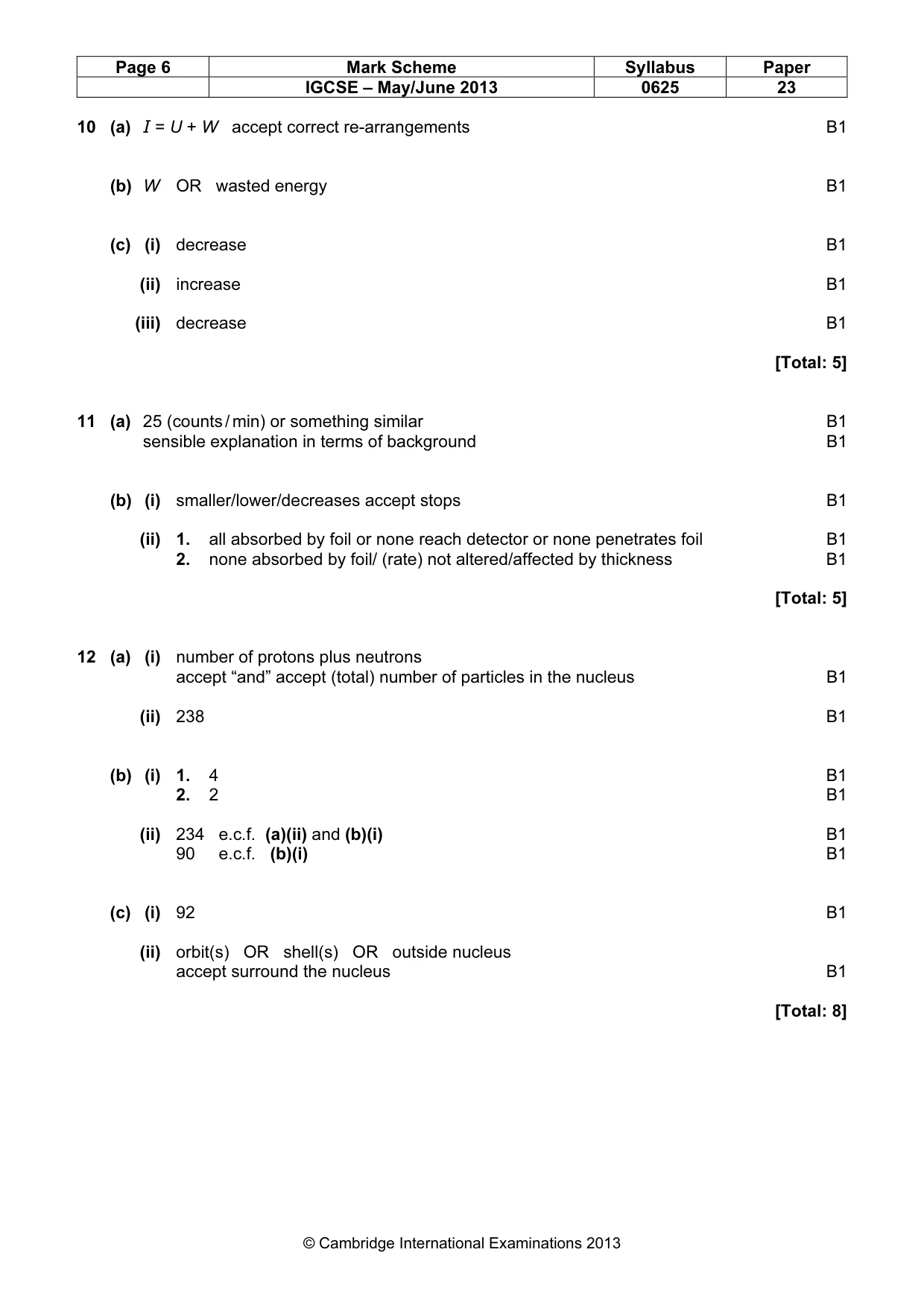
Page 6 Mark Scheme Syllabus Paper IGCSE – May/June 2013 0625 23 © Cambridge International Examinations 2013 10 (a) I = U + W accept correct re-arrangements B1 (b) W OR wasted energy B1 (c) (i) decrease B1 (ii) increase B1 (iii) decrease B1 [Total: 5] 11 (a) 25 (counts / min) or something similar B1 sensible explanation in terms of background B1 (b) (i) smaller/lower/decreases accept stops B1 (ii) 1. all absorbed by foil or none reach detector or none penetrates foil B1 2. none absorbed by foil/ (rate) not altered/affected by thickness B1 [Total: 5] 12 (a) (i) number of protons plus neutrons accept “and” accept (total) number of particles in the nucleus B1 (ii) 238 B1 (b) (i) 1. 4 B1 2. 2 B1 (ii) 234 e.c.f. (a)(ii) and (b)(i) B1 90 e.c.f. (b)(i) B1 (c) (i) 92 B1 (ii) orbit(s) OR shell(s) OR outside nucleus accept surround the nucleus B1 [Total: 8]
What you needed in this session
Cambridge’s own grade thresholds for 2013 May/June, Paper 2 · Variant 3. A higher threshold means an easier paper — the bar moves with how the cohort did.