Cambridge IGCSE Physics 0625 — 2013 May/June Paper 2 · Variant 1
0625/21/M/J/13 · 80 marks · ≈90 min
The question paper and its mark scheme, free to read here and free to download. This is Cambridge’s own paper, exactly as it was sat.
Question paper20 pages

Mark scheme6 pages
Answers below. Sit the paper first if you are practising.
Paper as text
Question paper, page 1
This document consists of 18 printed pages and 2 blank pages. DC (SJF/CGW) 58289/4 © UCLES 2013 [Turn over UNIVERSITY OF CAMBRIDGE INTERNATIONAL EXAMINATIONS International General Certificate of Secondary Education * 8 7 6 9 7 1 6 9 8 5 * PHYSICS 0625/21 Paper 2 Core May/June 2013 1 hour 15 minutes Candidates answer on the Question Paper. No Additional Materials are required. READ THESE INSTRUCTIONS FIRST Write your Centre number, candidate number and name on all the work you hand in. Write in dark blue or black pen. You may use a pencil for any diagrams or graphs. Do not use staples, paper clips, highlighters, glue or correction fluid. DO NOT WRITE IN ANY BARCODES. Answer all questions. Electronic calculators may be used. You may lose marks if you do not show your working or if you do not use appropriate units. Take the weight of 1 kg to be 10 N (i.e. acceleration of free fall = 10 m / s2). At the end of the examination, fasten all your work securely together. The number of marks is given in brackets [ ] at the end of each question or part question. For Examiner’s Use 1 2 3 4 5 6 7 8 9 10 11 12 Total www.XtremePapers.com
Question paper, page 2
2 0625/21/M/J/13 © UCLES 2013 BLANK PAGE
Question paper, page 3
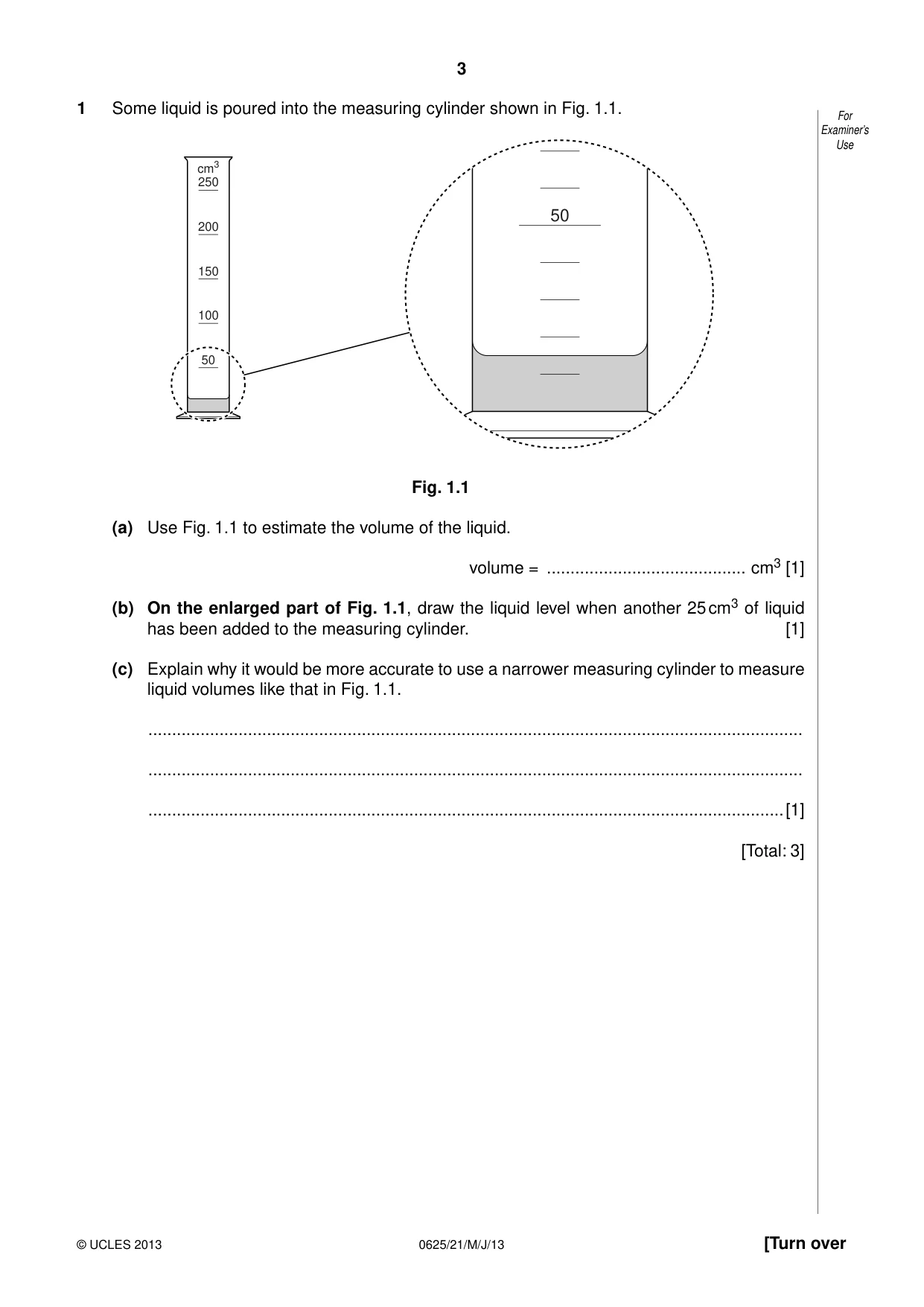
3 0625/21/M/J/13 © UCLES 2013 [Turn over For Examiner’s Use 1 Some liquid is poured into the measuring cylinder shown in Fig. 1.1. 50 100 150 200 250 cm3 50 Fig. 1.1 (a) Use Fig. 1.1 to estimate the volume of the liquid. volume = … cm3 [1] (b) On the enlarged part of Fig. 1.1, draw the liquid level when another 25 cm3 of liquid has been added to the measuring cylinder. [1] (c) Explain why it would be more accurate to use a narrower measuring cylinder to measure liquid volumes like that in Fig. 1.1. … … …[1] [Total: 3]
Question paper, page 4
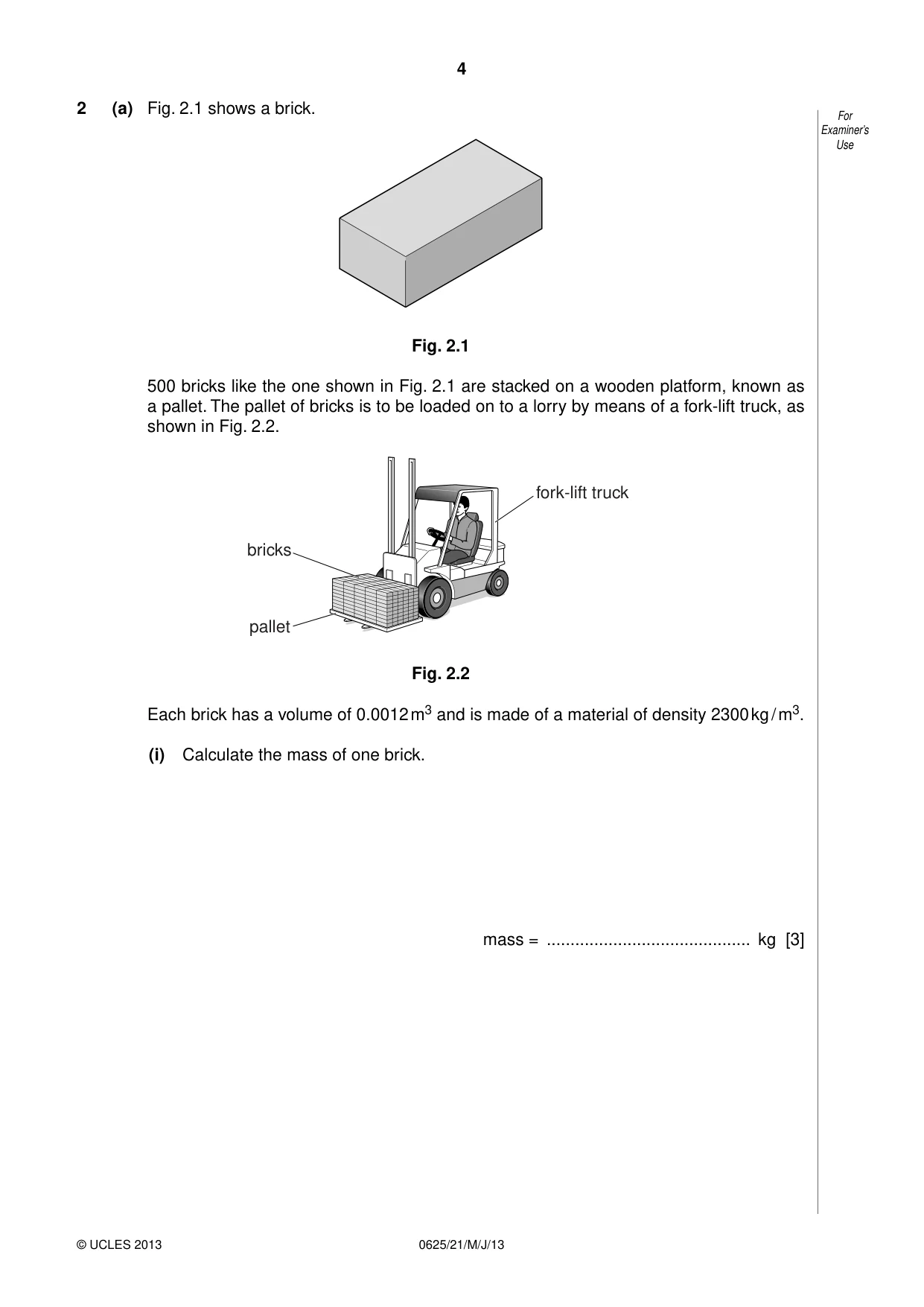
4 0625/21/M/J/13 © UCLES 2013 For Examiner’s Use 2 (a) Fig. 2.1 shows a brick. Fig. 2.1 500 bricks like the one shown in Fig. 2.1 are stacked on a wooden platform, known as a pallet. The pallet of bricks is to be loaded on to a lorry by means of a fork-lift truck, as shown in Fig. 2.2. pallet bricks fork-lift truck Fig. 2.2 Each brick has a volume of 0.0012 m3 and is made of a material of density 2300 kg / m3. (i) Calculate the mass of one brick. mass = … kg [3]
Question paper, page 5
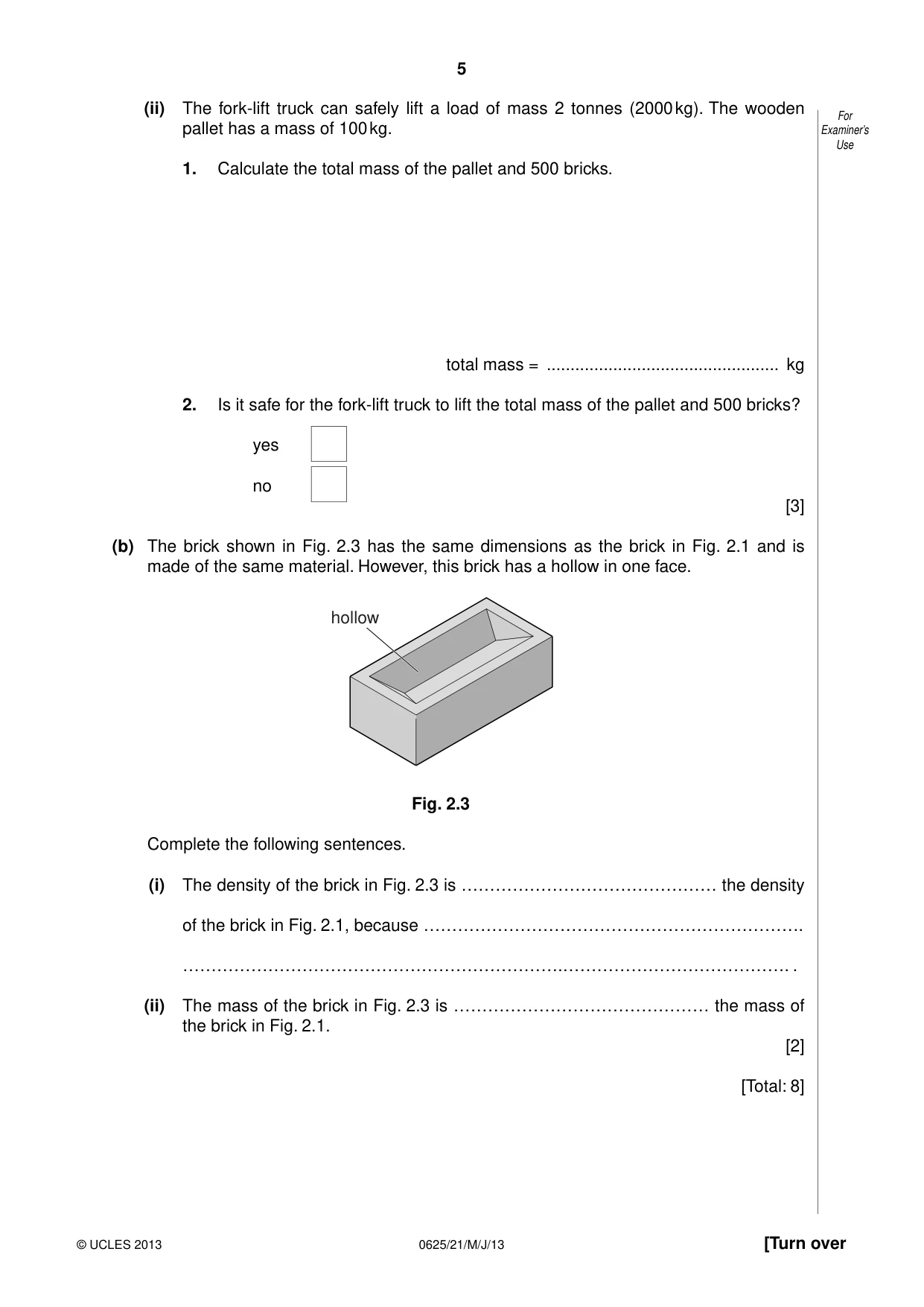
5 0625/21/M/J/13 © UCLES 2013 [Turn over For Examiner’s Use (ii) The fork-lift truck can safely lift a load of mass 2 tonnes (2000 kg). The wooden pallet has a mass of 100 kg. 1. Calculate the total mass of the pallet and 500 bricks. total mass = … kg 2. Is it safe for the fork-lift truck to lift the total mass of the pallet and 500 bricks? yes no [3] (b) The brick shown in Fig. 2.3 has the same dimensions as the brick in Fig. 2.1 and is made of the same material. However, this brick has a hollow in one face. hollow Fig. 2.3 Complete the following sentences. (i) The density of the brick in Fig. 2.3 is ……………………………………… the density of the brick in Fig. 2.1, because …………………………………………………………. ………………………………………………………….…………………………………. . (ii) The mass of the brick in Fig. 2.3 is ……………………………………… the mass of the brick in Fig. 2.1. [2] [Total: 8]
Question paper, page 6
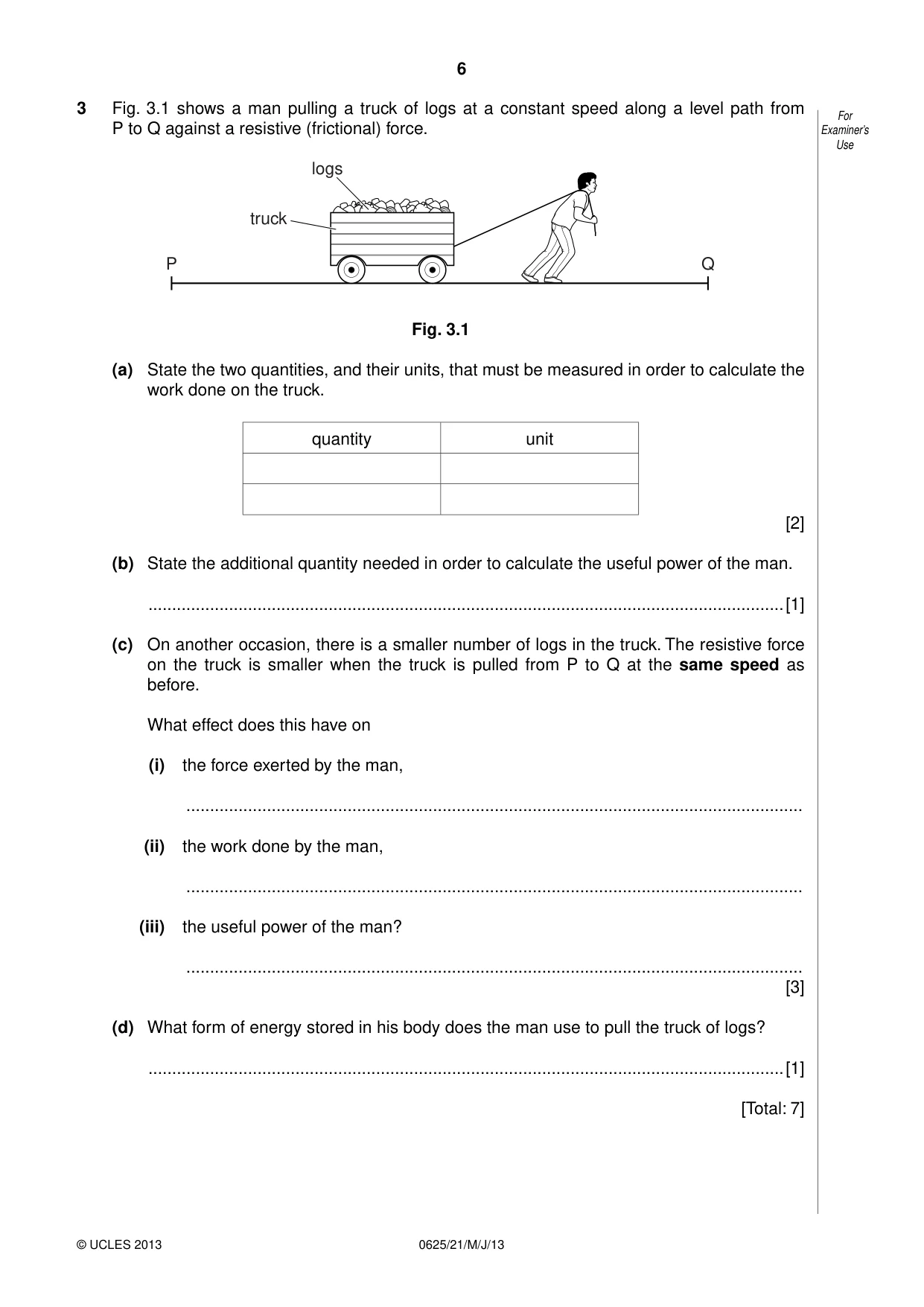
6 0625/21/M/J/13 © UCLES 2013 For Examiner’s Use 3 Fig. 3.1 shows a man pulling a truck of logs at a constant speed along a level path from P to Q against a resistive (frictional) force. P logs truck Q Fig. 3.1 (a) State the two quantities, and their units, that must be measured in order to calculate the work done on the truck. quantity unit [2] (b) State the additional quantity needed in order to calculate the useful power of the man. …[1] (c) On another occasion, there is a smaller number of logs in the truck. The resistive force on the truck is smaller when the truck is pulled from P to Q at the same speed as before. What effect does this have on (i) the force exerted by the man, … (ii) the work done by the man, … (iii) the useful power of the man? … [3] (d) What form of energy stored in his body does the man use to pull the truck of logs? …[1] [Total: 7]
Question paper, page 7
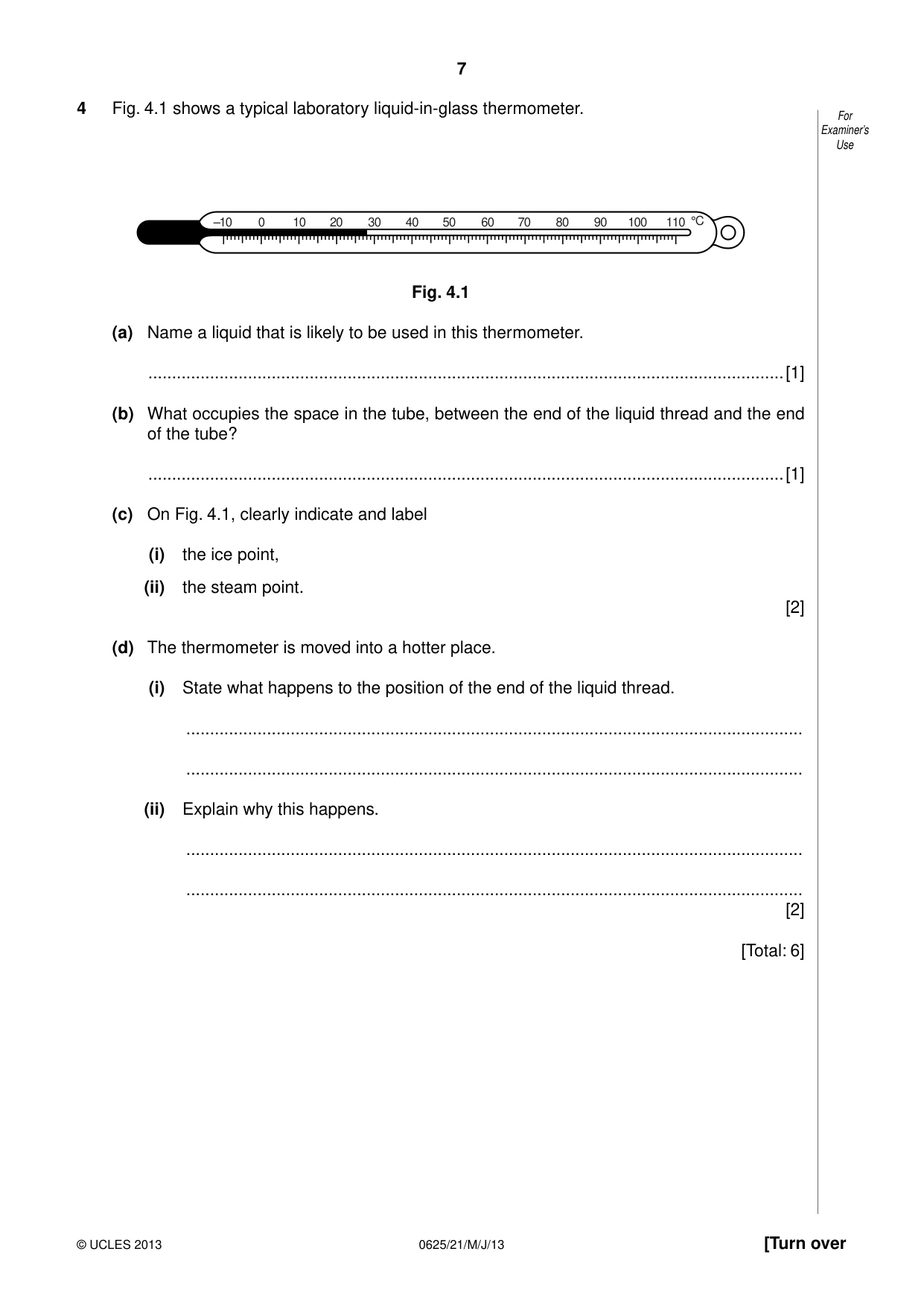
7 0625/21/M/J/13 © UCLES 2013 [Turn over For Examiner’s Use 4 Fig. 4.1 shows a typical laboratory liquid-in-glass thermometer. –10 0 10 20 30 40 50 60 70 80 90 100 110 °C Fig. 4.1 (a) Name a liquid that is likely to be used in this thermometer. …[1] (b) What occupies the space in the tube, between the end of the liquid thread and the end of the tube? …[1] (c) On Fig. 4.1, clearly indicate and label (i) the ice point, (ii) the steam point. [2] (d) The thermometer is moved into a hotter place. (i) State what happens to the position of the end of the liquid thread. … … (ii) Explain why this happens. … … [2] [Total: 6]
Question paper, page 8
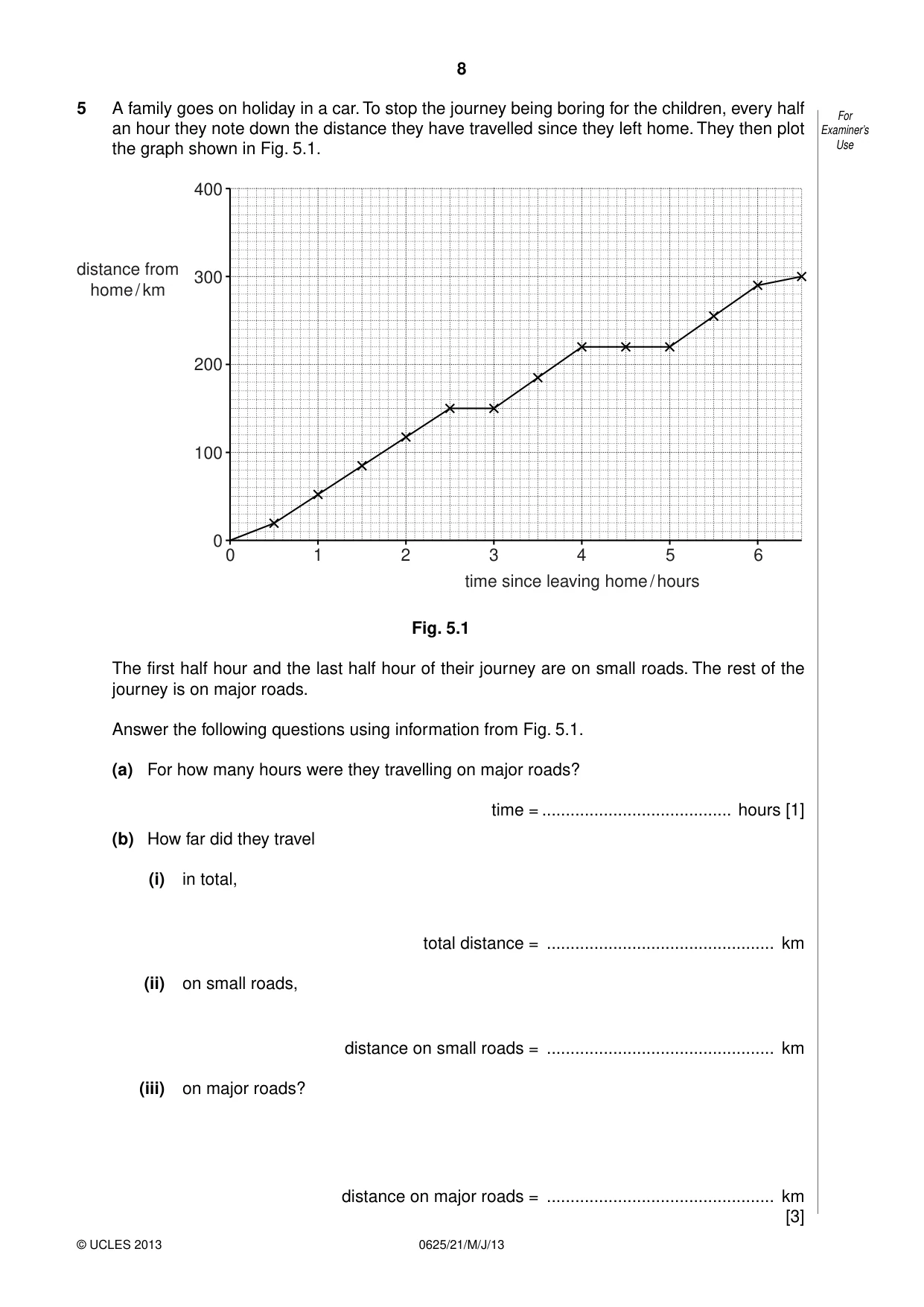
8 0625/21/M/J/13 © UCLES 2013 For Examiner’s Use 5 A family goes on holiday in a car. To stop the journey being boring for the children, every half an hour they note down the distance they have travelled since they left home. They then plot the graph shown in Fig. 5.1. 0 100 0 1 2 3 time since leaving home / hours distance from home / km 4 5 6 200 300 400 Fig. 5.1 The first half hour and the last half hour of their journey are on small roads. The rest of the journey is on major roads. Answer the following questions using information from Fig. 5.1. (a) For how many hours were they travelling on major roads? time = … hours [1] (b) How far did they travel (i) in total, total distance = … km (ii) on small roads, distance on small roads = … km (iii) on major roads? distance on major roads = … km [3]
Question paper, page 9
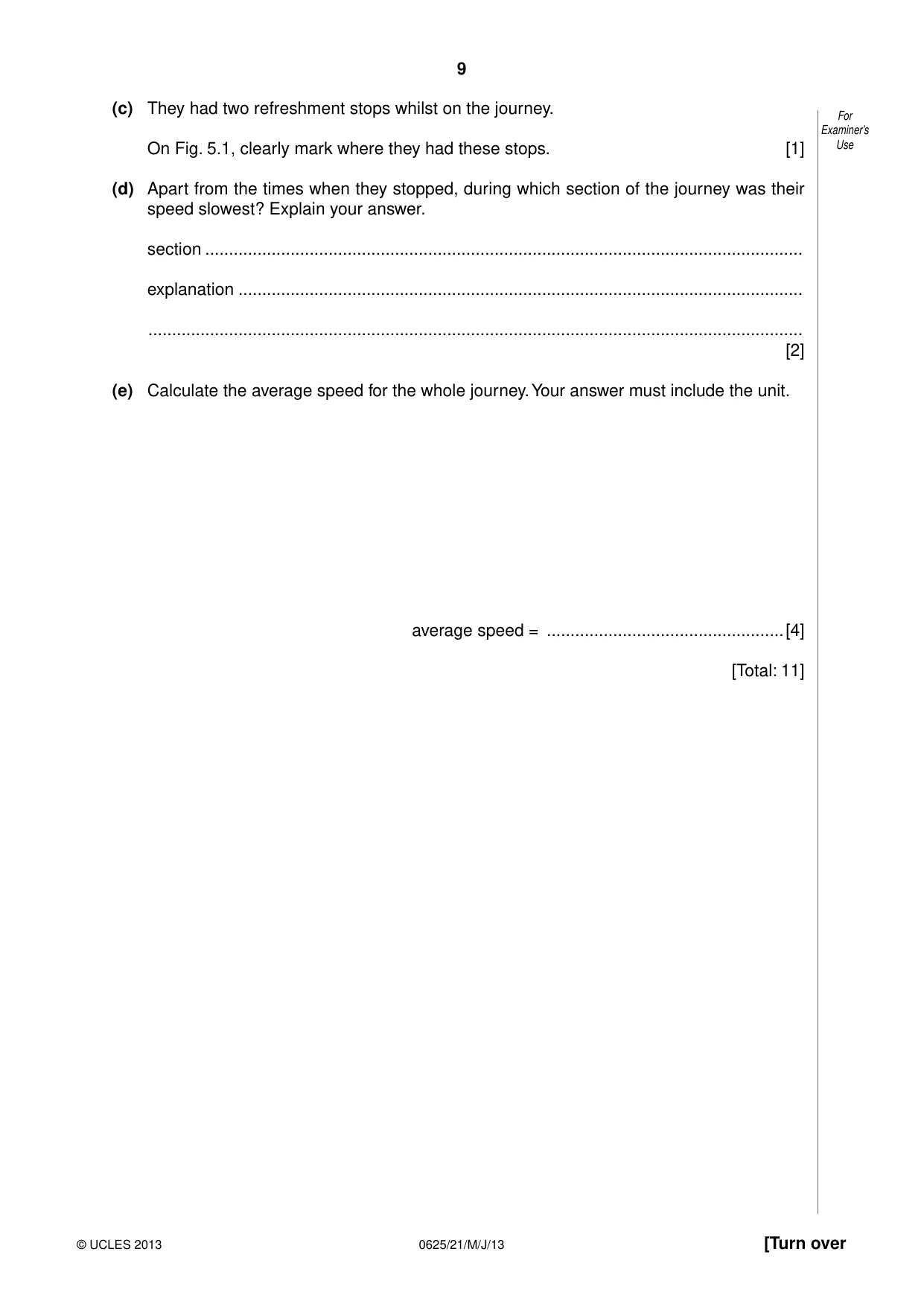
9 0625/21/M/J/13 © UCLES 2013 [Turn over For Examiner’s Use (c) They had two refreshment stops whilst on the journey. On Fig. 5.1, clearly mark where they had these stops. [1] (d) Apart from the times when they stopped, during which section of the journey was their speed slowest? Explain your answer. section … explanation … … [2] (e) Calculate the average speed for the whole journey. Your answer must include the unit. average speed = …[4] [Total: 11]
Question paper, page 10
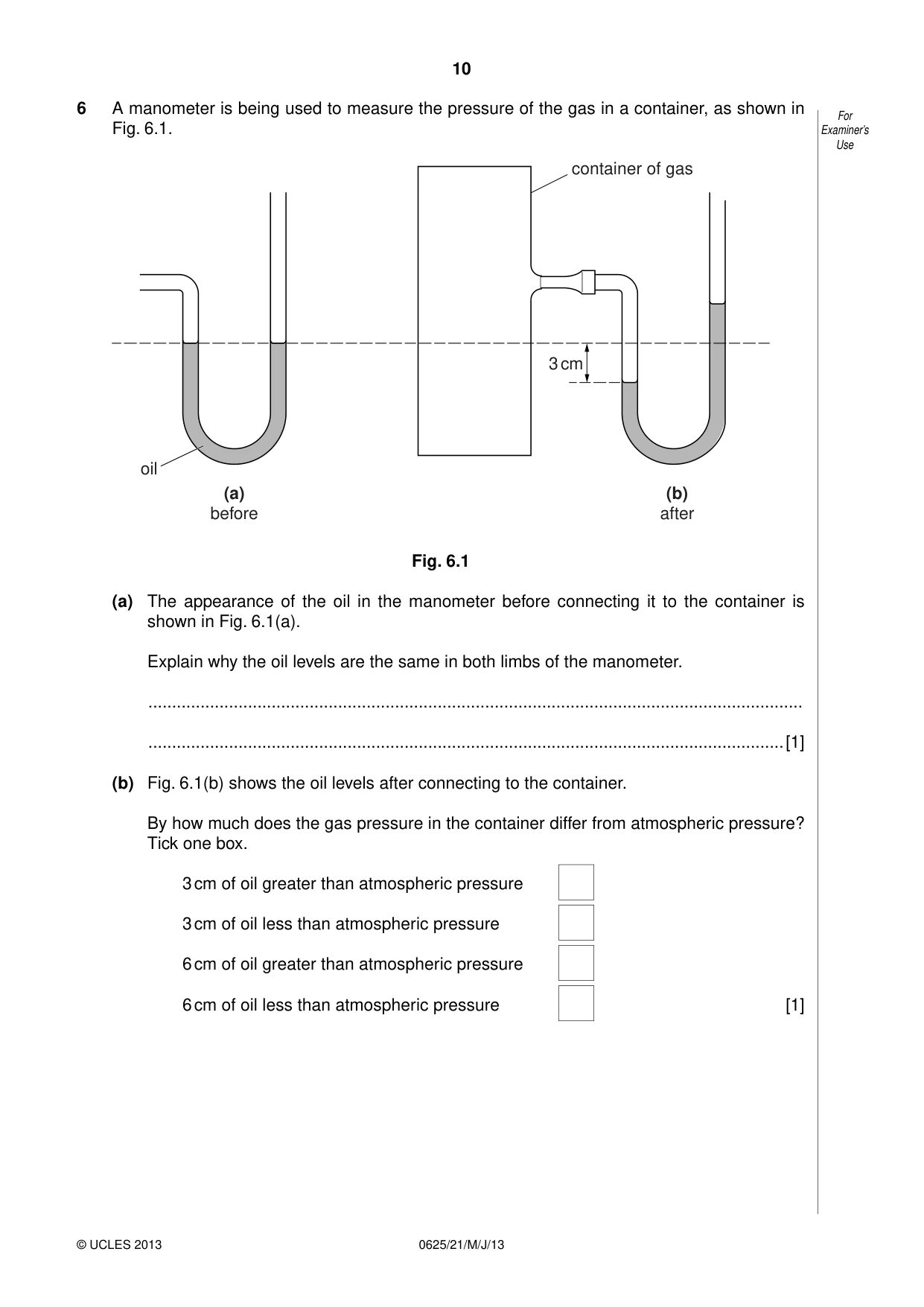
10 0625/21/M/J/13 © UCLES 2013 For Examiner’s Use 6 A manometer is being used to measure the pressure of the gas in a container, as shown in Fig. 6.1. oil 3 cm container of gas (a) before (b) after Fig. 6.1 (a) The appearance of the oil in the manometer before connecting it to the container is shown in Fig. 6.1(a). Explain why the oil levels are the same in both limbs of the manometer. … …[1] (b) Fig. 6.1(b) shows the oil levels after connecting to the container. By how much does the gas pressure in the container differ from atmospheric pressure? Tick one box. 3 cm of oil greater than atmospheric pressure 3 cm of oil less than atmospheric pressure 6 cm of oil greater than atmospheric pressure 6 cm of oil less than atmospheric pressure [1]
Question paper, page 11
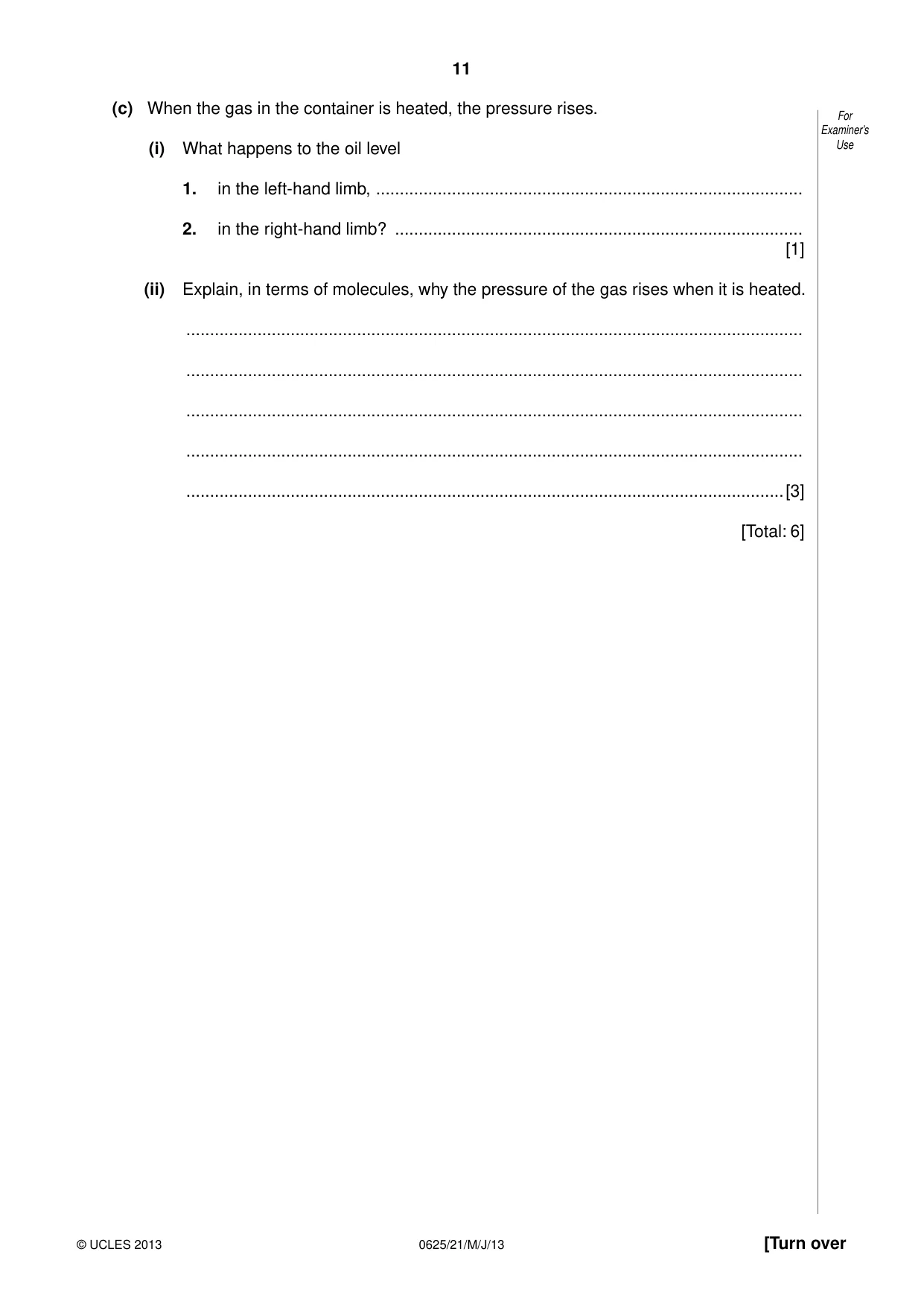
11 0625/21/M/J/13 © UCLES 2013 [Turn over For Examiner’s Use (c) When the gas in the container is heated, the pressure rises. (i) What happens to the oil level 1. in the left-hand limb, … 2. in the right-hand limb? … [1] (ii) Explain, in terms of molecules, why the pressure of the gas rises when it is heated. … … … … …[3] [Total: 6]
Question paper, page 12
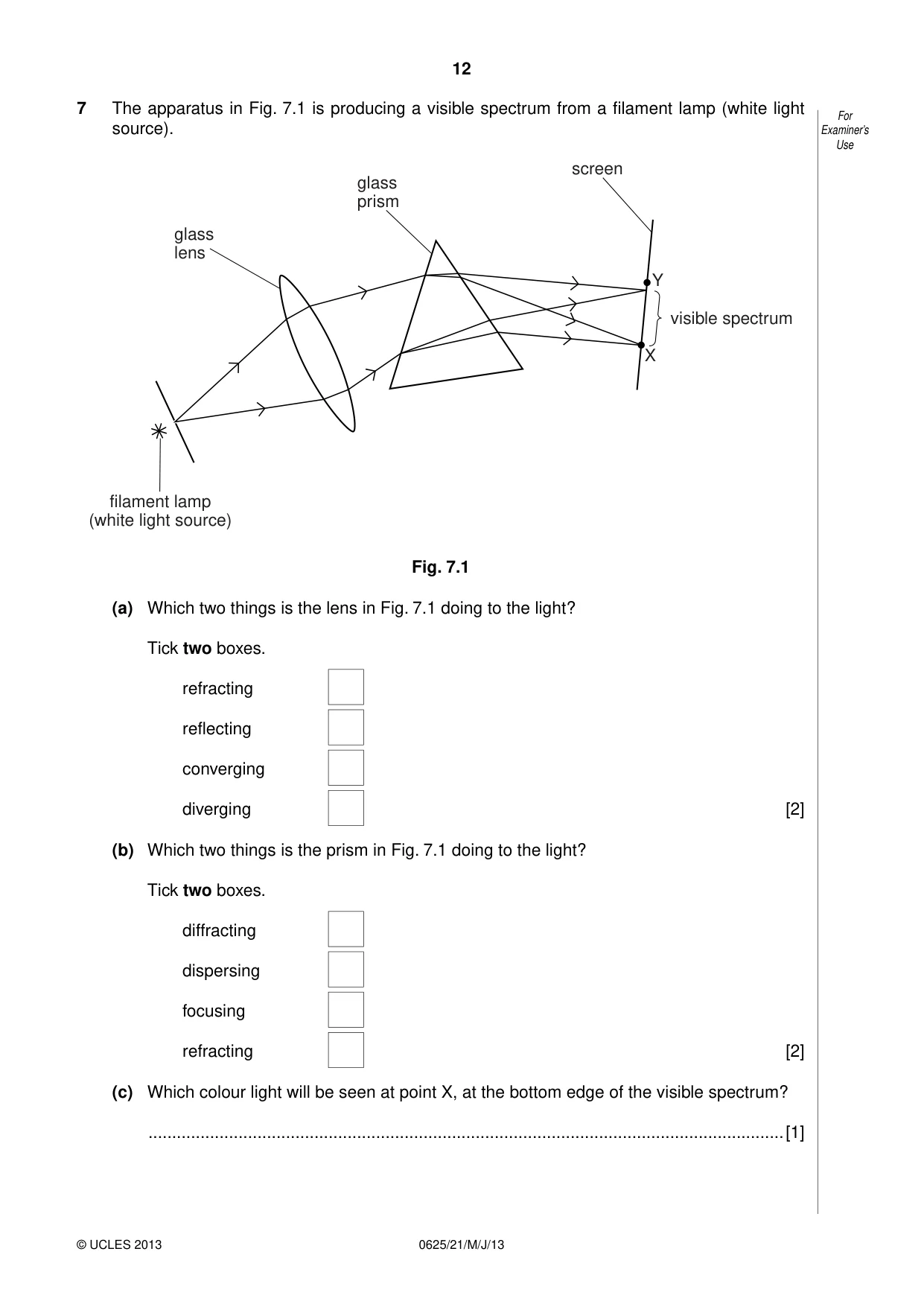
12 0625/21/M/J/13 © UCLES 2013 For Examiner’s Use 7 The apparatus in Fig. 7.1 is producing a visible spectrum from a filament lamp (white light source). screen glass prism glass lens filament lamp (white light source) visible spectrum X Y Fig. 7.1 (a) Which two things is the lens in Fig. 7.1 doing to the light? Tick two boxes. refracting reflecting converging diverging [2] (b) Which two things is the prism in Fig. 7.1 doing to the light? Tick two boxes. diffracting dispersing focusing refracting [2] (c) Which colour light will be seen at point X, at the bottom edge of the visible spectrum? …[1]
Question paper, page 13
13 0625/21/M/J/13 © UCLES 2013 [Turn over For Examiner’s Use (d) A sensitive thermometer shows a small rise in temperature when held at point Y, just above the top edge of the visible spectrum. (i) Which type of electromagnetic radiation is the thermometer detecting? … (ii) Suggest why this radiation is present. … [2] [Total: 7]
Question paper, page 14
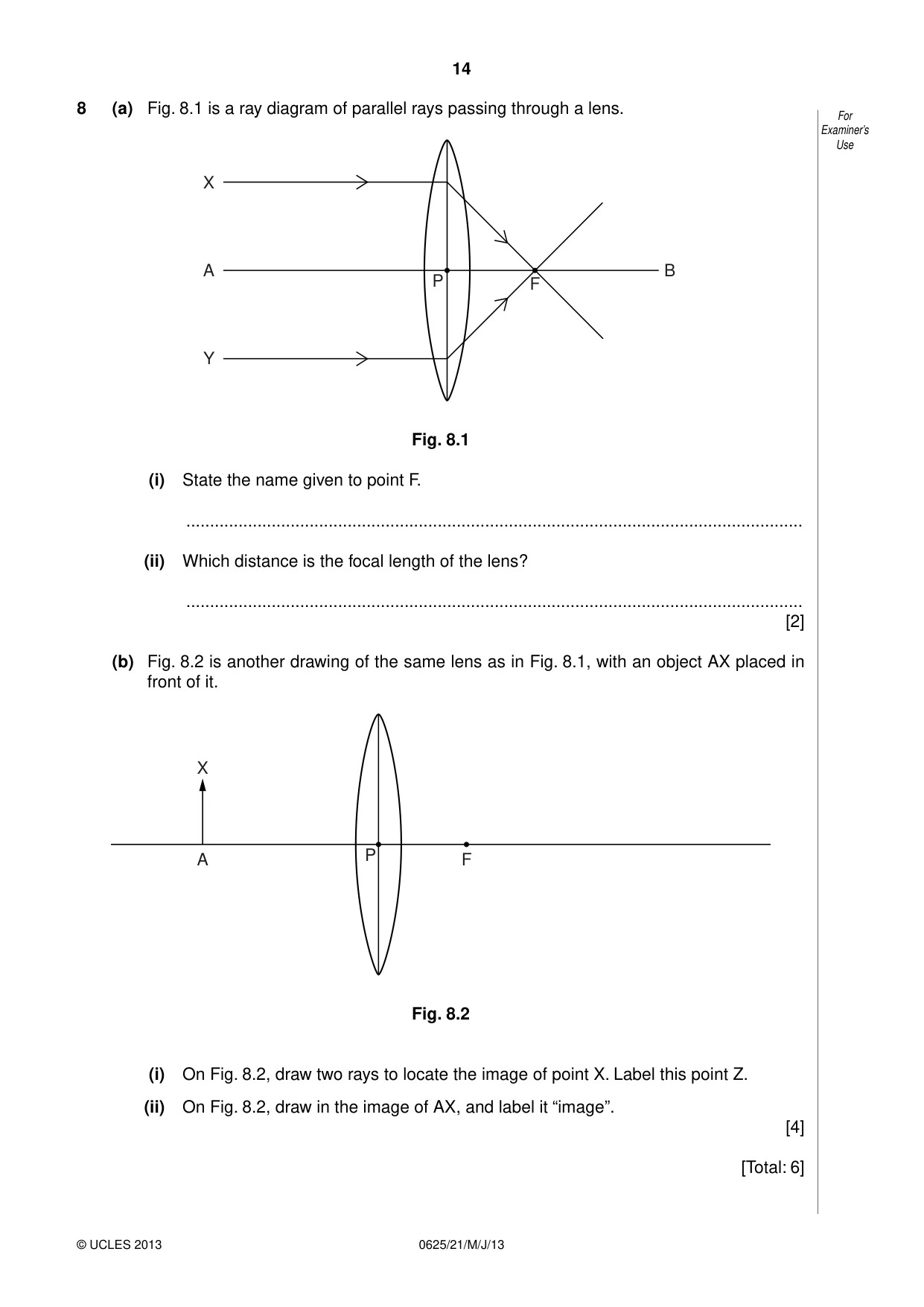
14 0625/21/M/J/13 © UCLES 2013 For Examiner’s Use 8 (a) Fig. 8.1 is a ray diagram of parallel rays passing through a lens. X A P F B Y Fig. 8.1 (i) State the name given to point F. … (ii) Which distance is the focal length of the lens? … [2] (b) Fig. 8.2 is another drawing of the same lens as in Fig. 8.1, with an object AX placed in front of it. X A P F Fig. 8.2 (i) On Fig. 8.2, draw two rays to locate the image of point X. Label this point Z. (ii) On Fig. 8.2, draw in the image of AX, and label it “image”. [4] [Total: 6]
Question paper, page 15
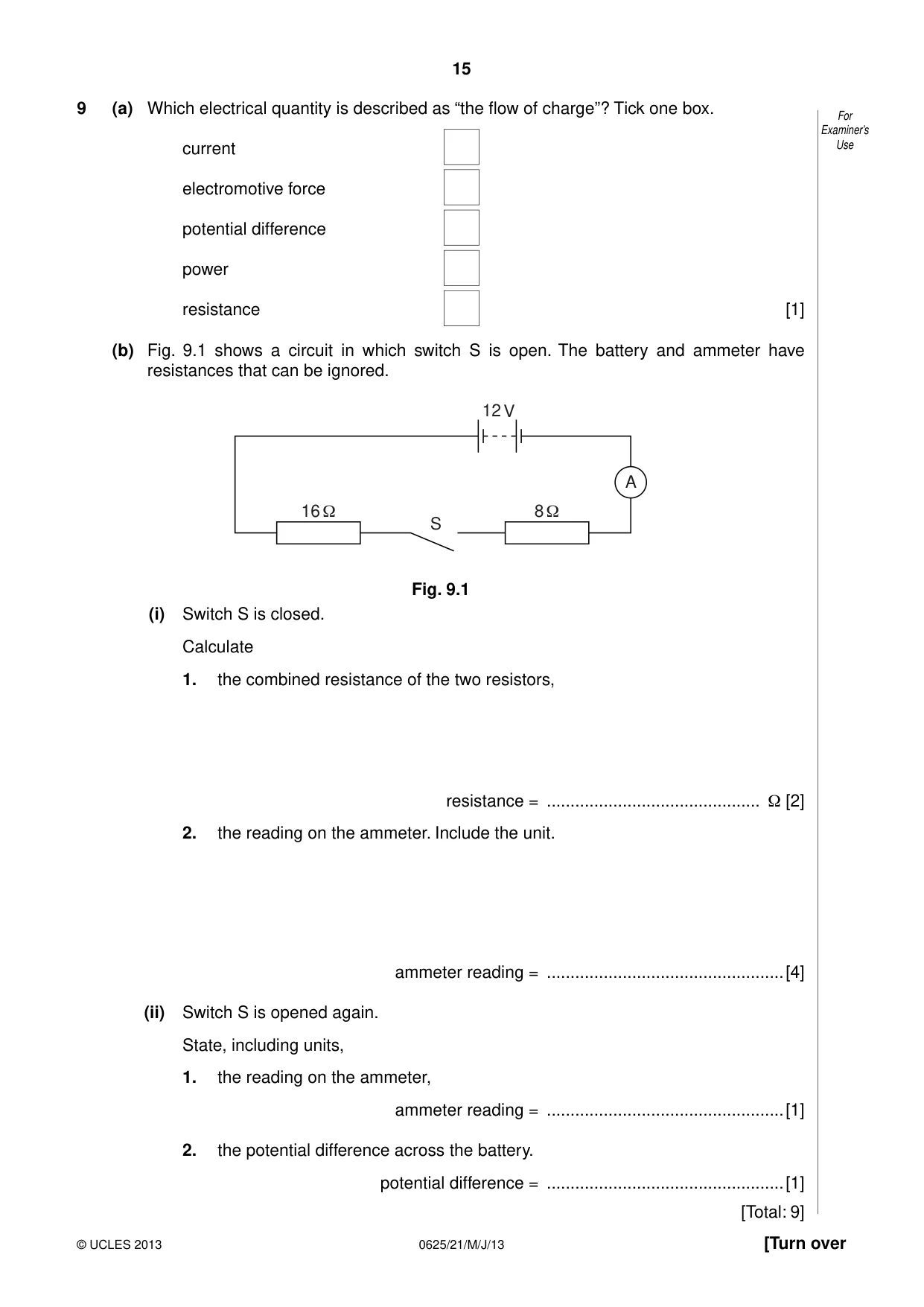
15 0625/21/M/J/13 © UCLES 2013 [Turn over For Examiner’s Use 9 (a) Which electrical quantity is described as “the flow of charge”? Tick one box. current electromotive force potential difference power resistance [1] (b) Fig. 9.1 shows a circuit in which switch S is open. The battery and ammeter have resistances that can be ignored. A 8 1 16 1 12 V S Fig. 9.1 (i) Switch S is closed. Calculate 1. the combined resistance of the two resistors, resistance = … Ω [2] 2. the reading on the ammeter. Include the unit. ammeter reading = …[4] (ii) Switch S is opened again. State, including units, 1. the reading on the ammeter, ammeter reading = …[1] 2. the potential difference across the battery. potential difference = …[1] [Total: 9]
Question paper, page 16
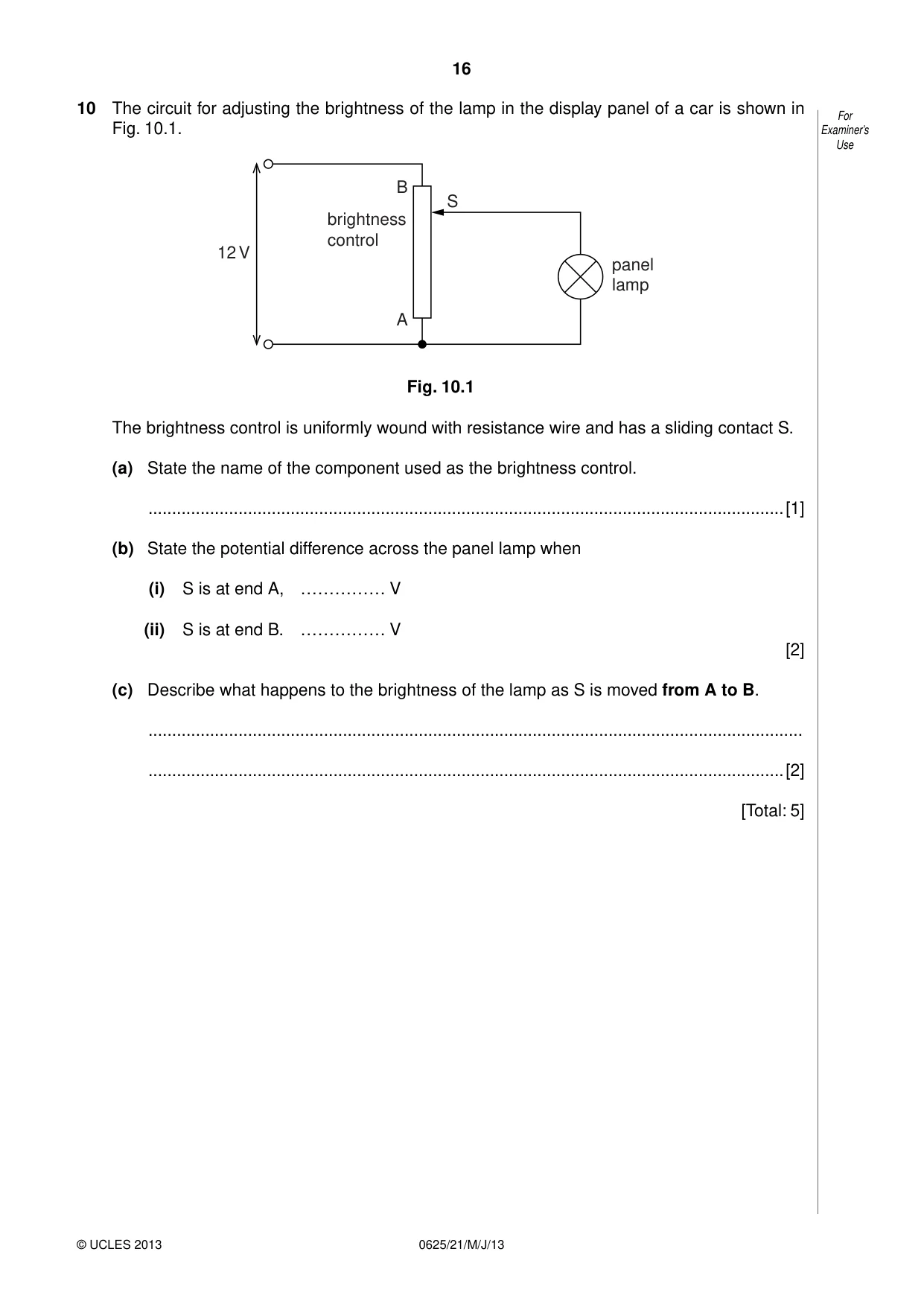
16 0625/21/M/J/13 © UCLES 2013 For Examiner’s Use 10 The circuit for adjusting the brightness of the lamp in the display panel of a car is shown in Fig. 10.1. panel lamp S B A brightness control 12 V Fig. 10.1 The brightness control is uniformly wound with resistance wire and has a sliding contact S. (a) State the name of the component used as the brightness control. …[1] (b) State the potential difference across the panel lamp when (i) S is at end A, …………… V (ii) S is at end B. …………… V [2] (c) Describe what happens to the brightness of the lamp as S is moved from A to B. … …[2] [Total: 5]
Question paper, page 17
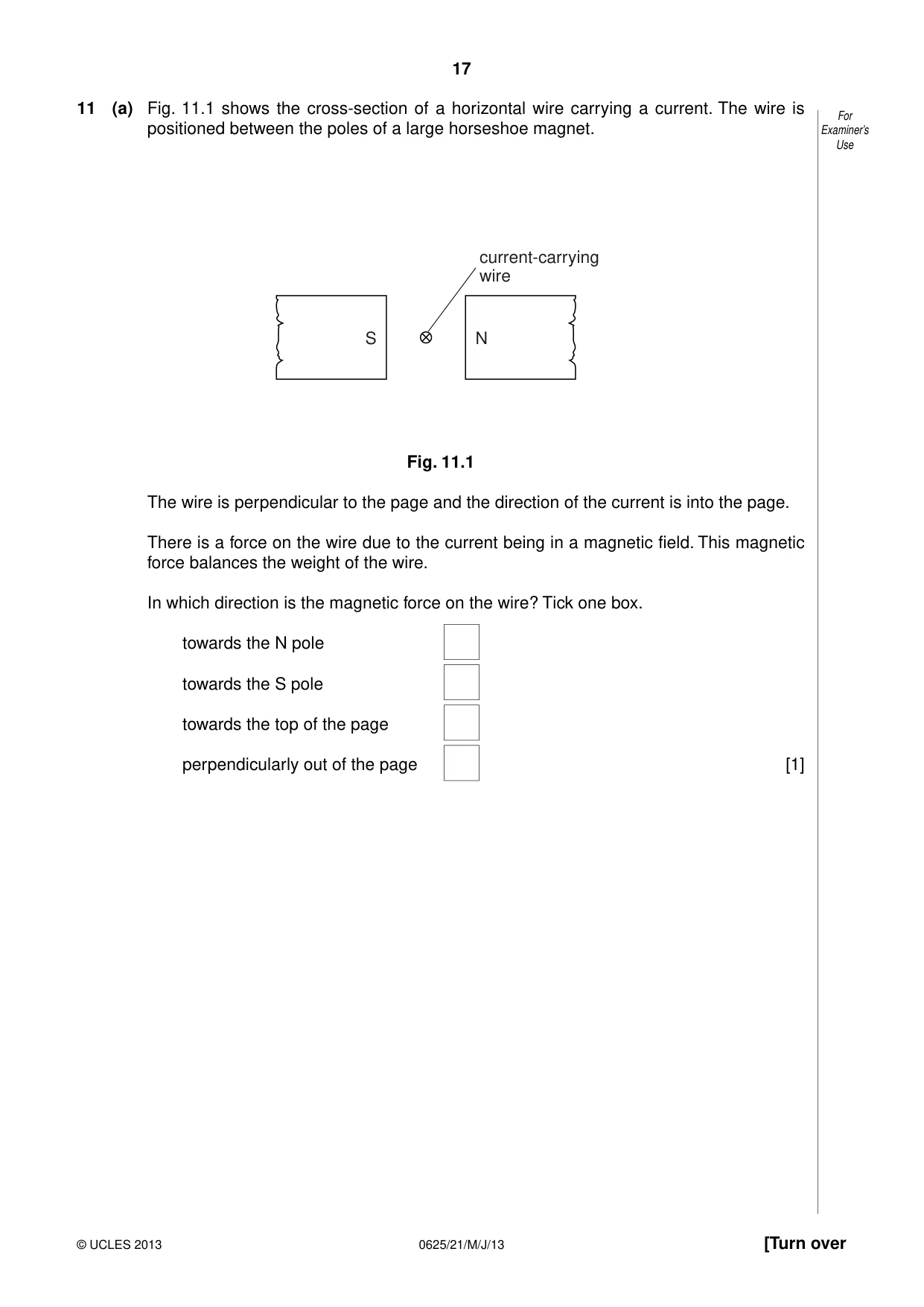
17 0625/21/M/J/13 © UCLES 2013 [Turn over For Examiner’s Use 11 (a) Fig. 11.1 shows the cross-section of a horizontal wire carrying a current. The wire is positioned between the poles of a large horseshoe magnet. S N current-carrying wire Fig. 11.1 The wire is perpendicular to the page and the direction of the current is into the page. There is a force on the wire due to the current being in a magnetic field. This magnetic force balances the weight of the wire. In which direction is the magnetic force on the wire? Tick one box. towards the N pole towards the S pole towards the top of the page perpendicularly out of the page [1]
Question paper, page 18
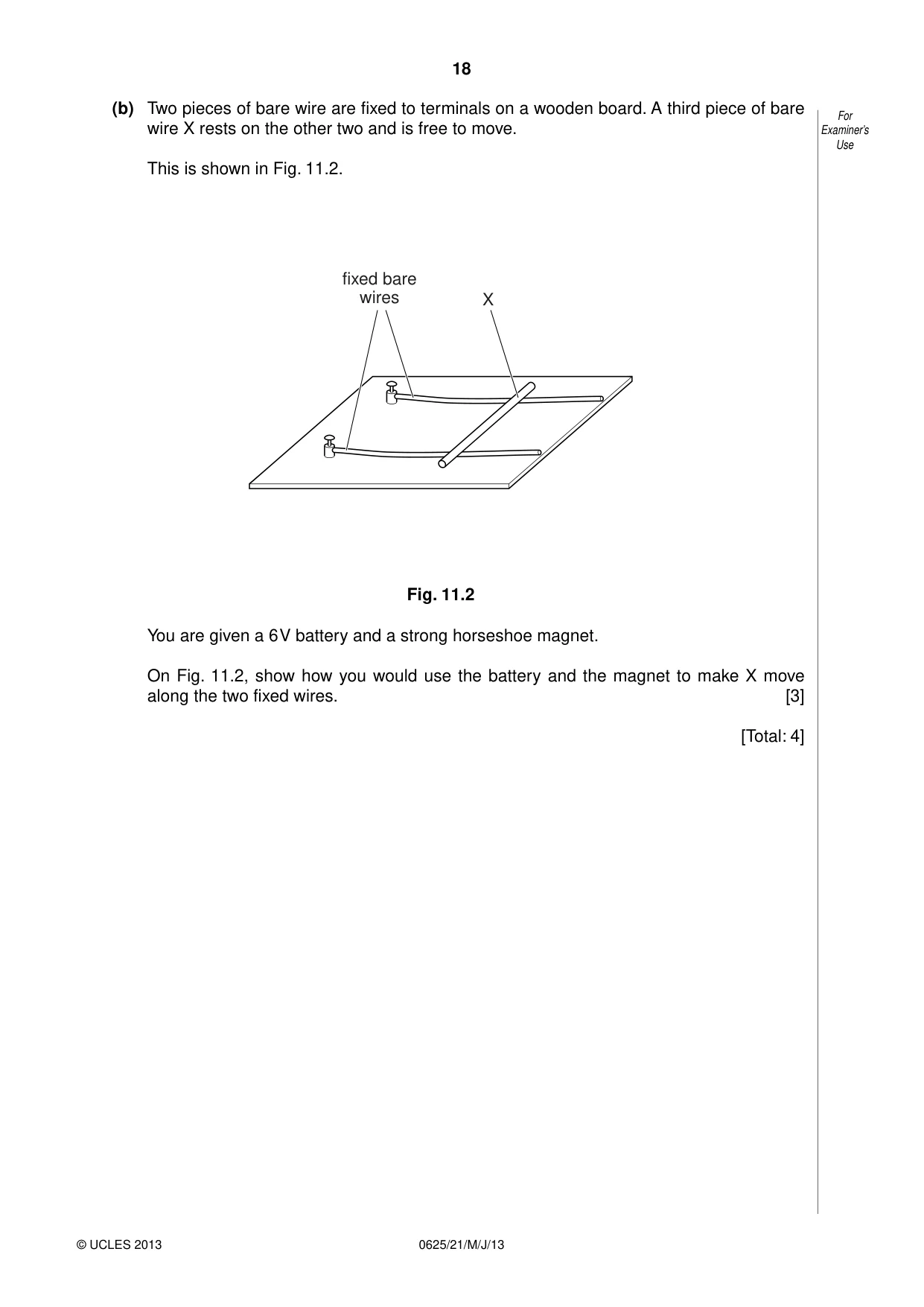
18 0625/21/M/J/13 © UCLES 2013 For Examiner’s Use (b) Two pieces of bare wire are fixed to terminals on a wooden board. A third piece of bare wire X rests on the other two and is free to move. This is shown in Fig. 11.2. fixed bare wires X Fig. 11.2 You are given a 6 V battery and a strong horseshoe magnet. On Fig. 11.2, show how you would use the battery and the magnet to make X move along the two fixed wires. [3] [Total: 4]
Question paper, page 19
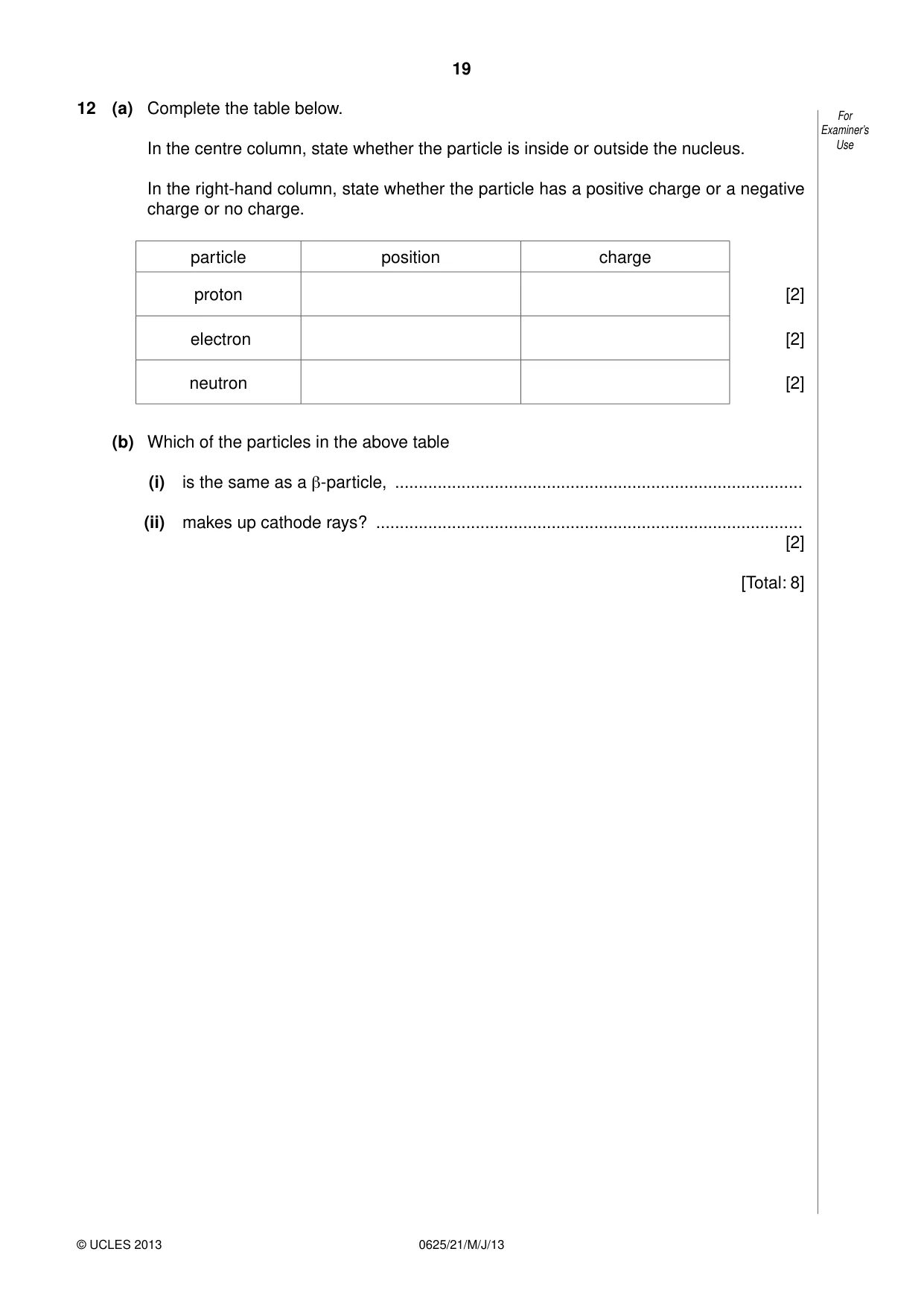
19 0625/21/M/J/13 © UCLES 2013 For Examiner’s Use 12 (a) Complete the table below. In the centre column, state whether the particle is inside or outside the nucleus. In the right-hand column, state whether the particle has a positive charge or a negative charge or no charge. particle position charge proton [2] electron [2] neutron [2] (b) Which of the particles in the above table (i) is the same as a β-particle, … (ii) makes up cathode rays? … [2] [Total: 8]
Question paper, page 20
20 0625/21/M/J/13 © UCLES 2013 Permission to reproduce items where third-party owned material protected by copyright is included has been sought and cleared where possible. Every reasonable effort has been made by the publisher (UCLES) to trace copyright holders, but if any items requiring clearance have unwittingly been included, the publisher will be pleased to make amends at the earliest possible opportunity. University of Cambridge International Examinations is part of the Cambridge Assessment Group. Cambridge Assessment is the brand name of University of Cambridge Local Examinations Syndicate (UCLES), which is itself a department of the University of Cambridge. BLANK PAGE
Mark scheme, page 1
CAMBRIDGE INTERNATIONAL EXAMINATIONS International General Certificate of Secondary Education MARK SCHEME for the May/June 2013 series 0625 PHYSICS 0625/21 Paper 2 (Core Theory), maximum raw mark 80 This mark scheme is published as an aid to teachers and candidates, to indicate the requirements of the examination. It shows the basis on which Examiners were instructed to award marks. It does not indicate the details of the discussions that took place at an Examiners’ meeting before marking began, which would have considered the acceptability of alternative answers. Mark schemes should be read in conjunction with the question paper and the Principal Examiner Report for Teachers. Cambridge will not enter into discussions about these mark schemes. Cambridge is publishing the mark schemes for the May/June 2013 series for most IGCSE, GCE Advanced Level and Advanced Subsidiary Level components and some Ordinary Level components. www.XtremePapers.com
Mark scheme, page 2
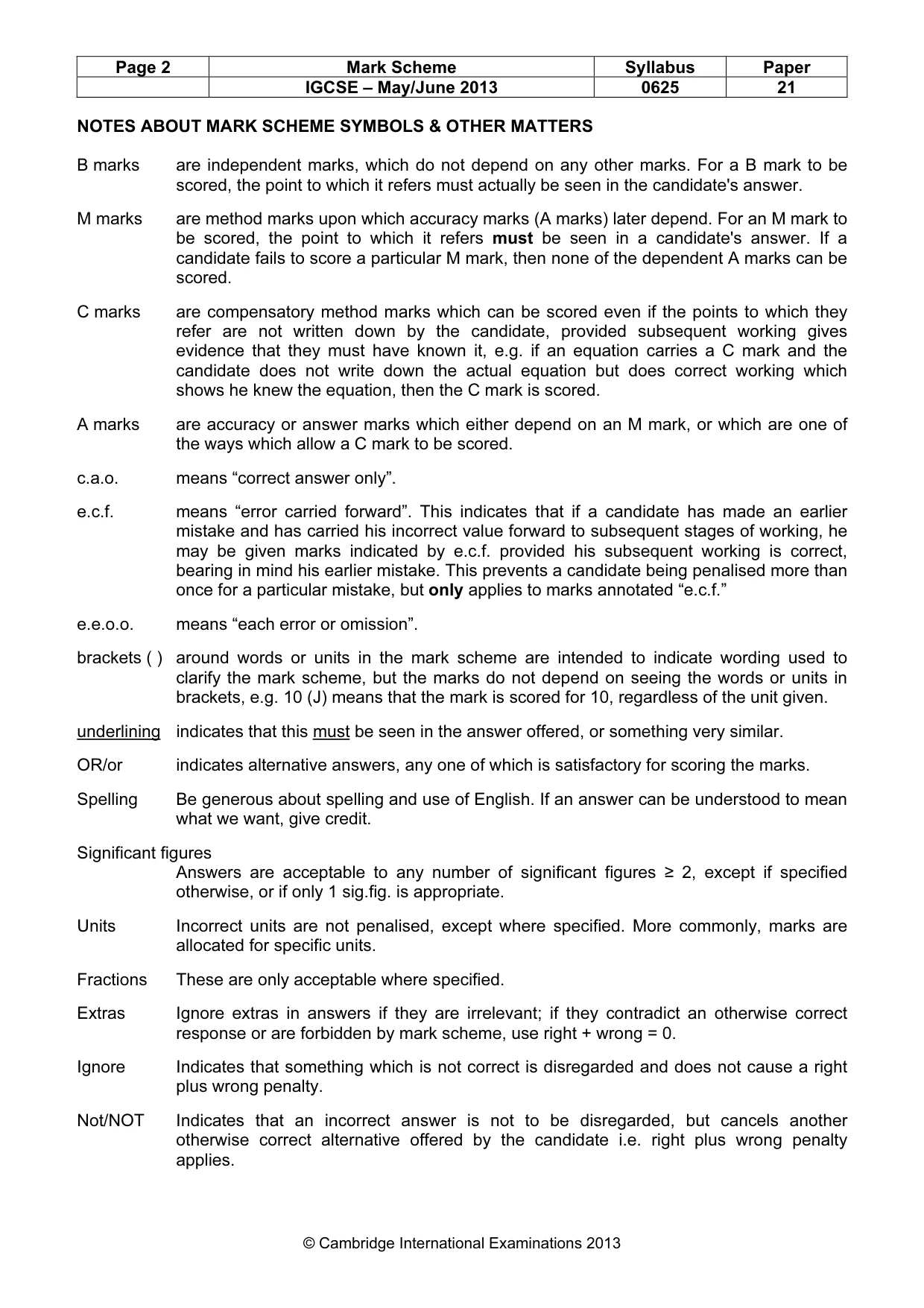
Page 2 Mark Scheme Syllabus Paper IGCSE – May/June 2013 0625 21 © Cambridge International Examinations 2013 NOTES ABOUT MARK SCHEME SYMBOLS & OTHER MATTERS B marks are independent marks, which do not depend on any other marks. For a B mark to be scored, the point to which it refers must actually be seen in the candidate's answer. M marks are method marks upon which accuracy marks (A marks) later depend. For an M mark to be scored, the point to which it refers must be seen in a candidate's answer. If a candidate fails to score a particular M mark, then none of the dependent A marks can be scored. C marks are compensatory method marks which can be scored even if the points to which they refer are not written down by the candidate, provided subsequent working gives evidence that they must have known it, e.g. if an equation carries a C mark and the candidate does not write down the actual equation but does correct working which shows he knew the equation, then the C mark is scored. A marks are accuracy or answer marks which either depend on an M mark, or which are one of the ways which allow a C mark to be scored. c.a.o. means “correct answer only”. e.c.f. means “error carried forward”. This indicates that if a candidate has made an earlier mistake and has carried his incorrect value forward to subsequent stages of working, he may be given marks indicated by e.c.f. provided his subsequent working is correct, bearing in mind his earlier mistake. This prevents a candidate being penalised more than once for a particular mistake, but only applies to marks annotated “e.c.f.” e.e.o.o. means “each error or omission”. brackets ( ) around words or units in the mark scheme are intended to indicate wording used to clarify the mark scheme, but the marks do not depend on seeing the words or units in brackets, e.g. 10 (J) means that the mark is scored for 10, regardless of the unit given. underlining indicates that this must be seen in the answer offered, or something very similar. OR/or indicates alternative answers, any one of which is satisfactory for scoring the marks. Spelling Be generous about spelling and use of English. If an answer can be understood to mean what we want, give credit. Significant figures Answers are acceptable to any number of significant figures ≥ 2, except if specified otherwise, or if only 1 sig.fig. is appropriate. Units Incorrect units are not penalised, except where specified. More commonly, marks are allocated for specific units. Fractions These are only acceptable where specified. Extras Ignore extras in answers if they are irrelevant; if they contradict an otherwise correct response or are forbidden by mark scheme, use right + wrong = 0. Ignore Indicates that something which is not correct is disregarded and does not cause a right plus wrong penalty. Not/NOT Indicates that an incorrect answer is not to be disregarded, but cancels another otherwise correct alternative offered by the candidate i.e. right plus wrong penalty applies.
Mark scheme, page 3
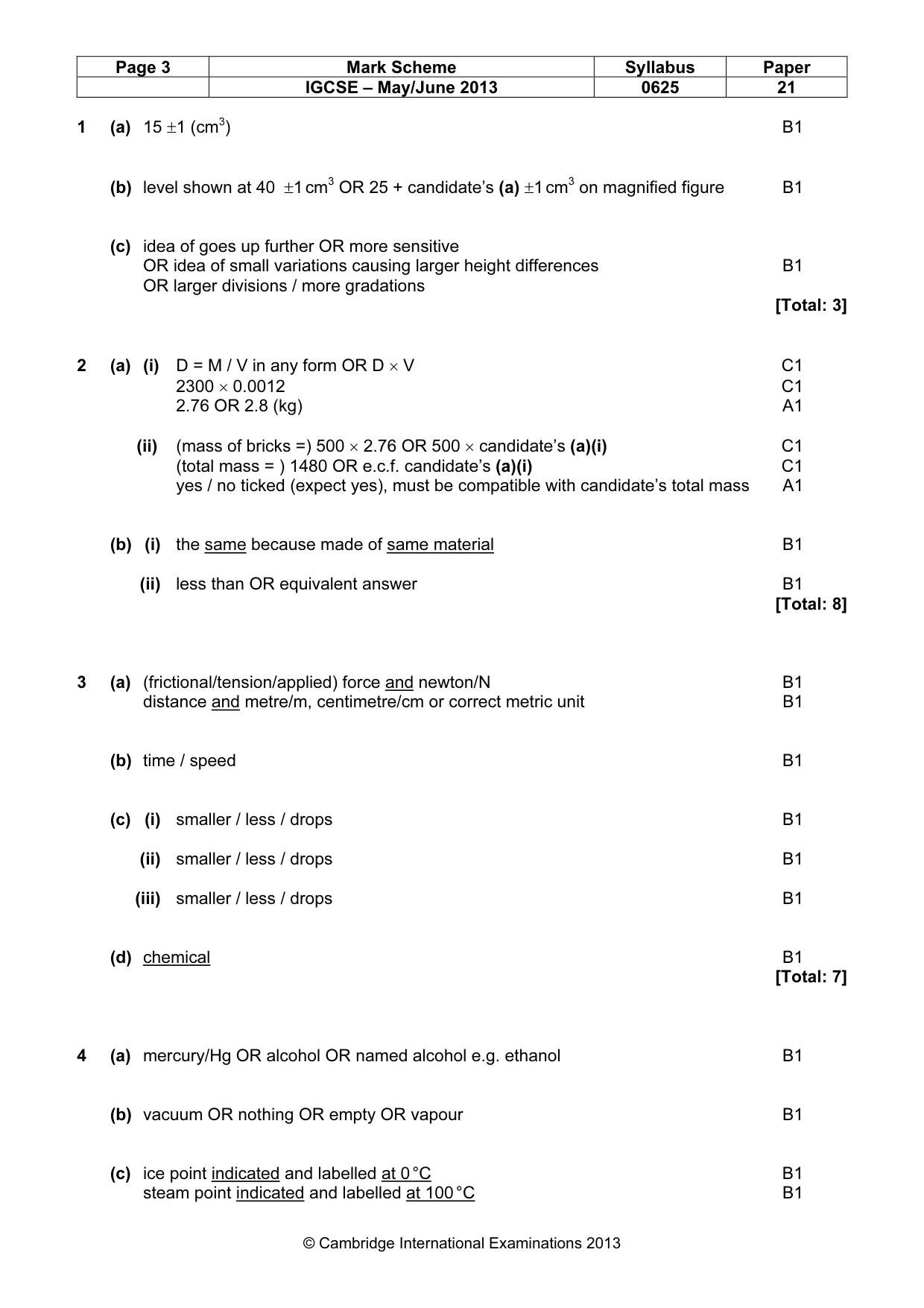
Page 3 Mark Scheme Syllabus Paper IGCSE – May/June 2013 0625 21 © Cambridge International Examinations 2013 1 (a) 15 ±1 (cm3) B1 (b) level shown at 40 ±1 cm3 OR 25 + candidate’s (a) ±1 cm3 on magnified figure B1 (c) idea of goes up further OR more sensitive OR idea of small variations causing larger height differences B1 OR larger divisions / more gradations [Total: 3] 2 (a) (i) D = M / V in any form OR D × V C1 2300 × 0.0012 C1 2.76 OR 2.8 (kg) A1 (ii) (mass of bricks =) 500 × 2.76 OR 500 × candidate’s (a)(i) C1 (total mass = ) 1480 OR e.c.f. candidate’s (a)(i) C1 yes / no ticked (expect yes), must be compatible with candidate’s total mass A1 (b) (i) the same because made of same material B1 (ii) less than OR equivalent answer B1 [Total: 8] 3 (a) (frictional/tension/applied) force and newton/N B1 distance and metre/m, centimetre/cm or correct metric unit B1 (b) time / speed B1 (c) (i) smaller / less / drops B1 (ii) smaller / less / drops B1 (iii) smaller / less / drops B1 (d) chemical B1 [Total: 7] 4 (a) mercury/Hg OR alcohol OR named alcohol e.g. ethanol B1 (b) vacuum OR nothing OR empty OR vapour B1 (c) ice point indicated and labelled at 0 °C B1 steam point indicated and labelled at 100 °C B1
Mark scheme, page 4
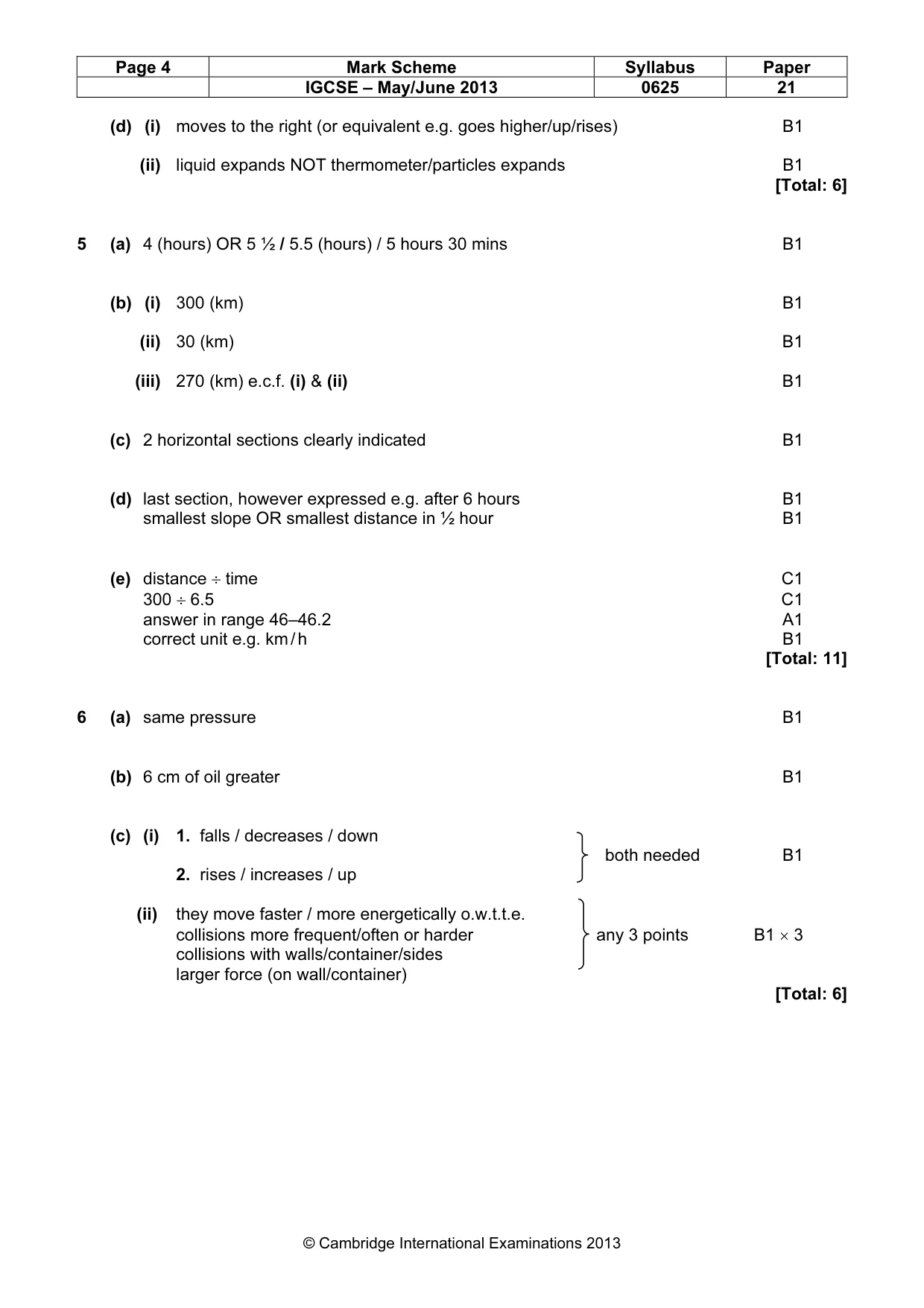
Page 4 Mark Scheme Syllabus Paper IGCSE – May/June 2013 0625 21 © Cambridge International Examinations 2013 (d) (i) moves to the right (or equivalent e.g. goes higher/up/rises) B1 (ii) liquid expands NOT thermometer/particles expands B1 [Total: 6] 5 (a) 4 (hours) OR 5 ½ / 5.5 (hours) / 5 hours 30 mins B1 (b) (i) 300 (km) B1 (ii) 30 (km) B1 (iii) 270 (km) e.c.f. (i) & (ii) B1 (c) 2 horizontal sections clearly indicated B1 (d) last section, however expressed e.g. after 6 hours B1 smallest slope OR smallest distance in ½ hour B1 (e) distance ÷ time C1 300 ÷ 6.5 C1 answer in range 46–46.2 A1 correct unit e.g. km / h B1 [Total: 11] 6 (a) same pressure B1 (b) 6 cm of oil greater B1 (c) (i) 1. falls / decreases / down both needed B1 2. rises / increases / up (ii) they move faster / more energetically o.w.t.t.e. collisions more frequent/often or harder any 3 points B1 × 3 collisions with walls/container/sides larger force (on wall/container) [Total: 6]
Mark scheme, page 5
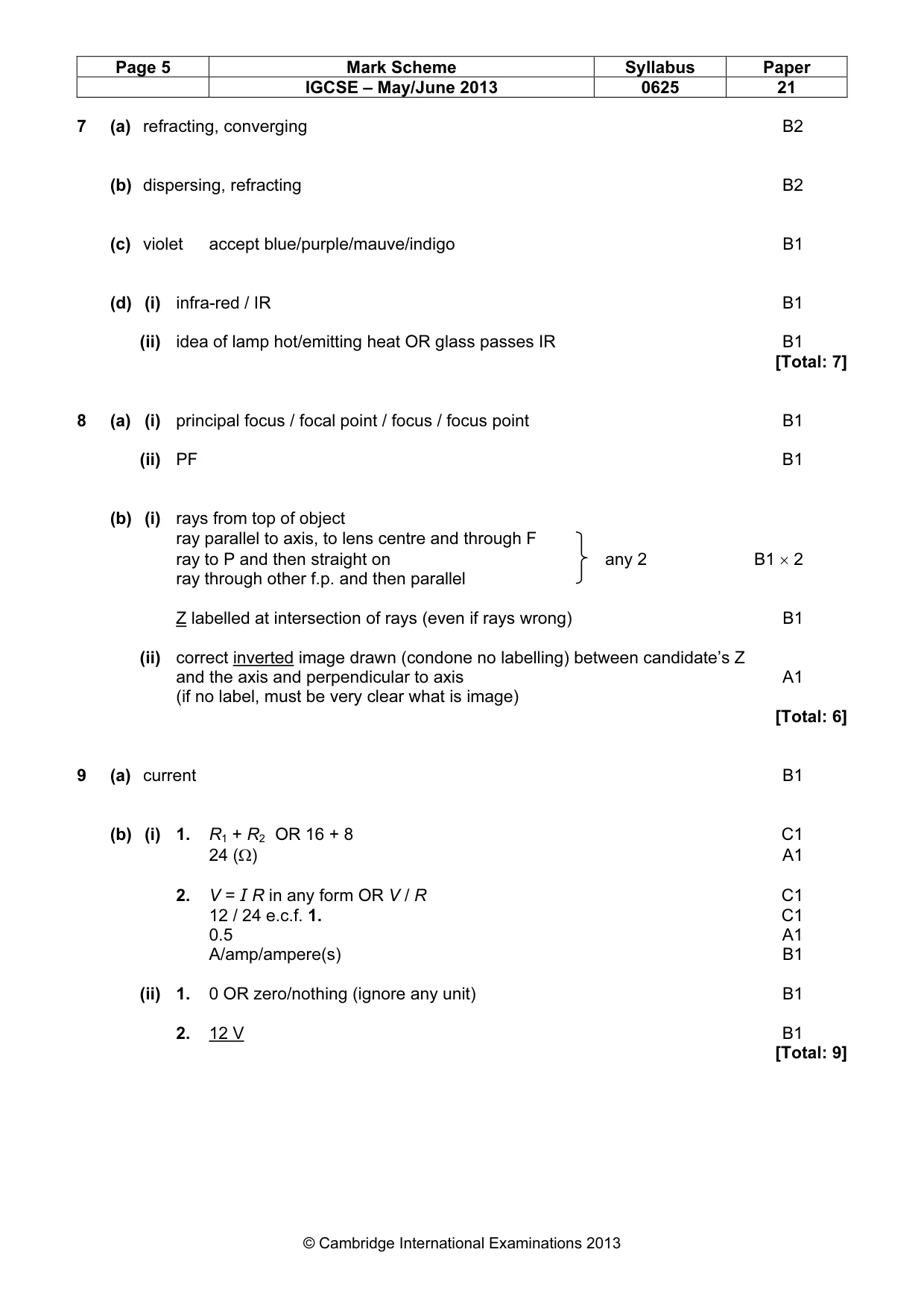
Page 5 Mark Scheme Syllabus Paper IGCSE – May/June 2013 0625 21 © Cambridge International Examinations 2013 7 (a) refracting, converging B2 (b) dispersing, refracting B2 (c) violet accept blue/purple/mauve/indigo B1 (d) (i) infra-red / IR B1 (ii) idea of lamp hot/emitting heat OR glass passes IR B1 [Total: 7] 8 (a) (i) principal focus / focal point / focus / focus point B1 (ii) PF B1 (b) (i) rays from top of object ray parallel to axis, to lens centre and through F ray to P and then straight on any 2 B1 × 2 ray through other f.p. and then parallel Z labelled at intersection of rays (even if rays wrong) B1 (ii) correct inverted image drawn (condone no labelling) between candidate’s Z and the axis and perpendicular to axis A1 (if no label, must be very clear what is image) [Total: 6] 9 (a) current B1 (b) (i) 1. R1 + R2 OR 16 + 8 C1 24 (Ω) A1 2. V = I R in any form OR V / R C1 12 / 24 e.c.f. 1. C1 0.5 A1 A/amp/ampere(s) B1 (ii) 1. 0 OR zero/nothing (ignore any unit) B1 2. 12 V B1 [Total: 9]
Mark scheme, page 6
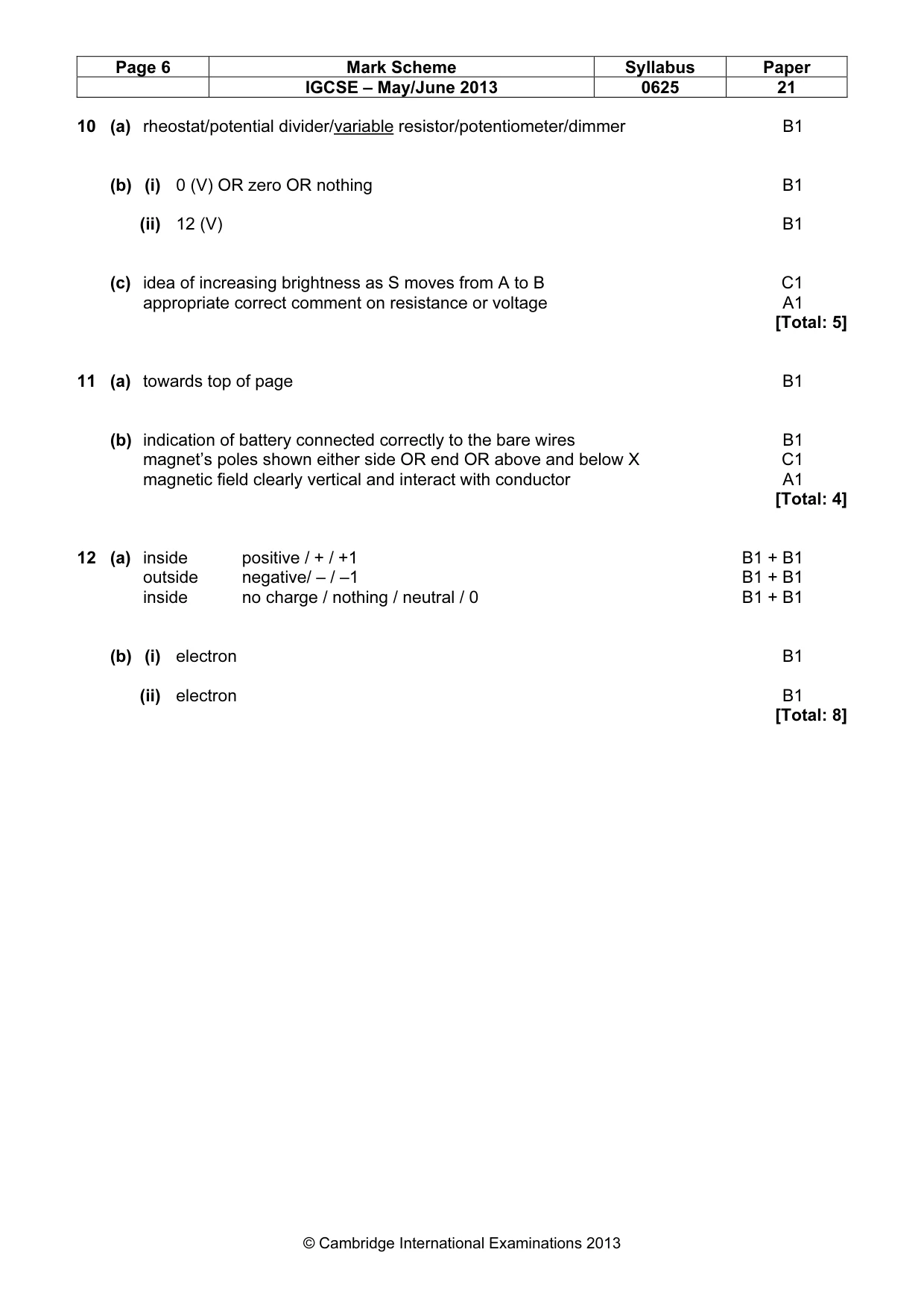
Page 6 Mark Scheme Syllabus Paper IGCSE – May/June 2013 0625 21 © Cambridge International Examinations 2013 10 (a) rheostat/potential divider/variable resistor/potentiometer/dimmer B1 (b) (i) 0 (V) OR zero OR nothing B1 (ii) 12 (V) B1 (c) idea of increasing brightness as S moves from A to B C1 appropriate correct comment on resistance or voltage A1 [Total: 5] 11 (a) towards top of page B1 (b) indication of battery connected correctly to the bare wires B1 magnet’s poles shown either side OR end OR above and below X C1 magnetic field clearly vertical and interact with conductor A1 [Total: 4] 12 (a) inside positive / + / +1 B1 + B1 outside negative/ – / –1 B1 + B1 inside no charge / nothing / neutral / 0 B1 + B1 (b) (i) electron B1 (ii) electron B1 [Total: 8]
What you needed in this session
Cambridge’s own grade thresholds for 2013 May/June, Paper 2 · Variant 1. A higher threshold means an easier paper — the bar moves with how the cohort did.