Cambridge IGCSE Physics 0625 — 2011 May/June Paper 2 · Variant 2
0625/22/M/J/11 · 80 marks · ≈90 min
The question paper and its mark scheme, free to read here and free to download. This is Cambridge’s own paper, exactly as it was sat.
Question paper16 pages

Mark scheme6 pages
Answers below. Sit the paper first if you are practising.
Paper as text
Question paper, page 1
This document consists of 15 printed pages and 1 blank page. DC (NF/SW) 28845/3 © UCLES 2011 [Turn over UNIVERSITY OF CAMBRIDGE INTERNATIONAL EXAMINATIONS International General Certificate of Secondary Education * 7 3 9 3 9 4 3 4 6 9 * PHYSICS 0625/22 Paper 2 Core May/June 2011 1 hour 15 minutes Candidates answer on the Question Paper. No Additional Materials are required. READ THESE INSTRUCTIONS FIRST Write your Centre number, candidate number and name on all the work you hand in. Write in dark blue or black pen. You may use a pencil for any diagrams, graphs or rough working. Do not use staples, paper clips, highlighters, glue or correction fluid. DO NOT WRITE IN ANY BARCODES. Answer all questions. You may lose marks if you do not show your working or if you do not use appropriate units. Take the weight of 1 kg to be 10 N (i.e. acceleration of free fall = 10 m / s2). The number of marks is given in brackets [ ] at the end of each question or part question. www.XtremePapers.com
Question paper, page 2
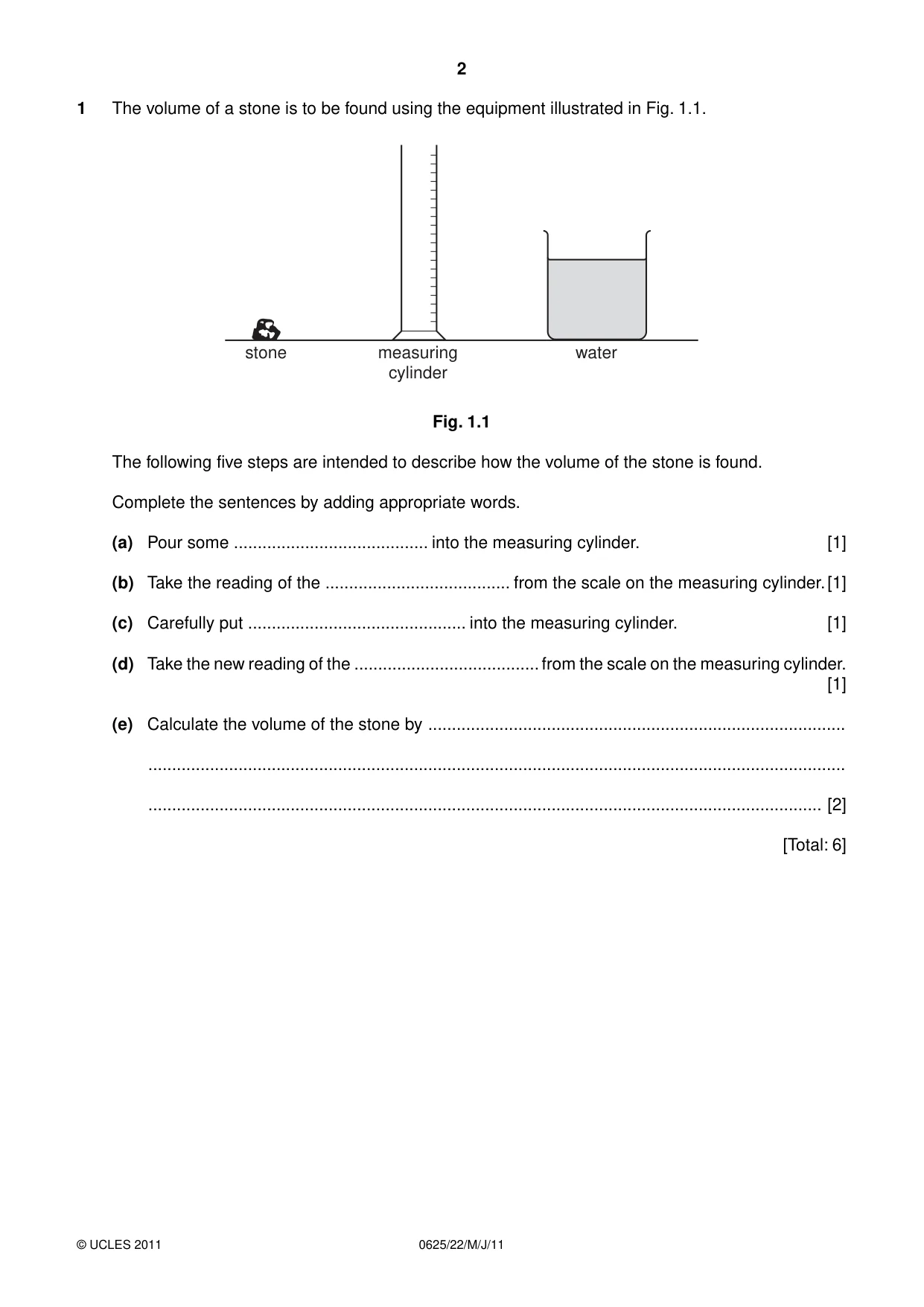
2 0625/22/M/J/11 © UCLES 2011 1 The volume of a stone is to be found using the equipment illustrated in Fig. 1.1. stone measuring cylinder water Fig. 1.1 The following five steps are intended to describe how the volume of the stone is found. Complete the sentences by adding appropriate words. (a) Pour some … into the measuring cylinder. [1] (b) Take the reading of the … from the scale on the measuring cylinder. [1] (c) Carefully put … into the measuring cylinder. [1] (d) Take the new reading of the … from the scale on the measuring cylinder. [1] (e) Calculate the volume of the stone by … … … [2] [Total: 6]
Question paper, page 3
3 0625/22/M/J/11 © UCLES 2011 [Turn over 2 Energy may be transferred from one place to another by means of conduction, convection or radiation. Which process is involved when energy is transferred through (a) a solid, … [1] (b) a liquid, … and … [2] (c) a vacuum? … [1] [Total: 4] 3 Solar panels are fitted to the roof of a house. Describe briefly what they do. … … … … [3] [Total: 3]
Question paper, page 4
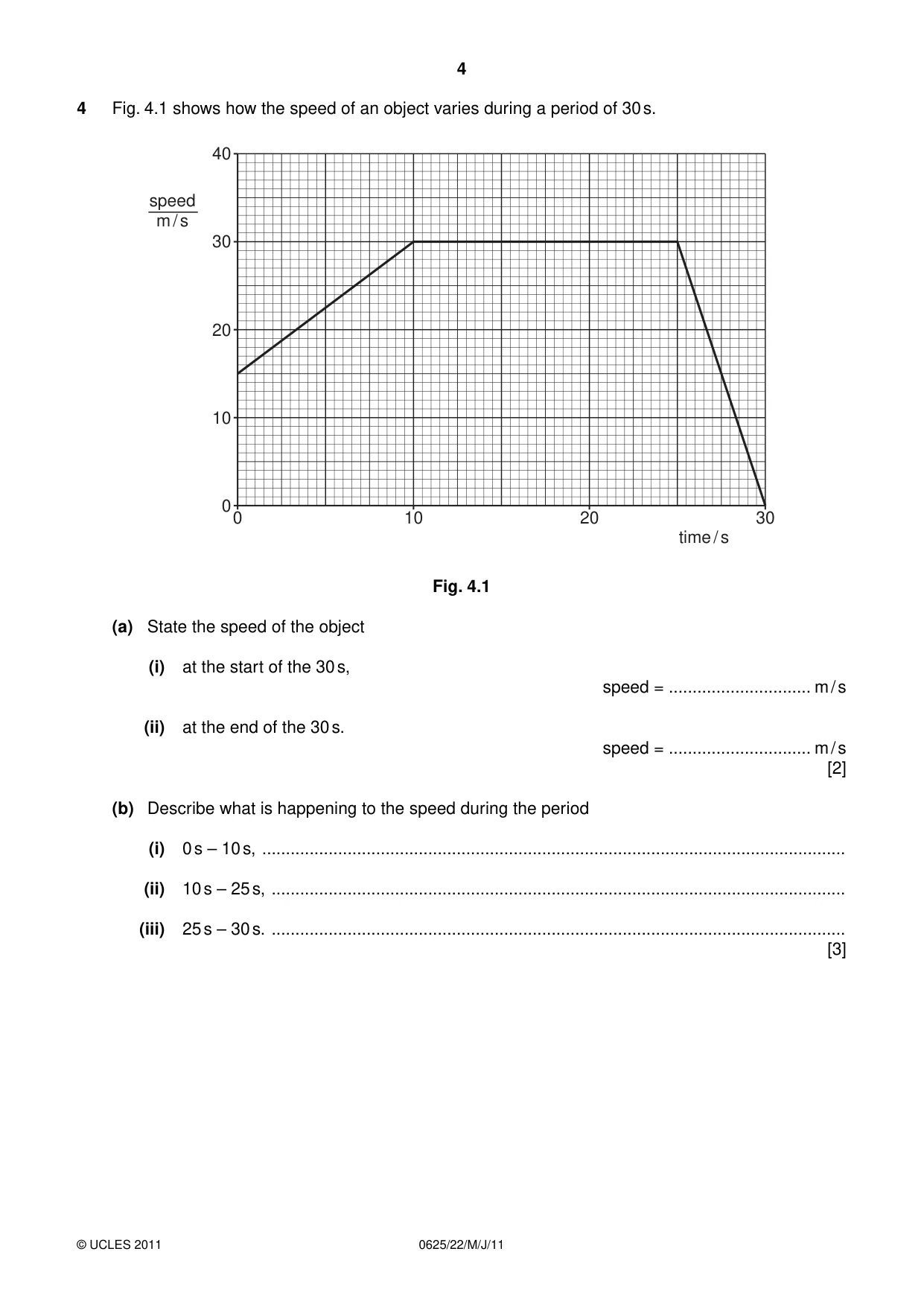
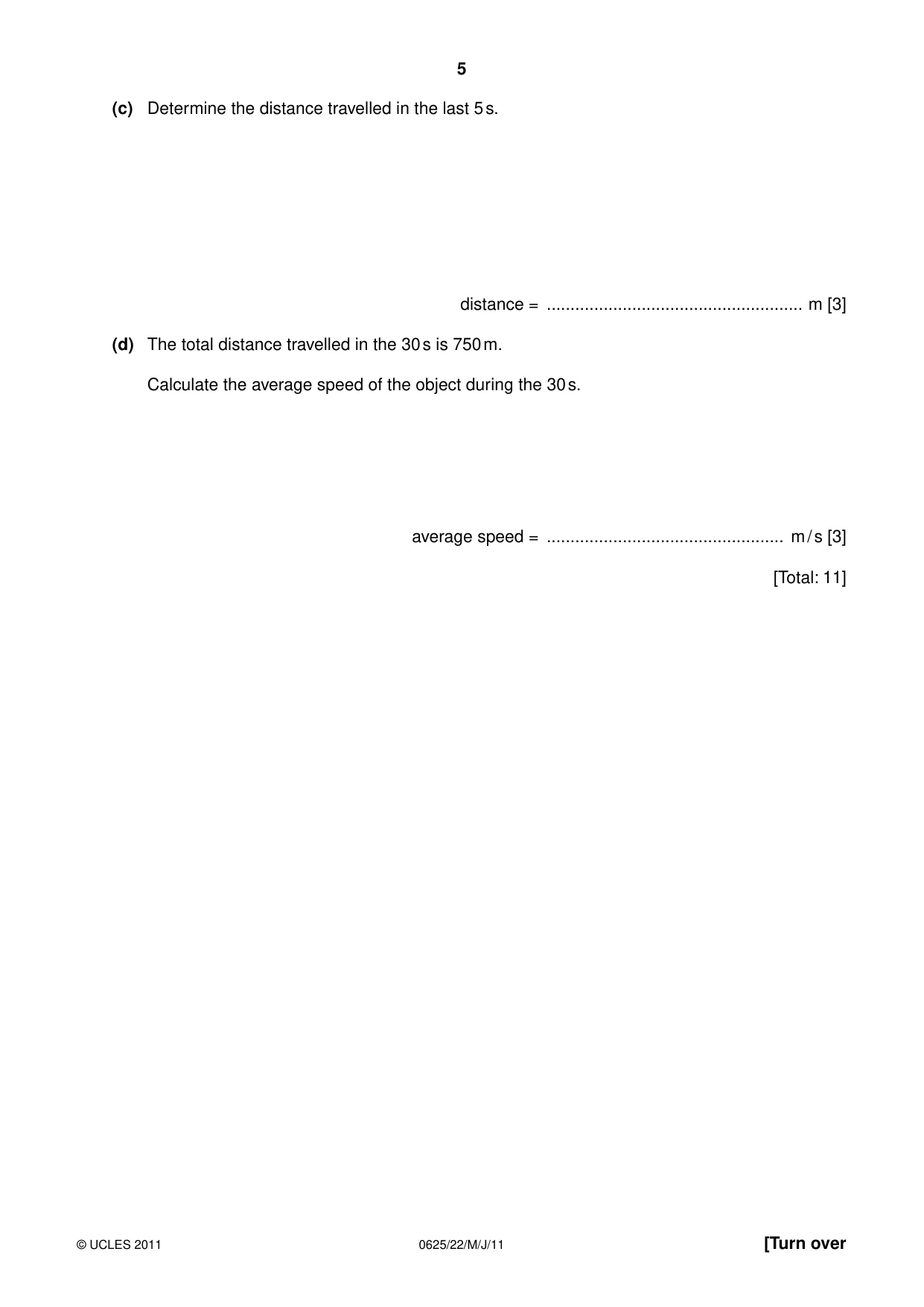
4 0625/22/M/J/11 © UCLES 2011 4 Fig. 4.1 shows how the speed of an object varies during a period of 30 s. 0 0 10 20 30 40 speed m / s time / s 10 20 30 Fig. 4.1 (a) State the speed of the object (i) at the start of the 30 s, speed = … m / s (ii) at the end of the 30 s. speed = … m / s [2] (b) Describe what is happening to the speed during the period (i) 0 s – 10 s, … (ii) 10 s – 25 s, … (iii) 25 s – 30 s. … [3]
Question paper, page 5
5 0625/22/M/J/11 © UCLES 2011 [Turn over (c) Determine the distance travelled in the last 5 s. distance = … m [3] (d) The total distance travelled in the 30 s is 750 m. Calculate the average speed of the object during the 30 s. average speed = … m / s [3] [Total: 11]
Question paper, page 6
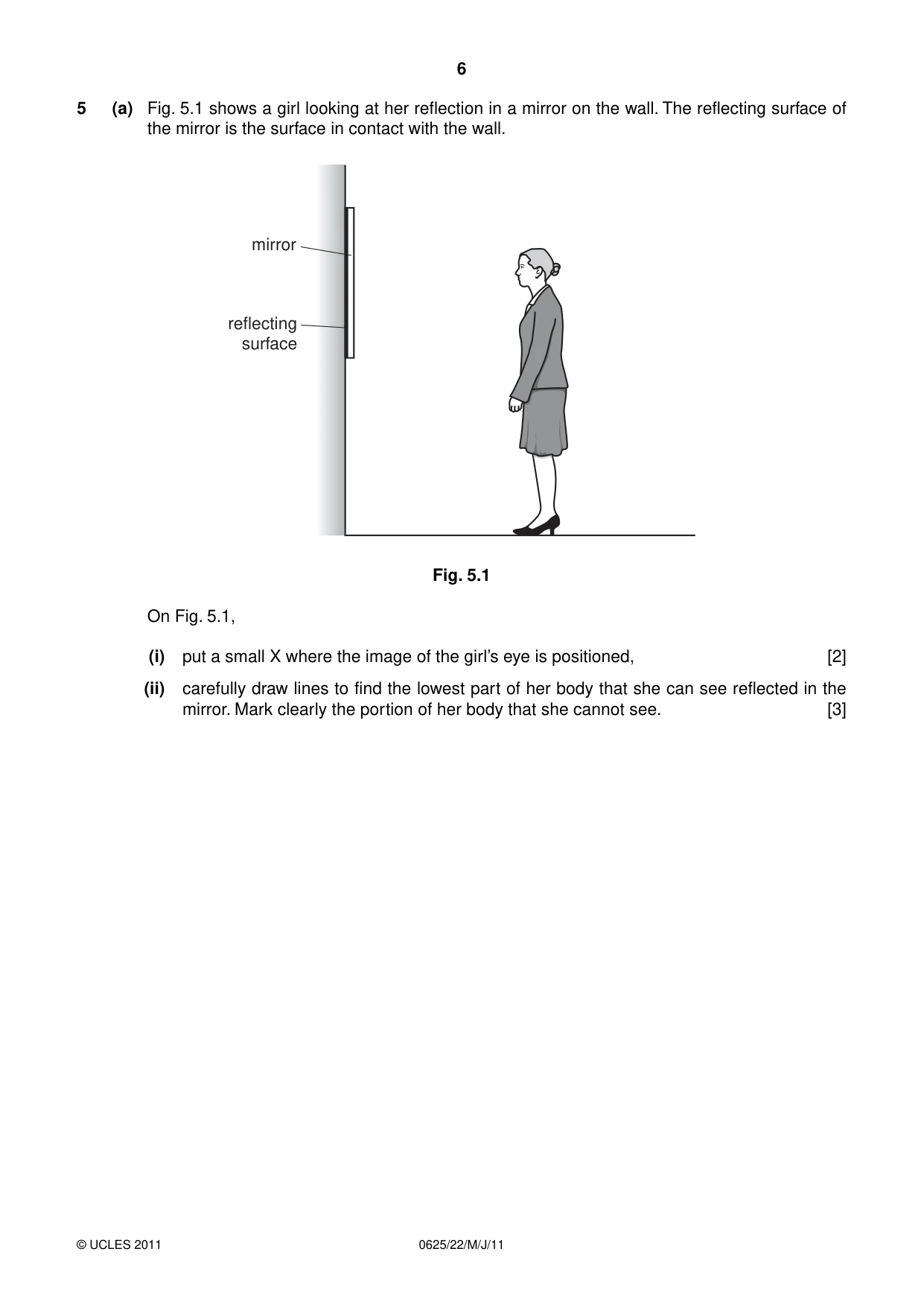
6 0625/22/M/J/11 © UCLES 2011 5 (a) Fig. 5.1 shows a girl looking at her reflection in a mirror on the wall. The reflecting surface of the mirror is the surface in contact with the wall. mirror reflecting surface Fig. 5.1 On Fig. 5.1, (i) put a small X where the image of the girl’s eye is positioned, [2] (ii) carefully draw lines to find the lowest part of her body that she can see reflected in the mirror. Mark clearly the portion of her body that she cannot see. [3]
Question paper, page 7
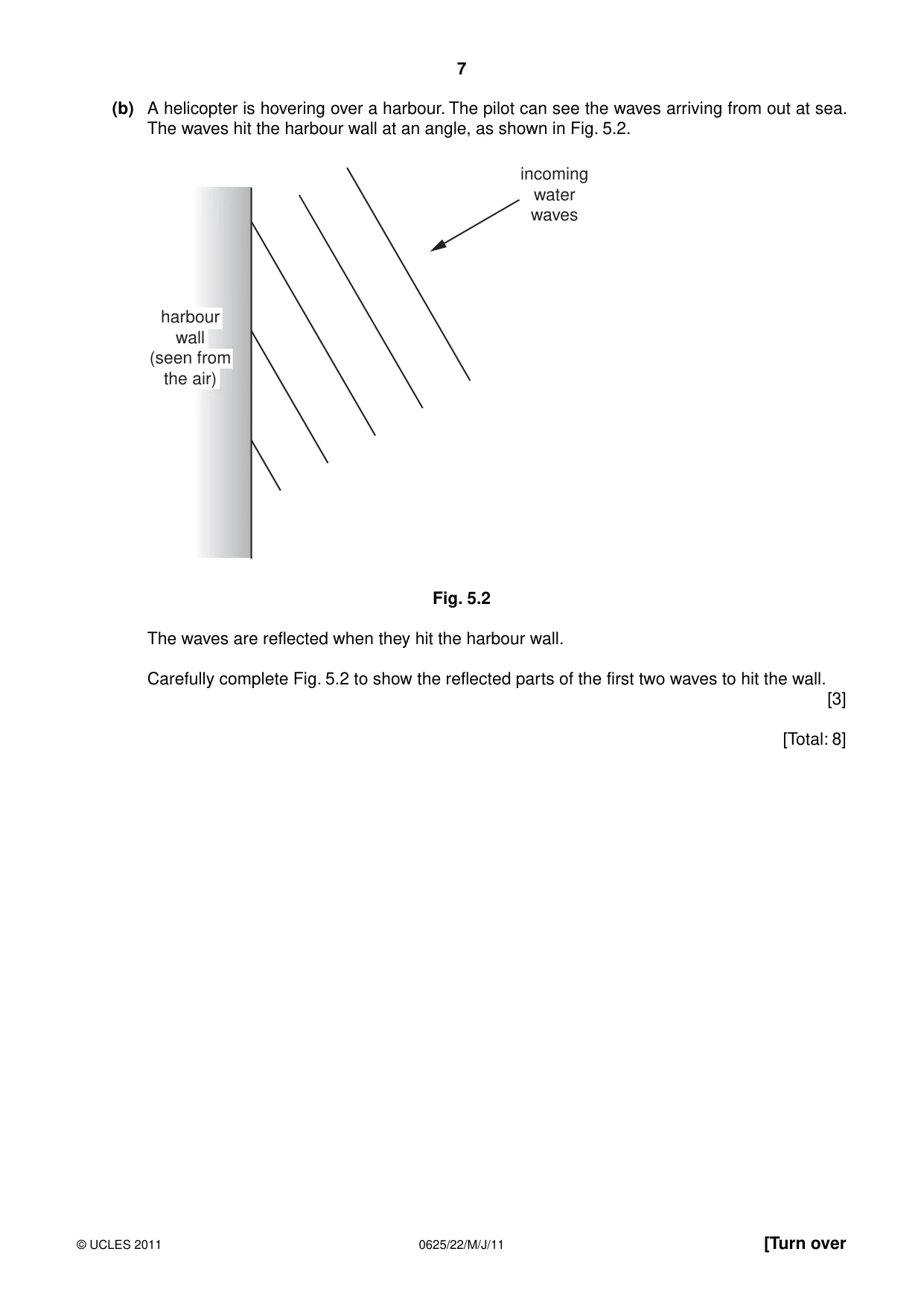
7 0625/22/M/J/11 © UCLES 2011 [Turn over (b) A helicopter is hovering over a harbour. The pilot can see the waves arriving from out at sea. The waves hit the harbour wall at an angle, as shown in Fig. 5.2. harbour wall (seen from the air) incoming water waves Fig. 5.2 The waves are reflected when they hit the harbour wall. Carefully complete Fig. 5.2 to show the reflected parts of the first two waves to hit the wall. [3] [Total: 8]
Question paper, page 8
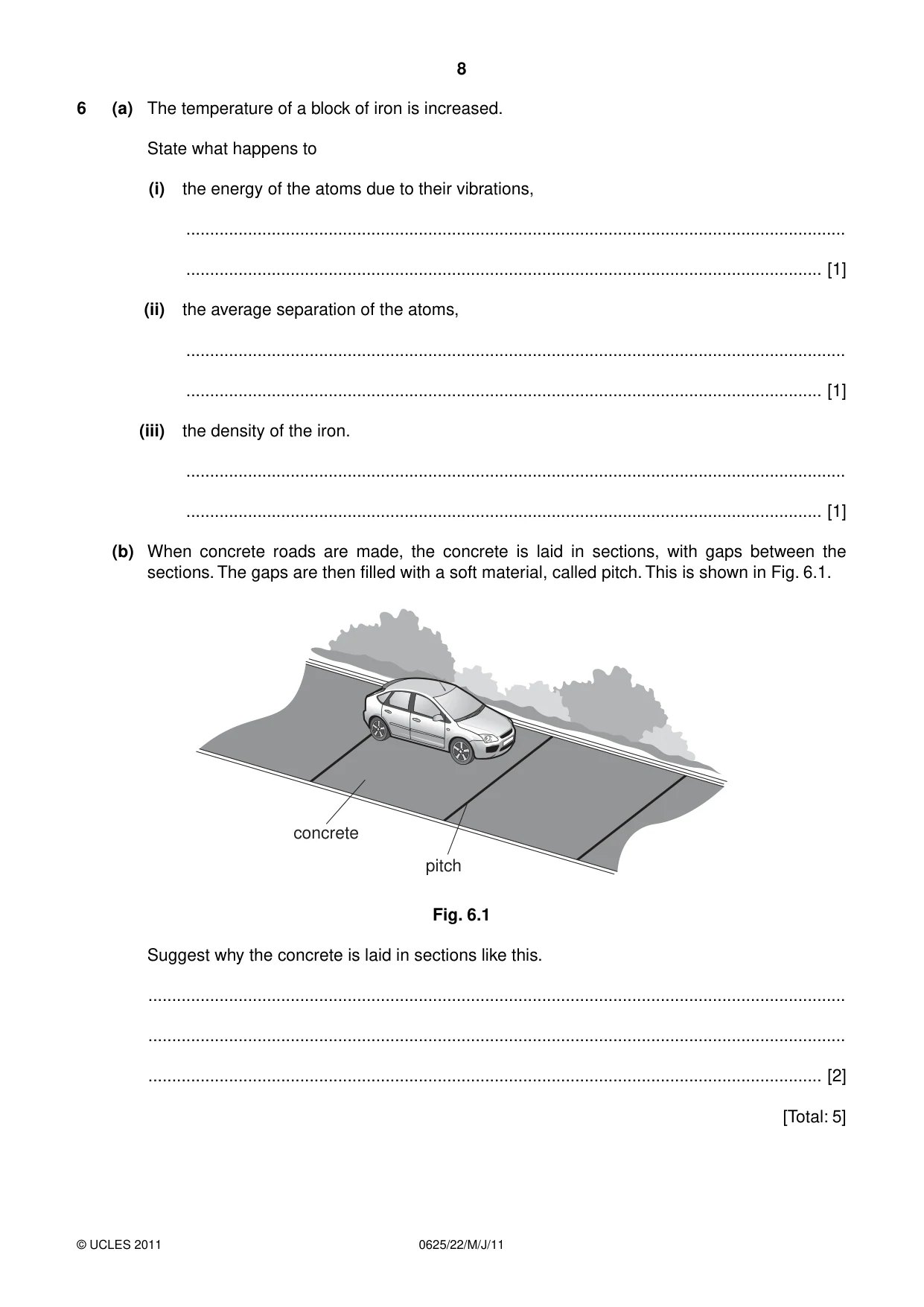
8 0625/22/M/J/11 © UCLES 2011 6 (a) The temperature of a block of iron is increased. State what happens to (i) the energy of the atoms due to their vibrations, … … [1] (ii) the average separation of the atoms, … … [1] (iii) the density of the iron. … … [1] (b) When concrete roads are made, the concrete is laid in sections, with gaps between the sections. The gaps are then filled with a soft material, called pitch. This is shown in Fig. 6.1. concrete pitch Fig. 6.1 Suggest why the concrete is laid in sections like this. … … … [2] [Total: 5]
Question paper, page 9
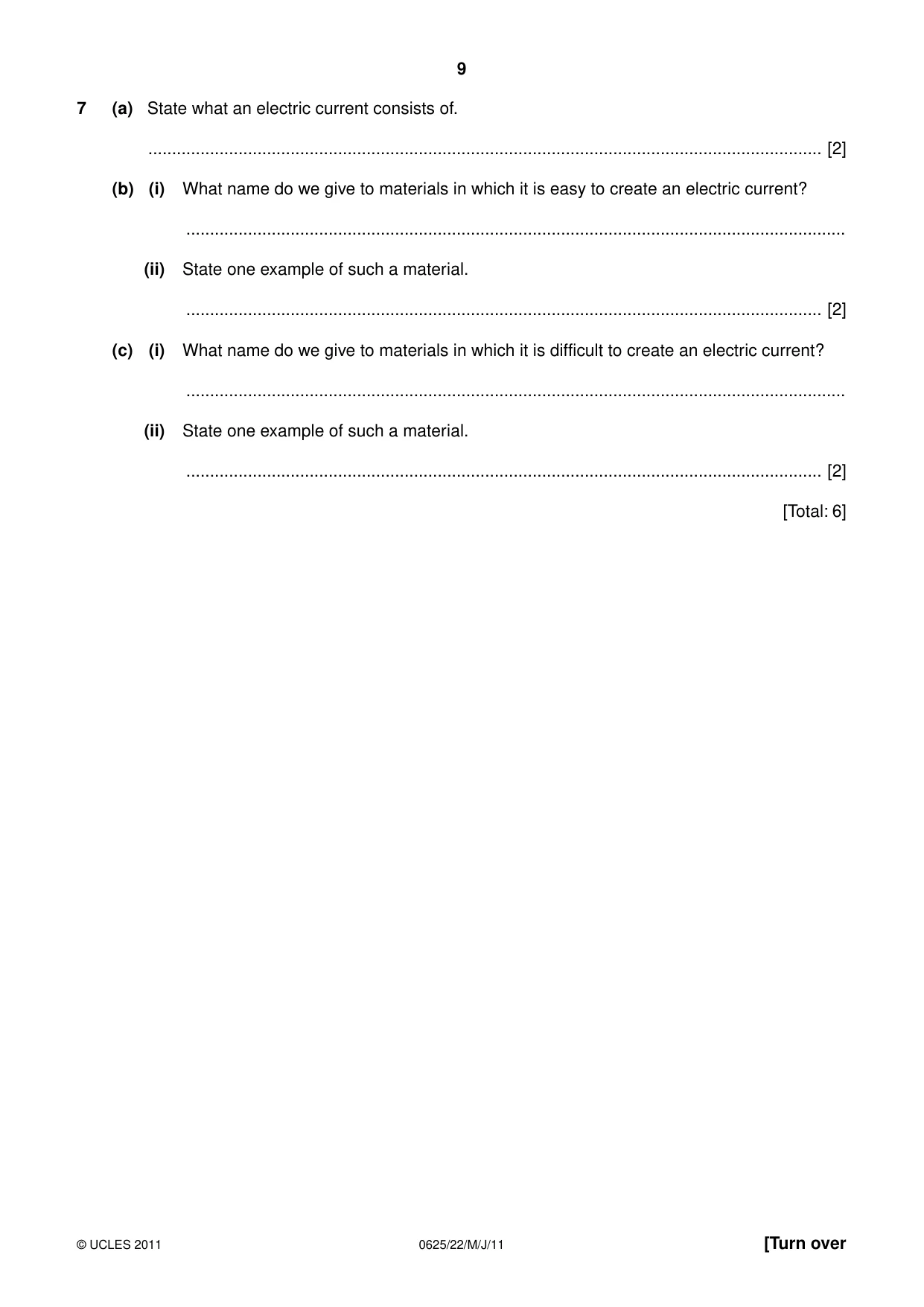
9 0625/22/M/J/11 © UCLES 2011 [Turn over 7 (a) State what an electric current consists of. … [2] (b) (i) What name do we give to materials in which it is easy to create an electric current? … (ii) State one example of such a material. … [2] (c) (i) What name do we give to materials in which it is difficult to create an electric current? … (ii) State one example of such a material. … [2] [Total: 6]
Question paper, page 10
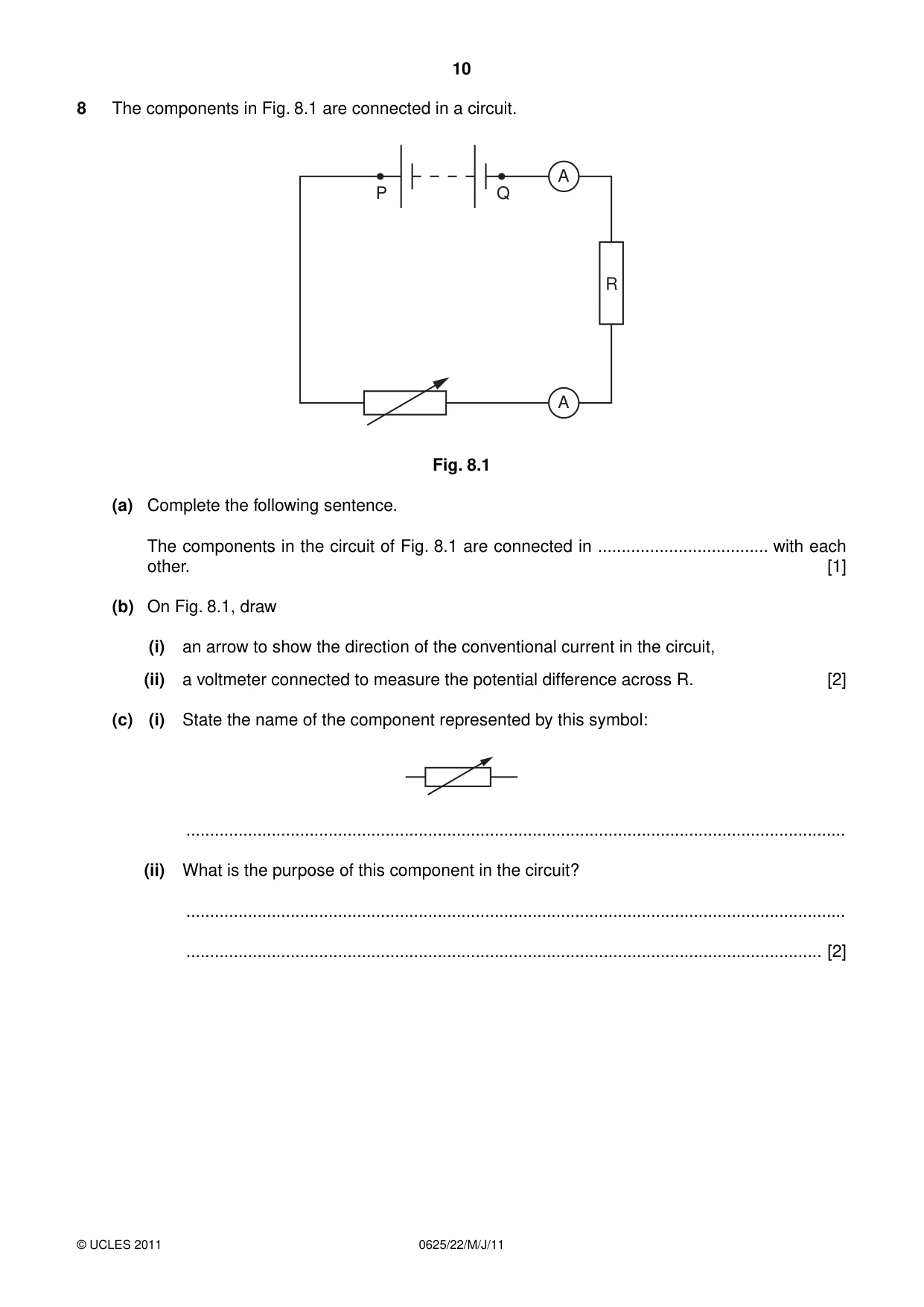
10 0625/22/M/J/11 © UCLES 2011 8 The components in Fig. 8.1 are connected in a circuit. A A R P Q Fig. 8.1 (a) Complete the following sentence. The components in the circuit of Fig. 8.1 are connected in … with each other. [1] (b) On Fig. 8.1, draw (i) an arrow to show the direction of the conventional current in the circuit, (ii) a voltmeter connected to measure the potential difference across R. [2] (c) (i) State the name of the component represented by this symbol: … (ii) What is the purpose of this component in the circuit? … … [2]
Question paper, page 11
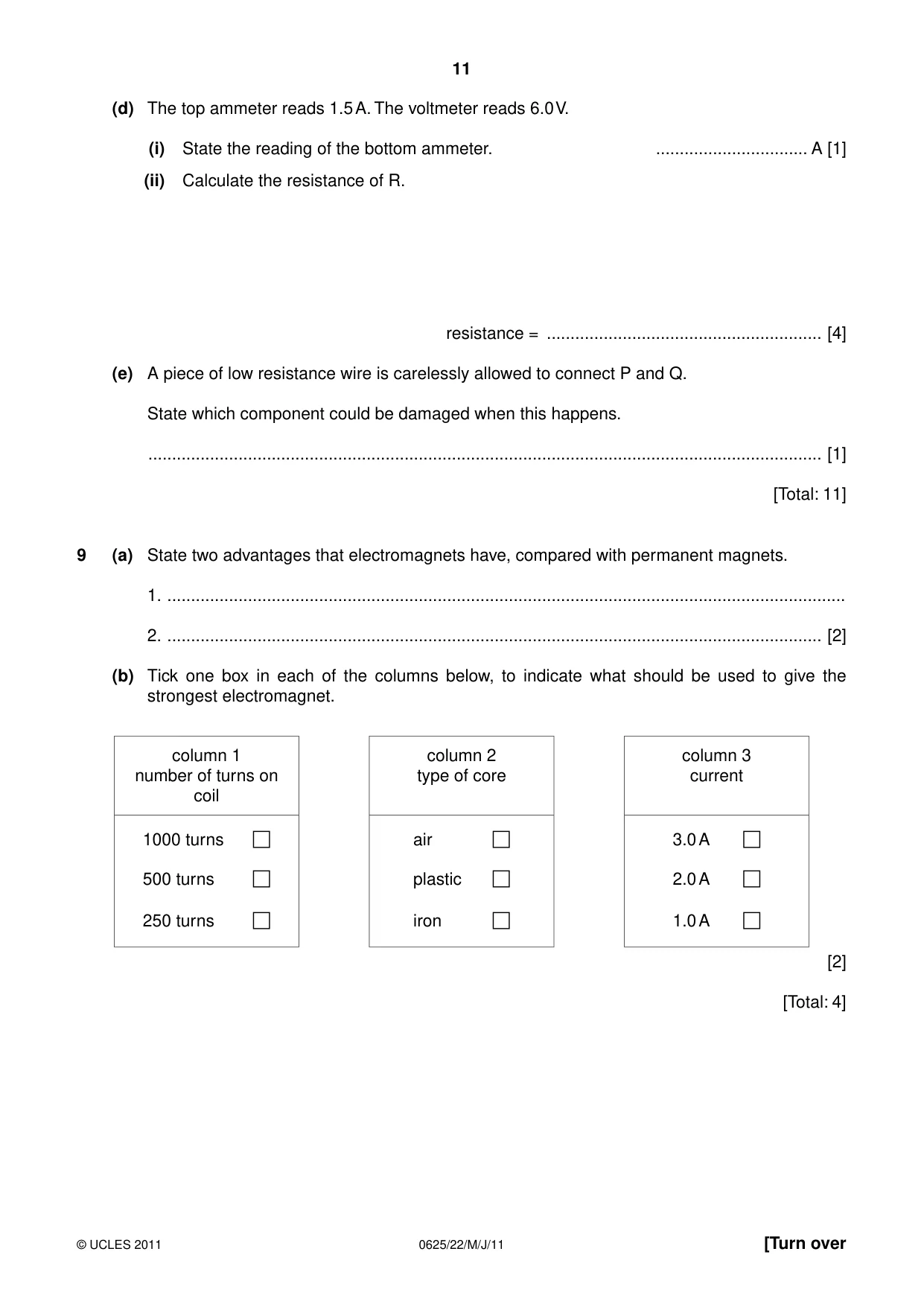
11 0625/22/M/J/11 © UCLES 2011 [Turn over (d) The top ammeter reads 1.5 A. The voltmeter reads 6.0 V. (i) State the reading of the bottom ammeter. … A [1] (ii) Calculate the resistance of R. resistance = … [4] (e) A piece of low resistance wire is carelessly allowed to connect P and Q. State which component could be damaged when this happens. … [1] [Total: 11] 9 (a) State two advantages that electromagnets have, compared with permanent magnets. 1. … 2. … [2] (b) Tick one box in each of the columns below, to indicate what should be used to give the strongest electromagnet. column 1 number of turns on coil column 2 type of core column 3 current 1000 turns F 500 turns F 250 turns F air F plastic F iron F 3.0 A F 2.0 A F 1.0 A F [2] [Total: 4]
Question paper, page 12
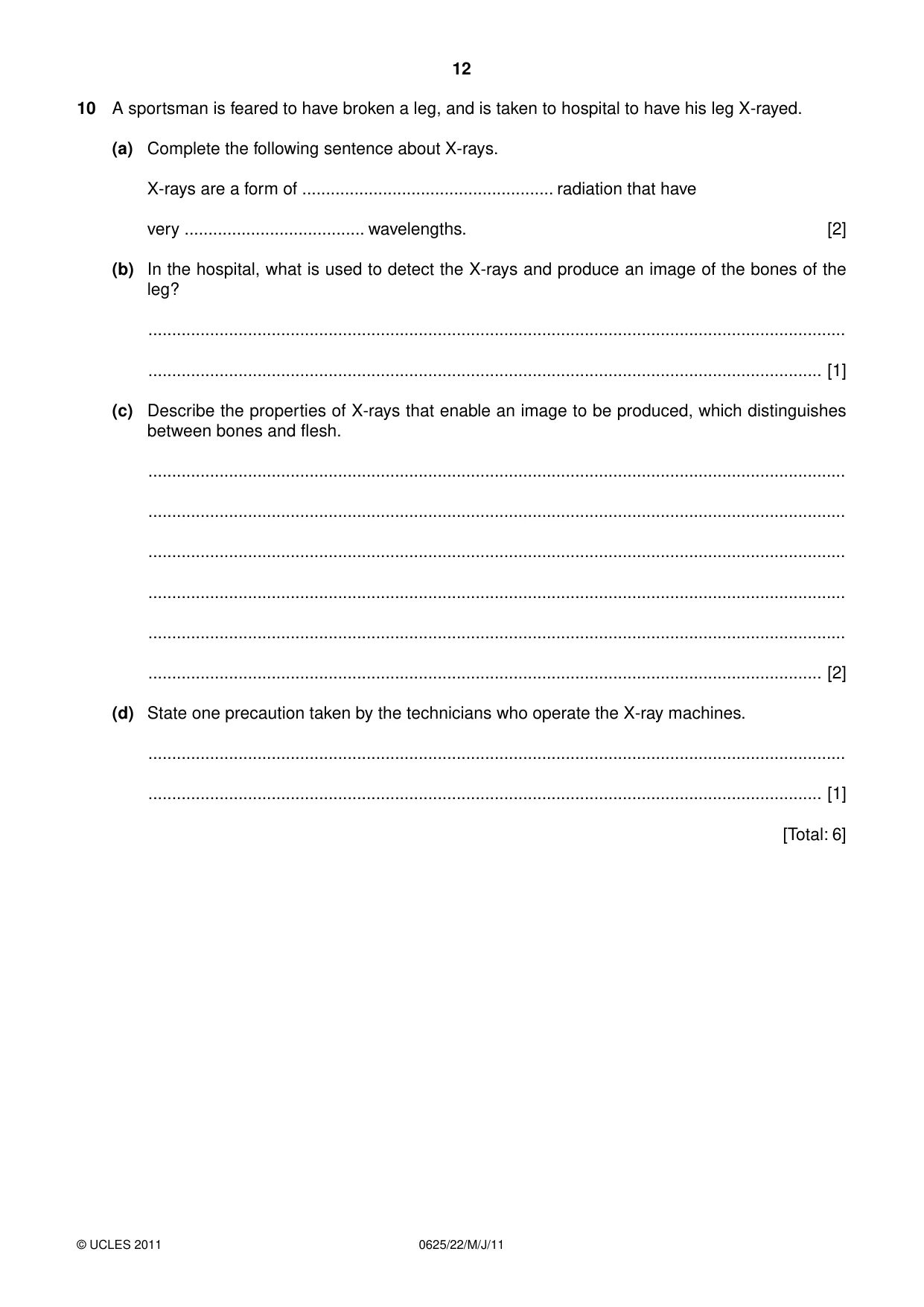
12 0625/22/M/J/11 © UCLES 2011 10 A sportsman is feared to have broken a leg, and is taken to hospital to have his leg X-rayed. (a) Complete the following sentence about X-rays. X-rays are a form of … radiation that have very … wavelengths. [2] (b) In the hospital, what is used to detect the X-rays and produce an image of the bones of the leg? … … [1] (c) Describe the properties of X-rays that enable an image to be produced, which distinguishes between bones and flesh. … … … … … … [2] (d) State one precaution taken by the technicians who operate the X-ray machines. … … [1] [Total: 6]
Question paper, page 13
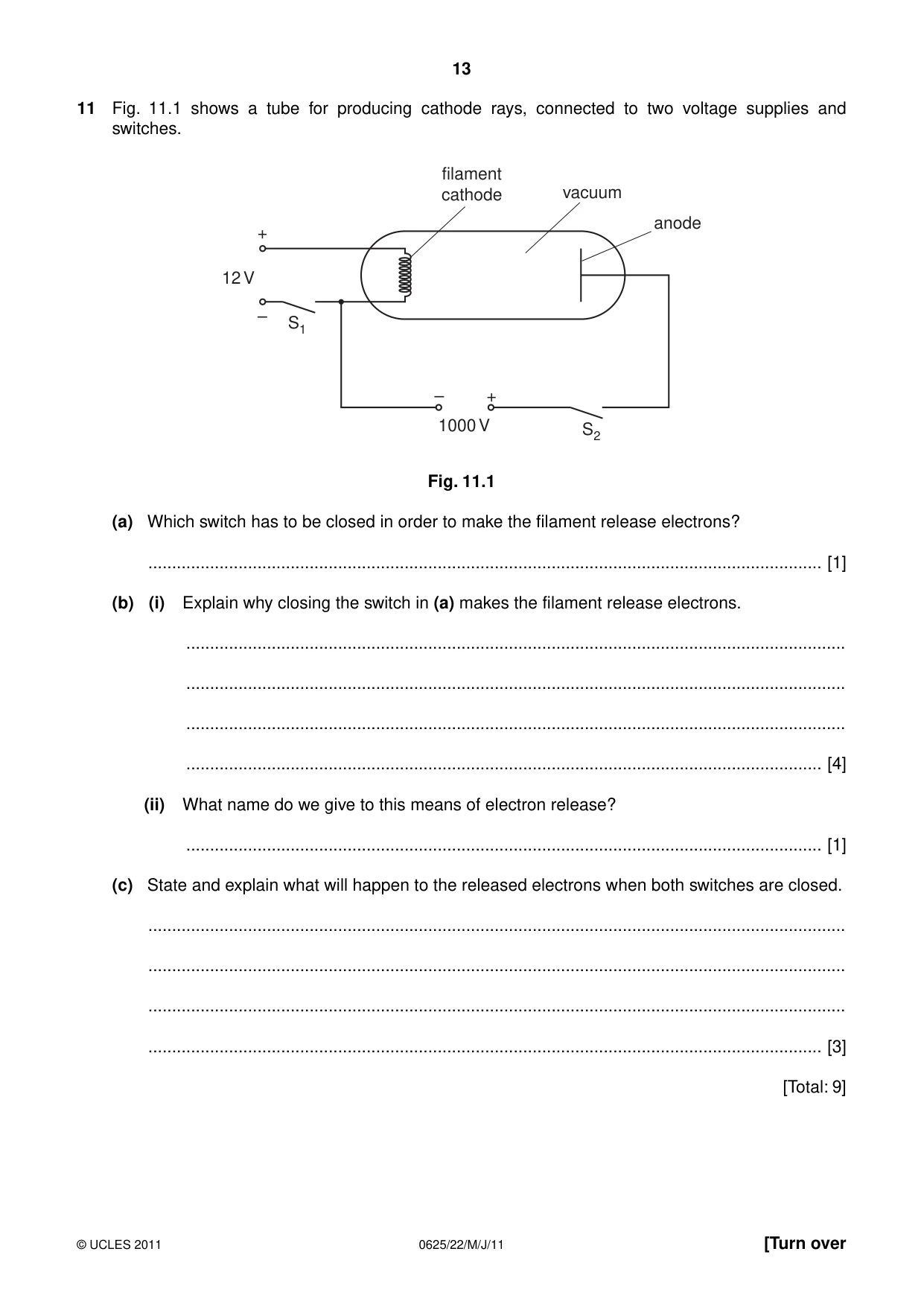
13 0625/22/M/J/11 © UCLES 2011 [Turn over 11 Fig. 11.1 shows a tube for producing cathode rays, connected to two voltage supplies and switches. 12 V 1000 V S1 S2 filament cathode vacuum anode + – + – Fig. 11.1 (a) Which switch has to be closed in order to make the filament release electrons? … [1] (b) (i) Explain why closing the switch in (a) makes the filament release electrons. … … … … [4] (ii) What name do we give to this means of electron release? … [1] (c) State and explain what will happen to the released electrons when both switches are closed. … … … … [3] [Total: 9]
Question paper, page 14
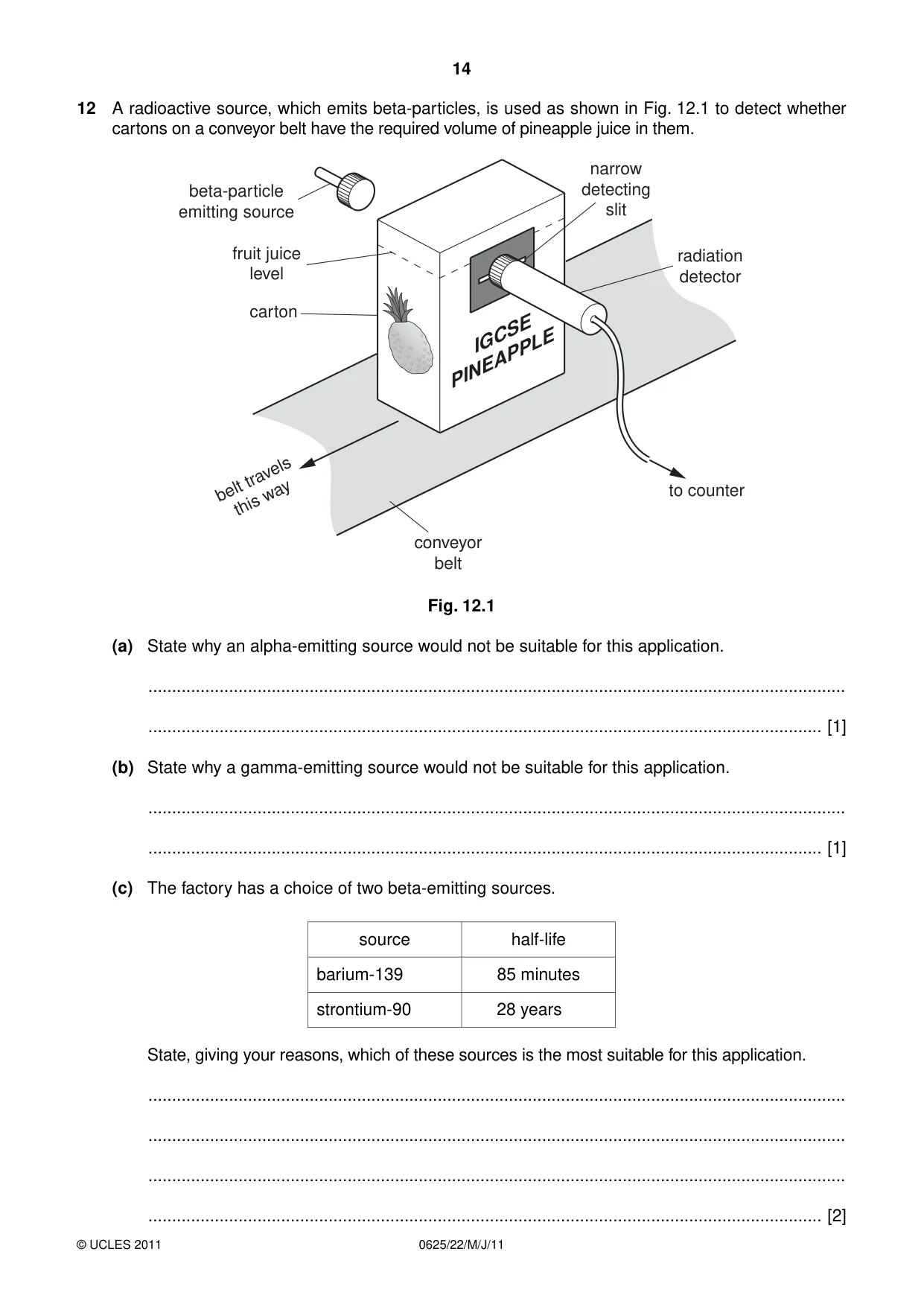
14 0625/22/M/J/11 © UCLES 2011 12 A radioactive source, which emits beta-particles, is used as shown in Fig. 12.1 to detect whether cartons on a conveyor belt have the required volume of pineapple juice in them. IGCSE PINEAPPLE beta-particle emitting source fruit juice level carton belt travels this way conveyor belt to counter radiation detector narrow detecting slit Fig. 12.1 (a) State why an alpha-emitting source would not be suitable for this application. … … [1] (b) State why a gamma-emitting source would not be suitable for this application. … … [1] (c) The factory has a choice of two beta-emitting sources. source half-life barium-139 85 minutes strontium-90 28 years State, giving your reasons, which of these sources is the most suitable for this application. … … … … [2]
Question paper, page 15
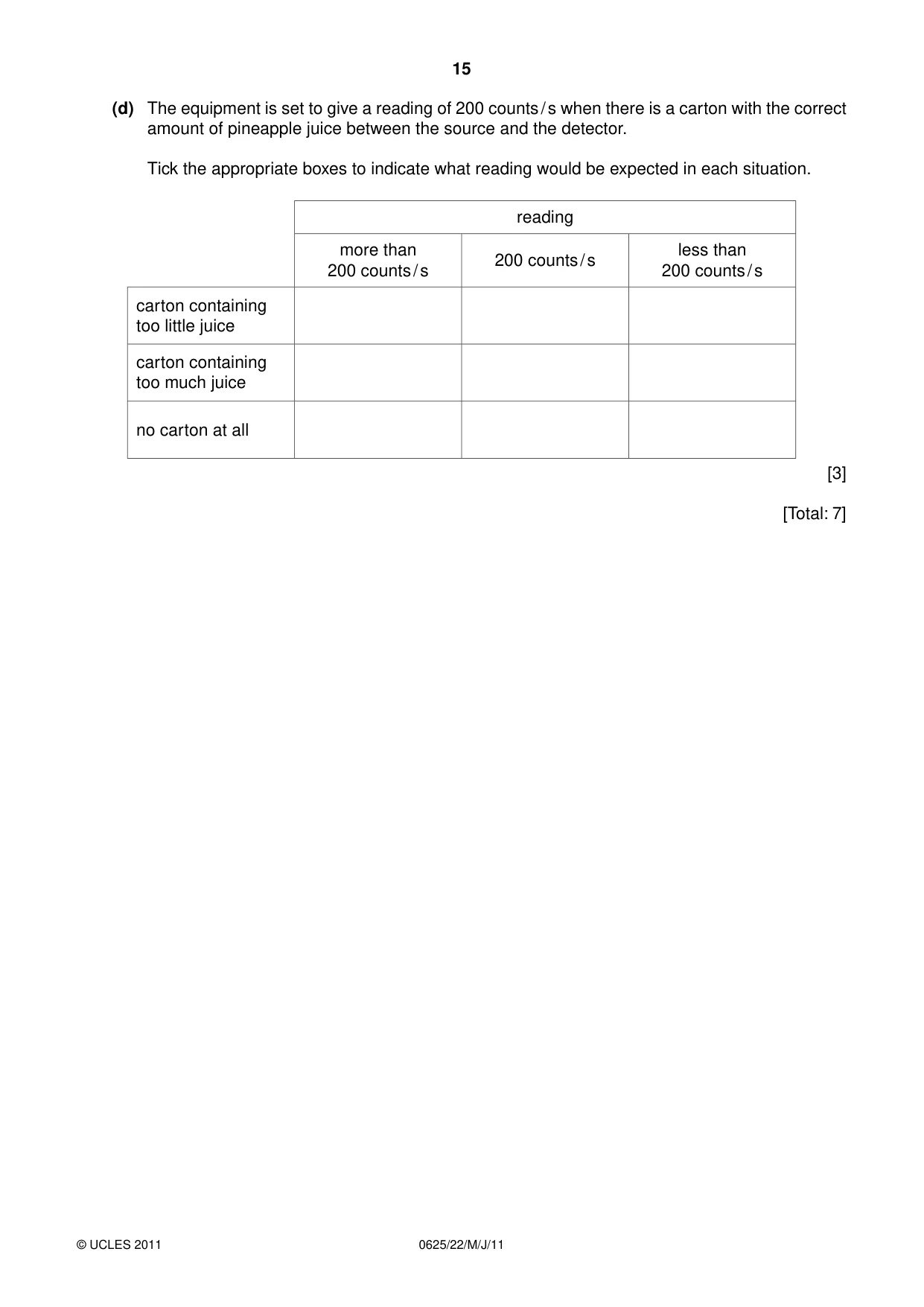
15 0625/22/M/J/11 © UCLES 2011 (d) The equipment is set to give a reading of 200 counts / s when there is a carton with the correct amount of pineapple juice between the source and the detector. Tick the appropriate boxes to indicate what reading would be expected in each situation. reading more than 200 counts / s 200 counts / s less than 200 counts / s carton containing too little juice carton containing too much juice no carton at all [3] [Total: 7]
Question paper, page 16
16 0625/22/M/J/11 © UCLES 2011 Permission to reproduce items where third-party owned material protected by copyright is included has been sought and cleared where possible. Every reasonable effort has been made by the publisher (UCLES) to trace copyright holders, but if any items requiring clearance have unwittingly been included, the publisher will be pleased to make amends at the earliest possible opportunity. University of Cambridge International Examinations is part of the Cambridge Assessment Group. Cambridge Assessment is the brand name of University of Cambridge Local Examinations Syndicate (UCLES), which is itself a department of the University of Cambridge. BLANK PAGE
Mark scheme, page 1
UNIVERSITY OF CAMBRIDGE INTERNATIONAL EXAMINATIONS International General Certificate of Secondary Education MARK SCHEME for the May/June 2011 question paper for the guidance of teachers 0625 PHYSICS 0625/22 Paper 2 (Core Theory), maximum raw mark 80 Mark schemes must be read in conjunction with the question papers and the report on the examination. • Cambridge will not enter into discussions or correspondence in connection with these mark schemes. Cambridge is publishing the mark schemes for the May/June 2011 question papers for most IGCSE, GCE Advanced Level and Advanced Subsidiary Level syllabuses and some Ordinary Level syllabuses. www.XtremePapers.com
Mark scheme, page 2
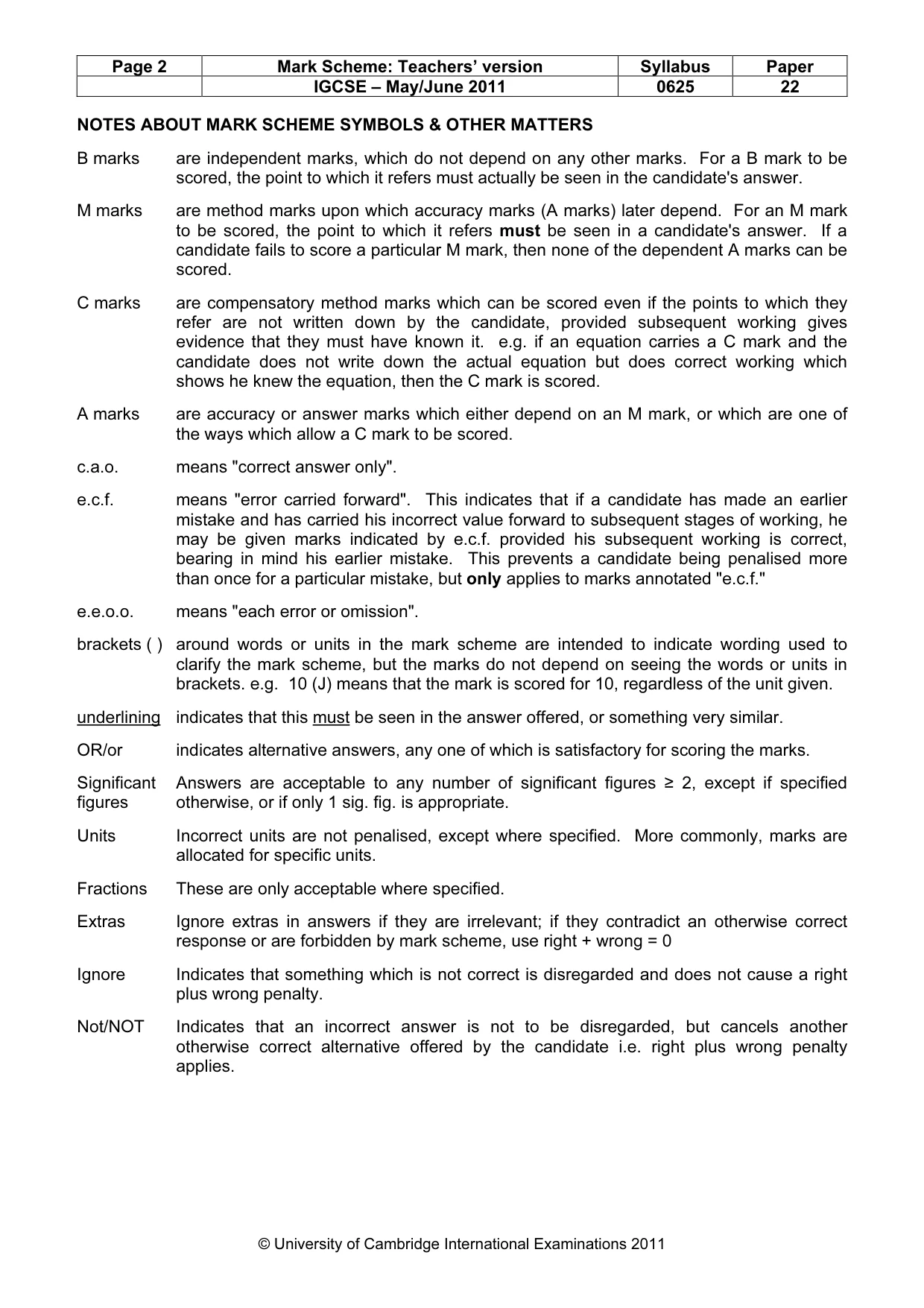
Page 2 Mark Scheme: Teachers’ version Syllabus Paper IGCSE – May/June 2011 0625 22 © University of Cambridge International Examinations 2011 NOTES ABOUT MARK SCHEME SYMBOLS & OTHER MATTERS B marks are independent marks, which do not depend on any other marks. For a B mark to be scored, the point to which it refers must actually be seen in the candidate's answer. M marks are method marks upon which accuracy marks (A marks) later depend. For an M mark to be scored, the point to which it refers must be seen in a candidate's answer. If a candidate fails to score a particular M mark, then none of the dependent A marks can be scored. C marks are compensatory method marks which can be scored even if the points to which they refer are not written down by the candidate, provided subsequent working gives evidence that they must have known it. e.g. if an equation carries a C mark and the candidate does not write down the actual equation but does correct working which shows he knew the equation, then the C mark is scored. A marks are accuracy or answer marks which either depend on an M mark, or which are one of the ways which allow a C mark to be scored. c.a.o. means "correct answer only". e.c.f. means "error carried forward". This indicates that if a candidate has made an earlier mistake and has carried his incorrect value forward to subsequent stages of working, he may be given marks indicated by e.c.f. provided his subsequent working is correct, bearing in mind his earlier mistake. This prevents a candidate being penalised more than once for a particular mistake, but only applies to marks annotated "e.c.f." e.e.o.o. means "each error or omission". brackets ( ) around words or units in the mark scheme are intended to indicate wording used to clarify the mark scheme, but the marks do not depend on seeing the words or units in brackets. e.g. 10 (J) means that the mark is scored for 10, regardless of the unit given. underlining indicates that this must be seen in the answer offered, or something very similar. OR/or indicates alternative answers, any one of which is satisfactory for scoring the marks. Significant Answers are acceptable to any number of significant figures ≥ 2, except if specified figures otherwise, or if only 1 sig. fig. is appropriate. Units Incorrect units are not penalised, except where specified. More commonly, marks are allocated for specific units. Fractions These are only acceptable where specified. Extras Ignore extras in answers if they are irrelevant; if they contradict an otherwise correct response or are forbidden by mark scheme, use right + wrong = 0 Ignore Indicates that something which is not correct is disregarded and does not cause a right plus wrong penalty. Not/NOT Indicates that an incorrect answer is not to be disregarded, but cancels another otherwise correct alternative offered by the candidate i.e. right plus wrong penalty applies.
Mark scheme, page 3
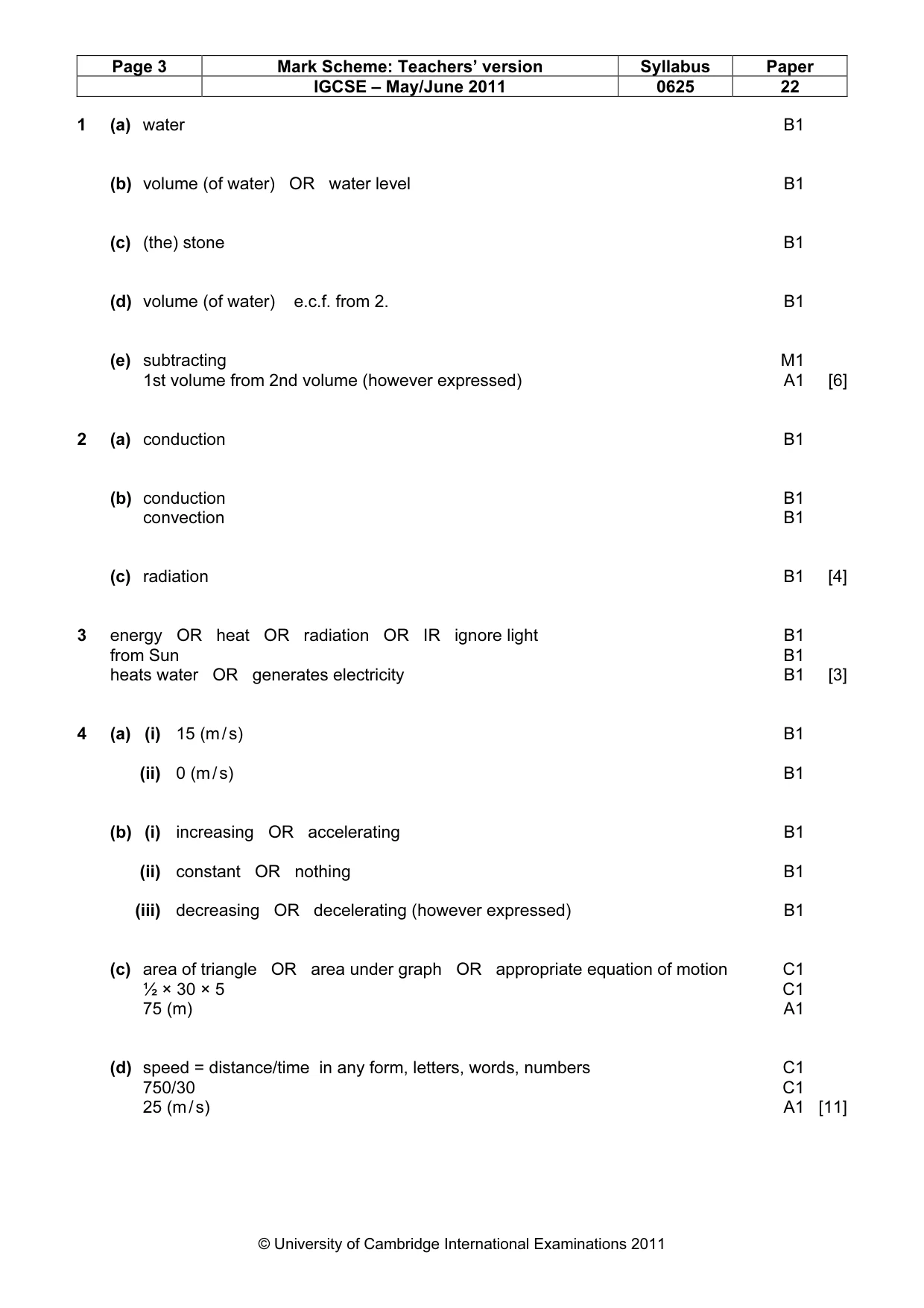
Page 3 Mark Scheme: Teachers’ version Syllabus Paper IGCSE – May/June 2011 0625 22 © University of Cambridge International Examinations 2011 1 (a) water B1 (b) volume (of water) OR water level B1 (c) (the) stone B1 (d) volume (of water) e.c.f. from 2. B1 (e) subtracting M1 1st volume from 2nd volume (however expressed) A1 [6] 2 (a) conduction B1 (b) conduction B1 convection B1 (c) radiation B1 [4] 3 energy OR heat OR radiation OR IR ignore light B1 from Sun B1 heats water OR generates electricity B1 [3] 4 (a) (i) 15 (m / s) B1 (ii) 0 (m / s) B1 (b) (i) increasing OR accelerating B1 (ii) constant OR nothing B1 (iii) decreasing OR decelerating (however expressed) B1 (c) area of triangle OR area under graph OR appropriate equation of motion C1 ½ × 30 × 5 C1 75 (m) A1 (d) speed = distance/time in any form, letters, words, numbers C1 750/30 C1 25 (m / s) A1 [11]
Mark scheme, page 4
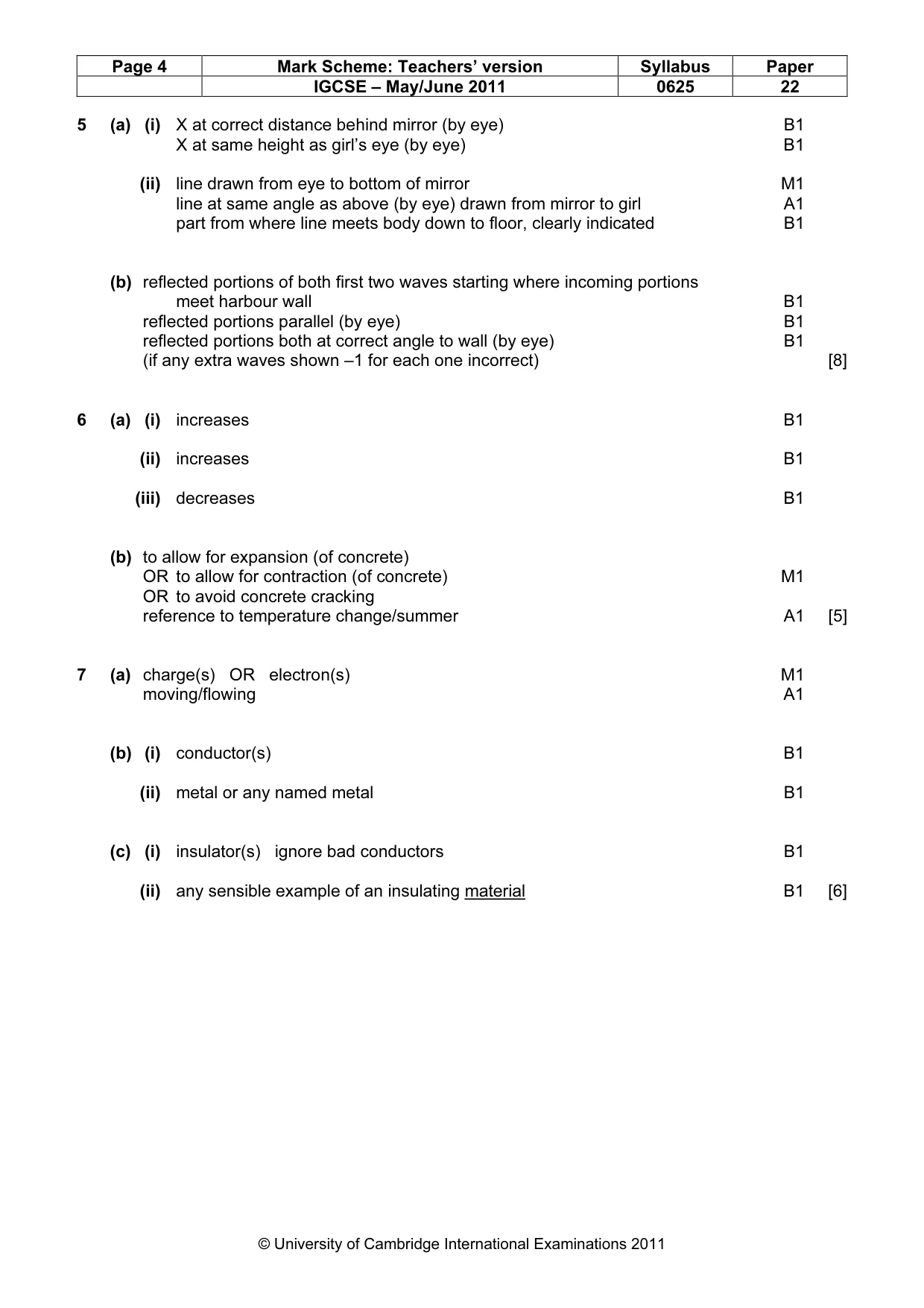
Page 4 Mark Scheme: Teachers’ version Syllabus Paper IGCSE – May/June 2011 0625 22 © University of Cambridge International Examinations 2011 5 (a) (i) X at correct distance behind mirror (by eye) B1 X at same height as girl’s eye (by eye) B1 (ii) line drawn from eye to bottom of mirror M1 line at same angle as above (by eye) drawn from mirror to girl A1 part from where line meets body down to floor, clearly indicated B1 (b) reflected portions of both first two waves starting where incoming portions meet harbour wall B1 reflected portions parallel (by eye) B1 reflected portions both at correct angle to wall (by eye) B1 (if any extra waves shown –1 for each one incorrect) [8] 6 (a) (i) increases B1 (ii) increases B1 (iii) decreases B1 (b) to allow for expansion (of concrete) OR to allow for contraction (of concrete) M1 OR to avoid concrete cracking reference to temperature change/summer A1 [5] 7 (a) charge(s) OR electron(s) M1 moving/flowing A1 (b) (i) conductor(s) B1 (ii) metal or any named metal B1 (c) (i) insulator(s) ignore bad conductors B1 (ii) any sensible example of an insulating material B1 [6]
Mark scheme, page 5
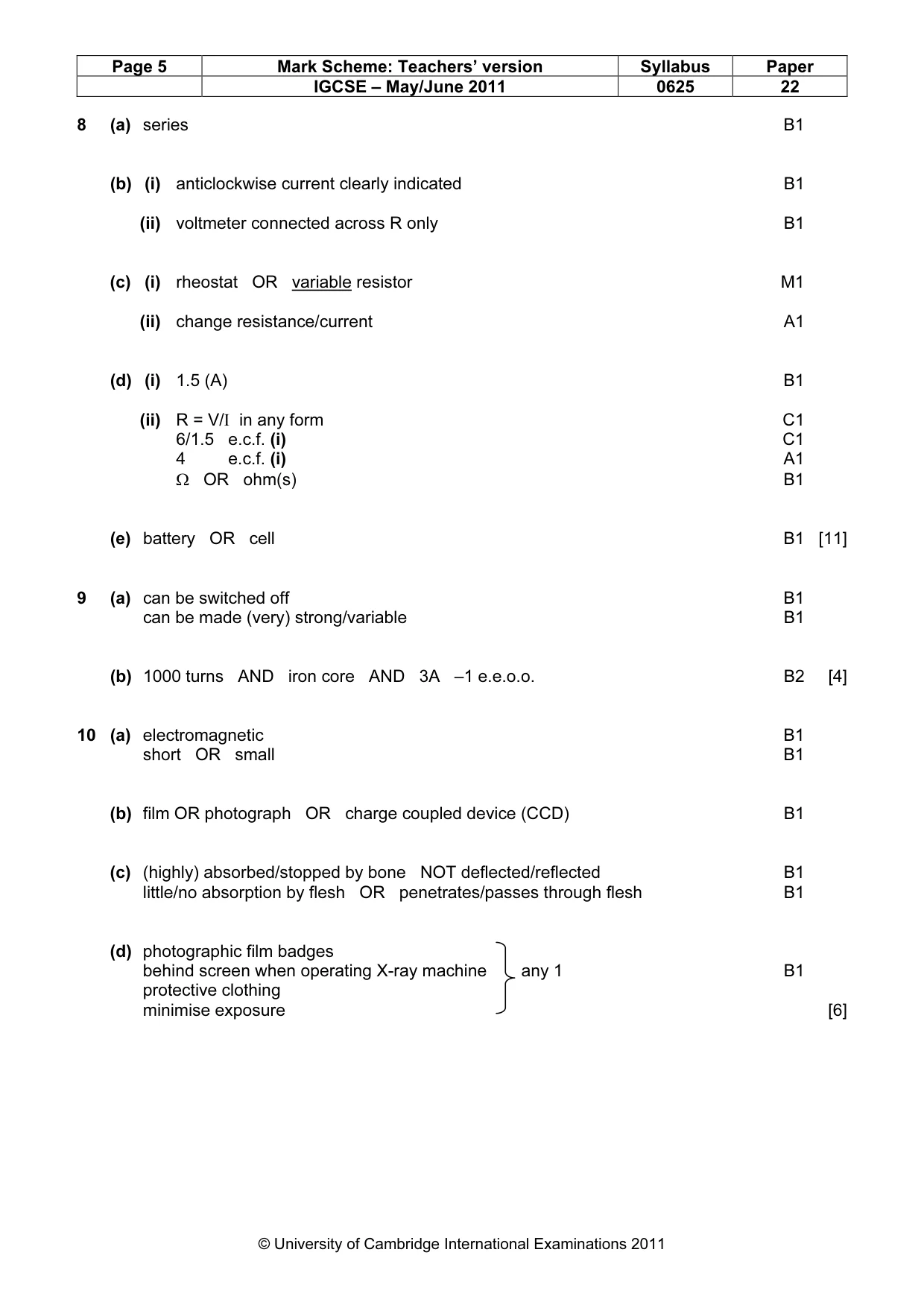
Page 5 Mark Scheme: Teachers’ version Syllabus Paper IGCSE – May/June 2011 0625 22 © University of Cambridge International Examinations 2011 8 (a) series B1 (b) (i) anticlockwise current clearly indicated B1 (ii) voltmeter connected across R only B1 (c) (i) rheostat OR variable resistor M1 (ii) change resistance/current A1 (d) (i) 1.5 (A) B1 (ii) R = V/I in any form C1 6/1.5 e.c.f. (i) C1 4 e.c.f. (i) A1 Ω OR ohm(s) B1 (e) battery OR cell B1 [11] 9 (a) can be switched off B1 can be made (very) strong/variable B1 (b) 1000 turns AND iron core AND 3A –1 e.e.o.o. B2 [4] 10 (a) electromagnetic B1 short OR small B1 (b) film OR photograph OR charge coupled device (CCD) B1 (c) (highly) absorbed/stopped by bone NOT deflected/reflected B1 little/no absorption by flesh OR penetrates/passes through flesh B1 (d) photographic film badges behind screen when operating X-ray machine any 1 B1 protective clothing minimise exposure [6]
Mark scheme, page 6
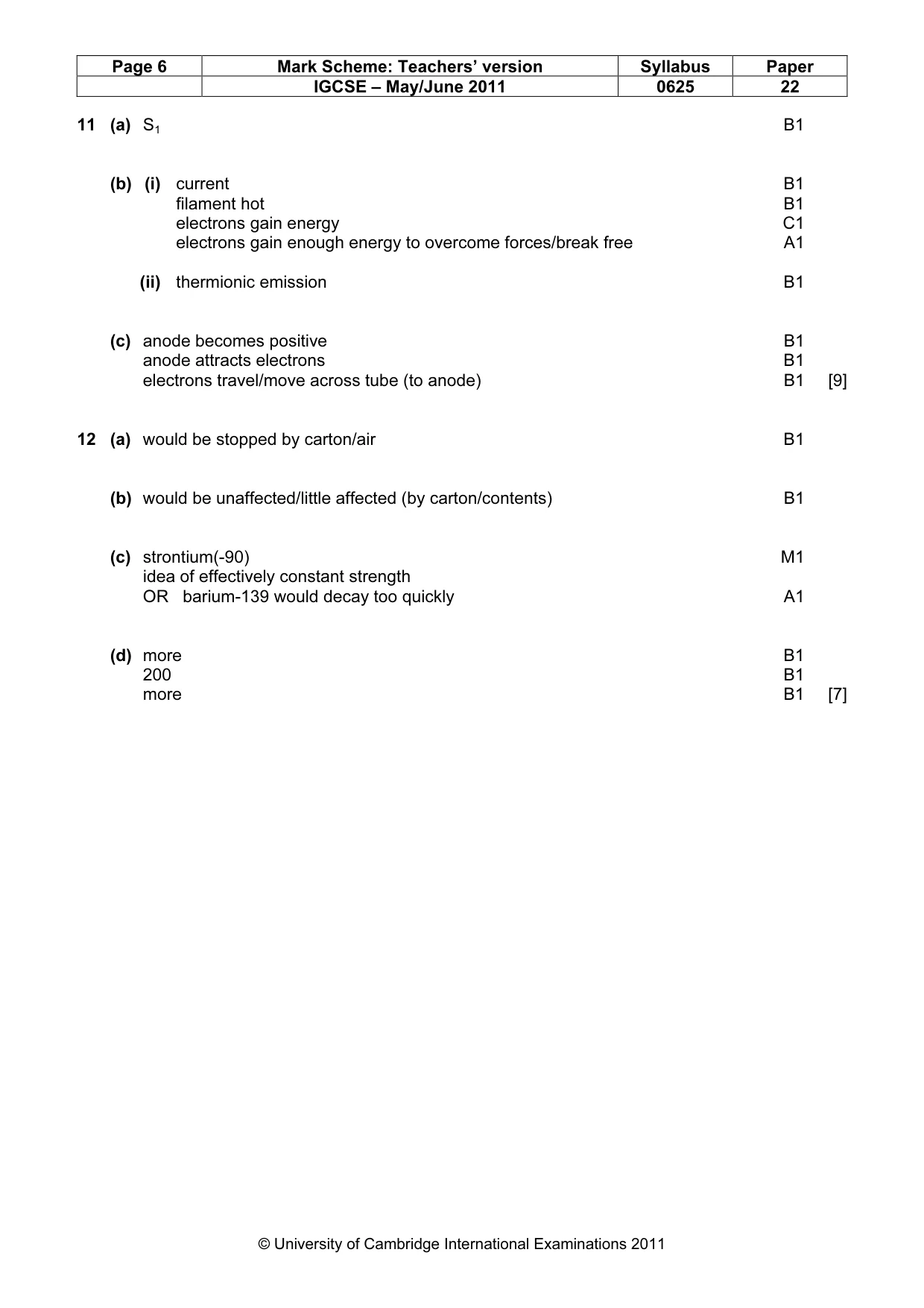
Page 6 Mark Scheme: Teachers’ version Syllabus Paper IGCSE – May/June 2011 0625 22 © University of Cambridge International Examinations 2011 11 (a) S1 B1 (b) (i) current B1 filament hot B1 electrons gain energy C1 electrons gain enough energy to overcome forces/break free A1 (ii) thermionic emission B1 (c) anode becomes positive B1 anode attracts electrons B1 electrons travel/move across tube (to anode) B1 [9] 12 (a) would be stopped by carton/air B1 (b) would be unaffected/little affected (by carton/contents) B1 (c) strontium(-90) M1 idea of effectively constant strength OR barium-139 would decay too quickly A1 (d) more B1 200 B1 more B1 [7]
What you needed in this session
Cambridge’s own grade thresholds for 2011 May/June, Paper 2 · Variant 2. A higher threshold means an easier paper — the bar moves with how the cohort did.