Cambridge IGCSE Physics 0625 — 2011 May/June Paper 2 · Variant 1
0625/21/M/J/11 · 80 marks · ≈90 min
The question paper and its mark scheme, free to read here and free to download. This is Cambridge’s own paper, exactly as it was sat.
Question paper20 pages
Mark scheme6 pages
Answers below. Sit the paper first if you are practising.
Paper as text
Question paper, page 1
This document consists of 19 printed pages and 1 blank page. DC (NH/DJ) 28876/6 © UCLES 2011 [Turn over UNIVERSITY OF CAMBRIDGE INTERNATIONAL EXAMINATIONS International General Certificate of Secondary Education READ THESE INSTRUCTIONS FIRST Write your Centre number, candidate number and name on all the work you hand in. Write in dark blue or black pen. You may use a pencil for any diagrams, graphs or rough working. Do not use staples, paper clips, highlighters, glue or correction fluid. DO NOT WRITE IN ANY BARCODES. Answer all questions. You may lose marks if you do not show your working or if you do not use appropriate units. Take the weight of 1 kg to be 10 N (i.e. acceleration of free fall = 10 m / s2). At the end of the examination, fasten all your work securely together. The number of marks is given in brackets [ ] at the end of each question or part question. * 6 9 9 3 4 3 1 9 7 2 * PHYSICS 0625/21 Paper 2 Core May/June 2011 1 hour 15 minutes Candidates answer on the Question Paper. No Additional Materials are required. www.XtremePapers.com
Question paper, page 2
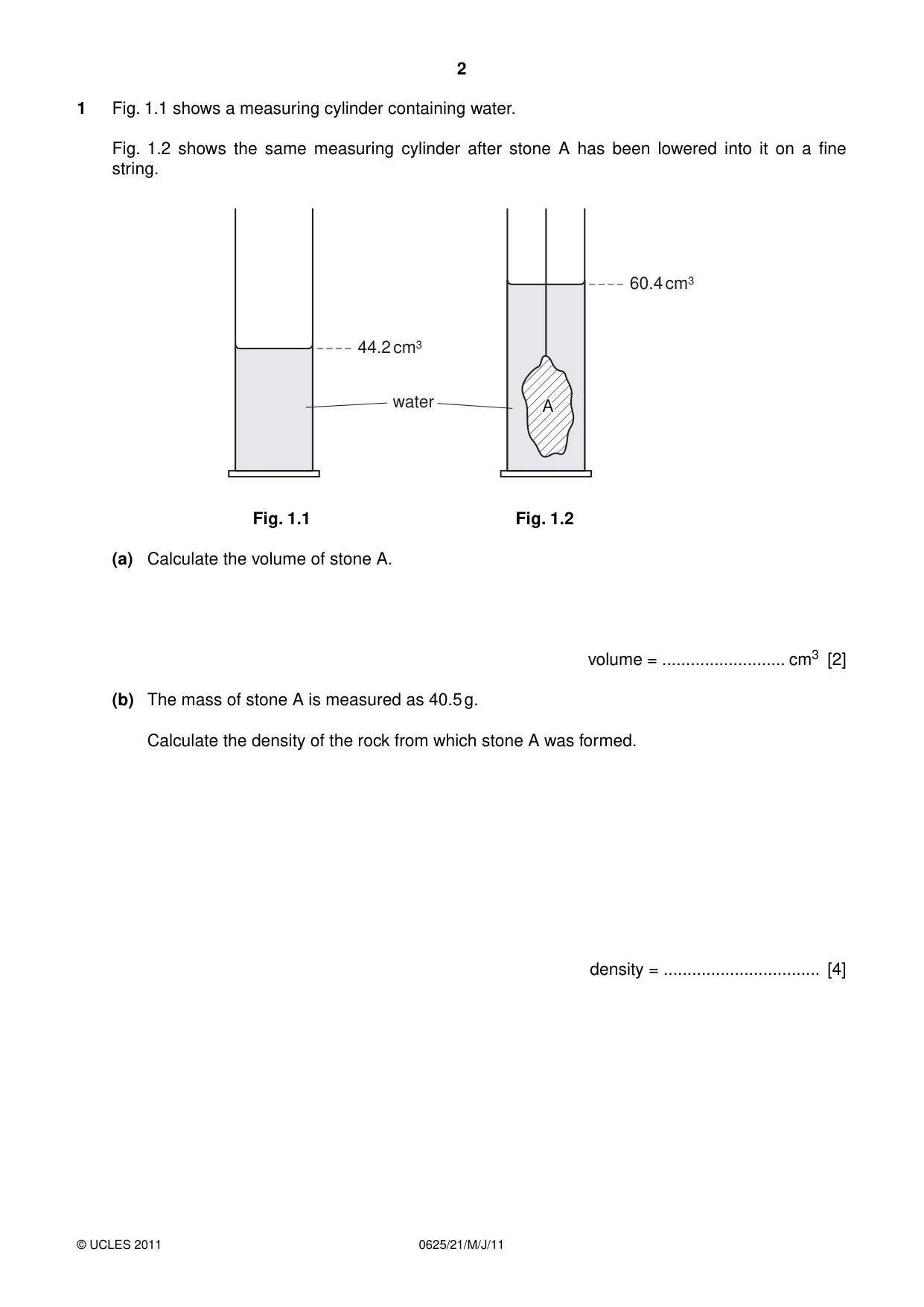
2 0625/21/M/J/11 © UCLES 2011 1 Fig. 1.1 shows a measuring cylinder containing water. Fig. 1.2 shows the same measuring cylinder after stone A has been lowered into it on a fine string. 44.2 cm3 water 60.4 cm3 A Fig. 1.1 Fig. 1.2 (a) Calculate the volume of stone A. volume = … cm3 [2] (b) The mass of stone A is measured as 40.5 g. Calculate the density of the rock from which stone A was formed. density = … [4]
Question paper, page 3
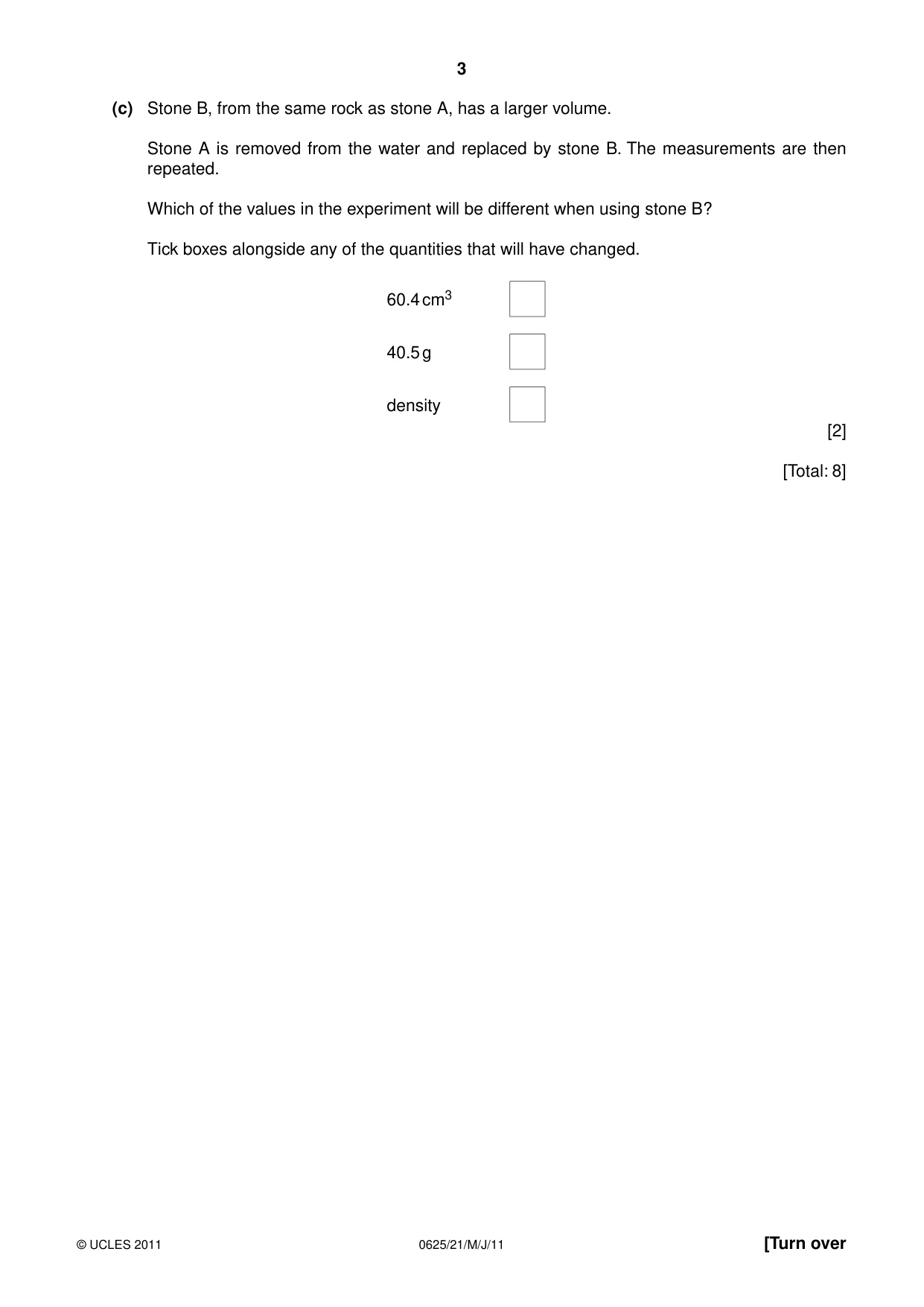
3 0625/21/M/J/11 © UCLES 2011 [Turn over (c) Stone B, from the same rock as stone A, has a larger volume. Stone A is removed from the water and replaced by stone B. The measurements are then repeated. Which of the values in the experiment will be different when using stone B? Tick boxes alongside any of the quantities that will have changed. 60.4 cm3 40.5 g density [2] [Total: 8]
Question paper, page 4
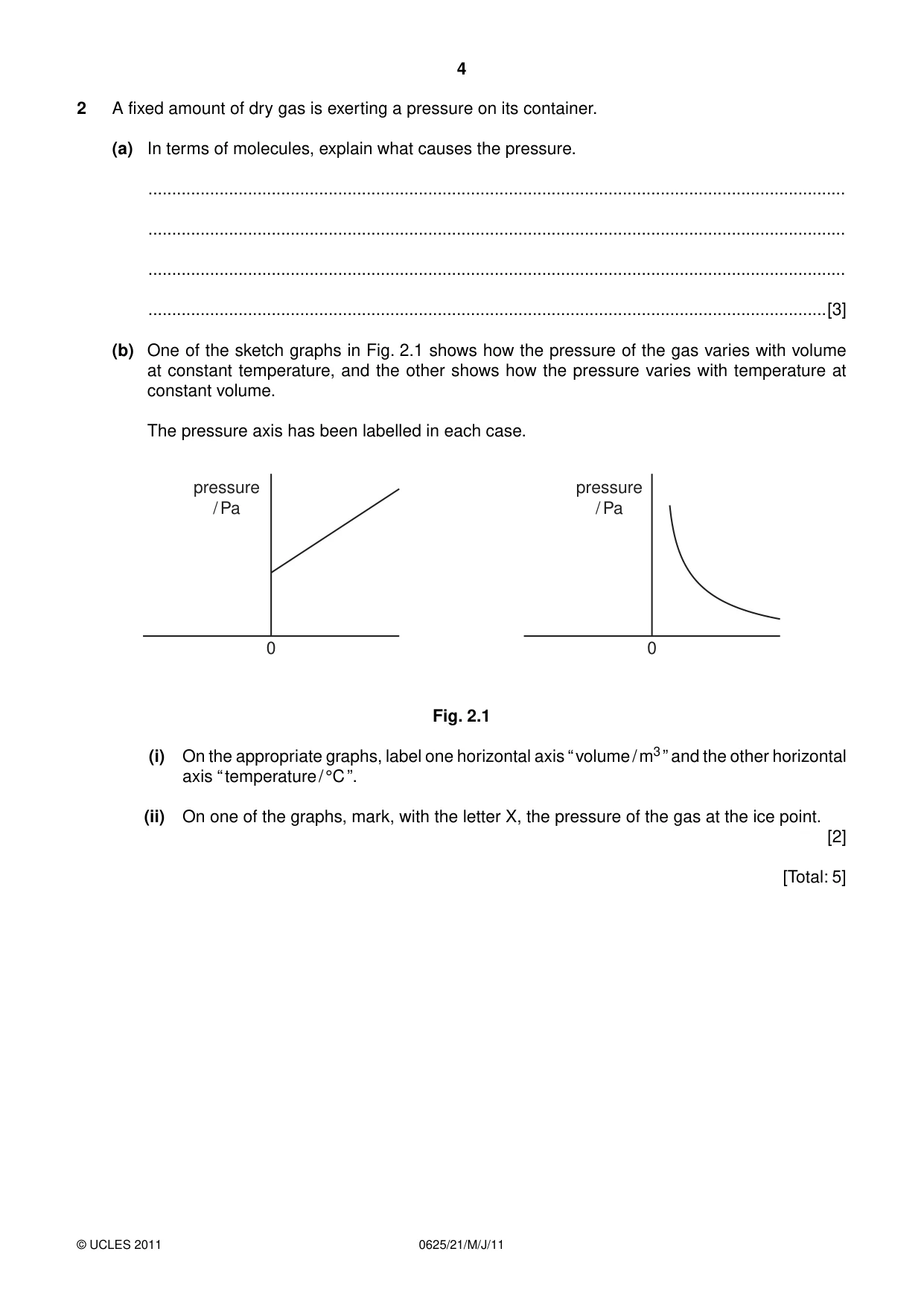
4 0625/21/M/J/11 © UCLES 2011 2 A fixed amount of dry gas is exerting a pressure on its container. (a) In terms of molecules, explain what causes the pressure. … … … …[3] (b) One of the sketch graphs in Fig. 2.1 shows how the pressure of the gas varies with volume at constant temperature, and the other shows how the pressure varies with temperature at constant volume. The pressure axis has been labelled in each case. pressure / Pa 0 pressure / Pa 0 Fig. 2.1 (i) On the appropriate graphs, label one horizontal axis “ volume / m3 ” and the other horizontal axis “ temperature / °C ”. (ii) On one of the graphs, mark, with the letter X, the pressure of the gas at the ice point. [2] [Total: 5]
Question paper, page 5
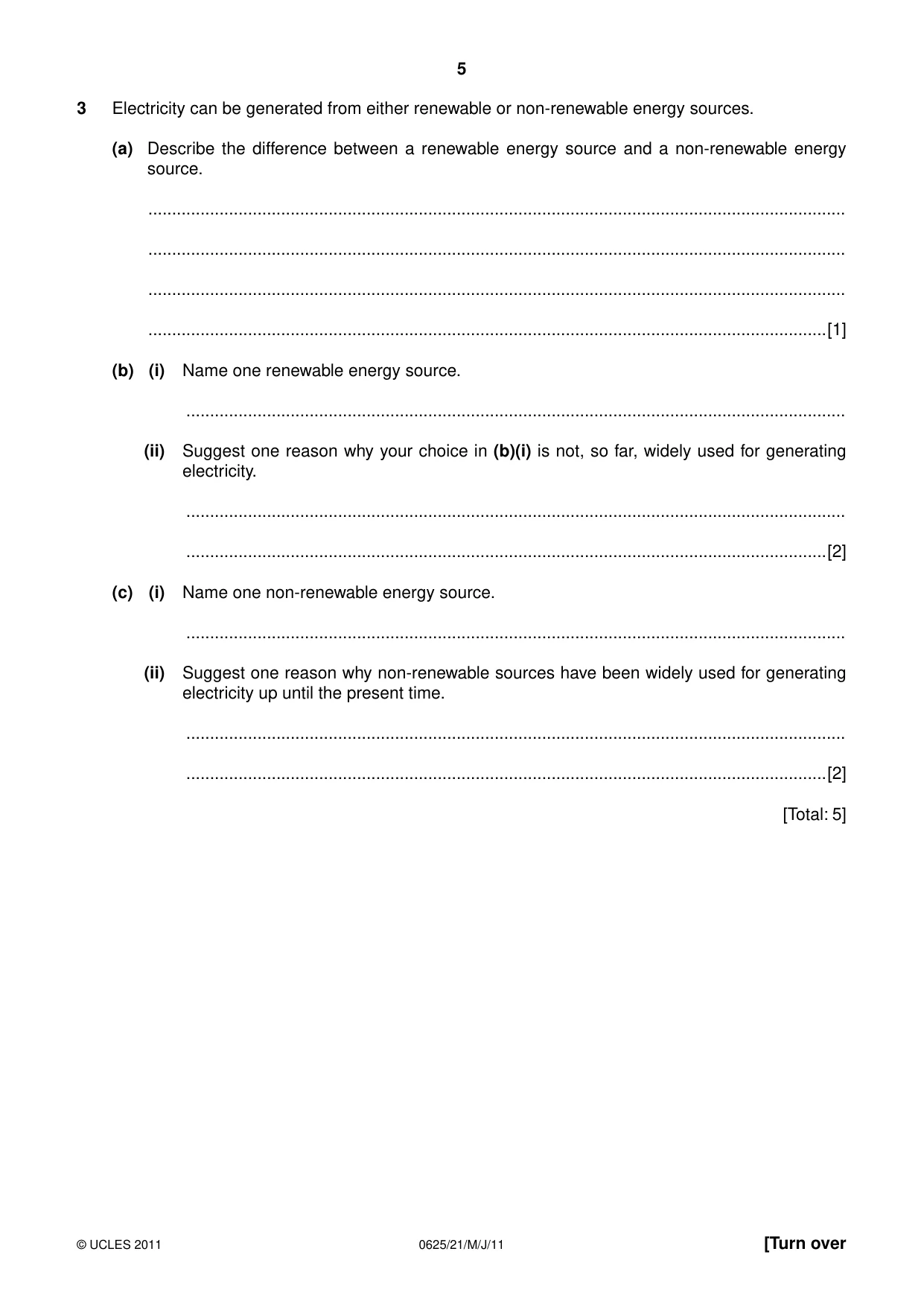
5 0625/21/M/J/11 © UCLES 2011 [Turn over 3 Electricity can be generated from either renewable or non-renewable energy sources. (a) Describe the difference between a renewable energy source and a non-renewable energy source. … … … …[1] (b) (i) Name one renewable energy source. … (ii) Suggest one reason why your choice in (b)(i) is not, so far, widely used for generating electricity. … …[2] (c) (i) Name one non-renewable energy source. … (ii) Suggest one reason why non-renewable sources have been widely used for generating electricity up until the present time. … …[2] [Total: 5]
Question paper, page 6
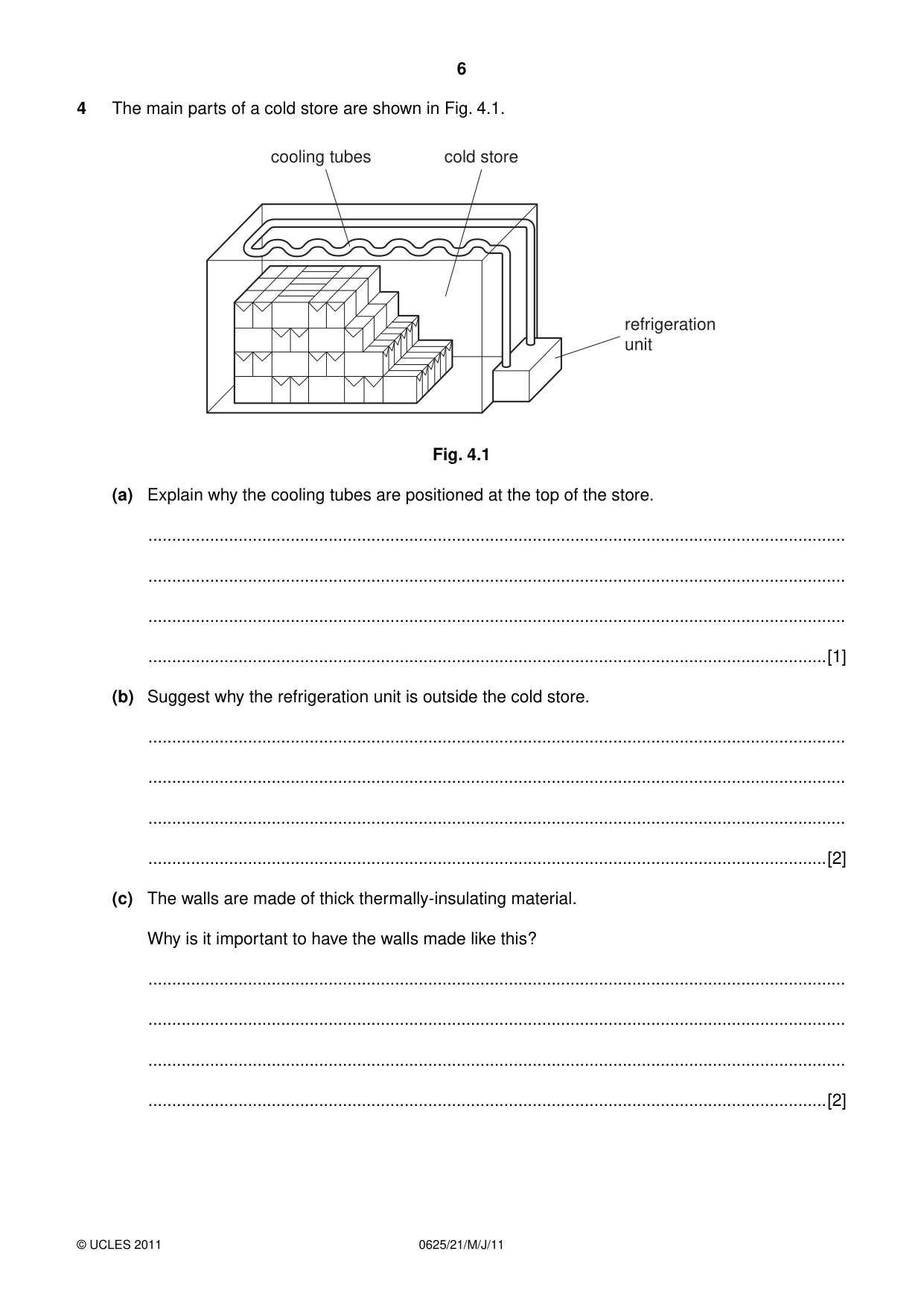
6 0625/21/M/J/11 © UCLES 2011 4 The main parts of a cold store are shown in Fig. 4.1. cooling tubes cold store refrigeration unit Fig. 4.1 (a) Explain why the cooling tubes are positioned at the top of the store. … … … …[1] (b) Suggest why the refrigeration unit is outside the cold store. … … … …[2] (c) The walls are made of thick thermally-insulating material. Why is it important to have the walls made like this? … … … …[2]
Question paper, page 7
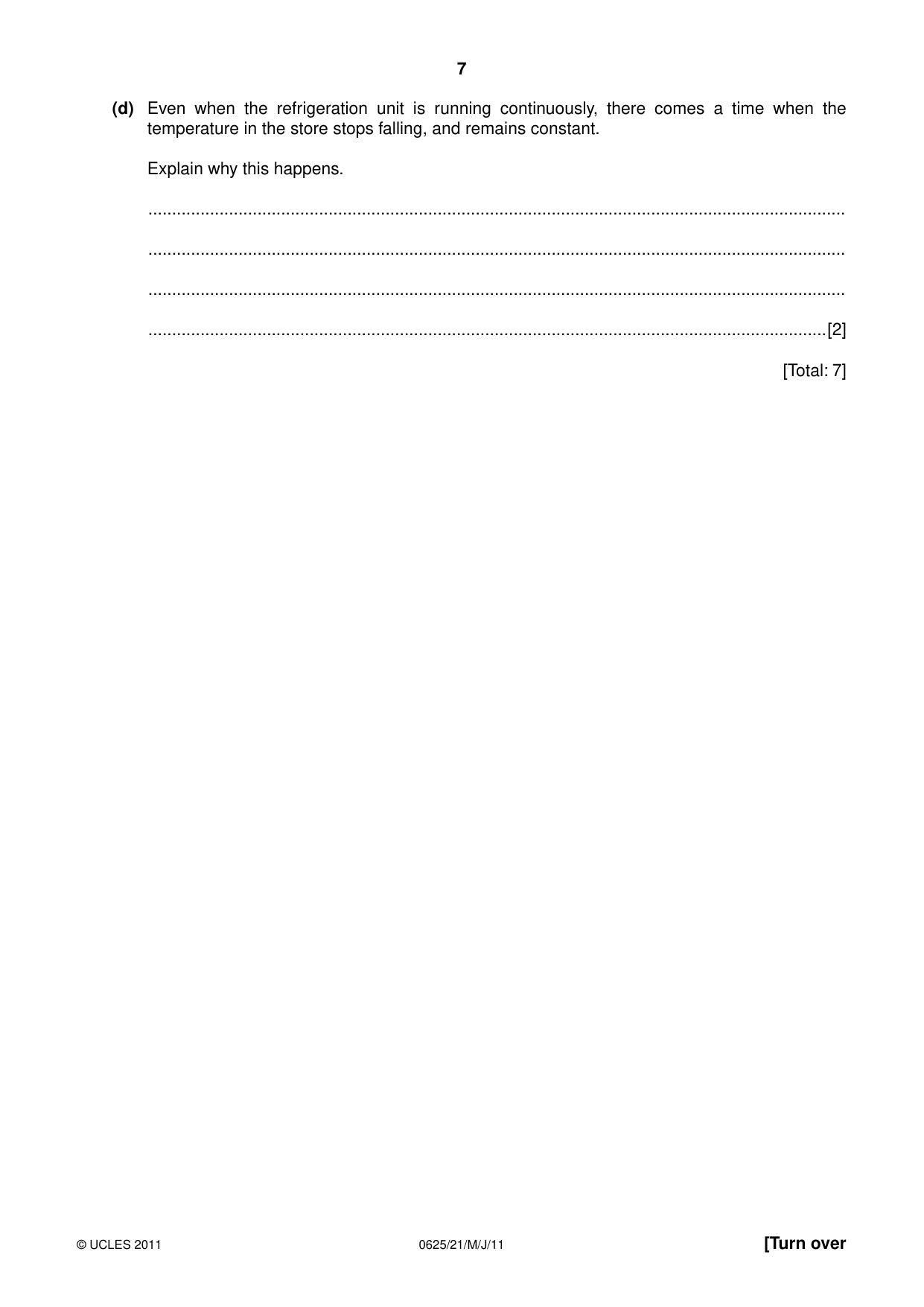
7 0625/21/M/J/11 © UCLES 2011 [Turn over (d) Even when the refrigeration unit is running continuously, there comes a time when the temperature in the store stops falling, and remains constant. Explain why this happens. … … … …[2] [Total: 7]
Question paper, page 8
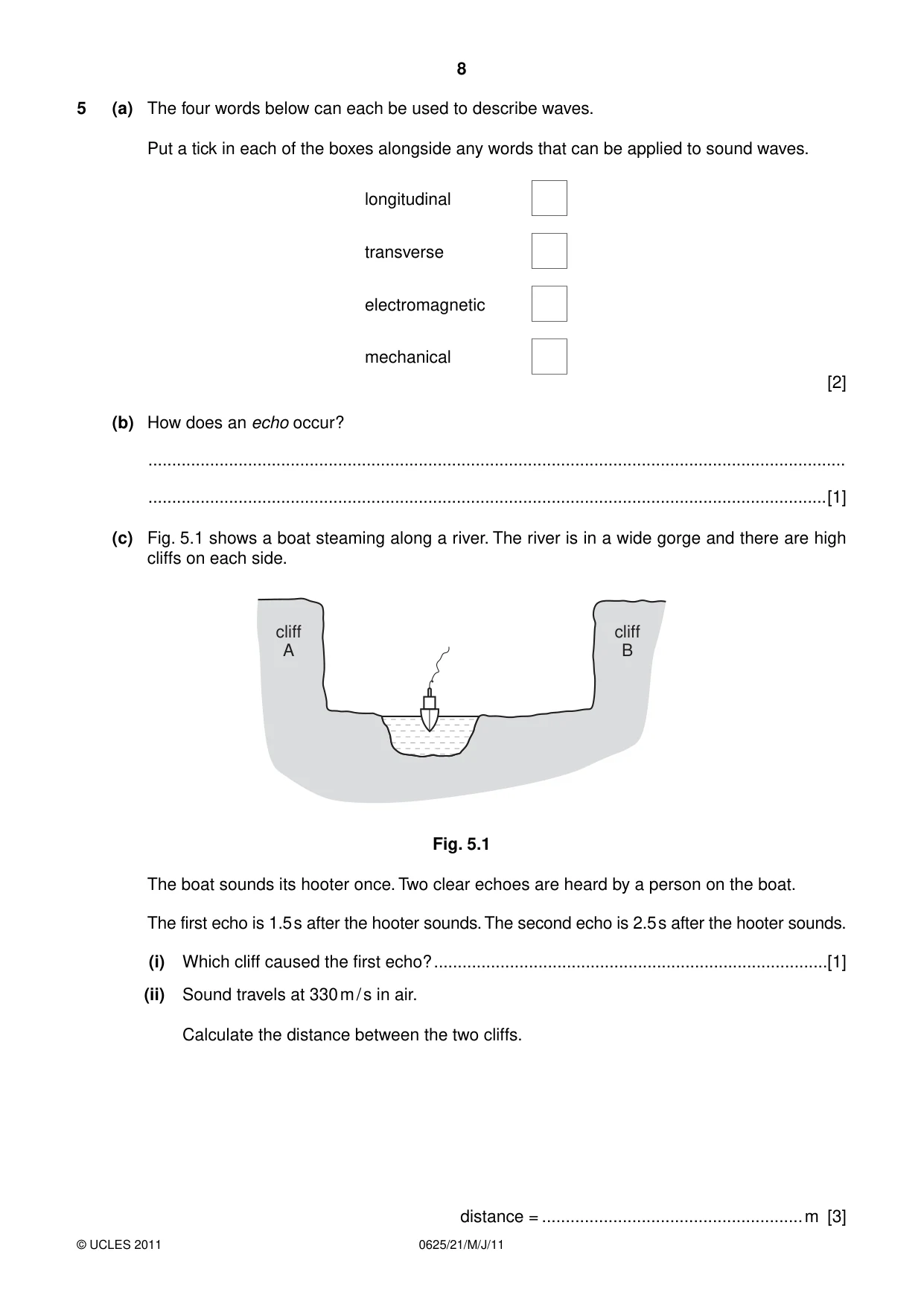
8 0625/21/M/J/11 © UCLES 2011 5 (a) The four words below can each be used to describe waves. Put a tick in each of the boxes alongside any words that can be applied to sound waves. longitudinal transverse electromagnetic mechanical [2] (b) How does an echo occur? … …[1] (c) Fig. 5.1 shows a boat steaming along a river. The river is in a wide gorge and there are high cliffs on each side. cliff A cliff B Fig. 5.1 The boat sounds its hooter once. Two clear echoes are heard by a person on the boat. The first echo is 1.5 s after the hooter sounds. The second echo is 2.5 s after the hooter sounds. (i) Which cliff caused the first echo? …[1] (ii) Sound travels at 330 m / s in air. Calculate the distance between the two cliffs. distance = …m [3]
Question paper, page 9
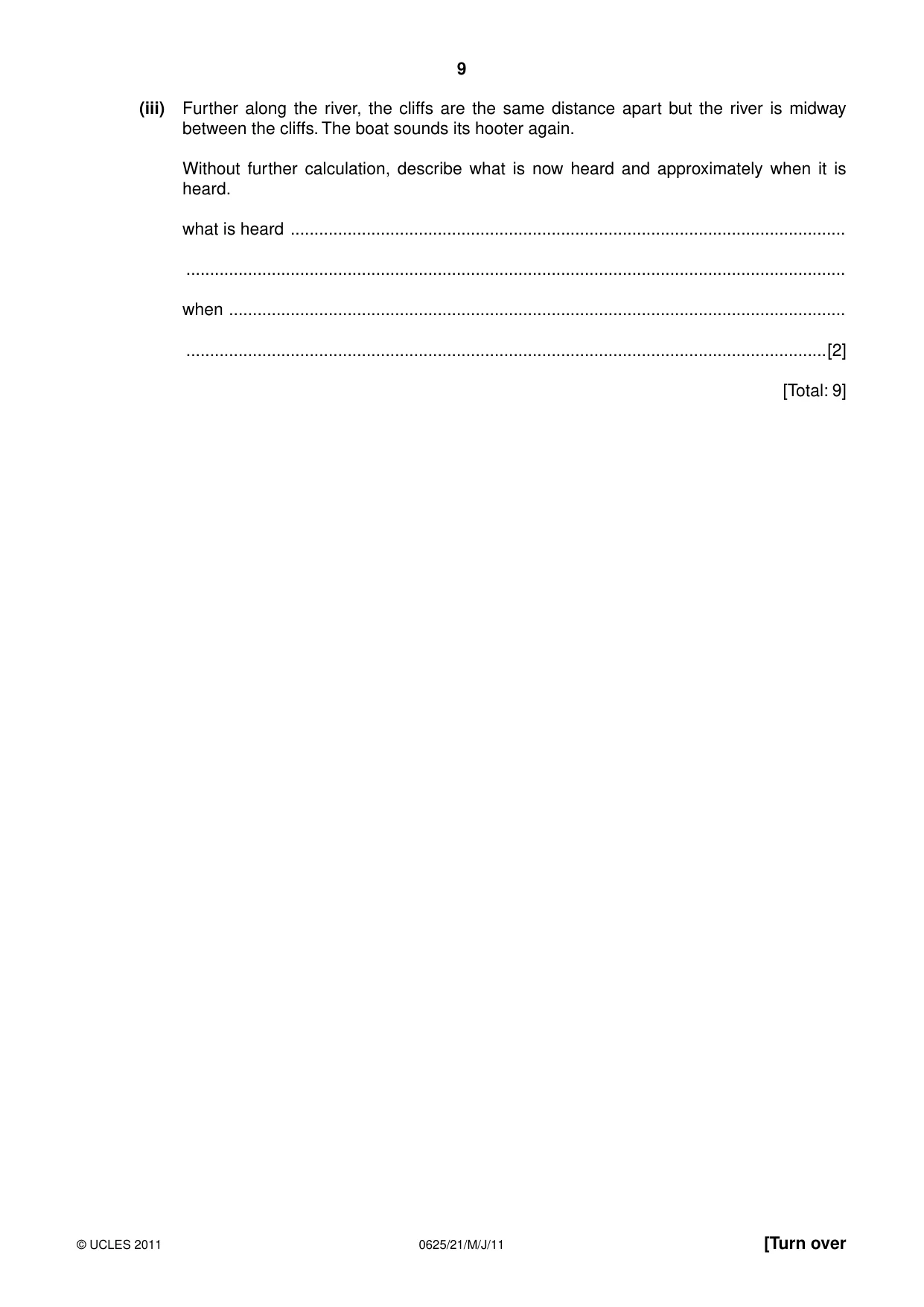
9 0625/21/M/J/11 © UCLES 2011 [Turn over (iii) Further along the river, the cliffs are the same distance apart but the river is midway between the cliffs. The boat sounds its hooter again. Without further calculation, describe what is now heard and approximately when it is heard. what is heard … … when … …[2] [Total: 9]
Question paper, page 10
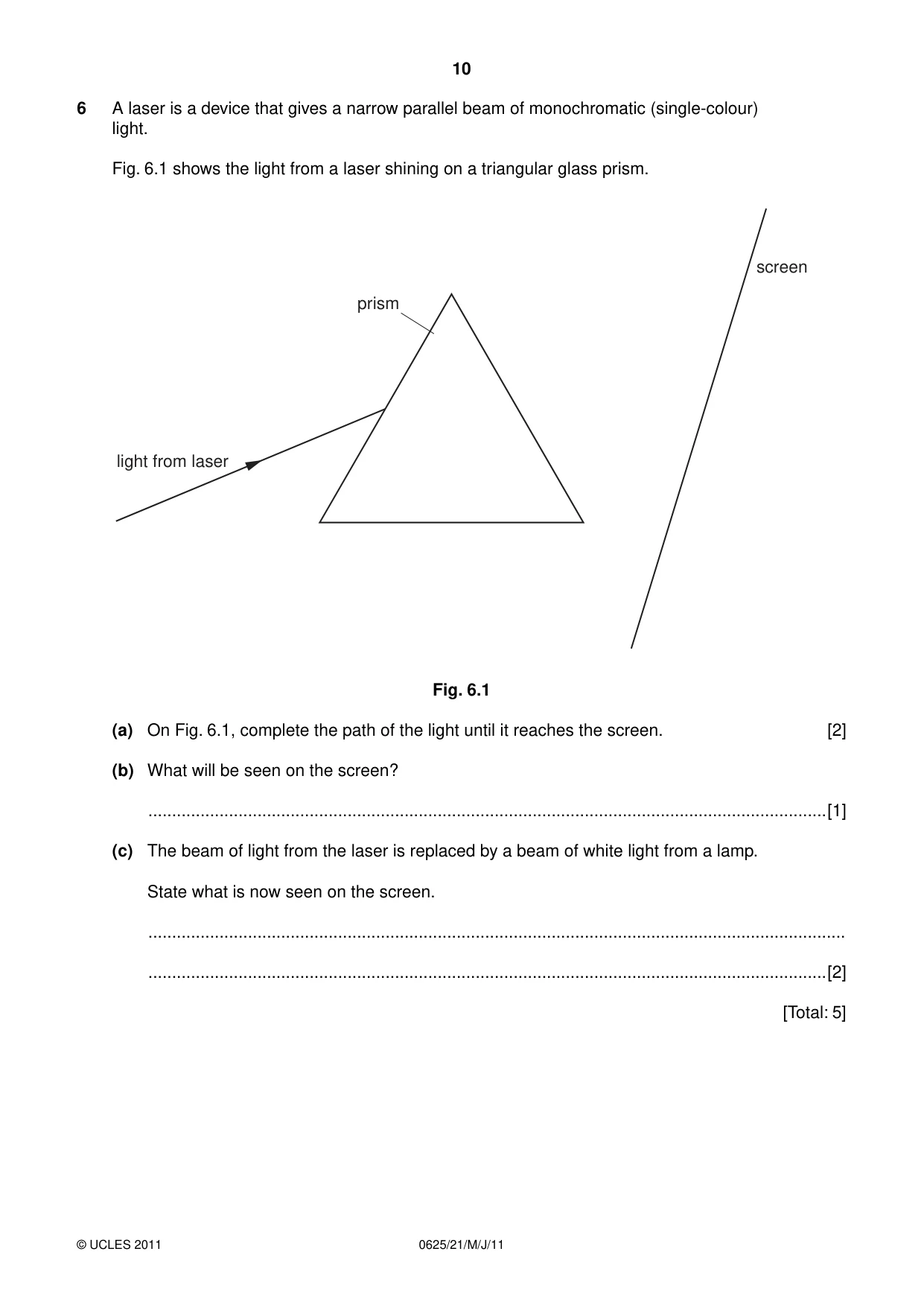
10 0625/21/M/J/11 © UCLES 2011 6 A laser is a device that gives a narrow parallel beam of monochromatic (single-colour) light. Fig. 6.1 shows the light from a laser shining on a triangular glass prism. light from laser prism screen Fig. 6.1 (a) On Fig. 6.1, complete the path of the light until it reaches the screen. [2] (b) What will be seen on the screen? …[1] (c) The beam of light from the laser is replaced by a beam of white light from a lamp. State what is now seen on the screen. … …[2] [Total: 5]
Question paper, page 11
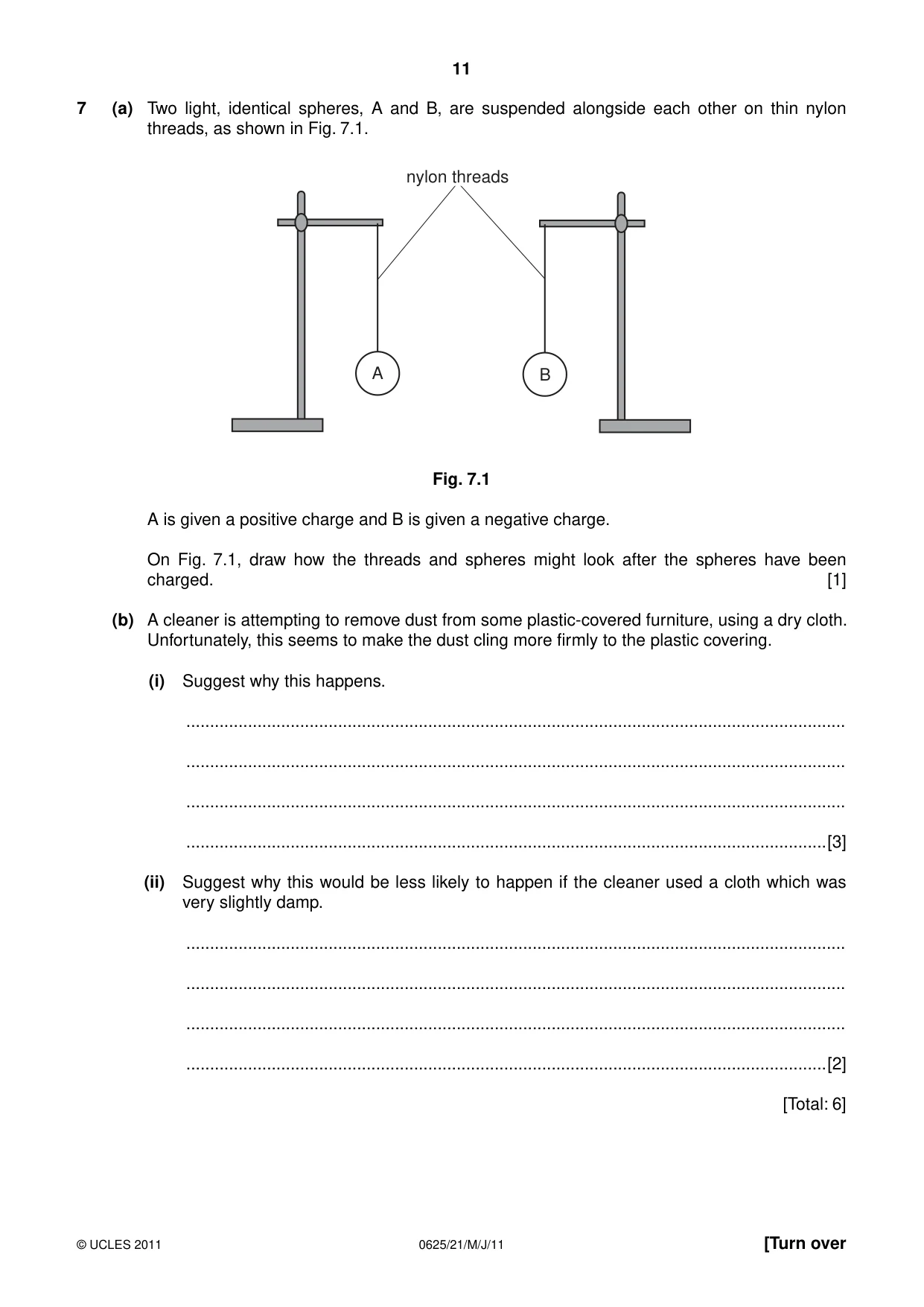
11 0625/21/M/J/11 © UCLES 2011 [Turn over 7 (a) Two light, identical spheres, A and B, are suspended alongside each other on thin nylon threads, as shown in Fig. 7.1. A B nylon threads Fig. 7.1 A is given a positive charge and B is given a negative charge. On Fig. 7.1, draw how the threads and spheres might look after the spheres have been charged. [1] (b) A cleaner is attempting to remove dust from some plastic-covered furniture, using a dry cloth. Unfortunately, this seems to make the dust cling more firmly to the plastic covering. (i) Suggest why this happens. … … … …[3] (ii) Suggest why this would be less likely to happen if the cleaner used a cloth which was very slightly damp. … … … …[2] [Total: 6]
Question paper, page 12
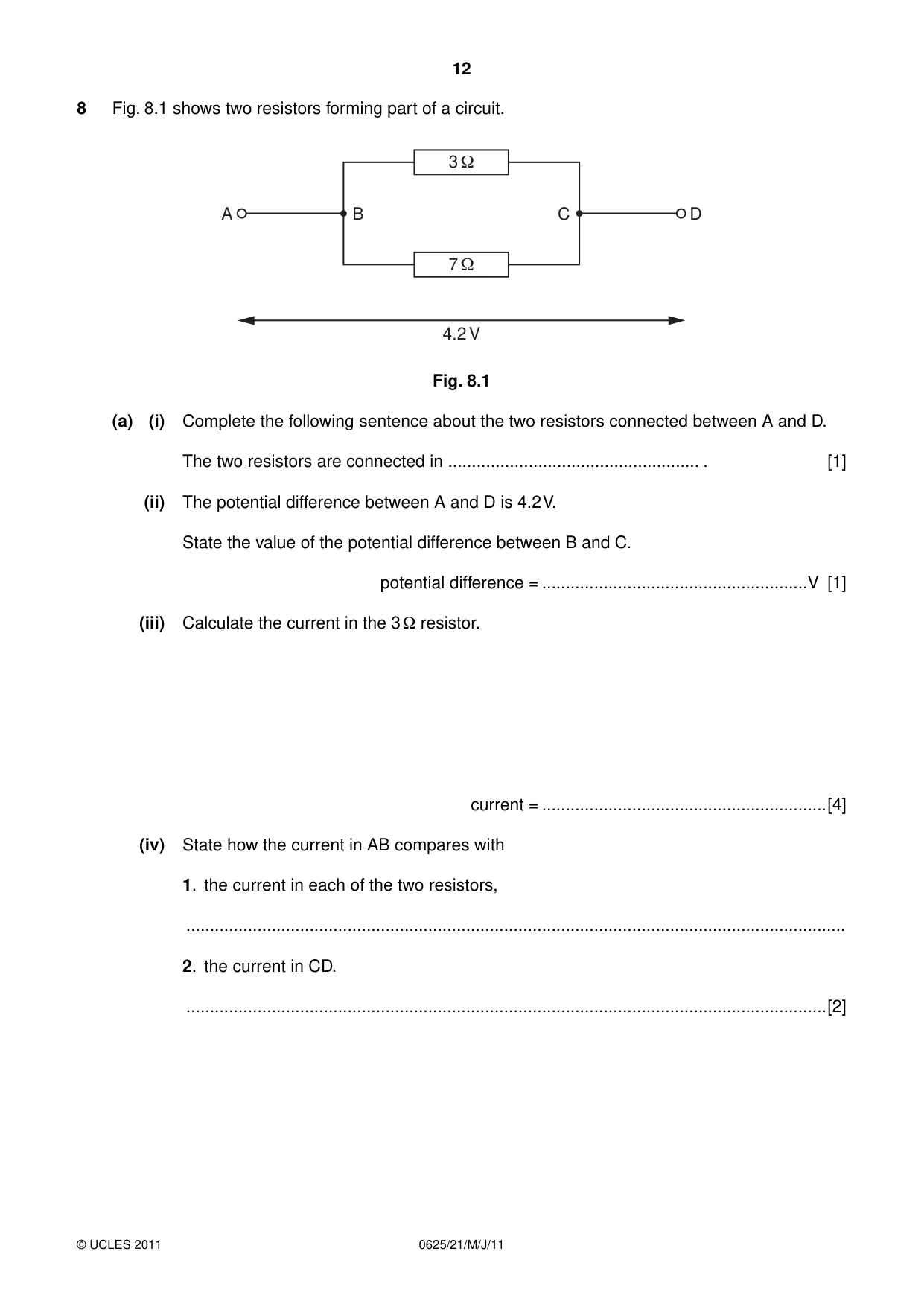
12 0625/21/M/J/11 © UCLES 2011 8 Fig. 8.1 shows two resistors forming part of a circuit. 3 Ω 7 Ω 4.2 V A B C D Fig. 8.1 (a) (i) Complete the following sentence about the two resistors connected between A and D. The two resistors are connected in … . [1] (ii) The potential difference between A and D is 4.2 V. State the value of the potential difference between B and C. potential difference = …V [1] (iii) Calculate the current in the 3 Ω resistor. current = …[4] (iv) State how the current in AB compares with 1. the current in each of the two resistors, … 2. the current in CD. …[2]
Question paper, page 13
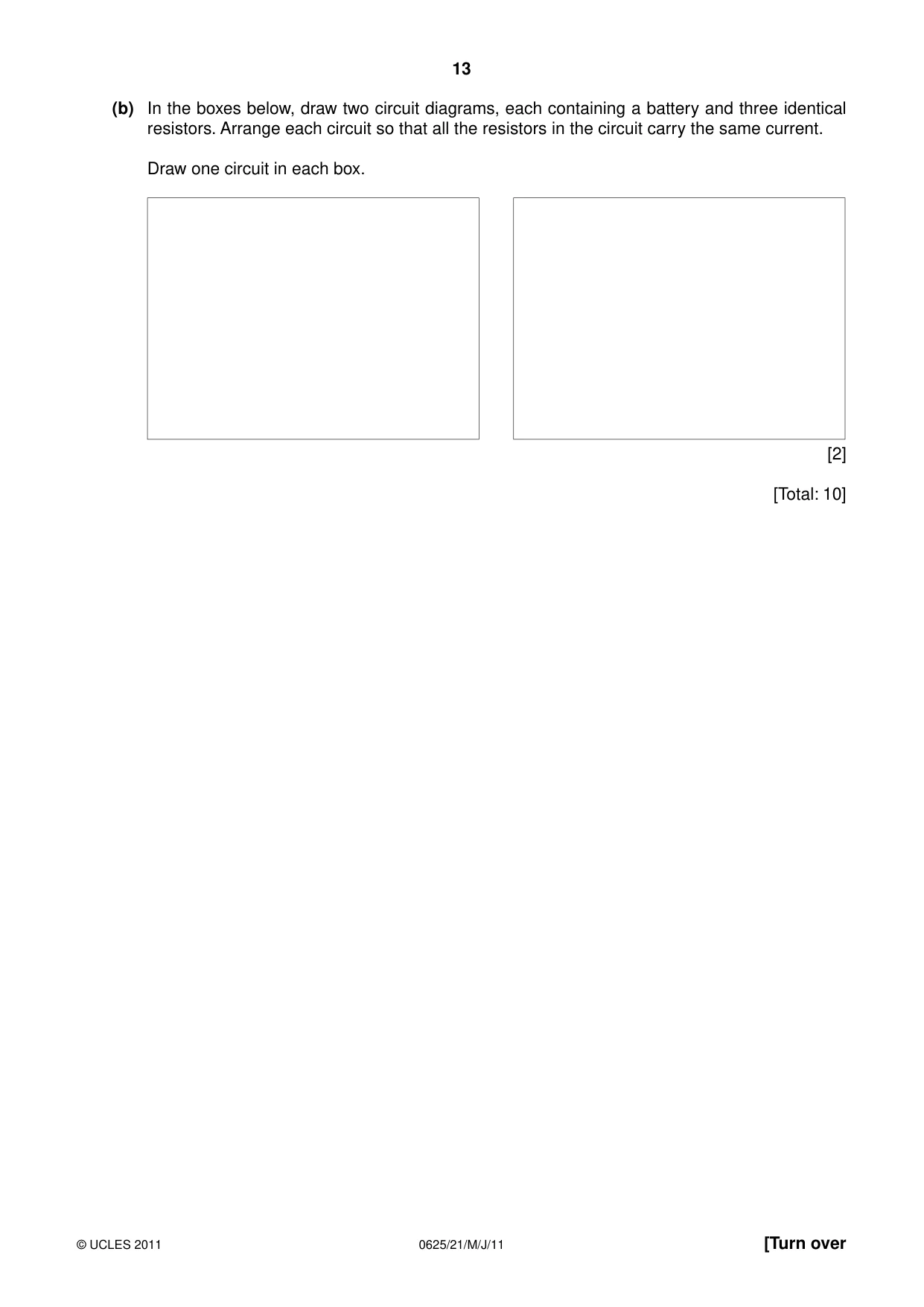
13 0625/21/M/J/11 © UCLES 2011 [Turn over (b) In the boxes below, draw two circuit diagrams, each containing a battery and three identical resistors. Arrange each circuit so that all the resistors in the circuit carry the same current. Draw one circuit in each box. [2] [Total: 10]
Question paper, page 14
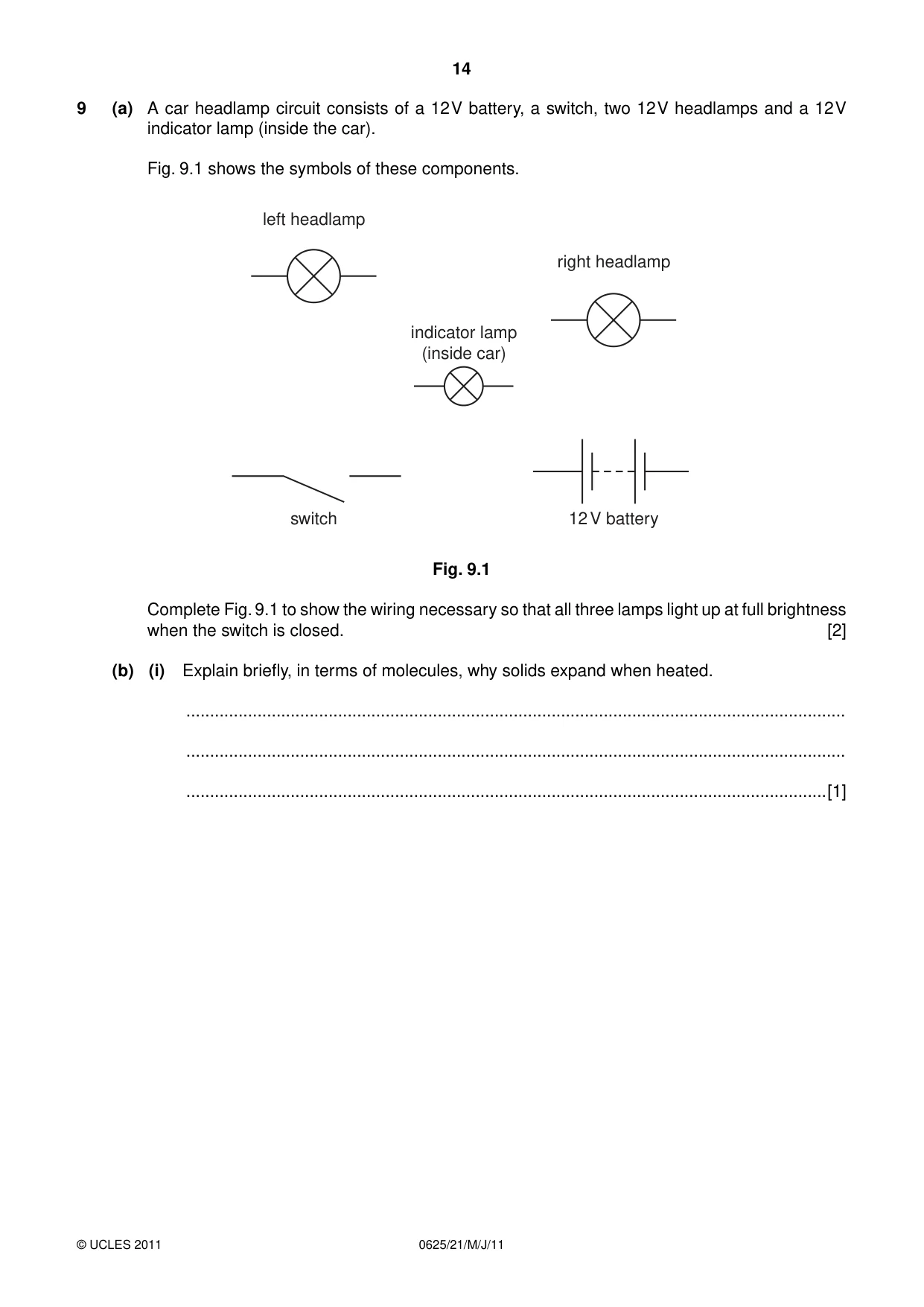
14 0625/21/M/J/11 © UCLES 2011 9 (a) A car headlamp circuit consists of a 12 V battery, a switch, two 12 V headlamps and a 12 V indicator lamp (inside the car). Fig. 9.1 shows the symbols of these components. left headlamp right headlamp indicator lamp (inside car) switch 12 V battery Fig. 9.1 Complete Fig. 9.1 to show the wiring necessary so that all three lamps light up at full brightness when the switch is closed. [2] (b) (i) Explain briefly, in terms of molecules, why solids expand when heated. … … …[1]
Question paper, page 15
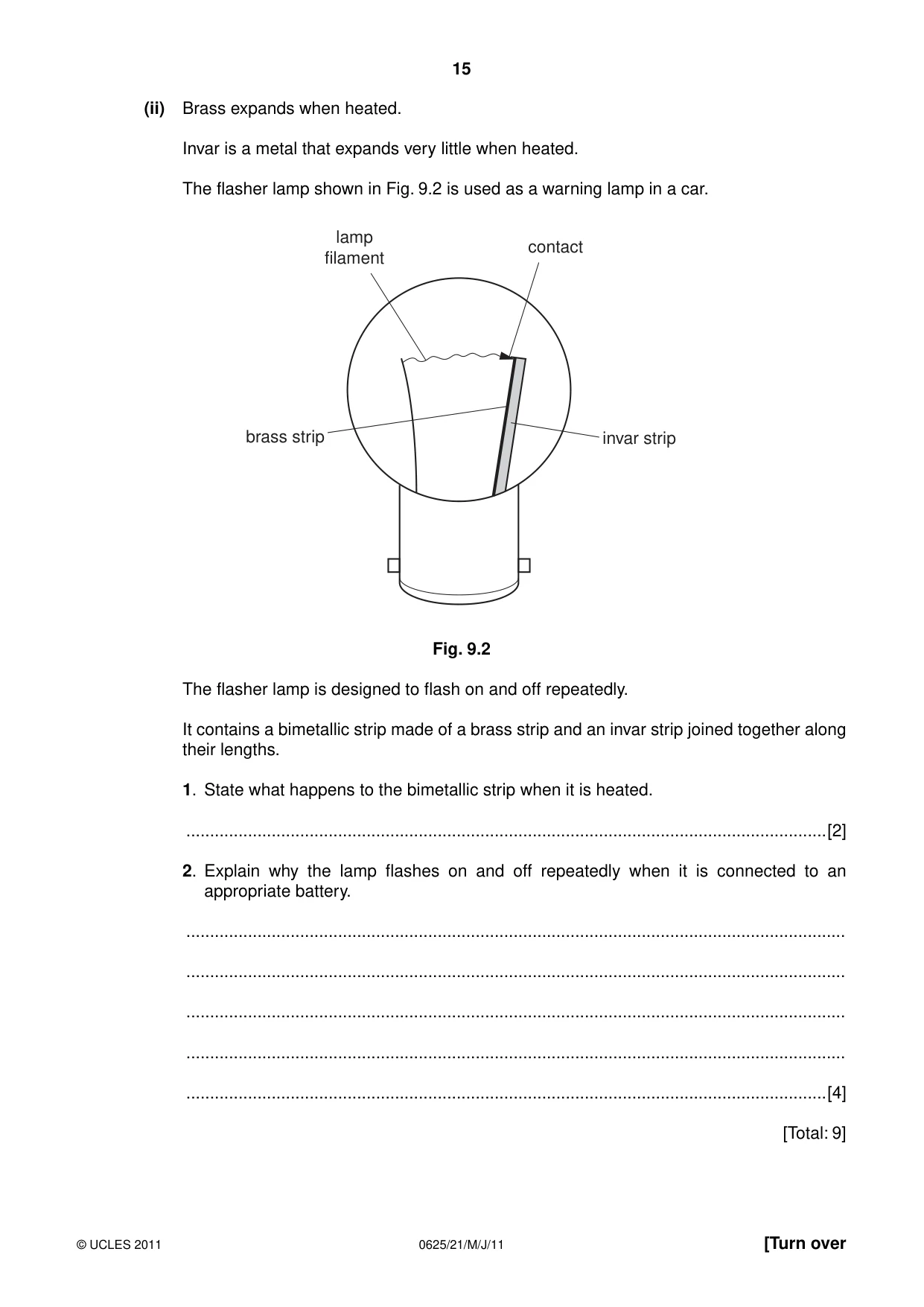
15 0625/21/M/J/11 © UCLES 2011 [Turn over (ii) Brass expands when heated. Invar is a metal that expands very little when heated. The flasher lamp shown in Fig. 9.2 is used as a warning lamp in a car. brass strip lamp filament contact invar strip Fig. 9.2 The flasher lamp is designed to flash on and off repeatedly. It contains a bimetallic strip made of a brass strip and an invar strip joined together along their lengths. 1. State what happens to the bimetallic strip when it is heated. …[2] 2. Explain why the lamp flashes on and off repeatedly when it is connected to an appropriate battery. … … … … …[4] [Total: 9]
Question paper, page 16
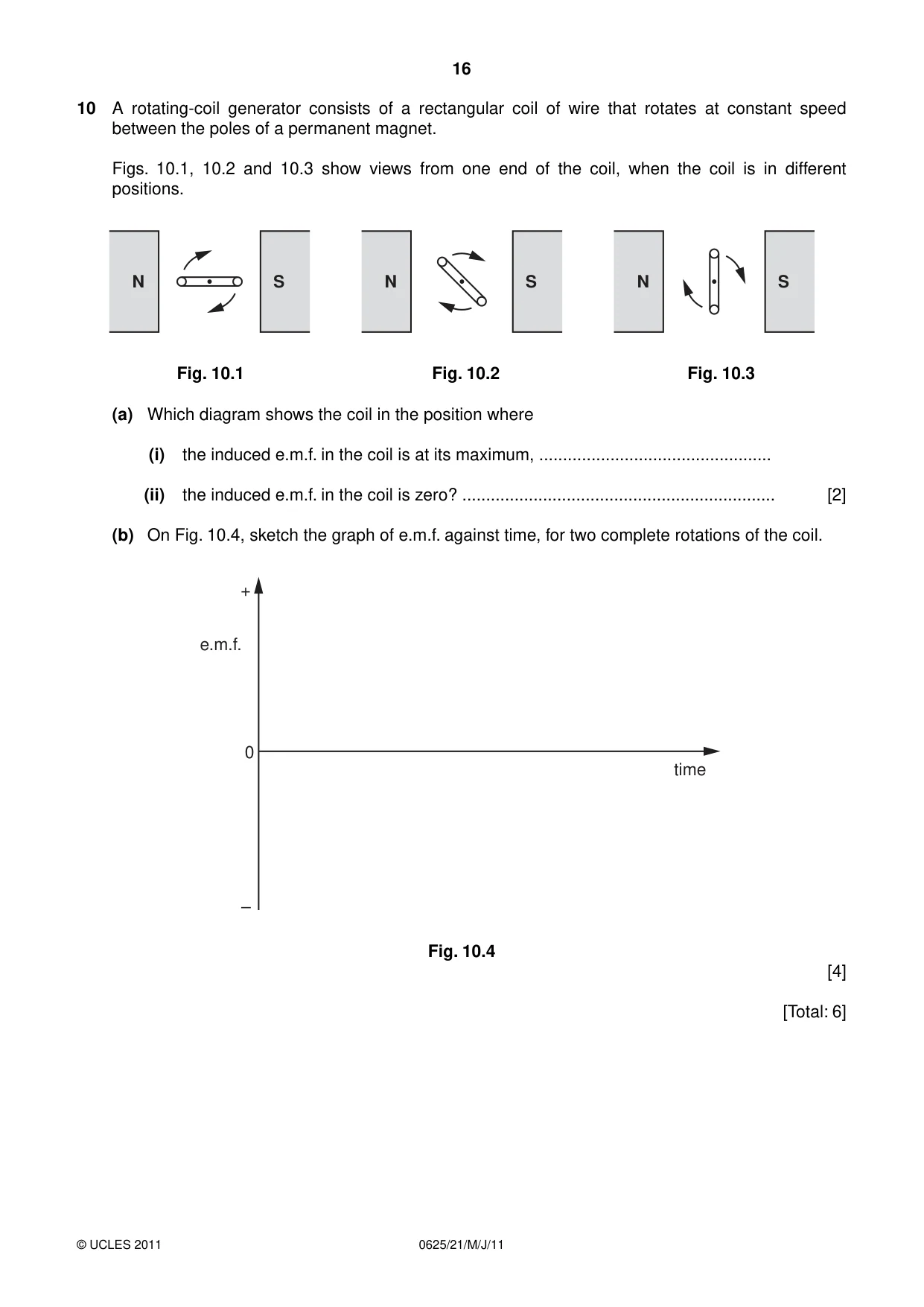
16 0625/21/M/J/11 © UCLES 2011 10 A rotating-coil generator consists of a rectangular coil of wire that rotates at constant speed between the poles of a permanent magnet. Figs. 10.1, 10.2 and 10.3 show views from one end of the coil, when the coil is in different positions. N S N S N S Fig. 10.1 Fig. 10.2 Fig. 10.3 (a) Which diagram shows the coil in the position where (i) the induced e.m.f. in the coil is at its maximum, … (ii) the induced e.m.f. in the coil is zero? … [2] (b) On Fig. 10.4, sketch the graph of e.m.f. against time, for two complete rotations of the coil. + 0 – e.m.f. time Fig. 10.4 [4] [Total: 6]
Question paper, page 17
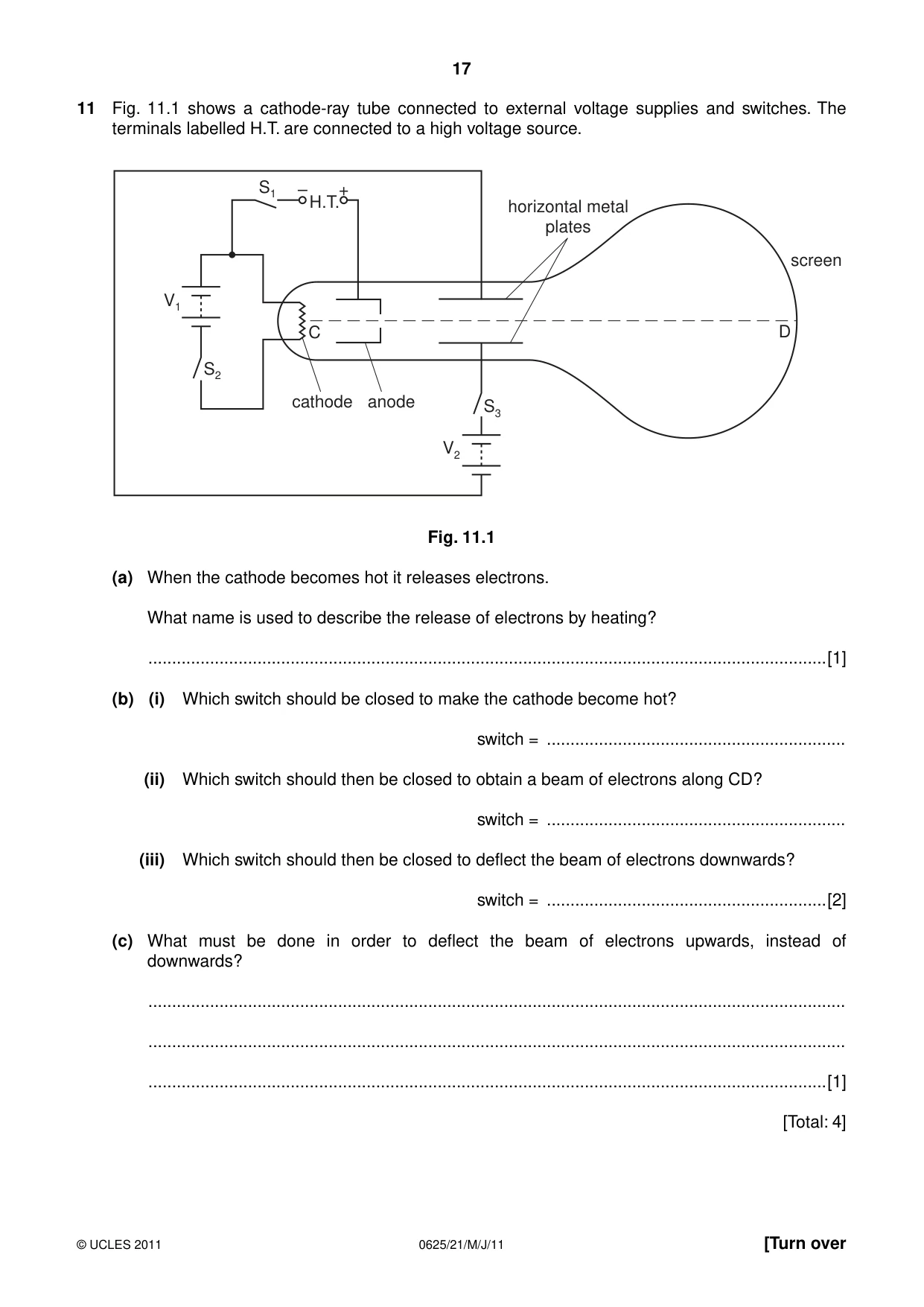
17 0625/21/M/J/11 © UCLES 2011 [Turn over 11 Fig. 11.1 shows a cathode-ray tube connected to external voltage supplies and switches. The terminals labelled H.T. are connected to a high voltage source. S1 V1 cathode anode C H.T. – + S2 V2 S3 horizontal metal plates screen D Fig. 11.1 (a) When the cathode becomes hot it releases electrons. What name is used to describe the release of electrons by heating? …[1] (b) (i) Which switch should be closed to make the cathode become hot? switch = … (ii) Which switch should then be closed to obtain a beam of electrons along CD? switch = … (iii) Which switch should then be closed to deflect the beam of electrons downwards? switch = …[2] (c) What must be done in order to deflect the beam of electrons upwards, instead of downwards? … … …[1] [Total: 4]
Question paper, page 18
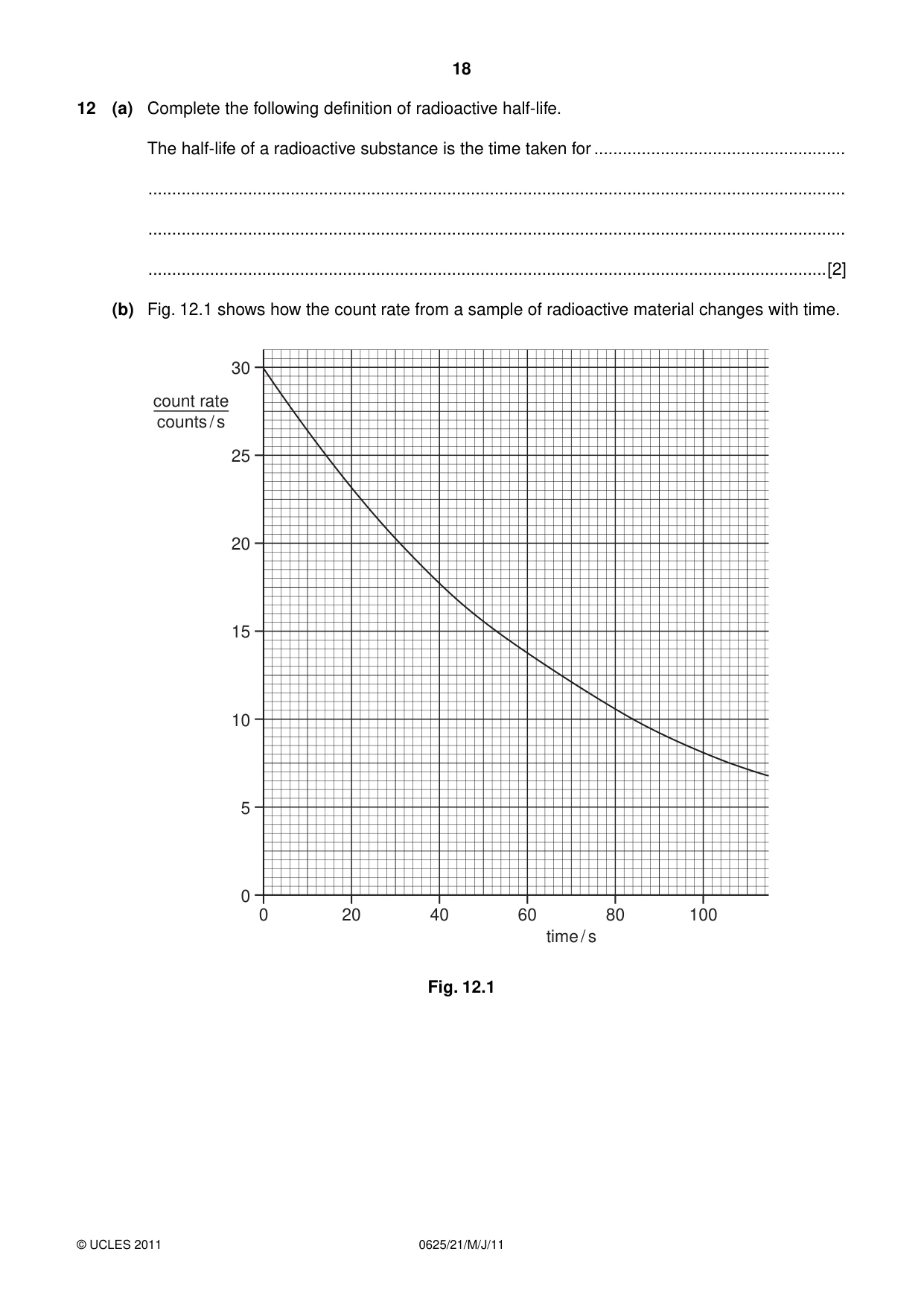
18 0625/21/M/J/11 © UCLES 2011 12 (a) Complete the following definition of radioactive half-life. The half-life of a radioactive substance is the time taken for … … … …[2] (b) Fig. 12.1 shows how the count rate from a sample of radioactive material changes with time. 0 0 5 10 15 20 25 count rate counts / s 30 20 40 60 80 time / s 100 Fig. 12.1
Question paper, page 19
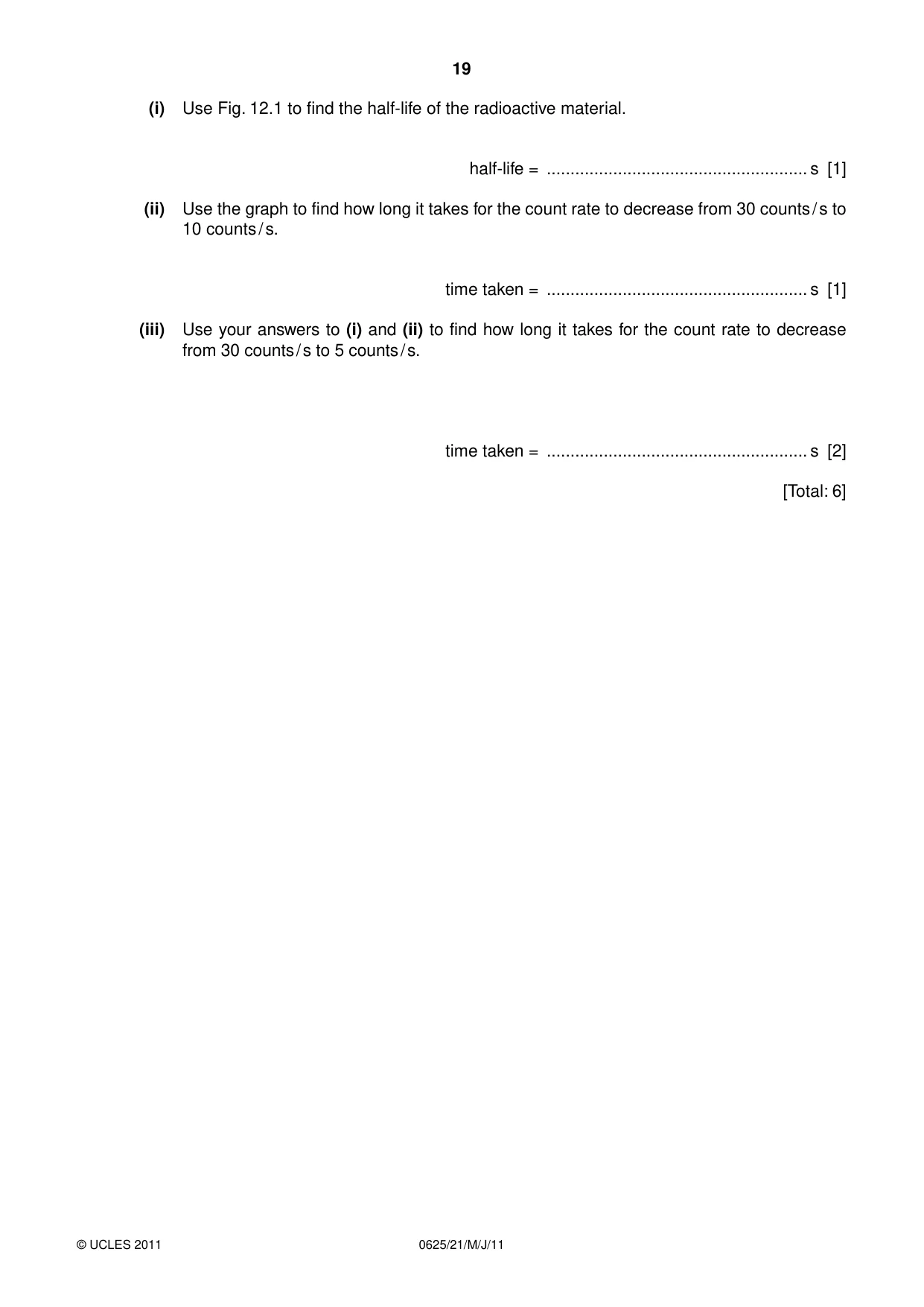
19 0625/21/M/J/11 © UCLES 2011 (i) Use Fig. 12.1 to find the half-life of the radioactive material. half-life = … s [1] (ii) Use the graph to find how long it takes for the count rate to decrease from 30 counts / s to 10 counts / s. time taken = … s [1] (iii) Use your answers to (i) and (ii) to find how long it takes for the count rate to decrease from 30 counts / s to 5 counts / s. time taken = … s [2] [Total: 6]
Question paper, page 20
20 0625/21/M/J/11 © UCLES 2011 BLANK PAGE Permission to reproduce items where third-party owned material protected by copyright is included has been sought and cleared where possible. Every reasonable effort has been made by the publisher (UCLES) to trace copyright holders, but if any items requiring clearance have unwittingly been included, the publisher will be pleased to make amends at the earliest possible opportunity. University of Cambridge International Examinations is part of the Cambridge Assessment Group. Cambridge Assessment is the brand name of University of Cambridge Local Examinations Syndicate (UCLES), which is itself a department of the University of Cambridge.
Mark scheme, page 1
UNIVERSITY OF CAMBRIDGE INTERNATIONAL EXAMINATIONS International General Certificate of Secondary Education MARK SCHEME for the May/June 2011 question paper for the guidance of teachers 0625 PHYSICS 0625/21 Paper 2 (Core Theory), maximum raw mark 80 This mark scheme is published as an aid to teachers and candidates, to indicate the requirements of the examination. It shows the basis on which Examiners were instructed to award marks. It does not indicate the details of the discussions that took place at an Examiners’ meeting before marking began, which would have considered the acceptability of alternative answers. Mark schemes must be read in conjunction with the question papers and the report on the examination. • Cambridge will not enter into discussions or correspondence in connection with these mark schemes. Cambridge is publishing the mark schemes for the May/June 2011 question papers for most IGCSE, GCE Advanced Level and Advanced Subsidiary Level syllabuses and some Ordinary Level syllabuses. www.XtremePapers.com
Mark scheme, page 2
Page 2 Mark Scheme: Teachers’ version Syllabus Paper IGCSE – May/June 2011 0625 21 © University of Cambridge International Examinations 2011 NOTES ABOUT MARK SCHEME SYMBOLS & OTHER MATTERS B marks are independent marks, which do not depend on any other marks. For a B mark to be scored, the point to which it refers must actually be seen in the candidate's answer. M marks are method marks upon which accuracy marks (A marks) later depend. For an M mark to be scored, the point to which it refers must be seen in a candidate's answer. If a candidate fails to score a particular M mark, then none of the dependent A marks can be scored. C marks are compensatory method marks which can be scored even if the points to which they refer are not written down by the candidate, provided subsequent working gives evidence that they must have known it. e.g. if an equation carries a C mark and the candidate does not write down the actual equation but does correct working which shows he knew the equation, then the C mark is scored. A marks are accuracy or answer marks which either depend on an M mark, or which are one of the ways which allow a C mark to be scored. c.a.o. means "correct answer only". e.c.f. means "error carried forward". This indicates that if a candidate has made an earlier mistake and has carried his incorrect value forward to subsequent stages of working, he may be given marks indicated by e.c.f. provided his subsequent working is correct, bearing in mind his earlier mistake. This prevents a candidate being penalised more than once for a particular mistake, but only applies to marks annotated "e.c.f." e.e.o.o. means "each error or omission". brackets ( ) around words or units in the mark scheme are intended to indicate wording used to clarify the mark scheme, but the marks do not depend on seeing the words or units in brackets. e.g. 10 (J) means that the mark is scored for 10, regardless of the unit given. underlining indicates that this must be seen in the answer offered, or something very similar. OR/or indicates alternative answers, any one of which is satisfactory for scoring the marks. Spelling Be generous about spelling and use of English. If an answer can be understood to mean what we want, give credit. Significant Answers are acceptable to any number of significant figures ≥ 2, except if specified figures otherwise, or if only 1 sig.fig. is appropriate. Units Incorrect units are not penalised, except where specified. More commonly, marks are allocated for specific units. Fractions These are only acceptable where specified. Extras Ignore extras in answers if they are irrelevant; if they contradict an otherwise correct response or are forbidden by mark scheme, use right + wrong = 0 Ignore Indicates that something which is not correct is disregarded and does not cause a right plus wrong penalty. Not/NOT Indicates that an incorrect answer is not to be disregarded, but cancels another otherwise correct alternative offered by the candidate i.e. right plus wrong penalty applies.
Mark scheme, page 3
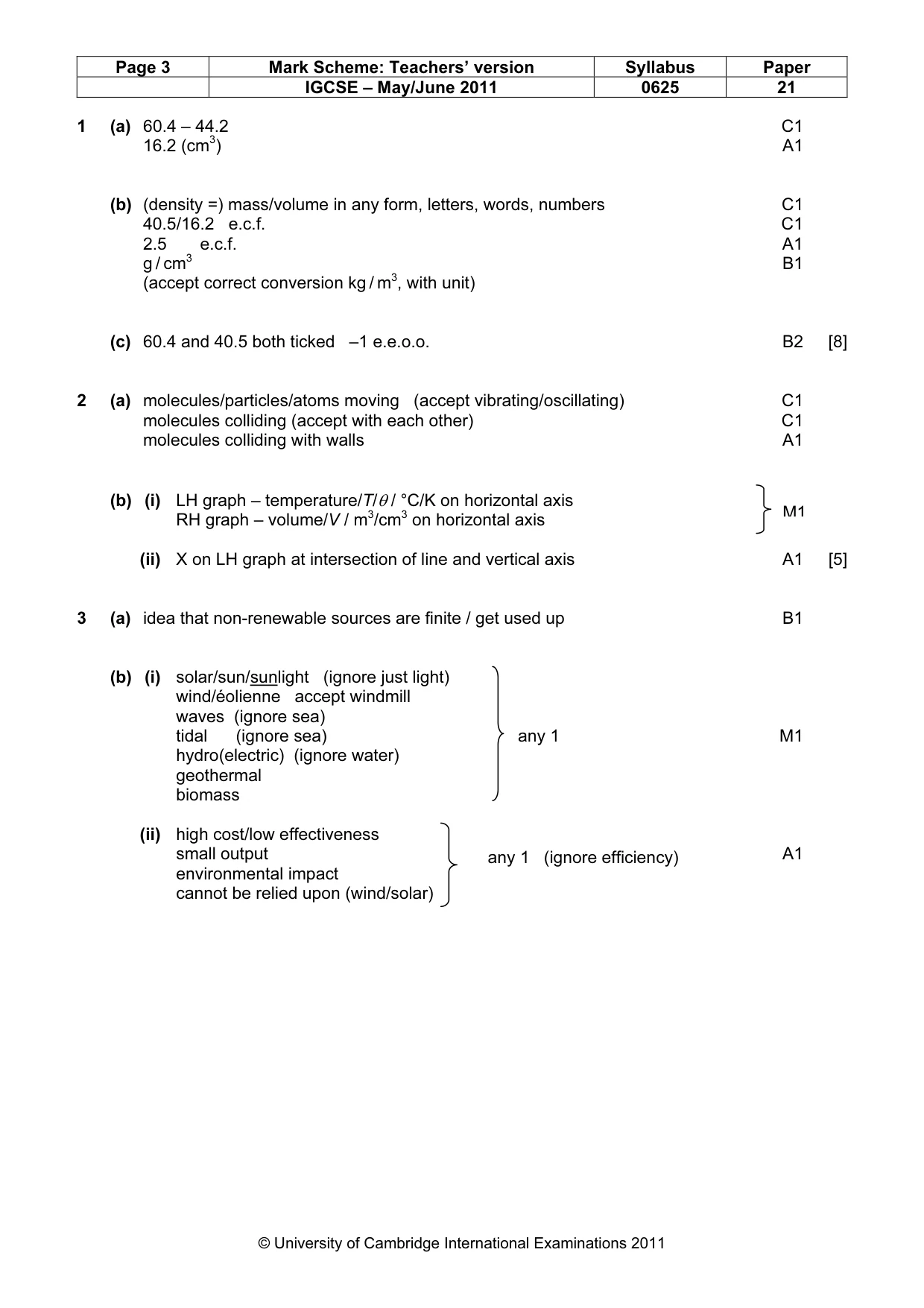
Page 3 Mark Scheme: Teachers’ version Syllabus Paper IGCSE – May/June 2011 0625 21 © University of Cambridge International Examinations 2011 1 (a) 60.4 – 44.2 C1 16.2 (cm3) A1 (b) (density =) mass/volume in any form, letters, words, numbers C1 40.5/16.2 e.c.f. C1 2.5 e.c.f. A1 g / cm3 B1 (accept correct conversion kg / m3, with unit) (c) 60.4 and 40.5 both ticked –1 e.e.o.o. B2 [8] 2 (a) molecules/particles/atoms moving (accept vibrating/oscillating) C1 molecules colliding (accept with each other) C1 molecules colliding with walls A1 (b) (i) LH graph – temperature/T/θ / °C/K on horizontal axis RH graph – volume/V / m3/cm3 on horizontal axis (ii) X on LH graph at intersection of line and vertical axis A1 [5] 3 (a) idea that non-renewable sources are finite / get used up B1 (b) (i) solar/sun/sunlight (ignore just light) wind/éolienne accept windmill waves (ignore sea) tidal (ignore sea) any 1 M1 hydro(electric) (ignore water) geothermal biomass (ii) high cost/low effectiveness small output A1 environmental impact cannot be relied upon (wind/solar) M1 any 1 (ignore efficiency)
Mark scheme, page 4
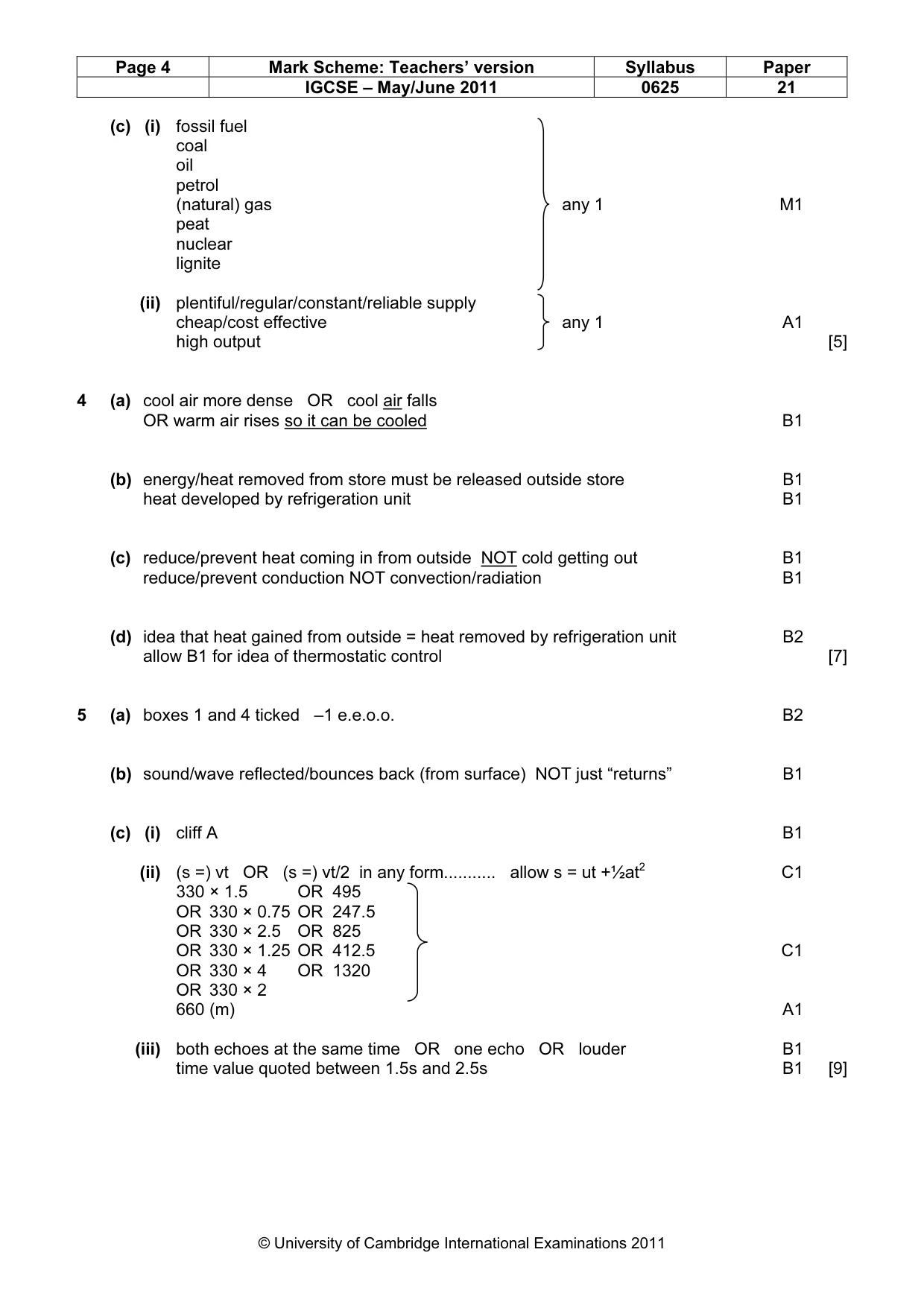
Page 4 Mark Scheme: Teachers’ version Syllabus Paper IGCSE – May/June 2011 0625 21 © University of Cambridge International Examinations 2011 (c) (i) fossil fuel coal oil petrol (natural) gas any 1 M1 peat nuclear lignite (ii) plentiful/regular/constant/reliable supply cheap/cost effective any 1 A1 high output [5] 4 (a) cool air more dense OR cool air falls OR warm air rises so it can be cooled B1 (b) energy/heat removed from store must be released outside store B1 heat developed by refrigeration unit B1 (c) reduce/prevent heat coming in from outside NOT cold getting out B1 reduce/prevent conduction NOT convection/radiation B1 (d) idea that heat gained from outside = heat removed by refrigeration unit B2 allow B1 for idea of thermostatic control [7] 5 (a) boxes 1 and 4 ticked –1 e.e.o.o. B2 (b) sound/wave reflected/bounces back (from surface) NOT just “returns” B1 (c) (i) cliff A B1 (ii) (s =) vt OR (s =) vt/2 in any form… allow s = ut +½at2 C1 330 × 1.5 OR 495 OR 330 × 0.75 OR 247.5 OR 330 × 2.5 OR 825 OR 330 × 1.25 OR 412.5 C1 OR 330 × 4 OR 1320 OR 330 × 2 660 (m) A1 (iii) both echoes at the same time OR one echo OR louder B1 time value quoted between 1.5s and 2.5s B1 [9]
Mark scheme, page 5
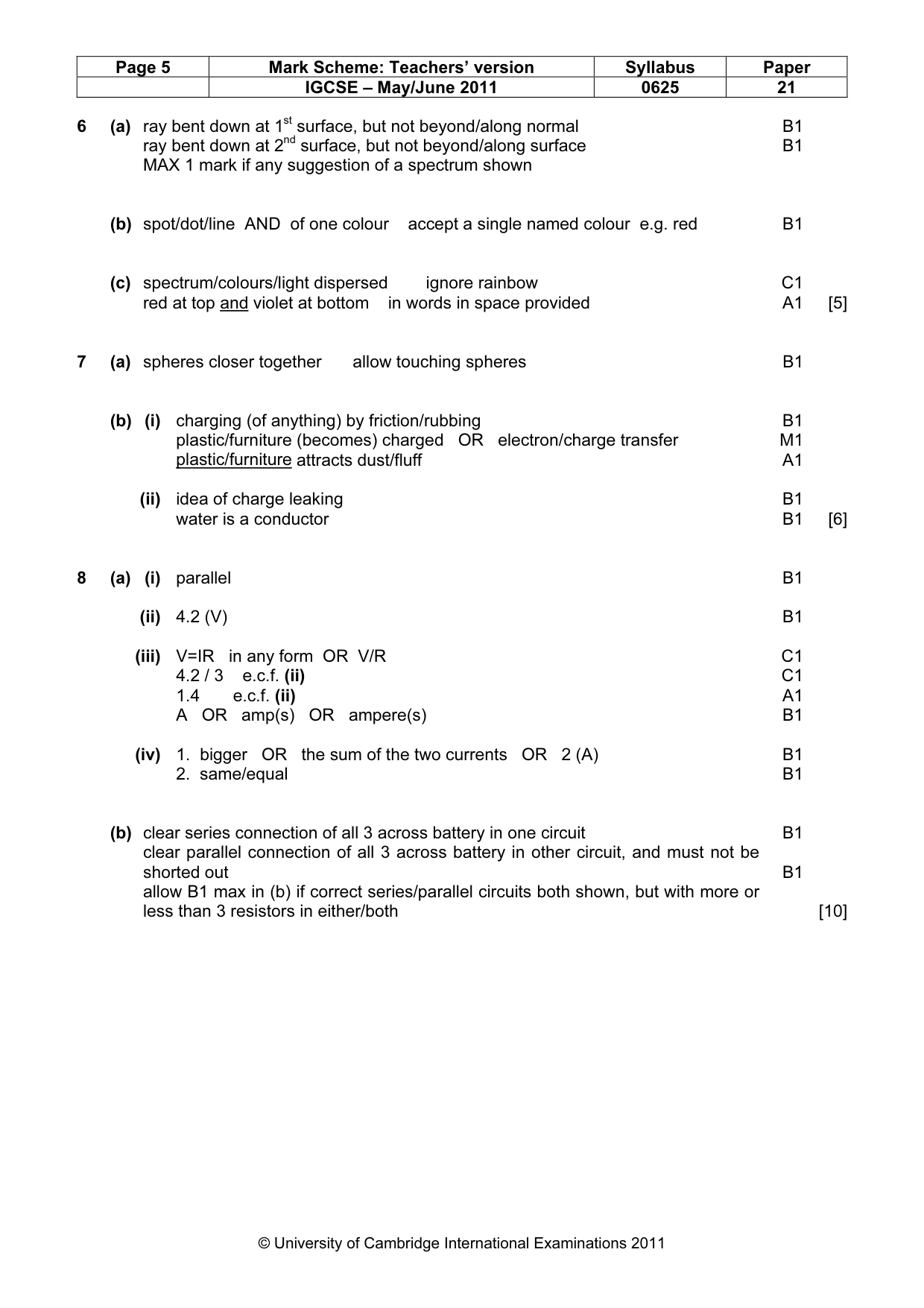
Page 5 Mark Scheme: Teachers’ version Syllabus Paper IGCSE – May/June 2011 0625 21 © University of Cambridge International Examinations 2011 6 (a) ray bent down at 1st surface, but not beyond/along normal B1 ray bent down at 2nd surface, but not beyond/along surface B1 MAX 1 mark if any suggestion of a spectrum shown (b) spot/dot/line AND of one colour accept a single named colour e.g. red B1 (c) spectrum/colours/light dispersed ignore rainbow C1 red at top and violet at bottom in words in space provided A1 [5] 7 (a) spheres closer together allow touching spheres B1 (b) (i) charging (of anything) by friction/rubbing B1 plastic/furniture (becomes) charged OR electron/charge transfer M1 plastic/furniture attracts dust/fluff A1 (ii) idea of charge leaking B1 water is a conductor B1 [6] 8 (a) (i) parallel B1 (ii) 4.2 (V) B1 (iii) V=IR in any form OR V/R C1 4.2 / 3 e.c.f. (ii) C1 1.4 e.c.f. (ii) A1 A OR amp(s) OR ampere(s) B1 (iv) 1. bigger OR the sum of the two currents OR 2 (A) B1 2. same/equal B1 (b) clear series connection of all 3 across battery in one circuit B1 clear parallel connection of all 3 across battery in other circuit, and must not be shorted out B1 allow B1 max in (b) if correct series/parallel circuits both shown, but with more or less than 3 resistors in either/both [10]
Mark scheme, page 6
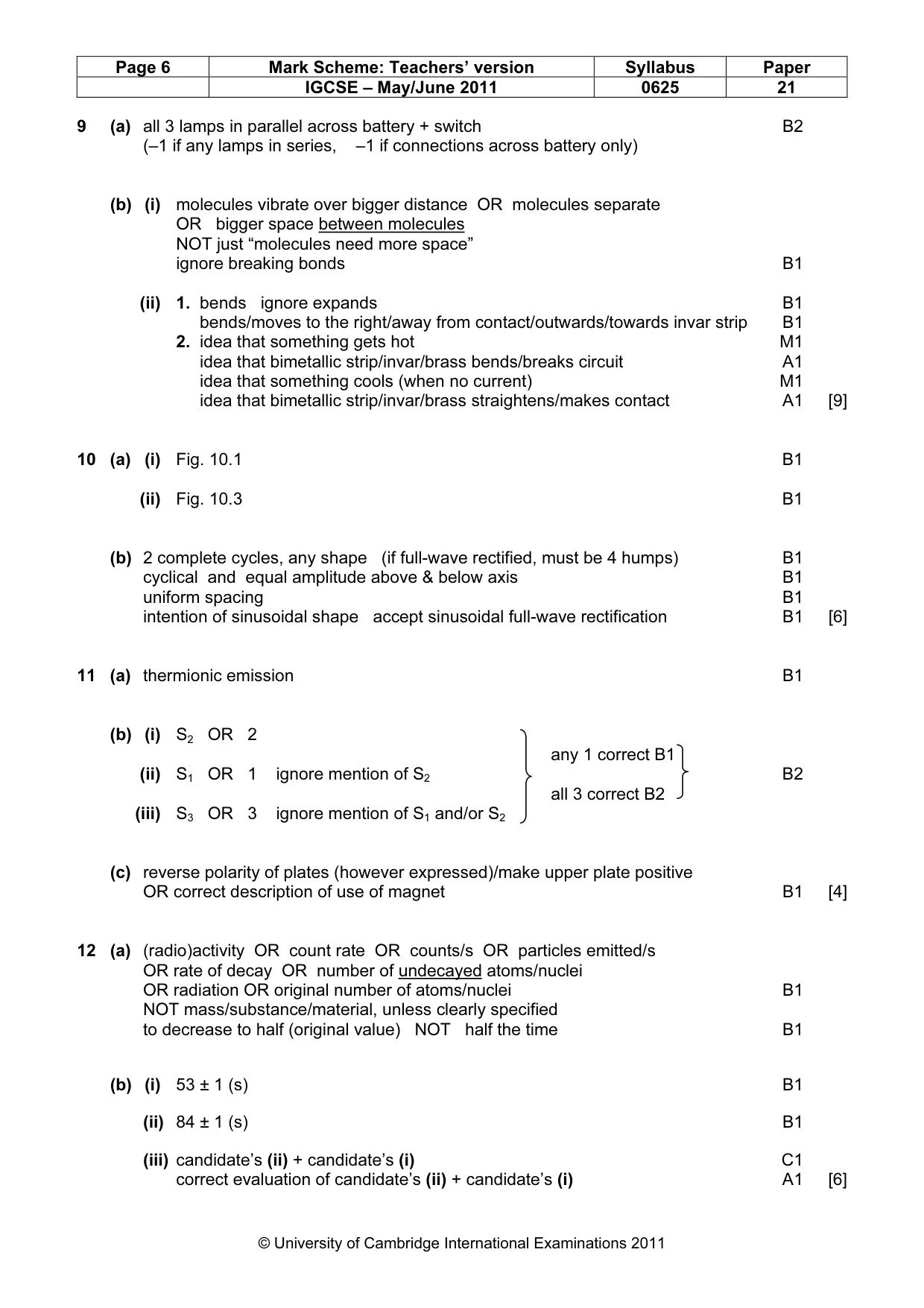
Page 6 Mark Scheme: Teachers’ version Syllabus Paper IGCSE – May/June 2011 0625 21 © University of Cambridge International Examinations 2011 9 (a) all 3 lamps in parallel across battery + switch B2 (–1 if any lamps in series, –1 if connections across battery only) (b) (i) molecules vibrate over bigger distance OR molecules separate OR bigger space between molecules NOT just “molecules need more space” ignore breaking bonds B1 (ii) 1. bends ignore expands B1 bends/moves to the right/away from contact/outwards/towards invar strip B1 2. idea that something gets hot M1 idea that bimetallic strip/invar/brass bends/breaks circuit A1 idea that something cools (when no current) M1 idea that bimetallic strip/invar/brass straightens/makes contact A1 [9] 10 (a) (i) Fig. 10.1 B1 (ii) Fig. 10.3 B1 (b) 2 complete cycles, any shape (if full-wave rectified, must be 4 humps) B1 cyclical and equal amplitude above & below axis B1 uniform spacing B1 intention of sinusoidal shape accept sinusoidal full-wave rectification B1 [6] 11 (a) thermionic emission B1 (b) (i) S2 OR 2 any 1 correct B1 (ii) S1 OR 1 ignore mention of S2 B2 all 3 correct B2 (iii) S3 OR 3 ignore mention of S1 and/or S2 (c) reverse polarity of plates (however expressed)/make upper plate positive OR correct description of use of magnet B1 [4] 12 (a) (radio)activity OR count rate OR counts/s OR particles emitted/s OR rate of decay OR number of undecayed atoms/nuclei OR radiation OR original number of atoms/nuclei B1 NOT mass/substance/material, unless clearly specified to decrease to half (original value) NOT half the time B1 (b) (i) 53 ± 1 (s) B1 (ii) 84 ± 1 (s) B1 (iii) candidate’s (ii) + candidate’s (i) C1 correct evaluation of candidate’s (ii) + candidate’s (i) A1 [6]
What you needed in this session
Cambridge’s own grade thresholds for 2011 May/June, Paper 2 · Variant 1. A higher threshold means an easier paper — the bar moves with how the cohort did.