Questions as text
Q1 · Which type of element is found on the left-hand side of the Periodic Table? 0652/11 Oct/Nov 2005
12 Which type of element is found on the left-hand side of the Periodic Table? A halogen B metal C noble gas D non-metal
1 marks
Answer: B
This question in 0652/11 Oct/Nov 2005
Q2 · The diagram shows part of the Periodic Table 0652/11 Oct/Nov 2008
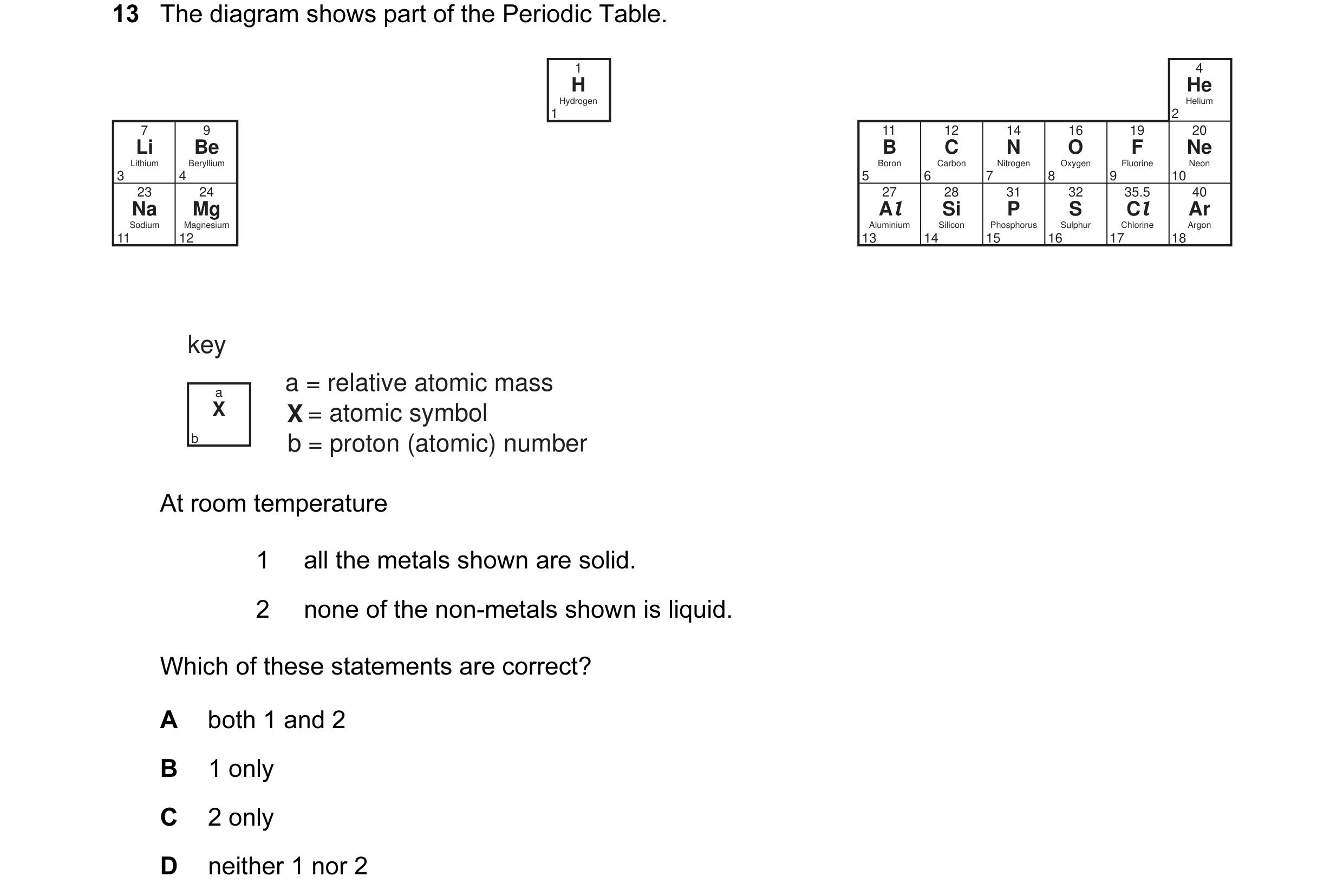
13 The diagram shows part of the Periodic Table. 1 4 H He 1 Hydrogen 2 Helium 7 9 11 12 14 16 19 20 Li Be B C N O F Ne 3 Lithium 4 Beryllium 5 Boron 6 Carbon 7 Nitrogen 8 Oxygen 9 Fluorine 10 Neon 23 24 27 28 31 32 35.5 40 Na Mg Al Si P S Cl Ar 11 Sodium 12 Magnesium 13 Aluminium 14 Silicon 15 Phosphorus 16 Sulphur 17 Chlorine 18 Argon key a = relative atomic mass a X X = atomic symbol b b = proton (atomic) number At room temperature 1 all the metals shown are solid. 2 none of the non-metals shown is liquid. Which of these statements are correct? A both 1 and 2 B 1 only C 2 only D neither 1 nor 2
1 marks
Answer: A
This question in 0652/11 Oct/Nov 2008
Q3 · The diagram shows an outline of part of the Periodic Table 0652/11 Oct/Nov 2011
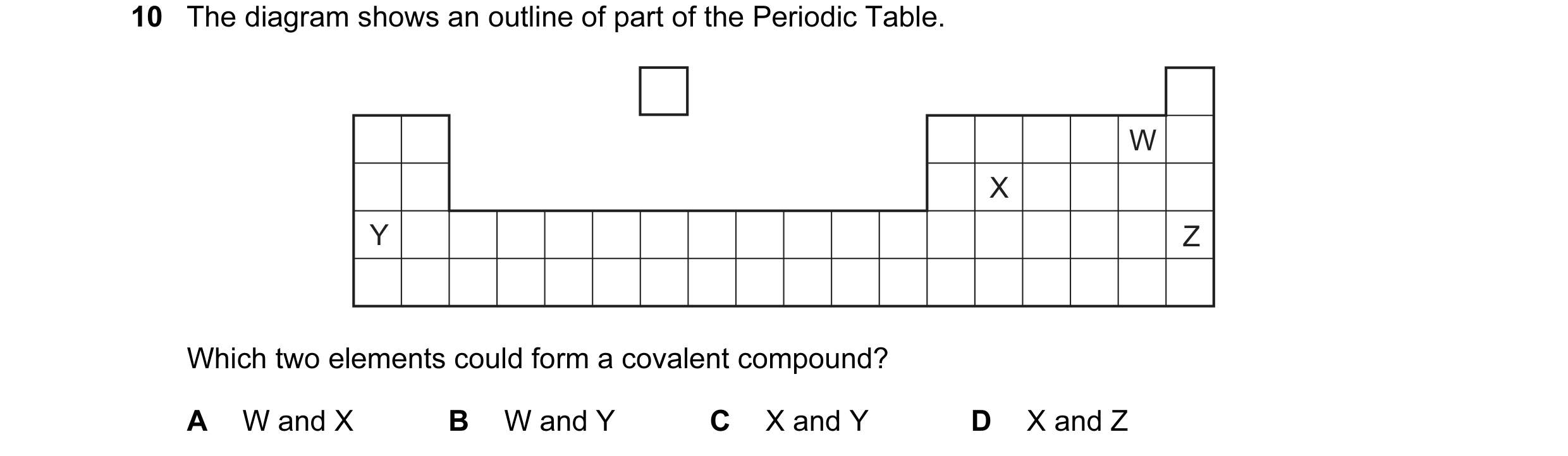
10 The diagram shows an outline of part of the Periodic Table. W X Y Z Which two elements could form a covalent compound? A W and X B W and Y C X and Y D X and Z
1 marks
Answer: A
This question in 0652/11 Oct/Nov 2011
Q4 · The element technetium, Tc (proton number 43), does not exist in nature 0652/11 Oct/Nov 2011
12 The element technetium, Tc (proton number 43), does not exist in nature. From its position in the Periodic Table, which description of technetium is most likely to be correct? A It is a brittle solid of low melting point. B It is a metal with a high melting point. C It is a soft, very reactive metal. D It is an unreactive gas.
1 marks
Answer: B
This question in 0652/11 Oct/Nov 2011
Q5 · The diagram shows an outline of part of the Periodic Table 0652/12 Oct/Nov 2011
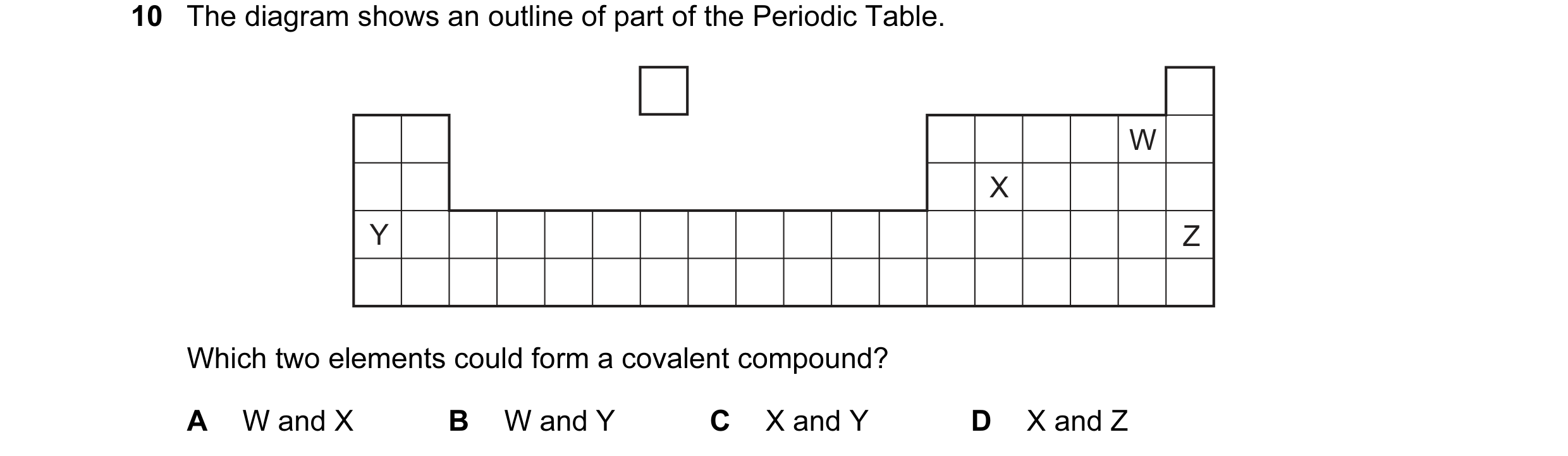
10 The diagram shows an outline of part of the Periodic Table. W X Y Z Which two elements could form a covalent compound? A W and X B W and Y C X and Y D X and Z
1 marks
Answer: A
This question in 0652/12 Oct/Nov 2011
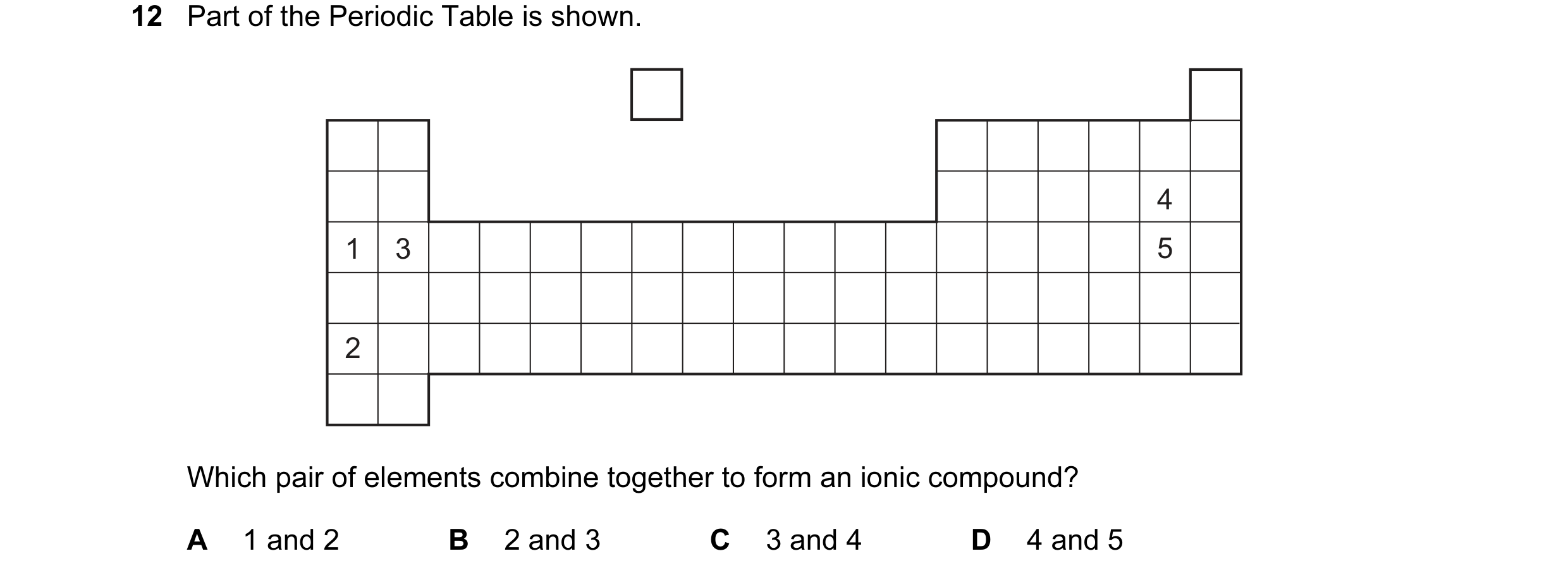
Q6 · Part of the Periodic Table is shown 0652/12 Oct/Nov 2016
12 Part of the Periodic Table is shown. 4 1 3 5 2 Which pair of elements combine together to form an ionic compound? A 1 and 2 B 2 and 3 C 3 and 4 D 4 and 5
1 marks
Answer: C
This question in 0652/12 Oct/Nov 2016
Q7 · Which statement about metals or non-metals is correct? 0652/12 Oct/Nov 2016
14 Which statement about metals or non-metals is correct? A Metals are poor conductors of heat. B Most metals have low melting points. C Most non-metals are poor conductors of electricity. D Non-metals are malleable.
1 marks
Answer: C
This question in 0652/12 Oct/Nov 2016
Q8 · Part of the Periodic Table is shown 0652/12 Oct/Nov 2019
11 Part of the Periodic Table is shown. The letters are not the usual chemical symbols of the elements. X Y W Z Which pair of elements are metals? A W and X B W and Z C X and Y D Y and Z
1 marks
Answer: A
This question in 0652/12 Oct/Nov 2019
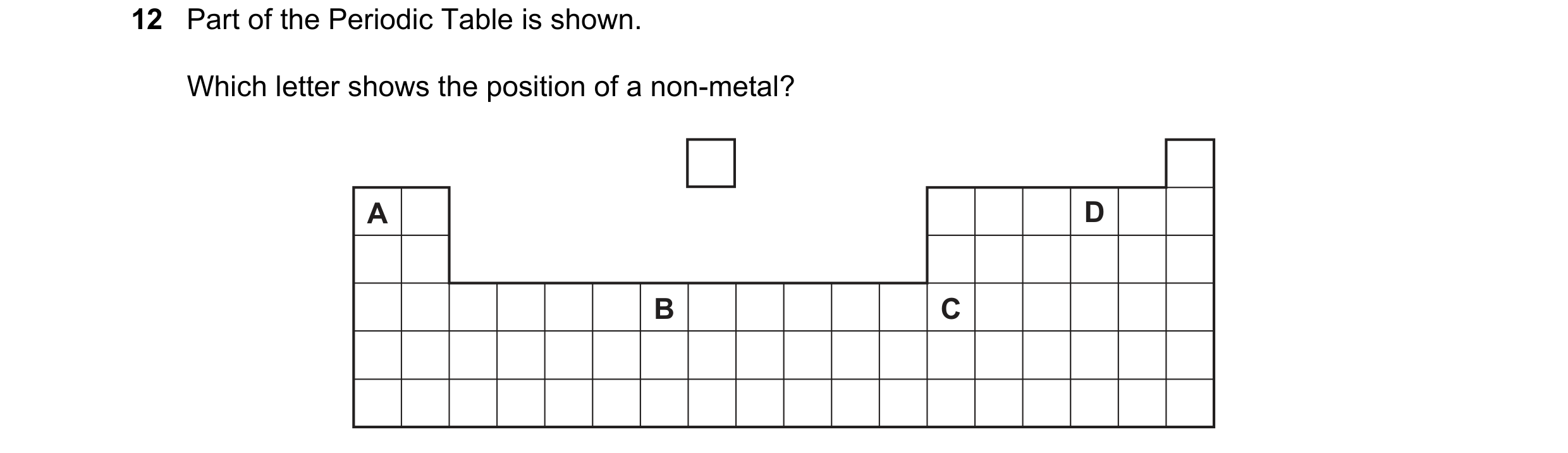
Q9 · Part of the Periodic Table is shown 0652/11 Oct/Nov 2022
12 Part of the Periodic Table is shown. Which letter shows the position of a non-metal? A D B C
1 marks
Answer: D
This question in 0652/11 Oct/Nov 2022
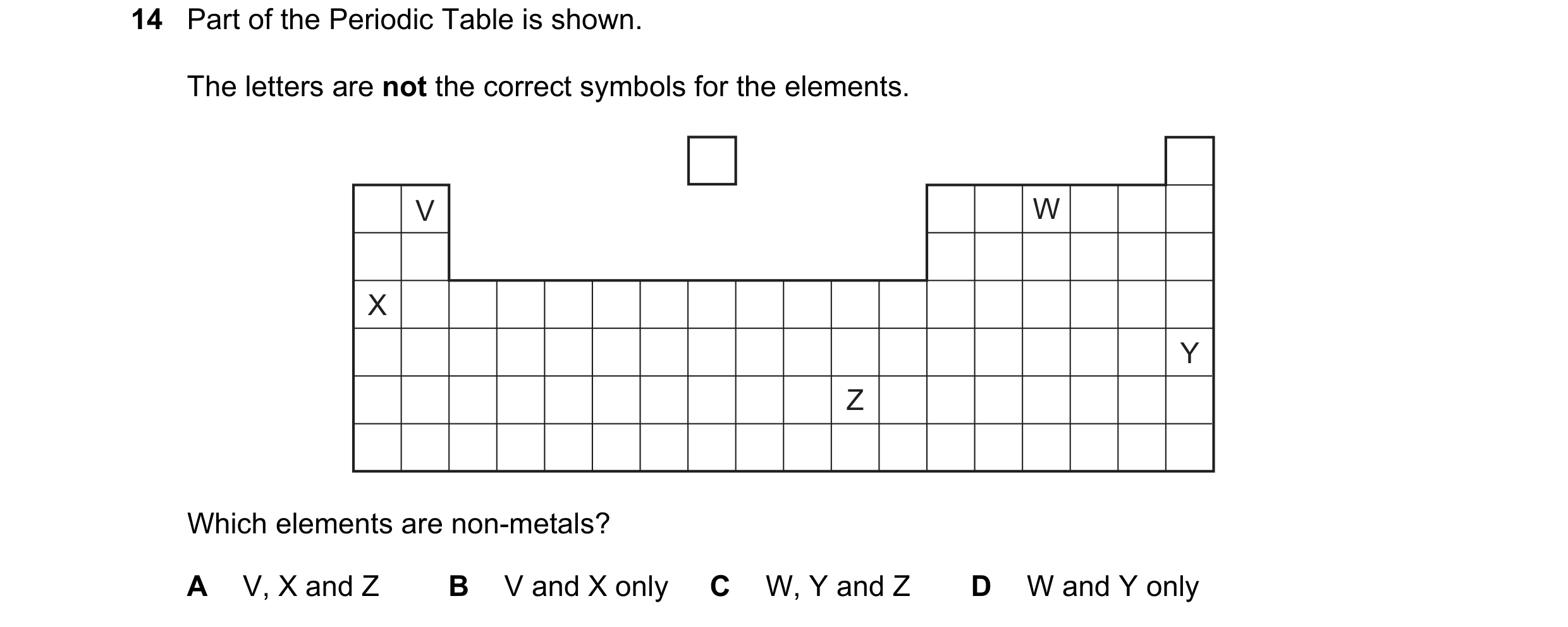
Q10 · Part of the Periodic Table is shown 0652/11 Oct/Nov 2023
14 Part of the Periodic Table is shown. The letters are not the correct symbols for the elements. V W X Y Z Which elements are non-metals? A V, X and Z B V and X only C W, Y and Z D W and Y only
1 marks
Answer: D
This question in 0652/11 Oct/Nov 2023
Q11 · Part of the Periodic Table is shown 0652/12 Oct/Nov 2023
14 Part of the Periodic Table is shown. The letters are not the correct symbols for the elements. V W X Y Z Which elements are non-metals? A V, X and Z B V and X only C W, Y and Z D W and Y only
1 marks
Answer: D
This question in 0652/12 Oct/Nov 2023

 1 / 4
1 / 4
 2 / 4
2 / 4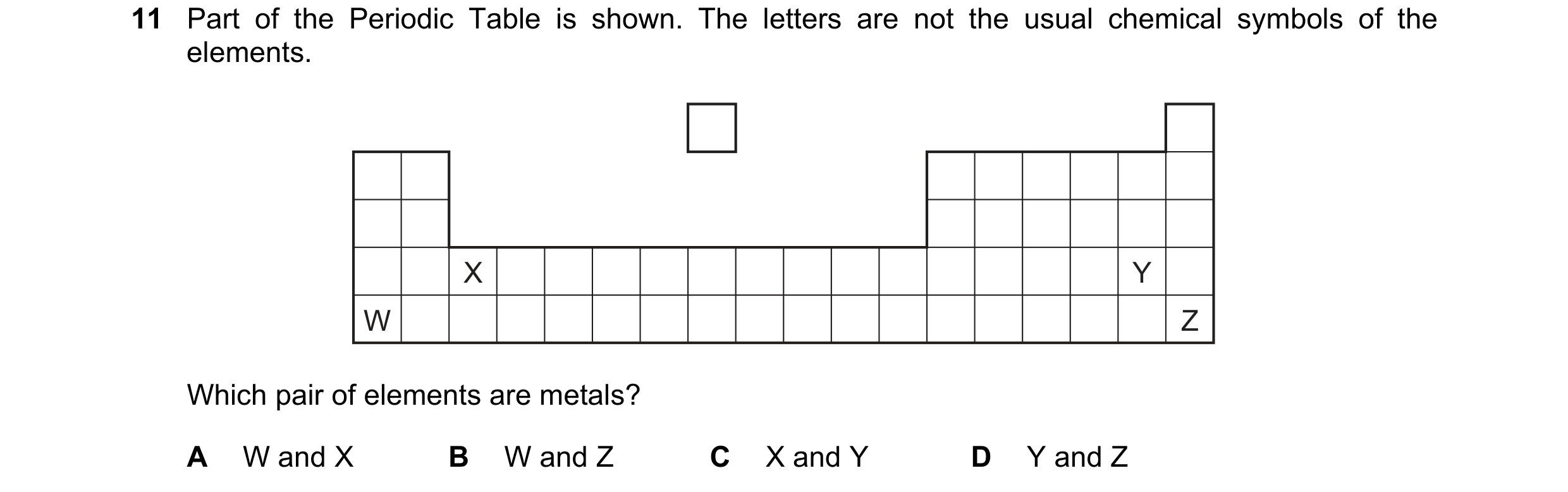
 3 / 4
3 / 4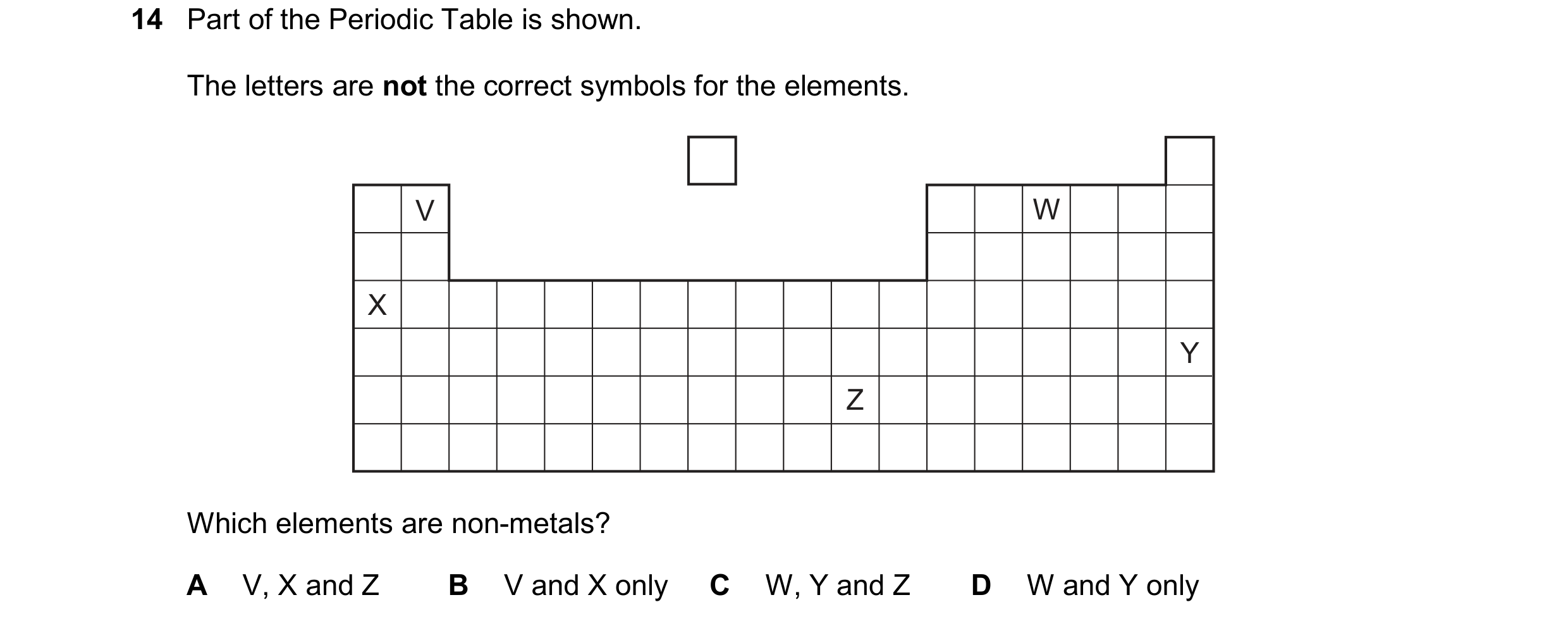 4 / 4
4 / 4