Cambridge IGCSE Physical Science 0652 — 2018 Oct/Nov Paper 3 · Variant 1
0652/31/O/N/18 · 13 questions · 80 marks · ≈90 min
The question paper and its mark scheme, free to read here and free to download. This is Cambridge’s own paper, exactly as it was sat.
Question paper20 pages

Mark scheme9 pages
Answers below. Sit the paper first if you are practising.
Questions as text
Q1 · A toy car in two positions on a ramp
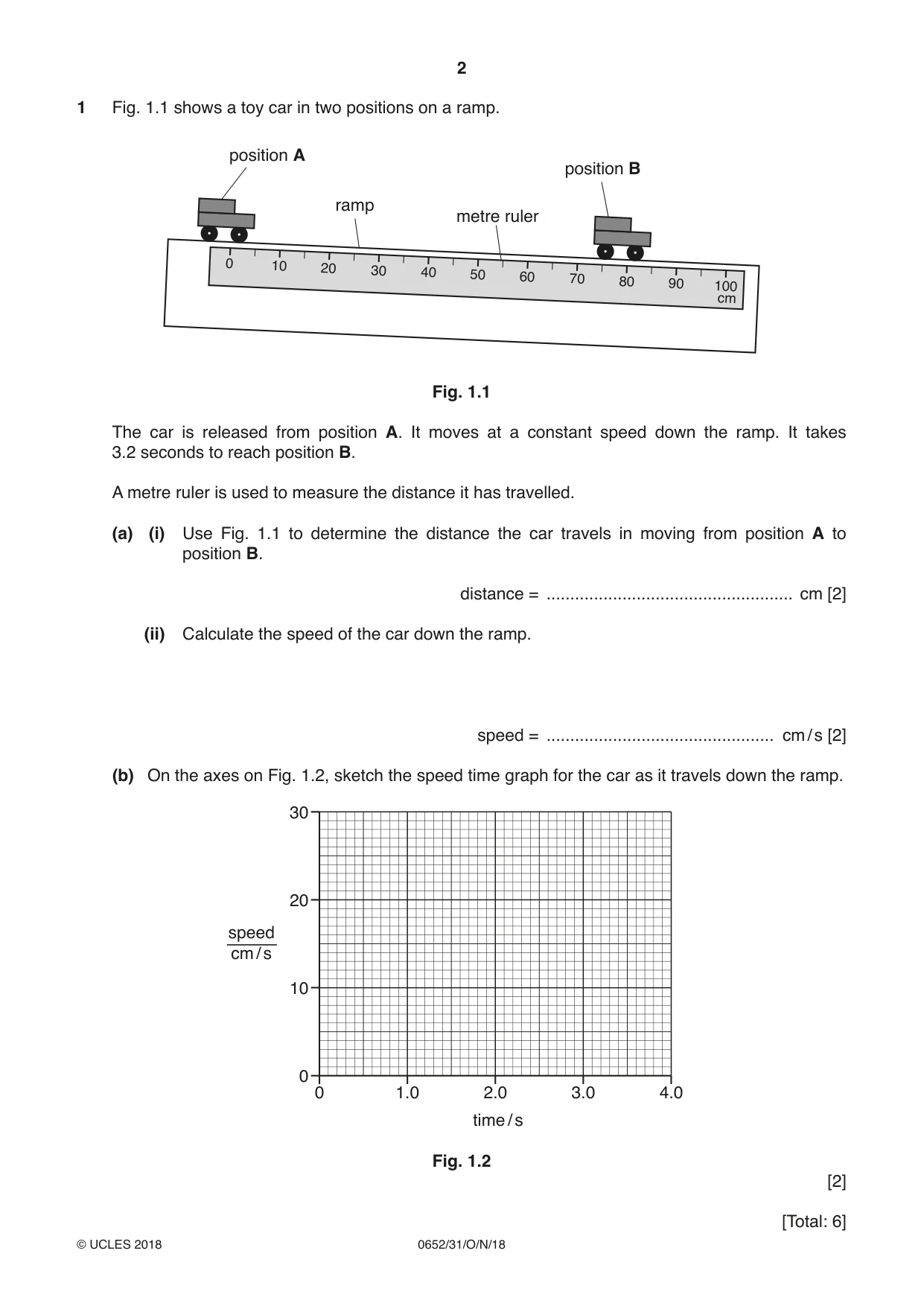
1 Fig. 1.1 shows a toy car in two positions on a ramp. position A position B ramp metre ruler 0 10 20 30 40 50 60 70 80 90 100 cm Fig. 1.1 The car is released from position A. It moves at a constant speed down the ramp. It takes 3.2 seconds to reach position B. A metre ruler is used to measure the distance it has travelled. (a) (i) Use Fig. 1.1 to determine the distance the car travels in moving from position A to position B. distance = .................................................... cm [2] (ii) Calculate the speed of the car down the ramp. speed = ................................................ cm / s [2] (b) On the axes on Fig. 1.2, sketch the speed time graph for the car as it travels down the ramp. 30 20 speed cm / s 10 0 0 1.0 2.0 3.0 4.0 time / s Fig. 1.2 [2] [Total: 6]
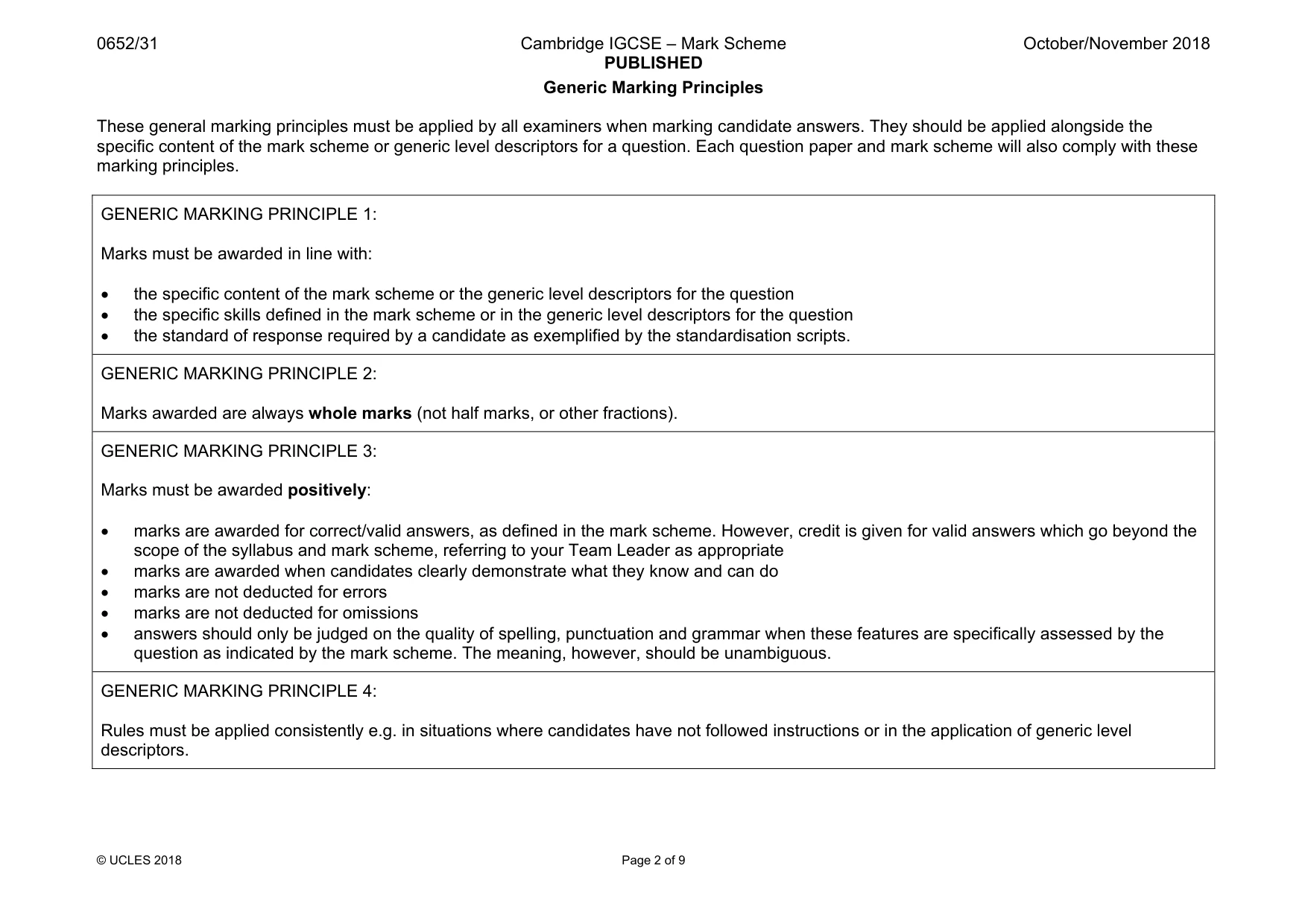
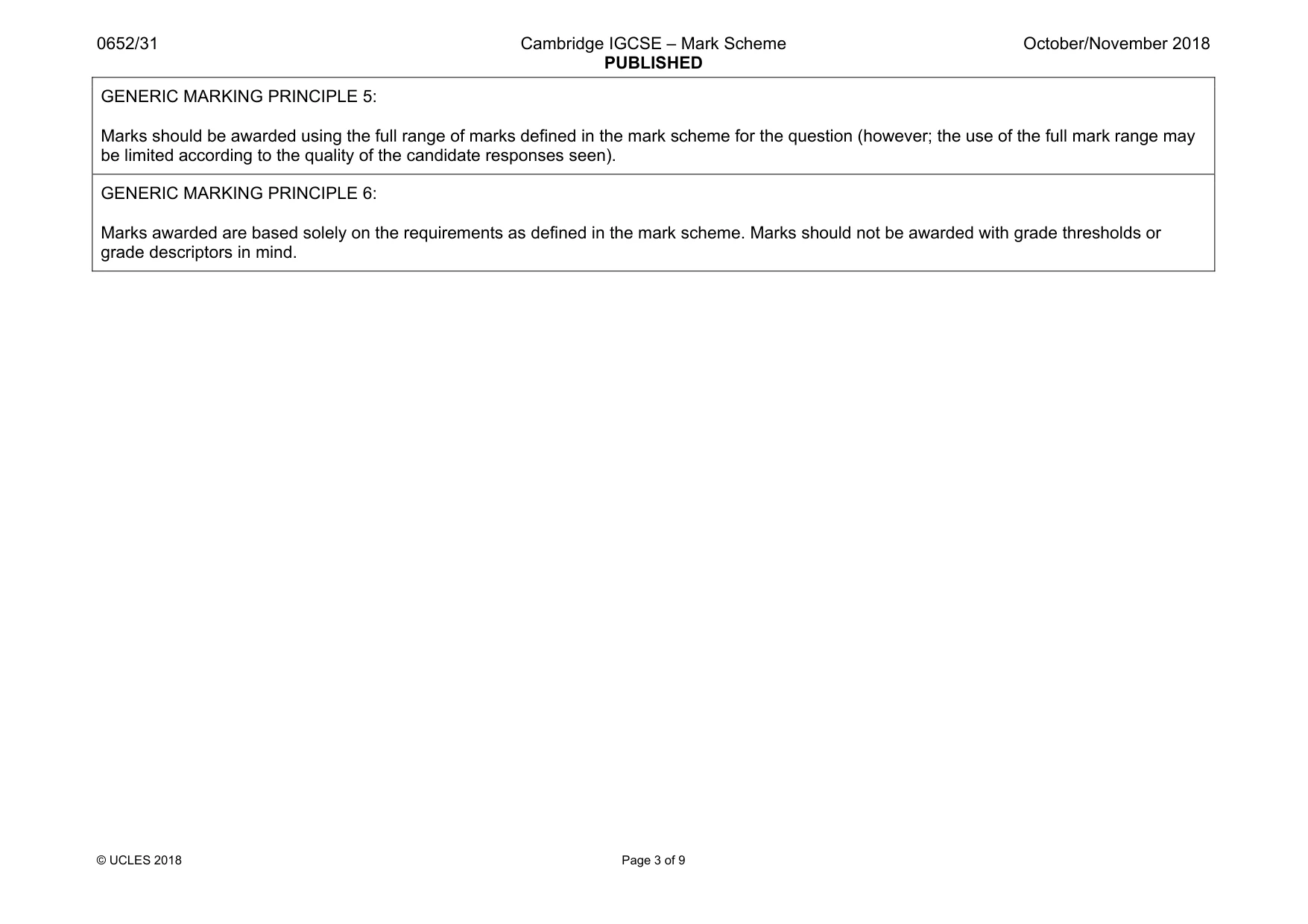
Mark scheme: 1(a)(i) recognition that starting point is 5 cm OR finishing point is 85 (cm) ; 80 (cm) ; 2 1(a)(ii) (speed =) distance / time OR 80 / 3.2 ; 25 (cm / s) ; 2 1(b) straight horizontal line ; speed clearly 25 cm / s ; 2
Q2 · The transition elements are a collection of metals in the Periodic Table
2 The transition elements are a collection of metals in the Periodic Table. Transition metals or their compounds are often used as catalysts. (a) State two other general properties of transition elements. 1 ................................................................................................................................................ 2 ................................................................................................................................................ [2] (b) Some metals occur ‘native’ in the Earth’s crust. Name two transition elements which occur native. 1 ................................................................................................................................................ 2 ................................................................................................................................................ [2] (c) Name the transition metal alloyed with chromium to make stainless steel. .............................................................................................................................................. [1] (d) Name the transition metal in the ore hematite. .............................................................................................................................................. [1] [Total: 6]
Mark scheme: 2(a) any two from: • high melting points • high densities • form coloured compounds • act as catalysts ;; 2 2(b) any two suitable transition elements examples: e.g. copper / gold ;; 2 2(c) iron ; 1 2(d) iron ; 1
Question 3
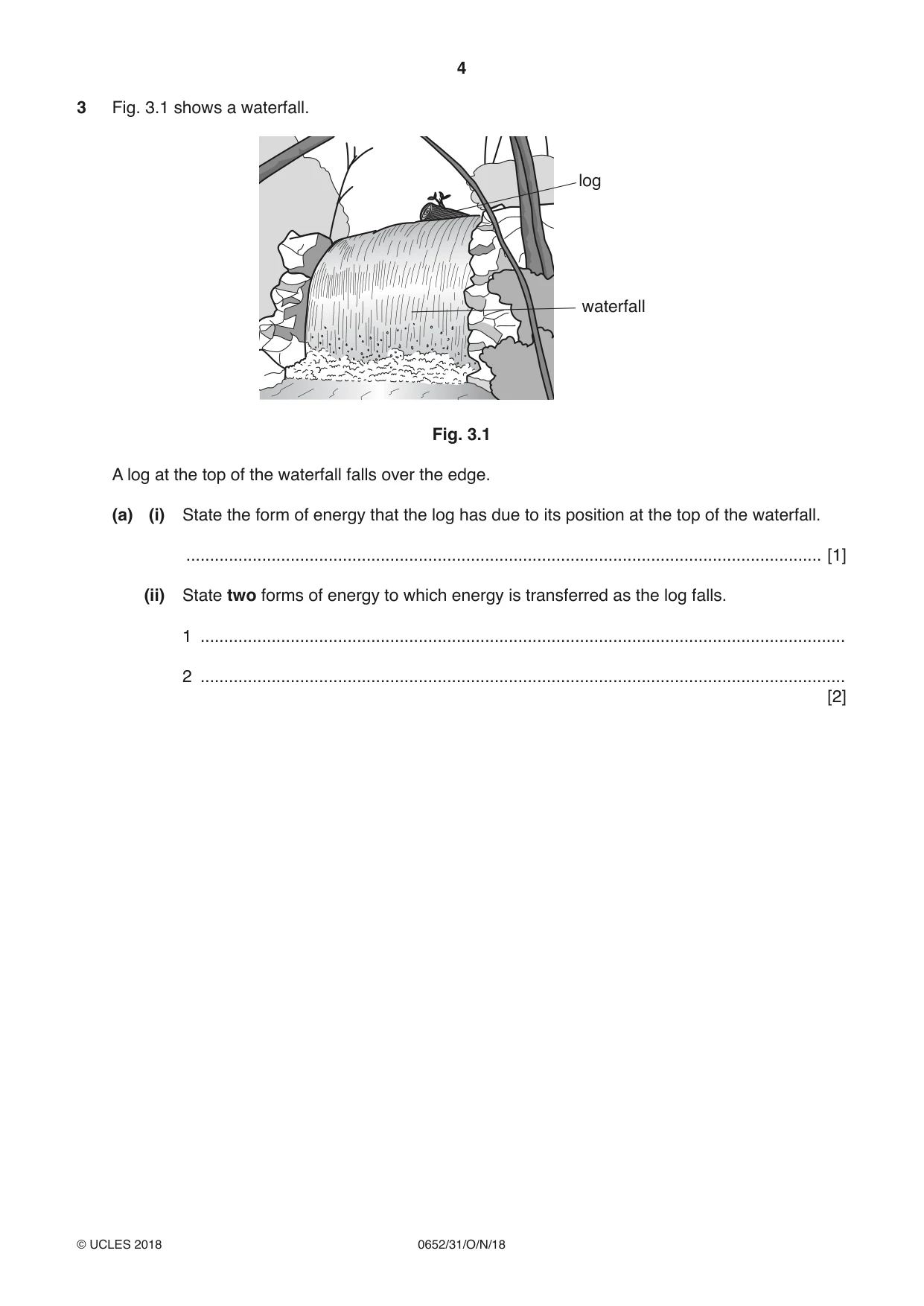
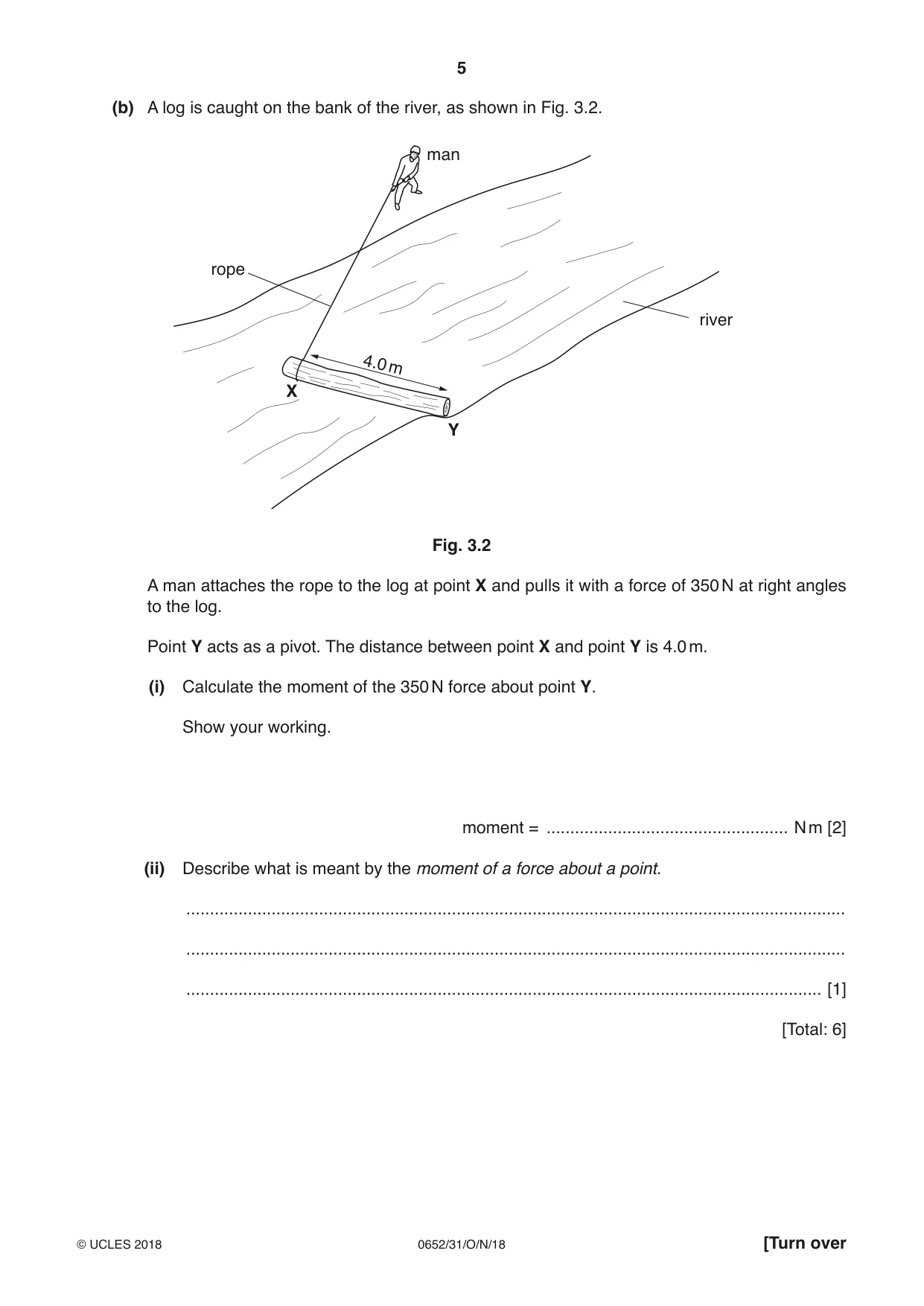
3 Fig. 3.1 shows a waterfall. log waterfall Fig. 3.1 A log at the top of the waterfall falls over the edge. (a) (i) State the form of energy that the log has due to its position at the top of the waterfall. ...................................................................................................................................... [1] (ii) State two forms of energy to which energy is transferred as the log falls. 1 ........................................................................................................................................ 2 ........................................................................................................................................ [2] (b) A log is caught on the bank of the river, as shown in Fig. 3.2. man rope river 4.0m X Y Fig. 3.2 A man attaches the rope to the log at point X and pulls it with a force of 350 N at right angles to the log. Point Y acts as a pivot. The distance between point X and point Y is 4.0 m. (i) Calculate the moment of the 350 N force about point Y. Show your working. moment = ................................................... N m [2] (ii) Describe what is meant by the moment of a force about a point. ........................................................................................................................................... ........................................................................................................................................... ...................................................................................................................................... [1] [Total: 6]
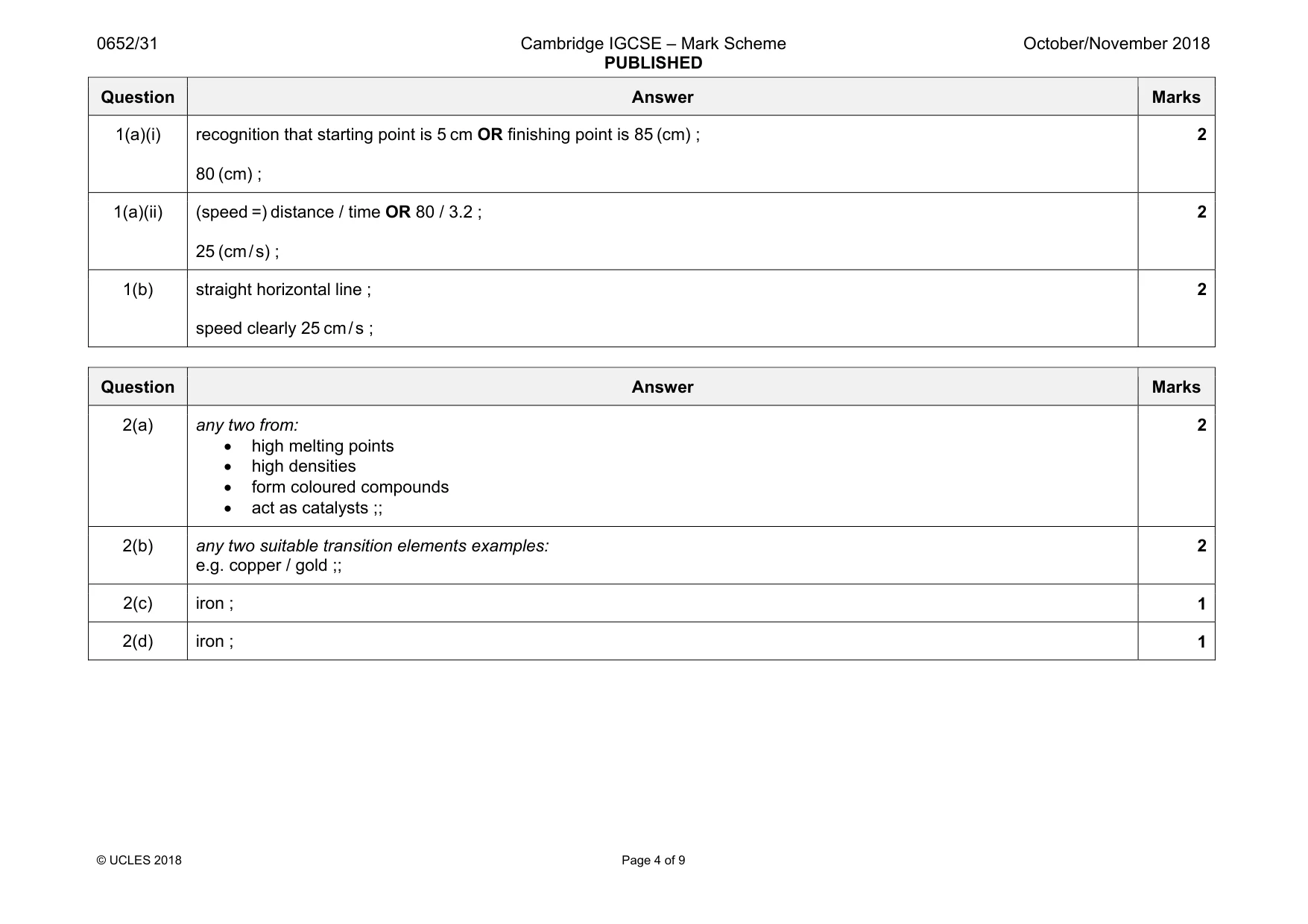
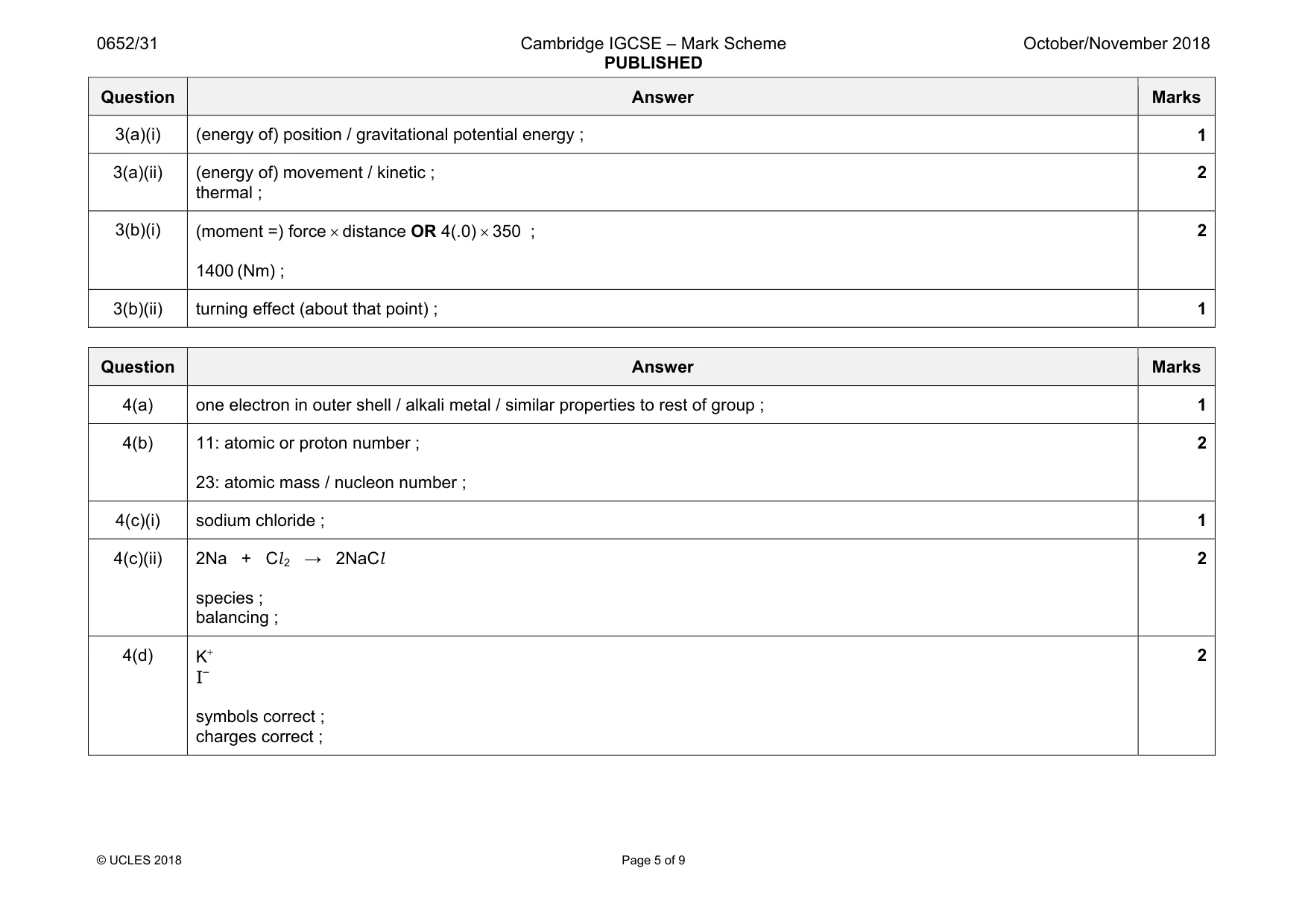
Mark scheme: 3(a)(i) (energy of) position / gravitational potential energy ; 1 3(a)(ii) (energy of) movement / kinetic ; thermal ; 2 3(b)(i) (moment =) force × distance OR 4(.0) × 350 ; 1400 (Nm) ; 2 3(b)(ii) turning effect (about that point) ; 1
Q4 · Sodium is an element in Group I of the Periodic Table
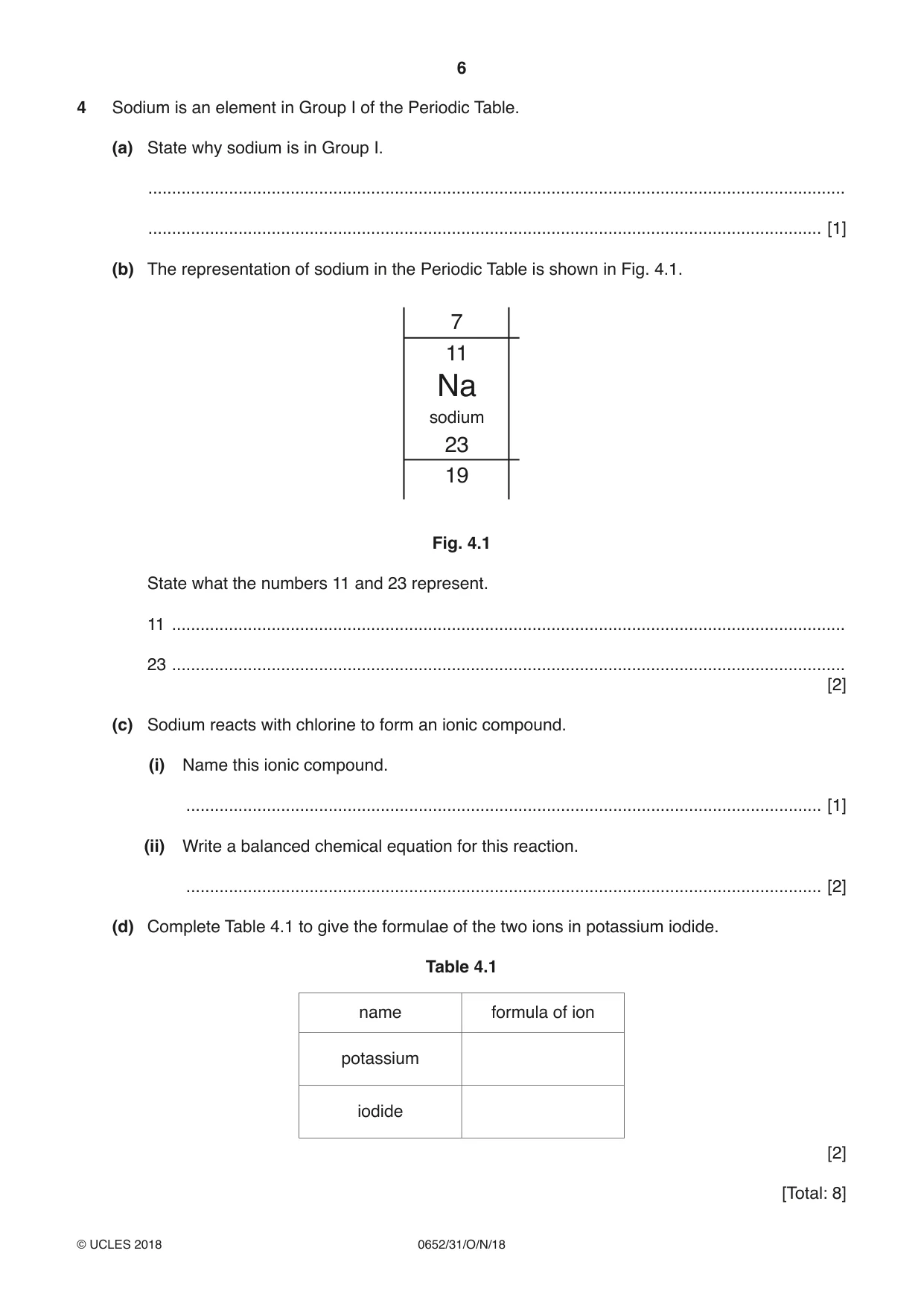
4 Sodium is an element in Group I of the Periodic Table. (a) State why sodium is in Group I. ................................................................................................................................................... .............................................................................................................................................. [1] (b) The representation of sodium in the Periodic Table is shown in Fig. 4.1. 7 11 Na sodium 23 19 Fig. 4.1 State what the numbers 11 and 23 represent. 11 .............................................................................................................................................. 23 .............................................................................................................................................. [2] (c) Sodium reacts with chlorine to form an ionic compound. (i) Name this ionic compound. ...................................................................................................................................... [1] (ii) Write a balanced chemical equation for this reaction. ...................................................................................................................................... [2] (d) Complete Table 4.1 to give the formulae of the two ions in potassium iodide. Table 4.1 name formula of ion potassium iodide [2] [Total: 8]
Mark scheme: 4(a) one electron in outer shell / alkali metal / similar properties to rest of group ; 1 4(b) 11: atomic or proton number ; 23: atomic mass / nucleon number ; 2 4(c)(i) sodium chloride ; 1 4(c)(ii) 2Na + Cl 2 → 2NaCl species ; balancing ; 2 4(d) K+ I– symbols correct ; charges correct ; 2
Question 5
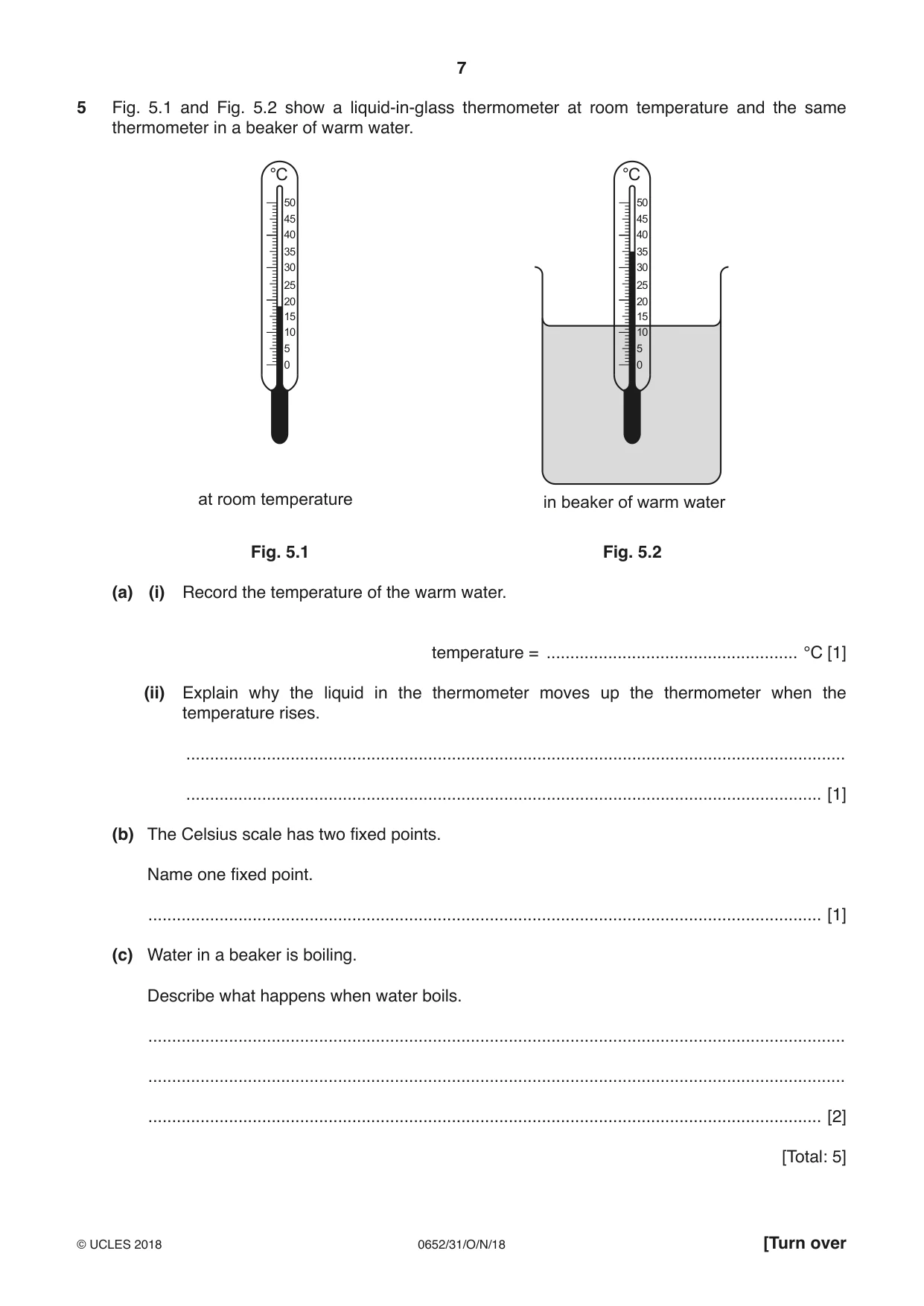
5 Fig. 5.1 and Fig. 5.2 show a liquid-in-glass thermometer at room temperature and the same thermometer in a beaker of warm water. °C °C 50 50 45 45 40 40 35 35 30 30 25 25 20 20 15 15 10 10 5 5 0 0 at room temperature in beaker of warm water Fig. 5.1 Fig. 5.2 (a) (i) Record the temperature of the warm water. temperature = ..................................................... °C [1] (ii) Explain why the liquid in the thermometer moves up the thermometer when the temperature rises. ........................................................................................................................................... ...................................................................................................................................... [1] (b) The Celsius scale has two fixed points. Name one fixed point. .............................................................................................................................................. [1] (c) Water in a beaker is boiling. Describe what happens when water boils. ................................................................................................................................................... ................................................................................................................................................... .............................................................................................................................................. [2] [Total: 5]
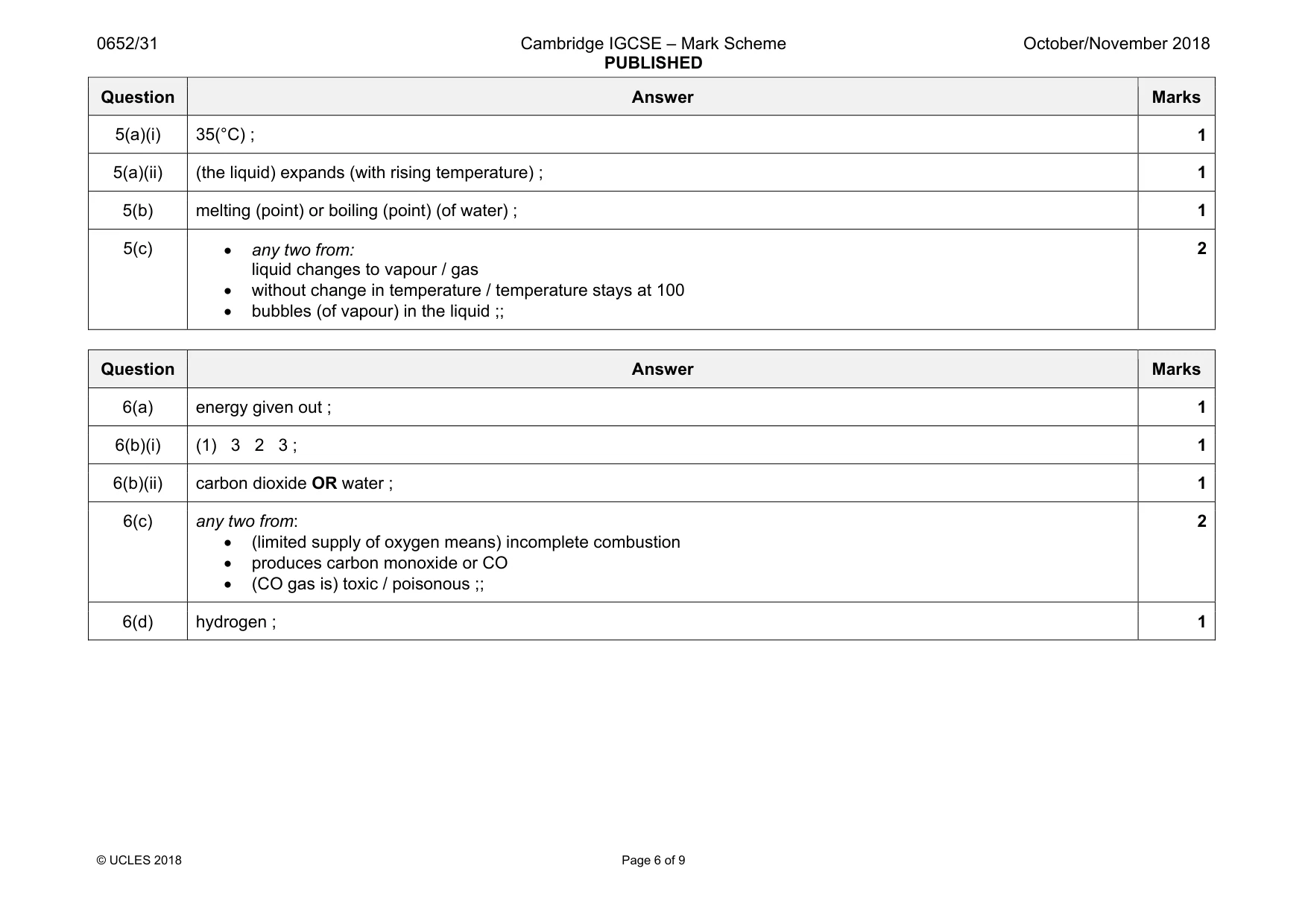
Mark scheme: 5(a)(i) 35(°C) ; 1 5(a)(ii) (the liquid) expands (with rising temperature) ; 1 5(b) melting (point) or boiling (point) (of water) ; 1 5(c) • any two from: liquid changes to vapour / gas • without change in temperature / temperature stays at 100 • bubbles (of vapour) in the liquid ;; 2
Q6 · Ethanol can be used as a fuel
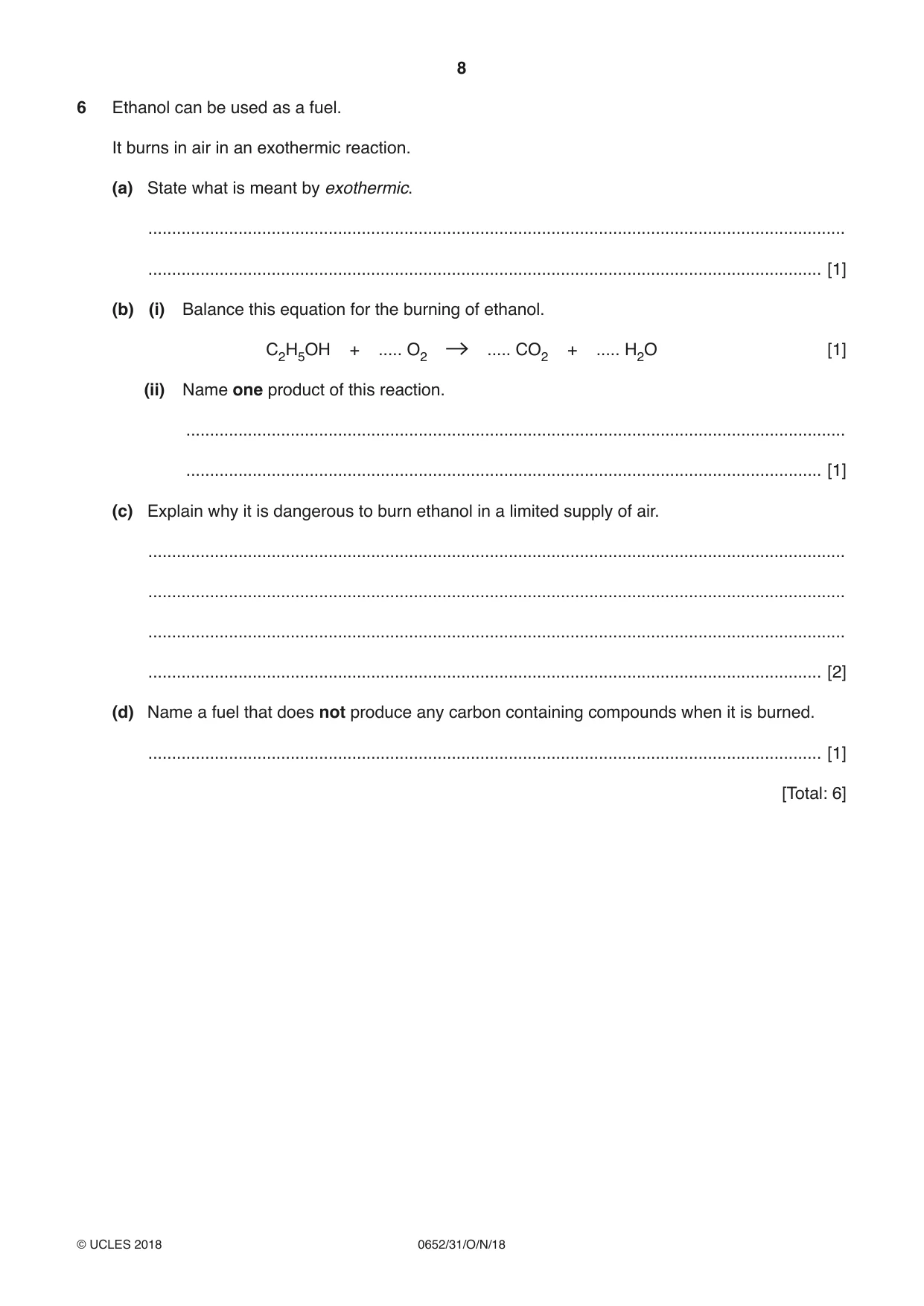
6 Ethanol can be used as a fuel. It burns in air in an exothermic reaction. (a) State what is meant by exothermic. ................................................................................................................................................... .............................................................................................................................................. [1] (b) (i) Balance this equation for the burning of ethanol. C2H5OH + ..... O2 ..... CO2 + ..... H2O [1] (ii) Name one product of this reaction. ........................................................................................................................................... ...................................................................................................................................... [1] (c) Explain why it is dangerous to burn ethanol in a limited supply of air. ................................................................................................................................................... ................................................................................................................................................... ................................................................................................................................................... .............................................................................................................................................. [2] (d) Name a fuel that does not produce any carbon containing compounds when it is burned. .............................................................................................................................................. [1] [Total: 6]
Mark scheme: 6(a) energy given out ; 1 6(b)(i) (1) 3 2 3 ; 1 6(b)(ii) carbon dioxide OR water ; 1 6(c) any two from: • (limited supply of oxygen means) incomplete combustion • produces carbon monoxide or CO • (CO gas is) toxic / poisonous ;; 2 6(d) hydrogen ; 1
Q7 · A side view of water waves in a shallow tank
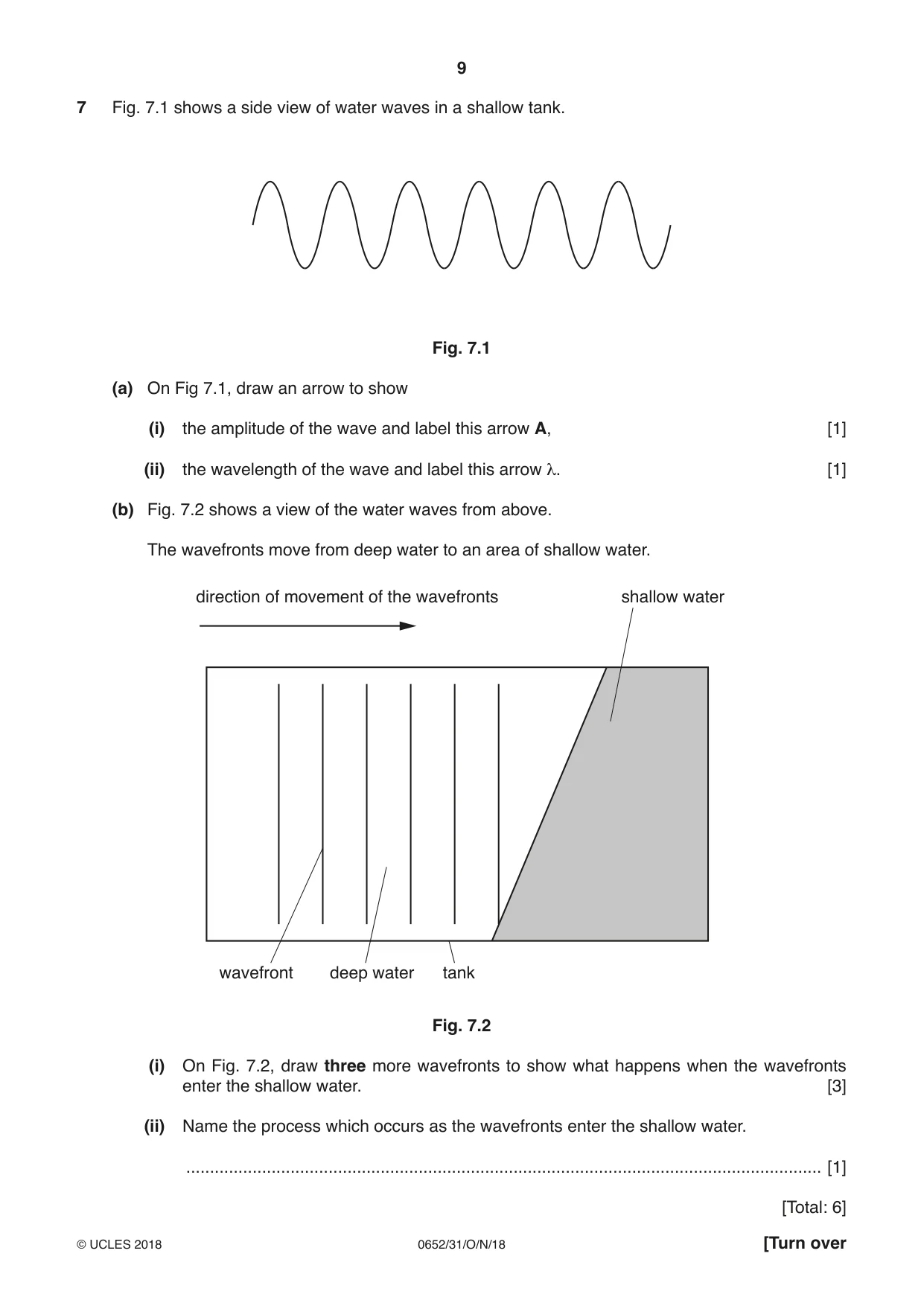
7 Fig. 7.1 shows a side view of water waves in a shallow tank. Fig. 7.1 (a) On Fig 7.1, draw an arrow to show (i) the amplitude of the wave and label this arrow A, [1] (ii) the wavelength of the wave and label this arrow λ. [1] (b) Fig. 7.2 shows a view of the water waves from above. The wavefronts move from deep water to an area of shallow water. direction of movement of the wavefronts shallow water wavefront deep water tank Fig. 7.2 (i) On Fig. 7.2, draw three more wavefronts to show what happens when the wavefronts enter the shallow water. [3] (ii) Name the process which occurs as the wavefronts enter the shallow water. ...................................................................................................................................... [1] [Total: 6]
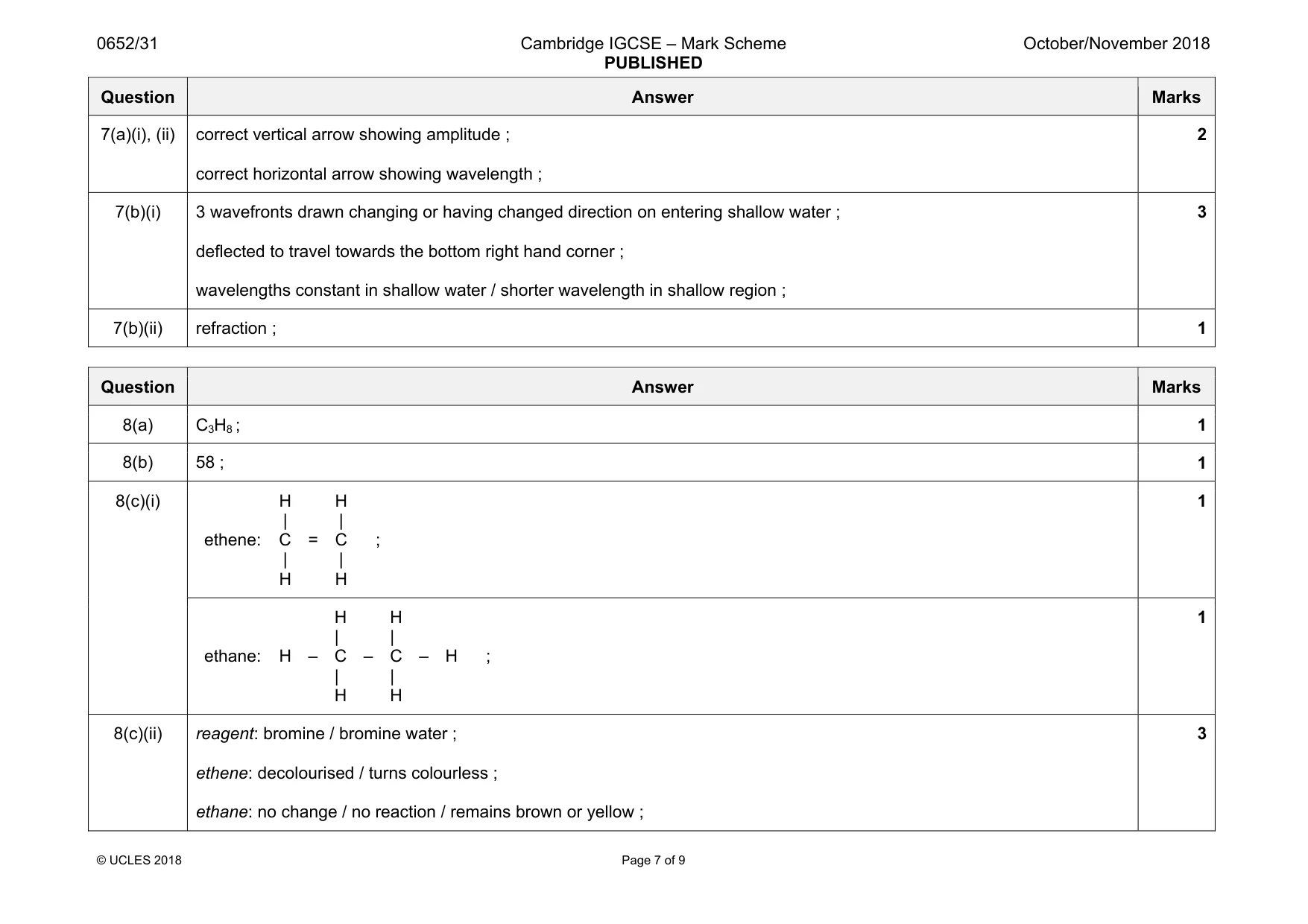
Mark scheme: 7(a)(i), (ii) correct vertical arrow showing amplitude ; correct horizontal arrow showing wavelength ; 2 7(b)(i) 3 wavefronts drawn changing or having changed direction on entering shallow water ; deflected to travel towards the bottom right hand corner ; wavelengths constant in shallow water / shorter wavelength in shallow region ; 3 7(b)(ii) refraction ; 1
Q8 · The alkanes are members of a homologous series
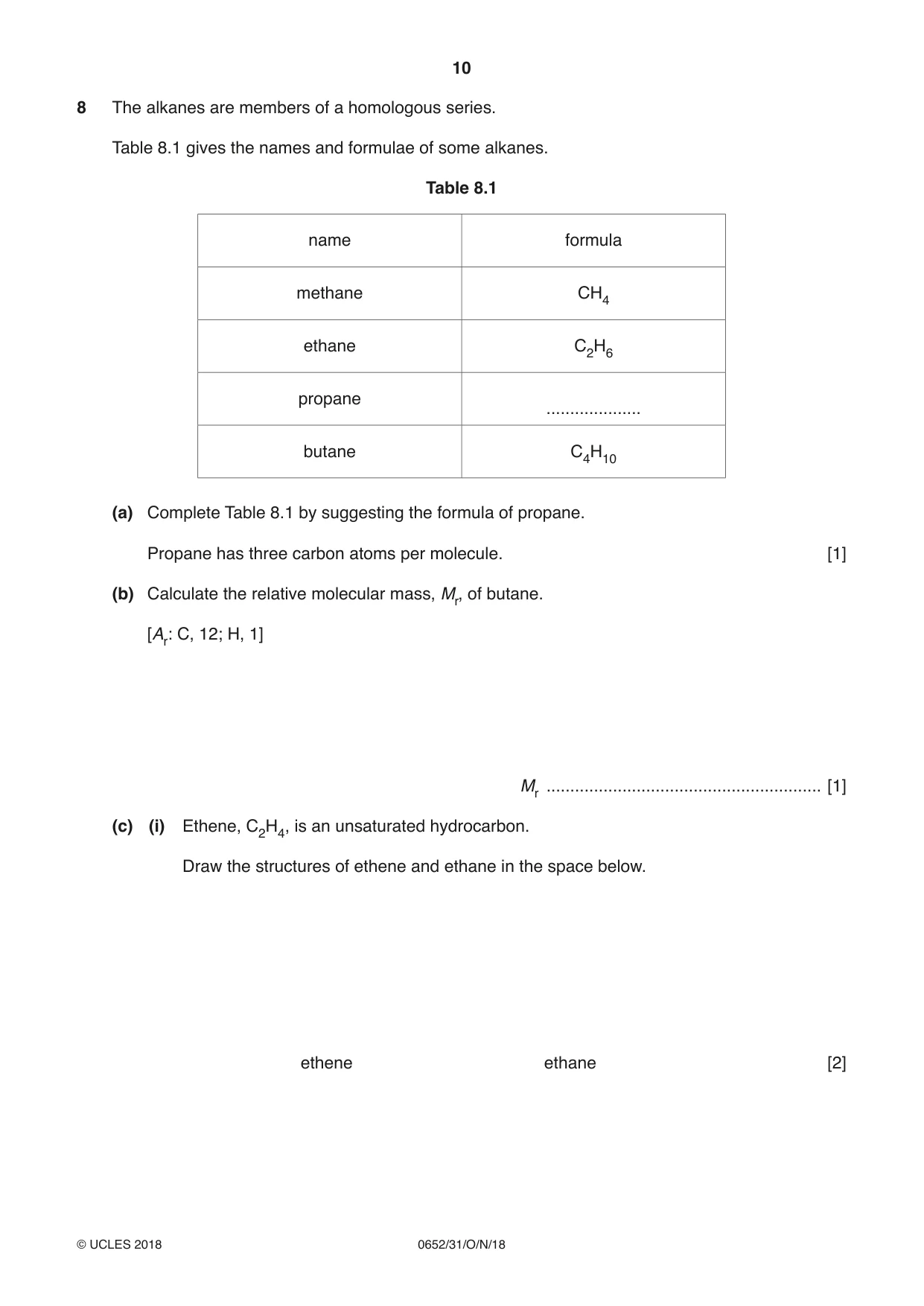
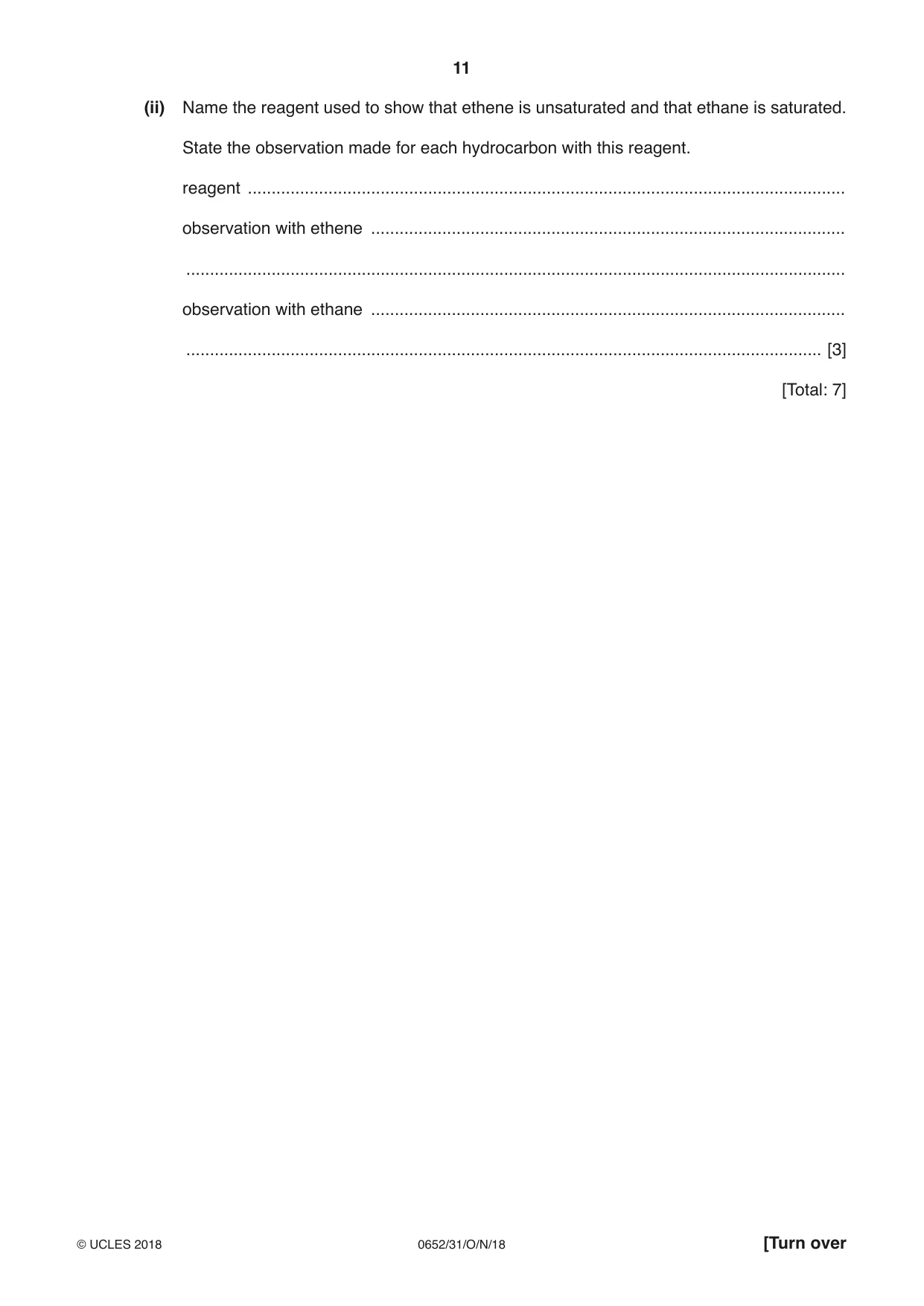
8 The alkanes are members of a homologous series. Table 8.1 gives the names and formulae of some alkanes. Table 8.1 name formula methane CH4 ethane C2H6 propane .................... butane C4H10 (a) Complete Table 8.1 by suggesting the formula of propane. Propane has three carbon atoms per molecule. [1] (b) Calculate the relative molecular mass, Mr, of butane. [Ar: C, 12; H, 1] Mr .......................................................... [1] (c) (i) Ethene, C2H4, is an unsaturated hydrocarbon. Draw the structures of ethene and ethane in the space below. ethene ethane [2] (ii) Name the reagent used to show that ethene is unsaturated and that ethane is saturated. State the observation made for each hydrocarbon with this reagent. reagent .............................................................................................................................. observation with ethene .................................................................................................... ........................................................................................................................................... observation with ethane .................................................................................................... ...................................................................................................................................... [3] [Total: 7]
Mark scheme: 8(a) C3H8 ; 1 8(b) 58 ; 1 8(c)(i) ; H H | | ethene: C = C | | H H 1 ; H H | | ethane: H – C – C – H | | H H 1 8(c)(ii) reagent: bromine / bromine water ; ethene: decolourised / turns colourless ; ethane: no change / no reaction / remains brown or yellow ; 3
Question 9
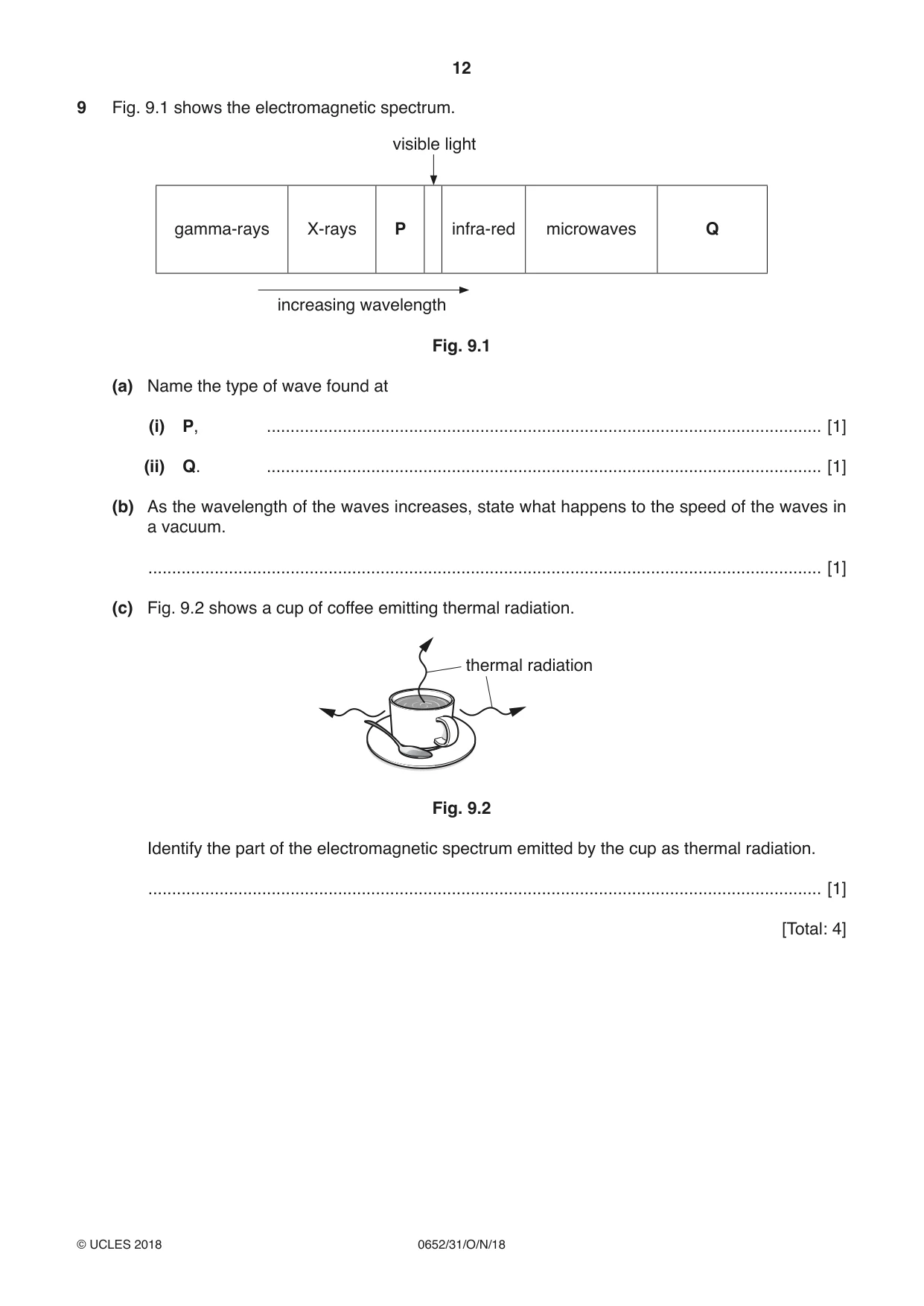
9 Fig. 9.1 shows the electromagnetic spectrum. visible light gamma-rays X-rays P infra-red microwaves Q increasing wavelength Fig. 9.1 (a) Name the type of wave found at (i) P, ..................................................................................................................... [1] (ii) Q. ..................................................................................................................... [1] (b) As the wavelength of the waves increases, state what happens to the speed of the waves in a vacuum. .............................................................................................................................................. [1] (c) Fig. 9.2 shows a cup of coffee emitting thermal radiation. thermal radiation Fig. 9.2 Identify the part of the electromagnetic spectrum emitted by the cup as thermal radiation. .............................................................................................................................................. [1] [Total: 4]
Mark scheme: 9(a)(i) ultra-violet ; 1 9(a)(ii) radio ; 1 9(b) stays the same ; 1 9(c) infra-red ; 1
Q10 · How drinking water is obtained from river water
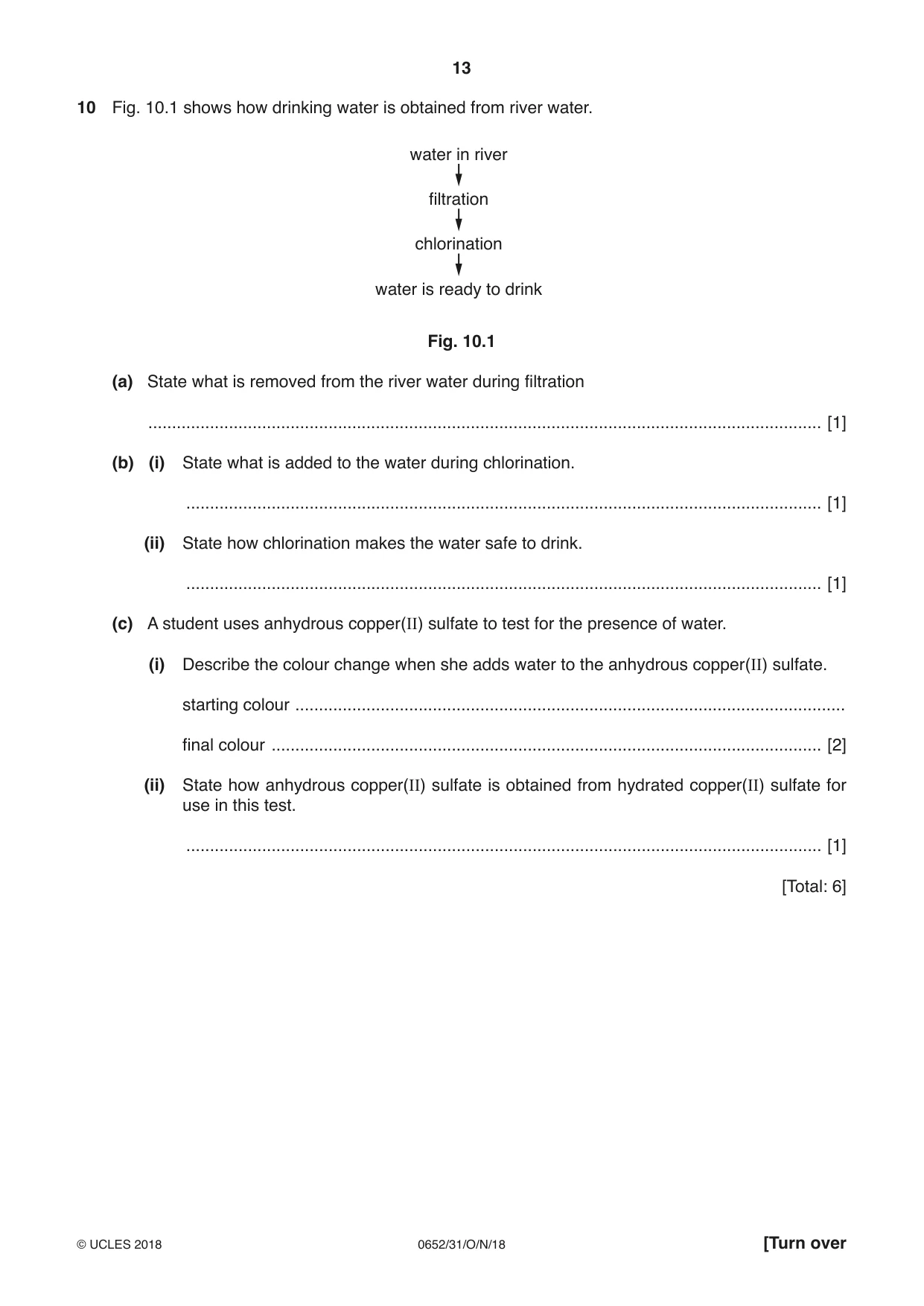
10 Fig. 10.1 shows how drinking water is obtained from river water. water in river filtration chlorination water is ready to drink Fig. 10.1 (a) State what is removed from the river water during filtration .............................................................................................................................................. [1] (b) (i) State what is added to the water during chlorination. ...................................................................................................................................... [1] (ii) State how chlorination makes the water safe to drink. ...................................................................................................................................... [1] (c) A student uses anhydrous copper(II) sulfate to test for the presence of water. (i) Describe the colour change when she adds water to the anhydrous copper(II) sulfate. starting colour .................................................................................................................... final colour .................................................................................................................... [2] (ii) State how anhydrous copper(II) sulfate is obtained from hydrated copper(II) sulfate for use in this test. ...................................................................................................................................... [1] [Total: 6]
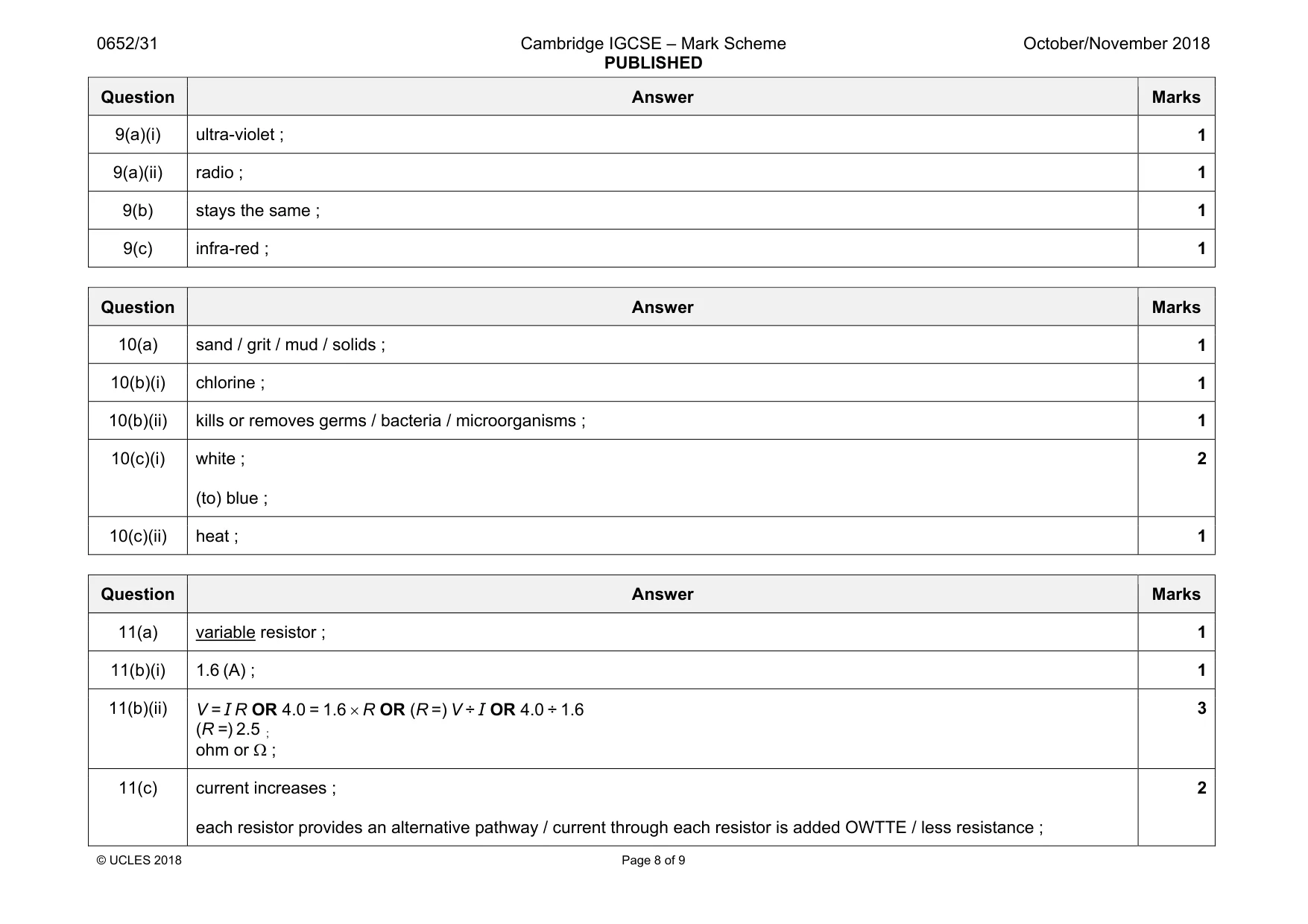
Mark scheme: 10(a) sand / grit / mud / solids ; 1 10(b)(i) chlorine ; 1 10(b)(ii) kills or removes germs / bacteria / microorganisms ; 1 10(c)(i) white ; (to) blue ; 2 10(c)(ii) heat ; 1
Question 11
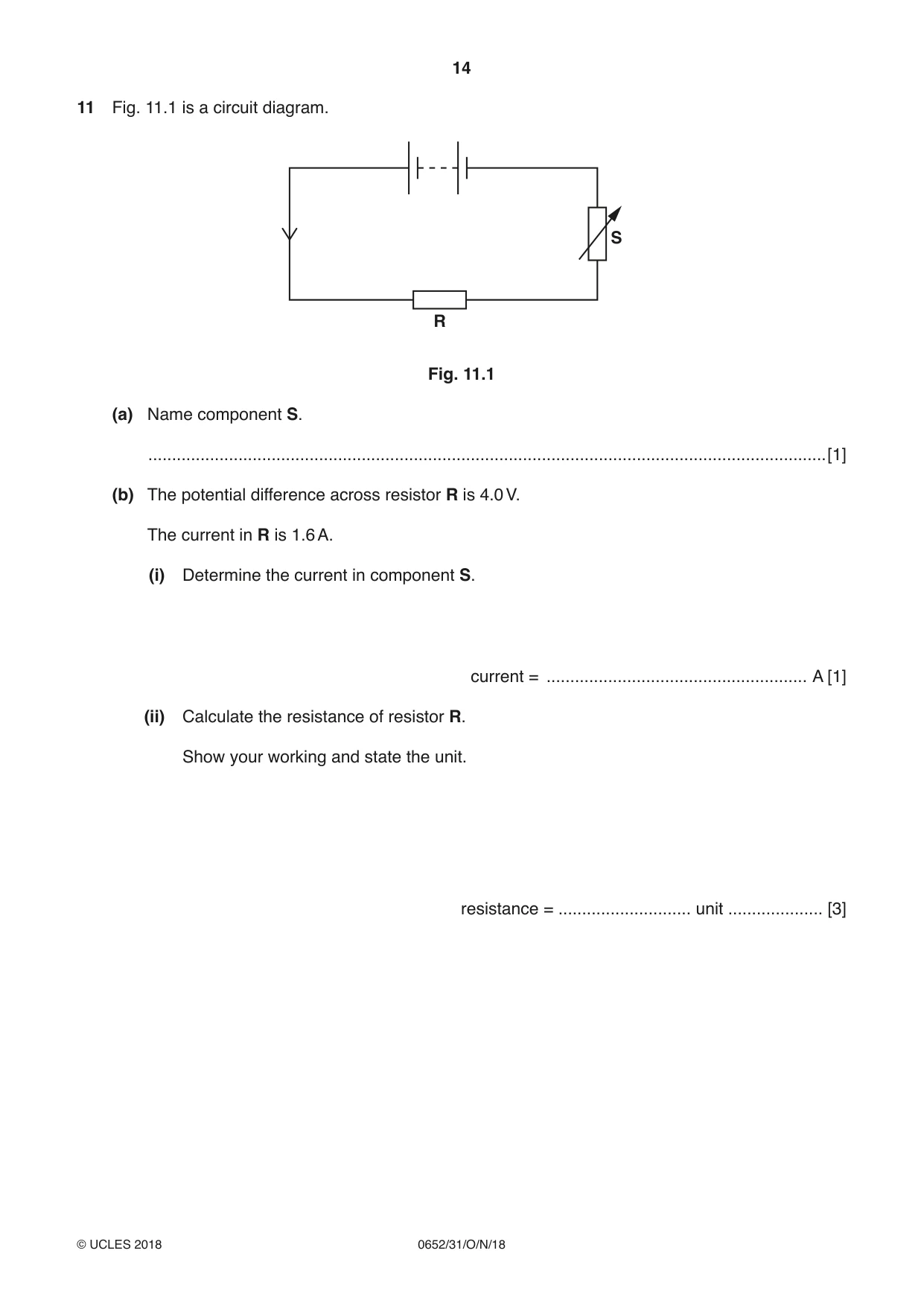
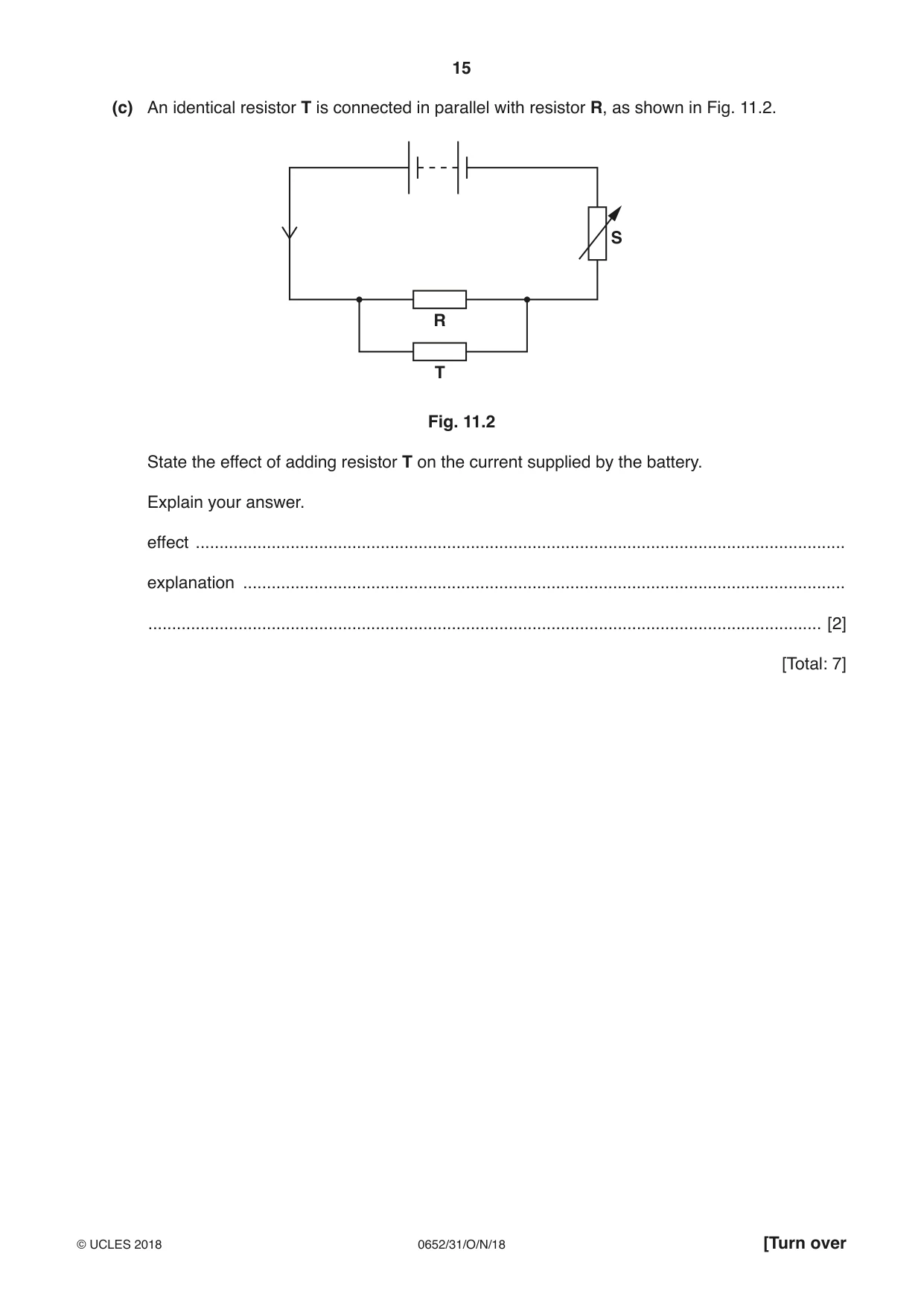
11 Fig. 11.1 is a circuit diagram. S R Fig. 11.1 (a) Name component S. ...............................................................................................................................................[1] (b) The potential difference across resistor R is 4.0 V. The current in R is 1.6 A. (i) Determine the current in component S. current = ....................................................... A [1] (ii) Calculate the resistance of resistor R. Show your working and state the unit. resistance = ............................ unit .................... [3] (c) An identical resistor T is connected in parallel with resistor R, as shown in Fig. 11.2. S R T Fig. 11.2 State the effect of adding resistor T on the current supplied by the battery. Explain your answer. effect ......................................................................................................................................... explanation ............................................................................................................................... .............................................................................................................................................. [2] [Total: 7]
Mark scheme: 11(a) variable resistor ; 1 11(b)(i) 1.6 (A) ; 1 11(b)(ii) V = I R OR 4.0 = 1.6 × R OR (R =) V ÷ I OR 4.0 ÷ 1.6 (R =) 2.5 ; ohm or Ω ; 3 11(c) current increases ; each resistor provides an alternative pathway / current through each resistor is added OWTTE / less resistance ; 2
Q12 · Aluminium saucepans do not burn when they are used to cook food but powdered aluminium…
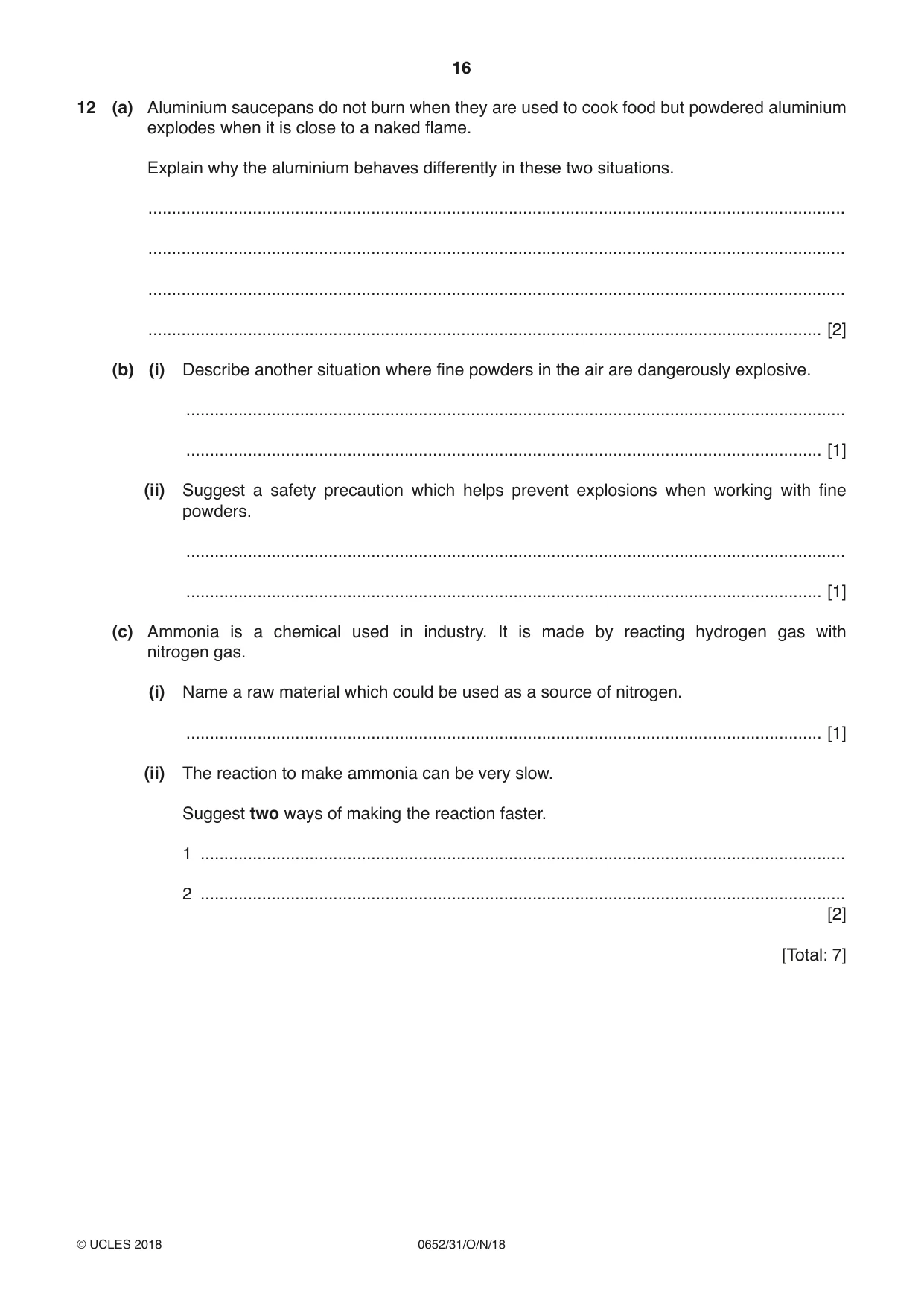
12 (a) Aluminium saucepans do not burn when they are used to cook food but powdered aluminium explodes when it is close to a naked flame. Explain why the aluminium behaves differently in these two situations. ................................................................................................................................................... ................................................................................................................................................... ................................................................................................................................................... .............................................................................................................................................. [2] (b) (i) Describe another situation where fine powders in the air are dangerously explosive. ........................................................................................................................................... ...................................................................................................................................... [1] (ii) Suggest a safety precaution which helps prevent explosions when working with fine powders. ........................................................................................................................................... ...................................................................................................................................... [1] (c) Ammonia is a chemical used in industry. It is made by reacting hydrogen gas with nitrogen gas. (i) Name a raw material which could be used as a source of nitrogen. ...................................................................................................................................... [1] (ii) The reaction to make ammonia can be very slow. Suggest two ways of making the reaction faster. 1 ........................................................................................................................................ 2 ........................................................................................................................................ [2] [Total: 7]
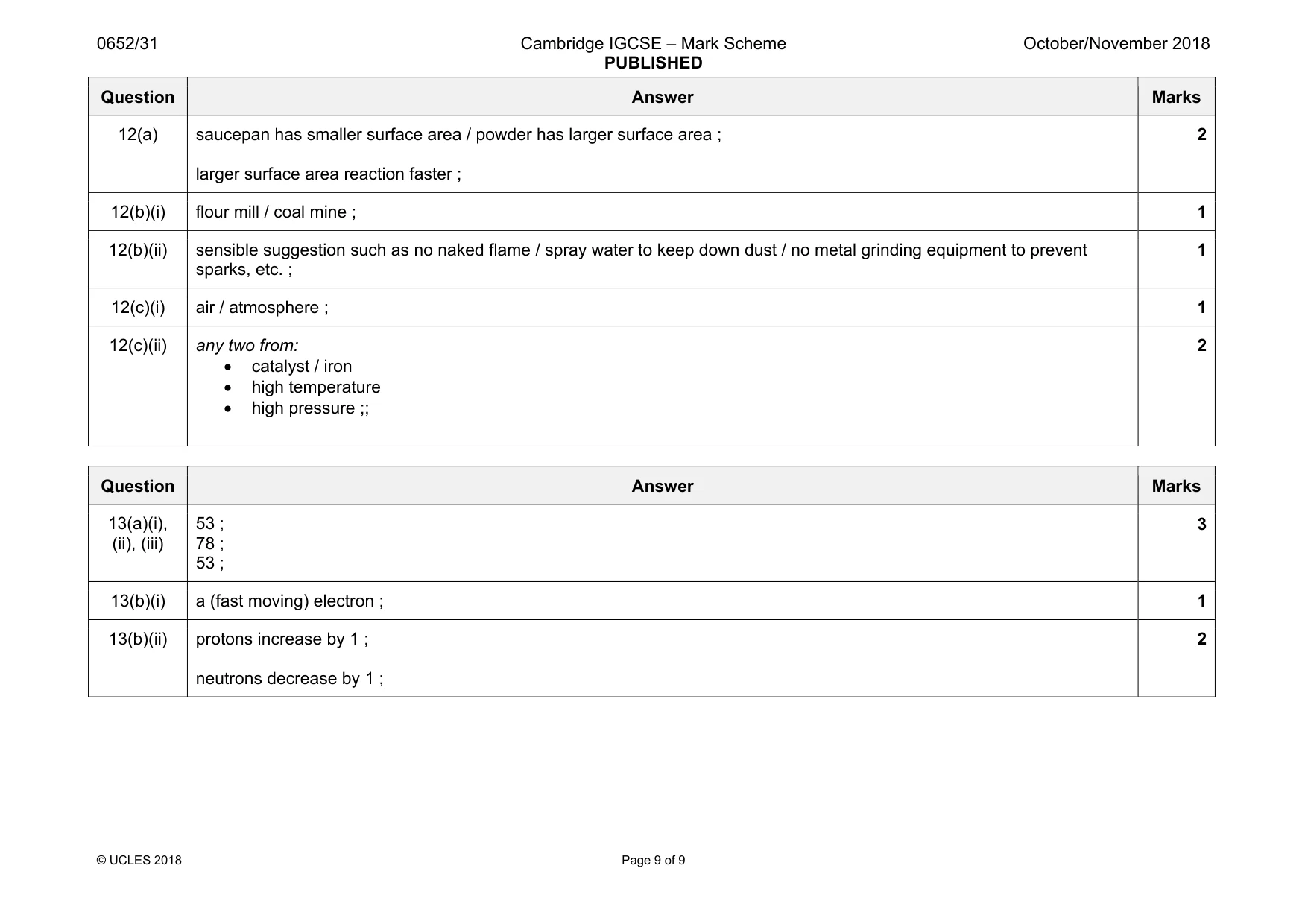
Mark scheme: 12(a) saucepan has smaller surface area / powder has larger surface area ; larger surface area reaction faster ; 2 12(b)(i) flour mill / coal mine ; 1 12(b)(ii) sensible suggestion such as no naked flame / spray water to keep down dust / no metal grinding equipment to prevent sparks, etc. ; 1 12(c)(i) air / atmosphere ; 1 12(c)(ii) any two from: • catalyst / iron • high temperature • high pressure ;; 2
Q13 · For this question, you will be expected to use the Periodic Table on page 20
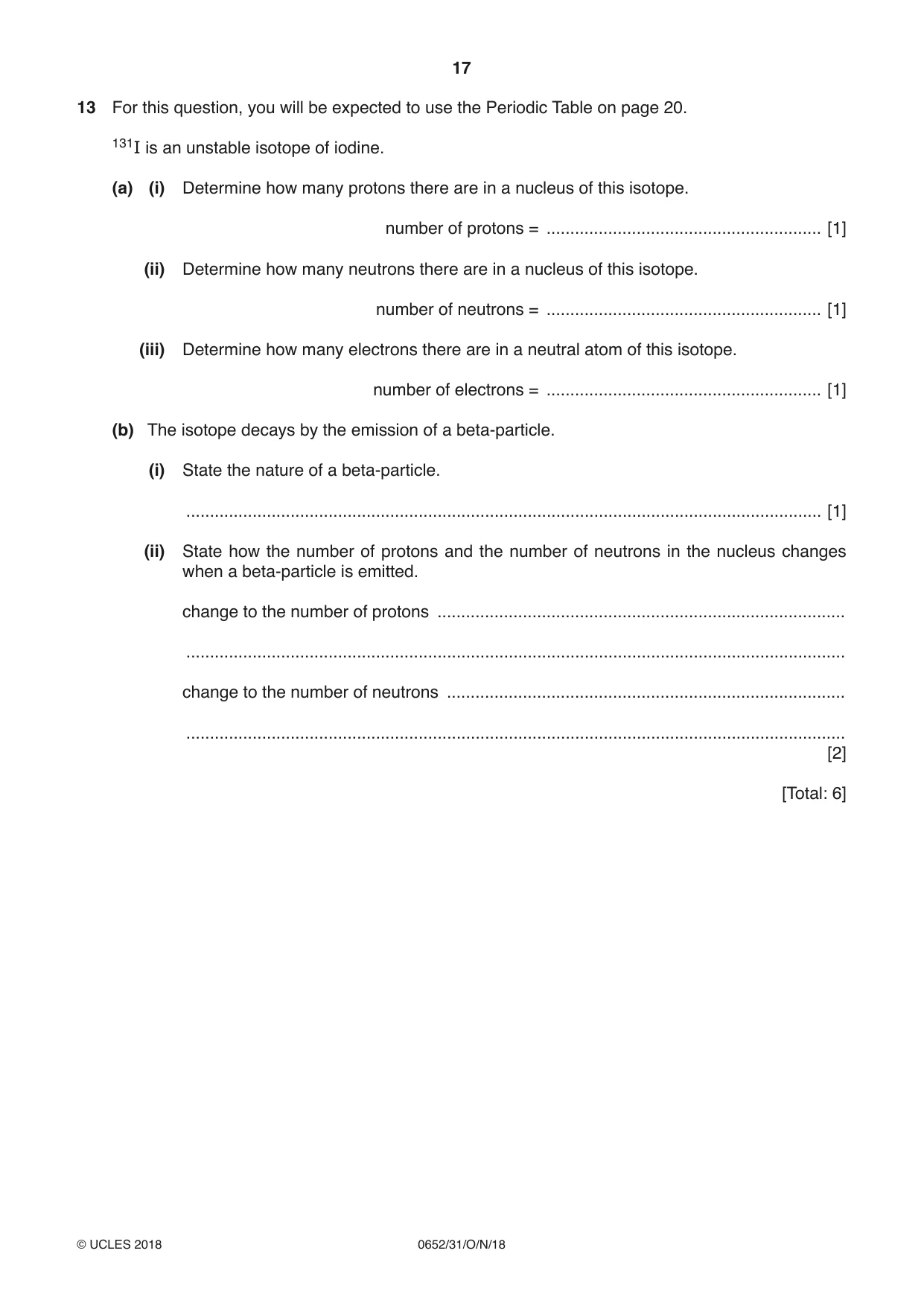
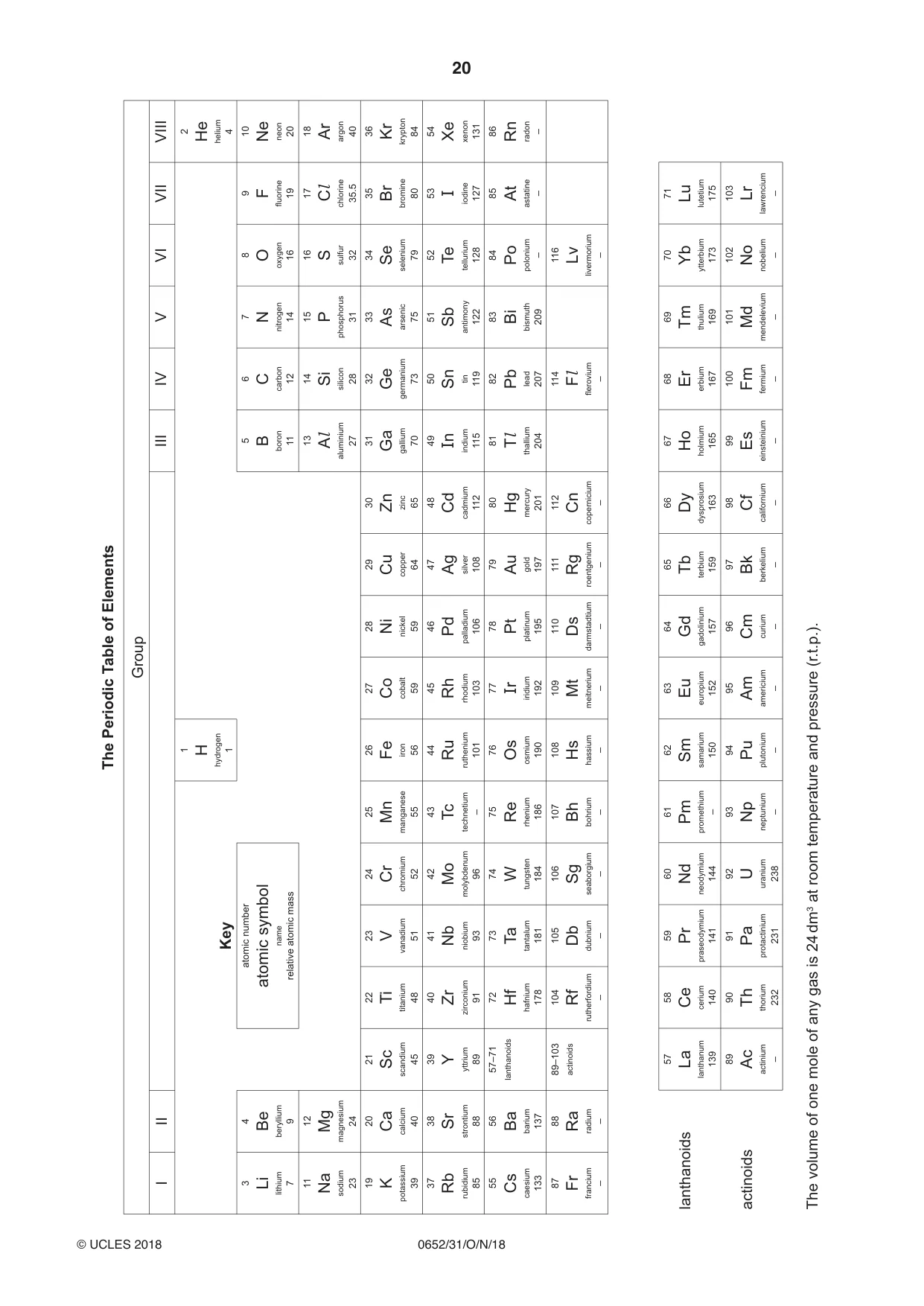
13 For this question, you will be expected to use the Periodic Table on page 20. 131I is an unstable isotope of iodine. (a) (i) Determine how many protons there are in a nucleus of this isotope. number of protons = .......................................................... [1] (ii) Determine how many neutrons there are in a nucleus of this isotope. number of neutrons = .......................................................... [1] (iii) Determine how many electrons there are in a neutral atom of this isotope. number of electrons = .......................................................... [1] (b) The isotope decays by the emission of a beta-particle. (i) State the nature of a beta-particle. ...................................................................................................................................... [1] (ii) State how the number of protons and the number of neutrons in the nucleus changes when a beta-particle is emitted. change to the number of protons ...................................................................................... ........................................................................................................................................... change to the number of neutrons .................................................................................... ........................................................................................................................................... [2] [Total: 6]
Mark scheme: 13(a)(i), (ii), (iii) 53 ; 78 ; 53 ; 3 13(b)(i) a (fast moving) electron ; 1 13(b)(ii) protons increase by 1 ; neutrons decrease by 1 ; 2
What was in this paper
The subtopics covered by these 13 questions, and how many questions each got. Open one in a new tab to see every Cambridge question on it.
What you needed in this session
Cambridge’s own grade thresholds for 2018 Oct/Nov, Paper 3 · Variant 1. A higher threshold means an easier paper — the bar moves with how the cohort did.