Cambridge IGCSE Physical Science 0652 — 2021 Oct/Nov Paper 3 · Variant 1
0652/31/O/N/21 · 10 questions · 80 marks · ≈90 min
The question paper and its mark scheme, free to read here and free to download. This is Cambridge’s own paper, exactly as it was sat.
Question paper20 pages

Mark scheme9 pages
Answers below. Sit the paper first if you are practising.
Questions as text
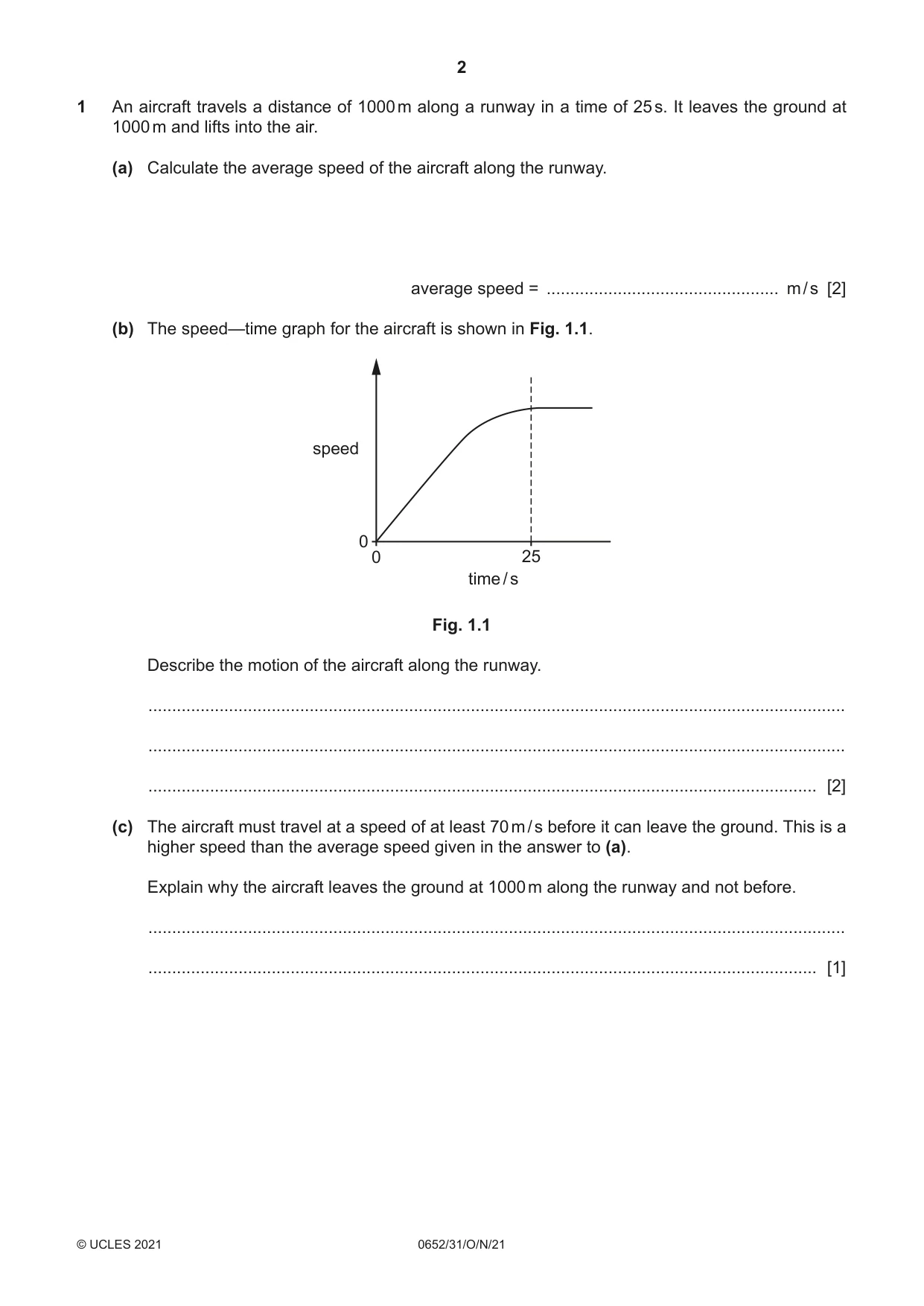
Q1 · An aircraft travels a distance of 1000 m along a runway in a time of 25 s
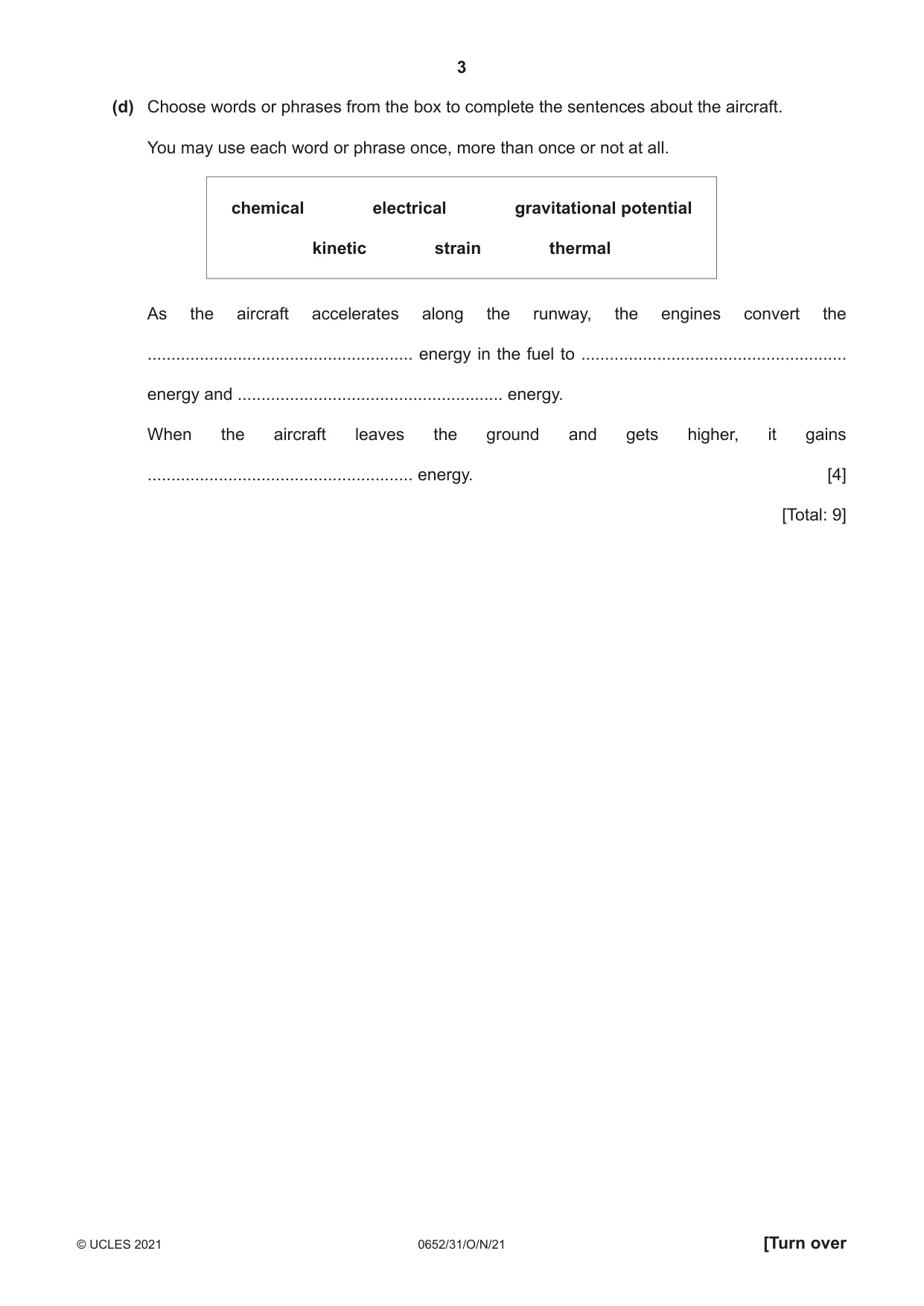
1 An aircraft travels a distance of 1000 m along a runway in a time of 25 s. It leaves the ground at 1000 m and lifts into the air. (a) Calculate the average speed of the aircraft along the runway. average speed = ................................................. m / s [2] (b) The speed—time graph for the aircraft is shown in Fig. 1.1. speed 0 0 25 time / s Fig. 1.1 Describe the motion of the aircraft along the runway. ................................................................................................................................................... ................................................................................................................................................... ............................................................................................................................................. [2] (c) The aircraft must travel at a speed of at least 70 m / s before it can leave the ground. This is a higher speed than the average speed given in the answer to (a). Explain why the aircraft leaves the ground at 1000 m along the runway and not before. ................................................................................................................................................... ............................................................................................................................................. [1] (d) Choose words or phrases from the box to complete the sentences about the aircraft. You may use each word or phrase once, more than once or not at all. chemical electrical gravitational potential kinetic strain thermal As the aircraft accelerates along the runway, the engines convert the ........................................................ energy in the fuel to ........................................................ energy and ........................................................ energy. When the aircraft leaves the ground and gets higher, it gains ........................................................ energy. [4] [Total: 9]
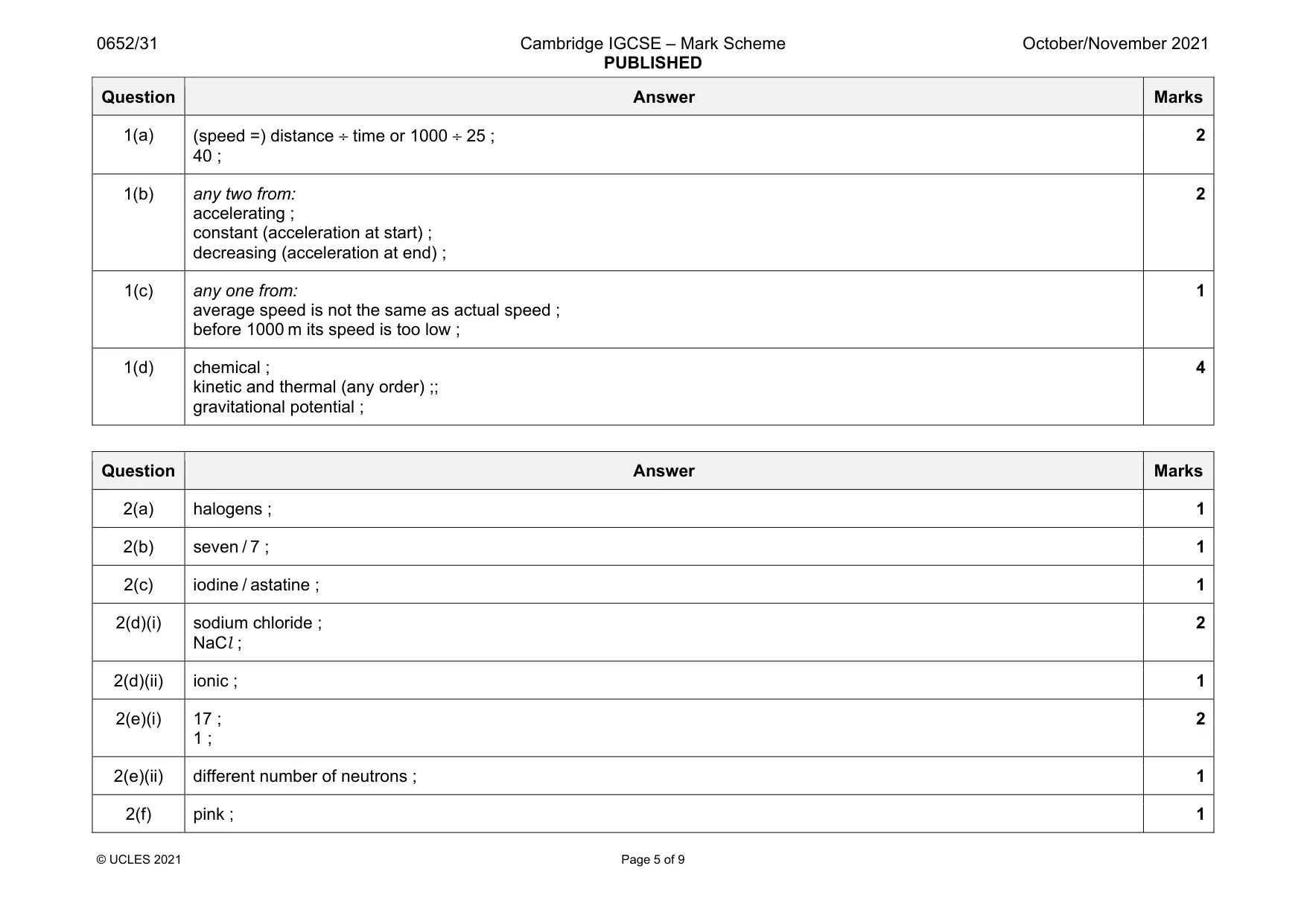
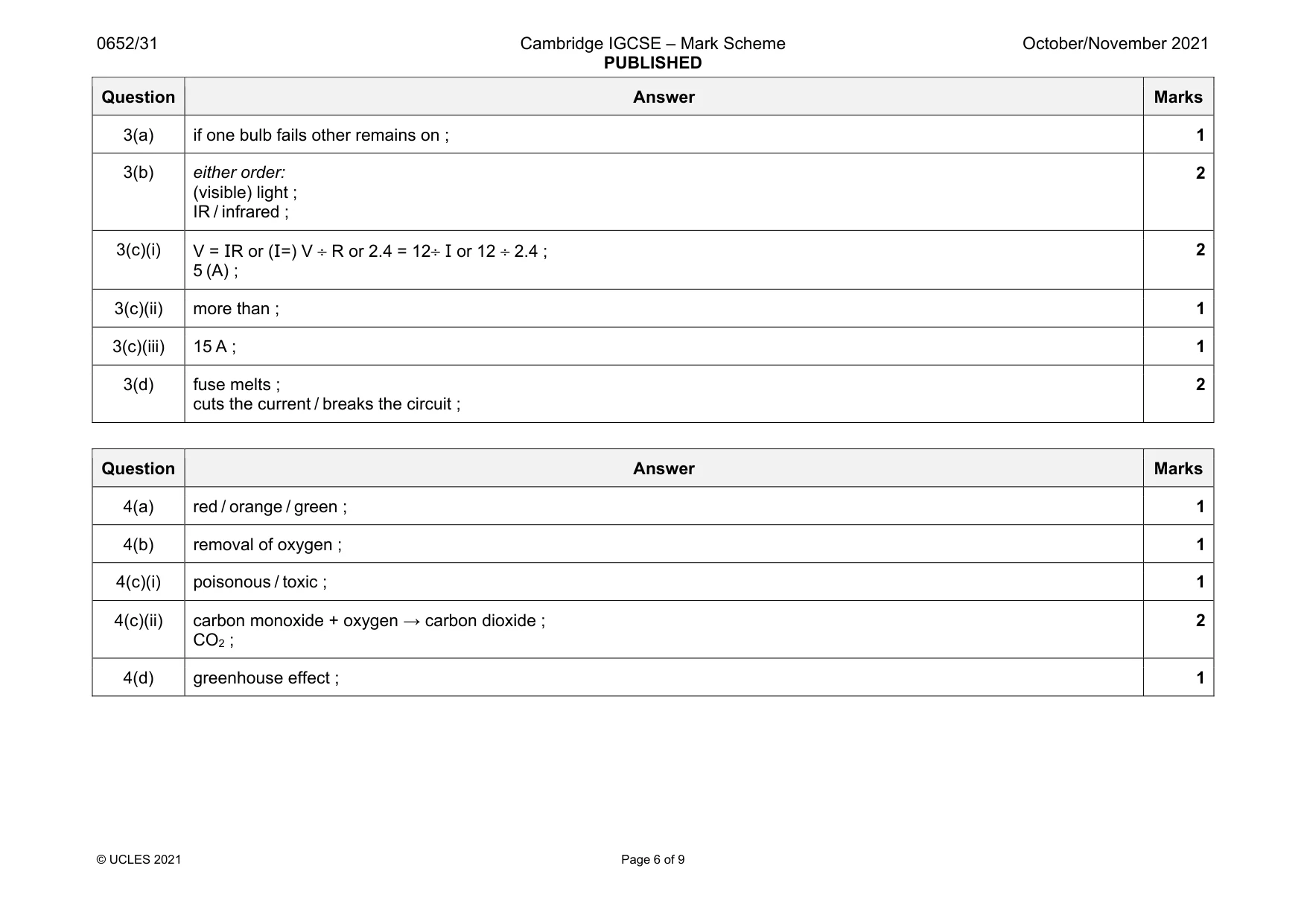
Mark scheme: 1(a) (speed =) distance ÷ time or 1000 ÷ 25 ; 40 ; 2 1(b) any two from: accelerating ; constant (acceleration at start) ; decreasing (acceleration at end) ; 2 1(c) any one from: average speed is not the same as actual speed ; before 1000 m its speed is too low ; 1 1(d) chemical ; kinetic and thermal (any order) ;; gravitational potential ; 4
Q2 · Chlorine is an element in Group VII of the Periodic Table
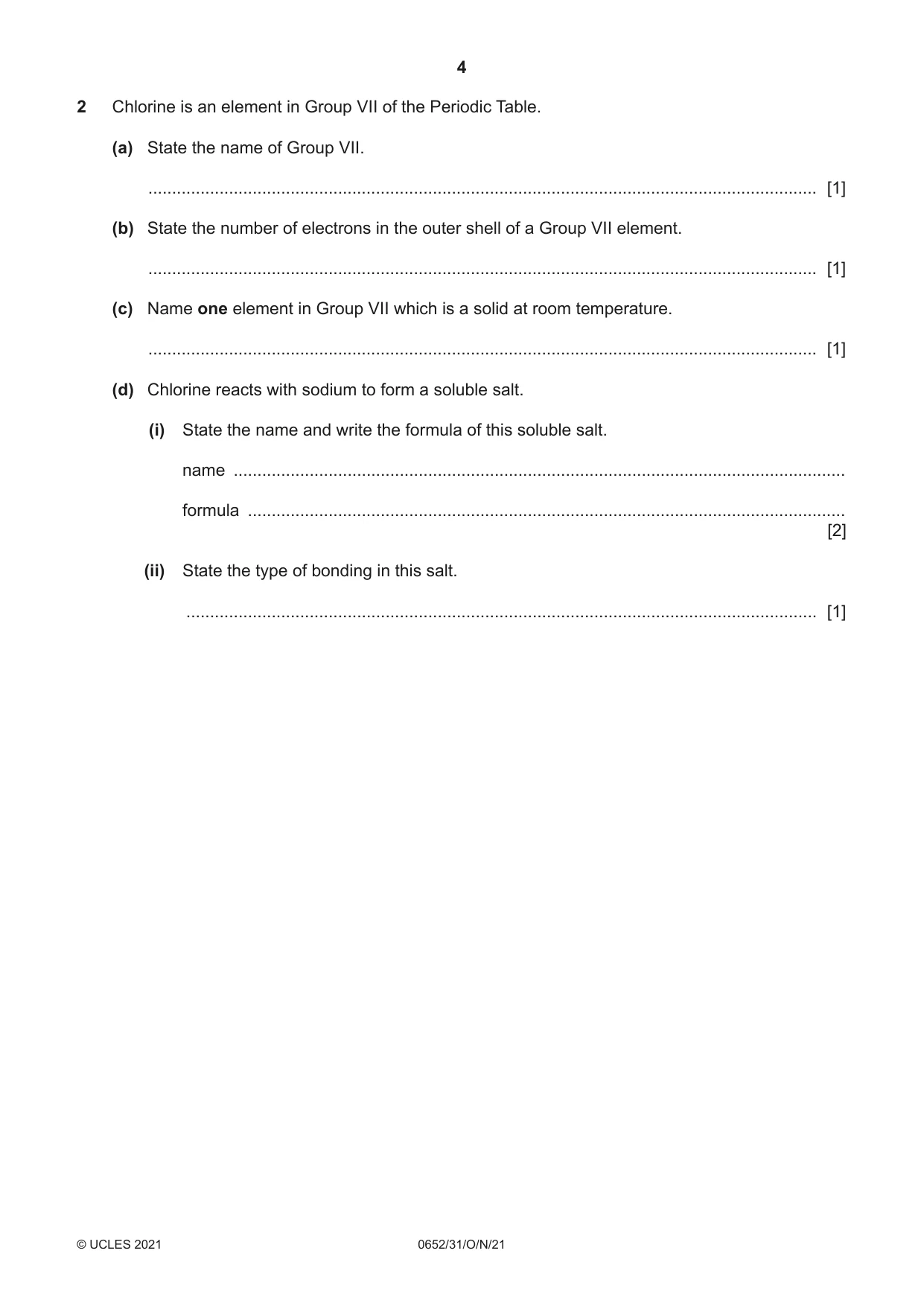
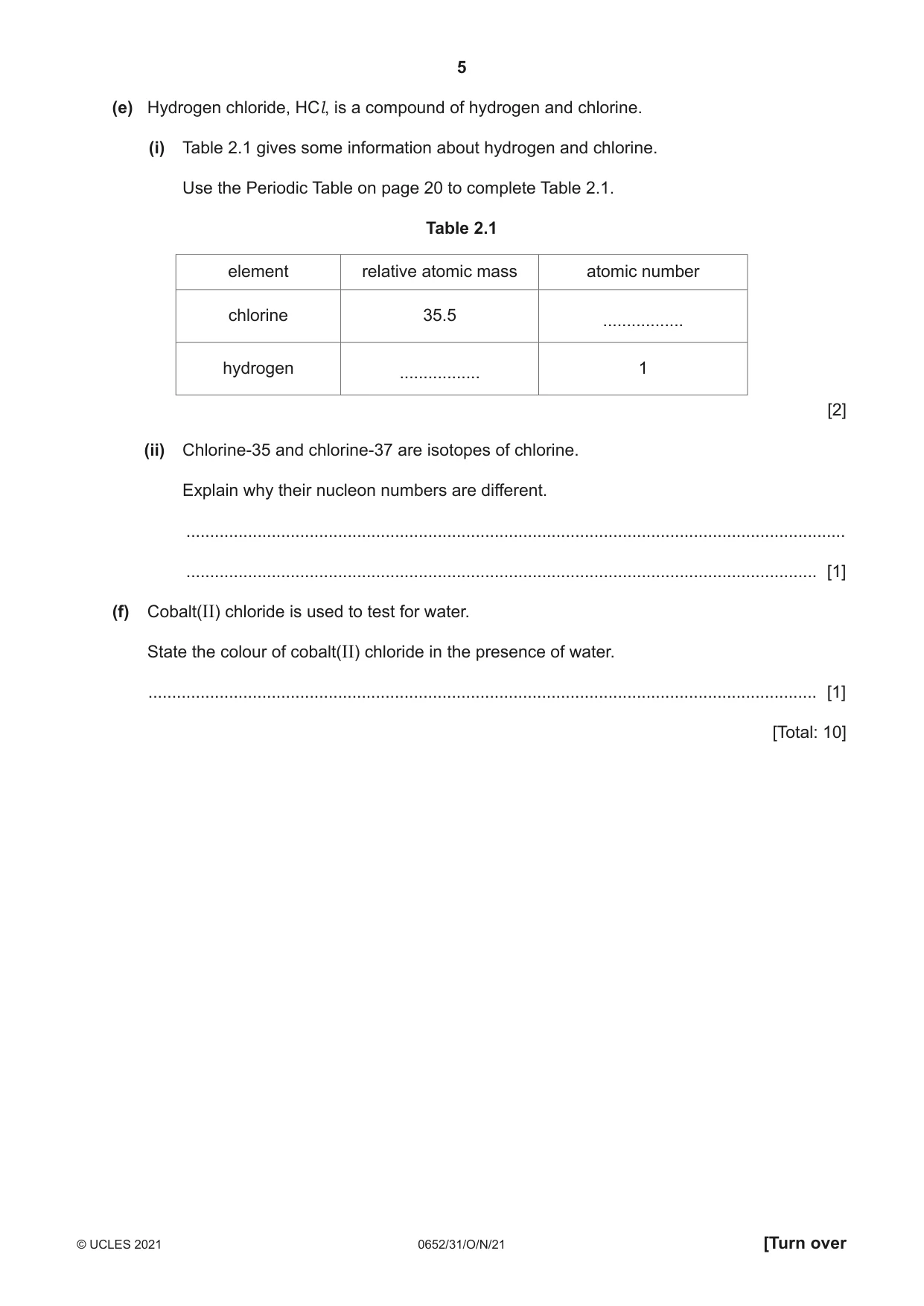
2 Chlorine is an element in Group VII of the Periodic Table. (a) State the name of Group VII. ............................................................................................................................................. [1] (b) State the number of electrons in the outer shell of a Group VII element. ............................................................................................................................................. [1] (c) Name one element in Group VII which is a solid at room temperature. ............................................................................................................................................. [1] (d) Chlorine reacts with sodium to form a soluble salt. (i) State the name and write the formula of this soluble salt. name ................................................................................................................................. formula .............................................................................................................................. [2] (ii) State the type of bonding in this salt. ..................................................................................................................................... [1] (e) Hydrogen chloride, HCl, is a compound of hydrogen and chlorine. (i) Table 2.1 gives some information about hydrogen and chlorine. Use the Periodic Table on page 20 to complete Table 2.1. Table 2.1 element relative atomic mass atomic number chlorine 35.5 ................. hydrogen 1 ................. [2] (ii) Chlorine-35 and chlorine-37 are isotopes of chlorine. Explain why their nucleon numbers are different. ........................................................................................................................................... ..................................................................................................................................... [1] (f) Cobalt(II) chloride is used to test for water. State the colour of cobalt(II) chloride in the presence of water. ............................................................................................................................................. [1] [Total: 10]
Mark scheme: 2(a) halogens ; 1 2(b) seven / 7 ; 1 2(c) iodine / astatine ; 1 2(d)(i) sodium chloride ; NaCl ; 2 2(d)(ii) ionic ; 1 2(e)(i) 17 ; 1 ; 2 2(e)(ii) different number of neutrons ; 1 2(f) pink ; 1
Q3 · A circuit diagram for the headlamps in a car is shown in Fig
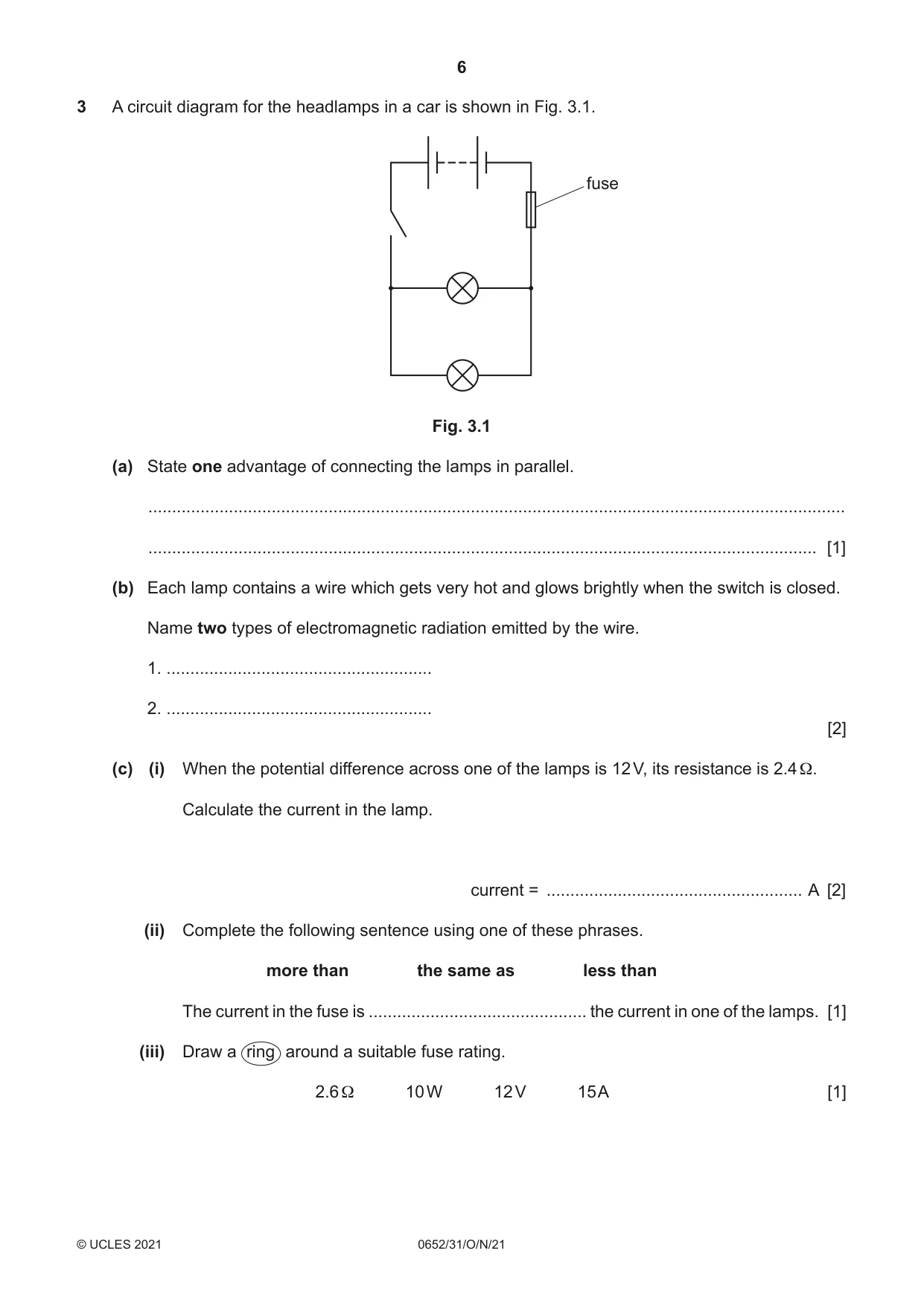
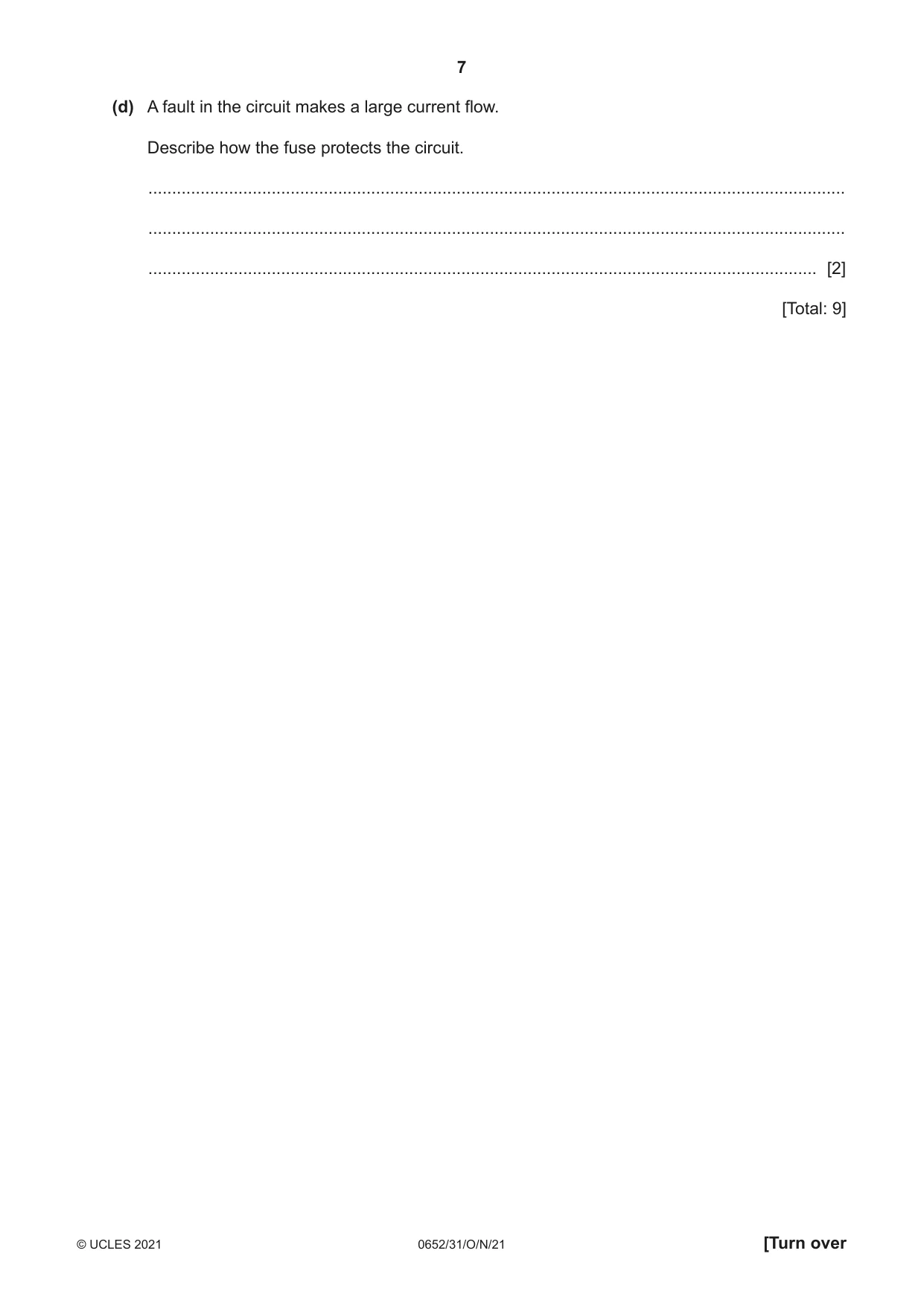
3 A circuit diagram for the headlamps in a car is shown in Fig. 3.1. fuse Fig. 3.1 (a) State one advantage of connecting the lamps in parallel. ................................................................................................................................................... ............................................................................................................................................. [1] (b) Each lamp contains a wire which gets very hot and glows brightly when the switch is closed. Name two types of electromagnetic radiation emitted by the wire. 1. ........................................................ 2. ........................................................ [2] (c) (i) When the potential difference across one of the lamps is 12 V, its resistance is 2.4 Ω. Calculate the current in the lamp. current = ...................................................... A [2] (ii) Complete the following sentence using one of these phrases. more than the same as less than The current in the fuse is .............................................. the current in one of the lamps. [1] (iii) Draw a ring around a suitable fuse rating. 2.6 Ω 10 W 12 V 15 A [1] (d) A fault in the circuit makes a large current flow. Describe how the fuse protects the circuit. ................................................................................................................................................... ................................................................................................................................................... ............................................................................................................................................. [2] [Total: 9]
Mark scheme: 3(a) if one bulb fails other remains on ; 1 3(b) either order: (visible) light ; IR / infrared ; 2 3(c)(i) V = IR or (I=) V ÷ R or 2.4 = 12÷ I or 12 ÷ 2.4 ; 5 (A) ; 2 3(c)(ii) more than ; 1 3(c)(iii) 15 A ; 1 3(d) fuse melts ; cuts the current / breaks the circuit ; 2
Q4 · Iron is a transition metal
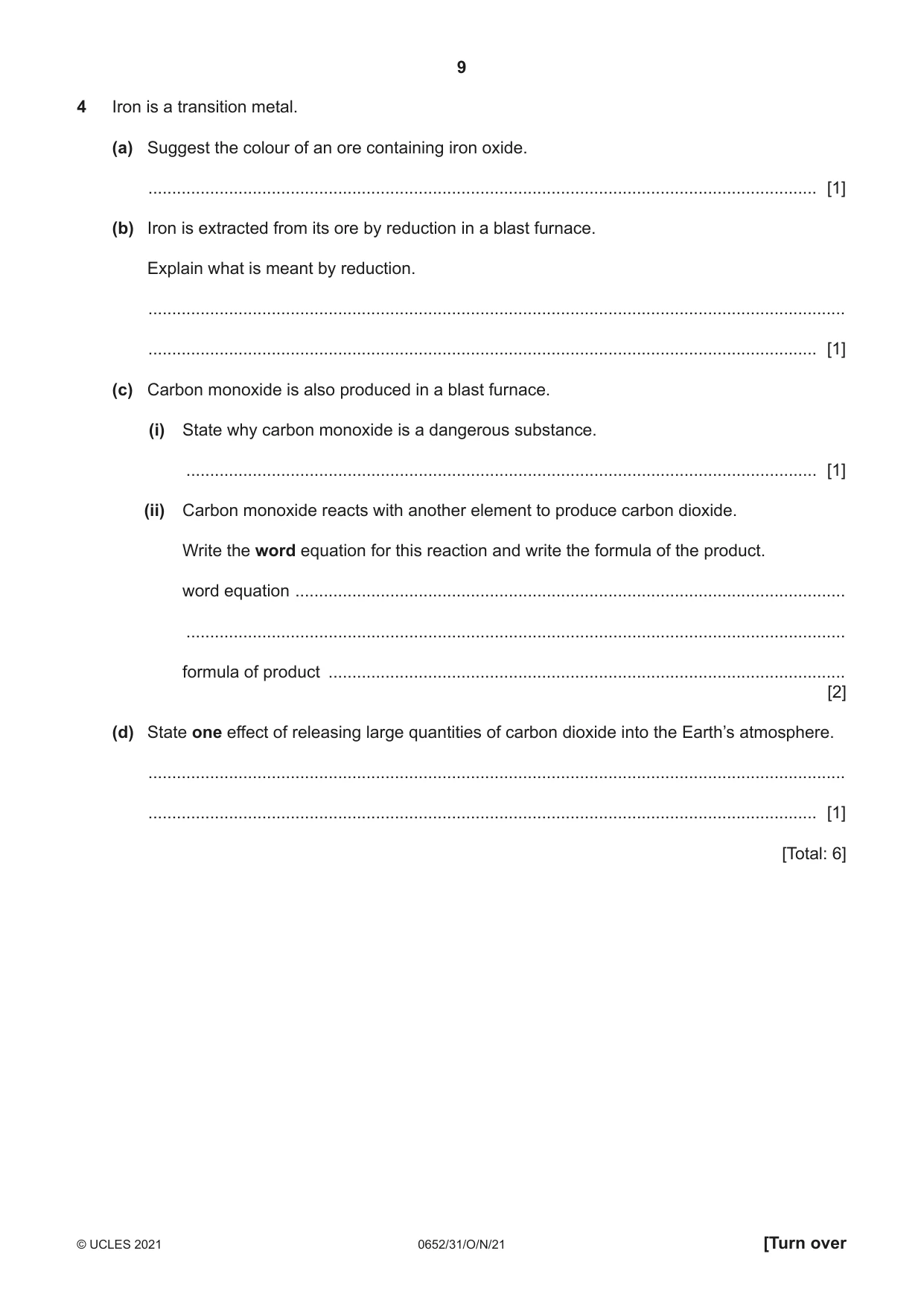
4 Iron is a transition metal. (a) Suggest the colour of an ore containing iron oxide. ............................................................................................................................................. [1] (b) Iron is extracted from its ore by reduction in a blast furnace. Explain what is meant by reduction. ................................................................................................................................................... ............................................................................................................................................. [1] (c) Carbon monoxide is also produced in a blast furnace. (i) State why carbon monoxide is a dangerous substance. ..................................................................................................................................... [1] (ii) Carbon monoxide reacts with another element to produce carbon dioxide. Write the word equation for this reaction and write the formula of the product. word equation .................................................................................................................... ........................................................................................................................................... formula of product ............................................................................................................. [2] (d) State one effect of releasing large quantities of carbon dioxide into the Earth’s atmosphere. ................................................................................................................................................... ............................................................................................................................................. [1] [Total: 6]
Mark scheme: 4(a) red / orange / green ; 1 4(b) removal of oxygen ; 1 4(c)(i) poisonous / toxic ; 1 4(c)(ii) carbon monoxide + oxygen → carbon dioxide ; CO2 ; 2 4(d) greenhouse effect ; 1
Q5 · A student has some sheets of card
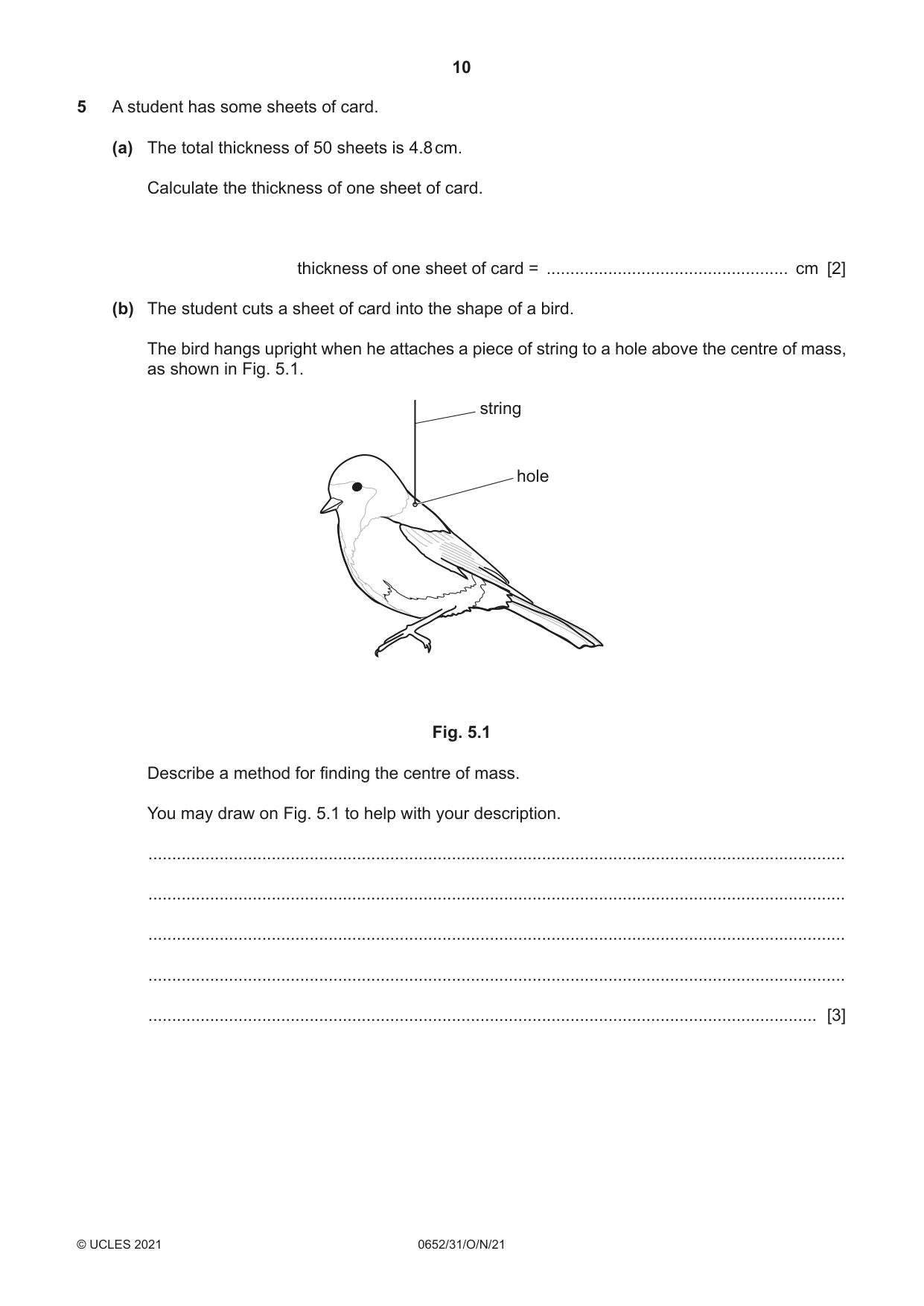
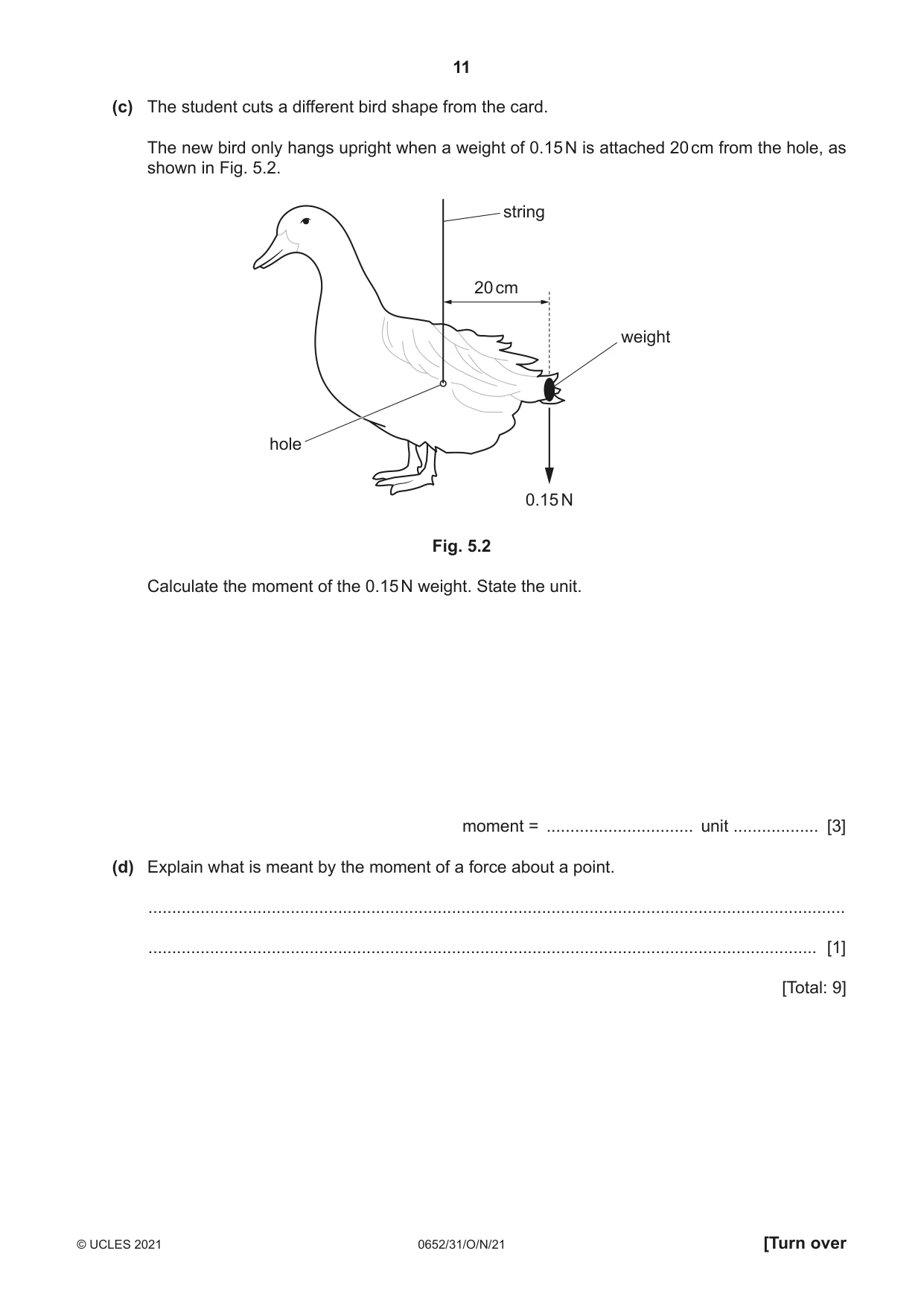
5 A student has some sheets of card. (a) The total thickness of 50 sheets is 4.8 cm. Calculate the thickness of one sheet of card. thickness of one sheet of card = ................................................... cm [2] (b) The student cuts a sheet of card into the shape of a bird. The bird hangs upright when he attaches a piece of string to a hole above the centre of mass, as shown in Fig. 5.1. string hole Fig. 5.1 Describe a method for finding the centre of mass. You may draw on Fig. 5.1 to help with your description. ................................................................................................................................................... ................................................................................................................................................... ................................................................................................................................................... ................................................................................................................................................... ............................................................................................................................................. [3] (c) The student cuts a different bird shape from the card. The new bird only hangs upright when a weight of 0.15 N is attached 20 cm from the hole, as shown in Fig. 5.2. string 20 cm weight hole 0.15 N Fig. 5.2 Calculate the moment of the 0.15 N weight. State the unit. moment = ............................... unit .................. [3] (d) Explain what is meant by the moment of a force about a point. ................................................................................................................................................... ............................................................................................................................................. [1] [Total: 9]
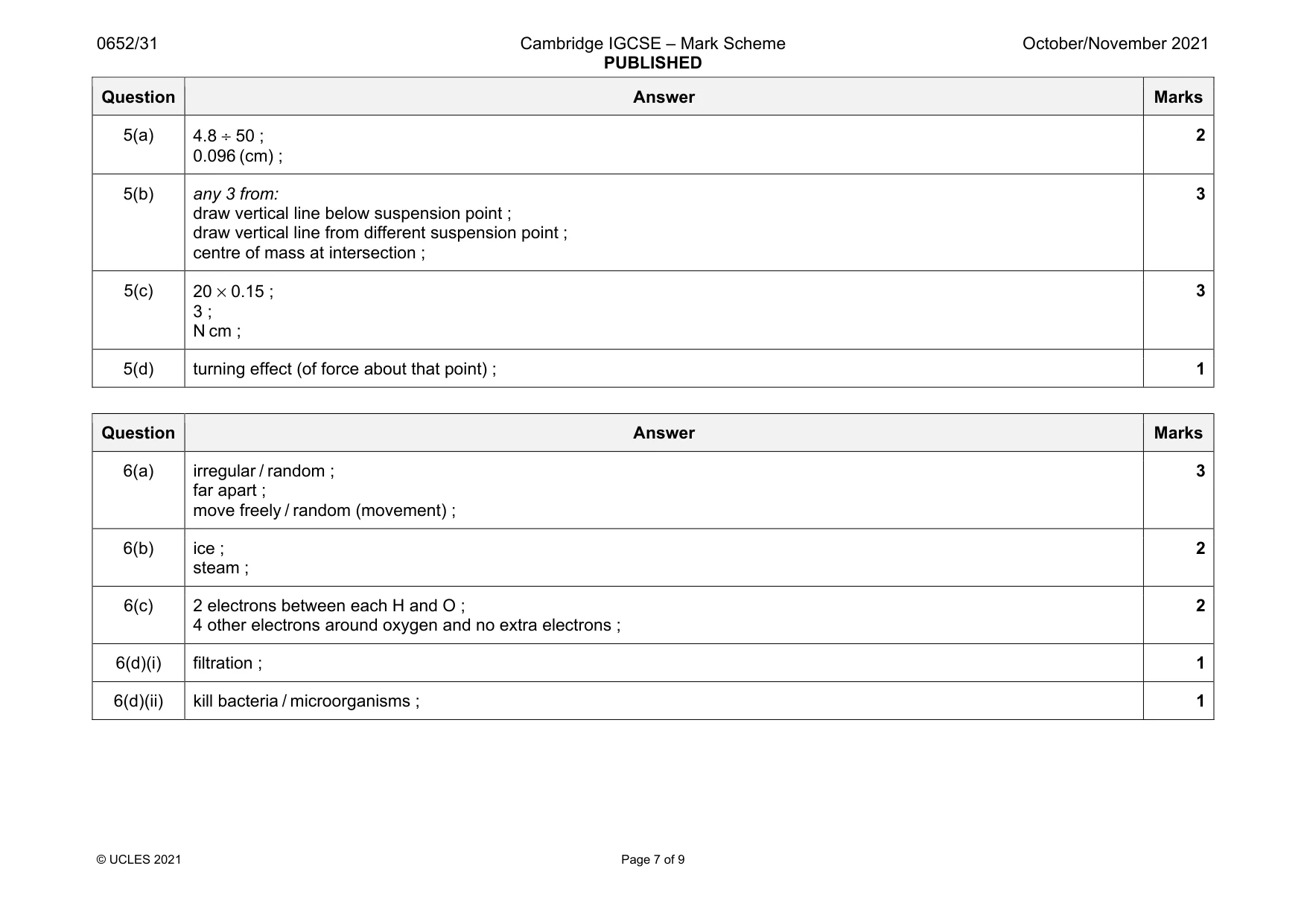
Mark scheme: 5(a) 4.8 ÷ 50 ; 0.096 (cm) ; 2 5(b) any 3 from: draw vertical line below suspension point ; draw vertical line from different suspension point ; centre of mass at intersection ; 3 5(c) 20 × 0.15 ; 3 ; N cm ; 3 5(d) turning effect (of force about that point) ; 1
Q6 · Table 6.1 describes the particles in a solid
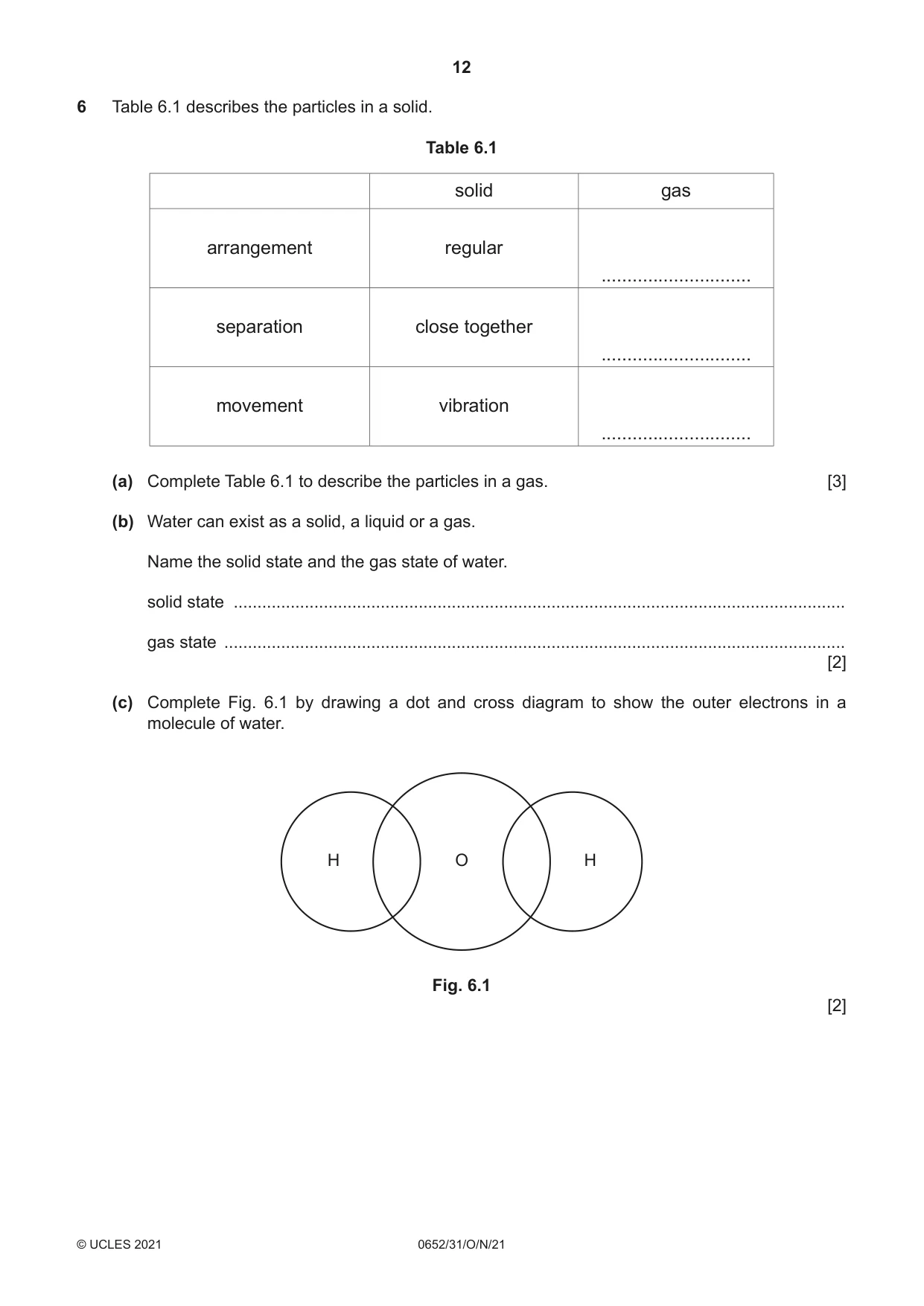
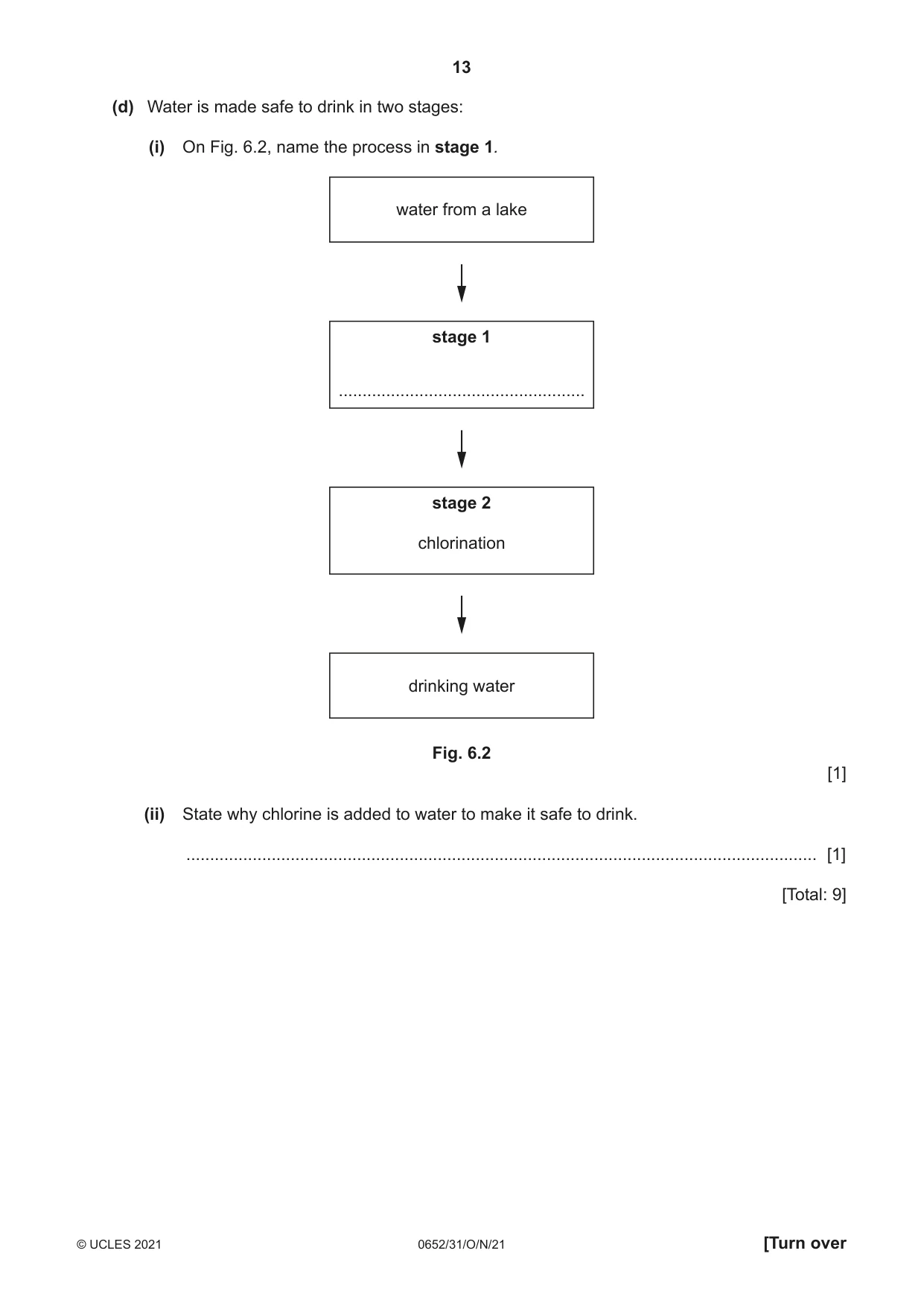
6 Table 6.1 describes the particles in a solid. Table 6.1 solid gas arrangement regular ............................. separation close together ............................. movement vibration ............................. (a) Complete Table 6.1 to describe the particles in a gas. [3] (b) Water can exist as a solid, a liquid or a gas. Name the solid state and the gas state of water. solid state ................................................................................................................................. gas state ................................................................................................................................... [2] (c) Complete Fig. 6.1 by drawing a dot and cross diagram to show the outer electrons in a molecule of water. H O H Fig. 6.1 [2] (d) Water is made safe to drink in two stages: (i) On Fig. 6.2, name the process in stage 1. water from a lake stage 1 .................................................... stage 2 chlorination drinking water Fig. 6.2 [1] (ii) State why chlorine is added to water to make it safe to drink. ..................................................................................................................................... [1] [Total: 9]
Mark scheme: 6(a) irregular / random ; far apart ; move freely / random (movement) ; 3 6(b) ice ; steam ; 2 6(c) 2 electrons between each H and O ; 4 other electrons around oxygen and no extra electrons ; 2 6(d)(i) filtration ; 1 6(d)(ii) kill bacteria / microorganisms ; 1
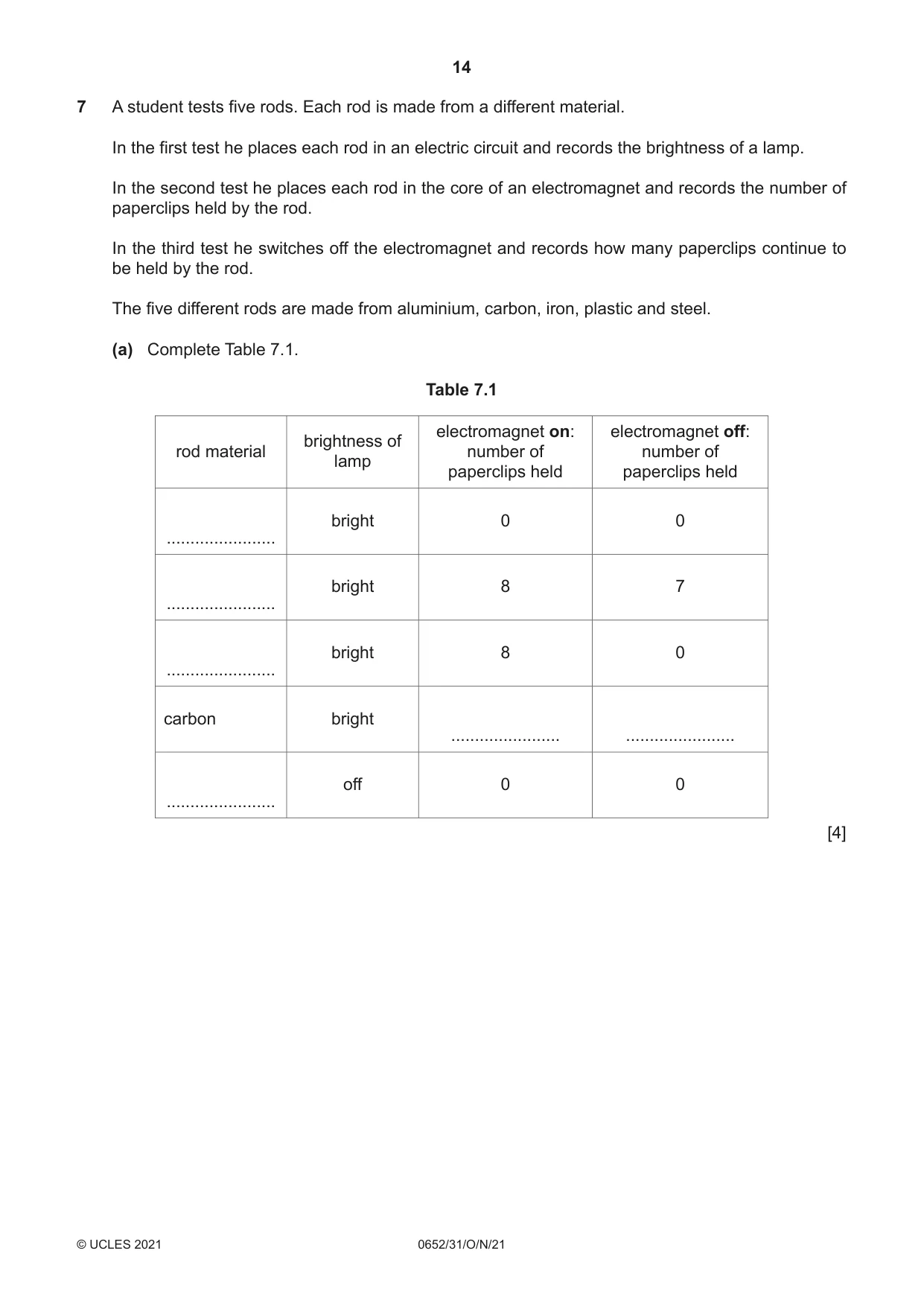
Q7 · A student tests five rods
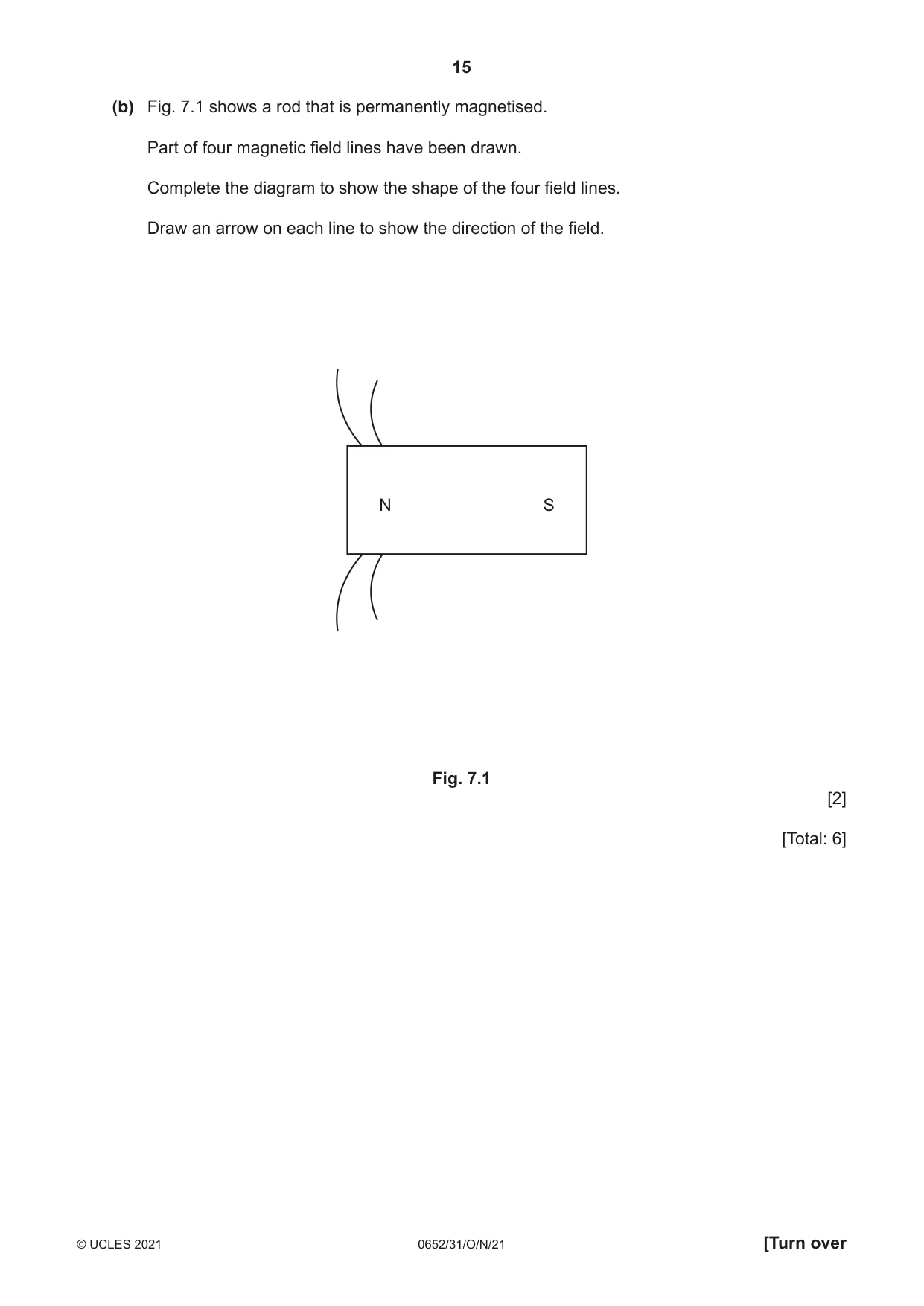
7 A student tests five rods. Each rod is made from a different material. In the first test he places each rod in an electric circuit and records the brightness of a lamp. In the second test he places each rod in the core of an electromagnet and records the number of paperclips held by the rod. In the third test he switches off the electromagnet and records how many paperclips continue to be held by the rod. The five different rods are made from aluminium, carbon, iron, plastic and steel. (a) Complete Table 7.1. Table 7.1 electromagnet on: electromagnet off: brightness of rod material number of number of lamp paperclips held paperclips held bright 0 0 ....................... bright 8 7 ....................... bright 8 0 ....................... carbon bright ....................... ....................... off 0 0 ....................... [4] (b) Fig. 7.1 shows a rod that is permanently magnetised. Part of four magnetic field lines have been drawn. Complete the diagram to show the shape of the four field lines. Draw an arrow on each line to show the direction of the field. N S Fig. 7.1 [2] [Total: 6]
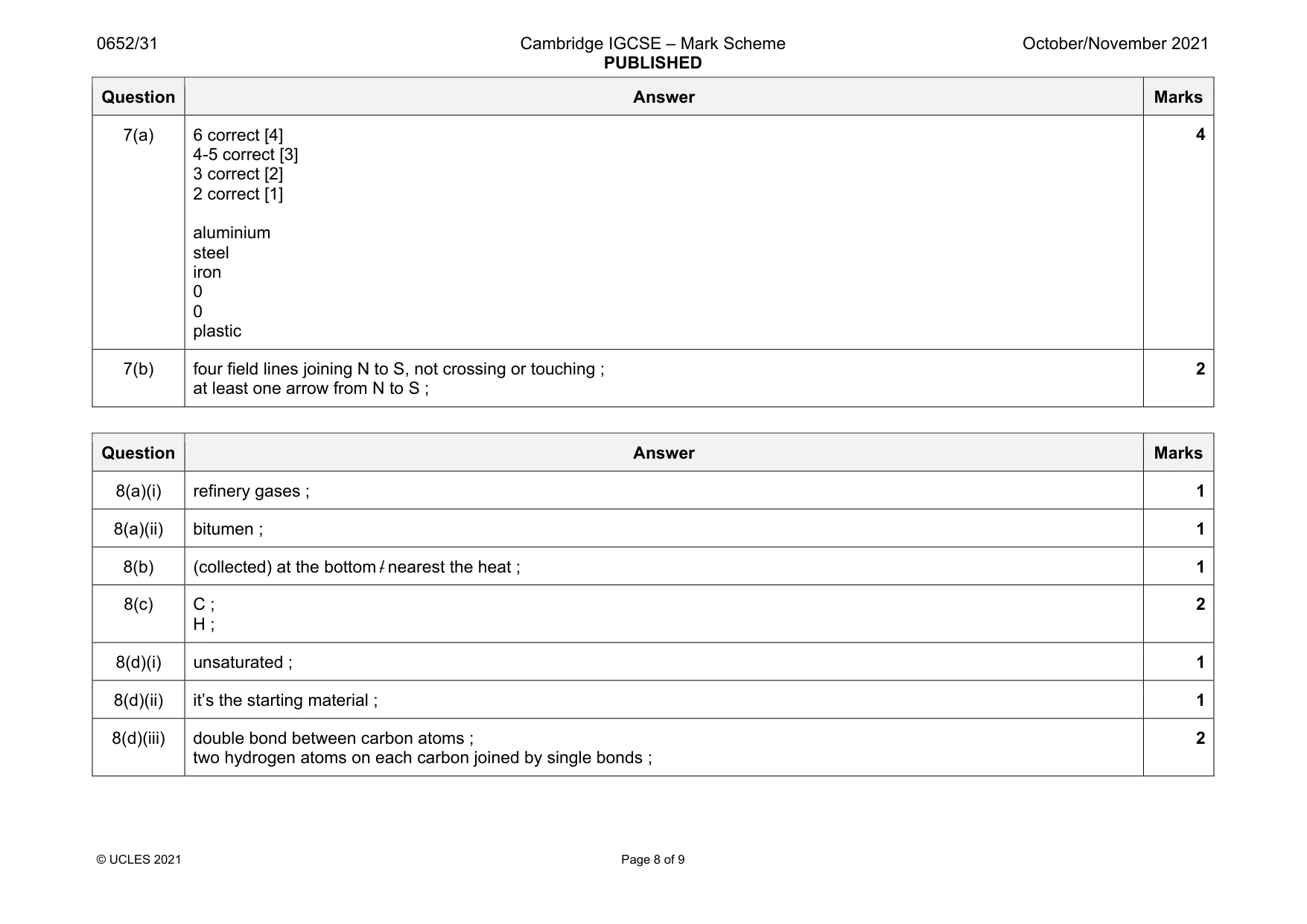
Mark scheme: 7(a) 6 correct [4] 4-5 correct [3] 3 correct [2] 2 correct [1] aluminium steel iron 0 0 plastic 7(b) four field lines joining N to S, not crossing or touching ; at least one arrow from N to S ; 2
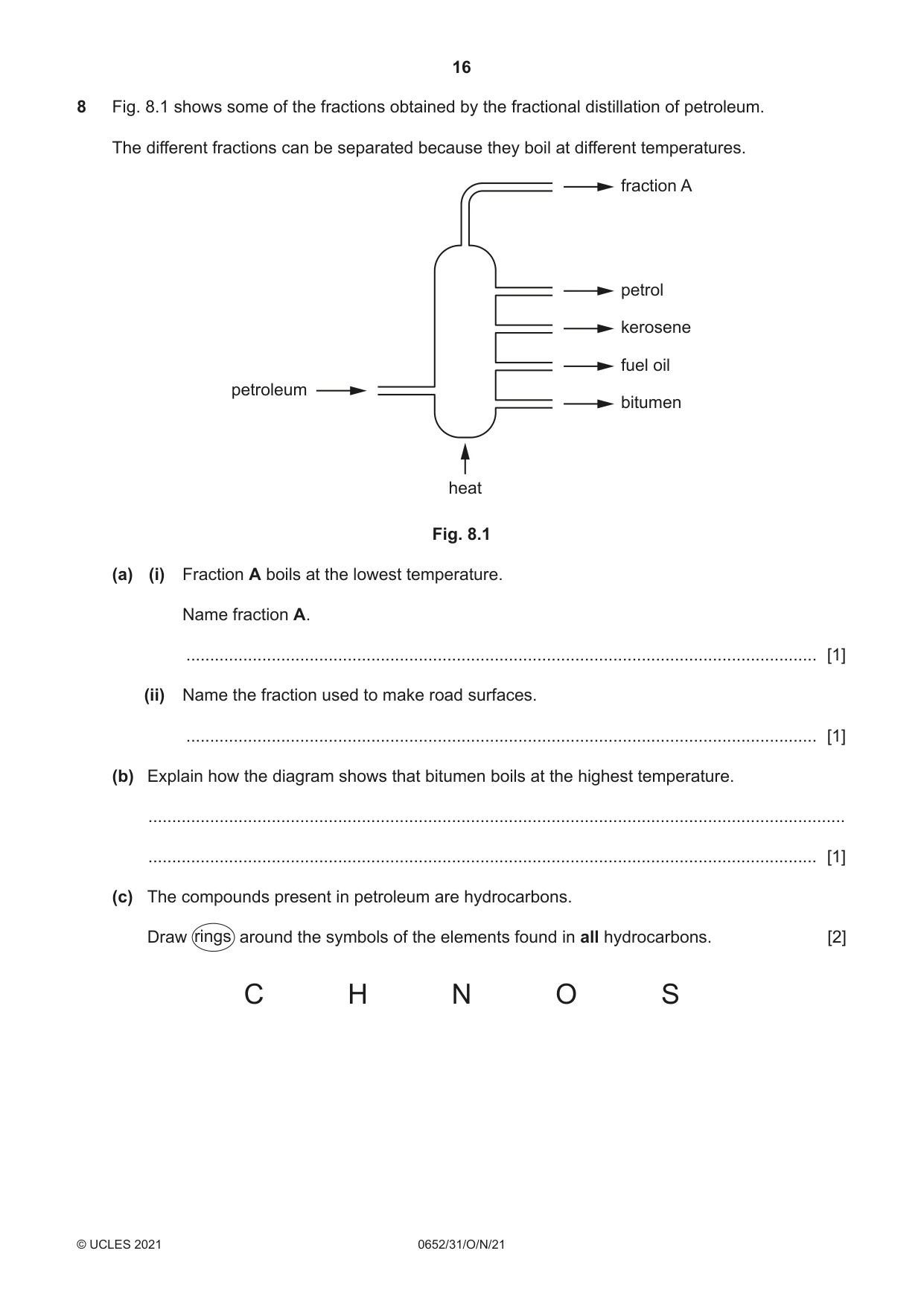
Q8 · Some of the fractions obtained by the fractional distillation of petroleum
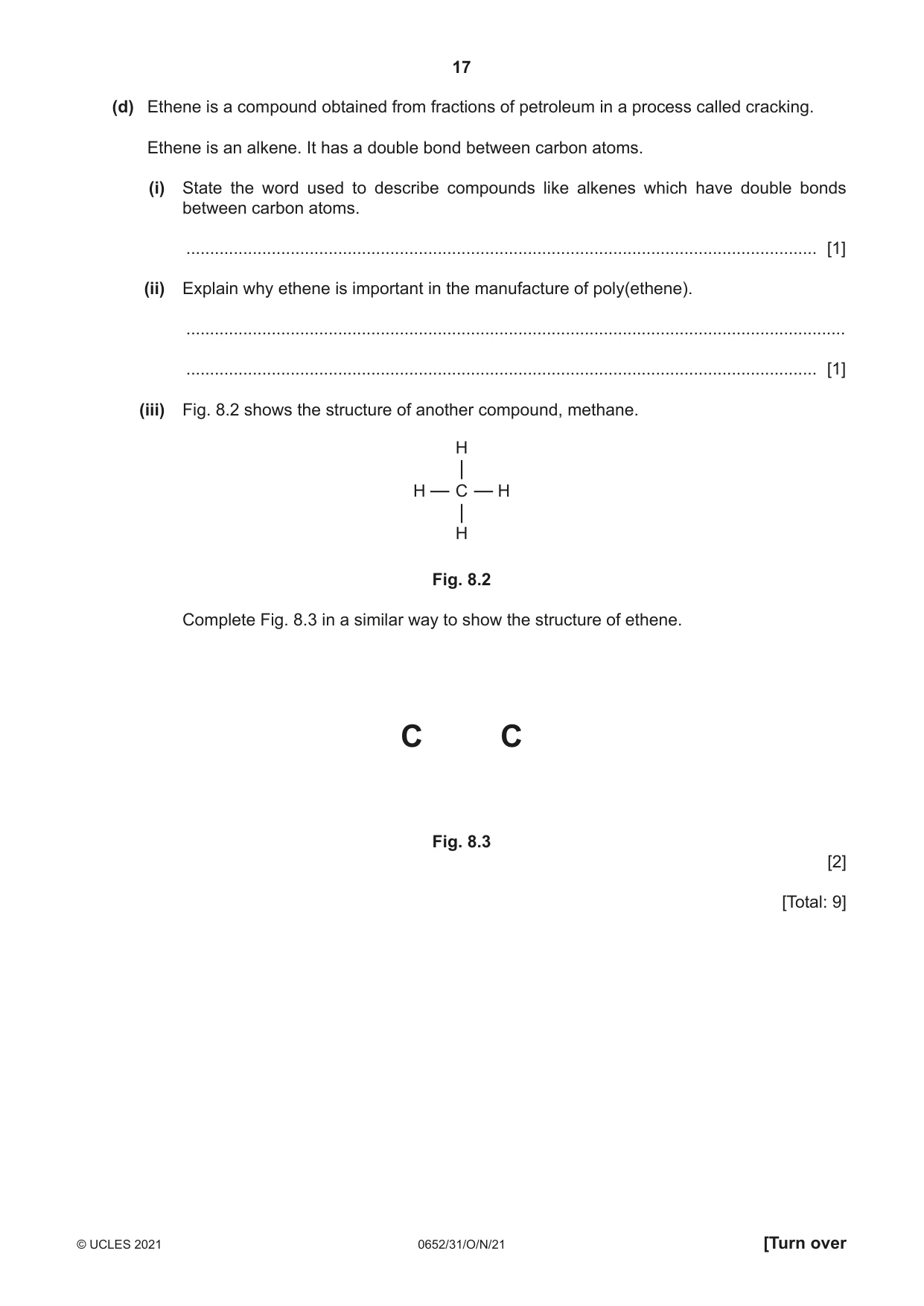
8 Fig. 8.1 shows some of the fractions obtained by the fractional distillation of petroleum. The different fractions can be separated because they boil at different temperatures. fraction A petrol kerosene fuel oil petroleum bitumen heat Fig. 8.1 (a) (i) Fraction A boils at the lowest temperature. Name fraction A. ..................................................................................................................................... [1] (ii) Name the fraction used to make road surfaces. ..................................................................................................................................... [1] (b) Explain how the diagram shows that bitumen boils at the highest temperature. ................................................................................................................................................... ............................................................................................................................................. [1] (c) The compounds present in petroleum are hydrocarbons. Draw rings around the symbols of the elements found in all hydrocarbons. [2] C H N O S (d) Ethene is a compound obtained from fractions of petroleum in a process called cracking. Ethene is an alkene. It has a double bond between carbon atoms. (i) State the word used to describe compounds like alkenes which have double bonds between carbon atoms. ..................................................................................................................................... [1] (ii) Explain why ethene is important in the manufacture of poly(ethene). ........................................................................................................................................... ..................................................................................................................................... [1] (iii) Fig. 8.2 shows the structure of another compound, methane. H H C H H Fig. 8.2 Complete Fig. 8.3 in a similar way to show the structure of ethene. C C Fig. 8.3 [2] [Total: 9]
Mark scheme: 8(a)(i) refinery gases ; 1 8(a)(ii) bitumen ; 1 8(b) (collected) at the bottom / nearest the heat ; 1 8(c) C ; H ; 2 8(d)(i) unsaturated ; 1 8(d)(ii) it’s the starting material ; 1 8(d)(iii) double bond between carbon atoms ; two hydrogen atoms on each carbon joined by single bonds ; 2
Question 9
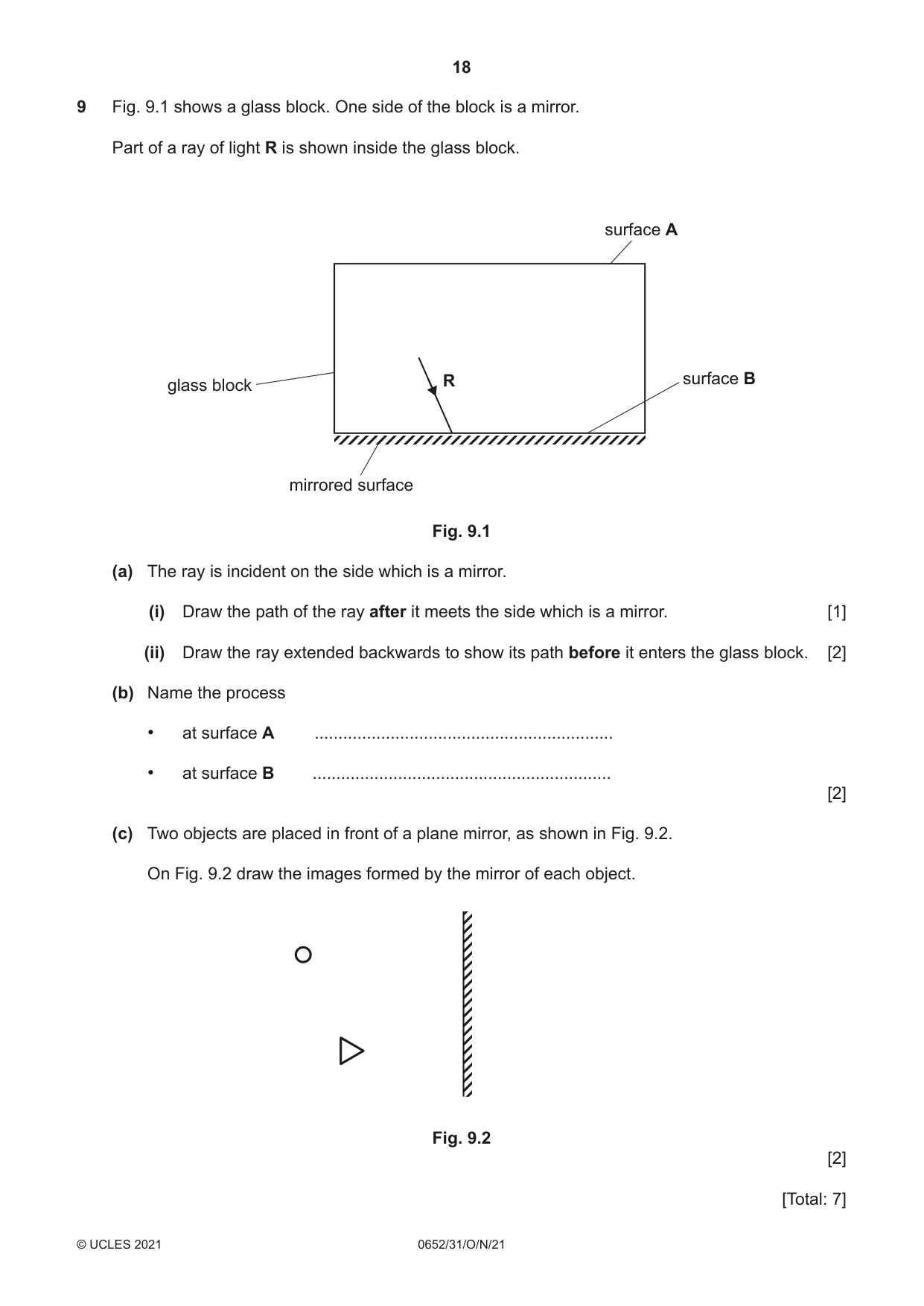
9 Fig. 9.1 shows a glass block. One side of the block is a mirror. Part of a ray of light R is shown inside the glass block. surface A glass block R surface B mirrored surface Fig. 9.1 (a) The ray is incident on the side which is a mirror. (i) Draw the path of the ray after it meets the side which is a mirror. [1] (ii) Draw the ray extended backwards to show its path before it enters the glass block. [2] (b) Name the process • at surface A ............................................................... • at surface B ............................................................... [2] (c) Two objects are placed in front of a plane mirror, as shown in Fig. 9.2. On Fig. 9.2 draw the images formed by the mirror of each object. Fig. 9.2 [2] [Total: 7]
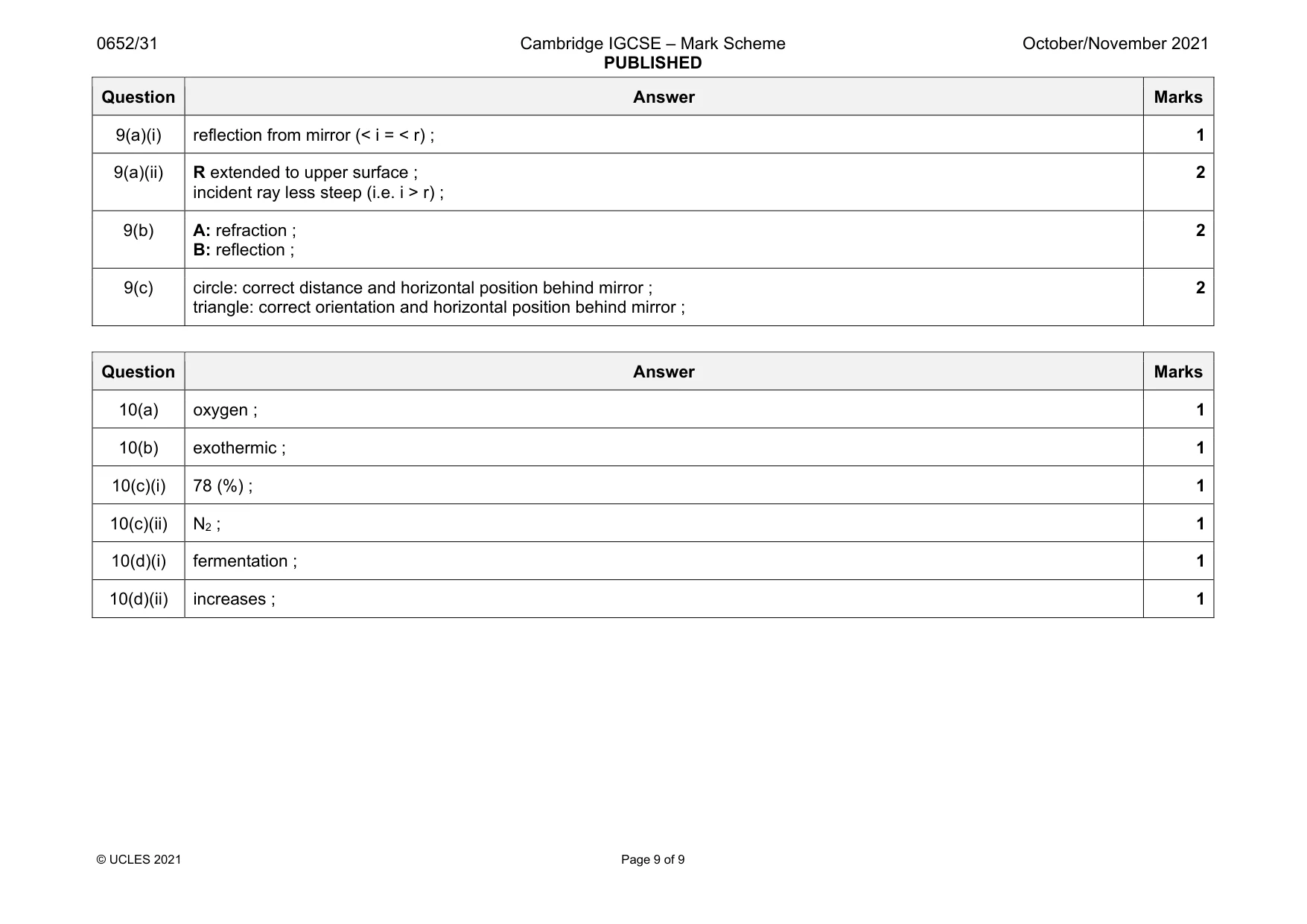
Mark scheme: 9(a)(i) reflection from mirror (< i = < r) ; 1 9(a)(ii) R extended to upper surface ; incident ray less steep (i.e. i > r) ; 2 9(b) A: refraction ; B: reflection ; 2 9(c) circle: correct distance and horizontal position behind mirror ; triangle: correct orientation and horizontal position behind mirror ; 2
Q10 · Ethanol, C2H5OH, is used as a fuel
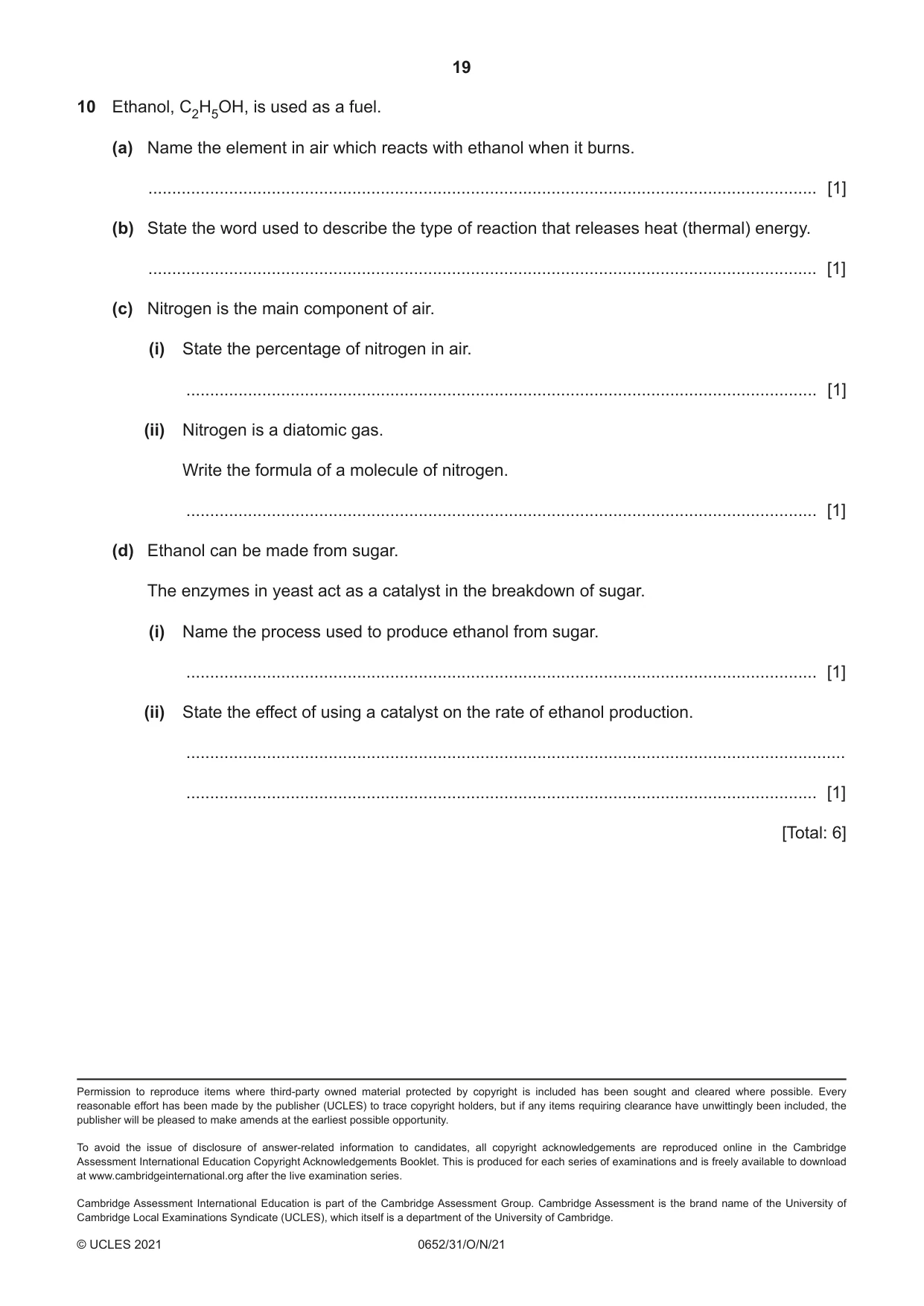
10 Ethanol, C2H5OH, is used as a fuel. (a) Name the element in air which reacts with ethanol when it burns. ............................................................................................................................................. [1] (b) State the word used to describe the type of reaction that releases heat (thermal) energy. ............................................................................................................................................. [1] (c) Nitrogen is the main component of air. (i) State the percentage of nitrogen in air. ..................................................................................................................................... [1] (ii) Nitrogen is a diatomic gas. Write the formula of a molecule of nitrogen. ..................................................................................................................................... [1] (d) Ethanol can be made from sugar. The enzymes in yeast act as a catalyst in the breakdown of sugar. (i) Name the process used to produce ethanol from sugar. ..................................................................................................................................... [1] (ii) State the effect of using a catalyst on the rate of ethanol production. ........................................................................................................................................... ..................................................................................................................................... [1] [Total: 6]
Mark scheme: 10(a) oxygen ; 1 10(b) exothermic ; 1 10(c)(i) 78 (%) ; 1 10(c)(ii) N2 ; 1 10(d)(i) fermentation ; 1 10(d)(ii) increases ; 1
What was in this paper
The subtopics covered by these 10 questions, and how many questions each got. Open one in a new tab to see every Cambridge question on it.
What you needed in this session
Cambridge’s own grade thresholds for 2021 Oct/Nov, Paper 3 · Variant 1. A higher threshold means an easier paper — the bar moves with how the cohort did.