Cambridge IGCSE Physical Science 0652 — 2023 Oct/Nov Paper 3 · Variant 1
0652/31/O/N/23 · 10 questions · 80 marks · ≈90 min
The question paper and its mark scheme, free to read here and free to download. This is Cambridge’s own paper, exactly as it was sat.
Question paper24 pages



Mark scheme10 pages
Answers below. Sit the paper first if you are practising.
Questions as text
Q1 · A person hits a golf ball with a golf club
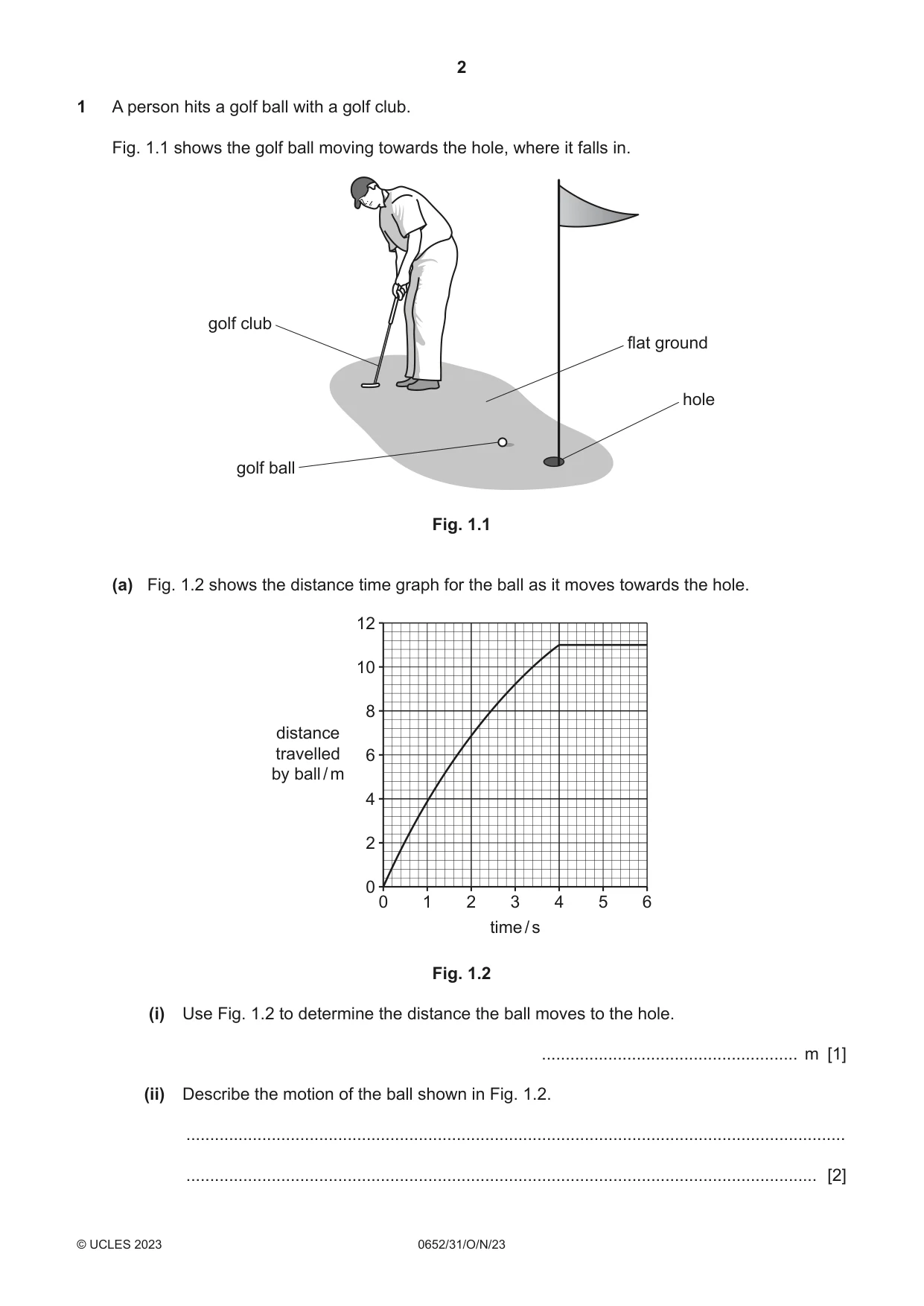
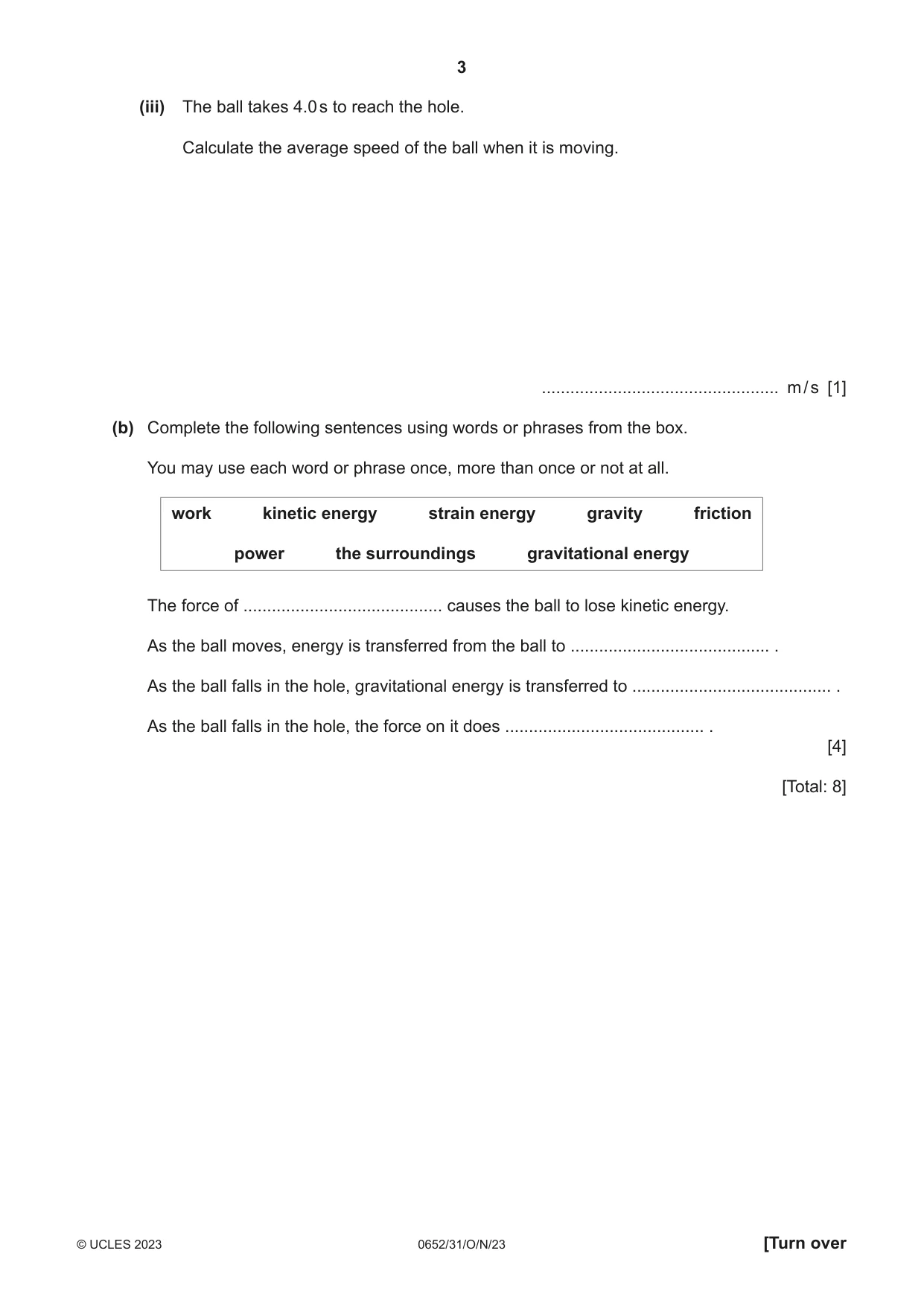
1 A person hits a golf ball with a golf club. Fig. 1.1 shows the golf ball moving towards the hole, where it falls in. golf club flat ground hole golf ball Fig. 1.1 (a) Fig. 1.2 shows the distance time graph for the ball as it moves towards the hole. 12 10 8 distance travelled 6 by ball / m 4 2 0 0 1 2 3 4 5 6 time / s Fig. 1.2 (i) Use Fig. 1.2 to determine the distance the ball moves to the hole. ...................................................... m [1] (ii) Describe the motion of the ball shown in Fig. 1.2. ........................................................................................................................................... ..................................................................................................................................... [2] (iii) The ball takes 4.0 s to reach the hole. Calculate the average speed of the ball when it is moving. .................................................. m / s [1] (b) Complete the following sentences using words or phrases from the box. You may use each word or phrase once, more than once or not at all. work kinetic energy strain energy gravity friction power the surroundings gravitational energy The force of .......................................... causes the ball to lose kinetic energy. As the ball moves, energy is transferred from the ball to .......................................... . As the ball falls in the hole, gravitational energy is transferred to .......................................... . As the ball falls in the hole, the force on it does .......................................... . [4] [Total: 8]
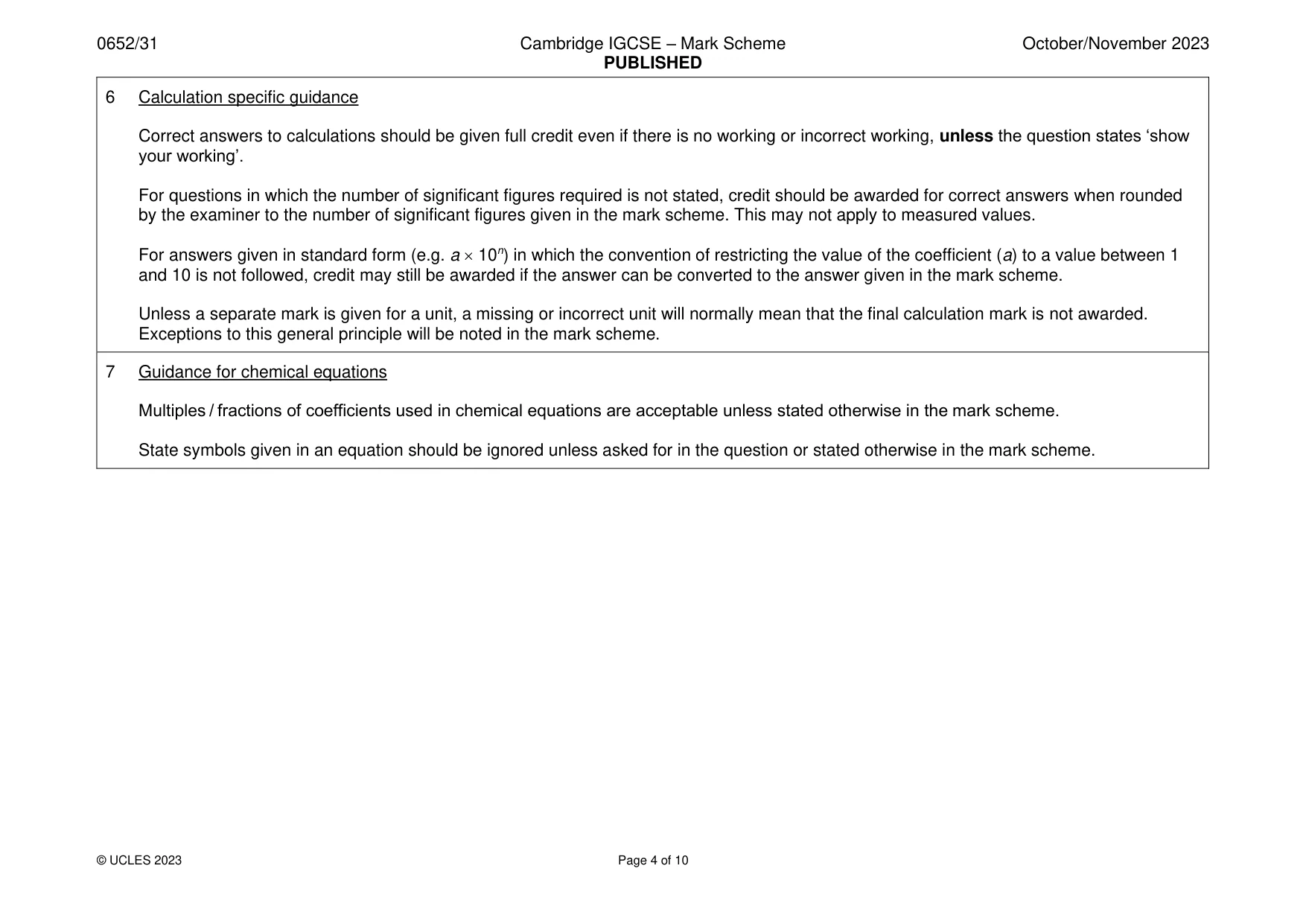
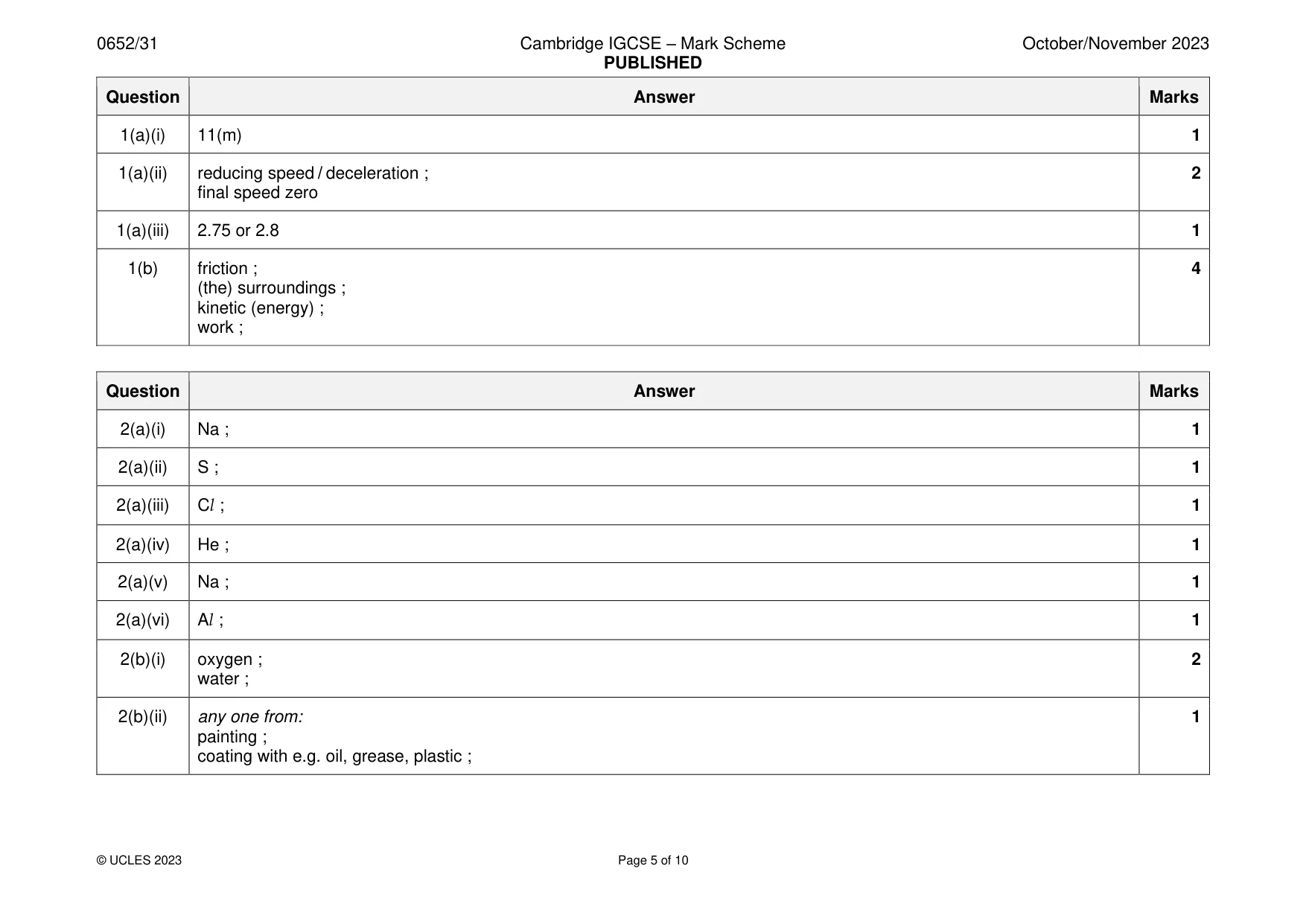
Mark scheme: Question Answer Marks 1(a)(i) 11(m) 1 1(a)(ii) reducing speed / deceleration ; 2 final speed zero 1(a)(iii) 2.75 or 2.8 1 1(b) friction ; 4 (the) surroundings ; kinetic (energy) ; work ;
Q2 · The symbols for some elements are shown
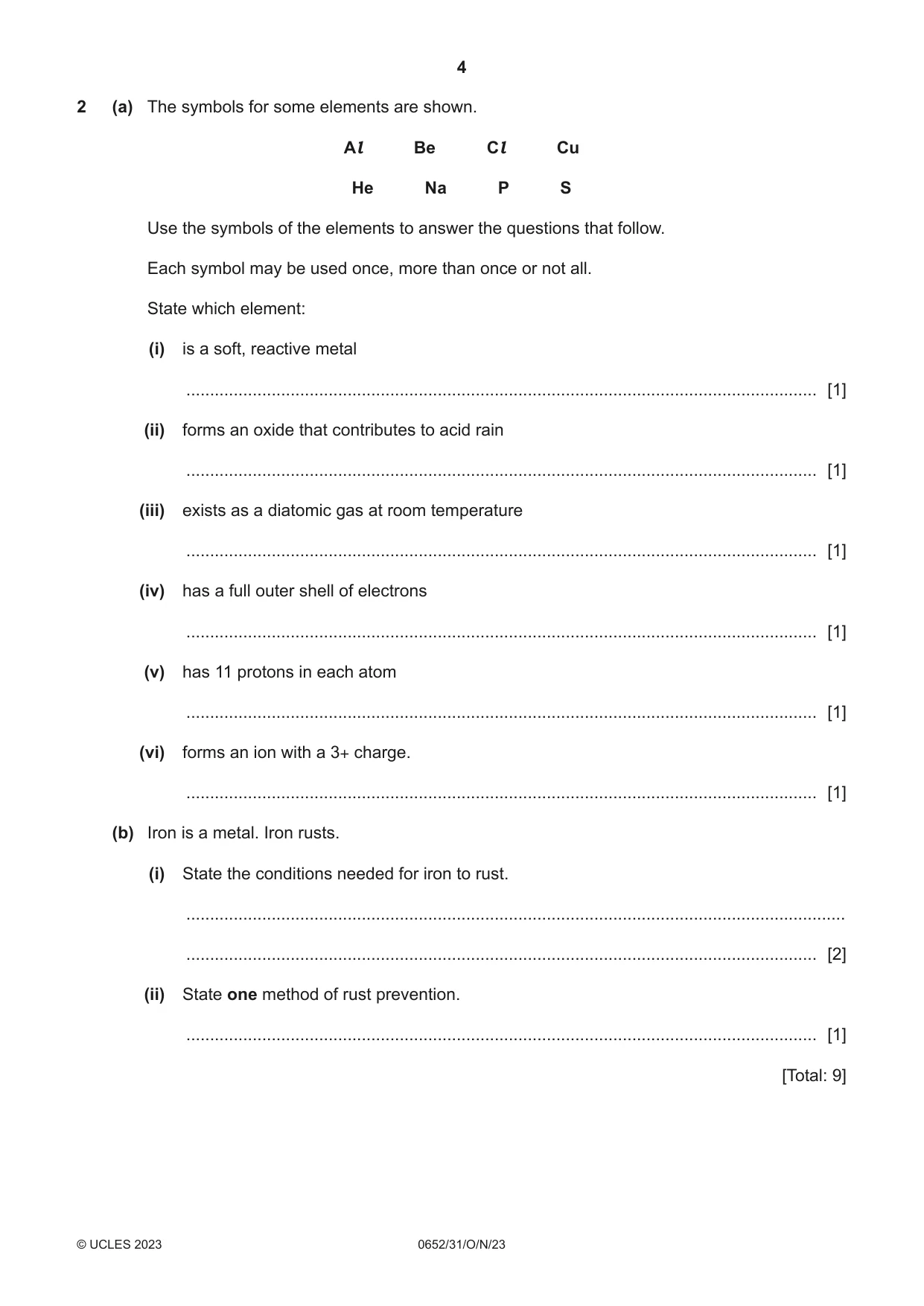
2 (a) The symbols for some elements are shown. Al Be Cl Cu He Na P S Use the symbols of the elements to answer the questions that follow. Each symbol may be used once, more than once or not all. State which element: (i) is a soft, reactive metal ..................................................................................................................................... [1] (ii) forms an oxide that contributes to acid rain ..................................................................................................................................... [1] (iii) exists as a diatomic gas at room temperature ..................................................................................................................................... [1] (iv) has a full outer shell of electrons ..................................................................................................................................... [1] (v) has 11 protons in each atom ..................................................................................................................................... [1] (vi) forms an ion with a 3+ charge. ..................................................................................................................................... [1] (b) Iron is a metal. Iron rusts. (i) State the conditions needed for iron to rust. ........................................................................................................................................... ..................................................................................................................................... [2] (ii) State one method of rust prevention. ..................................................................................................................................... [1] [Total: 9]
Mark scheme: 2(a)(i) Na ; 1 2(a)(ii) S ; 1 2(a)(iii) Cl ; 1 2(a)(iv) He ; 1 2(a)(v) Na ; 1 2(a)(vi) Al ; 1 2(b)(i) oxygen ; 2 water ; 2(b)(ii) any one from: 1 painting ; coating with e.g. oil, grease, plastic ;
Q3 · A student applies a force F to a beaker as shown in Fig
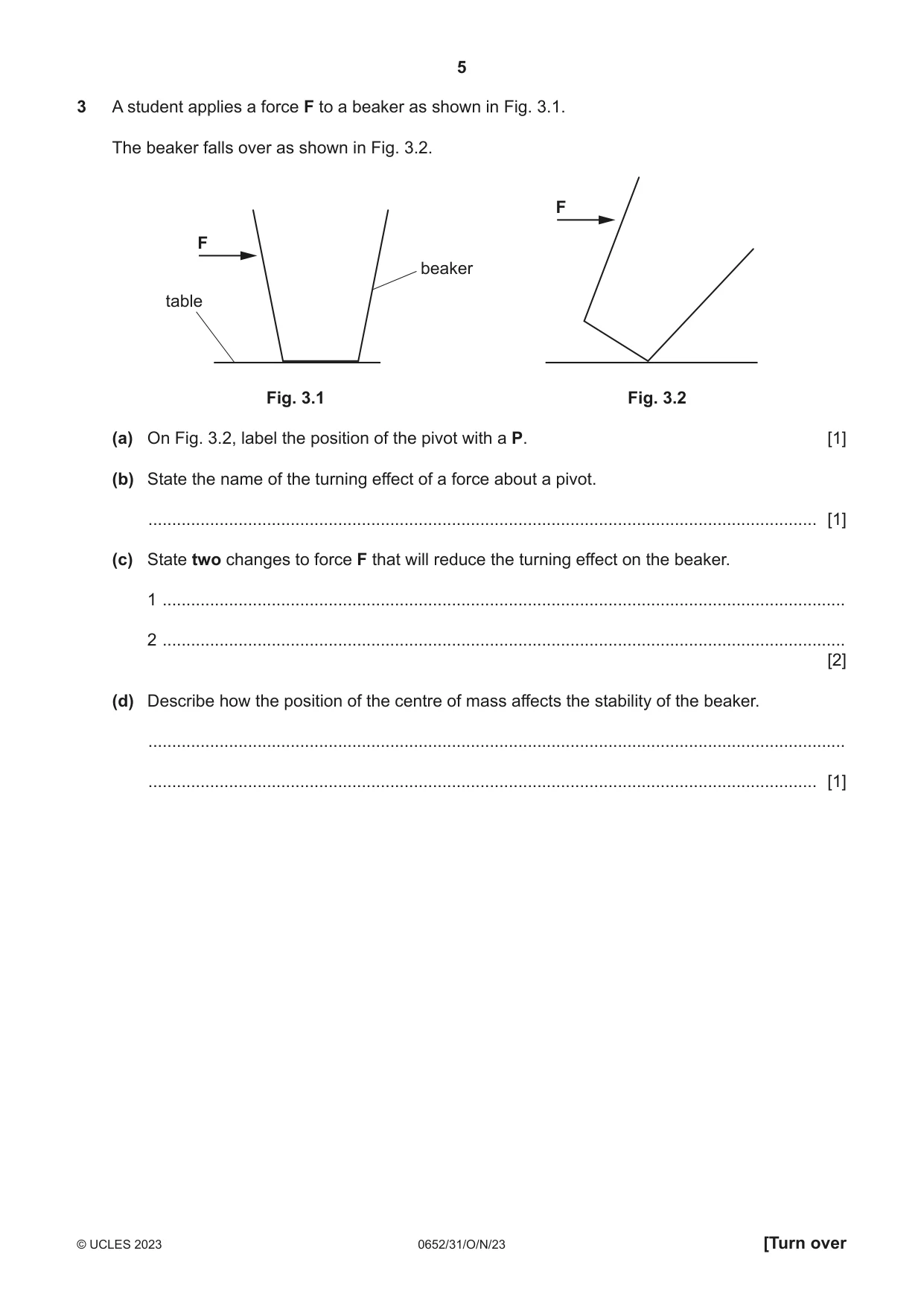
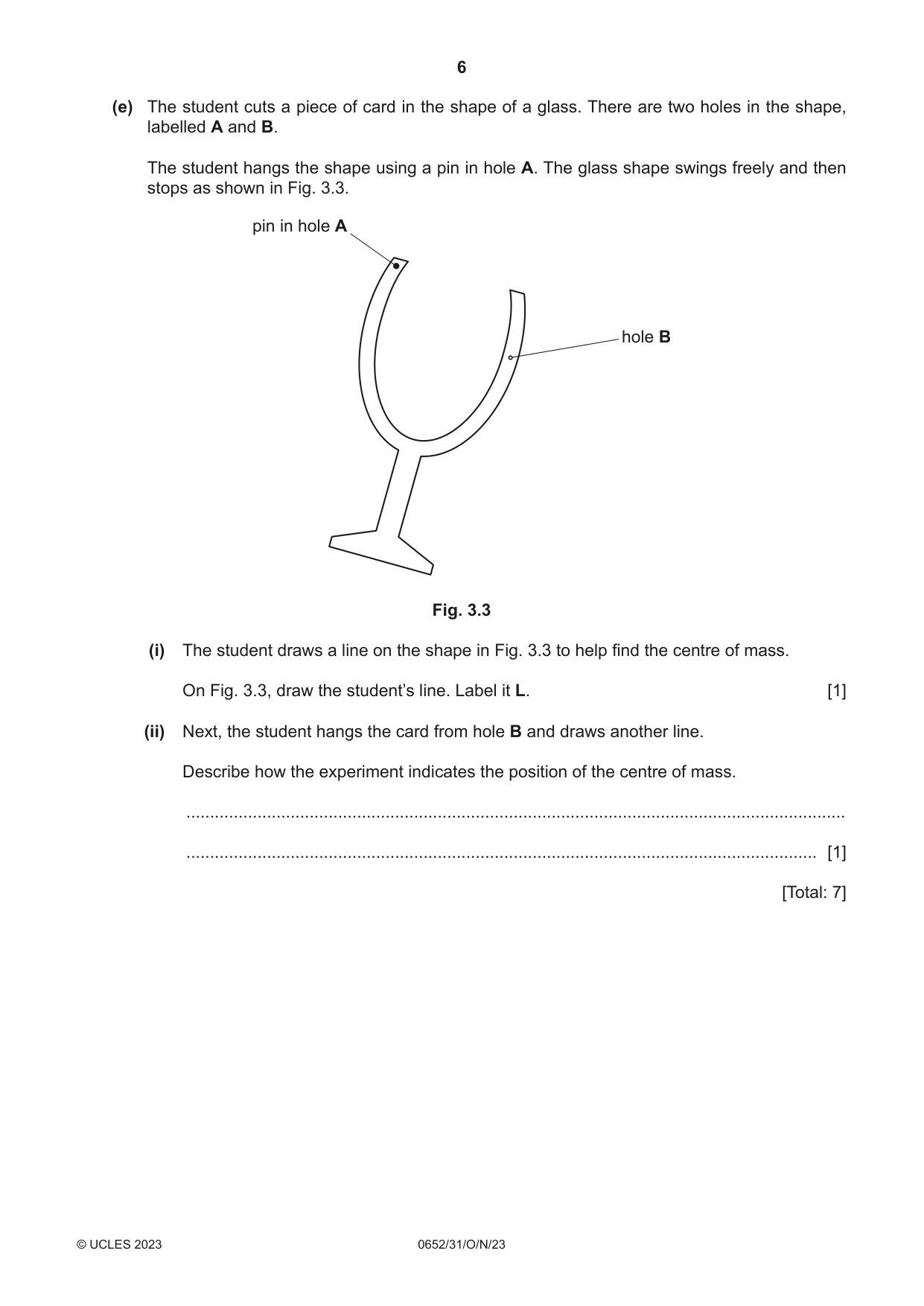
3 A student applies a force F to a beaker as shown in Fig. 3.1. The beaker falls over as shown in Fig. 3.2. F F beaker table Fig. 3.1 Fig. 3.2 (a) On Fig. 3.2, label the position of the pivot with a P. [1] (b) State the name of the turning effect of a force about a pivot. ............................................................................................................................................. [1] (c) State two changes to force F that will reduce the turning effect on the beaker. 1 ................................................................................................................................................ 2 ................................................................................................................................................ [2] (d) Describe how the position of the centre of mass affects the stability of the beaker. ................................................................................................................................................... ............................................................................................................................................. [1] (e) The student cuts a piece of card in the shape of a glass. There are two holes in the shape, labelled A and B. The student hangs the shape using a pin in hole A. The glass shape swings freely and then stops as shown in Fig. 3.3. pin in hole A hole B Fig. 3.3 (i) The student draws a line on the shape in Fig. 3.3 to help find the centre of mass. On Fig. 3.3, draw the student’s line. Label it L. [1] (ii) Next, the student hangs the card from hole B and draws another line. Describe how the experiment indicates the position of the centre of mass. ........................................................................................................................................... ..................................................................................................................................... [1] [Total: 7]
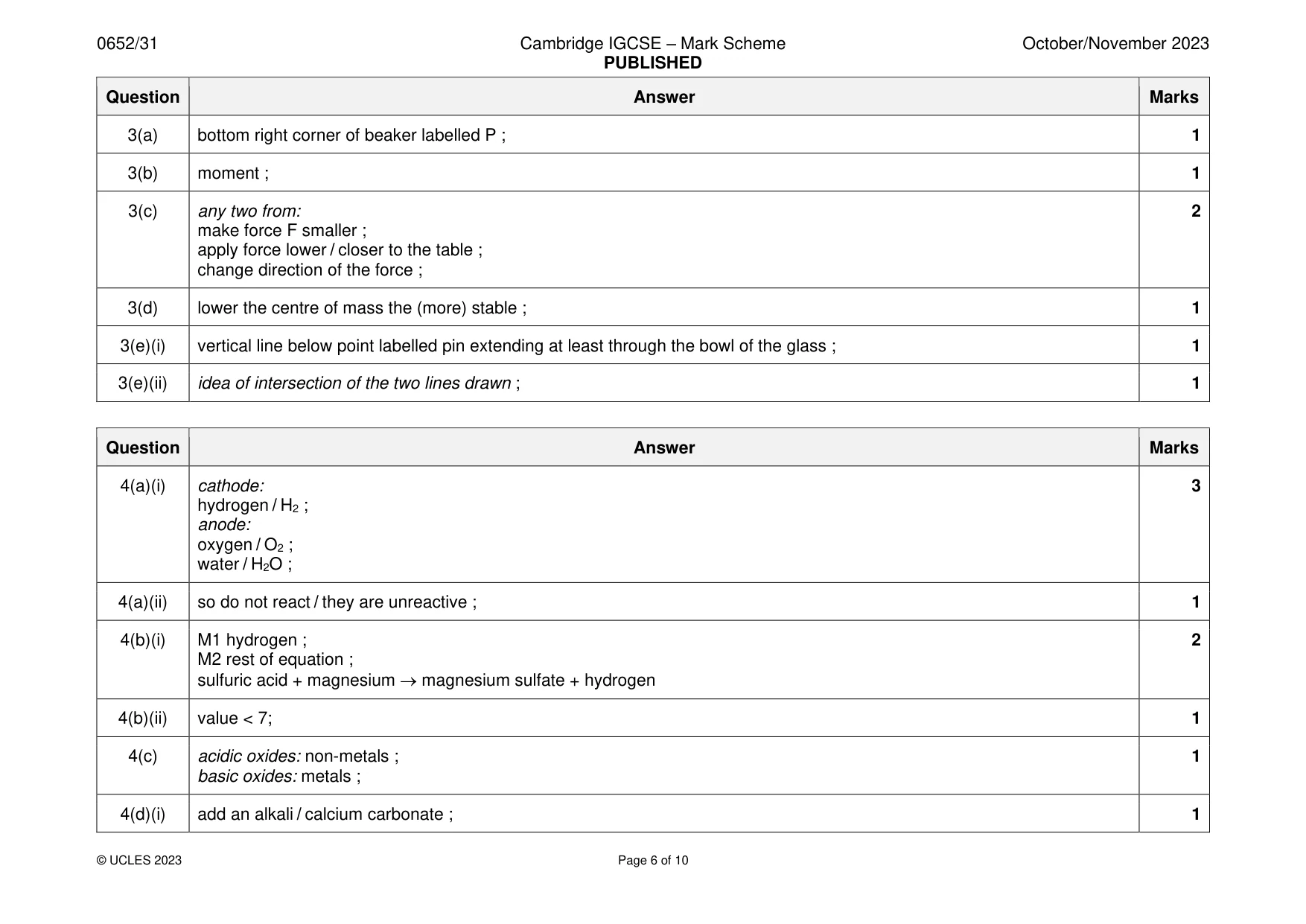
Mark scheme: 3(a) bottom right corner of beaker labelled P ; 1 3(b) moment ; 1 3(c) any two from: 2 make force F smaller ; apply force lower / closer to the table ; change direction of the force ; 3(d) lower the centre of mass the (more) stable ; 1 3(e)(i) vertical line below point labelled pin extending at least through the bowl of the glass ; 1 3(e)(ii) idea of intersection of the two lines drawn ; 1
Q4 · The apparatus needed for the electrolysis of dilute sulfuric acid
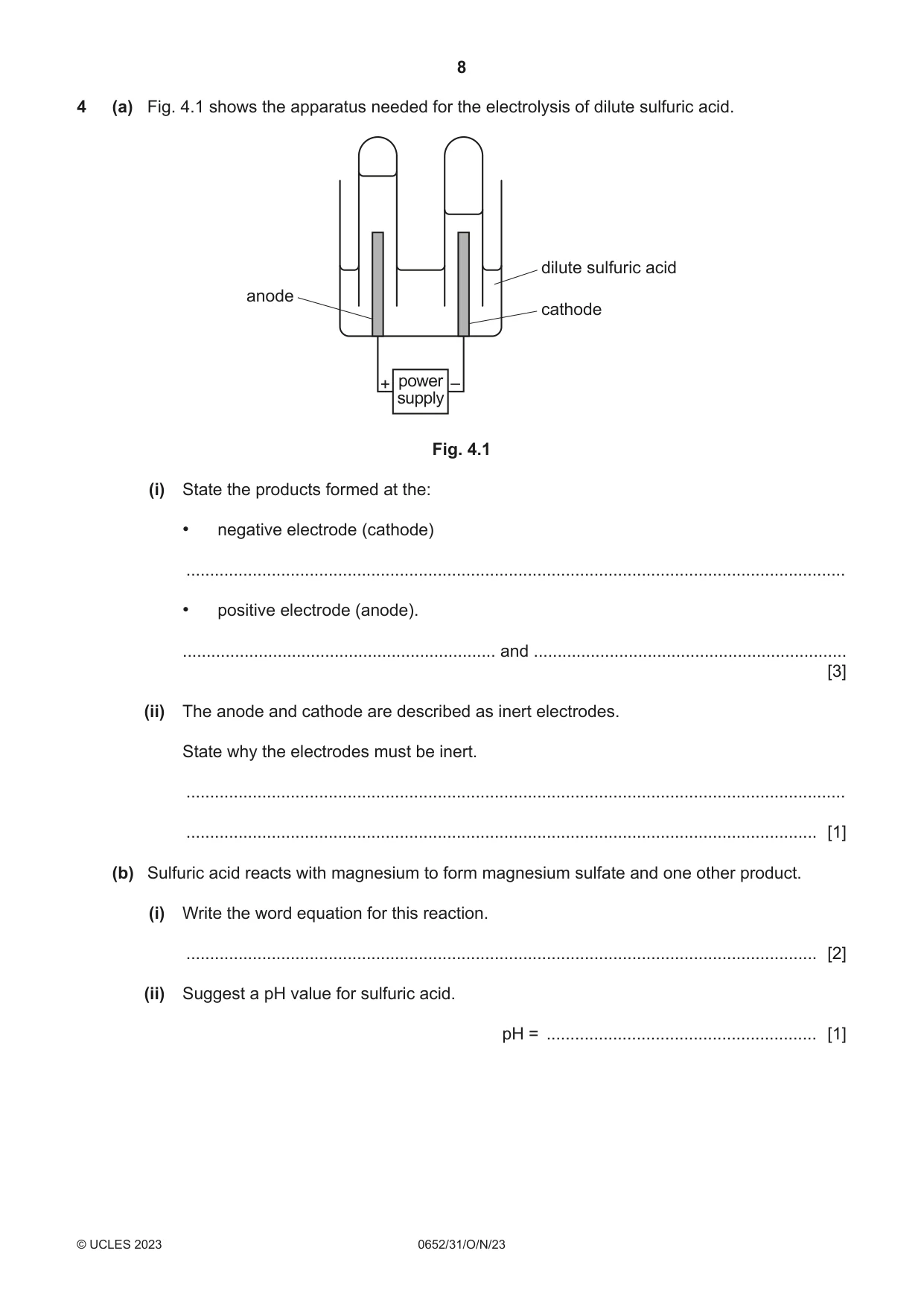
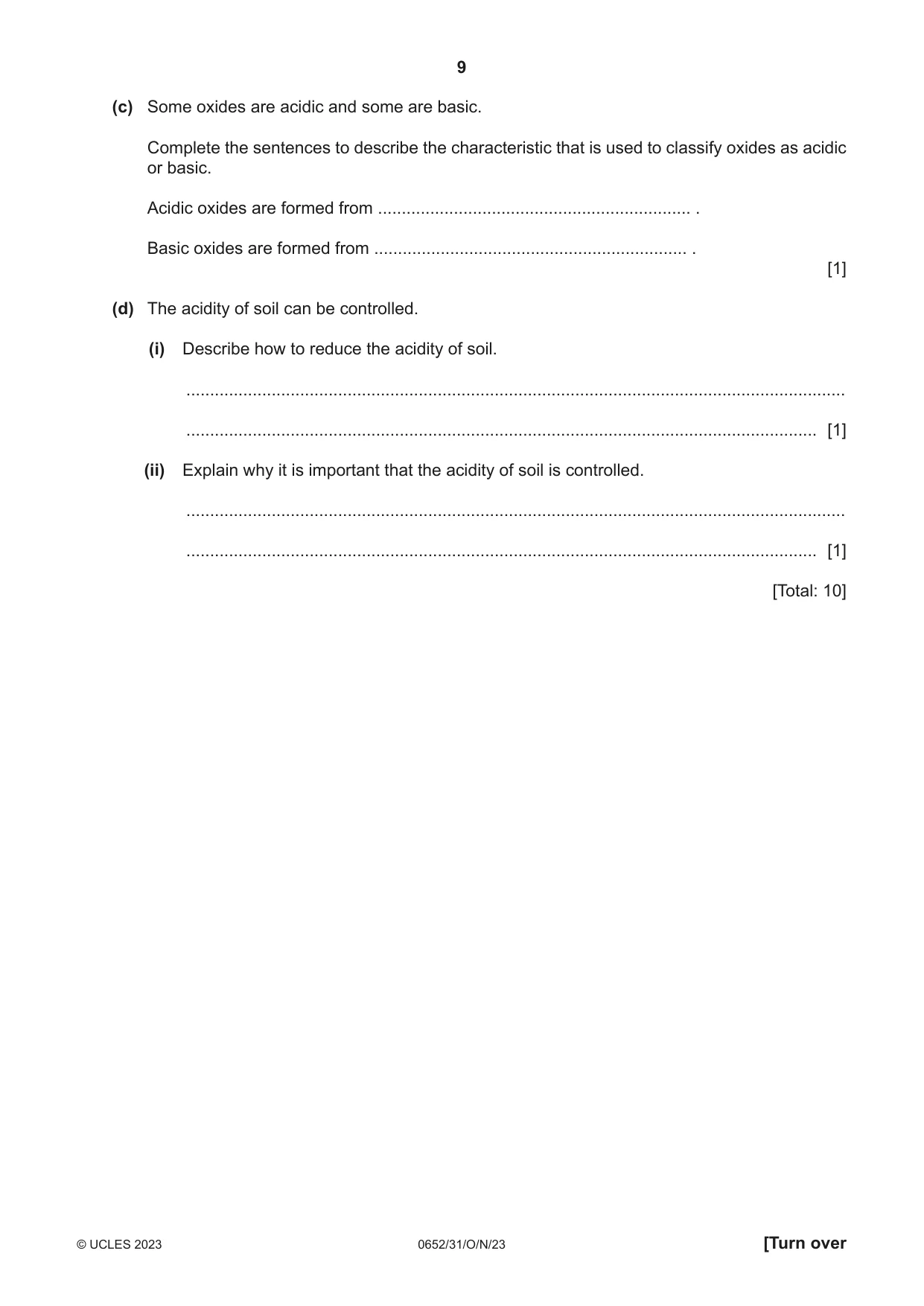
4 (a) Fig. 4.1 shows the apparatus needed for the electrolysis of dilute sulfuric acid. dilute sulfuric acid anode cathode + power – supply Fig. 4.1 (i) State the products formed at the: • negative electrode (cathode) ........................................................................................................................................... • positive electrode (anode). .................................................................. and .................................................................. [3] (ii) The anode and cathode are described as inert electrodes. State why the electrodes must be inert. ........................................................................................................................................... ..................................................................................................................................... [1] (b) Sulfuric acid reacts with magnesium to form magnesium sulfate and one other product. (i) Write the word equation for this reaction. ..................................................................................................................................... [2] (ii) Suggest a pH value for sulfuric acid. pH = ......................................................... [1] (c) Some oxides are acidic and some are basic. Complete the sentences to describe the characteristic that is used to classify oxides as acidic or basic. Acidic oxides are formed from .................................................................. . Basic oxides are formed from .................................................................. . [1] (d) The acidity of soil can be controlled. (i) Describe how to reduce the acidity of soil. ........................................................................................................................................... ..................................................................................................................................... [1] (ii) Explain why it is important that the acidity of soil is controlled. ........................................................................................................................................... ..................................................................................................................................... [1] [Total: 10]
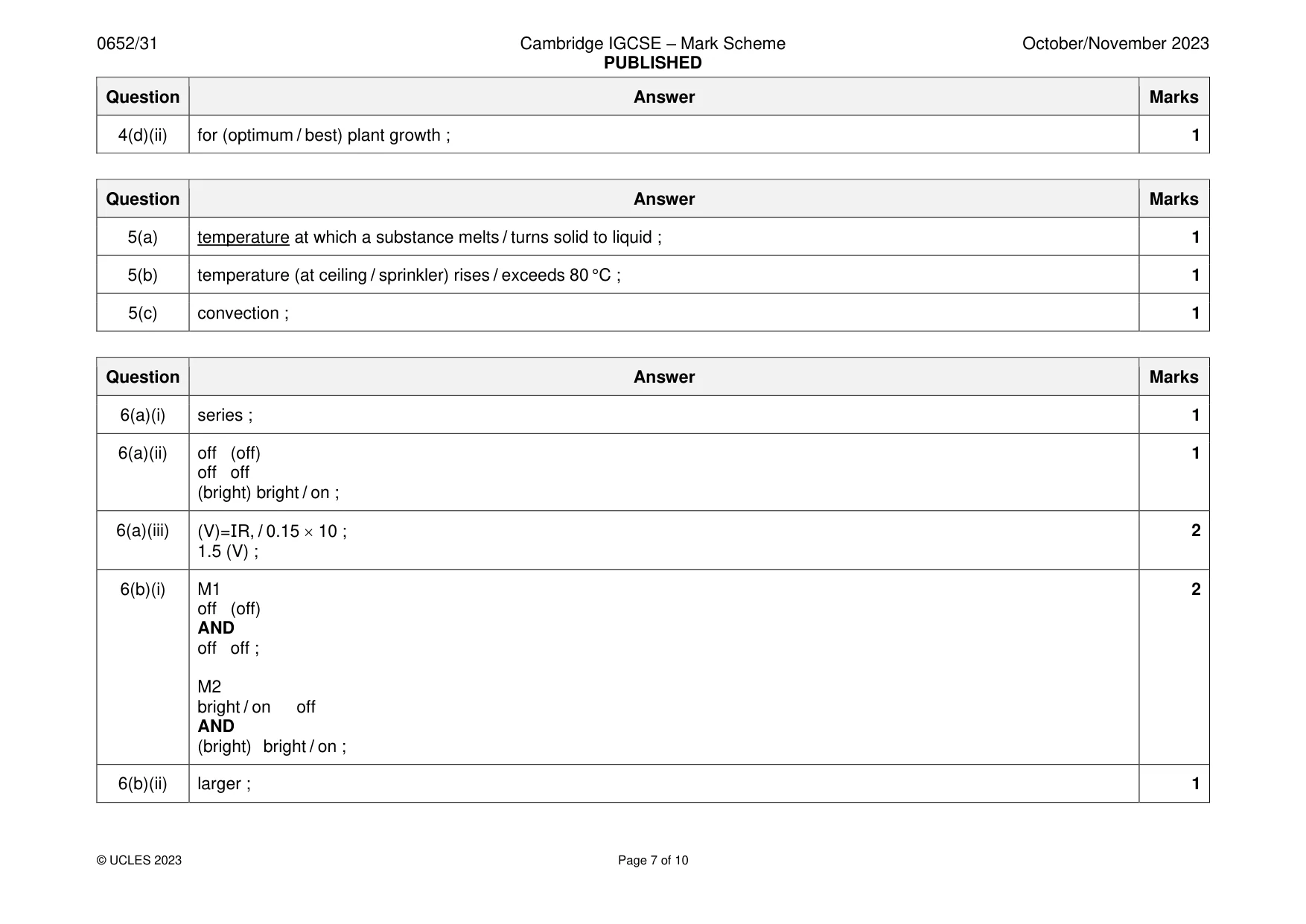
Mark scheme: 4(a)(i) cathode: 3 hydrogen / H2 ; anode: oxygen / O2 ; water / H2O ; 4(a)(ii) so do not react / they are unreactive ; 1 4(b)(i) M1 hydrogen ; 2 M2 rest of equation ; sulfuric acid + magnesium → magnesium sulfate + hydrogen 4(b)(ii) value < 7; 1 4(c) acidic oxides: non-metals ; 1 basic oxides: metals ; 4(d)(i) add an alkali / calcium carbonate ; 1 4(d)(ii) for (optimum / best) plant growth ; 1
Q5 · A fire starts on the floor of a hotel room
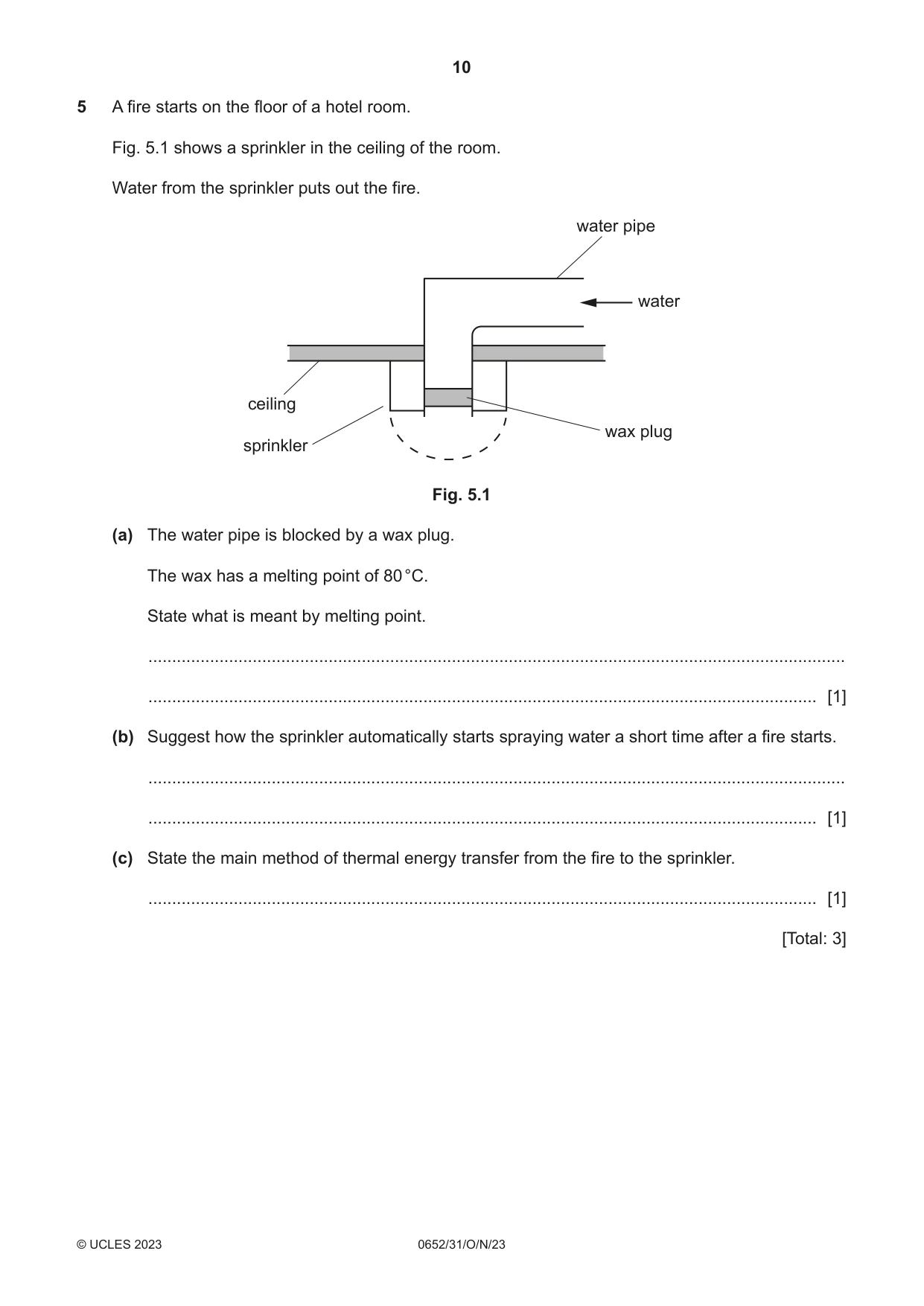
5 A fire starts on the floor of a hotel room. Fig. 5.1 shows a sprinkler in the ceiling of the room. Water from the sprinkler puts out the fire. water pipe water ceiling wax plug sprinkler Fig. 5.1 (a) The water pipe is blocked by a wax plug. The wax has a melting point of 80 °C. State what is meant by melting point. ................................................................................................................................................... ............................................................................................................................................. [1] (b) Suggest how the sprinkler automatically starts spraying water a short time after a fire starts. ................................................................................................................................................... ............................................................................................................................................. [1] (c) State the main method of thermal energy transfer from the fire to the sprinkler. ............................................................................................................................................. [1] [Total: 3]
Mark scheme: 5(a) temperature at which a substance melts / turns solid to liquid ; 1 5(b) temperature (at ceiling / sprinkler) rises / exceeds 80 °C ; 1 5(c) convection ; 1
Q6 · A student makes a circuit using two cells, two switches S1 and S2, and two lamps L1 and…
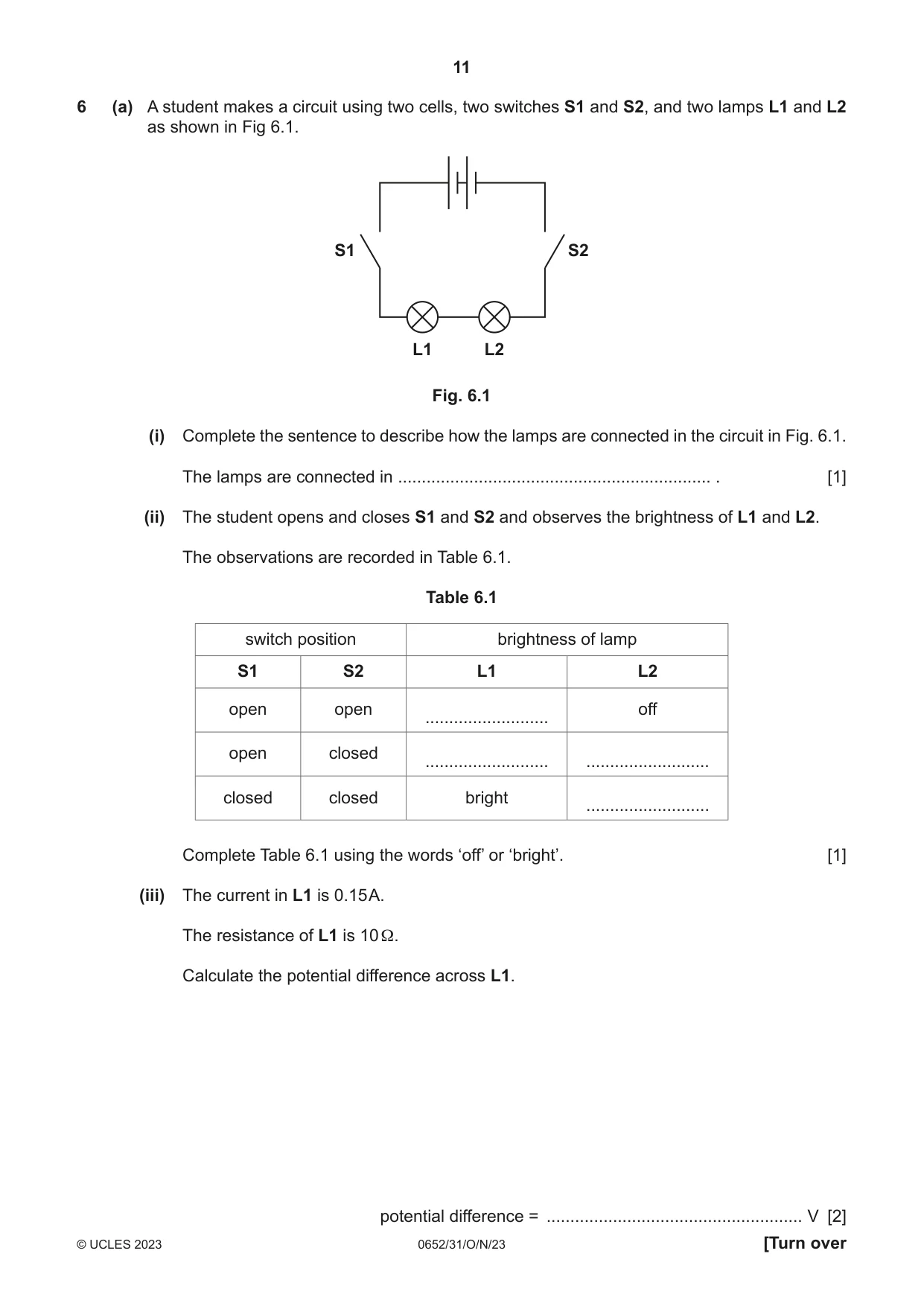
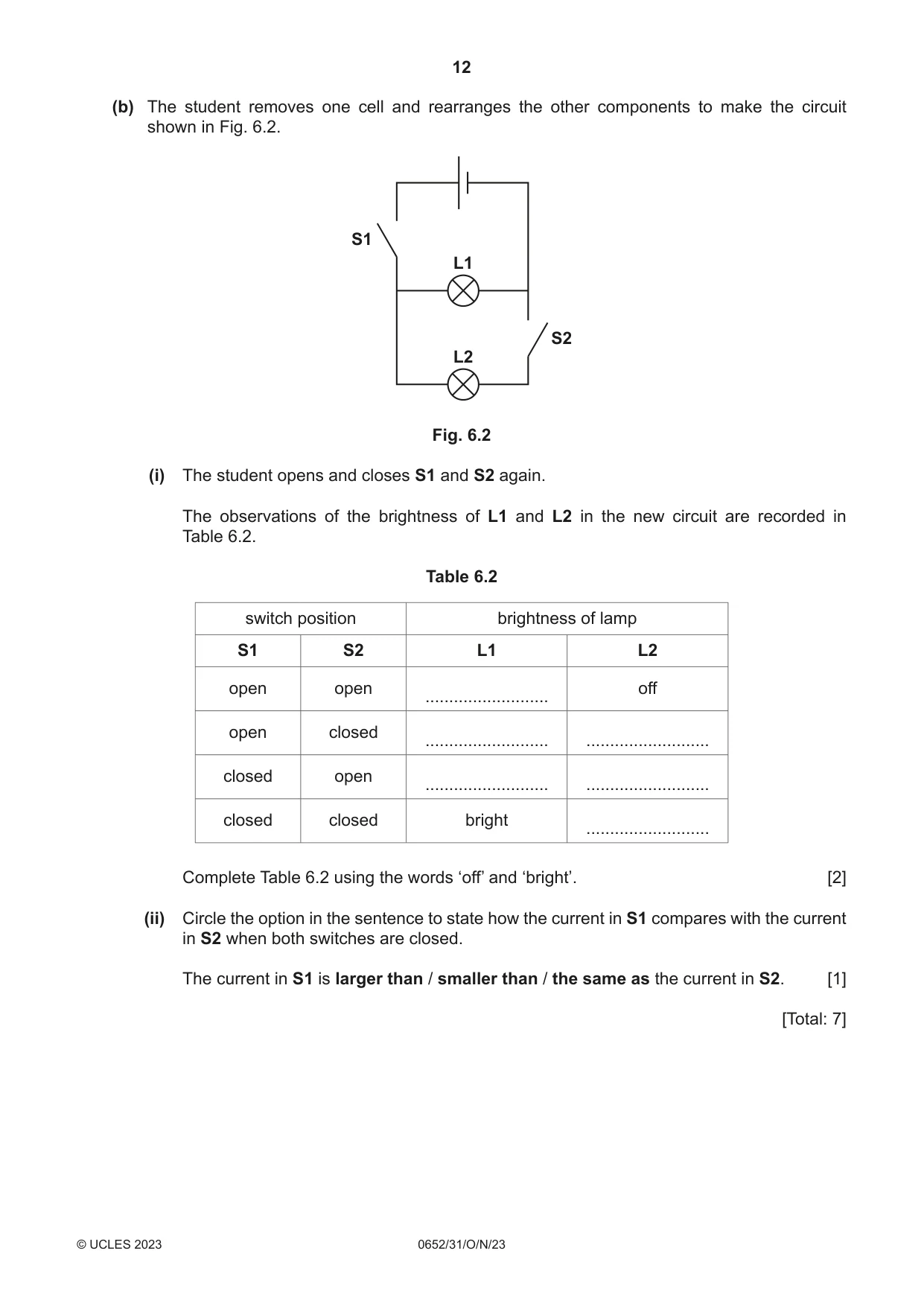
6 (a) A student makes a circuit using two cells, two switches S1 and S2, and two lamps L1 and L2 as shown in Fig 6.1. S1 S2 L1 L2 Fig. 6.1 (i) Complete the sentence to describe how the lamps are connected in the circuit in Fig. 6.1. The lamps are connected in .................................................................. . [1] (ii) The student opens and closes S1 and S2 and observes the brightness of L1 and L2. The observations are recorded in Table 6.1. Table 6.1 switch position brightness of lamp S1 S2 L1 L2 open open off .......................... open closed .......................... .......................... closed closed bright .......................... Complete Table 6.1 using the words ‘off’ or ‘bright’. [1] (iii) The current in L1 is 0.15 A. The resistance of L1 is 10 Ω. Calculate the potential difference across L1. potential difference = ...................................................... V [2] (b) The student removes one cell and rearranges the other components to make the circuit shown in Fig. 6.2. S1 L1 S2 L2 Fig. 6.2 (i) The student opens and closes S1 and S2 again. The observations of the brightness of L1 and L2 in the new circuit are recorded in Table 6.2. Table 6.2 switch position brightness of lamp S1 S2 L1 L2 open open off .......................... open closed .......................... .......................... closed open .......................... .......................... closed closed bright .......................... Complete Table 6.2 using the words ‘off’ and ‘bright’. [2] (ii) Circle the option in the sentence to state how the current in S1 compares with the current in S2 when both switches are closed. The current in S1 is larger than / smaller than / the same as the current in S2. [1] [Total: 7]
Mark scheme: 6(a)(i) series ; 1 6(a)(ii) off (off) 1 off off (bright) bright / on ; 6(a)(iii) (V)=IR, / 0.15 10 ; 2 1.5 (V) ; 6(b)(i) M1 2 off (off) AND off off ; M2 bright / on off AND (bright) bright / on ; 6(b)(ii) larger ; 1
Q7 · A student measures the rate of the reaction between pieces of calcium carbonate and…
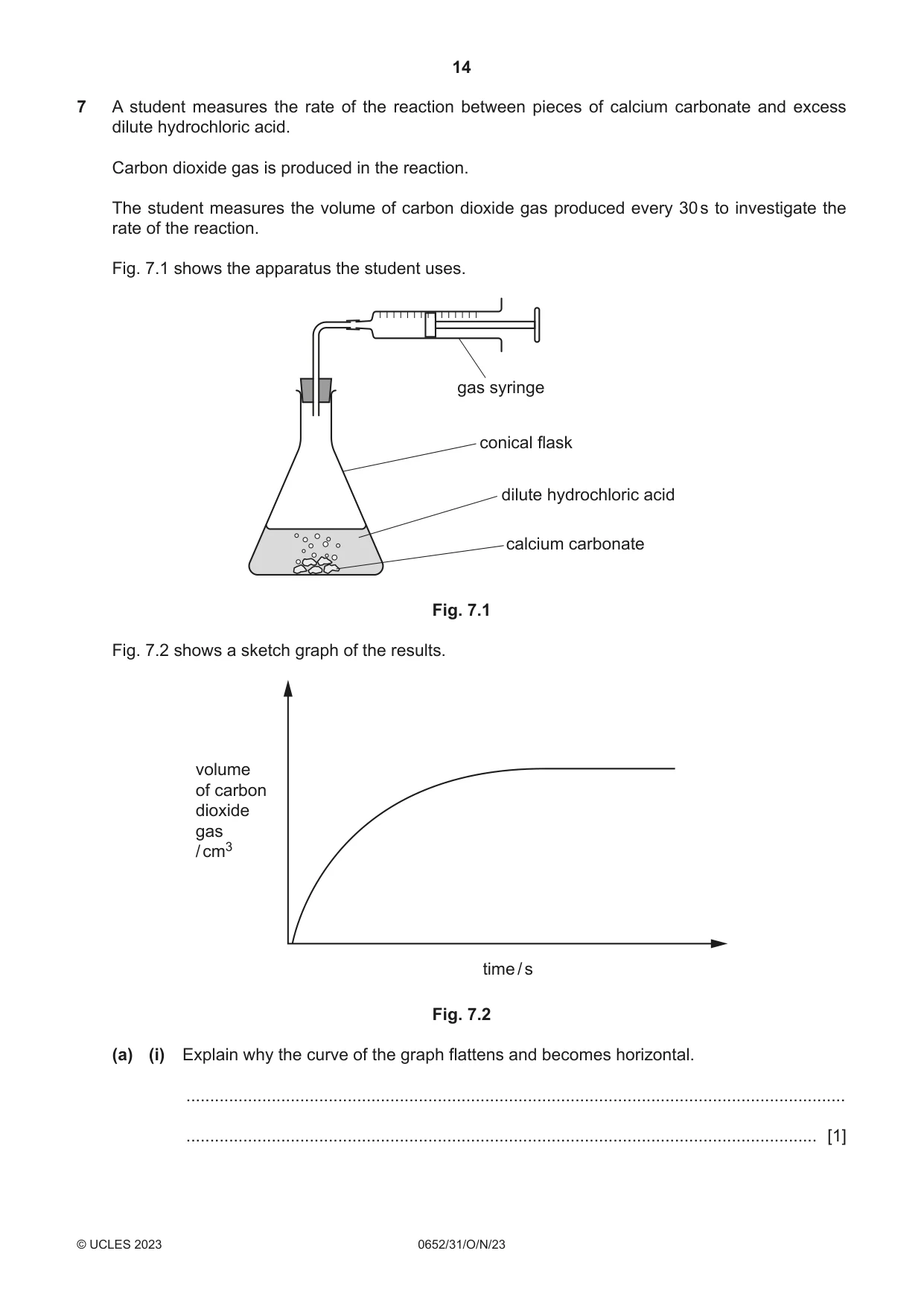
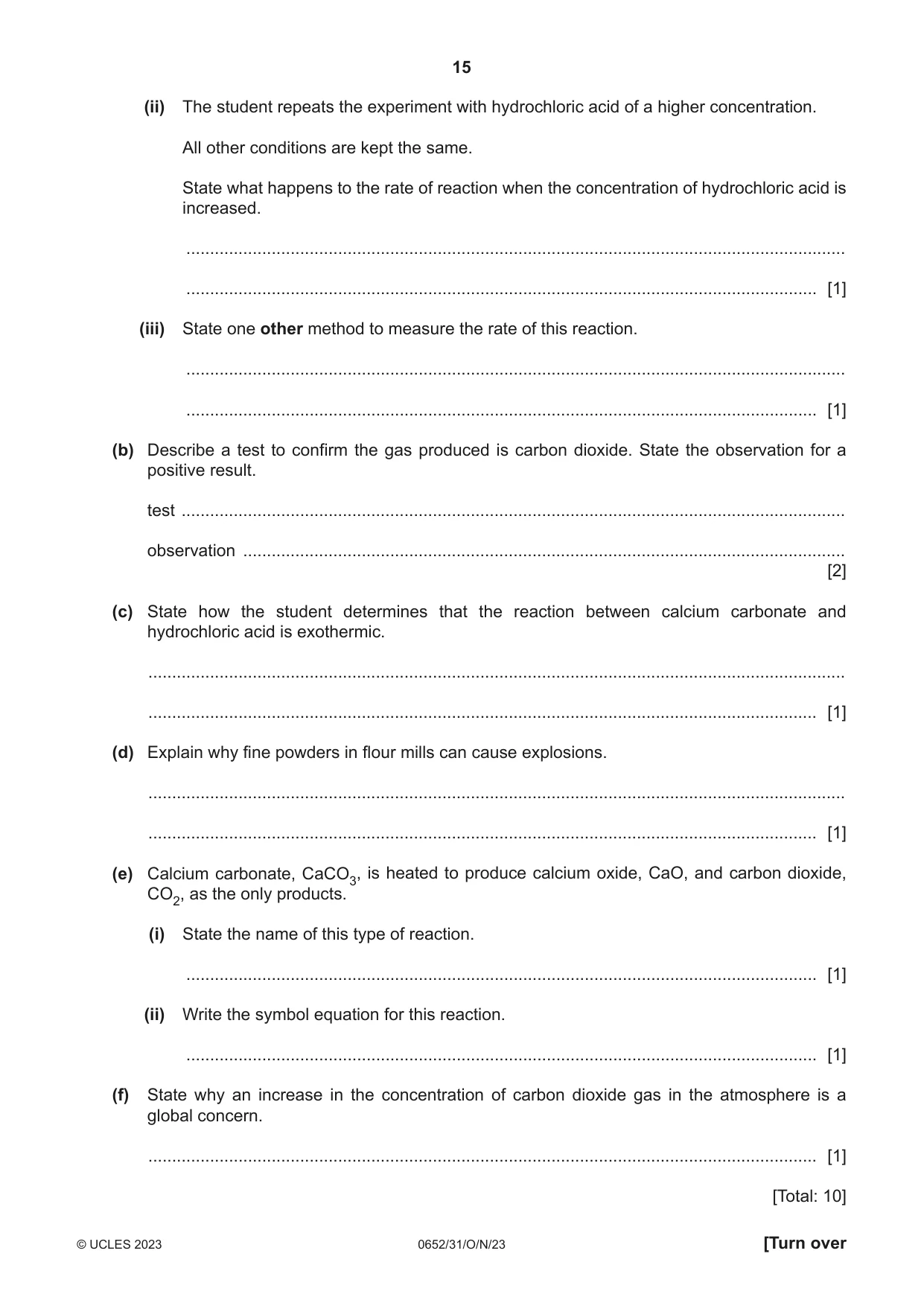
7 A student measures the rate of the reaction between pieces of calcium carbonate and excess dilute hydrochloric acid. Carbon dioxide gas is produced in the reaction. The student measures the volume of carbon dioxide gas produced every 30 s to investigate the rate of the reaction. Fig. 7.1 shows the apparatus the student uses. gas syringe conical flask dilute hydrochloric acid calcium carbonate Fig. 7.1 Fig. 7.2 shows a sketch graph of the results. volume of carbon dioxide gas / cm3 time / s Fig. 7.2 (a) (i) Explain why the curve of the graph flattens and becomes horizontal. ........................................................................................................................................... ..................................................................................................................................... [1] (ii) The student repeats the experiment with hydrochloric acid of a higher concentration. All other conditions are kept the same. State what happens to the rate of reaction when the concentration of hydrochloric acid is increased. ........................................................................................................................................... ..................................................................................................................................... [1] (iii) State one other method to measure the rate of this reaction. ........................................................................................................................................... ..................................................................................................................................... [1] (b) Describe a test to confirm the gas produced is carbon dioxide. State the observation for a positive result. test ............................................................................................................................................ observation ............................................................................................................................... [2] (c) State how the student determines that the reaction between calcium carbonate and hydrochloric acid is exothermic. ................................................................................................................................................... ............................................................................................................................................. [1] (d) Explain why fine powders in flour mills can cause explosions. ................................................................................................................................................... ............................................................................................................................................. [1] (e) Calcium carbonate, CaCO3, is heated to produce calcium oxide, CaO, and carbon dioxide, CO2, as the only products. (i) State the name of this type of reaction. ..................................................................................................................................... [1] (ii) Write the symbol equation for this reaction. ..................................................................................................................................... [1] (f) State why an increase in the concentration of carbon dioxide gas in the atmosphere is a global concern. ............................................................................................................................................. [1] [Total: 10]
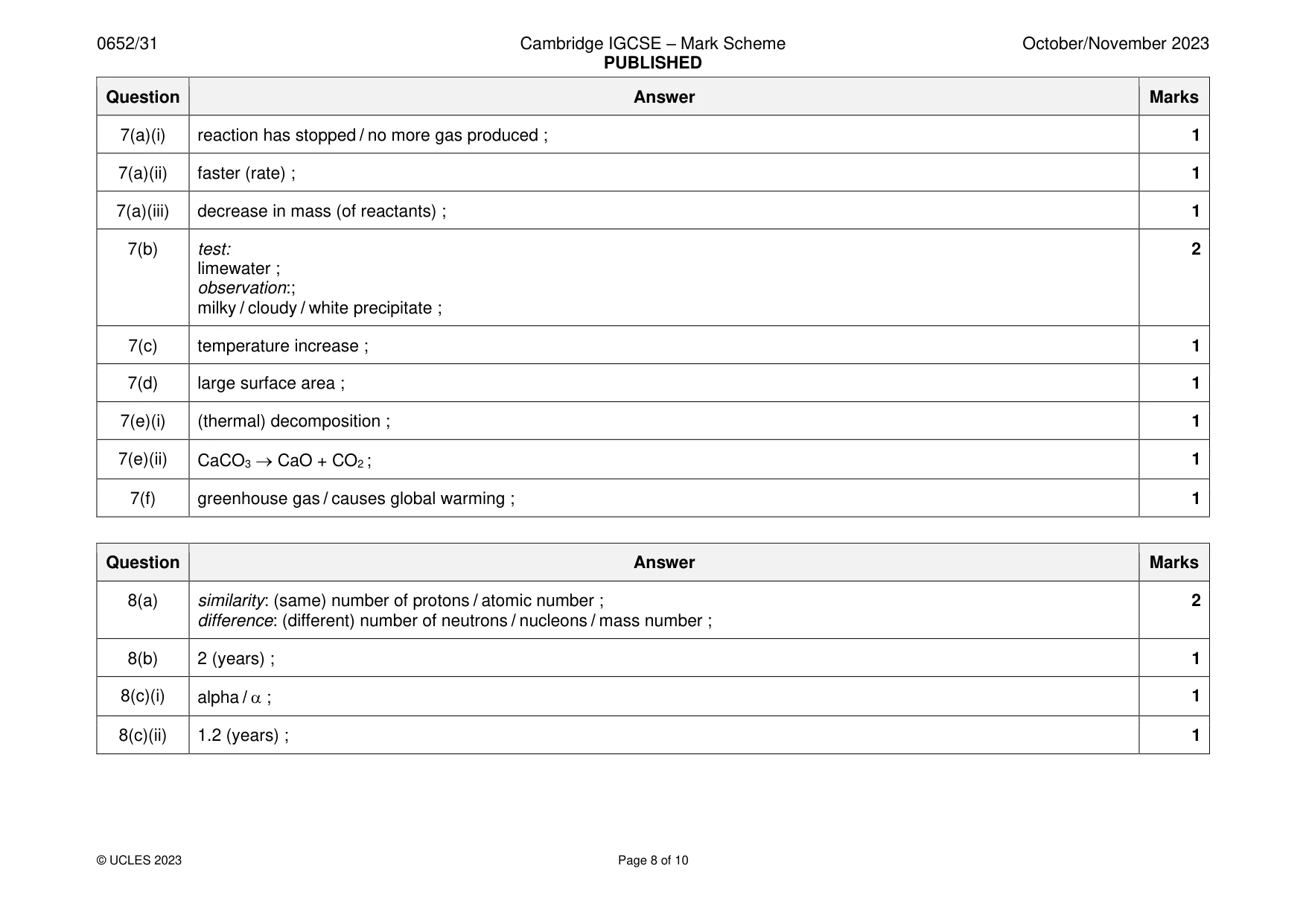
Mark scheme: 7(a)(i) reaction has stopped / no more gas produced ; 1 7(a)(ii) faster (rate) ; 1 7(a)(iii) decrease in mass (of reactants) ; 1 7(b) test: 2 limewater ; observation:; milky / cloudy / white precipitate ; 7(c) temperature increase ; 1 7(d) large surface area ; 1 7(e)(i) (thermal) decomposition ; 1 7(e)(ii) CaCO3 → CaO + CO2 ; 1 7(f) greenhouse gas / causes global warming ; 1
Q8 · 228Th and 230Th are isotopes of thorium
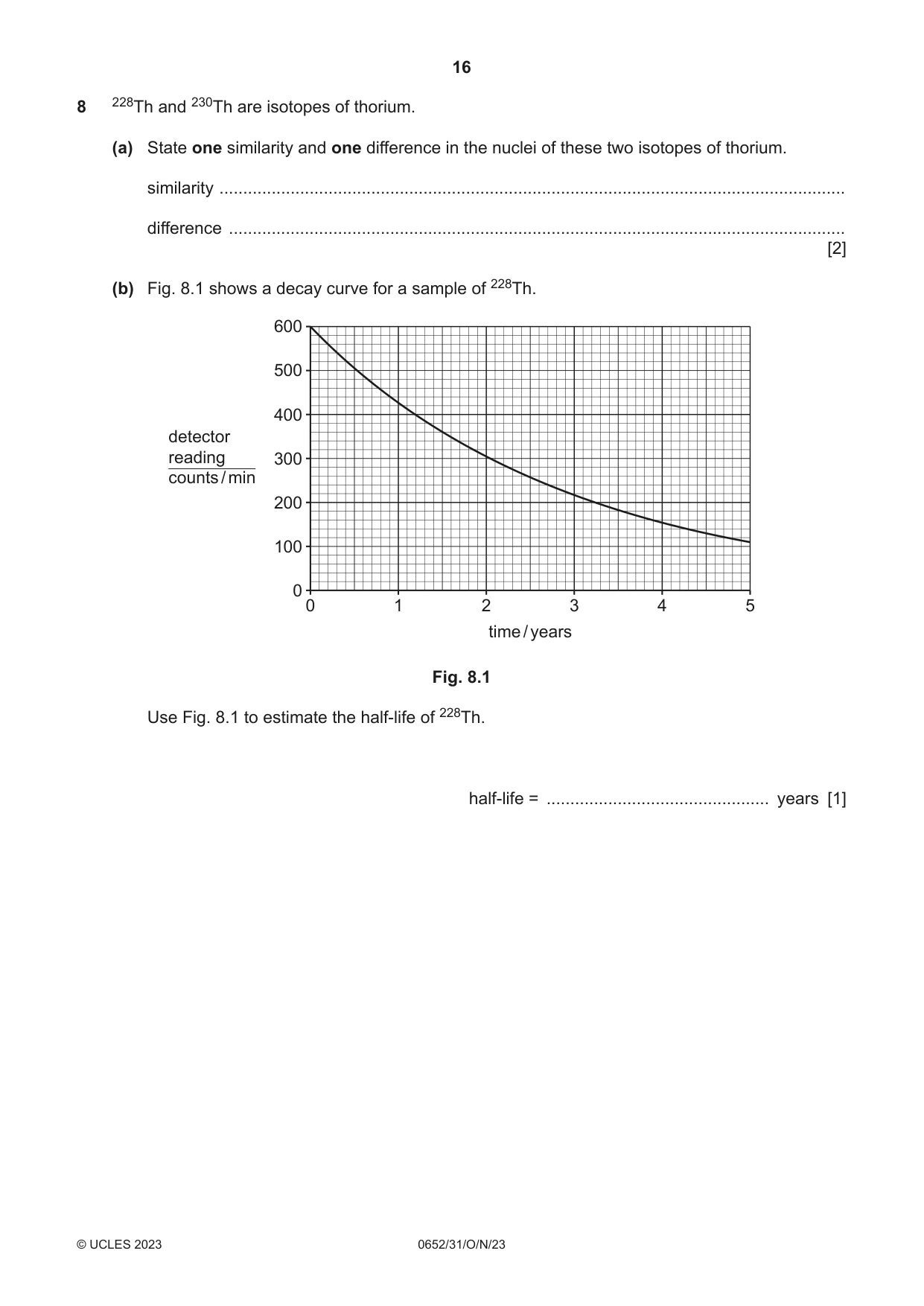
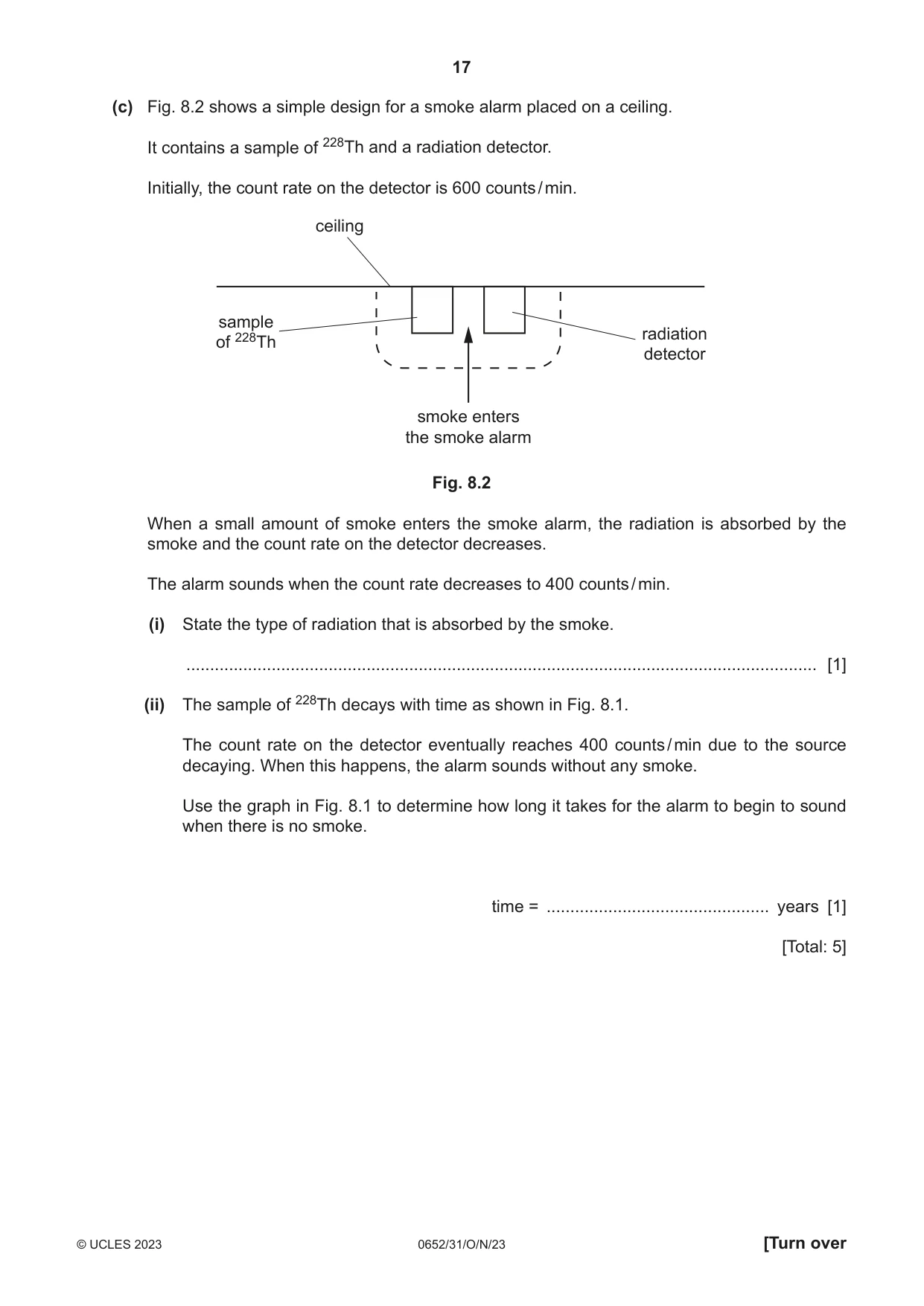
8 228Th and 230Th are isotopes of thorium. (a) State one similarity and one difference in the nuclei of these two isotopes of thorium. similarity .................................................................................................................................... difference .................................................................................................................................. [2] (b) Fig. 8.1 shows a decay curve for a sample of 228Th. 600 500 400 detector reading 300 counts / min 200 100 0 0 1 2 3 4 5 time / years Fig. 8.1 Use Fig. 8.1 to estimate the half-life of 228Th. half-life = ............................................... years [1] (c) Fig. 8.2 shows a simple design for a smoke alarm placed on a ceiling. It contains a sample of 228Th and a radiation detector. Initially, the count rate on the detector is 600 counts / min. ceiling sample radiation of 228Th detector smoke enters the smoke alarm Fig. 8.2 When a small amount of smoke enters the smoke alarm, the radiation is absorbed by the smoke and the count rate on the detector decreases. The alarm sounds when the count rate decreases to 400 counts / min. (i) State the type of radiation that is absorbed by the smoke. ..................................................................................................................................... [1] (ii) The sample of 228Th decays with time as shown in Fig. 8.1. The count rate on the detector eventually reaches 400 counts / min due to the source decaying. When this happens, the alarm sounds without any smoke. Use the graph in Fig. 8.1 to determine how long it takes for the alarm to begin to sound when there is no smoke. time = ............................................... years [1] [Total: 5]
Mark scheme: 8(a) similarity: (same) number of protons / atomic number ; 2 difference: (different) number of neutrons / nucleons / mass number ; 8(b) 2 (years) ; 1 8(c)(i) alpha / ; 1 8(c)(ii) 1.2 (years) ; 1
Q9 · Two organic molecules, methane and ethene
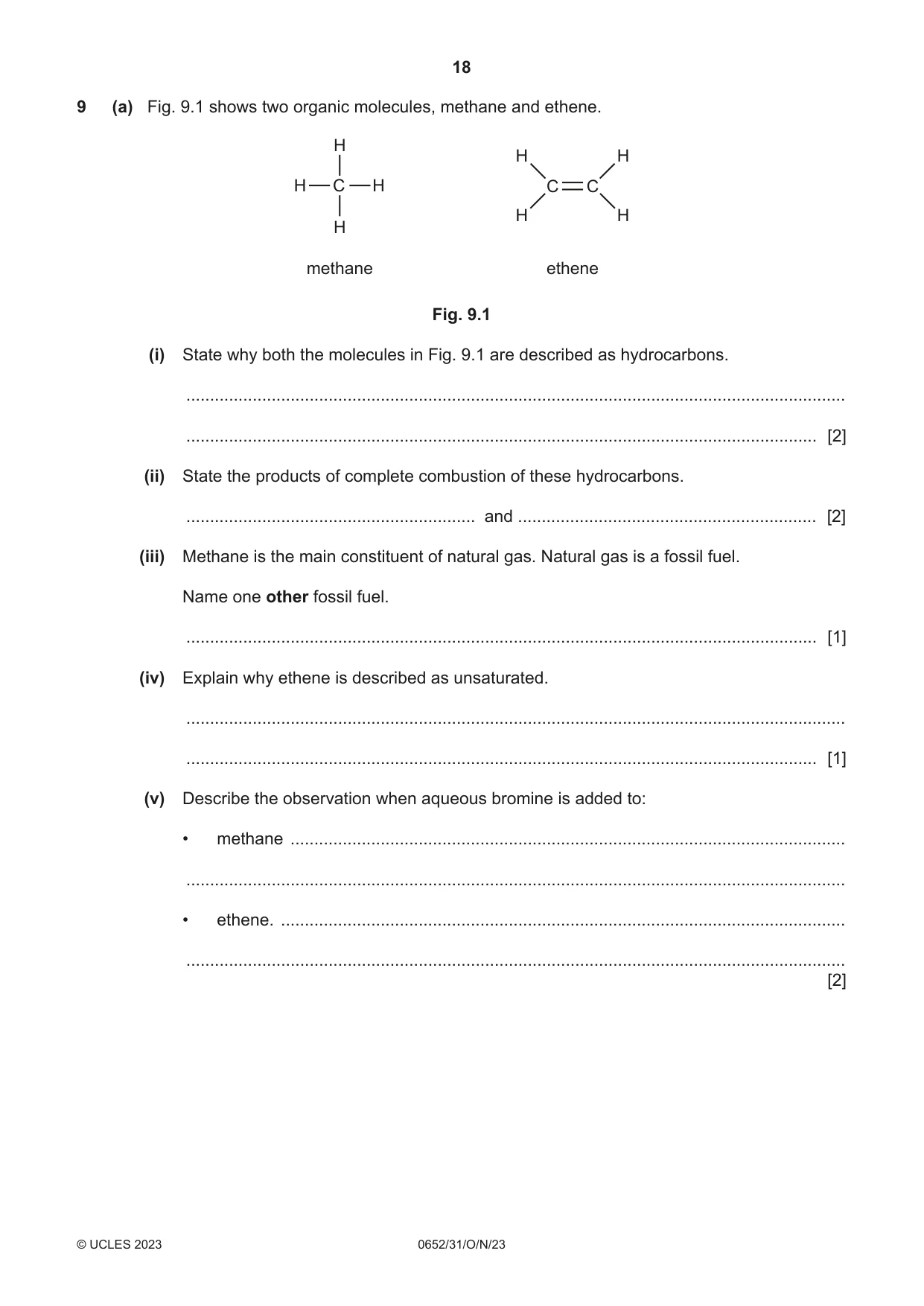
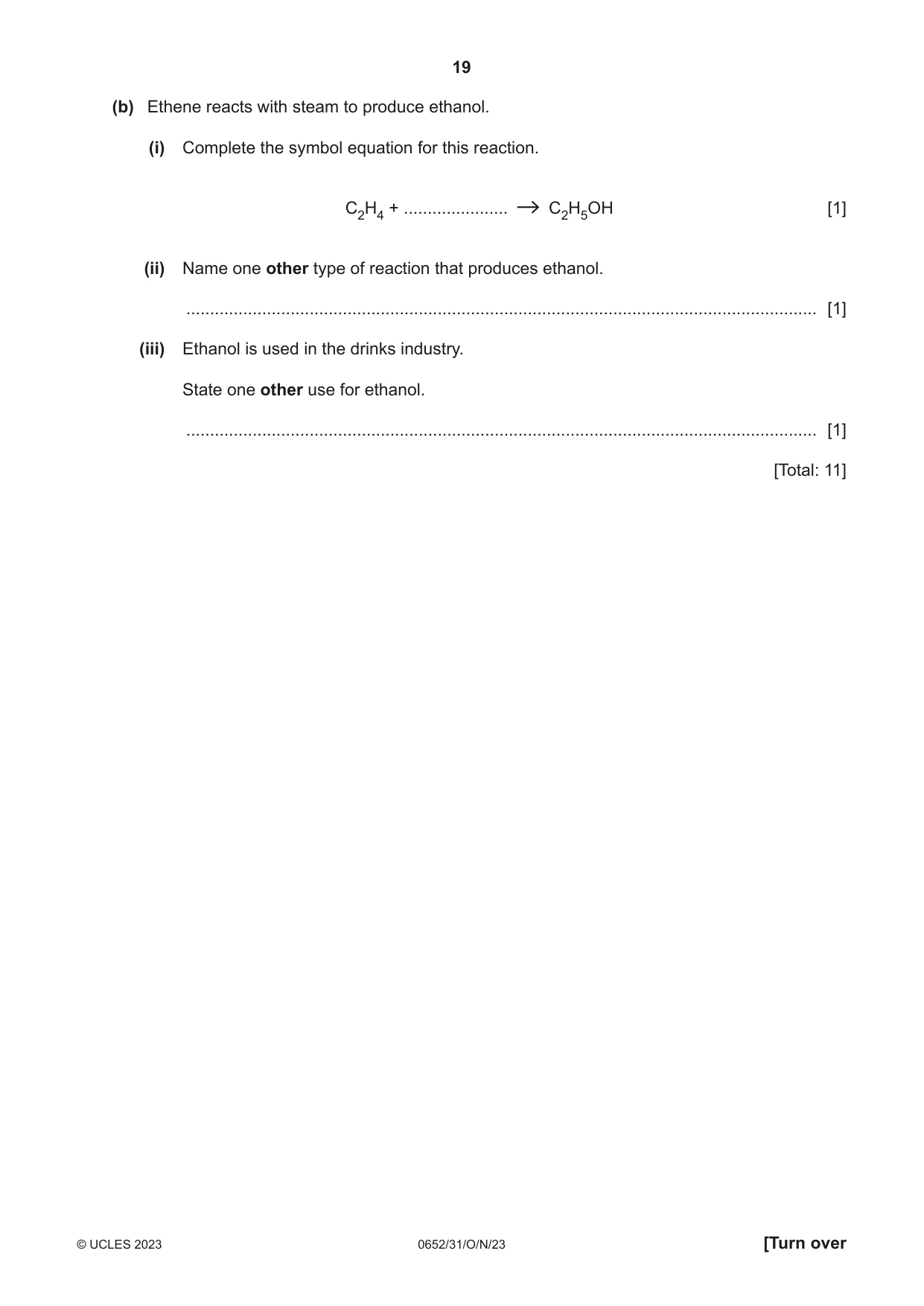
9 (a) Fig. 9.1 shows two organic molecules, methane and ethene. H H H H C H C C H H H methane ethene Fig. 9.1 (i) State why both the molecules in Fig. 9.1 are described as hydrocarbons. ........................................................................................................................................... ..................................................................................................................................... [2] (ii) State the products of complete combustion of these hydrocarbons. ............................................................. and ............................................................... [2] (iii) Methane is the main constituent of natural gas. Natural gas is a fossil fuel. Name one other fossil fuel. ..................................................................................................................................... [1] (iv) Explain why ethene is described as unsaturated. ........................................................................................................................................... ..................................................................................................................................... [1] (v) Describe the observation when aqueous bromine is added to: • methane ..................................................................................................................... ........................................................................................................................................... • ethene. ....................................................................................................................... ........................................................................................................................................... [2] (b) Ethene reacts with steam to produce ethanol. (i) Complete the symbol equation for this reaction. C2H4 + ...................... C2H5OH [1] (ii) Name one other type of reaction that produces ethanol. ..................................................................................................................................... [1] (iii) Ethanol is used in the drinks industry. State one other use for ethanol. ..................................................................................................................................... [1] [Total: 11]
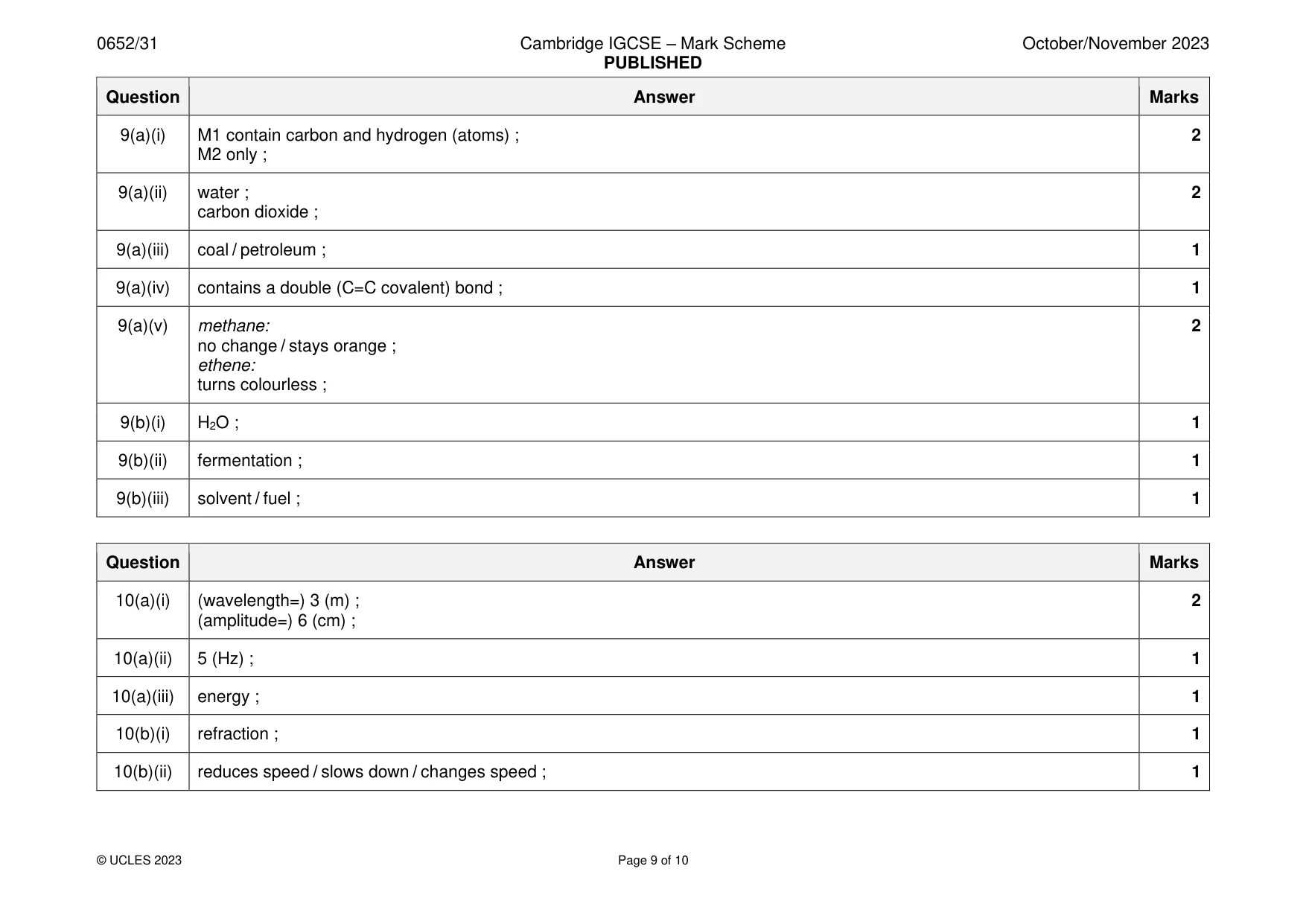
Mark scheme: 9(a)(i) M1 contain carbon and hydrogen (atoms) ; 2 M2 only ; 9(a)(ii) water ; 2 carbon dioxide ; 9(a)(iii) coal / petroleum ; 1 9(a)(iv) contains a double (C=C covalent) bond ; 1 9(a)(v) methane: 2 no change / stays orange ; ethene: turns colourless ; 9(b)(i) H2O ; 1 9(b)(ii) fermentation ; 1 9(b)(iii) solvent / fuel ; 1
Q10 · A graph of a wave on a rope at a point in time
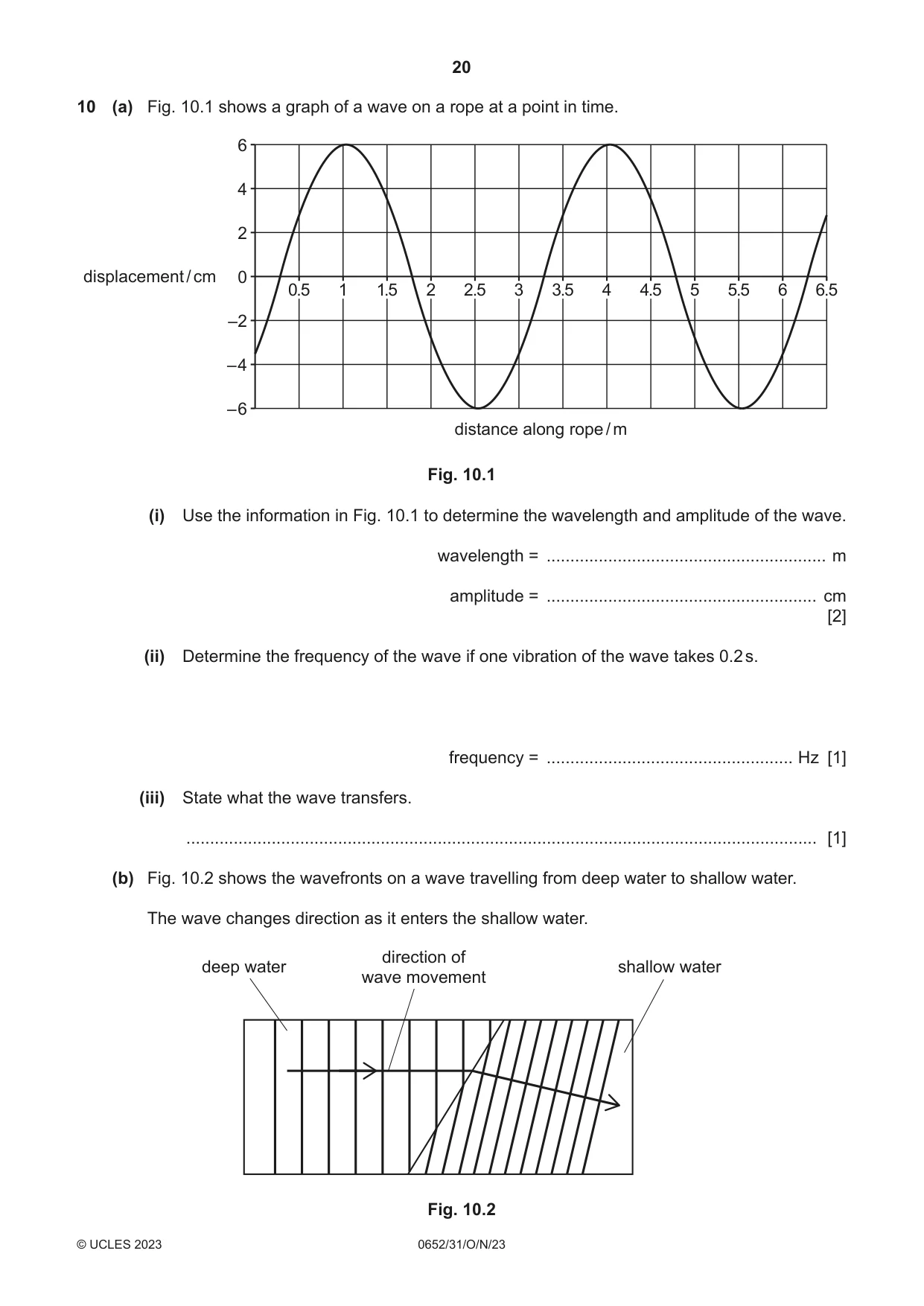
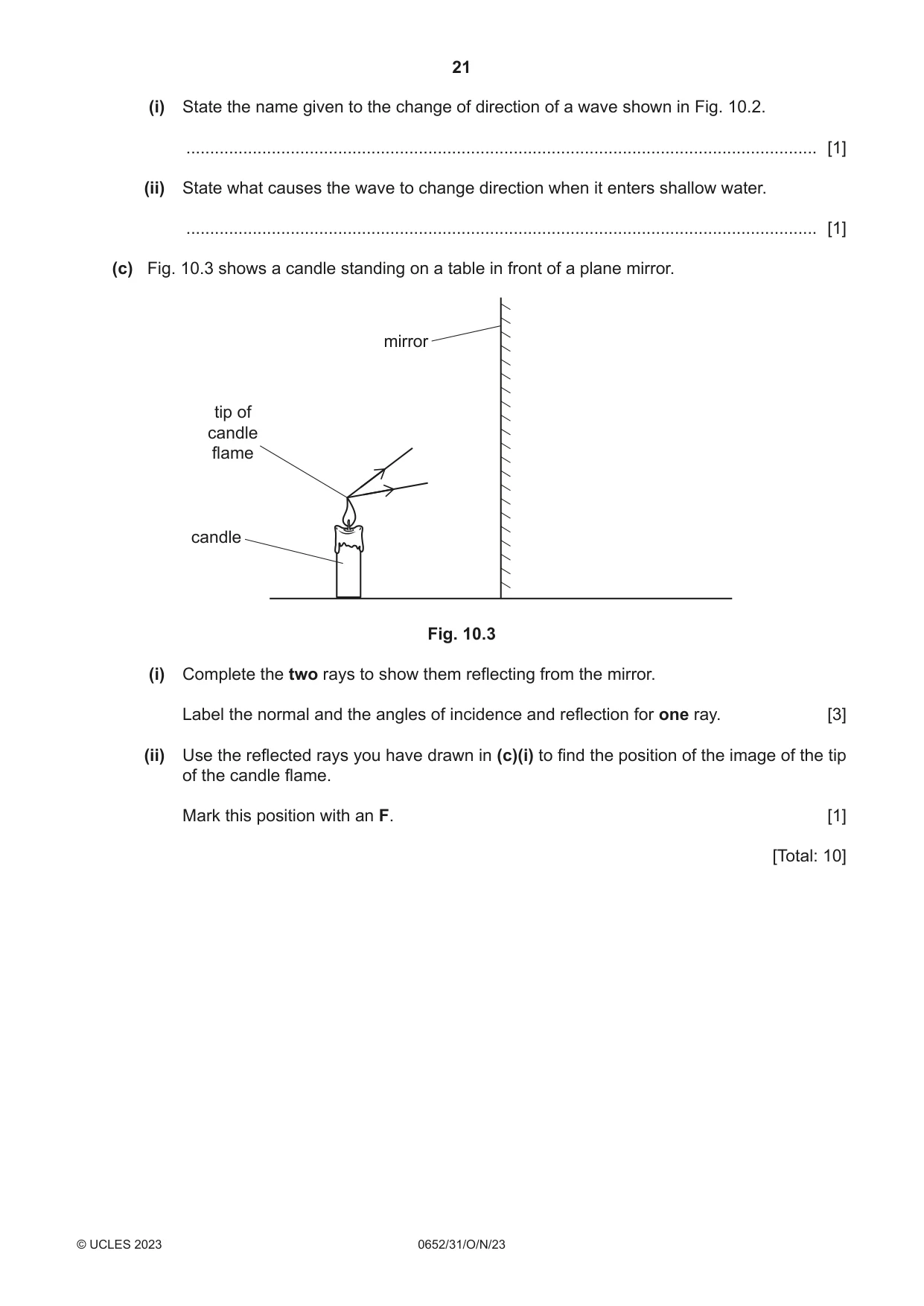
10 (a) Fig. 10.1 shows a graph of a wave on a rope at a point in time. 6 4 2 displacement / cm 0 0.5 1 1.5 2 2.5 3 3.5 4 4.5 5 5.5 6 6.5 –2 –4 –6 distance along rope / m Fig. 10.1 (i) Use the information in Fig. 10.1 to determine the wavelength and amplitude of the wave. wavelength = ........................................................... m amplitude = ......................................................... cm [2] (ii) Determine the frequency of the wave if one vibration of the wave takes 0.2 s. frequency = .................................................... Hz [1] (iii) State what the wave transfers. ..................................................................................................................................... [1] (b) Fig. 10.2 shows the wavefronts on a wave travelling from deep water to shallow water. The wave changes direction as it enters the shallow water. direction of deep water shallow water wave movement Fig. 10.2 (i) State the name given to the change of direction of a wave shown in Fig. 10.2. ..................................................................................................................................... [1] (ii) State what causes the wave to change direction when it enters shallow water. ..................................................................................................................................... [1] (c) Fig. 10.3 shows a candle standing on a table in front of a plane mirror. mirror tip of candle flame candle Fig. 10.3 (i) Complete the two rays to show them reflecting from the mirror. Label the normal and the angles of incidence and reflection for one ray. [3] (ii) Use the reflected rays you have drawn in (c)(i) to find the position of the image of the tip of the candle flame. Mark this position with an F. [1] [Total: 10]
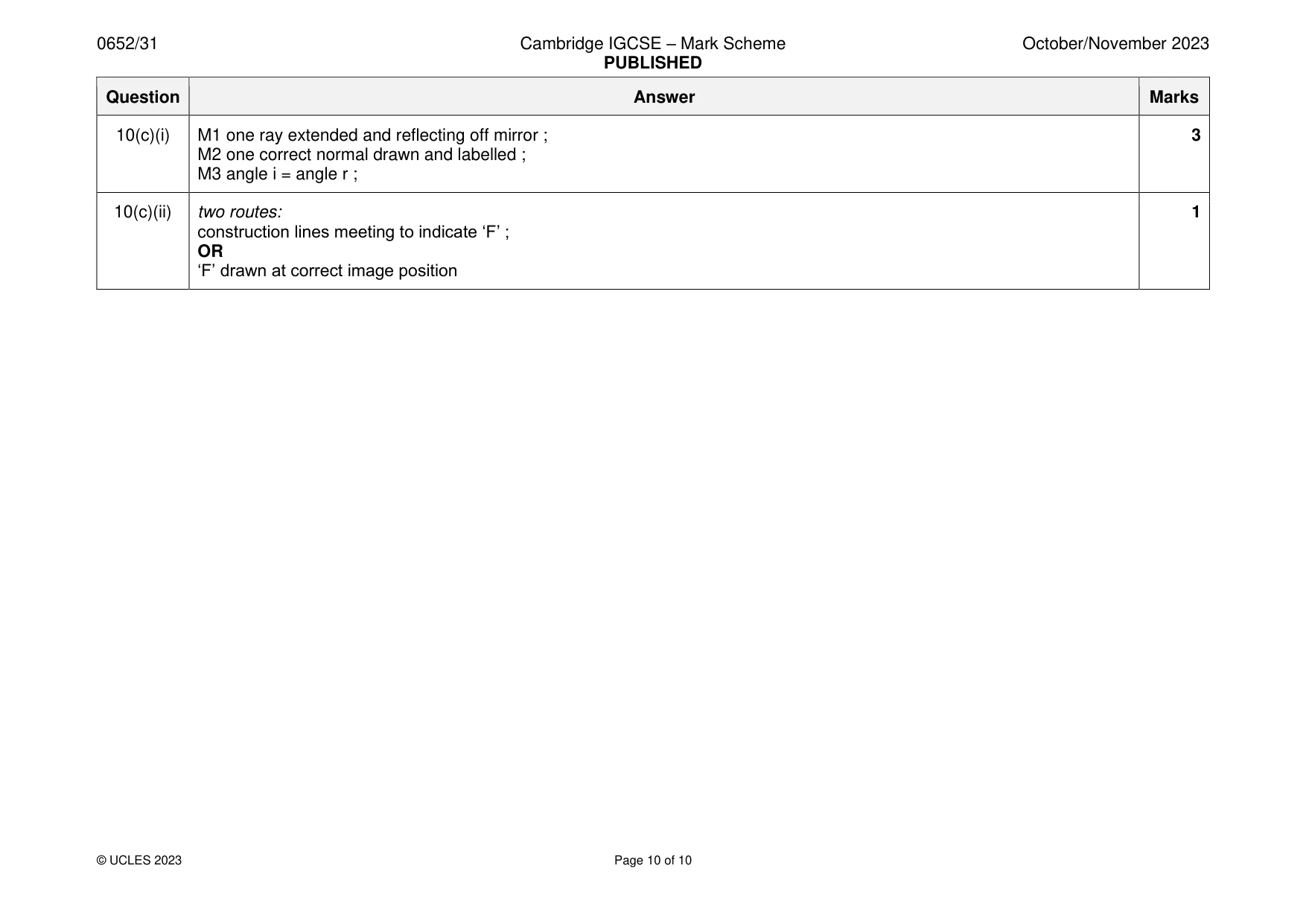
Mark scheme: 10(a)(i) (wavelength=) 3 (m) ; 2 (amplitude=) 6 (cm) ; 10(a)(ii) 5 (Hz) ; 1 10(a)(iii) energy ; 1 10(b)(i) refraction ; 1 10(b)(ii) reduces speed / slows down / changes speed ; 1 10(c)(i) M1 one ray extended and reflecting off mirror ; 3 M2 one correct normal drawn and labelled ; M3 angle i = angle r ; 10(c)(ii) two routes: 1 construction lines meeting to indicate ‘F’ ; OR ‘F’ drawn at correct image position
What was in this paper
The subtopics covered by these 10 questions, and how many questions each got. Open one in a new tab to see every Cambridge question on it.
What you needed in this session
Cambridge’s own grade thresholds for 2023 Oct/Nov, Paper 3 · Variant 1. A higher threshold means an easier paper — the bar moves with how the cohort did.