Cambridge IGCSE Physical Science 0652 — 2024 Oct/Nov Paper 3 · Variant 1
0652/31/O/N/24 · 11 questions · 80 marks · ≈90 min
The question paper and its mark scheme, free to read here and free to download. This is Cambridge’s own paper, exactly as it was sat.
Question paper24 pages





Mark scheme11 pages
Answers below. Sit the paper first if you are practising.
Questions as text
Q1 · A list of atoms and ions is shown
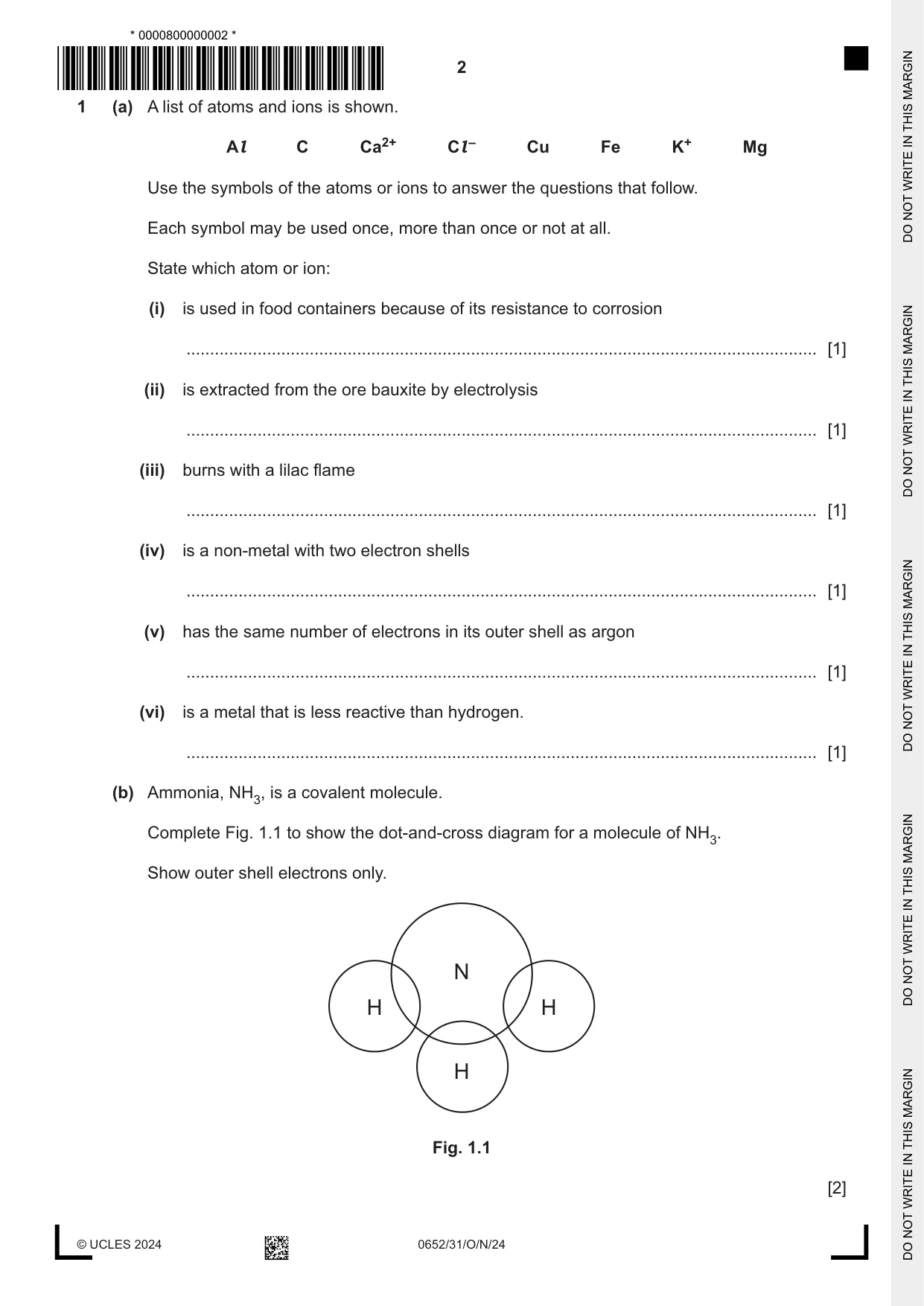
1 (a) A list of atoms and ions is shown. Al C Ca2+ Cl – Cu Fe K+ Mg Use the symbols of the atoms or ions to answer the questions that follow. Each symbol may be used once, more than once or not at all. State which atom or ion: (i) is used in food containers because of its resistance to corrosion ..................................................................................................................................... [1] (ii) is extracted from the ore bauxite by electrolysis ..................................................................................................................................... [1] (iii) burns with a lilac flame ..................................................................................................................................... [1] (iv) is a non-metal with two electron shells ..................................................................................................................................... [1] (v) has the same number of electrons in its outer shell as argon ..................................................................................................................................... [1] (vi) is a metal that is less reactive than hydrogen. ..................................................................................................................................... [1] (b) Ammonia, NH3, is a covalent molecule. Complete Fig. 1.1 to show the dot-and-cross diagram for a molecule of NH3. Show outer shell electrons only. N H H H Fig. 1.1 [2] (c) Describe a test for ammonia gas and state the observation if ammonia is present. test ............................................................................................................................................ observation ............................................................................................................................... ................................................................................................................................................... [2] [Total: 10]
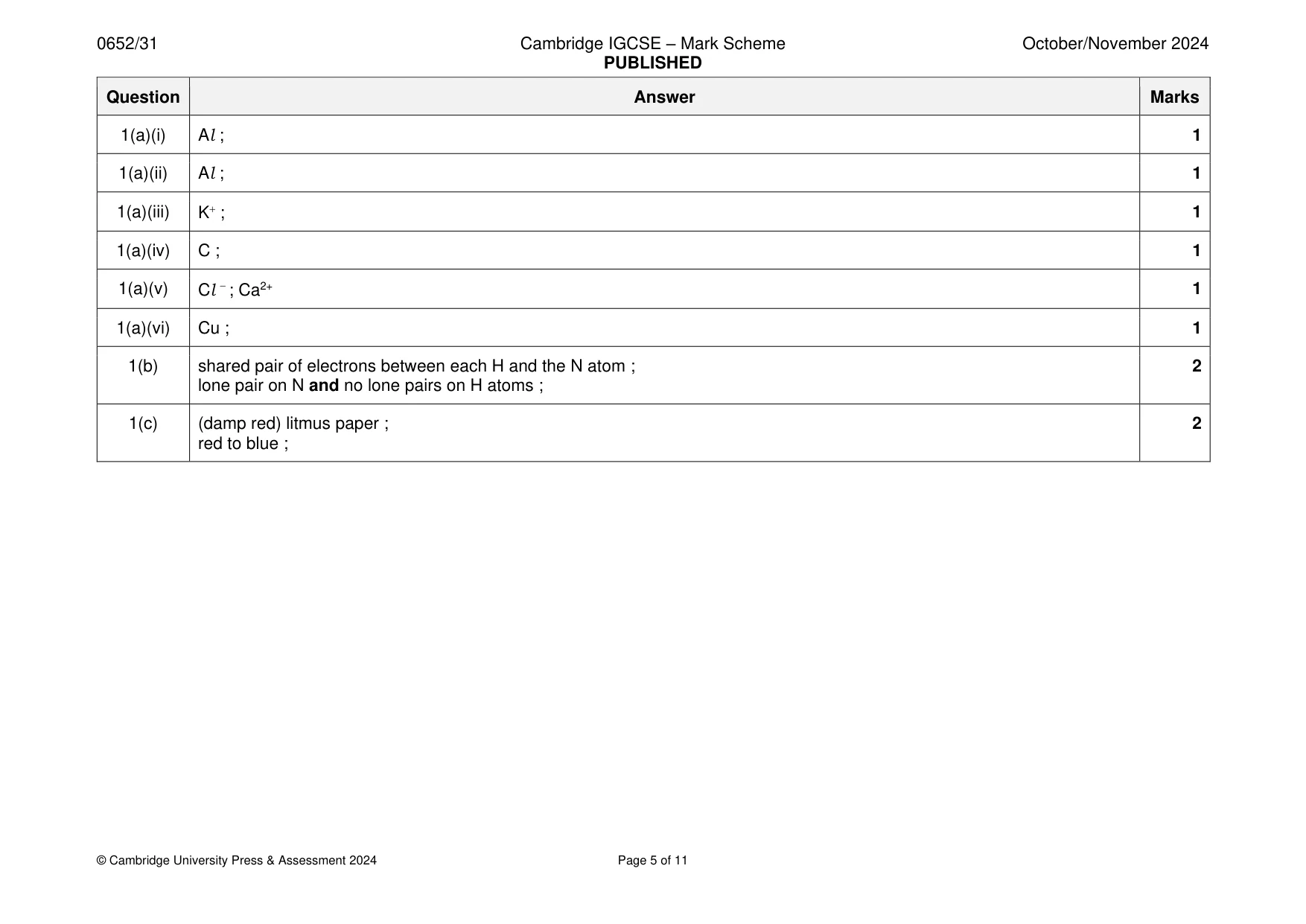
Mark scheme: Question Answer Marks 1(a)(i) Al ; 1 1(a)(ii) Al ; 1 1(a)(iii) K+ ; 1 1(a)(iv) C ; 1 1(a)(v) Cl − ; Ca2+ 1 1(a)(vi) Cu ; 1 1(b) shared pair of electrons between each H and the N atom ; 2 lone pair on N and no lone pairs on H atoms ; 1(c) (damp red) litmus paper ; 2 red to blue ;
Q2 · A cyclist starts from rest
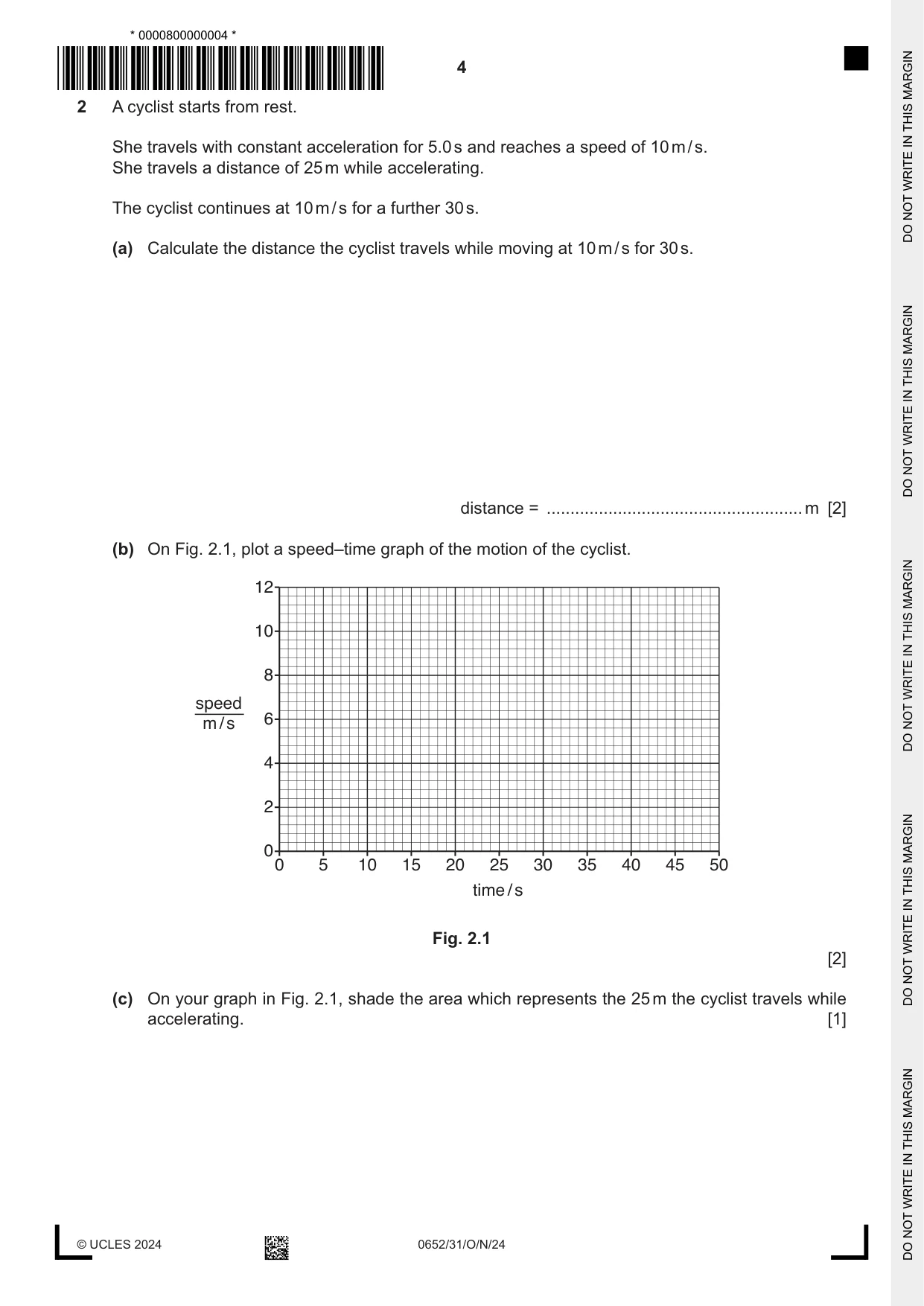
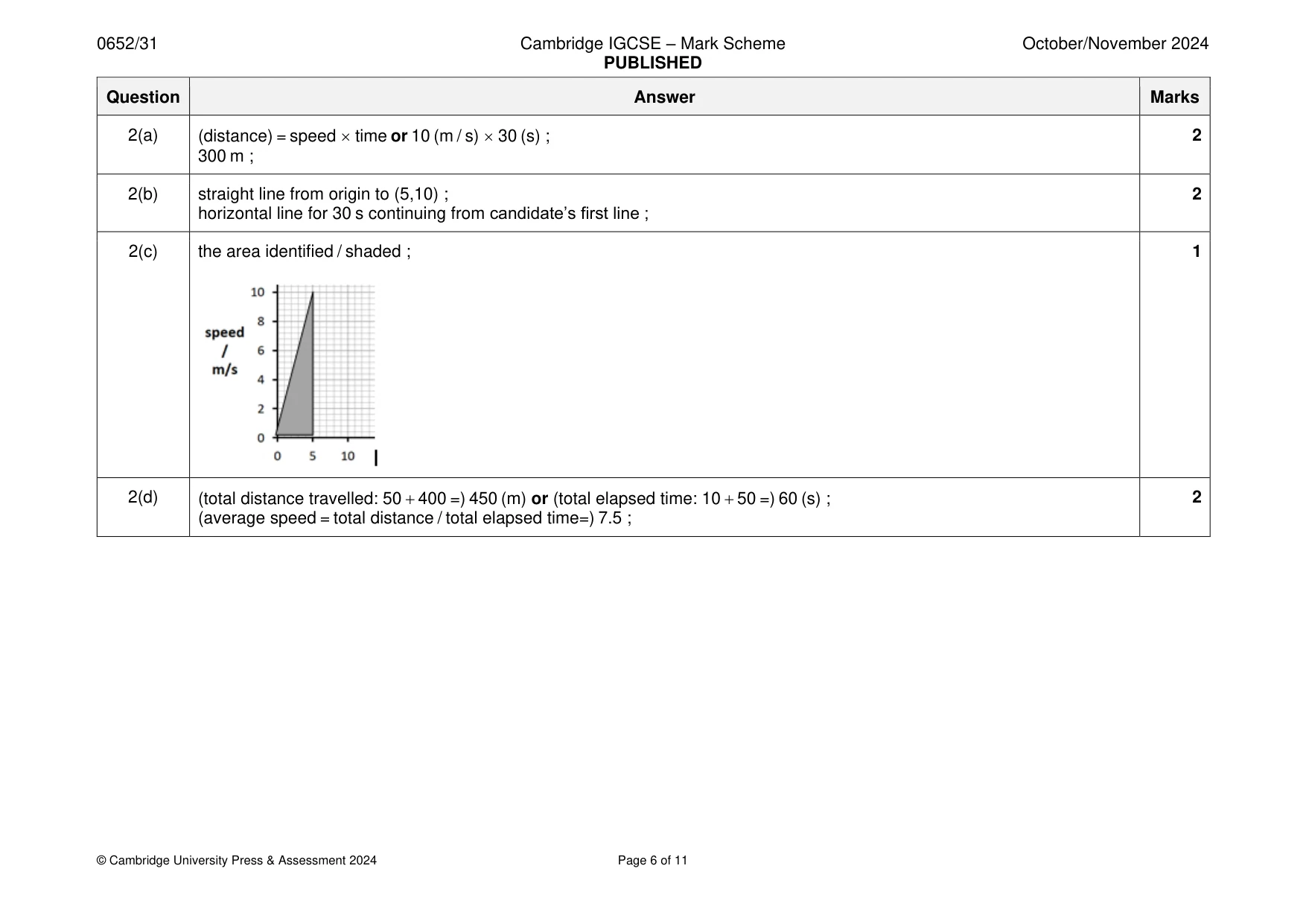
2 A cyclist starts from rest. She travels with constant acceleration for 5.0 s and reaches a speed of 10 m / s. She travels a distance of 25 m while accelerating. The cyclist continues at 10 m / s for a further 30 s. (a) Calculate the distance the cyclist travels while moving at 10 m / s for 30 s. distance = ...................................................... m [2] (b) On Fig. 2.1, plot a speed–time graph of the motion of the cyclist. 12 10 8 speed 6 m / s 4 2 00 5 10 15 20 25 30 35 40 45 50 time / s Fig. 2.1 [2] (c) On your graph in Fig. 2.1, shade the area which represents the 25 m the cyclist travels while accelerating. [1] (d) Another cyclist travels 50 m in 10 s while accelerating. He travels a further 400 m in 50 s at constant speed. Calculate the average speed of the cyclist. average speed = .................................................. m / s [2] [Total: 7]
Mark scheme: 2(a) (distance) = speed time or 10 (m / s) 30 (s) ; 2 300 m ; 2(b) straight line from origin to (5,10) ; 2 horizontal line for 30 s continuing from candidate’s first line ; 2(c) the area identified / shaded ; 1 2(d) (total distance travelled: 50 + 400 =) 450 (m) or (total elapsed time: 10 + 50 =) 60 (s) ; 2 (average speed = total distance / total elapsed time=) 7.5 ;
Q3 · An isotope of silicon
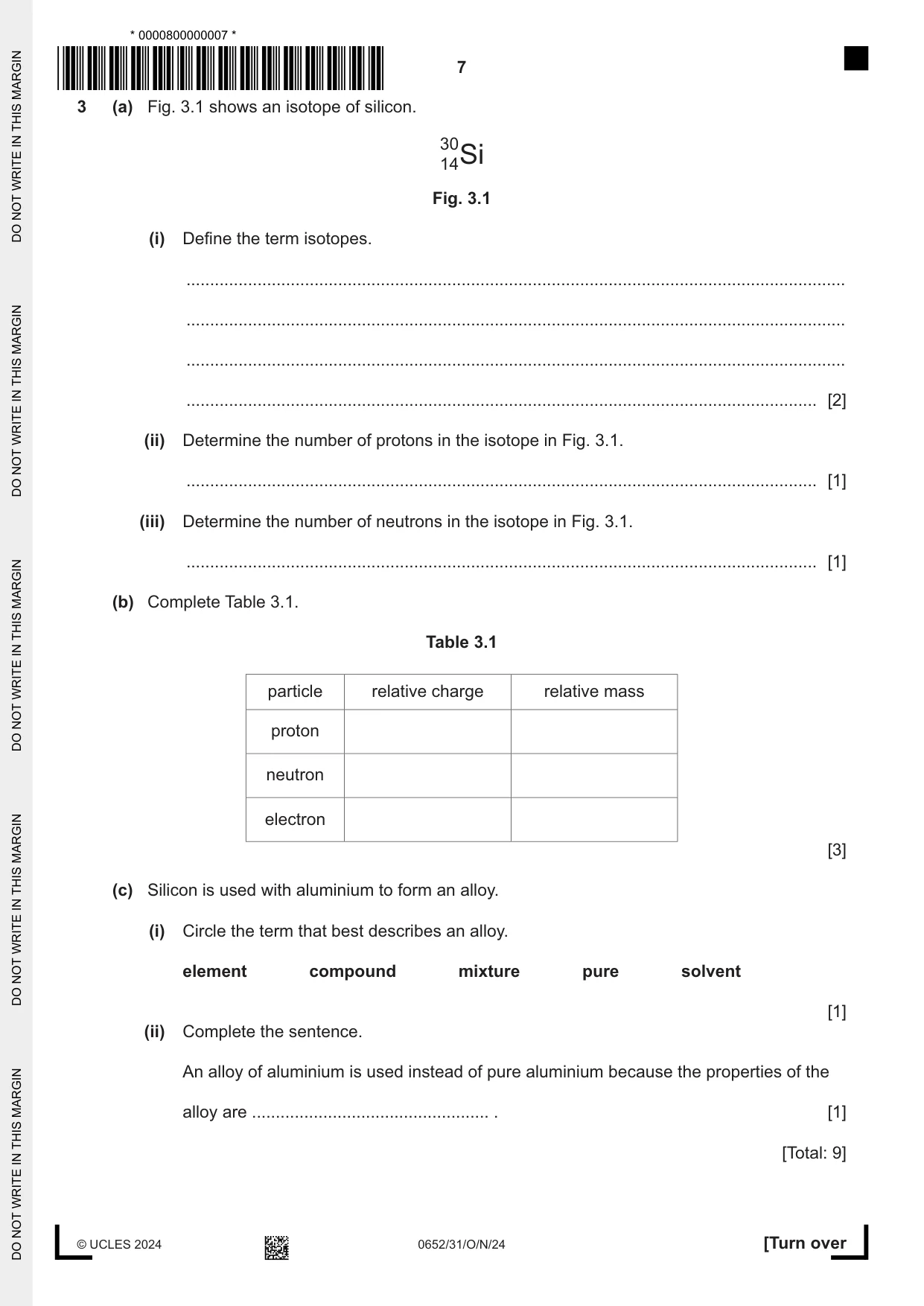
3 (a) Fig. 3.1 shows an isotope of silicon. 30 14Si Fig. 3.1 (i) Define the term isotopes. ........................................................................................................................................... ........................................................................................................................................... ........................................................................................................................................... ..................................................................................................................................... [2] (ii) Determine the number of protons in the isotope in Fig. 3.1. ..................................................................................................................................... [1] (iii) Determine the number of neutrons in the isotope in Fig. 3.1. ..................................................................................................................................... [1] (b) Complete Table 3.1. Table 3.1 particle relative charge relative mass proton neutron electron [3] (c) Silicon is used with aluminium to form an alloy. (i) Circle the term that best describes an alloy. element compound mixture pure solvent [1] (ii) Complete the sentence. An alloy of aluminium is used instead of pure aluminium because the properties of the alloy are .................................................. . [1] [Total: 9]
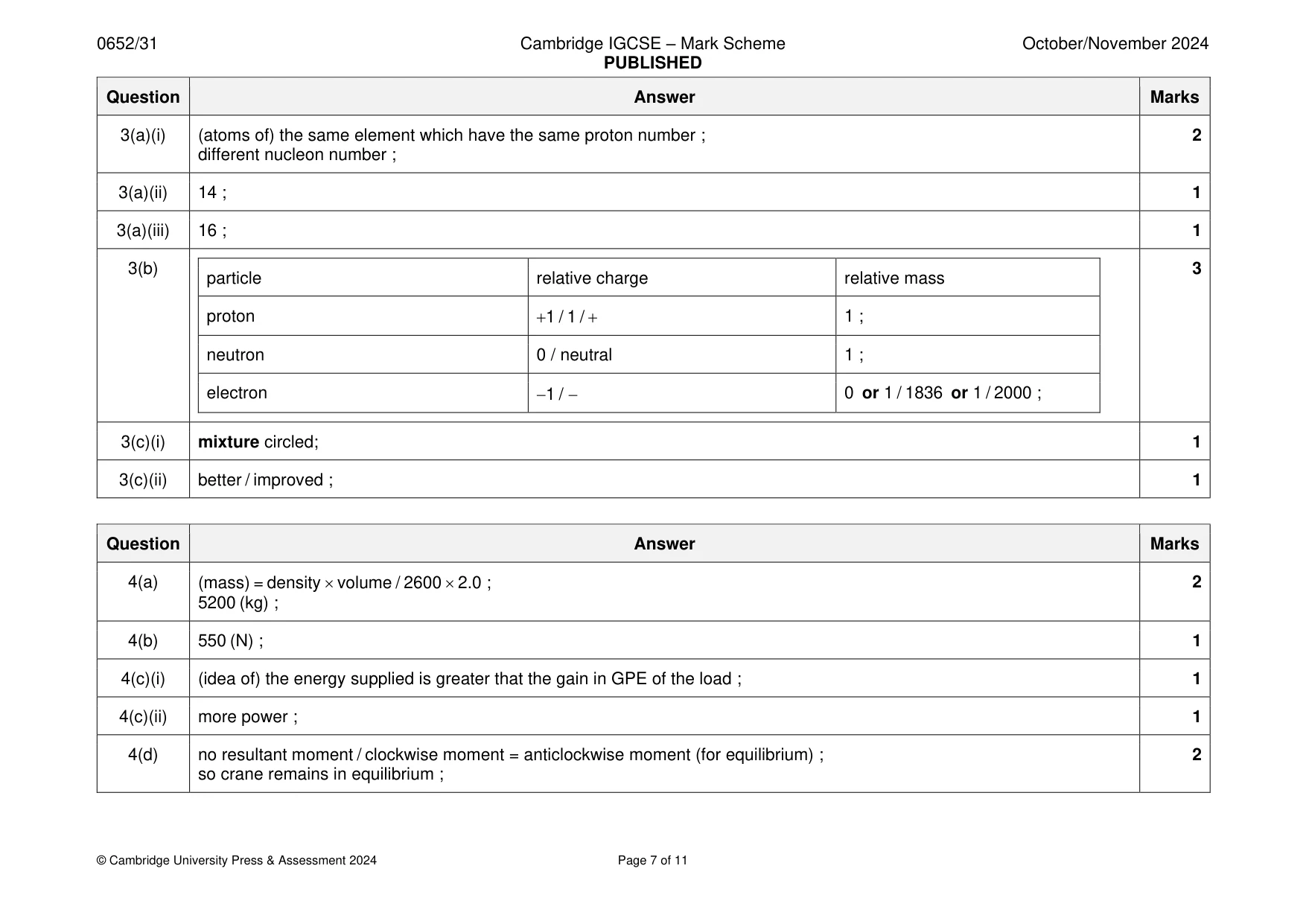
Mark scheme: 3(a)(i) (atoms of) the same element which have the same proton number ; 2 different nucleon number ; 3(a)(ii) 14 ; 1 3(a)(iii) 16 ; 1 3(b) 3 particle relative charge relative mass proton +1 / 1 / + 1 ; neutron 0 / neutral 1 ; electron −1 / − 0 or 1 / 1836 or 1 / 2000 ; 3(c)(i) mixture circled; 1 3(c)(ii) better / improved ; 1
Q4 · A crane lifts a large bucket containing concrete
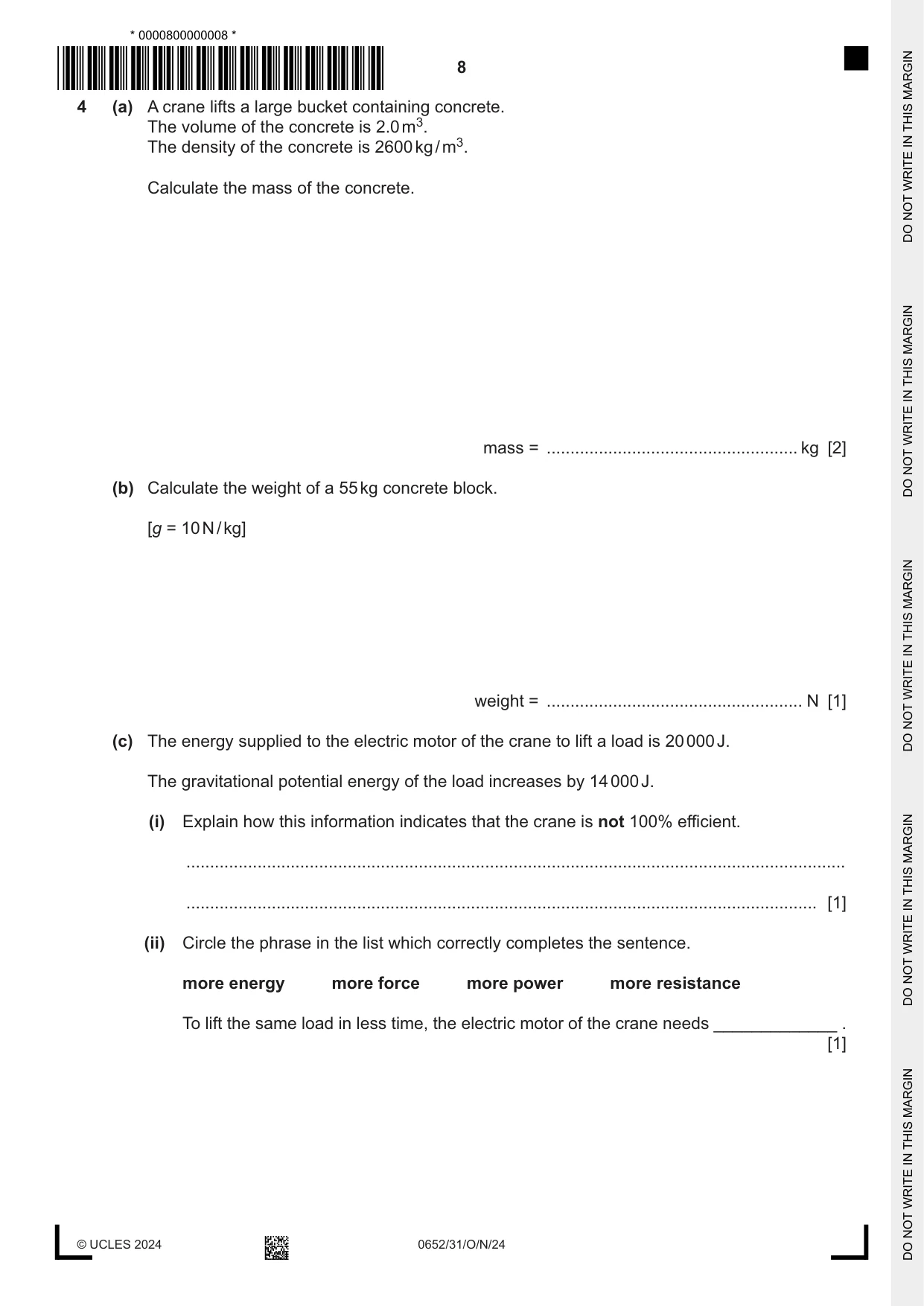
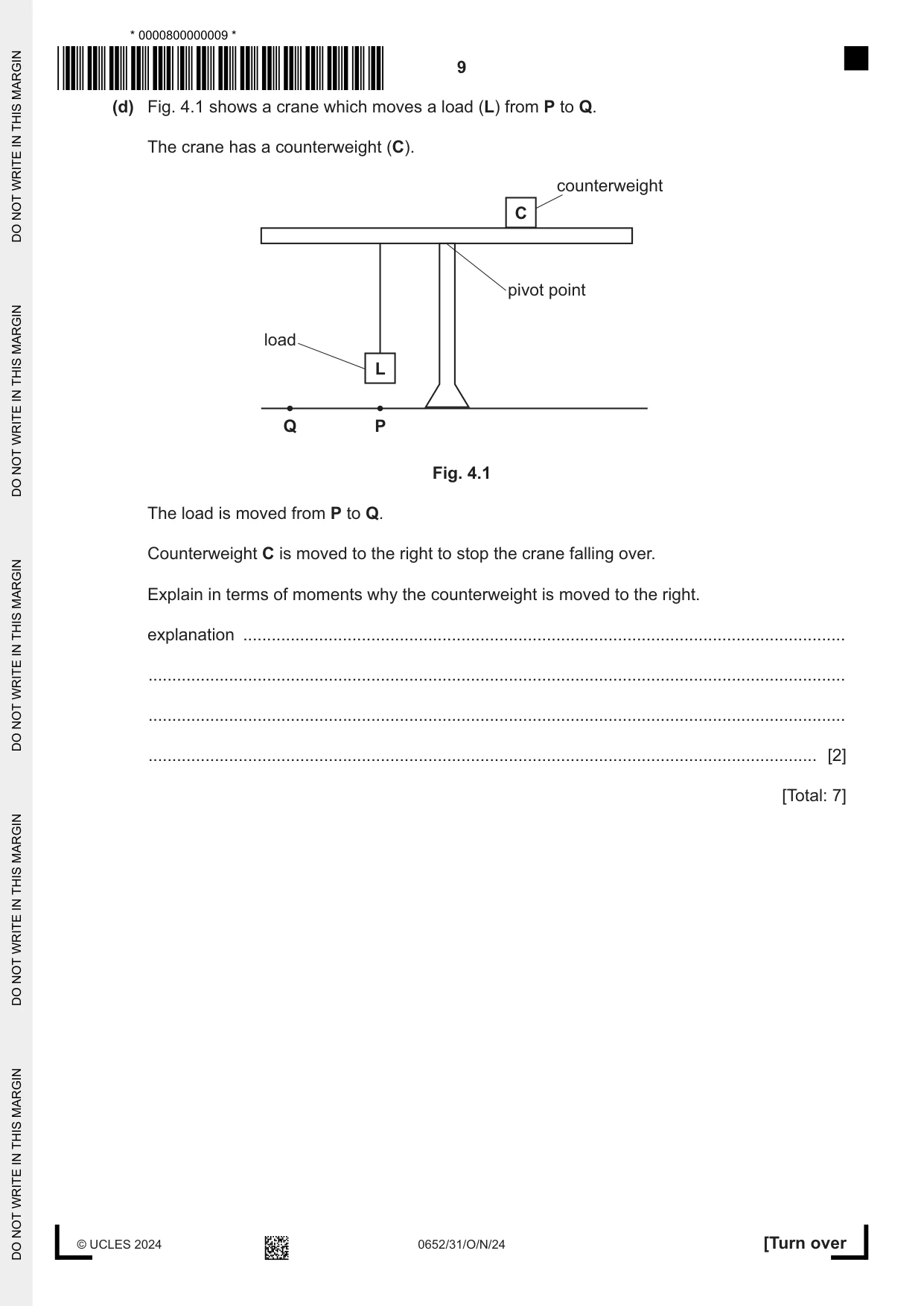
4 (a) A crane lifts a large bucket containing concrete. The volume of the concrete is 2.0 m3. The density of the concrete is 2600 kg / m3. Calculate the mass of the concrete. mass = ..................................................... kg [2] (b) Calculate the weight of a 55 kg concrete block. [g = 10 N / kg] weight = ...................................................... N [1] (c) The energy supplied to the electric motor of the crane to lift a load is 20 000 J. The gravitational potential energy of the load increases by 14 000 J. (i) Explain how this information indicates that the crane is not 100% efficient. ........................................................................................................................................... ..................................................................................................................................... [1] (ii) Circle the phrase in the list which correctly completes the sentence. more energy more force more power more resistance To lift the same load in less time, the electric motor of the crane needs _____________ . [1] (d) Fig. 4.1 shows a crane which moves a load (L) from P to Q. The crane has a counterweight (C). counterweight C pivot point load L Q P Fig. 4.1 The load is moved from P to Q. Counterweight C is moved to the right to stop the crane falling over. Explain in terms of moments why the counterweight is moved to the right. explanation ............................................................................................................................... ................................................................................................................................................... ................................................................................................................................................... ............................................................................................................................................. [2] [Total: 7]
Mark scheme: 4(a) (mass) = density volume / 2600 2.0 ; 2 5200 (kg) ; 4(b) 550 (N) ; 1 4(c)(i) (idea of) the energy supplied is greater that the gain in GPE of the load ; 1 4(c)(ii) more power ; 1 4(d) no resultant moment / clockwise moment = anticlockwise moment (for equilibrium) ; 2 so crane remains in equilibrium ;
Q5 · A microwave oven with food inside
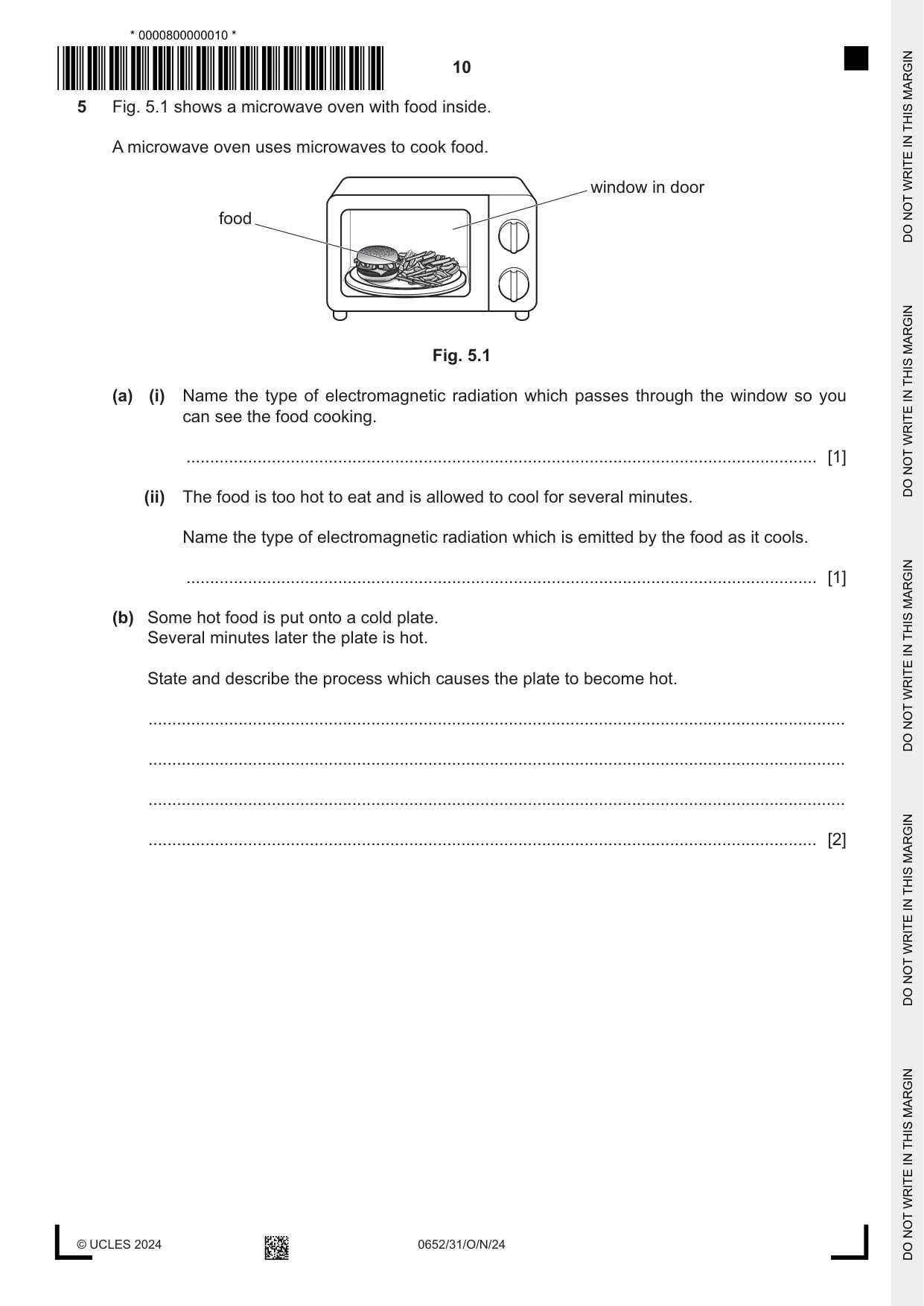
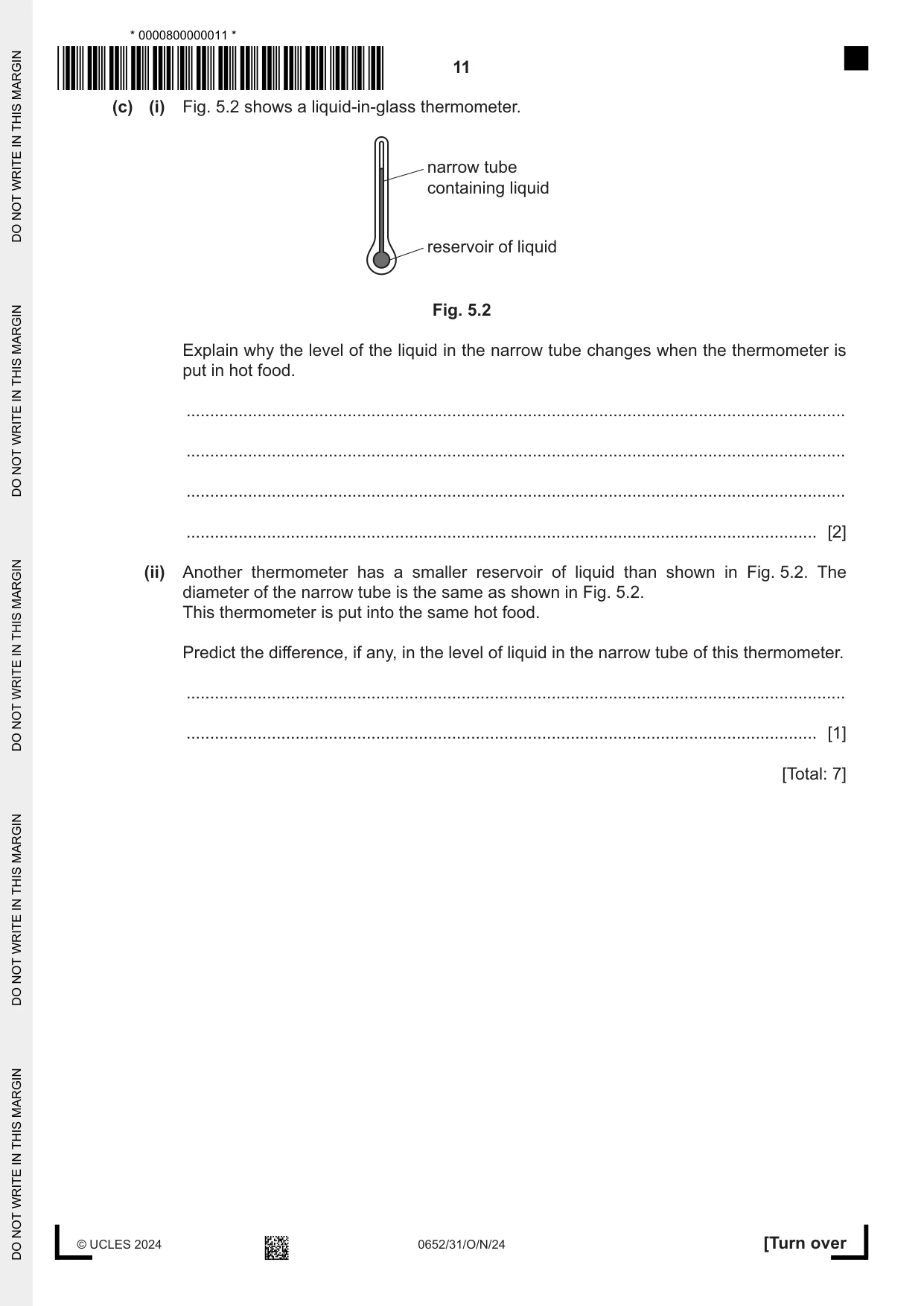
5 Fig. 5.1 shows a microwave oven with food inside. A microwave oven uses microwaves to cook food. window in door food Fig. 5.1 (a) (i) Name the type of electromagnetic radiation which passes through the window so you can see the food cooking. ..................................................................................................................................... [1] (ii) The food is too hot to eat and is allowed to cool for several minutes. Name the type of electromagnetic radiation which is emitted by the food as it cools. ..................................................................................................................................... [1] (b) Some hot food is put onto a cold plate. Several minutes later the plate is hot. State and describe the process which causes the plate to become hot. ................................................................................................................................................... ................................................................................................................................................... ................................................................................................................................................... ............................................................................................................................................. [2] (c) (i) Fig. 5.2 shows a liquid-in-glass thermometer. narrow tube containing liquid reservoir of liquid Fig. 5.2 Explain why the level of the liquid in the narrow tube changes when the thermometer is put in hot food. ........................................................................................................................................... ........................................................................................................................................... ........................................................................................................................................... ..................................................................................................................................... [2] (ii) Another thermometer has a smaller reservoir of liquid than shown in Fig. 5.2. The diameter of the narrow tube is the same as shown in Fig. 5.2. This thermometer is put into the same hot food. Predict the difference, if any, in the level of liquid in the narrow tube of this thermometer. ........................................................................................................................................... ..................................................................................................................................... [1] [Total: 7]
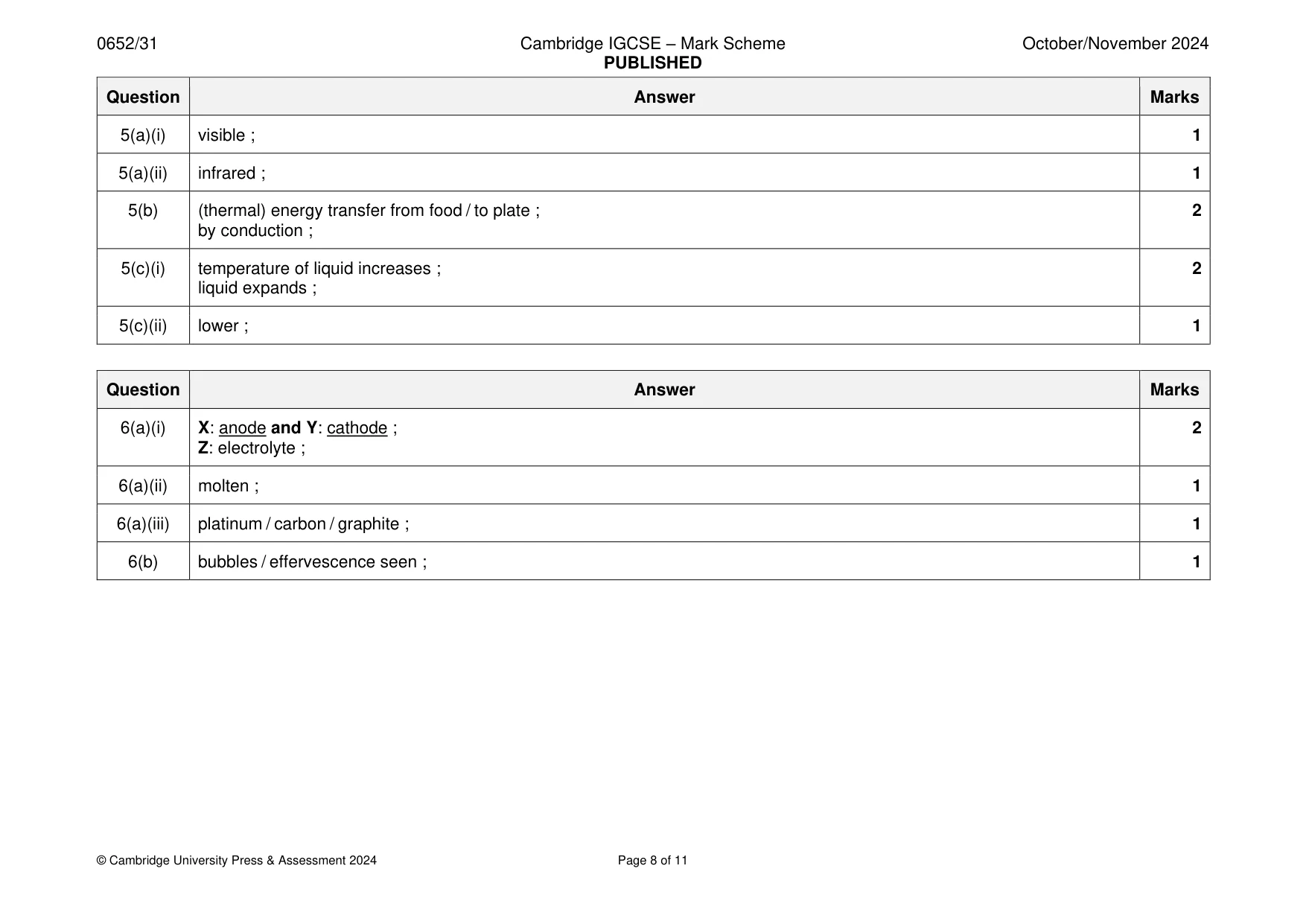
Mark scheme: 5(a)(i) visible ; 1 5(a)(ii) infrared ; 1 5(b) (thermal) energy transfer from food / to plate ; 2 by conduction ; 5(c)(i) temperature of liquid increases ; 2 liquid expands ; 5(c)(ii) lower ; 1
Q6 · The apparatus used for the electrolysis of an aqueous solution
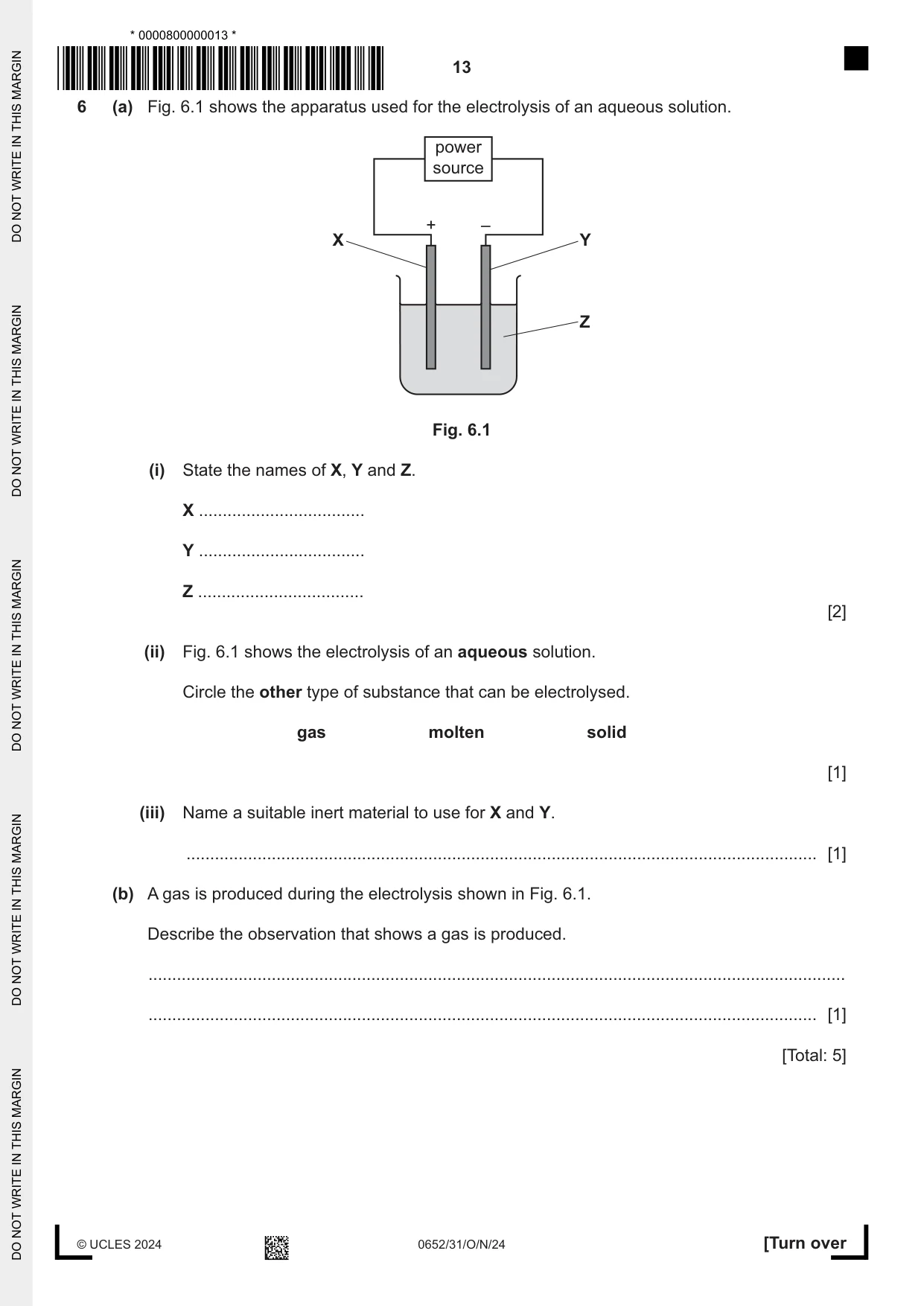
6 (a) Fig. 6.1 shows the apparatus used for the electrolysis of an aqueous solution. power source + – X Y Z Fig. 6.1 (i) State the names of X, Y and Z. X ................................... Y ................................... Z ................................... [2] (ii) Fig. 6.1 shows the electrolysis of an aqueous solution. Circle the other type of substance that can be electrolysed. gas molten solid [1] (iii) Name a suitable inert material to use for X and Y. ..................................................................................................................................... [1] (b) A gas is produced during the electrolysis shown in Fig. 6.1. Describe the observation that shows a gas is produced. ................................................................................................................................................... ............................................................................................................................................. [1] [Total: 5]
Mark scheme: 6(a)(i) X: anode and Y: cathode ; 2 Z: electrolyte ; 6(a)(ii) molten ; 1 6(a)(iii) platinum / carbon / graphite ; 1 6(b) bubbles / effervescence seen ; 1
Question 7
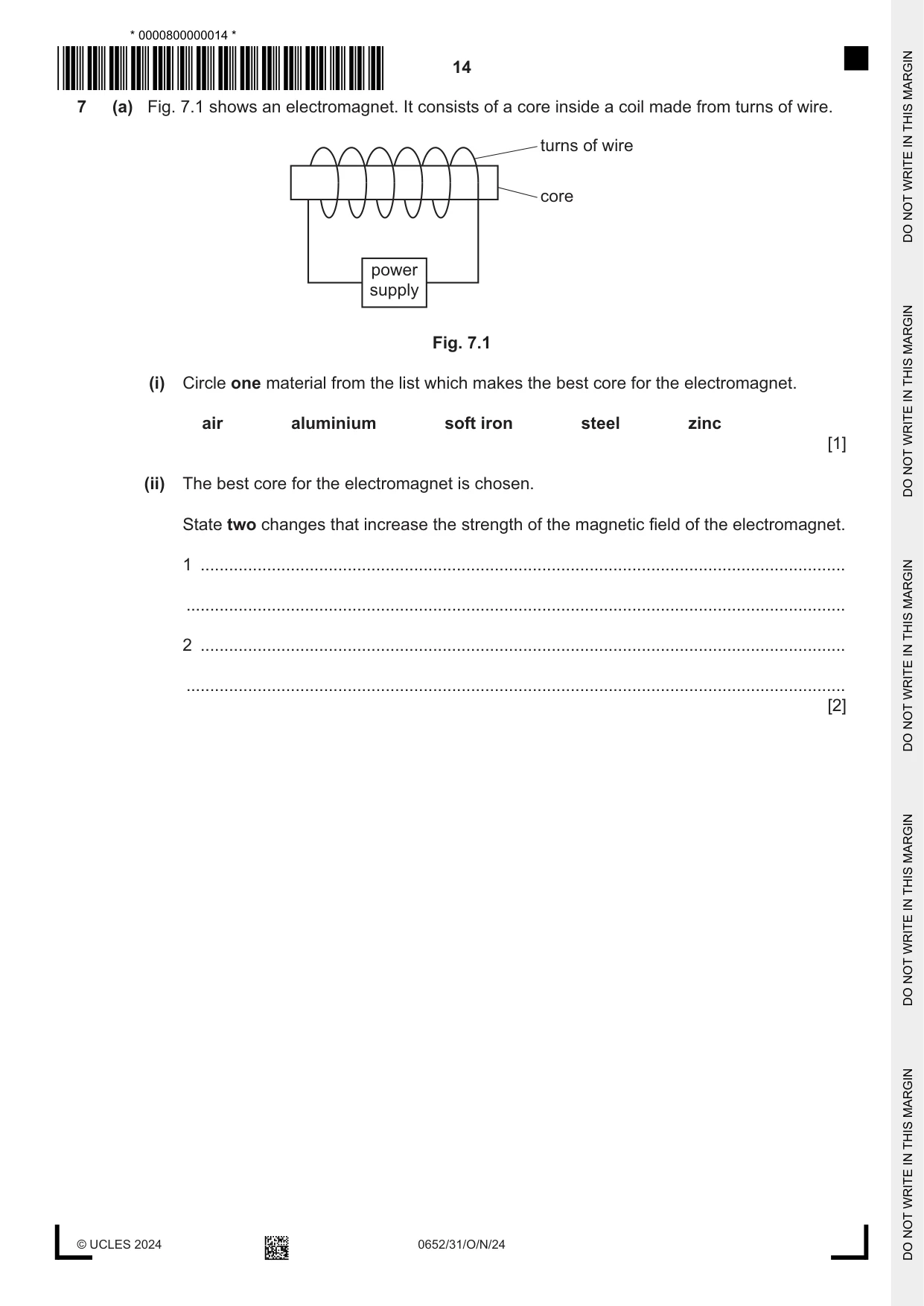
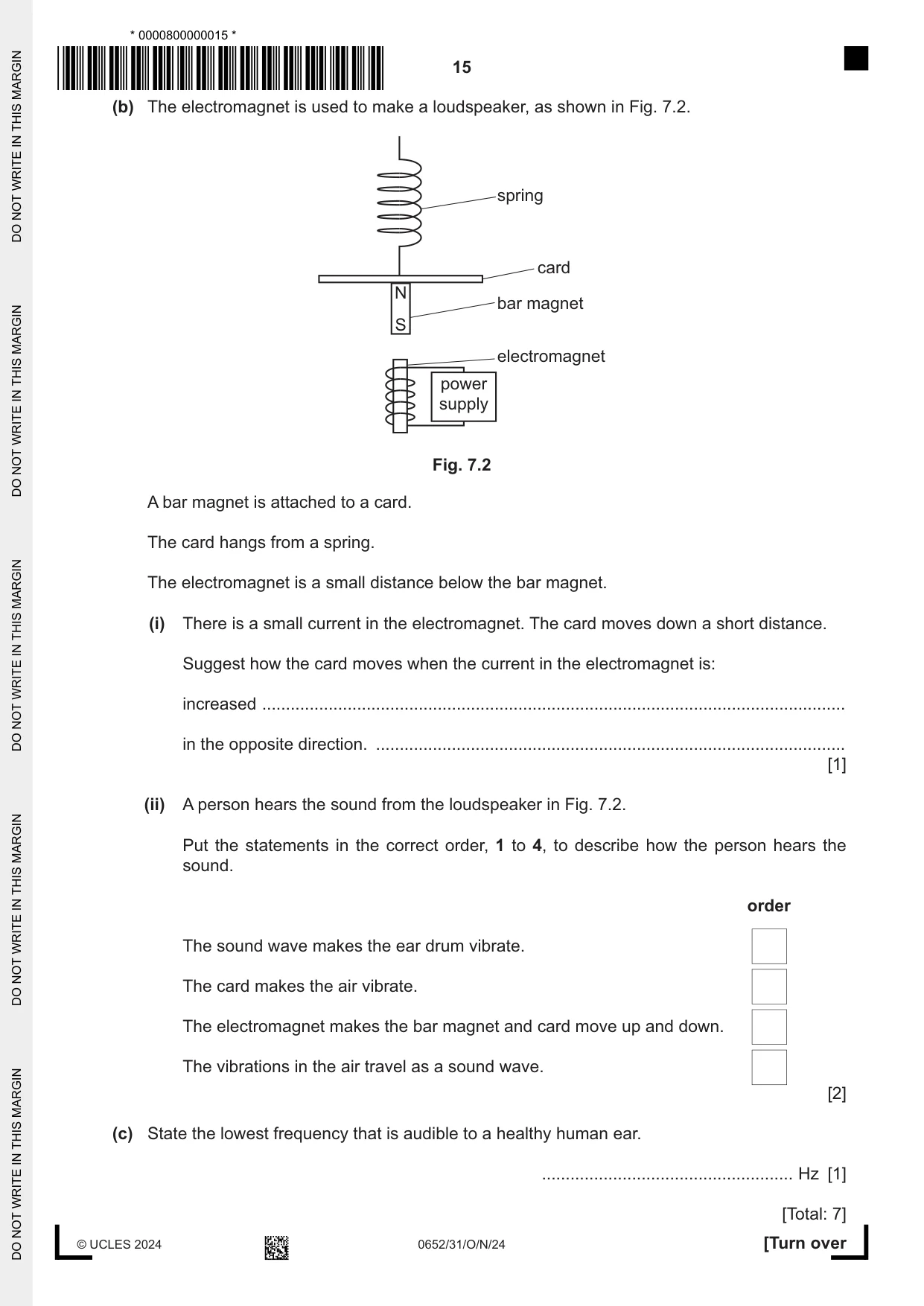
7 (a) Fig. 7.1 shows an electromagnet. It consists of a core inside a coil made from turns of wire. turns of wire core power supply Fig. 7.1 (i) Circle one material from the list which makes the best core for the electromagnet. air aluminium soft iron steel zinc [1] (ii) The best core for the electromagnet is chosen. State two changes that increase the strength of the magnetic field of the electromagnet. 1 ........................................................................................................................................ ........................................................................................................................................... 2 ........................................................................................................................................ ........................................................................................................................................... [2] (b) The electromagnet is used to make a loudspeaker, as shown in Fig. 7.2. spring card N bar magnet S electromagnet power supply Fig. 7.2 A bar magnet is attached to a card. The card hangs from a spring. The electromagnet is a small distance below the bar magnet. (i) There is a small current in the electromagnet. The card moves down a short distance. Suggest how the card moves when the current in the electromagnet is: increased ........................................................................................................................... in the opposite direction. ................................................................................................... [1] (ii) A person hears the sound from the loudspeaker in Fig. 7.2. Put the statements in the correct order, 1 to 4, to describe how the person hears the sound. order The sound wave makes the ear drum vibrate. The card makes the air vibrate. The electromagnet makes the bar magnet and card move up and down. The vibrations in the air travel as a sound wave. [2] (c) State the lowest frequency that is audible to a healthy human ear. ..................................................... Hz [1] [Total: 7]
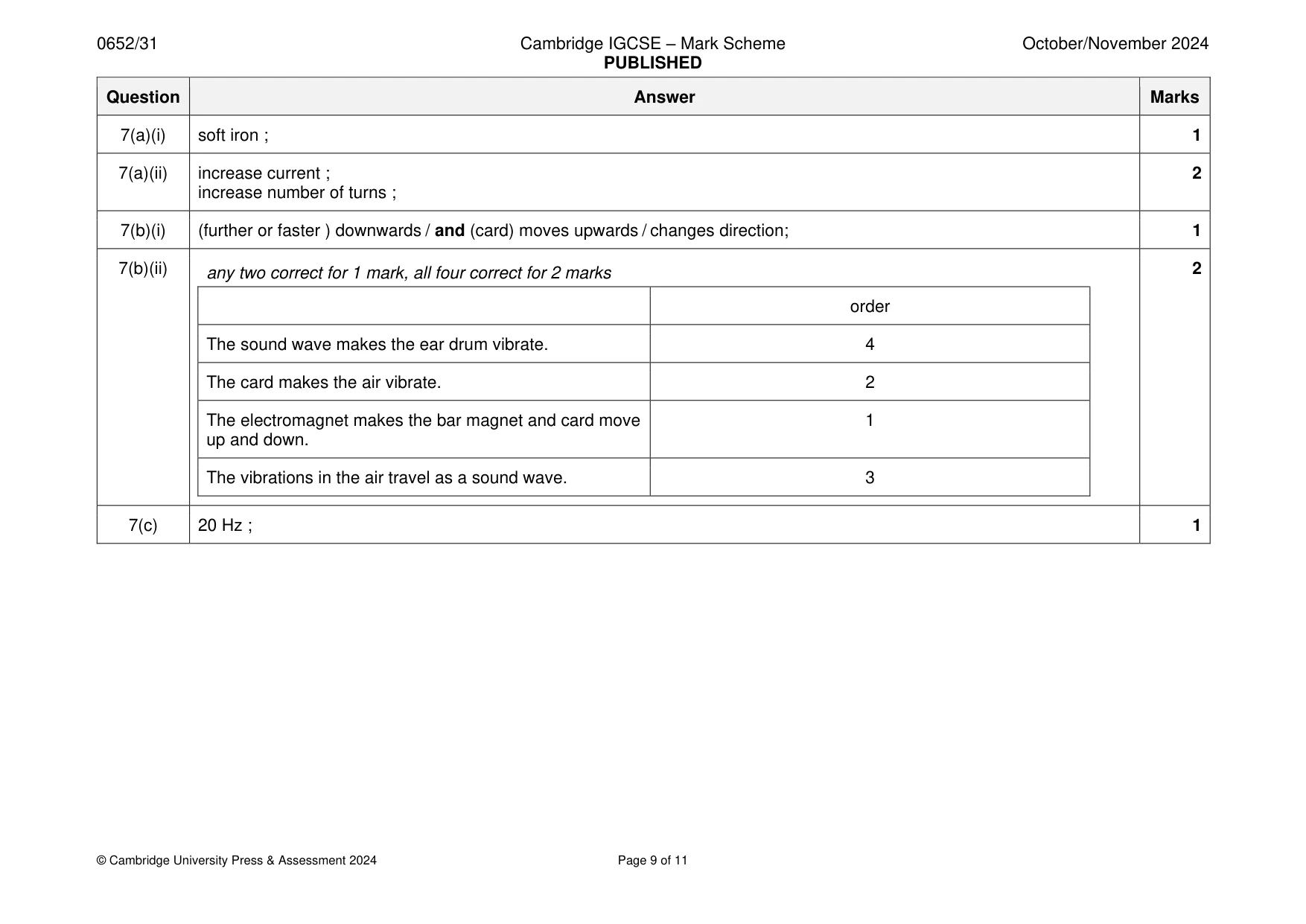
Mark scheme: 7(a)(i) soft iron ; 1 7(a)(ii) increase current ; 2 increase number of turns ; 7(b)(i) (further or faster ) downwards / and (card) moves upwards / changes direction; 1 7(b)(ii) any two correct for 1 mark, all four correct for 2 marks 2 order The sound wave makes the ear drum vibrate. 4 The card makes the air vibrate. 2 The electromagnet makes the bar magnet and card move 1 up and down. The vibrations in the air travel as a sound wave. 3 7(c) 20 Hz ; 1
Q8 · An apparatus used in an industrial process
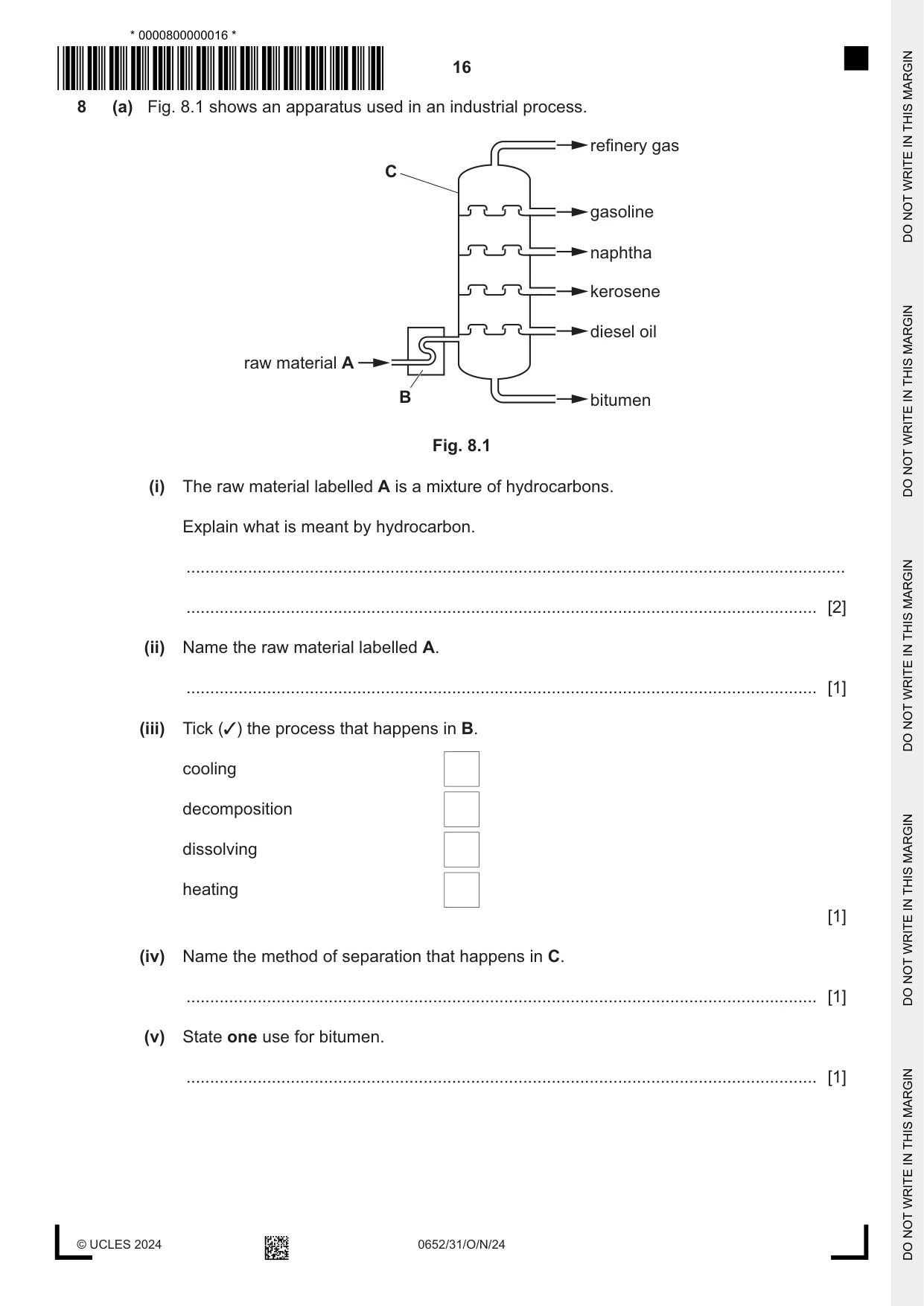
8 (a) Fig. 8.1 shows an apparatus used in an industrial process. refinery gas C gasoline naphtha kerosene diesel oil raw material A B bitumen Fig. 8.1 (i) The raw material labelled A is a mixture of hydrocarbons. Explain what is meant by hydrocarbon. ........................................................................................................................................... ..................................................................................................................................... [2] (ii) Name the raw material labelled A. ..................................................................................................................................... [1] (iii) Tick (✓) the process that happens in B. cooling decomposition dissolving heating [1] (iv) Name the method of separation that happens in C. ..................................................................................................................................... [1] (v) State one use for bitumen. ..................................................................................................................................... [1] (b) Gasoline is a carbon-containing substance. Gasoline is a fuel. Explain why the complete combustion of gasoline is a concern. ................................................................................................................................................... ................................................................................................................................................... ................................................................................................................................................... ............................................................................................................................................. [2] (c) Name a fuel that does not contain carbon. ............................................................................................................................................. [1] [Total: 9]
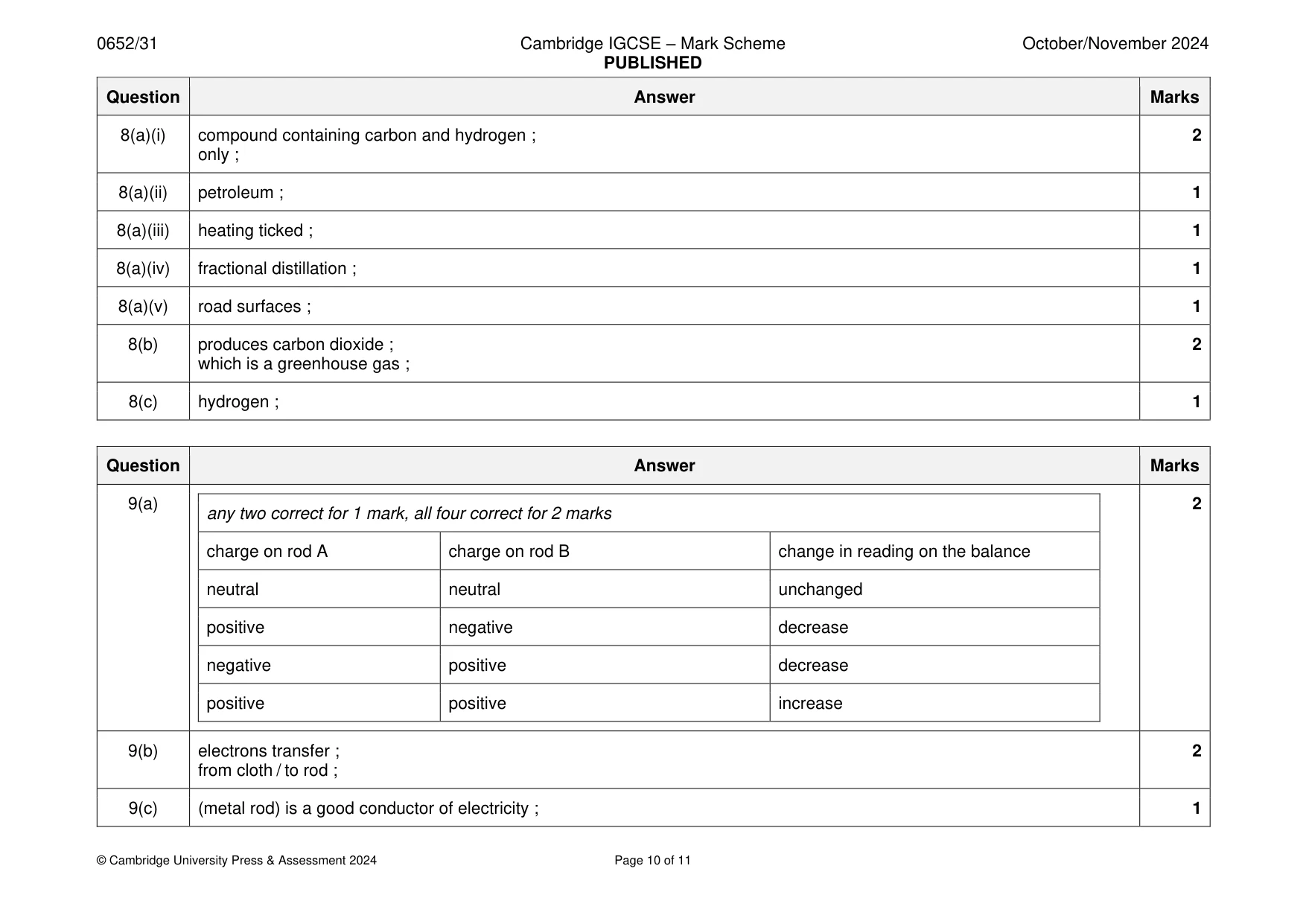
Mark scheme: 8(a)(i) compound containing carbon and hydrogen ; 2 only ; 8(a)(ii) petroleum ; 1 8(a)(iii) heating ticked ; 1 8(a)(iv) fractional distillation ; 1 8(a)(v) road surfaces ; 1 8(b) produces carbon dioxide ; 2 which is a greenhouse gas ; 8(c) hydrogen ; 1
Q9 · Two plastic rods, A and B
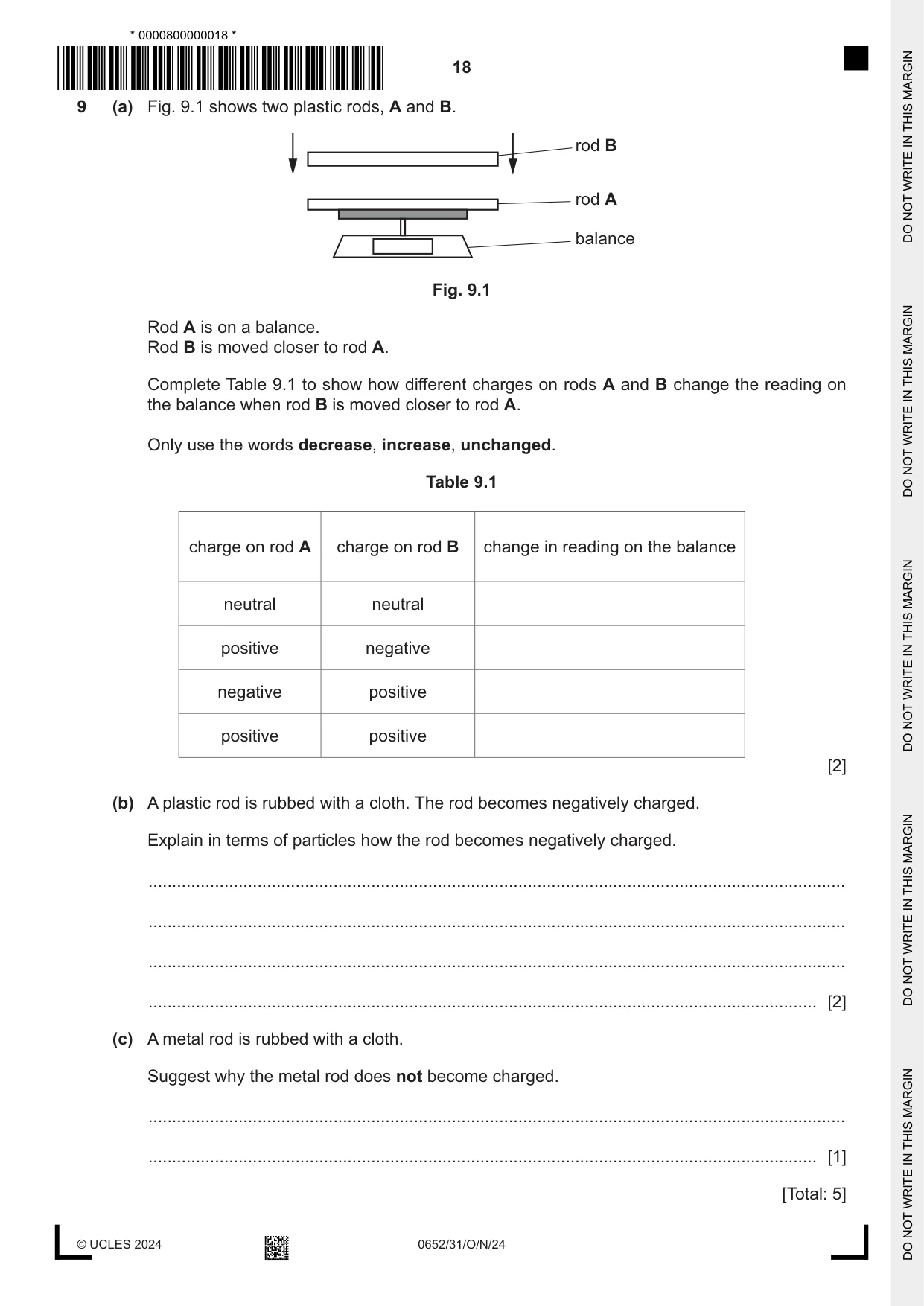
9 (a) Fig. 9.1 shows two plastic rods, A and B. rod B rod A balance Fig. 9.1 Rod A is on a balance. Rod B is moved closer to rod A. Complete Table 9.1 to show how different charges on rods A and B change the reading on the balance when rod B is moved closer to rod A. Only use the words decrease, increase, unchanged. Table 9.1 charge on rod A charge on rod B change in reading on the balance neutral neutral positive negative negative positive positive positive [2] (b) A plastic rod is rubbed with a cloth. The rod becomes negatively charged. Explain in terms of particles how the rod becomes negatively charged. ................................................................................................................................................... ................................................................................................................................................... ................................................................................................................................................... ............................................................................................................................................. [2] (c) A metal rod is rubbed with a cloth. Suggest why the metal rod does not become charged. ................................................................................................................................................... ............................................................................................................................................. [1] [Total: 5]
Mark scheme: 9(a) 2 any two correct for 1 mark, all four correct for 2 marks charge on rod A charge on rod B change in reading on the balance neutral neutral unchanged positive negative decrease negative positive decrease positive positive increase 9(b) electrons transfer ; 2 from cloth / to rod ; 9(c) (metal rod) is a good conductor of electricity ; 1
Q10 · Iron is a metal
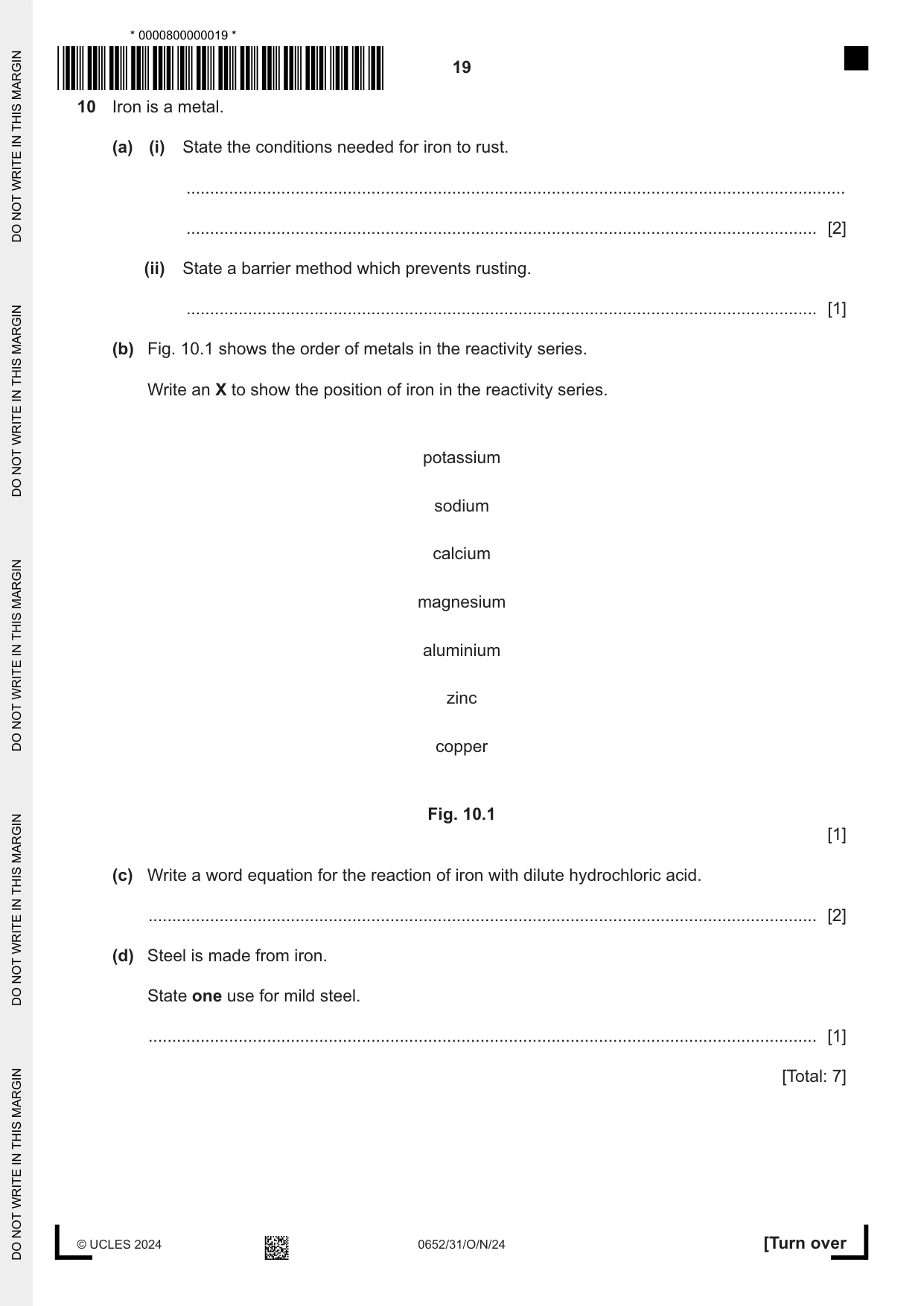
10 Iron is a metal. (a) (i) State the conditions needed for iron to rust. ........................................................................................................................................... ..................................................................................................................................... [2] (ii) State a barrier method which prevents rusting. ..................................................................................................................................... [1] (b) Fig. 10.1 shows the order of metals in the reactivity series. Write an X to show the position of iron in the reactivity series. potassium sodium calcium magnesium aluminium zinc copper Fig. 10.1 [1] (c) Write a word equation for the reaction of iron with dilute hydrochloric acid. ............................................................................................................................................. [2] (d) Steel is made from iron. State one use for mild steel. ............................................................................................................................................. [1] [Total: 7]
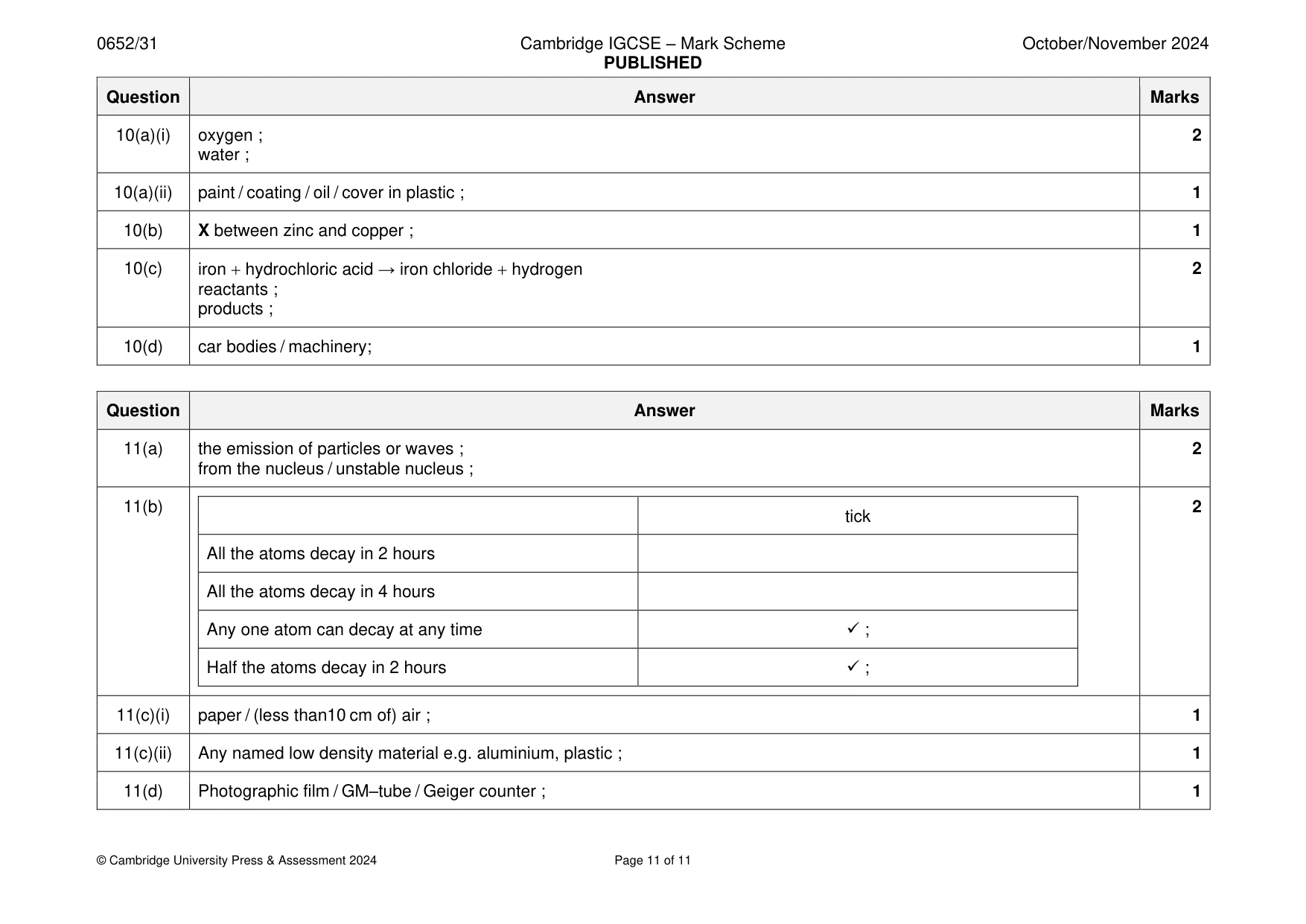
Mark scheme: 10(a)(i) oxygen ; 2 water ; 10(a)(ii) paint / coating / oil / cover in plastic ; 1 10(b) X between zinc and copper ; 1 10(c) iron + hydrochloric acid → iron chloride + hydrogen 2 reactants ; products ; 10(d) car bodies / machinery; 1
Q11 · Some nuclei undergo radioactive decay
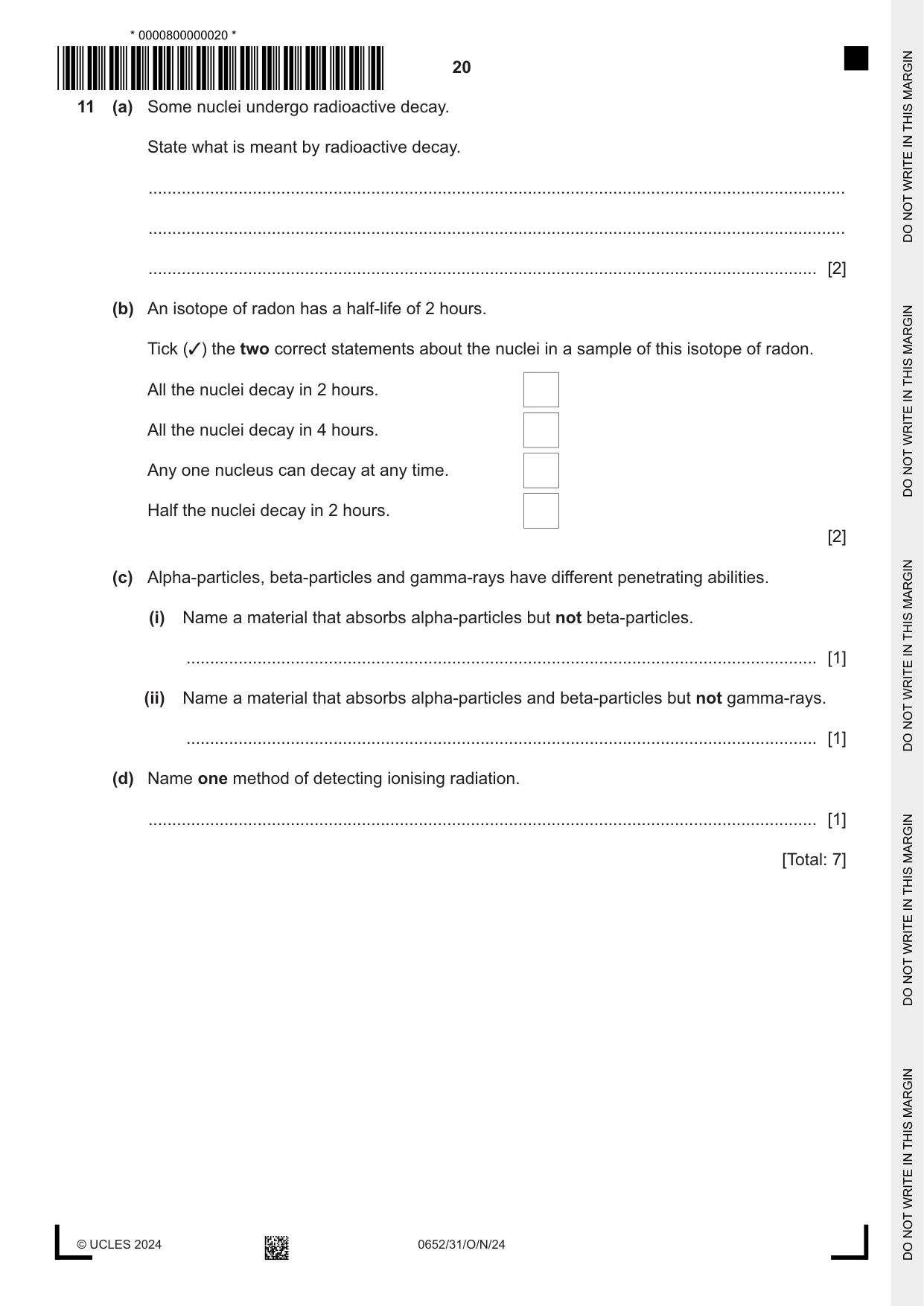
11 (a) Some nuclei undergo radioactive decay. State what is meant by radioactive decay. ................................................................................................................................................... ................................................................................................................................................... ............................................................................................................................................. [2] (b) An isotope of radon has a half-life of 2 hours. Tick (✓) the two correct statements about the nuclei in a sample of this isotope of radon. All the nuclei decay in 2 hours. All the nuclei decay in 4 hours. Any one nucleus can decay at any time. Half the nuclei decay in 2 hours. [2] (c) Alpha-particles, beta-particles and gamma-rays have different penetrating abilities. (i) Name a material that absorbs alpha-particles but not beta-particles. ..................................................................................................................................... [1] (ii) Name a material that absorbs alpha-particles and beta-particles but not gamma-rays. ..................................................................................................................................... [1] (d) Name one method of detecting ionising radiation. ............................................................................................................................................. [1] [Total: 7]
Mark scheme: 11(a) the emission of particles or waves ; 2 from the nucleus / unstable nucleus ; 11(b) 2 tick All the atoms decay in 2 hours All the atoms decay in 4 hours Any one atom can decay at any time ✓ ; Half the atoms decay in 2 hours ✓ ; 11(c)(i) paper / (less than10 cm of) air ; 1 11(c)(ii) Any named low density material e.g. aluminium, plastic ; 1 11(d) Photographic film / GM–tube / Geiger counter ; 1
What was in this paper
The subtopics covered by these 11 questions, and how many questions each got. Open one in a new tab to see every Cambridge question on it.
What you needed in this session
Cambridge’s own grade thresholds for 2024 Oct/Nov, Paper 3 · Variant 1. A higher threshold means an easier paper — the bar moves with how the cohort did.