Cambridge IGCSE Physical Science 0652 — 2022 Oct/Nov Paper 3 · Variant 1
0652/31/O/N/22 · 13 questions · 80 marks · ≈90 min
The question paper and its mark scheme, free to read here and free to download. This is Cambridge’s own paper, exactly as it was sat.
Question paper24 pages

Mark scheme10 pages
Answers below. Sit the paper first if you are practising.
Questions as text
Q1 · A climber needs to know the diameter of a rope
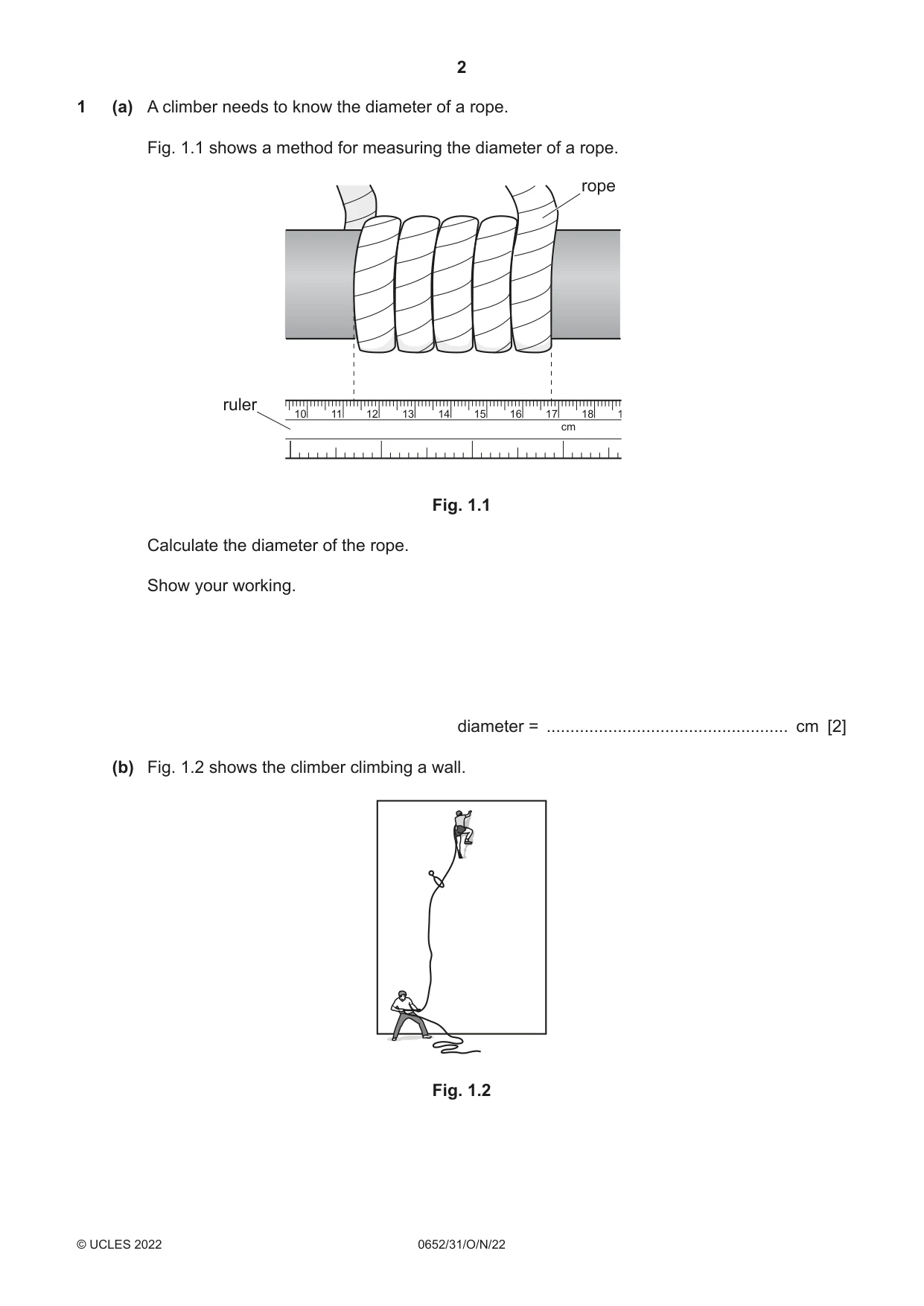
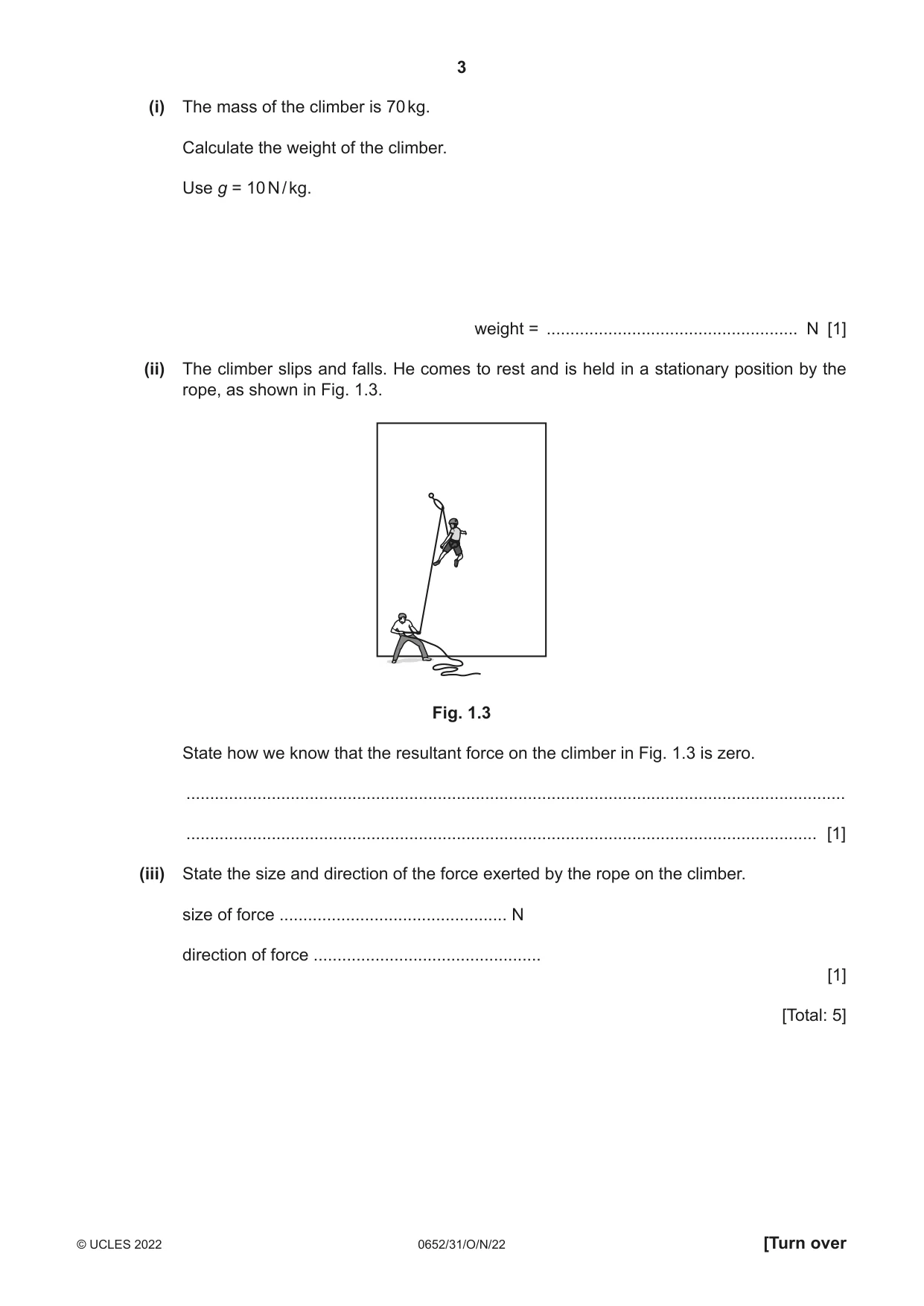
1 (a) A climber needs to know the diameter of a rope. Fig. 1.1 shows a method for measuring the diameter of a rope. rope ruler 8 9 10 11 12 13 14 15 16 17 18 19 20 21 22 cm Fig. 1.1 Calculate the diameter of the rope. Show your working. diameter = ................................................... cm [2] (b) Fig. 1.2 shows the climber climbing a wall. Fig. 1.2 (i) The mass of the climber is 70 kg. Calculate the weight of the climber. Use g = 10 N / kg. weight = ..................................................... N [1] (ii) The climber slips and falls. He comes to rest and is held in a stationary position by the rope, as shown in Fig. 1.3. Fig. 1.3 State how we know that the resultant force on the climber in Fig. 1.3 is zero. ........................................................................................................................................... ..................................................................................................................................... [1] (iii) State the size and direction of the force exerted by the rope on the climber. size of force ................................................ N direction of force ................................................ [1] [Total: 5]
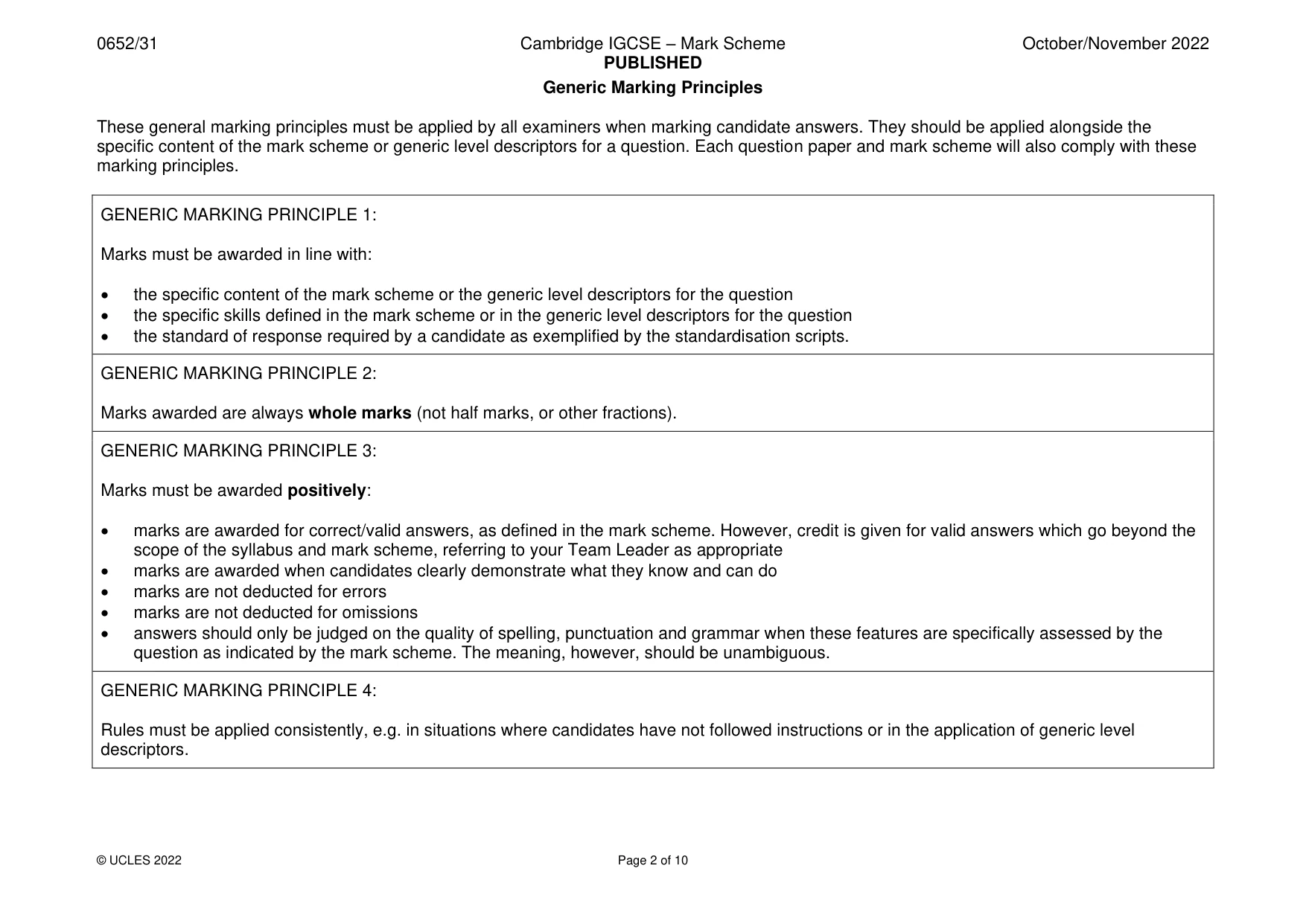
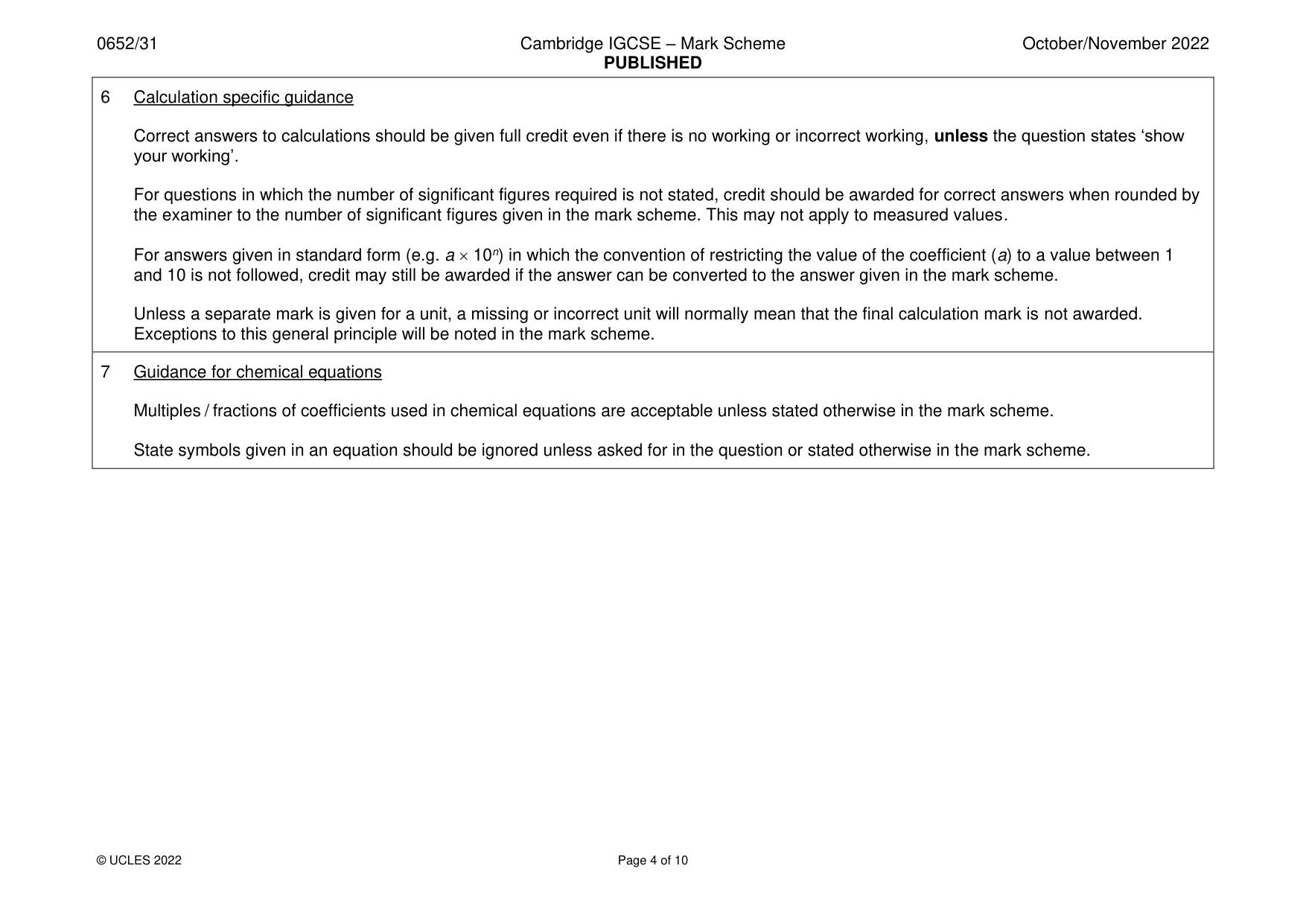
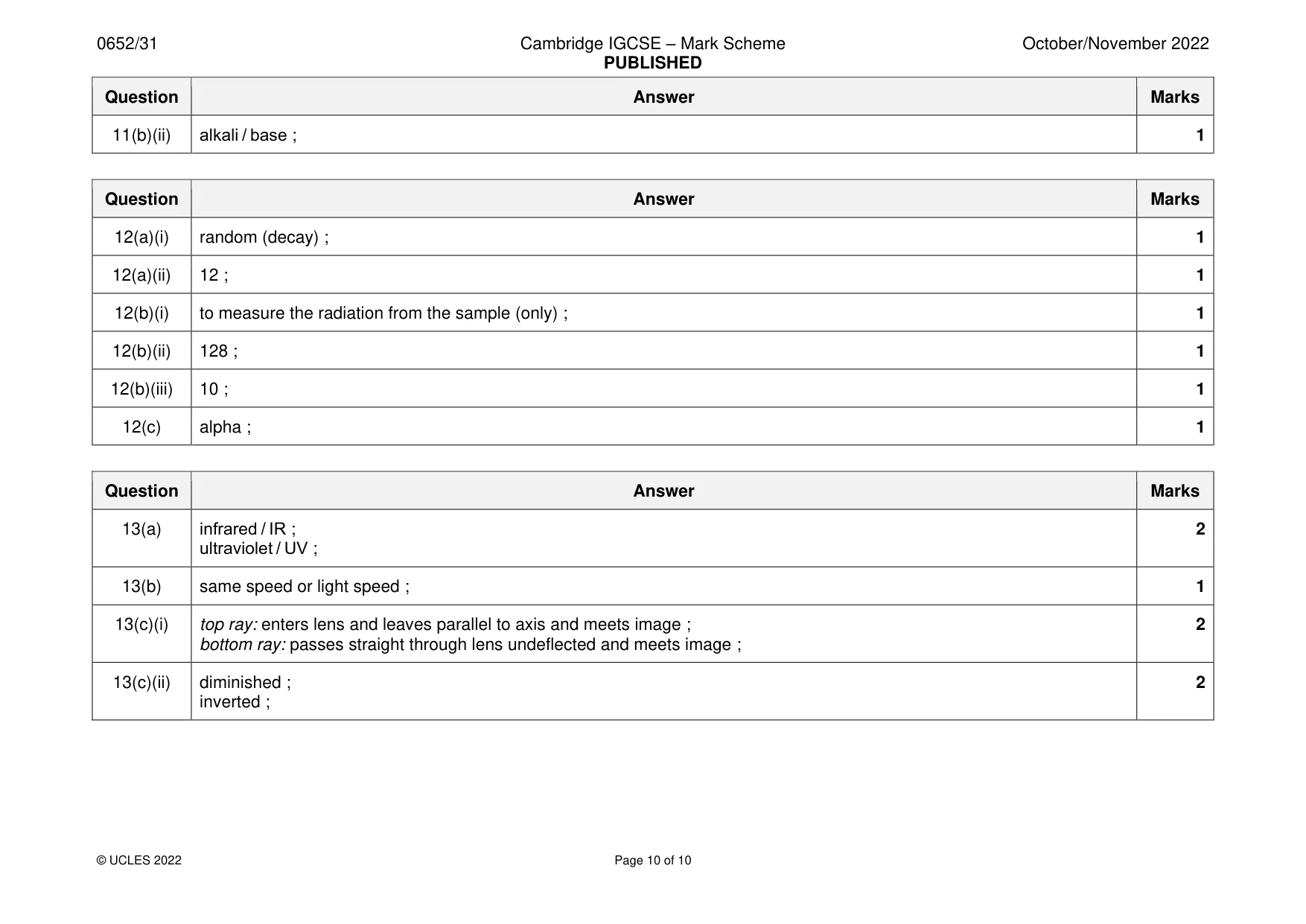
Mark scheme: Question Answer Marks 1(a) measurement: 5.5 or 16.8 − 11.3 ; 2 1.1 (cm) ; 1(b)(i) 700 (N) ; 1 1(b)(ii) speed is zero / no acceleration ; 1 1(b)(iii) 700 (N) AND upwards ; 1
Q2 · Fluorine is an element in the Periodic Table
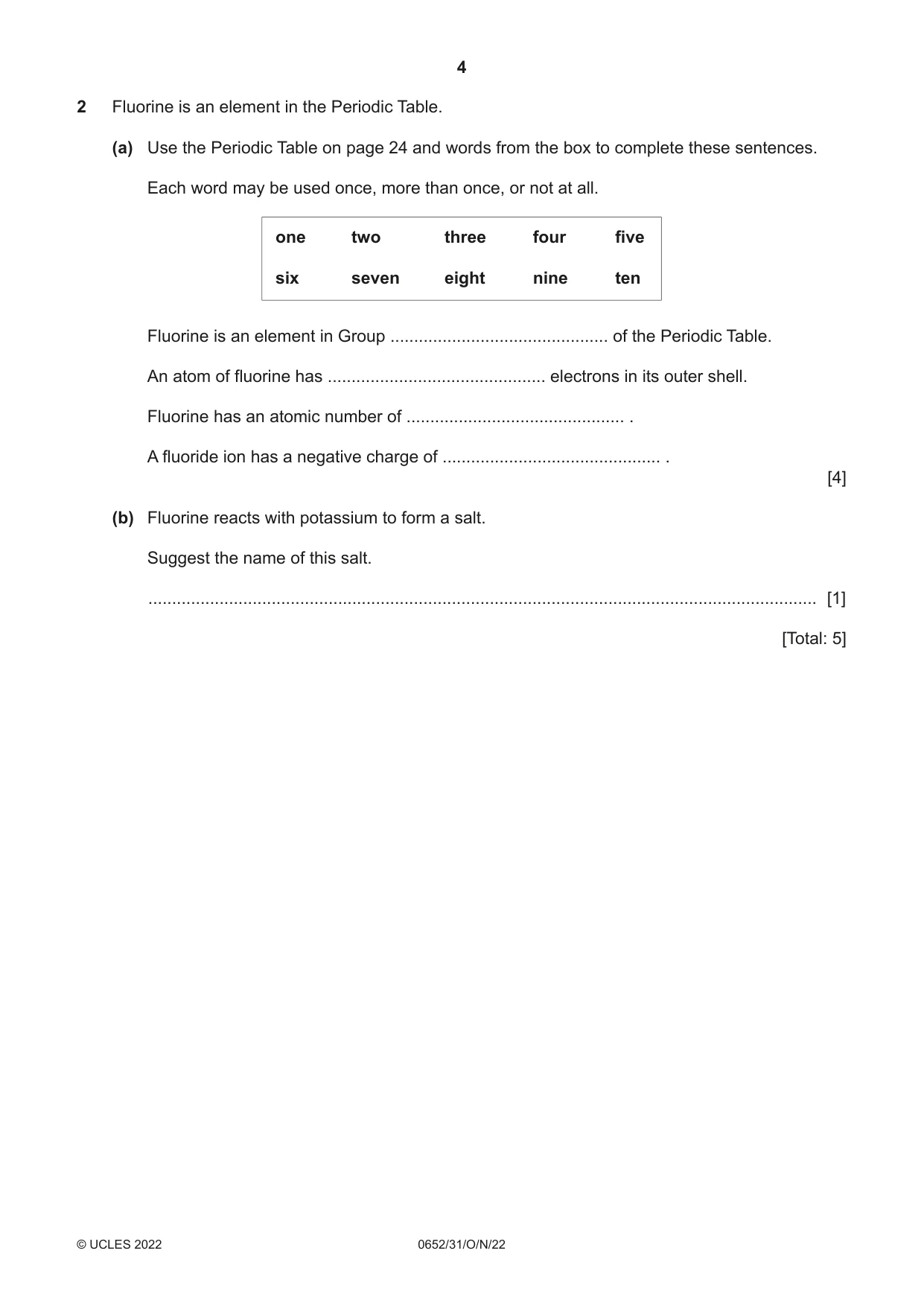
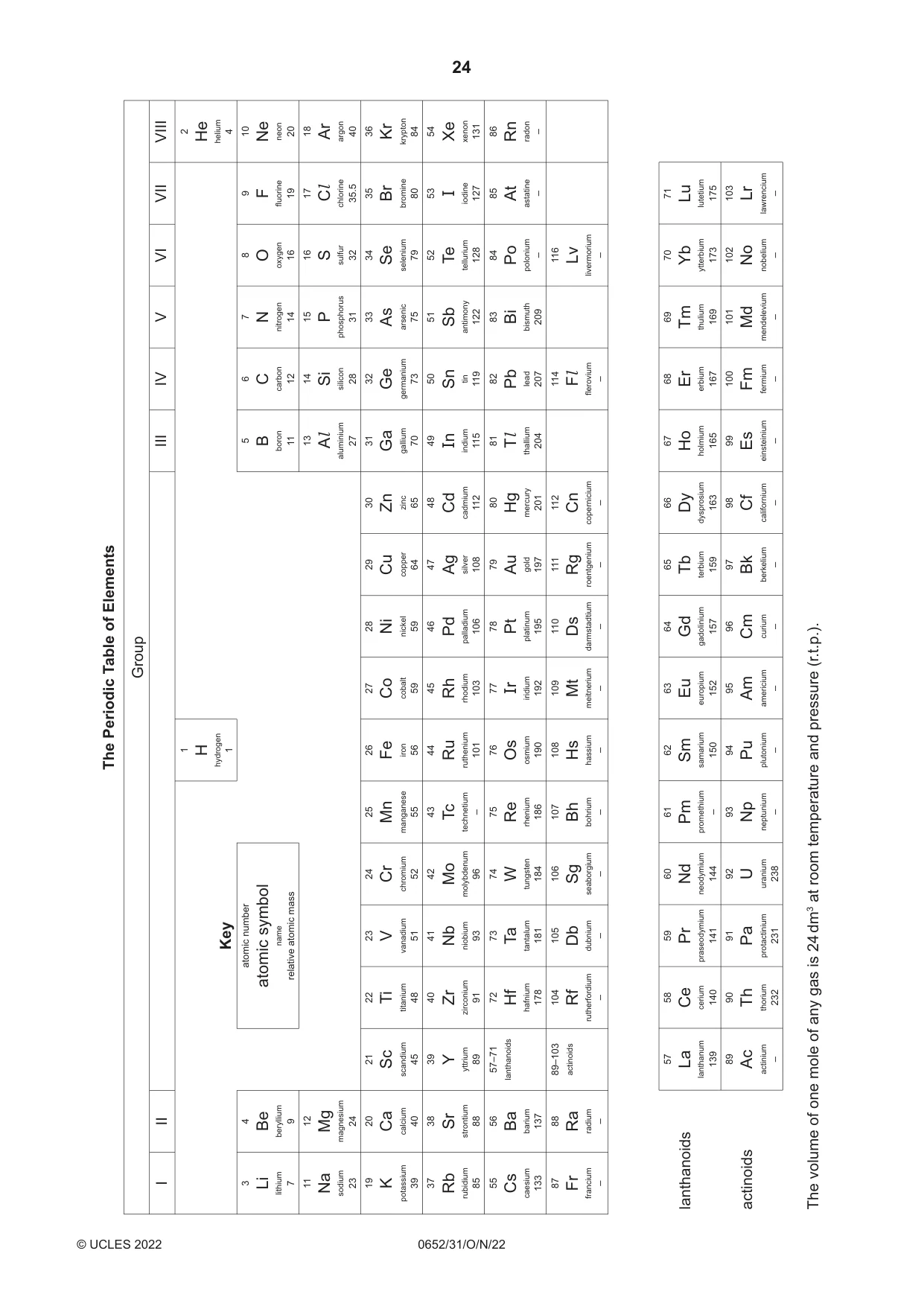
2 Fluorine is an element in the Periodic Table. (a) Use the Periodic Table on page 24 and words from the box to complete these sentences. Each word may be used once, more than once, or not at all. one two three four five six seven eight nine ten Fluorine is an element in Group .............................................. of the Periodic Table. An atom of fluorine has .............................................. electrons in its outer shell. Fluorine has an atomic number of .............................................. . A fluoride ion has a negative charge of .............................................. . [4] (b) Fluorine reacts with potassium to form a salt. Suggest the name of this salt. ............................................................................................................................................. [1] [Total: 5]
Mark scheme: 2(a) seven ; 4 seven ; nine ; one ; 2(b) potassium fluoride; 1
Q3 · Car tyres contain air under pressure
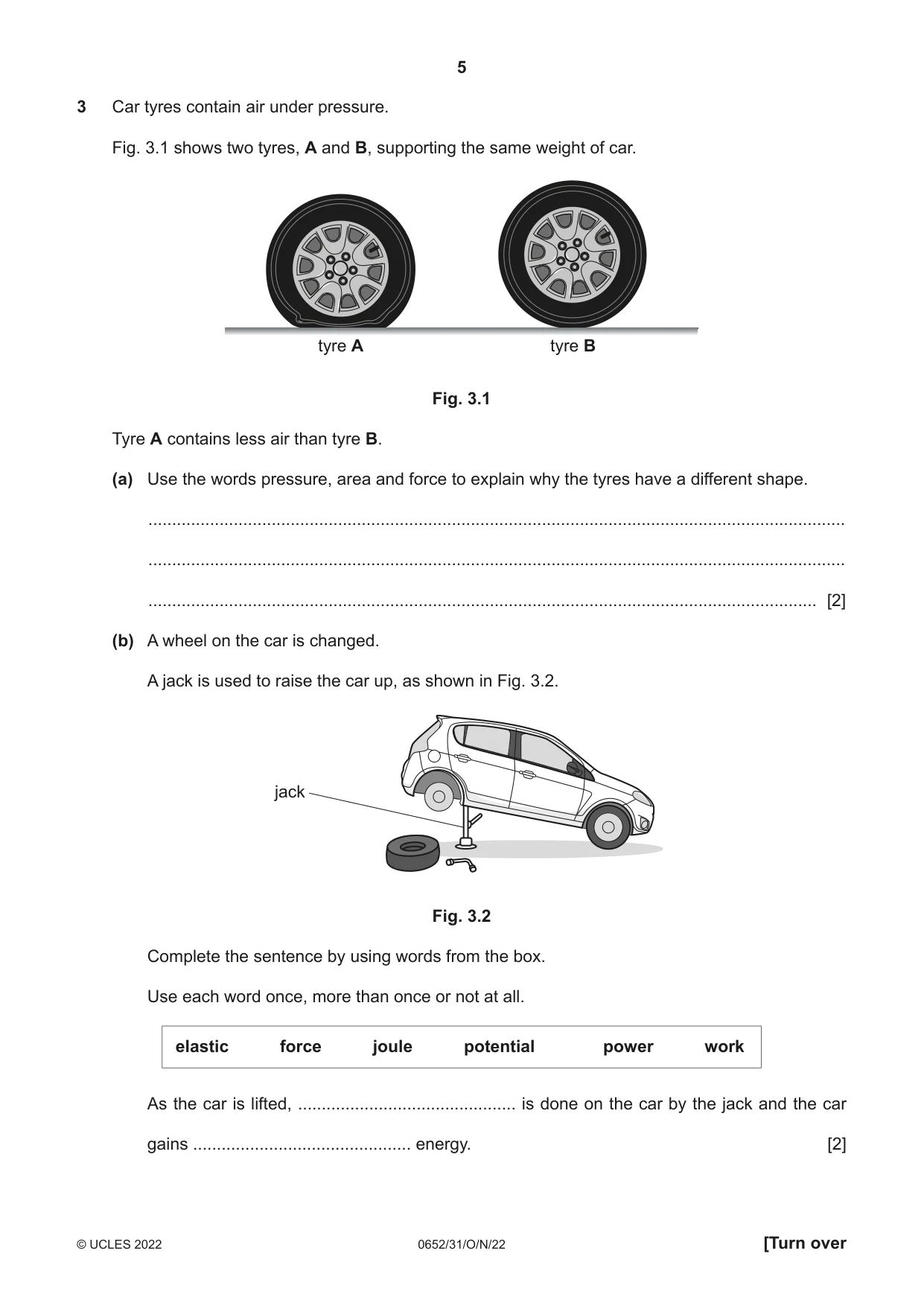
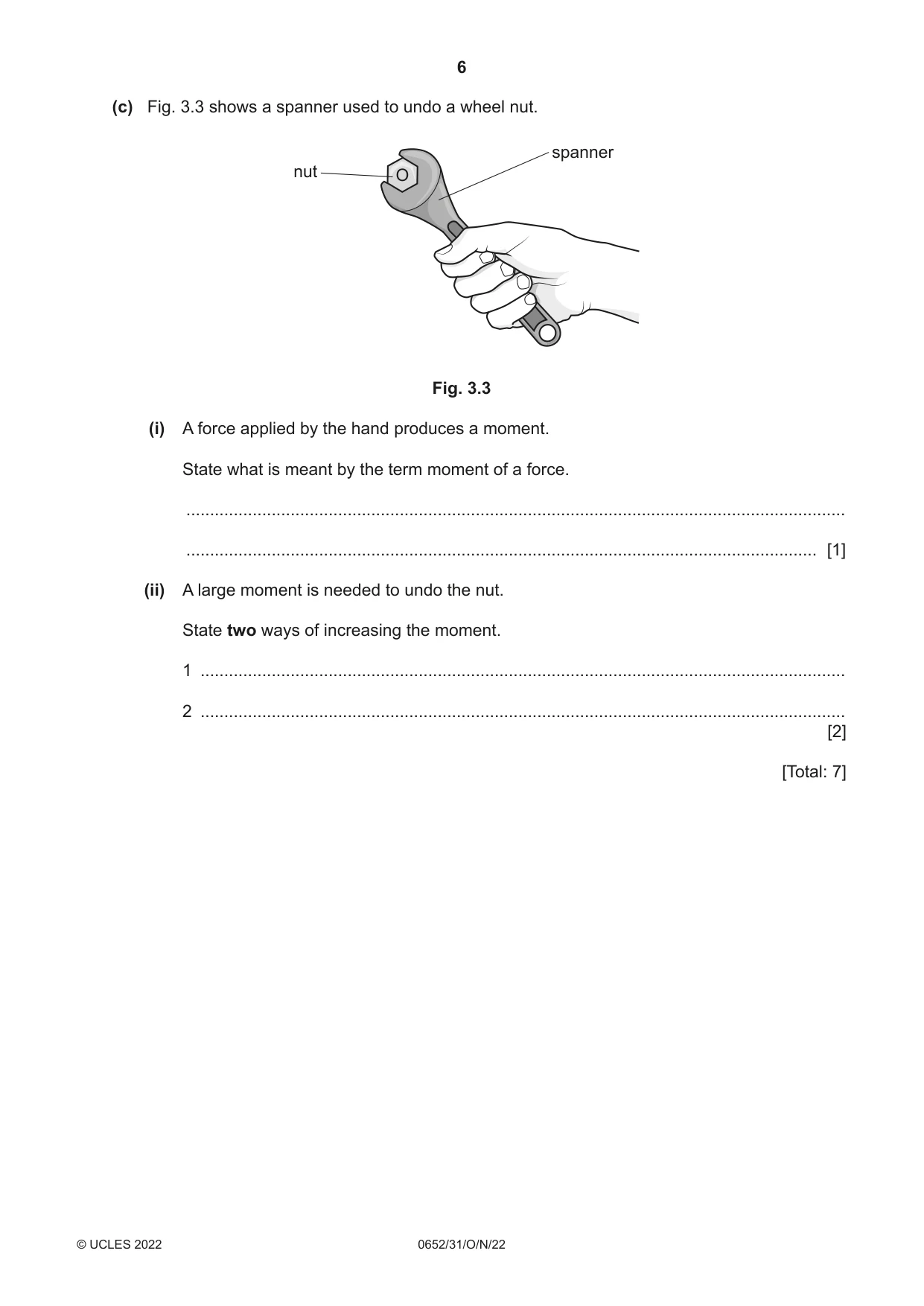
3 Car tyres contain air under pressure. Fig. 3.1 shows two tyres, A and B, supporting the same weight of car. tyre A tyre B Fig. 3.1 Tyre A contains less air than tyre B. (a) Use the words pressure, area and force to explain why the tyres have a different shape. ................................................................................................................................................... ................................................................................................................................................... ............................................................................................................................................. [2] (b) A wheel on the car is changed. A jack is used to raise the car up, as shown in Fig. 3.2. jack Fig. 3.2 Complete the sentence by using words from the box. Use each word once, more than once or not at all. elastic force joule potential power work As the car is lifted, .............................................. is done on the car by the jack and the car gains .............................................. energy. [2] (c) Fig. 3.3 shows a spanner used to undo a wheel nut. spanner nut O Fig. 3.3 (i) A force applied by the hand produces a moment. State what is meant by the term moment of a force. ........................................................................................................................................... ..................................................................................................................................... [1] (ii) A large moment is needed to undo the nut. State two ways of increasing the moment. 1 ........................................................................................................................................ 2 ........................................................................................................................................ [2] [Total: 7]
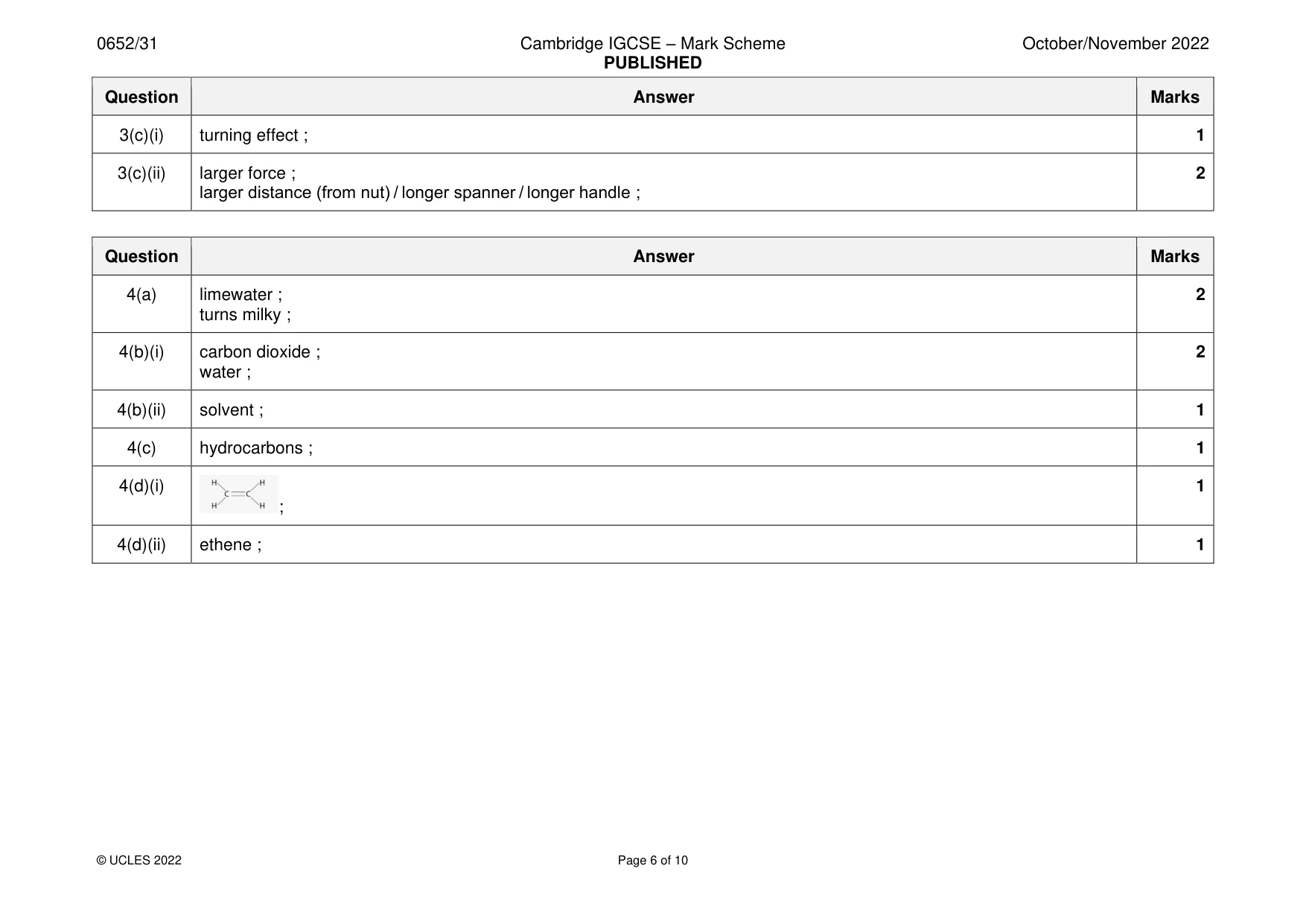
Mark scheme: 3(a) tyre A: 2 lower pressure ; greater (surface) area ; 3(b) work ; 2 potential ; 3(c)(i) turning effect ; 1 3(c)(ii) larger force ; 2 larger distance (from nut) / longer spanner / longer handle ;
Q4 · Fermentation is used to make ethanol
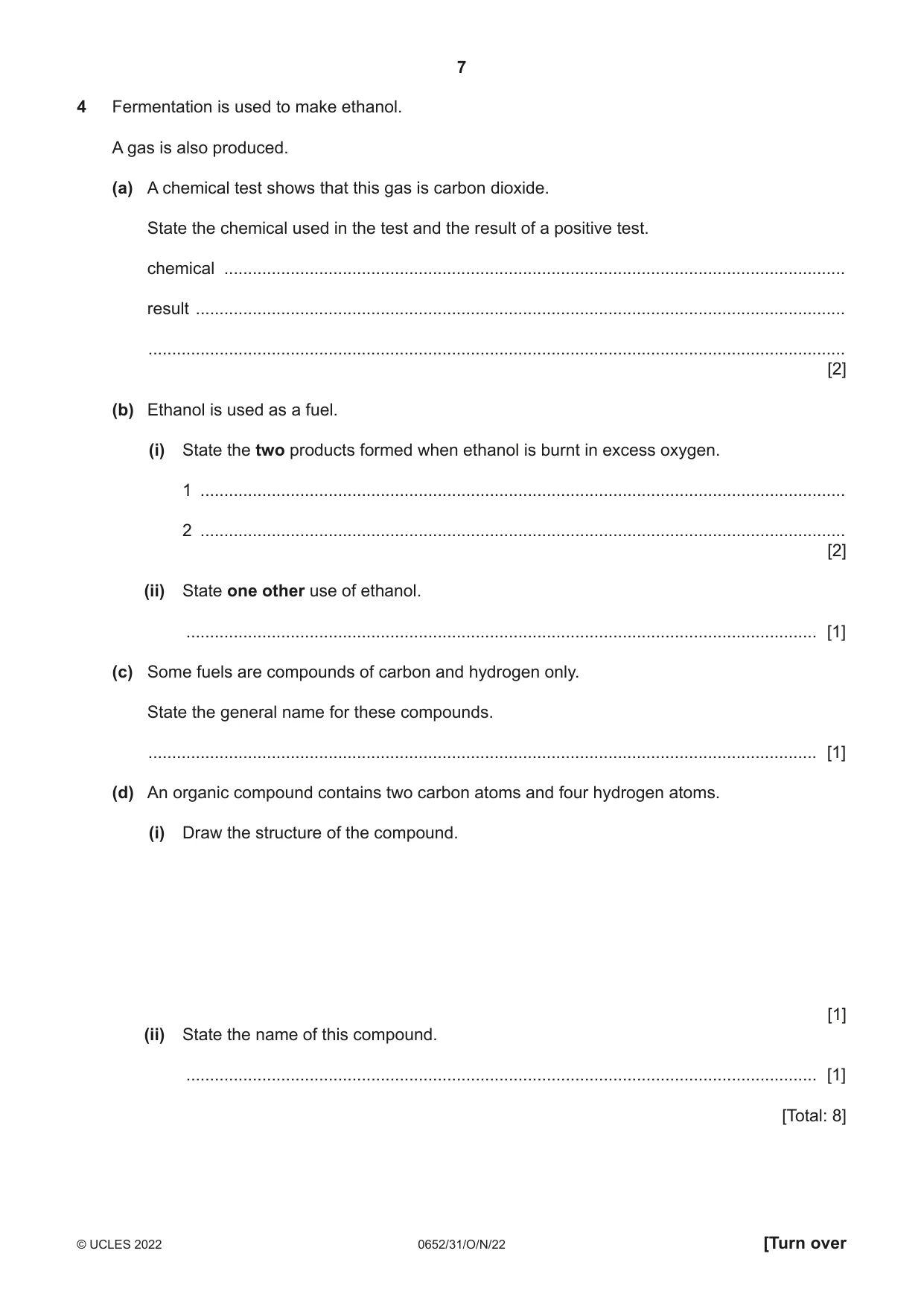
4 Fermentation is used to make ethanol. A gas is also produced. (a) A chemical test shows that this gas is carbon dioxide. State the chemical used in the test and the result of a positive test. chemical ................................................................................................................................... result ......................................................................................................................................... ................................................................................................................................................... [2] (b) Ethanol is used as a fuel. (i) State the two products formed when ethanol is burnt in excess oxygen. 1 ........................................................................................................................................ 2 ........................................................................................................................................ [2] (ii) State one other use of ethanol. ..................................................................................................................................... [1] (c) Some fuels are compounds of carbon and hydrogen only. State the general name for these compounds. ............................................................................................................................................. [1] (d) An organic compound contains two carbon atoms and four hydrogen atoms. (i) Draw the structure of the compound. [1] (ii) State the name of this compound. ..................................................................................................................................... [1] [Total: 8]
Mark scheme: 4(a) limewater ; 2 turns milky ; 4(b)(i) carbon dioxide ; 2 water ; 4(b)(ii) solvent ; 1 4(c) hydrocarbons ; 1 4(d)(i) 1 ; 4(d)(ii) ethene ; 1
Q5 · Apparatus used to react excess zinc with hydrochloric acid
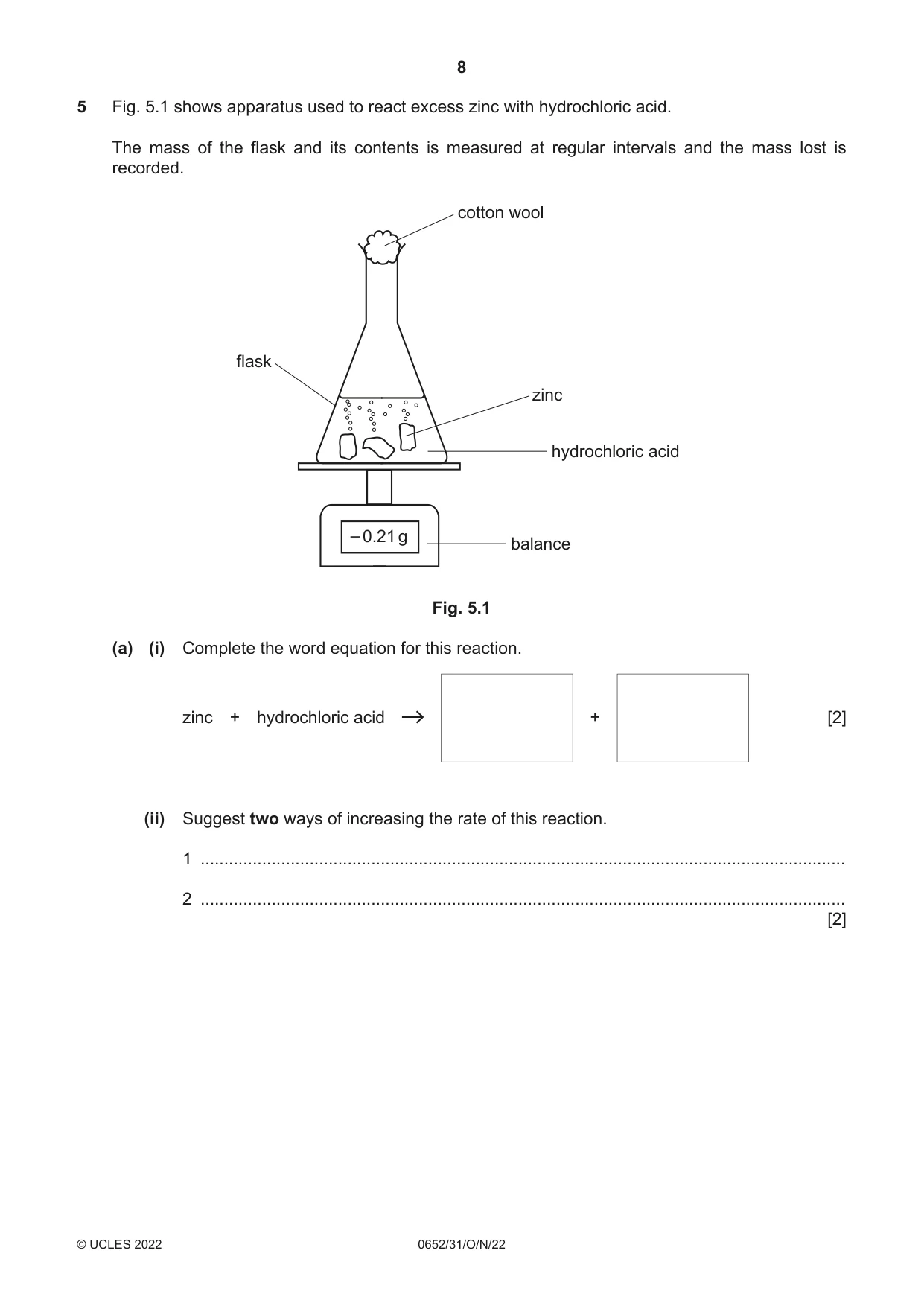
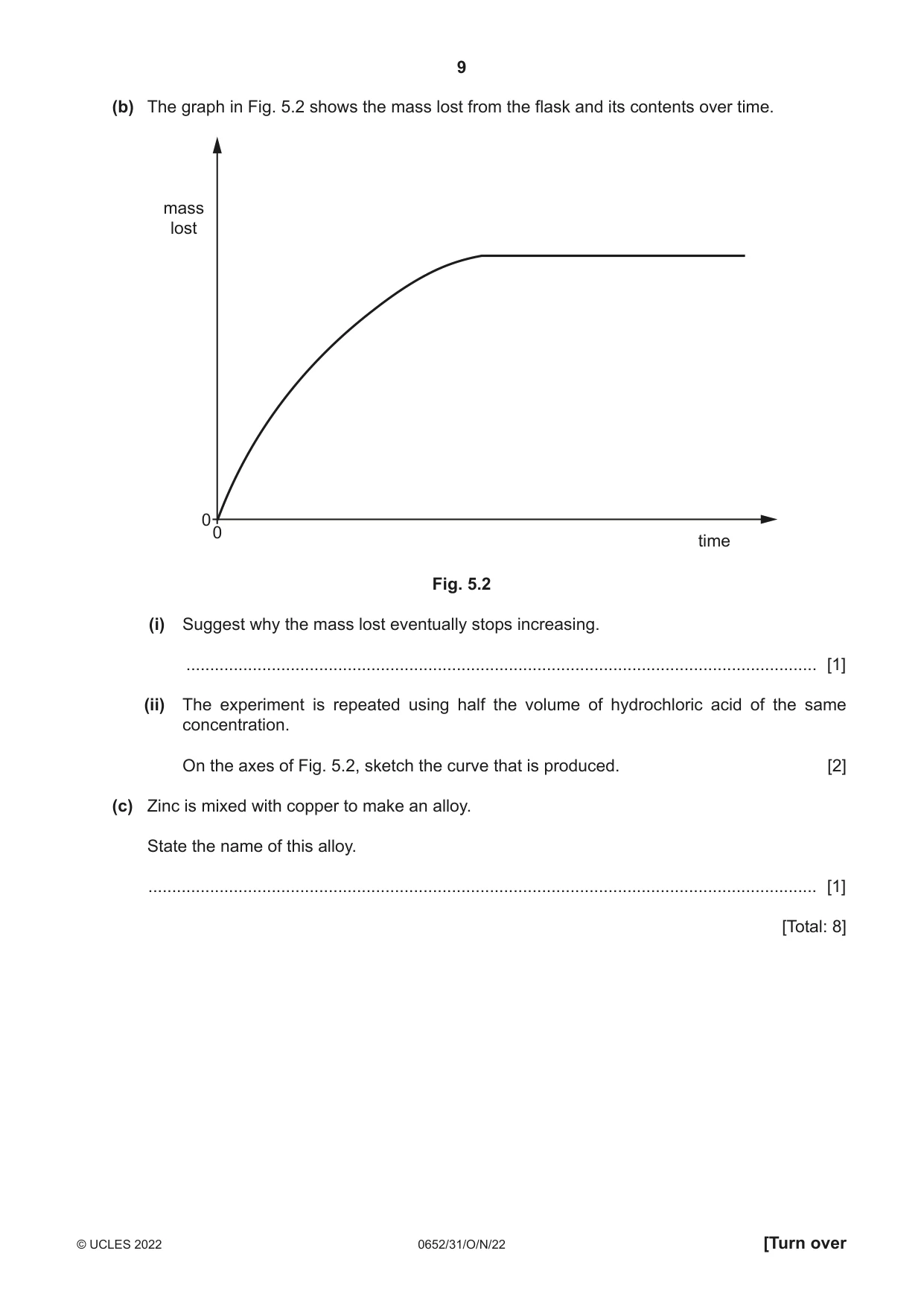
5 Fig. 5.1 shows apparatus used to react excess zinc with hydrochloric acid. The mass of the flask and its contents is measured at regular intervals and the mass lost is recorded. cotton wool flask zinc hydrochloric acid – 0.21 g balance Fig. 5.1 (a) (i) Complete the word equation for this reaction. zinc + hydrochloric acid + [2] (ii) Suggest two ways of increasing the rate of this reaction. 1 ........................................................................................................................................ 2 ........................................................................................................................................ [2] (b) The graph in Fig. 5.2 shows the mass lost from the flask and its contents over time. mass lost 00 time Fig. 5.2 (i) Suggest why the mass lost eventually stops increasing. ..................................................................................................................................... [1] (ii) The experiment is repeated using half the volume of hydrochloric acid of the same concentration. On the axes of Fig. 5.2, sketch the curve that is produced. [2] (c) Zinc is mixed with copper to make an alloy. State the name of this alloy. ............................................................................................................................................. [1] [Total: 8]
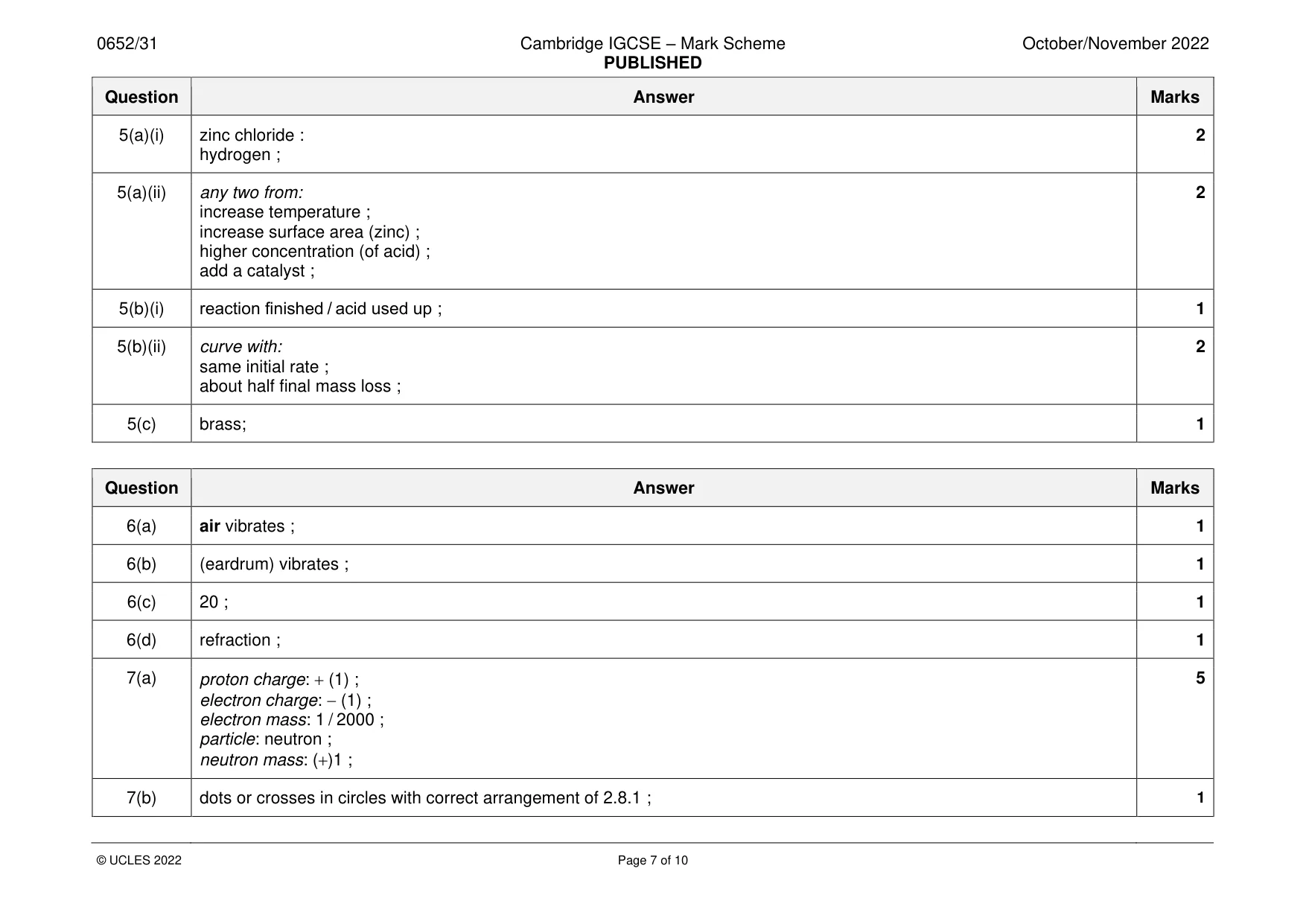
Mark scheme: 5(a)(i) zinc chloride : 2 hydrogen ; 5(a)(ii) any two from: 2 increase temperature ; increase surface area (zinc) ; higher concentration (of acid) ; add a catalyst ; 5(b)(i) reaction finished / acid used up ; 1 5(b)(ii) curve with: 2 same initial rate ; about half final mass loss ; 5(c) brass; 1
Q6 · A farmer uses a tape attached between two poles to scare birds, as shown in Fig
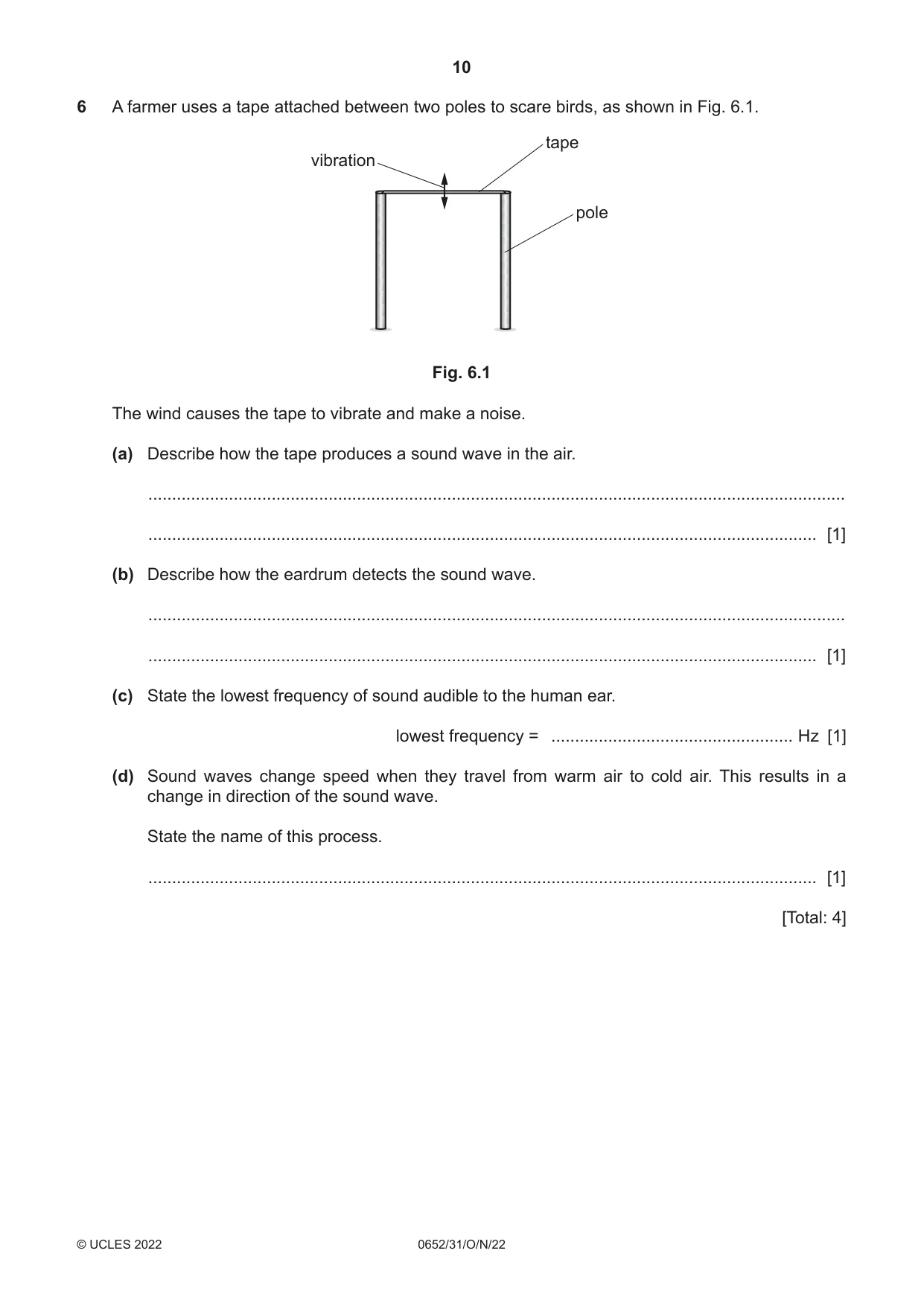
6 A farmer uses a tape attached between two poles to scare birds, as shown in Fig. 6.1. tape vibration pole Fig. 6.1 The wind causes the tape to vibrate and make a noise. (a) Describe how the tape produces a sound wave in the air. ................................................................................................................................................... ............................................................................................................................................. [1] (b) Describe how the eardrum detects the sound wave. ................................................................................................................................................... ............................................................................................................................................. [1] (c) State the lowest frequency of sound audible to the human ear. lowest frequency = ................................................... Hz [1] (d) Sound waves change speed when they travel from warm air to cold air. This results in a change in direction of the sound wave. State the name of this process. ............................................................................................................................................. [1] [Total: 4]
Mark scheme: 6(a) air vibrates ; 1 6(b) (eardrum) vibrates ; 1 6(c) 20 ; 1 6(d) refraction ; 1
Q7 · Information about some atomic particles
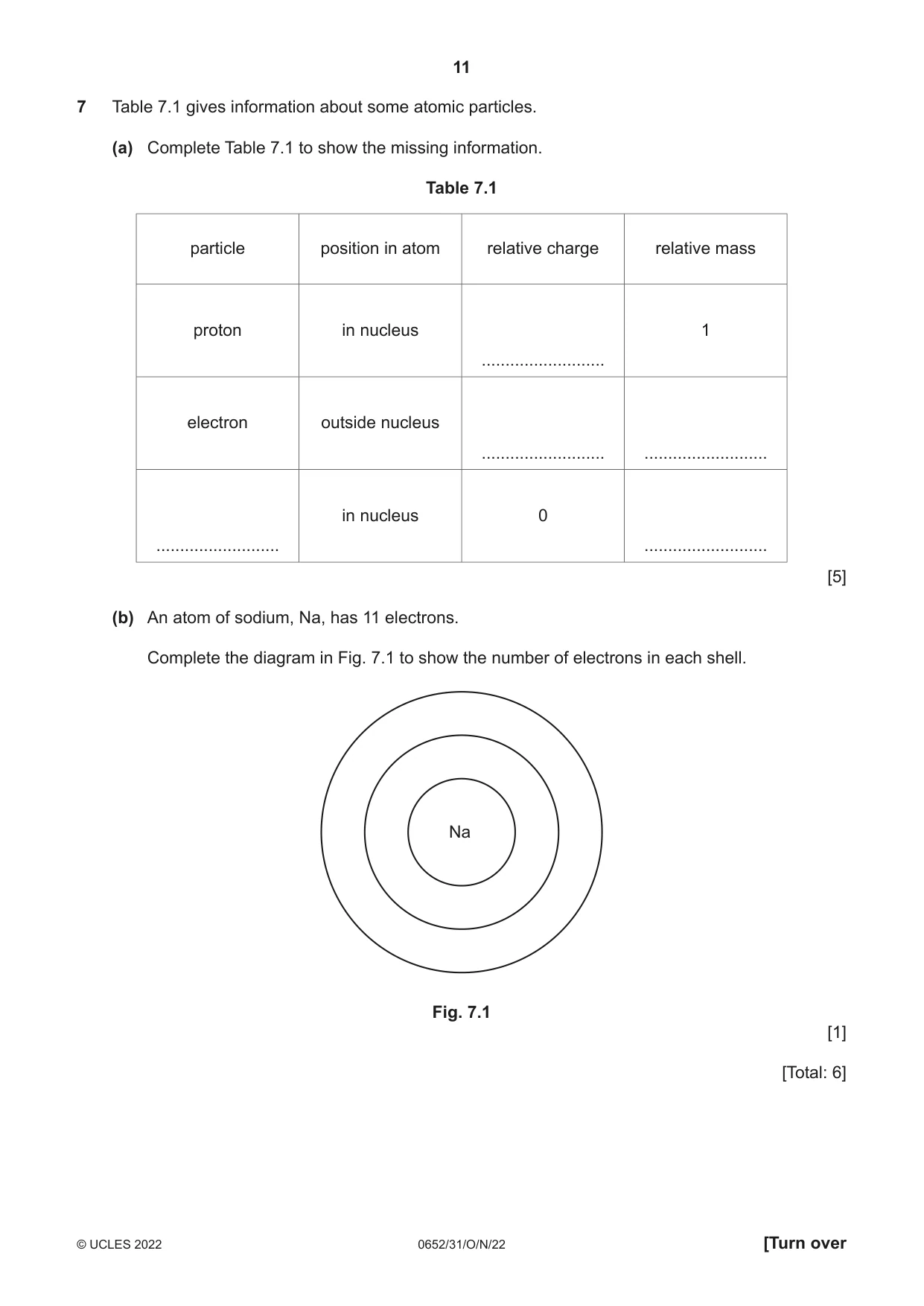
7 Table 7.1 gives information about some atomic particles. (a) Complete Table 7.1 to show the missing information. Table 7.1 particle position in atom relative charge relative mass proton in nucleus 1 .......................... electron outside nucleus .......................... .......................... in nucleus 0 .......................... .......................... [5] (b) An atom of sodium, Na, has 11 electrons. Complete the diagram in Fig. 7.1 to show the number of electrons in each shell. Na Fig. 7.1 [1] [Total: 6]
Mark scheme: 7(a) proton charge: + (1) ; 5 electron charge: − (1) ; electron mass: 1 / 2000 ; particle: neutron ; neutron mass: (+)1 ; 7(b) dots or crosses in circles with correct arrangement of 2.8.1 ; 1
Q8 · The design of an energy-saving kettle
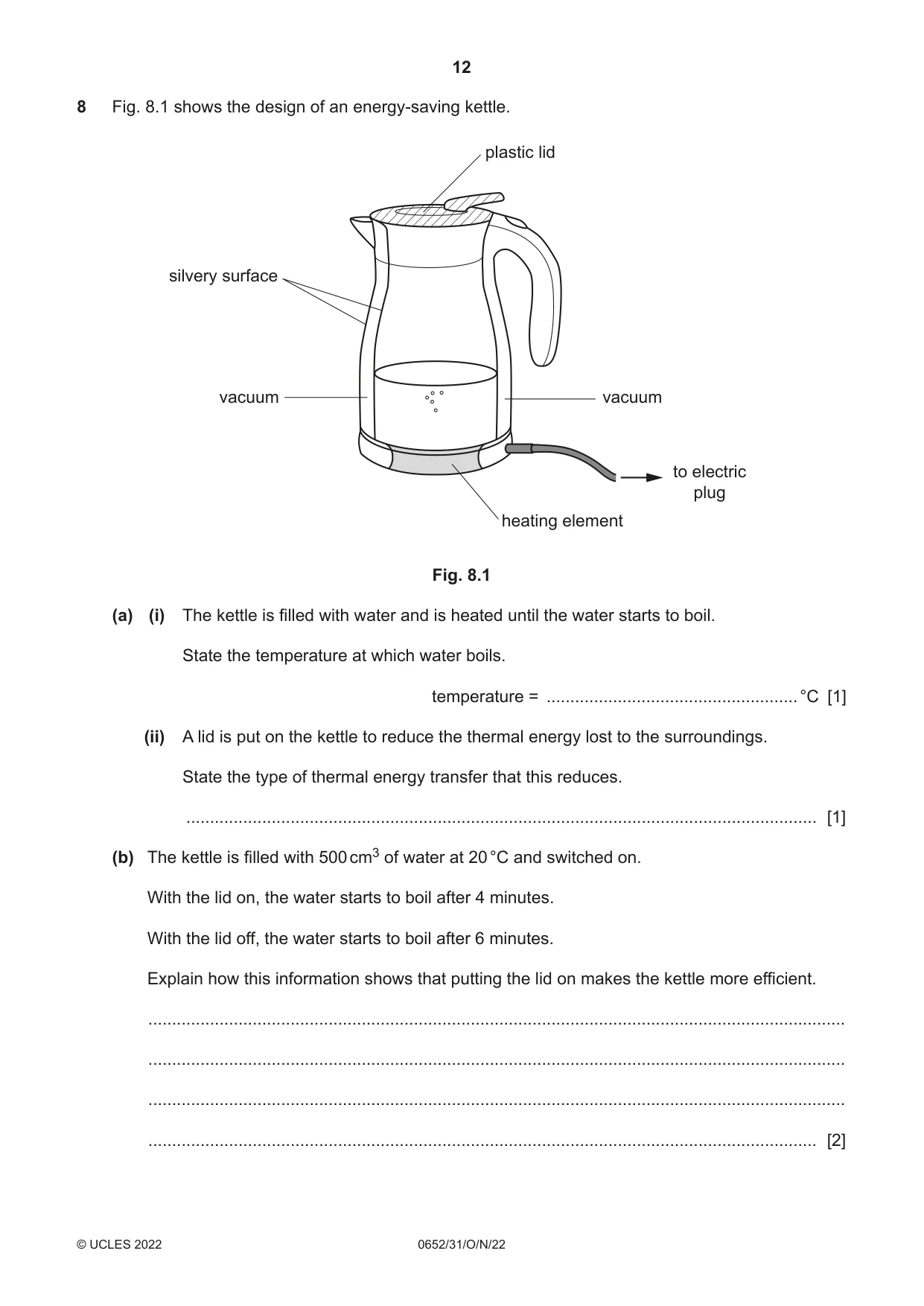
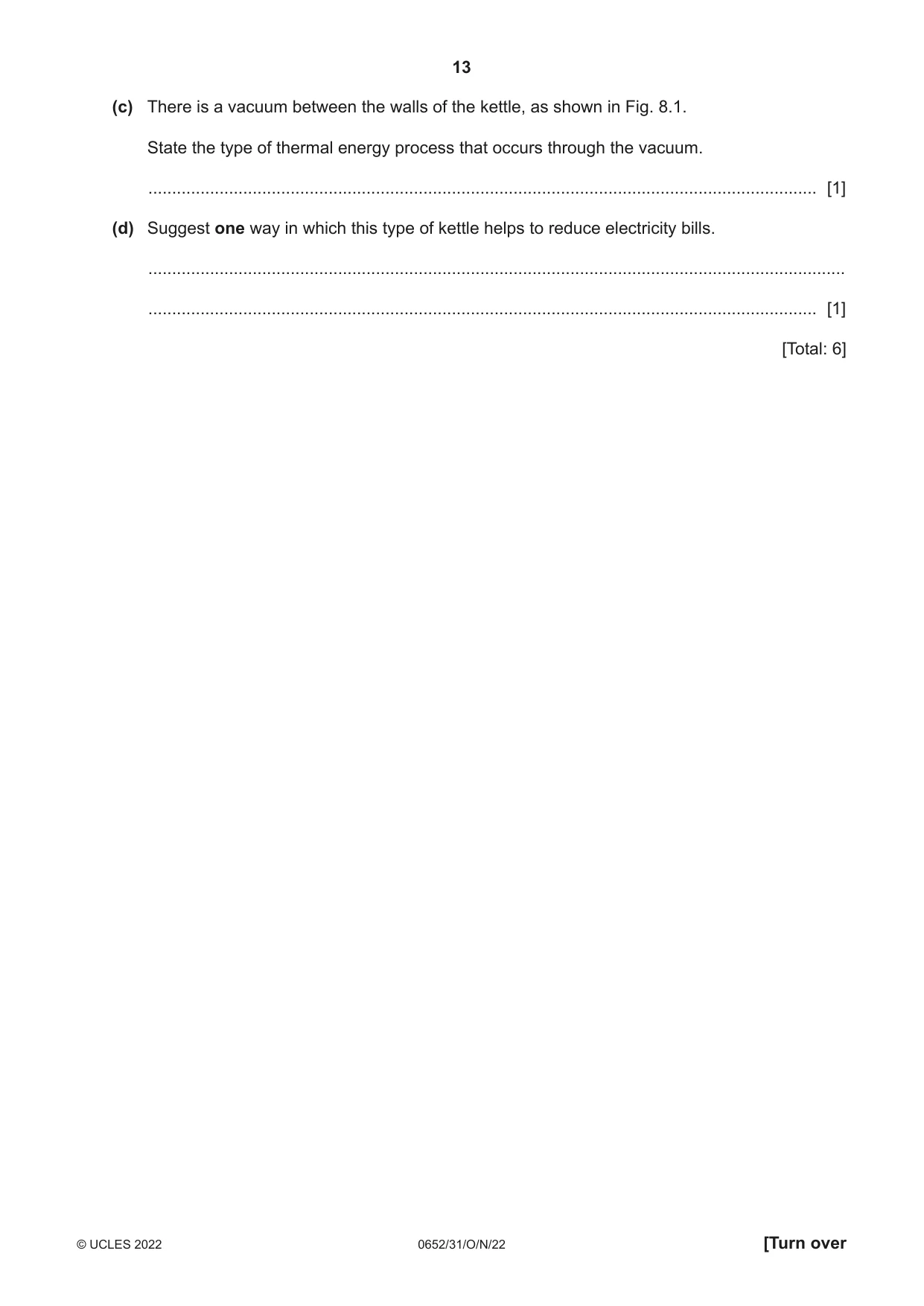
8 Fig. 8.1 shows the design of an energy-saving kettle. plastic lid silvery surface vacuum vacuum to electric plug heating element Fig. 8.1 (a) (i) The kettle is filled with water and is heated until the water starts to boil. State the temperature at which water boils. temperature = ..................................................... °C [1] (ii) A lid is put on the kettle to reduce the thermal energy lost to the surroundings. State the type of thermal energy transfer that this reduces. ..................................................................................................................................... [1] (b) The kettle is filled with 500 cm3 of water at 20 °C and switched on. With the lid on, the water starts to boil after 4 minutes. With the lid off, the water starts to boil after 6 minutes. Explain how this information shows that putting the lid on makes the kettle more efficient. ................................................................................................................................................... ................................................................................................................................................... ................................................................................................................................................... ............................................................................................................................................. [2] (c) There is a vacuum between the walls of the kettle, as shown in Fig. 8.1. State the type of thermal energy process that occurs through the vacuum. ............................................................................................................................................. [1] (d) Suggest one way in which this type of kettle helps to reduce electricity bills. ................................................................................................................................................... ............................................................................................................................................. [1] [Total: 6]
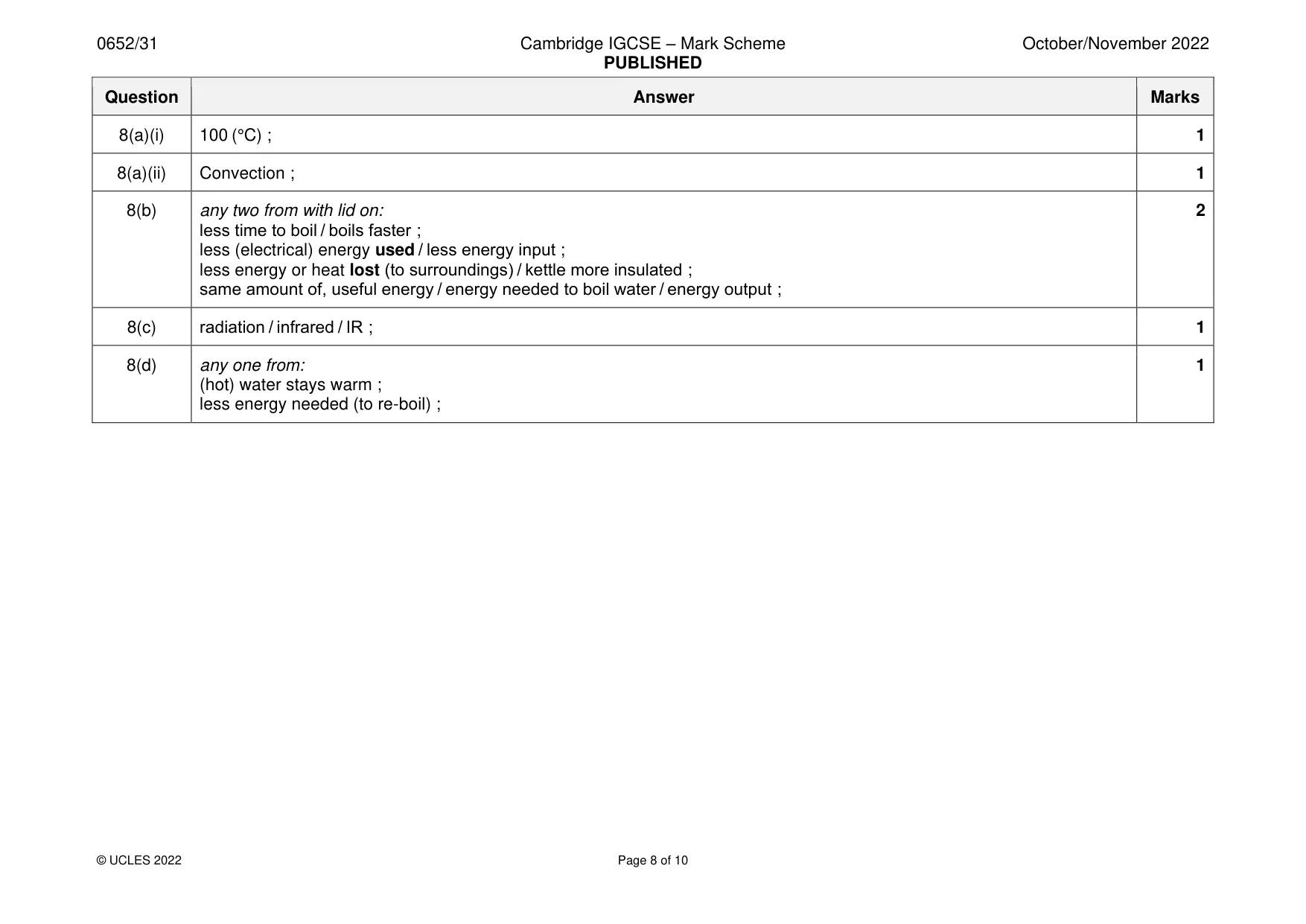
Mark scheme: 8(a)(i) 100 (°C) ; 1 8(a)(ii) Convection ; 1 8(b) any two from with lid on: 2 less time to boil / boils faster ; less (electrical) energy used / less energy input ; less energy or heat lost (to surroundings) / kettle more insulated ; same amount of, useful energy / energy needed to boil water / energy output ; 8(c) radiation / infrared / IR ; 1 8(d) any one from: 1 (hot) water stays warm ; less energy needed (to re-boil) ;
Q9 · An experiment to demonstrate the force on a current carrying wire in a magnetic field
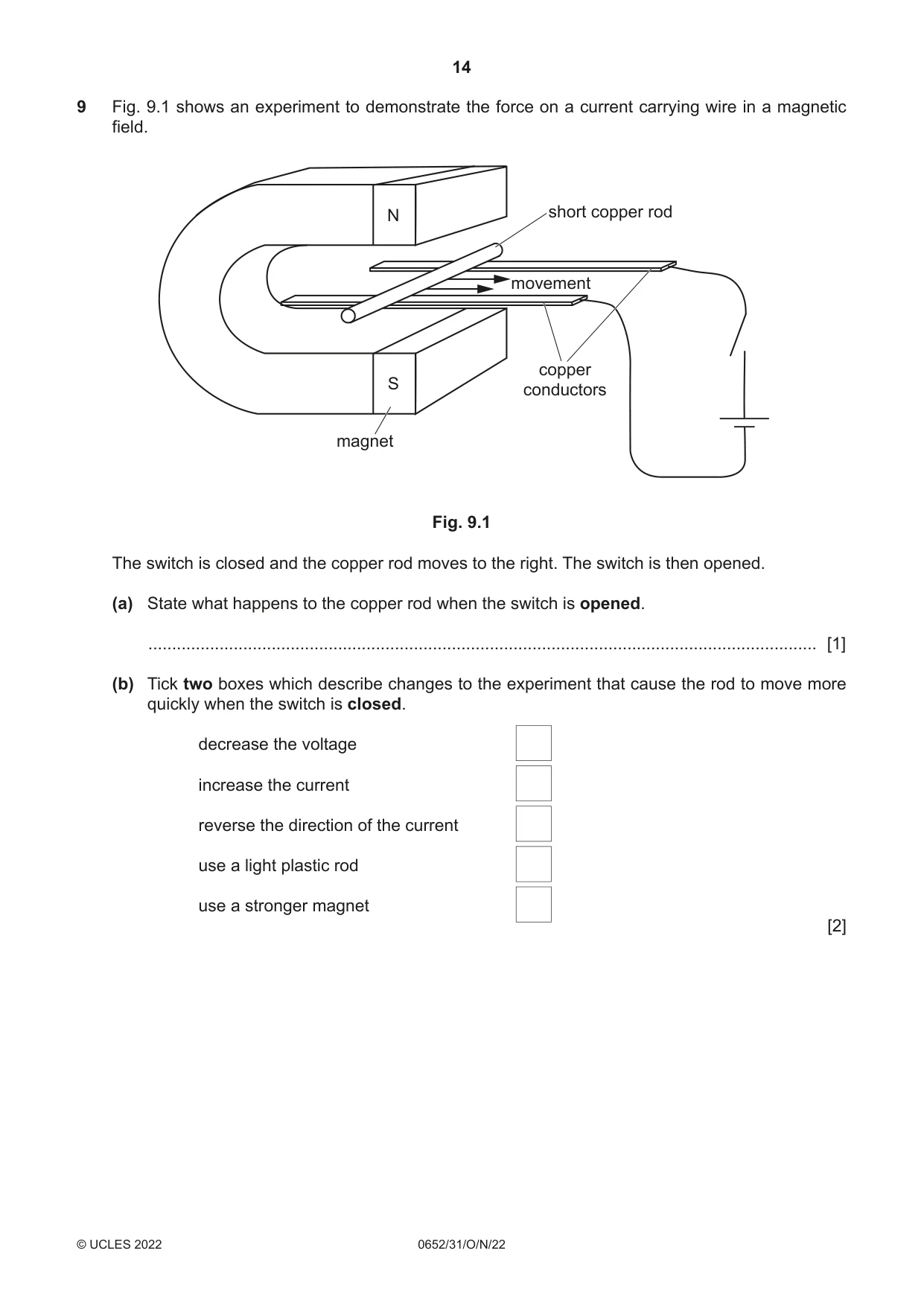
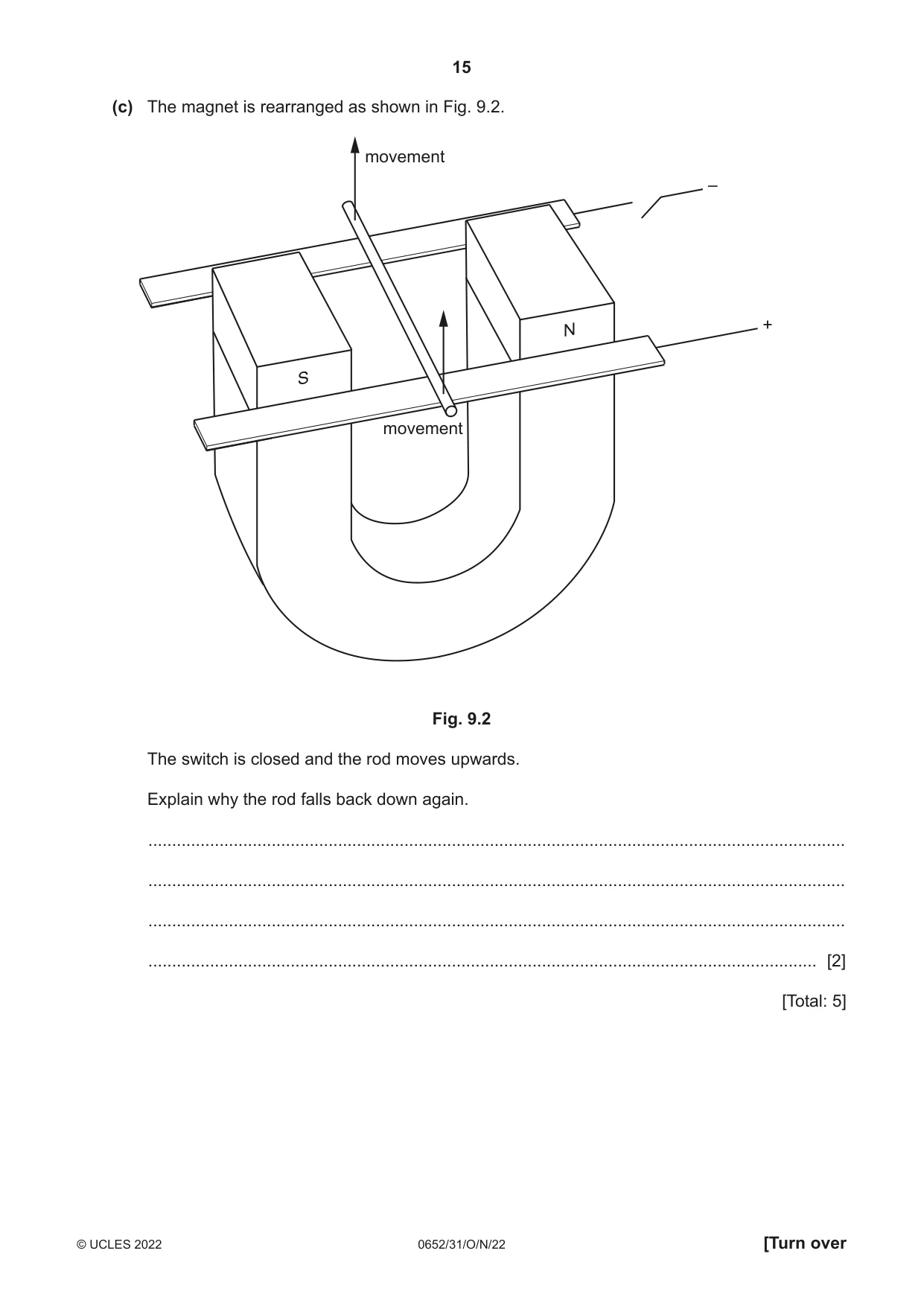
9 Fig. 9.1 shows an experiment to demonstrate the force on a current carrying wire in a magnetic field. N short copper rod movement copper S conductors magnet Fig. 9.1 The switch is closed and the copper rod moves to the right. The switch is then opened. (a) State what happens to the copper rod when the switch is opened. ............................................................................................................................................. [1] (b) Tick two boxes which describe changes to the experiment that cause the rod to move more quickly when the switch is closed. decrease the voltage increase the current reverse the direction of the current use a light plastic rod use a stronger magnet [2] (c) The magnet is rearranged as shown in Fig. 9.2. movement – N + S movement Fig. 9.2 The switch is closed and the rod moves upwards. Explain why the rod falls back down again. ................................................................................................................................................... ................................................................................................................................................... ................................................................................................................................................... ............................................................................................................................................. [2] [Total: 5]
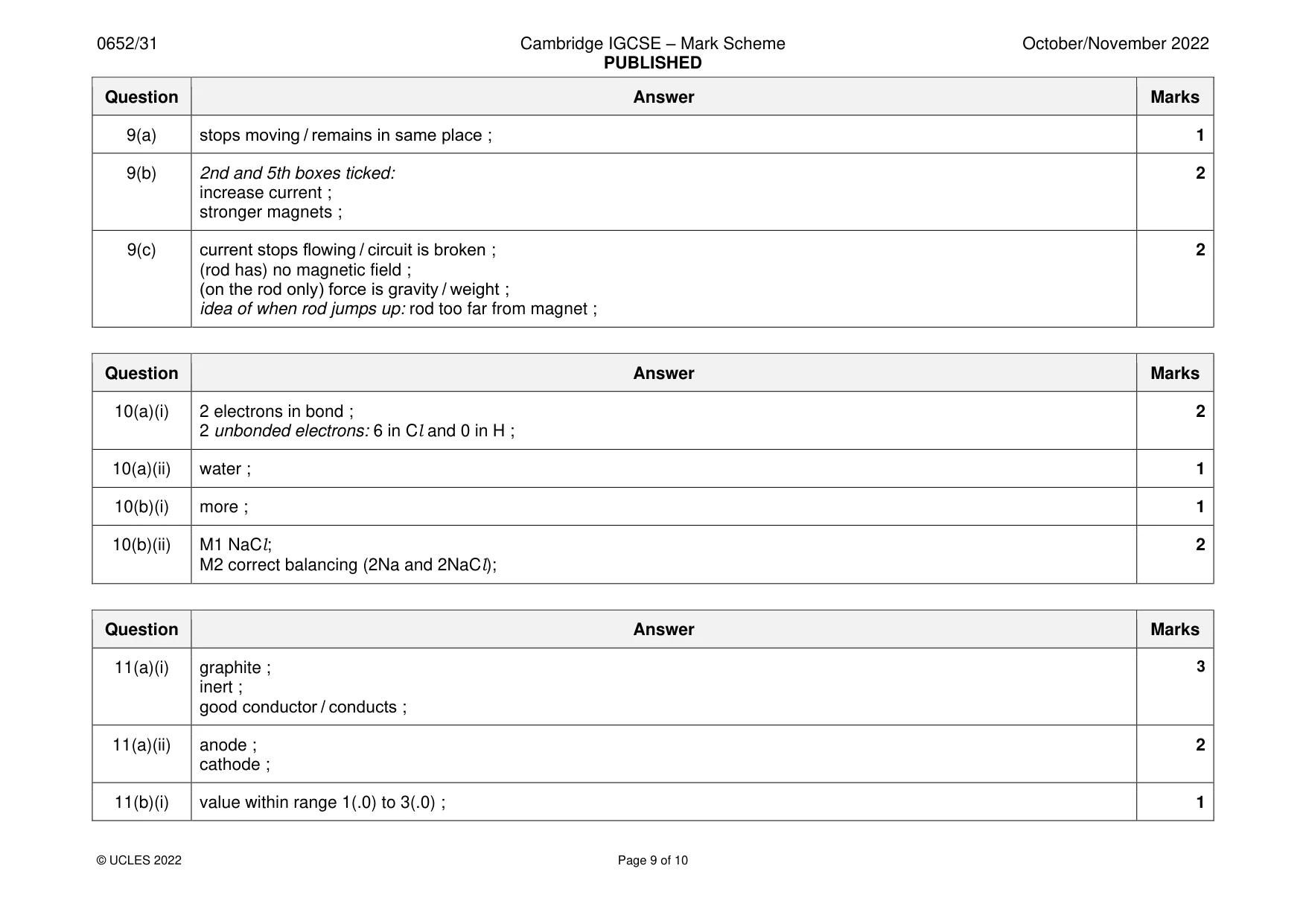
Mark scheme: 9(a) stops moving / remains in same place ; 1 9(b) 2nd and 5th boxes ticked: 2 increase current ; stronger magnets ; 9(c) current stops flowing / circuit is broken ; 2 (rod has) no magnetic field ; (on the rod only) force is gravity / weight ; idea of when rod jumps up: rod too far from magnet ;
Q10 · Hydrogen chloride, HCl, is a covalent compound of hydrogen and chlorine
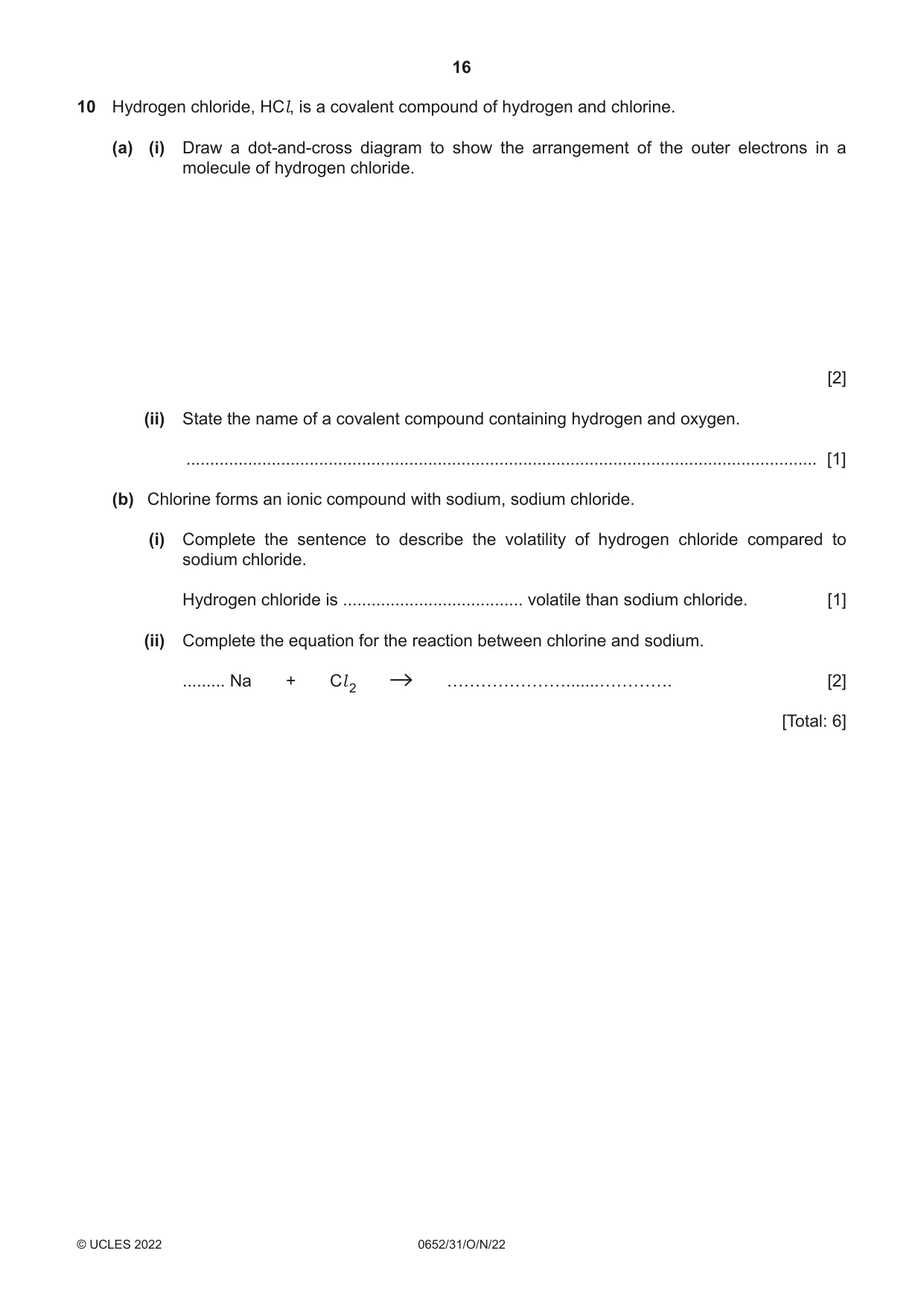
10 Hydrogen chloride, HCl, is a covalent compound of hydrogen and chlorine. (a) (i) Draw a dot-and-cross diagram to show the arrangement of the outer electrons in a molecule of hydrogen chloride. [2] (ii) State the name of a covalent compound containing hydrogen and oxygen. ..................................................................................................................................... [1] (b) Chlorine forms an ionic compound with sodium, sodium chloride. (i) Complete the sentence to describe the volatility of hydrogen chloride compared to sodium chloride. Hydrogen chloride is ...................................... volatile than sodium chloride. [1] (ii) Complete the equation for the reaction between chlorine and sodium. ......... Na + Cl 2 ………………….......…………. [2] [Total: 6]
Mark scheme: 10(a)(i) 2 electrons in bond ; 2 2 unbonded electrons: 6 in Cl and 0 in H ; 10(a)(ii) water ; 1 10(b)(i) more ; 1 10(b)(ii) M1 NaCl; 2 M2 correct balancing (2Na and 2NaCl);
Q11 · The apparatus used for the electrolysis of dilute sulfuric acid
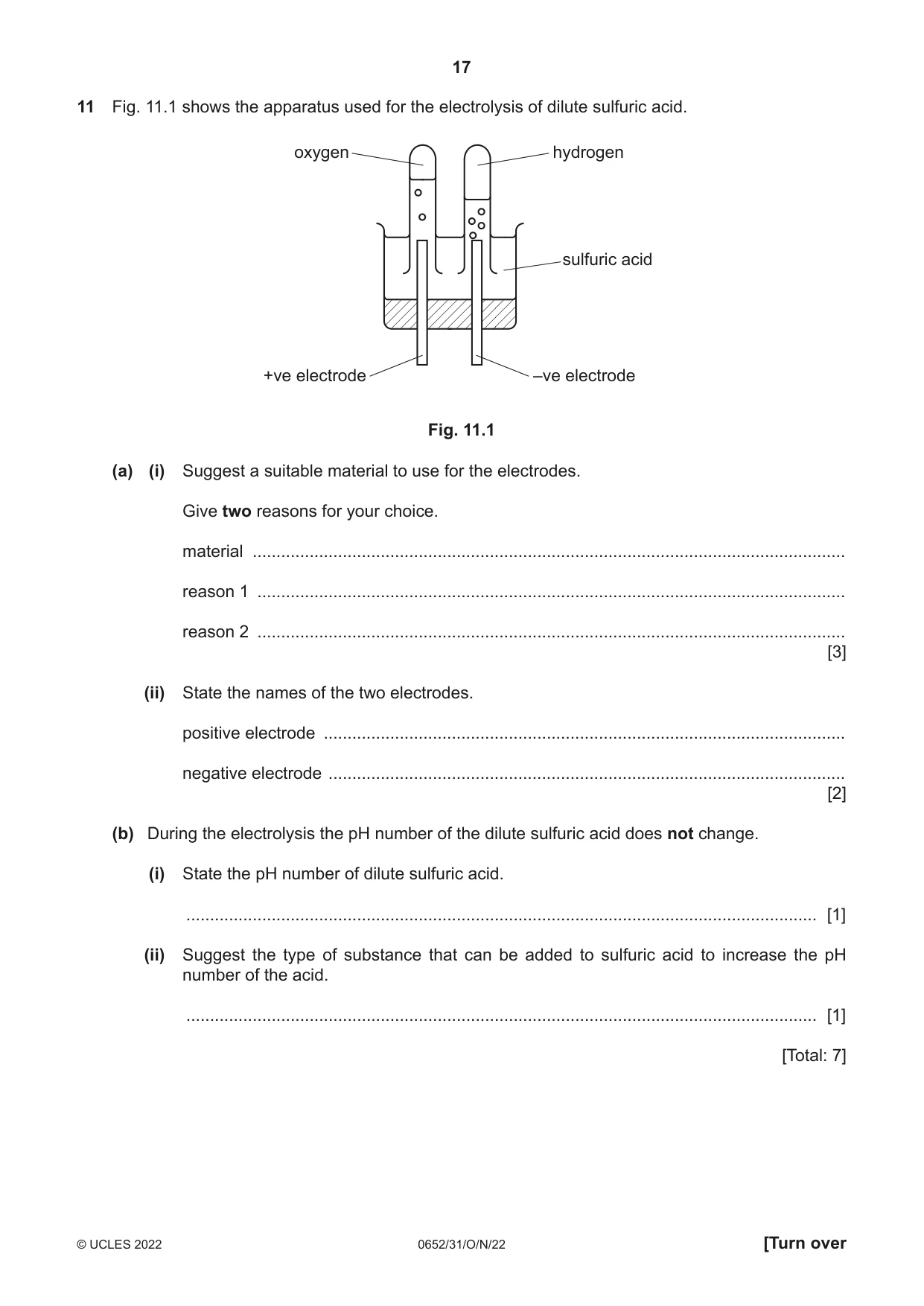
11 Fig. 11.1 shows the apparatus used for the electrolysis of dilute sulfuric acid. oxygen hydrogen sulfuric acid +ve electrode –ve electrode Fig. 11.1 (a) (i) Suggest a suitable material to use for the electrodes. Give two reasons for your choice. material ............................................................................................................................. reason 1 ............................................................................................................................ reason 2 ............................................................................................................................ [3] (ii) State the names of the two electrodes. positive electrode .............................................................................................................. negative electrode ............................................................................................................. [2] (b) During the electrolysis the pH number of the dilute sulfuric acid does not change. (i) State the pH number of dilute sulfuric acid. ..................................................................................................................................... [1] (ii) Suggest the type of substance that can be added to sulfuric acid to increase the pH number of the acid. ..................................................................................................................................... [1] [Total: 7]
Mark scheme: 11(a)(i) graphite ; 3 inert ; good conductor / conducts ; 11(a)(ii) anode ; 2 cathode ; 11(b)(i) value within range 1(.0) to 3(.0) ; 1 11(b)(ii) alkali / base ; 1
Q12 · A detector is used to measure the level of background radiation
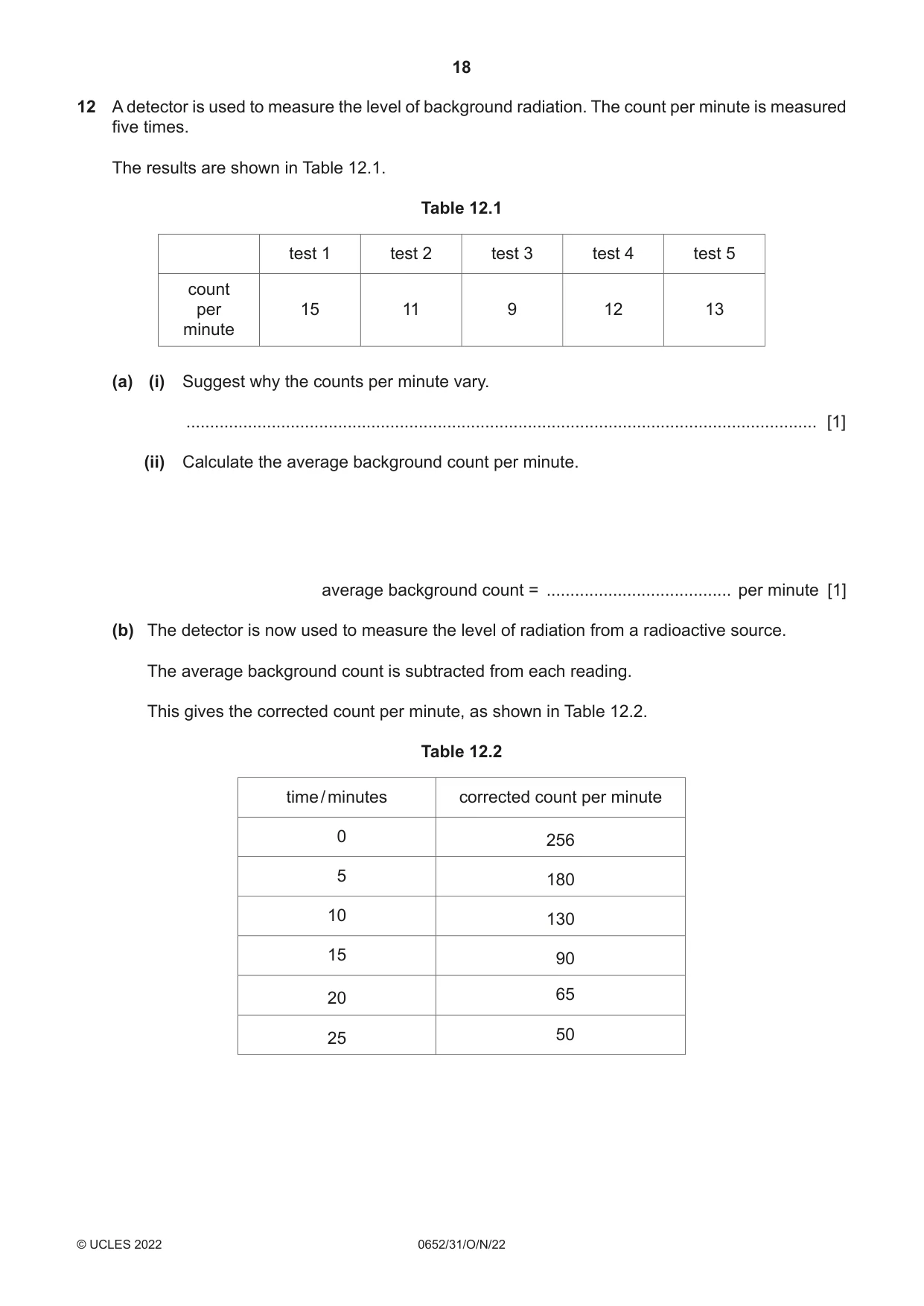
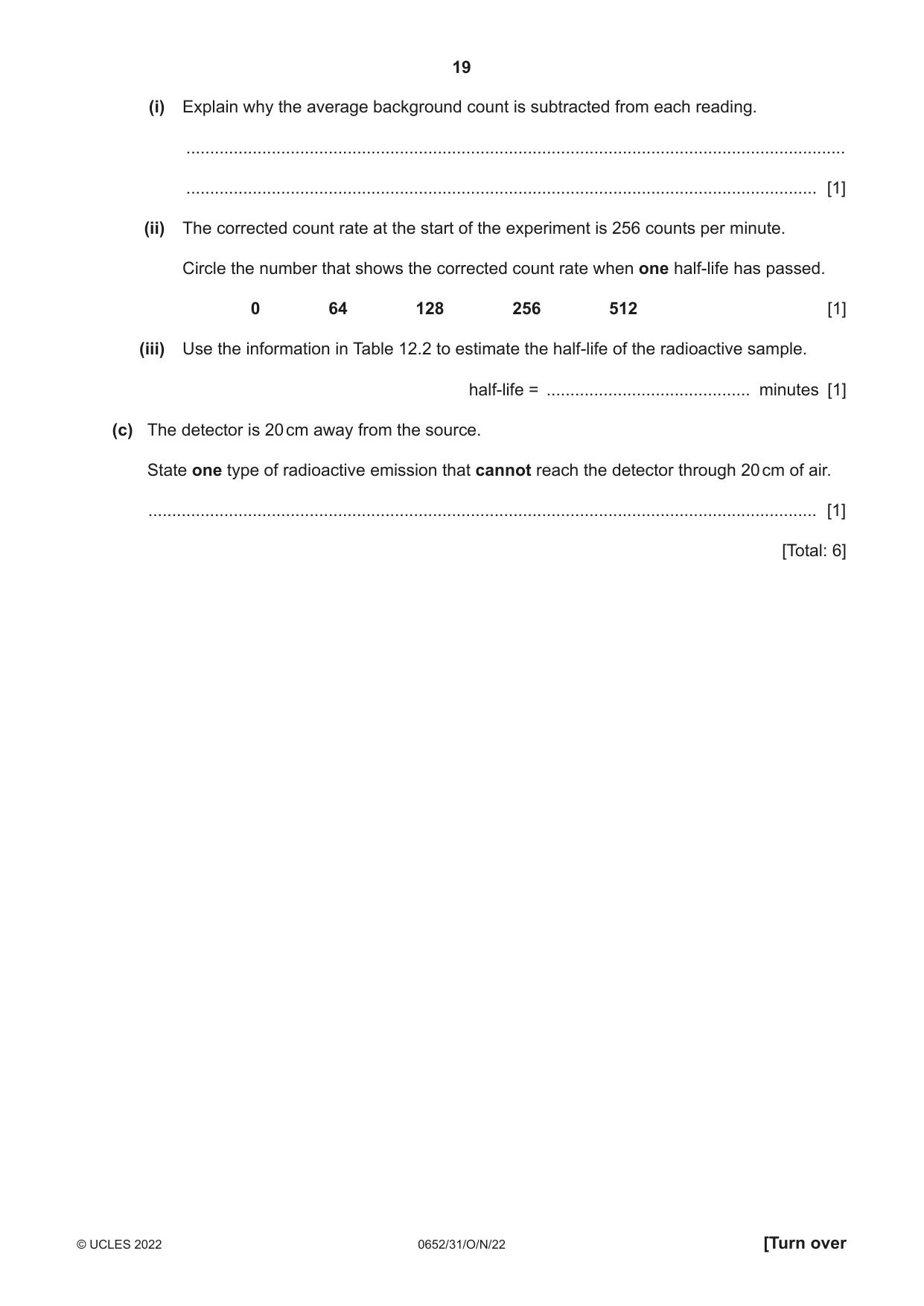
12 A detector is used to measure the level of background radiation. The count per minute is measured five times. The results are shown in Table 12.1. Table 12.1 test 1 test 2 test 3 test 4 test 5 count per 15 11 9 12 13 minute (a) (i) Suggest why the counts per minute vary. ..................................................................................................................................... [1] (ii) Calculate the average background count per minute. average background count = ....................................... per minute [1] (b) The detector is now used to measure the level of radiation from a radioactive source. The average background count is subtracted from each reading. This gives the corrected count per minute, as shown in Table 12.2. Table 12.2 time / minutes corrected count per minute 0 256 5 180 10 130 15 90 20 65 25 50 (i) Explain why the average background count is subtracted from each reading. ........................................................................................................................................... ..................................................................................................................................... [1] (ii) The corrected count rate at the start of the experiment is 256 counts per minute. Circle the number that shows the corrected count rate when one half-life has passed. 0 64 128 256 512 [1] (iii) Use the information in Table 12.2 to estimate the half-life of the radioactive sample. half-life = ........................................... minutes [1] (c) The detector is 20 cm away from the source. State one type of radioactive emission that cannot reach the detector through 20 cm of air. ............................................................................................................................................. [1] [Total: 6]
Mark scheme: 12(a)(i) random (decay) ; 1 12(a)(ii) 12 ; 1 12(b)(i) to measure the radiation from the sample (only) ; 1 12(b)(ii) 128 ; 1 12(b)(iii) 10 ; 1 12(c) alpha ; 1
Q13 · Part of the electromagnetic spectrum
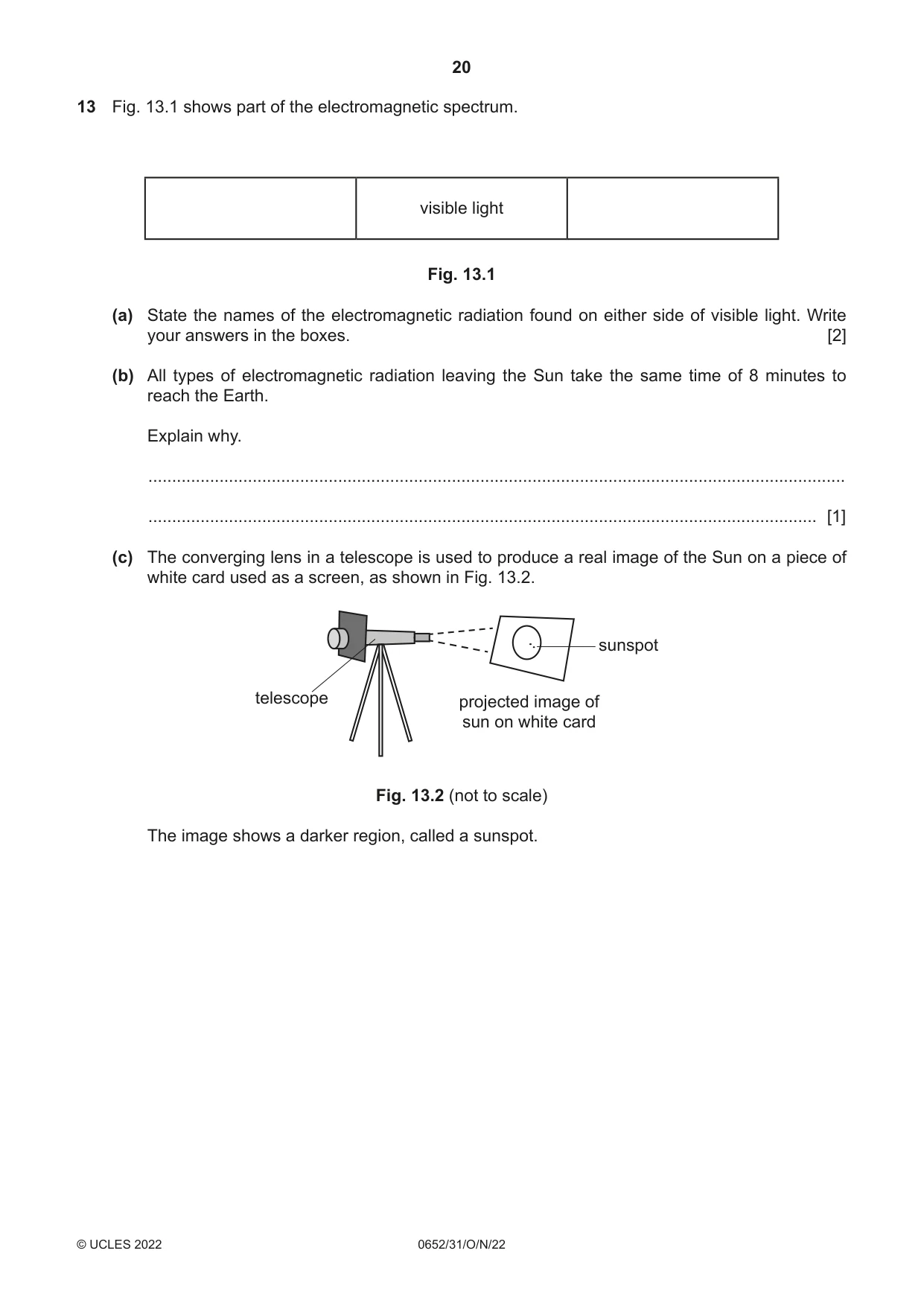
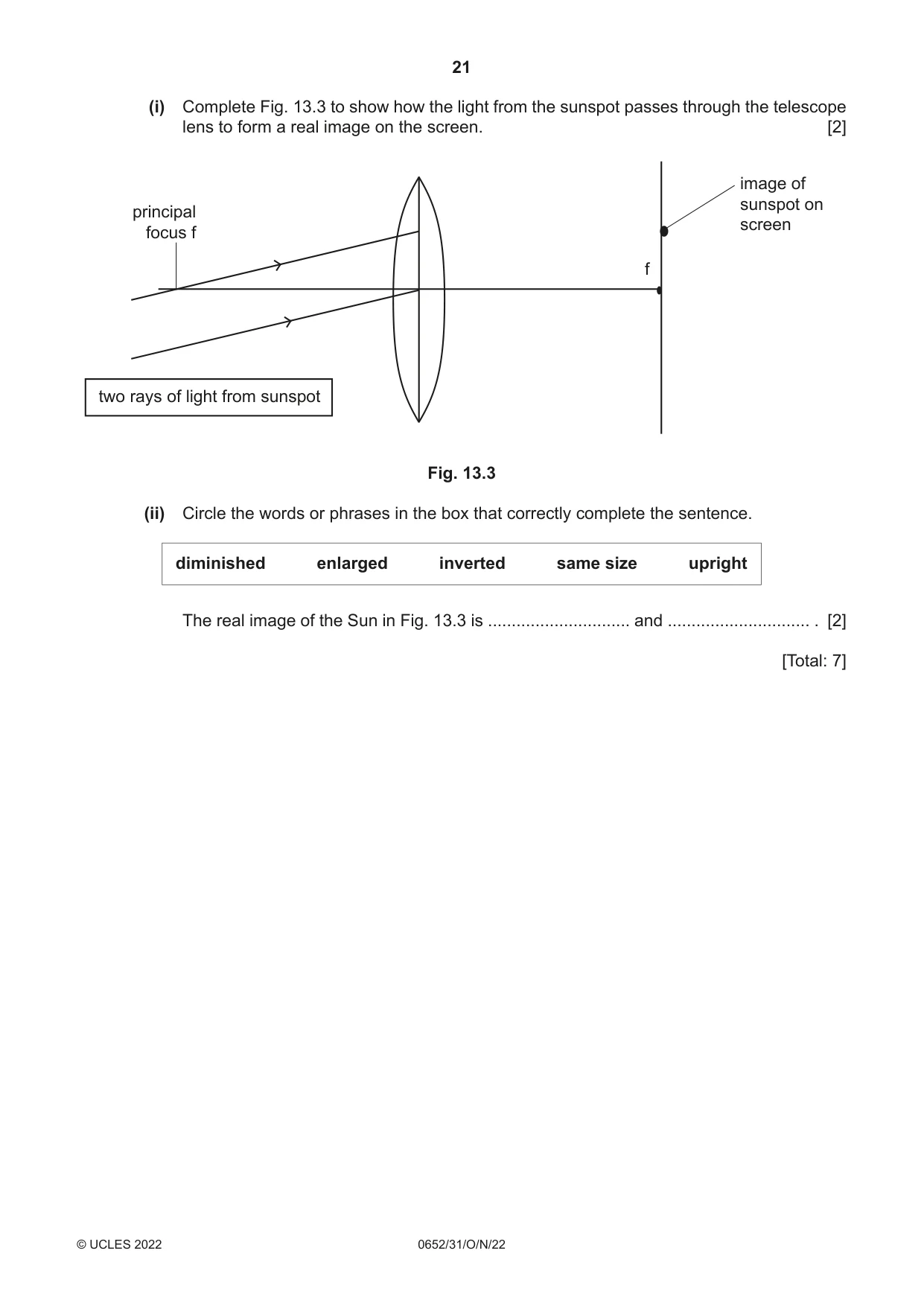
13 Fig. 13.1 shows part of the electromagnetic spectrum. visible light Fig. 13.1 (a) State the names of the electromagnetic radiation found on either side of visible light. Write your answers in the boxes. [2] (b) All types of electromagnetic radiation leaving the Sun take the same time of 8 minutes to reach the Earth. Explain why. ................................................................................................................................................... ............................................................................................................................................. [1] (c) The converging lens in a telescope is used to produce a real image of the Sun on a piece of white card used as a screen, as shown in Fig. 13.2. sunspot telescope projected image of sun on white card Fig. 13.2 (not to scale) The image shows a darker region, called a sunspot. (i) Complete Fig. 13.3 to show how the light from the sunspot passes through the telescope lens to form a real image on the screen. [2] image of sunspot on principal screen focus f f two rays of light from sunspot Fig. 13.3 (ii) Circle the words or phrases in the box that correctly complete the sentence. diminished enlarged inverted same size upright The real image of the Sun in Fig. 13.3 is .............................. and .............................. . [2] [Total: 7]
Mark scheme: 13(a) infrared / IR ; 2 ultraviolet / UV ; 13(b) same speed or light speed ; 1 13(c)(i) top ray: enters lens and leaves parallel to axis and meets image ; 2 bottom ray: passes straight through lens undeflected and meets image ; 13(c)(ii) diminished ; 2 inverted ;
What was in this paper
The subtopics covered by these 13 questions, and how many questions each got. Open one in a new tab to see every Cambridge question on it.
What you needed in this session
Cambridge’s own grade thresholds for 2022 Oct/Nov, Paper 3 · Variant 1. A higher threshold means an easier paper — the bar moves with how the cohort did.