Cambridge IGCSE Physical Science 0652 — 2020 Oct/Nov Paper 3 · Variant 1
0652/31/O/N/20 · 12 questions · 80 marks · ≈90 min
The question paper and its mark scheme, free to read here and free to download. This is Cambridge’s own paper, exactly as it was sat.
Question paper20 pages

Mark scheme10 pages
Answers below. Sit the paper first if you are practising.
Questions as text
Q1 · A mixture contains four components
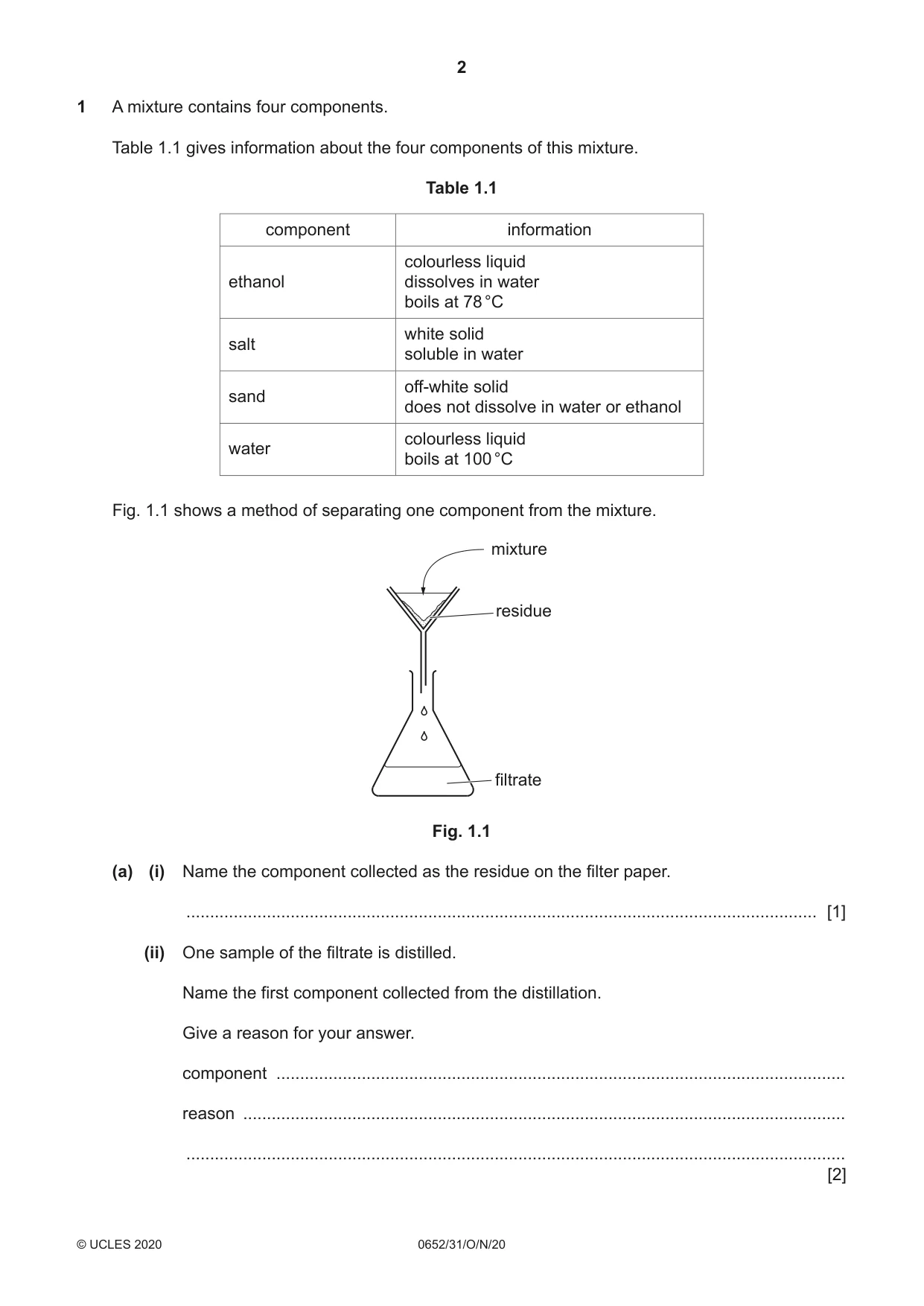
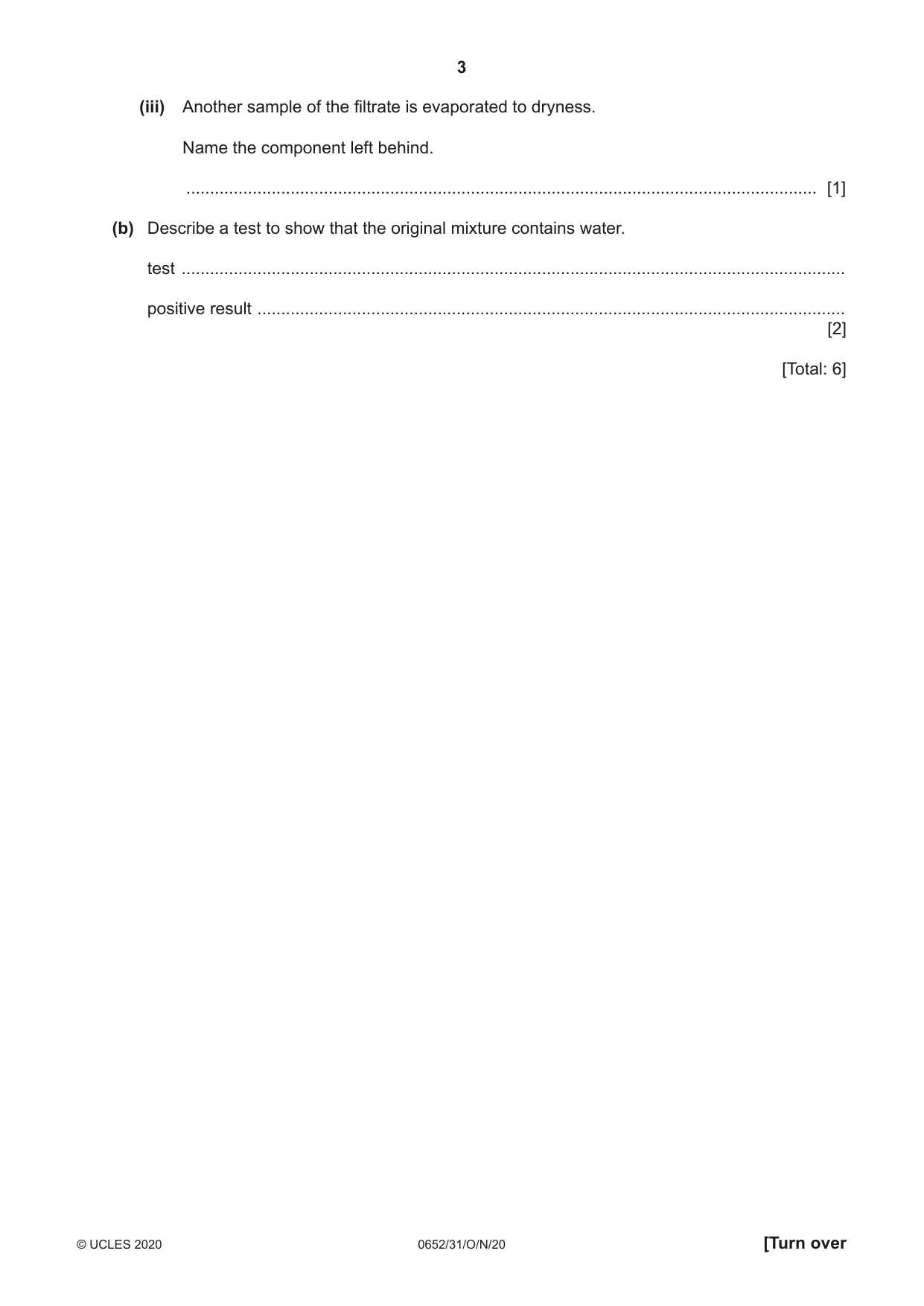
1 A mixture contains four components. Table 1.1 gives information about the four components of this mixture. Table 1.1 component information colourless liquid ethanol dissolves in water boils at 78 °C white solid salt soluble in water off-white solid sand does not dissolve in water or ethanol colourless liquid water boils at 100 °C Fig. 1.1 shows a method of separating one component from the mixture. mixture residue filtrate Fig. 1.1 (a) (i) Name the component collected as the residue on the filter paper. ..................................................................................................................................... [1] (ii) One sample of the filtrate is distilled. Name the first component collected from the distillation. Give a reason for your answer. component ........................................................................................................................ reason ............................................................................................................................... ........................................................................................................................................... [2] (iii) Another sample of the filtrate is evaporated to dryness. Name the component left behind. ..................................................................................................................................... [1] (b) Describe a test to show that the original mixture contains water. test ............................................................................................................................................ positive result ............................................................................................................................ [2] [Total: 6]
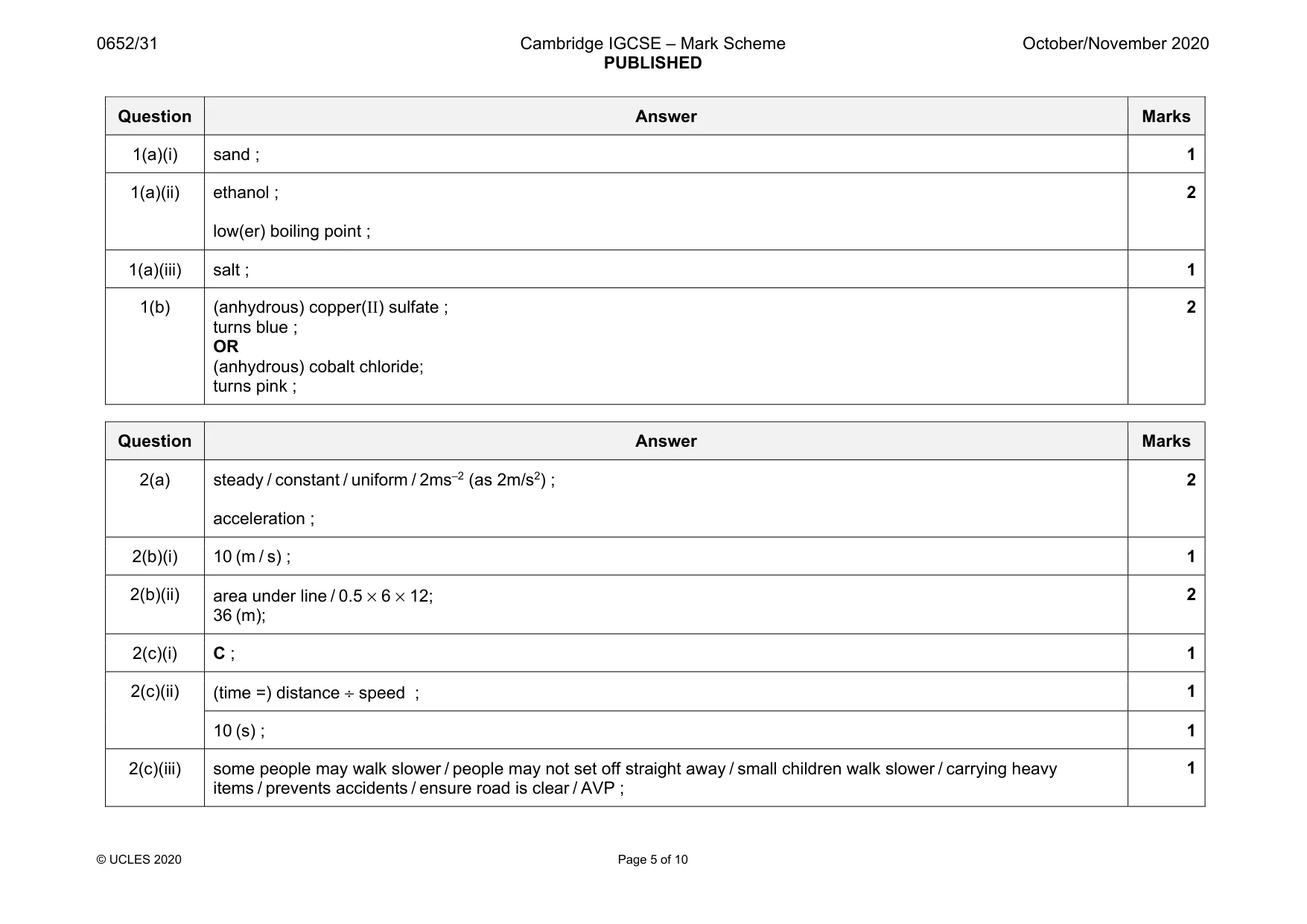
Mark scheme: 1(a)(i) sand ; 1 1(a)(ii) ethanol ; low(er) boiling point ; 2 1(a)(iii) salt ; 1 1(b) (anhydrous) copper(II) sulfate ; turns blue ; OR (anhydrous) cobalt chloride; turns pink ; 2
Q2 · The motion of a car on a straight horizontal road
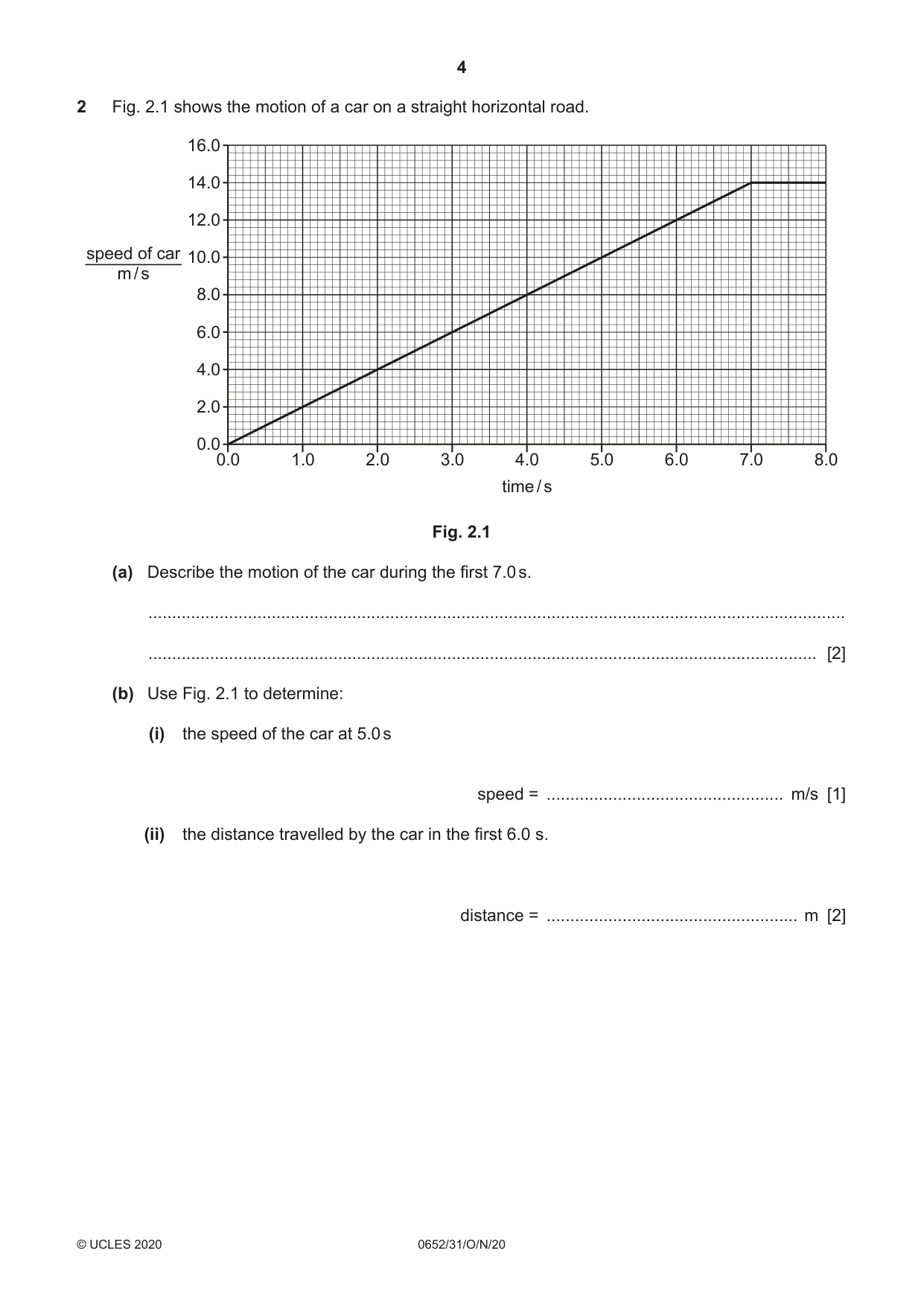
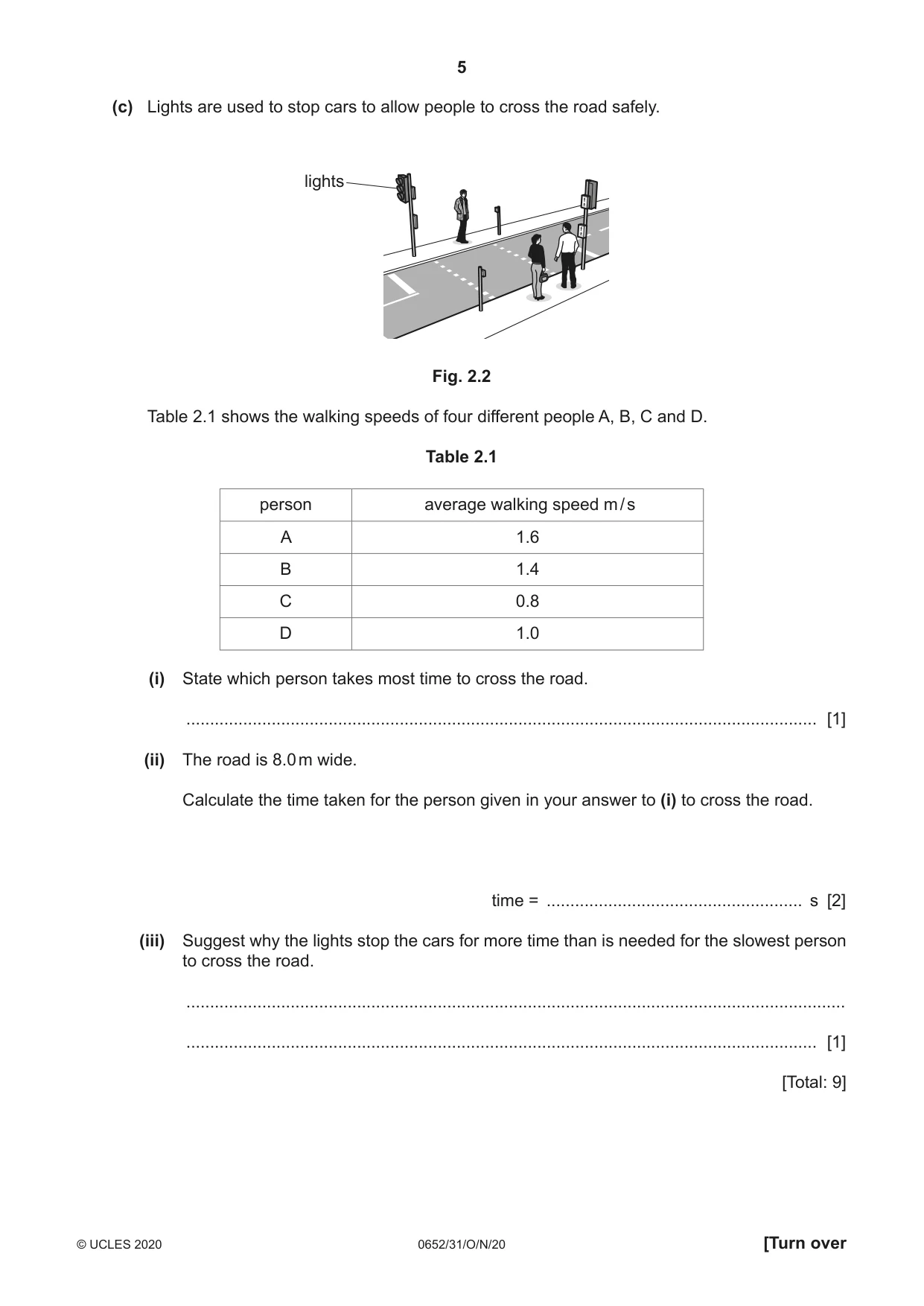
2 Fig. 2.1 shows the motion of a car on a straight horizontal road. 16.0 14.0 12.0 speed of car 10.0 m / s 8.0 6.0 4.0 2.0 0.0 0.0 1.0 2.0 3.0 4.0 5.0 6.0 7.0 8.0 time / s Fig. 2.1 (a) Describe the motion of the car during the first 7.0 s. ................................................................................................................................................... ............................................................................................................................................. [2] (b) Use Fig. 2.1 to determine: (i) the speed of the car at 5.0 s speed = .................................................. m/s [1] (ii) the distance travelled by the car in the first 6.0 s. distance = ..................................................... m [2] (c) Lights are used to stop cars to allow people to cross the road safely. lights Fig. 2.2 Table 2.1 shows the walking speeds of four different people A, B, C and D. Table 2.1 person average walking speed m / s A 1.6 B 1.4 C 0.8 D 1.0 (i) State which person takes most time to cross the road. ..................................................................................................................................... [1] (ii) The road is 8.0 m wide. Calculate the time taken for the person given in your answer to (i) to cross the road. time = ...................................................... s [2] (iii) Suggest why the lights stop the cars for more time than is needed for the slowest person to cross the road. ........................................................................................................................................... ..................................................................................................................................... [1] [Total: 9]
Mark scheme: 2(a) steady / constant / uniform / 2ms–2 (as 2m/s2) ; acceleration ; 2 2(b)(i) 10 (m / s) ; 1 2(b)(ii) area under line / 0.5 × 6 × 12; 36 (m); 2 2(c)(i) C ; 1 2(c)(ii) (time =) distance ÷ speed ; 1 10 (s) ; 1 2(c)(iii) some people may walk slower / people may not set off straight away / small children walk slower / carrying heavy items / prevents accidents / ensure road is clear / AVP ; 1
Q3 · Sodium is an element in Group I of the Periodic Table
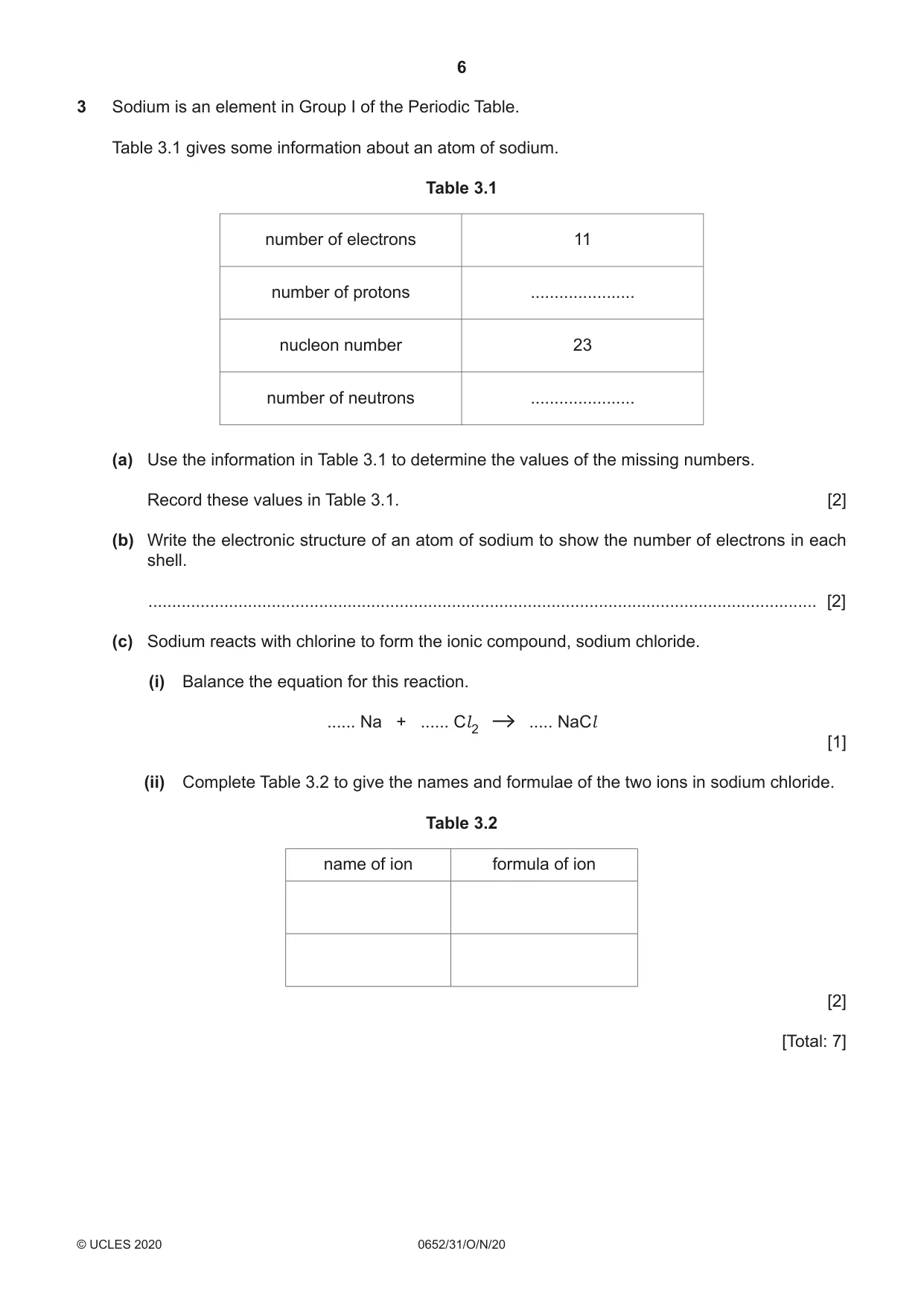
3 Sodium is an element in Group I of the Periodic Table. Table 3.1 gives some information about an atom of sodium. Table 3.1 number of electrons 11 number of protons ...................... nucleon number 23 number of neutrons ...................... (a) Use the information in Table 3.1 to determine the values of the missing numbers. Record these values in Table 3.1. [2] (b) Write the electronic structure of an atom of sodium to show the number of electrons in each shell. ............................................................................................................................................. [2] (c) Sodium reacts with chlorine to form the ionic compound, sodium chloride. (i) Balance the equation for this reaction. ...... Na + ...... Cl 2 ..... NaCl [1] (ii) Complete Table 3.2 to give the names and formulae of the two ions in sodium chloride. Table 3.2 name of ion formula of ion [2] [Total: 7]
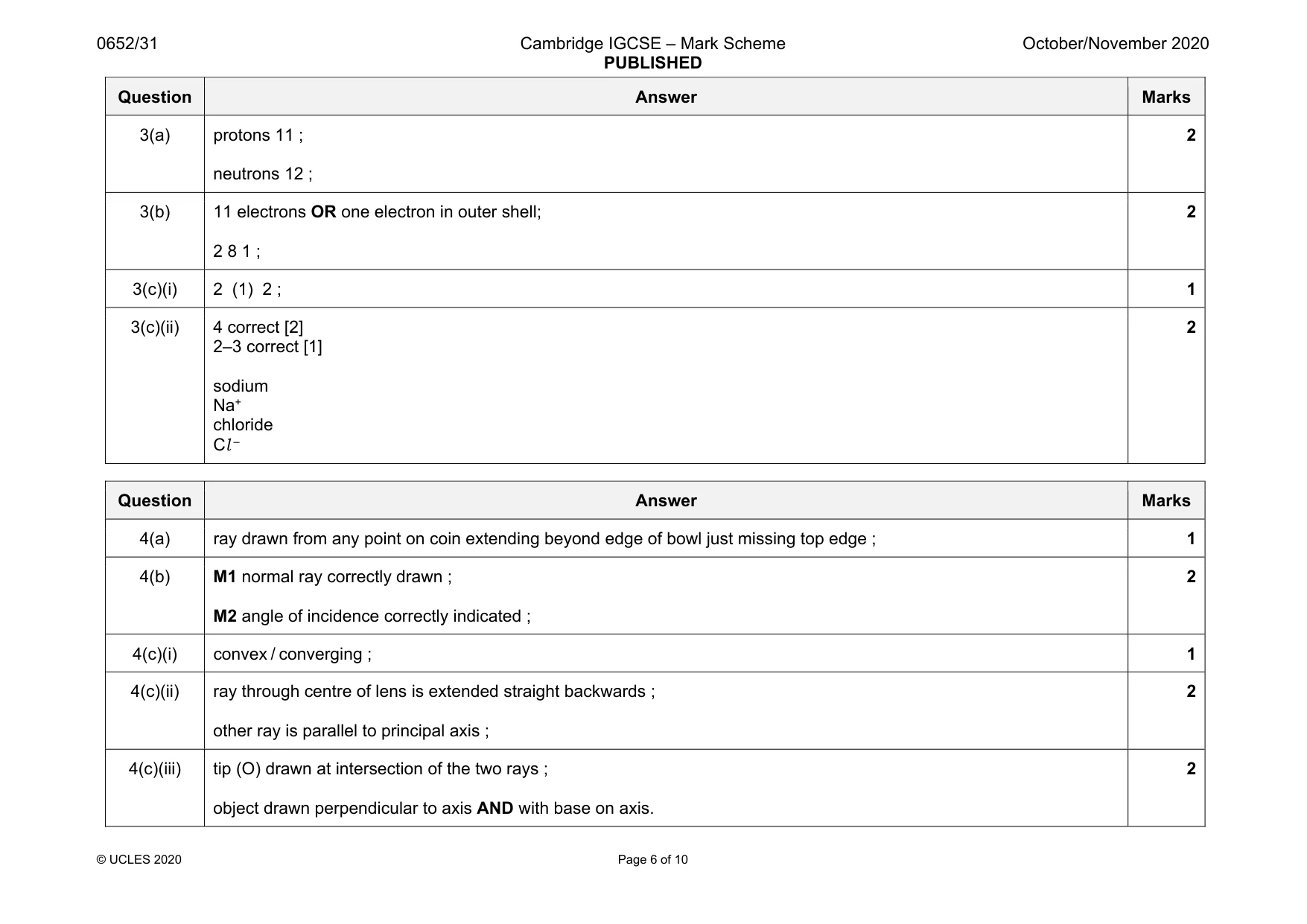
Mark scheme: 3(a) protons 11 ; neutrons 12 ; 2 3(b) 11 electrons OR one electron in outer shell; 2 8 1 ; 2 3(c)(i) 2 (1) 2 ; 1 3(c)(ii) 4 correct [2] 2–3 correct [1] sodium Na+ chloride Cl – 2
Q4 · A student observes a coin in a metal bowl
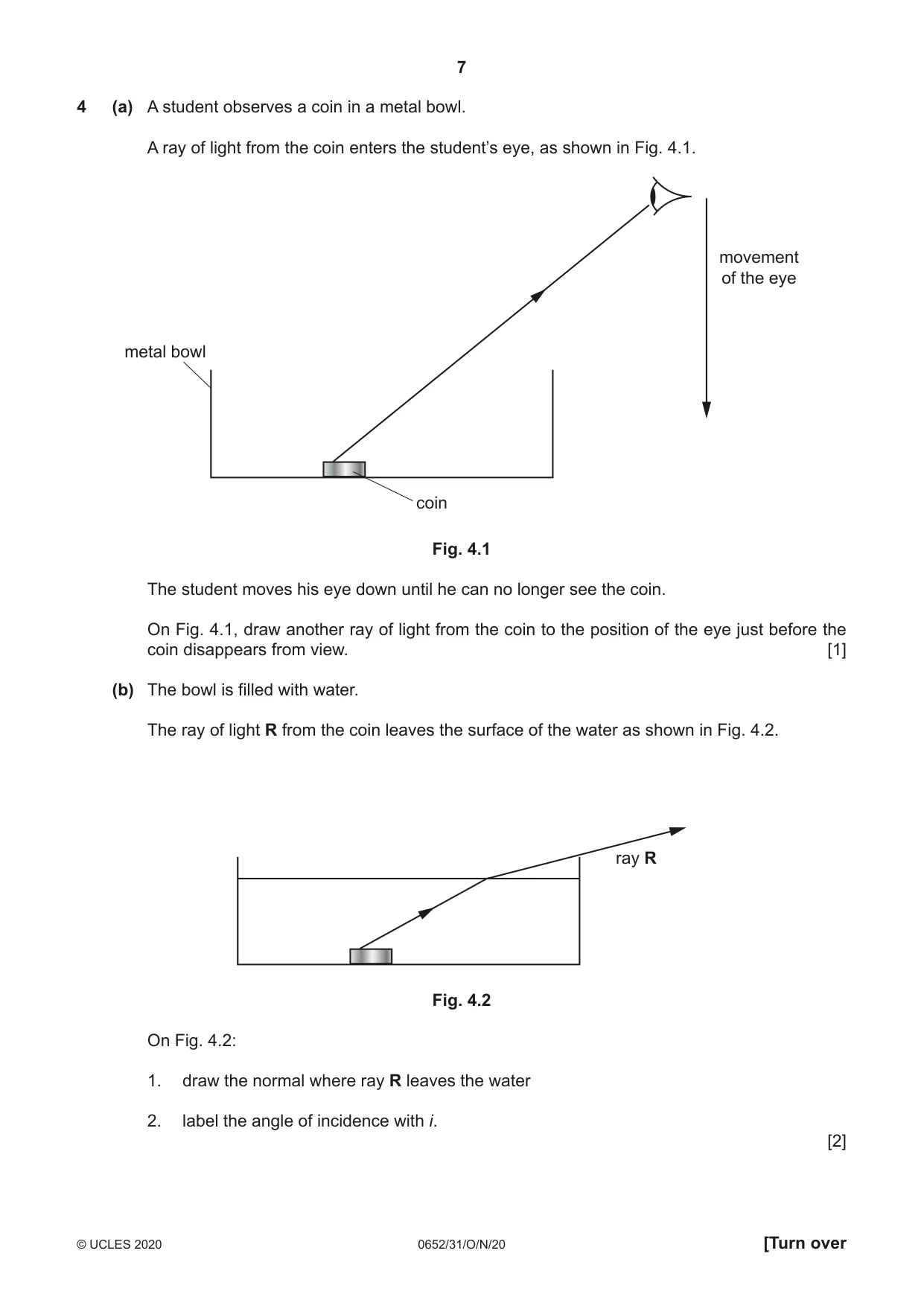
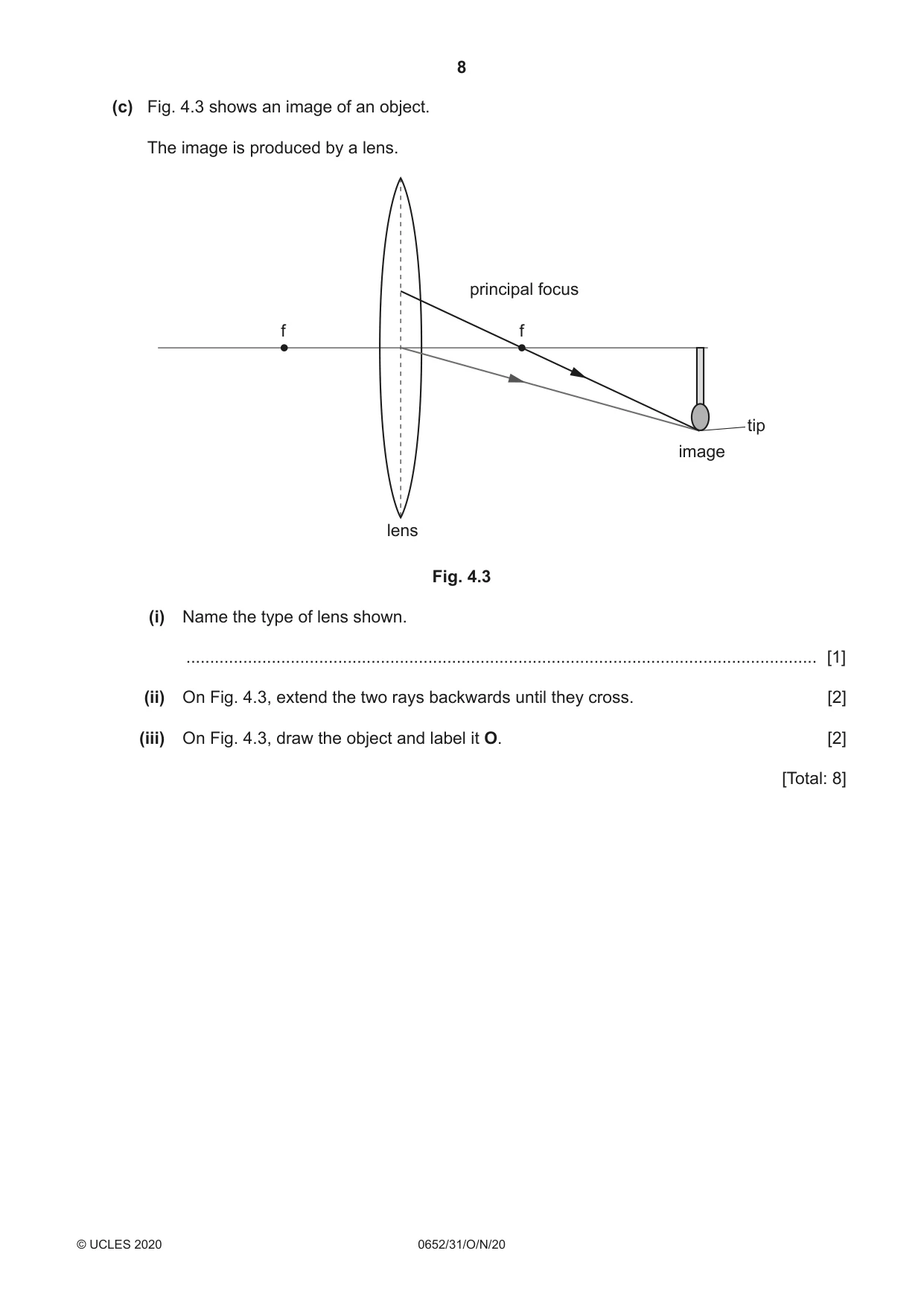
4 (a) A student observes a coin in a metal bowl. A ray of light from the coin enters the student’s eye, as shown in Fig. 4.1. movement of the eye metal bowl coin Fig. 4.1 The student moves his eye down until he can no longer see the coin. On Fig. 4.1, draw another ray of light from the coin to the position of the eye just before the coin disappears from view. [1] (b) The bowl is filled with water. The ray of light R from the coin leaves the surface of the water as shown in Fig. 4.2. ray R Fig. 4.2 On Fig. 4.2: 1. draw the normal where ray R leaves the water 2. label the angle of incidence with i. [2] (c) Fig. 4.3 shows an image of an object. The image is produced by a lens. principal focus f f tip image lens Fig. 4.3 (i) Name the type of lens shown. ..................................................................................................................................... [1] (ii) On Fig. 4.3, extend the two rays backwards until they cross. [2] (iii) On Fig. 4.3, draw the object and label it O. [2] [Total: 8]
Mark scheme: 4(a) ray drawn from any point on coin extending beyond edge of bowl just missing top edge ; 1 4(b) M1 normal ray correctly drawn ; M2 angle of incidence correctly indicated ; 2 4(c)(i) convex / converging ; 1 4(c)(ii) ray through centre of lens is extended straight backwards ; other ray is parallel to principal axis ; 2 4(c)(iii) tip (O) drawn at intersection of the two rays ; object drawn perpendicular to axis AND with base on axis. 2
Q5 · Carbon is an element which exists in different forms
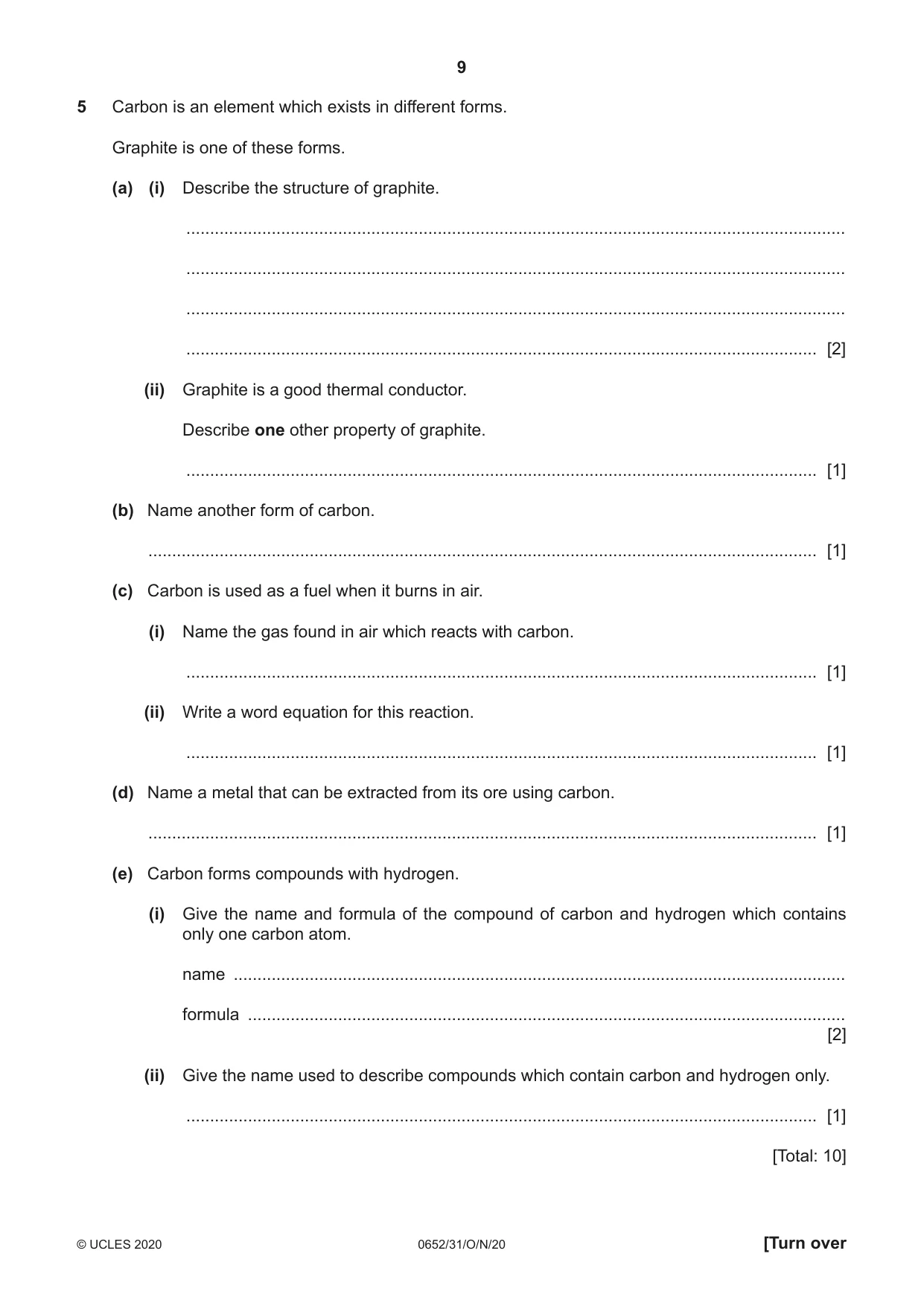
5 Carbon is an element which exists in different forms. Graphite is one of these forms. (a) (i) Describe the structure of graphite. ........................................................................................................................................... ........................................................................................................................................... ........................................................................................................................................... ..................................................................................................................................... [2] (ii) Graphite is a good thermal conductor. Describe one other property of graphite. ..................................................................................................................................... [1] (b) Name another form of carbon. ............................................................................................................................................. [1] (c) Carbon is used as a fuel when it burns in air. (i) Name the gas found in air which reacts with carbon. ..................................................................................................................................... [1] (ii) Write a word equation for this reaction. ..................................................................................................................................... [1] (d) Name a metal that can be extracted from its ore using carbon. ............................................................................................................................................. [1] (e) Carbon forms compounds with hydrogen. (i) Give the name and formula of the compound of carbon and hydrogen which contains only one carbon atom. name ................................................................................................................................. formula .............................................................................................................................. [2] (ii) Give the name used to describe compounds which contain carbon and hydrogen only. ..................................................................................................................................... [1] [Total: 10]
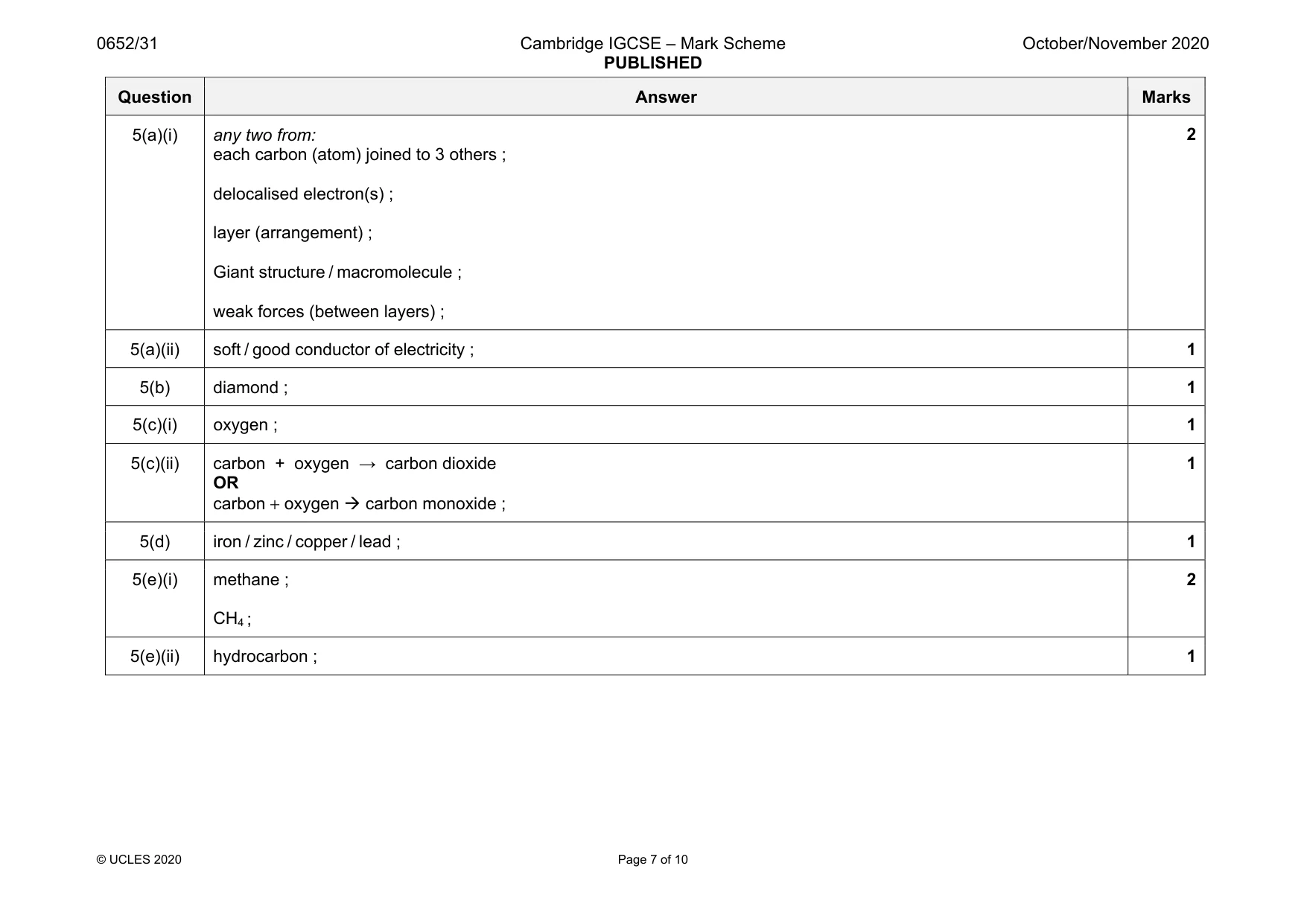
Mark scheme: 5(a)(i) any two from: each carbon (atom) joined to 3 others ; delocalised electron(s) ; layer (arrangement) ; Giant structure / macromolecule ; weak forces (between layers) ; 5(a)(ii) soft / good conductor of electricity ; 1 5(b) diamond ; 1 5(c)(i) oxygen ; 1 5(c)(ii) carbon + oxygen → carbon dioxide OR carbon + oxygen carbon monoxide ; 1 5(d) iron / zinc / copper / lead ; 1 5(e)(i) methane ; CH4 ; 2 5(e)(ii) hydrocarbon ; 1
Q6 · Four radioactive sources are investigated
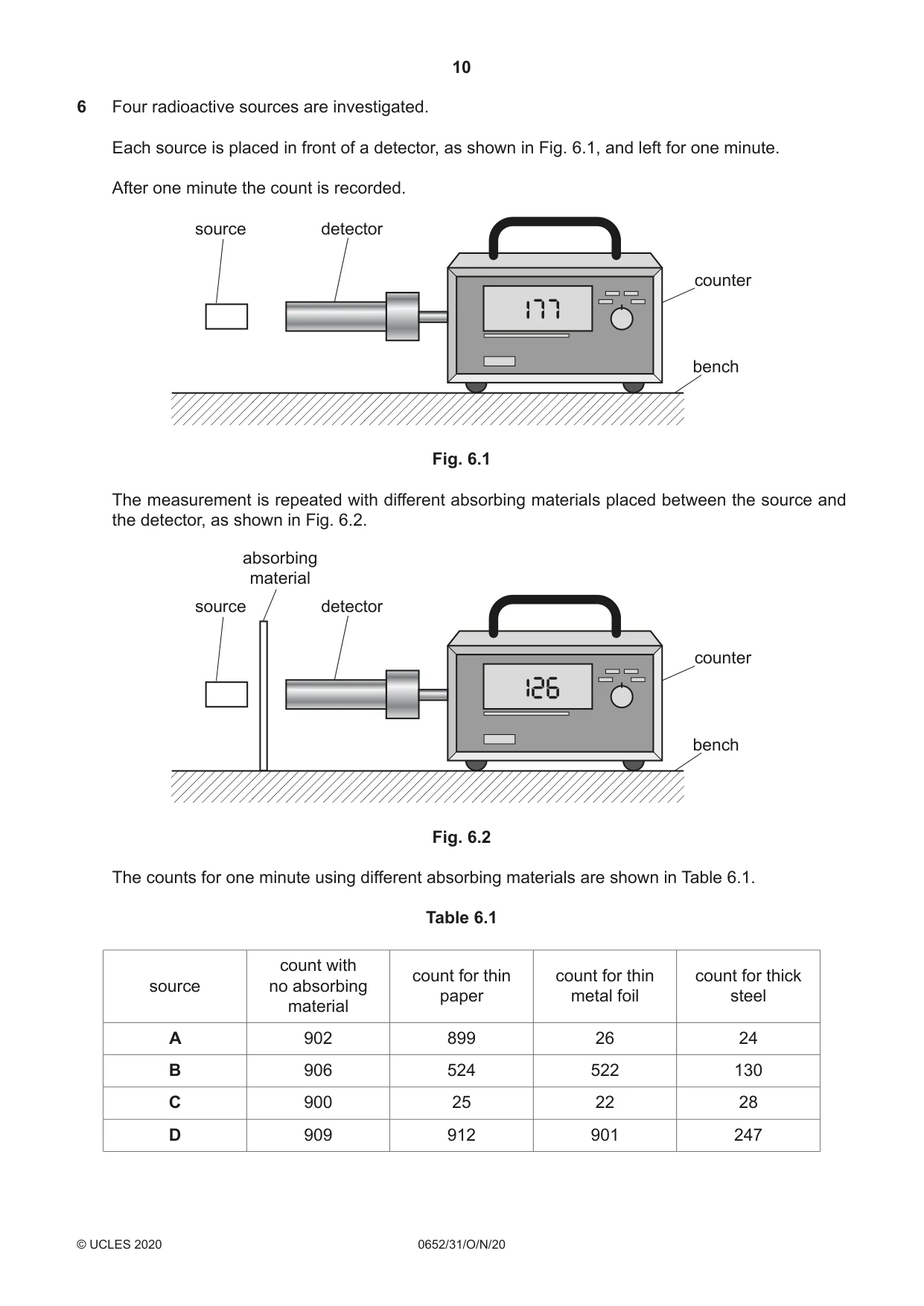
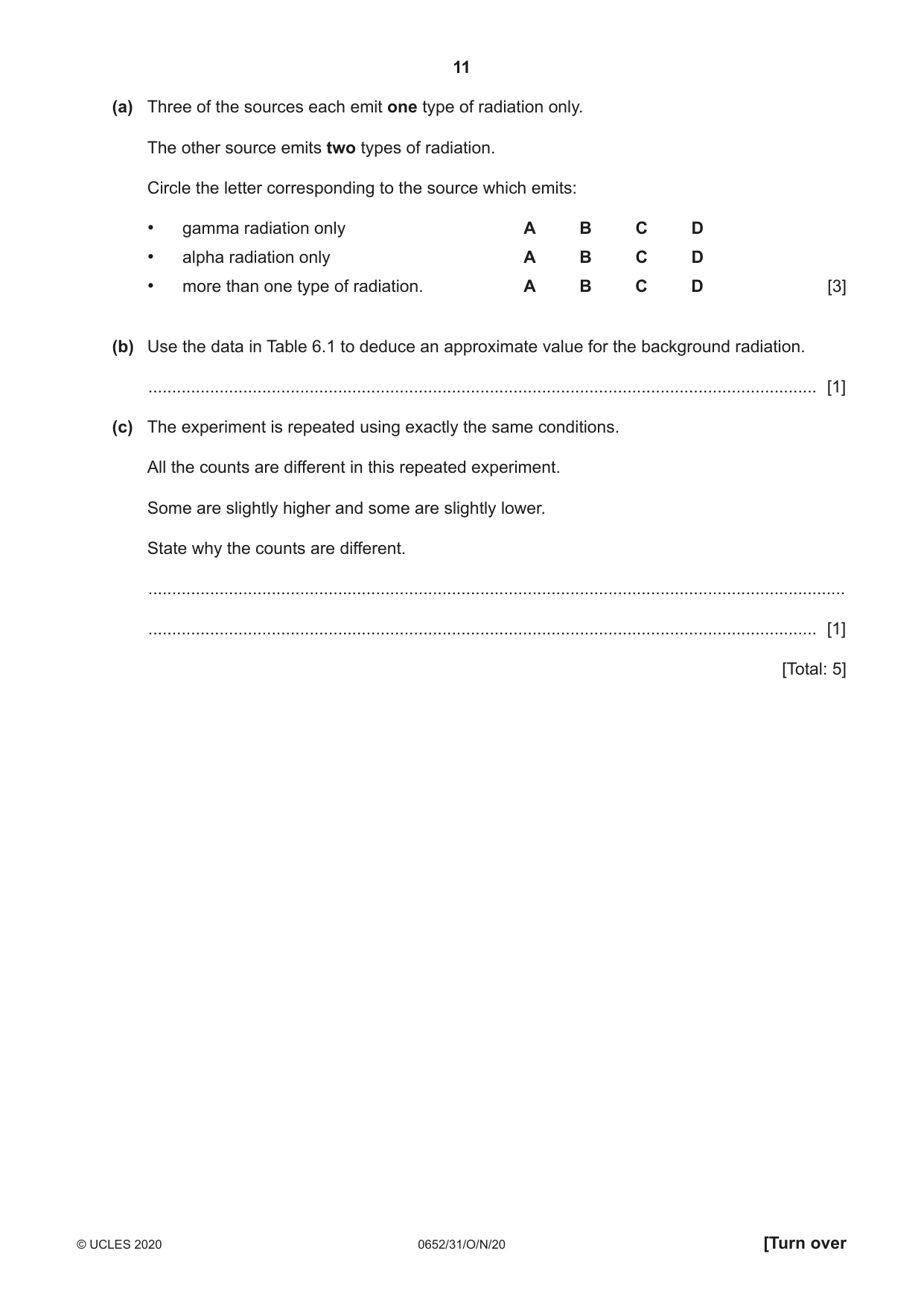
6 Four radioactive sources are investigated. Each source is placed in front of a detector, as shown in Fig. 6.1, and left for one minute. After one minute the count is recorded. source detector counter bench Fig. 6.1 The measurement is repeated with different absorbing materials placed between the source and the detector, as shown in Fig. 6.2. absorbing material source detector counter bench Fig. 6.2 The counts for one minute using different absorbing materials are shown in Table 6.1. Table 6.1 count with count for thin count for thin count for thick source no absorbing paper metal foil steel material A 902 899 26 24 B 906 524 522 130 C 900 25 22 28 D 909 912 901 247 (a) Three of the sources each emit one type of radiation only. The other source emits two types of radiation. Circle the letter corresponding to the source which emits: • gamma radiation only A B C D • alpha radiation only A B C D • more than one type of radiation. A B C D [3] (b) Use the data in Table 6.1 to deduce an approximate value for the background radiation. ............................................................................................................................................. [1] (c) The experiment is repeated using exactly the same conditions. All the counts are different in this repeated experiment. Some are slightly higher and some are slightly lower. State why the counts are different. ................................................................................................................................................... ............................................................................................................................................. [1] [Total: 5]
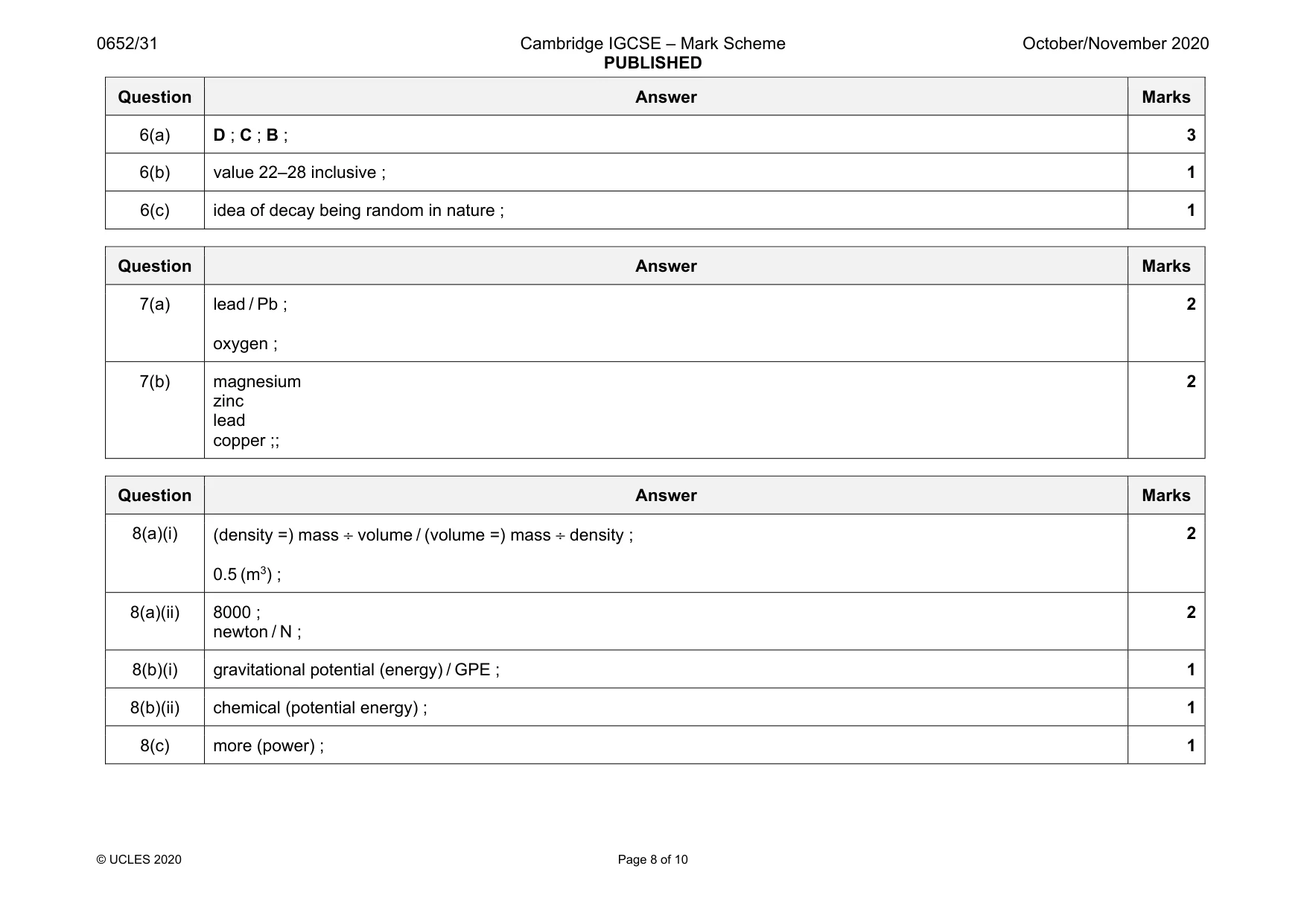
Mark scheme: 6(a) D ; C ; B ; 3 6(b) value 22–28 inclusive ; 1 6(c) idea of decay being random in nature ; 1
Q7 · Electrolysis is used to break down ionic compounds
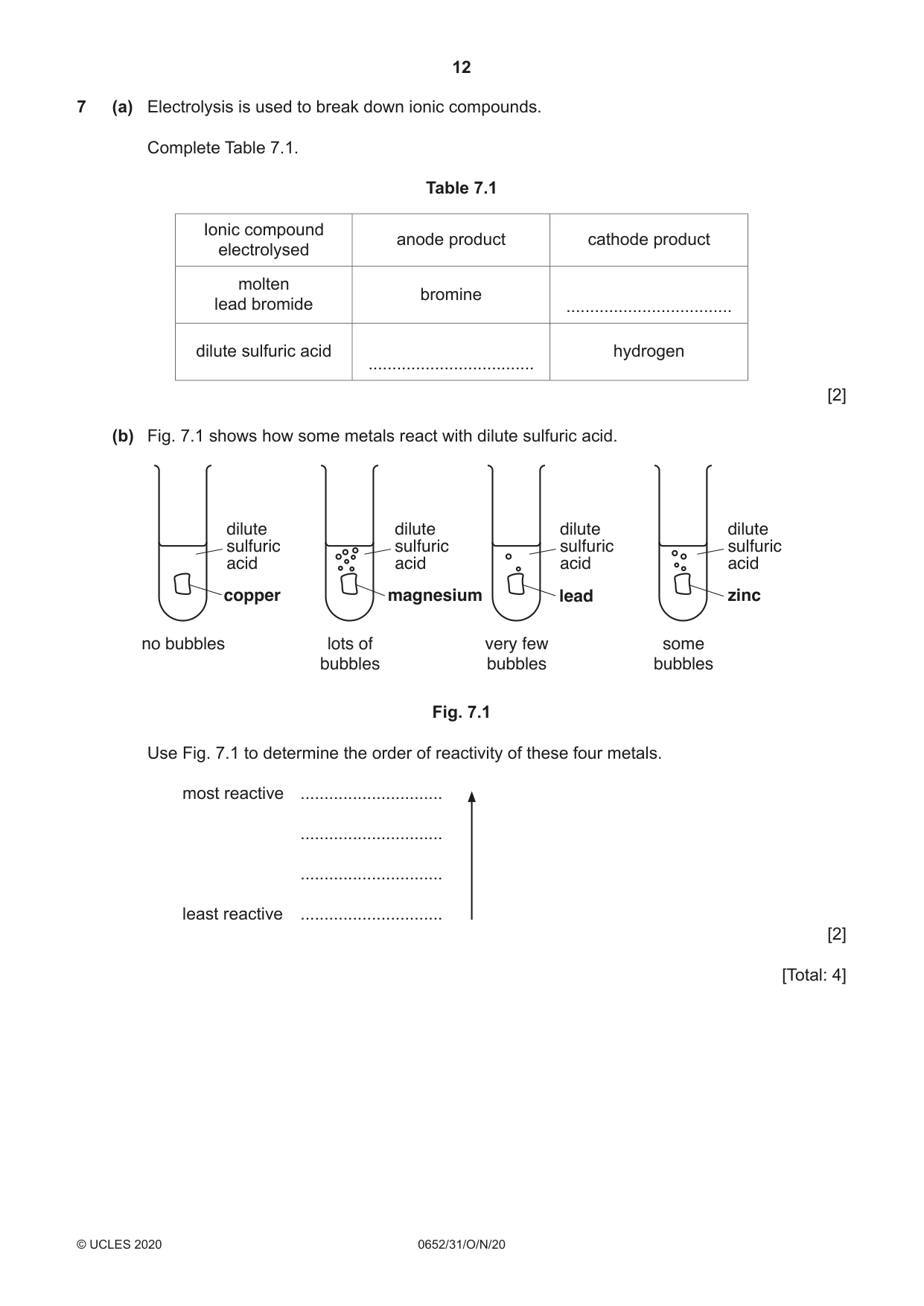
7 (a) Electrolysis is used to break down ionic compounds. Complete Table 7.1. Table 7.1 Ionic compound anode product cathode product electrolysed molten bromine lead bromide ................................... dilute sulfuric acid hydrogen ................................... [2] (b) Fig. 7.1 shows how some metals react with dilute sulfuric acid. dilute dilute dilute dilute sulfuric sulfuric sulfuric sulfuric acid acid acid acid copper magnesium lead zinc no bubbles lots of very few some bubbles bubbles bubbles Fig. 7.1 Use Fig. 7.1 to determine the order of reactivity of these four metals. most reactive .............................. .............................. .............................. least reactive .............................. [2] [Total: 4]
Mark scheme: 7(a) lead / Pb ; oxygen ; 2 7(b) magnesium zinc lead copper ;; 2
Q8 · A dumper truck full of sand
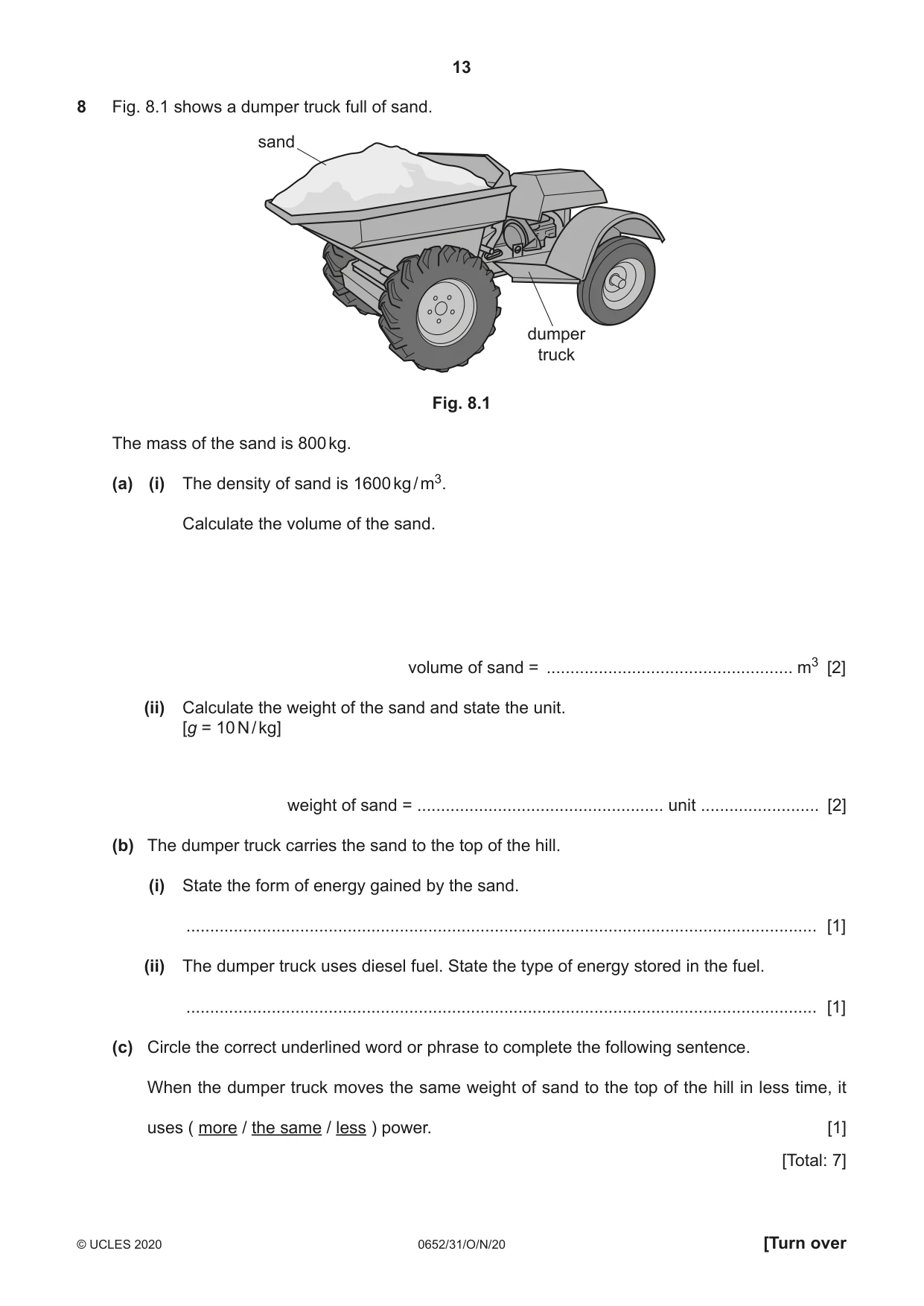
8 Fig. 8.1 shows a dumper truck full of sand. sand dumper truck Fig. 8.1 The mass of the sand is 800 kg. (a) (i) The density of sand is 1600 kg / m3. Calculate the volume of the sand. volume of sand = .................................................... m3 [2] (ii) Calculate the weight of the sand and state the unit. [g = 10 N / kg] weight of sand = .................................................... unit ......................... [2] (b) The dumper truck carries the sand to the top of the hill. (i) State the form of energy gained by the sand. ..................................................................................................................................... [1] (ii) The dumper truck uses diesel fuel. State the type of energy stored in the fuel. ..................................................................................................................................... [1] (c) Circle the correct underlined word or phrase to complete the following sentence. When the dumper truck moves the same weight of sand to the top of the hill in less time, it uses ( more / the same / less ) power. [1] [Total: 7]
Mark scheme: 8(a)(i) (density =) mass ÷ volume / (volume =) mass ÷ density ; 0.5 (m3) ; 2 8(a)(ii) 8000 ; newton / N ; 2 8(b)(i) gravitational potential (energy) / GPE ; 1 8(b)(ii) chemical (potential energy) ; 1 8(c) more (power) ; 1
Q9 · The formula of ammonium nitrate is NH4NO3
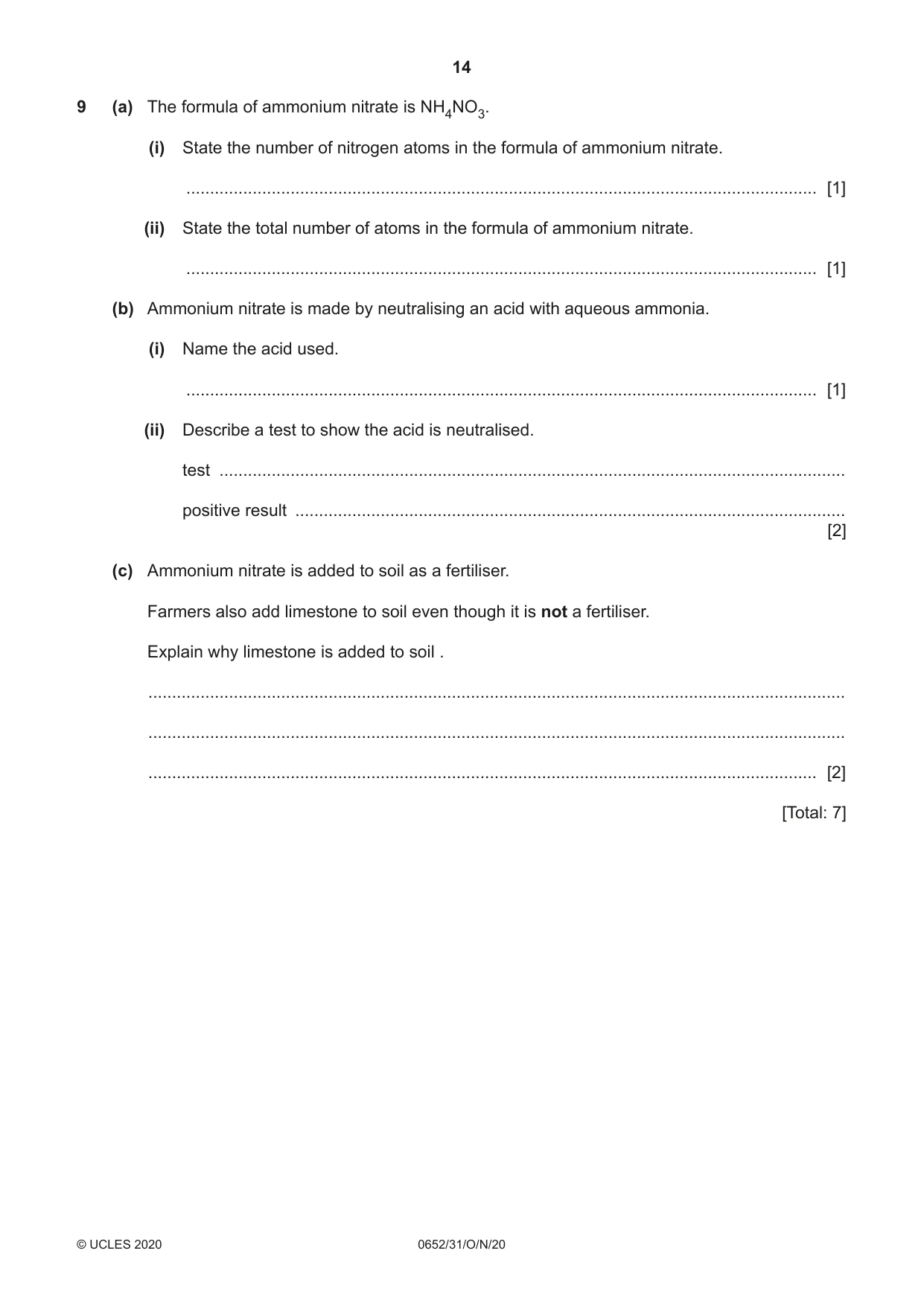
9 (a) The formula of ammonium nitrate is NH4NO3. (i) State the number of nitrogen atoms in the formula of ammonium nitrate. ..................................................................................................................................... [1] (ii) State the total number of atoms in the formula of ammonium nitrate. ..................................................................................................................................... [1] (b) Ammonium nitrate is made by neutralising an acid with aqueous ammonia. (i) Name the acid used. ..................................................................................................................................... [1] (ii) Describe a test to show the acid is neutralised. test .................................................................................................................................... positive result .................................................................................................................... [2] (c) Ammonium nitrate is added to soil as a fertiliser. Farmers also add limestone to soil even though it is not a fertiliser. Explain why limestone is added to soil . ................................................................................................................................................... ................................................................................................................................................... ............................................................................................................................................. [2] [Total: 7]
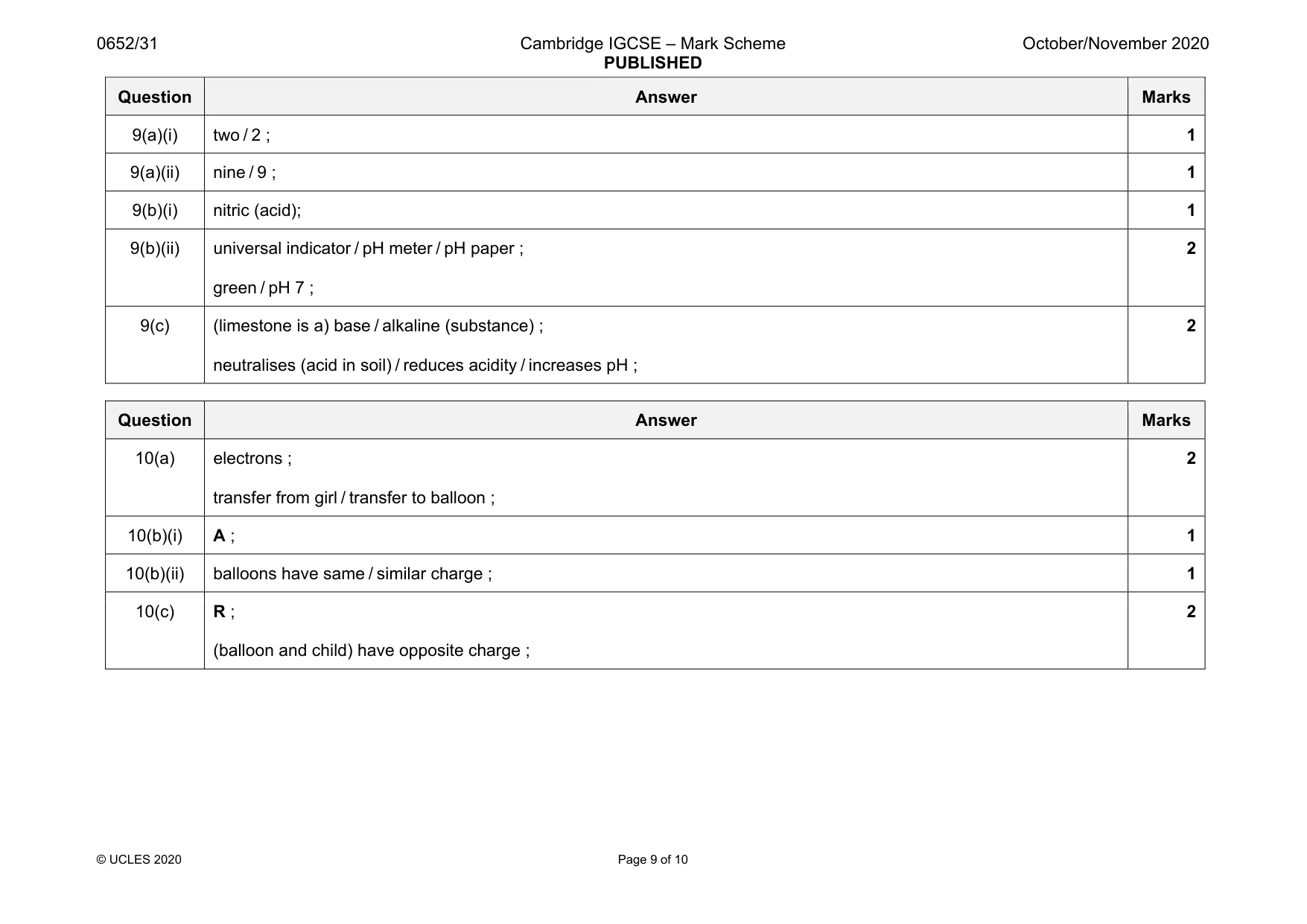
Mark scheme: 9(a)(i) two / 2 ; 1 9(a)(ii) nine / 9 ; 1 9(b)(i) nitric (acid); 1 9(b)(ii) universal indicator / pH meter / pH paper ; green / pH 7 ; 2 9(c) (limestone is a) base / alkaline (substance) ; neutralises (acid in soil) / reduces acidity / increases pH ; 2
Q10 · A girl rubs a balloon on her hair
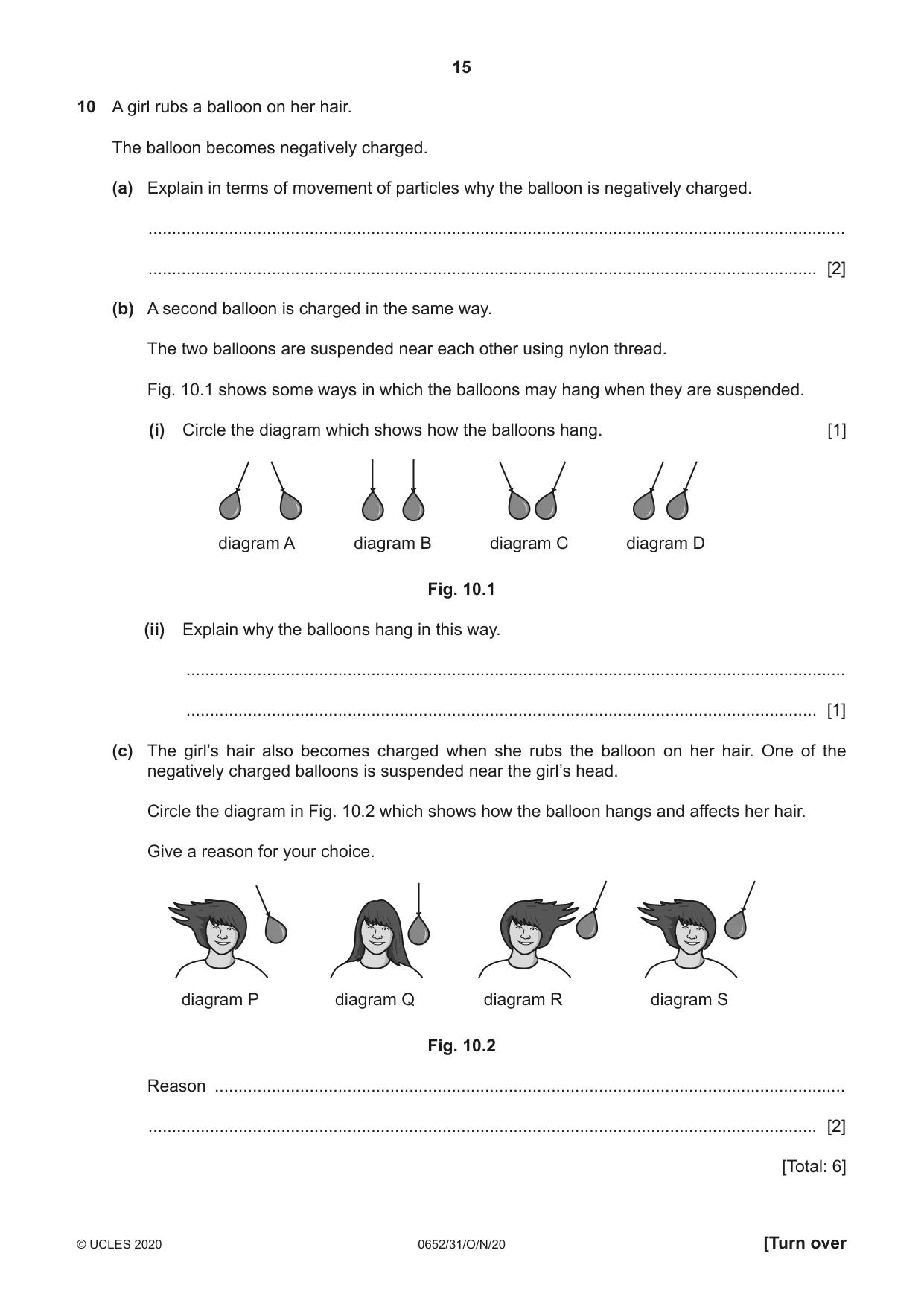
10 A girl rubs a balloon on her hair. The balloon becomes negatively charged. (a) Explain in terms of movement of particles why the balloon is negatively charged. ................................................................................................................................................... ............................................................................................................................................. [2] (b) A second balloon is charged in the same way. The two balloons are suspended near each other using nylon thread. Fig. 10.1 shows some ways in which the balloons may hang when they are suspended. (i) Circle the diagram which shows how the balloons hang. [1] diagram A diagram B diagram C diagram D Fig. 10.1 (ii) Explain why the balloons hang in this way. ........................................................................................................................................... ..................................................................................................................................... [1] (c) The girl’s hair also becomes charged when she rubs the balloon on her hair. One of the negatively charged balloons is suspended near the girl’s head. Circle the diagram in Fig. 10.2 which shows how the balloon hangs and affects her hair. Give a reason for your choice. diagram P diagram Q diagram R diagram S Fig. 10.2 Reason ..................................................................................................................................... ............................................................................................................................................. [2] [Total: 6]
Mark scheme: 10(a) electrons ; transfer from girl / transfer to balloon ; 2 10(b)(i) A ; 1 10(b)(ii) balloons have same / similar charge ; 1 10(c) R ; (balloon and child) have opposite charge ; 2
Q11 · Ethene, C2H4, is an unsaturated compound
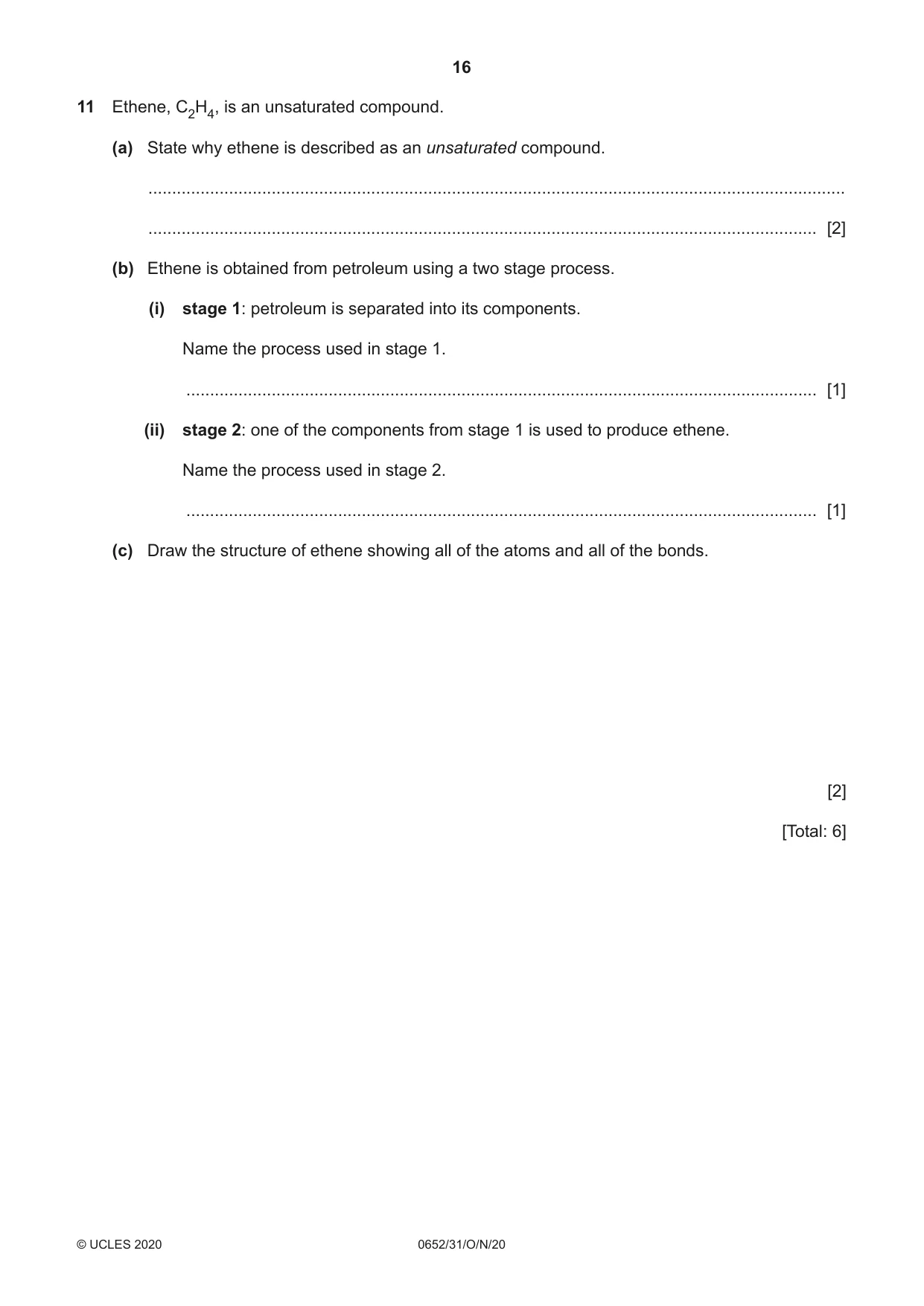
11 Ethene, C2H4, is an unsaturated compound. (a) State why ethene is described as an unsaturated compound. ................................................................................................................................................... ............................................................................................................................................. [2] (b) Ethene is obtained from petroleum using a two stage process. (i) stage 1: petroleum is separated into its components. Name the process used in stage 1. ..................................................................................................................................... [1] (ii) stage 2: one of the components from stage 1 is used to produce ethene. Name the process used in stage 2. ..................................................................................................................................... [1] (c) Draw the structure of ethene showing all of the atoms and all of the bonds. [2] [Total: 6]
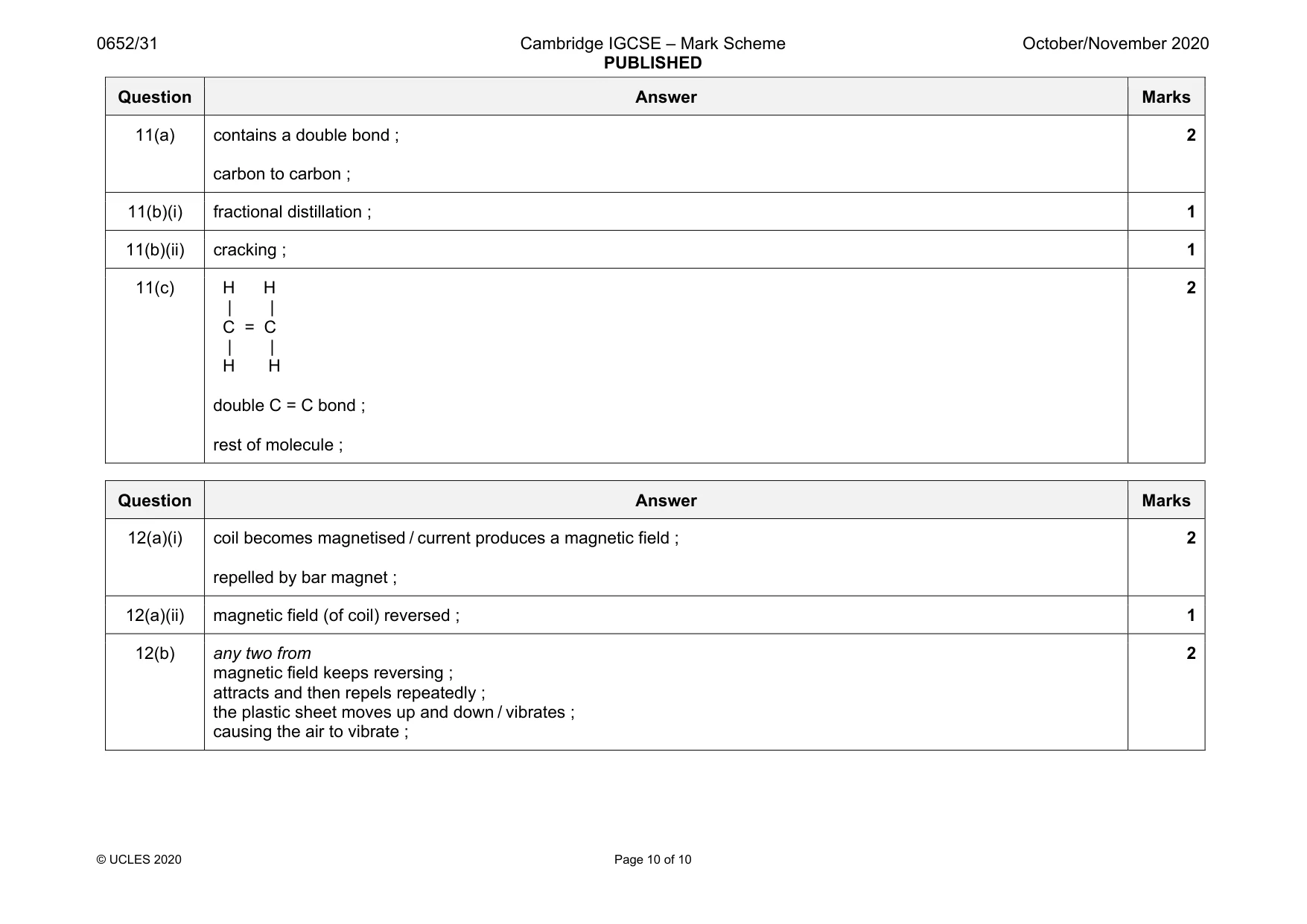
Mark scheme: 11(a) contains a double bond ; carbon to carbon ; 2 11(b)(i) fractional distillation ; 1 11(b)(ii) cracking ; 1 11(c) H H | | C = C | | H H double C = C bond ; rest of molecule ; 2
Question 12
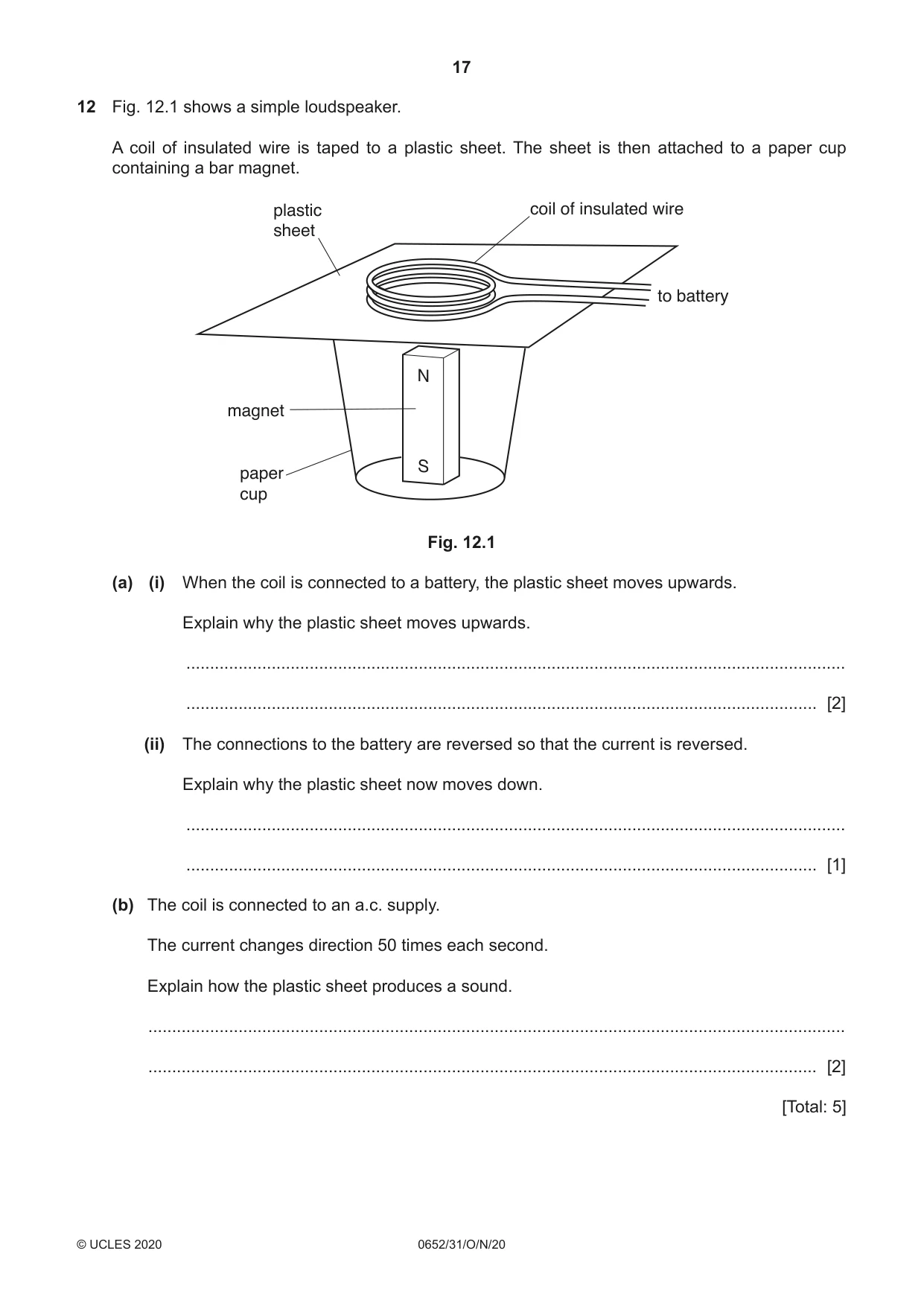
12 Fig. 12.1 shows a simple loudspeaker. A coil of insulated wire is taped to a plastic sheet. The sheet is then attached to a paper cup containing a bar magnet. plastic coil of insulated wire sheet to battery N magnet S paper cup Fig. 12.1 (a) (i) When the coil is connected to a battery, the plastic sheet moves upwards. Explain why the plastic sheet moves upwards. ........................................................................................................................................... ..................................................................................................................................... [2] (ii) The connections to the battery are reversed so that the current is reversed. Explain why the plastic sheet now moves down. ........................................................................................................................................... ..................................................................................................................................... [1] (b) The coil is connected to an a.c. supply. The current changes direction 50 times each second. Explain how the plastic sheet produces a sound. ................................................................................................................................................... ............................................................................................................................................. [2] [Total: 5]
Mark scheme: 12(a)(i) coil becomes magnetised / current produces a magnetic field ; repelled by bar magnet ; 2 12(a)(ii) magnetic field (of coil) reversed ; 1 12(b) any two from magnetic field keeps reversing ; attracts and then repels repeatedly ; the plastic sheet moves up and down / vibrates ; causing the air to vibrate ; 2
What was in this paper
The subtopics covered by these 12 questions, and how many questions each got. Open one in a new tab to see every Cambridge question on it.
What you needed in this session
Cambridge’s own grade thresholds for 2020 Oct/Nov, Paper 3 · Variant 1. A higher threshold means an easier paper — the bar moves with how the cohort did.