Cambridge IGCSE Physical Science 0652 — 2018 Oct/Nov Paper 3 · Variant 2
0652/32/O/N/18 · 11 questions · 80 marks · ≈90 min
The question paper and its mark scheme, free to read here and free to download. This is Cambridge’s own paper, exactly as it was sat.
Question paper20 pages



Mark scheme9 pages
Answers below. Sit the paper first if you are practising.
Questions as text
Q1 · A floating platform is made from several large blocks
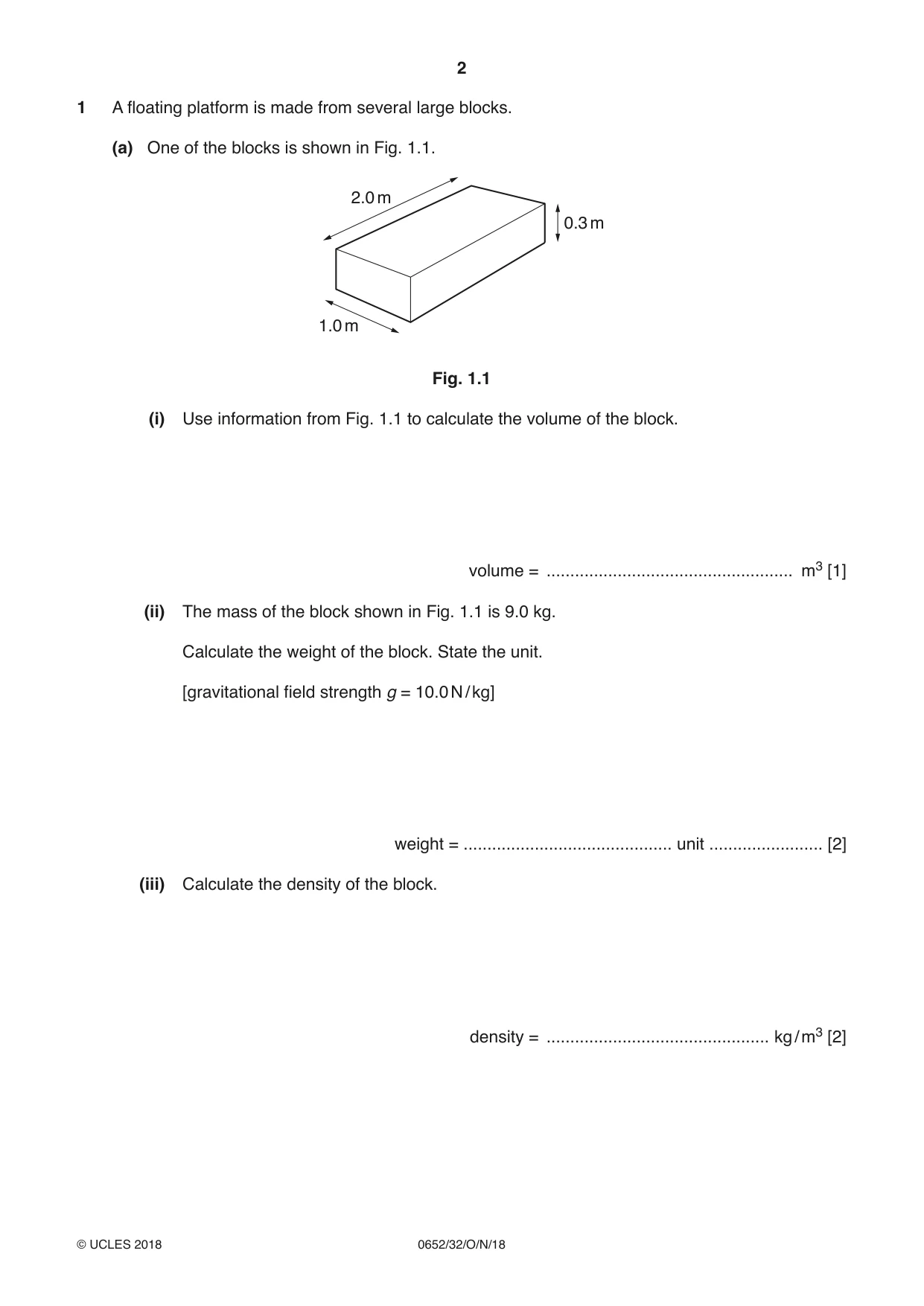
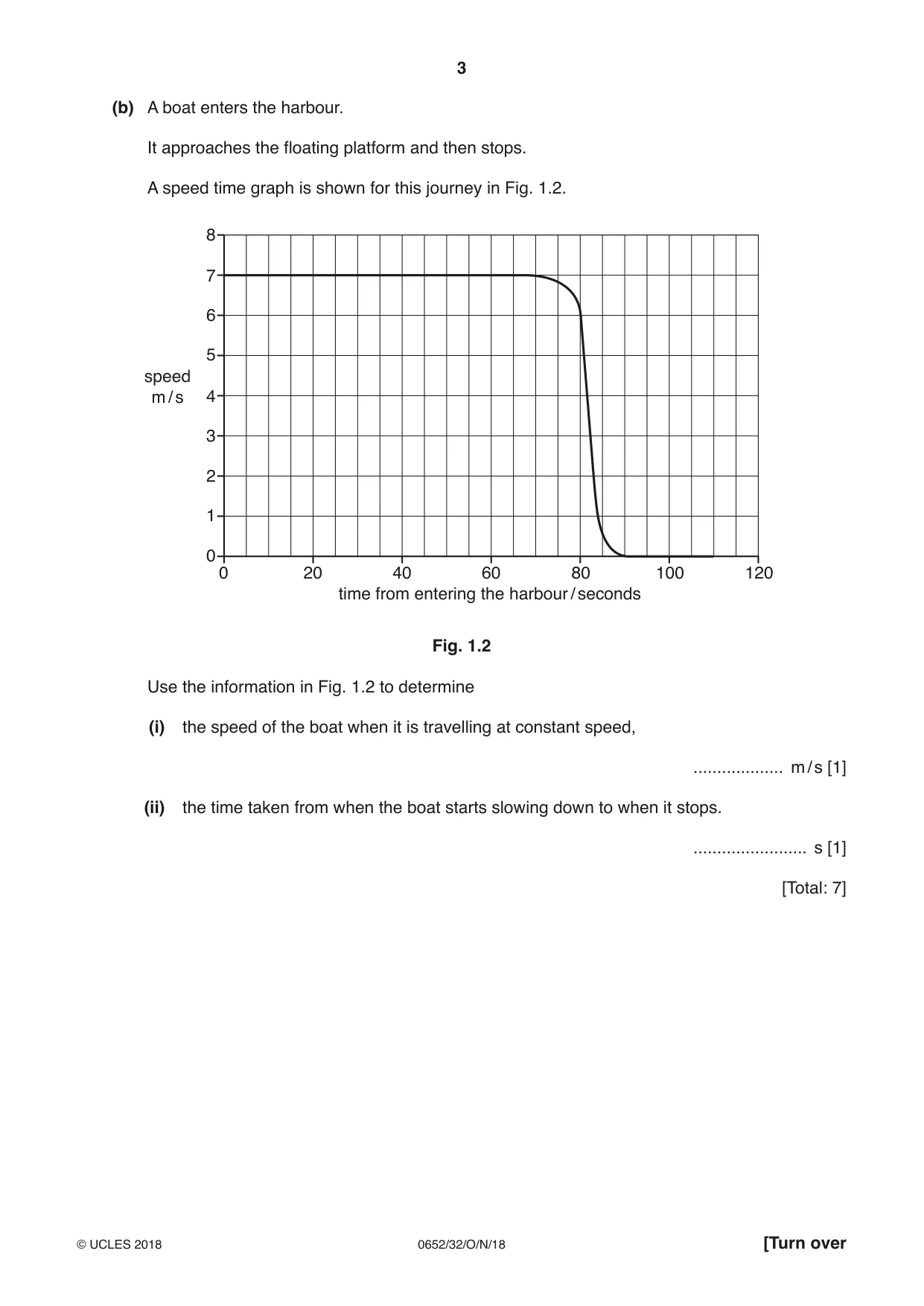
1 A floating platform is made from several large blocks. (a) One of the blocks is shown in Fig. 1.1. 2.0 m 0.3 m 1.0 m Fig. 1.1 (i) Use information from Fig. 1.1 to calculate the volume of the block. volume = .................................................... m3 [1] (ii) The mass of the block shown in Fig. 1.1 is 9.0 kg. Calculate the weight of the block. State the unit. [gravitational field strength g = 10.0 N / kg] weight = ............................................ unit ........................ [2] (iii) Calculate the density of the block. density = ............................................... kg / m3 [2] (b) A boat enters the harbour. It approaches the floating platform and then stops. A speed time graph is shown for this journey in Fig. 1.2. 8 7 6 5 speed m / s 4 3 2 1 0 0 20 40 60 80 100 120 time from entering the harbour / seconds Fig. 1.2 Use the information in Fig. 1.2 to determine (i) the speed of the boat when it is travelling at constant speed, ................... m / s [1] (ii) the time taken from when the boat starts slowing down to when it stops. ........................ s [1] [Total: 7]
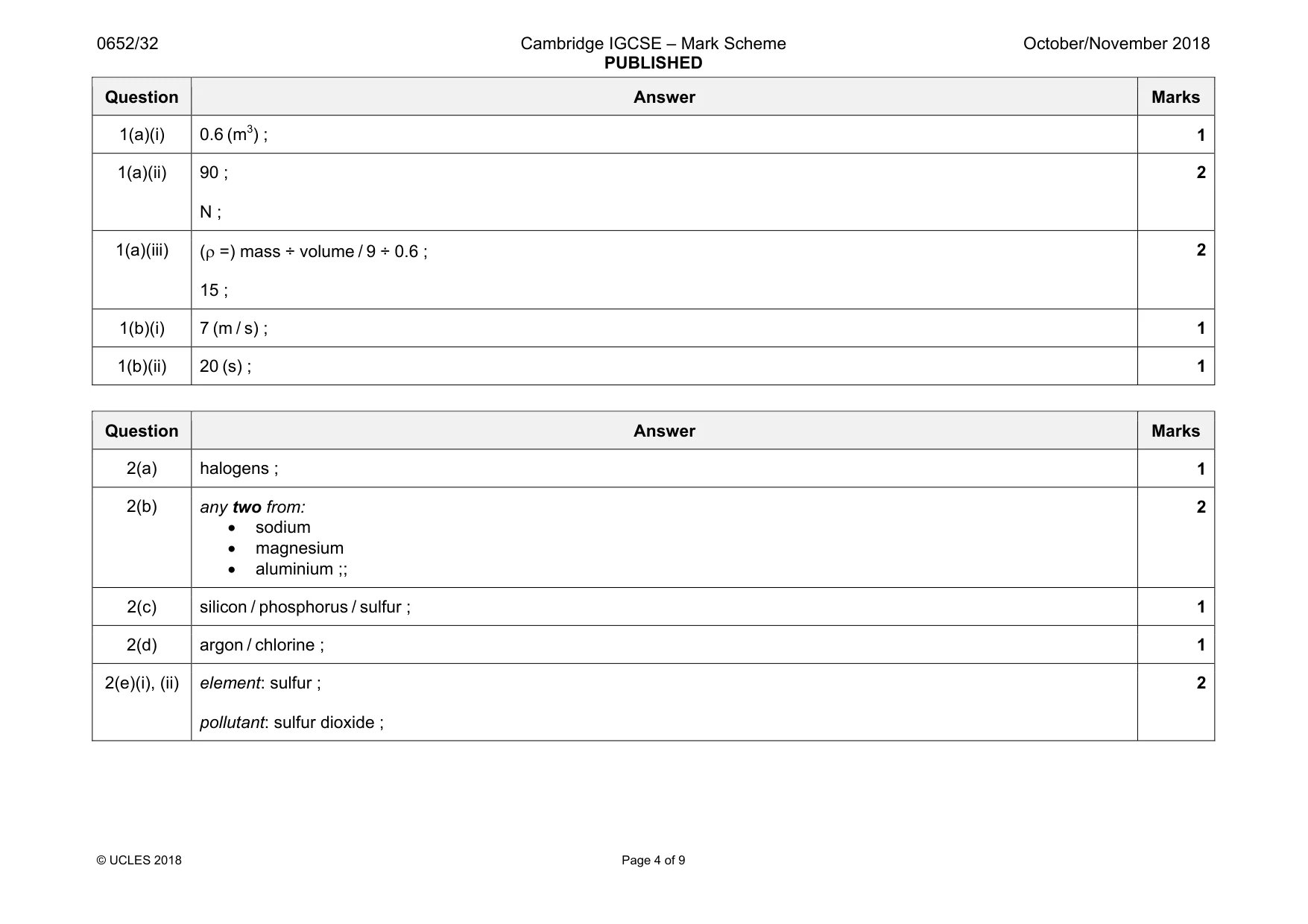
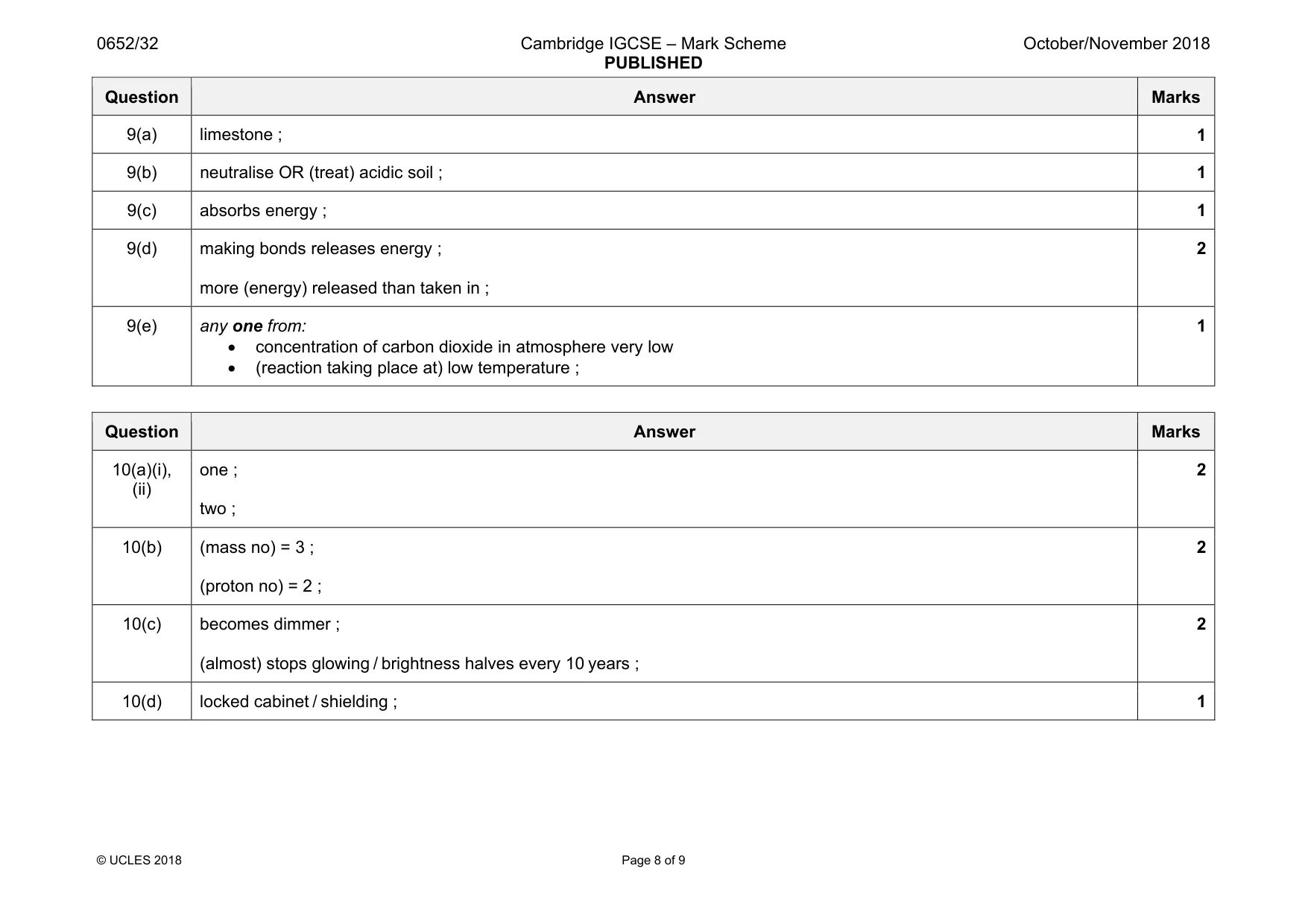
Mark scheme: 1(a)(i) 1 1(a)(ii) 90 ; N ; 2 1(a)(iii) (ρ =) mass ÷ volume / 9 ÷ 0.6 ; 15 ; 2 1(b)(i) 7 (m / s) ; 1 1(b)(ii) 20 (s) ; 1
Q2 · Chlorine is an element in Period 3 of the Periodic Table
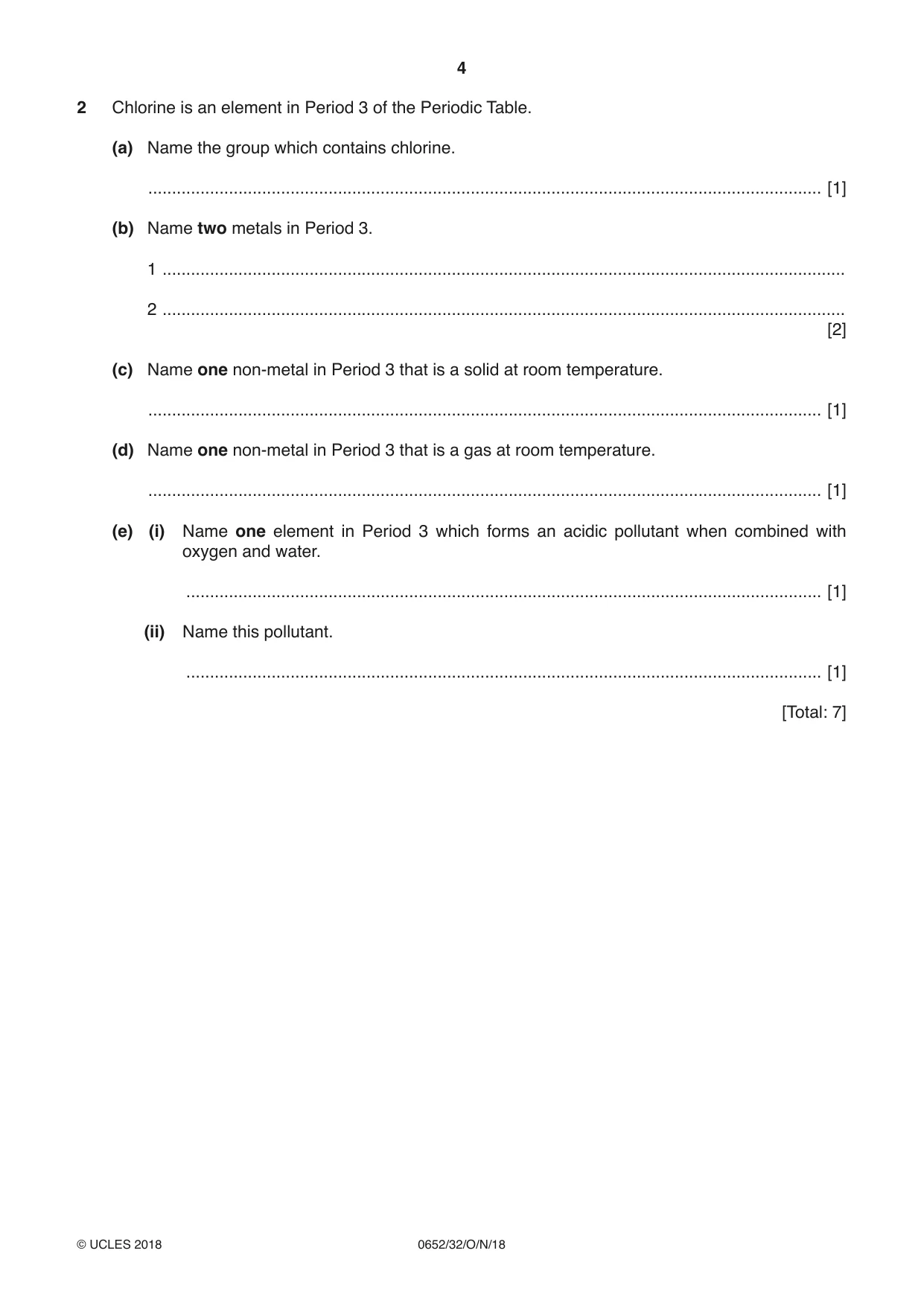
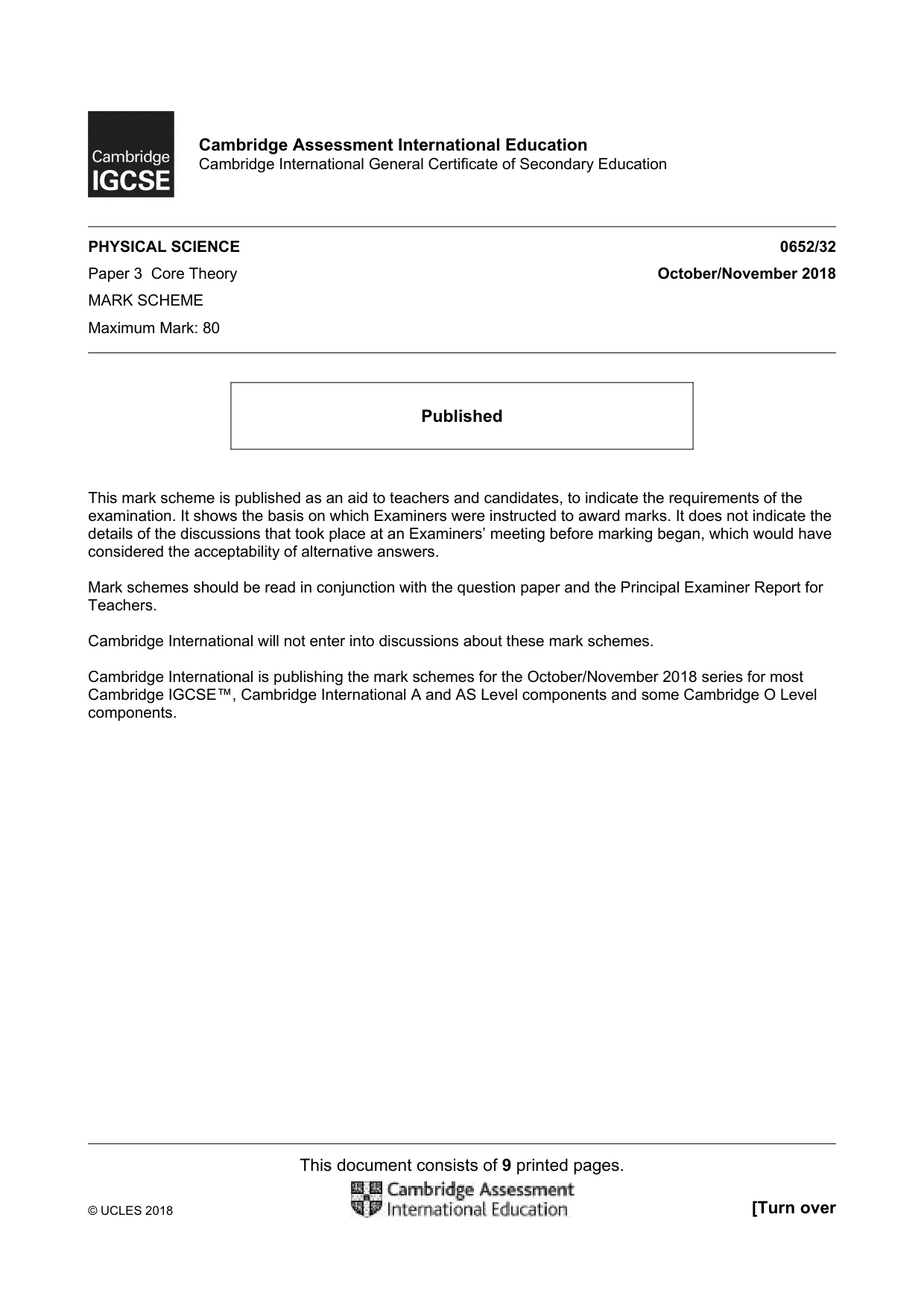
2 Chlorine is an element in Period 3 of the Periodic Table. (a) Name the group which contains chlorine. .............................................................................................................................................. [1] (b) Name two metals in Period 3. 1 ................................................................................................................................................ 2 ................................................................................................................................................ [2] (c) Name one non-metal in Period 3 that is a solid at room temperature. .............................................................................................................................................. [1] (d) Name one non-metal in Period 3 that is a gas at room temperature. .............................................................................................................................................. [1] (e) (i) Name one element in Period 3 which forms an acidic pollutant when combined with oxygen and water. ...................................................................................................................................... [1] (ii) Name this pollutant. ...................................................................................................................................... [1] [Total: 7] Question 3 starts over the page
Mark scheme: 2(a) halogens ; 1 2(b) any two from: • sodium • magnesium • aluminium ;; 2 2(c) silicon / phosphorus / sulfur ; 1 2(d) argon / chlorine ; 1 2(e)(i), (ii) element: sulfur ; pollutant: sulfur dioxide ; 2
Q3 · A worker is using a drill on a road surface
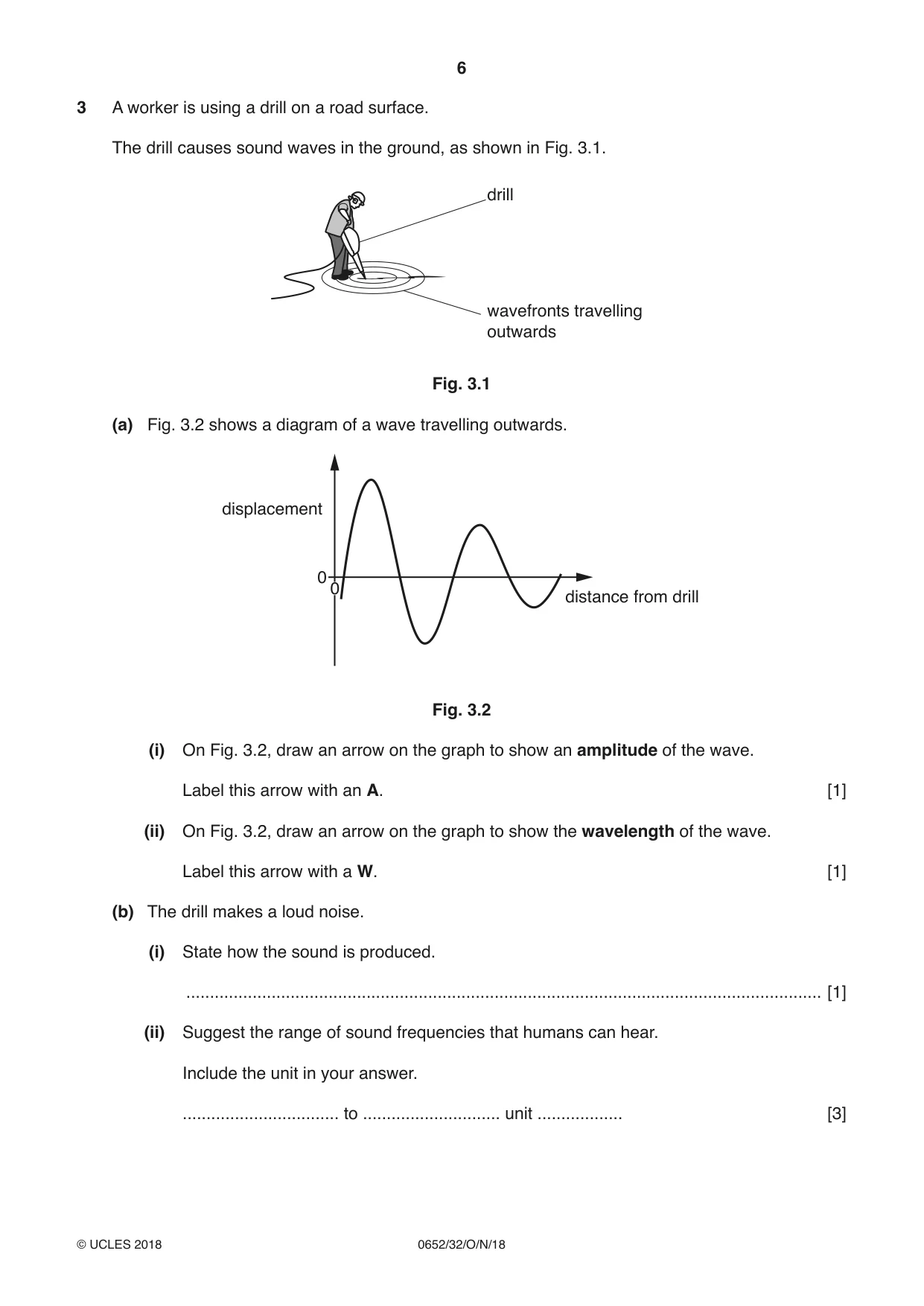
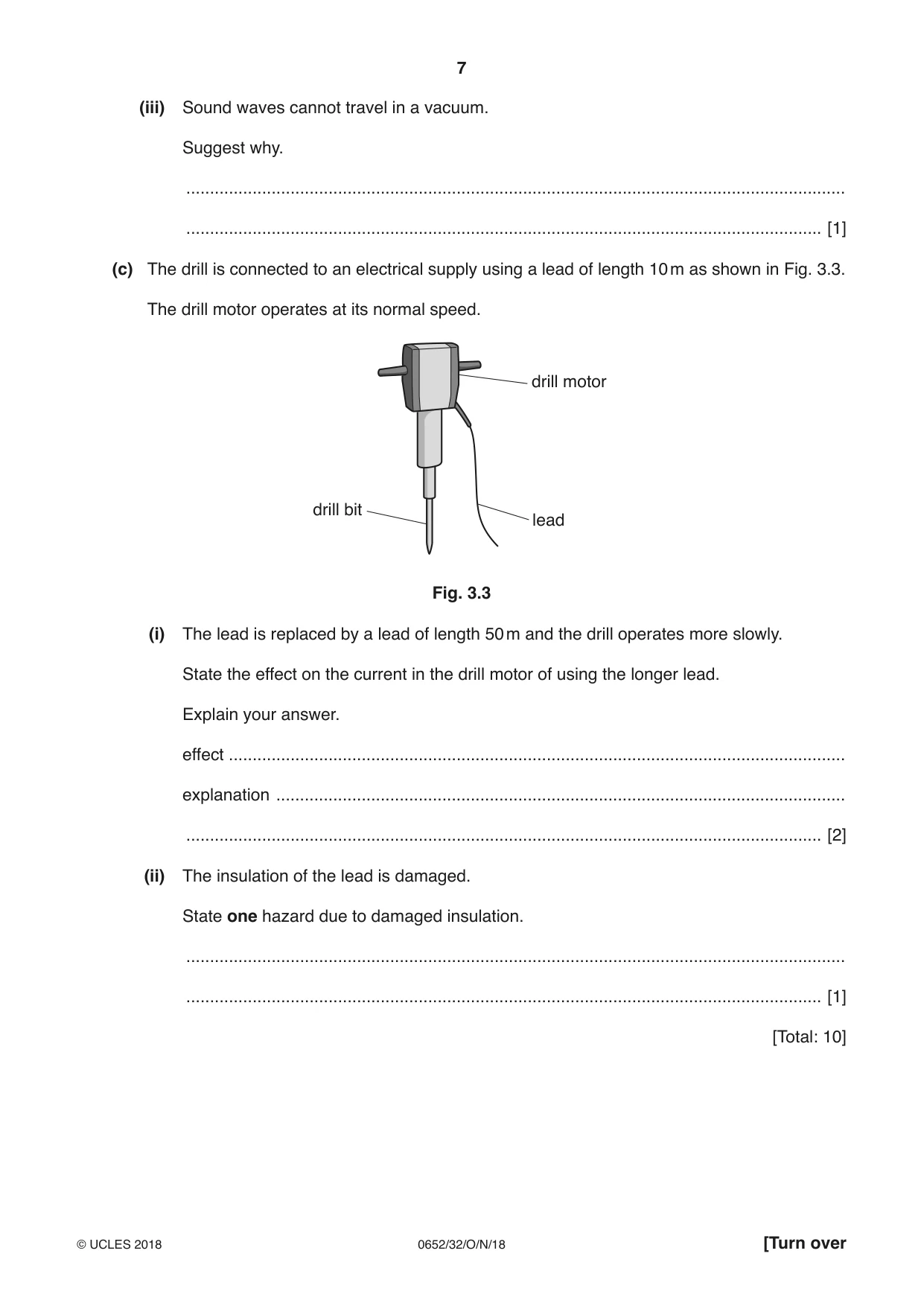
3 A worker is using a drill on a road surface. The drill causes sound waves in the ground, as shown in Fig. 3.1. drill wavefronts travelling outwards Fig. 3.1 (a) Fig. 3.2 shows a diagram of a wave travelling outwards. displacement 0 0 distance from drill Fig. 3.2 (i) On Fig. 3.2, draw an arrow on the graph to show an amplitude of the wave. Label this arrow with an A. [1] (ii) On Fig. 3.2, draw an arrow on the graph to show the wavelength of the wave. Label this arrow with a W. [1] (b) The drill makes a loud noise. (i) State how the sound is produced. ...................................................................................................................................... [1] (ii) Suggest the range of sound frequencies that humans can hear. Include the unit in your answer. ................................. to ............................. unit .................. [3] (iii) Sound waves cannot travel in a vacuum. Suggest why. ........................................................................................................................................... ...................................................................................................................................... [1] (c) The drill is connected to an electrical supply using a lead of length 10 m as shown in Fig. 3.3. The drill motor operates at its normal speed. drill motor drill bit lead Fig. 3.3 (i) The lead is replaced by a lead of length 50 m and the drill operates more slowly. State the effect on the current in the drill motor of using the longer lead. Explain your answer. effect .................................................................................................................................. explanation ........................................................................................................................ ...................................................................................................................................... [2] (ii) The insulation of the lead is damaged. State one hazard due to damaged insulation. ........................................................................................................................................... ...................................................................................................................................... [1] [Total: 10]
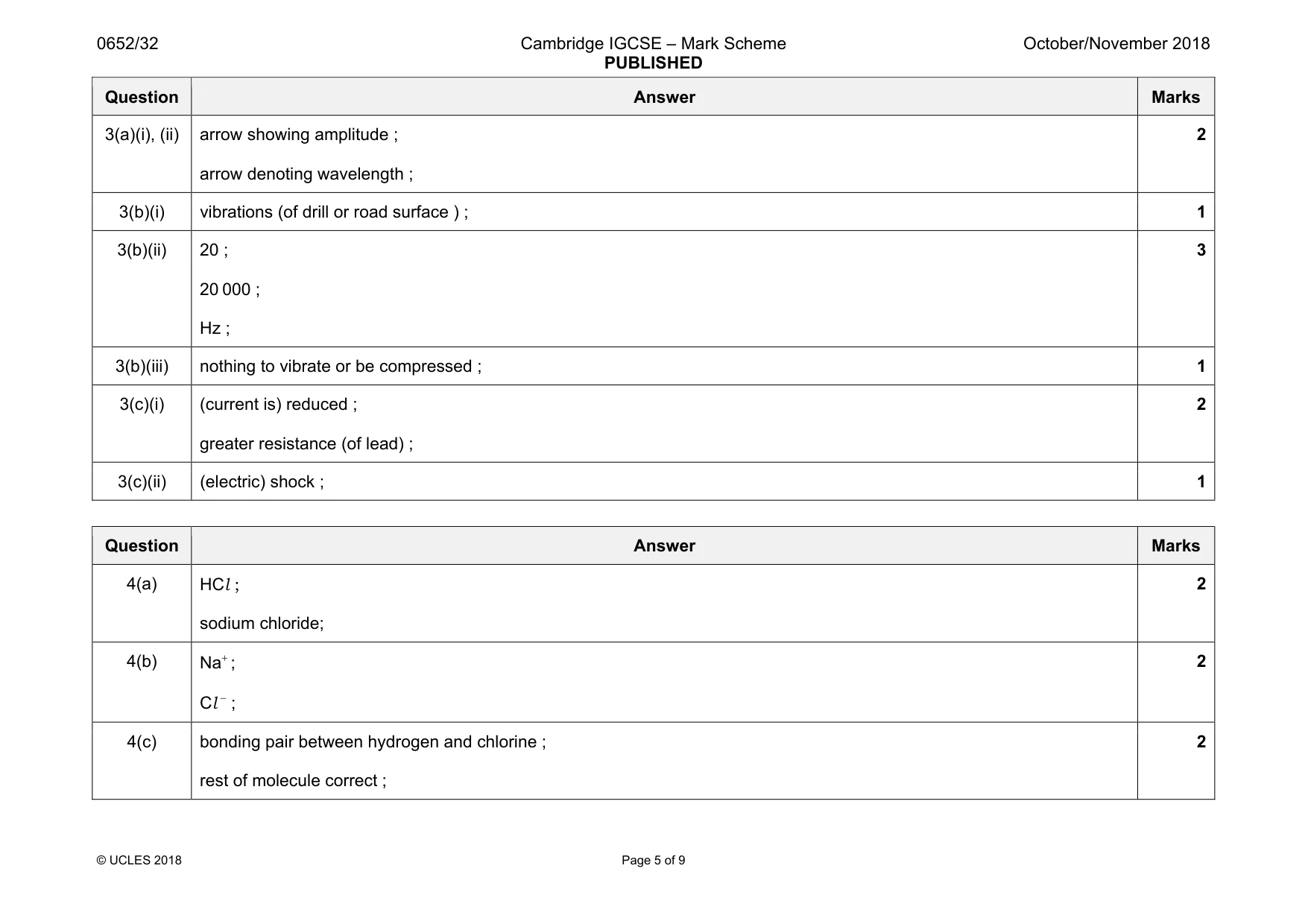
Mark scheme: 3(a)(i), (ii) arrow showing amplitude ; arrow denoting wavelength ; 2 3(b)(i) vibrations (of drill or road surface ) ; 1 3(b)(ii) 20 ; 20 000 ; Hz ; 3 3(b)(iii) nothing to vibrate or be compressed ; 1 3(c)(i) (current is) reduced ; greater resistance (of lead) ; 2 3(c)(ii) (electric) shock ; 1
Q4 · Chlorine forms ionic and covalent compounds
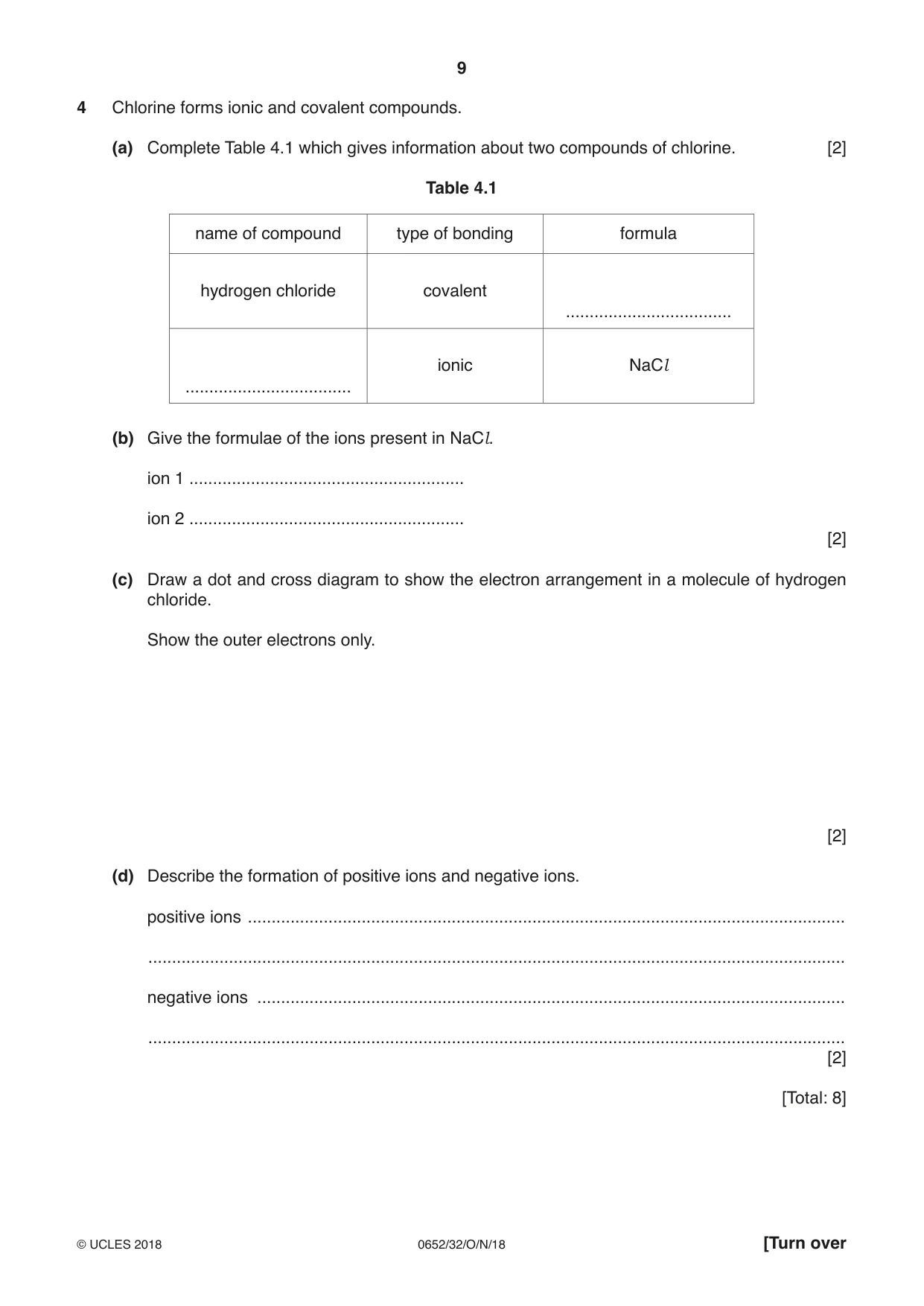
4 Chlorine forms ionic and covalent compounds. (a) Complete Table 4.1 which gives information about two compounds of chlorine. [2] Table 4.1 name of compound type of bonding formula hydrogen chloride covalent ................................... ionic NaCl ................................... (b) Give the formulae of the ions present in NaCl. ion 1 .......................................................... ion 2 .......................................................... [2] (c) Draw a dot and cross diagram to show the electron arrangement in a molecule of hydrogen chloride. Show the outer electrons only. [2] (d) Describe the formation of positive ions and negative ions. positive ions .............................................................................................................................. ................................................................................................................................................... negative ions ............................................................................................................................ ................................................................................................................................................... [2] [Total: 8]
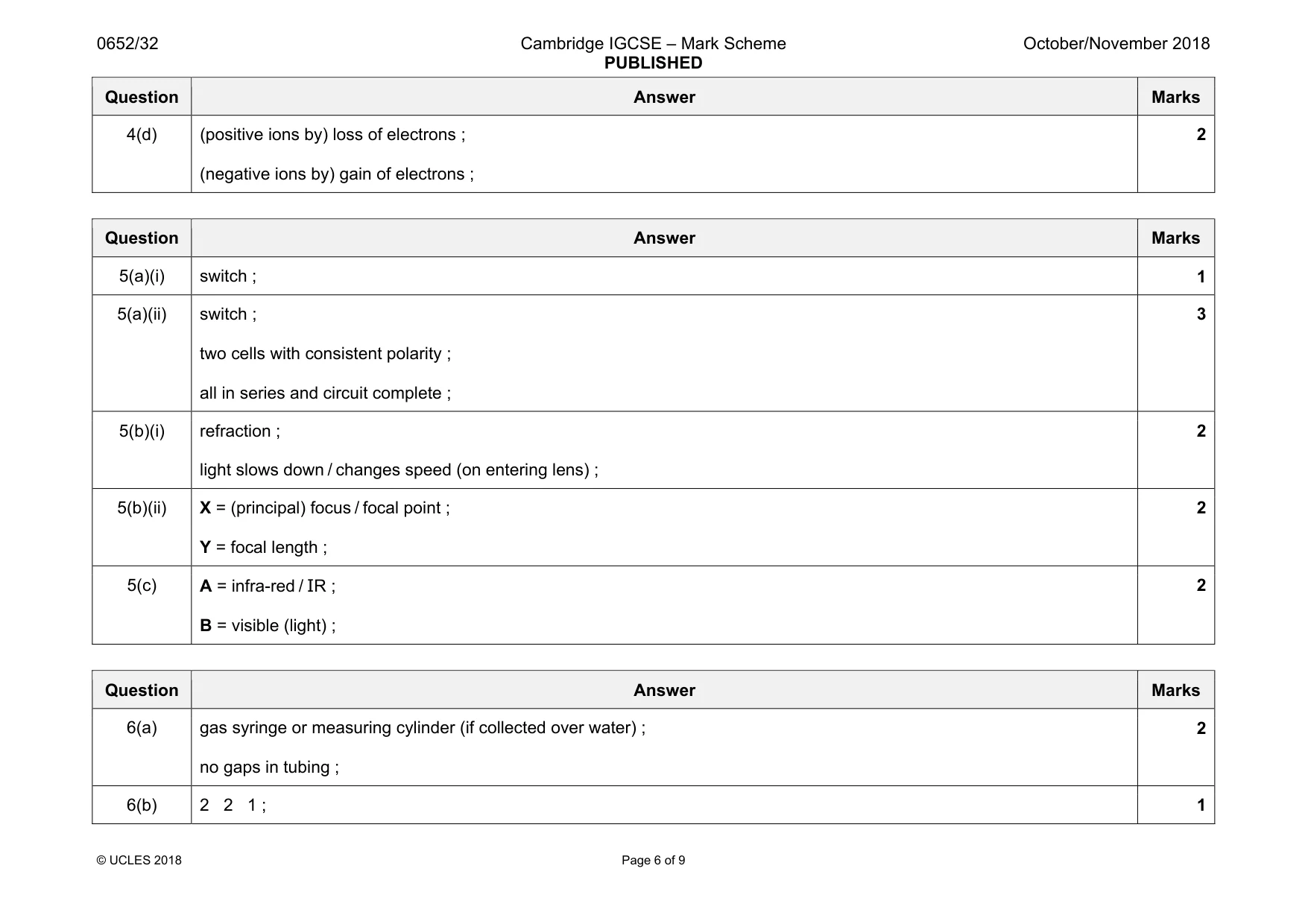
Mark scheme: 4(a) sodium chloride; 2 4(b) Na+ ; Cl − ; 2 4(c) bonding pair between hydrogen and chlorine ; rest of molecule correct ; 2 Question Answer Marks 4(d) (positive ions by) loss of electrons ; (negative ions by) gain of electrons ; 2
Q5 · A section through a torch
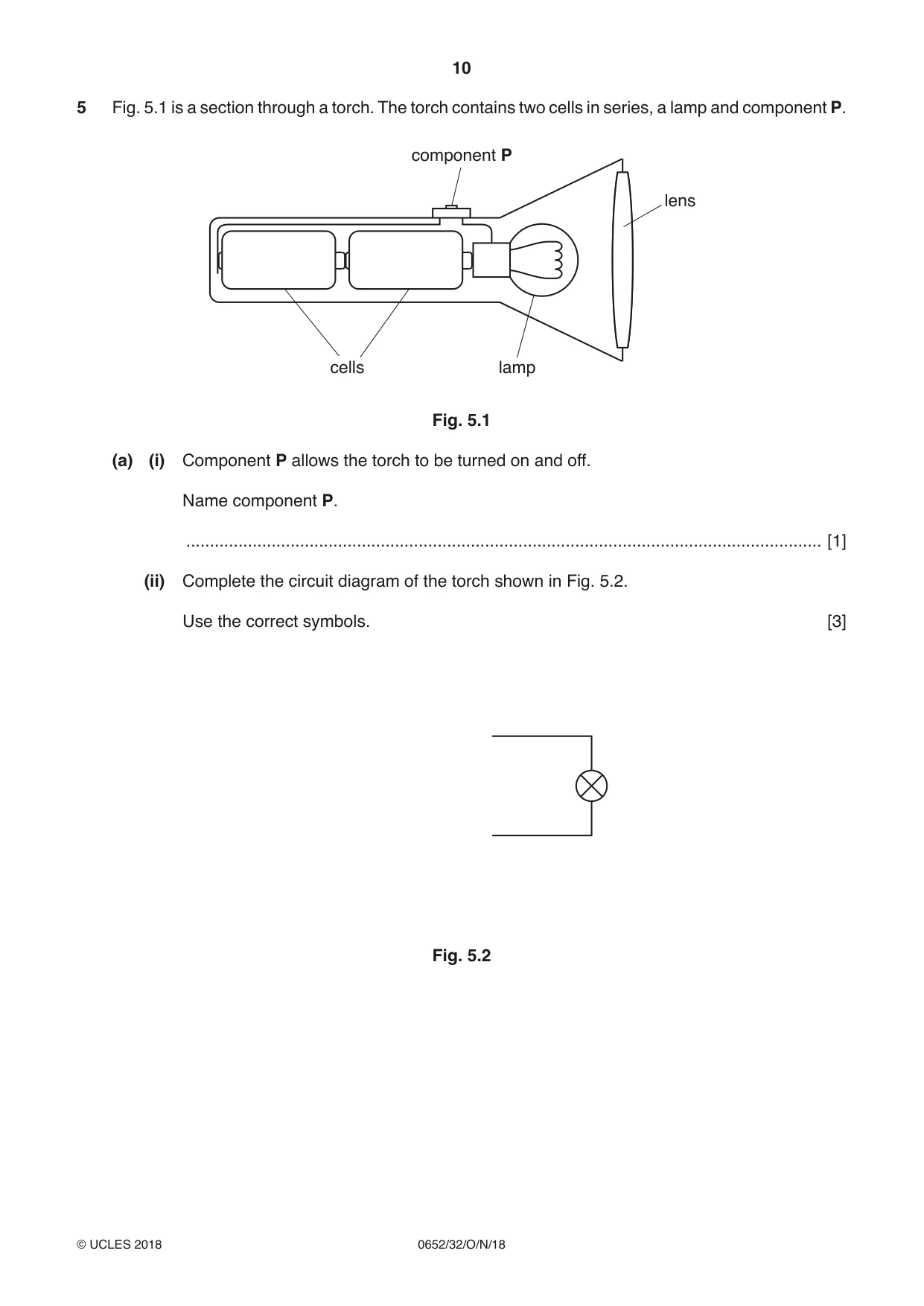
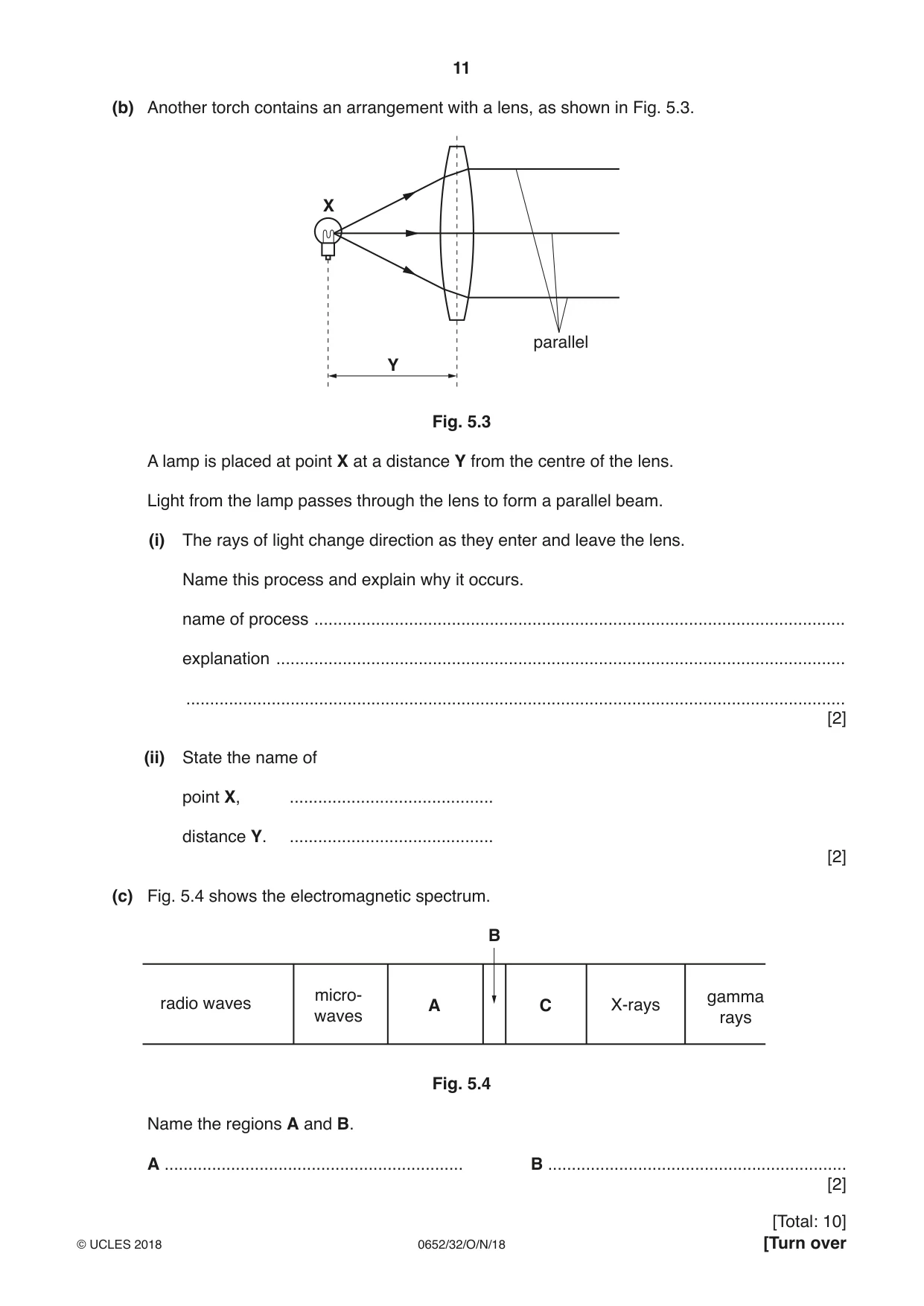
5 Fig. 5.1 is a section through a torch. The torch contains two cells in series, a lamp and component P. component P lens cells lamp Fig. 5.1 (a) (i) Component P allows the torch to be turned on and off. Name component P. ...................................................................................................................................... [1] (ii) Complete the circuit diagram of the torch shown in Fig. 5.2. Use the correct symbols. [3] Fig. 5.2 (b) Another torch contains an arrangement with a lens, as shown in Fig. 5.3. X parallel Y Fig. 5.3 A lamp is placed at point X at a distance Y from the centre of the lens. Light from the lamp passes through the lens to form a parallel beam. (i) The rays of light change direction as they enter and leave the lens. Name this process and explain why it occurs. name of process ................................................................................................................ explanation ........................................................................................................................ ........................................................................................................................................... [2] (ii) State the name of point X, ........................................... distance Y. ........................................... [2] (c) Fig. 5.4 shows the electromagnetic spectrum. B micro- gamma radio waves A C X-rays waves rays Fig. 5.4 Name the regions A and B. A ............................................................... B ............................................................... [2]
Mark scheme: 5(a)(i) switch ; 1 5(a)(ii) switch ; two cells with consistent polarity ; all in series and circuit complete ; 3 5(b)(i) refraction ; light slows down / changes speed (on entering lens) ; 2 5(b)(ii) X = (principal) focus / focal point ; Y = focal length ; 2 5(c) A = infra-red / IR ; B = visible (light) ; 2
Q6 · Hydrogen peroxide decomposes to form oxygen and water
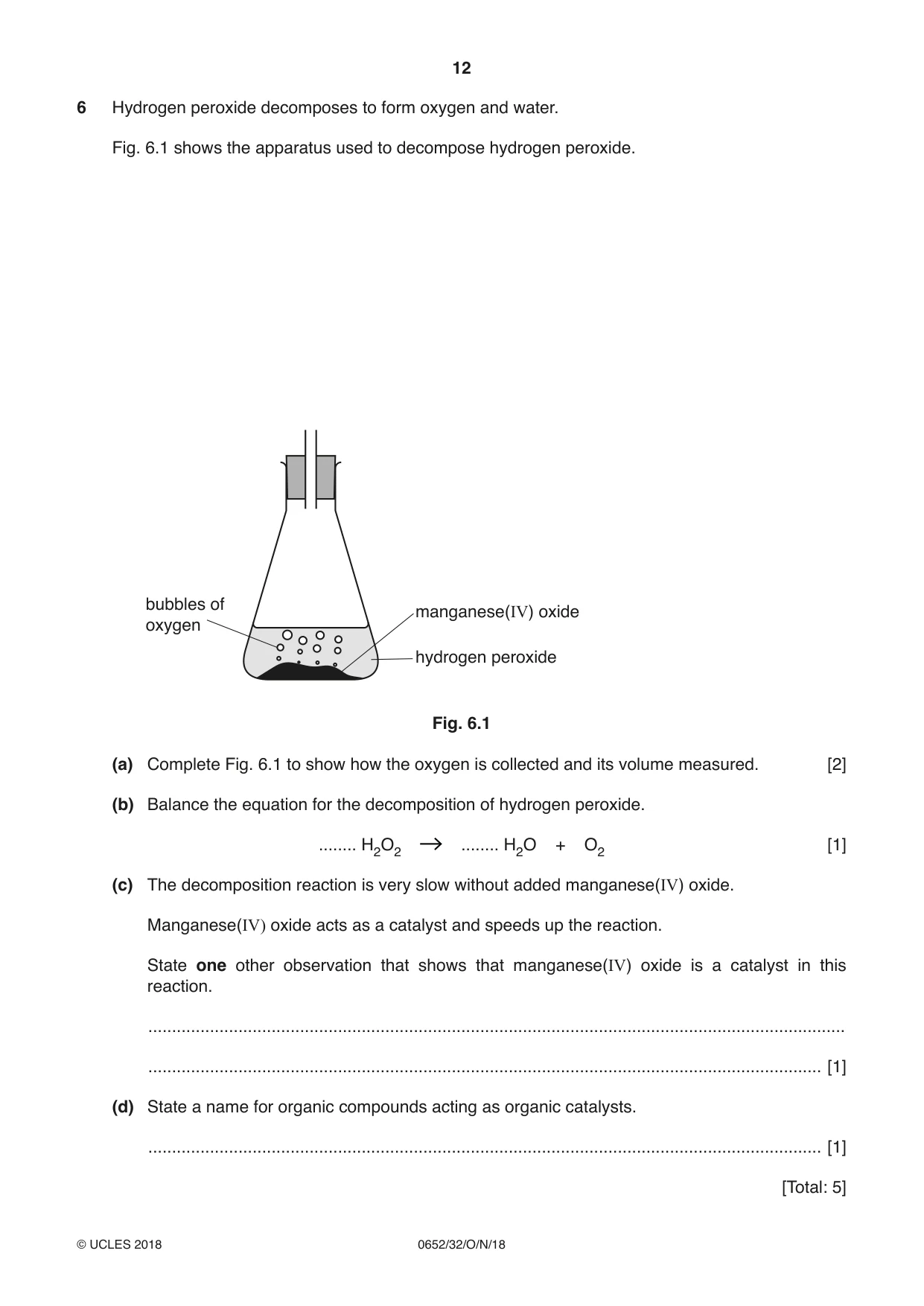
6 Hydrogen peroxide decomposes to form oxygen and water. Fig. 6.1 shows the apparatus used to decompose hydrogen peroxide. bubbles of manganese(IV) oxide oxygen hydrogen peroxide Fig. 6.1 (a) Complete Fig. 6.1 to show how the oxygen is collected and its volume measured. [2] (b) Balance the equation for the decomposition of hydrogen peroxide. ........ H2O2 ........ H2O + O2 [1] (c) The decomposition reaction is very slow without added manganese(IV) oxide. Manganese(IV) oxide acts as a catalyst and speeds up the reaction. State one other observation that shows that manganese(IV) oxide is a catalyst in this reaction. ................................................................................................................................................... .............................................................................................................................................. [1] (d) State a name for organic compounds acting as organic catalysts. .............................................................................................................................................. [1] [Total: 5]
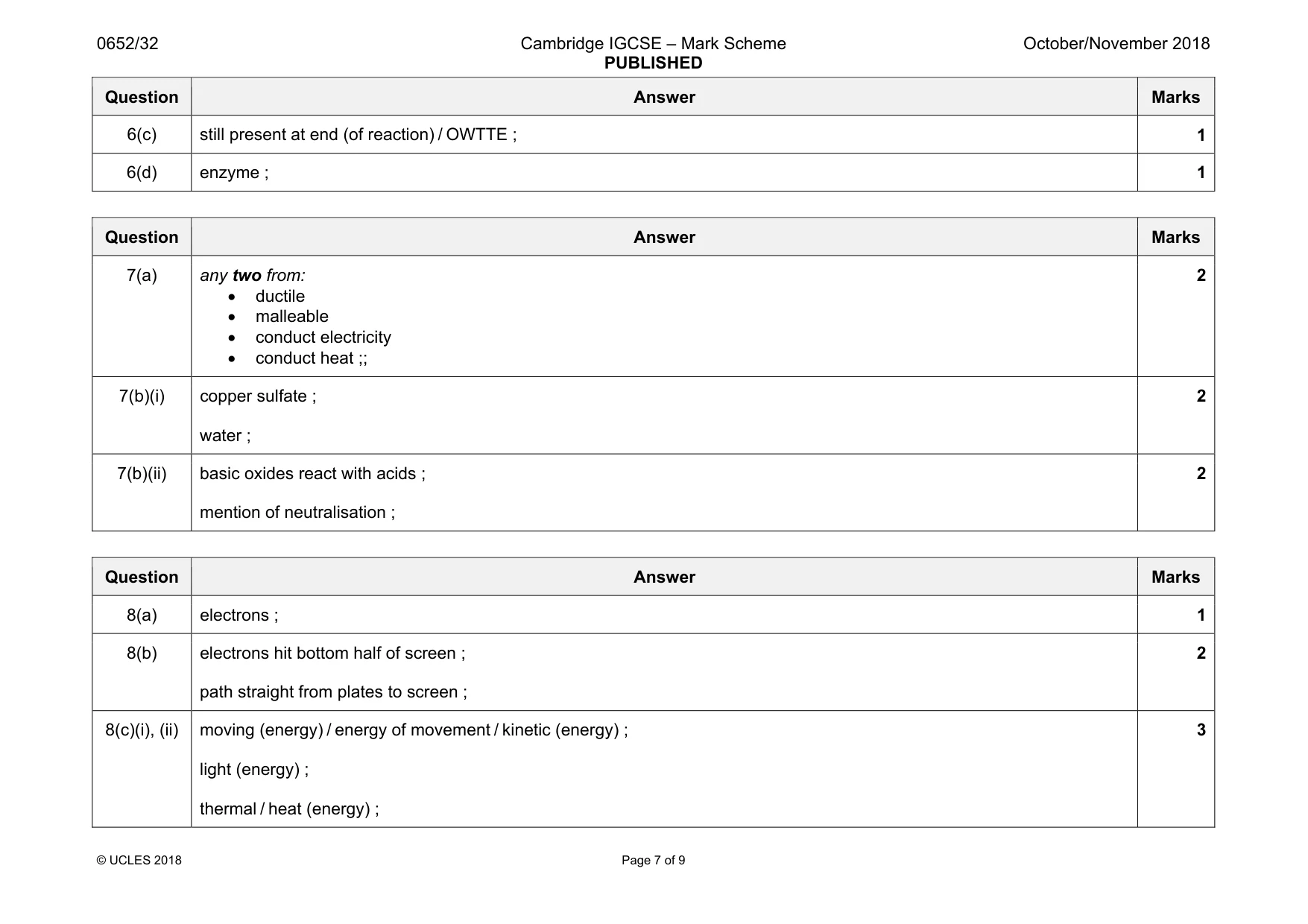
Mark scheme: 6(a) gas syringe or measuring cylinder (if collected over water) ; no gaps in tubing ; 2 6(b) 2 2 1 ; 1 Question Answer Marks 6(c) still present at end (of reaction) / OWTTE ; 1 6(d) enzyme ; 1
Q7 · State two properties of a metal
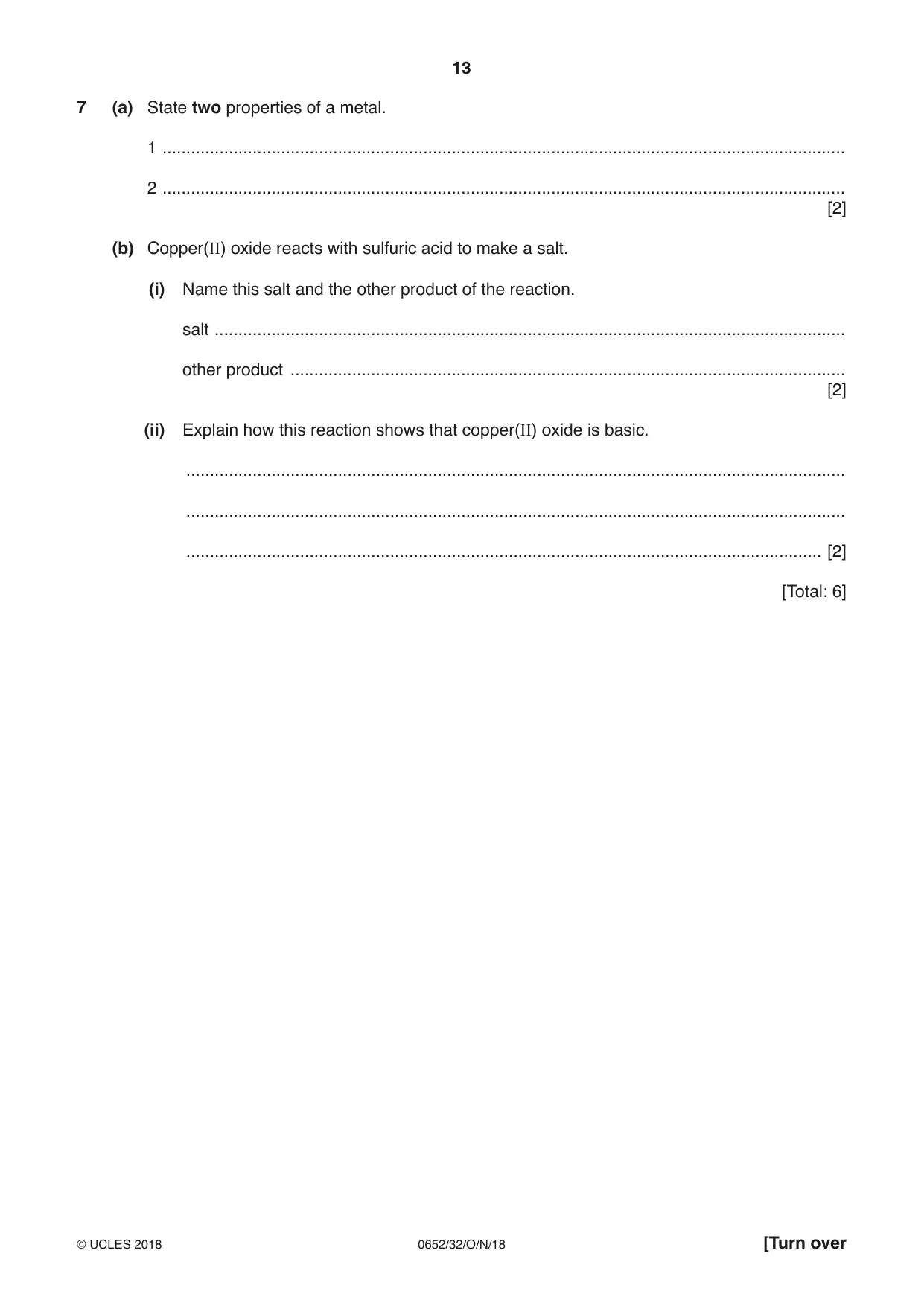
7 (a) State two properties of a metal. 1 ................................................................................................................................................ 2 ................................................................................................................................................ [2] (b) Copper(II) oxide reacts with sulfuric acid to make a salt. (i) Name this salt and the other product of the reaction. salt ..................................................................................................................................... other product ..................................................................................................................... [2] (ii) Explain how this reaction shows that copper(II) oxide is basic. ........................................................................................................................................... ........................................................................................................................................... ...................................................................................................................................... [2] [Total: 6]
Mark scheme: 7(a) any two from: • ductile • malleable • conduct electricity • conduct heat ;; 2 7(b)(i) copper sulfate ; water ; 2 7(b)(ii) basic oxides react with acids ; mention of neutralisation ; 2
Q8 · A cathode-ray oscilloscope (c.r.o.)
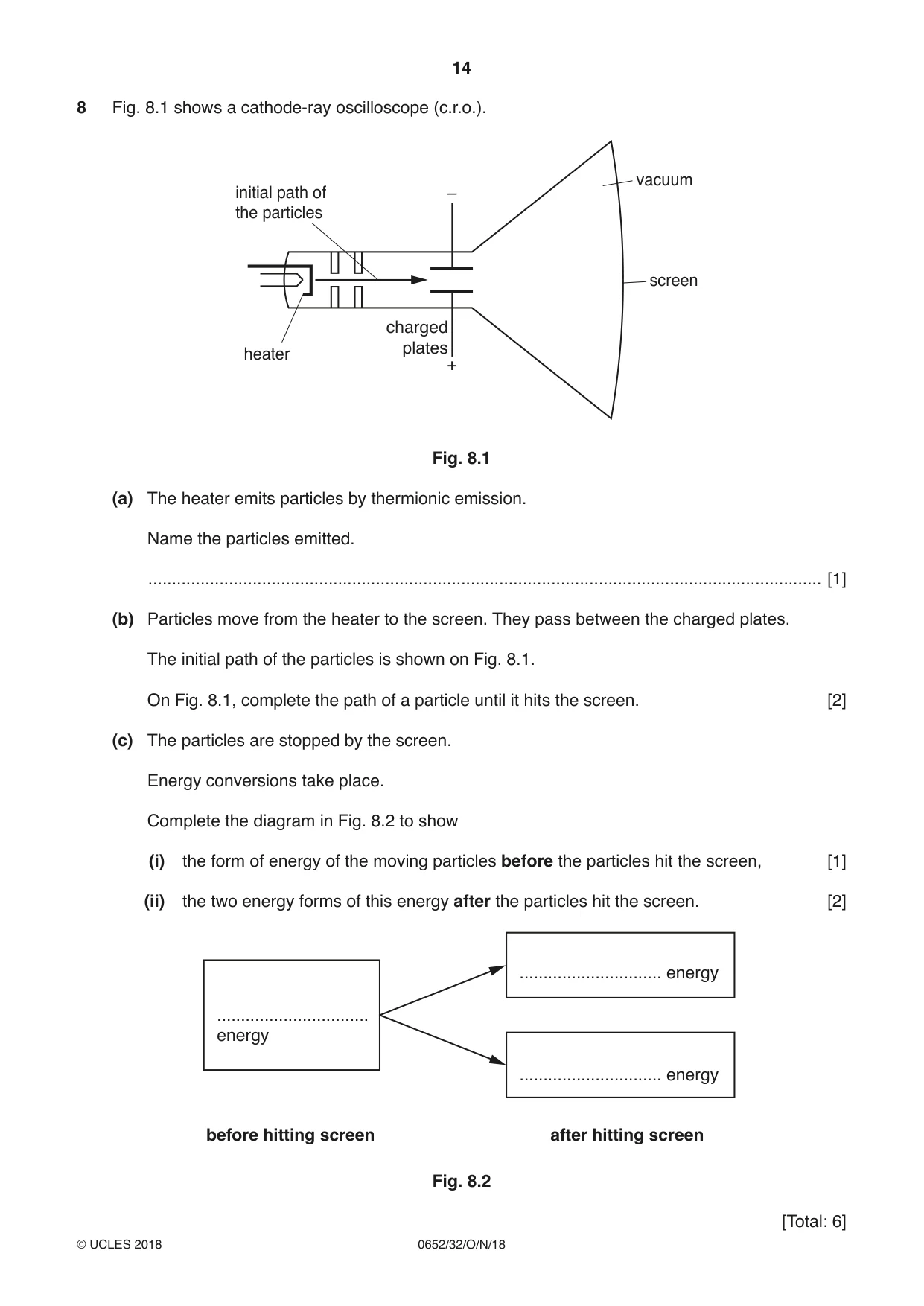
8 Fig. 8.1 shows a cathode-ray oscilloscope (c.r.o.). vacuum initial path of – the particles screen charged plates heater + Fig. 8.1 (a) The heater emits particles by thermionic emission. Name the particles emitted. .............................................................................................................................................. [1] (b) Particles move from the heater to the screen. They pass between the charged plates. The initial path of the particles is shown on Fig. 8.1. On Fig. 8.1, complete the path of a particle until it hits the screen. [2] (c) The particles are stopped by the screen. Energy conversions take place. Complete the diagram in Fig. 8.2 to show (i) the form of energy of the moving particles before the particles hit the screen, [1] (ii) the two energy forms of this energy after the particles hit the screen. [2] .............................. energy ................................ energy .............................. energy before hitting screen after hitting screen Fig. 8.2 [Total: 6]
Mark scheme: 8(a) electrons ; 1 8(b) electrons hit bottom half of screen ; path straight from plates to screen ; 2 8(c)(i), (ii) moving (energy) / energy of movement / kinetic (energy) ; light (energy) ; thermal / heat (energy) ; 3
Q9 · Calcium oxide (lime) and calcium hydroxide (slaked lime) are made from calcium carbonate…
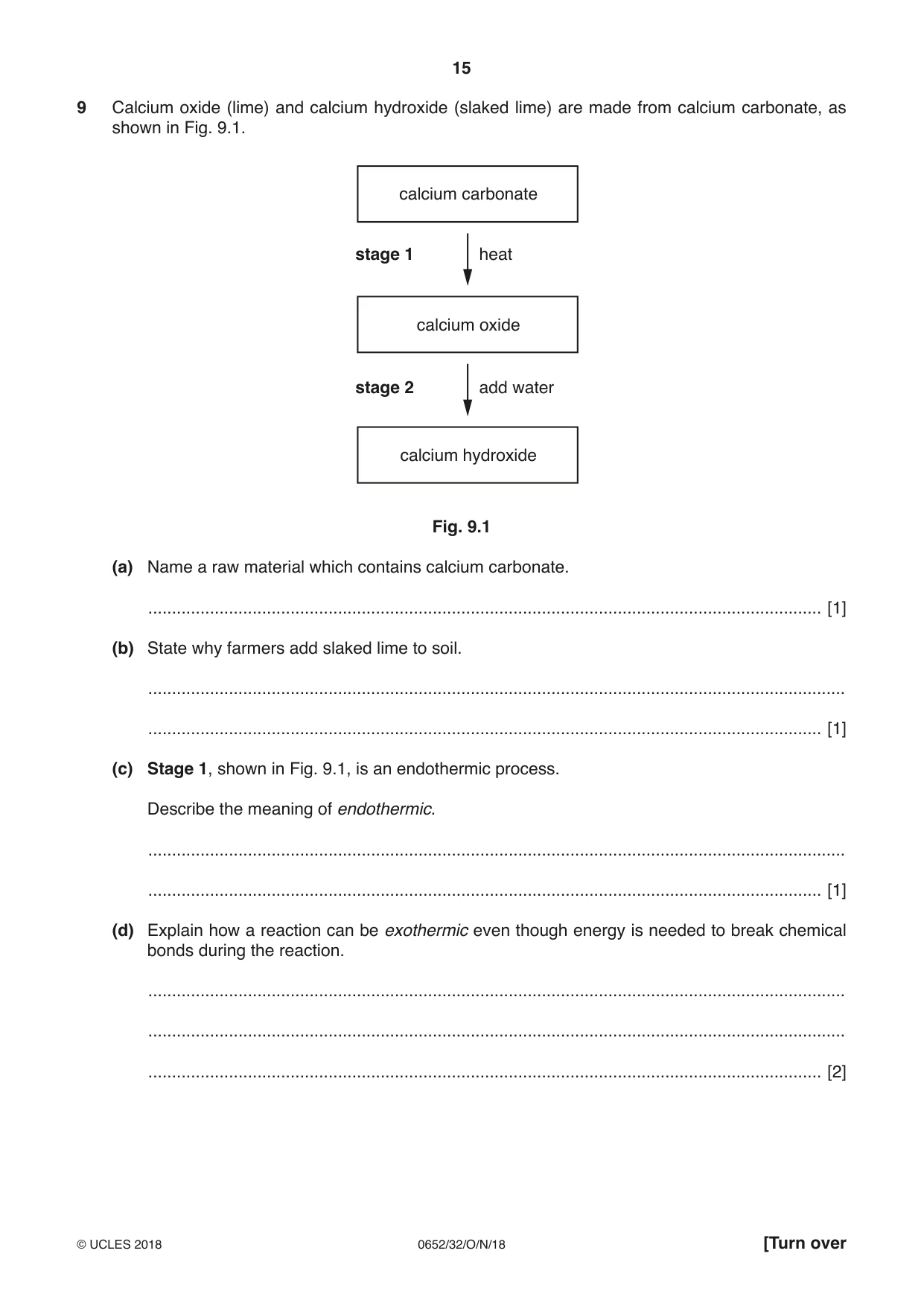
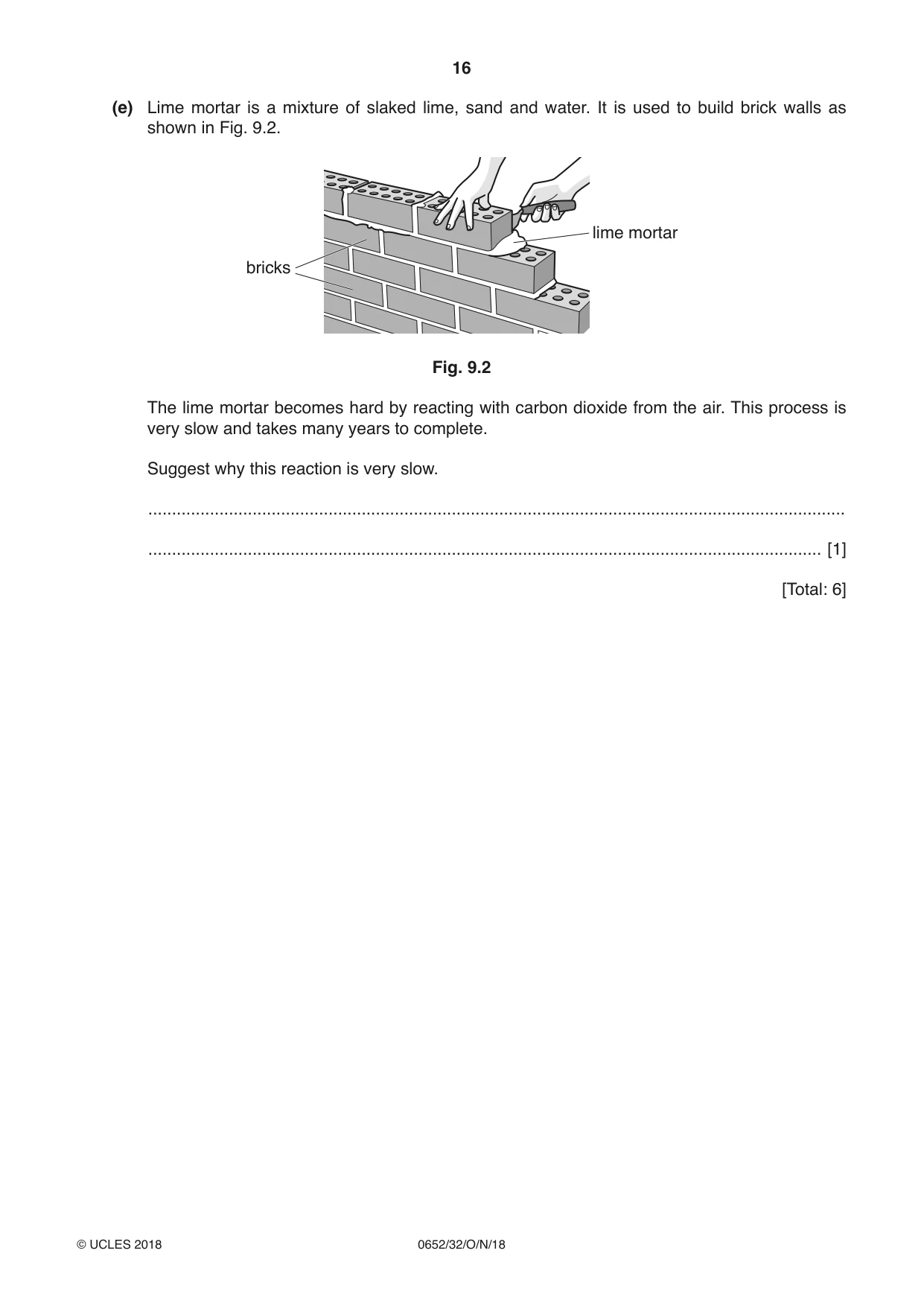
9 Calcium oxide (lime) and calcium hydroxide (slaked lime) are made from calcium carbonate, as shown in Fig. 9.1. calcium carbonate stage 1 heat calcium oxide stage 2 add water calcium hydroxide Fig. 9.1 (a) Name a raw material which contains calcium carbonate. .............................................................................................................................................. [1] (b) State why farmers add slaked lime to soil. ................................................................................................................................................... .............................................................................................................................................. [1] (c) Stage 1, shown in Fig. 9.1, is an endothermic process. Describe the meaning of endothermic. ................................................................................................................................................... .............................................................................................................................................. [1] (d) Explain how a reaction can be exothermic even though energy is needed to break chemical bonds during the reaction. ................................................................................................................................................... ................................................................................................................................................... .............................................................................................................................................. [2] (e) Lime mortar is a mixture of slaked lime, sand and water. It is used to build brick walls as shown in Fig. 9.2. lime mortar bricks Fig. 9.2 The lime mortar becomes hard by reacting with carbon dioxide from the air. This process is very slow and takes many years to complete. Suggest why this reaction is very slow. ................................................................................................................................................... .............................................................................................................................................. [1] [Total: 6]
Mark scheme: 9(a) limestone ; 1 9(b) neutralise OR (treat) acidic soil ; 1 9(c) absorbs energy ; 1 9(d) making bonds releases energy ; more (energy) released than taken in ; 2 9(e) any one from: • concentration of carbon dioxide in atmosphere very low • (reaction taking place at) low temperature ; 1
Q10 · Tritium is a radioactive isotope of hydrogen
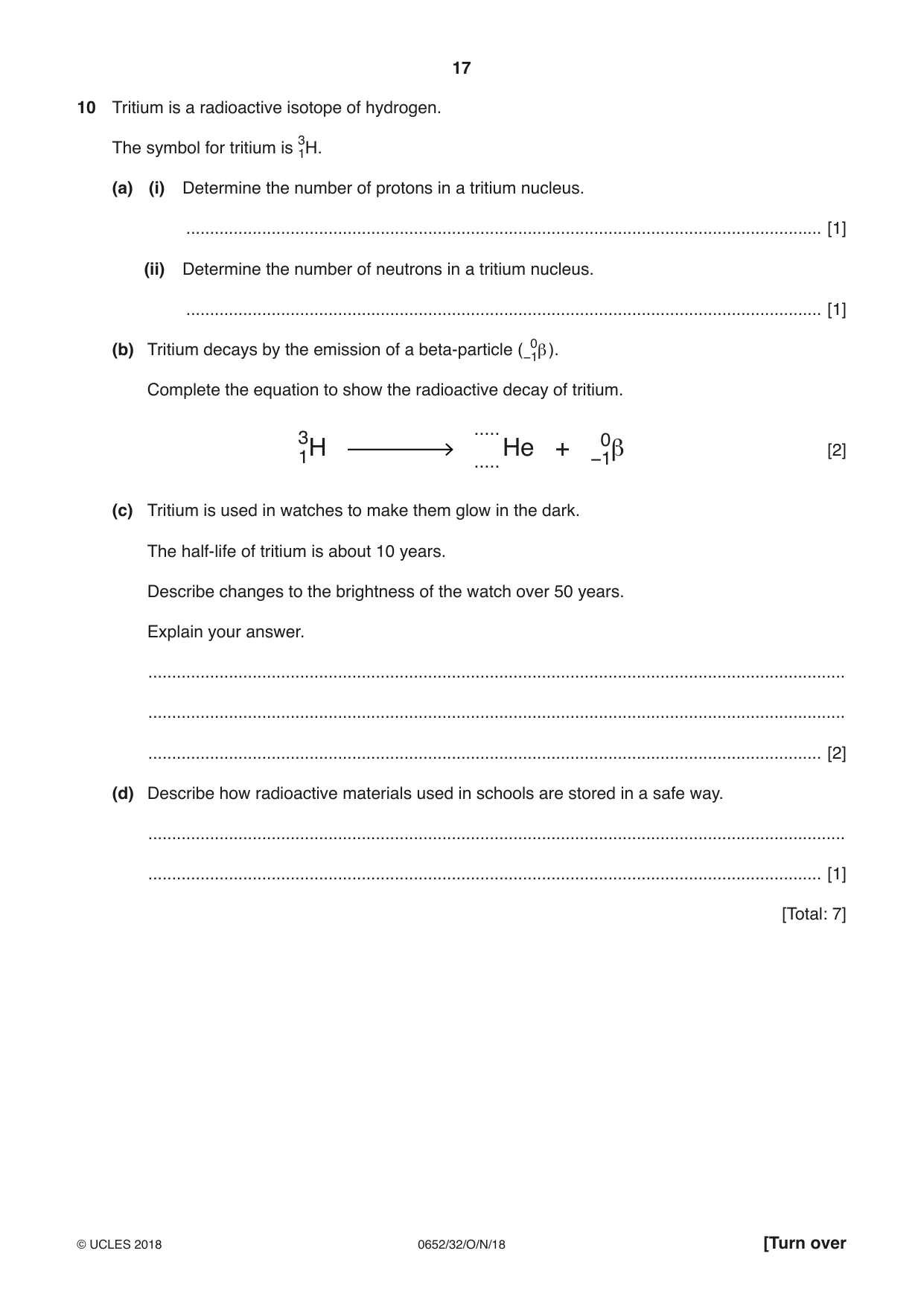
10 Tritium is a radioactive isotope of hydrogen. The symbol for tritium is 3H1 . (a) (i) Determine the number of protons in a tritium nucleus. ...................................................................................................................................... [1] (ii) Determine the number of neutrons in a tritium nucleus. ...................................................................................................................................... [1] (b) Tritium decays by the emission of a beta-particle ( −10β ). Complete the equation to show the radioactive decay of tritium. ..... 0β [2] + −1 3H1 .....He (c) Tritium is used in watches to make them glow in the dark. The half-life of tritium is about 10 years. Describe changes to the brightness of the watch over 50 years. Explain your answer. ................................................................................................................................................... ................................................................................................................................................... .............................................................................................................................................. [2] (d) Describe how radioactive materials used in schools are stored in a safe way. ................................................................................................................................................... .............................................................................................................................................. [1] [Total: 7]
Mark scheme: 10(a)(i), (ii) one ; two ; 2 10(b) (mass no) = 3 ; (proton no) = 2 ; 2 10(c) becomes dimmer ; (almost) stops glowing / brightness halves every 10 years ; 2 10(d) locked cabinet / shielding ; 1
Q11 · Ethene, C2H4, forms poly(ethene) by addition polymerisation
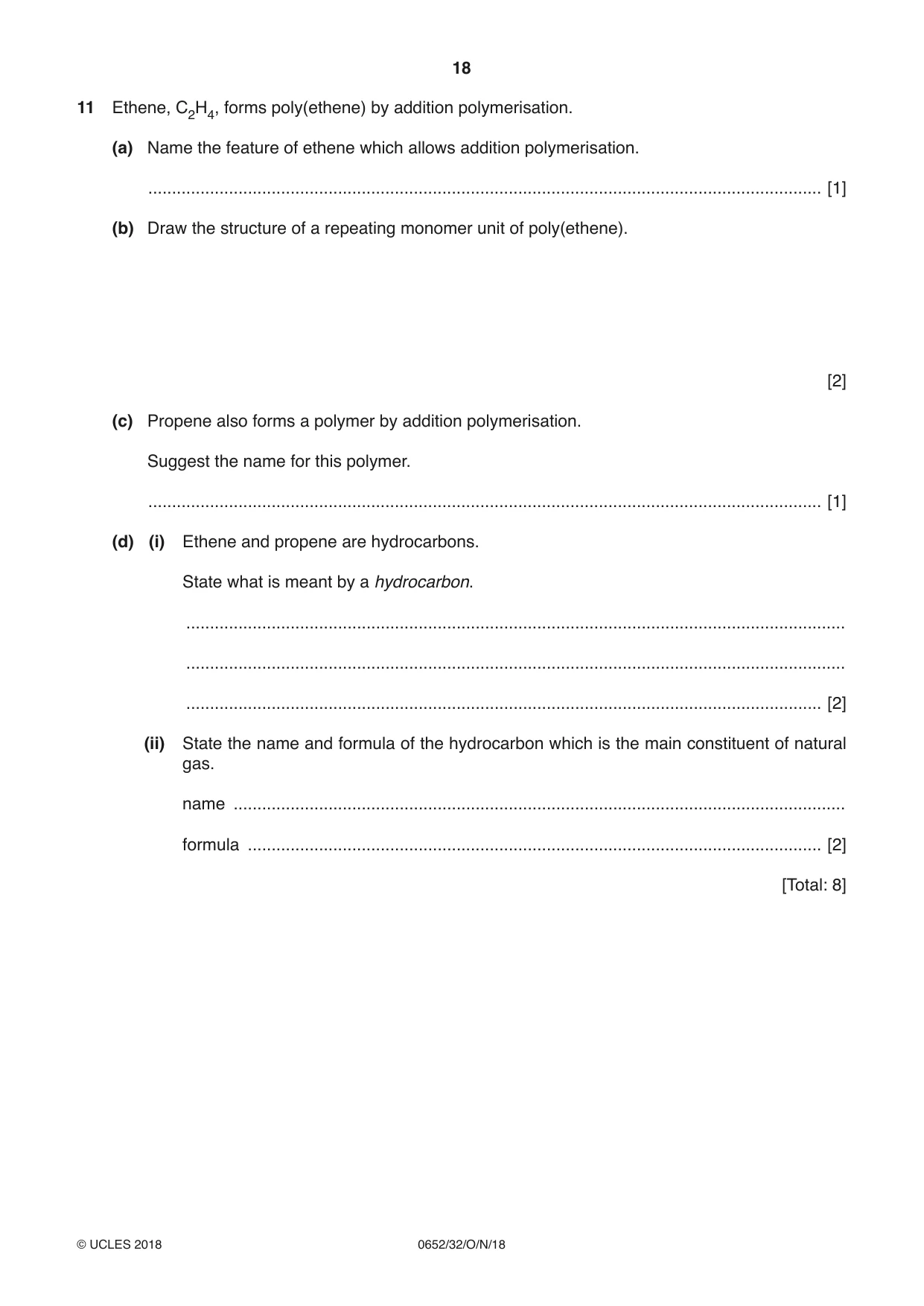
11 Ethene, C2H4, forms poly(ethene) by addition polymerisation. (a) Name the feature of ethene which allows addition polymerisation. .............................................................................................................................................. [1] (b) Draw the structure of a repeating monomer unit of poly(ethene). [2] (c) Propene also forms a polymer by addition polymerisation. Suggest the name for this polymer. .............................................................................................................................................. [1] (d) (i) Ethene and propene are hydrocarbons. State what is meant by a hydrocarbon. ........................................................................................................................................... ........................................................................................................................................... ...................................................................................................................................... [2] (ii) State the name and formula of the hydrocarbon which is the main constituent of natural gas. name ................................................................................................................................. formula ......................................................................................................................... [2] [Total: 8]
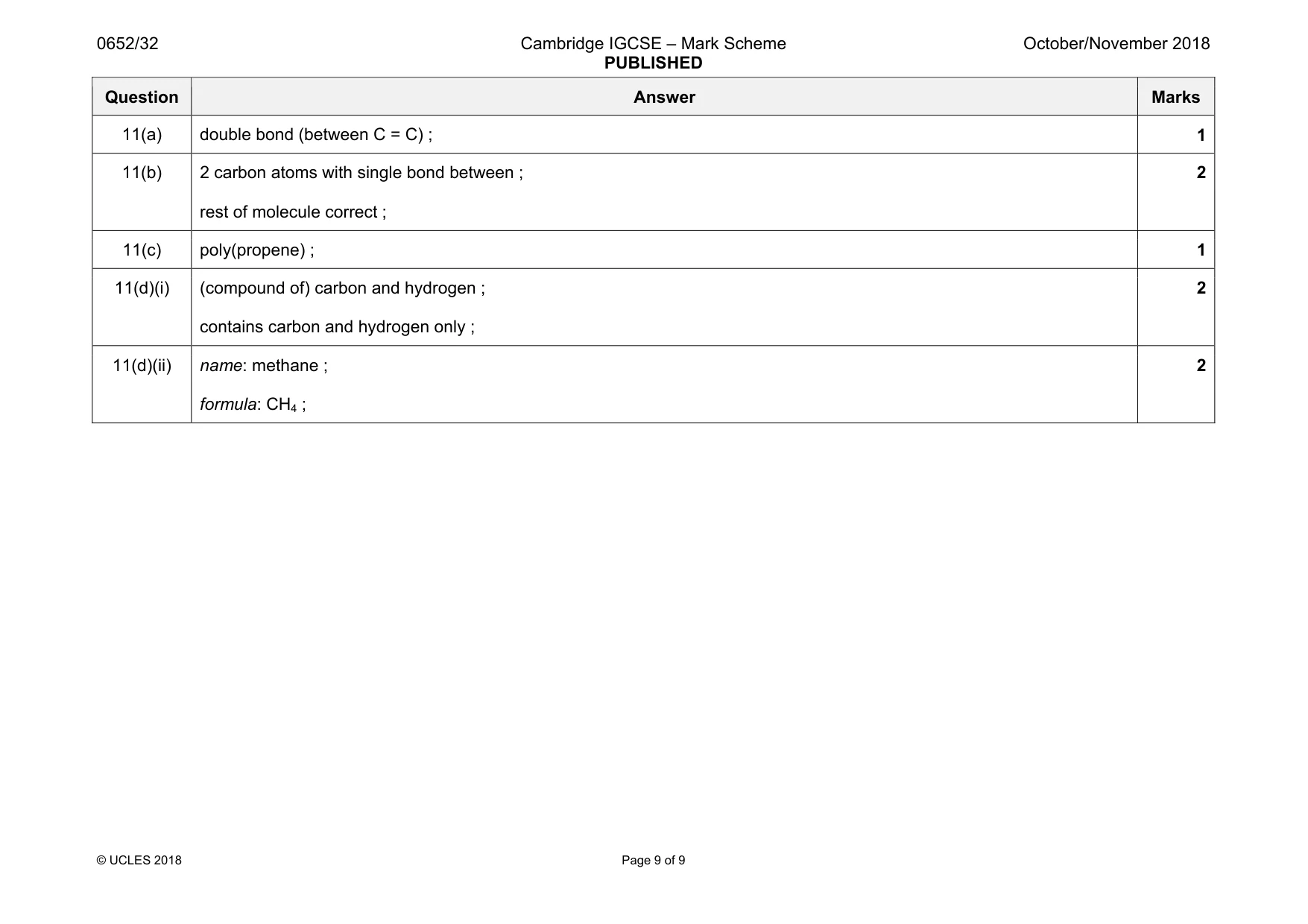
Mark scheme: 11(a) double bond (between C = C) ; 1 11(b) 2 carbon atoms with single bond between ; rest of molecule correct ; 2 11(c) poly(propene) ; 1 11(d)(i) (compound of) carbon and hydrogen ; contains carbon and hydrogen only ; 2 11(d)(ii) name: methane ; formula: CH4 ; 2
What was in this paper
The subtopics covered by these 11 questions, and how many questions each got. Open one in a new tab to see every Cambridge question on it.
What you needed in this session
Cambridge’s own grade thresholds for 2018 Oct/Nov, Paper 3 · Variant 2. A higher threshold means an easier paper — the bar moves with how the cohort did.