Cambridge IGCSE Physical Education 0413 — 2022 Oct/Nov Paper 1 · Variant 3
0413/13/O/N/22 · 100 marks · ≈113 min
The question paper and its mark scheme, free to read here and free to download. This is Cambridge’s own paper, exactly as it was sat.
Question paper16 pages


Mark scheme18 pages
Answers below. Sit the paper first if you are practising.
Paper as text
Question paper, page 1
This document has 16 pages. Any blank pages are indicated. [Turn over DC (RW/CB) 302914/2 © UCLES 2022 * 7 8 3 6 3 3 0 1 1 9 * PHYSICAL EDUCATION 0413/13 Paper 1 Theory October/November 2022 1 hour 45 minutes You must answer on the question paper. No additional materials are needed. INSTRUCTIONS ● Answer all questions. ● Use a black or dark blue pen. You may use an HB pencil for any diagrams or graphs. ● Write your name, centre number and candidate number in the boxes at the top of the page. ● Write your answer to each question in the space provided. ● Do not use an erasable pen or correction fluid. ● Do not write on any bar codes. ● You may use a calculator. ● You should show all your working and use appropriate units. INFORMATION ● The total mark for this paper is 100. ● The number of marks for each question or part question is shown in brackets [ ]. Cambridge IGCSE™
Question paper, page 2
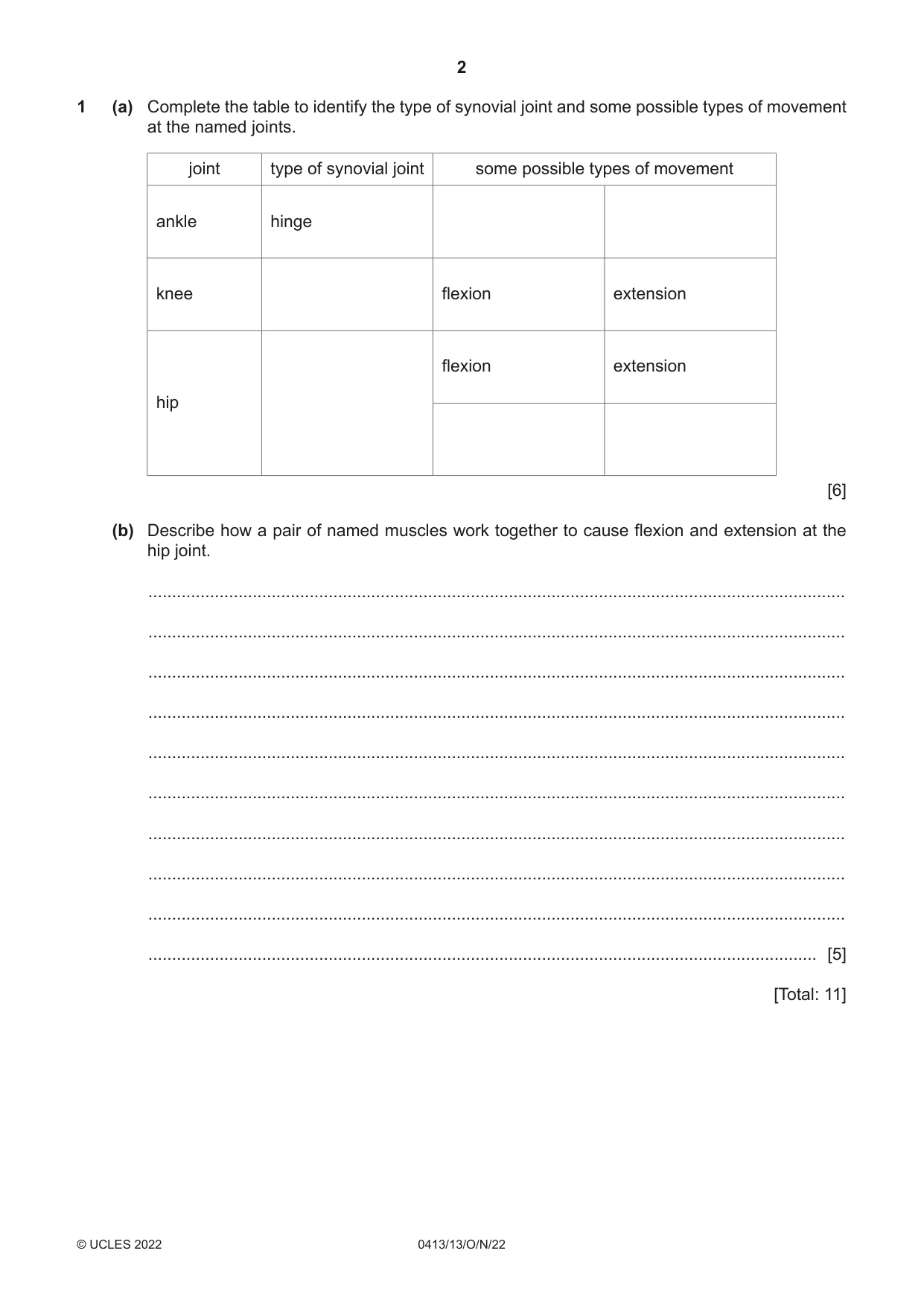
2 0413/13/O/N/22 © UCLES 2022 1 (a) Complete the table to identify the type of synovial joint and some possible types of movement at the named joints. joint type of synovial joint some possible types of movement ankle hinge knee flexion extension hip flexion extension [6] (b) Describe how a pair of named muscles work together to cause flexion and extension at the hip joint. … … … … … … … … … … [5] [Total: 11]
Question paper, page 3
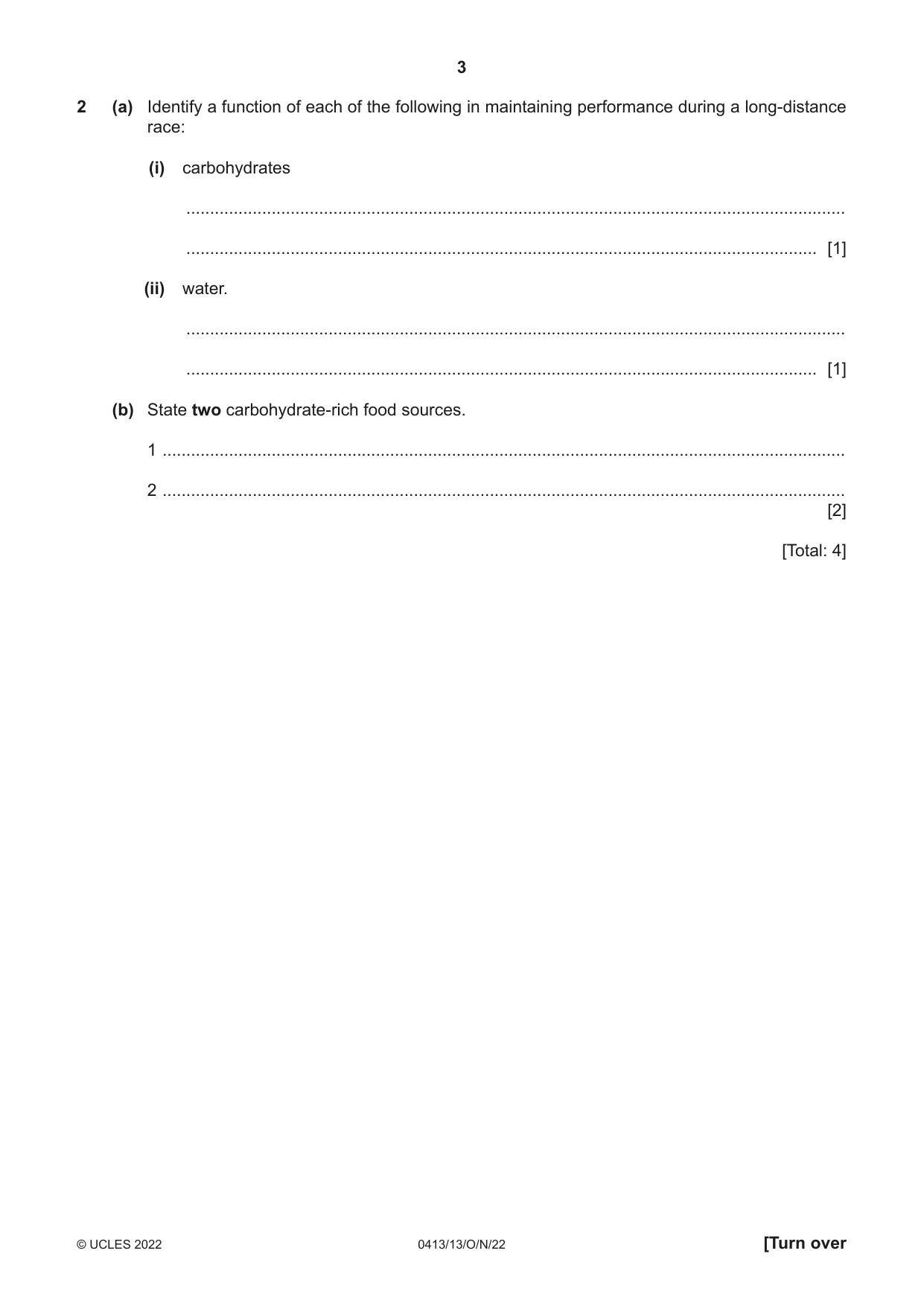
3 0413/13/O/N/22 © UCLES 2022 [Turn over 2 (a) Identify a function of each of the following in maintaining performance during a long‑distance race: (i) carbohydrates … … [1] (ii) water. … … [1] (b) State two carbohydrate‑rich food sources. 1 … 2 … [2] [Total: 4]
Question paper, page 4
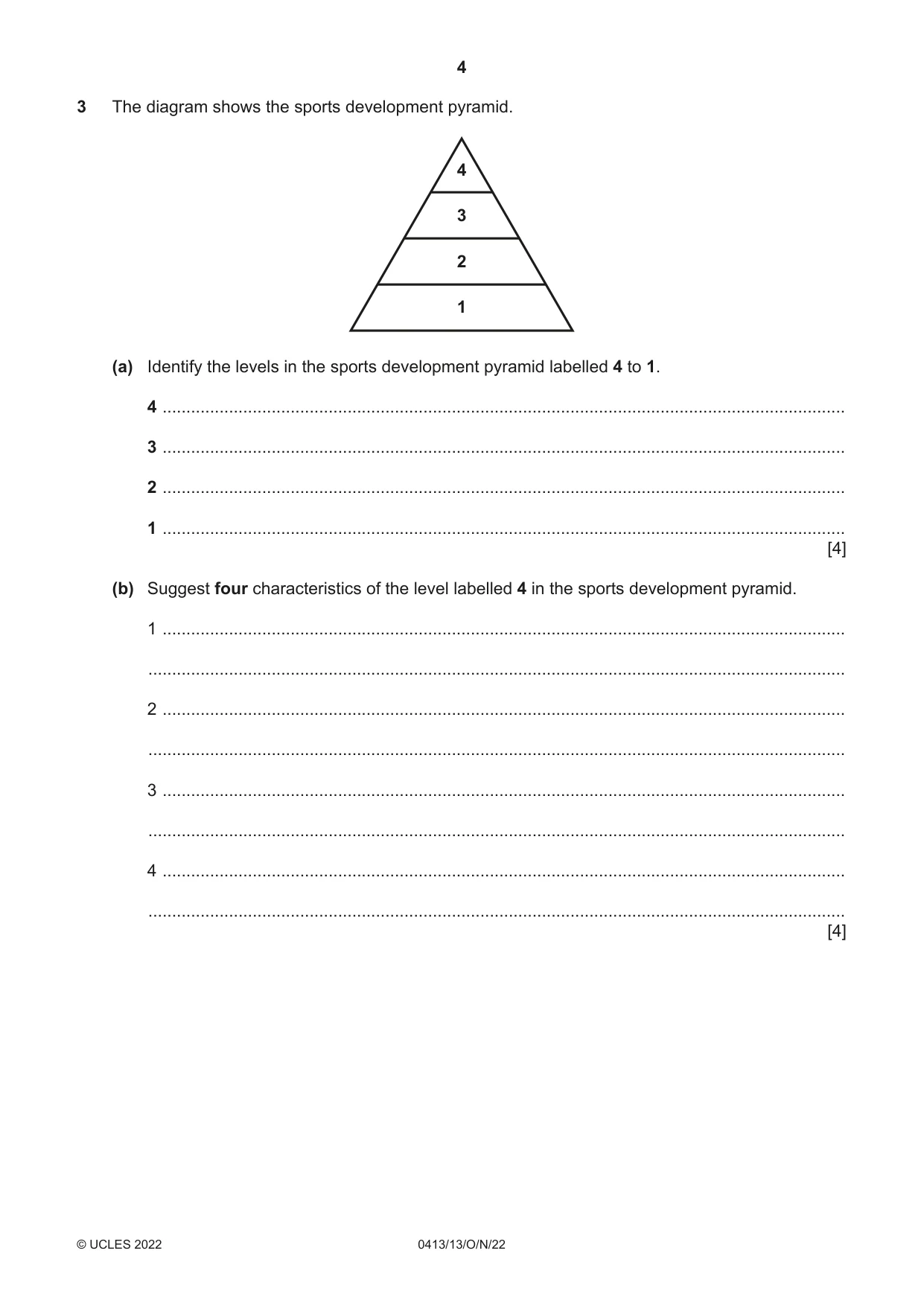
4 0413/13/O/N/22 © UCLES 2022 3 The diagram shows the sports development pyramid. 4 3 2 1 (a) Identify the levels in the sports development pyramid labelled 4 to 1. 4 … 3 … 2 … 1 … [4] (b) Suggest four characteristics of the level labelled 4 in the sports development pyramid. 1 … … 2 … … 3 … … 4 … … [4]
Question paper, page 5
5 0413/13/O/N/22 © UCLES 2022 [Turn over (c) Suggest ways that schools can affect the number of performers at the levels labelled 1 and 2 in the sports development pyramid. … … … … … … … … … … [5] [Total: 13] 4 (a) Describe three short‑term effects of exercise on a performer. 1 … … 2 … … 3 … … [3] (b) Explain how EPOC allows the body to recover after intense exercise. … … … … … … [3] [Total: 6]
Question paper, page 6
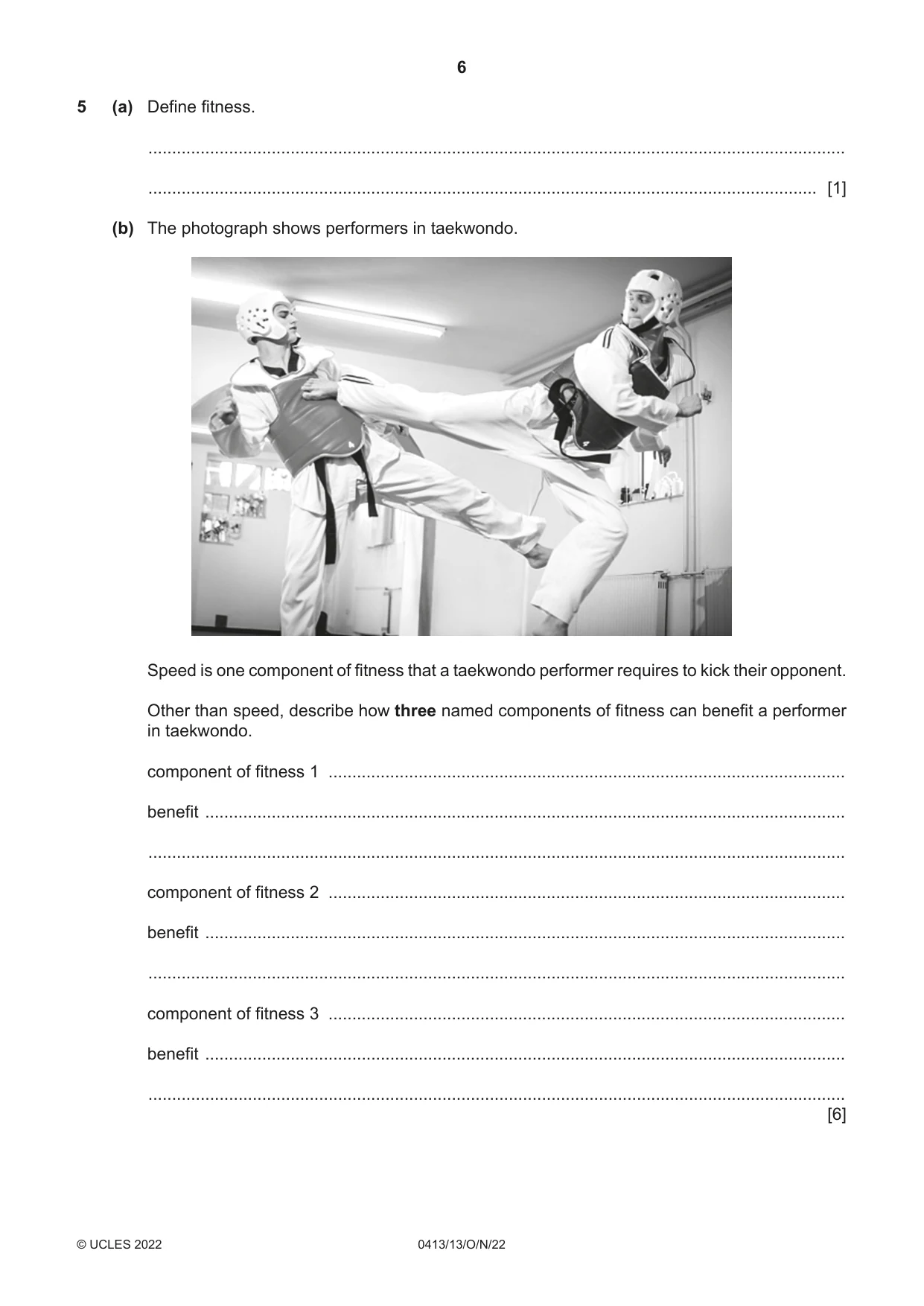
6 0413/13/O/N/22 © UCLES 2022 5 (a) Define fitness. … … [1] (b) The photograph shows performers in taekwondo. Speed is one component of fitness that a taekwondo performer requires to kick their opponent. Other than speed, describe how three named components of fitness can benefit a performer in taekwondo. component of fitness 1 … benefit … … component of fitness 2 … benefit … … component of fitness 3 … benefit … … [6]
Question paper, page 7
7 0413/13/O/N/22 © UCLES 2022 [Turn over (c) Describe how to carry out a named test to measure speed. name of test … description … … … … … … … … [4] (d) Suggest reasons why a coach would carry out fitness testing on a performer. … … … … … … … … [4] [Total: 15]
Question paper, page 8
8 0413/13/O/N/22 © UCLES 2022 6 Complete the table to identify two other types of guidance. Describe a different advantage of each type of guidance for a performer in the cognitive stage of learning. type of guidance advantage visual performer can form a mental picture of the skill [4] 7 Success in sport requires performers to have high levels of motivation. (a) Describe what is meant by motivation. … … [1] (b) Explain how two named types of motivation can affect a performer’s training. type of motivation 1 … explanation … … type of motivation 2 … explanation … … [4] [Total: 5]
Question paper, page 9
9 0413/13/O/N/22 © UCLES 2022 [Turn over 8 (a) Identify three types of performance‑enhancing drug (PED). Explain how each type of PED can benefit performance in different named physical activities. type of PED 1 … physical activity 1 … explanation … … type of PED 2 … physical activity 2 … explanation … … type of PED 3 … physical activity 3 … explanation … … [6] (b) Suggest two reasons, other than benefits to performance, why a performer might take prohibited PEDs. 1 … … 2 … … [2] (c) Suggest two different health risks for a performer from taking prohibited PEDs. 1 … 2 … [2] [Total: 10]
Question paper, page 10
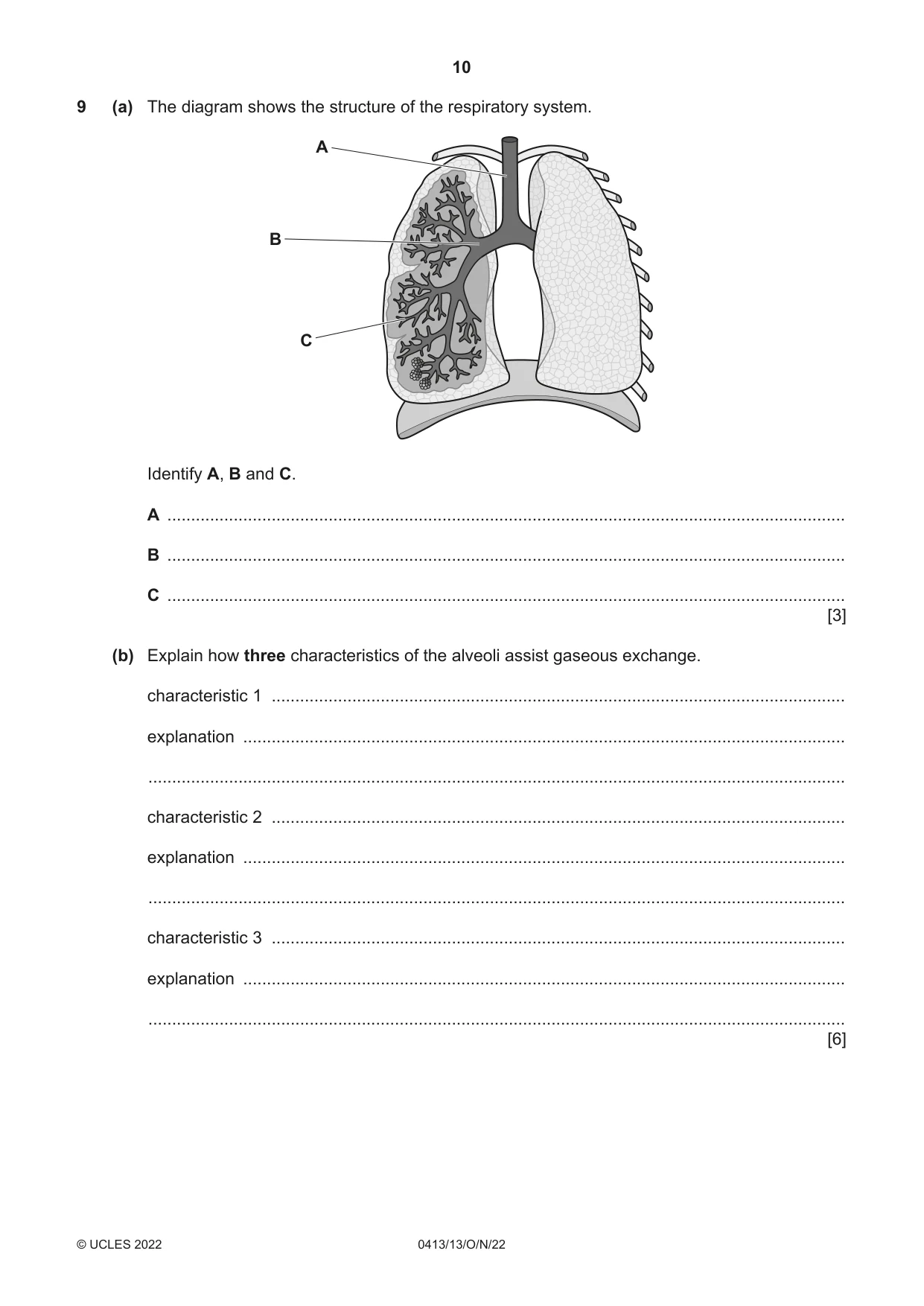
10 0413/13/O/N/22 © UCLES 2022 9 (a) The diagram shows the structure of the respiratory system. A B C Identify A, B and C. A … B … C … [3] (b) Explain how three characteristics of the alveoli assist gaseous exchange. characteristic 1 … explanation … … characteristic 2 … explanation … … characteristic 3 … explanation … … [6]
Question paper, page 11
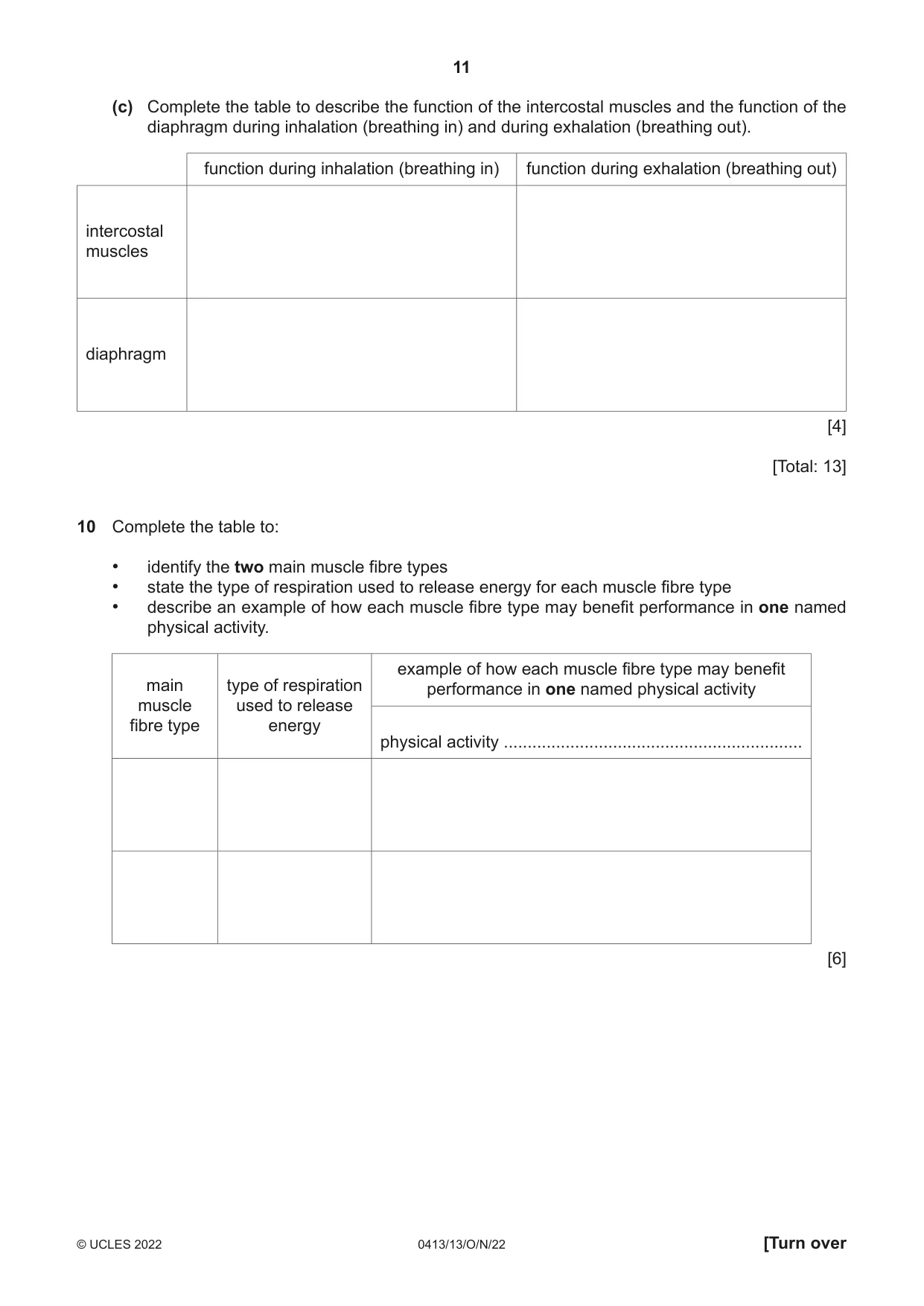
11 0413/13/O/N/22 © UCLES 2022 [Turn over (c) Complete the table to describe the function of the intercostal muscles and the function of the diaphragm during inhalation (breathing in) and during exhalation (breathing out). function during inhalation (breathing in) function during exhalation (breathing out) intercostal muscles diaphragm [4] [Total: 13] 10 Complete the table to: • identify the two main muscle fibre types • state the type of respiration used to release energy for each muscle fibre type • describe an example of how each muscle fibre type may benefit performance in one named physical activity. main muscle fibre type type of respiration used to release energy example of how each muscle fibre type may benefit performance in one named physical activity physical activity … [6]
Question paper, page 12
12 0413/13/O/N/22 © UCLES 2022 11 Fartlek training is one method of training. (a) Describe fartlek training. … … … … [2] (b) (i) Suggest two advantages of using fartlek training. 1 … … 2 … … [2] (ii) Suggest one disadvantage of using fartlek training. … … [1] [Total: 5]
Question paper, page 13
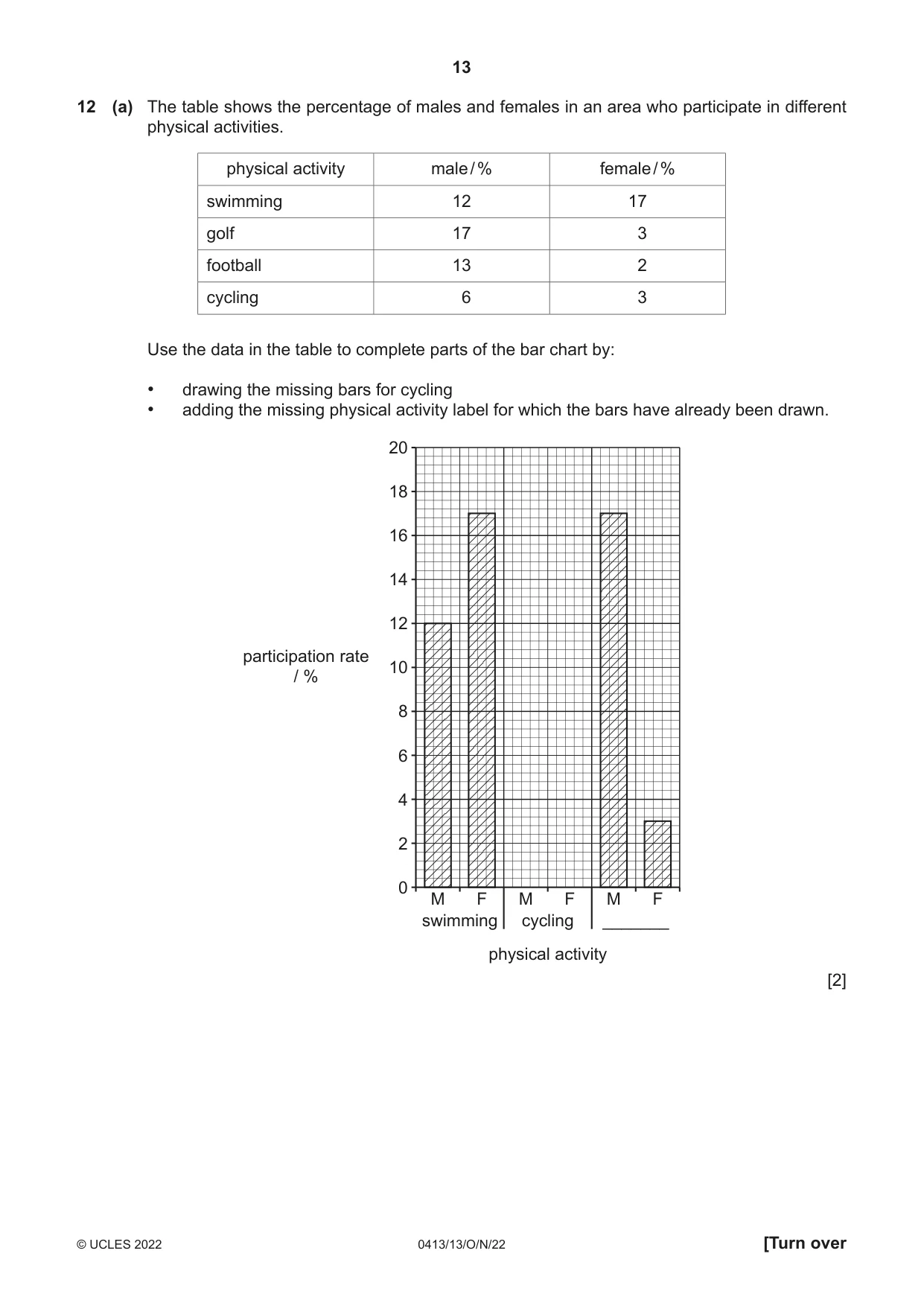
13 0413/13/O/N/22 © UCLES 2022 [Turn over 12 (a) The table shows the percentage of males and females in an area who participate in different physical activities. physical activity male / % female / % swimming 12 17 golf 17 3 football 13 2 cycling 6 3 Use the data in the table to complete parts of the bar chart by: • drawing the missing bars for cycling • adding the missing physical activity label for which the bars have already been drawn. 0 M F swimming cycling physical activity participation rate / % _______ M F M F 2 4 6 8 10 12 14 16 18 20 [2]
Question paper, page 14
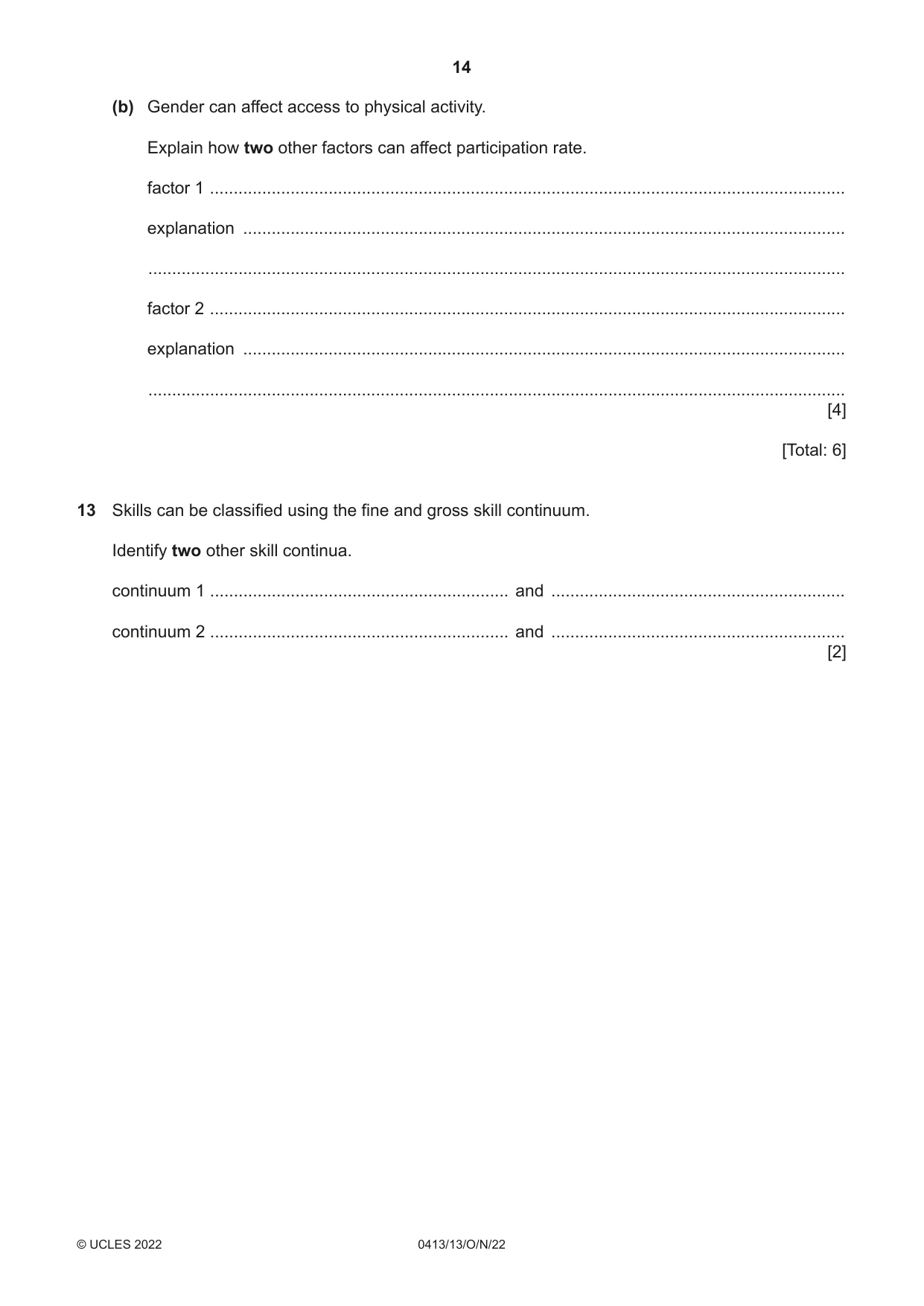
14 0413/13/O/N/22 © UCLES 2022 (b) Gender can affect access to physical activity. Explain how two other factors can affect participation rate. factor 1 … explanation … … factor 2 … explanation … … [4] [Total: 6] 13 Skills can be classified using the fine and gross skill continuum. Identify two other skill continua. continuum 1 … and … continuum 2 … and … [2]
Question paper, page 15
15 0413/13/O/N/22 © UCLES 2022 BLANK PAGE
Question paper, page 16
16 0413/13/O/N/22 © UCLES 2022 Permission to reproduce items where third‑party owned material protected by copyright is included has been sought and cleared where possible. Every reasonable effort has been made by the publisher (UCLES) to trace copyright holders, but if any items requiring clearance have unwittingly been included, the publisher will be pleased to make amends at the earliest possible opportunity. To avoid the issue of disclosure of answer‑related information to candidates, all copyright acknowledgements are reproduced online in the Cambridge Assessment International Education Copyright Acknowledgements Booklet. This is produced for each series of examinations and is freely available to download at www.cambridgeinternational.org after the live examination series. Cambridge Assessment International Education is part of Cambridge Assessment. Cambridge Assessment is the brand name of the University of Cambridge Local Examinations Syndicate (UCLES), which is a department of the University of Cambridge. BLANK PAGE
Mark scheme, page 1
This document consists of 18 printed pages. © UCLES 2022 [Turn over Cambridge IGCSE™ PHYSICAL EDUCATION 0413/13 Paper 1 Theory October/November 2022 MARK SCHEME Maximum Mark: 100 Published This mark scheme is published as an aid to teachers and candidates, to indicate the requirements of the examination. It shows the basis on which Examiners were instructed to award marks. It does not indicate the details of the discussions that took place at an Examiners’ meeting before marking began, which would have considered the acceptability of alternative answers. Mark schemes should be read in conjunction with the question paper and the Principal Examiner Report for Teachers. Cambridge International will not enter into discussions about these mark schemes. Cambridge International is publishing the mark schemes for the October/November 2022 series for most Cambridge IGCSE™, Cambridge International A and AS Level components and some Cambridge O Level components.
Mark scheme, page 2
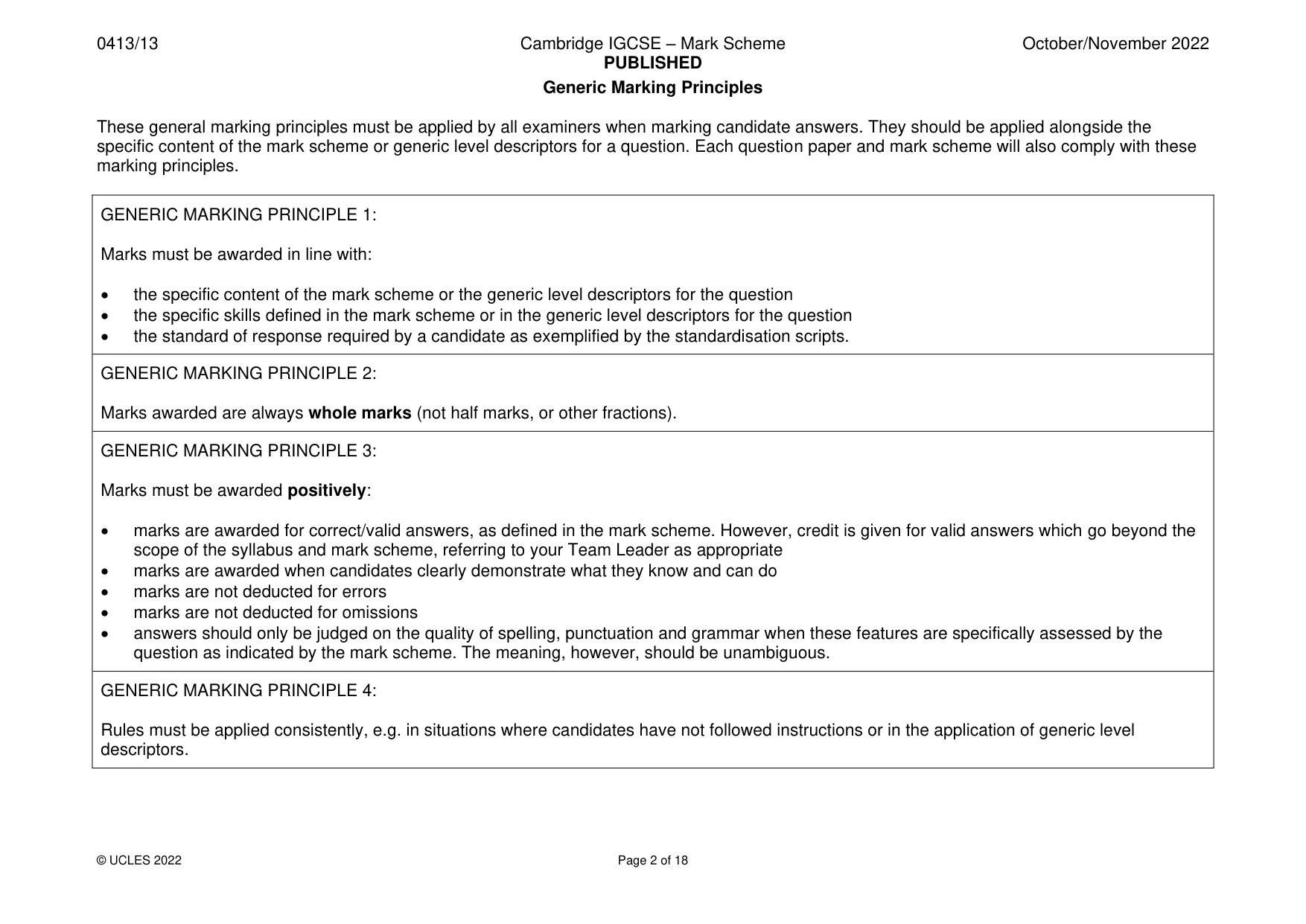
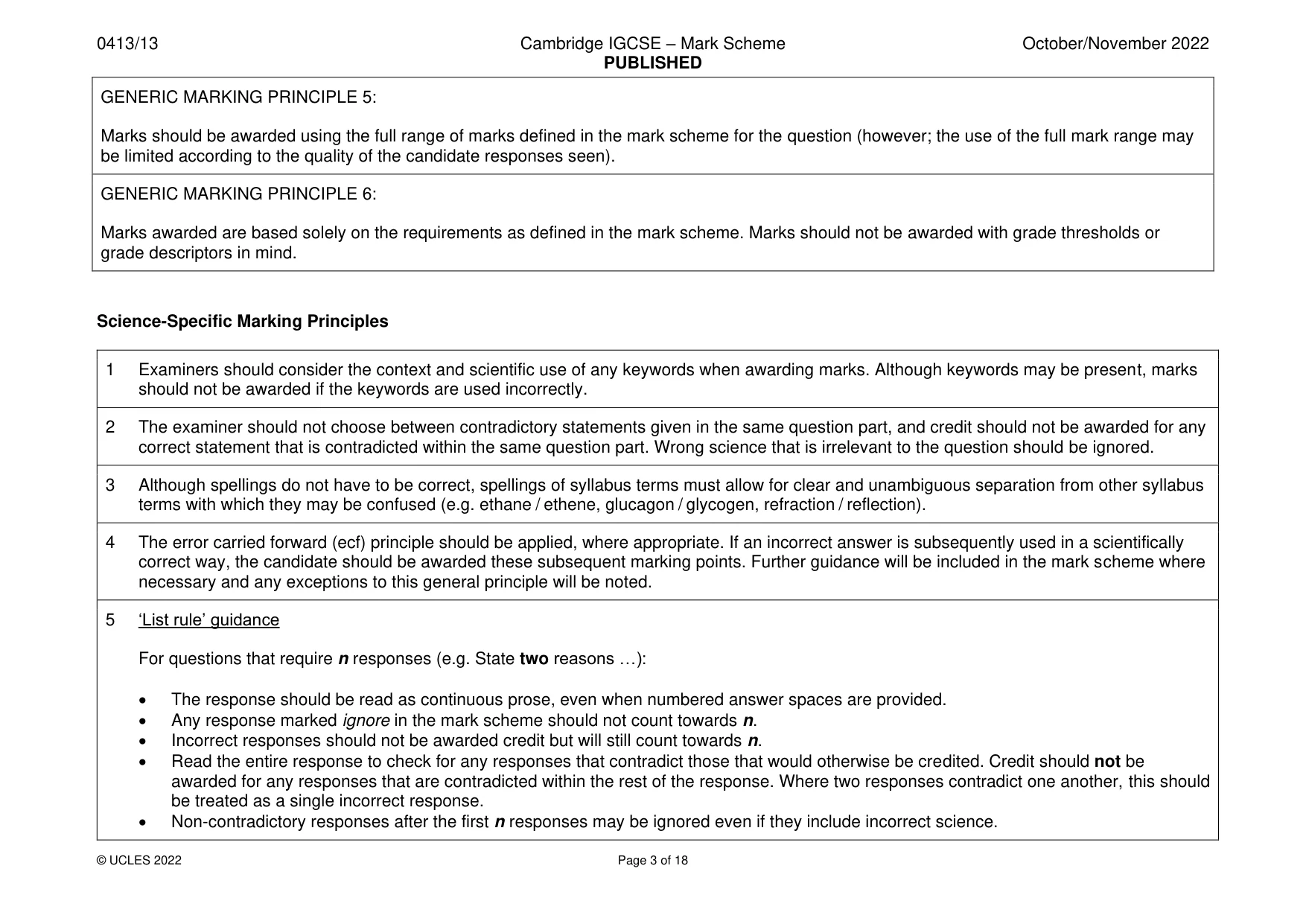
0413/13 Cambridge IGCSE – Mark Scheme PUBLISHED October/November 2022 © UCLES 2022 Page 2 of 18 Generic Marking Principles These general marking principles must be applied by all examiners when marking candidate answers. They should be applied alongside the specific content of the mark scheme or generic level descriptors for a question. Each question paper and mark scheme will also comply with these marking principles. GENERIC MARKING PRINCIPLE 1: Marks must be awarded in line with: • the specific content of the mark scheme or the generic level descriptors for the question • the specific skills defined in the mark scheme or in the generic level descriptors for the question • the standard of response required by a candidate as exemplified by the standardisation scripts. GENERIC MARKING PRINCIPLE 2: Marks awarded are always whole marks (not half marks, or other fractions). GENERIC MARKING PRINCIPLE 3: Marks must be awarded positively: • marks are awarded for correct/valid answers, as defined in the mark scheme. However, credit is given for valid answers which go beyond the scope of the syllabus and mark scheme, referring to your Team Leader as appropriate • marks are awarded when candidates clearly demonstrate what they know and can do • marks are not deducted for errors • marks are not deducted for omissions • answers should only be judged on the quality of spelling, punctuation and grammar when these features are specifically assessed by the question as indicated by the mark scheme. The meaning, however, should be unambiguous. GENERIC MARKING PRINCIPLE 4: Rules must be applied consistently, e.g. in situations where candidates have not followed instructions or in the application of generic level descriptors.
Mark scheme, page 3
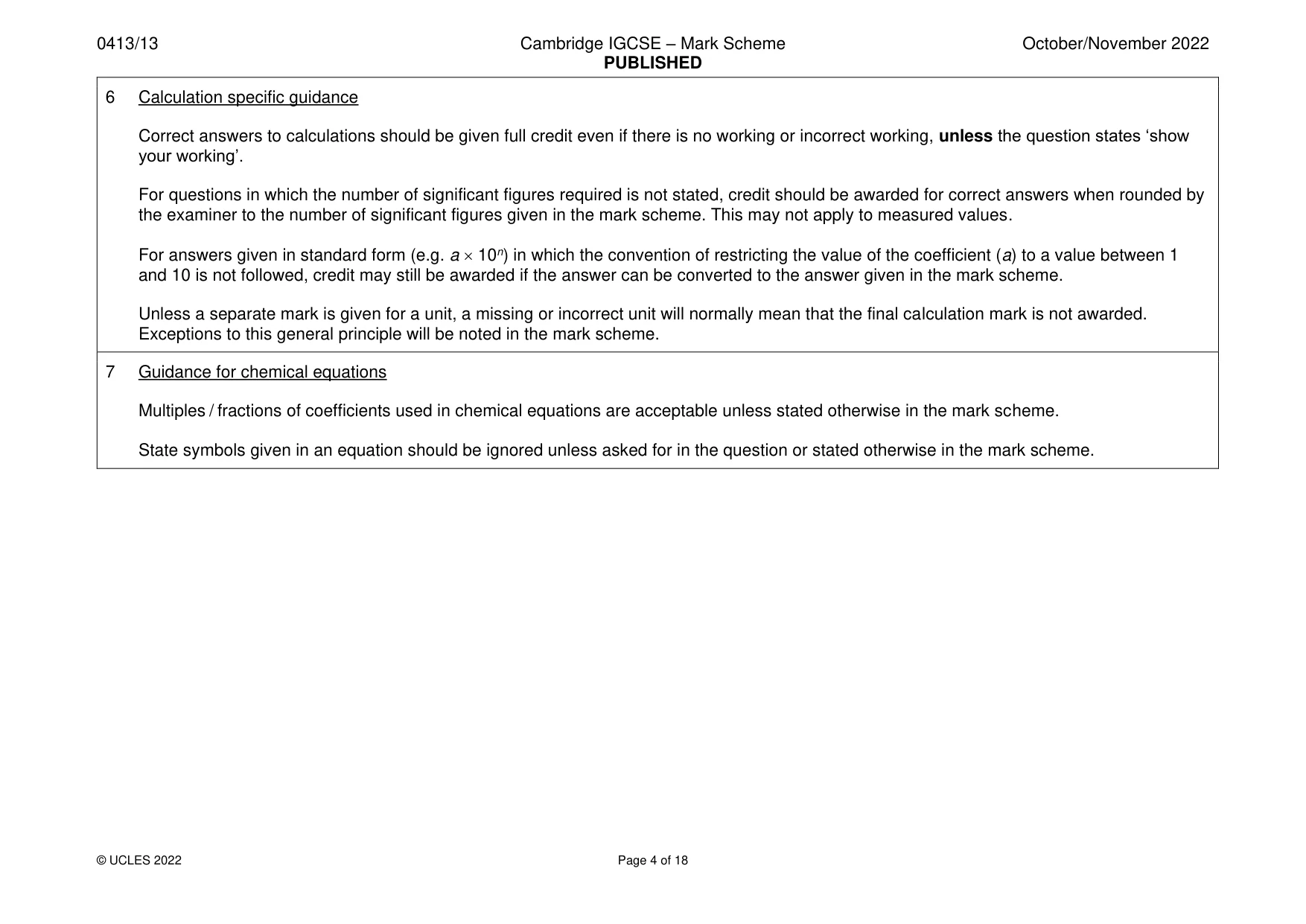
0413/13 Cambridge IGCSE – Mark Scheme PUBLISHED October/November 2022 © UCLES 2022 Page 3 of 18 GENERIC MARKING PRINCIPLE 5: Marks should be awarded using the full range of marks defined in the mark scheme for the question (however; the use of the full mark range may be limited according to the quality of the candidate responses seen). GENERIC MARKING PRINCIPLE 6: Marks awarded are based solely on the requirements as defined in the mark scheme. Marks should not be awarded with grade thresholds or grade descriptors in mind. Science-Specific Marking Principles 1 Examiners should consider the context and scientific use of any keywords when awarding marks. Although keywords may be present, marks should not be awarded if the keywords are used incorrectly. 2 The examiner should not choose between contradictory statements given in the same question part, and credit should not be awarded for any correct statement that is contradicted within the same question part. Wrong science that is irrelevant to the question should be ignored. 3 Although spellings do not have to be correct, spellings of syllabus terms must allow for clear and unambiguous separation from other syllabus terms with which they may be confused (e.g. ethane / ethene, glucagon / glycogen, refraction / reflection). 4 The error carried forward (ecf) principle should be applied, where appropriate. If an incorrect answer is subsequently used in a scientifically correct way, the candidate should be awarded these subsequent marking points. Further guidance will be included in the mark scheme where necessary and any exceptions to this general principle will be noted. 5 ‘List rule’ guidance For questions that require n responses (e.g. State two reasons …): • The response should be read as continuous prose, even when numbered answer spaces are provided. • Any response marked ignore in the mark scheme should not count towards n. • Incorrect responses should not be awarded credit but will still count towards n. • Read the entire response to check for any responses that contradict those that would otherwise be credited. Credit should not be awarded for any responses that are contradicted within the rest of the response. Where two responses contradict one another, this should be treated as a single incorrect response. • Non-contradictory responses after the first n responses may be ignored even if they include incorrect science.
Mark scheme, page 4
0413/13 Cambridge IGCSE – Mark Scheme PUBLISHED October/November 2022 © UCLES 2022 Page 4 of 18 6 Calculation specific guidance Correct answers to calculations should be given full credit even if there is no working or incorrect working, unless the question states ‘show your working’. For questions in which the number of significant figures required is not stated, credit should be awarded for correct answers when rounded by the examiner to the number of significant figures given in the mark scheme. This may not apply to measured values. For answers given in standard form (e.g. a 10n) in which the convention of restricting the value of the coefficient (a) to a value between 1 and 10 is not followed, credit may still be awarded if the answer can be converted to the answer given in the mark scheme. Unless a separate mark is given for a unit, a missing or incorrect unit will normally mean that the final calculation mark is not awarded. Exceptions to this general principle will be noted in the mark scheme. 7 Guidance for chemical equations Multiples / fractions of coefficients used in chemical equations are acceptable unless stated otherwise in the mark scheme. State symbols given in an equation should be ignored unless asked for in the question or stated otherwise in the mark scheme.
Mark scheme, page 5
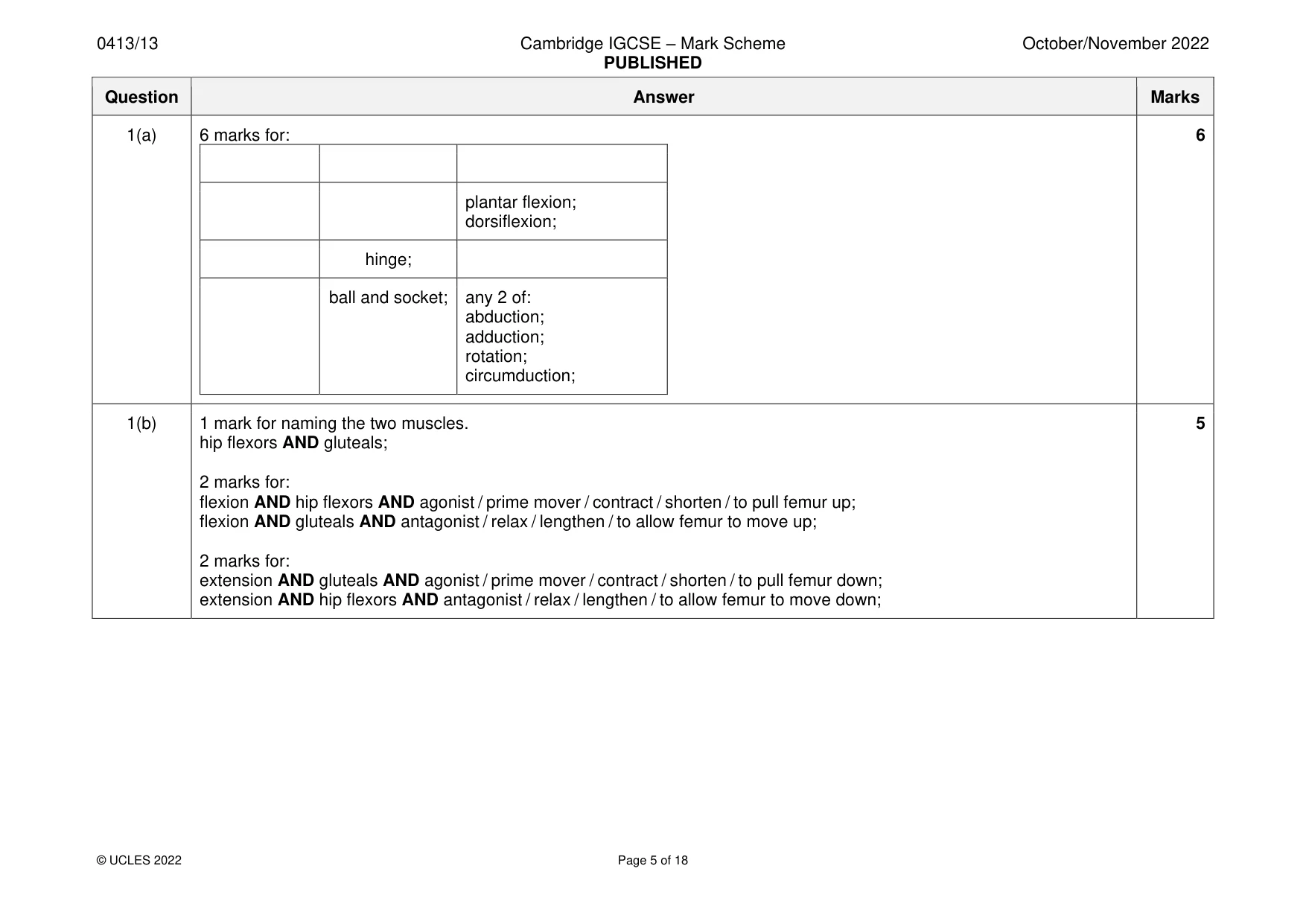
0413/13 Cambridge IGCSE – Mark Scheme PUBLISHED October/November 2022 © UCLES 2022 Page 5 of 18 Question Answer Marks 1(a) 6 marks for: plantar flexion; dorsiflexion; hinge; ball and socket; any 2 of: abduction; adduction; rotation; circumduction; 6 1(b) 1 mark for naming the two muscles. hip flexors AND gluteals; 2 marks for: flexion AND hip flexors AND agonist / prime mover / contract / shorten / to pull femur up; flexion AND gluteals AND antagonist / relax / lengthen / to allow femur to move up; 2 marks for: extension AND gluteals AND agonist / prime mover / contract / shorten / to pull femur down; extension AND hip flexors AND antagonist / relax / lengthen / to allow femur to move down; 5
Mark scheme, page 6
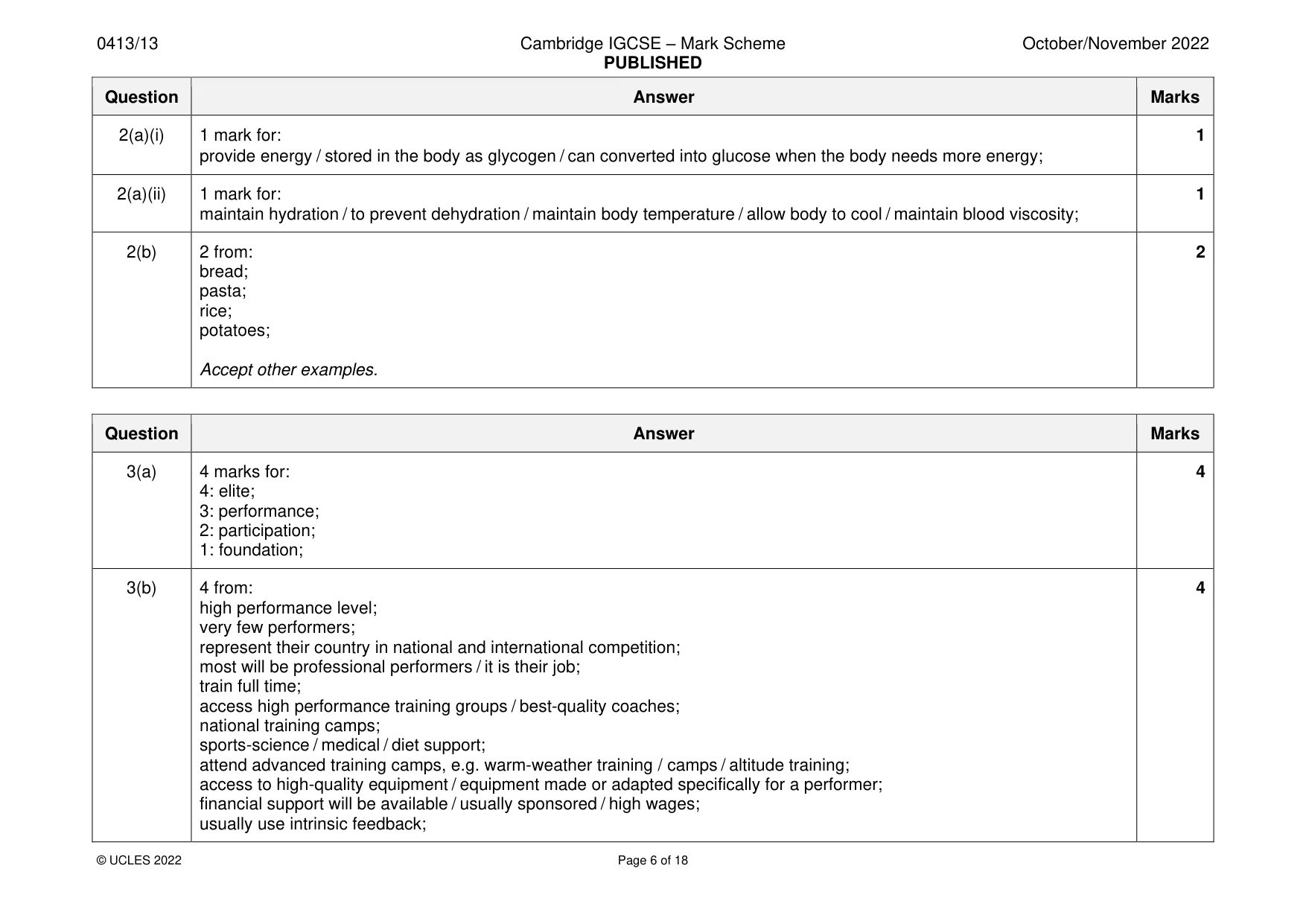
0413/13 Cambridge IGCSE – Mark Scheme PUBLISHED October/November 2022 © UCLES 2022 Page 6 of 18 Question Answer Marks 2(a)(i) 1 mark for: provide energy / stored in the body as glycogen / can converted into glucose when the body needs more energy; 1 2(a)(ii) 1 mark for: maintain hydration / to prevent dehydration / maintain body temperature / allow body to cool / maintain blood viscosity; 1 2(b) 2 from: bread; pasta; rice; potatoes; Accept other examples. 2 Question Answer Marks 3(a) 4 marks for: 4: elite; 3: performance; 2: participation; 1: foundation; 4 3(b) 4 from: high performance level; very few performers; represent their country in national and international competition; most will be professional performers / it is their job; train full time; access high performance training groups / best-quality coaches; national training camps; sports-science / medical / diet support; attend advanced training camps, e.g. warm-weather training / camps / altitude training; access to high-quality equipment / equipment made or adapted specifically for a performer; financial support will be available / usually sponsored / high wages; usually use intrinsic feedback; 4
Mark scheme, page 7
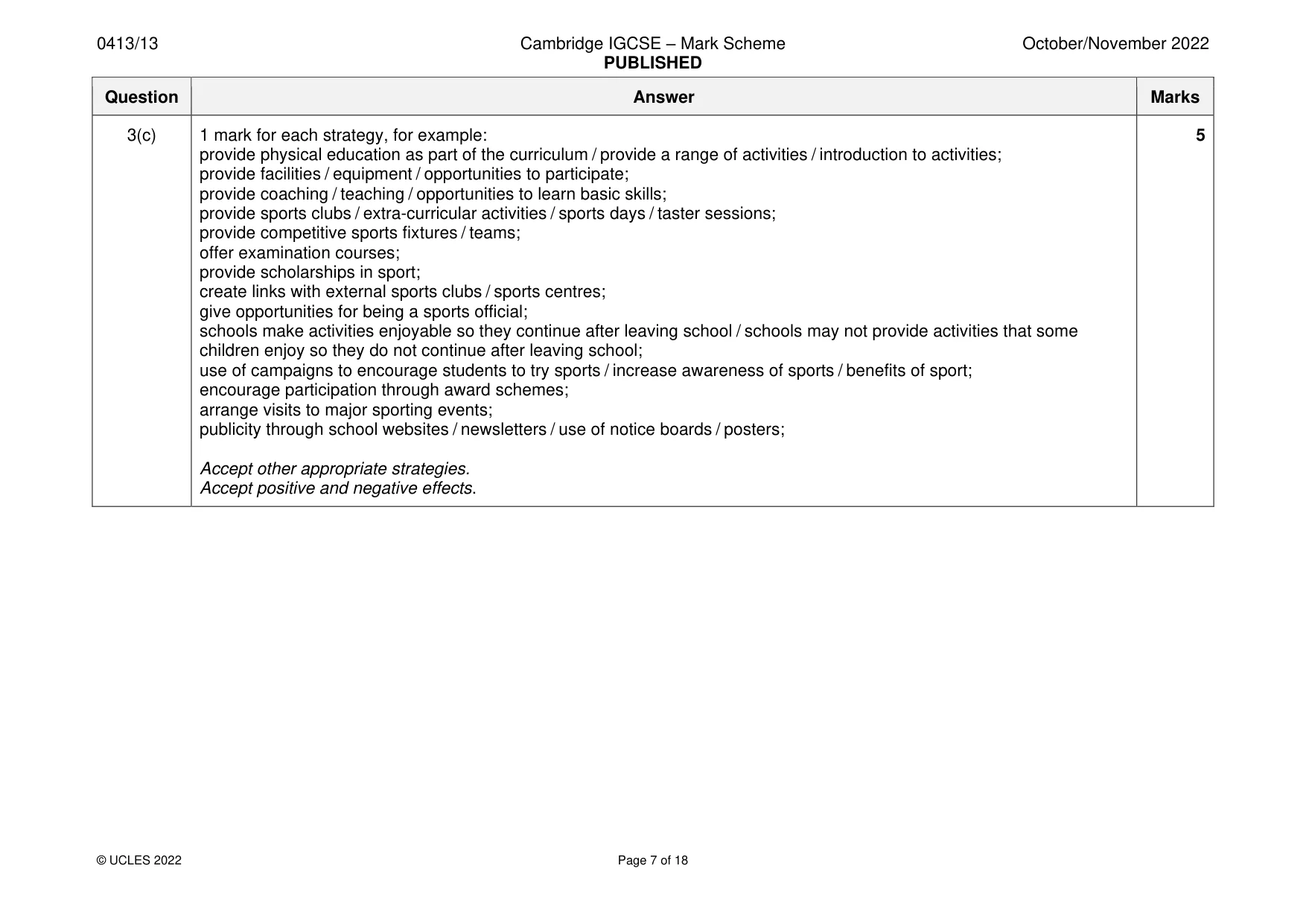
0413/13 Cambridge IGCSE – Mark Scheme PUBLISHED October/November 2022 © UCLES 2022 Page 7 of 18 Question Answer Marks 3(c) 1 mark for each strategy, for example: provide physical education as part of the curriculum / provide a range of activities / introduction to activities; provide facilities / equipment / opportunities to participate; provide coaching / teaching / opportunities to learn basic skills; provide sports clubs / extra-curricular activities / sports days / taster sessions; provide competitive sports fixtures / teams; offer examination courses; provide scholarships in sport; create links with external sports clubs / sports centres; give opportunities for being a sports official; schools make activities enjoyable so they continue after leaving school / schools may not provide activities that some children enjoy so they do not continue after leaving school; use of campaigns to encourage students to try sports / increase awareness of sports / benefits of sport; encourage participation through award schemes; arrange visits to major sporting events; publicity through school websites / newsletters / use of notice boards / posters; Accept other appropriate strategies. Accept positive and negative effects. 5
Mark scheme, page 8
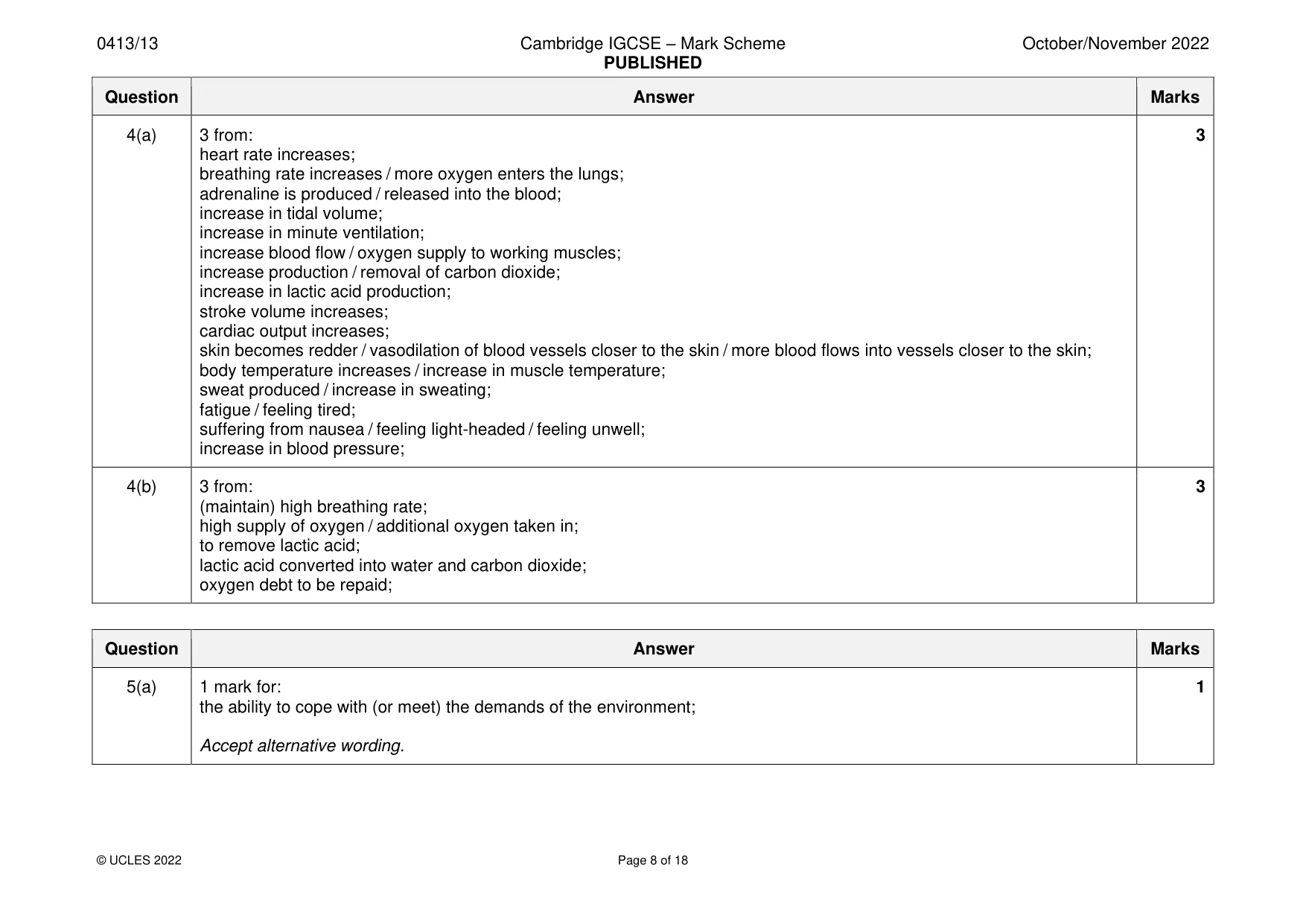
0413/13 Cambridge IGCSE – Mark Scheme PUBLISHED October/November 2022 © UCLES 2022 Page 8 of 18 Question Answer Marks 4(a) 3 from: heart rate increases; breathing rate increases / more oxygen enters the lungs; adrenaline is produced / released into the blood; increase in tidal volume; increase in minute ventilation; increase blood flow / oxygen supply to working muscles; increase production / removal of carbon dioxide; increase in lactic acid production; stroke volume increases; cardiac output increases; skin becomes redder / vasodilation of blood vessels closer to the skin / more blood flows into vessels closer to the skin; body temperature increases / increase in muscle temperature; sweat produced / increase in sweating; fatigue / feeling tired; suffering from nausea / feeling light-headed / feeling unwell; increase in blood pressure; 3 4(b) 3 from: (maintain) high breathing rate; high supply of oxygen / additional oxygen taken in; to remove lactic acid; lactic acid converted into water and carbon dioxide; oxygen debt to be repaid; 3 Question Answer Marks 5(a) 1 mark for: the ability to cope with (or meet) the demands of the environment; Accept alternative wording. 1
Mark scheme, page 9
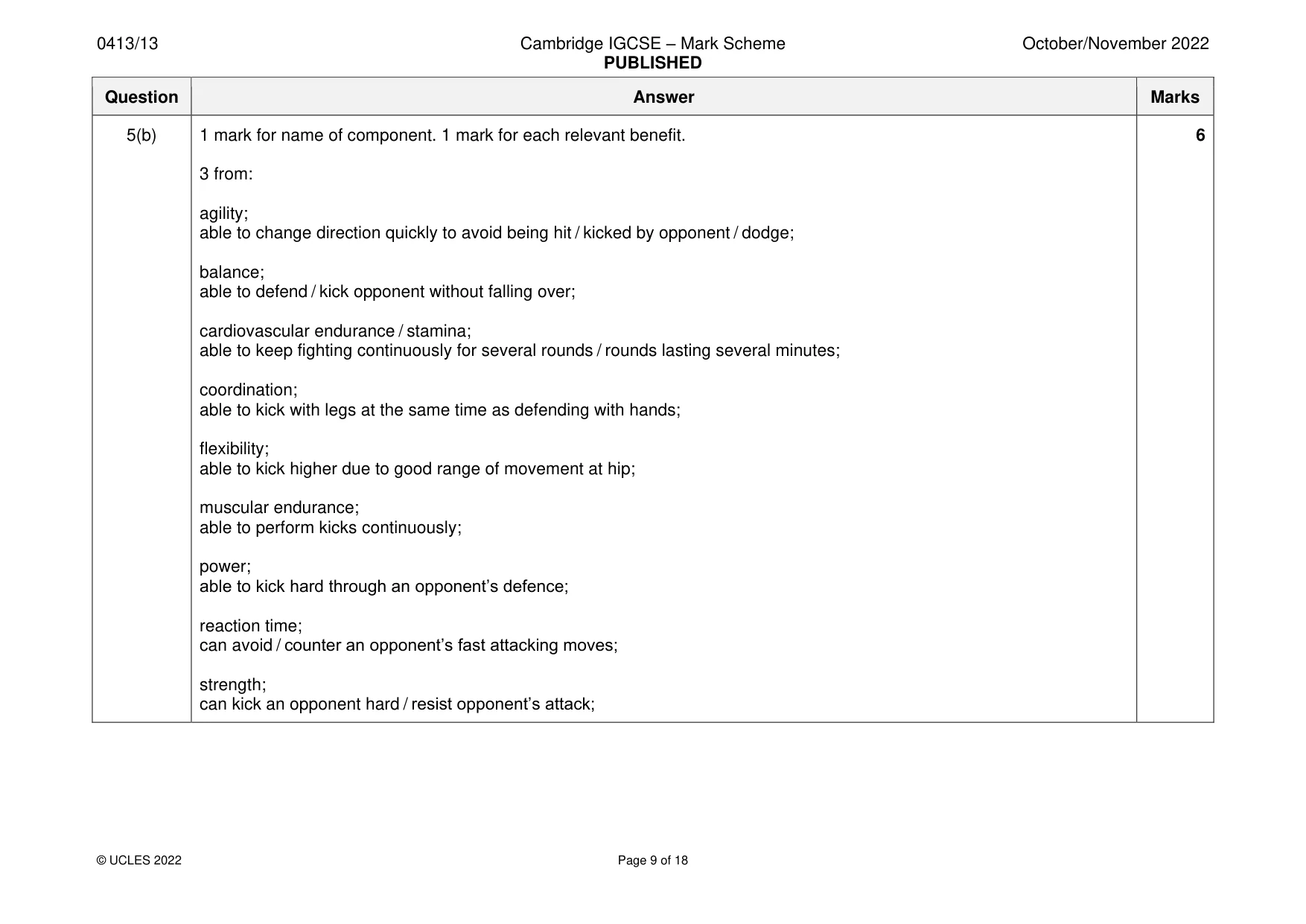
0413/13 Cambridge IGCSE – Mark Scheme PUBLISHED October/November 2022 © UCLES 2022 Page 9 of 18 Question Answer Marks 5(b) 1 mark for name of component. 1 mark for each relevant benefit. 3 from: agility; able to change direction quickly to avoid being hit / kicked by opponent / dodge; balance; able to defend / kick opponent without falling over; cardiovascular endurance / stamina; able to keep fighting continuously for several rounds / rounds lasting several minutes; coordination; able to kick with legs at the same time as defending with hands; flexibility; able to kick higher due to good range of movement at hip; muscular endurance; able to perform kicks continuously; power; able to kick hard through an opponent’s defence; reaction time; can avoid / counter an opponent’s fast attacking moves; strength; can kick an opponent hard / resist opponent’s attack; 6
Mark scheme, page 10
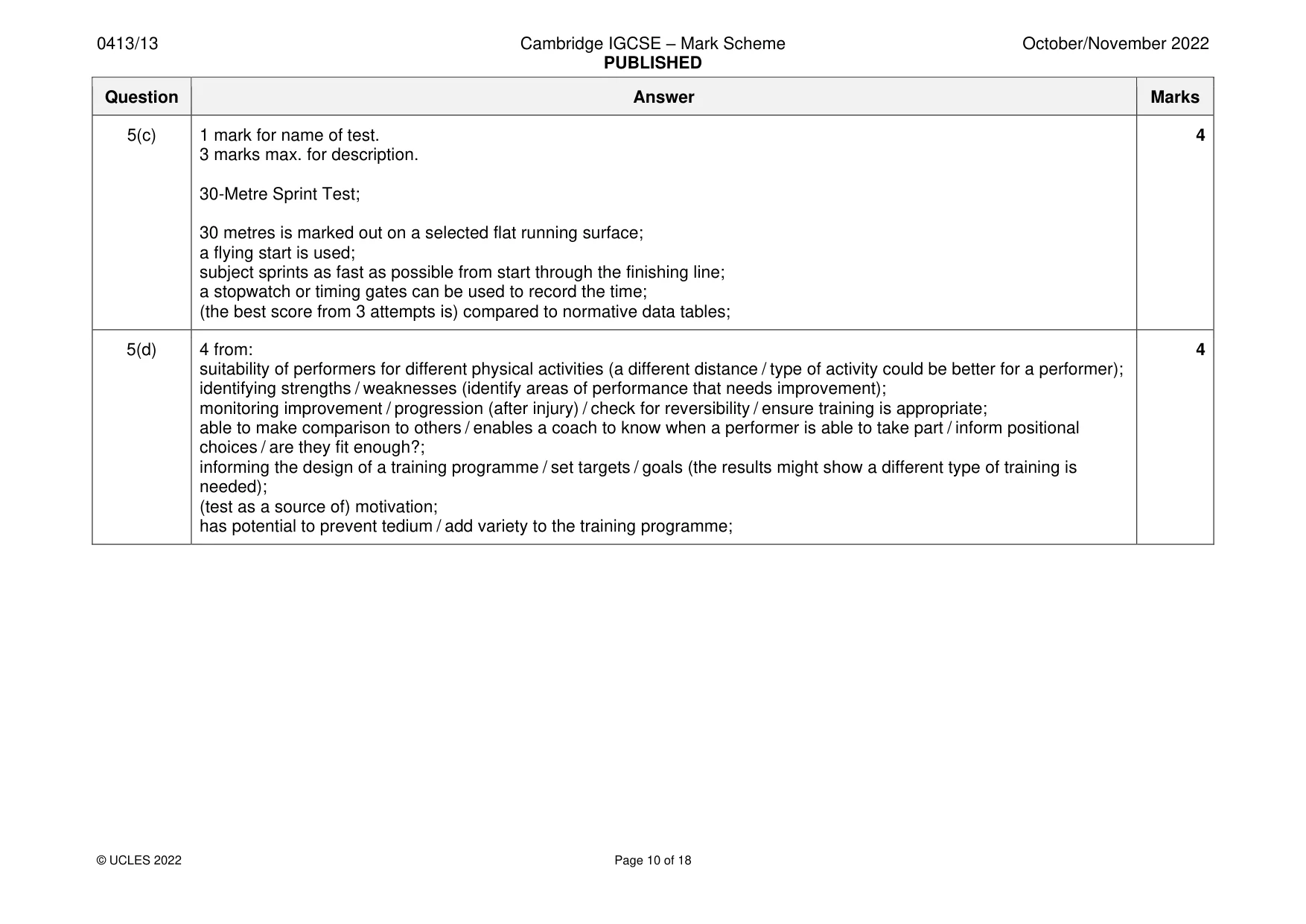
0413/13 Cambridge IGCSE – Mark Scheme PUBLISHED October/November 2022 © UCLES 2022 Page 10 of 18 Question Answer Marks 5(c) 1 mark for name of test. 3 marks max. for description. 30-Metre Sprint Test; 30 metres is marked out on a selected flat running surface; a flying start is used; subject sprints as fast as possible from start through the finishing line; a stopwatch or timing gates can be used to record the time; (the best score from 3 attempts is) compared to normative data tables; 4 5(d) 4 from: suitability of performers for different physical activities (a different distance / type of activity could be better for a performer); identifying strengths / weaknesses (identify areas of performance that needs improvement); monitoring improvement / progression (after injury) / check for reversibility / ensure training is appropriate; able to make comparison to others / enables a coach to know when a performer is able to take part / inform positional choices / are they fit enough?; informing the design of a training programme / set targets / goals (the results might show a different type of training is needed); (test as a source of) motivation; has potential to prevent tedium / add variety to the training programme; 4
Mark scheme, page 11
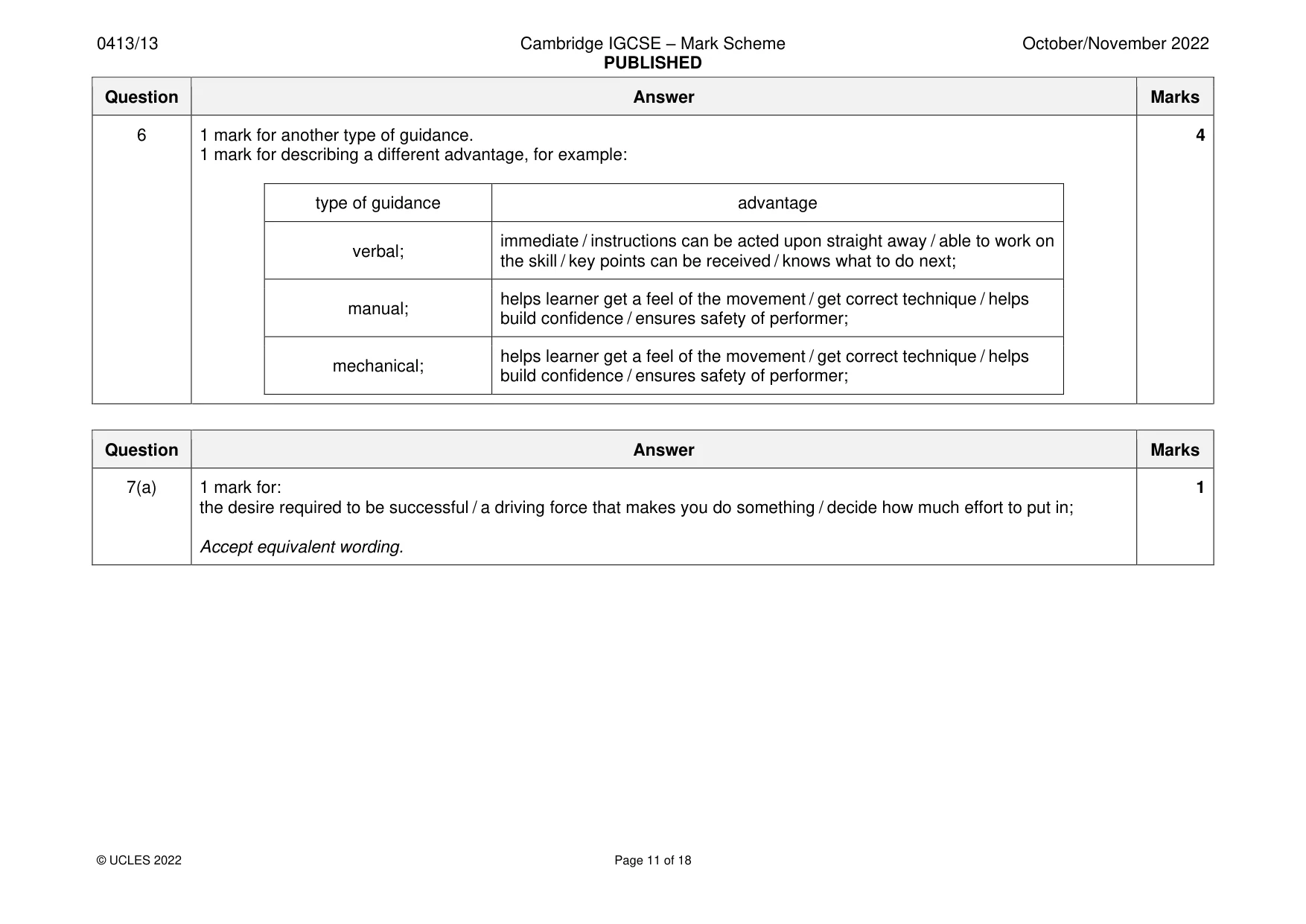
0413/13 Cambridge IGCSE – Mark Scheme PUBLISHED October/November 2022 © UCLES 2022 Page 11 of 18 Question Answer Marks 6 1 mark for another type of guidance. 1 mark for describing a different advantage, for example: type of guidance advantage verbal; immediate / instructions can be acted upon straight away / able to work on the skill / key points can be received / knows what to do next; manual; helps learner get a feel of the movement / get correct technique / helps build confidence / ensures safety of performer; mechanical; helps learner get a feel of the movement / get correct technique / helps build confidence / ensures safety of performer; 4 Question Answer Marks 7(a) 1 mark for: the desire required to be successful / a driving force that makes you do something / decide how much effort to put in; Accept equivalent wording. 1
Mark scheme, page 12
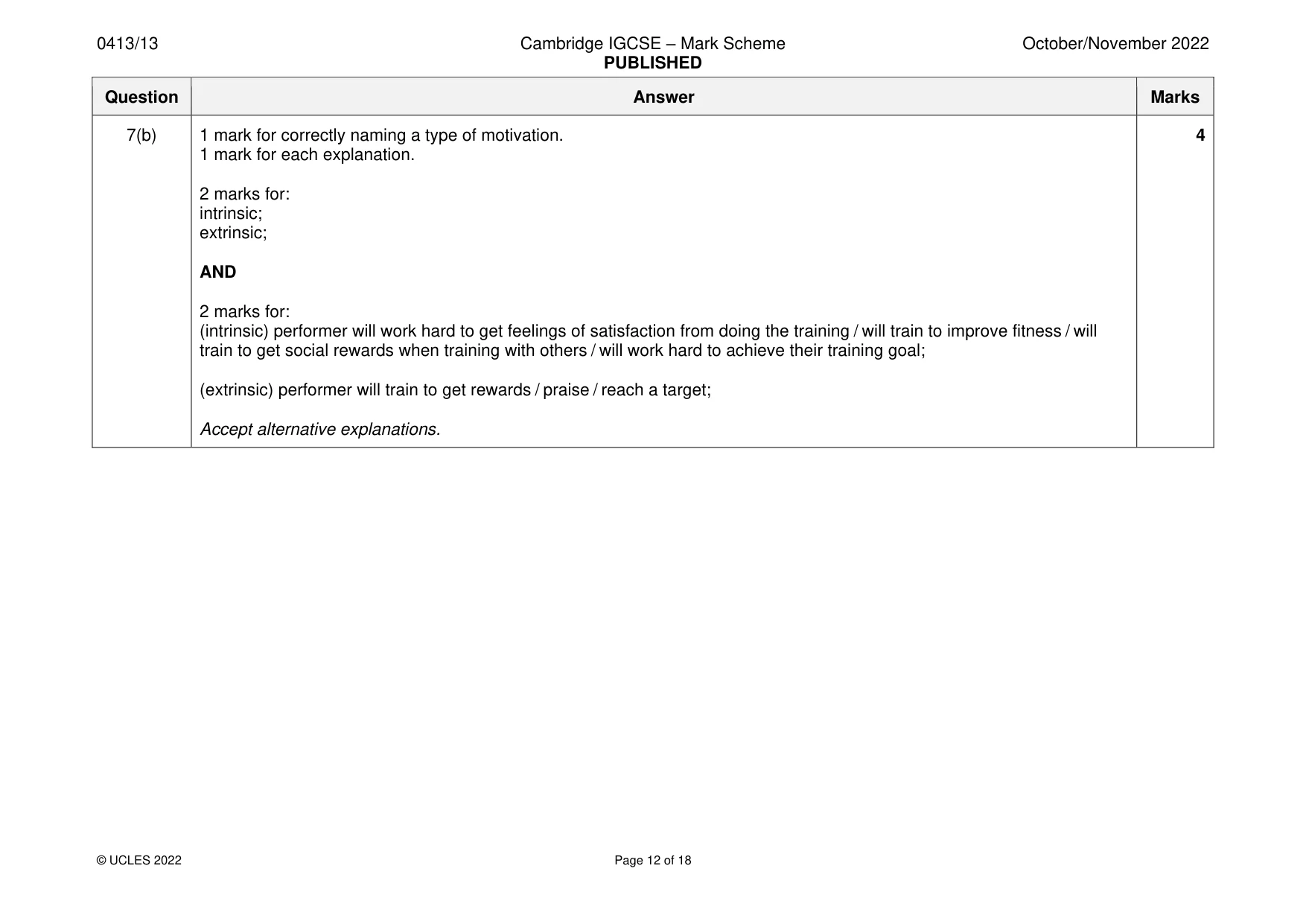
0413/13 Cambridge IGCSE – Mark Scheme PUBLISHED October/November 2022 © UCLES 2022 Page 12 of 18 Question Answer Marks 7(b) 1 mark for correctly naming a type of motivation. 1 mark for each explanation. 2 marks for: intrinsic; extrinsic; AND 2 marks for: (intrinsic) performer will work hard to get feelings of satisfaction from doing the training / will train to improve fitness / will train to get social rewards when training with others / will work hard to achieve their training goal; (extrinsic) performer will train to get rewards / praise / reach a target; Accept alternative explanations. 4
Mark scheme, page 13
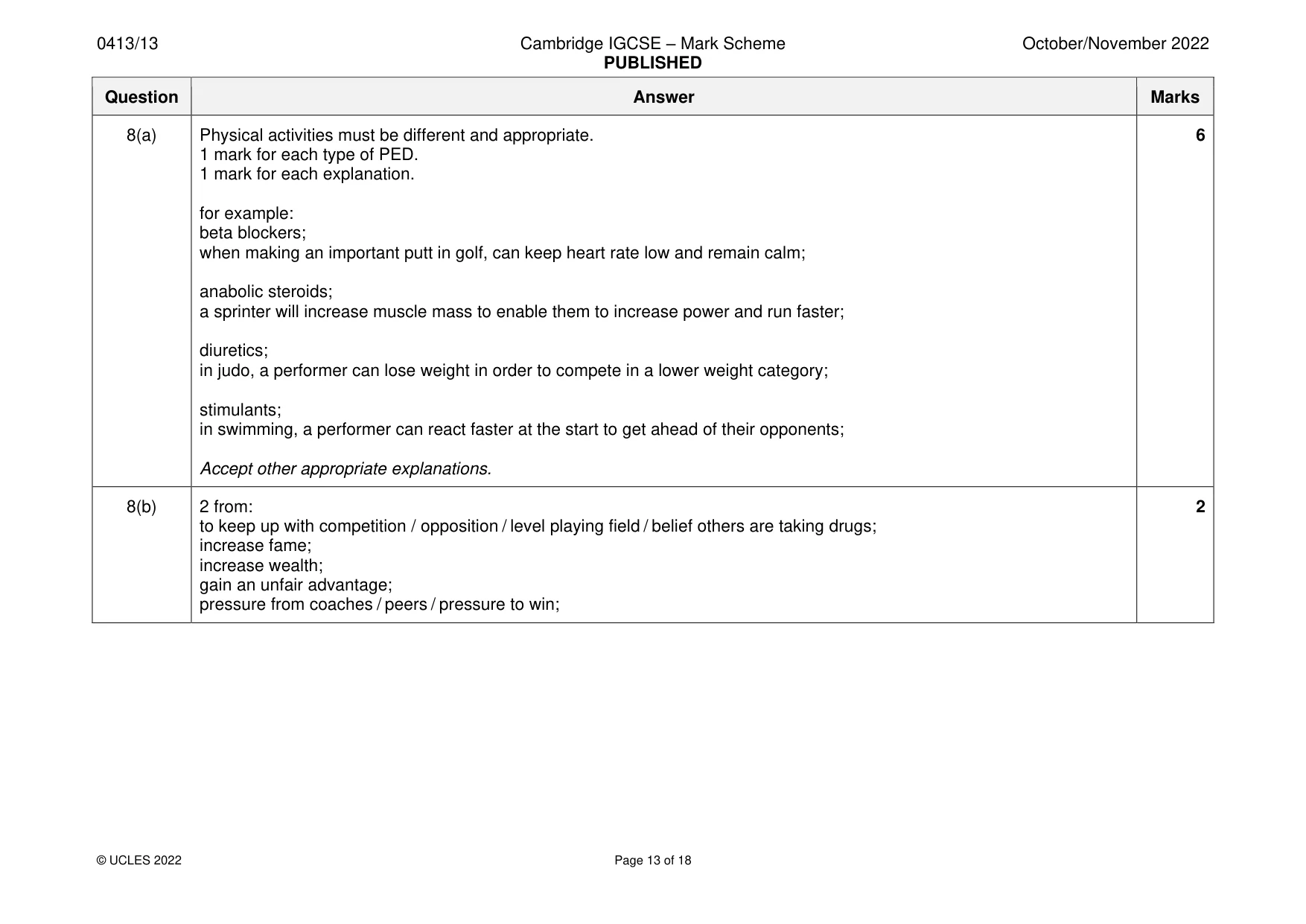
0413/13 Cambridge IGCSE – Mark Scheme PUBLISHED October/November 2022 © UCLES 2022 Page 13 of 18 Question Answer Marks 8(a) Physical activities must be different and appropriate. 1 mark for each type of PED. 1 mark for each explanation. for example: beta blockers; when making an important putt in golf, can keep heart rate low and remain calm; anabolic steroids; a sprinter will increase muscle mass to enable them to increase power and run faster; diuretics; in judo, a performer can lose weight in order to compete in a lower weight category; stimulants; in swimming, a performer can react faster at the start to get ahead of their opponents; Accept other appropriate explanations. 6 8(b) 2 from: to keep up with competition / opposition / level playing field / belief others are taking drugs; increase fame; increase wealth; gain an unfair advantage; pressure from coaches / peers / pressure to win; 2
Mark scheme, page 14
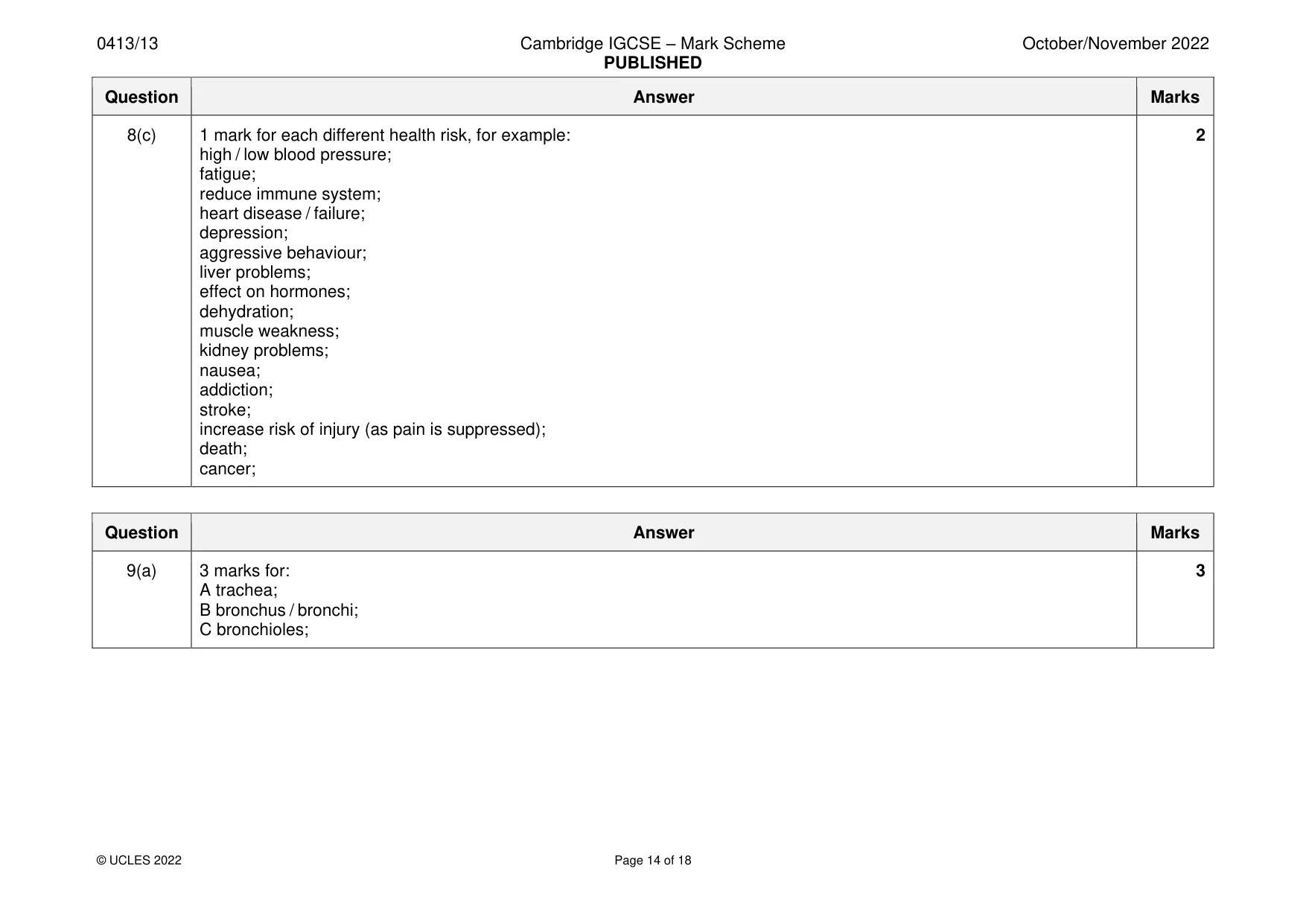
0413/13 Cambridge IGCSE – Mark Scheme PUBLISHED October/November 2022 © UCLES 2022 Page 14 of 18 Question Answer Marks 8(c) 1 mark for each different health risk, for example: high / low blood pressure; fatigue; reduce immune system; heart disease / failure; depression; aggressive behaviour; liver problems; effect on hormones; dehydration; muscle weakness; kidney problems; nausea; addiction; stroke; increase risk of injury (as pain is suppressed); death; cancer; 2 Question Answer Marks 9(a) 3 marks for: A trachea; B bronchus / bronchi; C bronchioles; 3
Mark scheme, page 15
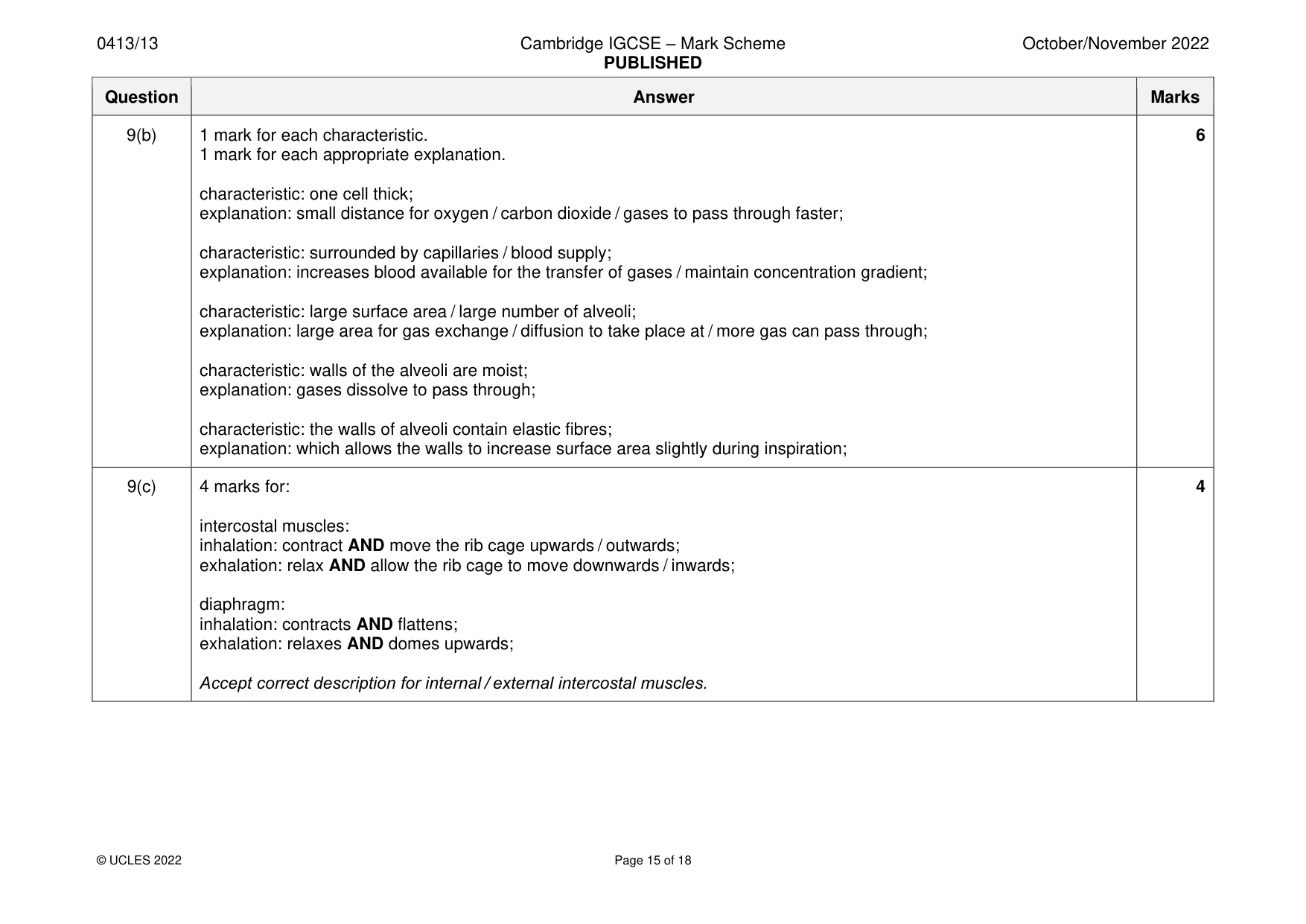
0413/13 Cambridge IGCSE – Mark Scheme PUBLISHED October/November 2022 © UCLES 2022 Page 15 of 18 Question Answer Marks 9(b) 1 mark for each characteristic. 1 mark for each appropriate explanation. characteristic: one cell thick; explanation: small distance for oxygen / carbon dioxide / gases to pass through faster; characteristic: surrounded by capillaries / blood supply; explanation: increases blood available for the transfer of gases / maintain concentration gradient; characteristic: large surface area / large number of alveoli; explanation: large area for gas exchange / diffusion to take place at / more gas can pass through; characteristic: walls of the alveoli are moist; explanation: gases dissolve to pass through; characteristic: the walls of alveoli contain elastic fibres; explanation: which allows the walls to increase surface area slightly during inspiration; 6 9(c) 4 marks for: intercostal muscles: inhalation: contract AND move the rib cage upwards / outwards; exhalation: relax AND allow the rib cage to move downwards / inwards; diaphragm: inhalation: contracts AND flattens; exhalation: relaxes AND domes upwards; Accept correct description for internal / external intercostal muscles. 4
Mark scheme, page 16
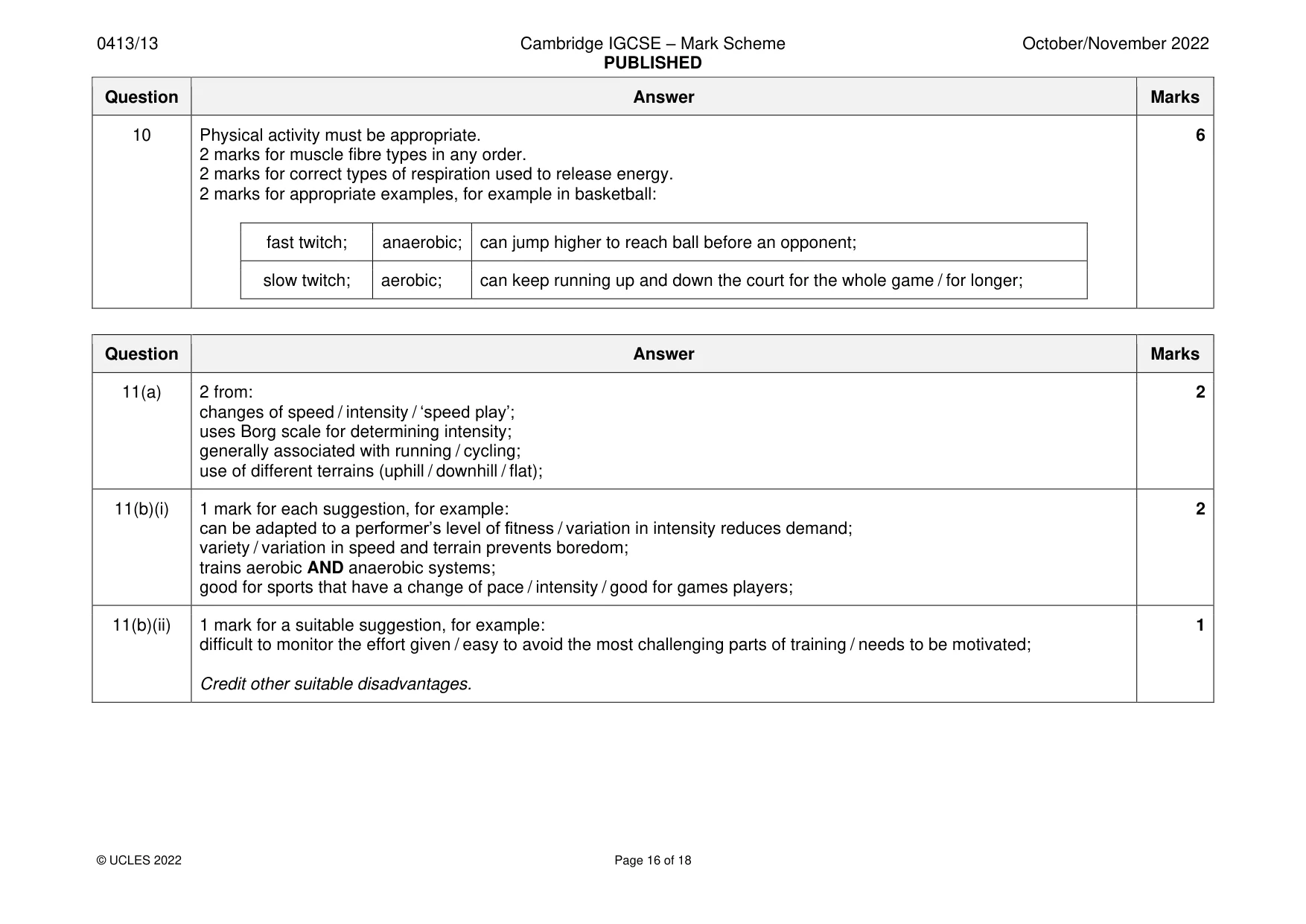
0413/13 Cambridge IGCSE – Mark Scheme PUBLISHED October/November 2022 © UCLES 2022 Page 16 of 18 Question Answer Marks 10 Physical activity must be appropriate. 2 marks for muscle fibre types in any order. 2 marks for correct types of respiration used to release energy. 2 marks for appropriate examples, for example in basketball: fast twitch; anaerobic; can jump higher to reach ball before an opponent; slow twitch; aerobic; can keep running up and down the court for the whole game / for longer; 6 Question Answer Marks 11(a) 2 from: changes of speed / intensity / ‘speed play’; uses Borg scale for determining intensity; generally associated with running / cycling; use of different terrains (uphill / downhill / flat); 2 11(b)(i) 1 mark for each suggestion, for example: can be adapted to a performer’s level of fitness / variation in intensity reduces demand; variety / variation in speed and terrain prevents boredom; trains aerobic AND anaerobic systems; good for sports that have a change of pace / intensity / good for games players; 2 11(b)(ii) 1 mark for a suitable suggestion, for example: difficult to monitor the effort given / easy to avoid the most challenging parts of training / needs to be motivated; Credit other suitable disadvantages. 1
Mark scheme, page 17
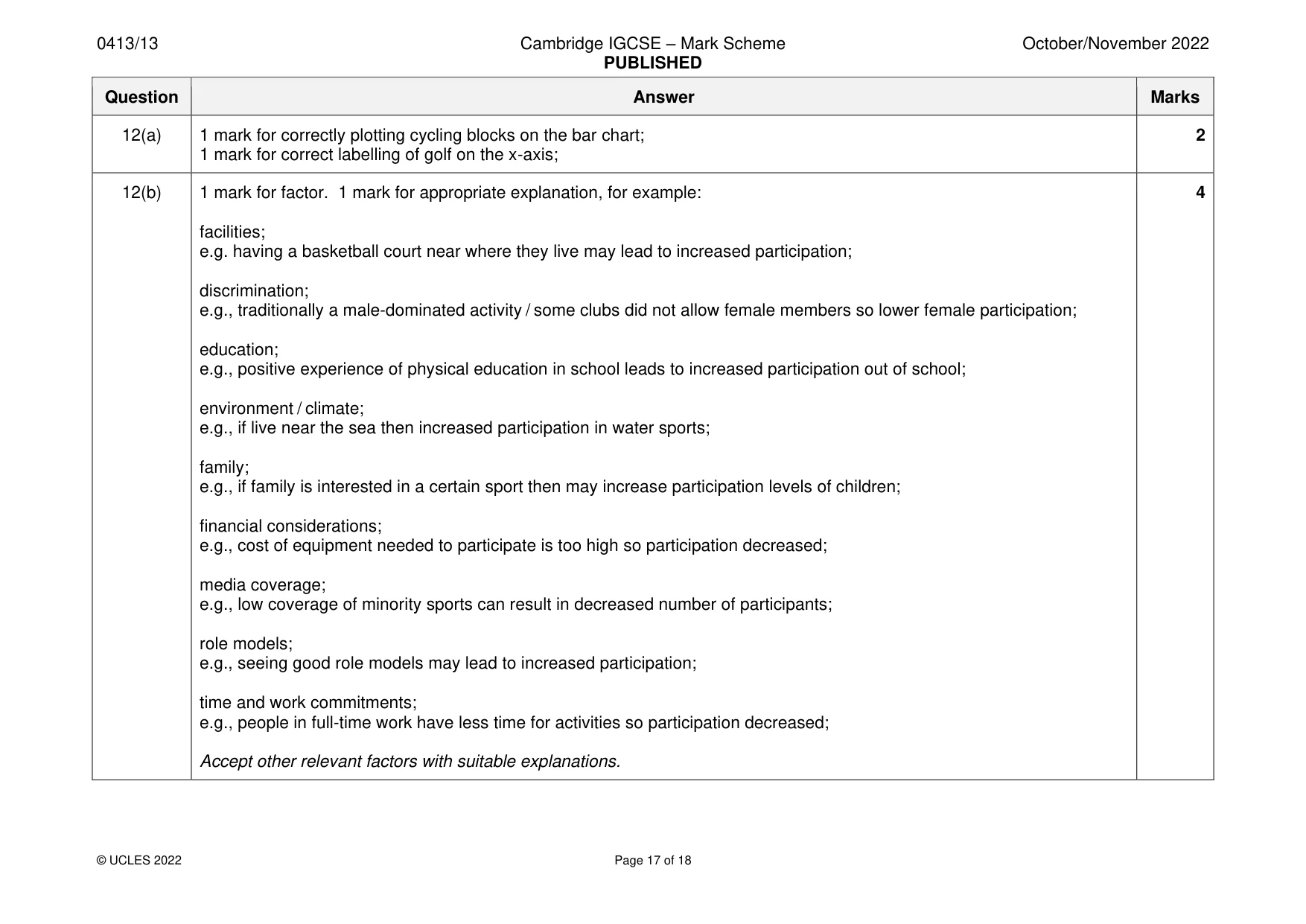
0413/13 Cambridge IGCSE – Mark Scheme PUBLISHED October/November 2022 © UCLES 2022 Page 17 of 18 Question Answer Marks 12(a) 1 mark for correctly plotting cycling blocks on the bar chart; 1 mark for correct labelling of golf on the x-axis; 2 12(b) 1 mark for factor. 1 mark for appropriate explanation, for example: facilities; e.g. having a basketball court near where they live may lead to increased participation; discrimination; e.g., traditionally a male-dominated activity / some clubs did not allow female members so lower female participation; education; e.g., positive experience of physical education in school leads to increased participation out of school; environment / climate; e.g., if live near the sea then increased participation in water sports; family; e.g., if family is interested in a certain sport then may increase participation levels of children; financial considerations; e.g., cost of equipment needed to participate is too high so participation decreased; media coverage; e.g., low coverage of minority sports can result in decreased number of participants; role models; e.g., seeing good role models may lead to increased participation; time and work commitments; e.g., people in full-time work have less time for activities so participation decreased; Accept other relevant factors with suitable explanations. 4
Mark scheme, page 18
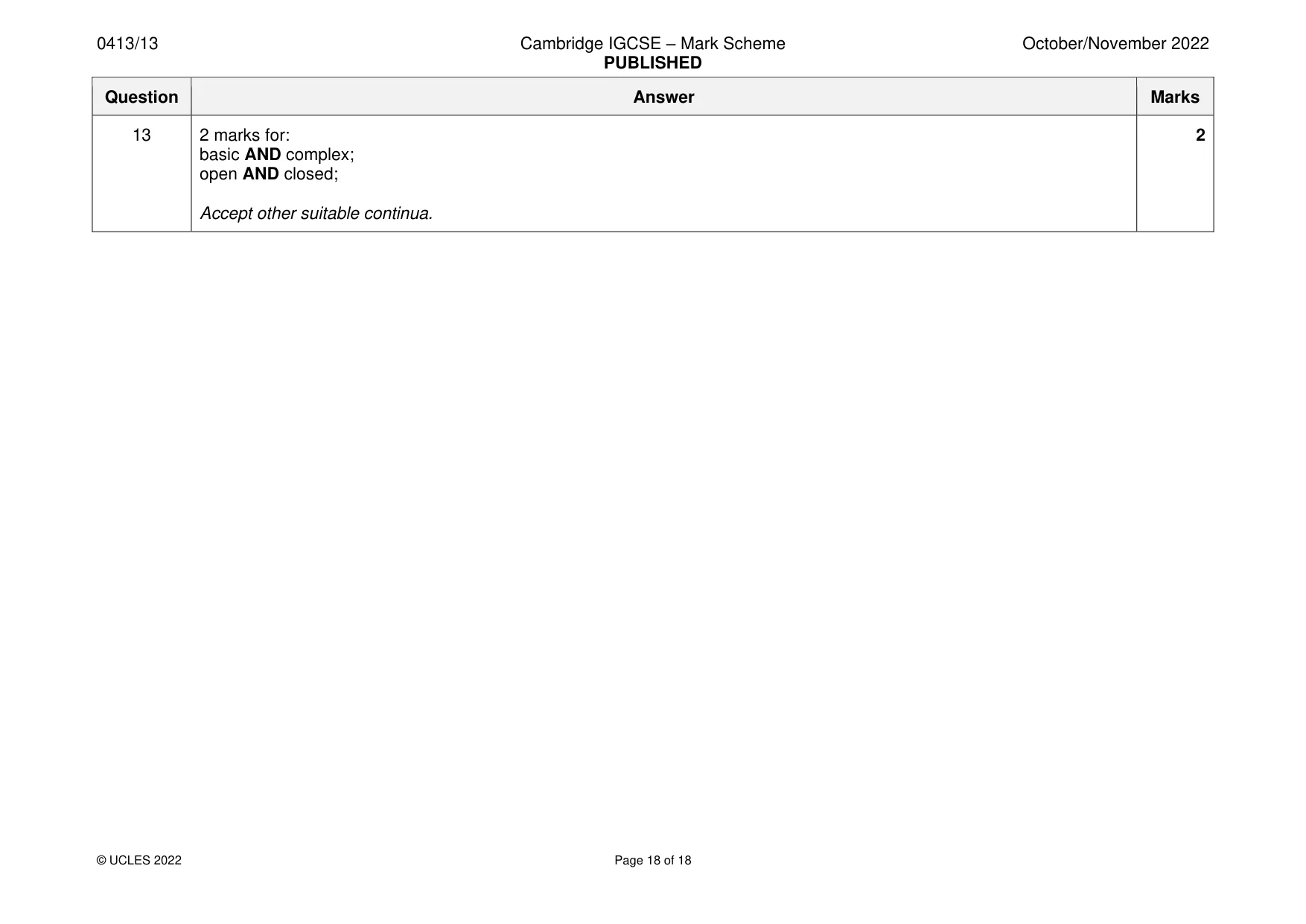
0413/13 Cambridge IGCSE – Mark Scheme PUBLISHED October/November 2022 © UCLES 2022 Page 18 of 18 Question Answer Marks 13 2 marks for: basic AND complex; open AND closed; Accept other suitable continua. 2
What you needed in this session
Cambridge’s own grade thresholds for 2022 Oct/Nov, Paper 1 · Variant 3. A higher threshold means an easier paper — the bar moves with how the cohort did.