Cambridge IGCSE Physical Education 0413 — 2021 Oct/Nov Paper 1 · Variant 2
0413/12/O/N/21 · 100 marks · ≈113 min
The question paper and its mark scheme, free to read here and free to download. This is Cambridge’s own paper, exactly as it was sat.
Question paper16 pages

Mark scheme18 pages
Answers below. Sit the paper first if you are practising.
Paper as text
Question paper, page 1
This document has 16 pages. Any blank pages are indicated. Cambridge IGCSE™ * 2 7 0 8 3 1 2 4 7 9 * DC (DH/CGW) 198498/3 © UCLES 2021 [Turn over PHYSICAL EDUCATION 0413/12 Paper 1 Theory October/November 2021 1 hour 45 minutes You must answer on the question paper. No additional materials are needed. INSTRUCTIONS ● Answer all questions. ● Use a black or dark blue pen. You may use an HB pencil for any diagrams or graphs. ● Write your name, centre number and candidate number in the boxes at the top of the page. ● Write your answer to each question in the space provided. ● Do not use an erasable pen or correction fluid. ● Do not write on any bar codes. ● You may use a calculator. ● You should show all your working and use appropriate units. INFORMATION ● The total mark for this paper is 100. ● The number of marks for each question or part question is shown in brackets [ ].
Question paper, page 2
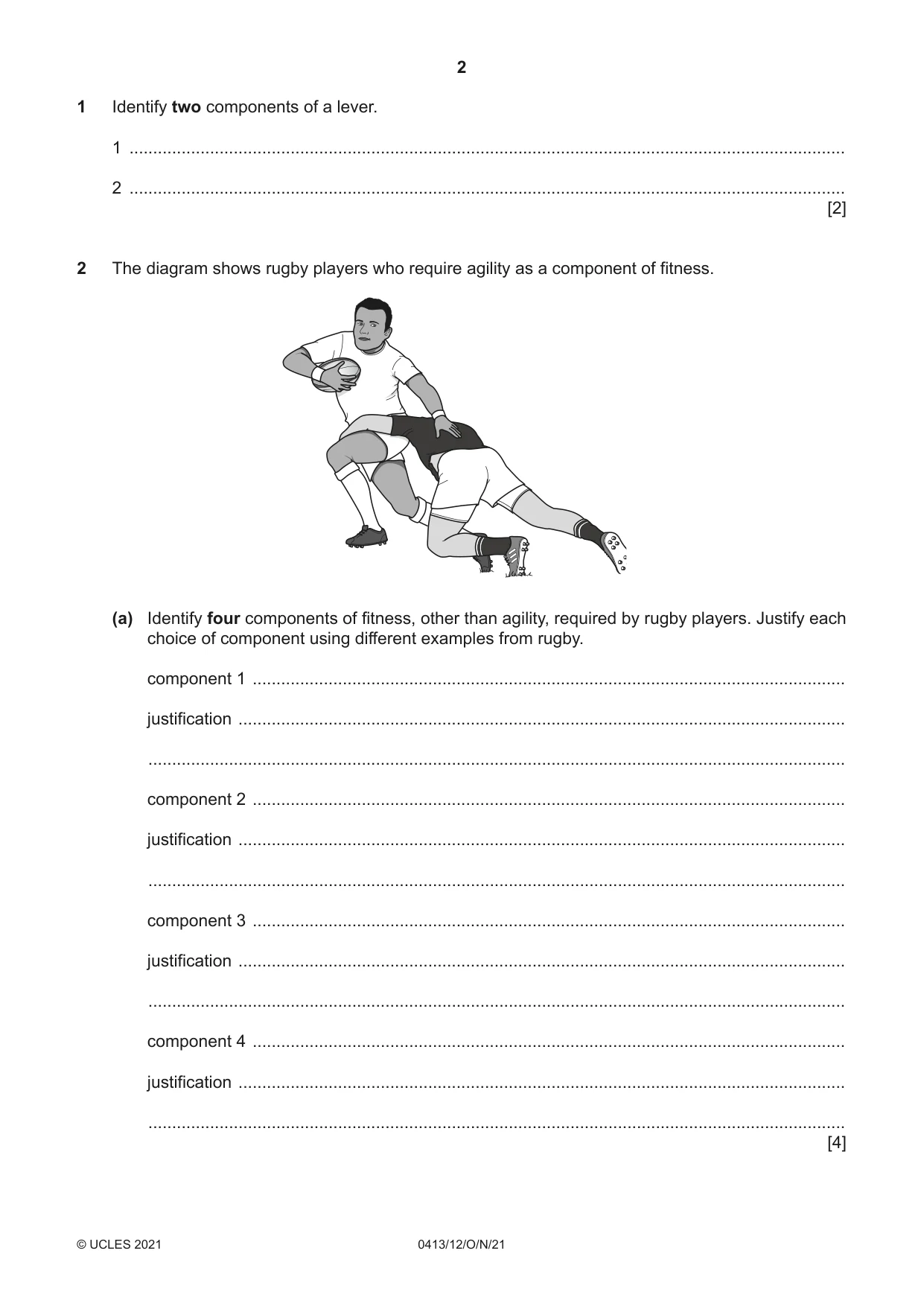
2 0413/12/O/N/21 © UCLES 2021 1 Identify two components of a lever. 1 … 2 … [2] 2 The diagram shows rugby players who require agility as a component of fitness. (a) Identify four components of fitness, other than agility, required by rugby players. Justify each choice of component using different examples from rugby. component 1 … justification … … component 2 … justification … … component 3 … justification … … component 4 … justification … … [4]
Question paper, page 3
3 0413/12/O/N/21 © UCLES 2021 [Turn over (b) Describe how to carry out a named fitness test for agility. test … description … … … … … … … … [4] (c) Some rugby players may use plyometric training. (i) Describe two examples of plyometric training exercises. 1 … … … … 2 … … … … [2] (ii) Describe two disadvantages of plyometric training. 1 … … 2 … … [2]
Question paper, page 4
4 0413/12/O/N/21 © UCLES 2021 (d) Overload and tedium are two principles of training. Explain how two other named principles of training can be applied to a training programme. principle 1 … explanation … … principle 2 … explanation … … [4] [Total: 16]
Question paper, page 5
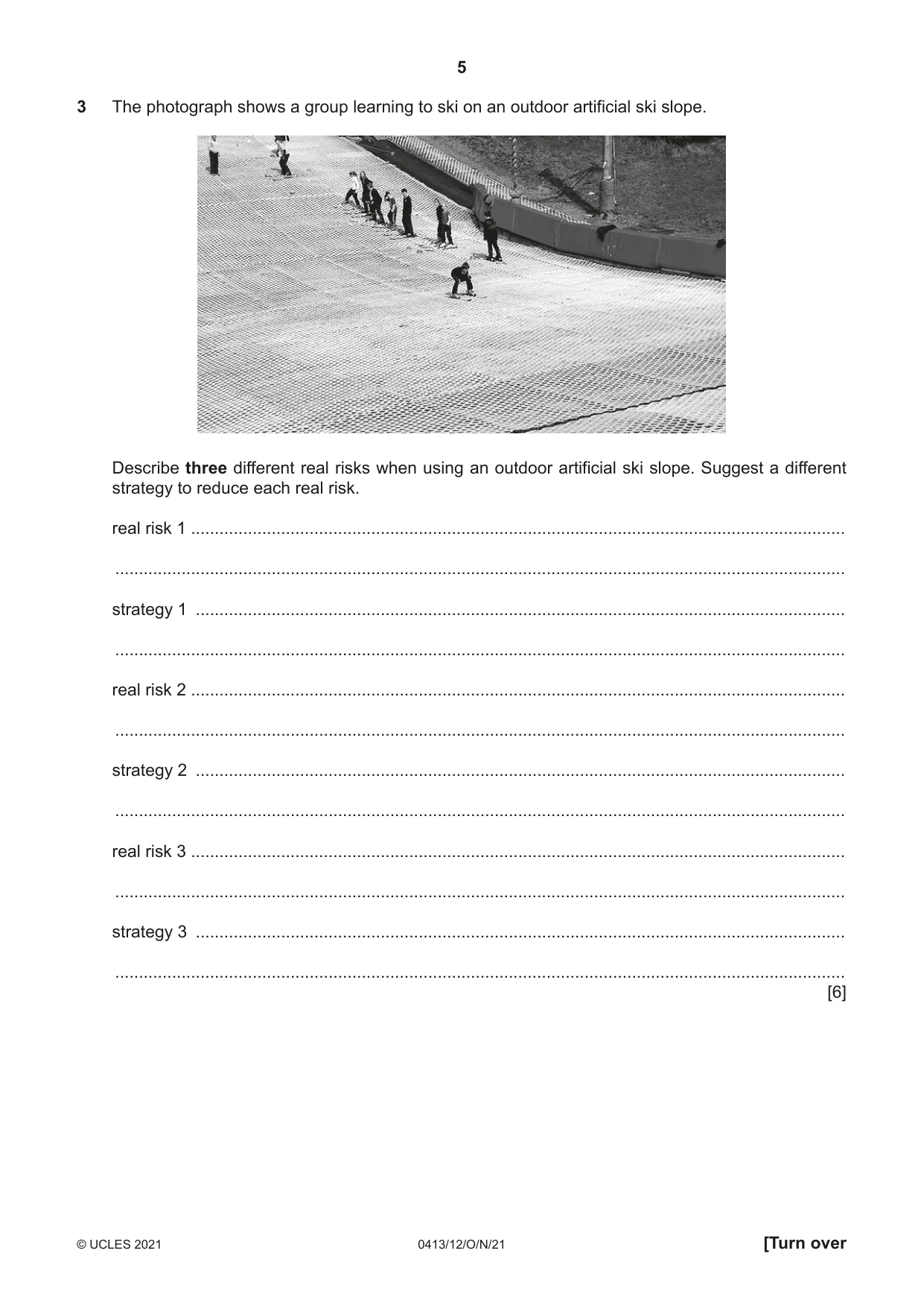
5 0413/12/O/N/21 © UCLES 2021 [Turn over 3 The photograph shows a group learning to ski on an outdoor artificial ski slope. Describe three different real risks when using an outdoor artificial ski slope. Suggest a different strategy to reduce each real risk. real risk 1 … … strategy 1 … … real risk 2 … … strategy 2 … … real risk 3 … … strategy 3 … … [6]
Question paper, page 6
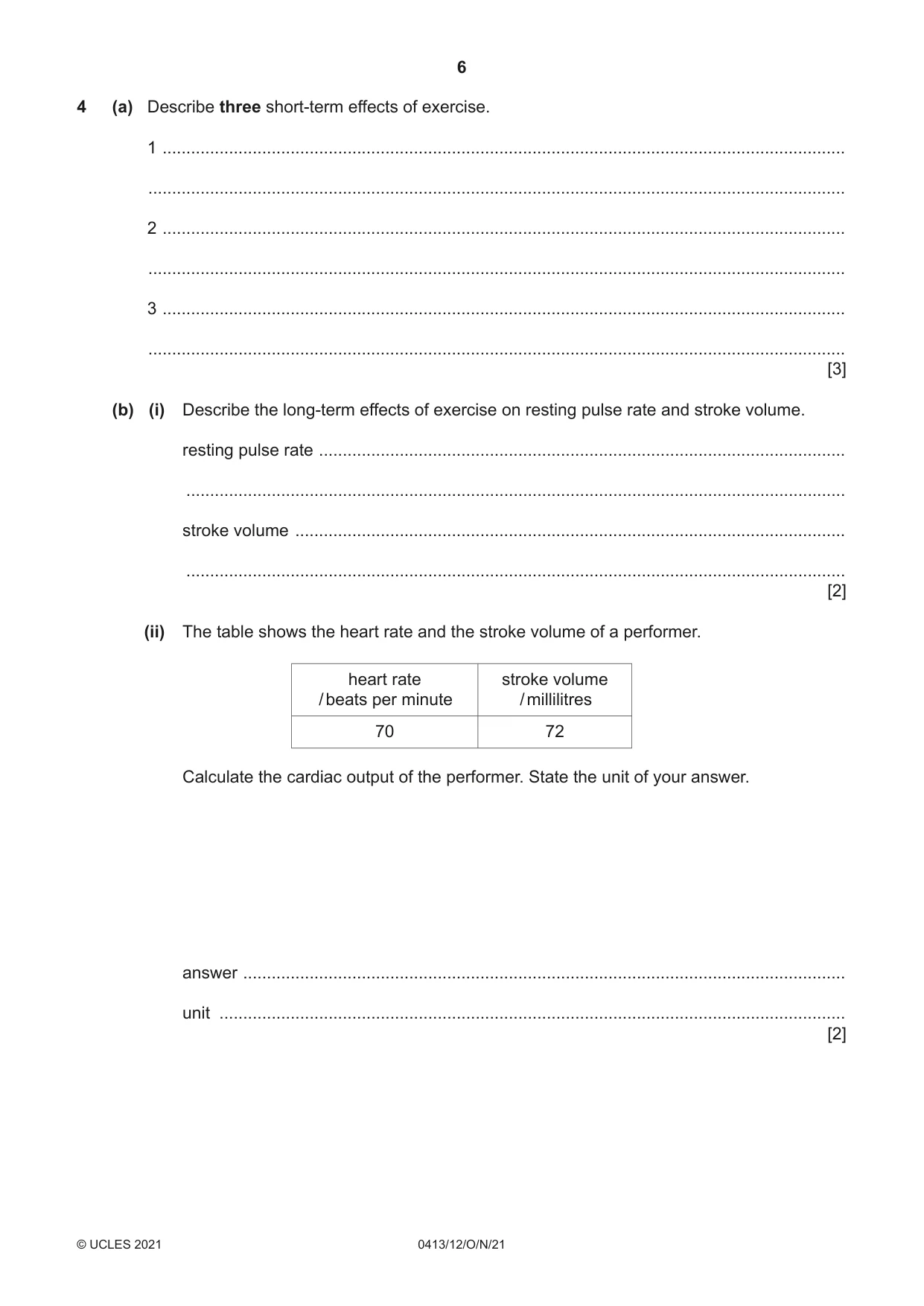
6 0413/12/O/N/21 © UCLES 2021 4 (a) Describe three short-term effects of exercise. 1 … … 2 … … 3 … … [3] (b) (i) Describe the long-term effects of exercise on resting pulse rate and stroke volume. resting pulse rate … … stroke volume … … [2] (ii) The table shows the heart rate and the stroke volume of a performer. heart rate / beats per minute stroke volume / millilitres 70 72 Calculate the cardiac output of the performer. State the unit of your answer. answer … unit … [2]
Question paper, page 7
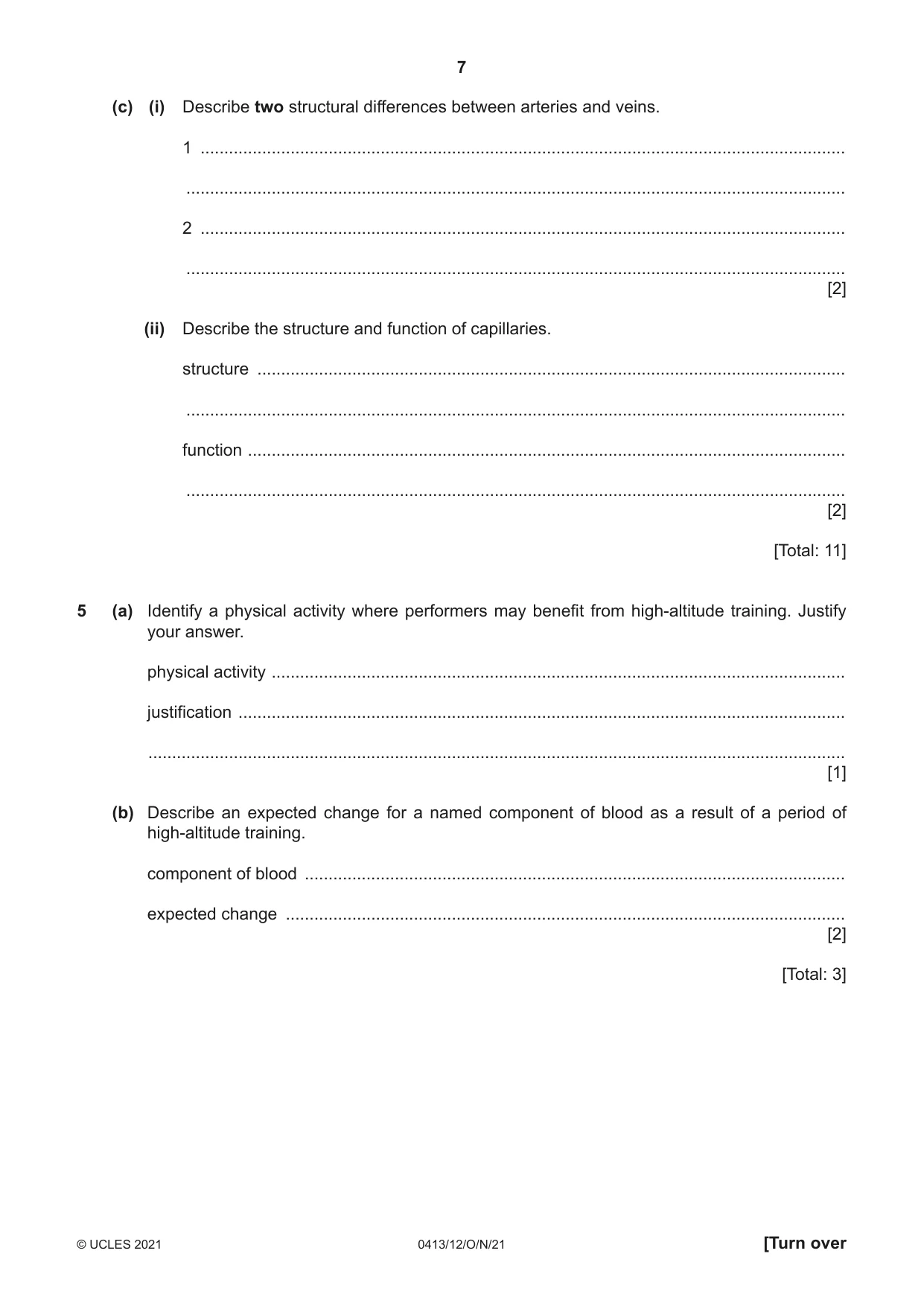
7 0413/12/O/N/21 © UCLES 2021 [Turn over (c) (i) Describe two structural differences between arteries and veins. 1 … … 2 … … [2] (ii) Describe the structure and function of capillaries. structure … … function … … [2] [Total: 11] 5 (a) Identify a physical activity where performers may benefit from high-altitude training. Justify your answer. physical activity … justification … … [1] (b) Describe an expected change for a named component of blood as a result of a period of high-altitude training. component of blood … expected change … [2] [Total: 3]
Question paper, page 8
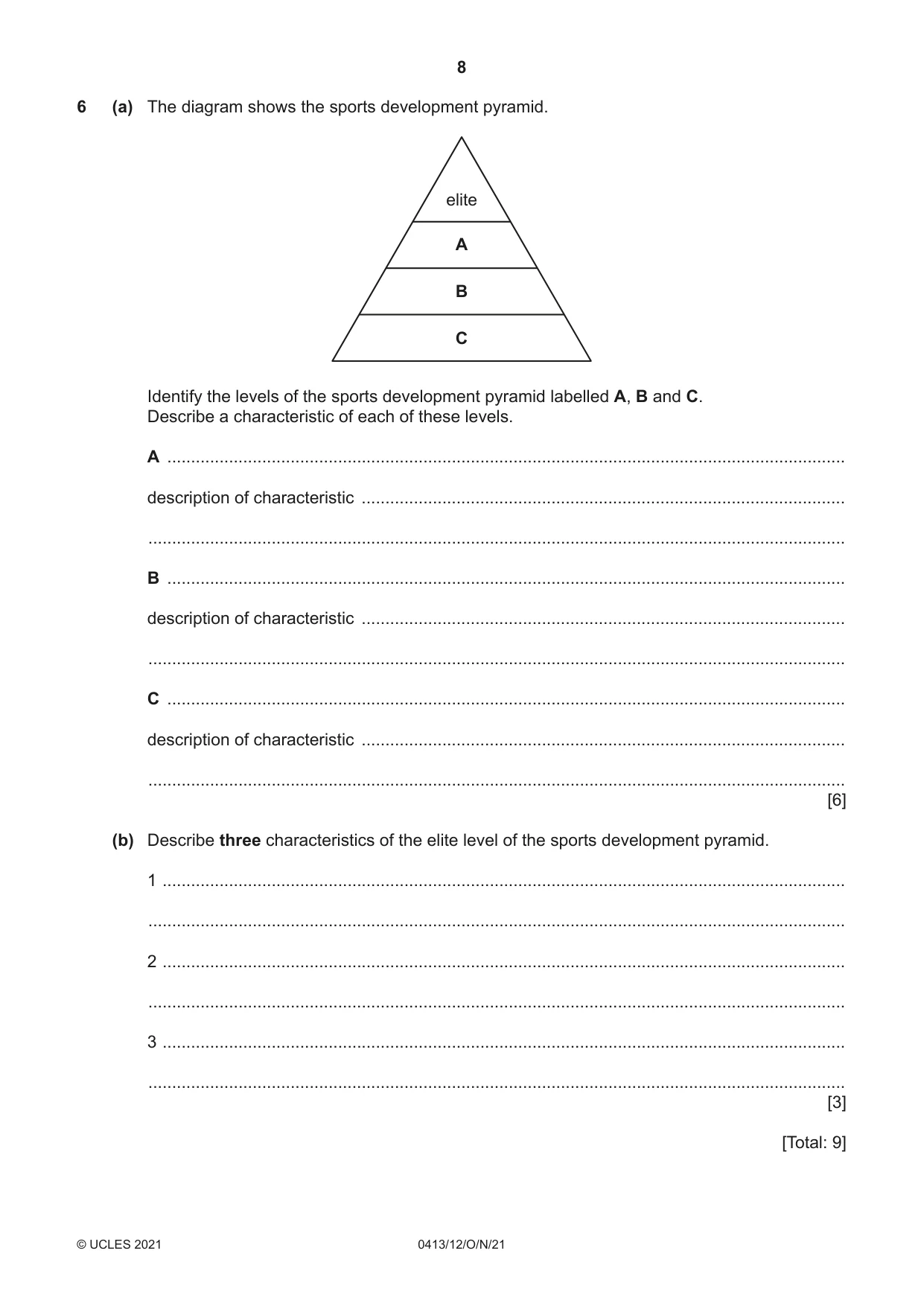
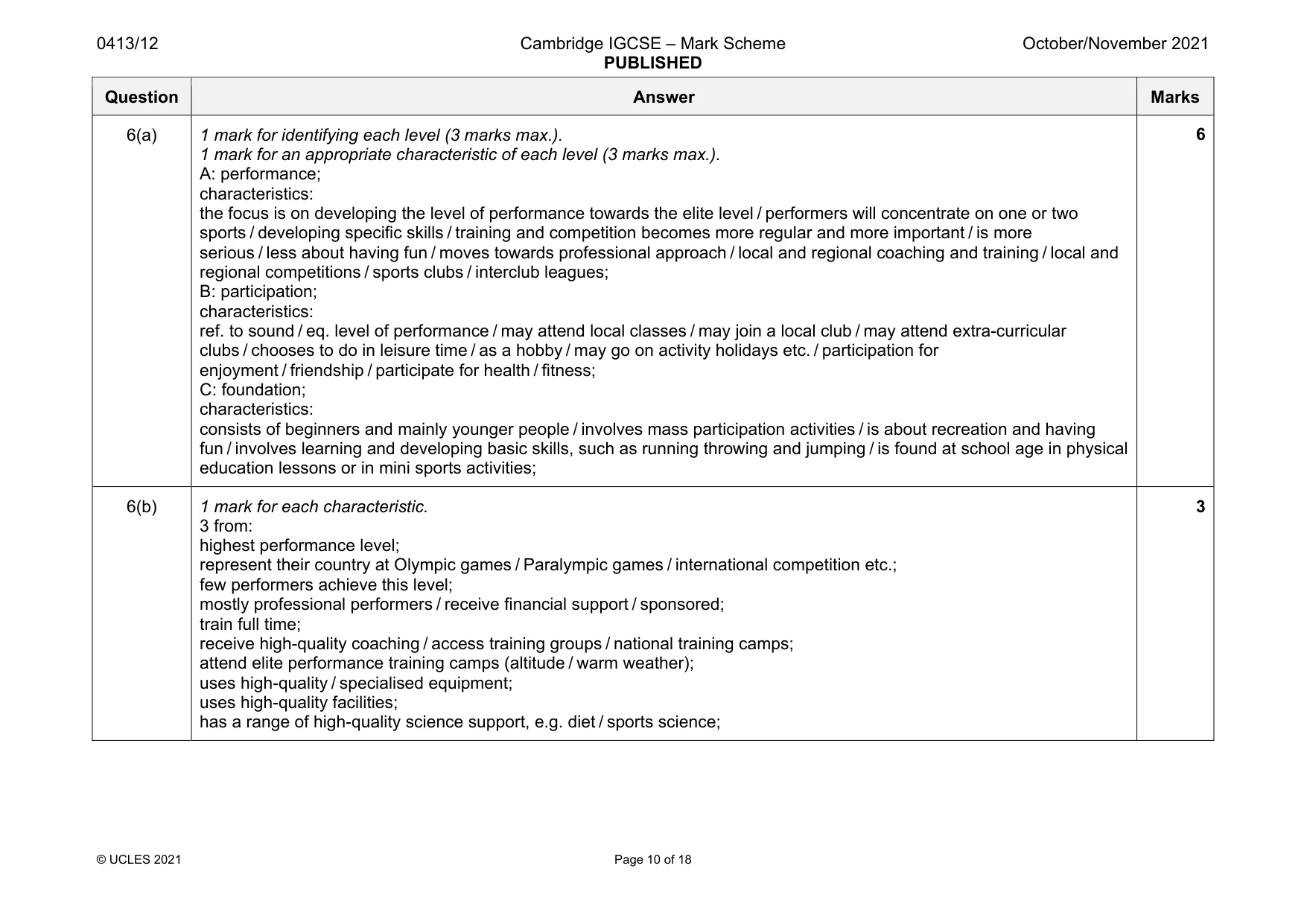
8 0413/12/O/N/21 © UCLES 2021 6 (a) The diagram shows the sports development pyramid. elite A B C Identify the levels of the sports development pyramid labelled A, B and C. Describe a characteristic of each of these levels. A … description of characteristic … … B … description of characteristic … … C … description of characteristic … … [6] (b) Describe three characteristics of the elite level of the sports development pyramid. 1 … … 2 … … 3 … … [3] [Total: 9]
Question paper, page 9
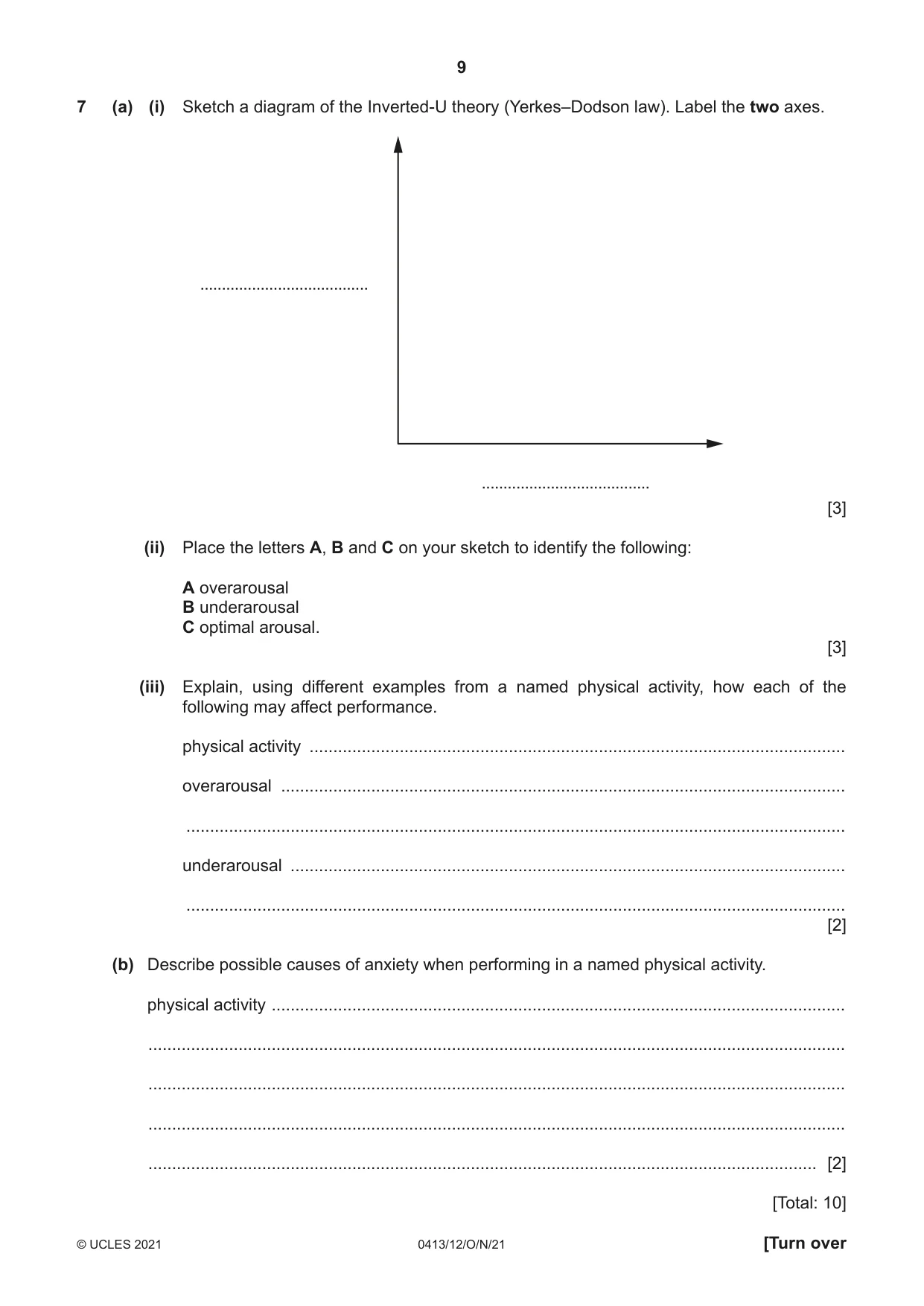
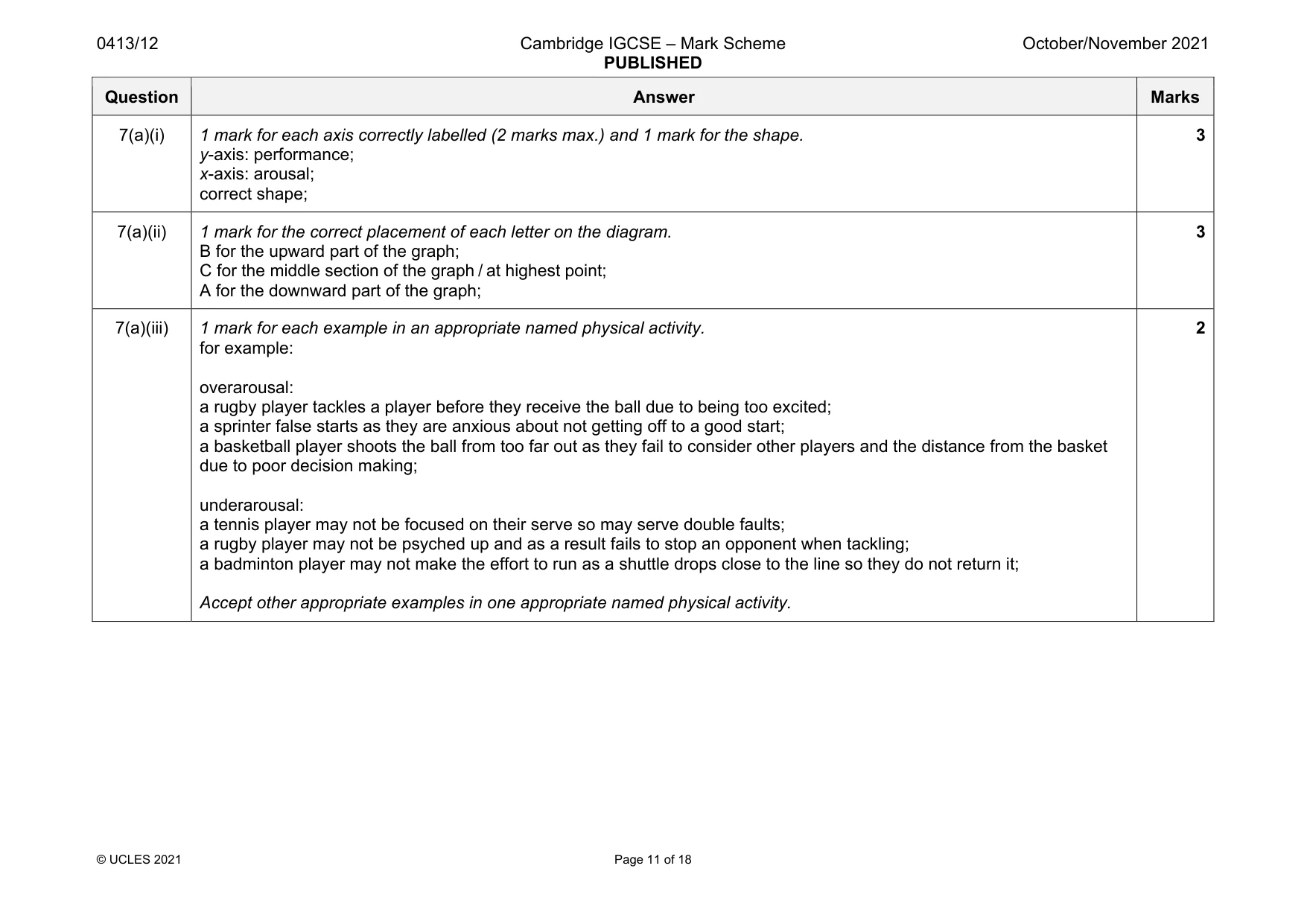
9 0413/12/O/N/21 © UCLES 2021 [Turn over 7 (a) (i) Sketch a diagram of the Inverted-U theory (Yerkes–Dodson law). Label the two axes. … … [3] (ii) Place the letters A, B and C on your sketch to identify the following: A overarousal B underarousal C optimal arousal. [3] (iii) Explain, using different examples from a named physical activity, how each of the following may affect performance. physical activity … overarousal … … underarousal … … [2] (b) Describe possible causes of anxiety when performing in a named physical activity. physical activity … … … … … [2] [Total: 10]
Question paper, page 10
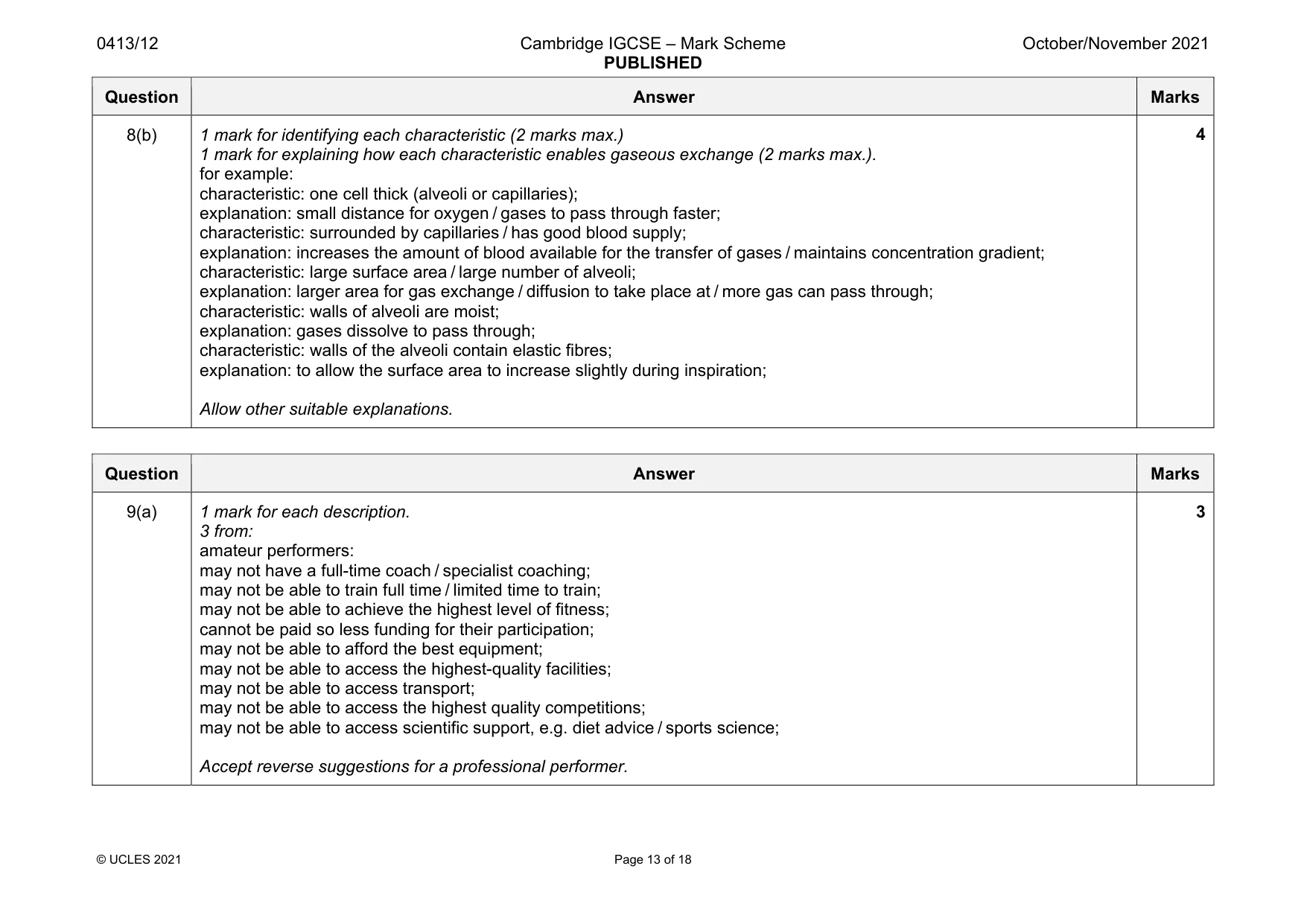
10 0413/12/O/N/21 © UCLES 2021 8 (a) Describe two named breathing volumes. breathing volume 1 … description … … breathing volume 2 … description … … [4] (b) Explain how two characteristics of the alveoli enable gaseous exchange. characteristic 1 … explanation … … characteristic 2 … explanation … … [4] [Total: 8]
Question paper, page 11
11 0413/12/O/N/21 © UCLES 2021 [Turn over 9 An amateur performer and a professional performer are preparing to compete at the Olympic Games. (a) Suggest how their preparation may differ. … … … … … … [3] (b) Suggest why there has been an increase in the blurring between professional status and amateur status of performers in sport. … … … … … … [2] [Total: 5]
Question paper, page 12
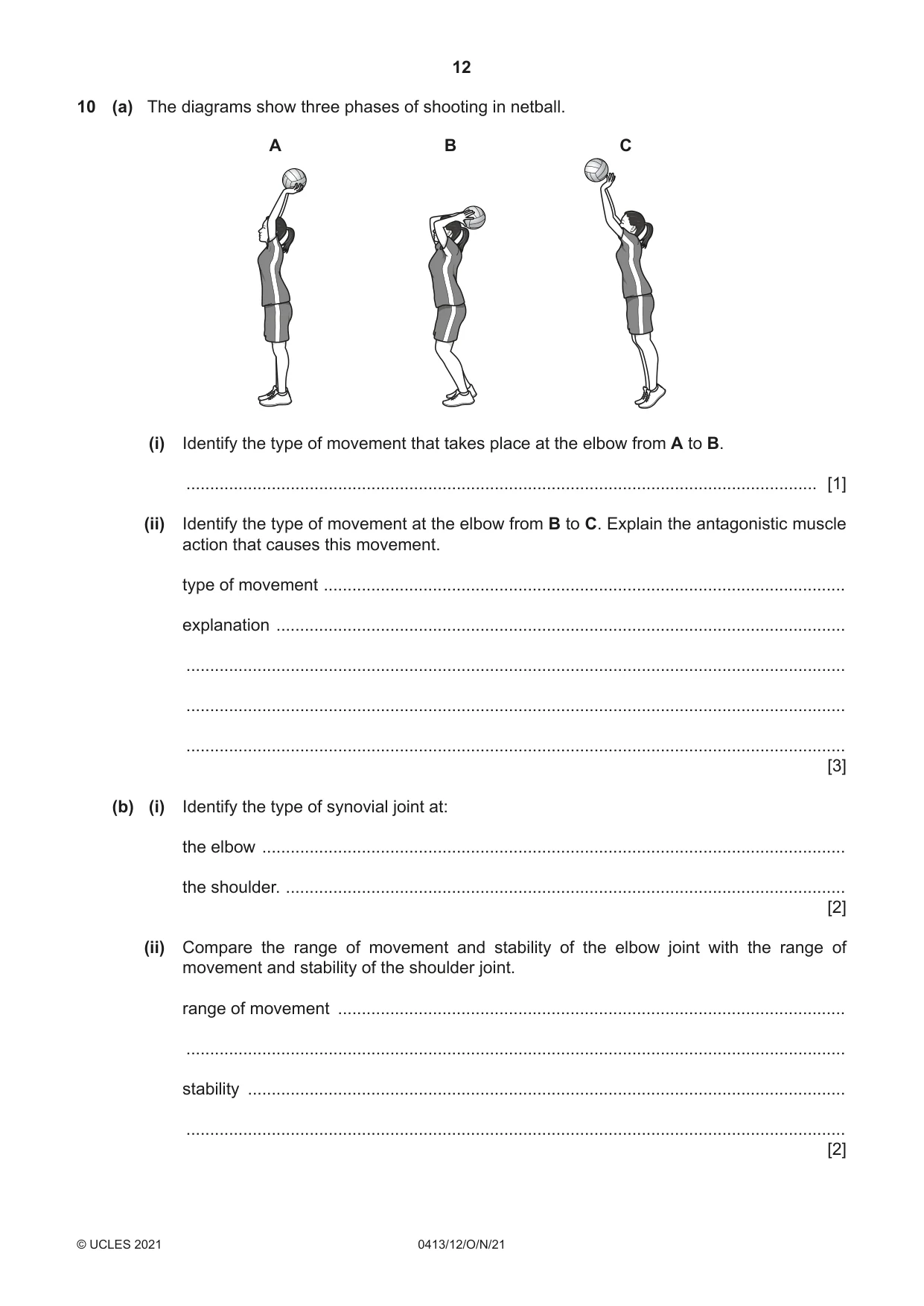
12 0413/12/O/N/21 © UCLES 2021 10 (a) The diagrams show three phases of shooting in netball. A B C (i) Identify the type of movement that takes place at the elbow from A to B. … [1] (ii) Identify the type of movement at the elbow from B to C. Explain the antagonistic muscle action that causes this movement. type of movement … explanation … … … … [3] (b) (i) Identify the type of synovial joint at: the elbow … the shoulder. … [2] (ii) Compare the range of movement and stability of the elbow joint with the range of movement and stability of the shoulder joint. range of movement … … stability … … [2]
Question paper, page 13
13 0413/12/O/N/21 © UCLES 2021 [Turn over (c) A graze is a common injury in netball. Suggest a possible cause of a graze. Describe a suitable treatment for the graze. cause … … treatment … … [2] [Total: 10] 11 (a) Define fitness. … … [1] (b) Describe requirements for good social health and well-being. … … … … … … [3] [Total: 4]
Question paper, page 14
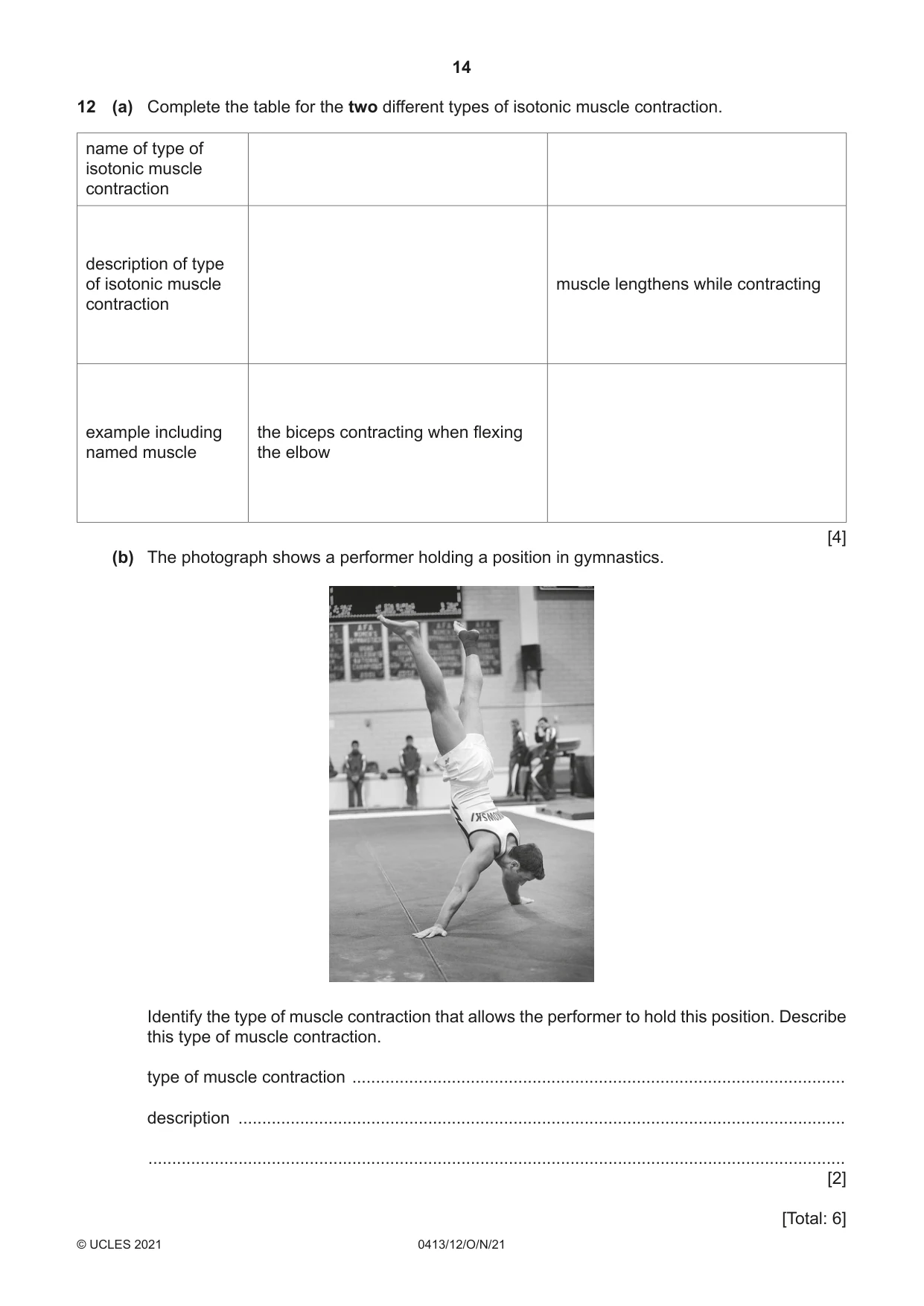
14 0413/12/O/N/21 © UCLES 2021 12 (a) Complete the table for the two different types of isotonic muscle contraction. name of type of isotonic muscle contraction description of type of isotonic muscle contraction muscle lengthens while contracting example including named muscle the biceps contracting when flexing the elbow [4] (b) The photograph shows a performer holding a position in gymnastics. Identify the type of muscle contraction that allows the performer to hold this position. Describe this type of muscle contraction. type of muscle contraction … description … … [2] [Total: 6]
Question paper, page 15
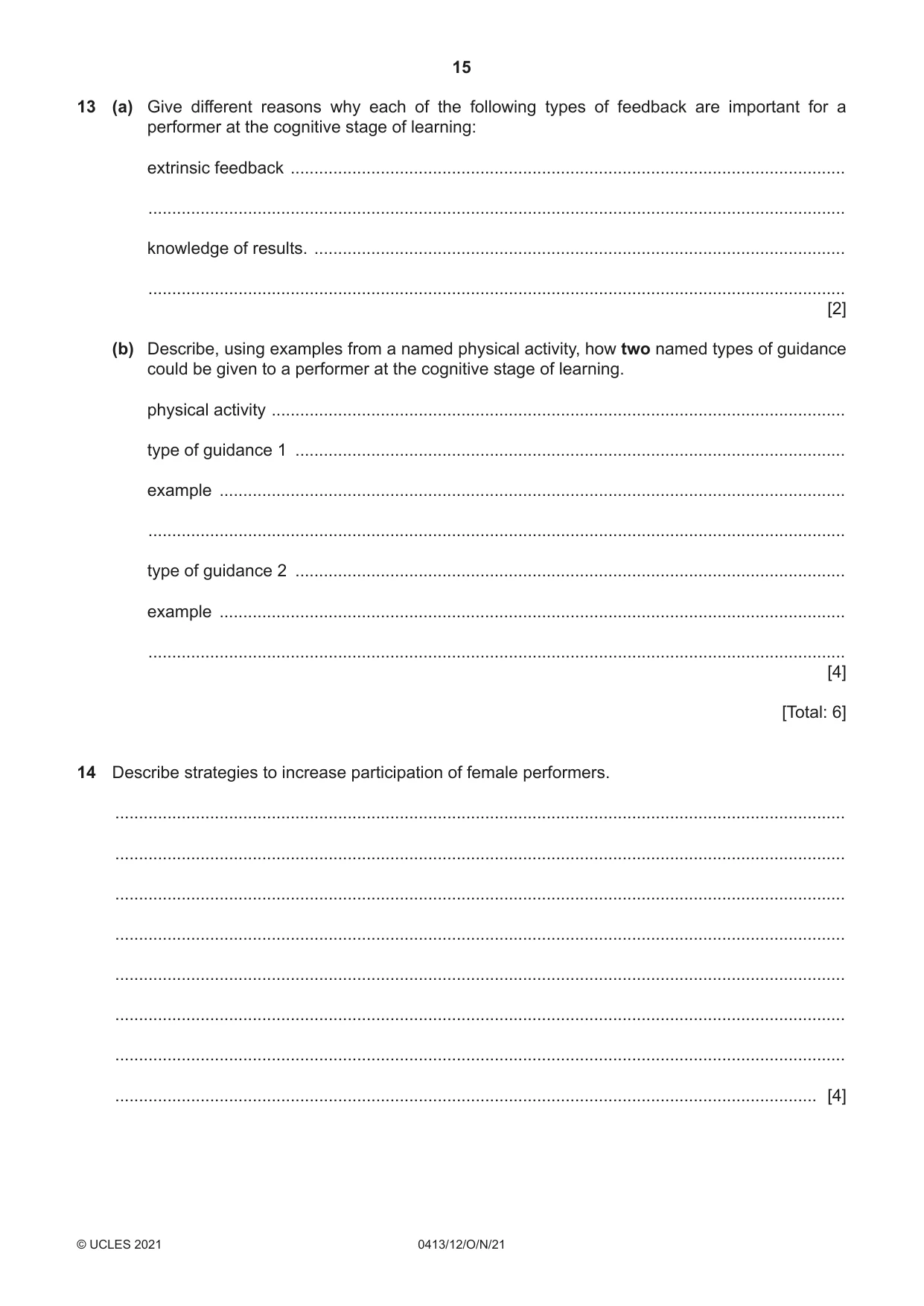
15 0413/12/O/N/21 © UCLES 2021 13 (a) Give different reasons why each of the following types of feedback are important for a performer at the cognitive stage of learning: extrinsic feedback … … knowledge of results. … … [2] (b) Describe, using examples from a named physical activity, how two named types of guidance could be given to a performer at the cognitive stage of learning. physical activity … type of guidance 1 … example … … type of guidance 2 … example … … [4] [Total: 6] 14 Describe strategies to increase participation of female performers. … … … … … … … … [4]
Question paper, page 16
16 0413/12/O/N/21 © UCLES 2021 Permission to reproduce items where third-party owned material protected by copyright is included has been sought and cleared where possible. Every reasonable effort has been made by the publisher (UCLES) to trace copyright holders, but if any items requiring clearance have unwittingly been included, the publisher will be pleased to make amends at the earliest possible opportunity. To avoid the issue of disclosure of answer-related information to candidates, all copyright acknowledgements are reproduced online in the Cambridge Assessment International Education Copyright Acknowledgements Booklet. This is produced for each series of examinations and is freely available to download at www.cambridgeinternational.org after the live examination series. Cambridge Assessment International Education is part of the Cambridge Assessment Group. Cambridge Assessment is the brand name of the University of Cambridge Local Examinations Syndicate (UCLES), which itself is a department of the University of Cambridge. BLANK PAGE
Mark scheme, page 1
This document consists of 18 printed pages. © UCLES 2021 [Turn over Cambridge IGCSE™ PHYSICAL EDUCATION 0413/12 Paper 1 Theory October/November 2021 MARK SCHEME Maximum Mark: 100 Published This mark scheme is published as an aid to teachers and candidates, to indicate the requirements of the examination. It shows the basis on which Examiners were instructed to award marks. It does not indicate the details of the discussions that took place at an Examiners’ meeting before marking began, which would have considered the acceptability of alternative answers. Mark schemes should be read in conjunction with the question paper and the principal examiner report for teachers. Cambridge international will not enter into discussions about these mark schemes. Cambridge International is publishing the mark schemes for the October/November 2021 series for most Cambridge IGCSE™, Cambridge International A and AS Level components and some Cambridge O Level components.
Mark scheme, page 2
0413/12 Cambridge IGCSE – Mark Scheme PUBLISHED October/November 2021 © UCLES 2021 Page 2 of 18 Generic Marking Principles These general marking principles must be applied by all examiners when marking candidate answers. They should be applied alongside the specific content of the mark scheme or generic level descriptors for a question. Each question paper and mark scheme will also comply with these marking principles. GENERIC MARKING PRINCIPLE 1: Marks must be awarded in line with: • the specific content of the mark scheme or the generic level descriptors for the question • the specific skills defined in the mark scheme or in the generic level descriptors for the question • the standard of response required by a candidate as exemplified by the standardisation scripts. GENERIC MARKING PRINCIPLE 2: Marks awarded are always whole marks (not half marks, or other fractions). GENERIC MARKING PRINCIPLE 3: Marks must be awarded positively: • marks are awarded for correct/valid answers, as defined in the mark scheme. However, credit is given for valid answers which go beyond the scope of the syllabus and mark scheme, referring to your Team Leader as appropriate • marks are awarded when candidates clearly demonstrate what they know and can do • marks are not deducted for errors • marks are not deducted for omissions • answers should only be judged on the quality of spelling, punctuation and grammar when these features are specifically assessed by the question as indicated by the mark scheme. The meaning, however, should be unambiguous. GENERIC MARKING PRINCIPLE 4: Rules must be applied consistently, e.g. in situations where candidates have not followed instructions or in the application of generic level descriptors.
Mark scheme, page 3
0413/12 Cambridge IGCSE – Mark Scheme PUBLISHED October/November 2021 © UCLES 2021 Page 3 of 18 GENERIC MARKING PRINCIPLE 5: Marks should be awarded using the full range of marks defined in the mark scheme for the question (however; the use of the full mark range may be limited according to the quality of the candidate responses seen). GENERIC MARKING PRINCIPLE 6: Marks awarded are based solely on the requirements as defined in the mark scheme. Marks should not be awarded with grade thresholds or grade descriptors in mind. Science-Specific Marking Principles 1 Examiners should consider the context and scientific use of any keywords when awarding marks. Although keywords may be present, marks should not be awarded if the keywords are used incorrectly. 2 The examiner should not choose between contradictory statements given in the same question part, and credit should not be awarded for any correct statement that is contradicted within the same question part. Wrong science that is irrelevant to the question should be ignored. 3 Although spellings do not have to be correct, spellings of syllabus terms must allow for clear and unambiguous separation from other syllabus terms with which they may be confused (e.g. ethane / ethene, glucagon / glycogen, refraction / reflection). 4 The error carried forward (ecf) principle should be applied, where appropriate. If an incorrect answer is subsequently used in a scientifically correct way, the candidate should be awarded these subsequent marking points. Further guidance will be included in the mark scheme where necessary and any exceptions to this general principle will be noted. 5 ‘List rule’ guidance For questions that require n responses (e.g. State two reasons …): • The response should be read as continuous prose, even when numbered answer spaces are provided. • Any response marked ignore in the mark scheme should not count towards n. • Incorrect responses should not be awarded credit but will still count towards n. • Read the entire response to check for any responses that contradict those that would otherwise be credited. Credit should not be awarded for any responses that are contradicted within the rest of the response. Where two responses contradict one another, this should be treated as a single incorrect response. • Non-contradictory responses after the first n responses may be ignored even if they include incorrect science.
Mark scheme, page 4
0413/12 Cambridge IGCSE – Mark Scheme PUBLISHED October/November 2021 © UCLES 2021 Page 4 of 18 6 Calculation specific guidance Correct answers to calculations should be given full credit even if there is no working or incorrect working, unless the question states ‘show your working’. For questions in which the number of significant figures required is not stated, credit should be awarded for correct answers when rounded by the examiner to the number of significant figures given in the mark scheme. This may not apply to measured values. For answers given in standard form (e.g. a × 10n) in which the convention of restricting the value of the coefficient (a) to a value between 1 and 10 is not followed, credit may still be awarded if the answer can be converted to the answer given in the mark scheme. Unless a separate mark is given for a unit, a missing or incorrect unit will normally mean that the final calculation mark is not awarded. Exceptions to this general principle will be noted in the mark scheme. 7 Guidance for chemical equations Multiples / fractions of coefficients used in chemical equations are acceptable unless stated otherwise in the mark scheme. State symbols given in an equation should be ignored unless asked for in the question or stated otherwise in the mark scheme.
Mark scheme, page 5
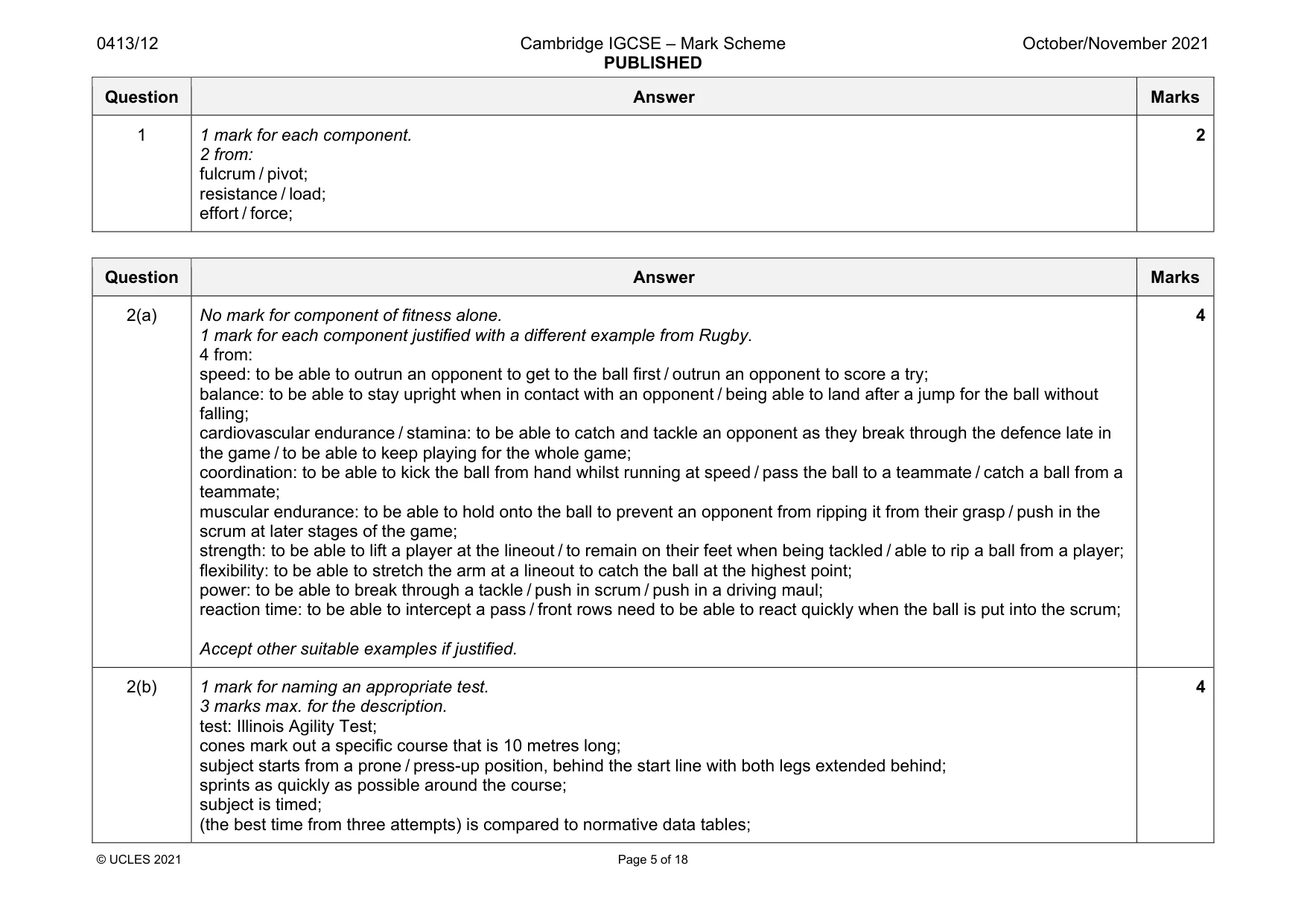
0413/12 Cambridge IGCSE – Mark Scheme PUBLISHED October/November 2021 © UCLES 2021 Page 5 of 18 Question Answer Marks 1 1 mark for each component. 2 from: fulcrum / pivot; resistance / load; effort / force; 2 Question Answer Marks 2(a) No mark for component of fitness alone. 1 mark for each component justified with a different example from Rugby. 4 from: speed: to be able to outrun an opponent to get to the ball first / outrun an opponent to score a try; balance: to be able to stay upright when in contact with an opponent / being able to land after a jump for the ball without falling; cardiovascular endurance / stamina: to be able to catch and tackle an opponent as they break through the defence late in the game / to be able to keep playing for the whole game; coordination: to be able to kick the ball from hand whilst running at speed / pass the ball to a teammate / catch a ball from a teammate; muscular endurance: to be able to hold onto the ball to prevent an opponent from ripping it from their grasp / push in the scrum at later stages of the game; strength: to be able to lift a player at the lineout / to remain on their feet when being tackled / able to rip a ball from a player; flexibility: to be able to stretch the arm at a lineout to catch the ball at the highest point; power: to be able to break through a tackle / push in scrum / push in a driving maul; reaction time: to be able to intercept a pass / front rows need to be able to react quickly when the ball is put into the scrum; Accept other suitable examples if justified. 4 2(b) 1 mark for naming an appropriate test. 3 marks max. for the description. test: Illinois Agility Test; cones mark out a specific course that is 10 metres long; subject starts from a prone / press-up position, behind the start line with both legs extended behind; sprints as quickly as possible around the course; subject is timed; (the best time from three attempts) is compared to normative data tables; 4
Mark scheme, page 6
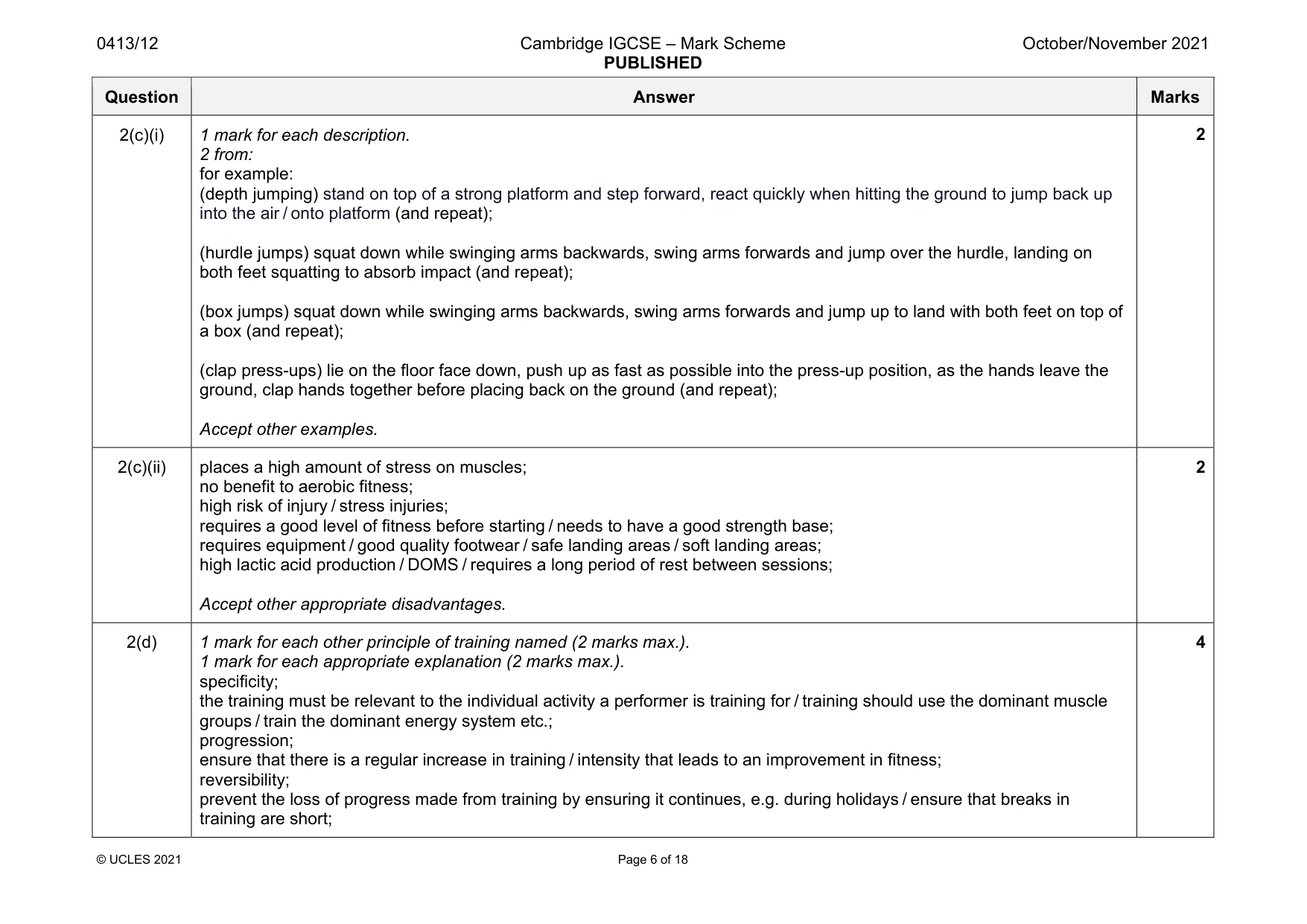
0413/12 Cambridge IGCSE – Mark Scheme PUBLISHED October/November 2021 © UCLES 2021 Page 6 of 18 Question Answer Marks 2(c)(i) 1 mark for each description. 2 from: for example: (depth jumping) stand on top of a strong platform and step forward, react quickly when hitting the ground to jump back up into the air / onto platform (and repeat); (hurdle jumps) squat down while swinging arms backwards, swing arms forwards and jump over the hurdle, landing on both feet squatting to absorb impact (and repeat); (box jumps) squat down while swinging arms backwards, swing arms forwards and jump up to land with both feet on top of a box (and repeat); (clap press-ups) lie on the floor face down, push up as fast as possible into the press-up position, as the hands leave the ground, clap hands together before placing back on the ground (and repeat); Accept other examples. 2 2(c)(ii) places a high amount of stress on muscles; no benefit to aerobic fitness; high risk of injury / stress injuries; requires a good level of fitness before starting / needs to have a good strength base; requires equipment / good quality footwear / safe landing areas / soft landing areas; high lactic acid production / DOMS / requires a long period of rest between sessions; Accept other appropriate disadvantages. 2 2(d) 1 mark for each other principle of training named (2 marks max.). 1 mark for each appropriate explanation (2 marks max.). specificity; the training must be relevant to the individual activity a performer is training for / training should use the dominant muscle groups / train the dominant energy system etc.; progression; ensure that there is a regular increase in training / intensity that leads to an improvement in fitness; reversibility; prevent the loss of progress made from training by ensuring it continues, e.g. during holidays / ensure that breaks in training are short; 4
Mark scheme, page 7
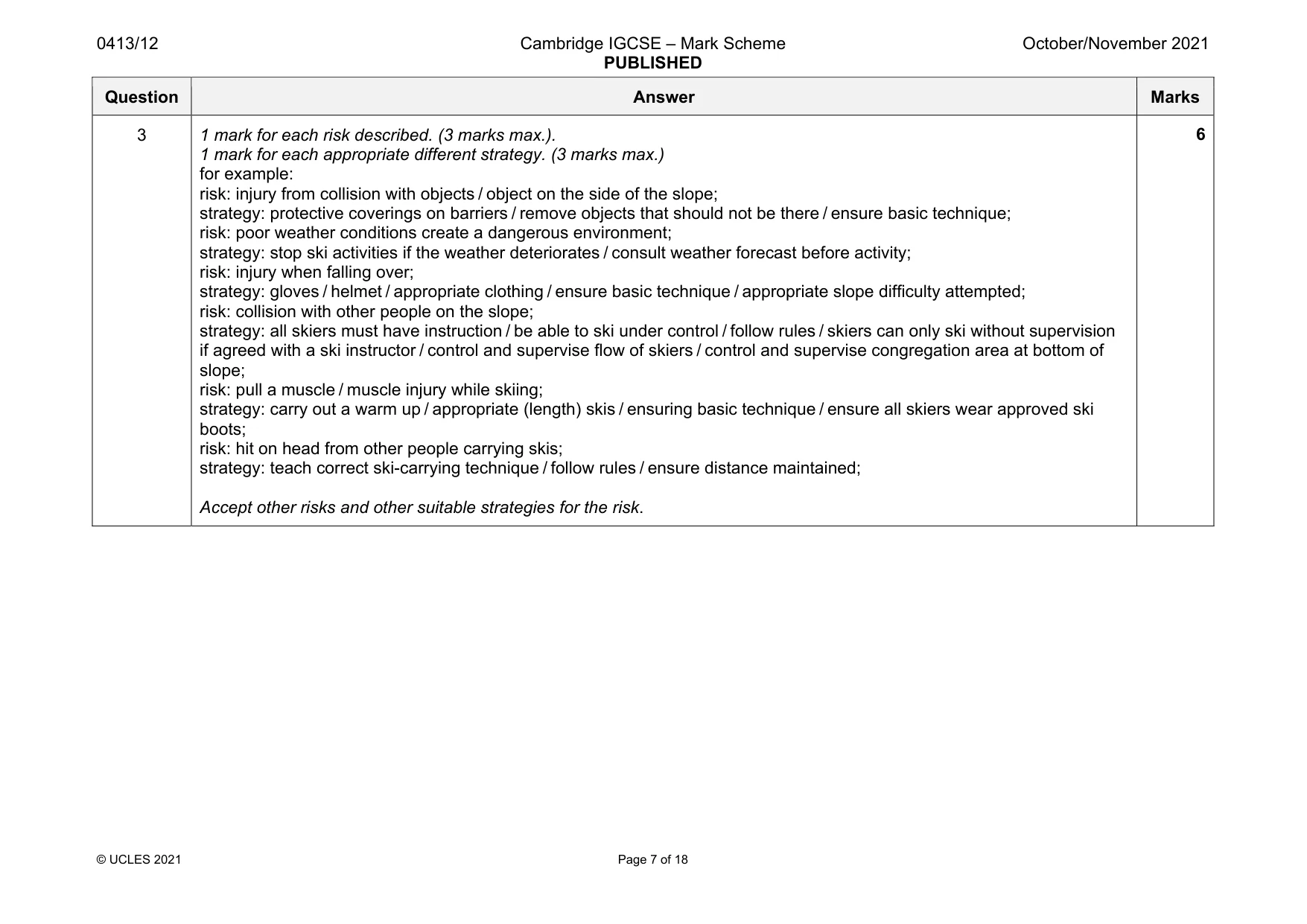
0413/12 Cambridge IGCSE – Mark Scheme PUBLISHED October/November 2021 © UCLES 2021 Page 7 of 18 Question Answer Marks 3 1 mark for each risk described. (3 marks max.). 1 mark for each appropriate different strategy. (3 marks max.) for example: risk: injury from collision with objects / object on the side of the slope; strategy: protective coverings on barriers / remove objects that should not be there / ensure basic technique; risk: poor weather conditions create a dangerous environment; strategy: stop ski activities if the weather deteriorates / consult weather forecast before activity; risk: injury when falling over; strategy: gloves / helmet / appropriate clothing / ensure basic technique / appropriate slope difficulty attempted; risk: collision with other people on the slope; strategy: all skiers must have instruction / be able to ski under control / follow rules / skiers can only ski without supervision if agreed with a ski instructor / control and supervise flow of skiers / control and supervise congregation area at bottom of slope; risk: pull a muscle / muscle injury while skiing; strategy: carry out a warm up / appropriate (length) skis / ensuring basic technique / ensure all skiers wear approved ski boots; risk: hit on head from other people carrying skis; strategy: teach correct ski-carrying technique / follow rules / ensure distance maintained; Accept other risks and other suitable strategies for the risk. 6
Mark scheme, page 8
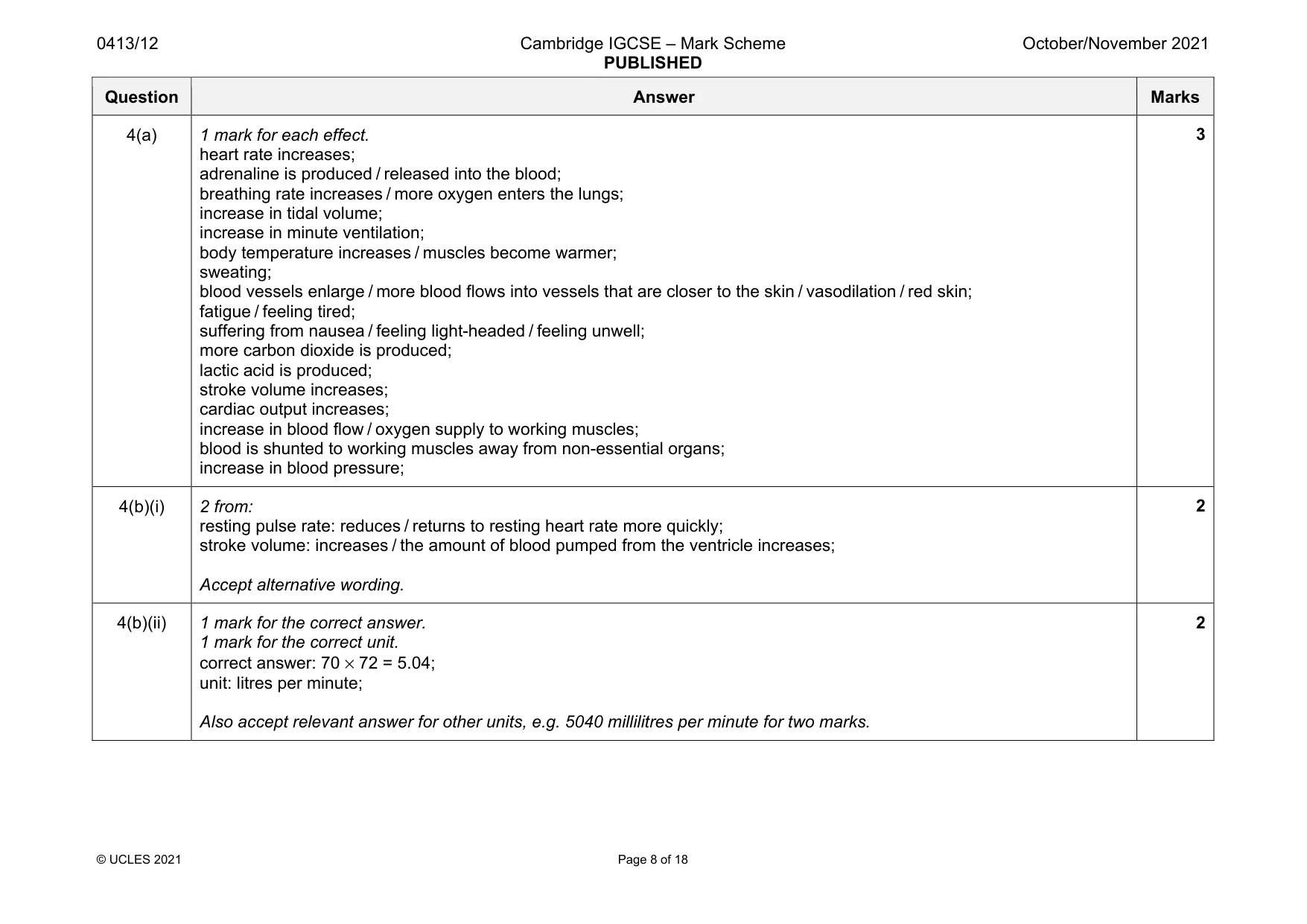
0413/12 Cambridge IGCSE – Mark Scheme PUBLISHED October/November 2021 © UCLES 2021 Page 8 of 18 Question Answer Marks 4(a) 1 mark for each effect. heart rate increases; adrenaline is produced / released into the blood; breathing rate increases / more oxygen enters the lungs; increase in tidal volume; increase in minute ventilation; body temperature increases / muscles become warmer; sweating; blood vessels enlarge / more blood flows into vessels that are closer to the skin / vasodilation / red skin; fatigue / feeling tired; suffering from nausea / feeling light-headed / feeling unwell; more carbon dioxide is produced; lactic acid is produced; stroke volume increases; cardiac output increases; increase in blood flow / oxygen supply to working muscles; blood is shunted to working muscles away from non-essential organs; increase in blood pressure; 3 4(b)(i) 2 from: resting pulse rate: reduces / returns to resting heart rate more quickly; stroke volume: increases / the amount of blood pumped from the ventricle increases; Accept alternative wording. 2 4(b)(ii) 1 mark for the correct answer. 1 mark for the correct unit. correct answer: 70 × 72 = 5.04; unit: litres per minute; Also accept relevant answer for other units, e.g. 5040 millilitres per minute for two marks. 2
Mark scheme, page 9
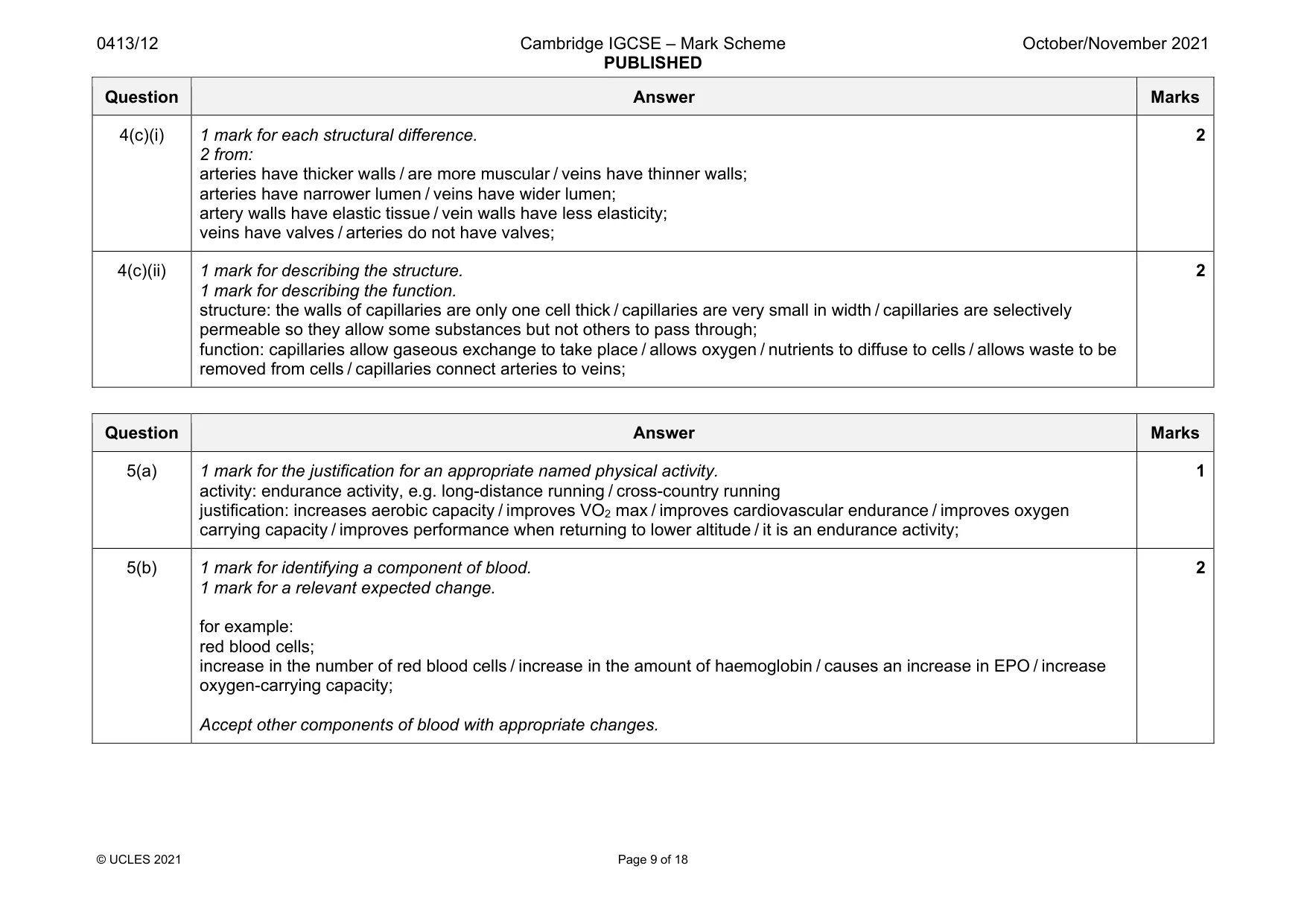
0413/12 Cambridge IGCSE – Mark Scheme PUBLISHED October/November 2021 © UCLES 2021 Page 9 of 18 Question Answer Marks 4(c)(i) 1 mark for each structural difference. 2 from: arteries have thicker walls / are more muscular / veins have thinner walls; arteries have narrower lumen / veins have wider lumen; artery walls have elastic tissue / vein walls have less elasticity; veins have valves / arteries do not have valves; 2 4(c)(ii) 1 mark for describing the structure. 1 mark for describing the function. structure: the walls of capillaries are only one cell thick / capillaries are very small in width / capillaries are selectively permeable so they allow some substances but not others to pass through; function: capillaries allow gaseous exchange to take place / allows oxygen / nutrients to diffuse to cells / allows waste to be removed from cells / capillaries connect arteries to veins; 2 Question Answer Marks 5(a) 1 mark for the justification for an appropriate named physical activity. activity: endurance activity, e.g. long-distance running / cross-country running justification: increases aerobic capacity / improves VO2 max / improves cardiovascular endurance / improves oxygen carrying capacity / improves performance when returning to lower altitude / it is an endurance activity; 1 5(b) 1 mark for identifying a component of blood. 1 mark for a relevant expected change. for example: red blood cells; increase in the number of red blood cells / increase in the amount of haemoglobin / causes an increase in EPO / increase oxygen-carrying capacity; Accept other components of blood with appropriate changes. 2
Mark scheme, page 10
0413/12 Cambridge IGCSE – Mark Scheme PUBLISHED October/November 2021 © UCLES 2021 Page 10 of 18 Question Answer Marks 6(a) 1 mark for identifying each level (3 marks max.). 1 mark for an appropriate characteristic of each level (3 marks max.). A: performance; characteristics: the focus is on developing the level of performance towards the elite level / performers will concentrate on one or two sports / developing specific skills / training and competition becomes more regular and more important / is more serious / less about having fun / moves towards professional approach / local and regional coaching and training / local and regional competitions / sports clubs / interclub leagues; B: participation; characteristics: ref. to sound / eq. level of performance / may attend local classes / may join a local club / may attend extra-curricular clubs / chooses to do in leisure time / as a hobby / may go on activity holidays etc. / participation for enjoyment / friendship / participate for health / fitness; C: foundation; characteristics: consists of beginners and mainly younger people / involves mass participation activities / is about recreation and having fun / involves learning and developing basic skills, such as running throwing and jumping / is found at school age in physical education lessons or in mini sports activities; 6 6(b) 1 mark for each characteristic. 3 from: highest performance level; represent their country at Olympic games / Paralympic games / international competition etc.; few performers achieve this level; mostly professional performers / receive financial support / sponsored; train full time; receive high-quality coaching / access training groups / national training camps; attend elite performance training camps (altitude / warm weather); uses high-quality / specialised equipment; uses high-quality facilities; has a range of high-quality science support, e.g. diet / sports science; 3
Mark scheme, page 11
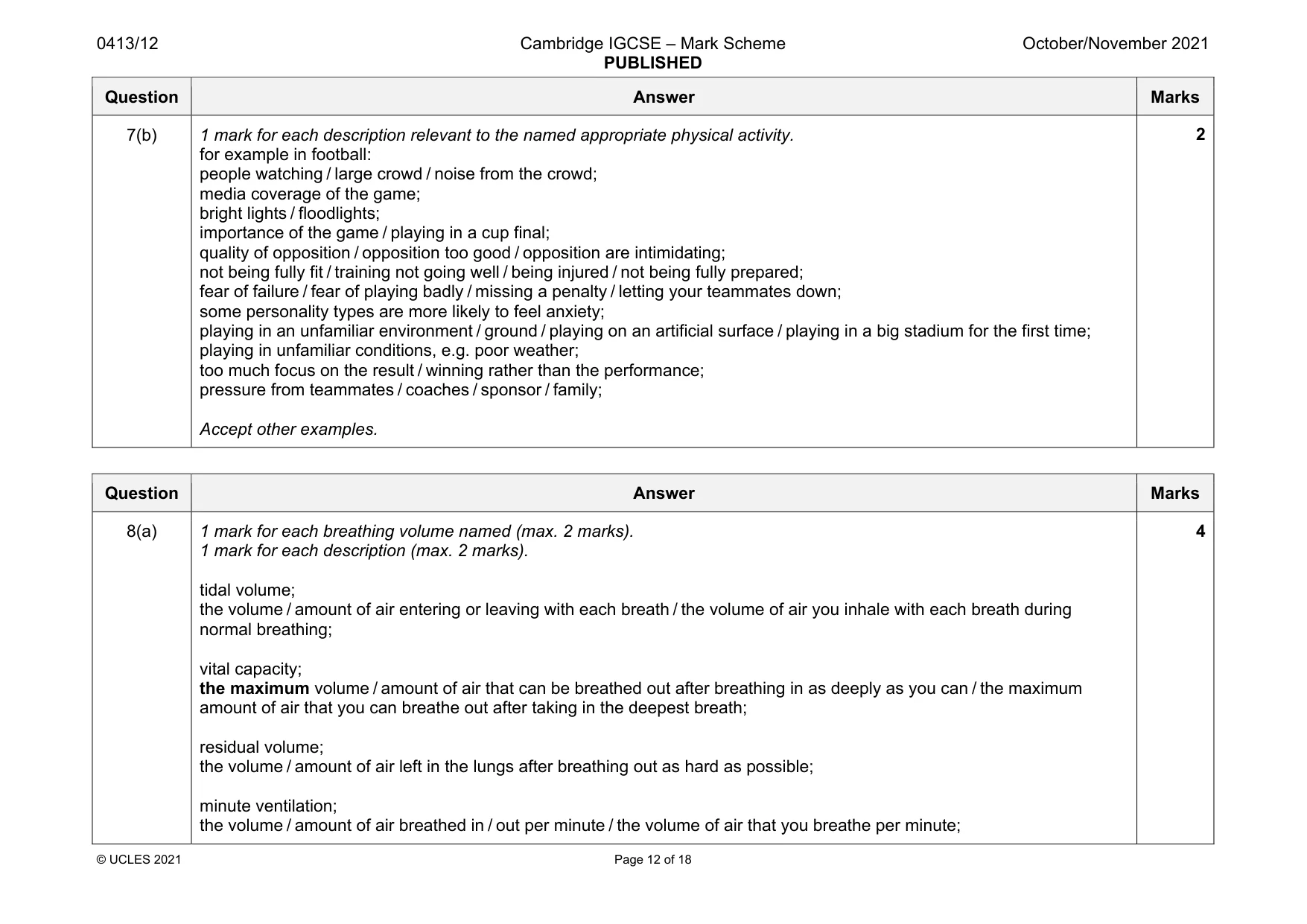
0413/12 Cambridge IGCSE – Mark Scheme PUBLISHED October/November 2021 © UCLES 2021 Page 11 of 18 Question Answer Marks 7(a)(i) 1 mark for each axis correctly labelled (2 marks max.) and 1 mark for the shape. y-axis: performance; x-axis: arousal; correct shape; 3 7(a)(ii) 1 mark for the correct placement of each letter on the diagram. B for the upward part of the graph; C for the middle section of the graph / at highest point; A for the downward part of the graph; 3 7(a)(iii) 1 mark for each example in an appropriate named physical activity. for example: overarousal: a rugby player tackles a player before they receive the ball due to being too excited; a sprinter false starts as they are anxious about not getting off to a good start; a basketball player shoots the ball from too far out as they fail to consider other players and the distance from the basket due to poor decision making; underarousal: a tennis player may not be focused on their serve so may serve double faults; a rugby player may not be psyched up and as a result fails to stop an opponent when tackling; a badminton player may not make the effort to run as a shuttle drops close to the line so they do not return it; Accept other appropriate examples in one appropriate named physical activity. 2
Mark scheme, page 12
0413/12 Cambridge IGCSE – Mark Scheme PUBLISHED October/November 2021 © UCLES 2021 Page 12 of 18 Question Answer Marks 7(b) 1 mark for each description relevant to the named appropriate physical activity. for example in football: people watching / large crowd / noise from the crowd; media coverage of the game; bright lights / floodlights; importance of the game / playing in a cup final; quality of opposition / opposition too good / opposition are intimidating; not being fully fit / training not going well / being injured / not being fully prepared; fear of failure / fear of playing badly / missing a penalty / letting your teammates down; some personality types are more likely to feel anxiety; playing in an unfamiliar environment / ground / playing on an artificial surface / playing in a big stadium for the first time; playing in unfamiliar conditions, e.g. poor weather; too much focus on the result / winning rather than the performance; pressure from teammates / coaches / sponsor / family; Accept other examples. 2 Question Answer Marks 8(a) 1 mark for each breathing volume named (max. 2 marks). 1 mark for each description (max. 2 marks). tidal volume; the volume / amount of air entering or leaving with each breath / the volume of air you inhale with each breath during normal breathing; vital capacity; the maximum volume / amount of air that can be breathed out after breathing in as deeply as you can / the maximum amount of air that you can breathe out after taking in the deepest breath; residual volume; the volume / amount of air left in the lungs after breathing out as hard as possible; minute ventilation; the volume / amount of air breathed in / out per minute / the volume of air that you breathe per minute; 4
Mark scheme, page 13
0413/12 Cambridge IGCSE – Mark Scheme PUBLISHED October/November 2021 © UCLES 2021 Page 13 of 18 Question Answer Marks 8(b) 1 mark for identifying each characteristic (2 marks max.) 1 mark for explaining how each characteristic enables gaseous exchange (2 marks max.). for example: characteristic: one cell thick (alveoli or capillaries); explanation: small distance for oxygen / gases to pass through faster; characteristic: surrounded by capillaries / has good blood supply; explanation: increases the amount of blood available for the transfer of gases / maintains concentration gradient; characteristic: large surface area / large number of alveoli; explanation: larger area for gas exchange / diffusion to take place at / more gas can pass through; characteristic: walls of alveoli are moist; explanation: gases dissolve to pass through; characteristic: walls of the alveoli contain elastic fibres; explanation: to allow the surface area to increase slightly during inspiration; Allow other suitable explanations. 4 Question Answer Marks 9(a) 1 mark for each description. 3 from: amateur performers: may not have a full-time coach / specialist coaching; may not be able to train full time / limited time to train; may not be able to achieve the highest level of fitness; cannot be paid so less funding for their participation; may not be able to afford the best equipment; may not be able to access the highest-quality facilities; may not be able to access transport; may not be able to access the highest quality competitions; may not be able to access scientific support, e.g. diet advice / sports science; Accept reverse suggestions for a professional performer. 3
Mark scheme, page 14
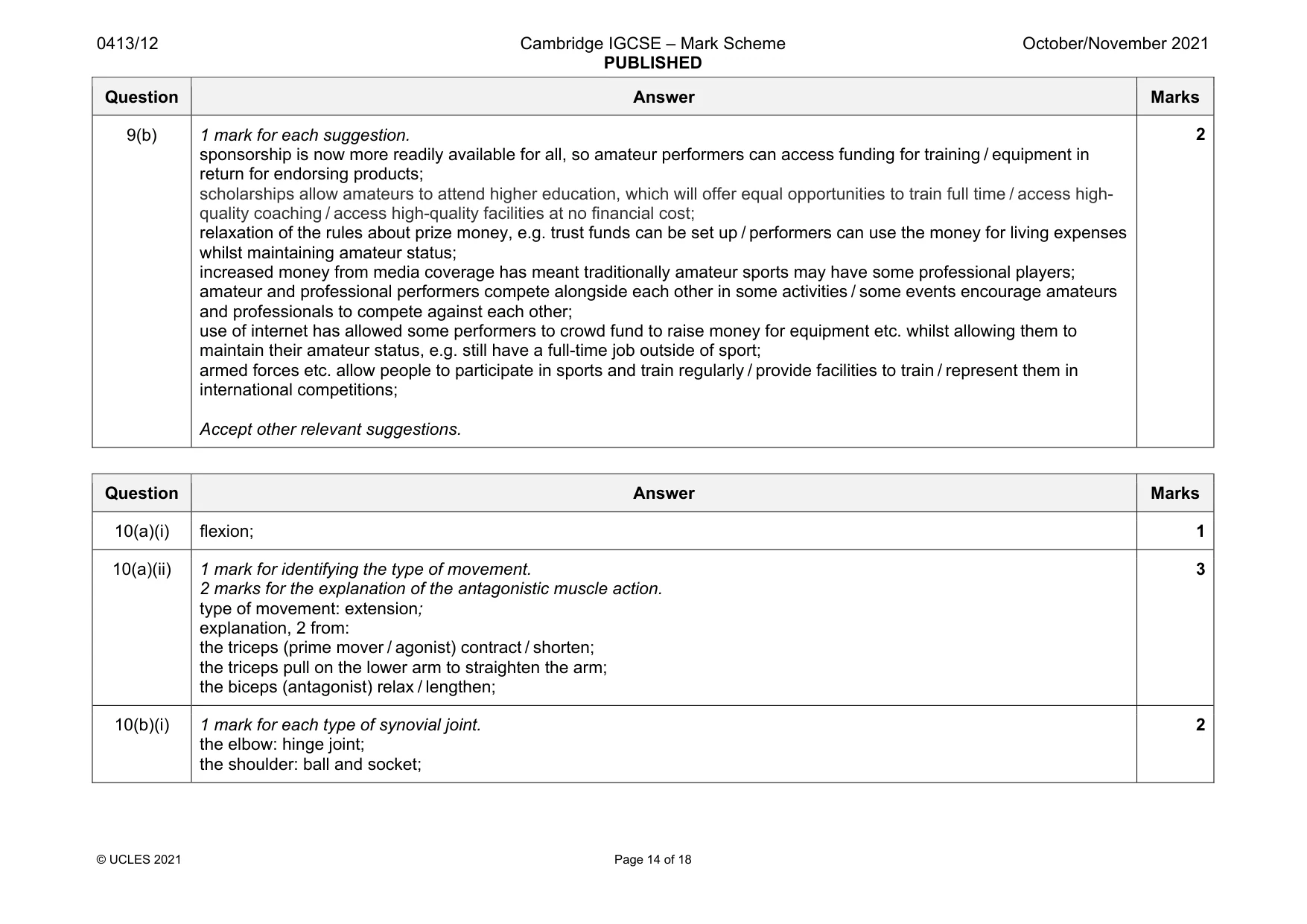
0413/12 Cambridge IGCSE – Mark Scheme PUBLISHED October/November 2021 © UCLES 2021 Page 14 of 18 Question Answer Marks 9(b) 1 mark for each suggestion. sponsorship is now more readily available for all, so amateur performers can access funding for training / equipment in return for endorsing products; scholarships allow amateurs to attend higher education, which will offer equal opportunities to train full time / access high- quality coaching / access high-quality facilities at no financial cost; relaxation of the rules about prize money, e.g. trust funds can be set up / performers can use the money for living expenses whilst maintaining amateur status; increased money from media coverage has meant traditionally amateur sports may have some professional players; amateur and professional performers compete alongside each other in some activities / some events encourage amateurs and professionals to compete against each other; use of internet has allowed some performers to crowd fund to raise money for equipment etc. whilst allowing them to maintain their amateur status, e.g. still have a full-time job outside of sport; armed forces etc. allow people to participate in sports and train regularly / provide facilities to train / represent them in international competitions; Accept other relevant suggestions. 2 Question Answer Marks 10(a)(i) flexion; 1 10(a)(ii) 1 mark for identifying the type of movement. 2 marks for the explanation of the antagonistic muscle action. type of movement: extension; explanation, 2 from: the triceps (prime mover / agonist) contract / shorten; the triceps pull on the lower arm to straighten the arm; the biceps (antagonist) relax / lengthen; 3 10(b)(i) 1 mark for each type of synovial joint. the elbow: hinge joint; the shoulder: ball and socket; 2
Mark scheme, page 15
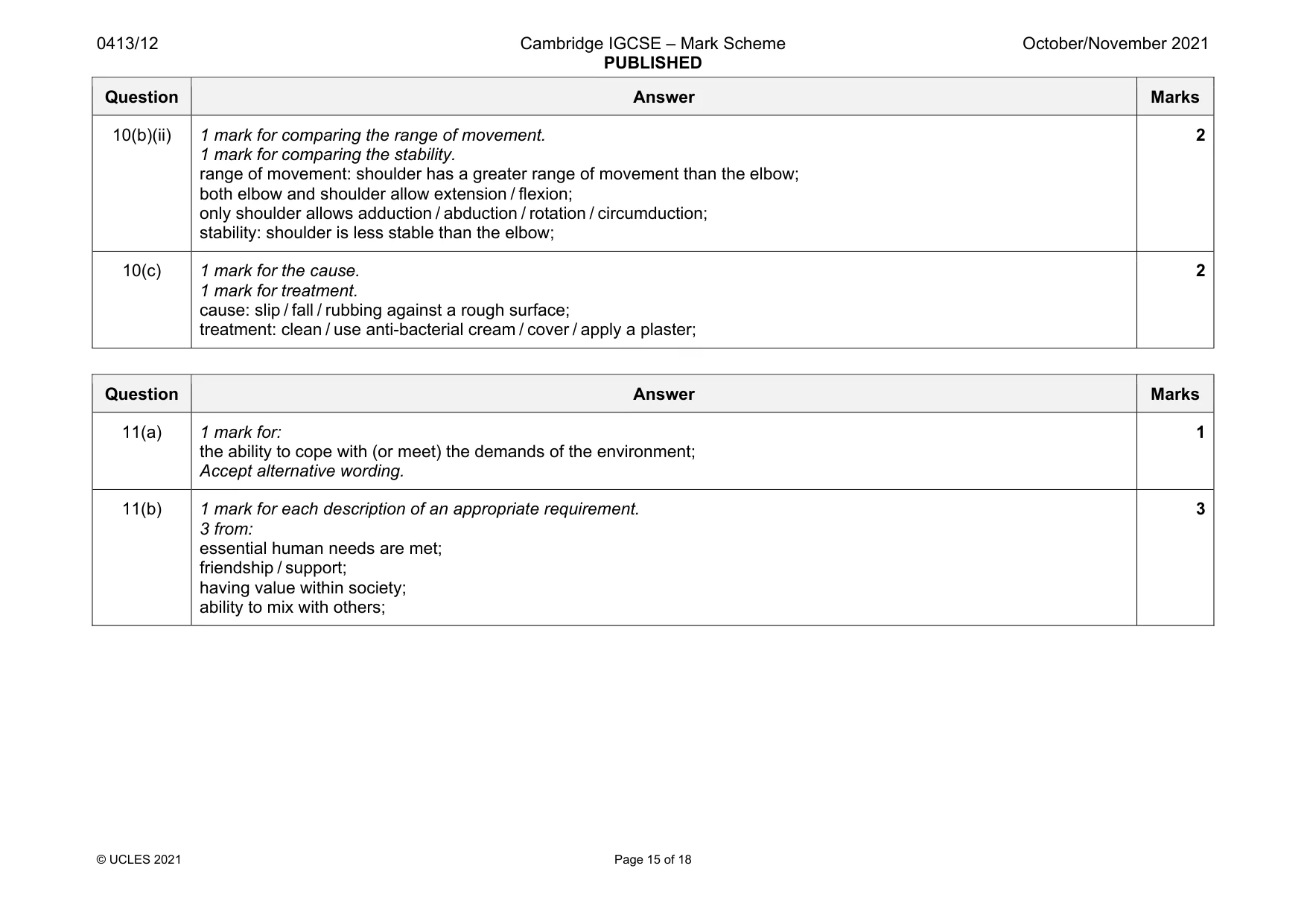
0413/12 Cambridge IGCSE – Mark Scheme PUBLISHED October/November 2021 © UCLES 2021 Page 15 of 18 Question Answer Marks 10(b)(ii) 1 mark for comparing the range of movement. 1 mark for comparing the stability. range of movement: shoulder has a greater range of movement than the elbow; both elbow and shoulder allow extension / flexion; only shoulder allows adduction / abduction / rotation / circumduction; stability: shoulder is less stable than the elbow; 2 10(c) 1 mark for the cause. 1 mark for treatment. cause: slip / fall / rubbing against a rough surface; treatment: clean / use anti-bacterial cream / cover / apply a plaster; 2 Question Answer Marks 11(a) 1 mark for: the ability to cope with (or meet) the demands of the environment; Accept alternative wording. 1 11(b) 1 mark for each description of an appropriate requirement. 3 from: essential human needs are met; friendship / support; having value within society; ability to mix with others; 3
Mark scheme, page 16
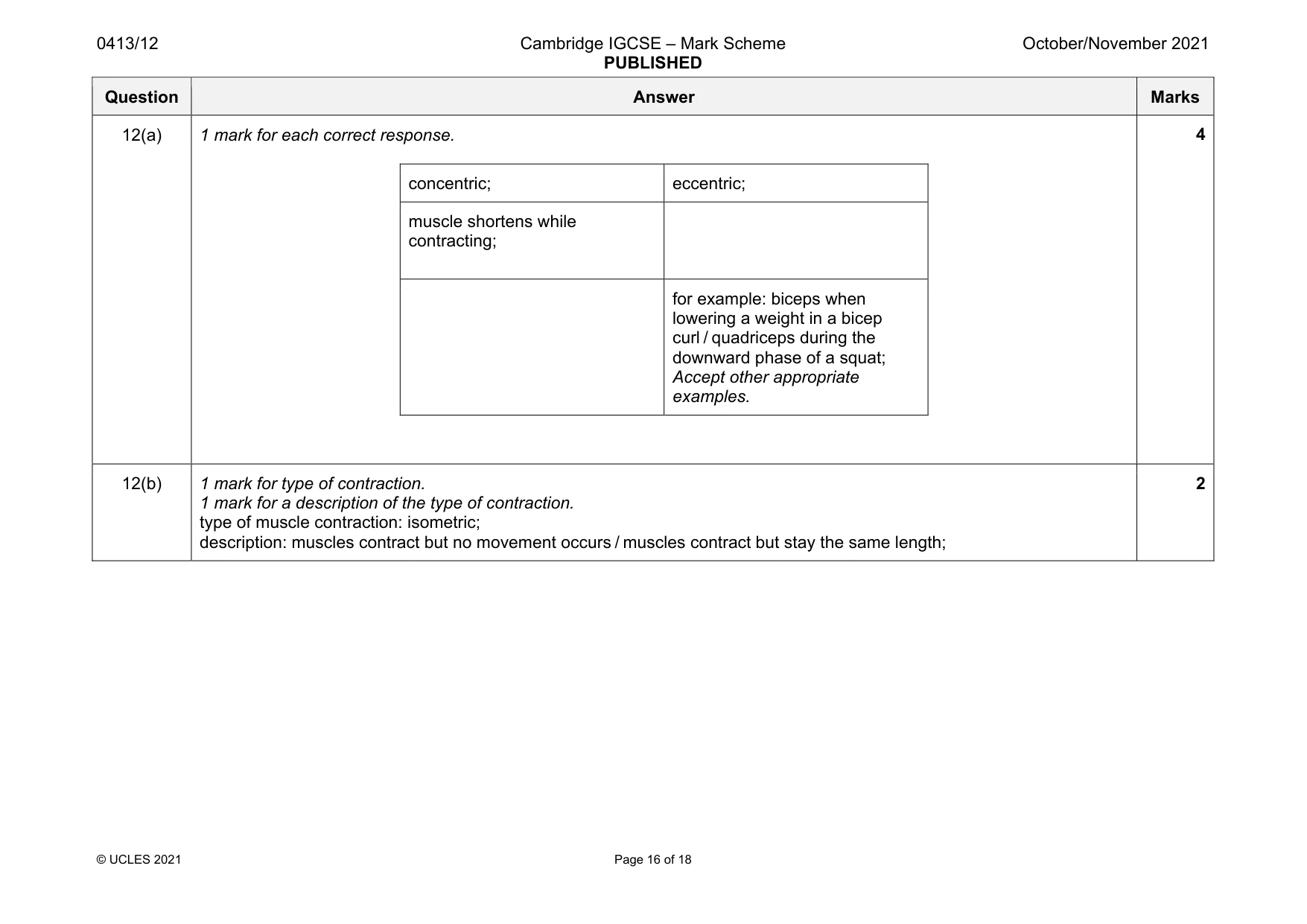
0413/12 Cambridge IGCSE – Mark Scheme PUBLISHED October/November 2021 © UCLES 2021 Page 16 of 18 Question Answer Marks 12(a) 1 mark for each correct response. concentric; eccentric; muscle shortens while contracting; for example: biceps when lowering a weight in a bicep curl / quadriceps during the downward phase of a squat; Accept other appropriate examples. 4 12(b) 1 mark for type of contraction. 1 mark for a description of the type of contraction. type of muscle contraction: isometric; description: muscles contract but no movement occurs / muscles contract but stay the same length; 2
Mark scheme, page 17
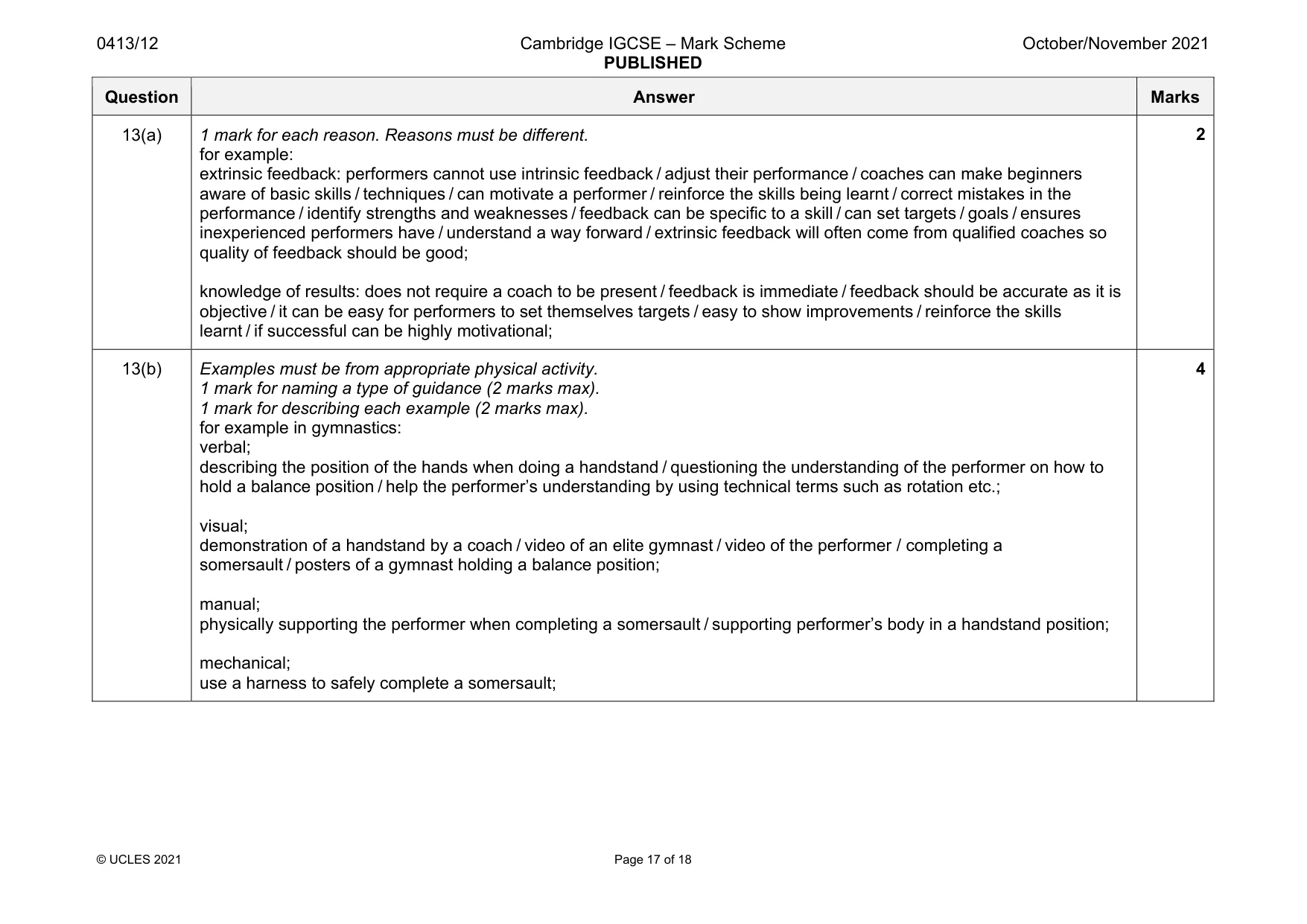
0413/12 Cambridge IGCSE – Mark Scheme PUBLISHED October/November 2021 © UCLES 2021 Page 17 of 18 Question Answer Marks 13(a) 1 mark for each reason. Reasons must be different. for example: extrinsic feedback: performers cannot use intrinsic feedback / adjust their performance / coaches can make beginners aware of basic skills / techniques / can motivate a performer / reinforce the skills being learnt / correct mistakes in the performance / identify strengths and weaknesses / feedback can be specific to a skill / can set targets / goals / ensures inexperienced performers have / understand a way forward / extrinsic feedback will often come from qualified coaches so quality of feedback should be good; knowledge of results: does not require a coach to be present / feedback is immediate / feedback should be accurate as it is objective / it can be easy for performers to set themselves targets / easy to show improvements / reinforce the skills learnt / if successful can be highly motivational; 2 13(b) Examples must be from appropriate physical activity. 1 mark for naming a type of guidance (2 marks max). 1 mark for describing each example (2 marks max). for example in gymnastics: verbal; describing the position of the hands when doing a handstand / questioning the understanding of the performer on how to hold a balance position / help the performer’s understanding by using technical terms such as rotation etc.; visual; demonstration of a handstand by a coach / video of an elite gymnast / video of the performer / completing a somersault / posters of a gymnast holding a balance position; manual; physically supporting the performer when completing a somersault / supporting performer’s body in a handstand position; mechanical; use a harness to safely complete a somersault; 4
Mark scheme, page 18
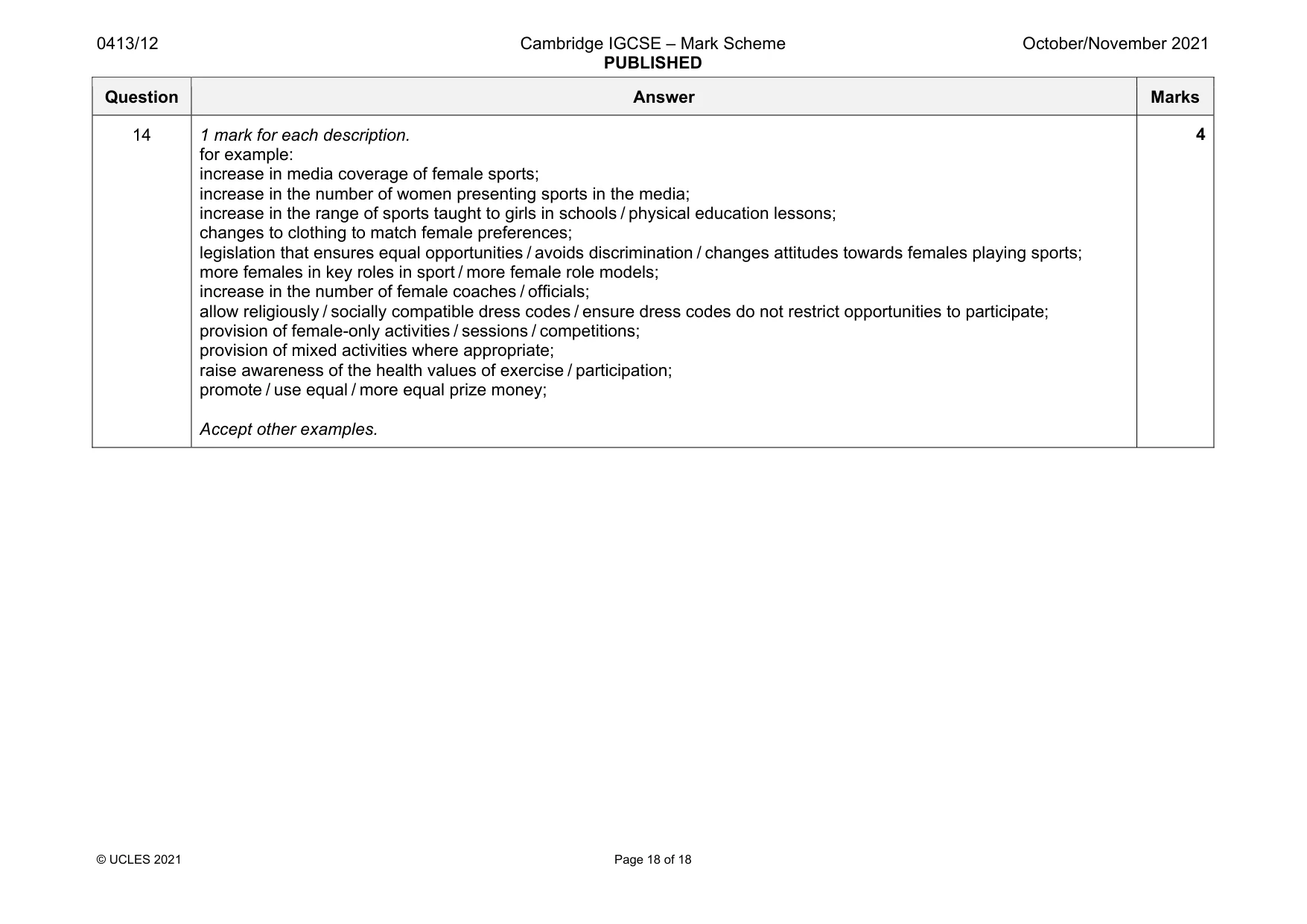
0413/12 Cambridge IGCSE – Mark Scheme PUBLISHED October/November 2021 © UCLES 2021 Page 18 of 18 Question Answer Marks 14 1 mark for each description. for example: increase in media coverage of female sports; increase in the number of women presenting sports in the media; increase in the range of sports taught to girls in schools / physical education lessons; changes to clothing to match female preferences; legislation that ensures equal opportunities / avoids discrimination / changes attitudes towards females playing sports; more females in key roles in sport / more female role models; increase in the number of female coaches / officials; allow religiously / socially compatible dress codes / ensure dress codes do not restrict opportunities to participate; provision of female-only activities / sessions / competitions; provision of mixed activities where appropriate; raise awareness of the health values of exercise / participation; promote / use equal / more equal prize money; Accept other examples. 4
What you needed in this session
Cambridge’s own grade thresholds for 2021 Oct/Nov, Paper 1 · Variant 2. A higher threshold means an easier paper — the bar moves with how the cohort did.