Cambridge IGCSE Physical Education 0413 — 2021 Oct/Nov Paper 1 · Variant 3
0413/13/O/N/21 · 100 marks · ≈113 min
The question paper and its mark scheme, free to read here and free to download. This is Cambridge’s own paper, exactly as it was sat.
Question paper16 pages
Mark scheme18 pages
Answers below. Sit the paper first if you are practising.
Paper as text
Question paper, page 1
This document has 16 pages. Cambridge IGCSE™ DC (DH/SG) 198499/3 © UCLES 2021 [Turn over * 2 4 7 7 6 5 9 2 2 7 * PHYSICAL EDUCATION 0413/13 Paper 1 Theory October/November 2021 1 hour 45 minutes You must answer on the question paper. No additional materials are needed. INSTRUCTIONS ● Answer all questions. ● Use a black or dark blue pen. You may use an HB pencil for any diagrams or graphs. ● Write your name, centre number and candidate number in the boxes at the top of the page. ● Write your answer to each question in the space provided. ● Do not use an erasable pen or correction fluid. ● Do not write on any bar codes. ● You may use a calculator. ● You should show all your working and use appropriate units. INFORMATION ● The total mark for this paper is 100. ● The number of marks for each question or part question is shown in brackets [ ].
Question paper, page 2
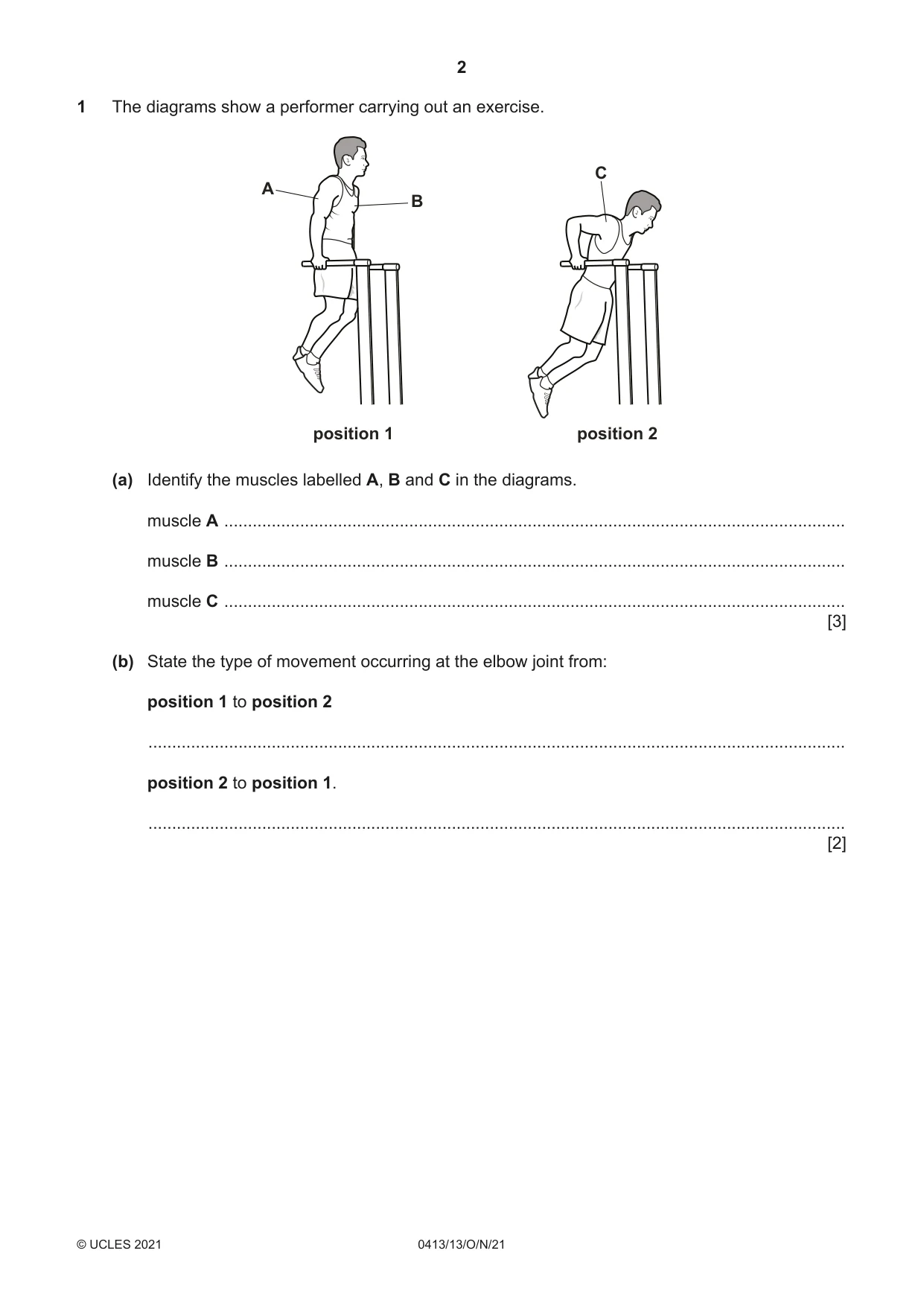
2 0413/13/O/N/21 © UCLES 2021 1 The diagrams show a performer carrying out an exercise. position 1 position 2 A B C (a) Identify the muscles labelled A, B and C in the diagrams. muscle A … muscle B … muscle C … [3] (b) State the type of movement occurring at the elbow joint from: position 1 to position 2 … position 2 to position 1. … [2]
Question paper, page 3
3 0413/13/O/N/21 © UCLES 2021 [Turn over (c) Identify and describe the type of isotonic muscle contraction occurring at muscle A when moving from: position 1 to position 2 type of isotonic muscle contraction … description … … position 2 to position 1. type of isotonic muscle contraction … description … … [4] [Total: 9]
Question paper, page 4
4 0413/13/O/N/21 © UCLES 2021 2 Plyometric training is one method that a performer could use as part of their training programme. (a) Identify the main component of fitness this method of training is designed to improve. Describe an example of when this component of fitness is used in a named physical activity. component of fitness … physical activity … example … … [2] (b) Flexibility is another important component of fitness. Describe how a named test of flexibility is carried out. name of test … description … … … … … … … … [4]
Question paper, page 5
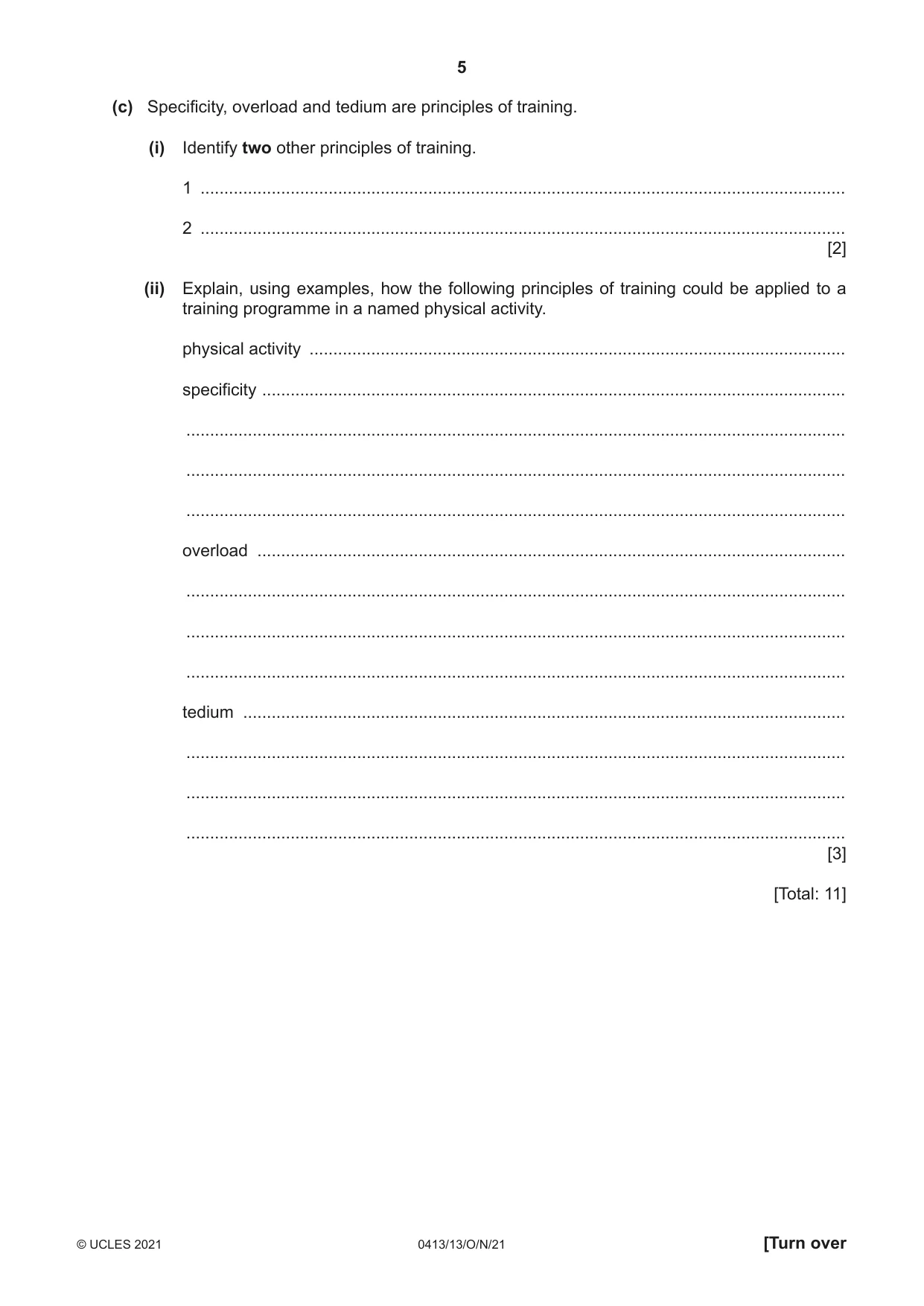
5 0413/13/O/N/21 © UCLES 2021 [Turn over (c) Specificity, overload and tedium are principles of training. (i) Identify two other principles of training. 1 … 2 … [2] (ii) Explain, using examples, how the following principles of training could be applied to a training programme in a named physical activity. physical activity … specificity … … … … overload … … … … tedium … … … … [3] [Total: 11]
Question paper, page 6
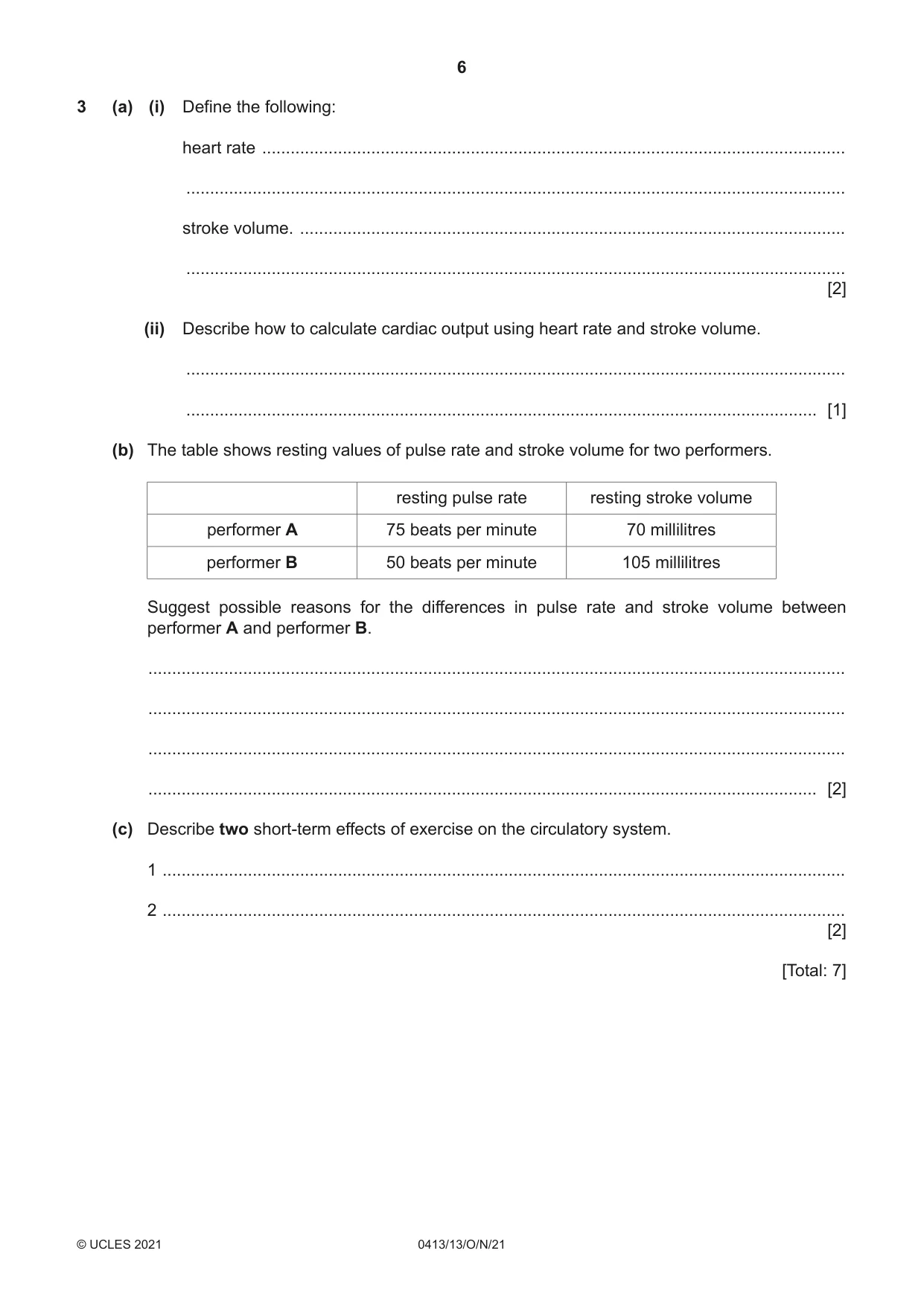
6 0413/13/O/N/21 © UCLES 2021 3 (a) (i) Define the following: heart rate … … stroke volume. … … [2] (ii) Describe how to calculate cardiac output using heart rate and stroke volume. … … [1] (b) The table shows resting values of pulse rate and stroke volume for two performers. resting pulse rate resting stroke volume performer A 75 beats per minute 70 millilitres performer B 50 beats per minute 105 millilitres Suggest possible reasons for the differences in pulse rate and stroke volume between performer A and performer B. … … … … [2] (c) Describe two short-term effects of exercise on the circulatory system. 1 … 2 … [2] [Total: 7]
Question paper, page 7
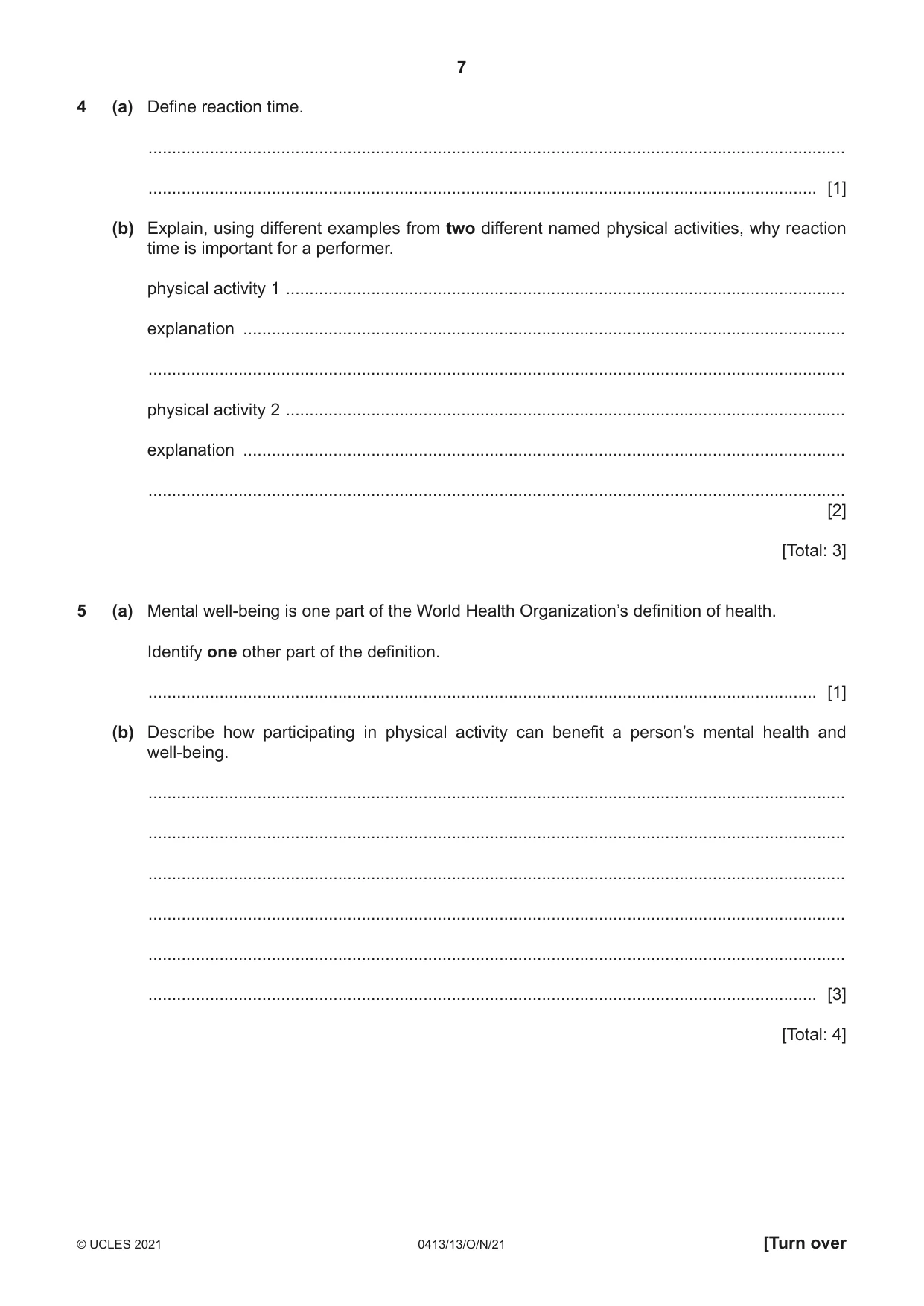
7 0413/13/O/N/21 © UCLES 2021 [Turn over 4 (a) Define reaction time. … … [1] (b) Explain, using different examples from two different named physical activities, why reaction time is important for a performer. physical activity 1 … explanation … … physical activity 2 … explanation … … [2] [Total: 3] 5 (a) Mental well-being is one part of the World Health Organization’s definition of health. Identify one other part of the definition. … [1] (b) Describe how participating in physical activity can benefit a person’s mental health and well-being. … … … … … … [3] [Total: 4]
Question paper, page 8
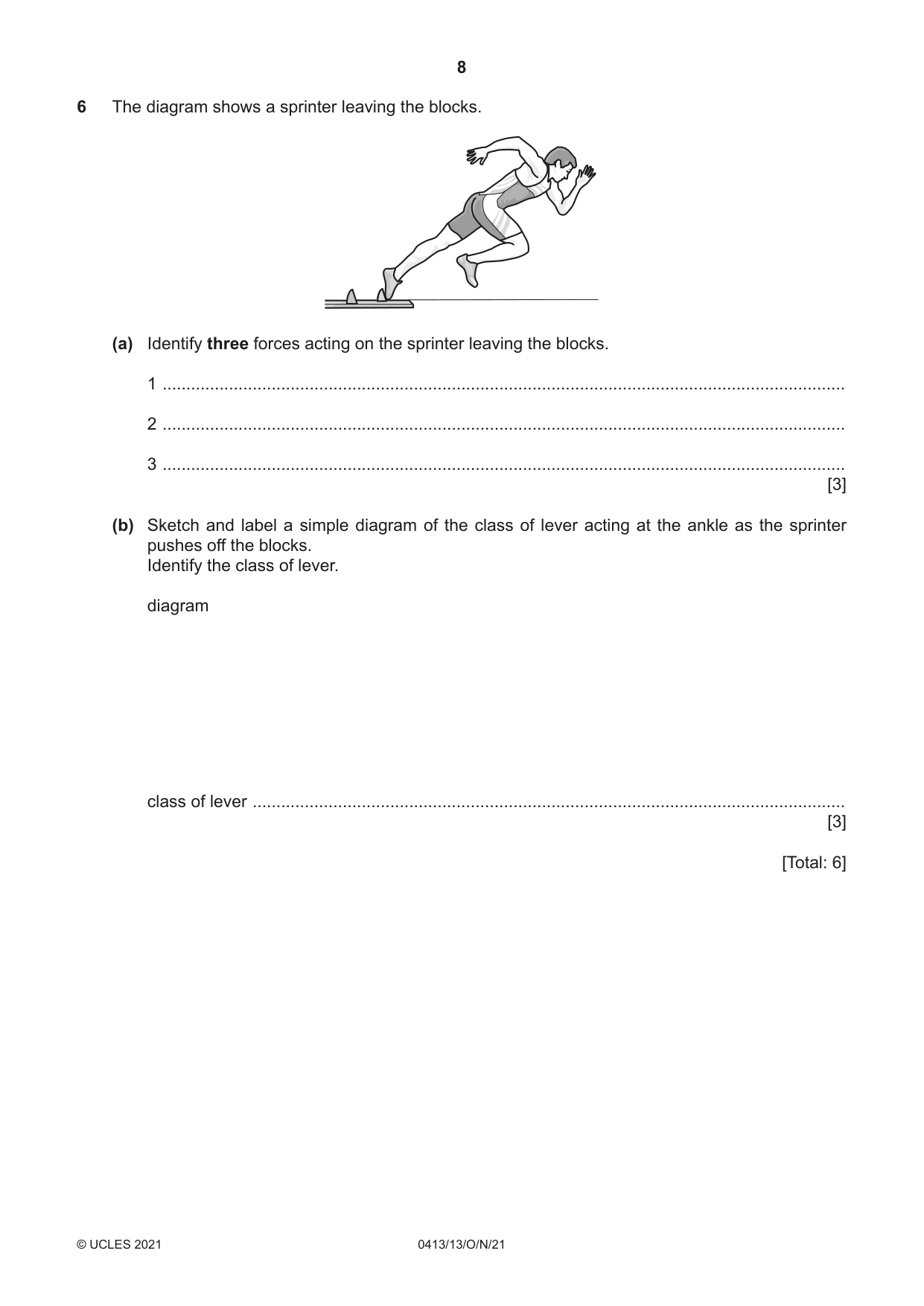
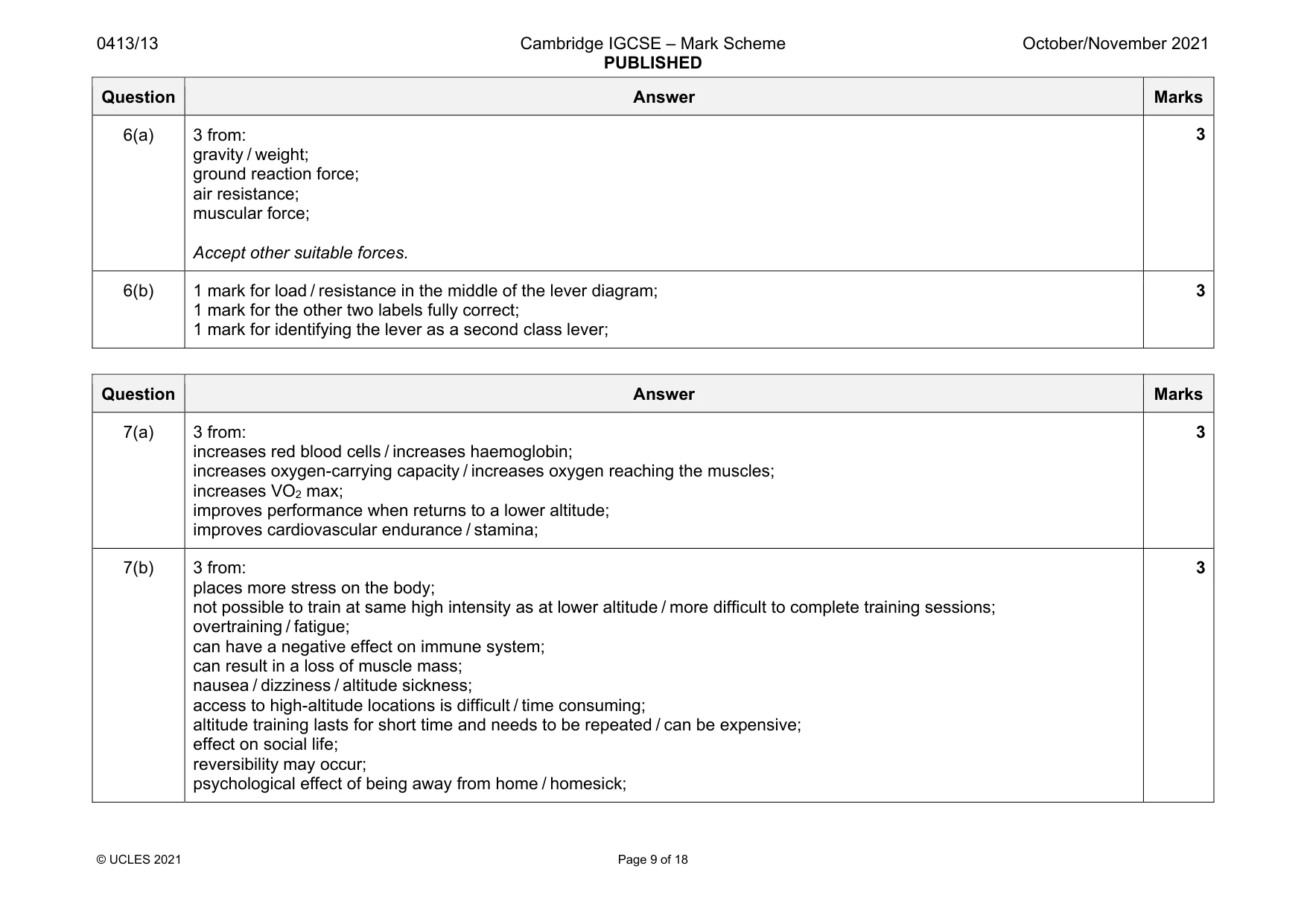
8 0413/13/O/N/21 © UCLES 2021 6 The diagram shows a sprinter leaving the blocks. (a) Identify three forces acting on the sprinter leaving the blocks. 1 … 2 … 3 … [3] (b) Sketch and label a simple diagram of the class of lever acting at the ankle as the sprinter pushes off the blocks. Identify the class of lever. diagram class of lever … [3] [Total: 6]
Question paper, page 9
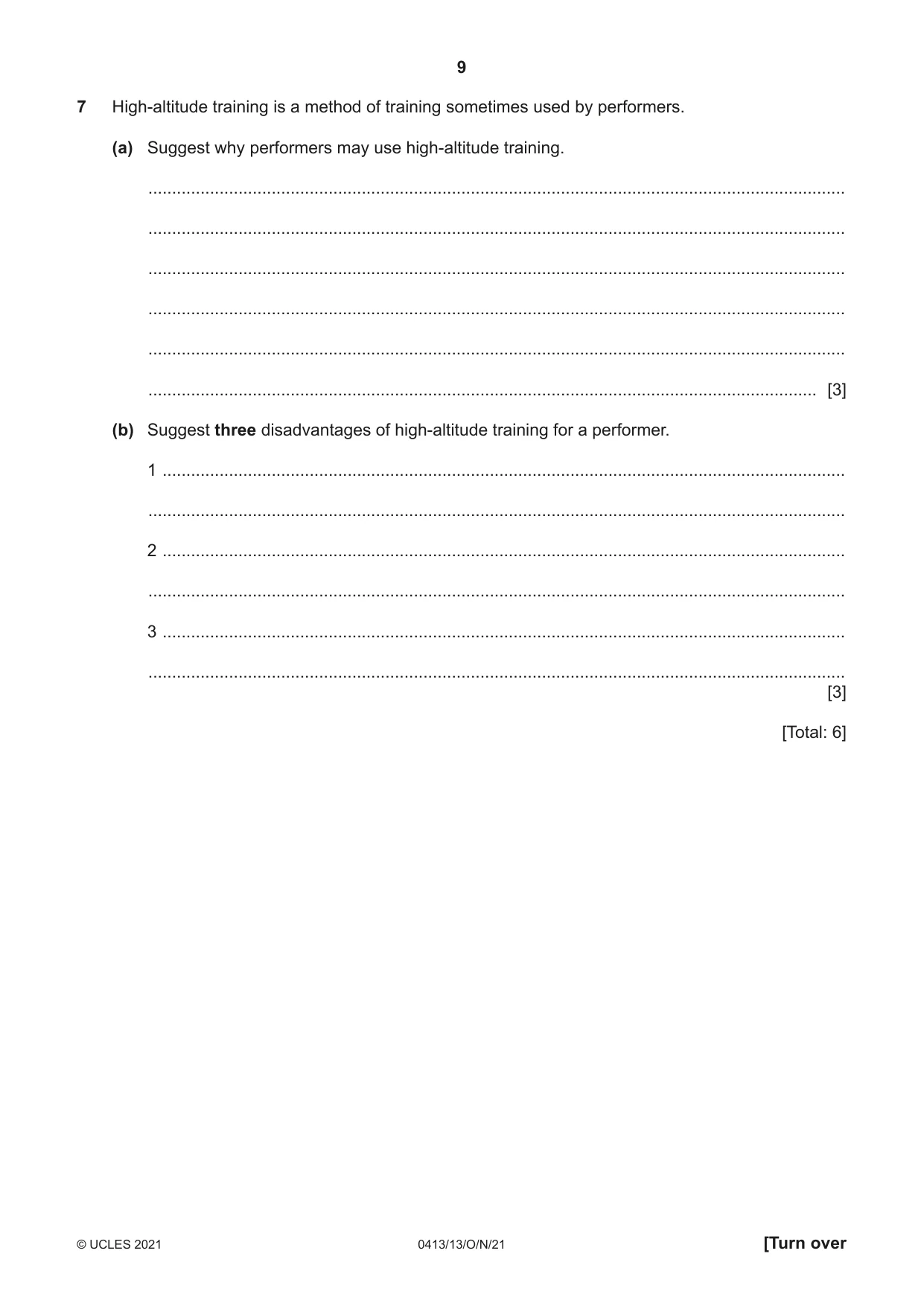
9 0413/13/O/N/21 © UCLES 2021 [Turn over 7 High-altitude training is a method of training sometimes used by performers. (a) Suggest why performers may use high-altitude training. … … … … … … [3] (b) Suggest three disadvantages of high-altitude training for a performer. 1 … … 2 … … 3 … … [3] [Total: 6]
Question paper, page 10
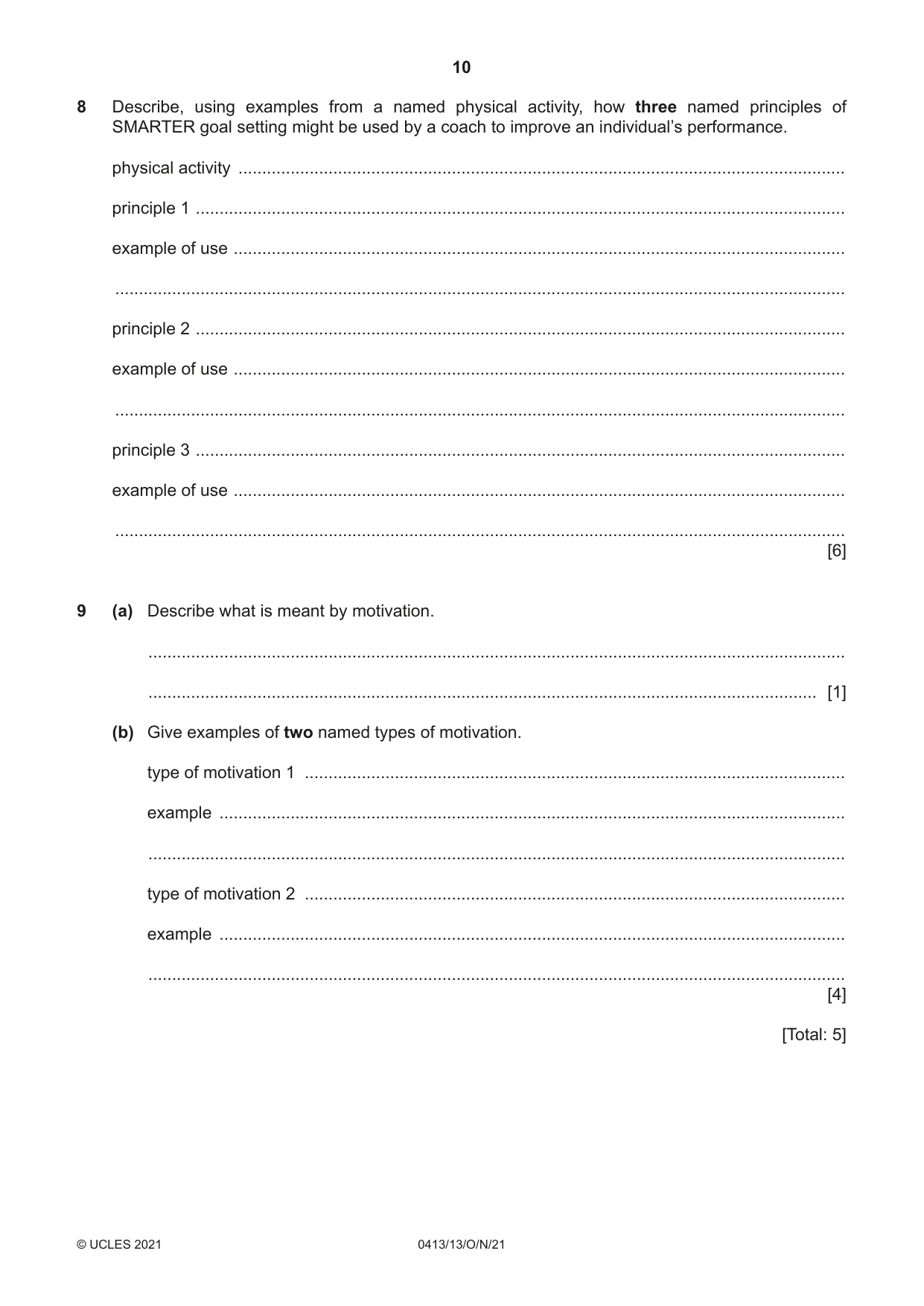
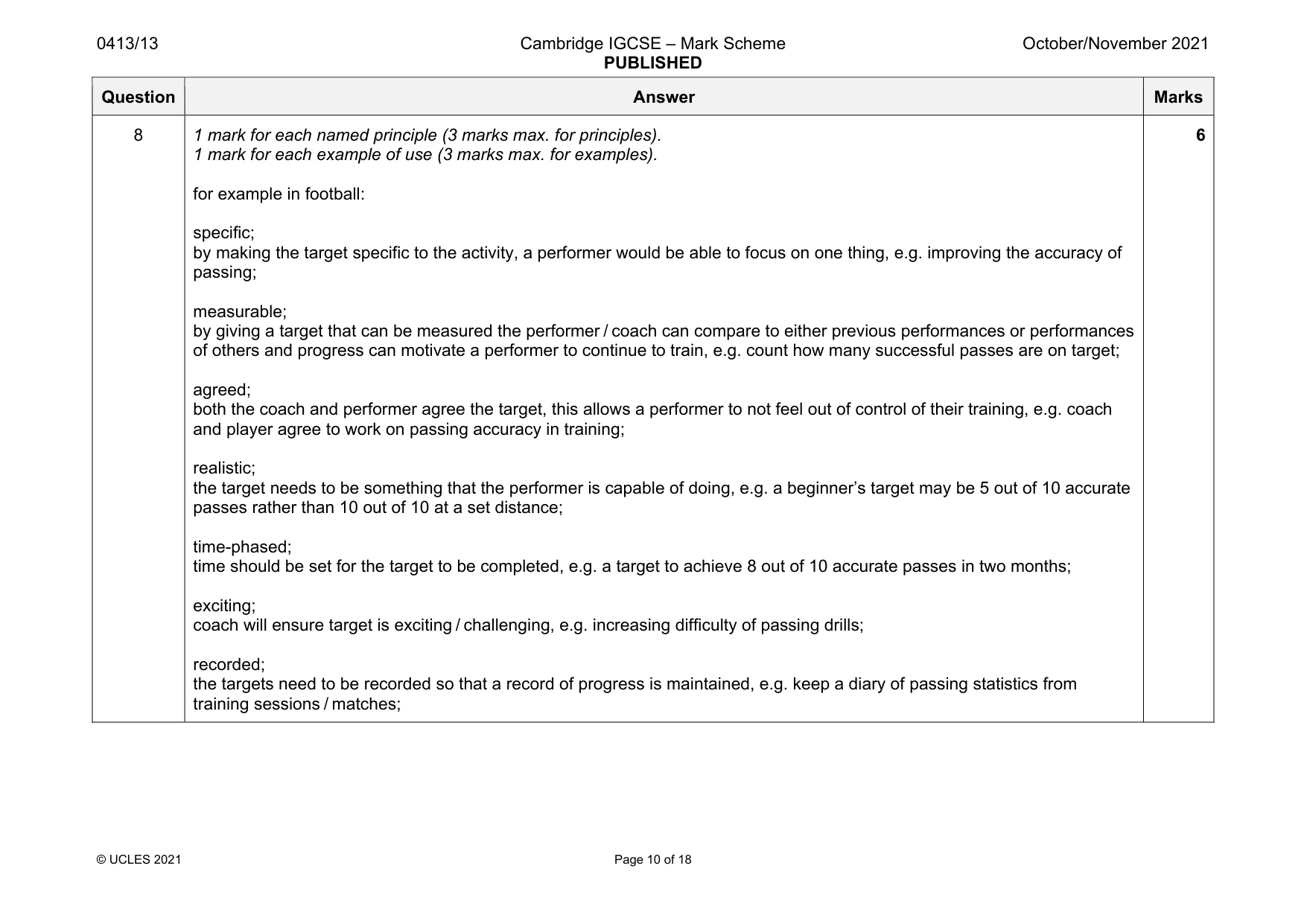
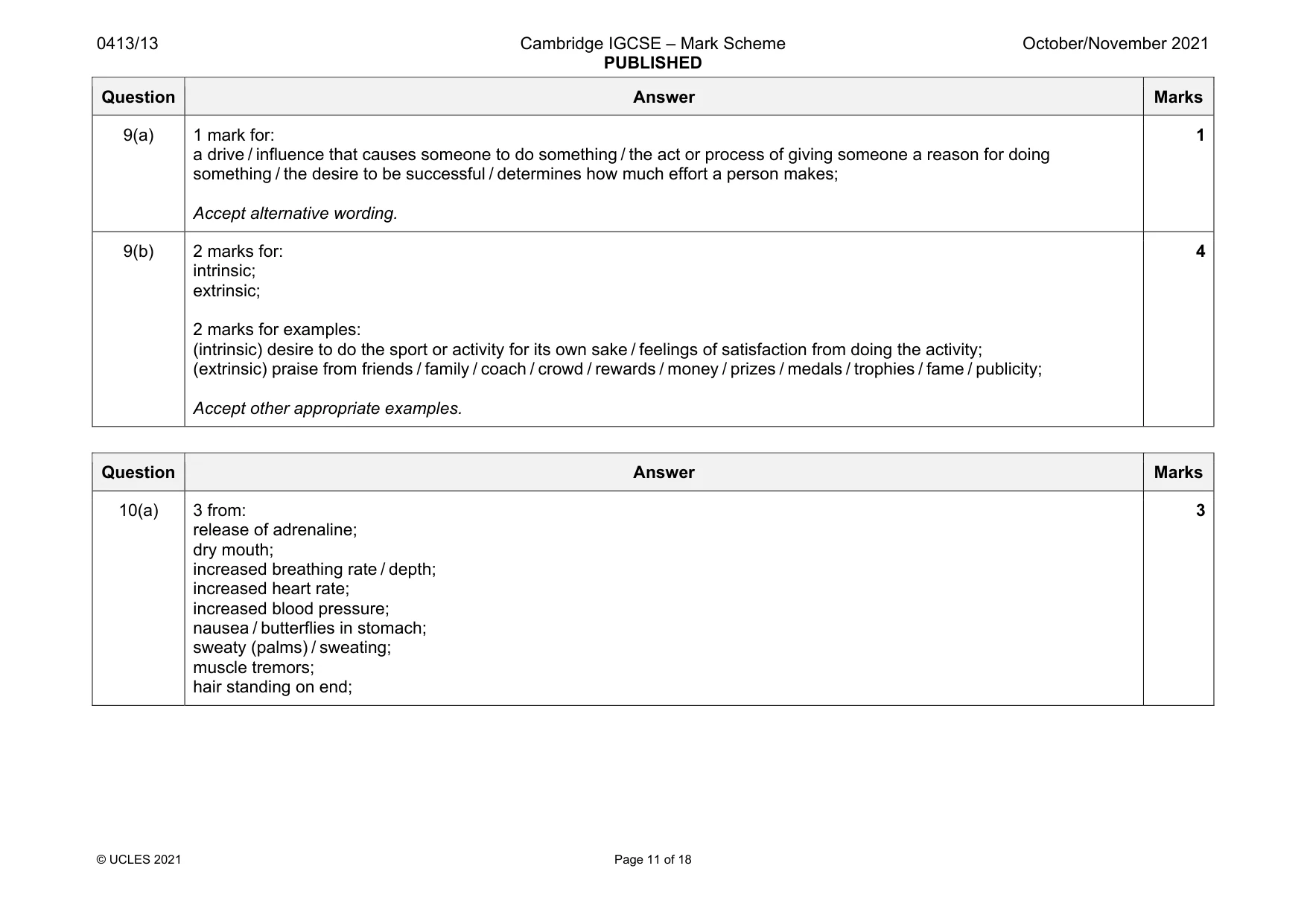
10 0413/13/O/N/21 © UCLES 2021 8 Describe, using examples from a named physical activity, how three named principles of SMARTER goal setting might be used by a coach to improve an individual’s performance. physical activity … principle 1 … example of use … … principle 2 … example of use … … principle 3 … example of use … … [6] 9 (a) Describe what is meant by motivation. … … [1] (b) Give examples of two named types of motivation. type of motivation 1 … example … … type of motivation 2 … example … … [4] [Total: 5]
Question paper, page 11
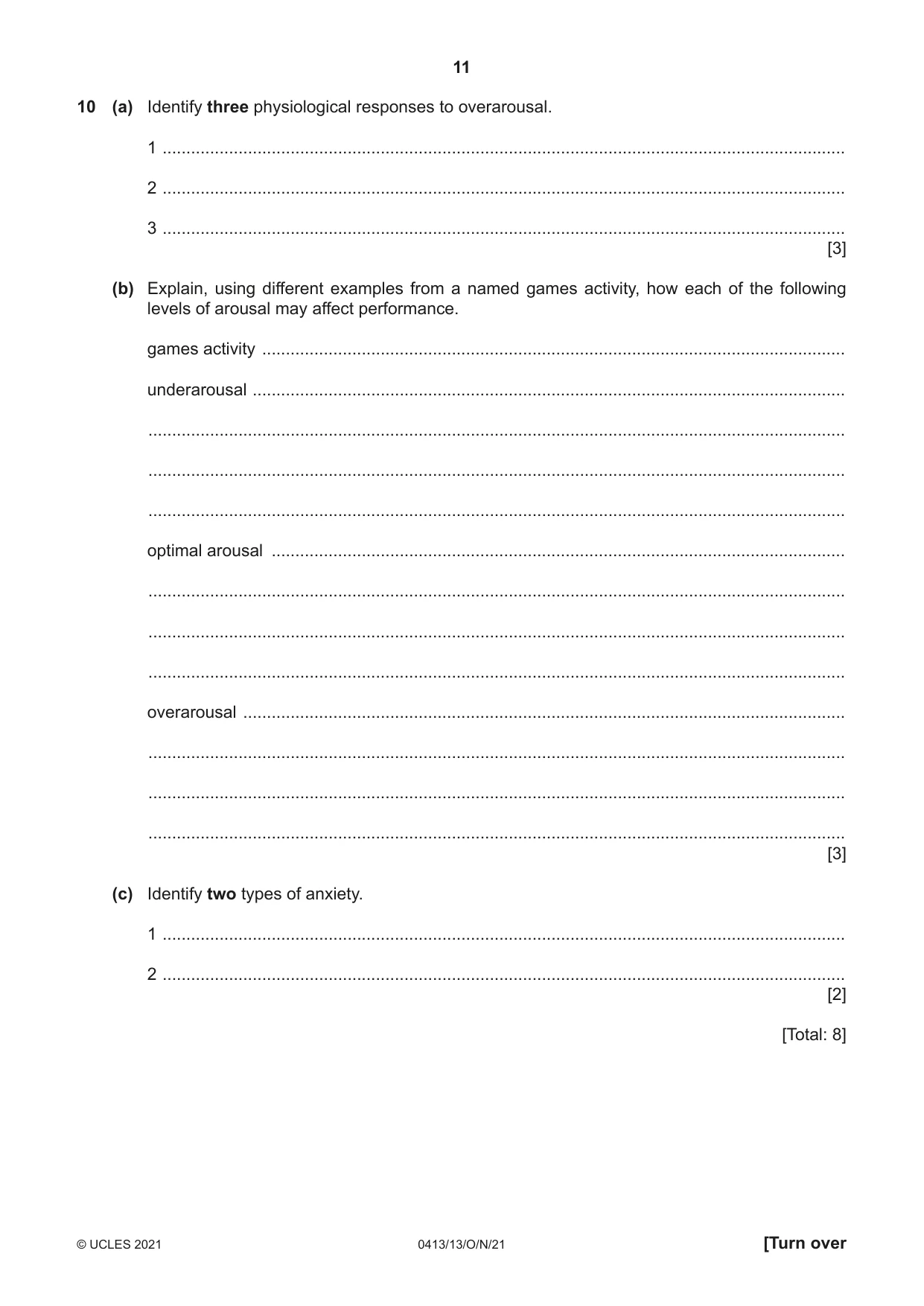
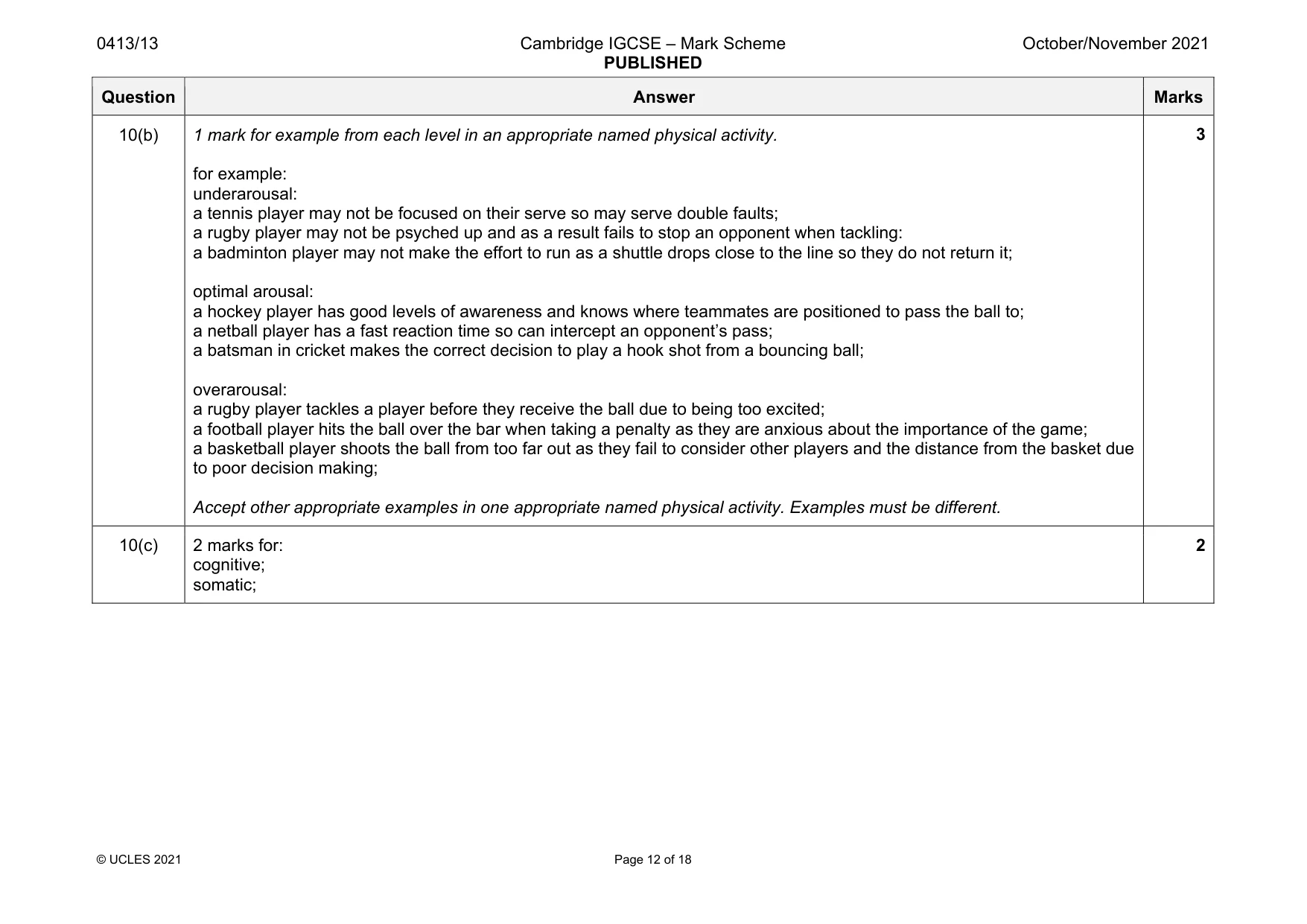
11 0413/13/O/N/21 © UCLES 2021 [Turn over 10 (a) Identify three physiological responses to overarousal. 1 … 2 … 3 … [3] (b) Explain, using different examples from a named games activity, how each of the following levels of arousal may affect performance. games activity … underarousal … … … … optimal arousal … … … … overarousal … … … … [3] (c) Identify two types of anxiety. 1 … 2 … [2] [Total: 8]
Question paper, page 12
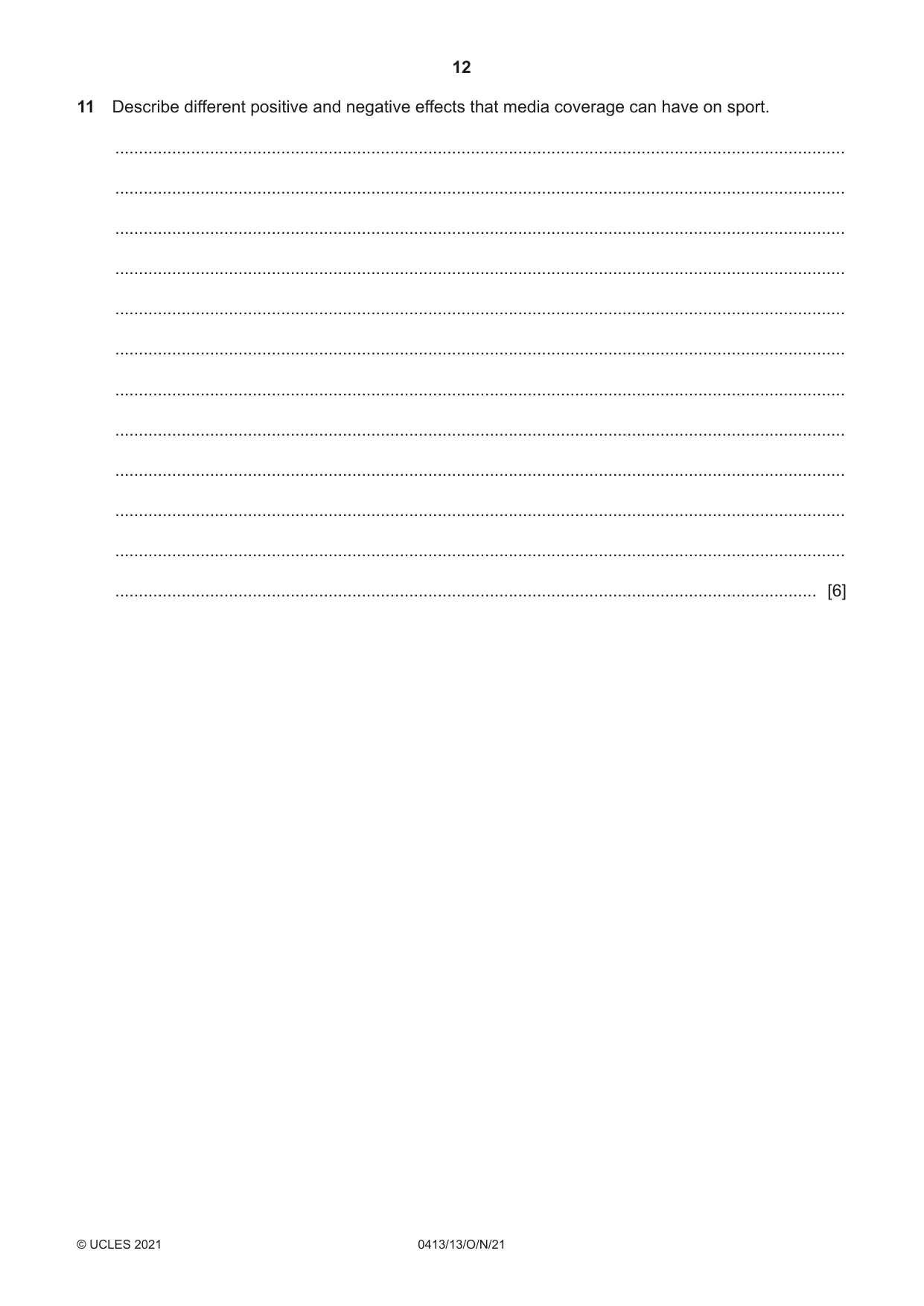
12 0413/13/O/N/21 © UCLES 2021 11 Describe different positive and negative effects that media coverage can have on sport. … … … … … … … … … … … … [6]
Question paper, page 13
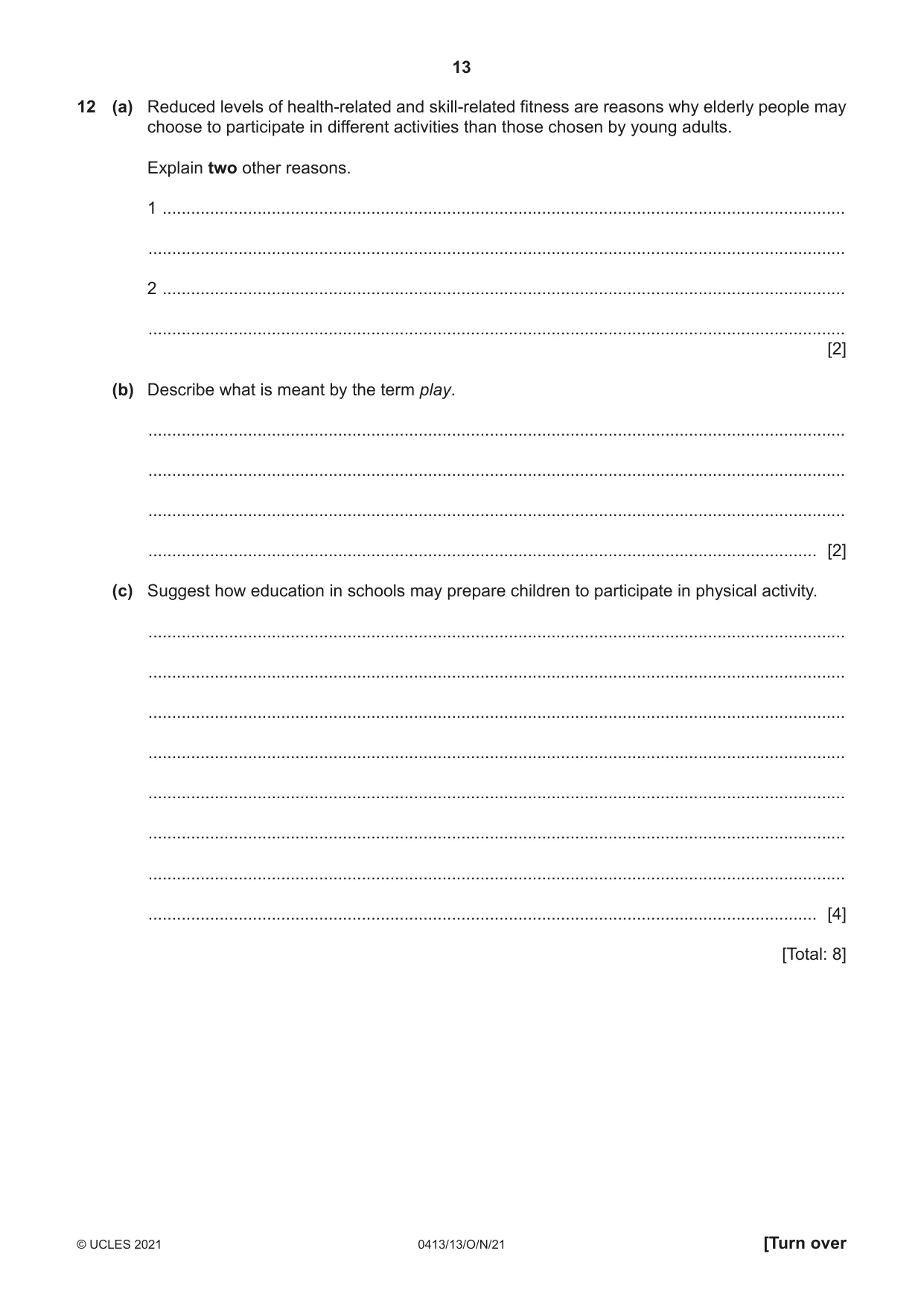
13 0413/13/O/N/21 © UCLES 2021 [Turn over 12 (a) Reduced levels of health-related and skill-related fitness are reasons why elderly people may choose to participate in different activities than those chosen by young adults. Explain two other reasons. 1 … … 2 … … [2] (b) Describe what is meant by the term play. … … … … [2] (c) Suggest how education in schools may prepare children to participate in physical activity. … … … … … … … … [4] [Total: 8]
Question paper, page 14
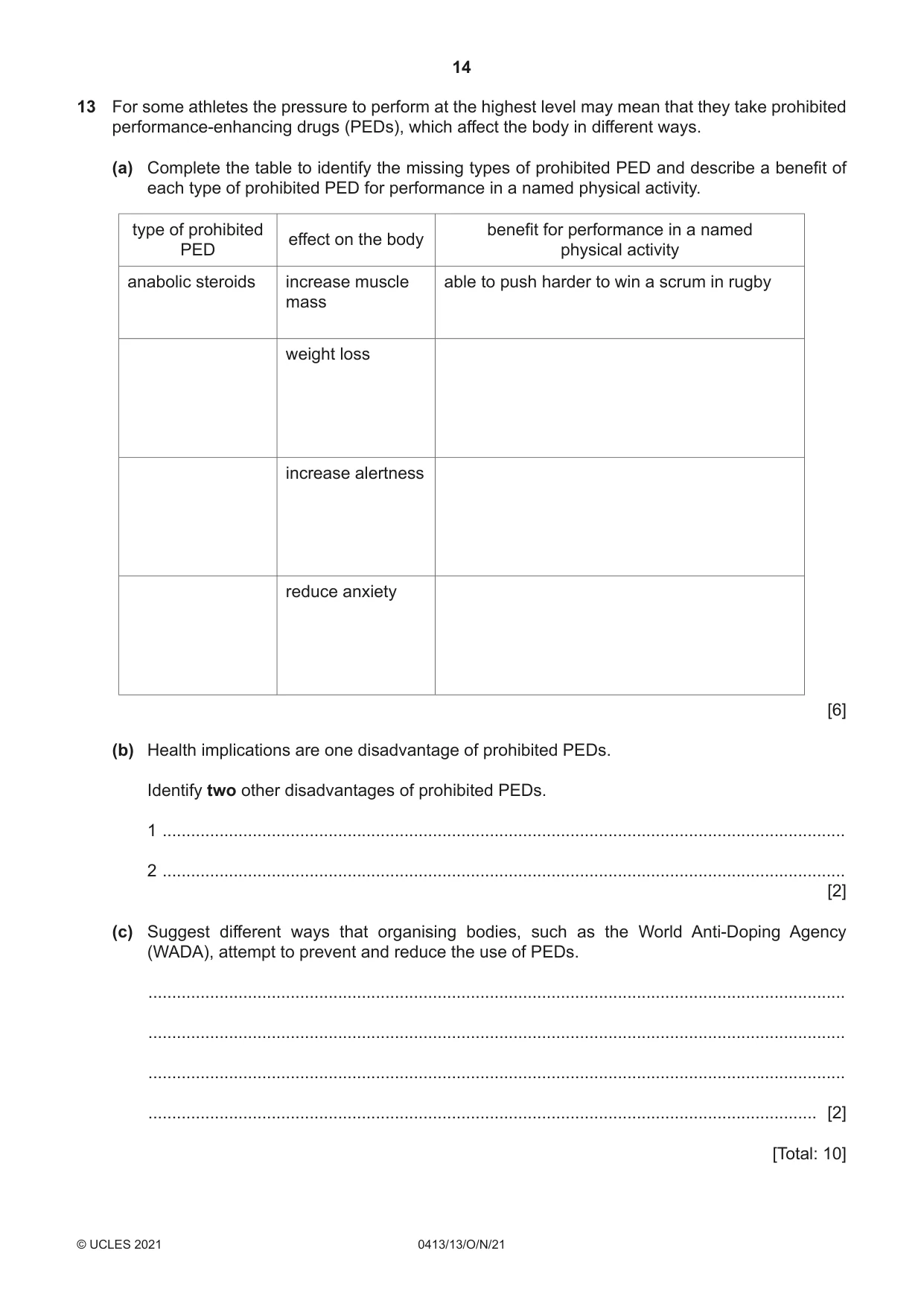
14 0413/13/O/N/21 © UCLES 2021 13 For some athletes the pressure to perform at the highest level may mean that they take prohibited performance-enhancing drugs (PEDs), which affect the body in different ways. (a) Complete the table to identify the missing types of prohibited PED and describe a benefit of each type of prohibited PED for performance in a named physical activity. type of prohibited PED effect on the body benefit for performance in a named physical activity anabolic steroids increase muscle mass able to push harder to win a scrum in rugby weight loss increase alertness reduce anxiety [6] (b) Health implications are one disadvantage of prohibited PEDs. Identify two other disadvantages of prohibited PEDs. 1 … 2 … [2] (c) Suggest different ways that organising bodies, such as the World Anti-Doping Agency (WADA), attempt to prevent and reduce the use of PEDs. … … … … [2] [Total: 10]
Question paper, page 15
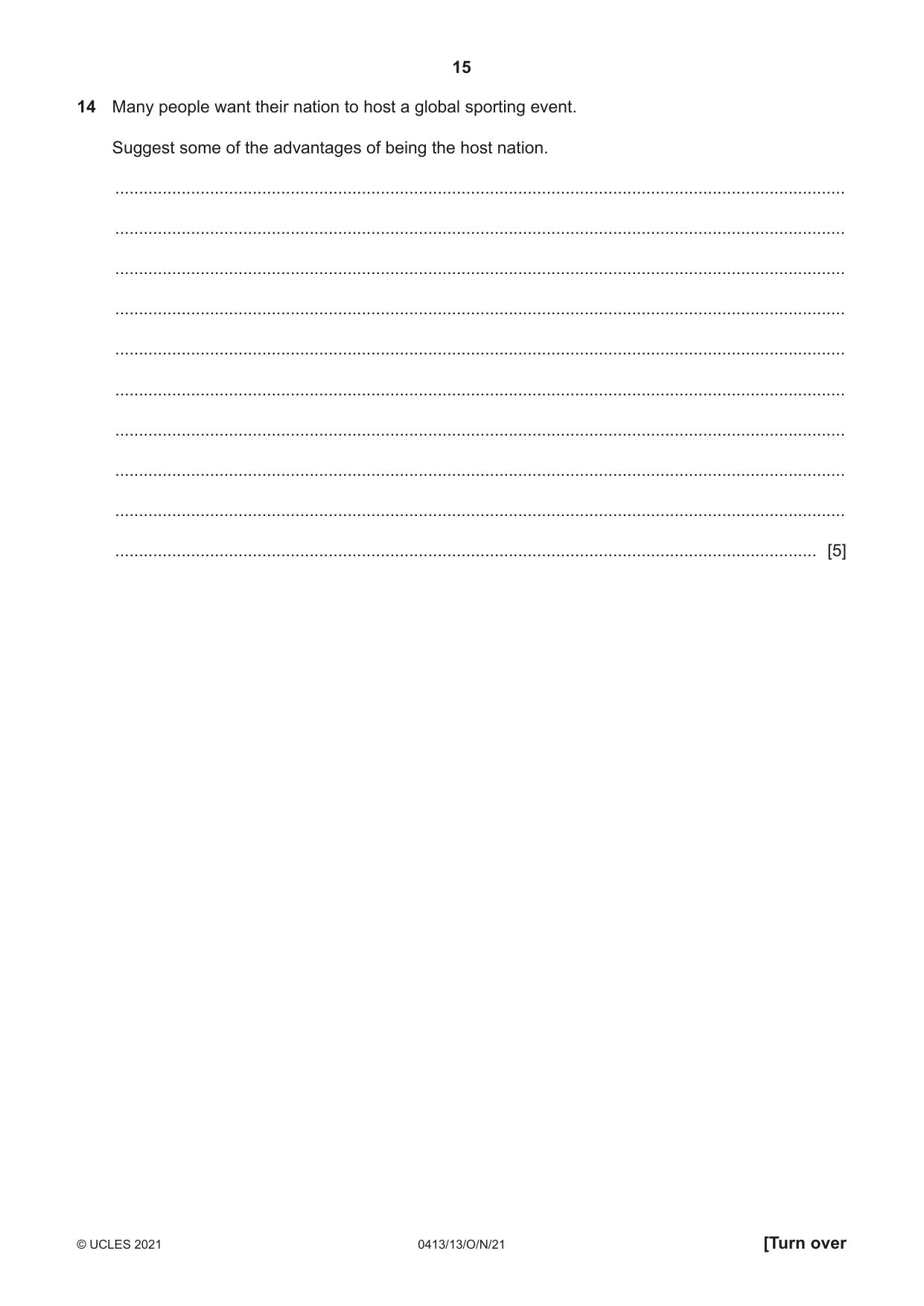
15 0413/13/O/N/21 © UCLES 2021 [Turn over 14 Many people want their nation to host a global sporting event. Suggest some of the advantages of being the host nation. … … … … … … … … … … [5]
Question paper, page 16
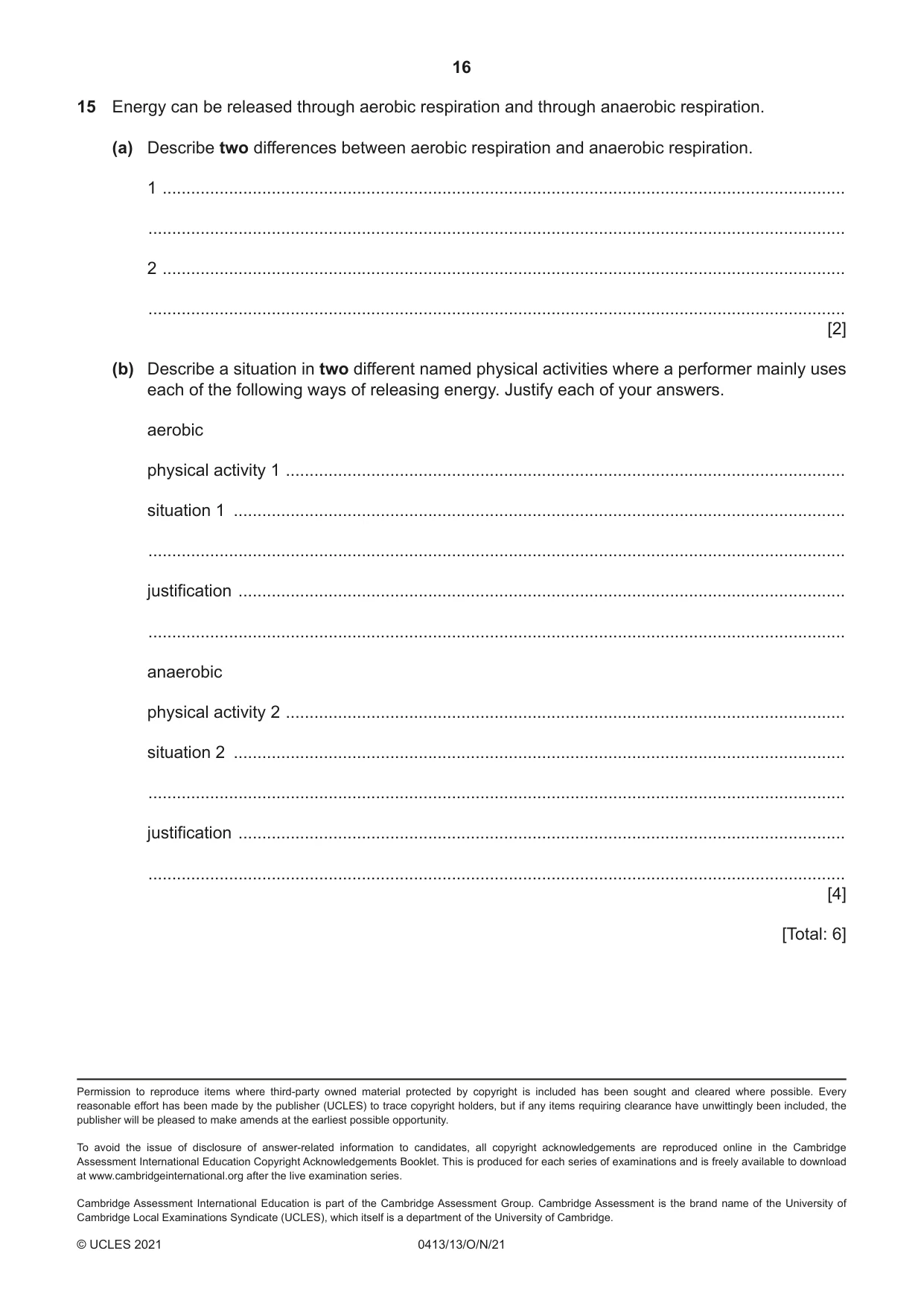
16 0413/13/O/N/21 © UCLES 2021 15 Energy can be released through aerobic respiration and through anaerobic respiration. (a) Describe two differences between aerobic respiration and anaerobic respiration. 1 … … 2 … … [2] (b) Describe a situation in two different named physical activities where a performer mainly uses each of the following ways of releasing energy. Justify each of your answers. aerobic physical activity 1 … situation 1 … … justification … … anaerobic physical activity 2 … situation 2 … … justification … … [4] [Total: 6] Permission to reproduce items where third-party owned material protected by copyright is included has been sought and cleared where possible. Every reasonable effort has been made by the publisher (UCLES) to trace copyright holders, but if any items requiring clearance have unwittingly been included, the publisher will be pleased to make amends at the earliest possible opportunity. To avoid the issue of disclosure of answer-related information to candidates, all copyright acknowledgements are reproduced online in the Cambridge Assessment International Education Copyright Acknowledgements Booklet. This is produced for each series of examinations and is freely available to download at www.cambridgeinternational.org after the live examination series. Cambridge Assessment International Education is part of the Cambridge Assessment Group. Cambridge Assessment is the brand name of the University of Cambridge Local Examinations Syndicate (UCLES), which itself is a department of the University of Cambridge.
Mark scheme, page 1
This document consists of 18 printed pages. © UCLES 2021 [Turn over Cambridge IGCSE™ PHYSICAL EDUCATION 0413/13 Paper 1 Theory October/November 2021 MARK SCHEME Maximum Mark: 100 Published This mark scheme is published as an aid to teachers and candidates, to indicate the requirements of the examination. It shows the basis on which Examiners were instructed to award marks. It does not indicate the details of the discussions that took place at an Examiners’ meeting before marking began, which would have considered the acceptability of alternative answers. Mark schemes should be read in conjunction with the question paper and the Principal Examiner Report for Teachers. Cambridge International will not enter into discussions about these mark schemes. Cambridge International is publishing the mark schemes for the October/November 2021 series for most Cambridge IGCSE™, Cambridge International A and AS Level components and some Cambridge O Level components.
Mark scheme, page 2
0413/13 Cambridge IGCSE – Mark Scheme PUBLISHED October/November 2021 © UCLES 2021 Page 2 of 18 Generic Marking Principles These general marking principles must be applied by all examiners when marking candidate answers. They should be applied alongside the specific content of the mark scheme or generic level descriptors for a question. Each question paper and mark scheme will also comply with these marking principles. GENERIC MARKING PRINCIPLE 1: Marks must be awarded in line with: • the specific content of the mark scheme or the generic level descriptors for the question • the specific skills defined in the mark scheme or in the generic level descriptors for the question • the standard of response required by a candidate as exemplified by the standardisation scripts. GENERIC MARKING PRINCIPLE 2: Marks awarded are always whole marks (not half marks, or other fractions). GENERIC MARKING PRINCIPLE 3: Marks must be awarded positively: • marks are awarded for correct/valid answers, as defined in the mark scheme. However, credit is given for valid answers which go beyond the scope of the syllabus and mark scheme, referring to your Team Leader as appropriate • marks are awarded when candidates clearly demonstrate what they know and can do • marks are not deducted for errors • marks are not deducted for omissions • answers should only be judged on the quality of spelling, punctuation and grammar when these features are specifically assessed by the question as indicated by the mark scheme. The meaning, however, should be unambiguous. GENERIC MARKING PRINCIPLE 4: Rules must be applied consistently, e.g. in situations where candidates have not followed instructions or in the application of generic level descriptors.
Mark scheme, page 3
0413/13 Cambridge IGCSE – Mark Scheme PUBLISHED October/November 2021 © UCLES 2021 Page 3 of 18 GENERIC MARKING PRINCIPLE 5: Marks should be awarded using the full range of marks defined in the mark scheme for the question (however; the use of the full mark range may be limited according to the quality of the candidate responses seen). GENERIC MARKING PRINCIPLE 6: Marks awarded are based solely on the requirements as defined in the mark scheme. Marks should not be awarded with grade thresholds or grade descriptors in mind. Science-Specific Marking Principles 1 Examiners should consider the context and scientific use of any keywords when awarding marks. Although keywords may be present, marks should not be awarded if the keywords are used incorrectly. 2 The examiner should not choose between contradictory statements given in the same question part, and credit should not be awarded for any correct statement that is contradicted within the same question part. Wrong science that is irrelevant to the question should be ignored. 3 Although spellings do not have to be correct, spellings of syllabus terms must allow for clear and unambiguous separation from other syllabus terms with which they may be confused (e.g. ethane / ethene, glucagon / glycogen, refraction / reflection). 4 The error carried forward (ecf) principle should be applied, where appropriate. If an incorrect answer is subsequently used in a scientifically correct way, the candidate should be awarded these subsequent marking points. Further guidance will be included in the mark scheme where necessary and any exceptions to this general principle will be noted. 5 ‘List rule’ guidance For questions that require n responses (e.g. State two reasons …): • The response should be read as continuous prose, even when numbered answer spaces are provided. • Any response marked ignore in the mark scheme should not count towards n. • Incorrect responses should not be awarded credit but will still count towards n. • Read the entire response to check for any responses that contradict those that would otherwise be credited. Credit should not be awarded for any responses that are contradicted within the rest of the response. Where two responses contradict one another, this should be treated as a single incorrect response. • Non-contradictory responses after the first n responses may be ignored even if they include incorrect science.
Mark scheme, page 4
0413/13 Cambridge IGCSE – Mark Scheme PUBLISHED October/November 2021 © UCLES 2021 Page 4 of 18 6 Calculation specific guidance Correct answers to calculations should be given full credit even if there is no working or incorrect working, unless the question states ‘show your working’. For questions in which the number of significant figures required is not stated, credit should be awarded for correct answers when rounded by the examiner to the number of significant figures given in the mark scheme. This may not apply to measured values. For answers given in standard form (e.g. a × 10n) in which the convention of restricting the value of the coefficient (a) to a value between 1 and 10 is not followed, credit may still be awarded if the answer can be converted to the answer given in the mark scheme. Unless a separate mark is given for a unit, a missing or incorrect unit will normally mean that the final calculation mark is not awarded. Exceptions to this general principle will be noted in the mark scheme. 7 Guidance for chemical equations Multiples / fractions of coefficients used in chemical equations are acceptable unless stated otherwise in the mark scheme. State symbols given in an equation should be ignored unless asked for in the question or stated otherwise in the mark scheme.
Mark scheme, page 5
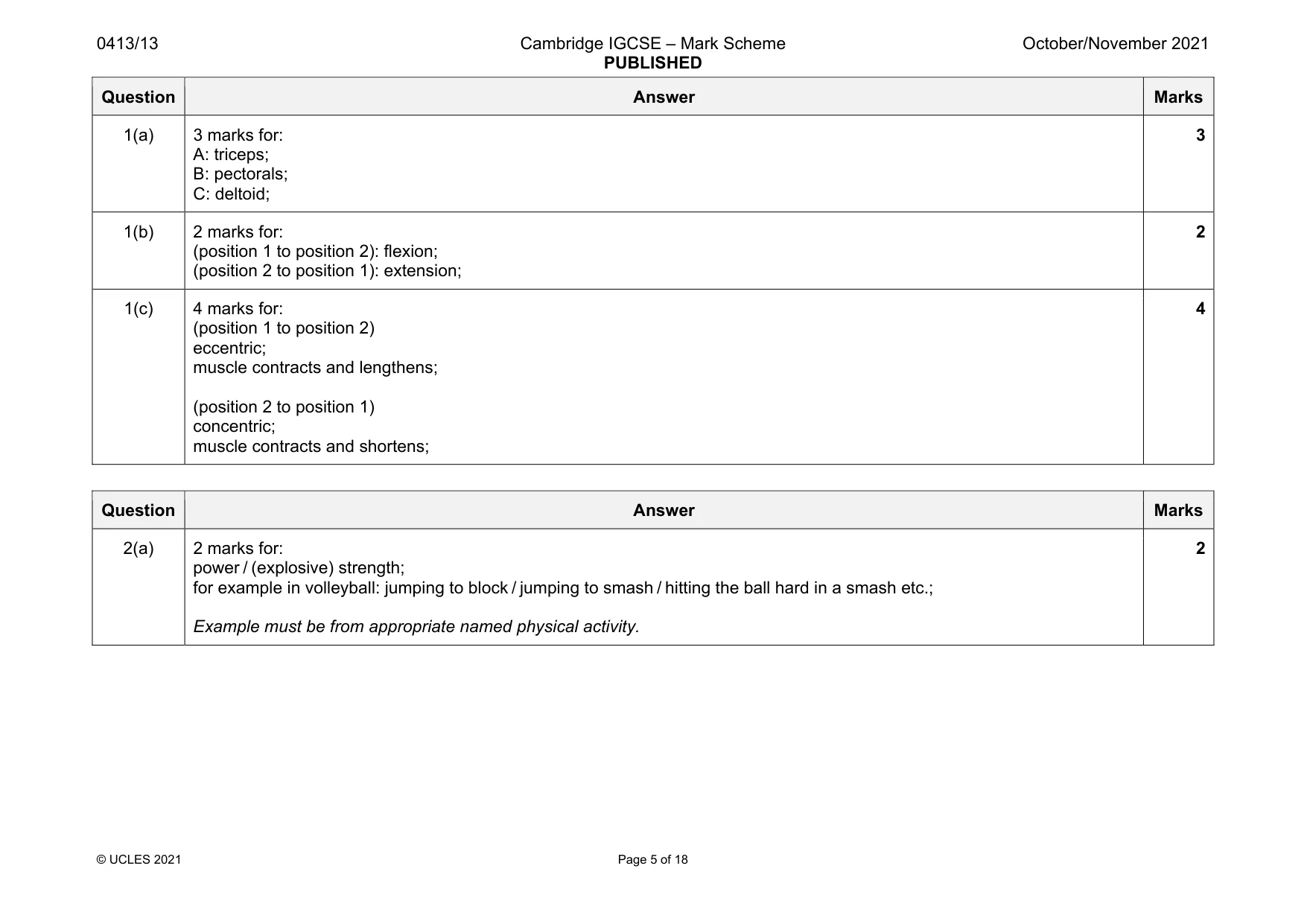
0413/13 Cambridge IGCSE – Mark Scheme PUBLISHED October/November 2021 © UCLES 2021 Page 5 of 18 Question Answer Marks 1(a) 3 marks for: A: triceps; B: pectorals; C: deltoid; 3 1(b) 2 marks for: (position 1 to position 2): flexion; (position 2 to position 1): extension; 2 1(c) 4 marks for: (position 1 to position 2) eccentric; muscle contracts and lengthens; (position 2 to position 1) concentric; muscle contracts and shortens; 4 Question Answer Marks 2(a) 2 marks for: power / (explosive) strength; for example in volleyball: jumping to block / jumping to smash / hitting the ball hard in a smash etc.; Example must be from appropriate named physical activity. 2
Mark scheme, page 6
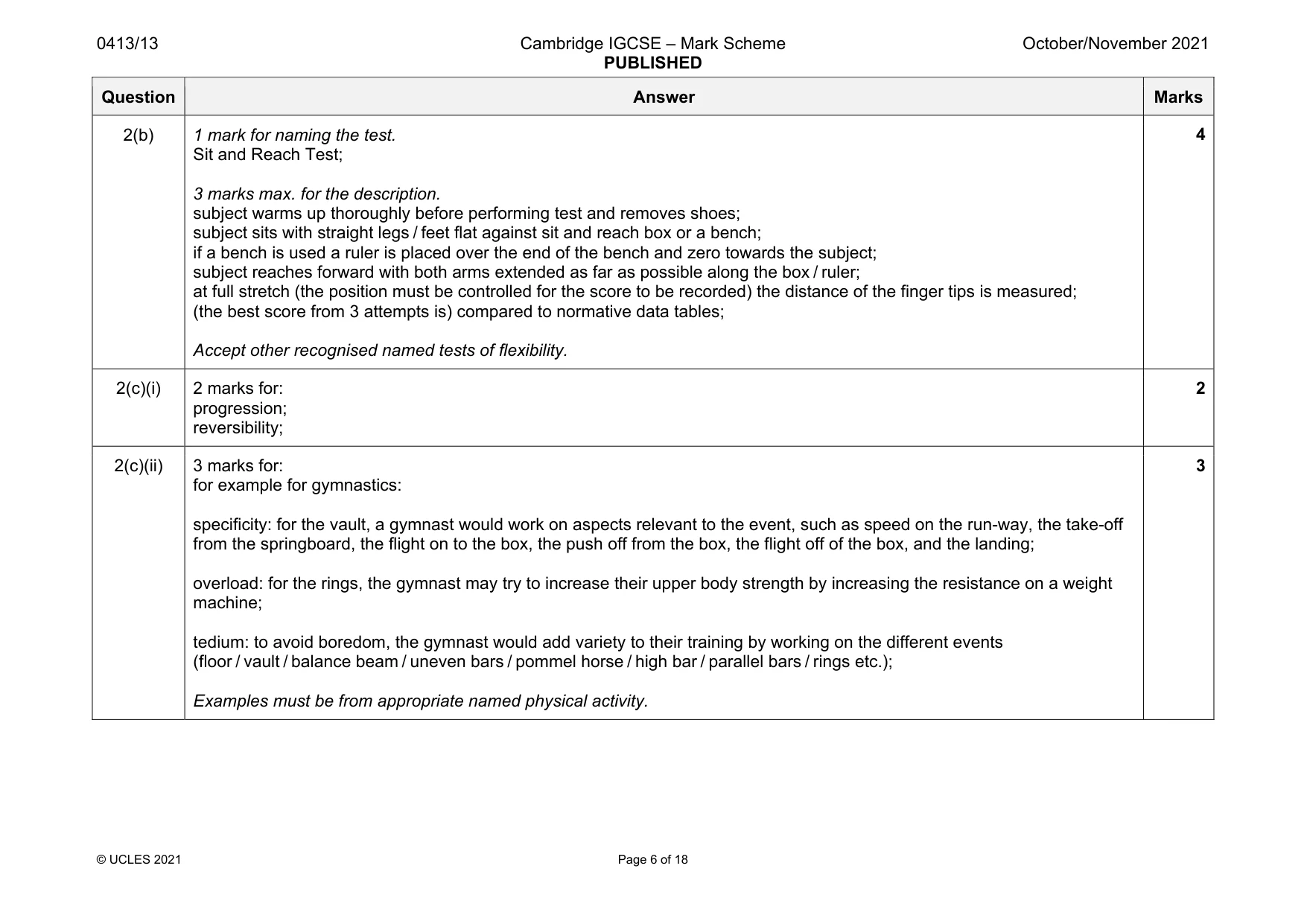
0413/13 Cambridge IGCSE – Mark Scheme PUBLISHED October/November 2021 © UCLES 2021 Page 6 of 18 Question Answer Marks 2(b) 1 mark for naming the test. Sit and Reach Test; 3 marks max. for the description. subject warms up thoroughly before performing test and removes shoes; subject sits with straight legs / feet flat against sit and reach box or a bench; if a bench is used a ruler is placed over the end of the bench and zero towards the subject; subject reaches forward with both arms extended as far as possible along the box / ruler; at full stretch (the position must be controlled for the score to be recorded) the distance of the finger tips is measured; (the best score from 3 attempts is) compared to normative data tables; Accept other recognised named tests of flexibility. 4 2(c)(i) 2 marks for: progression; reversibility; 2 2(c)(ii) 3 marks for: for example for gymnastics: specificity: for the vault, a gymnast would work on aspects relevant to the event, such as speed on the run-way, the take-off from the springboard, the flight on to the box, the push off from the box, the flight off of the box, and the landing; overload: for the rings, the gymnast may try to increase their upper body strength by increasing the resistance on a weight machine; tedium: to avoid boredom, the gymnast would add variety to their training by working on the different events (floor / vault / balance beam / uneven bars / pommel horse / high bar / parallel bars / rings etc.); Examples must be from appropriate named physical activity. 3
Mark scheme, page 7
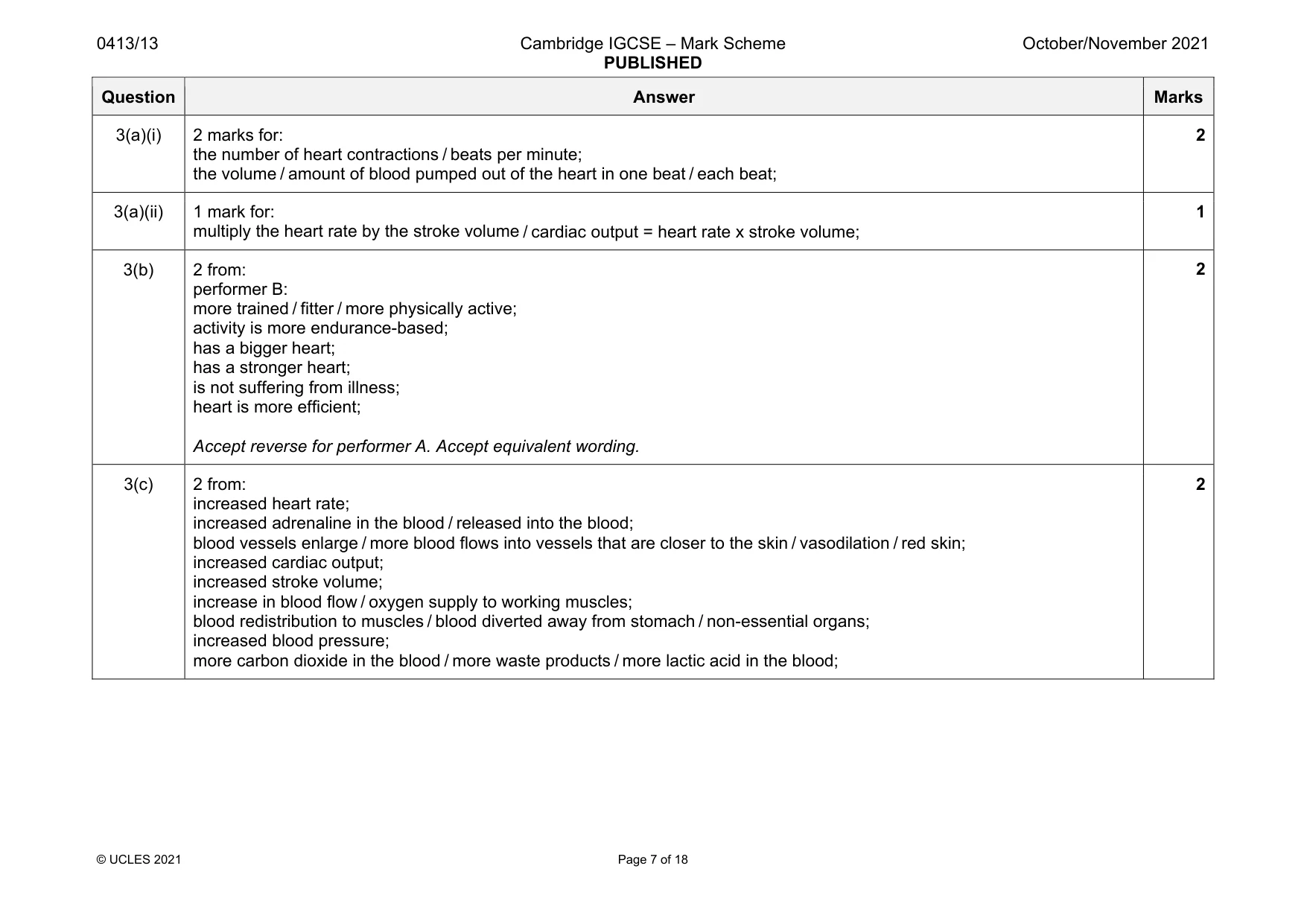
0413/13 Cambridge IGCSE – Mark Scheme PUBLISHED October/November 2021 © UCLES 2021 Page 7 of 18 Question Answer Marks 3(a)(i) 2 marks for: the number of heart contractions / beats per minute; the volume / amount of blood pumped out of the heart in one beat / each beat; 2 3(a)(ii) 1 mark for: multiply the heart rate by the stroke volume / cardiac output = heart rate x stroke volume; 1 3(b) 2 from: performer B: more trained / fitter / more physically active; activity is more endurance-based; has a bigger heart; has a stronger heart; is not suffering from illness; heart is more efficient; Accept reverse for performer A. Accept equivalent wording. 2 3(c) 2 from: increased heart rate; increased adrenaline in the blood / released into the blood; blood vessels enlarge / more blood flows into vessels that are closer to the skin / vasodilation / red skin; increased cardiac output; increased stroke volume; increase in blood flow / oxygen supply to working muscles; blood redistribution to muscles / blood diverted away from stomach / non-essential organs; increased blood pressure; more carbon dioxide in the blood / more waste products / more lactic acid in the blood; 2
Mark scheme, page 8
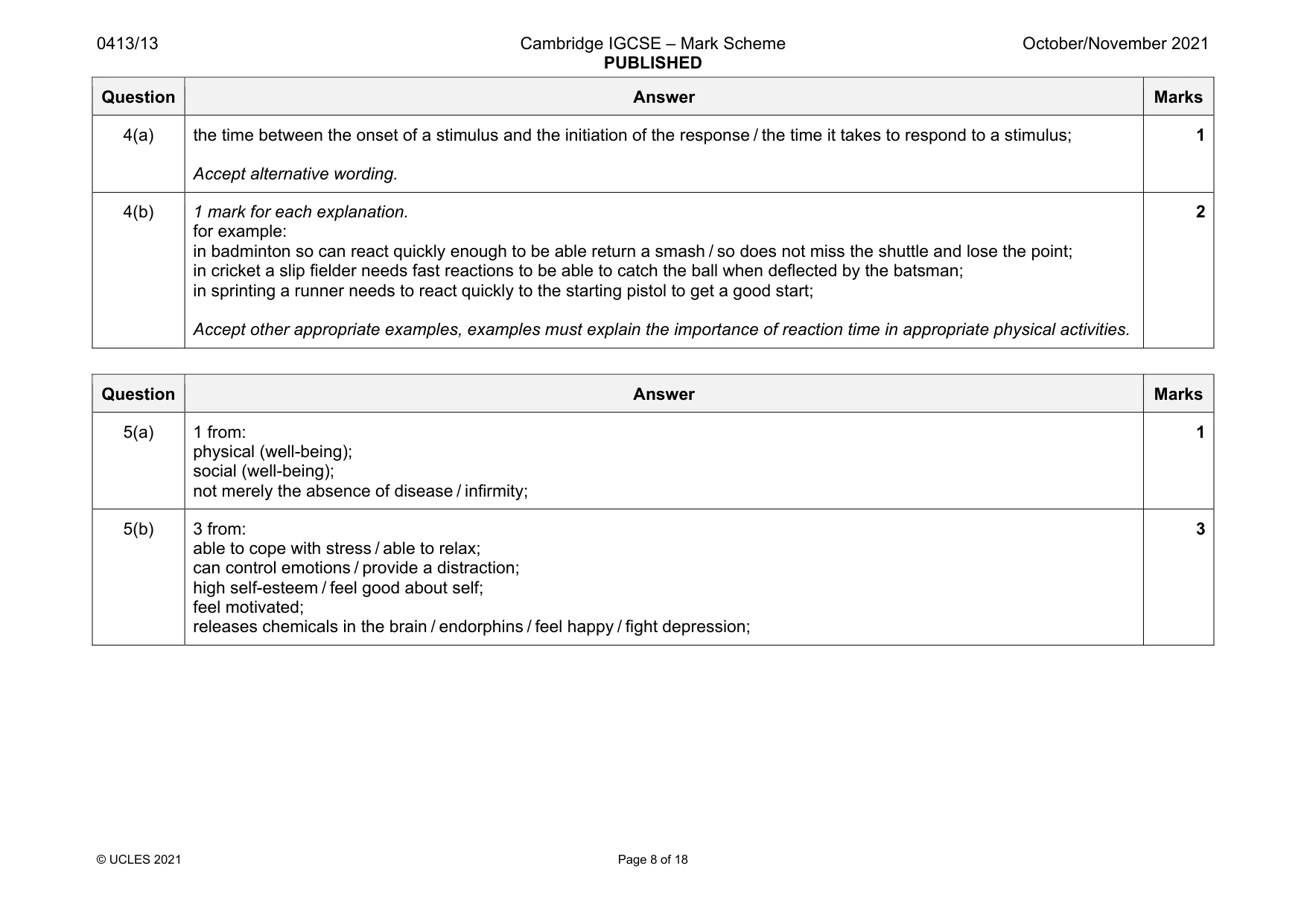
0413/13 Cambridge IGCSE – Mark Scheme PUBLISHED October/November 2021 © UCLES 2021 Page 8 of 18 Question Answer Marks 4(a) the time between the onset of a stimulus and the initiation of the response / the time it takes to respond to a stimulus; Accept alternative wording. 1 4(b) 1 mark for each explanation. for example: in badminton so can react quickly enough to be able return a smash / so does not miss the shuttle and lose the point; in cricket a slip fielder needs fast reactions to be able to catch the ball when deflected by the batsman; in sprinting a runner needs to react quickly to the starting pistol to get a good start; Accept other appropriate examples, examples must explain the importance of reaction time in appropriate physical activities. 2 Question Answer Marks 5(a) 1 from: physical (well-being); social (well-being); not merely the absence of disease / infirmity; 1 5(b) 3 from: able to cope with stress / able to relax; can control emotions / provide a distraction; high self-esteem / feel good about self; feel motivated; releases chemicals in the brain / endorphins / feel happy / fight depression; 3
Mark scheme, page 9
0413/13 Cambridge IGCSE – Mark Scheme PUBLISHED October/November 2021 © UCLES 2021 Page 9 of 18 Question Answer Marks 6(a) 3 from: gravity / weight; ground reaction force; air resistance; muscular force; Accept other suitable forces. 3 6(b) 1 mark for load / resistance in the middle of the lever diagram; 1 mark for the other two labels fully correct; 1 mark for identifying the lever as a second class lever; 3 Question Answer Marks 7(a) 3 from: increases red blood cells / increases haemoglobin; increases oxygen-carrying capacity / increases oxygen reaching the muscles; increases VO2 max; improves performance when returns to a lower altitude; improves cardiovascular endurance / stamina; 3 7(b) 3 from: places more stress on the body; not possible to train at same high intensity as at lower altitude / more difficult to complete training sessions; overtraining / fatigue; can have a negative effect on immune system; can result in a loss of muscle mass; nausea / dizziness / altitude sickness; access to high-altitude locations is difficult / time consuming; altitude training lasts for short time and needs to be repeated / can be expensive; effect on social life; reversibility may occur; psychological effect of being away from home / homesick; 3
Mark scheme, page 10
0413/13 Cambridge IGCSE – Mark Scheme PUBLISHED October/November 2021 © UCLES 2021 Page 10 of 18 Question Answer Marks 8 1 mark for each named principle (3 marks max. for principles). 1 mark for each example of use (3 marks max. for examples). for example in football: specific; by making the target specific to the activity, a performer would be able to focus on one thing, e.g. improving the accuracy of passing; measurable; by giving a target that can be measured the performer / coach can compare to either previous performances or performances of others and progress can motivate a performer to continue to train, e.g. count how many successful passes are on target; agreed; both the coach and performer agree the target, this allows a performer to not feel out of control of their training, e.g. coach and player agree to work on passing accuracy in training; realistic; the target needs to be something that the performer is capable of doing, e.g. a beginner’s target may be 5 out of 10 accurate passes rather than 10 out of 10 at a set distance; time-phased; time should be set for the target to be completed, e.g. a target to achieve 8 out of 10 accurate passes in two months; exciting; coach will ensure target is exciting / challenging, e.g. increasing difficulty of passing drills; recorded; the targets need to be recorded so that a record of progress is maintained, e.g. keep a diary of passing statistics from training sessions / matches; 6
Mark scheme, page 11
0413/13 Cambridge IGCSE – Mark Scheme PUBLISHED October/November 2021 © UCLES 2021 Page 11 of 18 Question Answer Marks 9(a) 1 mark for: a drive / influence that causes someone to do something / the act or process of giving someone a reason for doing something / the desire to be successful / determines how much effort a person makes; Accept alternative wording. 1 9(b) 2 marks for: intrinsic; extrinsic; 2 marks for examples: (intrinsic) desire to do the sport or activity for its own sake / feelings of satisfaction from doing the activity; (extrinsic) praise from friends / family / coach / crowd / rewards / money / prizes / medals / trophies / fame / publicity; Accept other appropriate examples. 4 Question Answer Marks 10(a) 3 from: release of adrenaline; dry mouth; increased breathing rate / depth; increased heart rate; increased blood pressure; nausea / butterflies in stomach; sweaty (palms) / sweating; muscle tremors; hair standing on end; 3
Mark scheme, page 12
0413/13 Cambridge IGCSE – Mark Scheme PUBLISHED October/November 2021 © UCLES 2021 Page 12 of 18 Question Answer Marks 10(b) 1 mark for example from each level in an appropriate named physical activity. for example: underarousal: a tennis player may not be focused on their serve so may serve double faults; a rugby player may not be psyched up and as a result fails to stop an opponent when tackling: a badminton player may not make the effort to run as a shuttle drops close to the line so they do not return it; optimal arousal: a hockey player has good levels of awareness and knows where teammates are positioned to pass the ball to; a netball player has a fast reaction time so can intercept an opponent’s pass; a batsman in cricket makes the correct decision to play a hook shot from a bouncing ball; overarousal: a rugby player tackles a player before they receive the ball due to being too excited; a football player hits the ball over the bar when taking a penalty as they are anxious about the importance of the game; a basketball player shoots the ball from too far out as they fail to consider other players and the distance from the basket due to poor decision making; Accept other appropriate examples in one appropriate named physical activity. Examples must be different. 3 10(c) 2 marks for: cognitive; somatic; 2
Mark scheme, page 13
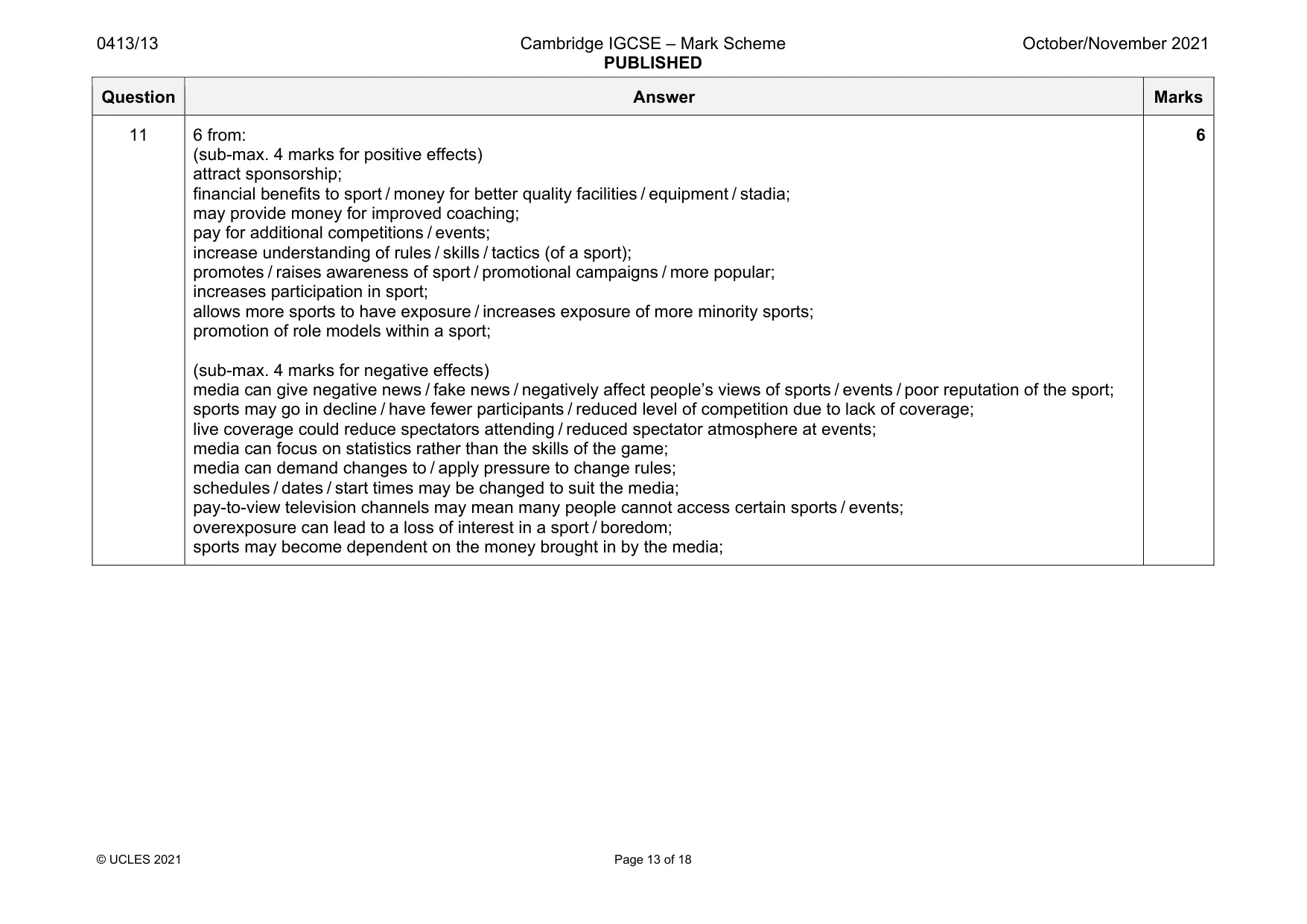
0413/13 Cambridge IGCSE – Mark Scheme PUBLISHED October/November 2021 © UCLES 2021 Page 13 of 18 Question Answer Marks 11 6 from: (sub-max. 4 marks for positive effects) attract sponsorship; financial benefits to sport / money for better quality facilities / equipment / stadia; may provide money for improved coaching; pay for additional competitions / events; increase understanding of rules / skills / tactics (of a sport); promotes / raises awareness of sport / promotional campaigns / more popular; increases participation in sport; allows more sports to have exposure / increases exposure of more minority sports; promotion of role models within a sport; (sub-max. 4 marks for negative effects) media can give negative news / fake news / negatively affect people’s views of sports / events / poor reputation of the sport; sports may go in decline / have fewer participants / reduced level of competition due to lack of coverage; live coverage could reduce spectators attending / reduced spectator atmosphere at events; media can focus on statistics rather than the skills of the game; media can demand changes to / apply pressure to change rules; schedules / dates / start times may be changed to suit the media; pay-to-view television channels may mean many people cannot access certain sports / events; overexposure can lead to a loss of interest in a sport / boredom; sports may become dependent on the money brought in by the media; 6
Mark scheme, page 14
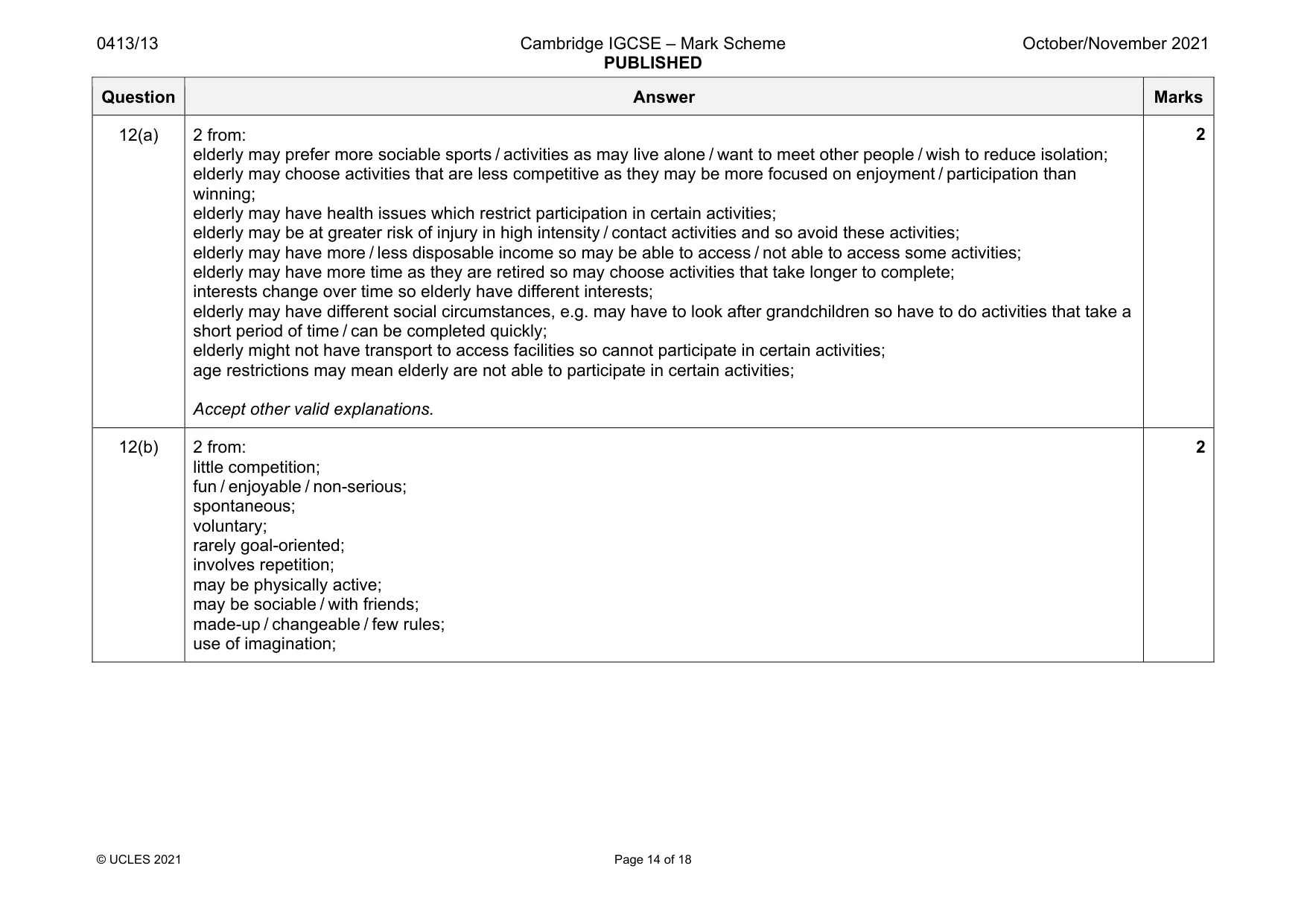
0413/13 Cambridge IGCSE – Mark Scheme PUBLISHED October/November 2021 © UCLES 2021 Page 14 of 18 Question Answer Marks 12(a) 2 from: elderly may prefer more sociable sports / activities as may live alone / want to meet other people / wish to reduce isolation; elderly may choose activities that are less competitive as they may be more focused on enjoyment / participation than winning; elderly may have health issues which restrict participation in certain activities; elderly may be at greater risk of injury in high intensity / contact activities and so avoid these activities; elderly may have more / less disposable income so may be able to access / not able to access some activities; elderly may have more time as they are retired so may choose activities that take longer to complete; interests change over time so elderly have different interests; elderly may have different social circumstances, e.g. may have to look after grandchildren so have to do activities that take a short period of time / can be completed quickly; elderly might not have transport to access facilities so cannot participate in certain activities; age restrictions may mean elderly are not able to participate in certain activities; Accept other valid explanations. 2 12(b) 2 from: little competition; fun / enjoyable / non-serious; spontaneous; voluntary; rarely goal-oriented; involves repetition; may be physically active; may be sociable / with friends; made-up / changeable / few rules; use of imagination; 2
Mark scheme, page 15
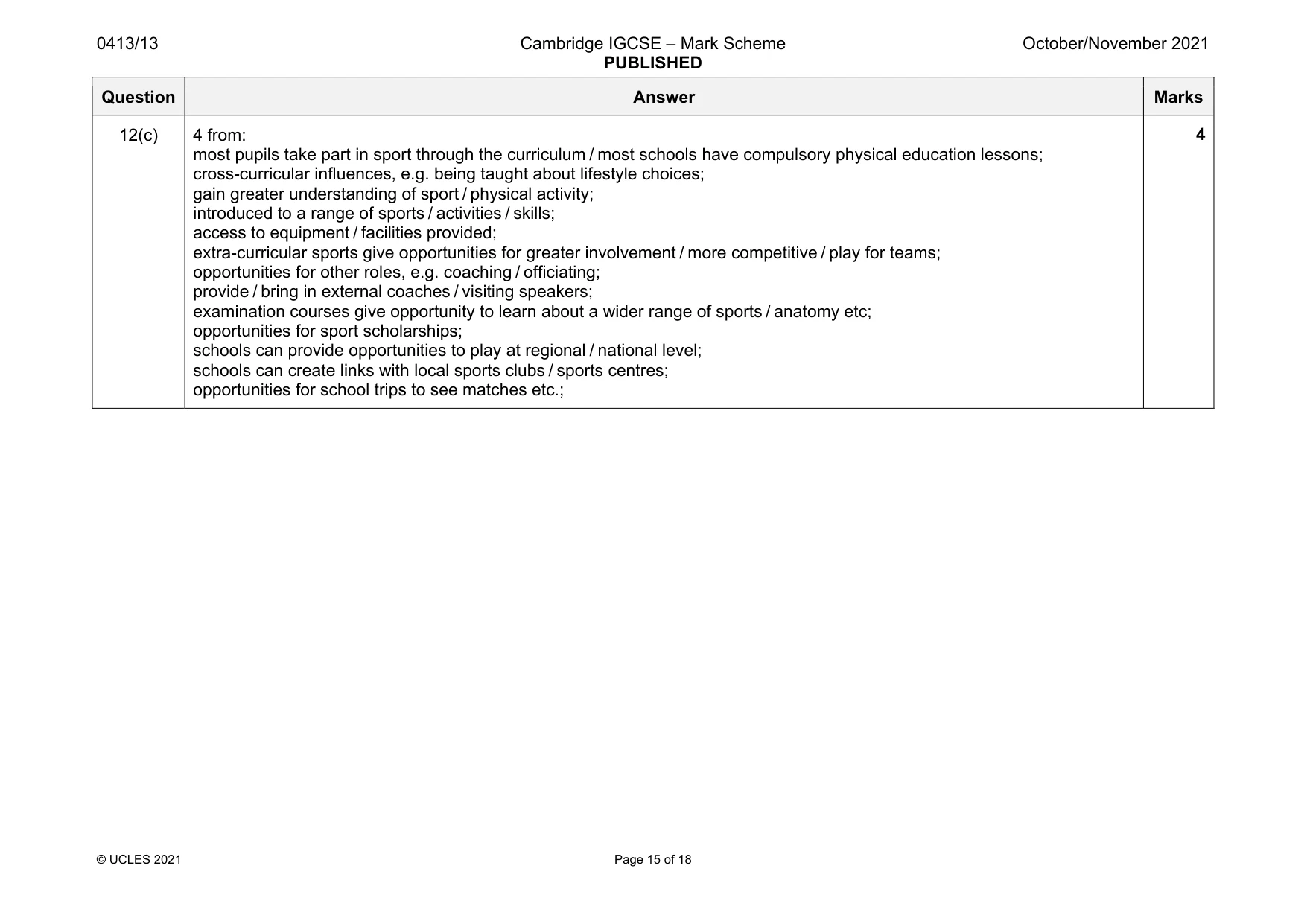
0413/13 Cambridge IGCSE – Mark Scheme PUBLISHED October/November 2021 © UCLES 2021 Page 15 of 18 Question Answer Marks 12(c) 4 from: most pupils take part in sport through the curriculum / most schools have compulsory physical education lessons; cross-curricular influences, e.g. being taught about lifestyle choices; gain greater understanding of sport / physical activity; introduced to a range of sports / activities / skills; access to equipment / facilities provided; extra-curricular sports give opportunities for greater involvement / more competitive / play for teams; opportunities for other roles, e.g. coaching / officiating; provide / bring in external coaches / visiting speakers; examination courses give opportunity to learn about a wider range of sports / anatomy etc; opportunities for sport scholarships; schools can provide opportunities to play at regional / national level; schools can create links with local sports clubs / sports centres; opportunities for school trips to see matches etc.; 4
Mark scheme, page 16
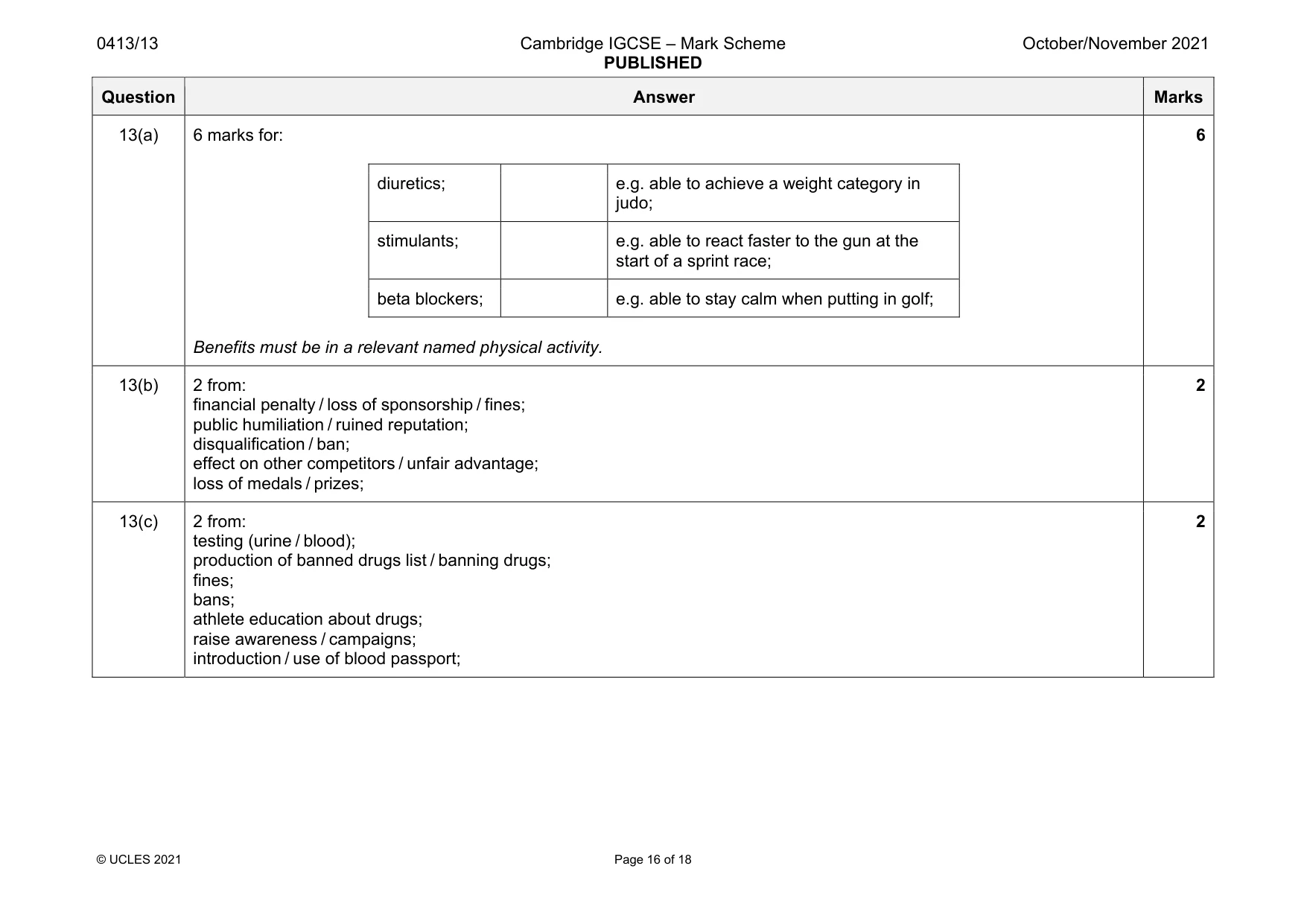
0413/13 Cambridge IGCSE – Mark Scheme PUBLISHED October/November 2021 © UCLES 2021 Page 16 of 18 Question Answer Marks 13(a) 6 marks for: diuretics; e.g. able to achieve a weight category in judo; stimulants; e.g. able to react faster to the gun at the start of a sprint race; beta blockers; e.g. able to stay calm when putting in golf; Benefits must be in a relevant named physical activity. 6 13(b) 2 from: financial penalty / loss of sponsorship / fines; public humiliation / ruined reputation; disqualification / ban; effect on other competitors / unfair advantage; loss of medals / prizes; 2 13(c) 2 from: testing (urine / blood); production of banned drugs list / banning drugs; fines; bans; athlete education about drugs; raise awareness / campaigns; introduction / use of blood passport; 2
Mark scheme, page 17
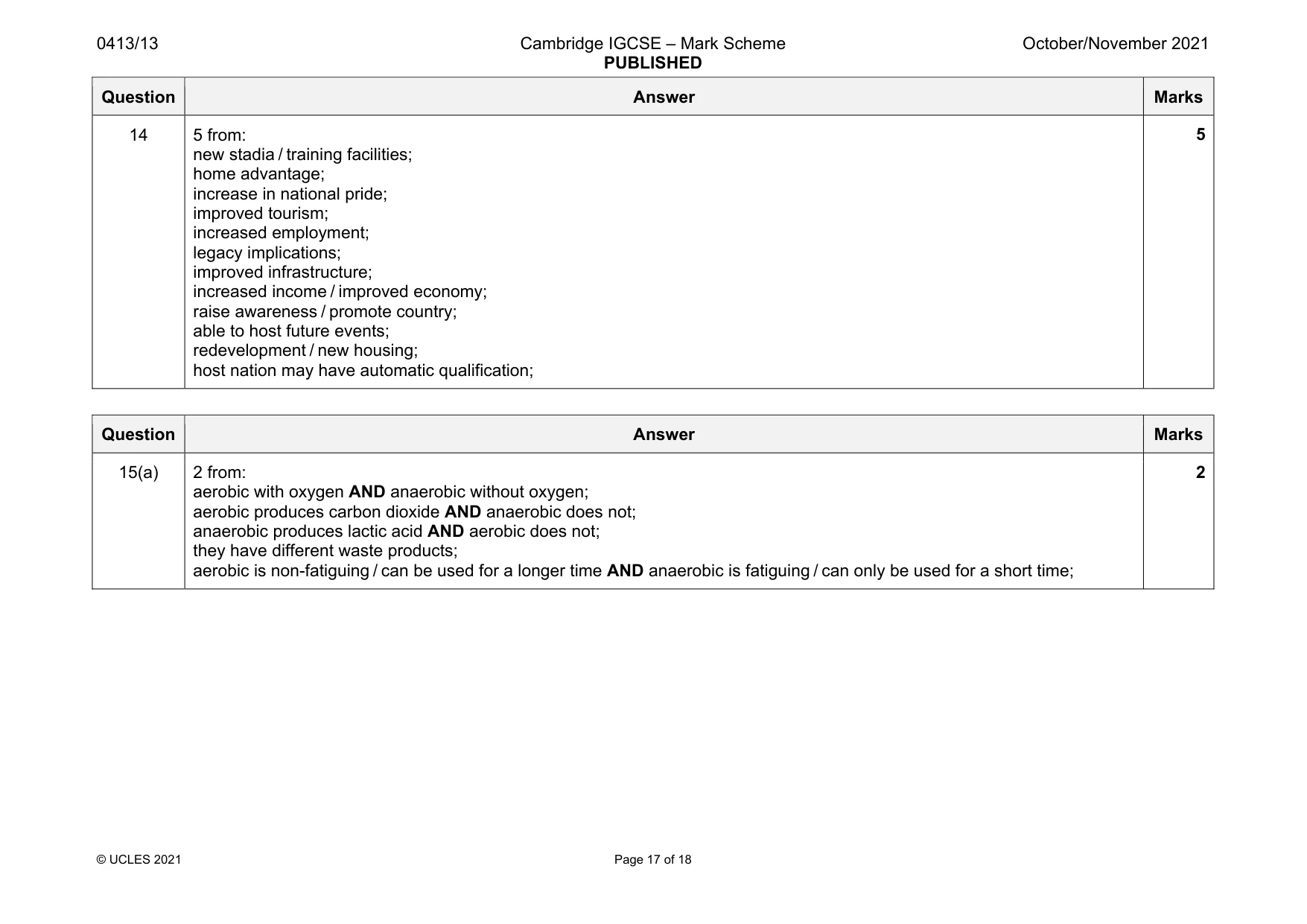
0413/13 Cambridge IGCSE – Mark Scheme PUBLISHED October/November 2021 © UCLES 2021 Page 17 of 18 Question Answer Marks 14 5 from: new stadia / training facilities; home advantage; increase in national pride; improved tourism; increased employment; legacy implications; improved infrastructure; increased income / improved economy; raise awareness / promote country; able to host future events; redevelopment / new housing; host nation may have automatic qualification; 5 Question Answer Marks 15(a) 2 from: aerobic with oxygen AND anaerobic without oxygen; aerobic produces carbon dioxide AND anaerobic does not; anaerobic produces lactic acid AND aerobic does not; they have different waste products; aerobic is non-fatiguing / can be used for a longer time AND anaerobic is fatiguing / can only be used for a short time; 2
Mark scheme, page 18
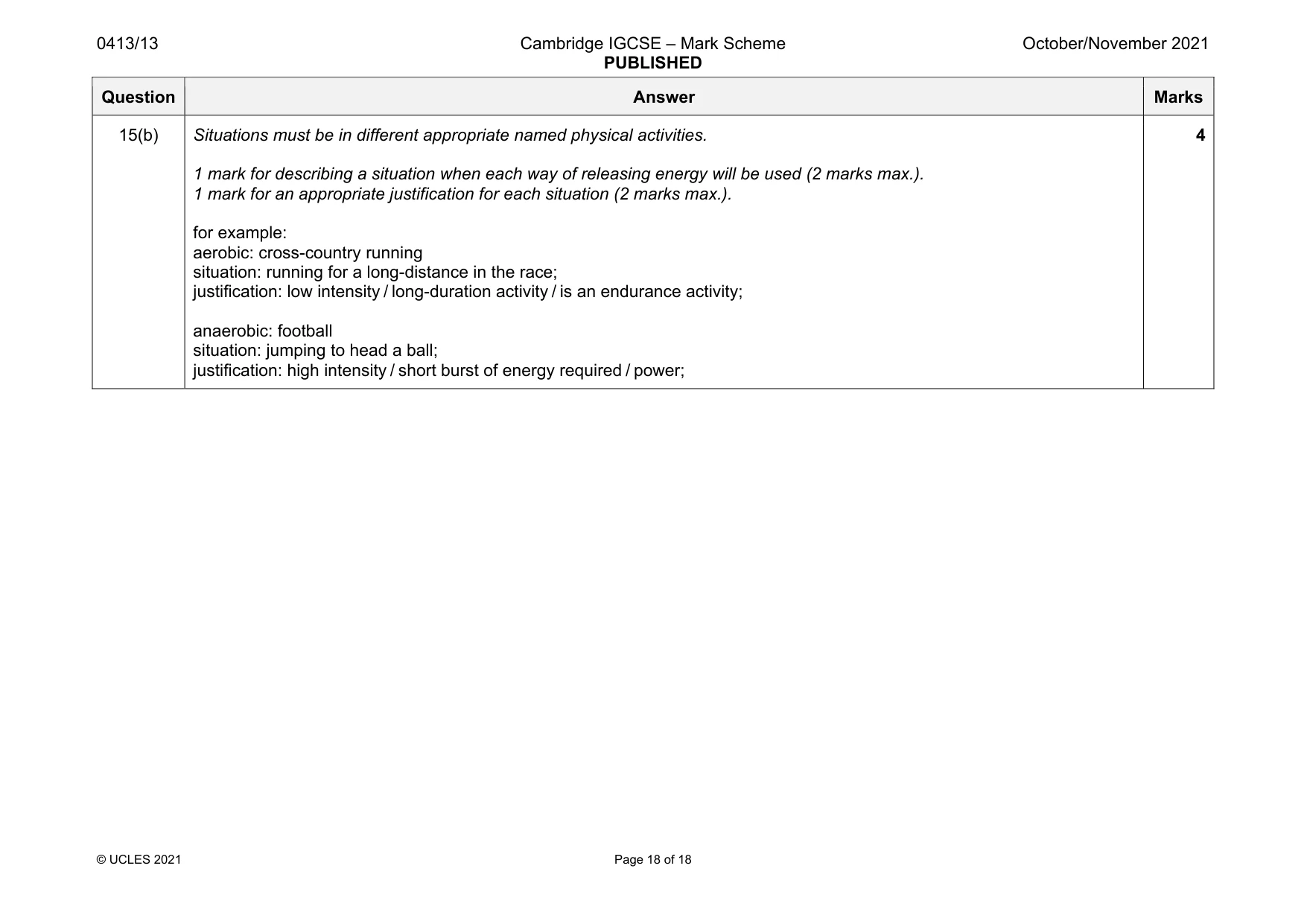
0413/13 Cambridge IGCSE – Mark Scheme PUBLISHED October/November 2021 © UCLES 2021 Page 18 of 18 Question Answer Marks 15(b) Situations must be in different appropriate named physical activities. 1 mark for describing a situation when each way of releasing energy will be used (2 marks max.). 1 mark for an appropriate justification for each situation (2 marks max.). for example: aerobic: cross-country running situation: running for a long-distance in the race; justification: low intensity / long-duration activity / is an endurance activity; anaerobic: football situation: jumping to head a ball; justification: high intensity / short burst of energy required / power; 4
What you needed in this session
Cambridge’s own grade thresholds for 2021 Oct/Nov, Paper 1 · Variant 3. A higher threshold means an easier paper — the bar moves with how the cohort did.