Cambridge IGCSE Physical Education 0413 — 2021 May/June Paper 1 · Variant 1
0413/11/M/J/21 · 100 marks · ≈113 min
The question paper and its mark scheme, free to read here and free to download. This is Cambridge’s own paper, exactly as it was sat.
Question paper16 pages



Mark scheme20 pages
Answers below. Sit the paper first if you are practising.
Paper as text
Question paper, page 1
This document has 16 pages. Any blank pages are indicated. Cambridge IGCSE™ PHYSICAL EDUCATION 0413/11 Paper 1 Theory May/June 2021 1 hour 45 minutes You must answer on the question paper. No additional materials are needed. INSTRUCTIONS ● Answer all questions. ● Use a black or dark blue pen. You may use an HB pencil for any diagrams or graphs. ● Write your name, centre number and candidate number in the boxes at the top of the page. ● Write your answer to each question in the space provided. ● Do not use an erasable pen or correction fluid. ● Do not write on any bar codes. ● You may use a calculator. ● You should show all your working and use appropriate units. INFORMATION ● The total mark for this paper is 100. ● The number of marks for each question or part question is shown in brackets [ ]. * 6 3 5 4 7 4 8 0 7 9 * DC (LK/FC) 198467/2 © UCLES 2021 [Turn over
Question paper, page 2
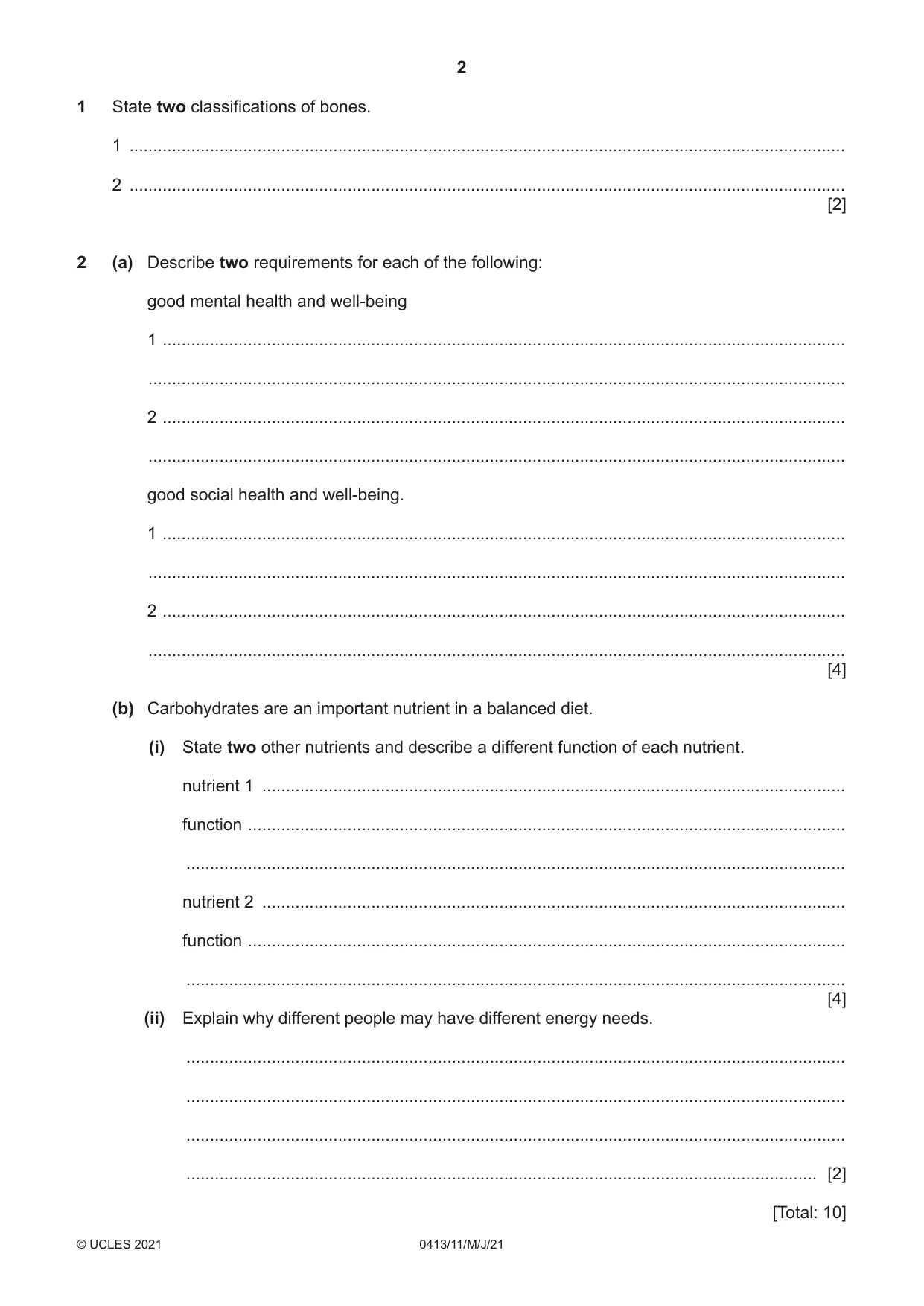
2 0413/11/M/J/21 © UCLES 2021 1 State two classifications of bones. 1 … 2 … [2] 2 (a) Describe two requirements for each of the following: good mental health and well-being 1 … … 2 … … good social health and well-being. 1 … … 2 … … [4] (b) Carbohydrates are an important nutrient in a balanced diet. (i) State two other nutrients and describe a different function of each nutrient. nutrient 1 … function … … nutrient 2 … function … … [4] (ii) Explain why different people may have different energy needs. … … … … [2] [Total: 10]
Question paper, page 3
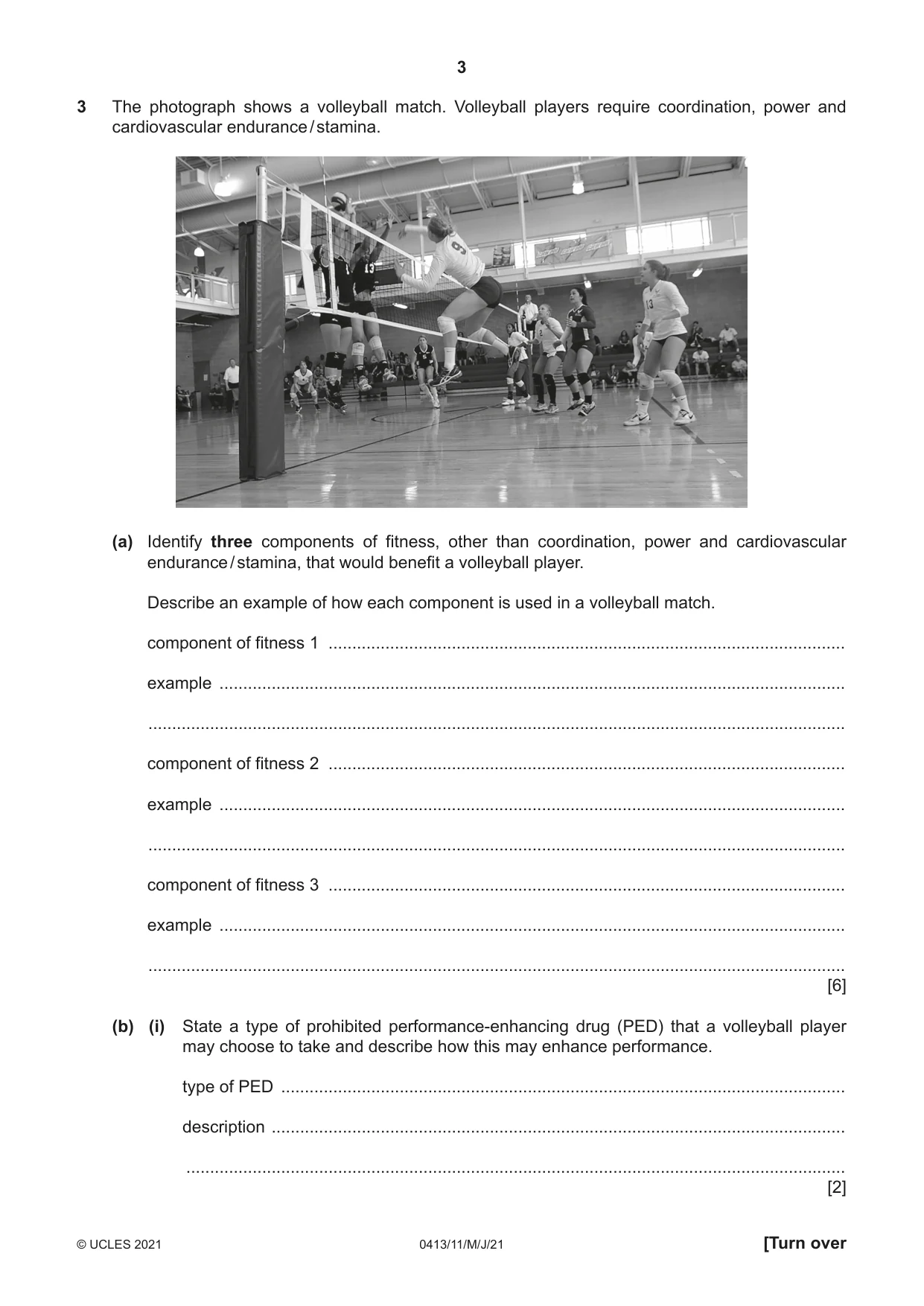
3 0413/11/M/J/21 © UCLES 2021 [Turn over 3 The photograph shows a volleyball match. Volleyball players require coordination, power and cardiovascular endurance / stamina. (a) Identify three components of fitness, other than coordination, power and cardiovascular endurance / stamina, that would benefit a volleyball player. Describe an example of how each component is used in a volleyball match. component of fitness 1 … example … … component of fitness 2 … example … … component of fitness 3 … example … … [6] (b) (i) State a type of prohibited performance-enhancing drug (PED) that a volleyball player may choose to take and describe how this may enhance performance. type of PED … description … … [2]
Question paper, page 4
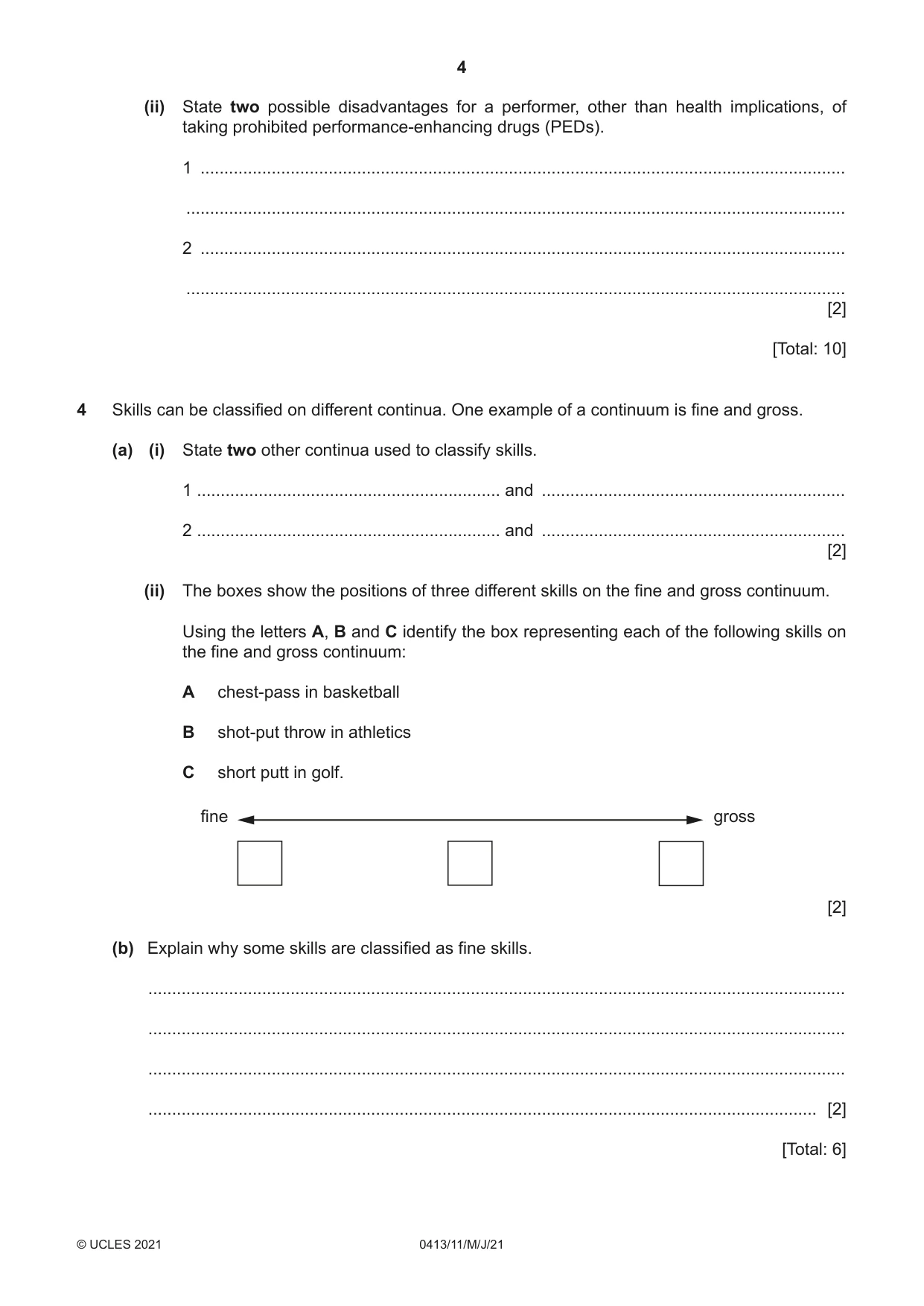
4 0413/11/M/J/21 © UCLES 2021 (ii) State two possible disadvantages for a performer, other than health implications, of taking prohibited performance-enhancing drugs (PEDs). 1 … … 2 … … [2] [Total: 10] 4 Skills can be classified on different continua. One example of a continuum is fine and gross. (a) (i) State two other continua used to classify skills. 1 … and … 2 … and … [2] (ii) The boxes show the positions of three different skills on the fine and gross continuum. Using the letters A, B and C identify the box representing each of the following skills on the fine and gross continuum: A chest-pass in basketball B shot-put throw in athletics C short putt in golf. fine gross [2] (b) Explain why some skills are classified as fine skills. … … … … [2] [Total: 6]
Question paper, page 5
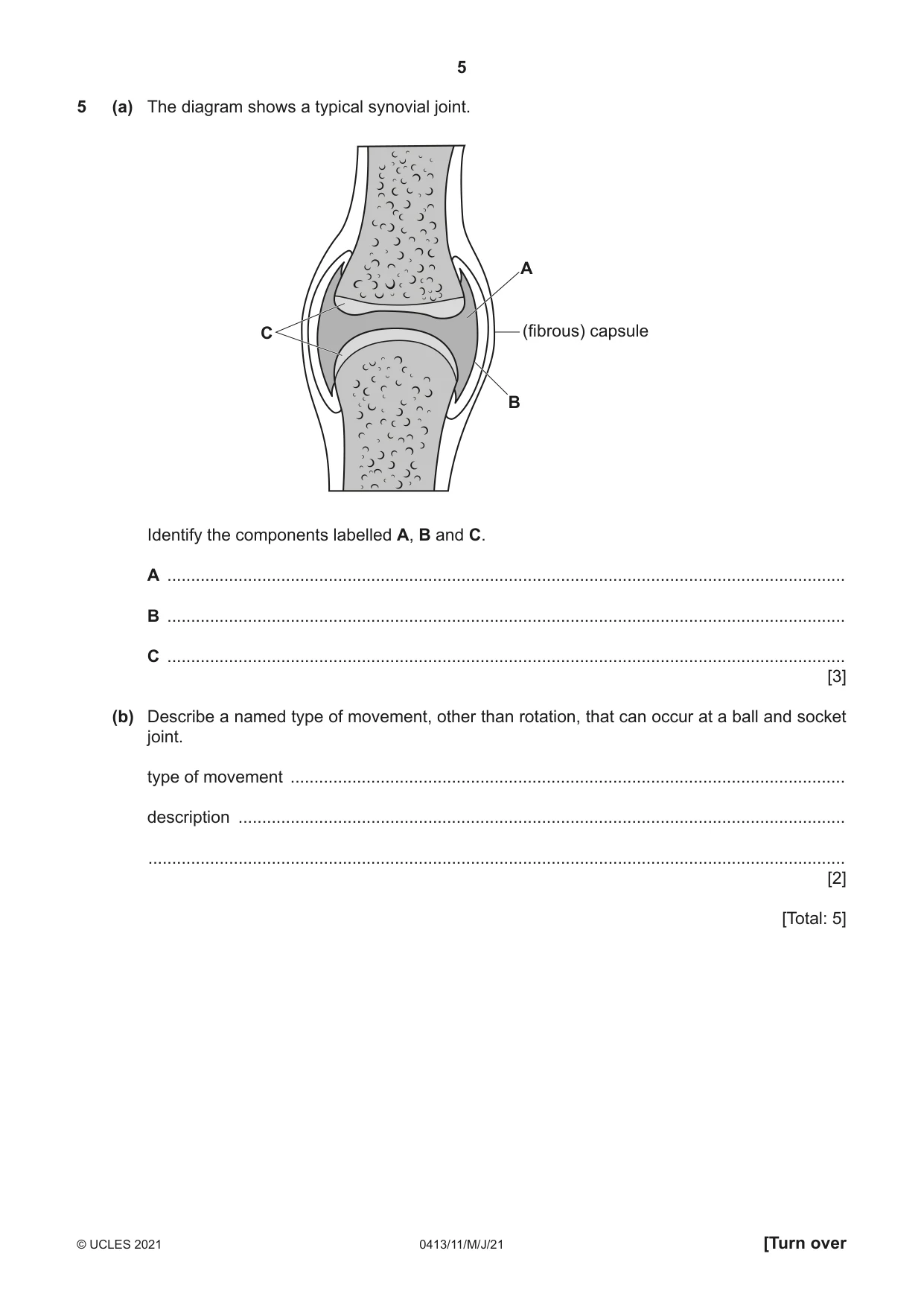
5 0413/11/M/J/21 © UCLES 2021 [Turn over 5 (a) The diagram shows a typical synovial joint. C B (fibrous) capsule A Identify the components labelled A, B and C. A … B … C … [3] (b) Describe a named type of movement, other than rotation, that can occur at a ball and socket joint. type of movement … description … … [2] [Total: 5]
Question paper, page 6
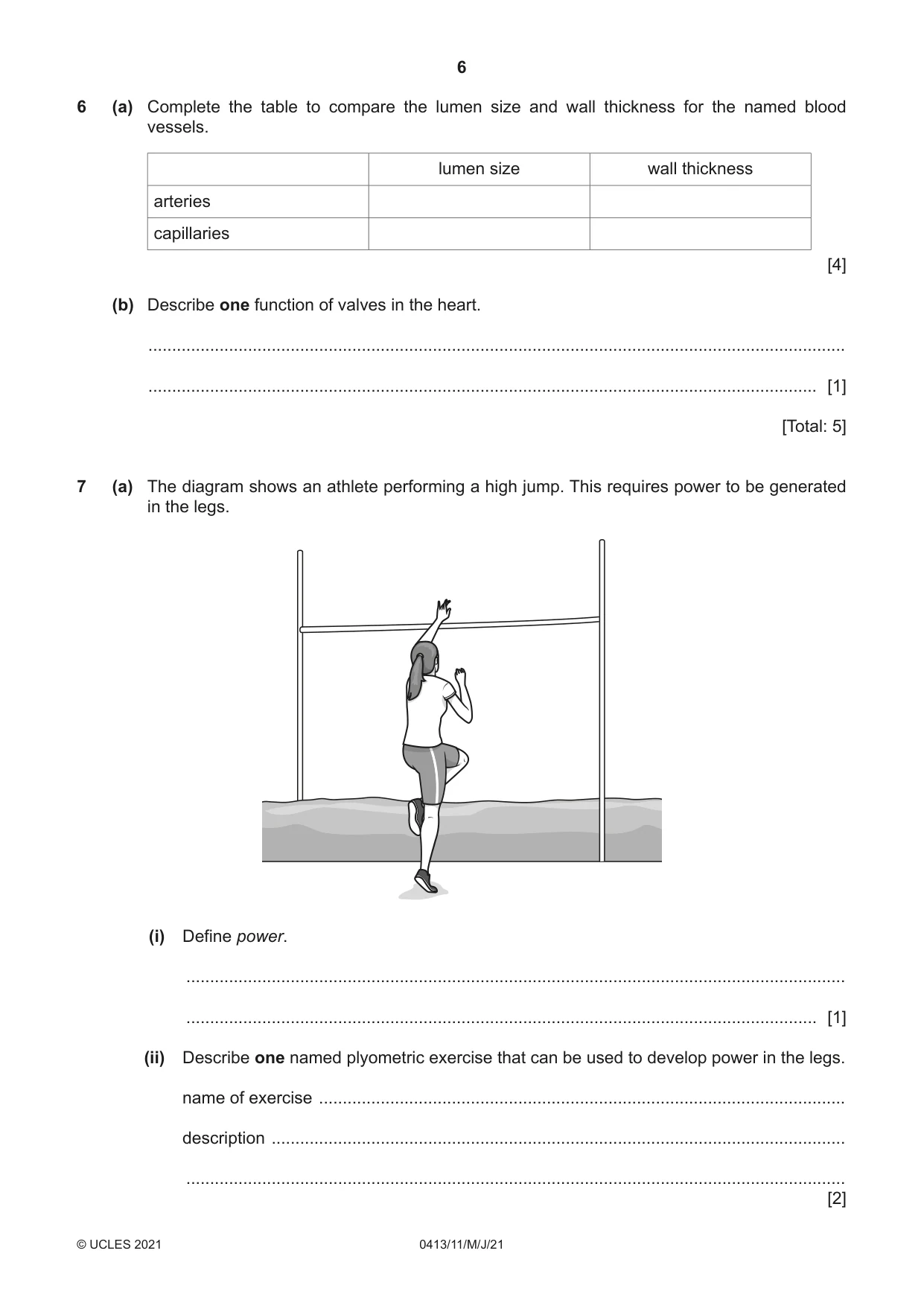
6 0413/11/M/J/21 © UCLES 2021 6 (a) Complete the table to compare the lumen size and wall thickness for the named blood vessels. lumen size wall thickness arteries capillaries [4] (b) Describe one function of valves in the heart. … … [1] [Total: 5] 7 (a) The diagram shows an athlete performing a high jump. This requires power to be generated in the legs. (i) Define power. … … [1] (ii) Describe one named plyometric exercise that can be used to develop power in the legs. name of exercise … description … … [2]
Question paper, page 7
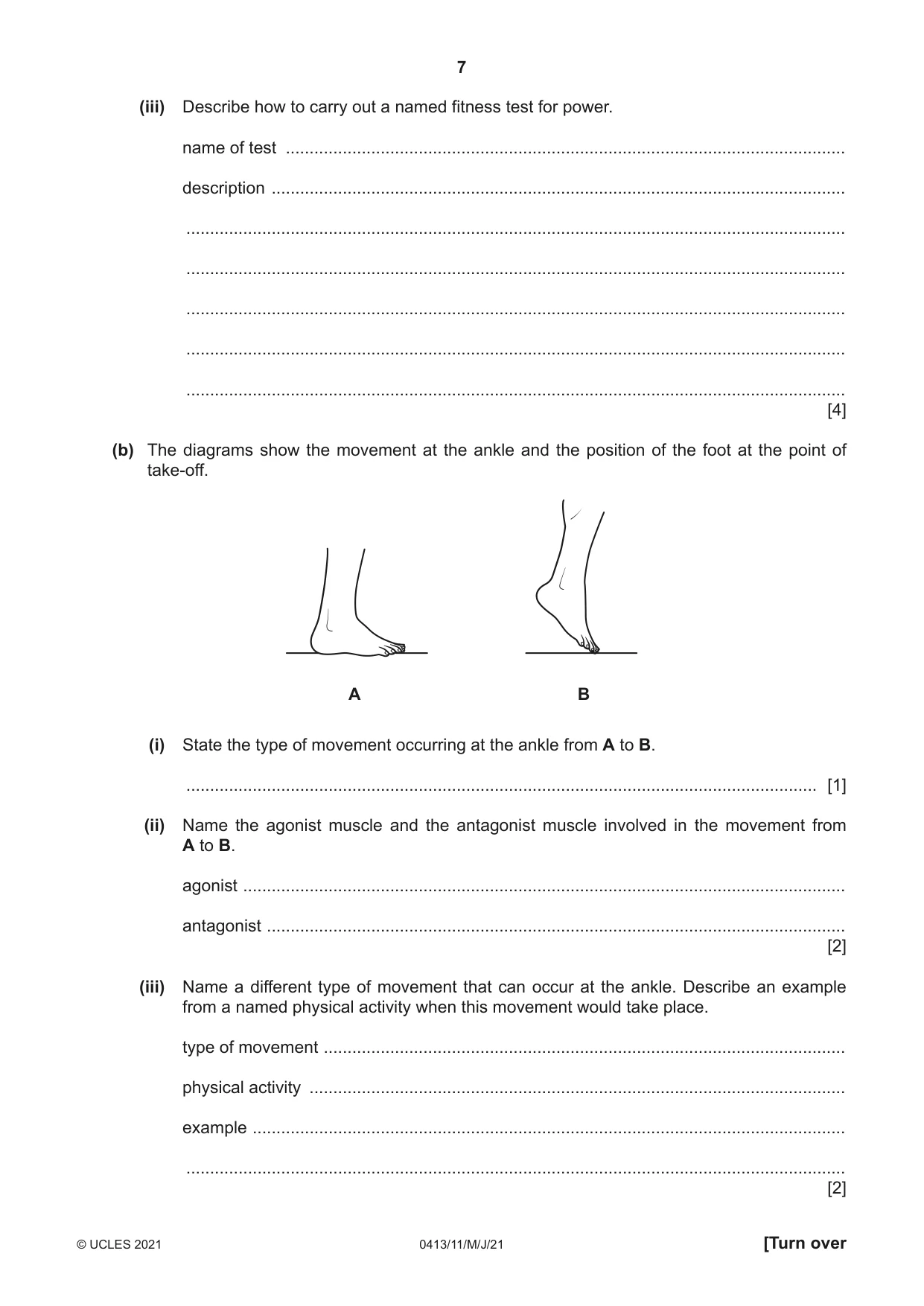
7 0413/11/M/J/21 © UCLES 2021 [Turn over (iii) Describe how to carry out a named fitness test for power. name of test … description … … … … … … [4] (b) The diagrams show the movement at the ankle and the position of the foot at the point of take-off. A B (i) State the type of movement occurring at the ankle from A to B. … [1] (ii) Name the agonist muscle and the antagonist muscle involved in the movement from A to B. agonist … antagonist … [2] (iii) Name a different type of movement that can occur at the ankle. Describe an example from a named physical activity when this movement would take place. type of movement … physical activity … example … … [2]
Question paper, page 8
8 0413/11/M/J/21 © UCLES 2021 (iv) Describe how a ligament injury could be caused at the ankle. Explain a named treatment for this injury. cause of injury … … treatment … explanation … … [3] [Total: 15]
Question paper, page 9
9 0413/11/M/J/21 © UCLES 2021 [Turn over 8 Describe, using examples from a named physical activity, how technology has had a different positive effect on officials, performers and the audience / spectators. physical activity … officials … … performers … … the audience / spectators … … [3] 9 (a) Knowledge of performance is a type of feedback that can improve performance. Describe two other advantages for a performer of knowledge of performance. advantage 1 … … advantage 2 … … [2] (b) Suggest why extrinsic feedback may be of greater benefit than intrinsic feedback for a performer trying to learn a skill during the cognitive stage of learning. … … … … [2] [Total: 4]
Question paper, page 10
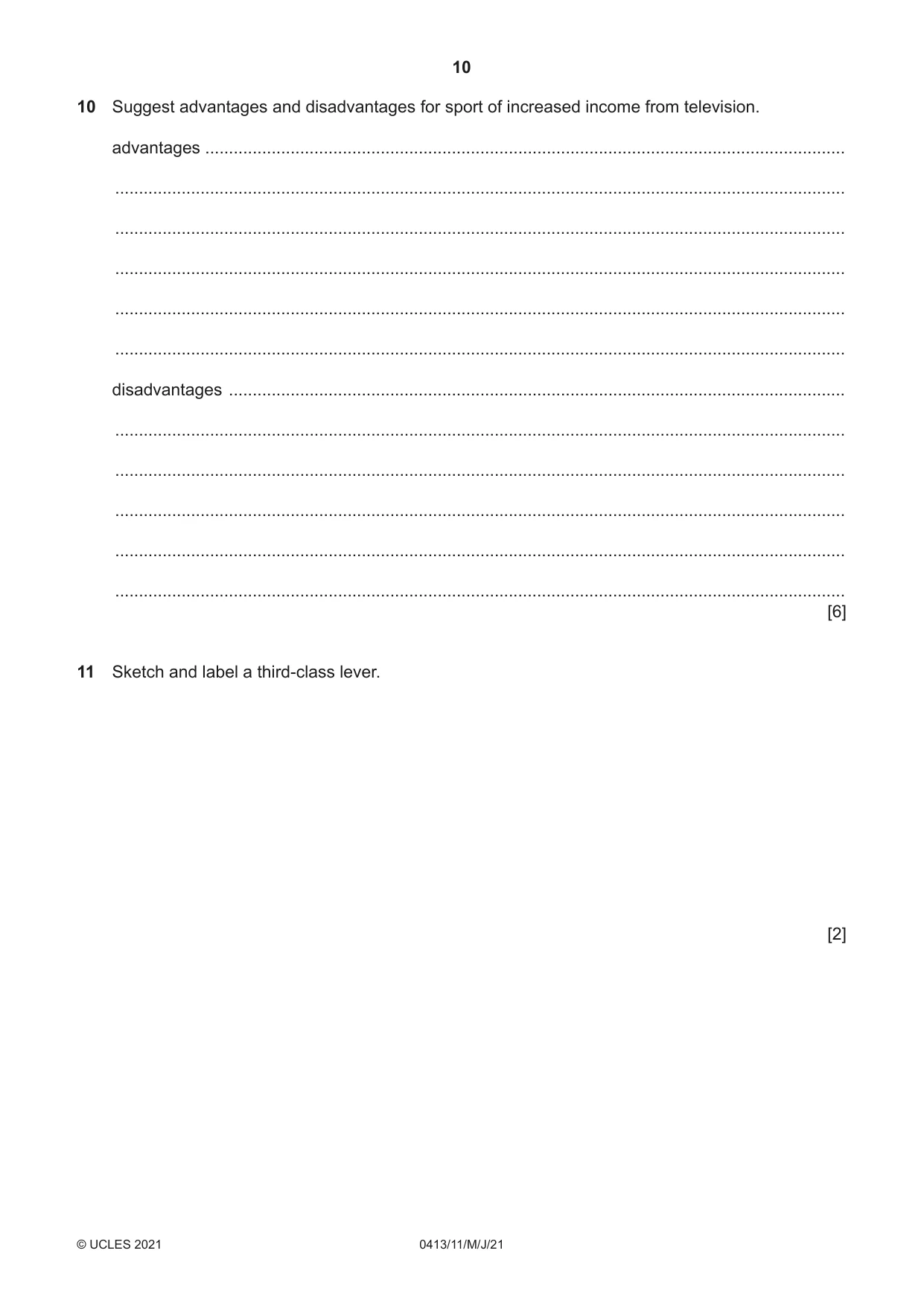
10 0413/11/M/J/21 © UCLES 2021 10 Suggest advantages and disadvantages for sport of increased income from television. advantages … … … … … … disadvantages … … … … … … [6] 11 Sketch and label a third-class lever. [2]
Question paper, page 11
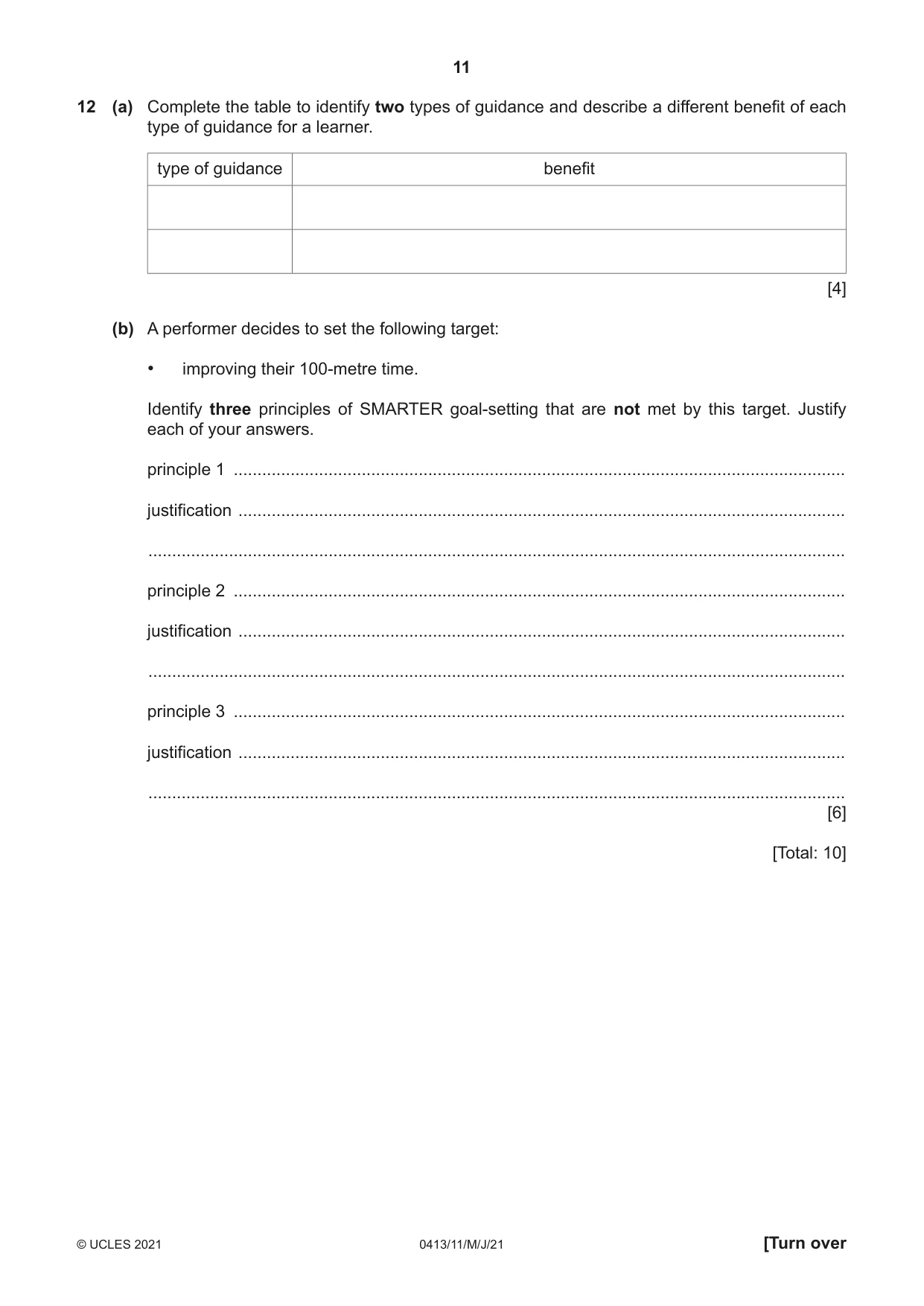
11 0413/11/M/J/21 © UCLES 2021 [Turn over 12 (a) Complete the table to identify two types of guidance and describe a different benefit of each type of guidance for a learner. type of guidance benefit [4] (b) A performer decides to set the following target: • improving their 100-metre time. Identify three principles of SMARTER goal-setting that are not met by this target. Justify each of your answers. principle 1 … justification … … principle 2 … justification … … principle 3 … justification … … [6] [Total: 10]
Question paper, page 12
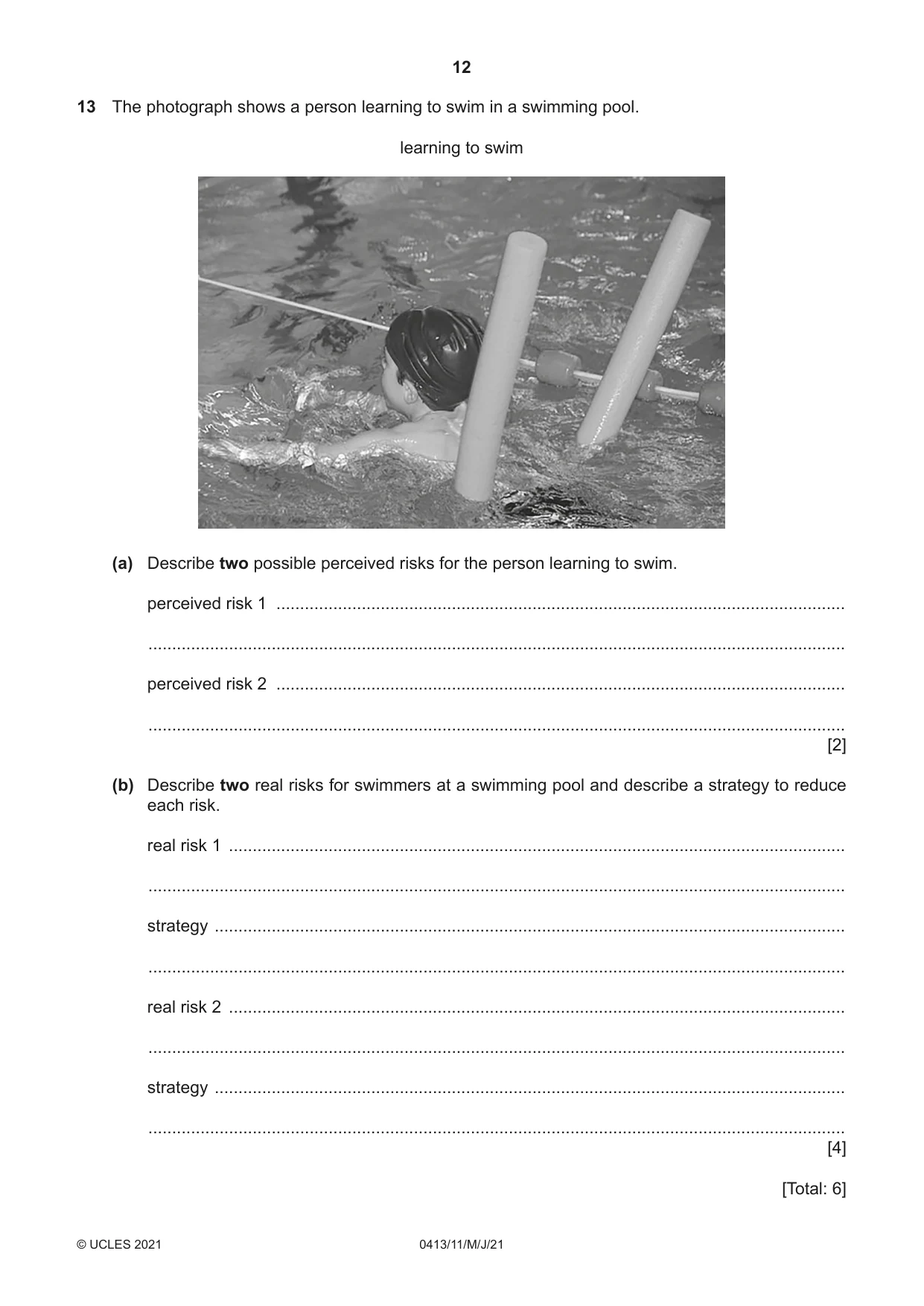
12 0413/11/M/J/21 © UCLES 2021 13 The photograph shows a person learning to swim in a swimming pool. learning to swim (a) Describe two possible perceived risks for the person learning to swim. perceived risk 1 … … perceived risk 2 … … [2] (b) Describe two real risks for swimmers at a swimming pool and describe a strategy to reduce each risk. real risk 1 … … strategy … … real risk 2 … … strategy … … [4] [Total: 6]
Question paper, page 13
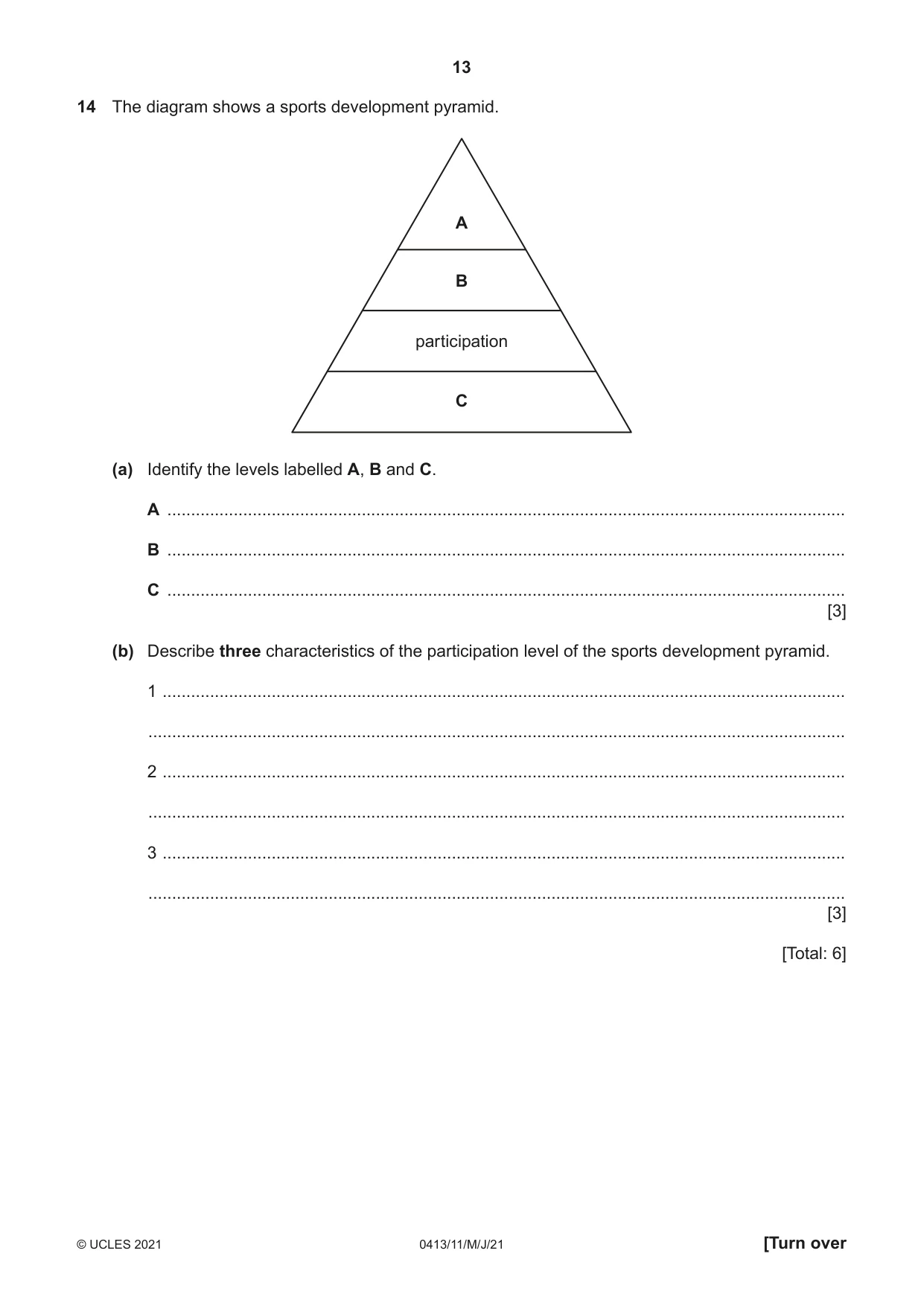
13 0413/11/M/J/21 © UCLES 2021 [Turn over 14 The diagram shows a sports development pyramid. participation A B C (a) Identify the levels labelled A, B and C. A … B … C … [3] (b) Describe three characteristics of the participation level of the sports development pyramid. 1 … … 2 … … 3 … … [3] [Total: 6]
Question paper, page 14
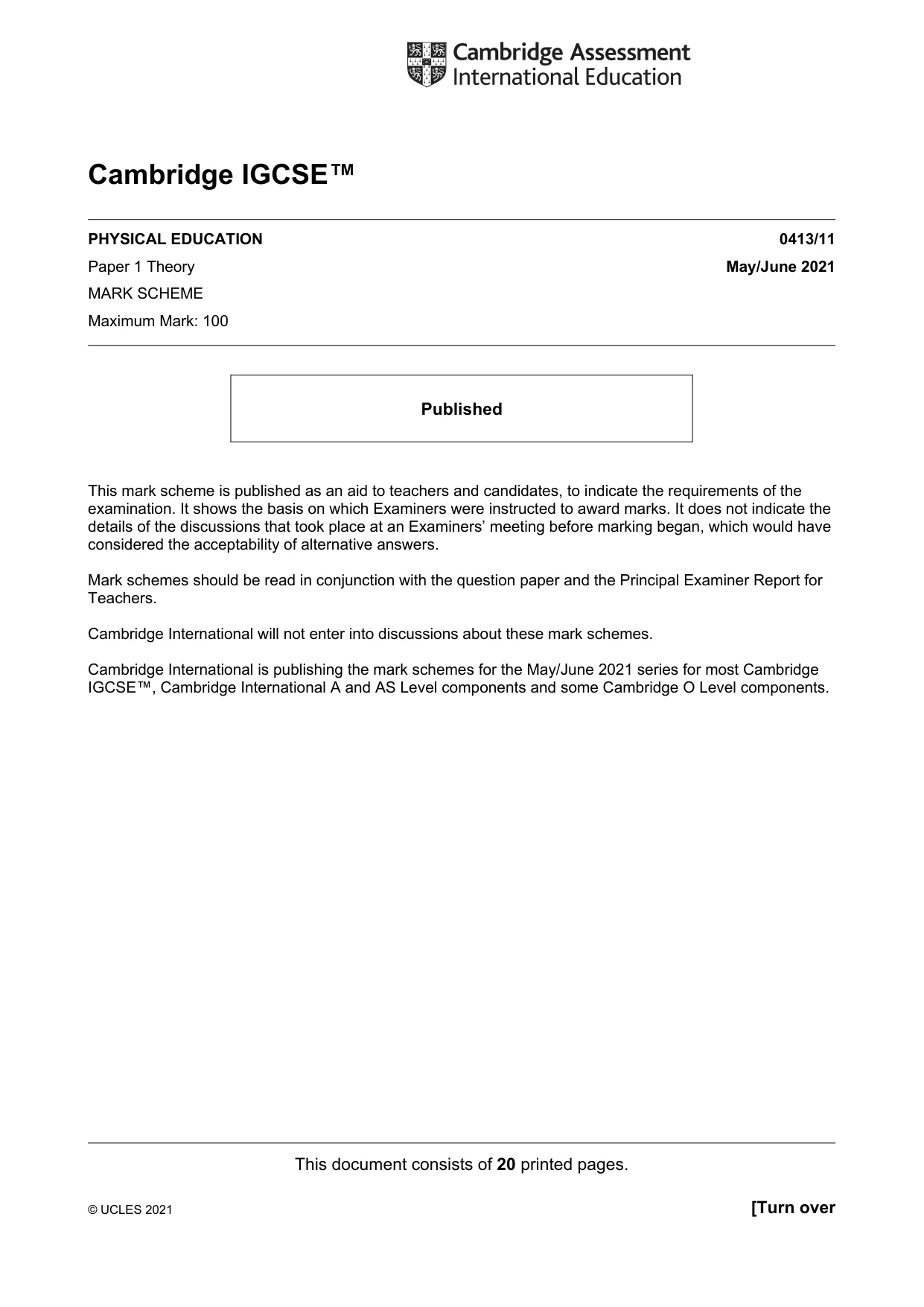
14 0413/11/M/J/21 © UCLES 2021 15 (a) Describe four short-term effects of exercise. 1 … 2 … 3 … 4 … [4] (b) (i) Describe two different examples from a named games activity when a performer’s energy demand is mainly anaerobic. games activity … example 1 … … example 2 … … [2] (ii) Outline how energy is released during anaerobic respiration. … … [2] (c) Describe how two factors may affect recovery after exercise. 1 … … 2 … … [2] [Total: 10]
Question paper, page 15
15 0413/11/M/J/21 © UCLES 2021 BLANK PAGE
Question paper, page 16
16 0413/11/M/J/21 © UCLES 2021 Permission to reproduce items where third-party owned material protected by copyright is included has been sought and cleared where possible. Every reasonable effort has been made by the publisher (UCLES) to trace copyright holders, but if any items requiring clearance have unwittingly been included, the publisher will be pleased to make amends at the earliest possible opportunity. To avoid the issue of disclosure of answer-related information to candidates, all copyright acknowledgements are reproduced online in the Cambridge Assessment International Education Copyright Acknowledgements Booklet. This is produced for each series of examinations and is freely available to download at www.cambridgeinternational.org after the live examination series. Cambridge Assessment International Education is part of the Cambridge Assessment Group. Cambridge Assessment is the brand name of the University of Cambridge Local Examinations Syndicate (UCLES), which itself is a department of the University of Cambridge. BLANK PAGE
Mark scheme, page 1
This document consists of 20 printed pages. © UCLES 2021 [Turn over Cambridge IGCSE™ PHYSICAL EDUCATION 0413/11 Paper 1 Theory May/June 2021 MARK SCHEME Maximum Mark: 100 Published This mark scheme is published as an aid to teachers and candidates, to indicate the requirements of the examination. It shows the basis on which Examiners were instructed to award marks. It does not indicate the details of the discussions that took place at an Examiners’ meeting before marking began, which would have considered the acceptability of alternative answers. Mark schemes should be read in conjunction with the question paper and the Principal Examiner Report for Teachers. Cambridge International will not enter into discussions about these mark schemes. Cambridge International is publishing the mark schemes for the May/June 2021 series for most Cambridge IGCSE™, Cambridge International A and AS Level components and some Cambridge O Level components.
Mark scheme, page 2
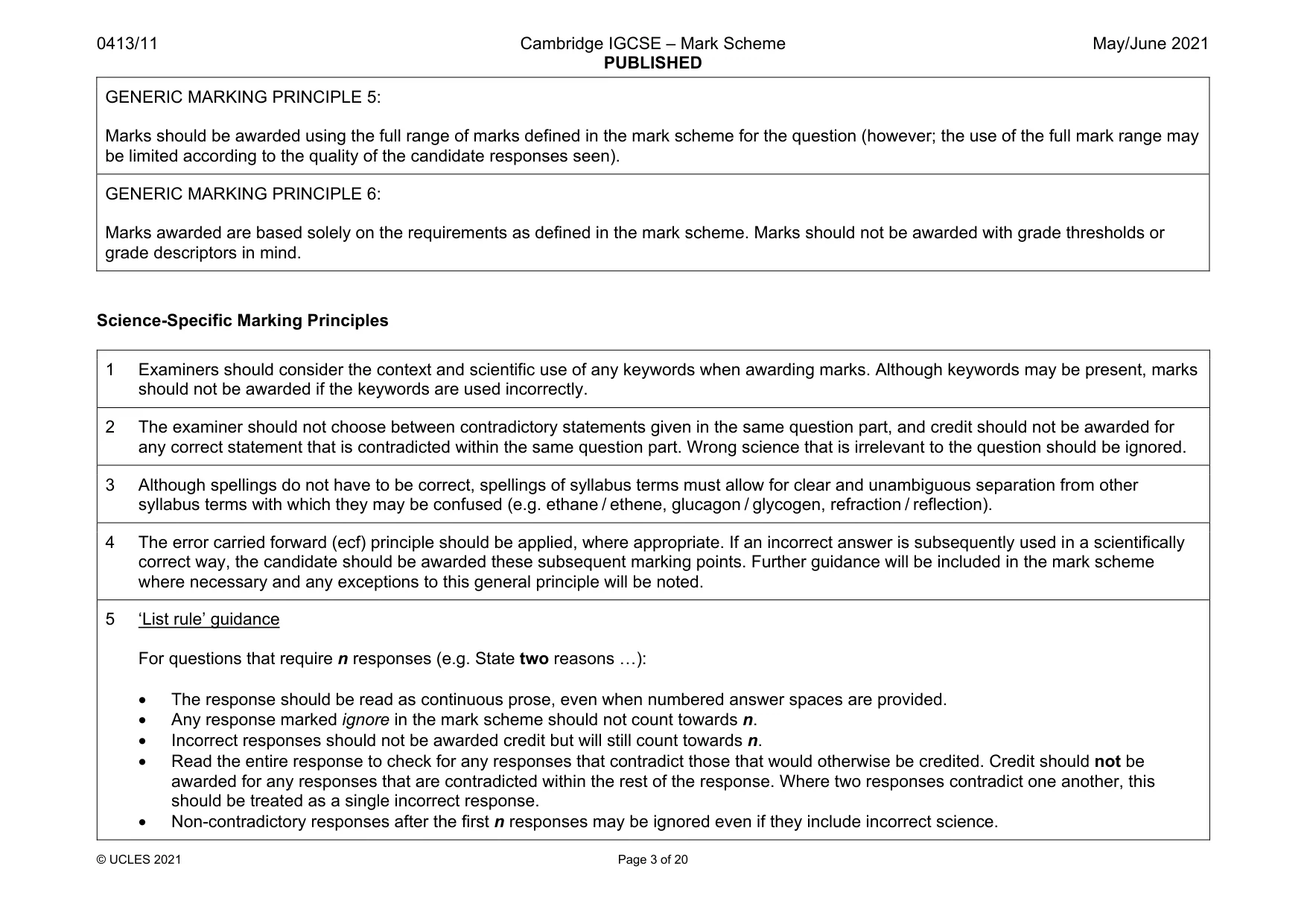
0413/11 Cambridge IGCSE – Mark Scheme PUBLISHED May/June 2021 © UCLES 2021 Page 2 of 20 Generic Marking Principles These general marking principles must be applied by all examiners when marking candidate answers. They should be applied alongside the specific content of the mark scheme or generic level descriptors for a question. Each question paper and mark scheme will also comply with these marking principles. GENERIC MARKING PRINCIPLE 1: Marks must be awarded in line with: • the specific content of the mark scheme or the generic level descriptors for the question • the specific skills defined in the mark scheme or in the generic level descriptors for the question • the standard of response required by a candidate as exemplified by the standardisation scripts. GENERIC MARKING PRINCIPLE 2: Marks awarded are always whole marks (not half marks, or other fractions). GENERIC MARKING PRINCIPLE 3: Marks must be awarded positively: • marks are awarded for correct/valid answers, as defined in the mark scheme. However, credit is given for valid answers which go beyond the scope of the syllabus and mark scheme, referring to your Team Leader as appropriate • marks are awarded when candidates clearly demonstrate what they know and can do • marks are not deducted for errors • marks are not deducted for omissions • answers should only be judged on the quality of spelling, punctuation and grammar when these features are specifically assessed by the question as indicated by the mark scheme. The meaning, however, should be unambiguous. GENERIC MARKING PRINCIPLE 4: Rules must be applied consistently, e.g. in situations where candidates have not followed instructions or in the application of generic level descriptors.
Mark scheme, page 3
0413/11 Cambridge IGCSE – Mark Scheme PUBLISHED May/June 2021 © UCLES 2021 Page 3 of 20 GENERIC MARKING PRINCIPLE 5: Marks should be awarded using the full range of marks defined in the mark scheme for the question (however; the use of the full mark range may be limited according to the quality of the candidate responses seen). GENERIC MARKING PRINCIPLE 6: Marks awarded are based solely on the requirements as defined in the mark scheme. Marks should not be awarded with grade thresholds or grade descriptors in mind. Science-Specific Marking Principles 1 Examiners should consider the context and scientific use of any keywords when awarding marks. Although keywords may be present, marks should not be awarded if the keywords are used incorrectly. 2 The examiner should not choose between contradictory statements given in the same question part, and credit should not be awarded for any correct statement that is contradicted within the same question part. Wrong science that is irrelevant to the question should be ignored. 3 Although spellings do not have to be correct, spellings of syllabus terms must allow for clear and unambiguous separation from other syllabus terms with which they may be confused (e.g. ethane / ethene, glucagon / glycogen, refraction / reflection). 4 The error carried forward (ecf) principle should be applied, where appropriate. If an incorrect answer is subsequently used in a scientifically correct way, the candidate should be awarded these subsequent marking points. Further guidance will be included in the mark scheme where necessary and any exceptions to this general principle will be noted. 5 ‘List rule’ guidance For questions that require n responses (e.g. State two reasons …): • The response should be read as continuous prose, even when numbered answer spaces are provided. • Any response marked ignore in the mark scheme should not count towards n. • Incorrect responses should not be awarded credit but will still count towards n. • Read the entire response to check for any responses that contradict those that would otherwise be credited. Credit should not be awarded for any responses that are contradicted within the rest of the response. Where two responses contradict one another, this should be treated as a single incorrect response. • Non-contradictory responses after the first n responses may be ignored even if they include incorrect science.
Mark scheme, page 4
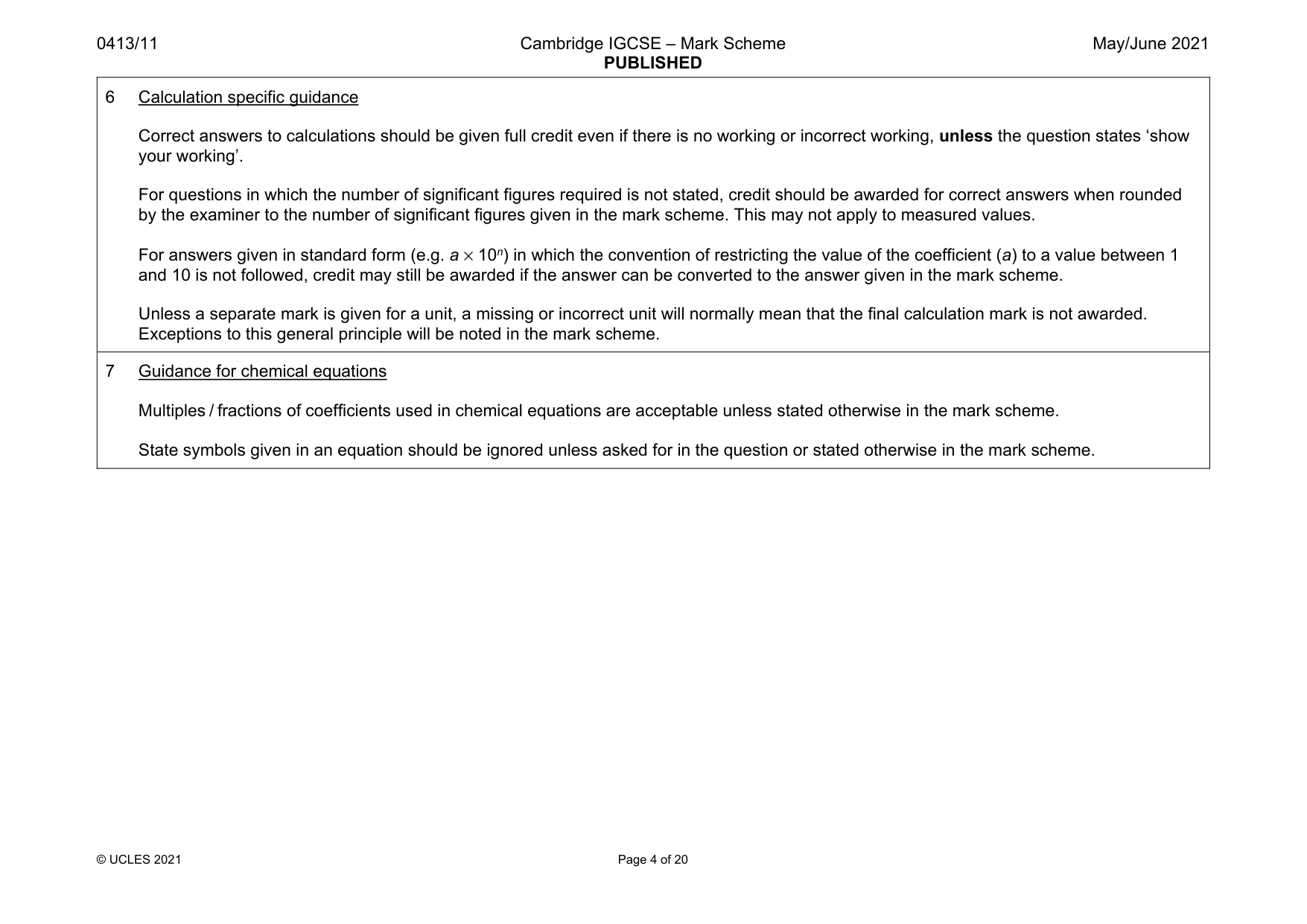
0413/11 Cambridge IGCSE – Mark Scheme PUBLISHED May/June 2021 © UCLES 2021 Page 4 of 20 6 Calculation specific guidance Correct answers to calculations should be given full credit even if there is no working or incorrect working, unless the question states ‘show your working’. For questions in which the number of significant figures required is not stated, credit should be awarded for correct answers when rounded by the examiner to the number of significant figures given in the mark scheme. This may not apply to measured values. For answers given in standard form (e.g. a × 10n) in which the convention of restricting the value of the coefficient (a) to a value between 1 and 10 is not followed, credit may still be awarded if the answer can be converted to the answer given in the mark scheme. Unless a separate mark is given for a unit, a missing or incorrect unit will normally mean that the final calculation mark is not awarded. Exceptions to this general principle will be noted in the mark scheme. 7 Guidance for chemical equations Multiples / fractions of coefficients used in chemical equations are acceptable unless stated otherwise in the mark scheme. State symbols given in an equation should be ignored unless asked for in the question or stated otherwise in the mark scheme.
Mark scheme, page 5
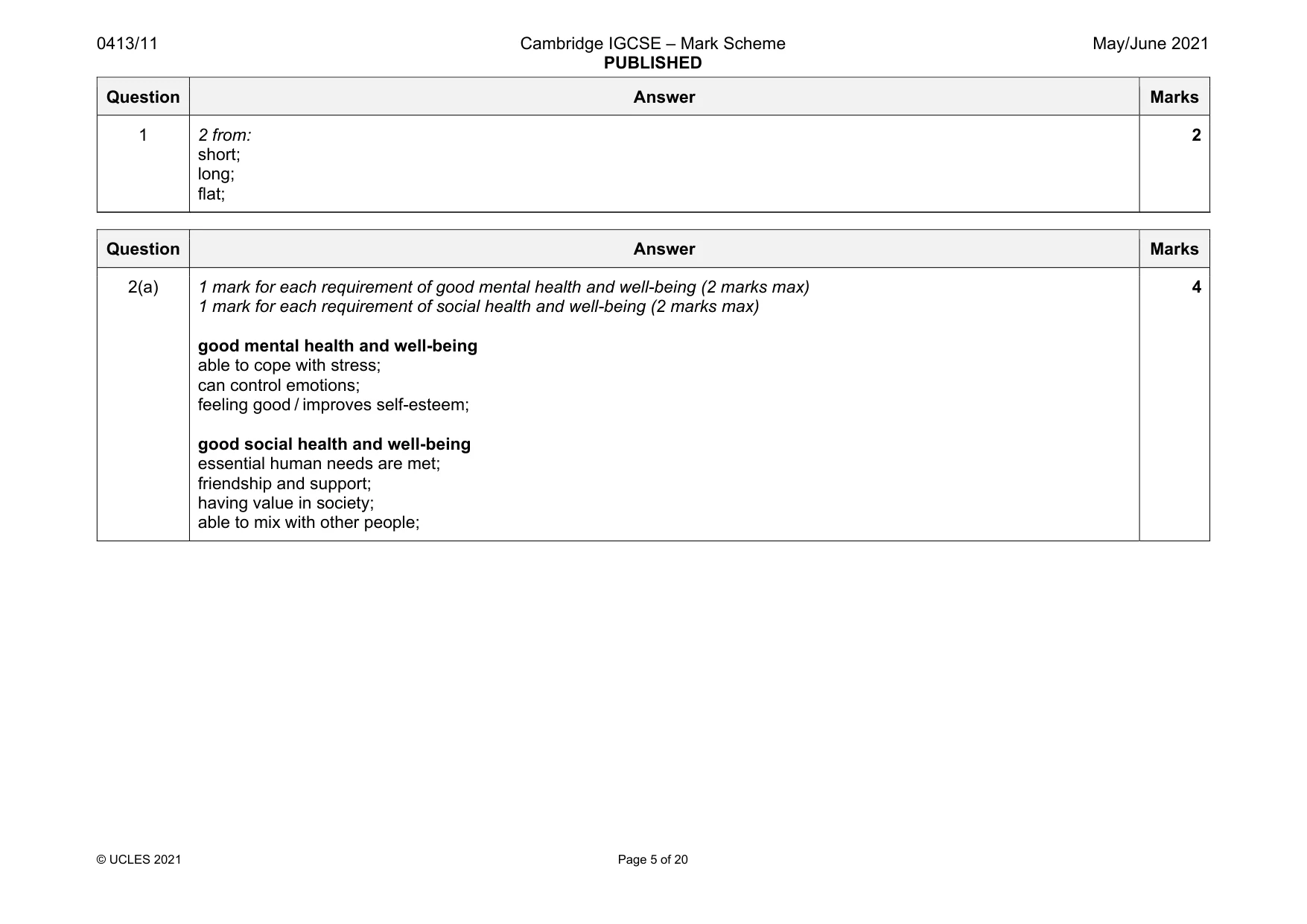
0413/11 Cambridge IGCSE – Mark Scheme PUBLISHED May/June 2021 © UCLES 2021 Page 5 of 20 Question Answer Marks 1 2 from: short; long; flat; 2 Question Answer Marks 2(a) 1 mark for each requirement of good mental health and well-being (2 marks max) 1 mark for each requirement of social health and well-being (2 marks max) good mental health and well-being able to cope with stress; can control emotions; feeling good / improves self-esteem; good social health and well-being essential human needs are met; friendship and support; having value in society; able to mix with other people; 4
Mark scheme, page 6
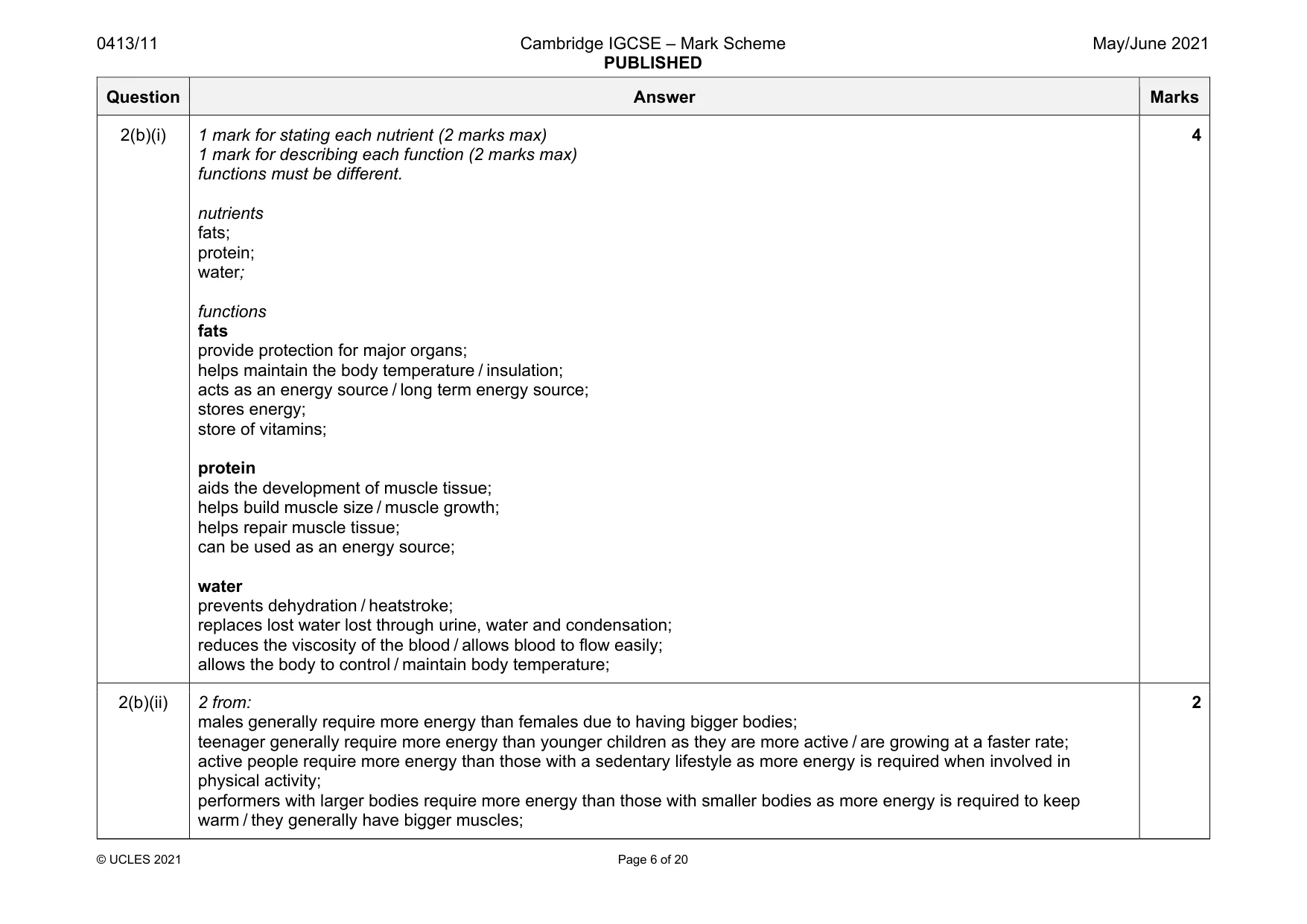
0413/11 Cambridge IGCSE – Mark Scheme PUBLISHED May/June 2021 © UCLES 2021 Page 6 of 20 Question Answer Marks 2(b)(i) 1 mark for stating each nutrient (2 marks max) 1 mark for describing each function (2 marks max) functions must be different. nutrients fats; protein; water; functions fats provide protection for major organs; helps maintain the body temperature / insulation; acts as an energy source / long term energy source; stores energy; store of vitamins; protein aids the development of muscle tissue; helps build muscle size / muscle growth; helps repair muscle tissue; can be used as an energy source; water prevents dehydration / heatstroke; replaces lost water lost through urine, water and condensation; reduces the viscosity of the blood / allows blood to flow easily; allows the body to control / maintain body temperature; 4 2(b)(ii) 2 from: males generally require more energy than females due to having bigger bodies; teenager generally require more energy than younger children as they are more active / are growing at a faster rate; active people require more energy than those with a sedentary lifestyle as more energy is required when involved in physical activity; performers with larger bodies require more energy than those with smaller bodies as more energy is required to keep warm / they generally have bigger muscles; 2
Mark scheme, page 7
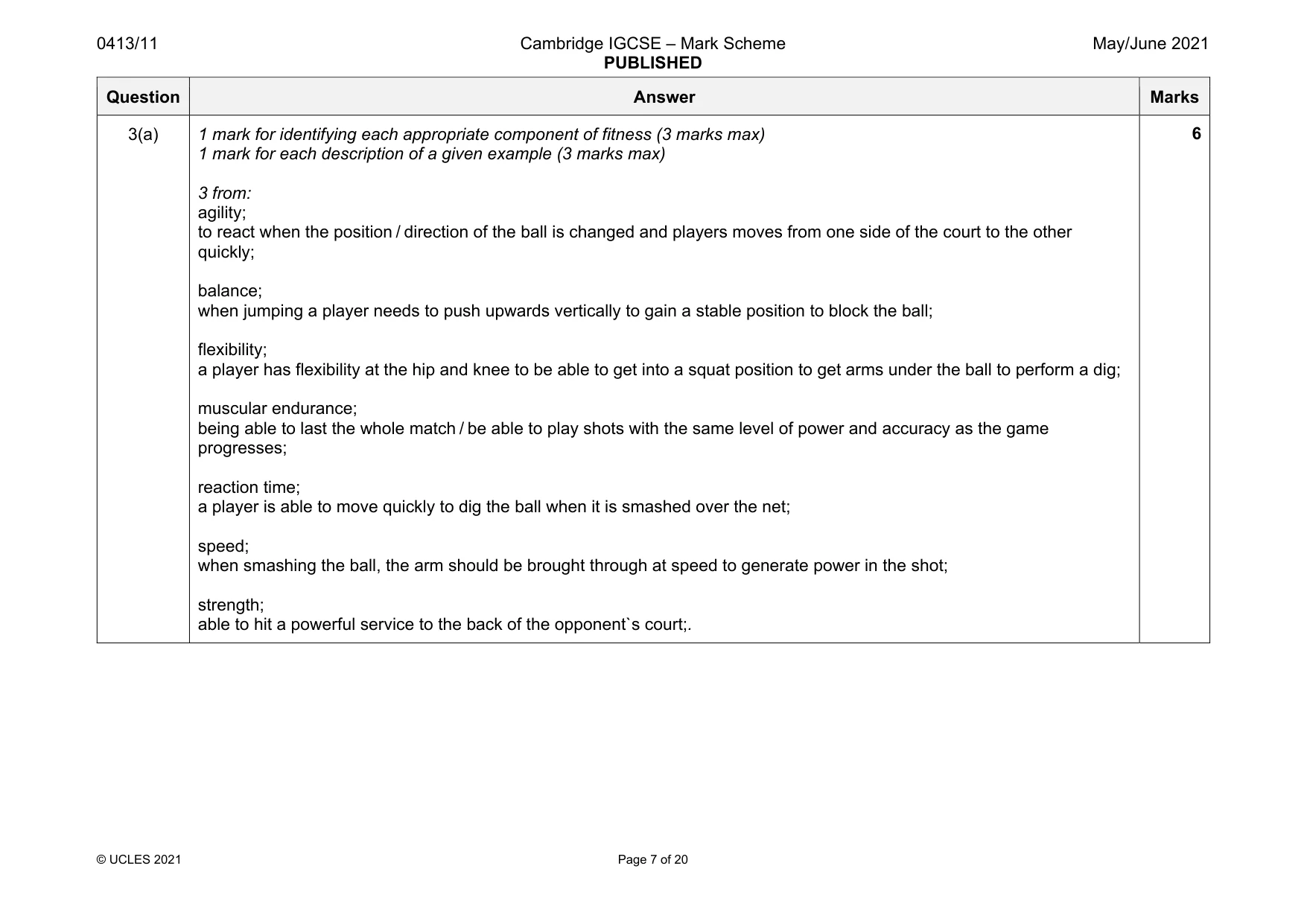
0413/11 Cambridge IGCSE – Mark Scheme PUBLISHED May/June 2021 © UCLES 2021 Page 7 of 20 Question Answer Marks 3(a) 1 mark for identifying each appropriate component of fitness (3 marks max) 1 mark for each description of a given example (3 marks max) 3 from: agility; to react when the position / direction of the ball is changed and players moves from one side of the court to the other quickly; balance; when jumping a player needs to push upwards vertically to gain a stable position to block the ball; flexibility; a player has flexibility at the hip and knee to be able to get into a squat position to get arms under the ball to perform a dig; muscular endurance; being able to last the whole match / be able to play shots with the same level of power and accuracy as the game progresses; reaction time; a player is able to move quickly to dig the ball when it is smashed over the net; speed; when smashing the ball, the arm should be brought through at speed to generate power in the shot; strength; able to hit a powerful service to the back of the opponent`s court;. 6
Mark scheme, page 8
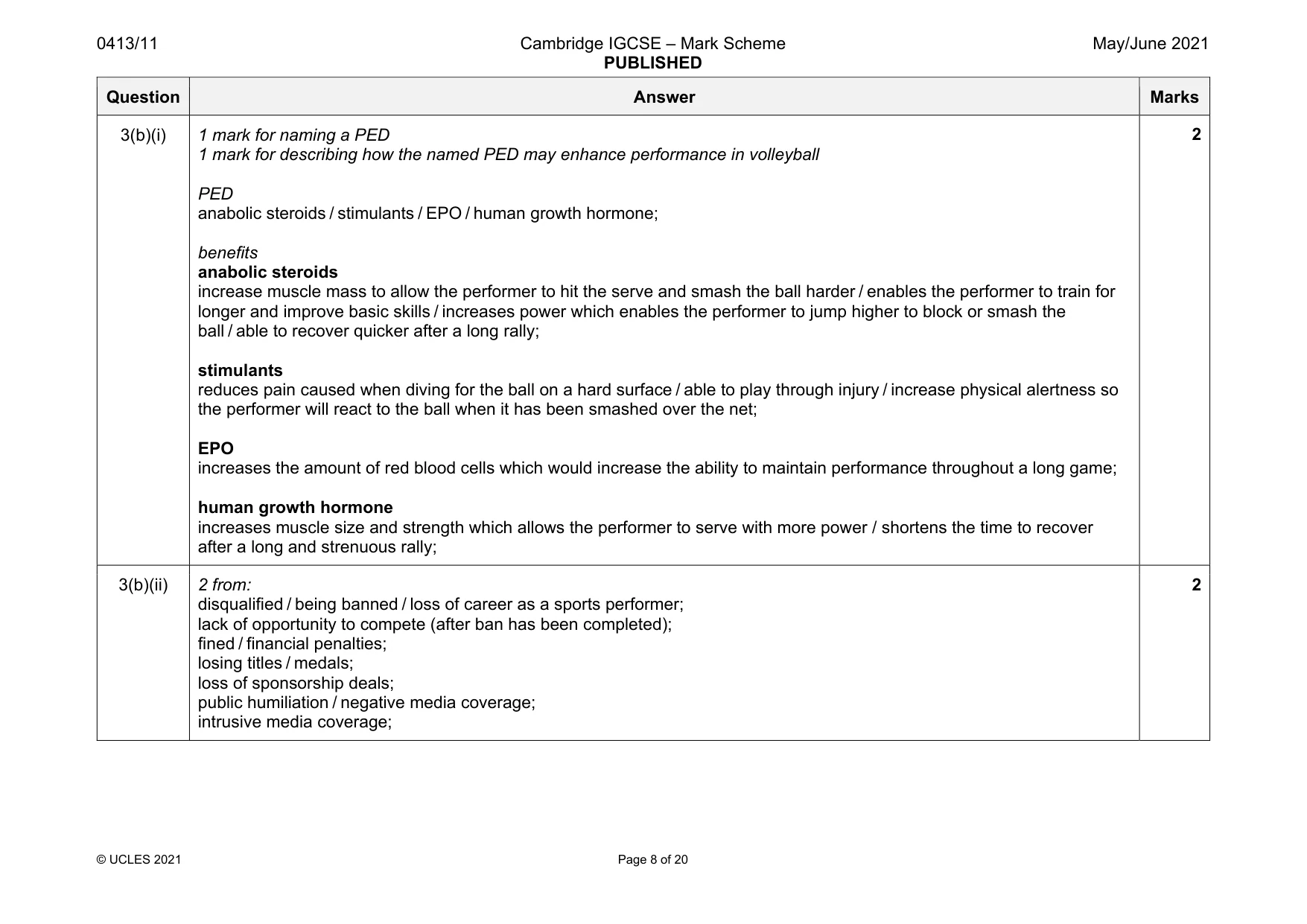
0413/11 Cambridge IGCSE – Mark Scheme PUBLISHED May/June 2021 © UCLES 2021 Page 8 of 20 Question Answer Marks 3(b)(i) 1 mark for naming a PED 1 mark for describing how the named PED may enhance performance in volleyball PED anabolic steroids / stimulants / EPO / human growth hormone; benefits anabolic steroids increase muscle mass to allow the performer to hit the serve and smash the ball harder / enables the performer to train for longer and improve basic skills / increases power which enables the performer to jump higher to block or smash the ball / able to recover quicker after a long rally; stimulants reduces pain caused when diving for the ball on a hard surface / able to play through injury / increase physical alertness so the performer will react to the ball when it has been smashed over the net; EPO increases the amount of red blood cells which would increase the ability to maintain performance throughout a long game; human growth hormone increases muscle size and strength which allows the performer to serve with more power / shortens the time to recover after a long and strenuous rally; 2 3(b)(ii) 2 from: disqualified / being banned / loss of career as a sports performer; lack of opportunity to compete (after ban has been completed); fined / financial penalties; losing titles / medals; loss of sponsorship deals; public humiliation / negative media coverage; intrusive media coverage; 2
Mark scheme, page 9
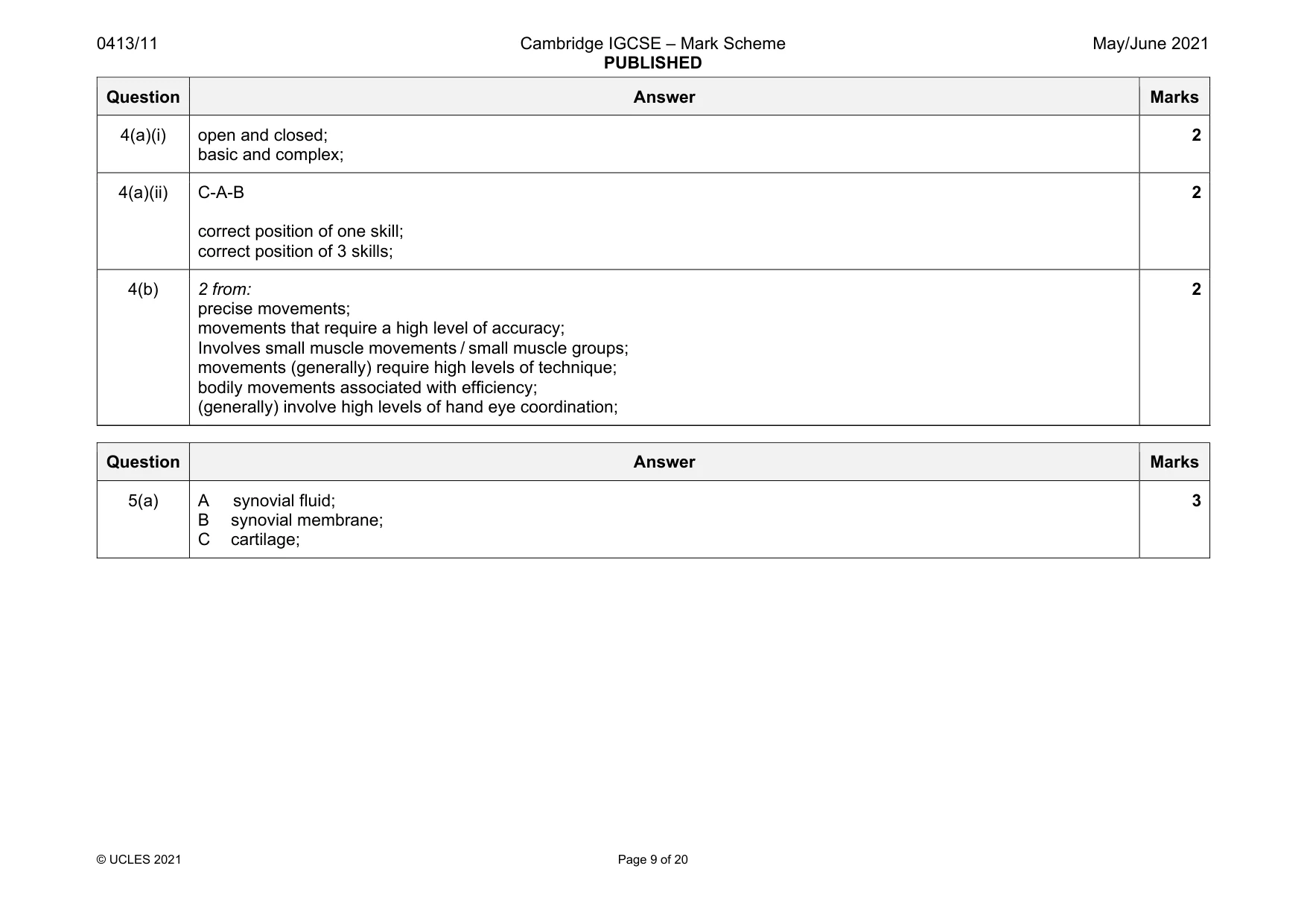
0413/11 Cambridge IGCSE – Mark Scheme PUBLISHED May/June 2021 © UCLES 2021 Page 9 of 20 Question Answer Marks 4(a)(i) open and closed; basic and complex; 2 4(a)(ii) C-A-B correct position of one skill; correct position of 3 skills; 2 4(b) 2 from: precise movements; movements that require a high level of accuracy; Involves small muscle movements / small muscle groups; movements (generally) require high levels of technique; bodily movements associated with efficiency; (generally) involve high levels of hand eye coordination; 2 Question Answer Marks 5(a) A synovial fluid; B synovial membrane; C cartilage; 3
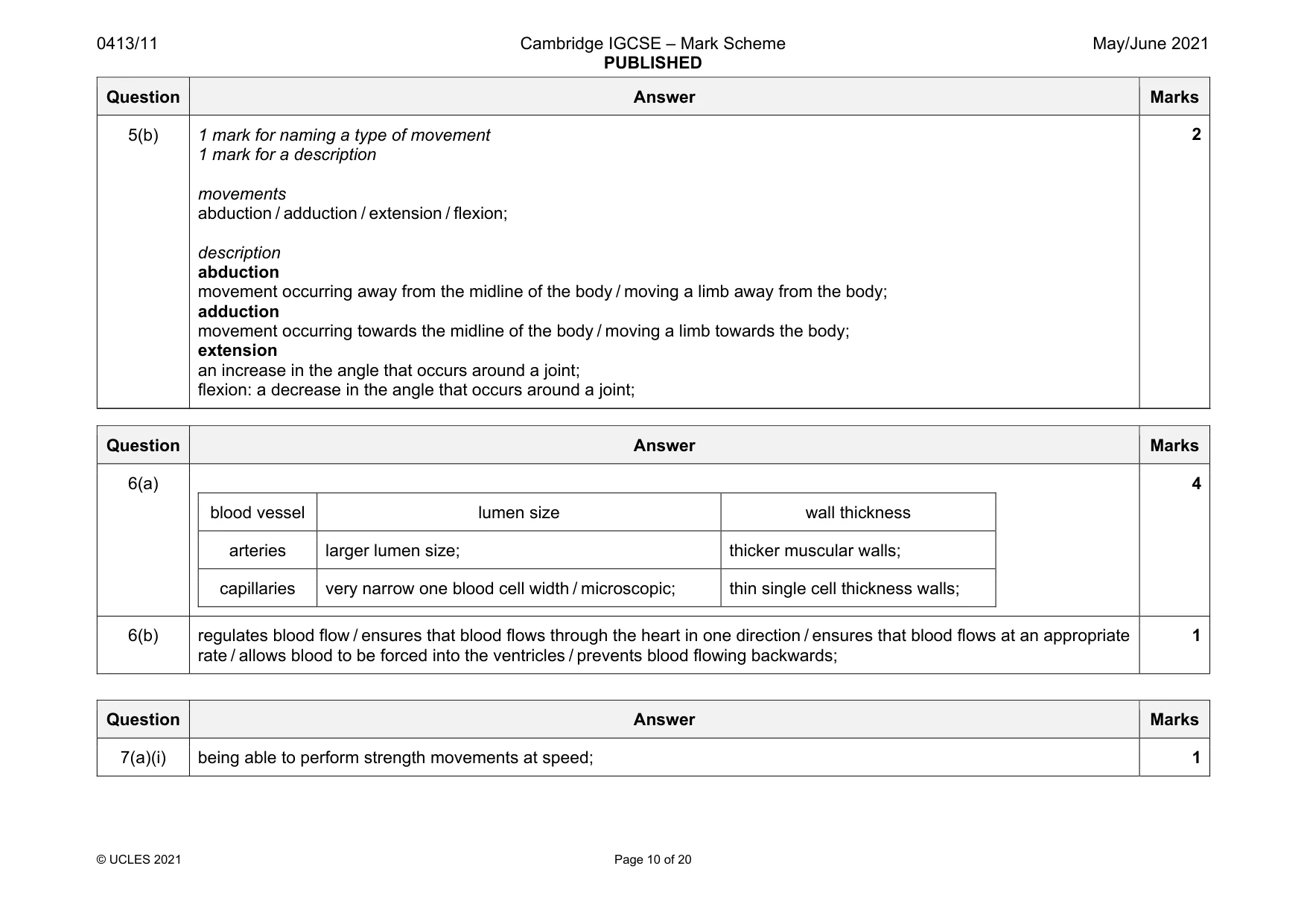
Mark scheme, page 10
0413/11 Cambridge IGCSE – Mark Scheme PUBLISHED May/June 2021 © UCLES 2021 Page 10 of 20 Question Answer Marks 5(b) 1 mark for naming a type of movement 1 mark for a description movements abduction / adduction / extension / flexion; description abduction movement occurring away from the midline of the body / moving a limb away from the body; adduction movement occurring towards the midline of the body / moving a limb towards the body; extension an increase in the angle that occurs around a joint; flexion: a decrease in the angle that occurs around a joint; 2 Question Answer Marks 6(a) blood vessel lumen size wall thickness arteries larger lumen size; thicker muscular walls; capillaries very narrow one blood cell width / microscopic; thin single cell thickness walls; 4 6(b) regulates blood flow / ensures that blood flows through the heart in one direction / ensures that blood flows at an appropriate rate / allows blood to be forced into the ventricles / prevents blood flowing backwards; 1 Question Answer Marks 7(a)(i) being able to perform strength movements at speed; 1
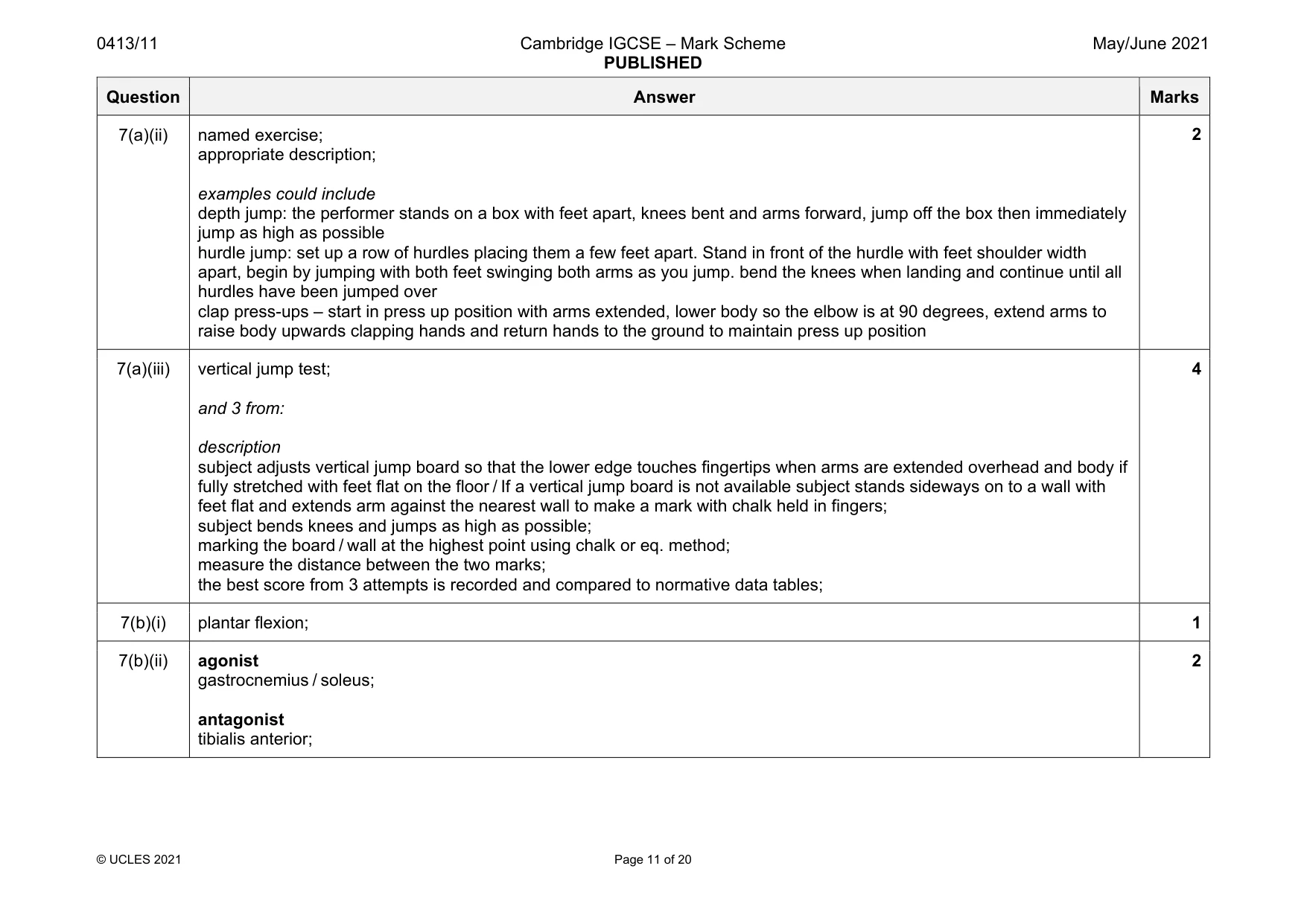
Mark scheme, page 11
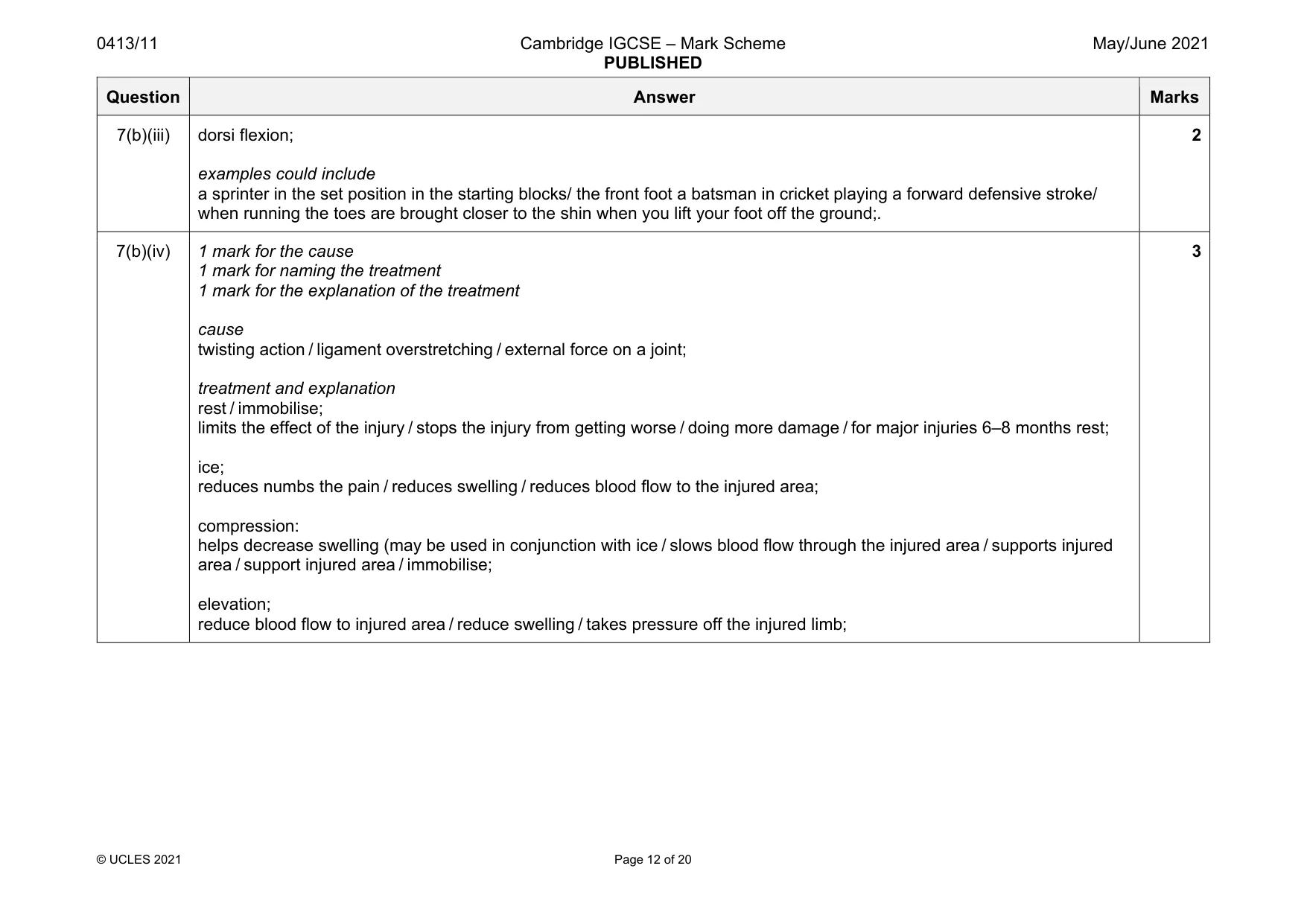
0413/11 Cambridge IGCSE – Mark Scheme PUBLISHED May/June 2021 © UCLES 2021 Page 11 of 20 Question Answer Marks 7(a)(ii) named exercise; appropriate description; examples could include depth jump: the performer stands on a box with feet apart, knees bent and arms forward, jump off the box then immediately jump as high as possible hurdle jump: set up a row of hurdles placing them a few feet apart. Stand in front of the hurdle with feet shoulder width apart, begin by jumping with both feet swinging both arms as you jump. bend the knees when landing and continue until all hurdles have been jumped over clap press-ups – start in press up position with arms extended, lower body so the elbow is at 90 degrees, extend arms to raise body upwards clapping hands and return hands to the ground to maintain press up position 2 7(a)(iii) vertical jump test; and 3 from: description subject adjusts vertical jump board so that the lower edge touches fingertips when arms are extended overhead and body if fully stretched with feet flat on the floor / If a vertical jump board is not available subject stands sideways on to a wall with feet flat and extends arm against the nearest wall to make a mark with chalk held in fingers; subject bends knees and jumps as high as possible; marking the board / wall at the highest point using chalk or eq. method; measure the distance between the two marks; the best score from 3 attempts is recorded and compared to normative data tables; 4 7(b)(i) plantar flexion; 1 7(b)(ii) agonist gastrocnemius / soleus; antagonist tibialis anterior; 2
Mark scheme, page 12
0413/11 Cambridge IGCSE – Mark Scheme PUBLISHED May/June 2021 © UCLES 2021 Page 12 of 20 Question Answer Marks 7(b)(iii) dorsi flexion; examples could include a sprinter in the set position in the starting blocks/ the front foot a batsman in cricket playing a forward defensive stroke/ when running the toes are brought closer to the shin when you lift your foot off the ground;. 2 7(b)(iv) 1 mark for the cause 1 mark for naming the treatment 1 mark for the explanation of the treatment cause twisting action / ligament overstretching / external force on a joint; treatment and explanation rest / immobilise; limits the effect of the injury / stops the injury from getting worse / doing more damage / for major injuries 6–8 months rest; ice; reduces numbs the pain / reduces swelling / reduces blood flow to the injured area; compression: helps decrease swelling (may be used in conjunction with ice / slows blood flow through the injured area / supports injured area / support injured area / immobilise; elevation; reduce blood flow to injured area / reduce swelling / takes pressure off the injured limb; 3
Mark scheme, page 13
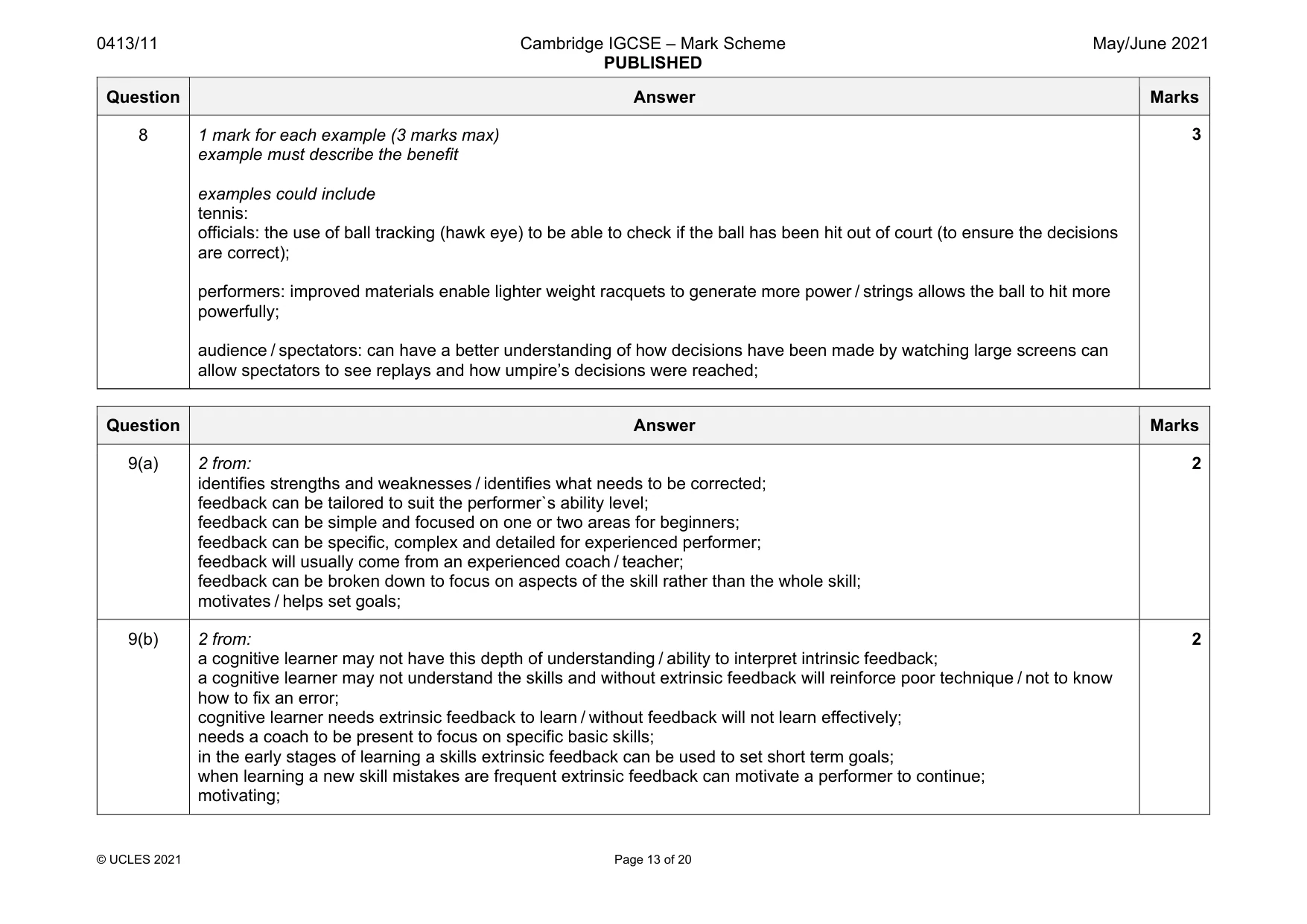
0413/11 Cambridge IGCSE – Mark Scheme PUBLISHED May/June 2021 © UCLES 2021 Page 13 of 20 Question Answer Marks 8 1 mark for each example (3 marks max) example must describe the benefit examples could include tennis: officials: the use of ball tracking (hawk eye) to be able to check if the ball has been hit out of court (to ensure the decisions are correct); performers: improved materials enable lighter weight racquets to generate more power / strings allows the ball to hit more powerfully; audience / spectators: can have a better understanding of how decisions have been made by watching large screens can allow spectators to see replays and how umpire’s decisions were reached; 3 Question Answer Marks 9(a) 2 from: identifies strengths and weaknesses / identifies what needs to be corrected; feedback can be tailored to suit the performer`s ability level; feedback can be simple and focused on one or two areas for beginners; feedback can be specific, complex and detailed for experienced performer; feedback will usually come from an experienced coach / teacher; feedback can be broken down to focus on aspects of the skill rather than the whole skill; motivates / helps set goals; 2 9(b) 2 from: a cognitive learner may not have this depth of understanding / ability to interpret intrinsic feedback; a cognitive learner may not understand the skills and without extrinsic feedback will reinforce poor technique / not to know how to fix an error; cognitive learner needs extrinsic feedback to learn / without feedback will not learn effectively; needs a coach to be present to focus on specific basic skills; in the early stages of learning a skills extrinsic feedback can be used to set short term goals; when learning a new skill mistakes are frequent extrinsic feedback can motivate a performer to continue; motivating; 2
Mark scheme, page 14
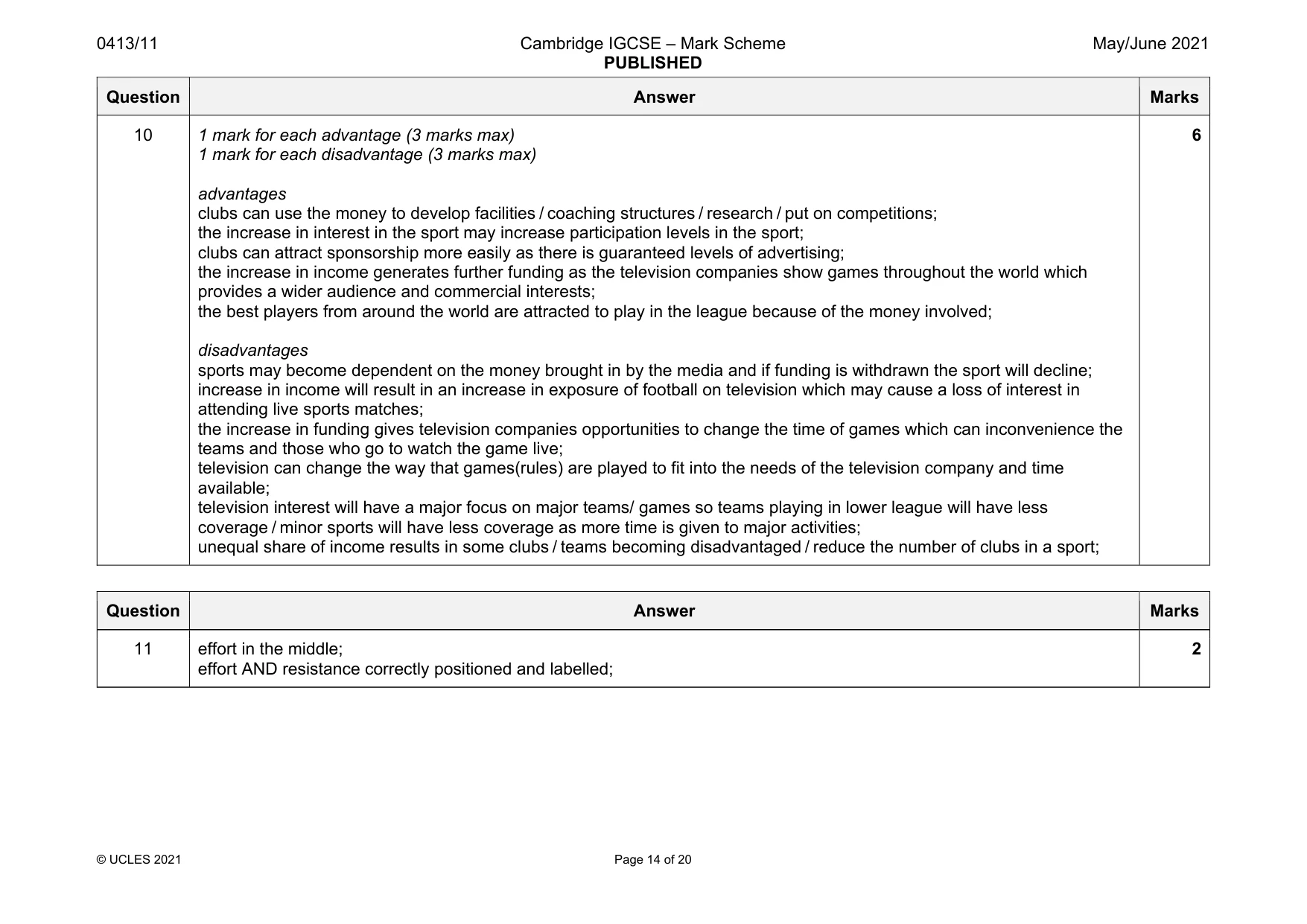
0413/11 Cambridge IGCSE – Mark Scheme PUBLISHED May/June 2021 © UCLES 2021 Page 14 of 20 Question Answer Marks 10 1 mark for each advantage (3 marks max) 1 mark for each disadvantage (3 marks max) advantages clubs can use the money to develop facilities / coaching structures / research / put on competitions; the increase in interest in the sport may increase participation levels in the sport; clubs can attract sponsorship more easily as there is guaranteed levels of advertising; the increase in income generates further funding as the television companies show games throughout the world which provides a wider audience and commercial interests; the best players from around the world are attracted to play in the league because of the money involved; disadvantages sports may become dependent on the money brought in by the media and if funding is withdrawn the sport will decline; increase in income will result in an increase in exposure of football on television which may cause a loss of interest in attending live sports matches; the increase in funding gives television companies opportunities to change the time of games which can inconvenience the teams and those who go to watch the game live; television can change the way that games(rules) are played to fit into the needs of the television company and time available; television interest will have a major focus on major teams/ games so teams playing in lower league will have less coverage / minor sports will have less coverage as more time is given to major activities; unequal share of income results in some clubs / teams becoming disadvantaged / reduce the number of clubs in a sport; 6 Question Answer Marks 11 effort in the middle; effort AND resistance correctly positioned and labelled; 2
Mark scheme, page 15
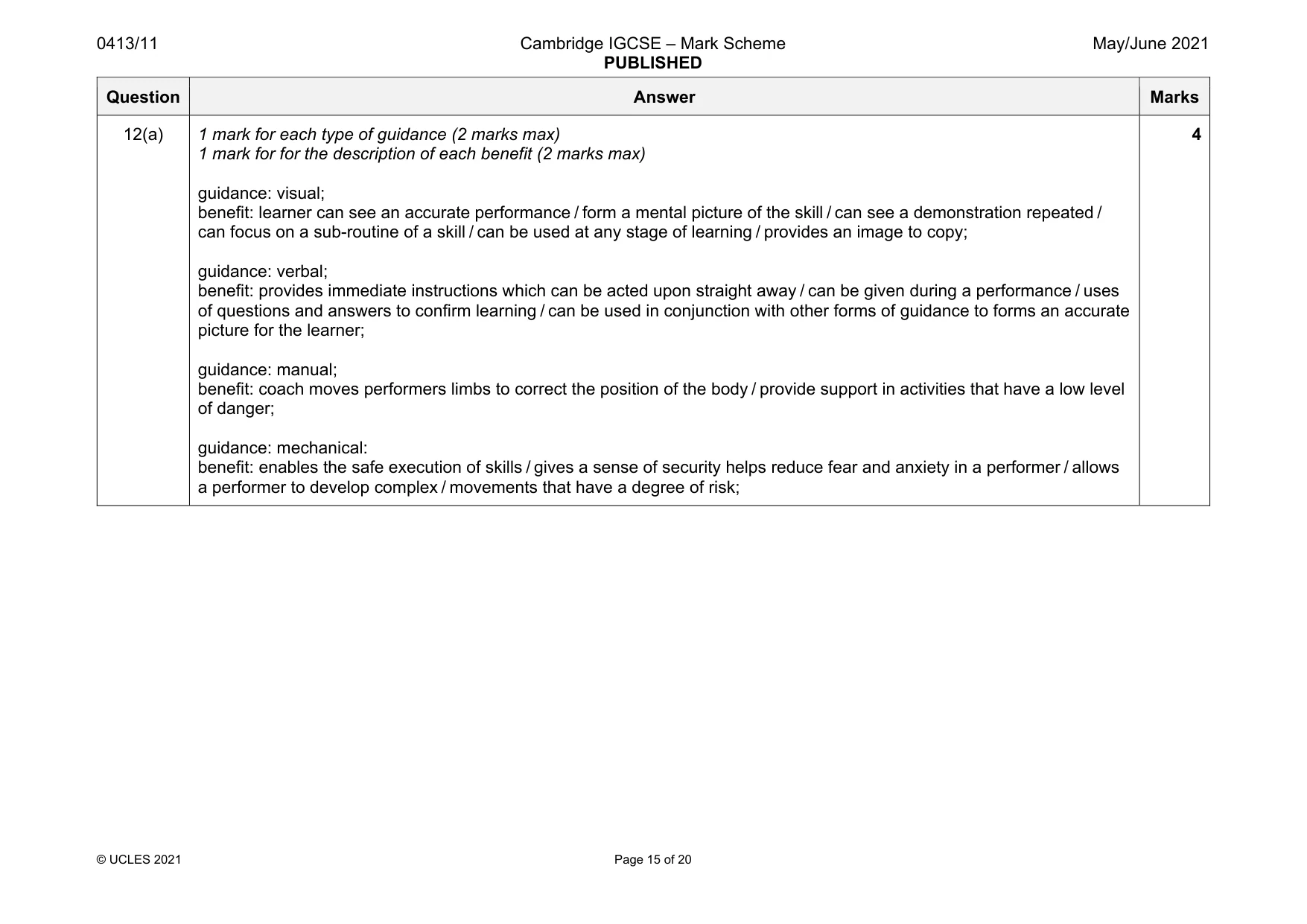
0413/11 Cambridge IGCSE – Mark Scheme PUBLISHED May/June 2021 © UCLES 2021 Page 15 of 20 Question Answer Marks 12(a) 1 mark for each type of guidance (2 marks max) 1 mark for for the description of each benefit (2 marks max) guidance: visual; benefit: learner can see an accurate performance / form a mental picture of the skill / can see a demonstration repeated / can focus on a sub-routine of a skill / can be used at any stage of learning / provides an image to copy; guidance: verbal; benefit: provides immediate instructions which can be acted upon straight away / can be given during a performance / uses of questions and answers to confirm learning / can be used in conjunction with other forms of guidance to forms an accurate picture for the learner; guidance: manual; benefit: coach moves performers limbs to correct the position of the body / provide support in activities that have a low level of danger; guidance: mechanical: benefit: enables the safe execution of skills / gives a sense of security helps reduce fear and anxiety in a performer / allows a performer to develop complex / movements that have a degree of risk; 4
Mark scheme, page 16
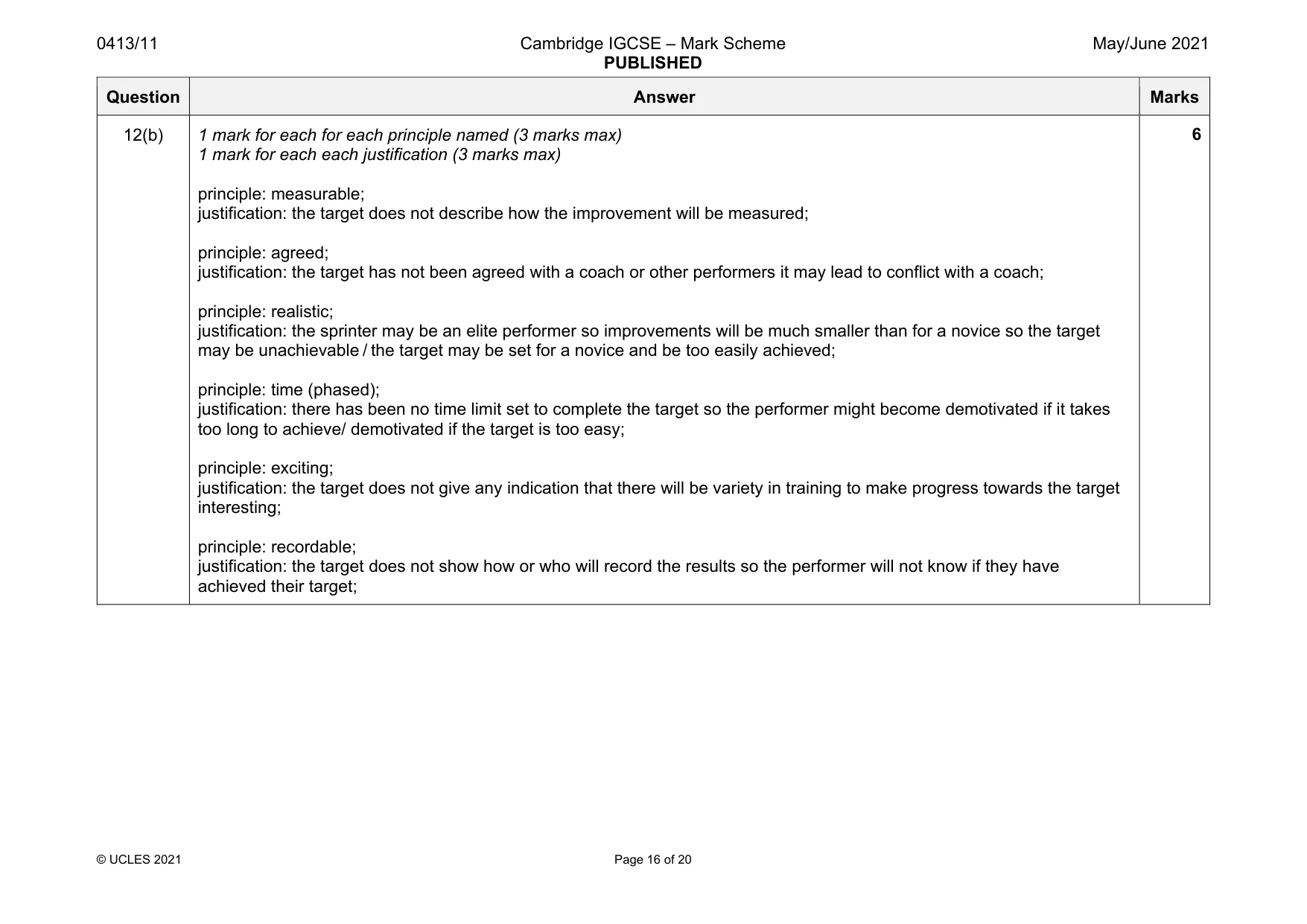
0413/11 Cambridge IGCSE – Mark Scheme PUBLISHED May/June 2021 © UCLES 2021 Page 16 of 20 Question Answer Marks 12(b) 1 mark for each for each principle named (3 marks max) 1 mark for each each justification (3 marks max) principle: measurable; justification: the target does not describe how the improvement will be measured; principle: agreed; justification: the target has not been agreed with a coach or other performers it may lead to conflict with a coach; principle: realistic; justification: the sprinter may be an elite performer so improvements will be much smaller than for a novice so the target may be unachievable / the target may be set for a novice and be too easily achieved; principle: time (phased); justification: there has been no time limit set to complete the target so the performer might become demotivated if it takes too long to achieve/ demotivated if the target is too easy; principle: exciting; justification: the target does not give any indication that there will be variety in training to make progress towards the target interesting; principle: recordable; justification: the target does not show how or who will record the results so the performer will not know if they have achieved their target; 6
Mark scheme, page 17
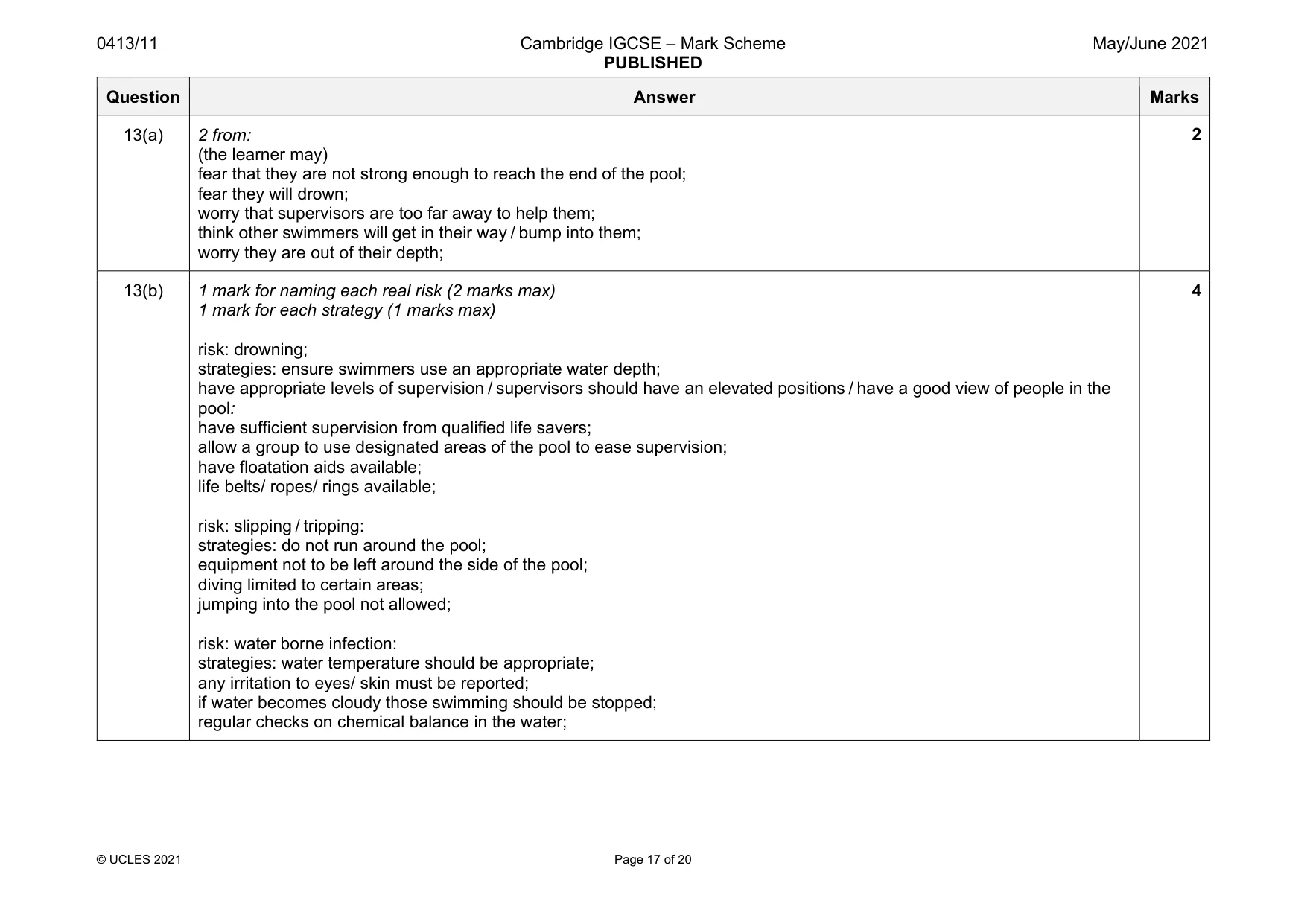
0413/11 Cambridge IGCSE – Mark Scheme PUBLISHED May/June 2021 © UCLES 2021 Page 17 of 20 Question Answer Marks 13(a) 2 from: (the learner may) fear that they are not strong enough to reach the end of the pool; fear they will drown; worry that supervisors are too far away to help them; think other swimmers will get in their way / bump into them; worry they are out of their depth; 2 13(b) 1 mark for naming each real risk (2 marks max) 1 mark for each strategy (1 marks max) risk: drowning; strategies: ensure swimmers use an appropriate water depth; have appropriate levels of supervision / supervisors should have an elevated positions / have a good view of people in the pool: have sufficient supervision from qualified life savers; allow a group to use designated areas of the pool to ease supervision; have floatation aids available; life belts/ ropes/ rings available; risk: slipping / tripping: strategies: do not run around the pool; equipment not to be left around the side of the pool; diving limited to certain areas; jumping into the pool not allowed; risk: water borne infection: strategies: water temperature should be appropriate; any irritation to eyes/ skin must be reported; if water becomes cloudy those swimming should be stopped; regular checks on chemical balance in the water; 4
Mark scheme, page 18
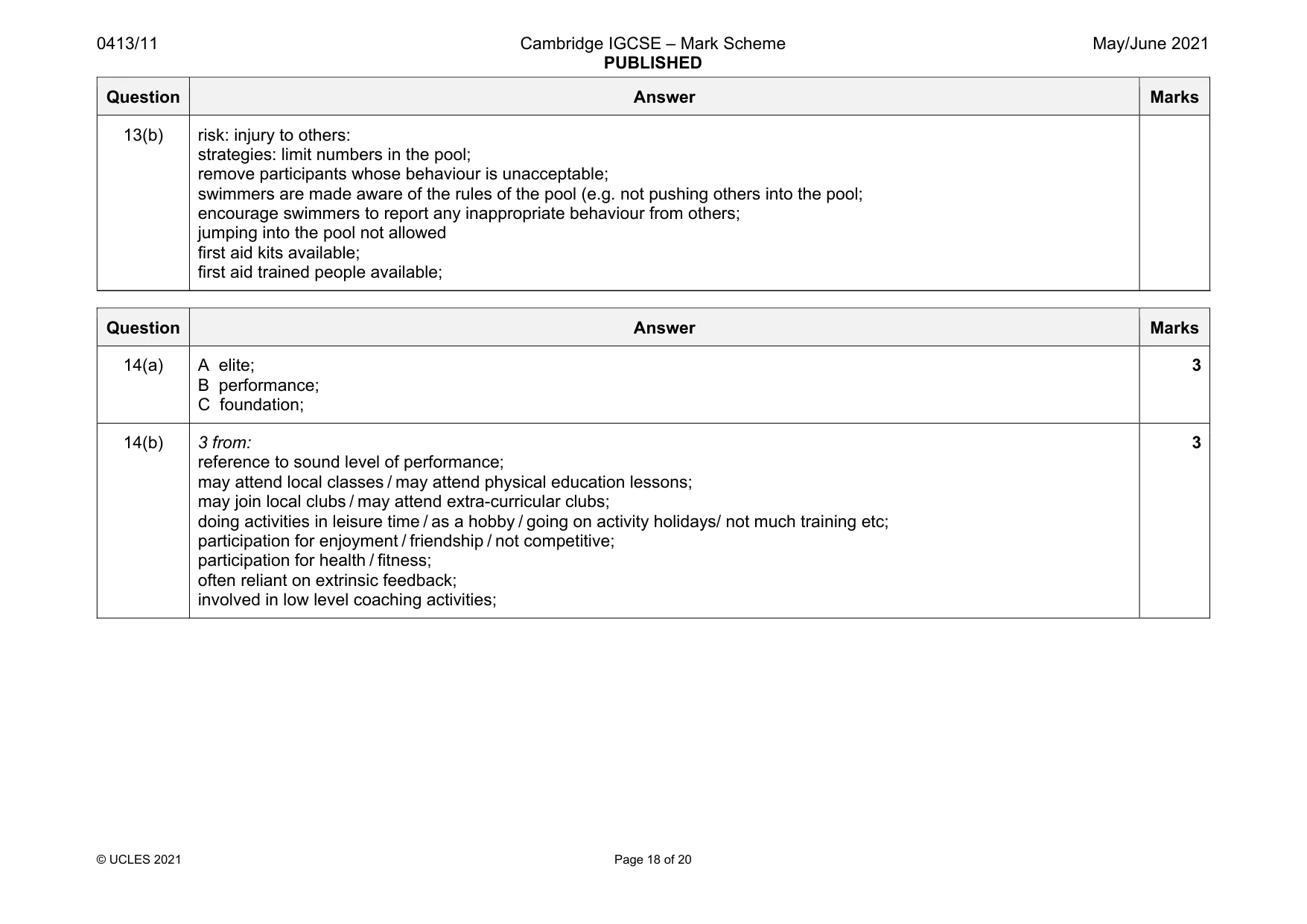
0413/11 Cambridge IGCSE – Mark Scheme PUBLISHED May/June 2021 © UCLES 2021 Page 18 of 20 Question Answer Marks 13(b) risk: injury to others: strategies: limit numbers in the pool; remove participants whose behaviour is unacceptable; swimmers are made aware of the rules of the pool (e.g. not pushing others into the pool; encourage swimmers to report any inappropriate behaviour from others; jumping into the pool not allowed first aid kits available; first aid trained people available; Question Answer Marks 14(a) A elite; B performance; C foundation; 3 14(b) 3 from: reference to sound level of performance; may attend local classes / may attend physical education lessons; may join local clubs / may attend extra-curricular clubs; doing activities in leisure time / as a hobby / going on activity holidays/ not much training etc; participation for enjoyment / friendship / not competitive; participation for health / fitness; often reliant on extrinsic feedback; involved in low level coaching activities; 3
Mark scheme, page 19
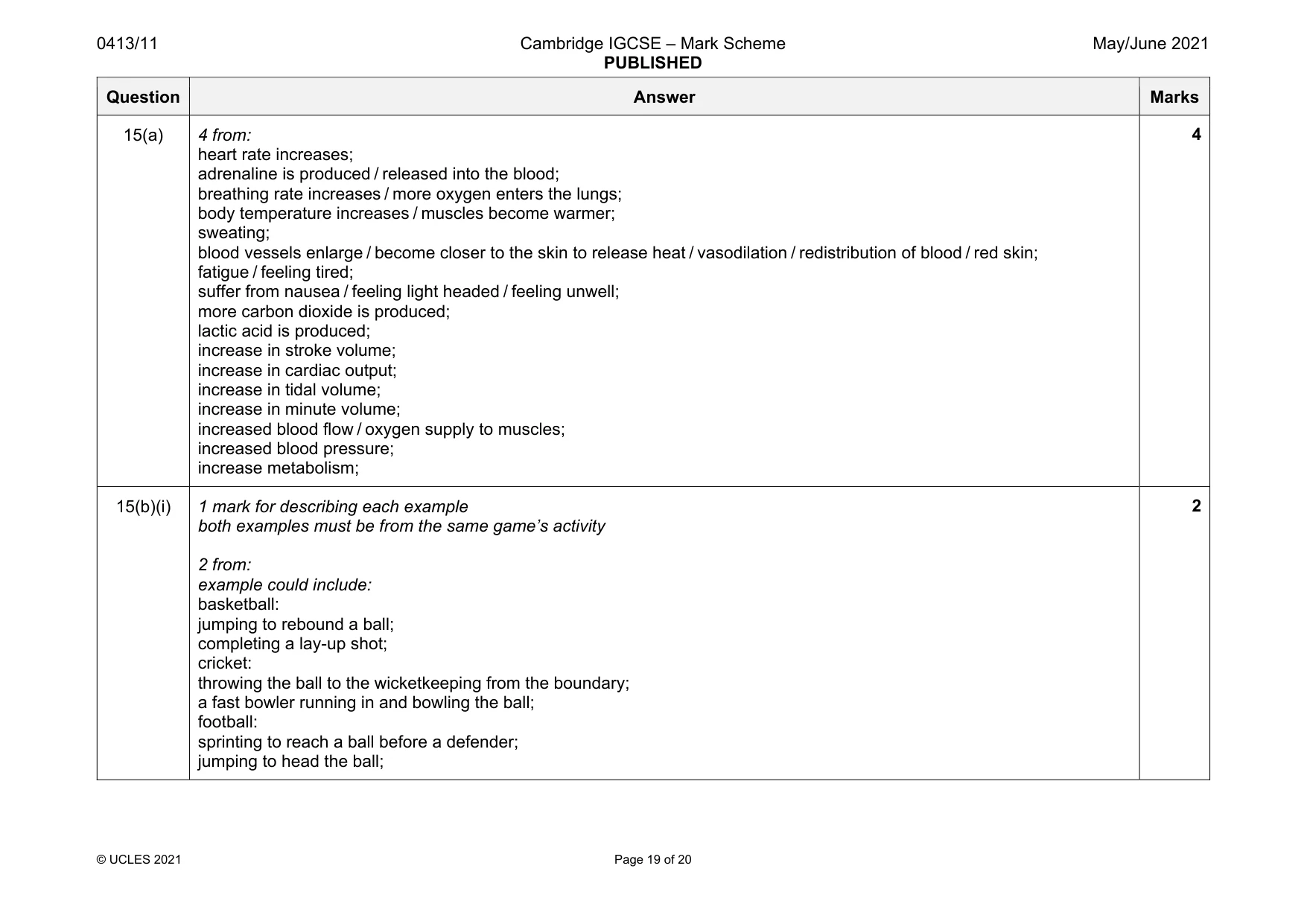
0413/11 Cambridge IGCSE – Mark Scheme PUBLISHED May/June 2021 © UCLES 2021 Page 19 of 20 Question Answer Marks 15(a) 4 from: heart rate increases; adrenaline is produced / released into the blood; breathing rate increases / more oxygen enters the lungs; body temperature increases / muscles become warmer; sweating; blood vessels enlarge / become closer to the skin to release heat / vasodilation / redistribution of blood / red skin; fatigue / feeling tired; suffer from nausea / feeling light headed / feeling unwell; more carbon dioxide is produced; lactic acid is produced; increase in stroke volume; increase in cardiac output; increase in tidal volume; increase in minute volume; increased blood flow / oxygen supply to muscles; increased blood pressure; increase metabolism; 4 15(b)(i) 1 mark for describing each example both examples must be from the same game’s activity 2 from: example could include: basketball: jumping to rebound a ball; completing a lay-up shot; cricket: throwing the ball to the wicketkeeping from the boundary; a fast bowler running in and bowling the ball; football: sprinting to reach a ball before a defender; jumping to head the ball; 2
Mark scheme, page 20
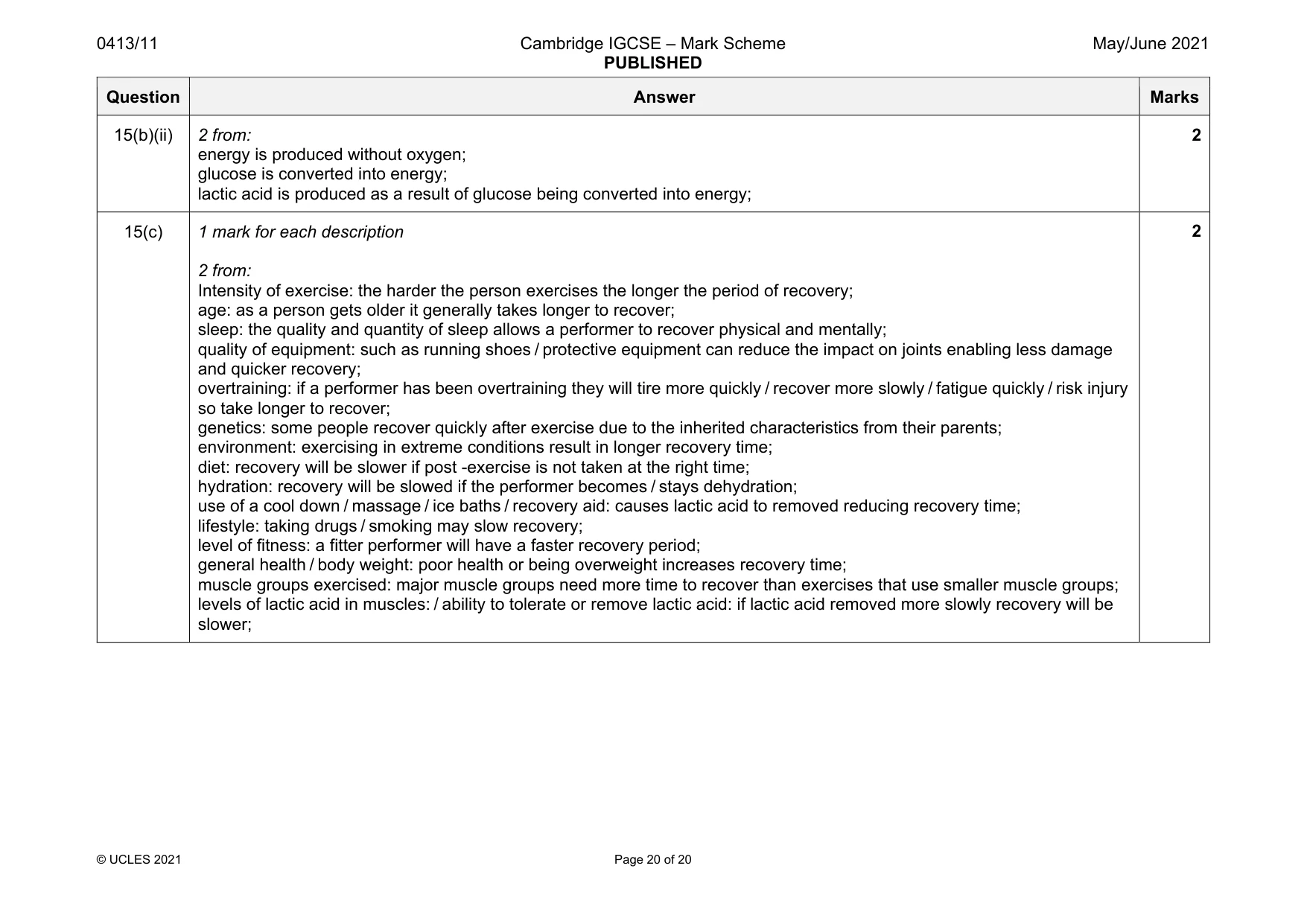
0413/11 Cambridge IGCSE – Mark Scheme PUBLISHED May/June 2021 © UCLES 2021 Page 20 of 20 Question Answer Marks 15(b)(ii) 2 from: energy is produced without oxygen; glucose is converted into energy; lactic acid is produced as a result of glucose being converted into energy; 2 15(c) 1 mark for each description 2 from: Intensity of exercise: the harder the person exercises the longer the period of recovery; age: as a person gets older it generally takes longer to recover; sleep: the quality and quantity of sleep allows a performer to recover physical and mentally; quality of equipment: such as running shoes / protective equipment can reduce the impact on joints enabling less damage and quicker recovery; overtraining: if a performer has been overtraining they will tire more quickly / recover more slowly / fatigue quickly / risk injury so take longer to recover; genetics: some people recover quickly after exercise due to the inherited characteristics from their parents; environment: exercising in extreme conditions result in longer recovery time; diet: recovery will be slower if post -exercise is not taken at the right time; hydration: recovery will be slowed if the performer becomes / stays dehydration; use of a cool down / massage / ice baths / recovery aid: causes lactic acid to removed reducing recovery time; lifestyle: taking drugs / smoking may slow recovery; level of fitness: a fitter performer will have a faster recovery period; general health / body weight: poor health or being overweight increases recovery time; muscle groups exercised: major muscle groups need more time to recover than exercises that use smaller muscle groups; levels of lactic acid in muscles: / ability to tolerate or remove lactic acid: if lactic acid removed more slowly recovery will be slower; 2
What you needed in this session
Cambridge’s own grade thresholds for 2021 May/June, Paper 1 · Variant 1. A higher threshold means an easier paper — the bar moves with how the cohort did.