Cambridge IGCSE Physical Education 0413 — 2021 May/June Paper 1 · Variant 3
0413/13/M/J/21 · 100 marks · ≈113 min
The question paper and its mark scheme, free to read here and free to download. This is Cambridge’s own paper, exactly as it was sat.
Question paper16 pages
Mark scheme18 pages
Answers below. Sit the paper first if you are practising.
Paper as text
Question paper, page 1
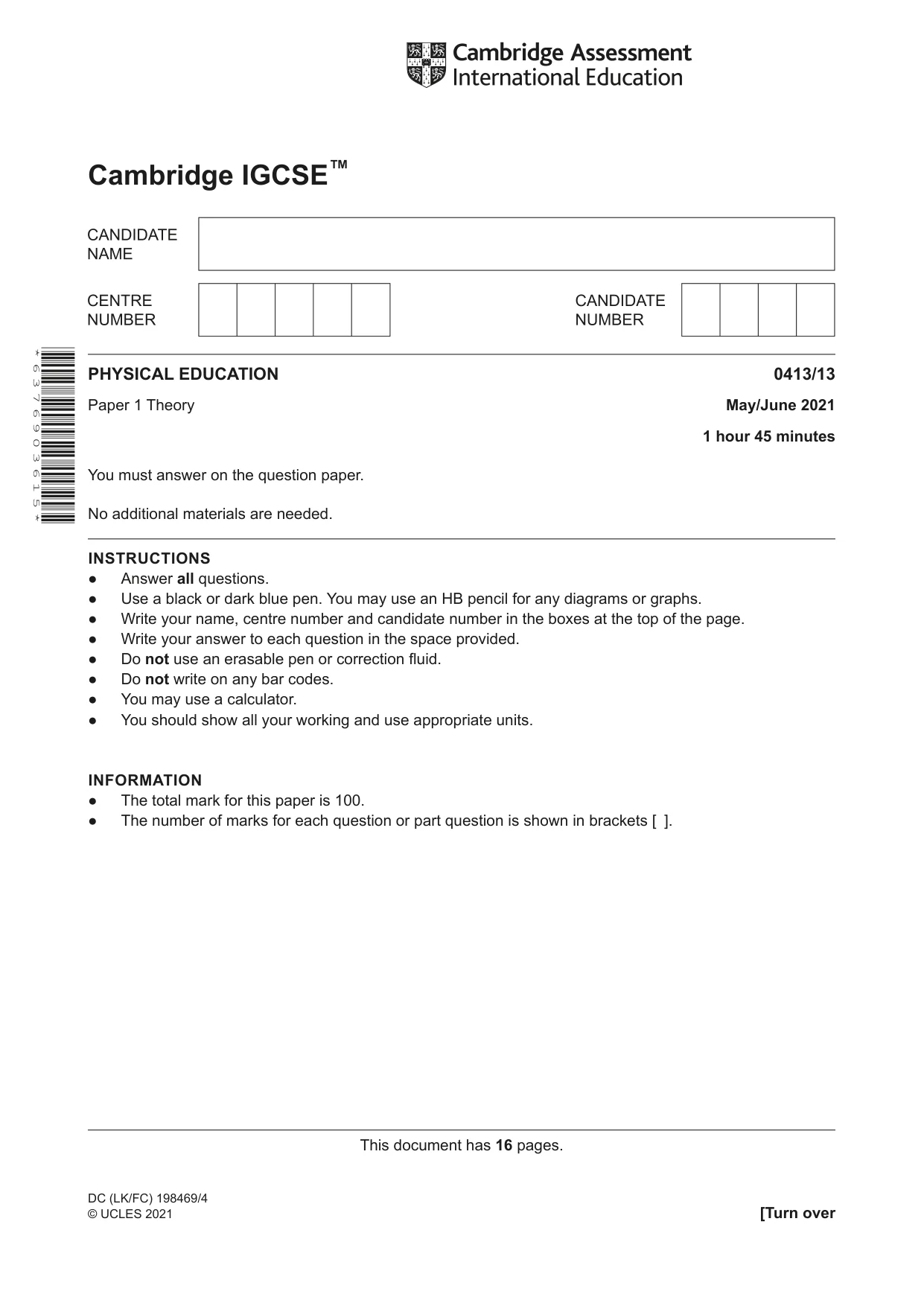
This document has 16 pages. Cambridge IGCSE™ PHYSICAL EDUCATION 0413/13 Paper 1 Theory May/June 2021 1 hour 45 minutes You must answer on the question paper. No additional materials are needed. INSTRUCTIONS ● Answer all questions. ● Use a black or dark blue pen. You may use an HB pencil for any diagrams or graphs. ● Write your name, centre number and candidate number in the boxes at the top of the page. ● Write your answer to each question in the space provided. ● Do not use an erasable pen or correction fluid. ● Do not write on any bar codes. ● You may use a calculator. ● You should show all your working and use appropriate units. INFORMATION ● The total mark for this paper is 100. ● The number of marks for each question or part question is shown in brackets [ ]. * 6 3 7 6 9 0 3 6 1 5 * DC (LK/FC) 198469/4 © UCLES 2021 [Turn over
Question paper, page 2
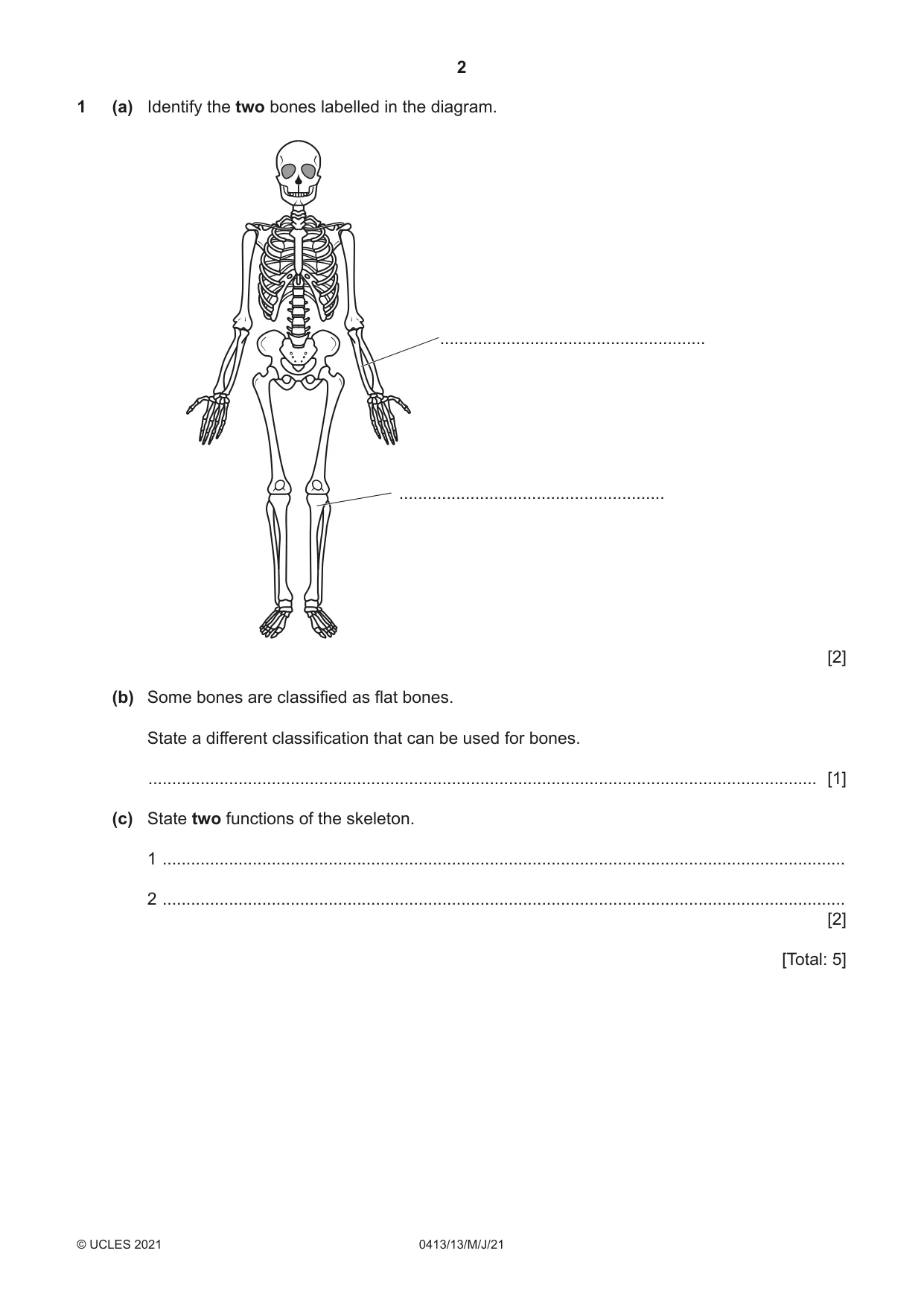
2 0413/13/M/J/21 © UCLES 2021 1 (a) Identify the two bones labelled in the diagram. … … [2] (b) Some bones are classified as flat bones. State a different classification that can be used for bones. … [1] (c) State two functions of the skeleton. 1 … 2 … [2] [Total: 5]
Question paper, page 3
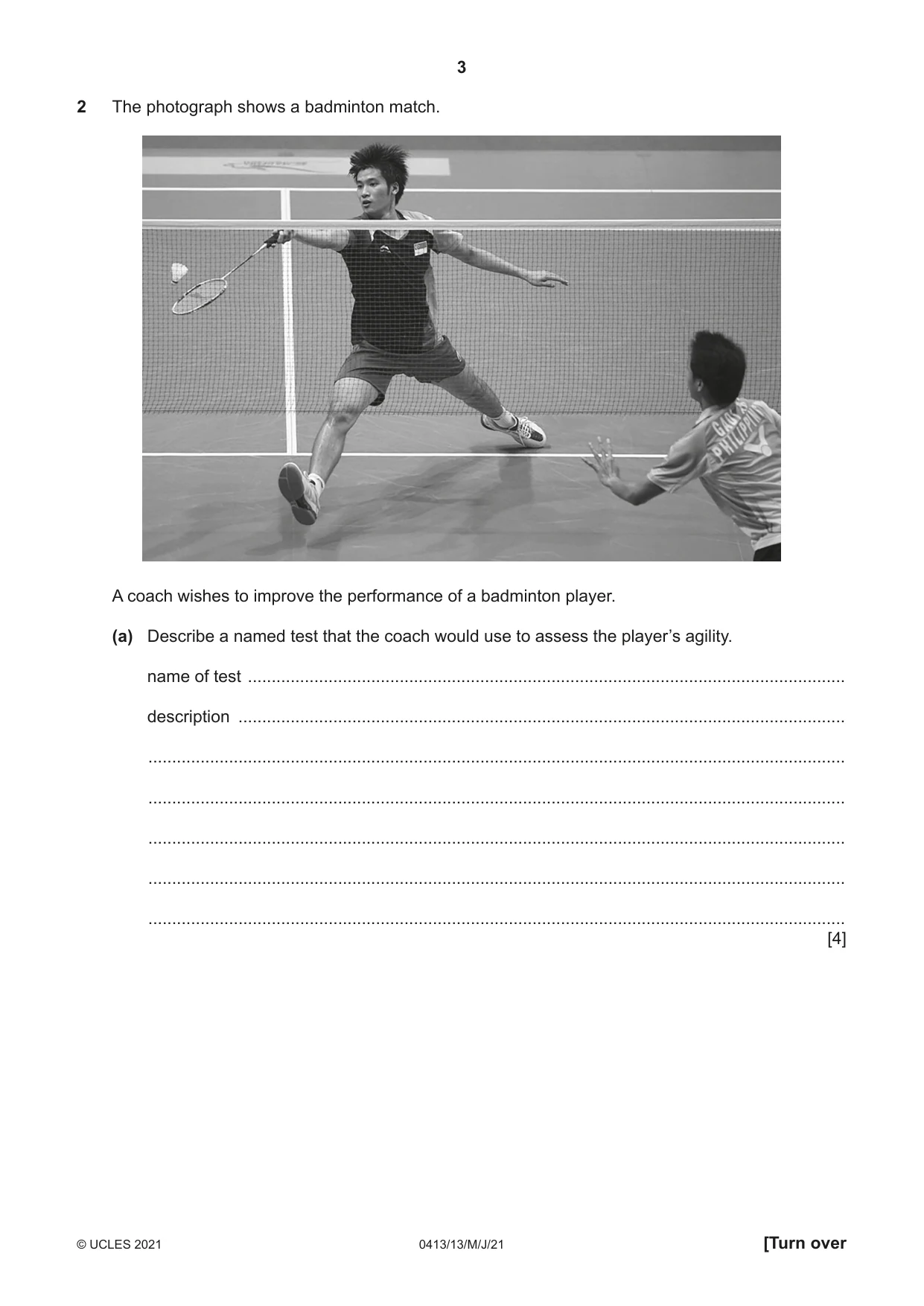
3 0413/13/M/J/21 © UCLES 2021 [Turn over 2 The photograph shows a badminton match. A coach wishes to improve the performance of a badminton player. (a) Describe a named test that the coach would use to assess the player’s agility. name of test … description … … … … … … [4]
Question paper, page 4
4 0413/13/M/J/21 © UCLES 2021 (b) Explain the importance of three named components of fitness, other than agility, for a badminton player. component 1 … explanation … … component 2 … explanation … … component 3 … explanation … … [6] (c) Suggest three reasons why a coach might test a player’s fitness. 1 … … 2 … … 3 … … [3] [Total: 13]
Question paper, page 5
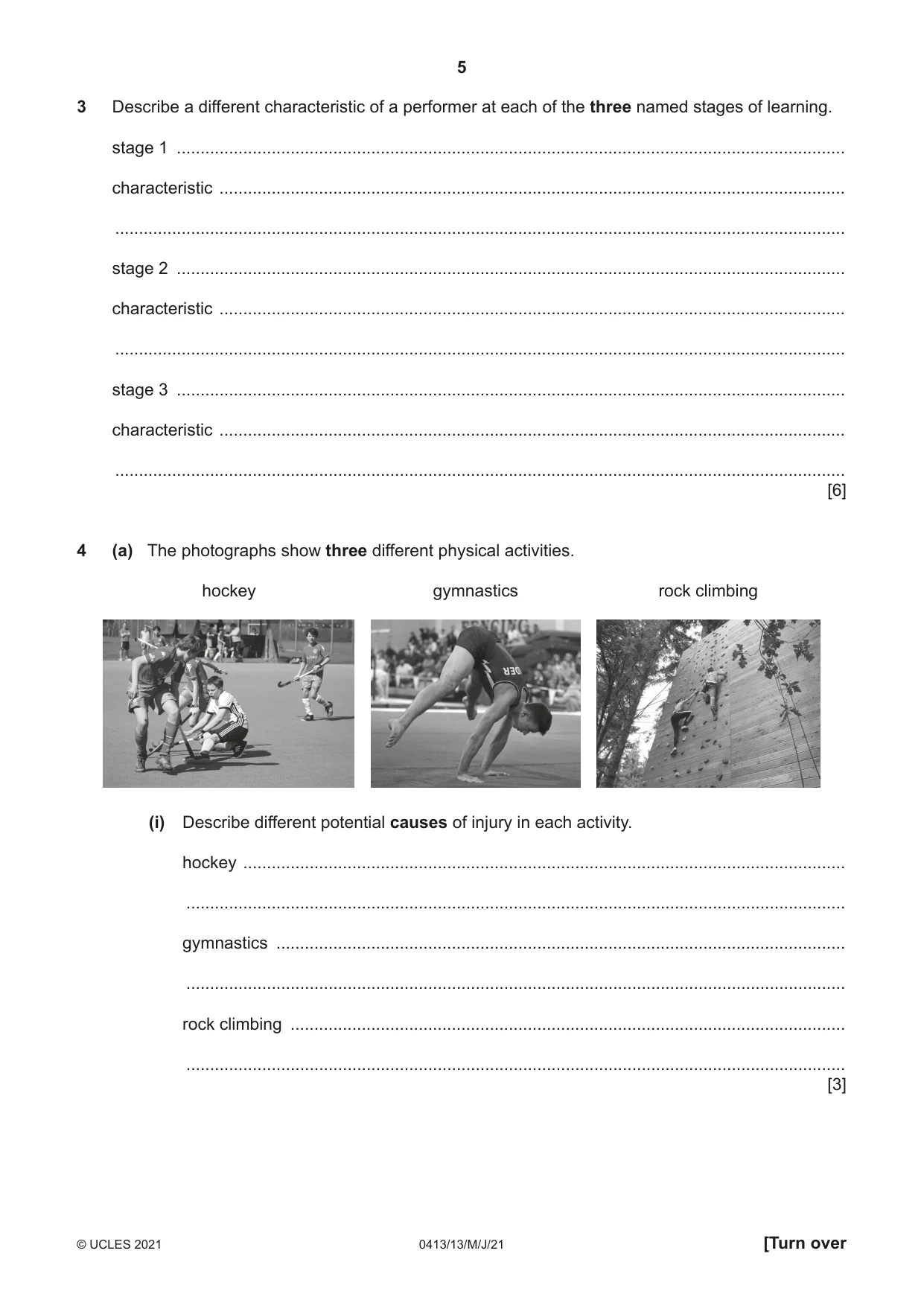
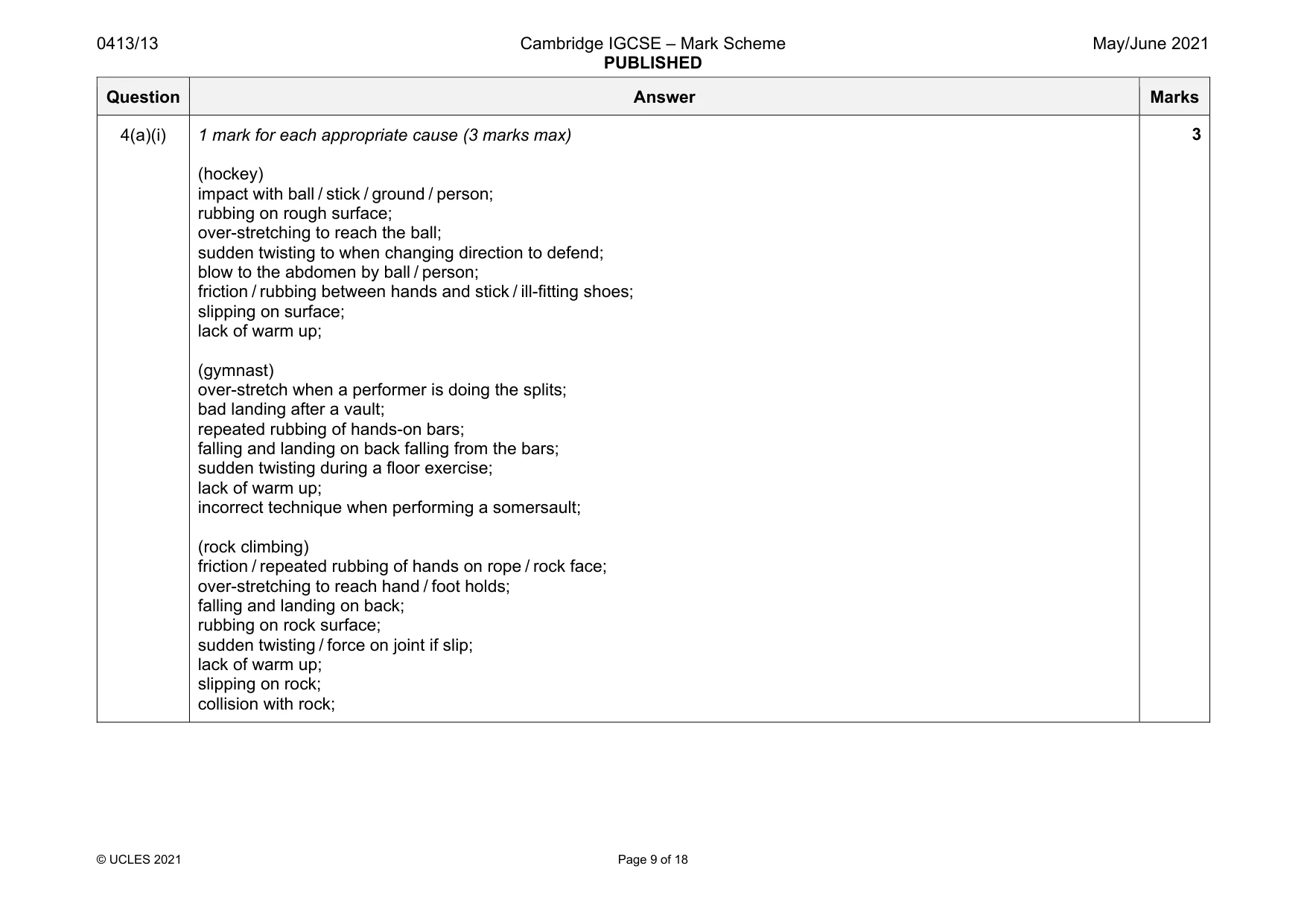
5 0413/13/M/J/21 © UCLES 2021 [Turn over 3 Describe a different characteristic of a performer at each of the three named stages of learning. stage 1 … characteristic … … stage 2 … characteristic … … stage 3 … characteristic … … [6] 4 (a) The photographs show three different physical activities. hockey gymnastics rock climbing (i) Describe different potential causes of injury in each activity. hockey … … gymnastics … … rock climbing … … [3]
Question paper, page 6
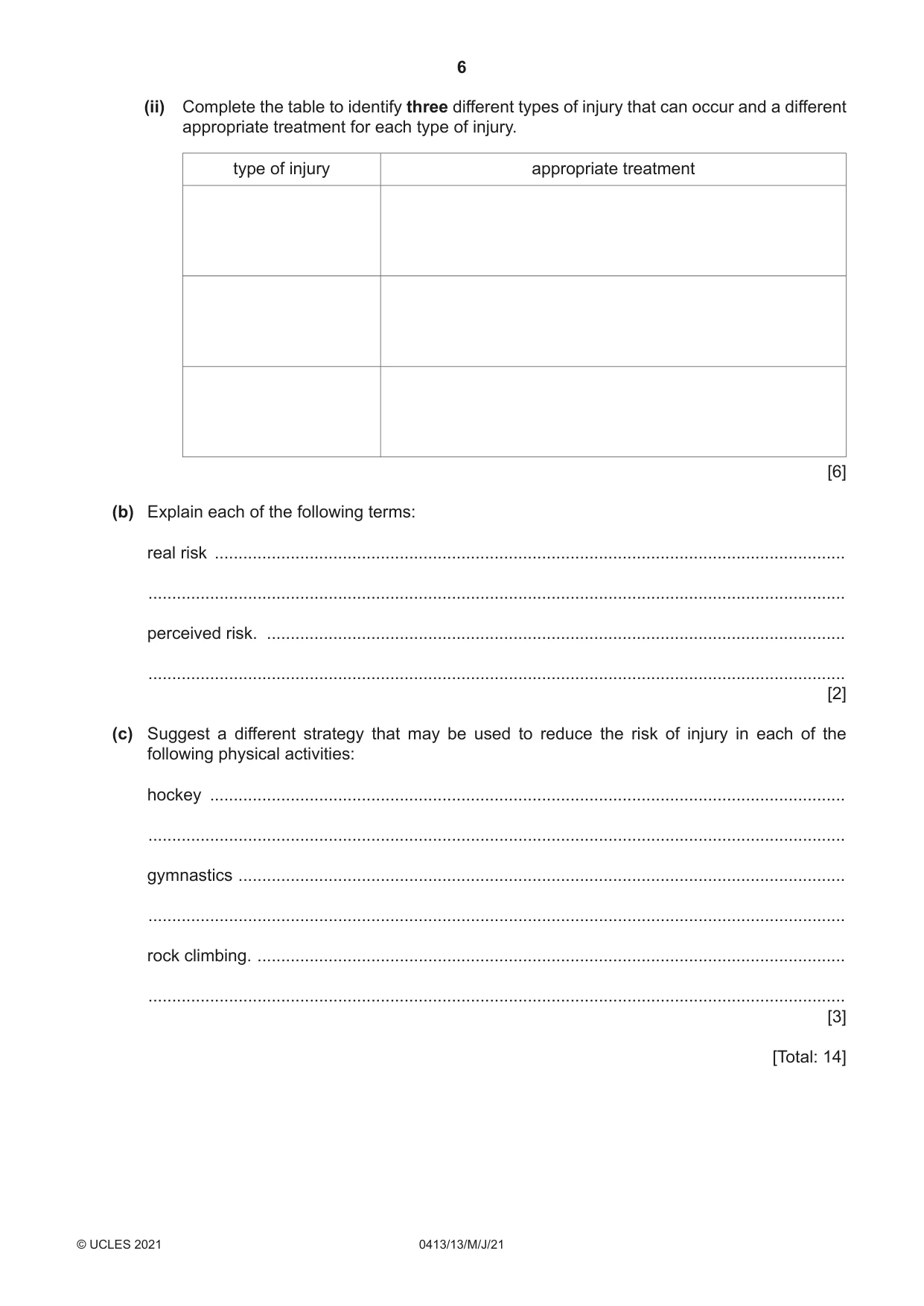
6 0413/13/M/J/21 © UCLES 2021 (ii) Complete the table to identify three different types of injury that can occur and a different appropriate treatment for each type of injury. type of injury appropriate treatment [6] (b) Explain each of the following terms: real risk … … perceived risk. … … [2] (c) Suggest a different strategy that may be used to reduce the risk of injury in each of the following physical activities: hockey … … gymnastics … … rock climbing. … … [3] [Total: 14]
Question paper, page 7
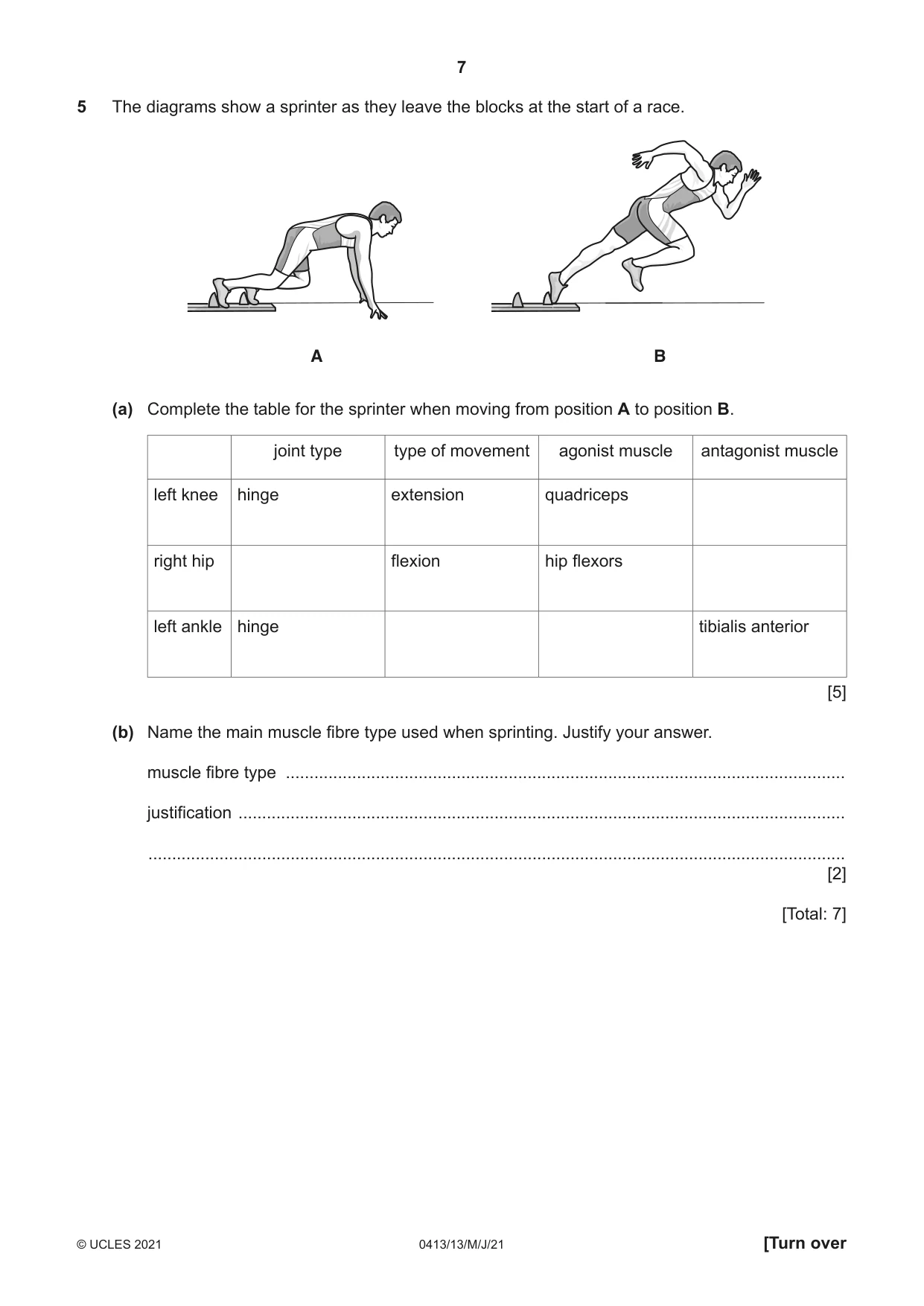
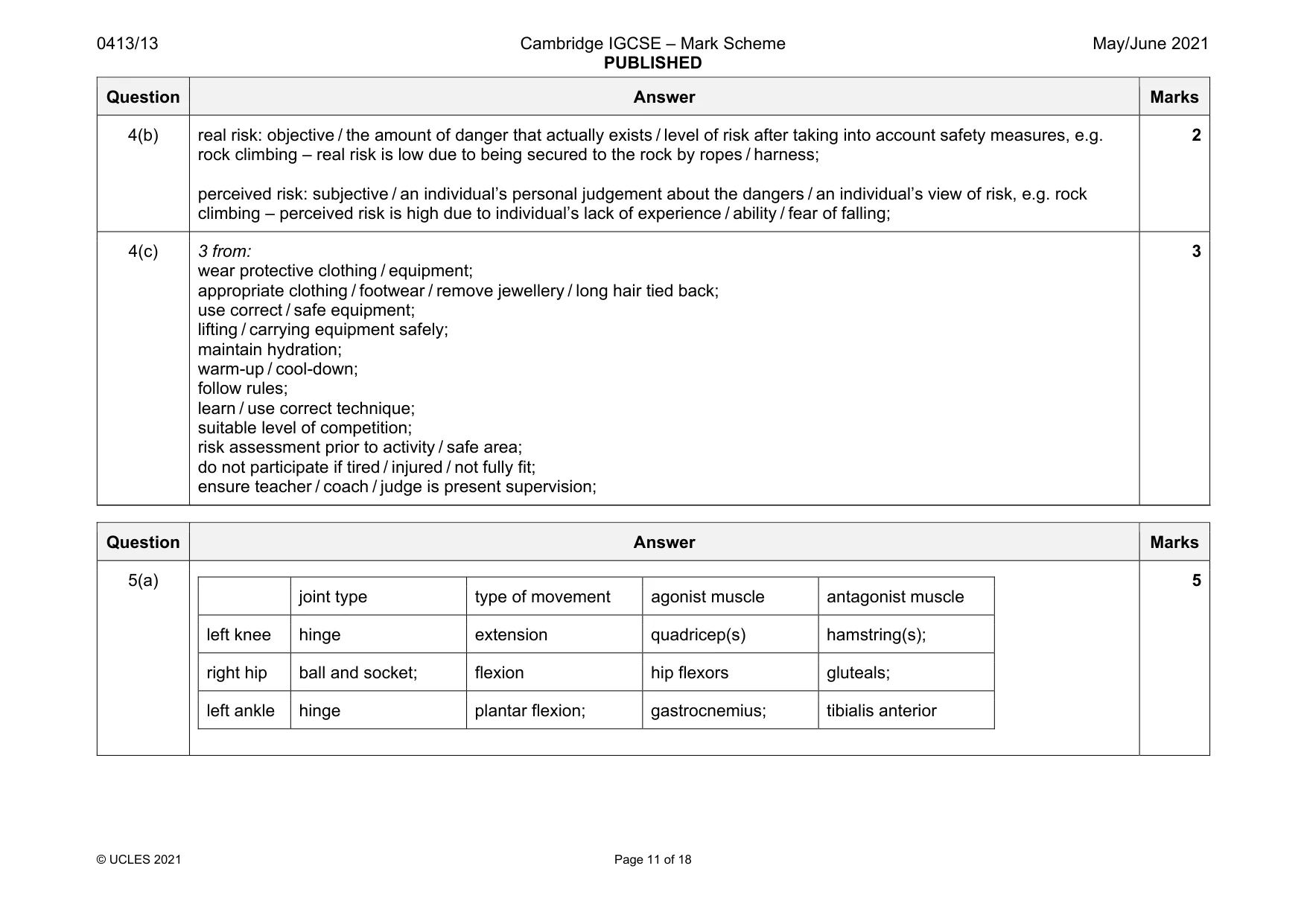
7 0413/13/M/J/21 © UCLES 2021 [Turn over 5 The diagrams show a sprinter as they leave the blocks at the start of a race. A B (a) Complete the table for the sprinter when moving from position A to position B. joint type type of movement agonist muscle antagonist muscle left knee hinge extension quadriceps right hip flexion hip flexors left ankle hinge tibialis anterior [5] (b) Name the main muscle fibre type used when sprinting. Justify your answer. muscle fibre type … justification … … [2] [Total: 7]
Question paper, page 8
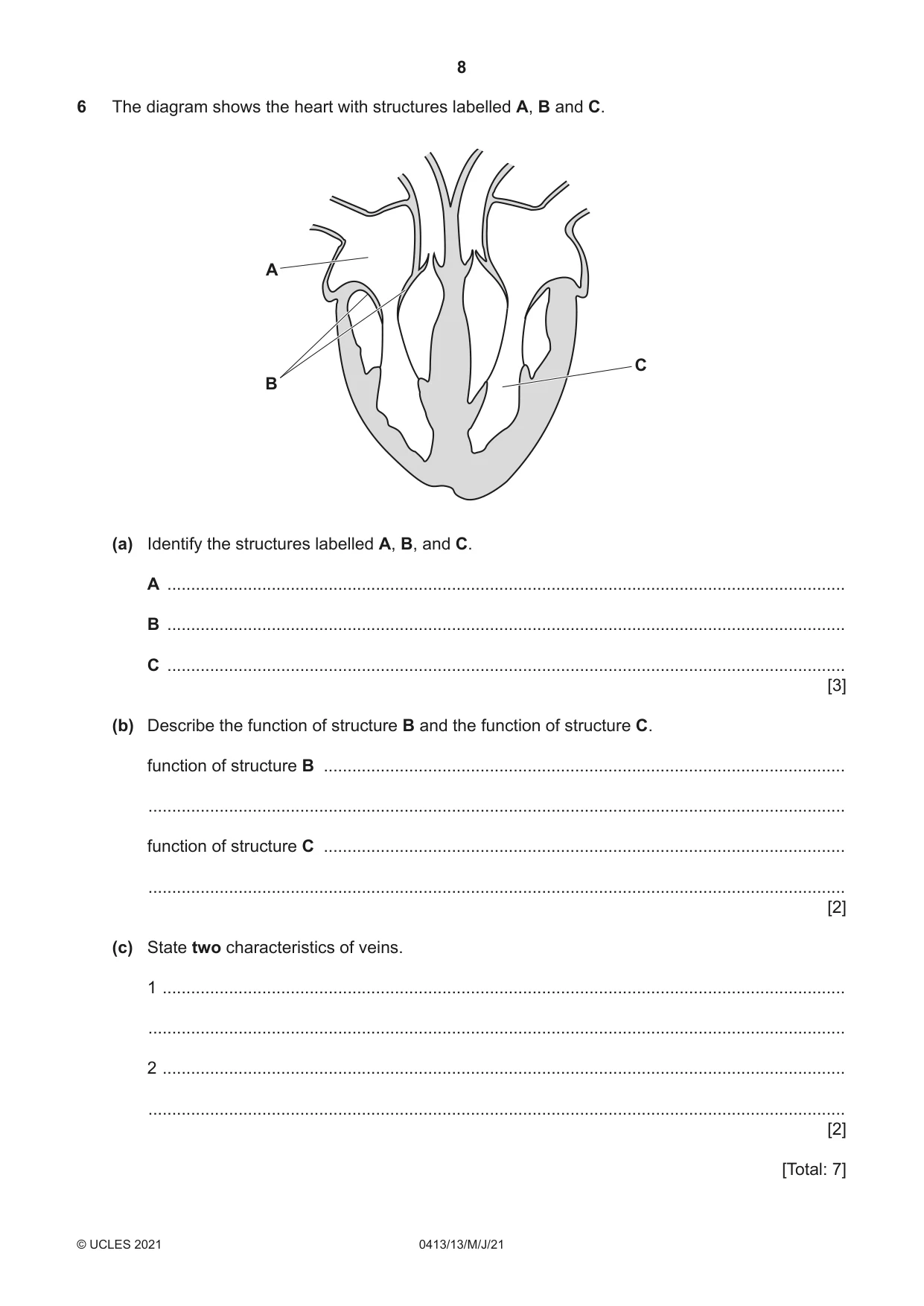
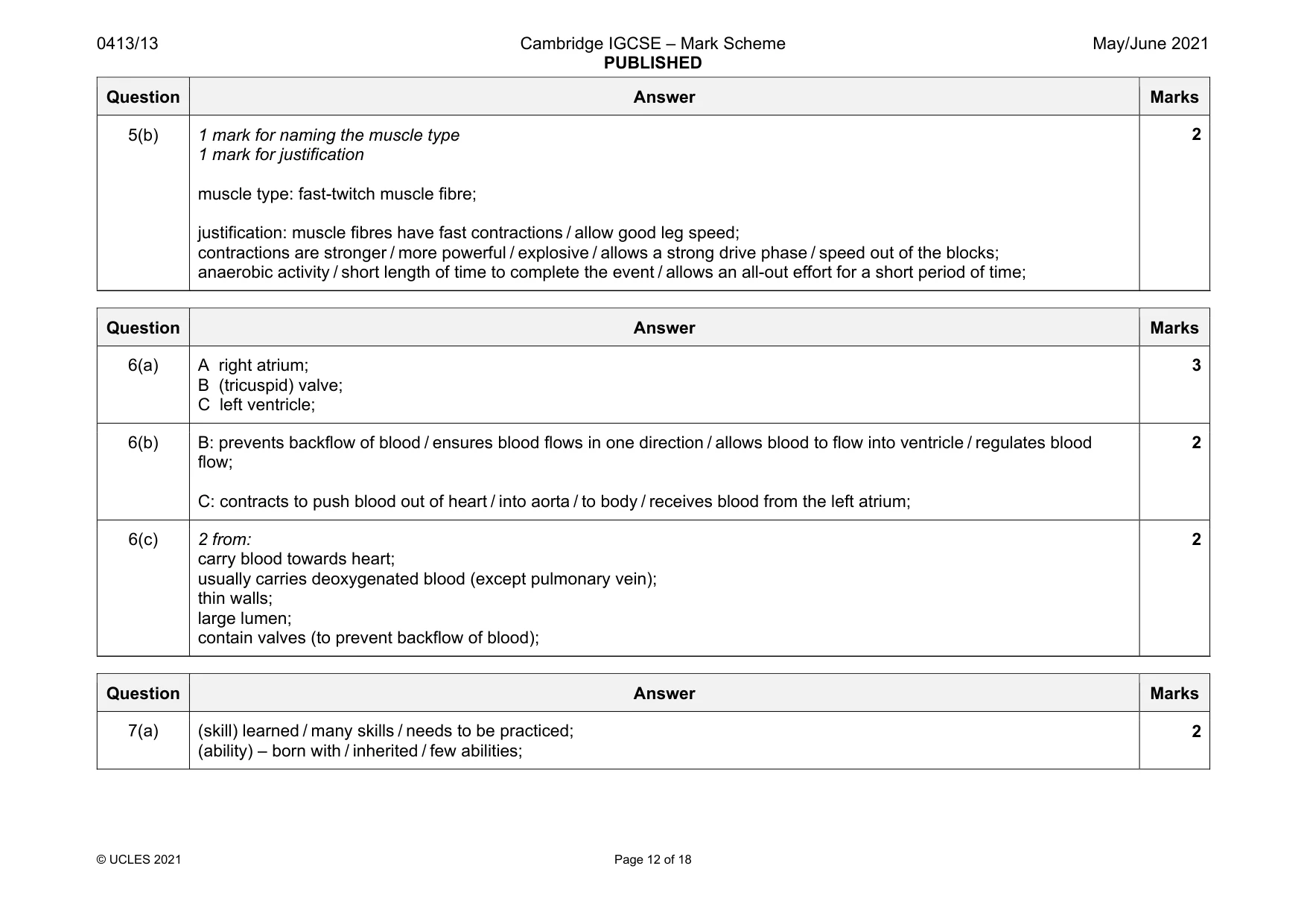
8 0413/13/M/J/21 © UCLES 2021 6 The diagram shows the heart with structures labelled A, B and C. C A B (a) Identify the structures labelled A, B, and C. A … B … C … [3] (b) Describe the function of structure B and the function of structure C. function of structure B … … function of structure C … … [2] (c) State two characteristics of veins. 1 … … 2 … … [2] [Total: 7]
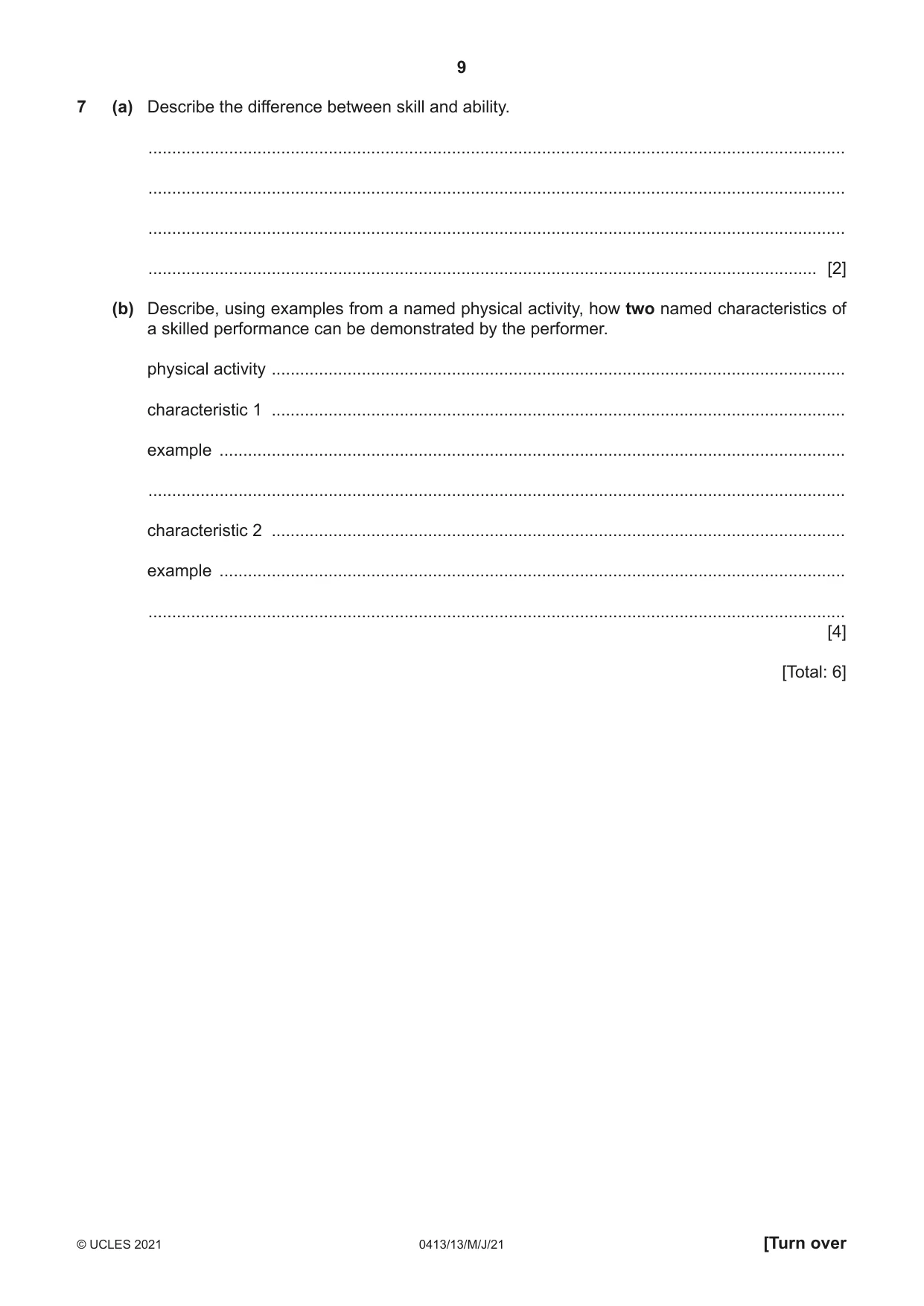
Question paper, page 9
9 0413/13/M/J/21 © UCLES 2021 [Turn over 7 (a) Describe the difference between skill and ability. … … … … [2] (b) Describe, using examples from a named physical activity, how two named characteristics of a skilled performance can be demonstrated by the performer. physical activity … characteristic 1 … example … … characteristic 2 … example … … [4] [Total: 6]
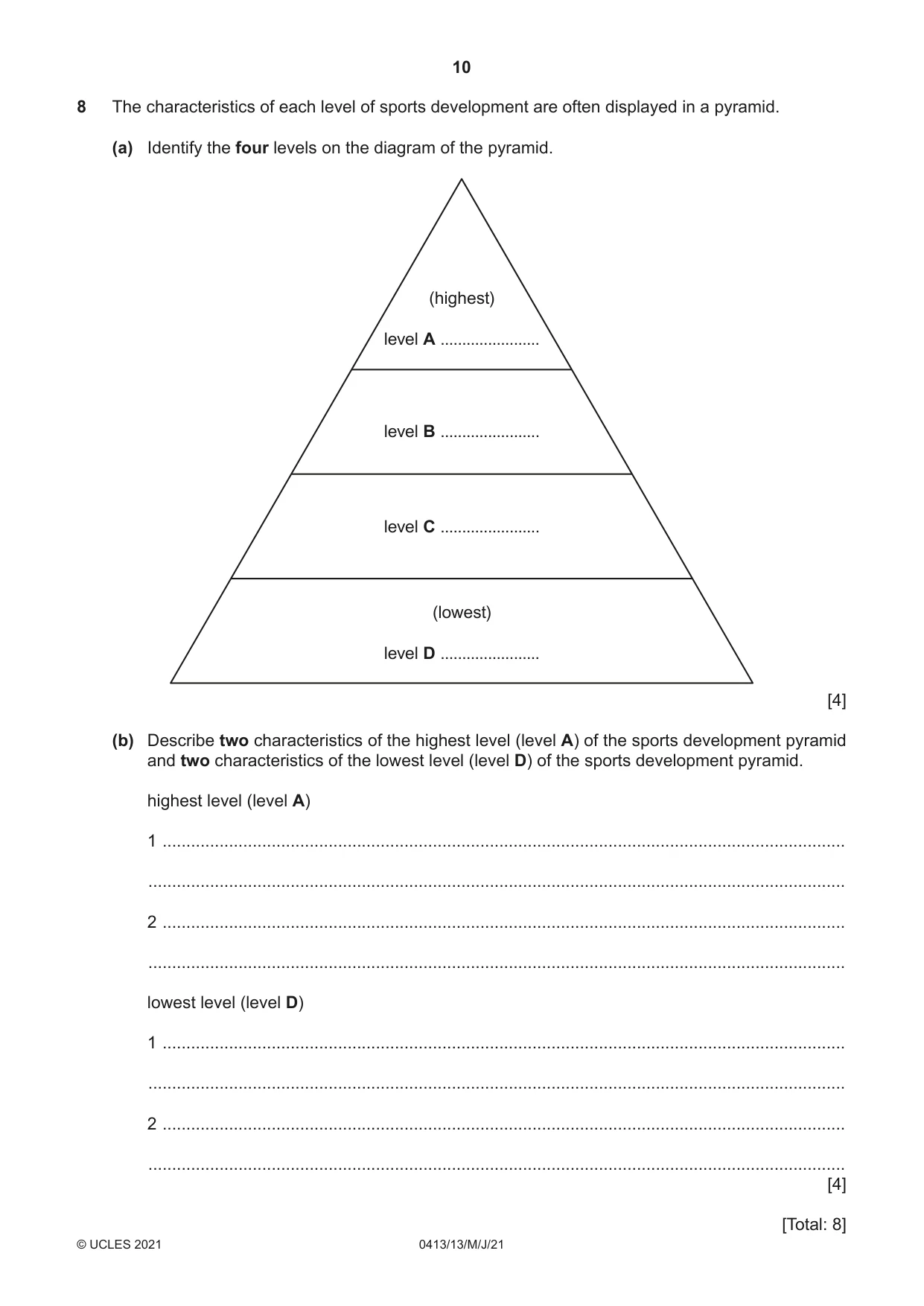
Question paper, page 10
10 0413/13/M/J/21 © UCLES 2021 8 The characteristics of each level of sports development are often displayed in a pyramid. (a) Identify the four levels on the diagram of the pyramid. level C … level B … (highest) level A … (lowest) level D … [4] (b) Describe two characteristics of the highest level (level A) of the sports development pyramid and two characteristics of the lowest level (level D) of the sports development pyramid. highest level (level A) 1 … … 2 … … lowest level (level D) 1 … … 2 … … [4] [Total: 8]
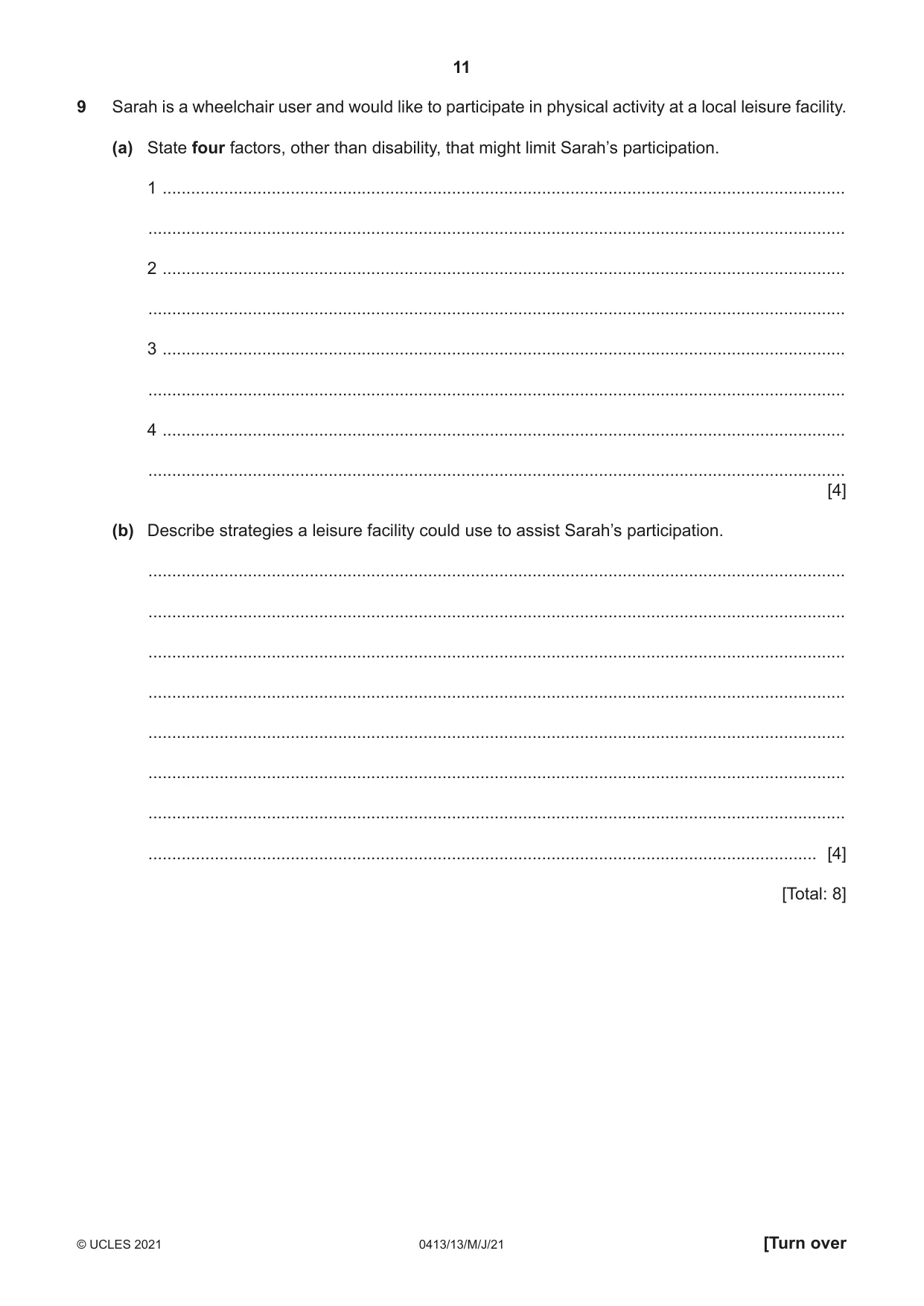
Question paper, page 11
11 0413/13/M/J/21 © UCLES 2021 [Turn over 9 Sarah is a wheelchair user and would like to participate in physical activity at a local leisure facility. (a) State four factors, other than disability, that might limit Sarah’s participation. 1 … … 2 … … 3 … … 4 … … [4] (b) Describe strategies a leisure facility could use to assist Sarah’s participation. … … … … … … … … [4] [Total: 8]
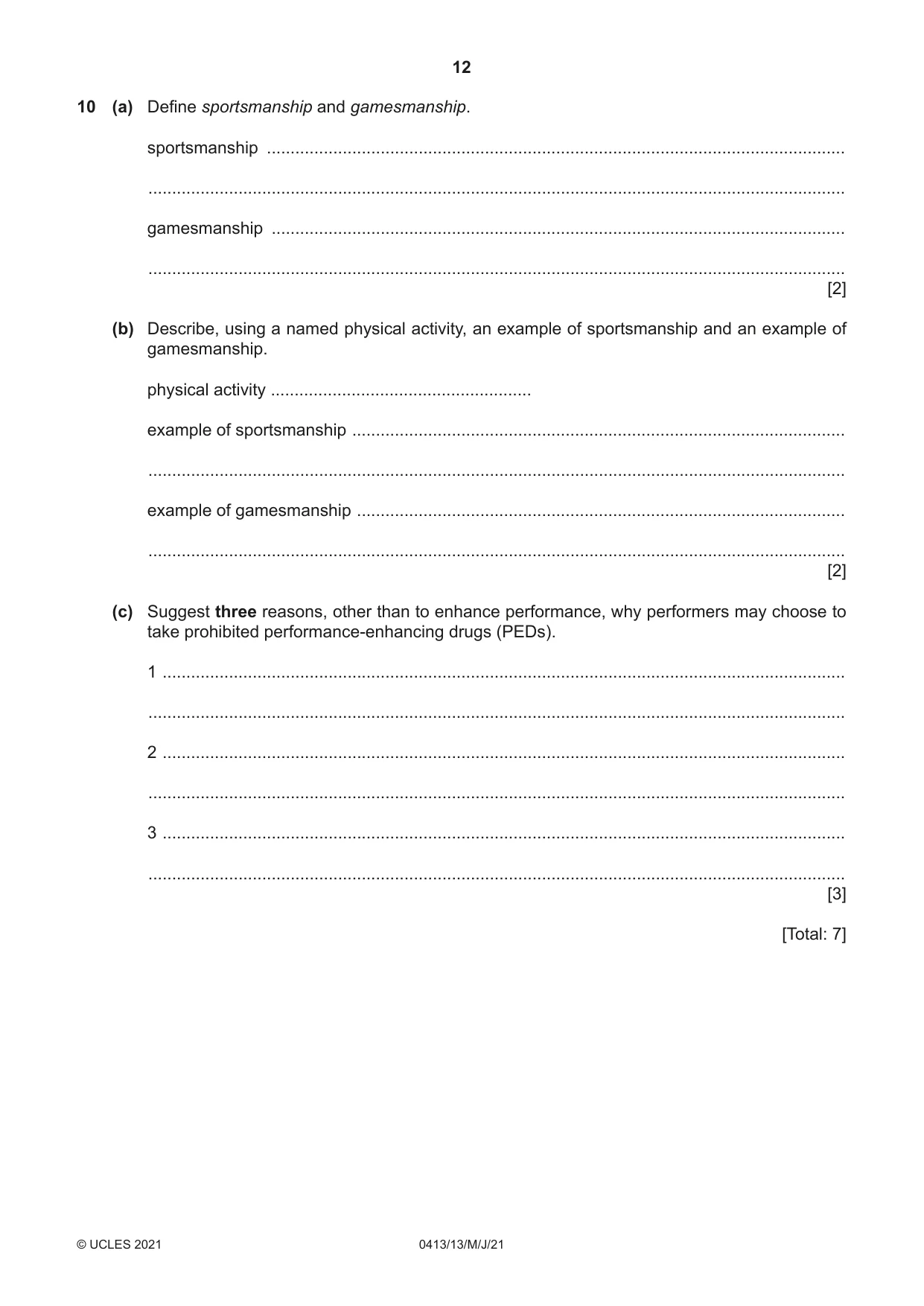
Question paper, page 12
12 0413/13/M/J/21 © UCLES 2021 10 (a) Define sportsmanship and gamesmanship. sportsmanship … … gamesmanship … … [2] (b) Describe, using a named physical activity, an example of sportsmanship and an example of gamesmanship. physical activity … example of sportsmanship … … example of gamesmanship … … [2] (c) Suggest three reasons, other than to enhance performance, why performers may choose to take prohibited performance-enhancing drugs (PEDs). 1 … … 2 … … 3 … … [3] [Total: 7]
Question paper, page 13
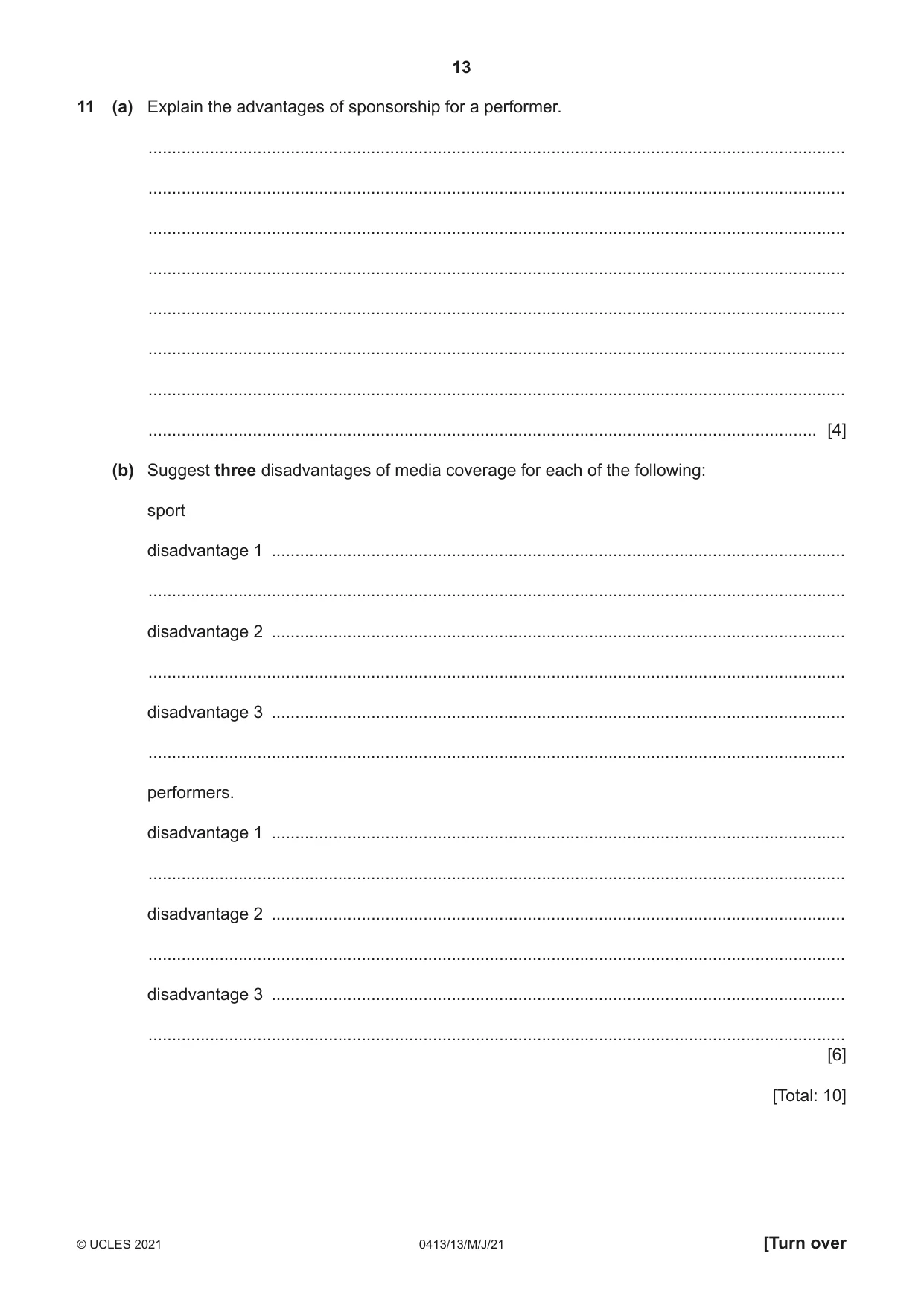
13 0413/13/M/J/21 © UCLES 2021 [Turn over 11 (a) Explain the advantages of sponsorship for a performer. … … … … … … … … [4] (b) Suggest three disadvantages of media coverage for each of the following: sport disadvantage 1 … … disadvantage 2 … … disadvantage 3 … … performers. disadvantage 1 … … disadvantage 2 … … disadvantage 3 … … [6] [Total: 10]
Question paper, page 14
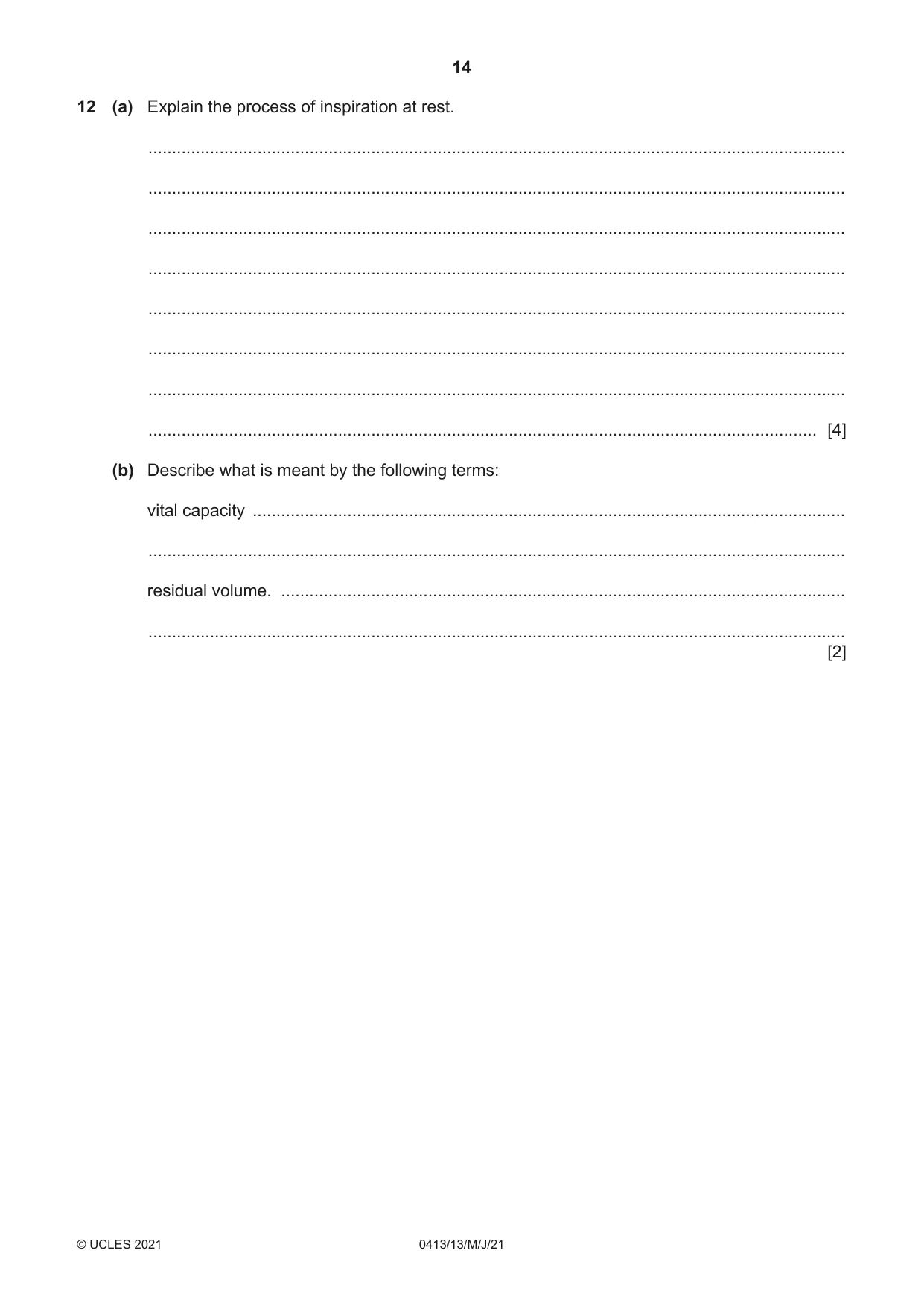
14 0413/13/M/J/21 © UCLES 2021 12 (a) Explain the process of inspiration at rest. … … … … … … … … [4] (b) Describe what is meant by the following terms: vital capacity … … residual volume. … … [2]
Question paper, page 15
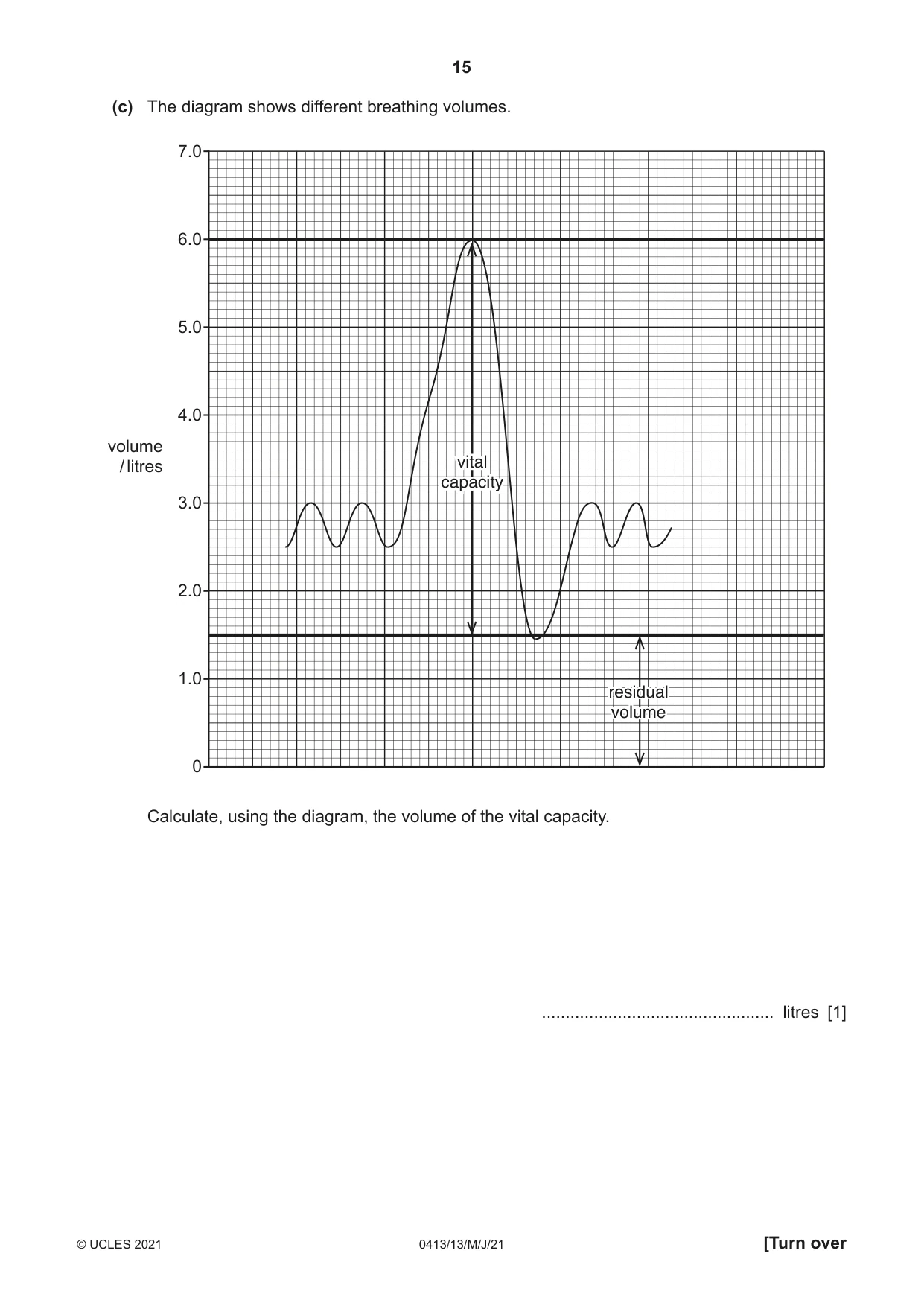
15 0413/13/M/J/21 © UCLES 2021 [Turn over (c) The diagram shows different breathing volumes. 0 1.0 2.0 3.0 4.0 volume / litres 5.0 6.0 7.0 vital capacity residual volume vital capacity residual volume Calculate, using the diagram, the volume of the vital capacity. … litres [1]
Question paper, page 16
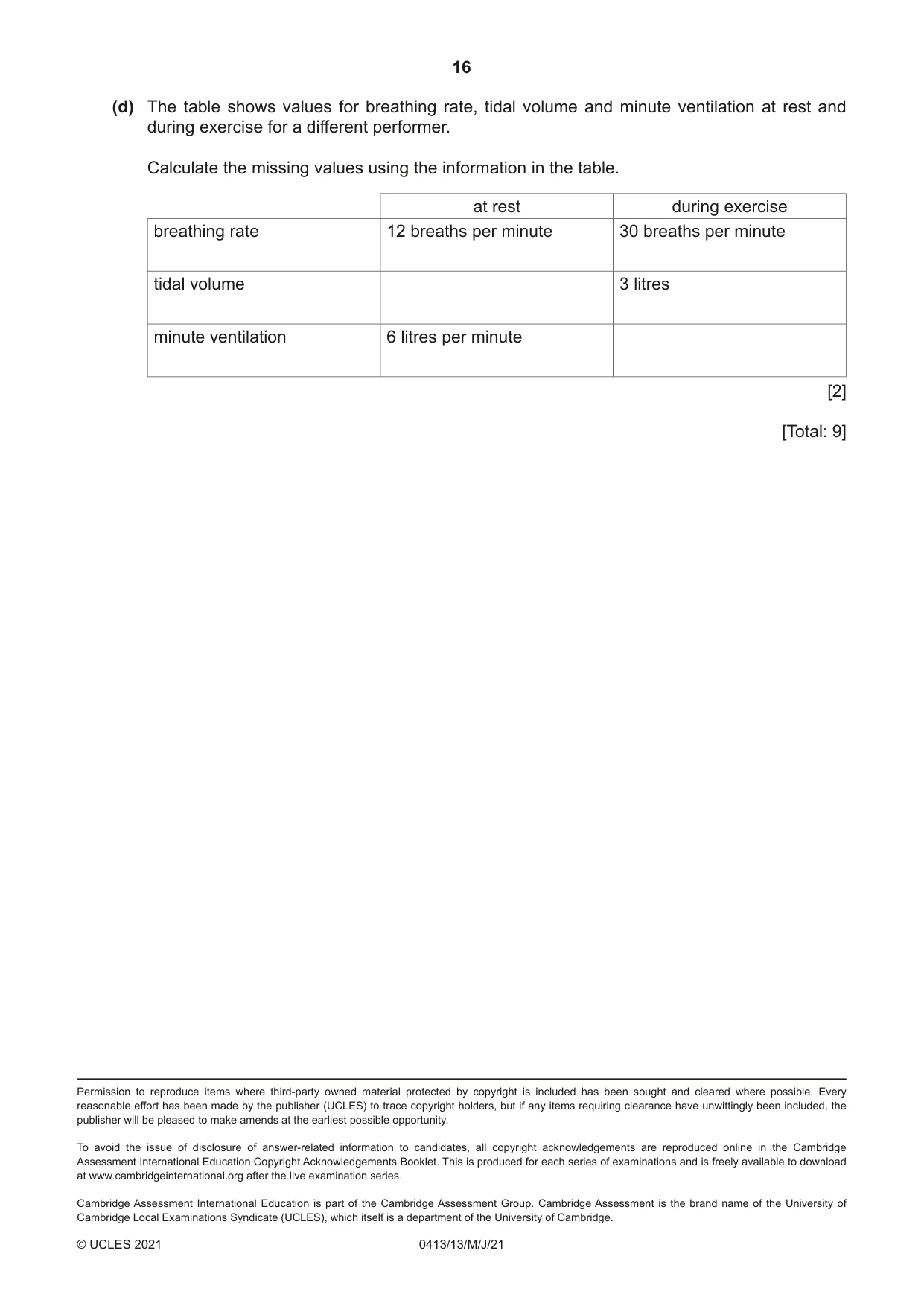
16 0413/13/M/J/21 © UCLES 2021 Permission to reproduce items where third-party owned material protected by copyright is included has been sought and cleared where possible. Every reasonable effort has been made by the publisher (UCLES) to trace copyright holders, but if any items requiring clearance have unwittingly been included, the publisher will be pleased to make amends at the earliest possible opportunity. To avoid the issue of disclosure of answer-related information to candidates, all copyright acknowledgements are reproduced online in the Cambridge Assessment International Education Copyright Acknowledgements Booklet. This is produced for each series of examinations and is freely available to download at www.cambridgeinternational.org after the live examination series. Cambridge Assessment International Education is part of the Cambridge Assessment Group. Cambridge Assessment is the brand name of the University of Cambridge Local Examinations Syndicate (UCLES), which itself is a department of the University of Cambridge. (d) The table shows values for breathing rate, tidal volume and minute ventilation at rest and during exercise for a different performer. Calculate the missing values using the information in the table. at rest during exercise breathing rate 12 breaths per minute 30 breaths per minute tidal volume 3 litres minute ventilation 6 litres per minute [2] [Total: 9]
Mark scheme, page 1
This document consists of 18 printed pages. © UCLES 2021 [Turn over Cambridge IGCSE™ PHYSICAL EDUCATION 0413/13 Paper 1 Theory May/June 2021 MARK SCHEME Maximum Mark: 100 Published This mark scheme is published as an aid to teachers and candidates, to indicate the requirements of the examination. It shows the basis on which Examiners were instructed to award marks. It does not indicate the details of the discussions that took place at an Examiners’ meeting before marking began, which would have considered the acceptability of alternative answers. Mark schemes should be read in conjunction with the question paper and the Principal Examiner Report for Teachers. Cambridge International will not enter into discussions about these mark schemes. Cambridge International is publishing the mark schemes for the May/June 2021 series for most Cambridge IGCSE™, Cambridge International A and AS Level components and some Cambridge O Level components.
Mark scheme, page 2
0413/13 Cambridge IGCSE – Mark Scheme PUBLISHED May/June 2021 © UCLES 2021 Page 2 of 18 Generic Marking Principles These general marking principles must be applied by all examiners when marking candidate answers. They should be applied alongside the specific content of the mark scheme or generic level descriptors for a question. Each question paper and mark scheme will also comply with these marking principles. GENERIC MARKING PRINCIPLE 1: Marks must be awarded in line with: • the specific content of the mark scheme or the generic level descriptors for the question • the specific skills defined in the mark scheme or in the generic level descriptors for the question • the standard of response required by a candidate as exemplified by the standardisation scripts. GENERIC MARKING PRINCIPLE 2: Marks awarded are always whole marks (not half marks, or other fractions). GENERIC MARKING PRINCIPLE 3: Marks must be awarded positively: • marks are awarded for correct/valid answers, as defined in the mark scheme. However, credit is given for valid answers which go beyond the scope of the syllabus and mark scheme, referring to your Team Leader as appropriate • marks are awarded when candidates clearly demonstrate what they know and can do • marks are not deducted for errors • marks are not deducted for omissions • answers should only be judged on the quality of spelling, punctuation and grammar when these features are specifically assessed by the question as indicated by the mark scheme. The meaning, however, should be unambiguous. GENERIC MARKING PRINCIPLE 4: Rules must be applied consistently, e.g. in situations where candidates have not followed instructions or in the application of generic level descriptors.
Mark scheme, page 3
0413/13 Cambridge IGCSE – Mark Scheme PUBLISHED May/June 2021 © UCLES 2021 Page 3 of 18 GENERIC MARKING PRINCIPLE 5: Marks should be awarded using the full range of marks defined in the mark scheme for the question (however; the use of the full mark range may be limited according to the quality of the candidate responses seen). GENERIC MARKING PRINCIPLE 6: Marks awarded are based solely on the requirements as defined in the mark scheme. Marks should not be awarded with grade thresholds or grade descriptors in mind. Science-Specific Marking Principles 1 Examiners should consider the context and scientific use of any keywords when awarding marks. Although keywords may be present, marks should not be awarded if the keywords are used incorrectly. 2 The examiner should not choose between contradictory statements given in the same question part, and credit should not be awarded for any correct statement that is contradicted within the same question part. Wrong science that is irrelevant to the question should be ignored. 3 Although spellings do not have to be correct, spellings of syllabus terms must allow for clear and unambiguous separation from other syllabus terms with which they may be confused (e.g. ethane / ethene, glucagon / glycogen, refraction / reflection). 4 The error carried forward (ecf) principle should be applied, where appropriate. If an incorrect answer is subsequently used in a scientifically correct way, the candidate should be awarded these subsequent marking points. Further guidance will be included in the mark scheme where necessary and any exceptions to this general principle will be noted. 5 ‘List rule’ guidance For questions that require n responses (e.g. State two reasons …): • The response should be read as continuous prose, even when numbered answer spaces are provided. • Any response marked ignore in the mark scheme should not count towards n. • Incorrect responses should not be awarded credit but will still count towards n. • Read the entire response to check for any responses that contradict those that would otherwise be credited. Credit should not be awarded for any responses that are contradicted within the rest of the response. Where two responses contradict one another, this should be treated as a single incorrect response. • Non-contradictory responses after the first n responses may be ignored even if they include incorrect science.
Mark scheme, page 4
0413/13 Cambridge IGCSE – Mark Scheme PUBLISHED May/June 2021 © UCLES 2021 Page 4 of 18 6 Calculation specific guidance Correct answers to calculations should be given full credit even if there is no working or incorrect working, unless the question states ‘show your working’. For questions in which the number of significant figures required is not stated, credit should be awarded for correct answers when rounded by the examiner to the number of significant figures given in the mark scheme. This may not apply to measured values. For answers given in standard form (e.g. a × 10n) in which the convention of restricting the value of the coefficient (a) to a value between 1 and 10 is not followed, credit may still be awarded if the answer can be converted to the answer given in the mark scheme. Unless a separate mark is given for a unit, a missing or incorrect unit will normally mean that the final calculation mark is not awarded. Exceptions to this general principle will be noted in the mark scheme. 7 Guidance for chemical equations Multiples / fractions of coefficients used in chemical equations are acceptable unless stated otherwise in the mark scheme. State symbols given in an equation should be ignored unless asked for in the question or stated otherwise in the mark scheme.
Mark scheme, page 5
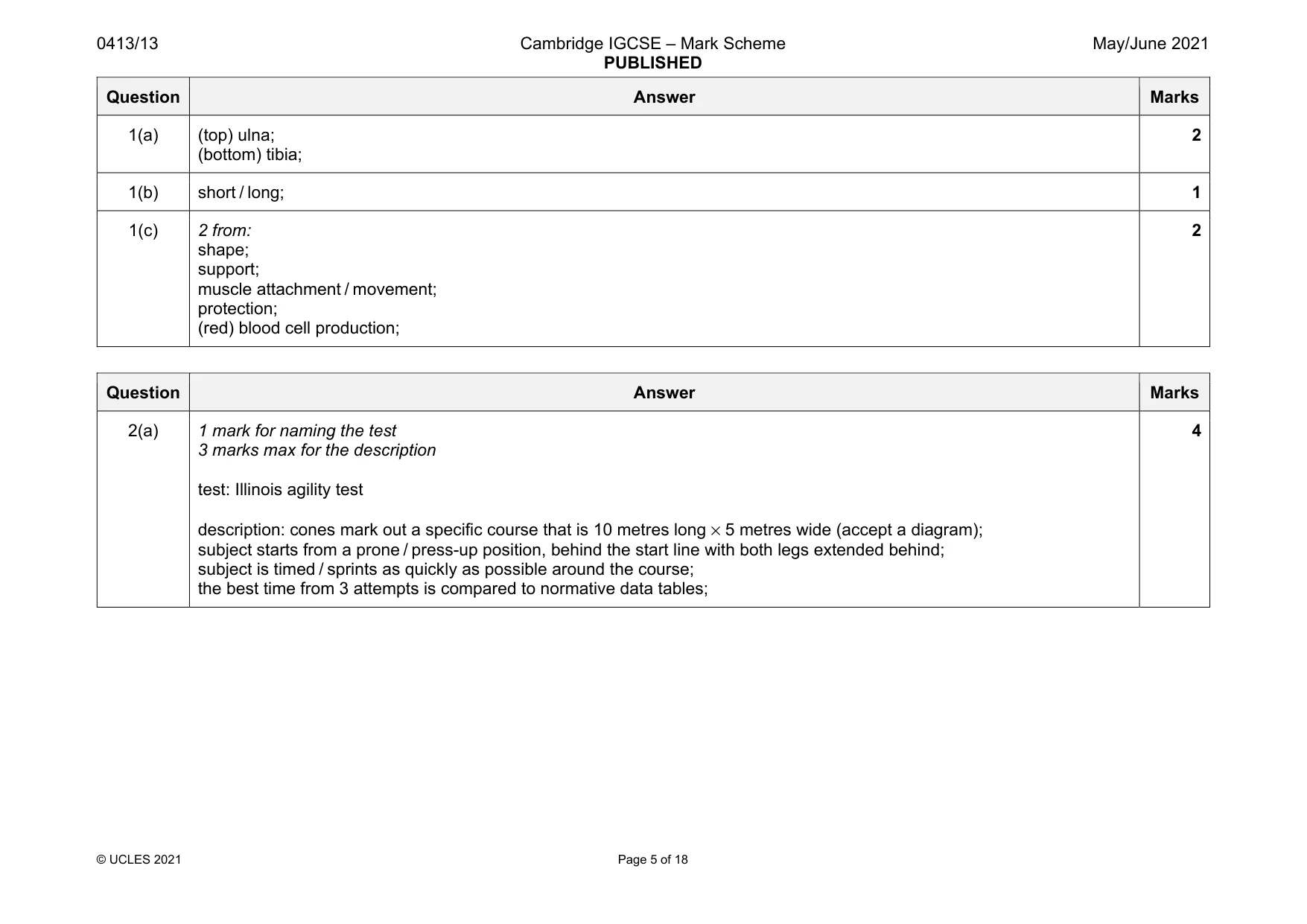
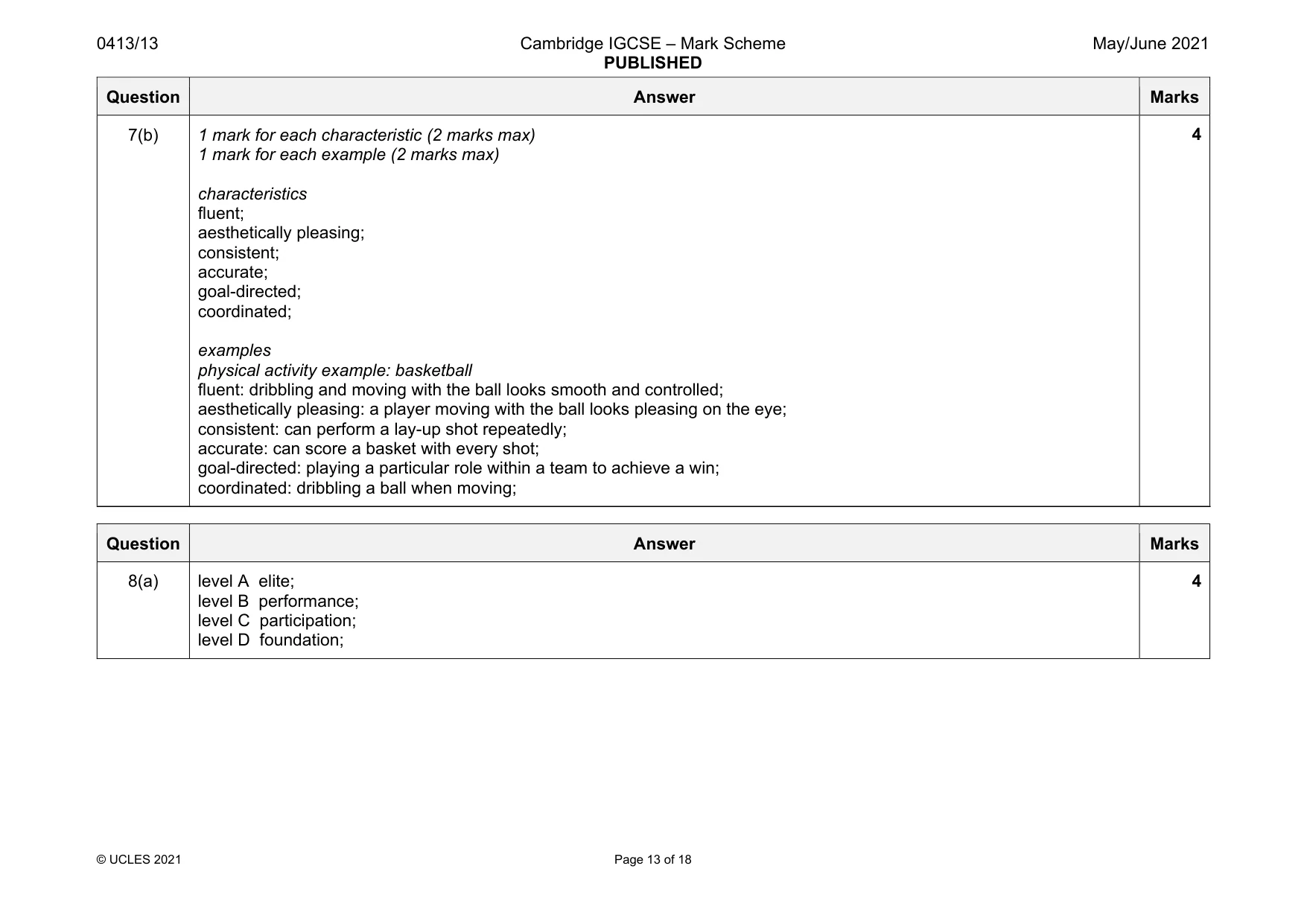
0413/13 Cambridge IGCSE – Mark Scheme PUBLISHED May/June 2021 © UCLES 2021 Page 5 of 18 Question Answer Marks 1(a) (top) ulna; (bottom) tibia; 2 1(b) short / long; 1 1(c) 2 from: shape; support; muscle attachment / movement; protection; (red) blood cell production; 2 Question Answer Marks 2(a) 1 mark for naming the test 3 marks max for the description test: Illinois agility test description: cones mark out a specific course that is 10 metres long × 5 metres wide (accept a diagram); subject starts from a prone / press-up position, behind the start line with both legs extended behind; subject is timed / sprints as quickly as possible around the course; the best time from 3 attempts is compared to normative data tables; 4
Mark scheme, page 6
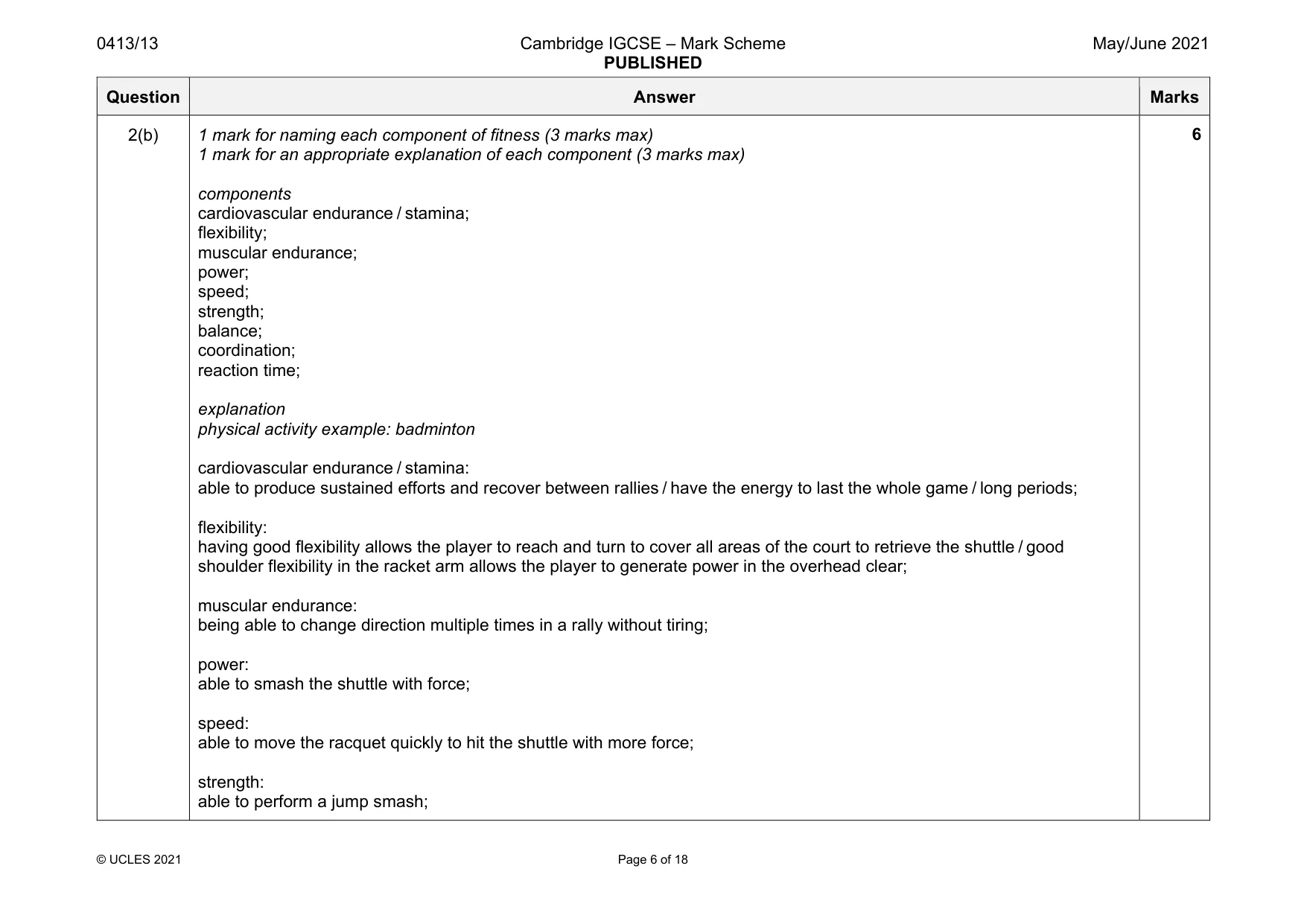
0413/13 Cambridge IGCSE – Mark Scheme PUBLISHED May/June 2021 © UCLES 2021 Page 6 of 18 Question Answer Marks 2(b) 1 mark for naming each component of fitness (3 marks max) 1 mark for an appropriate explanation of each component (3 marks max) components cardiovascular endurance / stamina; flexibility; muscular endurance; power; speed; strength; balance; coordination; reaction time; explanation physical activity example: badminton cardiovascular endurance / stamina: able to produce sustained efforts and recover between rallies / have the energy to last the whole game / long periods; flexibility: having good flexibility allows the player to reach and turn to cover all areas of the court to retrieve the shuttle / good shoulder flexibility in the racket arm allows the player to generate power in the overhead clear; muscular endurance: being able to change direction multiple times in a rally without tiring; power: able to smash the shuttle with force; speed: able to move the racquet quickly to hit the shuttle with more force; strength: able to perform a jump smash; 6
Mark scheme, page 7
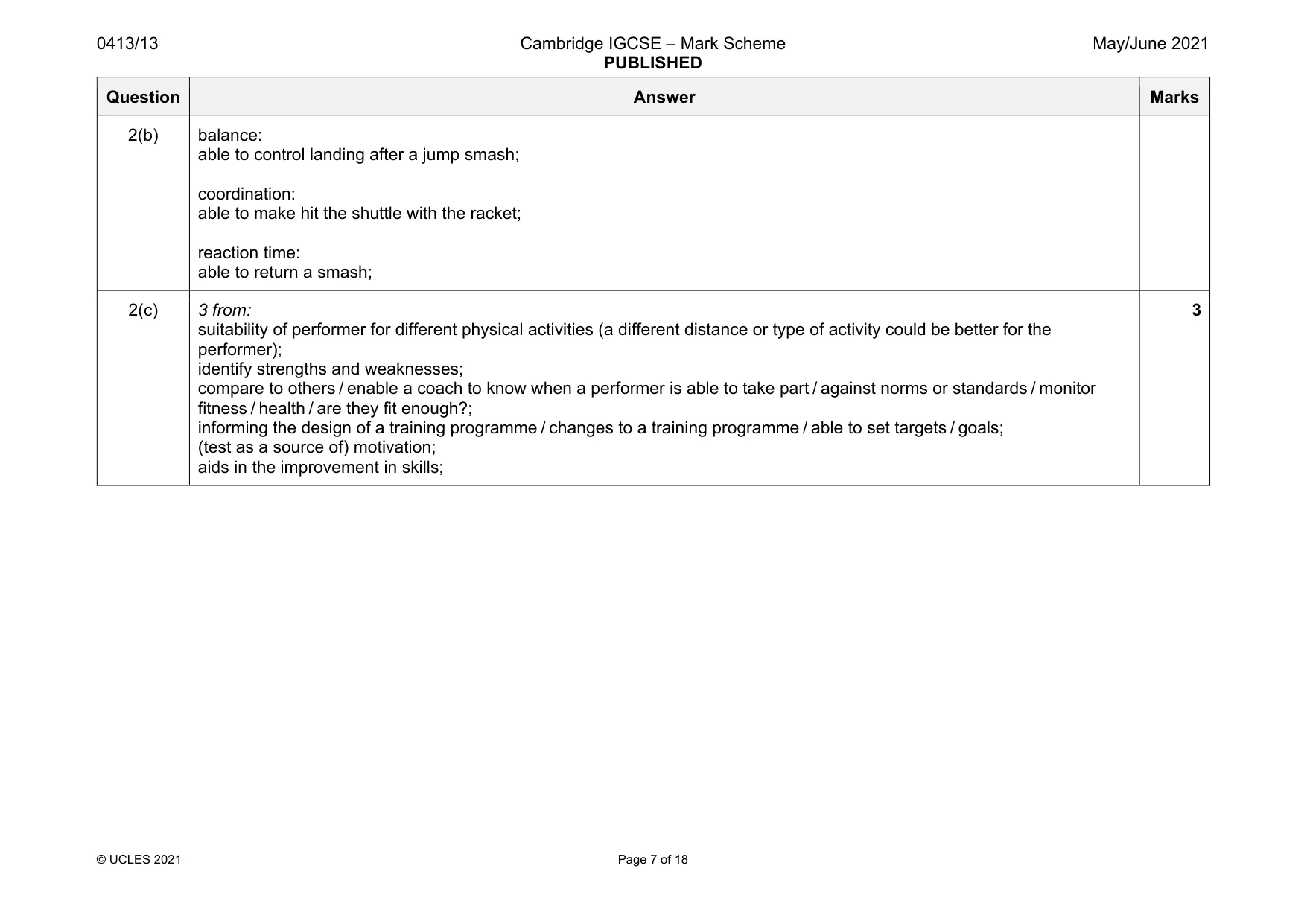
0413/13 Cambridge IGCSE – Mark Scheme PUBLISHED May/June 2021 © UCLES 2021 Page 7 of 18 Question Answer Marks 2(b) balance: able to control landing after a jump smash; coordination: able to make hit the shuttle with the racket; reaction time: able to return a smash; 2(c) 3 from: suitability of performer for different physical activities (a different distance or type of activity could be better for the performer); identify strengths and weaknesses; compare to others / enable a coach to know when a performer is able to take part / against norms or standards / monitor fitness / health / are they fit enough?; informing the design of a training programme / changes to a training programme / able to set targets / goals; (test as a source of) motivation; aids in the improvement in skills; 3
Mark scheme, page 8
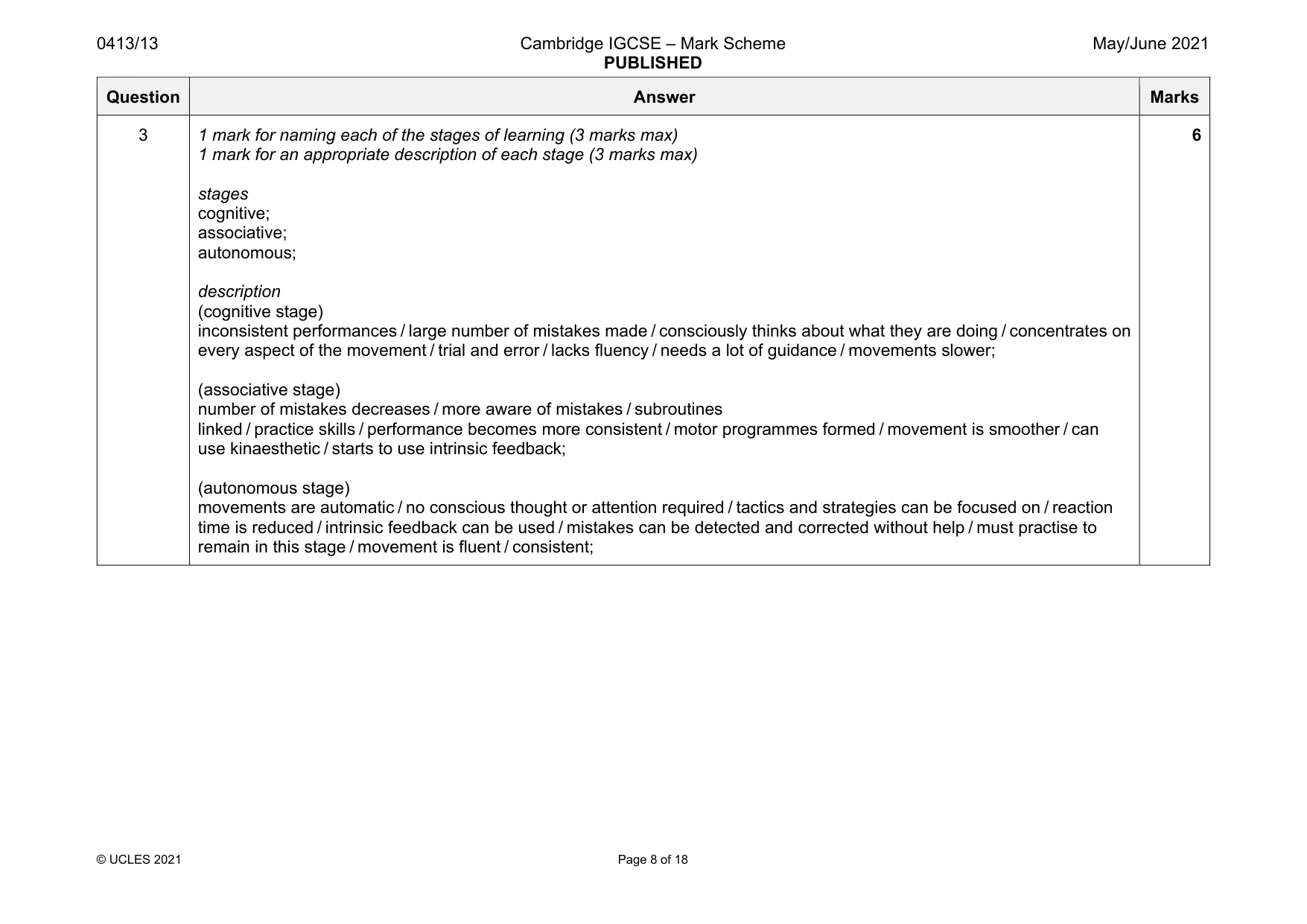
0413/13 Cambridge IGCSE – Mark Scheme PUBLISHED May/June 2021 © UCLES 2021 Page 8 of 18 Question Answer Marks 3 1 mark for naming each of the stages of learning (3 marks max) 1 mark for an appropriate description of each stage (3 marks max) stages cognitive; associative; autonomous; description (cognitive stage) inconsistent performances / large number of mistakes made / consciously thinks about what they are doing / concentrates on every aspect of the movement / trial and error / lacks fluency / needs a lot of guidance / movements slower; (associative stage) number of mistakes decreases / more aware of mistakes / subroutines linked / practice skills / performance becomes more consistent / motor programmes formed / movement is smoother / can use kinaesthetic / starts to use intrinsic feedback; (autonomous stage) movements are automatic / no conscious thought or attention required / tactics and strategies can be focused on / reaction time is reduced / intrinsic feedback can be used / mistakes can be detected and corrected without help / must practise to remain in this stage / movement is fluent / consistent; 6
Mark scheme, page 9
0413/13 Cambridge IGCSE – Mark Scheme PUBLISHED May/June 2021 © UCLES 2021 Page 9 of 18 Question Answer Marks 4(a)(i) 1 mark for each appropriate cause (3 marks max) (hockey) impact with ball / stick / ground / person; rubbing on rough surface; over-stretching to reach the ball; sudden twisting to when changing direction to defend; blow to the abdomen by ball / person; friction / rubbing between hands and stick / ill-fitting shoes; slipping on surface; lack of warm up; (gymnast) over-stretch when a performer is doing the splits; bad landing after a vault; repeated rubbing of hands-on bars; falling and landing on back falling from the bars; sudden twisting during a floor exercise; lack of warm up; incorrect technique when performing a somersault; (rock climbing) friction / repeated rubbing of hands on rope / rock face; over-stretching to reach hand / foot holds; falling and landing on back; rubbing on rock surface; sudden twisting / force on joint if slip; lack of warm up; slipping on rock; collision with rock; 3
Mark scheme, page 10
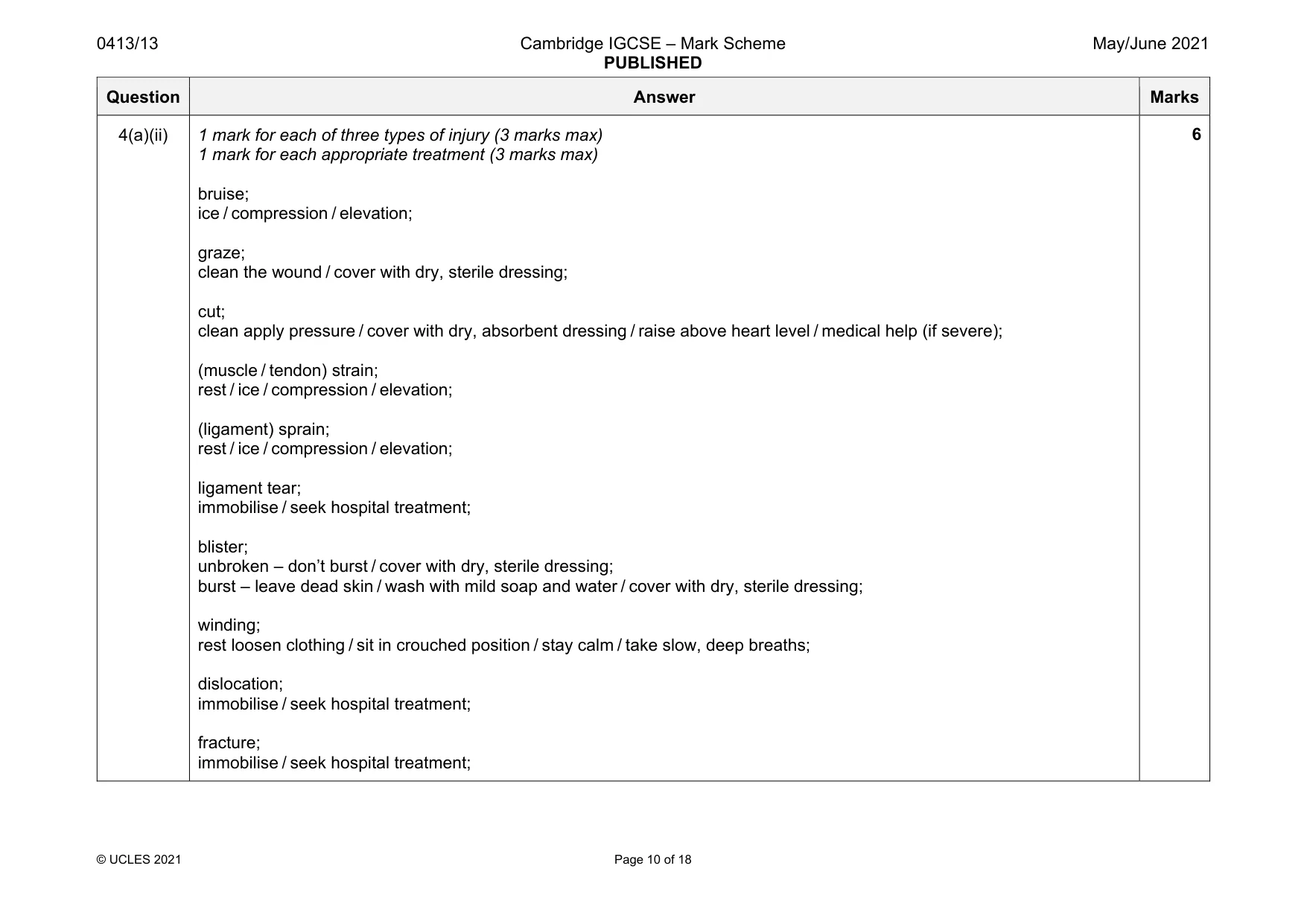
0413/13 Cambridge IGCSE – Mark Scheme PUBLISHED May/June 2021 © UCLES 2021 Page 10 of 18 Question Answer Marks 4(a)(ii) 1 mark for each of three types of injury (3 marks max) 1 mark for each appropriate treatment (3 marks max) bruise; ice / compression / elevation; graze; clean the wound / cover with dry, sterile dressing; cut; clean apply pressure / cover with dry, absorbent dressing / raise above heart level / medical help (if severe); (muscle / tendon) strain; rest / ice / compression / elevation; (ligament) sprain; rest / ice / compression / elevation; ligament tear; immobilise / seek hospital treatment; blister; unbroken – don’t burst / cover with dry, sterile dressing; burst – leave dead skin / wash with mild soap and water / cover with dry, sterile dressing; winding; rest loosen clothing / sit in crouched position / stay calm / take slow, deep breaths; dislocation; immobilise / seek hospital treatment; fracture; immobilise / seek hospital treatment; 6
Mark scheme, page 11
0413/13 Cambridge IGCSE – Mark Scheme PUBLISHED May/June 2021 © UCLES 2021 Page 11 of 18 Question Answer Marks 4(b) real risk: objective / the amount of danger that actually exists / level of risk after taking into account safety measures, e.g. rock climbing – real risk is low due to being secured to the rock by ropes / harness; perceived risk: subjective / an individual’s personal judgement about the dangers / an individual’s view of risk, e.g. rock climbing – perceived risk is high due to individual’s lack of experience / ability / fear of falling; 2 4(c) 3 from: wear protective clothing / equipment; appropriate clothing / footwear / remove jewellery / long hair tied back; use correct / safe equipment; lifting / carrying equipment safely; maintain hydration; warm-up / cool-down; follow rules; learn / use correct technique; suitable level of competition; risk assessment prior to activity / safe area; do not participate if tired / injured / not fully fit; ensure teacher / coach / judge is present supervision; 3 Question Answer Marks 5(a) joint type type of movement agonist muscle antagonist muscle left knee hinge extension quadricep(s) hamstring(s); right hip ball and socket; flexion hip flexors gluteals; left ankle hinge plantar flexion; gastrocnemius; tibialis anterior 5
Mark scheme, page 12
0413/13 Cambridge IGCSE – Mark Scheme PUBLISHED May/June 2021 © UCLES 2021 Page 12 of 18 Question Answer Marks 5(b) 1 mark for naming the muscle type 1 mark for justification muscle type: fast-twitch muscle fibre; justification: muscle fibres have fast contractions / allow good leg speed; contractions are stronger / more powerful / explosive / allows a strong drive phase / speed out of the blocks; anaerobic activity / short length of time to complete the event / allows an all-out effort for a short period of time; 2 Question Answer Marks 6(a) A right atrium; B (tricuspid) valve; C left ventricle; 3 6(b) B: prevents backflow of blood / ensures blood flows in one direction / allows blood to flow into ventricle / regulates blood flow; C: contracts to push blood out of heart / into aorta / to body / receives blood from the left atrium; 2 6(c) 2 from: carry blood towards heart; usually carries deoxygenated blood (except pulmonary vein); thin walls; large lumen; contain valves (to prevent backflow of blood); 2 Question Answer Marks 7(a) (skill) learned / many skills / needs to be practiced; (ability) – born with / inherited / few abilities; 2
Mark scheme, page 13
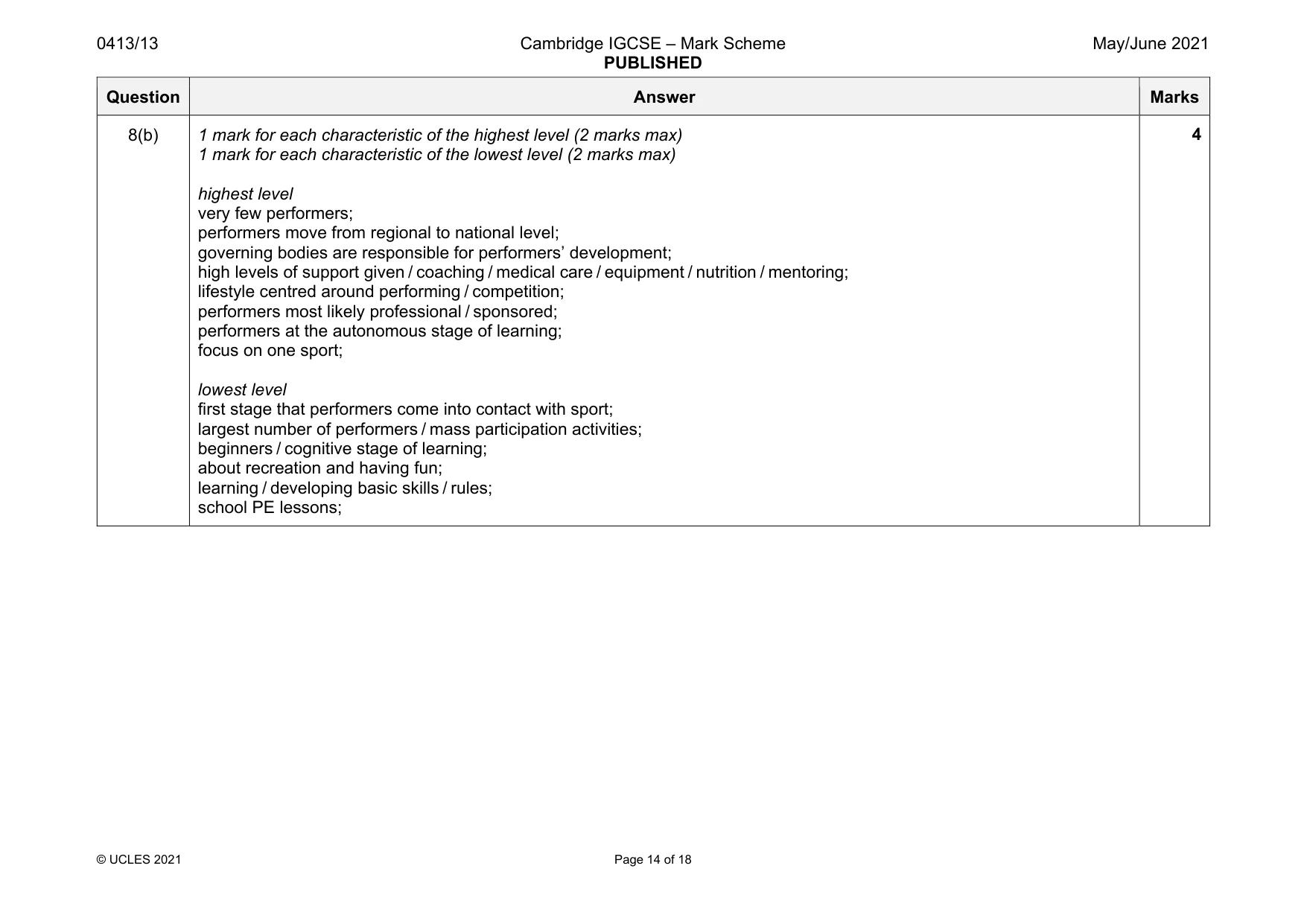
0413/13 Cambridge IGCSE – Mark Scheme PUBLISHED May/June 2021 © UCLES 2021 Page 13 of 18 Question Answer Marks 7(b) 1 mark for each characteristic (2 marks max) 1 mark for each example (2 marks max) characteristics fluent; aesthetically pleasing; consistent; accurate; goal-directed; coordinated; examples physical activity example: basketball fluent: dribbling and moving with the ball looks smooth and controlled; aesthetically pleasing: a player moving with the ball looks pleasing on the eye; consistent: can perform a lay-up shot repeatedly; accurate: can score a basket with every shot; goal-directed: playing a particular role within a team to achieve a win; coordinated: dribbling a ball when moving; 4 Question Answer Marks 8(a) level A elite; level B performance; level C participation; level D foundation; 4
Mark scheme, page 14
0413/13 Cambridge IGCSE – Mark Scheme PUBLISHED May/June 2021 © UCLES 2021 Page 14 of 18 Question Answer Marks 8(b) 1 mark for each characteristic of the highest level (2 marks max) 1 mark for each characteristic of the lowest level (2 marks max) highest level very few performers; performers move from regional to national level; governing bodies are responsible for performers’ development; high levels of support given / coaching / medical care / equipment / nutrition / mentoring; lifestyle centred around performing / competition; performers most likely professional / sponsored; performers at the autonomous stage of learning; focus on one sport; lowest level first stage that performers come into contact with sport; largest number of performers / mass participation activities; beginners / cognitive stage of learning; about recreation and having fun; learning / developing basic skills / rules; school PE lessons; 4
Mark scheme, page 15
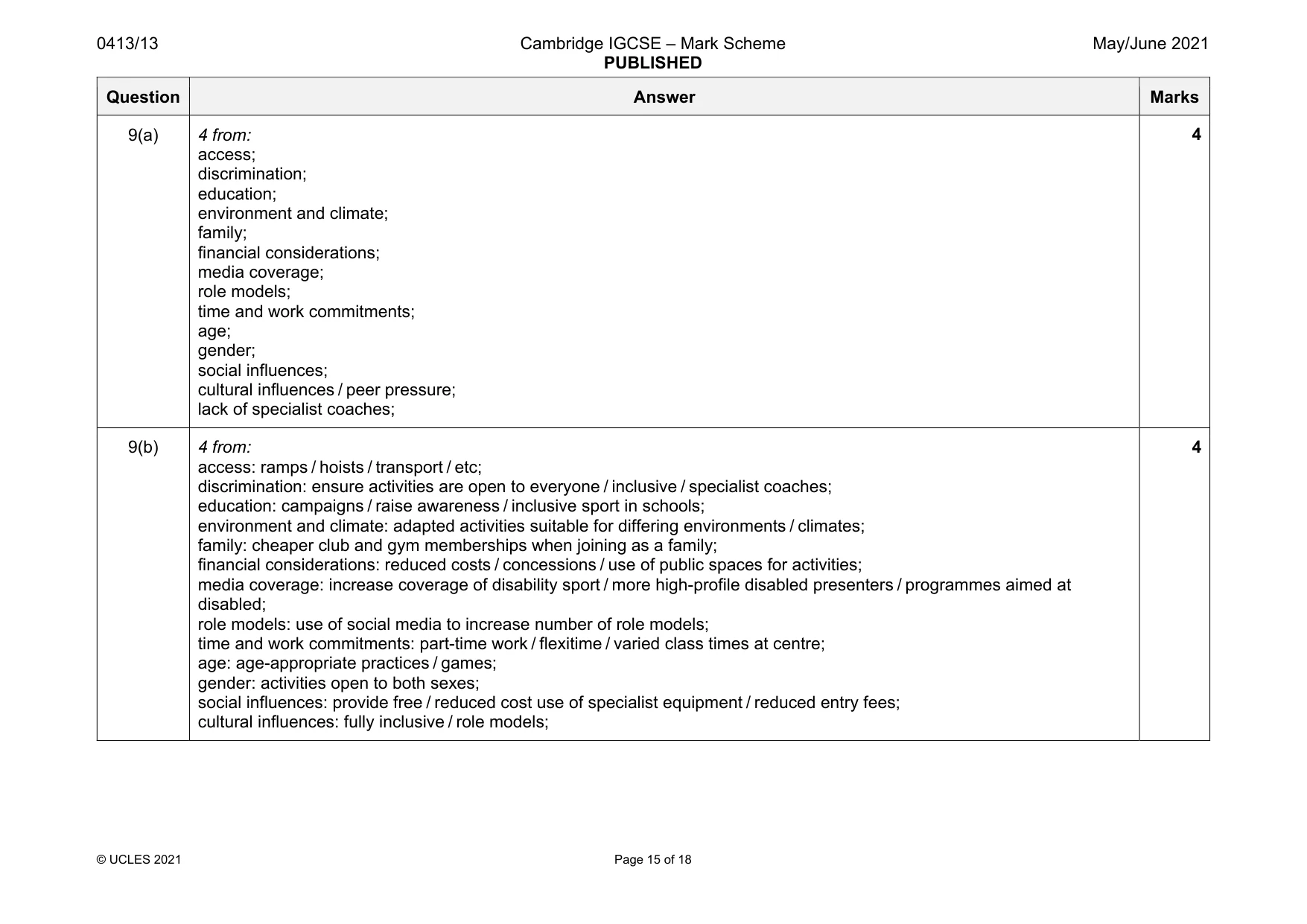
0413/13 Cambridge IGCSE – Mark Scheme PUBLISHED May/June 2021 © UCLES 2021 Page 15 of 18 Question Answer Marks 9(a) 4 from: access; discrimination; education; environment and climate; family; financial considerations; media coverage; role models; time and work commitments; age; gender; social influences; cultural influences / peer pressure; lack of specialist coaches; 4 9(b) 4 from: access: ramps / hoists / transport / etc; discrimination: ensure activities are open to everyone / inclusive / specialist coaches; education: campaigns / raise awareness / inclusive sport in schools; environment and climate: adapted activities suitable for differing environments / climates; family: cheaper club and gym memberships when joining as a family; financial considerations: reduced costs / concessions / use of public spaces for activities; media coverage: increase coverage of disability sport / more high-profile disabled presenters / programmes aimed at disabled; role models: use of social media to increase number of role models; time and work commitments: part-time work / flexitime / varied class times at centre; age: age-appropriate practices / games; gender: activities open to both sexes; social influences: provide free / reduced cost use of specialist equipment / reduced entry fees; cultural influences: fully inclusive / role models; 4
Mark scheme, page 16
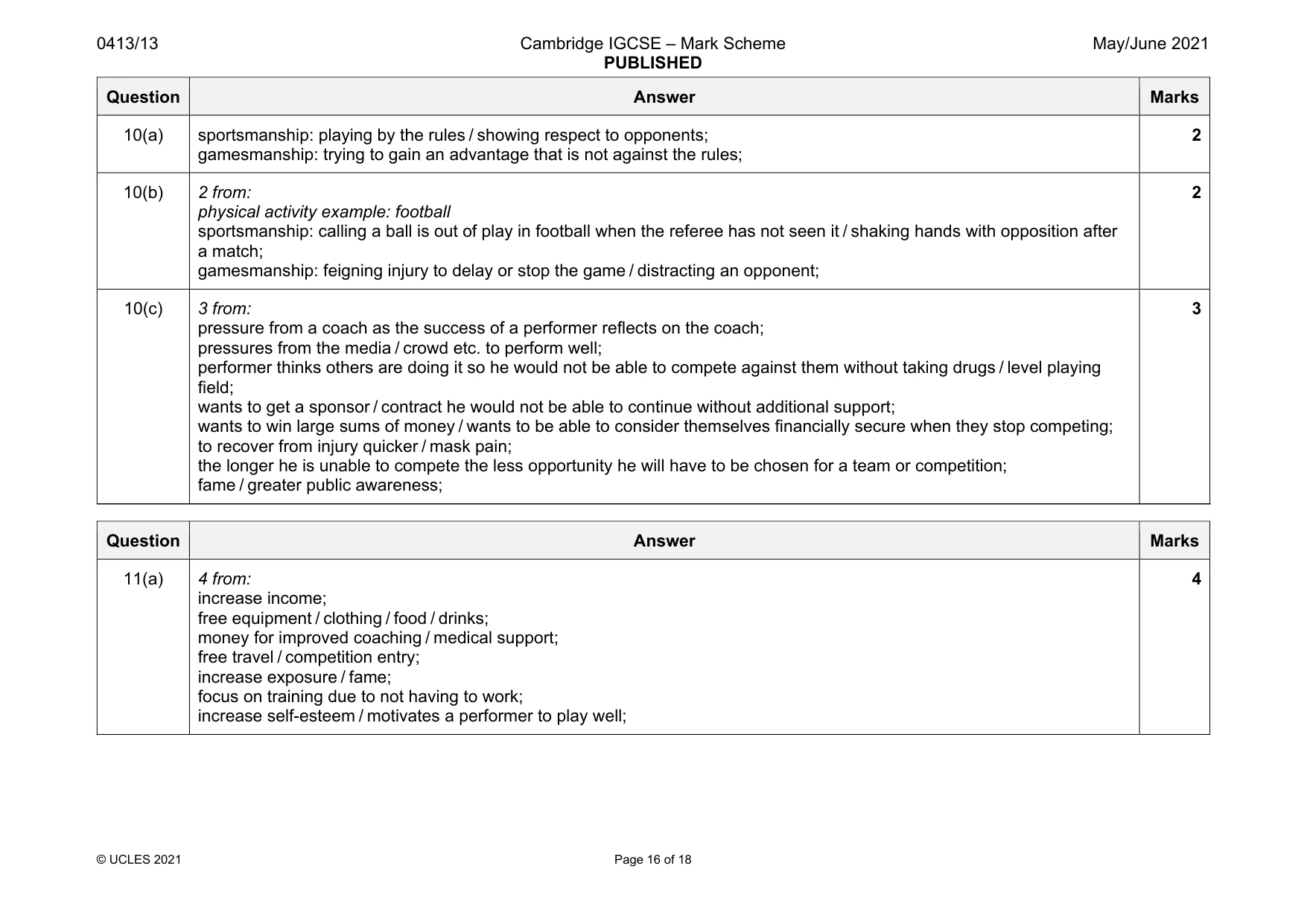
0413/13 Cambridge IGCSE – Mark Scheme PUBLISHED May/June 2021 © UCLES 2021 Page 16 of 18 Question Answer Marks 10(a) sportsmanship: playing by the rules / showing respect to opponents; gamesmanship: trying to gain an advantage that is not against the rules; 2 10(b) 2 from: physical activity example: football sportsmanship: calling a ball is out of play in football when the referee has not seen it / shaking hands with opposition after a match; gamesmanship: feigning injury to delay or stop the game / distracting an opponent; 2 10(c) 3 from: pressure from a coach as the success of a performer reflects on the coach; pressures from the media / crowd etc. to perform well; performer thinks others are doing it so he would not be able to compete against them without taking drugs / level playing field; wants to get a sponsor / contract he would not be able to continue without additional support; wants to win large sums of money / wants to be able to consider themselves financially secure when they stop competing; to recover from injury quicker / mask pain; the longer he is unable to compete the less opportunity he will have to be chosen for a team or competition; fame / greater public awareness; 3 Question Answer Marks 11(a) 4 from: increase income; free equipment / clothing / food / drinks; money for improved coaching / medical support; free travel / competition entry; increase exposure / fame; focus on training due to not having to work; increase self-esteem / motivates a performer to play well; 4
Mark scheme, page 17
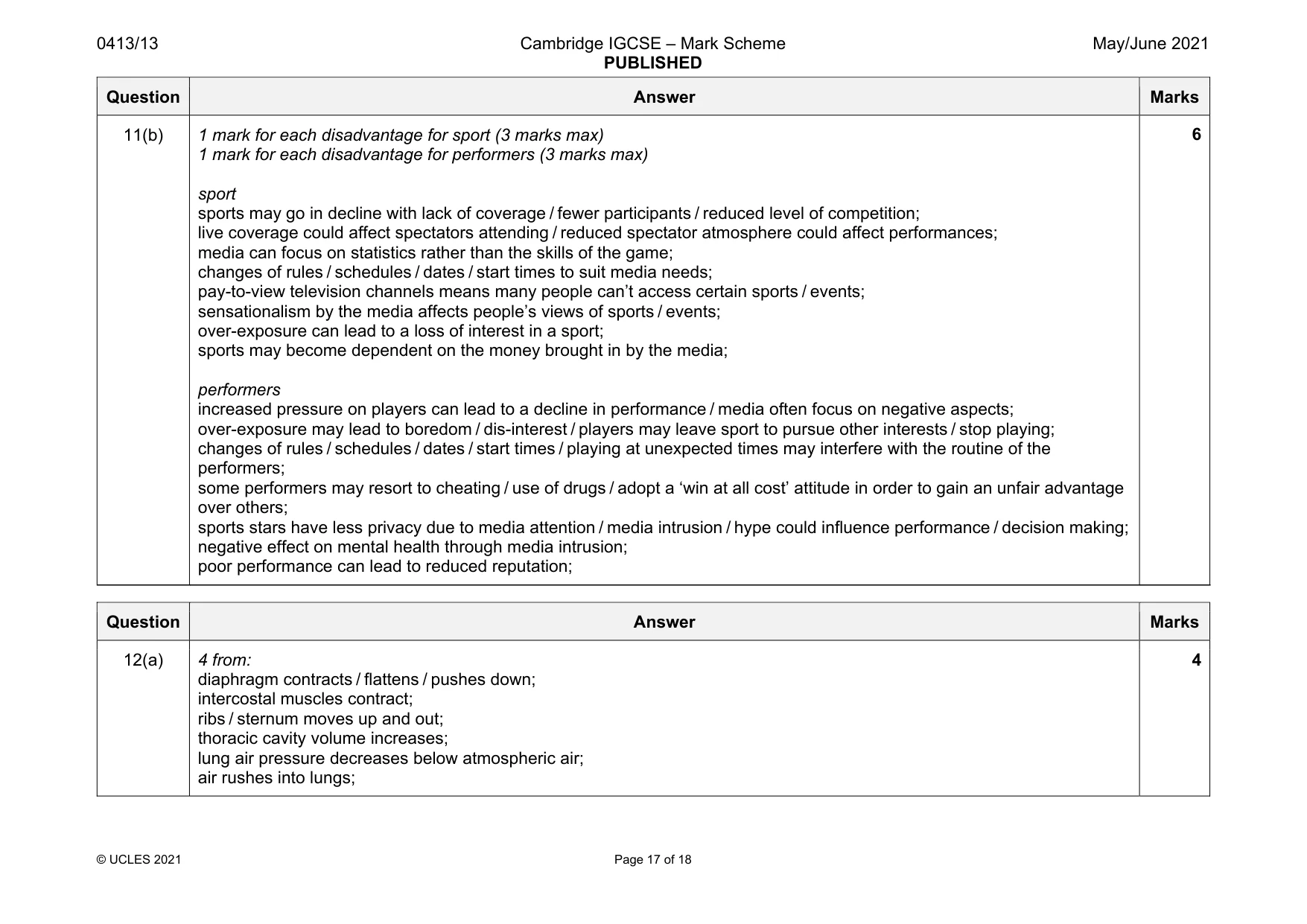
0413/13 Cambridge IGCSE – Mark Scheme PUBLISHED May/June 2021 © UCLES 2021 Page 17 of 18 Question Answer Marks 11(b) 1 mark for each disadvantage for sport (3 marks max) 1 mark for each disadvantage for performers (3 marks max) sport sports may go in decline with lack of coverage / fewer participants / reduced level of competition; live coverage could affect spectators attending / reduced spectator atmosphere could affect performances; media can focus on statistics rather than the skills of the game; changes of rules / schedules / dates / start times to suit media needs; pay-to-view television channels means many people can’t access certain sports / events; sensationalism by the media affects people’s views of sports / events; over-exposure can lead to a loss of interest in a sport; sports may become dependent on the money brought in by the media; performers increased pressure on players can lead to a decline in performance / media often focus on negative aspects; over-exposure may lead to boredom / dis-interest / players may leave sport to pursue other interests / stop playing; changes of rules / schedules / dates / start times / playing at unexpected times may interfere with the routine of the performers; some performers may resort to cheating / use of drugs / adopt a ‘win at all cost’ attitude in order to gain an unfair advantage over others; sports stars have less privacy due to media attention / media intrusion / hype could influence performance / decision making; negative effect on mental health through media intrusion; poor performance can lead to reduced reputation; 6 Question Answer Marks 12(a) 4 from: diaphragm contracts / flattens / pushes down; intercostal muscles contract; ribs / sternum moves up and out; thoracic cavity volume increases; lung air pressure decreases below atmospheric air; air rushes into lungs; 4
Mark scheme, page 18
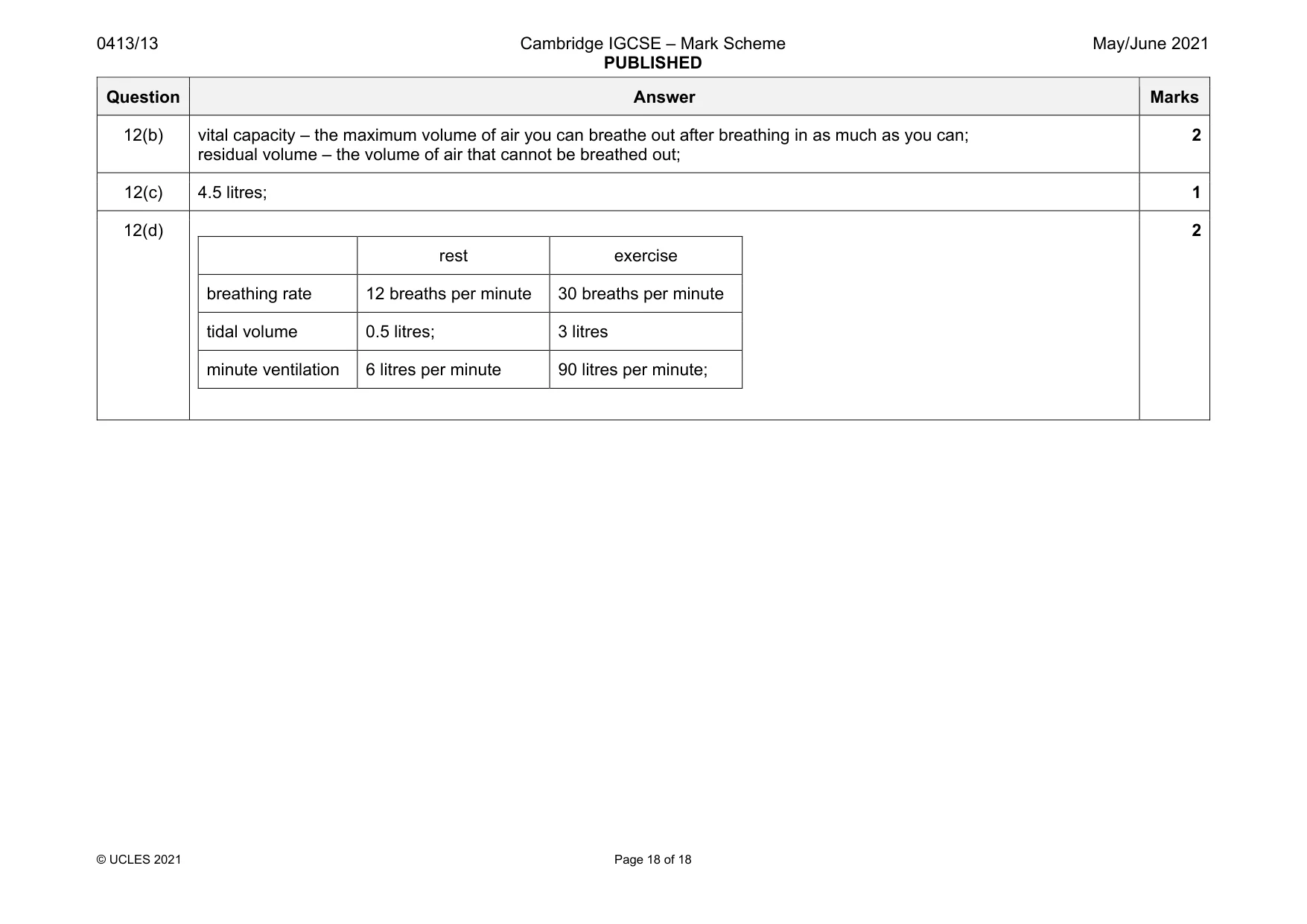
0413/13 Cambridge IGCSE – Mark Scheme PUBLISHED May/June 2021 © UCLES 2021 Page 18 of 18 Question Answer Marks 12(b) vital capacity – the maximum volume of air you can breathe out after breathing in as much as you can; residual volume – the volume of air that cannot be breathed out; 2 12(c) 4.5 litres; 1 12(d) rest exercise breathing rate 12 breaths per minute 30 breaths per minute tidal volume 0.5 litres; 3 litres minute ventilation 6 litres per minute 90 litres per minute; 2
What you needed in this session
Cambridge’s own grade thresholds for 2021 May/June, Paper 1 · Variant 3. A higher threshold means an easier paper — the bar moves with how the cohort did.