Cambridge IGCSE Physical Education 0413 — 2020 Oct/Nov Paper 1 · Variant 2
0413/12/O/N/20 · 100 marks · ≈113 min
The question paper and its mark scheme, free to read here and free to download. This is Cambridge’s own paper, exactly as it was sat.
Question paper16 pages

Mark scheme23 pages
Answers below. Sit the paper first if you are practising.
Paper as text
Question paper, page 1
Cambridge IGCSE™ DC (JC/CT) 182737/2 © UCLES 2020 [Turn over This document has 16 pages. Blank pages are indicated. * 1 2 2 2 4 2 4 4 6 7 * PHYSICAL EDUCATION 0413/12 Paper 1 Theory October/November 2020 1 hour 45 minutes You must answer on the question paper. No additional materials are needed. INSTRUCTIONS ● Answer all questions. ● Use a black or dark blue pen. You may use an HB pencil for any diagrams or graphs. ● Write your name, centre number and candidate number in the boxes at the top of the page. ● Write your answer to each question in the space provided. ● Do not use an erasable pen or correction fluid. ● Do not write on any bar codes. ● You may use a calculator. ● You should show all your working and use appropriate units. INFORMATION ● The total mark for this paper is 100. ● The number of marks for each question or part question is shown in brackets [ ].
Question paper, page 2
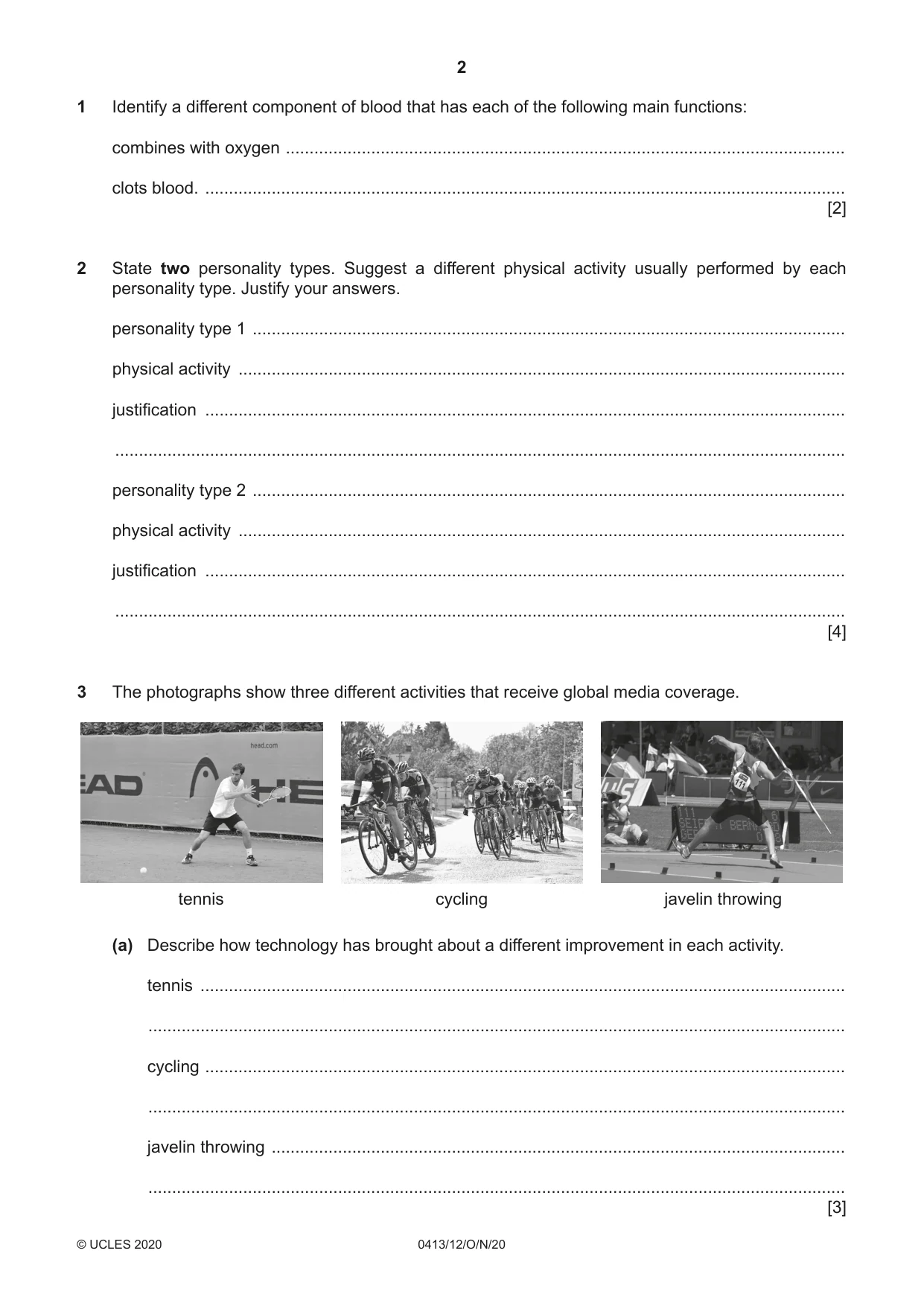
2 0413/12/O/N/20 © UCLES 2020 1 Identify a different component of blood that has each of the following main functions: combines with oxygen … clots blood. … [2] 2 State two personality types. Suggest a different physical activity usually performed by each personality type. Justify your answers. personality type 1 … physical activity … justification … … personality type 2 … physical activity … justification … … [4] 3 The photographs show three different activities that receive global media coverage. tennis cycling javelin throwing (a) Describe how technology has brought about a different improvement in each activity. tennis … … cycling … … javelin throwing … … [3]
Question paper, page 3
3 0413/12/O/N/20 © UCLES 2020 [Turn over (b) Describe three different ways that the internet and social media may benefit performers. 1 … … 2 … … 3 … … [3] (c) Describe two advantages and two disadvantages of increased media coverage for people who watch global sporting events. advantage 1 … … advantage 2 … … disadvantage 1 … … disadvantage 2 … … [4] [Total: 10]
Question paper, page 4
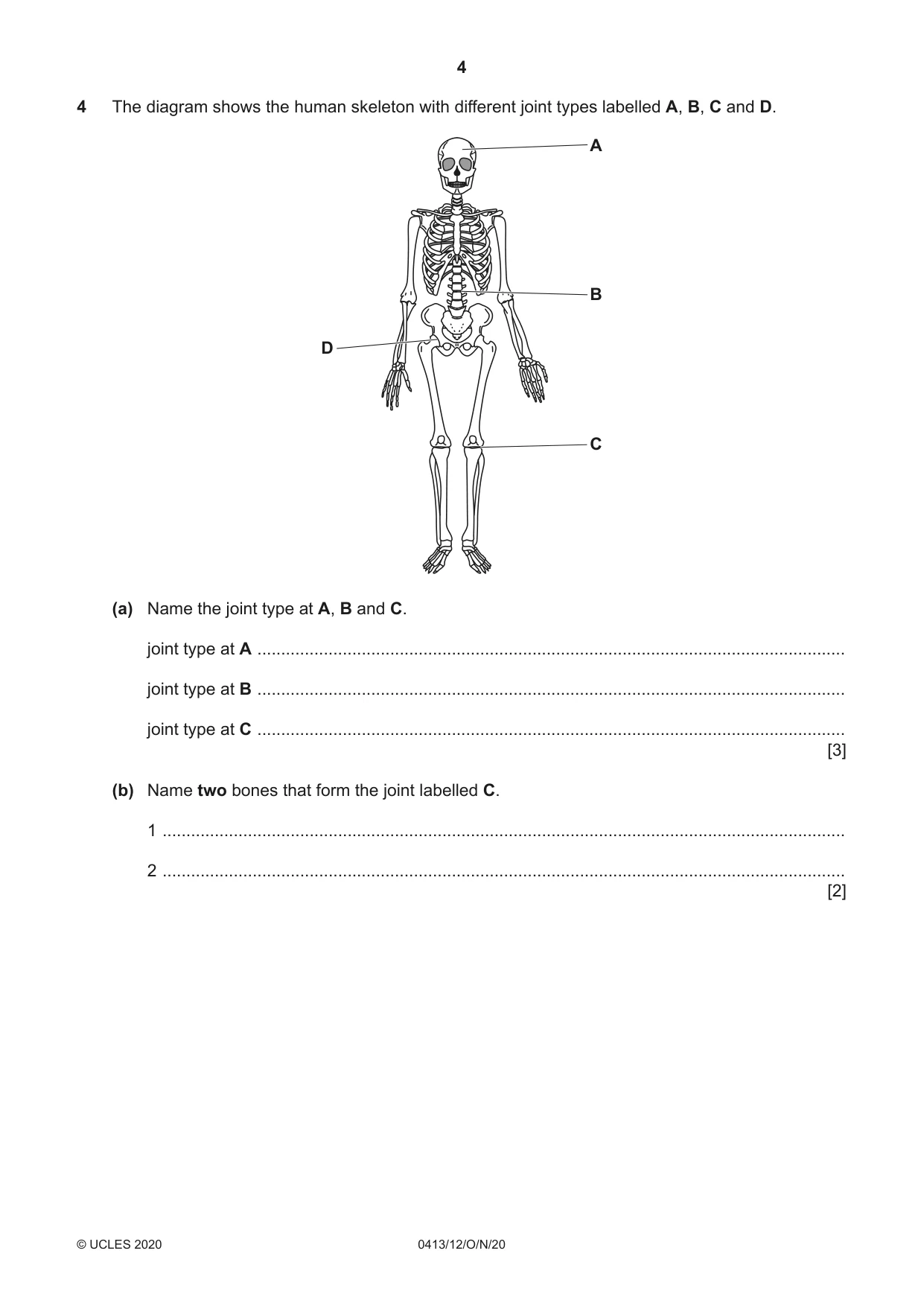
4 0413/12/O/N/20 © UCLES 2020 4 The diagram shows the human skeleton with different joint types labelled A, B, C and D. B D A C (a) Name the joint type at A, B and C. joint type at A … joint type at B … joint type at C … [3] (b) Name two bones that form the joint labelled C. 1 … 2 … [2]
Question paper, page 5
5 0413/12/O/N/20 © UCLES 2020 [Turn over (c) Describe different functions of three named components of the joint type found at both C and D. component 1 … function … … component 2 … function … … component 3 … function … … [6] (d) Describe the difference between the joints labelled C and D in terms of their range of movement and stability. … … … … [2] [Total: 13] 5 Describe, using two examples, how taking part in regular physical activity can improve a person’s social health and well-being. 1 … … 2 … … [2]
Question paper, page 6
6 0413/12/O/N/20 © UCLES 2020 6 The photograph shows a swimming stroke, which can be classified as a closed skill. (a) Explain why this skill can be classified as a closed skill on the open–closed continuum. … … … … [2] (b) Classify this skill on two other named continua. Justify each of your answers. continuum 1 … classification … justification … … continuum 2 … classification … justification … … [4] [Total: 6]
Question paper, page 7
7 0413/12/O/N/20 © UCLES 2020 [Turn over 7 (a) Suggest three factors that may influence whether a young performer participates in a physical activity. 1 … … 2 … … 3 … … [3] (b) Describe examples of two named characteristics of a skilled performance in a named physical activity. physical activity … characteristic 1 … example … … characteristic 2 … example … … [4] (c) Identify, using examples from one named physical activity, how two named types of guidance could be used to develop skilled performance. physical activity … type of guidance 1 … example … … type of guidance 2 … example … … [4] [Total: 11]
Question paper, page 8
8 0413/12/O/N/20 © UCLES 2020 8 (a) Describe the three phases of a warm up. phase 1 … … phase 2 … … phase 3 … … [3] (b) Using a named physical activity, describe a suitable exercise for each phase of a warm up. physical activity … phase 1 … … phase 2 … … phase 3 … … [3] (c) Suggest two different psychological benefits that a cool down can provide for a performer. 1 … … 2 … … [2] [Total: 8]
Question paper, page 9
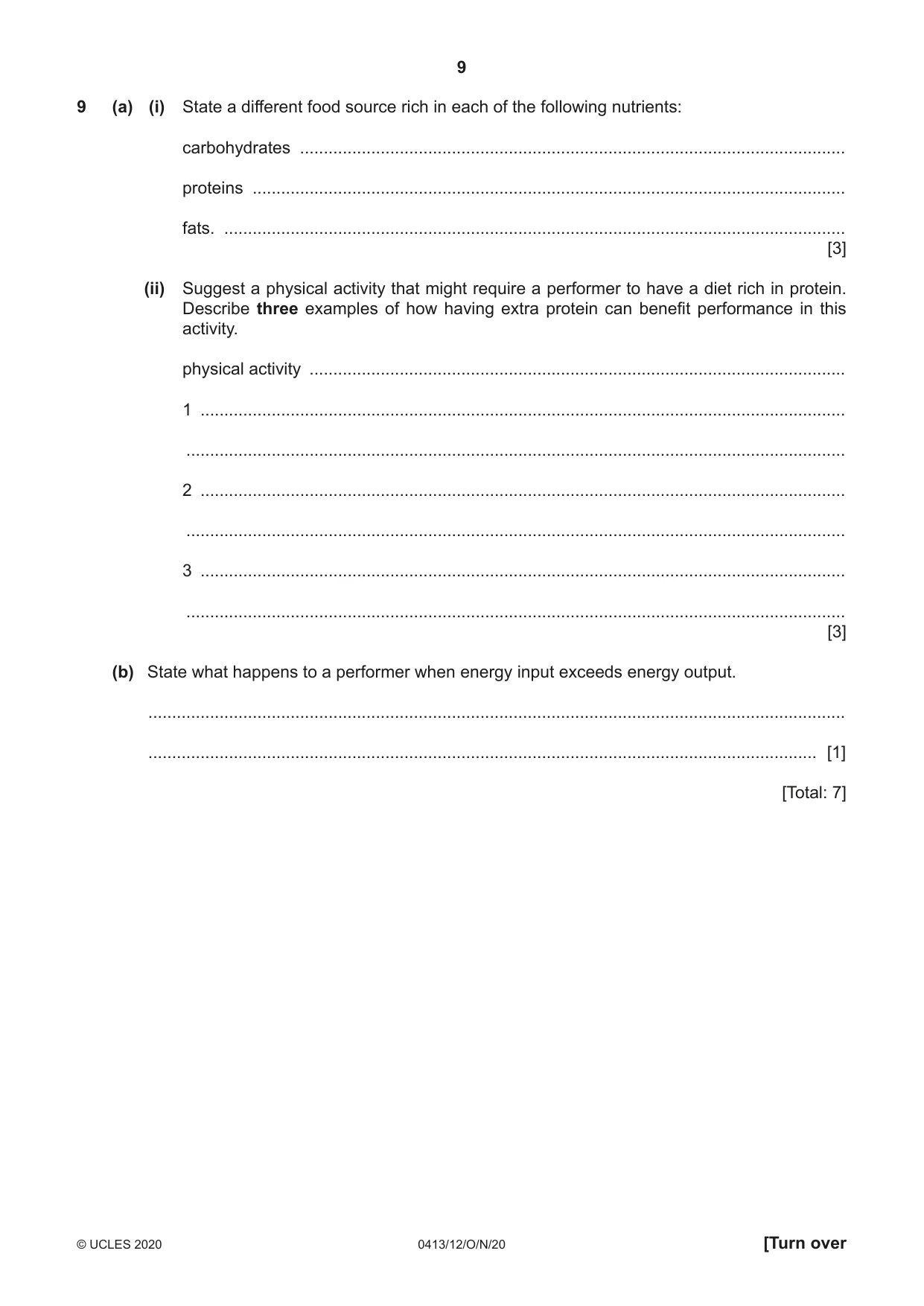
9 0413/12/O/N/20 © UCLES 2020 [Turn over 9 (a) (i) State a different food source rich in each of the following nutrients: carbohydrates … proteins … fats. … [3] (ii) Suggest a physical activity that might require a performer to have a diet rich in protein. Describe three examples of how having extra protein can benefit performance in this activity. physical activity … 1 … … 2 … … 3 … … [3] (b) State what happens to a performer when energy input exceeds energy output. … … [1] [Total: 7]
Question paper, page 10
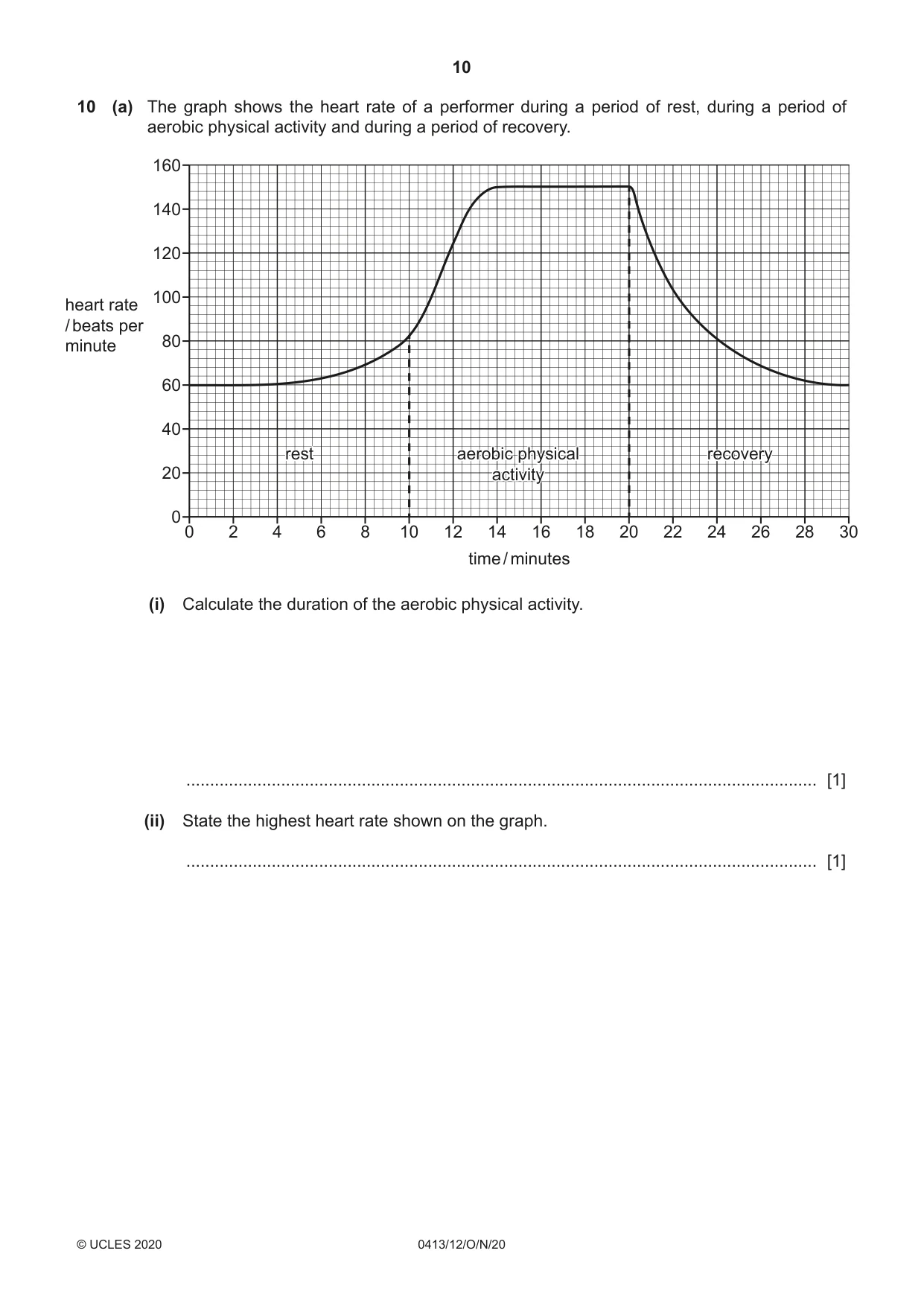
10 0413/12/O/N/20 © UCLES 2020 10 (a) The graph shows the heart rate of a performer during a period of rest, during a period of aerobic physical activity and during a period of recovery. 0 0 20 40 60 80 100 120 140 160 2 4 6 8 10 12 14 16 time / minutes heart rate / beats per minute 18 20 22 24 26 28 30 rest aerobic physical activity recovery rest aerobic physical activity recovery (i) Calculate the duration of the aerobic physical activity. … [1] (ii) State the highest heart rate shown on the graph. … [1]
Question paper, page 11
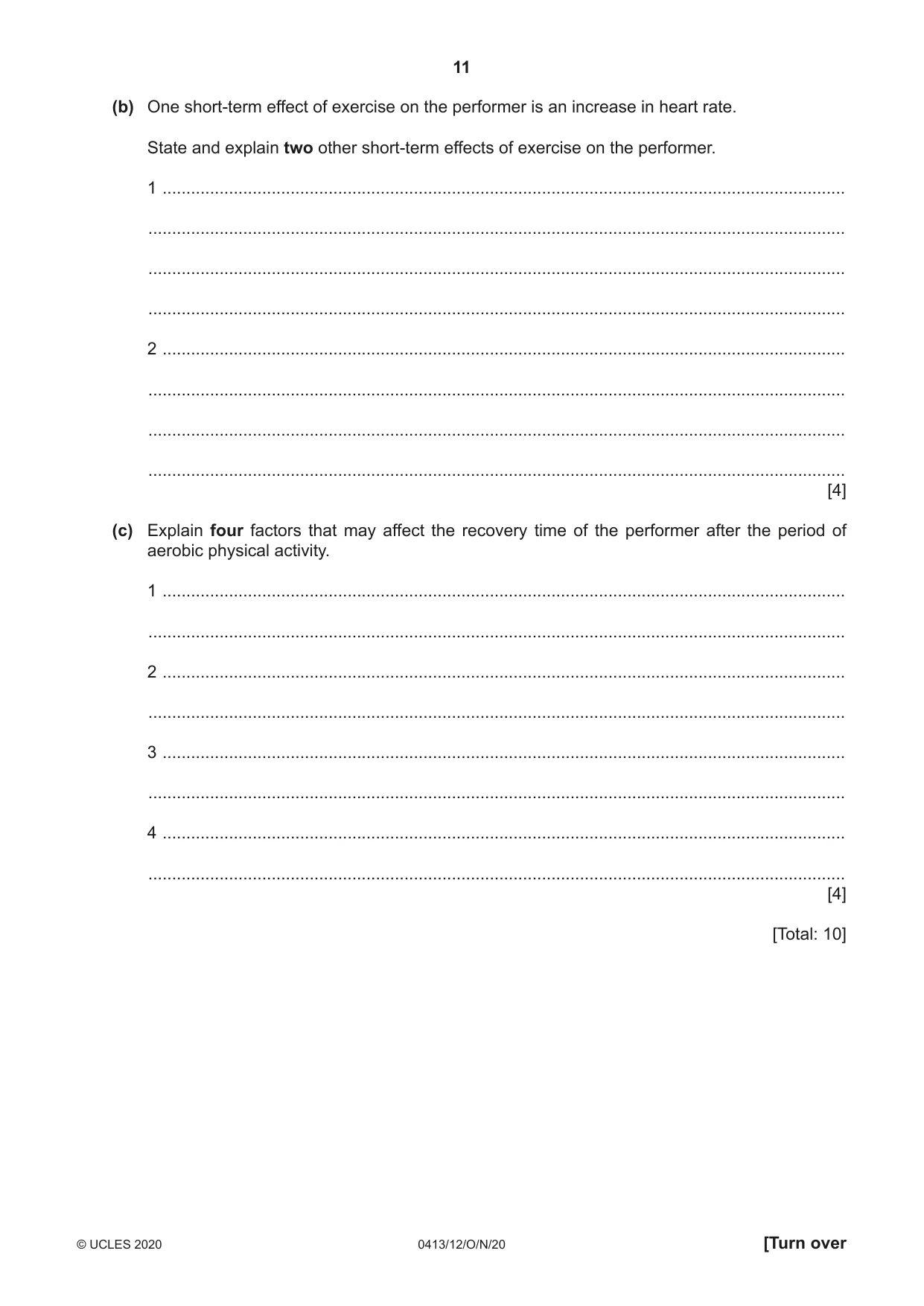
11 0413/12/O/N/20 © UCLES 2020 [Turn over (b) One short-term effect of exercise on the performer is an increase in heart rate. State and explain two other short-term effects of exercise on the performer. 1 … … … … 2 … … … … [4] (c) Explain four factors that may affect the recovery time of the performer after the period of aerobic physical activity. 1 … … 2 … … 3 … … 4 … … [4] [Total: 10]
Question paper, page 12
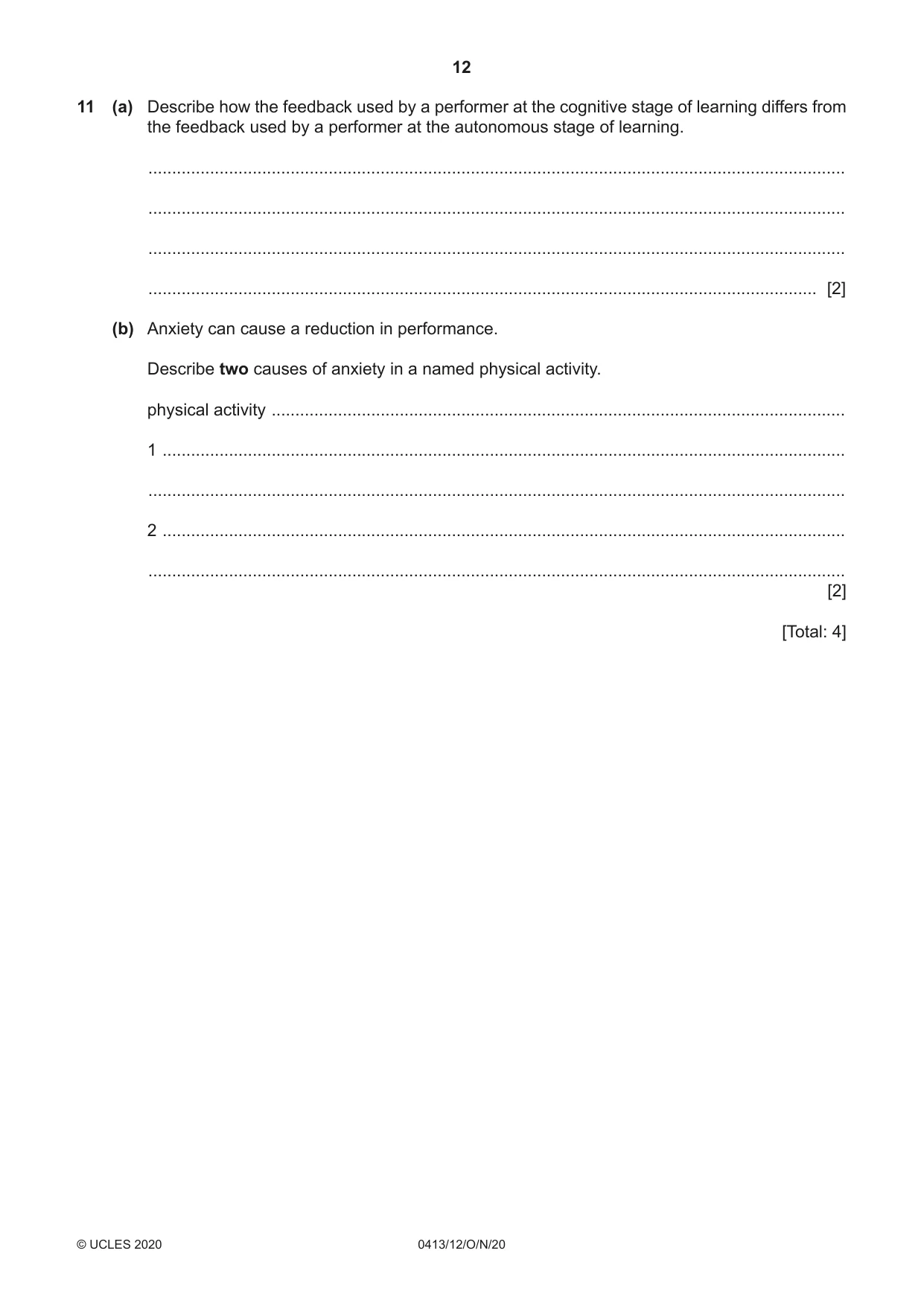
12 0413/12/O/N/20 © UCLES 2020 11 (a) Describe how the feedback used by a performer at the cognitive stage of learning differs from the feedback used by a performer at the autonomous stage of learning. … … … … [2] (b) Anxiety can cause a reduction in performance. Describe two causes of anxiety in a named physical activity. physical activity … 1 … … 2 … … [2] [Total: 4]
Question paper, page 13
13 0413/12/O/N/20 © UCLES 2020 [Turn over 12 (a) Describe what is meant by residual volume. … … [1] (b) Explain the functions of two named muscles involved in normal breathing. muscle 1 … explanation … … … muscle 2 … explanation … … … [4] (c) Explain three characteristics of the alveoli that enable gaseous exchange to take place. 1 … … … … 2 … … … … 3 … … … … [6] [Total: 11]
Question paper, page 14
14 0413/12/O/N/20 © UCLES 2020 13 The photograph shows a group sailing, which is an outdoor and adventurous activity with some level of risk. (a) Explain the terms real risk and perceived risk. real risk … … perceived risk … … [2] (b) Complete the table to suggest different strategies to reduce each risk. risk strategy to reduce risk boat capsizes causing the performers to fall into the water injury while sailing collisions with other boats [3] [Total: 5]
Question paper, page 15
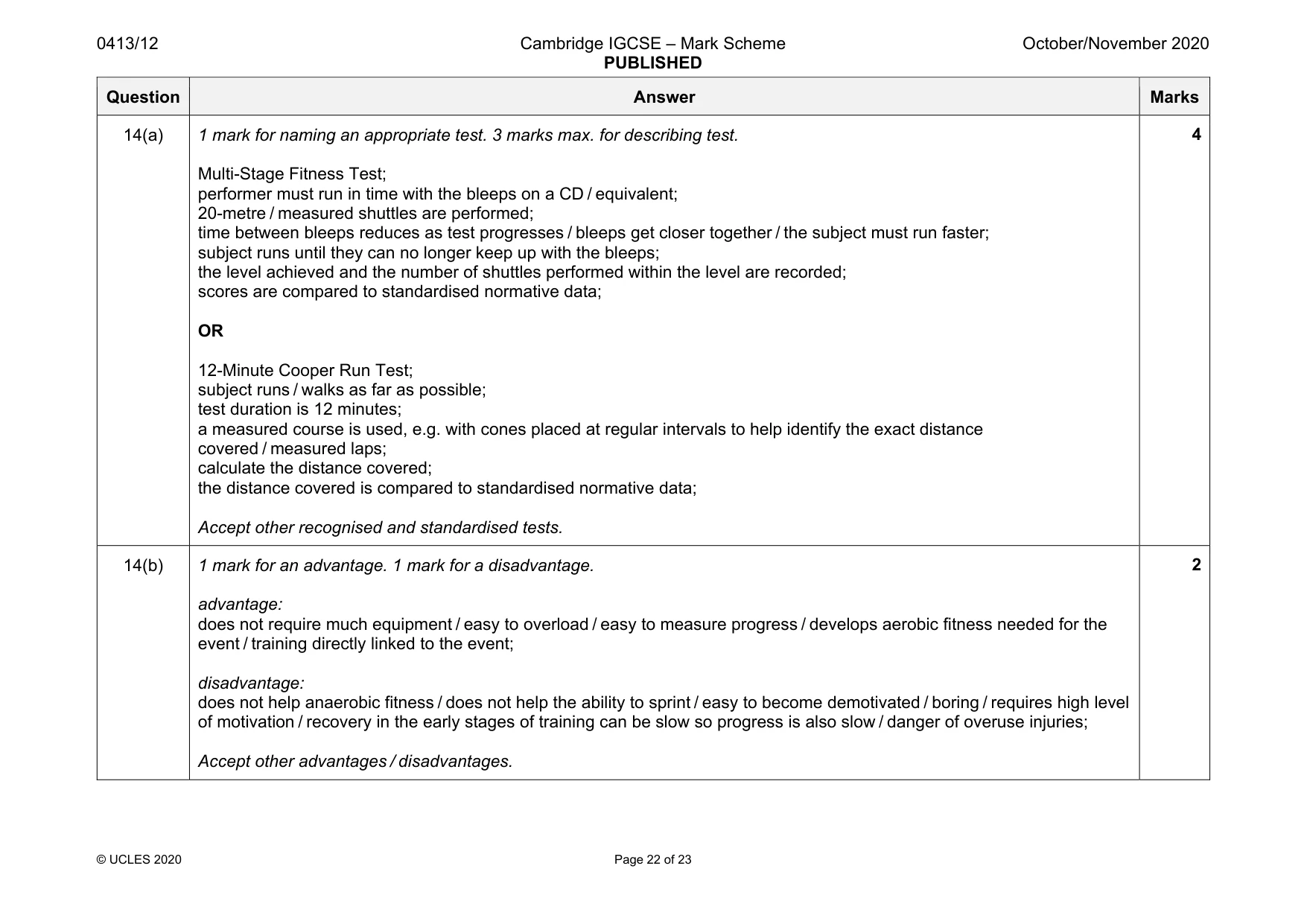
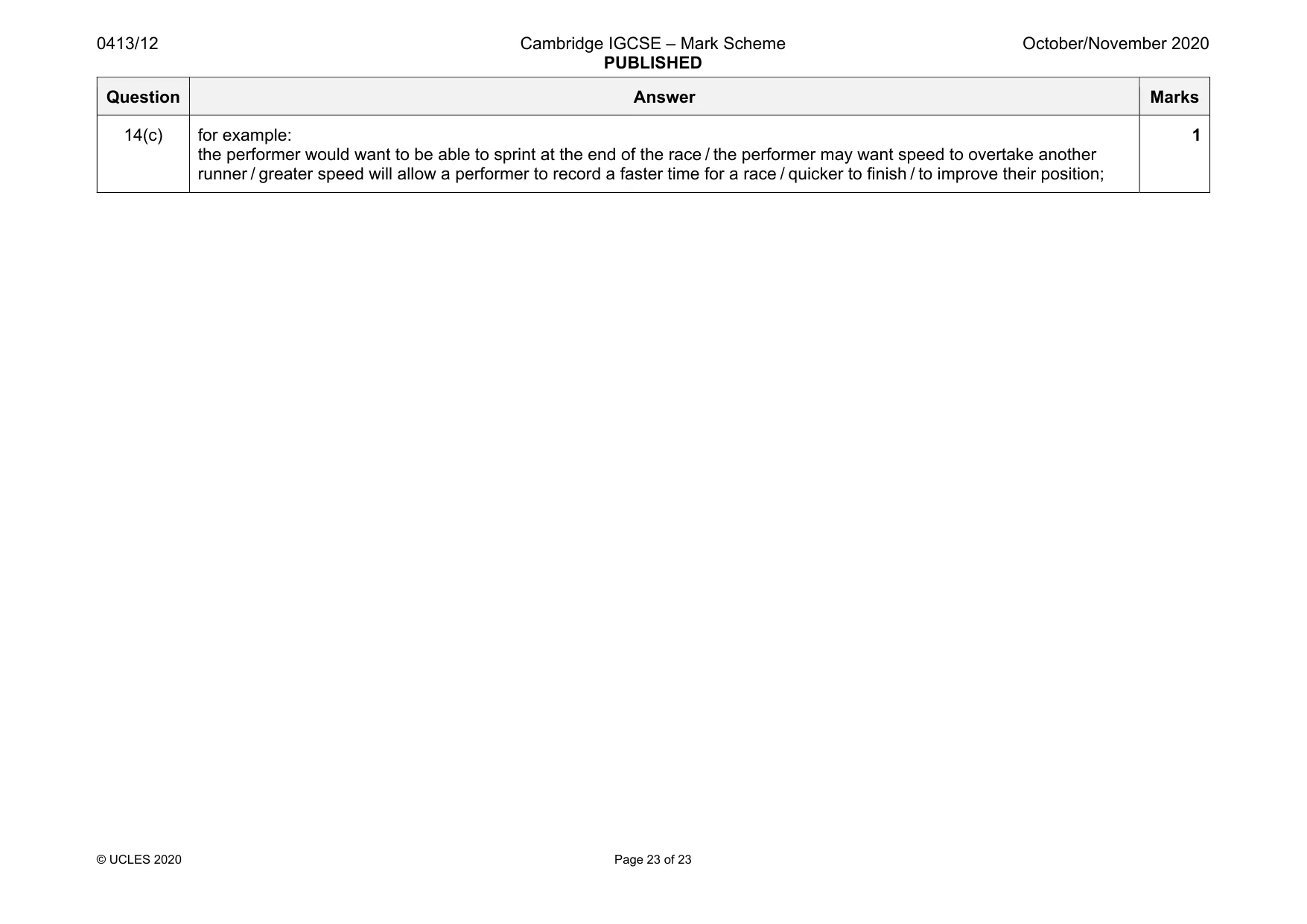
15 0413/12/O/N/20 © UCLES 2020 14 A performer joins a running club to improve their fitness in preparation to run in a local long-distance race. Before the performer takes part in a training programme a coach tests their cardiovascular endurance. (a) Name and describe a test to measure the cardiovascular endurance of the performer. name of test … description … … … … … … … … [4] (b) Continuous training is a suitable method of training for improving cardiovascular endurance. State one advantage and one disadvantage of continuous training. advantage … disadvantage … [2] (c) Suggest why the performer may also wish to improve their speed. … … [1] [Total: 7]
Question paper, page 16
16 0413/12/O/N/20 © UCLES 2020 Permission to reproduce items where third-party owned material protected by copyright is included has been sought and cleared where possible. Every reasonable effort has been made by the publisher (UCLES) to trace copyright holders, but if any items requiring clearance have unwittingly been included, the publisher will be pleased to make amends at the earliest possible opportunity. To avoid the issue of disclosure of answer-related information to candidates, all copyright acknowledgements are reproduced online in the Cambridge Assessment International Education Copyright Acknowledgements Booklet. This is produced for each series of examinations and is freely available to download at www.cambridgeinternational.org after the live examination series. Cambridge Assessment International Education is part of the Cambridge Assessment Group. Cambridge Assessment is the brand name of the University of Cambridge Local Examinations Syndicate (UCLES), which itself is a department of the University of Cambridge. BLANK PAGE
Mark scheme, page 1
This document consists of 23 printed pages. © UCLES 2020 [Turn over Cambridge IGCSE™ PHYSICAL EDUCATION 0413/12 Paper 1 Theory October/November 2020 MARK SCHEME Maximum Mark: 100 Published This mark scheme is published as an aid to teachers and candidates, to indicate the requirements of the examination. It shows the basis on which Examiners were instructed to award marks. It does not indicate the details of the discussions that took place at an Examiners’ meeting before marking began, which would have considered the acceptability of alternative answers. Mark schemes should be read in conjunction with the question paper and the Principal Examiner Report for Teachers. Cambridge International will not enter into discussions about these mark schemes. Cambridge International is publishing the mark schemes for the October/November 2020 series for most Cambridge IGCSE™, Cambridge International A and AS Level and Cambridge Pre-U components, and some Cambridge O Level components.
Mark scheme, page 2
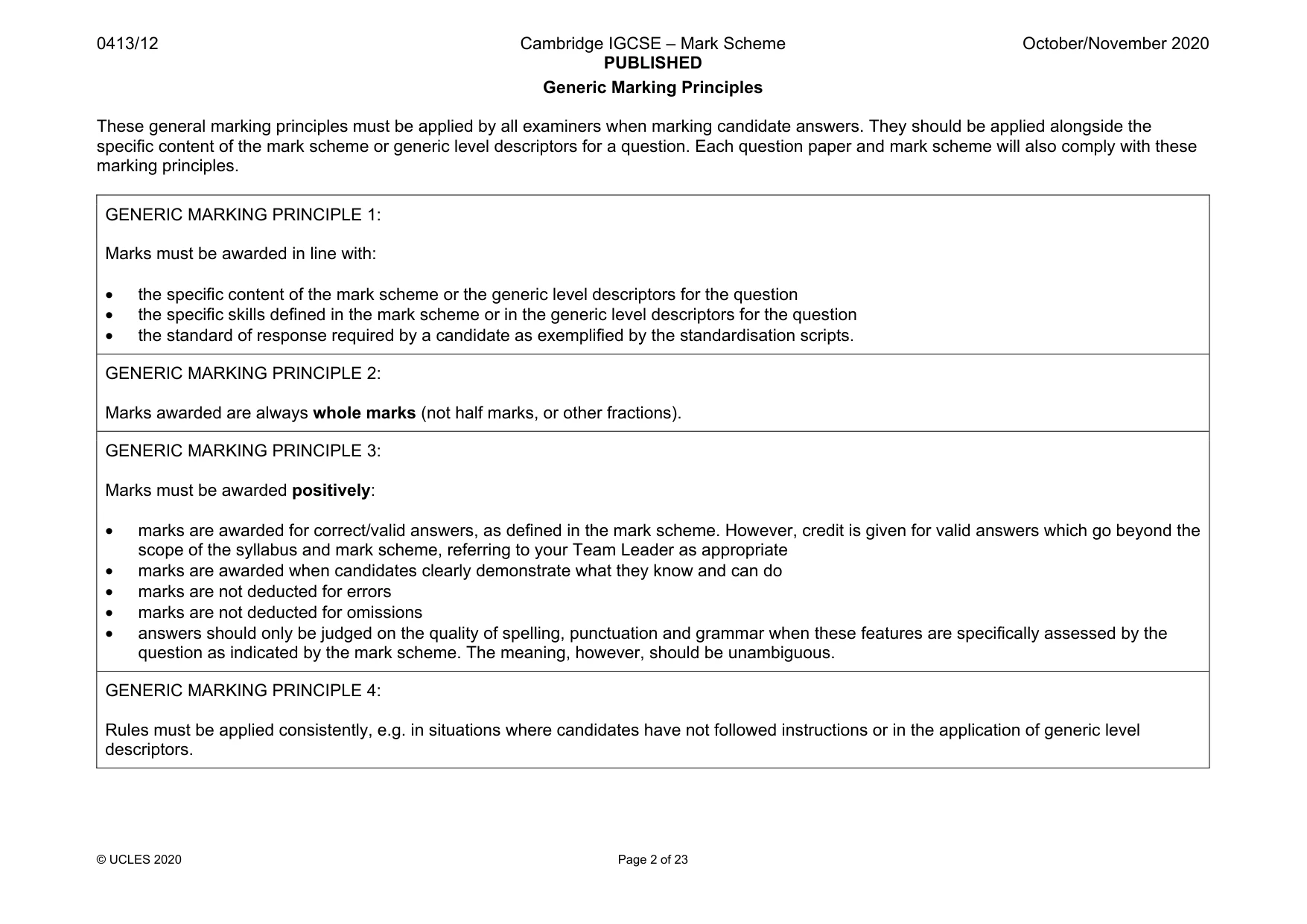
0413/12 Cambridge IGCSE – Mark Scheme PUBLISHED October/November 2020 © UCLES 2020 Page 2 of 23 Generic Marking Principles These general marking principles must be applied by all examiners when marking candidate answers. They should be applied alongside the specific content of the mark scheme or generic level descriptors for a question. Each question paper and mark scheme will also comply with these marking principles. GENERIC MARKING PRINCIPLE 1: Marks must be awarded in line with: • the specific content of the mark scheme or the generic level descriptors for the question • the specific skills defined in the mark scheme or in the generic level descriptors for the question • the standard of response required by a candidate as exemplified by the standardisation scripts. GENERIC MARKING PRINCIPLE 2: Marks awarded are always whole marks (not half marks, or other fractions). GENERIC MARKING PRINCIPLE 3: Marks must be awarded positively: • marks are awarded for correct/valid answers, as defined in the mark scheme. However, credit is given for valid answers which go beyond the scope of the syllabus and mark scheme, referring to your Team Leader as appropriate • marks are awarded when candidates clearly demonstrate what they know and can do • marks are not deducted for errors • marks are not deducted for omissions • answers should only be judged on the quality of spelling, punctuation and grammar when these features are specifically assessed by the question as indicated by the mark scheme. The meaning, however, should be unambiguous. GENERIC MARKING PRINCIPLE 4: Rules must be applied consistently, e.g. in situations where candidates have not followed instructions or in the application of generic level descriptors.
Mark scheme, page 3
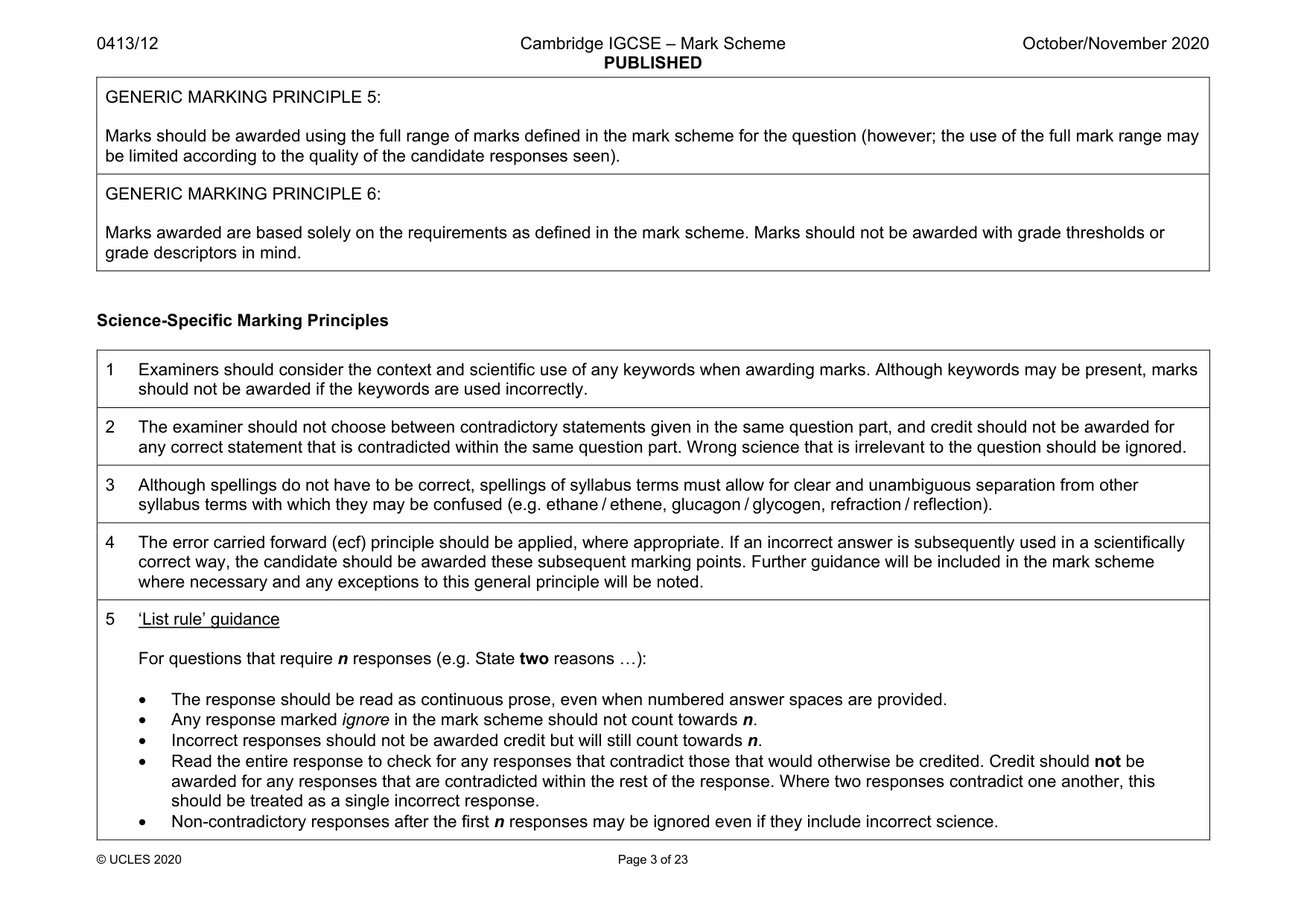
0413/12 Cambridge IGCSE – Mark Scheme PUBLISHED October/November 2020 © UCLES 2020 Page 3 of 23 GENERIC MARKING PRINCIPLE 5: Marks should be awarded using the full range of marks defined in the mark scheme for the question (however; the use of the full mark range may be limited according to the quality of the candidate responses seen). GENERIC MARKING PRINCIPLE 6: Marks awarded are based solely on the requirements as defined in the mark scheme. Marks should not be awarded with grade thresholds or grade descriptors in mind. Science-Specific Marking Principles 1 Examiners should consider the context and scientific use of any keywords when awarding marks. Although keywords may be present, marks should not be awarded if the keywords are used incorrectly. 2 The examiner should not choose between contradictory statements given in the same question part, and credit should not be awarded for any correct statement that is contradicted within the same question part. Wrong science that is irrelevant to the question should be ignored. 3 Although spellings do not have to be correct, spellings of syllabus terms must allow for clear and unambiguous separation from other syllabus terms with which they may be confused (e.g. ethane / ethene, glucagon / glycogen, refraction / reflection). 4 The error carried forward (ecf) principle should be applied, where appropriate. If an incorrect answer is subsequently used in a scientifically correct way, the candidate should be awarded these subsequent marking points. Further guidance will be included in the mark scheme where necessary and any exceptions to this general principle will be noted. 5 ‘List rule’ guidance For questions that require n responses (e.g. State two reasons …): • The response should be read as continuous prose, even when numbered answer spaces are provided. • Any response marked ignore in the mark scheme should not count towards n. • Incorrect responses should not be awarded credit but will still count towards n. • Read the entire response to check for any responses that contradict those that would otherwise be credited. Credit should not be awarded for any responses that are contradicted within the rest of the response. Where two responses contradict one another, this should be treated as a single incorrect response. • Non-contradictory responses after the first n responses may be ignored even if they include incorrect science.
Mark scheme, page 4
0413/12 Cambridge IGCSE – Mark Scheme PUBLISHED October/November 2020 © UCLES 2020 Page 4 of 23 6 Calculation specific guidance Correct answers to calculations should be given full credit even if there is no working or incorrect working, unless the question states ‘show your working’. For questions in which the number of significant figures required is not stated, credit should be awarded for correct answers when rounded by the examiner to the number of significant figures given in the mark scheme. This may not apply to measured values. For answers given in standard form (e.g. a × 10n) in which the convention of restricting the value of the coefficient (a) to a value between 1 and 10 is not followed, credit may still be awarded if the answer can be converted to the answer given in the mark scheme. Unless a separate mark is given for a unit, a missing or incorrect unit will normally mean that the final calculation mark is not awarded. Exceptions to this general principle will be noted in the mark scheme. 7 Guidance for chemical equations Multiples / fractions of coefficients used in chemical equations are acceptable unless stated otherwise in the mark scheme. State symbols given in an equation should be ignored unless asked for in the question or stated otherwise in the mark scheme.
Mark scheme, page 5
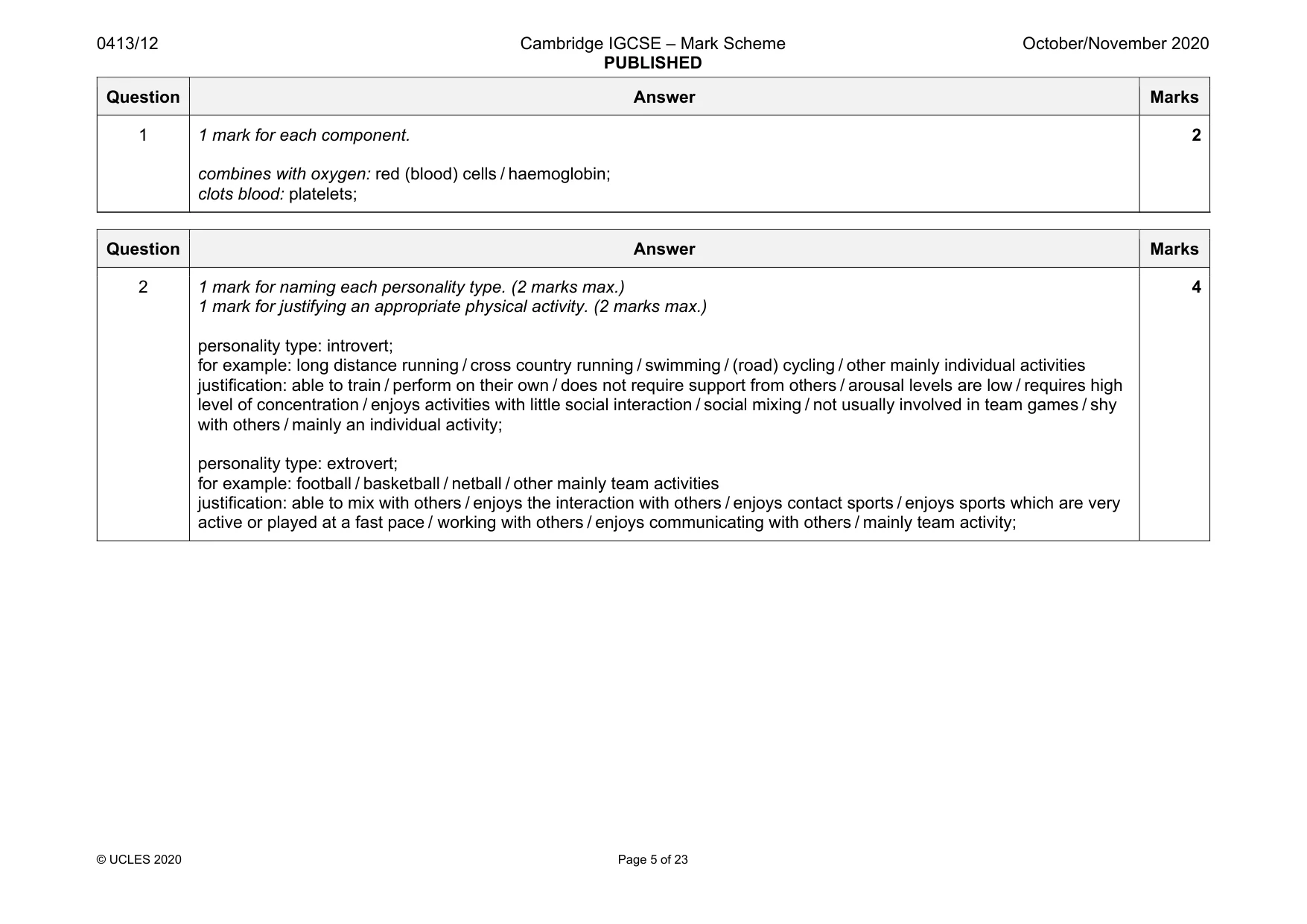
0413/12 Cambridge IGCSE – Mark Scheme PUBLISHED October/November 2020 © UCLES 2020 Page 5 of 23 Question Answer Marks 1 1 mark for each component. combines with oxygen: red (blood) cells / haemoglobin; clots blood: platelets; 2 Question Answer Marks 2 1 mark for naming each personality type. (2 marks max.) 1 mark for justifying an appropriate physical activity. (2 marks max.) personality type: introvert; for example: long distance running / cross country running / swimming / (road) cycling / other mainly individual activities justification: able to train / perform on their own / does not require support from others / arousal levels are low / requires high level of concentration / enjoys activities with little social interaction / social mixing / not usually involved in team games / shy with others / mainly an individual activity; personality type: extrovert; for example: football / basketball / netball / other mainly team activities justification: able to mix with others / enjoys the interaction with others / enjoys contact sports / enjoys sports which are very active or played at a fast pace / working with others / enjoys communicating with others / mainly team activity; 4
Mark scheme, page 6
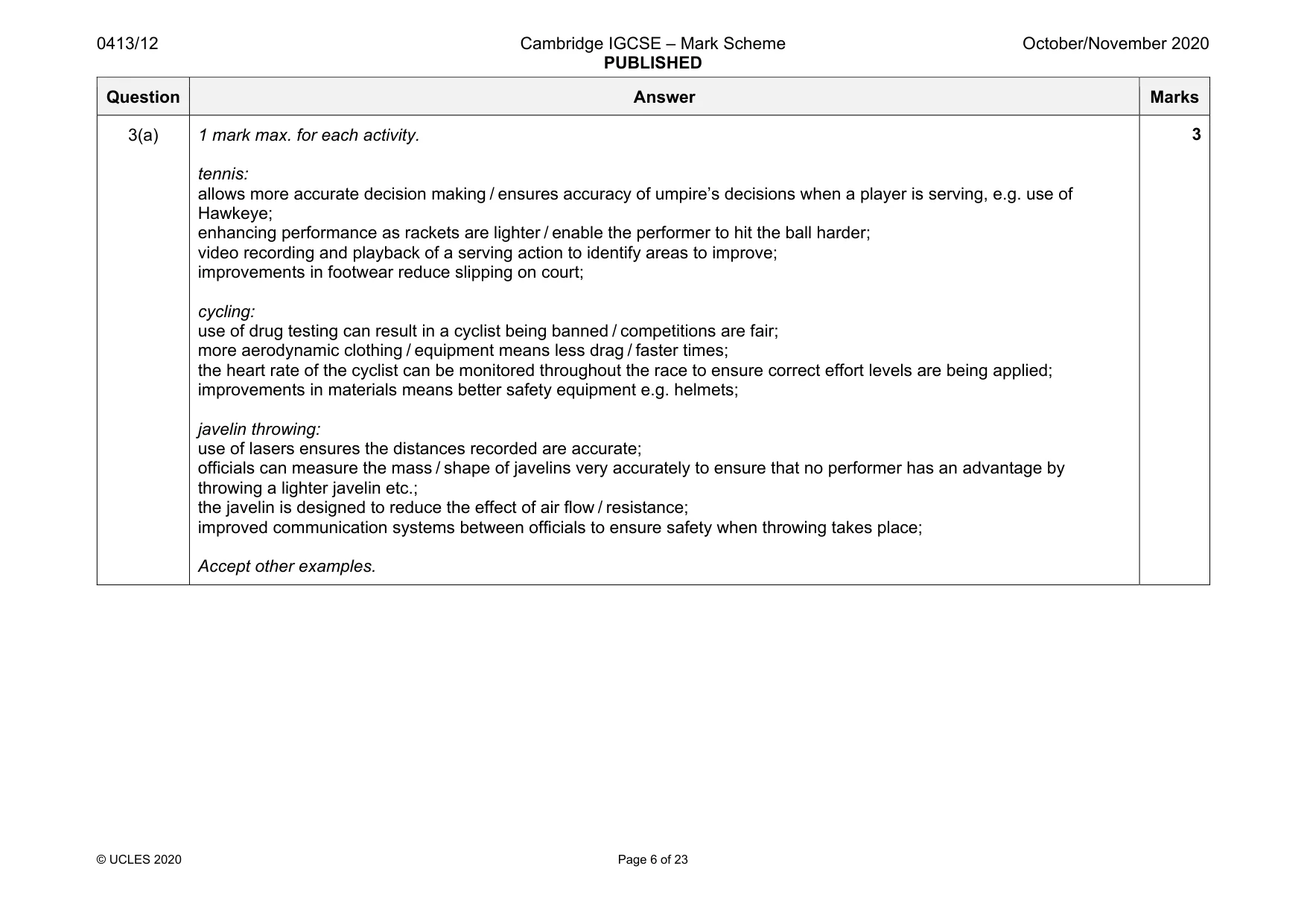
0413/12 Cambridge IGCSE – Mark Scheme PUBLISHED October/November 2020 © UCLES 2020 Page 6 of 23 Question Answer Marks 3(a) 1 mark max. for each activity. tennis: allows more accurate decision making / ensures accuracy of umpire’s decisions when a player is serving, e.g. use of Hawkeye; enhancing performance as rackets are lighter / enable the performer to hit the ball harder; video recording and playback of a serving action to identify areas to improve; improvements in footwear reduce slipping on court; cycling: use of drug testing can result in a cyclist being banned / competitions are fair; more aerodynamic clothing / equipment means less drag / faster times; the heart rate of the cyclist can be monitored throughout the race to ensure correct effort levels are being applied; improvements in materials means better safety equipment e.g. helmets; javelin throwing: use of lasers ensures the distances recorded are accurate; officials can measure the mass / shape of javelins very accurately to ensure that no performer has an advantage by throwing a lighter javelin etc.; the javelin is designed to reduce the effect of air flow / resistance; improved communication systems between officials to ensure safety when throwing takes place; Accept other examples. 3
Mark scheme, page 7
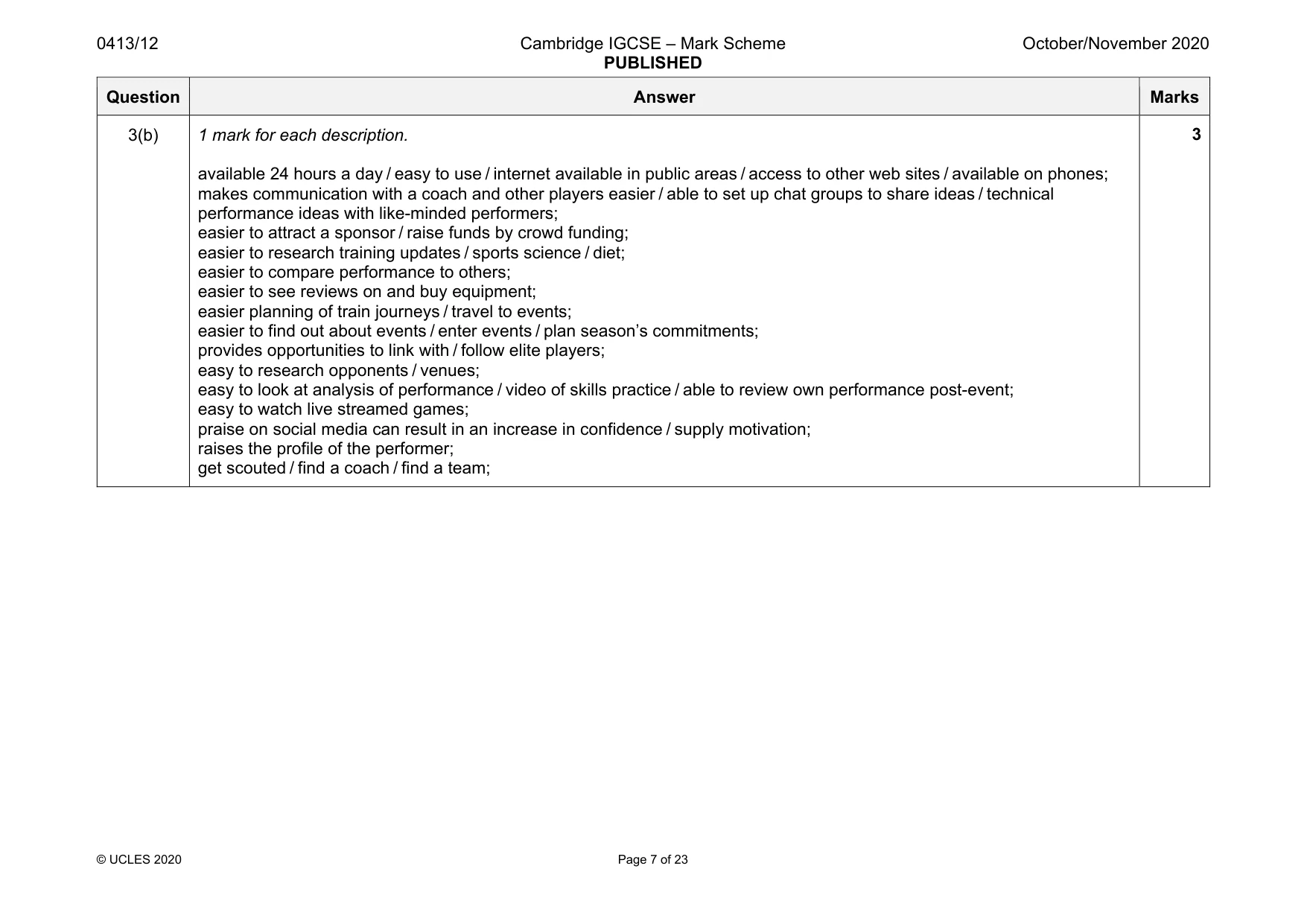
0413/12 Cambridge IGCSE – Mark Scheme PUBLISHED October/November 2020 © UCLES 2020 Page 7 of 23 Question Answer Marks 3(b) 1 mark for each description. available 24 hours a day / easy to use / internet available in public areas / access to other web sites / available on phones; makes communication with a coach and other players easier / able to set up chat groups to share ideas / technical performance ideas with like-minded performers; easier to attract a sponsor / raise funds by crowd funding; easier to research training updates / sports science / diet; easier to compare performance to others; easier to see reviews on and buy equipment; easier planning of train journeys / travel to events; easier to find out about events / enter events / plan season’s commitments; provides opportunities to link with / follow elite players; easy to research opponents / venues; easy to look at analysis of performance / video of skills practice / able to review own performance post-event; easy to watch live streamed games; praise on social media can result in an increase in confidence / supply motivation; raises the profile of the performer; get scouted / find a coach / find a team; 3
Mark scheme, page 8
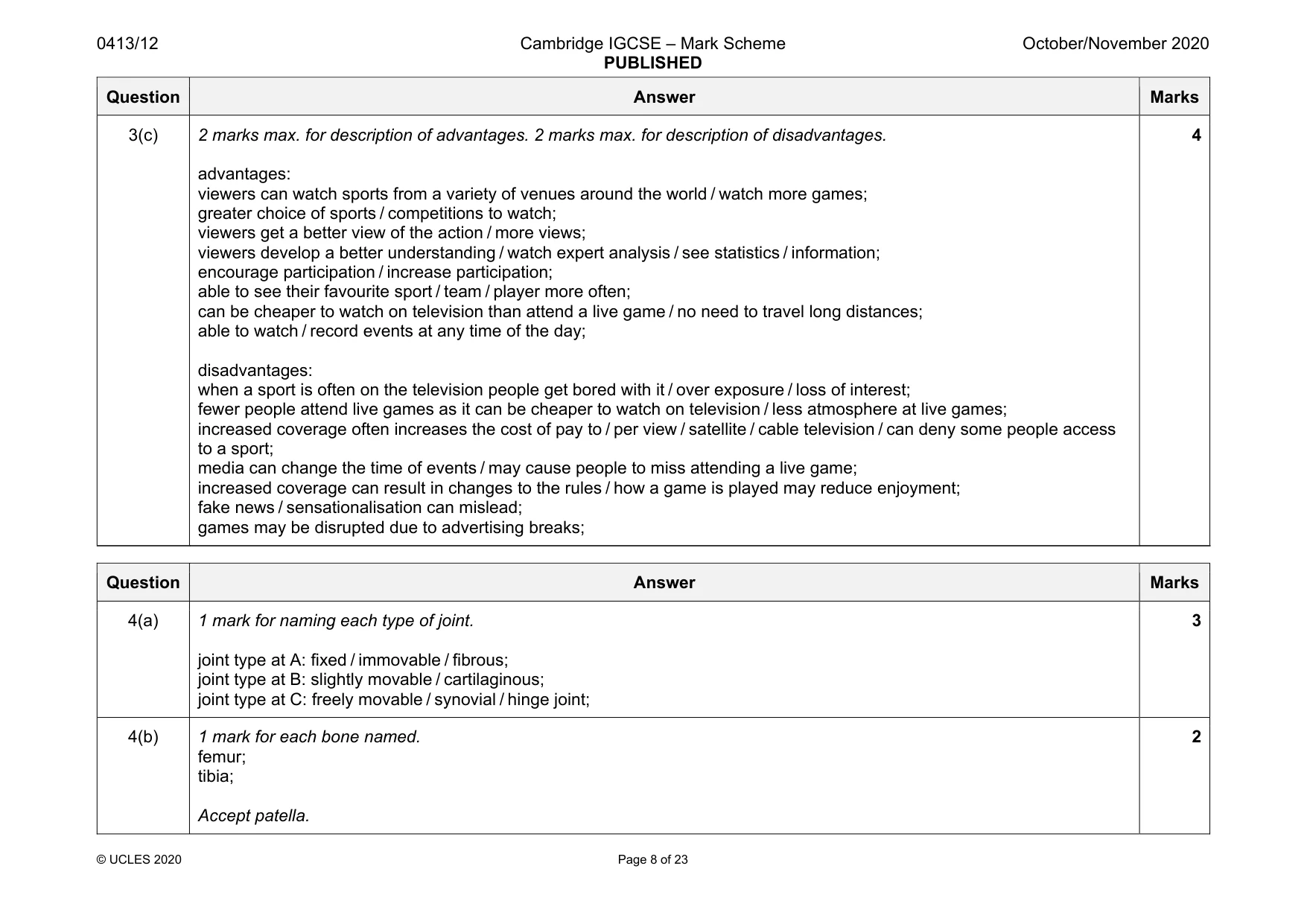
0413/12 Cambridge IGCSE – Mark Scheme PUBLISHED October/November 2020 © UCLES 2020 Page 8 of 23 Question Answer Marks 3(c) 2 marks max. for description of advantages. 2 marks max. for description of disadvantages. advantages: viewers can watch sports from a variety of venues around the world / watch more games; greater choice of sports / competitions to watch; viewers get a better view of the action / more views; viewers develop a better understanding / watch expert analysis / see statistics / information; encourage participation / increase participation; able to see their favourite sport / team / player more often; can be cheaper to watch on television than attend a live game / no need to travel long distances; able to watch / record events at any time of the day; disadvantages: when a sport is often on the television people get bored with it / over exposure / loss of interest; fewer people attend live games as it can be cheaper to watch on television / less atmosphere at live games; increased coverage often increases the cost of pay to / per view / satellite / cable television / can deny some people access to a sport; media can change the time of events / may cause people to miss attending a live game; increased coverage can result in changes to the rules / how a game is played may reduce enjoyment; fake news / sensationalisation can mislead; games may be disrupted due to advertising breaks; 4 Question Answer Marks 4(a) 1 mark for naming each type of joint. joint type at A: fixed / immovable / fibrous; joint type at B: slightly movable / cartilaginous; joint type at C: freely movable / synovial / hinge joint; 3 4(b) 1 mark for each bone named. femur; tibia; Accept patella. 2
Mark scheme, page 9
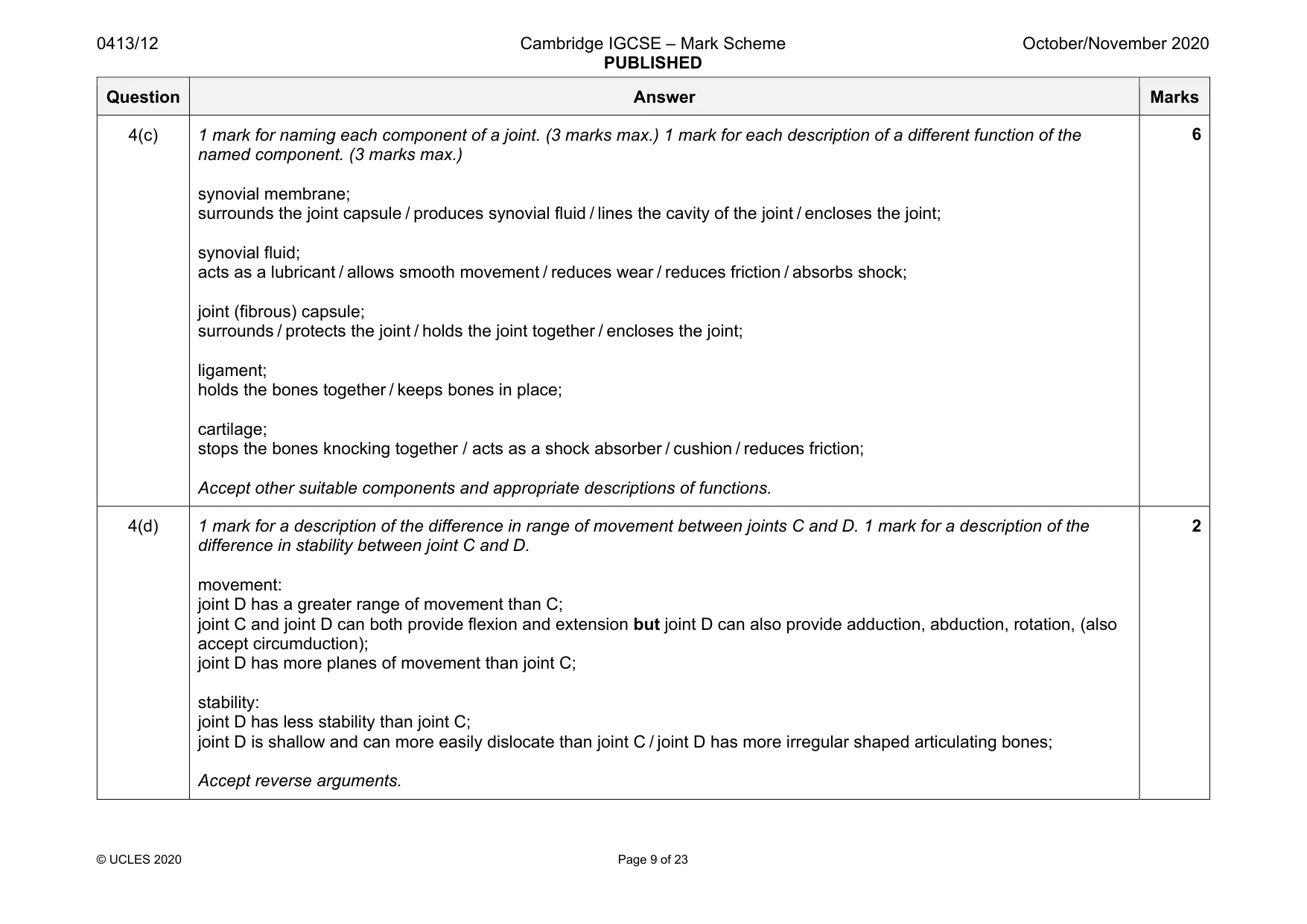
0413/12 Cambridge IGCSE – Mark Scheme PUBLISHED October/November 2020 © UCLES 2020 Page 9 of 23 Question Answer Marks 4(c) 1 mark for naming each component of a joint. (3 marks max.) 1 mark for each description of a different function of the named component. (3 marks max.) synovial membrane; surrounds the joint capsule / produces synovial fluid / lines the cavity of the joint / encloses the joint; synovial fluid; acts as a lubricant / allows smooth movement / reduces wear / reduces friction / absorbs shock; joint (fibrous) capsule; surrounds / protects the joint / holds the joint together / encloses the joint; ligament; holds the bones together / keeps bones in place; cartilage; stops the bones knocking together / acts as a shock absorber / cushion / reduces friction; Accept other suitable components and appropriate descriptions of functions. 6 4(d) 1 mark for a description of the difference in range of movement between joints C and D. 1 mark for a description of the difference in stability between joint C and D. movement: joint D has a greater range of movement than C; joint C and joint D can both provide flexion and extension but joint D can also provide adduction, abduction, rotation, (also accept circumduction); joint D has more planes of movement than joint C; stability: joint D has less stability than joint C; joint D is shallow and can more easily dislocate than joint C / joint D has more irregular shaped articulating bones; Accept reverse arguments. 2
Mark scheme, page 10
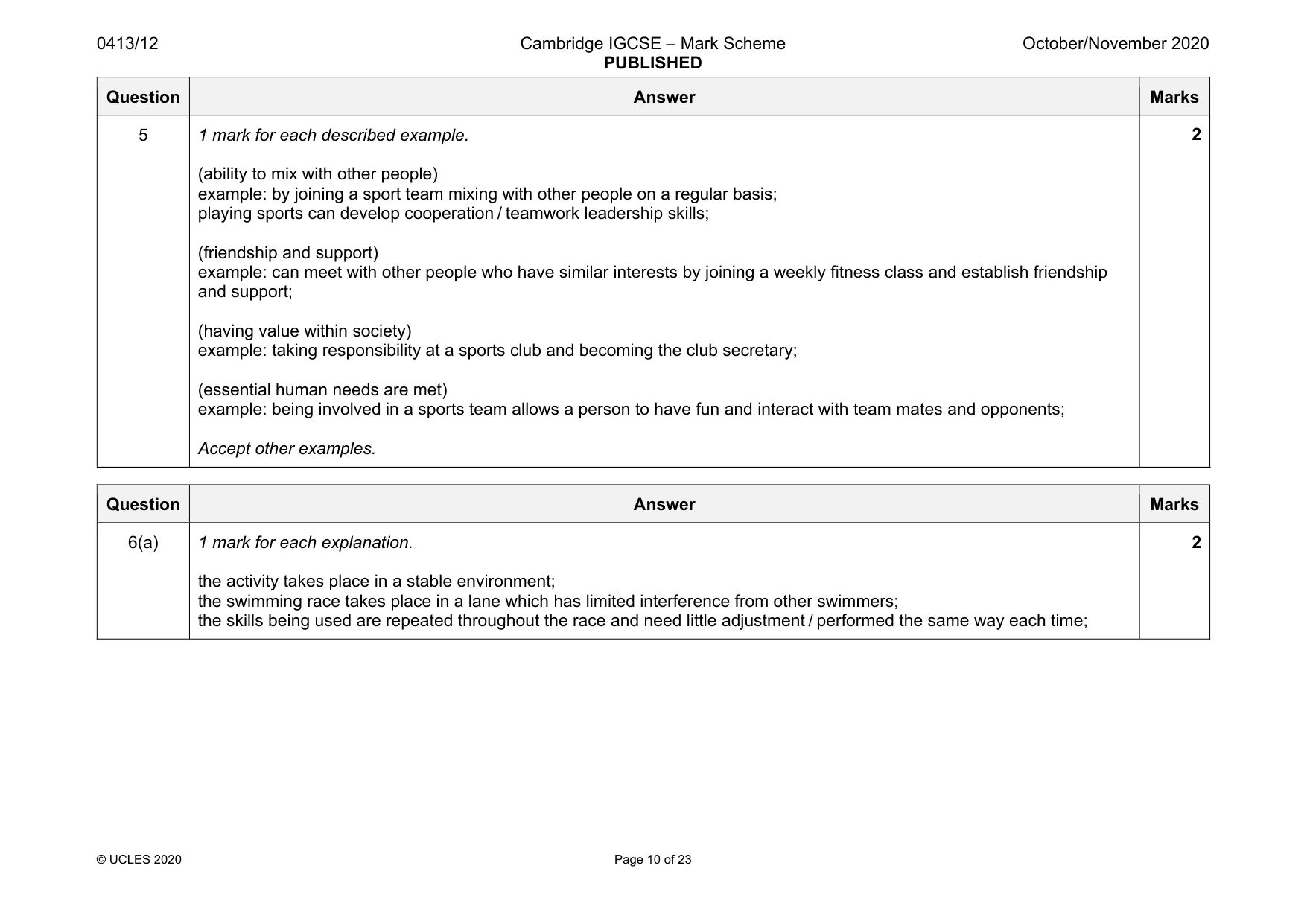
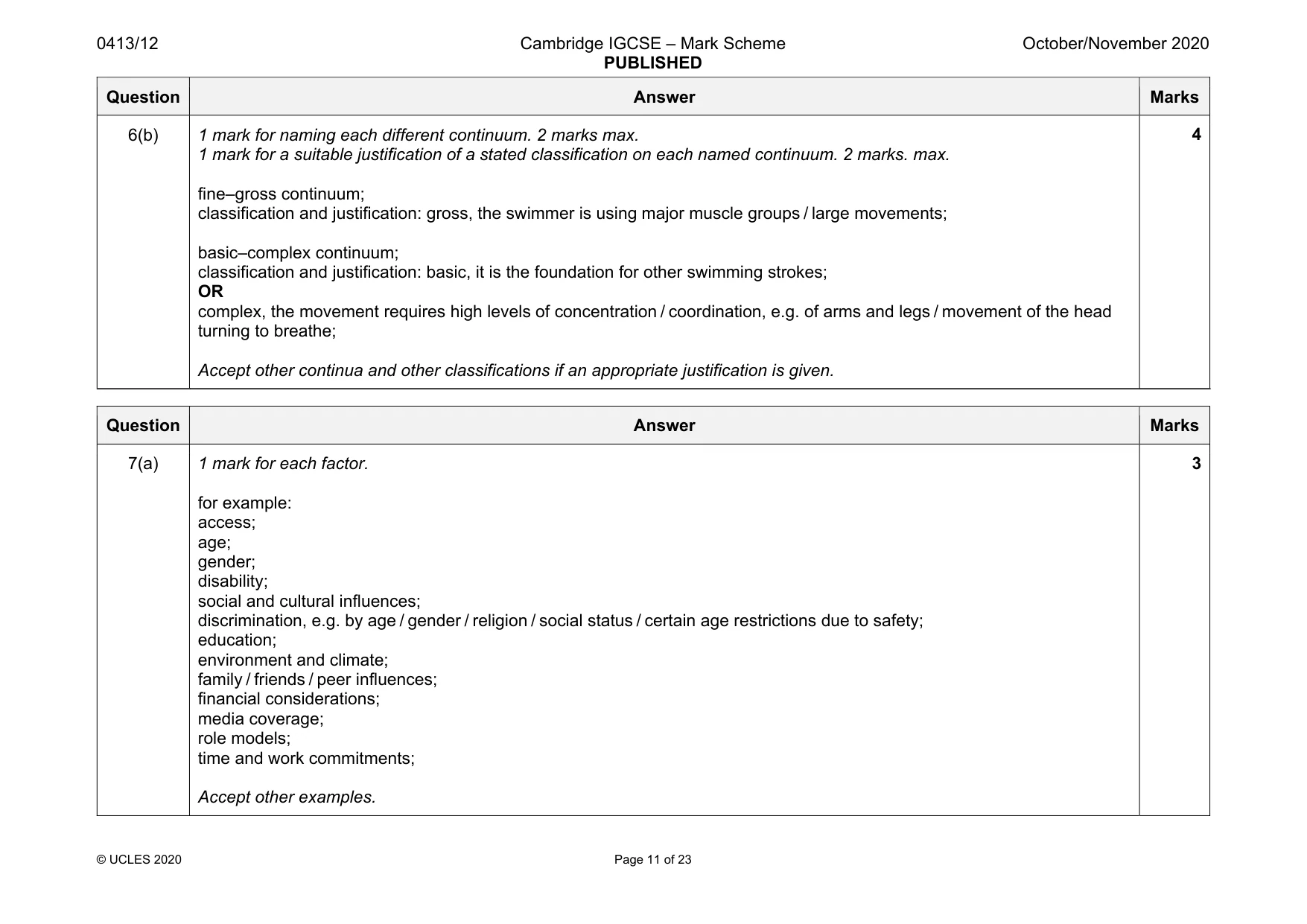
0413/12 Cambridge IGCSE – Mark Scheme PUBLISHED October/November 2020 © UCLES 2020 Page 10 of 23 Question Answer Marks 5 1 mark for each described example. (ability to mix with other people) example: by joining a sport team mixing with other people on a regular basis; playing sports can develop cooperation / teamwork leadership skills; (friendship and support) example: can meet with other people who have similar interests by joining a weekly fitness class and establish friendship and support; (having value within society) example: taking responsibility at a sports club and becoming the club secretary; (essential human needs are met) example: being involved in a sports team allows a person to have fun and interact with team mates and opponents; Accept other examples. 2 Question Answer Marks 6(a) 1 mark for each explanation. the activity takes place in a stable environment; the swimming race takes place in a lane which has limited interference from other swimmers; the skills being used are repeated throughout the race and need little adjustment / performed the same way each time; 2
Mark scheme, page 11
0413/12 Cambridge IGCSE – Mark Scheme PUBLISHED October/November 2020 © UCLES 2020 Page 11 of 23 Question Answer Marks 6(b) 1 mark for naming each different continuum. 2 marks max. 1 mark for a suitable justification of a stated classification on each named continuum. 2 marks. max. fine–gross continuum; classification and justification: gross, the swimmer is using major muscle groups / large movements; basic–complex continuum; classification and justification: basic, it is the foundation for other swimming strokes; OR complex, the movement requires high levels of concentration / coordination, e.g. of arms and legs / movement of the head turning to breathe; Accept other continua and other classifications if an appropriate justification is given. 4 Question Answer Marks 7(a) 1 mark for each factor. for example: access; age; gender; disability; social and cultural influences; discrimination, e.g. by age / gender / religion / social status / certain age restrictions due to safety; education; environment and climate; family / friends / peer influences; financial considerations; media coverage; role models; time and work commitments; Accept other examples. 3
Mark scheme, page 12
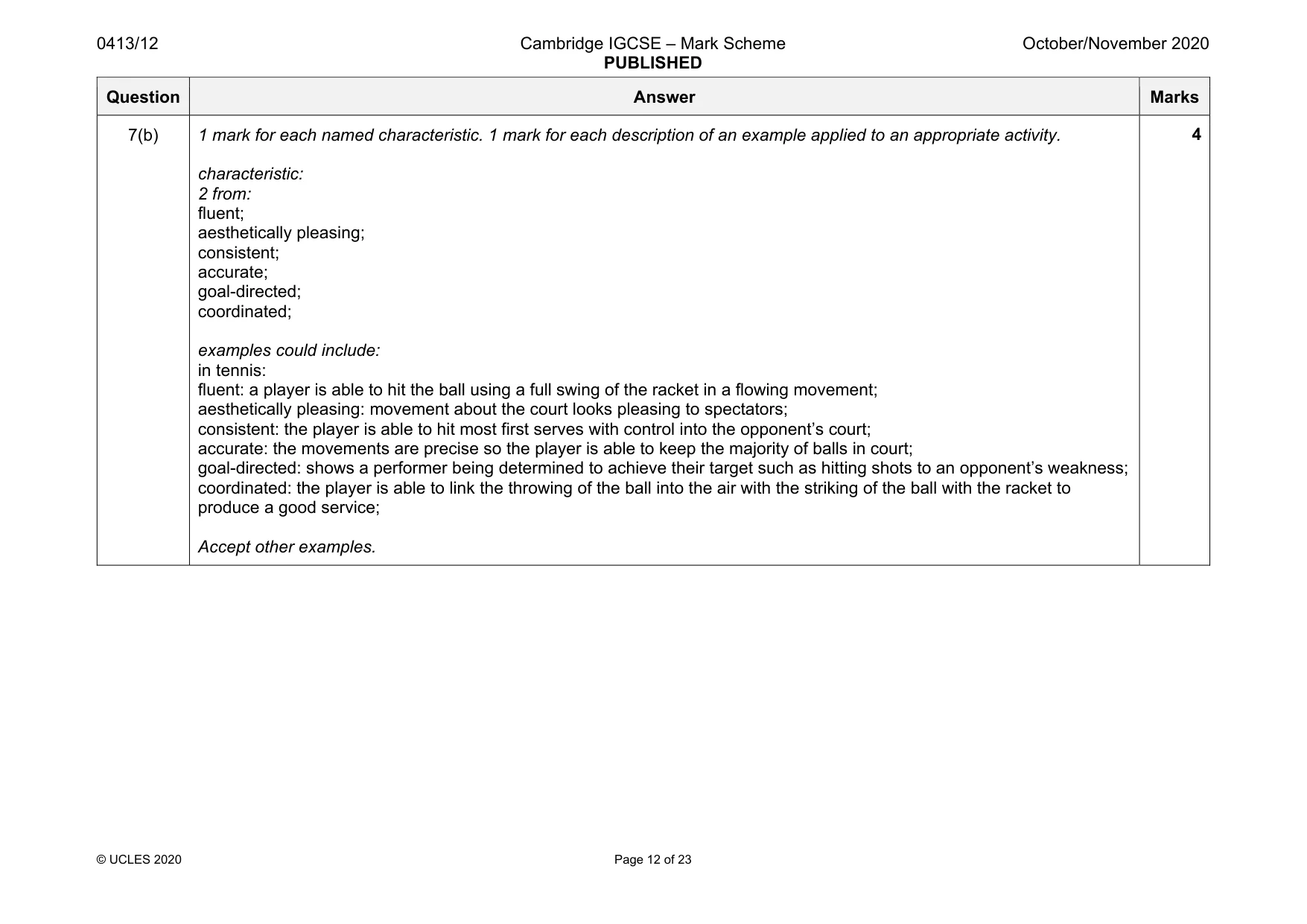
0413/12 Cambridge IGCSE – Mark Scheme PUBLISHED October/November 2020 © UCLES 2020 Page 12 of 23 Question Answer Marks 7(b) 1 mark for each named characteristic. 1 mark for each description of an example applied to an appropriate activity. characteristic: 2 from: fluent; aesthetically pleasing; consistent; accurate; goal-directed; coordinated; examples could include: in tennis: fluent: a player is able to hit the ball using a full swing of the racket in a flowing movement; aesthetically pleasing: movement about the court looks pleasing to spectators; consistent: the player is able to hit most first serves with control into the opponent’s court; accurate: the movements are precise so the player is able to keep the majority of balls in court; goal-directed: shows a performer being determined to achieve their target such as hitting shots to an opponent’s weakness; coordinated: the player is able to link the throwing of the ball into the air with the striking of the ball with the racket to produce a good service; Accept other examples. 4
Mark scheme, page 13
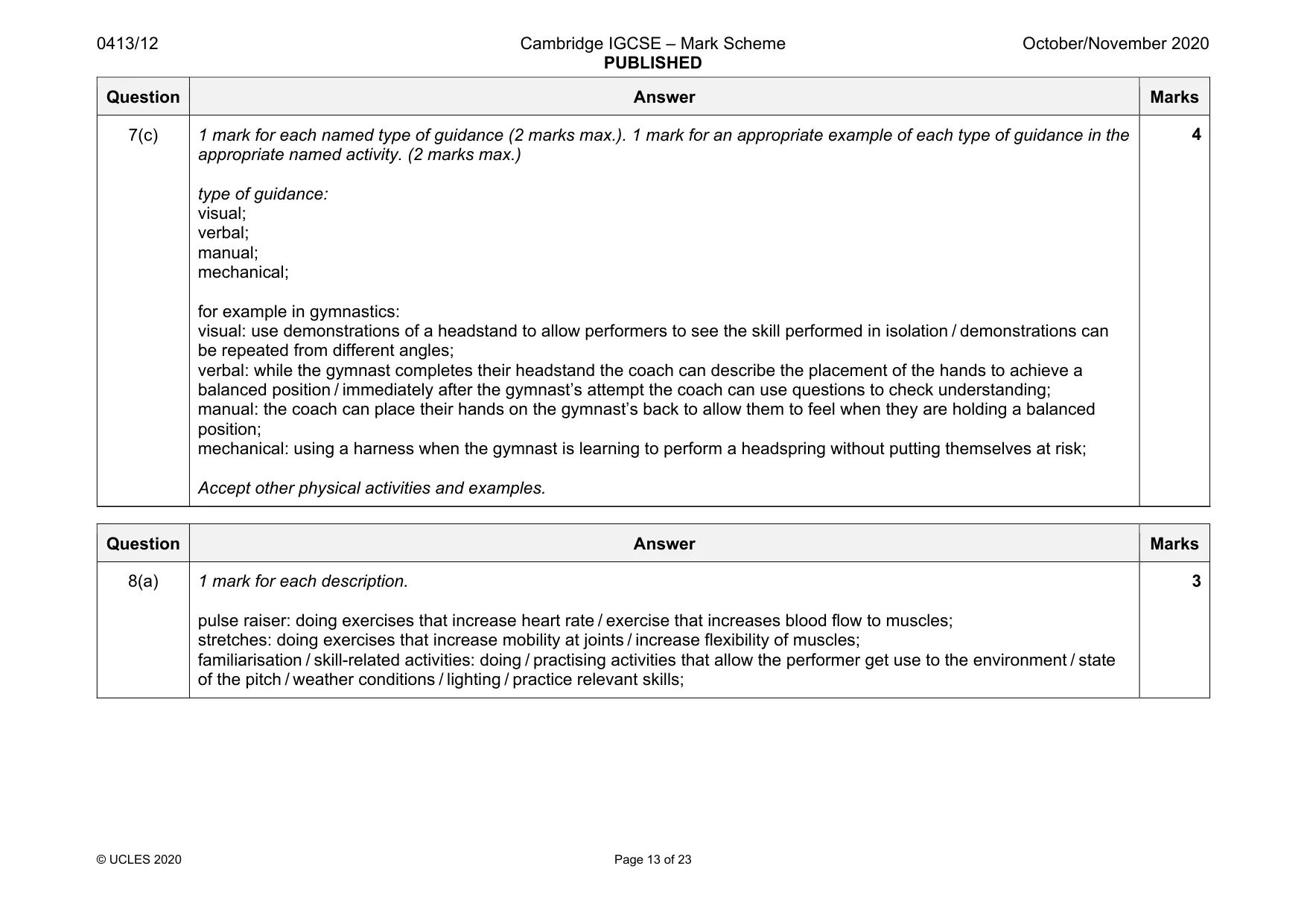
0413/12 Cambridge IGCSE – Mark Scheme PUBLISHED October/November 2020 © UCLES 2020 Page 13 of 23 Question Answer Marks 7(c) 1 mark for each named type of guidance (2 marks max.). 1 mark for an appropriate example of each type of guidance in the appropriate named activity. (2 marks max.) type of guidance: visual; verbal; manual; mechanical; for example in gymnastics: visual: use demonstrations of a headstand to allow performers to see the skill performed in isolation / demonstrations can be repeated from different angles; verbal: while the gymnast completes their headstand the coach can describe the placement of the hands to achieve a balanced position / immediately after the gymnast’s attempt the coach can use questions to check understanding; manual: the coach can place their hands on the gymnast’s back to allow them to feel when they are holding a balanced position; mechanical: using a harness when the gymnast is learning to perform a headspring without putting themselves at risk; Accept other physical activities and examples. 4 Question Answer Marks 8(a) 1 mark for each description. pulse raiser: doing exercises that increase heart rate / exercise that increases blood flow to muscles; stretches: doing exercises that increase mobility at joints / increase flexibility of muscles; familiarisation / skill-related activities: doing / practising activities that allow the performer get use to the environment / state of the pitch / weather conditions / lighting / practice relevant skills; 3
Mark scheme, page 14
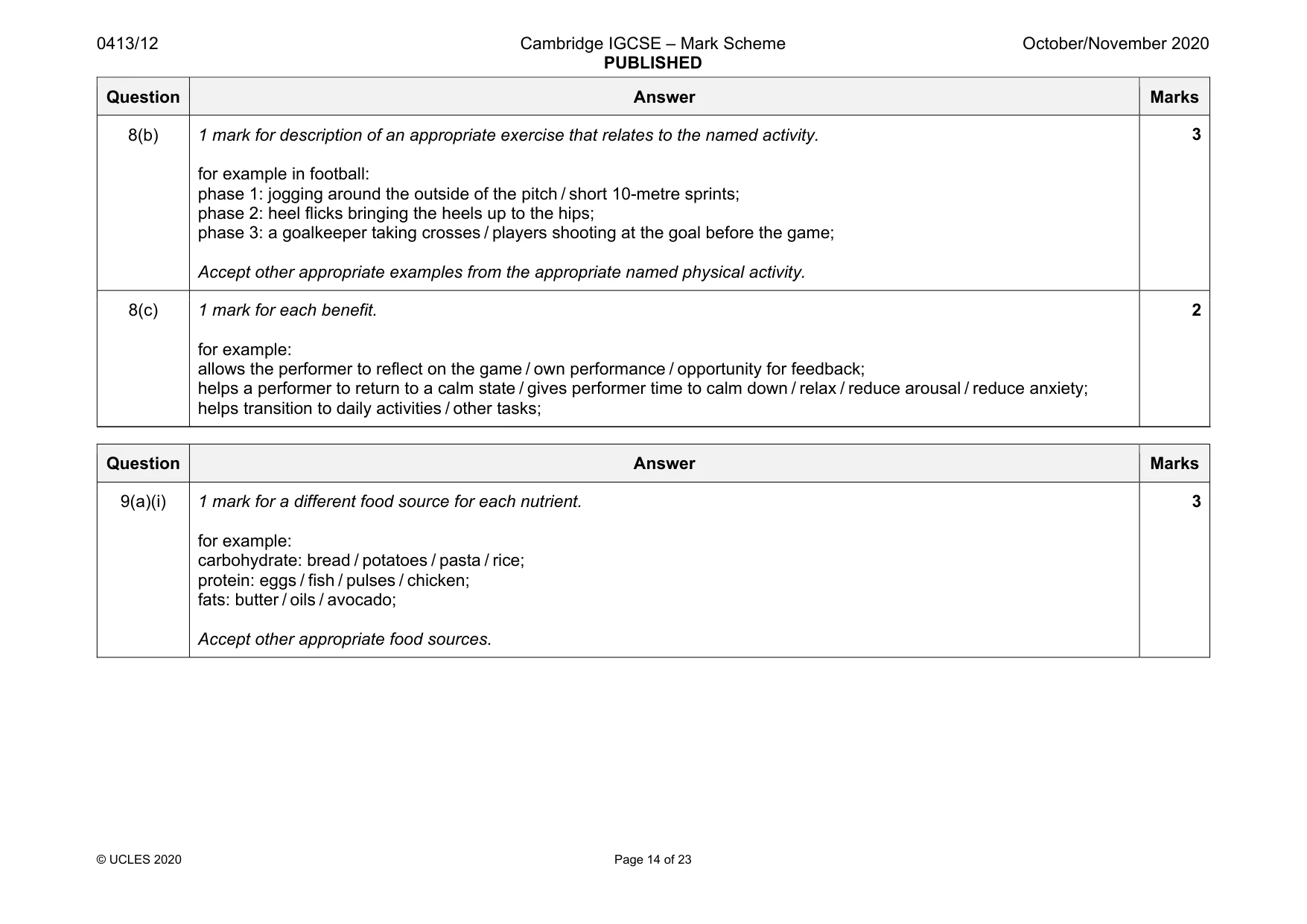
0413/12 Cambridge IGCSE – Mark Scheme PUBLISHED October/November 2020 © UCLES 2020 Page 14 of 23 Question Answer Marks 8(b) 1 mark for description of an appropriate exercise that relates to the named activity. for example in football: phase 1: jogging around the outside of the pitch / short 10-metre sprints; phase 2: heel flicks bringing the heels up to the hips; phase 3: a goalkeeper taking crosses / players shooting at the goal before the game; Accept other appropriate examples from the appropriate named physical activity. 3 8(c) 1 mark for each benefit. for example: allows the performer to reflect on the game / own performance / opportunity for feedback; helps a performer to return to a calm state / gives performer time to calm down / relax / reduce arousal / reduce anxiety; helps transition to daily activities / other tasks; 2 Question Answer Marks 9(a)(i) 1 mark for a different food source for each nutrient. for example: carbohydrate: bread / potatoes / pasta / rice; protein: eggs / fish / pulses / chicken; fats: butter / oils / avocado; Accept other appropriate food sources. 3
Mark scheme, page 15
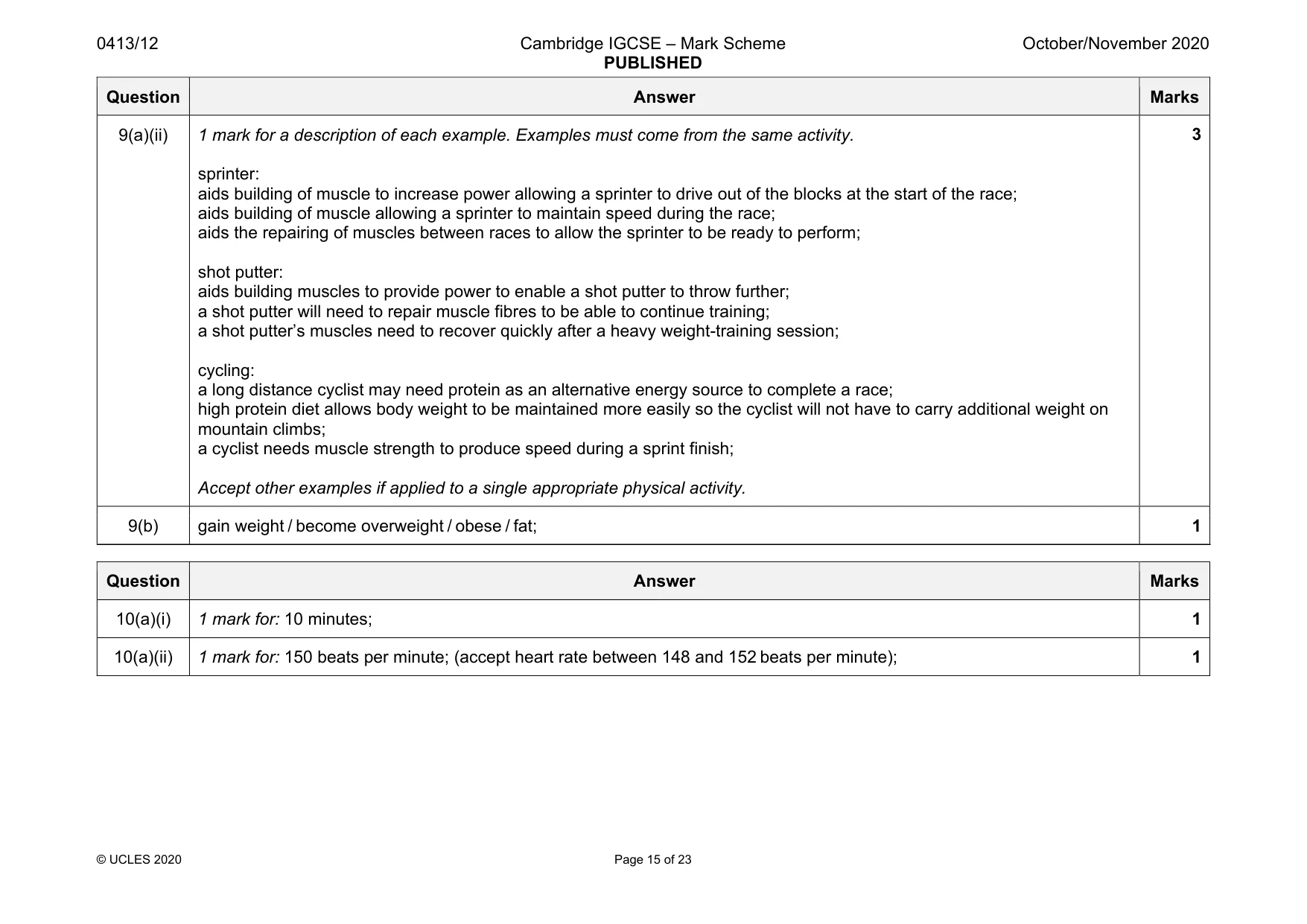
0413/12 Cambridge IGCSE – Mark Scheme PUBLISHED October/November 2020 © UCLES 2020 Page 15 of 23 Question Answer Marks 9(a)(ii) 1 mark for a description of each example. Examples must come from the same activity. sprinter: aids building of muscle to increase power allowing a sprinter to drive out of the blocks at the start of the race; aids building of muscle allowing a sprinter to maintain speed during the race; aids the repairing of muscles between races to allow the sprinter to be ready to perform; shot putter: aids building muscles to provide power to enable a shot putter to throw further; a shot putter will need to repair muscle fibres to be able to continue training; a shot putter’s muscles need to recover quickly after a heavy weight-training session; cycling: a long distance cyclist may need protein as an alternative energy source to complete a race; high protein diet allows body weight to be maintained more easily so the cyclist will not have to carry additional weight on mountain climbs; a cyclist needs muscle strength to produce speed during a sprint finish; Accept other examples if applied to a single appropriate physical activity. 3 9(b) gain weight / become overweight / obese / fat; 1 Question Answer Marks 10(a)(i) 1 mark for: 10 minutes; 1 10(a)(ii) 1 mark for: 150 beats per minute; (accept heart rate between 148 and 152 beats per minute); 1
Mark scheme, page 16
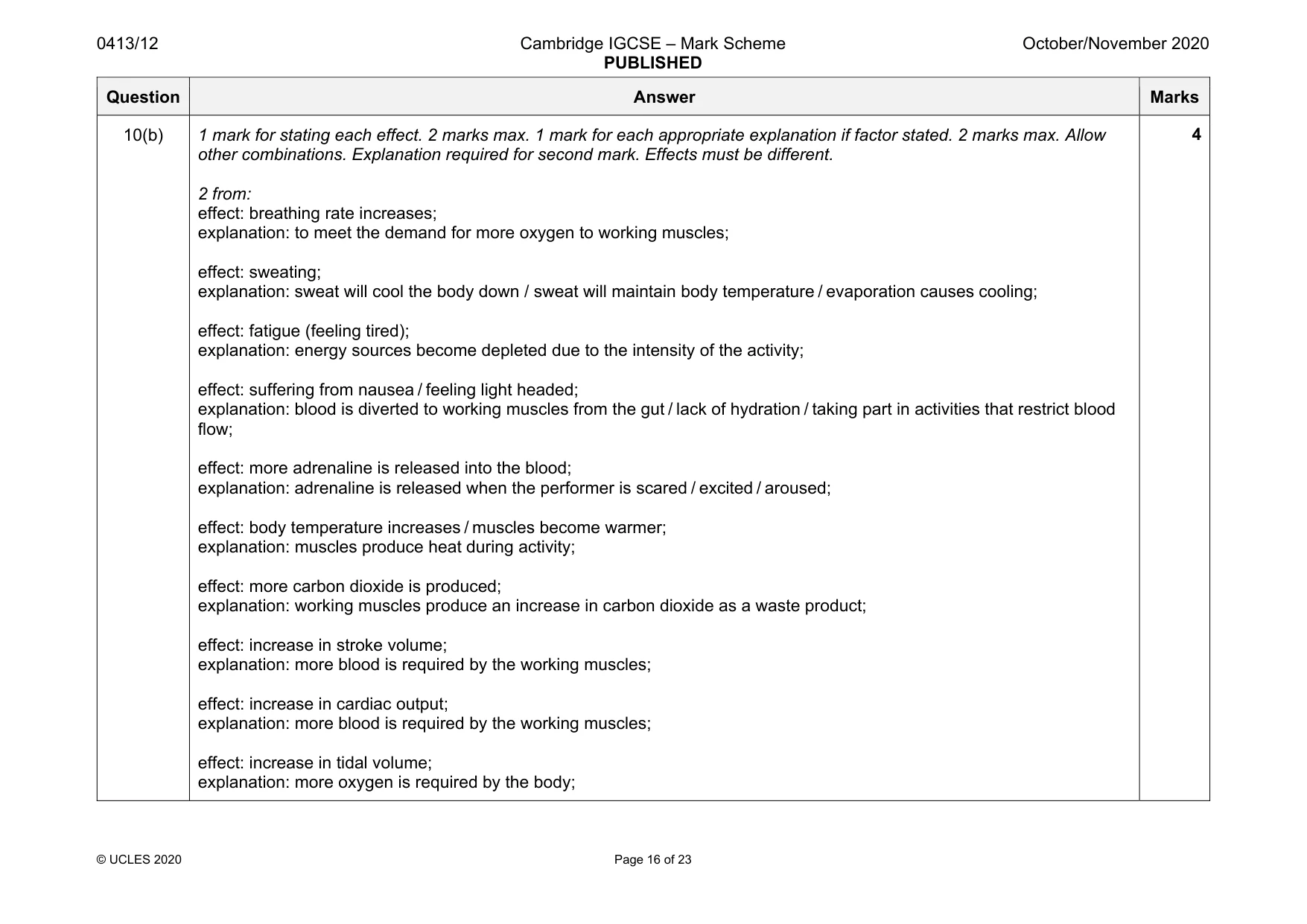
0413/12 Cambridge IGCSE – Mark Scheme PUBLISHED October/November 2020 © UCLES 2020 Page 16 of 23 Question Answer Marks 10(b) 1 mark for stating each effect. 2 marks max. 1 mark for each appropriate explanation if factor stated. 2 marks max. Allow other combinations. Explanation required for second mark. Effects must be different. 2 from: effect: breathing rate increases; explanation: to meet the demand for more oxygen to working muscles; effect: sweating; explanation: sweat will cool the body down / sweat will maintain body temperature / evaporation causes cooling; effect: fatigue (feeling tired); explanation: energy sources become depleted due to the intensity of the activity; effect: suffering from nausea / feeling light headed; explanation: blood is diverted to working muscles from the gut / lack of hydration / taking part in activities that restrict blood flow; effect: more adrenaline is released into the blood; explanation: adrenaline is released when the performer is scared / excited / aroused; effect: body temperature increases / muscles become warmer; explanation: muscles produce heat during activity; effect: more carbon dioxide is produced; explanation: working muscles produce an increase in carbon dioxide as a waste product; effect: increase in stroke volume; explanation: more blood is required by the working muscles; effect: increase in cardiac output; explanation: more blood is required by the working muscles; effect: increase in tidal volume; explanation: more oxygen is required by the body; 4
Mark scheme, page 17
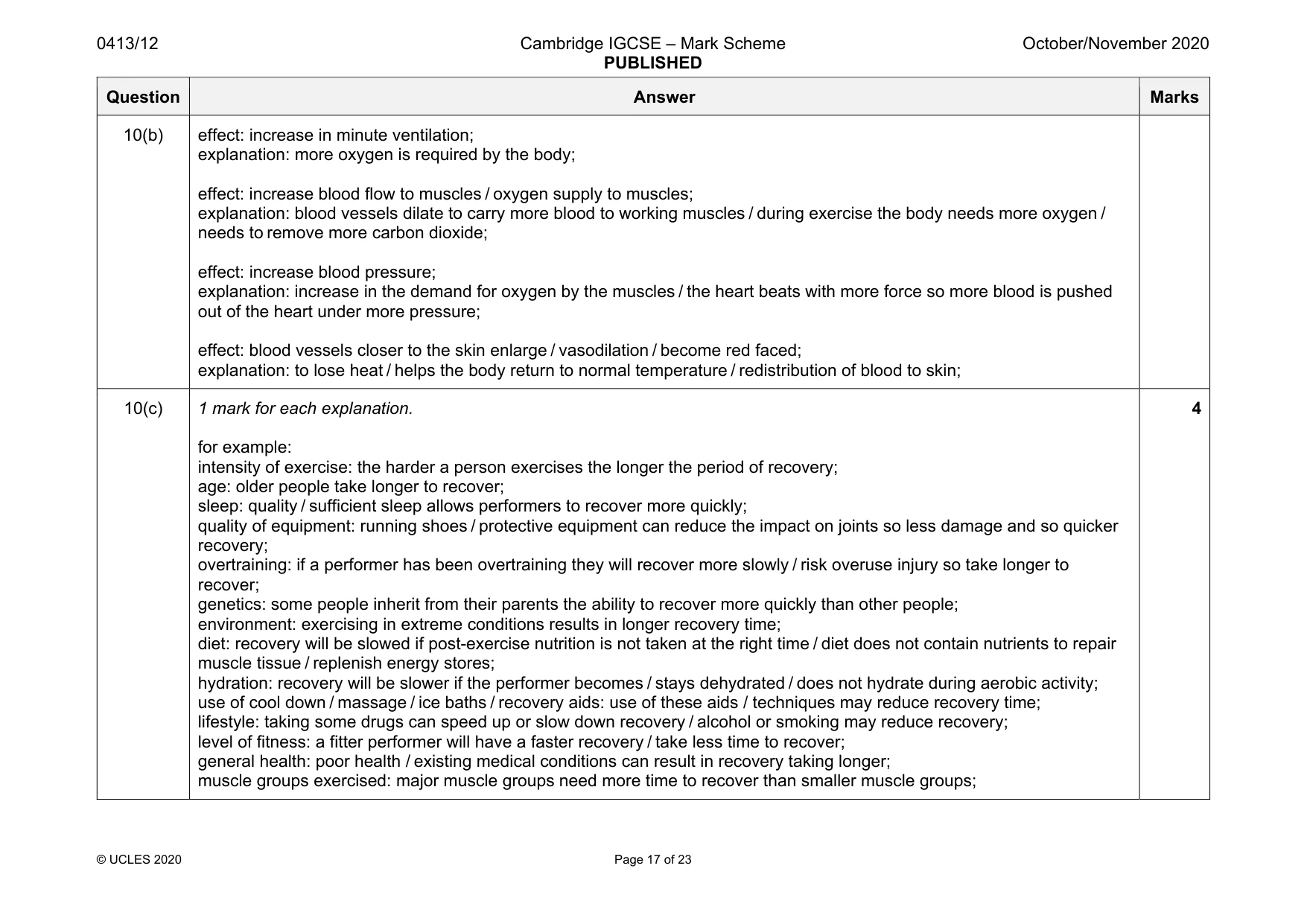
0413/12 Cambridge IGCSE – Mark Scheme PUBLISHED October/November 2020 © UCLES 2020 Page 17 of 23 Question Answer Marks 10(b) effect: increase in minute ventilation; explanation: more oxygen is required by the body; effect: increase blood flow to muscles / oxygen supply to muscles; explanation: blood vessels dilate to carry more blood to working muscles / during exercise the body needs more oxygen / needs to remove more carbon dioxide; effect: increase blood pressure; explanation: increase in the demand for oxygen by the muscles / the heart beats with more force so more blood is pushed out of the heart under more pressure; effect: blood vessels closer to the skin enlarge / vasodilation / become red faced; explanation: to lose heat / helps the body return to normal temperature / redistribution of blood to skin; 10(c) 1 mark for each explanation. for example: intensity of exercise: the harder a person exercises the longer the period of recovery; age: older people take longer to recover; sleep: quality / sufficient sleep allows performers to recover more quickly; quality of equipment: running shoes / protective equipment can reduce the impact on joints so less damage and so quicker recovery; overtraining: if a performer has been overtraining they will recover more slowly / risk overuse injury so take longer to recover; genetics: some people inherit from their parents the ability to recover more quickly than other people; environment: exercising in extreme conditions results in longer recovery time; diet: recovery will be slowed if post-exercise nutrition is not taken at the right time / diet does not contain nutrients to repair muscle tissue / replenish energy stores; hydration: recovery will be slower if the performer becomes / stays dehydrated / does not hydrate during aerobic activity; use of cool down / massage / ice baths / recovery aids: use of these aids / techniques may reduce recovery time; lifestyle: taking some drugs can speed up or slow down recovery / alcohol or smoking may reduce recovery; level of fitness: a fitter performer will have a faster recovery / take less time to recover; general health: poor health / existing medical conditions can result in recovery taking longer; muscle groups exercised: major muscle groups need more time to recover than smaller muscle groups; 4
Mark scheme, page 18
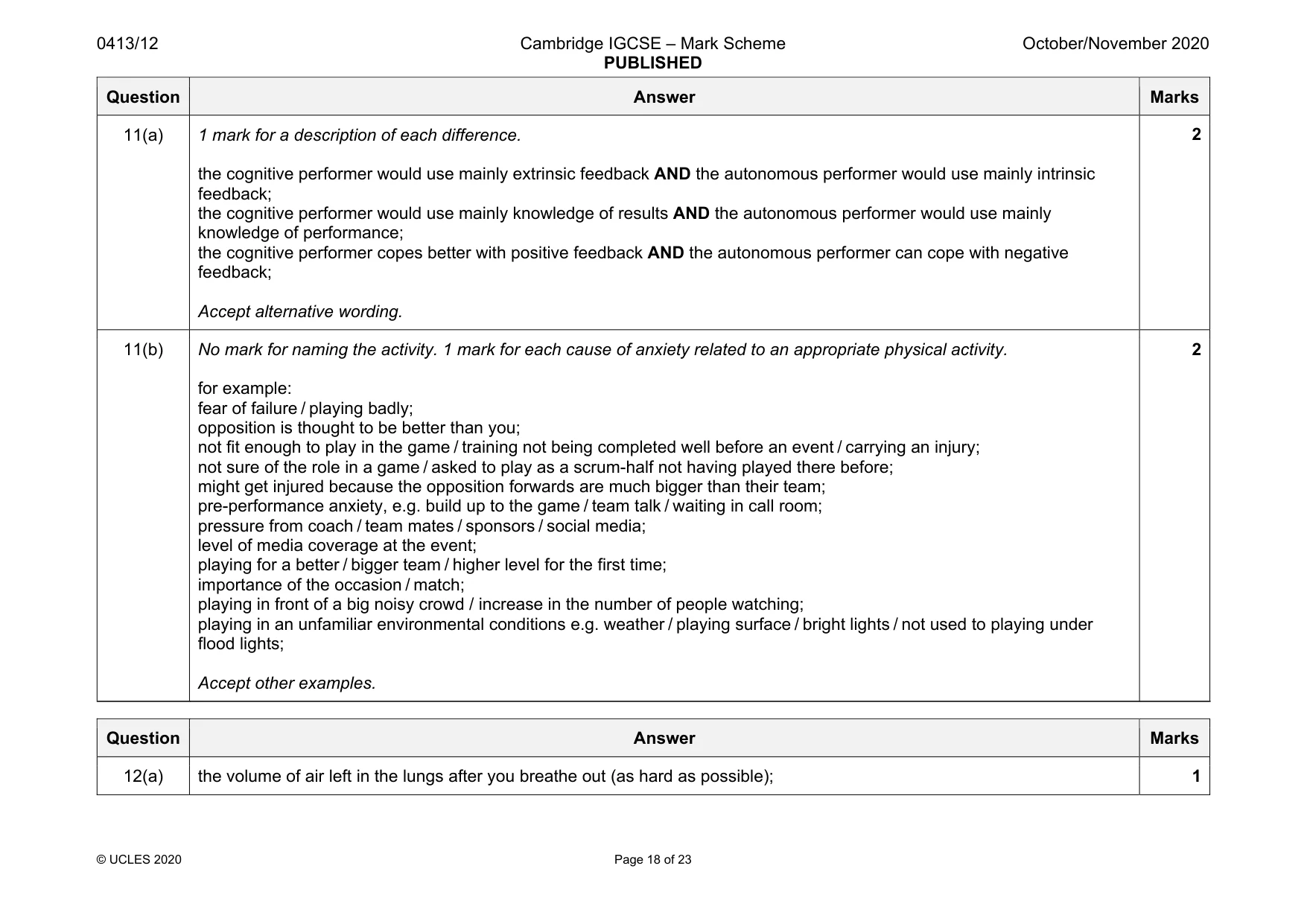
0413/12 Cambridge IGCSE – Mark Scheme PUBLISHED October/November 2020 © UCLES 2020 Page 18 of 23 Question Answer Marks 11(a) 1 mark for a description of each difference. the cognitive performer would use mainly extrinsic feedback AND the autonomous performer would use mainly intrinsic feedback; the cognitive performer would use mainly knowledge of results AND the autonomous performer would use mainly knowledge of performance; the cognitive performer copes better with positive feedback AND the autonomous performer can cope with negative feedback; Accept alternative wording. 2 11(b) No mark for naming the activity. 1 mark for each cause of anxiety related to an appropriate physical activity. for example: fear of failure / playing badly; opposition is thought to be better than you; not fit enough to play in the game / training not being completed well before an event / carrying an injury; not sure of the role in a game / asked to play as a scrum-half not having played there before; might get injured because the opposition forwards are much bigger than their team; pre-performance anxiety, e.g. build up to the game / team talk / waiting in call room; pressure from coach / team mates / sponsors / social media; level of media coverage at the event; playing for a better / bigger team / higher level for the first time; importance of the occasion / match; playing in front of a big noisy crowd / increase in the number of people watching; playing in an unfamiliar environmental conditions e.g. weather / playing surface / bright lights / not used to playing under flood lights; Accept other examples. 2 Question Answer Marks 12(a) the volume of air left in the lungs after you breathe out (as hard as possible); 1
Mark scheme, page 19
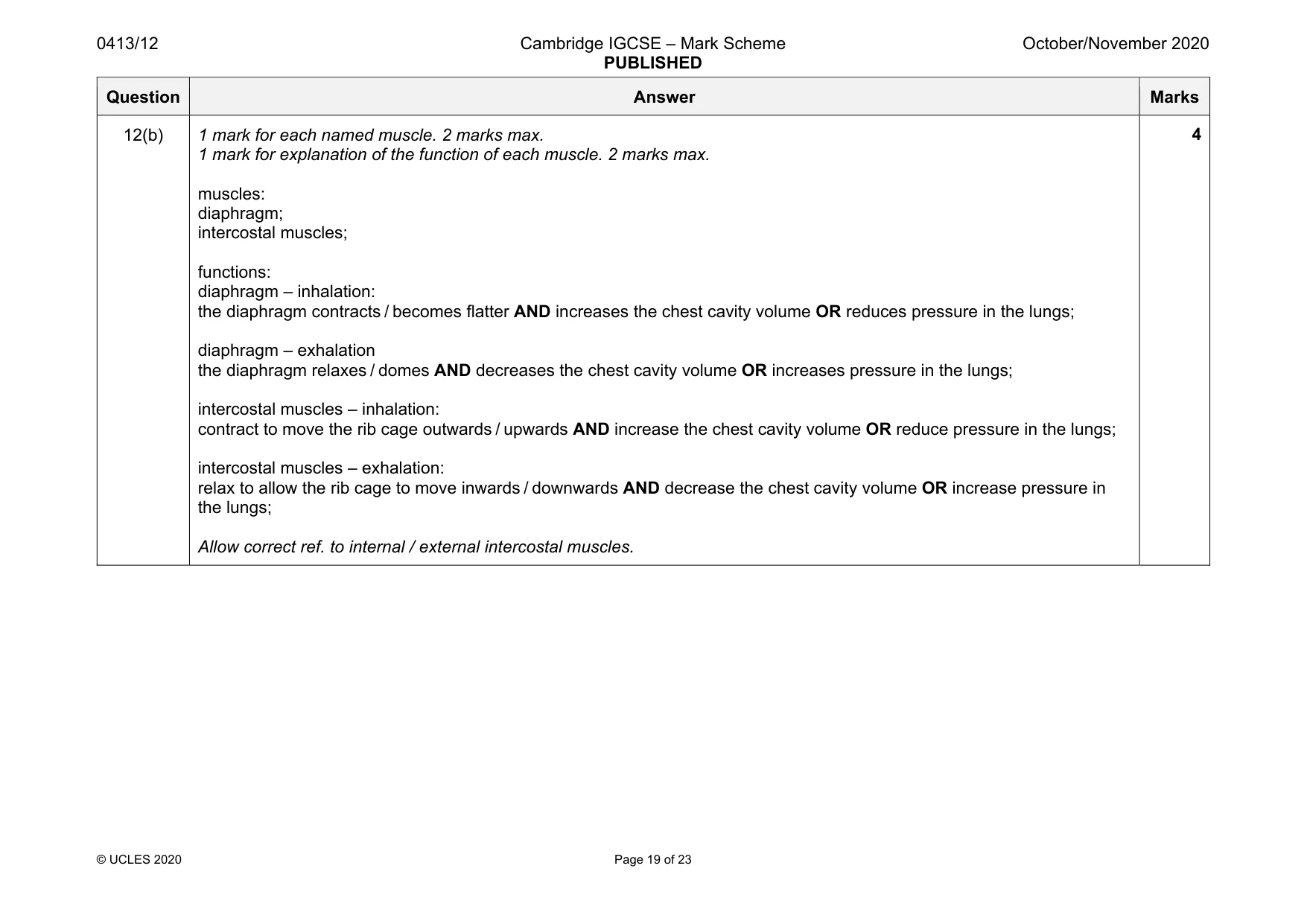
0413/12 Cambridge IGCSE – Mark Scheme PUBLISHED October/November 2020 © UCLES 2020 Page 19 of 23 Question Answer Marks 12(b) 1 mark for each named muscle. 2 marks max. 1 mark for explanation of the function of each muscle. 2 marks max. muscles: diaphragm; intercostal muscles; functions: diaphragm – inhalation: the diaphragm contracts / becomes flatter AND increases the chest cavity volume OR reduces pressure in the lungs; diaphragm – exhalation the diaphragm relaxes / domes AND decreases the chest cavity volume OR increases pressure in the lungs; intercostal muscles – inhalation: contract to move the rib cage outwards / upwards AND increase the chest cavity volume OR reduce pressure in the lungs; intercostal muscles – exhalation: relax to allow the rib cage to move inwards / downwards AND decrease the chest cavity volume OR increase pressure in the lungs; Allow correct ref. to internal / external intercostal muscles. 4
Mark scheme, page 20
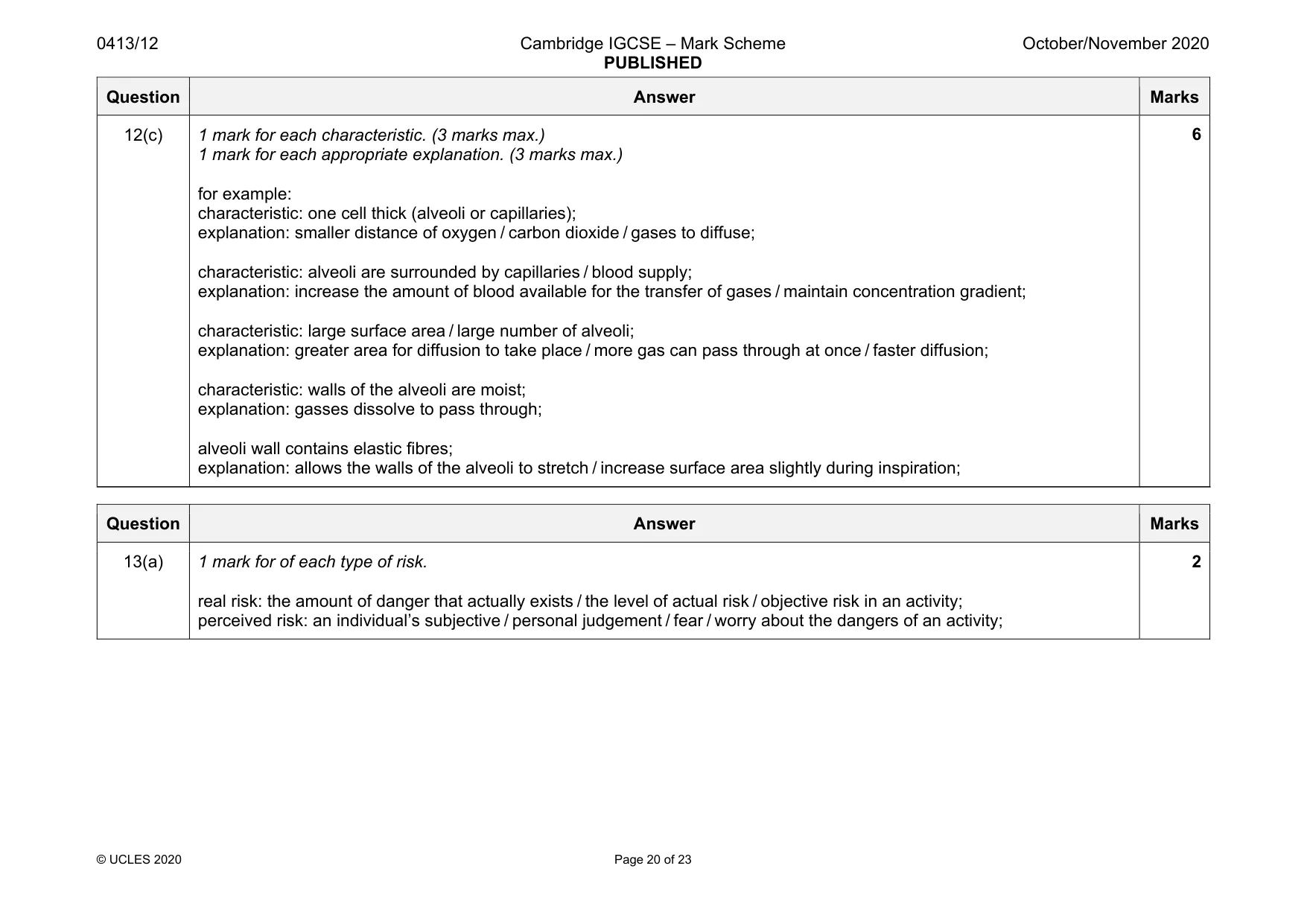
0413/12 Cambridge IGCSE – Mark Scheme PUBLISHED October/November 2020 © UCLES 2020 Page 20 of 23 Question Answer Marks 12(c) 1 mark for each characteristic. (3 marks max.) 1 mark for each appropriate explanation. (3 marks max.) for example: characteristic: one cell thick (alveoli or capillaries); explanation: smaller distance of oxygen / carbon dioxide / gases to diffuse; characteristic: alveoli are surrounded by capillaries / blood supply; explanation: increase the amount of blood available for the transfer of gases / maintain concentration gradient; characteristic: large surface area / large number of alveoli; explanation: greater area for diffusion to take place / more gas can pass through at once / faster diffusion; characteristic: walls of the alveoli are moist; explanation: gasses dissolve to pass through; alveoli wall contains elastic fibres; explanation: allows the walls of the alveoli to stretch / increase surface area slightly during inspiration; 6 Question Answer Marks 13(a) 1 mark for of each type of risk. real risk: the amount of danger that actually exists / the level of actual risk / objective risk in an activity; perceived risk: an individual’s subjective / personal judgement / fear / worry about the dangers of an activity; 2
Mark scheme, page 21
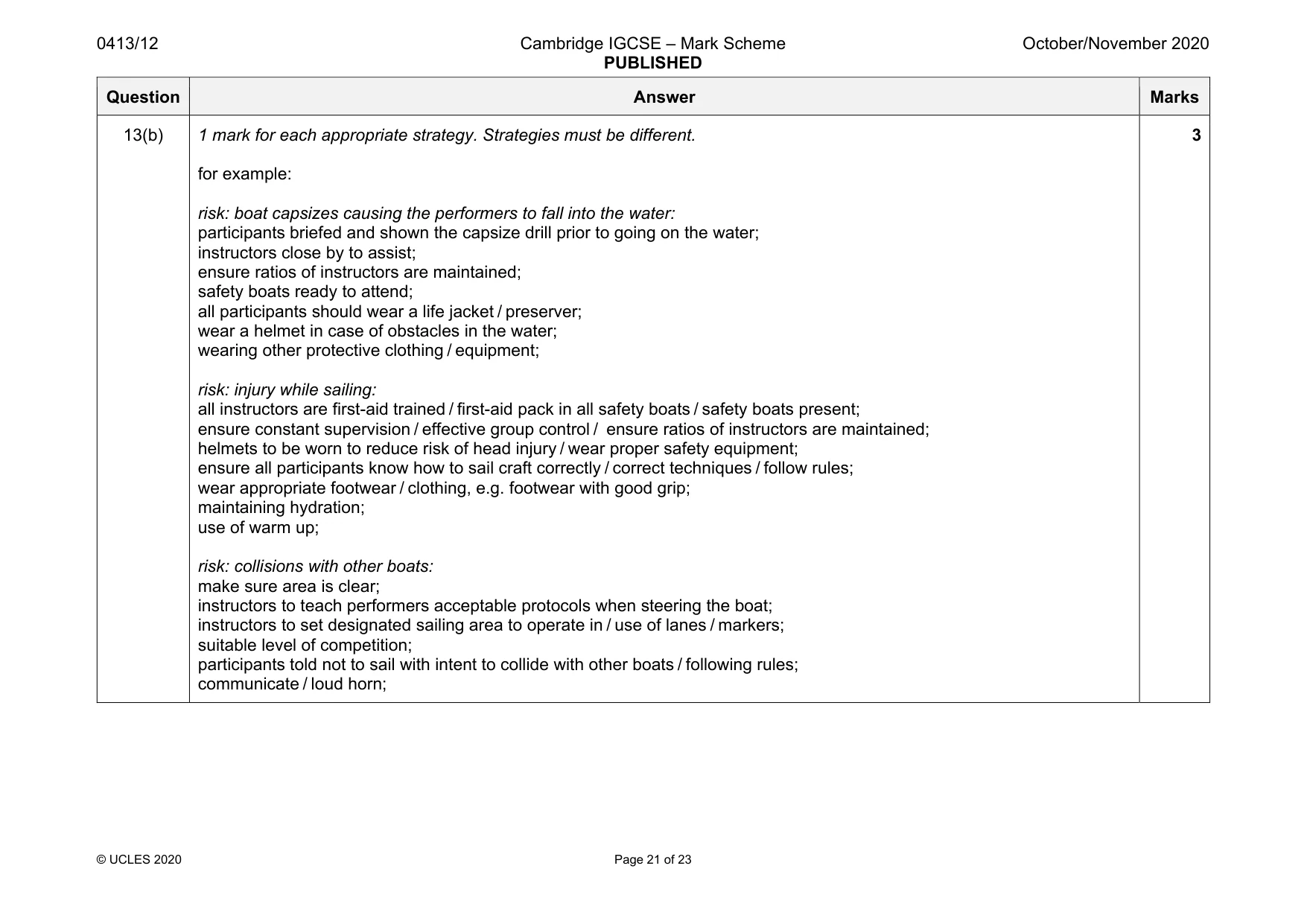
0413/12 Cambridge IGCSE – Mark Scheme PUBLISHED October/November 2020 © UCLES 2020 Page 21 of 23 Question Answer Marks 13(b) 1 mark for each appropriate strategy. Strategies must be different. for example: risk: boat capsizes causing the performers to fall into the water: participants briefed and shown the capsize drill prior to going on the water; instructors close by to assist; ensure ratios of instructors are maintained; safety boats ready to attend; all participants should wear a life jacket / preserver; wear a helmet in case of obstacles in the water; wearing other protective clothing / equipment; risk: injury while sailing: all instructors are first-aid trained / first-aid pack in all safety boats / safety boats present; ensure constant supervision / effective group control / ensure ratios of instructors are maintained; helmets to be worn to reduce risk of head injury / wear proper safety equipment; ensure all participants know how to sail craft correctly / correct techniques / follow rules; wear appropriate footwear / clothing, e.g. footwear with good grip; maintaining hydration; use of warm up; risk: collisions with other boats: make sure area is clear; instructors to teach performers acceptable protocols when steering the boat; instructors to set designated sailing area to operate in / use of lanes / markers; suitable level of competition; participants told not to sail with intent to collide with other boats / following rules; communicate / loud horn; 3
Mark scheme, page 22
0413/12 Cambridge IGCSE – Mark Scheme PUBLISHED October/November 2020 © UCLES 2020 Page 22 of 23 Question Answer Marks 14(a) 1 mark for naming an appropriate test. 3 marks max. for describing test. Multi-Stage Fitness Test; performer must run in time with the bleeps on a CD / equivalent; 20-metre / measured shuttles are performed; time between bleeps reduces as test progresses / bleeps get closer together / the subject must run faster; subject runs until they can no longer keep up with the bleeps; the level achieved and the number of shuttles performed within the level are recorded; scores are compared to standardised normative data; OR 12-Minute Cooper Run Test; subject runs / walks as far as possible; test duration is 12 minutes; a measured course is used, e.g. with cones placed at regular intervals to help identify the exact distance covered / measured laps; calculate the distance covered; the distance covered is compared to standardised normative data; Accept other recognised and standardised tests. 4 14(b) 1 mark for an advantage. 1 mark for a disadvantage. advantage: does not require much equipment / easy to overload / easy to measure progress / develops aerobic fitness needed for the event / training directly linked to the event; disadvantage: does not help anaerobic fitness / does not help the ability to sprint / easy to become demotivated / boring / requires high level of motivation / recovery in the early stages of training can be slow so progress is also slow / danger of overuse injuries; Accept other advantages / disadvantages. 2
Mark scheme, page 23
0413/12 Cambridge IGCSE – Mark Scheme PUBLISHED October/November 2020 © UCLES 2020 Page 23 of 23 Question Answer Marks 14(c) for example: the performer would want to be able to sprint at the end of the race / the performer may want speed to overtake another runner / greater speed will allow a performer to record a faster time for a race / quicker to finish / to improve their position; 1
What you needed in this session
Cambridge’s own grade thresholds for 2020 Oct/Nov, Paper 1 · Variant 2. A higher threshold means an easier paper — the bar moves with how the cohort did.