Cambridge IGCSE Physical Education 0413 — 2020 Oct/Nov Paper 1 · Variant 3
0413/13/O/N/20 · 100 marks · ≈113 min
The question paper and its mark scheme, free to read here and free to download. This is Cambridge’s own paper, exactly as it was sat.
Question paper16 pages

Mark scheme24 pages
Answers below. Sit the paper first if you are practising.
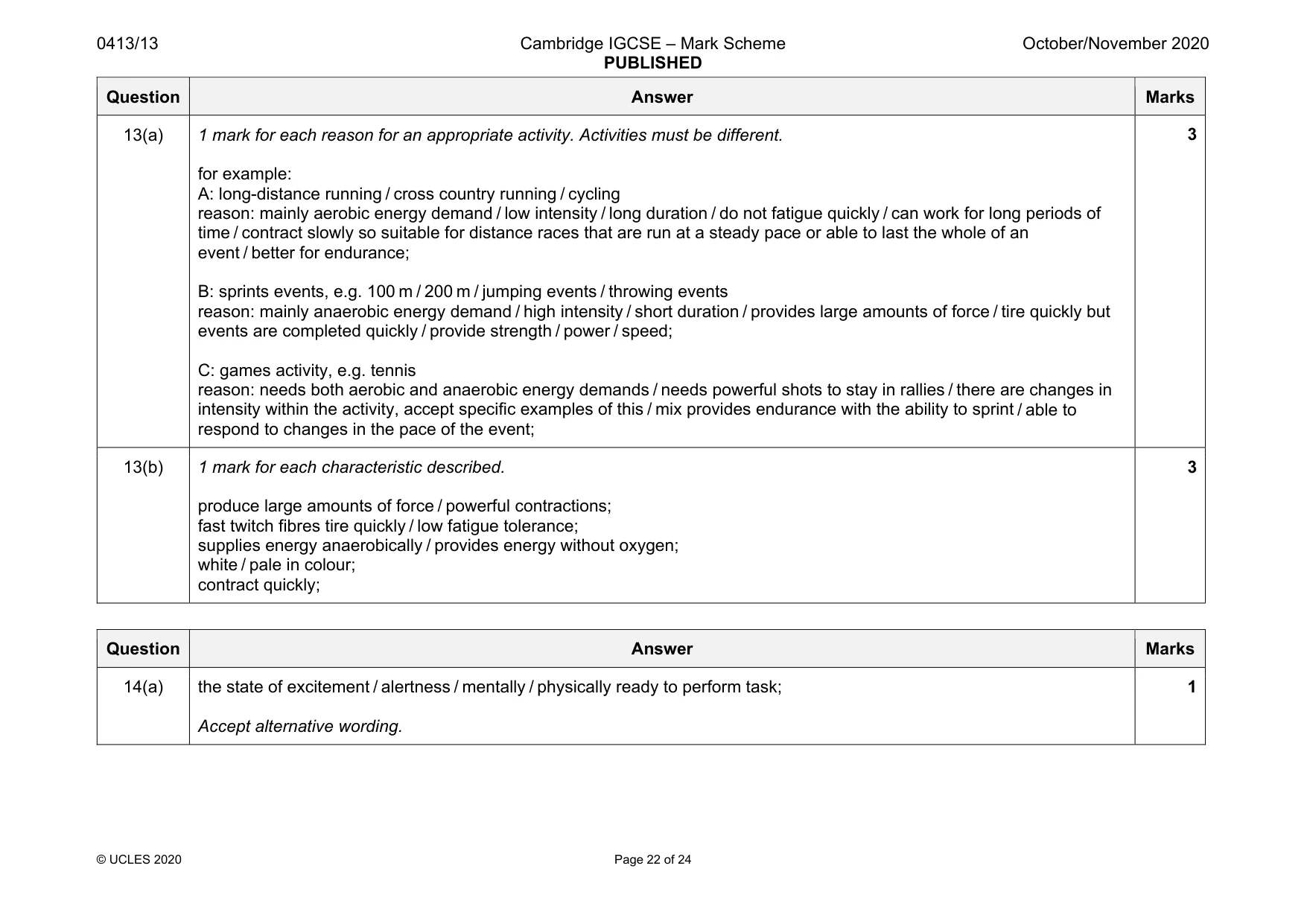
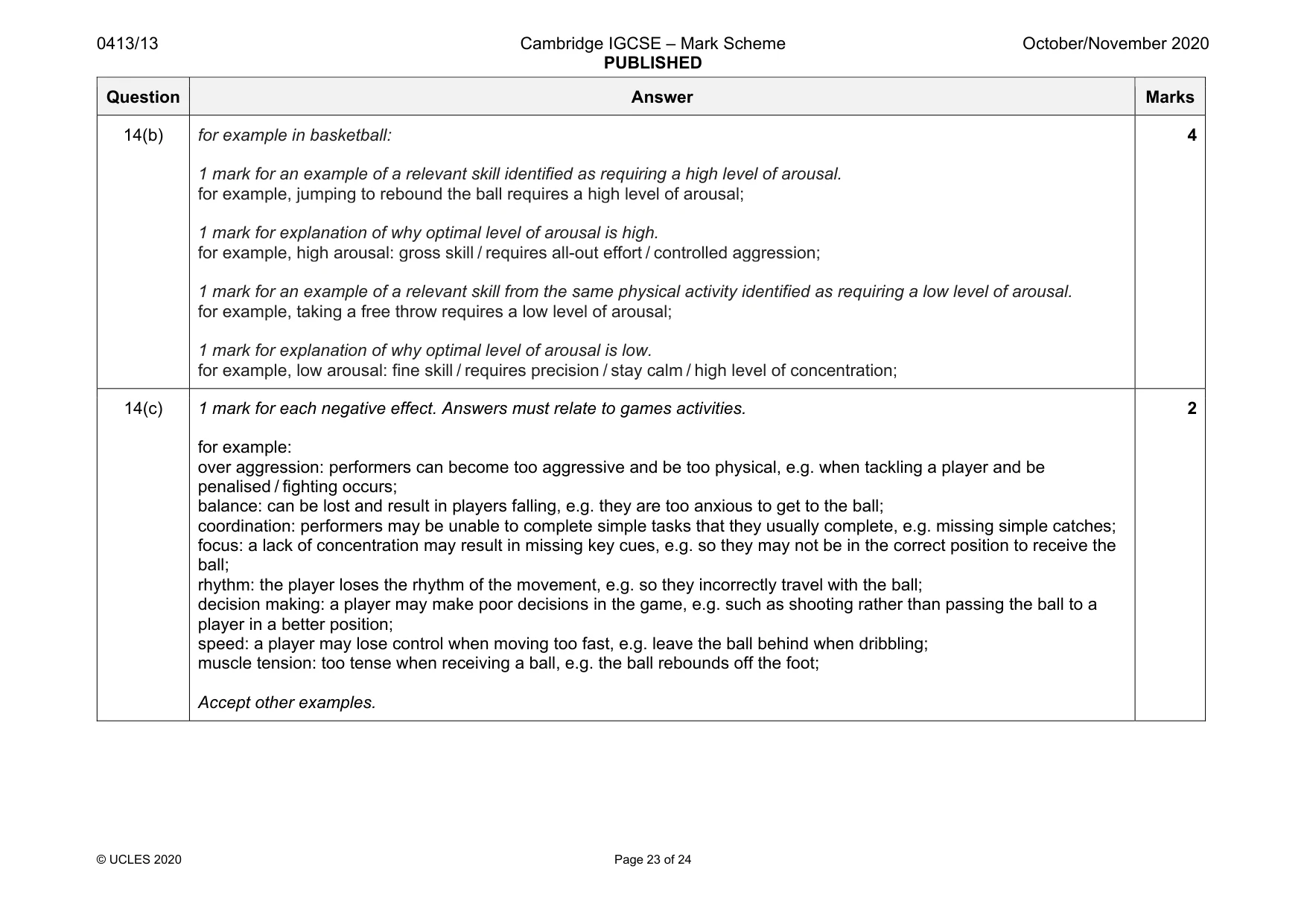
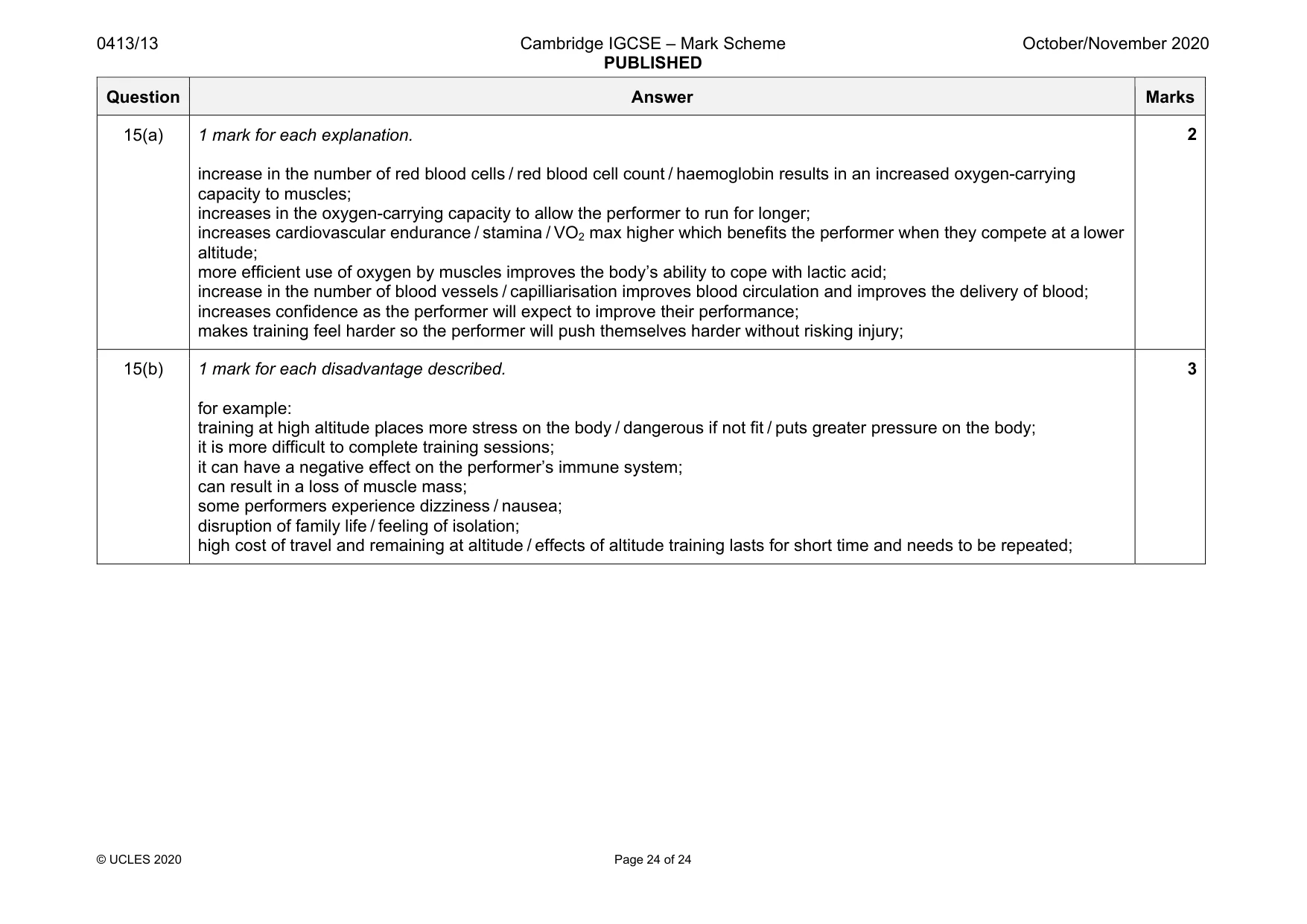
Paper as text
Question paper, page 1
Cambridge IGCSE™ This document has 16 pages. Blank pages are indicated. DC (ST/JG) 182736/4 © UCLES 2020 [Turn over PHYSICAL EDUCATION 0413/13 Paper 1 Theory October/November 2020 1 hour 45 minutes You must answer on the question paper. No additional materials are needed. INSTRUCTIONS ● Answer all questions. ● Use a black or dark blue pen. You may use an HB pencil for any diagrams or graphs. ● Write your name, centre number and candidate number in the boxes at the top of the page. ● Write your answer to each question in the space provided. ● Do not use an erasable pen or correction fluid. ● Do not write on any bar codes. ● You may use a calculator. ● You should show all your working and use appropriate units. INFORMATION ● The total mark for this paper is 100. ● The number of marks for each question or part question is shown in brackets [ ]. * 6 2 9 2 3 8 5 2 9 0 *
Question paper, page 2
2 0413/13/O/N/20 © UCLES 2020 1 Name two bones at the elbow. 1 … 2 … [2] 2 An untrained performer joins an athletics club to try and get fit to run in a long-distance race. (a) Suggest three short-term effects of exercise on the performer other than an increase in heart rate. 1 … … 2 … … 3 … … [3] (b) Name and describe a test a coach might use to assess the performer’s stamina. name of test … description … … … … … … … … [4]
Question paper, page 3
3 0413/13/O/N/20 © UCLES 2020 [Turn over (c) Suggest a method of training that could be used to help improve the performer’s stamina. Give two justifications for your answer. method of training … justification 1 … … justification 2 … … [3] (d) Describe, using examples, how four named principles of overload could be applied to the performer’s training. principle 1 … … … principle 2 … … … principle 3 … … … principle 4 … … … [4] [Total: 14]
Question paper, page 4
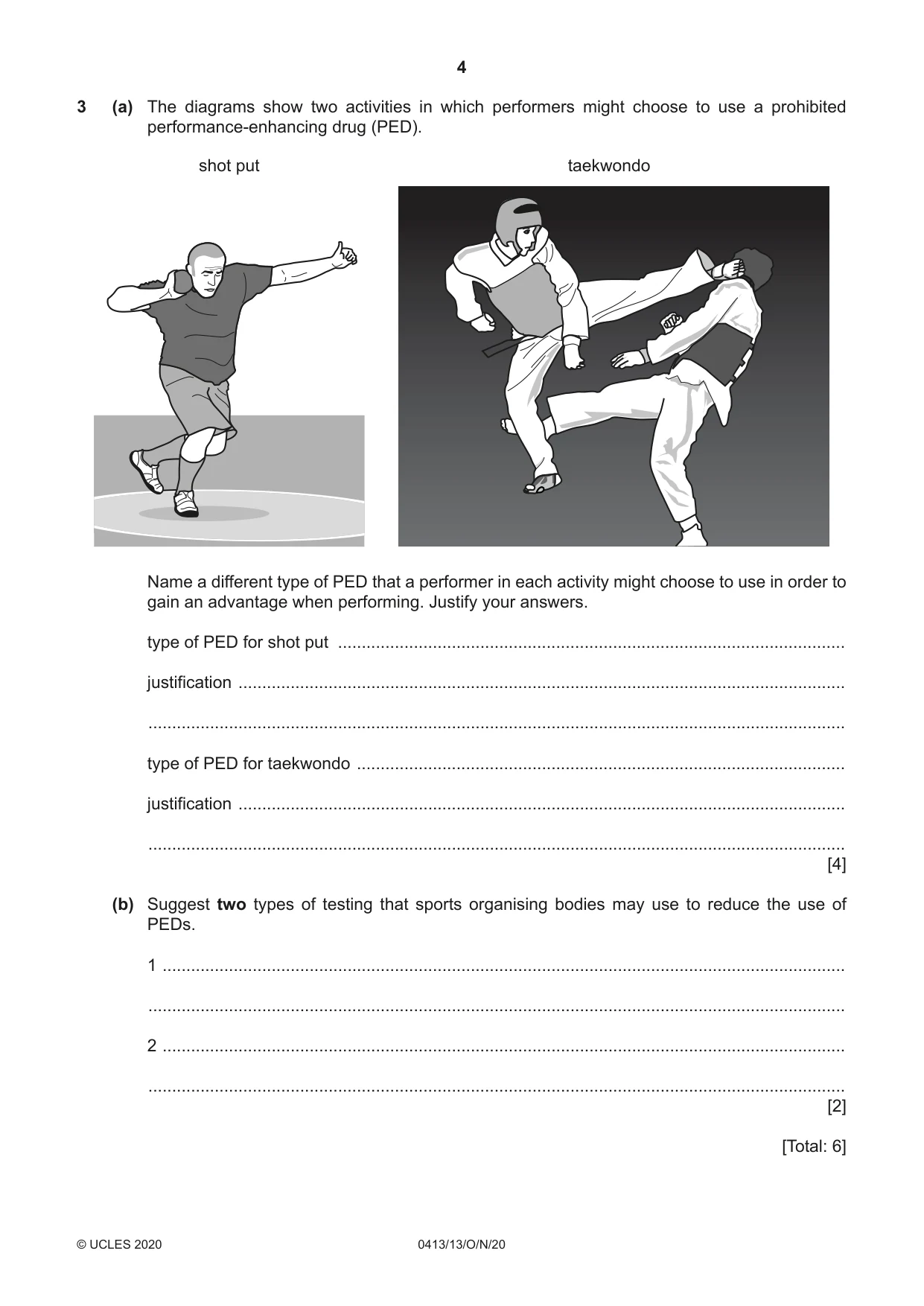
4 0413/13/O/N/20 © UCLES 2020 3 (a) The diagrams show two activities in which performers might choose to use a prohibited performance-enhancing drug (PED). shot put taekwondo Name a different type of PED that a performer in each activity might choose to use in order to gain an advantage when performing. Justify your answers. type of PED for shot put … justification … … type of PED for taekwondo … justification … … [4] (b) Suggest two types of testing that sports organising bodies may use to reduce the use of PEDs. 1 … … 2 … … [2] [Total: 6]
Question paper, page 5
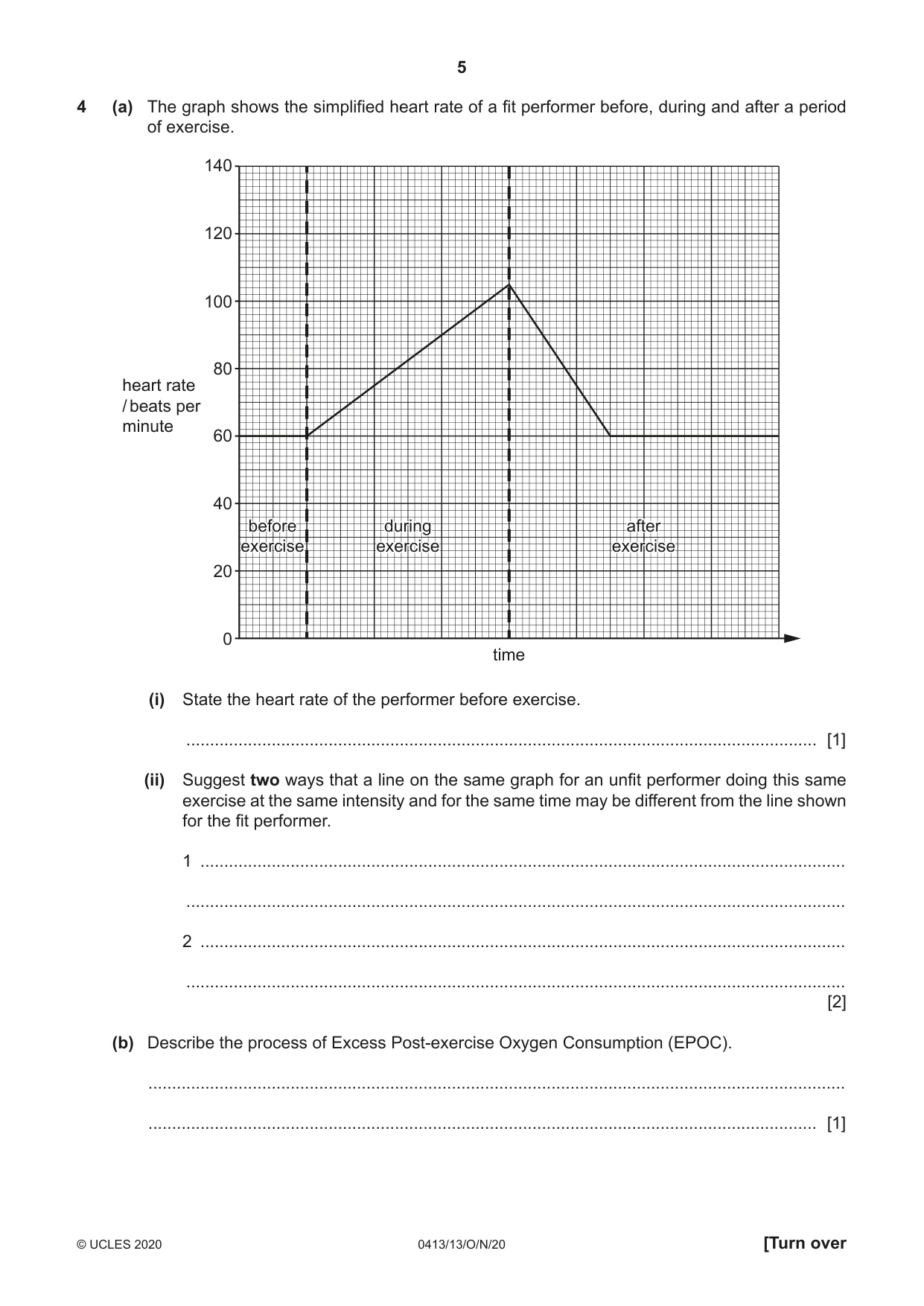
5 0413/13/O/N/20 © UCLES 2020 [Turn over 4 (a) The graph shows the simplified heart rate of a fit performer before, during and after a period of exercise. 140 120 100 80 60 40 20 0 before exercise after exercise during exercise before exercise after exercise during exercise heart rate / beats per minute time (i) State the heart rate of the performer before exercise. … [1] (ii) Suggest two ways that a line on the same graph for an unfit performer doing this same exercise at the same intensity and for the same time may be different from the line shown for the fit performer. 1 … … 2 … … [2] (b) Describe the process of Excess Post-exercise Oxygen Consumption (EPOC). … … [1]
Question paper, page 6
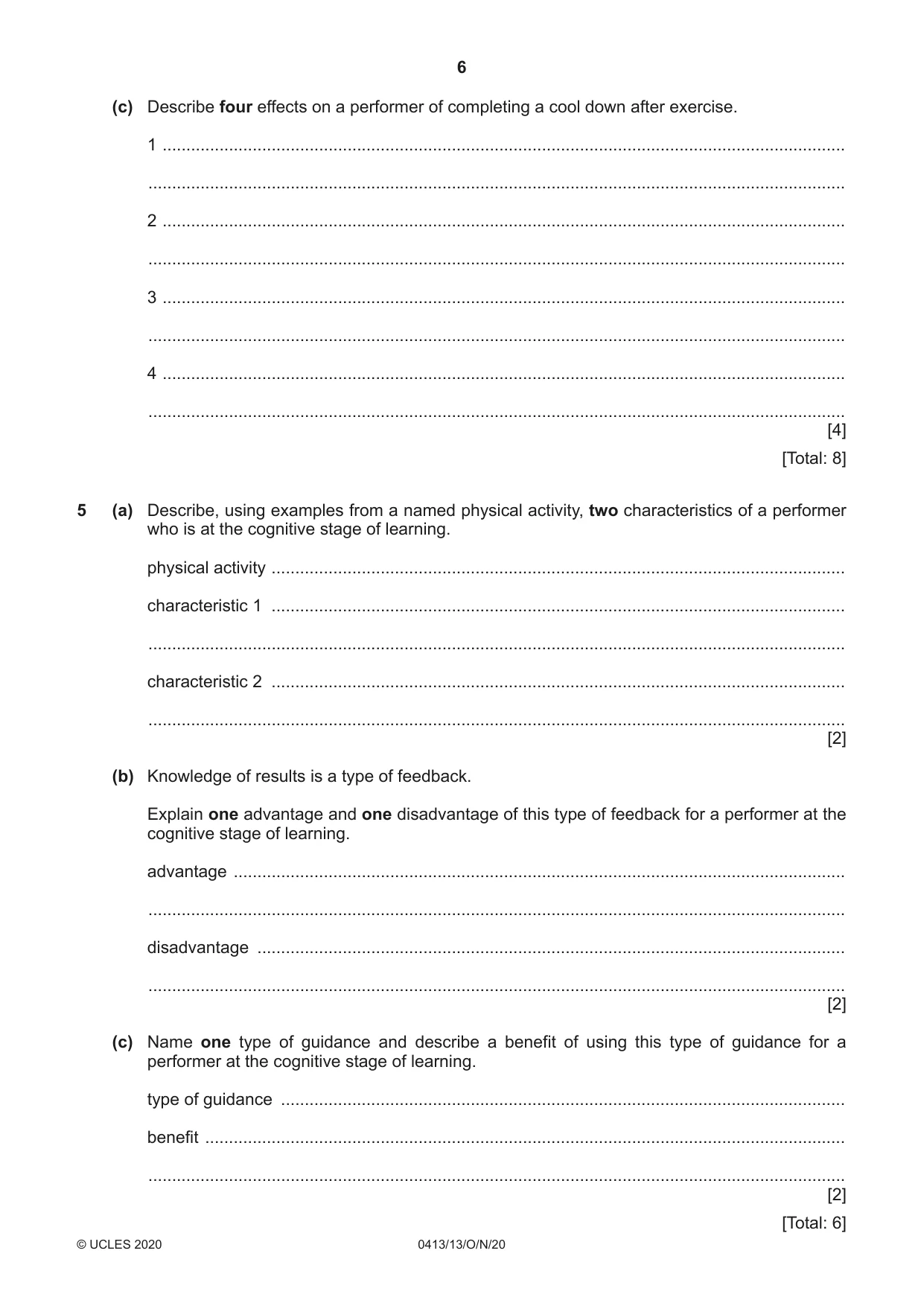
6 0413/13/O/N/20 © UCLES 2020 (c) Describe four effects on a performer of completing a cool down after exercise. 1 … … 2 … … 3 … … 4 … … [4] [Total: 8] 5 (a) Describe, using examples from a named physical activity, two characteristics of a performer who is at the cognitive stage of learning. physical activity … characteristic 1 … … characteristic 2 … … [2] (b) Knowledge of results is a type of feedback. Explain one advantage and one disadvantage of this type of feedback for a performer at the cognitive stage of learning. advantage … … disadvantage … … [2] (c) Name one type of guidance and describe a benefit of using this type of guidance for a performer at the cognitive stage of learning. type of guidance … benefit … … [2] [Total: 6]
Question paper, page 7
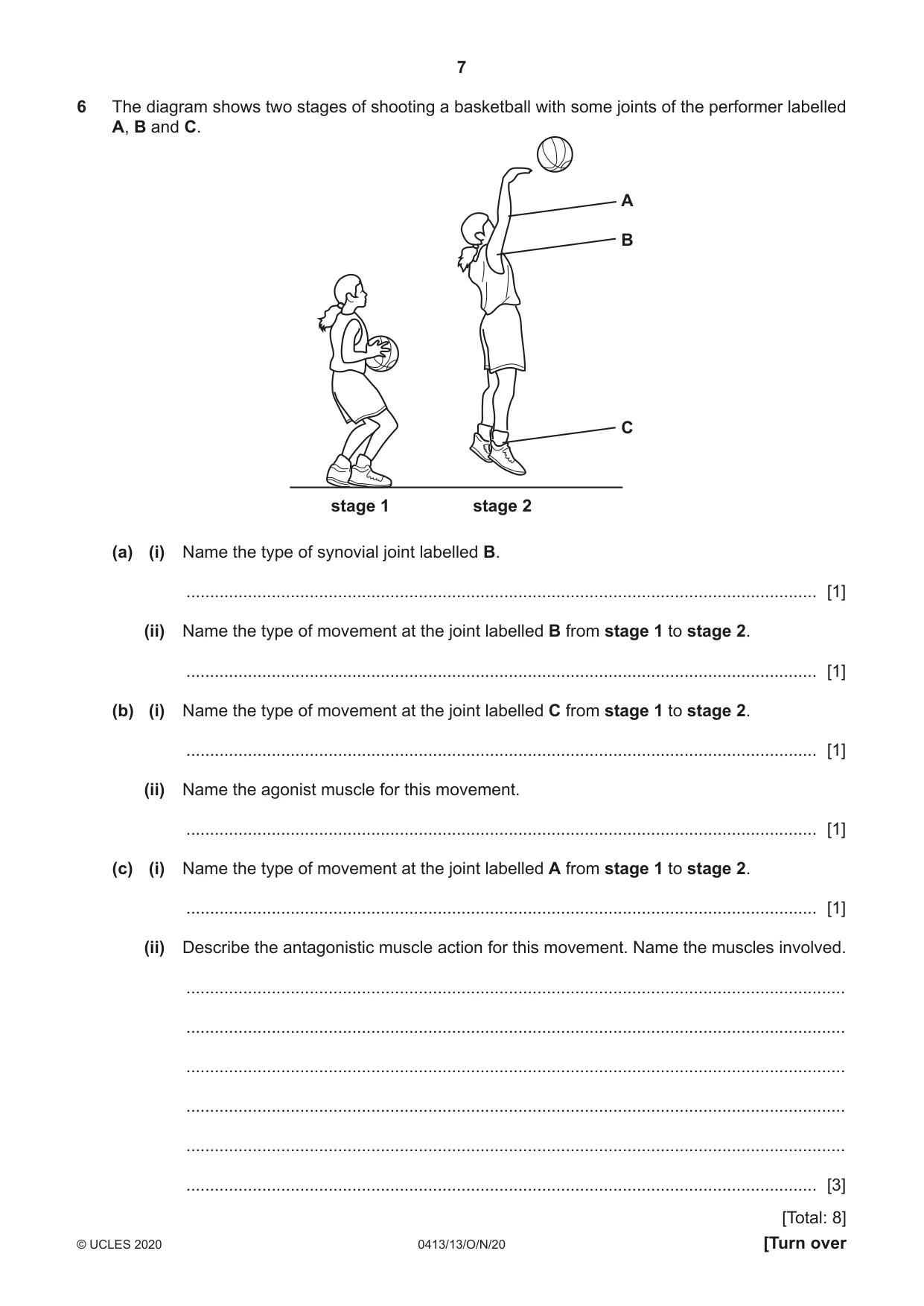
7 0413/13/O/N/20 © UCLES 2020 [Turn over 6 The diagram shows two stages of shooting a basketball with some joints of the performer labelled A, B and C. stage 1 stage 2 A B C (a) (i) Name the type of synovial joint labelled B. … [1] (ii) Name the type of movement at the joint labelled B from stage 1 to stage 2. … [1] (b) (i) Name the type of movement at the joint labelled C from stage 1 to stage 2. … [1] (ii) Name the agonist muscle for this movement. … [1] (c) (i) Name the type of movement at the joint labelled A from stage 1 to stage 2. … [1] (ii) Describe the antagonistic muscle action for this movement. Name the muscles involved. … … … … … … [3] [Total: 8]
Question paper, page 8
8 0413/13/O/N/20 © UCLES 2020 7 (a) Describe two differences between physical recreation and sport. 1 … … 2 … … [2] (b) Explain how each of the following may influence what recreational activities people choose to do during their leisure time: age … … social circumstances … … peer influences … … area where they live. … … [4] (c) Explain four factors that have influenced the growth in leisure activities. 1 … … 2 … … 3 … … 4 … … [4] [Total: 10]
Question paper, page 9
9 0413/13/O/N/20 © UCLES 2020 [Turn over 8 Explain three reasons why people may have different energy needs. 1 … … 2 … … 3 … … [3]
Question paper, page 10
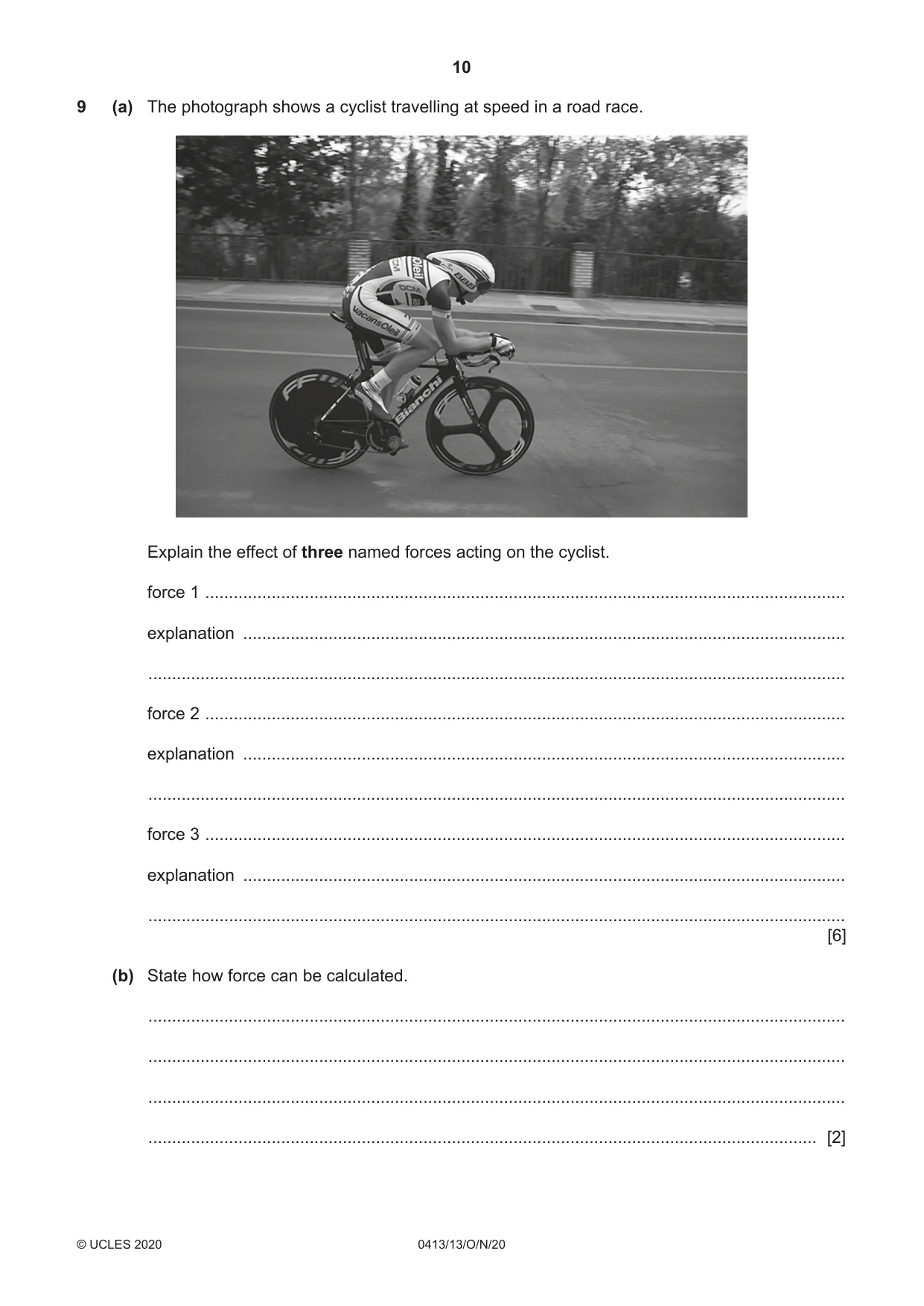
10 0413/13/O/N/20 © UCLES 2020 9 (a) The photograph shows a cyclist travelling at speed in a road race. Explain the effect of three named forces acting on the cyclist. force 1 … explanation … … force 2 … explanation … … force 3 … explanation … … [6] (b) State how force can be calculated. … … … … [2]
Question paper, page 11
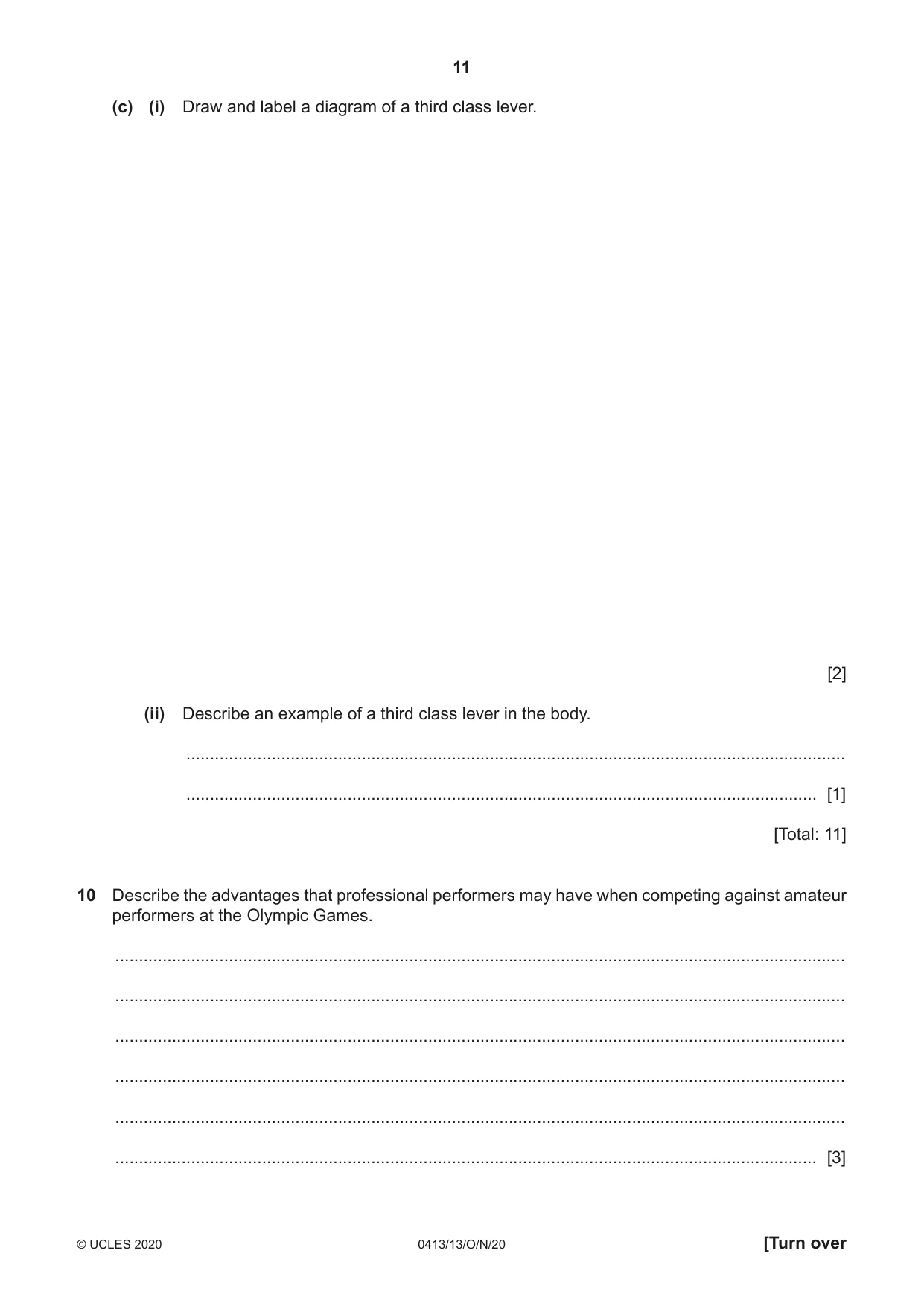
11 0413/13/O/N/20 © UCLES 2020 [Turn over (c) (i) Draw and label a diagram of a third class lever. [2] (ii) Describe an example of a third class lever in the body. … … [1] [Total: 11] 10 Describe the advantages that professional performers may have when competing against amateur performers at the Olympic Games. … … … … … … [3]
Question paper, page 12
12 0413/13/O/N/20 © UCLES 2020 11 (a) Describe the long-term effects of regular exercise on the heart. … … … … … … [3] (b) Describe two structural differences between arteries and veins. 1 … … 2 … … [2] [Total: 5]
Question paper, page 13
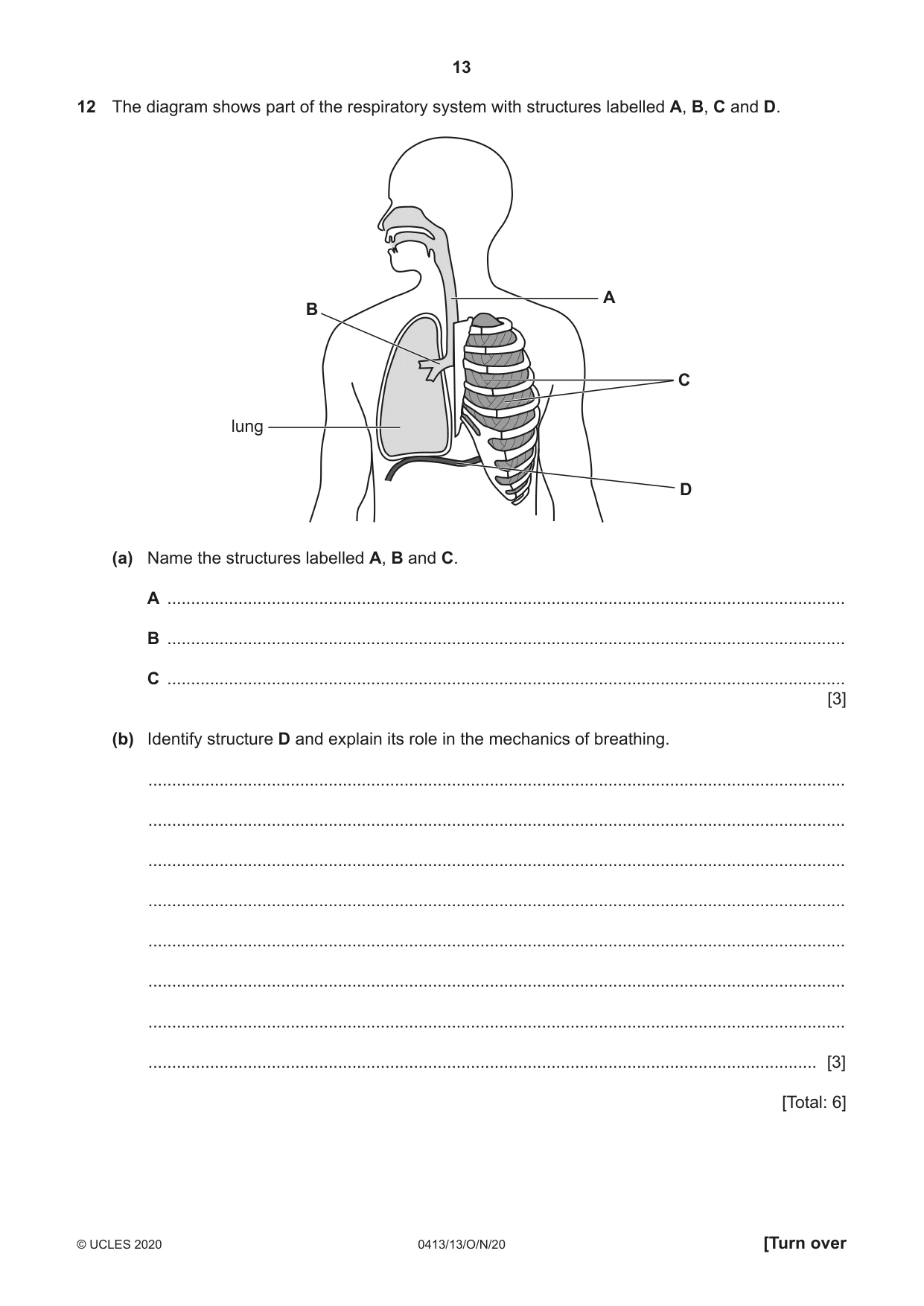
13 0413/13/O/N/20 © UCLES 2020 [Turn over 12 The diagram shows part of the respiratory system with structures labelled A, B, C and D. A C D B lung (a) Name the structures labelled A, B and C. A … B … C … [3] (b) Identify structure D and explain its role in the mechanics of breathing. … … … … … … … … [3] [Total: 6]
Question paper, page 14
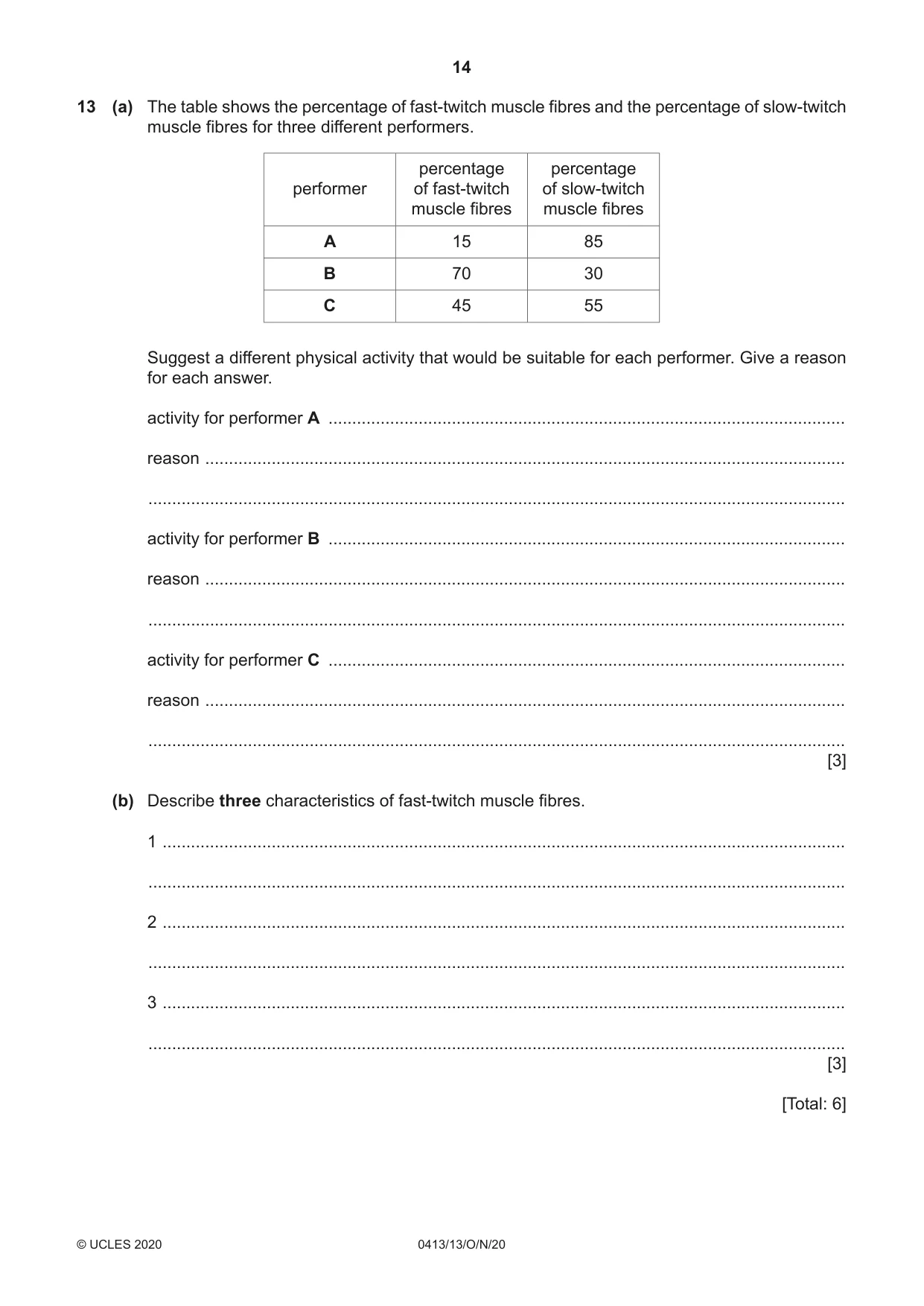
14 0413/13/O/N/20 © UCLES 2020 13 (a) The table shows the percentage of fast-twitch muscle fibres and the percentage of slow-twitch muscle fibres for three different performers. performer percentage of fast-twitch muscle fibres percentage of slow-twitch muscle fibres A 15 85 B 70 30 C 45 55 Suggest a different physical activity that would be suitable for each performer. Give a reason for each answer. activity for performer A … reason … … activity for performer B … reason … … activity for performer C … reason … … [3] (b) Describe three characteristics of fast-twitch muscle fibres. 1 … … 2 … … 3 … … [3] [Total: 6]
Question paper, page 15
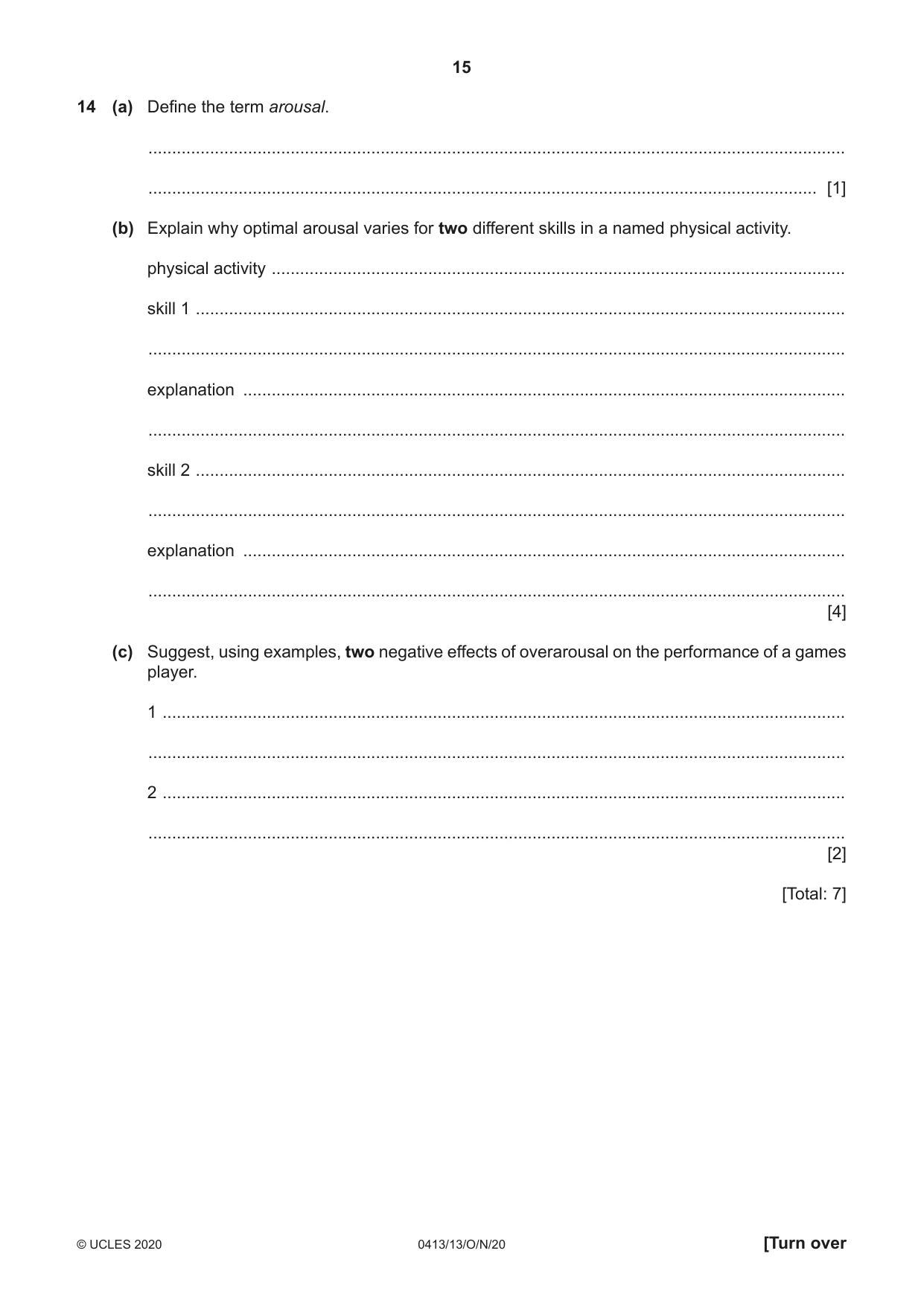
15 0413/13/O/N/20 © UCLES 2020 [Turn over 14 (a) Define the term arousal. … … [1] (b) Explain why optimal arousal varies for two different skills in a named physical activity. physical activity … skill 1 … … explanation … … skill 2 … … explanation … … [4] (c) Suggest, using examples, two negative effects of overarousal on the performance of a games player. 1 … … 2 … … [2] [Total: 7]
Question paper, page 16
16 0413/13/O/N/20 © UCLES 2020 Permission to reproduce items where third-party owned material protected by copyright is included has been sought and cleared where possible. Every reasonable effort has been made by the publisher (UCLES) to trace copyright holders, but if any items requiring clearance have unwittingly been included, the publisher will be pleased to make amends at the earliest possible opportunity. To avoid the issue of disclosure of answer-related information to candidates, all copyright acknowledgements are reproduced online in the Cambridge Assessment International Education Copyright Acknowledgements Booklet. This is produced for each series of examinations and is freely available to download at www.cambridgeinternational.org after the live examination series. Cambridge Assessment International Education is part of the Cambridge Assessment Group. Cambridge Assessment is the brand name of the University of Cambridge Local Examinations Syndicate (UCLES), which itself is a department of the University of Cambridge. 15 (a) Explain why a performer in an endurance activity is likely to benefit from high-altitude training. … … … … [2] (b) Suggest disadvantages of training at high-altitude for a performer. … … … … … … [3] [Total: 5]
Mark scheme, page 1
This document consists of 24 printed pages. © UCLES 2020 [Turn over Cambridge IGCSE™ PHYSICAL EDUCATION 0413/13 Paper 1 Theory October/November 2020 MARK SCHEME Maximum Mark: 100 Published This mark scheme is published as an aid to teachers and candidates, to indicate the requirements of the examination. It shows the basis on which Examiners were instructed to award marks. It does not indicate the details of the discussions that took place at an Examiners’ meeting before marking began, which would have considered the acceptability of alternative answers. Mark schemes should be read in conjunction with the question paper and the Principal Examiner Report for Teachers. Cambridge International will not enter into discussions about these mark schemes. Cambridge International is publishing the mark schemes for the October/November 2020 series for most Cambridge IGCSE™, Cambridge International A and AS Level and Cambridge Pre-U components, and some Cambridge O Level components.
Mark scheme, page 2
0413/13 Cambridge IGCSE – Mark Scheme PUBLISHED October/November 2020 © UCLES 2020 Page 2 of 24 Generic Marking Principles These general marking principles must be applied by all examiners when marking candidate answers. They should be applied alongside the specific content of the mark scheme or generic level descriptors for a question. Each question paper and mark scheme will also comply with these marking principles. GENERIC MARKING PRINCIPLE 1: Marks must be awarded in line with: • the specific content of the mark scheme or the generic level descriptors for the question • the specific skills defined in the mark scheme or in the generic level descriptors for the question • the standard of response required by a candidate as exemplified by the standardisation scripts. GENERIC MARKING PRINCIPLE 2: Marks awarded are always whole marks (not half marks, or other fractions). GENERIC MARKING PRINCIPLE 3: Marks must be awarded positively: • marks are awarded for correct/valid answers, as defined in the mark scheme. However, credit is given for valid answers which go beyond the scope of the syllabus and mark scheme, referring to your Team Leader as appropriate • marks are awarded when candidates clearly demonstrate what they know and can do • marks are not deducted for errors • marks are not deducted for omissions • answers should only be judged on the quality of spelling, punctuation and grammar when these features are specifically assessed by the question as indicated by the mark scheme. The meaning, however, should be unambiguous. GENERIC MARKING PRINCIPLE 4: Rules must be applied consistently, e.g. in situations where candidates have not followed instructions or in the application of generic level descriptors.
Mark scheme, page 3
0413/13 Cambridge IGCSE – Mark Scheme PUBLISHED October/November 2020 © UCLES 2020 Page 3 of 24 GENERIC MARKING PRINCIPLE 5: Marks should be awarded using the full range of marks defined in the mark scheme for the question (however; the use of the full mark range may be limited according to the quality of the candidate responses seen). GENERIC MARKING PRINCIPLE 6: Marks awarded are based solely on the requirements as defined in the mark scheme. Marks should not be awarded with grade thresholds or grade descriptors in mind. Science-Specific Marking Principles 1 Examiners should consider the context and scientific use of any keywords when awarding marks. Although keywords may be present, marks should not be awarded if the keywords are used incorrectly. 2 The examiner should not choose between contradictory statements given in the same question part, and credit should not be awarded for any correct statement that is contradicted within the same question part. Wrong science that is irrelevant to the question should be ignored. 3 Although spellings do not have to be correct, spellings of syllabus terms must allow for clear and unambiguous separation from other syllabus terms with which they may be confused (e.g. ethane / ethene, glucagon / glycogen, refraction / reflection). 4 The error carried forward (ecf) principle should be applied, where appropriate. If an incorrect answer is subsequently used in a scientifically correct way, the candidate should be awarded these subsequent marking points. Further guidance will be included in the mark scheme where necessary and any exceptions to this general principle will be noted. 5 ‘List rule’ guidance For questions that require n responses (e.g. State two reasons …): • The response should be read as continuous prose, even when numbered answer spaces are provided. • Any response marked ignore in the mark scheme should not count towards n. • Incorrect responses should not be awarded credit but will still count towards n. • Read the entire response to check for any responses that contradict those that would otherwise be credited. Credit should not be awarded for any responses that are contradicted within the rest of the response. Where two responses contradict one another, this should be treated as a single incorrect response. • Non-contradictory responses after the first n responses may be ignored even if they include incorrect science.
Mark scheme, page 4
0413/13 Cambridge IGCSE – Mark Scheme PUBLISHED October/November 2020 © UCLES 2020 Page 4 of 24 6 Calculation specific guidance Correct answers to calculations should be given full credit even if there is no working or incorrect working, unless the question states ‘show your working’. For questions in which the number of significant figures required is not stated, credit should be awarded for correct answers when rounded by the examiner to the number of significant figures given in the mark scheme. This may not apply to measured values. For answers given in standard form (e.g. a × 10n) in which the convention of restricting the value of the coefficient (a) to a value between 1 and 10 is not followed, credit may still be awarded if the answer can be converted to the answer given in the mark scheme. Unless a separate mark is given for a unit, a missing or incorrect unit will normally mean that the final calculation mark is not awarded. Exceptions to this general principle will be noted in the mark scheme. 7 Guidance for chemical equations Multiples / fractions of coefficients used in chemical equations are acceptable unless stated otherwise in the mark scheme. State symbols given in an equation should be ignored unless asked for in the question or stated otherwise in the mark scheme.
Mark scheme, page 5
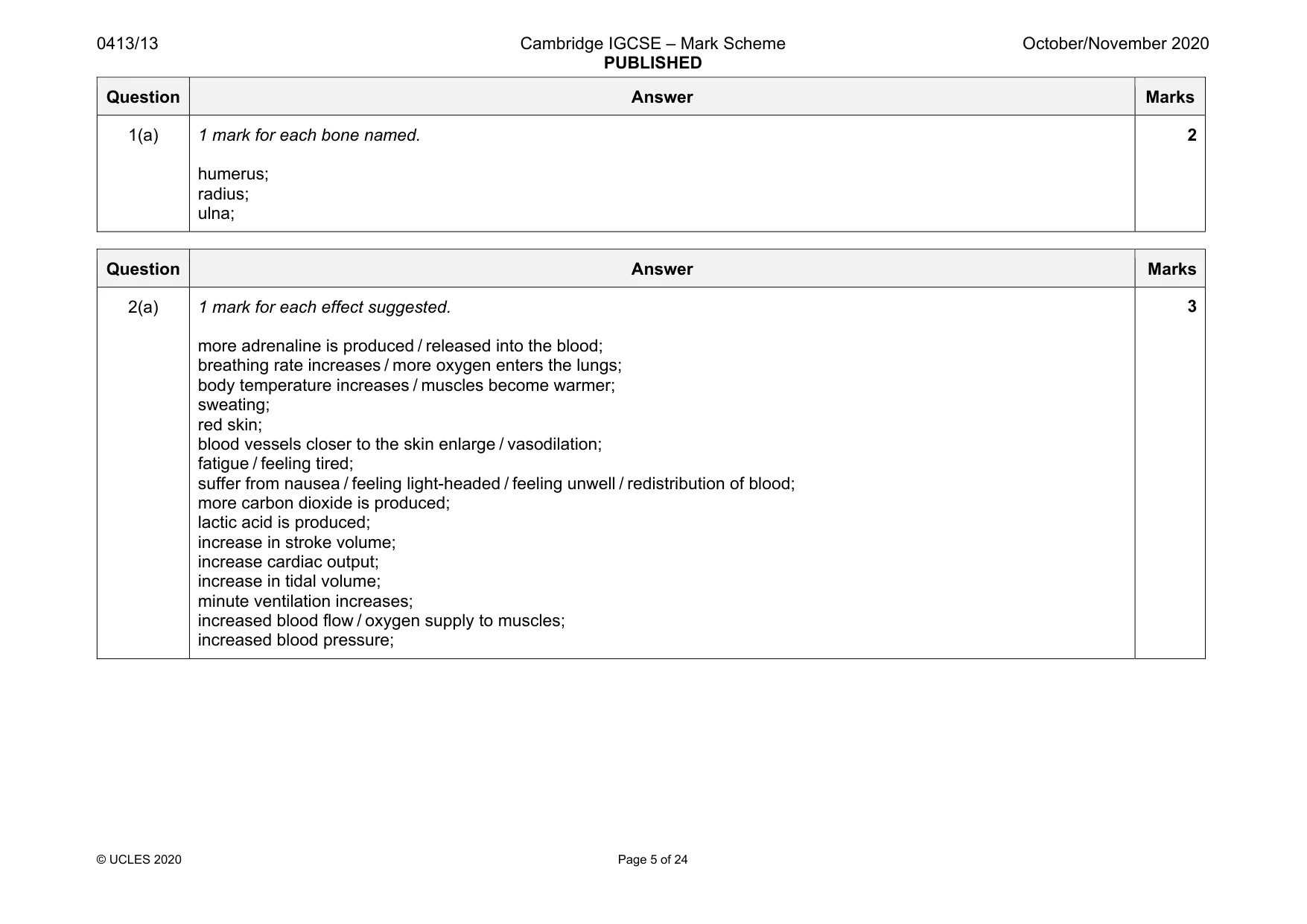
0413/13 Cambridge IGCSE – Mark Scheme PUBLISHED October/November 2020 © UCLES 2020 Page 5 of 24 Question Answer Marks 1(a) 1 mark for each bone named. humerus; radius; ulna; 2 Question Answer Marks 2(a) 1 mark for each effect suggested. more adrenaline is produced / released into the blood; breathing rate increases / more oxygen enters the lungs; body temperature increases / muscles become warmer; sweating; red skin; blood vessels closer to the skin enlarge / vasodilation; fatigue / feeling tired; suffer from nausea / feeling light-headed / feeling unwell / redistribution of blood; more carbon dioxide is produced; lactic acid is produced; increase in stroke volume; increase cardiac output; increase in tidal volume; minute ventilation increases; increased blood flow / oxygen supply to muscles; increased blood pressure; 3
Mark scheme, page 6
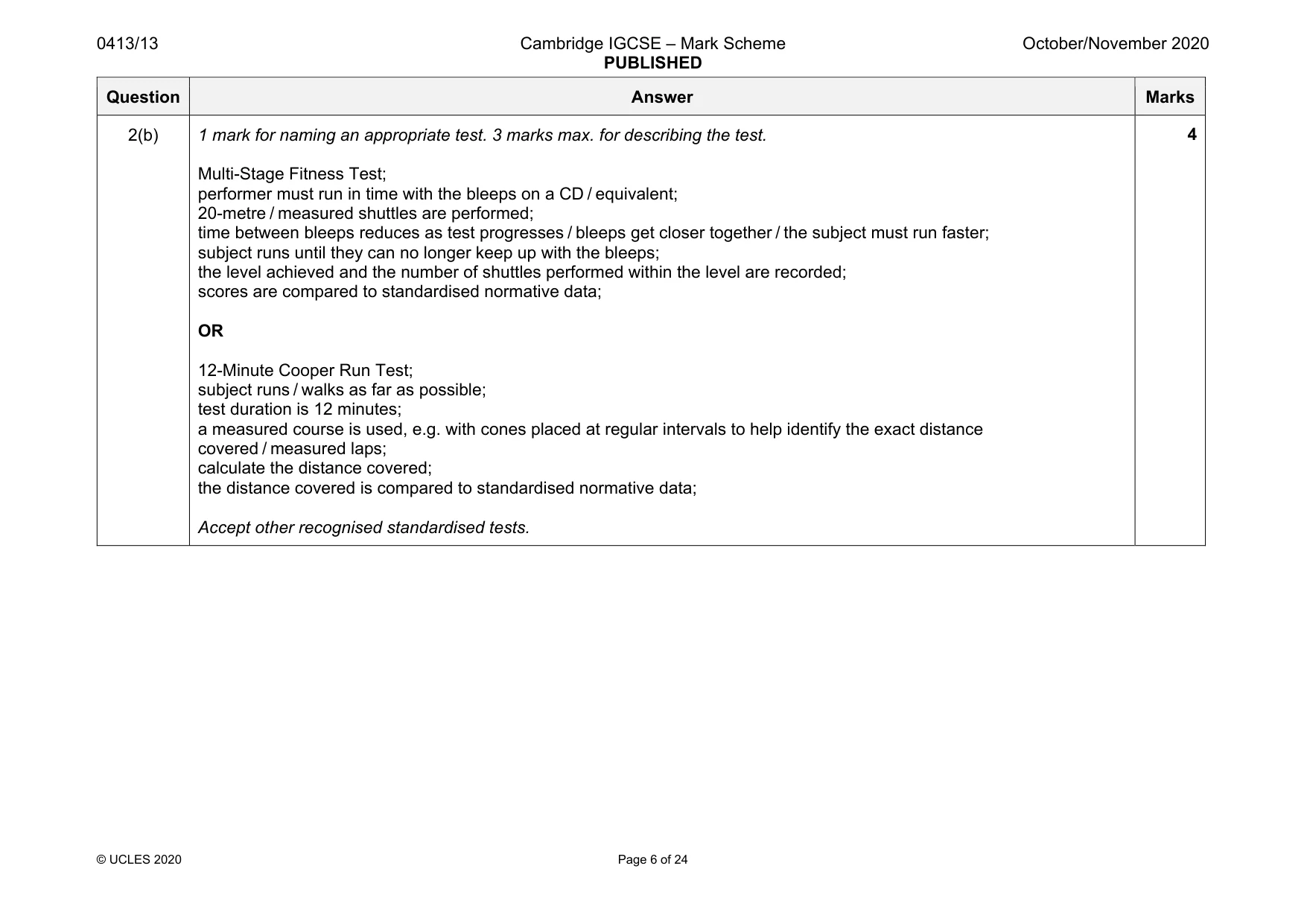
0413/13 Cambridge IGCSE – Mark Scheme PUBLISHED October/November 2020 © UCLES 2020 Page 6 of 24 Question Answer Marks 2(b) 1 mark for naming an appropriate test. 3 marks max. for describing the test. Multi-Stage Fitness Test; performer must run in time with the bleeps on a CD / equivalent; 20-metre / measured shuttles are performed; time between bleeps reduces as test progresses / bleeps get closer together / the subject must run faster; subject runs until they can no longer keep up with the bleeps; the level achieved and the number of shuttles performed within the level are recorded; scores are compared to standardised normative data; OR 12-Minute Cooper Run Test; subject runs / walks as far as possible; test duration is 12 minutes; a measured course is used, e.g. with cones placed at regular intervals to help identify the exact distance covered / measured laps; calculate the distance covered; the distance covered is compared to standardised normative data; Accept other recognised standardised tests. 4
Mark scheme, page 7
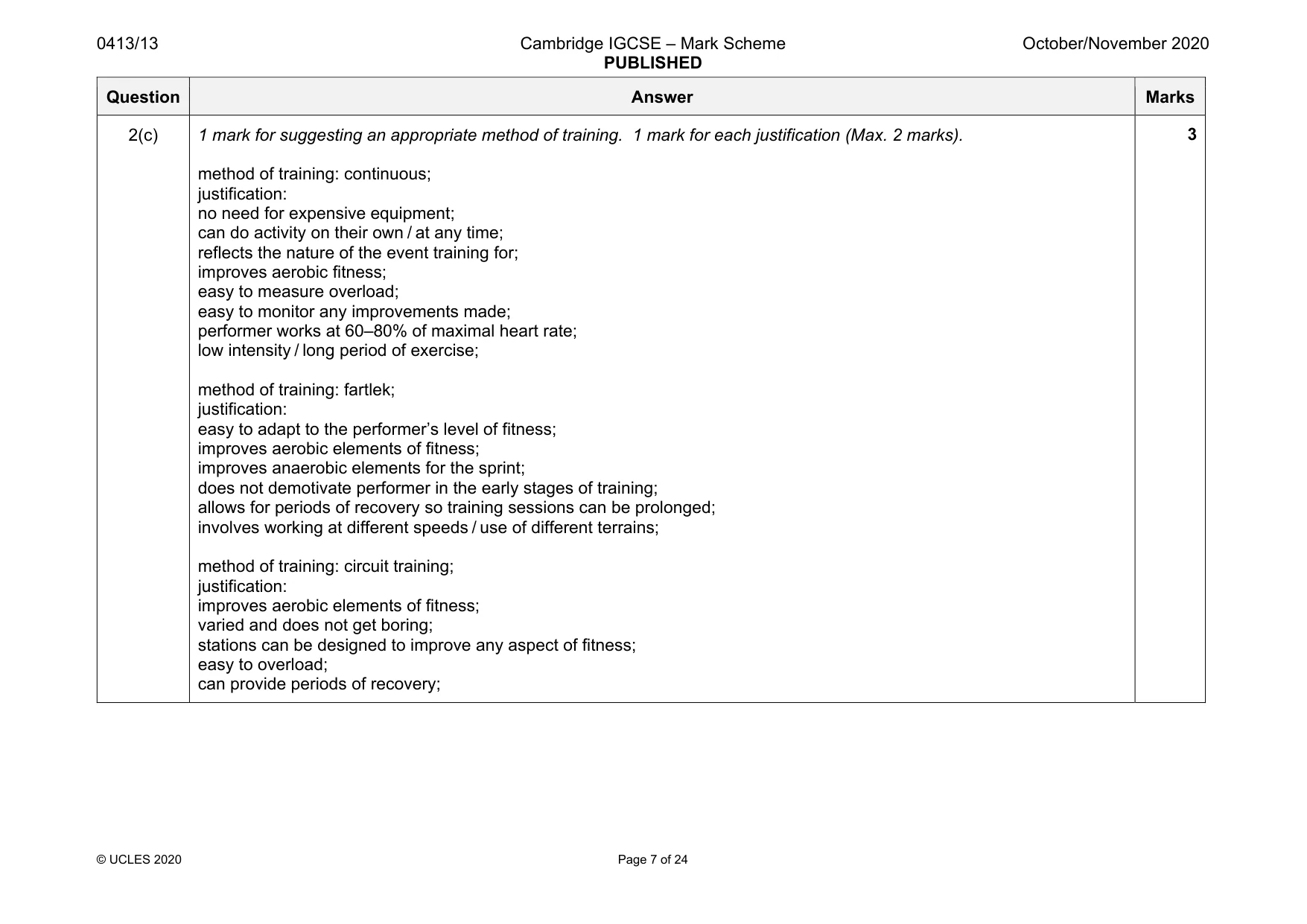
0413/13 Cambridge IGCSE – Mark Scheme PUBLISHED October/November 2020 © UCLES 2020 Page 7 of 24 Question Answer Marks 2(c) 1 mark for suggesting an appropriate method of training. 1 mark for each justification (Max. 2 marks). method of training: continuous; justification: no need for expensive equipment; can do activity on their own / at any time; reflects the nature of the event training for; improves aerobic fitness; easy to measure overload; easy to monitor any improvements made; performer works at 60–80% of maximal heart rate; low intensity / long period of exercise; method of training: fartlek; justification: easy to adapt to the performer’s level of fitness; improves aerobic elements of fitness; improves anaerobic elements for the sprint; does not demotivate performer in the early stages of training; allows for periods of recovery so training sessions can be prolonged; involves working at different speeds / use of different terrains; method of training: circuit training; justification: improves aerobic elements of fitness; varied and does not get boring; stations can be designed to improve any aspect of fitness; easy to overload; can provide periods of recovery; 3
Mark scheme, page 8
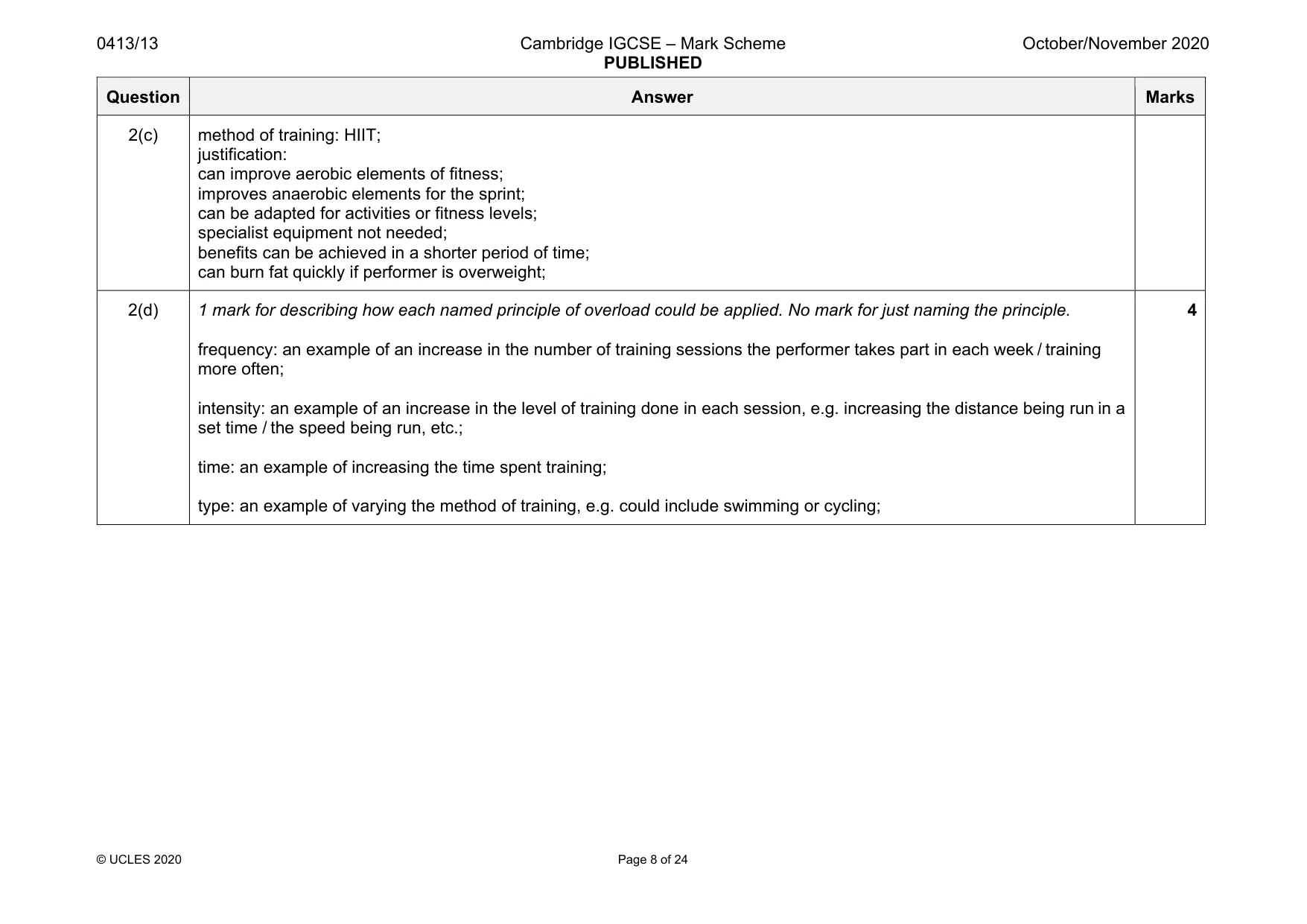
0413/13 Cambridge IGCSE – Mark Scheme PUBLISHED October/November 2020 © UCLES 2020 Page 8 of 24 Question Answer Marks 2(c) method of training: HIIT; justification: can improve aerobic elements of fitness; improves anaerobic elements for the sprint; can be adapted for activities or fitness levels; specialist equipment not needed; benefits can be achieved in a shorter period of time; can burn fat quickly if performer is overweight; 2(d) 1 mark for describing how each named principle of overload could be applied. No mark for just naming the principle. frequency: an example of an increase in the number of training sessions the performer takes part in each week / training more often; intensity: an example of an increase in the level of training done in each session, e.g. increasing the distance being run in a set time / the speed being run, etc.; time: an example of increasing the time spent training; type: an example of varying the method of training, e.g. could include swimming or cycling; 4
Mark scheme, page 9
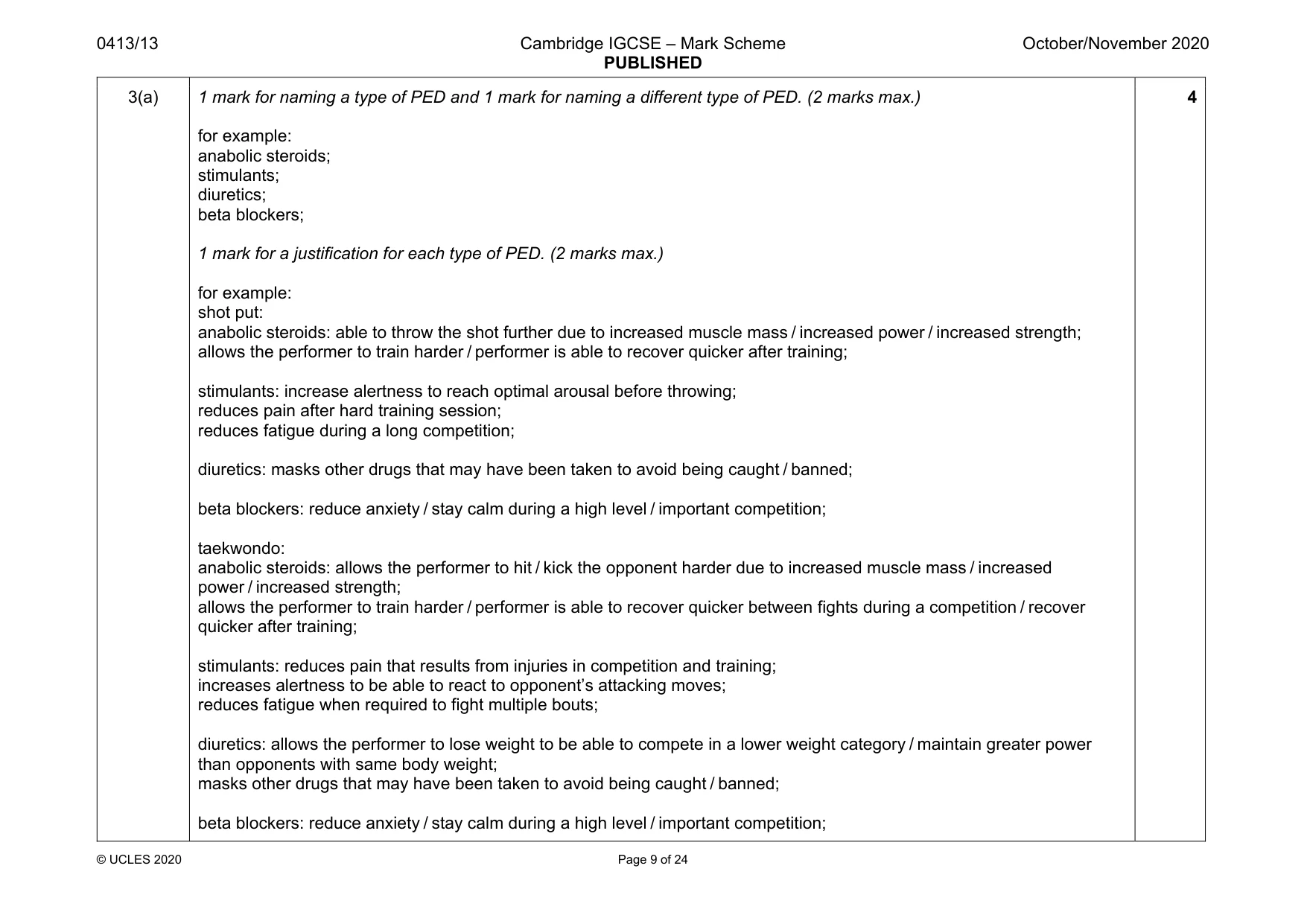
0413/13 Cambridge IGCSE – Mark Scheme PUBLISHED October/November 2020 © UCLES 2020 Page 9 of 24 3(a) 1 mark for naming a type of PED and 1 mark for naming a different type of PED. (2 marks max.) for example: anabolic steroids; stimulants; diuretics; beta blockers; 1 mark for a justification for each type of PED. (2 marks max.) for example: shot put: anabolic steroids: able to throw the shot further due to increased muscle mass / increased power / increased strength; allows the performer to train harder / performer is able to recover quicker after training; stimulants: increase alertness to reach optimal arousal before throwing; reduces pain after hard training session; reduces fatigue during a long competition; diuretics: masks other drugs that may have been taken to avoid being caught / banned; beta blockers: reduce anxiety / stay calm during a high level / important competition; taekwondo: anabolic steroids: allows the performer to hit / kick the opponent harder due to increased muscle mass / increased power / increased strength; allows the performer to train harder / performer is able to recover quicker between fights during a competition / recover quicker after training; stimulants: reduces pain that results from injuries in competition and training; increases alertness to be able to react to opponent’s attacking moves; reduces fatigue when required to fight multiple bouts; diuretics: allows the performer to lose weight to be able to compete in a lower weight category / maintain greater power than opponents with same body weight; masks other drugs that may have been taken to avoid being caught / banned; beta blockers: reduce anxiety / stay calm during a high level / important competition; 4
Mark scheme, page 10
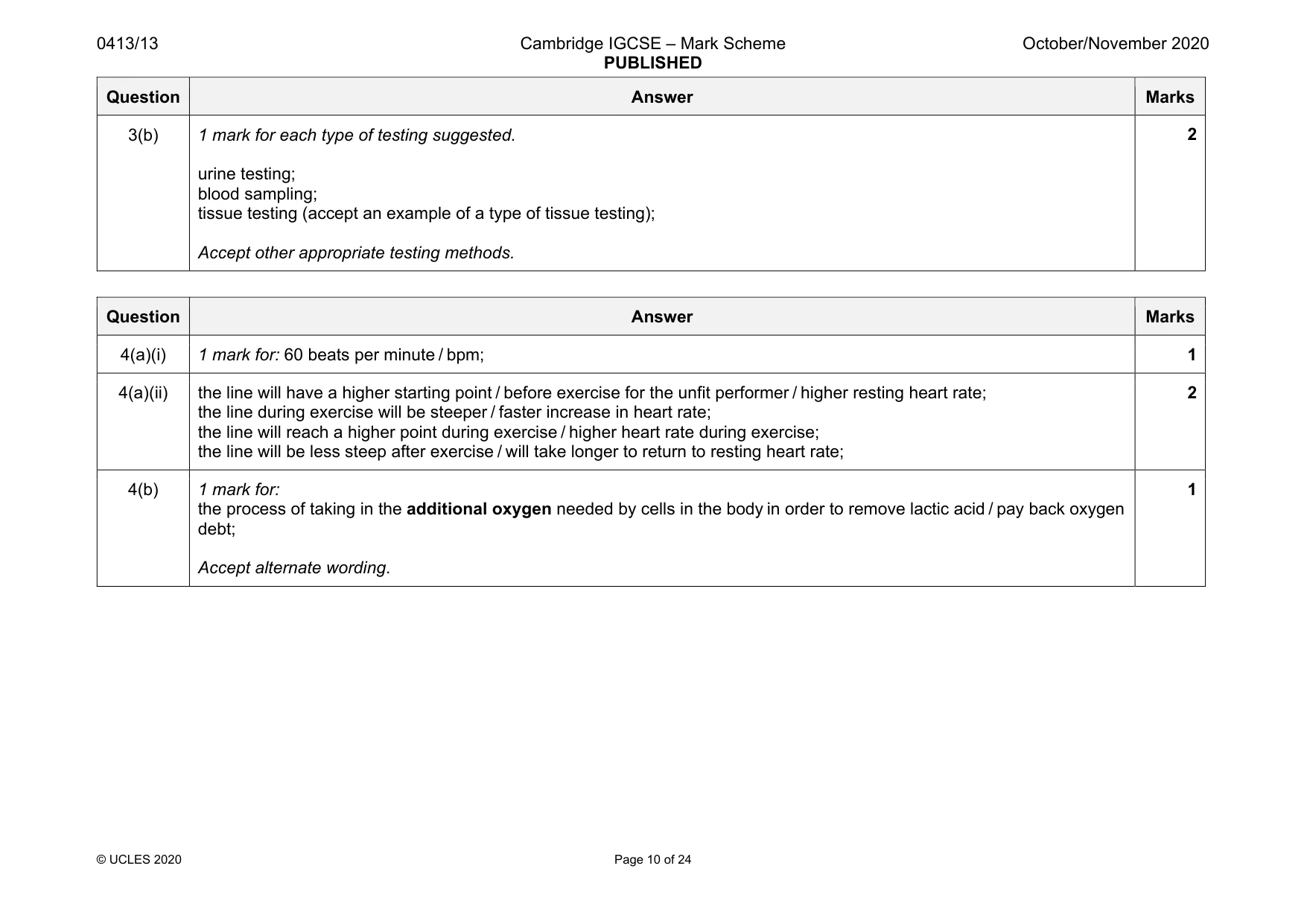
0413/13 Cambridge IGCSE – Mark Scheme PUBLISHED October/November 2020 © UCLES 2020 Page 10 of 24 Question Answer Marks 3(b) 1 mark for each type of testing suggested. urine testing; blood sampling; tissue testing (accept an example of a type of tissue testing); Accept other appropriate testing methods. 2 Question Answer Marks 4(a)(i) 1 mark for: 60 beats per minute / bpm; 1 4(a)(ii) the line will have a higher starting point / before exercise for the unfit performer / higher resting heart rate; the line during exercise will be steeper / faster increase in heart rate; the line will reach a higher point during exercise / higher heart rate during exercise; the line will be less steep after exercise / will take longer to return to resting heart rate; 2 4(b) 1 mark for: the process of taking in the additional oxygen needed by cells in the body in order to remove lactic acid / pay back oxygen debt; Accept alternate wording. 1
Mark scheme, page 11
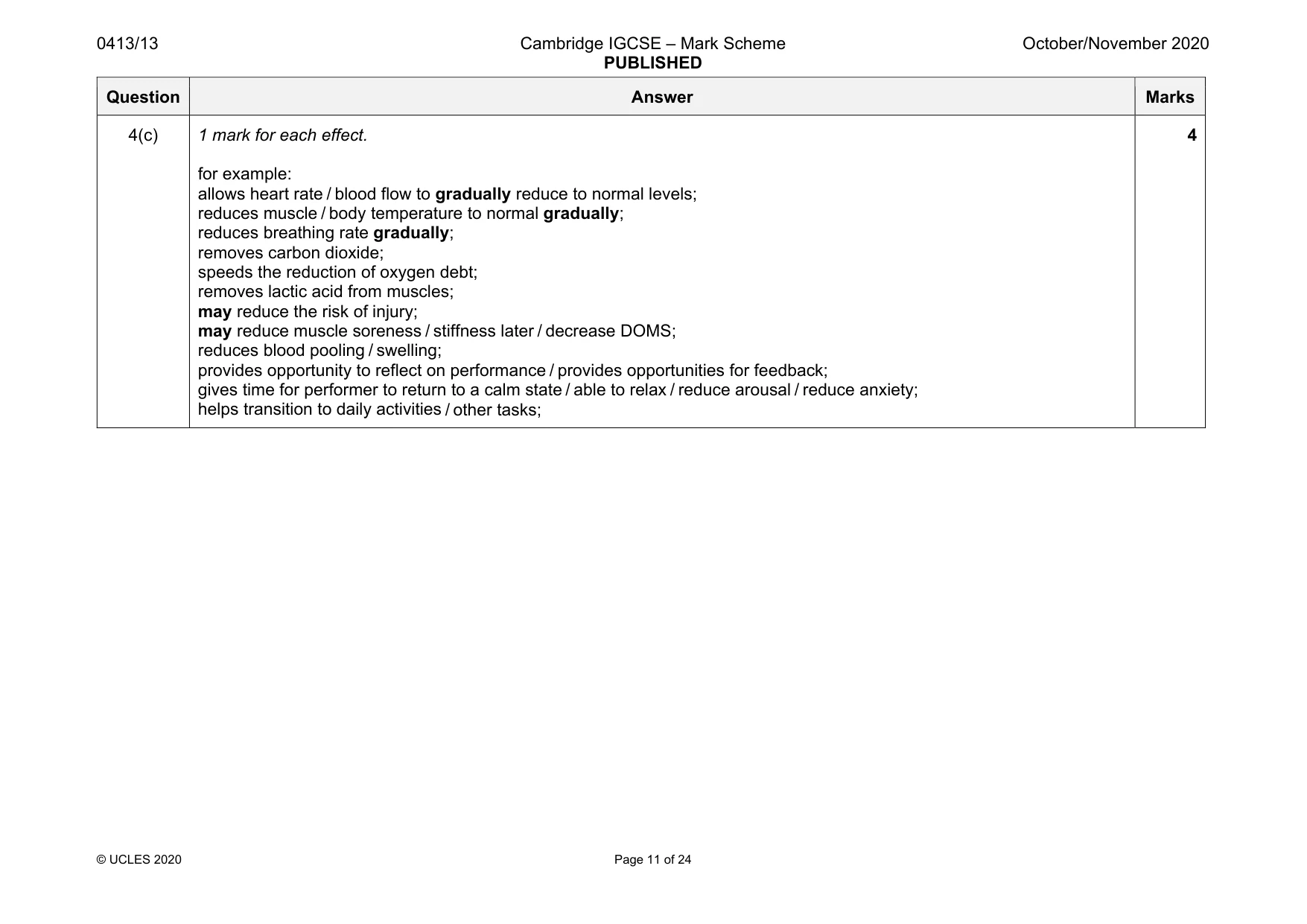
0413/13 Cambridge IGCSE – Mark Scheme PUBLISHED October/November 2020 © UCLES 2020 Page 11 of 24 Question Answer Marks 4(c) 1 mark for each effect. for example: allows heart rate / blood flow to gradually reduce to normal levels; reduces muscle / body temperature to normal gradually; reduces breathing rate gradually; removes carbon dioxide; speeds the reduction of oxygen debt; removes lactic acid from muscles; may reduce the risk of injury; may reduce muscle soreness / stiffness later / decrease DOMS; reduces blood pooling / swelling; provides opportunity to reflect on performance / provides opportunities for feedback; gives time for performer to return to a calm state / able to relax / reduce arousal / reduce anxiety; helps transition to daily activities / other tasks; 4
Mark scheme, page 12
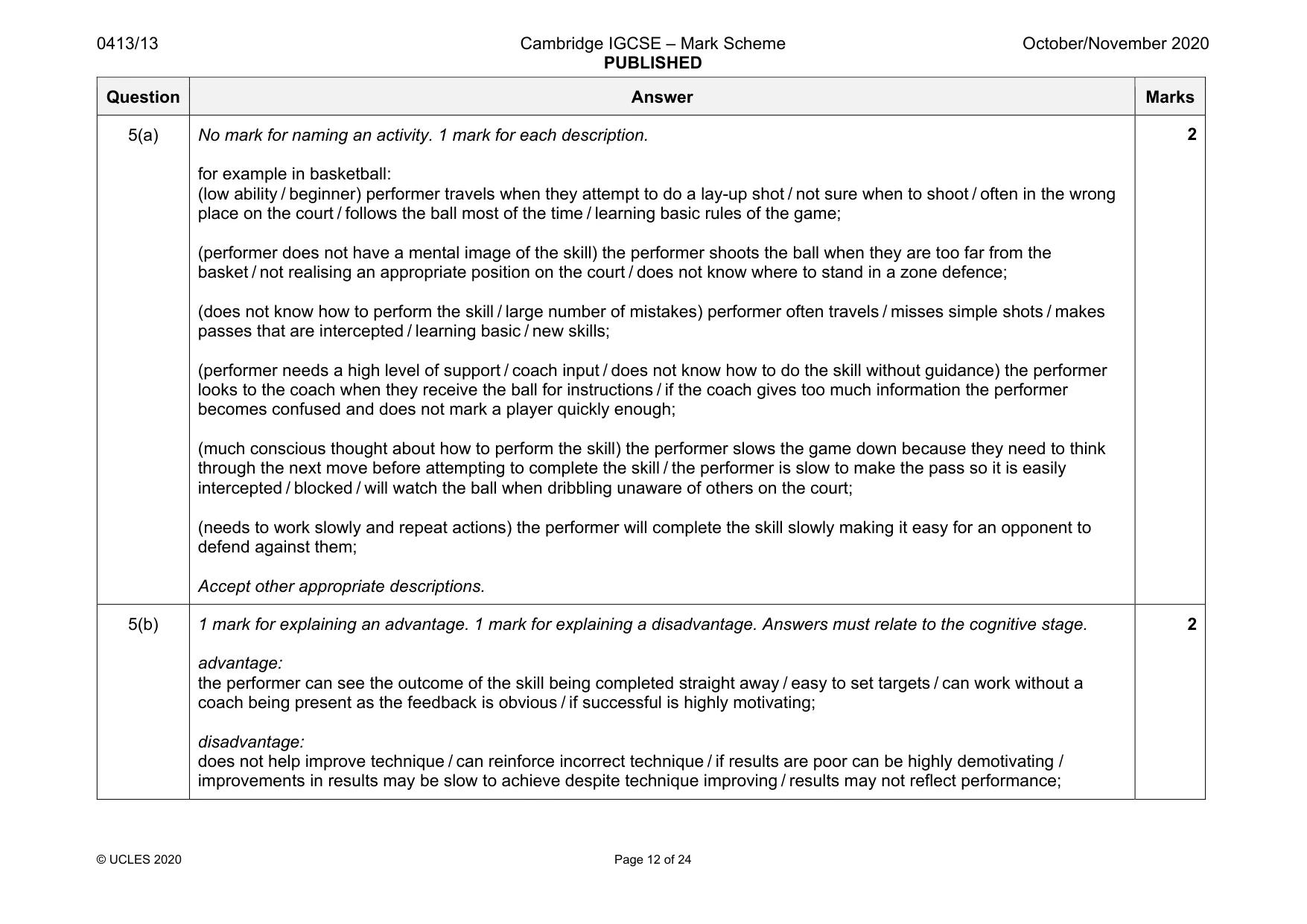
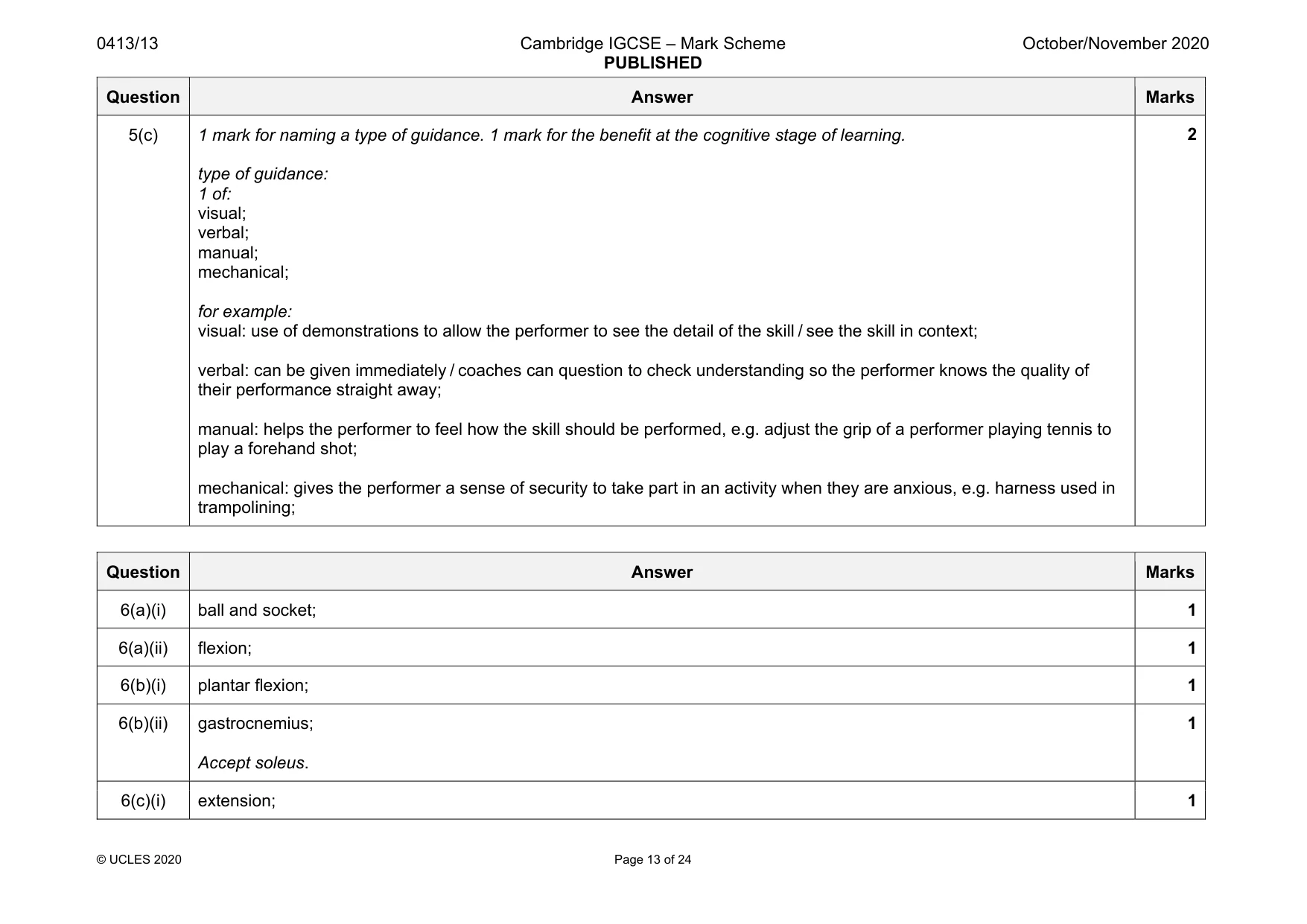
0413/13 Cambridge IGCSE – Mark Scheme PUBLISHED October/November 2020 © UCLES 2020 Page 12 of 24 Question Answer Marks 5(a) No mark for naming an activity. 1 mark for each description. for example in basketball: (low ability / beginner) performer travels when they attempt to do a lay-up shot / not sure when to shoot / often in the wrong place on the court / follows the ball most of the time / learning basic rules of the game; (performer does not have a mental image of the skill) the performer shoots the ball when they are too far from the basket / not realising an appropriate position on the court / does not know where to stand in a zone defence; (does not know how to perform the skill / large number of mistakes) performer often travels / misses simple shots / makes passes that are intercepted / learning basic / new skills; (performer needs a high level of support / coach input / does not know how to do the skill without guidance) the performer looks to the coach when they receive the ball for instructions / if the coach gives too much information the performer becomes confused and does not mark a player quickly enough; (much conscious thought about how to perform the skill) the performer slows the game down because they need to think through the next move before attempting to complete the skill / the performer is slow to make the pass so it is easily intercepted / blocked / will watch the ball when dribbling unaware of others on the court; (needs to work slowly and repeat actions) the performer will complete the skill slowly making it easy for an opponent to defend against them; Accept other appropriate descriptions. 2 5(b) 1 mark for explaining an advantage. 1 mark for explaining a disadvantage. Answers must relate to the cognitive stage. advantage: the performer can see the outcome of the skill being completed straight away / easy to set targets / can work without a coach being present as the feedback is obvious / if successful is highly motivating; disadvantage: does not help improve technique / can reinforce incorrect technique / if results are poor can be highly demotivating / improvements in results may be slow to achieve despite technique improving / results may not reflect performance; 2
Mark scheme, page 13
0413/13 Cambridge IGCSE – Mark Scheme PUBLISHED October/November 2020 © UCLES 2020 Page 13 of 24 Question Answer Marks 5(c) 1 mark for naming a type of guidance. 1 mark for the benefit at the cognitive stage of learning. type of guidance: 1 of: visual; verbal; manual; mechanical; for example: visual: use of demonstrations to allow the performer to see the detail of the skill / see the skill in context; verbal: can be given immediately / coaches can question to check understanding so the performer knows the quality of their performance straight away; manual: helps the performer to feel how the skill should be performed, e.g. adjust the grip of a performer playing tennis to play a forehand shot; mechanical: gives the performer a sense of security to take part in an activity when they are anxious, e.g. harness used in trampolining; 2 Question Answer Marks 6(a)(i) ball and socket; 1 6(a)(ii) flexion; 1 6(b)(i) plantar flexion; 1 6(b)(ii) gastrocnemius; Accept soleus. 1 6(c)(i) extension; 1
Mark scheme, page 14
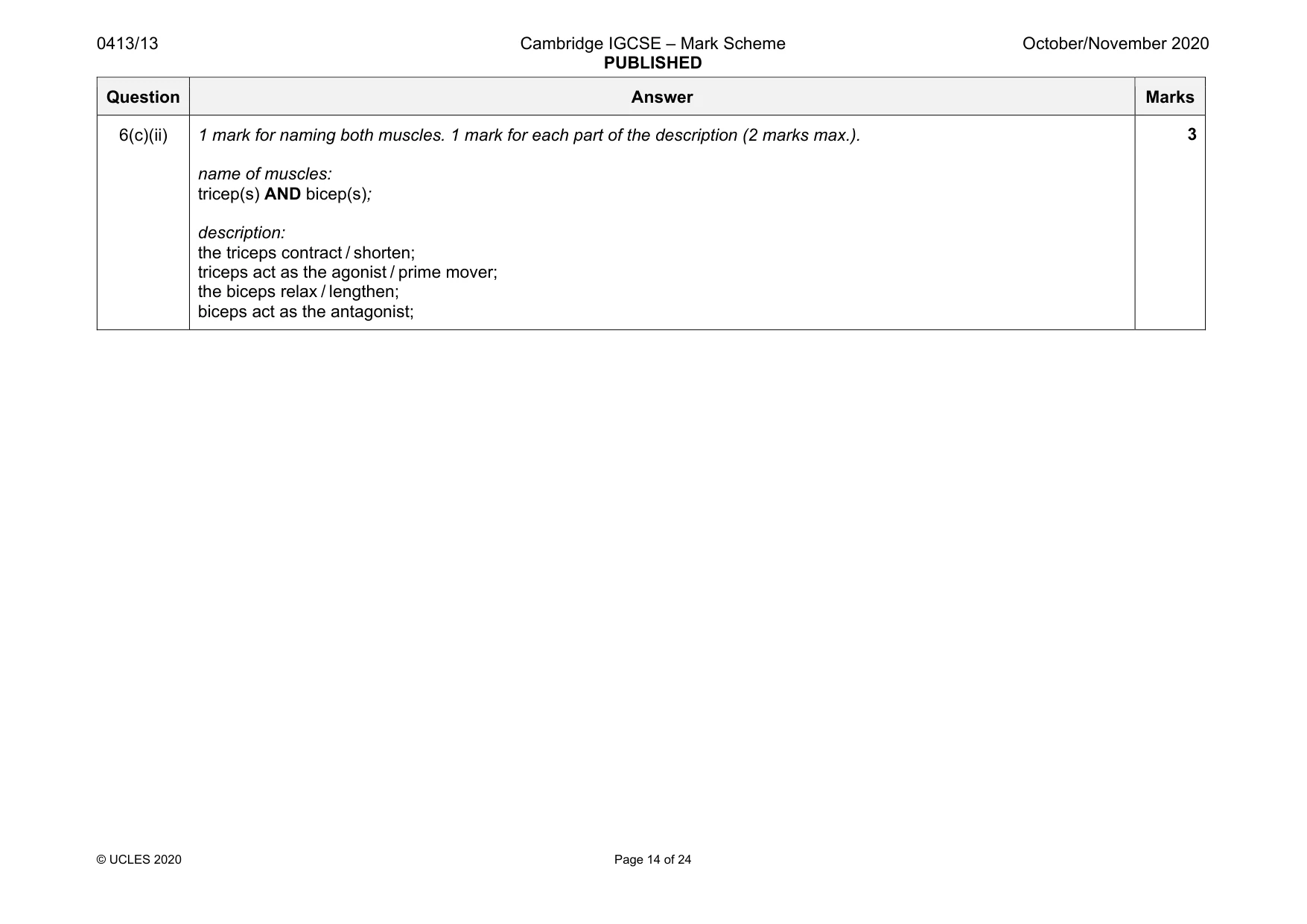
0413/13 Cambridge IGCSE – Mark Scheme PUBLISHED October/November 2020 © UCLES 2020 Page 14 of 24 Question Answer Marks 6(c)(ii) 1 mark for naming both muscles. 1 mark for each part of the description (2 marks max.). name of muscles: tricep(s) AND bicep(s); description: the triceps contract / shorten; triceps act as the agonist / prime mover; the biceps relax / lengthen; biceps act as the antagonist; 3
Mark scheme, page 15
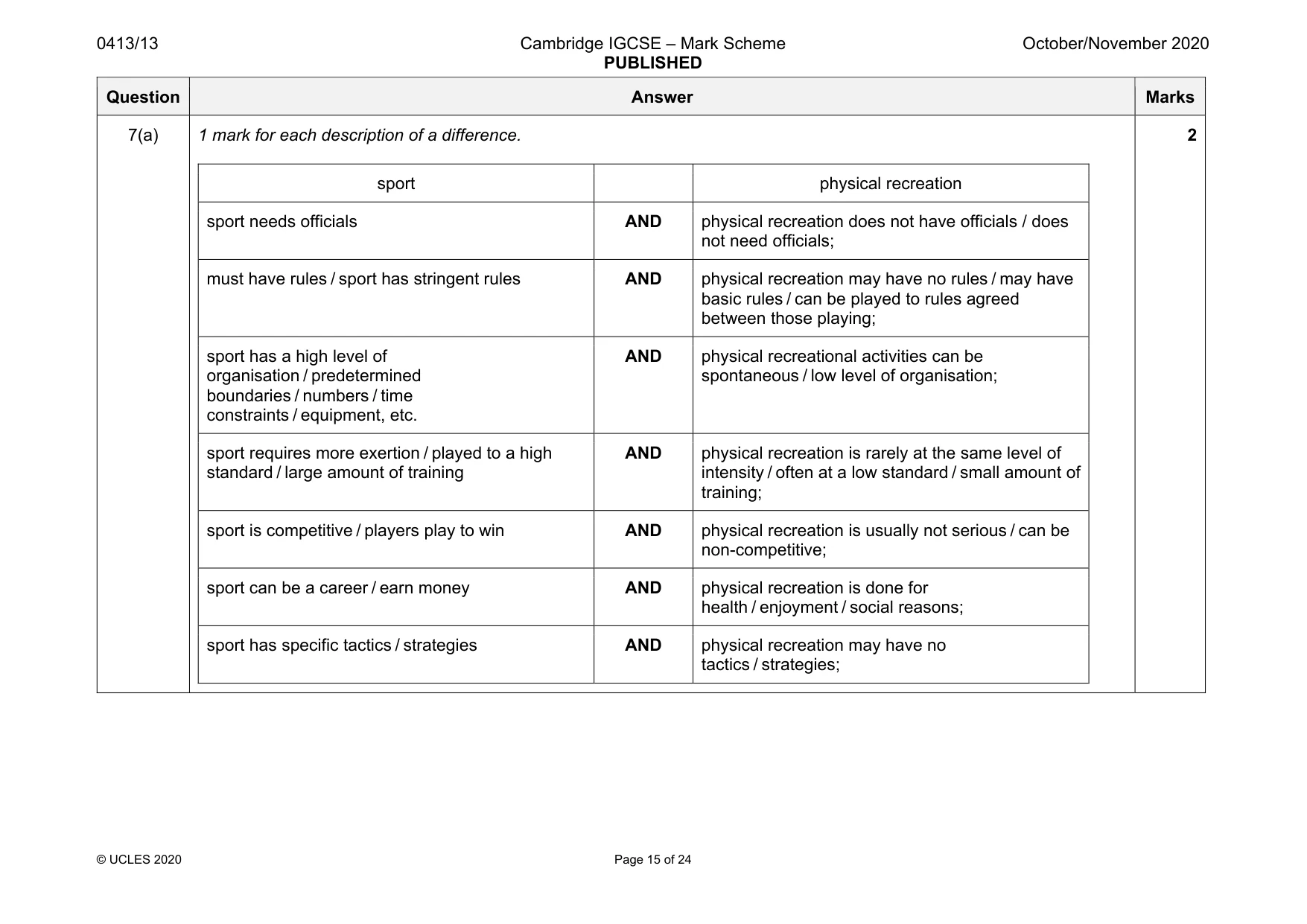
0413/13 Cambridge IGCSE – Mark Scheme PUBLISHED October/November 2020 © UCLES 2020 Page 15 of 24 Question Answer Marks 7(a) 1 mark for each description of a difference. sport physical recreation sport needs officials AND physical recreation does not have officials / does not need officials; must have rules / sport has stringent rules AND physical recreation may have no rules / may have basic rules / can be played to rules agreed between those playing; sport has a high level of organisation / predetermined boundaries / numbers / time constraints / equipment, etc. AND physical recreational activities can be spontaneous / low level of organisation; sport requires more exertion / played to a high standard / large amount of training AND physical recreation is rarely at the same level of intensity / often at a low standard / small amount of training; sport is competitive / players play to win AND physical recreation is usually not serious / can be non-competitive; sport can be a career / earn money AND physical recreation is done for health / enjoyment / social reasons; sport has specific tactics / strategies AND physical recreation may have no tactics / strategies; 2
Mark scheme, page 16
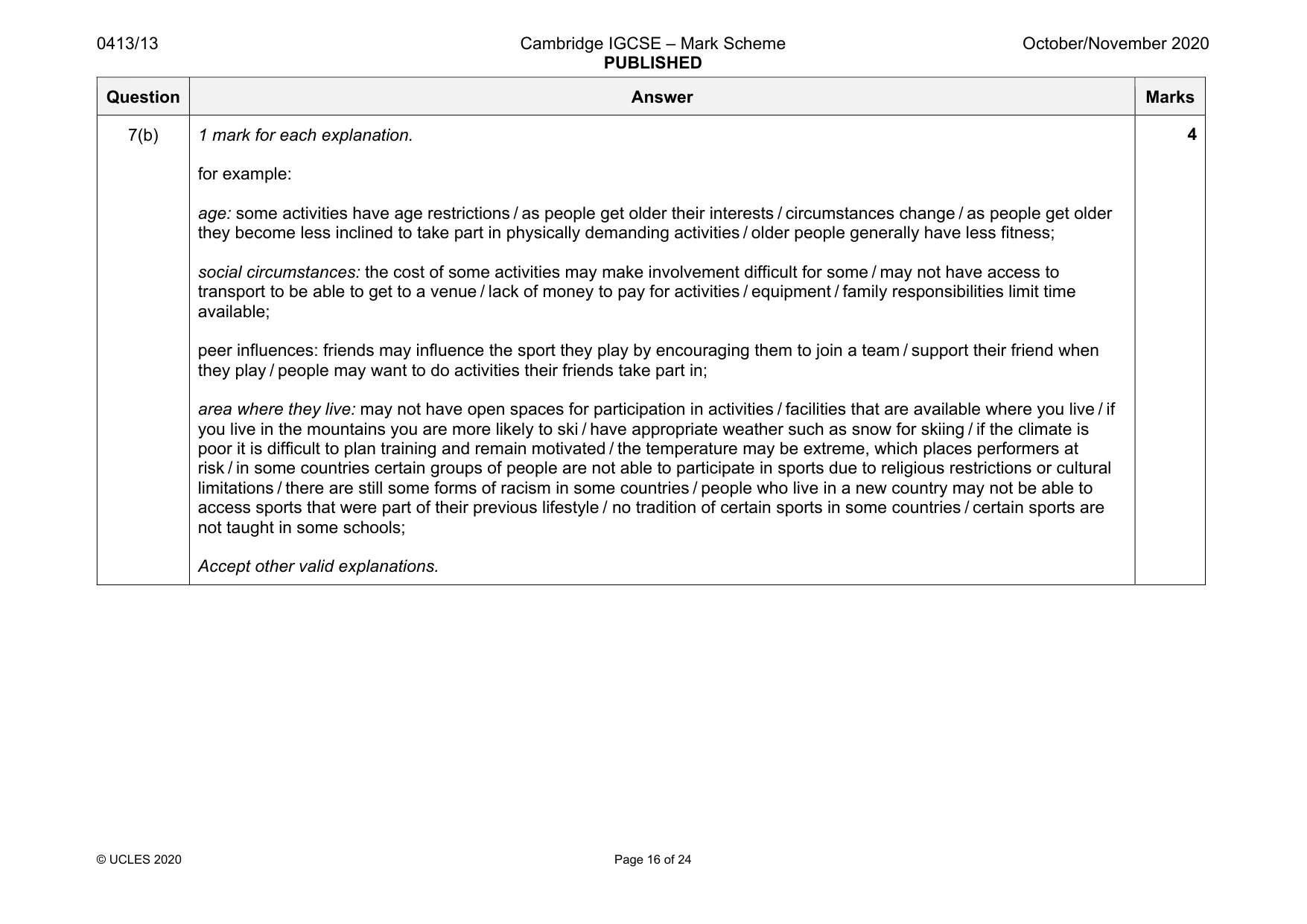
0413/13 Cambridge IGCSE – Mark Scheme PUBLISHED October/November 2020 © UCLES 2020 Page 16 of 24 Question Answer Marks 7(b) 1 mark for each explanation. for example: age: some activities have age restrictions / as people get older their interests / circumstances change / as people get older they become less inclined to take part in physically demanding activities / older people generally have less fitness; social circumstances: the cost of some activities may make involvement difficult for some / may not have access to transport to be able to get to a venue / lack of money to pay for activities / equipment / family responsibilities limit time available; peer influences: friends may influence the sport they play by encouraging them to join a team / support their friend when they play / people may want to do activities their friends take part in; area where they live: may not have open spaces for participation in activities / facilities that are available where you live / if you live in the mountains you are more likely to ski / have appropriate weather such as snow for skiing / if the climate is poor it is difficult to plan training and remain motivated / the temperature may be extreme, which places performers at risk / in some countries certain groups of people are not able to participate in sports due to religious restrictions or cultural limitations / there are still some forms of racism in some countries / people who live in a new country may not be able to access sports that were part of their previous lifestyle / no tradition of certain sports in some countries / certain sports are not taught in some schools; Accept other valid explanations. 4
Mark scheme, page 17
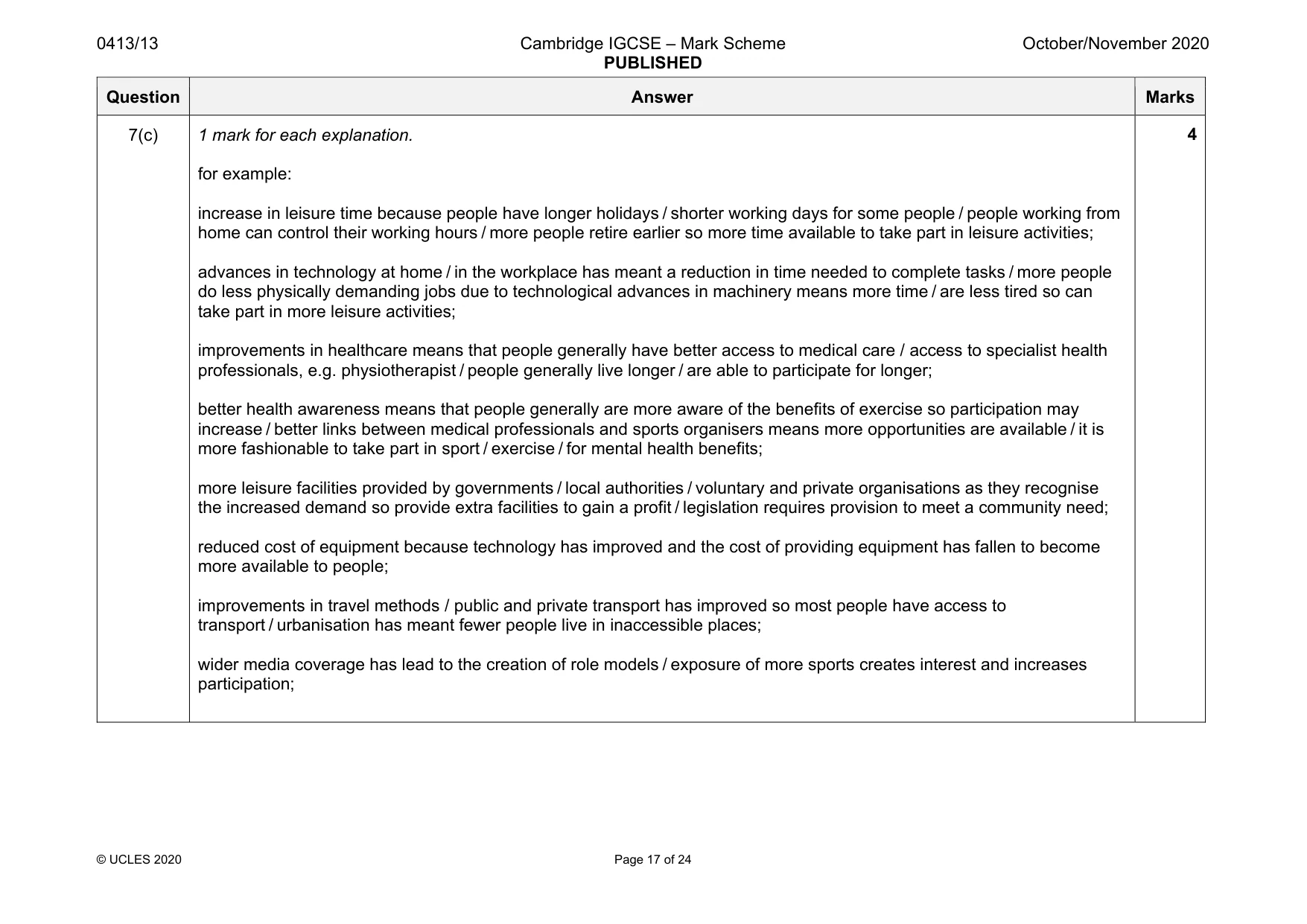
0413/13 Cambridge IGCSE – Mark Scheme PUBLISHED October/November 2020 © UCLES 2020 Page 17 of 24 Question Answer Marks 7(c) 1 mark for each explanation. for example: increase in leisure time because people have longer holidays / shorter working days for some people / people working from home can control their working hours / more people retire earlier so more time available to take part in leisure activities; advances in technology at home / in the workplace has meant a reduction in time needed to complete tasks / more people do less physically demanding jobs due to technological advances in machinery means more time / are less tired so can take part in more leisure activities; improvements in healthcare means that people generally have better access to medical care / access to specialist health professionals, e.g. physiotherapist / people generally live longer / are able to participate for longer; better health awareness means that people generally are more aware of the benefits of exercise so participation may increase / better links between medical professionals and sports organisers means more opportunities are available / it is more fashionable to take part in sport / exercise / for mental health benefits; more leisure facilities provided by governments / local authorities / voluntary and private organisations as they recognise the increased demand so provide extra facilities to gain a profit / legislation requires provision to meet a community need; reduced cost of equipment because technology has improved and the cost of providing equipment has fallen to become more available to people; improvements in travel methods / public and private transport has improved so most people have access to transport / urbanisation has meant fewer people live in inaccessible places; wider media coverage has lead to the creation of role models / exposure of more sports creates interest and increases participation; 4
Mark scheme, page 18
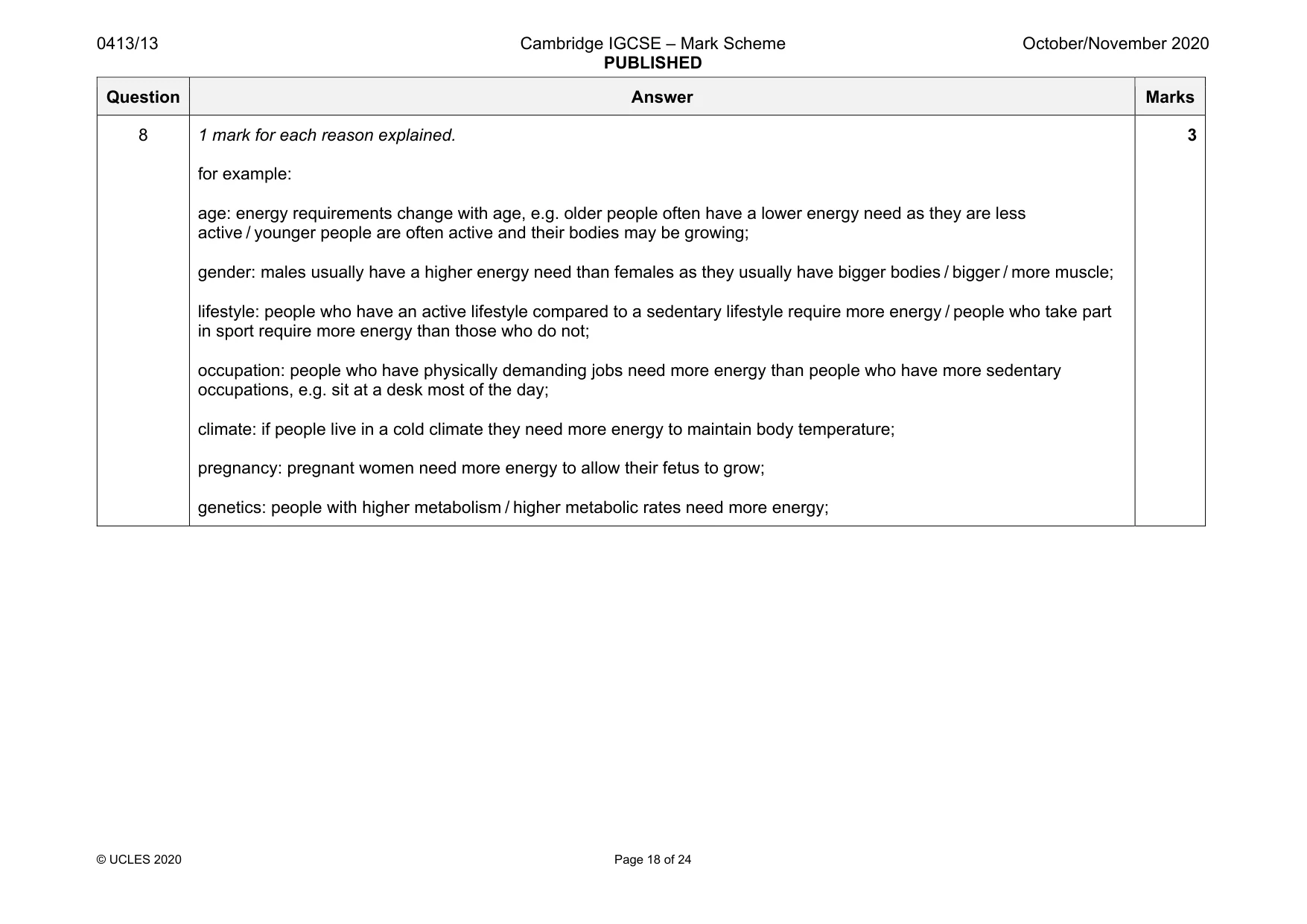
0413/13 Cambridge IGCSE – Mark Scheme PUBLISHED October/November 2020 © UCLES 2020 Page 18 of 24 Question Answer Marks 8 1 mark for each reason explained. for example: age: energy requirements change with age, e.g. older people often have a lower energy need as they are less active / younger people are often active and their bodies may be growing; gender: males usually have a higher energy need than females as they usually have bigger bodies / bigger / more muscle; lifestyle: people who have an active lifestyle compared to a sedentary lifestyle require more energy / people who take part in sport require more energy than those who do not; occupation: people who have physically demanding jobs need more energy than people who have more sedentary occupations, e.g. sit at a desk most of the day; climate: if people live in a cold climate they need more energy to maintain body temperature; pregnancy: pregnant women need more energy to allow their fetus to grow; genetics: people with higher metabolism / higher metabolic rates need more energy; 3
Mark scheme, page 19
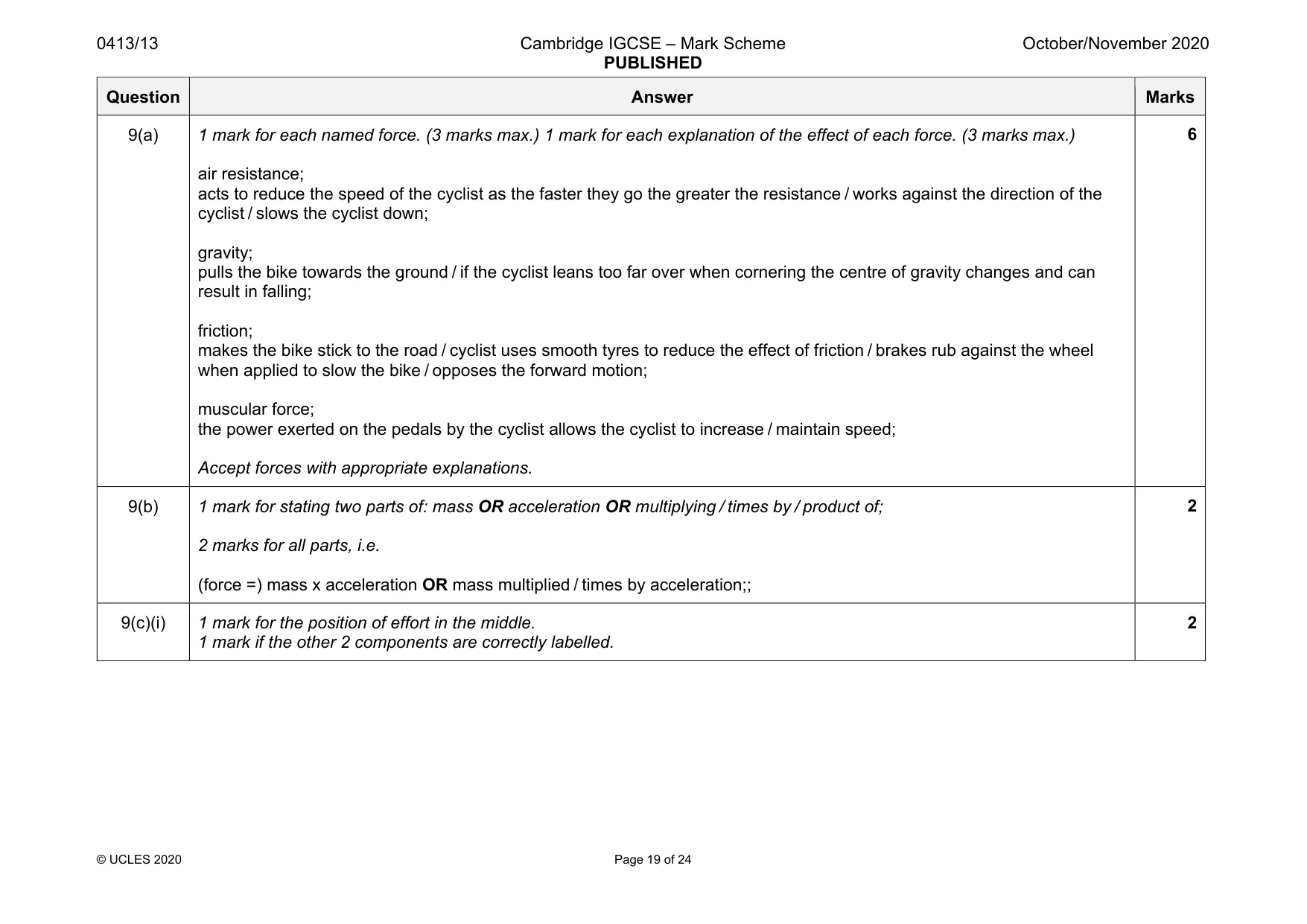
0413/13 Cambridge IGCSE – Mark Scheme PUBLISHED October/November 2020 © UCLES 2020 Page 19 of 24 Question Answer Marks 9(a) 1 mark for each named force. (3 marks max.) 1 mark for each explanation of the effect of each force. (3 marks max.) air resistance; acts to reduce the speed of the cyclist as the faster they go the greater the resistance / works against the direction of the cyclist / slows the cyclist down; gravity; pulls the bike towards the ground / if the cyclist leans too far over when cornering the centre of gravity changes and can result in falling; friction; makes the bike stick to the road / cyclist uses smooth tyres to reduce the effect of friction / brakes rub against the wheel when applied to slow the bike / opposes the forward motion; muscular force; the power exerted on the pedals by the cyclist allows the cyclist to increase / maintain speed; Accept forces with appropriate explanations. 6 9(b) 1 mark for stating two parts of: mass OR acceleration OR multiplying / times by / product of; 2 marks for all parts, i.e. (force =) mass x acceleration OR mass multiplied / times by acceleration;; 2 9(c)(i) 1 mark for the position of effort in the middle. 1 mark if the other 2 components are correctly labelled. 2
Mark scheme, page 20
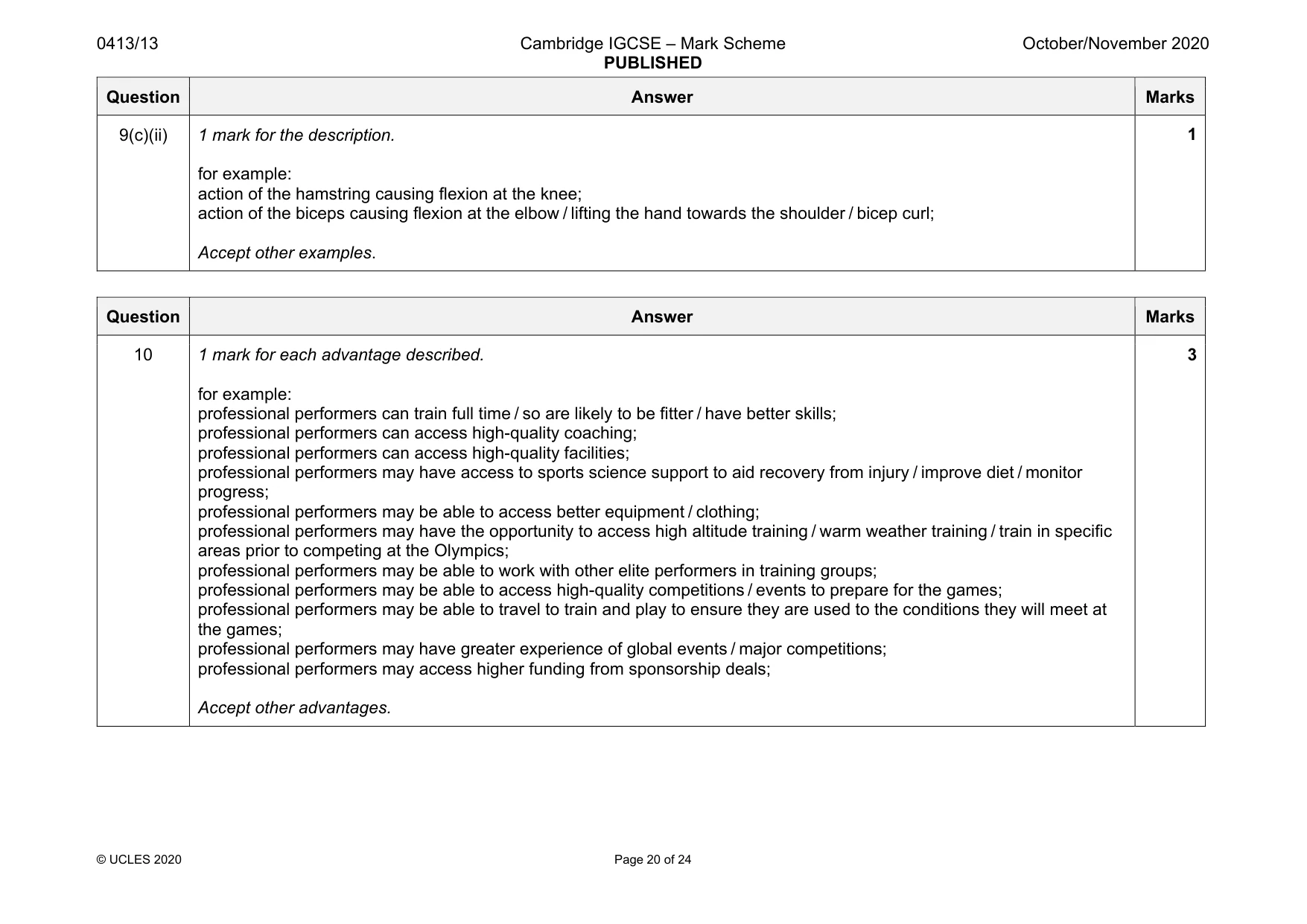
0413/13 Cambridge IGCSE – Mark Scheme PUBLISHED October/November 2020 © UCLES 2020 Page 20 of 24 Question Answer Marks 9(c)(ii) 1 mark for the description. for example: action of the hamstring causing flexion at the knee; action of the biceps causing flexion at the elbow / lifting the hand towards the shoulder / bicep curl; Accept other examples. 1 Question Answer Marks 10 1 mark for each advantage described. for example: professional performers can train full time / so are likely to be fitter / have better skills; professional performers can access high-quality coaching; professional performers can access high-quality facilities; professional performers may have access to sports science support to aid recovery from injury / improve diet / monitor progress; professional performers may be able to access better equipment / clothing; professional performers may have the opportunity to access high altitude training / warm weather training / train in specific areas prior to competing at the Olympics; professional performers may be able to work with other elite performers in training groups; professional performers may be able to access high-quality competitions / events to prepare for the games; professional performers may be able to travel to train and play to ensure they are used to the conditions they will meet at the games; professional performers may have greater experience of global events / major competitions; professional performers may access higher funding from sponsorship deals; Accept other advantages. 3
Mark scheme, page 21
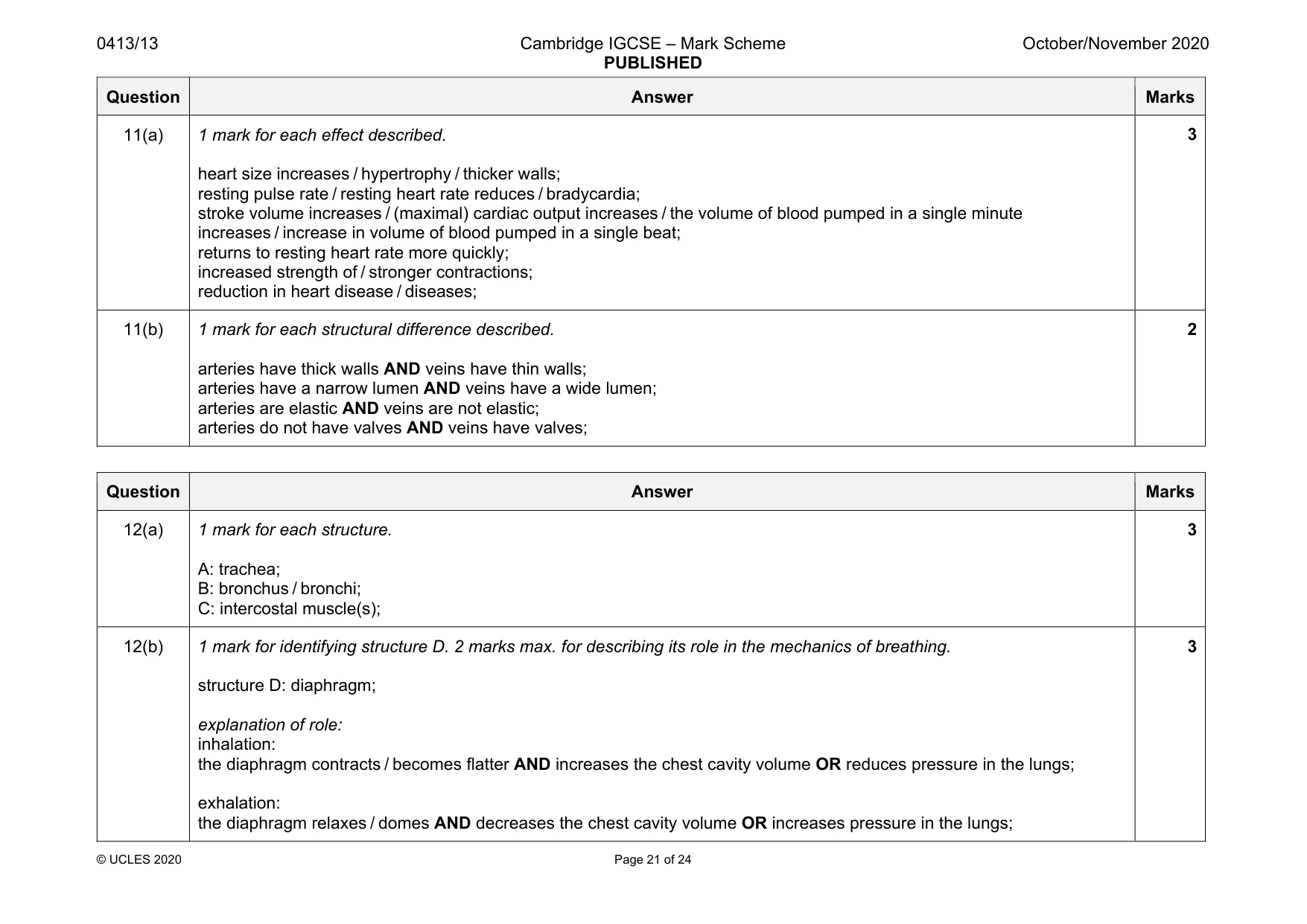
0413/13 Cambridge IGCSE – Mark Scheme PUBLISHED October/November 2020 © UCLES 2020 Page 21 of 24 Question Answer Marks 11(a) 1 mark for each effect described. heart size increases / hypertrophy / thicker walls; resting pulse rate / resting heart rate reduces / bradycardia; stroke volume increases / (maximal) cardiac output increases / the volume of blood pumped in a single minute increases / increase in volume of blood pumped in a single beat; returns to resting heart rate more quickly; increased strength of / stronger contractions; reduction in heart disease / diseases; 3 11(b) 1 mark for each structural difference described. arteries have thick walls AND veins have thin walls; arteries have a narrow lumen AND veins have a wide lumen; arteries are elastic AND veins are not elastic; arteries do not have valves AND veins have valves; 2 Question Answer Marks 12(a) 1 mark for each structure. A: trachea; B: bronchus / bronchi; C: intercostal muscle(s); 3 12(b) 1 mark for identifying structure D. 2 marks max. for describing its role in the mechanics of breathing. structure D: diaphragm; explanation of role: inhalation: the diaphragm contracts / becomes flatter AND increases the chest cavity volume OR reduces pressure in the lungs; exhalation: the diaphragm relaxes / domes AND decreases the chest cavity volume OR increases pressure in the lungs; 3
Mark scheme, page 22
0413/13 Cambridge IGCSE – Mark Scheme PUBLISHED October/November 2020 © UCLES 2020 Page 22 of 24 Question Answer Marks 13(a) 1 mark for each reason for an appropriate activity. Activities must be different. for example: A: long-distance running / cross country running / cycling reason: mainly aerobic energy demand / low intensity / long duration / do not fatigue quickly / can work for long periods of time / contract slowly so suitable for distance races that are run at a steady pace or able to last the whole of an event / better for endurance; B: sprints events, e.g. 100 m / 200 m / jumping events / throwing events reason: mainly anaerobic energy demand / high intensity / short duration / provides large amounts of force / tire quickly but events are completed quickly / provide strength / power / speed; C: games activity, e.g. tennis reason: needs both aerobic and anaerobic energy demands / needs powerful shots to stay in rallies / there are changes in intensity within the activity, accept specific examples of this / mix provides endurance with the ability to sprint / able to respond to changes in the pace of the event; 3 13(b) 1 mark for each characteristic described. produce large amounts of force / powerful contractions; fast twitch fibres tire quickly / low fatigue tolerance; supplies energy anaerobically / provides energy without oxygen; white / pale in colour; contract quickly; 3 Question Answer Marks 14(a) the state of excitement / alertness / mentally / physically ready to perform task; Accept alternative wording. 1
Mark scheme, page 23
0413/13 Cambridge IGCSE – Mark Scheme PUBLISHED October/November 2020 © UCLES 2020 Page 23 of 24 Question Answer Marks 14(b) for example in basketball: 1 mark for an example of a relevant skill identified as requiring a high level of arousal. for example, jumping to rebound the ball requires a high level of arousal; 1 mark for explanation of why optimal level of arousal is high. for example, high arousal: gross skill / requires all-out effort / controlled aggression; 1 mark for an example of a relevant skill from the same physical activity identified as requiring a low level of arousal. for example, taking a free throw requires a low level of arousal; 1 mark for explanation of why optimal level of arousal is low. for example, low arousal: fine skill / requires precision / stay calm / high level of concentration; 4 14(c) 1 mark for each negative effect. Answers must relate to games activities. for example: over aggression: performers can become too aggressive and be too physical, e.g. when tackling a player and be penalised / fighting occurs; balance: can be lost and result in players falling, e.g. they are too anxious to get to the ball; coordination: performers may be unable to complete simple tasks that they usually complete, e.g. missing simple catches; focus: a lack of concentration may result in missing key cues, e.g. so they may not be in the correct position to receive the ball; rhythm: the player loses the rhythm of the movement, e.g. so they incorrectly travel with the ball; decision making: a player may make poor decisions in the game, e.g. such as shooting rather than passing the ball to a player in a better position; speed: a player may lose control when moving too fast, e.g. leave the ball behind when dribbling; muscle tension: too tense when receiving a ball, e.g. the ball rebounds off the foot; Accept other examples. 2
Mark scheme, page 24
0413/13 Cambridge IGCSE – Mark Scheme PUBLISHED October/November 2020 © UCLES 2020 Page 24 of 24 Question Answer Marks 15(a) 1 mark for each explanation. increase in the number of red blood cells / red blood cell count / haemoglobin results in an increased oxygen-carrying capacity to muscles; increases in the oxygen-carrying capacity to allow the performer to run for longer; increases cardiovascular endurance / stamina / VO2 max higher which benefits the performer when they compete at a lower altitude; more efficient use of oxygen by muscles improves the body’s ability to cope with lactic acid; increase in the number of blood vessels / capilliarisation improves blood circulation and improves the delivery of blood; increases confidence as the performer will expect to improve their performance; makes training feel harder so the performer will push themselves harder without risking injury; 2 15(b) 1 mark for each disadvantage described. for example: training at high altitude places more stress on the body / dangerous if not fit / puts greater pressure on the body; it is more difficult to complete training sessions; it can have a negative effect on the performer’s immune system; can result in a loss of muscle mass; some performers experience dizziness / nausea; disruption of family life / feeling of isolation; high cost of travel and remaining at altitude / effects of altitude training lasts for short time and needs to be repeated; 3
What you needed in this session
Cambridge’s own grade thresholds for 2020 Oct/Nov, Paper 1 · Variant 3. A higher threshold means an easier paper — the bar moves with how the cohort did.