Cambridge IGCSE Physical Education 0413 — 2020 May/June Paper 1 · Variant 2
0413/12/M/J/20
The question paper and its mark scheme, free to read here and free to download. This is Cambridge’s own paper, exactly as it was sat.
Question paper16 pages

Mark scheme18 pages
Answers below. Sit the paper first if you are practising.
Paper as text
Question paper, page 1
Cambridge IGCSE™ This document has 16 pages. Blank pages are indicated. * 8 0 3 7 5 5 0 1 5 0 * DC (ST/JG) 208848/2 © UCLES 2020 [Turn over PHYSICAL EDUCATION 0413/12 Paper 1 Theory May/June 2020 1 hour 45 minutes You must answer on the question paper. No additional materials are needed. INSTRUCTIONS ● Answer all questions. ● Use a black or dark blue pen. You may use an HB pencil for any diagrams or graphs. ● Write your name, centre number and candidate number in the boxes at the top of the page. ● Write your answer to each question in the space provided. ● Do not use an erasable pen or correction fluid. ● Do not write on any bar codes. ● You may use a calculator. ● You should show all your working and use appropriate units. INFORMATION ● The total mark for this paper is 100. ● The number of marks for each question or part question is shown in brackets [ ].
Question paper, page 2
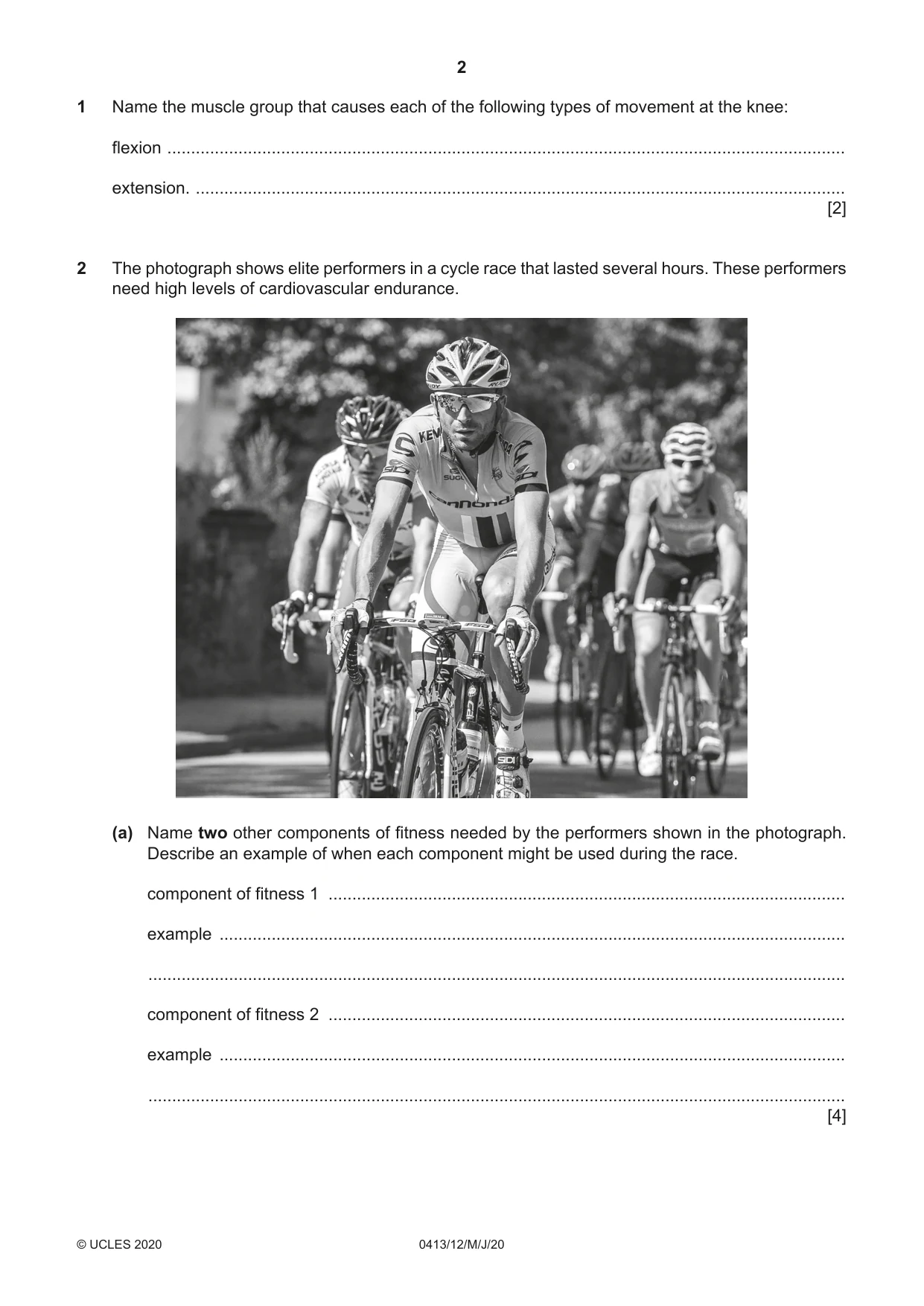
2 0413/12/M/J/20 © UCLES 2020 1 Name the muscle group that causes each of the following types of movement at the knee: flexion … extension. … [2] 2 The photograph shows elite performers in a cycle race that lasted several hours. These performers need high levels of cardiovascular endurance. (a) Name two other components of fitness needed by the performers shown in the photograph. Describe an example of when each component might be used during the race. component of fitness 1 … example … … component of fitness 2 … example … … [4]
Question paper, page 3
3 0413/12/M/J/20 © UCLES 2020 [Turn over (b) Before taking part in a physical activity a performer should complete a warm up. Name three phases of a warm up and describe a different benefit of each phase for a performer. phase 1 … benefit … … phase 2 … benefit … … phase 3 … benefit … … [6] [Total: 10]
Question paper, page 4
4 0413/12/M/J/20 © UCLES 2020 3 (a) Describe, using examples from a named physical activity, one open and one closed skill. Justify your answers. physical activity … open skill … justification … … closed skill … justification … … [4] (b) Name two other continua that can be used to classify skills. continua 1 … and … continua 2 … and … [2]
Question paper, page 5
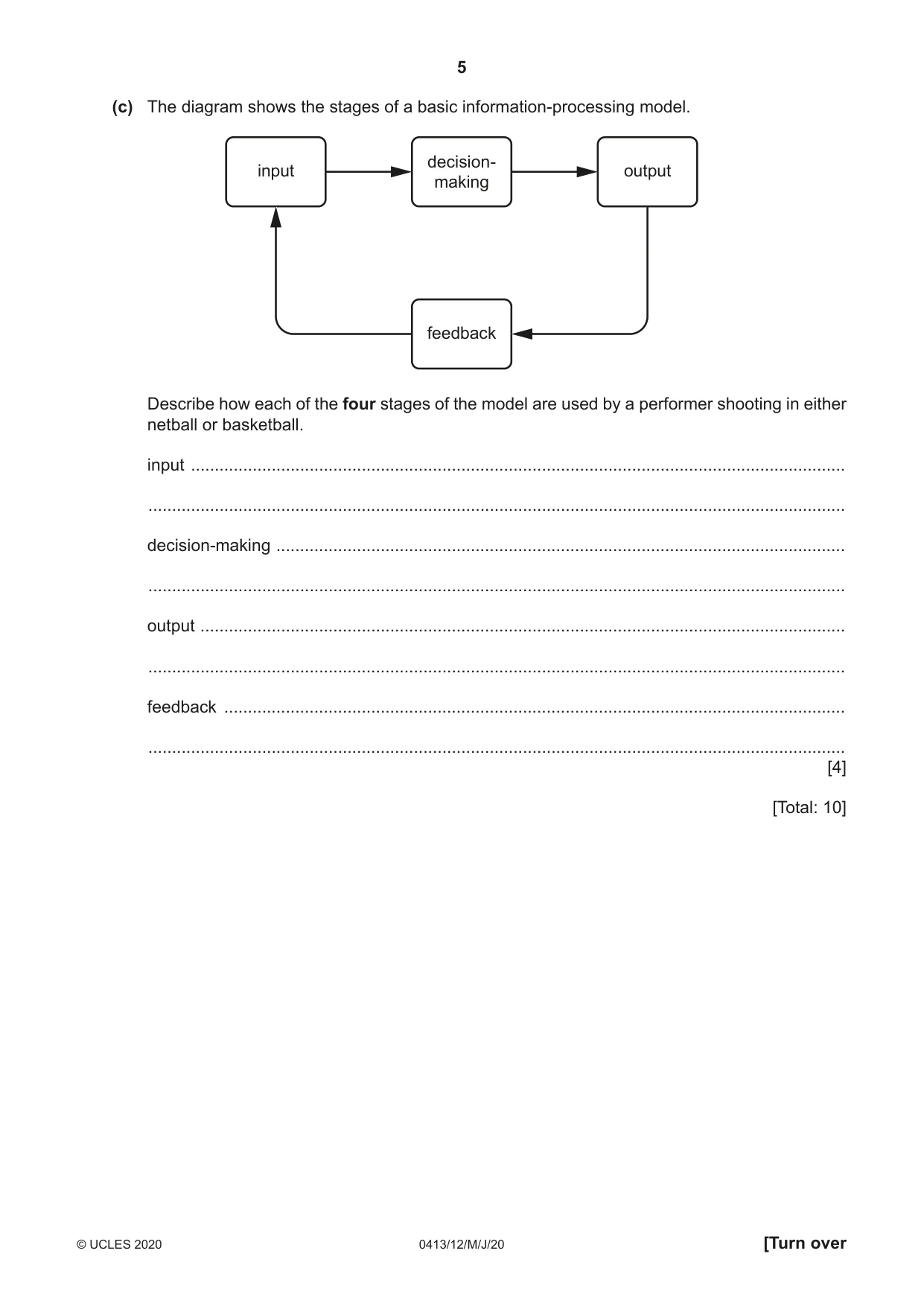
5 0413/12/M/J/20 © UCLES 2020 [Turn over (c) The diagram shows the stages of a basic information-processing model. input output decision- making feedback Describe how each of the four stages of the model are used by a performer shooting in either netball or basketball. input … … decision-making … … output … … feedback … … [4] [Total: 10]
Question paper, page 6
6 0413/12/M/J/20 © UCLES 2020 4 Explain how three factors can affect participation in physical activities for young people. factor 1 … explanation … … factor 2 … explanation … … factor 3 … explanation … … [6] 5 One feature of social health and well-being is that essential human needs are met. Name two other features of a person’s social health and well-being and describe how each feature can benefit a performer. feature 1 … benefit … … feature 2 … benefit … … [4]
Question paper, page 7
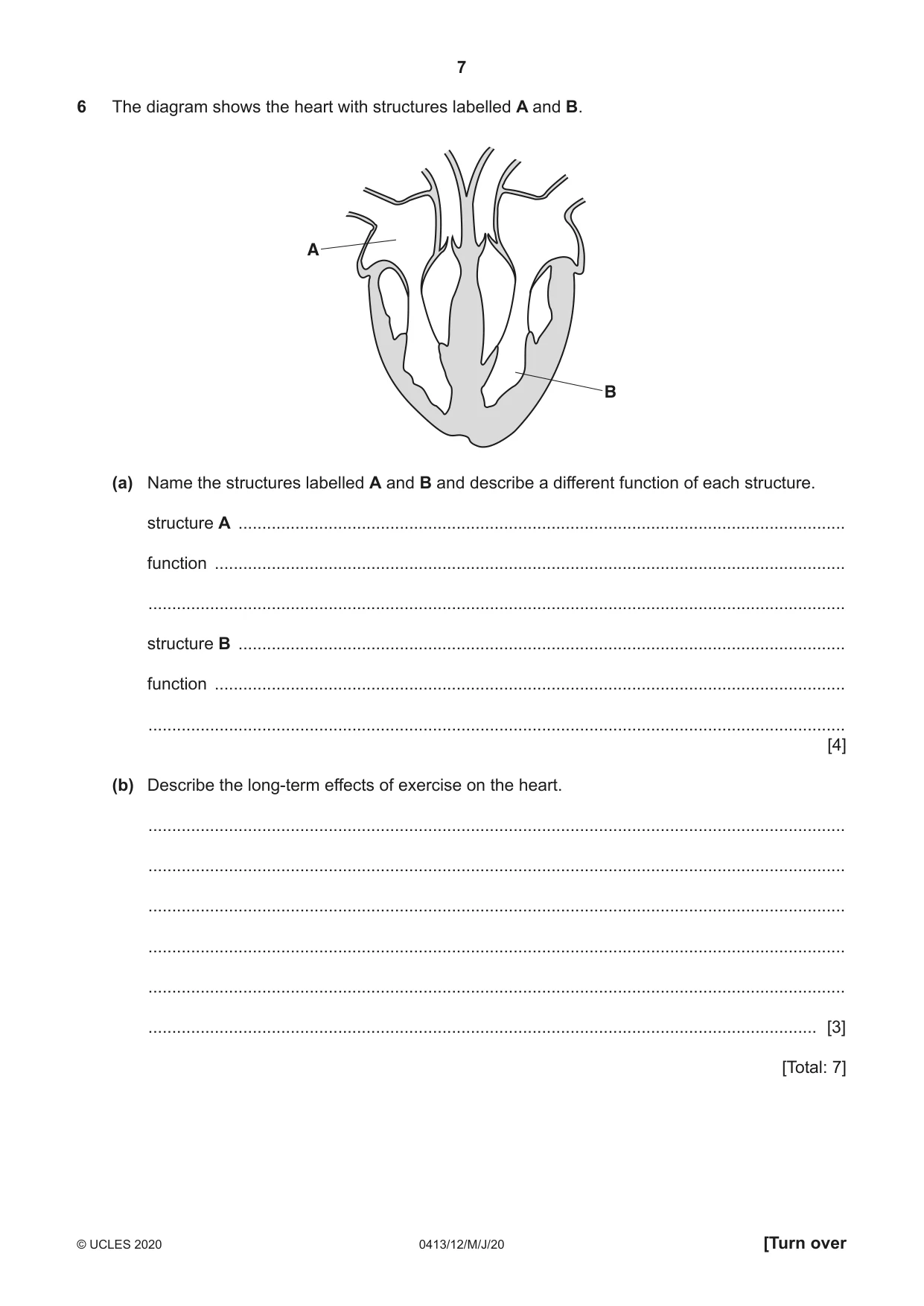
7 0413/12/M/J/20 © UCLES 2020 [Turn over 6 The diagram shows the heart with structures labelled A and B. B A (a) Name the structures labelled A and B and describe a different function of each structure. structure A … function … … structure B … function … … [4] (b) Describe the long-term effects of exercise on the heart. … … … … … … [3] [Total: 7]
Question paper, page 8
8 0413/12/M/J/20 © UCLES 2020 7 (a) Identify the joint type at each of the following locations in the human skeleton: the cranium … the elbow. … [2] (b) (i) Name the type of synovial joint found at the hip. … [1] (ii) Describe different functions of each of the following components of the hip joint: joint (fibrous) capsule function … … cartilage function … … ligament. function … … [3]
Question paper, page 9
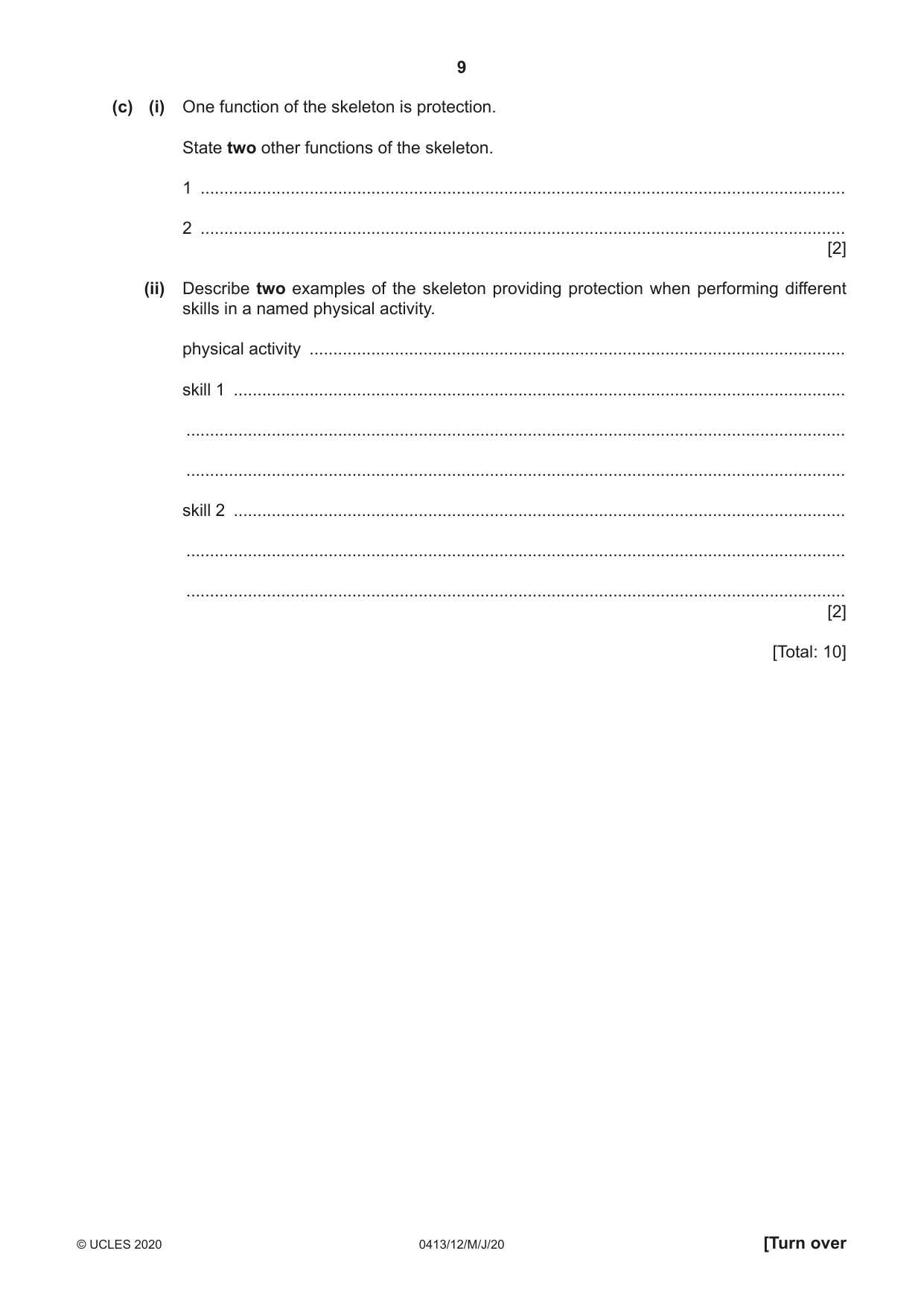
9 0413/12/M/J/20 © UCLES 2020 [Turn over (c) (i) One function of the skeleton is protection. State two other functions of the skeleton. 1 … 2 … [2] (ii) Describe two examples of the skeleton providing protection when performing different skills in a named physical activity. physical activity … skill 1 … … … skill 2 … … … [2] [Total: 10]
Question paper, page 10
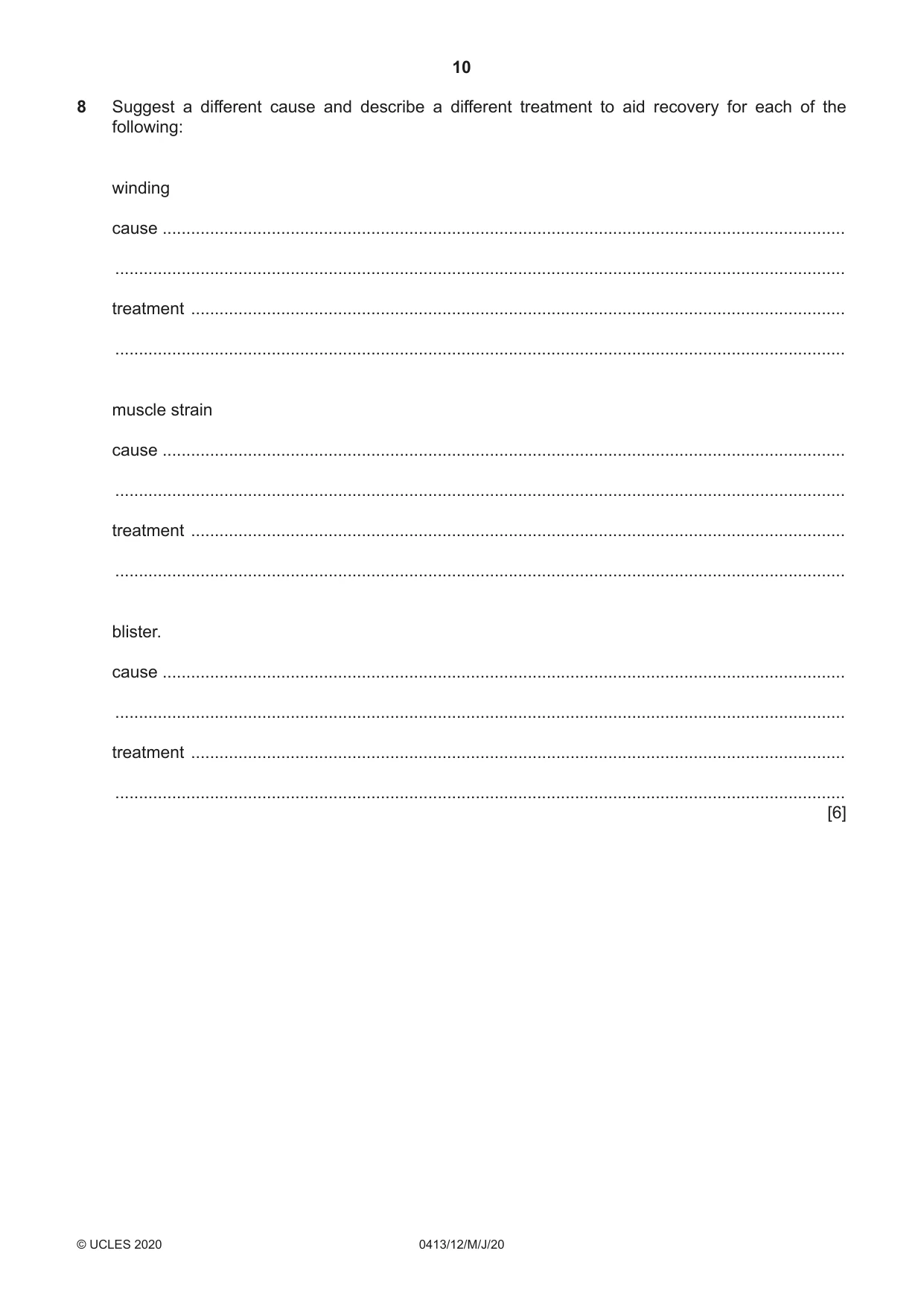
10 0413/12/M/J/20 © UCLES 2020 8 Suggest a different cause and describe a different treatment to aid recovery for each of the following: winding cause … … treatment … … muscle strain cause … … treatment … … blister. cause … … treatment … … [6]
Question paper, page 11
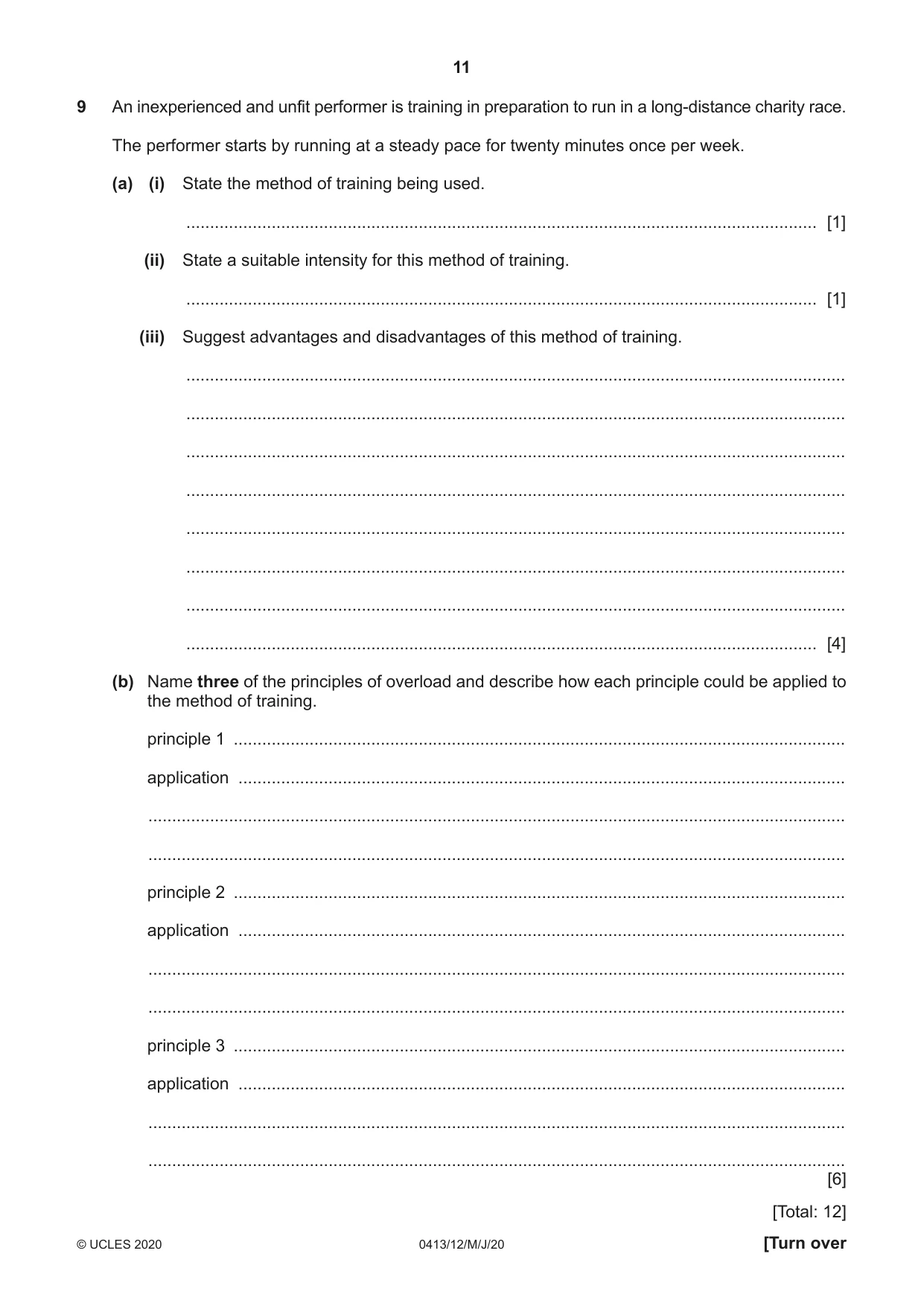
11 0413/12/M/J/20 © UCLES 2020 [Turn over 9 An inexperienced and unfit performer is training in preparation to run in a long-distance charity race. The performer starts by running at a steady pace for twenty minutes once per week. (a) (i) State the method of training being used. … [1] (ii) State a suitable intensity for this method of training. … [1] (iii) Suggest advantages and disadvantages of this method of training. … … … … … … … … [4] (b) Name three of the principles of overload and describe how each principle could be applied to the method of training. principle 1 … application … … … principle 2 … application … … … principle 3 … application … … … [6] [Total: 12]
Question paper, page 12
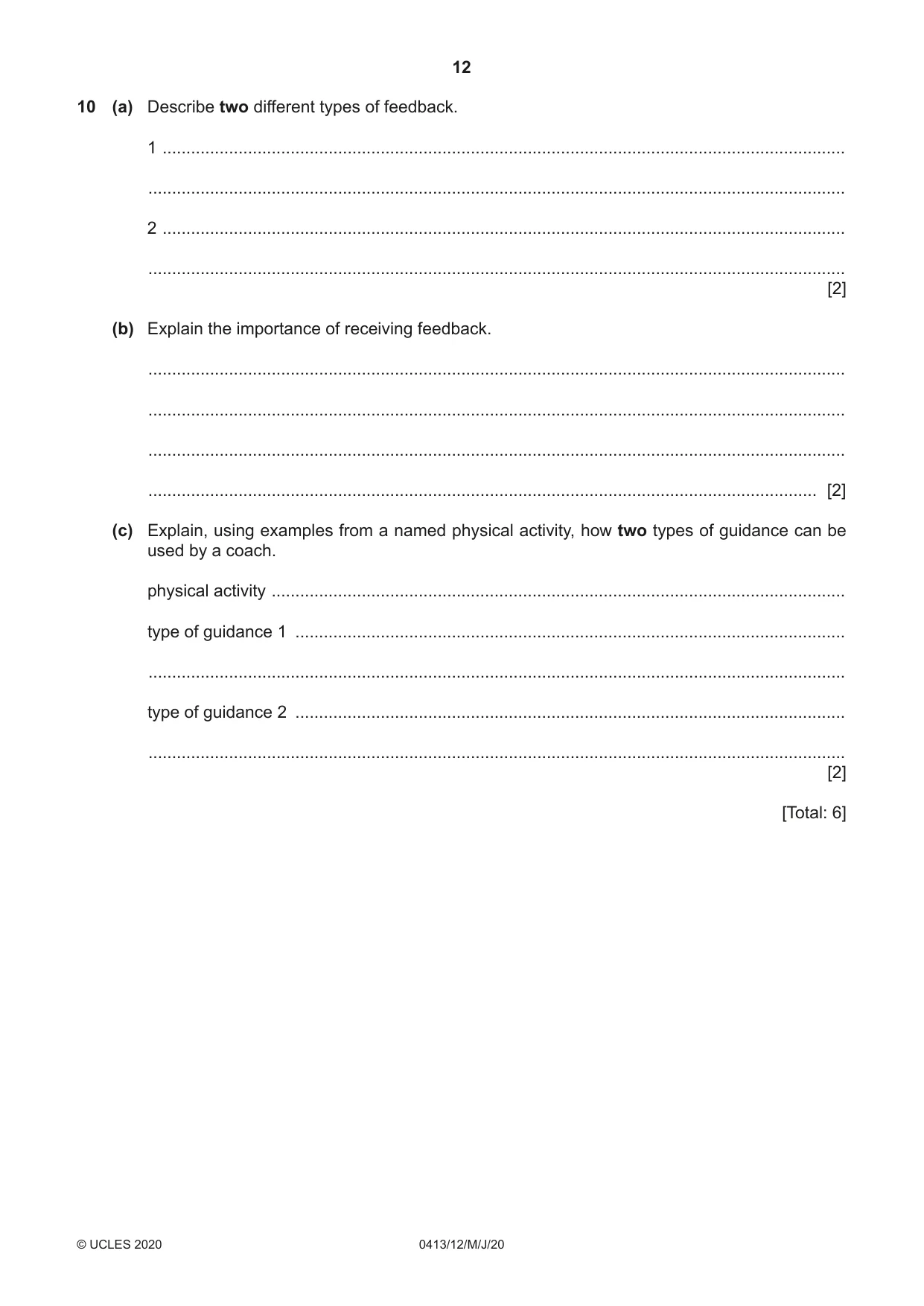
12 0413/12/M/J/20 © UCLES 2020 10 (a) Describe two different types of feedback. 1 … … 2 … … [2] (b) Explain the importance of receiving feedback. … … … … [2] (c) Explain, using examples from a named physical activity, how two types of guidance can be used by a coach. physical activity … type of guidance 1 … … type of guidance 2 … … [2] [Total: 6]
Question paper, page 13
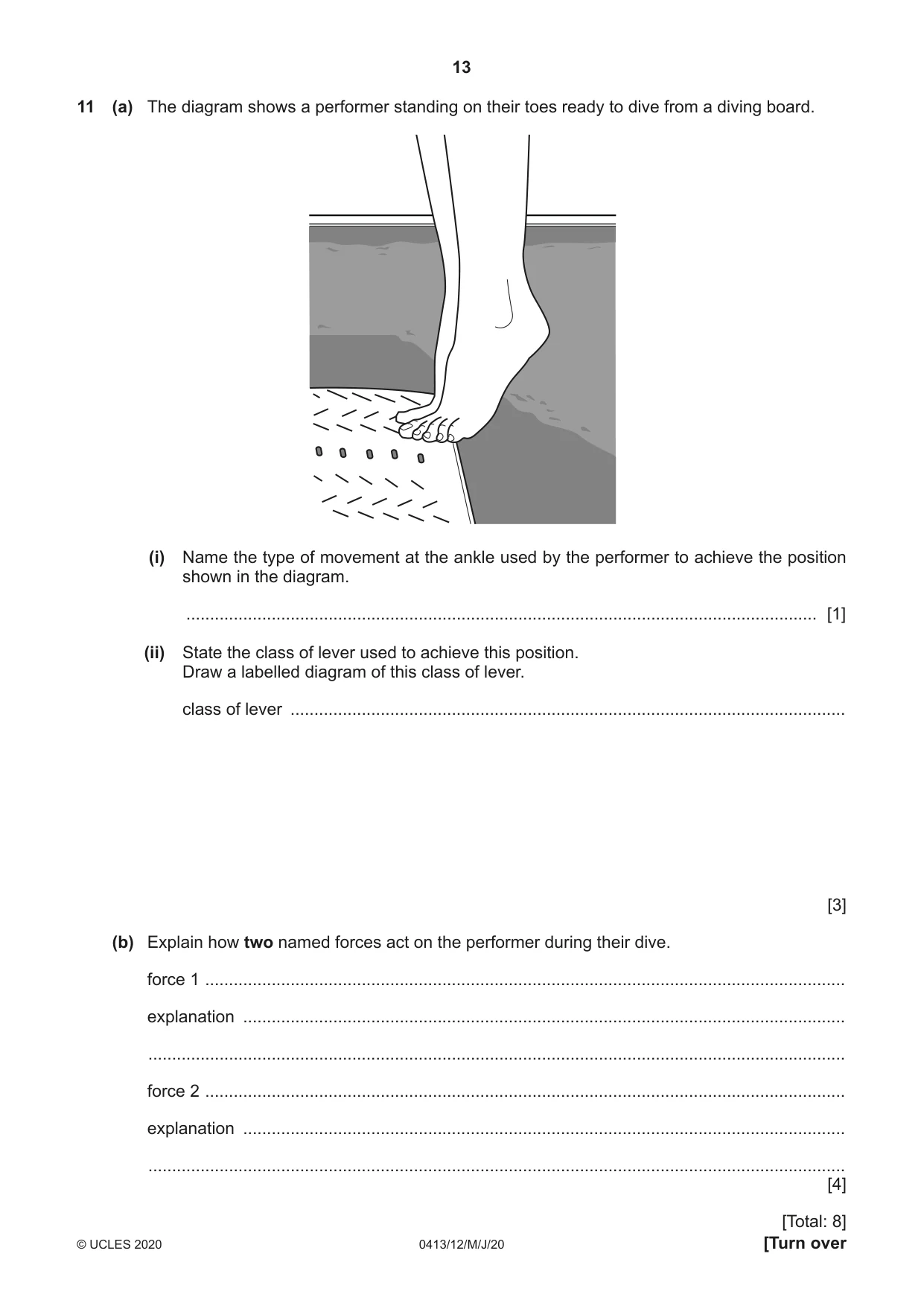
13 0413/12/M/J/20 © UCLES 2020 [Turn over 11 (a) The diagram shows a performer standing on their toes ready to dive from a diving board. (i) Name the type of movement at the ankle used by the performer to achieve the position shown in the diagram. … [1] (ii) State the class of lever used to achieve this position. Draw a labelled diagram of this class of lever. class of lever … [3] (b) Explain how two named forces act on the performer during their dive. force 1 … explanation … … force 2 … explanation … … [4] [Total: 8]
Question paper, page 14
14 0413/12/M/J/20 © UCLES 2020 12 Name two components of blood and describe a different function of each component. component 1 … function … … component 2 … function … … [4]
Question paper, page 15
15 0413/12/M/J/20 © UCLES 2020 [Turn over 13 (a) Complete the following pathway of air into the body: 1. nose or mouth 2. trachea 3. … 4. … 5. alveoli. [2] (b) Name two characteristics of the alveoli. Explain how each characteristic enables gaseous exchange to occur. characteristic 1 … … explanation … … characteristic 2 … … explanation … … [4] (c) Suggest the benefits for a performer of efficient gaseous exchange. … … … … [2] [Total: 8]
Question paper, page 16
16 0413/12/M/J/20 © UCLES 2020 Permission to reproduce items where third-party owned material protected by copyright is included has been sought and cleared where possible. Every reasonable effort has been made by the publisher (UCLES) to trace copyright holders, but if any items requiring clearance have unwittingly been included, the publisher will be pleased to make amends at the earliest possible opportunity. To avoid the issue of disclosure of answer-related information to candidates, all copyright acknowledgements are reproduced online in the Cambridge Assessment International Education Copyright Acknowledgements Booklet. This is produced for each series of examinations and is freely available to download at www.cambridgeinternational.org after the live examination series. Cambridge Assessment International Education is part of the Cambridge Assessment Group. Cambridge Assessment is the brand name of the University of Cambridge Local Examinations Syndicate (UCLES), which itself is a department of the University of Cambridge. 14 The table shows different types of prohibited performance-enhancing drug (PED). Complete the table to describe an effect on performance for each type of PED in a named physical activity. type of PED effect on performance in a named physical activity stimulants increases alertness in a 100-metre sprint in athletics to achieve a faster start diuretics anabolic steroids beta blockers [3] 15 (a) Define what is meant by each of the following terms: sportsmanship … … gamesmanship. … … [2] (b) Describe, in a named physical activity, one example of each of the following: sportsmanship … … gamesmanship. … … [2] [Total: 4]
Mark scheme, page 1
This document consists of 18 printed pages. © UCLES 2020 [Turn over Cambridge IGCSE™ PHYSICAL EDUCATION 0413/12 Paper 1 Theory May/June 2020 MARK SCHEME Maximum Mark: 100 Published Students did not sit exam papers in the June 2020 series due to the Covid-19 global pandemic. This mark scheme is published to support teachers and students and should be read together with the question paper. It shows the requirements of the exam. The answer column of the mark scheme shows the proposed basis on which Examiners would award marks for this exam. Where appropriate, this column also provides the most likely acceptable alternative responses expected from students. Examiners usually review the mark scheme after they have seen student responses and update the mark scheme if appropriate. In the June series, Examiners were unable to consider the acceptability of alternative responses, as there were no student responses to consider. Mark schemes should usually be read together with the Principal Examiner Report for Teachers. However, because students did not sit exam papers, there is no Principal Examiner Report for Teachers for the June 2020 series. Cambridge International will not enter into discussions about these mark schemes. Cambridge International is publishing the mark schemes for the June 2020 series for most Cambridge IGCSE™ and Cambridge International A & AS Level components, and some Cambridge O Level components.
Mark scheme, page 2
0413/12 Cambridge IGCSE – Mark Scheme PUBLISHED May/June 2020 © UCLES 2020 Page 2 of 18 Generic Marking Principles These general marking principles must be applied by all examiners when marking candidate answers. They should be applied alongside the specific content of the mark scheme or generic level descriptors for a question. Each question paper and mark scheme will also comply with these marking principles. GENERIC MARKING PRINCIPLE 1: Marks must be awarded in line with: • the specific content of the mark scheme or the generic level descriptors for the question • the specific skills defined in the mark scheme or in the generic level descriptors for the question • the standard of response required by a candidate as exemplified by the standardisation scripts. GENERIC MARKING PRINCIPLE 2: Marks awarded are always whole marks (not half marks, or other fractions). GENERIC MARKING PRINCIPLE 3: Marks must be awarded positively: • marks are awarded for correct/valid answers, as defined in the mark scheme. However, credit is given for valid answers which go beyond the scope of the syllabus and mark scheme, referring to your Team Leader as appropriate • marks are awarded when candidates clearly demonstrate what they know and can do • marks are not deducted for errors • marks are not deducted for omissions • answers should only be judged on the quality of spelling, punctuation and grammar when these features are specifically assessed by the question as indicated by the mark scheme. The meaning, however, should be unambiguous. GENERIC MARKING PRINCIPLE 4: Rules must be applied consistently e.g. in situations where candidates have not followed instructions or in the application of generic level descriptors.
Mark scheme, page 3
0413/12 Cambridge IGCSE – Mark Scheme PUBLISHED May/June 2020 © UCLES 2020 Page 3 of 18 GENERIC MARKING PRINCIPLE 5: Marks should be awarded using the full range of marks defined in the mark scheme for the question (however; the use of the full mark range may be limited according to the quality of the candidate responses seen). GENERIC MARKING PRINCIPLE 6: Marks awarded are based solely on the requirements as defined in the mark scheme. Marks should not be awarded with grade thresholds or grade descriptors in mind. Science-Specific Marking Principles 1 Examiners should consider the context and scientific use of any keywords when awarding marks. Although keywords may be present, marks should not be awarded if the keywords are used incorrectly. 2 The examiner should not choose between contradictory statements given in the same question part, and credit should not be awarded for any correct statement that is contradicted within the same question part. Wrong science that is irrelevant to the question should be ignored. 3 Although spellings do not have to be correct, spellings of syllabus terms must allow for clear and unambiguous separation from other syllabus terms with which they may be confused (e.g. ethane / ethene, glucagon / glycogen, refraction / reflection). 4 The error carried forward (ecf) principle should be applied, where appropriate. If an incorrect answer is subsequently used in a scientifically correct way, the candidate should be awarded these subsequent marking points. Further guidance will be included in the mark scheme where necessary and any exceptions to this general principle will be noted.
Mark scheme, page 4
0413/12 Cambridge IGCSE – Mark Scheme PUBLISHED May/June 2020 © UCLES 2020 Page 4 of 18 5 ‘List rule’ guidance (see examples below) For questions that require n responses (e.g. State two reasons …): • The response should be read as continuous prose, even when numbered answer spaces are provided • Any response marked ignore in the mark scheme should not count towards n • Incorrect responses should not be awarded credit but will still count towards n • Read the entire response to check for any responses that contradict those that would otherwise be credited. Credit should not be awarded for any responses that are contradicted within the rest of the response. Where two responses contradict one another, this should be treated as a single incorrect response • Non-contradictory responses after the first n responses may be ignored even if they include incorrect science. 6 Calculation specific guidance Correct answers to calculations should be given full credit even if there is no working or incorrect working, unless the question states ‘show your working’. For questions in which the number of significant figures required is not stated, credit should be awarded for correct answers when rounded by the examiner to the number of significant figures given in the mark scheme. This may not apply to measured values. For answers given in standard form, (e.g. a × 10n) in which the convention of restricting the value of the coefficient (a) to a value between 1 and 10 is not followed, credit may still be awarded if the answer can be converted to the answer given in the mark scheme. Unless a separate mark is given for a unit, a missing or incorrect unit will normally mean that the final calculation mark is not awarded. Exceptions to this general principle will be noted in the mark scheme. 7 Guidance for chemical equations Multiples / fractions of coefficients used in chemical equations are acceptable unless stated otherwise in the mark scheme. State symbols given in an equation should be ignored unless asked for in the question or stated otherwise in the mark scheme.
Mark scheme, page 5
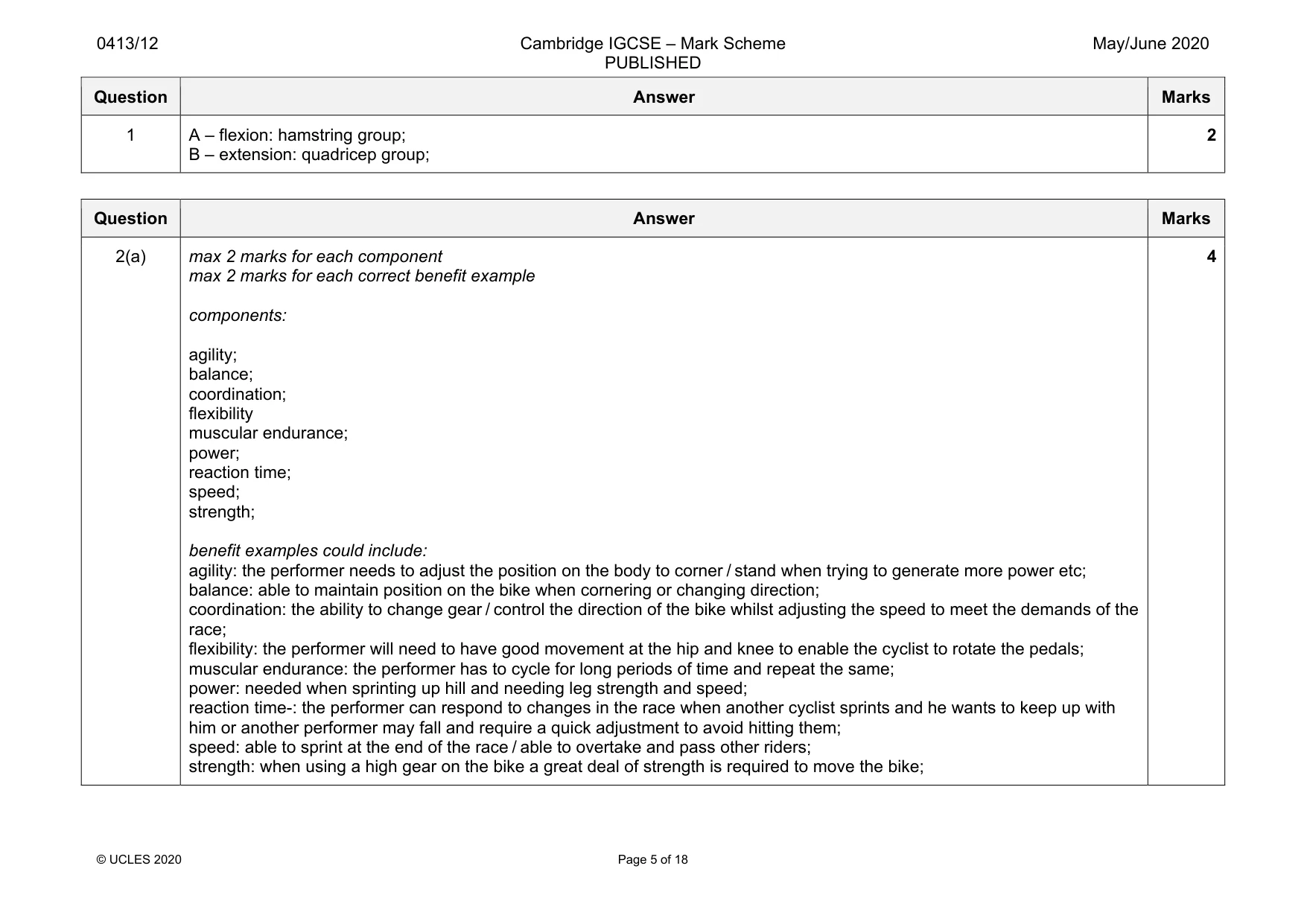
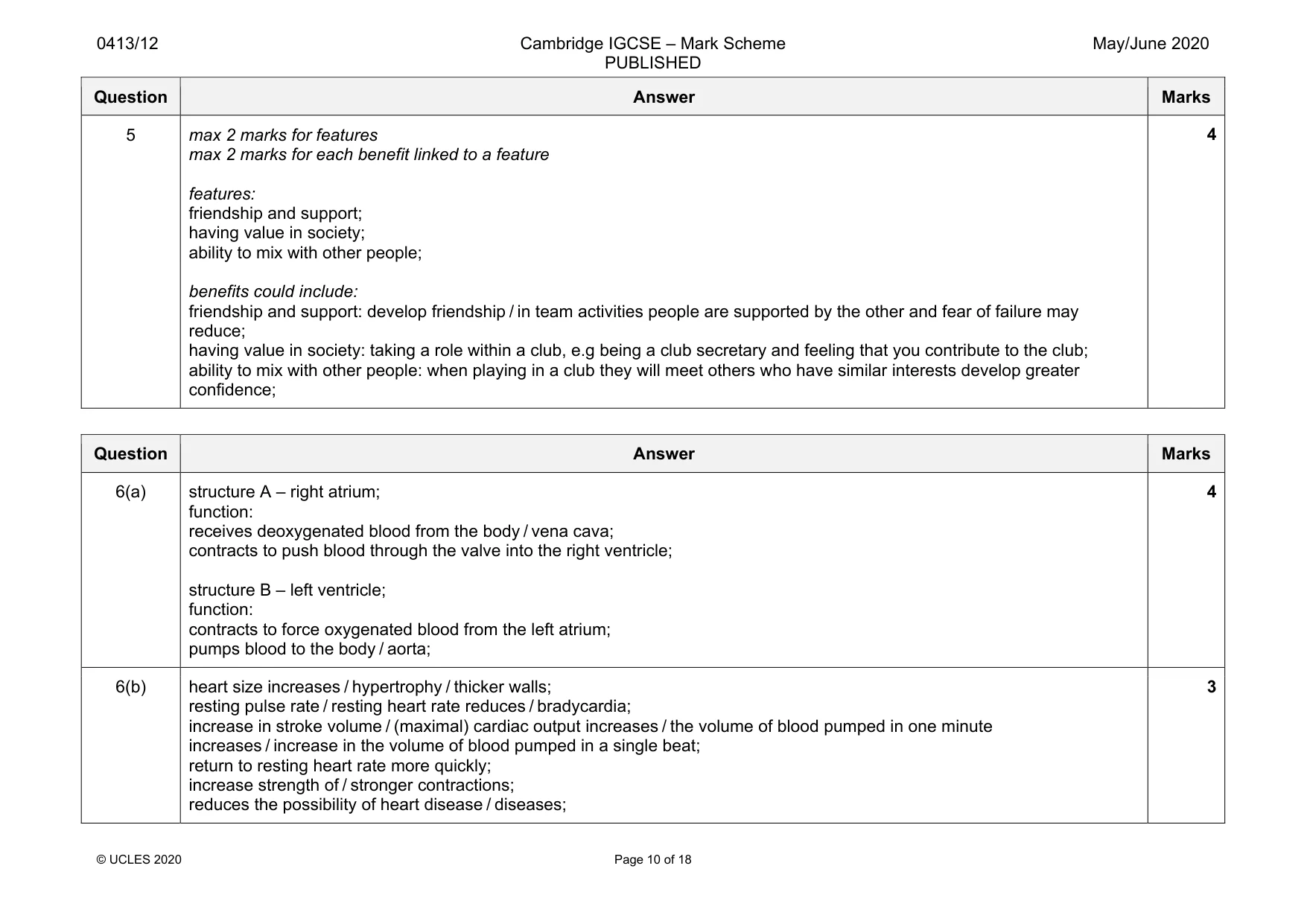
0413/12 Cambridge IGCSE – Mark Scheme PUBLISHED May/June 2020 © UCLES 2020 Page 5 of 18 Question Answer Marks 1 A – flexion: hamstring group; B – extension: quadricep group; 2 Question Answer Marks 2(a) max 2 marks for each component max 2 marks for each correct benefit example components: agility; balance; coordination; flexibility muscular endurance; power; reaction time; speed; strength; benefit examples could include: agility: the performer needs to adjust the position on the body to corner / stand when trying to generate more power etc; balance: able to maintain position on the bike when cornering or changing direction; coordination: the ability to change gear / control the direction of the bike whilst adjusting the speed to meet the demands of the race; flexibility: the performer will need to have good movement at the hip and knee to enable the cyclist to rotate the pedals; muscular endurance: the performer has to cycle for long periods of time and repeat the same; power: needed when sprinting up hill and needing leg strength and speed; reaction time-: the performer can respond to changes in the race when another cyclist sprints and he wants to keep up with him or another performer may fall and require a quick adjustment to avoid hitting them; speed: able to sprint at the end of the race / able to overtake and pass other riders; strength: when using a high gear on the bike a great deal of strength is required to move the bike; 4
Mark scheme, page 6
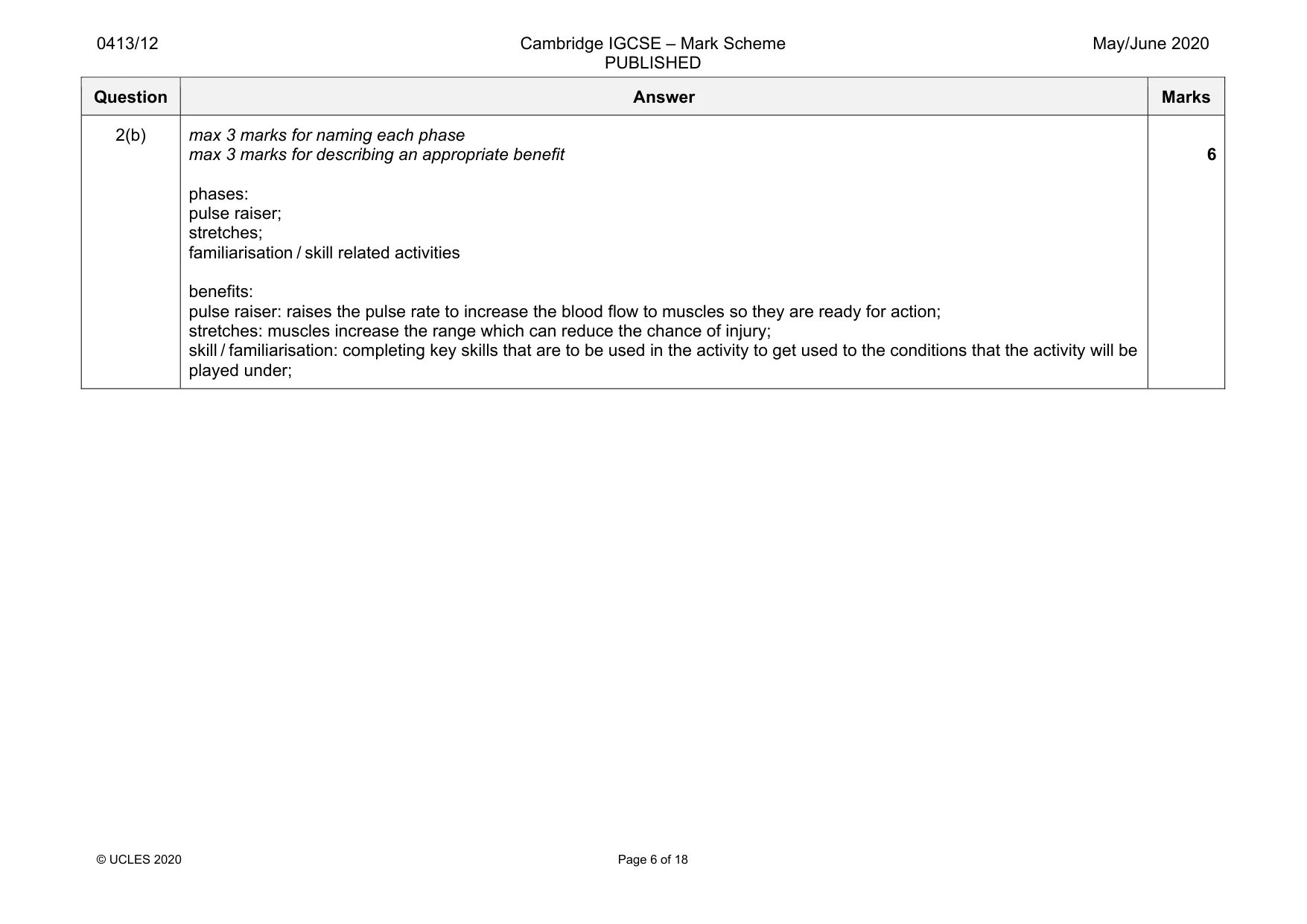
0413/12 Cambridge IGCSE – Mark Scheme PUBLISHED May/June 2020 © UCLES 2020 Page 6 of 18 Question Answer Marks 2(b) max 3 marks for naming each phase max 3 marks for describing an appropriate benefit phases: pulse raiser; stretches; familiarisation / skill related activities benefits: pulse raiser: raises the pulse rate to increase the blood flow to muscles so they are ready for action; stretches: muscles increase the range which can reduce the chance of injury; skill / familiarisation: completing key skills that are to be used in the activity to get used to the conditions that the activity will be played under; 6
Mark scheme, page 7
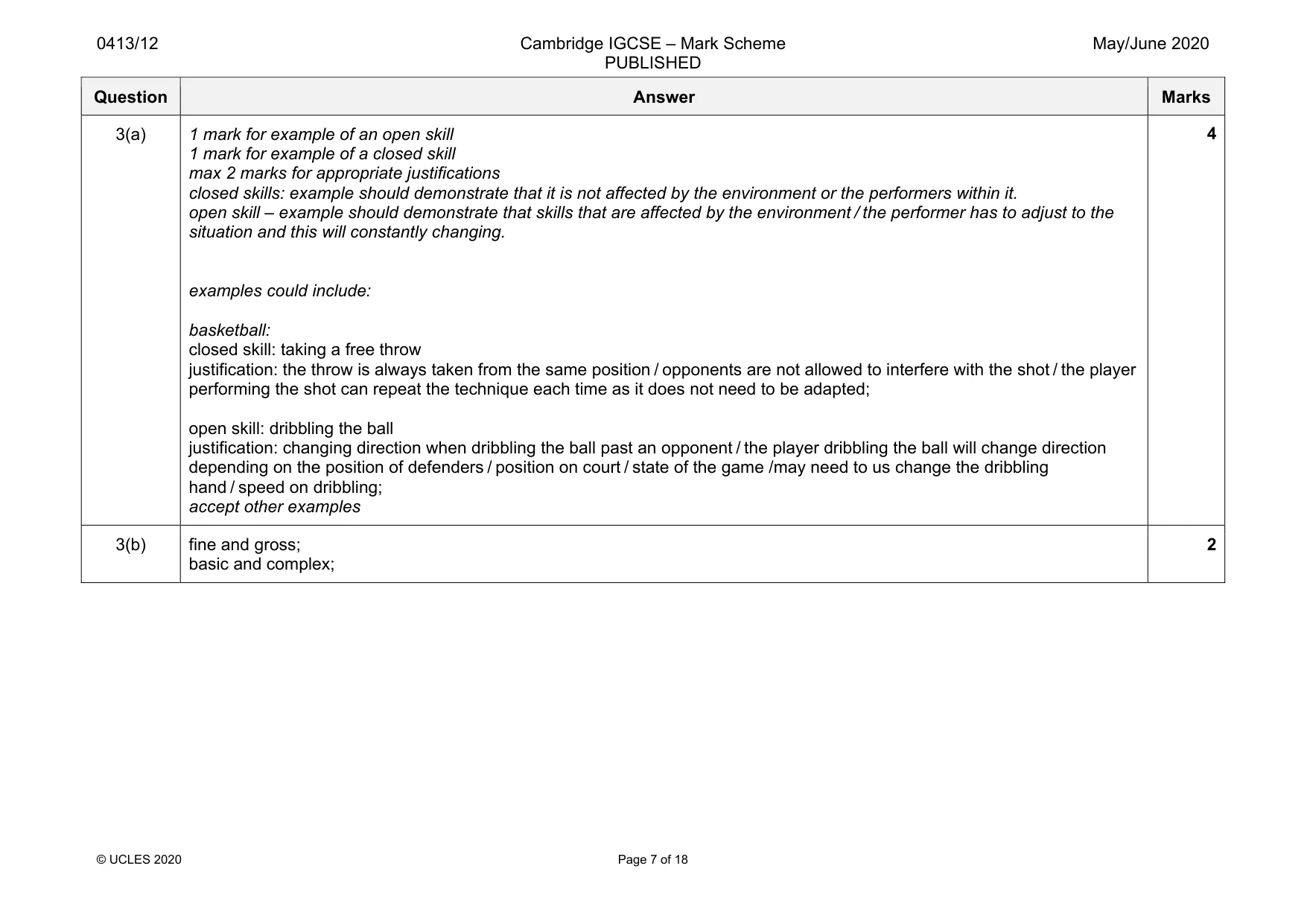
0413/12 Cambridge IGCSE – Mark Scheme PUBLISHED May/June 2020 © UCLES 2020 Page 7 of 18 Question Answer Marks 3(a) 1 mark for example of an open skill 1 mark for example of a closed skill max 2 marks for appropriate justifications closed skills: example should demonstrate that it is not affected by the environment or the performers within it. open skill – example should demonstrate that skills that are affected by the environment / the performer has to adjust to the situation and this will constantly changing. examples could include: basketball: closed skill: taking a free throw justification: the throw is always taken from the same position / opponents are not allowed to interfere with the shot / the player performing the shot can repeat the technique each time as it does not need to be adapted; open skill: dribbling the ball justification: changing direction when dribbling the ball past an opponent / the player dribbling the ball will change direction depending on the position of defenders / position on court / state of the game /may need to us change the dribbling hand / speed on dribbling; accept other examples 4 3(b) fine and gross; basic and complex; 2
Mark scheme, page 8
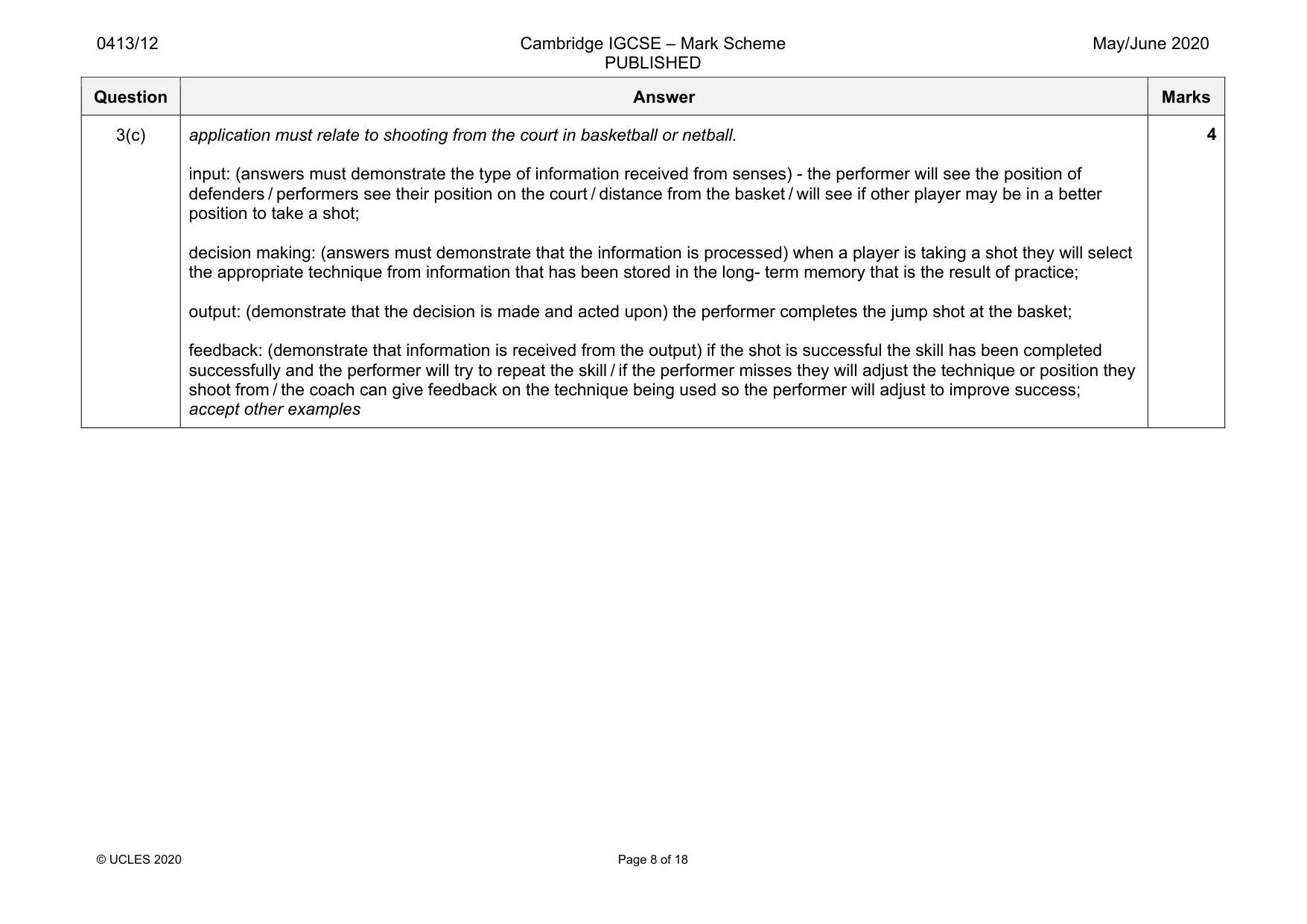
0413/12 Cambridge IGCSE – Mark Scheme PUBLISHED May/June 2020 © UCLES 2020 Page 8 of 18 Question Answer Marks 3(c) application must relate to shooting from the court in basketball or netball. input: (answers must demonstrate the type of information received from senses) - the performer will see the position of defenders / performers see their position on the court / distance from the basket / will see if other player may be in a better position to take a shot; decision making: (answers must demonstrate that the information is processed) when a player is taking a shot they will select the appropriate technique from information that has been stored in the long- term memory that is the result of practice; output: (demonstrate that the decision is made and acted upon) the performer completes the jump shot at the basket; feedback: (demonstrate that information is received from the output) if the shot is successful the skill has been completed successfully and the performer will try to repeat the skill / if the performer misses they will adjust the technique or position they shoot from / the coach can give feedback on the technique being used so the performer will adjust to improve success; accept other examples 4
Mark scheme, page 9
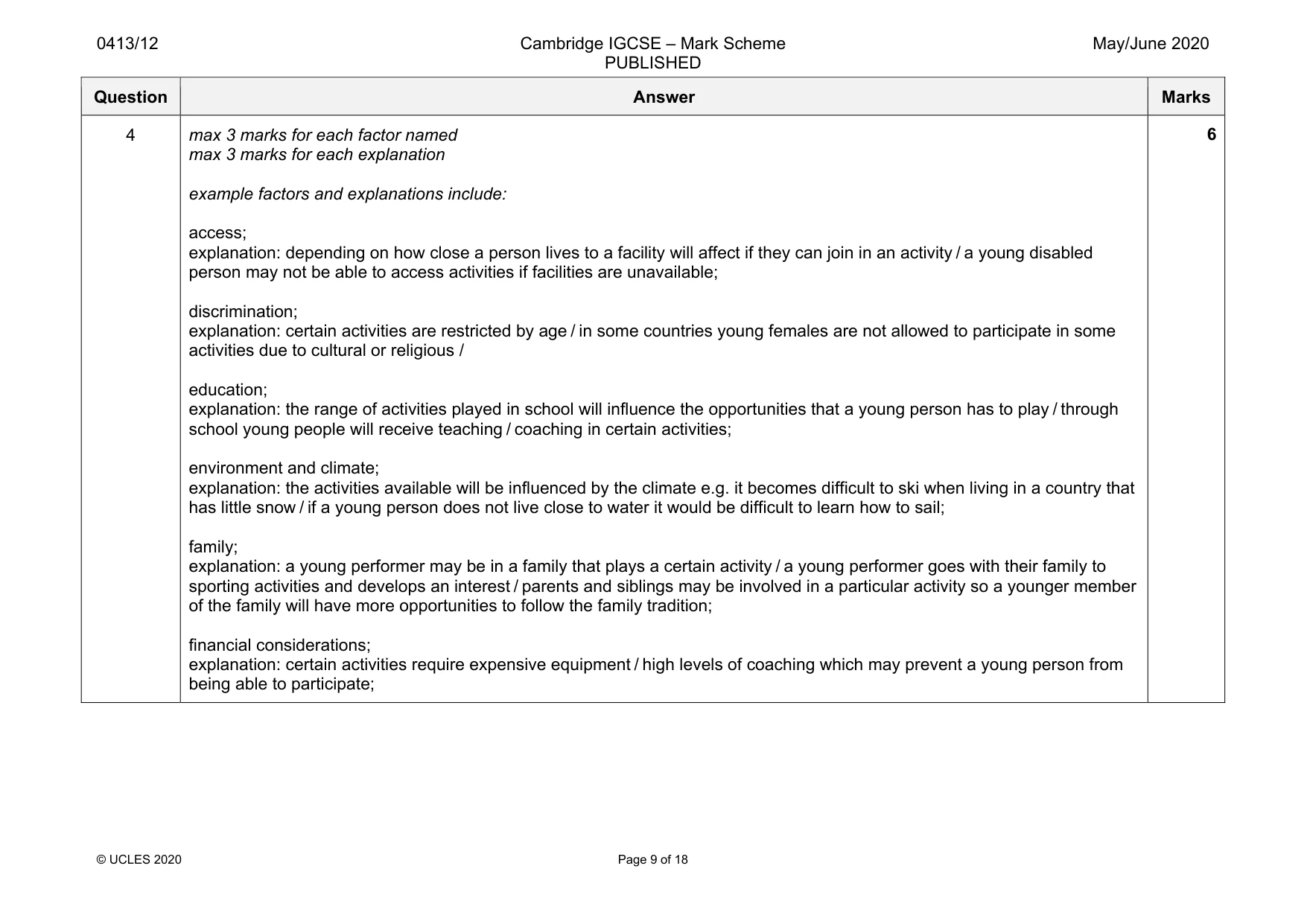
0413/12 Cambridge IGCSE – Mark Scheme PUBLISHED May/June 2020 © UCLES 2020 Page 9 of 18 Question Answer Marks 4 max 3 marks for each factor named max 3 marks for each explanation example factors and explanations include: access; explanation: depending on how close a person lives to a facility will affect if they can join in an activity / a young disabled person may not be able to access activities if facilities are unavailable; discrimination; explanation: certain activities are restricted by age / in some countries young females are not allowed to participate in some activities due to cultural or religious / education; explanation: the range of activities played in school will influence the opportunities that a young person has to play / through school young people will receive teaching / coaching in certain activities; environment and climate; explanation: the activities available will be influenced by the climate e.g. it becomes difficult to ski when living in a country that has little snow / if a young person does not live close to water it would be difficult to learn how to sail; family; explanation: a young performer may be in a family that plays a certain activity / a young performer goes with their family to sporting activities and develops an interest / parents and siblings may be involved in a particular activity so a younger member of the family will have more opportunities to follow the family tradition; financial considerations; explanation: certain activities require expensive equipment / high levels of coaching which may prevent a young person from being able to participate; 6
Mark scheme, page 10
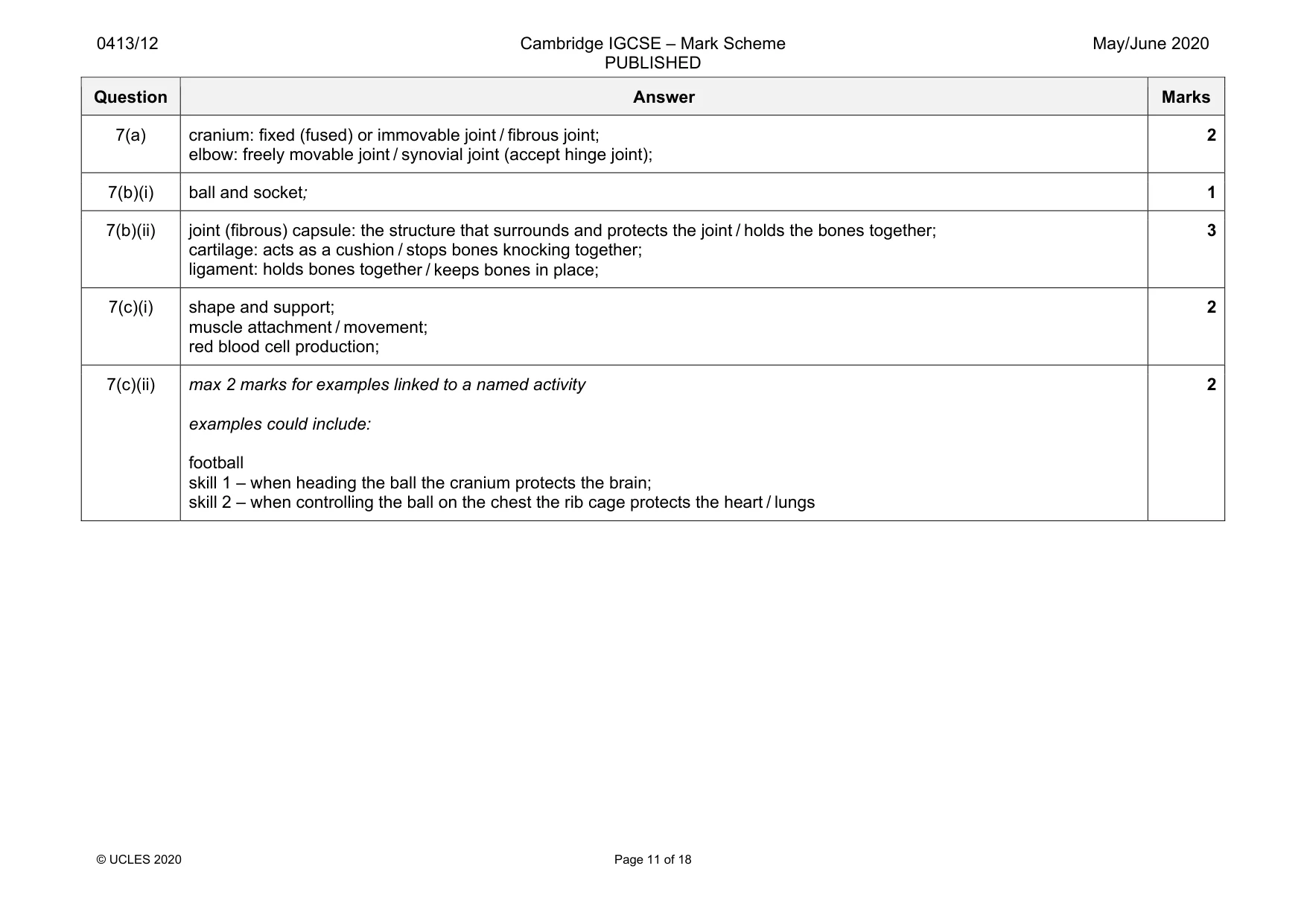
0413/12 Cambridge IGCSE – Mark Scheme PUBLISHED May/June 2020 © UCLES 2020 Page 10 of 18 Question Answer Marks 5 max 2 marks for features max 2 marks for each benefit linked to a feature features: friendship and support; having value in society; ability to mix with other people; benefits could include: friendship and support: develop friendship / in team activities people are supported by the other and fear of failure may reduce; having value in society: taking a role within a club, e.g being a club secretary and feeling that you contribute to the club; ability to mix with other people: when playing in a club they will meet others who have similar interests develop greater confidence; 4 Question Answer Marks 6(a) structure A – right atrium; function: receives deoxygenated blood from the body / vena cava; contracts to push blood through the valve into the right ventricle; structure B – left ventricle; function: contracts to force oxygenated blood from the left atrium; pumps blood to the body / aorta; 4 6(b) heart size increases / hypertrophy / thicker walls; resting pulse rate / resting heart rate reduces / bradycardia; increase in stroke volume / (maximal) cardiac output increases / the volume of blood pumped in one minute increases / increase in the volume of blood pumped in a single beat; return to resting heart rate more quickly; increase strength of / stronger contractions; reduces the possibility of heart disease / diseases; 3
Mark scheme, page 11
0413/12 Cambridge IGCSE – Mark Scheme PUBLISHED May/June 2020 © UCLES 2020 Page 11 of 18 Question Answer Marks 7(a) cranium: fixed (fused) or immovable joint / fibrous joint; elbow: freely movable joint / synovial joint (accept hinge joint); 2 7(b)(i) ball and socket; 1 7(b)(ii) joint (fibrous) capsule: the structure that surrounds and protects the joint / holds the bones together; cartilage: acts as a cushion / stops bones knocking together; ligament: holds bones together / keeps bones in place; 3 7(c)(i) shape and support; muscle attachment / movement; red blood cell production; 2 7(c)(ii) max 2 marks for examples linked to a named activity examples could include: football skill 1 – when heading the ball the cranium protects the brain; skill 2 – when controlling the ball on the chest the rib cage protects the heart / lungs 2
Mark scheme, page 12
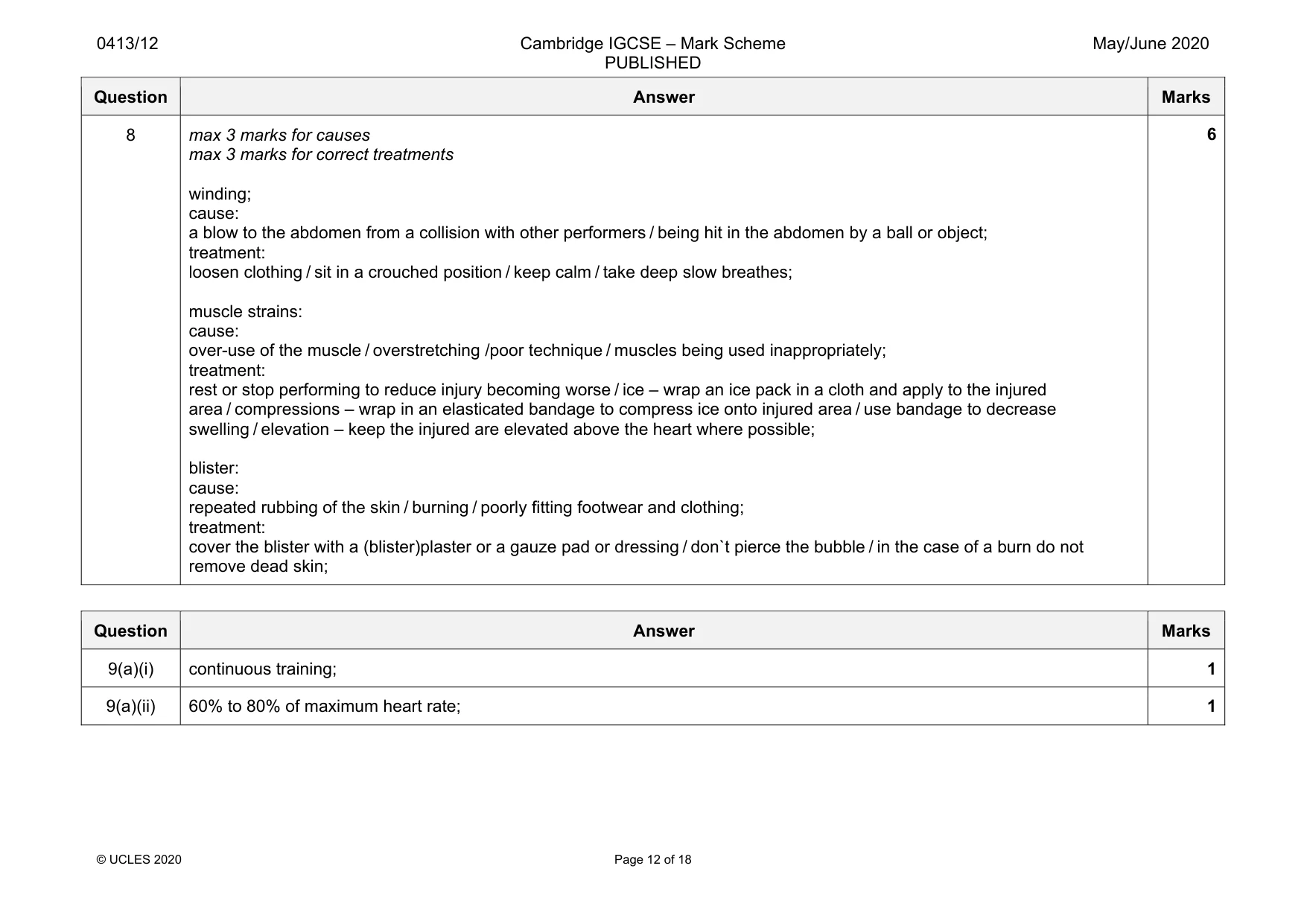
0413/12 Cambridge IGCSE – Mark Scheme PUBLISHED May/June 2020 © UCLES 2020 Page 12 of 18 Question Answer Marks 8 max 3 marks for causes max 3 marks for correct treatments winding; cause: a blow to the abdomen from a collision with other performers / being hit in the abdomen by a ball or object; treatment: loosen clothing / sit in a crouched position / keep calm / take deep slow breathes; muscle strains: cause: over-use of the muscle / overstretching /poor technique / muscles being used inappropriately; treatment: rest or stop performing to reduce injury becoming worse / ice – wrap an ice pack in a cloth and apply to the injured area / compressions – wrap in an elasticated bandage to compress ice onto injured area / use bandage to decrease swelling / elevation – keep the injured are elevated above the heart where possible; blister: cause: repeated rubbing of the skin / burning / poorly fitting footwear and clothing; treatment: cover the blister with a (blister)plaster or a gauze pad or dressing / don`t pierce the bubble / in the case of a burn do not remove dead skin; 6 Question Answer Marks 9(a)(i) continuous training; 1 9(a)(ii) 60% to 80% of maximum heart rate; 1
Mark scheme, page 13
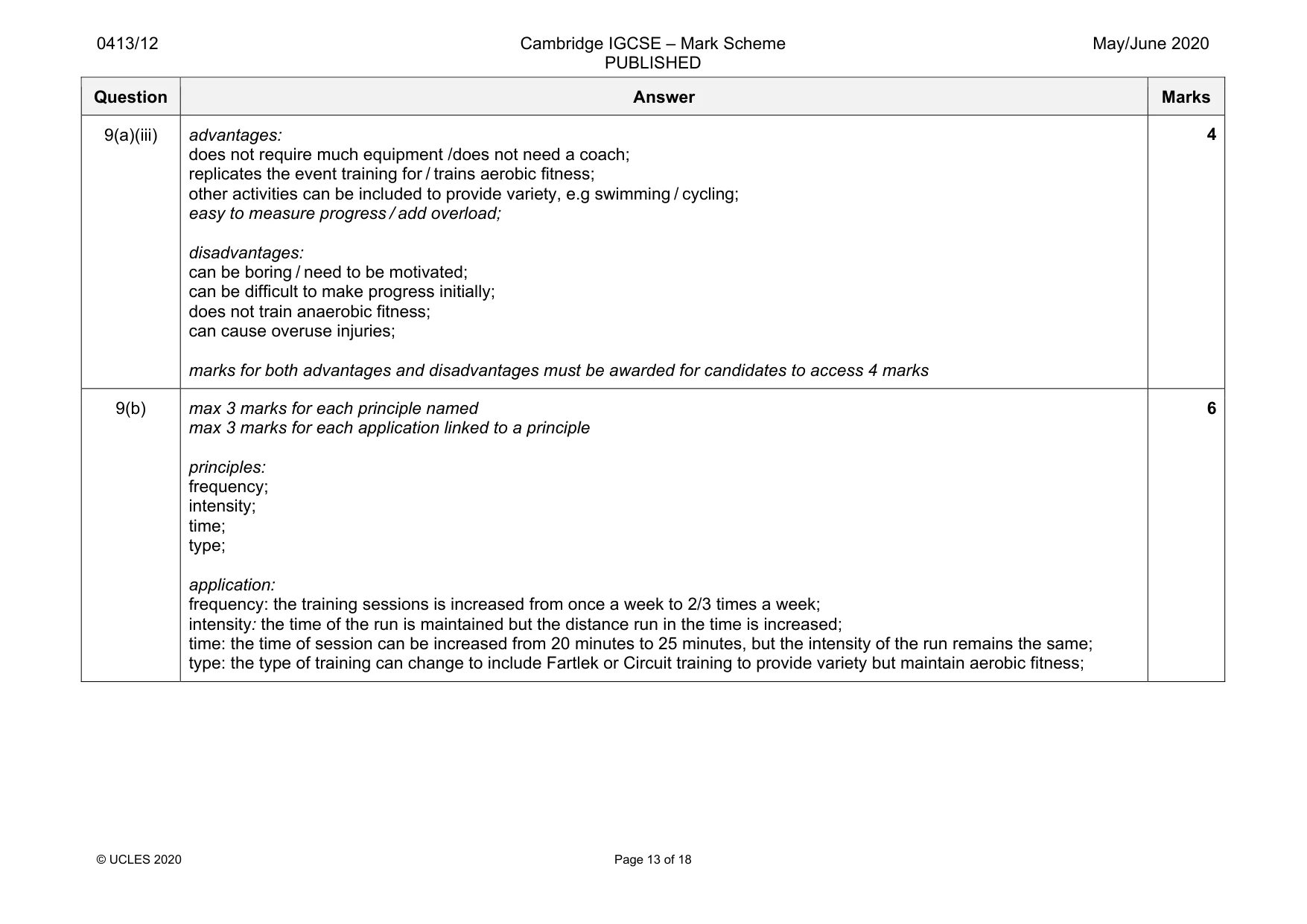
0413/12 Cambridge IGCSE – Mark Scheme PUBLISHED May/June 2020 © UCLES 2020 Page 13 of 18 Question Answer Marks 9(a)(iii) advantages: does not require much equipment /does not need a coach; replicates the event training for / trains aerobic fitness; other activities can be included to provide variety, e.g swimming / cycling; easy to measure progress / add overload; disadvantages: can be boring / need to be motivated; can be difficult to make progress initially; does not train anaerobic fitness; can cause overuse injuries; marks for both advantages and disadvantages must be awarded for candidates to access 4 marks 4 9(b) max 3 marks for each principle named max 3 marks for each application linked to a principle principles: frequency; intensity; time; type; application: frequency: the training sessions is increased from once a week to 2/3 times a week; intensity: the time of the run is maintained but the distance run in the time is increased; time: the time of session can be increased from 20 minutes to 25 minutes, but the intensity of the run remains the same; type: the type of training can change to include Fartlek or Circuit training to provide variety but maintain aerobic fitness; 6
Mark scheme, page 14
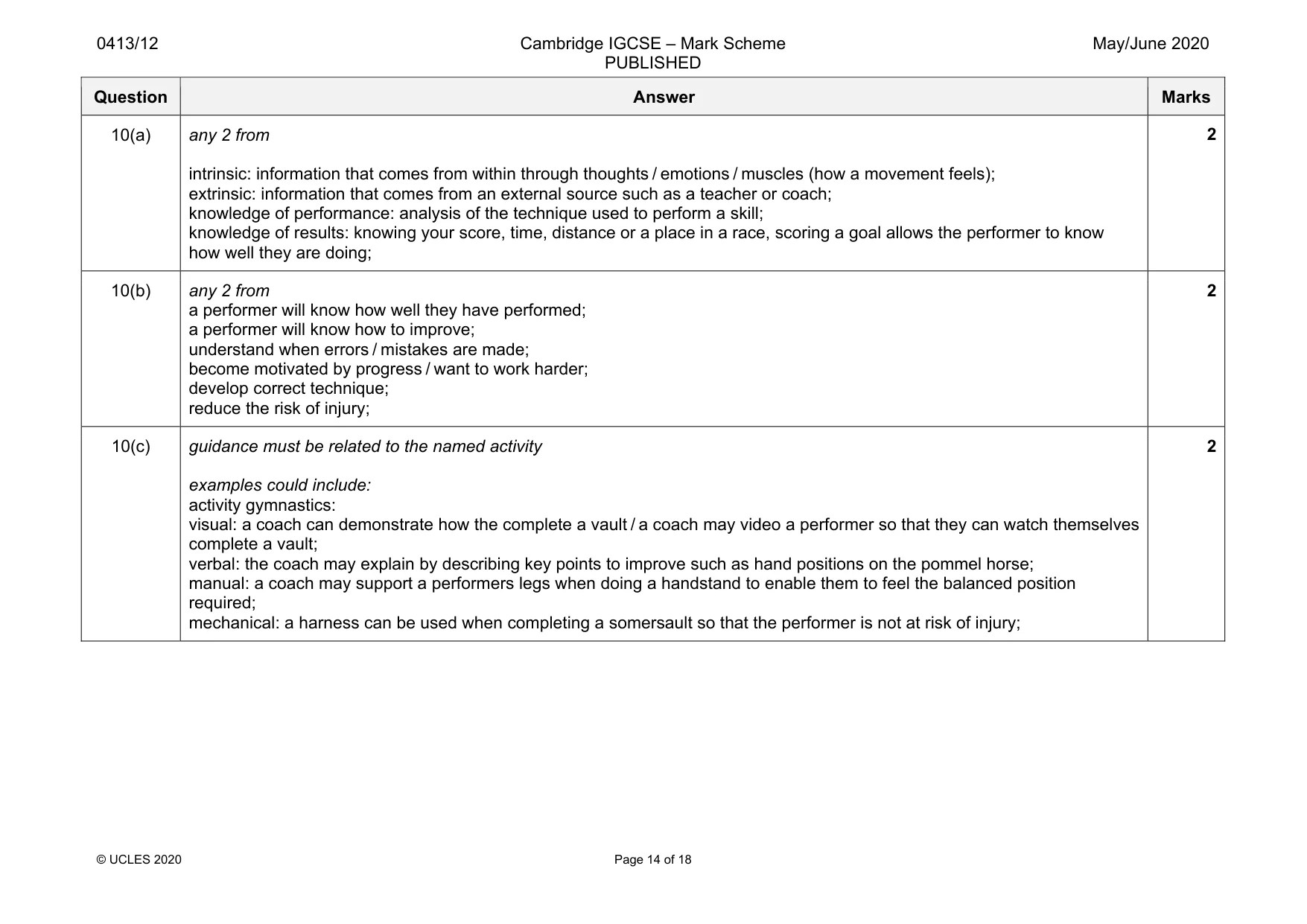
0413/12 Cambridge IGCSE – Mark Scheme PUBLISHED May/June 2020 © UCLES 2020 Page 14 of 18 Question Answer Marks 10(a) any 2 from intrinsic: information that comes from within through thoughts / emotions / muscles (how a movement feels); extrinsic: information that comes from an external source such as a teacher or coach; knowledge of performance: analysis of the technique used to perform a skill; knowledge of results: knowing your score, time, distance or a place in a race, scoring a goal allows the performer to know how well they are doing; 2 10(b) any 2 from a performer will know how well they have performed; a performer will know how to improve; understand when errors / mistakes are made; become motivated by progress / want to work harder; develop correct technique; reduce the risk of injury; 2 10(c) guidance must be related to the named activity examples could include: activity gymnastics: visual: a coach can demonstrate how the complete a vault / a coach may video a performer so that they can watch themselves complete a vault; verbal: the coach may explain by describing key points to improve such as hand positions on the pommel horse; manual: a coach may support a performers legs when doing a handstand to enable them to feel the balanced position required; mechanical: a harness can be used when completing a somersault so that the performer is not at risk of injury; 2
Mark scheme, page 15
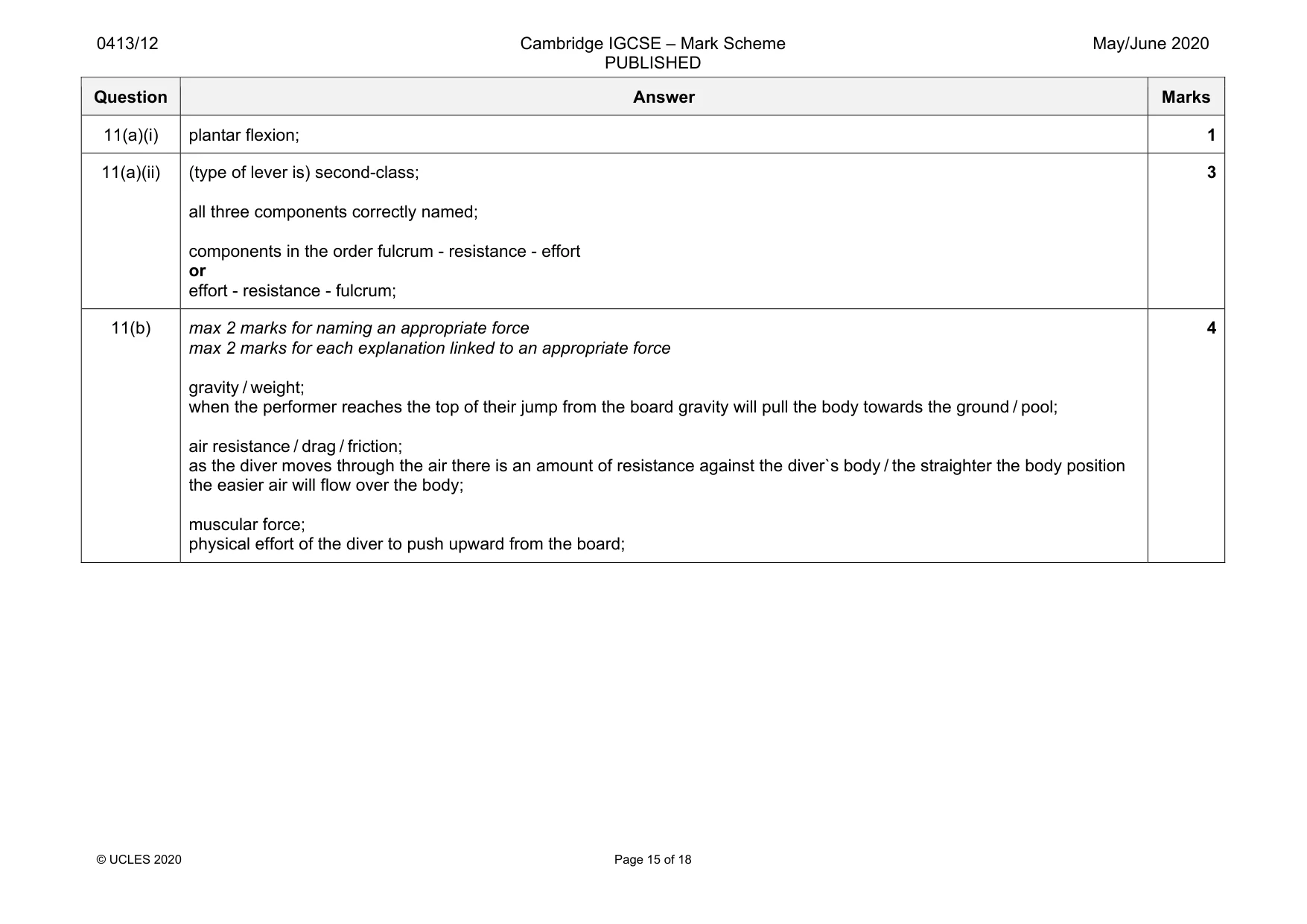
0413/12 Cambridge IGCSE – Mark Scheme PUBLISHED May/June 2020 © UCLES 2020 Page 15 of 18 Question Answer Marks 11(a)(i) plantar flexion; 1 11(a)(ii) (type of lever is) second-class; all three components correctly named; components in the order fulcrum - resistance - effort or effort - resistance - fulcrum; 3 11(b) max 2 marks for naming an appropriate force max 2 marks for each explanation linked to an appropriate force gravity / weight; when the performer reaches the top of their jump from the board gravity will pull the body towards the ground / pool; air resistance / drag / friction; as the diver moves through the air there is an amount of resistance against the diver`s body / the straighter the body position the easier air will flow over the body; muscular force; physical effort of the diver to push upward from the board; 4
Mark scheme, page 16
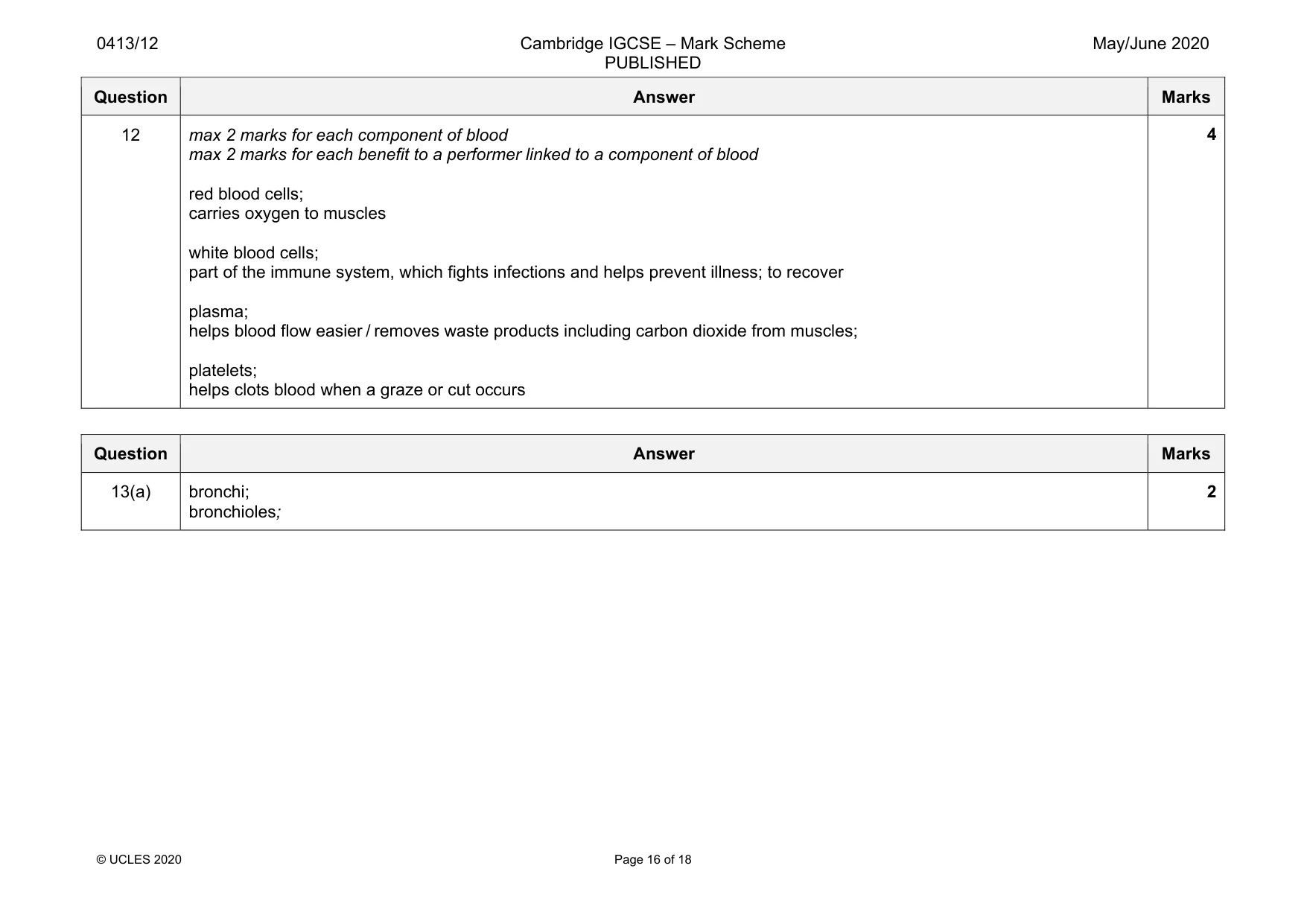
0413/12 Cambridge IGCSE – Mark Scheme PUBLISHED May/June 2020 © UCLES 2020 Page 16 of 18 Question Answer Marks 12 max 2 marks for each component of blood max 2 marks for each benefit to a performer linked to a component of blood red blood cells; carries oxygen to muscles white blood cells; part of the immune system, which fights infections and helps prevent illness; to recover plasma; helps blood flow easier / removes waste products including carbon dioxide from muscles; platelets; helps clots blood when a graze or cut occurs 4 Question Answer Marks 13(a) bronchi; bronchioles; 2
Mark scheme, page 17
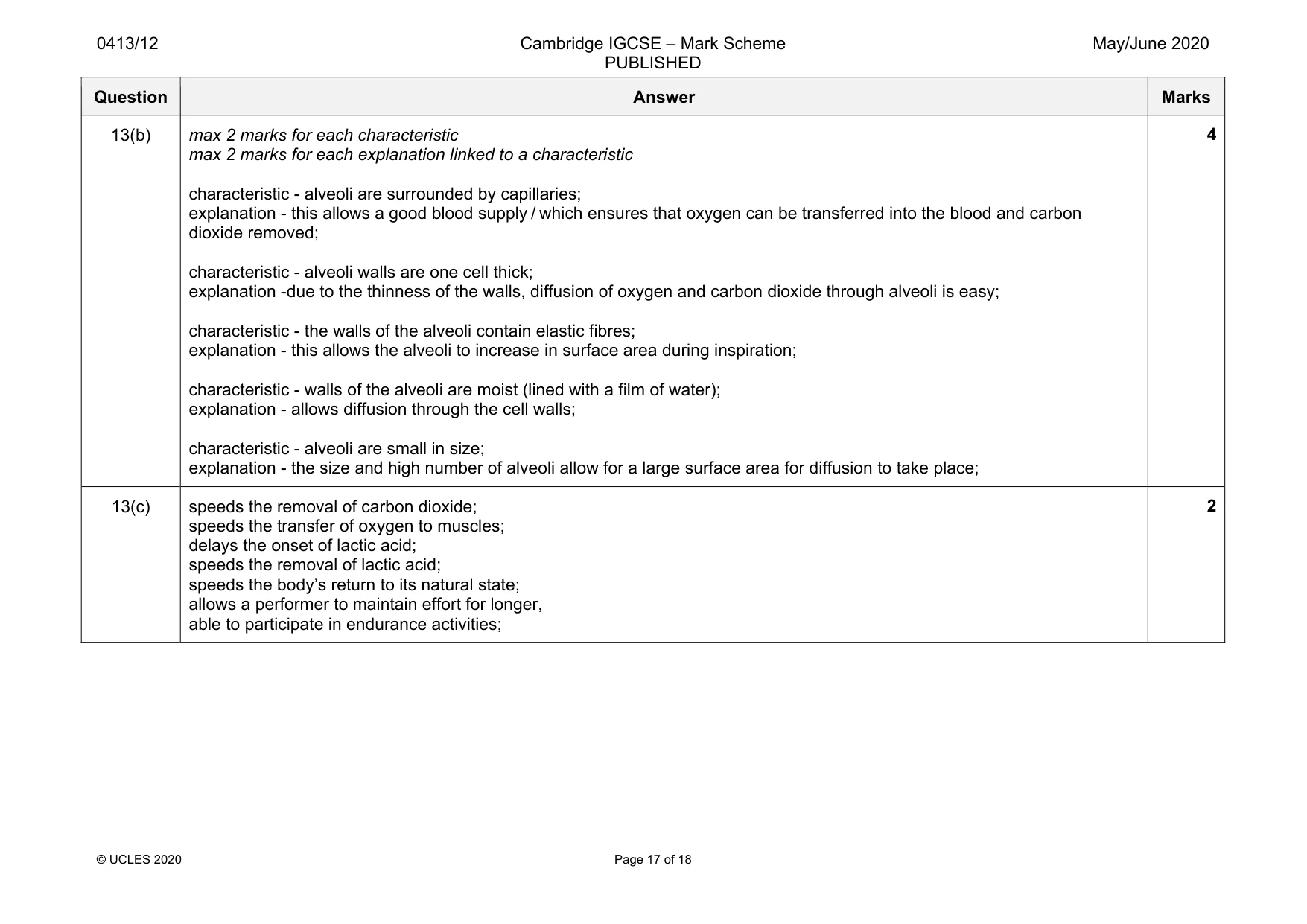
0413/12 Cambridge IGCSE – Mark Scheme PUBLISHED May/June 2020 © UCLES 2020 Page 17 of 18 Question Answer Marks 13(b) max 2 marks for each characteristic max 2 marks for each explanation linked to a characteristic characteristic - alveoli are surrounded by capillaries; explanation - this allows a good blood supply / which ensures that oxygen can be transferred into the blood and carbon dioxide removed; characteristic - alveoli walls are one cell thick; explanation -due to the thinness of the walls, diffusion of oxygen and carbon dioxide through alveoli is easy; characteristic - the walls of the alveoli contain elastic fibres; explanation - this allows the alveoli to increase in surface area during inspiration; characteristic - walls of the alveoli are moist (lined with a film of water); explanation - allows diffusion through the cell walls; characteristic - alveoli are small in size; explanation - the size and high number of alveoli allow for a large surface area for diffusion to take place; 4 13(c) speeds the removal of carbon dioxide; speeds the transfer of oxygen to muscles; delays the onset of lactic acid; speeds the removal of lactic acid; speeds the body’s return to its natural state; allows a performer to maintain effort for longer, able to participate in endurance activities; 2
Mark scheme, page 18
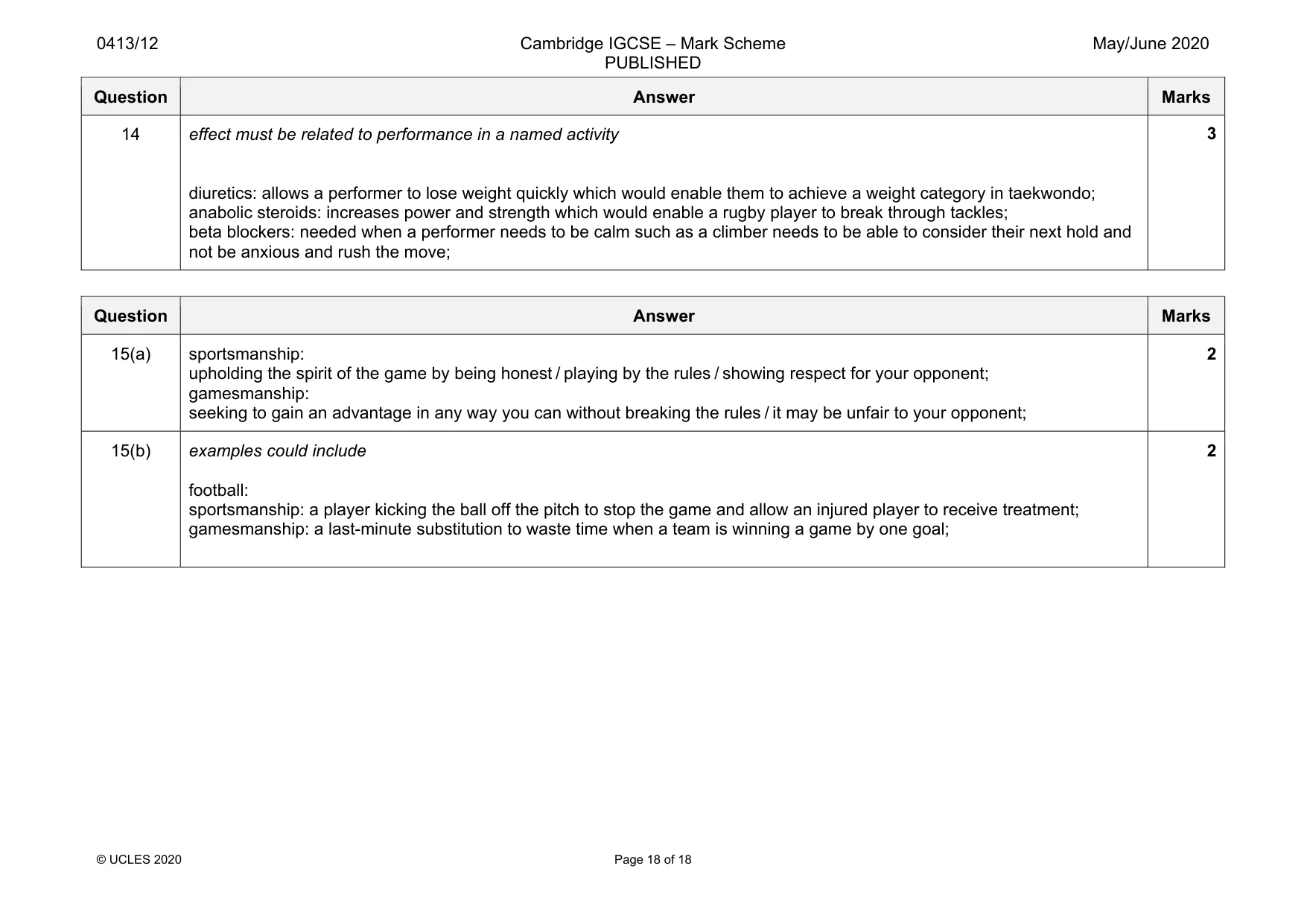
0413/12 Cambridge IGCSE – Mark Scheme PUBLISHED May/June 2020 © UCLES 2020 Page 18 of 18 Question Answer Marks 14 effect must be related to performance in a named activity diuretics: allows a performer to lose weight quickly which would enable them to achieve a weight category in taekwondo; anabolic steroids: increases power and strength which would enable a rugby player to break through tackles; beta blockers: needed when a performer needs to be calm such as a climber needs to be able to consider their next hold and not be anxious and rush the move; 3 Question Answer Marks 15(a) sportsmanship: upholding the spirit of the game by being honest / playing by the rules / showing respect for your opponent; gamesmanship: seeking to gain an advantage in any way you can without breaking the rules / it may be unfair to your opponent; 2 15(b) examples could include football: sportsmanship: a player kicking the ball off the pitch to stop the game and allow an injured player to receive treatment; gamesmanship: a last-minute substitution to waste time when a team is winning a game by one goal; 2