Cambridge IGCSE Physical Education 0413 — 2020 May/June Paper 1 · Variant 3
0413/13/M/J/20
The question paper and its mark scheme, free to read here and free to download. This is Cambridge’s own paper, exactly as it was sat.
Question paper16 pages

Mark scheme22 pages
Answers below. Sit the paper first if you are practising.
Paper as text
Question paper, page 1
Cambridge IGCSE™ DC (JC/CT) 182733/2 © UCLES 2020 [Turn over This document has 16 pages. Blank pages are indicated. * 5 5 0 3 8 0 5 4 1 2 * PHYSICAL EDUCATION 0413/13 Paper 1 Theory May/June 2020 1 hour 45 minutes You must answer on the question paper. No additional materials are needed. INSTRUCTIONS ● Answer all questions. ● Use a black or dark blue pen. You may use an HB pencil for any diagrams or graphs. ● Write your name, centre number and candidate number in the boxes at the top of the page. ● Write your answer to each question in the space provided. ● Do not use an erasable pen or correction fluid. ● Do not write on any bar codes. ● You may use a calculator. ● You should show all your working and use appropriate units. INFORMATION ● The total mark for this paper is 100. ● The number of marks for each question or part question is shown in brackets [ ].
Question paper, page 2
2 0413/13/M/J/20 © UCLES 2020 1 Name three components of blood. 1 … 2 … 3 … [3] 2 (a) Plantar flexion is a type of movement. Describe an example of when plantar flexion is used in two different physical activities. physical activity 1 … example 1 … … physical activity 2 … example 2 … … [2]
Question paper, page 3
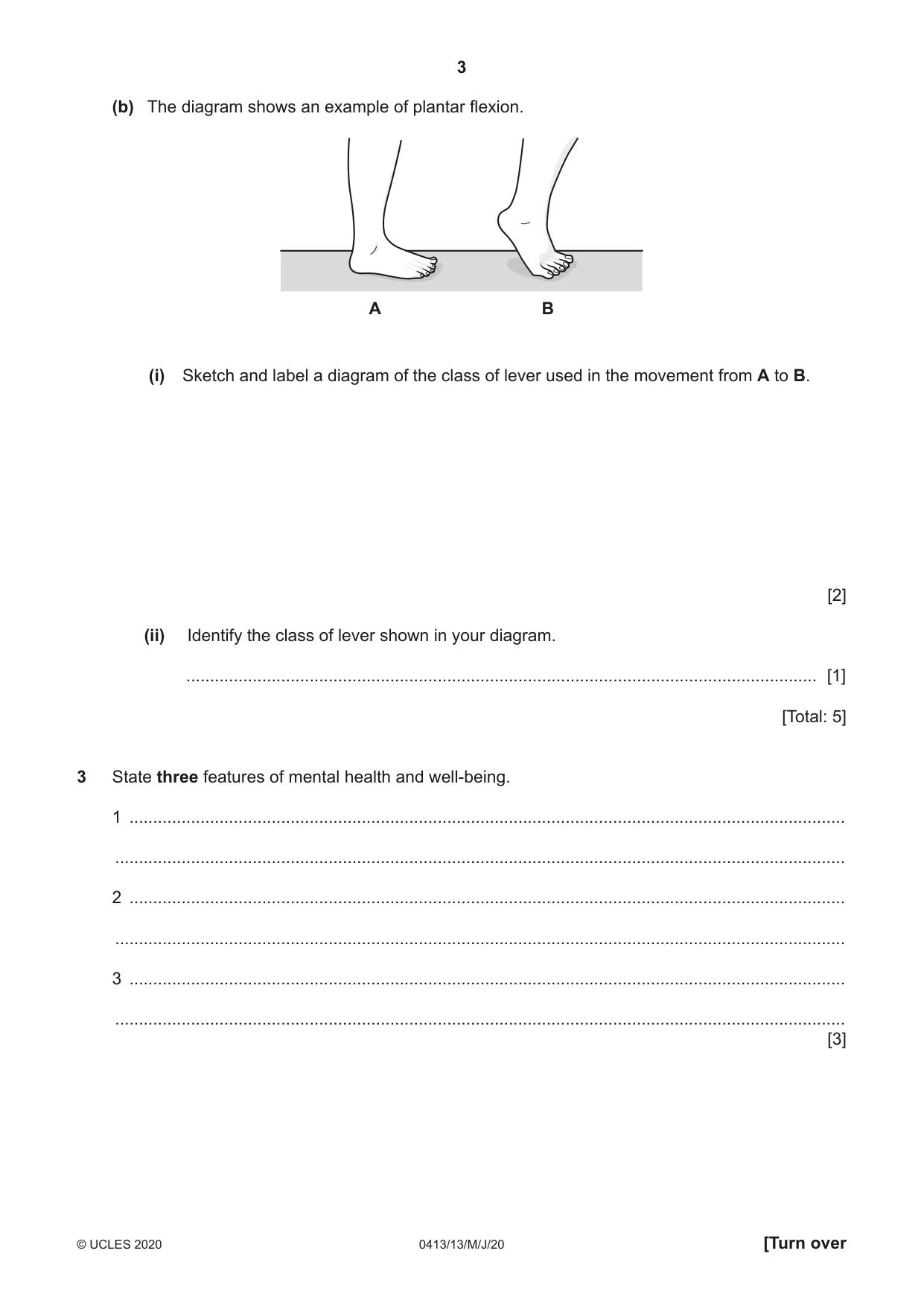
3 0413/13/M/J/20 © UCLES 2020 [Turn over (b) The diagram shows an example of plantar flexion. A B (i) Sketch and label a diagram of the class of lever used in the movement from A to B. [2] (ii) Identify the class of lever shown in your diagram. … [1] [Total: 5] 3 State three features of mental health and well-being. 1 … … 2 … … 3 … … [3]
Question paper, page 4
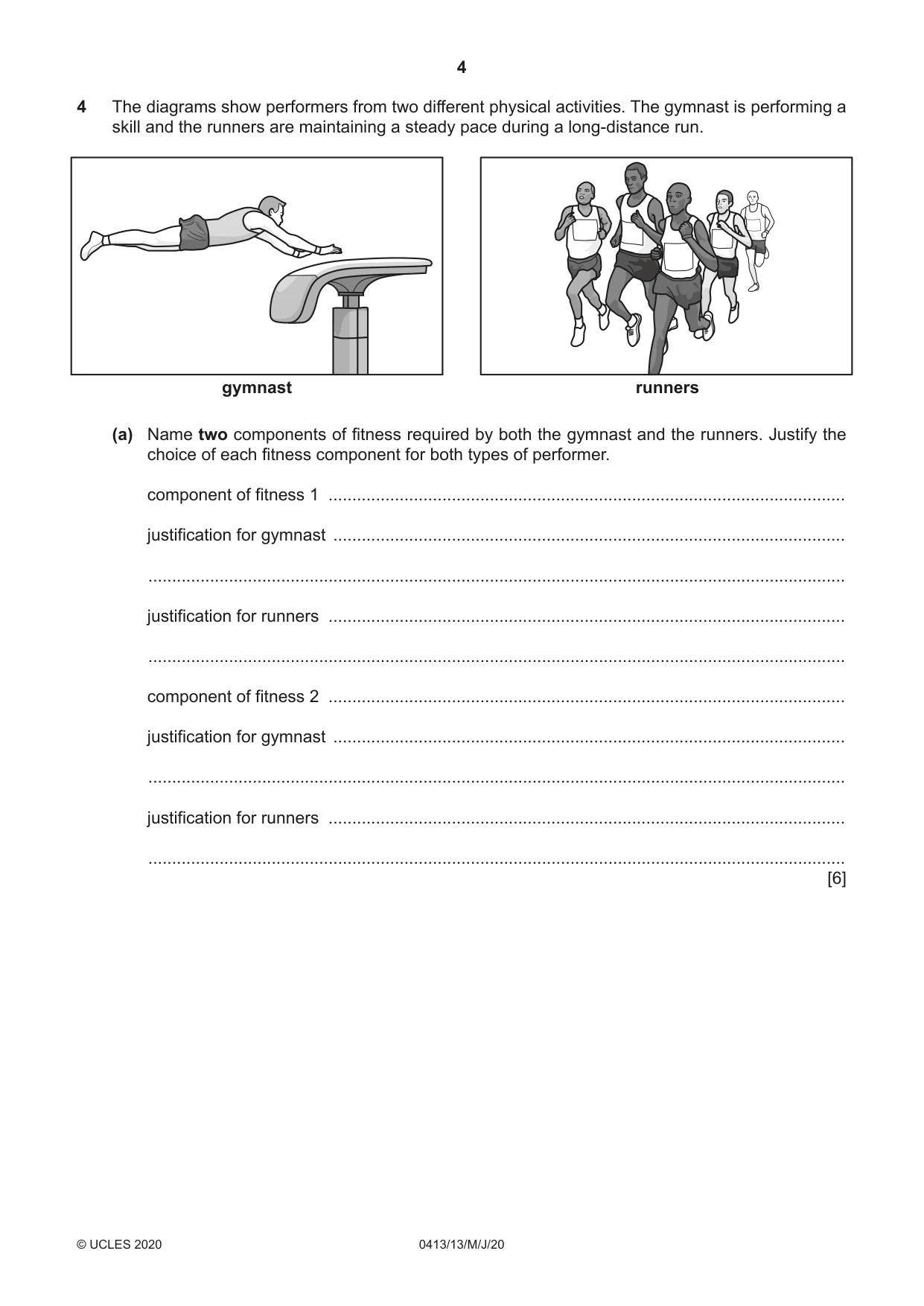
4 0413/13/M/J/20 © UCLES 2020 4 The diagrams show performers from two different physical activities. The gymnast is performing a skill and the runners are maintaining a steady pace during a long-distance run. runners gymnast (a) Name two components of fitness required by both the gymnast and the runners. Justify the choice of each fitness component for both types of performer. component of fitness 1 … justification for gymnast … … justification for runners … … component of fitness 2 … justification for gymnast … … justification for runners … … [6]
Question paper, page 5
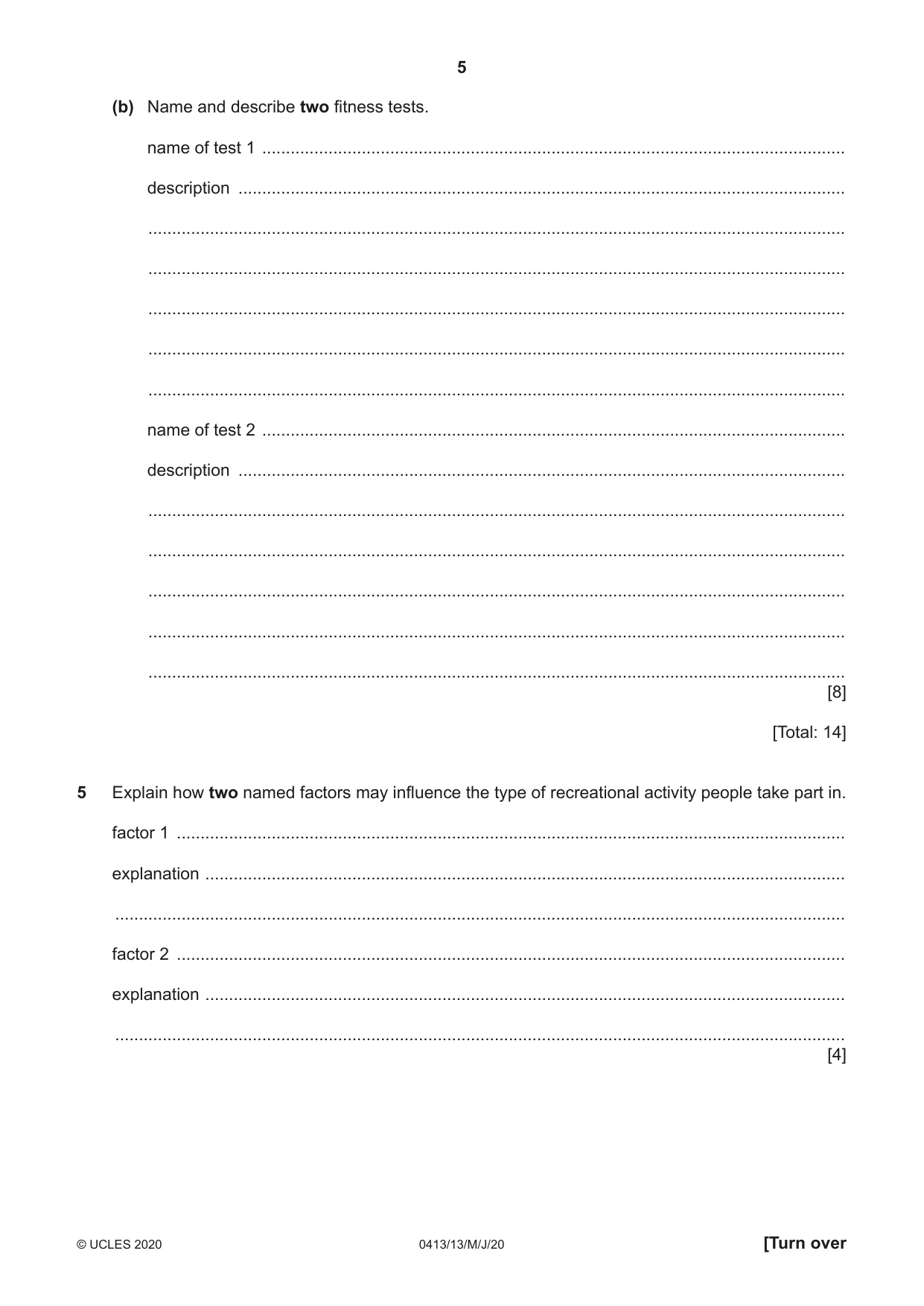
5 0413/13/M/J/20 © UCLES 2020 [Turn over (b) Name and describe two fitness tests. name of test 1 … description … … … … … … name of test 2 … description … … … … … … [8] [Total: 14] 5 Explain how two named factors may influence the type of recreational activity people take part in. factor 1 … explanation … … factor 2 … explanation … … [4]
Question paper, page 6
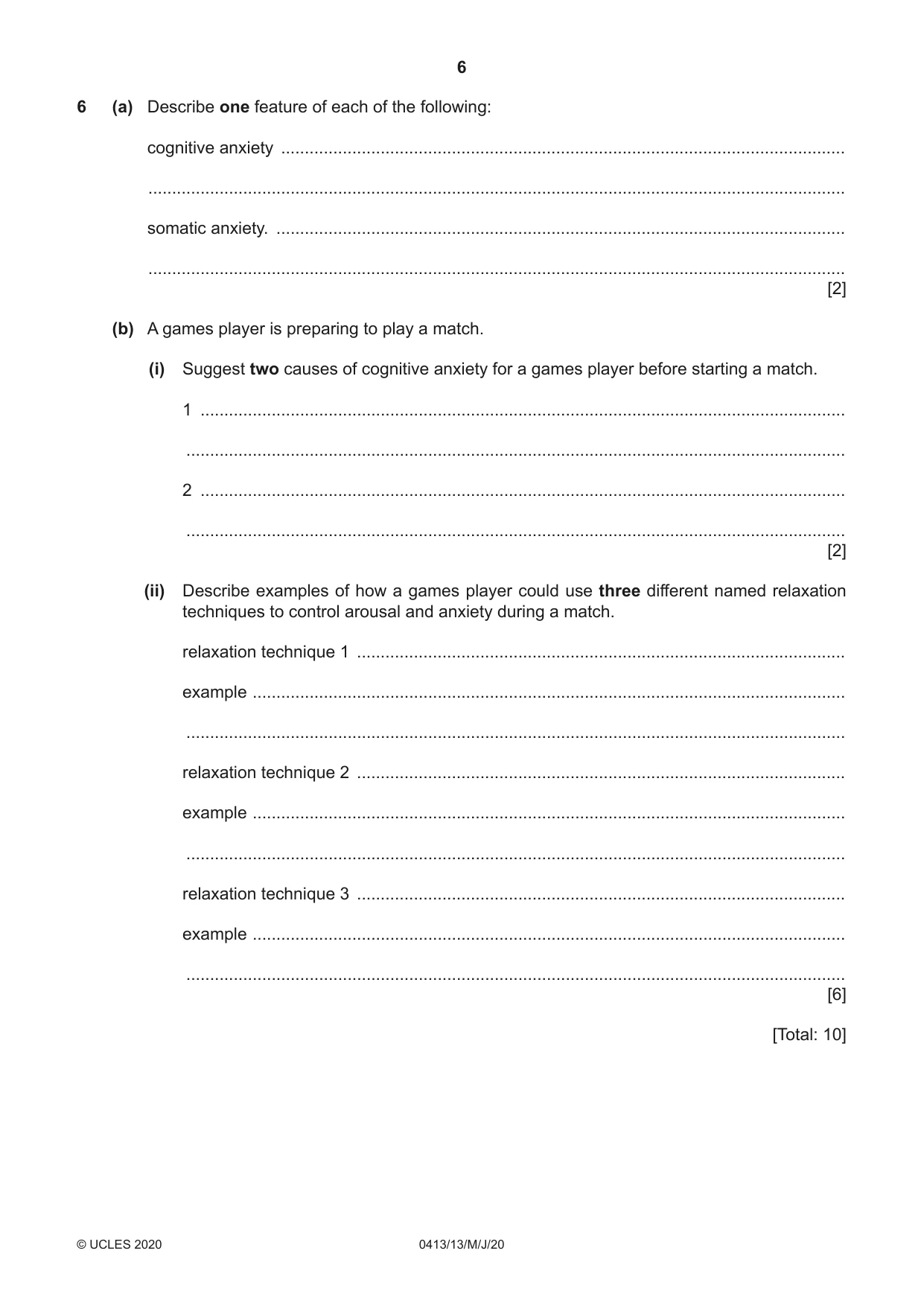
6 0413/13/M/J/20 © UCLES 2020 6 (a) Describe one feature of each of the following: cognitive anxiety … … somatic anxiety. … … [2] (b) A games player is preparing to play a match. (i) Suggest two causes of cognitive anxiety for a games player before starting a match. 1 … … 2 … … [2] (ii) Describe examples of how a games player could use three different named relaxation techniques to control arousal and anxiety during a match. relaxation technique 1 … example … … relaxation technique 2 … example … … relaxation technique 3 … example … … [6] [Total: 10]
Question paper, page 7
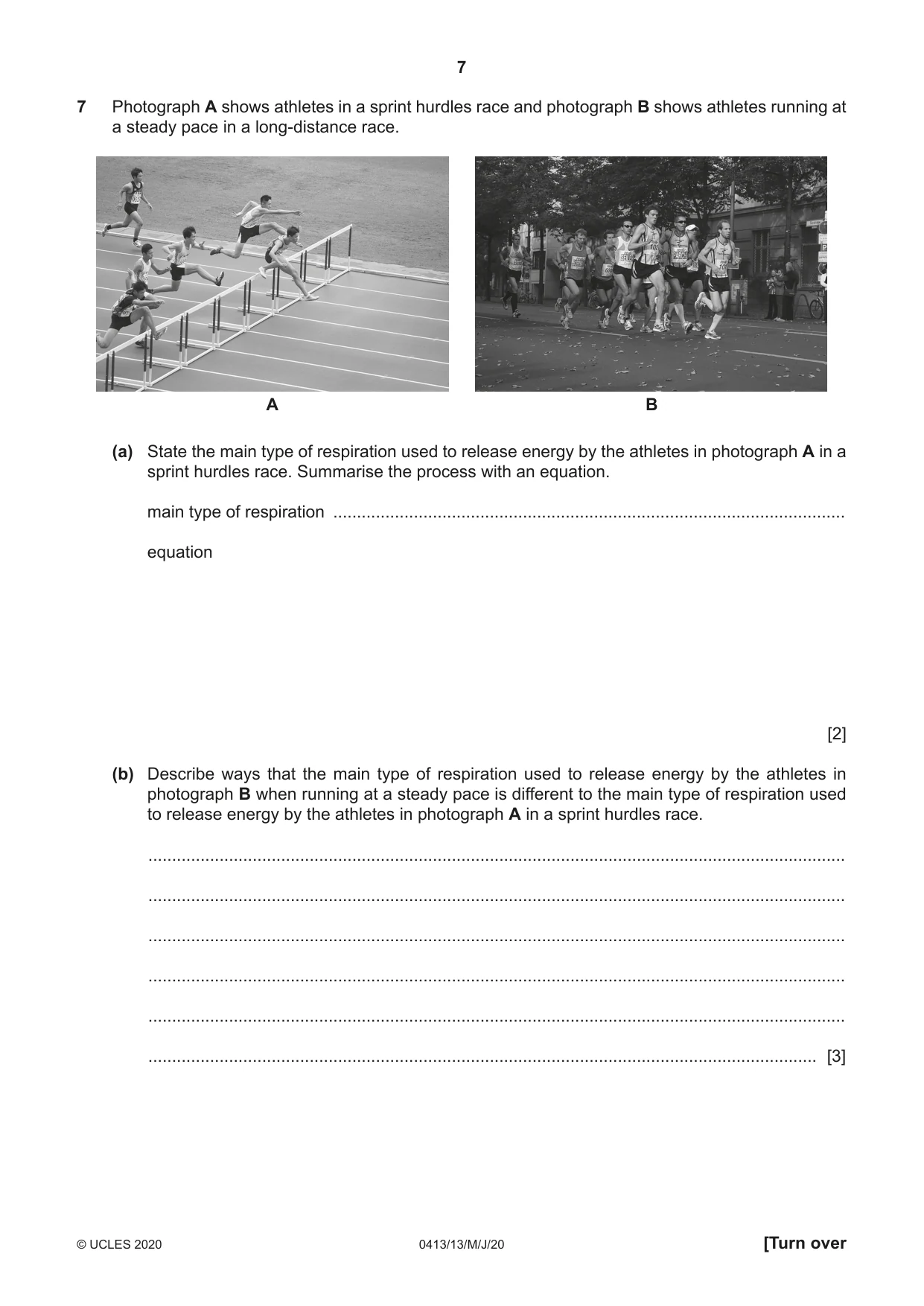
7 0413/13/M/J/20 © UCLES 2020 [Turn over 7 Photograph A shows athletes in a sprint hurdles race and photograph B shows athletes running at a steady pace in a long-distance race. A B (a) State the main type of respiration used to release energy by the athletes in photograph A in a sprint hurdles race. Summarise the process with an equation. main type of respiration … equation [2] (b) Describe ways that the main type of respiration used to release energy by the athletes in photograph B when running at a steady pace is different to the main type of respiration used to release energy by the athletes in photograph A in a sprint hurdles race. … … … … … … [3]
Question paper, page 8
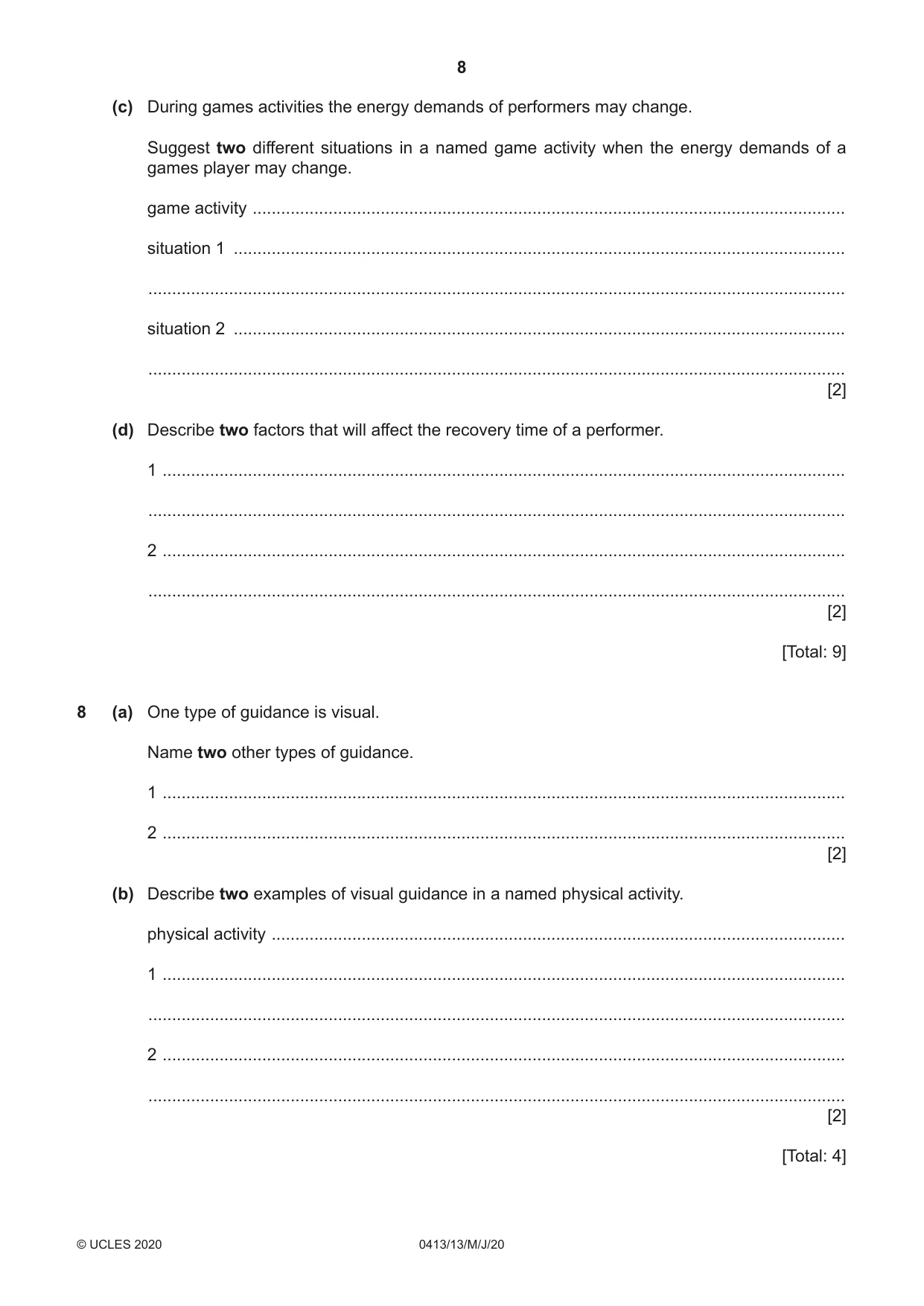
8 0413/13/M/J/20 © UCLES 2020 (c) During games activities the energy demands of performers may change. Suggest two different situations in a named game activity when the energy demands of a games player may change. game activity … situation 1 … … situation 2 … … [2] (d) Describe two factors that will affect the recovery time of a performer. 1 … … 2 … … [2] [Total: 9] 8 (a) One type of guidance is visual. Name two other types of guidance. 1 … 2 … [2] (b) Describe two examples of visual guidance in a named physical activity. physical activity … 1 … … 2 … … [2] [Total: 4]
Question paper, page 9
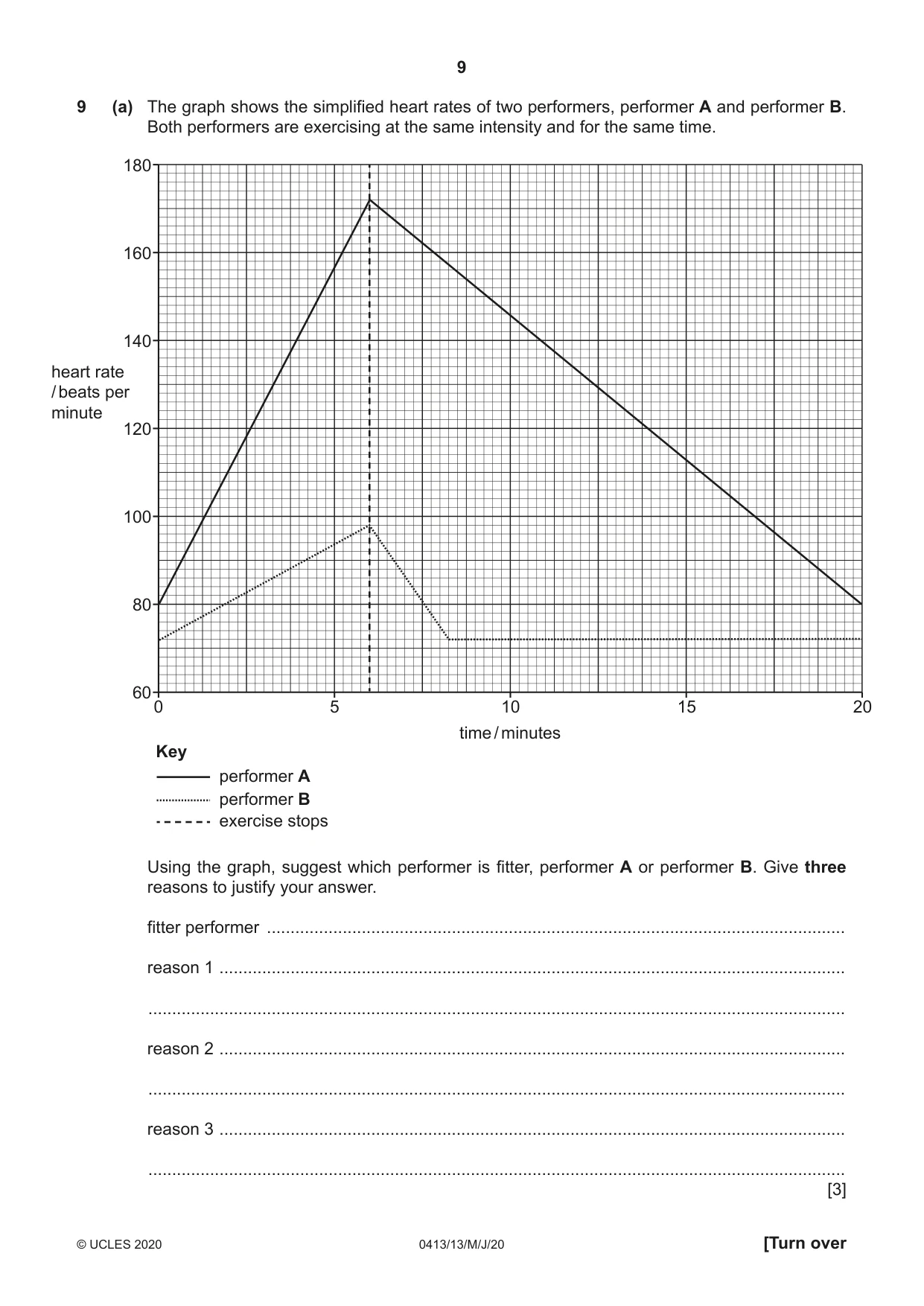
9 0413/13/M/J/20 © UCLES 2020 [Turn over 9 (a) The graph shows the simplified heart rates of two performers, performer A and performer B. Both performers are exercising at the same intensity and for the same time. 60 0 5 10 15 20 80 100 120 140 160 180 heart rate / beats per minute time / minutes Key performer A performer B exercise stops Using the graph, suggest which performer is fitter, performer A or performer B. Give three reasons to justify your answer. fitter performer … reason 1 … … reason 2 … … reason 3 … … [3]
Question paper, page 10
10 0413/13/M/J/20 © UCLES 2020 (b) The fitter performer may have a higher VO2 max. (i) State the component of fitness that VO2 max indicates. … [1] (ii) Describe how three named factors may affect VO2 max. factor 1 … description … … factor 2 … description … … factor 3 … description … … [6] (c) Describe three short-term effects of exercise, other than effects on the heart. 1 … … 2 … … 3 … … [3]
Question paper, page 11
11 0413/13/M/J/20 © UCLES 2020 [Turn over (d) Describe three benefits for performers of a cool down. 1 … … 2 … … 3 … … [3] [Total: 16] 10 (a) Describe two features of the HIIT method of training. 1 … … 2 … … [2] (b) Explain the advantages of the HIIT method of training for a games player. … … … … … … [3] (c) State two dangers of overtraining. 1 … … 2 … … [2] [Total: 7]
Question paper, page 12
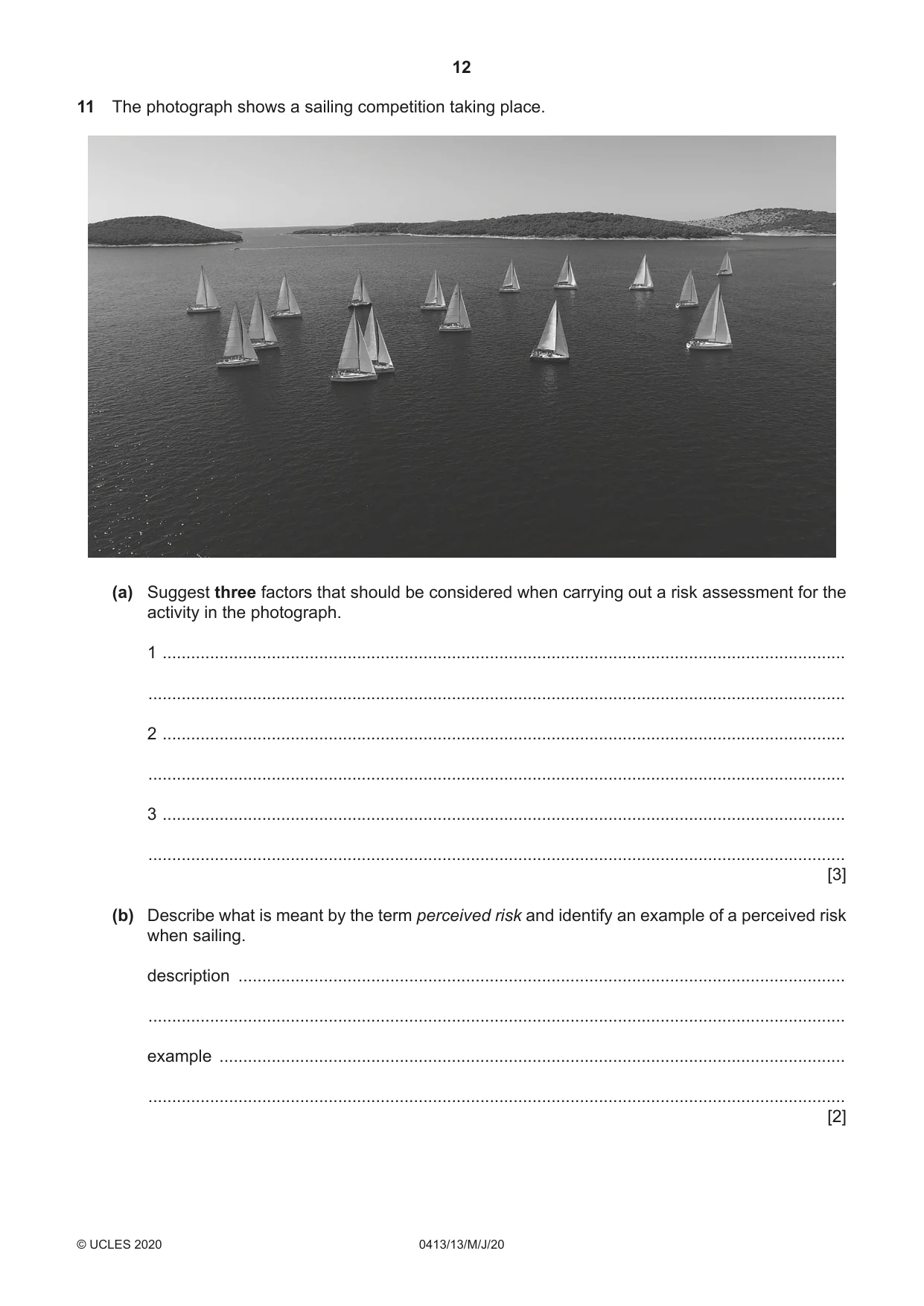
12 0413/13/M/J/20 © UCLES 2020 11 The photograph shows a sailing competition taking place. (a) Suggest three factors that should be considered when carrying out a risk assessment for the activity in the photograph. 1 … … 2 … … 3 … … [3] (b) Describe what is meant by the term perceived risk and identify an example of a perceived risk when sailing. description … … example … … [2]
Question paper, page 13
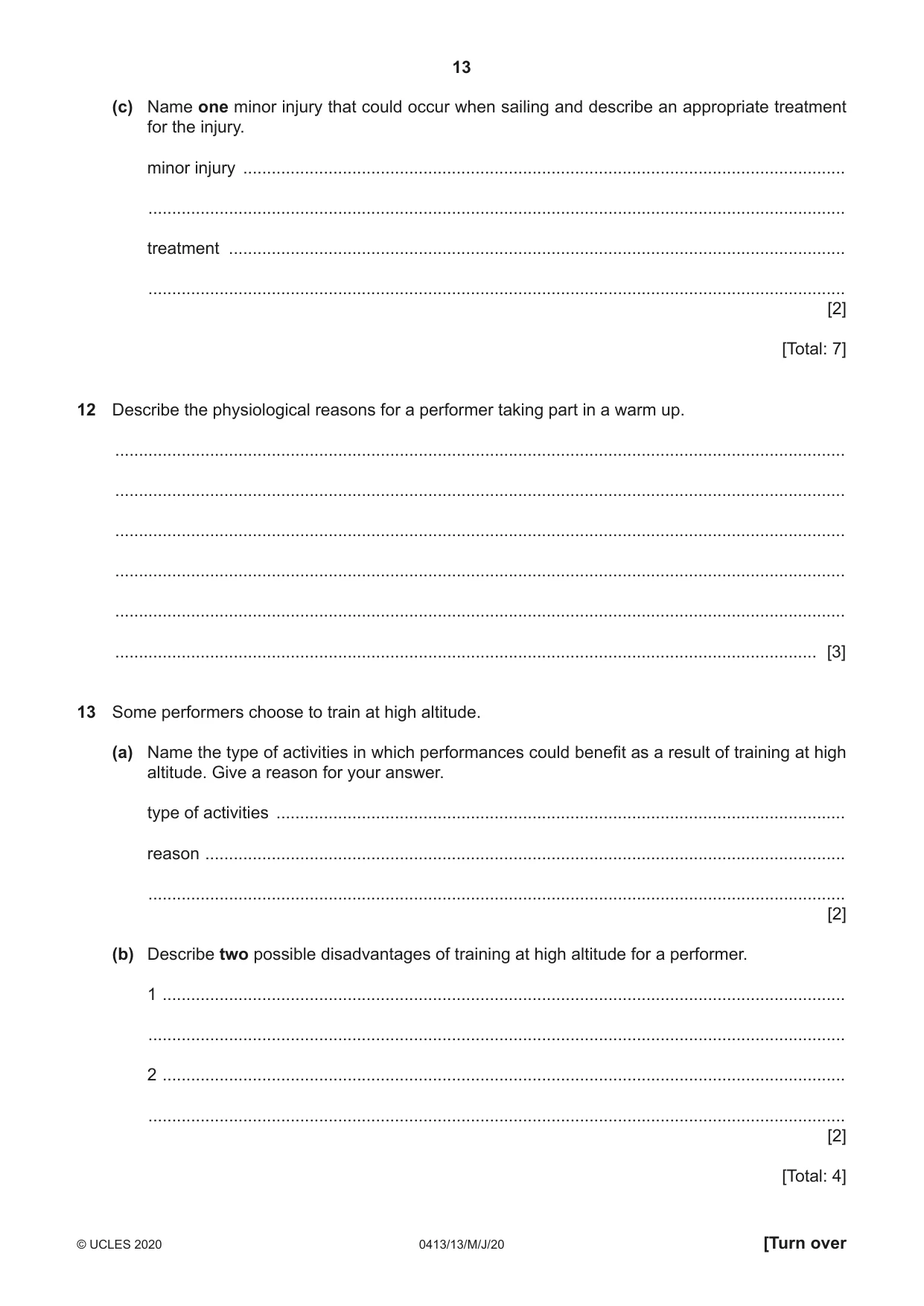
13 0413/13/M/J/20 © UCLES 2020 [Turn over (c) Name one minor injury that could occur when sailing and describe an appropriate treatment for the injury. minor injury … … treatment … … [2] [Total: 7] 12 Describe the physiological reasons for a performer taking part in a warm up. … … … … … … [3] 13 Some performers choose to train at high altitude. (a) Name the type of activities in which performances could benefit as a result of training at high altitude. Give a reason for your answer. type of activities … reason … … [2] (b) Describe two possible disadvantages of training at high altitude for a performer. 1 … … 2 … … [2] [Total: 4]
Question paper, page 14
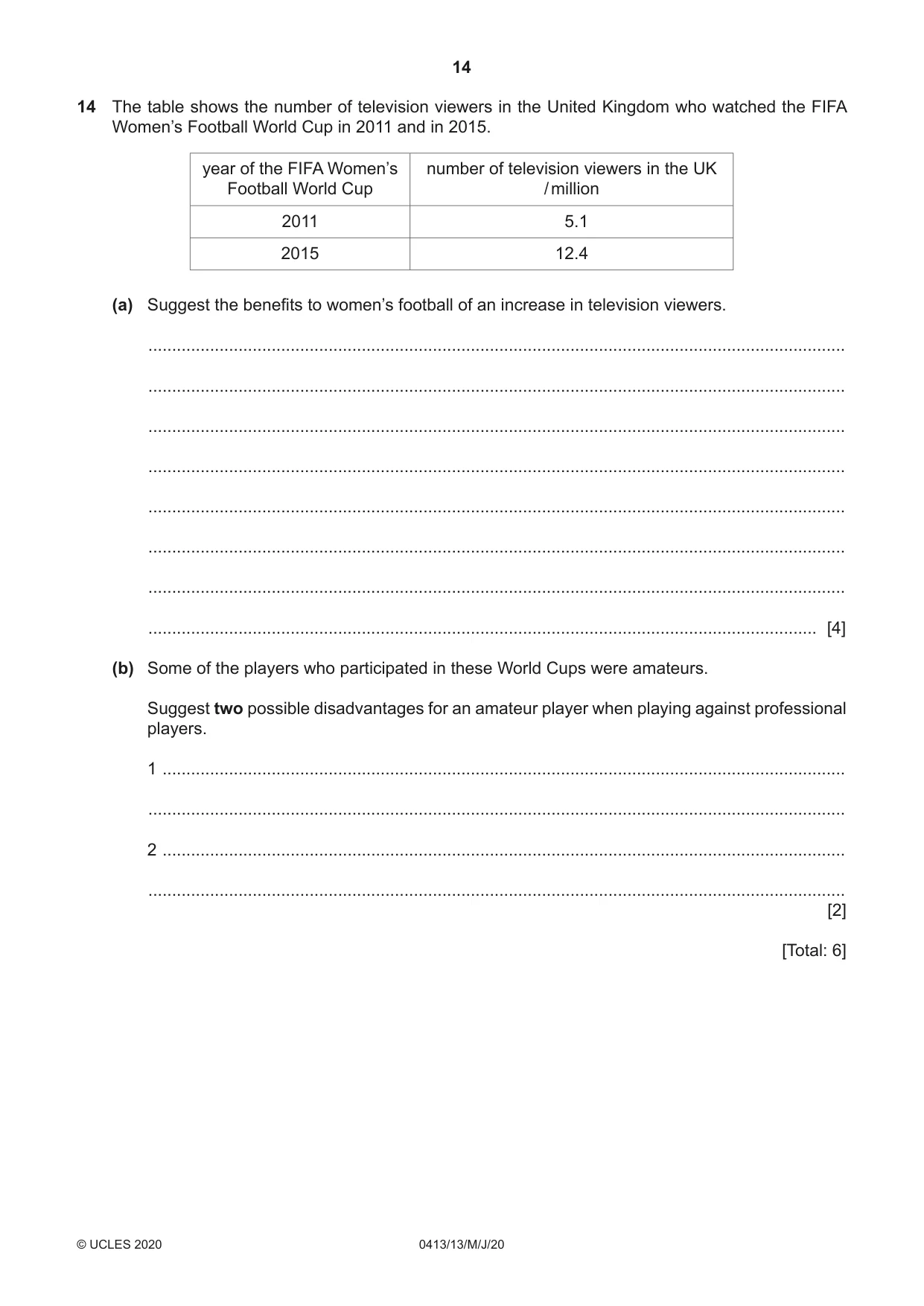
14 0413/13/M/J/20 © UCLES 2020 14 The table shows the number of television viewers in the United Kingdom who watched the FIFA Women’s Football World Cup in 2011 and in 2015. year of the FIFA Women’s Football World Cup number of television viewers in the UK / million 2011 5.1 2015 12.4 (a) Suggest the benefits to women’s football of an increase in television viewers. … … … … … … … … [4] (b) Some of the players who participated in these World Cups were amateurs. Suggest two possible disadvantages for an amateur player when playing against professional players. 1 … … 2 … … [2] [Total: 6]
Question paper, page 15
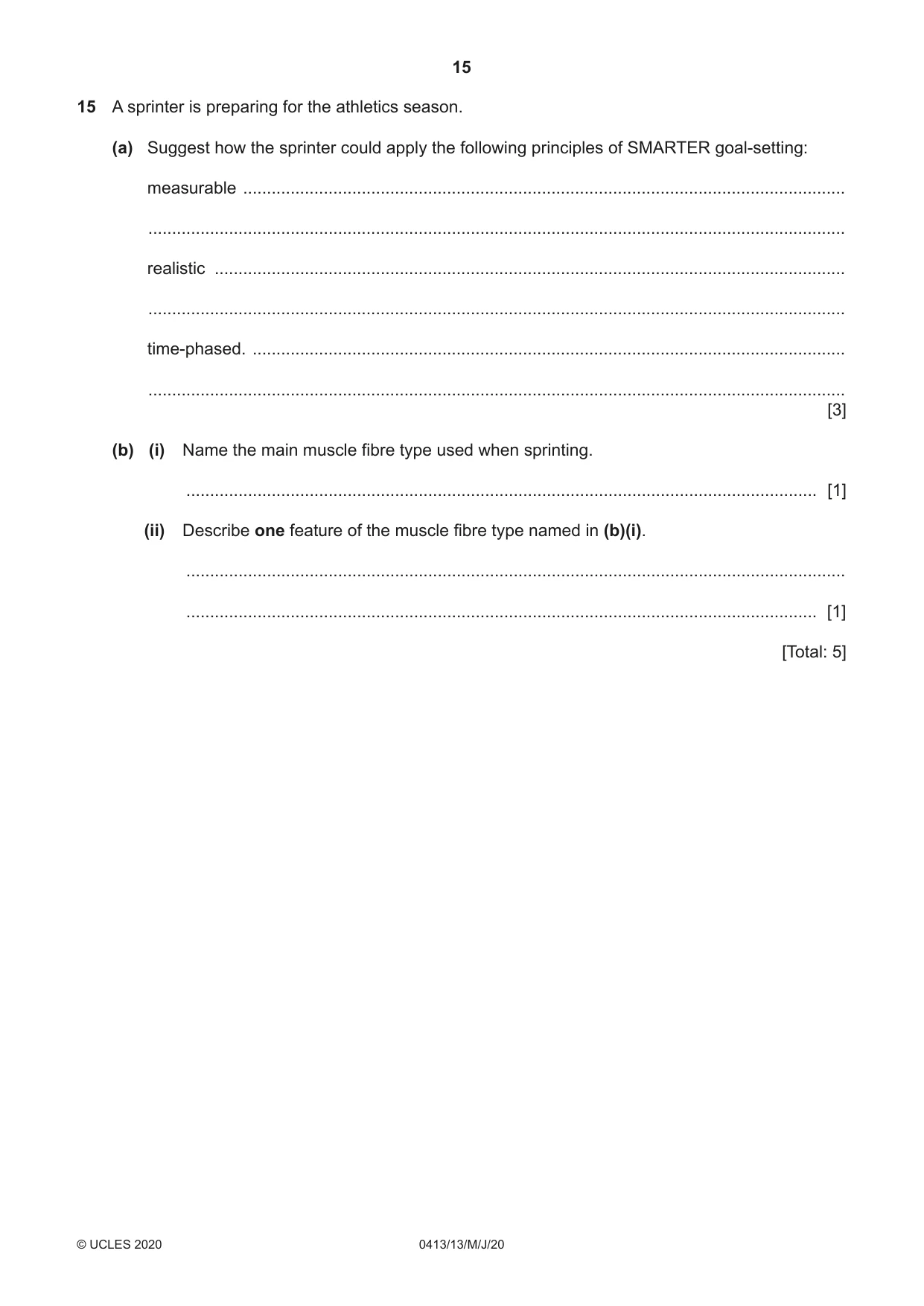
15 0413/13/M/J/20 © UCLES 2020 15 A sprinter is preparing for the athletics season. (a) Suggest how the sprinter could apply the following principles of SMARTER goal-setting: measurable … … realistic … … time-phased. … … [3] (b) (i) Name the main muscle fibre type used when sprinting. … [1] (ii) Describe one feature of the muscle fibre type named in (b)(i). … … [1] [Total: 5]
Question paper, page 16
16 0413/13/M/J/20 © UCLES 2020 Permission to reproduce items where third-party owned material protected by copyright is included has been sought and cleared where possible. Every reasonable effort has been made by the publisher (UCLES) to trace copyright holders, but if any items requiring clearance have unwittingly been included, the publisher will be pleased to make amends at the earliest possible opportunity. To avoid the issue of disclosure of answer-related information to candidates, all copyright acknowledgements are reproduced online in the Cambridge Assessment International Education Copyright Acknowledgements Booklet. This is produced for each series of examinations and is freely available to download at www.cambridgeinternational.org after the live examination series. Cambridge Assessment International Education is part of the Cambridge Assessment Group. Cambridge Assessment is the brand name of the University of Cambridge Local Examinations Syndicate (UCLES), which itself is a department of the University of Cambridge. BLANK PAGE
Mark scheme, page 1
This document consists of 22 printed pages. © UCLES 2020 [Turn over Cambridge IGCSE™ PHYSICAL EDUCATION 0413/13 Paper 1 Theory May/June 2020 MARK SCHEME Maximum Mark: 100 Published Students did not sit exam papers in the June 2020 series due to the Covid-19 global pandemic. This mark scheme is published to support teachers and students and should be read together with the question paper. It shows the requirements of the exam. The answer column of the mark scheme shows the proposed basis on which Examiners would award marks for this exam. Where appropriate, this column also provides the most likely acceptable alternative responses expected from students. Examiners usually review the mark scheme after they have seen student responses and update the mark scheme if appropriate. In the June series, Examiners were unable to consider the acceptability of alternative responses, as there were no student responses to consider. Mark schemes should usually be read together with the Principal Examiner Report for Teachers. However, because students did not sit exam papers, there is no Principal Examiner Report for Teachers for the June 2020 series. Cambridge International will not enter into discussions about these mark schemes. Cambridge International is publishing the mark schemes for the June 2020 series for most Cambridge IGCSE™ and Cambridge International A & AS Level components, and some Cambridge O Level components.
Mark scheme, page 2
0413/13 Cambridge IGCSE – Mark Scheme PUBLISHED May/June 2020 © UCLES 2020 Page 2 of 22 Generic Marking Principles These general marking principles must be applied by all examiners when marking candidate answers. They should be applied alongside the specific content of the mark scheme or generic level descriptors for a question. Each question paper and mark scheme will also comply with these marking principles. GENERIC MARKING PRINCIPLE 1: Marks must be awarded in line with: • the specific content of the mark scheme or the generic level descriptors for the question • the specific skills defined in the mark scheme or in the generic level descriptors for the question • the standard of response required by a candidate as exemplified by the standardisation scripts. GENERIC MARKING PRINCIPLE 2: Marks awarded are always whole marks (not half marks, or other fractions). GENERIC MARKING PRINCIPLE 3: Marks must be awarded positively: • marks are awarded for correct/valid answers, as defined in the mark scheme. However, credit is given for valid answers which go beyond the scope of the syllabus and mark scheme, referring to your Team Leader as appropriate • marks are awarded when candidates clearly demonstrate what they know and can do • marks are not deducted for errors • marks are not deducted for omissions • answers should only be judged on the quality of spelling, punctuation and grammar when these features are specifically assessed by the question as indicated by the mark scheme. The meaning, however, should be unambiguous. GENERIC MARKING PRINCIPLE 4: Rules must be applied consistently e.g. in situations where candidates have not followed instructions or in the application of generic level descriptors.
Mark scheme, page 3
0413/13 Cambridge IGCSE – Mark Scheme PUBLISHED May/June 2020 © UCLES 2020 Page 3 of 22 GENERIC MARKING PRINCIPLE 5: Marks should be awarded using the full range of marks defined in the mark scheme for the question (however; the use of the full mark range may be limited according to the quality of the candidate responses seen). GENERIC MARKING PRINCIPLE 6: Marks awarded are based solely on the requirements as defined in the mark scheme. Marks should not be awarded with grade thresholds or grade descriptors in mind. Science-Specific Marking Principles 1 Examiners should consider the context and scientific use of any keywords when awarding marks. Although keywords may be present, marks should not be awarded if the keywords are used incorrectly. 2 The examiner should not choose between contradictory statements given in the same question part, and credit should not be awarded for any correct statement that is contradicted within the same question part. Wrong science that is irrelevant to the question should be ignored. 3 Although spellings do not have to be correct, spellings of syllabus terms must allow for clear and unambiguous separation from other syllabus terms with which they may be confused (e.g. ethane / ethene, glucagon / glycogen, refraction / reflection). 4 The error carried forward (ecf) principle should be applied, where appropriate. If an incorrect answer is subsequently used in a scientifically correct way, the candidate should be awarded these subsequent marking points. Further guidance will be included in the mark scheme where necessary and any exceptions to this general principle will be noted.
Mark scheme, page 4
0413/13 Cambridge IGCSE – Mark Scheme PUBLISHED May/June 2020 © UCLES 2020 Page 4 of 22 5 ‘List rule’ guidance (see examples below) For questions that require n responses (e.g. State two reasons …): • The response should be read as continuous prose, even when numbered answer spaces are provided • Any response marked ignore in the mark scheme should not count towards n • Incorrect responses should not be awarded credit but will still count towards n • Read the entire response to check for any responses that contradict those that would otherwise be credited. Credit should not be awarded for any responses that are contradicted within the rest of the response. Where two responses contradict one another, this should be treated as a single incorrect response • Non-contradictory responses after the first n responses may be ignored even if they include incorrect science. 6 Calculation specific guidance Correct answers to calculations should be given full credit even if there is no working or incorrect working, unless the question states ‘show your working’. For questions in which the number of significant figures required is not stated, credit should be awarded for correct answers when rounded by the examiner to the number of significant figures given in the mark scheme. This may not apply to measured values. For answers given in standard form, (e.g. a × 10n) in which the convention of restricting the value of the coefficient (a) to a value between 1 and 10 is not followed, credit may still be awarded if the answer can be converted to the answer given in the mark scheme. Unless a separate mark is given for a unit, a missing or incorrect unit will normally mean that the final calculation mark is not awarded. Exceptions to this general principle will be noted in the mark scheme. 7 Guidance for chemical equations Multiples / fractions of coefficients used in chemical equations are acceptable unless stated otherwise in the mark scheme. State symbols given in an equation should be ignored unless asked for in the question or stated otherwise in the mark scheme.
Mark scheme, page 5
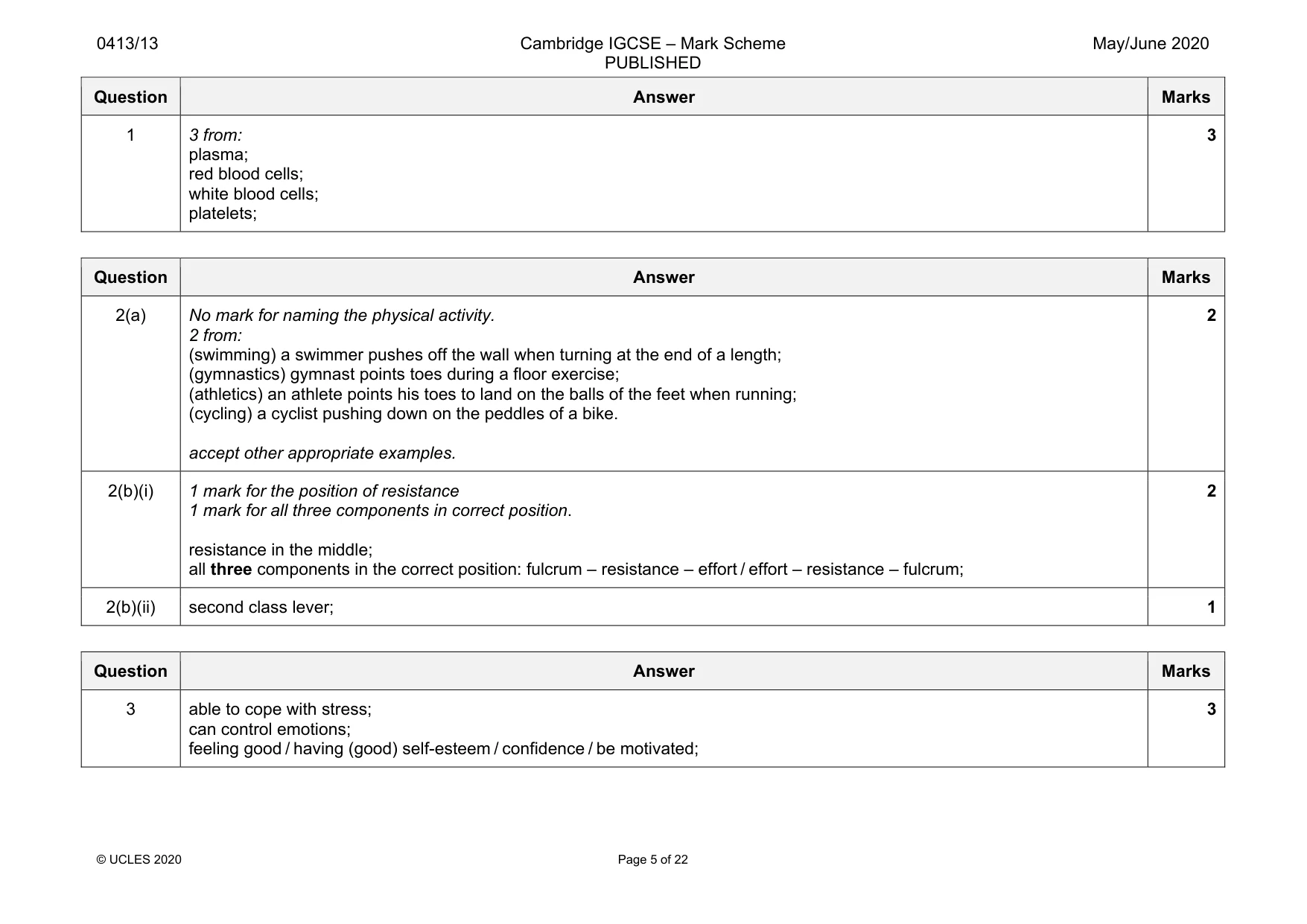
0413/13 Cambridge IGCSE – Mark Scheme PUBLISHED May/June 2020 © UCLES 2020 Page 5 of 22 Question Answer Marks 1 3 from: plasma; red blood cells; white blood cells; platelets; 3 Question Answer Marks 2(a) No mark for naming the physical activity. 2 from: (swimming) a swimmer pushes off the wall when turning at the end of a length; (gymnastics) gymnast points toes during a floor exercise; (athletics) an athlete points his toes to land on the balls of the feet when running; (cycling) a cyclist pushing down on the peddles of a bike. accept other appropriate examples. 2 2(b)(i) 1 mark for the position of resistance 1 mark for all three components in correct position. resistance in the middle; all three components in the correct position: fulcrum – resistance – effort / effort – resistance – fulcrum; 2 2(b)(ii) second class lever; 1 Question Answer Marks 3 able to cope with stress; can control emotions; feeling good / having (good) self-esteem / confidence / be motivated; 3
Mark scheme, page 6
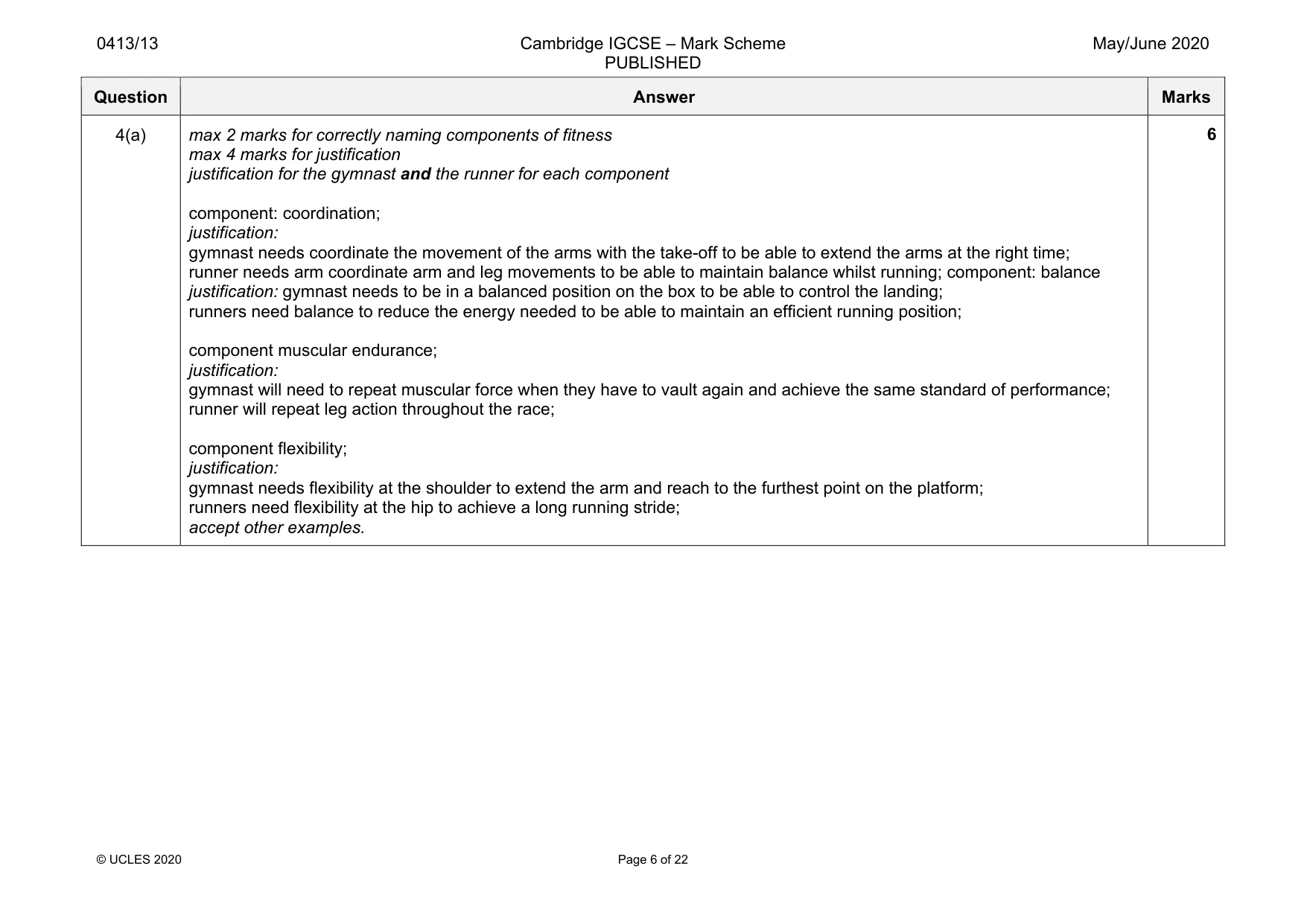
0413/13 Cambridge IGCSE – Mark Scheme PUBLISHED May/June 2020 © UCLES 2020 Page 6 of 22 Question Answer Marks 4(a) max 2 marks for correctly naming components of fitness max 4 marks for justification justification for the gymnast and the runner for each component component: coordination; justification: gymnast needs coordinate the movement of the arms with the take-off to be able to extend the arms at the right time; runner needs arm coordinate arm and leg movements to be able to maintain balance whilst running; component: balance justification: gymnast needs to be in a balanced position on the box to be able to control the landing; runners need balance to reduce the energy needed to be able to maintain an efficient running position; component muscular endurance; justification: gymnast will need to repeat muscular force when they have to vault again and achieve the same standard of performance; runner will repeat leg action throughout the race; component flexibility; justification: gymnast needs flexibility at the shoulder to extend the arm and reach to the furthest point on the platform; runners need flexibility at the hip to achieve a long running stride; accept other examples. 6
Mark scheme, page 7
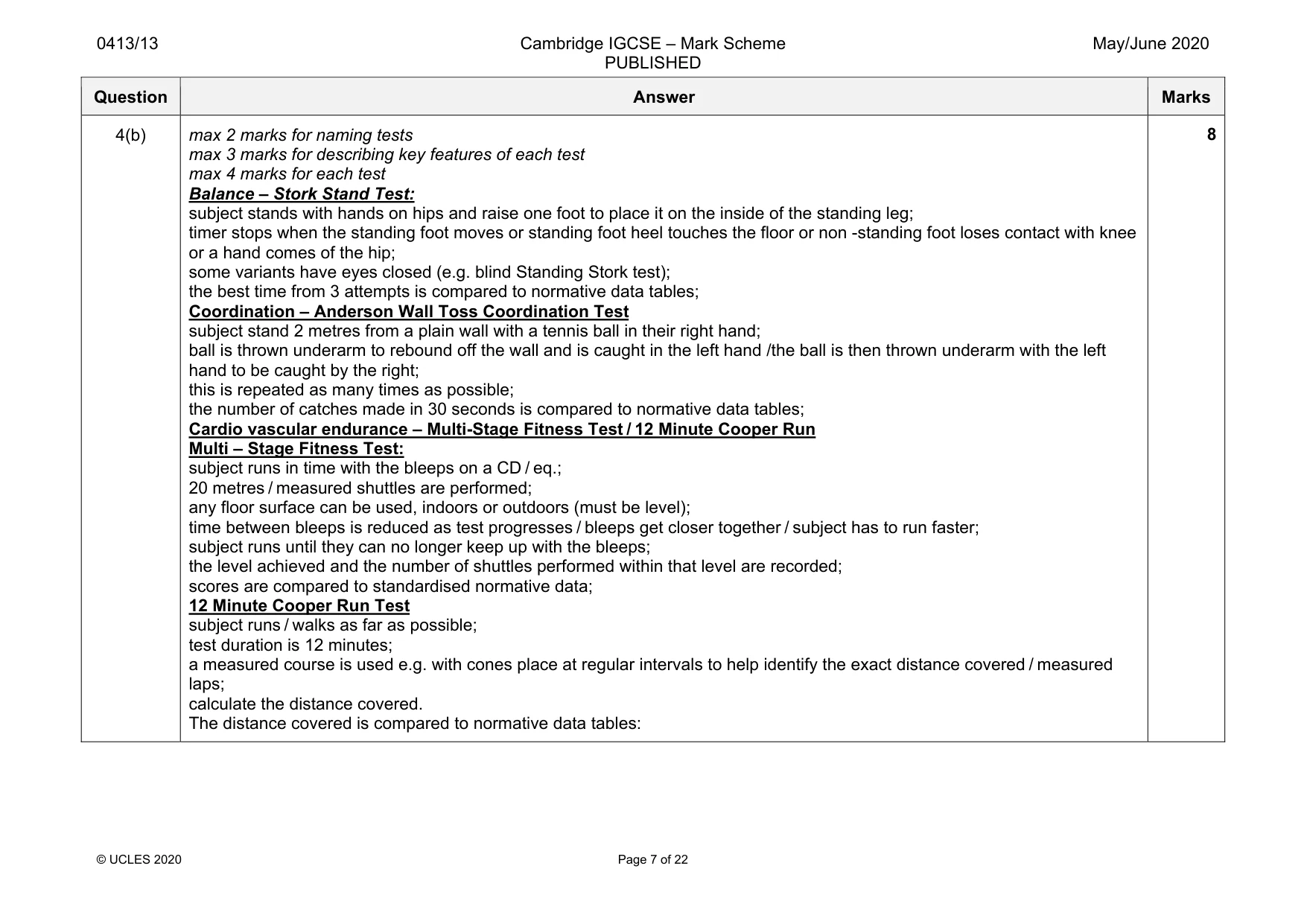
0413/13 Cambridge IGCSE – Mark Scheme PUBLISHED May/June 2020 © UCLES 2020 Page 7 of 22 Question Answer Marks 4(b) max 2 marks for naming tests max 3 marks for describing key features of each test max 4 marks for each test Balance – Stork Stand Test: subject stands with hands on hips and raise one foot to place it on the inside of the standing leg; timer stops when the standing foot moves or standing foot heel touches the floor or non -standing foot loses contact with knee or a hand comes of the hip; some variants have eyes closed (e.g. blind Standing Stork test); the best time from 3 attempts is compared to normative data tables; Coordination – Anderson Wall Toss Coordination Test subject stand 2 metres from a plain wall with a tennis ball in their right hand; ball is thrown underarm to rebound off the wall and is caught in the left hand /the ball is then thrown underarm with the left hand to be caught by the right; this is repeated as many times as possible; the number of catches made in 30 seconds is compared to normative data tables; Cardio vascular endurance – Multi-Stage Fitness Test / 12 Minute Cooper Run Multi – Stage Fitness Test: subject runs in time with the bleeps on a CD / eq.; 20 metres / measured shuttles are performed; any floor surface can be used, indoors or outdoors (must be level); time between bleeps is reduced as test progresses / bleeps get closer together / subject has to run faster; subject runs until they can no longer keep up with the bleeps; the level achieved and the number of shuttles performed within that level are recorded; scores are compared to standardised normative data; 12 Minute Cooper Run Test subject runs / walks as far as possible; test duration is 12 minutes; a measured course is used e.g. with cones place at regular intervals to help identify the exact distance covered / measured laps; calculate the distance covered. The distance covered is compared to normative data tables: 8
Mark scheme, page 8
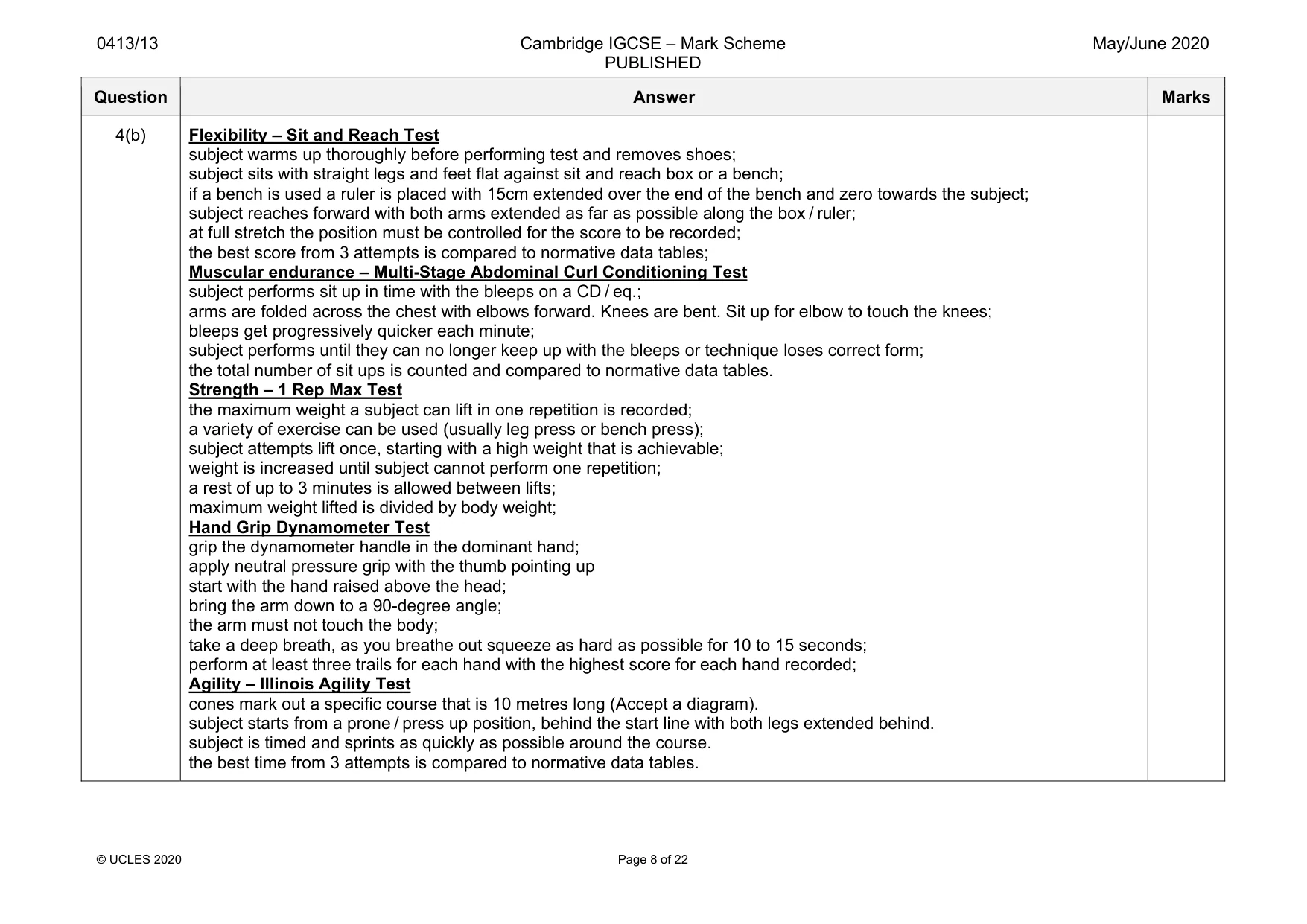
0413/13 Cambridge IGCSE – Mark Scheme PUBLISHED May/June 2020 © UCLES 2020 Page 8 of 22 Question Answer Marks 4(b) Flexibility – Sit and Reach Test subject warms up thoroughly before performing test and removes shoes; subject sits with straight legs and feet flat against sit and reach box or a bench; if a bench is used a ruler is placed with 15cm extended over the end of the bench and zero towards the subject; subject reaches forward with both arms extended as far as possible along the box / ruler; at full stretch the position must be controlled for the score to be recorded; the best score from 3 attempts is compared to normative data tables; Muscular endurance – Multi-Stage Abdominal Curl Conditioning Test subject performs sit up in time with the bleeps on a CD / eq.; arms are folded across the chest with elbows forward. Knees are bent. Sit up for elbow to touch the knees; bleeps get progressively quicker each minute; subject performs until they can no longer keep up with the bleeps or technique loses correct form; the total number of sit ups is counted and compared to normative data tables. Strength – 1 Rep Max Test the maximum weight a subject can lift in one repetition is recorded; a variety of exercise can be used (usually leg press or bench press); subject attempts lift once, starting with a high weight that is achievable; weight is increased until subject cannot perform one repetition; a rest of up to 3 minutes is allowed between lifts; maximum weight lifted is divided by body weight; Hand Grip Dynamometer Test grip the dynamometer handle in the dominant hand; apply neutral pressure grip with the thumb pointing up start with the hand raised above the head; bring the arm down to a 90-degree angle; the arm must not touch the body; take a deep breath, as you breathe out squeeze as hard as possible for 10 to 15 seconds; perform at least three trails for each hand with the highest score for each hand recorded; Agility – Illinois Agility Test cones mark out a specific course that is 10 metres long (Accept a diagram). subject starts from a prone / press up position, behind the start line with both legs extended behind. subject is timed and sprints as quickly as possible around the course. the best time from 3 attempts is compared to normative data tables.
Mark scheme, page 9
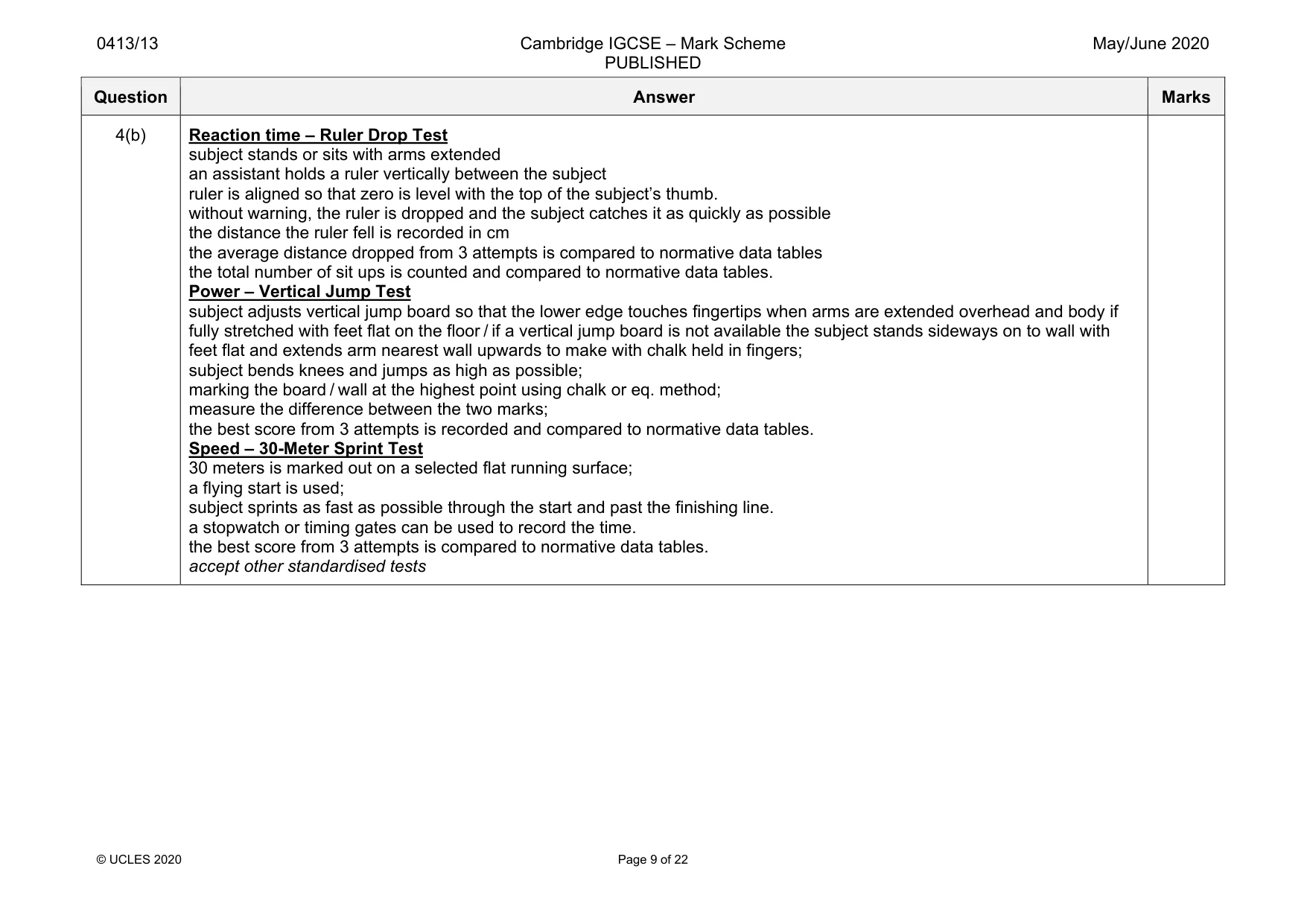
0413/13 Cambridge IGCSE – Mark Scheme PUBLISHED May/June 2020 © UCLES 2020 Page 9 of 22 Question Answer Marks 4(b) Reaction time – Ruler Drop Test subject stands or sits with arms extended an assistant holds a ruler vertically between the subject ruler is aligned so that zero is level with the top of the subject’s thumb. without warning, the ruler is dropped and the subject catches it as quickly as possible the distance the ruler fell is recorded in cm the average distance dropped from 3 attempts is compared to normative data tables the total number of sit ups is counted and compared to normative data tables. Power – Vertical Jump Test subject adjusts vertical jump board so that the lower edge touches fingertips when arms are extended overhead and body if fully stretched with feet flat on the floor / if a vertical jump board is not available the subject stands sideways on to wall with feet flat and extends arm nearest wall upwards to make with chalk held in fingers; subject bends knees and jumps as high as possible; marking the board / wall at the highest point using chalk or eq. method; measure the difference between the two marks; the best score from 3 attempts is recorded and compared to normative data tables. Speed – 30-Meter Sprint Test 30 meters is marked out on a selected flat running surface; a flying start is used; subject sprints as fast as possible through the start and past the finishing line. a stopwatch or timing gates can be used to record the time. the best score from 3 attempts is compared to normative data tables. accept other standardised tests
Mark scheme, page 10
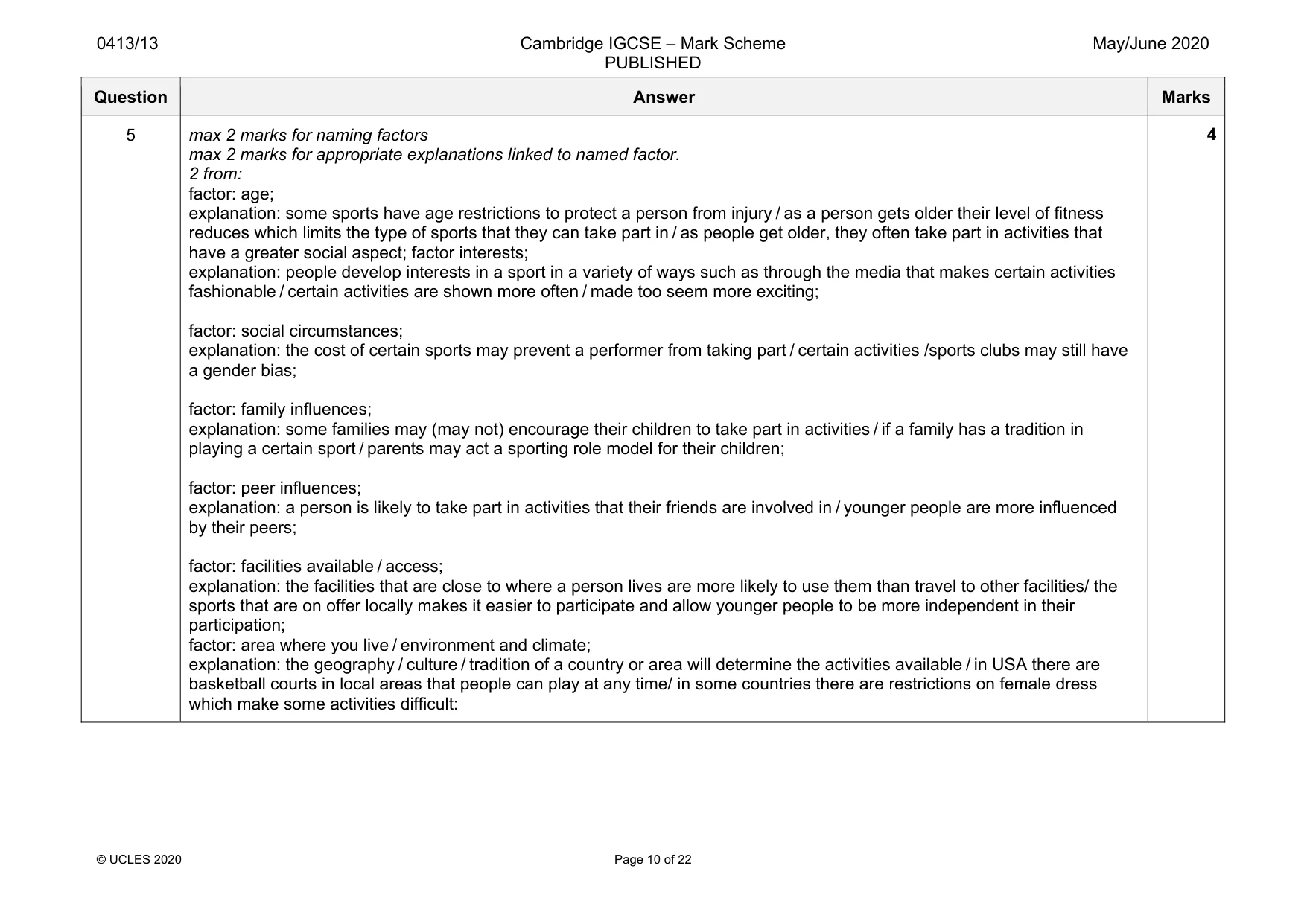
0413/13 Cambridge IGCSE – Mark Scheme PUBLISHED May/June 2020 © UCLES 2020 Page 10 of 22 Question Answer Marks 5 max 2 marks for naming factors max 2 marks for appropriate explanations linked to named factor. 2 from: factor: age; explanation: some sports have age restrictions to protect a person from injury / as a person gets older their level of fitness reduces which limits the type of sports that they can take part in / as people get older, they often take part in activities that have a greater social aspect; factor interests; explanation: people develop interests in a sport in a variety of ways such as through the media that makes certain activities fashionable / certain activities are shown more often / made too seem more exciting; factor: social circumstances; explanation: the cost of certain sports may prevent a performer from taking part / certain activities /sports clubs may still have a gender bias; factor: family influences; explanation: some families may (may not) encourage their children to take part in activities / if a family has a tradition in playing a certain sport / parents may act a sporting role model for their children; factor: peer influences; explanation: a person is likely to take part in activities that their friends are involved in / younger people are more influenced by their peers; factor: facilities available / access; explanation: the facilities that are close to where a person lives are more likely to use them than travel to other facilities/ the sports that are on offer locally makes it easier to participate and allow younger people to be more independent in their participation; factor: area where you live / environment and climate; explanation: the geography / culture / tradition of a country or area will determine the activities available / in USA there are basketball courts in local areas that people can play at any time/ in some countries there are restrictions on female dress which make some activities difficult: 4
Mark scheme, page 11
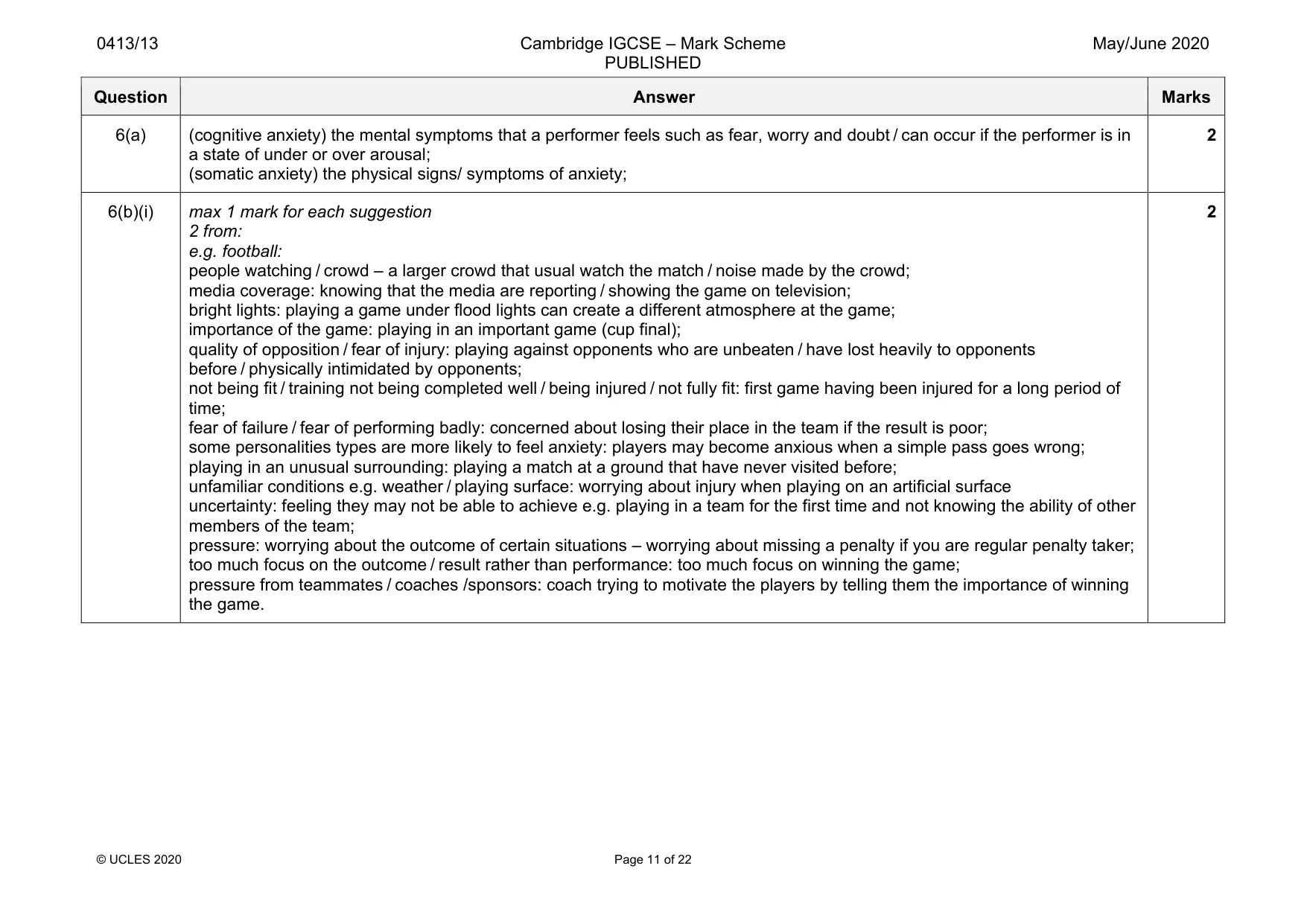
0413/13 Cambridge IGCSE – Mark Scheme PUBLISHED May/June 2020 © UCLES 2020 Page 11 of 22 Question Answer Marks 6(a) (cognitive anxiety) the mental symptoms that a performer feels such as fear, worry and doubt / can occur if the performer is in a state of under or over arousal; (somatic anxiety) the physical signs/ symptoms of anxiety; 2 6(b)(i) max 1 mark for each suggestion 2 from: e.g. football: people watching / crowd – a larger crowd that usual watch the match / noise made by the crowd; media coverage: knowing that the media are reporting / showing the game on television; bright lights: playing a game under flood lights can create a different atmosphere at the game; importance of the game: playing in an important game (cup final); quality of opposition / fear of injury: playing against opponents who are unbeaten / have lost heavily to opponents before / physically intimidated by opponents; not being fit / training not being completed well / being injured / not fully fit: first game having been injured for a long period of time; fear of failure / fear of performing badly: concerned about losing their place in the team if the result is poor; some personalities types are more likely to feel anxiety: players may become anxious when a simple pass goes wrong; playing in an unusual surrounding: playing a match at a ground that have never visited before; unfamiliar conditions e.g. weather / playing surface: worrying about injury when playing on an artificial surface uncertainty: feeling they may not be able to achieve e.g. playing in a team for the first time and not knowing the ability of other members of the team; pressure: worrying about the outcome of certain situations – worrying about missing a penalty if you are regular penalty taker; too much focus on the outcome / result rather than performance: too much focus on winning the game; pressure from teammates / coaches /sponsors: coach trying to motivate the players by telling them the importance of winning the game. 2
Mark scheme, page 12
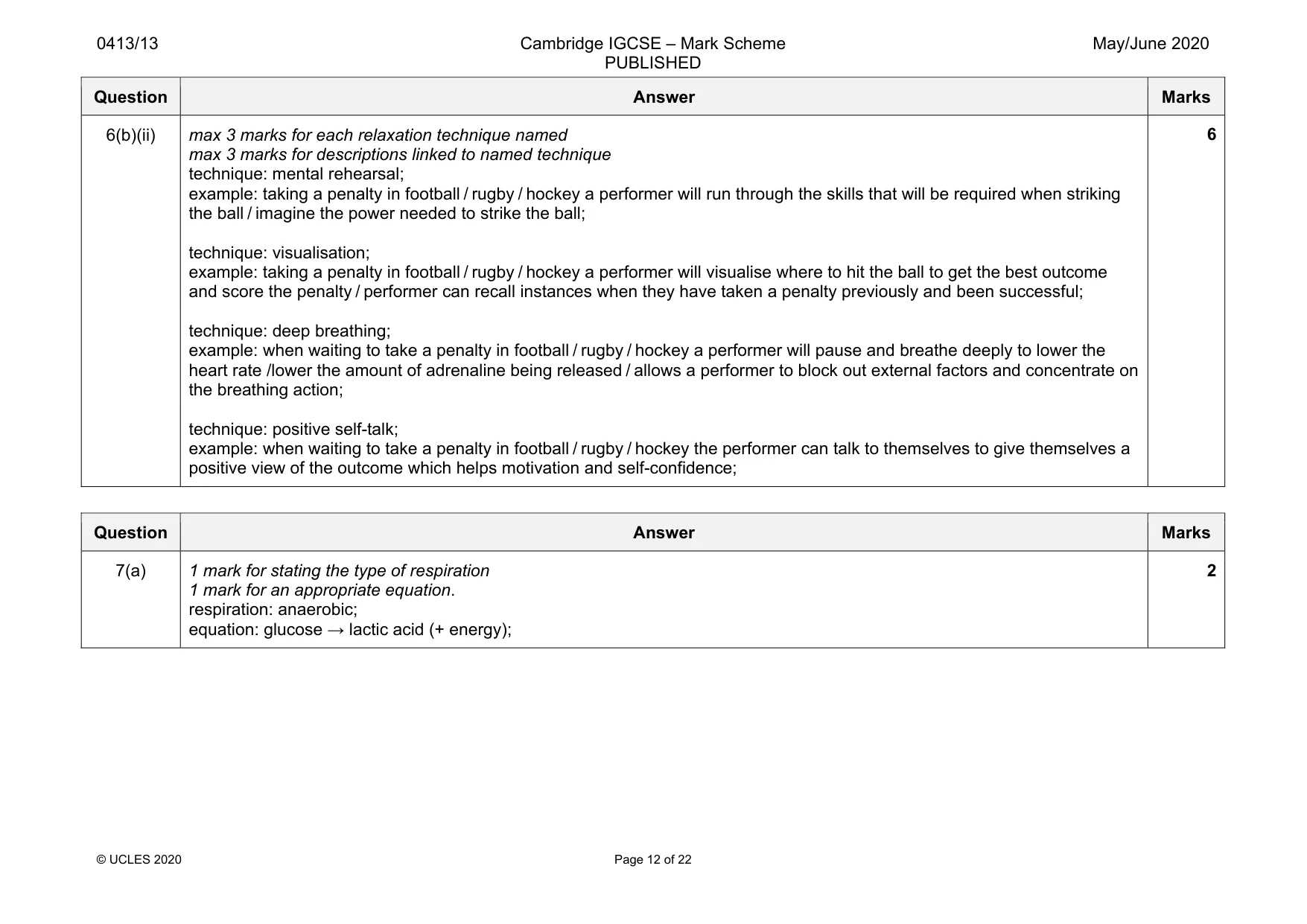
0413/13 Cambridge IGCSE – Mark Scheme PUBLISHED May/June 2020 © UCLES 2020 Page 12 of 22 Question Answer Marks 6(b)(ii) max 3 marks for each relaxation technique named max 3 marks for descriptions linked to named technique technique: mental rehearsal; example: taking a penalty in football / rugby / hockey a performer will run through the skills that will be required when striking the ball / imagine the power needed to strike the ball; technique: visualisation; example: taking a penalty in football / rugby / hockey a performer will visualise where to hit the ball to get the best outcome and score the penalty / performer can recall instances when they have taken a penalty previously and been successful; technique: deep breathing; example: when waiting to take a penalty in football / rugby / hockey a performer will pause and breathe deeply to lower the heart rate /lower the amount of adrenaline being released / allows a performer to block out external factors and concentrate on the breathing action; technique: positive self-talk; example: when waiting to take a penalty in football / rugby / hockey the performer can talk to themselves to give themselves a positive view of the outcome which helps motivation and self-confidence; 6 Question Answer Marks 7(a) 1 mark for stating the type of respiration 1 mark for an appropriate equation. respiration: anaerobic; equation: glucose → lactic acid (+ energy); 2
Mark scheme, page 13
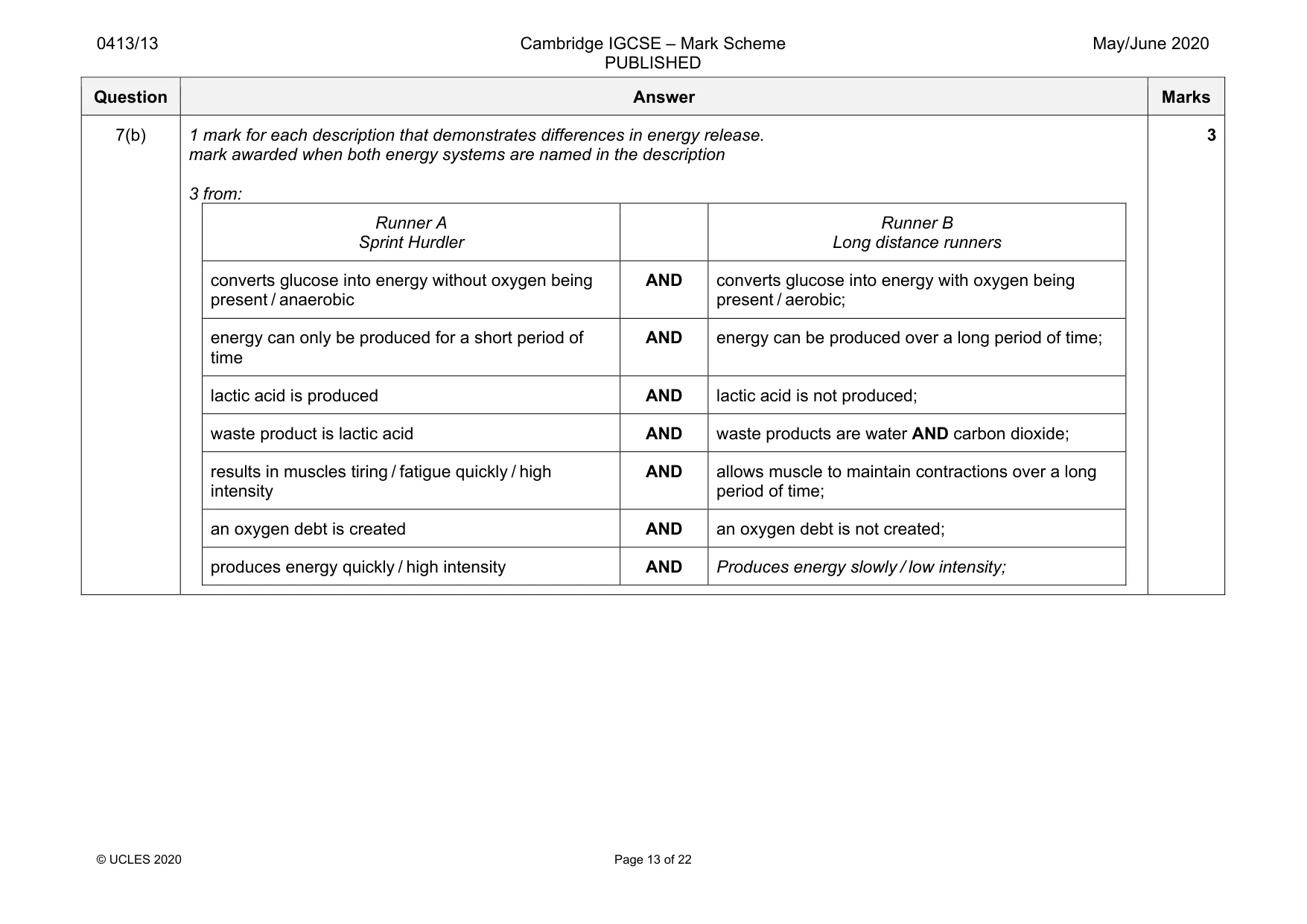
0413/13 Cambridge IGCSE – Mark Scheme PUBLISHED May/June 2020 © UCLES 2020 Page 13 of 22 Question Answer Marks 7(b) 1 mark for each description that demonstrates differences in energy release. mark awarded when both energy systems are named in the description 3 from: Runner A Sprint Hurdler Runner B Long distance runners converts glucose into energy without oxygen being present / anaerobic AND converts glucose into energy with oxygen being present / aerobic; energy can only be produced for a short period of time AND energy can be produced over a long period of time; lactic acid is produced AND lactic acid is not produced; waste product is lactic acid AND waste products are water AND carbon dioxide; results in muscles tiring / fatigue quickly / high intensity AND allows muscle to maintain contractions over a long period of time; an oxygen debt is created AND an oxygen debt is not created; produces energy quickly / high intensity AND Produces energy slowly / low intensity; 3
Mark scheme, page 14
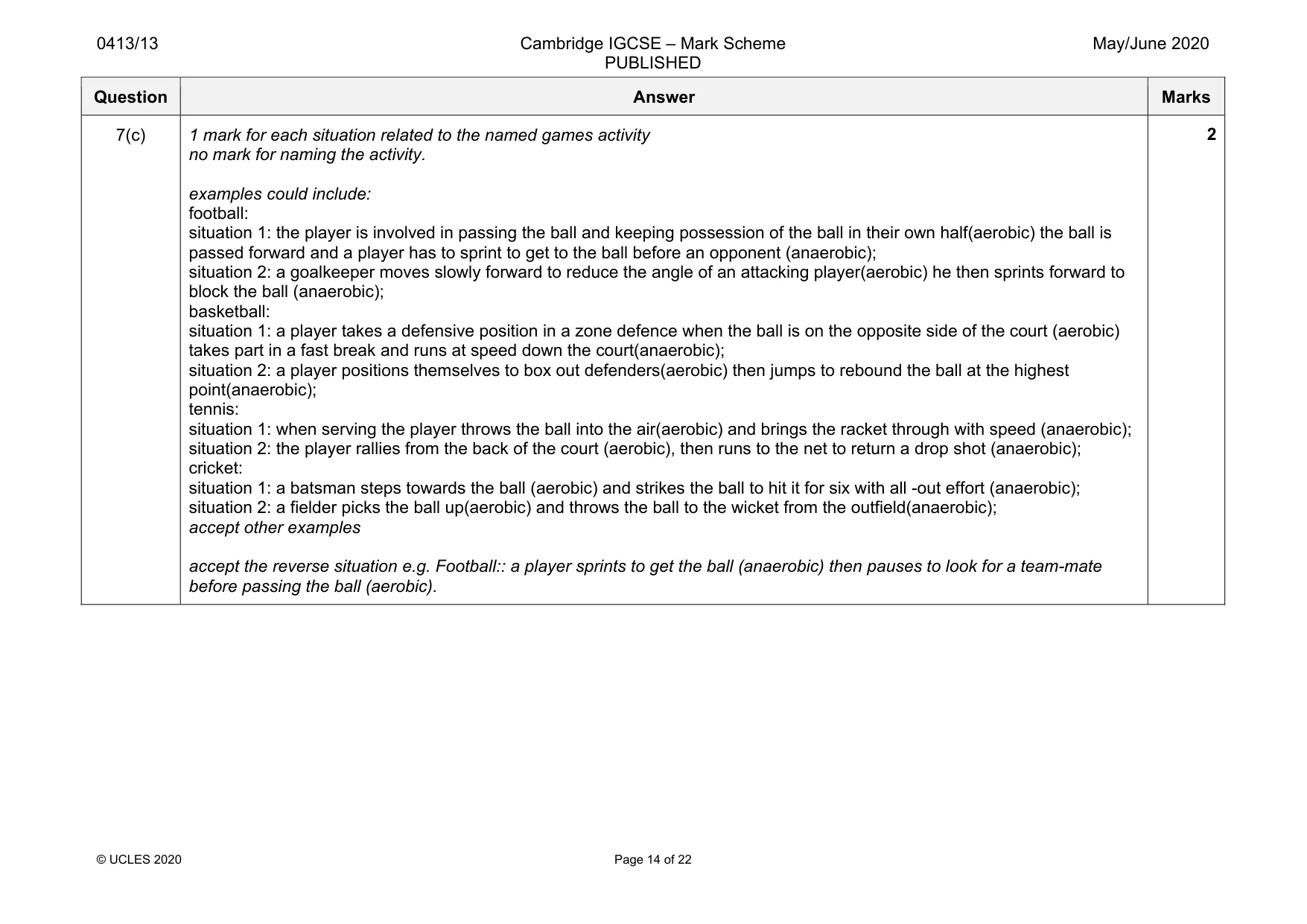
0413/13 Cambridge IGCSE – Mark Scheme PUBLISHED May/June 2020 © UCLES 2020 Page 14 of 22 Question Answer Marks 7(c) 1 mark for each situation related to the named games activity no mark for naming the activity. examples could include: football: situation 1: the player is involved in passing the ball and keeping possession of the ball in their own half(aerobic) the ball is passed forward and a player has to sprint to get to the ball before an opponent (anaerobic); situation 2: a goalkeeper moves slowly forward to reduce the angle of an attacking player(aerobic) he then sprints forward to block the ball (anaerobic); basketball: situation 1: a player takes a defensive position in a zone defence when the ball is on the opposite side of the court (aerobic) takes part in a fast break and runs at speed down the court(anaerobic); situation 2: a player positions themselves to box out defenders(aerobic) then jumps to rebound the ball at the highest point(anaerobic); tennis: situation 1: when serving the player throws the ball into the air(aerobic) and brings the racket through with speed (anaerobic); situation 2: the player rallies from the back of the court (aerobic), then runs to the net to return a drop shot (anaerobic); cricket: situation 1: a batsman steps towards the ball (aerobic) and strikes the ball to hit it for six with all -out effort (anaerobic); situation 2: a fielder picks the ball up(aerobic) and throws the ball to the wicket from the outfield(anaerobic); accept other examples accept the reverse situation e.g. Football:: a player sprints to get the ball (anaerobic) then pauses to look for a team-mate before passing the ball (aerobic). 2
Mark scheme, page 15
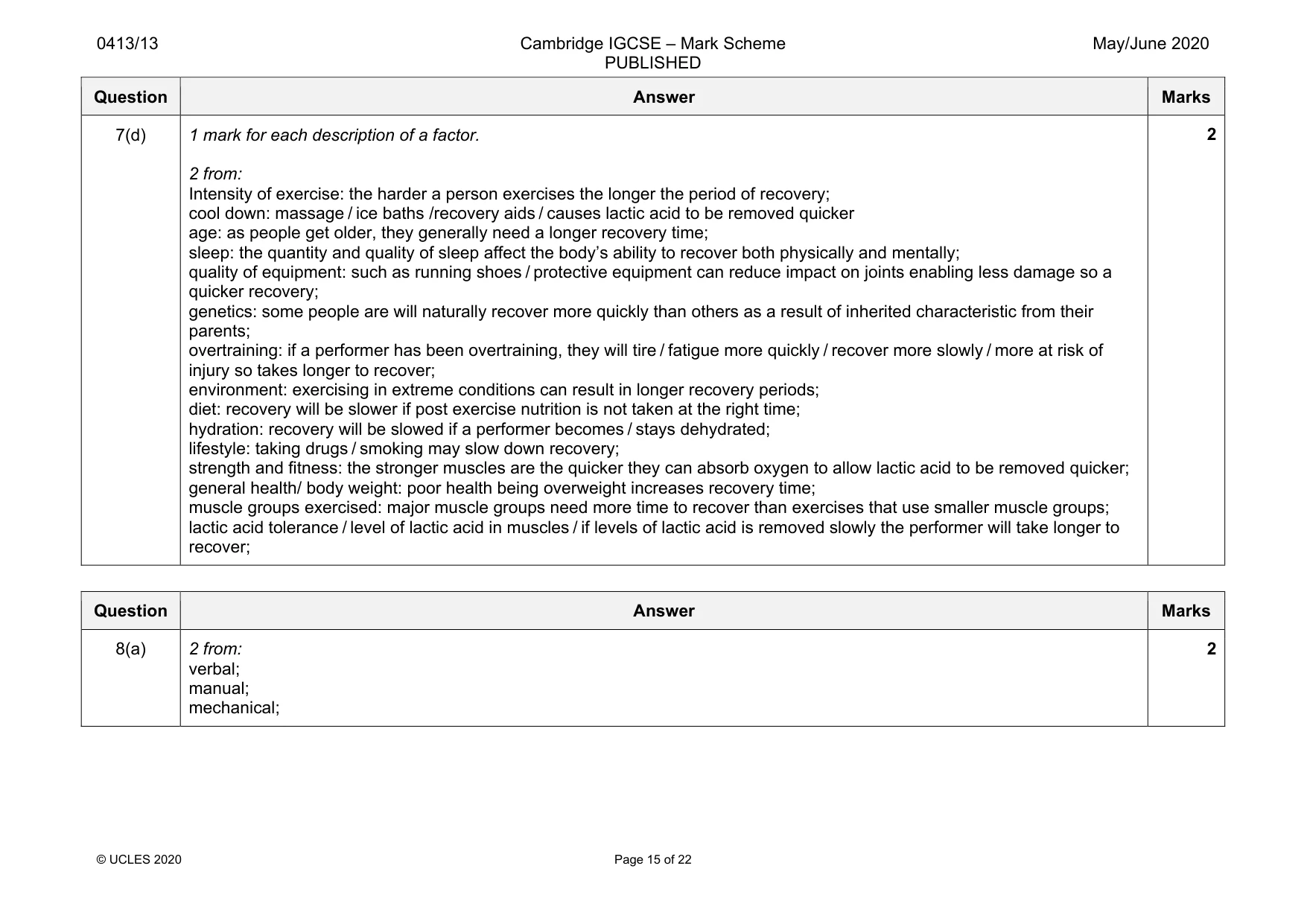
0413/13 Cambridge IGCSE – Mark Scheme PUBLISHED May/June 2020 © UCLES 2020 Page 15 of 22 Question Answer Marks 7(d) 1 mark for each description of a factor. 2 from: Intensity of exercise: the harder a person exercises the longer the period of recovery; cool down: massage / ice baths /recovery aids / causes lactic acid to be removed quicker age: as people get older, they generally need a longer recovery time; sleep: the quantity and quality of sleep affect the body’s ability to recover both physically and mentally; quality of equipment: such as running shoes / protective equipment can reduce impact on joints enabling less damage so a quicker recovery; genetics: some people are will naturally recover more quickly than others as a result of inherited characteristic from their parents; overtraining: if a performer has been overtraining, they will tire / fatigue more quickly / recover more slowly / more at risk of injury so takes longer to recover; environment: exercising in extreme conditions can result in longer recovery periods; diet: recovery will be slower if post exercise nutrition is not taken at the right time; hydration: recovery will be slowed if a performer becomes / stays dehydrated; lifestyle: taking drugs / smoking may slow down recovery; strength and fitness: the stronger muscles are the quicker they can absorb oxygen to allow lactic acid to be removed quicker; general health/ body weight: poor health being overweight increases recovery time; muscle groups exercised: major muscle groups need more time to recover than exercises that use smaller muscle groups; lactic acid tolerance / level of lactic acid in muscles / if levels of lactic acid is removed slowly the performer will take longer to recover; 2 Question Answer Marks 8(a) 2 from: verbal; manual; mechanical; 2
Mark scheme, page 16
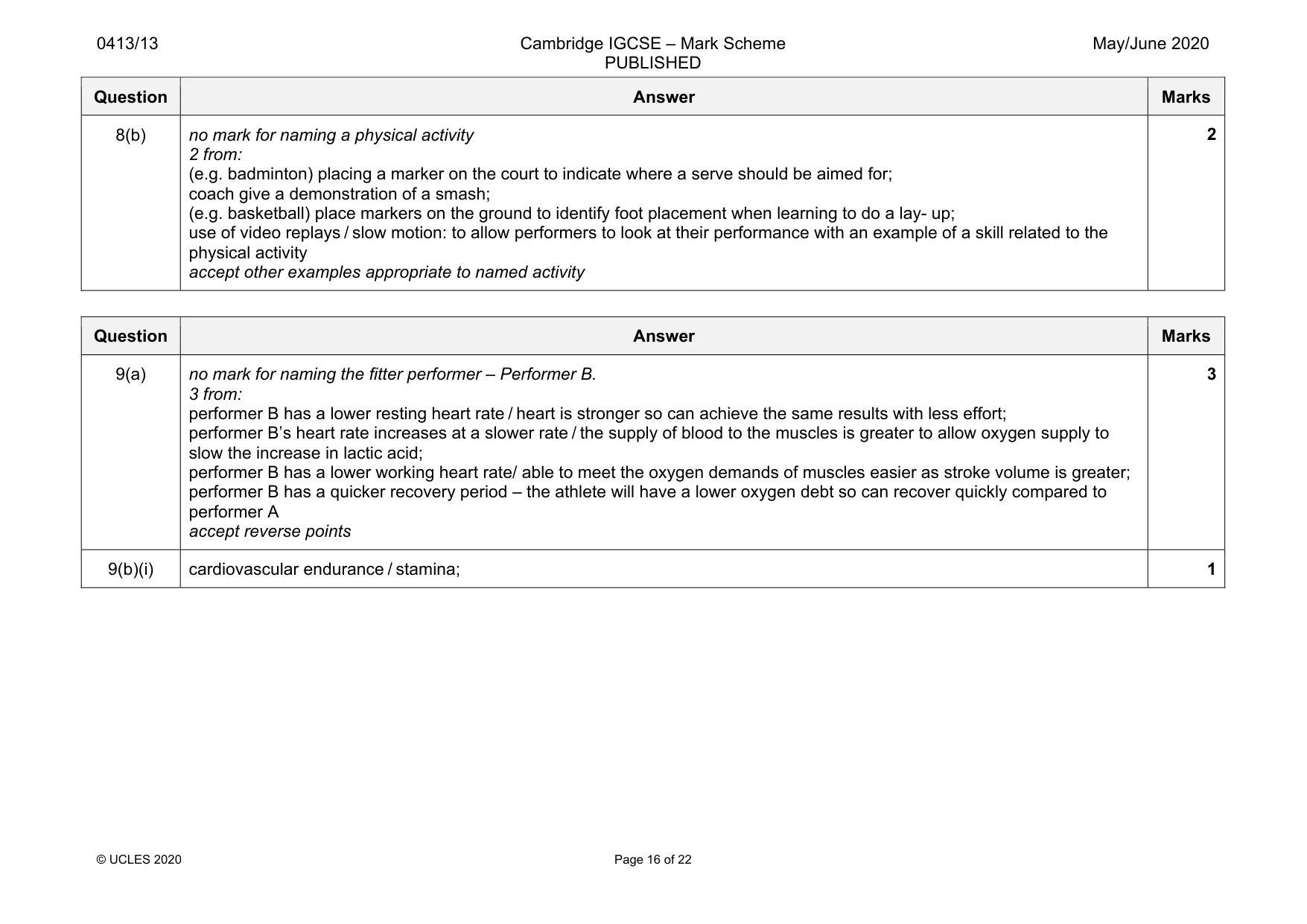
0413/13 Cambridge IGCSE – Mark Scheme PUBLISHED May/June 2020 © UCLES 2020 Page 16 of 22 Question Answer Marks 8(b) no mark for naming a physical activity 2 from: (e.g. badminton) placing a marker on the court to indicate where a serve should be aimed for; coach give a demonstration of a smash; (e.g. basketball) place markers on the ground to identify foot placement when learning to do a lay- up; use of video replays / slow motion: to allow performers to look at their performance with an example of a skill related to the physical activity accept other examples appropriate to named activity 2 Question Answer Marks 9(a) no mark for naming the fitter performer – Performer B. 3 from: performer B has a lower resting heart rate / heart is stronger so can achieve the same results with less effort; performer B’s heart rate increases at a slower rate / the supply of blood to the muscles is greater to allow oxygen supply to slow the increase in lactic acid; performer B has a lower working heart rate/ able to meet the oxygen demands of muscles easier as stroke volume is greater; performer B has a quicker recovery period – the athlete will have a lower oxygen debt so can recover quickly compared to performer A accept reverse points 3 9(b)(i) cardiovascular endurance / stamina; 1
Mark scheme, page 17
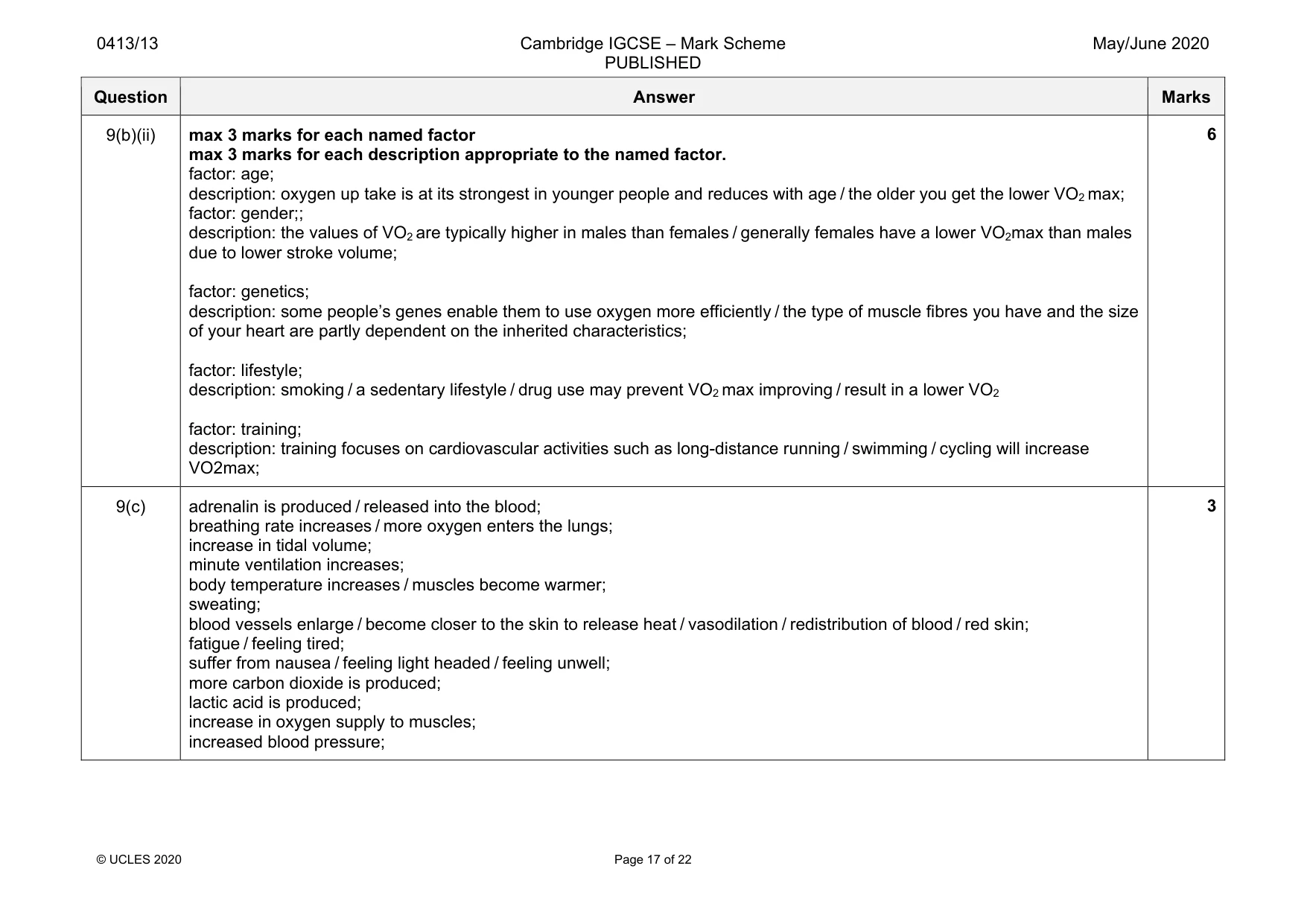
0413/13 Cambridge IGCSE – Mark Scheme PUBLISHED May/June 2020 © UCLES 2020 Page 17 of 22 Question Answer Marks 9(b)(ii) max 3 marks for each named factor max 3 marks for each description appropriate to the named factor. factor: age; description: oxygen up take is at its strongest in younger people and reduces with age / the older you get the lower VO2 max; factor: gender;; description: the values of VO2 are typically higher in males than females / generally females have a lower VO2max than males due to lower stroke volume; factor: genetics; description: some people’s genes enable them to use oxygen more efficiently / the type of muscle fibres you have and the size of your heart are partly dependent on the inherited characteristics; factor: lifestyle; description: smoking / a sedentary lifestyle / drug use may prevent VO2 max improving / result in a lower VO2 factor: training; description: training focuses on cardiovascular activities such as long-distance running / swimming / cycling will increase VO2max; 6 9(c) adrenalin is produced / released into the blood; breathing rate increases / more oxygen enters the lungs; increase in tidal volume; minute ventilation increases; body temperature increases / muscles become warmer; sweating; blood vessels enlarge / become closer to the skin to release heat / vasodilation / redistribution of blood / red skin; fatigue / feeling tired; suffer from nausea / feeling light headed / feeling unwell; more carbon dioxide is produced; lactic acid is produced; increase in oxygen supply to muscles; increased blood pressure; 3
Mark scheme, page 18
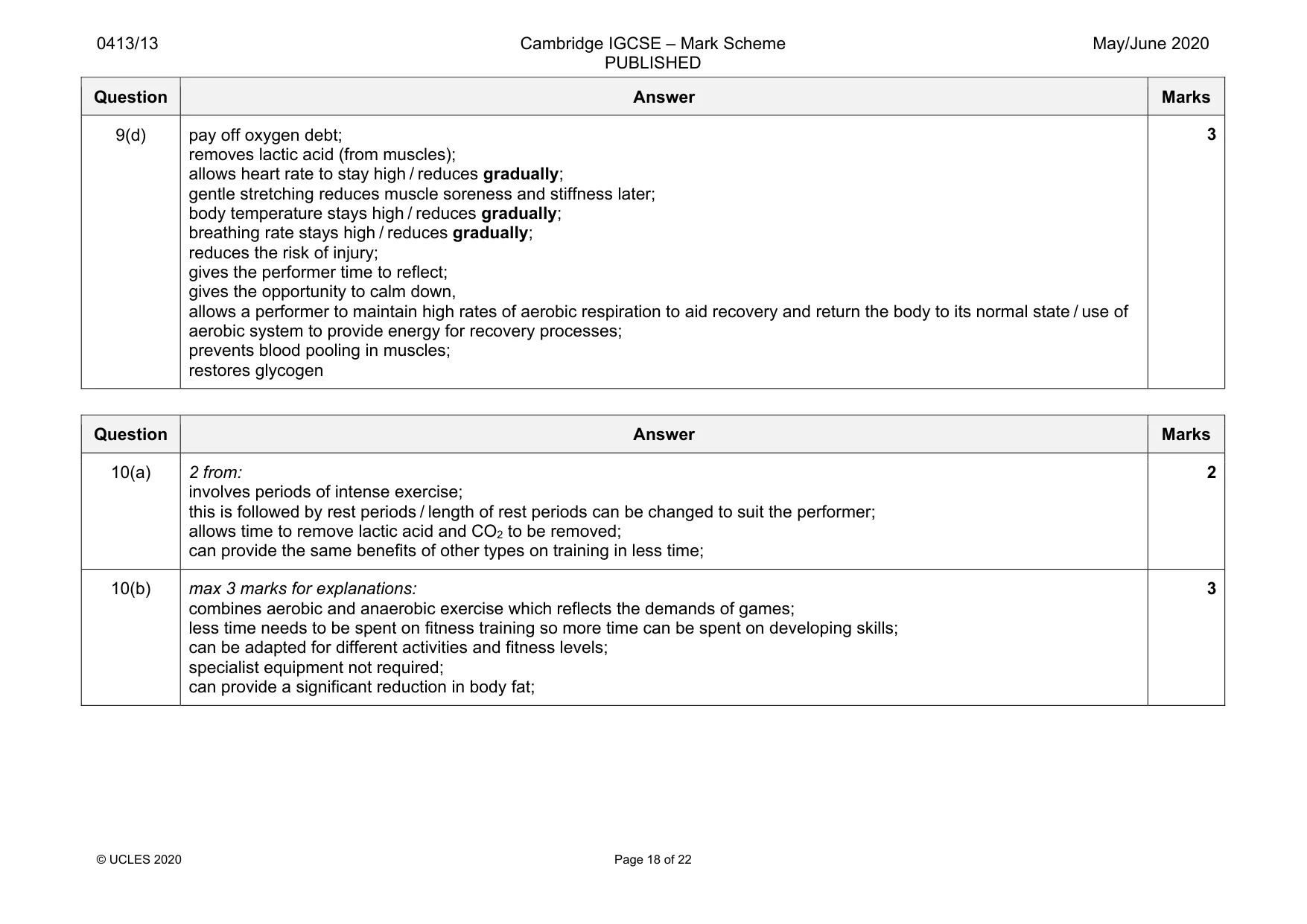
0413/13 Cambridge IGCSE – Mark Scheme PUBLISHED May/June 2020 © UCLES 2020 Page 18 of 22 Question Answer Marks 9(d) pay off oxygen debt; removes lactic acid (from muscles); allows heart rate to stay high / reduces gradually; gentle stretching reduces muscle soreness and stiffness later; body temperature stays high / reduces gradually; breathing rate stays high / reduces gradually; reduces the risk of injury; gives the performer time to reflect; gives the opportunity to calm down, allows a performer to maintain high rates of aerobic respiration to aid recovery and return the body to its normal state / use of aerobic system to provide energy for recovery processes; prevents blood pooling in muscles; restores glycogen 3 Question Answer Marks 10(a) 2 from: involves periods of intense exercise; this is followed by rest periods / length of rest periods can be changed to suit the performer; allows time to remove lactic acid and CO2 to be removed; can provide the same benefits of other types on training in less time; 2 10(b) max 3 marks for explanations: combines aerobic and anaerobic exercise which reflects the demands of games; less time needs to be spent on fitness training so more time can be spent on developing skills; can be adapted for different activities and fitness levels; specialist equipment not required; can provide a significant reduction in body fat; 3
Mark scheme, page 19
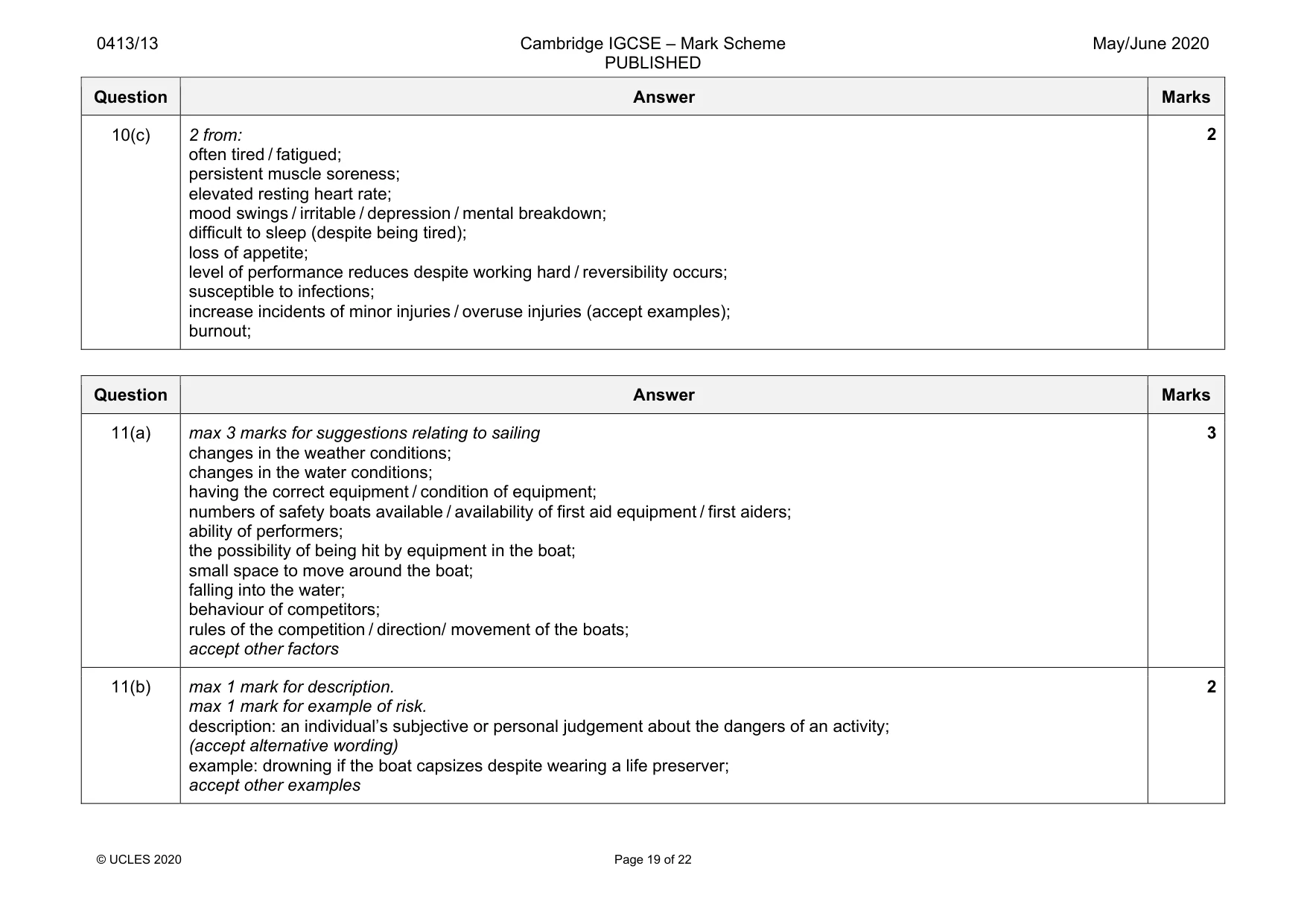
0413/13 Cambridge IGCSE – Mark Scheme PUBLISHED May/June 2020 © UCLES 2020 Page 19 of 22 Question Answer Marks 10(c) 2 from: often tired / fatigued; persistent muscle soreness; elevated resting heart rate; mood swings / irritable / depression / mental breakdown; difficult to sleep (despite being tired); loss of appetite; level of performance reduces despite working hard / reversibility occurs; susceptible to infections; increase incidents of minor injuries / overuse injuries (accept examples); burnout; 2 Question Answer Marks 11(a) max 3 marks for suggestions relating to sailing changes in the weather conditions; changes in the water conditions; having the correct equipment / condition of equipment; numbers of safety boats available / availability of first aid equipment / first aiders; ability of performers; the possibility of being hit by equipment in the boat; small space to move around the boat; falling into the water; behaviour of competitors; rules of the competition / direction/ movement of the boats; accept other factors 3 11(b) max 1 mark for description. max 1 mark for example of risk. description: an individual’s subjective or personal judgement about the dangers of an activity; (accept alternative wording) example: drowning if the boat capsizes despite wearing a life preserver; accept other examples 2
Mark scheme, page 20
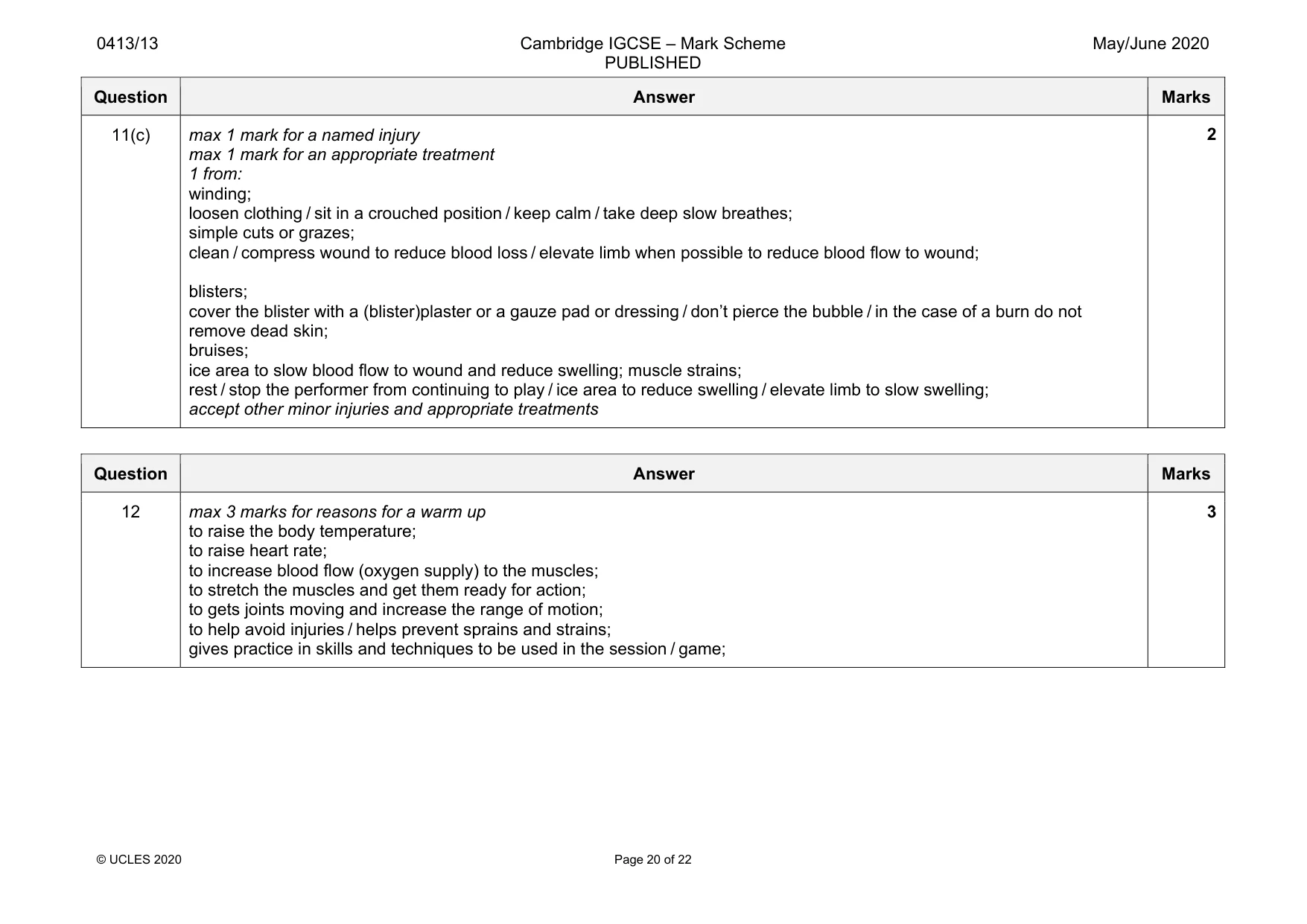
0413/13 Cambridge IGCSE – Mark Scheme PUBLISHED May/June 2020 © UCLES 2020 Page 20 of 22 Question Answer Marks 11(c) max 1 mark for a named injury max 1 mark for an appropriate treatment 1 from: winding; loosen clothing / sit in a crouched position / keep calm / take deep slow breathes; simple cuts or grazes; clean / compress wound to reduce blood loss / elevate limb when possible to reduce blood flow to wound; blisters; cover the blister with a (blister)plaster or a gauze pad or dressing / don’t pierce the bubble / in the case of a burn do not remove dead skin; bruises; ice area to slow blood flow to wound and reduce swelling; muscle strains; rest / stop the performer from continuing to play / ice area to reduce swelling / elevate limb to slow swelling; accept other minor injuries and appropriate treatments 2 Question Answer Marks 12 max 3 marks for reasons for a warm up to raise the body temperature; to raise heart rate; to increase blood flow (oxygen supply) to the muscles; to stretch the muscles and get them ready for action; to gets joints moving and increase the range of motion; to help avoid injuries / helps prevent sprains and strains; gives practice in skills and techniques to be used in the session / game; 3
Mark scheme, page 21
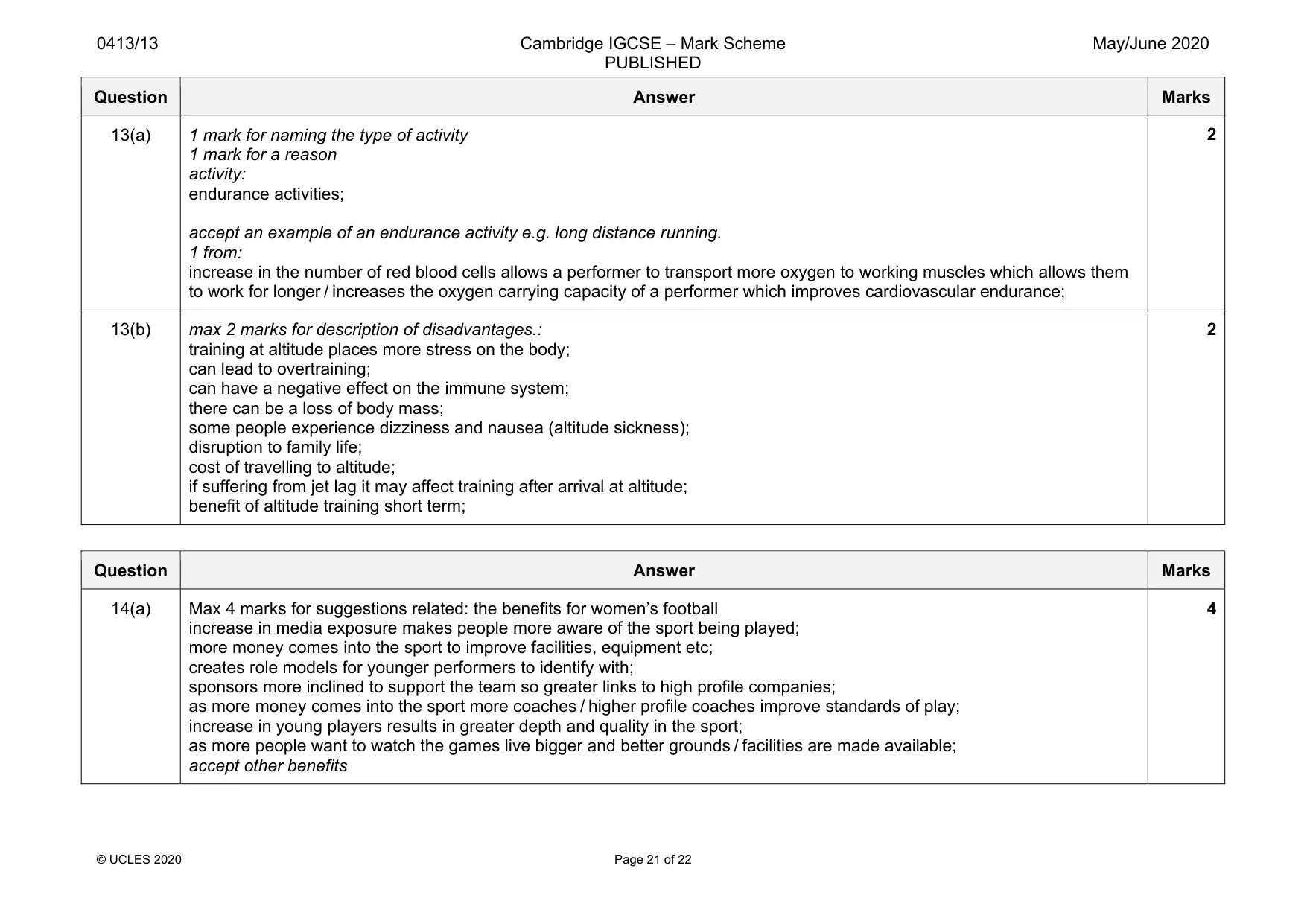
0413/13 Cambridge IGCSE – Mark Scheme PUBLISHED May/June 2020 © UCLES 2020 Page 21 of 22 Question Answer Marks 13(a) 1 mark for naming the type of activity 1 mark for a reason activity: endurance activities; accept an example of an endurance activity e.g. long distance running. 1 from: increase in the number of red blood cells allows a performer to transport more oxygen to working muscles which allows them to work for longer / increases the oxygen carrying capacity of a performer which improves cardiovascular endurance; 2 13(b) max 2 marks for description of disadvantages.: training at altitude places more stress on the body; can lead to overtraining; can have a negative effect on the immune system; there can be a loss of body mass; some people experience dizziness and nausea (altitude sickness); disruption to family life; cost of travelling to altitude; if suffering from jet lag it may affect training after arrival at altitude; benefit of altitude training short term; 2 Question Answer Marks 14(a) Max 4 marks for suggestions related: the benefits for women’s football increase in media exposure makes people more aware of the sport being played; more money comes into the sport to improve facilities, equipment etc; creates role models for younger performers to identify with; sponsors more inclined to support the team so greater links to high profile companies; as more money comes into the sport more coaches / higher profile coaches improve standards of play; increase in young players results in greater depth and quality in the sport; as more people want to watch the games live bigger and better grounds / facilities are made available; accept other benefits 4
Mark scheme, page 22
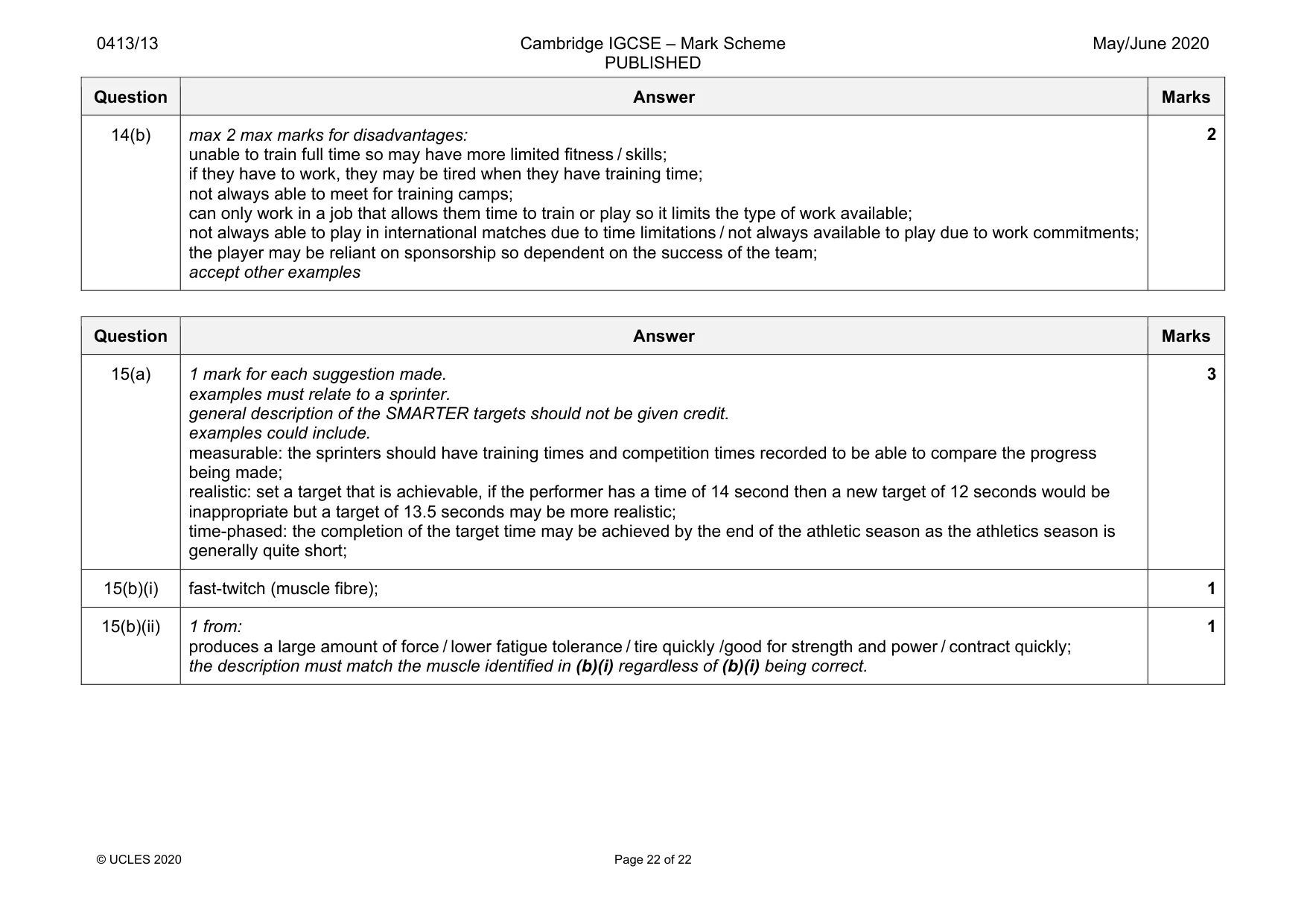
0413/13 Cambridge IGCSE – Mark Scheme PUBLISHED May/June 2020 © UCLES 2020 Page 22 of 22 Question Answer Marks 14(b) max 2 max marks for disadvantages: unable to train full time so may have more limited fitness / skills; if they have to work, they may be tired when they have training time; not always able to meet for training camps; can only work in a job that allows them time to train or play so it limits the type of work available; not always able to play in international matches due to time limitations / not always available to play due to work commitments; the player may be reliant on sponsorship so dependent on the success of the team; accept other examples 2 Question Answer Marks 15(a) 1 mark for each suggestion made. examples must relate to a sprinter. general description of the SMARTER targets should not be given credit. examples could include. measurable: the sprinters should have training times and competition times recorded to be able to compare the progress being made; realistic: set a target that is achievable, if the performer has a time of 14 second then a new target of 12 seconds would be inappropriate but a target of 13.5 seconds may be more realistic; time-phased: the completion of the target time may be achieved by the end of the athletic season as the athletics season is generally quite short; 3 15(b)(i) fast-twitch (muscle fibre); 1 15(b)(ii) 1 from: produces a large amount of force / lower fatigue tolerance / tire quickly /good for strength and power / contract quickly; the description must match the muscle identified in (b)(i) regardless of (b)(i) being correct. 1