Cambridge IGCSE Physical Education 0413 — 2019 May/June Paper 1 · Variant 2
0413/12/M/J/19 · 100 marks · ≈113 min
The question paper and its mark scheme, free to read here and free to download. This is Cambridge’s own paper, exactly as it was sat.
Question paper20 pages



Mark scheme19 pages
Answers below. Sit the paper first if you are practising.
Paper as text
Question paper, page 1
This document consists of 17 printed pages and 3 blank pages. DC (LK/CB) 164481/3 © UCLES 2019 [Turn over Cambridge Assessment International Education Cambridge International General Certificate of Secondary Education * 4 2 4 6 2 0 9 4 1 8 * PHYSICAL EDUCATION 0413/12 Paper 1 Theory May/June 2019 1 hour 45 minutes Candidates answer on the Question Paper. No Additional Materials are required. READ THESE INSTRUCTIONS FIRST Write your centre number, candidate number and name on all the work you hand in. Write in dark blue or black pen. You may use an HB pencil for any diagrams or graphs. Do not use staples, paper clips, glue or correction fluid. DO NOT WRITE IN ANY BARCODES. Answer all questions. Electronic calculators may be used. You may lose marks if you do not show your working or if you do not use appropriate units. The number of marks is given in brackets [ ] at the end of each question or part question. The total mark for this paper is 100.
Question paper, page 2
2 0413/12/M/J/19 © UCLES 2019 1 State two bones in the arm. 1 … 2 … [2] 2 (a) Define the term fitness. … … [1] (b) Explain the relationship between health and fitness. … … … … [2] (c) Describe requirements for good mental health and well-being. … … … … … … [3] [Total: 6] 3 (a) State three factors that cause variation in skill levels. 1 … … 2 … … 3 … … [3]
Question paper, page 3
3 0413/12/M/J/19 © UCLES 2019 [Turn over (b) Describe, using examples from a named physical activity, three characteristics of a skilled performance. physical activity … 1 … … 2 … … 3 … … [3] (c) Describe the advantages that sponsorship can provide for a performer. … … … … … … [3] [Total: 9]
Question paper, page 4
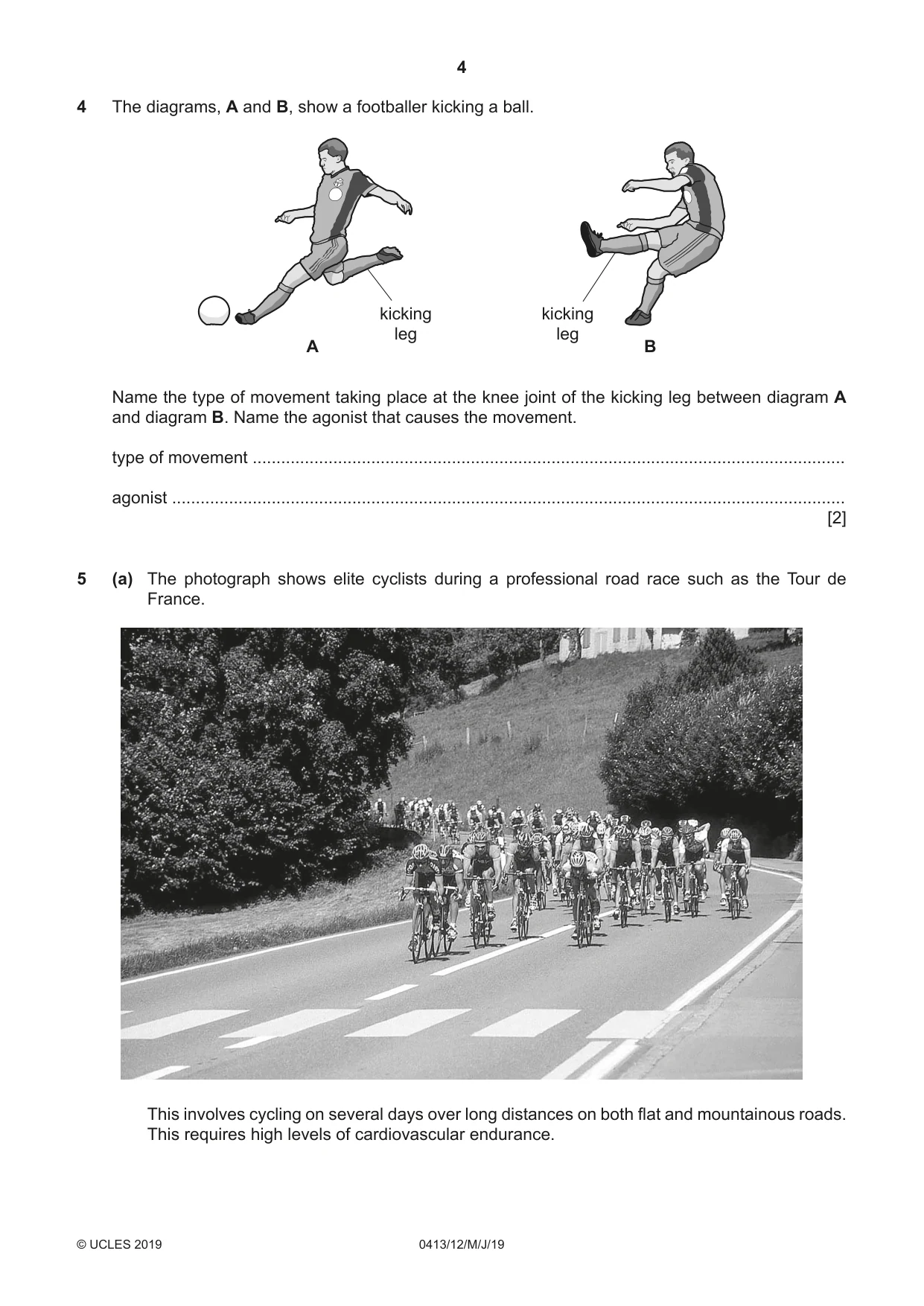
4 0413/12/M/J/19 © UCLES 2019 4 The diagrams, A and B, show a footballer kicking a ball. A kicking leg kicking leg B Name the type of movement taking place at the knee joint of the kicking leg between diagram A and diagram B. Name the agonist that causes the movement. type of movement … agonist … [2] 5 (a) The photograph shows elite cyclists during a professional road race such as the Tour de France. This involves cycling on several days over long distances on both flat and mountainous roads. This requires high levels of cardiovascular endurance.
Question paper, page 5
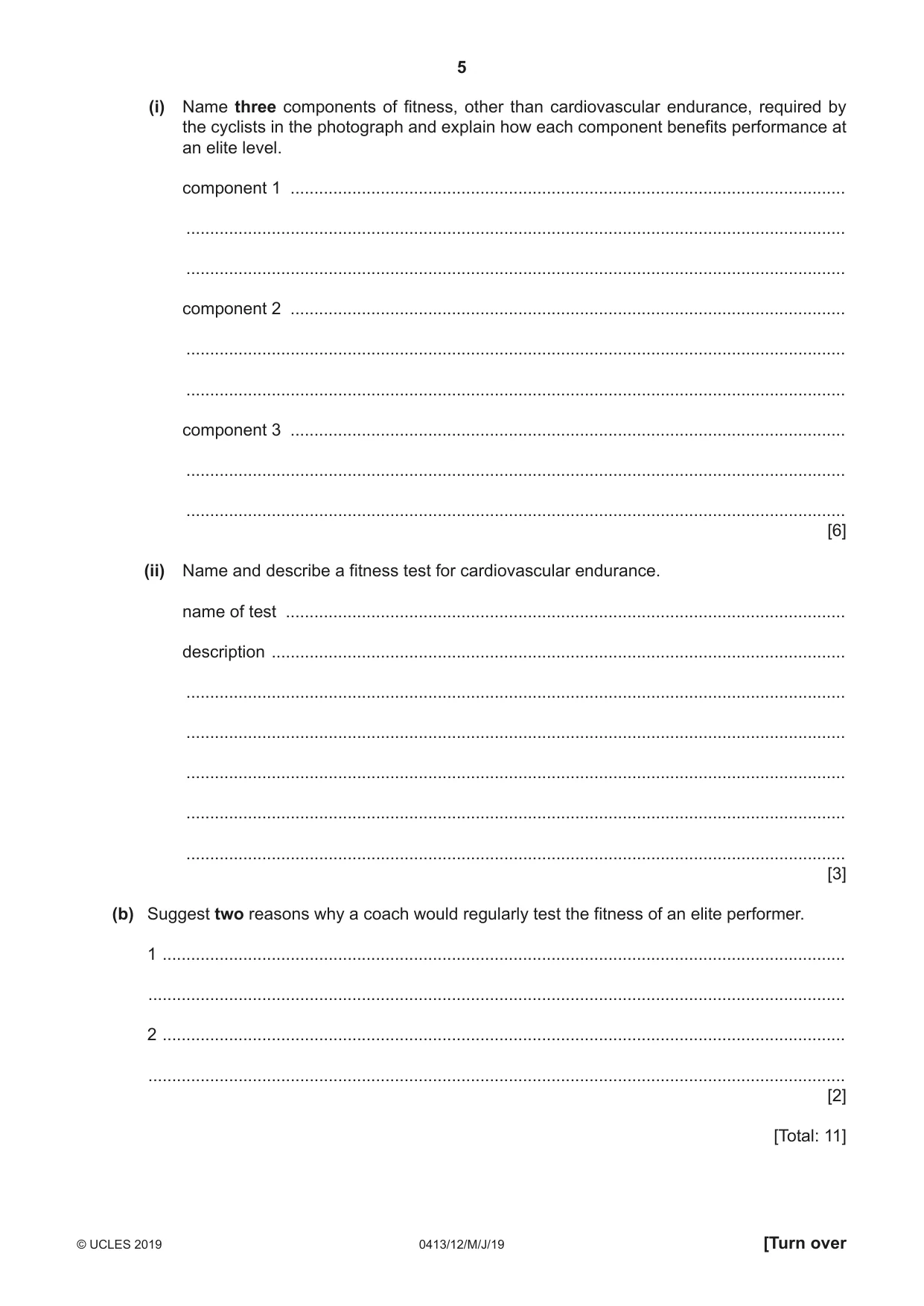
5 0413/12/M/J/19 © UCLES 2019 [Turn over (i) Name three components of fitness, other than cardiovascular endurance, required by the cyclists in the photograph and explain how each component benefits performance at an elite level. component 1 … … … component 2 … … … component 3 … … … [6] (ii) Name and describe a fitness test for cardiovascular endurance. name of test … description … … … … … … [3] (b) Suggest two reasons why a coach would regularly test the fitness of an elite performer. 1 … … 2 … … [2] [Total: 11]
Question paper, page 6
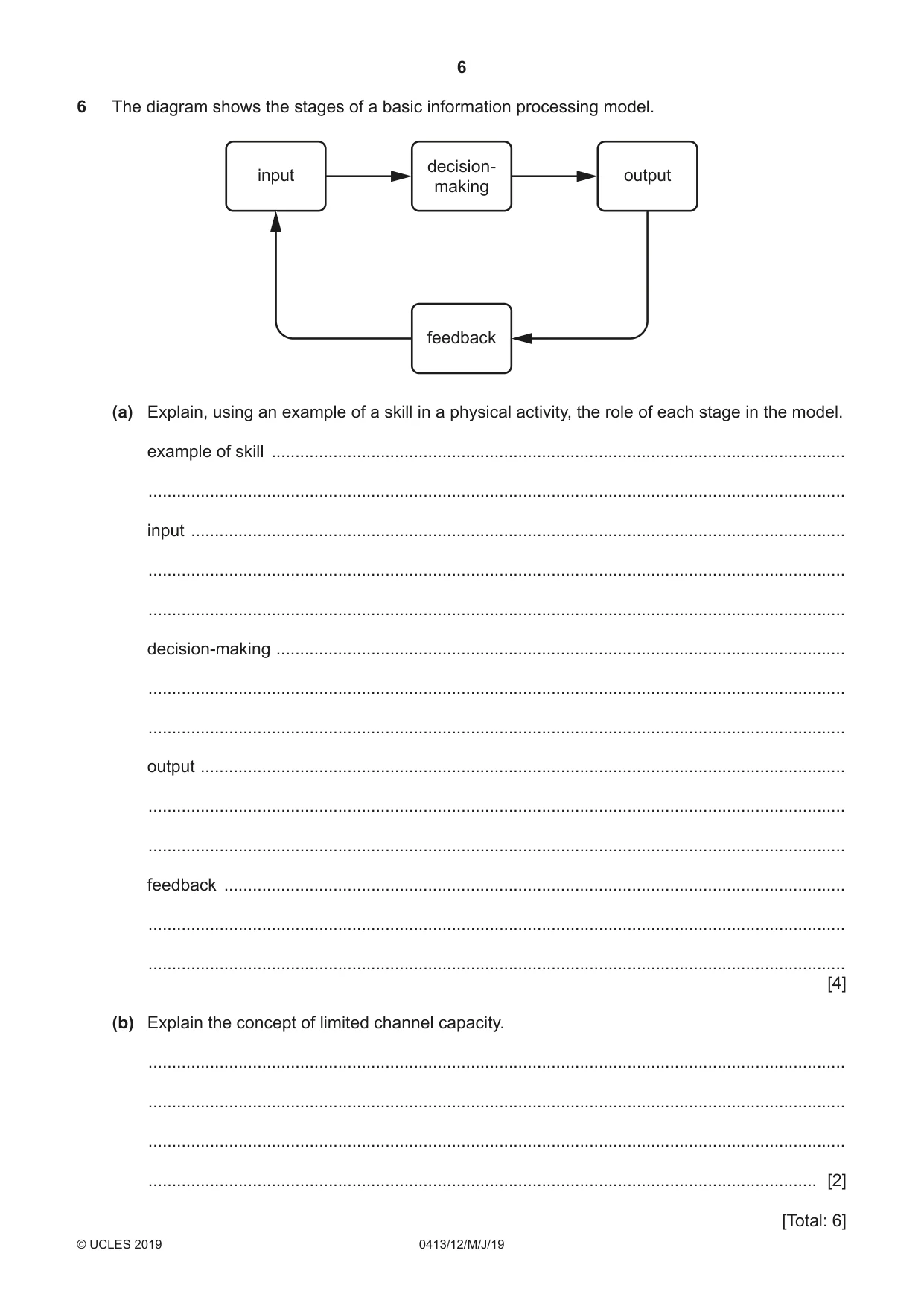
6 0413/12/M/J/19 © UCLES 2019 6 The diagram shows the stages of a basic information processing model. input output decision- making feedback (a) Explain, using an example of a skill in a physical activity, the role of each stage in the model. example of skill … … input … … … decision-making … … … output … … … feedback … … … [4] (b) Explain the concept of limited channel capacity. … … … … [2] [Total: 6]
Question paper, page 7
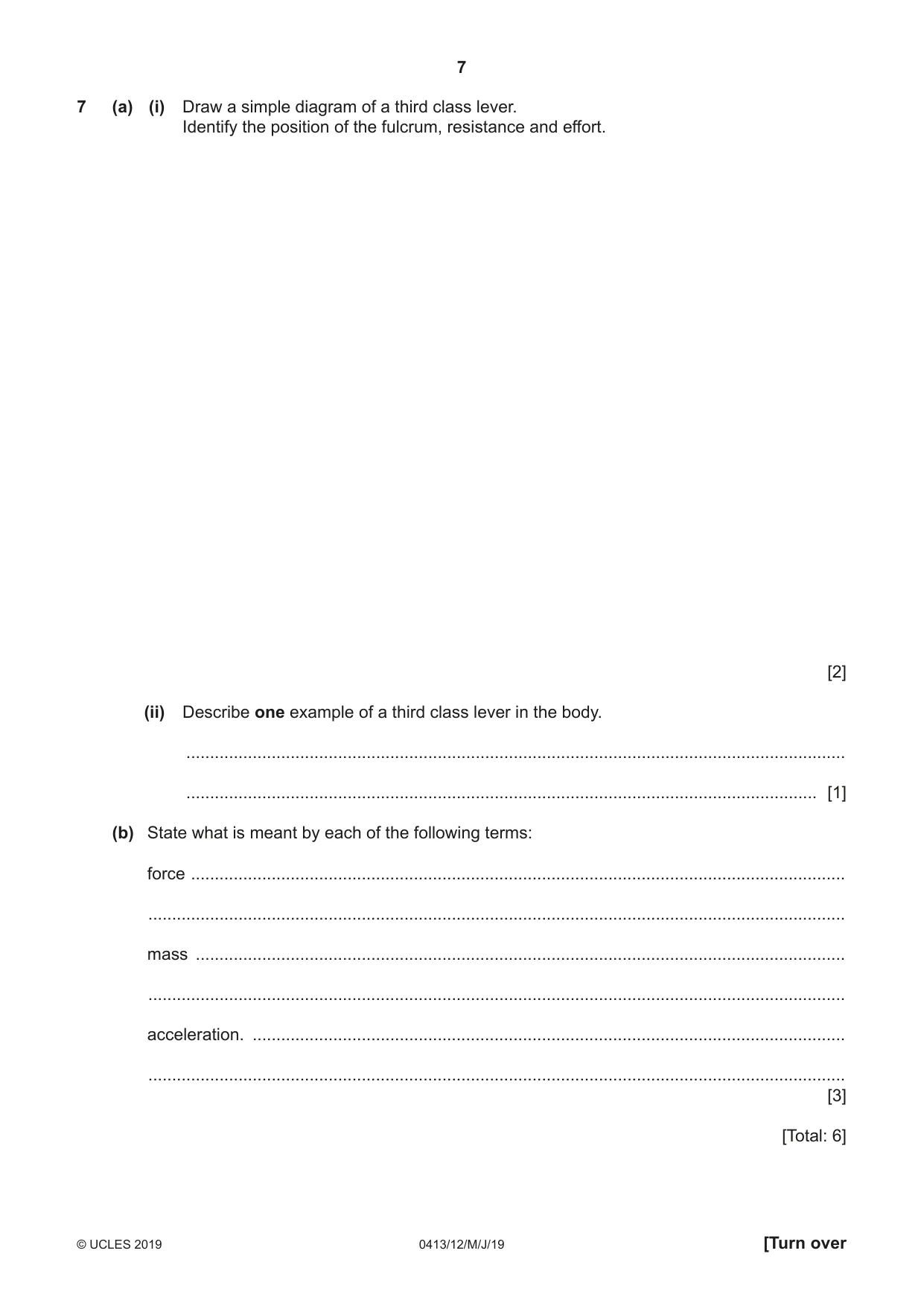
7 0413/12/M/J/19 © UCLES 2019 [Turn over 7 (a) (i) Draw a simple diagram of a third class lever. Identify the position of the fulcrum, resistance and effort. [2] (ii) Describe one example of a third class lever in the body. … … [1] (b) State what is meant by each of the following terms: force … … mass … … acceleration. … … [3] [Total: 6]
Question paper, page 8
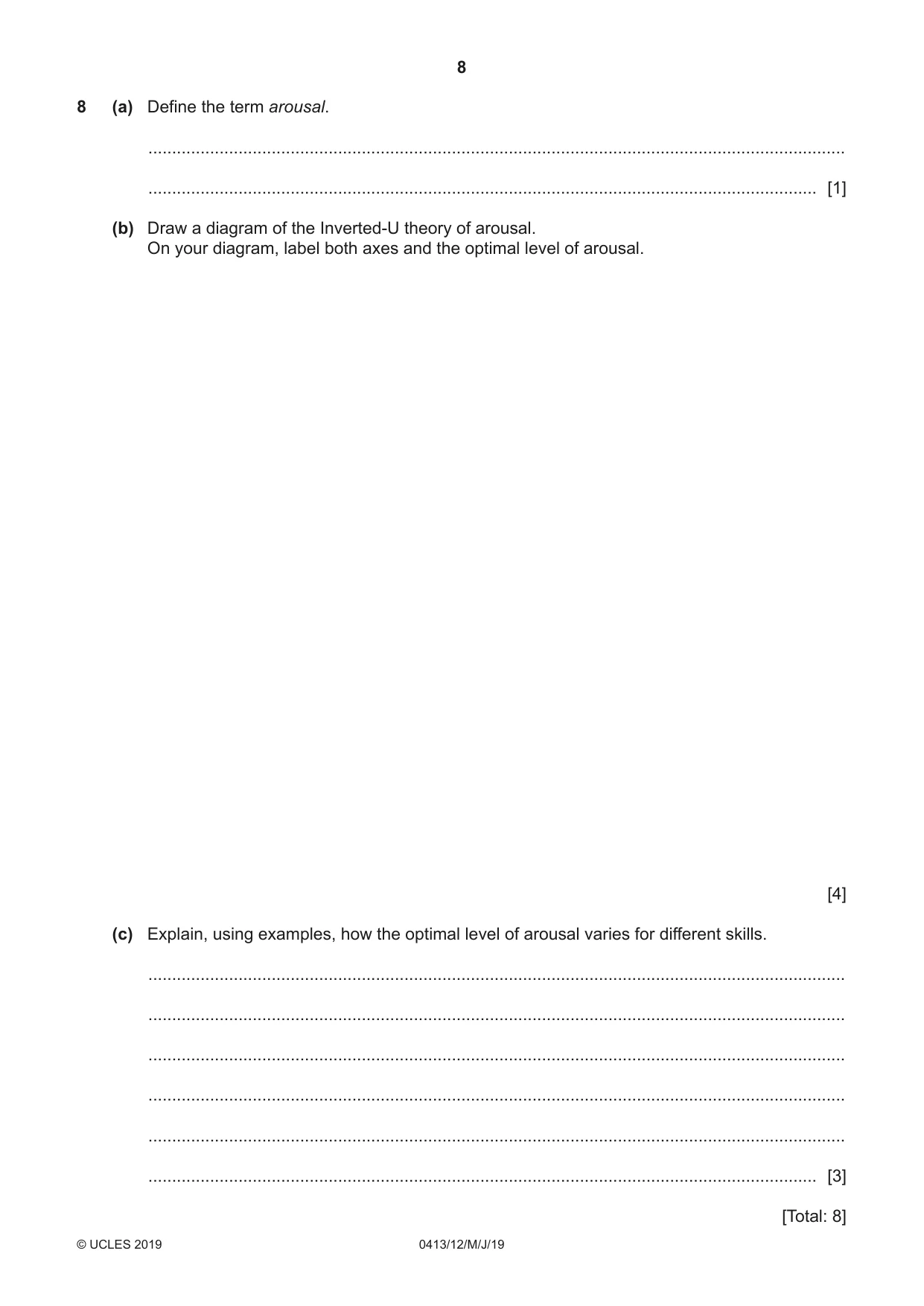
8 0413/12/M/J/19 © UCLES 2019 8 (a) Define the term arousal. … … [1] (b) Draw a diagram of the Inverted-U theory of arousal. On your diagram, label both axes and the optimal level of arousal. [4] (c) Explain, using examples, how the optimal level of arousal varies for different skills. … … … … … … [3] [Total: 8]
Question paper, page 9
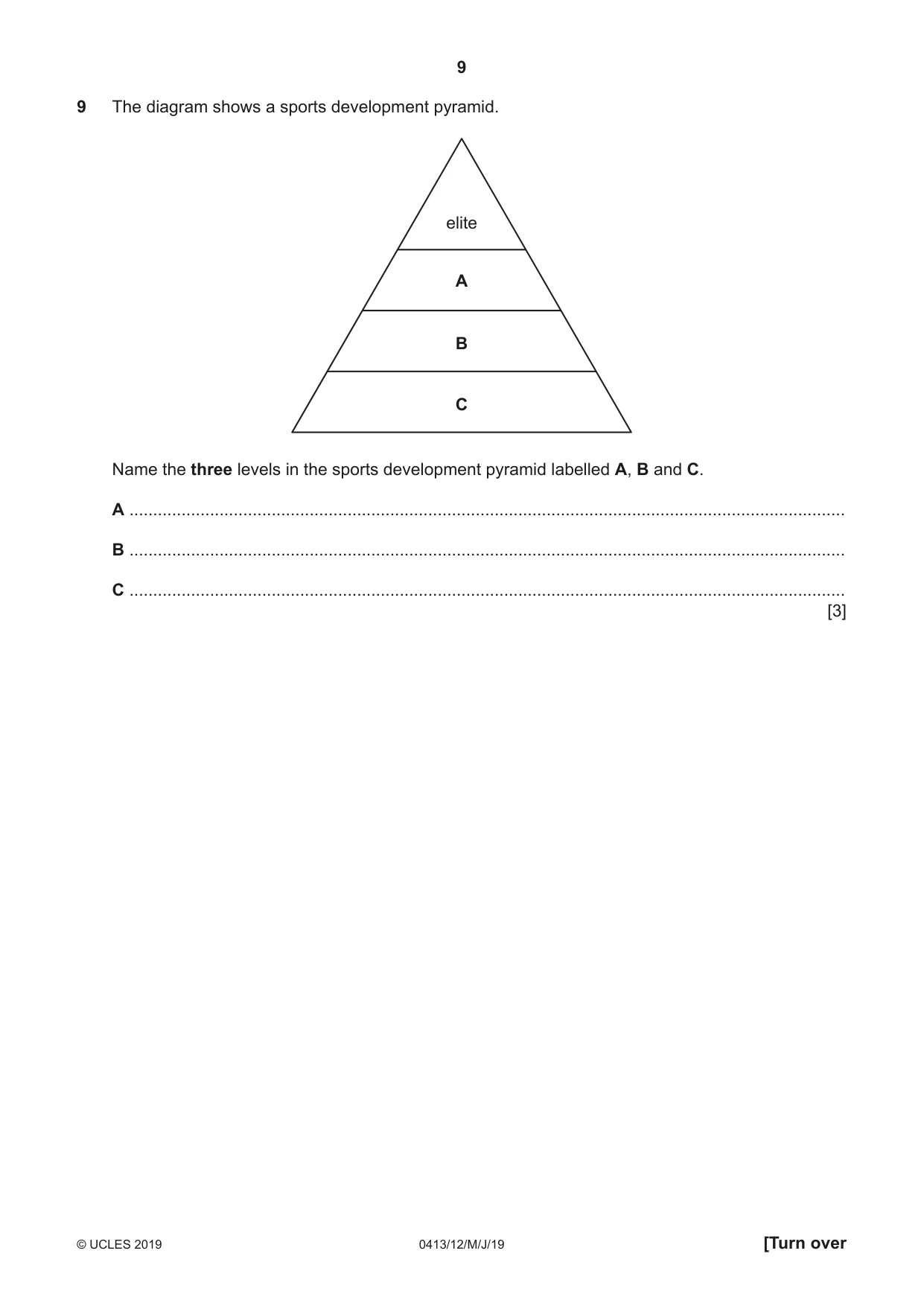
9 0413/12/M/J/19 © UCLES 2019 [Turn over 9 The diagram shows a sports development pyramid. elite A B C Name the three levels in the sports development pyramid labelled A, B and C. A … B … C … [3]
Question paper, page 10
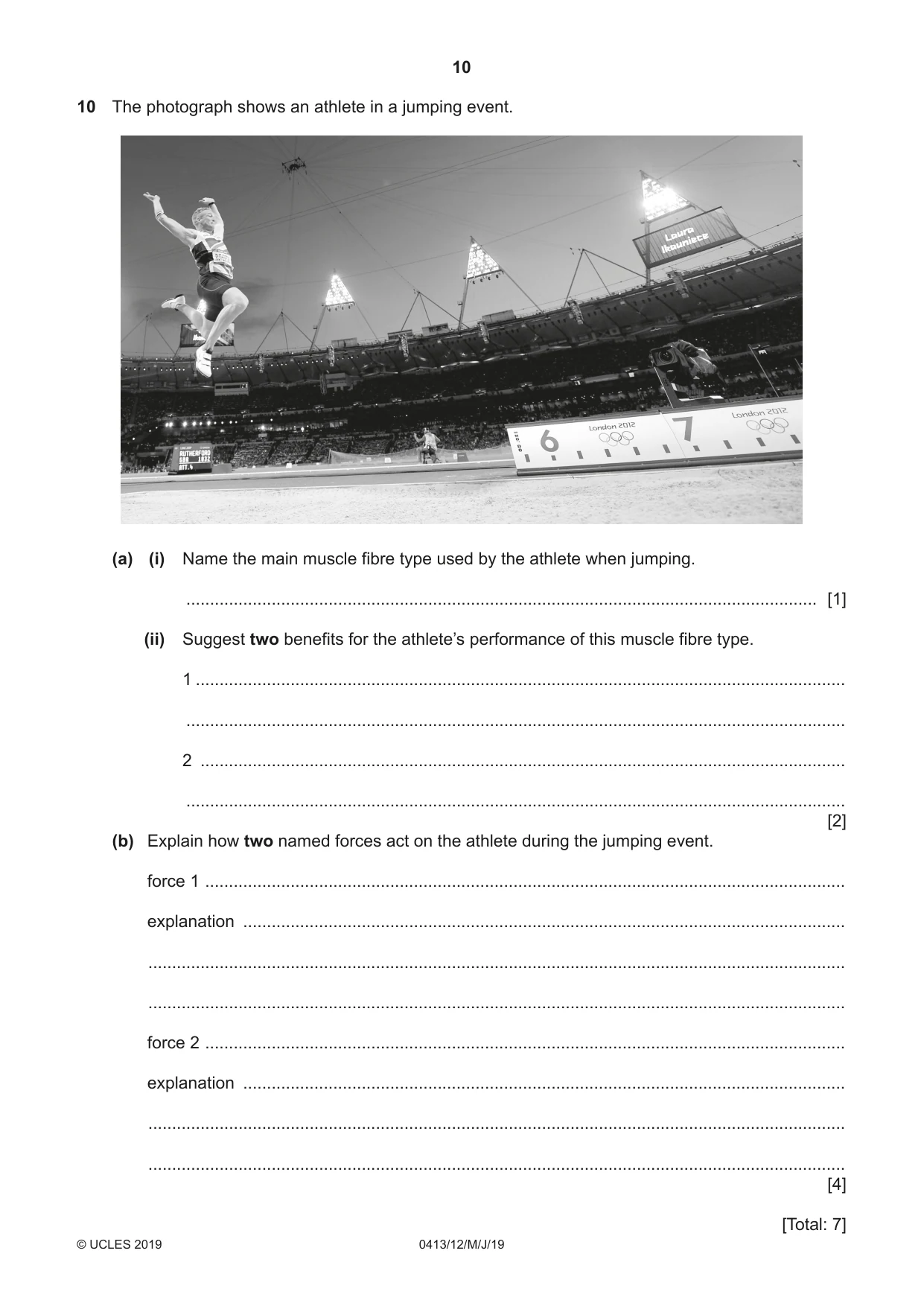
10 0413/12/M/J/19 © UCLES 2019 10 The photograph shows an athlete in a jumping event. (a) (i) Name the main muscle fibre type used by the athlete when jumping. … [1] (ii) Suggest two benefits for the athlete’s performance of this muscle fibre type. 1 … … 2 … … [2] (b) Explain how two named forces act on the athlete during the jumping event. force 1 … explanation … … … force 2 … explanation … … … [4] [Total: 7]
Question paper, page 11
11 0413/12/M/J/19 © UCLES 2019 [Turn over BLANK PAGE
Question paper, page 12
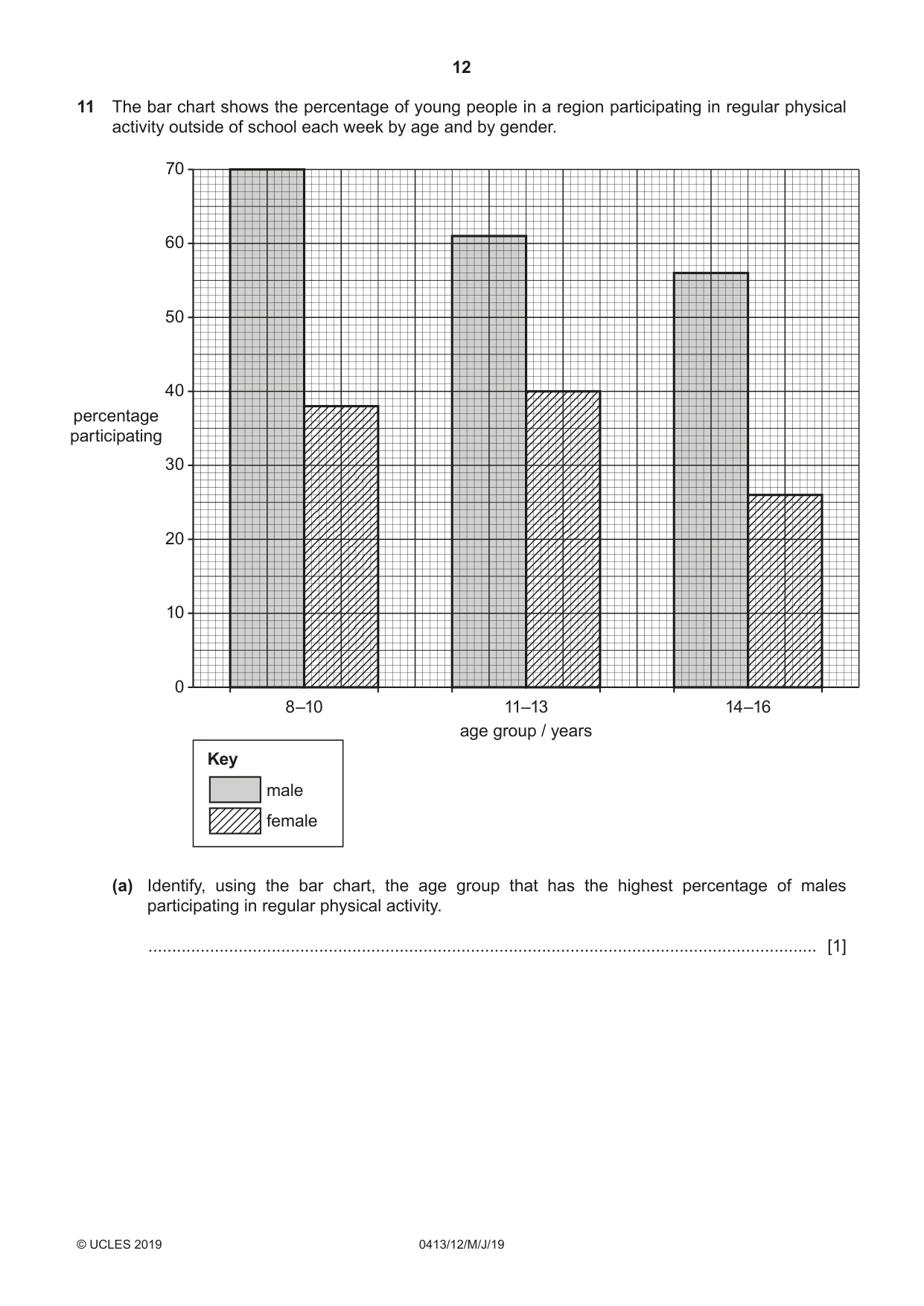
12 0413/12/M/J/19 © UCLES 2019 11 The bar chart shows the percentage of young people in a region participating in regular physical activity outside of school each week by age and by gender. 0 8–10 11–13 age group / years Key male female percentage participating 14–16 10 20 30 40 50 60 70 (a) Identify, using the bar chart, the age group that has the highest percentage of males participating in regular physical activity. … [1]
Question paper, page 13
13 0413/12/M/J/19 © UCLES 2019 [Turn over (b) Suggest reasons why there is a low percentage of participation for 14 to 16 year-old females. … … … … … … … … [4] [Total: 5]
Question paper, page 14
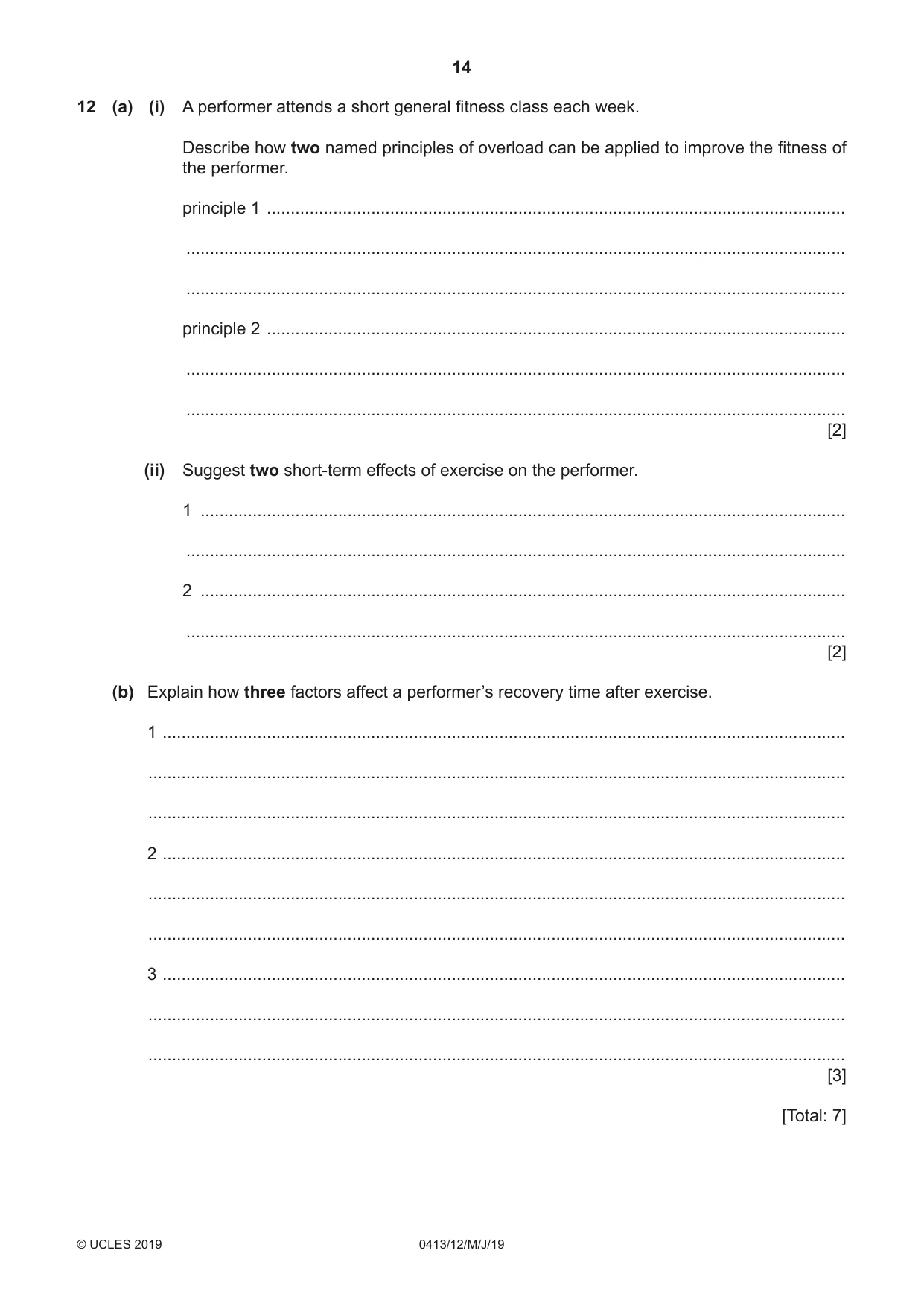
14 0413/12/M/J/19 © UCLES 2019 12 (a) (i) A performer attends a short general fitness class each week. Describe how two named principles of overload can be applied to improve the fitness of the performer. principle 1 … … … principle 2 … … … [2] (ii) Suggest two short-term effects of exercise on the performer. 1 … … 2 … … [2] (b) Explain how three factors affect a performer’s recovery time after exercise. 1 … … … 2 … … … 3 … … … [3] [Total: 7]
Question paper, page 15
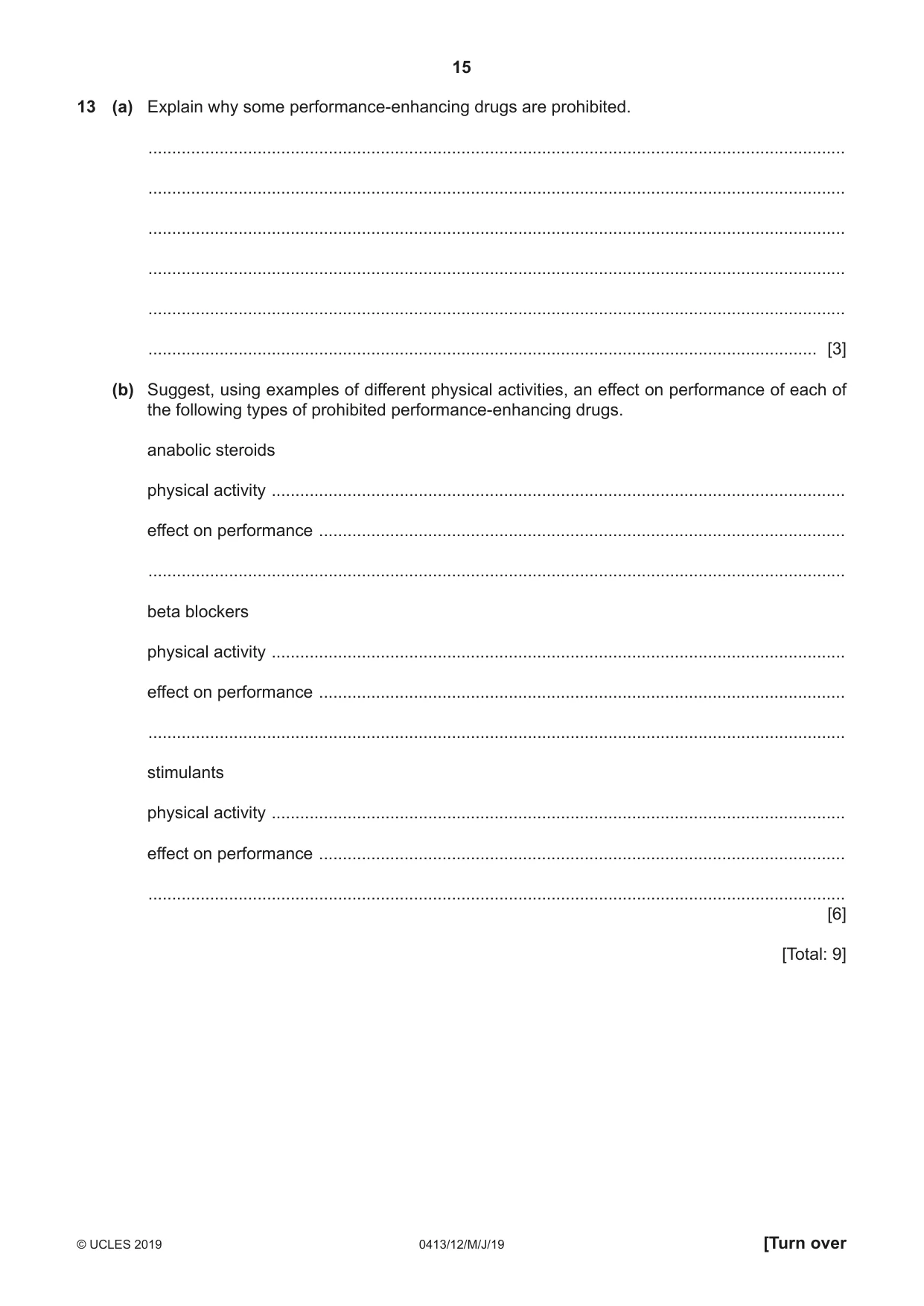
15 0413/12/M/J/19 © UCLES 2019 [Turn over 13 (a) Explain why some performance-enhancing drugs are prohibited. … … … … … … [3] (b) Suggest, using examples of different physical activities, an effect on performance of each of the following types of prohibited performance-enhancing drugs. anabolic steroids physical activity … effect on performance … … beta blockers physical activity … effect on performance … … stimulants physical activity … effect on performance … … [6] [Total: 9]
Question paper, page 16
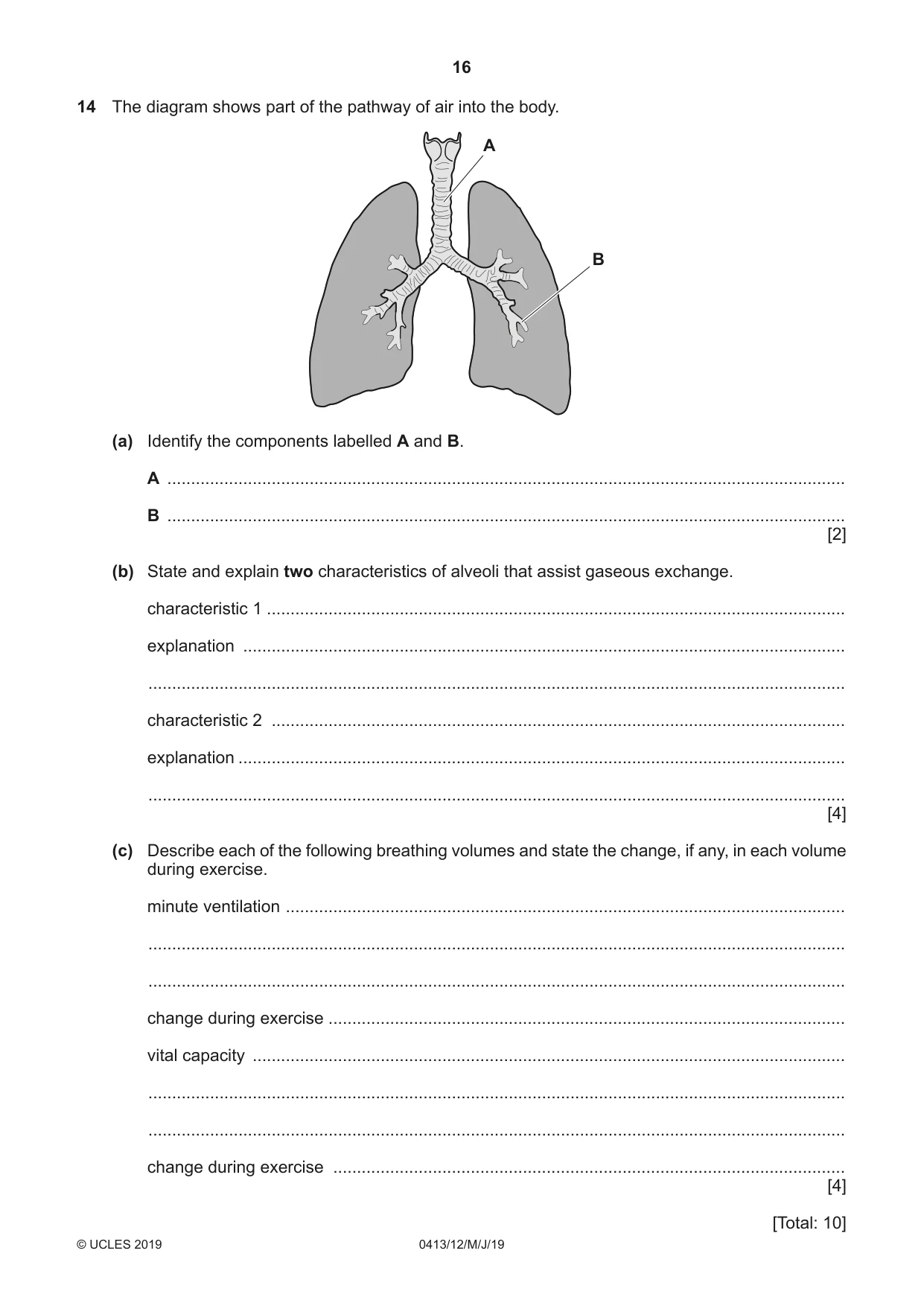
16 0413/12/M/J/19 © UCLES 2019 14 The diagram shows part of the pathway of air into the body. A B (a) Identify the components labelled A and B. A … B … [2] (b) State and explain two characteristics of alveoli that assist gaseous exchange. characteristic 1 … explanation … … characteristic 2 … explanation … … [4] (c) Describe each of the following breathing volumes and state the change, if any, in each volume during exercise. minute ventilation … … … change during exercise … vital capacity … … … change during exercise … [4] [Total: 10]
Question paper, page 17
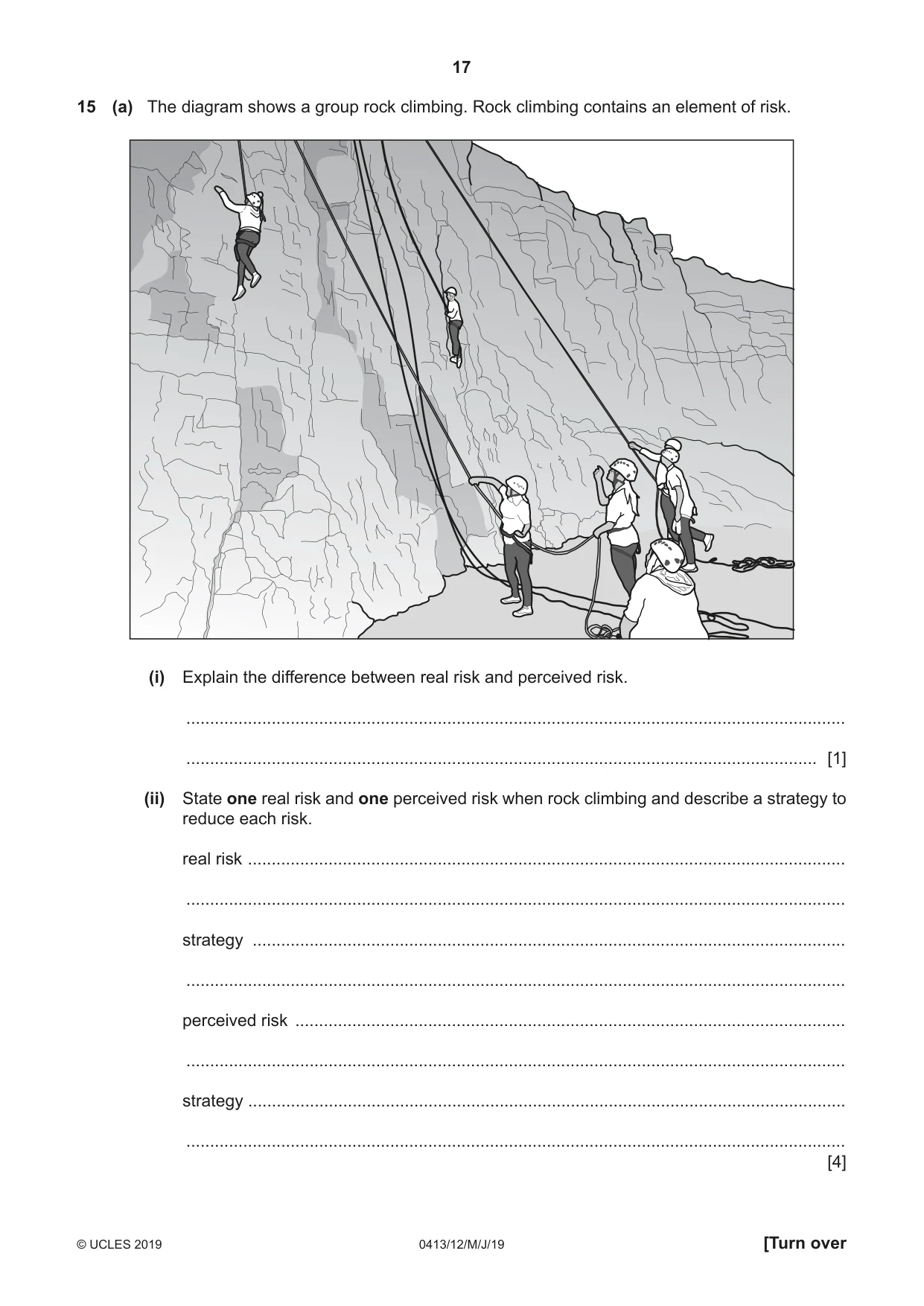
17 0413/12/M/J/19 © UCLES 2019 [Turn over 15 (a) The diagram shows a group rock climbing. Rock climbing contains an element of risk. (i) Explain the difference between real risk and perceived risk. … … [1] (ii) State one real risk and one perceived risk when rock climbing and describe a strategy to reduce each risk. real risk … … strategy … … perceived risk … … strategy … … [4]
Question paper, page 18
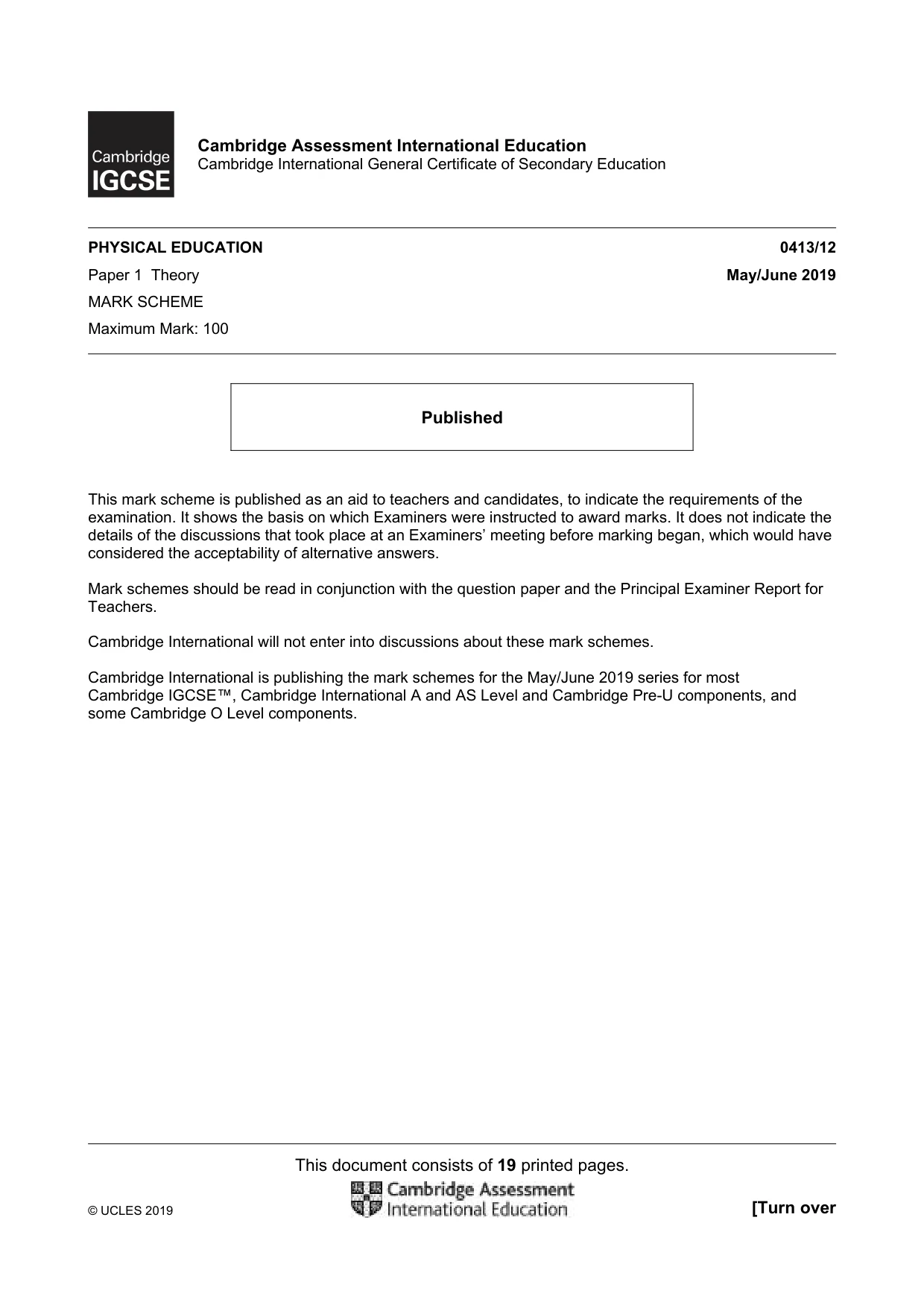
18 0413/12/M/J/19 © UCLES 2019 (b) State two typical minor injuries that could occur during different named physical activities and describe a different treatment for each injury. physical activity … injury 1 … treatment … … physical activity … injury 2 … treatment … … [4] [Total: 9]
Question paper, page 19
19 0413/12/M/J/19 © UCLES 2019 BLANK PAGE
Question paper, page 20
20 0413/12/M/J/19 © UCLES 2019 Permission to reproduce items where third-party owned material protected by copyright is included has been sought and cleared where possible. Every reasonable effort has been made by the publisher (UCLES) to trace copyright holders, but if any items requiring clearance have unwittingly been included, the publisher will be pleased to make amends at the earliest possible opportunity. To avoid the issue of disclosure of answer-related information to candidates, all copyright acknowledgements are reproduced online in the Cambridge Assessment International Education Copyright Acknowledgements Booklet. This is produced for each series of examinations and is freely available to download at www.cambridgeinternational.org after the live examination series. Cambridge Assessment International Education is part of the Cambridge Assessment Group. Cambridge Assessment is the brand name of the University of Cambridge Local Examinations Syndicate (UCLES), which itself is a department of the University of Cambridge. BLANK PAGE
Mark scheme, page 1
This document consists of 19 printed pages. © UCLES 2019 [Turn over Cambridge Assessment International Education Cambridge International General Certificate of Secondary Education PHYSICAL EDUCATION 0413/12 Paper 1 Theory May/June 2019 MARK SCHEME Maximum Mark: 100 Published This mark scheme is published as an aid to teachers and candidates, to indicate the requirements of the examination. It shows the basis on which Examiners were instructed to award marks. It does not indicate the details of the discussions that took place at an Examiners’ meeting before marking began, which would have considered the acceptability of alternative answers. Mark schemes should be read in conjunction with the question paper and the Principal Examiner Report for Teachers. Cambridge International will not enter into discussions about these mark schemes. Cambridge International is publishing the mark schemes for the May/June 2019 series for most Cambridge IGCSE™, Cambridge International A and AS Level and Cambridge Pre-U components, and some Cambridge O Level components.
Mark scheme, page 2
0413/12 Cambridge IGCSE – Mark Scheme PUBLISHED May/June 2019 © UCLES 2019 Page 2 of 19 Generic Marking Principles These general marking principles must be applied by all examiners when marking candidate answers. They should be applied alongside the specific content of the mark scheme or generic level descriptors for a question. Each question paper and mark scheme will also comply with these marking principles. GENERIC MARKING PRINCIPLE 1: Marks must be awarded in line with: • the specific content of the mark scheme or the generic level descriptors for the question • the specific skills defined in the mark scheme or in the generic level descriptors for the question • the standard of response required by a candidate as exemplified by the standardisation scripts. GENERIC MARKING PRINCIPLE 2: Marks awarded are always whole marks (not half marks, or other fractions). GENERIC MARKING PRINCIPLE 3: Marks must be awarded positively: • marks are awarded for correct/valid answers, as defined in the mark scheme. However, credit is given for valid answers which go beyond the scope of the syllabus and mark scheme, referring to your Team Leader as appropriate • marks are awarded when candidates clearly demonstrate what they know and can do • marks are not deducted for errors • marks are not deducted for omissions • answers should only be judged on the quality of spelling, punctuation and grammar when these features are specifically assessed by the question as indicated by the mark scheme. The meaning, however, should be unambiguous. GENERIC MARKING PRINCIPLE 4: Rules must be applied consistently e.g. in situations where candidates have not followed instructions or in the application of generic level descriptors.
Mark scheme, page 3
0413/12 Cambridge IGCSE – Mark Scheme PUBLISHED May/June 2019 © UCLES 2019 Page 3 of 19 GENERIC MARKING PRINCIPLE 5: Marks should be awarded using the full range of marks defined in the mark scheme for the question (however; the use of the full mark range may be limited according to the quality of the candidate responses seen). GENERIC MARKING PRINCIPLE 6: Marks awarded are based solely on the requirements as defined in the mark scheme. Marks should not be awarded with grade thresholds or grade descriptors in mind.
Mark scheme, page 4
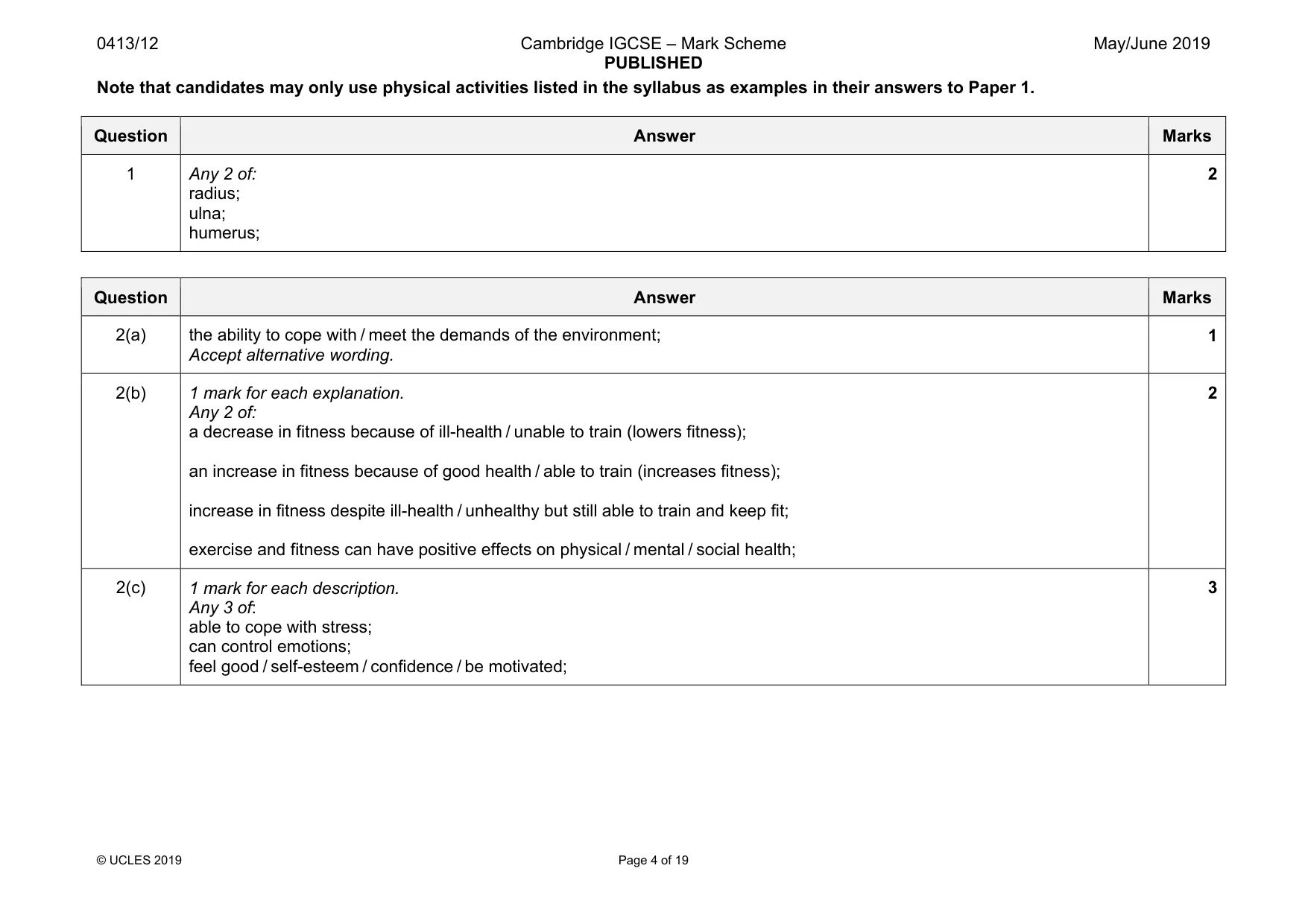
0413/12 Cambridge IGCSE – Mark Scheme PUBLISHED May/June 2019 © UCLES 2019 Page 4 of 19 Note that candidates may only use physical activities listed in the syllabus as examples in their answers to Paper 1. Question Answer Marks 1 Any 2 of: radius; ulna; humerus; 2 Question Answer Marks 2(a) the ability to cope with / meet the demands of the environment; Accept alternative wording. 1 2(b) 1 mark for each explanation. Any 2 of: a decrease in fitness because of ill-health / unable to train (lowers fitness); an increase in fitness because of good health / able to train (increases fitness); increase in fitness despite ill-health / unhealthy but still able to train and keep fit; exercise and fitness can have positive effects on physical / mental / social health; 2 2(c) 1 mark for each description. Any 3 of: able to cope with stress; can control emotions; feel good / self-esteem / confidence / be motivated; 3
Mark scheme, page 5
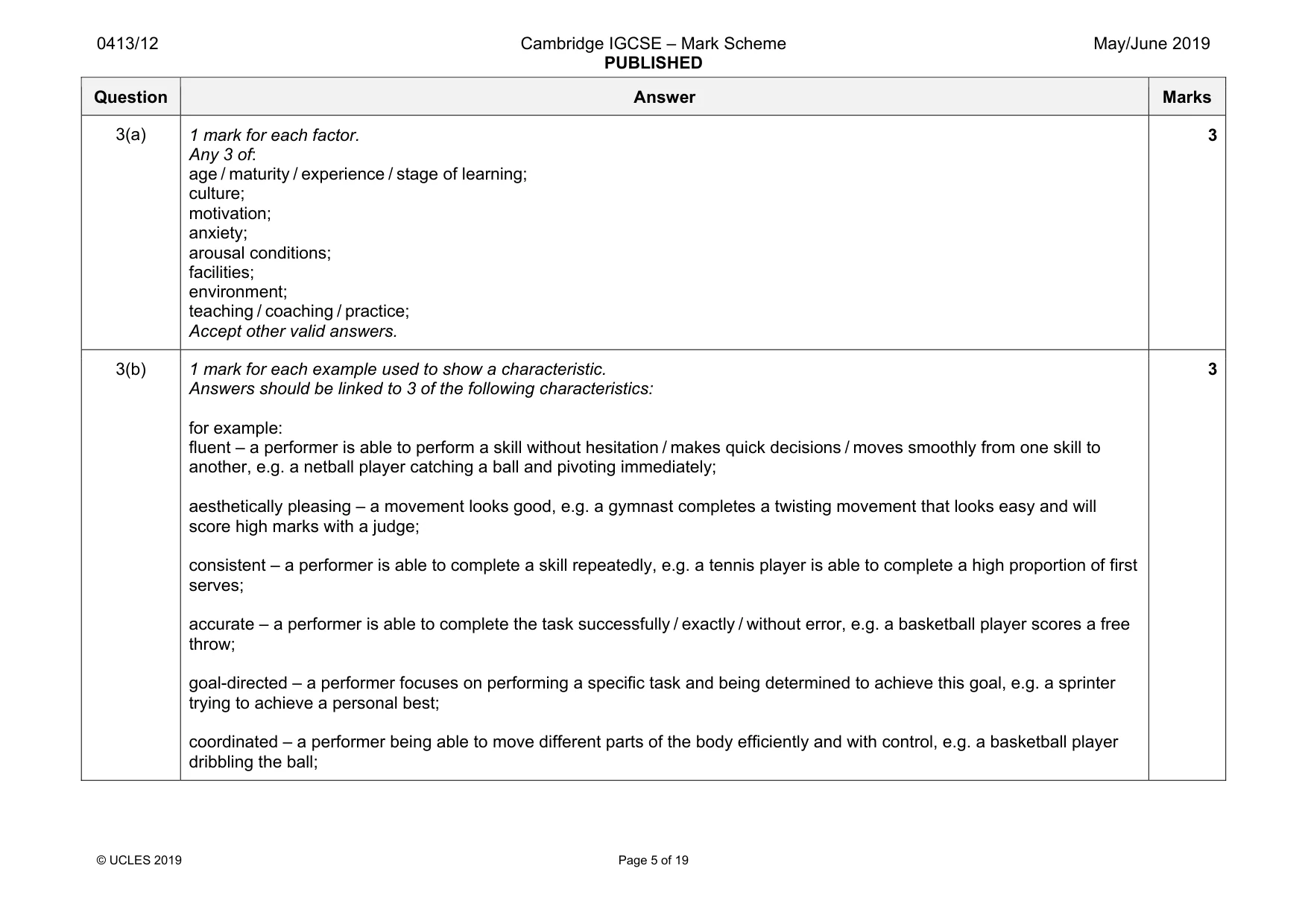
0413/12 Cambridge IGCSE – Mark Scheme PUBLISHED May/June 2019 © UCLES 2019 Page 5 of 19 Question Answer Marks 3(a) 1 mark for each factor. Any 3 of: age / maturity / experience / stage of learning; culture; motivation; anxiety; arousal conditions; facilities; environment; teaching / coaching / practice; Accept other valid answers. 3 3(b) 1 mark for each example used to show a characteristic. Answers should be linked to 3 of the following characteristics: for example: fluent – a performer is able to perform a skill without hesitation / makes quick decisions / moves smoothly from one skill to another, e.g. a netball player catching a ball and pivoting immediately; aesthetically pleasing – a movement looks good, e.g. a gymnast completes a twisting movement that looks easy and will score high marks with a judge; consistent – a performer is able to complete a skill repeatedly, e.g. a tennis player is able to complete a high proportion of first serves; accurate – a performer is able to complete the task successfully / exactly / without error, e.g. a basketball player scores a free throw; goal-directed – a performer focuses on performing a specific task and being determined to achieve this goal, e.g. a sprinter trying to achieve a personal best; coordinated – a performer being able to move different parts of the body efficiently and with control, e.g. a basketball player dribbling the ball; 3
Mark scheme, page 6
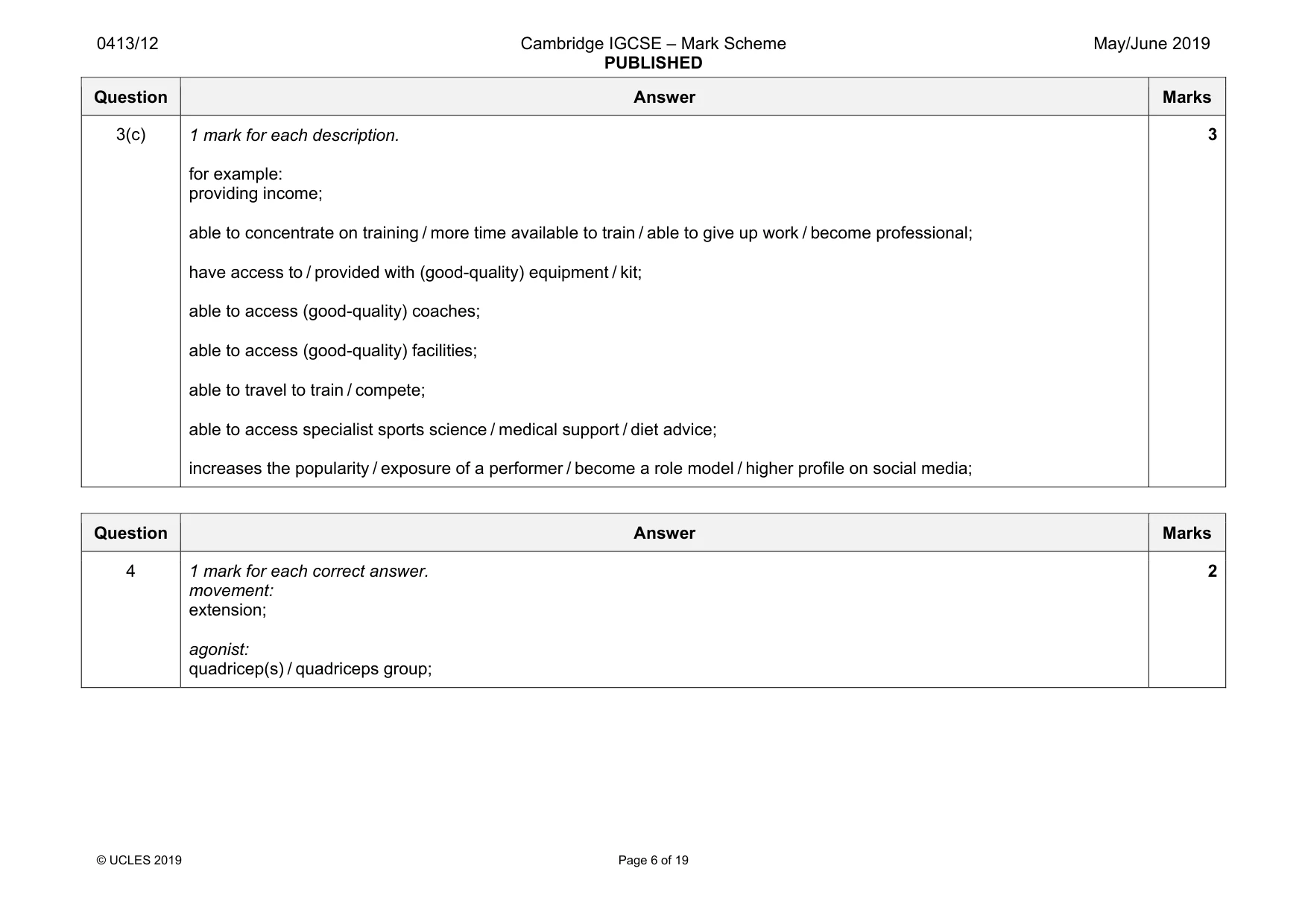
0413/12 Cambridge IGCSE – Mark Scheme PUBLISHED May/June 2019 © UCLES 2019 Page 6 of 19 Question Answer Marks 3(c) 1 mark for each description. for example: providing income; able to concentrate on training / more time available to train / able to give up work / become professional; have access to / provided with (good-quality) equipment / kit; able to access (good-quality) coaches; able to access (good-quality) facilities; able to travel to train / compete; able to access specialist sports science / medical support / diet advice; increases the popularity / exposure of a performer / become a role model / higher profile on social media; 3 Question Answer Marks 4 1 mark for each correct answer. movement: extension; agonist: quadricep(s) / quadriceps group; 2
Mark scheme, page 7
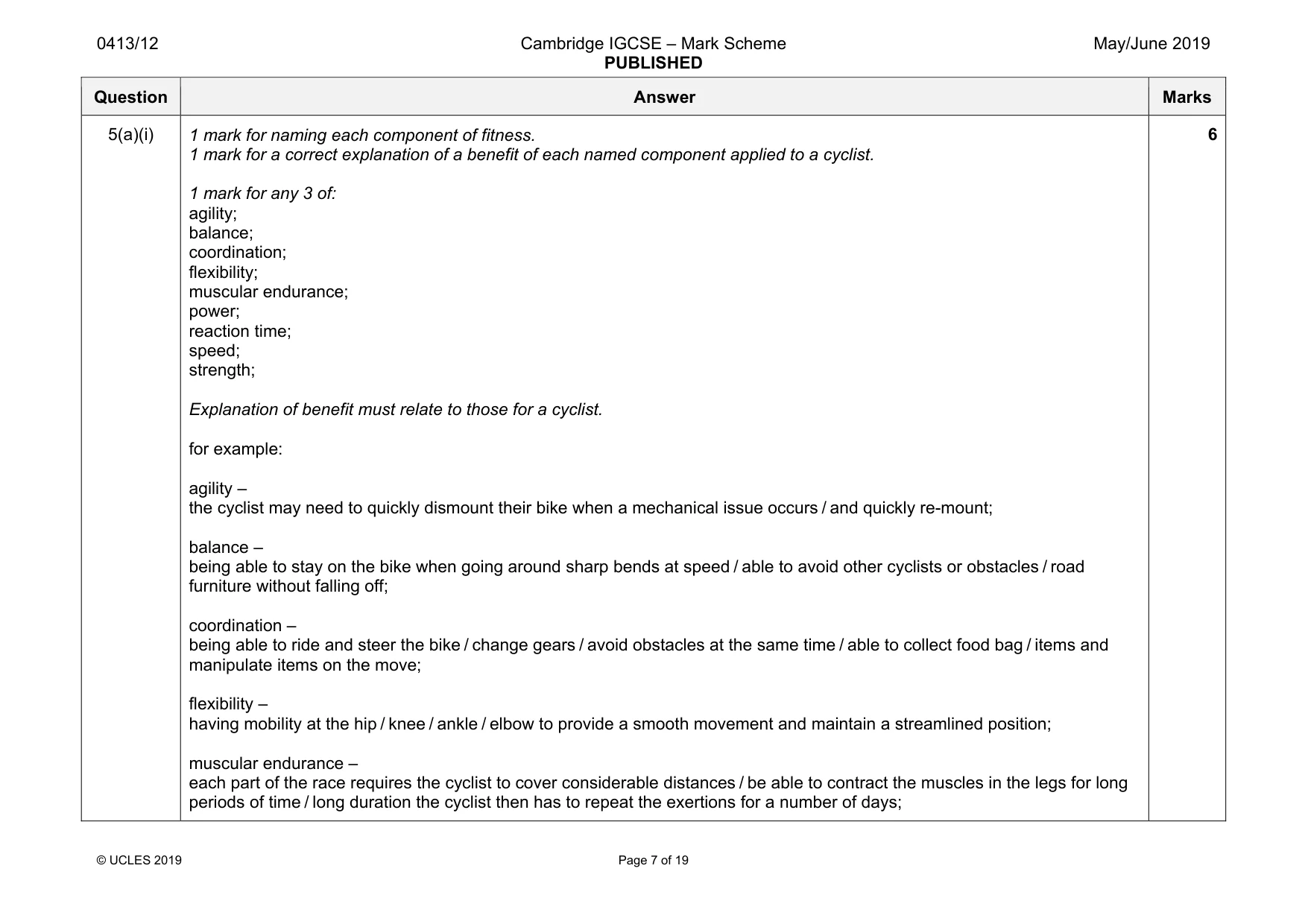
0413/12 Cambridge IGCSE – Mark Scheme PUBLISHED May/June 2019 © UCLES 2019 Page 7 of 19 Question Answer Marks 5(a)(i) 1 mark for naming each component of fitness. 1 mark for a correct explanation of a benefit of each named component applied to a cyclist. 1 mark for any 3 of: agility; balance; coordination; flexibility; muscular endurance; power; reaction time; speed; strength; Explanation of benefit must relate to those for a cyclist. for example: agility – the cyclist may need to quickly dismount their bike when a mechanical issue occurs / and quickly re-mount; balance – being able to stay on the bike when going around sharp bends at speed / able to avoid other cyclists or obstacles / road furniture without falling off; coordination – being able to ride and steer the bike / change gears / avoid obstacles at the same time / able to collect food bag / items and manipulate items on the move; flexibility – having mobility at the hip / knee / ankle / elbow to provide a smooth movement and maintain a streamlined position; muscular endurance – each part of the race requires the cyclist to cover considerable distances / be able to contract the muscles in the legs for long periods of time / long duration the cyclist then has to repeat the exertions for a number of days; 6
Mark scheme, page 8
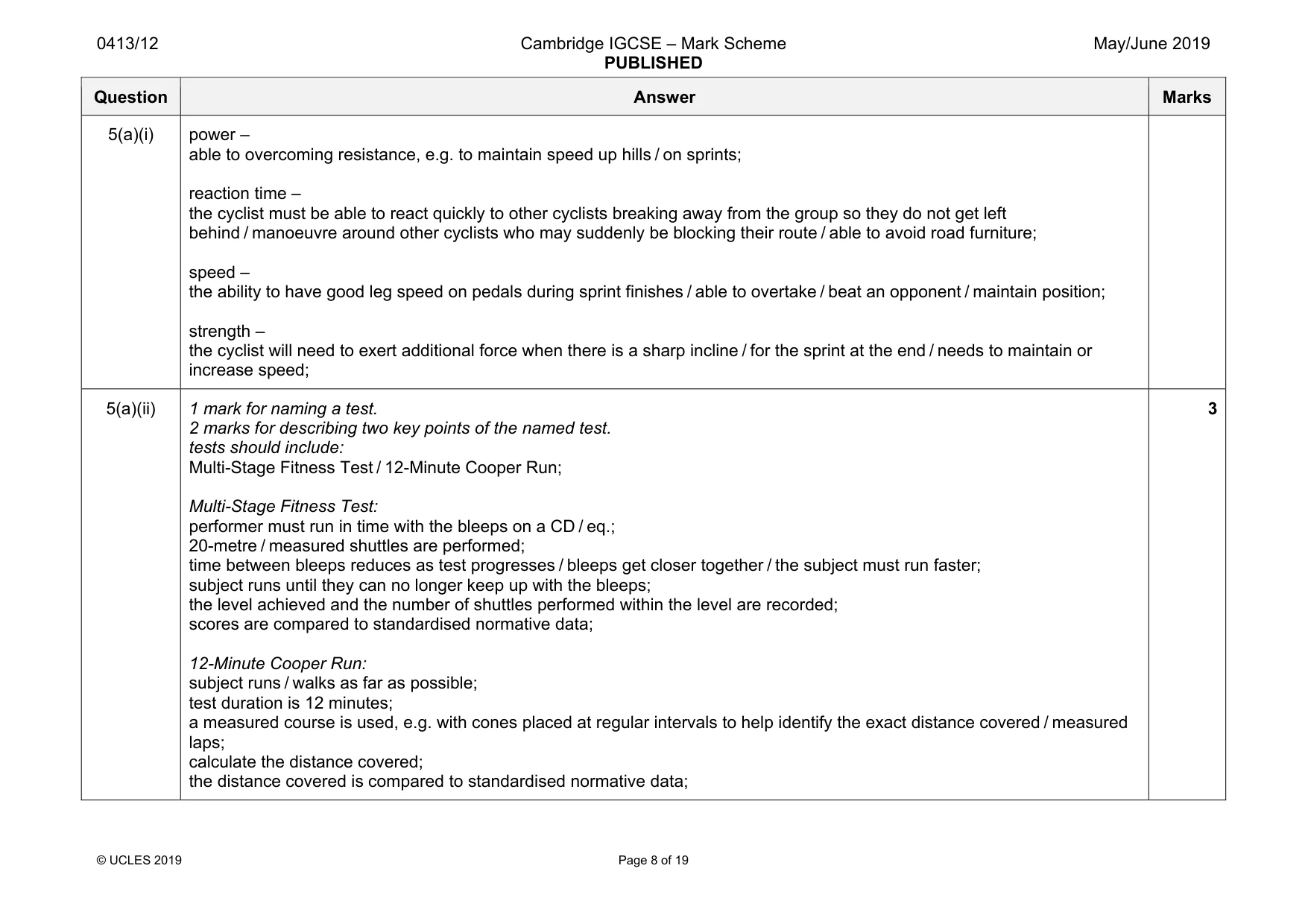
0413/12 Cambridge IGCSE – Mark Scheme PUBLISHED May/June 2019 © UCLES 2019 Page 8 of 19 Question Answer Marks 5(a)(i) power – able to overcoming resistance, e.g. to maintain speed up hills / on sprints; reaction time – the cyclist must be able to react quickly to other cyclists breaking away from the group so they do not get left behind / manoeuvre around other cyclists who may suddenly be blocking their route / able to avoid road furniture; speed – the ability to have good leg speed on pedals during sprint finishes / able to overtake / beat an opponent / maintain position; strength – the cyclist will need to exert additional force when there is a sharp incline / for the sprint at the end / needs to maintain or increase speed; 5(a)(ii) 1 mark for naming a test. 2 marks for describing two key points of the named test. tests should include: Multi-Stage Fitness Test / 12-Minute Cooper Run; Multi-Stage Fitness Test: performer must run in time with the bleeps on a CD / eq.; 20-metre / measured shuttles are performed; time between bleeps reduces as test progresses / bleeps get closer together / the subject must run faster; subject runs until they can no longer keep up with the bleeps; the level achieved and the number of shuttles performed within the level are recorded; scores are compared to standardised normative data; 12-Minute Cooper Run: subject runs / walks as far as possible; test duration is 12 minutes; a measured course is used, e.g. with cones placed at regular intervals to help identify the exact distance covered / measured laps; calculate the distance covered; the distance covered is compared to standardised normative data; 3
Mark scheme, page 9
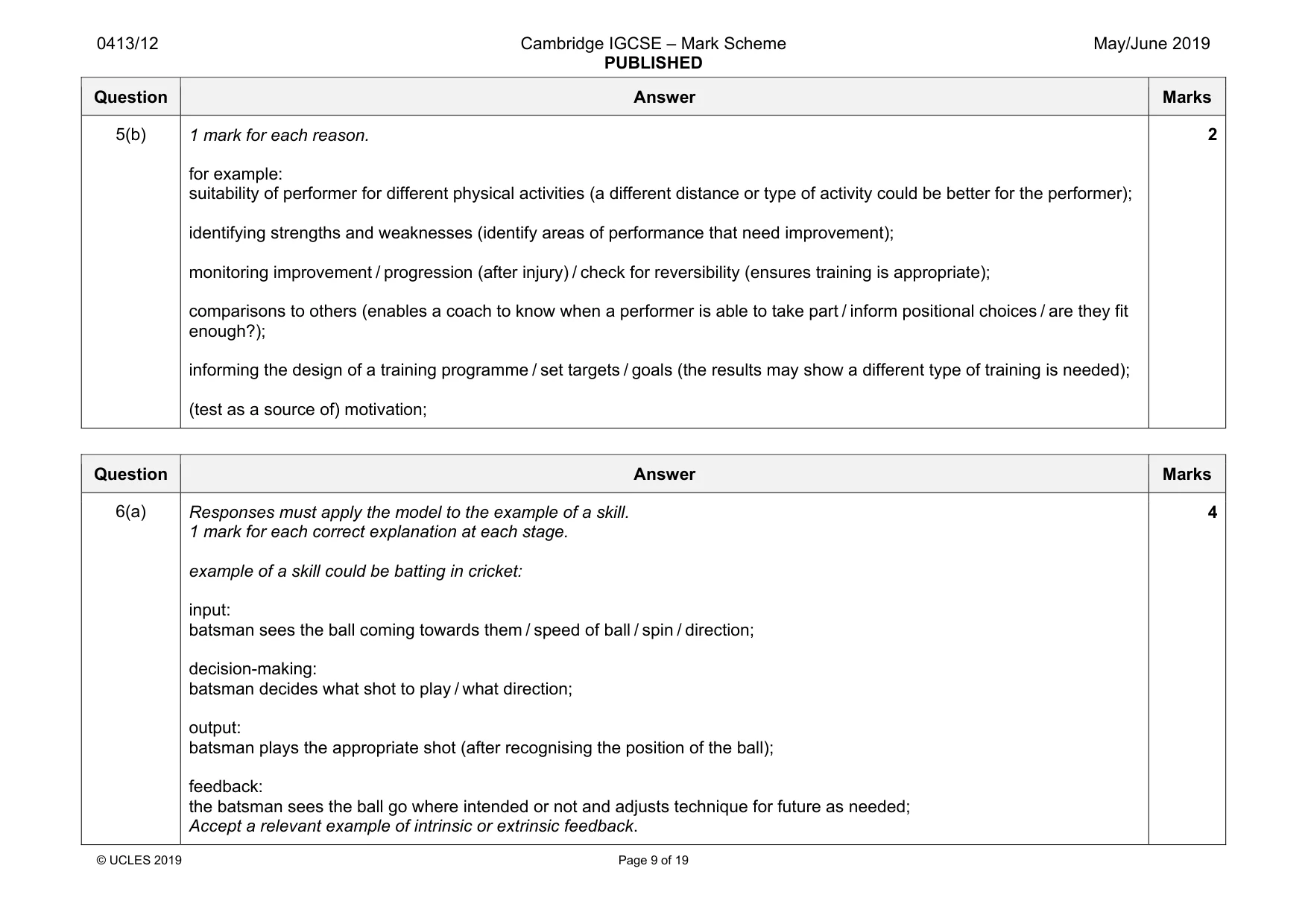
0413/12 Cambridge IGCSE – Mark Scheme PUBLISHED May/June 2019 © UCLES 2019 Page 9 of 19 Question Answer Marks 5(b) 1 mark for each reason. for example: suitability of performer for different physical activities (a different distance or type of activity could be better for the performer); identifying strengths and weaknesses (identify areas of performance that need improvement); monitoring improvement / progression (after injury) / check for reversibility (ensures training is appropriate); comparisons to others (enables a coach to know when a performer is able to take part / inform positional choices / are they fit enough?); informing the design of a training programme / set targets / goals (the results may show a different type of training is needed); (test as a source of) motivation; 2 Question Answer Marks 6(a) Responses must apply the model to the example of a skill. 1 mark for each correct explanation at each stage. example of a skill could be batting in cricket: input: batsman sees the ball coming towards them / speed of ball / spin / direction; decision-making: batsman decides what shot to play / what direction; output: batsman plays the appropriate shot (after recognising the position of the ball); feedback: the batsman sees the ball go where intended or not and adjusts technique for future as needed; Accept a relevant example of intrinsic or extrinsic feedback. 4
Mark scheme, page 10
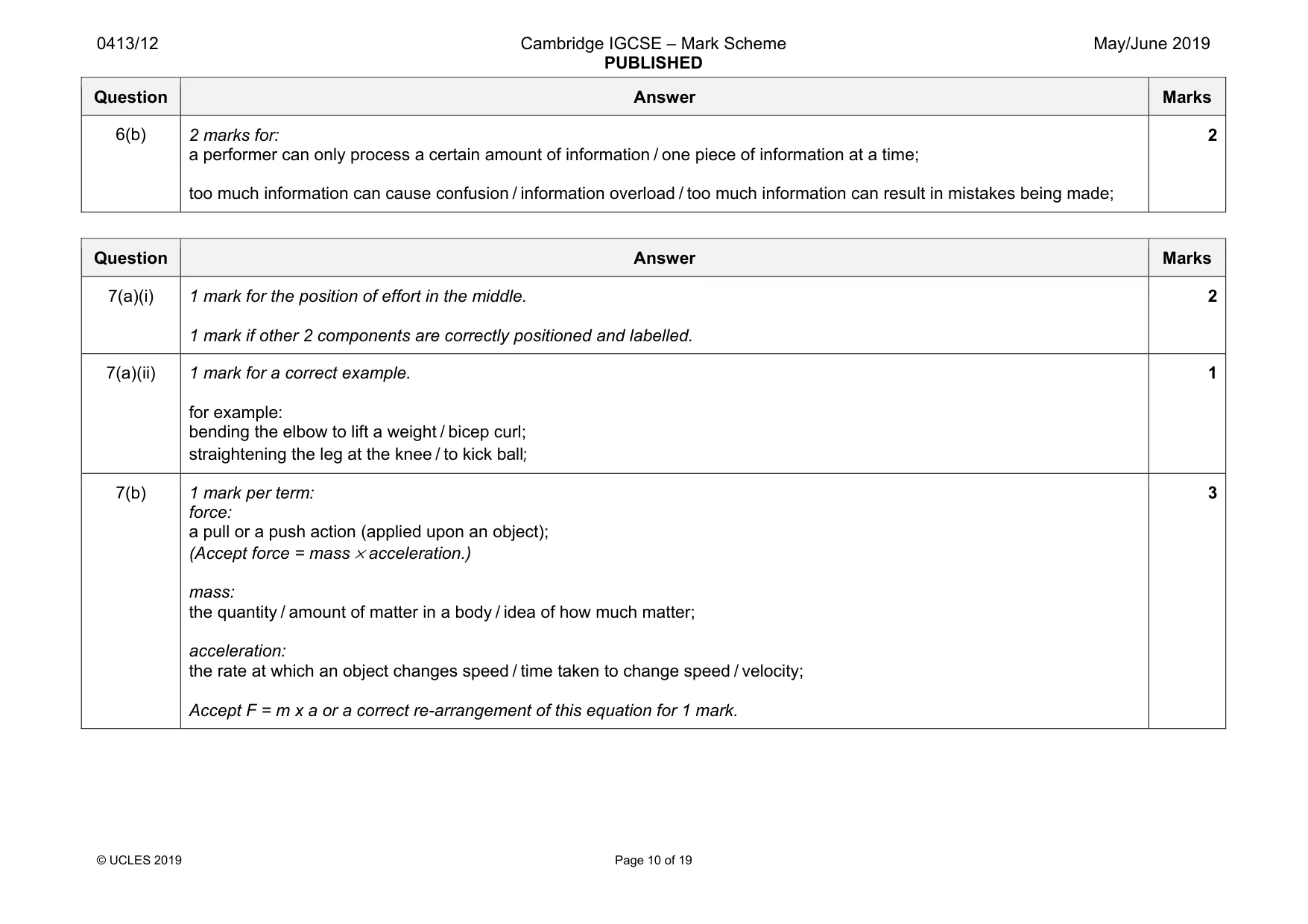
0413/12 Cambridge IGCSE – Mark Scheme PUBLISHED May/June 2019 © UCLES 2019 Page 10 of 19 Question Answer Marks 6(b) 2 marks for: a performer can only process a certain amount of information / one piece of information at a time; too much information can cause confusion / information overload / too much information can result in mistakes being made; 2 Question Answer Marks 7(a)(i) 1 mark for the position of effort in the middle. 1 mark if other 2 components are correctly positioned and labelled. 2 7(a)(ii) 1 mark for a correct example. for example: bending the elbow to lift a weight / bicep curl; straightening the leg at the knee / to kick ball; 1 7(b) 1 mark per term: force: a pull or a push action (applied upon an object); (Accept force = mass × acceleration.) mass: the quantity / amount of matter in a body / idea of how much matter; acceleration: the rate at which an object changes speed / time taken to change speed / velocity; Accept F = m x a or a correct re-arrangement of this equation for 1 mark. 3
Mark scheme, page 11
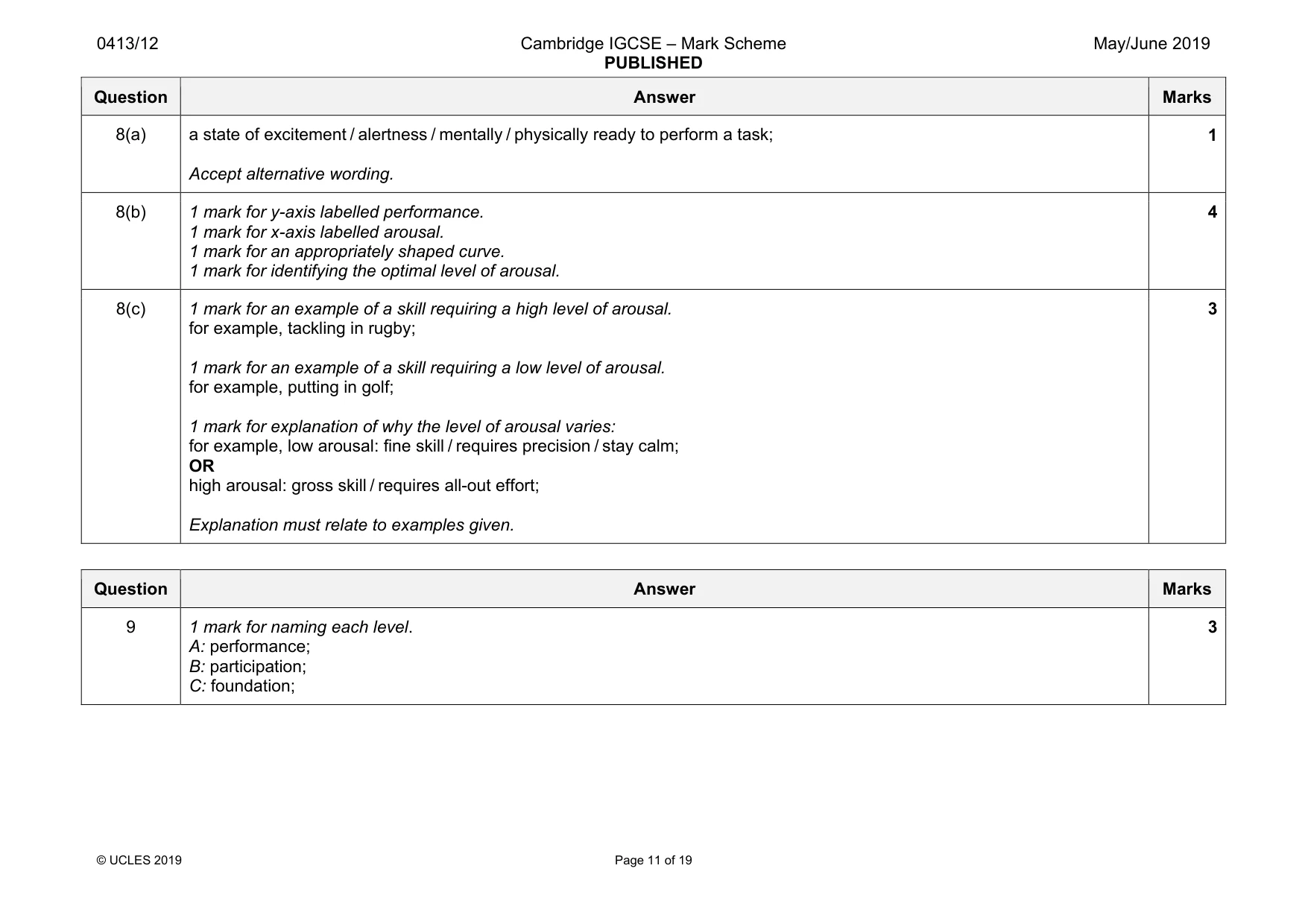
0413/12 Cambridge IGCSE – Mark Scheme PUBLISHED May/June 2019 © UCLES 2019 Page 11 of 19 Question Answer Marks 8(a) a state of excitement / alertness / mentally / physically ready to perform a task; Accept alternative wording. 1 8(b) 1 mark for y-axis labelled performance. 1 mark for x-axis labelled arousal. 1 mark for an appropriately shaped curve. 1 mark for identifying the optimal level of arousal. 4 8(c) 1 mark for an example of a skill requiring a high level of arousal. for example, tackling in rugby; 1 mark for an example of a skill requiring a low level of arousal. for example, putting in golf; 1 mark for explanation of why the level of arousal varies: for example, low arousal: fine skill / requires precision / stay calm; OR high arousal: gross skill / requires all-out effort; Explanation must relate to examples given. 3 Question Answer Marks 9 1 mark for naming each level. A: performance; B: participation; C: foundation; 3
Mark scheme, page 12
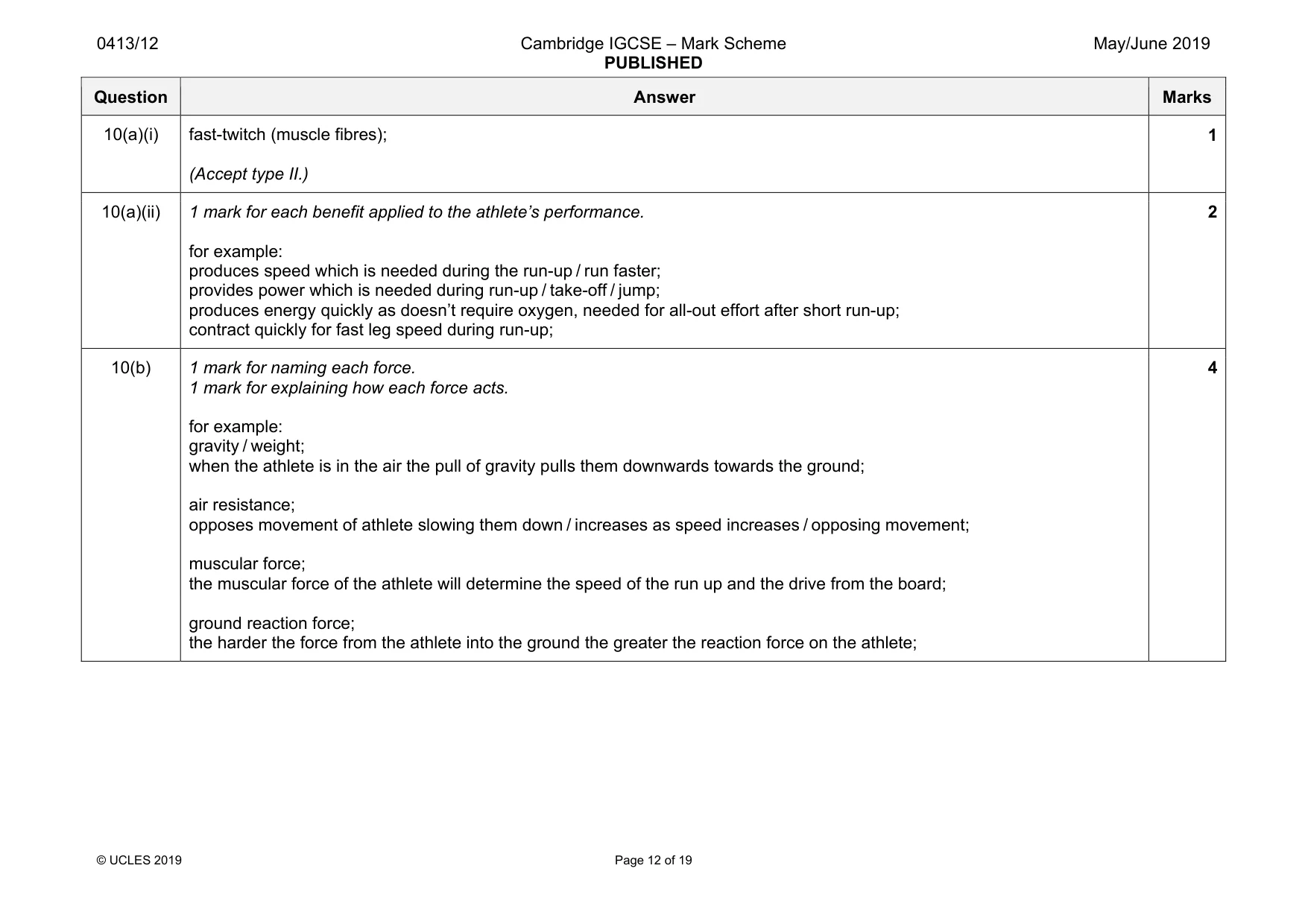
0413/12 Cambridge IGCSE – Mark Scheme PUBLISHED May/June 2019 © UCLES 2019 Page 12 of 19 Question Answer Marks 10(a)(i) fast-twitch (muscle fibres); (Accept type II.) 1 10(a)(ii) 1 mark for each benefit applied to the athlete’s performance. for example: produces speed which is needed during the run-up / run faster; provides power which is needed during run-up / take-off / jump; produces energy quickly as doesn’t require oxygen, needed for all-out effort after short run-up; contract quickly for fast leg speed during run-up; 2 10(b) 1 mark for naming each force. 1 mark for explaining how each force acts. for example: gravity / weight; when the athlete is in the air the pull of gravity pulls them downwards towards the ground; air resistance; opposes movement of athlete slowing them down / increases as speed increases / opposing movement; muscular force; the muscular force of the athlete will determine the speed of the run up and the drive from the board; ground reaction force; the harder the force from the athlete into the ground the greater the reaction force on the athlete; 4
Mark scheme, page 13
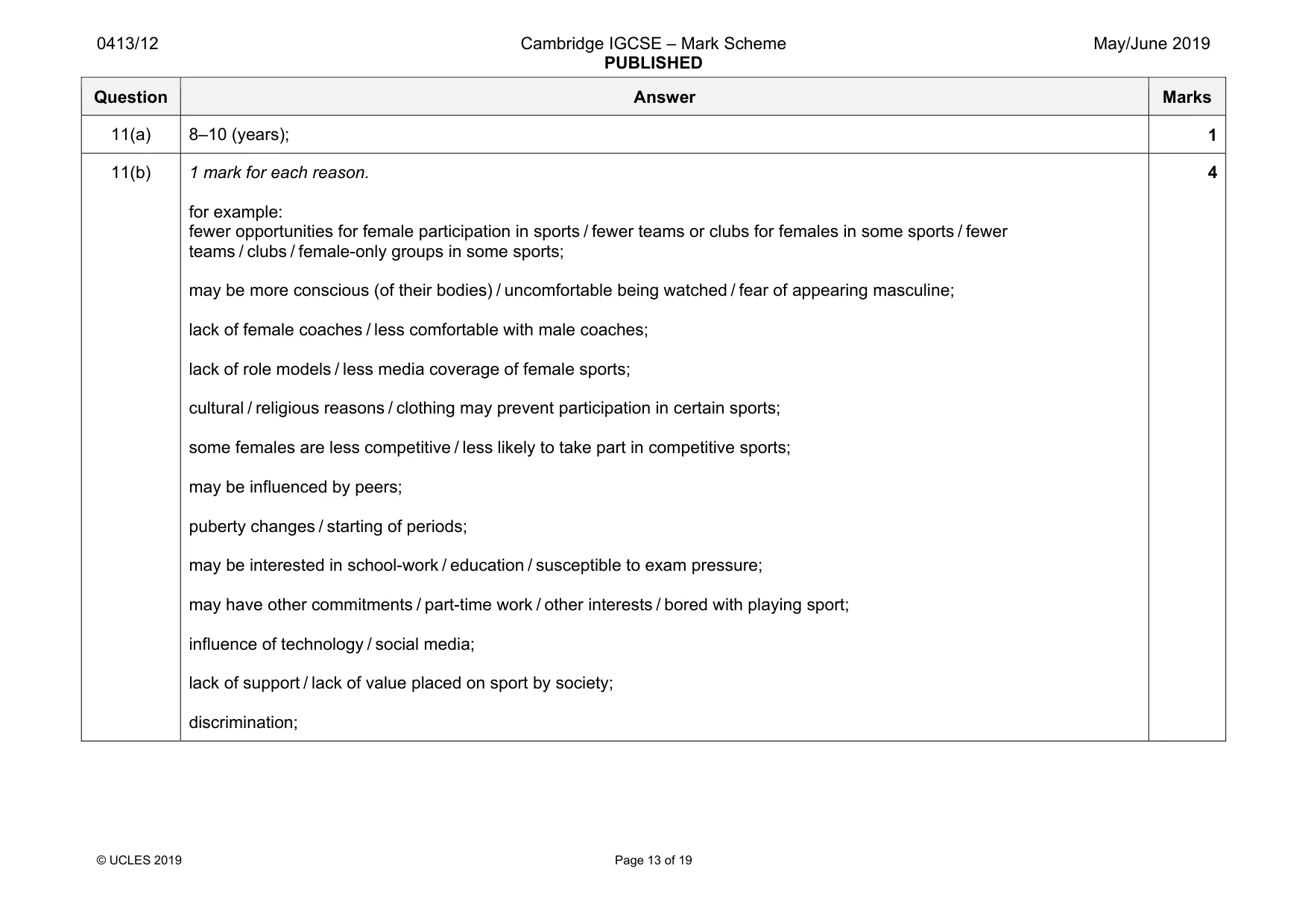
0413/12 Cambridge IGCSE – Mark Scheme PUBLISHED May/June 2019 © UCLES 2019 Page 13 of 19 Question Answer Marks 11(a) 8–10 (years); 1 11(b) 1 mark for each reason. for example: fewer opportunities for female participation in sports / fewer teams or clubs for females in some sports / fewer teams / clubs / female-only groups in some sports; may be more conscious (of their bodies) / uncomfortable being watched / fear of appearing masculine; lack of female coaches / less comfortable with male coaches; lack of role models / less media coverage of female sports; cultural / religious reasons / clothing may prevent participation in certain sports; some females are less competitive / less likely to take part in competitive sports; may be influenced by peers; puberty changes / starting of periods; may be interested in school-work / education / susceptible to exam pressure; may have other commitments / part-time work / other interests / bored with playing sport; influence of technology / social media; lack of support / lack of value placed on sport by society; discrimination; 4
Mark scheme, page 14
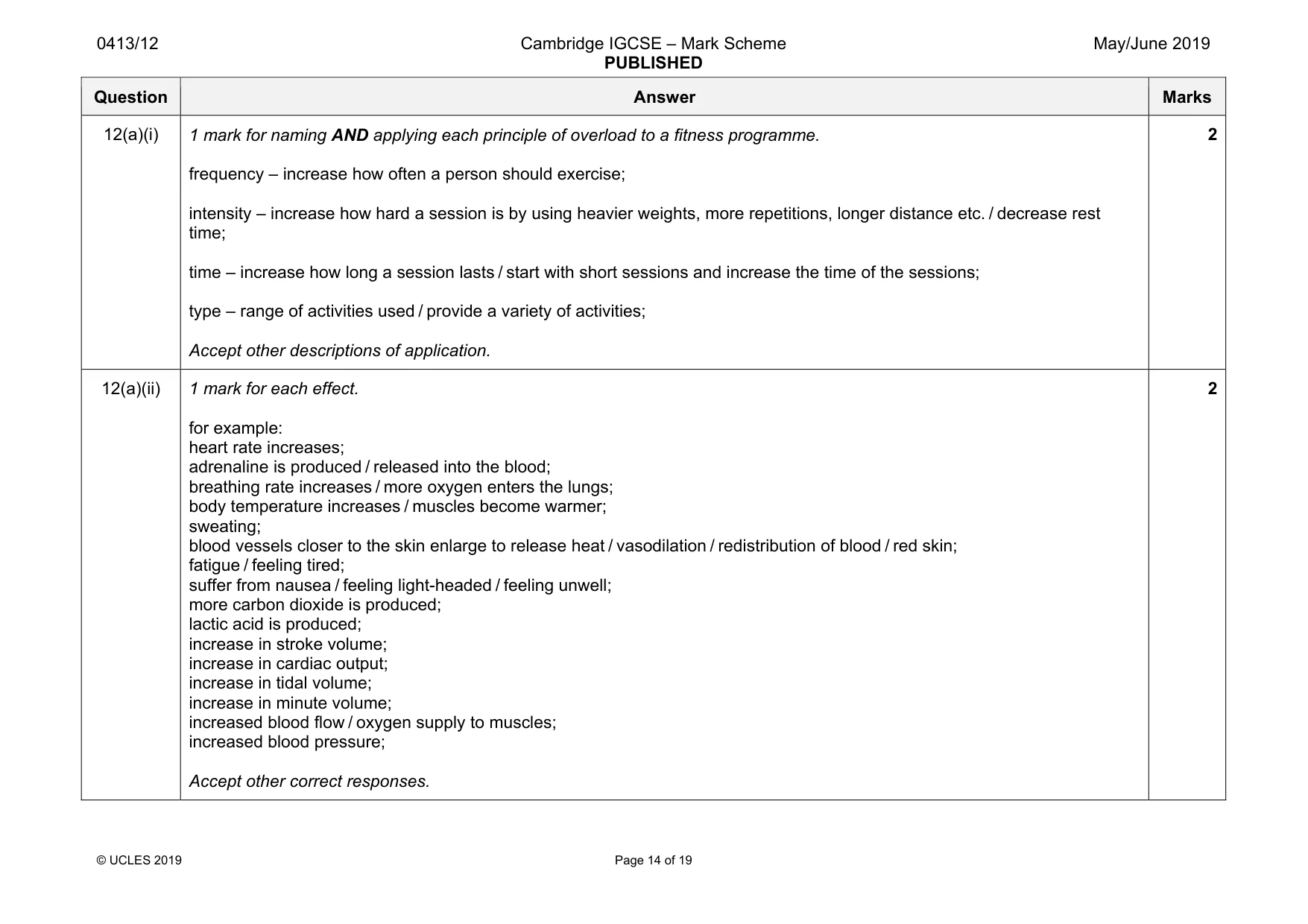
0413/12 Cambridge IGCSE – Mark Scheme PUBLISHED May/June 2019 © UCLES 2019 Page 14 of 19 Question Answer Marks 12(a)(i) 1 mark for naming AND applying each principle of overload to a fitness programme. frequency – increase how often a person should exercise; intensity – increase how hard a session is by using heavier weights, more repetitions, longer distance etc. / decrease rest time; time – increase how long a session lasts / start with short sessions and increase the time of the sessions; type – range of activities used / provide a variety of activities; Accept other descriptions of application. 2 12(a)(ii) 1 mark for each effect. for example: heart rate increases; adrenaline is produced / released into the blood; breathing rate increases / more oxygen enters the lungs; body temperature increases / muscles become warmer; sweating; blood vessels closer to the skin enlarge to release heat / vasodilation / redistribution of blood / red skin; fatigue / feeling tired; suffer from nausea / feeling light-headed / feeling unwell; more carbon dioxide is produced; lactic acid is produced; increase in stroke volume; increase in cardiac output; increase in tidal volume; increase in minute volume; increased blood flow / oxygen supply to muscles; increased blood pressure; Accept other correct responses. 2
Mark scheme, page 15
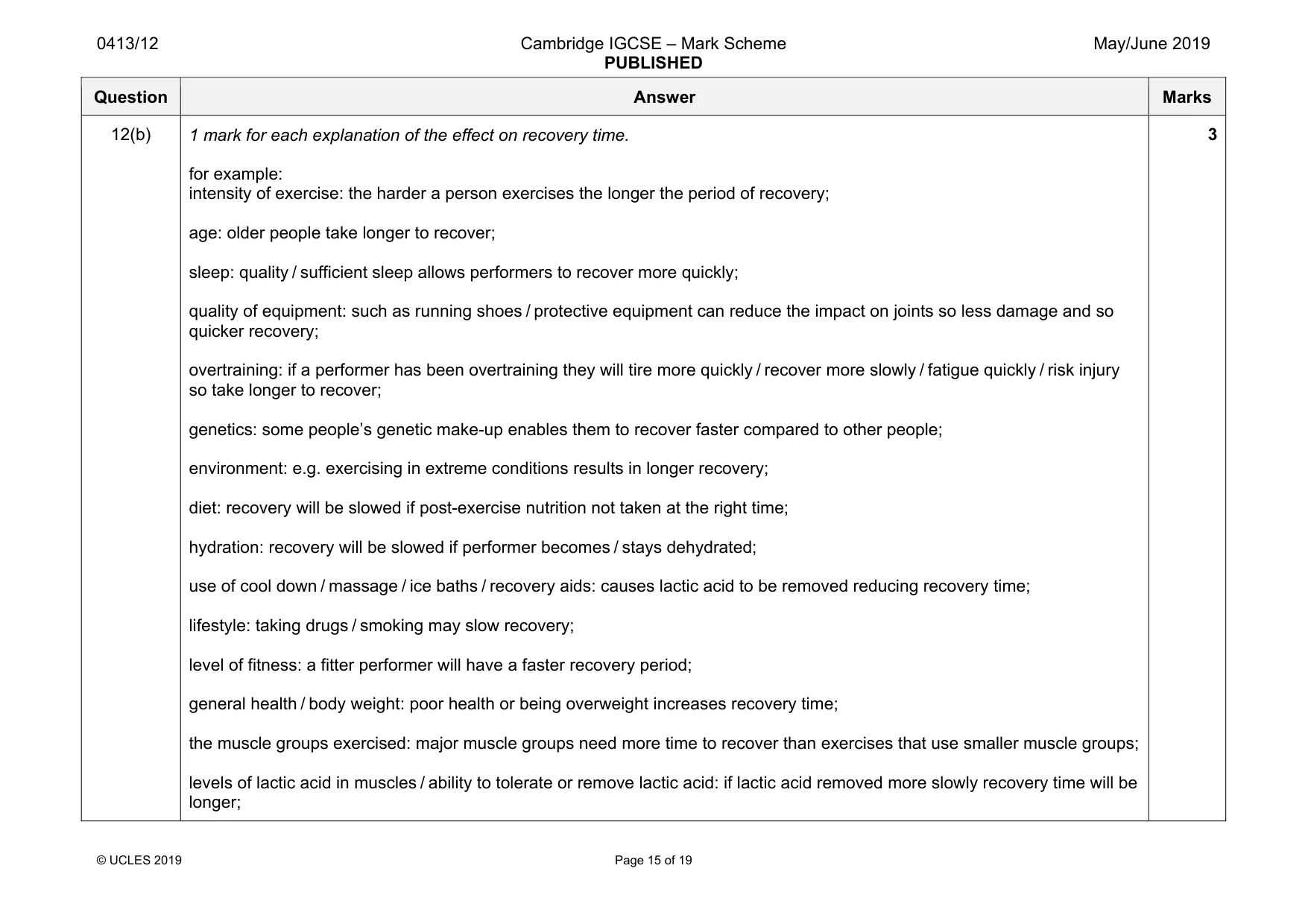
0413/12 Cambridge IGCSE – Mark Scheme PUBLISHED May/June 2019 © UCLES 2019 Page 15 of 19 Question Answer Marks 12(b) 1 mark for each explanation of the effect on recovery time. for example: intensity of exercise: the harder a person exercises the longer the period of recovery; age: older people take longer to recover; sleep: quality / sufficient sleep allows performers to recover more quickly; quality of equipment: such as running shoes / protective equipment can reduce the impact on joints so less damage and so quicker recovery; overtraining: if a performer has been overtraining they will tire more quickly / recover more slowly / fatigue quickly / risk injury so take longer to recover; genetics: some people’s genetic make-up enables them to recover faster compared to other people; environment: e.g. exercising in extreme conditions results in longer recovery; diet: recovery will be slowed if post-exercise nutrition not taken at the right time; hydration: recovery will be slowed if performer becomes / stays dehydrated; use of cool down / massage / ice baths / recovery aids: causes lactic acid to be removed reducing recovery time; lifestyle: taking drugs / smoking may slow recovery; level of fitness: a fitter performer will have a faster recovery period; general health / body weight: poor health or being overweight increases recovery time; the muscle groups exercised: major muscle groups need more time to recover than exercises that use smaller muscle groups; levels of lactic acid in muscles / ability to tolerate or remove lactic acid: if lactic acid removed more slowly recovery time will be longer; 3
Mark scheme, page 16
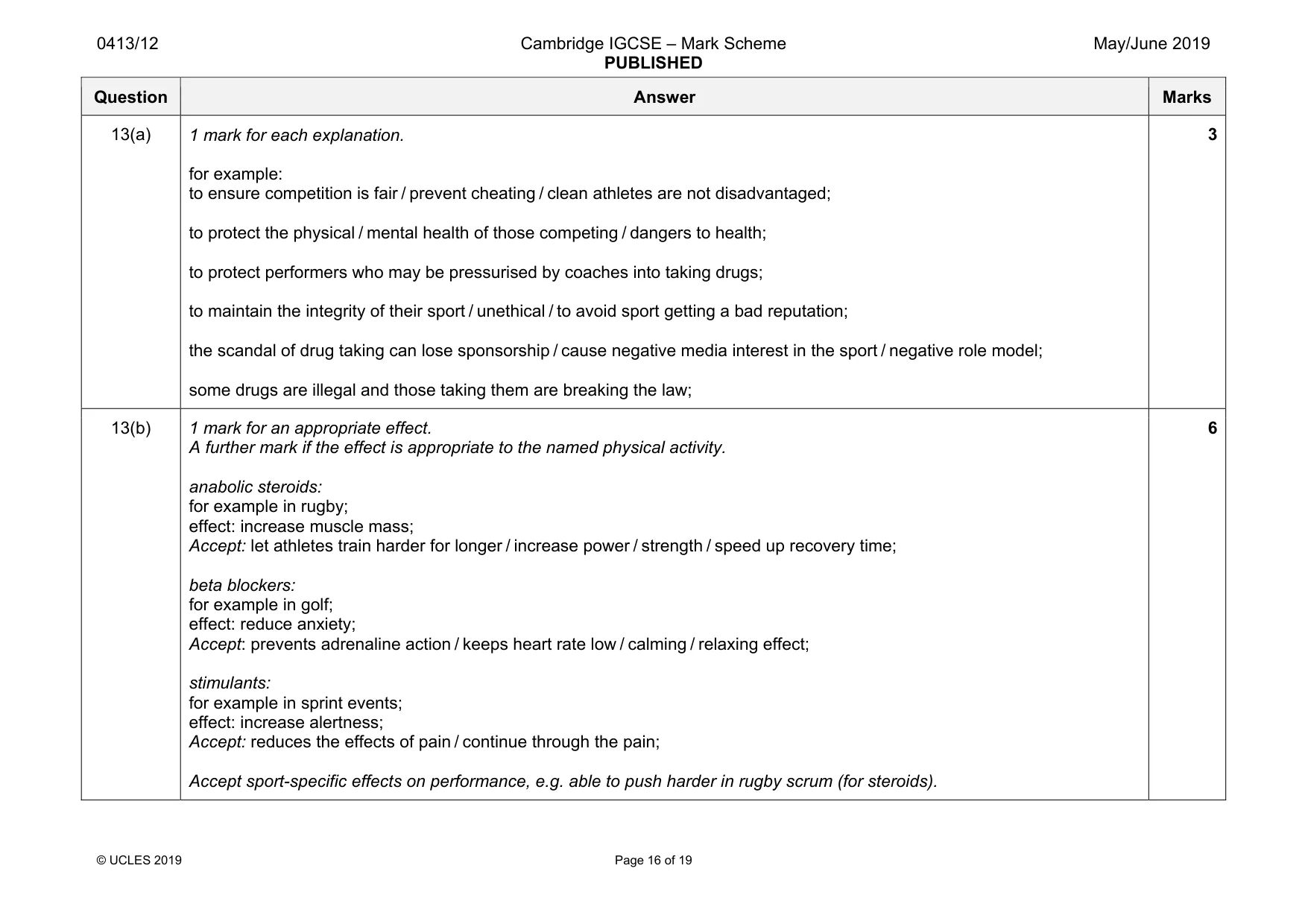
0413/12 Cambridge IGCSE – Mark Scheme PUBLISHED May/June 2019 © UCLES 2019 Page 16 of 19 Question Answer Marks 13(a) 1 mark for each explanation. for example: to ensure competition is fair / prevent cheating / clean athletes are not disadvantaged; to protect the physical / mental health of those competing / dangers to health; to protect performers who may be pressurised by coaches into taking drugs; to maintain the integrity of their sport / unethical / to avoid sport getting a bad reputation; the scandal of drug taking can lose sponsorship / cause negative media interest in the sport / negative role model; some drugs are illegal and those taking them are breaking the law; 3 13(b) 1 mark for an appropriate effect. A further mark if the effect is appropriate to the named physical activity. anabolic steroids: for example in rugby; effect: increase muscle mass; Accept: let athletes train harder for longer / increase power / strength / speed up recovery time; beta blockers: for example in golf; effect: reduce anxiety; Accept: prevents adrenaline action / keeps heart rate low / calming / relaxing effect; stimulants: for example in sprint events; effect: increase alertness; Accept: reduces the effects of pain / continue through the pain; Accept sport-specific effects on performance, e.g. able to push harder in rugby scrum (for steroids). 6
Mark scheme, page 17
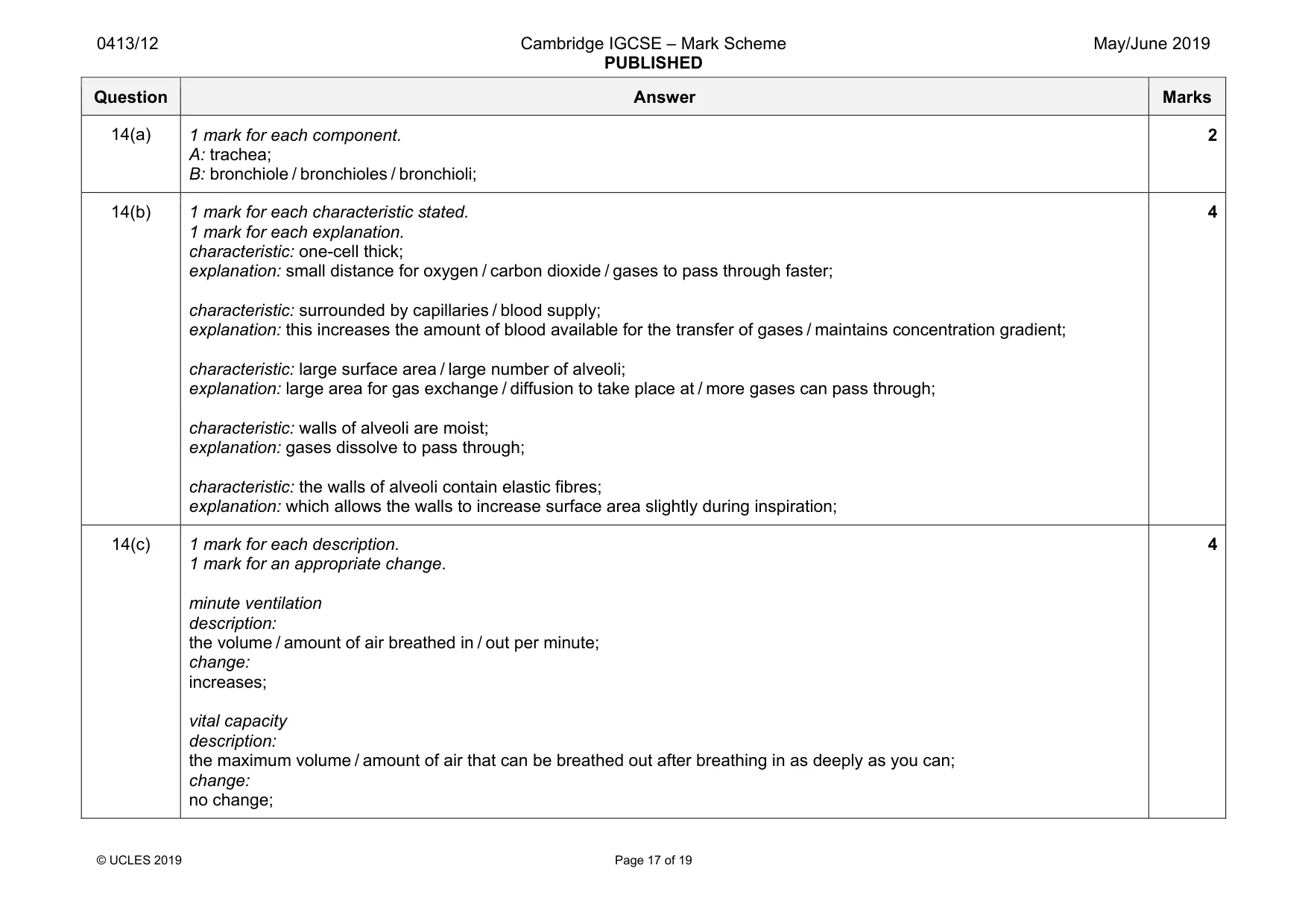
0413/12 Cambridge IGCSE – Mark Scheme PUBLISHED May/June 2019 © UCLES 2019 Page 17 of 19 Question Answer Marks 14(a) 1 mark for each component. A: trachea; B: bronchiole / bronchioles / bronchioli; 2 14(b) 1 mark for each characteristic stated. 1 mark for each explanation. characteristic: one-cell thick; explanation: small distance for oxygen / carbon dioxide / gases to pass through faster; characteristic: surrounded by capillaries / blood supply; explanation: this increases the amount of blood available for the transfer of gases / maintains concentration gradient; characteristic: large surface area / large number of alveoli; explanation: large area for gas exchange / diffusion to take place at / more gases can pass through; characteristic: walls of alveoli are moist; explanation: gases dissolve to pass through; characteristic: the walls of alveoli contain elastic fibres; explanation: which allows the walls to increase surface area slightly during inspiration; 4 14(c) 1 mark for each description. 1 mark for an appropriate change. minute ventilation description: the volume / amount of air breathed in / out per minute; change: increases; vital capacity description: the maximum volume / amount of air that can be breathed out after breathing in as deeply as you can; change: no change; 4
Mark scheme, page 18
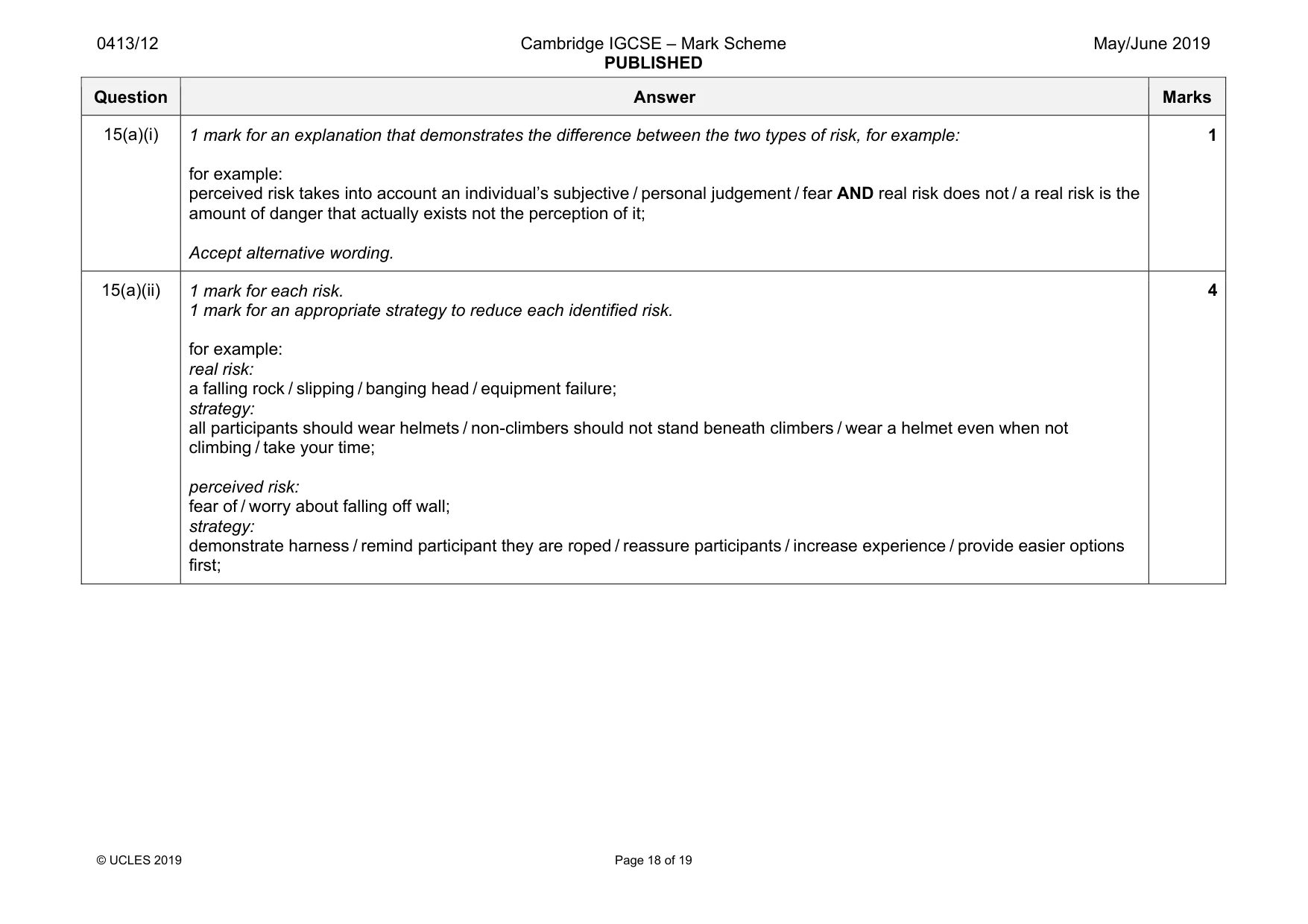
0413/12 Cambridge IGCSE – Mark Scheme PUBLISHED May/June 2019 © UCLES 2019 Page 18 of 19 Question Answer Marks 15(a)(i) 1 mark for an explanation that demonstrates the difference between the two types of risk, for example: for example: perceived risk takes into account an individual’s subjective / personal judgement / fear AND real risk does not / a real risk is the amount of danger that actually exists not the perception of it; Accept alternative wording. 1 15(a)(ii) 1 mark for each risk. 1 mark for an appropriate strategy to reduce each identified risk. for example: real risk: a falling rock / slipping / banging head / equipment failure; strategy: all participants should wear helmets / non-climbers should not stand beneath climbers / wear a helmet even when not climbing / take your time; perceived risk: fear of / worry about falling off wall; strategy: demonstrate harness / remind participant they are roped / reassure participants / increase experience / provide easier options first; 4
Mark scheme, page 19
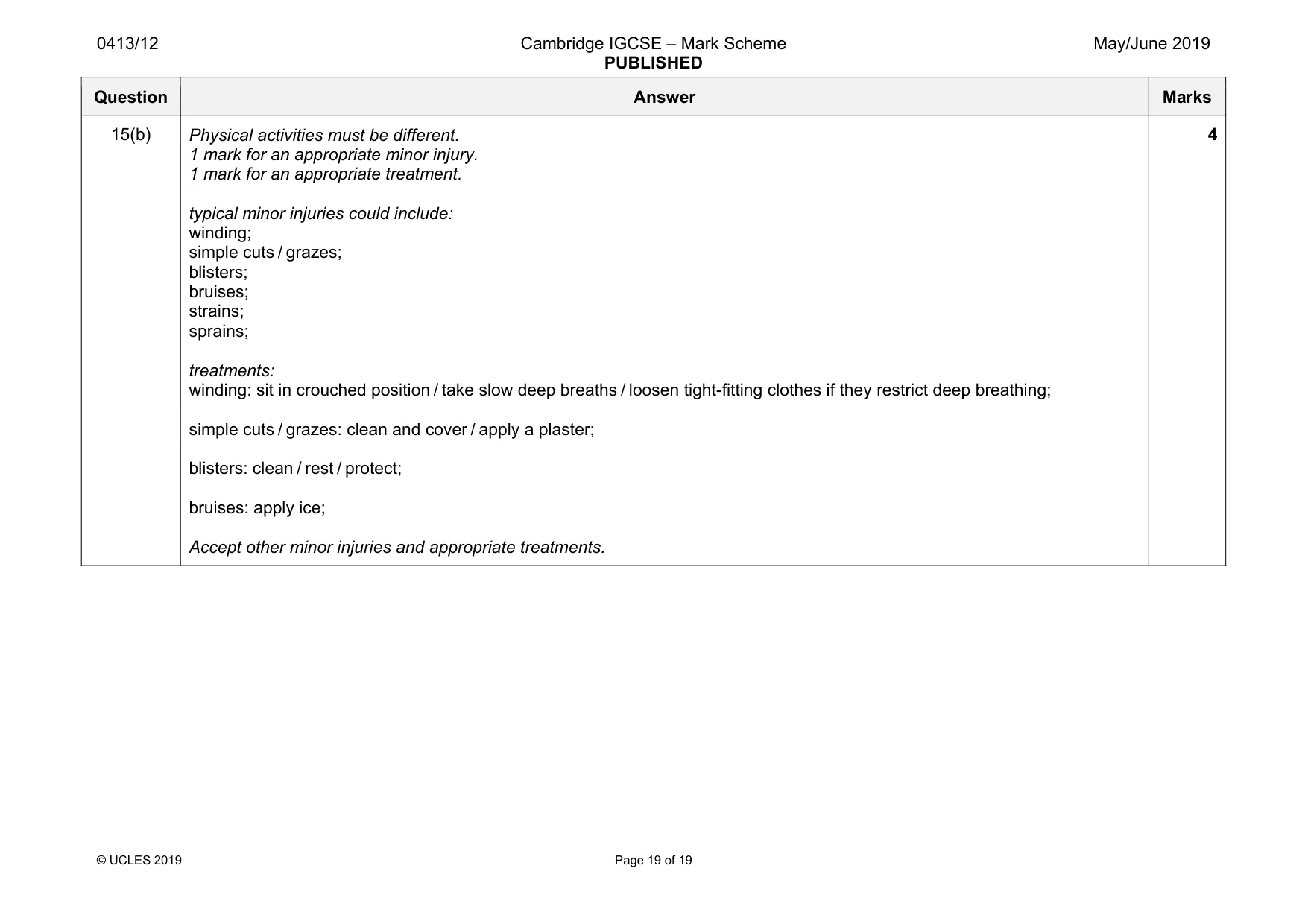
0413/12 Cambridge IGCSE – Mark Scheme PUBLISHED May/June 2019 © UCLES 2019 Page 19 of 19 Question Answer Marks 15(b) Physical activities must be different. 1 mark for an appropriate minor injury. 1 mark for an appropriate treatment. typical minor injuries could include: winding; simple cuts / grazes; blisters; bruises; strains; sprains; treatments: winding: sit in crouched position / take slow deep breaths / loosen tight-fitting clothes if they restrict deep breathing; simple cuts / grazes: clean and cover / apply a plaster; blisters: clean / rest / protect; bruises: apply ice; Accept other minor injuries and appropriate treatments. 4
What you needed in this session
Cambridge’s own grade thresholds for 2019 May/June, Paper 1 · Variant 2. A higher threshold means an easier paper — the bar moves with how the cohort did.