Cambridge IGCSE Physical Education 0413 — 2019 May/June Paper 1 · Variant 1
0413/11/M/J/19 · 100 marks · ≈113 min
The question paper and its mark scheme, free to read here and free to download. This is Cambridge’s own paper, exactly as it was sat.
Question paper16 pages
Mark scheme22 pages
Answers below. Sit the paper first if you are practising.
Paper as text
Question paper, page 1
This document consists of 16 printed pages. DC (KN/CB) 164479/3 © UCLES 2019 [Turn over Cambridge Assessment International Education Cambridge International General Certificate of Secondary Education * 0 4 8 6 8 1 8 1 7 6 * PHYSICAL EDUCATION 0413/11 Paper 1 Theory May/June 2019 1 hour 45 minutes Candidates answer on the Question Paper. No Additional Materials are required. READ THESE INSTRUCTIONS FIRST Write your centre number, candidate number and name on all the work you hand in. Write in dark blue or black pen. You may use an HB pencil for any diagrams or graphs. Do not use staples, paper clips, glue or correction fluid. DO NOT WRITE IN ANY BARCODES. Answer all questions. Electronic calculators may be used. You may lose marks if you do not show your working or if you do not use appropriate units. The number of marks is given in brackets [ ] at the end of each question or part question. The total mark for this paper is 100.
Question paper, page 2
2 0413/11/M/J/19 © UCLES 2019 1 Name the two main muscle groups that enable movement at the knee when running. 1 … 2 … [2] 2 (a) Describe two characteristics of a performer who is in the associative stage of learning. 1 … … 2 … … [2] (b) Describe, using examples, how visual guidance benefits a performer at the cognitive stage of learning. … … … … … … [3] (c) Explain the importance of receiving feedback when learning a skill. … … … … … … [3] [Total: 8]
Question paper, page 3
3 0413/11/M/J/19 © UCLES 2019 [Turn over 3 (a) (i) Name the main muscle fibre type used by a sprinter. … [1] (ii) Describe the different characteristics of the main muscle fibre type used by a sprinter and the main muscle fibre type used by a long-distance runner. … … … … … … [3] (b) Name and describe the main type of respiration being used to release energy for a sprinter and a long-distance runner. sprinter … … … … long-distance runner … … … … [4] [Total: 8] 4 State two functions of the skeleton. 1 … 2 … [2]
Question paper, page 4
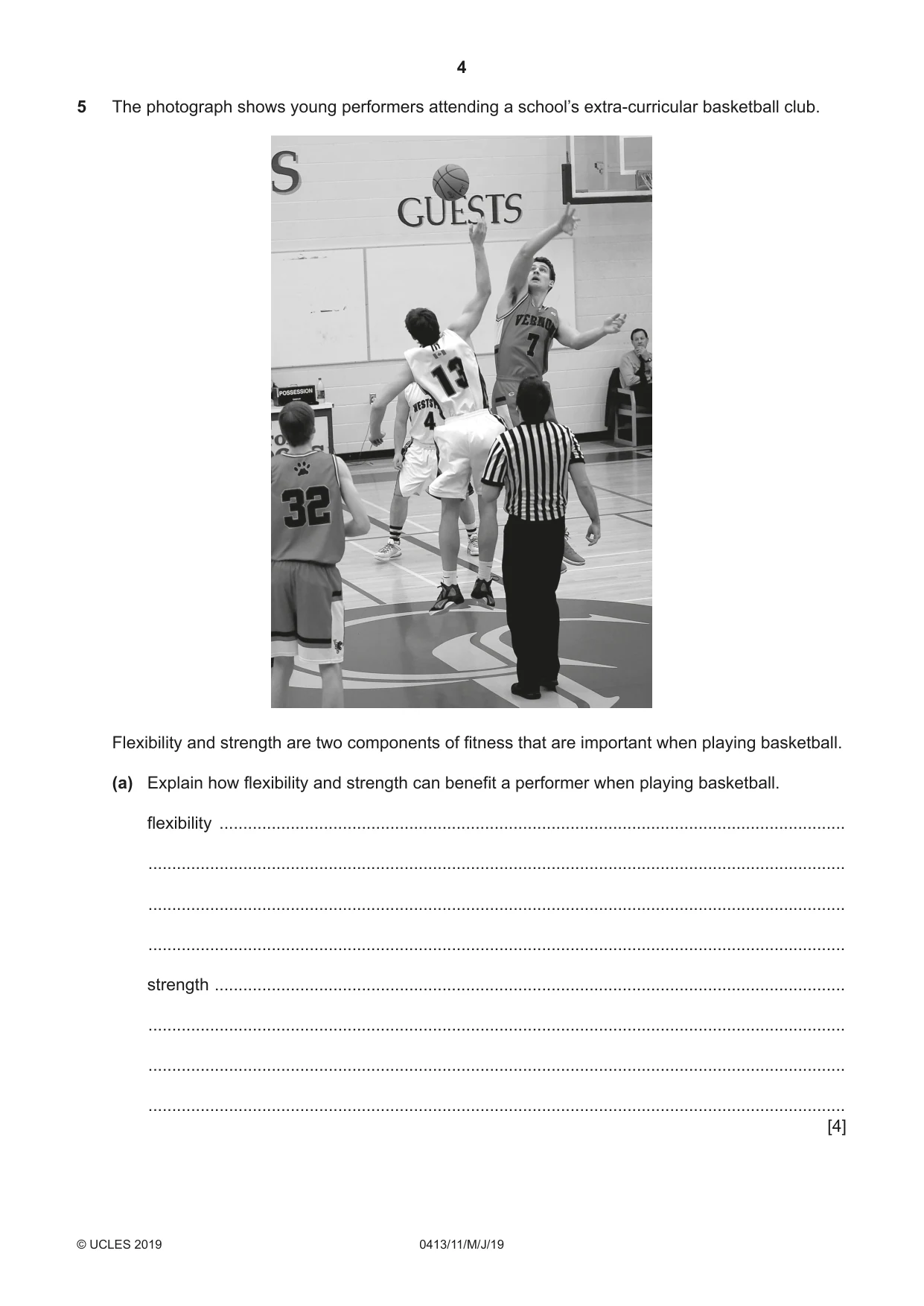
4 0413/11/M/J/19 © UCLES 2019 5 The photograph shows young performers attending a school’s extra-curricular basketball club. Flexibility and strength are two components of fitness that are important when playing basketball. (a) Explain how flexibility and strength can benefit a performer when playing basketball. flexibility … … … … strength … … … … [4]
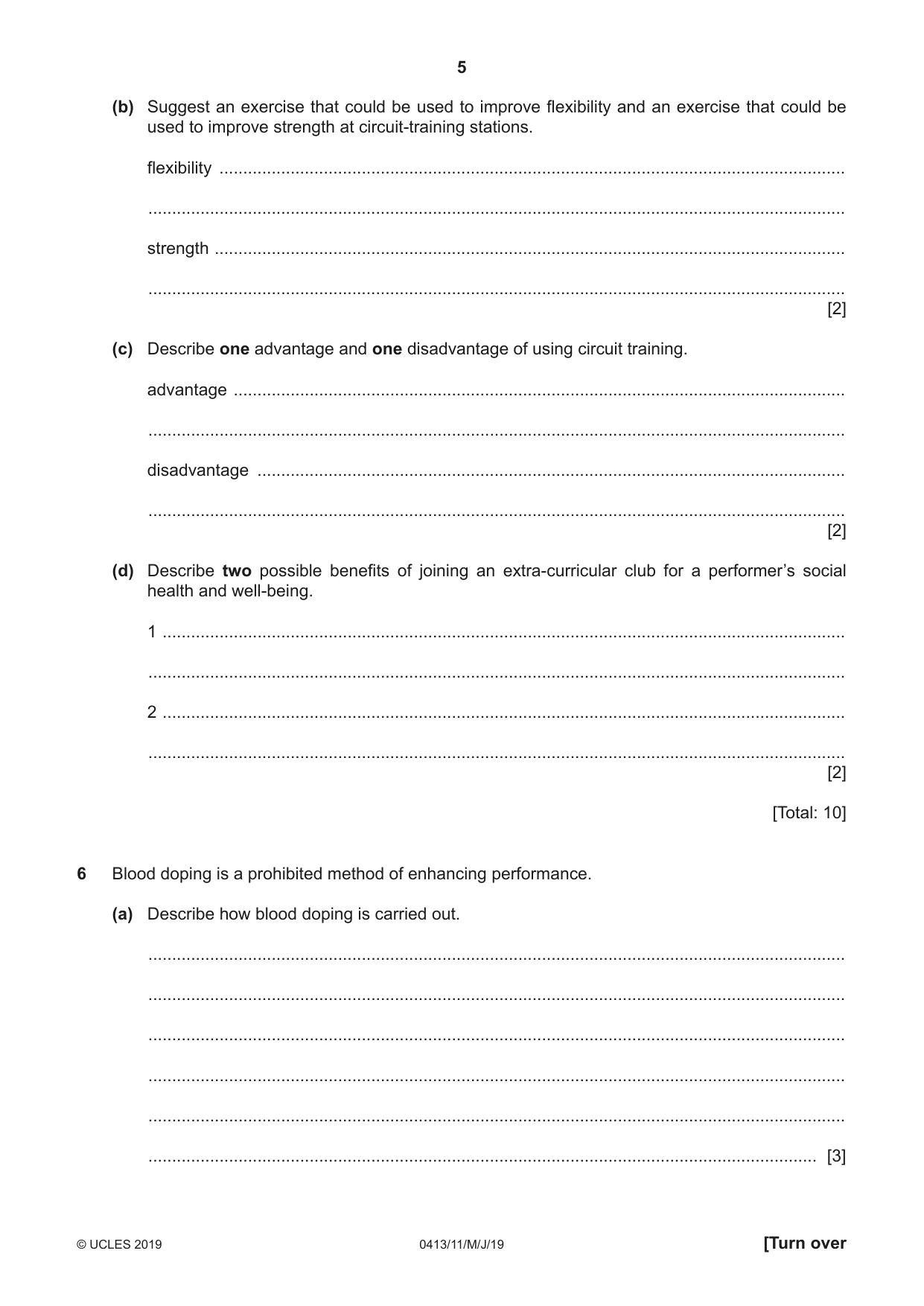
Question paper, page 5
5 0413/11/M/J/19 © UCLES 2019 [Turn over (b) Suggest an exercise that could be used to improve flexibility and an exercise that could be used to improve strength at circuit-training stations. flexibility … … strength … … [2] (c) Describe one advantage and one disadvantage of using circuit training. advantage … … disadvantage … … [2] (d) Describe two possible benefits of joining an extra-curricular club for a performer’s social health and well-being. 1 … … 2 … … [2] [Total: 10] 6 Blood doping is a prohibited method of enhancing performance. (a) Describe how blood doping is carried out. … … … … … … [3]
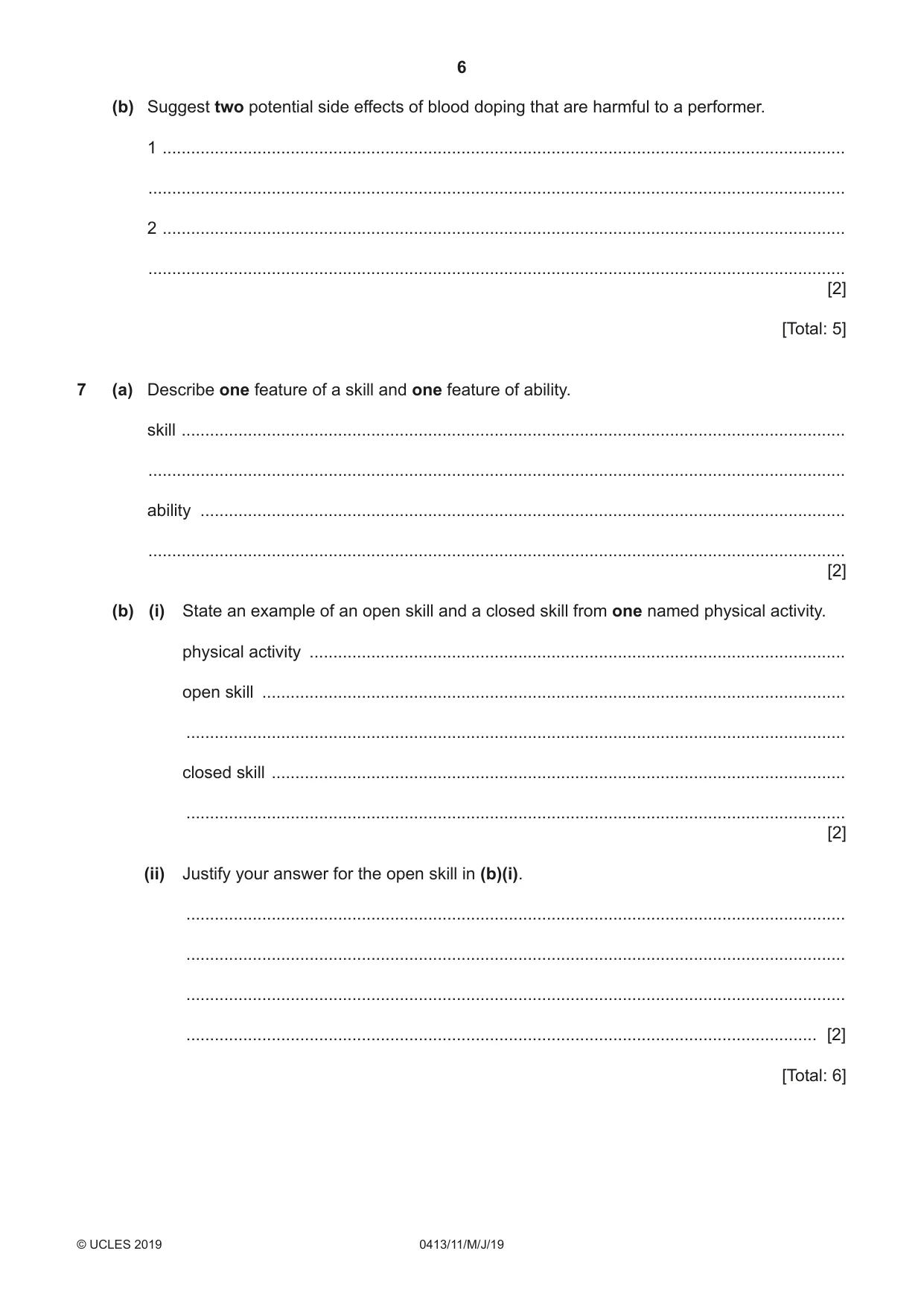
Question paper, page 6
6 0413/11/M/J/19 © UCLES 2019 (b) Suggest two potential side effects of blood doping that are harmful to a performer. 1 … … 2 … … [2] [Total: 5] 7 (a) Describe one feature of a skill and one feature of ability. skill … … ability … … [2] (b) (i) State an example of an open skill and a closed skill from one named physical activity. physical activity … open skill … … closed skill … … [2] (ii) Justify your answer for the open skill in (b)(i). … … … … [2] [Total: 6]
Question paper, page 7
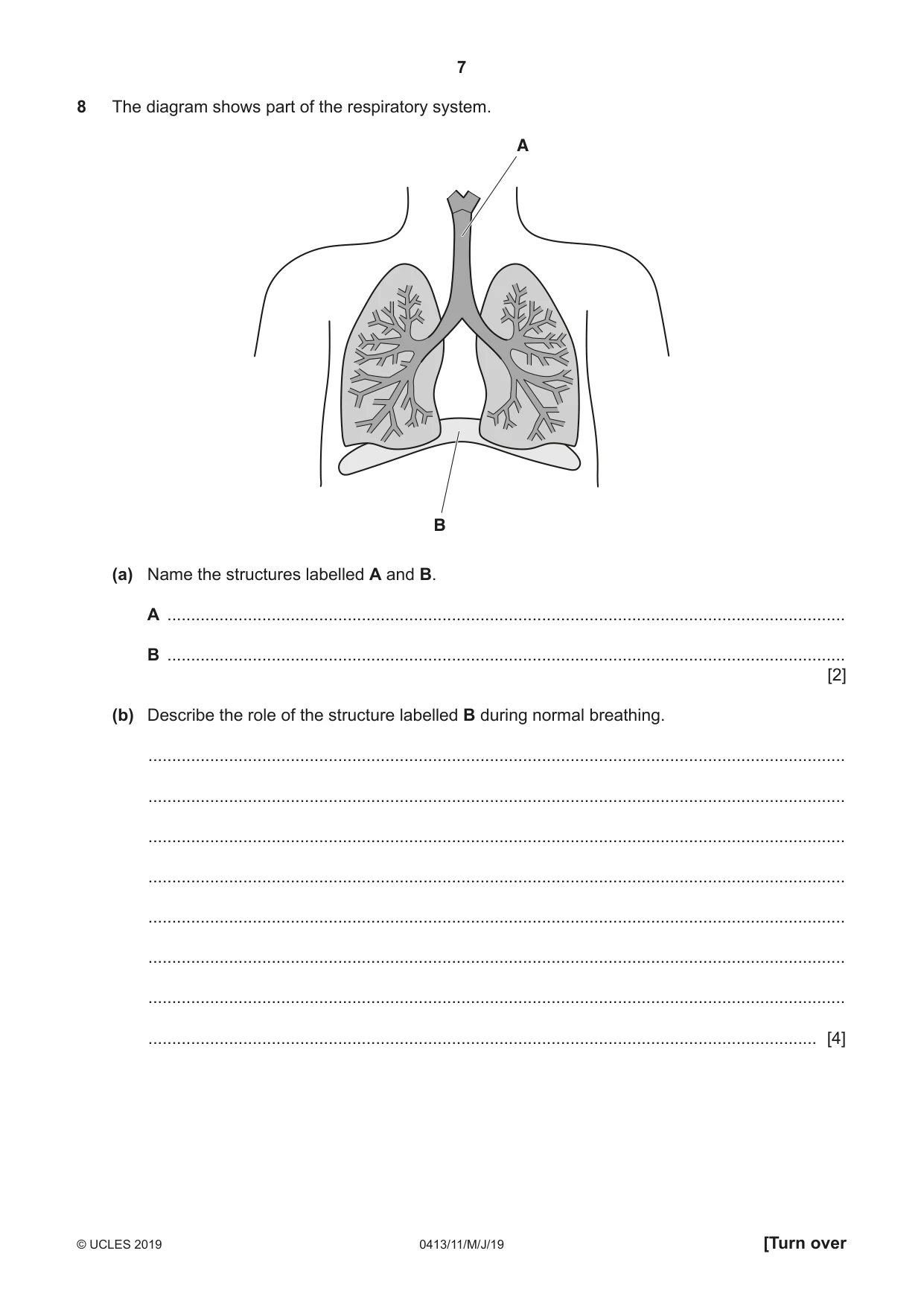
7 0413/11/M/J/19 © UCLES 2019 [Turn over 8 The diagram shows part of the respiratory system. A B (a) Name the structures labelled A and B. A … B … [2] (b) Describe the role of the structure labelled B during normal breathing. … … … … … … … … [4]
Question paper, page 8
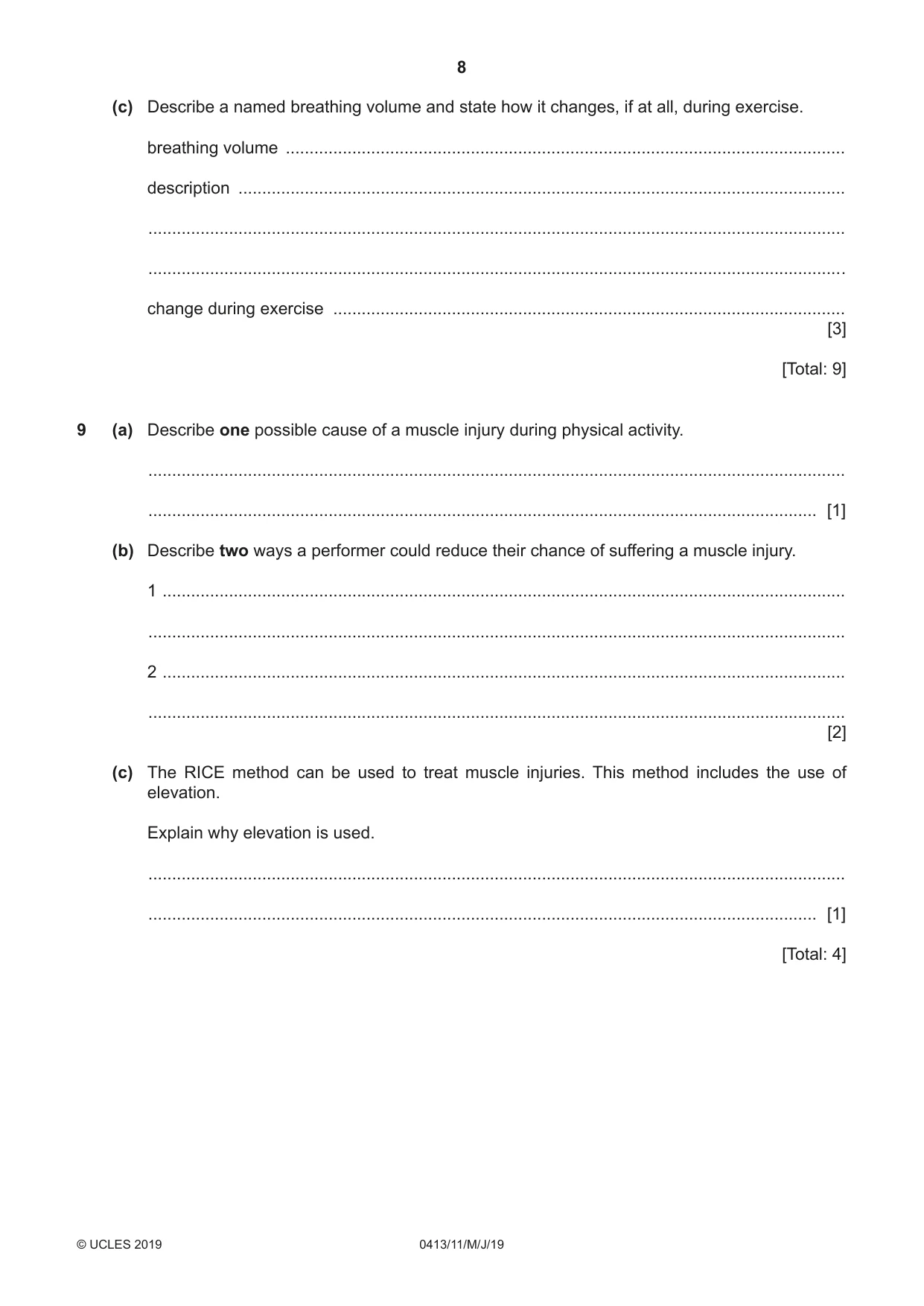
8 0413/11/M/J/19 © UCLES 2019 (c) Describe a named breathing volume and state how it changes, if at all, during exercise. breathing volume … description … … … change during exercise … [3] [Total: 9] 9 (a) Describe one possible cause of a muscle injury during physical activity. … … [1] (b) Describe two ways a performer could reduce their chance of suffering a muscle injury. 1 … … 2 … … [2] (c) The RICE method can be used to treat muscle injuries. This method includes the use of elevation. Explain why elevation is used. … … [1] [Total: 4]
Question paper, page 9
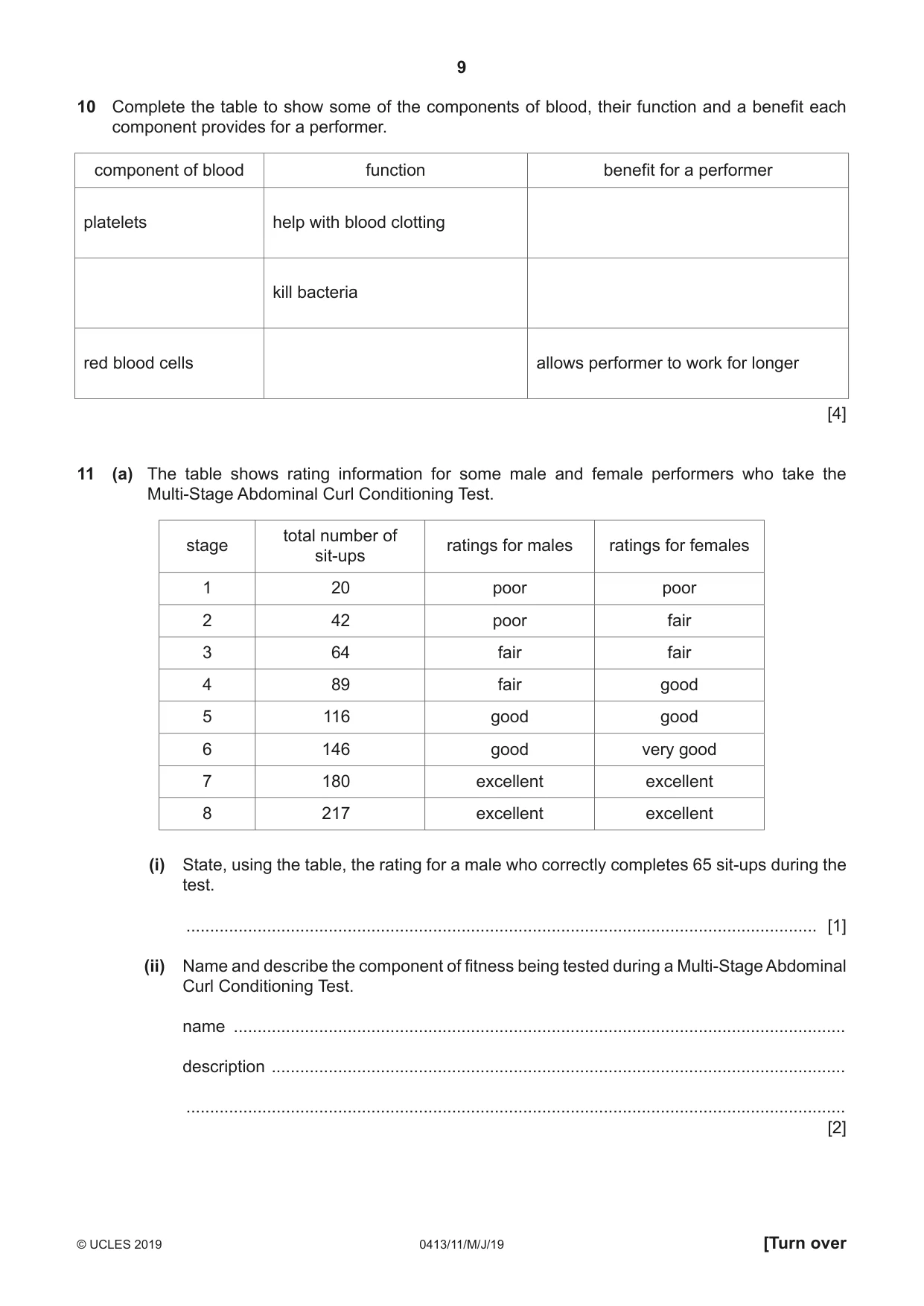
9 0413/11/M/J/19 © UCLES 2019 [Turn over 10 Complete the table to show some of the components of blood, their function and a benefit each component provides for a performer. component of blood function benefit for a performer platelets help with blood clotting kill bacteria red blood cells allows performer to work for longer [4] 11 (a) The table shows rating information for some male and female performers who take the Multi-Stage Abdominal Curl Conditioning Test. stage total number of sit-ups ratings for males ratings for females 1 20 poor poor 2 42 poor fair 3 64 fair fair 4 89 fair good 5 116 good good 6 146 good very good 7 180 excellent excellent 8 217 excellent excellent (i) State, using the table, the rating for a male who correctly completes 65 sit-ups during the test. … [1] (ii) Name and describe the component of fitness being tested during a Multi-Stage Abdominal Curl Conditioning Test. name … description … … [2]
Question paper, page 10
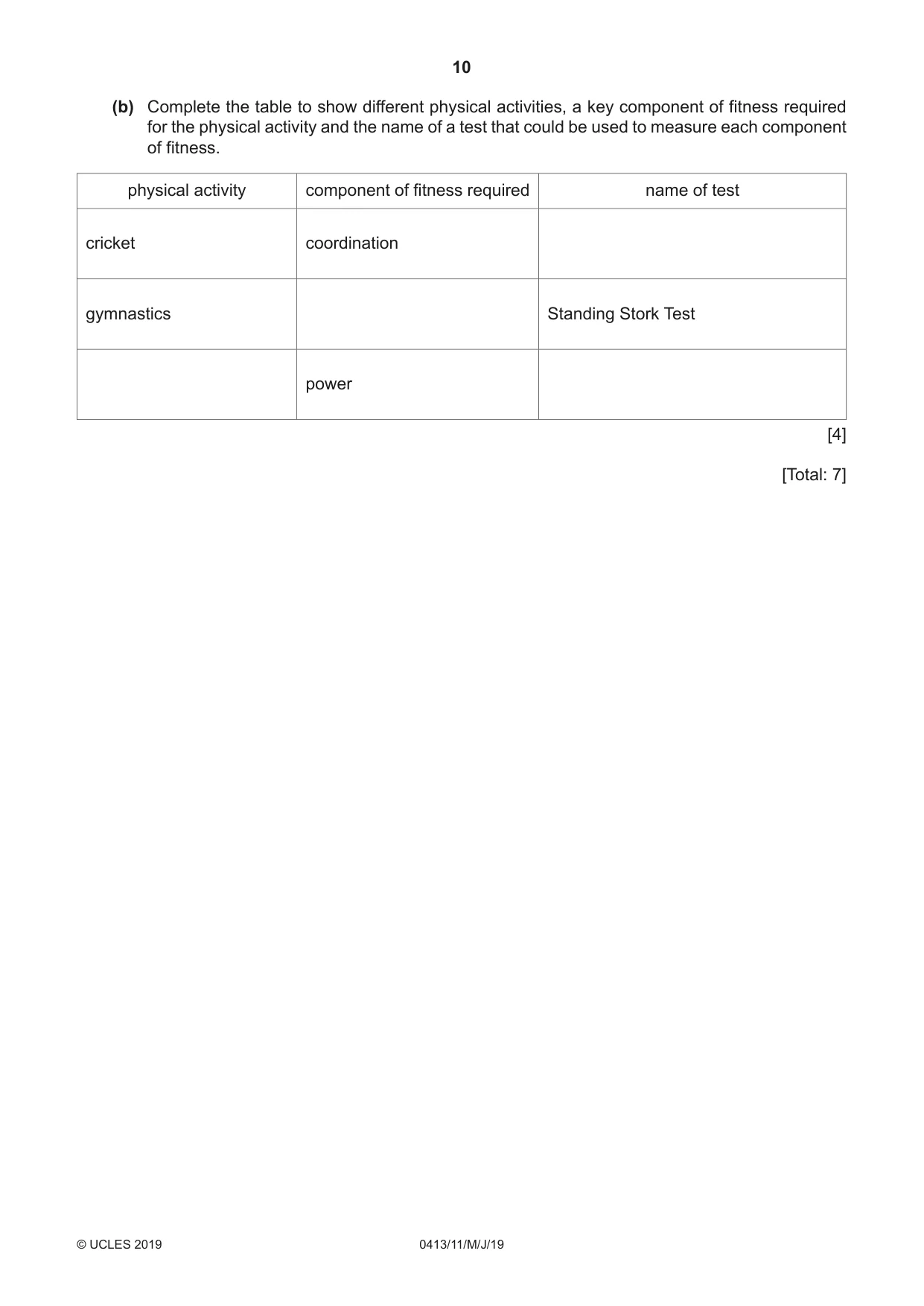
10 0413/11/M/J/19 © UCLES 2019 (b) Complete the table to show different physical activities, a key component of fitness required for the physical activity and the name of a test that could be used to measure each component of fitness. physical activity component of fitness required name of test cricket coordination gymnastics Standing Stork Test power [4] [Total: 7]
Question paper, page 11
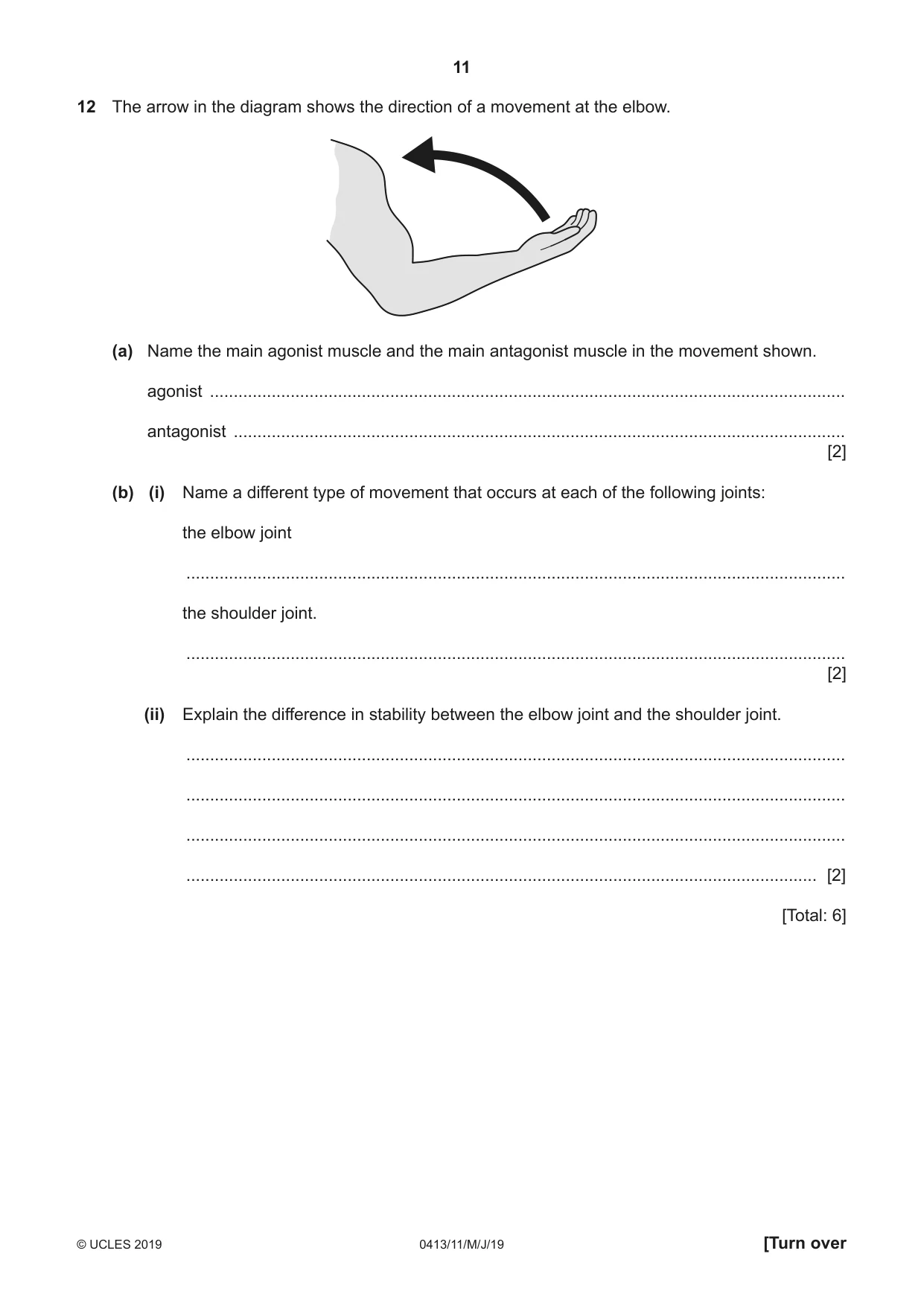
11 0413/11/M/J/19 © UCLES 2019 [Turn over 12 The arrow in the diagram shows the direction of a movement at the elbow. (a) Name the main agonist muscle and the main antagonist muscle in the movement shown. agonist … antagonist … [2] (b) (i) Name a different type of movement that occurs at each of the following joints: the elbow joint … the shoulder joint. … [2] (ii) Explain the difference in stability between the elbow joint and the shoulder joint. … … … … [2] [Total: 6]
Question paper, page 12
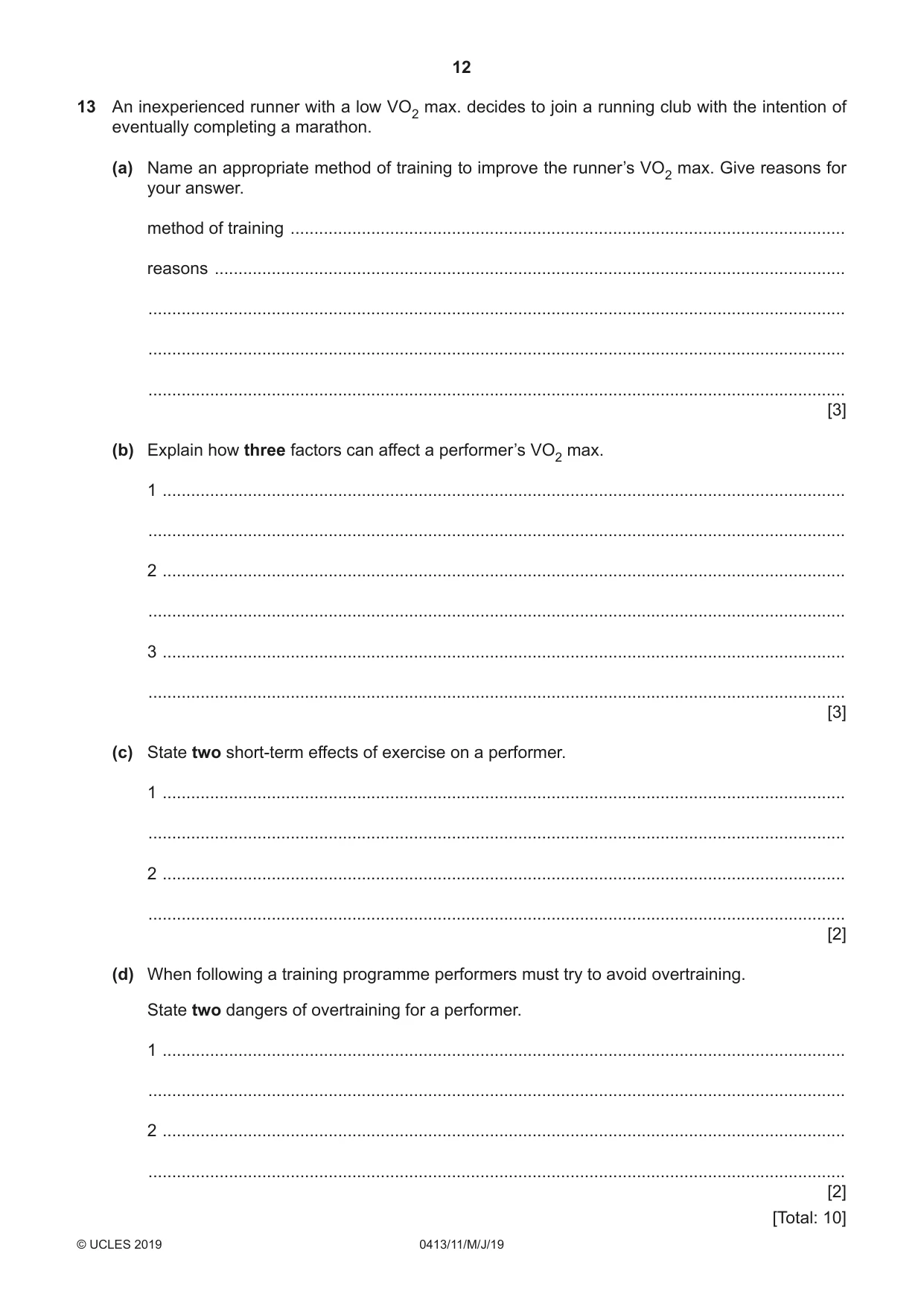
12 0413/11/M/J/19 © UCLES 2019 13 An inexperienced runner with a low VO2 max. decides to join a running club with the intention of eventually completing a marathon. (a) Name an appropriate method of training to improve the runner’s VO2 max. Give reasons for your answer. method of training … reasons … … … … [3] (b) Explain how three factors can affect a performer’s VO2 max. 1 … … 2 … … 3 … … [3] (c) State two short-term effects of exercise on a performer. 1 … … 2 … … [2] (d) When following a training programme performers must try to avoid overtraining. State two dangers of overtraining for a performer. 1 … … 2 … … [2] [Total: 10]
Question paper, page 13
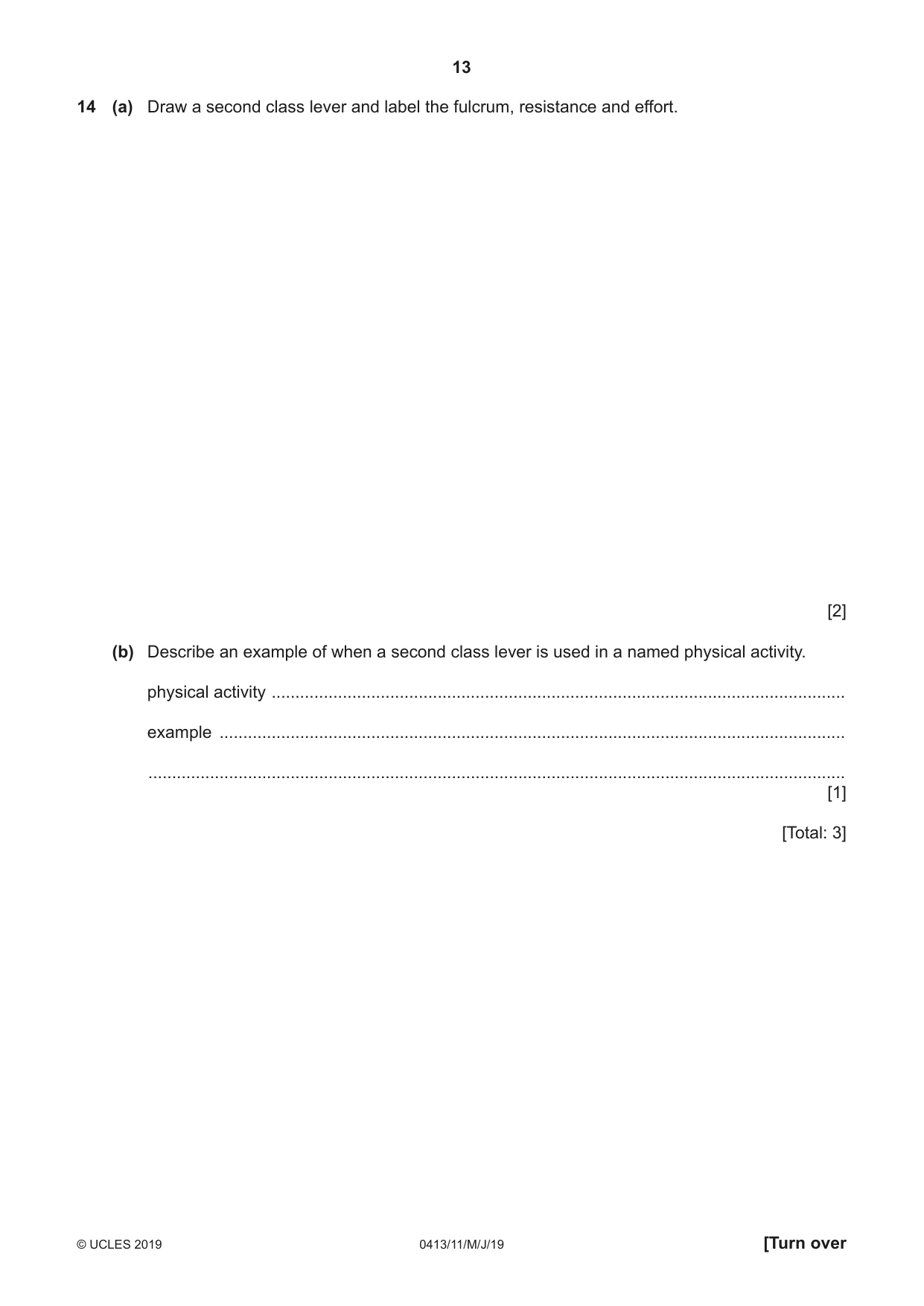
13 0413/11/M/J/19 © UCLES 2019 [Turn over 14 (a) Draw a second class lever and label the fulcrum, resistance and effort. [2] (b) Describe an example of when a second class lever is used in a named physical activity. physical activity … example … … [1] [Total: 3]
Question paper, page 14
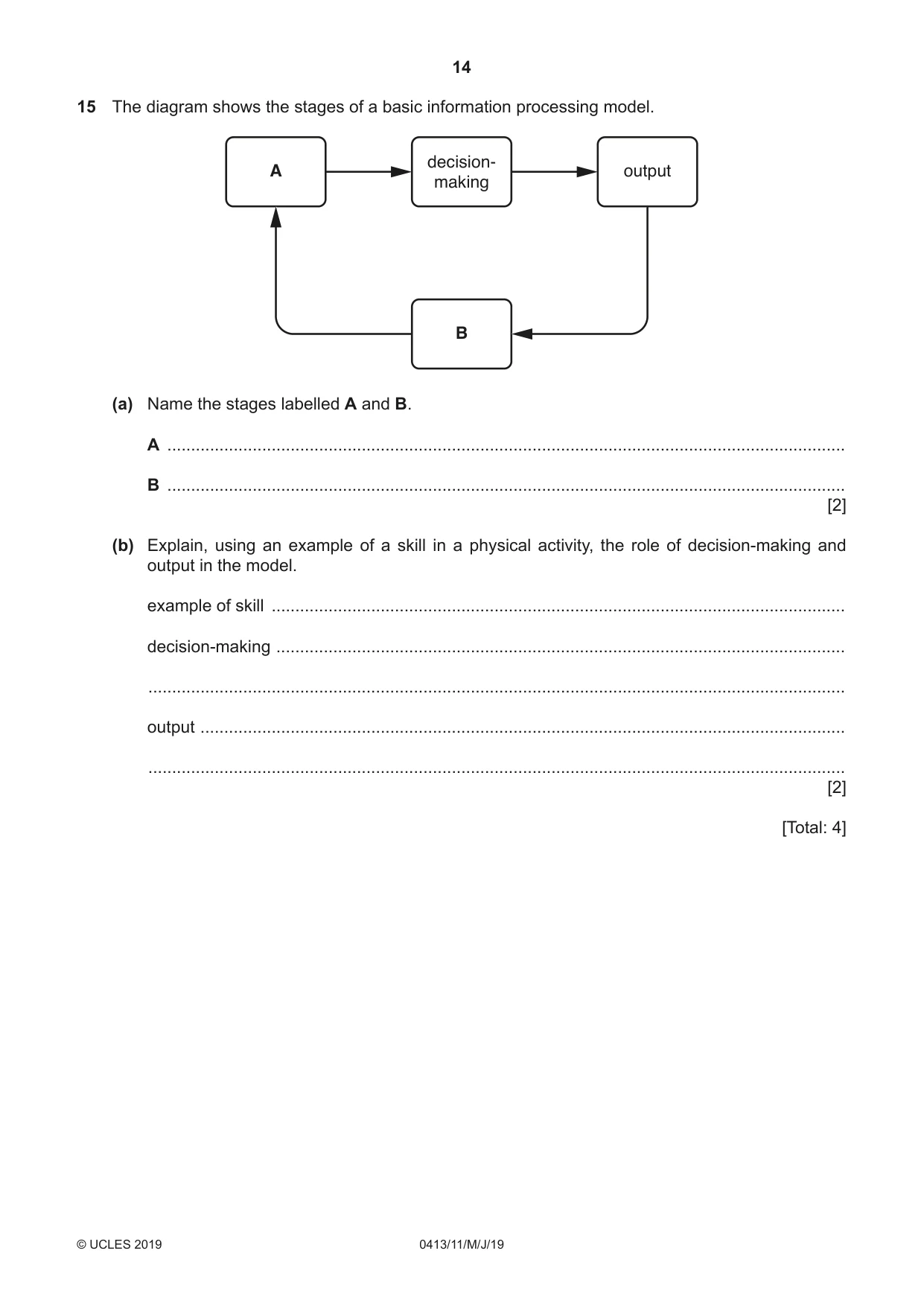
14 0413/11/M/J/19 © UCLES 2019 15 The diagram shows the stages of a basic information processing model. A output decision- making B (a) Name the stages labelled A and B. A … B … [2] (b) Explain, using an example of a skill in a physical activity, the role of decision-making and output in the model. example of skill … decision-making … … output … … [2] [Total: 4]
Question paper, page 15
15 0413/11/M/J/19 © UCLES 2019 [Turn over 16 (a) Describe four factors that have contributed to growth in leisure activities. 1 … … 2 … … 3 … … 4 … … [4] (b) Explain how four factors affect a person’s ability to participate in physical activity as they get older. 1 … … … 2 … … … 3 … … … 4 … … … [4]
Question paper, page 16
16 0413/11/M/J/19 © UCLES 2019 Permission to reproduce items where third-party owned material protected by copyright is included has been sought and cleared where possible. Every reasonable effort has been made by the publisher (UCLES) to trace copyright holders, but if any items requiring clearance have unwittingly been included, the publisher will be pleased to make amends at the earliest possible opportunity. To avoid the issue of disclosure of answer-related information to candidates, all copyright acknowledgements are reproduced online in the Cambridge Assessment International Education Copyright Acknowledgements Booklet. This is produced for each series of examinations and is freely available to download at www.cambridgeinternational.org after the live examination series. Cambridge Assessment International Education is part of the Cambridge Assessment Group. Cambridge Assessment is the brand name of the University of Cambridge Local Examinations Syndicate (UCLES), which itself is a department of the University of Cambridge. (c) Suggest strategies to increase participation of people with a disability. … … … … … … … … [4] [Total: 12]
Mark scheme, page 1
This document consists of 22 printed pages. © UCLES 2019 [Turn over Cambridge Assessment International Education Cambridge International General Certificate of Secondary Education PHYSICAL EDUCATION 0413/11 Paper 1 Theory May/June 2019 MARK SCHEME Maximum Mark: 100 Published This mark scheme is published as an aid to teachers and candidates, to indicate the requirements of the examination. It shows the basis on which Examiners were instructed to award marks. It does not indicate the details of the discussions that took place at an Examiners’ meeting before marking began, which would have considered the acceptability of alternative answers. Mark schemes should be read in conjunction with the question paper and the Principal Examiner Report for Teachers. Cambridge International will not enter into discussions about these mark schemes. Cambridge International is publishing the mark schemes for the May/June 2019 series for most Cambridge IGCSE™, Cambridge International A and AS Level and Cambridge Pre-U components, and some Cambridge O Level components.
Mark scheme, page 2
0413/11 Cambridge IGCSE – Mark Scheme PUBLISHED May/June 2019 © UCLES 2019 Page 2 of 22 Generic Marking Principles These general marking principles must be applied by all examiners when marking candidate answers. They should be applied alongside the specific content of the mark scheme or generic level descriptors for a question. Each question paper and mark scheme will also comply with these marking principles. GENERIC MARKING PRINCIPLE 1: Marks must be awarded in line with: • the specific content of the mark scheme or the generic level descriptors for the question • the specific skills defined in the mark scheme or in the generic level descriptors for the question • the standard of response required by a candidate as exemplified by the standardisation scripts. GENERIC MARKING PRINCIPLE 2: Marks awarded are always whole marks (not half marks, or other fractions). GENERIC MARKING PRINCIPLE 3: Marks must be awarded positively: • marks are awarded for correct/valid answers, as defined in the mark scheme. However, credit is given for valid answers which go beyond the scope of the syllabus and mark scheme, referring to your Team Leader as appropriate • marks are awarded when candidates clearly demonstrate what they know and can do • marks are not deducted for errors • marks are not deducted for omissions • answers should only be judged on the quality of spelling, punctuation and grammar when these features are specifically assessed by the question as indicated by the mark scheme. The meaning, however, should be unambiguous. GENERIC MARKING PRINCIPLE 4: Rules must be applied consistently e.g. in situations where candidates have not followed instructions or in the application of generic level descriptors.
Mark scheme, page 3
0413/11 Cambridge IGCSE – Mark Scheme PUBLISHED May/June 2019 © UCLES 2019 Page 3 of 22 GENERIC MARKING PRINCIPLE 5: Marks should be awarded using the full range of marks defined in the mark scheme for the question (however; the use of the full mark range may be limited according to the quality of the candidate responses seen). GENERIC MARKING PRINCIPLE 6: Marks awarded are based solely on the requirements as defined in the mark scheme. Marks should not be awarded with grade thresholds or grade descriptors in mind.
Mark scheme, page 4
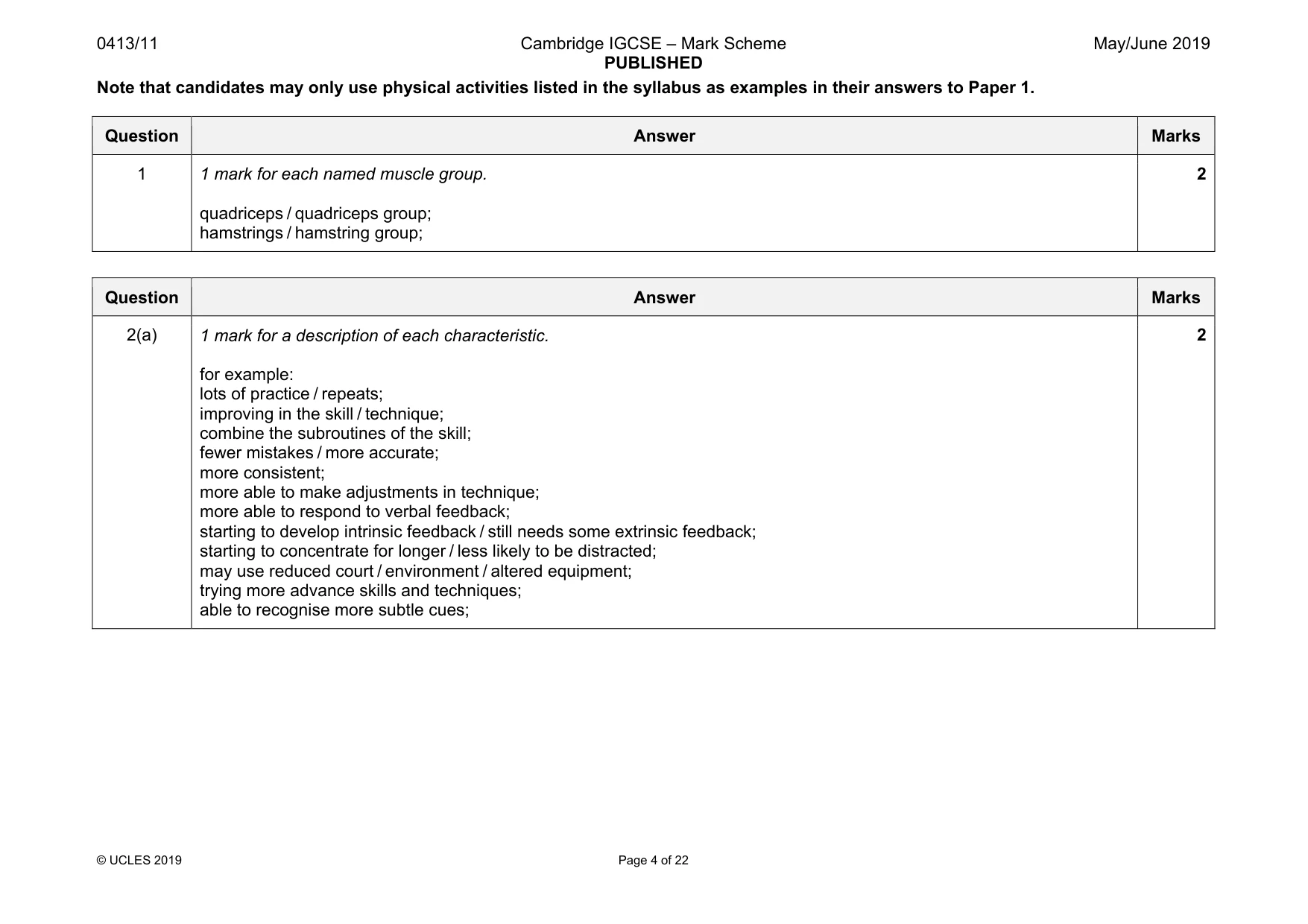
0413/11 Cambridge IGCSE – Mark Scheme PUBLISHED May/June 2019 © UCLES 2019 Page 4 of 22 Note that candidates may only use physical activities listed in the syllabus as examples in their answers to Paper 1. Question Answer Marks 1 1 mark for each named muscle group. quadriceps / quadriceps group; hamstrings / hamstring group; 2 Question Answer Marks 2(a) 1 mark for a description of each characteristic. for example: lots of practice / repeats; improving in the skill / technique; combine the subroutines of the skill; fewer mistakes / more accurate; more consistent; more able to make adjustments in technique; more able to respond to verbal feedback; starting to develop intrinsic feedback / still needs some extrinsic feedback; starting to concentrate for longer / less likely to be distracted; may use reduced court / environment / altered equipment; trying more advance skills and techniques; able to recognise more subtle cues; 2
Mark scheme, page 5
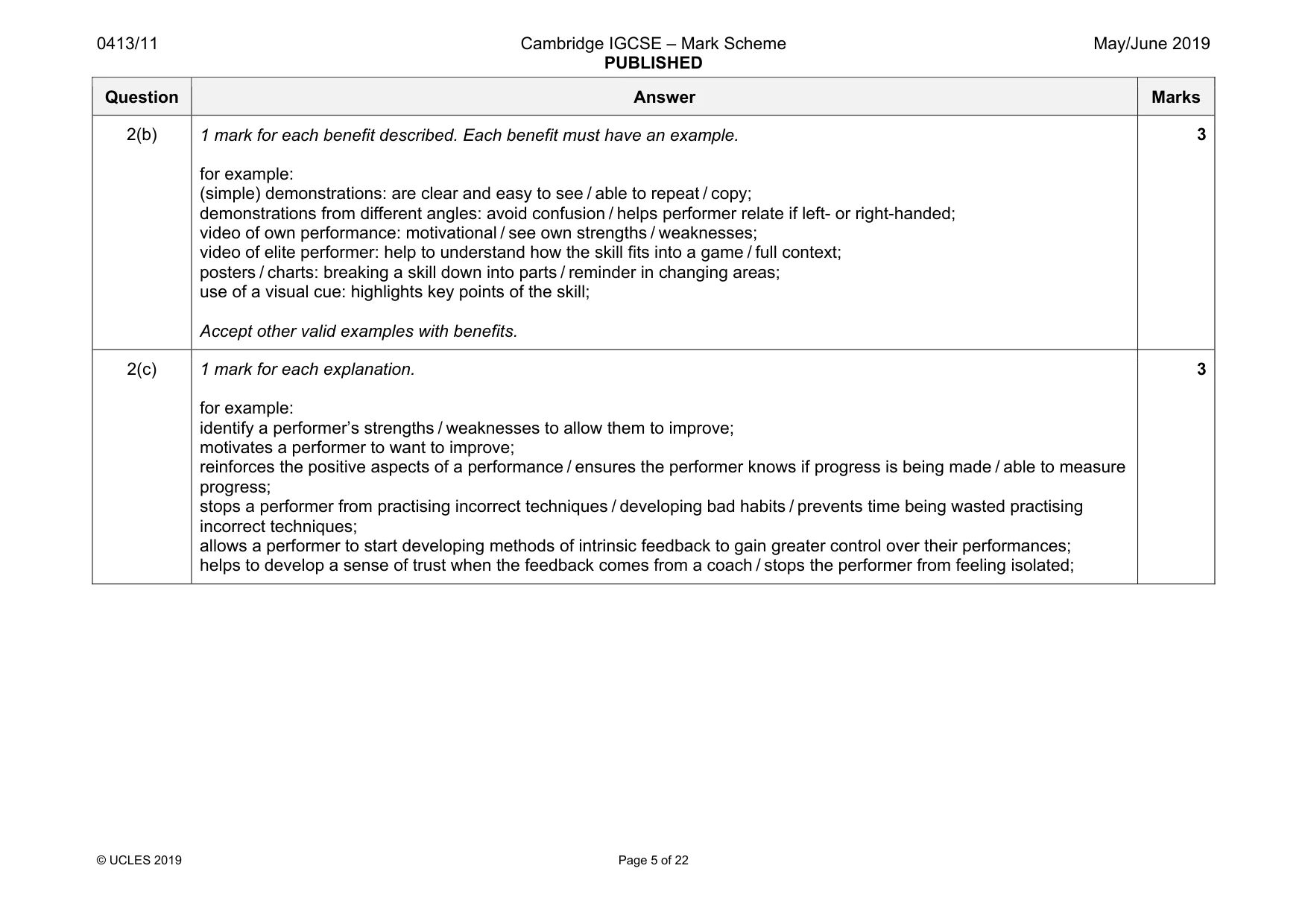
0413/11 Cambridge IGCSE – Mark Scheme PUBLISHED May/June 2019 © UCLES 2019 Page 5 of 22 Question Answer Marks 2(b) 1 mark for each benefit described. Each benefit must have an example. for example: (simple) demonstrations: are clear and easy to see / able to repeat / copy; demonstrations from different angles: avoid confusion / helps performer relate if left- or right-handed; video of own performance: motivational / see own strengths / weaknesses; video of elite performer: help to understand how the skill fits into a game / full context; posters / charts: breaking a skill down into parts / reminder in changing areas; use of a visual cue: highlights key points of the skill; Accept other valid examples with benefits. 3 2(c) 1 mark for each explanation. for example: identify a performer’s strengths / weaknesses to allow them to improve; motivates a performer to want to improve; reinforces the positive aspects of a performance / ensures the performer knows if progress is being made / able to measure progress; stops a performer from practising incorrect techniques / developing bad habits / prevents time being wasted practising incorrect techniques; allows a performer to start developing methods of intrinsic feedback to gain greater control over their performances; helps to develop a sense of trust when the feedback comes from a coach / stops the performer from feeling isolated; 3
Mark scheme, page 6
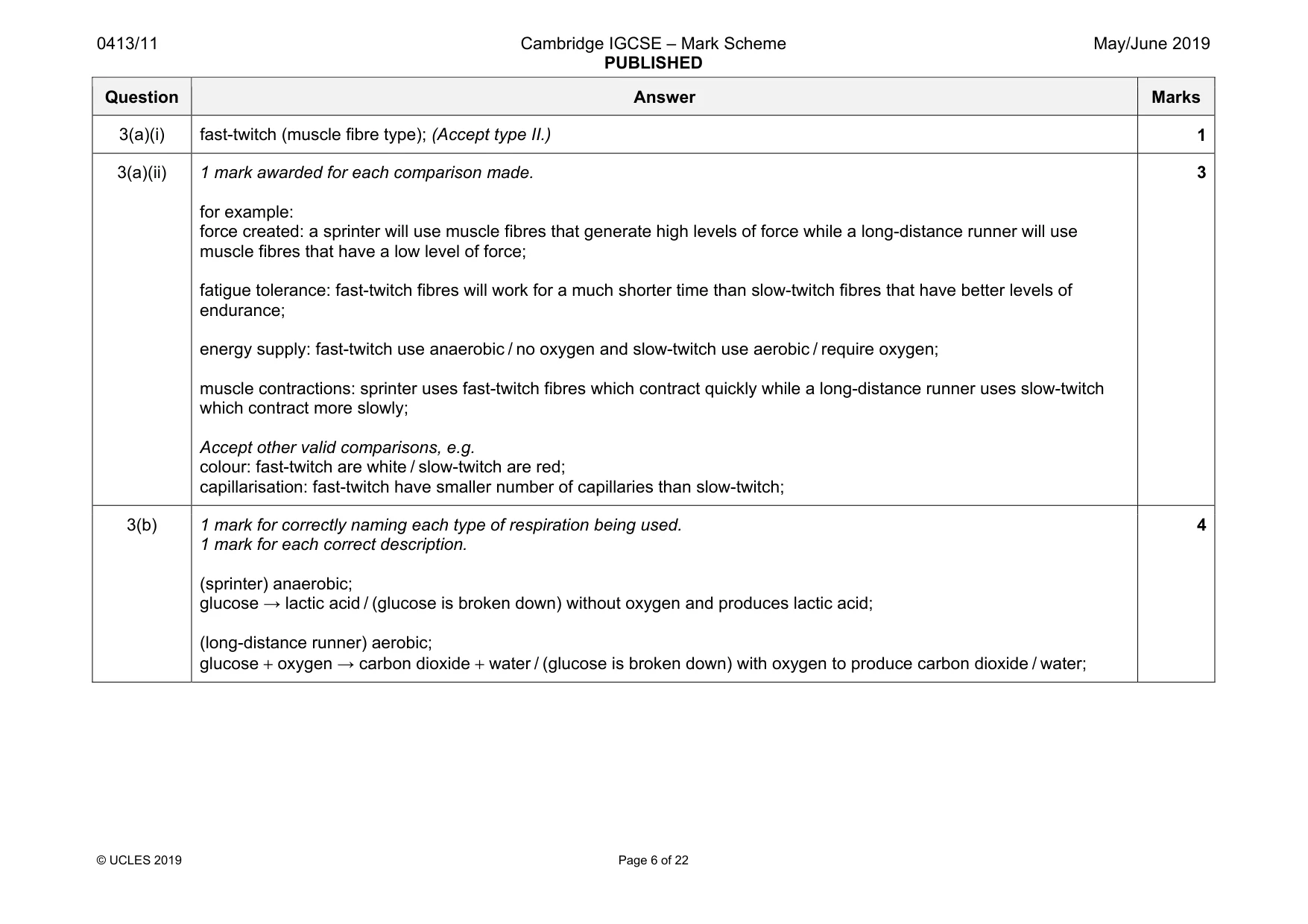
0413/11 Cambridge IGCSE – Mark Scheme PUBLISHED May/June 2019 © UCLES 2019 Page 6 of 22 Question Answer Marks 3(a)(i) fast-twitch (muscle fibre type); (Accept type II.) 1 3(a)(ii) 1 mark awarded for each comparison made. for example: force created: a sprinter will use muscle fibres that generate high levels of force while a long-distance runner will use muscle fibres that have a low level of force; fatigue tolerance: fast-twitch fibres will work for a much shorter time than slow-twitch fibres that have better levels of endurance; energy supply: fast-twitch use anaerobic / no oxygen and slow-twitch use aerobic / require oxygen; muscle contractions: sprinter uses fast-twitch fibres which contract quickly while a long-distance runner uses slow-twitch which contract more slowly; Accept other valid comparisons, e.g. colour: fast-twitch are white / slow-twitch are red; capillarisation: fast-twitch have smaller number of capillaries than slow-twitch; 3 3(b) 1 mark for correctly naming each type of respiration being used. 1 mark for each correct description. (sprinter) anaerobic; glucose → lactic acid / (glucose is broken down) without oxygen and produces lactic acid; (long-distance runner) aerobic; glucose + oxygen → carbon dioxide + water / (glucose is broken down) with oxygen to produce carbon dioxide / water; 4
Mark scheme, page 7
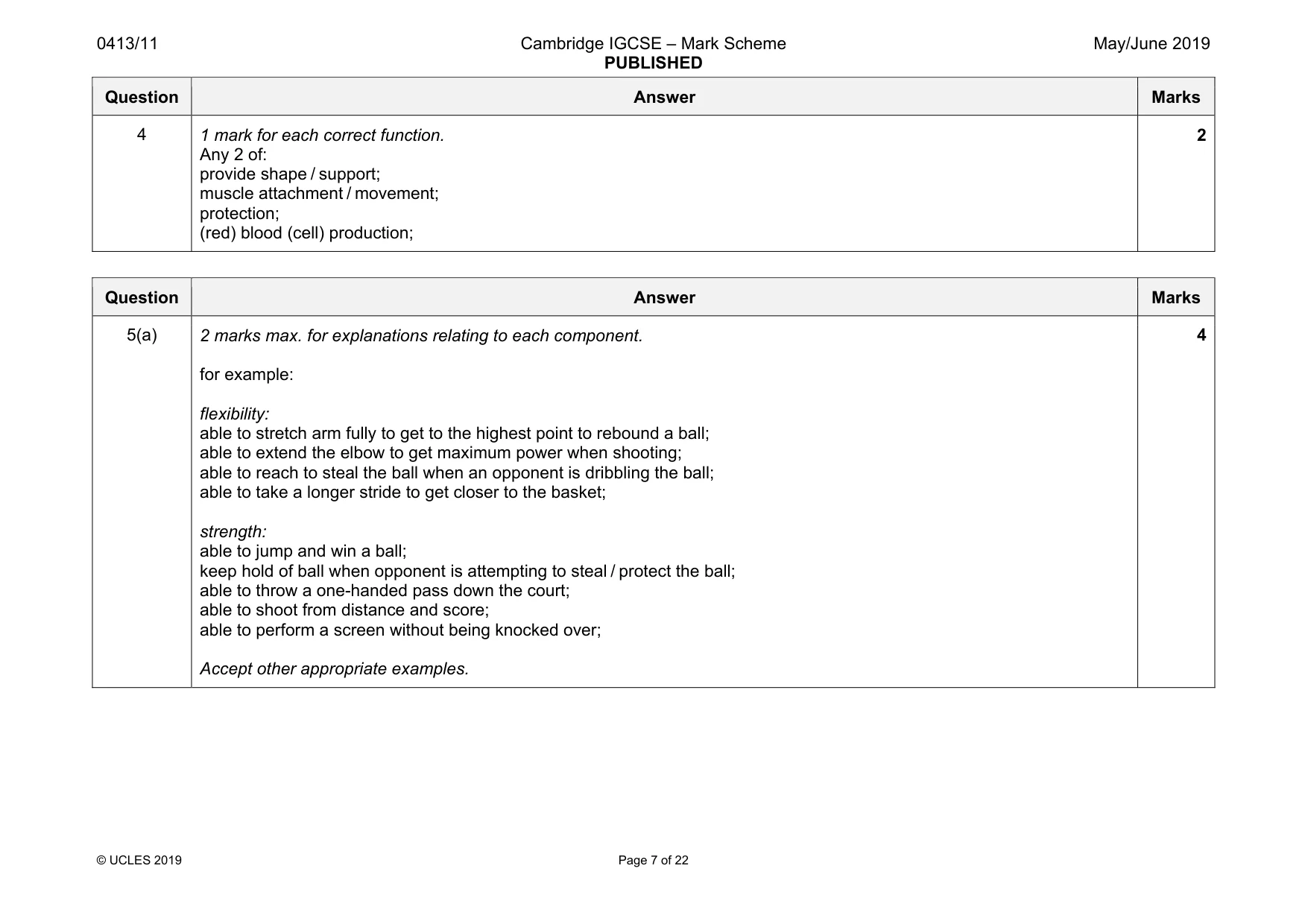
0413/11 Cambridge IGCSE – Mark Scheme PUBLISHED May/June 2019 © UCLES 2019 Page 7 of 22 Question Answer Marks 4 1 mark for each correct function. Any 2 of: provide shape / support; muscle attachment / movement; protection; (red) blood (cell) production; 2 Question Answer Marks 5(a) 2 marks max. for explanations relating to each component. for example: flexibility: able to stretch arm fully to get to the highest point to rebound a ball; able to extend the elbow to get maximum power when shooting; able to reach to steal the ball when an opponent is dribbling the ball; able to take a longer stride to get closer to the basket; strength: able to jump and win a ball; keep hold of ball when opponent is attempting to steal / protect the ball; able to throw a one-handed pass down the court; able to shoot from distance and score; able to perform a screen without being knocked over; Accept other appropriate examples. 4
Mark scheme, page 8
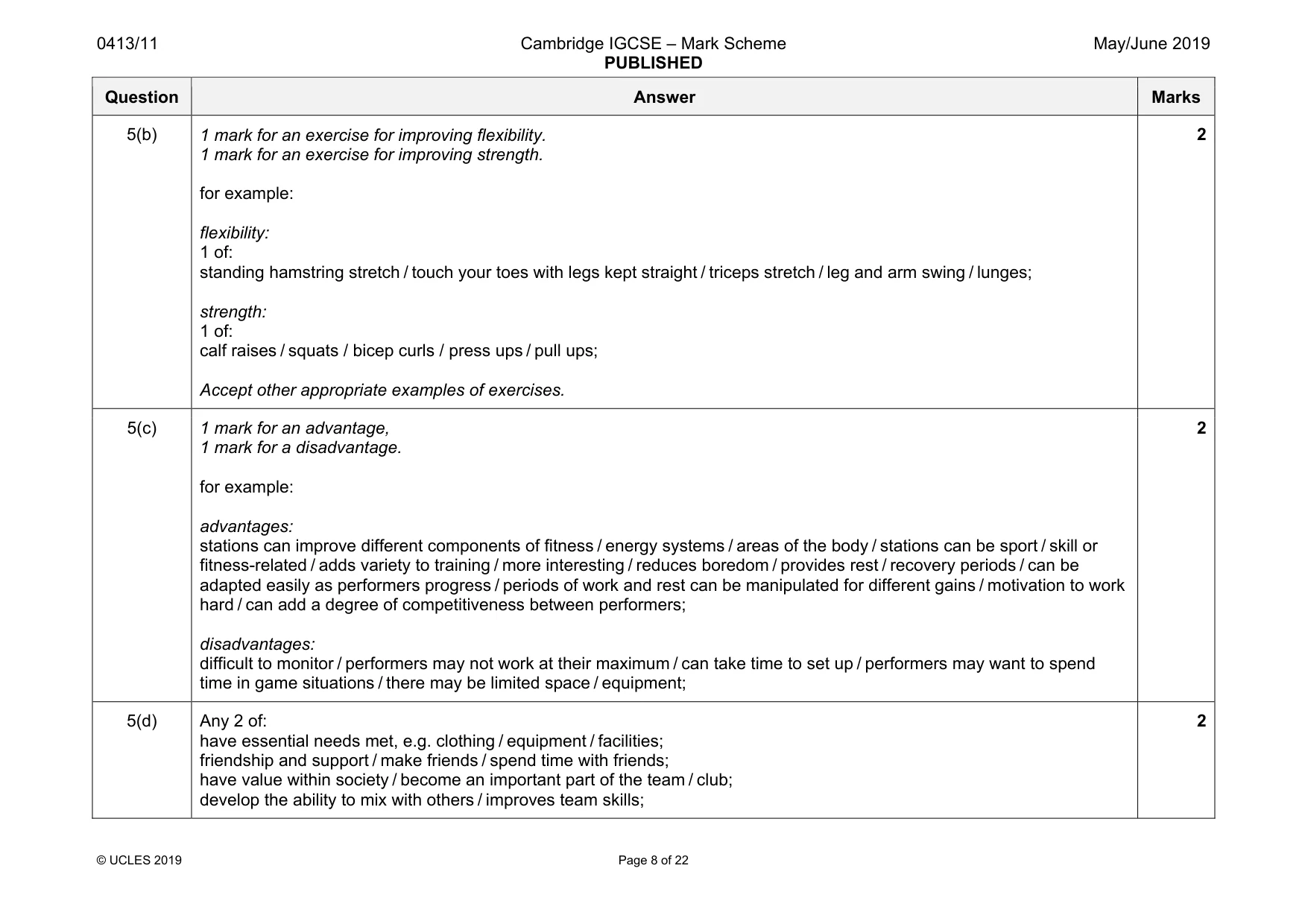
0413/11 Cambridge IGCSE – Mark Scheme PUBLISHED May/June 2019 © UCLES 2019 Page 8 of 22 Question Answer Marks 5(b) 1 mark for an exercise for improving flexibility. 1 mark for an exercise for improving strength. for example: flexibility: 1 of: standing hamstring stretch / touch your toes with legs kept straight / triceps stretch / leg and arm swing / lunges; strength: 1 of: calf raises / squats / bicep curls / press ups / pull ups; Accept other appropriate examples of exercises. 2 5(c) 1 mark for an advantage, 1 mark for a disadvantage. for example: advantages: stations can improve different components of fitness / energy systems / areas of the body / stations can be sport / skill or fitness-related / adds variety to training / more interesting / reduces boredom / provides rest / recovery periods / can be adapted easily as performers progress / periods of work and rest can be manipulated for different gains / motivation to work hard / can add a degree of competitiveness between performers; disadvantages: difficult to monitor / performers may not work at their maximum / can take time to set up / performers may want to spend time in game situations / there may be limited space / equipment; 2 5(d) Any 2 of: have essential needs met, e.g. clothing / equipment / facilities; friendship and support / make friends / spend time with friends; have value within society / become an important part of the team / club; develop the ability to mix with others / improves team skills; 2
Mark scheme, page 9
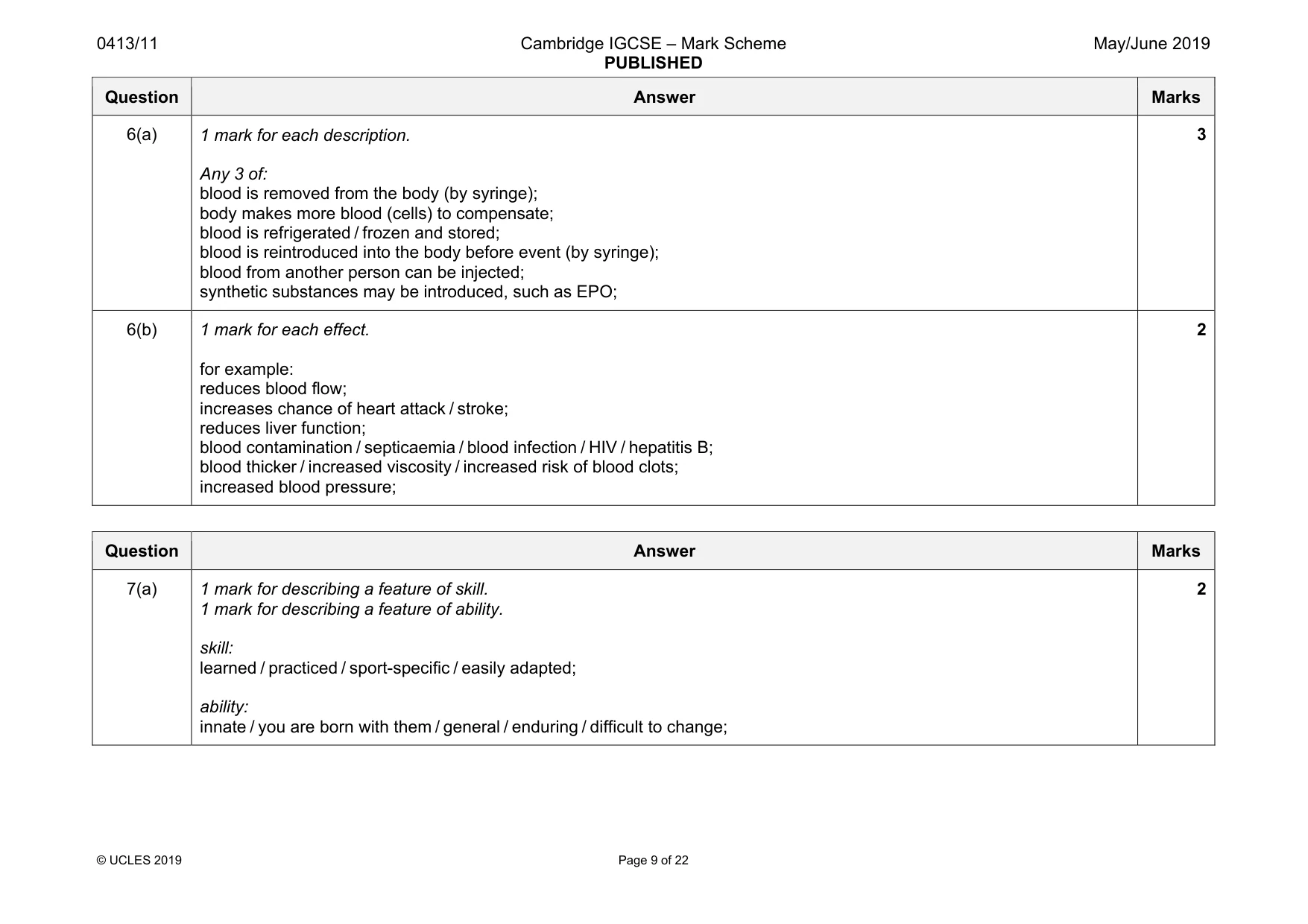
0413/11 Cambridge IGCSE – Mark Scheme PUBLISHED May/June 2019 © UCLES 2019 Page 9 of 22 Question Answer Marks 6(a) 1 mark for each description. Any 3 of: blood is removed from the body (by syringe); body makes more blood (cells) to compensate; blood is refrigerated / frozen and stored; blood is reintroduced into the body before event (by syringe); blood from another person can be injected; synthetic substances may be introduced, such as EPO; 3 6(b) 1 mark for each effect. for example: reduces blood flow; increases chance of heart attack / stroke; reduces liver function; blood contamination / septicaemia / blood infection / HIV / hepatitis B; blood thicker / increased viscosity / increased risk of blood clots; increased blood pressure; 2 Question Answer Marks 7(a) 1 mark for describing a feature of skill. 1 mark for describing a feature of ability. skill: learned / practiced / sport-specific / easily adapted; ability: innate / you are born with them / general / enduring / difficult to change; 2
Mark scheme, page 10
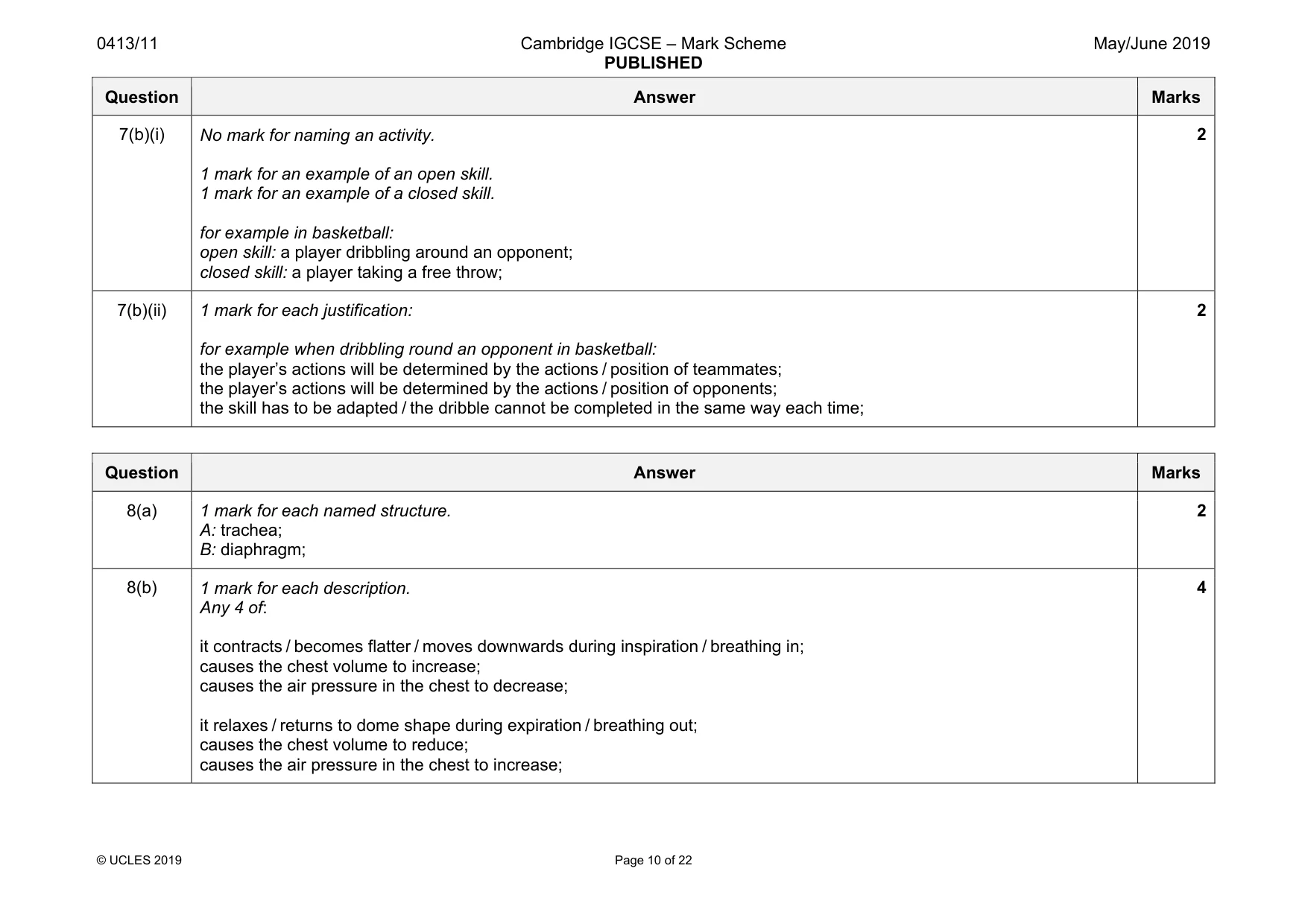
0413/11 Cambridge IGCSE – Mark Scheme PUBLISHED May/June 2019 © UCLES 2019 Page 10 of 22 Question Answer Marks 7(b)(i) No mark for naming an activity. 1 mark for an example of an open skill. 1 mark for an example of a closed skill. for example in basketball: open skill: a player dribbling around an opponent; closed skill: a player taking a free throw; 2 7(b)(ii) 1 mark for each justification: for example when dribbling round an opponent in basketball: the player’s actions will be determined by the actions / position of teammates; the player’s actions will be determined by the actions / position of opponents; the skill has to be adapted / the dribble cannot be completed in the same way each time; 2 Question Answer Marks 8(a) 1 mark for each named structure. A: trachea; B: diaphragm; 2 8(b) 1 mark for each description. Any 4 of: it contracts / becomes flatter / moves downwards during inspiration / breathing in; causes the chest volume to increase; causes the air pressure in the chest to decrease; it relaxes / returns to dome shape during expiration / breathing out; causes the chest volume to reduce; causes the air pressure in the chest to increase; 4
Mark scheme, page 11
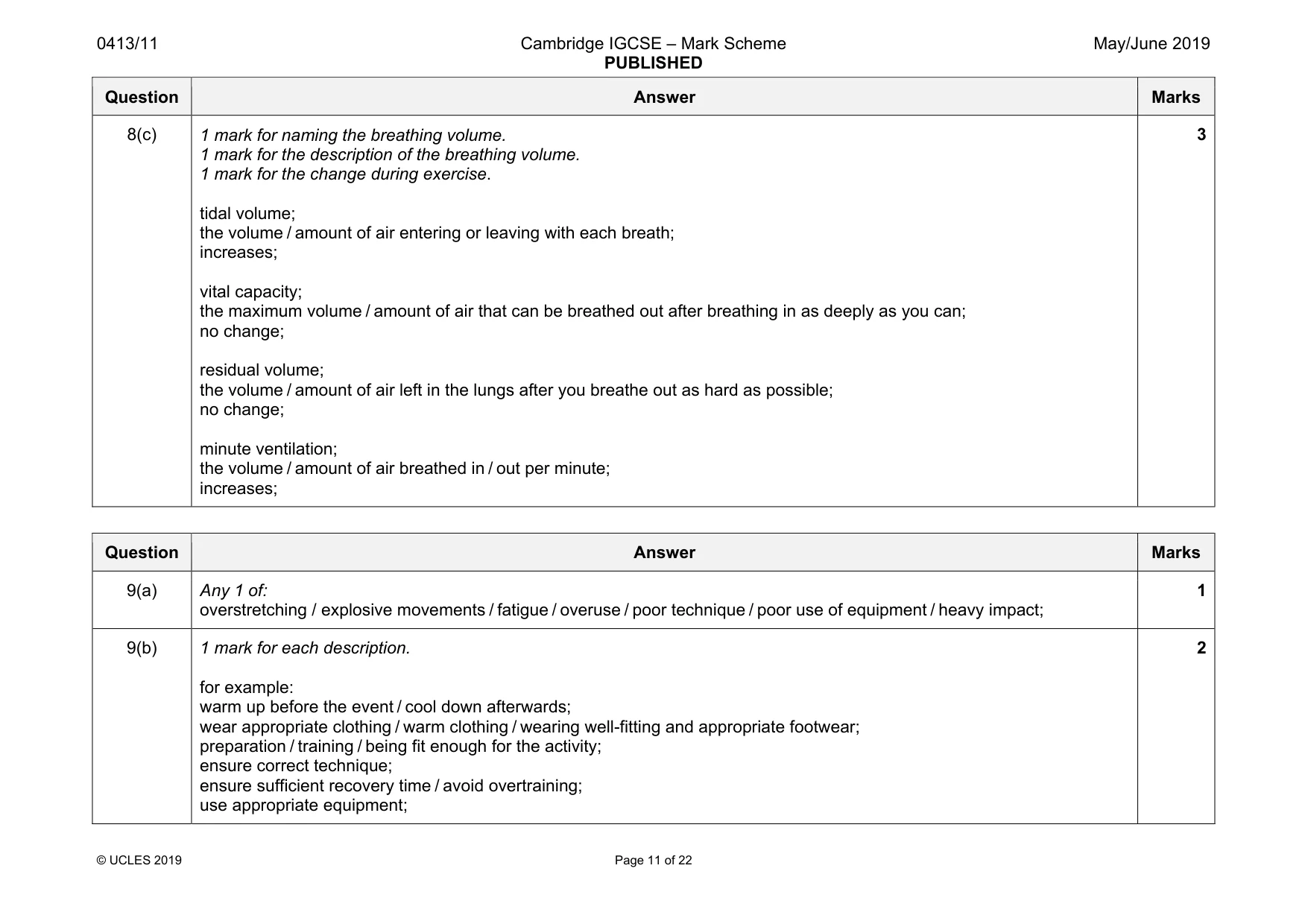
0413/11 Cambridge IGCSE – Mark Scheme PUBLISHED May/June 2019 © UCLES 2019 Page 11 of 22 Question Answer Marks 8(c) 1 mark for naming the breathing volume. 1 mark for the description of the breathing volume. 1 mark for the change during exercise. tidal volume; the volume / amount of air entering or leaving with each breath; increases; vital capacity; the maximum volume / amount of air that can be breathed out after breathing in as deeply as you can; no change; residual volume; the volume / amount of air left in the lungs after you breathe out as hard as possible; no change; minute ventilation; the volume / amount of air breathed in / out per minute; increases; 3 Question Answer Marks 9(a) Any 1 of: overstretching / explosive movements / fatigue / overuse / poor technique / poor use of equipment / heavy impact; 1 9(b) 1 mark for each description. for example: warm up before the event / cool down afterwards; wear appropriate clothing / warm clothing / wearing well-fitting and appropriate footwear; preparation / training / being fit enough for the activity; ensure correct technique; ensure sufficient recovery time / avoid overtraining; use appropriate equipment; 2
Mark scheme, page 12
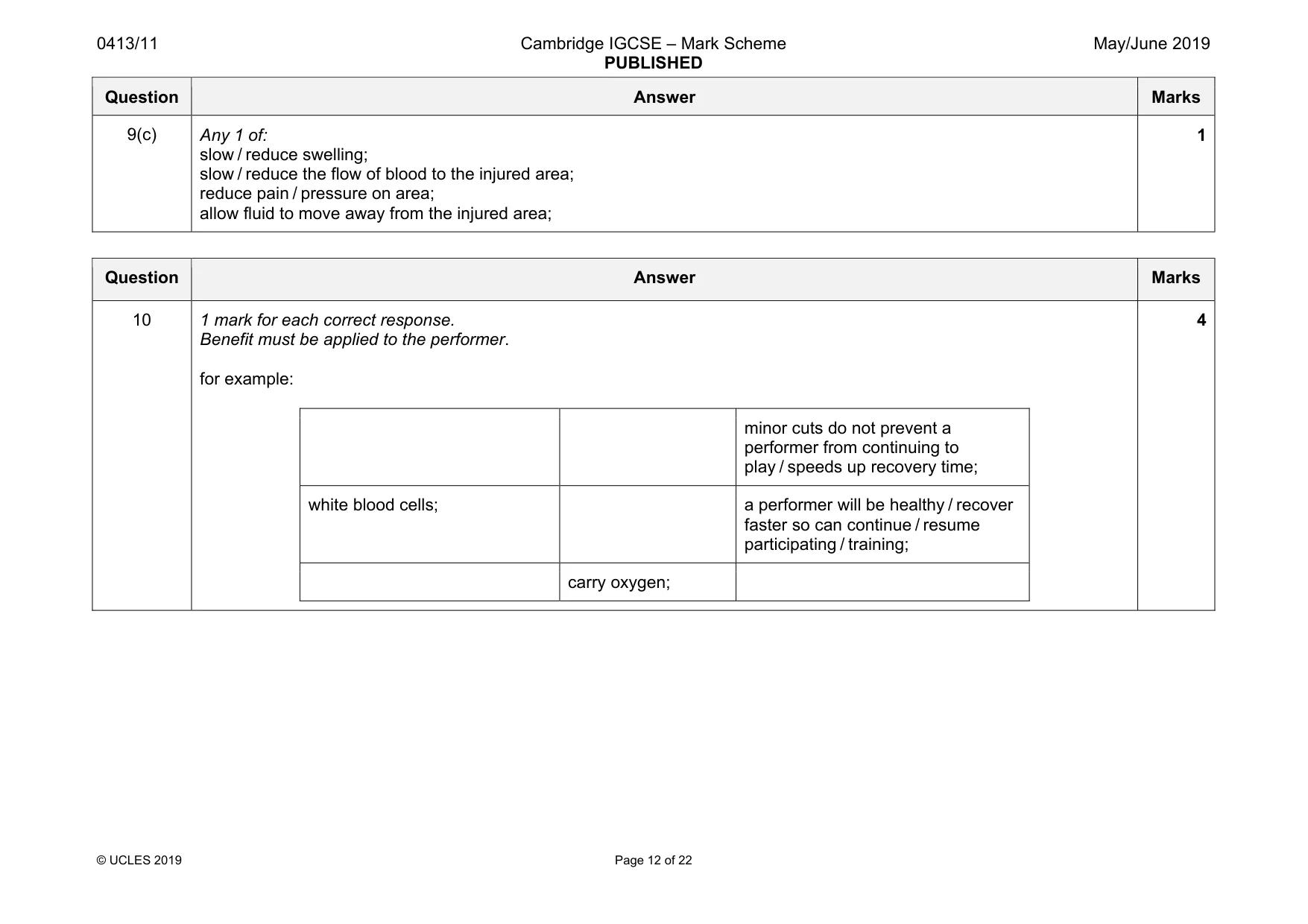
0413/11 Cambridge IGCSE – Mark Scheme PUBLISHED May/June 2019 © UCLES 2019 Page 12 of 22 Question Answer Marks 9(c) Any 1 of: slow / reduce swelling; slow / reduce the flow of blood to the injured area; reduce pain / pressure on area; allow fluid to move away from the injured area; 1 Question Answer Marks 10 1 mark for each correct response. Benefit must be applied to the performer. for example: minor cuts do not prevent a performer from continuing to play / speeds up recovery time; white blood cells; a performer will be healthy / recover faster so can continue / resume participating / training; carry oxygen; 4
Mark scheme, page 13
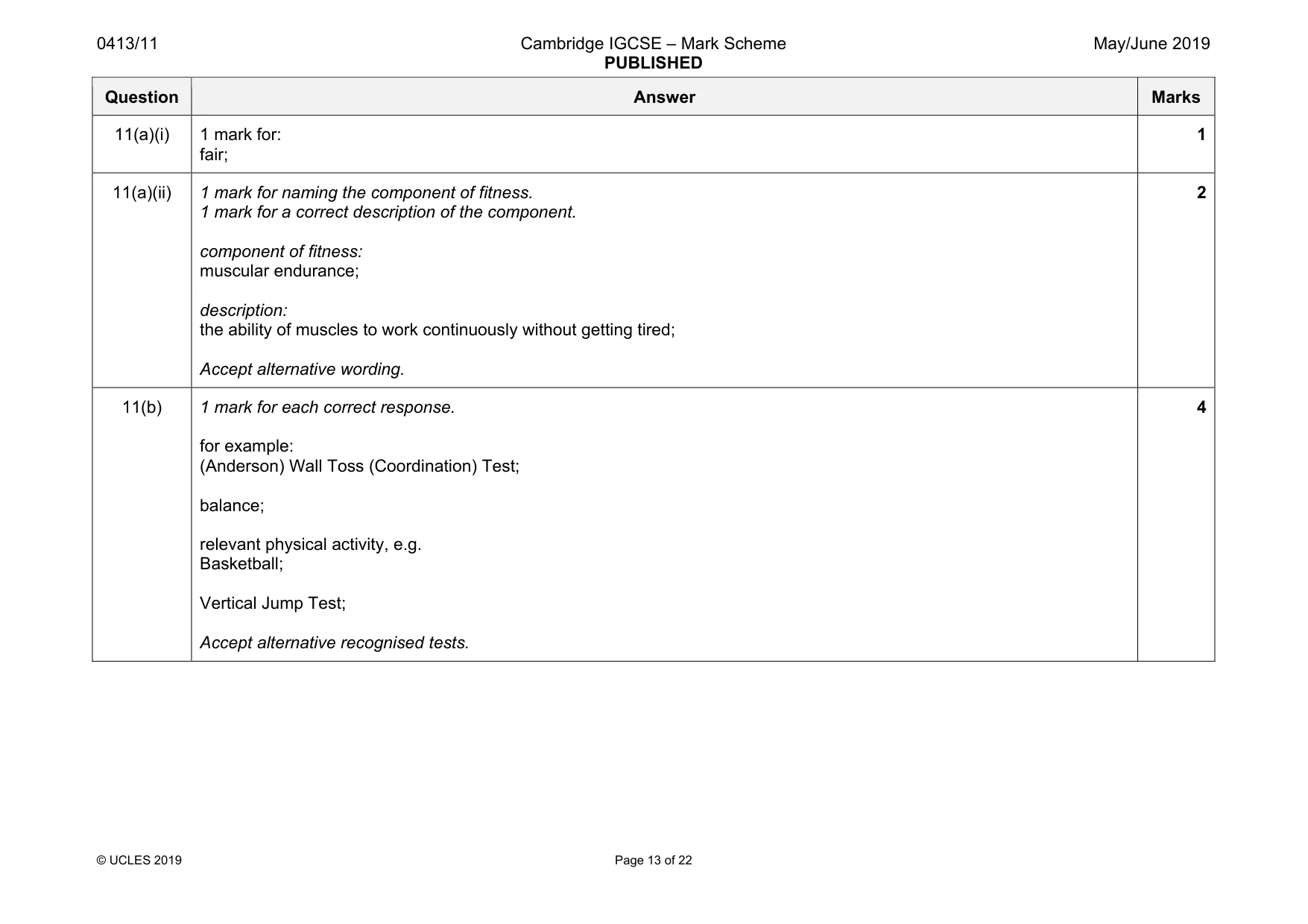
0413/11 Cambridge IGCSE – Mark Scheme PUBLISHED May/June 2019 © UCLES 2019 Page 13 of 22 Question Answer Marks 11(a)(i) 1 mark for: fair; 1 11(a)(ii) 1 mark for naming the component of fitness. 1 mark for a correct description of the component. component of fitness: muscular endurance; description: the ability of muscles to work continuously without getting tired; Accept alternative wording. 2 11(b) 1 mark for each correct response. for example: (Anderson) Wall Toss (Coordination) Test; balance; relevant physical activity, e.g. Basketball; Vertical Jump Test; Accept alternative recognised tests. 4
Mark scheme, page 14
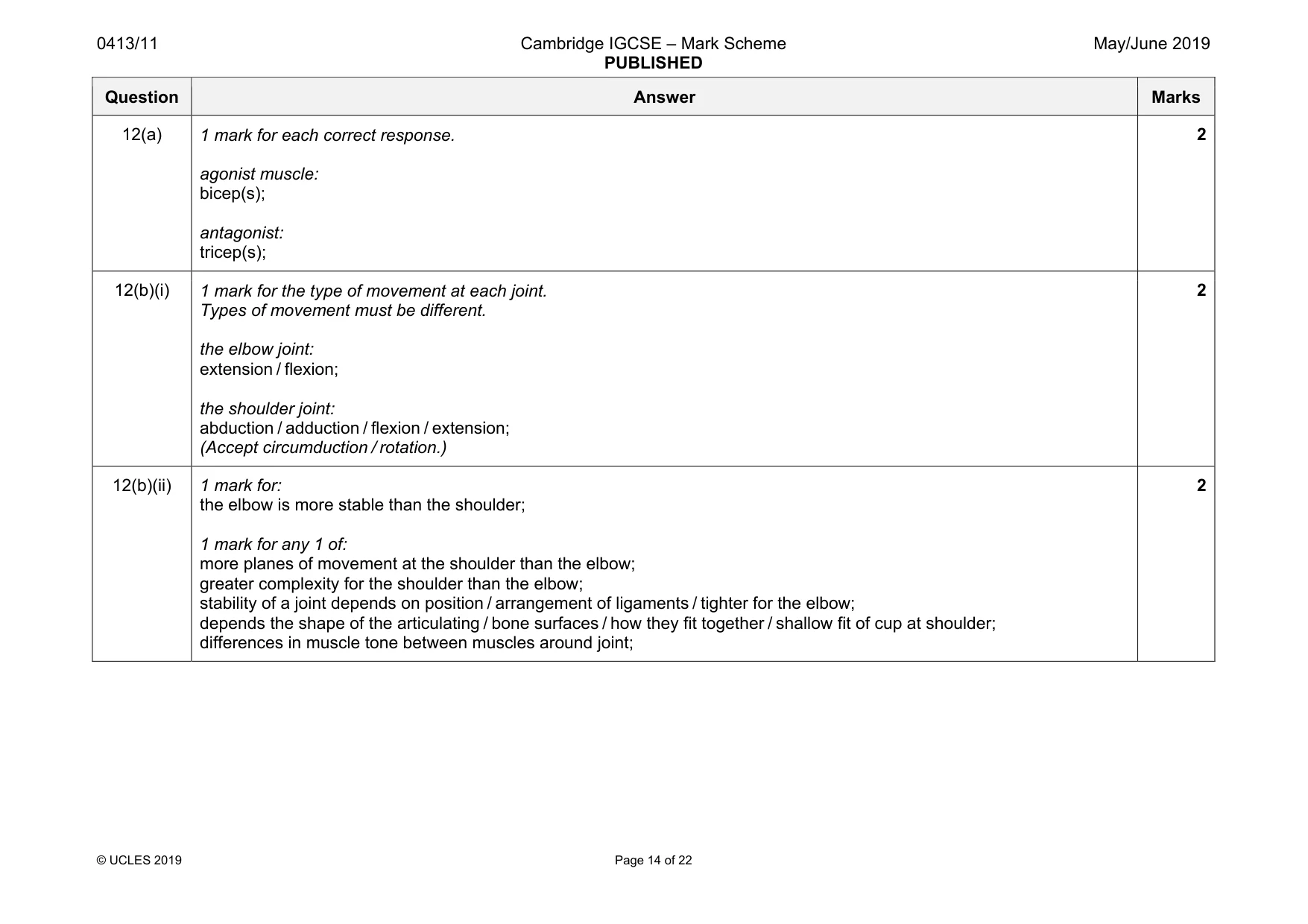
0413/11 Cambridge IGCSE – Mark Scheme PUBLISHED May/June 2019 © UCLES 2019 Page 14 of 22 Question Answer Marks 12(a) 1 mark for each correct response. agonist muscle: bicep(s); antagonist: tricep(s); 2 12(b)(i) 1 mark for the type of movement at each joint. Types of movement must be different. the elbow joint: extension / flexion; the shoulder joint: abduction / adduction / flexion / extension; (Accept circumduction / rotation.) 2 12(b)(ii) 1 mark for: the elbow is more stable than the shoulder; 1 mark for any 1 of: more planes of movement at the shoulder than the elbow; greater complexity for the shoulder than the elbow; stability of a joint depends on position / arrangement of ligaments / tighter for the elbow; depends the shape of the articulating / bone surfaces / how they fit together / shallow fit of cup at shoulder; differences in muscle tone between muscles around joint; 2
Mark scheme, page 15
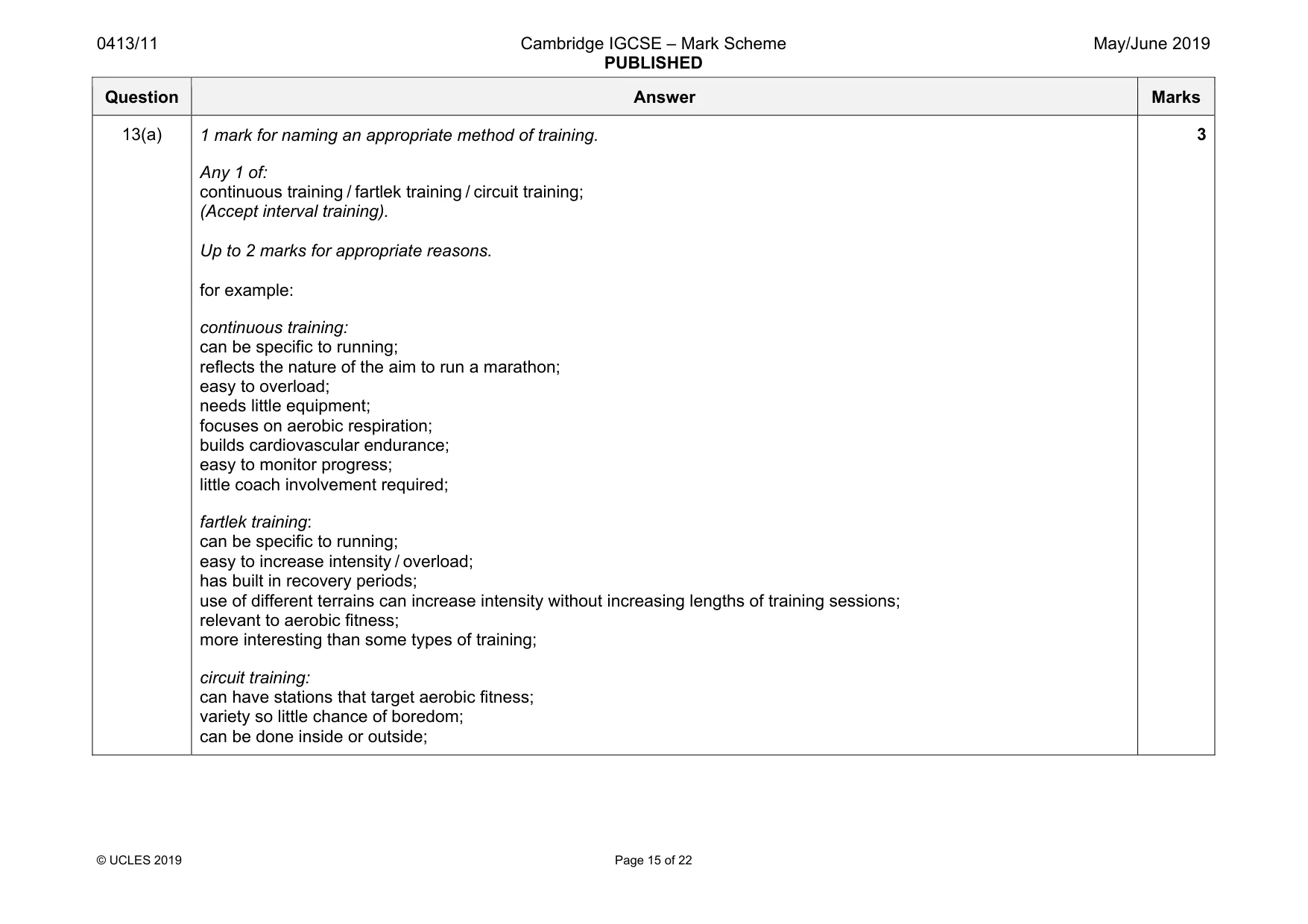
0413/11 Cambridge IGCSE – Mark Scheme PUBLISHED May/June 2019 © UCLES 2019 Page 15 of 22 Question Answer Marks 13(a) 1 mark for naming an appropriate method of training. Any 1 of: continuous training / fartlek training / circuit training; (Accept interval training). Up to 2 marks for appropriate reasons. for example: continuous training: can be specific to running; reflects the nature of the aim to run a marathon; easy to overload; needs little equipment; focuses on aerobic respiration; builds cardiovascular endurance; easy to monitor progress; little coach involvement required; fartlek training: can be specific to running; easy to increase intensity / overload; has built in recovery periods; use of different terrains can increase intensity without increasing lengths of training sessions; relevant to aerobic fitness; more interesting than some types of training; circuit training: can have stations that target aerobic fitness; variety so little chance of boredom; can be done inside or outside; 3
Mark scheme, page 16
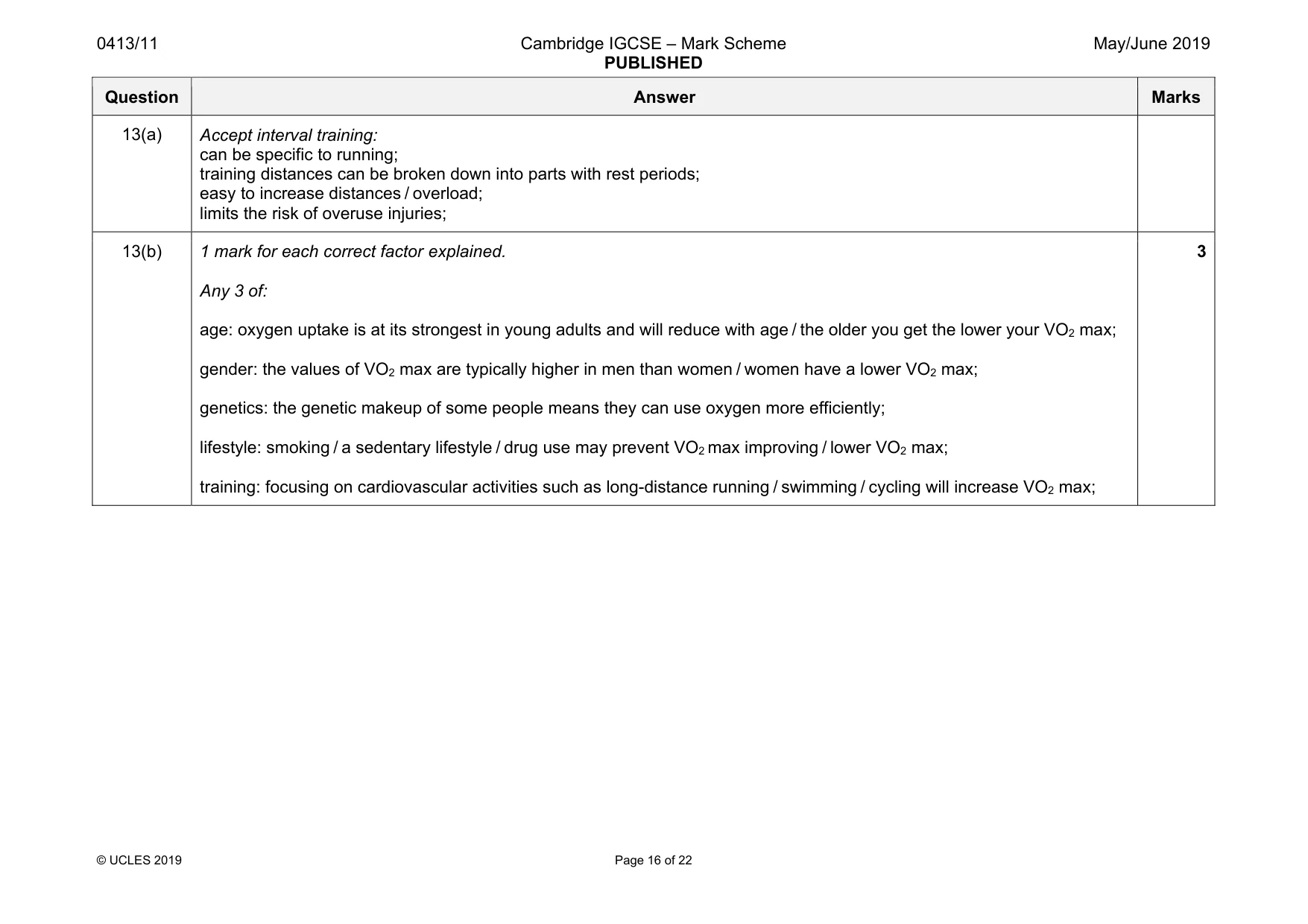
0413/11 Cambridge IGCSE – Mark Scheme PUBLISHED May/June 2019 © UCLES 2019 Page 16 of 22 Question Answer Marks 13(a) Accept interval training: can be specific to running; training distances can be broken down into parts with rest periods; easy to increase distances / overload; limits the risk of overuse injuries; 13(b) 1 mark for each correct factor explained. Any 3 of: age: oxygen uptake is at its strongest in young adults and will reduce with age / the older you get the lower your VO2 max; gender: the values of VO2 max are typically higher in men than women / women have a lower VO2 max; genetics: the genetic makeup of some people means they can use oxygen more efficiently; lifestyle: smoking / a sedentary lifestyle / drug use may prevent VO2 max improving / lower VO2 max; training: focusing on cardiovascular activities such as long-distance running / swimming / cycling will increase VO2 max; 3
Mark scheme, page 17
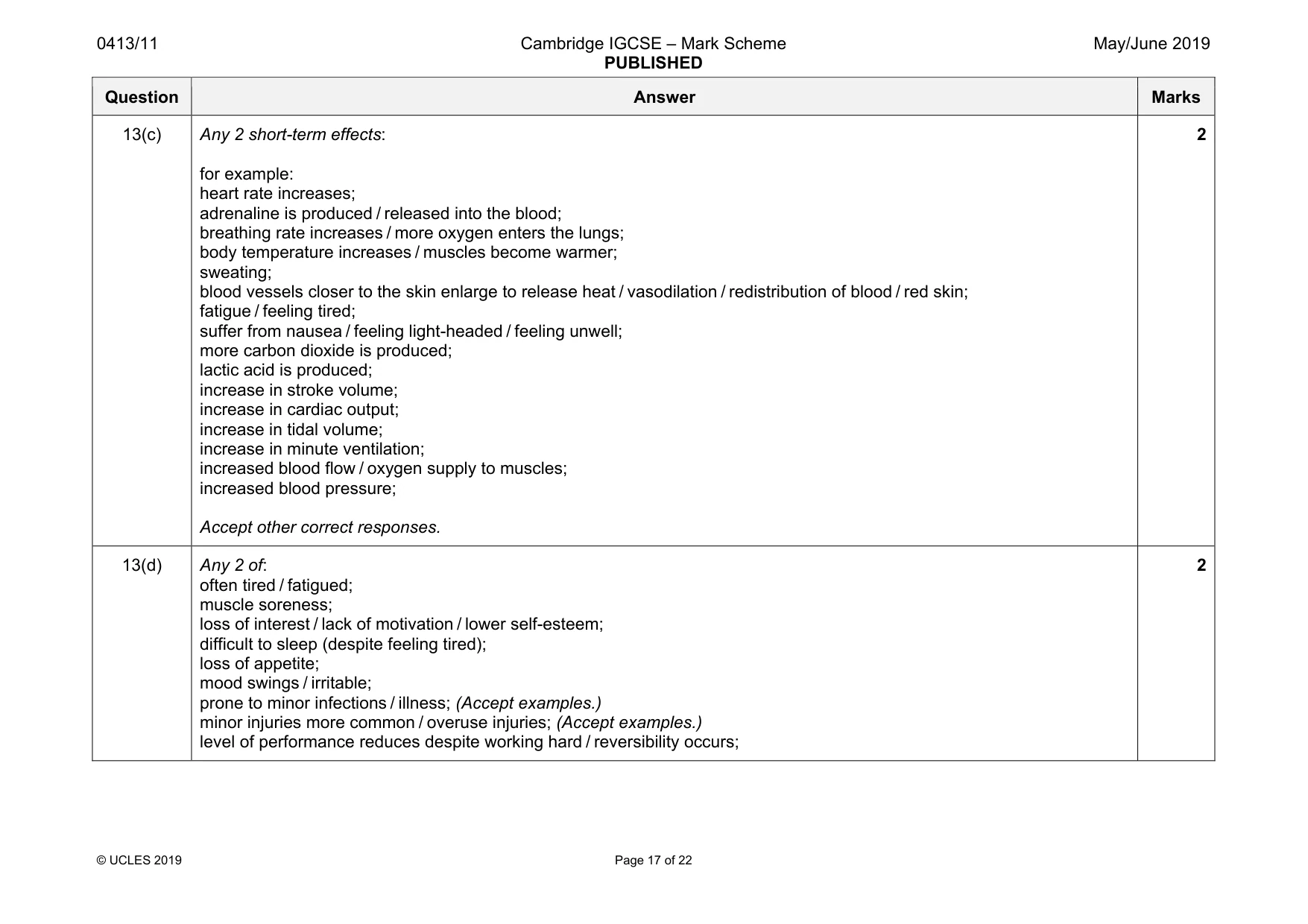
0413/11 Cambridge IGCSE – Mark Scheme PUBLISHED May/June 2019 © UCLES 2019 Page 17 of 22 Question Answer Marks 13(c) Any 2 short-term effects: for example: heart rate increases; adrenaline is produced / released into the blood; breathing rate increases / more oxygen enters the lungs; body temperature increases / muscles become warmer; sweating; blood vessels closer to the skin enlarge to release heat / vasodilation / redistribution of blood / red skin; fatigue / feeling tired; suffer from nausea / feeling light-headed / feeling unwell; more carbon dioxide is produced; lactic acid is produced; increase in stroke volume; increase in cardiac output; increase in tidal volume; increase in minute ventilation; increased blood flow / oxygen supply to muscles; increased blood pressure; Accept other correct responses. 2 13(d) Any 2 of: often tired / fatigued; muscle soreness; loss of interest / lack of motivation / lower self-esteem; difficult to sleep (despite feeling tired); loss of appetite; mood swings / irritable; prone to minor infections / illness; (Accept examples.) minor injuries more common / overuse injuries; (Accept examples.) level of performance reduces despite working hard / reversibility occurs; 2
Mark scheme, page 18
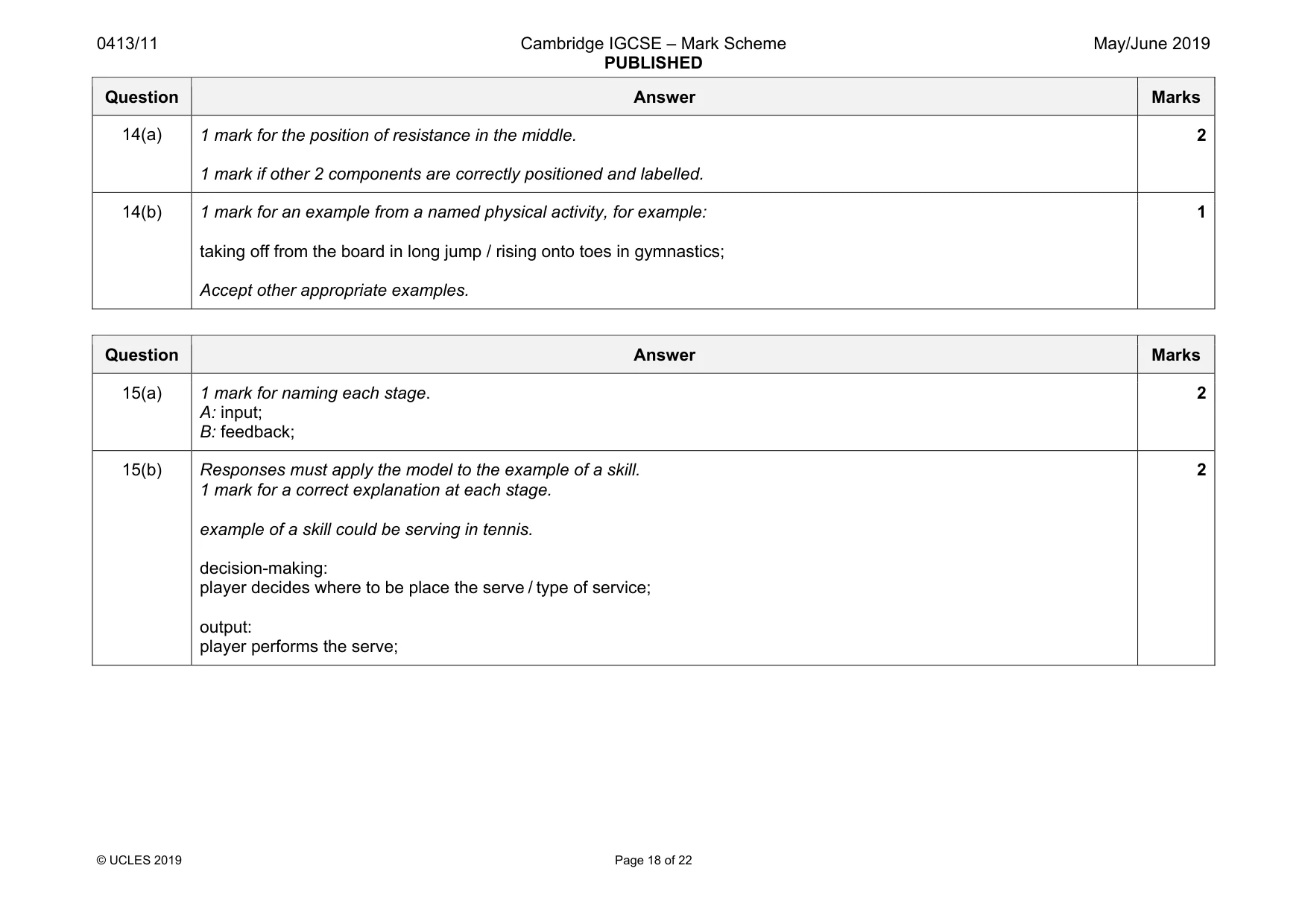
0413/11 Cambridge IGCSE – Mark Scheme PUBLISHED May/June 2019 © UCLES 2019 Page 18 of 22 Question Answer Marks 14(a) 1 mark for the position of resistance in the middle. 1 mark if other 2 components are correctly positioned and labelled. 2 14(b) 1 mark for an example from a named physical activity, for example: taking off from the board in long jump / rising onto toes in gymnastics; Accept other appropriate examples. 1 Question Answer Marks 15(a) 1 mark for naming each stage. A: input; B: feedback; 2 15(b) Responses must apply the model to the example of a skill. 1 mark for a correct explanation at each stage. example of a skill could be serving in tennis. decision-making: player decides where to be place the serve / type of service; output: player performs the serve; 2
Mark scheme, page 19
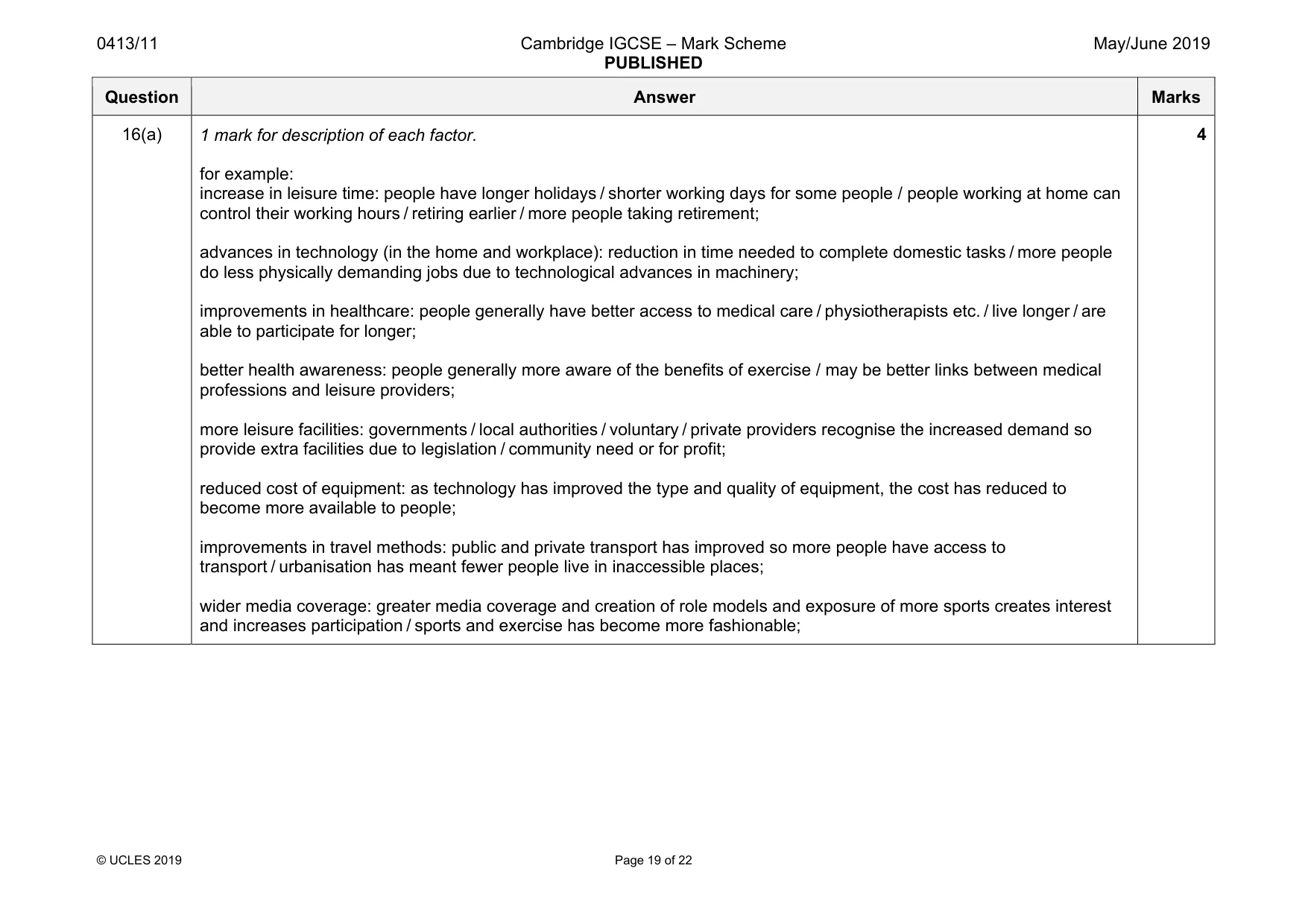
0413/11 Cambridge IGCSE – Mark Scheme PUBLISHED May/June 2019 © UCLES 2019 Page 19 of 22 Question Answer Marks 16(a) 1 mark for description of each factor. for example: increase in leisure time: people have longer holidays / shorter working days for some people / people working at home can control their working hours / retiring earlier / more people taking retirement; advances in technology (in the home and workplace): reduction in time needed to complete domestic tasks / more people do less physically demanding jobs due to technological advances in machinery; improvements in healthcare: people generally have better access to medical care / physiotherapists etc. / live longer / are able to participate for longer; better health awareness: people generally more aware of the benefits of exercise / may be better links between medical professions and leisure providers; more leisure facilities: governments / local authorities / voluntary / private providers recognise the increased demand so provide extra facilities due to legislation / community need or for profit; reduced cost of equipment: as technology has improved the type and quality of equipment, the cost has reduced to become more available to people; improvements in travel methods: public and private transport has improved so more people have access to transport / urbanisation has meant fewer people live in inaccessible places; wider media coverage: greater media coverage and creation of role models and exposure of more sports creates interest and increases participation / sports and exercise has become more fashionable; 4
Mark scheme, page 20
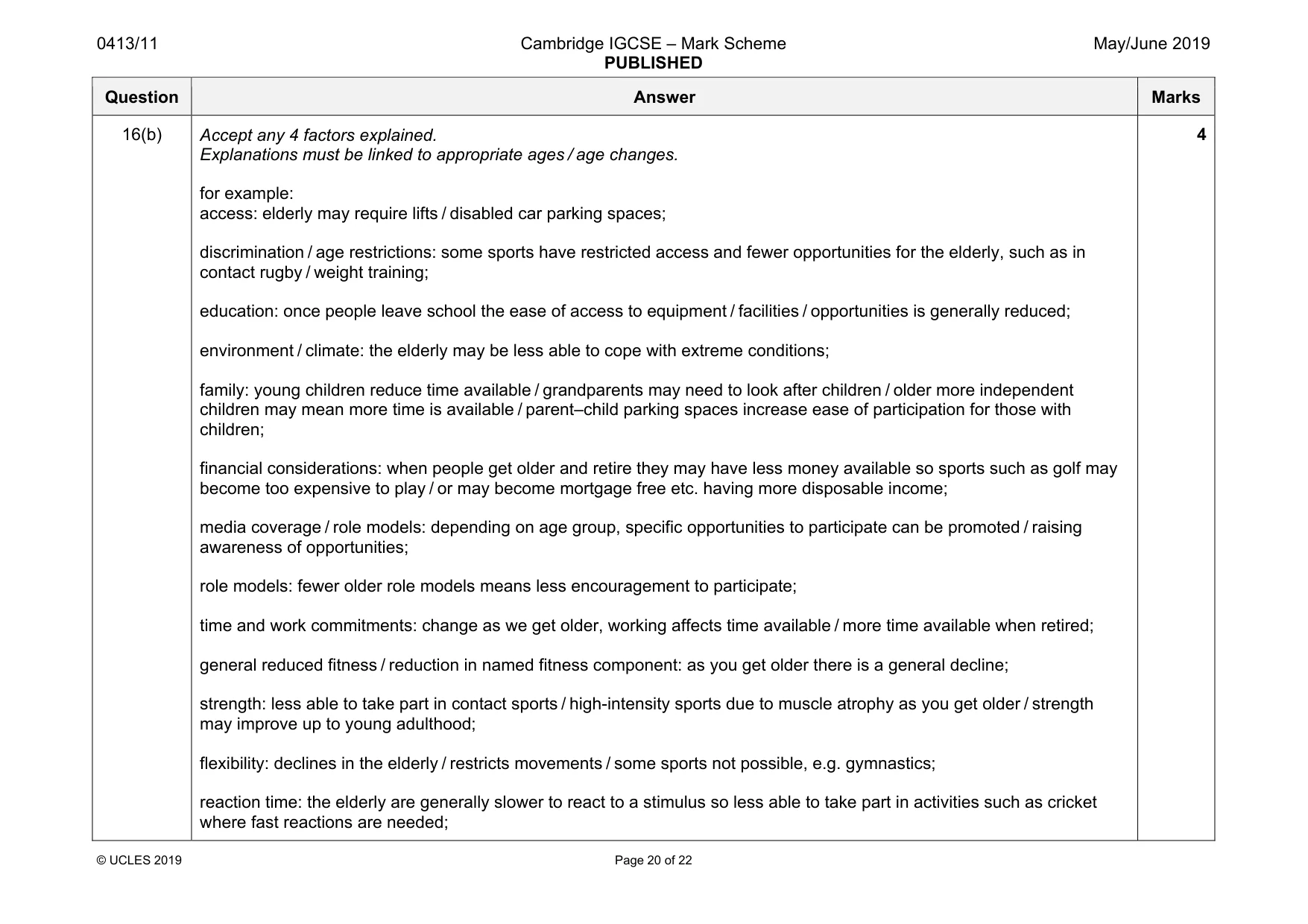
0413/11 Cambridge IGCSE – Mark Scheme PUBLISHED May/June 2019 © UCLES 2019 Page 20 of 22 Question Answer Marks 16(b) Accept any 4 factors explained. Explanations must be linked to appropriate ages / age changes. for example: access: elderly may require lifts / disabled car parking spaces; discrimination / age restrictions: some sports have restricted access and fewer opportunities for the elderly, such as in contact rugby / weight training; education: once people leave school the ease of access to equipment / facilities / opportunities is generally reduced; environment / climate: the elderly may be less able to cope with extreme conditions; family: young children reduce time available / grandparents may need to look after children / older more independent children may mean more time is available / parent–child parking spaces increase ease of participation for those with children; financial considerations: when people get older and retire they may have less money available so sports such as golf may become too expensive to play / or may become mortgage free etc. having more disposable income; media coverage / role models: depending on age group, specific opportunities to participate can be promoted / raising awareness of opportunities; role models: fewer older role models means less encouragement to participate; time and work commitments: change as we get older, working affects time available / more time available when retired; general reduced fitness / reduction in named fitness component: as you get older there is a general decline; strength: less able to take part in contact sports / high-intensity sports due to muscle atrophy as you get older / strength may improve up to young adulthood; flexibility: declines in the elderly / restricts movements / some sports not possible, e.g. gymnastics; reaction time: the elderly are generally slower to react to a stimulus so less able to take part in activities such as cricket where fast reactions are needed; 4
Mark scheme, page 21
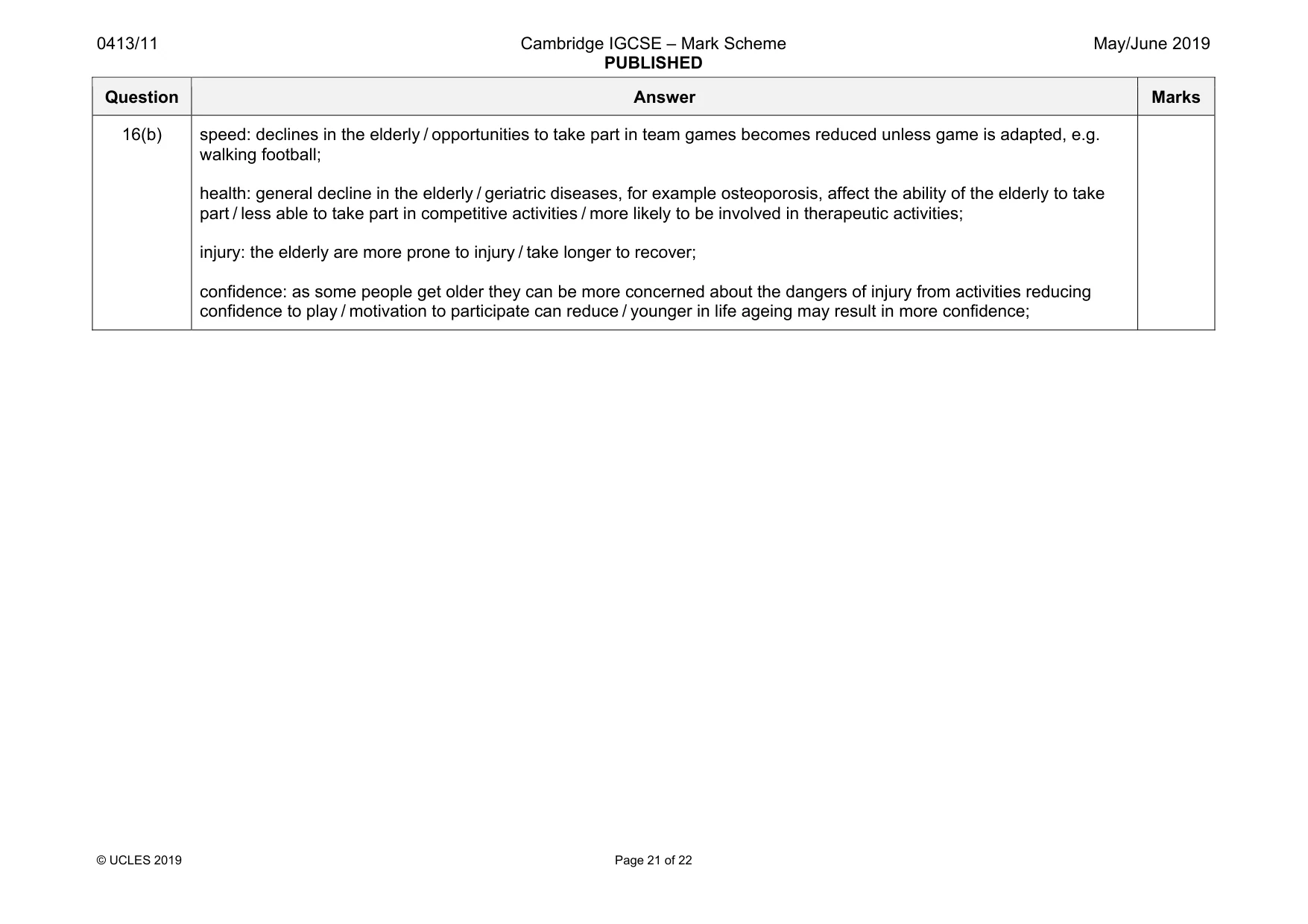
0413/11 Cambridge IGCSE – Mark Scheme PUBLISHED May/June 2019 © UCLES 2019 Page 21 of 22 Question Answer Marks 16(b) speed: declines in the elderly / opportunities to take part in team games becomes reduced unless game is adapted, e.g. walking football; health: general decline in the elderly / geriatric diseases, for example osteoporosis, affect the ability of the elderly to take part / less able to take part in competitive activities / more likely to be involved in therapeutic activities; injury: the elderly are more prone to injury / take longer to recover; confidence: as some people get older they can be more concerned about the dangers of injury from activities reducing confidence to play / motivation to participate can reduce / younger in life ageing may result in more confidence;
Mark scheme, page 22
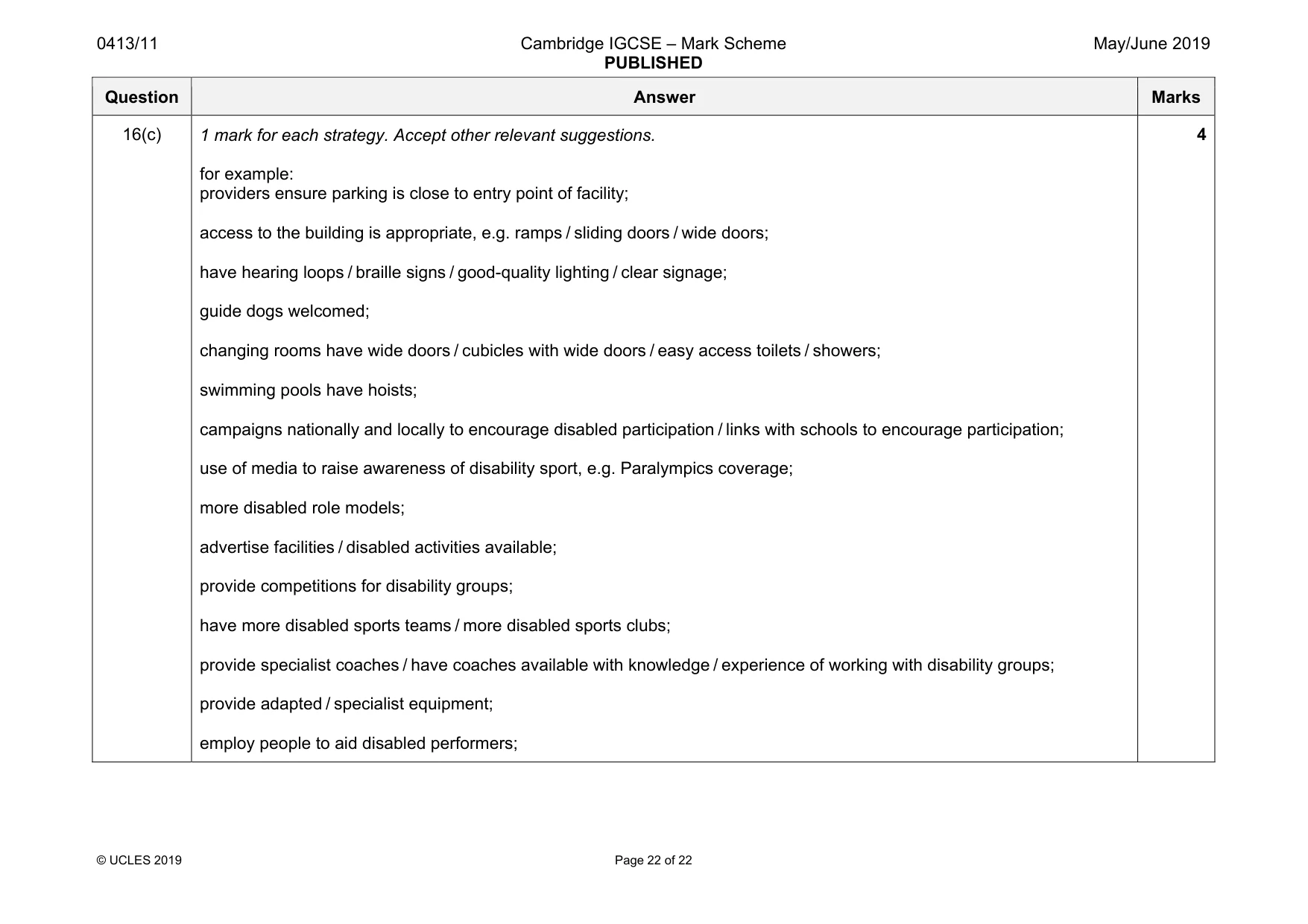
0413/11 Cambridge IGCSE – Mark Scheme PUBLISHED May/June 2019 © UCLES 2019 Page 22 of 22 Question Answer Marks 16(c) 1 mark for each strategy. Accept other relevant suggestions. for example: providers ensure parking is close to entry point of facility; access to the building is appropriate, e.g. ramps / sliding doors / wide doors; have hearing loops / braille signs / good-quality lighting / clear signage; guide dogs welcomed; changing rooms have wide doors / cubicles with wide doors / easy access toilets / showers; swimming pools have hoists; campaigns nationally and locally to encourage disabled participation / links with schools to encourage participation; use of media to raise awareness of disability sport, e.g. Paralympics coverage; more disabled role models; advertise facilities / disabled activities available; provide competitions for disability groups; have more disabled sports teams / more disabled sports clubs; provide specialist coaches / have coaches available with knowledge / experience of working with disability groups; provide adapted / specialist equipment; employ people to aid disabled performers; 4
What you needed in this session
Cambridge’s own grade thresholds for 2019 May/June, Paper 1 · Variant 1. A higher threshold means an easier paper — the bar moves with how the cohort did.