Cambridge IGCSE Physical Education 0413 — 2015 May/June Paper 1 · Variant 1
0413/11/M/J/15 · 80 marks · ≈90 min
The question paper and its mark scheme, free to read here and free to download. This is Cambridge’s own paper, exactly as it was sat.
Question paper12 pages

Mark scheme18 pages
Answers below. Sit the paper first if you are practising.
Paper as text
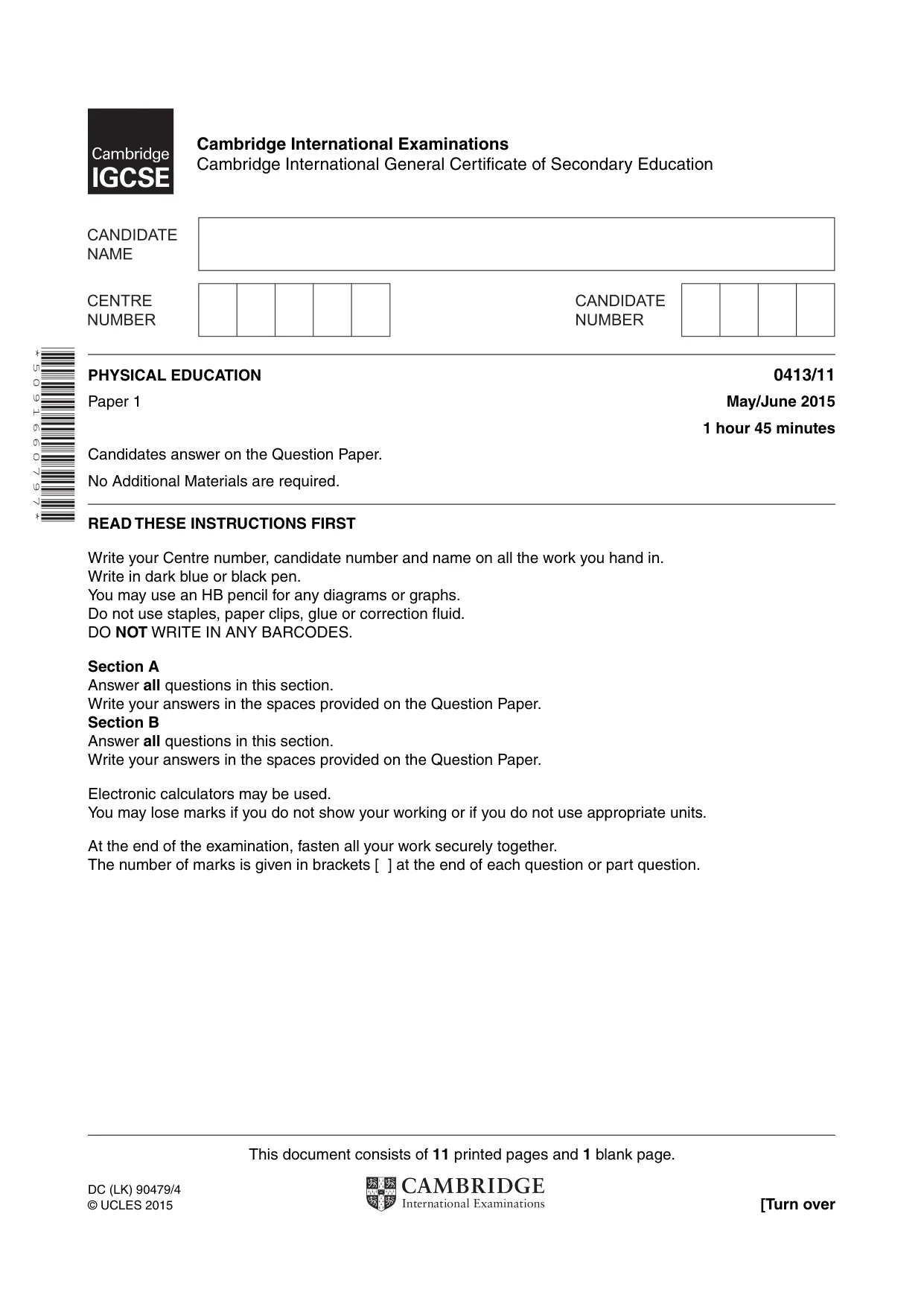
Question paper, page 1
This document consists of 11 printed pages and 1 blank page. DC (LK) 90479/4 © UCLES 2015 [Turn over Cambridge International Examinations Cambridge International General Certificate of Secondary Education * 5 0 9 1 6 6 0 7 9 7 * PHYSICAL EDUCATION 0413/11 Paper 1 May/June 2015 1 hour 45 minutes Candidates answer on the Question Paper. No Additional Materials are required. READ THESE INSTRUCTIONS FIRST Write your Centre number, candidate number and name on all the work you hand in. Write in dark blue or black pen. You may use an HB pencil for any diagrams or graphs. Do not use staples, paper clips, glue or correction fluid. DO NOT WRITE IN ANY BARCODES. Section A Answer all questions in this section. Write your answers in the spaces provided on the Question Paper. Section B Answer all questions in this section. Write your answers in the spaces provided on the Question Paper. Electronic calculators may be used. You may lose marks if you do not show your working or if you do not use appropriate units. At the end of the examination, fasten all your work securely together. The number of marks is given in brackets [ ] at the end of each question or part question.
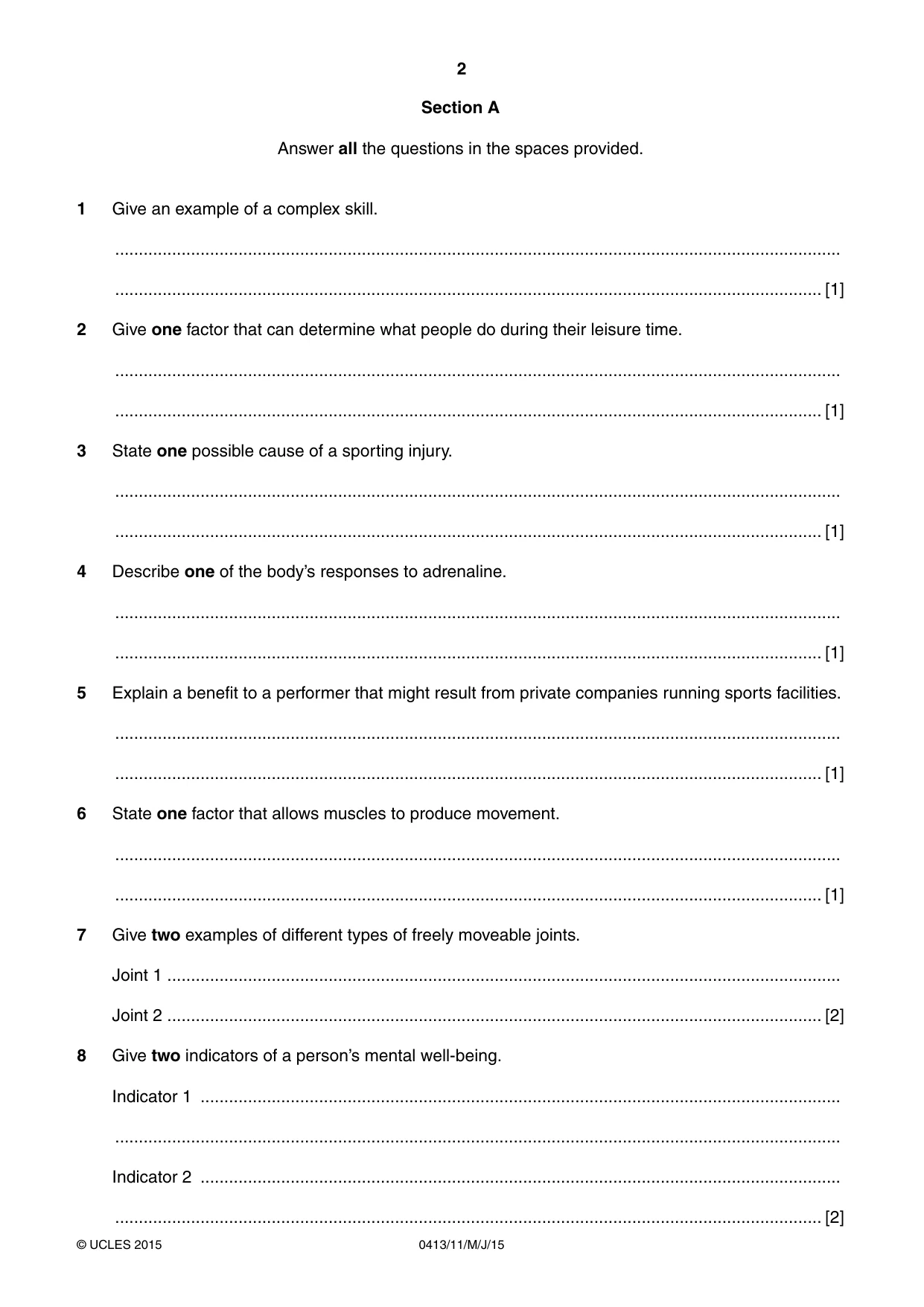
Question paper, page 2
2 0413/11/M/J/15 © UCLES 2015 Section A Answer all the questions in the spaces provided. 1 Give an example of a complex skill. … … [1] 2 Give one factor that can determine what people do during their leisure time. … … [1] 3 State one possible cause of a sporting injury. … … [1] 4 Describe one of the body’s responses to adrenaline. … … [1] 5 Explain a benefit to a performer that might result from private companies running sports facilities. … … [1] 6 State one factor that allows muscles to produce movement. … … [1] 7 Give two examples of different types of freely moveable joints. Joint 1 … Joint 2 … [2] 8 Give two indicators of a person’s mental well-being. Indicator 1 … … Indicator 2 … … [2]
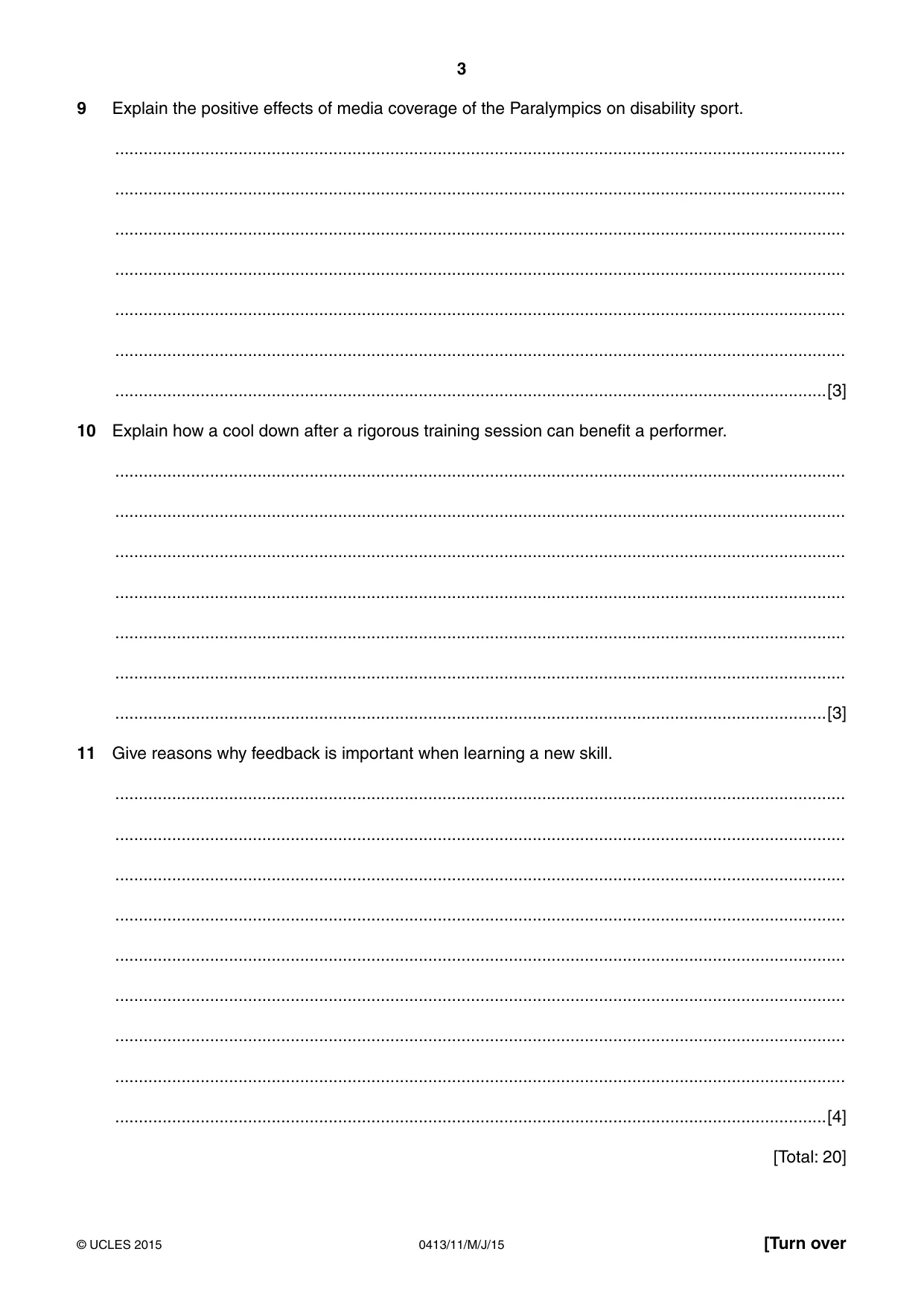
Question paper, page 3
3 0413/11/M/J/15 © UCLES 2015 [Turn over 9 Explain the positive effects of media coverage of the Paralympics on disability sport. … … … … … … …[3] 10 Explain how a cool down after a rigorous training session can benefit a performer. … … … … … … …[3] 11 Give reasons why feedback is important when learning a new skill. … … … … … … … … …[4] [Total: 20]
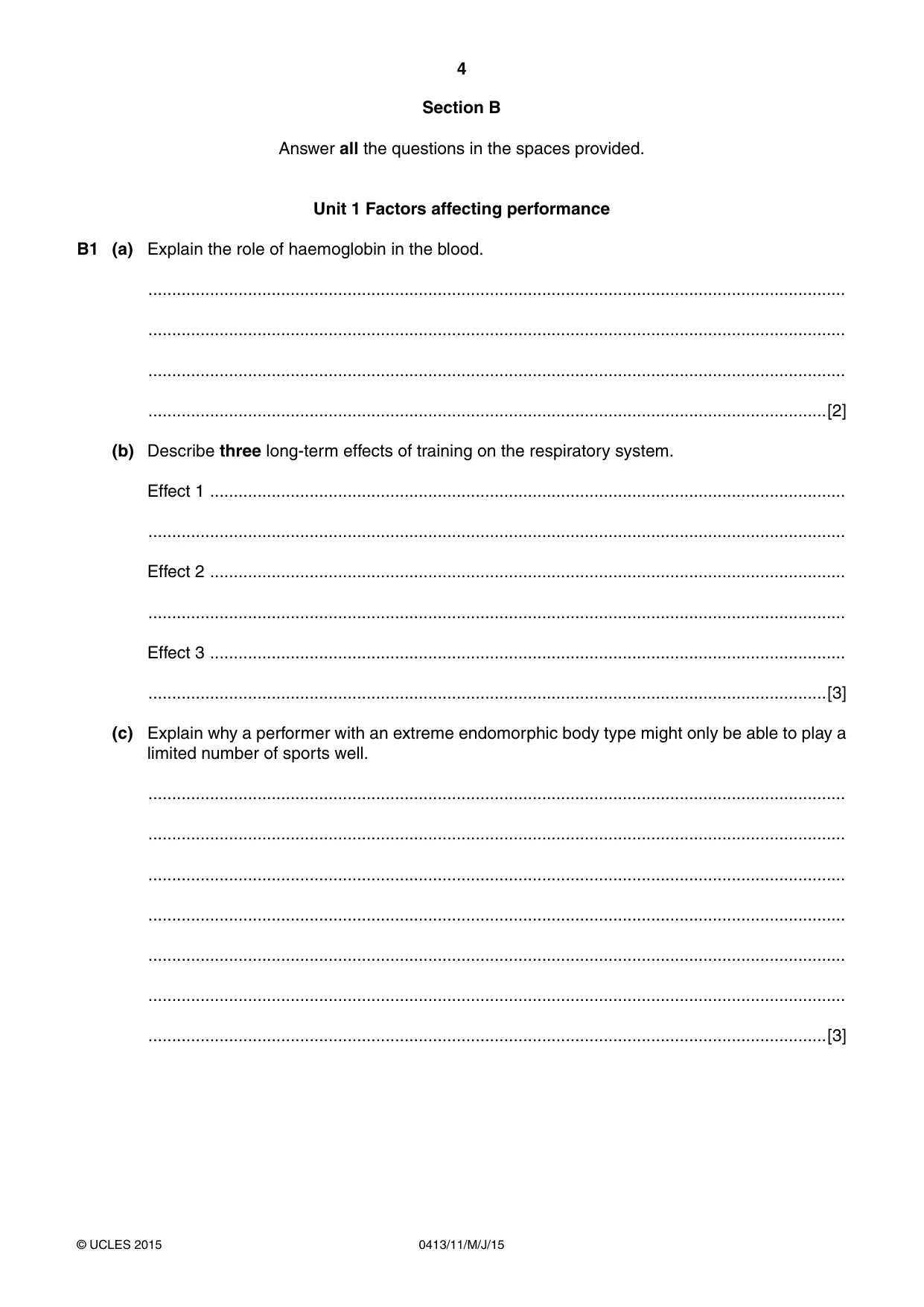
Question paper, page 4
4 0413/11/M/J/15 © UCLES 2015 Section B Answer all the questions in the spaces provided. Unit 1 Factors affecting performance B1 (a) Explain the role of haemoglobin in the blood. … … … …[2] (b) Describe three long-term effects of training on the respiratory system. Effect 1 … … Effect 2 … … Effect 3 … …[3] (c) Explain why a performer with an extreme endomorphic body type might only be able to play a limited number of sports well. … … … … … … …[3]
Question paper, page 5
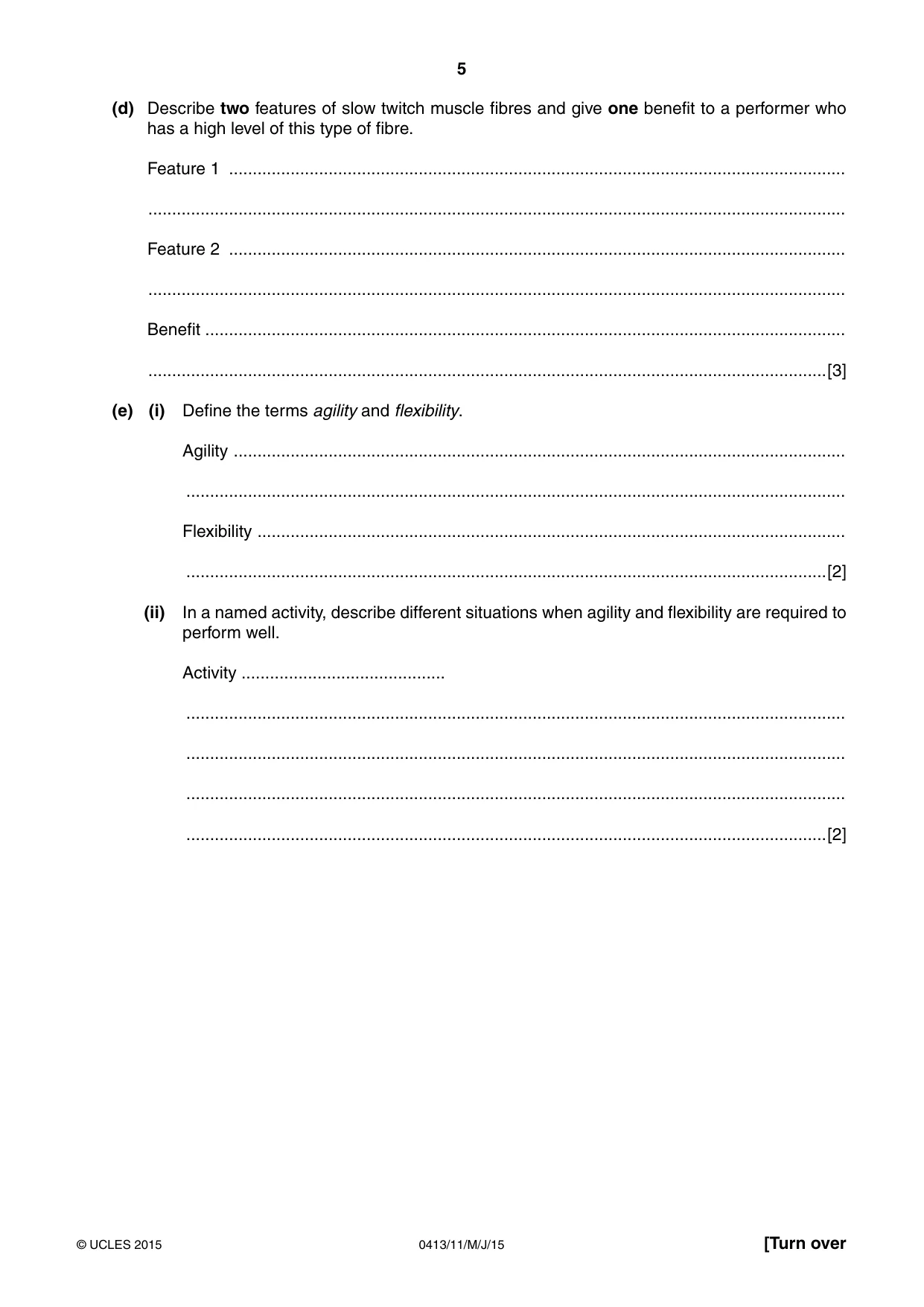
5 0413/11/M/J/15 © UCLES 2015 [Turn over (d) Describe two features of slow twitch muscle fibres and give one benefit to a performer who has a high level of this type of fibre. Feature 1 … … Feature 2 … … Benefit … …[3] (e) (i) Define the terms agility and flexibility. Agility … … Flexibility … …[2] (ii) In a named activity, describe different situations when agility and flexibility are required to perform well. Activity … … … … …[2]
Question paper, page 6
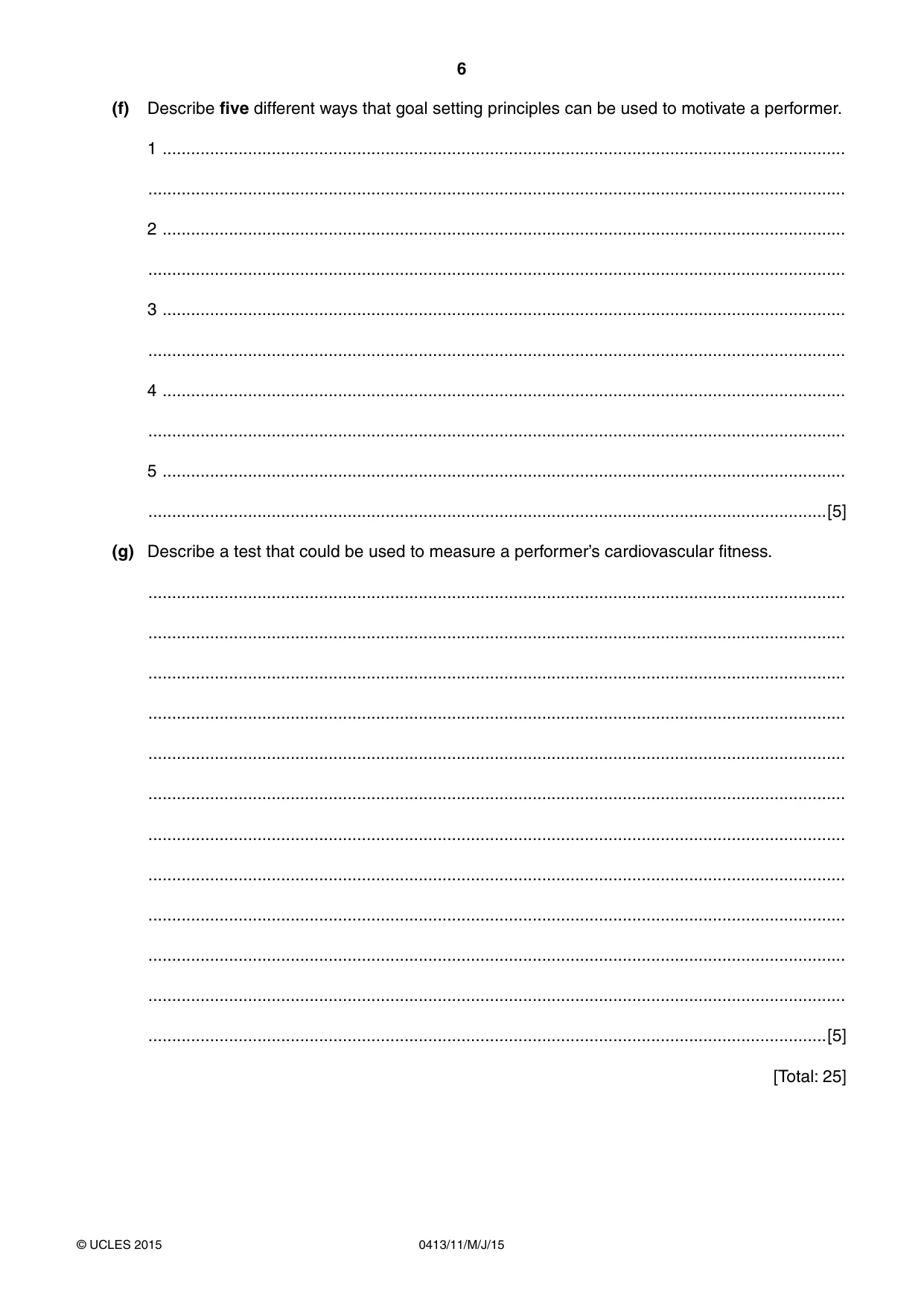
6 0413/11/M/J/15 © UCLES 2015 (f) Describe five different ways that goal setting principles can be used to motivate a performer. 1 … … 2 … … 3 … … 4 … … 5 … …[5] (g) Describe a test that could be used to measure a performer’s cardiovascular fitness. … … … … … … … … … … … …[5] [Total: 25]
Question paper, page 7
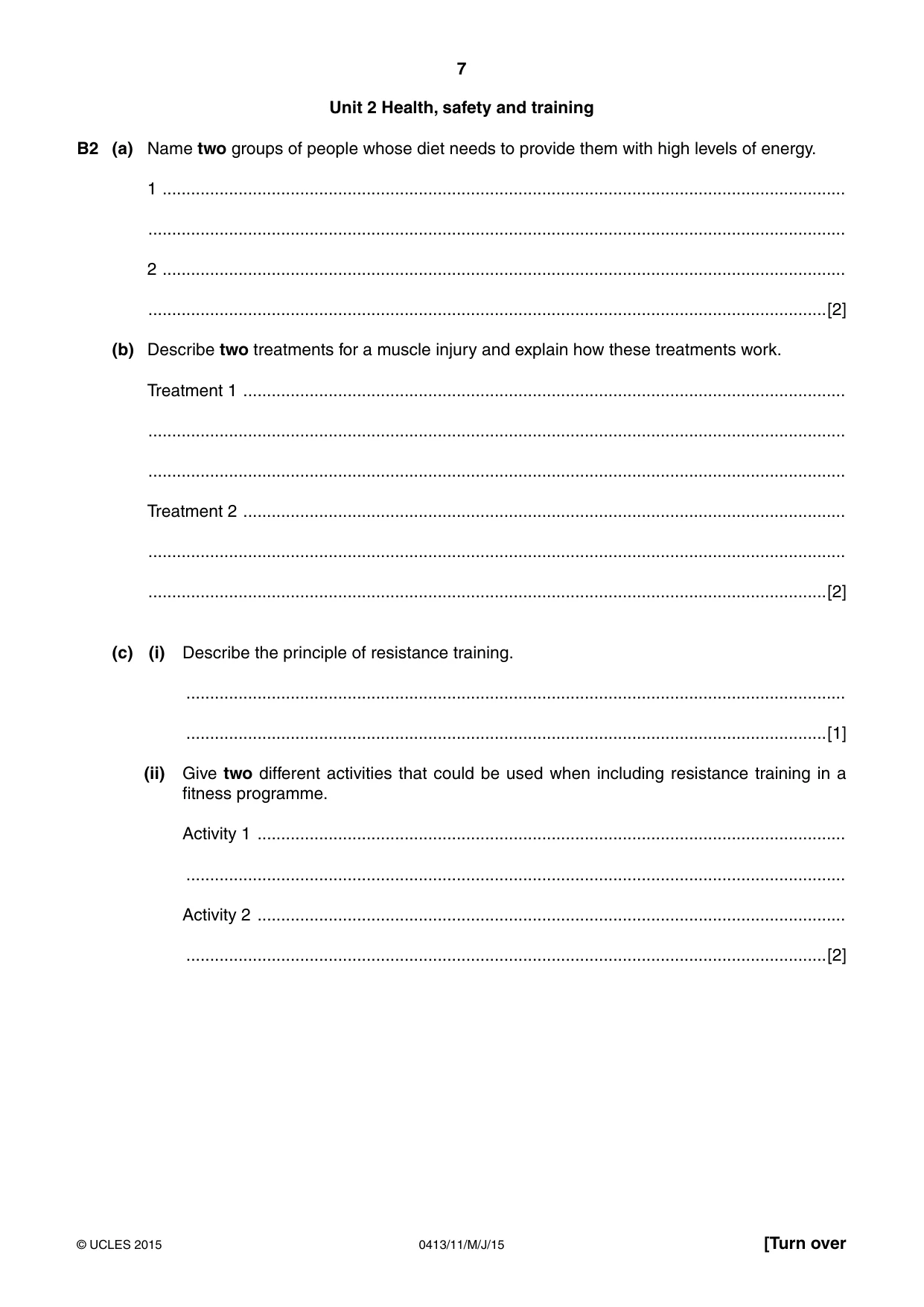
7 0413/11/M/J/15 © UCLES 2015 [Turn over Unit 2 Health, safety and training B2 (a) Name two groups of people whose diet needs to provide them with high levels of energy. 1 … … 2 … …[2] (b) Describe two treatments for a muscle injury and explain how these treatments work. Treatment 1 … … … Treatment 2 … … …[2] (c) (i) Describe the principle of resistance training. … …[1] (ii) Give two different activities that could be used when including resistance training in a fitness programme. Activity 1 … … Activity 2 … …[2]
Question paper, page 8
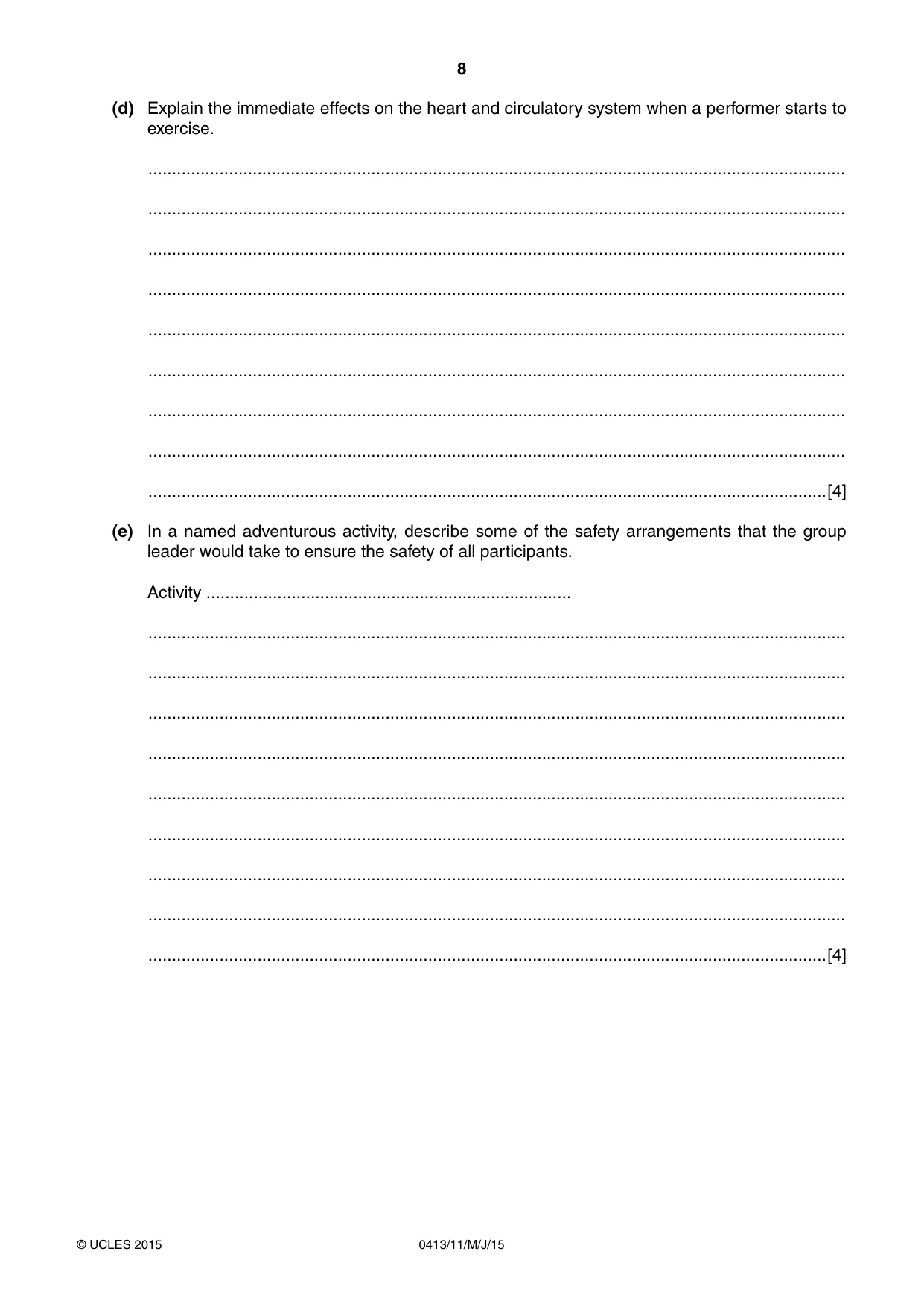
8 0413/11/M/J/15 © UCLES 2015 (d) Explain the immediate effects on the heart and circulatory system when a performer starts to exercise. … … … … … … … … …[4] (e) In a named adventurous activity, describe some of the safety arrangements that the group leader would take to ensure the safety of all participants. Activity … … … … … … … … … …[4]
Question paper, page 9
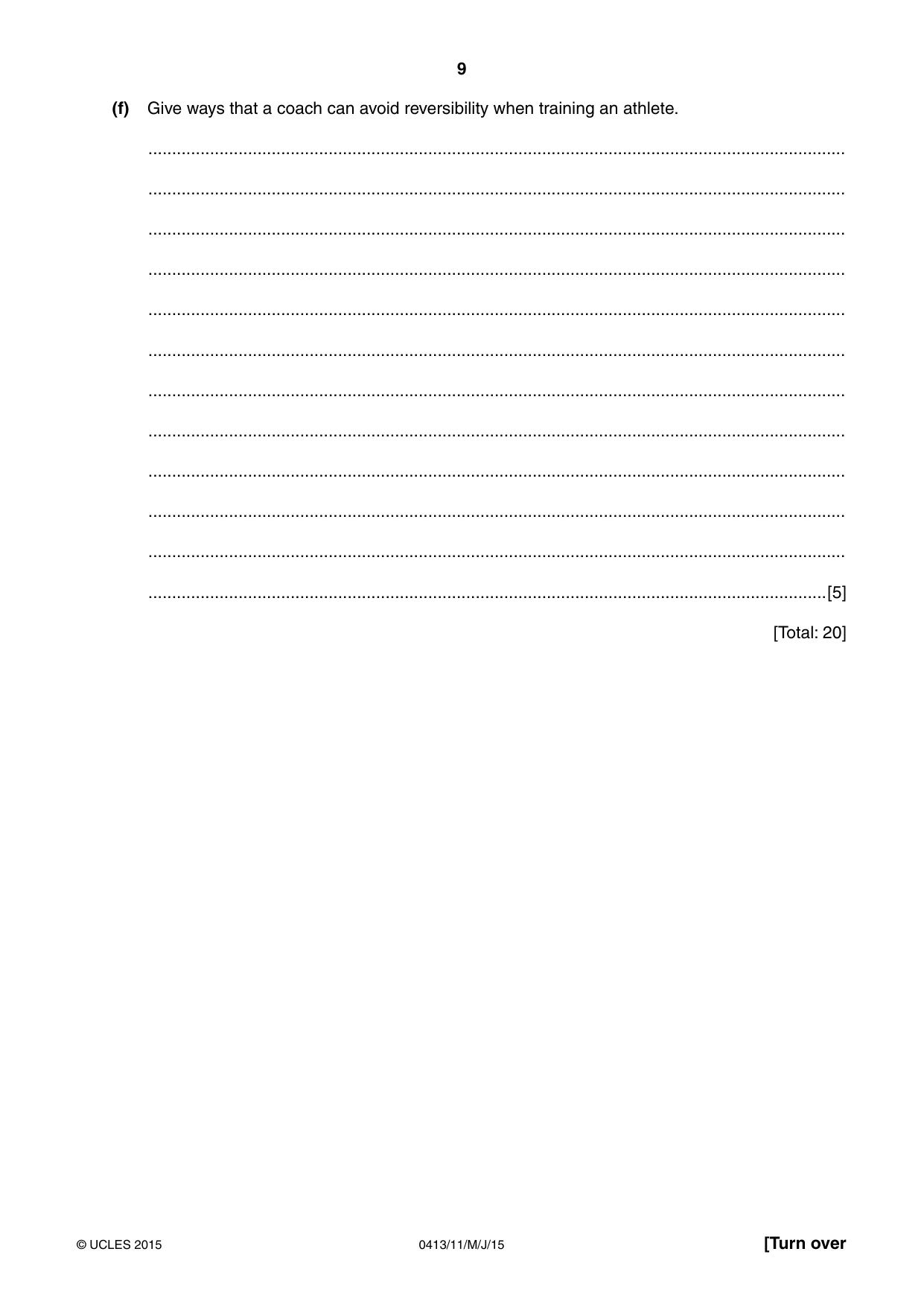
9 0413/11/M/J/15 © UCLES 2015 [Turn over (f) Give ways that a coach can avoid reversibility when training an athlete. … … … … … … … … … … … …[5] [Total: 20]
Question paper, page 10
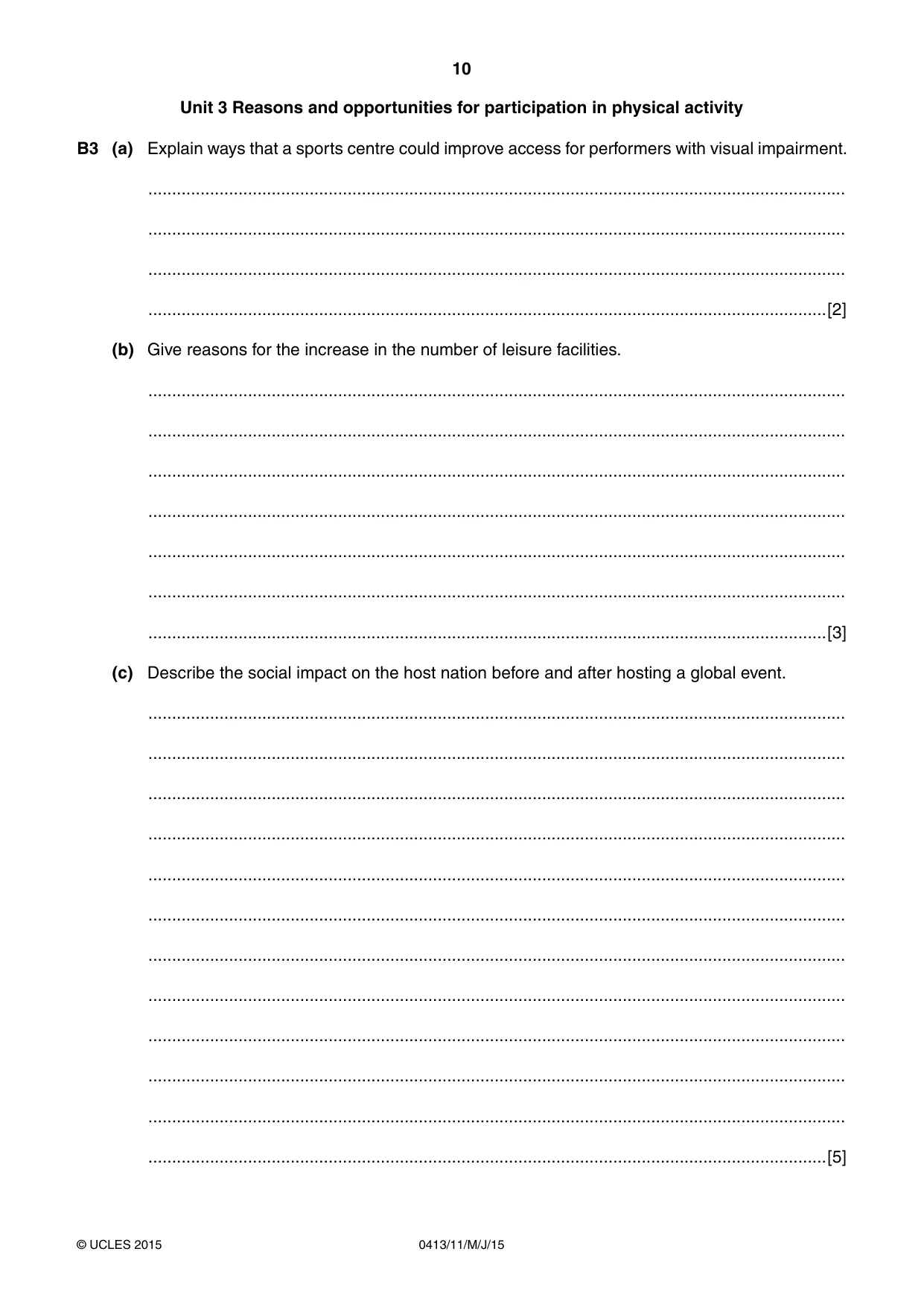
10 0413/11/M/J/15 © UCLES 2015 Unit 3 Reasons and opportunities for participation in physical activity B3 (a) Explain ways that a sports centre could improve access for performers with visual impairment. … … … …[2] (b) Give reasons for the increase in the number of leisure facilities. … … … … … … …[3] (c) Describe the social impact on the host nation before and after hosting a global event. … … … … … … … … … … … …[5]
Question paper, page 11
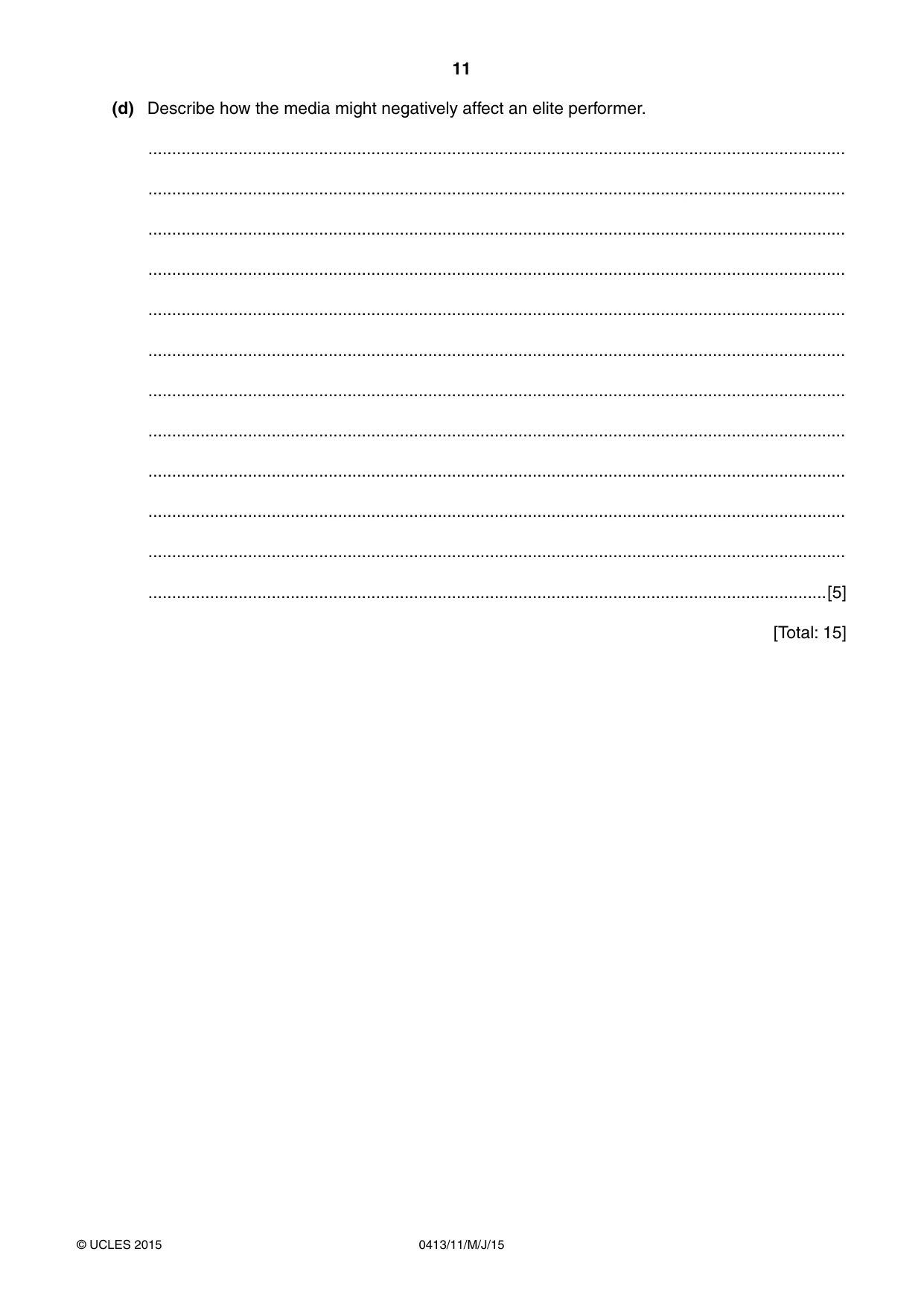
11 0413/11/M/J/15 © UCLES 2015 (d) Describe how the media might negatively affect an elite performer. … … … … … … … … … … … …[5] [Total: 15]
Question paper, page 12
12 0413/11/M/J/15 © UCLES 2015 Permission to reproduce items where third-party owned material protected by copyright is included has been sought and cleared where possible. Every reasonable effort has been made by the publisher (UCLES) to trace copyright holders, but if any items requiring clearance have unwittingly been included, the publisher will be pleased to make amends at the earliest possible opportunity. To avoid the issue of disclosure of answer-related information to candidates, all copyright acknowledgements are reproduced online in the Cambridge International Examinations Copyright Acknowledgements Booklet. This is produced for each series of examinations and is freely available to download at www.cie.org.uk after the live examination series. Cambridge International Examinations is part of the Cambridge Assessment Group. Cambridge Assessment is the brand name of University of Cambridge Local Examinations Syndicate (UCLES), which is itself a department of the University of Cambridge. BLANK PAGE
Mark scheme, page 1
® IGCSE is the registered trademark of Cambridge International Examinations. CAMBRIDGE INTERNATIONAL EXAMINATIONS Cambridge International Advanced Subsidiary and Advanced Level MARK SCHEME for the May/June 2015 series 0413 PHYSICAL EDUCATION 0413/11 Paper 1 (Paper 1), maximum raw mark 80 This mark scheme is published as an aid to teachers and candidates, to indicate the requirements of the examination. It shows the basis on which Examiners were instructed to award marks. It does not indicate the details of the discussions that took place at an Examiners’ meeting before marking began, which would have considered the acceptability of alternative answers. Mark schemes should be read in conjunction with the question paper and the Principal Examiner Report for Teachers. Cambridge will not enter into discussions about these mark schemes. Cambridge is publishing the mark schemes for the May/June 2015 series for most Cambridge IGCSE®, Cambridge International A and AS Level components and some Cambridge O Level components.
Mark scheme, page 2
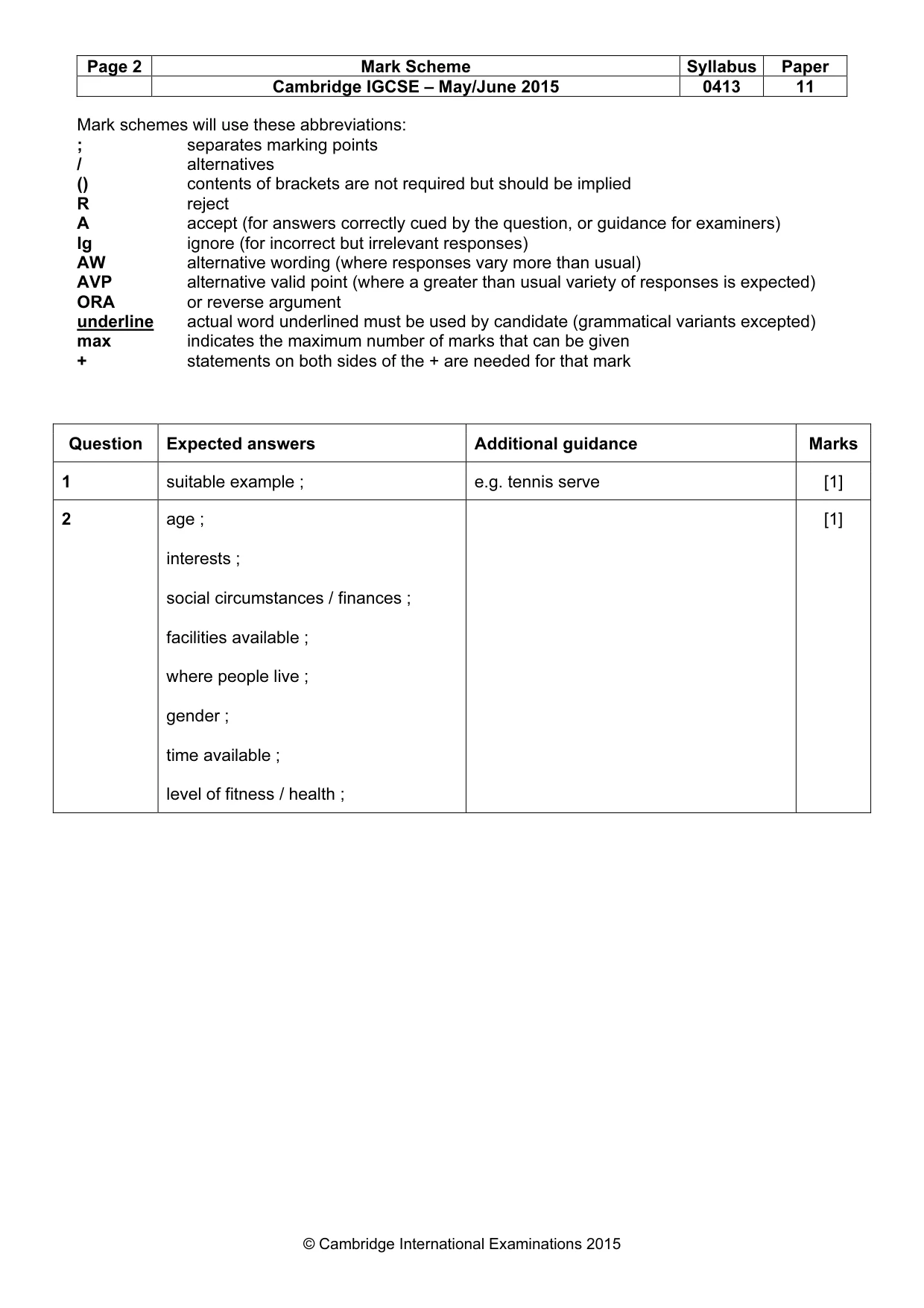
Page 2 Mark Scheme Syllabus Paper Cambridge IGCSE – May/June 2015 0413 11 © Cambridge International Examinations 2015 Mark schemes will use these abbreviations: ; separates marking points / alternatives () contents of brackets are not required but should be implied R reject A accept (for answers correctly cued by the question, or guidance for examiners) Ig ignore (for incorrect but irrelevant responses) AW alternative wording (where responses vary more than usual) AVP alternative valid point (where a greater than usual variety of responses is expected) ORA or reverse argument underline actual word underlined must be used by candidate (grammatical variants excepted) max indicates the maximum number of marks that can be given + statements on both sides of the + are needed for that mark Question Expected answers Additional guidance Marks 1 suitable example ; e.g. tennis serve [1] 2 age ; interests ; social circumstances / finances ; facilities available ; where people live ; gender ; time available ; level of fitness / health ; [1]
Mark scheme, page 3
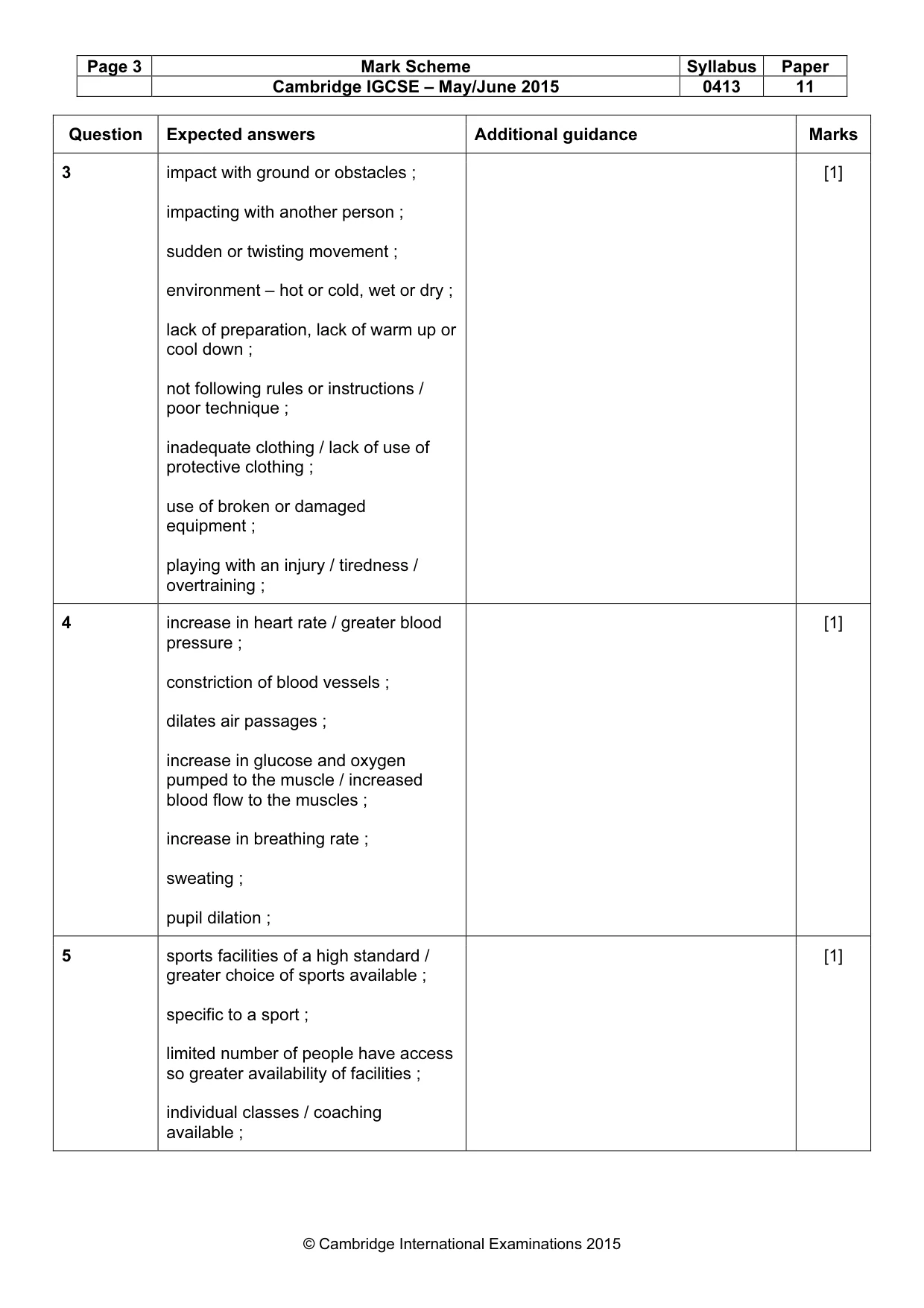
Page 3 Mark Scheme Syllabus Paper Cambridge IGCSE – May/June 2015 0413 11 © Cambridge International Examinations 2015 Question Expected answers Additional guidance Marks 3 impact with ground or obstacles ; impacting with another person ; sudden or twisting movement ; environment – hot or cold, wet or dry ; lack of preparation, lack of warm up or cool down ; not following rules or instructions / poor technique ; inadequate clothing / lack of use of protective clothing ; use of broken or damaged equipment ; playing with an injury / tiredness / overtraining ; [1] 4 increase in heart rate / greater blood pressure ; constriction of blood vessels ; dilates air passages ; increase in glucose and oxygen pumped to the muscle / increased blood flow to the muscles ; increase in breathing rate ; sweating ; pupil dilation ; [1] 5 sports facilities of a high standard / greater choice of sports available ; specific to a sport ; limited number of people have access so greater availability of facilities ; individual classes / coaching available ; [1]
Mark scheme, page 4
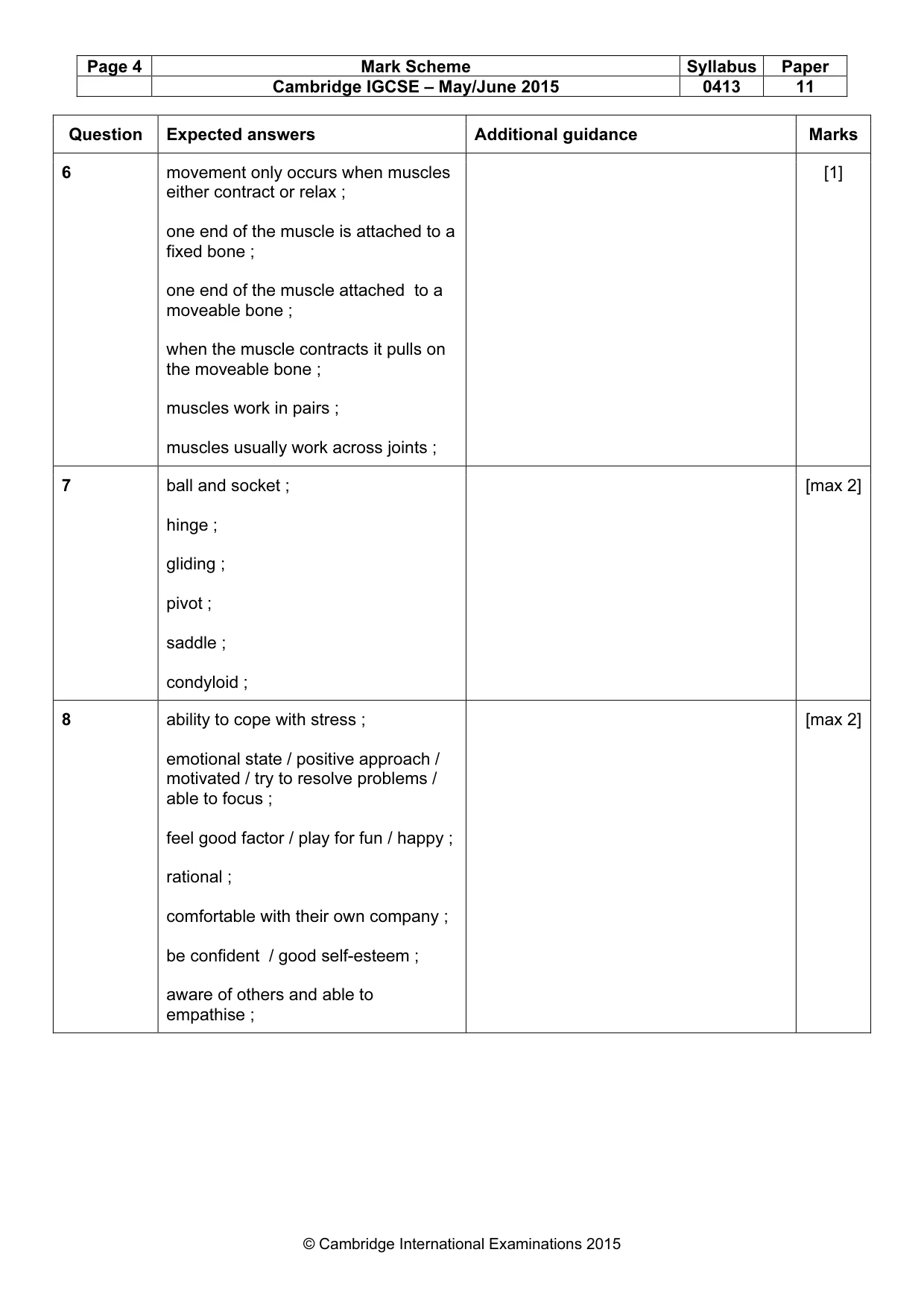
Page 4 Mark Scheme Syllabus Paper Cambridge IGCSE – May/June 2015 0413 11 © Cambridge International Examinations 2015 Question Expected answers Additional guidance Marks 6 movement only occurs when muscles either contract or relax ; one end of the muscle is attached to a fixed bone ; one end of the muscle attached to a moveable bone ; when the muscle contracts it pulls on the moveable bone ; muscles work in pairs ; muscles usually work across joints ; [1] 7 ball and socket ; hinge ; gliding ; pivot ; saddle ; condyloid ; [max 2] 8 ability to cope with stress ; emotional state / positive approach / motivated / try to resolve problems / able to focus ; feel good factor / play for fun / happy ; rational ; comfortable with their own company ; be confident / good self-esteem ; aware of others and able to empathise ; [max 2]
Mark scheme, page 5
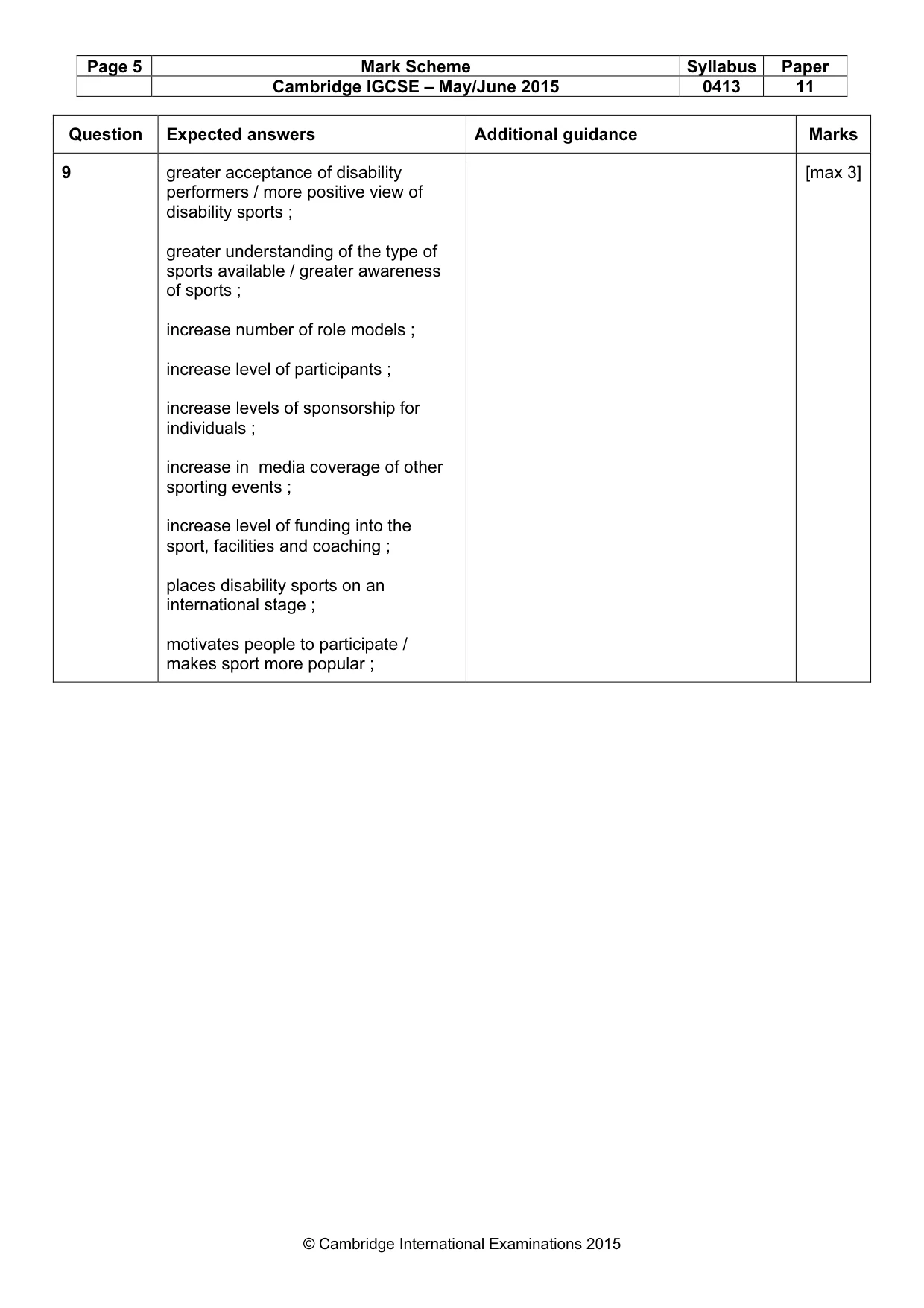
Page 5 Mark Scheme Syllabus Paper Cambridge IGCSE – May/June 2015 0413 11 © Cambridge International Examinations 2015 Question Expected answers Additional guidance Marks 9 greater acceptance of disability performers / more positive view of disability sports ; greater understanding of the type of sports available / greater awareness of sports ; increase number of role models ; increase level of participants ; increase levels of sponsorship for individuals ; increase in media coverage of other sporting events ; increase level of funding into the sport, facilities and coaching ; places disability sports on an international stage ; motivates people to participate / makes sport more popular ; [max 3]
Mark scheme, page 6
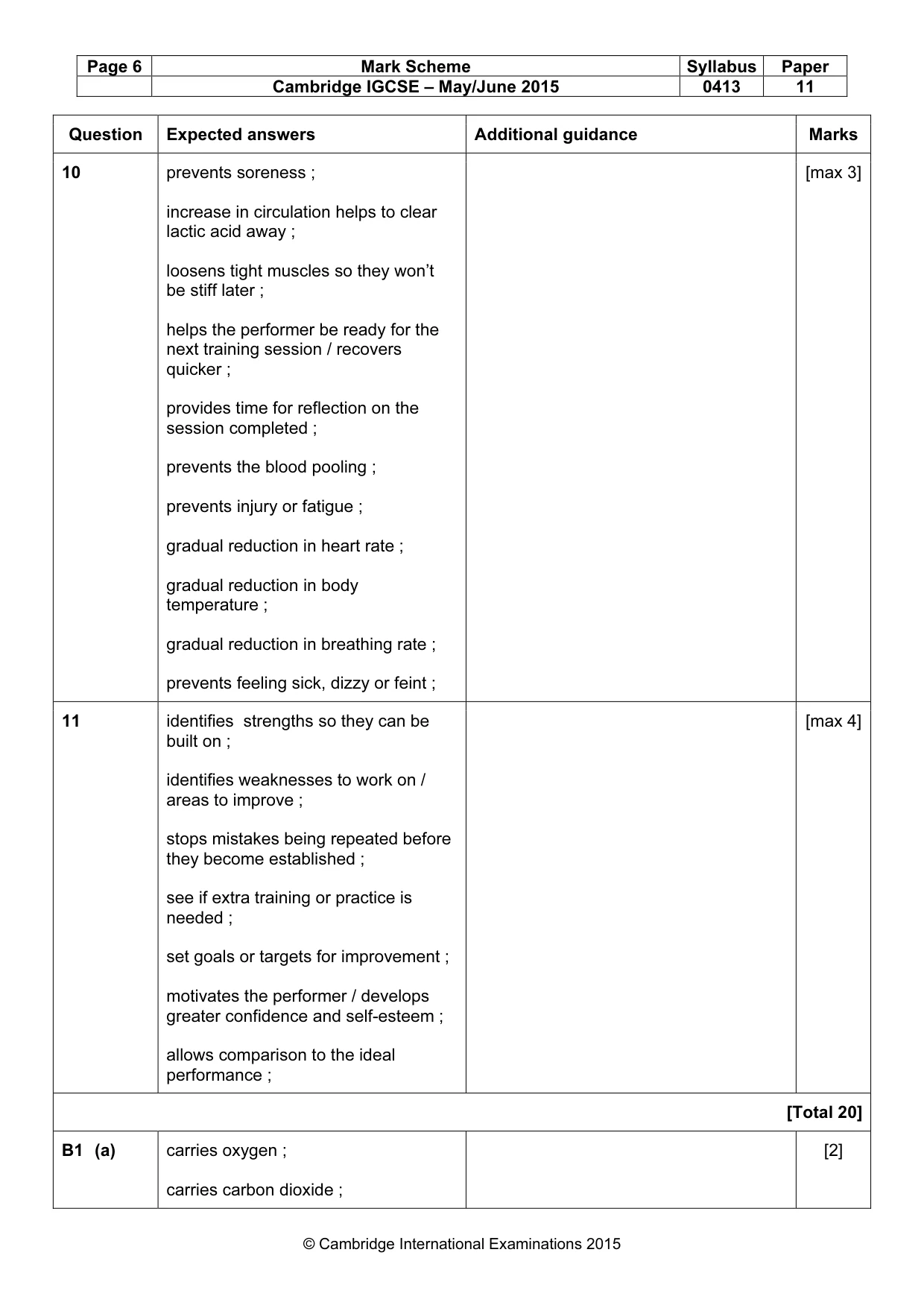
Page 6 Mark Scheme Syllabus Paper Cambridge IGCSE – May/June 2015 0413 11 © Cambridge International Examinations 2015 Question Expected answers Additional guidance Marks 10 prevents soreness ; increase in circulation helps to clear lactic acid away ; loosens tight muscles so they won’t be stiff later ; helps the performer be ready for the next training session / recovers quicker ; provides time for reflection on the session completed ; prevents the blood pooling ; prevents injury or fatigue ; gradual reduction in heart rate ; gradual reduction in body temperature ; gradual reduction in breathing rate ; prevents feeling sick, dizzy or feint ; [max 3] 11 identifies strengths so they can be built on ; identifies weaknesses to work on / areas to improve ; stops mistakes being repeated before they become established ; see if extra training or practice is needed ; set goals or targets for improvement ; motivates the performer / develops greater confidence and self-esteem ; allows comparison to the ideal performance ; [max 4] [Total 20] B1 (a) carries oxygen ; carries carbon dioxide ; [2]
Mark scheme, page 7
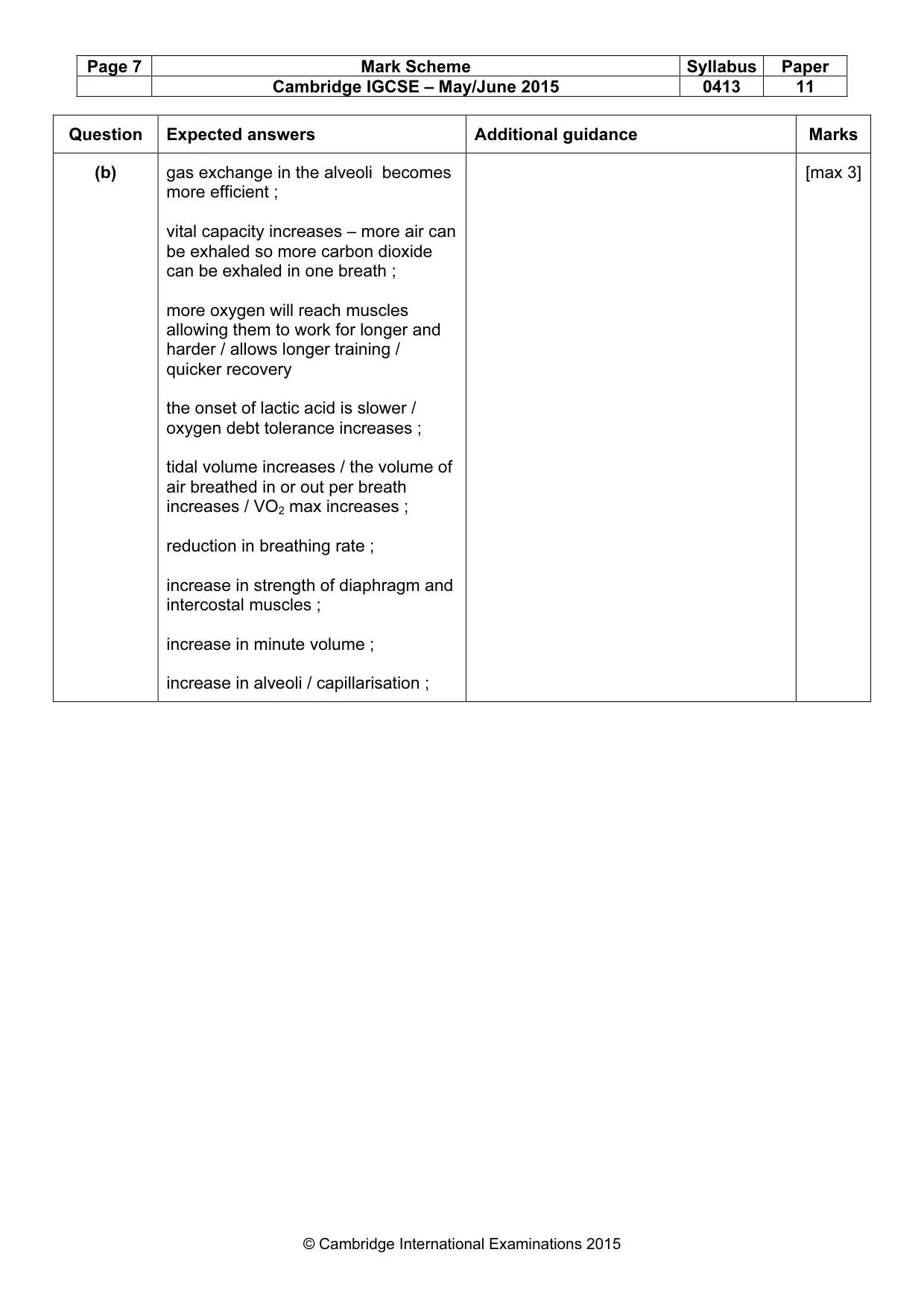
Page 7 Mark Scheme Syllabus Paper Cambridge IGCSE – May/June 2015 0413 11 © Cambridge International Examinations 2015 Question Expected answers Additional guidance Marks (b) gas exchange in the alveoli becomes more efficient ; vital capacity increases – more air can be exhaled so more carbon dioxide can be exhaled in one breath ; more oxygen will reach muscles allowing them to work for longer and harder / allows longer training / quicker recovery the onset of lactic acid is slower / oxygen debt tolerance increases ; tidal volume increases / the volume of air breathed in or out per breath increases / VO2 max increases ; reduction in breathing rate ; increase in strength of diaphragm and intercostal muscles ; increase in minute volume ; increase in alveoli / capillarisation ; [max 3]
Mark scheme, page 8
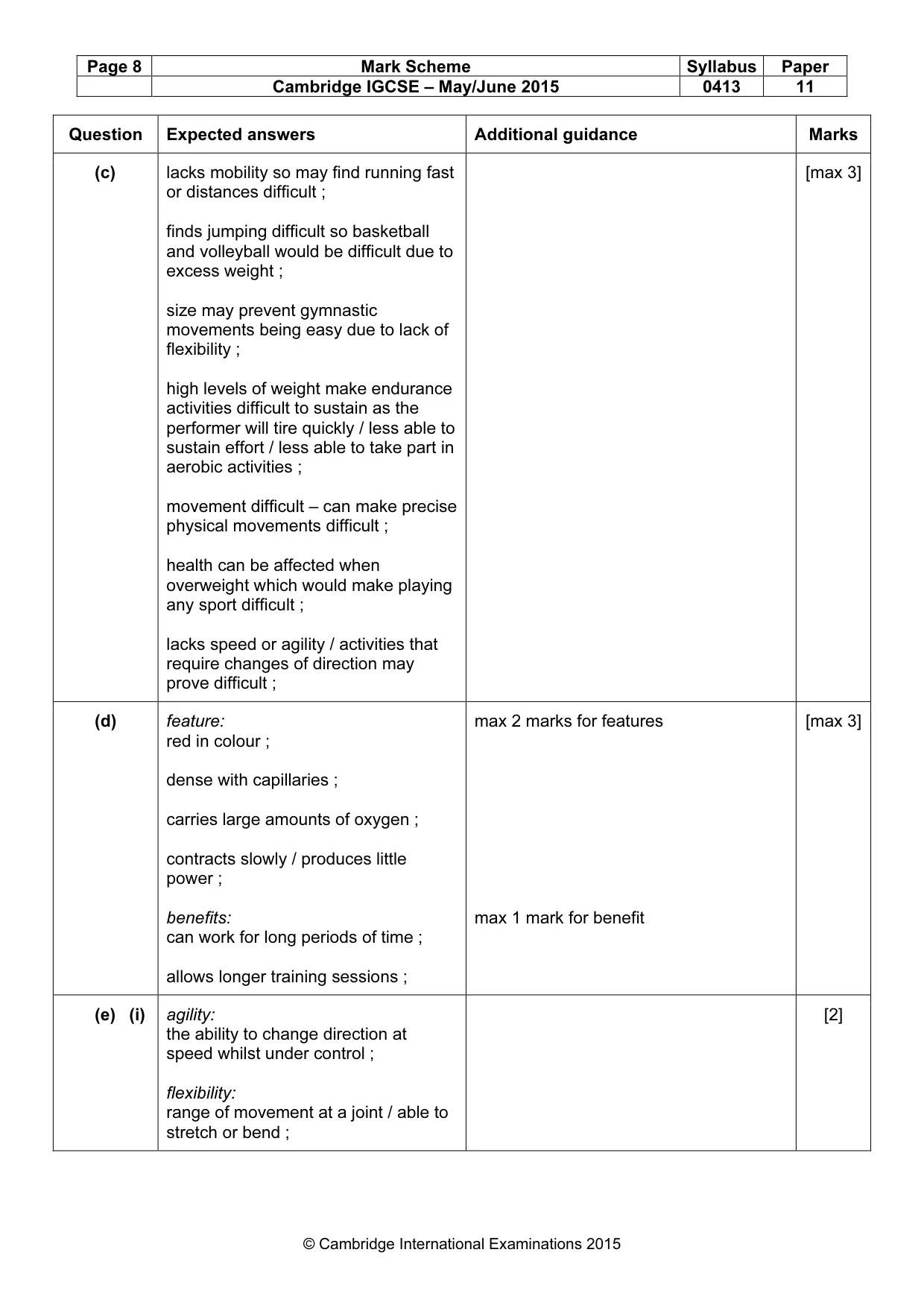
Page 8 Mark Scheme Syllabus Paper Cambridge IGCSE – May/June 2015 0413 11 © Cambridge International Examinations 2015 Question Expected answers Additional guidance Marks (c) lacks mobility so may find running fast or distances difficult ; finds jumping difficult so basketball and volleyball would be difficult due to excess weight ; size may prevent gymnastic movements being easy due to lack of flexibility ; high levels of weight make endurance activities difficult to sustain as the performer will tire quickly / less able to sustain effort / less able to take part in aerobic activities ; movement difficult – can make precise physical movements difficult ; health can be affected when overweight which would make playing any sport difficult ; lacks speed or agility / activities that require changes of direction may prove difficult ; [max 3] (d) feature: red in colour ; dense with capillaries ; carries large amounts of oxygen ; contracts slowly / produces little power ; benefits: can work for long periods of time ; allows longer training sessions ; max 2 marks for features max 1 mark for benefit [max 3] (e) (i) agility: the ability to change direction at speed whilst under control ; flexibility: range of movement at a joint / able to stretch or bend ; [2]
Mark scheme, page 9
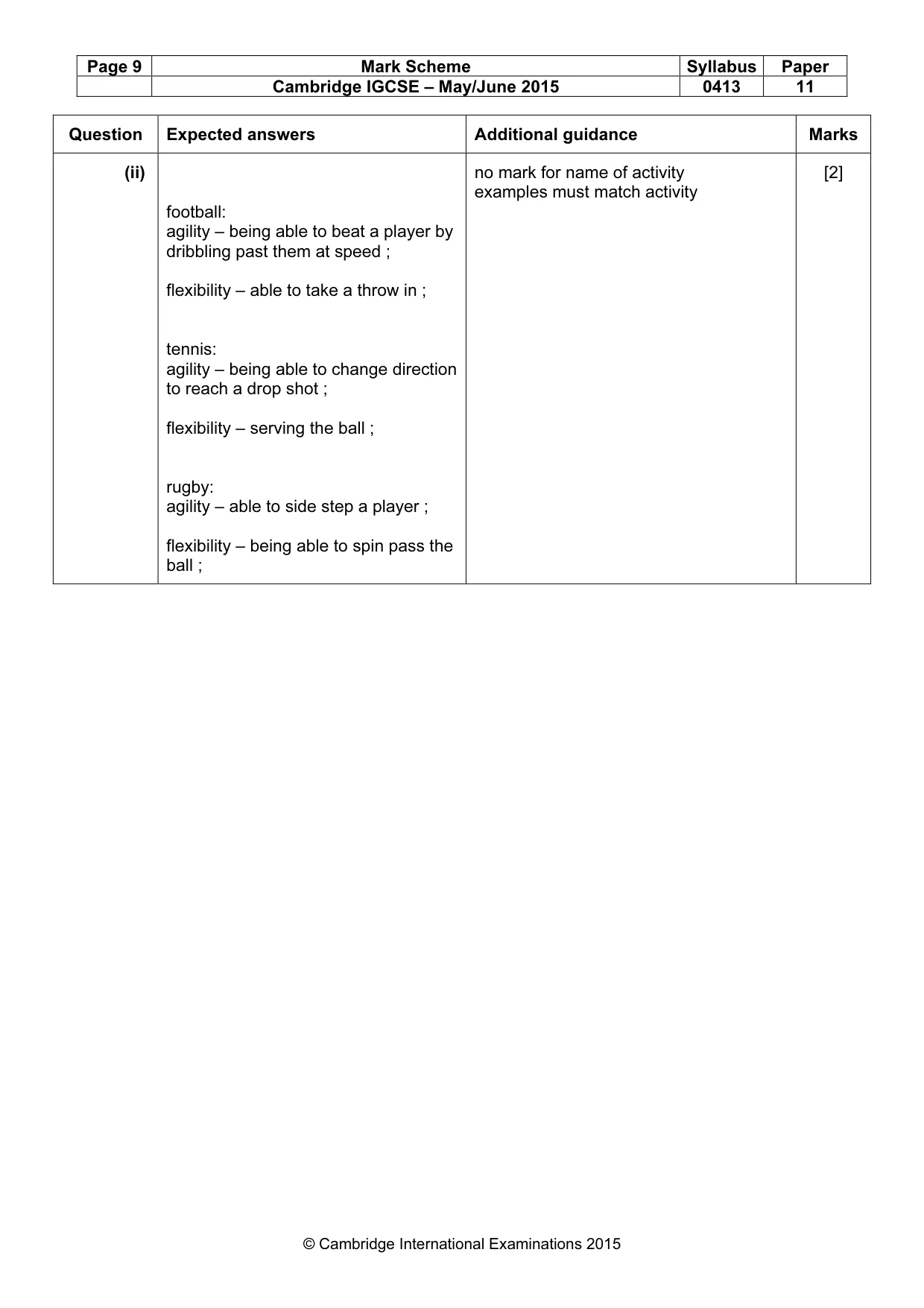
Page 9 Mark Scheme Syllabus Paper Cambridge IGCSE – May/June 2015 0413 11 © Cambridge International Examinations 2015 Question Expected answers Additional guidance Marks (ii) football: agility – being able to beat a player by dribbling past them at speed ; flexibility – able to take a throw in ; tennis: agility – being able to change direction to reach a drop shot ; flexibility – serving the ball ; rugby: agility – able to side step a player ; flexibility – being able to spin pass the ball ; no mark for name of activity examples must match activity [2]
Mark scheme, page 10
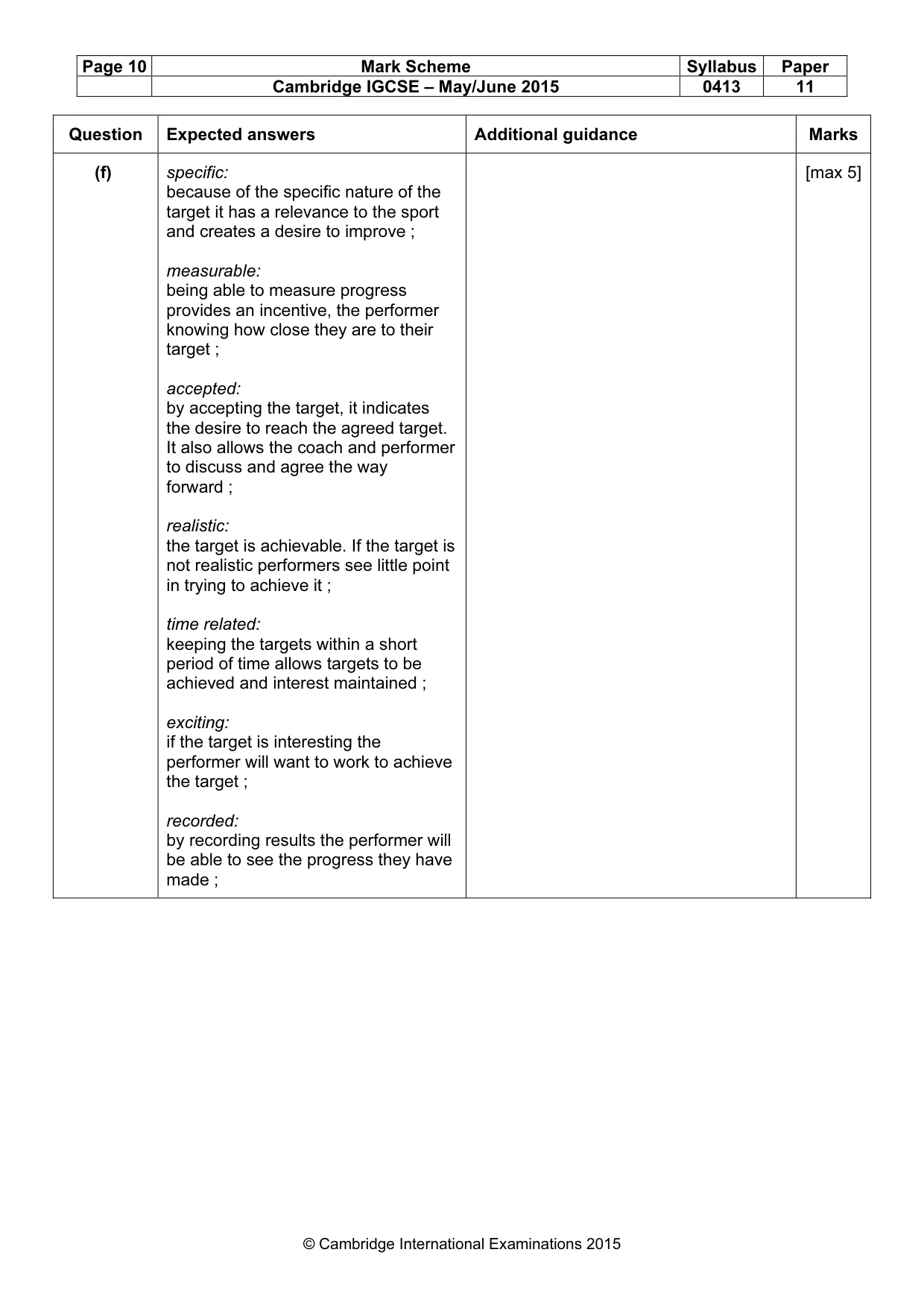
Page 10 Mark Scheme Syllabus Paper Cambridge IGCSE – May/June 2015 0413 11 © Cambridge International Examinations 2015 Question Expected answers Additional guidance Marks (f) specific: because of the specific nature of the target it has a relevance to the sport and creates a desire to improve ; measurable: being able to measure progress provides an incentive, the performer knowing how close they are to their target ; accepted: by accepting the target, it indicates the desire to reach the agreed target. It also allows the coach and performer to discuss and agree the way forward ; realistic: the target is achievable. If the target is not realistic performers see little point in trying to achieve it ; time related: keeping the targets within a short period of time allows targets to be achieved and interest maintained ; exciting: if the target is interesting the performer will want to work to achieve the target ; recorded: by recording results the performer will be able to see the progress they have made ; [max 5]
Mark scheme, page 11
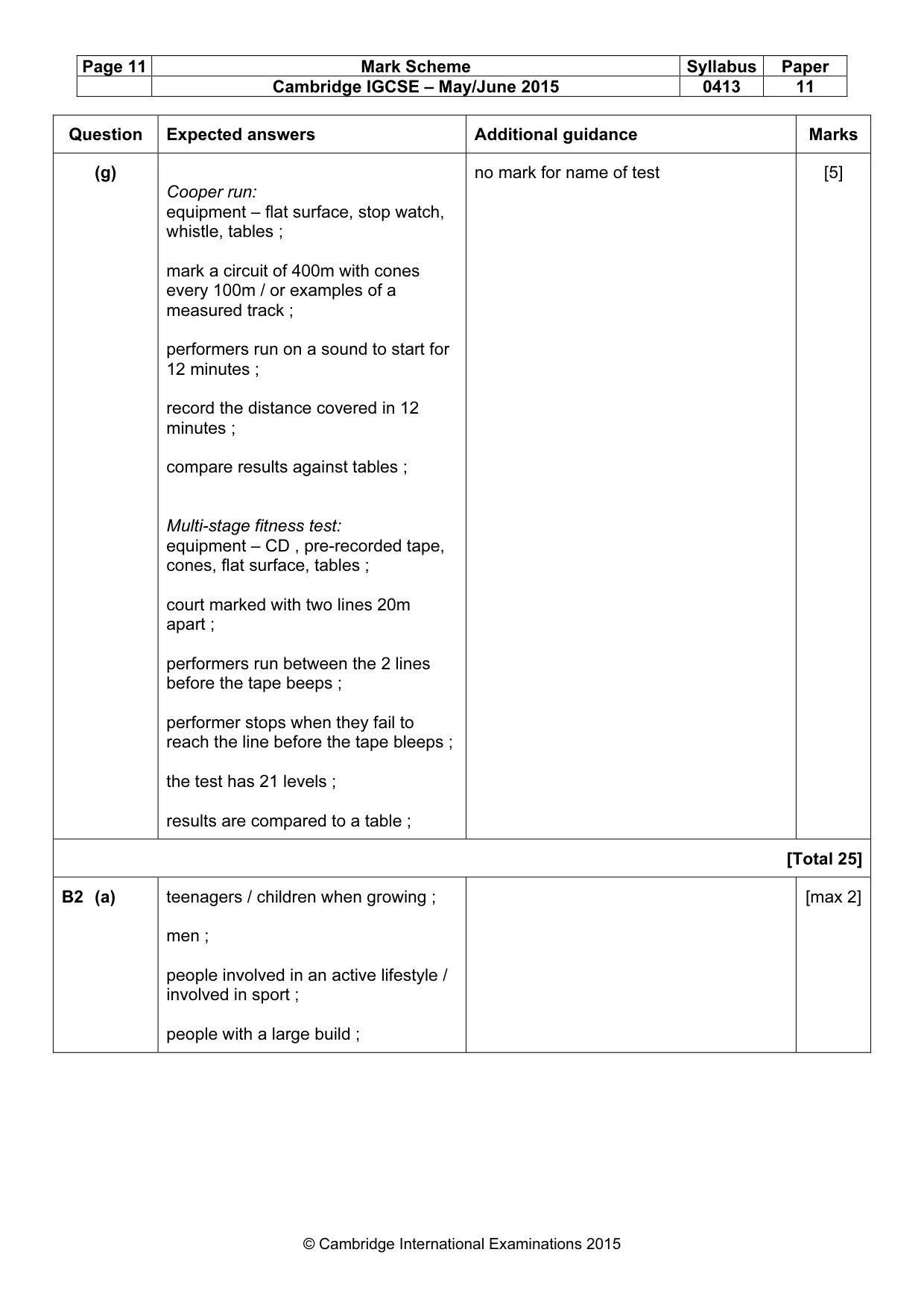
Page 11 Mark Scheme Syllabus Paper Cambridge IGCSE – May/June 2015 0413 11 © Cambridge International Examinations 2015 Question Expected answers Additional guidance Marks (g) Cooper run: equipment – flat surface, stop watch, whistle, tables ; mark a circuit of 400m with cones every 100m / or examples of a measured track ; performers run on a sound to start for 12 minutes ; record the distance covered in 12 minutes ; compare results against tables ; Multi-stage fitness test: equipment – CD , pre-recorded tape, cones, flat surface, tables ; court marked with two lines 20m apart ; performers run between the 2 lines before the tape beeps ; performer stops when they fail to reach the line before the tape bleeps ; the test has 21 levels ; results are compared to a table ; no mark for name of test [5] [Total 25] B2 (a) teenagers / children when growing ; men ; people involved in an active lifestyle / involved in sport ; people with a large build ; [max 2]
Mark scheme, page 12
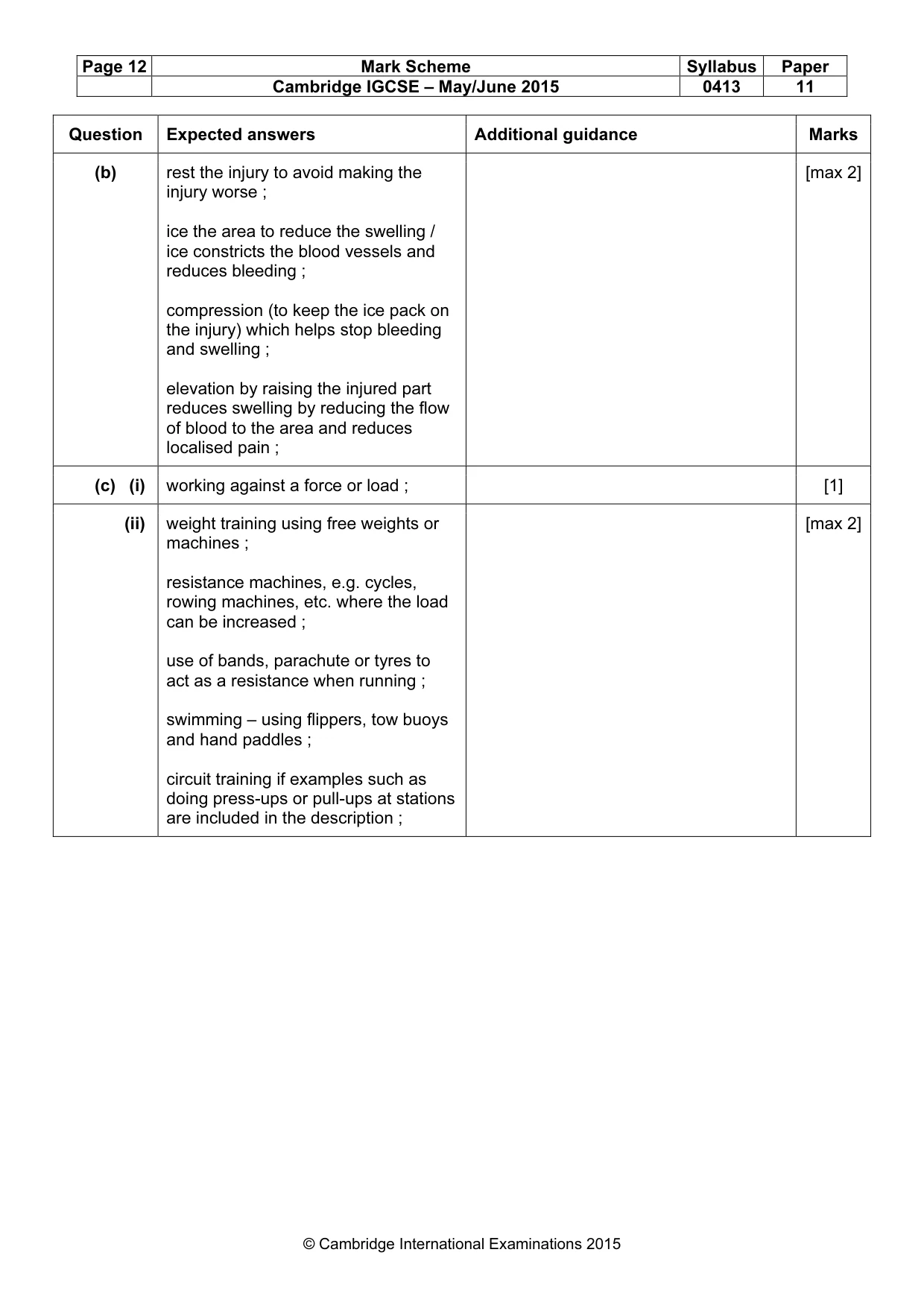
Page 12 Mark Scheme Syllabus Paper Cambridge IGCSE – May/June 2015 0413 11 © Cambridge International Examinations 2015 Question Expected answers Additional guidance Marks (b) rest the injury to avoid making the injury worse ; ice the area to reduce the swelling / ice constricts the blood vessels and reduces bleeding ; compression (to keep the ice pack on the injury) which helps stop bleeding and swelling ; elevation by raising the injured part reduces swelling by reducing the flow of blood to the area and reduces localised pain ; [max 2] (c) (i) working against a force or load ; [1] (ii) weight training using free weights or machines ; resistance machines, e.g. cycles, rowing machines, etc. where the load can be increased ; use of bands, parachute or tyres to act as a resistance when running ; swimming – using flippers, tow buoys and hand paddles ; circuit training if examples such as doing press-ups or pull-ups at stations are included in the description ; [max 2]
Mark scheme, page 13
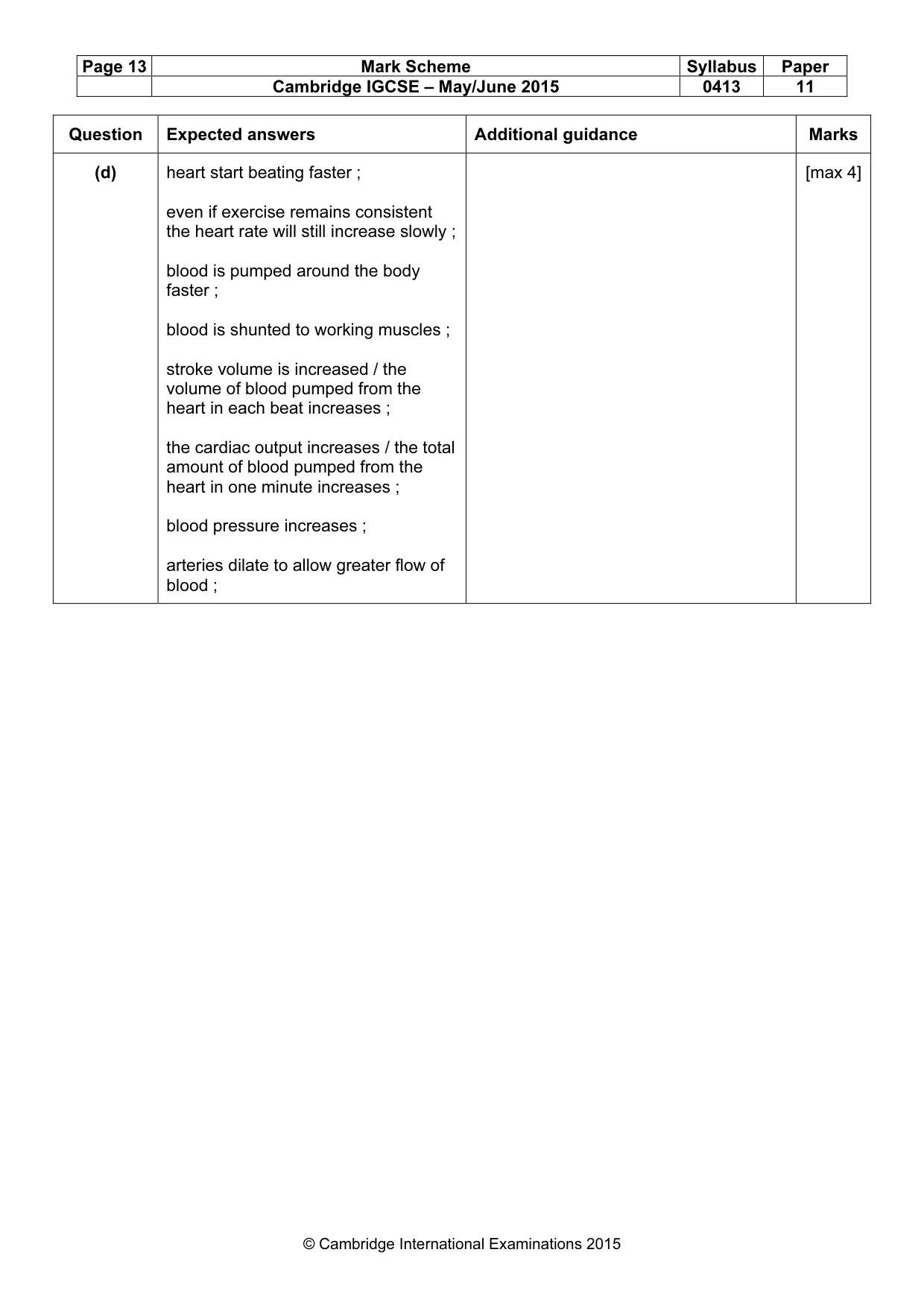
Page 13 Mark Scheme Syllabus Paper Cambridge IGCSE – May/June 2015 0413 11 © Cambridge International Examinations 2015 Question Expected answers Additional guidance Marks (d) heart start beating faster ; even if exercise remains consistent the heart rate will still increase slowly ; blood is pumped around the body faster ; blood is shunted to working muscles ; stroke volume is increased / the volume of blood pumped from the heart in each beat increases ; the cardiac output increases / the total amount of blood pumped from the heart in one minute increases ; blood pressure increases ; arteries dilate to allow greater flow of blood ; [max 4]
Mark scheme, page 14
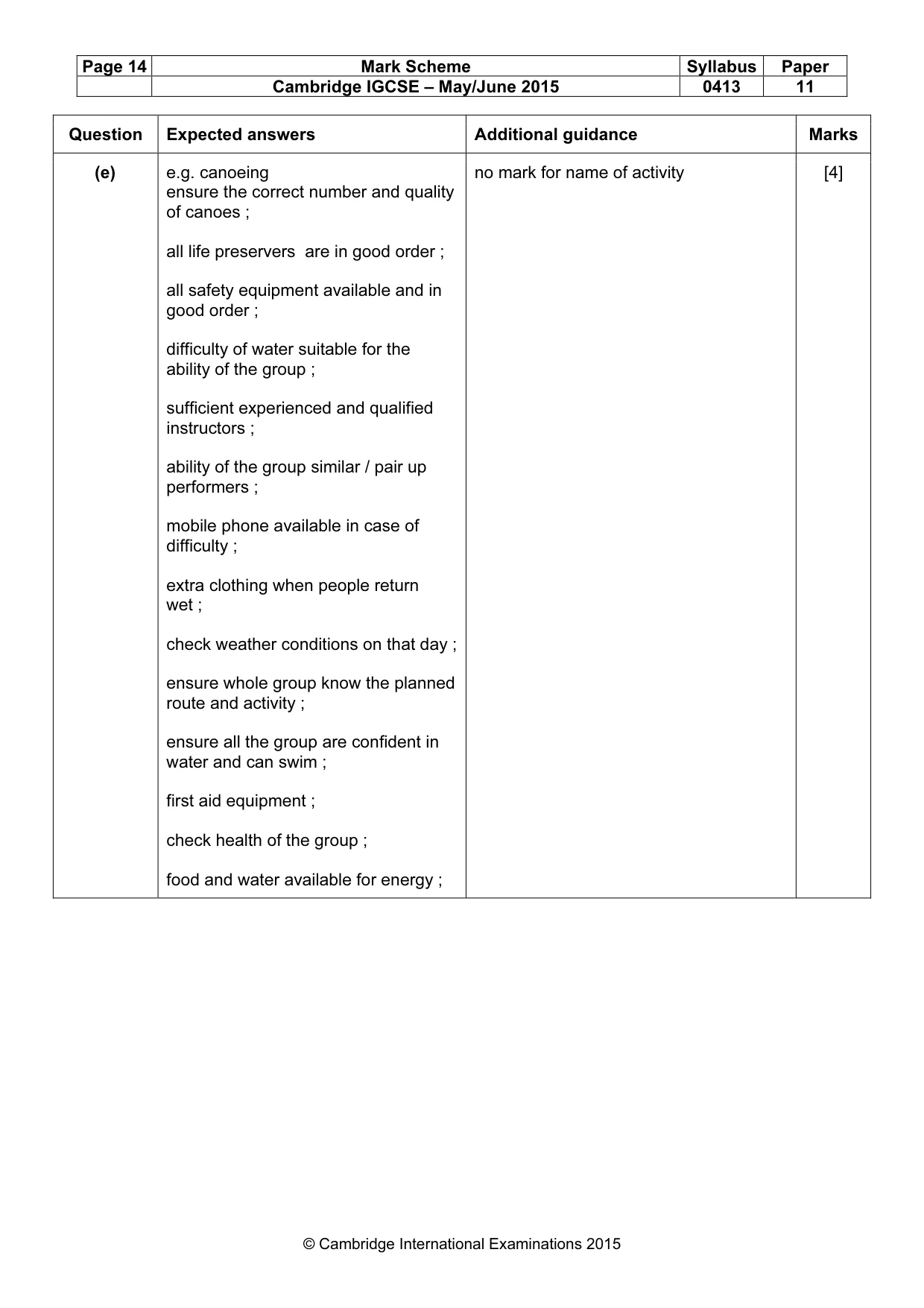
Page 14 Mark Scheme Syllabus Paper Cambridge IGCSE – May/June 2015 0413 11 © Cambridge International Examinations 2015 Question Expected answers Additional guidance Marks (e) e.g. canoeing ensure the correct number and quality of canoes ; all life preservers are in good order ; all safety equipment available and in good order ; difficulty of water suitable for the ability of the group ; sufficient experienced and qualified instructors ; ability of the group similar / pair up performers ; mobile phone available in case of difficulty ; extra clothing when people return wet ; check weather conditions on that day ; ensure whole group know the planned route and activity ; ensure all the group are confident in water and can swim ; first aid equipment ; check health of the group ; food and water available for energy ; no mark for name of activity [4]
Mark scheme, page 15
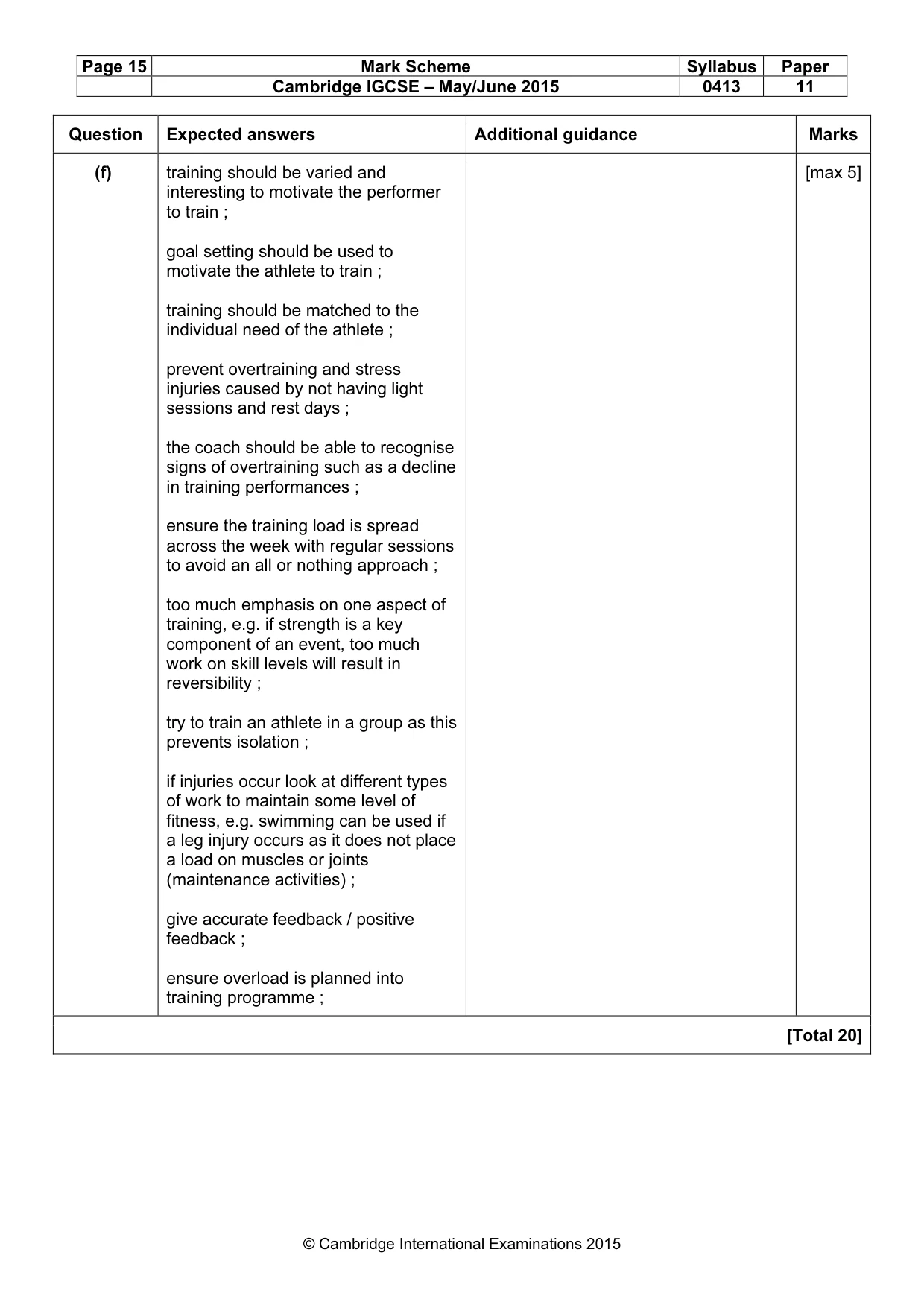
Page 15 Mark Scheme Syllabus Paper Cambridge IGCSE – May/June 2015 0413 11 © Cambridge International Examinations 2015 Question Expected answers Additional guidance Marks (f) training should be varied and interesting to motivate the performer to train ; goal setting should be used to motivate the athlete to train ; training should be matched to the individual need of the athlete ; prevent overtraining and stress injuries caused by not having light sessions and rest days ; the coach should be able to recognise signs of overtraining such as a decline in training performances ; ensure the training load is spread across the week with regular sessions to avoid an all or nothing approach ; too much emphasis on one aspect of training, e.g. if strength is a key component of an event, too much work on skill levels will result in reversibility ; try to train an athlete in a group as this prevents isolation ; if injuries occur look at different types of work to maintain some level of fitness, e.g. swimming can be used if a leg injury occurs as it does not place a load on muscles or joints (maintenance activities) ; give accurate feedback / positive feedback ; ensure overload is planned into training programme ; [max 5] [Total 20]
Mark scheme, page 16
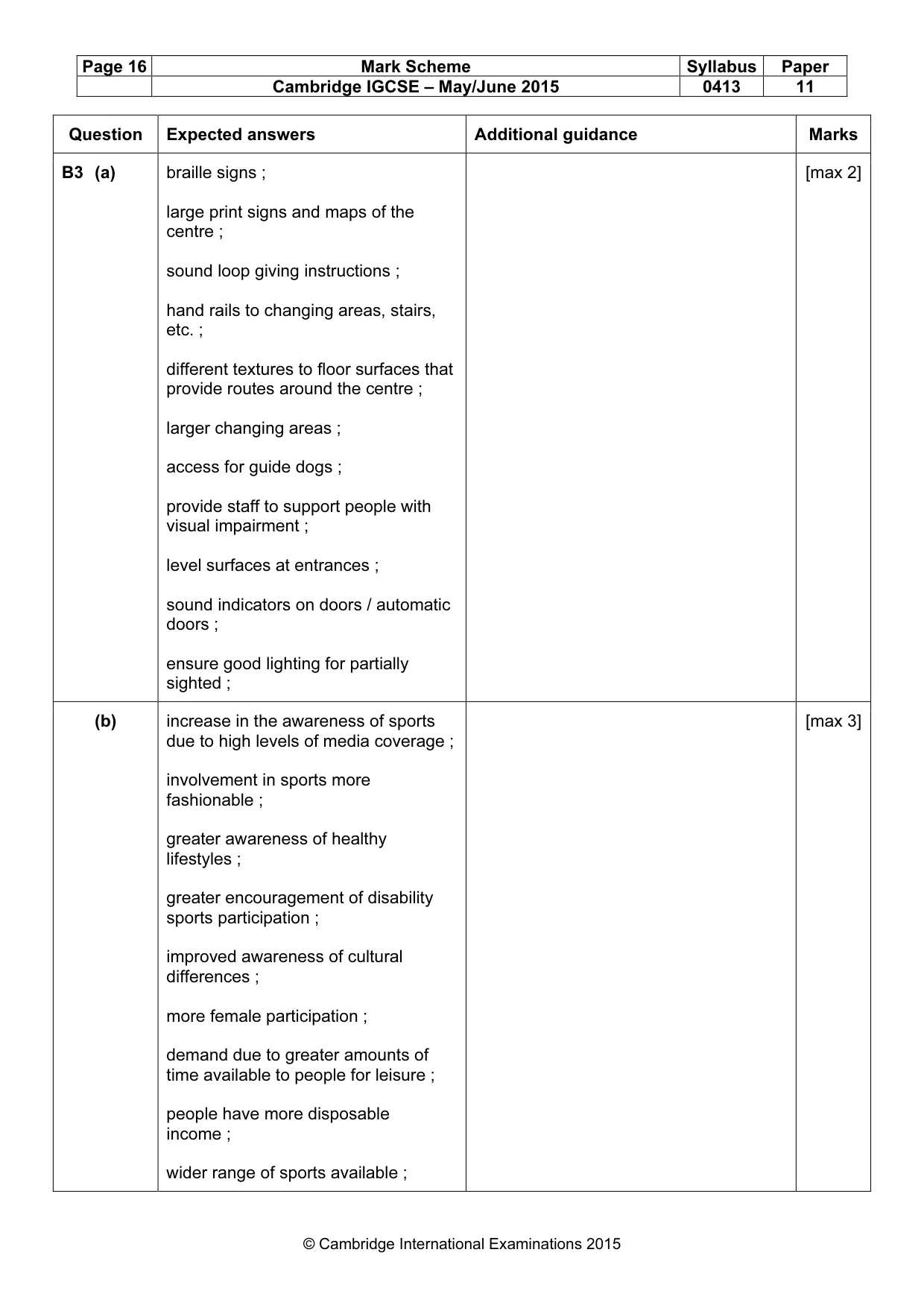
Page 16 Mark Scheme Syllabus Paper Cambridge IGCSE – May/June 2015 0413 11 © Cambridge International Examinations 2015 Question Expected answers Additional guidance Marks B3 (a) braille signs ; large print signs and maps of the centre ; sound loop giving instructions ; hand rails to changing areas, stairs, etc. ; different textures to floor surfaces that provide routes around the centre ; larger changing areas ; access for guide dogs ; provide staff to support people with visual impairment ; level surfaces at entrances ; sound indicators on doors / automatic doors ; ensure good lighting for partially sighted ; [max 2] (b) increase in the awareness of sports due to high levels of media coverage ; involvement in sports more fashionable ; greater awareness of healthy lifestyles ; greater encouragement of disability sports participation ; improved awareness of cultural differences ; more female participation ; demand due to greater amounts of time available to people for leisure ; people have more disposable income ; wider range of sports available ; [max 3]
Mark scheme, page 17
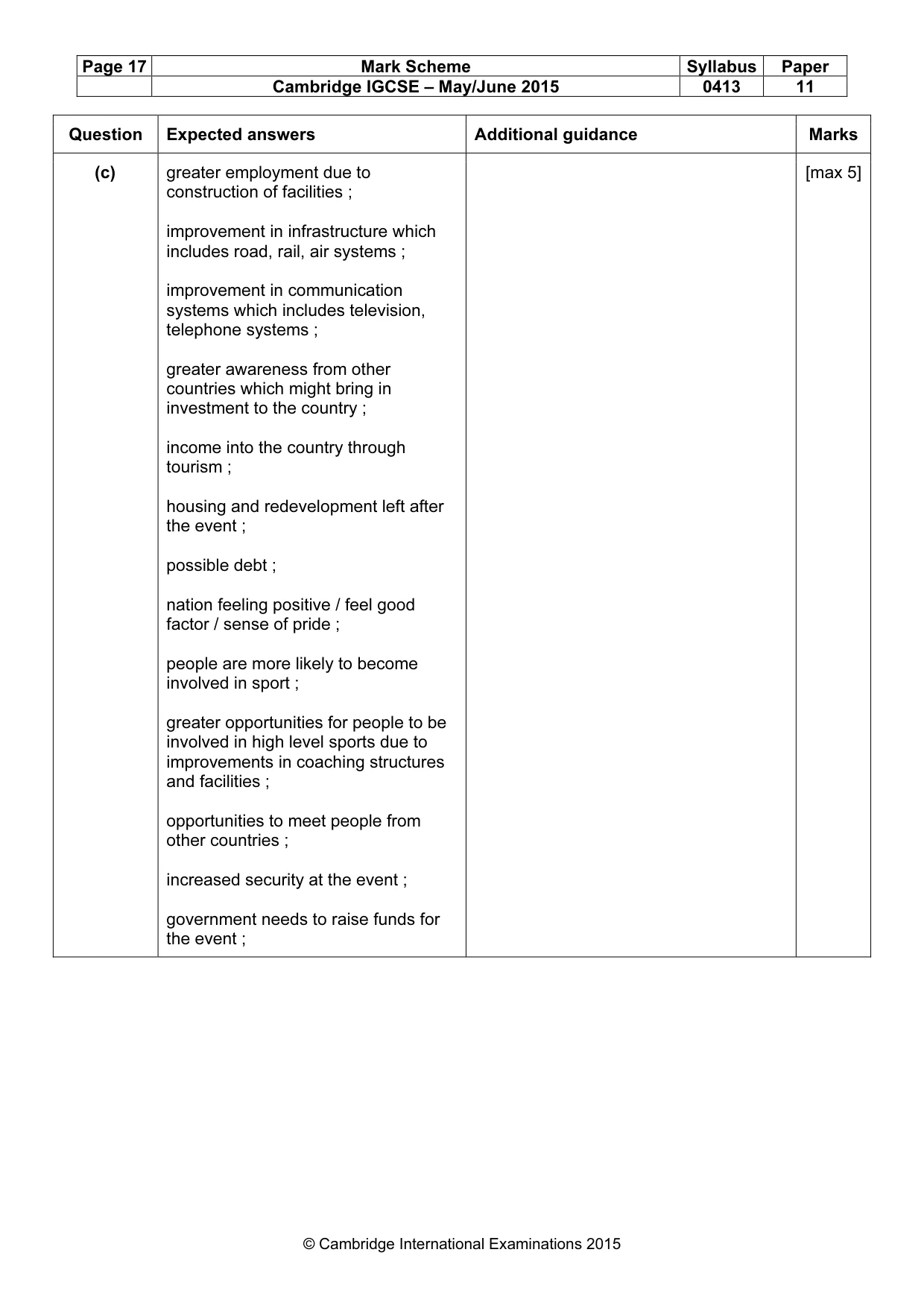
Page 17 Mark Scheme Syllabus Paper Cambridge IGCSE – May/June 2015 0413 11 © Cambridge International Examinations 2015 Question Expected answers Additional guidance Marks (c) greater employment due to construction of facilities ; improvement in infrastructure which includes road, rail, air systems ; improvement in communication systems which includes television, telephone systems ; greater awareness from other countries which might bring in investment to the country ; income into the country through tourism ; housing and redevelopment left after the event ; possible debt ; nation feeling positive / feel good factor / sense of pride ; people are more likely to become involved in sport ; greater opportunities for people to be involved in high level sports due to improvements in coaching structures and facilities ; opportunities to meet people from other countries ; increased security at the event ; government needs to raise funds for the event ; [max 5]
Mark scheme, page 18
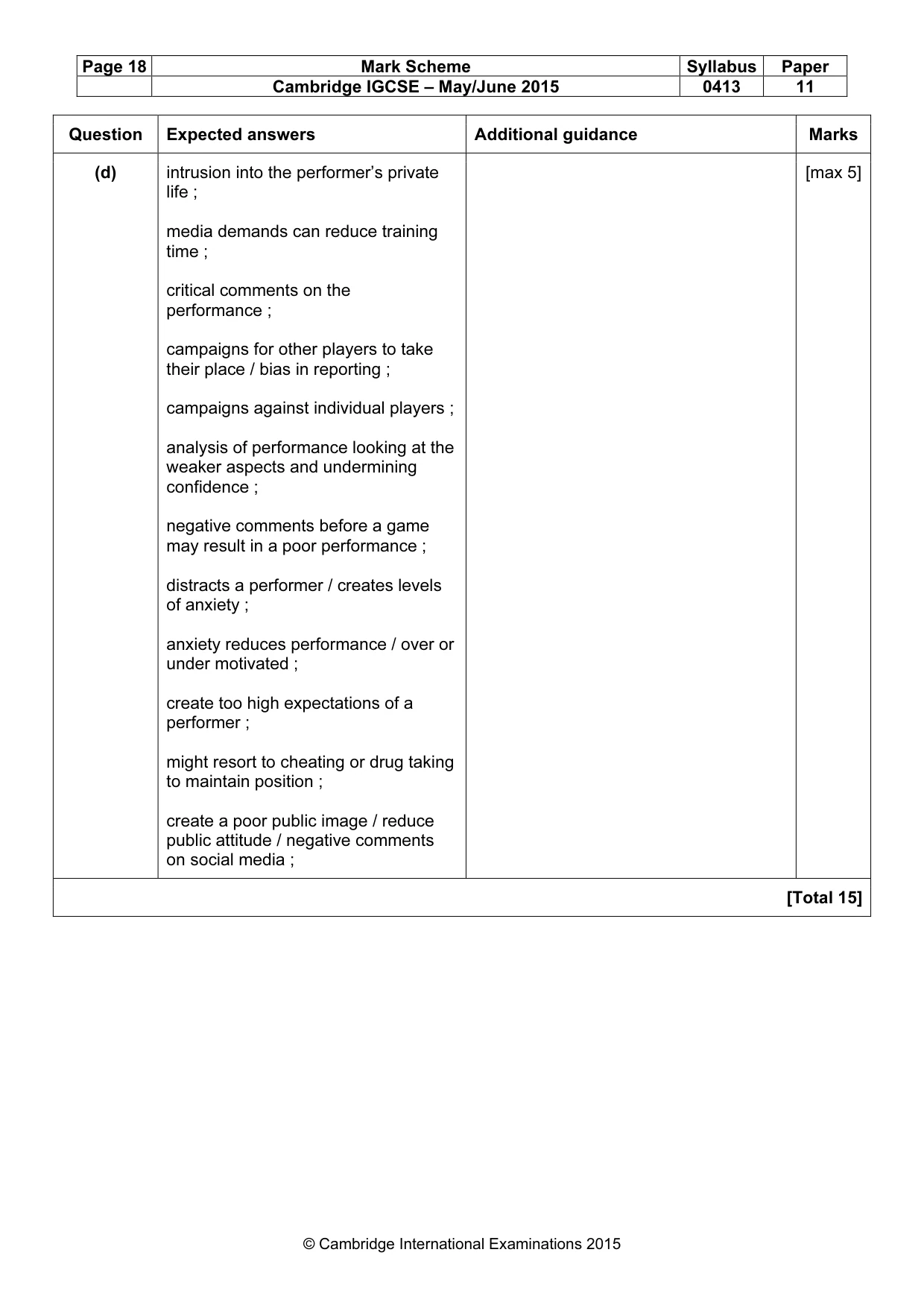
Page 18 Mark Scheme Syllabus Paper Cambridge IGCSE – May/June 2015 0413 11 © Cambridge International Examinations 2015 Question Expected answers Additional guidance Marks (d) intrusion into the performer’s private life ; media demands can reduce training time ; critical comments on the performance ; campaigns for other players to take their place / bias in reporting ; campaigns against individual players ; analysis of performance looking at the weaker aspects and undermining confidence ; negative comments before a game may result in a poor performance ; distracts a performer / creates levels of anxiety ; anxiety reduces performance / over or under motivated ; create too high expectations of a performer ; might resort to cheating or drug taking to maintain position ; create a poor public image / reduce public attitude / negative comments on social media ; [max 5] [Total 15]
What you needed in this session
Cambridge’s own grade thresholds for 2015 May/June, Paper 1 · Variant 1. A higher threshold means an easier paper — the bar moves with how the cohort did.