Cambridge IGCSE Physical Education 0413 — 2015 May/June Paper 1 · Variant 3
0413/13/M/J/15 · 80 marks · ≈90 min
The question paper and its mark scheme, free to read here and free to download. This is Cambridge’s own paper, exactly as it was sat.
Question paper12 pages

Mark scheme17 pages
Answers below. Sit the paper first if you are practising.
Paper as text
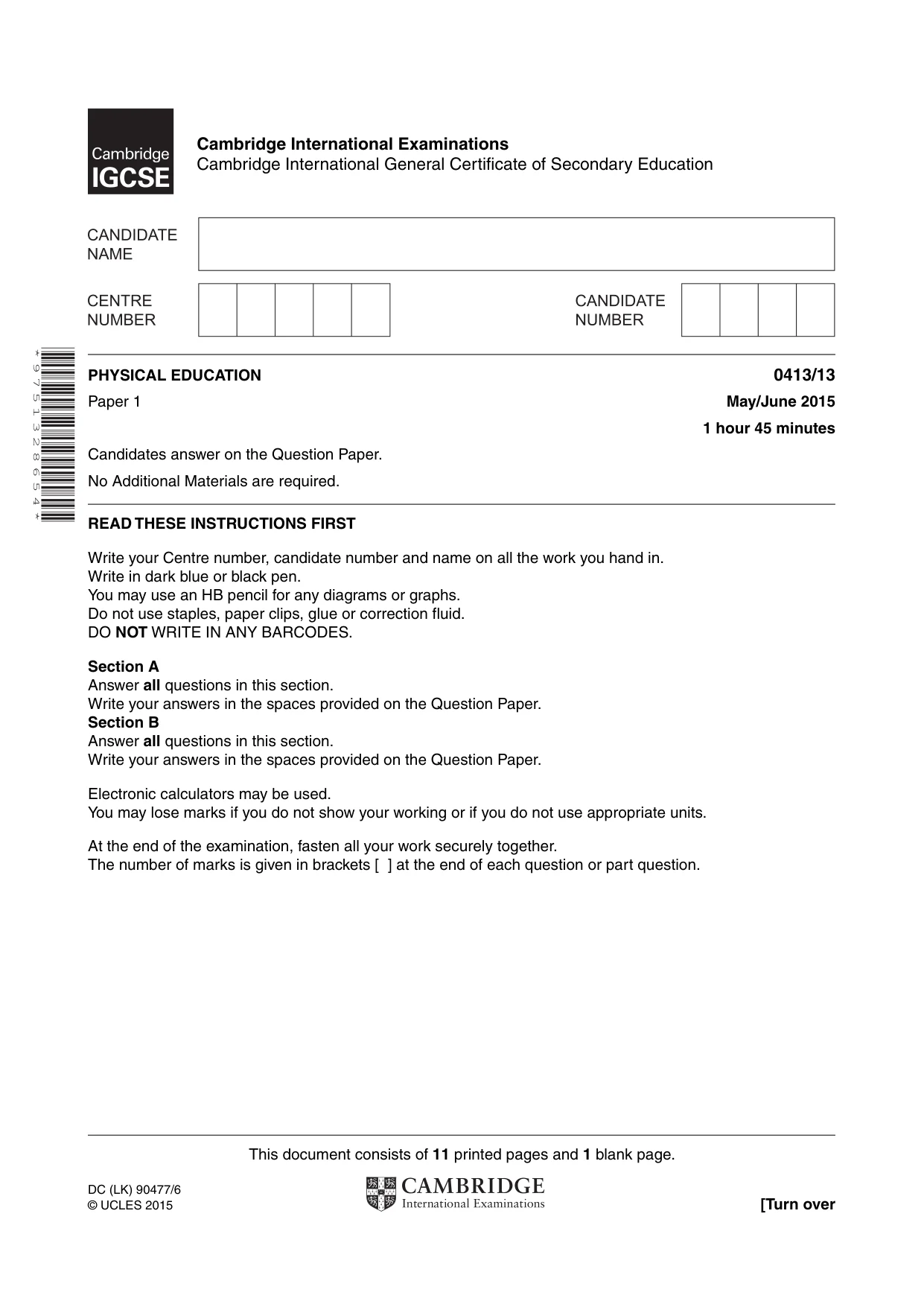
Question paper, page 1
This document consists of 11 printed pages and 1 blank page. DC (LK) 90477/6 © UCLES 2015 [Turn over Cambridge International Examinations Cambridge International General Certificate of Secondary Education * 9 7 5 1 3 2 8 6 5 4 * PHYSICAL EDUCATION 0413/13 Paper 1 May/June 2015 1 hour 45 minutes Candidates answer on the Question Paper. No Additional Materials are required. READ THESE INSTRUCTIONS FIRST Write your Centre number, candidate number and name on all the work you hand in. Write in dark blue or black pen. You may use an HB pencil for any diagrams or graphs. Do not use staples, paper clips, glue or correction fluid. DO NOT WRITE IN ANY BARCODES. Section A Answer all questions in this section. Write your answers in the spaces provided on the Question Paper. Section B Answer all questions in this section. Write your answers in the spaces provided on the Question Paper. Electronic calculators may be used. You may lose marks if you do not show your working or if you do not use appropriate units. At the end of the examination, fasten all your work securely together. The number of marks is given in brackets [ ] at the end of each question or part question.
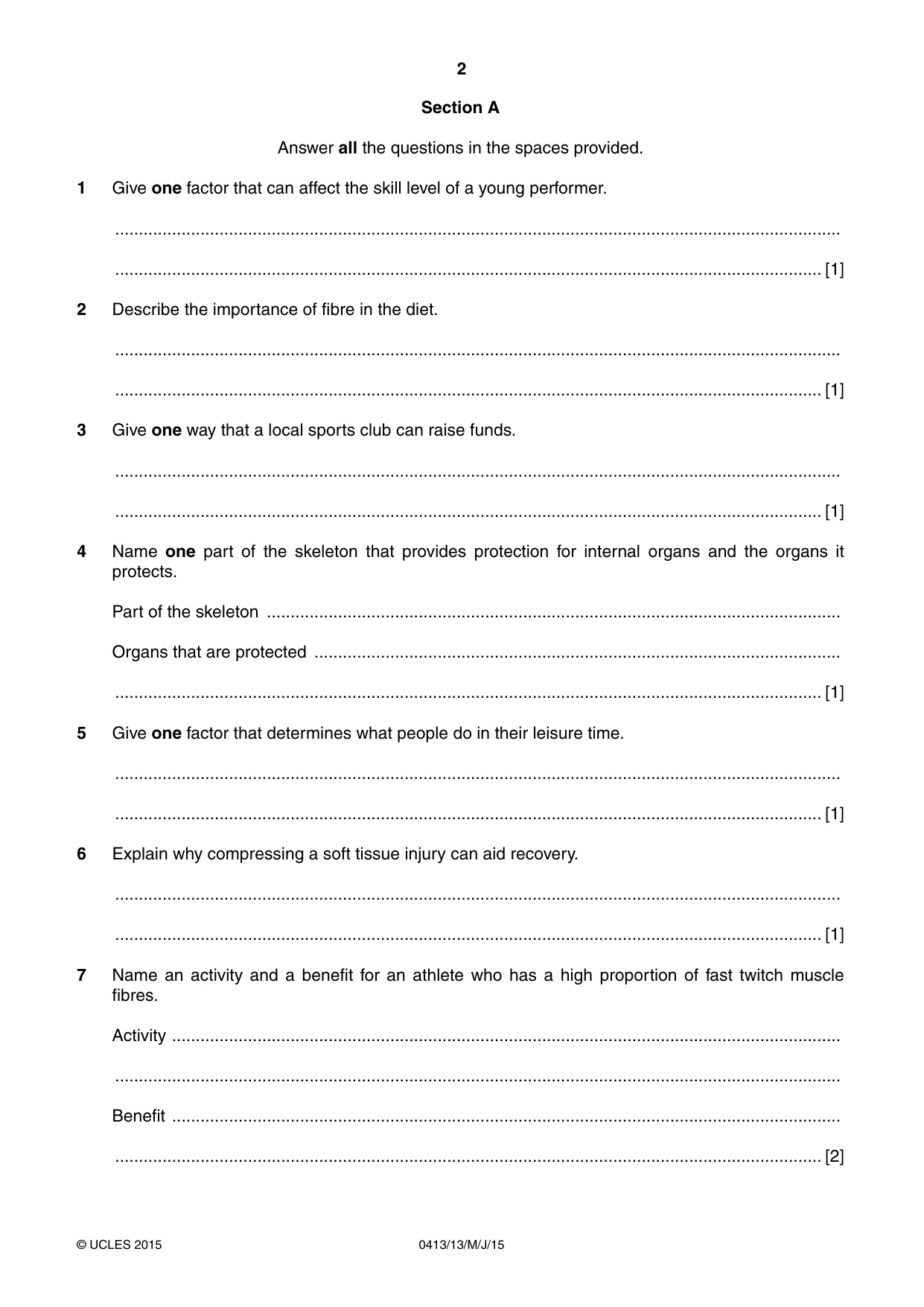
Question paper, page 2
2 0413/13/M/J/15 © UCLES 2015 Section A Answer all the questions in the spaces provided. 1 Give one factor that can affect the skill level of a young performer. … … [1] 2 Describe the importance of fibre in the diet. … … [1] 3 Give one way that a local sports club can raise funds. … … [1] 4 Name one part of the skeleton that provides protection for internal organs and the organs it protects. Part of the skeleton … Organs that are protected … … [1] 5 Give one factor that determines what people do in their leisure time. … … [1] 6 Explain why compressing a soft tissue injury can aid recovery. … … [1] 7 Name an activity and a benefit for an athlete who has a high proportion of fast twitch muscle fibres. Activity … … Benefit … … [2]
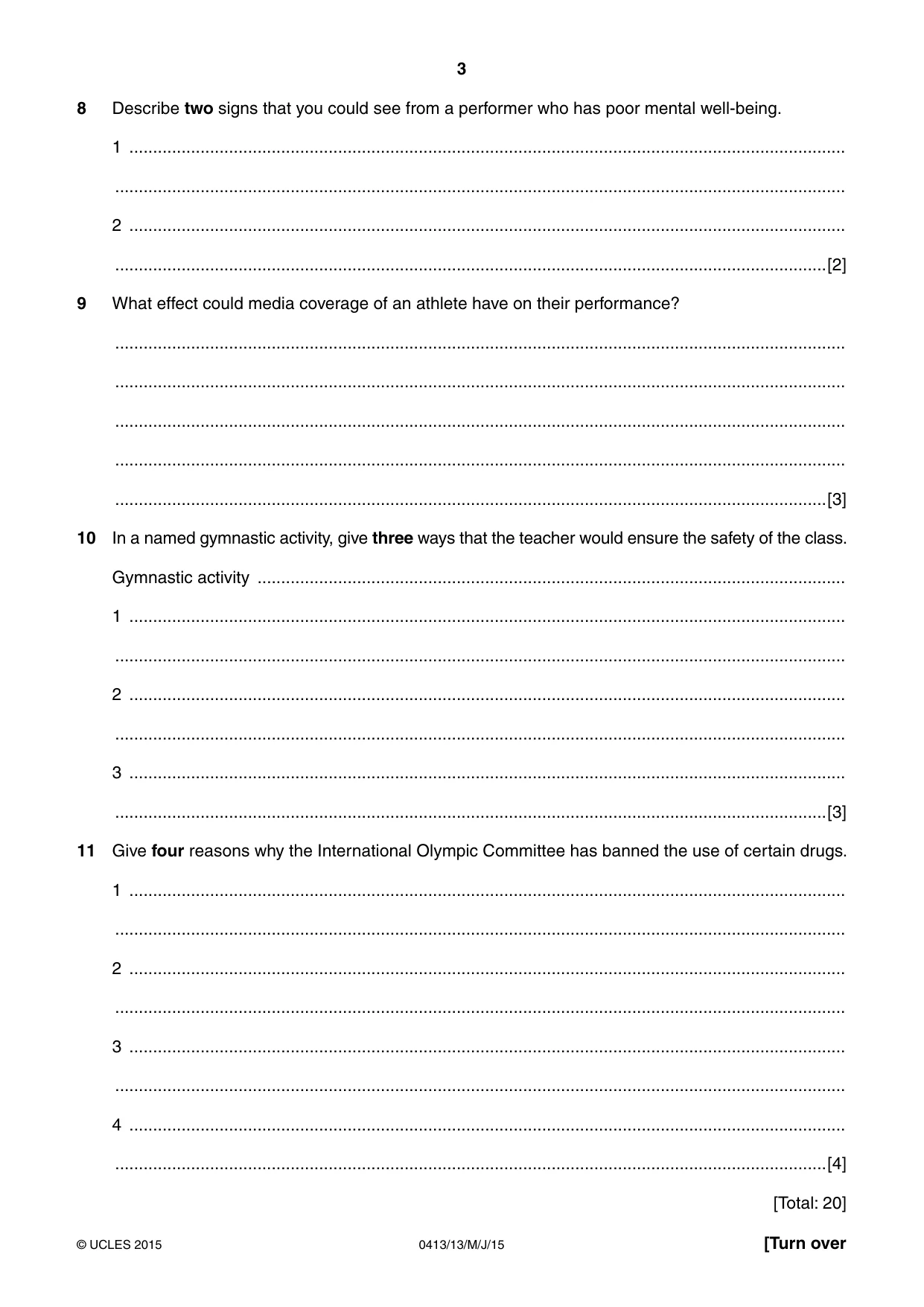
Question paper, page 3
3 0413/13/M/J/15 © UCLES 2015 [Turn over 8 Describe two signs that you could see from a performer who has poor mental well-being. 1 … … 2 … …[2] 9 What effect could media coverage of an athlete have on their performance? … … … … …[3] 10 In a named gymnastic activity, give three ways that the teacher would ensure the safety of the class. Gymnastic activity … 1 … … 2 … … 3 … …[3] 11 Give four reasons why the International Olympic Committee has banned the use of certain drugs. 1 … … 2 … … 3 … … 4 … …[4] [Total: 20]
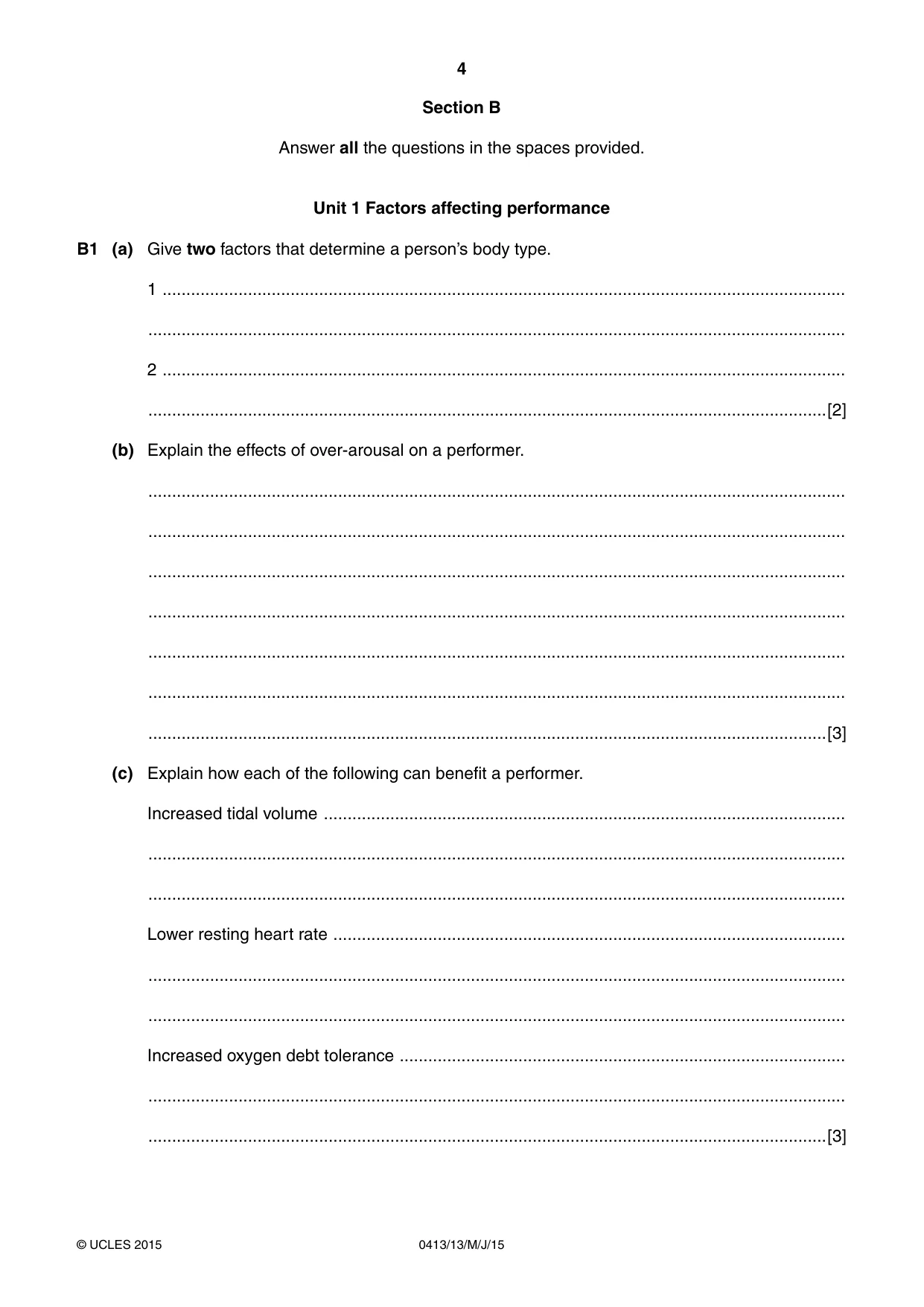
Question paper, page 4
4 0413/13/M/J/15 © UCLES 2015 Section B Answer all the questions in the spaces provided. Unit 1 Factors affecting performance B1 (a) Give two factors that determine a person’s body type. 1 … … 2 … …[2] (b) Explain the effects of over-arousal on a performer. … … … … … … …[3] (c) Explain how each of the following can benefit a performer. Increased tidal volume … … … Lower resting heart rate … … … Increased oxygen debt tolerance … … …[3]
Question paper, page 5
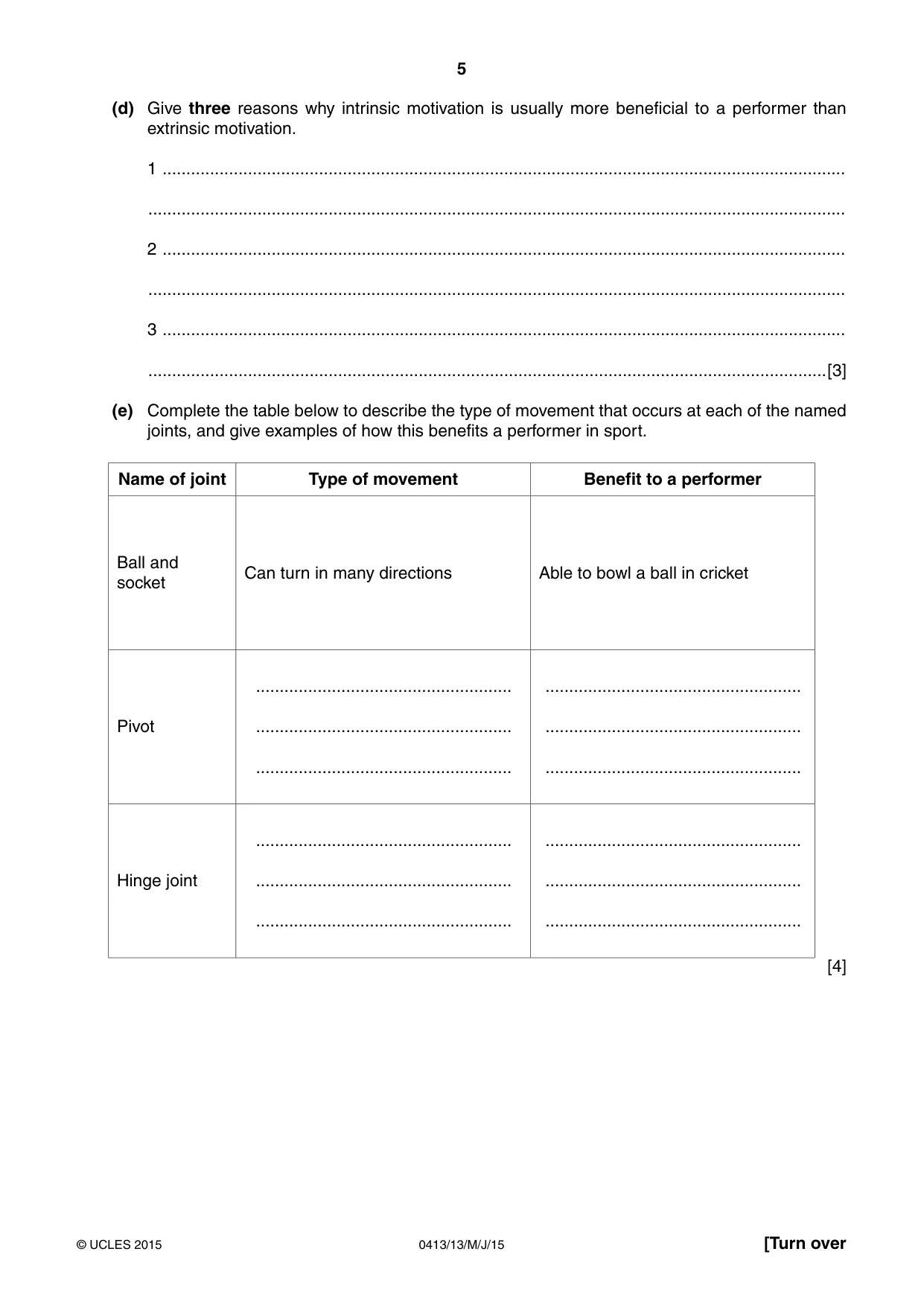
5 0413/13/M/J/15 © UCLES 2015 [Turn over (d) Give three reasons why intrinsic motivation is usually more beneficial to a performer than extrinsic motivation. 1 … … 2 … … 3 … …[3] (e) Complete the table below to describe the type of movement that occurs at each of the named joints, and give examples of how this benefits a performer in sport. Name of joint Type of movement Benefit to a performer Ball and socket Can turn in many directions Able to bowl a ball in cricket Pivot … … … … … … Hinge joint … … … … … … [4]
Question paper, page 6
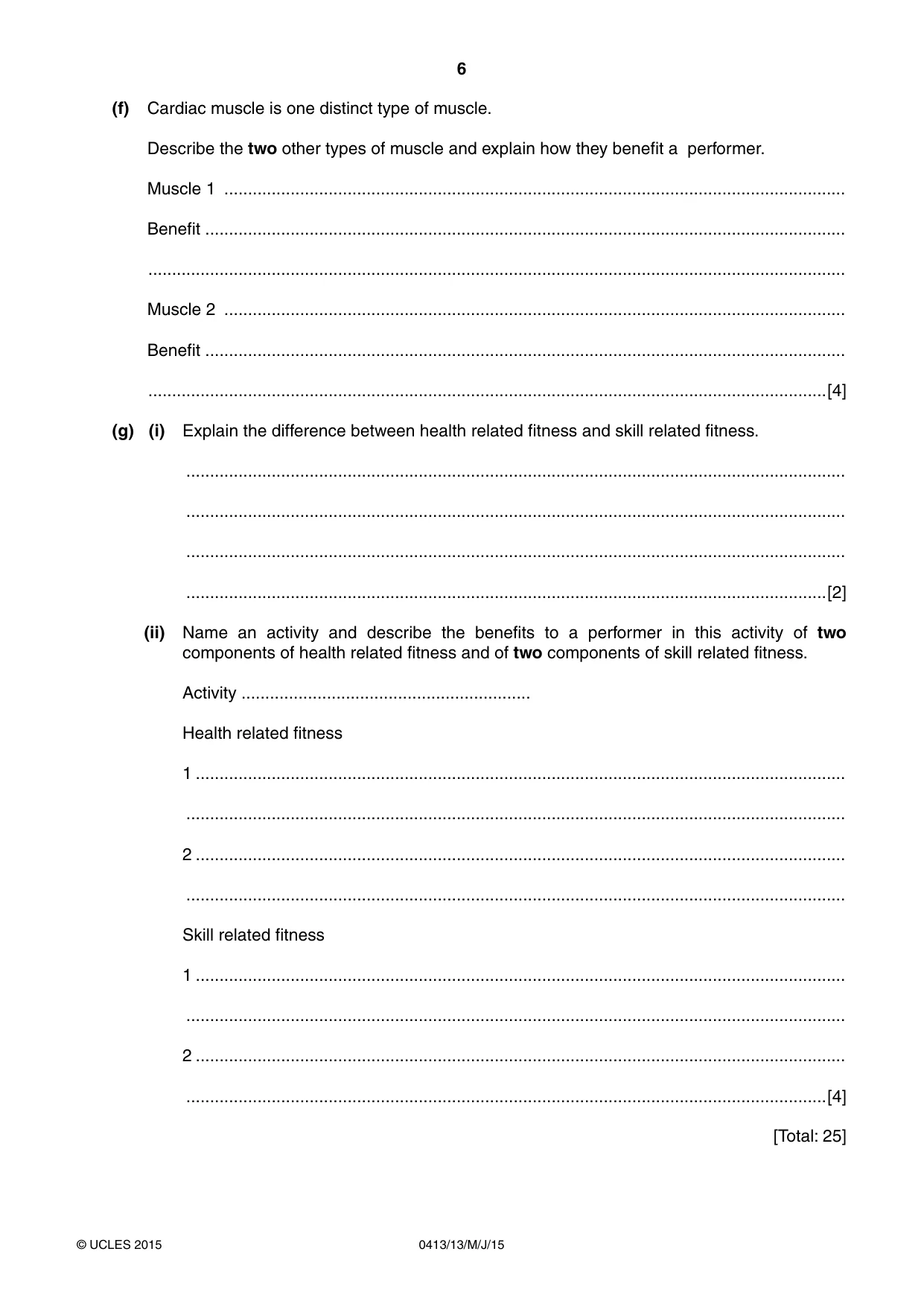
6 0413/13/M/J/15 © UCLES 2015 (f) Cardiac muscle is one distinct type of muscle. Describe the two other types of muscle and explain how they benefit a performer. Muscle 1 … Benefit … … Muscle 2 … Benefit … …[4] (g) (i) Explain the difference between health related fitness and skill related fitness. … … … …[2] (ii) Name an activity and describe the benefits to a performer in this activity of two components of health related fitness and of two components of skill related fitness. Activity … Health related fitness 1 … … 2 … … Skill related fitness 1 … … 2 … …[4] [Total: 25]
Question paper, page 7
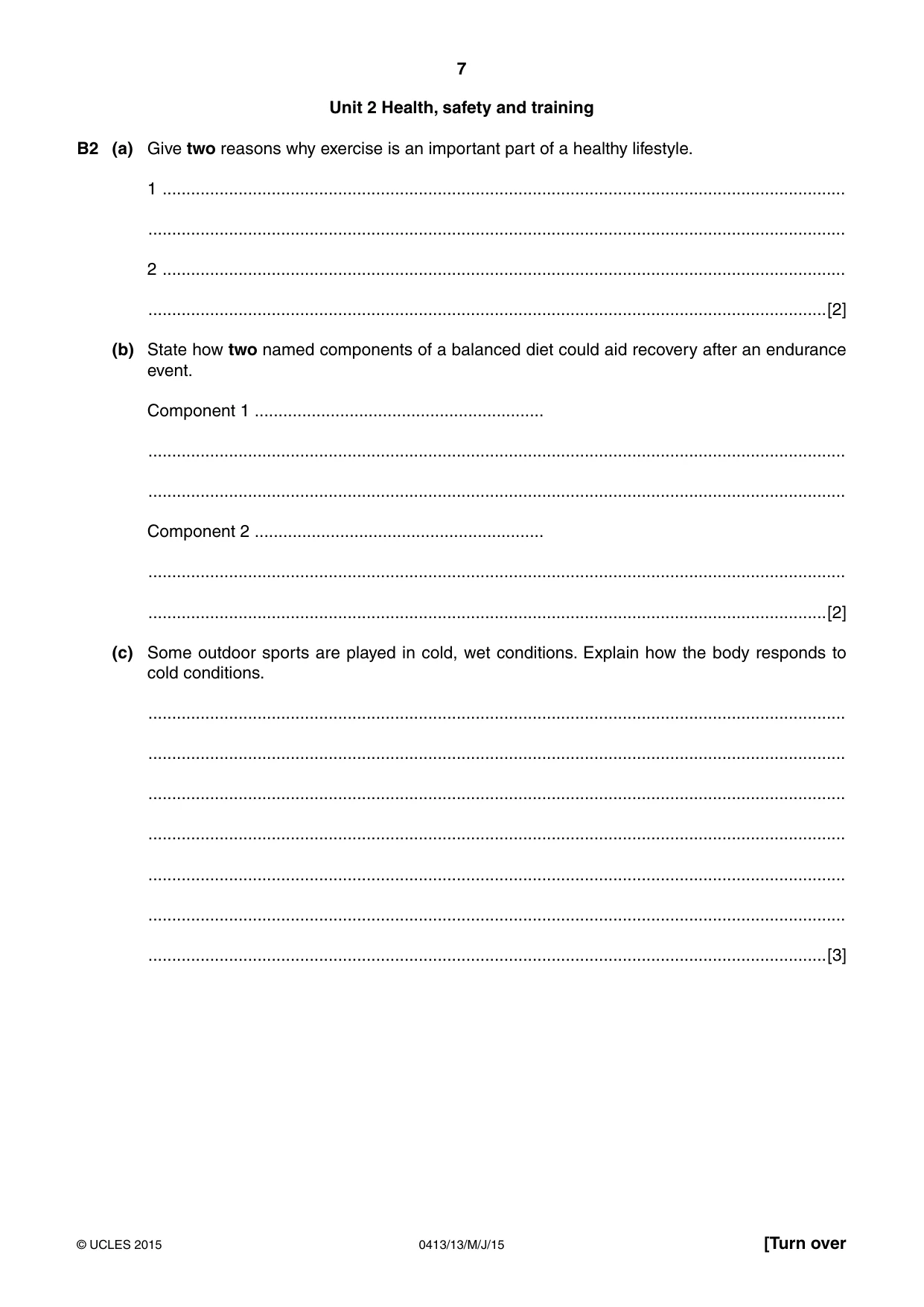
7 0413/13/M/J/15 © UCLES 2015 [Turn over Unit 2 Health, safety and training B2 (a) Give two reasons why exercise is an important part of a healthy lifestyle. 1 … … 2 … …[2] (b) State how two named components of a balanced diet could aid recovery after an endurance event. Component 1 … … … Component 2 … … …[2] (c) Some outdoor sports are played in cold, wet conditions. Explain how the body responds to cold conditions. … … … … … … …[3]
Question paper, page 8
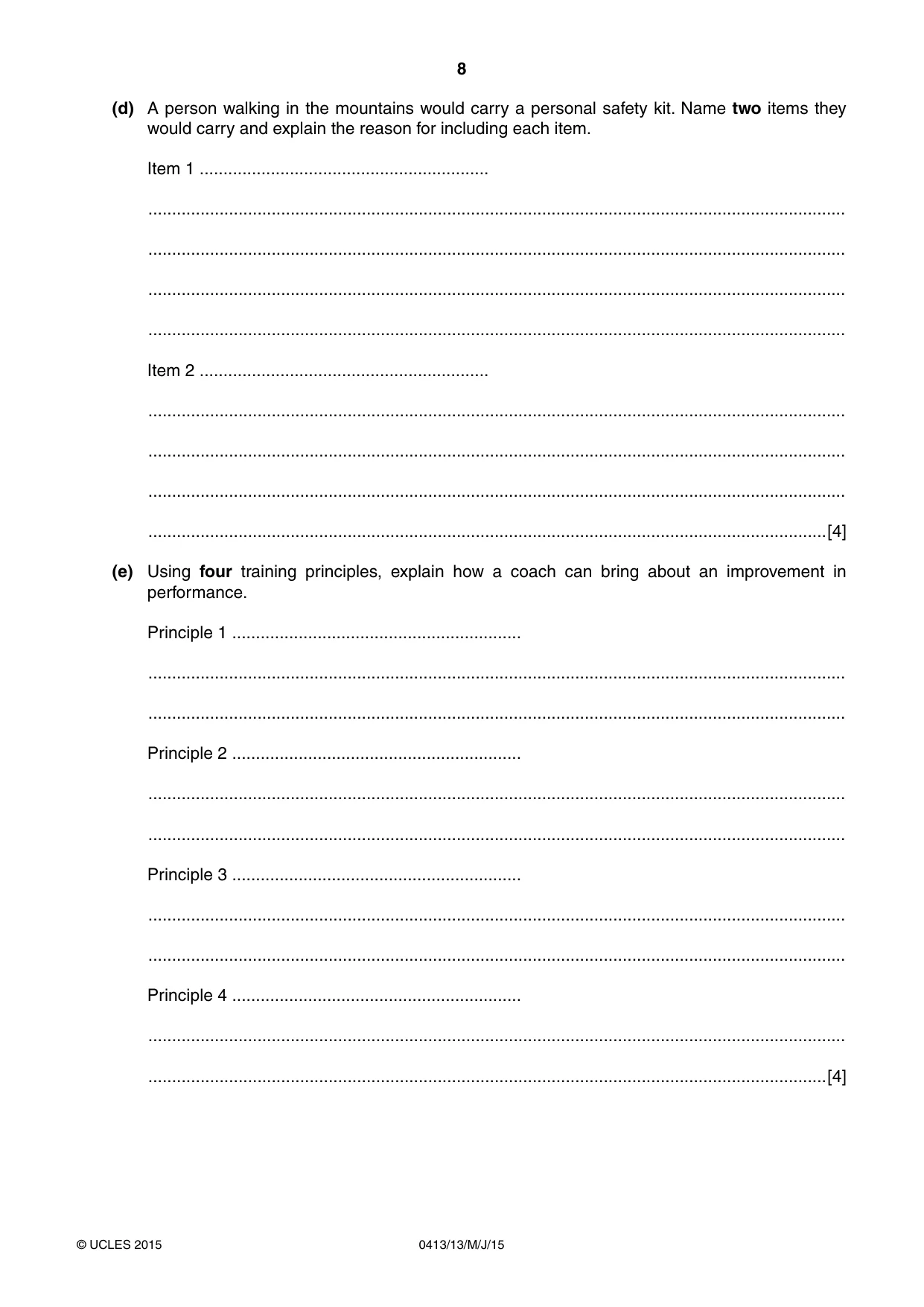
8 0413/13/M/J/15 © UCLES 2015 (d) A person walking in the mountains would carry a personal safety kit. Name two items they would carry and explain the reason for including each item. Item 1 … … … … … Item 2 … … … … …[4] (e) Using four training principles, explain how a coach can bring about an improvement in performance. Principle 1 … … … Principle 2 … … … Principle 3 … … … Principle 4 … … …[4]
Question paper, page 9
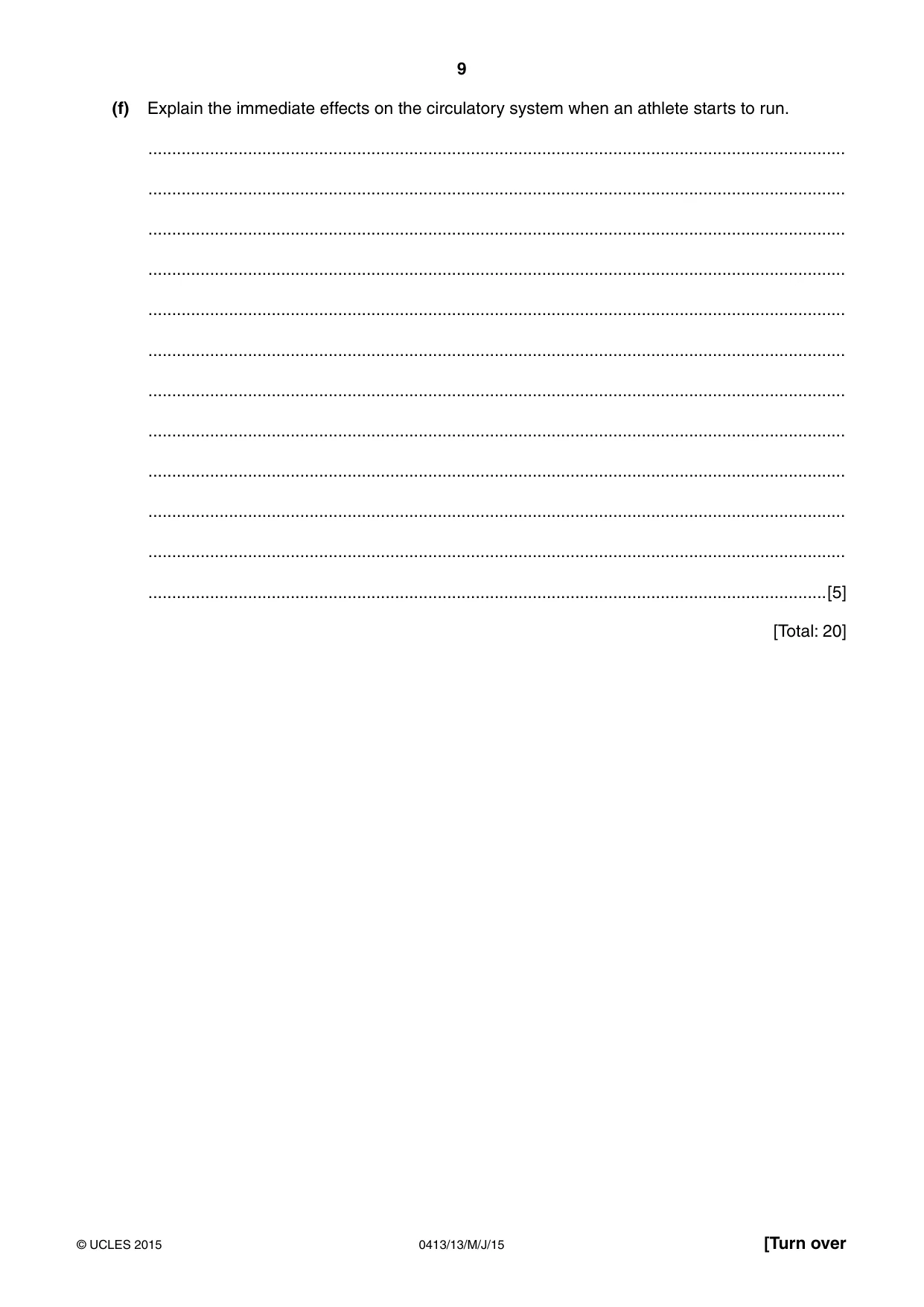
9 0413/13/M/J/15 © UCLES 2015 [Turn over (f) Explain the immediate effects on the circulatory system when an athlete starts to run. … … … … … … … … … … … …[5] [Total: 20]
Question paper, page 10
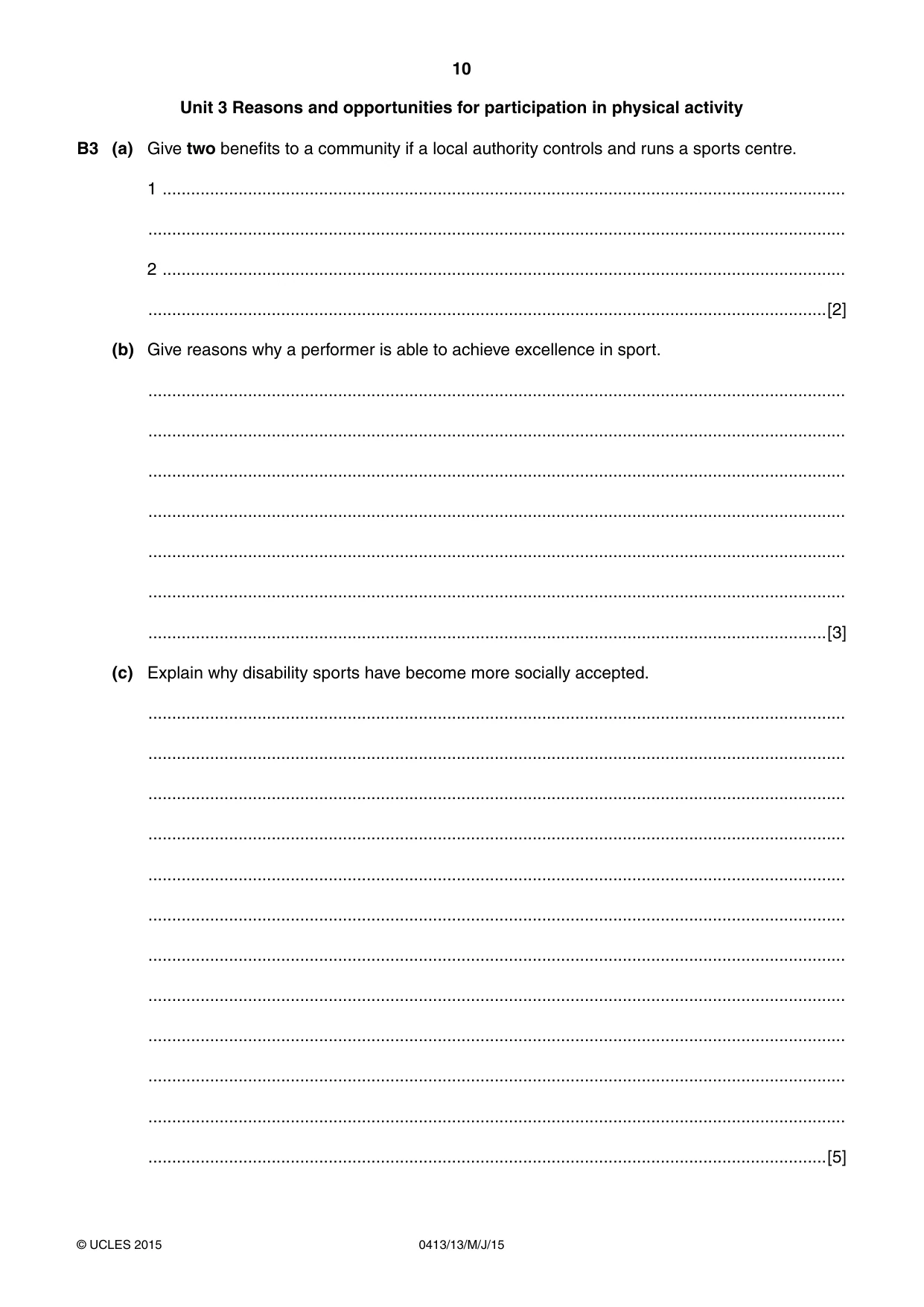
10 0413/13/M/J/15 © UCLES 2015 Unit 3 Reasons and opportunities for participation in physical activity B3 (a) Give two benefits to a community if a local authority controls and runs a sports centre. 1 … … 2 … …[2] (b) Give reasons why a performer is able to achieve excellence in sport. … … … … … … …[3] (c) Explain why disability sports have become more socially accepted. … … … … … … … … … … … …[5]
Question paper, page 11
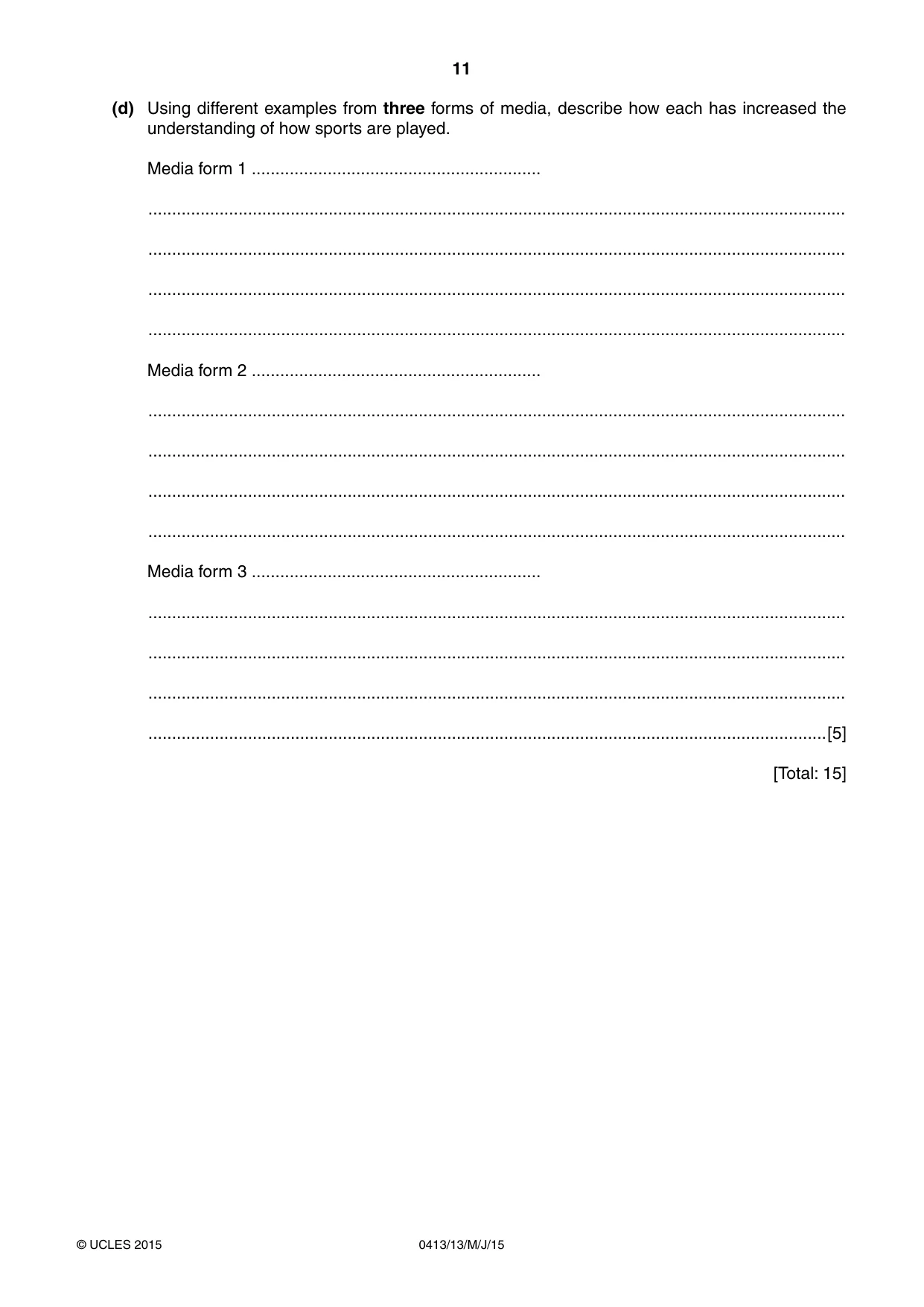
11 0413/13/M/J/15 © UCLES 2015 (d) Using different examples from three forms of media, describe how each has increased the understanding of how sports are played. Media form 1 … … … … … Media form 2 … … … … … Media form 3 … … … … …[5] [Total: 15]
Question paper, page 12
12 0413/13/M/J/15 © UCLES 2015 Permission to reproduce items where third-party owned material protected by copyright is included has been sought and cleared where possible. Every reasonable effort has been made by the publisher (UCLES) to trace copyright holders, but if any items requiring clearance have unwittingly been included, the publisher will be pleased to make amends at the earliest possible opportunity. To avoid the issue of disclosure of answer-related information to candidates, all copyright acknowledgements are reproduced online in the Cambridge International Examinations Copyright Acknowledgements Booklet. This is produced for each series of examinations and is freely available to download at www.cie.org.uk after the live examination series. Cambridge International Examinations is part of the Cambridge Assessment Group. Cambridge Assessment is the brand name of University of Cambridge Local Examinations Syndicate (UCLES), which is itself a department of the University of Cambridge. BLANK PAGE
Mark scheme, page 1
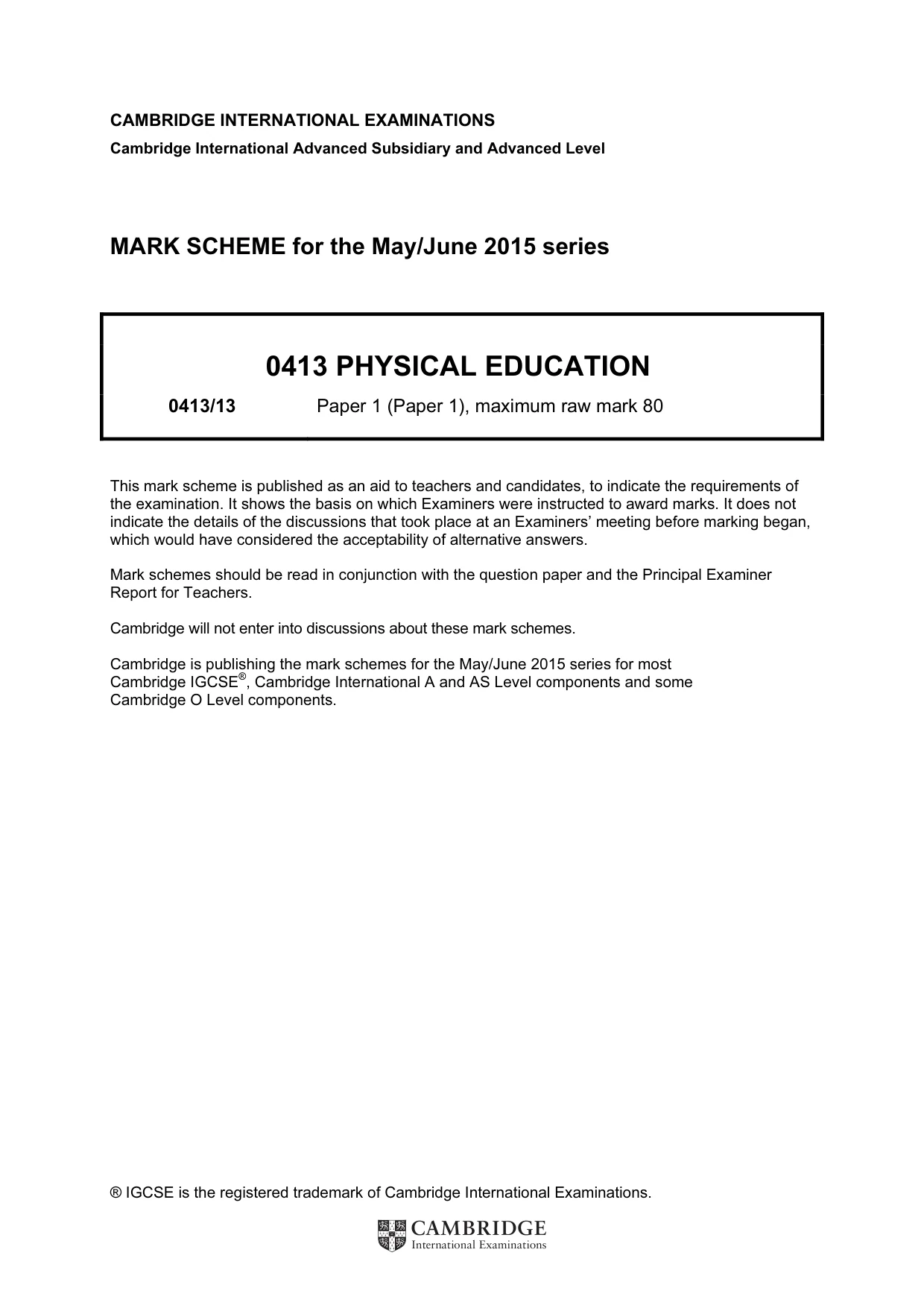
® IGCSE is the registered trademark of Cambridge International Examinations. CAMBRIDGE INTERNATIONAL EXAMINATIONS Cambridge International Advanced Subsidiary and Advanced Level MARK SCHEME for the May/June 2015 series 0413 PHYSICAL EDUCATION 0413/13 Paper 1 (Paper 1), maximum raw mark 80 This mark scheme is published as an aid to teachers and candidates, to indicate the requirements of the examination. It shows the basis on which Examiners were instructed to award marks. It does not indicate the details of the discussions that took place at an Examiners’ meeting before marking began, which would have considered the acceptability of alternative answers. Mark schemes should be read in conjunction with the question paper and the Principal Examiner Report for Teachers. Cambridge will not enter into discussions about these mark schemes. Cambridge is publishing the mark schemes for the May/June 2015 series for most Cambridge IGCSE®, Cambridge International A and AS Level components and some Cambridge O Level components.
Mark scheme, page 2
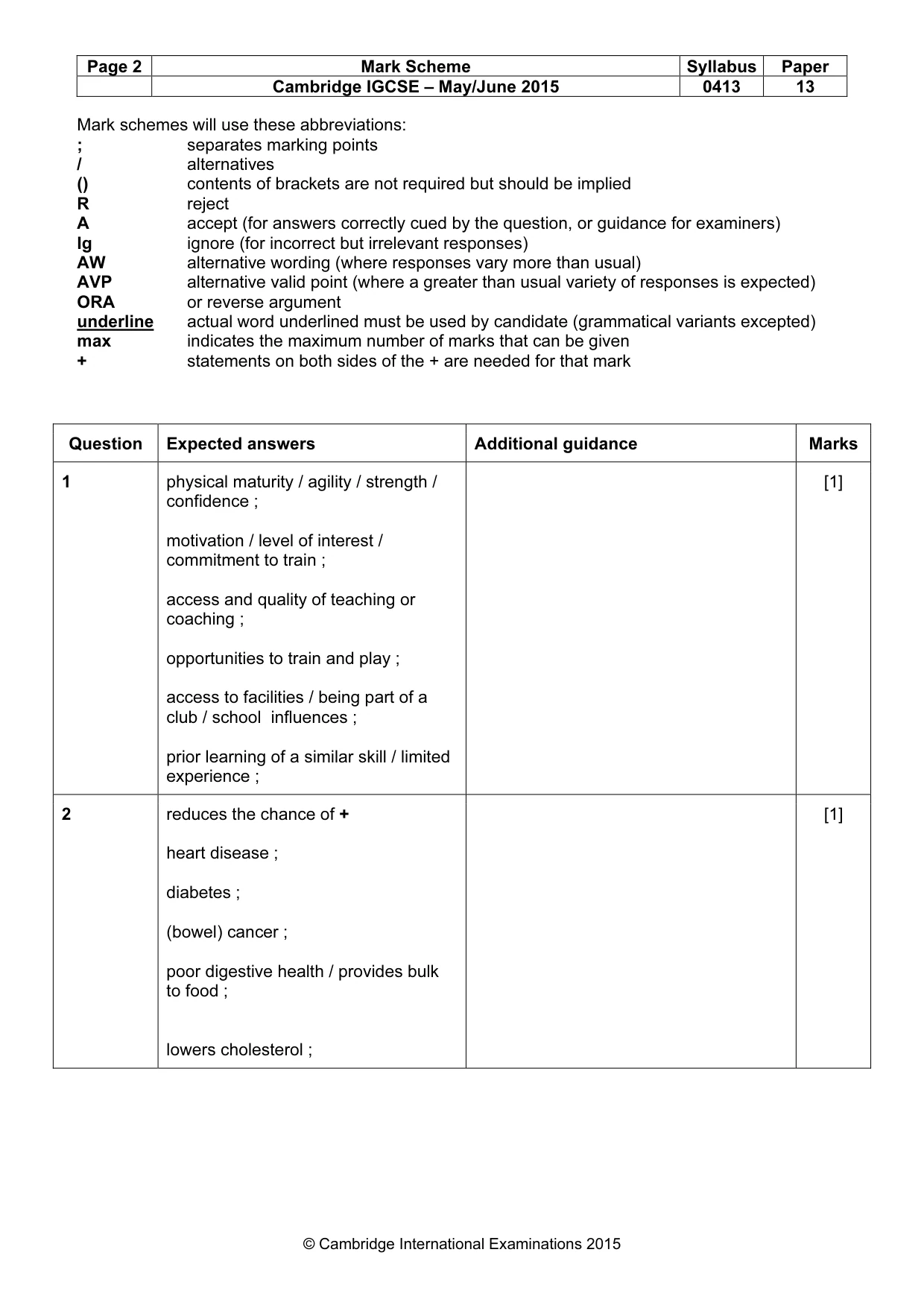
Page 2 Mark Scheme Syllabus Paper Cambridge IGCSE – May/June 2015 0413 13 © Cambridge International Examinations 2015 Mark schemes will use these abbreviations: ; separates marking points / alternatives () contents of brackets are not required but should be implied R reject A accept (for answers correctly cued by the question, or guidance for examiners) Ig ignore (for incorrect but irrelevant responses) AW alternative wording (where responses vary more than usual) AVP alternative valid point (where a greater than usual variety of responses is expected) ORA or reverse argument underline actual word underlined must be used by candidate (grammatical variants excepted) max indicates the maximum number of marks that can be given + statements on both sides of the + are needed for that mark Question Expected answers Additional guidance Marks 1 physical maturity / agility / strength / confidence ; motivation / level of interest / commitment to train ; access and quality of teaching or coaching ; opportunities to train and play ; access to facilities / being part of a club / school influences ; prior learning of a similar skill / limited experience ; [1] 2 reduces the chance of + heart disease ; diabetes ; (bowel) cancer ; poor digestive health / provides bulk to food ; lowers cholesterol ; [1]
Mark scheme, page 3
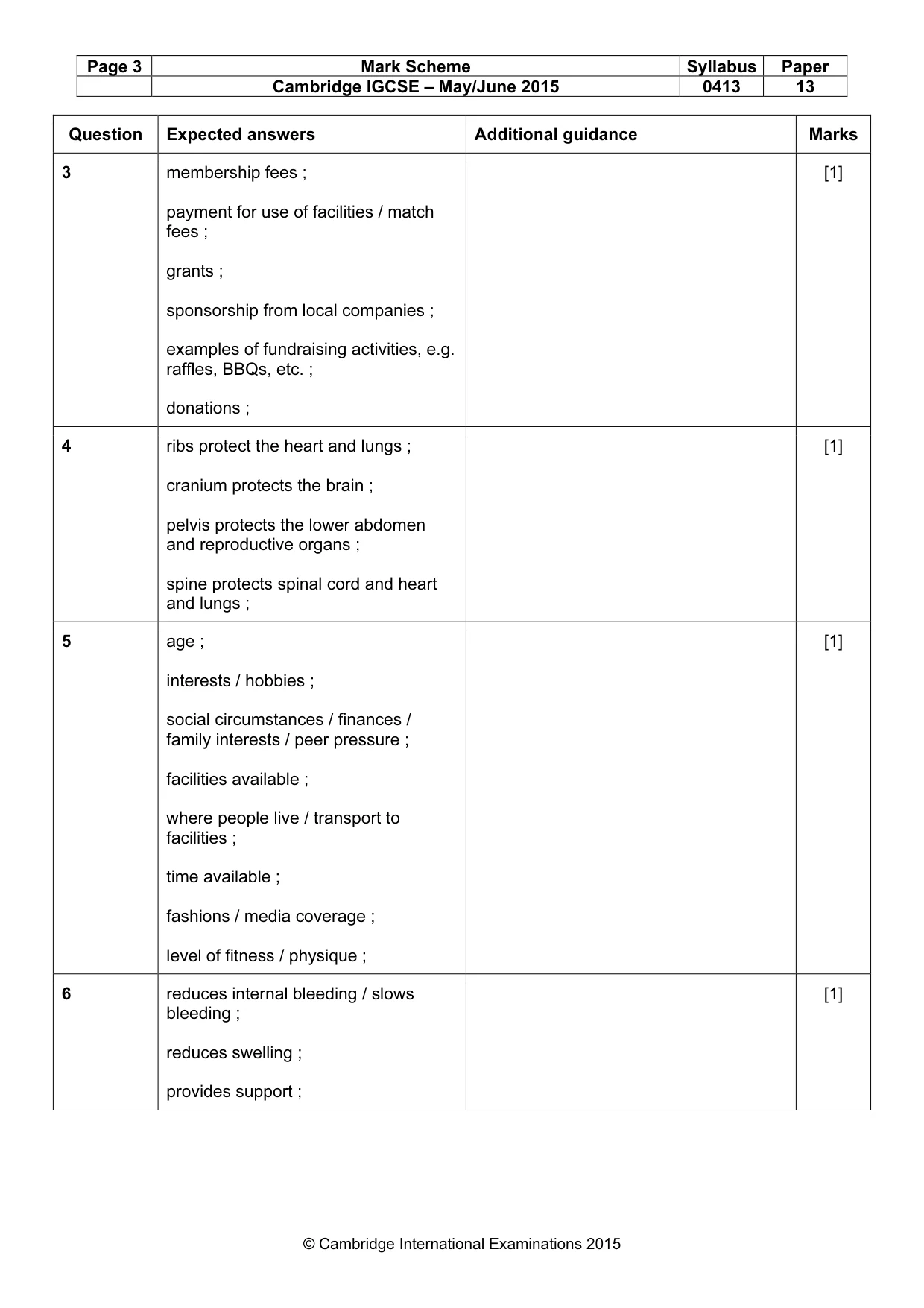
Page 3 Mark Scheme Syllabus Paper Cambridge IGCSE – May/June 2015 0413 13 © Cambridge International Examinations 2015 Question Expected answers Additional guidance Marks 3 membership fees ; payment for use of facilities / match fees ; grants ; sponsorship from local companies ; examples of fundraising activities, e.g. raffles, BBQs, etc. ; donations ; [1] 4 ribs protect the heart and lungs ; cranium protects the brain ; pelvis protects the lower abdomen and reproductive organs ; spine protects spinal cord and heart and lungs ; [1] 5 age ; interests / hobbies ; social circumstances / finances / family interests / peer pressure ; facilities available ; where people live / transport to facilities ; time available ; fashions / media coverage ; level of fitness / physique ; [1] 6 reduces internal bleeding / slows bleeding ; reduces swelling ; provides support ; [1]
Mark scheme, page 4
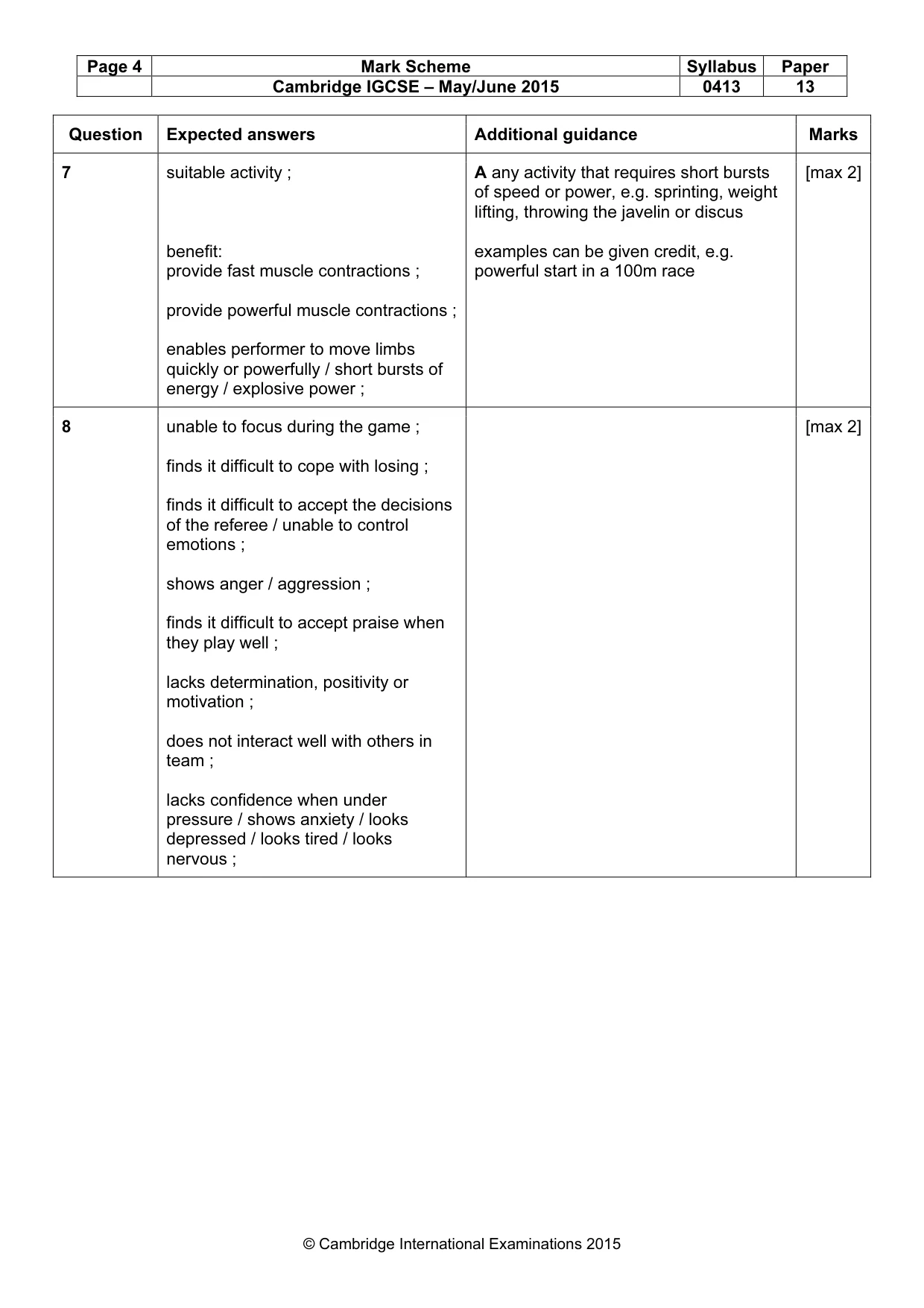
Page 4 Mark Scheme Syllabus Paper Cambridge IGCSE – May/June 2015 0413 13 © Cambridge International Examinations 2015 Question Expected answers Additional guidance Marks 7 suitable activity ; benefit: provide fast muscle contractions ; provide powerful muscle contractions ; enables performer to move limbs quickly or powerfully / short bursts of energy / explosive power ; A any activity that requires short bursts of speed or power, e.g. sprinting, weight lifting, throwing the javelin or discus examples can be given credit, e.g. powerful start in a 100m race [max 2] 8 unable to focus during the game ; finds it difficult to cope with losing ; finds it difficult to accept the decisions of the referee / unable to control emotions ; shows anger / aggression ; finds it difficult to accept praise when they play well ; lacks determination, positivity or motivation ; does not interact well with others in team ; lacks confidence when under pressure / shows anxiety / looks depressed / looks tired / looks nervous ; [max 2]
Mark scheme, page 5
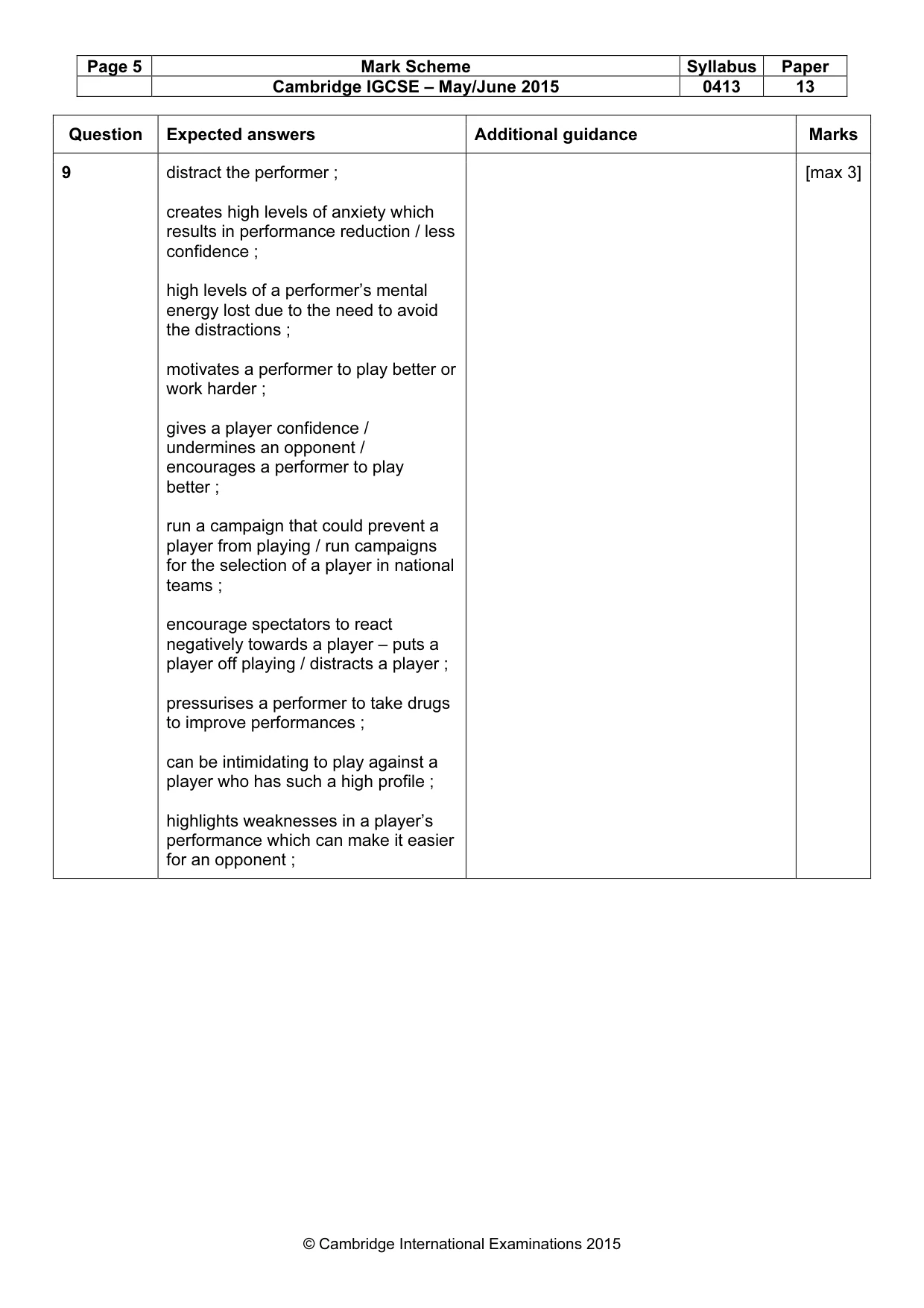
Page 5 Mark Scheme Syllabus Paper Cambridge IGCSE – May/June 2015 0413 13 © Cambridge International Examinations 2015 Question Expected answers Additional guidance Marks 9 distract the performer ; creates high levels of anxiety which results in performance reduction / less confidence ; high levels of a performer’s mental energy lost due to the need to avoid the distractions ; motivates a performer to play better or work harder ; gives a player confidence / undermines an opponent / encourages a performer to play better ; run a campaign that could prevent a player from playing / run campaigns for the selection of a player in national teams ; encourage spectators to react negatively towards a player – puts a player off playing / distracts a player ; pressurises a performer to take drugs to improve performances ; can be intimidating to play against a player who has such a high profile ; highlights weaknesses in a player’s performance which can make it easier for an opponent ; [max 3]
Mark scheme, page 6
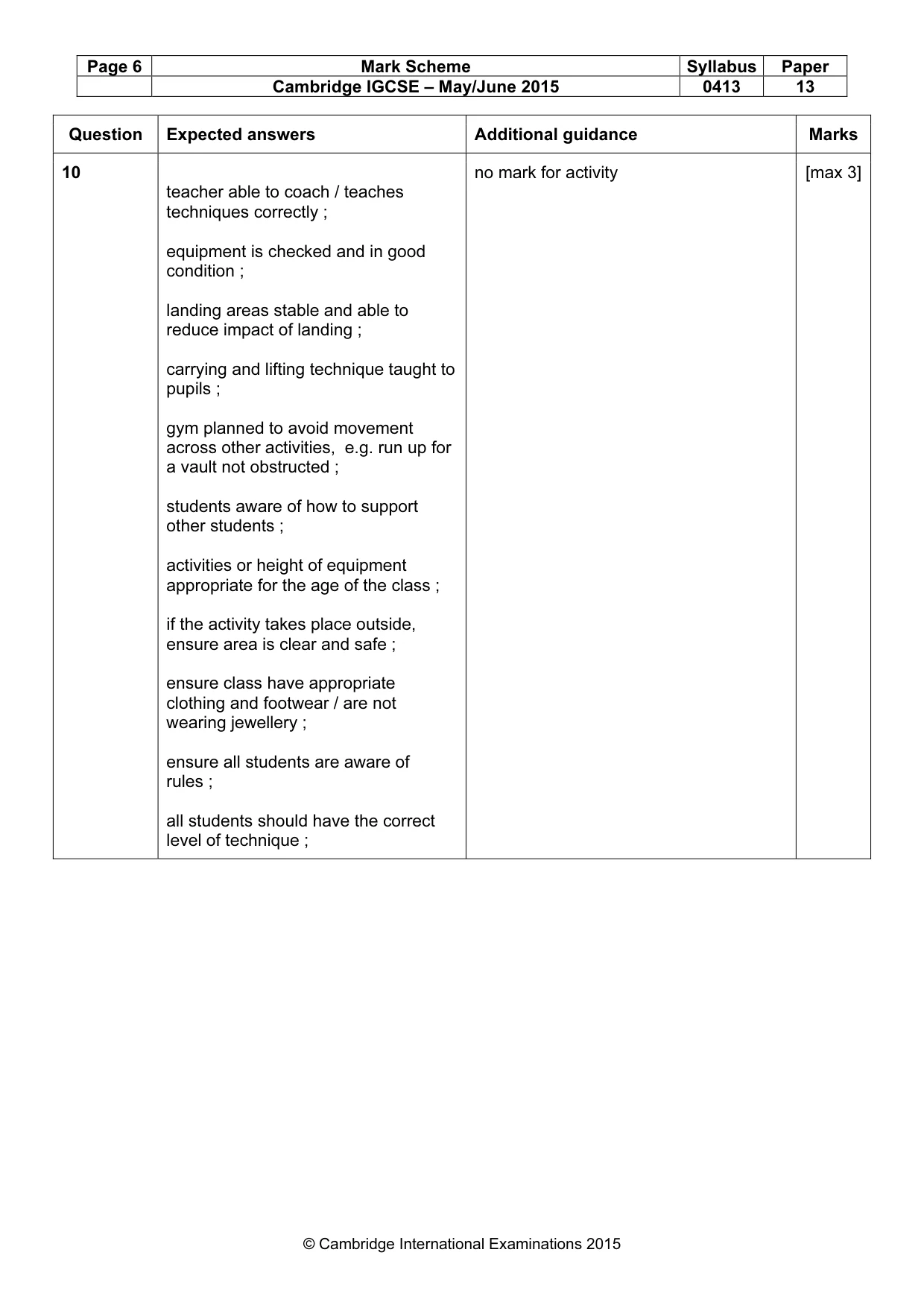
Page 6 Mark Scheme Syllabus Paper Cambridge IGCSE – May/June 2015 0413 13 © Cambridge International Examinations 2015 Question Expected answers Additional guidance Marks 10 teacher able to coach / teaches techniques correctly ; equipment is checked and in good condition ; landing areas stable and able to reduce impact of landing ; carrying and lifting technique taught to pupils ; gym planned to avoid movement across other activities, e.g. run up for a vault not obstructed ; students aware of how to support other students ; activities or height of equipment appropriate for the age of the class ; if the activity takes place outside, ensure area is clear and safe ; ensure class have appropriate clothing and footwear / are not wearing jewellery ; ensure all students are aware of rules ; all students should have the correct level of technique ; no mark for activity [max 3]
Mark scheme, page 7
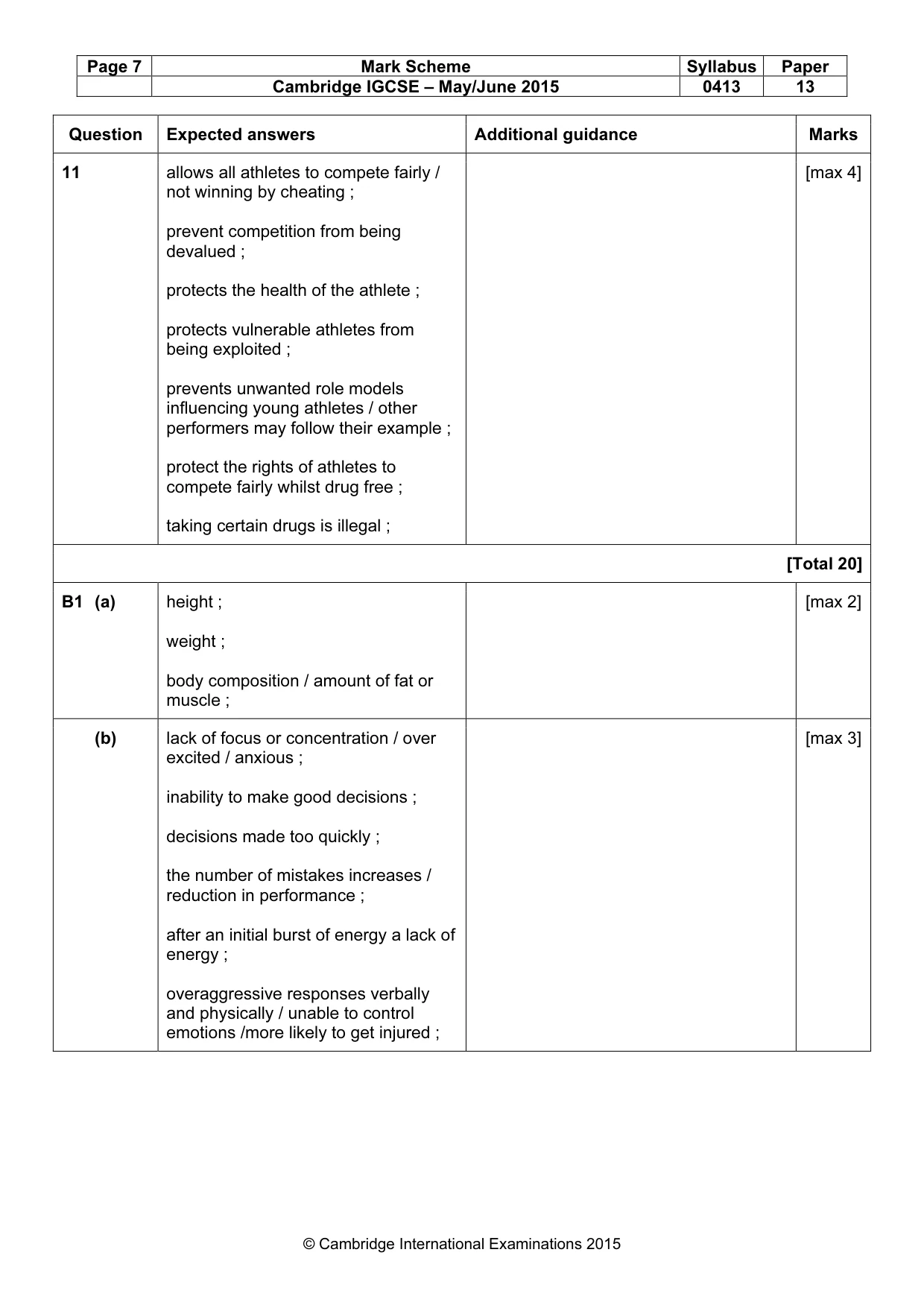
Page 7 Mark Scheme Syllabus Paper Cambridge IGCSE – May/June 2015 0413 13 © Cambridge International Examinations 2015 Question Expected answers Additional guidance Marks 11 allows all athletes to compete fairly / not winning by cheating ; prevent competition from being devalued ; protects the health of the athlete ; protects vulnerable athletes from being exploited ; prevents unwanted role models influencing young athletes / other performers may follow their example ; protect the rights of athletes to compete fairly whilst drug free ; taking certain drugs is illegal ; [max 4] [Total 20] B1 (a) height ; weight ; body composition / amount of fat or muscle ; [max 2] (b) lack of focus or concentration / over excited / anxious ; inability to make good decisions ; decisions made too quickly ; the number of mistakes increases / reduction in performance ; after an initial burst of energy a lack of energy ; overaggressive responses verbally and physically / unable to control emotions /more likely to get injured ; [max 3]
Mark scheme, page 8
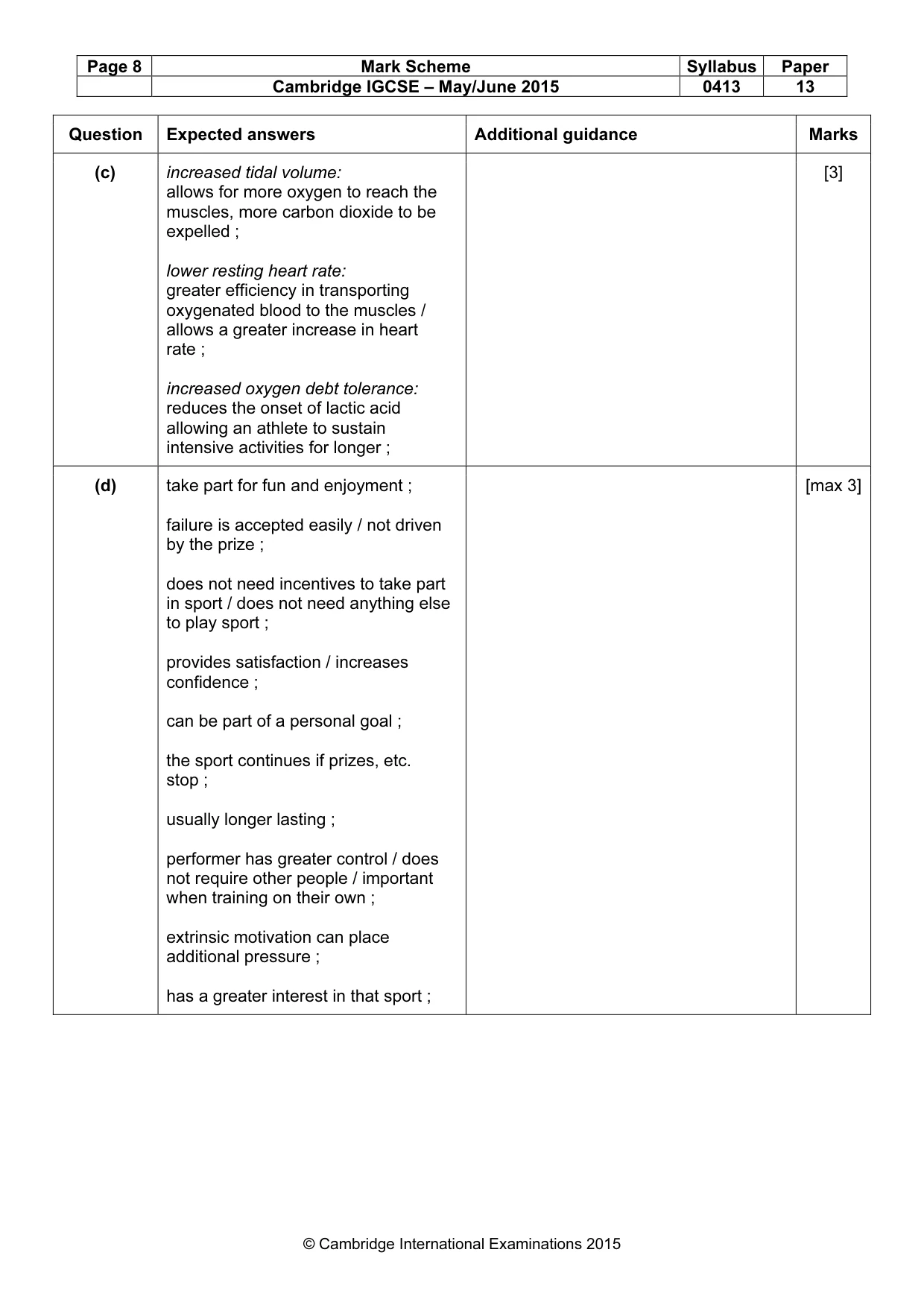
Page 8 Mark Scheme Syllabus Paper Cambridge IGCSE – May/June 2015 0413 13 © Cambridge International Examinations 2015 Question Expected answers Additional guidance Marks (c) increased tidal volume: allows for more oxygen to reach the muscles, more carbon dioxide to be expelled ; lower resting heart rate: greater efficiency in transporting oxygenated blood to the muscles / allows a greater increase in heart rate ; increased oxygen debt tolerance: reduces the onset of lactic acid allowing an athlete to sustain intensive activities for longer ; [3] (d) take part for fun and enjoyment ; failure is accepted easily / not driven by the prize ; does not need incentives to take part in sport / does not need anything else to play sport ; provides satisfaction / increases confidence ; can be part of a personal goal ; the sport continues if prizes, etc. stop ; usually longer lasting ; performer has greater control / does not require other people / important when training on their own ; extrinsic motivation can place additional pressure ; has a greater interest in that sport ; [max 3]
Mark scheme, page 9
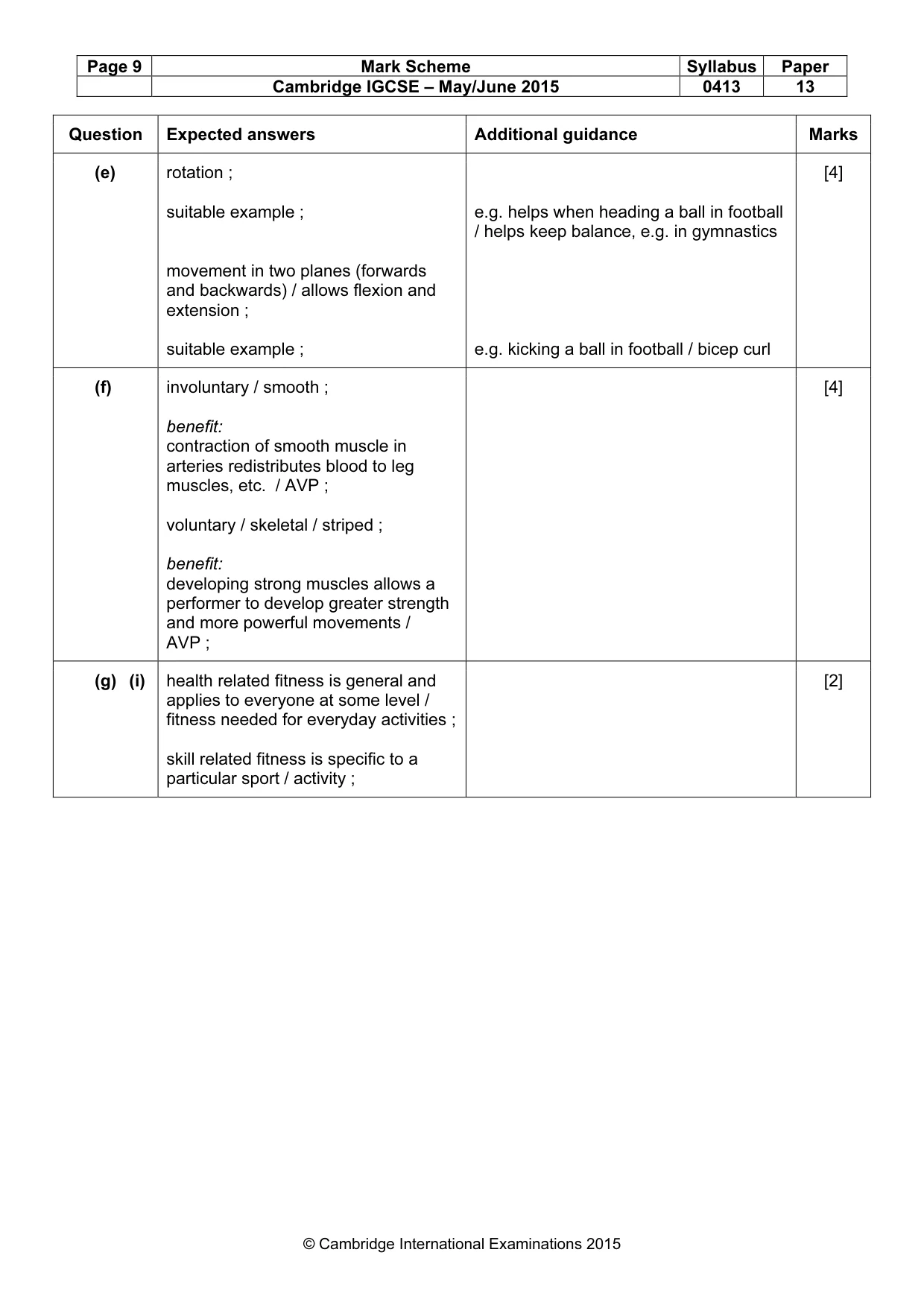
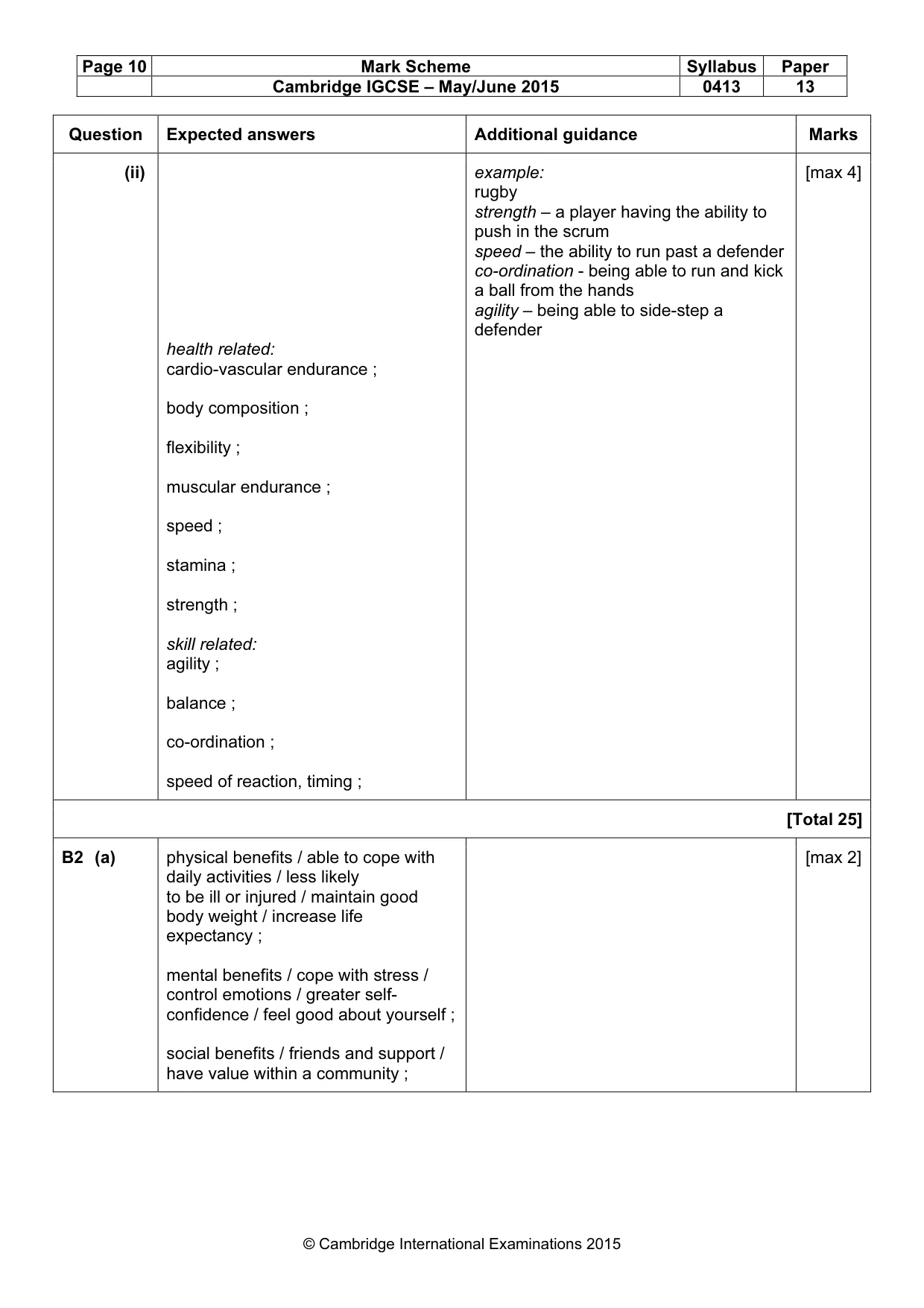
Page 9 Mark Scheme Syllabus Paper Cambridge IGCSE – May/June 2015 0413 13 © Cambridge International Examinations 2015 Question Expected answers Additional guidance Marks (e) rotation ; suitable example ; movement in two planes (forwards and backwards) / allows flexion and extension ; suitable example ; e.g. helps when heading a ball in football / helps keep balance, e.g. in gymnastics e.g. kicking a ball in football / bicep curl [4] (f) involuntary / smooth ; benefit: contraction of smooth muscle in arteries redistributes blood to leg muscles, etc. / AVP ; voluntary / skeletal / striped ; benefit: developing strong muscles allows a performer to develop greater strength and more powerful movements / AVP ; [4] (g) (i) health related fitness is general and applies to everyone at some level / fitness needed for everyday activities ; skill related fitness is specific to a particular sport / activity ; [2]
Mark scheme, page 10
Page 10 Mark Scheme Syllabus Paper Cambridge IGCSE – May/June 2015 0413 13 © Cambridge International Examinations 2015 Question Expected answers Additional guidance Marks (ii) health related: cardio-vascular endurance ; body composition ; flexibility ; muscular endurance ; speed ; stamina ; strength ; skill related: agility ; balance ; co-ordination ; speed of reaction, timing ; example: rugby strength – a player having the ability to push in the scrum speed – the ability to run past a defender co-ordination - being able to run and kick a ball from the hands agility – being able to side-step a defender [max 4] [Total 25] B2 (a) physical benefits / able to cope with daily activities / less likely to be ill or injured / maintain good body weight / increase life expectancy ; mental benefits / cope with stress / control emotions / greater self- confidence / feel good about yourself ; social benefits / friends and support / have value within a community ; [max 2]
Mark scheme, page 11
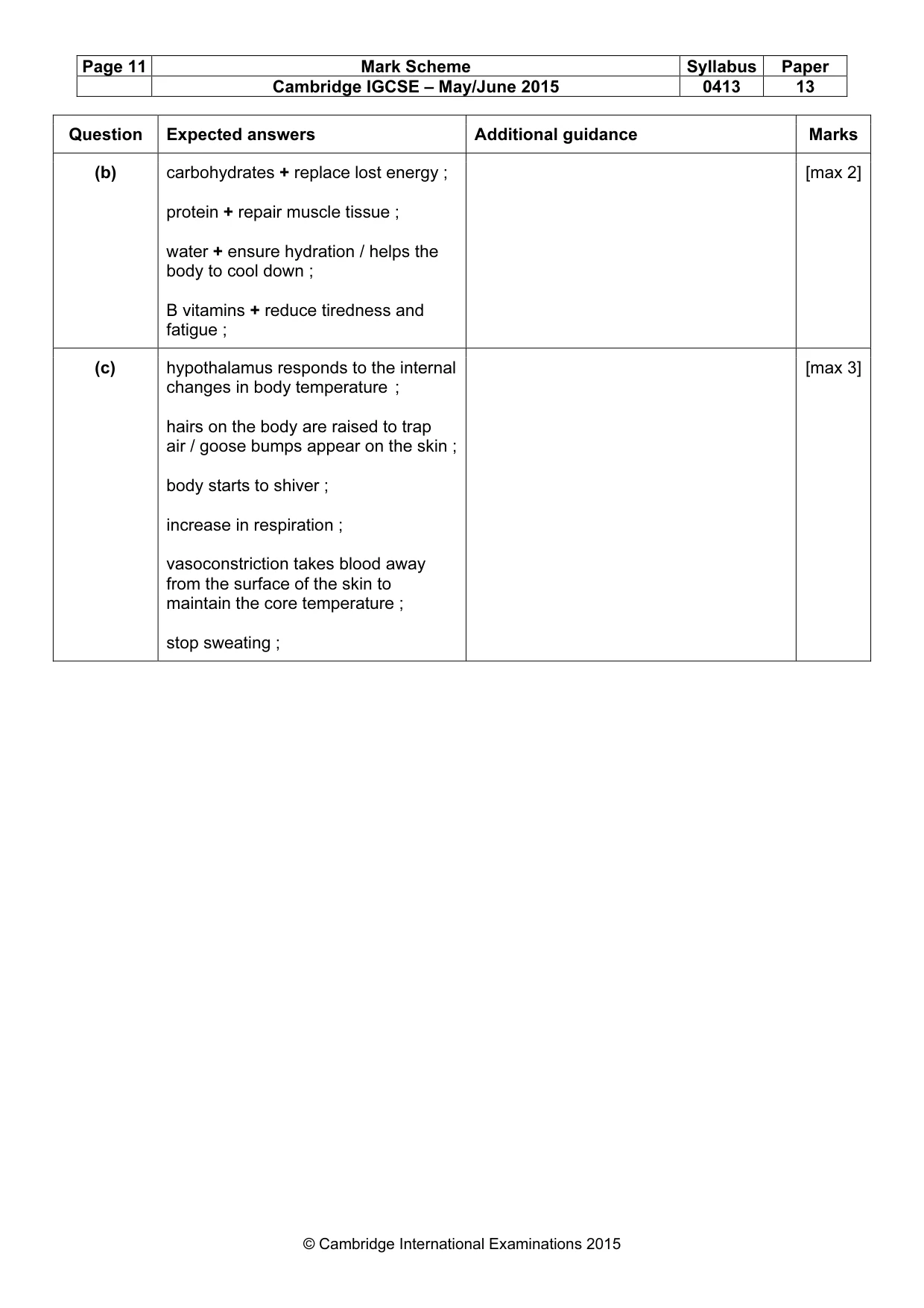
Page 11 Mark Scheme Syllabus Paper Cambridge IGCSE – May/June 2015 0413 13 © Cambridge International Examinations 2015 Question Expected answers Additional guidance Marks (b) carbohydrates + replace lost energy ; protein + repair muscle tissue ; water + ensure hydration / helps the body to cool down ; B vitamins + reduce tiredness and fatigue ; [max 2] (c) hypothalamus responds to the internal changes in body temperature ; hairs on the body are raised to trap air / goose bumps appear on the skin ; body starts to shiver ; increase in respiration ; vasoconstriction takes blood away from the surface of the skin to maintain the core temperature ; stop sweating ; [max 3]
Mark scheme, page 12
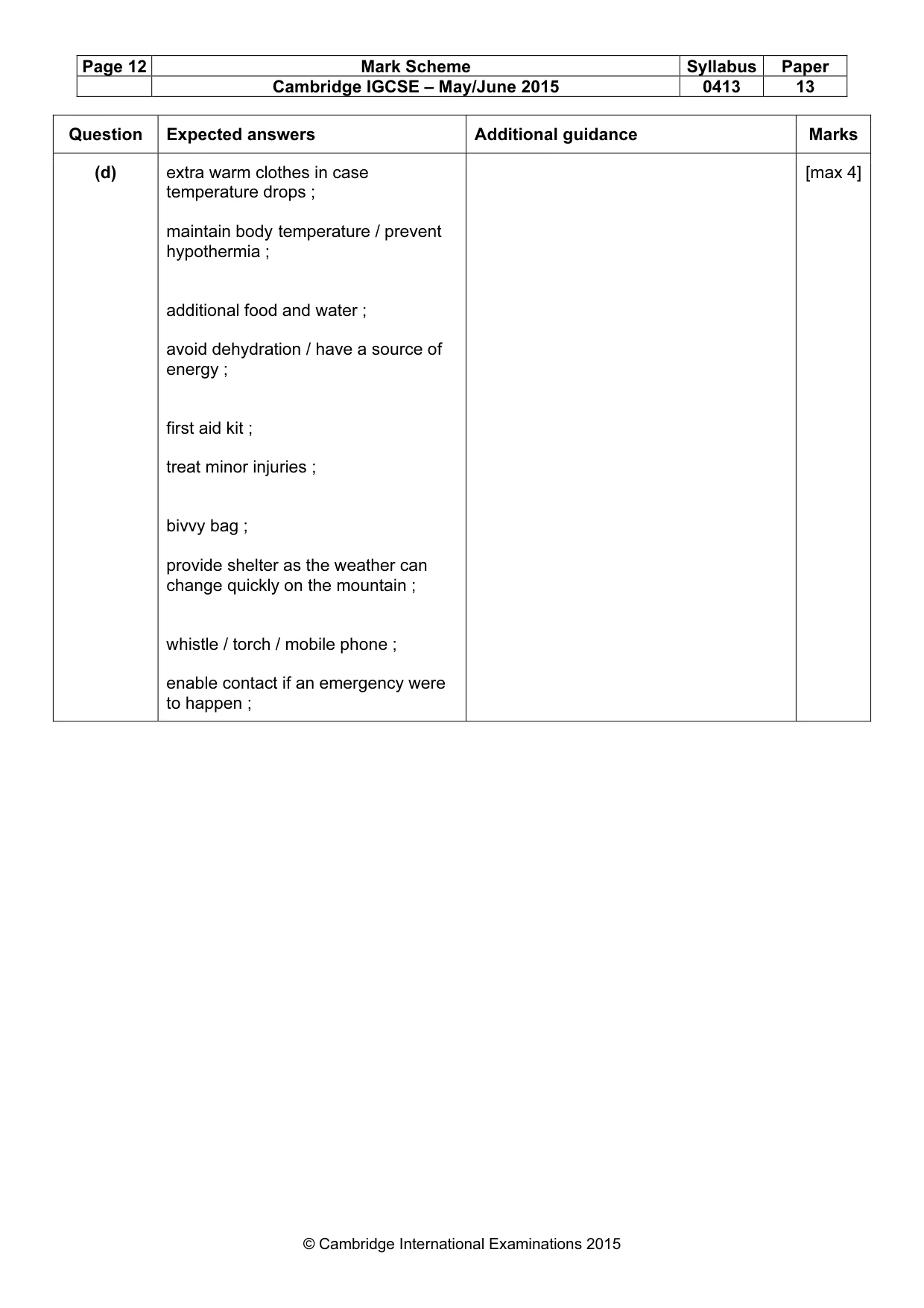
Page 12 Mark Scheme Syllabus Paper Cambridge IGCSE – May/June 2015 0413 13 © Cambridge International Examinations 2015 Question Expected answers Additional guidance Marks (d) extra warm clothes in case temperature drops ; maintain body temperature / prevent hypothermia ; additional food and water ; avoid dehydration / have a source of energy ; first aid kit ; treat minor injuries ; bivvy bag ; provide shelter as the weather can change quickly on the mountain ; whistle / torch / mobile phone ; enable contact if an emergency were to happen ; [max 4]
Mark scheme, page 13
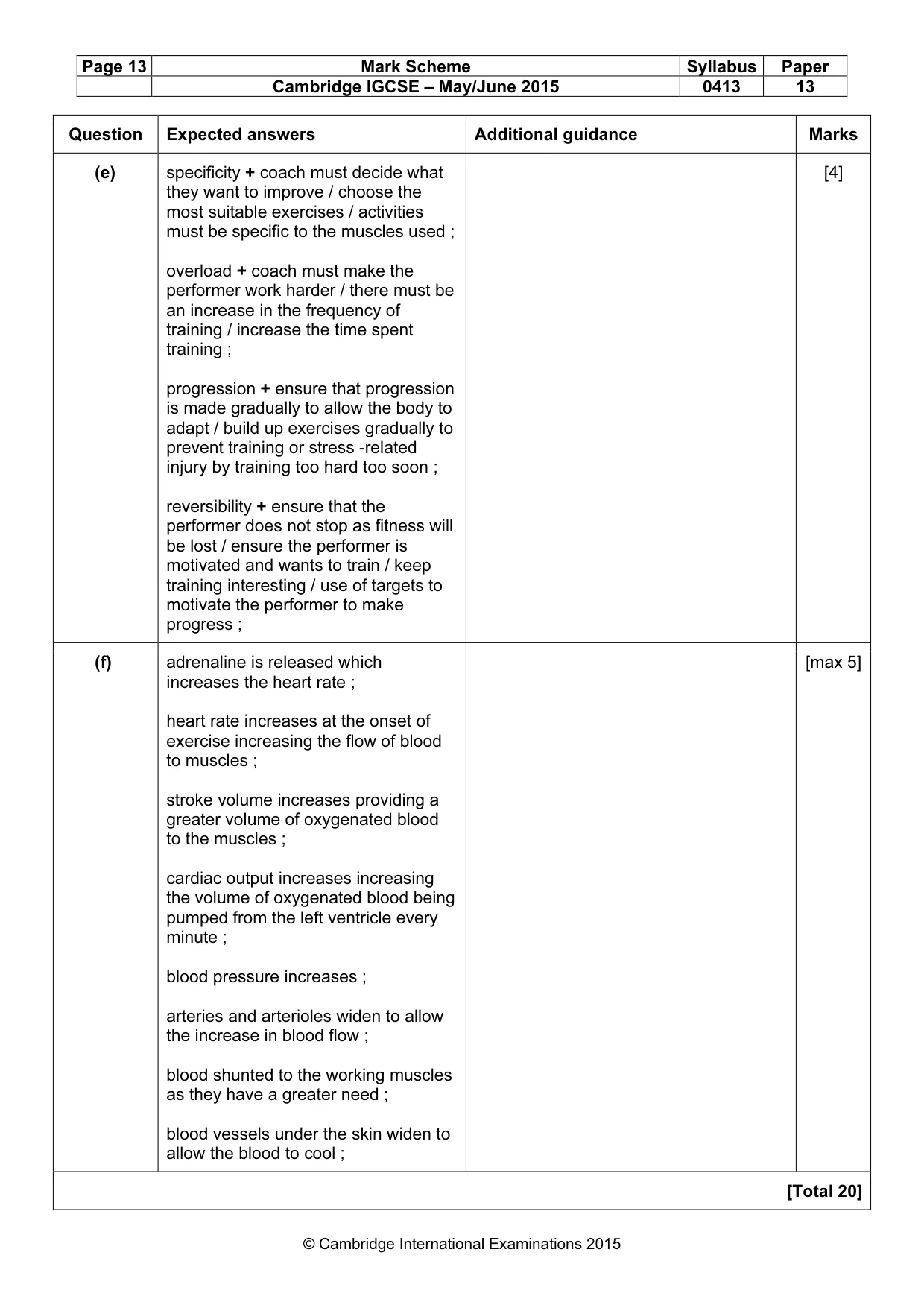
Page 13 Mark Scheme Syllabus Paper Cambridge IGCSE – May/June 2015 0413 13 © Cambridge International Examinations 2015 Question Expected answers Additional guidance Marks (e) specificity + coach must decide what they want to improve / choose the most suitable exercises / activities must be specific to the muscles used ; overload + coach must make the performer work harder / there must be an increase in the frequency of training / increase the time spent training ; progression + ensure that progression is made gradually to allow the body to adapt / build up exercises gradually to prevent training or stress -related injury by training too hard too soon ; reversibility + ensure that the performer does not stop as fitness will be lost / ensure the performer is motivated and wants to train / keep training interesting / use of targets to motivate the performer to make progress ; [4] (f) adrenaline is released which increases the heart rate ; heart rate increases at the onset of exercise increasing the flow of blood to muscles ; stroke volume increases providing a greater volume of oxygenated blood to the muscles ; cardiac output increases increasing the volume of oxygenated blood being pumped from the left ventricle every minute ; blood pressure increases ; arteries and arterioles widen to allow the increase in blood flow ; blood shunted to the working muscles as they have a greater need ; blood vessels under the skin widen to allow the blood to cool ; [max 5] [Total 20]
Mark scheme, page 14
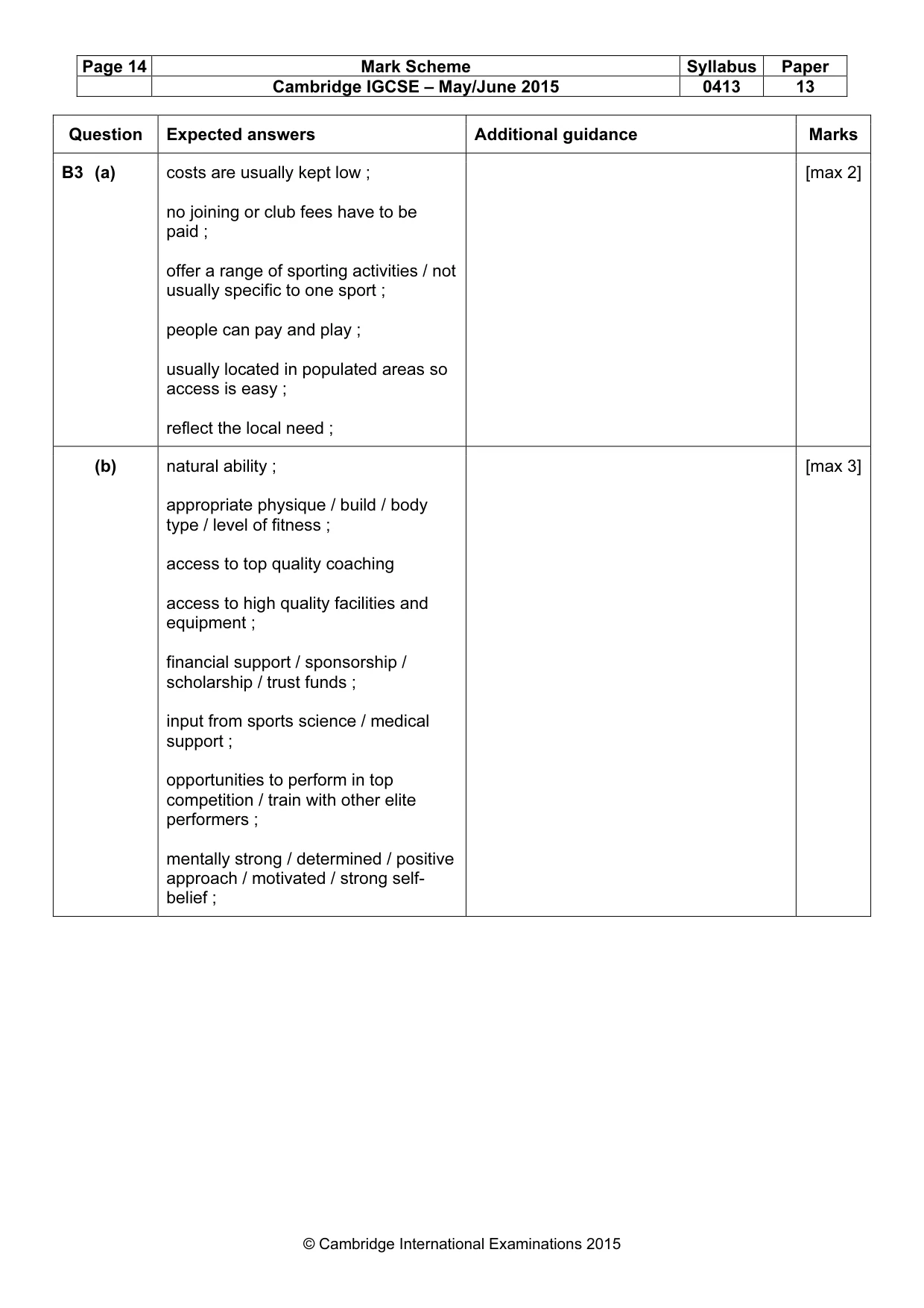
Page 14 Mark Scheme Syllabus Paper Cambridge IGCSE – May/June 2015 0413 13 © Cambridge International Examinations 2015 Question Expected answers Additional guidance Marks B3 (a) costs are usually kept low ; no joining or club fees have to be paid ; offer a range of sporting activities / not usually specific to one sport ; people can pay and play ; usually located in populated areas so access is easy ; reflect the local need ; [max 2] (b) natural ability ; appropriate physique / build / body type / level of fitness ; access to top quality coaching access to high quality facilities and equipment ; financial support / sponsorship / scholarship / trust funds ; input from sports science / medical support ; opportunities to perform in top competition / train with other elite performers ; mentally strong / determined / positive approach / motivated / strong self- belief ; [max 3]
Mark scheme, page 15
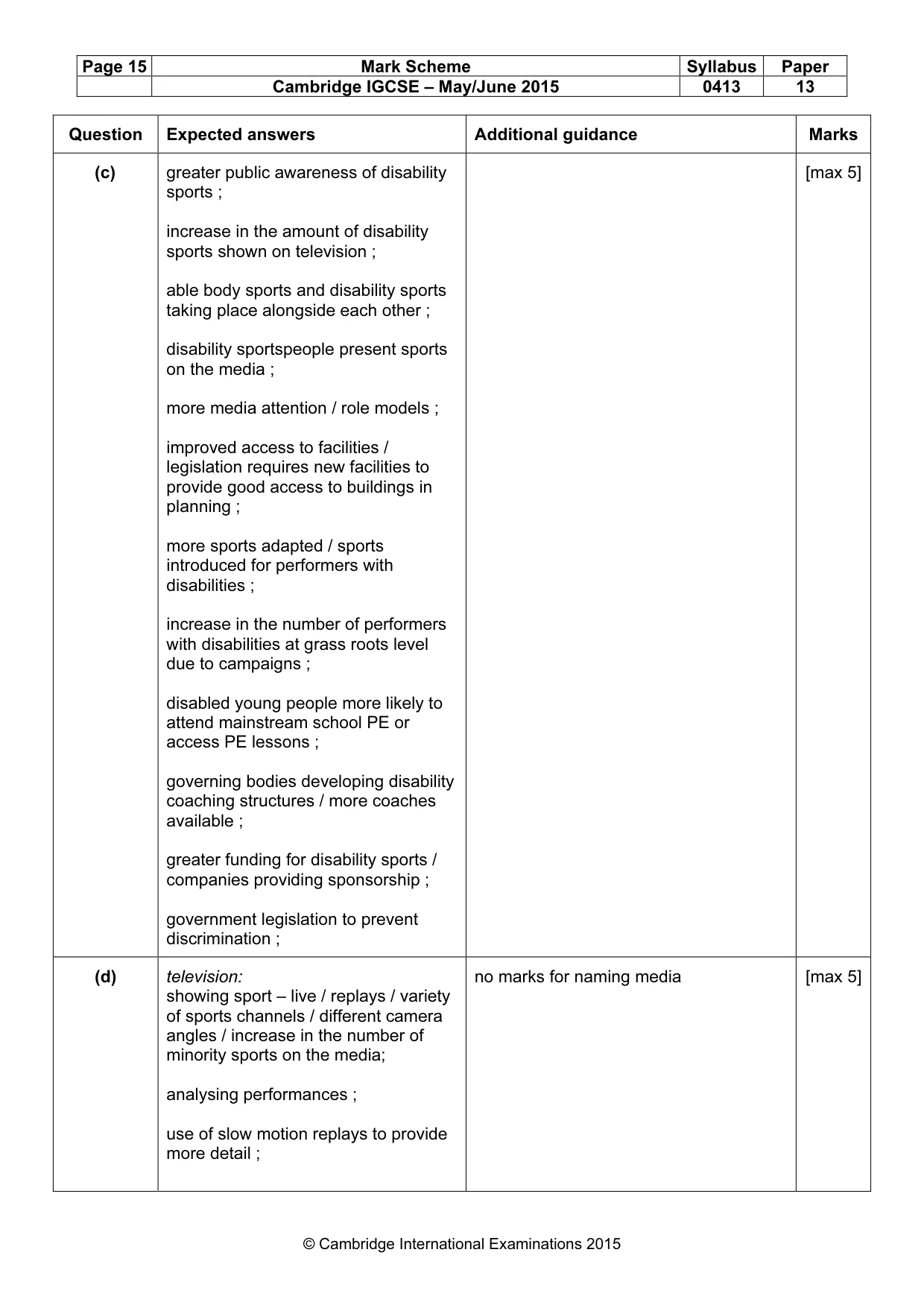
Page 15 Mark Scheme Syllabus Paper Cambridge IGCSE – May/June 2015 0413 13 © Cambridge International Examinations 2015 Question Expected answers Additional guidance Marks (c) greater public awareness of disability sports ; increase in the amount of disability sports shown on television ; able body sports and disability sports taking place alongside each other ; disability sportspeople present sports on the media ; more media attention / role models ; improved access to facilities / legislation requires new facilities to provide good access to buildings in planning ; more sports adapted / sports introduced for performers with disabilities ; increase in the number of performers with disabilities at grass roots level due to campaigns ; disabled young people more likely to attend mainstream school PE or access PE lessons ; governing bodies developing disability coaching structures / more coaches available ; greater funding for disability sports / companies providing sponsorship ; government legislation to prevent discrimination ; [max 5] (d) television: showing sport – live / replays / variety of sports channels / different camera angles / increase in the number of minority sports on the media; analysing performances ; use of slow motion replays to provide more detail ; no marks for naming media [max 5]
Mark scheme, page 16
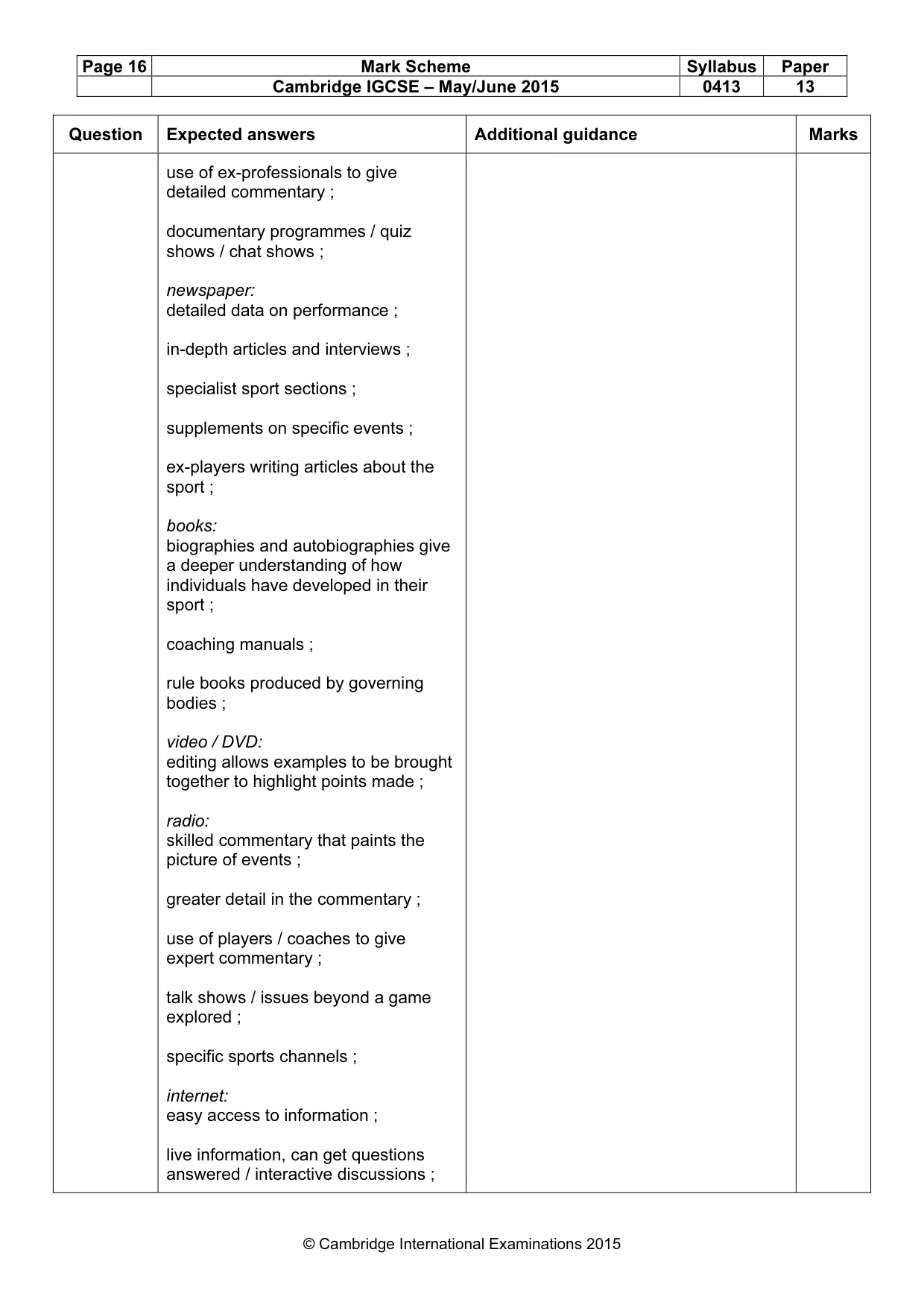
Page 16 Mark Scheme Syllabus Paper Cambridge IGCSE – May/June 2015 0413 13 © Cambridge International Examinations 2015 Question Expected answers Additional guidance Marks use of ex-professionals to give detailed commentary ; documentary programmes / quiz shows / chat shows ; newspaper: detailed data on performance ; in-depth articles and interviews ; specialist sport sections ; supplements on specific events ; ex-players writing articles about the sport ; books: biographies and autobiographies give a deeper understanding of how individuals have developed in their sport ; coaching manuals ; rule books produced by governing bodies ; video / DVD: editing allows examples to be brought together to highlight points made ; radio: skilled commentary that paints the picture of events ; greater detail in the commentary ; use of players / coaches to give expert commentary ; talk shows / issues beyond a game explored ; specific sports channels ; internet: easy access to information ; live information, can get questions answered / interactive discussions ;
Mark scheme, page 17
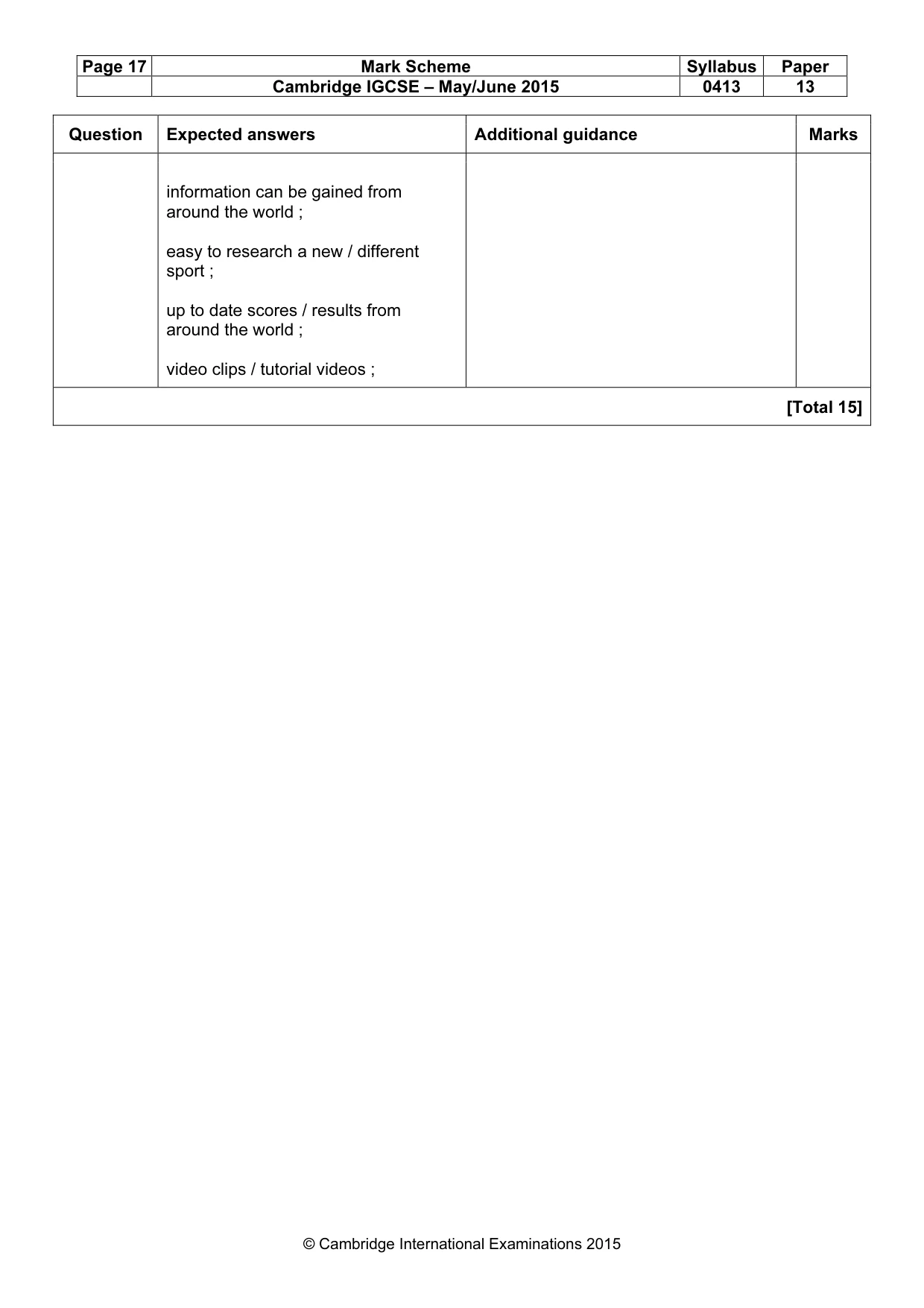
Page 17 Mark Scheme Syllabus Paper Cambridge IGCSE – May/June 2015 0413 13 © Cambridge International Examinations 2015 Question Expected answers Additional guidance Marks information can be gained from around the world ; easy to research a new / different sport ; up to date scores / results from around the world ; video clips / tutorial videos ; [Total 15]
What you needed in this session
Cambridge’s own grade thresholds for 2015 May/June, Paper 1 · Variant 3. A higher threshold means an easier paper — the bar moves with how the cohort did.