Cambridge IGCSE Physical Education 0413 — 2013 Oct/Nov Paper 1 · Variant 1
0413/11/O/N/13 · 80 marks · ≈90 min
The question paper and its mark scheme, free to read here and free to download. This is Cambridge’s own paper, exactly as it was sat.
Question paper12 pages
Mark scheme9 pages
Answers below. Sit the paper first if you are practising.
Paper as text
Question paper, page 1
This document consists of 12 printed pages. DC (NH) 64499/3 © UCLES 2013 [Turn over UNIVERSITY OF CAMBRIDGE INTERNATIONAL EXAMINATIONS International General Certificate of Secondary Education * 3 0 7 7 3 3 5 2 8 8 * PHYSICAL EDUCATION 0413/11 Paper 1 October/November 2013 1 hour 45 minutes Candidates answer on the Question Paper. No Additional Materials are required. READ THESE INSTRUCTIONS FIRST Write your Centre number, candidate number and name on all the work you hand in. Write in dark blue or black pen. You may use a soft pencil for any diagrams, graphs or rough working. Do not use staples, paper clips, highlighters, glue or correction fluid. DO NOT WRITE IN ANY BARCODES. Answer all questions. At the end of the examination, fasten all your work securely together. The number of marks is given in brackets [ ] at the end of each question or part question.
Question paper, page 2
2 0413/11/O/N/13 © UCLES 2013 For Examiner’s Use Section A Answer all the questions in this section. 1 What does letter “R” represent in the RICE treatment of an injury? …[1] 2 Give one performance related benefit of having sufficient sleep. …[1] 3 Name a sport and give an item of protective clothing or safety equipment used by a performer, in that sport. Sport: … Clothing / equipment: … …[1] 4 In addition to television, give another form of media which informs people about sport. …[1] 5 In addition to promoting growth, give another reason for the need for food. …[1] 6 Explain, with an example, one of the factors which may affect variations in levels of skill. Factor: … Explanation: … …[2] 7 The World Health Organisation gives a definition of health as a state of complete physical, mental and social well-being. What do you understand by the term physical well-being? … … … …[2]
Question paper, page 3
3 0413/11/O/N/13 © UCLES 2013 [Turn over For Examiner’s Use 8 Describe adduction movement and give an example of when this occurs in sport. … … … …[2] 9 Describe how a school can promote participation in extra-curricular physical activity. … … … …[2] 10 Explain the reasons why particular activities take place in mountainous areas. … … … …[2] 11 Describe two ways in which the skeleton provides shape and support. … … … …[2]
Question paper, page 4
4 0413/11/O/N/13 © UCLES 2013 For Examiner’s Use 12 Describe the following principle of training and give an example of when it may be applied. (i) Reversibility: … … … Example: …[2] (ii) Name one other principle of training. …[1] [Total: 20]
Question paper, page 5
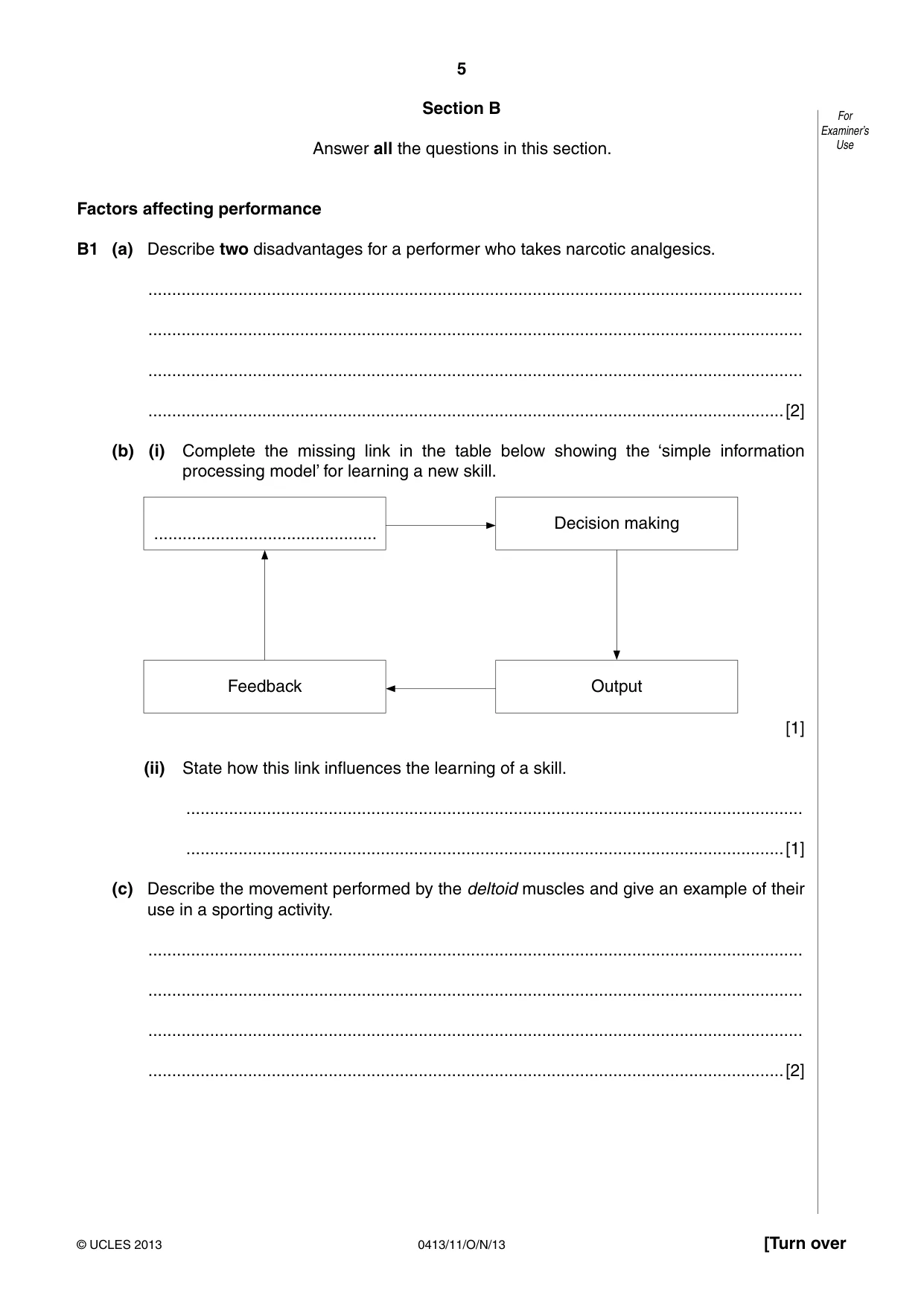
5 0413/11/O/N/13 © UCLES 2013 [Turn over For Examiner’s Use Section B Answer all the questions in this section. Factors affecting performance B1 (a) Describe two disadvantages for a performer who takes narcotic analgesics. … … … …[2] (b) (i) Complete the missing link in the table below showing the ‘simple information processing model’ for learning a new skill. … Decision making Feedback Output [1] (ii) State how this link influences the learning of a skill. … …[1] (c) Describe the movement performed by the deltoid muscles and give an example of their use in a sporting activity. … … … …[2]
Question paper, page 6
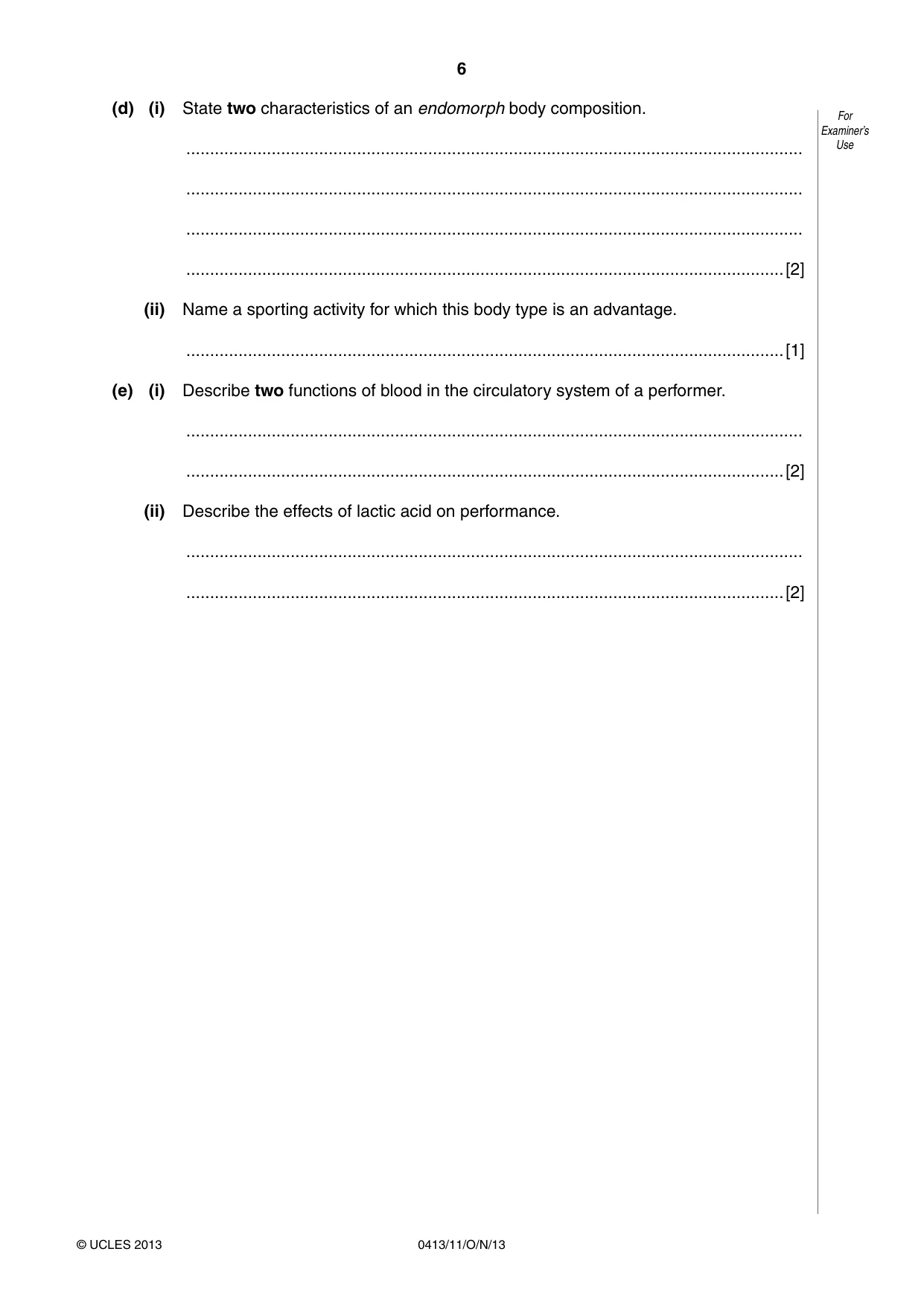
6 0413/11/O/N/13 © UCLES 2013 For Examiner’s Use (d) (i) State two characteristics of an endomorph body composition. … … … …[2] (ii) Name a sporting activity for which this body type is an advantage. …[1] (e) (i) Describe two functions of blood in the circulatory system of a performer. … …[2] (ii) Describe the effects of lactic acid on performance. … …[2]
Question paper, page 7
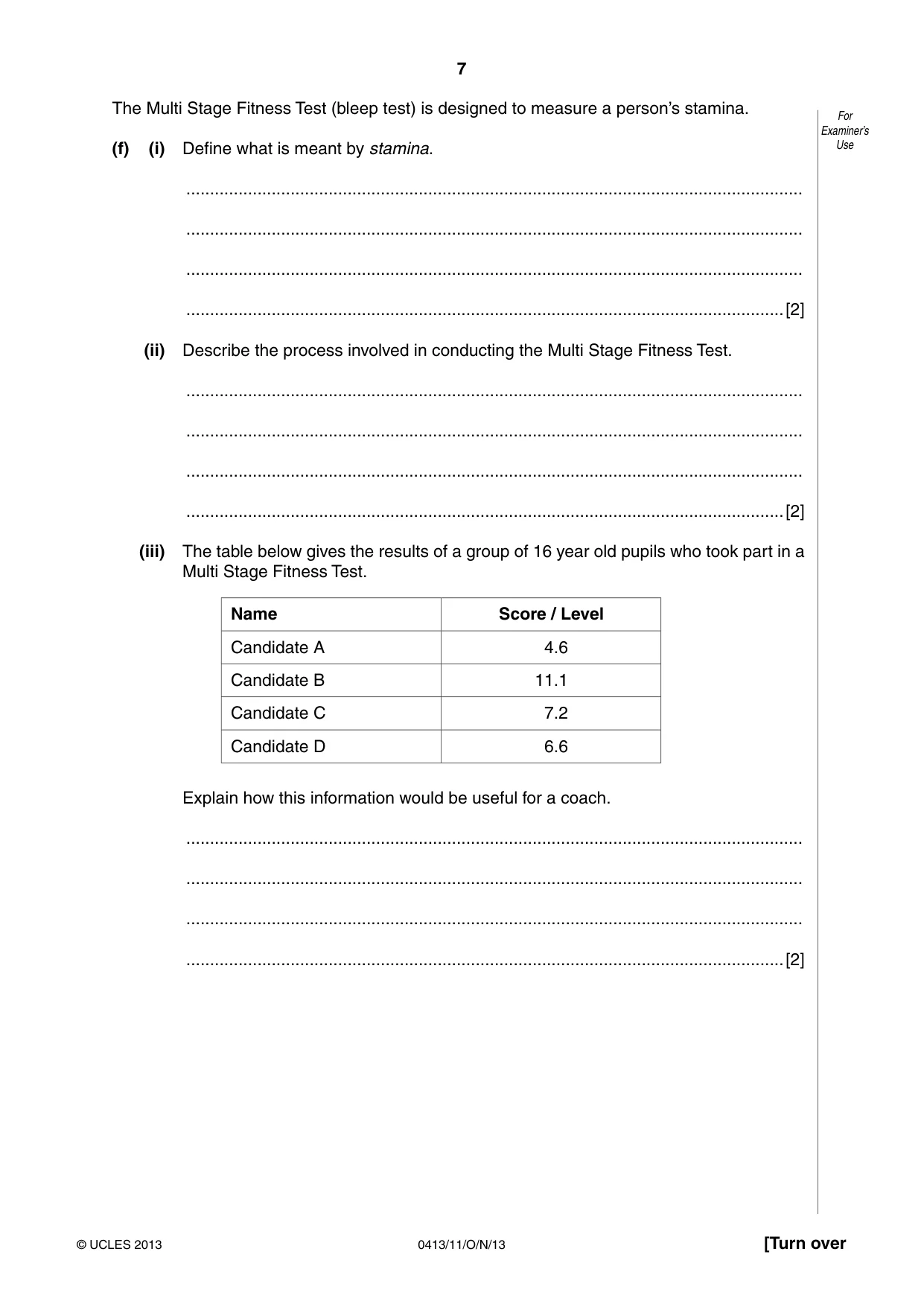
7 0413/11/O/N/13 © UCLES 2013 [Turn over For Examiner’s Use The Multi Stage Fitness Test (bleep test) is designed to measure a person’s stamina. (f) (i) Define what is meant by stamina. … … … …[2] (ii) Describe the process involved in conducting the Multi Stage Fitness Test. … … … …[2] (iii) The table below gives the results of a group of 16 year old pupils who took part in a Multi Stage Fitness Test. Name Score / Level Candidate A 4.6 Candidate B 11.1 Candidate C 7.2 Candidate D 6.6 Explain how this information would be useful for a coach. … … … …[2]
Question paper, page 8
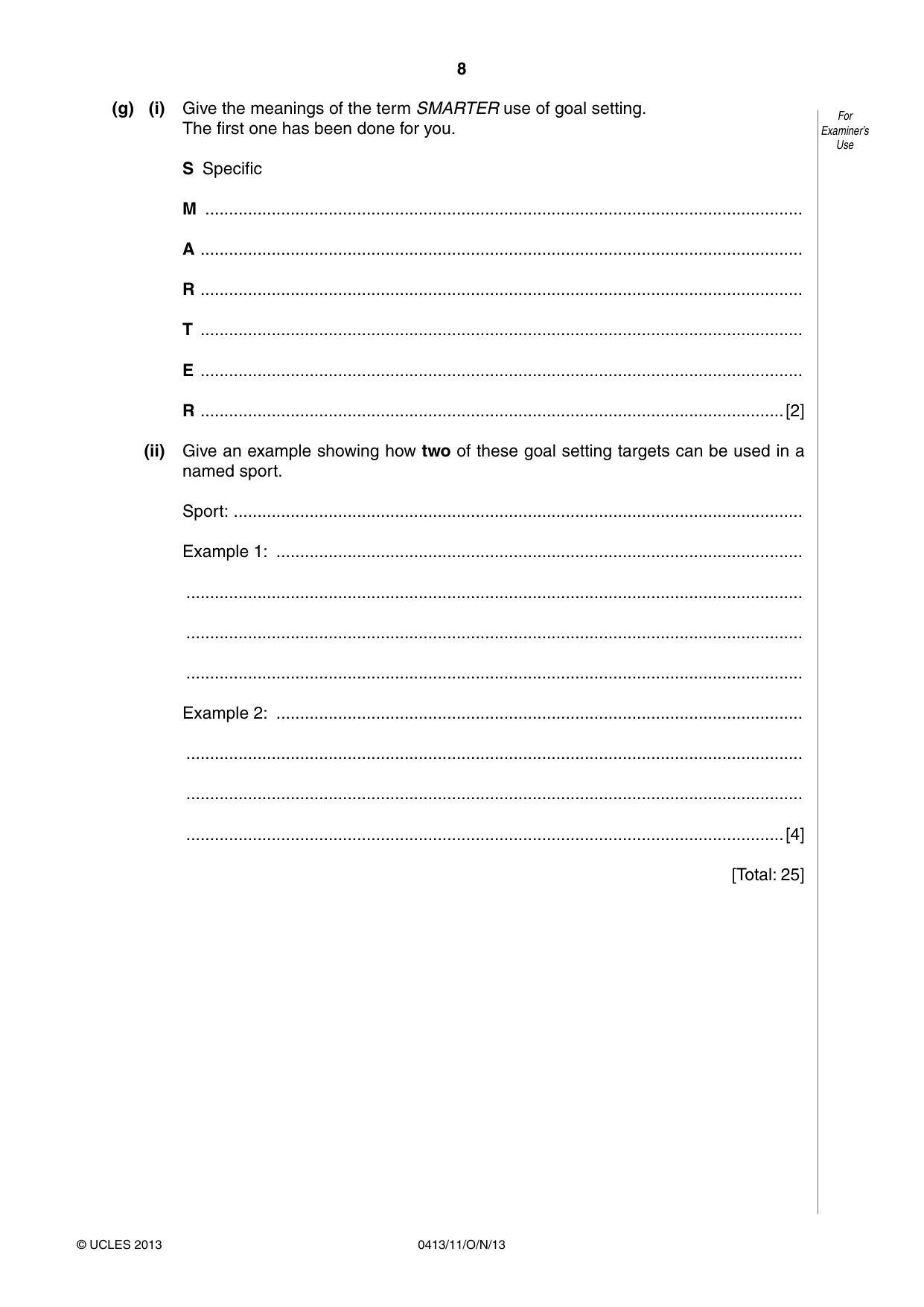
8 0413/11/O/N/13 © UCLES 2013 For Examiner’s Use (g) (i) Give the meanings of the term SMARTER use of goal setting. The first one has been done for you. S Specific M … A … R … T … E … R …[2] (ii) Give an example showing how two of these goal setting targets can be used in a named sport. Sport: … Example 1: … … … … Example 2: … … … …[4] [Total: 25]
Question paper, page 9
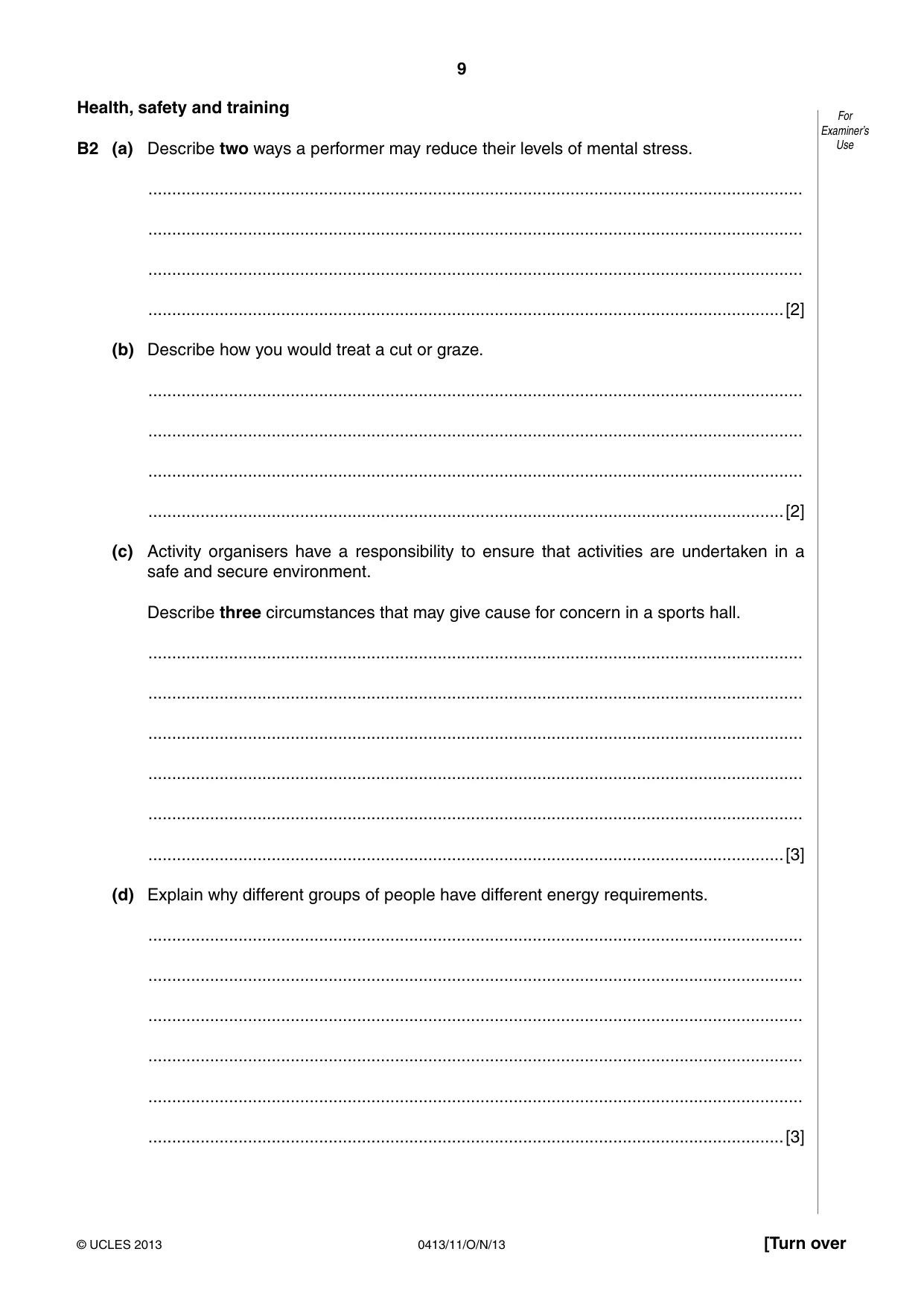
9 0413/11/O/N/13 © UCLES 2013 [Turn over For Examiner’s Use Health, safety and training B2 (a) Describe two ways a performer may reduce their levels of mental stress. … … … …[2] (b) Describe how you would treat a cut or graze. … … … …[2] (c) Activity organisers have a responsibility to ensure that activities are undertaken in a safe and secure environment. Describe three circumstances that may give cause for concern in a sports hall. … … … … … …[3] (d) Explain why different groups of people have different energy requirements. … … … … … …[3]
Question paper, page 10
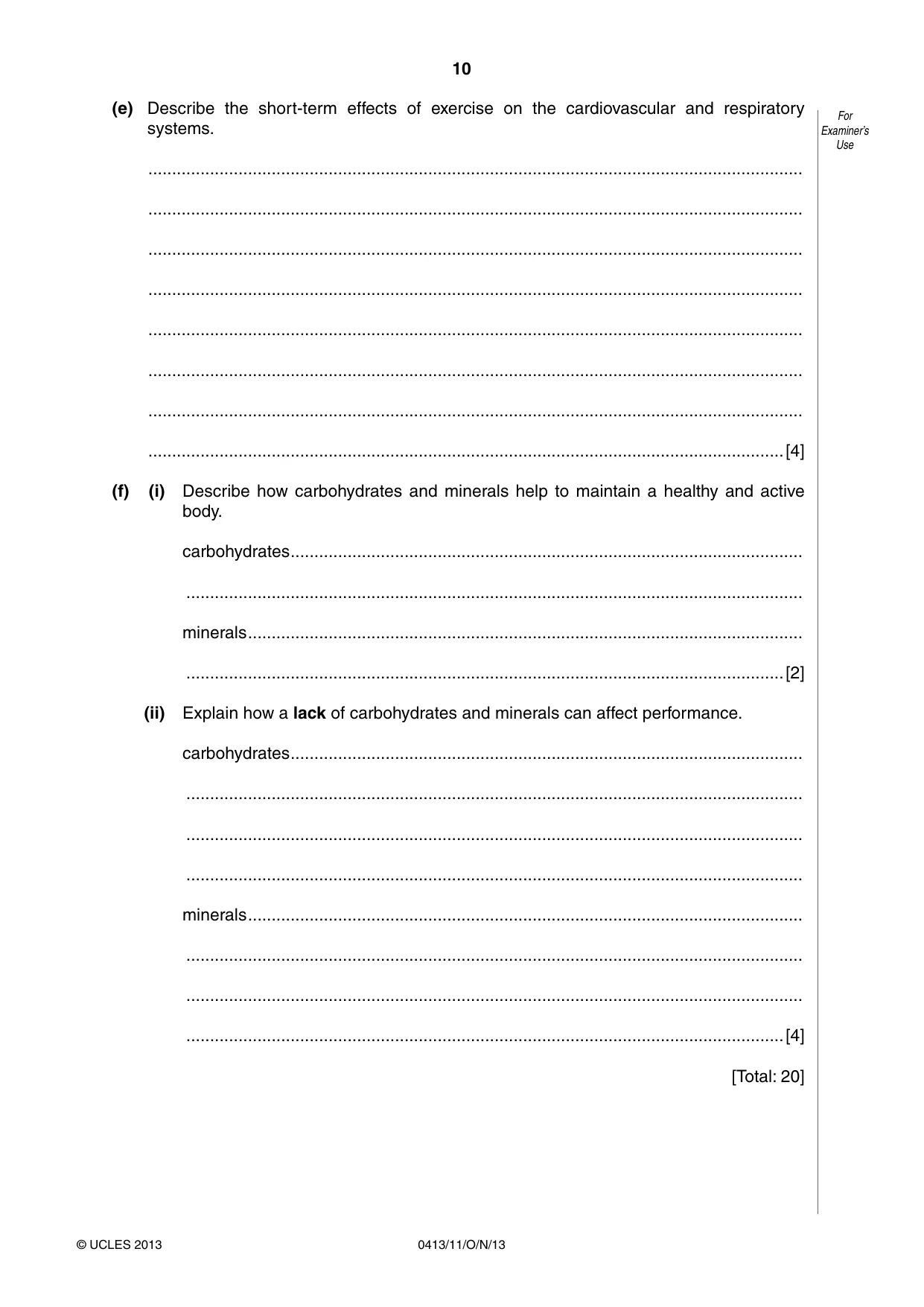
10 0413/11/O/N/13 © UCLES 2013 For Examiner’s Use (e) Describe the short-term effects of exercise on the cardiovascular and respiratory systems. … … … … … … … …[4] (f) (i) Describe how carbohydrates and minerals help to maintain a healthy and active body. carbohydrates … … minerals … …[2] (ii) Explain how a lack of carbohydrates and minerals can affect performance. carbohydrates … … … … minerals … … … …[4] [Total: 20]
Question paper, page 11
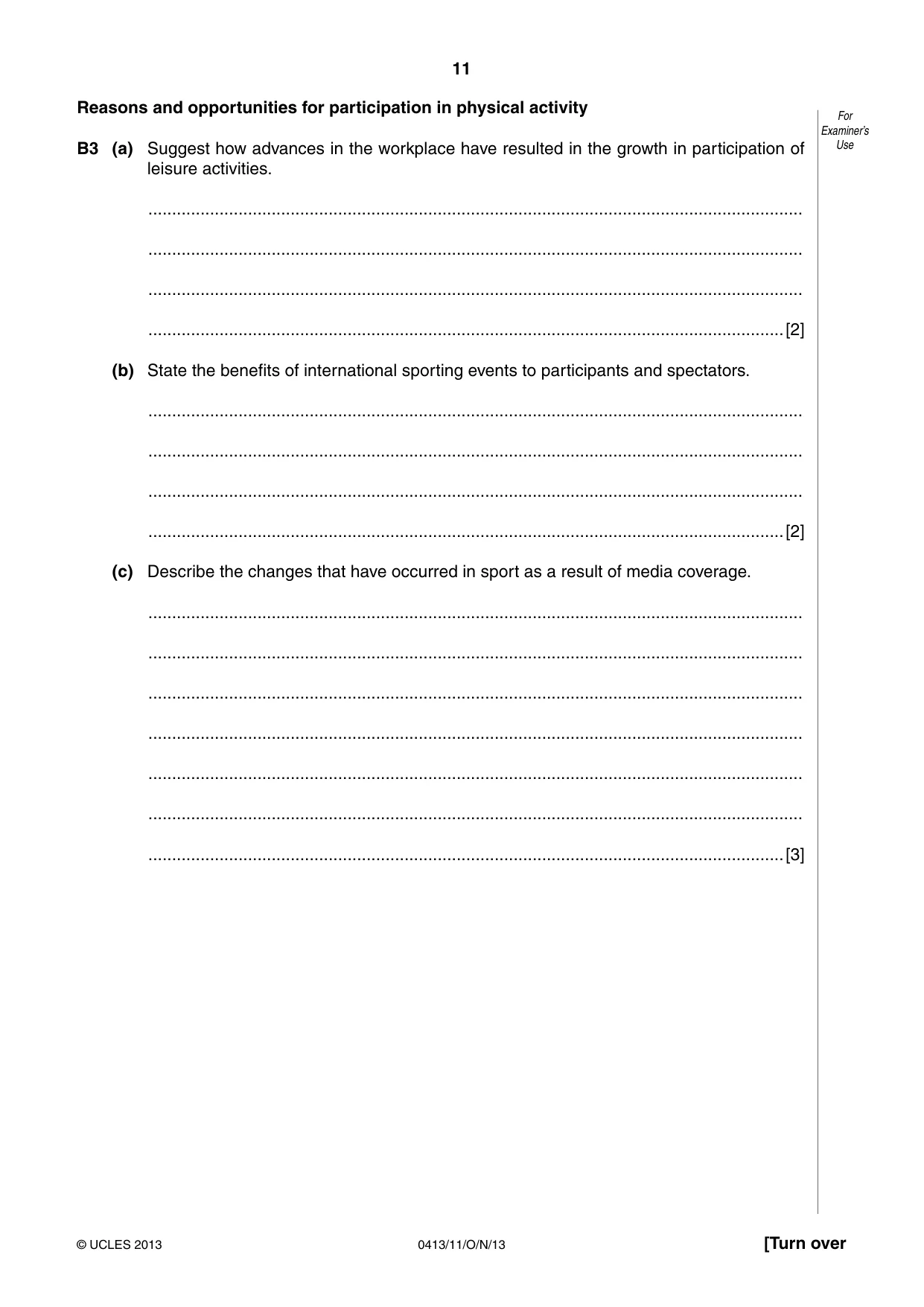
11 0413/11/O/N/13 © UCLES 2013 [Turn over For Examiner’s Use Reasons and opportunities for participation in physical activity B3 (a) Suggest how advances in the workplace have resulted in the growth in participation of leisure activities. … … … …[2] (b) State the benefits of international sporting events to participants and spectators. … … … …[2] (c) Describe the changes that have occurred in sport as a result of media coverage. … … … … … … …[3]
Question paper, page 12
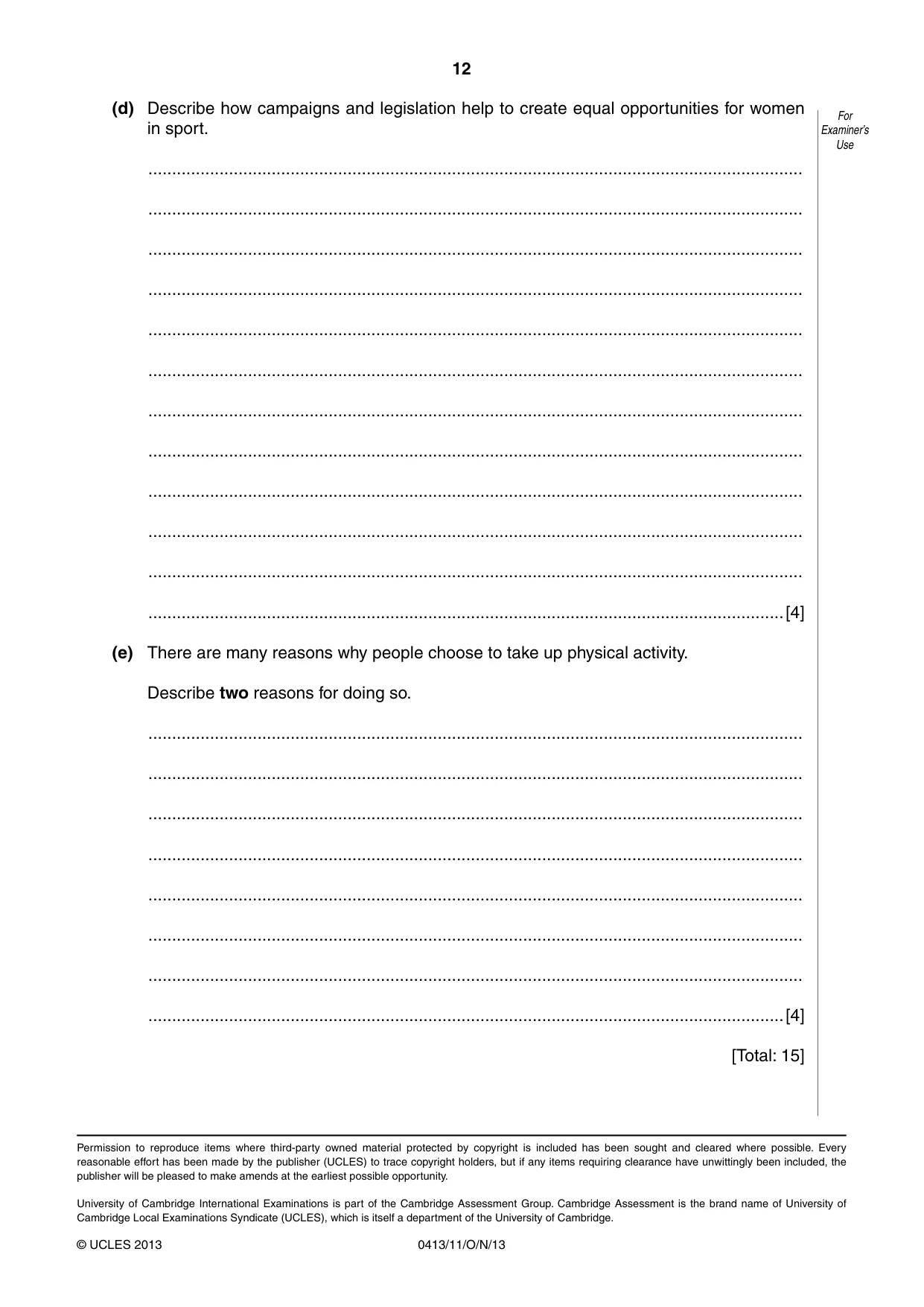
12 0413/11/O/N/13 © UCLES 2013 For Examiner’s Use (d) Describe how campaigns and legislation help to create equal opportunities for women in sport. … … … … … … … … … … … …[4] (e) There are many reasons why people choose to take up physical activity. Describe two reasons for doing so. … … … … … … … …[4] [Total: 15] Permission to reproduce items where third-party owned material protected by copyright is included has been sought and cleared where possible. Every reasonable effort has been made by the publisher (UCLES) to trace copyright holders, but if any items requiring clearance have unwittingly been included, the publisher will be pleased to make amends at the earliest possible opportunity. University of Cambridge International Examinations is part of the Cambridge Assessment Group. Cambridge Assessment is the brand name of University of Cambridge Local Examinations Syndicate (UCLES), which is itself a department of the University of Cambridge.
Mark scheme, page 1
CAMBRIDGE INTERNATIONAL EXAMINATIONS International General Certificate of Secondary Education MARK SCHEME for the October/November 2013 series 0413 PHYSICAL EDUCATION 0413/11 Paper 1, maximum raw mark 80 This mark scheme is published as an aid to teachers and candidates, to indicate the requirements of the examination. It shows the basis on which Examiners were instructed to award marks. It does not indicate the details of the discussions that took place at an Examiners’ meeting before marking began, which would have considered the acceptability of alternative answers. Mark schemes should be read in conjunction with the question paper and the Principal Examiner Report for Teachers. Cambridge will not enter into discussions about these mark schemes. Cambridge is publishing the mark schemes for the October/November 2013 series for most IGCSE, GCE Advanced Level and Advanced Subsidiary Level components and some Ordinary Level components.
Mark scheme, page 2
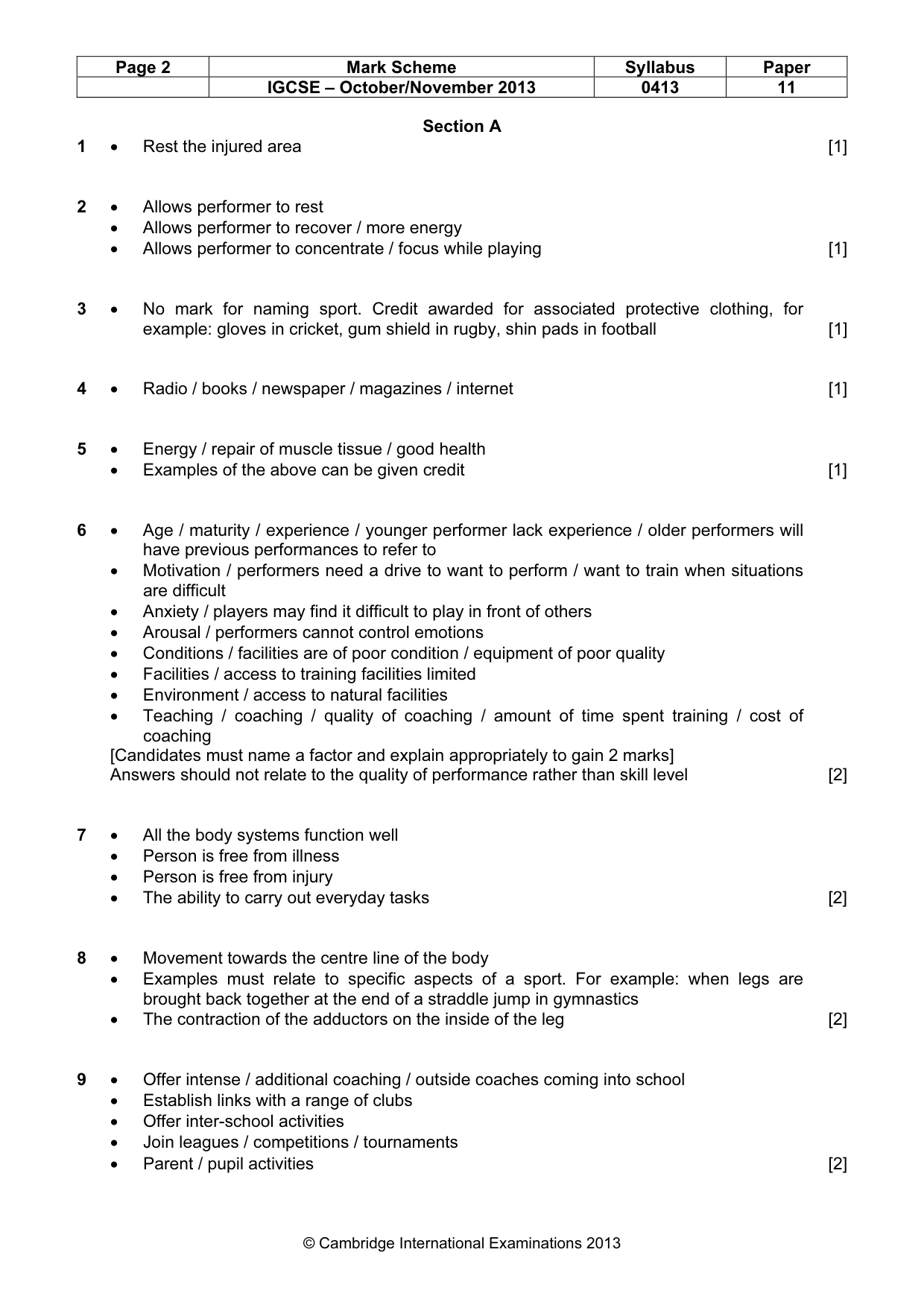
Page 2 Mark Scheme Syllabus Paper IGCSE – October/November 2013 0413 11 © Cambridge International Examinations 2013 Section A 1 • Rest the injured area [1] 2 • Allows performer to rest • Allows performer to recover / more energy • Allows performer to concentrate / focus while playing [1] 3 • No mark for naming sport. Credit awarded for associated protective clothing, for example: gloves in cricket, gum shield in rugby, shin pads in football [1] 4 • Radio / books / newspaper / magazines / internet [1] 5 • Energy / repair of muscle tissue / good health • Examples of the above can be given credit [1] 6 • Age / maturity / experience / younger performer lack experience / older performers will have previous performances to refer to • Motivation / performers need a drive to want to perform / want to train when situations are difficult • Anxiety / players may find it difficult to play in front of others • Arousal / performers cannot control emotions • Conditions / facilities are of poor condition / equipment of poor quality • Facilities / access to training facilities limited • Environment / access to natural facilities • Teaching / coaching / quality of coaching / amount of time spent training / cost of coaching [Candidates must name a factor and explain appropriately to gain 2 marks] Answers should not relate to the quality of performance rather than skill level [2] 7 • All the body systems function well • Person is free from illness • Person is free from injury • The ability to carry out everyday tasks [2] 8 • Movement towards the centre line of the body • Examples must relate to specific aspects of a sport. For example: when legs are brought back together at the end of a straddle jump in gymnastics • The contraction of the adductors on the inside of the leg [2] 9 • Offer intense / additional coaching / outside coaches coming into school • Establish links with a range of clubs • Offer inter-school activities • Join leagues / competitions / tournaments • Parent / pupil activities [2]
Mark scheme, page 3
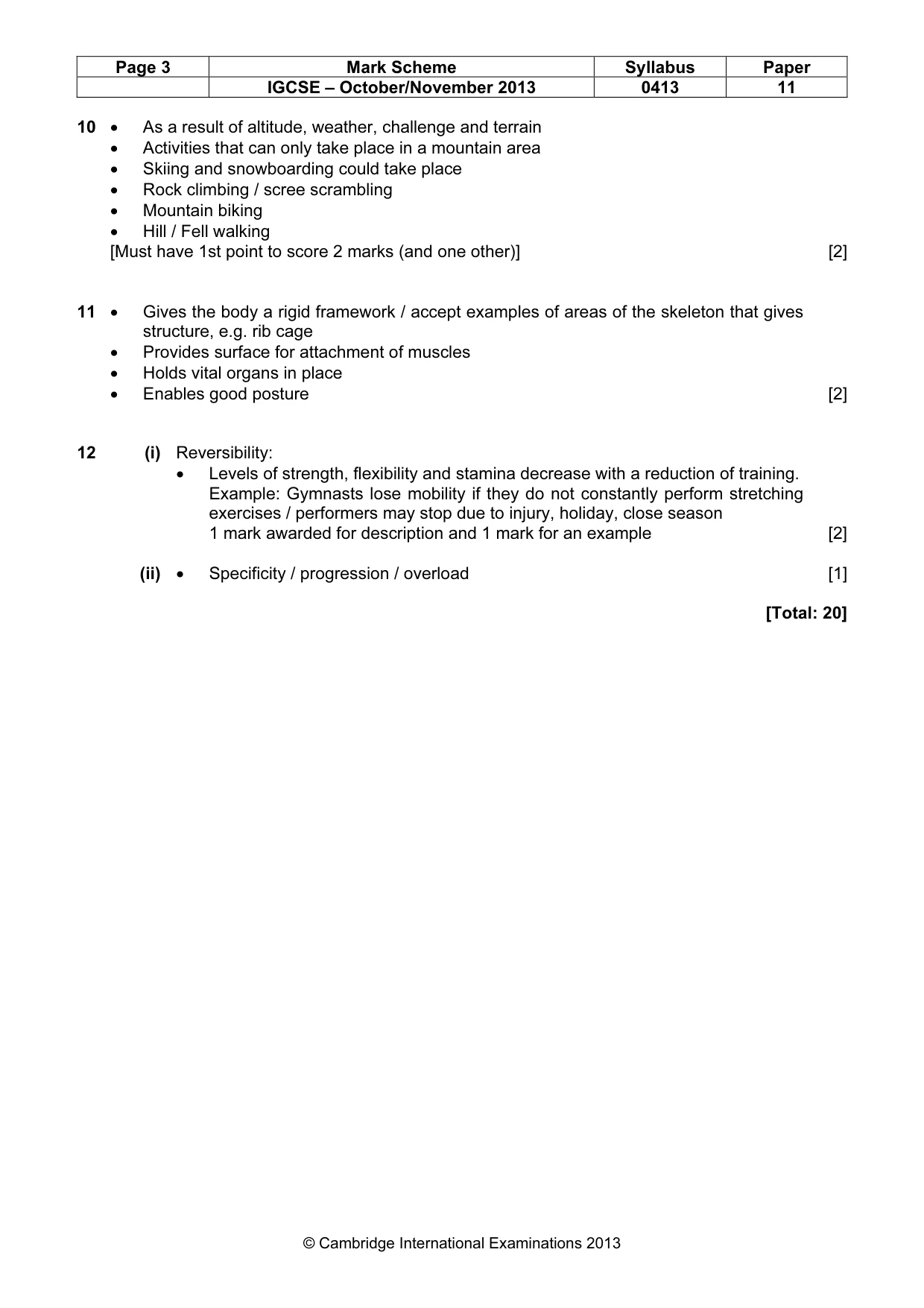
Page 3 Mark Scheme Syllabus Paper IGCSE – October/November 2013 0413 11 © Cambridge International Examinations 2013 10 • As a result of altitude, weather, challenge and terrain • Activities that can only take place in a mountain area • Skiing and snowboarding could take place • Rock climbing / scree scrambling • Mountain biking • Hill / Fell walking [Must have 1st point to score 2 marks (and one other)] [2] 11 • Gives the body a rigid framework / accept examples of areas of the skeleton that gives structure, e.g. rib cage • Provides surface for attachment of muscles • Holds vital organs in place • Enables good posture [2] 12 (i) Reversibility: • Levels of strength, flexibility and stamina decrease with a reduction of training. Example: Gymnasts lose mobility if they do not constantly perform stretching exercises / performers may stop due to injury, holiday, close season 1 mark awarded for description and 1 mark for an example [2] (ii) • Specificity / progression / overload [1] [Total: 20]
Mark scheme, page 4
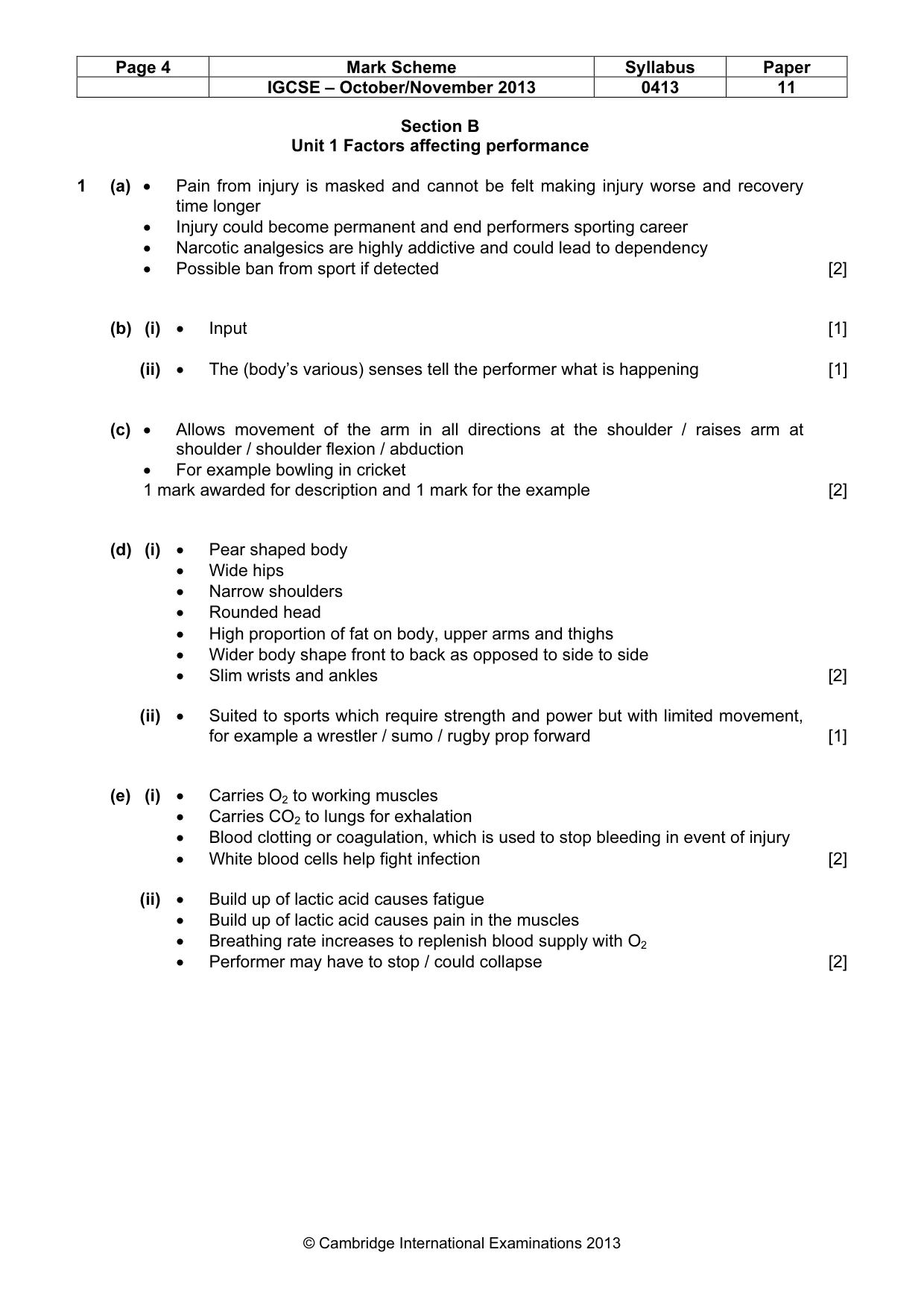
Page 4 Mark Scheme Syllabus Paper IGCSE – October/November 2013 0413 11 © Cambridge International Examinations 2013 Section B Unit 1 Factors affecting performance 1 (a) • Pain from injury is masked and cannot be felt making injury worse and recovery time longer • Injury could become permanent and end performers sporting career • Narcotic analgesics are highly addictive and could lead to dependency • Possible ban from sport if detected [2] (b) (i) • Input [1] (ii) • The (body’s various) senses tell the performer what is happening [1] (c) • Allows movement of the arm in all directions at the shoulder / raises arm at shoulder / shoulder flexion / abduction • For example bowling in cricket 1 mark awarded for description and 1 mark for the example [2] (d) (i) • Pear shaped body • Wide hips • Narrow shoulders • Rounded head • High proportion of fat on body, upper arms and thighs • Wider body shape front to back as opposed to side to side • Slim wrists and ankles [2] (ii) • Suited to sports which require strength and power but with limited movement, for example a wrestler / sumo / rugby prop forward [1] (e) (i) • Carries O2 to working muscles • Carries CO2 to lungs for exhalation • Blood clotting or coagulation, which is used to stop bleeding in event of injury • White blood cells help fight infection [2] (ii) • Build up of lactic acid causes fatigue • Build up of lactic acid causes pain in the muscles • Breathing rate increases to replenish blood supply with O2 • Performer may have to stop / could collapse [2]
Mark scheme, page 5
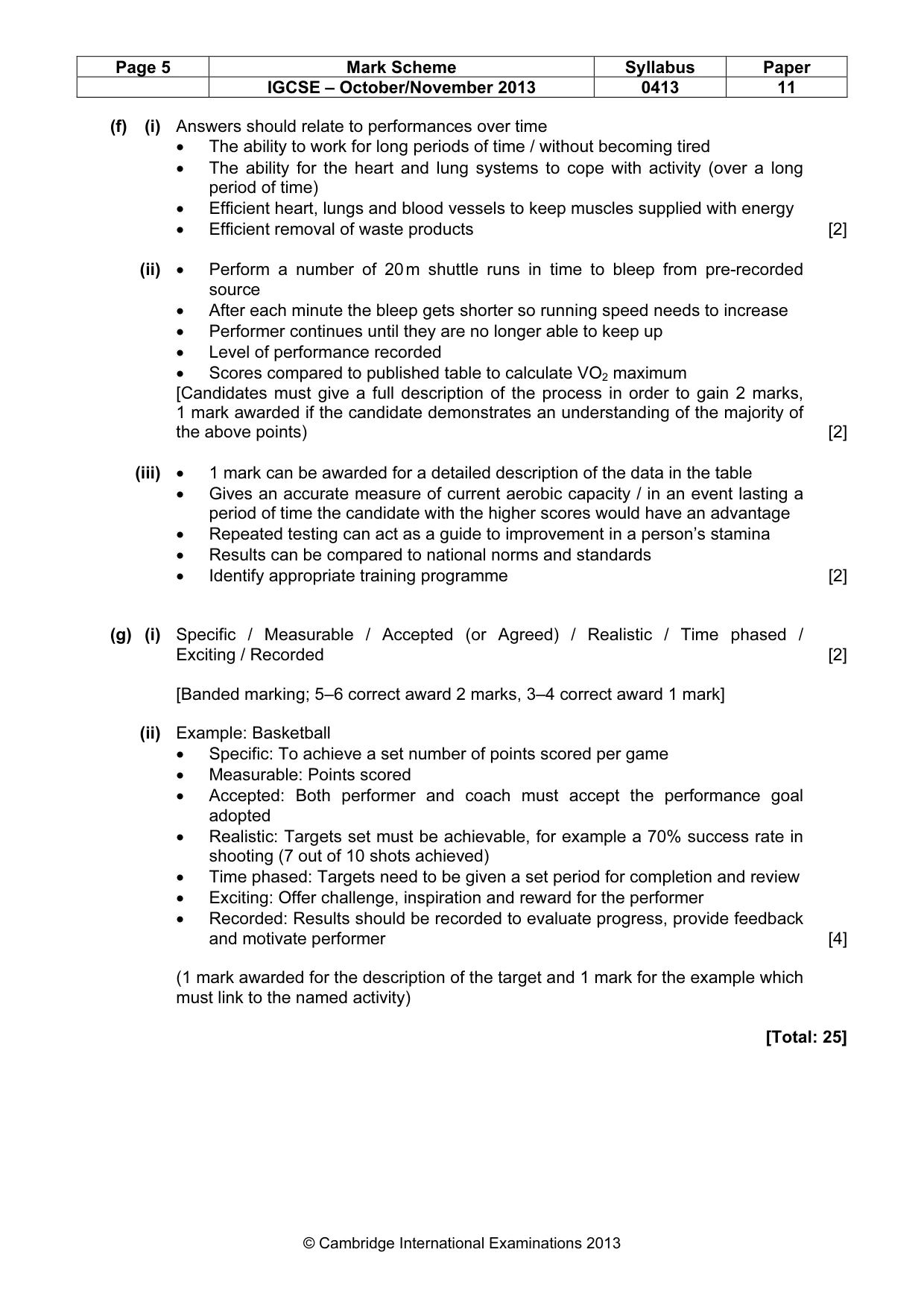
Page 5 Mark Scheme Syllabus Paper IGCSE – October/November 2013 0413 11 © Cambridge International Examinations 2013 (f) (i) Answers should relate to performances over time • The ability to work for long periods of time / without becoming tired • The ability for the heart and lung systems to cope with activity (over a long period of time) • Efficient heart, lungs and blood vessels to keep muscles supplied with energy • Efficient removal of waste products [2] (ii) • Perform a number of 20 m shuttle runs in time to bleep from pre-recorded source • After each minute the bleep gets shorter so running speed needs to increase • Performer continues until they are no longer able to keep up • Level of performance recorded • Scores compared to published table to calculate VO2 maximum [Candidates must give a full description of the process in order to gain 2 marks, 1 mark awarded if the candidate demonstrates an understanding of the majority of the above points) [2] (iii) • 1 mark can be awarded for a detailed description of the data in the table • Gives an accurate measure of current aerobic capacity / in an event lasting a period of time the candidate with the higher scores would have an advantage • Repeated testing can act as a guide to improvement in a person’s stamina • Results can be compared to national norms and standards • Identify appropriate training programme [2] (g) (i) Specific / Measurable / Accepted (or Agreed) / Realistic / Time phased / Exciting / Recorded [2] [Banded marking; 5–6 correct award 2 marks, 3–4 correct award 1 mark] (ii) Example: Basketball • Specific: To achieve a set number of points scored per game • Measurable: Points scored • Accepted: Both performer and coach must accept the performance goal adopted • Realistic: Targets set must be achievable, for example a 70% success rate in shooting (7 out of 10 shots achieved) • Time phased: Targets need to be given a set period for completion and review • Exciting: Offer challenge, inspiration and reward for the performer • Recorded: Results should be recorded to evaluate progress, provide feedback and motivate performer [4] (1 mark awarded for the description of the target and 1 mark for the example which must link to the named activity) [Total: 25]
Mark scheme, page 6
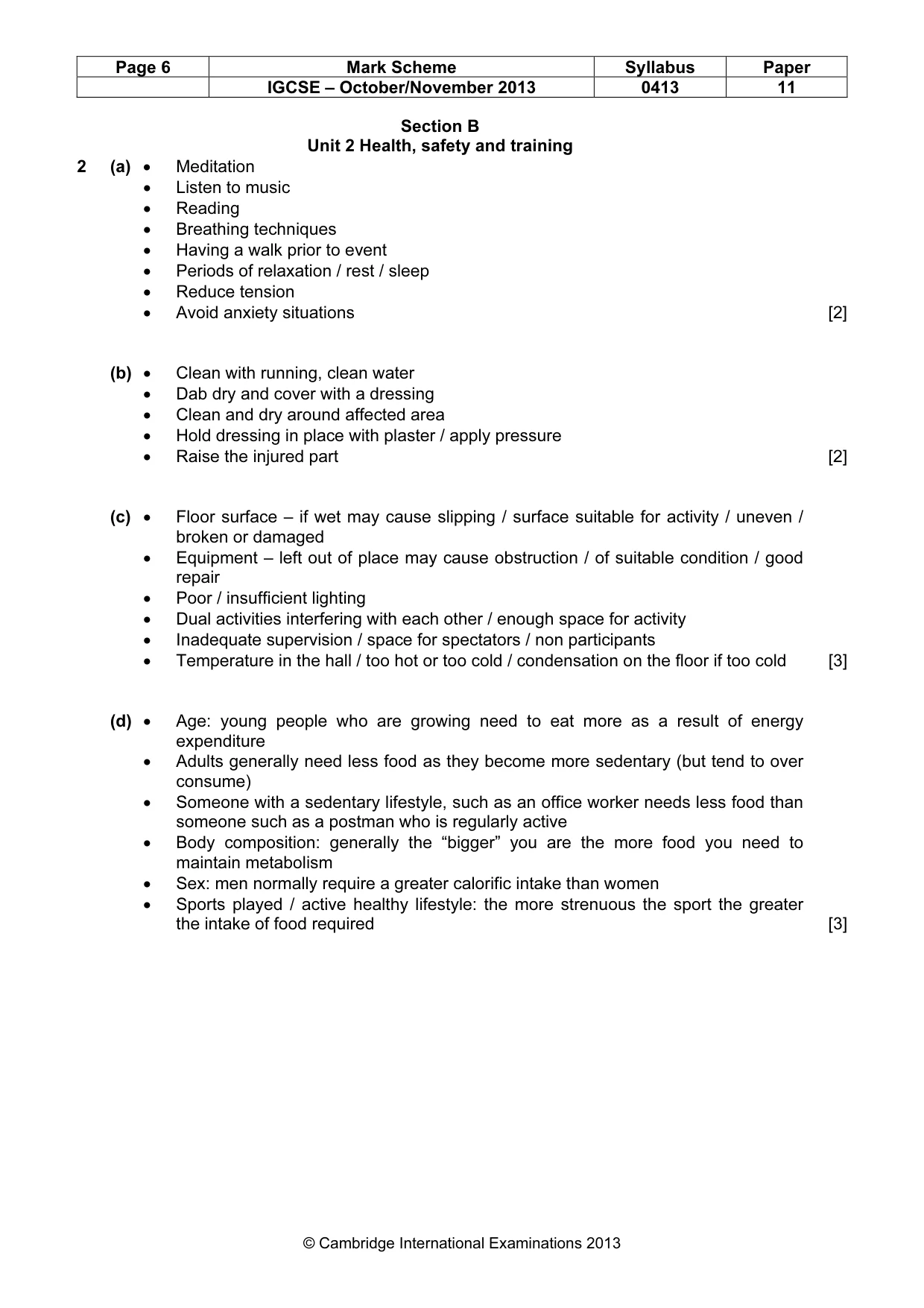
Page 6 Mark Scheme Syllabus Paper IGCSE – October/November 2013 0413 11 © Cambridge International Examinations 2013 Section B Unit 2 Health, safety and training 2 (a) • Meditation • Listen to music • Reading • Breathing techniques • Having a walk prior to event • Periods of relaxation / rest / sleep • Reduce tension • Avoid anxiety situations [2] (b) • Clean with running, clean water • Dab dry and cover with a dressing • Clean and dry around affected area • Hold dressing in place with plaster / apply pressure • Raise the injured part [2] (c) • Floor surface – if wet may cause slipping / surface suitable for activity / uneven / broken or damaged • Equipment – left out of place may cause obstruction / of suitable condition / good repair • Poor / insufficient lighting • Dual activities interfering with each other / enough space for activity • Inadequate supervision / space for spectators / non participants • Temperature in the hall / too hot or too cold / condensation on the floor if too cold [3] (d) • Age: young people who are growing need to eat more as a result of energy expenditure • Adults generally need less food as they become more sedentary (but tend to over consume) • Someone with a sedentary lifestyle, such as an office worker needs less food than someone such as a postman who is regularly active • Body composition: generally the “bigger” you are the more food you need to maintain metabolism • Sex: men normally require a greater calorific intake than women • Sports played / active healthy lifestyle: the more strenuous the sport the greater the intake of food required [3]
Mark scheme, page 7
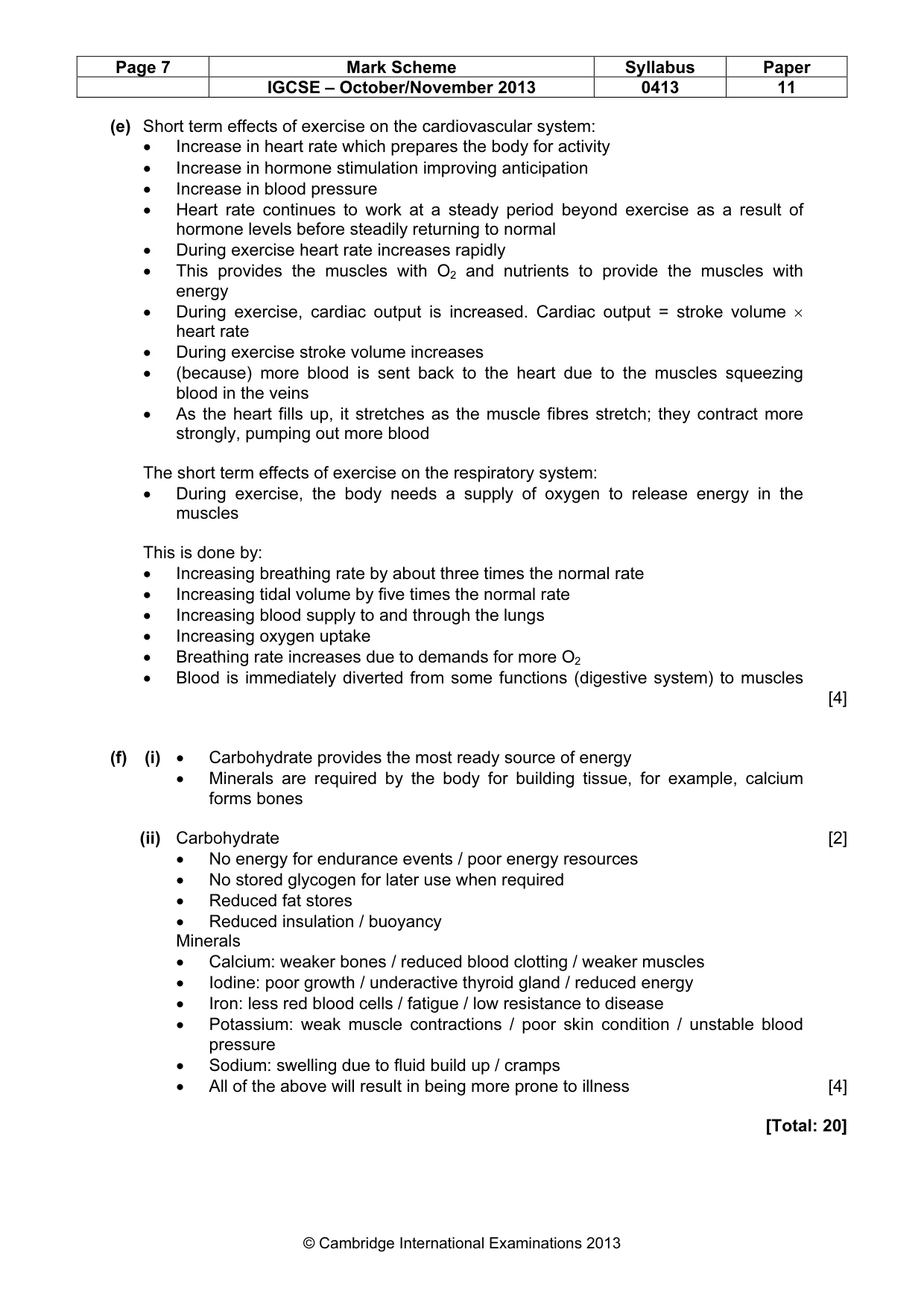
Page 7 Mark Scheme Syllabus Paper IGCSE – October/November 2013 0413 11 © Cambridge International Examinations 2013 (e) Short term effects of exercise on the cardiovascular system: • Increase in heart rate which prepares the body for activity • Increase in hormone stimulation improving anticipation • Increase in blood pressure • Heart rate continues to work at a steady period beyond exercise as a result of hormone levels before steadily returning to normal • During exercise heart rate increases rapidly • This provides the muscles with O2 and nutrients to provide the muscles with energy • During exercise, cardiac output is increased. Cardiac output = stroke volume × heart rate • During exercise stroke volume increases • (because) more blood is sent back to the heart due to the muscles squeezing blood in the veins • As the heart fills up, it stretches as the muscle fibres stretch; they contract more strongly, pumping out more blood The short term effects of exercise on the respiratory system: • During exercise, the body needs a supply of oxygen to release energy in the muscles This is done by: • Increasing breathing rate by about three times the normal rate • Increasing tidal volume by five times the normal rate • Increasing blood supply to and through the lungs • Increasing oxygen uptake • Breathing rate increases due to demands for more O2 • Blood is immediately diverted from some functions (digestive system) to muscles [4] (f) (i) • Carbohydrate provides the most ready source of energy • Minerals are required by the body for building tissue, for example, calcium forms bones (ii) Carbohydrate [2] • No energy for endurance events / poor energy resources • No stored glycogen for later use when required • Reduced fat stores • Reduced insulation / buoyancy Minerals • Calcium: weaker bones / reduced blood clotting / weaker muscles • Iodine: poor growth / underactive thyroid gland / reduced energy • Iron: less red blood cells / fatigue / low resistance to disease • Potassium: weak muscle contractions / poor skin condition / unstable blood pressure • Sodium: swelling due to fluid build up / cramps • All of the above will result in being more prone to illness [4] [Total: 20]
Mark scheme, page 8
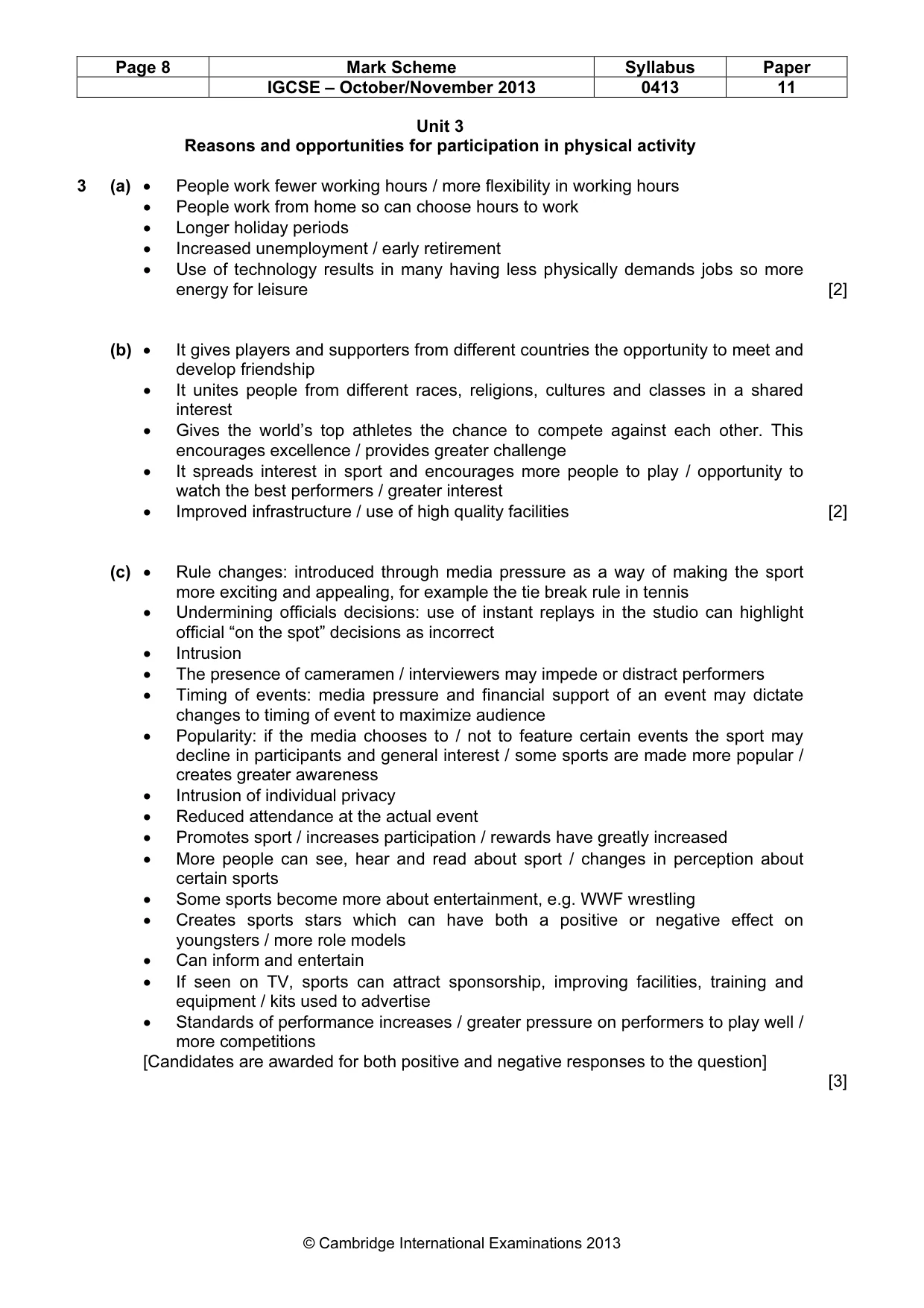
Page 8 Mark Scheme Syllabus Paper IGCSE – October/November 2013 0413 11 © Cambridge International Examinations 2013 Unit 3 Reasons and opportunities for participation in physical activity 3 (a) • People work fewer working hours / more flexibility in working hours • People work from home so can choose hours to work • Longer holiday periods • Increased unemployment / early retirement • Use of technology results in many having less physically demands jobs so more energy for leisure [2] (b) • It gives players and supporters from different countries the opportunity to meet and develop friendship • It unites people from different races, religions, cultures and classes in a shared interest • Gives the world’s top athletes the chance to compete against each other. This encourages excellence / provides greater challenge • It spreads interest in sport and encourages more people to play / opportunity to watch the best performers / greater interest • Improved infrastructure / use of high quality facilities [2] (c) • Rule changes: introduced through media pressure as a way of making the sport more exciting and appealing, for example the tie break rule in tennis • Undermining officials decisions: use of instant replays in the studio can highlight official “on the spot” decisions as incorrect • Intrusion • The presence of cameramen / interviewers may impede or distract performers • Timing of events: media pressure and financial support of an event may dictate changes to timing of event to maximize audience • Popularity: if the media chooses to / not to feature certain events the sport may decline in participants and general interest / some sports are made more popular / creates greater awareness • Intrusion of individual privacy • Reduced attendance at the actual event • Promotes sport / increases participation / rewards have greatly increased • More people can see, hear and read about sport / changes in perception about certain sports • Some sports become more about entertainment, e.g. WWF wrestling • Creates sports stars which can have both a positive or negative effect on youngsters / more role models • Can inform and entertain • If seen on TV, sports can attract sponsorship, improving facilities, training and equipment / kits used to advertise • Standards of performance increases / greater pressure on performers to play well / more competitions [Candidates are awarded for both positive and negative responses to the question] [3]
Mark scheme, page 9
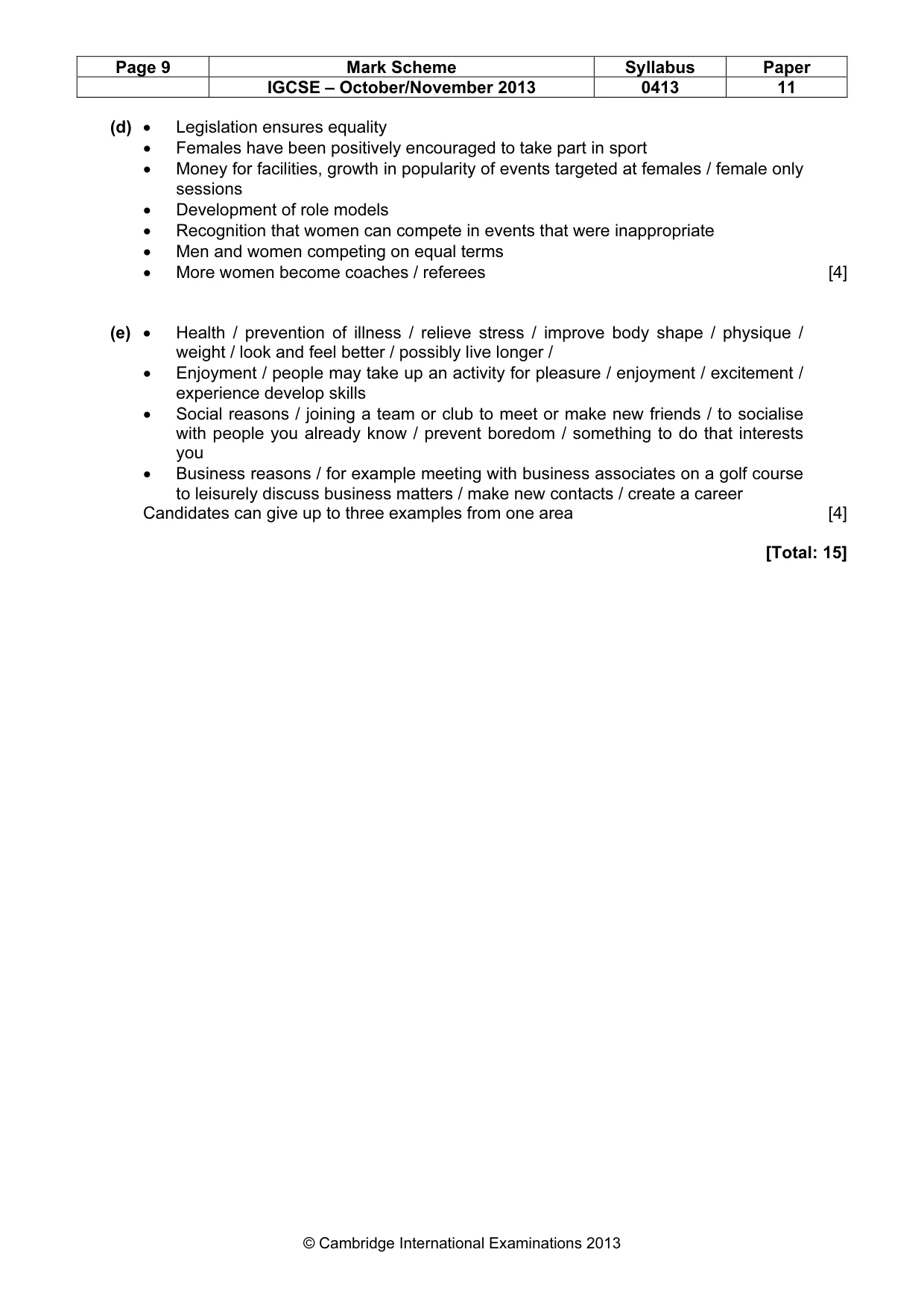
Page 9 Mark Scheme Syllabus Paper IGCSE – October/November 2013 0413 11 © Cambridge International Examinations 2013 (d) • Legislation ensures equality • Females have been positively encouraged to take part in sport • Money for facilities, growth in popularity of events targeted at females / female only sessions • Development of role models • Recognition that women can compete in events that were inappropriate • Men and women competing on equal terms • More women become coaches / referees [4] (e) • Health / prevention of illness / relieve stress / improve body shape / physique / weight / look and feel better / possibly live longer / • Enjoyment / people may take up an activity for pleasure / enjoyment / excitement / experience develop skills • Social reasons / joining a team or club to meet or make new friends / to socialise with people you already know / prevent boredom / something to do that interests you • Business reasons / for example meeting with business associates on a golf course to leisurely discuss business matters / make new contacts / create a career Candidates can give up to three examples from one area [4] [Total: 15]
What you needed in this session
Cambridge’s own grade thresholds for 2013 Oct/Nov, Paper 1 · Variant 1. A higher threshold means an easier paper — the bar moves with how the cohort did.