Cambridge IGCSE Physical Education 0413 — 2013 Oct/Nov Paper 1 · Variant 3
0413/13/O/N/13 · 80 marks · ≈90 min
The question paper and its mark scheme, free to read here and free to download. This is Cambridge’s own paper, exactly as it was sat.
Question paper12 pages

Mark scheme8 pages
Answers below. Sit the paper first if you are practising.

Paper as text
Question paper, page 1
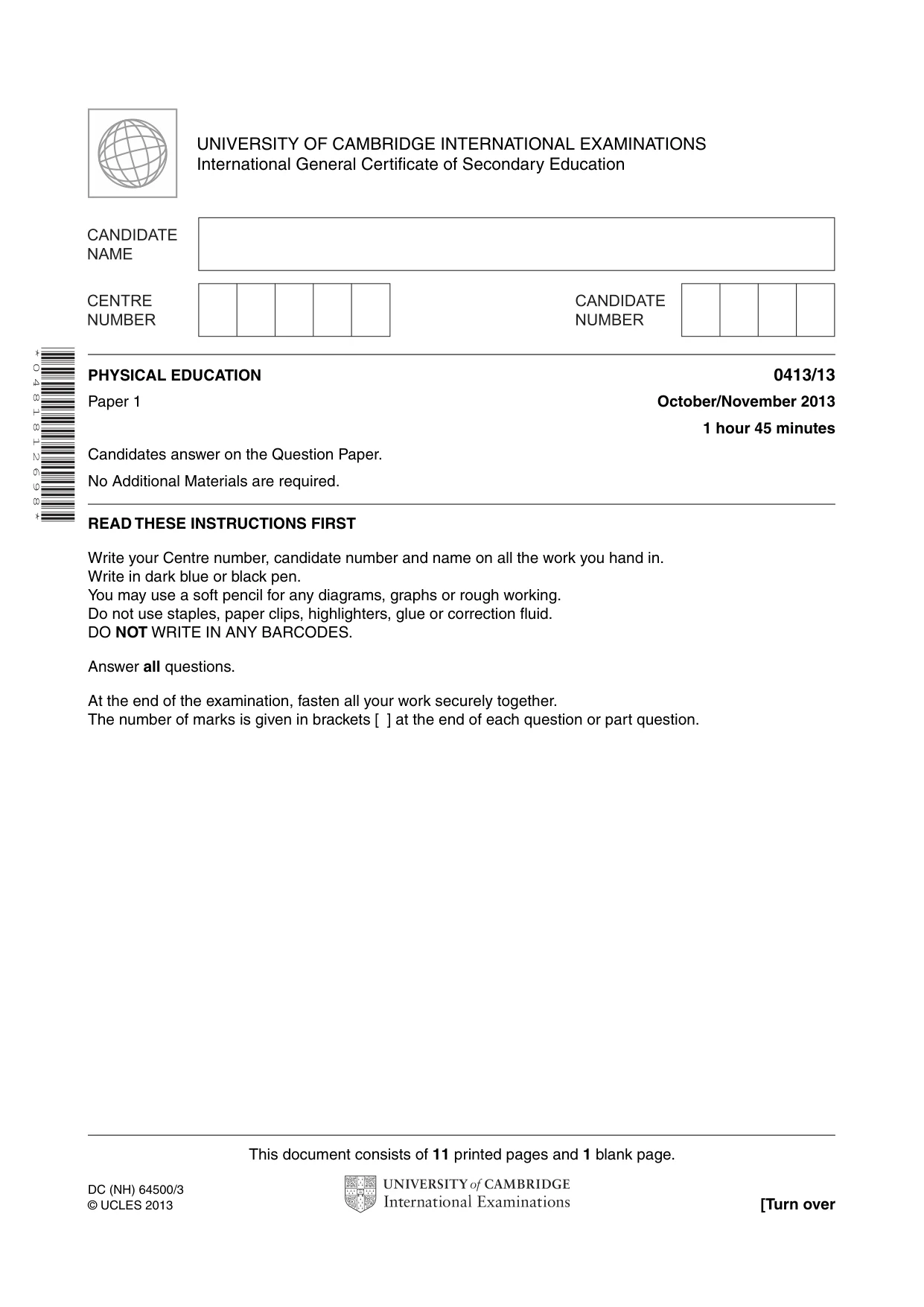
This document consists of 11 printed pages and 1 blank page. DC (NH) 64500/3 © UCLES 2013 [Turn over UNIVERSITY OF CAMBRIDGE INTERNATIONAL EXAMINATIONS International General Certificate of Secondary Education * 0 4 8 1 8 1 2 6 9 8 * PHYSICAL EDUCATION 0413/13 Paper 1 October/November 2013 1 hour 45 minutes Candidates answer on the Question Paper. No Additional Materials are required. READ THESE INSTRUCTIONS FIRST Write your Centre number, candidate number and name on all the work you hand in. Write in dark blue or black pen. You may use a soft pencil for any diagrams, graphs or rough working. Do not use staples, paper clips, highlighters, glue or correction fluid. DO NOT WRITE IN ANY BARCODES. Answer all questions. At the end of the examination, fasten all your work securely together. The number of marks is given in brackets [ ] at the end of each question or part question.
Question paper, page 2
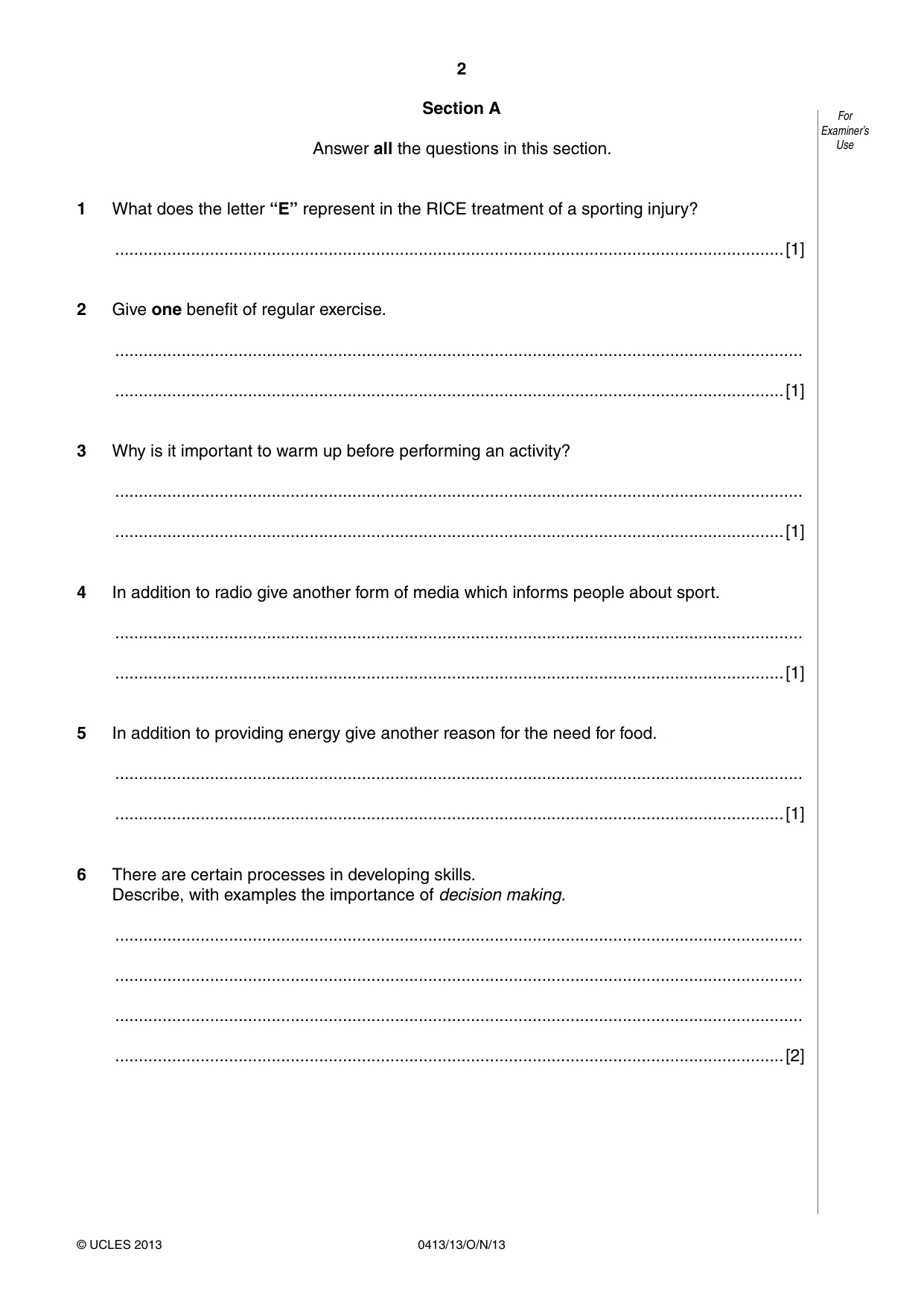
2 0413/13/O/N/13 © UCLES 2013 For Examiner’s Use Section A Answer all the questions in this section. 1 What does the letter “E” represent in the RICE treatment of a sporting injury? …[1] 2 Give one benefit of regular exercise. … …[1] 3 Why is it important to warm up before performing an activity? … …[1] 4 In addition to radio give another form of media which informs people about sport. … …[1] 5 In addition to providing energy give another reason for the need for food. … …[1] 6 There are certain processes in developing skills. Describe, with examples the importance of decision making. … … … …[2]
Question paper, page 3
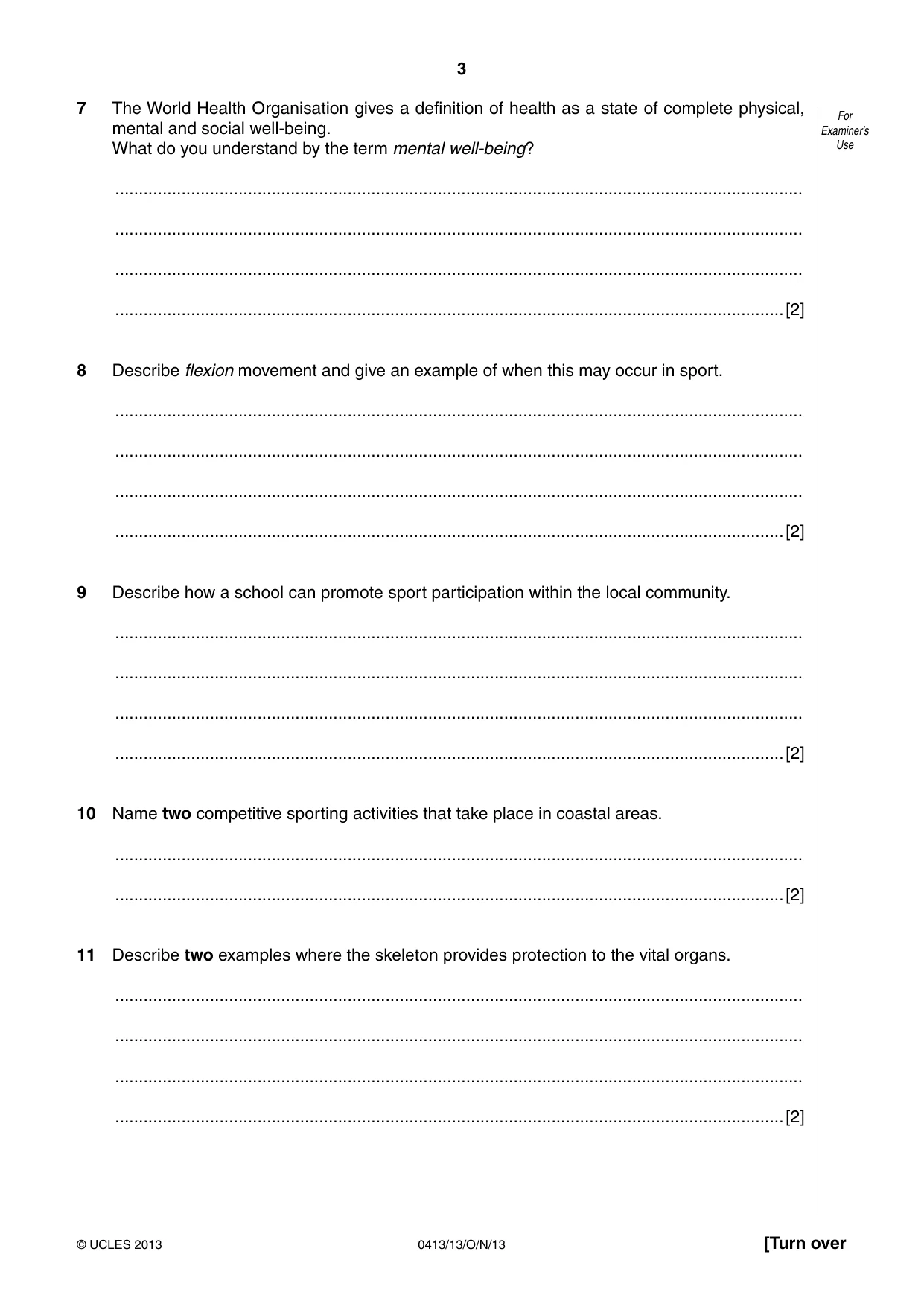
3 0413/13/O/N/13 © UCLES 2013 [Turn over For Examiner’s Use 7 The World Health Organisation gives a definition of health as a state of complete physical, mental and social well-being. What do you understand by the term mental well-being? … … … …[2] 8 Describe flexion movement and give an example of when this may occur in sport. … … … …[2] 9 Describe how a school can promote sport participation within the local community. … … … …[2] 10 Name two competitive sporting activities that take place in coastal areas. … …[2] 11 Describe two examples where the skeleton provides protection to the vital organs. … … … …[2]
Question paper, page 4
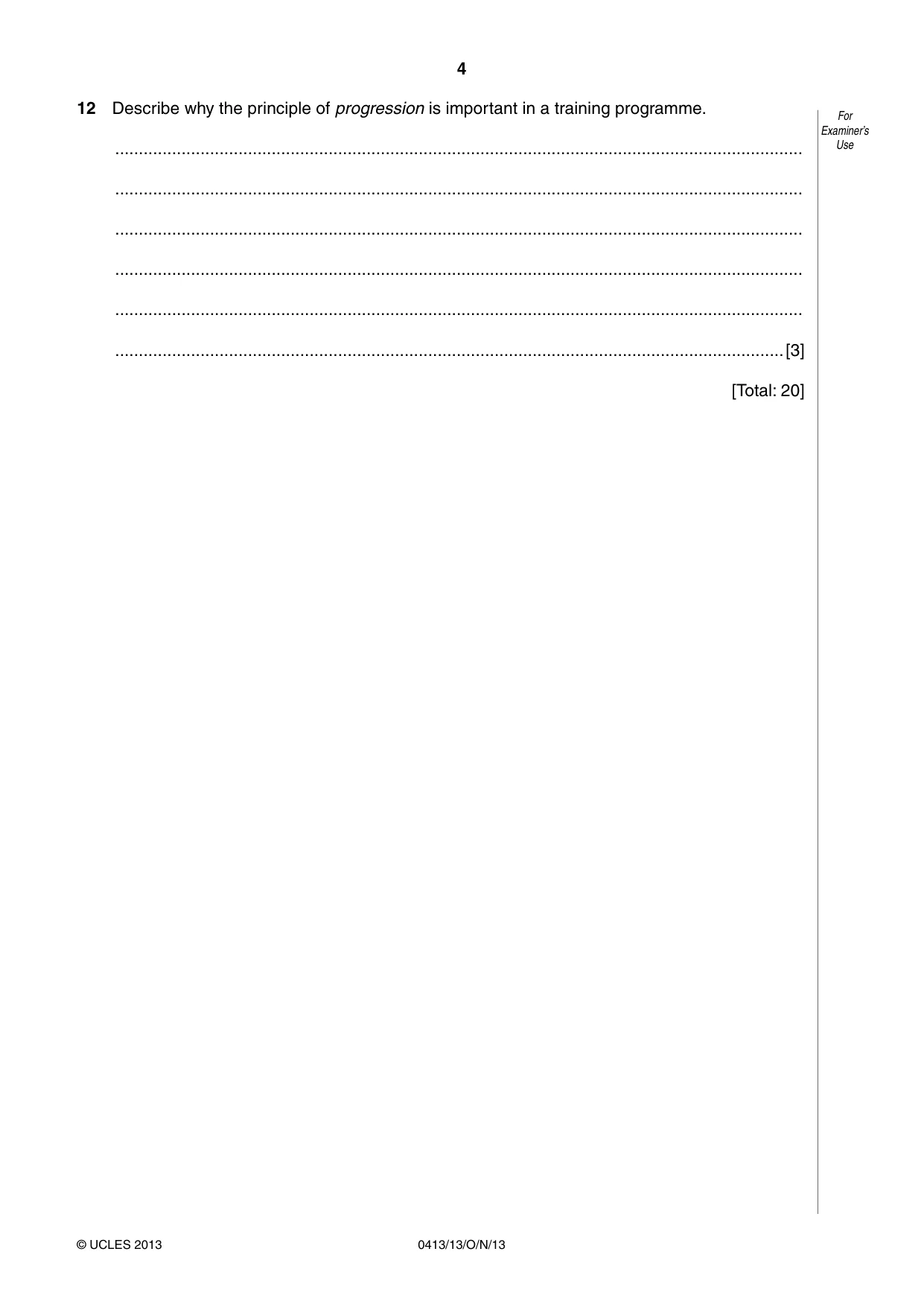
4 0413/13/O/N/13 © UCLES 2013 For Examiner’s Use 12 Describe why the principle of progression is important in a training programme. … … … … … …[3] [Total: 20]
Question paper, page 5
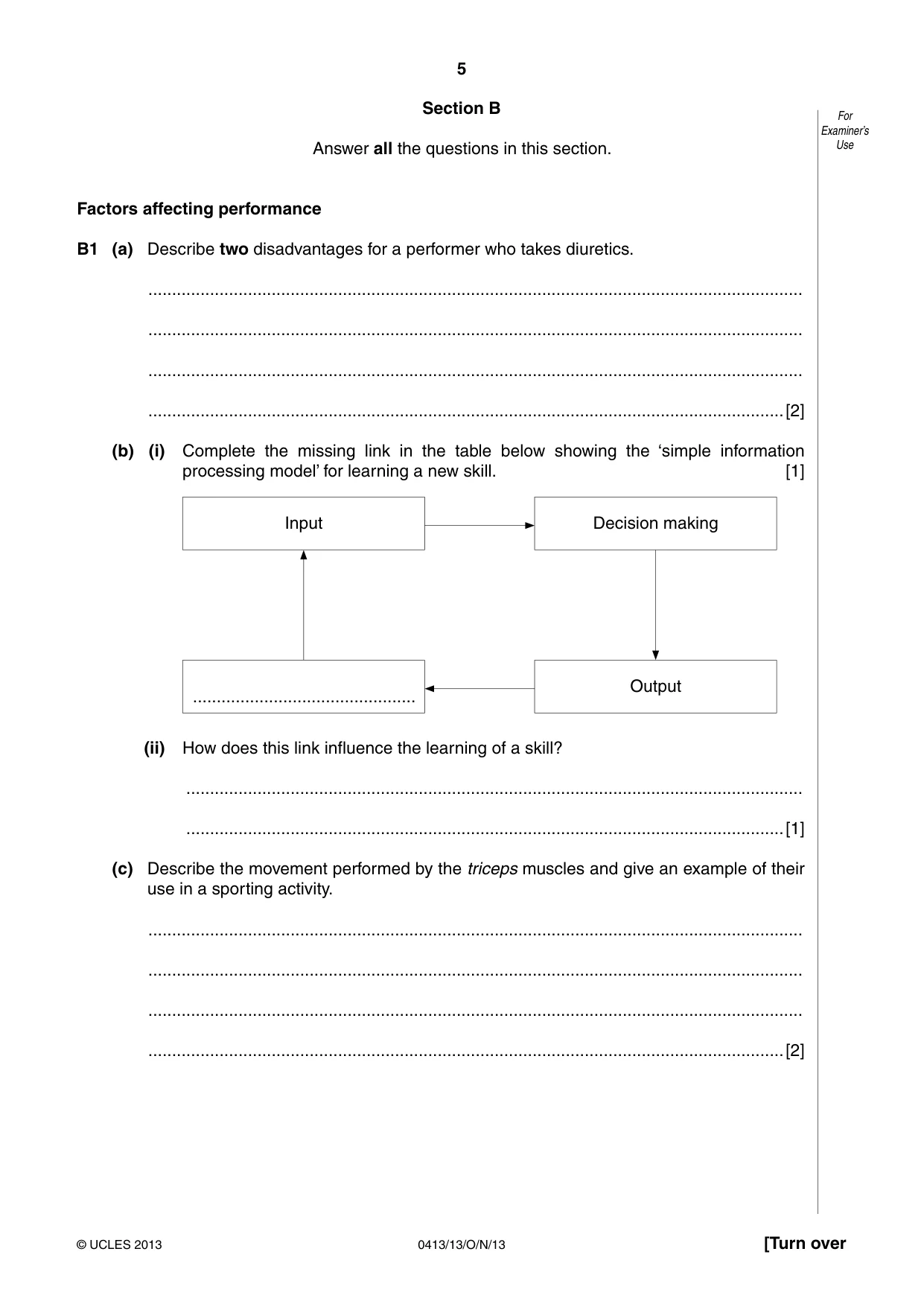
5 0413/13/O/N/13 © UCLES 2013 [Turn over For Examiner’s Use Section B Answer all the questions in this section. Factors affecting performance B1 (a) Describe two disadvantages for a performer who takes diuretics. … … … …[2] (b) (i) Complete the missing link in the table below showing the ‘simple information processing model’ for learning a new skill. [1] Input Decision making … Output (ii) How does this link influence the learning of a skill? … …[1] (c) Describe the movement performed by the triceps muscles and give an example of their use in a sporting activity. … … … …[2]
Question paper, page 6
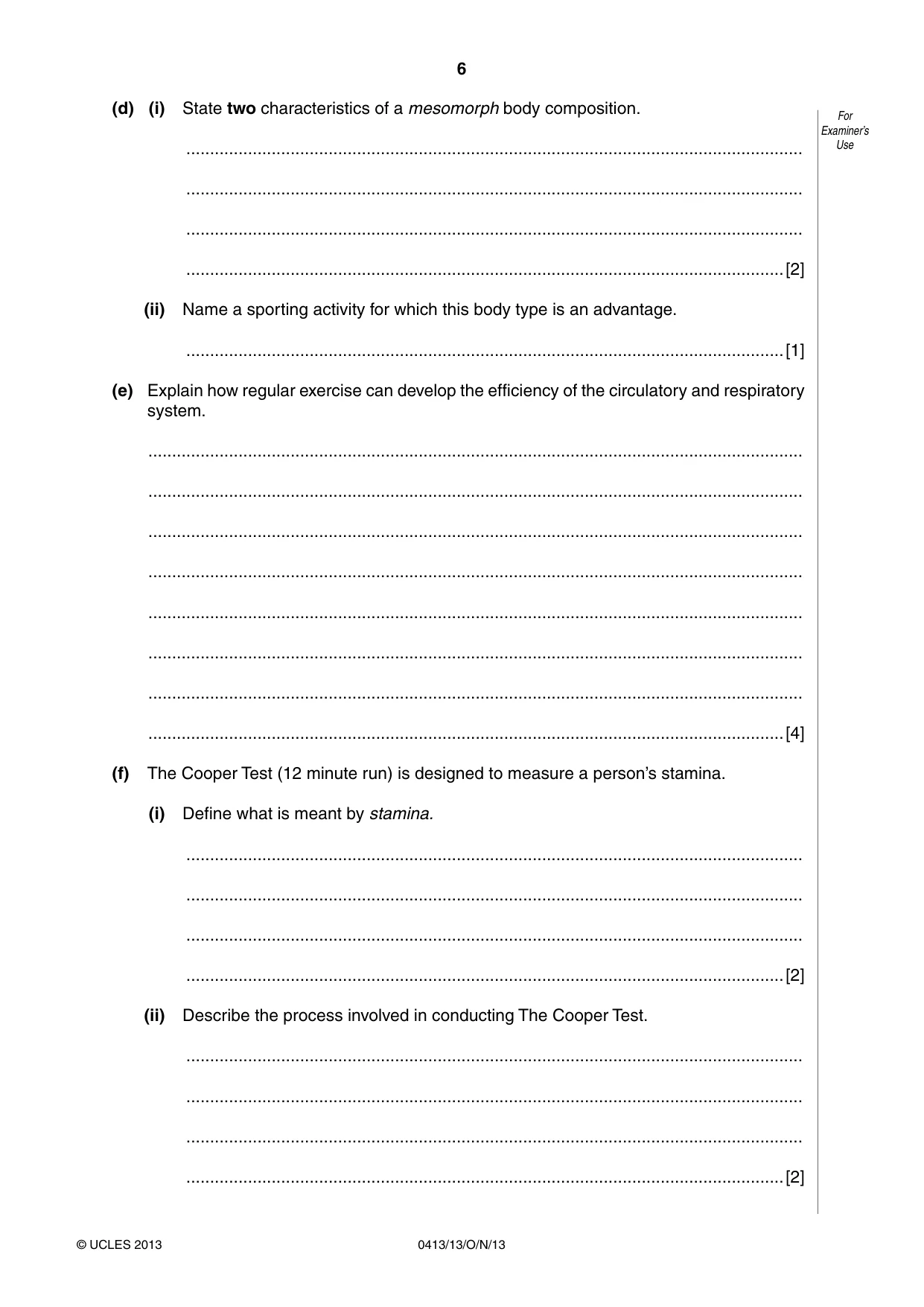
6 0413/13/O/N/13 © UCLES 2013 For Examiner’s Use (d) (i) State two characteristics of a mesomorph body composition. … … … …[2] (ii) Name a sporting activity for which this body type is an advantage. …[1] (e) Explain how regular exercise can develop the efficiency of the circulatory and respiratory system. … … … … … … … …[4] (f) The Cooper Test (12 minute run) is designed to measure a person’s stamina. (i) Define what is meant by stamina. … … … …[2] (ii) Describe the process involved in conducting The Cooper Test. … … … …[2]
Question paper, page 7
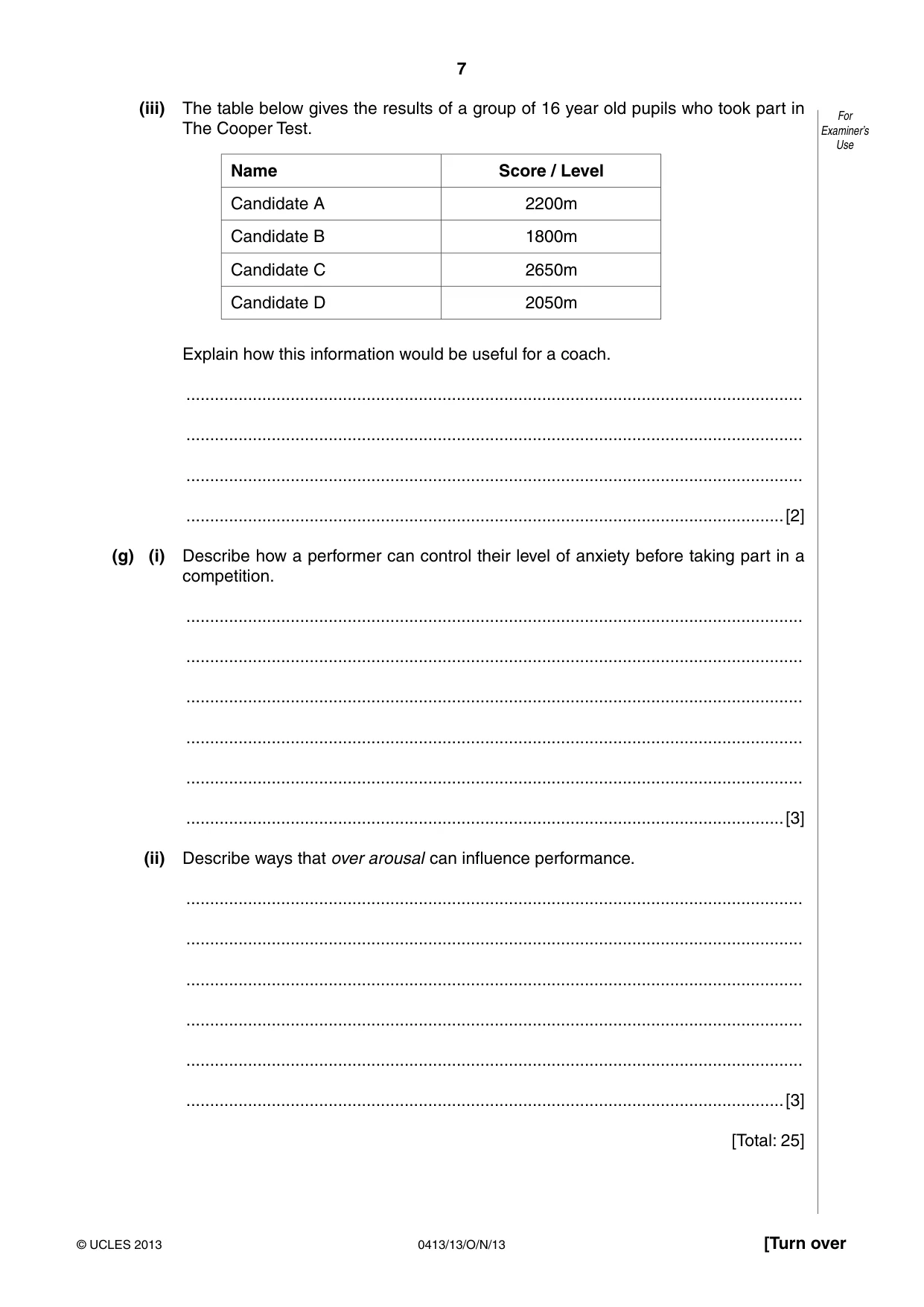
7 0413/13/O/N/13 © UCLES 2013 [Turn over For Examiner’s Use (iii) The table below gives the results of a group of 16 year old pupils who took part in The Cooper Test. Name Score / Level Candidate A 2200m Candidate B 1800m Candidate C 2650m Candidate D 2050m Explain how this information would be useful for a coach. … … … …[2] (g) (i) Describe how a performer can control their level of anxiety before taking part in a competition. … … … … … …[3] (ii) Describe ways that over arousal can influence performance. … … … … … …[3] [Total: 25]
Question paper, page 8
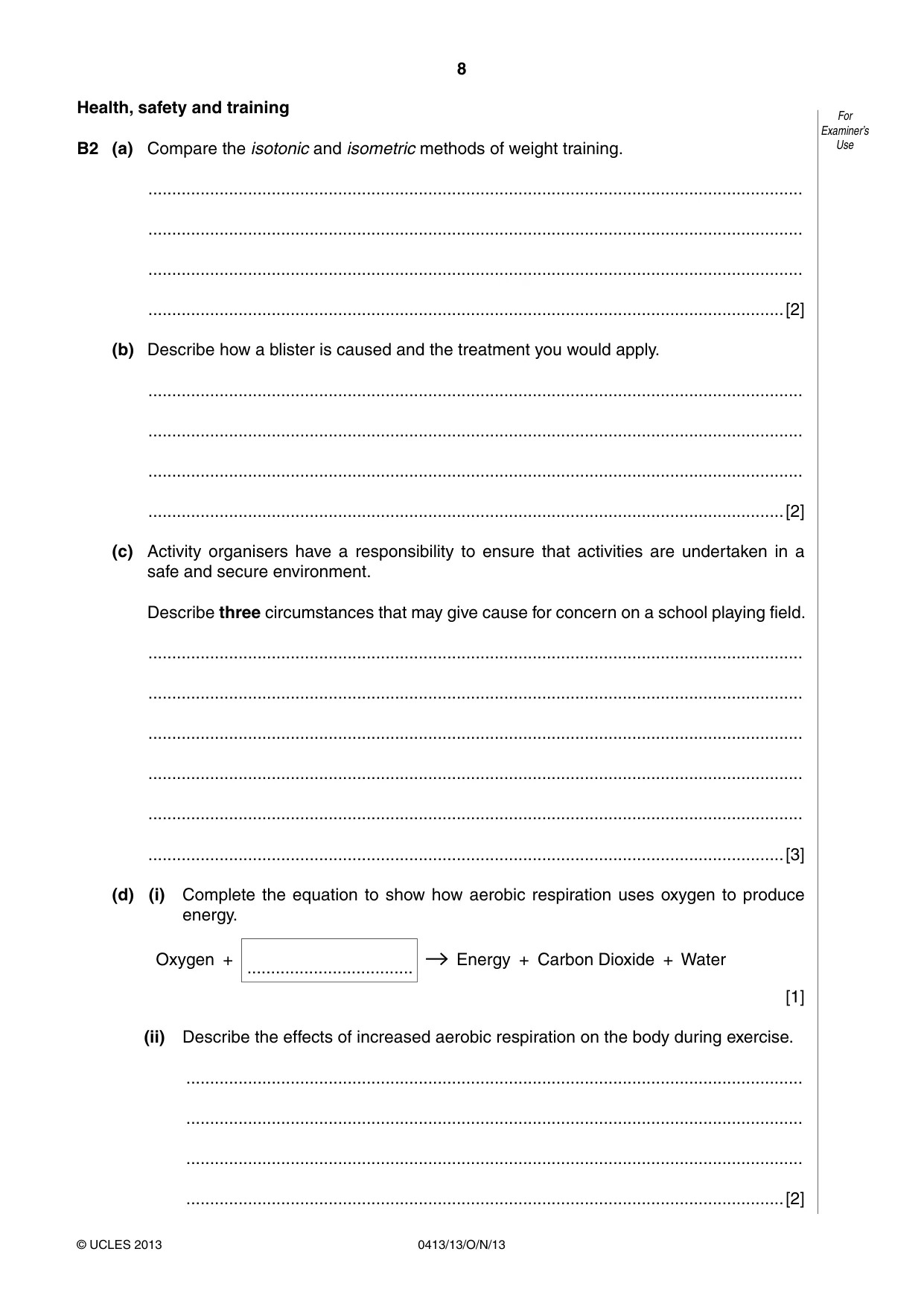
8 0413/13/O/N/13 © UCLES 2013 For Examiner’s Use Health, safety and training B2 (a) Compare the isotonic and isometric methods of weight training. … … … …[2] (b) Describe how a blister is caused and the treatment you would apply. … … … …[2] (c) Activity organisers have a responsibility to ensure that activities are undertaken in a safe and secure environment. Describe three circumstances that may give cause for concern on a school playing field. … … … … … …[3] (d) (i) Complete the equation to show how aerobic respiration uses oxygen to produce energy. Oxygen + … Energy + Carbon Dioxide + Water [1] (ii) Describe the effects of increased aerobic respiration on the body during exercise. … … … …[2]
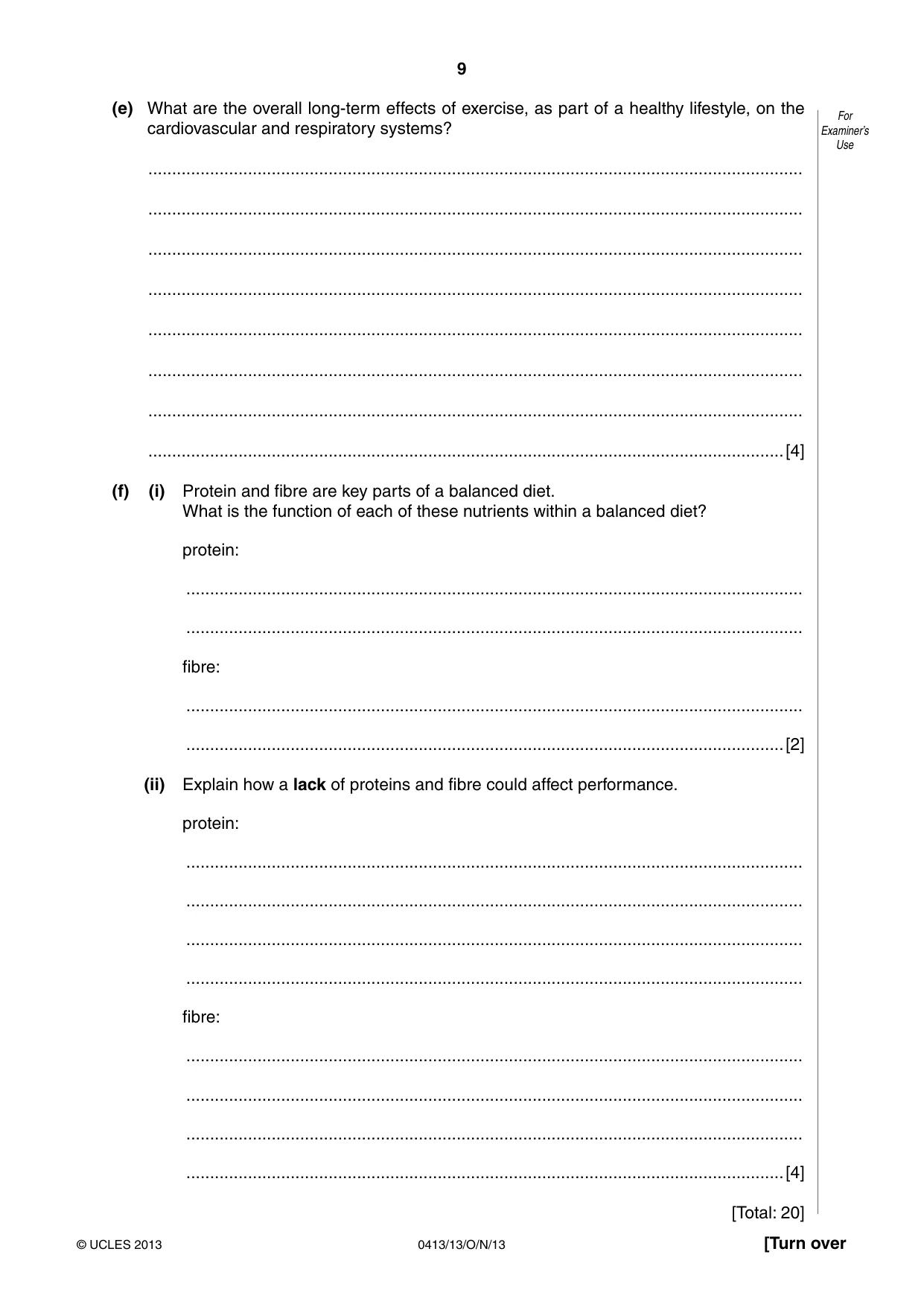
Question paper, page 9
9 0413/13/O/N/13 © UCLES 2013 [Turn over For Examiner’s Use (e) What are the overall long-term effects of exercise, as part of a healthy lifestyle, on the cardiovascular and respiratory systems? … … … … … … … …[4] (f) (i) Protein and fibre are key parts of a balanced diet. What is the function of each of these nutrients within a balanced diet? protein: … … fibre: … …[2] (ii) Explain how a lack of proteins and fibre could affect performance. protein: … … … … fibre: … … … …[4] [Total: 20]
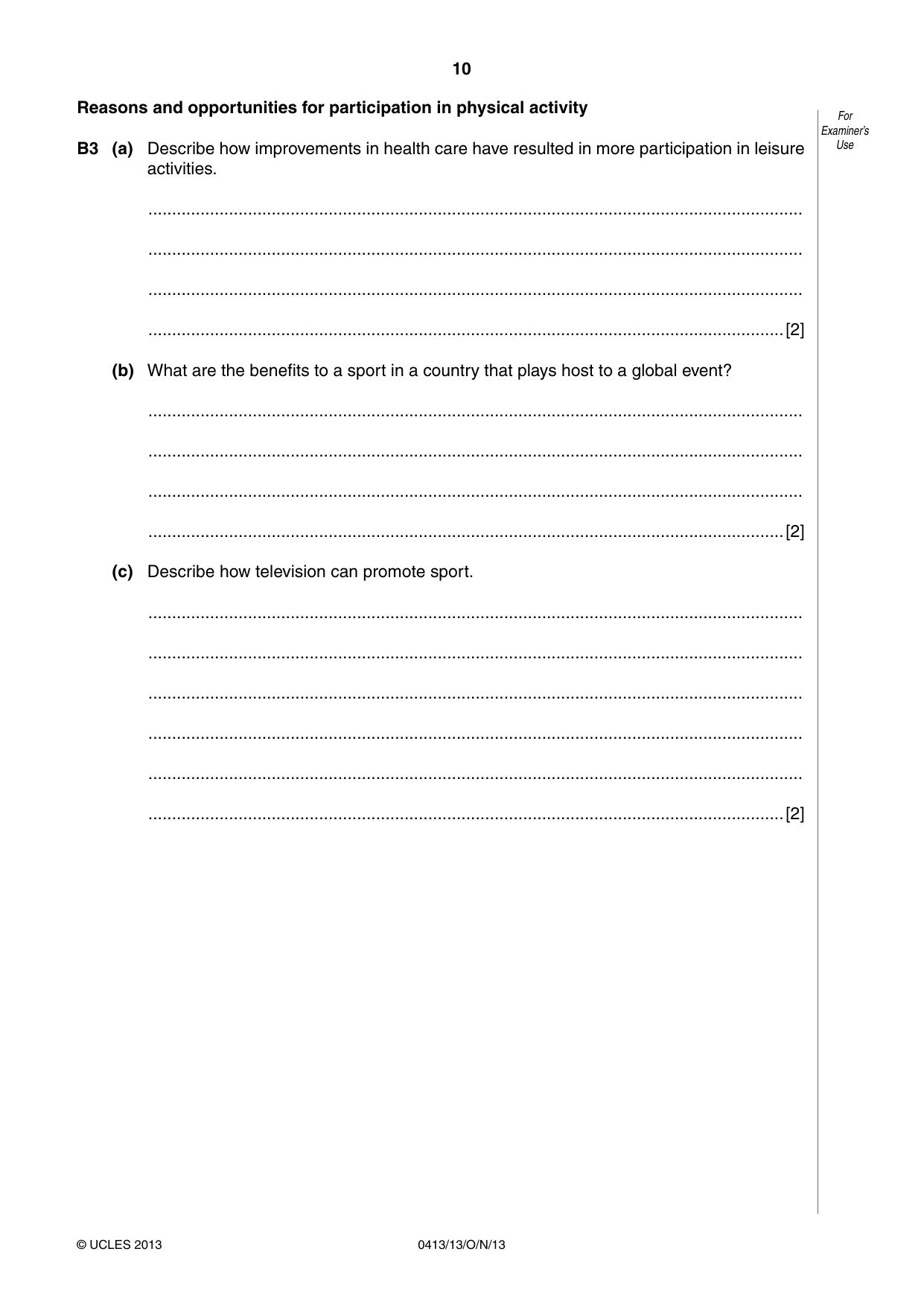
Question paper, page 10
10 0413/13/O/N/13 © UCLES 2013 For Examiner’s Use Reasons and opportunities for participation in physical activity B3 (a) Describe how improvements in health care have resulted in more participation in leisure activities. … … … …[2] (b) What are the benefits to a sport in a country that plays host to a global event? … … … …[2] (c) Describe how television can promote sport. … … … … … …[2]
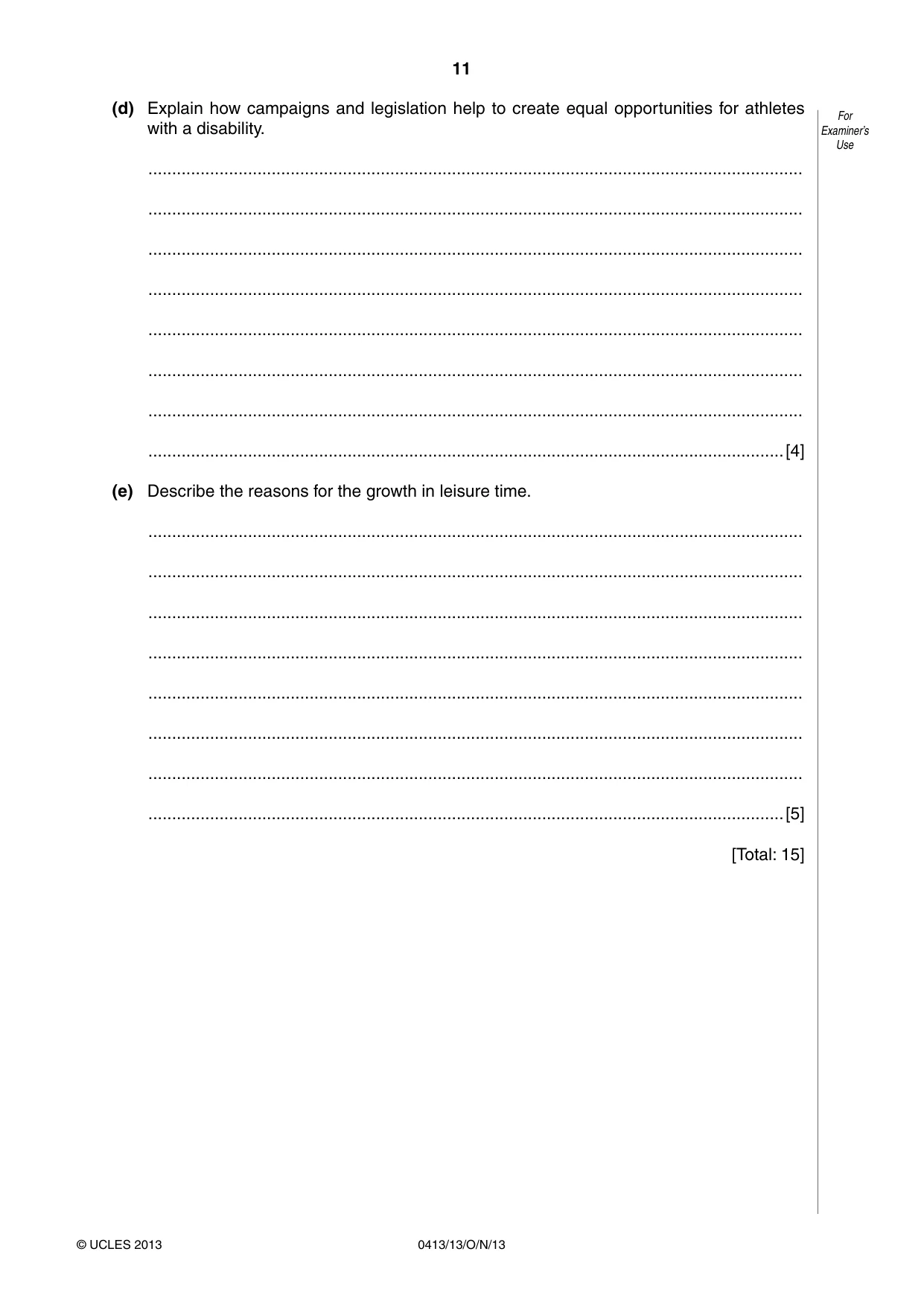
Question paper, page 11
11 0413/13/O/N/13 © UCLES 2013 For Examiner’s Use (d) Explain how campaigns and legislation help to create equal opportunities for athletes with a disability. … … … … … … … …[4] (e) Describe the reasons for the growth in leisure time. … … … … … … … …[5] [Total: 15]
Question paper, page 12
12 0413/13/O/N/13 © UCLES 2013 BLANK PAGE Permission to reproduce items where third-party owned material protected by copyright is included has been sought and cleared where possible. Every reasonable effort has been made by the publisher (UCLES) to trace copyright holders, but if any items requiring clearance have unwittingly been included, the publisher will be pleased to make amends at the earliest possible opportunity. University of Cambridge International Examinations is part of the Cambridge Assessment Group. Cambridge Assessment is the brand name of University of Cambridge Local Examinations Syndicate (UCLES), which is itself a department of the University of Cambridge.
Mark scheme, page 1
CAMBRIDGE INTERNATIONAL EXAMINATIONS International General Certificate of Secondary Education MARK SCHEME for the October/November 2013 series 0413 PHYSICAL EDUCATION 0413/13 Paper 1, maximum raw mark 80 This mark scheme is published as an aid to teachers and candidates, to indicate the requirements of the examination. It shows the basis on which Examiners were instructed to award marks. It does not indicate the details of the discussions that took place at an Examiners’ meeting before marking began, which would have considered the acceptability of alternative answers. Mark schemes should be read in conjunction with the question paper and the Principal Examiner Report for Teachers. Cambridge will not enter into discussions about these mark schemes. Cambridge is publishing the mark schemes for the October/November 2013 series for most IGCSE, GCE Advanced Level and Advanced Subsidiary Level components and some Ordinary Level components.
Mark scheme, page 2
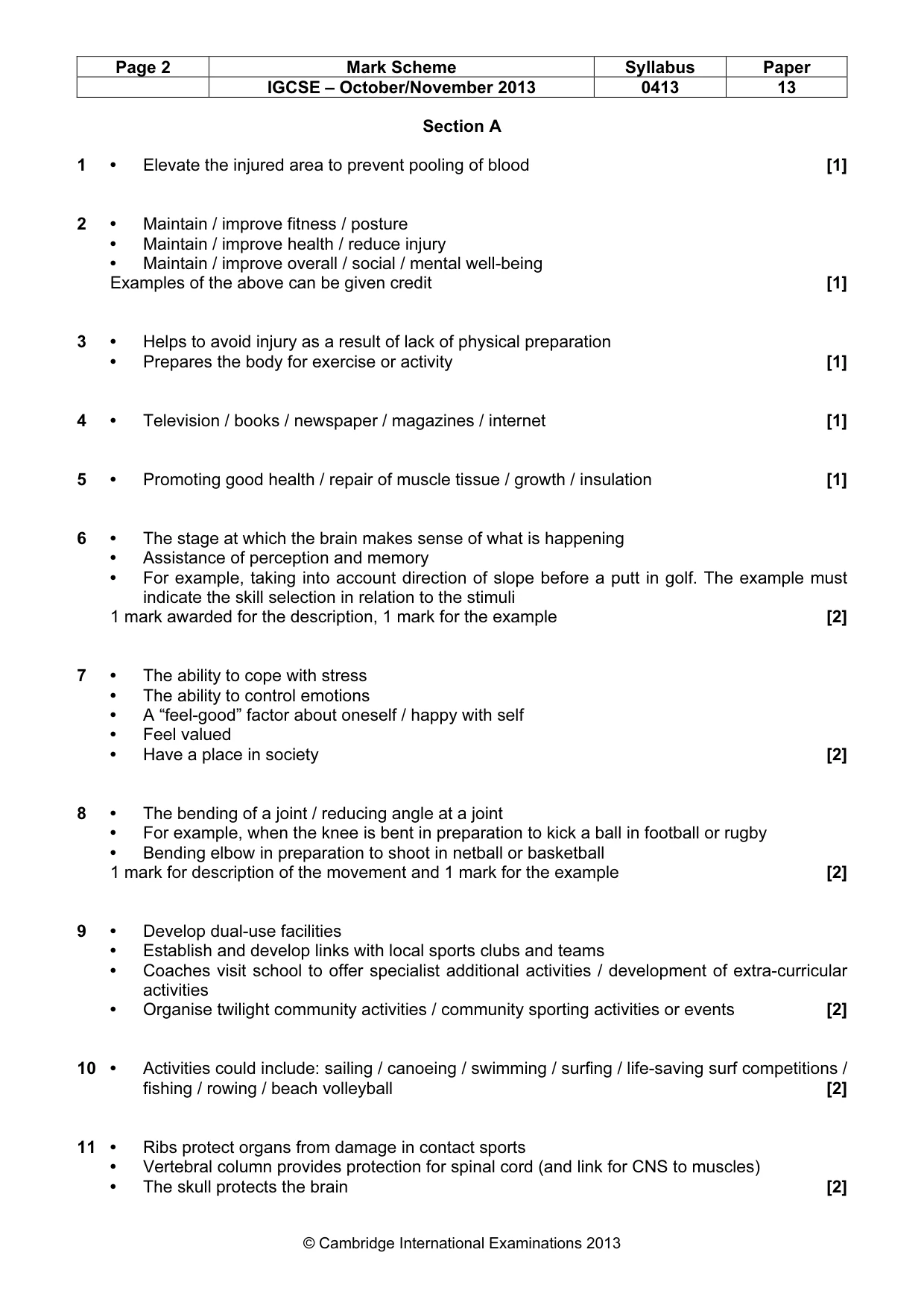
Page 2 Mark Scheme Syllabus Paper IGCSE – October/November 2013 0413 13 © Cambridge International Examinations 2013 Section A 1 • Elevate the injured area to prevent pooling of blood [1] 2 • Maintain / improve fitness / posture • Maintain / improve health / reduce injury • Maintain / improve overall / social / mental well-being Examples of the above can be given credit [1] 3 • Helps to avoid injury as a result of lack of physical preparation • Prepares the body for exercise or activity [1] 4 • Television / books / newspaper / magazines / internet [1] 5 • Promoting good health / repair of muscle tissue / growth / insulation [1] 6 • The stage at which the brain makes sense of what is happening • Assistance of perception and memory • For example, taking into account direction of slope before a putt in golf. The example must indicate the skill selection in relation to the stimuli 1 mark awarded for the description, 1 mark for the example [2] 7 • The ability to cope with stress • The ability to control emotions • A “feel-good” factor about oneself / happy with self • Feel valued • Have a place in society [2] 8 • The bending of a joint / reducing angle at a joint • For example, when the knee is bent in preparation to kick a ball in football or rugby • Bending elbow in preparation to shoot in netball or basketball 1 mark for description of the movement and 1 mark for the example [2] 9 • Develop dual-use facilities • Establish and develop links with local sports clubs and teams • Coaches visit school to offer specialist additional activities / development of extra-curricular activities • Organise twilight community activities / community sporting activities or events [2] 10 • Activities could include: sailing / canoeing / swimming / surfing / life-saving surf competitions / fishing / rowing / beach volleyball [2] 11 • Ribs protect organs from damage in contact sports • Vertebral column provides protection for spinal cord (and link for CNS to muscles) • The skull protects the brain [2]
Mark scheme, page 3
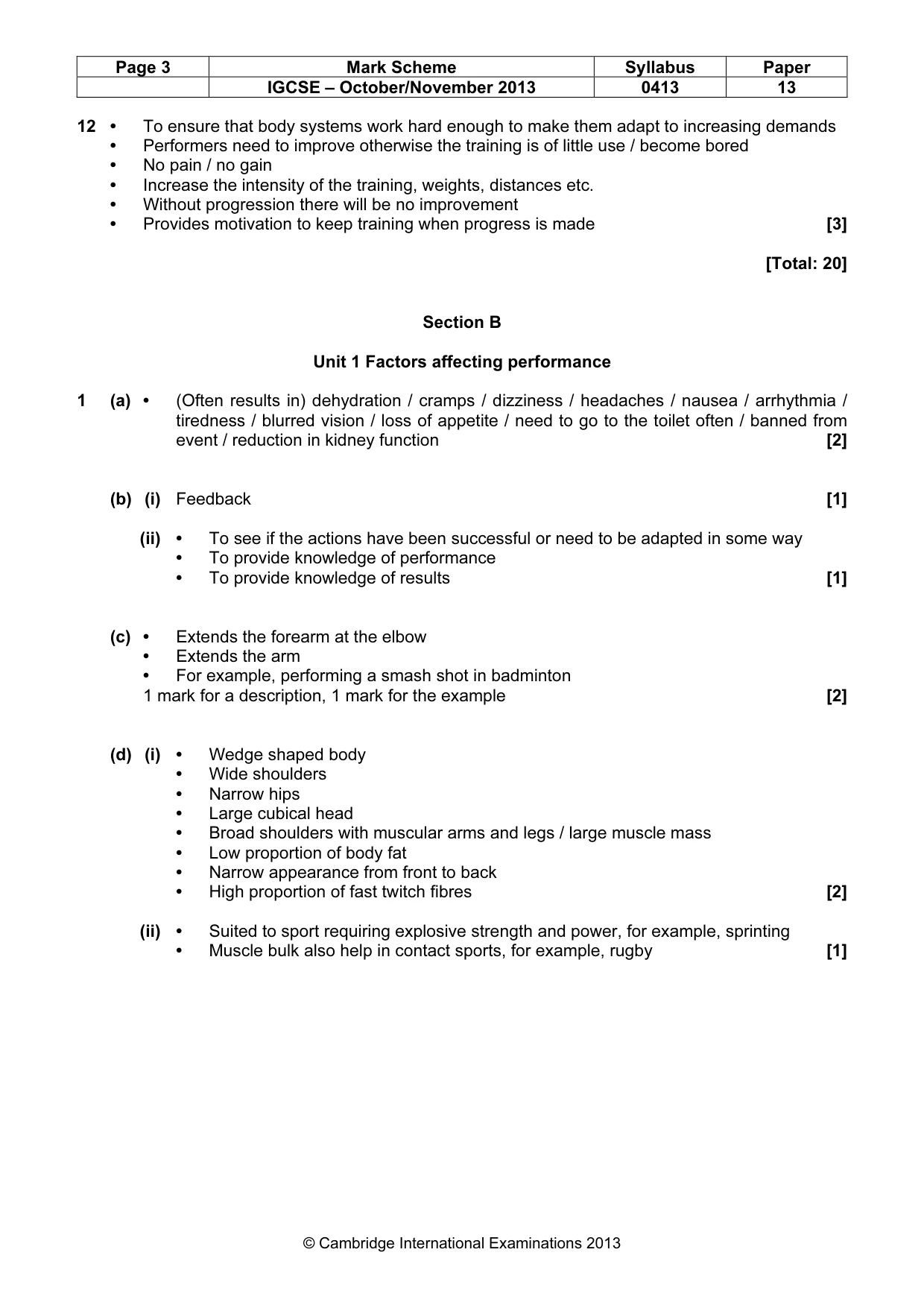
Page 3 Mark Scheme Syllabus Paper IGCSE – October/November 2013 0413 13 © Cambridge International Examinations 2013 12 • To ensure that body systems work hard enough to make them adapt to increasing demands • Performers need to improve otherwise the training is of little use / become bored • No pain / no gain • Increase the intensity of the training, weights, distances etc. • Without progression there will be no improvement • Provides motivation to keep training when progress is made [3] [Total: 20] Section B Unit 1 Factors affecting performance 1 (a) • (Often results in) dehydration / cramps / dizziness / headaches / nausea / arrhythmia / tiredness / blurred vision / loss of appetite / need to go to the toilet often / banned from event / reduction in kidney function [2] (b) (i) Feedback [1] (ii) • To see if the actions have been successful or need to be adapted in some way • To provide knowledge of performance • To provide knowledge of results [1] (c) • Extends the forearm at the elbow • Extends the arm • For example, performing a smash shot in badminton 1 mark for a description, 1 mark for the example [2] (d) (i) • Wedge shaped body • Wide shoulders • Narrow hips • Large cubical head • Broad shoulders with muscular arms and legs / large muscle mass • Low proportion of body fat • Narrow appearance from front to back • High proportion of fast twitch fibres [2] (ii) • Suited to sport requiring explosive strength and power, for example, sprinting • Muscle bulk also help in contact sports, for example, rugby [1]
Mark scheme, page 4
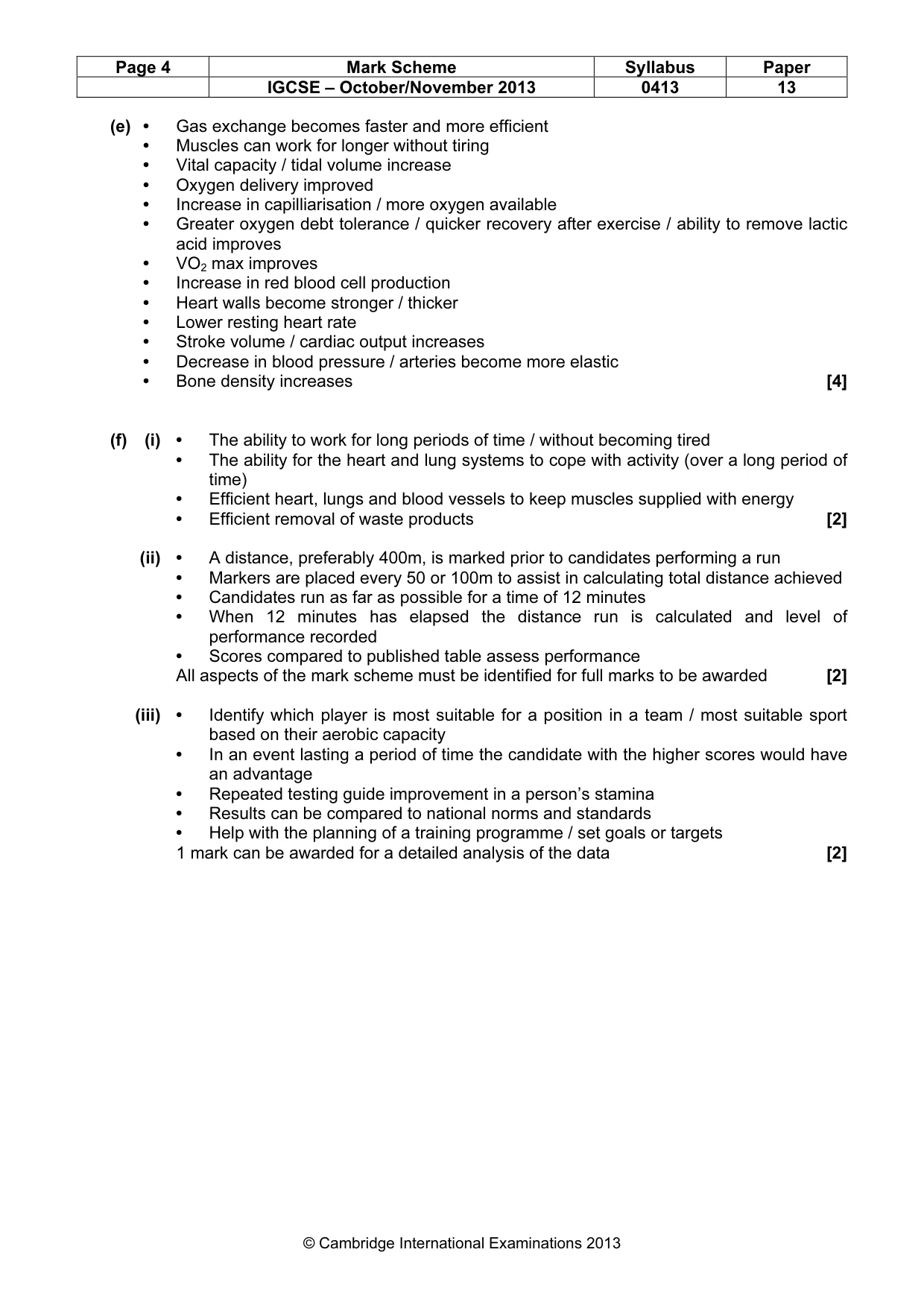
Page 4 Mark Scheme Syllabus Paper IGCSE – October/November 2013 0413 13 © Cambridge International Examinations 2013 (e) • Gas exchange becomes faster and more efficient • Muscles can work for longer without tiring • Vital capacity / tidal volume increase • Oxygen delivery improved • Increase in capilliarisation / more oxygen available • Greater oxygen debt tolerance / quicker recovery after exercise / ability to remove lactic acid improves • VO2 max improves • Increase in red blood cell production • Heart walls become stronger / thicker • Lower resting heart rate • Stroke volume / cardiac output increases • Decrease in blood pressure / arteries become more elastic • Bone density increases [4] (f) (i) • The ability to work for long periods of time / without becoming tired • The ability for the heart and lung systems to cope with activity (over a long period of time) • Efficient heart, lungs and blood vessels to keep muscles supplied with energy • Efficient removal of waste products [2] (ii) • A distance, preferably 400m, is marked prior to candidates performing a run • Markers are placed every 50 or 100m to assist in calculating total distance achieved • Candidates run as far as possible for a time of 12 minutes • When 12 minutes has elapsed the distance run is calculated and level of performance recorded • Scores compared to published table assess performance All aspects of the mark scheme must be identified for full marks to be awarded [2] (iii) • Identify which player is most suitable for a position in a team / most suitable sport based on their aerobic capacity • In an event lasting a period of time the candidate with the higher scores would have an advantage • Repeated testing guide improvement in a person’s stamina • Results can be compared to national norms and standards • Help with the planning of a training programme / set goals or targets 1 mark can be awarded for a detailed analysis of the data [2]
Mark scheme, page 5
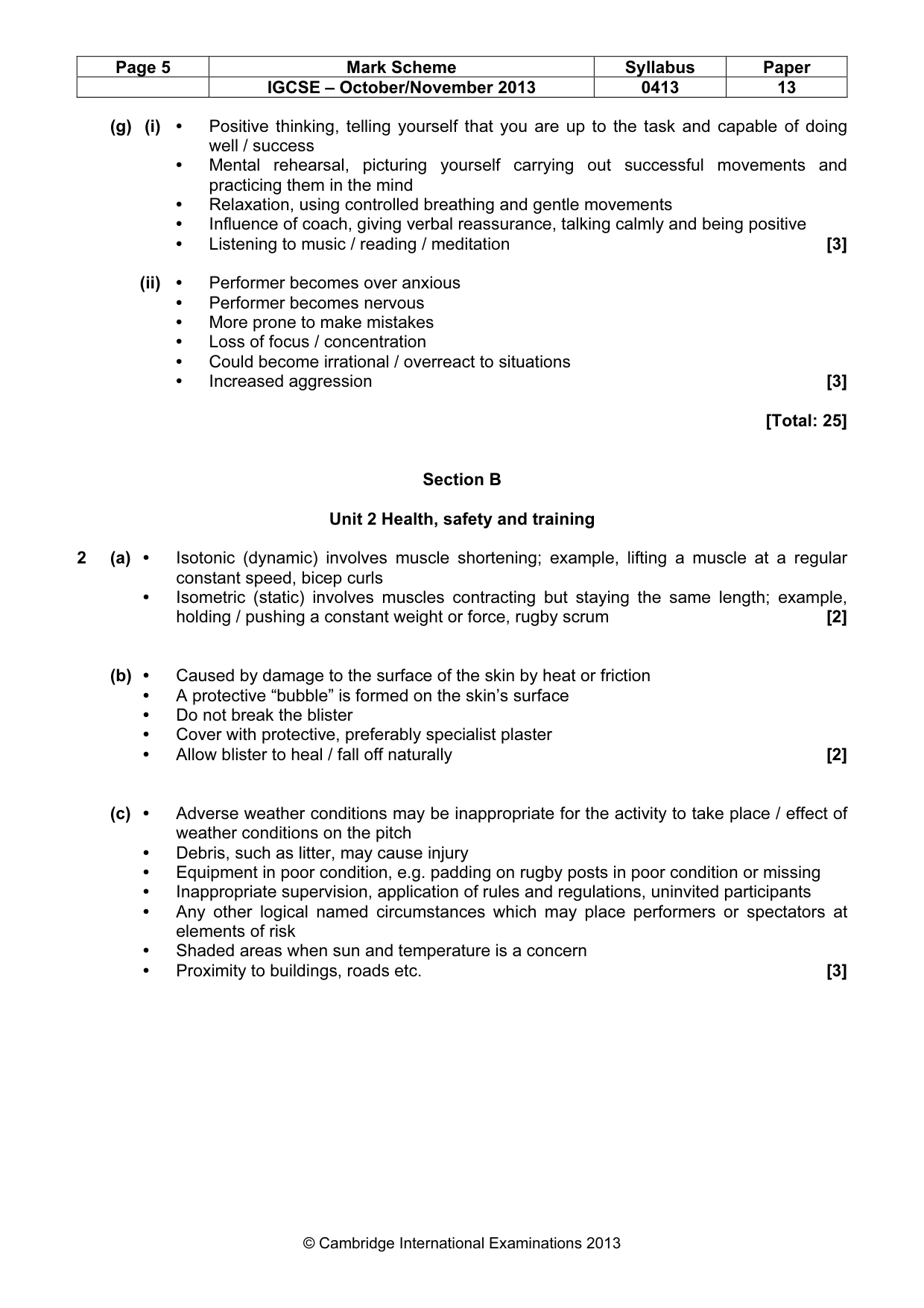
Page 5 Mark Scheme Syllabus Paper IGCSE – October/November 2013 0413 13 © Cambridge International Examinations 2013 (g) (i) • Positive thinking, telling yourself that you are up to the task and capable of doing well / success • Mental rehearsal, picturing yourself carrying out successful movements and practicing them in the mind • Relaxation, using controlled breathing and gentle movements • Influence of coach, giving verbal reassurance, talking calmly and being positive • Listening to music / reading / meditation [3] (ii) • Performer becomes over anxious • Performer becomes nervous • More prone to make mistakes • Loss of focus / concentration • Could become irrational / overreact to situations • Increased aggression [3] [Total: 25] Section B Unit 2 Health, safety and training 2 (a) • Isotonic (dynamic) involves muscle shortening; example, lifting a muscle at a regular constant speed, bicep curls • Isometric (static) involves muscles contracting but staying the same length; example, holding / pushing a constant weight or force, rugby scrum [2] (b) • Caused by damage to the surface of the skin by heat or friction • A protective “bubble” is formed on the skin’s surface • Do not break the blister • Cover with protective, preferably specialist plaster • Allow blister to heal / fall off naturally [2] (c) • Adverse weather conditions may be inappropriate for the activity to take place / effect of weather conditions on the pitch • Debris, such as litter, may cause injury • Equipment in poor condition, e.g. padding on rugby posts in poor condition or missing • Inappropriate supervision, application of rules and regulations, uninvited participants • Any other logical named circumstances which may place performers or spectators at elements of risk • Shaded areas when sun and temperature is a concern • Proximity to buildings, roads etc. [3]
Mark scheme, page 6
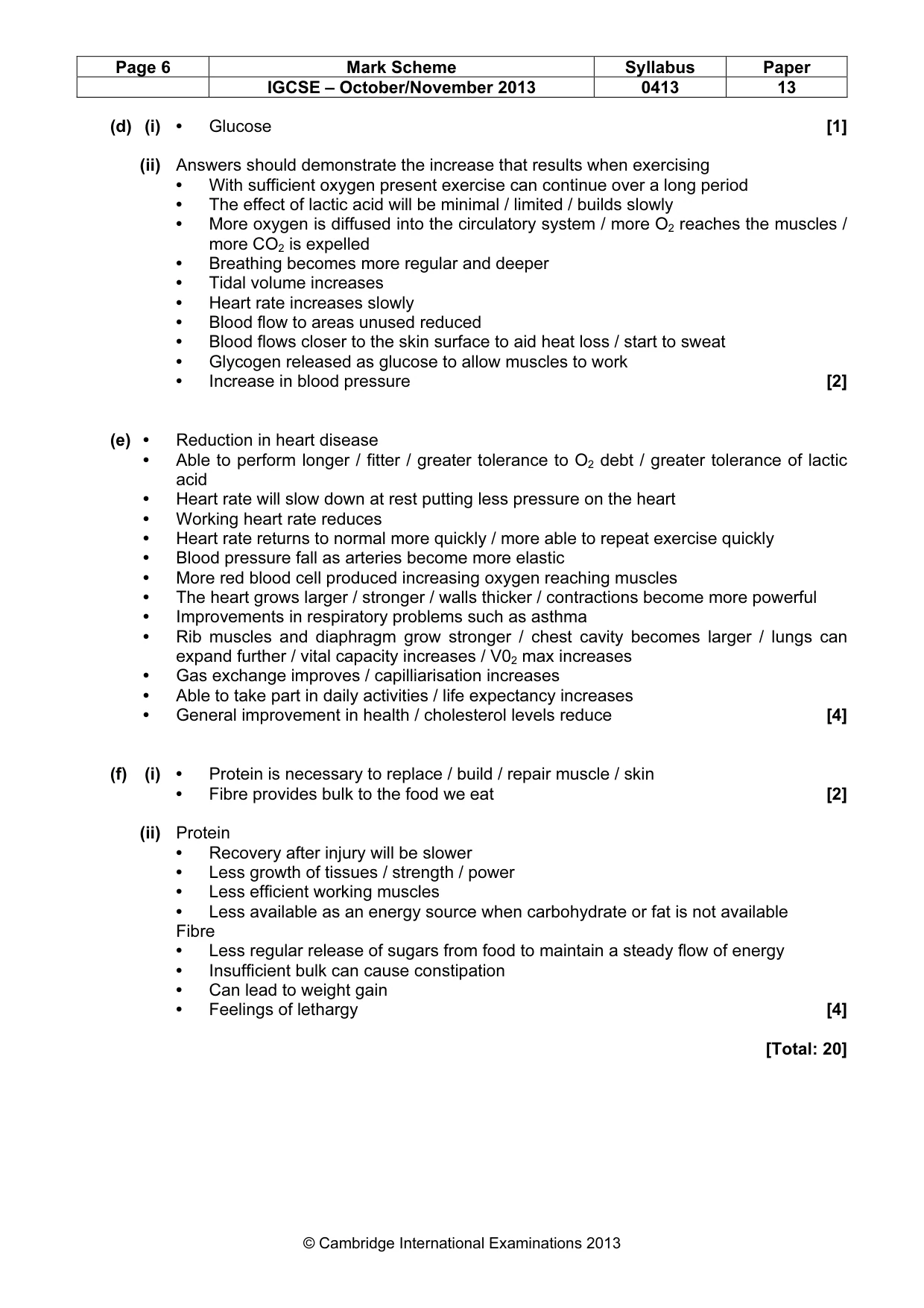
Page 6 Mark Scheme Syllabus Paper IGCSE – October/November 2013 0413 13 © Cambridge International Examinations 2013 (d) (i) • Glucose [1] (ii) Answers should demonstrate the increase that results when exercising • With sufficient oxygen present exercise can continue over a long period • The effect of lactic acid will be minimal / limited / builds slowly • More oxygen is diffused into the circulatory system / more O2 reaches the muscles / more CO2 is expelled • Breathing becomes more regular and deeper • Tidal volume increases • Heart rate increases slowly • Blood flow to areas unused reduced • Blood flows closer to the skin surface to aid heat loss / start to sweat • Glycogen released as glucose to allow muscles to work • Increase in blood pressure [2] (e) • Reduction in heart disease • Able to perform longer / fitter / greater tolerance to O2 debt / greater tolerance of lactic acid • Heart rate will slow down at rest putting less pressure on the heart • Working heart rate reduces • Heart rate returns to normal more quickly / more able to repeat exercise quickly • Blood pressure fall as arteries become more elastic • More red blood cell produced increasing oxygen reaching muscles • The heart grows larger / stronger / walls thicker / contractions become more powerful • Improvements in respiratory problems such as asthma • Rib muscles and diaphragm grow stronger / chest cavity becomes larger / lungs can expand further / vital capacity increases / V02 max increases • Gas exchange improves / capilliarisation increases • Able to take part in daily activities / life expectancy increases • General improvement in health / cholesterol levels reduce [4] (f) (i) • Protein is necessary to replace / build / repair muscle / skin • Fibre provides bulk to the food we eat [2] (ii) Protein • Recovery after injury will be slower • Less growth of tissues / strength / power • Less efficient working muscles • Less available as an energy source when carbohydrate or fat is not available Fibre • Less regular release of sugars from food to maintain a steady flow of energy • Insufficient bulk can cause constipation • Can lead to weight gain • Feelings of lethargy [4] [Total: 20]
Mark scheme, page 7
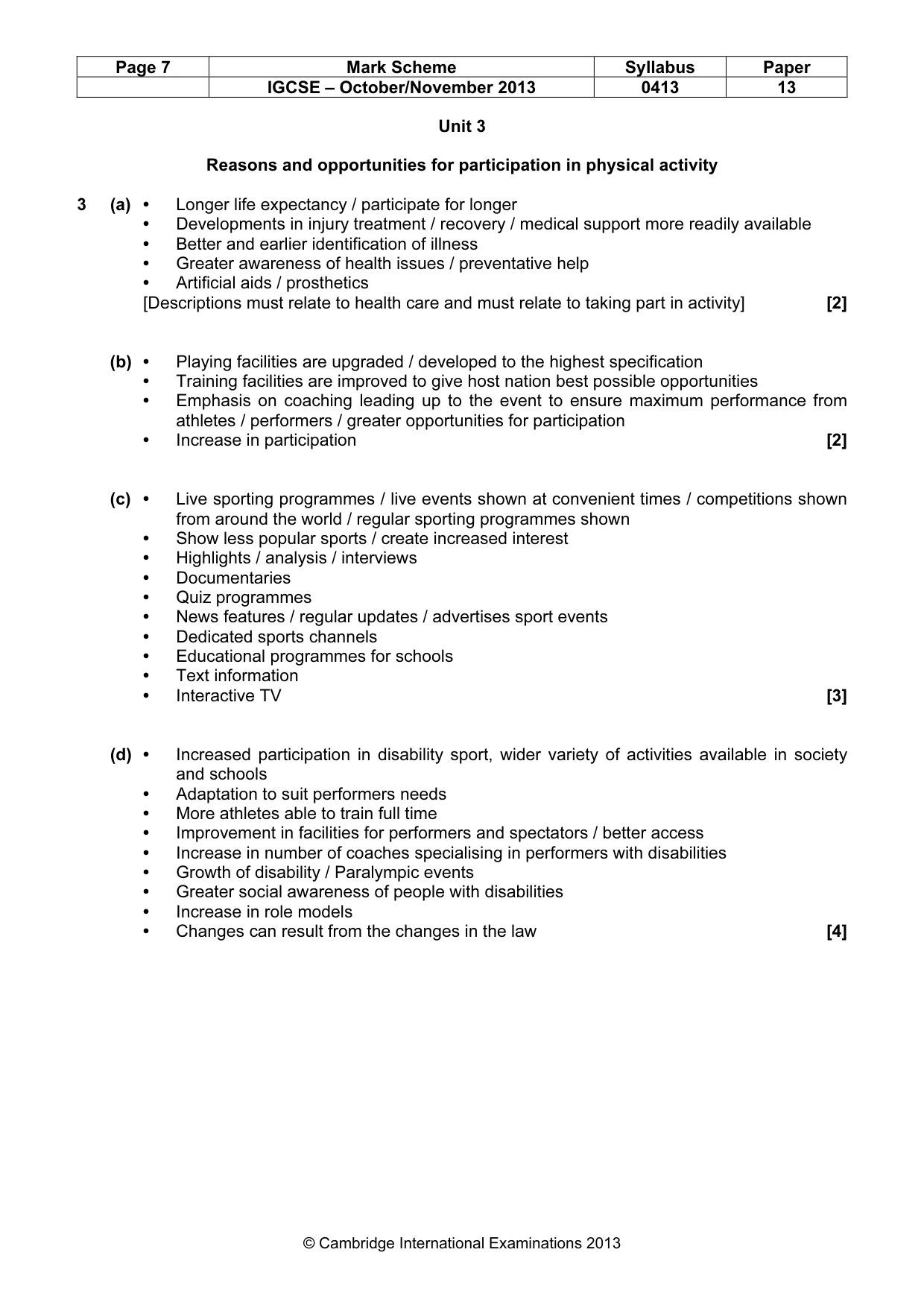
Page 7 Mark Scheme Syllabus Paper IGCSE – October/November 2013 0413 13 © Cambridge International Examinations 2013 Unit 3 Reasons and opportunities for participation in physical activity 3 (a) • Longer life expectancy / participate for longer • Developments in injury treatment / recovery / medical support more readily available • Better and earlier identification of illness • Greater awareness of health issues / preventative help • Artificial aids / prosthetics [Descriptions must relate to health care and must relate to taking part in activity] [2] (b) • Playing facilities are upgraded / developed to the highest specification • Training facilities are improved to give host nation best possible opportunities • Emphasis on coaching leading up to the event to ensure maximum performance from athletes / performers / greater opportunities for participation • Increase in participation [2] (c) • Live sporting programmes / live events shown at convenient times / competitions shown from around the world / regular sporting programmes shown • Show less popular sports / create increased interest • Highlights / analysis / interviews • Documentaries • Quiz programmes • News features / regular updates / advertises sport events • Dedicated sports channels • Educational programmes for schools • Text information • Interactive TV [3] (d) • Increased participation in disability sport, wider variety of activities available in society and schools • Adaptation to suit performers needs • More athletes able to train full time • Improvement in facilities for performers and spectators / better access • Increase in number of coaches specialising in performers with disabilities • Growth of disability / Paralympic events • Greater social awareness of people with disabilities • Increase in role models • Changes can result from the changes in the law [4]
Mark scheme, page 8
Page 8 Mark Scheme Syllabus Paper IGCSE – October/November 2013 0413 13 © Cambridge International Examinations 2013 (e) • Improvements in technology mean less manual labour and time is needed in the workplace / shorter working week • Working at home more possible due to the internet • Increased unemployment • Earlier retirement • Improvements in health care and standards of living. Longer life expectancy and more leisure time available / access to child care facilities / more aware of health needs • People choose to work less (part-time) / job share • Government initiatives to improve facilities / participations • Women choosing to have families later in life / changes in traditional roles within the family [5] [Total: 15]
What you needed in this session
Cambridge’s own grade thresholds for 2013 Oct/Nov, Paper 1 · Variant 3. A higher threshold means an easier paper — the bar moves with how the cohort did.