Cambridge IGCSE Physical Education 0413 — 2012 May/June Paper 1 · Variant 1
0413/11/M/J/12 · 80 marks · ≈90 min
The question paper and its mark scheme, free to read here and free to download. This is Cambridge’s own paper, exactly as it was sat.
Question paper12 pages


Mark scheme11 pages
Answers below. Sit the paper first if you are practising.
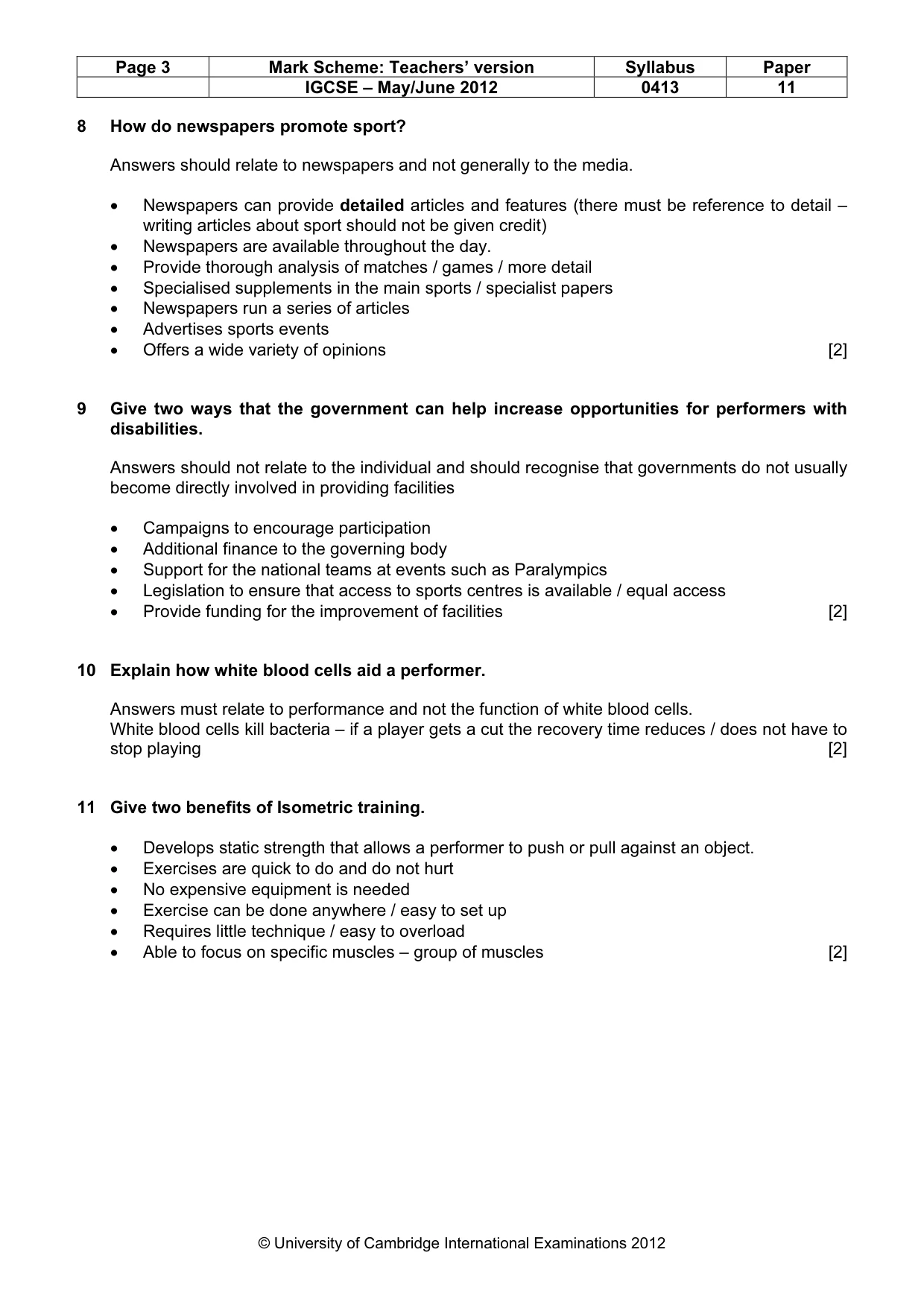

Paper as text
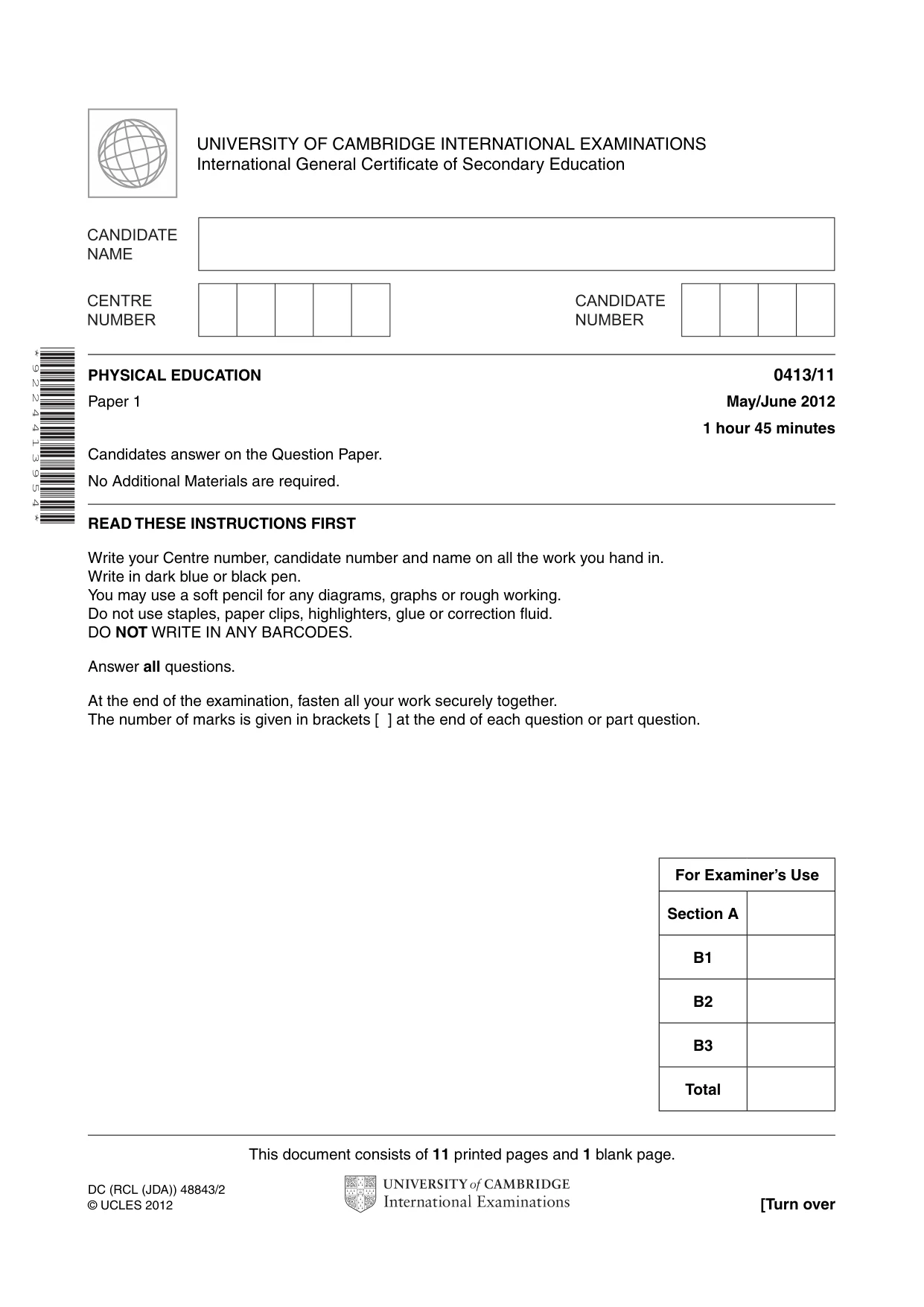
Question paper, page 1
This document consists of 11 printed pages and 1 blank page. DC (RCL (JDA)) 48843/2 © UCLES 2012 [Turn over UNIVERSITY OF CAMBRIDGE INTERNATIONAL EXAMINATIONS International General Certificate of Secondary Education * 9 2 2 4 4 1 3 9 5 4 * PHYSICAL EDUCATION 0413/11 Paper 1 May/June 2012 1 hour 45 minutes Candidates answer on the Question Paper. No Additional Materials are required. READ THESE INSTRUCTIONS FIRST Write your Centre number, candidate number and name on all the work you hand in. Write in dark blue or black pen. You may use a soft pencil for any diagrams, graphs or rough working. Do not use staples, paper clips, highlighters, glue or correction fluid. DO NOT WRITE IN ANY BARCODES. Answer all questions. At the end of the examination, fasten all your work securely together. The number of marks is given in brackets [ ] at the end of each question or part question. For Examiner’s Use Section A B1 B2 B3 Total
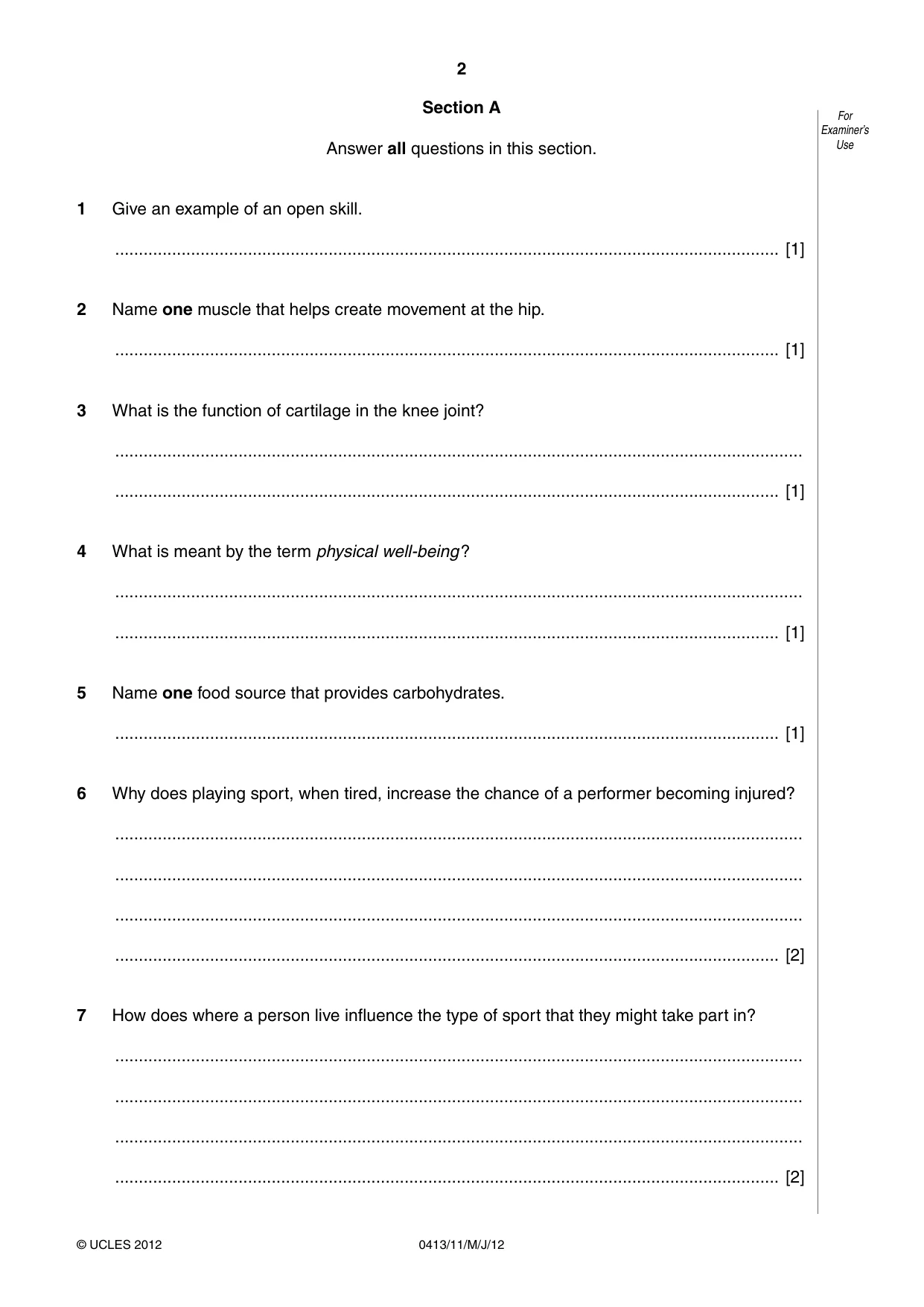
Question paper, page 2
2 0413/11/M/J/12 © UCLES 2012 For Examiner’s Use Section A Answer all questions in this section. 1 Give an example of an open skill. … [1] 2 Name one muscle that helps create movement at the hip. … [1] 3 What is the function of cartilage in the knee joint? … … [1] 4 What is meant by the term physical well-being ? … … [1] 5 Name one food source that provides carbohydrates. … [1] 6 Why does playing sport, when tired, increase the chance of a performer becoming injured? … … … … [2] 7 How does where a person live influence the type of sport that they might take part in? … … … … [2]
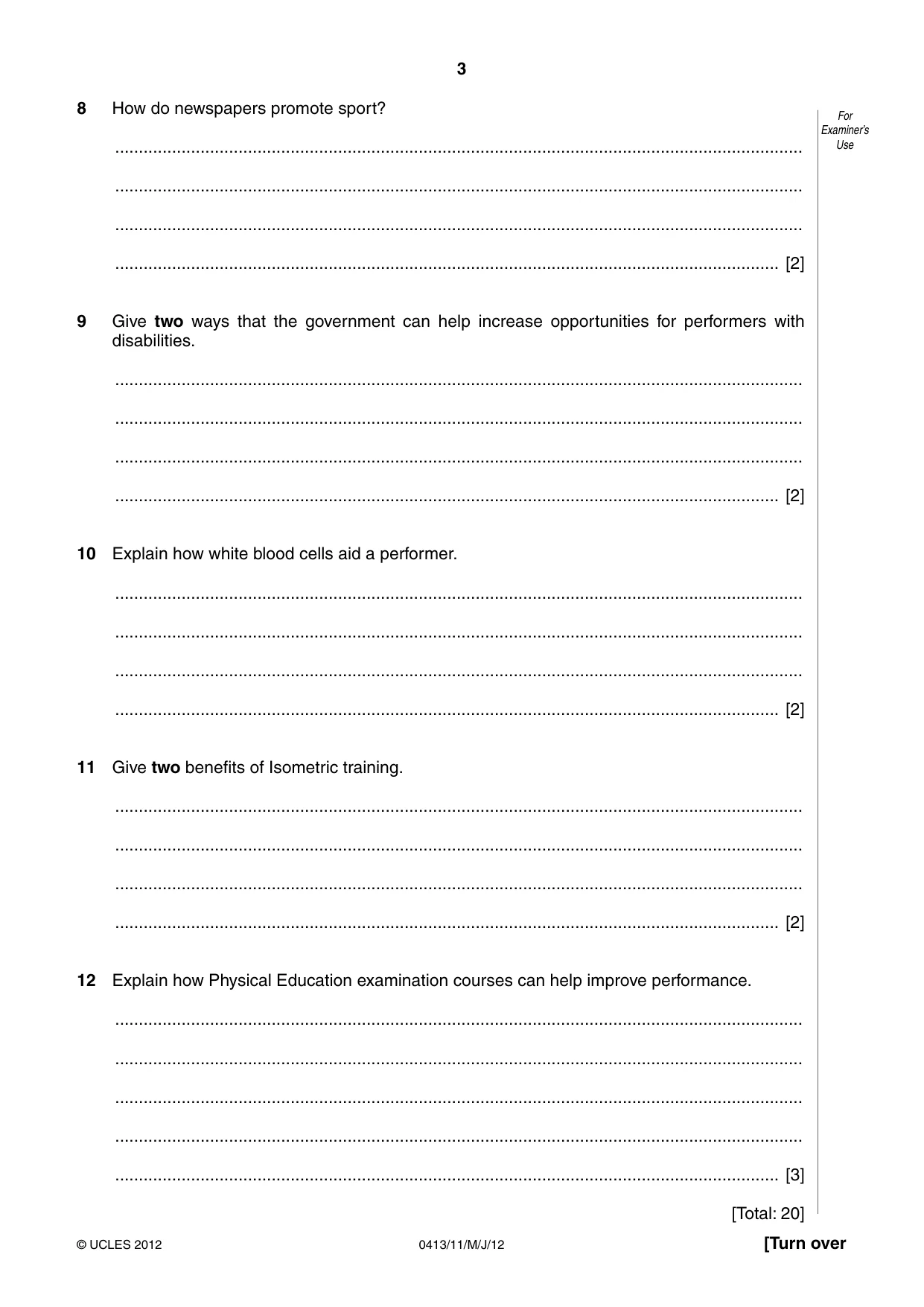
Question paper, page 3
3 0413/11/M/J/12 © UCLES 2012 [Turn over For Examiner’s Use 8 How do newspapers promote sport? … … … … [2] 9 Give two ways that the government can help increase opportunities for performers with disabilities. … … … … [2] 10 Explain how white blood cells aid a performer. … … … … [2] 11 Give two benefits of Isometric training. … … … … [2] 12 Explain how Physical Education examination courses can help improve performance. … … … … … [3] [Total: 20]
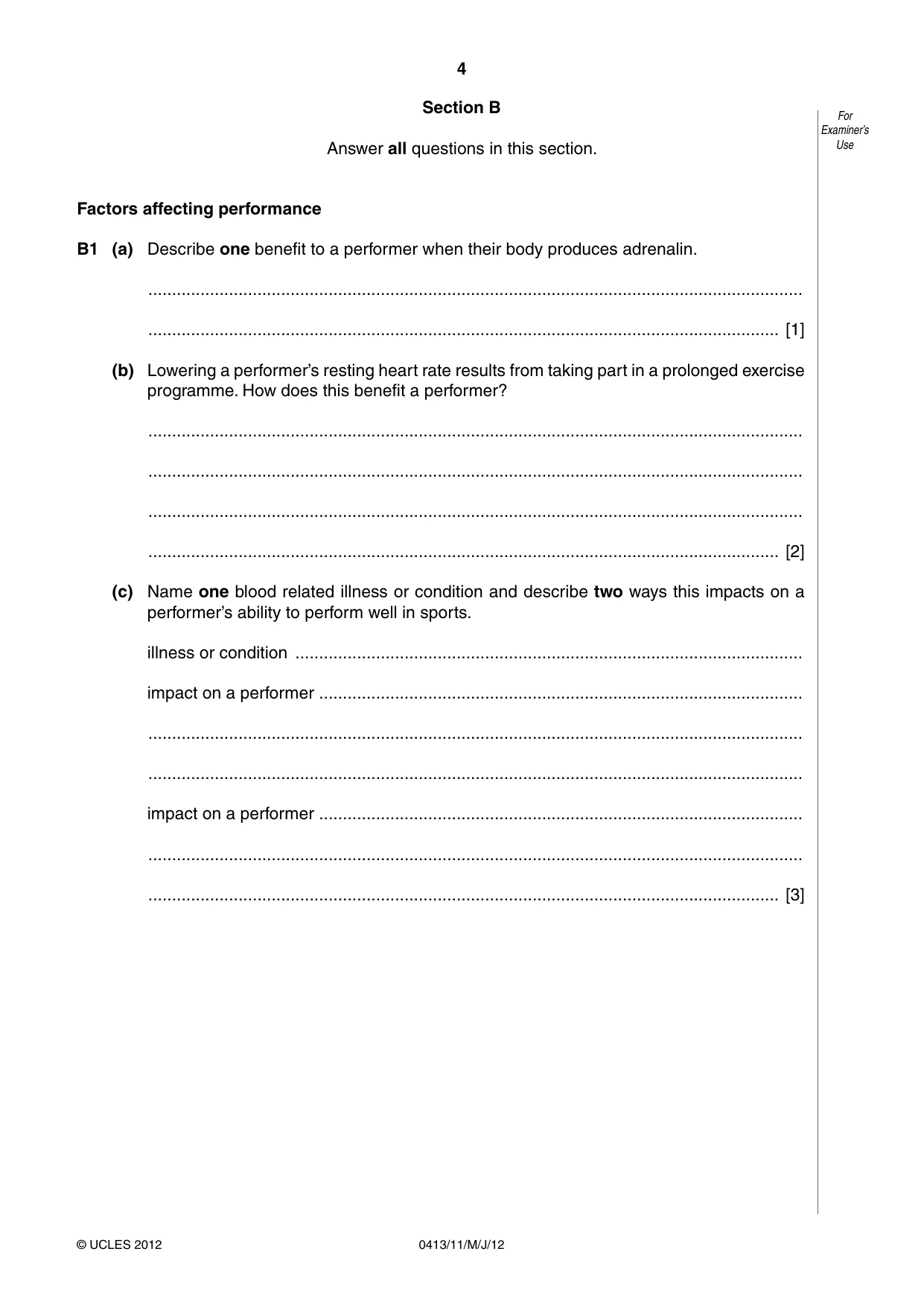
Question paper, page 4
4 0413/11/M/J/12 © UCLES 2012 For Examiner’s Use Section B Answer all questions in this section. Factors affecting performance B1 (a) Describe one benefit to a performer when their body produces adrenalin. … … [1] (b) Lowering a performer’s resting heart rate results from taking part in a prolonged exercise programme. How does this benefit a performer? … … … … [2] (c) Name one blood related illness or condition and describe two ways this impacts on a performer’s ability to perform well in sports. illness or condition … impact on a performer … … … impact on a performer … … … [3]
Question paper, page 5
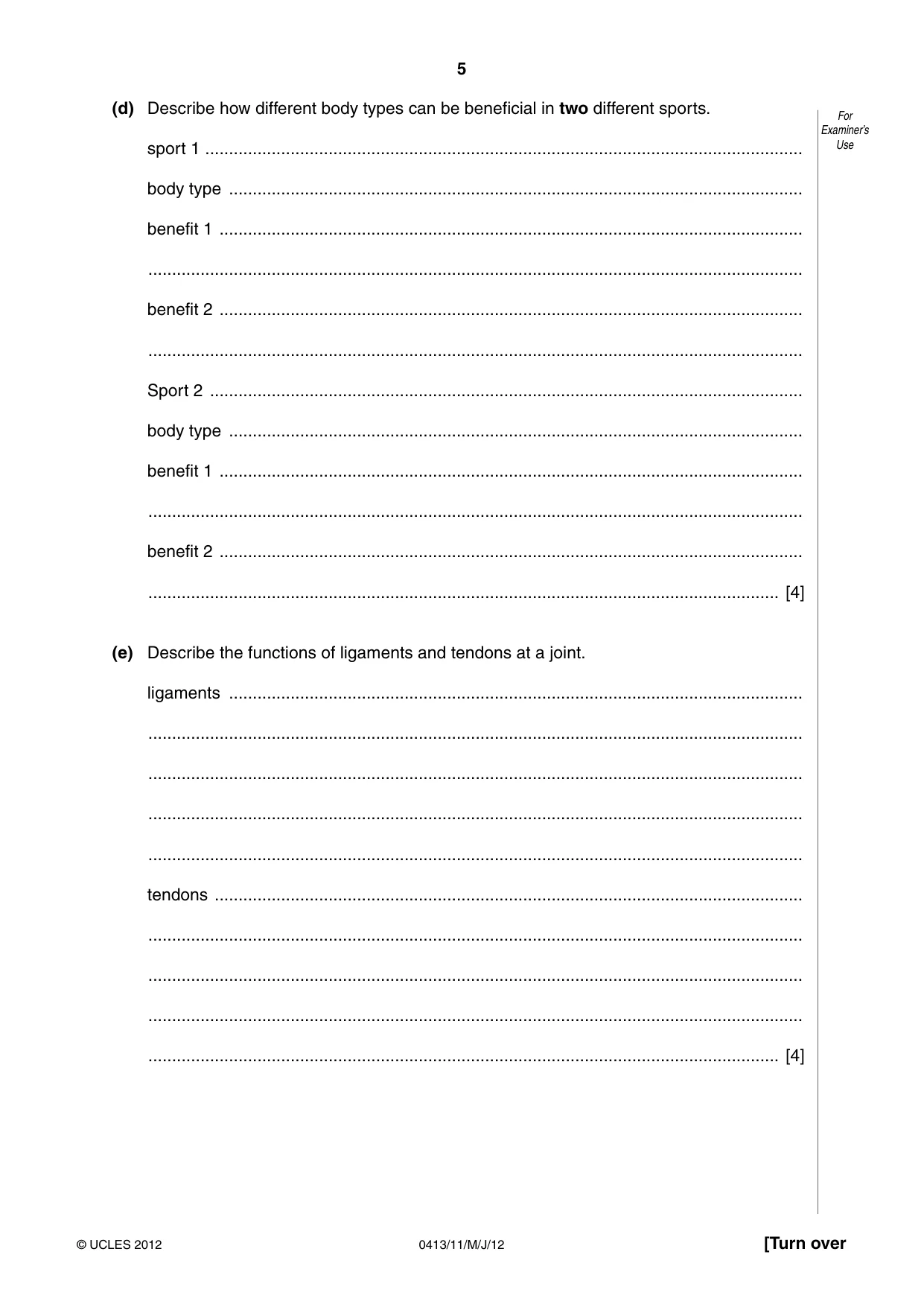
5 0413/11/M/J/12 © UCLES 2012 [Turn over For Examiner’s Use (d) Describe how different body types can be beneficial in two different sports. sport 1 … body type … benefit 1 … … benefit 2 … … Sport 2 … body type … benefit 1 … … benefit 2 … … [4] (e) Describe the functions of ligaments and tendons at a joint. ligaments … … … … … tendons … … … … … [4]
Question paper, page 6
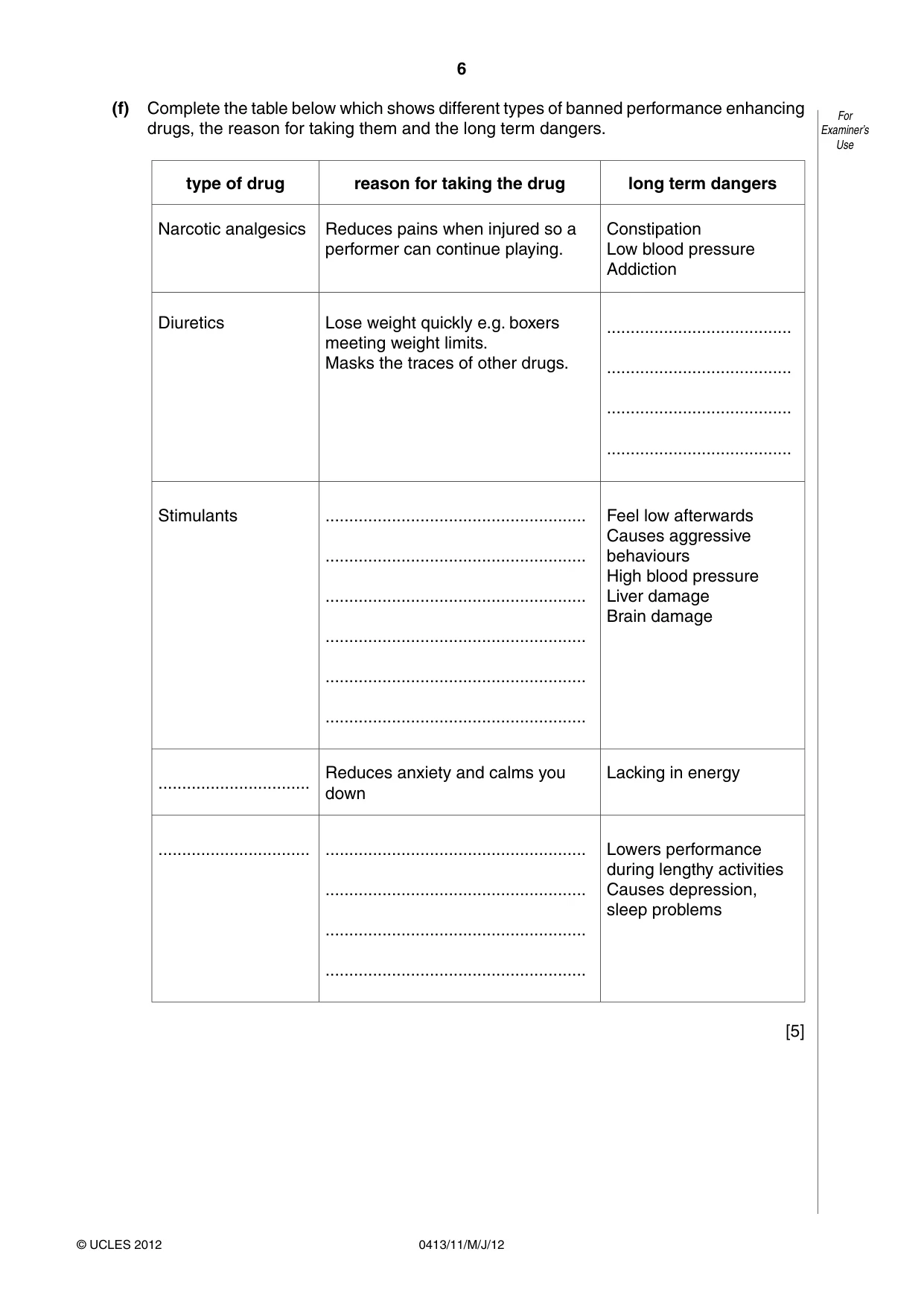
6 0413/11/M/J/12 © UCLES 2012 For Examiner’s Use (f) Complete the table below which shows different types of banned performance enhancing drugs, the reason for taking them and the long term dangers. type of drug reason for taking the drug long term dangers Narcotic analgesics Reduces pains when injured so a performer can continue playing. Constipation Low blood pressure Addiction Diuretics Lose weight quickly e.g. boxers meeting weight limits. Masks the traces of other drugs. … … … … Stimulants … … … … … … Feel low afterwards Causes aggressive behaviours High blood pressure Liver damage Brain damage … Reduces anxiety and calms you down Lacking in energy … … … … … Lowers performance during lengthy activities Causes depression, sleep problems [5]
Question paper, page 7
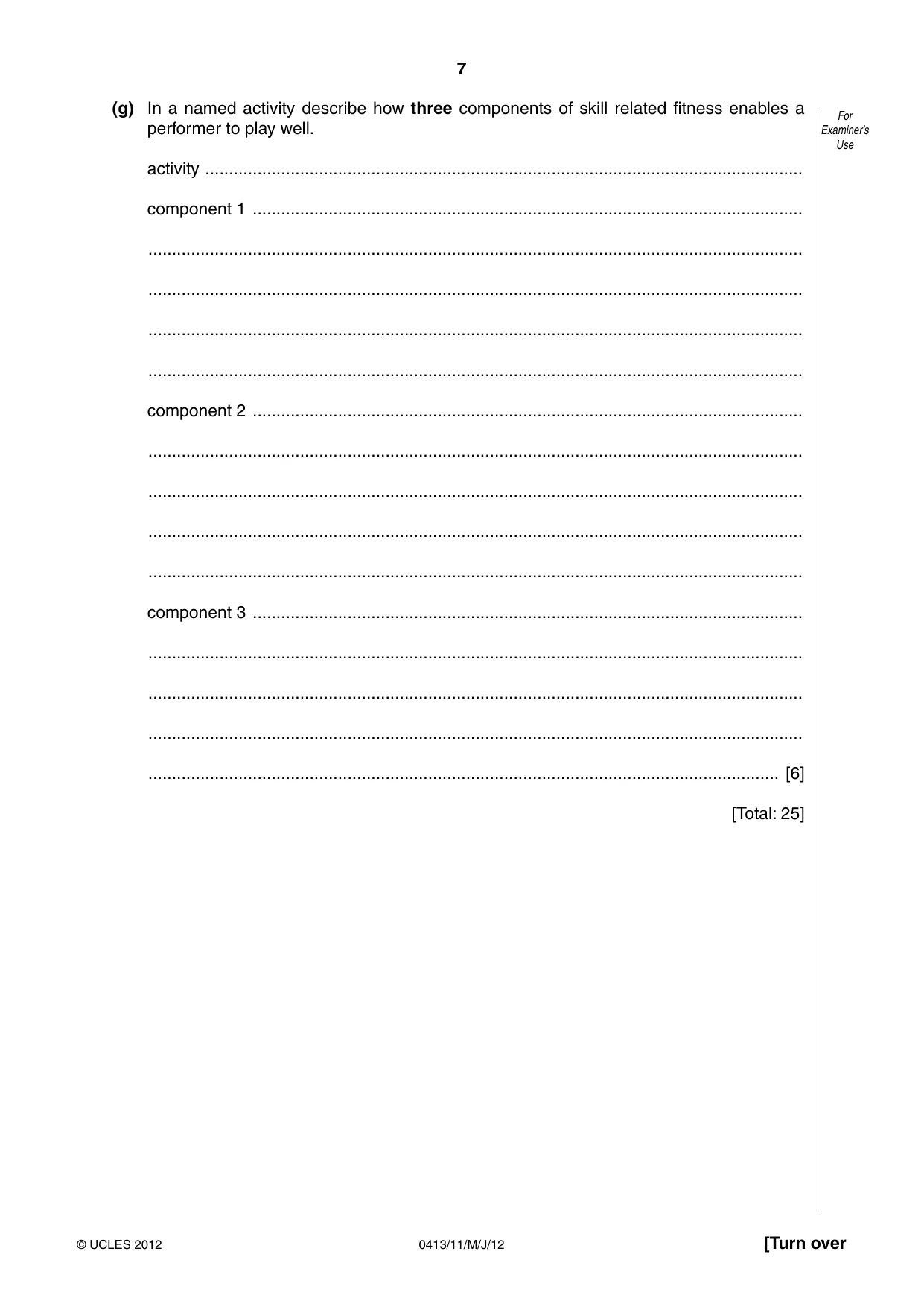
7 0413/11/M/J/12 © UCLES 2012 [Turn over For Examiner’s Use (g) In a named activity describe how three components of skill related fitness enables a performer to play well. activity … component 1 … … … … … component 2 … … … … … component 3 … … … … … [6] [Total: 25]
Question paper, page 8
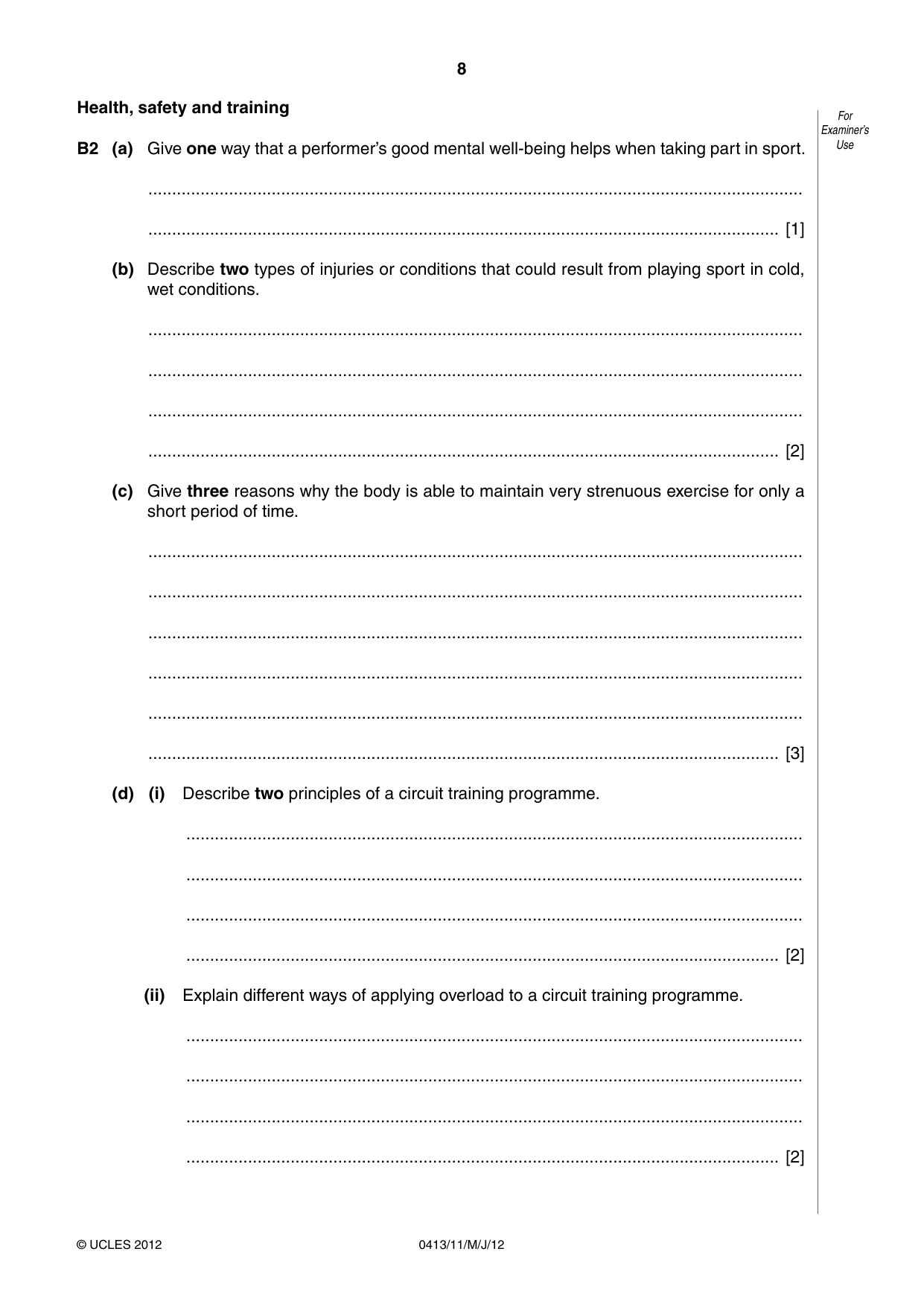
8 0413/11/M/J/12 © UCLES 2012 For Examiner’s Use Health, safety and training B2 (a) Give one way that a performer’s good mental well-being helps when taking part in sport. … … [1] (b) Describe two types of injuries or conditions that could result from playing sport in cold, wet conditions. … … … … [2] (c) Give three reasons why the body is able to maintain very strenuous exercise for only a short period of time. … … … … … … [3] (d) (i) Describe two principles of a circuit training programme. … … … … [2] (ii) Explain different ways of applying overload to a circuit training programme. … … … … [2]
Question paper, page 9
9 0413/11/M/J/12 © UCLES 2012 [Turn over For Examiner’s Use (e) Explain the immediate changes to the circulatory and respiratory systems during the early stages of a long distance run. … … … … … … … … … … … [5] (f) You are part of a group of students on an outdoor water based activity. Explain the risks a leader would assess when planning the activity. … … … … … … … … … … … [5] [Total: 20]
Question paper, page 10
10 0413/11/M/J/12 © UCLES 2012 For Examiner’s Use Reasons and opportunities for participation in physical activity B3 (a) Give one feature of a recreational activity. … … [1] (b) Give two ways that a local sports club can encourage young players to join their sports club. … … … … [2] (c) How has television helped improve people’s knowledge of how sport is played? … … … … … … [3] (d) The country hosting the Olympic Games will want to be successful. Describe some of the changes that governing bodies might make to their sport to achieve this. … … … … … … … … [4]
Question paper, page 11
11 0413/11/M/J/12 © UCLES 2012 For Examiner’s Use (e) Describe factors, other than where you live, that influence how well someone is able to take part in sport. … … … … … … … … … … [5] [Total: 15]
Question paper, page 12
12 0413/11/M/J/12 © UCLES 2012 BLANK PAGE Permission to reproduce items where third-party owned material protected by copyright is included has been sought and cleared where possible. Every reasonable effort has been made by the publisher (UCLES) to trace copyright holders, but if any items requiring clearance have unwittingly been included, the publisher will be pleased to make amends at the earliest possible opportunity. University of Cambridge International Examinations is part of the Cambridge Assessment Group. Cambridge Assessment is the brand name of University of Cambridge Local Examinations Syndicate (UCLES), which is itself a department of the University of Cambridge.
Mark scheme, page 1
UNIVERSITY OF CAMBRIDGE INTERNATIONAL EXAMINATIONS International General Certificate of Secondary Education MARK SCHEME for the May/June 2012 question paper for the guidance of teachers 0413 PHYSICAL EDUCATION 0413/11 Paper 1, maximum raw mark 80 This mark scheme is published as an aid to teachers and candidates, to indicate the requirements of the examination. It shows the basis on which Examiners were instructed to award marks. It does not indicate the details of the discussions that took place at an Examiners’ meeting before marking began, which would have considered the acceptability of alternative answers. Mark schemes must be read in conjunction with the question papers and the report on the examination. • Cambridge will not enter into discussions or correspondence in connection with these mark schemes. Cambridge is publishing the mark schemes for the May/June 2012 question papers for most IGCSE, GCE Advanced Level and Advanced Subsidiary Level syllabuses and some Ordinary Level syllabuses.
Mark scheme, page 2
Page 2 Mark Scheme: Teachers’ version Syllabus Paper IGCSE – May/June 2012 0413 11 © University of Cambridge International Examinations 2012 Section A 1 Give an example of an open skill. • Any sport or activity within a sport which is dependent on the environment. i.e. saving a goal in football / hockey, spike in volleyball, Judo etc. [1] 2 Name one muscle that helps create movement at the hip. • Gluteals / hamstring / quadriceps [1] 3 What is the function of cartilage in the knee joint? • Protects the femur and head of the tibia from wear • Provides a cushion to prevent pain caused by femur and tibia by acting as a shock absorber • Prevents friction which causes pain [1] 4 What is meant by the term physical well-being? • All body systems work well • Free from injury and illness • Carry out every day physical tasks [1] 5 Name one food source that provides carbohydrates. • Bread / pasta / rice / potatoes / [1] 6 Why does playing sport when tired increase the chance of a performer becoming injured? • Co ordination becomes more difficult i.e. being hit by a ball when batting in cricket • Mis- timing of tackles when playing football • Loss of balance could fall from the beam in gymnastics • Weakness can cause weights to be dropped • Decision making becomes impaired • Lack of focus [2] 7 How does where a person live influence the type of sport that they might take part in? • Distance to sports centres / facilities in the immediate area • Access to public transport • If you live in a city some sports are not accessible i.e. sailing / horse riding • Some sports traditionally urban i.e. basketball • Geography of the area mountains / lakes etc. • Cultural / traditional sports • Finance of the country – not individual finances / personal wealth [2]
Mark scheme, page 3
Page 3 Mark Scheme: Teachers’ version Syllabus Paper IGCSE – May/June 2012 0413 11 © University of Cambridge International Examinations 2012 8 How do newspapers promote sport? Answers should relate to newspapers and not generally to the media. • Newspapers can provide detailed articles and features (there must be reference to detail – writing articles about sport should not be given credit) • Newspapers are available throughout the day. • Provide thorough analysis of matches / games / more detail • Specialised supplements in the main sports / specialist papers • Newspapers run a series of articles • Advertises sports events • Offers a wide variety of opinions [2] 9 Give two ways that the government can help increase opportunities for performers with disabilities. Answers should not relate to the individual and should recognise that governments do not usually become directly involved in providing facilities • Campaigns to encourage participation • Additional finance to the governing body • Support for the national teams at events such as Paralympics • Legislation to ensure that access to sports centres is available / equal access • Provide funding for the improvement of facilities [2] 10 Explain how white blood cells aid a performer. Answers must relate to performance and not the function of white blood cells. White blood cells kill bacteria – if a player gets a cut the recovery time reduces / does not have to stop playing [2] 11 Give two benefits of Isometric training. • Develops static strength that allows a performer to push or pull against an object. • Exercises are quick to do and do not hurt • No expensive equipment is needed • Exercise can be done anywhere / easy to set up • Requires little technique / easy to overload • Able to focus on specific muscles – group of muscles [2]
Mark scheme, page 4
Page 4 Mark Scheme: Teachers’ version Syllabus Paper IGCSE – May/June 2012 0413 11 © University of Cambridge International Examinations 2012 12 Explain how physical education examination courses can help improve performance. • Allow performers to gain greater understanding of a sport • Allow performers to gain greater understanding of physiology / diet. Other theoretical aspects of physical education • Provide additional opportunities to take part in practical activities • Increase the range of sports that students take part in • Access better facilities / equipment • Access external coaches / improved coaching [3] [Total: 20]
Mark scheme, page 5
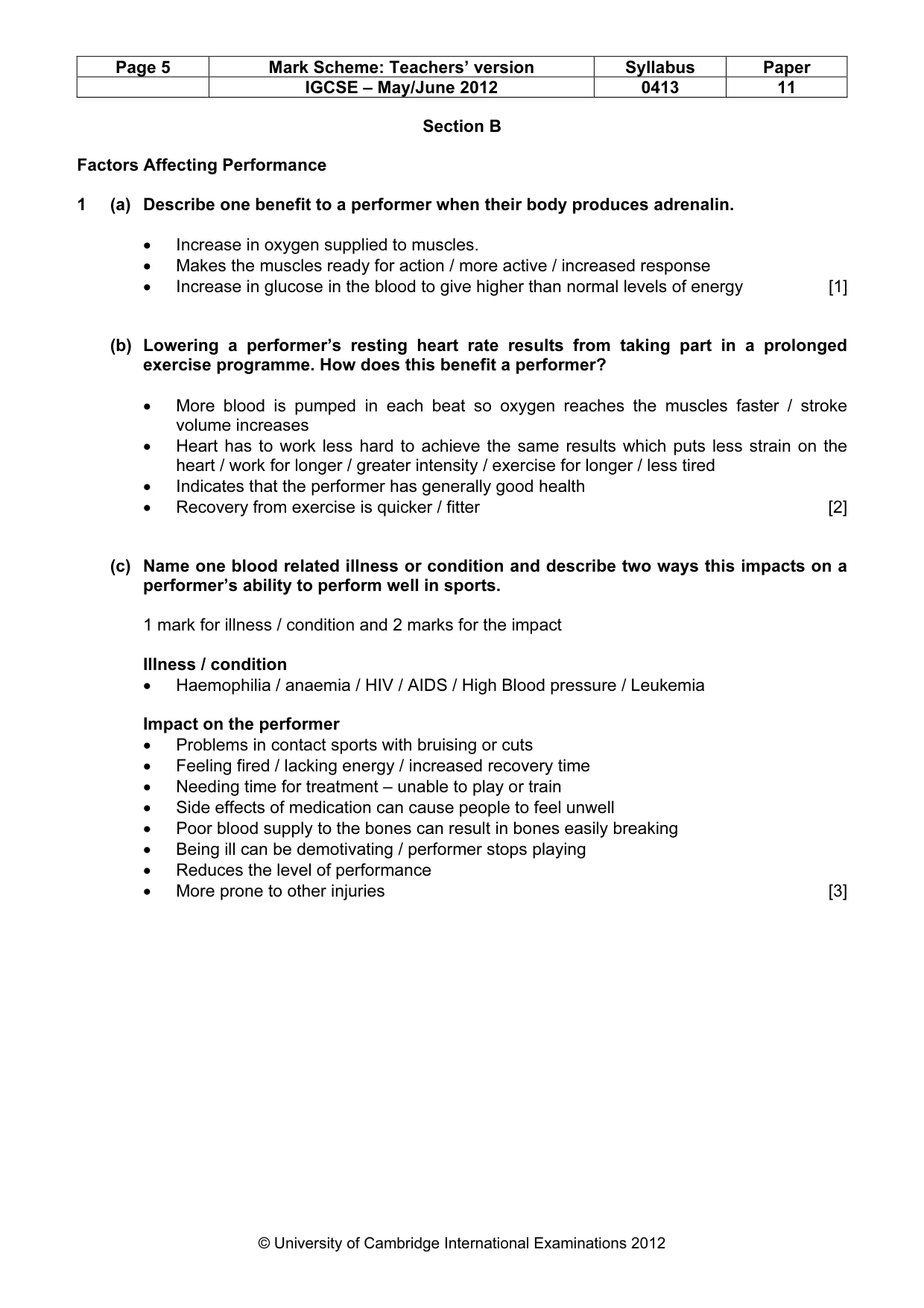
Page 5 Mark Scheme: Teachers’ version Syllabus Paper IGCSE – May/June 2012 0413 11 © University of Cambridge International Examinations 2012 Section B Factors Affecting Performance 1 (a) Describe one benefit to a performer when their body produces adrenalin. • Increase in oxygen supplied to muscles. • Makes the muscles ready for action / more active / increased response • Increase in glucose in the blood to give higher than normal levels of energy [1] (b) Lowering a performer’s resting heart rate results from taking part in a prolonged exercise programme. How does this benefit a performer? • More blood is pumped in each beat so oxygen reaches the muscles faster / stroke volume increases • Heart has to work less hard to achieve the same results which puts less strain on the heart / work for longer / greater intensity / exercise for longer / less tired • Indicates that the performer has generally good health • Recovery from exercise is quicker / fitter [2] (c) Name one blood related illness or condition and describe two ways this impacts on a performer’s ability to perform well in sports. 1 mark for illness / condition and 2 marks for the impact Illness / condition • Haemophilia / anaemia / HIV / AIDS / High Blood pressure / Leukemia Impact on the performer • Problems in contact sports with bruising or cuts • Feeling fired / lacking energy / increased recovery time • Needing time for treatment – unable to play or train • Side effects of medication can cause people to feel unwell • Poor blood supply to the bones can result in bones easily breaking • Being ill can be demotivating / performer stops playing • Reduces the level of performance • More prone to other injuries [3]
Mark scheme, page 6
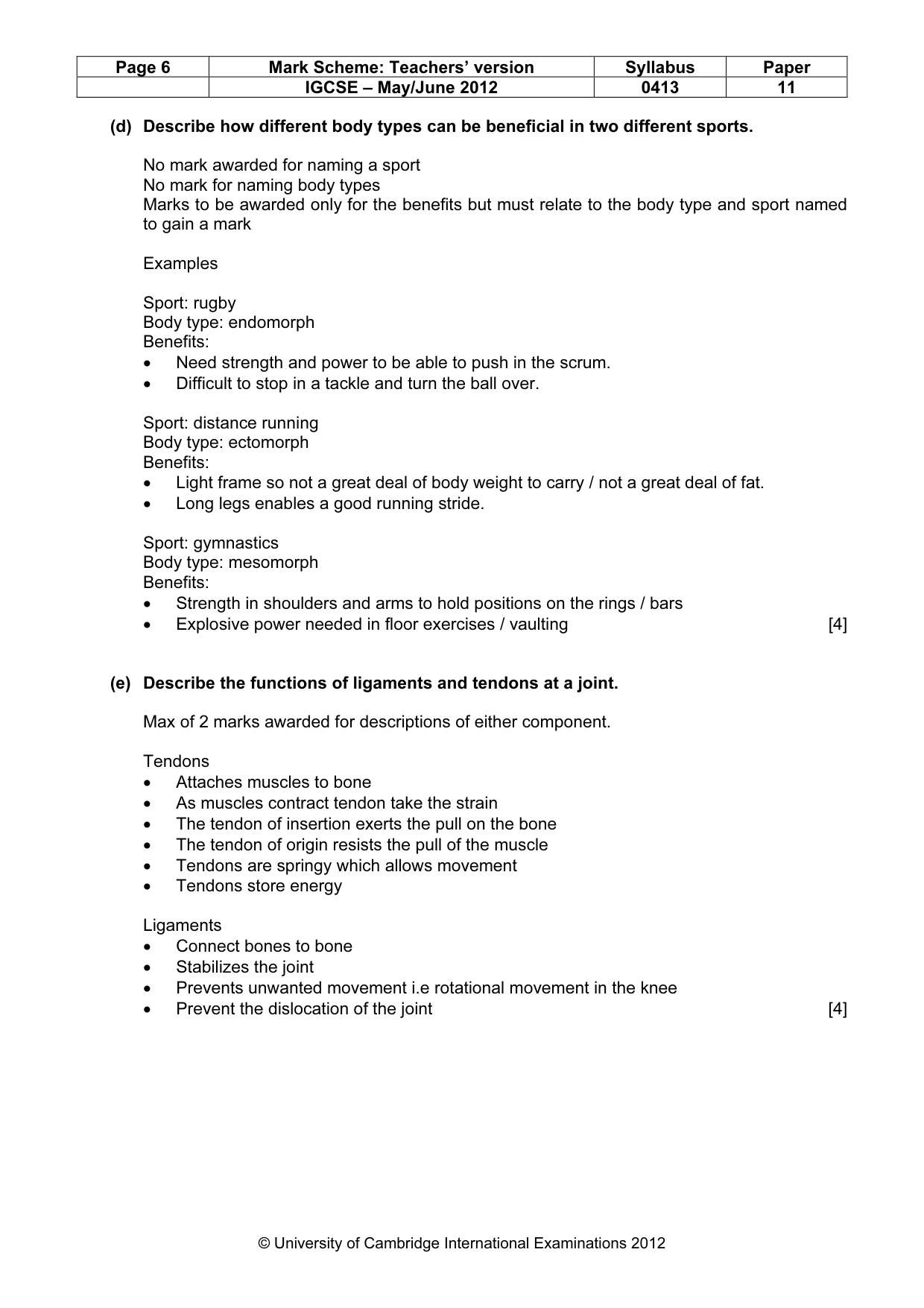
Page 6 Mark Scheme: Teachers’ version Syllabus Paper IGCSE – May/June 2012 0413 11 © University of Cambridge International Examinations 2012 (d) Describe how different body types can be beneficial in two different sports. No mark awarded for naming a sport No mark for naming body types Marks to be awarded only for the benefits but must relate to the body type and sport named to gain a mark Examples Sport: rugby Body type: endomorph Benefits: • Need strength and power to be able to push in the scrum. • Difficult to stop in a tackle and turn the ball over. Sport: distance running Body type: ectomorph Benefits: • Light frame so not a great deal of body weight to carry / not a great deal of fat. • Long legs enables a good running stride. Sport: gymnastics Body type: mesomorph Benefits: • Strength in shoulders and arms to hold positions on the rings / bars • Explosive power needed in floor exercises / vaulting [4] (e) Describe the functions of ligaments and tendons at a joint. Max of 2 marks awarded for descriptions of either component. Tendons • Attaches muscles to bone • As muscles contract tendon take the strain • The tendon of insertion exerts the pull on the bone • The tendon of origin resists the pull of the muscle • Tendons are springy which allows movement • Tendons store energy Ligaments • Connect bones to bone • Stabilizes the joint • Prevents unwanted movement i.e rotational movement in the knee • Prevent the dislocation of the joint [4]
Mark scheme, page 7
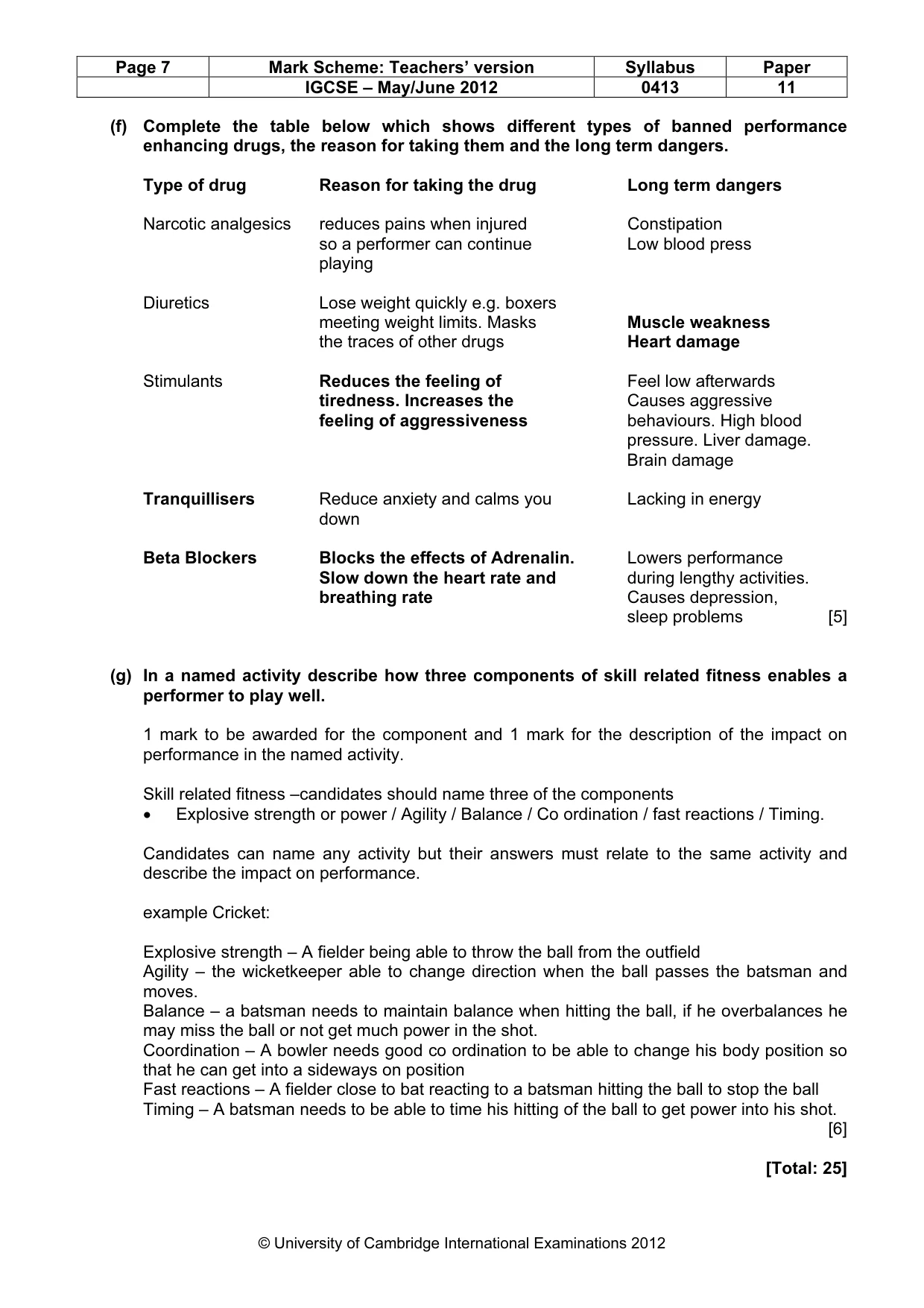
Page 7 Mark Scheme: Teachers’ version Syllabus Paper IGCSE – May/June 2012 0413 11 © University of Cambridge International Examinations 2012 (f) Complete the table below which shows different types of banned performance enhancing drugs, the reason for taking them and the long term dangers. Type of drug Reason for taking the drug Long term dangers Narcotic analgesics reduces pains when injured Constipation so a performer can continue Low blood press playing Diuretics Lose weight quickly e.g. boxers meeting weight limits. Masks Muscle weakness the traces of other drugs Heart damage Stimulants Reduces the feeling of Feel low afterwards tiredness. Increases the Causes aggressive feeling of aggressiveness behaviours. High blood pressure. Liver damage. Brain damage Tranquillisers Reduce anxiety and calms you Lacking in energy down Beta Blockers Blocks the effects of Adrenalin. Lowers performance Slow down the heart rate and during lengthy activities. breathing rate Causes depression, sleep problems [5] (g) In a named activity describe how three components of skill related fitness enables a performer to play well. 1 mark to be awarded for the component and 1 mark for the description of the impact on performance in the named activity. Skill related fitness –candidates should name three of the components • Explosive strength or power / Agility / Balance / Co ordination / fast reactions / Timing. Candidates can name any activity but their answers must relate to the same activity and describe the impact on performance. example Cricket: Explosive strength – A fielder being able to throw the ball from the outfield Agility – the wicketkeeper able to change direction when the ball passes the batsman and moves. Balance – a batsman needs to maintain balance when hitting the ball, if he overbalances he may miss the ball or not get much power in the shot. Coordination – A bowler needs good co ordination to be able to change his body position so that he can get into a sideways on position Fast reactions – A fielder close to bat reacting to a batsman hitting the ball to stop the ball Timing – A batsman needs to be able to time his hitting of the ball to get power into his shot. [6] [Total: 25]
Mark scheme, page 8
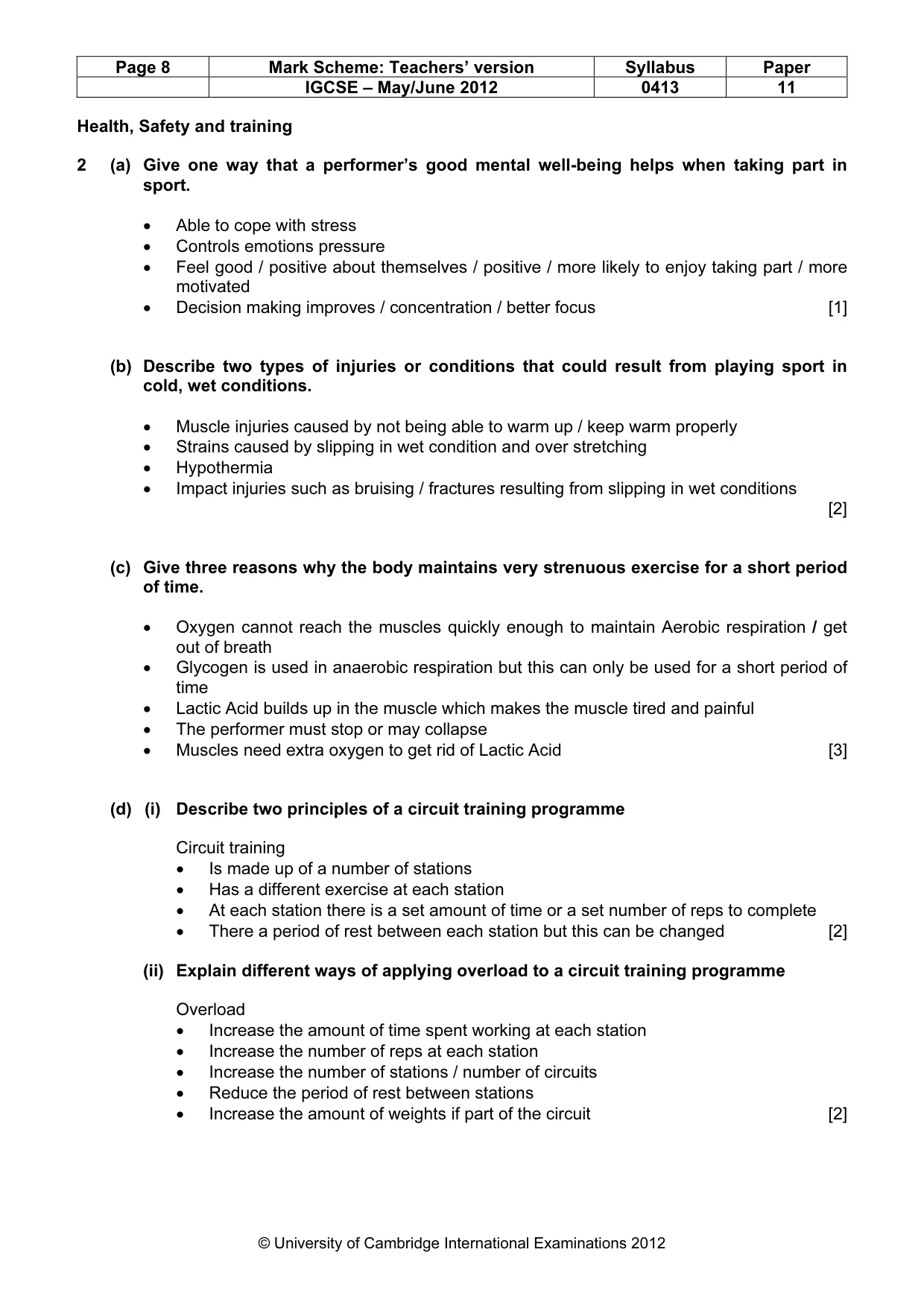
Page 8 Mark Scheme: Teachers’ version Syllabus Paper IGCSE – May/June 2012 0413 11 © University of Cambridge International Examinations 2012 Health, Safety and training 2 (a) Give one way that a performer’s good mental well-being helps when taking part in sport. • Able to cope with stress • Controls emotions pressure • Feel good / positive about themselves / positive / more likely to enjoy taking part / more motivated • Decision making improves / concentration / better focus [1] (b) Describe two types of injuries or conditions that could result from playing sport in cold, wet conditions. • Muscle injuries caused by not being able to warm up / keep warm properly • Strains caused by slipping in wet condition and over stretching • Hypothermia • Impact injuries such as bruising / fractures resulting from slipping in wet conditions [2] (c) Give three reasons why the body maintains very strenuous exercise for a short period of time. • Oxygen cannot reach the muscles quickly enough to maintain Aerobic respiration / get out of breath • Glycogen is used in anaerobic respiration but this can only be used for a short period of time • Lactic Acid builds up in the muscle which makes the muscle tired and painful • The performer must stop or may collapse • Muscles need extra oxygen to get rid of Lactic Acid [3] (d) (i) Describe two principles of a circuit training programme Circuit training • Is made up of a number of stations • Has a different exercise at each station • At each station there is a set amount of time or a set number of reps to complete • There a period of rest between each station but this can be changed [2] (ii) Explain different ways of applying overload to a circuit training programme Overload • Increase the amount of time spent working at each station • Increase the number of reps at each station • Increase the number of stations / number of circuits • Reduce the period of rest between stations • Increase the amount of weights if part of the circuit [2]
Mark scheme, page 9
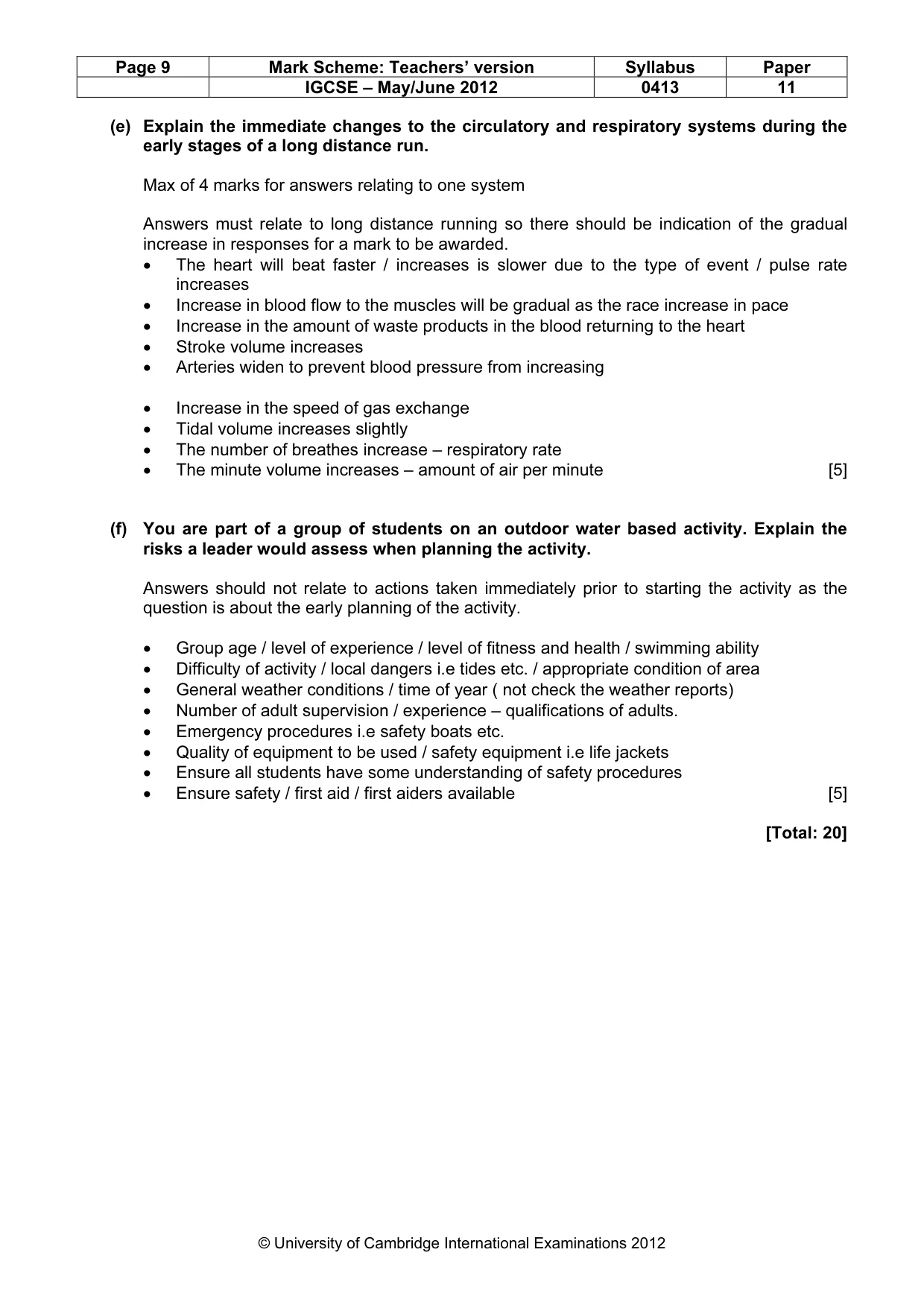
Page 9 Mark Scheme: Teachers’ version Syllabus Paper IGCSE – May/June 2012 0413 11 © University of Cambridge International Examinations 2012 (e) Explain the immediate changes to the circulatory and respiratory systems during the early stages of a long distance run. Max of 4 marks for answers relating to one system Answers must relate to long distance running so there should be indication of the gradual increase in responses for a mark to be awarded. • The heart will beat faster / increases is slower due to the type of event / pulse rate increases • Increase in blood flow to the muscles will be gradual as the race increase in pace • Increase in the amount of waste products in the blood returning to the heart • Stroke volume increases • Arteries widen to prevent blood pressure from increasing • Increase in the speed of gas exchange • Tidal volume increases slightly • The number of breathes increase – respiratory rate • The minute volume increases – amount of air per minute [5] (f) You are part of a group of students on an outdoor water based activity. Explain the risks a leader would assess when planning the activity. Answers should not relate to actions taken immediately prior to starting the activity as the question is about the early planning of the activity. • Group age / level of experience / level of fitness and health / swimming ability • Difficulty of activity / local dangers i.e tides etc. / appropriate condition of area • General weather conditions / time of year ( not check the weather reports) • Number of adult supervision / experience – qualifications of adults. • Emergency procedures i.e safety boats etc. • Quality of equipment to be used / safety equipment i.e life jackets • Ensure all students have some understanding of safety procedures • Ensure safety / first aid / first aiders available [5] [Total: 20]
Mark scheme, page 10
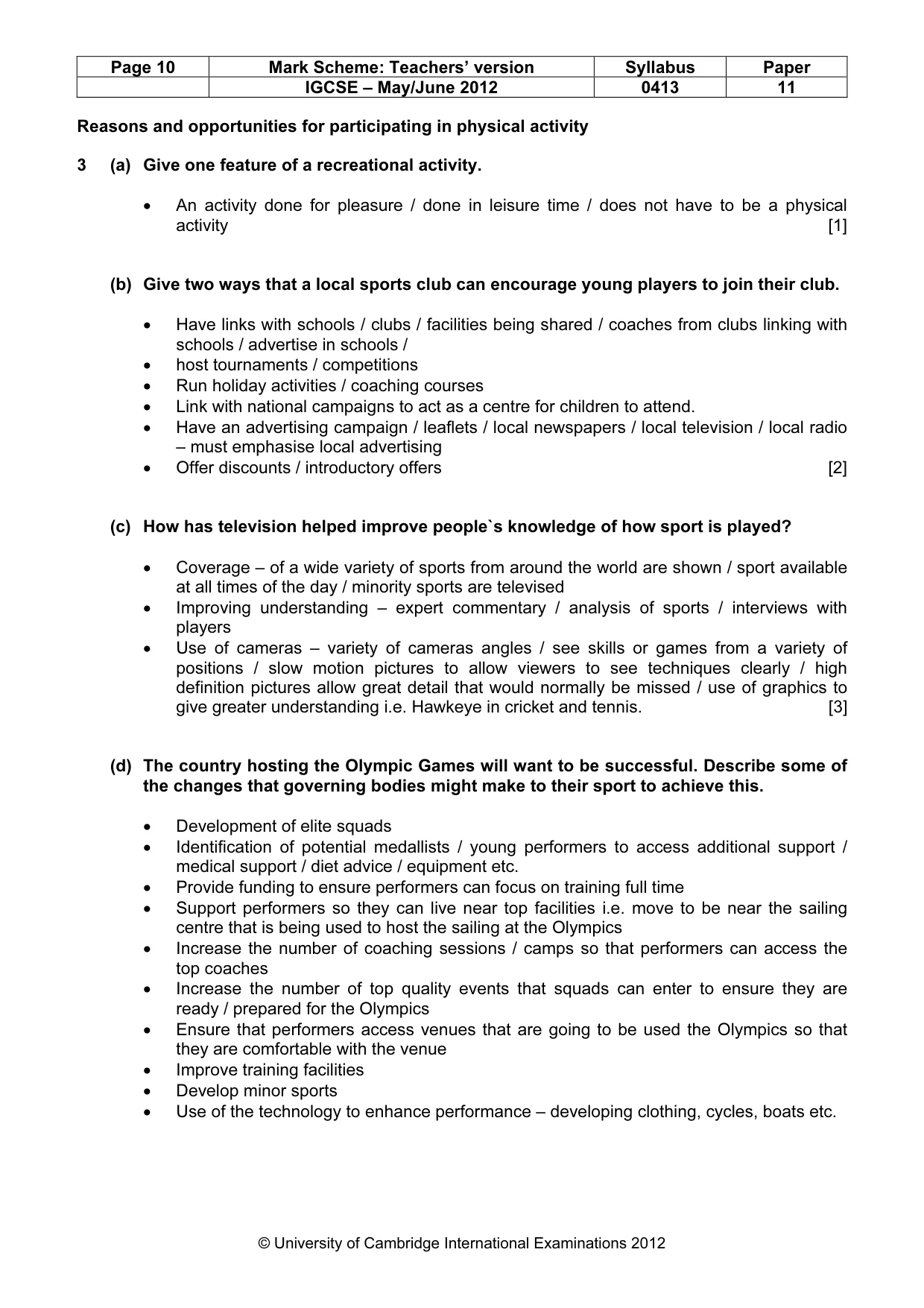
Page 10 Mark Scheme: Teachers’ version Syllabus Paper IGCSE – May/June 2012 0413 11 © University of Cambridge International Examinations 2012 Reasons and opportunities for participating in physical activity 3 (a) Give one feature of a recreational activity. • An activity done for pleasure / done in leisure time / does not have to be a physical activity [1] (b) Give two ways that a local sports club can encourage young players to join their club. • Have links with schools / clubs / facilities being shared / coaches from clubs linking with schools / advertise in schools / • host tournaments / competitions • Run holiday activities / coaching courses • Link with national campaigns to act as a centre for children to attend. • Have an advertising campaign / leaflets / local newspapers / local television / local radio – must emphasise local advertising • Offer discounts / introductory offers [2] (c) How has television helped improve people`s knowledge of how sport is played? • Coverage – of a wide variety of sports from around the world are shown / sport available at all times of the day / minority sports are televised • Improving understanding – expert commentary / analysis of sports / interviews with players • Use of cameras – variety of cameras angles / see skills or games from a variety of positions / slow motion pictures to allow viewers to see techniques clearly / high definition pictures allow great detail that would normally be missed / use of graphics to give greater understanding i.e. Hawkeye in cricket and tennis. [3] (d) The country hosting the Olympic Games will want to be successful. Describe some of the changes that governing bodies might make to their sport to achieve this. • Development of elite squads • Identification of potential medallists / young performers to access additional support / medical support / diet advice / equipment etc. • Provide funding to ensure performers can focus on training full time • Support performers so they can live near top facilities i.e. move to be near the sailing centre that is being used to host the sailing at the Olympics • Increase the number of coaching sessions / camps so that performers can access the top coaches • Increase the number of top quality events that squads can enter to ensure they are ready / prepared for the Olympics • Ensure that performers access venues that are going to be used the Olympics so that they are comfortable with the venue • Improve training facilities • Develop minor sports • Use of the technology to enhance performance – developing clothing, cycles, boats etc.
Mark scheme, page 11
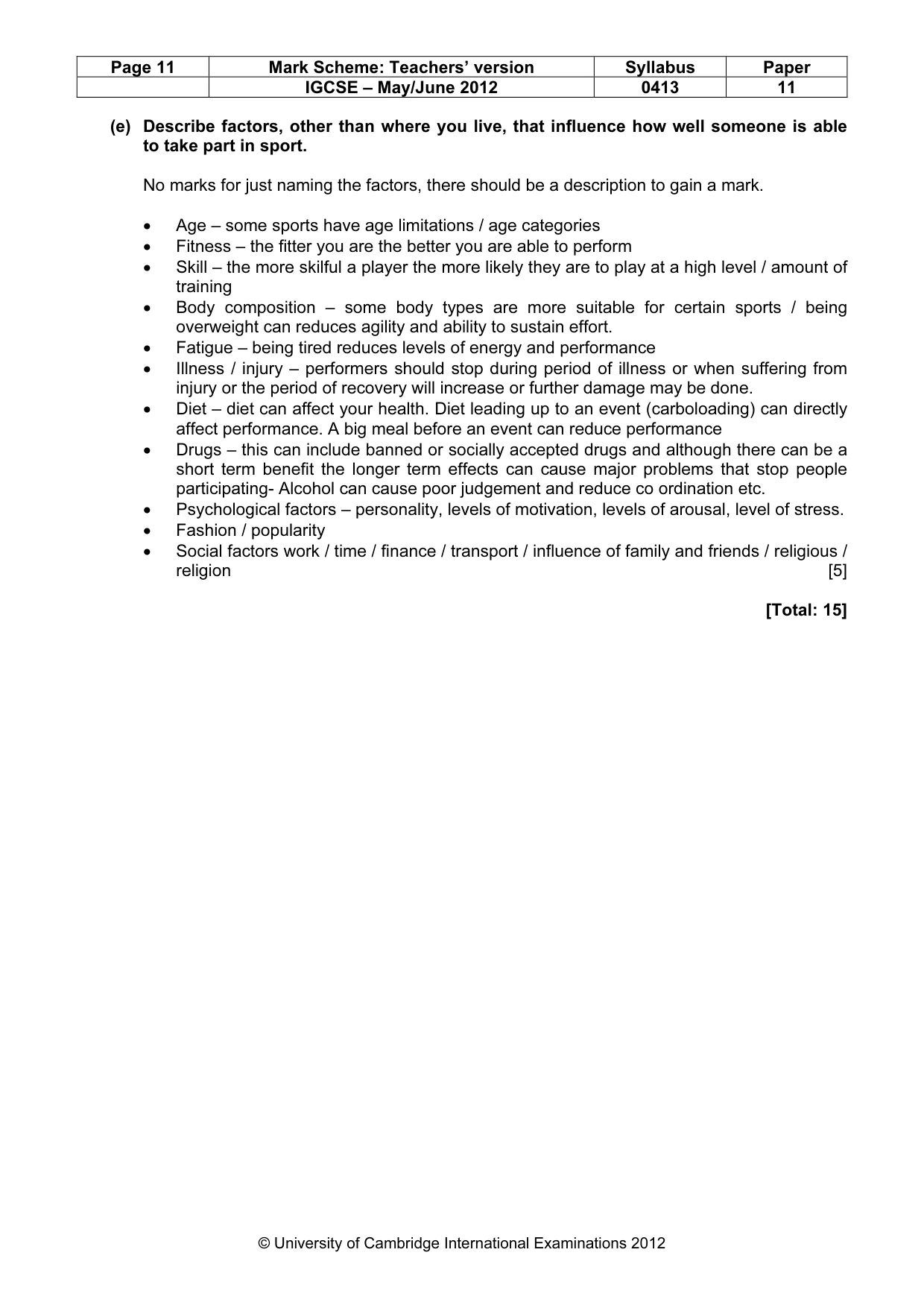
Page 11 Mark Scheme: Teachers’ version Syllabus Paper IGCSE – May/June 2012 0413 11 © University of Cambridge International Examinations 2012 (e) Describe factors, other than where you live, that influence how well someone is able to take part in sport. No marks for just naming the factors, there should be a description to gain a mark. • Age – some sports have age limitations / age categories • Fitness – the fitter you are the better you are able to perform • Skill – the more skilful a player the more likely they are to play at a high level / amount of training • Body composition – some body types are more suitable for certain sports / being overweight can reduces agility and ability to sustain effort. • Fatigue – being tired reduces levels of energy and performance • Illness / injury – performers should stop during period of illness or when suffering from injury or the period of recovery will increase or further damage may be done. • Diet – diet can affect your health. Diet leading up to an event (carboloading) can directly affect performance. A big meal before an event can reduce performance • Drugs – this can include banned or socially accepted drugs and although there can be a short term benefit the longer term effects can cause major problems that stop people participating- Alcohol can cause poor judgement and reduce co ordination etc. • Psychological factors – personality, levels of motivation, levels of arousal, level of stress. • Fashion / popularity • Social factors work / time / finance / transport / influence of family and friends / religious / religion [5] [Total: 15]
What you needed in this session
Cambridge’s own grade thresholds for 2012 May/June, Paper 1 · Variant 1. A higher threshold means an easier paper — the bar moves with how the cohort did.