Cambridge IGCSE Physical Education 0413 — 2012 May/June Paper 1 · Variant 3
0413/13/M/J/12 · 80 marks · ≈90 min
The question paper and its mark scheme, free to read here and free to download. This is Cambridge’s own paper, exactly as it was sat.
Question paper12 pages




Mark scheme12 pages
Answers below. Sit the paper first if you are practising.
Paper as text
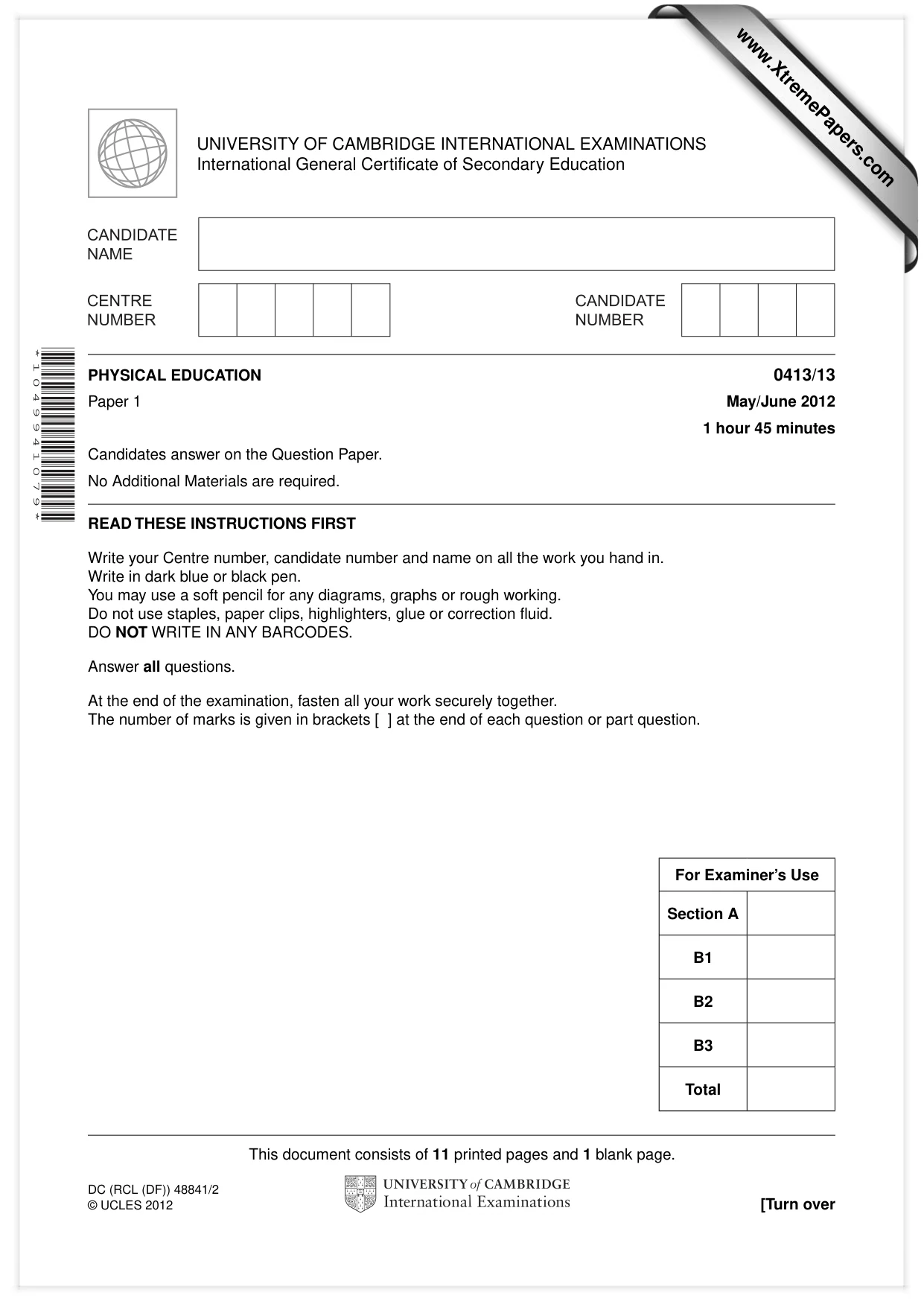
Question paper, page 1
This document consists of 11 printed pages and 1 blank page. DC (RCL (DF)) 48841/2 © UCLES 2012 [Turn over UNIVERSITY OF CAMBRIDGE INTERNATIONAL EXAMINATIONS International General Certificate of Secondary Education * 1 0 4 9 9 4 1 0 7 9 * PHYSICAL EDUCATION 0413/13 Paper 1 May/June 2012 1 hour 45 minutes Candidates answer on the Question Paper. No Additional Materials are required. READ THESE INSTRUCTIONS FIRST Write your Centre number, candidate number and name on all the work you hand in. Write in dark blue or black pen. You may use a soft pencil for any diagrams, graphs or rough working. Do not use staples, paper clips, highlighters, glue or correction fluid. DO NOT WRITE IN ANY BARCODES. Answer all questions. At the end of the examination, fasten all your work securely together. The number of marks is given in brackets [ ] at the end of each question or part question. For Examiner’s Use Section A B1 B2 B3 Total www.XtremePapers.com
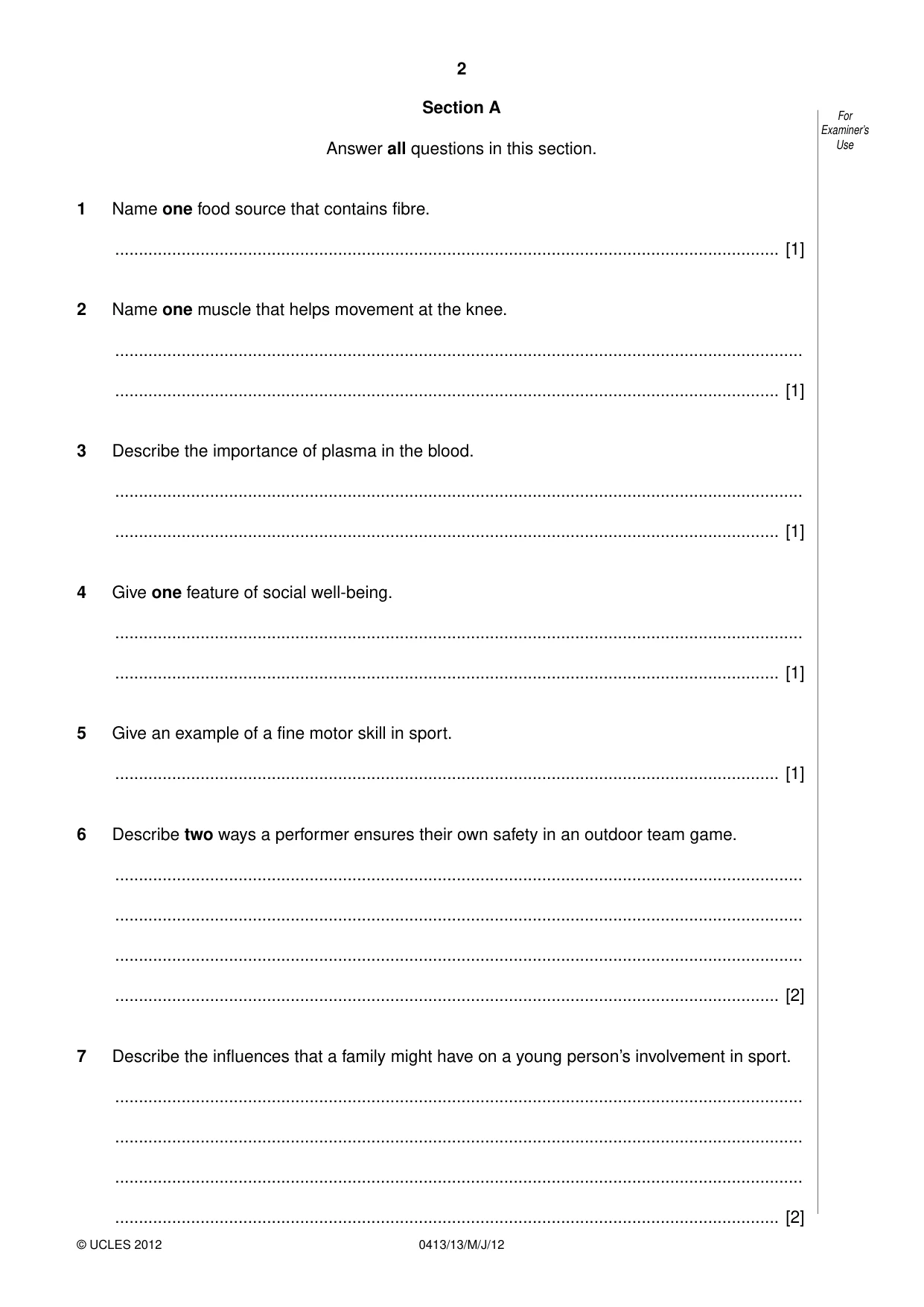
Question paper, page 2
2 0413/13/M/J/12 © UCLES 2012 For Examiner’s Use Section A Answer all questions in this section. 1 Name one food source that contains fibre. … [1] 2 Name one muscle that helps movement at the knee. … … [1] 3 Describe the importance of plasma in the blood. … … [1] 4 Give one feature of social well-being. … … [1] 5 Give an example of a fine motor skill in sport. … [1] 6 Describe two ways a performer ensures their own safety in an outdoor team game. … … … … [2] 7 Describe the influences that a family might have on a young person’s involvement in sport. … … … … [2]
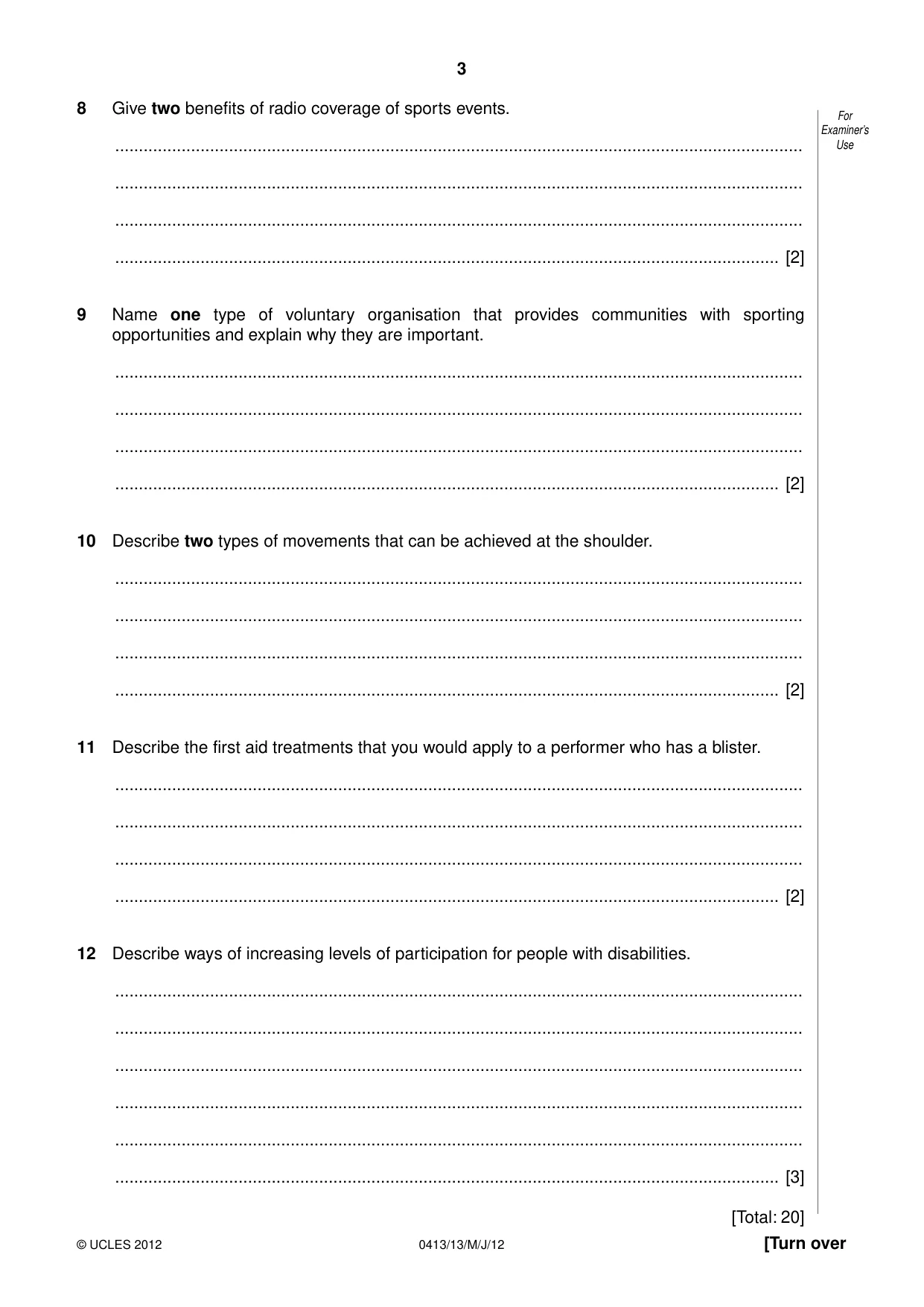
Question paper, page 3
3 0413/13/M/J/12 © UCLES 2012 [Turn over For Examiner’s Use 8 Give two benefits of radio coverage of sports events. … … … … [2] 9 Name one type of voluntary organisation that provides communities with sporting opportunities and explain why they are important. … … … … [2] 10 Describe two types of movements that can be achieved at the shoulder. … … … … [2] 11 Describe the first aid treatments that you would apply to a performer who has a blister. … … … … [2] 12 Describe ways of increasing levels of participation for people with disabilities. … … … … … … [3] [Total: 20]
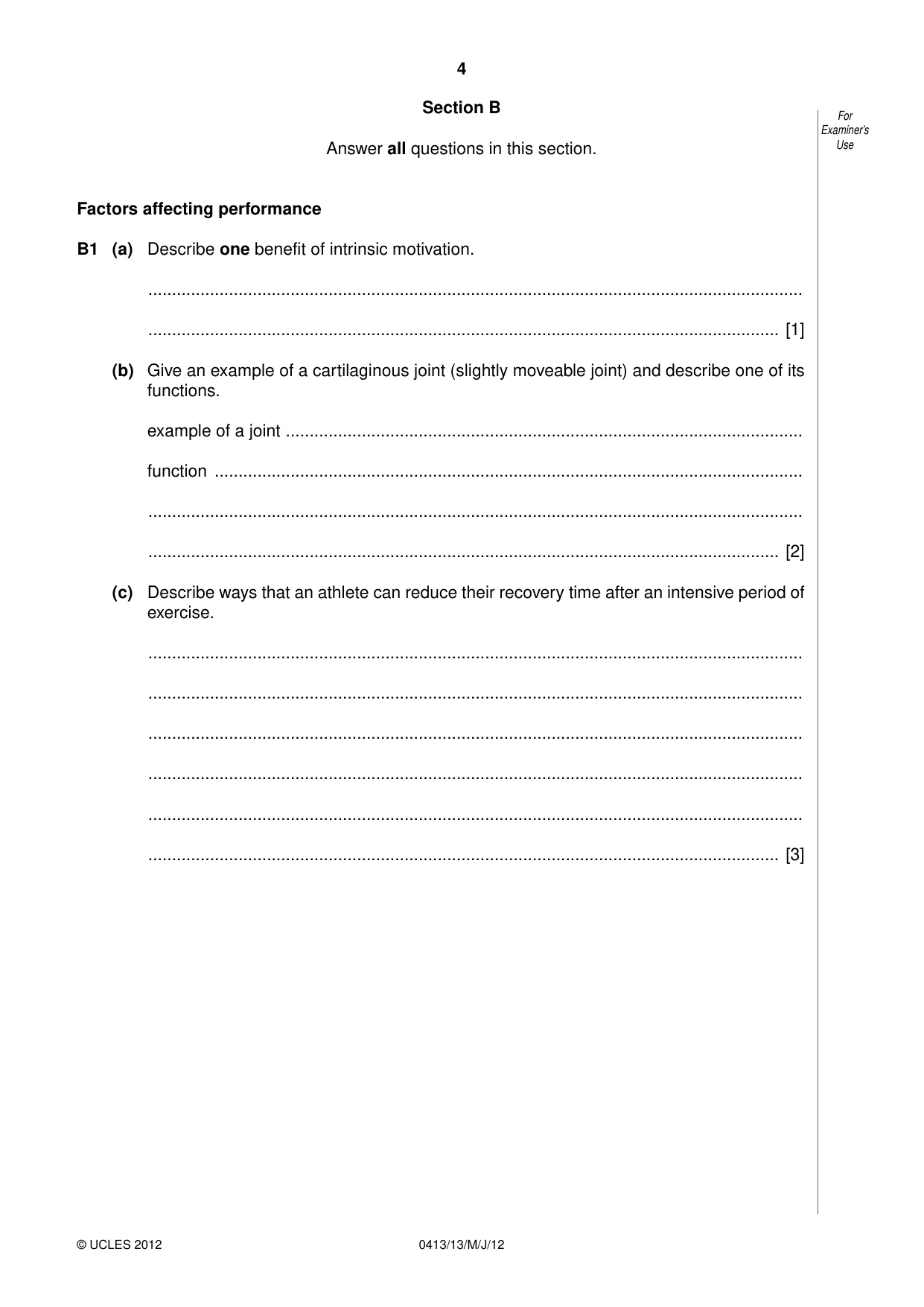
Question paper, page 4
4 0413/13/M/J/12 © UCLES 2012 For Examiner’s Use Section B Answer all questions in this section. Factors affecting performance B1 (a) Describe one benefit of intrinsic motivation. … … [1] (b) Give an example of a cartilaginous joint (slightly moveable joint) and describe one of its functions. example of a joint … function … … … [2] (c) Describe ways that an athlete can reduce their recovery time after an intensive period of exercise. … … … … … … [3]
Question paper, page 5
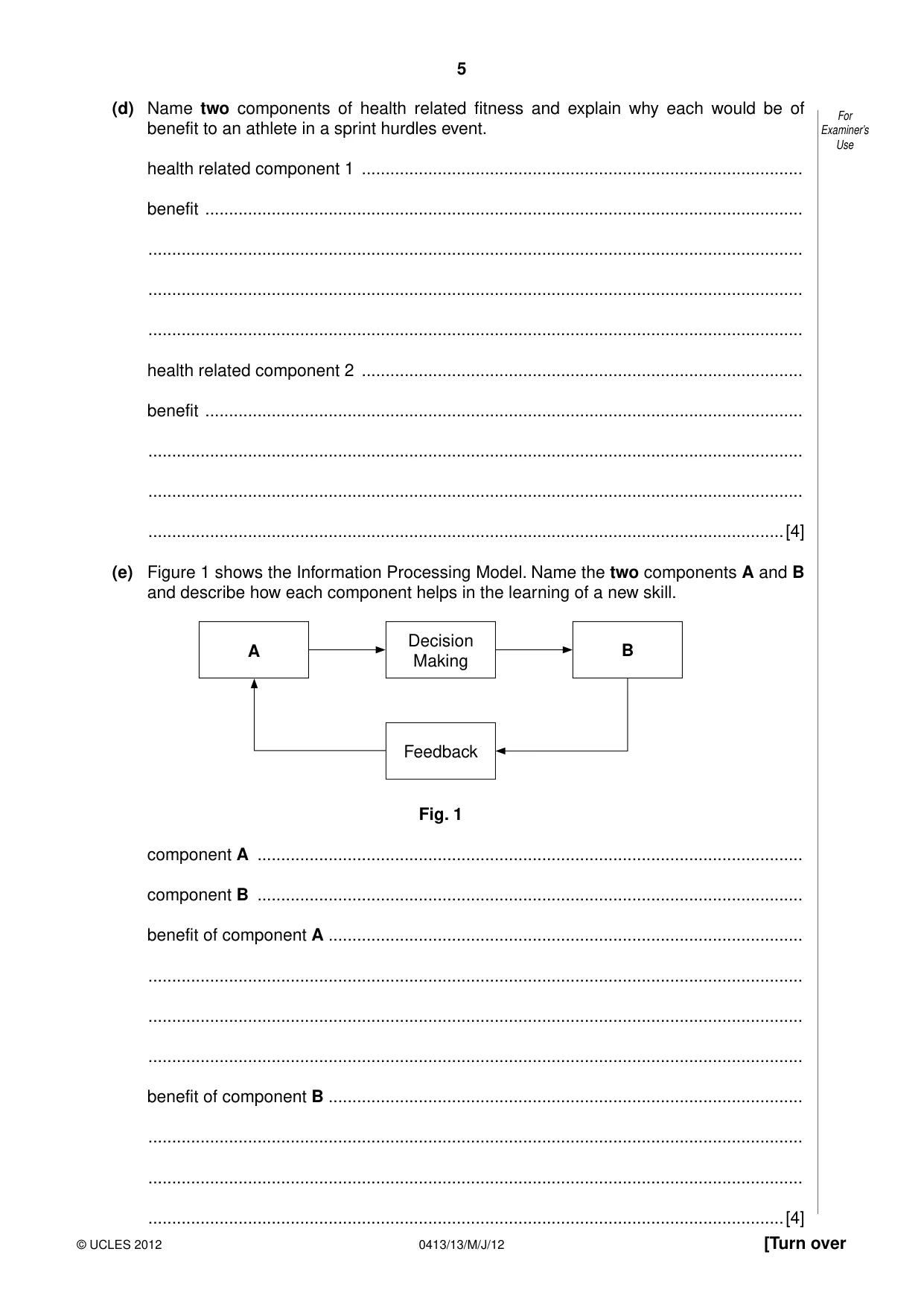
5 0413/13/M/J/12 © UCLES 2012 [Turn over For Examiner’s Use (d) Name two components of health related fitness and explain why each would be of benefit to an athlete in a sprint hurdles event. health related component 1 … benefit … … … … health related component 2 … benefit … … … …[4] (e) Figure 1 shows the Information Processing Model. Name the two components A and B and describe how each component helps in the learning of a new skill. A Decision Making B Feedback Fig. 1 component A … component B … benefit of component A … … … … benefit of component B … … … …[4]
Question paper, page 6
6 0413/13/M/J/12 © UCLES 2012 For Examiner’s Use (f) Describe the factors that could affect an athlete’s performance in a competition. … … … … … … … … … … [5] (g) (i) Give three reasons why you would test an athlete’s fitness level before and during a fitness training programme. … … … … … … [3] (ii) Describe a test that you would use to measure an athlete’s fitness level if they were getting ready for a long distance running event. … … … … … … [3] [Total: 25]
Question paper, page 7
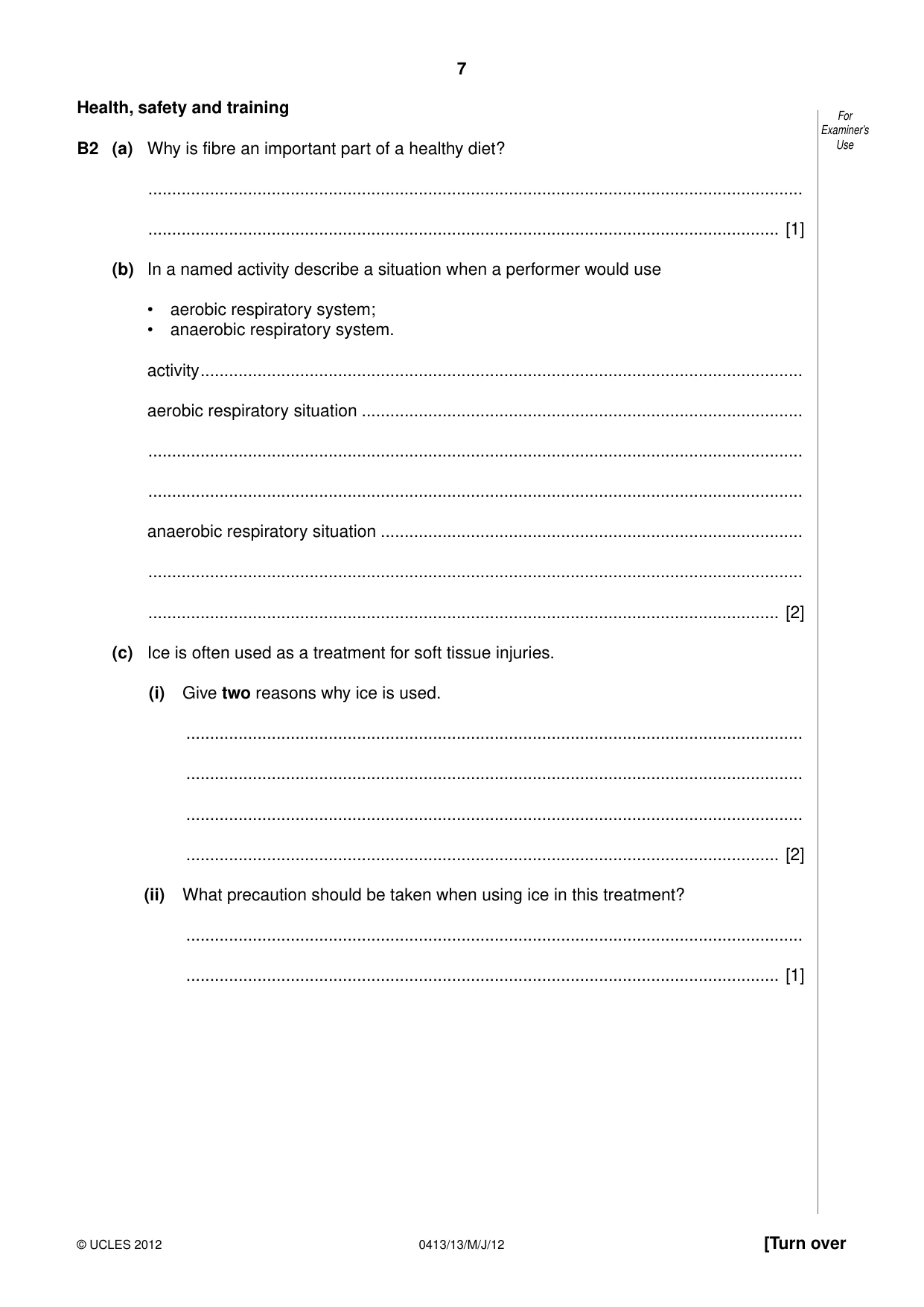
7 0413/13/M/J/12 © UCLES 2012 [Turn over For Examiner’s Use Health, safety and training B2 (a) Why is fibre an important part of a healthy diet? … … [1] (b) In a named activity describe a situation when a performer would use • aerobic respiratory system; • anaerobic respiratory system. activity … aerobic respiratory situation … … … anaerobic respiratory situation … … … [2] (c) Ice is often used as a treatment for soft tissue injuries. (i) Give two reasons why ice is used. … … … … [2] (ii) What precaution should be taken when using ice in this treatment? … … [1]
Question paper, page 8
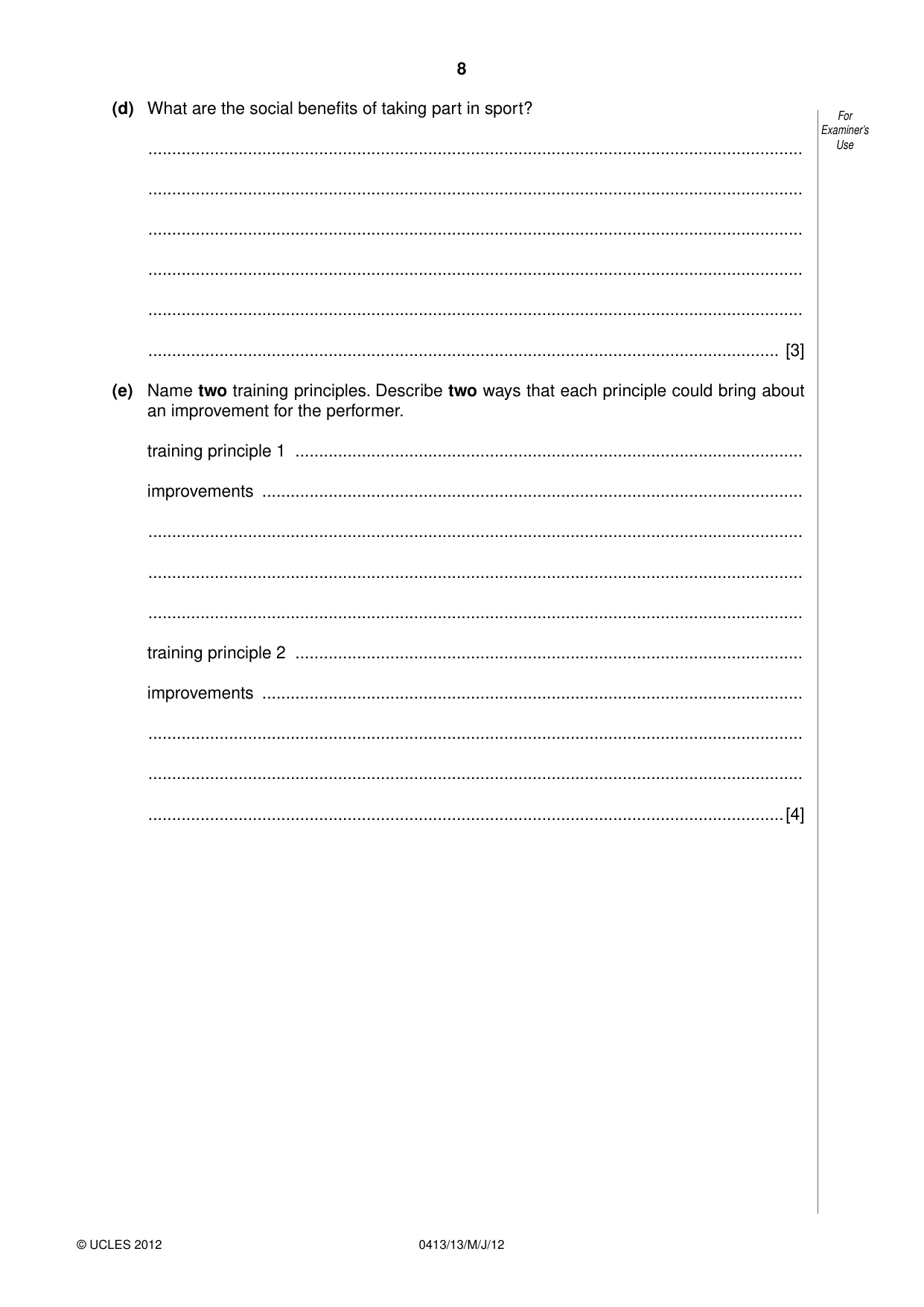
8 0413/13/M/J/12 © UCLES 2012 For Examiner’s Use (d) What are the social benefits of taking part in sport? … … … … … … [3] (e) Name two training principles. Describe two ways that each principle could bring about an improvement for the performer. training principle 1 … improvements … … … … training principle 2 … improvements … … … …[4]
Question paper, page 9
9 0413/13/M/J/12 © UCLES 2012 [Turn over For Examiner’s Use (f) (i) You are planning to use circuit training to help improve a games player. Describe some of the benefits of using this type of training. … … … … … … … … [4] (ii) Give two ways that you can change a circuit to bring about an improvement in performance. … … … … [2] (iii) Give one disadvantage of using this type of training programme. … … [1] [Total: 20]
Question paper, page 10
10 0413/13/M/J/12 © UCLES 2012 For Examiner’s Use Reasons and opportunities for participation in physical activity B3 (a) To become an elite performer you need a great deal of skill. Name one other factor that will determine the level of a performer’s success. … … [1] (b) There has been an improvement in health care in recent years. Give two benefits of these improvements to sports performers. … … … … [2] (c) Extra-curricular activities are an important part of school life. Describe the benefits, other than social, to the students who take part in extra-curricular activities. … … … … … … … … [3]
Question paper, page 11
11 0413/13/M/J/12 © UCLES 2012 For Examiner’s Use (d) There has been an increase in the number of sports channels on the television in many countries. Explain why this increase has occurred. … … … … … … … … [4] (e) There has been greater acceptance of performers with disabilities in recent years. Explain why this has happened. … … … … … … … … … … [5] [Total: 15]
Question paper, page 12
12 0413/13/M/J/12 © UCLES 2012 BLANK PAGE Permission to reproduce items where third-party owned material protected by copyright is included has been sought and cleared where possible. Every reasonable effort has been made by the publisher (UCLES) to trace copyright holders, but if any items requiring clearance have unwittingly been included, the publisher will be pleased to make amends at the earliest possible opportunity. University of Cambridge International Examinations is part of the Cambridge Assessment Group. Cambridge Assessment is the brand name of University of Cambridge Local Examinations Syndicate (UCLES), which is itself a department of the University of Cambridge.
Mark scheme, page 1
UNIVERSITY OF CAMBRIDGE INTERNATIONAL EXAMINATIONS International General Certificate of Secondary Education MARK SCHEME for the May/June 2012 question paper for the guidance of teachers 0413 PHYSICAL EDUCATION 0413/13 Paper 1, maximum raw mark 80 This mark scheme is published as an aid to teachers and candidates, to indicate the requirements of the examination. It shows the basis on which Examiners were instructed to award marks. It does not indicate the details of the discussions that took place at an Examiners’ meeting before marking began, which would have considered the acceptability of alternative answers. Mark schemes must be read in conjunction with the question papers and the report on the examination. • Cambridge will not enter into discussions or correspondence in connection with these mark schemes. Cambridge is publishing the mark schemes for the May/June 2012 question papers for most IGCSE, GCE Advanced Level and Advanced Subsidiary Level syllabuses and some Ordinary Level syllabuses.
Mark scheme, page 2
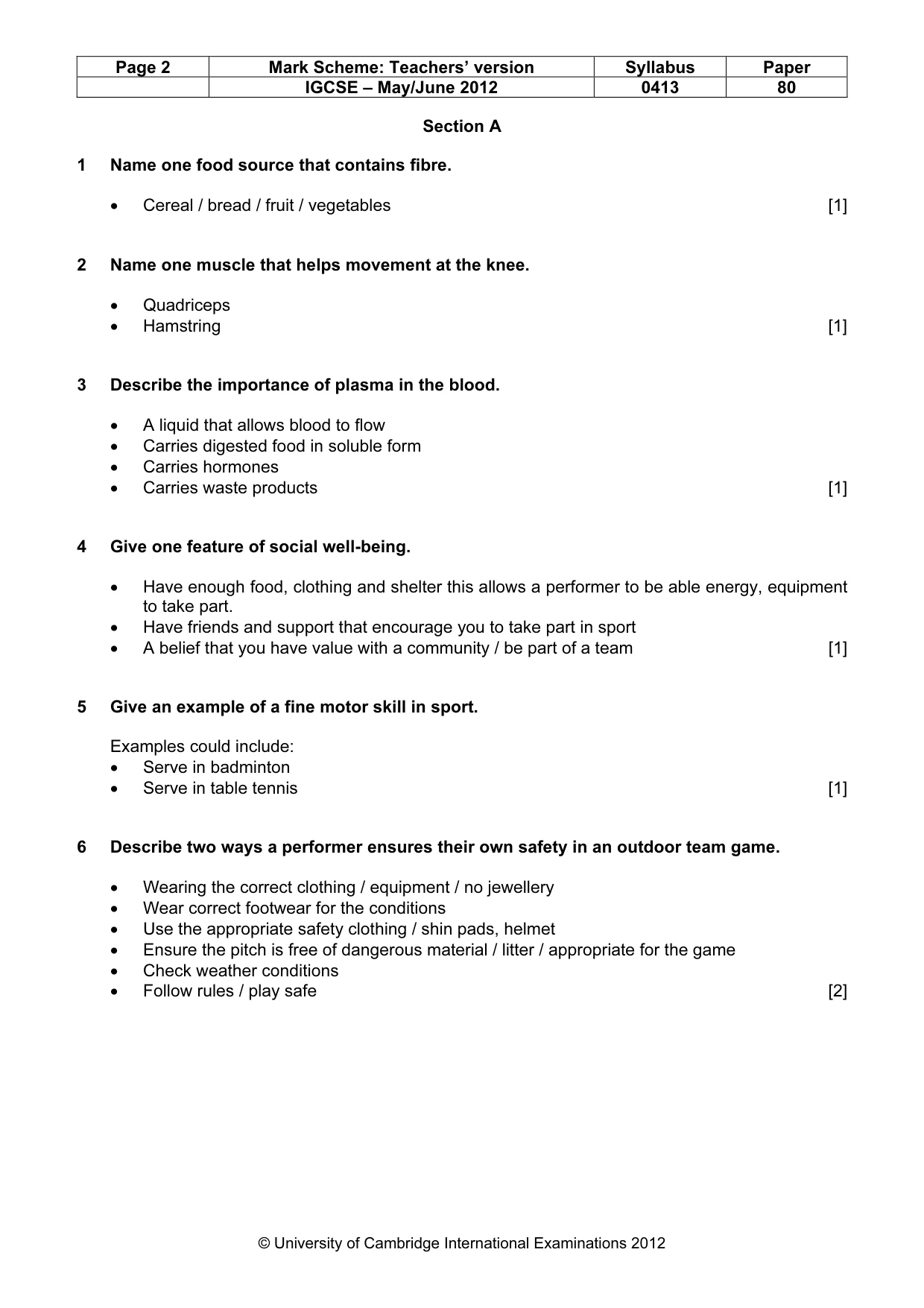
Page 2 Mark Scheme: Teachers’ version Syllabus Paper IGCSE – May/June 2012 0413 80 © University of Cambridge International Examinations 2012 Section A 1 Name one food source that contains fibre. • Cereal / bread / fruit / vegetables [1] 2 Name one muscle that helps movement at the knee. • Quadriceps • Hamstring [1] 3 Describe the importance of plasma in the blood. • A liquid that allows blood to flow • Carries digested food in soluble form • Carries hormones • Carries waste products [1] 4 Give one feature of social well-being. • Have enough food, clothing and shelter this allows a performer to be able energy, equipment to take part. • Have friends and support that encourage you to take part in sport • A belief that you have value with a community / be part of a team [1] 5 Give an example of a fine motor skill in sport. Examples could include: • Serve in badminton • Serve in table tennis [1] 6 Describe two ways a performer ensures their own safety in an outdoor team game. • Wearing the correct clothing / equipment / no jewellery • Wear correct footwear for the conditions • Use the appropriate safety clothing / shin pads, helmet • Ensure the pitch is free of dangerous material / litter / appropriate for the game • Check weather conditions • Follow rules / play safe [2]
Mark scheme, page 3
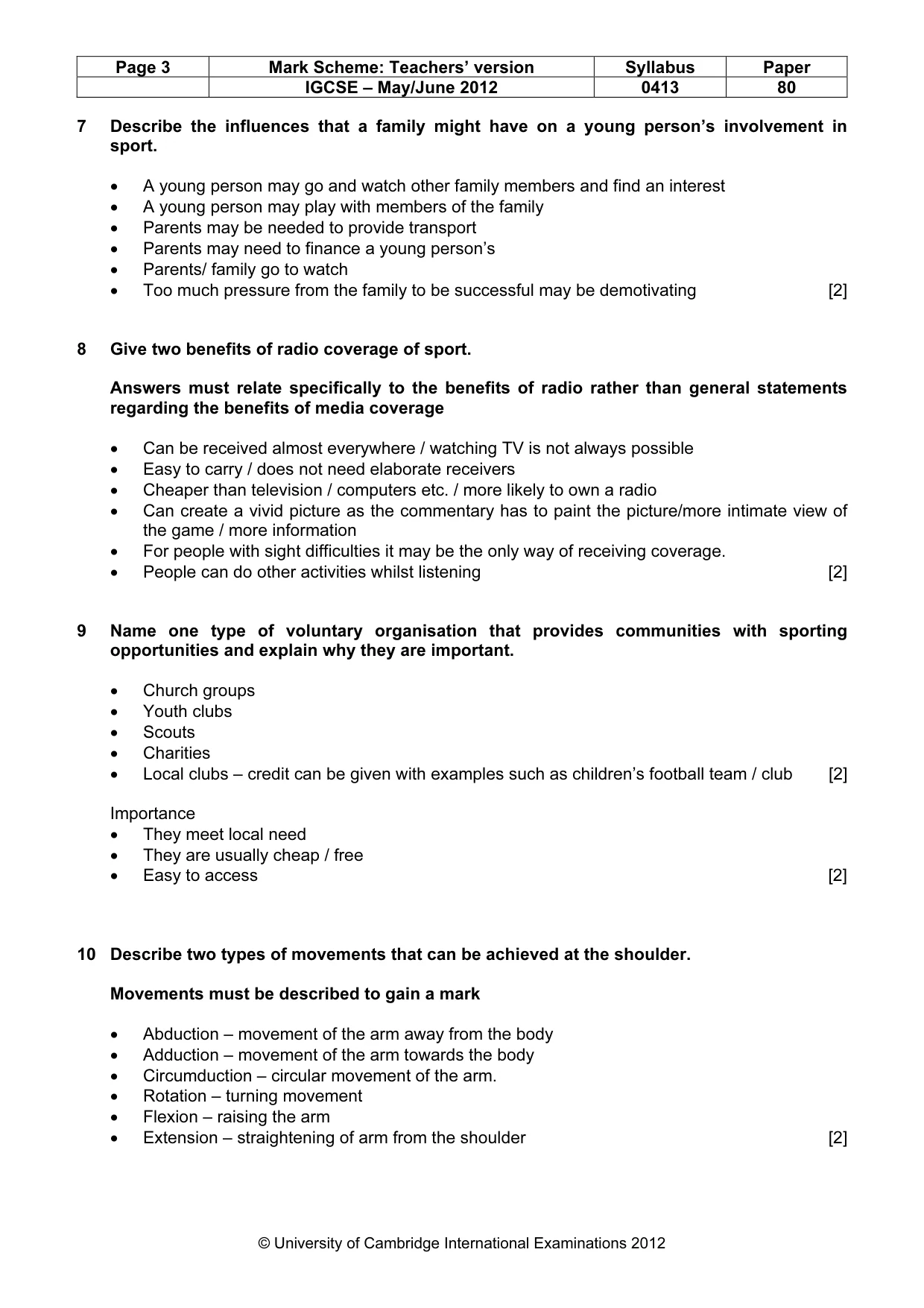
Page 3 Mark Scheme: Teachers’ version Syllabus Paper IGCSE – May/June 2012 0413 80 © University of Cambridge International Examinations 2012 7 Describe the influences that a family might have on a young person’s involvement in sport. • A young person may go and watch other family members and find an interest • A young person may play with members of the family • Parents may be needed to provide transport • Parents may need to finance a young person’s • Parents/ family go to watch • Too much pressure from the family to be successful may be demotivating [2] 8 Give two benefits of radio coverage of sport. Answers must relate specifically to the benefits of radio rather than general statements regarding the benefits of media coverage • Can be received almost everywhere / watching TV is not always possible • Easy to carry / does not need elaborate receivers • Cheaper than television / computers etc. / more likely to own a radio • Can create a vivid picture as the commentary has to paint the picture/more intimate view of the game / more information • For people with sight difficulties it may be the only way of receiving coverage. • People can do other activities whilst listening [2] 9 Name one type of voluntary organisation that provides communities with sporting opportunities and explain why they are important. • Church groups • Youth clubs • Scouts • Charities • Local clubs – credit can be given with examples such as children’s football team / club [2] Importance • They meet local need • They are usually cheap / free • Easy to access [2] 10 Describe two types of movements that can be achieved at the shoulder. Movements must be described to gain a mark • Abduction – movement of the arm away from the body • Adduction – movement of the arm towards the body • Circumduction – circular movement of the arm. • Rotation – turning movement • Flexion – raising the arm • Extension – straightening of arm from the shoulder [2]
Mark scheme, page 4
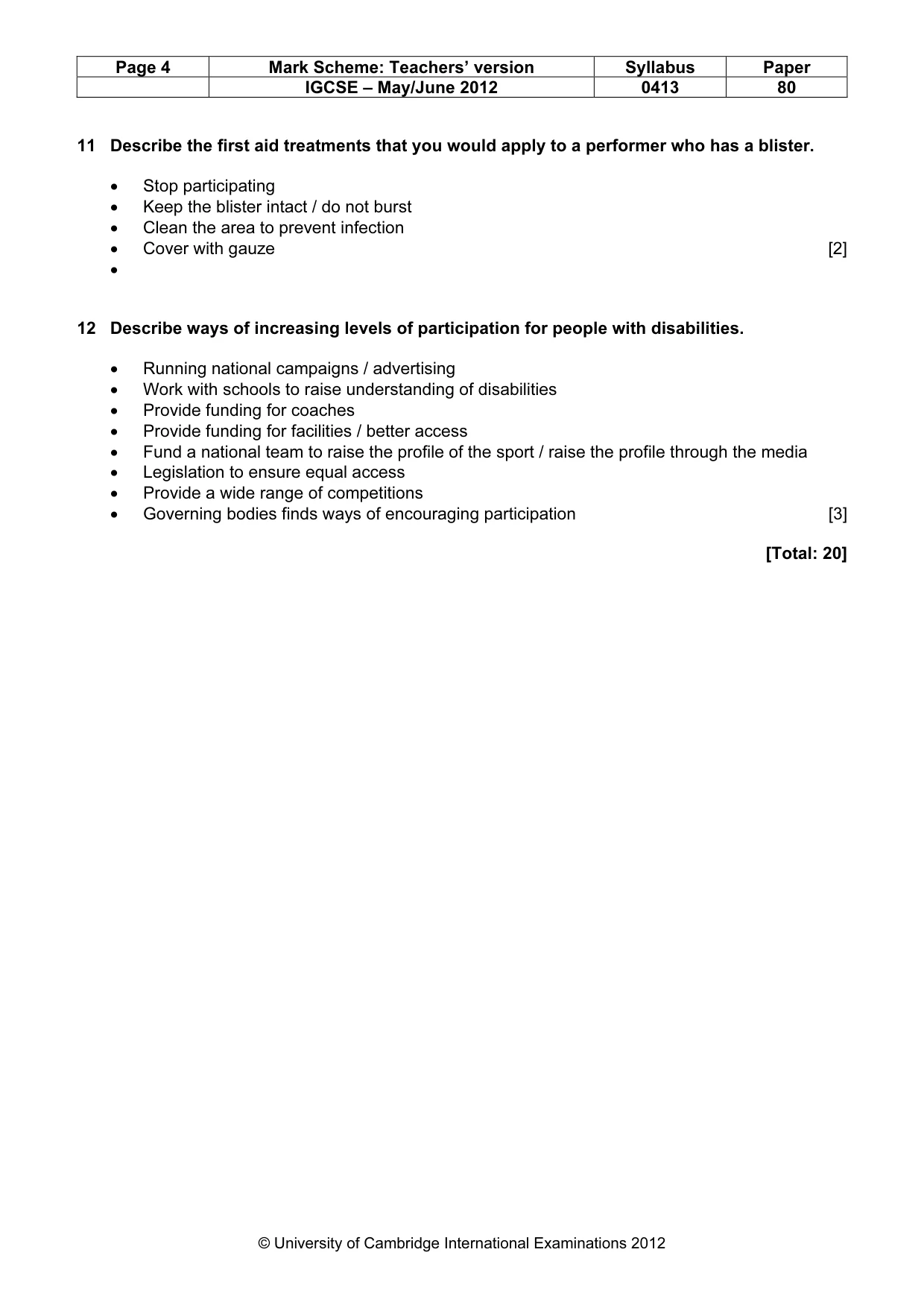
Page 4 Mark Scheme: Teachers’ version Syllabus Paper IGCSE – May/June 2012 0413 80 © University of Cambridge International Examinations 2012 11 Describe the first aid treatments that you would apply to a performer who has a blister. • Stop participating • Keep the blister intact / do not burst • Clean the area to prevent infection • Cover with gauze [2] • 12 Describe ways of increasing levels of participation for people with disabilities. • Running national campaigns / advertising • Work with schools to raise understanding of disabilities • Provide funding for coaches • Provide funding for facilities / better access • Fund a national team to raise the profile of the sport / raise the profile through the media • Legislation to ensure equal access • Provide a wide range of competitions • Governing bodies finds ways of encouraging participation [3] [Total: 20]
Mark scheme, page 5
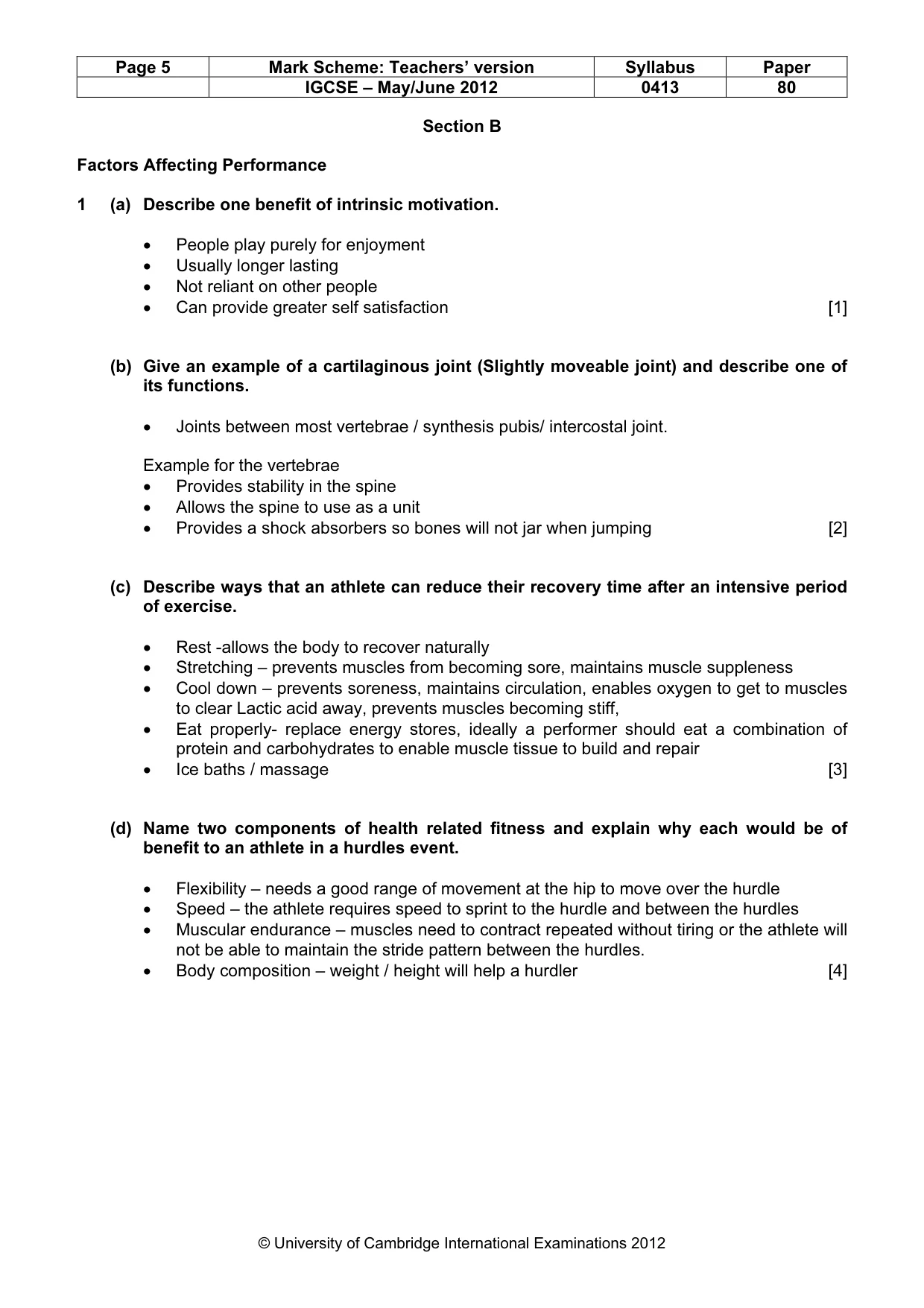
Page 5 Mark Scheme: Teachers’ version Syllabus Paper IGCSE – May/June 2012 0413 80 © University of Cambridge International Examinations 2012 Section B Factors Affecting Performance 1 (a) Describe one benefit of intrinsic motivation. • People play purely for enjoyment • Usually longer lasting • Not reliant on other people • Can provide greater self satisfaction [1] (b) Give an example of a cartilaginous joint (Slightly moveable joint) and describe one of its functions. • Joints between most vertebrae / synthesis pubis/ intercostal joint. Example for the vertebrae • Provides stability in the spine • Allows the spine to use as a unit • Provides a shock absorbers so bones will not jar when jumping [2] (c) Describe ways that an athlete can reduce their recovery time after an intensive period of exercise. • Rest -allows the body to recover naturally • Stretching – prevents muscles from becoming sore, maintains muscle suppleness • Cool down – prevents soreness, maintains circulation, enables oxygen to get to muscles to clear Lactic acid away, prevents muscles becoming stiff, • Eat properly- replace energy stores, ideally a performer should eat a combination of protein and carbohydrates to enable muscle tissue to build and repair • Ice baths / massage [3] (d) Name two components of health related fitness and explain why each would be of benefit to an athlete in a hurdles event. • Flexibility – needs a good range of movement at the hip to move over the hurdle • Speed – the athlete requires speed to sprint to the hurdle and between the hurdles • Muscular endurance – muscles need to contract repeated without tiring or the athlete will not be able to maintain the stride pattern between the hurdles. • Body composition – weight / height will help a hurdler [4]
Mark scheme, page 6
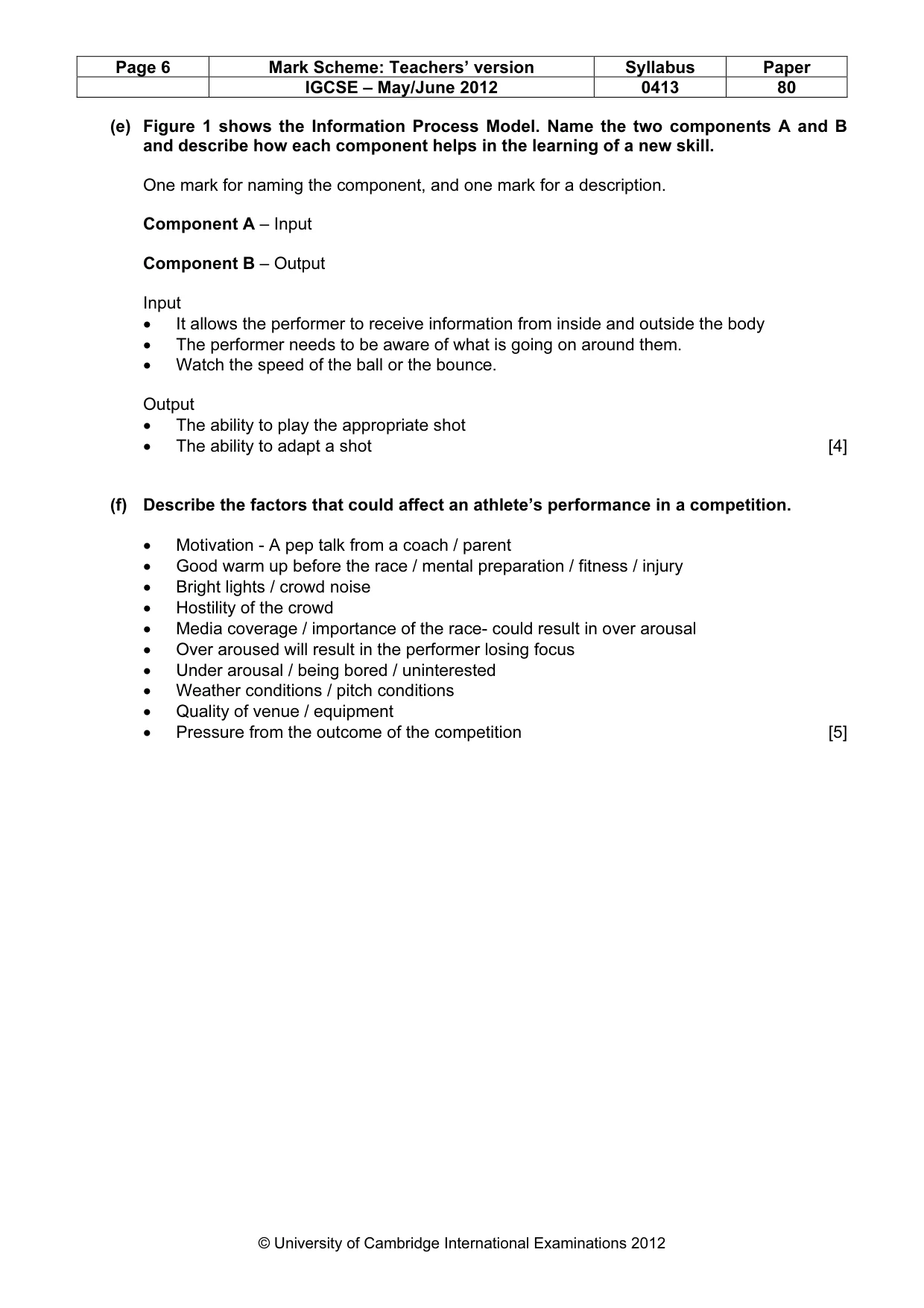
Page 6 Mark Scheme: Teachers’ version Syllabus Paper IGCSE – May/June 2012 0413 80 © University of Cambridge International Examinations 2012 (e) Figure 1 shows the Information Process Model. Name the two components A and B and describe how each component helps in the learning of a new skill. One mark for naming the component, and one mark for a description. Component A – Input Component B – Output Input • It allows the performer to receive information from inside and outside the body • The performer needs to be aware of what is going on around them. • Watch the speed of the ball or the bounce. Output • The ability to play the appropriate shot • The ability to adapt a shot [4] (f) Describe the factors that could affect an athlete’s performance in a competition. • Motivation - A pep talk from a coach / parent • Good warm up before the race / mental preparation / fitness / injury • Bright lights / crowd noise • Hostility of the crowd • Media coverage / importance of the race- could result in over arousal • Over aroused will result in the performer losing focus • Under arousal / being bored / uninterested • Weather conditions / pitch conditions • Quality of venue / equipment • Pressure from the outcome of the competition [5]
Mark scheme, page 7
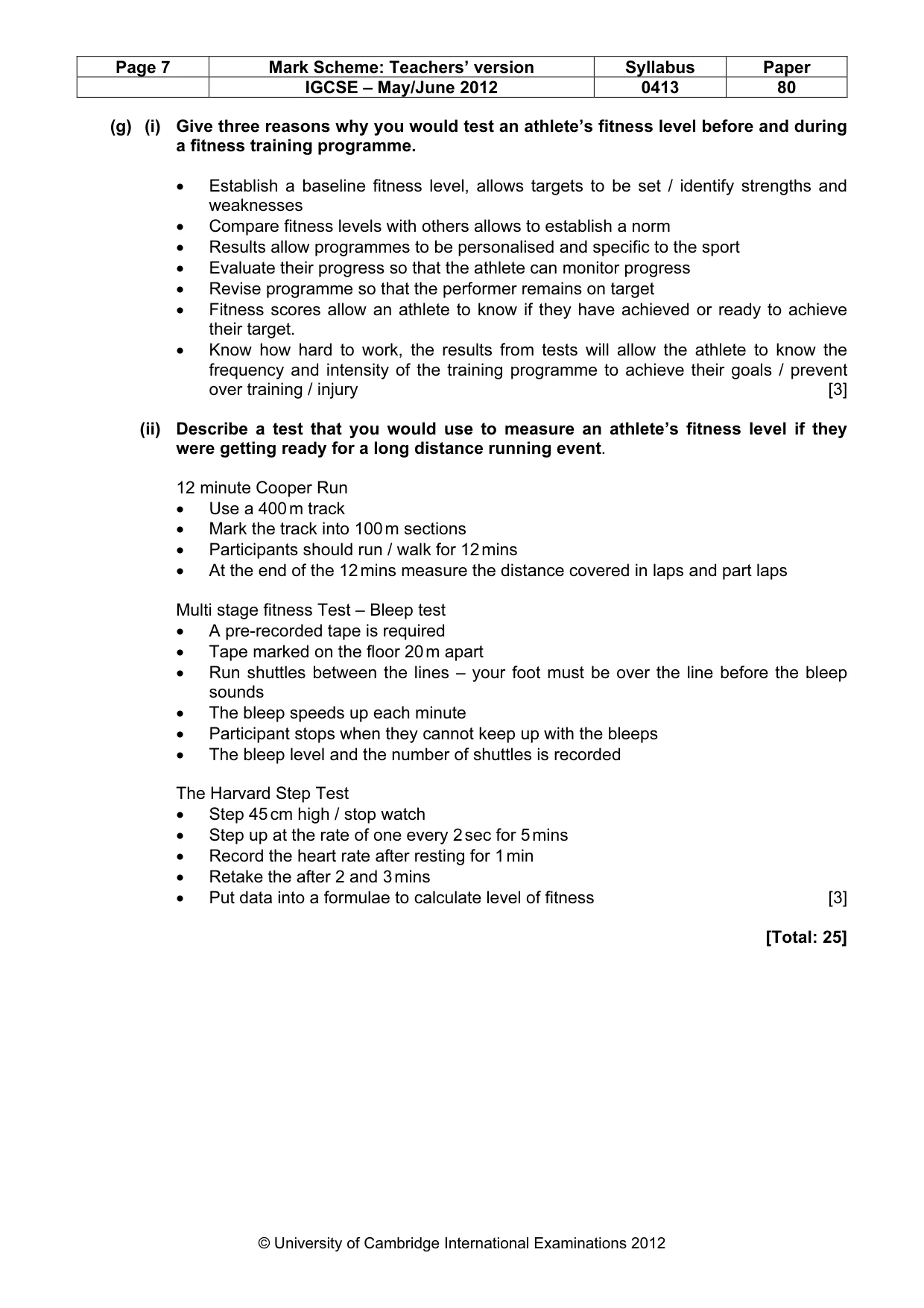
Page 7 Mark Scheme: Teachers’ version Syllabus Paper IGCSE – May/June 2012 0413 80 © University of Cambridge International Examinations 2012 (g) (i) Give three reasons why you would test an athlete’s fitness level before and during a fitness training programme. • Establish a baseline fitness level, allows targets to be set / identify strengths and weaknesses • Compare fitness levels with others allows to establish a norm • Results allow programmes to be personalised and specific to the sport • Evaluate their progress so that the athlete can monitor progress • Revise programme so that the performer remains on target • Fitness scores allow an athlete to know if they have achieved or ready to achieve their target. • Know how hard to work, the results from tests will allow the athlete to know the frequency and intensity of the training programme to achieve their goals / prevent over training / injury [3] (ii) Describe a test that you would use to measure an athlete’s fitness level if they were getting ready for a long distance running event. 12 minute Cooper Run • Use a 400 m track • Mark the track into 100 m sections • Participants should run / walk for 12 mins • At the end of the 12 mins measure the distance covered in laps and part laps Multi stage fitness Test – Bleep test • A pre-recorded tape is required • Tape marked on the floor 20 m apart • Run shuttles between the lines – your foot must be over the line before the bleep sounds • The bleep speeds up each minute • Participant stops when they cannot keep up with the bleeps • The bleep level and the number of shuttles is recorded The Harvard Step Test • Step 45 cm high / stop watch • Step up at the rate of one every 2 sec for 5 mins • Record the heart rate after resting for 1 min • Retake the after 2 and 3 mins • Put data into a formulae to calculate level of fitness [3] [Total: 25]
Mark scheme, page 8
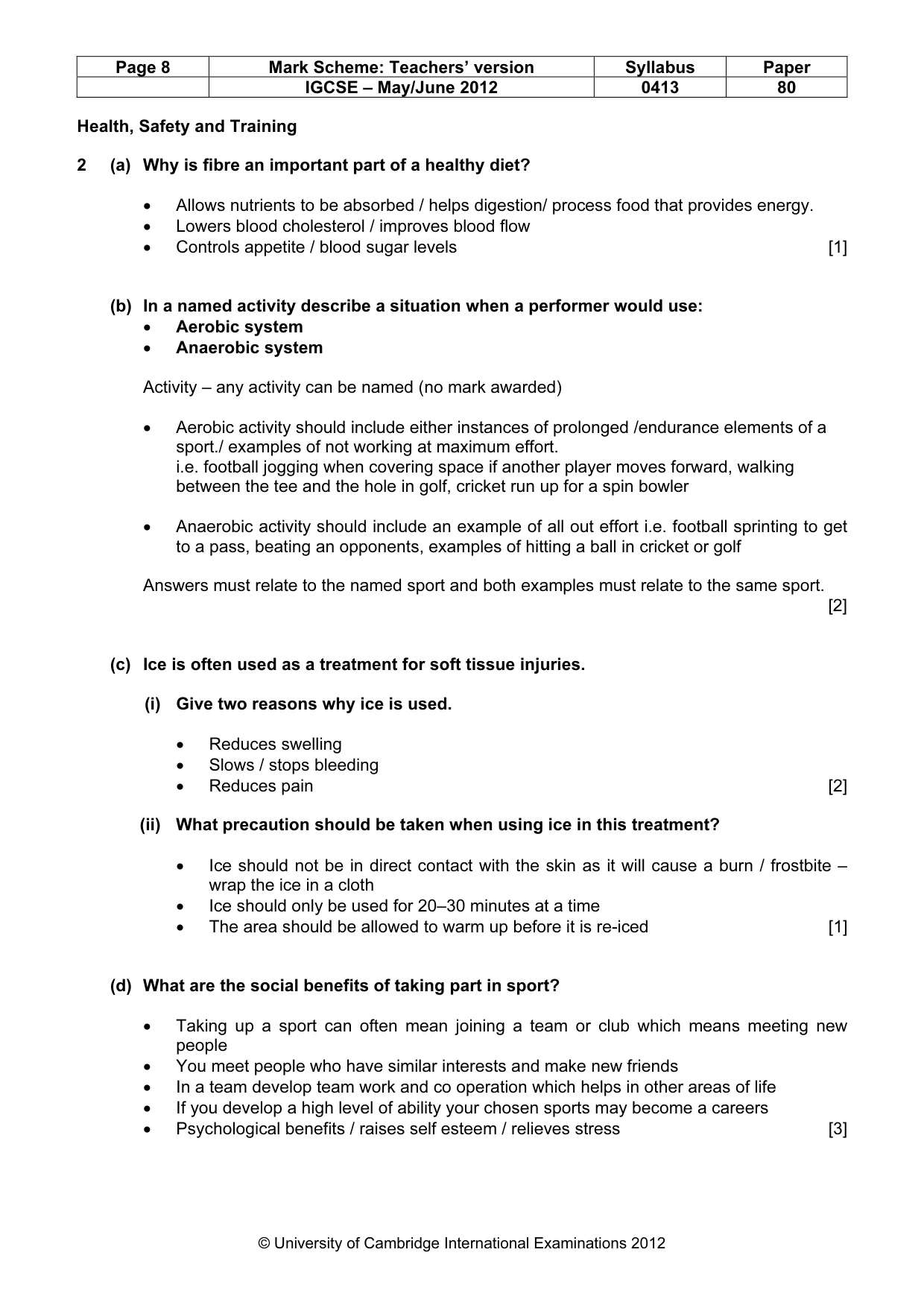
Page 8 Mark Scheme: Teachers’ version Syllabus Paper IGCSE – May/June 2012 0413 80 © University of Cambridge International Examinations 2012 Health, Safety and Training 2 (a) Why is fibre an important part of a healthy diet? • Allows nutrients to be absorbed / helps digestion/ process food that provides energy. • Lowers blood cholesterol / improves blood flow • Controls appetite / blood sugar levels [1] (b) In a named activity describe a situation when a performer would use: • Aerobic system • Anaerobic system Activity – any activity can be named (no mark awarded) • Aerobic activity should include either instances of prolonged /endurance elements of a sport./ examples of not working at maximum effort. i.e. football jogging when covering space if another player moves forward, walking between the tee and the hole in golf, cricket run up for a spin bowler • Anaerobic activity should include an example of all out effort i.e. football sprinting to get to a pass, beating an opponents, examples of hitting a ball in cricket or golf Answers must relate to the named sport and both examples must relate to the same sport. [2] (c) Ice is often used as a treatment for soft tissue injuries. (i) Give two reasons why ice is used. • Reduces swelling • Slows / stops bleeding • Reduces pain [2] (ii) What precaution should be taken when using ice in this treatment? • Ice should not be in direct contact with the skin as it will cause a burn / frostbite – wrap the ice in a cloth • Ice should only be used for 20–30 minutes at a time • The area should be allowed to warm up before it is re-iced [1] (d) What are the social benefits of taking part in sport? • Taking up a sport can often mean joining a team or club which means meeting new people • You meet people who have similar interests and make new friends • In a team develop team work and co operation which helps in other areas of life • If you develop a high level of ability your chosen sports may become a careers • Psychological benefits / raises self esteem / relieves stress [3]
Mark scheme, page 9
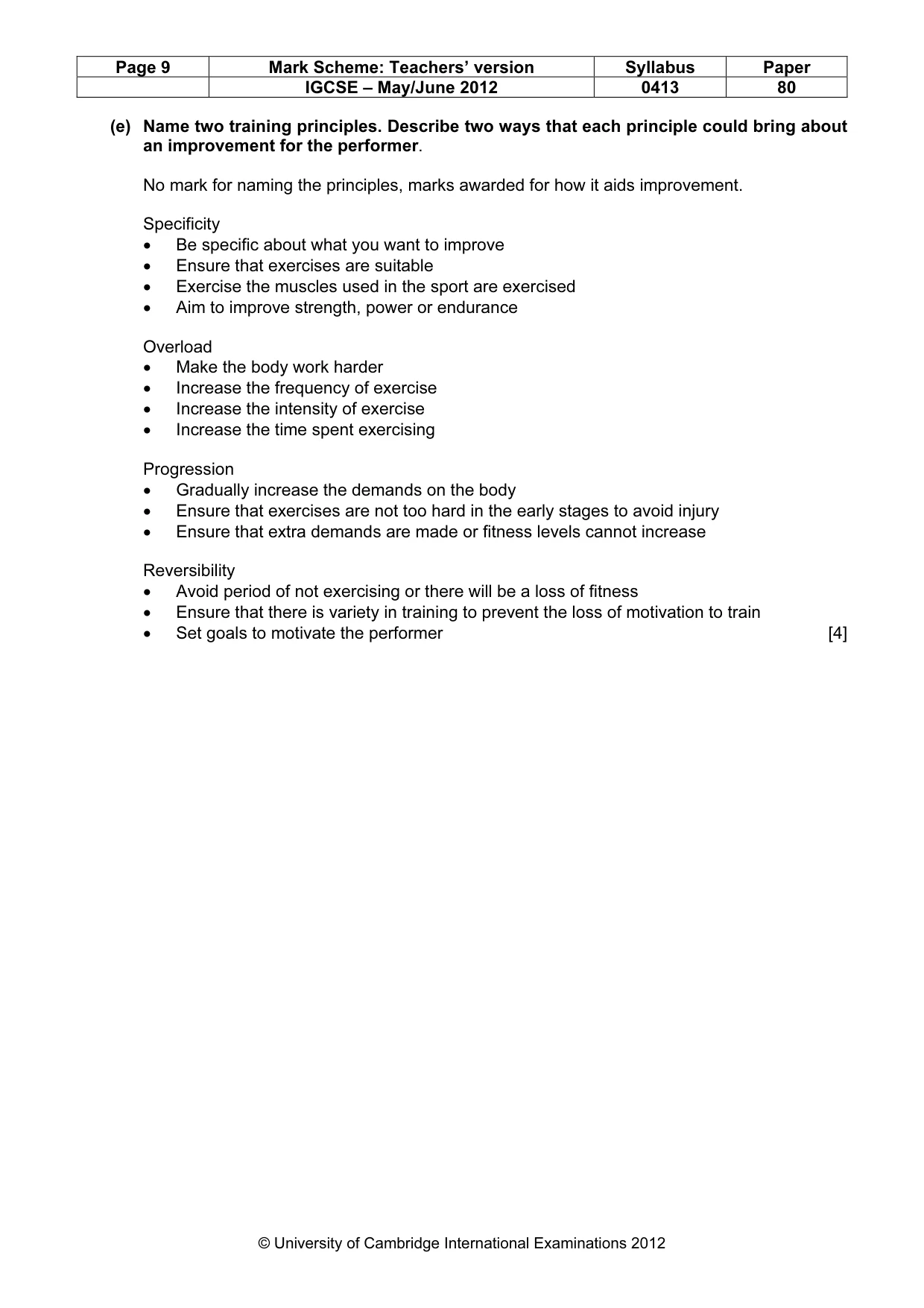
Page 9 Mark Scheme: Teachers’ version Syllabus Paper IGCSE – May/June 2012 0413 80 © University of Cambridge International Examinations 2012 (e) Name two training principles. Describe two ways that each principle could bring about an improvement for the performer. No mark for naming the principles, marks awarded for how it aids improvement. Specificity • Be specific about what you want to improve • Ensure that exercises are suitable • Exercise the muscles used in the sport are exercised • Aim to improve strength, power or endurance Overload • Make the body work harder • Increase the frequency of exercise • Increase the intensity of exercise • Increase the time spent exercising Progression • Gradually increase the demands on the body • Ensure that exercises are not too hard in the early stages to avoid injury • Ensure that extra demands are made or fitness levels cannot increase Reversibility • Avoid period of not exercising or there will be a loss of fitness • Ensure that there is variety in training to prevent the loss of motivation to train • Set goals to motivate the performer [4]
Mark scheme, page 10
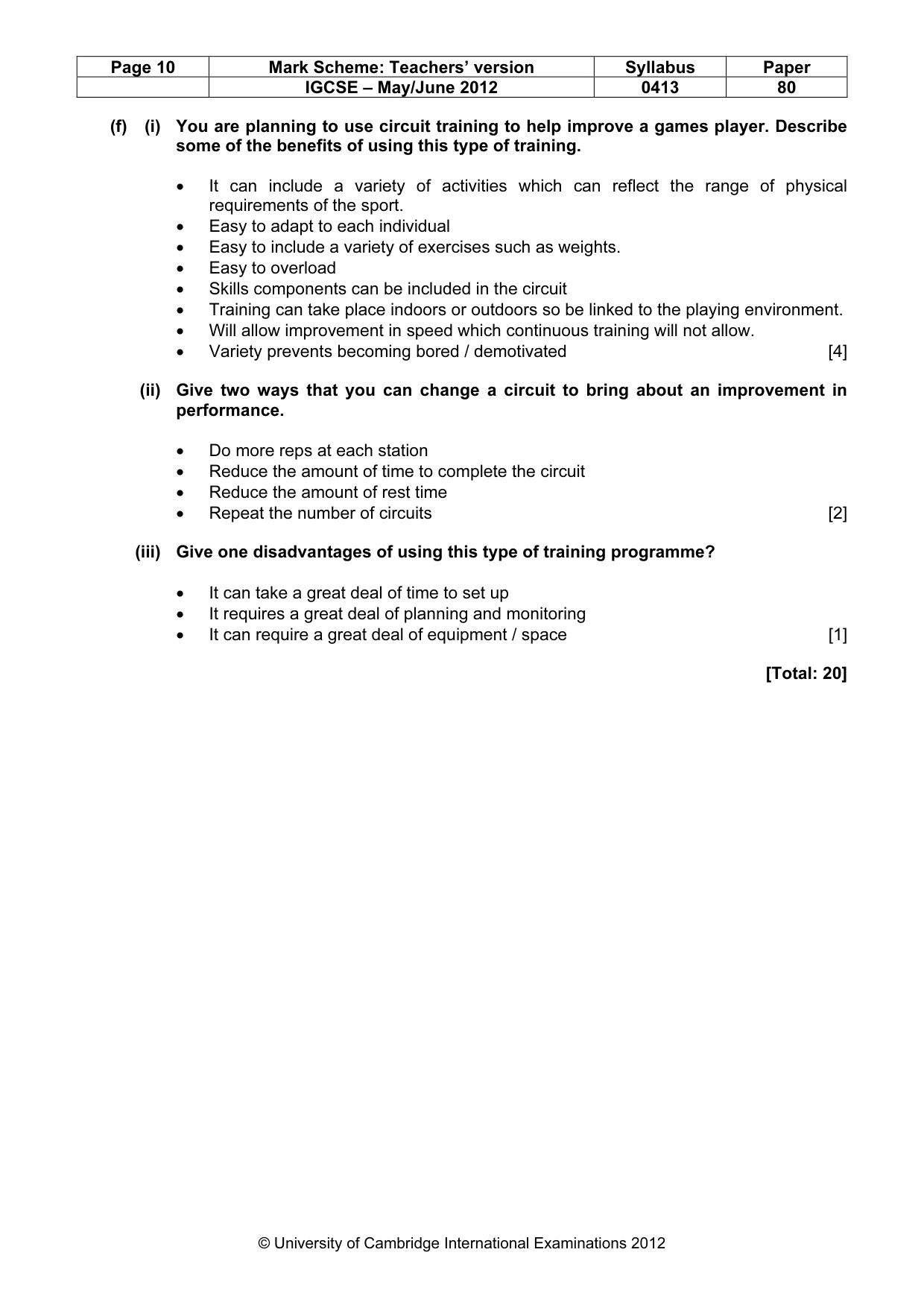
Page 10 Mark Scheme: Teachers’ version Syllabus Paper IGCSE – May/June 2012 0413 80 © University of Cambridge International Examinations 2012 (f) (i) You are planning to use circuit training to help improve a games player. Describe some of the benefits of using this type of training. • It can include a variety of activities which can reflect the range of physical requirements of the sport. • Easy to adapt to each individual • Easy to include a variety of exercises such as weights. • Easy to overload • Skills components can be included in the circuit • Training can take place indoors or outdoors so be linked to the playing environment. • Will allow improvement in speed which continuous training will not allow. • Variety prevents becoming bored / demotivated [4] (ii) Give two ways that you can change a circuit to bring about an improvement in performance. • Do more reps at each station • Reduce the amount of time to complete the circuit • Reduce the amount of rest time • Repeat the number of circuits [2] (iii) Give one disadvantages of using this type of training programme? • It can take a great deal of time to set up • It requires a great deal of planning and monitoring • It can require a great deal of equipment / space [1] [Total: 20]
Mark scheme, page 11
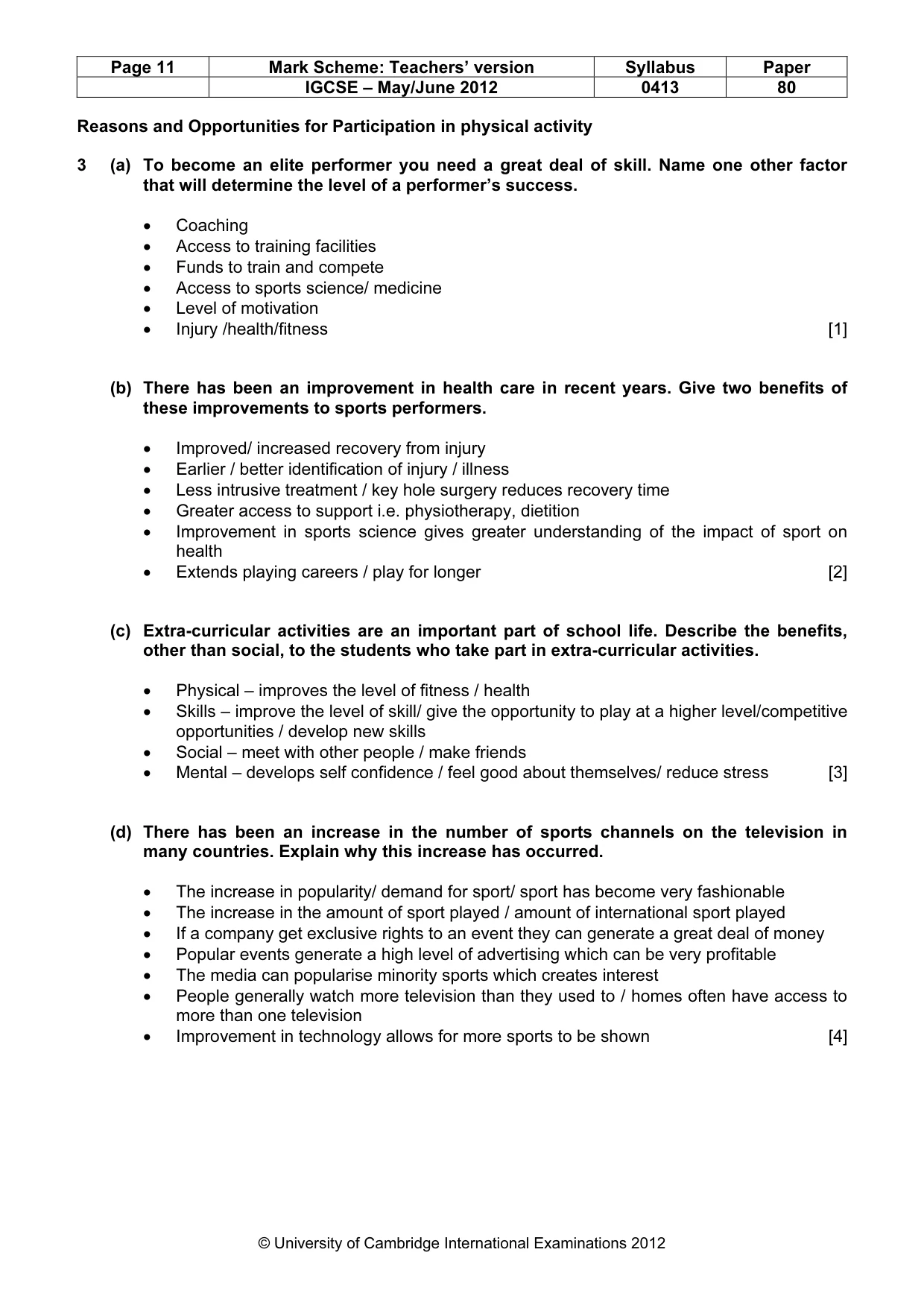
Page 11 Mark Scheme: Teachers’ version Syllabus Paper IGCSE – May/June 2012 0413 80 © University of Cambridge International Examinations 2012 Reasons and Opportunities for Participation in physical activity 3 (a) To become an elite performer you need a great deal of skill. Name one other factor that will determine the level of a performer’s success. • Coaching • Access to training facilities • Funds to train and compete • Access to sports science/ medicine • Level of motivation • Injury /health/fitness [1] (b) There has been an improvement in health care in recent years. Give two benefits of these improvements to sports performers. • Improved/ increased recovery from injury • Earlier / better identification of injury / illness • Less intrusive treatment / key hole surgery reduces recovery time • Greater access to support i.e. physiotherapy, dietition • Improvement in sports science gives greater understanding of the impact of sport on health • Extends playing careers / play for longer [2] (c) Extra-curricular activities are an important part of school life. Describe the benefits, other than social, to the students who take part in extra-curricular activities. • Physical – improves the level of fitness / health • Skills – improve the level of skill/ give the opportunity to play at a higher level/competitive opportunities / develop new skills • Social – meet with other people / make friends • Mental – develops self confidence / feel good about themselves/ reduce stress [3] (d) There has been an increase in the number of sports channels on the television in many countries. Explain why this increase has occurred. • The increase in popularity/ demand for sport/ sport has become very fashionable • The increase in the amount of sport played / amount of international sport played • If a company get exclusive rights to an event they can generate a great deal of money • Popular events generate a high level of advertising which can be very profitable • The media can popularise minority sports which creates interest • People generally watch more television than they used to / homes often have access to more than one television • Improvement in technology allows for more sports to be shown [4]
Mark scheme, page 12
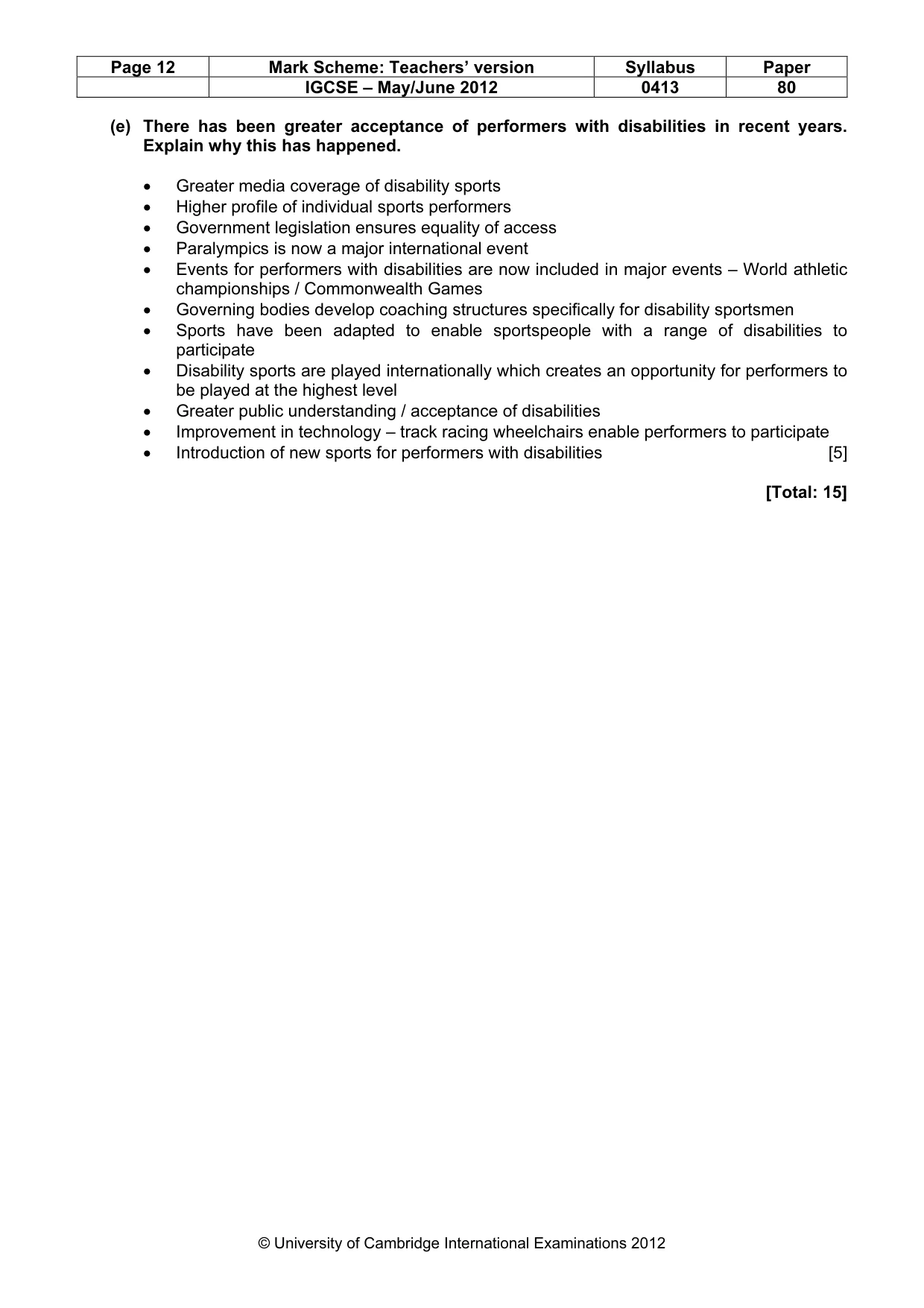
Page 12 Mark Scheme: Teachers’ version Syllabus Paper IGCSE – May/June 2012 0413 80 © University of Cambridge International Examinations 2012 (e) There has been greater acceptance of performers with disabilities in recent years. Explain why this has happened. • Greater media coverage of disability sports • Higher profile of individual sports performers • Government legislation ensures equality of access • Paralympics is now a major international event • Events for performers with disabilities are now included in major events – World athletic championships / Commonwealth Games • Governing bodies develop coaching structures specifically for disability sportsmen • Sports have been adapted to enable sportspeople with a range of disabilities to participate • Disability sports are played internationally which creates an opportunity for performers to be played at the highest level • Greater public understanding / acceptance of disabilities • Improvement in technology – track racing wheelchairs enable performers to participate • Introduction of new sports for performers with disabilities [5] [Total: 15]
What you needed in this session
Cambridge’s own grade thresholds for 2012 May/June, Paper 1 · Variant 3. A higher threshold means an easier paper — the bar moves with how the cohort did.