Cambridge IGCSE Physical Education 0413 — 2011 Oct/Nov Paper 1 · Variant 1
0413/11/O/N/11 · 80 marks · ≈90 min
The question paper and its mark scheme, free to read here and free to download. This is Cambridge’s own paper, exactly as it was sat.
Question paper12 pages

Mark scheme9 pages
Answers below. Sit the paper first if you are practising.
Paper as text
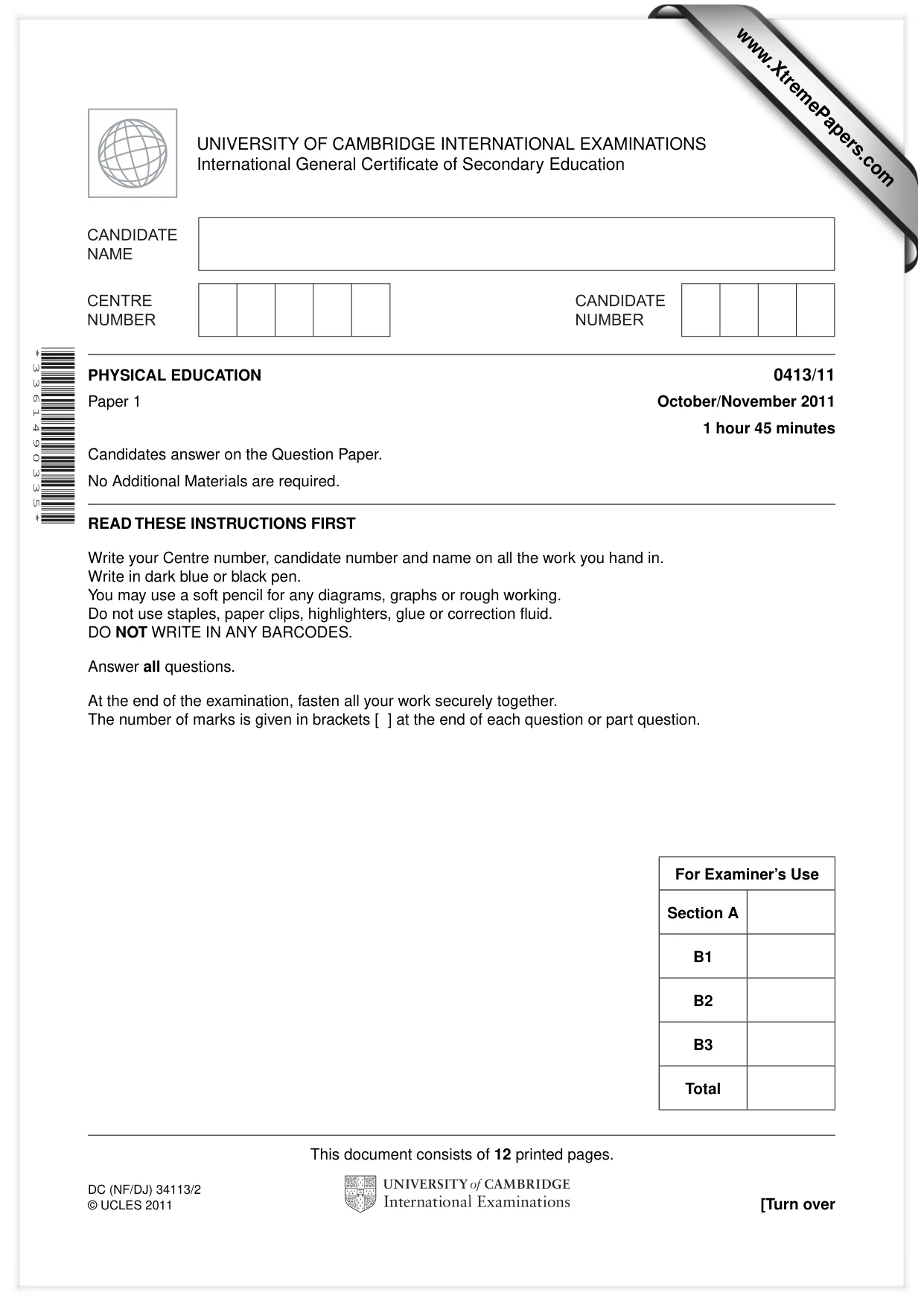
Question paper, page 1
This document consists of 12 printed pages. DC (NF/DJ) 34113/2 © UCLES 2011 [Turn over UNIVERSITY OF CAMBRIDGE INTERNATIONAL EXAMINATIONS International General Certificate of Secondary Education * 3 3 6 1 4 9 0 3 3 5 * PHYSICAL EDUCATION 0413/11 Paper 1 October/November 2011 1 hour 45 minutes Candidates answer on the Question Paper. No Additional Materials are required. READ THESE INSTRUCTIONS FIRST Write your Centre number, candidate number and name on all the work you hand in. Write in dark blue or black pen. You may use a soft pencil for any diagrams, graphs or rough working. Do not use staples, paper clips, highlighters, glue or correction fluid. DO NOT WRITE IN ANY BARCODES. Answer all questions. At the end of the examination, fasten all your work securely together. The number of marks is given in brackets [ ] at the end of each question or part question. For Examiner’s Use Section A B1 B2 B3 Total www.XtremePapers.com
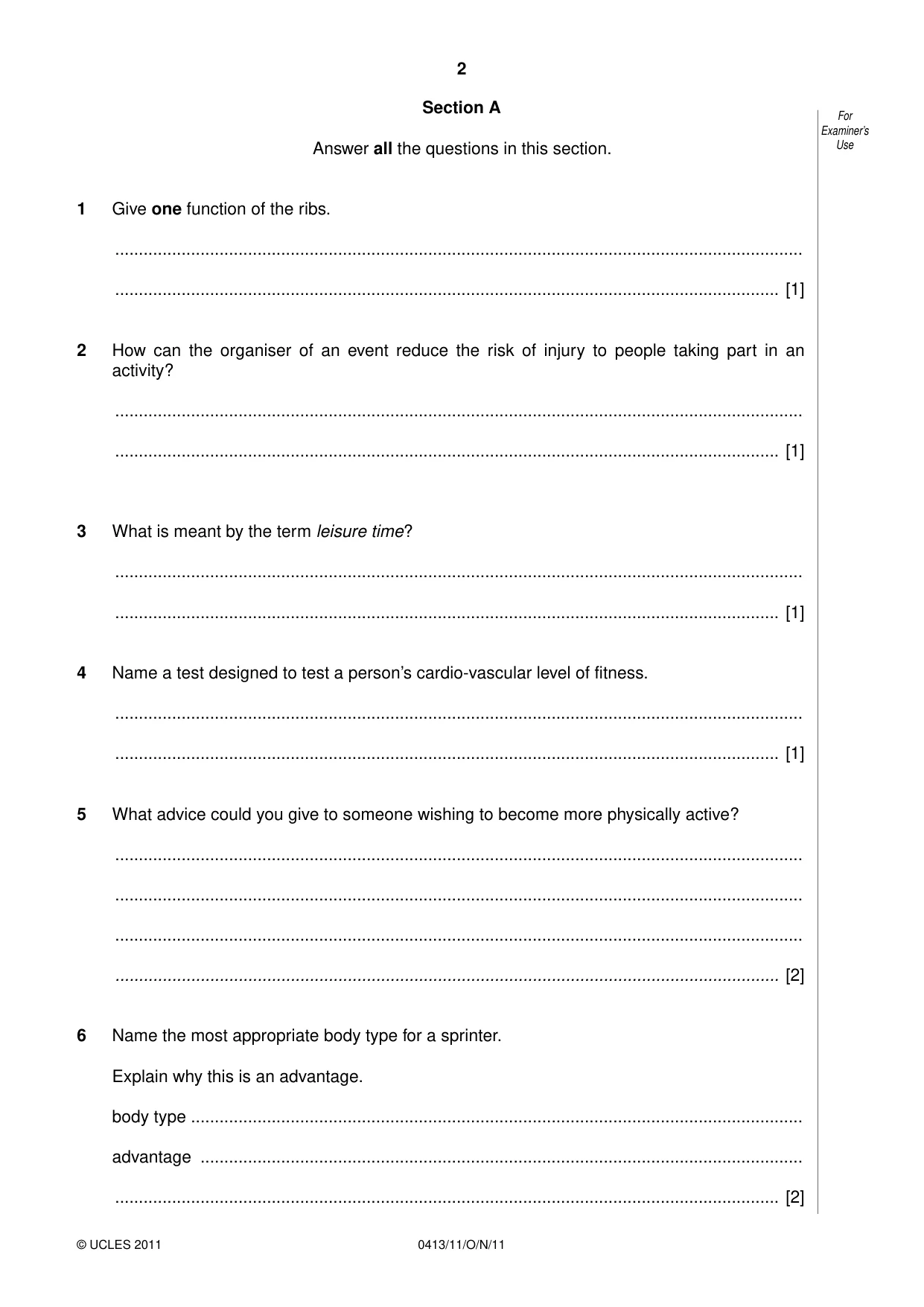
Question paper, page 2
2 0413/11/O/N/11 © UCLES 2011 For Examiner’s Use Section A Answer all the questions in this section. 1 Give one function of the ribs. … … [1] 2 How can the organiser of an event reduce the risk of injury to people taking part in an activity? … … [1] 3 What is meant by the term leisure time? … … [1] 4 Name a test designed to test a person’s cardio-vascular level of fitness. … … [1] 5 What advice could you give to someone wishing to become more physically active? … … … … [2] 6 Name the most appropriate body type for a sprinter. Explain why this is an advantage. body type … advantage … … [2]
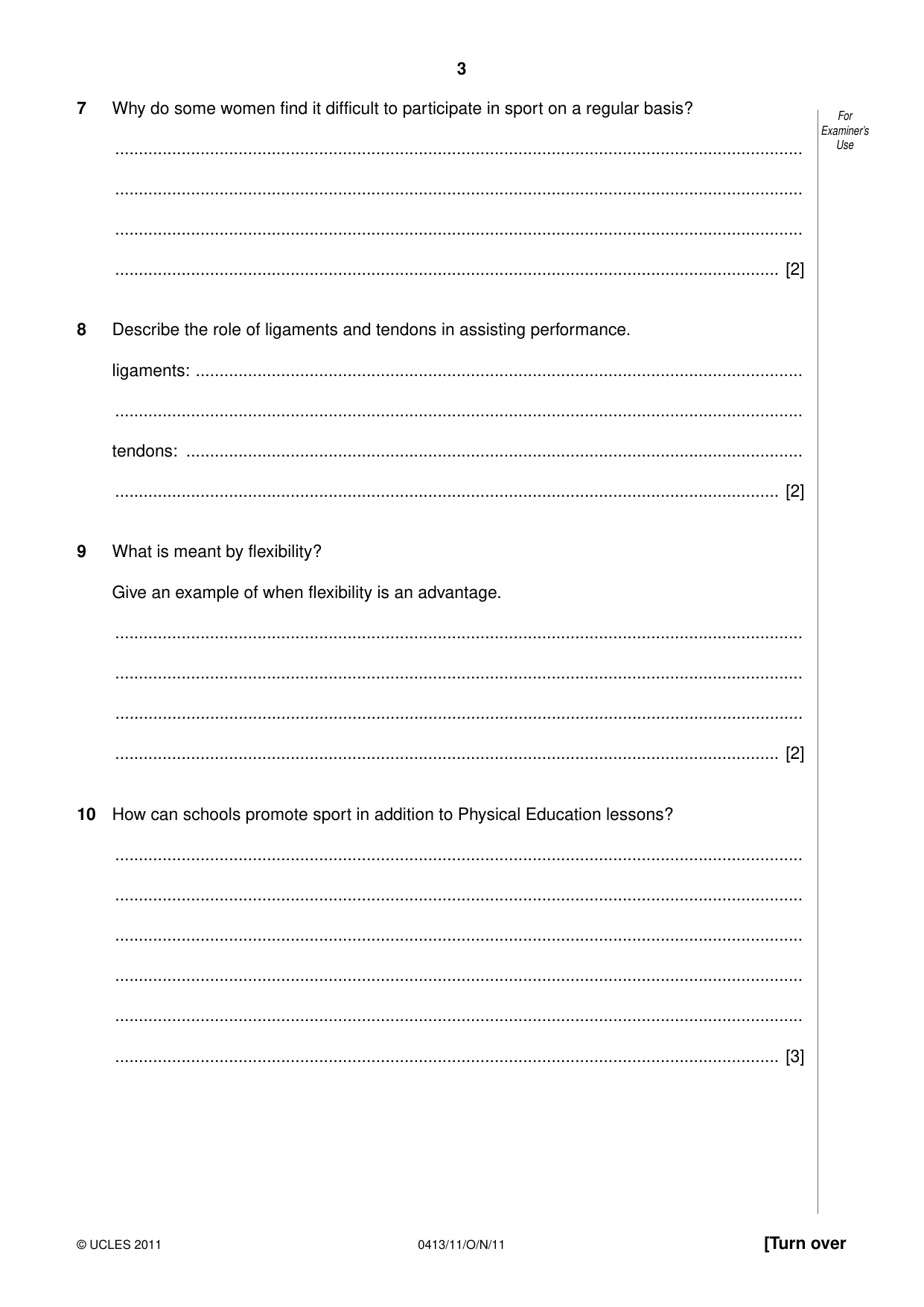
Question paper, page 3
3 0413/11/O/N/11 © UCLES 2011 [Turn over For Examiner’s Use 7 Why do some women find it difficult to participate in sport on a regular basis? … … … … [2] 8 Describe the role of ligaments and tendons in assisting performance. ligaments: … … tendons: … … [2] 9 What is meant by flexibility? Give an example of when flexibility is an advantage. … … … … [2] 10 How can schools promote sport in addition to Physical Education lessons? … … … … … … [3]
Question paper, page 4
4 0413/11/O/N/11 © UCLES 2011 For Examiner’s Use 11 How can performers maintain an amateur status while being able to perform at the highest level? … … … … [3] [Total: 20]
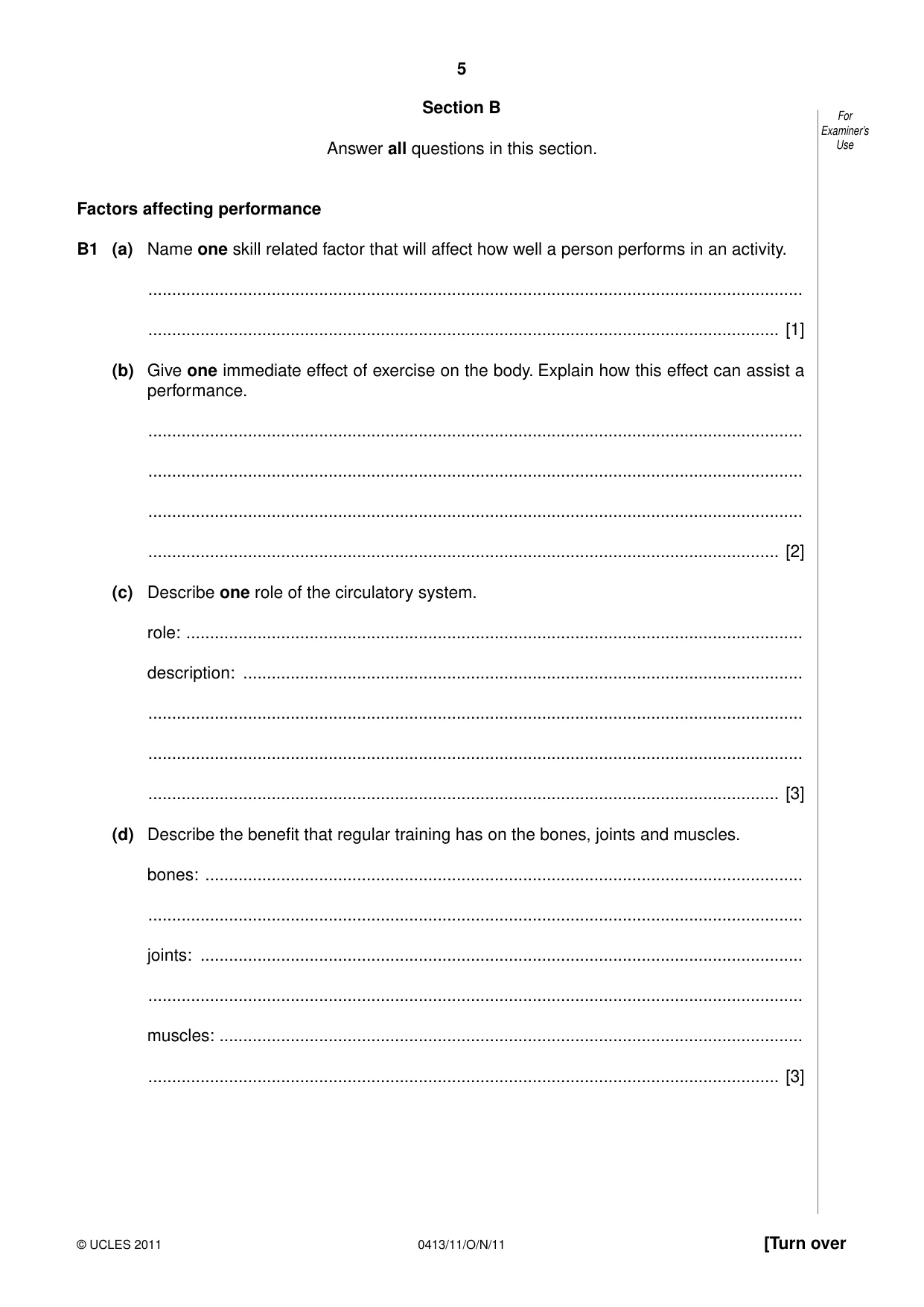
Question paper, page 5
5 0413/11/O/N/11 © UCLES 2011 [Turn over For Examiner’s Use Section B Answer all questions in this section. Factors affecting performance B1 (a) Name one skill related factor that will affect how well a person performs in an activity. … … [1] (b) Give one immediate effect of exercise on the body. Explain how this effect can assist a performance. … … … … [2] (c) Describe one role of the circulatory system. role: … description: … … … … [3] (d) Describe the benefit that regular training has on the bones, joints and muscles. bones: … … joints: … … muscles: … … [3]
Question paper, page 6
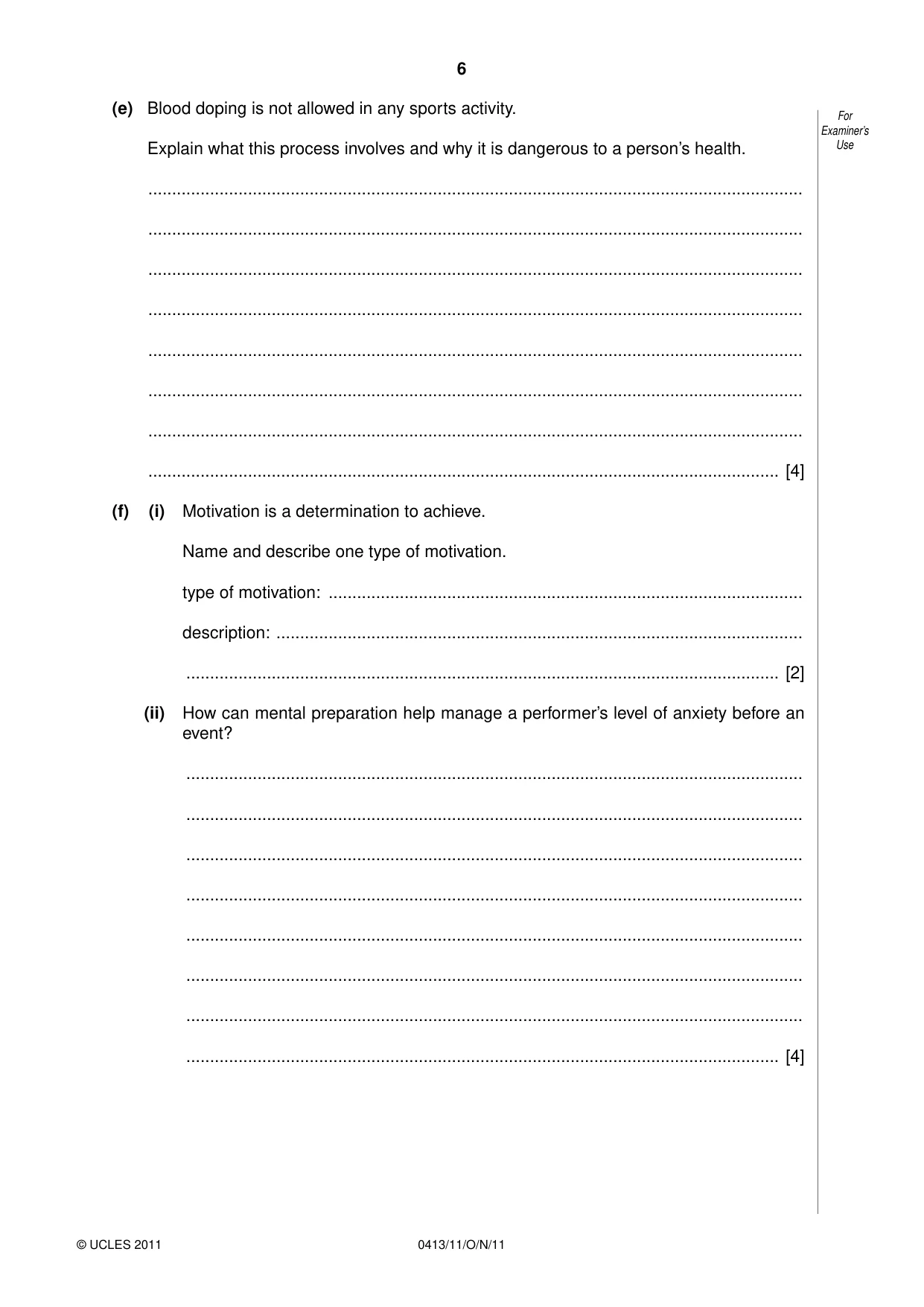
6 0413/11/O/N/11 © UCLES 2011 For Examiner’s Use (e) Blood doping is not allowed in any sports activity. Explain what this process involves and why it is dangerous to a person’s health. … … … … … … … … [4] (f) (i) Motivation is a determination to achieve. Name and describe one type of motivation. type of motivation: … description: … … [2] (ii) How can mental preparation help manage a performer’s level of anxiety before an event? … … … … … … … … [4]
Question paper, page 7
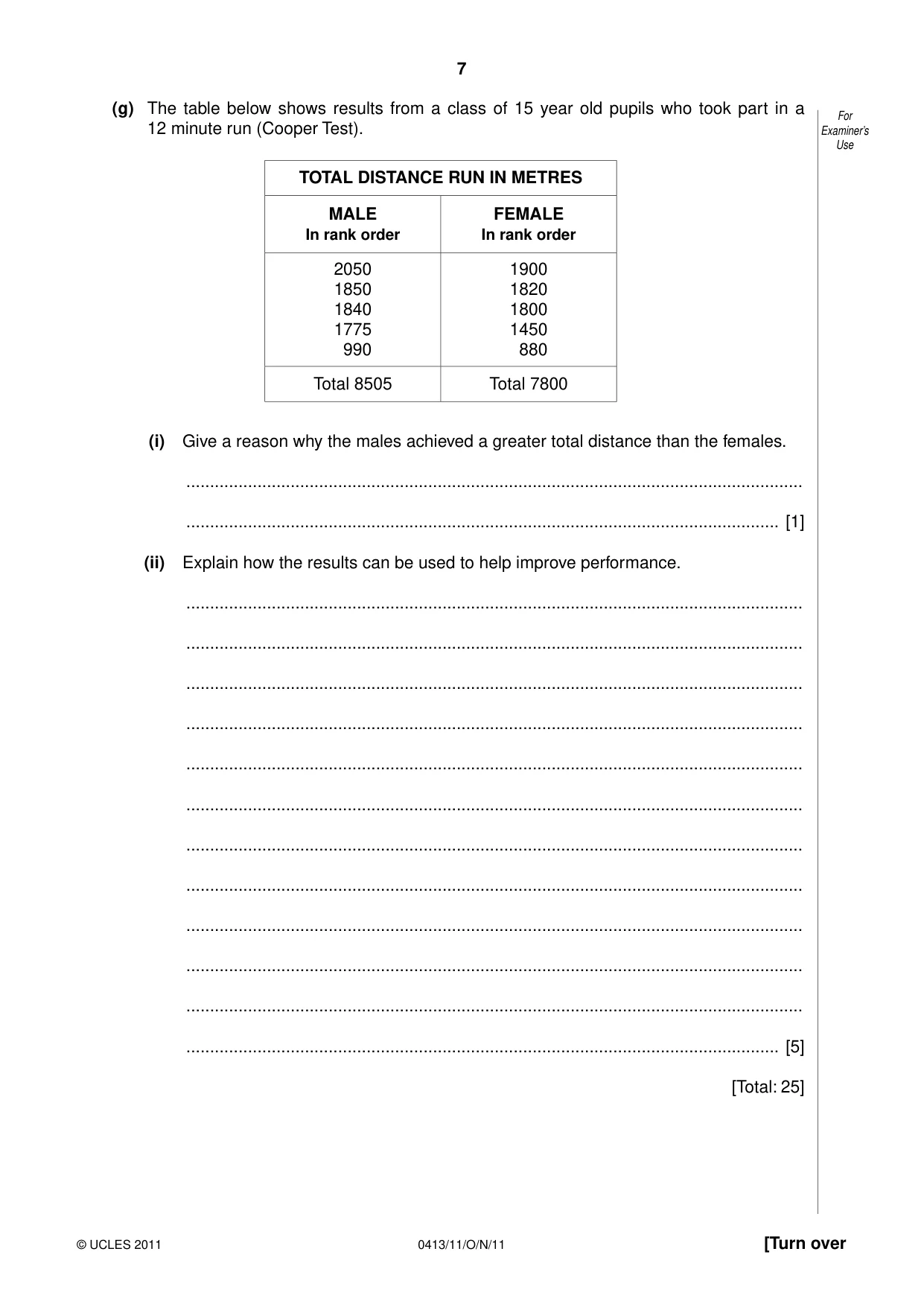
7 0413/11/O/N/11 © UCLES 2011 [Turn over For Examiner’s Use (g) The table below shows results from a class of 15 year old pupils who took part in a 12 minute run (Cooper Test). TOTAL DISTANCE RUN IN METRES MALE In rank order FEMALE In rank order 2050 1850 1840 1775 990 1900 1820 1800 1450 880 Total 8505 Total 7800 (i) Give a reason why the males achieved a greater total distance than the females. … … [1] (ii) Explain how the results can be used to help improve performance. … … … … … … … … … … … … [5] [Total: 25]
Question paper, page 8
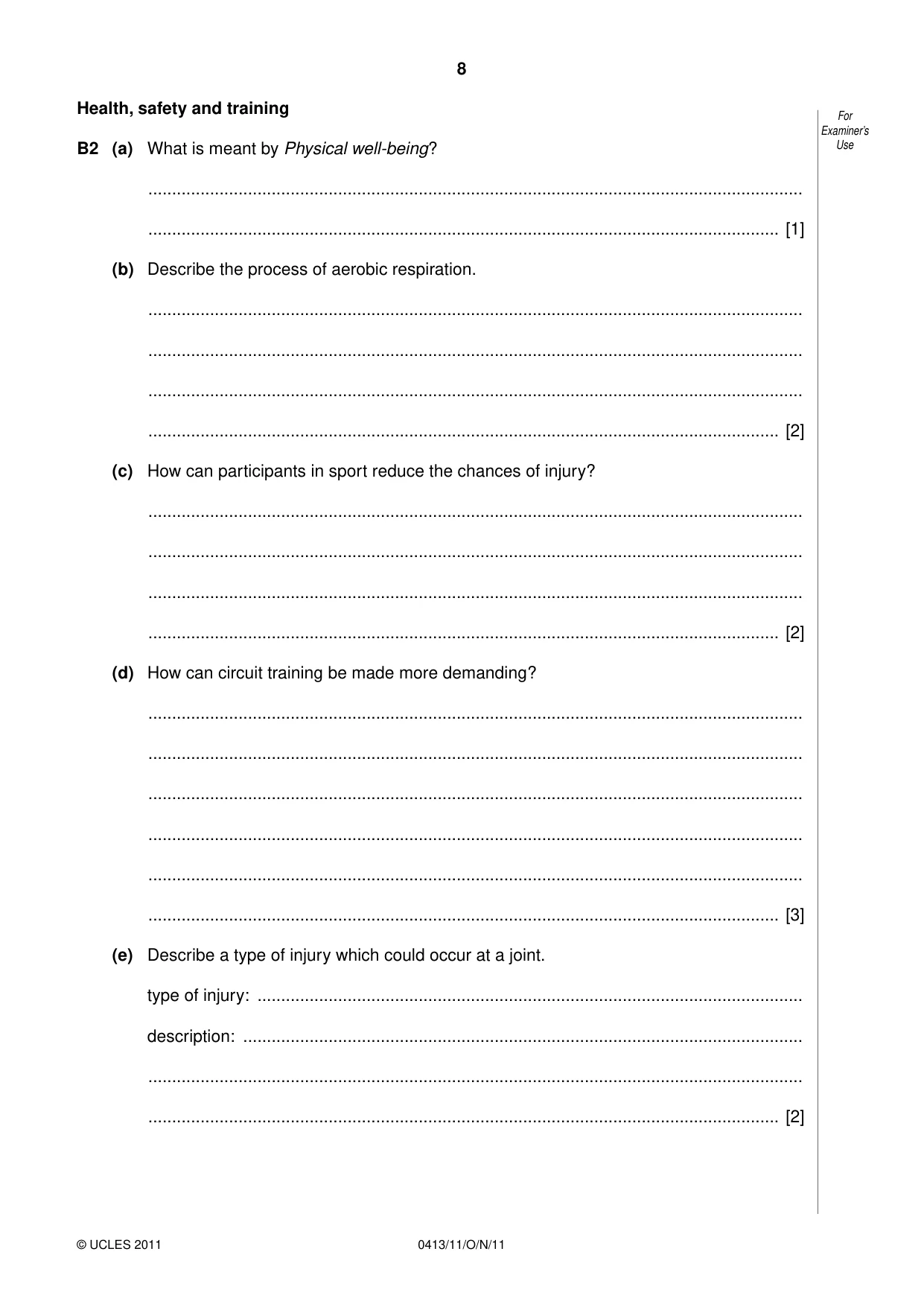
8 0413/11/O/N/11 © UCLES 2011 For Examiner’s Use Health, safety and training B2 (a) What is meant by Physical well-being? … … [1] (b) Describe the process of aerobic respiration. … … … … [2] (c) How can participants in sport reduce the chances of injury? … … … … [2] (d) How can circuit training be made more demanding? … … … … … … [3] (e) Describe a type of injury which could occur at a joint. type of injury: … description: … … … [2]
Question paper, page 9
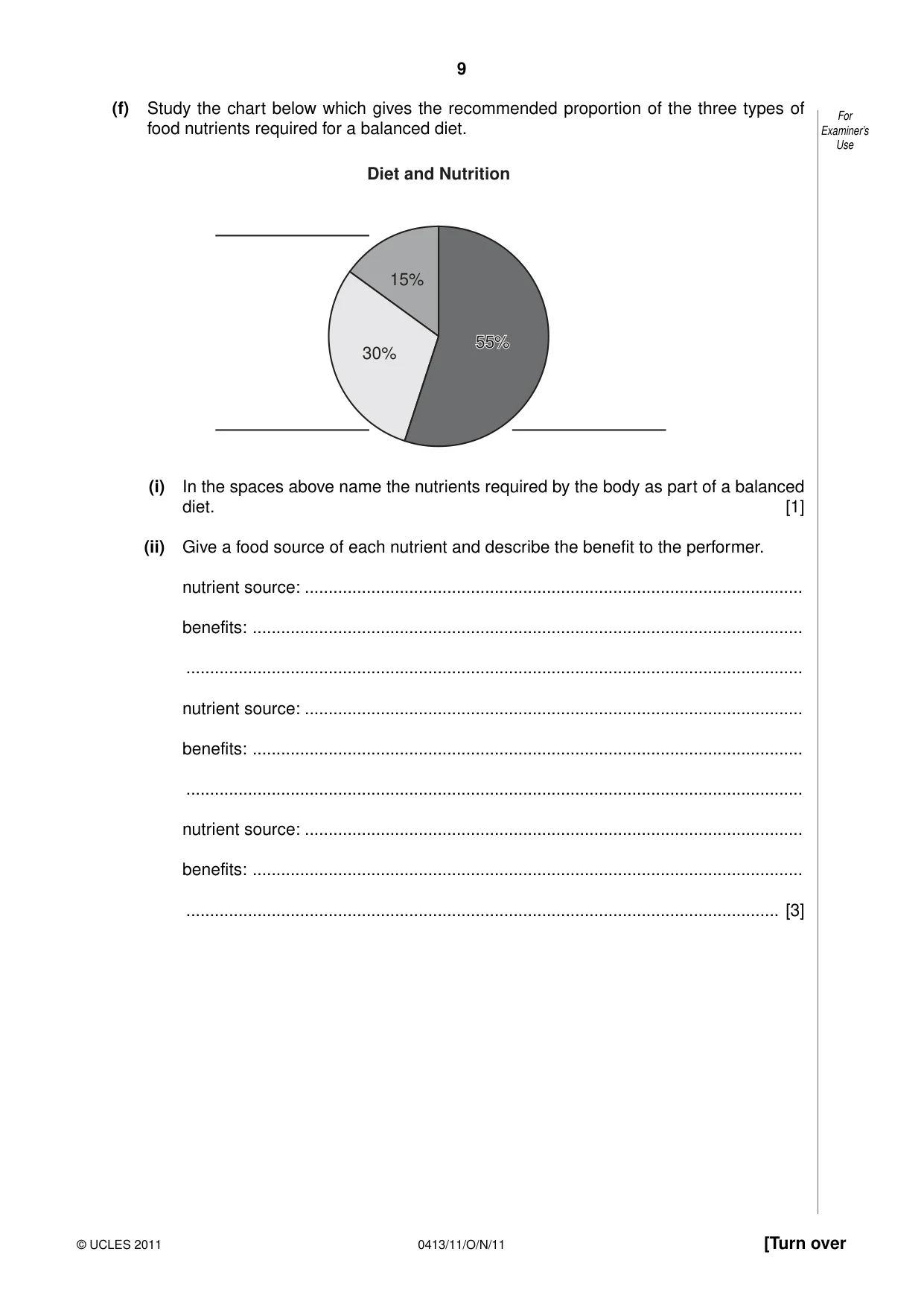
9 0413/11/O/N/11 © UCLES 2011 [Turn over For Examiner’s Use (f) Study the chart below which gives the recommended proportion of the three types of food nutrients required for a balanced diet. 15% 30% 55% 55% 55% Diet and Nutrition (i) In the spaces above name the nutrients required by the body as part of a balanced diet. [1] (ii) Give a food source of each nutrient and describe the benefit to the performer. nutrient source: … benefits: … … nutrient source: … benefits: … … nutrient source: … benefits: … … [3]
Question paper, page 10
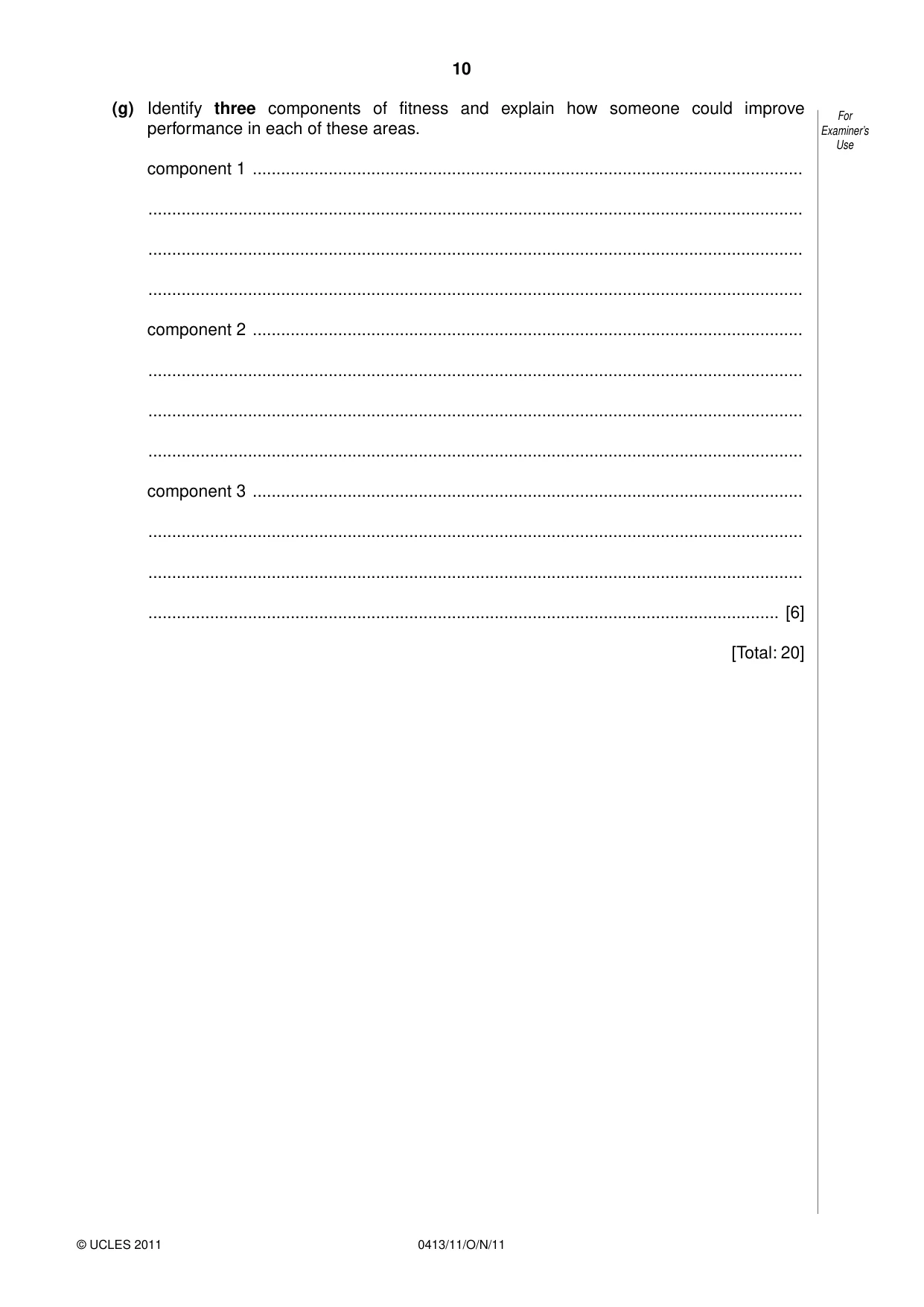
10 0413/11/O/N/11 © UCLES 2011 For Examiner’s Use (g) Identify three components of fitness and explain how someone could improve performance in each of these areas. component 1 … … … … component 2 … … … … component 3 … … … … [6] [Total: 20]
Question paper, page 11
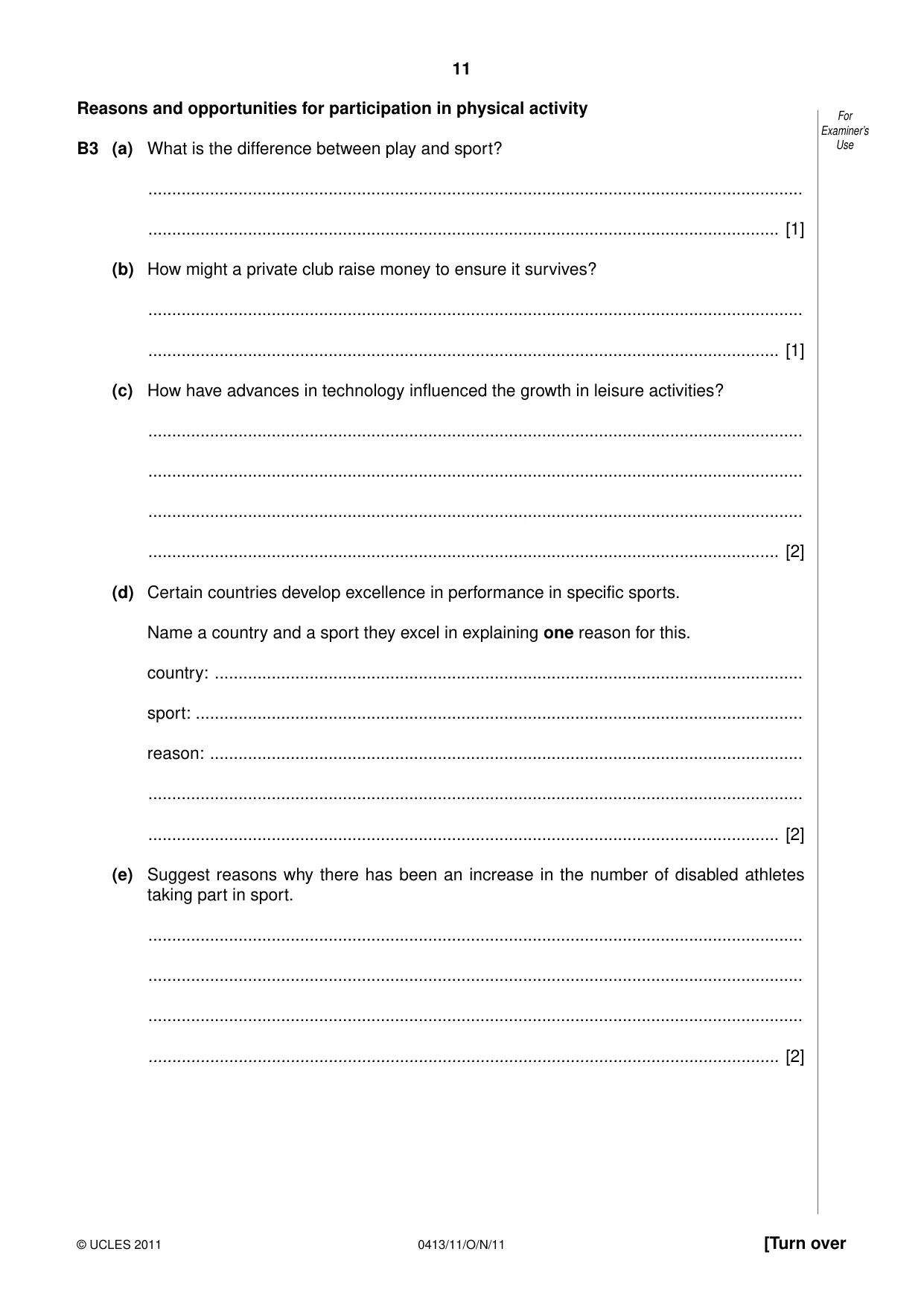
11 0413/11/O/N/11 © UCLES 2011 [Turn over For Examiner’s Use Reasons and opportunities for participation in physical activity B3 (a) What is the difference between play and sport? … … [1] (b) How might a private club raise money to ensure it survives? … … [1] (c) How have advances in technology influenced the growth in leisure activities? … … … … [2] (d) Certain countries develop excellence in performance in specific sports. Name a country and a sport they excel in explaining one reason for this. country: … sport: … reason: … … … [2] (e) Suggest reasons why there has been an increase in the number of disabled athletes taking part in sport. … … … … [2]
Question paper, page 12
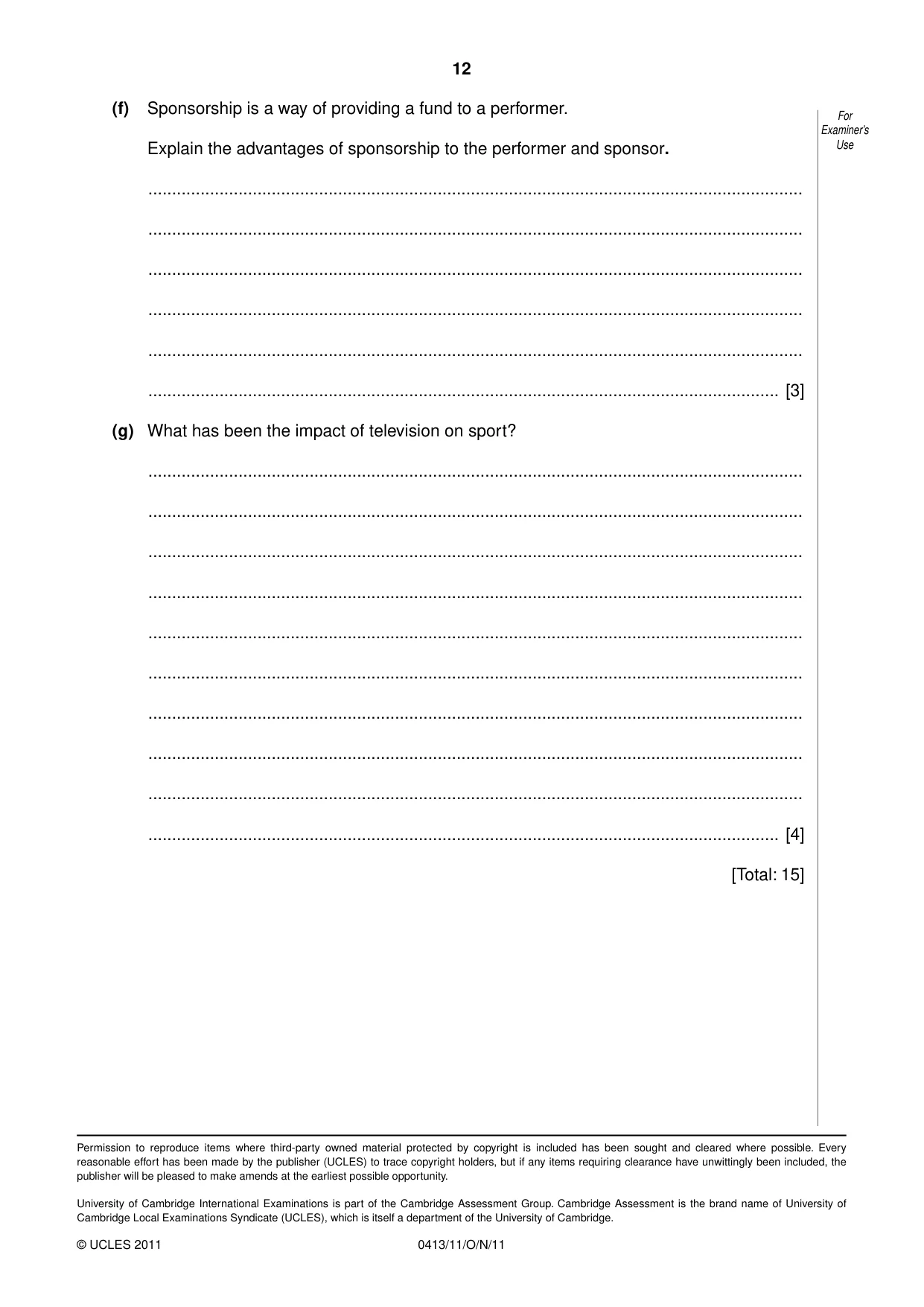
12 0413/11/O/N/11 © UCLES 2011 For Examiner’s Use Permission to reproduce items where third-party owned material protected by copyright is included has been sought and cleared where possible. Every reasonable effort has been made by the publisher (UCLES) to trace copyright holders, but if any items requiring clearance have unwittingly been included, the publisher will be pleased to make amends at the earliest possible opportunity. University of Cambridge International Examinations is part of the Cambridge Assessment Group. Cambridge Assessment is the brand name of University of Cambridge Local Examinations Syndicate (UCLES), which is itself a department of the University of Cambridge. (f) Sponsorship is a way of providing a fund to a performer. Explain the advantages of sponsorship to the performer and sponsor. … … … … … … [3] (g) What has been the impact of television on sport? … … … … … … … … … … [4] [Total: 15]
Mark scheme, page 1
UNIVERSITY OF CAMBRIDGE INTERNATIONAL EXAMINATIONS International General Certificate of Secondary Education MARK SCHEME for the October/November 2011 question paper for the guidance of teachers 0413 PHYSICAL EDUCATION 0413/11 Paper 1, maximum raw mark 80 This mark scheme is published as an aid to teachers and candidates, to indicate the requirements of the examination. It shows the basis on which Examiners were instructed to award marks. It does not indicate the details of the discussions that took place at an Examiners’ meeting before marking began, which would have considered the acceptability of alternative answers. Mark schemes must be read in conjunction with the question papers and the report on the examination. • Cambridge will not enter into discussions or correspondence in connection with these mark schemes. Cambridge is publishing the mark schemes for the October/November 2011 question papers for most IGCSE, GCE Advanced Level and Advanced Subsidiary Level syllabuses and some Ordinary Level syllabuses. www.XtremePapers.com
Mark scheme, page 2
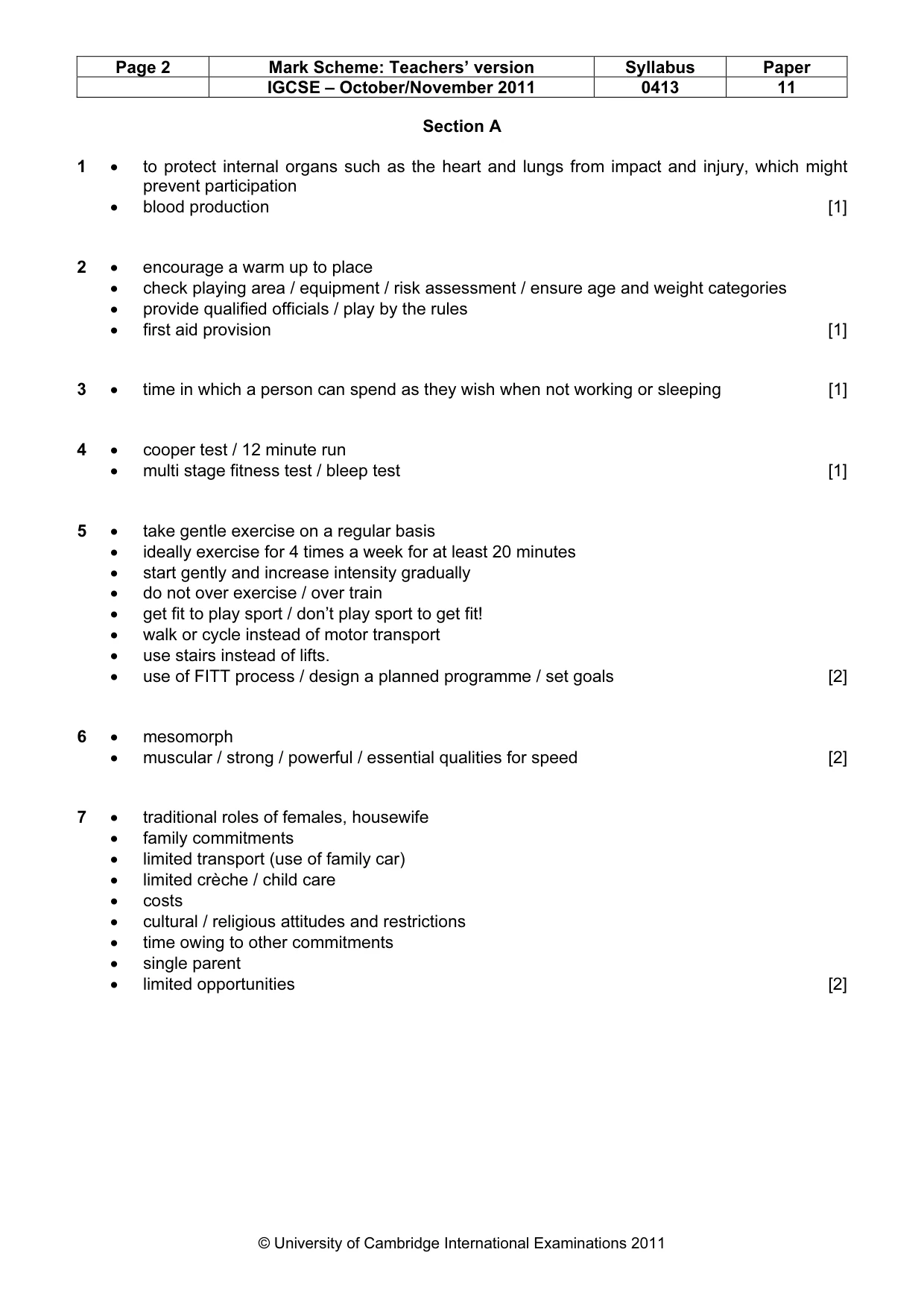
Page 2 Mark Scheme: Teachers’ version Syllabus Paper IGCSE – October/November 2011 0413 11 © University of Cambridge International Examinations 2011 Section A 1 • to protect internal organs such as the heart and lungs from impact and injury, which might prevent participation • blood production [1] 2 • encourage a warm up to place • check playing area / equipment / risk assessment / ensure age and weight categories • provide qualified officials / play by the rules • first aid provision [1] 3 • time in which a person can spend as they wish when not working or sleeping [1] 4 • cooper test / 12 minute run • multi stage fitness test / bleep test [1] 5 • take gentle exercise on a regular basis • ideally exercise for 4 times a week for at least 20 minutes • start gently and increase intensity gradually • do not over exercise / over train • get fit to play sport / don’t play sport to get fit! • walk or cycle instead of motor transport • use stairs instead of lifts. • use of FITT process / design a planned programme / set goals [2] 6 • mesomorph • muscular / strong / powerful / essential qualities for speed [2] 7 • traditional roles of females, housewife • family commitments • limited transport (use of family car) • limited crèche / child care • costs • cultural / religious attitudes and restrictions • time owing to other commitments • single parent • limited opportunities [2]
Mark scheme, page 3
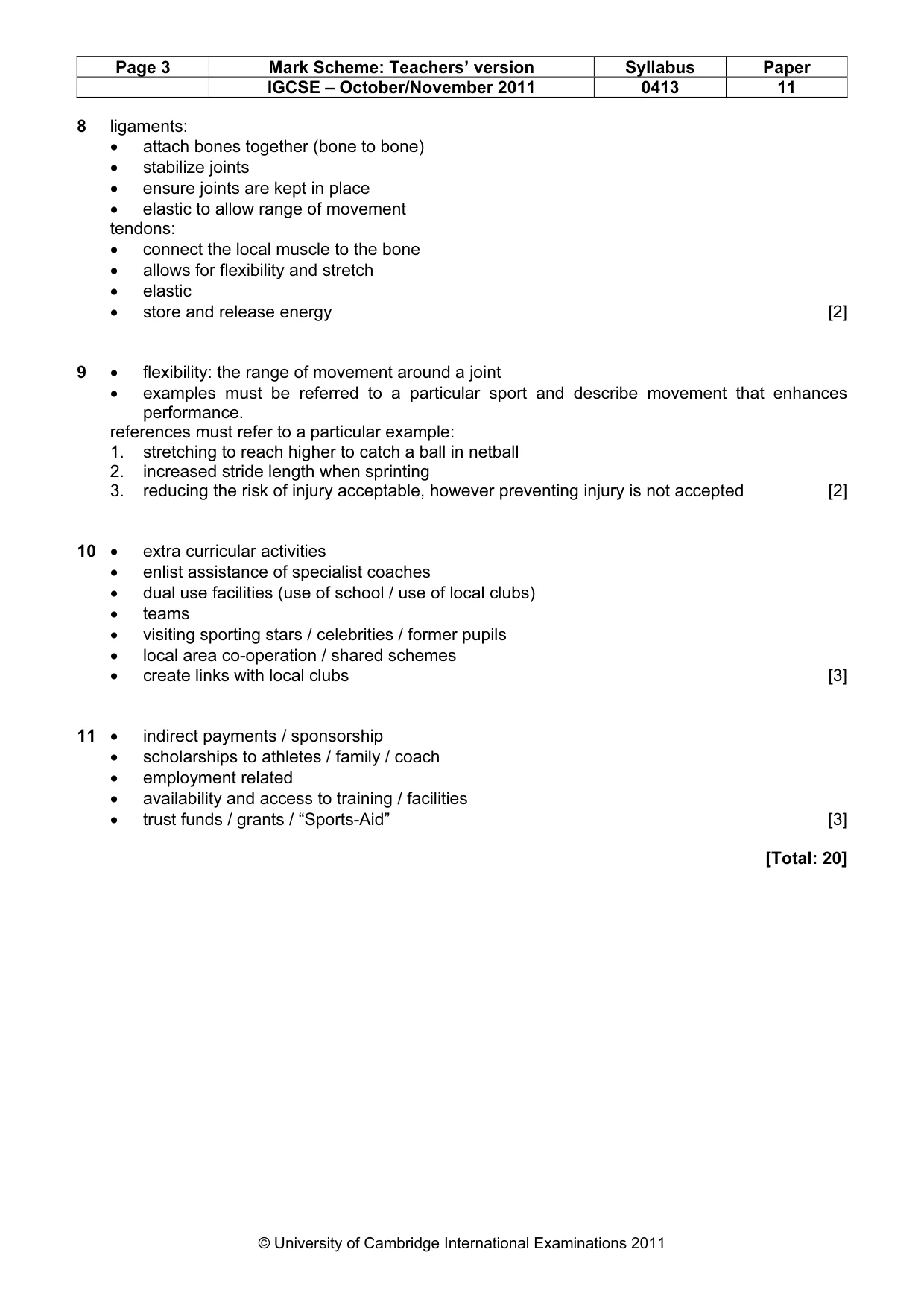
Page 3 Mark Scheme: Teachers’ version Syllabus Paper IGCSE – October/November 2011 0413 11 © University of Cambridge International Examinations 2011 8 ligaments: • attach bones together (bone to bone) • stabilize joints • ensure joints are kept in place • elastic to allow range of movement tendons: • connect the local muscle to the bone • allows for flexibility and stretch • elastic • store and release energy [2] 9 • flexibility: the range of movement around a joint • examples must be referred to a particular sport and describe movement that enhances performance. references must refer to a particular example: 1. stretching to reach higher to catch a ball in netball 2. increased stride length when sprinting 3. reducing the risk of injury acceptable, however preventing injury is not accepted [2] 10 • extra curricular activities • enlist assistance of specialist coaches • dual use facilities (use of school / use of local clubs) • teams • visiting sporting stars / celebrities / former pupils • local area co-operation / shared schemes • create links with local clubs [3] 11 • indirect payments / sponsorship • scholarships to athletes / family / coach • employment related • availability and access to training / facilities • trust funds / grants / “Sports-Aid” [3] [Total: 20]
Mark scheme, page 4
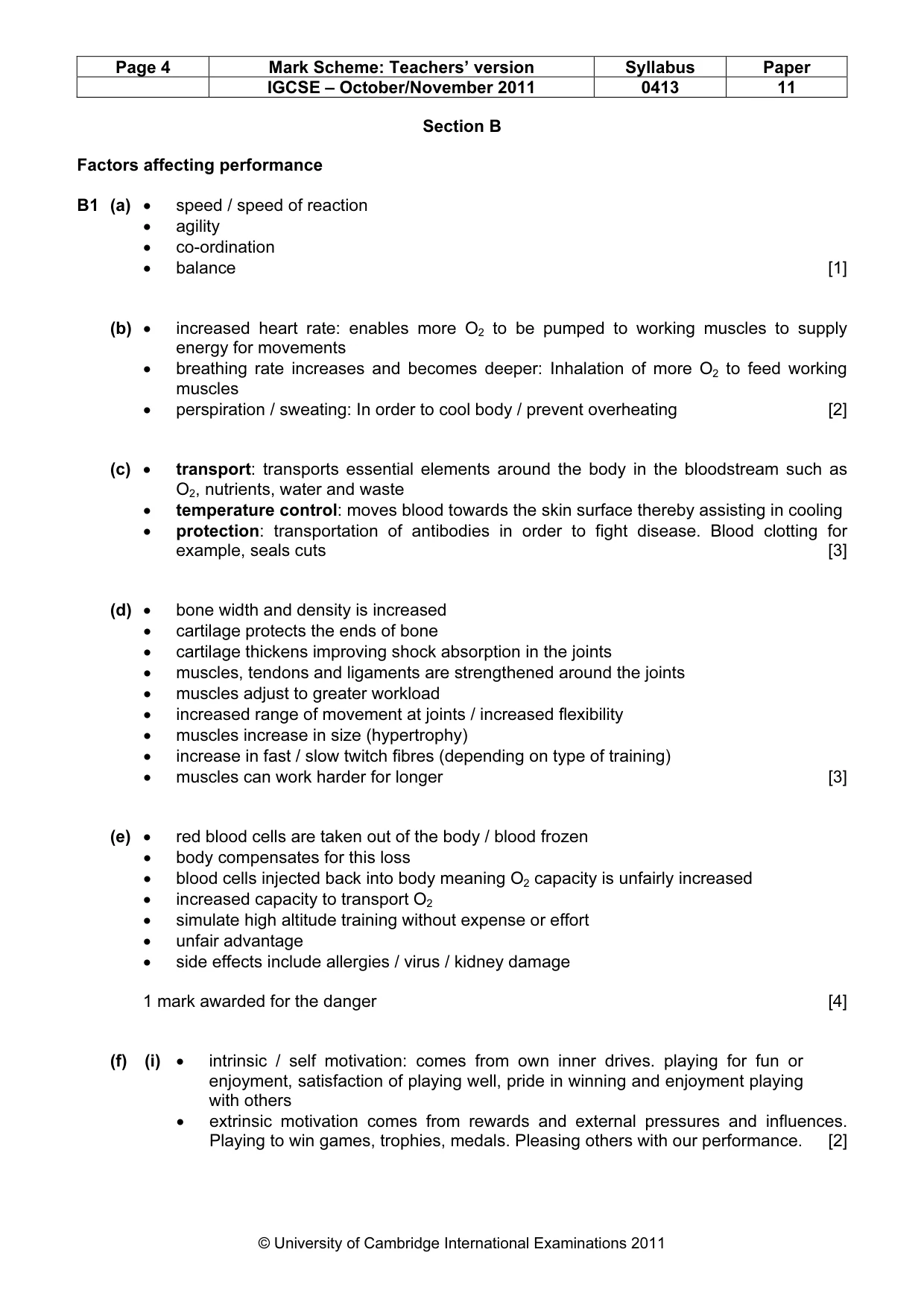
Page 4 Mark Scheme: Teachers’ version Syllabus Paper IGCSE – October/November 2011 0413 11 © University of Cambridge International Examinations 2011 Section B Factors affecting performance B1 (a) • speed / speed of reaction • agility • co-ordination • balance [1] (b) • increased heart rate: enables more O2 to be pumped to working muscles to supply energy for movements • breathing rate increases and becomes deeper: Inhalation of more O2 to feed working muscles • perspiration / sweating: In order to cool body / prevent overheating [2] (c) • transport: transports essential elements around the body in the bloodstream such as O2, nutrients, water and waste • temperature control: moves blood towards the skin surface thereby assisting in cooling • protection: transportation of antibodies in order to fight disease. Blood clotting for example, seals cuts [3] (d) • bone width and density is increased • cartilage protects the ends of bone • cartilage thickens improving shock absorption in the joints • muscles, tendons and ligaments are strengthened around the joints • muscles adjust to greater workload • increased range of movement at joints / increased flexibility • muscles increase in size (hypertrophy) • increase in fast / slow twitch fibres (depending on type of training) • muscles can work harder for longer [3] (e) • red blood cells are taken out of the body / blood frozen • body compensates for this loss • blood cells injected back into body meaning O2 capacity is unfairly increased • increased capacity to transport O2 • simulate high altitude training without expense or effort • unfair advantage • side effects include allergies / virus / kidney damage 1 mark awarded for the danger [4] (f) (i) • intrinsic / self motivation: comes from own inner drives. playing for fun or enjoyment, satisfaction of playing well, pride in winning and enjoyment playing with others • extrinsic motivation comes from rewards and external pressures and influences. Playing to win games, trophies, medals. Pleasing others with our performance. [2]
Mark scheme, page 5
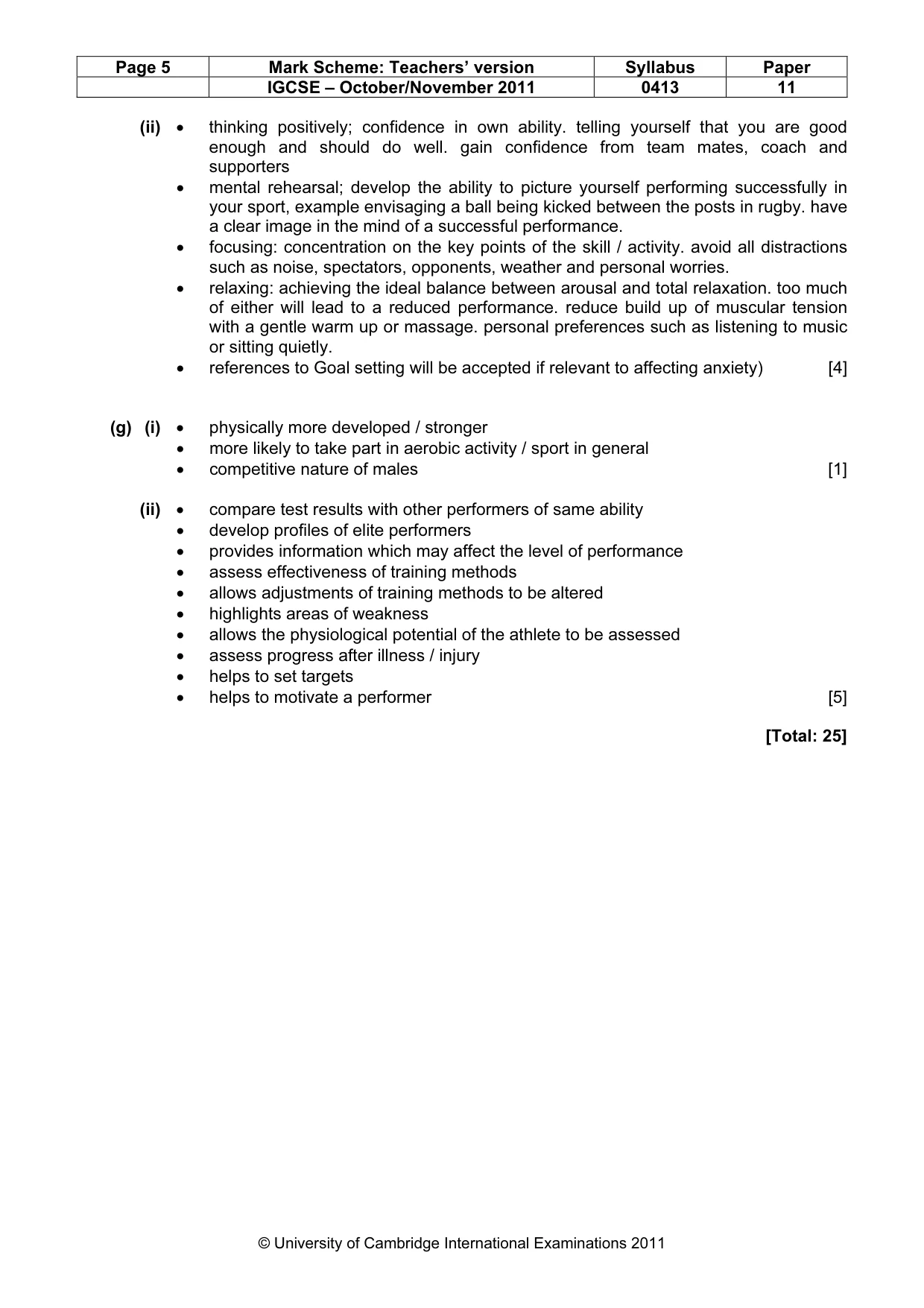
Page 5 Mark Scheme: Teachers’ version Syllabus Paper IGCSE – October/November 2011 0413 11 © University of Cambridge International Examinations 2011 (ii) • thinking positively; confidence in own ability. telling yourself that you are good enough and should do well. gain confidence from team mates, coach and supporters • mental rehearsal; develop the ability to picture yourself performing successfully in your sport, example envisaging a ball being kicked between the posts in rugby. have a clear image in the mind of a successful performance. • focusing: concentration on the key points of the skill / activity. avoid all distractions such as noise, spectators, opponents, weather and personal worries. • relaxing: achieving the ideal balance between arousal and total relaxation. too much of either will lead to a reduced performance. reduce build up of muscular tension with a gentle warm up or massage. personal preferences such as listening to music or sitting quietly. • references to Goal setting will be accepted if relevant to affecting anxiety) [4] (g) (i) • physically more developed / stronger • more likely to take part in aerobic activity / sport in general • competitive nature of males [1] (ii) • compare test results with other performers of same ability • develop profiles of elite performers • provides information which may affect the level of performance • assess effectiveness of training methods • allows adjustments of training methods to be altered • highlights areas of weakness • allows the physiological potential of the athlete to be assessed • assess progress after illness / injury • helps to set targets • helps to motivate a performer [5] [Total: 25]
Mark scheme, page 6
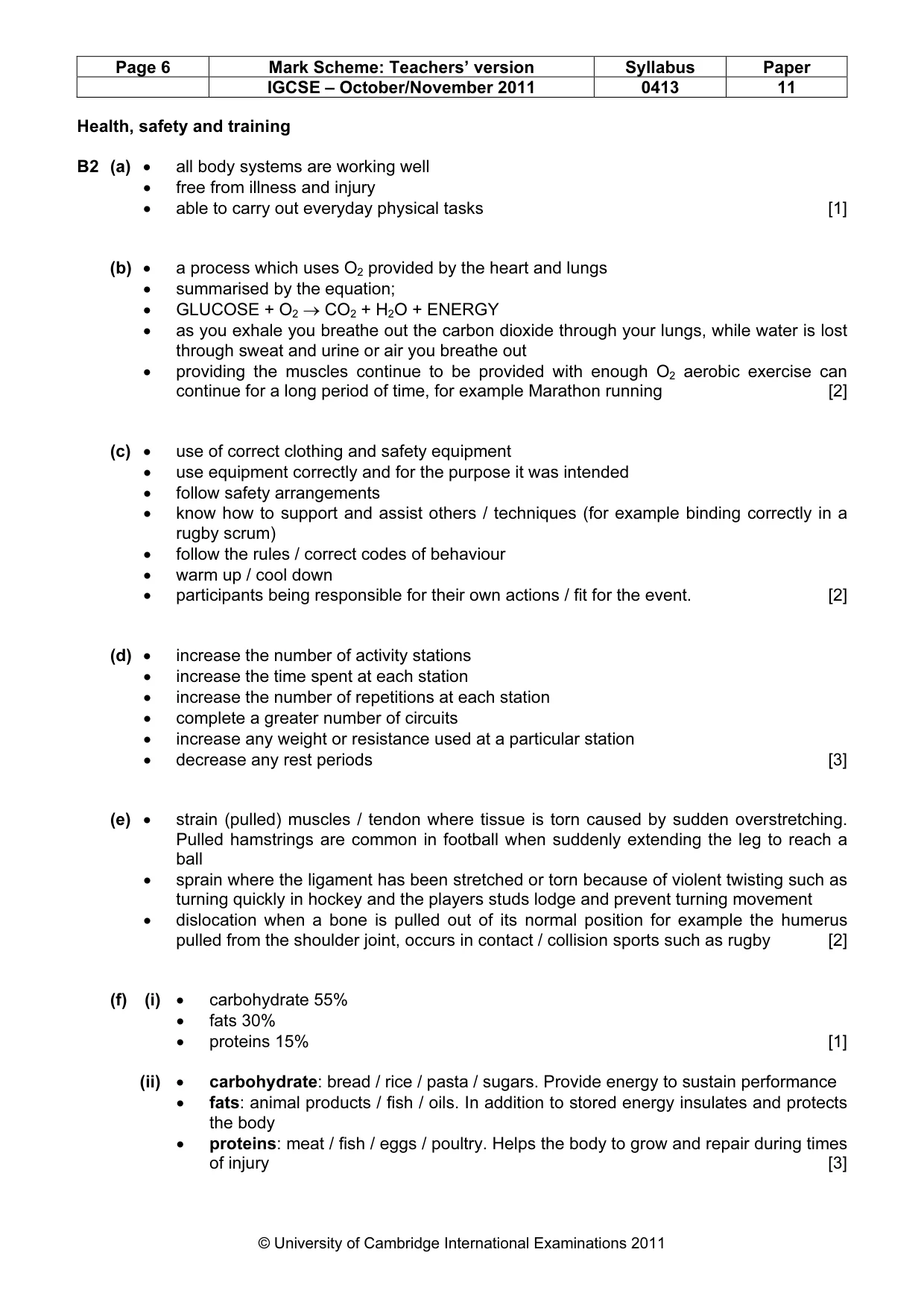
Page 6 Mark Scheme: Teachers’ version Syllabus Paper IGCSE – October/November 2011 0413 11 © University of Cambridge International Examinations 2011 Health, safety and training B2 (a) • all body systems are working well • free from illness and injury • able to carry out everyday physical tasks [1] (b) • a process which uses O2 provided by the heart and lungs • summarised by the equation; • GLUCOSE + O2 → CO2 + H2O + ENERGY • as you exhale you breathe out the carbon dioxide through your lungs, while water is lost through sweat and urine or air you breathe out • providing the muscles continue to be provided with enough O2 aerobic exercise can continue for a long period of time, for example Marathon running [2] (c) • use of correct clothing and safety equipment • use equipment correctly and for the purpose it was intended • follow safety arrangements • know how to support and assist others / techniques (for example binding correctly in a rugby scrum) • follow the rules / correct codes of behaviour • warm up / cool down • participants being responsible for their own actions / fit for the event. [2] (d) • increase the number of activity stations • increase the time spent at each station • increase the number of repetitions at each station • complete a greater number of circuits • increase any weight or resistance used at a particular station • decrease any rest periods [3] (e) • strain (pulled) muscles / tendon where tissue is torn caused by sudden overstretching. Pulled hamstrings are common in football when suddenly extending the leg to reach a ball • sprain where the ligament has been stretched or torn because of violent twisting such as turning quickly in hockey and the players studs lodge and prevent turning movement • dislocation when a bone is pulled out of its normal position for example the humerus pulled from the shoulder joint, occurs in contact / collision sports such as rugby [2] (f) (i) • carbohydrate 55% • fats 30% • proteins 15% [1] (ii) • carbohydrate: bread / rice / pasta / sugars. Provide energy to sustain performance • fats: animal products / fish / oils. In addition to stored energy insulates and protects the body • proteins: meat / fish / eggs / poultry. Helps the body to grow and repair during times of injury [3]
Mark scheme, page 7
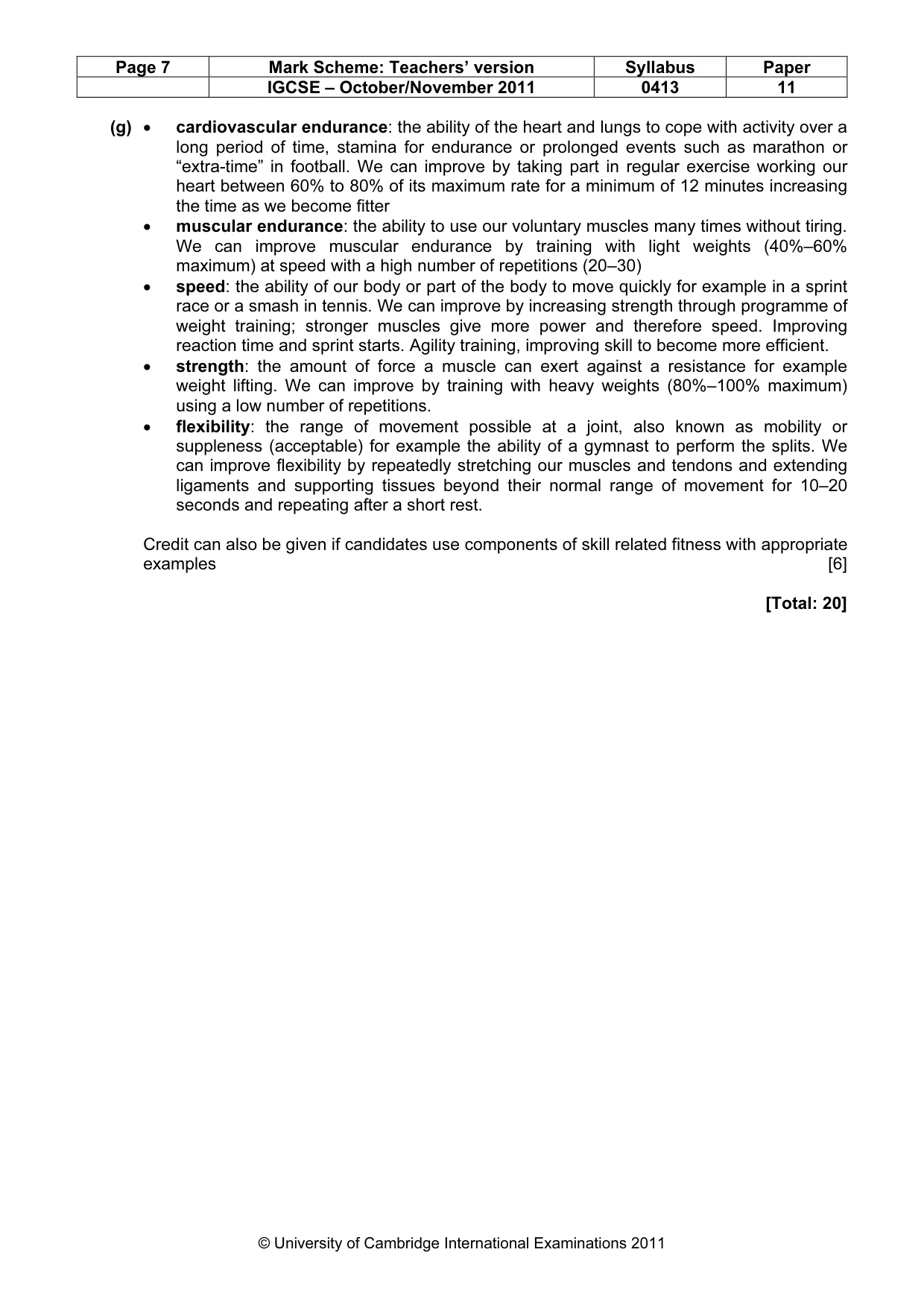
Page 7 Mark Scheme: Teachers’ version Syllabus Paper IGCSE – October/November 2011 0413 11 © University of Cambridge International Examinations 2011 (g) • cardiovascular endurance: the ability of the heart and lungs to cope with activity over a long period of time, stamina for endurance or prolonged events such as marathon or “extra-time” in football. We can improve by taking part in regular exercise working our heart between 60% to 80% of its maximum rate for a minimum of 12 minutes increasing the time as we become fitter • muscular endurance: the ability to use our voluntary muscles many times without tiring. We can improve muscular endurance by training with light weights (40%–60% maximum) at speed with a high number of repetitions (20–30) • speed: the ability of our body or part of the body to move quickly for example in a sprint race or a smash in tennis. We can improve by increasing strength through programme of weight training; stronger muscles give more power and therefore speed. Improving reaction time and sprint starts. Agility training, improving skill to become more efficient. • strength: the amount of force a muscle can exert against a resistance for example weight lifting. We can improve by training with heavy weights (80%–100% maximum) using a low number of repetitions. • flexibility: the range of movement possible at a joint, also known as mobility or suppleness (acceptable) for example the ability of a gymnast to perform the splits. We can improve flexibility by repeatedly stretching our muscles and tendons and extending ligaments and supporting tissues beyond their normal range of movement for 10–20 seconds and repeating after a short rest. Credit can also be given if candidates use components of skill related fitness with appropriate examples [6] [Total: 20]
Mark scheme, page 8
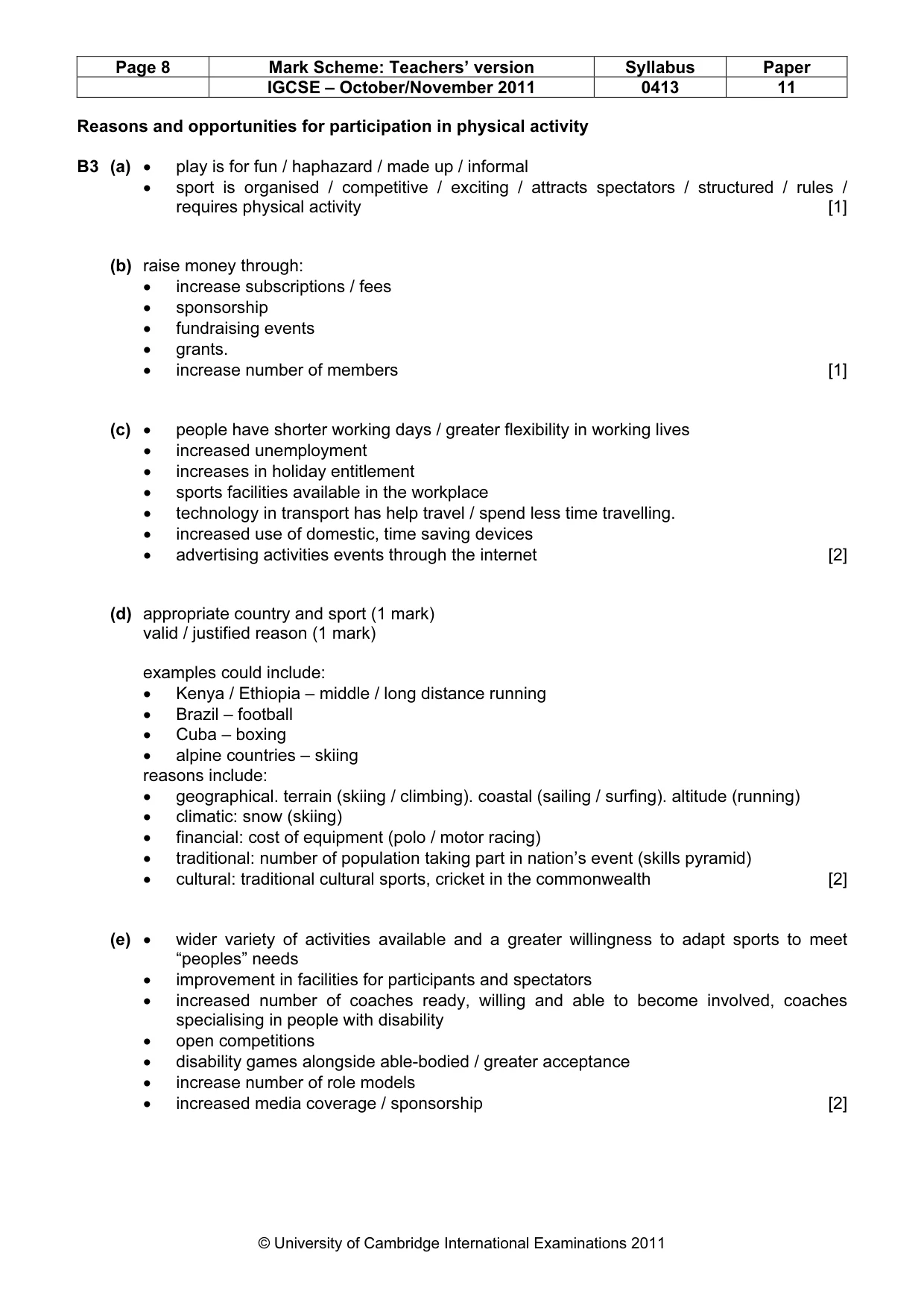
Page 8 Mark Scheme: Teachers’ version Syllabus Paper IGCSE – October/November 2011 0413 11 © University of Cambridge International Examinations 2011 Reasons and opportunities for participation in physical activity B3 (a) • play is for fun / haphazard / made up / informal • sport is organised / competitive / exciting / attracts spectators / structured / rules / requires physical activity [1] (b) raise money through: • increase subscriptions / fees • sponsorship • fundraising events • grants. • increase number of members [1] (c) • people have shorter working days / greater flexibility in working lives • increased unemployment • increases in holiday entitlement • sports facilities available in the workplace • technology in transport has help travel / spend less time travelling. • increased use of domestic, time saving devices • advertising activities events through the internet [2] (d) appropriate country and sport (1 mark) valid / justified reason (1 mark) examples could include: • Kenya / Ethiopia – middle / long distance running • Brazil – football • Cuba – boxing • alpine countries – skiing reasons include: • geographical. terrain (skiing / climbing). coastal (sailing / surfing). altitude (running) • climatic: snow (skiing) • financial: cost of equipment (polo / motor racing) • traditional: number of population taking part in nation’s event (skills pyramid) • cultural: traditional cultural sports, cricket in the commonwealth [2] (e) • wider variety of activities available and a greater willingness to adapt sports to meet “peoples” needs • improvement in facilities for participants and spectators • increased number of coaches ready, willing and able to become involved, coaches specialising in people with disability • open competitions • disability games alongside able-bodied / greater acceptance • increase number of role models • increased media coverage / sponsorship [2]
Mark scheme, page 9
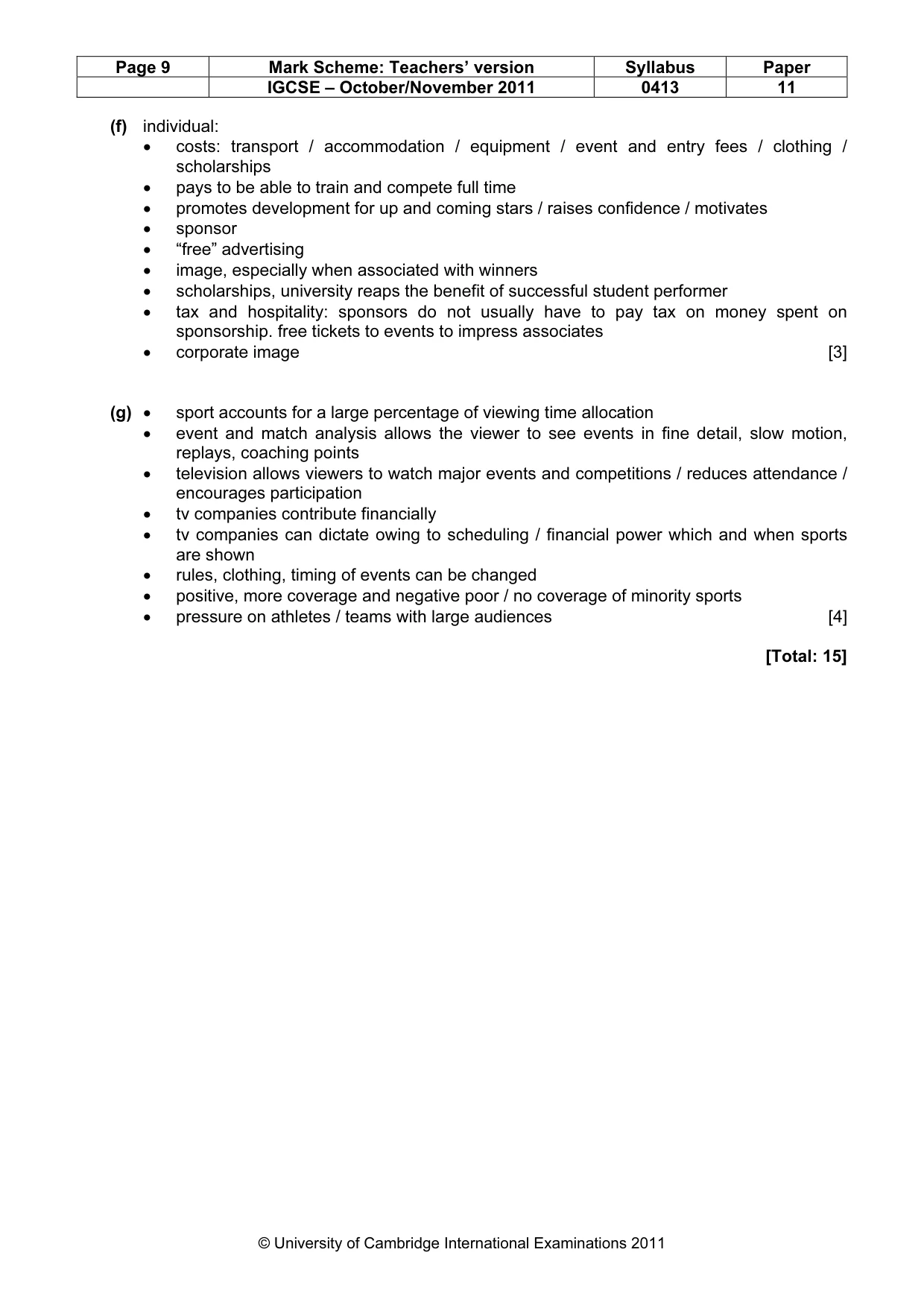
Page 9 Mark Scheme: Teachers’ version Syllabus Paper IGCSE – October/November 2011 0413 11 © University of Cambridge International Examinations 2011 (f) individual: • costs: transport / accommodation / equipment / event and entry fees / clothing / scholarships • pays to be able to train and compete full time • promotes development for up and coming stars / raises confidence / motivates • sponsor • “free” advertising • image, especially when associated with winners • scholarships, university reaps the benefit of successful student performer • tax and hospitality: sponsors do not usually have to pay tax on money spent on sponsorship. free tickets to events to impress associates • corporate image [3] (g) • sport accounts for a large percentage of viewing time allocation • event and match analysis allows the viewer to see events in fine detail, slow motion, replays, coaching points • television allows viewers to watch major events and competitions / reduces attendance / encourages participation • tv companies contribute financially • tv companies can dictate owing to scheduling / financial power which and when sports are shown • rules, clothing, timing of events can be changed • positive, more coverage and negative poor / no coverage of minority sports • pressure on athletes / teams with large audiences [4] [Total: 15]
What you needed in this session
Cambridge’s own grade thresholds for 2011 Oct/Nov, Paper 1 · Variant 1. A higher threshold means an easier paper — the bar moves with how the cohort did.