Cambridge IGCSE Physical Education 0413 — 2011 Oct/Nov Paper 1 · Variant 3
0413/13/O/N/11 · 80 marks · ≈90 min
The question paper and its mark scheme, free to read here and free to download. This is Cambridge’s own paper, exactly as it was sat.
Question paper12 pages


Mark scheme9 pages
Answers below. Sit the paper first if you are practising.

Paper as text
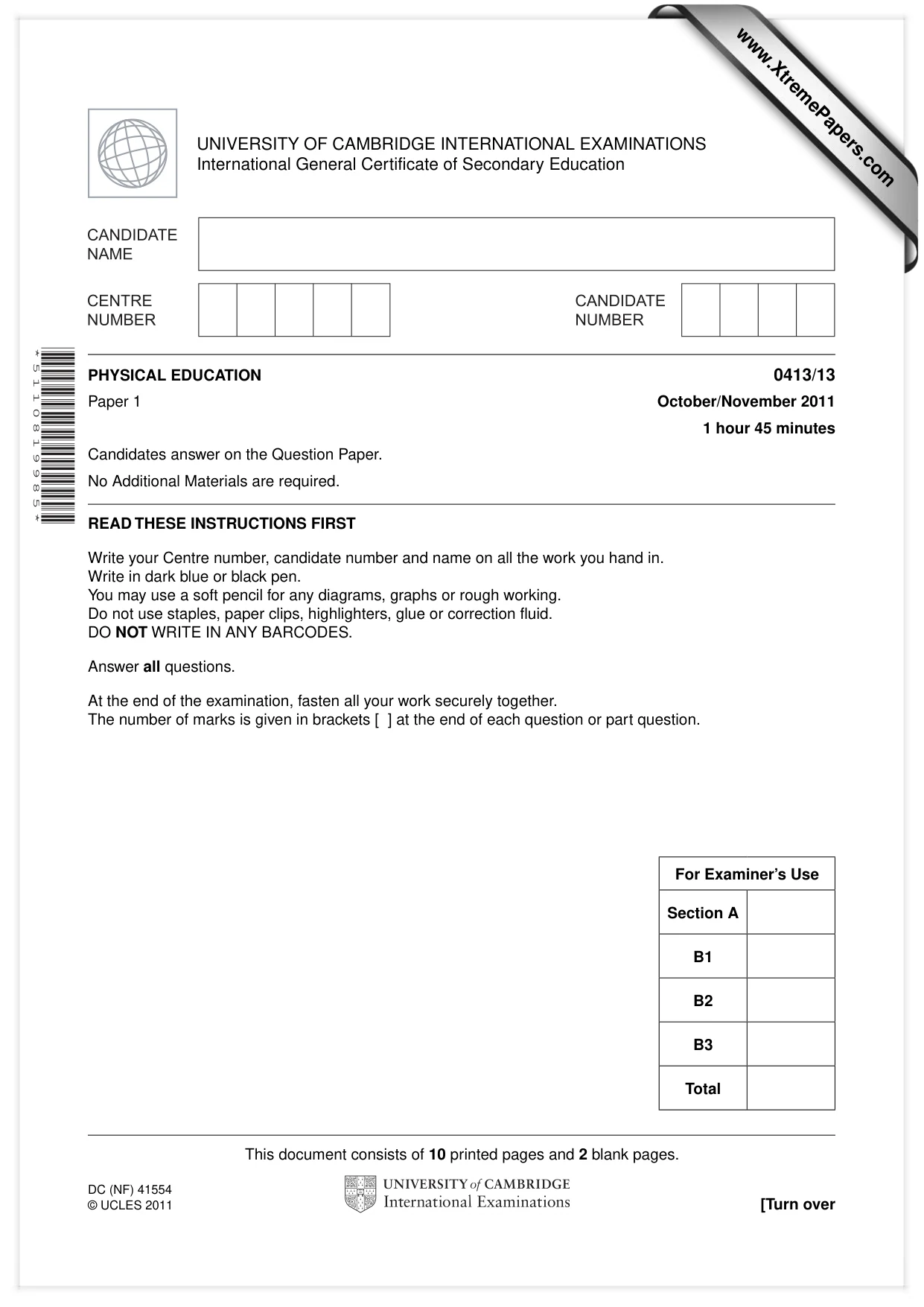
Question paper, page 1
This document consists of 10 printed pages and 2 blank pages. DC (NF) 41554 © UCLES 2011 [Turn over UNIVERSITY OF CAMBRIDGE INTERNATIONAL EXAMINATIONS International General Certificate of Secondary Education * 5 1 1 0 8 1 9 9 8 5 * PHYSICAL EDUCATION 0413/13 Paper 1 October/November 2011 1 hour 45 minutes Candidates answer on the Question Paper. No Additional Materials are required. READ THESE INSTRUCTIONS FIRST Write your Centre number, candidate number and name on all the work you hand in. Write in dark blue or black pen. You may use a soft pencil for any diagrams, graphs or rough working. Do not use staples, paper clips, highlighters, glue or correction fluid. DO NOT WRITE IN ANY BARCODES. Answer all questions. At the end of the examination, fasten all your work securely together. The number of marks is given in brackets [ ] at the end of each question or part question. For Examiner’s Use Section A B1 B2 B3 Total www.XtremePapers.com
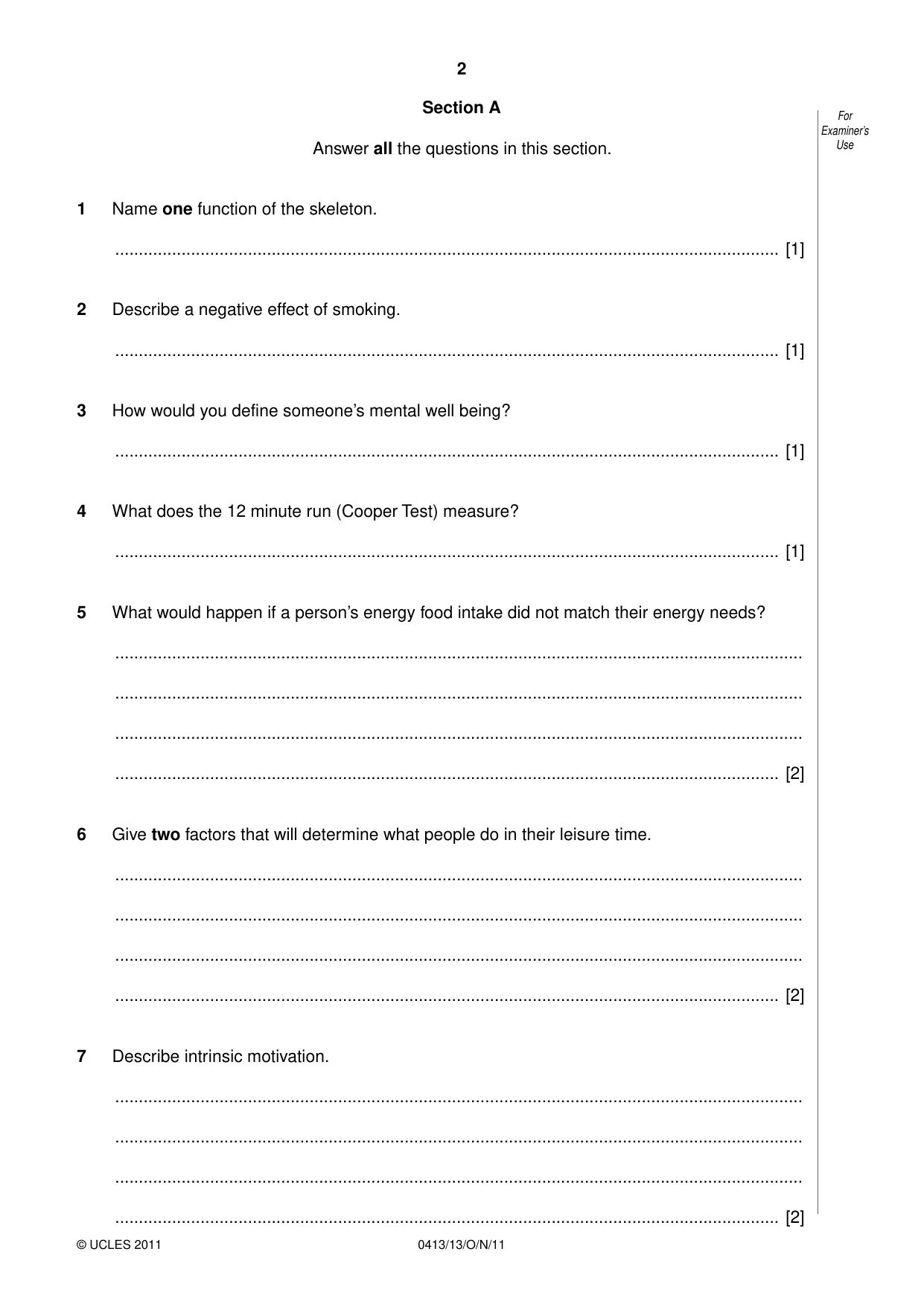
Question paper, page 2
2 0413/13/O/N/11 © UCLES 2011 For Examiner’s Use Section A Answer all the questions in this section. 1 Name one function of the skeleton. … [1] 2 Describe a negative effect of smoking. … [1] 3 How would you define someone’s mental well being? … [1] 4 What does the 12 minute run (Cooper Test) measure? … [1] 5 What would happen if a person’s energy food intake did not match their energy needs? … … … … [2] 6 Give two factors that will determine what people do in their leisure time. … … … … [2] 7 Describe intrinsic motivation. … … … … [2]
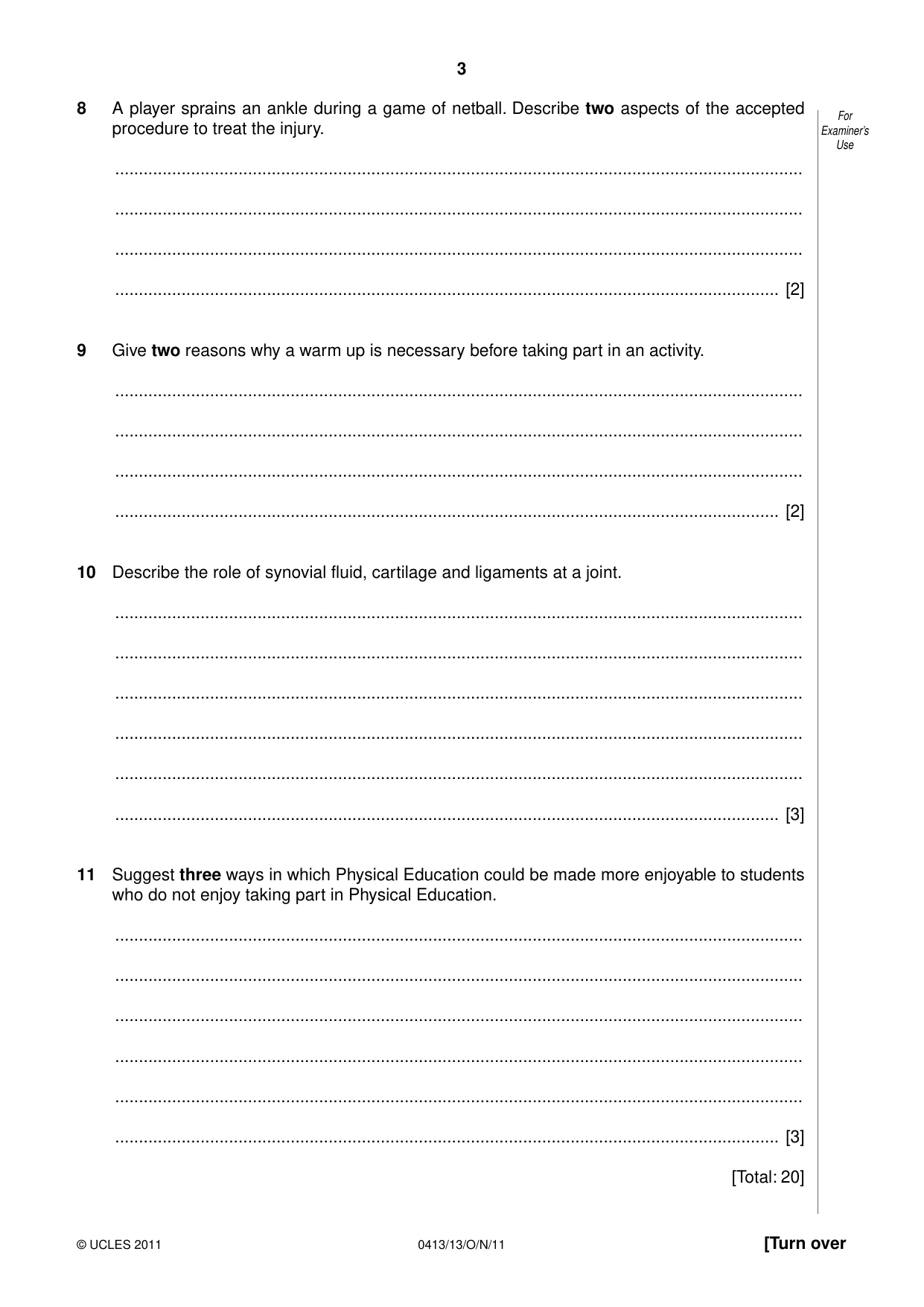
Question paper, page 3
3 0413/13/O/N/11 © UCLES 2011 [Turn over For Examiner’s Use 8 A player sprains an ankle during a game of netball. Describe two aspects of the accepted procedure to treat the injury. … … … … [2] 9 Give two reasons why a warm up is necessary before taking part in an activity. … … … … [2] 10 Describe the role of synovial fluid, cartilage and ligaments at a joint. … … … … … … [3] 11 Suggest three ways in which Physical Education could be made more enjoyable to students who do not enjoy taking part in Physical Education. … … … … … … [3] [Total: 20]
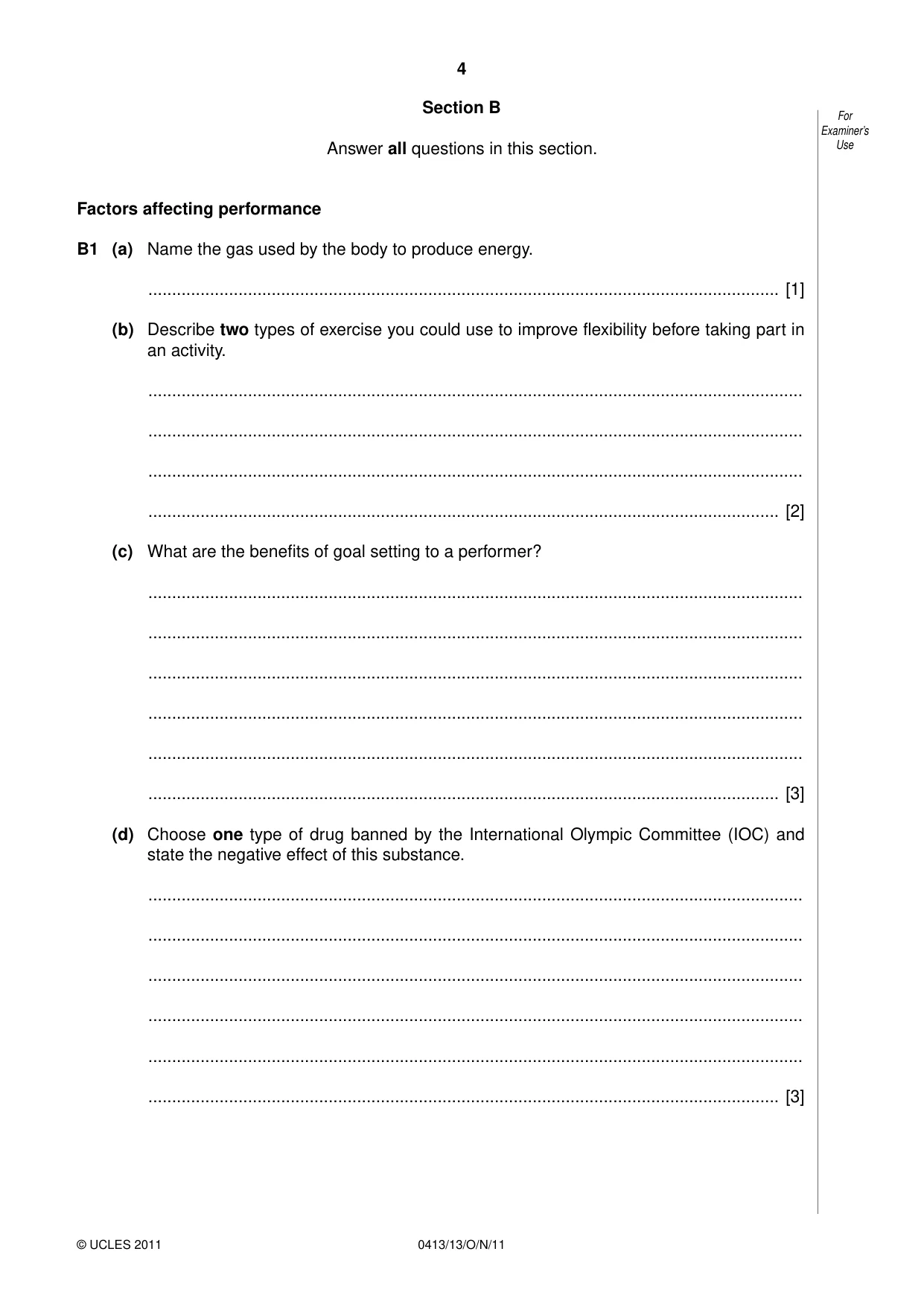
Question paper, page 4
4 0413/13/O/N/11 © UCLES 2011 For Examiner’s Use Section B Answer all questions in this section. Factors affecting performance B1 (a) Name the gas used by the body to produce energy. … [1] (b) Describe two types of exercise you could use to improve flexibility before taking part in an activity. … … … … [2] (c) What are the benefits of goal setting to a performer? … … … … … … [3] (d) Choose one type of drug banned by the International Olympic Committee (IOC) and state the negative effect of this substance. … … … … … … [3]
Question paper, page 5
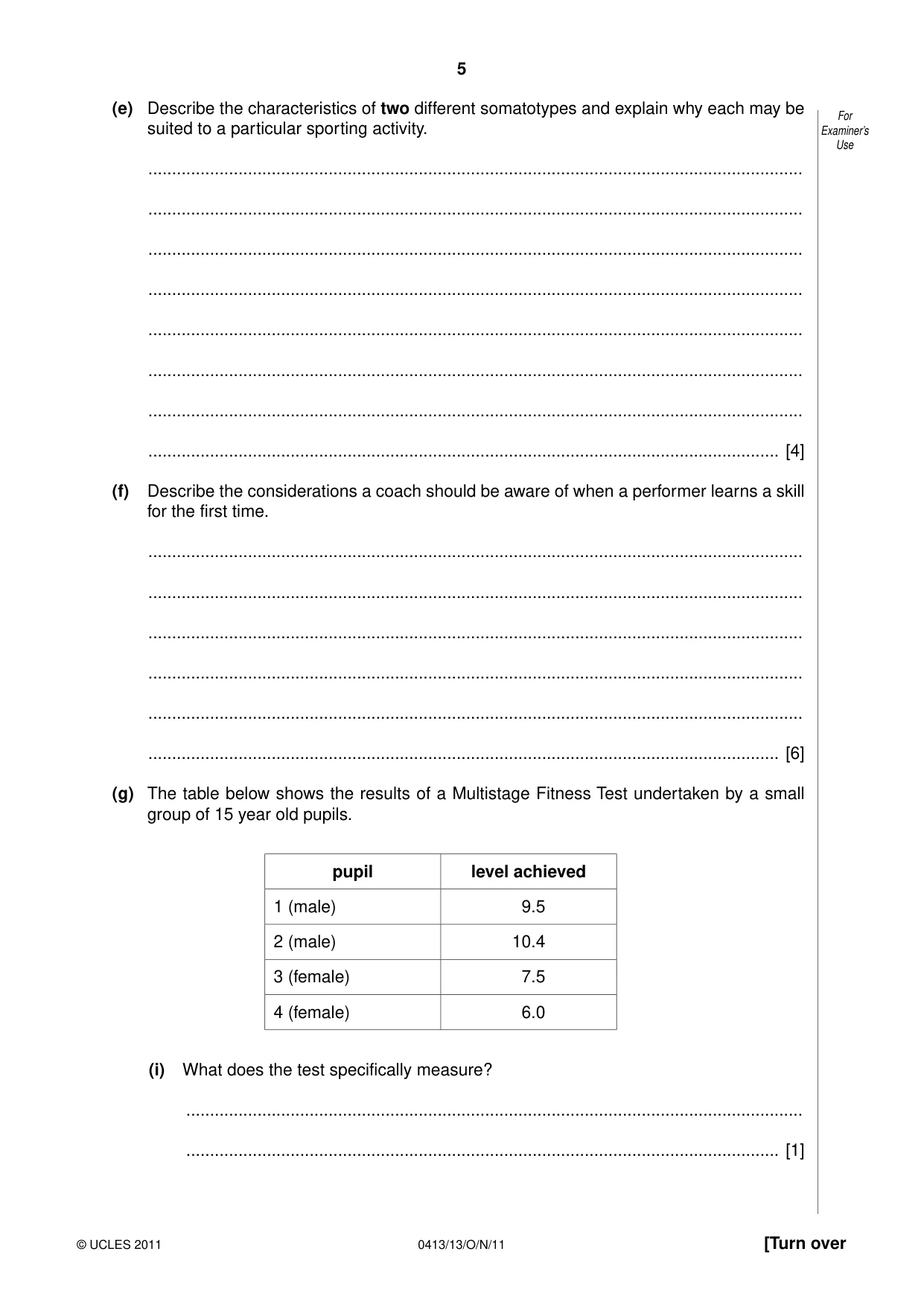
5 0413/13/O/N/11 © UCLES 2011 [Turn over For Examiner’s Use (e) Describe the characteristics of two different somatotypes and explain why each may be suited to a particular sporting activity. … … … … … … … … [4] (f) Describe the considerations a coach should be aware of when a performer learns a skill for the first time. … … … … … … [6] (g) The table below shows the results of a Multistage Fitness Test undertaken by a small group of 15 year old pupils. pupil level achieved 1 (male) 9.5 2 (male) 10.4 3 (female) 7.5 4 (female) 6.0 (i) What does the test specifically measure? … … [1]
Question paper, page 6
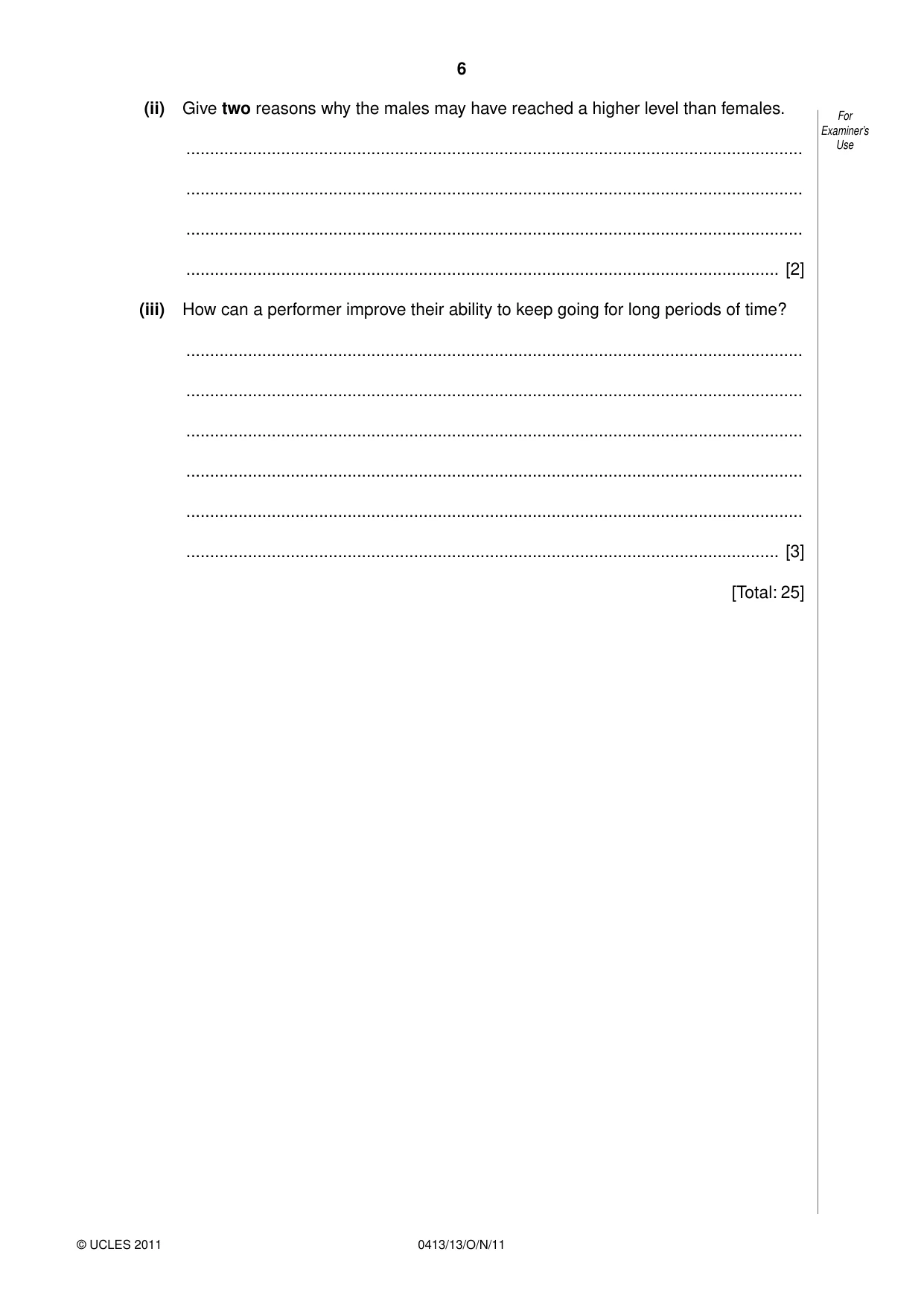
6 0413/13/O/N/11 © UCLES 2011 For Examiner’s Use (ii) Give two reasons why the males may have reached a higher level than females. … … … … [2] (iii) How can a performer improve their ability to keep going for long periods of time? … … … … … … [3] [Total: 25]
Question paper, page 7
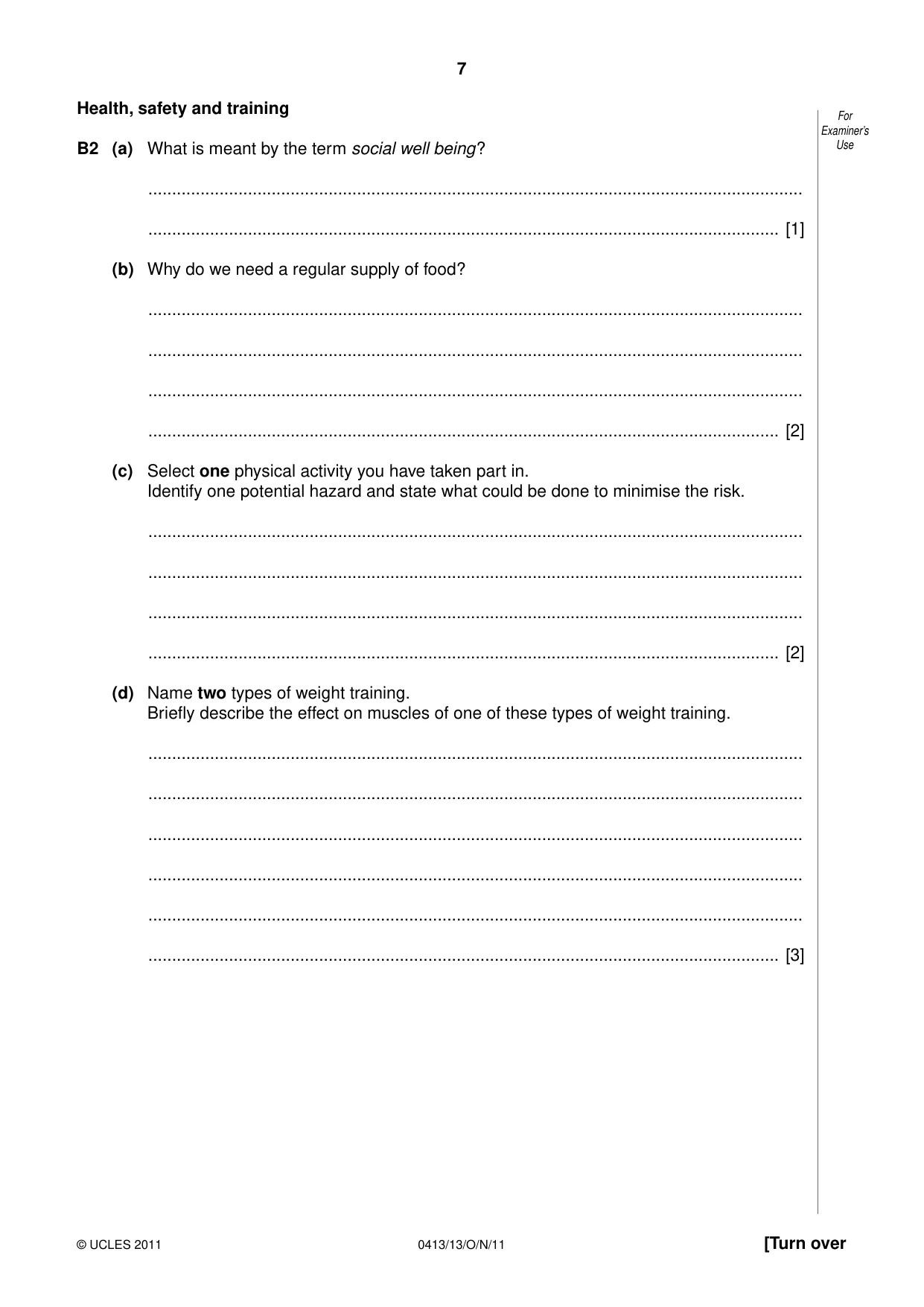
7 0413/13/O/N/11 © UCLES 2011 [Turn over For Examiner’s Use Health, safety and training B2 (a) What is meant by the term social well being? … … [1] (b) Why do we need a regular supply of food? … … … … [2] (c) Select one physical activity you have taken part in. Identify one potential hazard and state what could be done to minimise the risk. … … … … [2] (d) Name two types of weight training. Briefly describe the effect on muscles of one of these types of weight training. … … … … … … [3]
Question paper, page 8
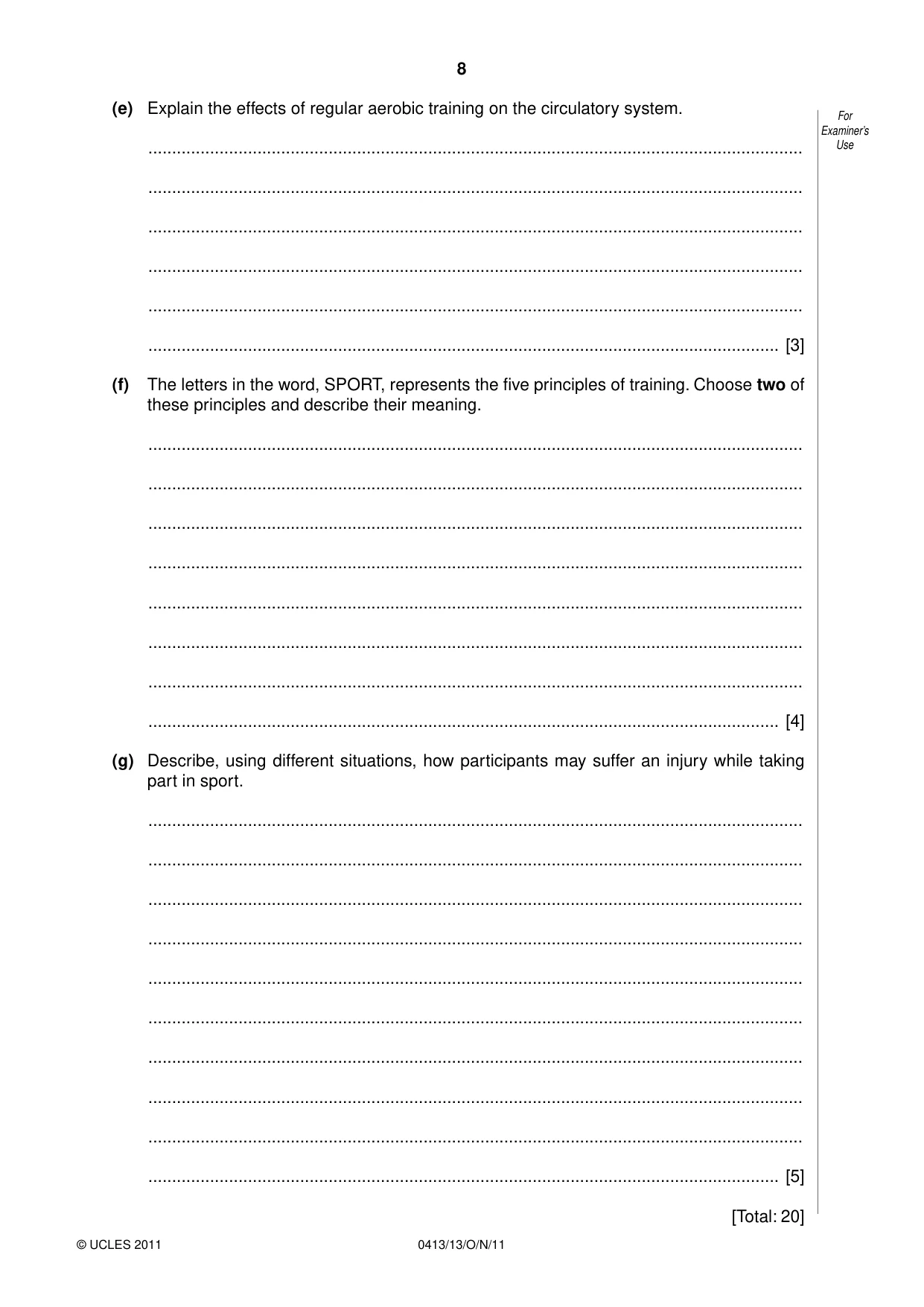
8 0413/13/O/N/11 © UCLES 2011 For Examiner’s Use (e) Explain the effects of regular aerobic training on the circulatory system. … … … … … … [3] (f) The letters in the word, SPORT, represents the five principles of training. Choose two of these principles and describe their meaning. … … … … … … … … [4] (g) Describe, using different situations, how participants may suffer an injury while taking part in sport. … … … … … … … … … … [5] [Total: 20]
Question paper, page 9
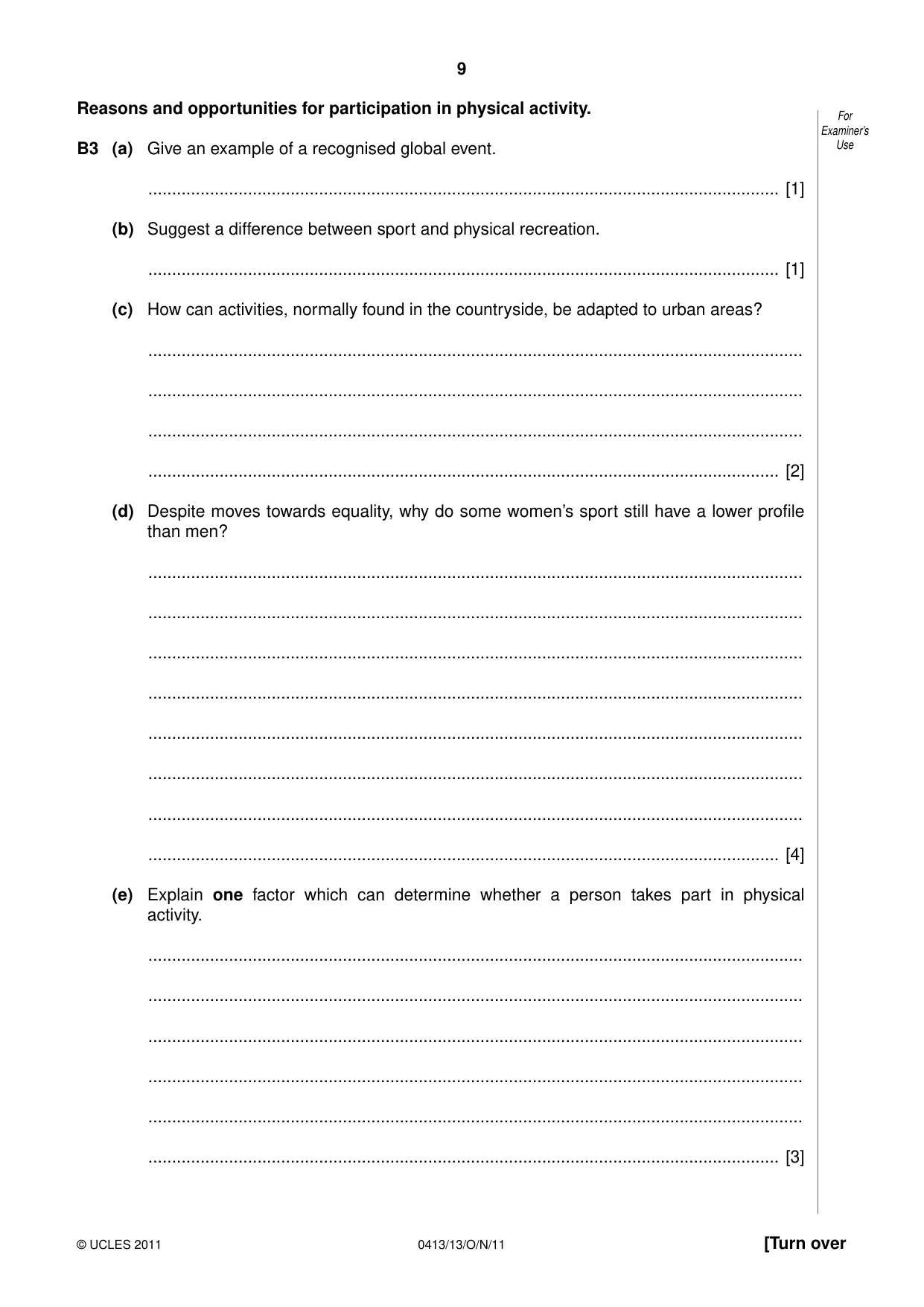
9 0413/13/O/N/11 © UCLES 2011 [Turn over For Examiner’s Use Reasons and opportunities for participation in physical activity. B3 (a) Give an example of a recognised global event. … [1] (b) Suggest a difference between sport and physical recreation. … [1] (c) How can activities, normally found in the countryside, be adapted to urban areas? … … … … [2] (d) Despite moves towards equality, why do some women’s sport still have a lower profile than men? … … … … … … … … [4] (e) Explain one factor which can determine whether a person takes part in physical activity. … … … … … … [3]
Question paper, page 10
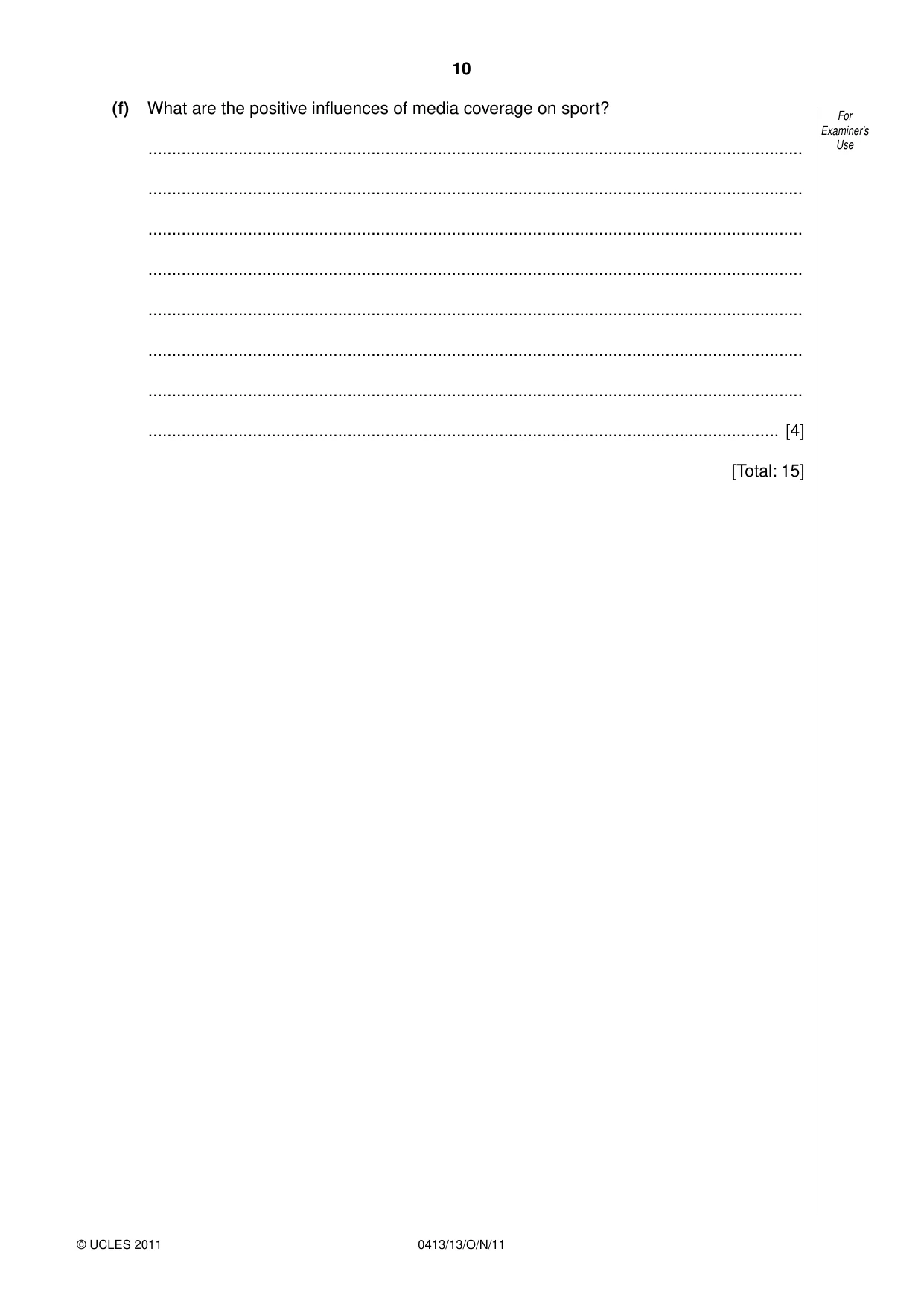
10 0413/13/O/N/11 © UCLES 2011 For Examiner’s Use (f) What are the positive influences of media coverage on sport? … … … … … … … … [4] [Total: 15]
Question paper, page 11
11 0413/13/O/N/11 © UCLES 2011 BLANK PAGE
Question paper, page 12
12 0413/13/O/N/11 © UCLES 2011 Permission to reproduce items where third-party owned material protected by copyright is included has been sought and cleared where possible. Every reasonable effort has been made by the publisher (UCLES) to trace copyright holders, but if any items requiring clearance have unwittingly been included, the publisher will be pleased to make amends at the earliest possible opportunity. University of Cambridge International Examinations is part of the Cambridge Assessment Group. Cambridge Assessment is the brand name of University of Cambridge Local Examinations Syndicate (UCLES), which is itself a department of the University of Cambridge. BLANK PAGE
Mark scheme, page 1
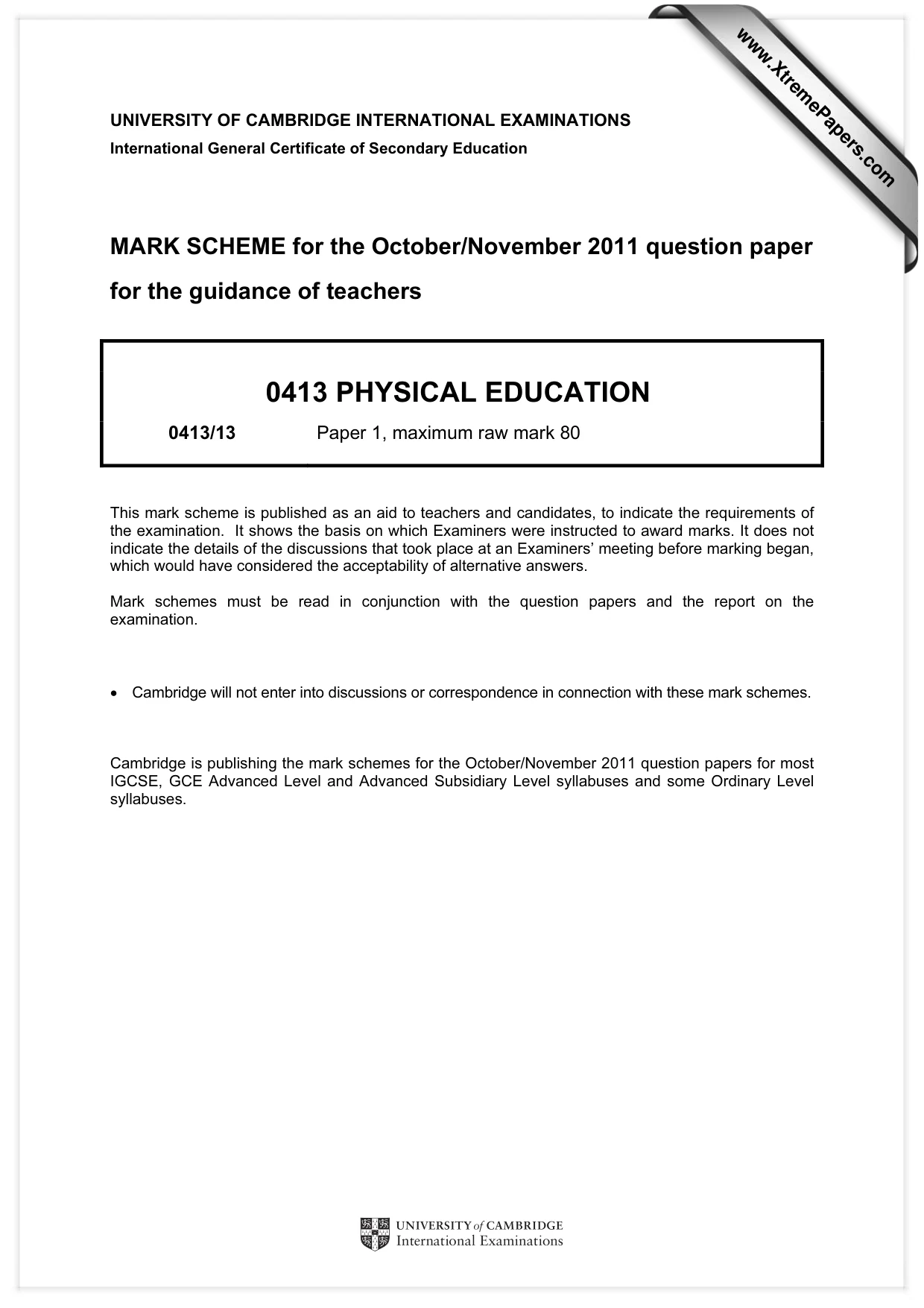
UNIVERSITY OF CAMBRIDGE INTERNATIONAL EXAMINATIONS International General Certificate of Secondary Education MARK SCHEME for the October/November 2011 question paper for the guidance of teachers 0413 PHYSICAL EDUCATION 0413/13 Paper 1, maximum raw mark 80 This mark scheme is published as an aid to teachers and candidates, to indicate the requirements of the examination. It shows the basis on which Examiners were instructed to award marks. It does not indicate the details of the discussions that took place at an Examiners’ meeting before marking began, which would have considered the acceptability of alternative answers. Mark schemes must be read in conjunction with the question papers and the report on the examination. • Cambridge will not enter into discussions or correspondence in connection with these mark schemes. Cambridge is publishing the mark schemes for the October/November 2011 question papers for most IGCSE, GCE Advanced Level and Advanced Subsidiary Level syllabuses and some Ordinary Level syllabuses. www.XtremePapers.com
Mark scheme, page 2
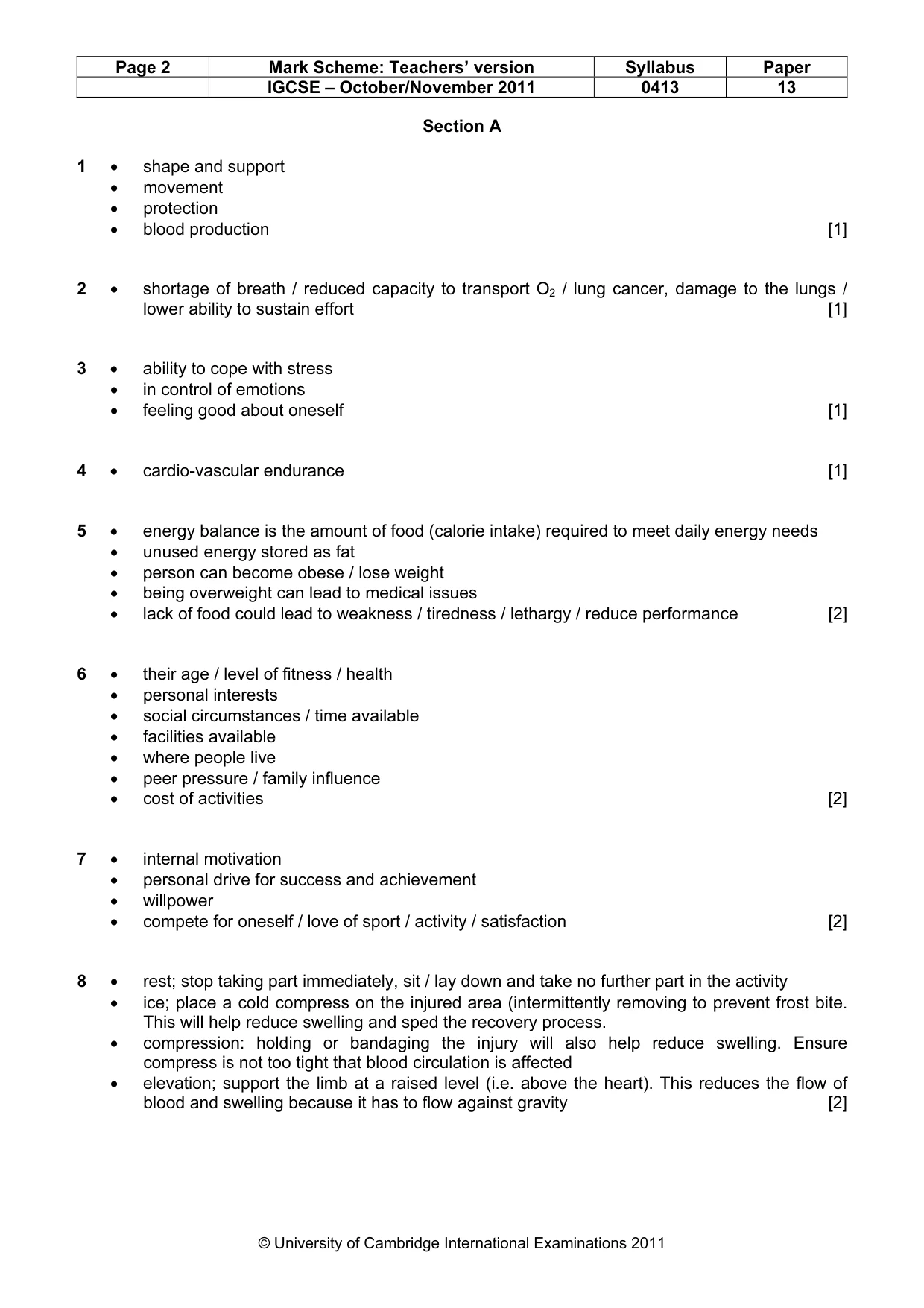
Page 2 Mark Scheme: Teachers’ version Syllabus Paper IGCSE – October/November 2011 0413 13 © University of Cambridge International Examinations 2011 Section A 1 • shape and support • movement • protection • blood production [1] 2 • shortage of breath / reduced capacity to transport O2 / lung cancer, damage to the lungs / lower ability to sustain effort [1] 3 • ability to cope with stress • in control of emotions • feeling good about oneself [1] 4 • cardio-vascular endurance [1] 5 • energy balance is the amount of food (calorie intake) required to meet daily energy needs • unused energy stored as fat • person can become obese / lose weight • being overweight can lead to medical issues • lack of food could lead to weakness / tiredness / lethargy / reduce performance [2] 6 • their age / level of fitness / health • personal interests • social circumstances / time available • facilities available • where people live • peer pressure / family influence • cost of activities [2] 7 • internal motivation • personal drive for success and achievement • willpower • compete for oneself / love of sport / activity / satisfaction [2] 8 • rest; stop taking part immediately, sit / lay down and take no further part in the activity • ice; place a cold compress on the injured area (intermittently removing to prevent frost bite. This will help reduce swelling and sped the recovery process. • compression: holding or bandaging the injury will also help reduce swelling. Ensure compress is not too tight that blood circulation is affected • elevation; support the limb at a raised level (i.e. above the heart). This reduces the flow of blood and swelling because it has to flow against gravity [2]
Mark scheme, page 3
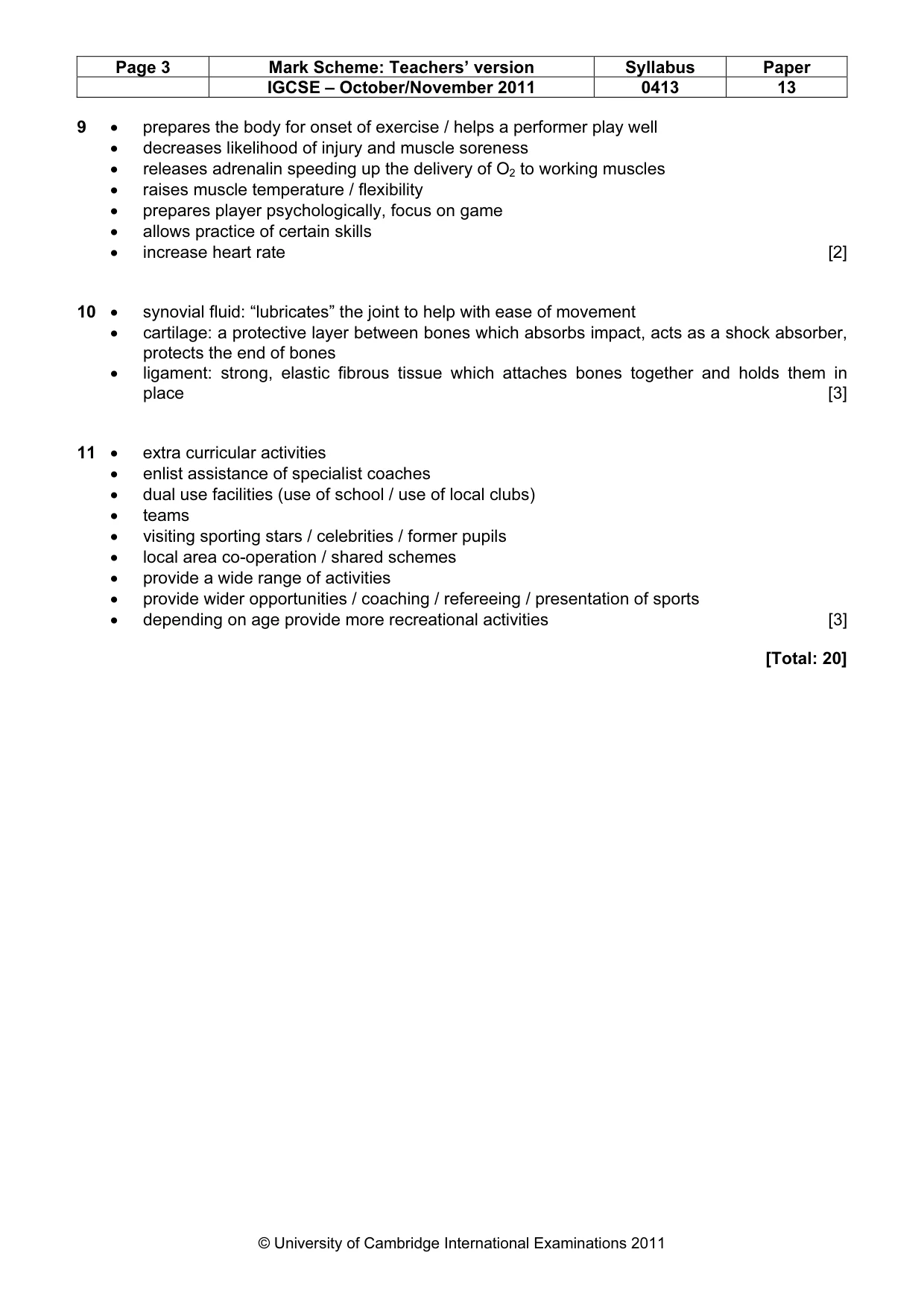
Page 3 Mark Scheme: Teachers’ version Syllabus Paper IGCSE – October/November 2011 0413 13 © University of Cambridge International Examinations 2011 9 • prepares the body for onset of exercise / helps a performer play well • decreases likelihood of injury and muscle soreness • releases adrenalin speeding up the delivery of O2 to working muscles • raises muscle temperature / flexibility • prepares player psychologically, focus on game • allows practice of certain skills • increase heart rate [2] 10 • synovial fluid: “lubricates” the joint to help with ease of movement • cartilage: a protective layer between bones which absorbs impact, acts as a shock absorber, protects the end of bones • ligament: strong, elastic fibrous tissue which attaches bones together and holds them in place [3] 11 • extra curricular activities • enlist assistance of specialist coaches • dual use facilities (use of school / use of local clubs) • teams • visiting sporting stars / celebrities / former pupils • local area co-operation / shared schemes • provide a wide range of activities • provide wider opportunities / coaching / refereeing / presentation of sports • depending on age provide more recreational activities [3] [Total: 20]
Mark scheme, page 4
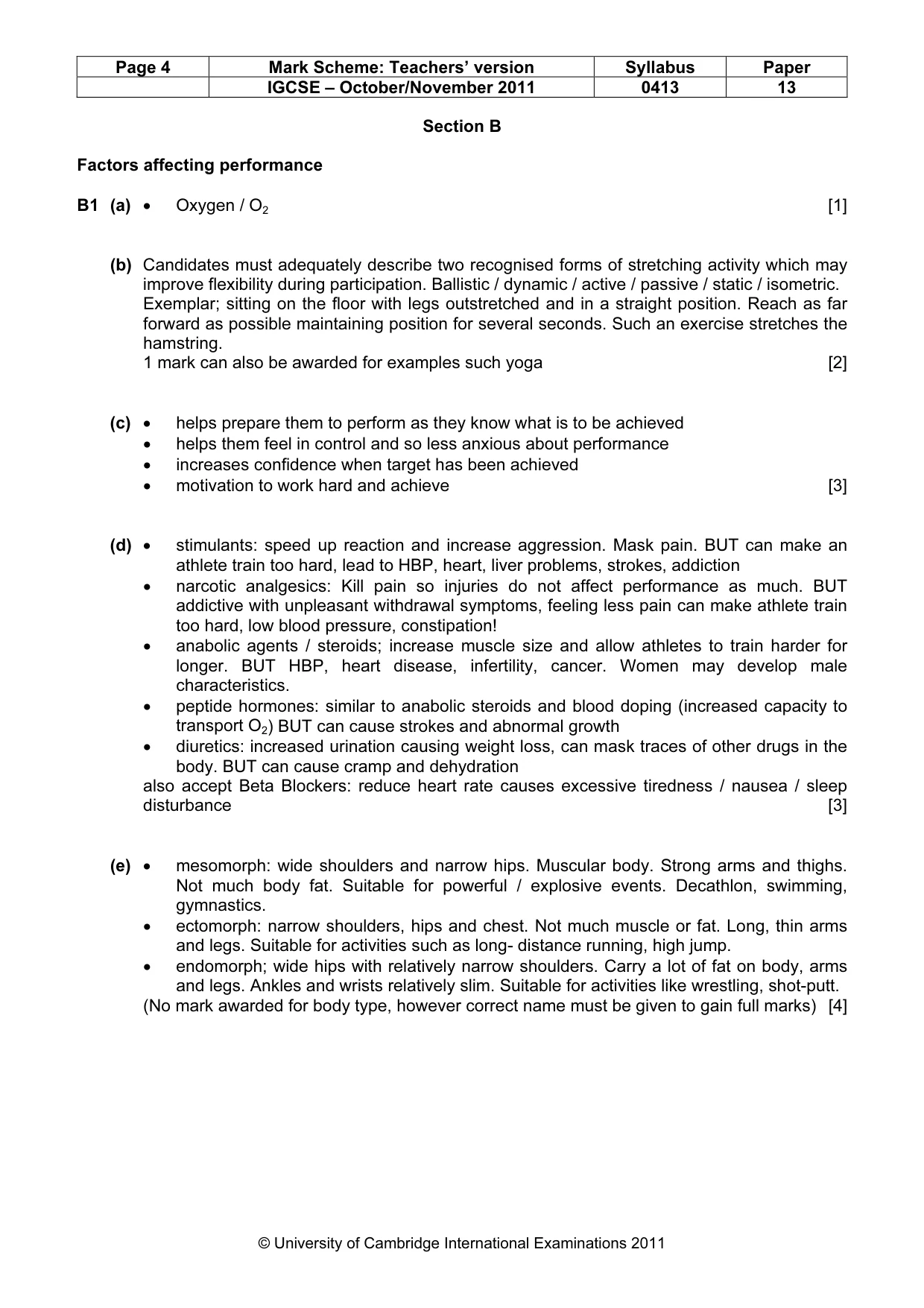
Page 4 Mark Scheme: Teachers’ version Syllabus Paper IGCSE – October/November 2011 0413 13 © University of Cambridge International Examinations 2011 Section B Factors affecting performance B1 (a) • Oxygen / O2 [1] (b) Candidates must adequately describe two recognised forms of stretching activity which may improve flexibility during participation. Ballistic / dynamic / active / passive / static / isometric. Exemplar; sitting on the floor with legs outstretched and in a straight position. Reach as far forward as possible maintaining position for several seconds. Such an exercise stretches the hamstring. 1 mark can also be awarded for examples such yoga [2] (c) • helps prepare them to perform as they know what is to be achieved • helps them feel in control and so less anxious about performance • increases confidence when target has been achieved • motivation to work hard and achieve [3] (d) • stimulants: speed up reaction and increase aggression. Mask pain. BUT can make an athlete train too hard, lead to HBP, heart, liver problems, strokes, addiction • narcotic analgesics: Kill pain so injuries do not affect performance as much. BUT addictive with unpleasant withdrawal symptoms, feeling less pain can make athlete train too hard, low blood pressure, constipation! • anabolic agents / steroids; increase muscle size and allow athletes to train harder for longer. BUT HBP, heart disease, infertility, cancer. Women may develop male characteristics. • peptide hormones: similar to anabolic steroids and blood doping (increased capacity to transport O2) BUT can cause strokes and abnormal growth • diuretics: increased urination causing weight loss, can mask traces of other drugs in the body. BUT can cause cramp and dehydration also accept Beta Blockers: reduce heart rate causes excessive tiredness / nausea / sleep disturbance [3] (e) • mesomorph: wide shoulders and narrow hips. Muscular body. Strong arms and thighs. Not much body fat. Suitable for powerful / explosive events. Decathlon, swimming, gymnastics. • ectomorph: narrow shoulders, hips and chest. Not much muscle or fat. Long, thin arms and legs. Suitable for activities such as long- distance running, high jump. • endomorph; wide hips with relatively narrow shoulders. Carry a lot of fat on body, arms and legs. Ankles and wrists relatively slim. Suitable for activities like wrestling, shot-putt. (No mark awarded for body type, however correct name must be given to gain full marks) [4]
Mark scheme, page 5
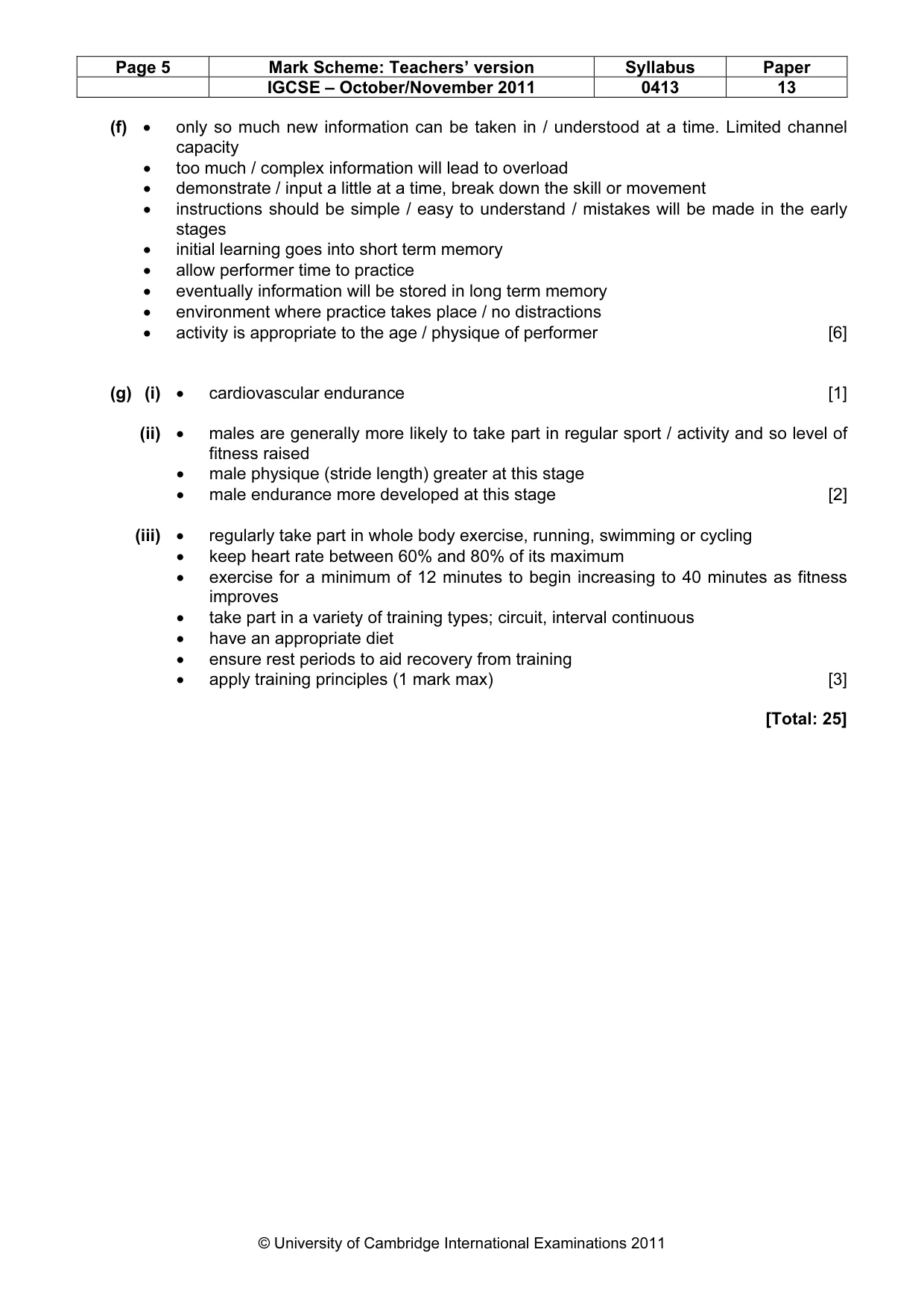
Page 5 Mark Scheme: Teachers’ version Syllabus Paper IGCSE – October/November 2011 0413 13 © University of Cambridge International Examinations 2011 (f) • only so much new information can be taken in / understood at a time. Limited channel capacity • too much / complex information will lead to overload • demonstrate / input a little at a time, break down the skill or movement • instructions should be simple / easy to understand / mistakes will be made in the early stages • initial learning goes into short term memory • allow performer time to practice • eventually information will be stored in long term memory • environment where practice takes place / no distractions • activity is appropriate to the age / physique of performer [6] (g) (i) • cardiovascular endurance [1] (ii) • males are generally more likely to take part in regular sport / activity and so level of fitness raised • male physique (stride length) greater at this stage • male endurance more developed at this stage [2] (iii) • regularly take part in whole body exercise, running, swimming or cycling • keep heart rate between 60% and 80% of its maximum • exercise for a minimum of 12 minutes to begin increasing to 40 minutes as fitness improves • take part in a variety of training types; circuit, interval continuous • have an appropriate diet • ensure rest periods to aid recovery from training • apply training principles (1 mark max) [3] [Total: 25]
Mark scheme, page 6
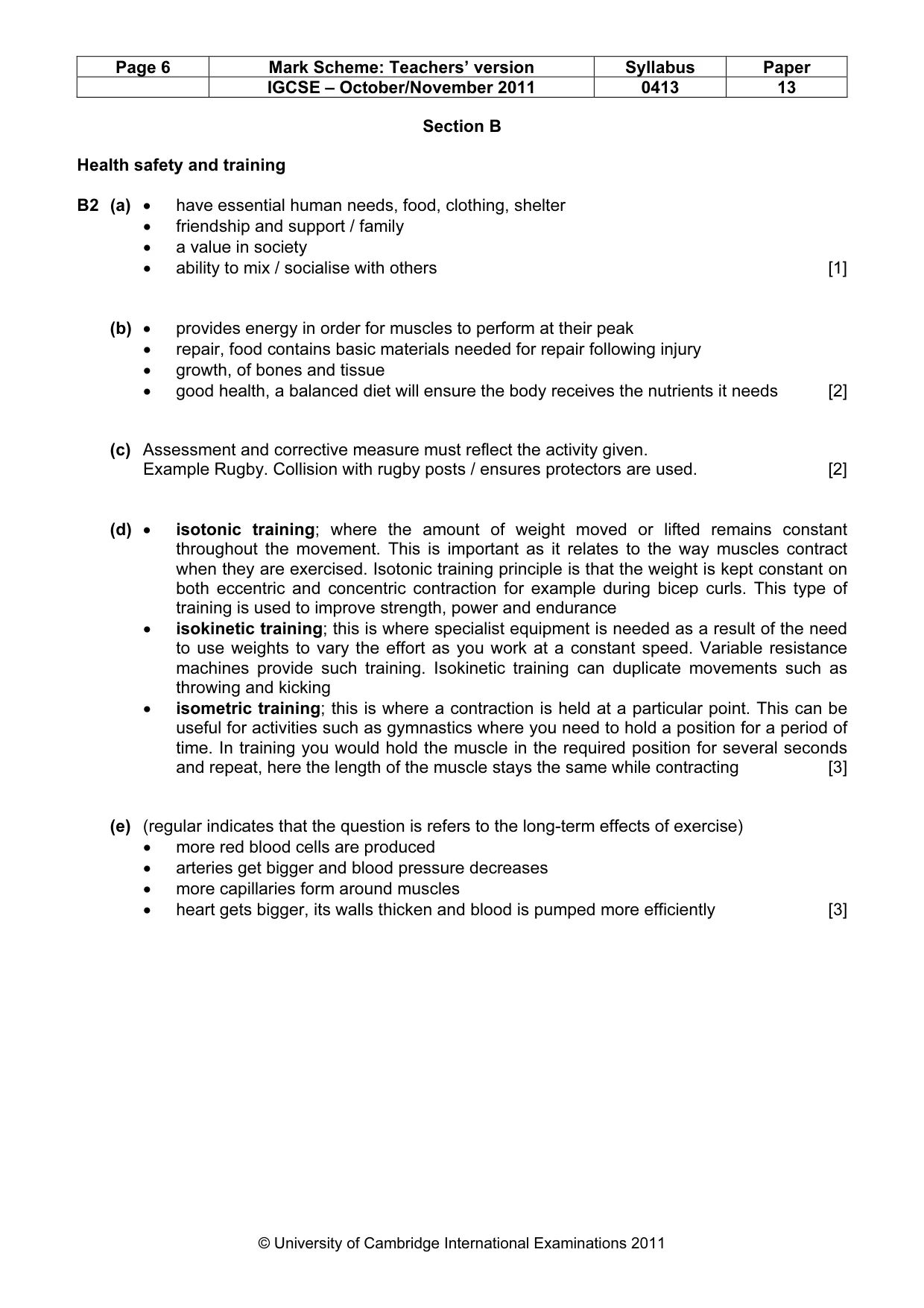
Page 6 Mark Scheme: Teachers’ version Syllabus Paper IGCSE – October/November 2011 0413 13 © University of Cambridge International Examinations 2011 Section B Health safety and training B2 (a) • have essential human needs, food, clothing, shelter • friendship and support / family • a value in society • ability to mix / socialise with others [1] (b) • provides energy in order for muscles to perform at their peak • repair, food contains basic materials needed for repair following injury • growth, of bones and tissue • good health, a balanced diet will ensure the body receives the nutrients it needs [2] (c) Assessment and corrective measure must reflect the activity given. Example Rugby. Collision with rugby posts / ensures protectors are used. [2] (d) • isotonic training; where the amount of weight moved or lifted remains constant throughout the movement. This is important as it relates to the way muscles contract when they are exercised. Isotonic training principle is that the weight is kept constant on both eccentric and concentric contraction for example during bicep curls. This type of training is used to improve strength, power and endurance • isokinetic training; this is where specialist equipment is needed as a result of the need to use weights to vary the effort as you work at a constant speed. Variable resistance machines provide such training. Isokinetic training can duplicate movements such as throwing and kicking • isometric training; this is where a contraction is held at a particular point. This can be useful for activities such as gymnastics where you need to hold a position for a period of time. In training you would hold the muscle in the required position for several seconds and repeat, here the length of the muscle stays the same while contracting [3] (e) (regular indicates that the question is refers to the long-term effects of exercise) • more red blood cells are produced • arteries get bigger and blood pressure decreases • more capillaries form around muscles • heart gets bigger, its walls thicken and blood is pumped more efficiently [3]
Mark scheme, page 7
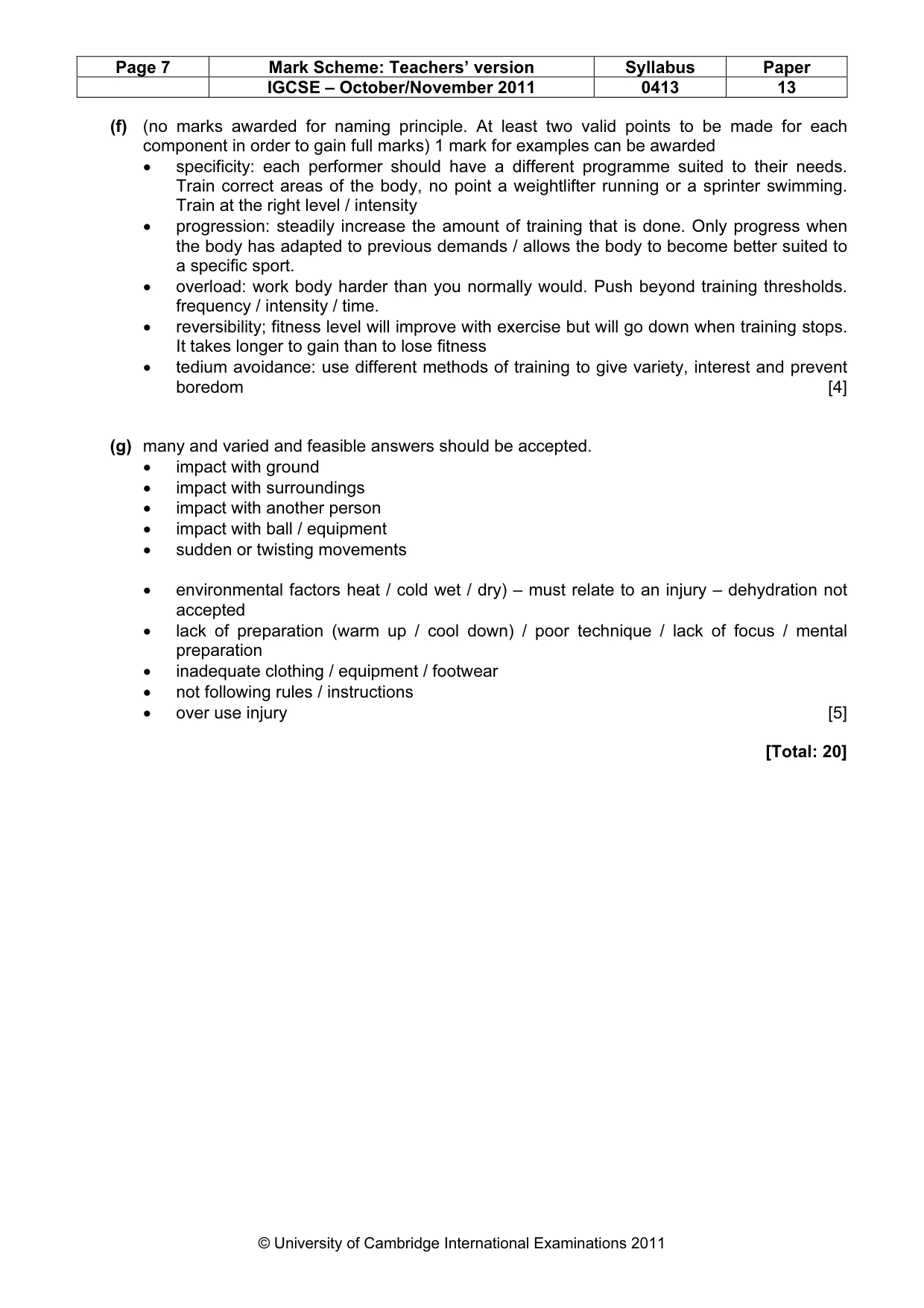
Page 7 Mark Scheme: Teachers’ version Syllabus Paper IGCSE – October/November 2011 0413 13 © University of Cambridge International Examinations 2011 (f) (no marks awarded for naming principle. At least two valid points to be made for each component in order to gain full marks) 1 mark for examples can be awarded • specificity: each performer should have a different programme suited to their needs. Train correct areas of the body, no point a weightlifter running or a sprinter swimming. Train at the right level / intensity • progression: steadily increase the amount of training that is done. Only progress when the body has adapted to previous demands / allows the body to become better suited to a specific sport. • overload: work body harder than you normally would. Push beyond training thresholds. frequency / intensity / time. • reversibility; fitness level will improve with exercise but will go down when training stops. It takes longer to gain than to lose fitness • tedium avoidance: use different methods of training to give variety, interest and prevent boredom [4] (g) many and varied and feasible answers should be accepted. • impact with ground • impact with surroundings • impact with another person • impact with ball / equipment • sudden or twisting movements • environmental factors heat / cold wet / dry) – must relate to an injury – dehydration not accepted • lack of preparation (warm up / cool down) / poor technique / lack of focus / mental preparation • inadequate clothing / equipment / footwear • not following rules / instructions • over use injury [5] [Total: 20]
Mark scheme, page 8
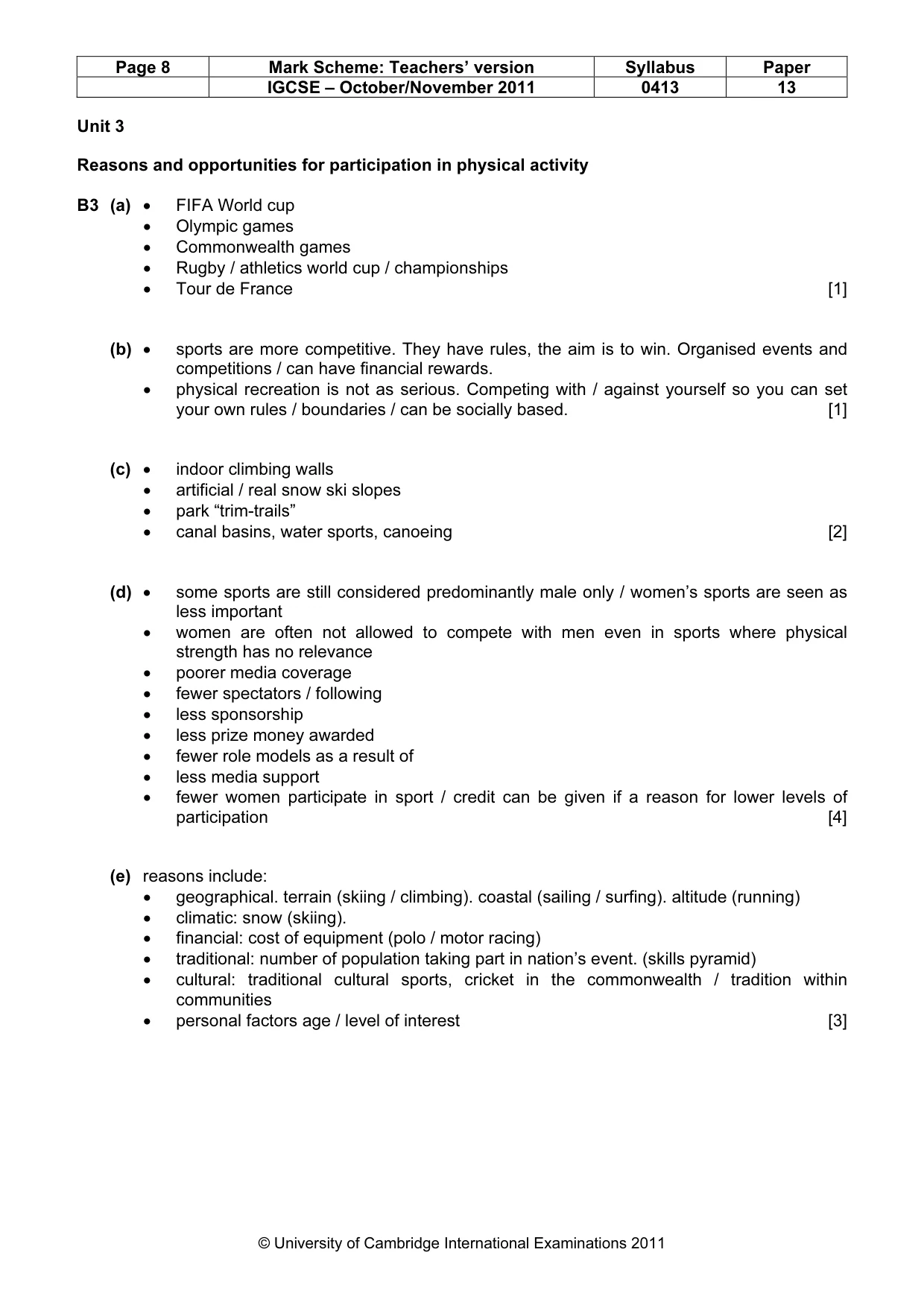
Page 8 Mark Scheme: Teachers’ version Syllabus Paper IGCSE – October/November 2011 0413 13 © University of Cambridge International Examinations 2011 Unit 3 Reasons and opportunities for participation in physical activity B3 (a) • FIFA World cup • Olympic games • Commonwealth games • Rugby / athletics world cup / championships • Tour de France [1] (b) • sports are more competitive. They have rules, the aim is to win. Organised events and competitions / can have financial rewards. • physical recreation is not as serious. Competing with / against yourself so you can set your own rules / boundaries / can be socially based. [1] (c) • indoor climbing walls • artificial / real snow ski slopes • park “trim-trails” • canal basins, water sports, canoeing [2] (d) • some sports are still considered predominantly male only / women’s sports are seen as less important • women are often not allowed to compete with men even in sports where physical strength has no relevance • poorer media coverage • fewer spectators / following • less sponsorship • less prize money awarded • fewer role models as a result of • less media support • fewer women participate in sport / credit can be given if a reason for lower levels of participation [4] (e) reasons include: • geographical. terrain (skiing / climbing). coastal (sailing / surfing). altitude (running) • climatic: snow (skiing). • financial: cost of equipment (polo / motor racing) • traditional: number of population taking part in nation’s event. (skills pyramid) • cultural: traditional cultural sports, cricket in the commonwealth / tradition within communities • personal factors age / level of interest [3]
Mark scheme, page 9
Page 9 Mark Scheme: Teachers’ version Syllabus Paper IGCSE – October/November 2011 0413 13 © University of Cambridge International Examinations 2011 (f) • greater audience can see, hear and read about sport • promotes sport • creates sports stars which can have a positive effect on young people and the popularity of the sport • can inform and entertain • if seen on television sports can attract sponsorship which can lead to improved facilities, stadia, training, coaches, players etc. / raise standards • increase participation [4] [Total: 15]
What you needed in this session
Cambridge’s own grade thresholds for 2011 Oct/Nov, Paper 1 · Variant 3. A higher threshold means an easier paper — the bar moves with how the cohort did.