Cambridge IGCSE Physical Education 0413 — 2010 May/June Paper 1 · Variant 1
0413/11/M/J/10 · 80 marks · ≈90 min
The question paper and its mark scheme, free to read here and free to download. This is Cambridge’s own paper, exactly as it was sat.
Question paper16 pages









Mark scheme13 pages
Answers below. Sit the paper first if you are practising.


Paper as text
Question paper, page 1
This document consists of 14 printed pages and 2 blank pages. DC (CB/CS) 15792/3 © UCLES 2010 [Turn over UNIVERSITY OF CAMBRIDGE INTERNATIONAL EXAMINATIONS International General Certificate of Secondary Education READ THESE INSTRUCTIONS FIRST Write your Centre number, candidate number and name on all the work you hand in. Write in dark blue or black pen. You may use a soft pencil for any diagrams, graphs or rough working. Do not use staples, paper clips, highlighters, glue or correction fluid. DO NOT WRITE IN ANY BARCODES. Answer all questions. At the end of the examination, fasten all your work securely together. The number of marks is given in brackets [ ] at the end of each question or part question. PHYSICAL EDUCATION 0413/11 Paper 1 May/June 2010 1 hour 45 minutes Candidates answer on the Question Paper. No Additional Materials are required. For Examiner’s Use Section A B1 B2 B3 Total * 9 3 8 1 3 3 8 6 2 8 * www.XtremePapers.com
Question paper, page 2
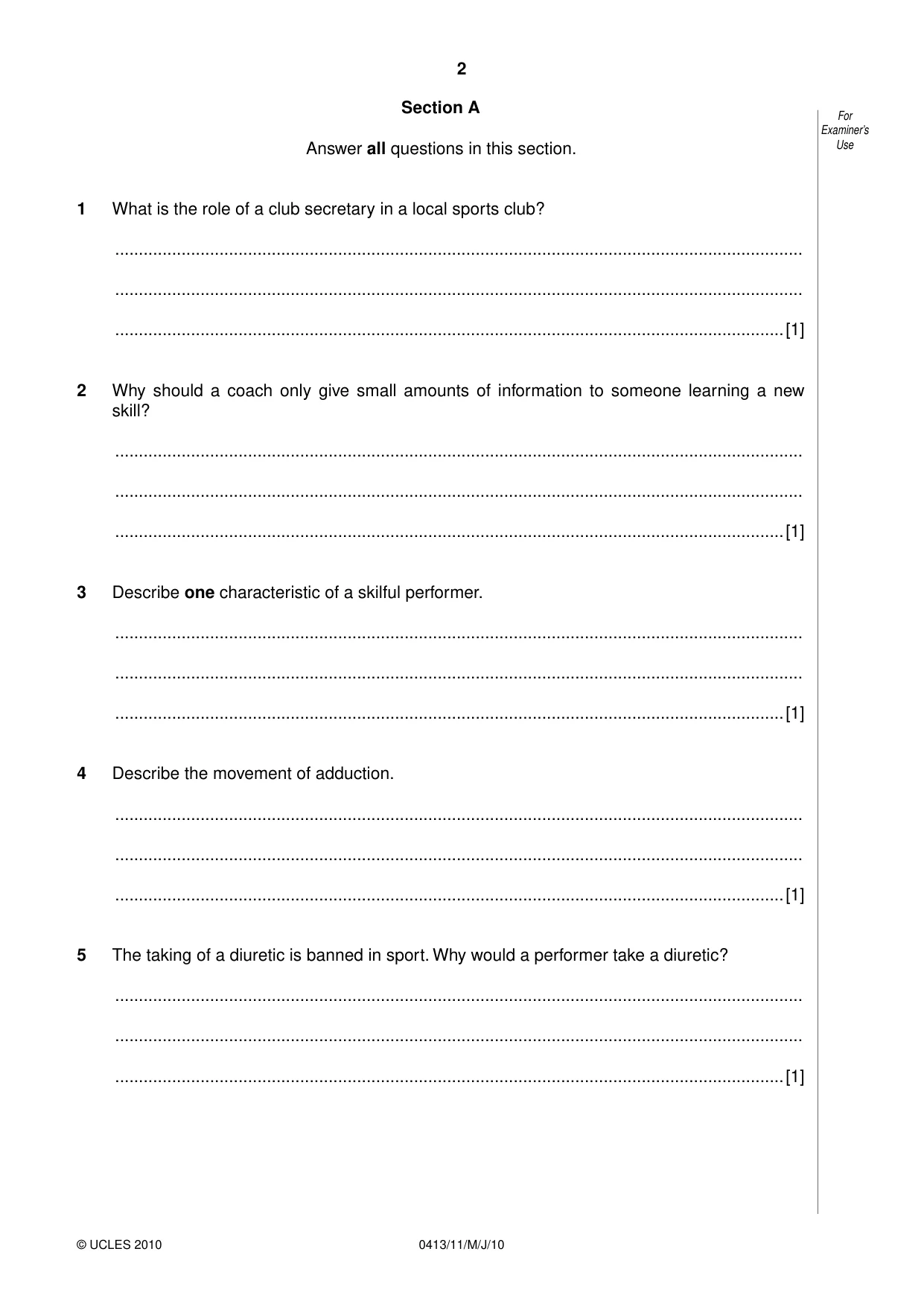
2 0413/11/M/J/10 © UCLES 2010 For Examiner’s Use Section A Answer all questions in this section. 1 What is the role of a club secretary in a local sports club? … … …[1] 2 Why should a coach only give small amounts of information to someone learning a new skill? … … …[1] 3 Describe one characteristic of a skilful performer. … … …[1] 4 Describe the movement of adduction. … … …[1] 5 The taking of a diuretic is banned in sport. Why would a performer take a diuretic? … … …[1]
Question paper, page 3
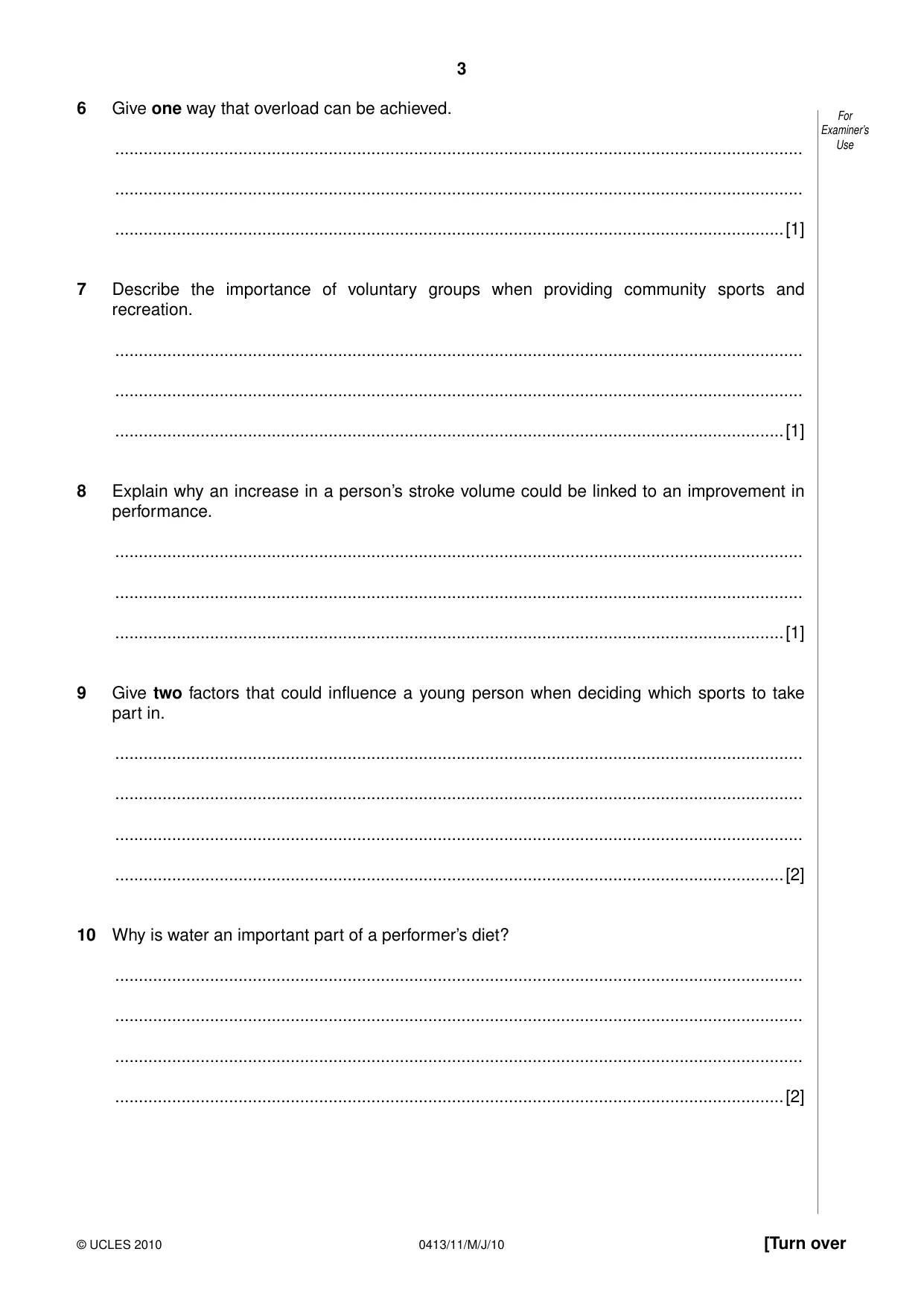
3 0413/11/M/J/10 © UCLES 2010 [Turn over For Examiner’s Use 6 Give one way that overload can be achieved. … … …[1] 7 Describe the importance of voluntary groups when providing community sports and recreation. … … …[1] 8 Explain why an increase in a person’s stroke volume could be linked to an improvement in performance. … … …[1] 9 Give two factors that could influence a young person when deciding which sports to take part in. … … … …[2] 10 Why is water an important part of a performer’s diet? … … … …[2]
Question paper, page 4
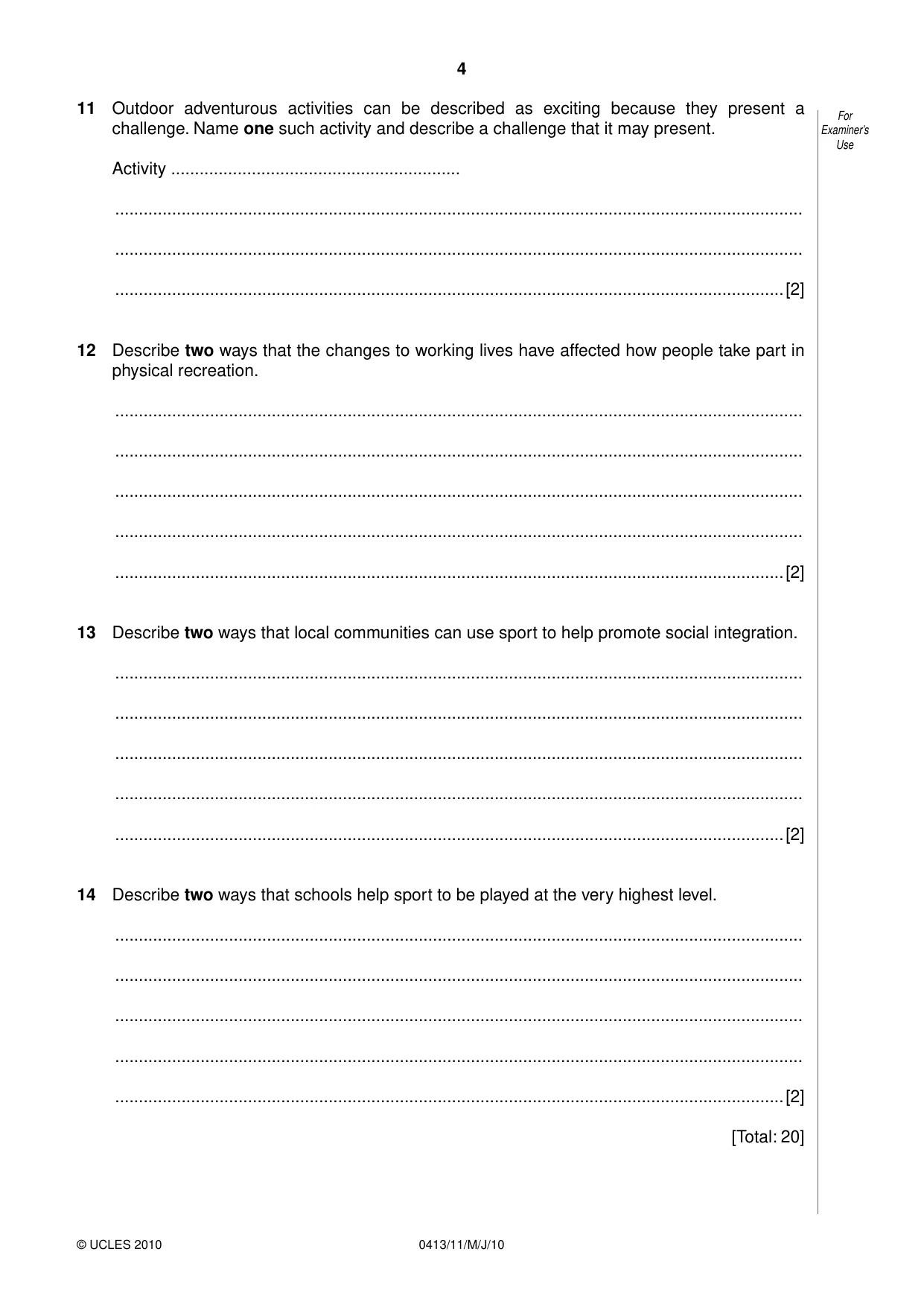
4 0413/11/M/J/10 © UCLES 2010 For Examiner’s Use 11 Outdoor adventurous activities can be described as exciting because they present a challenge. Name one such activity and describe a challenge that it may present. Activity … … … …[2] 12 Describe two ways that the changes to working lives have affected how people take part in physical recreation. … … … … …[2] 13 Describe two ways that local communities can use sport to help promote social integration. … … … … …[2] 14 Describe two ways that schools help sport to be played at the very highest level. … … … … …[2] [Total: 20]
Question paper, page 5
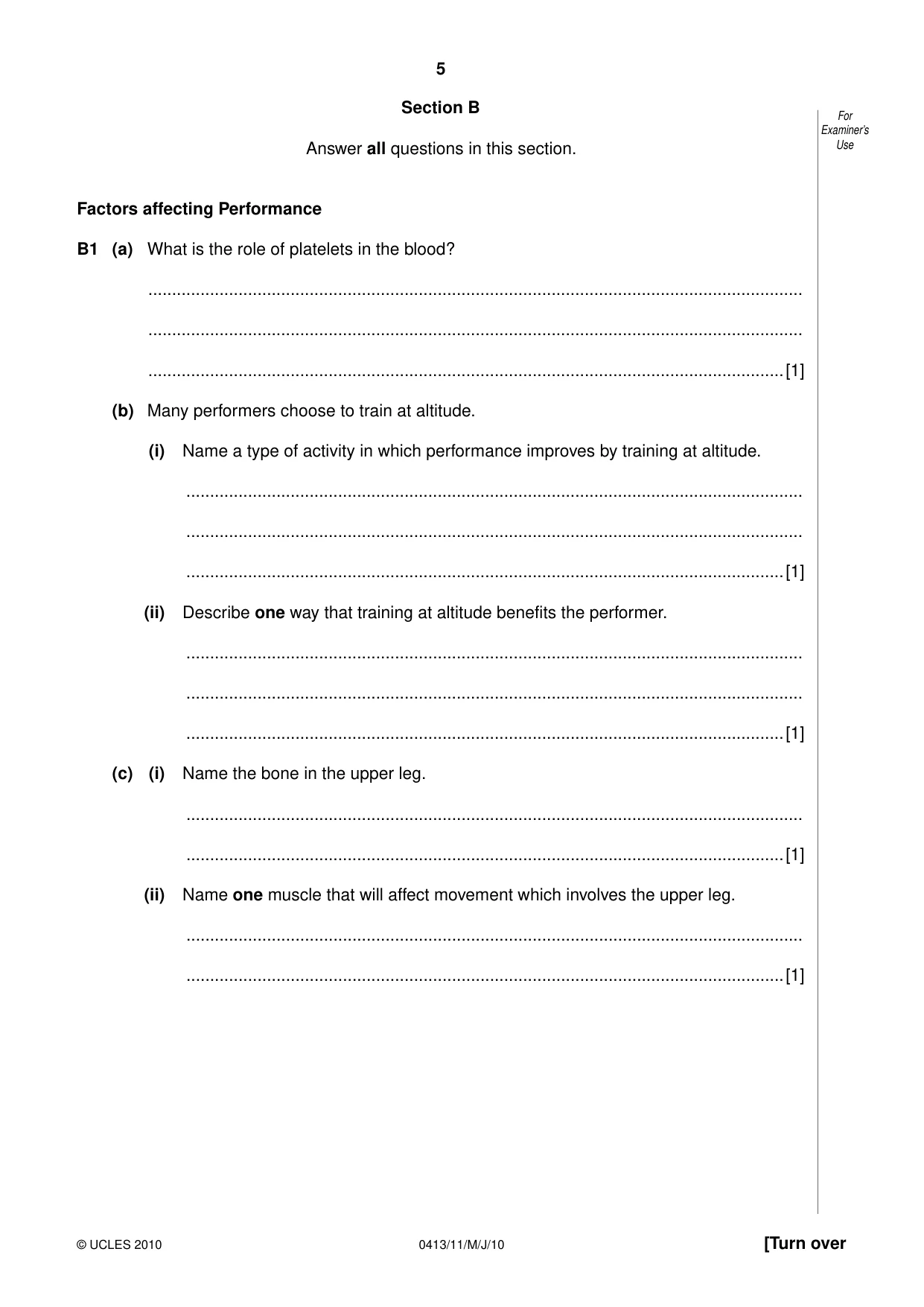
0413/11/M/J/10 © UCLES 2010 [Turn over For Examiner’s Use Section B Answer all questions in this section. Factors affecting Performance B1 (a) What is the role of platelets in the blood? … … …[1] (b) Many performers choose to train at altitude. (i) Name a type of activity in which performance improves by training at altitude. … … …[1] (ii) Describe one way that training at altitude benefits the performer. … … …[1] (c) (i) Name the bone in the upper leg. … …[1] (ii) Name one muscle that will affect movement which involves the upper leg. … …[1] 5
Question paper, page 6
6 0413/11/M/J/10 © UCLES 2010 For Examiner’s Use (iii) Describe the two types of movements that occur at the knee when a kicking action takes place. … … … … … … … … …[4] (d) Describe the changes that take place in breathing when moving from a walking to a running pace. … … … … … … …[3] (e) (i) Describe how the level of arousal affects the quality of performance. … … … … … … …[3]
Question paper, page 7
7 0413/11/M/J/10 © UCLES 2010 [Turn over For Examiner’s Use (ii) Describe how a performance may suffer when the level of arousal is not at an appropriate level. … … …[1] (iii) How does adrenalin affect the level of arousal? … … … … … …[2] (f) Fitness can be classified as Health Related or Skill Related. (i) Describe one difference between these two types of fitness. … … …[1]
Question paper, page 8
8 0413/11/M/J/10 © UCLES 2010 For Examiner’s Use (ii) Choose one component of each type of fitness and describe how you would recognise these in an able performer. Health Related Component … … … … … …[2] Skill Related Component … … … … … …[2] (iii) Describe how you would carry out a test for one component of Skill Related Fitness. Test … Description … … … … …[2] [Total: 25]
Question paper, page 9
9 0413/11/M/J/10 © UCLES 2010 [Turn over For Examiner’s Use Health, Safety and Training B2 (a) Protein is an important nutrient in a performer’s diet. Explain one of its benefits. … … …[1] (b) Describe two ways that misuse of the overload principle can result in reversibility in a weight training programme. … … … … …[2] (c) Injuries are an accepted part of sport. (i) Describe a sign and an area of the body where a strain injury may occur. … … … … (ii) Describe one treatment that you could apply to this injury. … … …[3]
Question paper, page 10
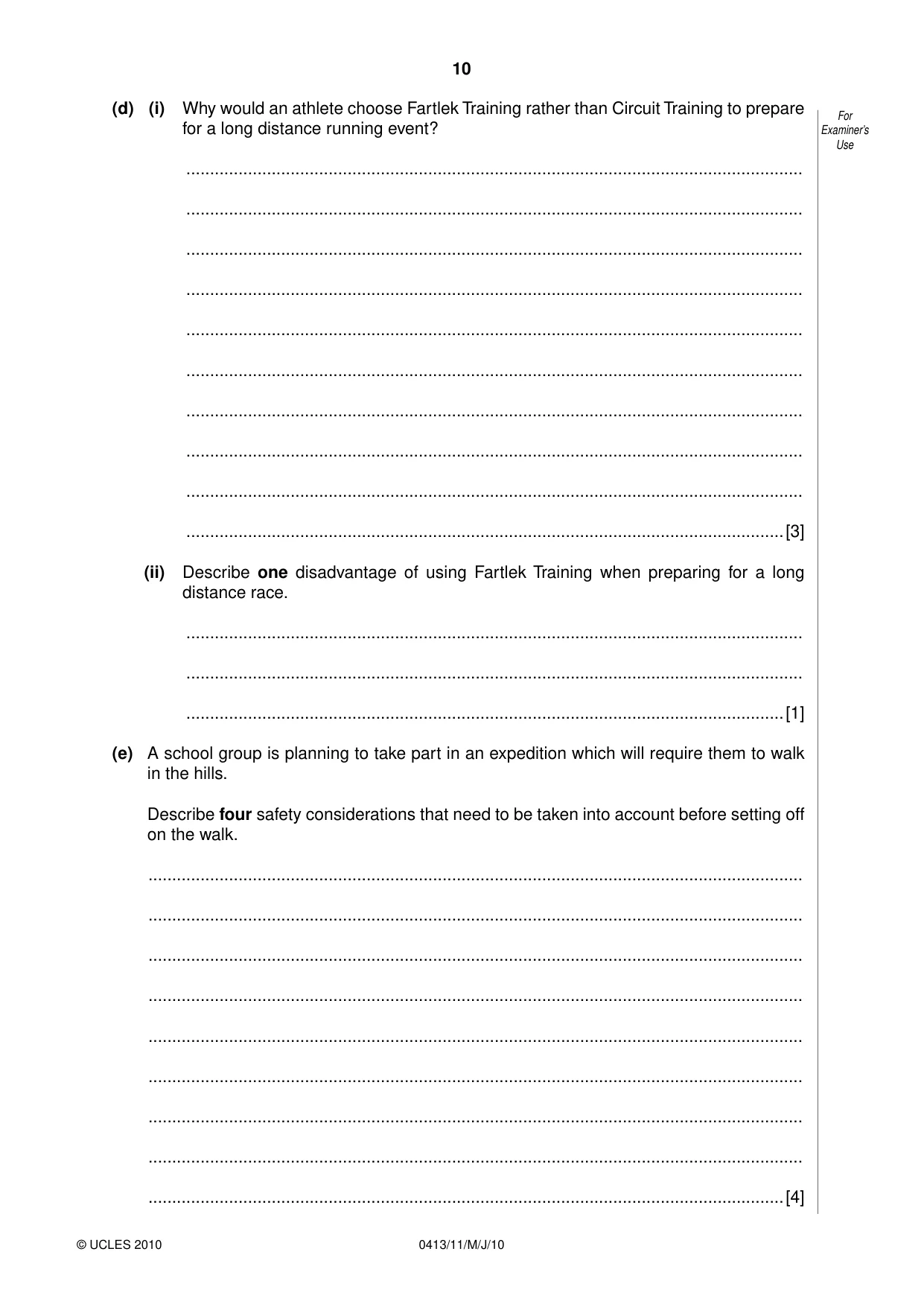
10 0413/11/M/J/10 © UCLES 2010 For Examiner’s Use (d) (i) Why would an athlete choose Fartlek Training rather than Circuit Training to prepare for a long distance running event? … … … … … … … … … …[3] (ii) Describe one disadvantage of using Fartlek Training when preparing for a long distance race. … … …[1] (e) A school group is planning to take part in an expedition which will require them to walk in the hills. Describe four safety considerations that need to be taken into account before setting off on the walk. … … … … … … … … …[4]
Question paper, page 11
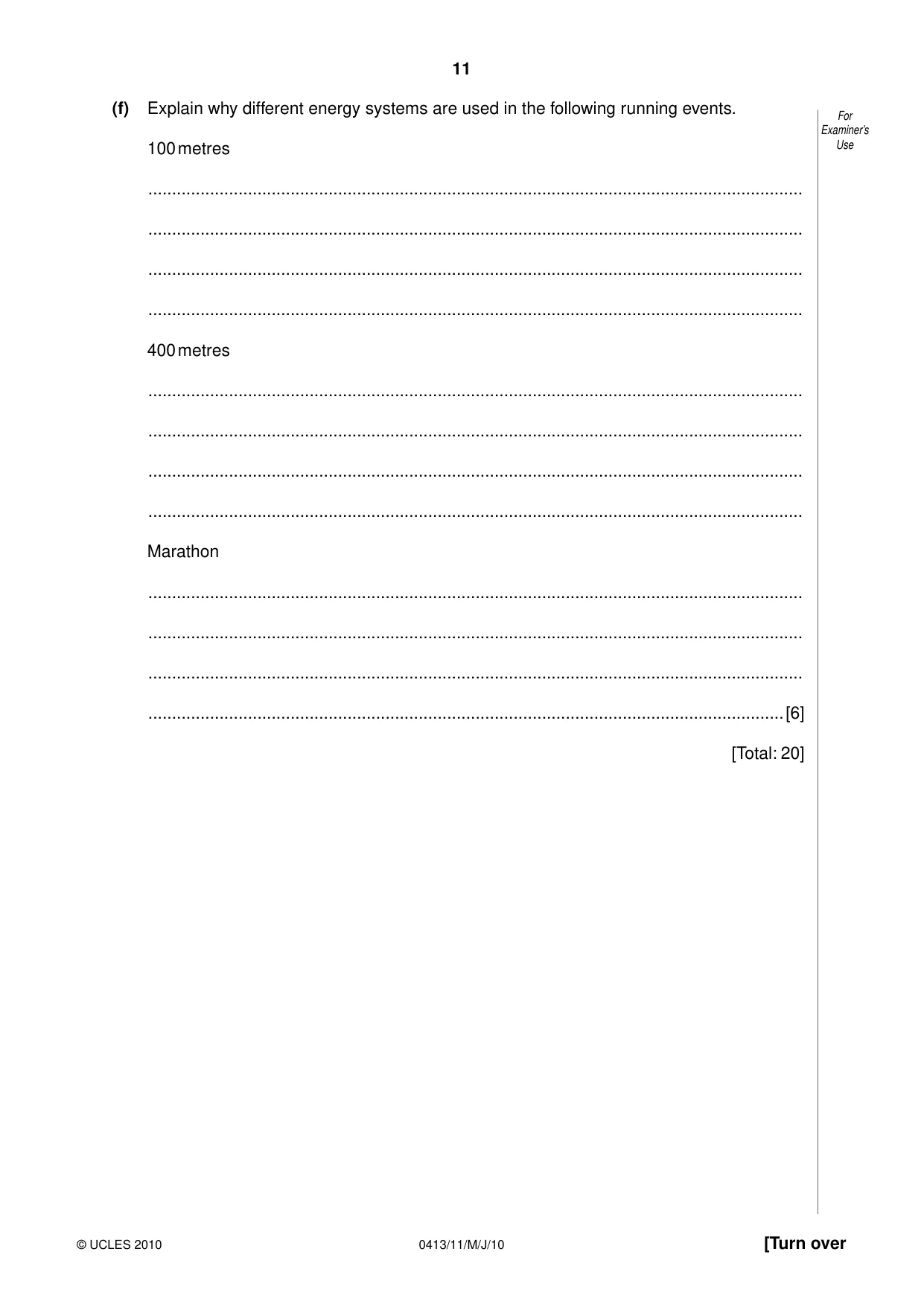
11 0413/11/M/J/10 © UCLES 2010 [Turn over For Examiner’s Use (f) Explain why different energy systems are used in the following running events. 100 metres … … … … 400 metres … … … … Marathon … … … …[6] [Total: 20]
Question paper, page 12
12 0413/11/M/J/10 © UCLES 2010 For Examiner’s Use Reasons and opportunities for participation in physical education B3 (a) Global events create huge interest. (i) Give one example of a global sporting event. …[1] (ii) Describe two benefits to sport in a country when they host a global event. … … … … … …[2] (iii) Describe three social benefits that might occur for the host nation when hosting a global event. … … … … … … … … …[3]
Question paper, page 13
13 0413/11/M/J/10 © UCLES 2010 [Turn over For Examiner’s Use (b) (i) Give two reasons why a person organising a tournament may seek sponsorship. … … … … …[2] (ii) Companies are often approached to sponsor an event. Describe two reasons why they might refuse. … … … … … …[2] (iii) Give one benefit for the sponsor when providing sponsorship. … … …[1]
Question paper, page 14
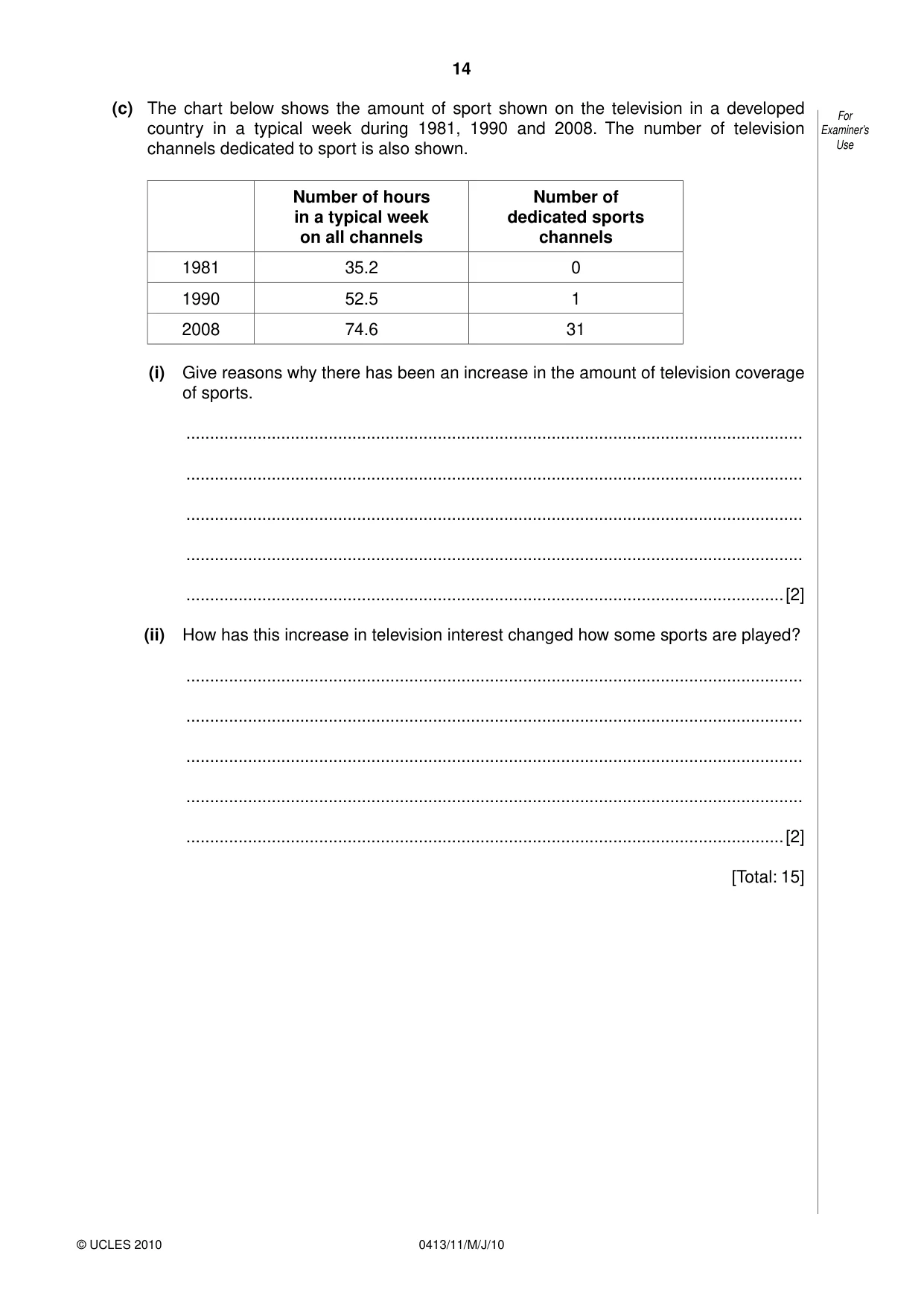
14 0413/11/M/J/10 © UCLES 2010 For Examiner’s Use (c) The chart below shows the amount of sport shown on the television in a developed country in a typical week during 1981, 1990 and 2008. The number of television channels dedicated to sport is also shown. Number of hours in a typical week on all channels Number of dedicated sports channels 1981 35.2 0 1990 52.5 1 2008 74.6 31 (i) Give reasons why there has been an increase in the amount of television coverage of sports. … … … … …[2] (ii) How has this increase in television interest changed how some sports are played? … … … … …[2] [Total: 15]
Question paper, page 15
15 0413/11/M/J/10 © UCLES 2010 BLANK PAGE
Question paper, page 16
16 0413/11/M/J/10 © UCLES 2010 BLANK PAGE Permission to reproduce items where third-party owned material protected by copyright is included has been sought and cleared where possible. Every reasonable effort has been made by the publisher (UCLES) to trace copyright holders, but if any items requiring clearance have unwittingly been included, the publisher will be pleased to make amends at the earliest possible opportunity. University of Cambridge International Examinations is part of the Cambridge Assessment Group. Cambridge Assessment is the brand name of University of Cambridge Local Examinations Syndicate (UCLES), which is itself a department of the University of Cambridge.
Mark scheme, page 1
UNIVERSITY OF CAMBRIDGE INTERNATIONAL EXAMINATIONS International General Certificate of Secondary Education MARK SCHEME for the May/June 2010 question paper for the guidance of teachers 0413 PHYSICAL EDUCATION 0413/11 Paper 11, maximum raw mark 80 This mark scheme is published as an aid to teachers and candidates, to indicate the requirements of the examination. It shows the basis on which Examiners were instructed to award marks. It does not indicate the details of the discussions that took place at an Examiners’ meeting before marking began, which would have considered the acceptability of alternative answers. Mark schemes must be read in conjunction with the question papers and the report on the examination. • CIE will not enter into discussions or correspondence in connection with these mark schemes. CIE is publishing the mark schemes for the May/June 2010 question papers for most IGCSE, GCE Advanced Level and Advanced Subsidiary Level syllabuses and some Ordinary Level syllabuses. www.XtremePapers.com
Mark scheme, page 2
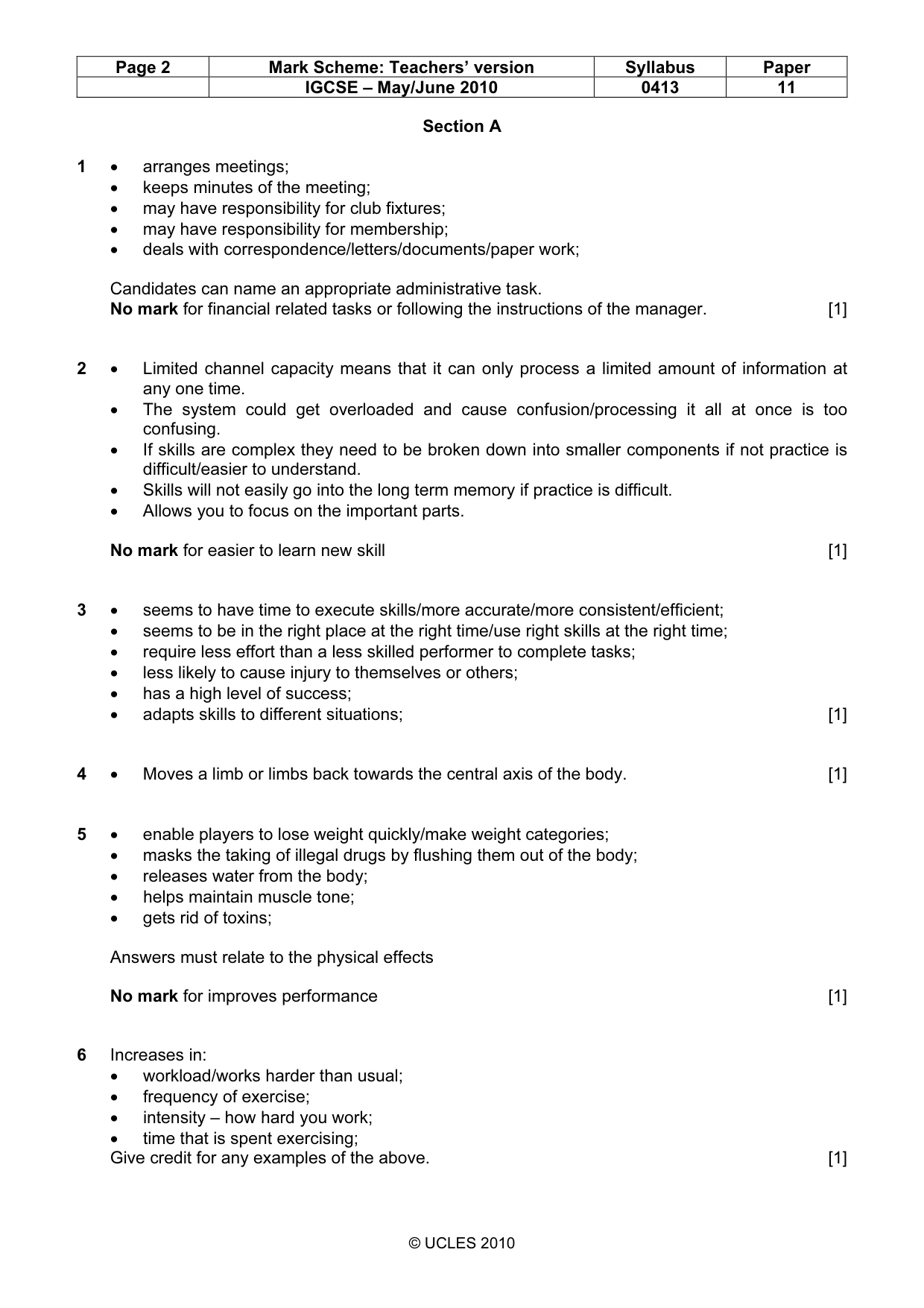
Page 2 Mark Scheme: Teachers’ version Syllabus Paper IGCSE – May/June 2010 0413 11 © UCLES 2010 Section A 1 • arranges meetings; • keeps minutes of the meeting; • may have responsibility for club fixtures; • may have responsibility for membership; • deals with correspondence/letters/documents/paper work; Candidates can name an appropriate administrative task. No mark for financial related tasks or following the instructions of the manager. [1] 2 • Limited channel capacity means that it can only process a limited amount of information at any one time. • The system could get overloaded and cause confusion/processing it all at once is too confusing. • If skills are complex they need to be broken down into smaller components if not practice is difficult/easier to understand. • Skills will not easily go into the long term memory if practice is difficult. • Allows you to focus on the important parts. No mark for easier to learn new skill [1] 3 • seems to have time to execute skills/more accurate/more consistent/efficient; • seems to be in the right place at the right time/use right skills at the right time; • require less effort than a less skilled performer to complete tasks; • less likely to cause injury to themselves or others; • has a high level of success; • adapts skills to different situations; [1] 4 • Moves a limb or limbs back towards the central axis of the body. [1] 5 • enable players to lose weight quickly/make weight categories; • masks the taking of illegal drugs by flushing them out of the body; • releases water from the body; • helps maintain muscle tone; • gets rid of toxins; Answers must relate to the physical effects No mark for improves performance [1] 6 Increases in: • workload/works harder than usual; • frequency of exercise; • intensity – how hard you work; • time that is spent exercising; Give credit for any examples of the above. [1]
Mark scheme, page 3
Page 3 Mark Scheme: Teachers’ version Syllabus Paper IGCSE – May/June 2010 0413 11 © UCLES 2010 7 • provide activities to local communities; • meet local demands/what the community wants; • easily accessible to the local community; • provide additional activities that do not already exist; • cheap or free; Do not accept facilities. The question assumes facilities are already in place. [1] 8 • There would be an increase in the amount of blood pumped around the body/lower resting heart rate. • There would be an increase in the amount of oxygen delivered to muscles/able to go on for longer/increased stamina. • There would be an improvement in gaseous exchange. Answer must show an increase/improvement. [1] 9 • The interest of parents and other members of the family. • Sports or sports stars that are frequently on the television/media coverage/role models. • Peer pressure. • Access – transport and availability. • Experience of the school curriculum/activities after school. • Fun/enjoyment. No mark for costs/physical size. [2] 10 • It helps remove unabsorbed foods and other waste products. • Water is a key to chemical reactions. • An essential part of blood which carries oxygen and nutrients around the body. • Stops the body from overheating. • Allows hydration/replaces fluids/stops headaches, dizziness, etc. • Helps maintain muscle tone. • Gets rid of toxins. • Keeps performers healthy. [2] 11 • Answers must relate to the named activity. • An example could be: hill walking – physically being able to walk for a prolonged period; coping with the changes in the environment – ability to read a map – being able to plan with safety in mind Include the responses dangers/unknown surprises. Answers must be adventurous and not just outside activities. 1 mark for activity and 1 for the challenge. [2]
Mark scheme, page 4
Page 4 Mark Scheme: Teachers’ version Syllabus Paper IGCSE – May/June 2010 0413 11 © UCLES 2010 12 • Changes to working patterns allow people to take part in sports at a variety of times rather than just at weekends. • People have more holiday time that can be used for sporting activities. • Sporting holidays give people opportunities to participate – sailing, golf, etc. • Unemployment. • Increased workload can reduce opportunities. • Early retirement. Answer must relate to work rather than family demands. No mark for stress. [2] 13 • Relaxation of rules to allow access – in certain cultures women are not allowed to wear swimming costumes but could take part if they are allowed to cover arms and legs. • Affordable sports. • Providing sports that are traditional in different cultures. • Provide sports that are popular. • Ensure good access for disabled participants to sports centres. • Provide coaching for all levels of performers. • Provide equal access and opportunities for women. • Provide crèche facilities that allow women to participate. • Provide opportunities through competitions/tournaments/events/local teams. [2] 14 • Schools’ sport have a pyramid structure that allows elite performers to play internationally. • School based competition at all levels. • Scholarships allow students to attend university and continue to study and play at the highest level. • Schools offer a variety of examination courses that create a high level of understanding of sports. • Schools have links with clubs that allow students to play outside the school environment. • Schools allow access to high quality facilities/equipment. • Schools can provide access to top quality coaching and teaching. No mark for PE lessons must indicate extra/higher. [2] [Total: 20]
Mark scheme, page 5
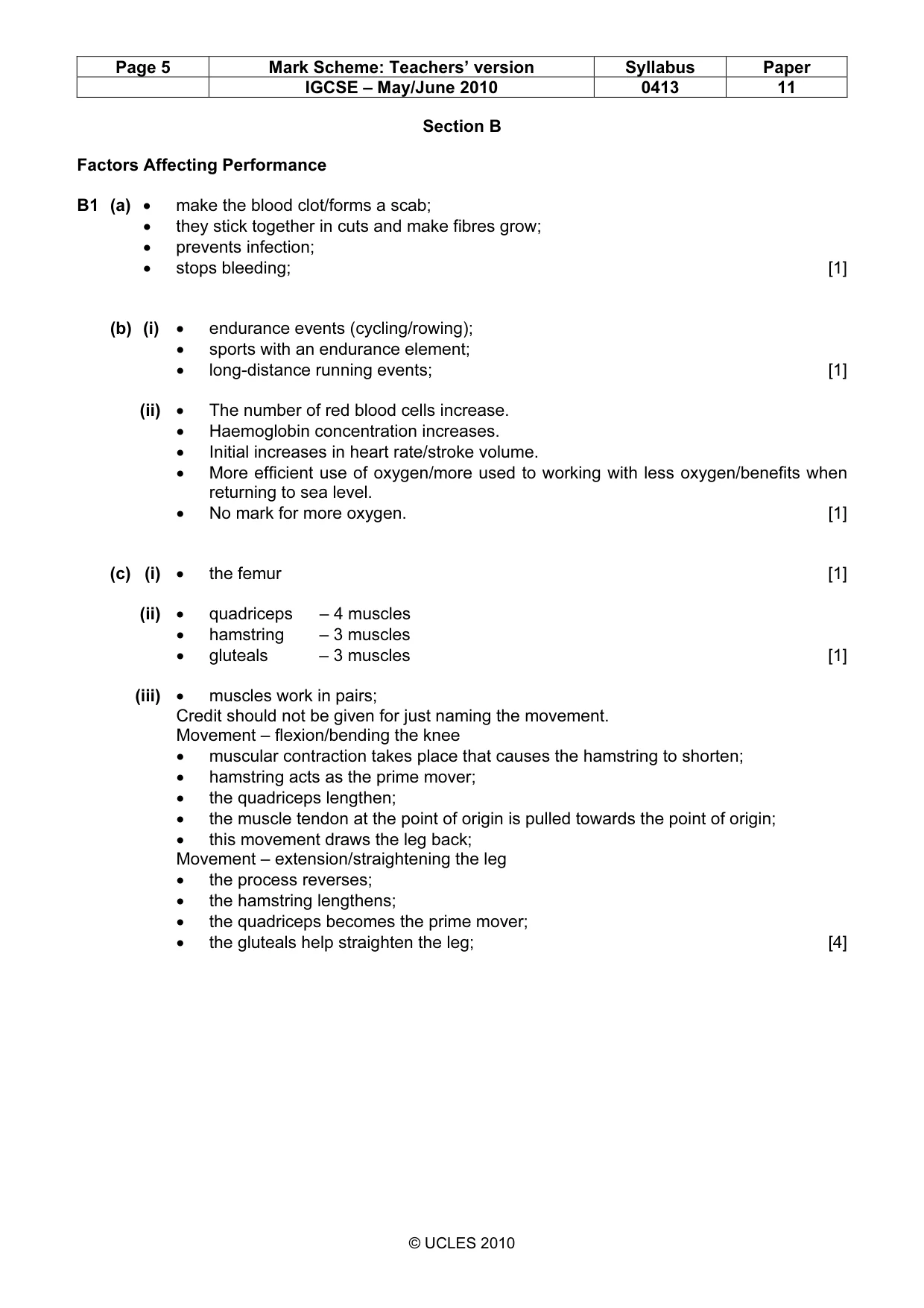
Page 5 Mark Scheme: Teachers’ version Syllabus Paper IGCSE – May/June 2010 0413 11 © UCLES 2010 Section B Factors Affecting Performance B1 (a) • make the blood clot/forms a scab; • they stick together in cuts and make fibres grow; • prevents infection; • stops bleeding; [1] (b) (i) • endurance events (cycling/rowing); • sports with an endurance element; • long-distance running events; [1] (ii) • The number of red blood cells increase. • Haemoglobin concentration increases. • Initial increases in heart rate/stroke volume. • More efficient use of oxygen/more used to working with less oxygen/benefits when returning to sea level. • No mark for more oxygen. [1] (c) (i) • the femur [1] (ii) • quadriceps – 4 muscles • hamstring – 3 muscles • gluteals – 3 muscles [1] (iii) • muscles work in pairs; Credit should not be given for just naming the movement. Movement – flexion/bending the knee • muscular contraction takes place that causes the hamstring to shorten; • hamstring acts as the prime mover; • the quadriceps lengthen; • the muscle tendon at the point of origin is pulled towards the point of origin; • this movement draws the leg back; Movement – extension/straightening the leg • the process reverses; • the hamstring lengthens; • the quadriceps becomes the prime mover; • the gluteals help straighten the leg; [4]
Mark scheme, page 6
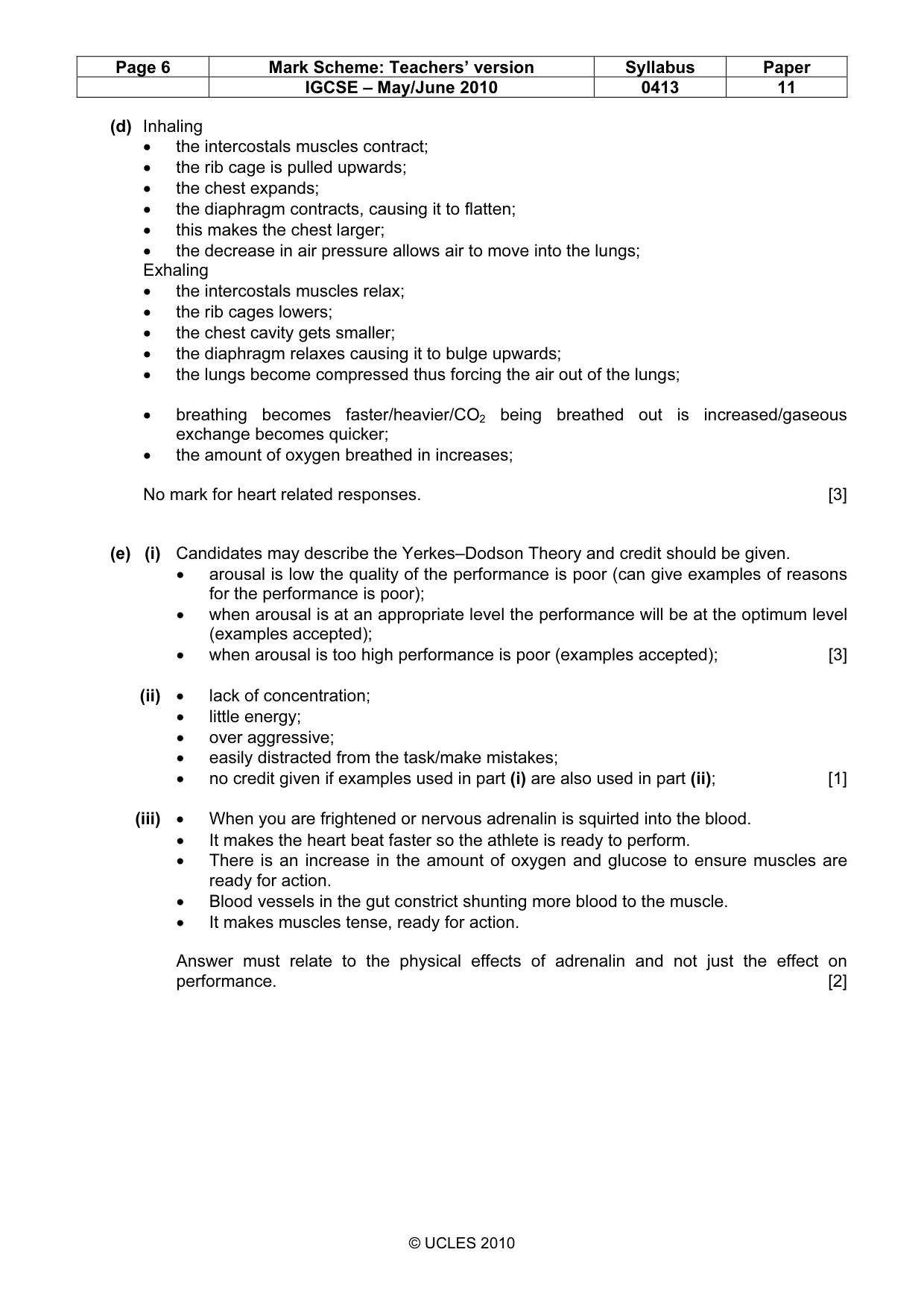
Page 6 Mark Scheme: Teachers’ version Syllabus Paper IGCSE – May/June 2010 0413 11 © UCLES 2010 (d) Inhaling • the intercostals muscles contract; • the rib cage is pulled upwards; • the chest expands; • the diaphragm contracts, causing it to flatten; • this makes the chest larger; • the decrease in air pressure allows air to move into the lungs; Exhaling • the intercostals muscles relax; • the rib cages lowers; • the chest cavity gets smaller; • the diaphragm relaxes causing it to bulge upwards; • the lungs become compressed thus forcing the air out of the lungs; • breathing becomes faster/heavier/CO2 being breathed out is increased/gaseous exchange becomes quicker; • the amount of oxygen breathed in increases; No mark for heart related responses. [3] (e) (i) Candidates may describe the Yerkes–Dodson Theory and credit should be given. • arousal is low the quality of the performance is poor (can give examples of reasons for the performance is poor); • when arousal is at an appropriate level the performance will be at the optimum level (examples accepted); • when arousal is too high performance is poor (examples accepted); [3] (ii) • lack of concentration; • little energy; • over aggressive; • easily distracted from the task/make mistakes; • no credit given if examples used in part (i) are also used in part (ii); [1] (iii) • When you are frightened or nervous adrenalin is squirted into the blood. • It makes the heart beat faster so the athlete is ready to perform. • There is an increase in the amount of oxygen and glucose to ensure muscles are ready for action. • Blood vessels in the gut constrict shunting more blood to the muscle. • It makes muscles tense, ready for action. Answer must relate to the physical effects of adrenalin and not just the effect on performance. [2]
Mark scheme, page 7
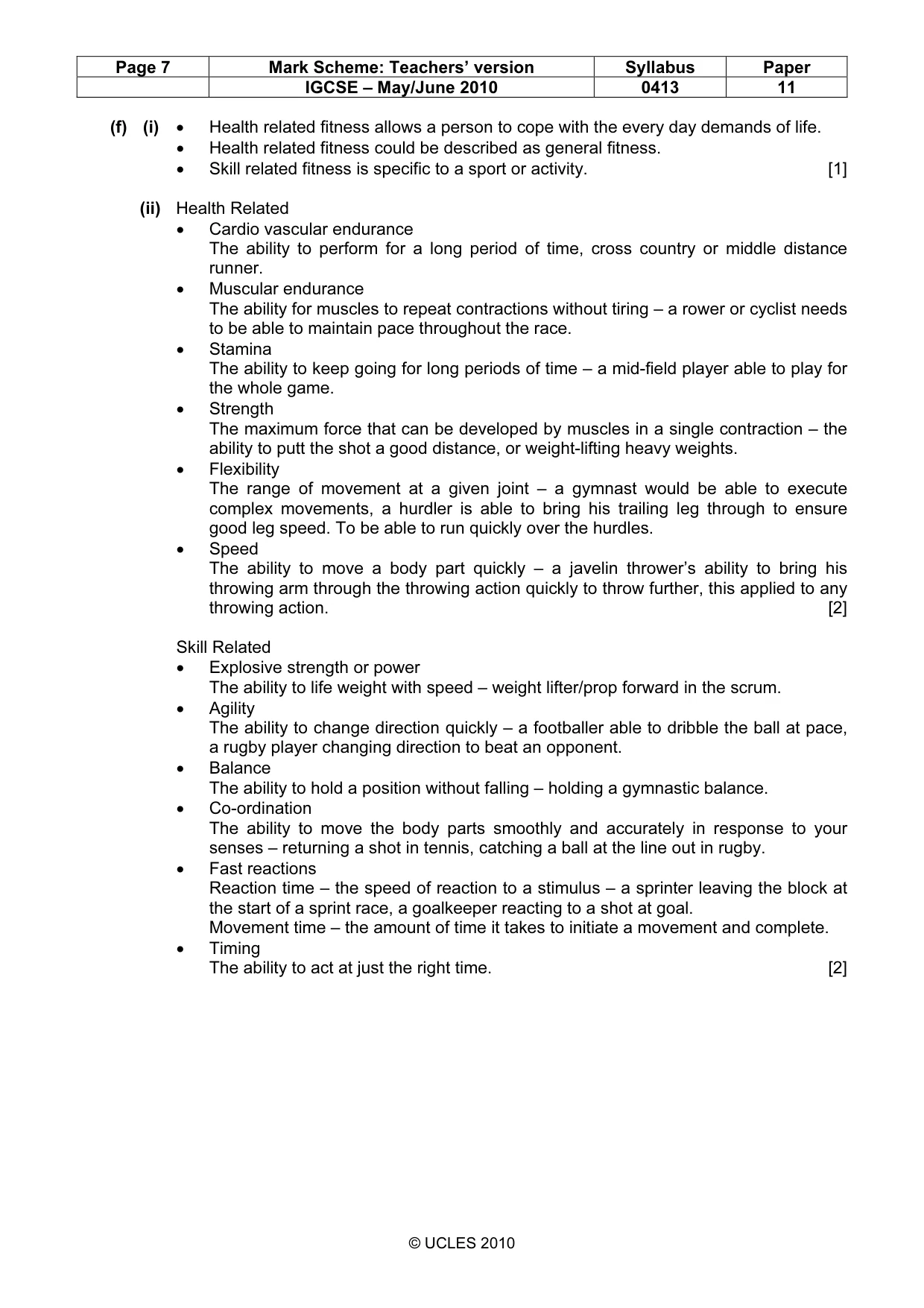
Page 7 Mark Scheme: Teachers’ version Syllabus Paper IGCSE – May/June 2010 0413 11 © UCLES 2010 (f) (i) • Health related fitness allows a person to cope with the every day demands of life. • Health related fitness could be described as general fitness. • Skill related fitness is specific to a sport or activity. [1] (ii) Health Related • Cardio vascular endurance The ability to perform for a long period of time, cross country or middle distance runner. • Muscular endurance The ability for muscles to repeat contractions without tiring – a rower or cyclist needs to be able to maintain pace throughout the race. • Stamina The ability to keep going for long periods of time – a mid-field player able to play for the whole game. • Strength The maximum force that can be developed by muscles in a single contraction – the ability to putt the shot a good distance, or weight-lifting heavy weights. • Flexibility The range of movement at a given joint – a gymnast would be able to execute complex movements, a hurdler is able to bring his trailing leg through to ensure good leg speed. To be able to run quickly over the hurdles. • Speed The ability to move a body part quickly – a javelin thrower’s ability to bring his throwing arm through the throwing action quickly to throw further, this applied to any throwing action. [2] Skill Related • Explosive strength or power The ability to life weight with speed – weight lifter/prop forward in the scrum. • Agility The ability to change direction quickly – a footballer able to dribble the ball at pace, a rugby player changing direction to beat an opponent. • Balance The ability to hold a position without falling – holding a gymnastic balance. • Co-ordination The ability to move the body parts smoothly and accurately in response to your senses – returning a shot in tennis, catching a ball at the line out in rugby. • Fast reactions Reaction time – the speed of reaction to a stimulus – a sprinter leaving the block at the start of a sprint race, a goalkeeper reacting to a shot at goal. Movement time – the amount of time it takes to initiate a movement and complete. • Timing The ability to act at just the right time. [2]
Mark scheme, page 8
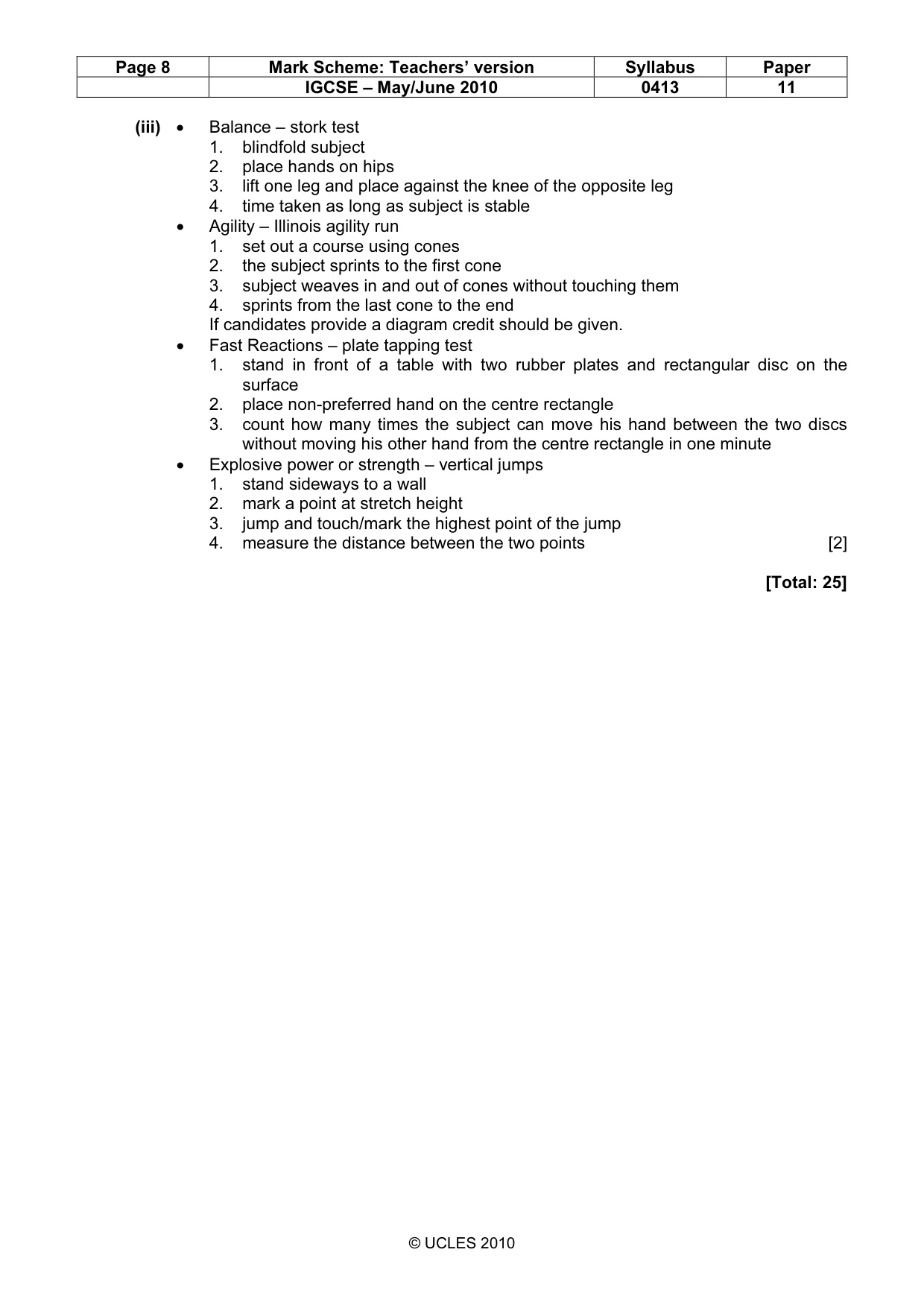
Page 8 Mark Scheme: Teachers’ version Syllabus Paper IGCSE – May/June 2010 0413 11 © UCLES 2010 (iii) • Balance – stork test 1. blindfold subject 2. place hands on hips 3. lift one leg and place against the knee of the opposite leg 4. time taken as long as subject is stable • Agility – Illinois agility run 1. set out a course using cones 2. the subject sprints to the first cone 3. subject weaves in and out of cones without touching them 4. sprints from the last cone to the end If candidates provide a diagram credit should be given. • Fast Reactions – plate tapping test 1. stand in front of a table with two rubber plates and rectangular disc on the surface 2. place non-preferred hand on the centre rectangle 3. count how many times the subject can move his hand between the two discs without moving his other hand from the centre rectangle in one minute • Explosive power or strength – vertical jumps 1. stand sideways to a wall 2. mark a point at stretch height 3. jump and touch/mark the highest point of the jump 4. measure the distance between the two points [2] [Total: 25]
Mark scheme, page 9
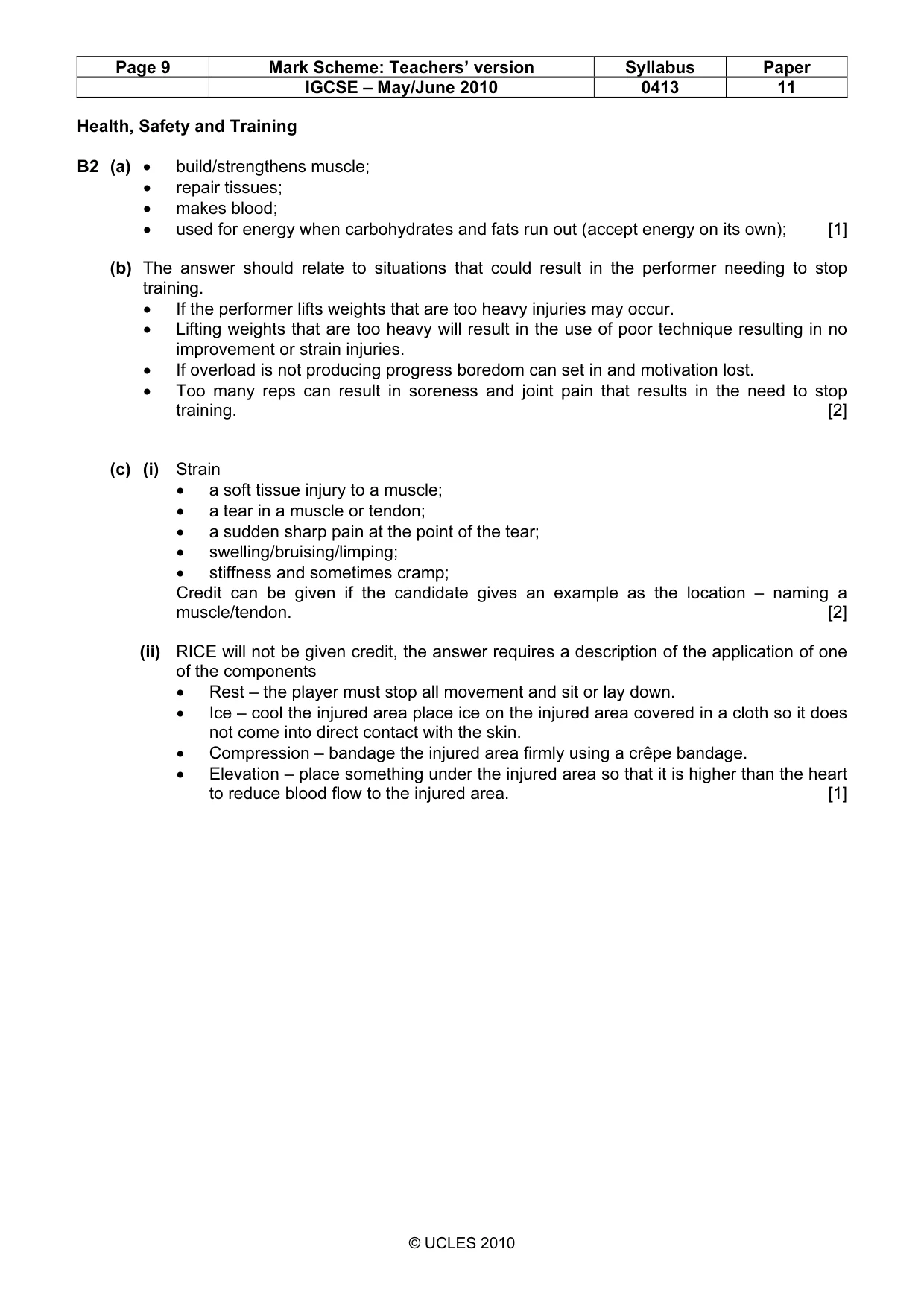
Page 9 Mark Scheme: Teachers’ version Syllabus Paper IGCSE – May/June 2010 0413 11 © UCLES 2010 Health, Safety and Training B2 (a) • build/strengthens muscle; • repair tissues; • makes blood; • used for energy when carbohydrates and fats run out (accept energy on its own); [1] (b) The answer should relate to situations that could result in the performer needing to stop training. • If the performer lifts weights that are too heavy injuries may occur. • Lifting weights that are too heavy will result in the use of poor technique resulting in no improvement or strain injuries. • If overload is not producing progress boredom can set in and motivation lost. • Too many reps can result in soreness and joint pain that results in the need to stop training. [2] (c) (i) Strain • a soft tissue injury to a muscle; • a tear in a muscle or tendon; • a sudden sharp pain at the point of the tear; • swelling/bruising/limping; • stiffness and sometimes cramp; Credit can be given if the candidate gives an example as the location – naming a muscle/tendon. [2] (ii) RICE will not be given credit, the answer requires a description of the application of one of the components • Rest – the player must stop all movement and sit or lay down. • Ice – cool the injured area place ice on the injured area covered in a cloth so it does not come into direct contact with the skin. • Compression – bandage the injured area firmly using a crêpe bandage. • Elevation – place something under the injured area so that it is higher than the heart to reduce blood flow to the injured area. [1]
Mark scheme, page 10
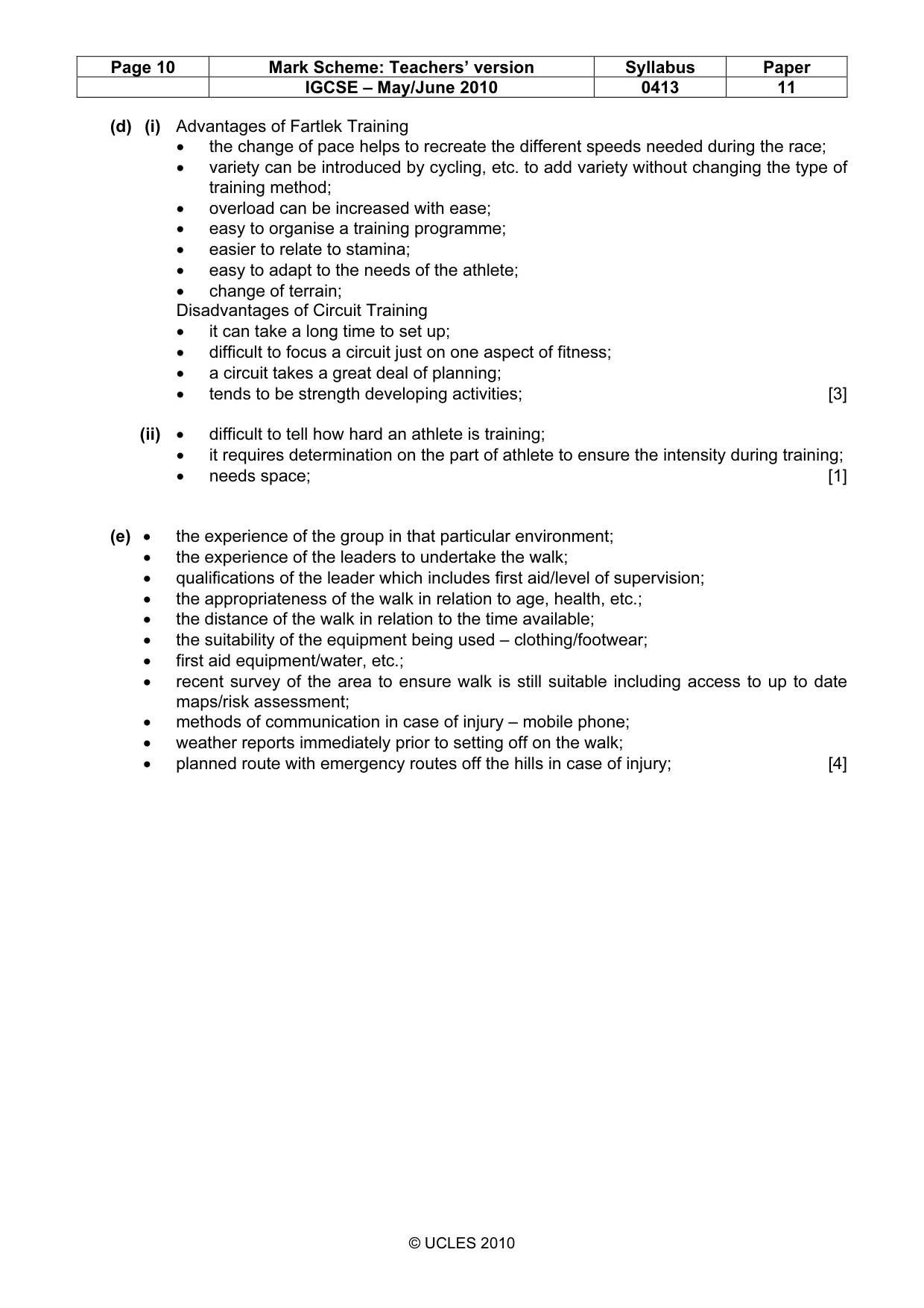
Page 10 Mark Scheme: Teachers’ version Syllabus Paper IGCSE – May/June 2010 0413 11 © UCLES 2010 (d) (i) Advantages of Fartlek Training • the change of pace helps to recreate the different speeds needed during the race; • variety can be introduced by cycling, etc. to add variety without changing the type of training method; • overload can be increased with ease; • easy to organise a training programme; • easier to relate to stamina; • easy to adapt to the needs of the athlete; • change of terrain; Disadvantages of Circuit Training • it can take a long time to set up; • difficult to focus a circuit just on one aspect of fitness; • a circuit takes a great deal of planning; • tends to be strength developing activities; [3] (ii) • difficult to tell how hard an athlete is training; • it requires determination on the part of athlete to ensure the intensity during training; • needs space; [1] (e) • the experience of the group in that particular environment; • the experience of the leaders to undertake the walk; • qualifications of the leader which includes first aid/level of supervision; • the appropriateness of the walk in relation to age, health, etc.; • the distance of the walk in relation to the time available; • the suitability of the equipment being used – clothing/footwear; • first aid equipment/water, etc.; • recent survey of the area to ensure walk is still suitable including access to up to date maps/risk assessment; • methods of communication in case of injury – mobile phone; • weather reports immediately prior to setting off on the walk; • planned route with emergency routes off the hills in case of injury; [4]
Mark scheme, page 11
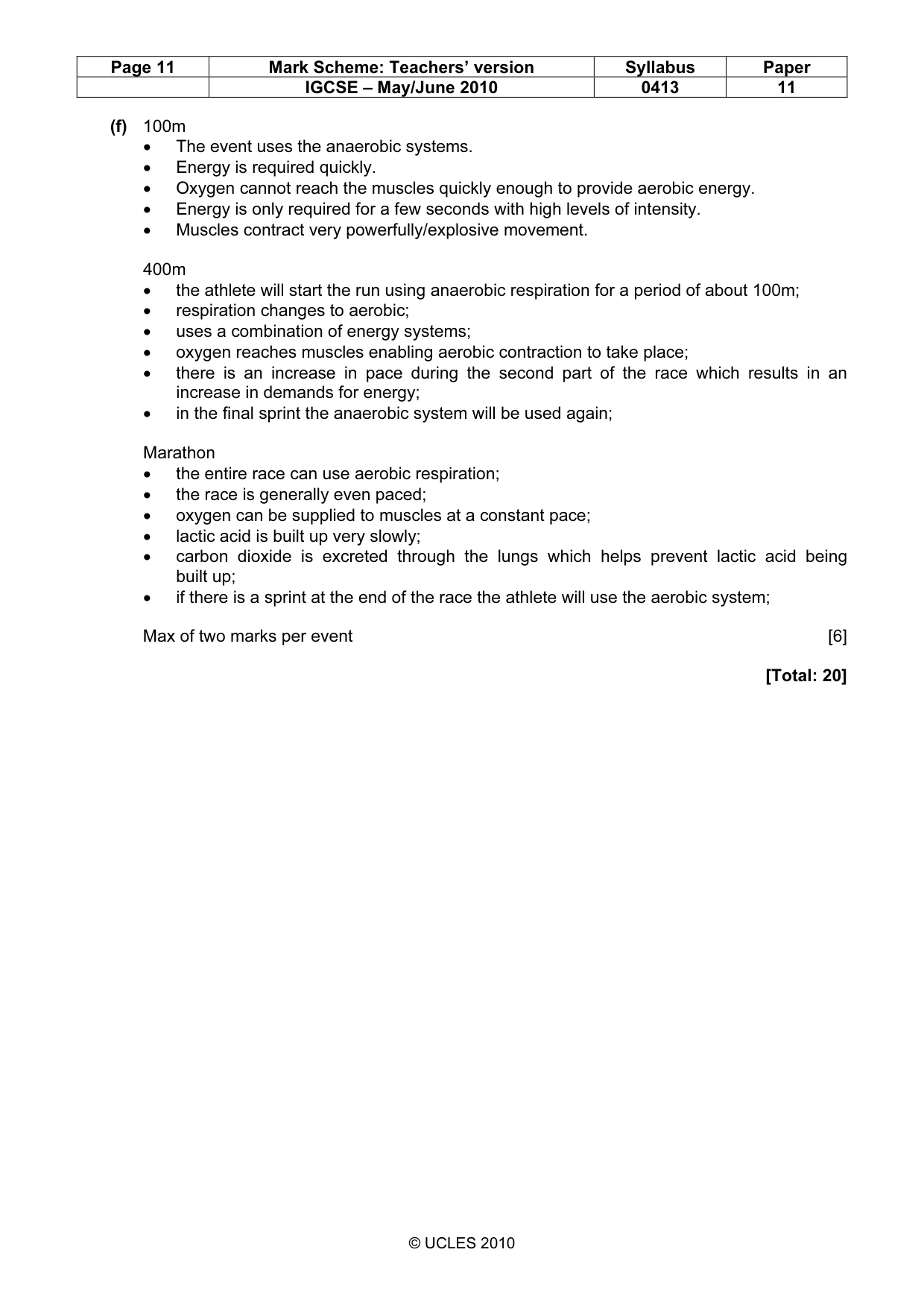
Page 11 Mark Scheme: Teachers’ version Syllabus Paper IGCSE – May/June 2010 0413 11 © UCLES 2010 (f) 100m • The event uses the anaerobic systems. • Energy is required quickly. • Oxygen cannot reach the muscles quickly enough to provide aerobic energy. • Energy is only required for a few seconds with high levels of intensity. • Muscles contract very powerfully/explosive movement. 400m • the athlete will start the run using anaerobic respiration for a period of about 100m; • respiration changes to aerobic; • uses a combination of energy systems; • oxygen reaches muscles enabling aerobic contraction to take place; • there is an increase in pace during the second part of the race which results in an increase in demands for energy; • in the final sprint the anaerobic system will be used again; Marathon • the entire race can use aerobic respiration; • the race is generally even paced; • oxygen can be supplied to muscles at a constant pace; • lactic acid is built up very slowly; • carbon dioxide is excreted through the lungs which helps prevent lactic acid being built up; • if there is a sprint at the end of the race the athlete will use the aerobic system; Max of two marks per event [6] [Total: 20]
Mark scheme, page 12
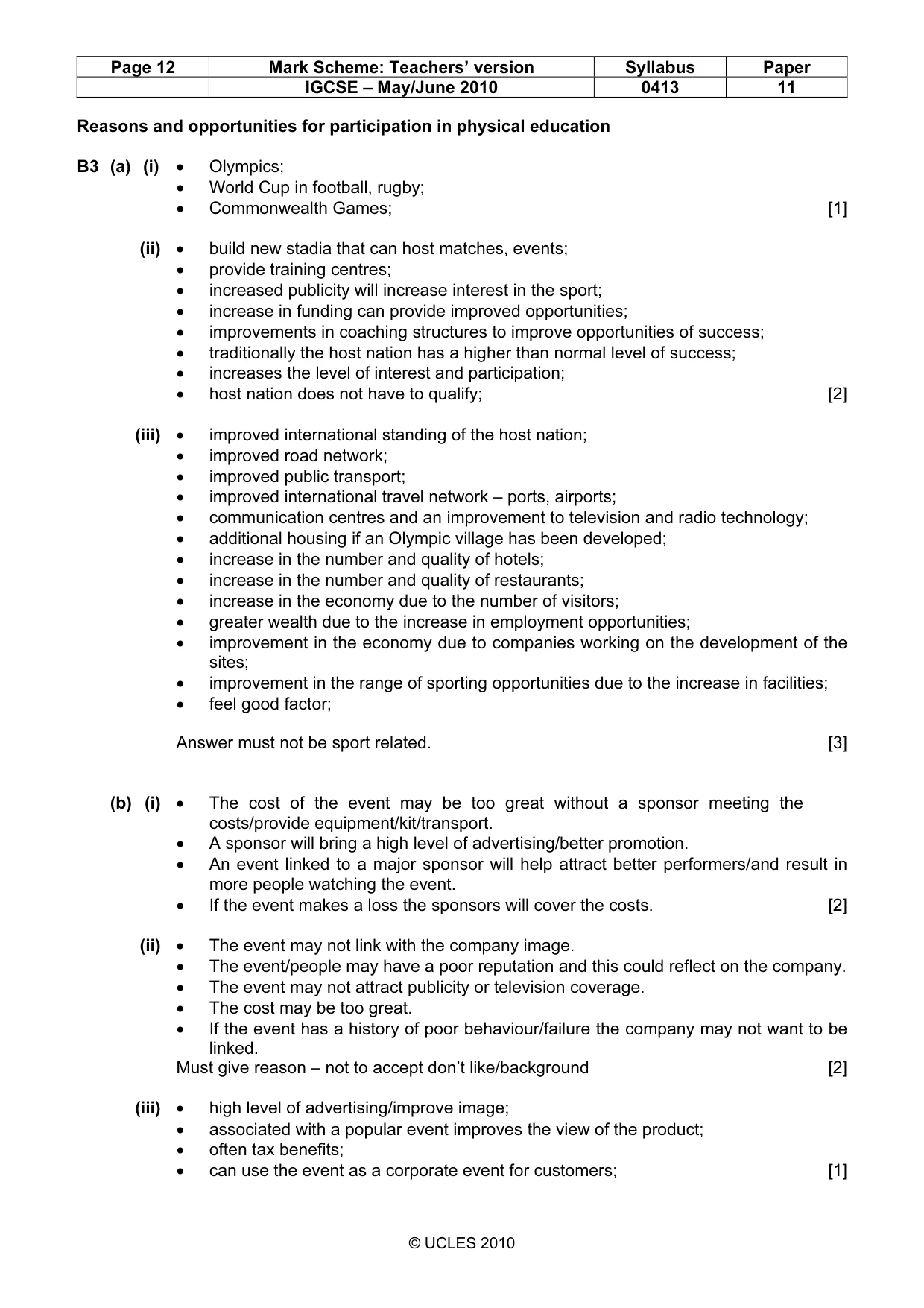
Page 12 Mark Scheme: Teachers’ version Syllabus Paper IGCSE – May/June 2010 0413 11 © UCLES 2010 Reasons and opportunities for participation in physical education B3 (a) (i) • Olympics; • World Cup in football, rugby; • Commonwealth Games; [1] (ii) • build new stadia that can host matches, events; • provide training centres; • increased publicity will increase interest in the sport; • increase in funding can provide improved opportunities; • improvements in coaching structures to improve opportunities of success; • traditionally the host nation has a higher than normal level of success; • increases the level of interest and participation; • host nation does not have to qualify; [2] (iii) • improved international standing of the host nation; • improved road network; • improved public transport; • improved international travel network – ports, airports; • communication centres and an improvement to television and radio technology; • additional housing if an Olympic village has been developed; • increase in the number and quality of hotels; • increase in the number and quality of restaurants; • increase in the economy due to the number of visitors; • greater wealth due to the increase in employment opportunities; • improvement in the economy due to companies working on the development of the sites; • improvement in the range of sporting opportunities due to the increase in facilities; • feel good factor; Answer must not be sport related. [3] (b) (i) • The cost of the event may be too great without a sponsor meeting the costs/provide equipment/kit/transport. • A sponsor will bring a high level of advertising/better promotion. • An event linked to a major sponsor will help attract better performers/and result in more people watching the event. • If the event makes a loss the sponsors will cover the costs. [2] (ii) • The event may not link with the company image. • The event/people may have a poor reputation and this could reflect on the company. • The event may not attract publicity or television coverage. • The cost may be too great. • If the event has a history of poor behaviour/failure the company may not want to be linked. Must give reason – not to accept don’t like/background [2] (iii) • high level of advertising/improve image; • associated with a popular event improves the view of the product; • often tax benefits; • can use the event as a corporate event for customers; [1]
Mark scheme, page 13
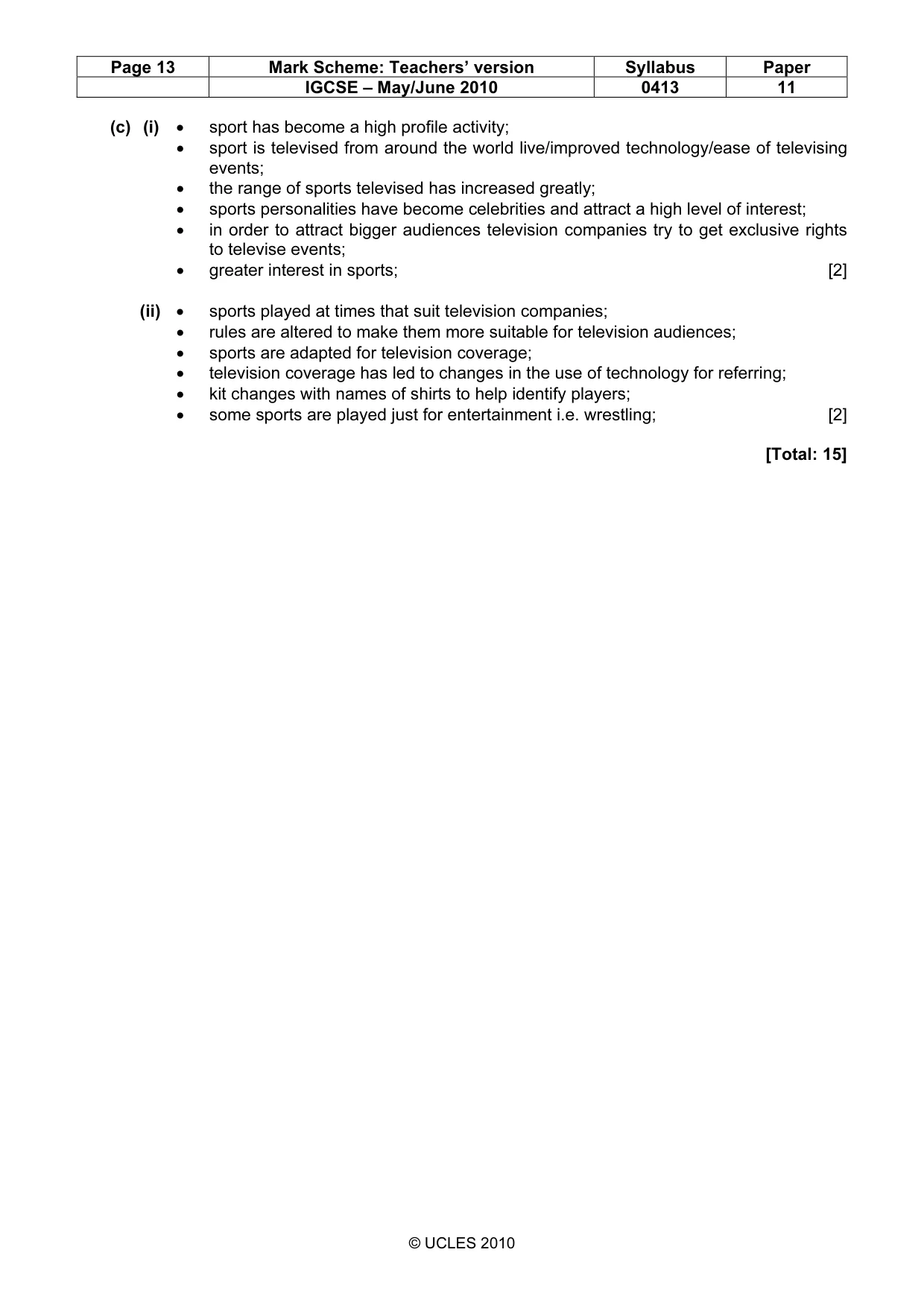
Page 13 Mark Scheme: Teachers’ version Syllabus Paper IGCSE – May/June 2010 0413 11 © UCLES 2010 (c) (i) • sport has become a high profile activity; • sport is televised from around the world live/improved technology/ease of televising events; • the range of sports televised has increased greatly; • sports personalities have become celebrities and attract a high level of interest; • in order to attract bigger audiences television companies try to get exclusive rights to televise events; • greater interest in sports; [2] (ii) • sports played at times that suit television companies; • rules are altered to make them more suitable for television audiences; • sports are adapted for television coverage; • television coverage has led to changes in the use of technology for referring; • kit changes with names of shirts to help identify players; • some sports are played just for entertainment i.e. wrestling; [2] [Total: 15]
What you needed in this session
Cambridge’s own grade thresholds for 2010 May/June, Paper 1 · Variant 1. A higher threshold means an easier paper — the bar moves with how the cohort did.