Cambridge IGCSE Physical Education 0413 — 2010 May/June Paper 1 · Variant 3
0413/13/M/J/10 · 80 marks · ≈90 min
The question paper and its mark scheme, free to read here and free to download. This is Cambridge’s own paper, exactly as it was sat.
Question paper12 pages

Mark scheme9 pages
Answers below. Sit the paper first if you are practising.
Paper as text
Question paper, page 1
This document consists of 12 printed pages. DC (AC) 21360/4 © UCLES 2010 [Turn over UNIVERSITY OF CAMBRIDGE INTERNATIONAL EXAMINATIONS International General Certificate of Secondary Education PHYSICAL EDUCATION 0413/13 Paper 1 May/June 2010 1 hour 45 minutes Candidates answer on the Question Paper. No Additional Materials are required. READ THESE INSTRUCTIONS FIRST Write your Centre number, candidate number and name on all the work you hand in. Write in dark blue or black pen. You may use a soft pencil for any diagrams, graphs or rough working. Do not use staples, paper clips, highlighters, glue or correction fluid. DO NOT WRITE IN ANY BARCODES. Answer all questions. At the end of the examination, fasten all your work securely together. The number of marks is given in brackets [ ] at the end of each question or part question. For Examiner’s Use Section A B1 B2 B3 Total * 8 8 0 6 3 9 2 0 4 2 * www.XtremePapers.com
Question paper, page 2
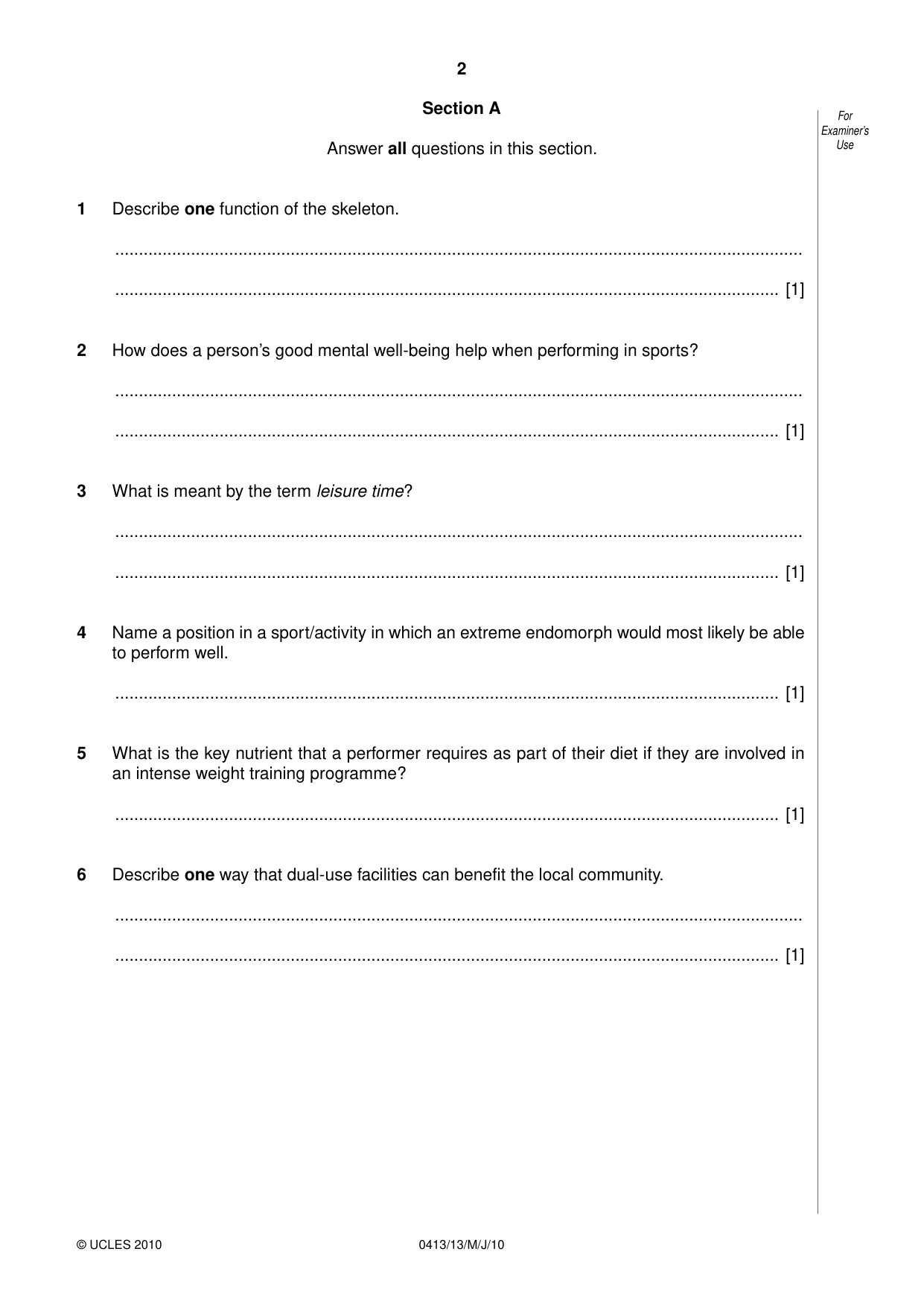
2 © UCLES 2010 0413/13/M/J/10 For Examiner’s Use Section A Answer all questions in this section. 1 Describe one function of the skeleton. … … [1] 2 How does a person’s good mental well-being help when performing in sports? … … [1] 3 What is meant by the term leisure time? … … [1] 4 Name a position in a sport/activity in which an extreme endomorph would most likely be able to perform well. … [1] 5 What is the key nutrient that a performer requires as part of their diet if they are involved in an intense weight training programme? … [1] 6 Describe one way that dual-use facilities can benefit the local community. … … [1]
Question paper, page 3
3 © UCLES 2010 [Turn over 0413/13/M/J/10 For Examiner’s Use 7 Name an activity and describe two ways that you would be able to identify a highly skilled performer. Activity … … … … … [2] 8 Give two ways that a performer can reduce the possibility of injury. … … … … [2] 9 Certain countries excel in a specific sport. Give an example of both a country and a sport and one reason why this has happened. country … sport … reason … …[2] 10 Name one component of blood and describe how this affects a person’s ability to take part in sports. component of blood … … … [2]
Question paper, page 4
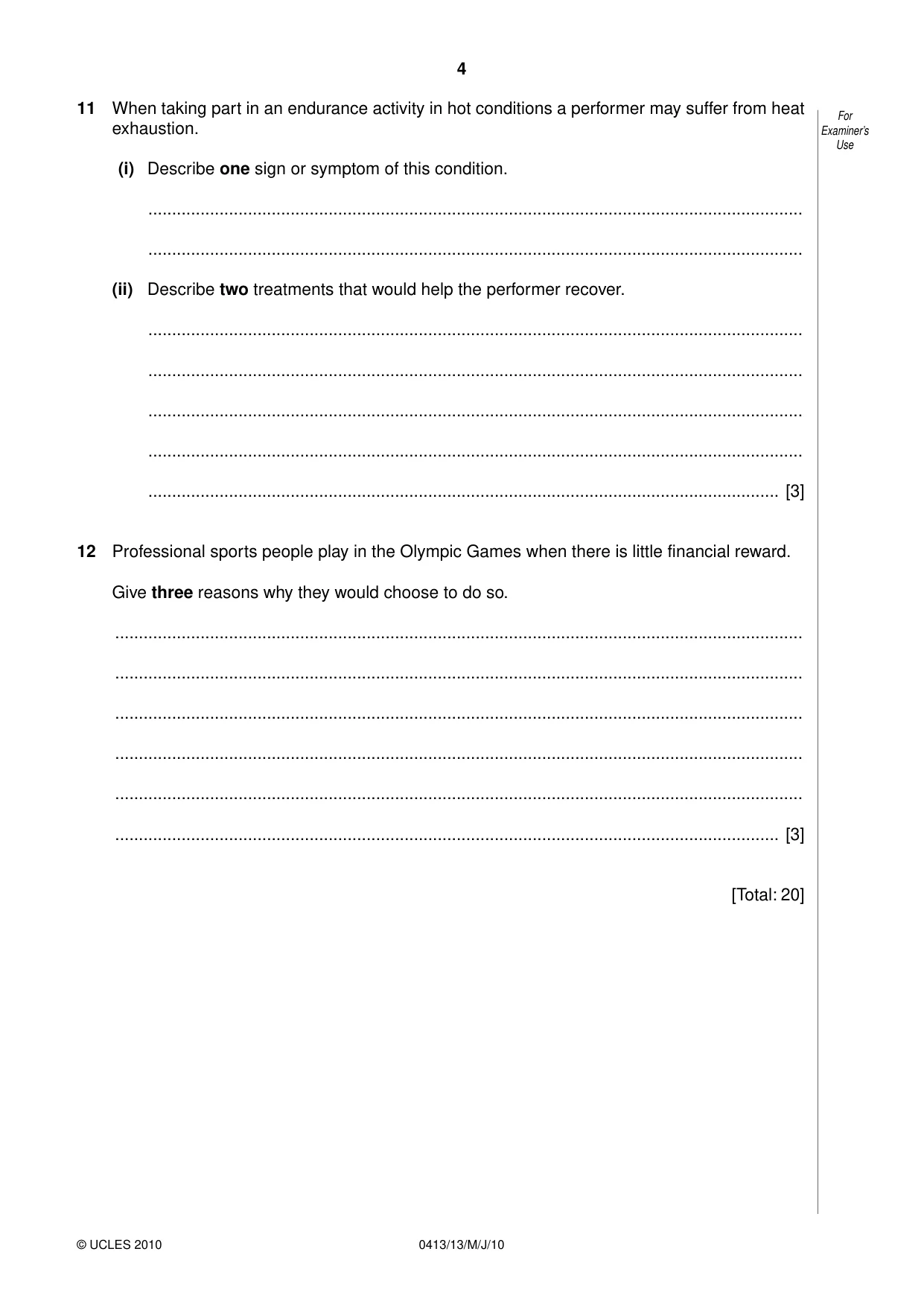
4 © UCLES 2010 0413/13/M/J/10 For Examiner’s Use 11 When taking part in an endurance activity in hot conditions a performer may suffer from heat exhaustion. (i) Describe one sign or symptom of this condition. … … (ii) Describe two treatments that would help the performer recover. … … … … … [3] 12 Professional sports people play in the Olympic Games when there is little financial reward. Give three reasons why they would choose to do so. … … … … … … [3] [Total: 20]
Question paper, page 5
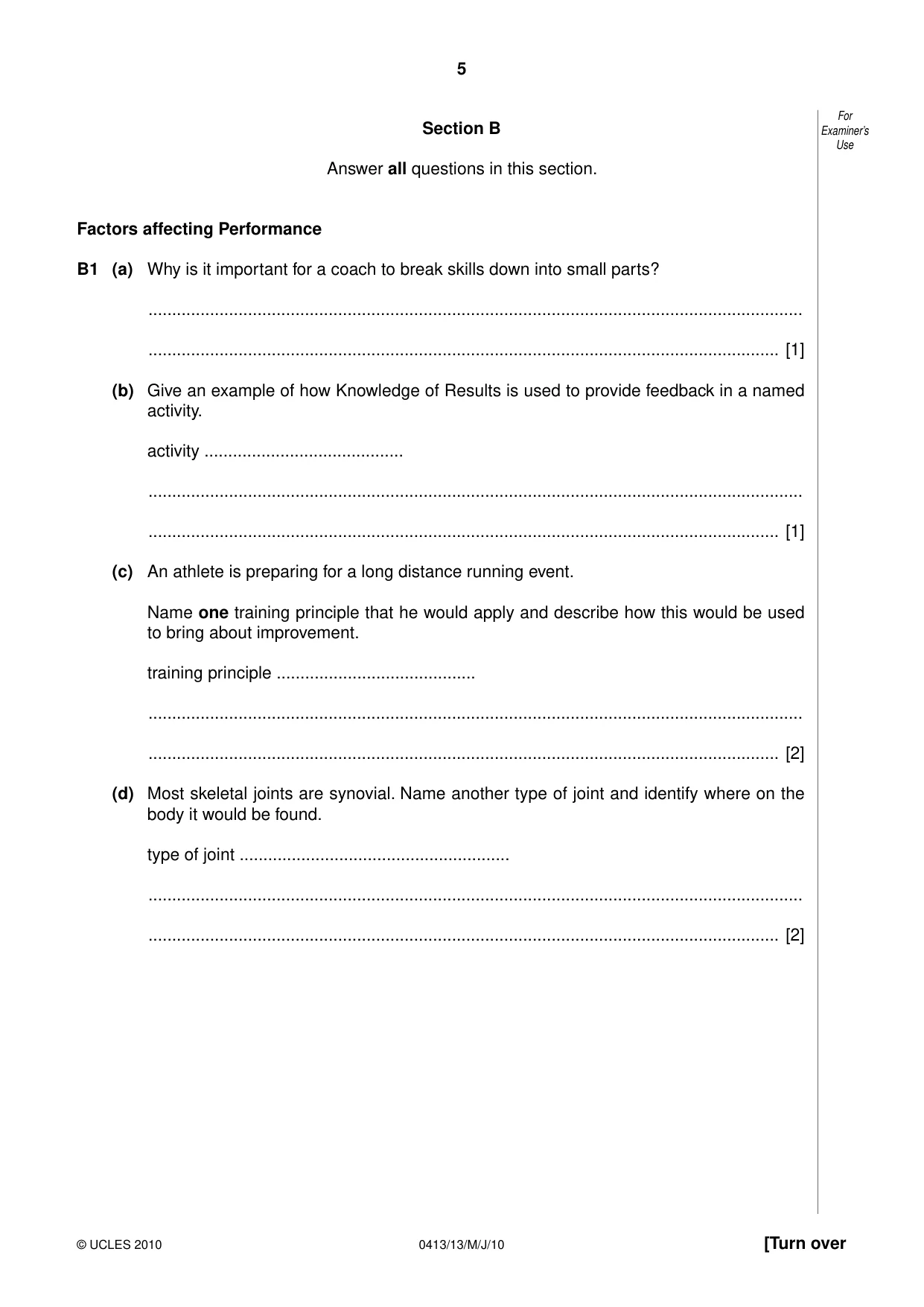
5 © UCLES 2010 [Turn over 0413/13/M/J/10 For Examiner’s Use Section B Answer all questions in this section. Factors affecting Performance B1 (a) Why is it important for a coach to break skills down into small parts? … … [1] (b) Give an example of how Knowledge of Results is used to provide feedback in a named activity. activity … … … [1] (c) An athlete is preparing for a long distance running event. Name one training principle that he would apply and describe how this would be used to bring about improvement. training principle … … … [2] (d) Most skeletal joints are synovial. Name another type of joint and identify where on the body it would be found. type of joint … … … [2]
Question paper, page 6
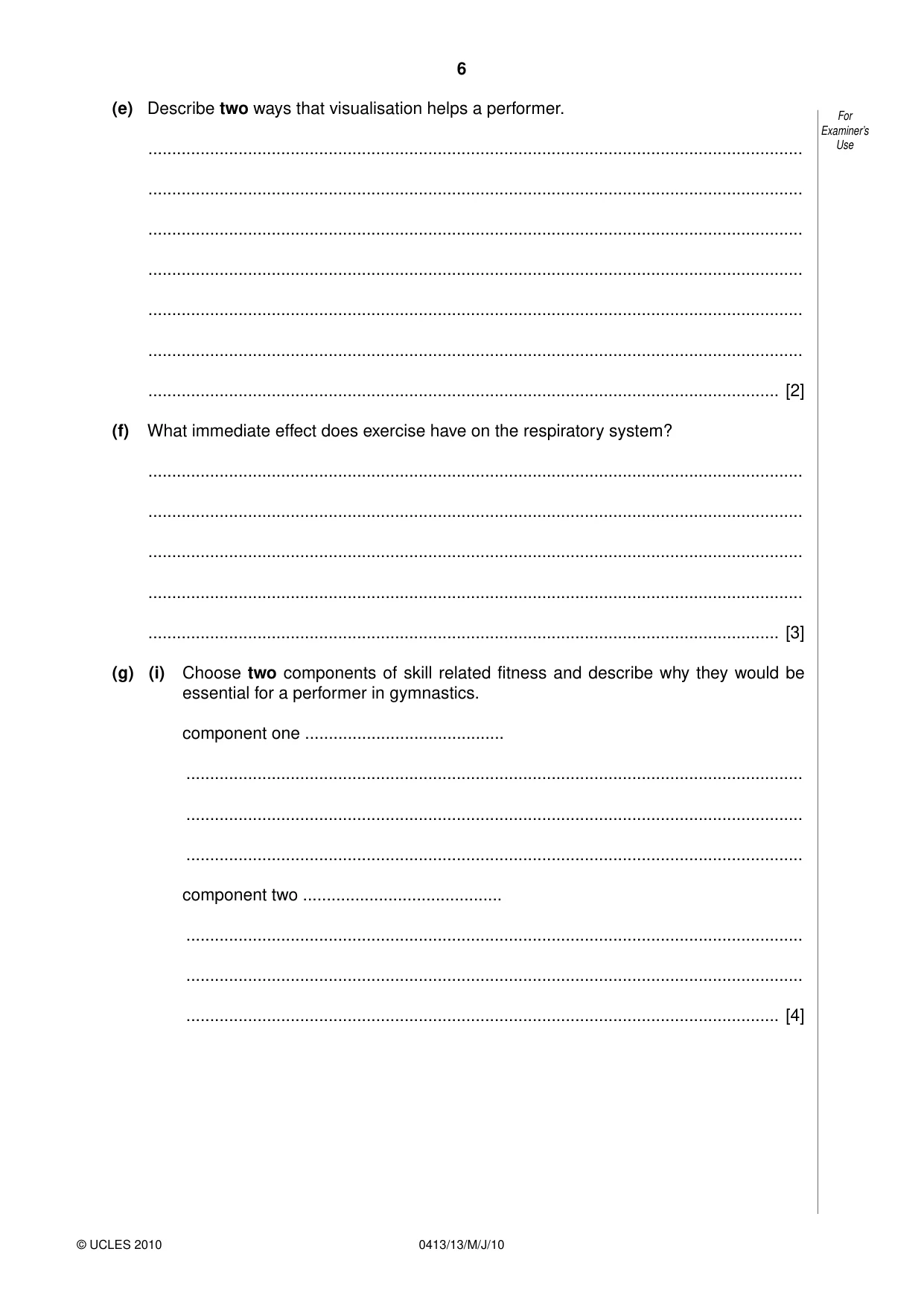
6 © UCLES 2010 0413/13/M/J/10 For Examiner’s Use (e) Describe two ways that visualisation helps a performer. … … … … … … … [2] (f) What immediate effect does exercise have on the respiratory system? … … … … … [3] (g) (i) Choose two components of skill related fitness and describe why they would be essential for a performer in gymnastics. component one … … … … component two … … … … [4]
Question paper, page 7
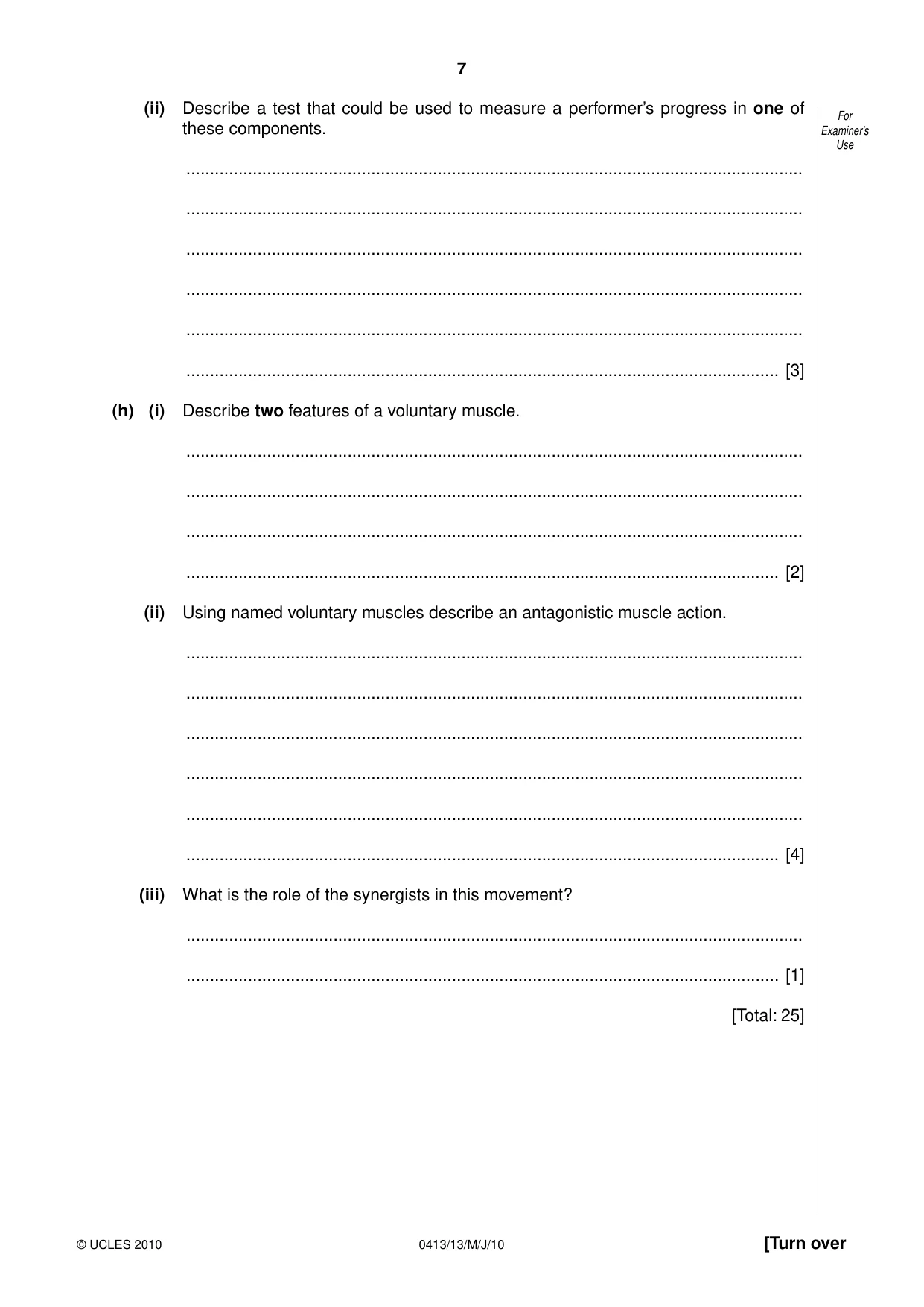
7 © UCLES 2010 [Turn over 0413/13/M/J/10 For Examiner’s Use (ii) Describe a test that could be used to measure a performer’s progress in one of these components. … … … … … … [3] (h) (i) Describe two features of a voluntary muscle. … … … … [2] (ii) Using named voluntary muscles describe an antagonistic muscle action. … … … … … … [4] (iii) What is the role of the synergists in this movement? … … [1] [Total: 25]
Question paper, page 8
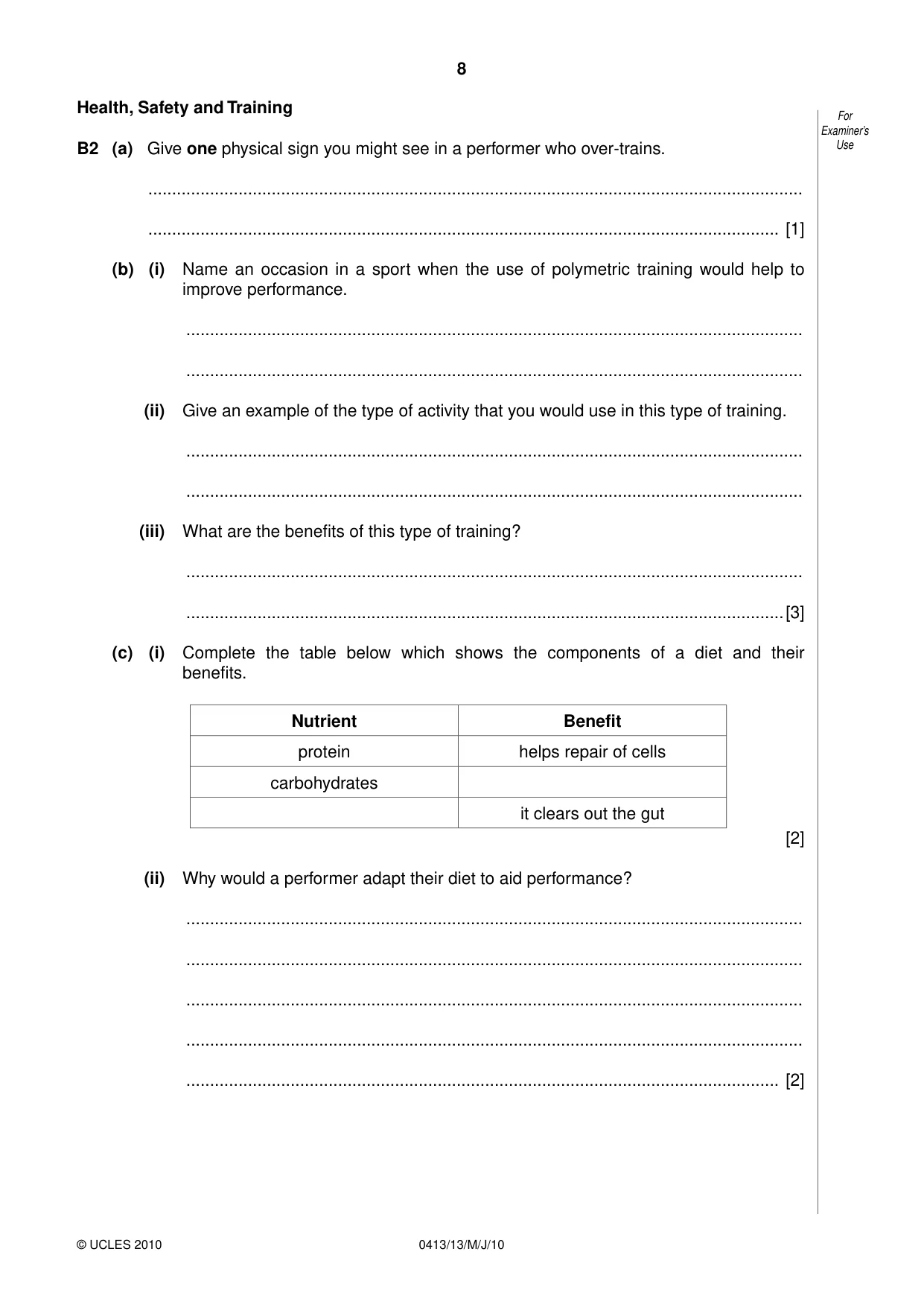
8 © UCLES 2010 0413/13/M/J/10 For Examiner’s Use Health, Safety and Training B2 (a) Give one physical sign you might see in a performer who over-trains. … … [1] (b) (i) Name an occasion in a sport when the use of polymetric training would help to improve performance. … … (ii) Give an example of the type of activity that you would use in this type of training. … … (iii) What are the benefits of this type of training? … …[3] (c) (i) Complete the table below which shows the components of a diet and their benefits. Nutrient Benefit protein helps repair of cells carbohydrates it clears out the gut [2] (ii) Why would a performer adapt their diet to aid performance? … … … … … [2]
Question paper, page 9
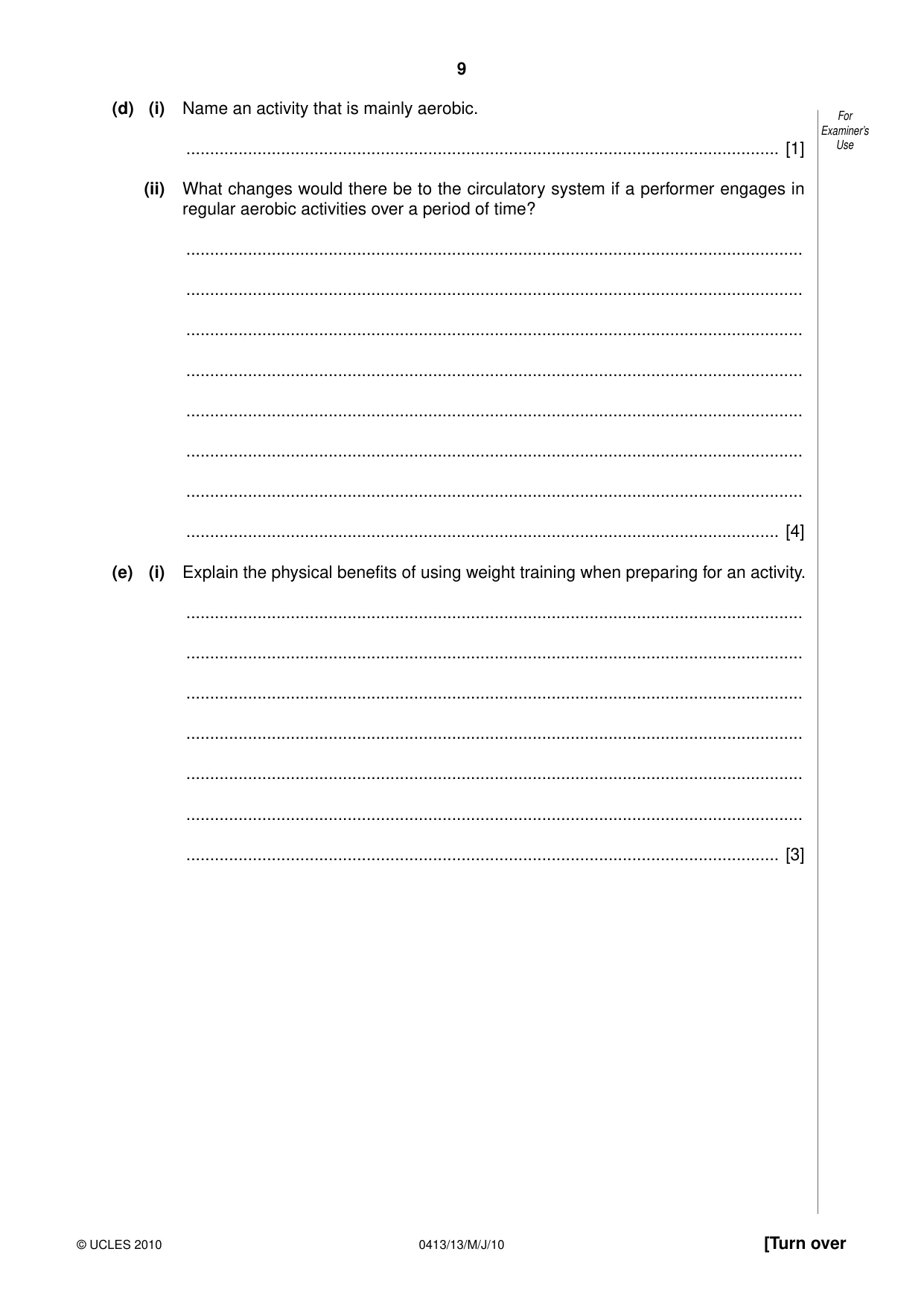
9 © UCLES 2010 [Turn over 0413/13/M/J/10 For Examiner’s Use (d) (i) Name an activity that is mainly aerobic. … [1] (ii) What changes would there be to the circulatory system if a performer engages in regular aerobic activities over a period of time? … … … … … … … … [4] (e) (i) Explain the physical benefits of using weight training when preparing for an activity. … … … … … … … [3]
Question paper, page 10
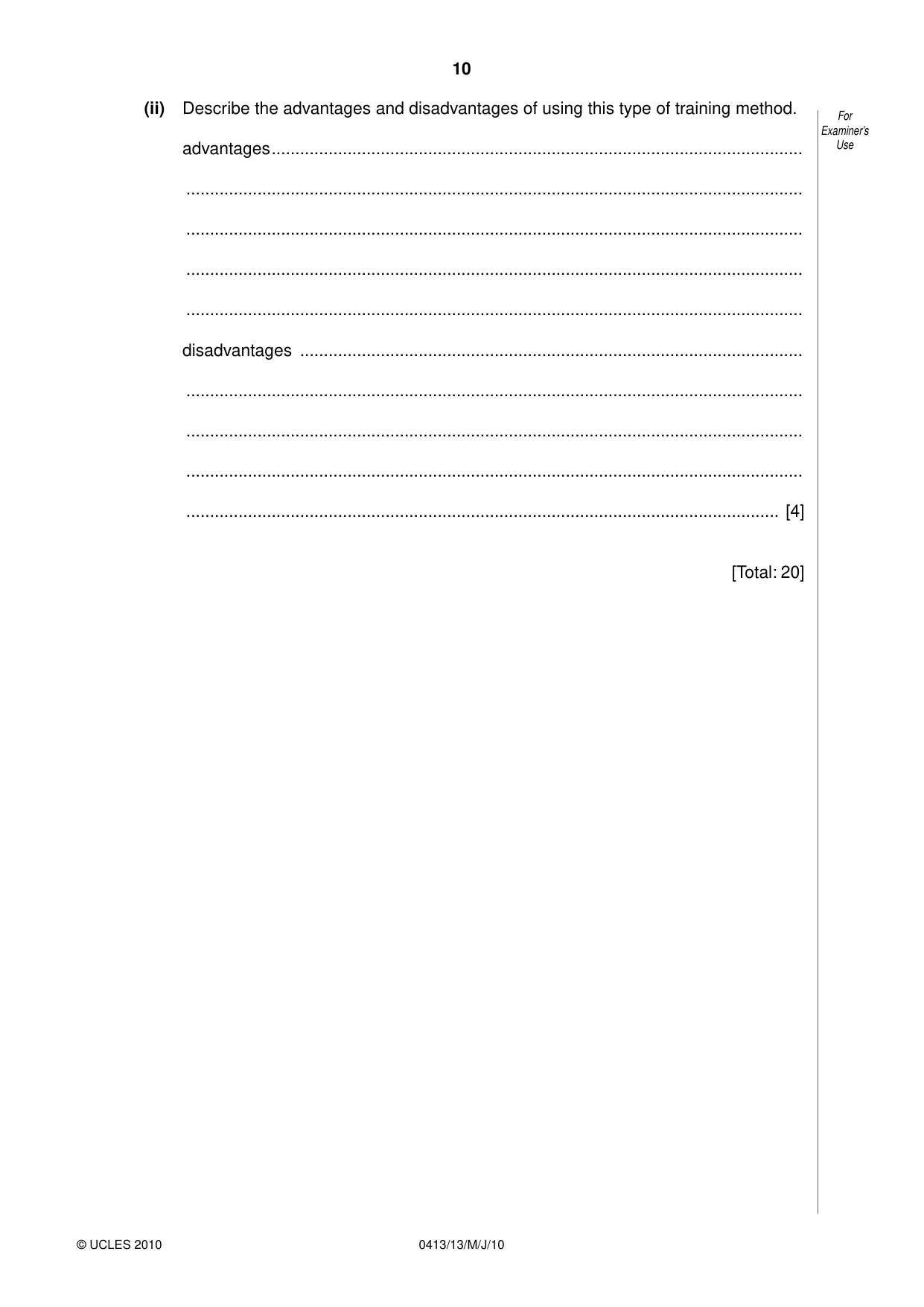
10 © UCLES 2010 0413/13/M/J/10 For Examiner’s Use (ii) Describe the advantages and disadvantages of using this type of training method. advantages … … … … … disadvantages … … … … … [4] [Total: 20]
Question paper, page 11
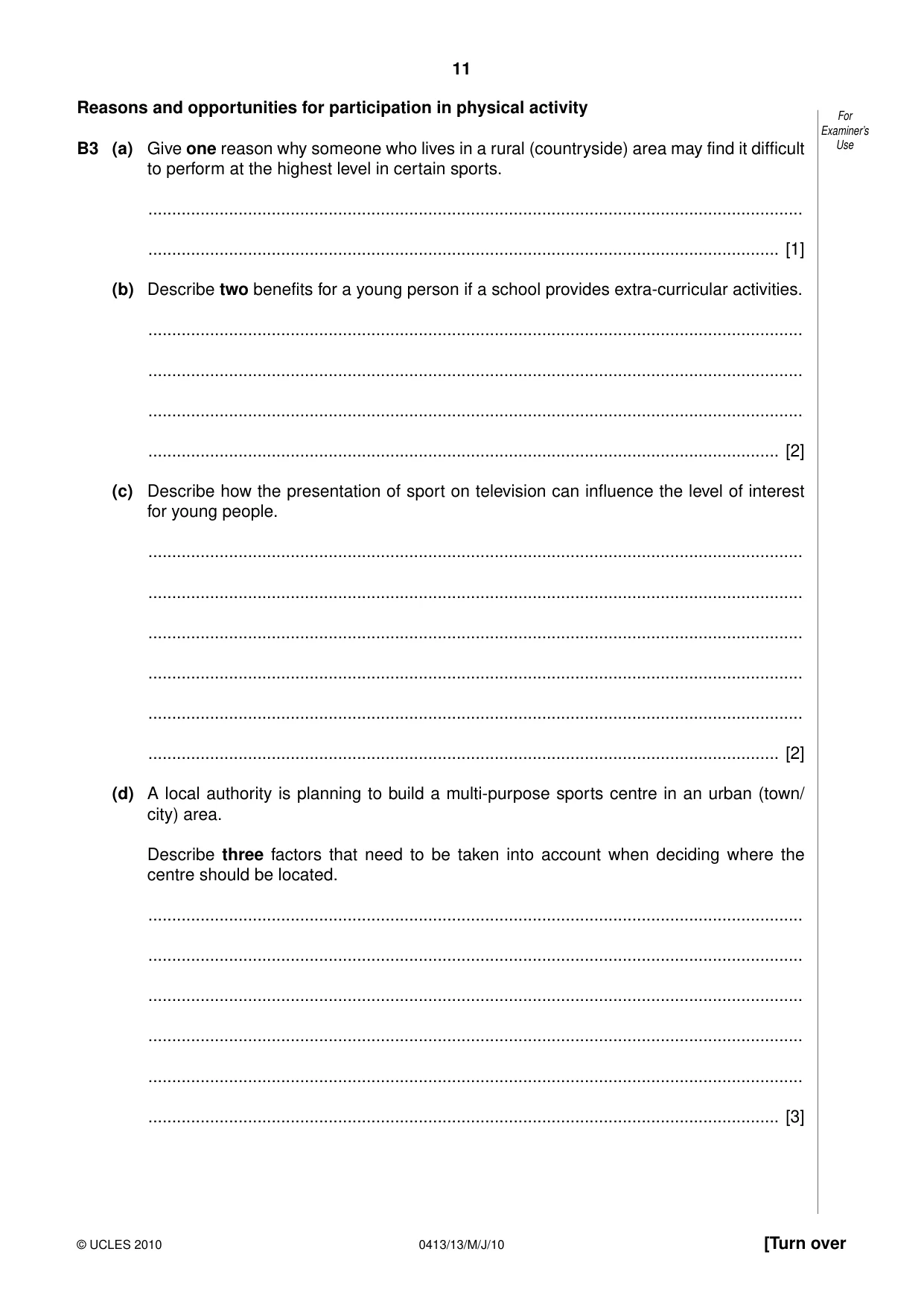
11 © UCLES 2010 [Turn over 0413/13/M/J/10 For Examiner’s Use Reasons and opportunities for participation in physical activity B3 (a) Give one reason why someone who lives in a rural (countryside) area may find it difficult to perform at the highest level in certain sports. … … [1] (b) Describe two benefits for a young person if a school provides extra-curricular activities. … … … … [2] (c) Describe how the presentation of sport on television can influence the level of interest for young people. … … … … … … [2] (d) A local authority is planning to build a multi-purpose sports centre in an urban (town/ city) area. Describe three factors that need to be taken into account when deciding where the centre should be located. … … … … … … [3]
Question paper, page 12
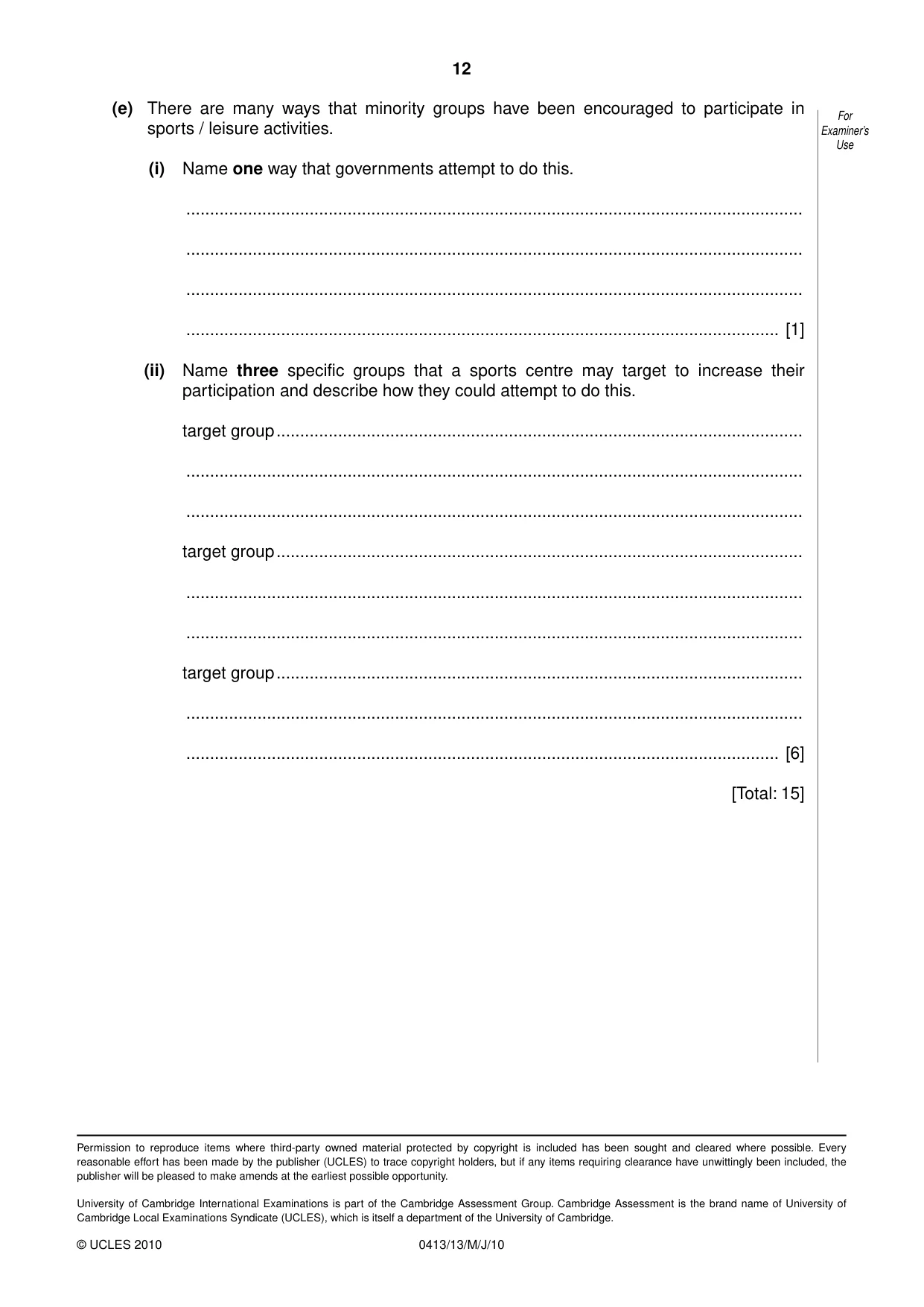
12 © UCLES 2010 0413/13/M/J/10 For Examiner’s Use (e) There are many ways that minority groups have been encouraged to participate in sports / leisure activities. (i) Name one way that governments attempt to do this. … … … … [1] (ii) Name three specific groups that a sports centre may target to increase their participation and describe how they could attempt to do this. target group … … … target group … … … target group … … … [6] [Total: 15] Permission to reproduce items where third-party owned material protected by copyright is included has been sought and cleared where possible. Every reasonable effort has been made by the publisher (UCLES) to trace copyright holders, but if any items requiring clearance have unwittingly been included, the publisher will be pleased to make amends at the earliest possible opportunity. University of Cambridge International Examinations is part of the Cambridge Assessment Group. Cambridge Assessment is the brand name of University of Cambridge Local Examinations Syndicate (UCLES), which is itself a department of the University of Cambridge.
Mark scheme, page 1
UNIVERSITY OF CAMBRIDGE INTERNATIONAL EXAMINATIONS International General Certificate of Secondary Education MARK SCHEME for the May/June 2010 question paper for the guidance of teachers 0413 PHYSICAL EDUCATION 0413/13 Paper 13, maximum raw mark 80 This mark scheme is published as an aid to teachers and candidates, to indicate the requirements of the examination. It shows the basis on which Examiners were instructed to award marks. It does not indicate the details of the discussions that took place at an Examiners’ meeting before marking began, which would have considered the acceptability of alternative answers. Mark schemes must be read in conjunction with the question papers and the report on the examination. • CIE will not enter into discussions or correspondence in connection with these mark schemes. CIE is publishing the mark schemes for the May/June 2010 question papers for most IGCSE, GCE Advanced Level and Advanced Subsidiary Level syllabuses and some Ordinary Level syllabuses. www.XtremePapers.com
Mark scheme, page 2
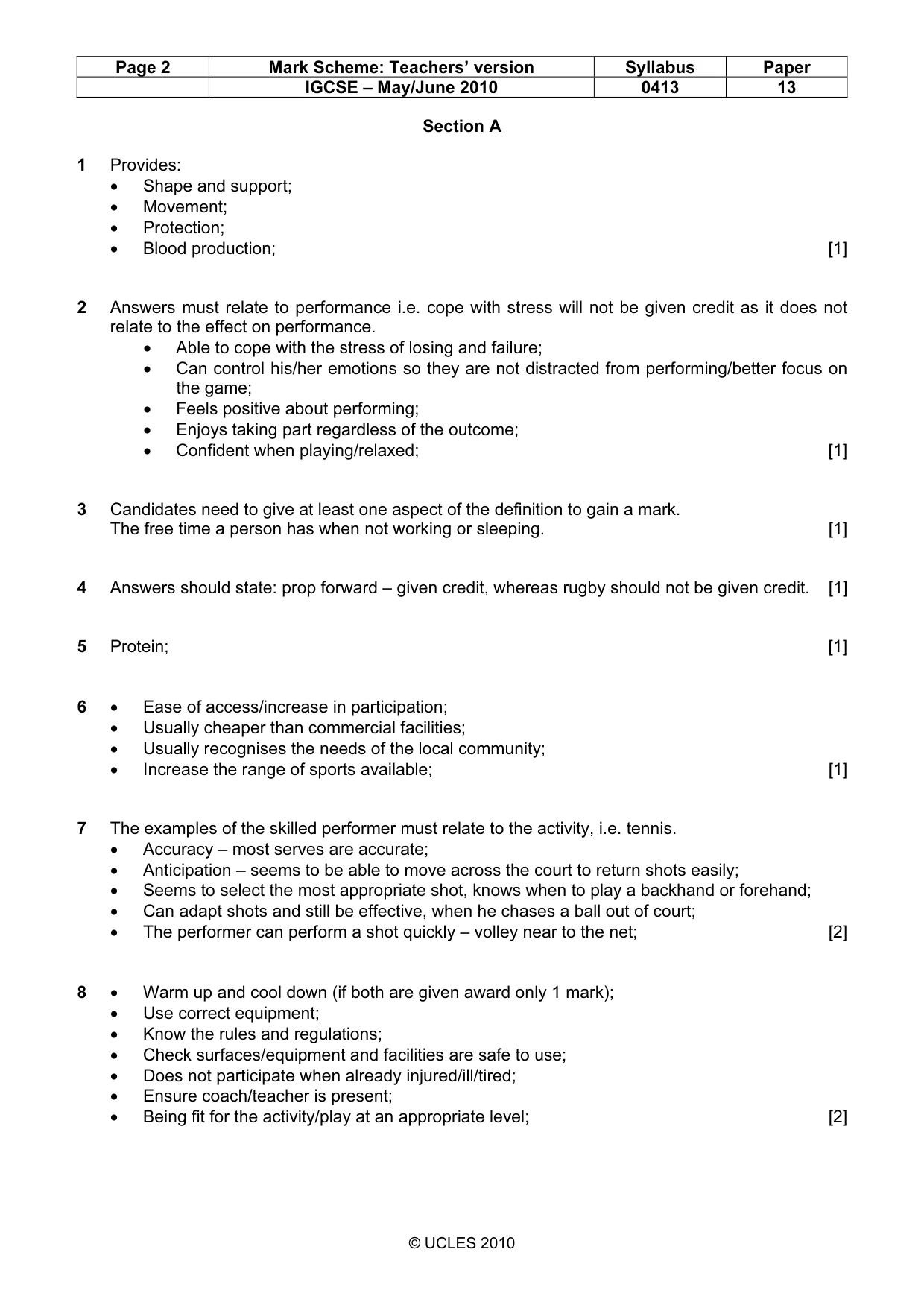
Page 2 Mark Scheme: Teachers’ version Syllabus Paper IGCSE – May/June 2010 0413 13 © UCLES 2010 Section A 1 Provides: • Shape and support; • Movement; • Protection; • Blood production; [1] 2 Answers must relate to performance i.e. cope with stress will not be given credit as it does not relate to the effect on performance. • Able to cope with the stress of losing and failure; • Can control his/her emotions so they are not distracted from performing/better focus on the game; • Feels positive about performing; • Enjoys taking part regardless of the outcome; • Confident when playing/relaxed; [1] 3 Candidates need to give at least one aspect of the definition to gain a mark. The free time a person has when not working or sleeping. [1] 4 Answers should state: prop forward – given credit, whereas rugby should not be given credit. [1] 5 Protein; [1] 6 • Ease of access/increase in participation; • Usually cheaper than commercial facilities; • Usually recognises the needs of the local community; • Increase the range of sports available; [1] 7 The examples of the skilled performer must relate to the activity, i.e. tennis. • Accuracy – most serves are accurate; • Anticipation – seems to be able to move across the court to return shots easily; • Seems to select the most appropriate shot, knows when to play a backhand or forehand; • Can adapt shots and still be effective, when he chases a ball out of court; • The performer can perform a shot quickly – volley near to the net; [2] 8 • Warm up and cool down (if both are given award only 1 mark); • Use correct equipment; • Know the rules and regulations; • Check surfaces/equipment and facilities are safe to use; • Does not participate when already injured/ill/tired; • Ensure coach/teacher is present; • Being fit for the activity/play at an appropriate level; [2]
Mark scheme, page 3
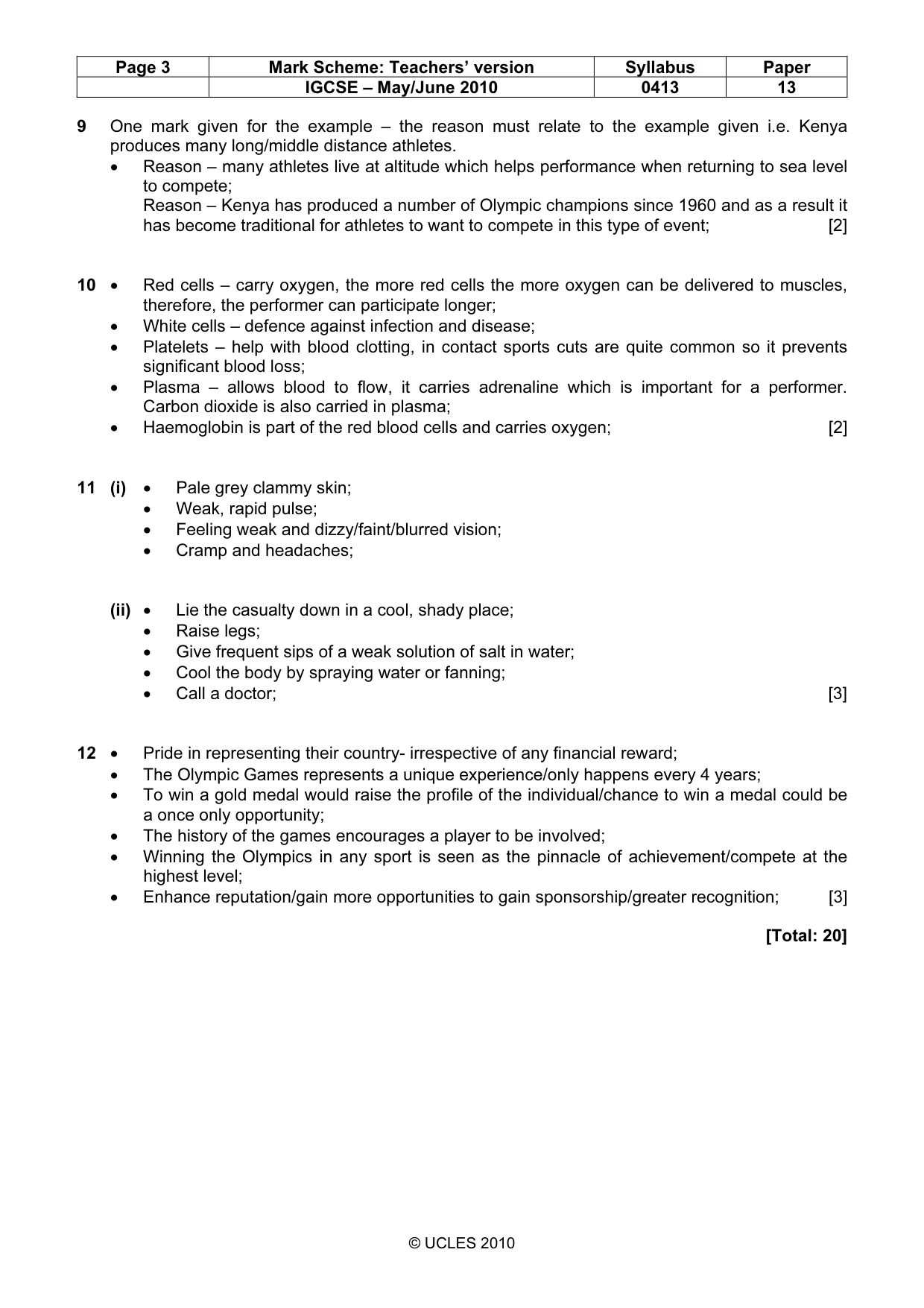
Page 3 Mark Scheme: Teachers’ version Syllabus Paper IGCSE – May/June 2010 0413 13 © UCLES 2010 9 One mark given for the example – the reason must relate to the example given i.e. Kenya produces many long/middle distance athletes. • Reason – many athletes live at altitude which helps performance when returning to sea level to compete; Reason – Kenya has produced a number of Olympic champions since 1960 and as a result it has become traditional for athletes to want to compete in this type of event; [2] 10 • Red cells – carry oxygen, the more red cells the more oxygen can be delivered to muscles, therefore, the performer can participate longer; • White cells – defence against infection and disease; • Platelets – help with blood clotting, in contact sports cuts are quite common so it prevents significant blood loss; • Plasma – allows blood to flow, it carries adrenaline which is important for a performer. Carbon dioxide is also carried in plasma; • Haemoglobin is part of the red blood cells and carries oxygen; [2] 11 (i) • Pale grey clammy skin; • Weak, rapid pulse; • Feeling weak and dizzy/faint/blurred vision; • Cramp and headaches; (ii) • Lie the casualty down in a cool, shady place; • Raise legs; • Give frequent sips of a weak solution of salt in water; • Cool the body by spraying water or fanning; • Call a doctor; [3] 12 • Pride in representing their country- irrespective of any financial reward; • The Olympic Games represents a unique experience/only happens every 4 years; • To win a gold medal would raise the profile of the individual/chance to win a medal could be a once only opportunity; • The history of the games encourages a player to be involved; • Winning the Olympics in any sport is seen as the pinnacle of achievement/compete at the highest level; • Enhance reputation/gain more opportunities to gain sponsorship/greater recognition; [3] [Total: 20]
Mark scheme, page 4
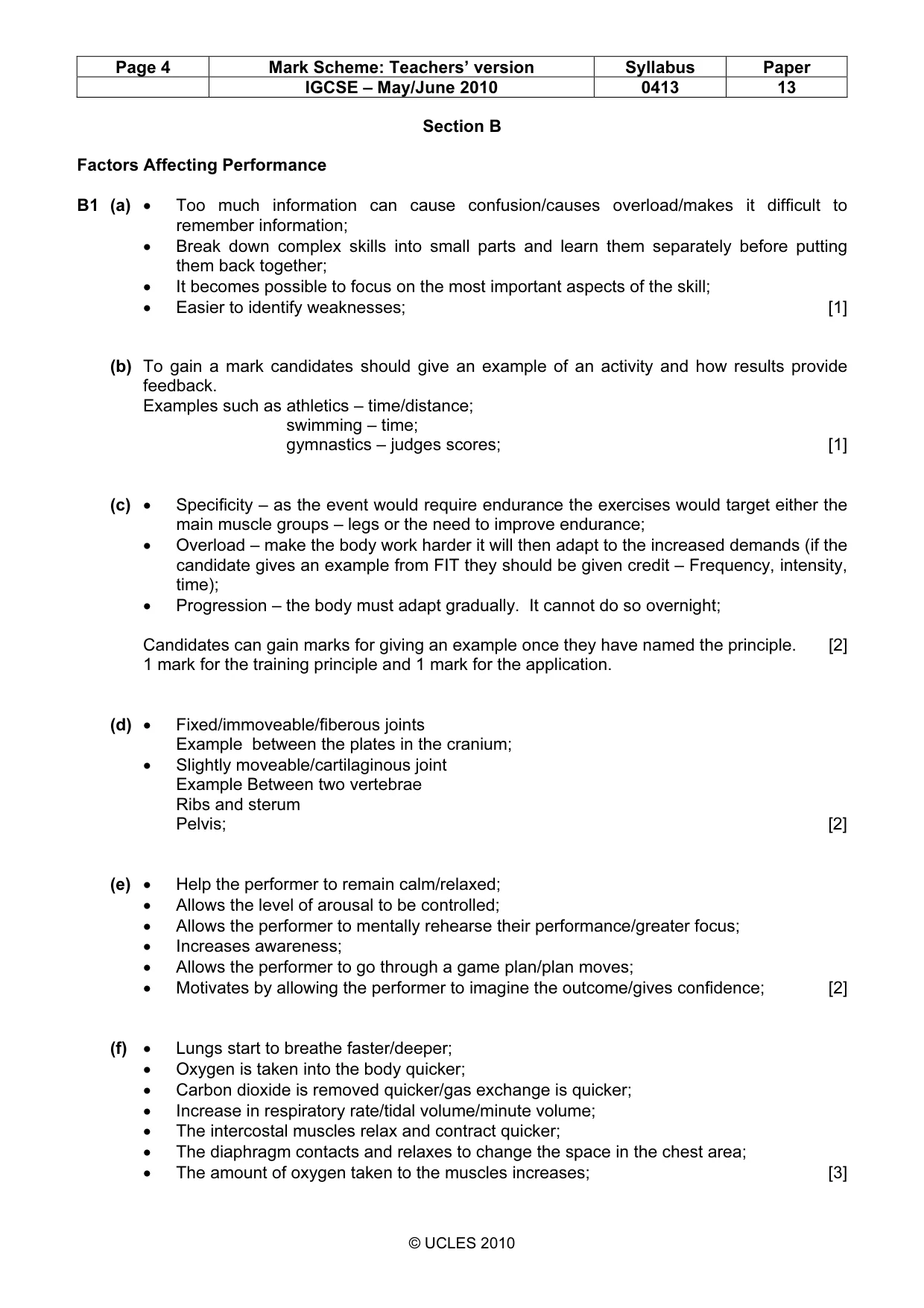
Page 4 Mark Scheme: Teachers’ version Syllabus Paper IGCSE – May/June 2010 0413 13 © UCLES 2010 Section B Factors Affecting Performance B1 (a) • Too much information can cause confusion/causes overload/makes it difficult to remember information; • Break down complex skills into small parts and learn them separately before putting them back together; • It becomes possible to focus on the most important aspects of the skill; • Easier to identify weaknesses; [1] (b) To gain a mark candidates should give an example of an activity and how results provide feedback. Examples such as athletics – time/distance; swimming – time; gymnastics – judges scores; [1] (c) • Specificity – as the event would require endurance the exercises would target either the main muscle groups – legs or the need to improve endurance; • Overload – make the body work harder it will then adapt to the increased demands (if the candidate gives an example from FIT they should be given credit – Frequency, intensity, time); • Progression – the body must adapt gradually. It cannot do so overnight; Candidates can gain marks for giving an example once they have named the principle. [2] 1 mark for the training principle and 1 mark for the application. (d) • Fixed/immoveable/fiberous joints Example between the plates in the cranium; • Slightly moveable/cartilaginous joint Example Between two vertebrae Ribs and sterum Pelvis; [2] (e) • Help the performer to remain calm/relaxed; • Allows the level of arousal to be controlled; • Allows the performer to mentally rehearse their performance/greater focus; • Increases awareness; • Allows the performer to go through a game plan/plan moves; • Motivates by allowing the performer to imagine the outcome/gives confidence; [2] (f) • Lungs start to breathe faster/deeper; • Oxygen is taken into the body quicker; • Carbon dioxide is removed quicker/gas exchange is quicker; • Increase in respiratory rate/tidal volume/minute volume; • The intercostal muscles relax and contract quicker; • The diaphragm contacts and relaxes to change the space in the chest area; • The amount of oxygen taken to the muscles increases; [3]
Mark scheme, page 5
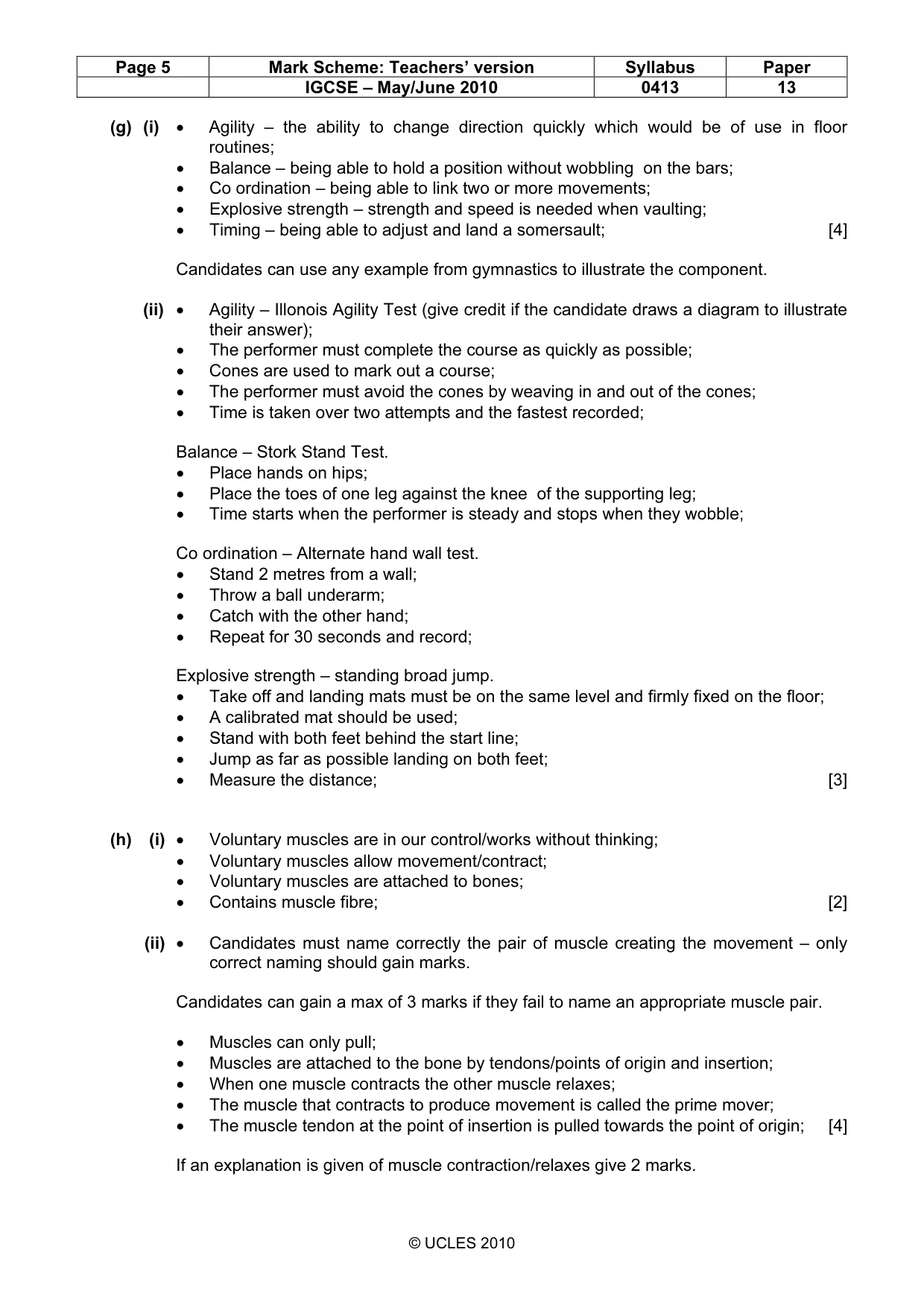
Page 5 Mark Scheme: Teachers’ version Syllabus Paper IGCSE – May/June 2010 0413 13 © UCLES 2010 (g) (i) • Agility – the ability to change direction quickly which would be of use in floor routines; • Balance – being able to hold a position without wobbling on the bars; • Co ordination – being able to link two or more movements; • Explosive strength – strength and speed is needed when vaulting; • Timing – being able to adjust and land a somersault; [4] Candidates can use any example from gymnastics to illustrate the component. (ii) • Agility – Illonois Agility Test (give credit if the candidate draws a diagram to illustrate their answer); • The performer must complete the course as quickly as possible; • Cones are used to mark out a course; • The performer must avoid the cones by weaving in and out of the cones; • Time is taken over two attempts and the fastest recorded; Balance – Stork Stand Test. • Place hands on hips; • Place the toes of one leg against the knee of the supporting leg; • Time starts when the performer is steady and stops when they wobble; Co ordination – Alternate hand wall test. • Stand 2 metres from a wall; • Throw a ball underarm; • Catch with the other hand; • Repeat for 30 seconds and record; Explosive strength – standing broad jump. • Take off and landing mats must be on the same level and firmly fixed on the floor; • A calibrated mat should be used; • Stand with both feet behind the start line; • Jump as far as possible landing on both feet; • Measure the distance; [3] (h) (i) • Voluntary muscles are in our control/works without thinking; • Voluntary muscles allow movement/contract; • Voluntary muscles are attached to bones; • Contains muscle fibre; [2] (ii) • Candidates must name correctly the pair of muscle creating the movement – only correct naming should gain marks. Candidates can gain a max of 3 marks if they fail to name an appropriate muscle pair. • Muscles can only pull; • Muscles are attached to the bone by tendons/points of origin and insertion; • When one muscle contracts the other muscle relaxes; • The muscle that contracts to produce movement is called the prime mover; • The muscle tendon at the point of insertion is pulled towards the point of origin; [4] If an explanation is given of muscle contraction/relaxes give 2 marks.
Mark scheme, page 6
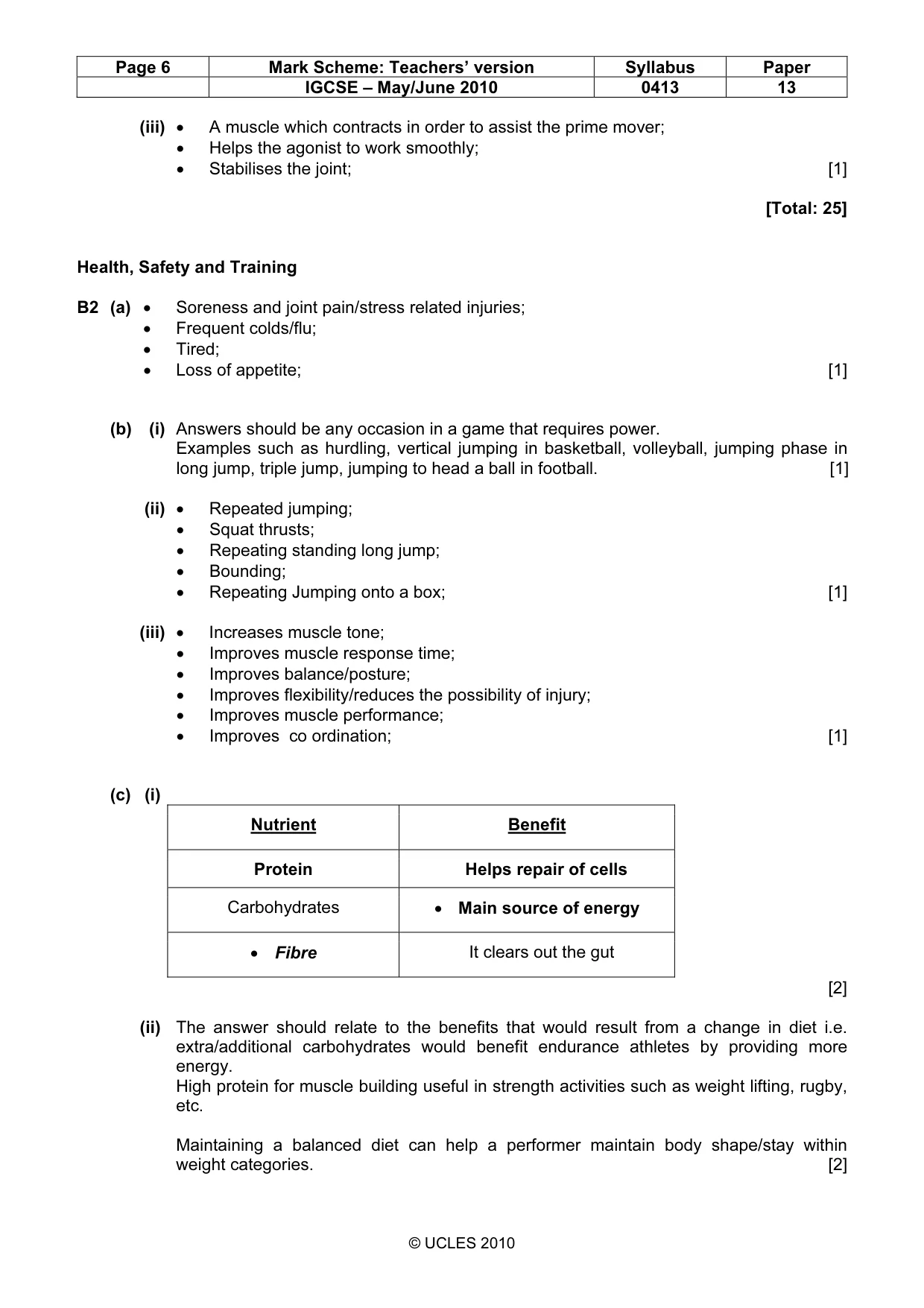
Page 6 Mark Scheme: Teachers’ version Syllabus Paper IGCSE – May/June 2010 0413 13 © UCLES 2010 (iii) • A muscle which contracts in order to assist the prime mover; • Helps the agonist to work smoothly; • Stabilises the joint; [1] [Total: 25] Health, Safety and Training B2 (a) • Soreness and joint pain/stress related injuries; • Frequent colds/flu; • Tired; • Loss of appetite; [1] (b) (i) Answers should be any occasion in a game that requires power. Examples such as hurdling, vertical jumping in basketball, volleyball, jumping phase in long jump, triple jump, jumping to head a ball in football. [1] (ii) • Repeated jumping; • Squat thrusts; • Repeating standing long jump; • Bounding; • Repeating Jumping onto a box; [1] (iii) • Increases muscle tone; • Improves muscle response time; • Improves balance/posture; • Improves flexibility/reduces the possibility of injury; • Improves muscle performance; • Improves co ordination; [1] (c) (i) Nutrient Benefit Protein Helps repair of cells Carbohydrates • Main source of energy • Fibre It clears out the gut [2] (ii) The answer should relate to the benefits that would result from a change in diet i.e. extra/additional carbohydrates would benefit endurance athletes by providing more energy. High protein for muscle building useful in strength activities such as weight lifting, rugby, etc. Maintaining a balanced diet can help a performer maintain body shape/stay within weight categories. [2]
Mark scheme, page 7
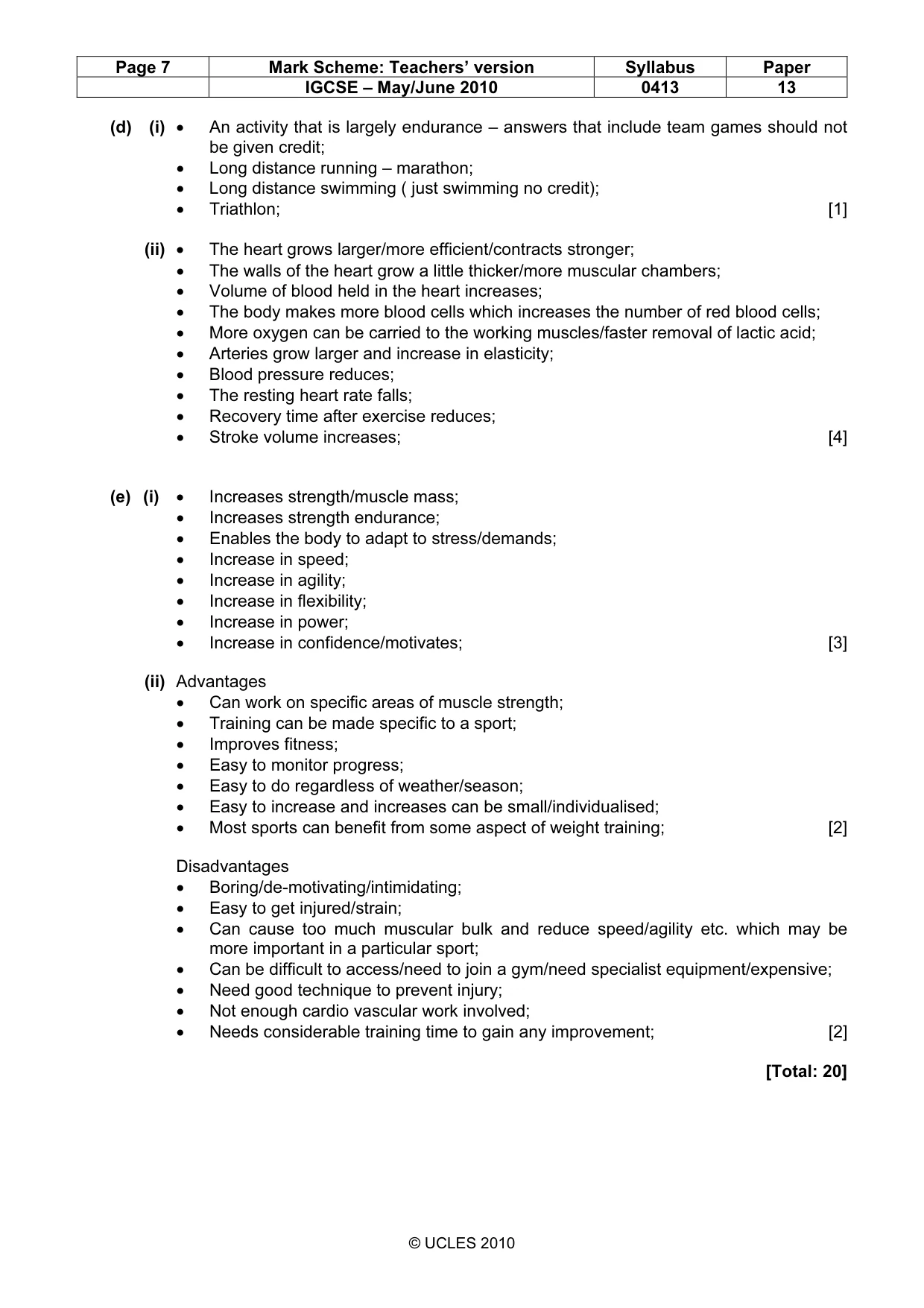
Page 7 Mark Scheme: Teachers’ version Syllabus Paper IGCSE – May/June 2010 0413 13 © UCLES 2010 (d) (i) • An activity that is largely endurance – answers that include team games should not be given credit; • Long distance running – marathon; • Long distance swimming ( just swimming no credit); • Triathlon; [1] (ii) • The heart grows larger/more efficient/contracts stronger; • The walls of the heart grow a little thicker/more muscular chambers; • Volume of blood held in the heart increases; • The body makes more blood cells which increases the number of red blood cells; • More oxygen can be carried to the working muscles/faster removal of lactic acid; • Arteries grow larger and increase in elasticity; • Blood pressure reduces; • The resting heart rate falls; • Recovery time after exercise reduces; • Stroke volume increases; [4] (e) (i) • Increases strength/muscle mass; • Increases strength endurance; • Enables the body to adapt to stress/demands; • Increase in speed; • Increase in agility; • Increase in flexibility; • Increase in power; • Increase in confidence/motivates; [3] (ii) Advantages • Can work on specific areas of muscle strength; • Training can be made specific to a sport; • Improves fitness; • Easy to monitor progress; • Easy to do regardless of weather/season; • Easy to increase and increases can be small/individualised; • Most sports can benefit from some aspect of weight training; [2] Disadvantages • Boring/de-motivating/intimidating; • Easy to get injured/strain; • Can cause too much muscular bulk and reduce speed/agility etc. which may be more important in a particular sport; • Can be difficult to access/need to join a gym/need specialist equipment/expensive; • Need good technique to prevent injury; • Not enough cardio vascular work involved; • Needs considerable training time to gain any improvement; [2] [Total: 20]
Mark scheme, page 8
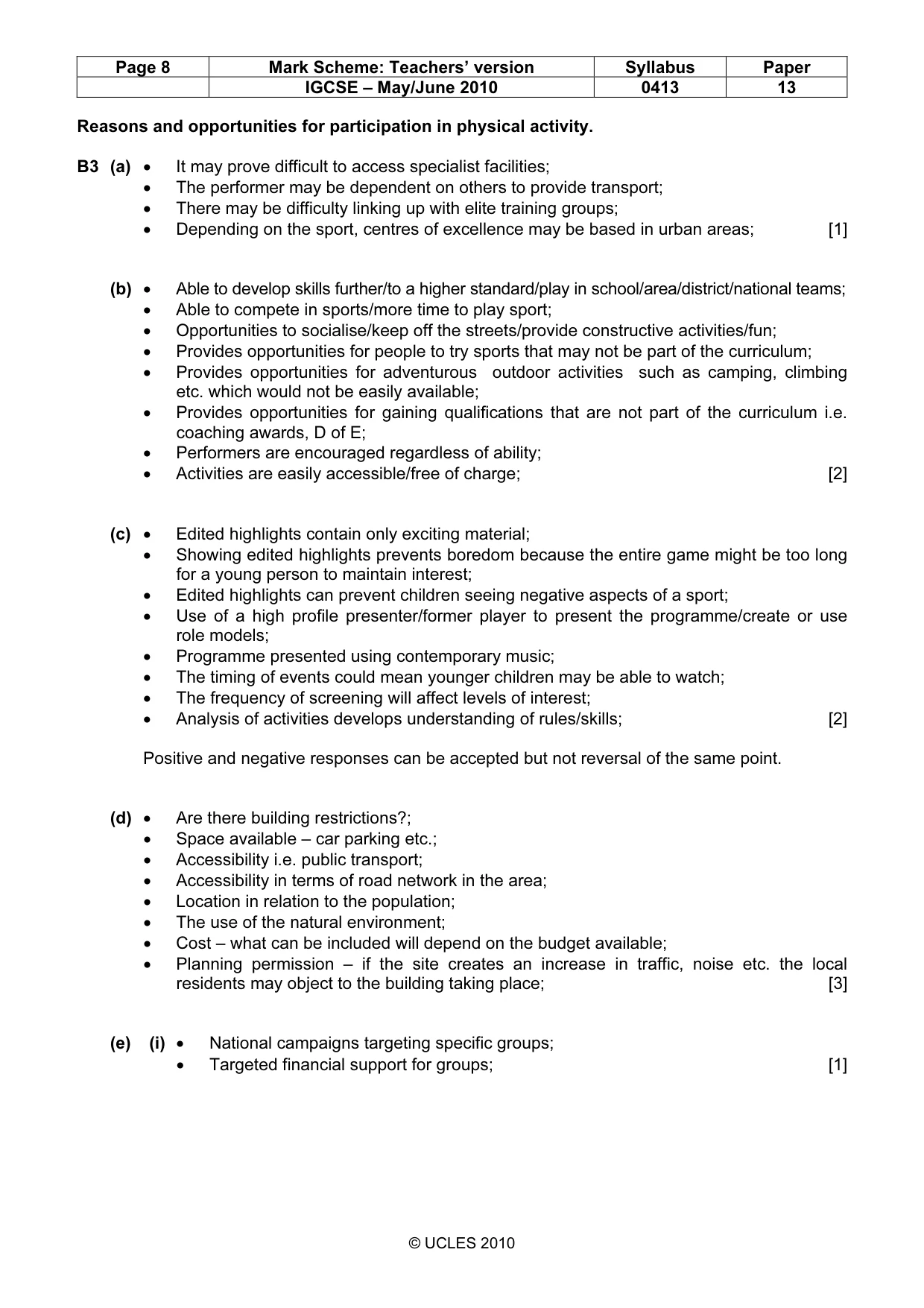
Page 8 Mark Scheme: Teachers’ version Syllabus Paper IGCSE – May/June 2010 0413 13 © UCLES 2010 Reasons and opportunities for participation in physical activity. B3 (a) • It may prove difficult to access specialist facilities; • The performer may be dependent on others to provide transport; • There may be difficulty linking up with elite training groups; • Depending on the sport, centres of excellence may be based in urban areas; [1] (b) • Able to develop skills further/to a higher standard/play in school/area/district/national teams; • Able to compete in sports/more time to play sport; • Opportunities to socialise/keep off the streets/provide constructive activities/fun; • Provides opportunities for people to try sports that may not be part of the curriculum; • Provides opportunities for adventurous outdoor activities such as camping, climbing etc. which would not be easily available; • Provides opportunities for gaining qualifications that are not part of the curriculum i.e. coaching awards, D of E; • Performers are encouraged regardless of ability; • Activities are easily accessible/free of charge; [2] (c) • Edited highlights contain only exciting material; • Showing edited highlights prevents boredom because the entire game might be too long for a young person to maintain interest; • Edited highlights can prevent children seeing negative aspects of a sport; • Use of a high profile presenter/former player to present the programme/create or use role models; • Programme presented using contemporary music; • The timing of events could mean younger children may be able to watch; • The frequency of screening will affect levels of interest; • Analysis of activities develops understanding of rules/skills; [2] Positive and negative responses can be accepted but not reversal of the same point. (d) • Are there building restrictions?; • Space available – car parking etc.; • Accessibility i.e. public transport; • Accessibility in terms of road network in the area; • Location in relation to the population; • The use of the natural environment; • Cost – what can be included will depend on the budget available; • Planning permission – if the site creates an increase in traffic, noise etc. the local residents may object to the building taking place; [3] (e) (i) • National campaigns targeting specific groups; • Targeted financial support for groups; [1]
Mark scheme, page 9
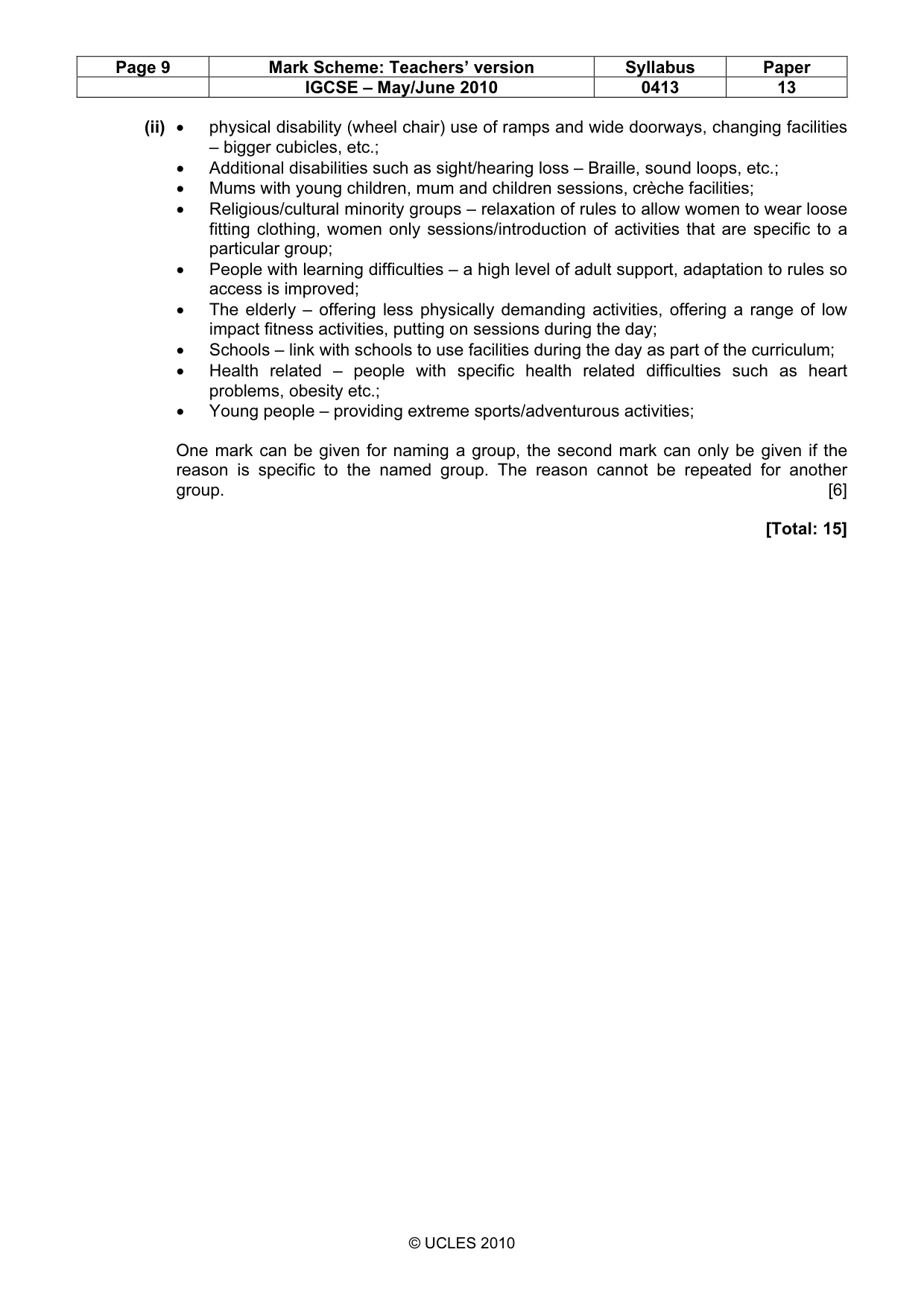
Page 9 Mark Scheme: Teachers’ version Syllabus Paper IGCSE – May/June 2010 0413 13 © UCLES 2010 (ii) • physical disability (wheel chair) use of ramps and wide doorways, changing facilities – bigger cubicles, etc.; • Additional disabilities such as sight/hearing loss – Braille, sound loops, etc.; • Mums with young children, mum and children sessions, crèche facilities; • Religious/cultural minority groups – relaxation of rules to allow women to wear loose fitting clothing, women only sessions/introduction of activities that are specific to a particular group; • People with learning difficulties – a high level of adult support, adaptation to rules so access is improved; • The elderly – offering less physically demanding activities, offering a range of low impact fitness activities, putting on sessions during the day; • Schools – link with schools to use facilities during the day as part of the curriculum; • Health related – people with specific health related difficulties such as heart problems, obesity etc.; • Young people – providing extreme sports/adventurous activities; One mark can be given for naming a group, the second mark can only be given if the reason is specific to the named group. The reason cannot be repeated for another group. [6] [Total: 15]
What you needed in this session
Cambridge’s own grade thresholds for 2010 May/June, Paper 1 · Variant 3. A higher threshold means an easier paper — the bar moves with how the cohort did.