Cambridge IGCSE Mathematics - International 0607 — 2022 May/June Paper 4 · Variant 3
0607/43/M/J/22 · 11 questions · 120 marks · ≈135 min
The question paper and its mark scheme, free to read here and free to download. This is Cambridge’s own paper, exactly as it was sat.
Question paper20 pages
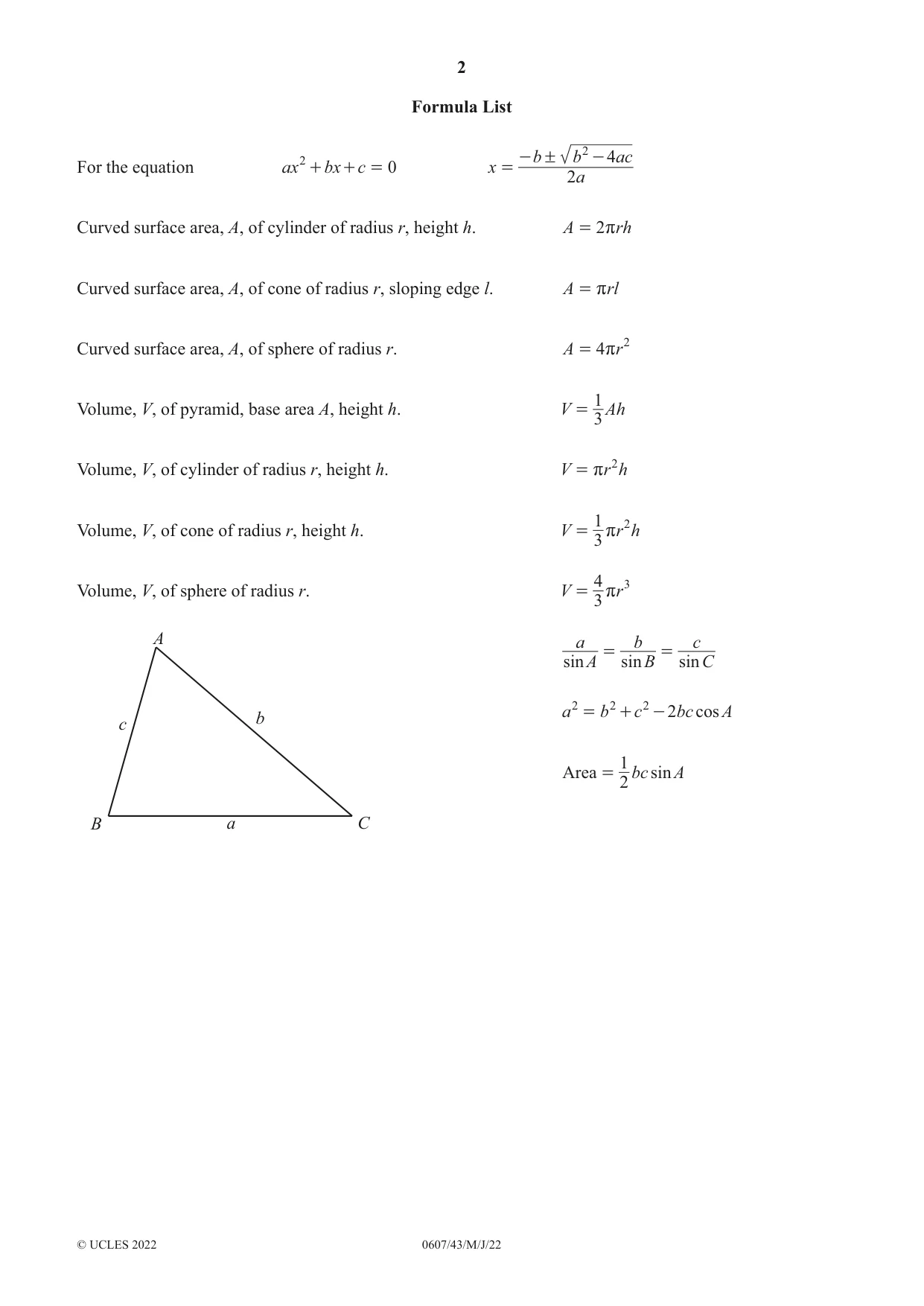
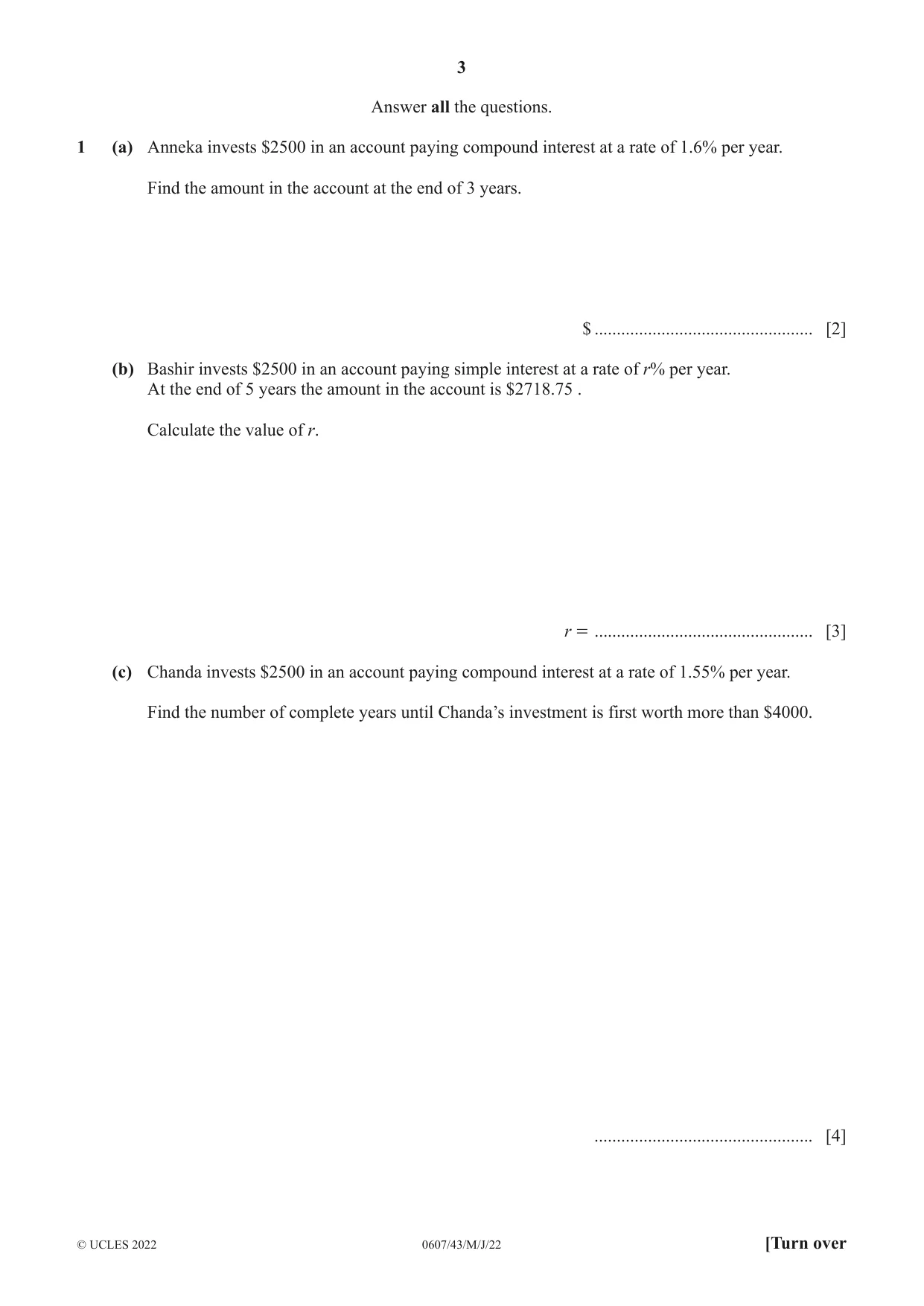
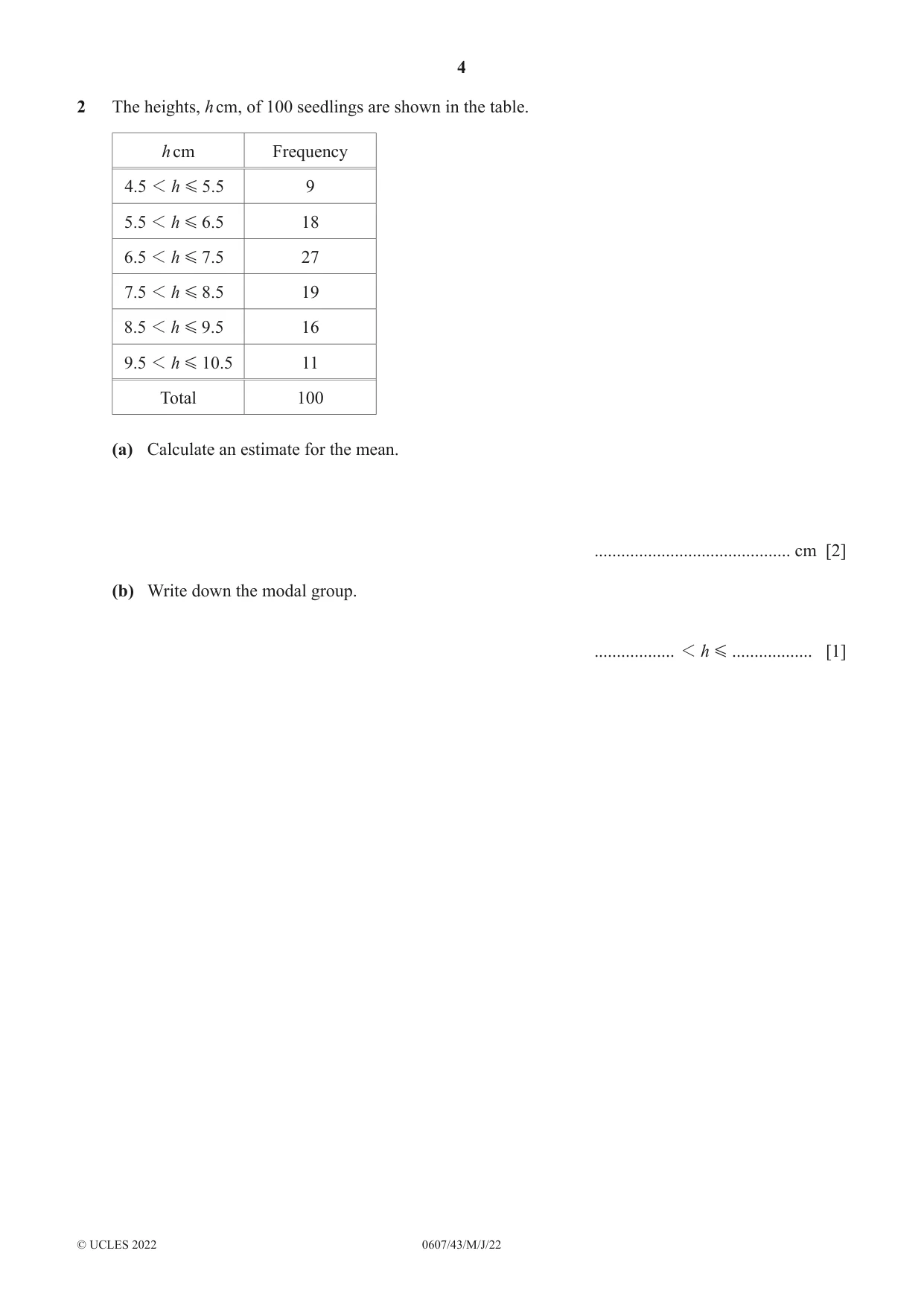

Mark scheme8 pages
Answers below. Sit the paper first if you are practising.
Questions as text
Q1 · Anneka invests $2500 in an account paying compound interest at a rate of 1.6% per year
1 (a) Anneka invests $2500 in an account paying compound interest at a rate of 1.6% per year. Find the amount in the account at the end of 3 years. $ ................................................. [2] (b) Bashir invests $2500 in an account paying simple interest at a rate of r% per year. At the end of 5 years the amount in the account is $2718.75 . Calculate the value of r. r = ................................................. [3] (c) Chanda invests $2500 in an account paying compound interest at a rate of 1.55% per year. Find the number of complete years until Chanda’s investment is first worth more than $4000. ................................................. [4]
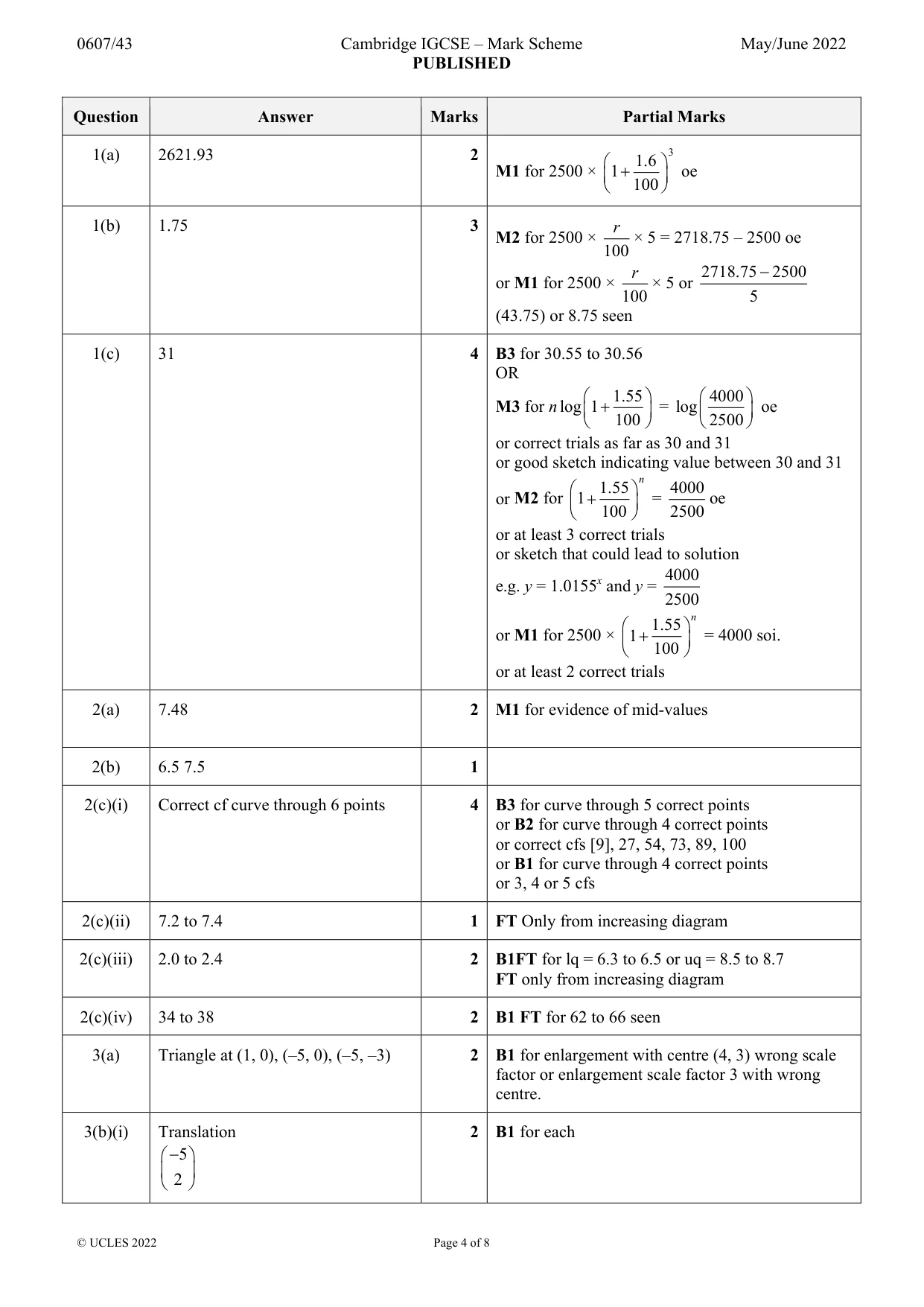
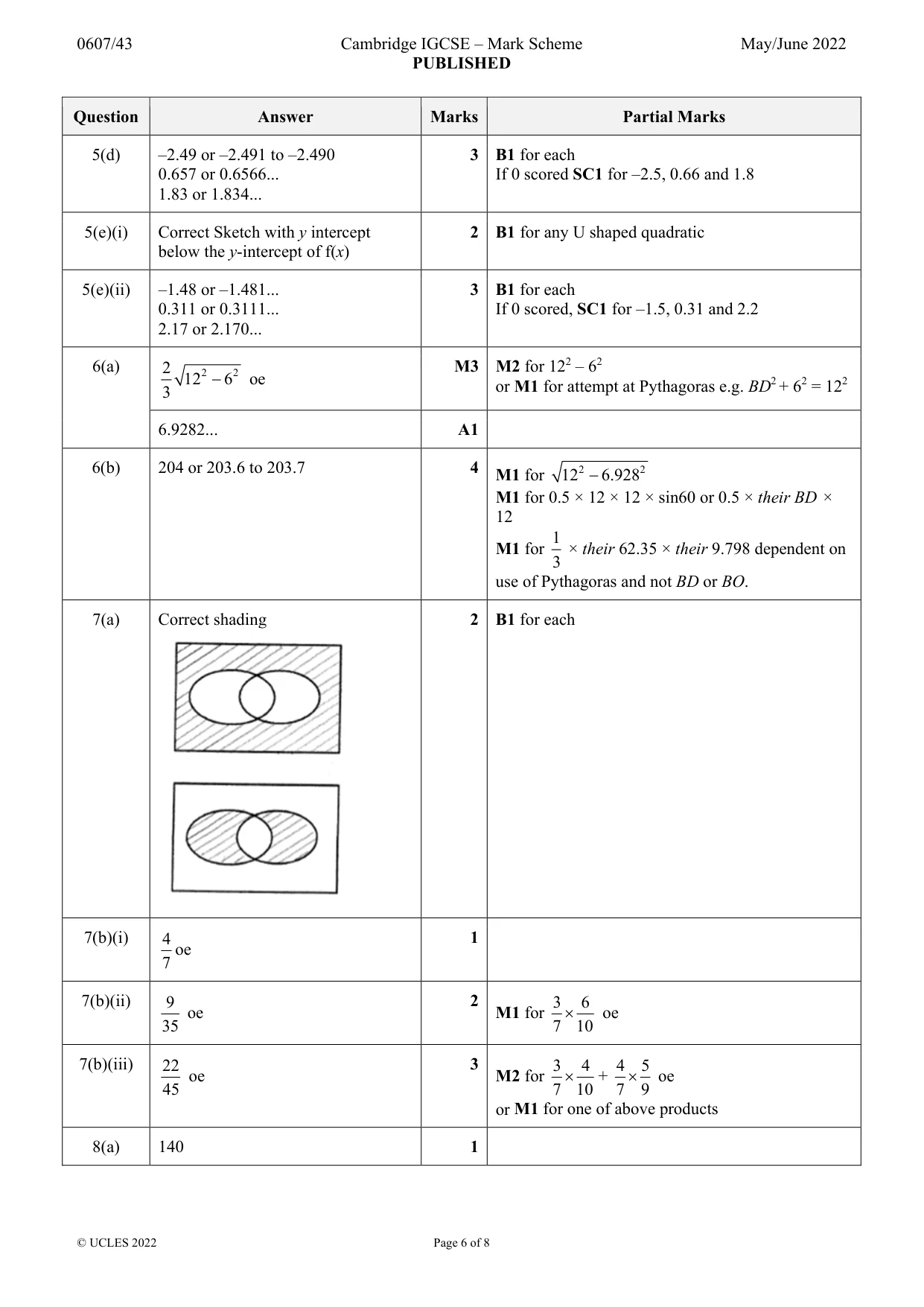
Mark scheme: Question Answer Marks Partial Marks 1(a) 2621.93 2 3 1.6 M1 for 2500 × 1 oe 100 1(b) 1.75 3 r M2 for 2500 × × 5 = 2718.75 – 2500 oe 100 r 2718.75 2500 or M1 for 2500 × × 5 or 100 5 (43.75) or 8.75 seen 1(c) 31 4 B3 for 30.55 to 30.56 OR 1.55 4000 M3 for n log 1 = log oe 100 2500 or correct trials as far as 30 and 31 or good sketch indicating value between 30 and 31 1.55 n 4000 or M2 for 1 = oe 100 2500 or at least 3 correct trials or sketch that could lead to solution 4000 e.g. y = 1.0155x and y = 2500 1.55 n or M1 for 2500 × 1 = 4000 soi. 100 or at least 2 correct trials
Q2 · The heights, h cm, of 100 seedlings are shown in the table
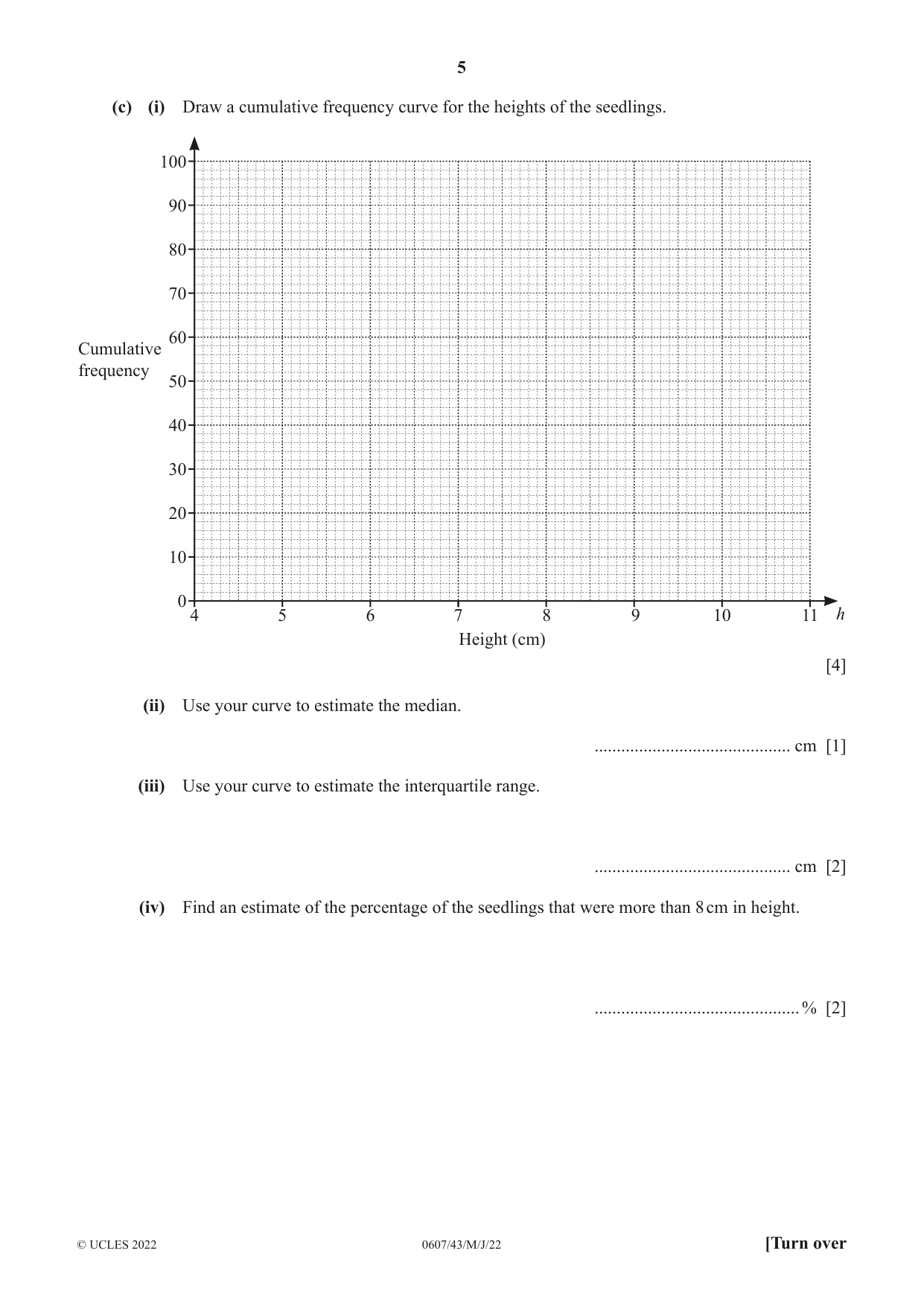
2 The heights, h cm, of 100 seedlings are shown in the table. h cm Frequency 4.5 1 h G 5.5 9 5.5 1 h G 6.5 18 6.5 1 h G 7 .5 27 7.5 1 h G 8.5 19 8.5 1 h G 9.5 16 9.5 1 h G 10.5 11 Total 100 (a) Calculate an estimate for the mean. ............................................ cm [2] (b) Write down the modal group. .................. 1 h G .................. [1] (c) (i) Draw a cumulative frequency curve for the heights of the seedlings. 100 90 80 70 60Cumulative frequency 50 40 30 20 10 0 4 5 6 7 8 9 10 11 h Height (cm) [4] (ii) Use your curve to estimate the median. ............................................ cm [1] (iii) Use your curve to estimate the interquartile range. ............................................ cm [2] (iv) Find an estimate of the percentage of the seedlings that were more than 8 cm in height. ..............................................% [2]
Mark scheme: 2(a) 7.48 2 M1 for evidence of mid-values 2(b) 6.5 7.5 1 2(c)(i) Correct cf curve through 6 points 4 B3 for curve through 5 correct points or B2 for curve through 4 correct points or correct cfs [9], 27, 54, 73, 89, 100 or B1 for curve through 4 correct points or 3, 4 or 5 cfs 2(c)(ii) 7.2 to 7.4 1 FT Only from increasing diagram 2(c)(iii) 2.0 to 2.4 2 B1FT for lq = 6.3 to 6.5 or uq = 8.5 to 8.7 FT only from increasing diagram 2(c)(iv) 34 to 38 2 B1 FT for 62 to 66 seen
Q3 · Y 10 9 8 D 7 6 5 4 B 3 2 A 1 0 x – 6 –5 – 4 –3 –2 –1 1 2 3 4 5 6 7 8 9 10 C –1 –2 –3 – 4…
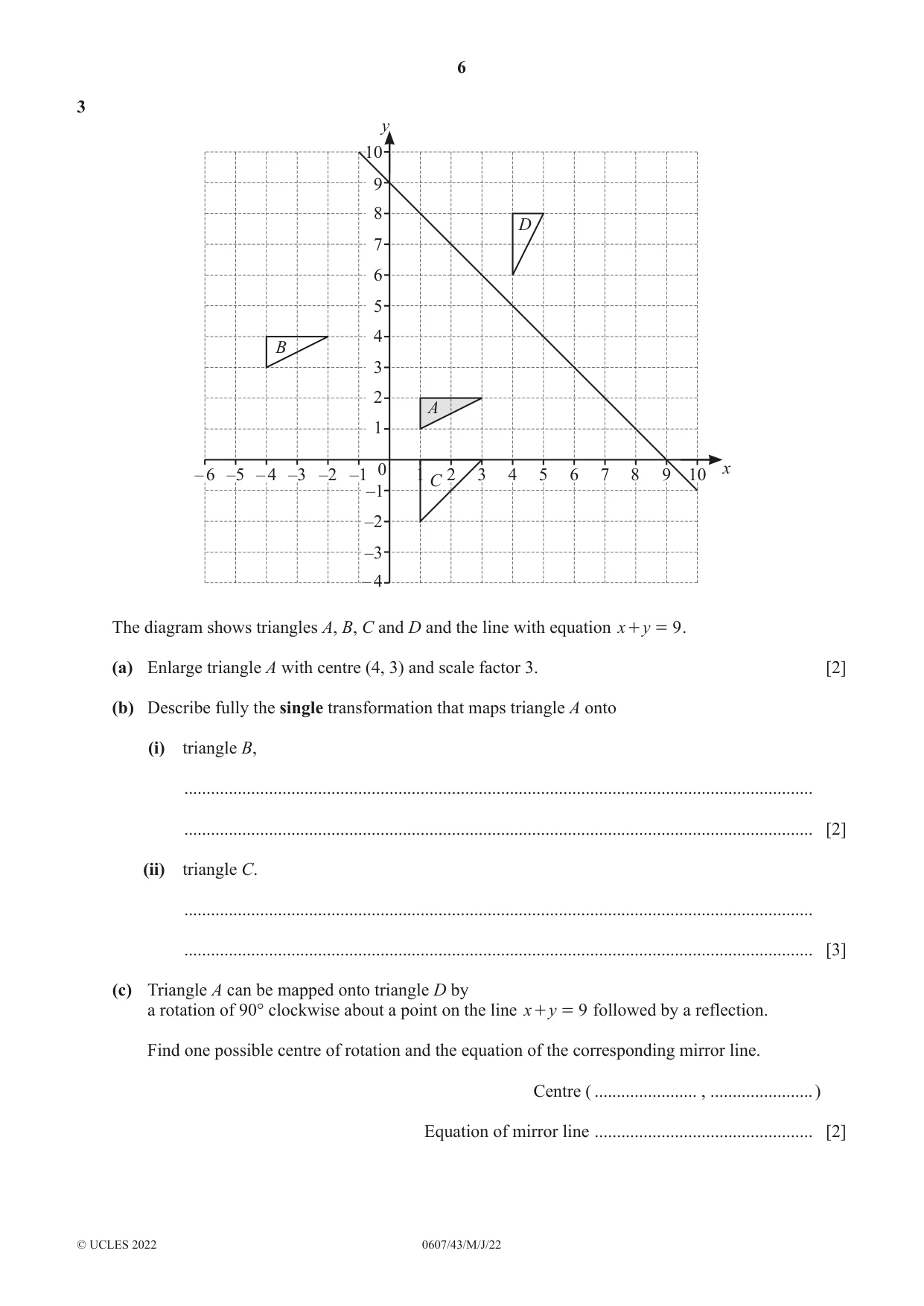
3 y 10 9 8 D 7 6 5 4 B 3 2 A 1 0 x – 6 –5 – 4 –3 –2 –1 1 2 3 4 5 6 7 8 9 10 C –1 –2 –3 – 4 The diagram shows triangles A, B, C and D and the line with equation x + y = 9 . (a) Enlarge triangle A with centre (4, 3) and scale factor 3. [2] (b) Describe fully the single transformation that maps triangle A onto (i) triangle B, ............................................................................................................................................. ............................................................................................................................................. [2] (ii) triangle C. ............................................................................................................................................. ............................................................................................................................................. [3] (c) Triangle A can be mapped onto triangle D by a rotation of 90° clockwise about a point on the line x + y = 9 followed by a reflection. Find one possible centre of rotation and the equation of the corresponding mirror line. Centre ( ....................... , ....................... ) Equation of mirror line ................................................. [2]
Mark scheme: 3(a) Triangle at (1, 0), (–5, 0), (–5, –3) 2 B1 for enlargement with centre (4, 3) wrong scale factor or enlargement scale factor 3 with wrong centre. 3(b)(i) Translation 2 B1 for each 5 2 3(b)(ii) Stretch 3 B1 for each Invariant line y = 4 [Factor] 2 3(c) e.g. 2 B1 for point on x + y = 9 and x = k (7, 2) x = 5.5 (6, 3) x = 4.5 (8, 1) x = 6.5 (9, 0) x = 7.5 (5, 4) x = 3.5 (4, 5) x = 2.5 (3, 6) x = 1.5
Q4 · Solve 4x - 3 = 7
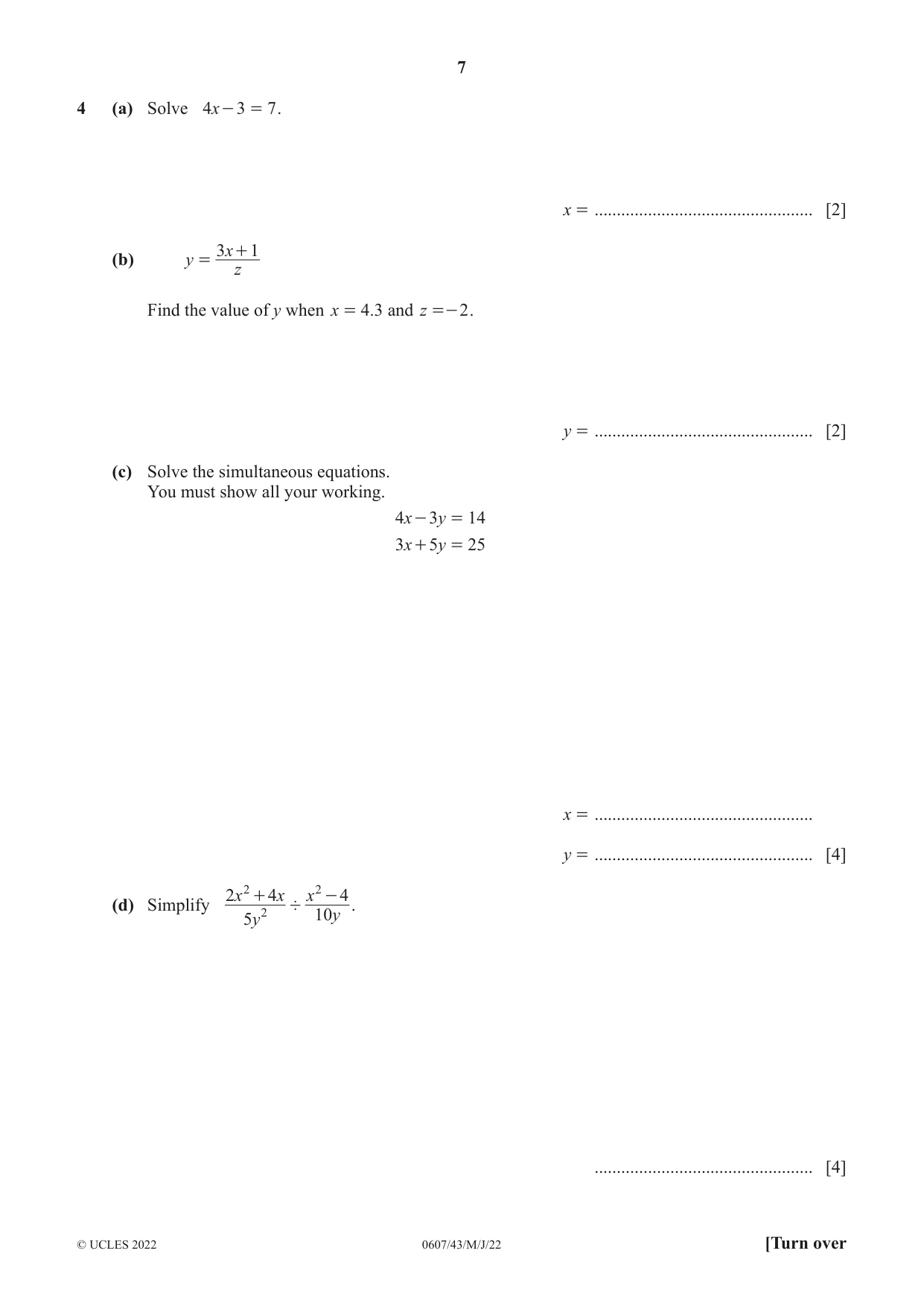
4 (a) Solve 4x - 3 = 7 . x = ................................................. [2] 3x + 1 (b) y = z Find the value of y when x = 4.3 and z =- 2 . y = ................................................. [2] (c) Solve the simultaneous equations. You must show all your working. 4x - 3y = 14 3x + 5y = 25 x = ................................................. y = ................................................. [4] 2 x 2 + 4 x x 2 - 4 (d) Simplify 2 ' . 5 y 10y ................................................. [4]
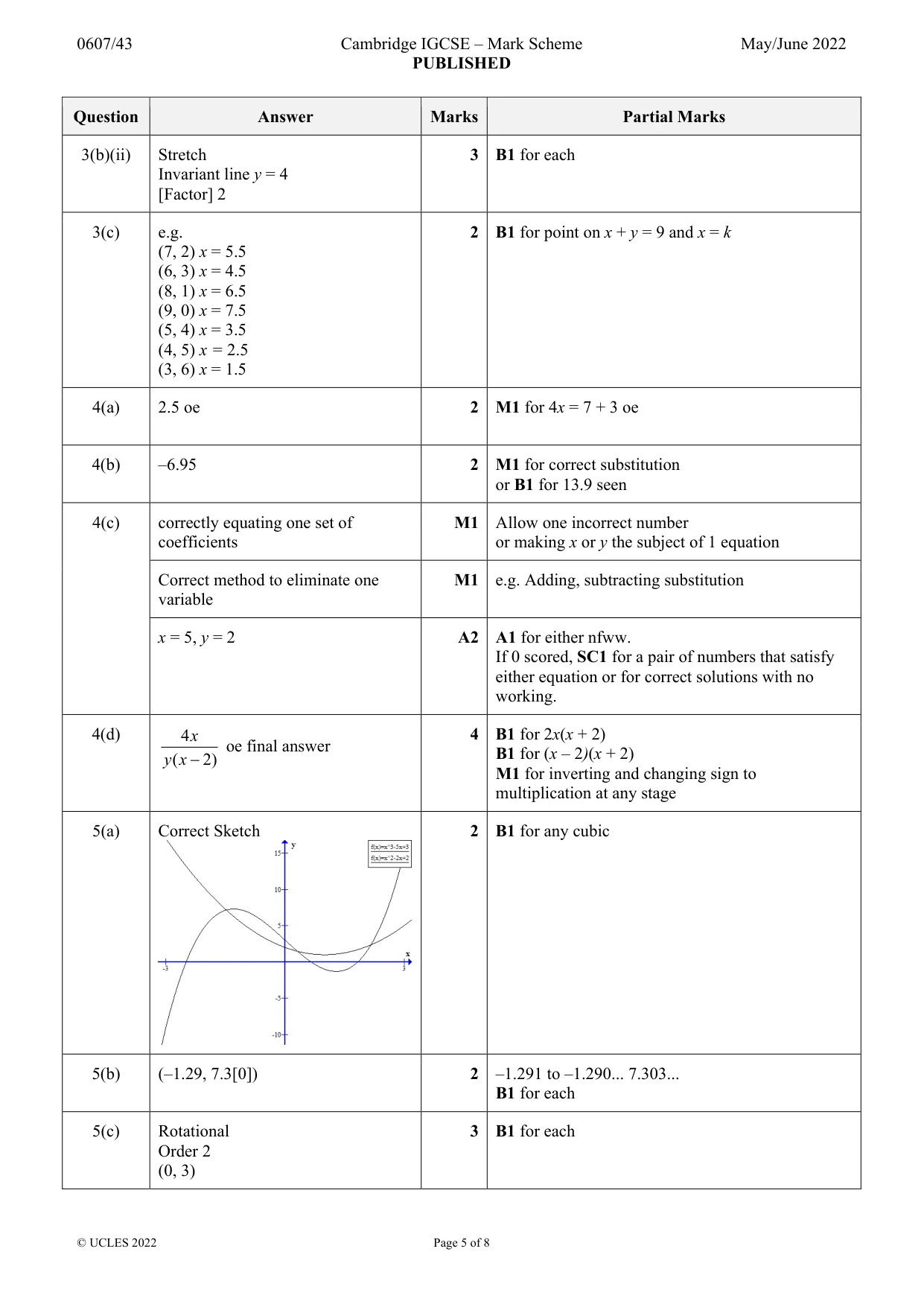
Mark scheme: 4(a) 2.5 oe 2 M1 for 4x = 7 + 3 oe 4(b) –6.95 2 M1 for correct substitution or B1 for 13.9 seen 4(c) correctly equating one set of M1 Allow one incorrect number coefficients or making x or y the subject of 1 equation Correct method to eliminate one M1 e.g. Adding, subtracting substitution variable x = 5, y = 2 A2 A1 for either nfww. If 0 scored, SC1 for a pair of numbers that satisfy either equation or for correct solutions with no working. 4(d) 4 x 4 B1 for 2x(x + 2) oe final answer B1 for (x – 2)(x + 2) y ( x 2) M1 for inverting and changing sign to multiplication at any stage
Q5 · Y 20 x 0 – 3 3 – 10 f ( x) = x 3 - 5x + 3 for - 3 G x G 3 (a) On the diagram, sketch the…
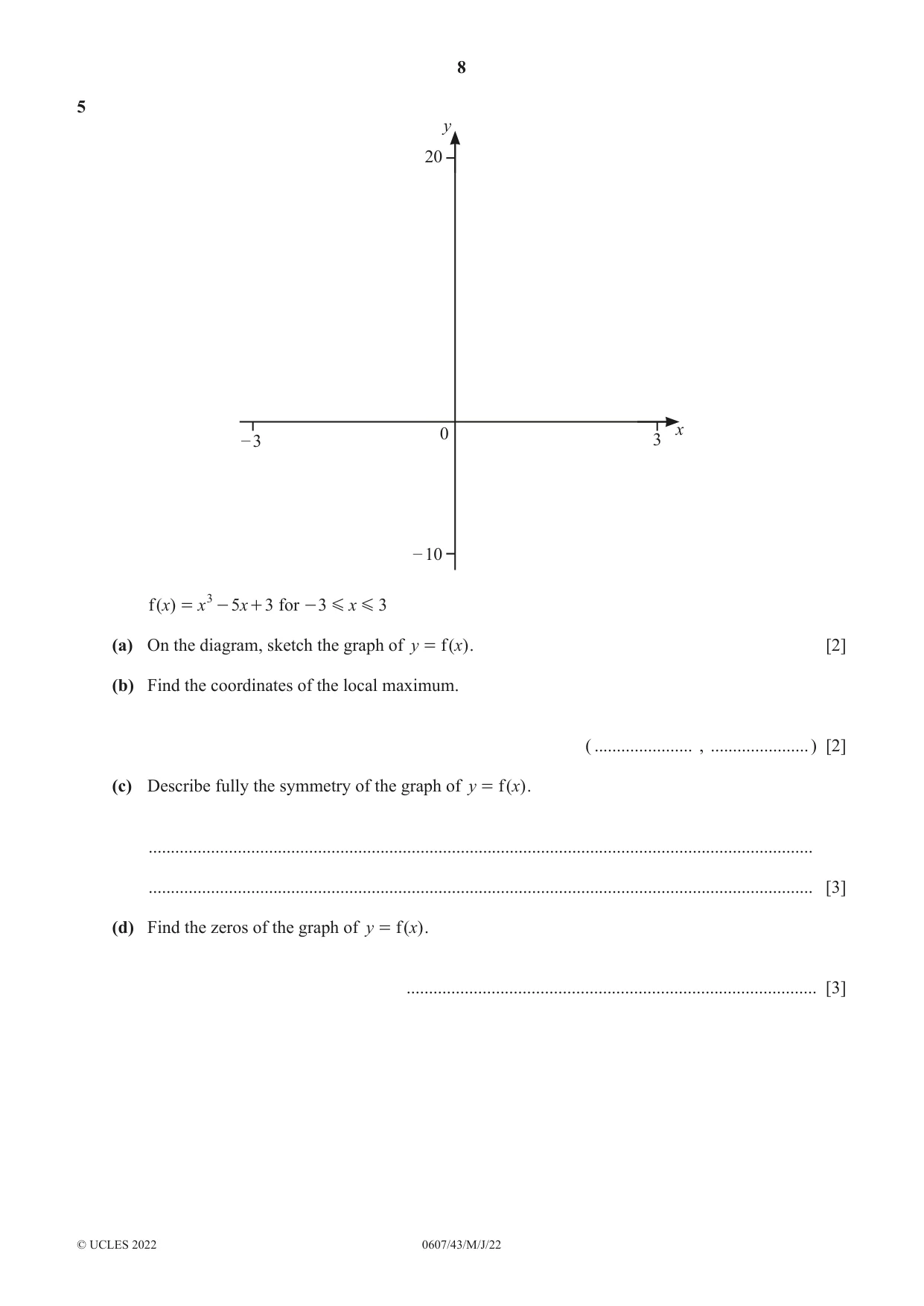
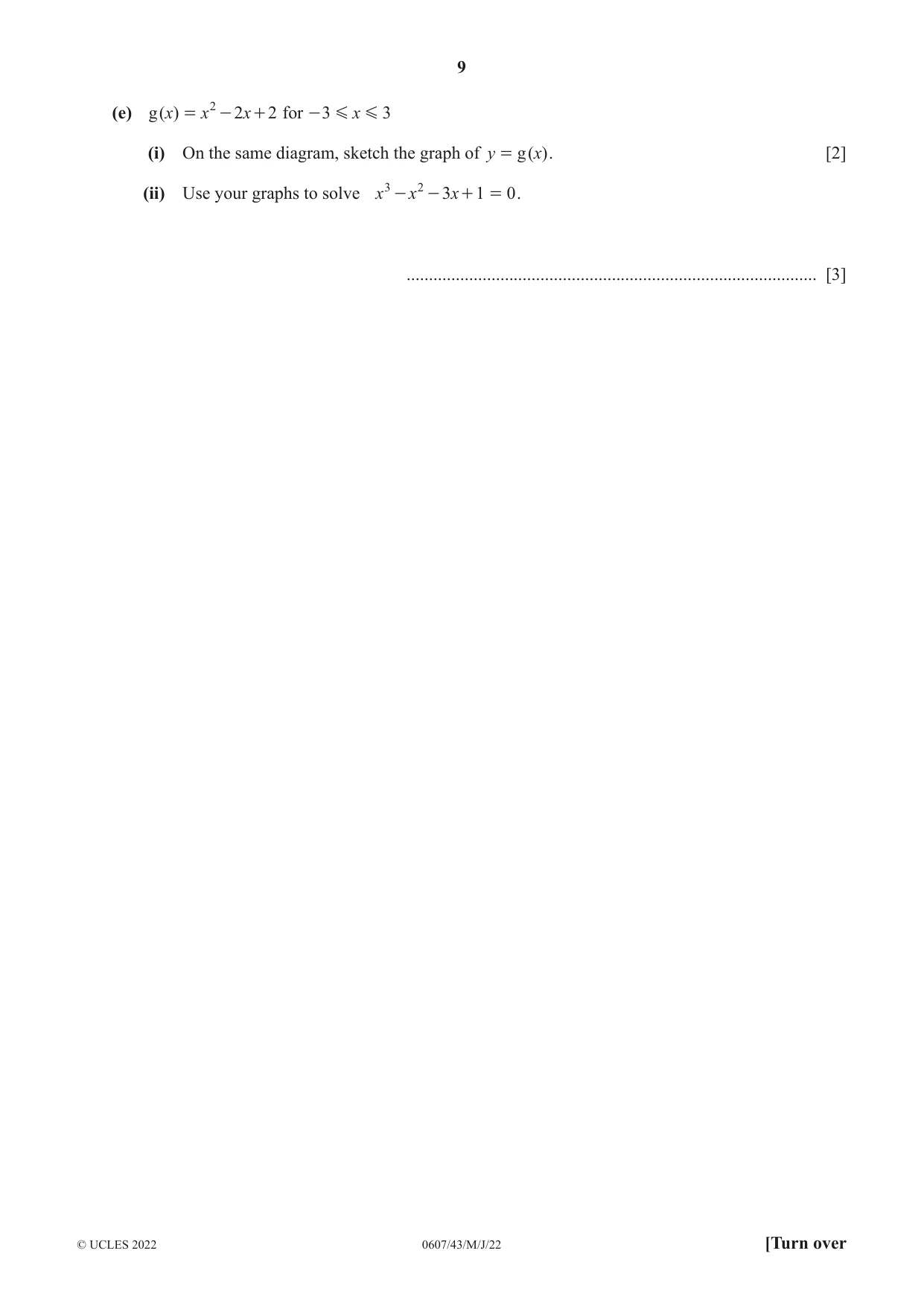
5 y 20 x 0 – 3 3 – 10 f ( x) = x 3 - 5x + 3 for - 3 G x G 3 (a) On the diagram, sketch the graph of y = f ( x) . [2] (b) Find the coordinates of the local maximum. ( ...................... , ...................... ) [2] (c) Describe fully the symmetry of the graph of y = f ( x) . ..................................................................................................................................................... ..................................................................................................................................................... [3] (d) Find the zeros of the graph of y = f ( x) . ............................................................................................ [3] (e) g ( x) = x 2 - 2x + 2 for - 3 G x G 3 (i) On the same diagram, sketch the graph of y = g ( x) . [2] (ii) Use your graphs to solve x 3 - x 2 - 3x + 1 = 0 . ............................................................................................ [3]
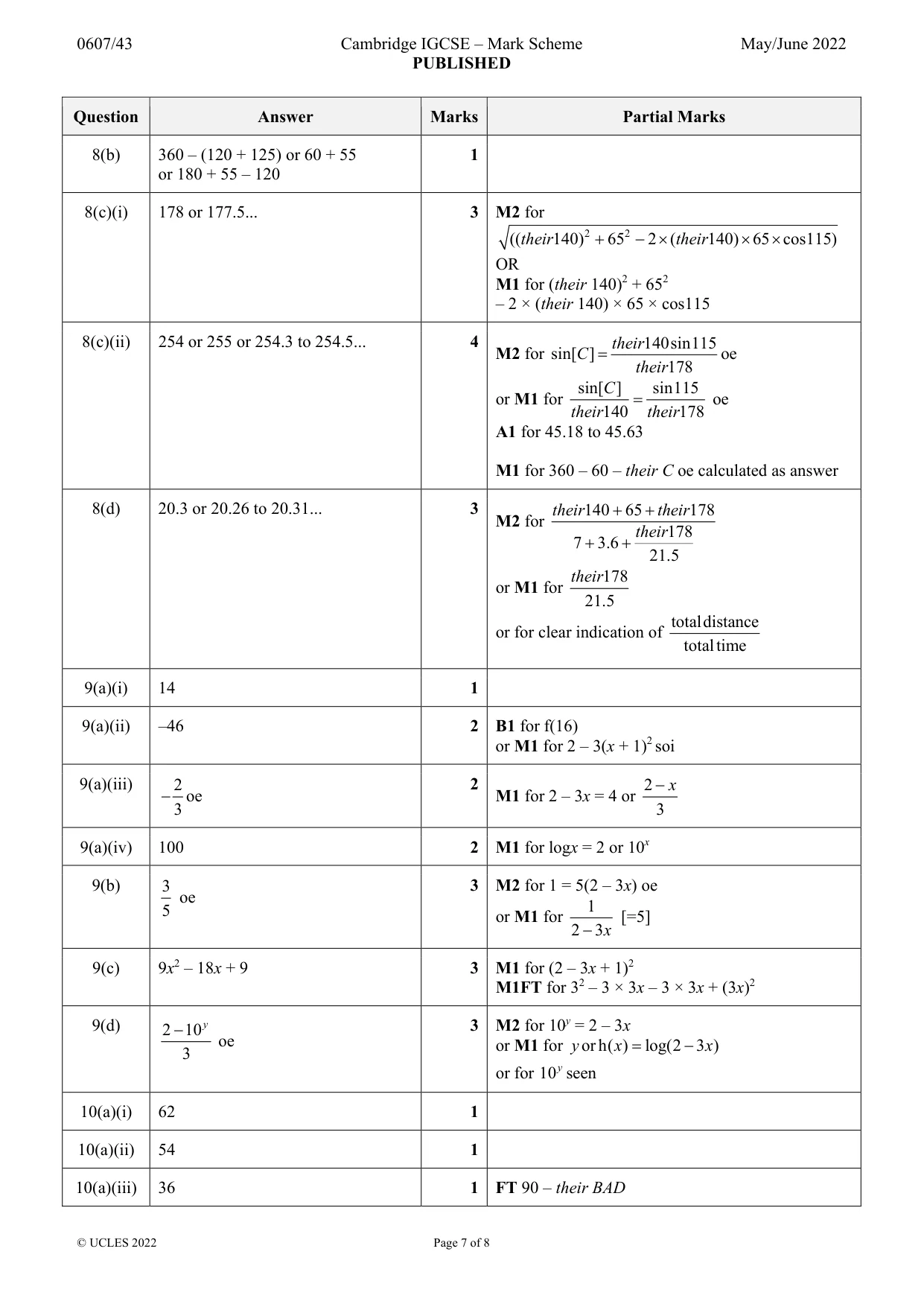
Mark scheme: 5(a) Correct Sketch 2 B1 for any cubic 5(b) (–1.29, 7.3[0]) 2 –1.291 to –1.290... 7.303... B1 for each 5(c) Rotational 3 B1 for each Order 2 (0, 3) 5(d) –2.49 or –2.491 to –2.490 3 B1 for each 0.657 or 0.6566... If 0 scored SC1 for –2.5, 0.66 and 1.8 1.83 or 1.834... 5(e)(i) Correct Sketch with y intercept 2 B1 for any U shaped quadratic below the y-intercept of f(x) 5(e)(ii) –1.48 or –1.481... 3 B1 for each 0.311 or 0.3111... If 0 scored, SC1 for –1.5, 0.31 and 2.2 2.17 or 2.170...
Q6 · V NOT TO SCALE 12 cm B 12 cm A O D C VABC is a pyramid with a triangular base
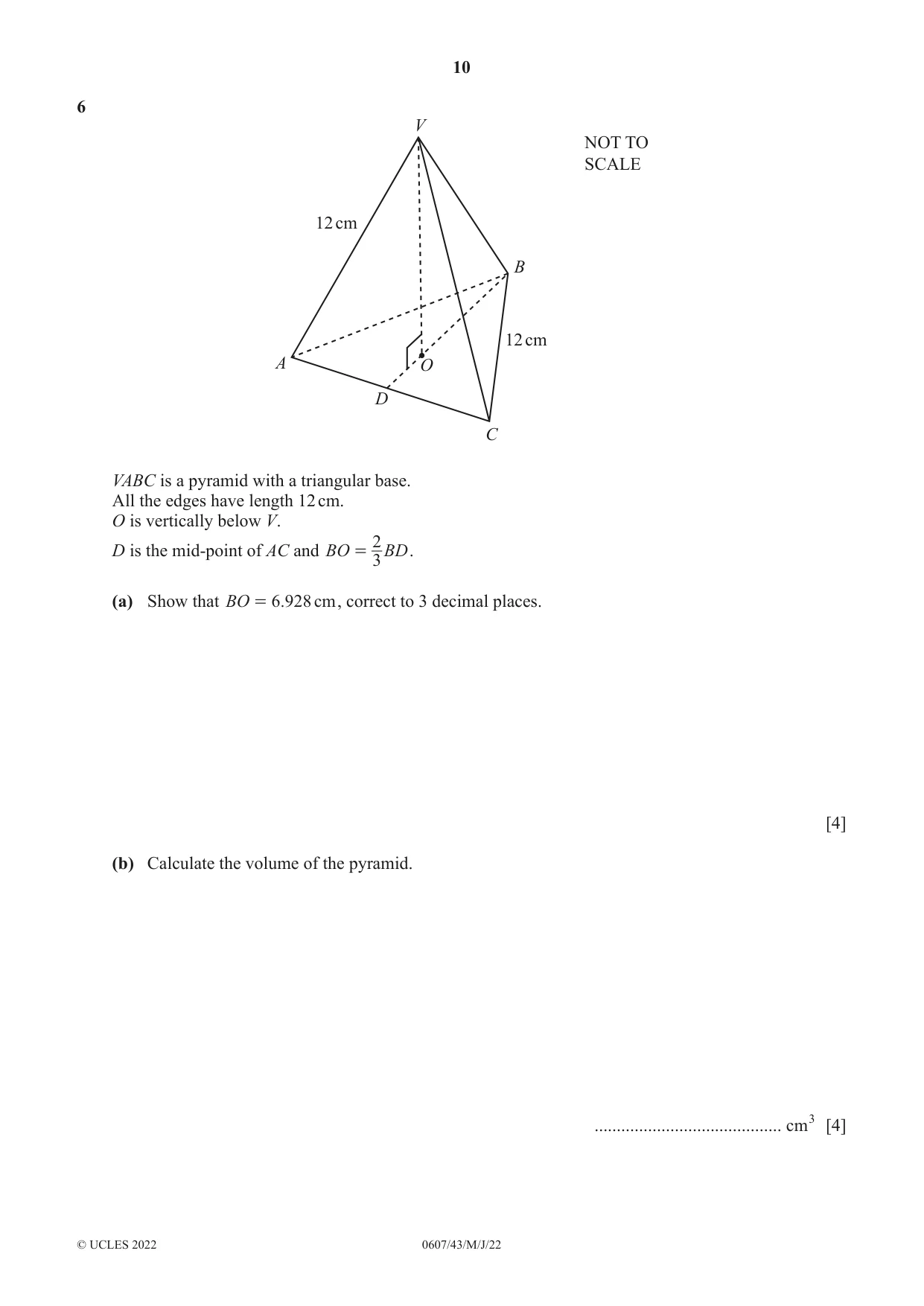
6 V NOT TO SCALE 12 cm B 12 cm A O D C VABC is a pyramid with a triangular base. All the edges have length 12 cm. O is vertically below V. 2 D is the mid‑point of AC and BO = BD . 3 (a) Show that BO = 6. 928 cm , correct to 3 decimal places. [4] (b) Calculate the volume of the pyramid. .......................................... cm3 [4]
Mark scheme: 6(a) 2 2 2 M3 M2 for 122 – 62 12 6 oe or M1 for attempt at Pythagoras e.g. BD2 + 62 = 122 3 6.9282... A1 6(b) 204 or 203.6 to 203.7 4 2 2 M1 for 12 6.928 M1 for 0.5 × 12 × 12 × sin60 or 0.5 × their BD × 12 1 M1 for × their 62.35 × their 9.798 dependent on 3 use of Pythagoras and not BD or BO.
Q7 · Shade the region indicated below each of these Venn diagrams
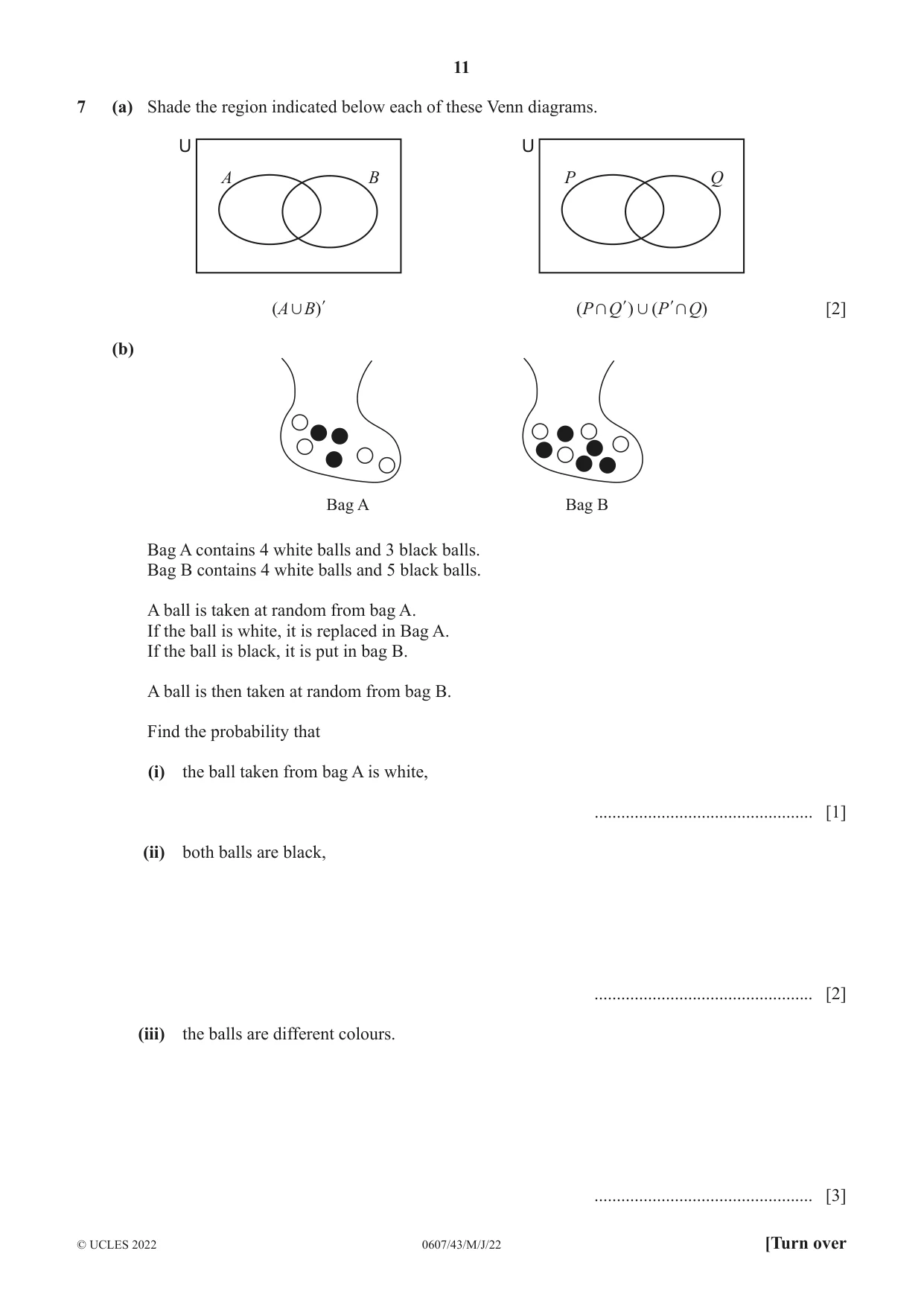
7 (a) Shade the region indicated below each of these Venn diagrams. U U A B P Q ( A , B ) l ( P + Q l ) , ( P l + Q ) [2] (b) Bag A Bag B Bag A contains 4 white balls and 3 black balls. Bag B contains 4 white balls and 5 black balls. A ball is taken at random from bag A. If the ball is white, it is replaced in Bag A. If the ball is black, it is put in bag B. A ball is then taken at random from bag B. Find the probability that (i) the ball taken from bag A is white, ................................................. [1] (ii) both balls are black, ................................................. [2] (iii) the balls are different colours. ................................................. [3]
Mark scheme: 7(a) Correct shading 2 B1 for each 7(b)(i) 4 1 oe 7 7(b)(ii) 9 2 3 6 oe M1 for oe 35 7 10 7(b)(iii) 22 3 3 4 4 5 oe M2 for + oe 45 7 10 7 9 or M1 for one of above products
Q8 · North NOT TO B 120° SCALE North 65 km C 55° A The diagram shows the route of a ship…
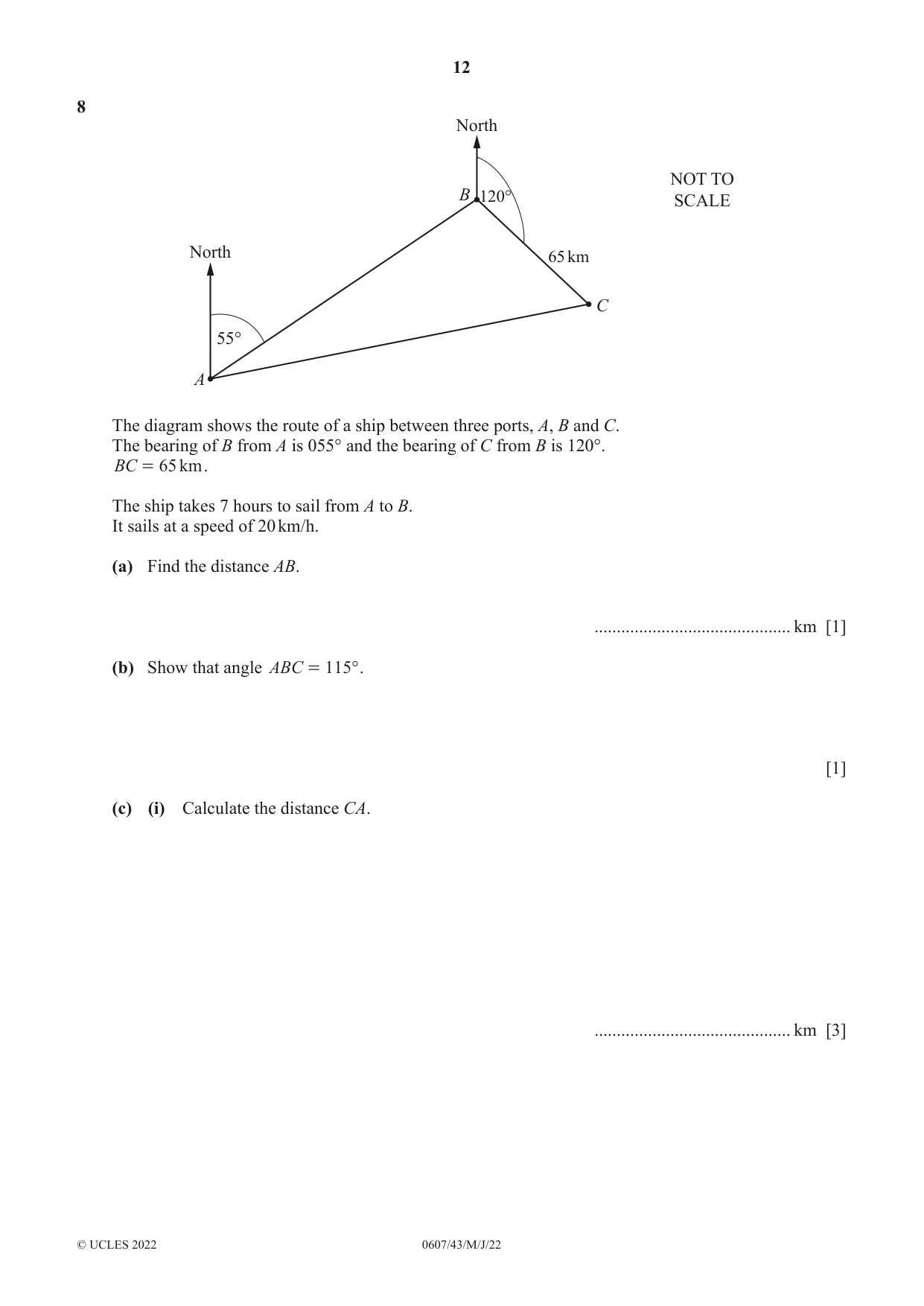
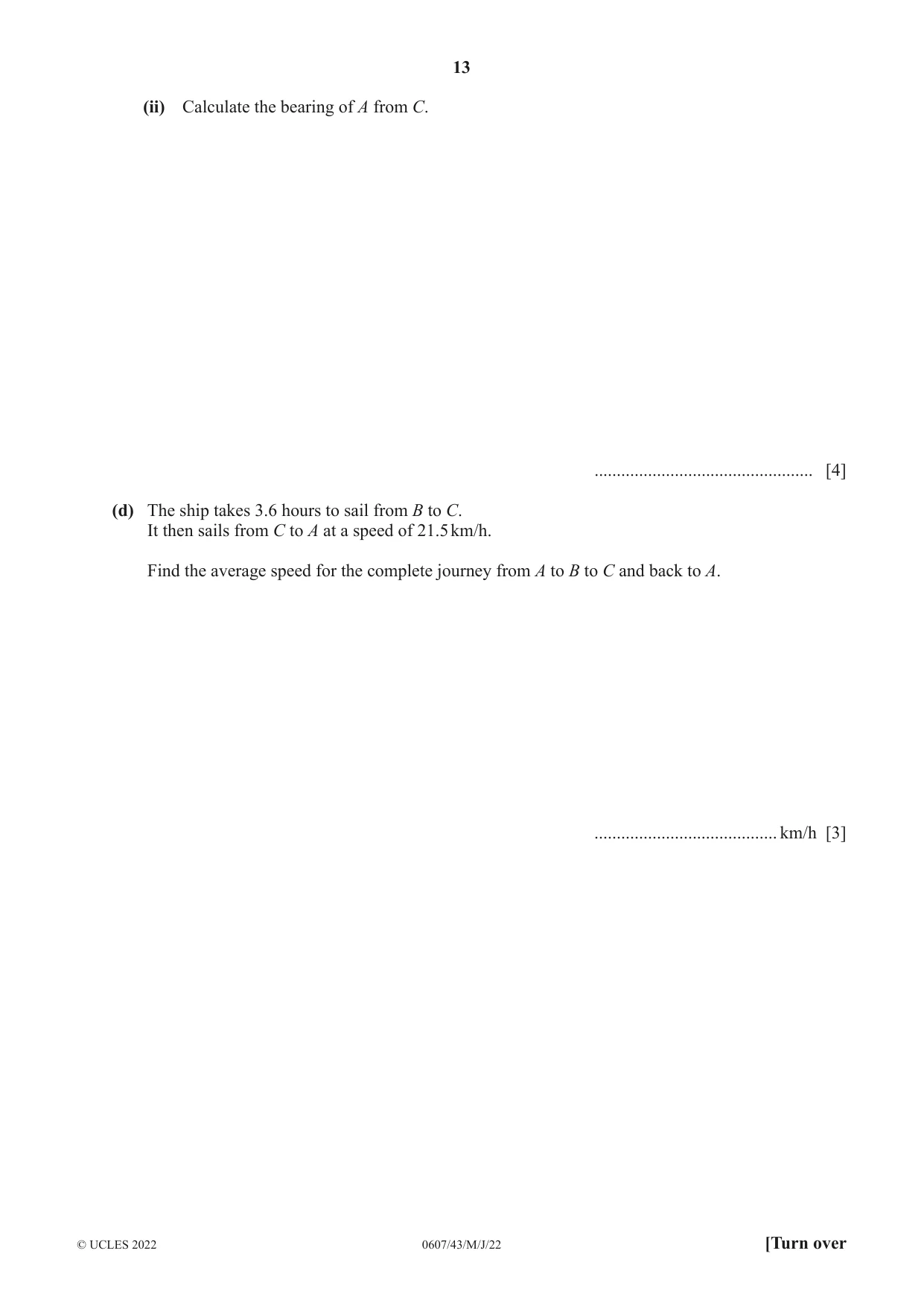
8 North NOT TO B 120° SCALE North 65 km C 55° A The diagram shows the route of a ship between three ports, A, B and C. The bearing of B from A is 055° and the bearing of C from B is 120°. BC = 65 km . The ship takes 7 hours to sail from A to B. It sails at a speed of 20 km/h. (a) Find the distance AB. ............................................ km [1] (b) Show that angle ABC = 115° . [1] (c) (i) Calculate the distance CA. ............................................ km [3] (ii) Calculate the bearing of A from C. ................................................. [4] (d) The ship takes 3.6 hours to sail from B to C. It then sails from C to A at a speed of 21.5 km/h. Find the average speed for the complete journey from A to B to C and back to A. ......................................... km/h [3]
Mark scheme: 8(a) 140 1 8(b) 360 – (120 + 125) or 60 + 55 1 or 180 + 55 – 120 8(c)(i) 178 or 177.5... 3 M2 for ((their140) 2 65 2 2 ( their140) 65 cos115) OR M1 for (their 140)2 + 652 – 2 × (their 140) × 65 × cos115 8(c)(ii) 254 or 255 or 254.3 to 254.5... 4 their140sin115 M2 for sin[C ] oe their178 sin[ C ] sin115 or M1 for oe their140 their178 A1 for 45.18 to 45.63 M1 for 360 – 60 – their C oe calculated as answer 8(d) 20.3 or 20.26 to 20.31... 3 their140 65 their178 M2 for their178 7 3.6 21.5 their178 or M1 for 21.5 totaldistance or for clear indication of totaltime
Q9 · F ( x) = 2 - 3 x g ( x) = ( x + 1) 2 h ( x) = log x (a) Find
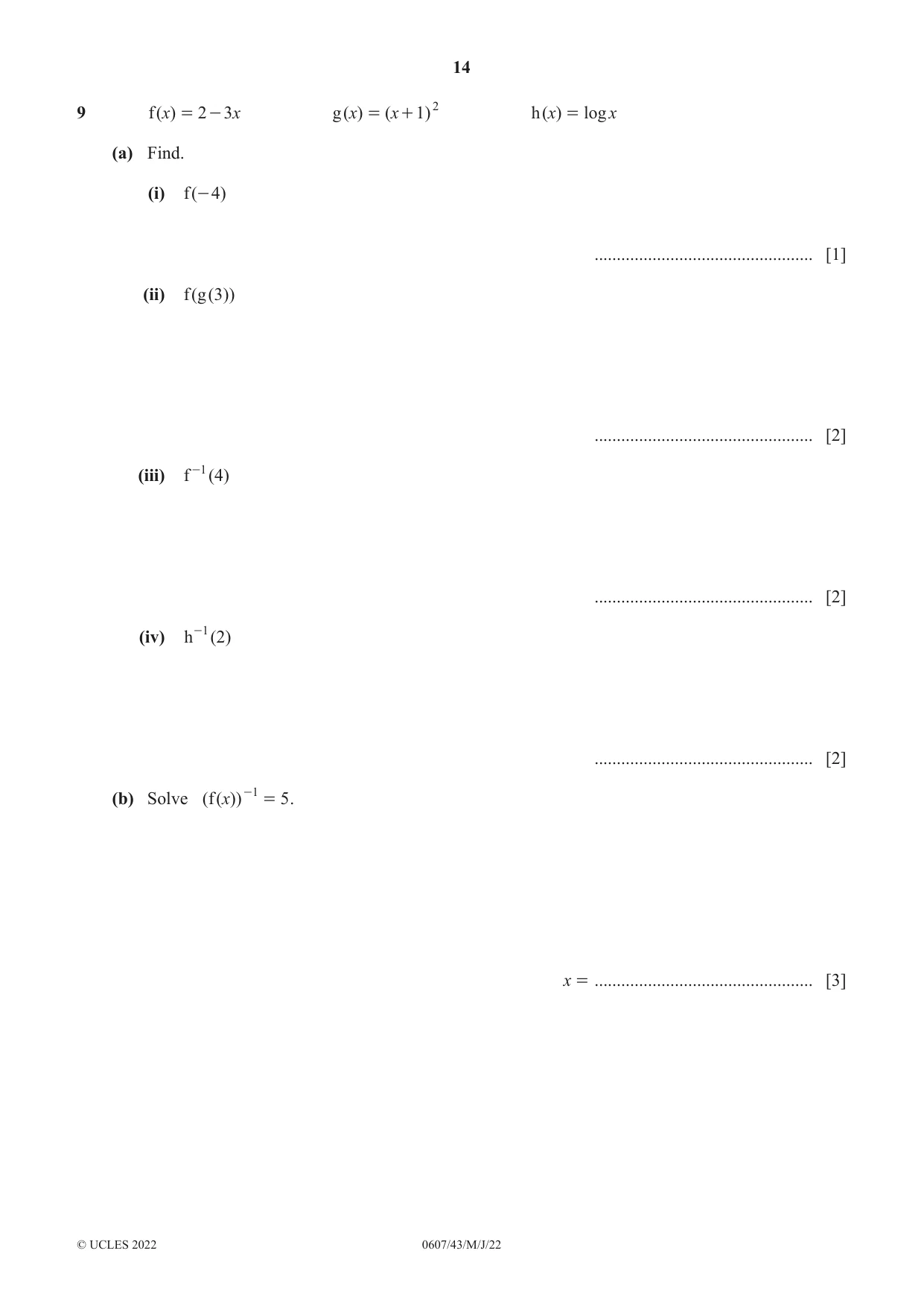
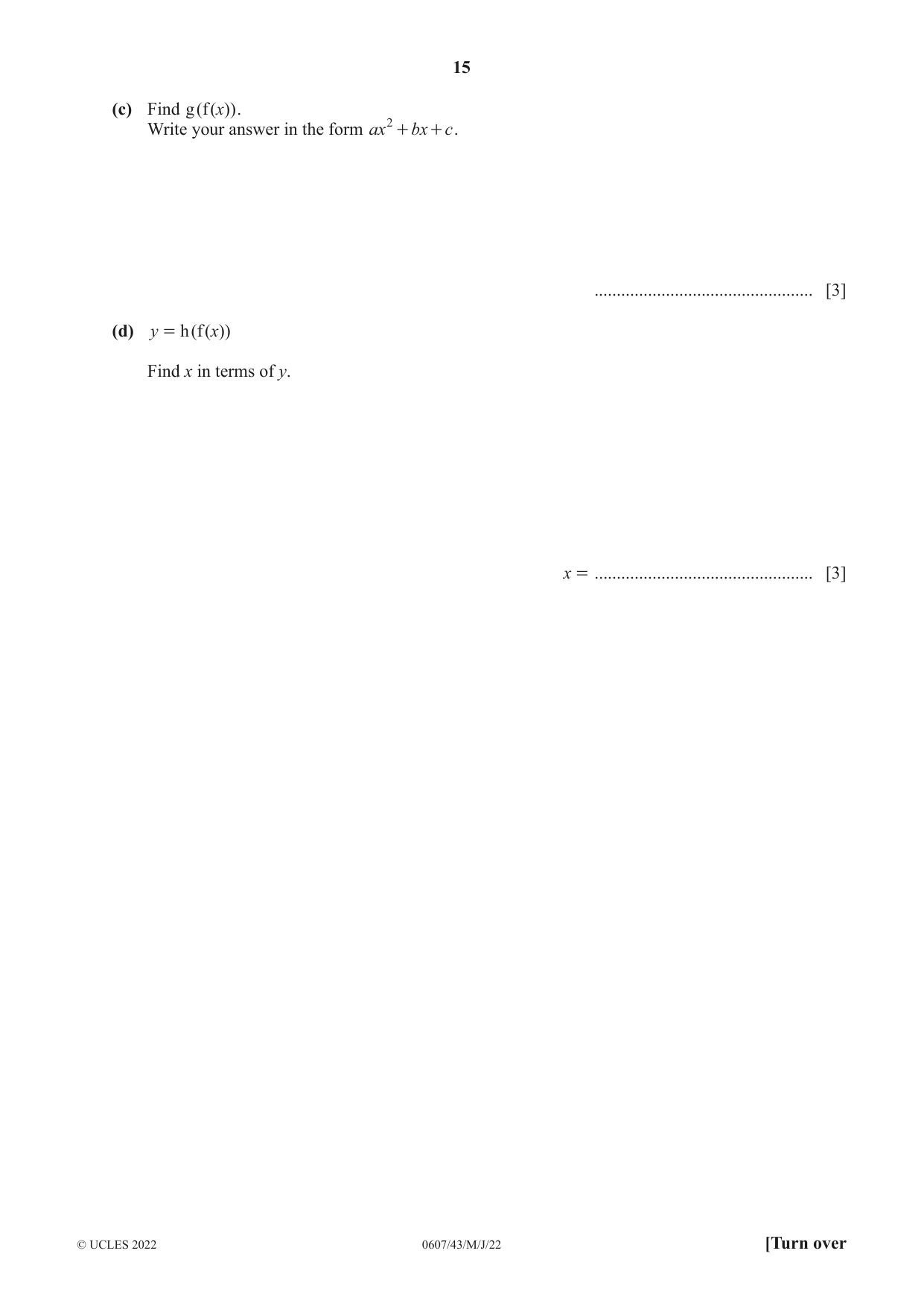
9 f ( x) = 2 - 3 x g ( x) = ( x + 1) 2 h ( x) = log x (a) Find. (i) f ( - 4) ................................................. [1] (ii) f ( g ( 3)) ................................................. [2] (iii) f -1 ( 4) ................................................. [2] (iv) h -1 ( 2) ................................................. [2] (b) Solve ( f ( x)) -1 = 5 . x = ................................................. [3] (c) Find g ( f ( x)) . Write your answer in the form ax 2 + bx + c . ................................................. [3] (d) y = h ( f ( x)) Find x in terms of y. x = ................................................. [3]
Mark scheme: 9(a)(i) 14 1 9(a)(ii) –46 2 B1 for f(16) or M1 for 2 – 3(x + 1)2 soi 9(a)(iii) 2 2 2 x oe M1 for 2 – 3x = 4 or 3 3 9(a)(iv) 100 2 M1 for logx = 2 or 10x 9(b) 3 3 M2 for 1 = 5(2 – 3x) oe oe 5 1 or M1 for [=5] 2 3x 9(c) 9x2 – 18x + 9 3 M1 for (2 – 3x + 1)2 M1FT for 32 – 3 × 3x – 3 × 3x + (3x)2 9(d) 2 10 y 3 M2 for 10y = 2 – 3x oe or M1 for y orh( x ) log(2 3 x ) 3 or for 10y seen
Q10 · A NOT TO E SCALE 54° O F D 62° B C G A, B, C, D and E are points on the circle centre O
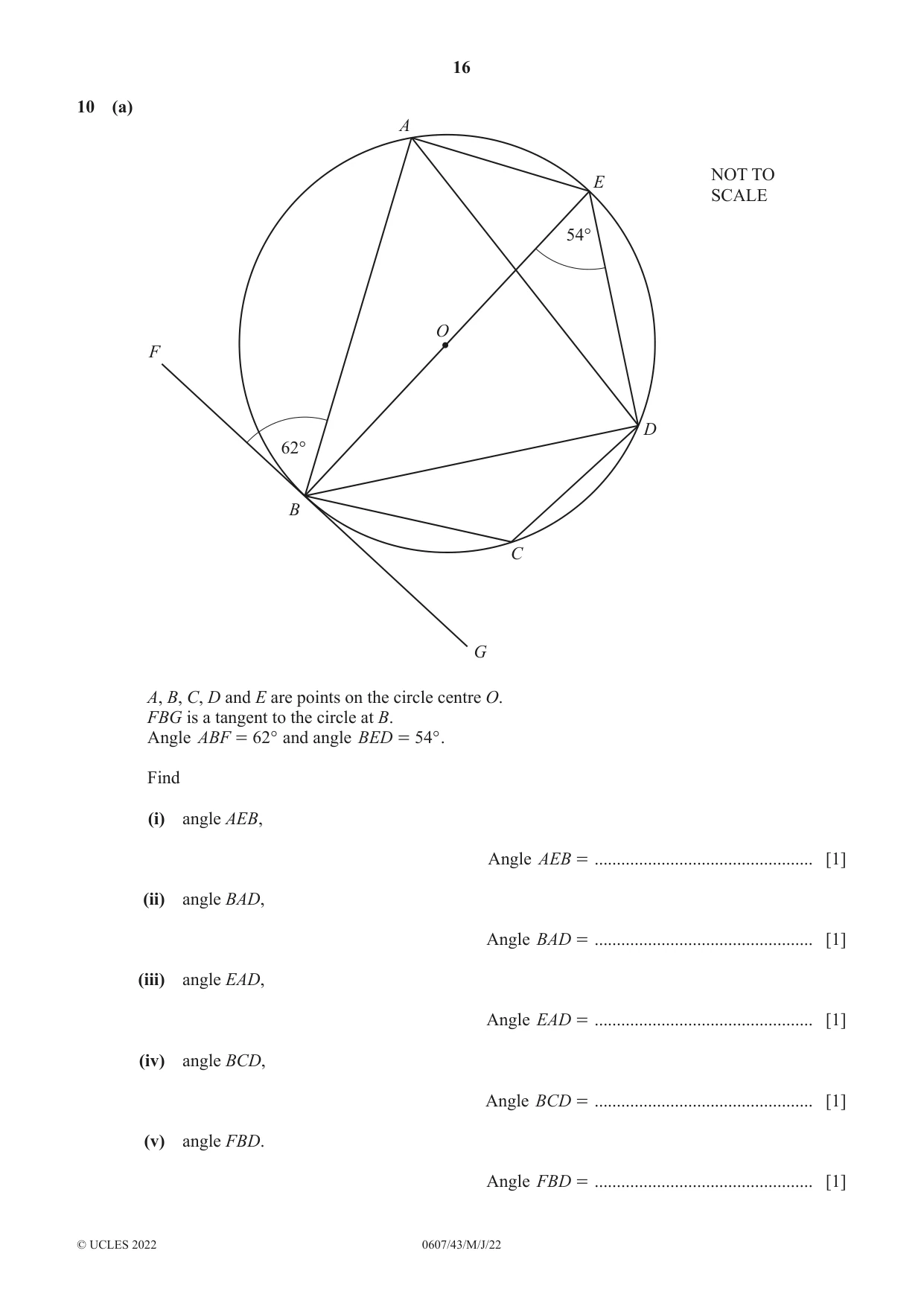
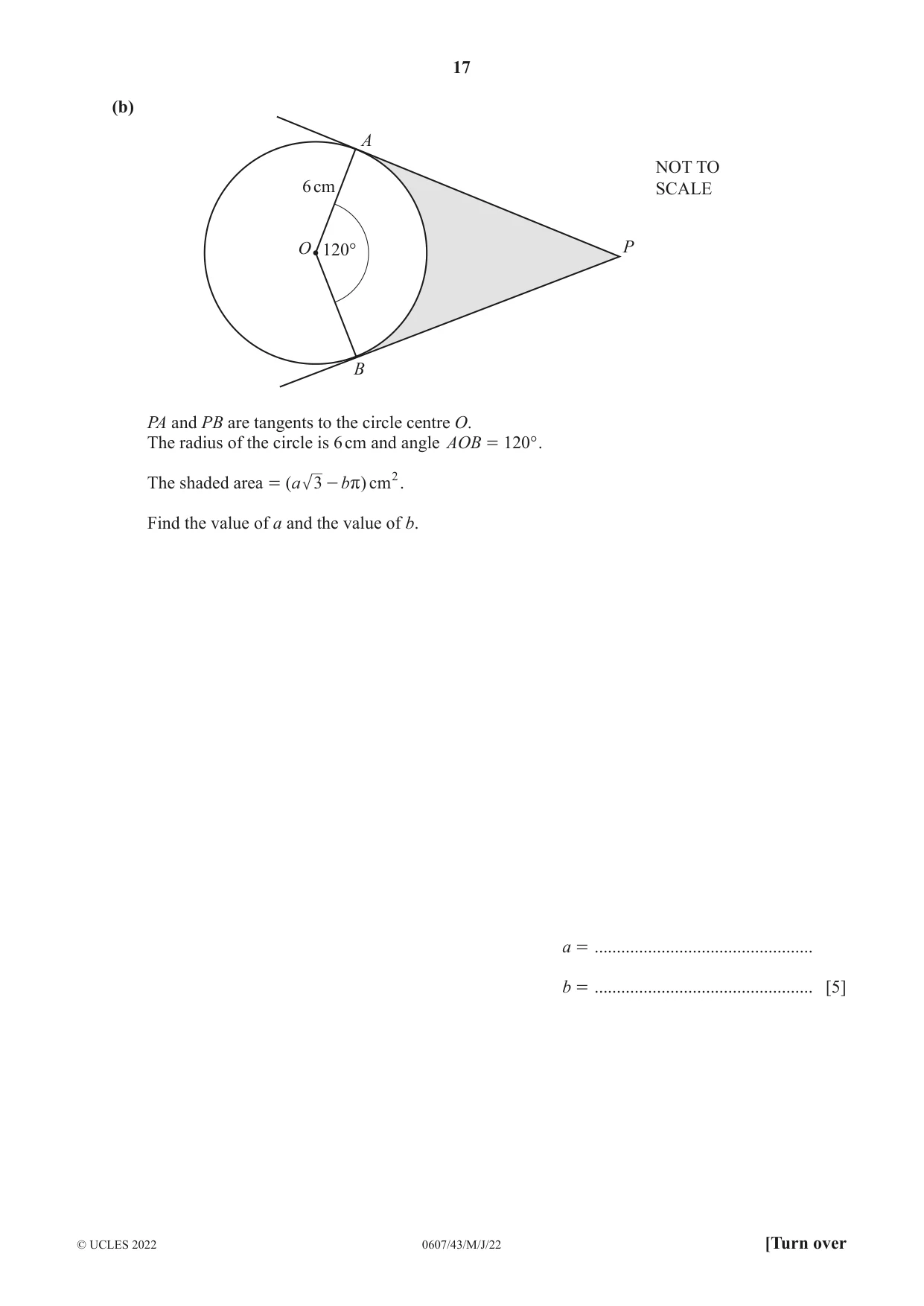
10 (a) A NOT TO E SCALE 54° O F D 62° B C G A, B, C, D and E are points on the circle centre O. FBG is a tangent to the circle at B. Angle ABF = 62° and angle BED = 54° . Find (i) angle AEB, Angle AEB = ................................................. [1] (ii) angle BAD, Angle BAD = ................................................. [1] (iii) angle EAD, Angle EAD = ................................................. [1] (iv) angle BCD, Angle BCD = ................................................. [1] (v) angle FBD. Angle FBD = ................................................. [1] (b) A NOT TO 6 cm SCALE O 120° P B PA and PB are tangents to the circle centre O. The radius of the circle is 6 cm and angle AOB = 120° . The shaded area = ( a 3 - b r) cm 2 . Find the value of a and the value of b. a = ................................................. b = ................................................. [5]
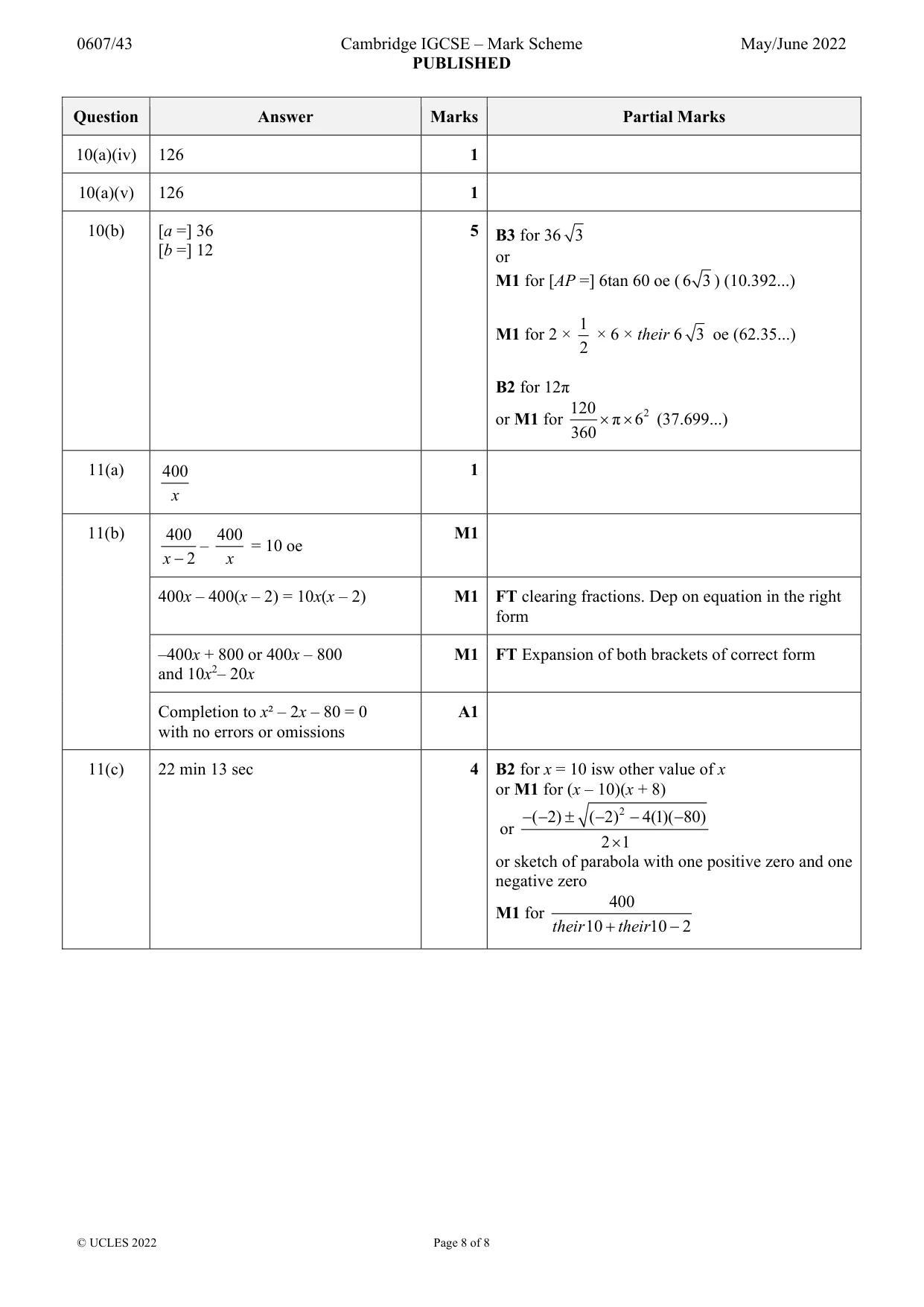
Mark scheme: 10(a)(i) 62 1 10(a)(ii) 54 1 10(a)(iii) 36 1 FT 90 – their BAD 10(a)(iv) 126 1 10(a)(v) 126 1 10(b) [a =] 36 5 B3 for 36 3 [b =] 12 or M1 for [AP =] 6tan 60 oe (6 3 ) (10.392...) 1 M1 for 2 × × 6 × their 6 3 oe (62.35...) 2 B2 for 12π 120 2 or M1 for π 6 (37.699...) 360
Q11 · A tank has a capacity of 400 litres
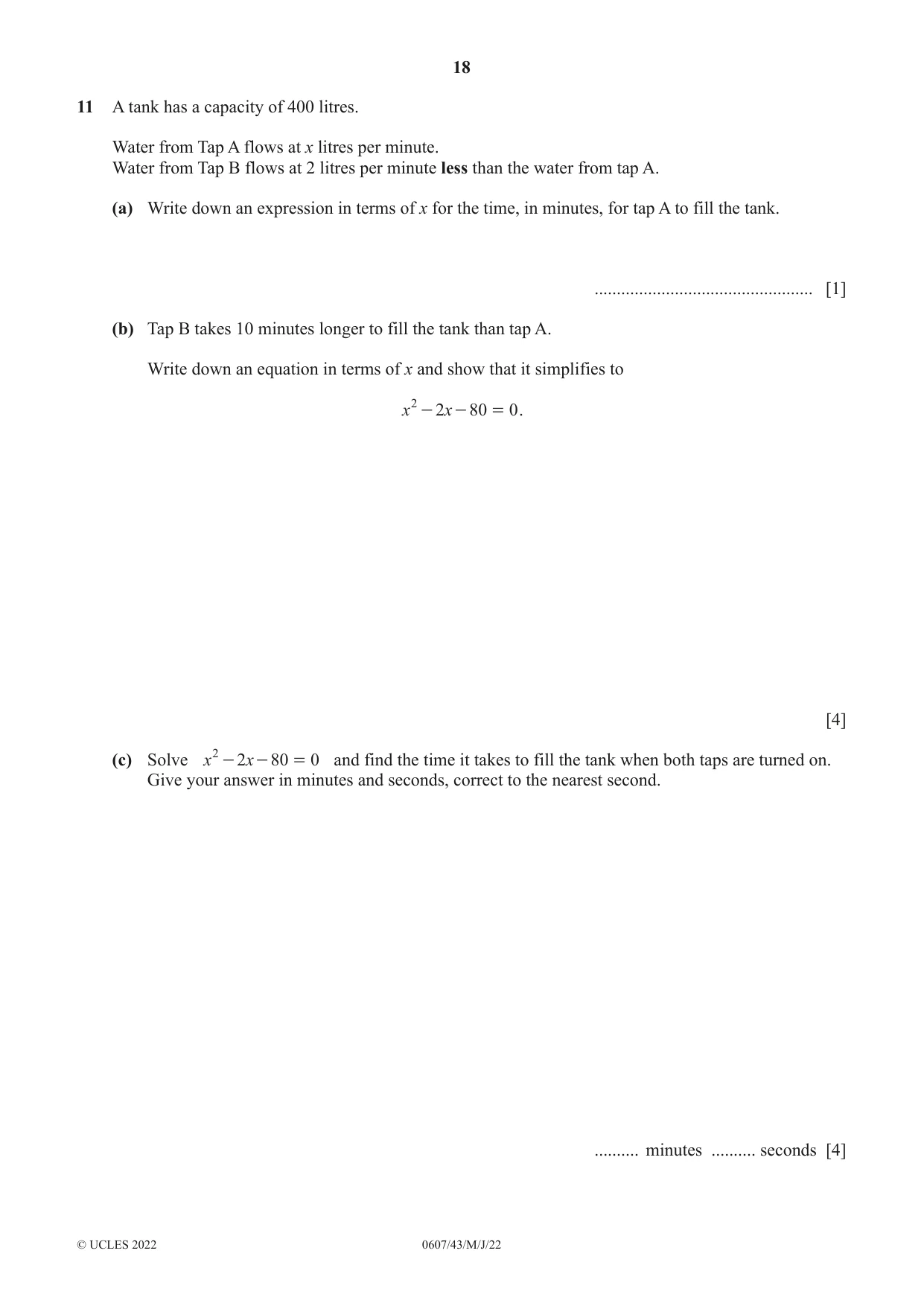
11 A tank has a capacity of 400 litres. Water from Tap A flows at x litres per minute. Water from Tap B flows at 2 litres per minute less than the water from tap A. (a) Write down an expression in terms of x for the time, in minutes, for tap A to fill the tank. ................................................. [1] (b) Tap B takes 10 minutes longer to fill the tank than tap A. Write down an equation in terms of x and show that it simplifies to x 2 - 2x - 80 = 0 . [4] (c) Solve x 2 - 2x - 80 = 0 and find the time it takes to fill the tank when both taps are turned on. Give your answer in minutes and seconds, correct to the nearest second. .......... minutes .......... seconds [4]
Mark scheme: 11(a) 400 1 x 11(b) 400 400 M1 – = 10 oe x 2 x 400x – 400(x – 2) = 10x(x – 2) M1 FT clearing fractions. Dep on equation in the right form –400x + 800 or 400x – 800 M1 FT Expansion of both brackets of correct form and 10x2– 20x Completion to x² – 2x – 80 = 0 A1 with no errors or omissions 11(c) 22 min 13 sec 4 B2 for x = 10 isw other value of x or M1 for (x – 10)(x + 8) ( 2) ( 2) 2 4(1)( 80) or 2 1 or sketch of parabola with one positive zero and one negative zero 400 M1 for their 10 their10 2
What was in this paper
The subtopics covered by these 11 questions, and how many questions each got. Open one in a new tab to see every Cambridge question on it.
What you needed in this session
Cambridge’s own grade thresholds for 2022 May/June, Paper 4 · Variant 3. A higher threshold means an easier paper — the bar moves with how the cohort did.