Cambridge IGCSE Mathematics - International 0607 — 2024 May/June Paper 4 · Variant 2
0607/42/M/J/24 · 11 questions · 120 marks · ≈135 min
The question paper and its mark scheme, free to read here and free to download. This is Cambridge’s own paper, exactly as it was sat.
Question paper20 pages
Mark scheme9 pages
Answers below. Sit the paper first if you are practising.
Questions as text
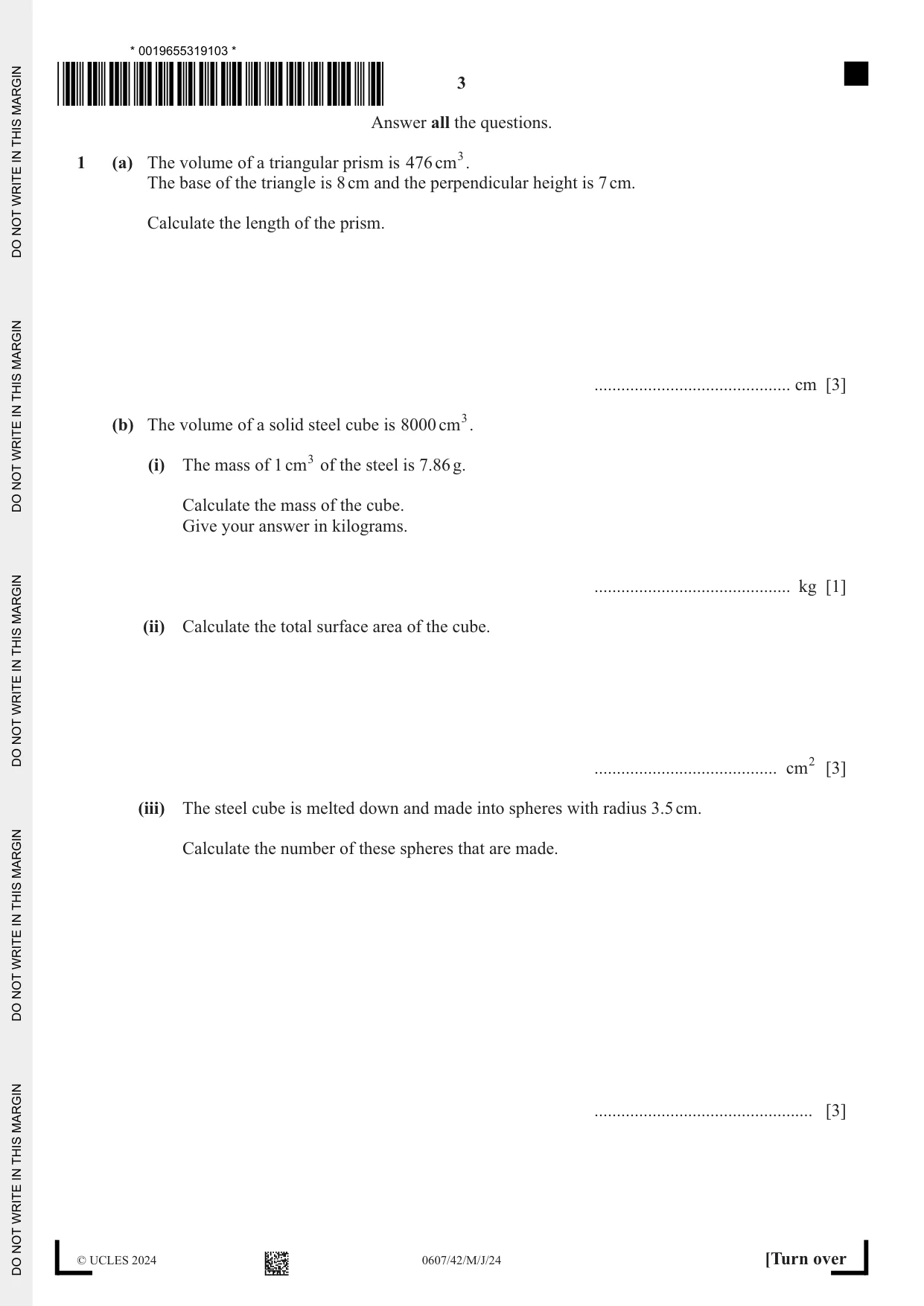
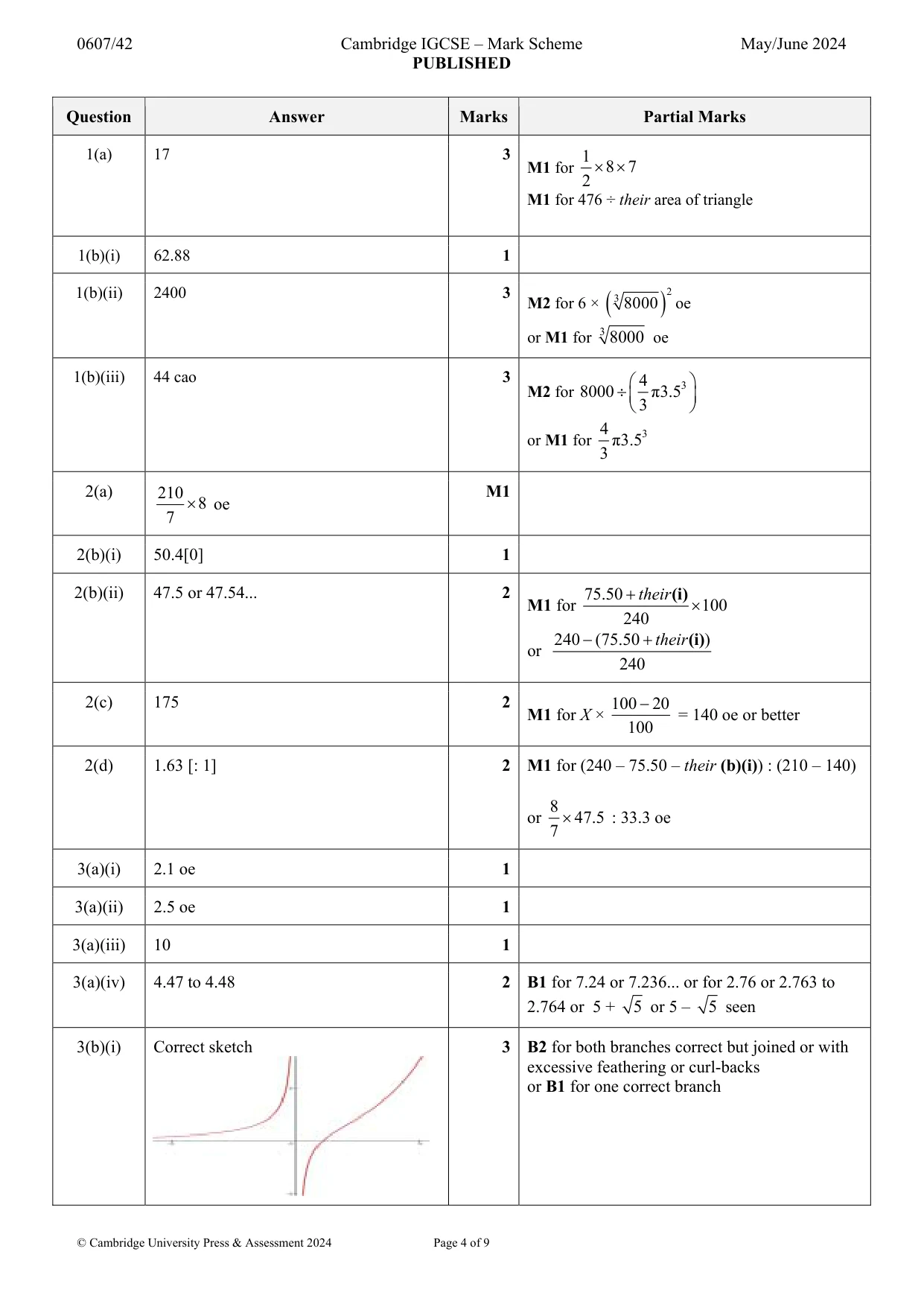
Q1 · The volume of a triangular prism is 476 cm 3
1 (a) The volume of a triangular prism is 476 cm 3. The base of the triangle is 8 cm and the perpendicular height is 7 cm. Calculate the length of the prism. ............................................ cm [3] (b) The volume of a solid steel cube is 8000 cm 3. (i) The mass of 1 cm 3 of the steel is 7.86 g. Calculate the mass of the cube. Give your answer in kilograms. ............................................ kg [1] (ii) Calculate the total surface area of the cube. ......................................... cm2 [3] (iii) The steel cube is melted down and made into spheres with radius 3.5 cm. Calculate the number of these spheres that are made. ................................................. [3]
Mark scheme: Question Answer Marks Partial Marks 1(a) 17 3 1 M1 for 8 7 2 M1 for 476 ÷ their area of triangle 1(b)(i) 62.88 1 1(b)(ii) 2400 3 3 2 M2 for 6 × 8000 oe or M1 for 3 8000 oe 1(b)(iii) 44 cao 3 4 3 M2 for 8000 π3.5 3 4 3 or M1 for π3.5 3
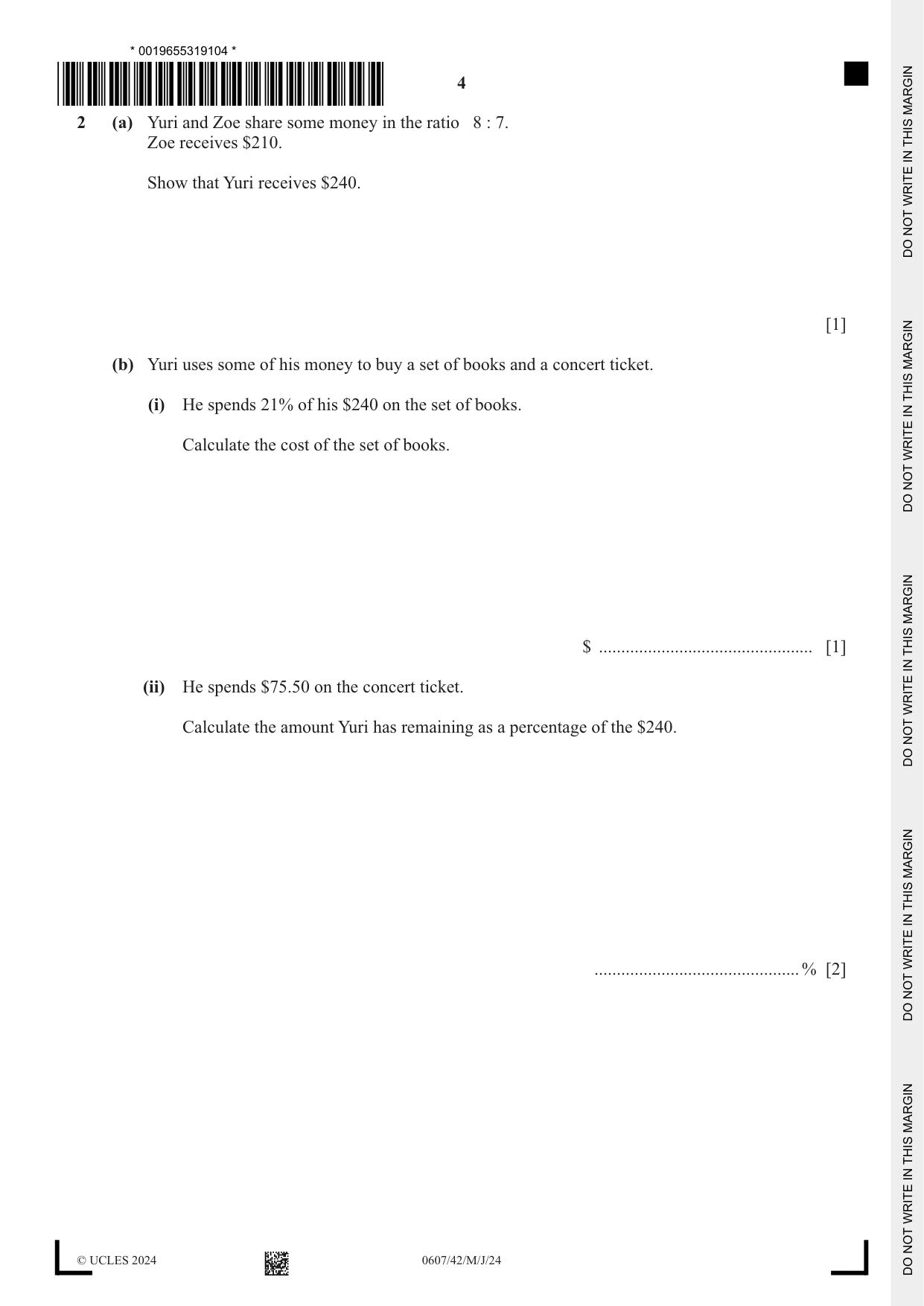
Q2 · Yuri and Zoe share some money in the ratio 8 : 7
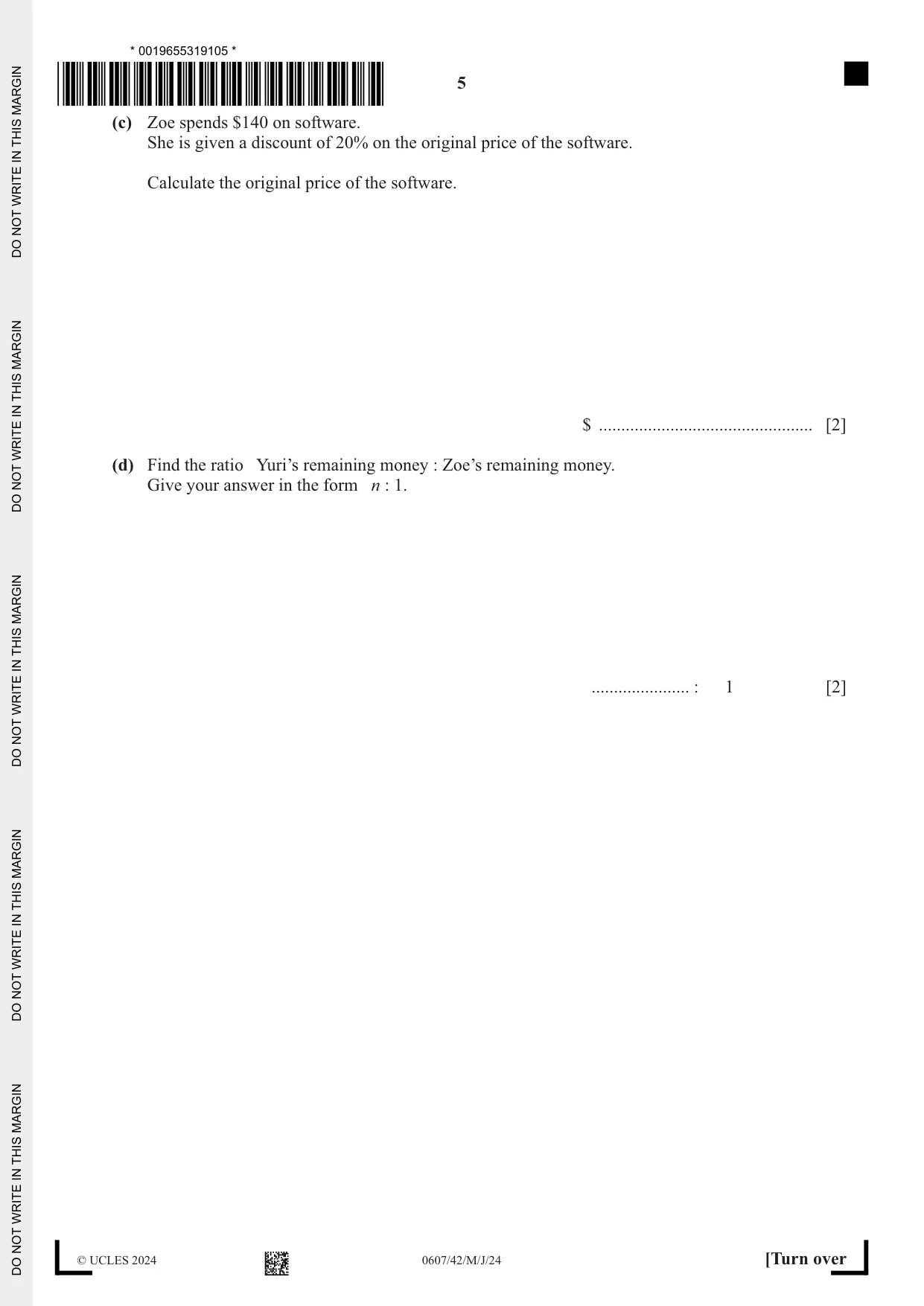
2 (a) Yuri and Zoe share some money in the ratio 8 : 7. Zoe receives $210. Show that Yuri receives $240. [1] (b) Yuri uses some of his money to buy a set of books and a concert ticket. (i) He spends 21% of his $240 on the set of books. Calculate the cost of the set of books. $ ................................................ [1] (ii) He spends $75.50 on the concert ticket. Calculate the amount Yuri has remaining as a percentage of the $240. ..............................................% [2] (c) Zoe spends $140 on software. She is given a discount of 20% on the original price of the software. Calculate the original price of the software. $ ................................................ [2] (d) Find the ratio Yuri’s remaining money : Zoe’s remaining money. Give your answer in the form n : 1. ...................... : 1 [2]
Mark scheme: 2(a) 210 M1 8 oe 7 2(b)(i) 50.4[0] 1 2(b)(ii) 47.5 or 47.54... 2 75.50 their(i) M1 for 100 240 240 (75.50 their(i)) or 240 2(c) 175 2 100 20 M1 for X × = 140 oe or better 100 2(d) 1.63 [: 1] 2 M1 for (240 – 75.50 – their (b)(i)) : (210 – 140) 8 or 47.5 : 33.3 oe 7
Q3 · Y NOT TO SCALE Height of stone (metres) O G x Horizontal distance (metres) Vic throws a…
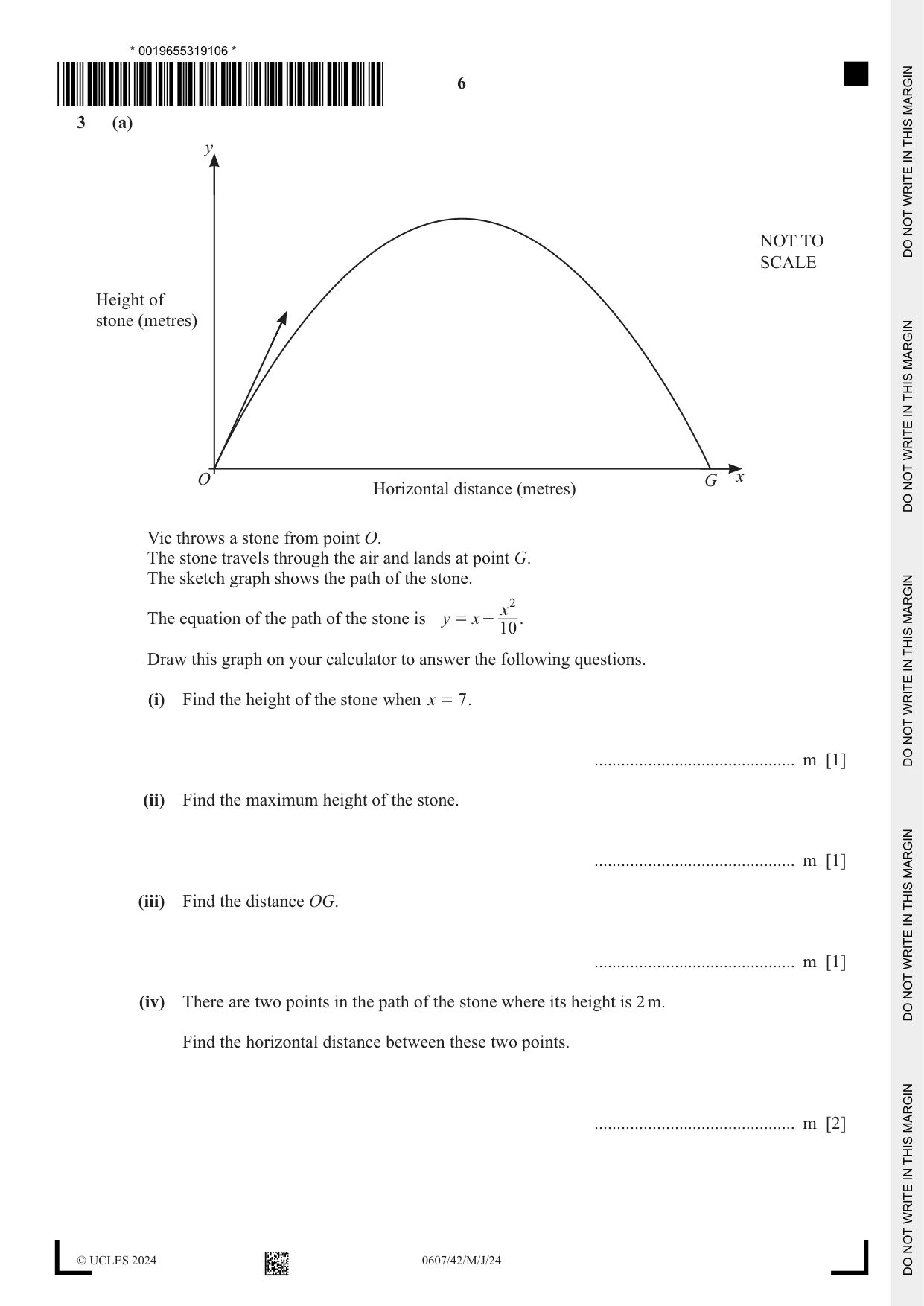
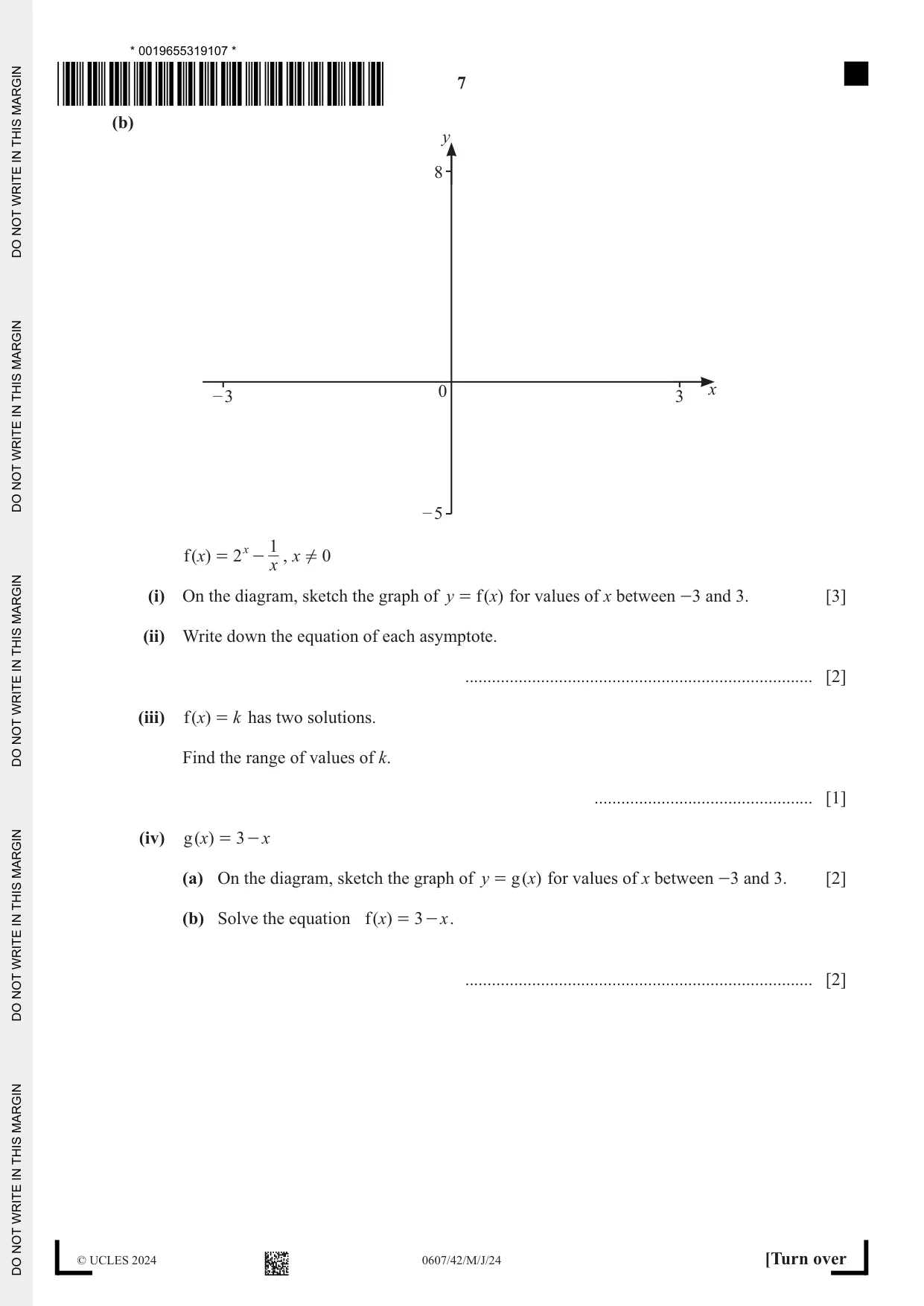
3 (a) y NOT TO SCALE Height of stone (metres) O G x Horizontal distance (metres) Vic throws a stone from point O. The stone travels through the air and lands at point G. The sketch graph shows the path of the stone. x 2 The equation of the path of the stone is y = x - . 10 Draw this graph on your calculator to answer the following questions. (i) Find the height of the stone when x = 7 . ............................................. m [1] (ii) Find the maximum height of the stone. ............................................. m [1] (iii) Find the distance OG. ............................................. m [1] (iv) There are two points in the path of the stone where its height is 2 m. Find the horizontal distance between these two points. ............................................. m [2] (b) y 8 – 3 0 3 x – 5 x 1 f ( x) = 2 - , x ! 0 x (i) On the diagram, sketch the graph of y = f ( x) for values of x between -3 and 3. [3] (ii) Write down the equation of each asymptote. .............................................................................. [2] (iii) f ( )x = k has two solutions. Find the range of values of k. ................................................. [1] (iv) g ( )x = 3 - x (a) On the diagram, sketch the graph of y = g ( x) for values of x between -3 and 3. [2] (b) Solve the equation f ( )x = 3 - x . .............................................................................. [2]
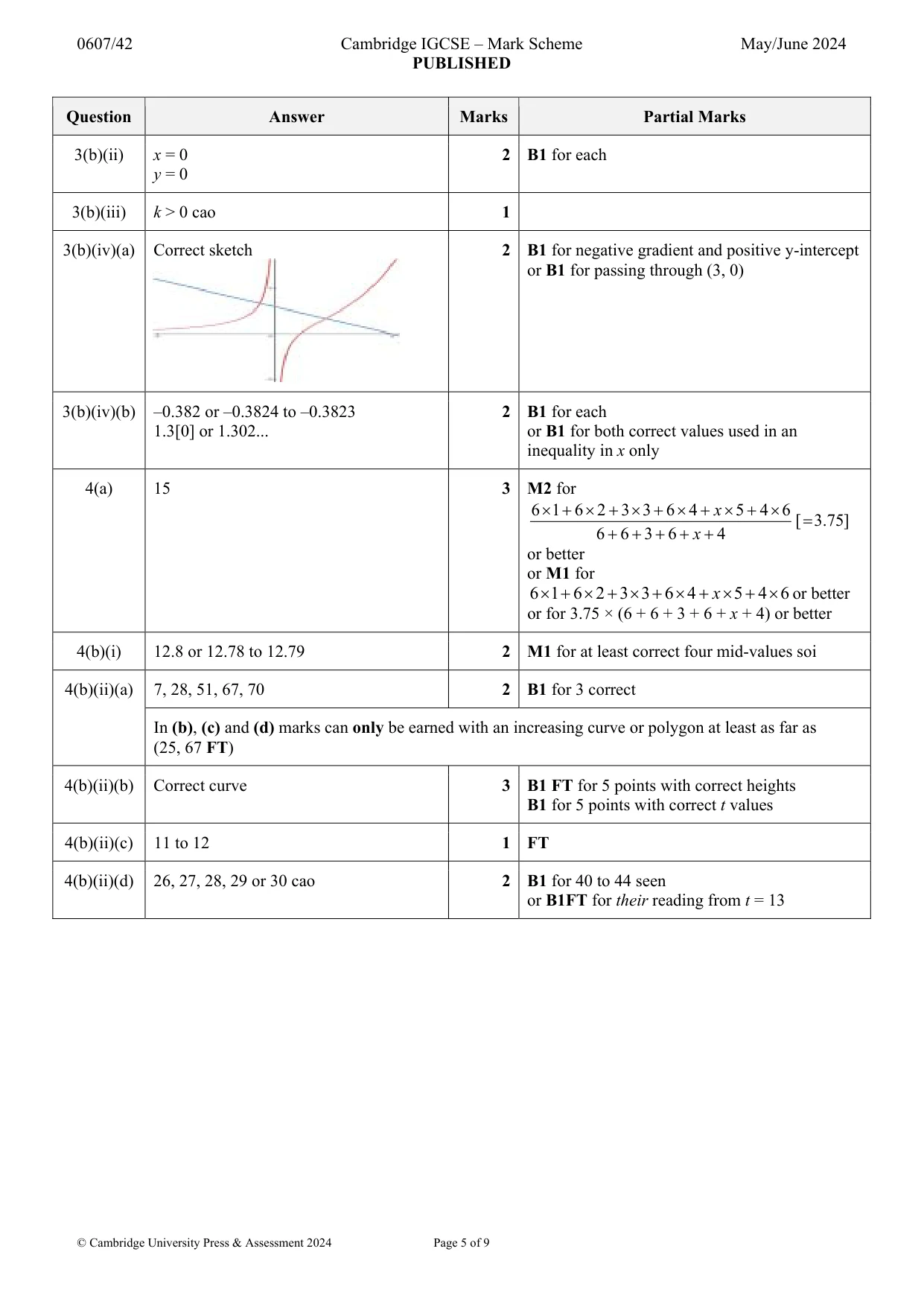
Mark scheme: 3(a)(i) 2.1 oe 1 3(a)(ii) 2.5 oe 1 3(a)(iii) 10 1 3(a)(iv) 4.47 to 4.48 2 B1 for 7.24 or 7.236... or for 2.76 or 2.763 to 2.764 or 5 + 5 or 5 – 5 seen 3(b)(i) Correct sketch 3 B2 for both branches correct but joined or with excessive feathering or curl-backs or B1 for one correct branch 3(b)(ii) x = 0 2 B1 for each y = 0 3(b)(iii) k > 0 cao 1 3(b)(iv)(a) Correct sketch 2 B1 for negative gradient and positive y-intercept or B1 for passing through (3, 0) 3(b)(iv)(b) –0.382 or –0.3824 to –0.3823 2 B1 for each 1.3[0] or 1.302... or B1 for both correct values used in an inequality in x only
Q4 · Erin rolls a biased die a number of times
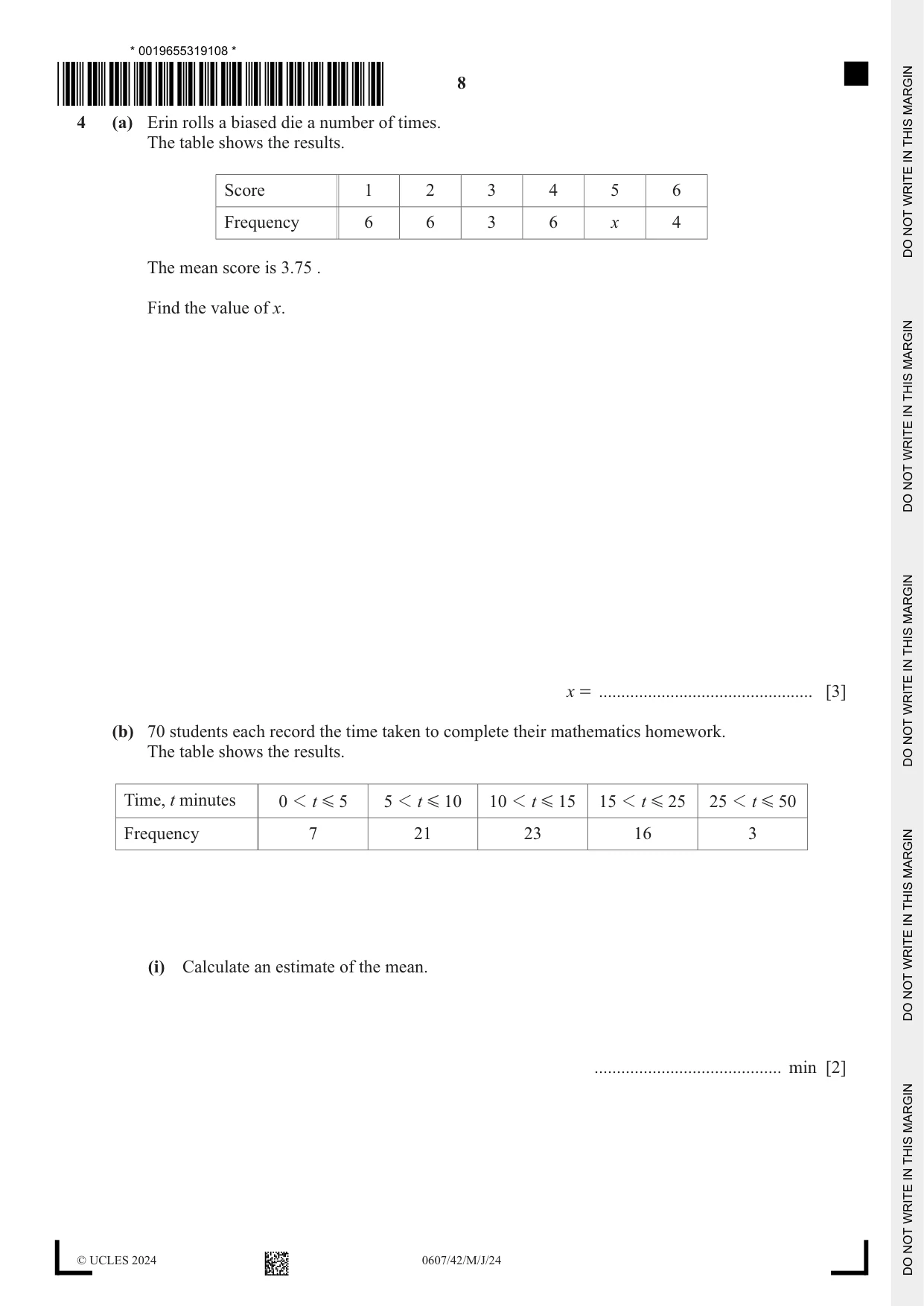
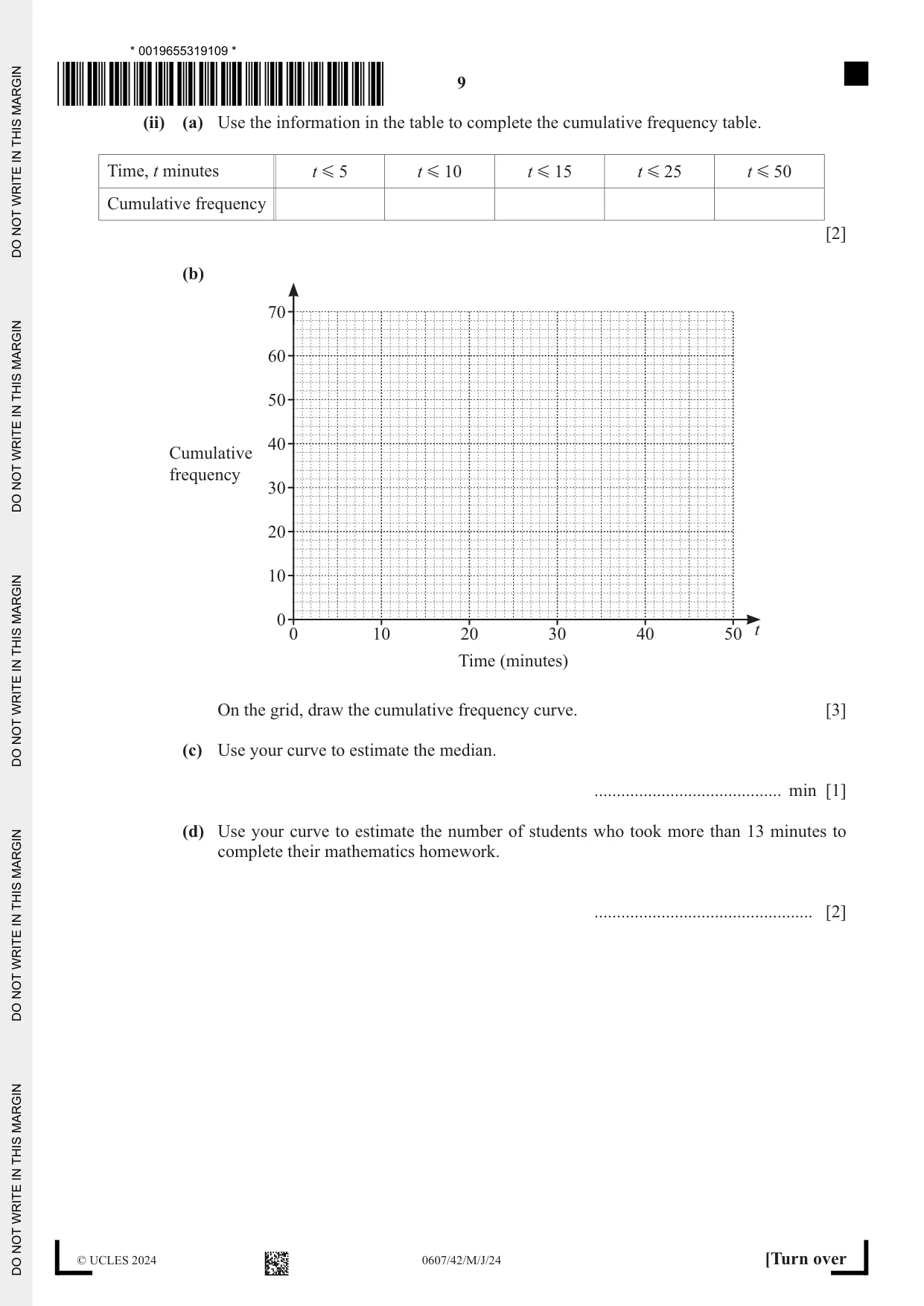
4 (a) Erin rolls a biased die a number of times. The table shows the results. Score 1 2 3 4 5 6 Frequency 6 6 3 6 x 4 The mean score is 3.75 . Find the value of x. x = ................................................ [3] (b) 70 students each record the time taken to complete their mathematics homework. The table shows the results. Time, t minutes 0 1 t G 5 5 1 t G 10 10 1 t G 15 15 1 t G 25 25 1 t G 50 Frequency 7 21 23 16 3 (i) Calculate an estimate of the mean. .......................................... min [2] (ii) (a) Use the information in the table to complete the cumulative frequency table. Time, t minutes t G 5 t G 10 t G 15 t G 25 t G 50 Cumulative frequency [2] (b) 70 60 50 40 Cumulative frequency 30 20 10 0 t 0 10 20 30 40 50 Time (minutes) On the grid, draw the cumulative frequency curve. [3] (c) Use your curve to estimate the median. .......................................... min [1] (d) Use your curve to estimate the number of students who took more than 13 minutes to complete their mathematics homework. ................................................. [2]
Mark scheme: 4(a) 15 3 M2 for 6 1 6 2 3 3 6 4 x 5 4 6 [ 3.75] 6 6 3 6 x 4 or better or M1 for 6 1 6 2 3 3 6 4 x 5 4 6 or better or for 3.75 × (6 + 6 + 3 + 6 + x + 4) or better 4(b)(i) 12.8 or 12.78 to 12.79 2 M1 for at least correct four mid-values soi 4(b)(ii)(a) 7, 28, 51, 67, 70 2 B1 for 3 correct In (b), (c) and (d) marks can only be earned with an increasing curve or polygon at least as far as (25, 67 FT) 4(b)(ii)(b) Correct curve 3 B1 FT for 5 points with correct heights B1 for 5 points with correct t values 4(b)(ii)(c) 11 to 12 1 FT 4(b)(ii)(d) 26, 27, 28, 29 or 30 cao 2 B1 for 40 to 44 seen or B1FT for their reading from t = 13
Q5 · Calculate the area of an equilateral triangle with side length 12 cm
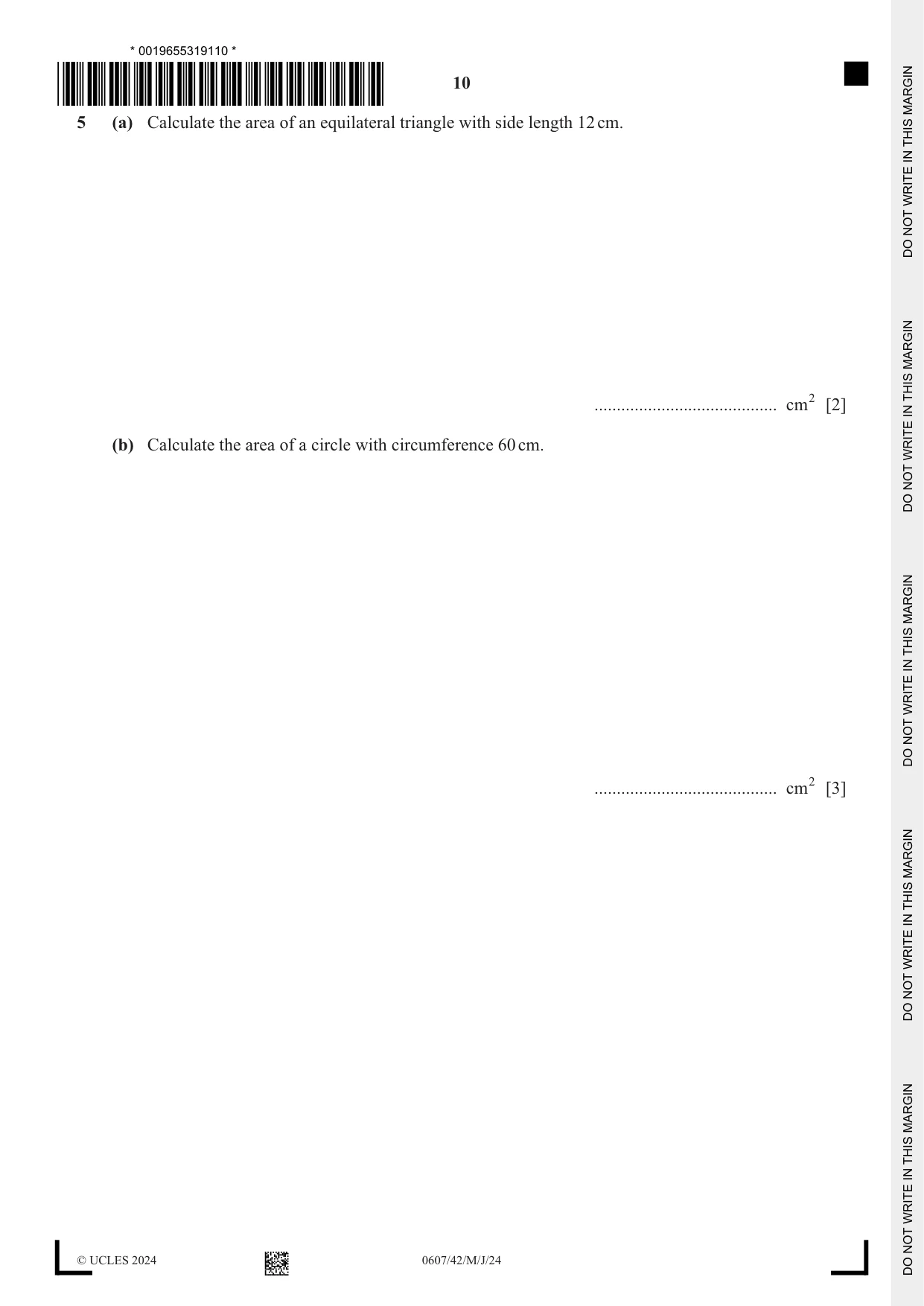
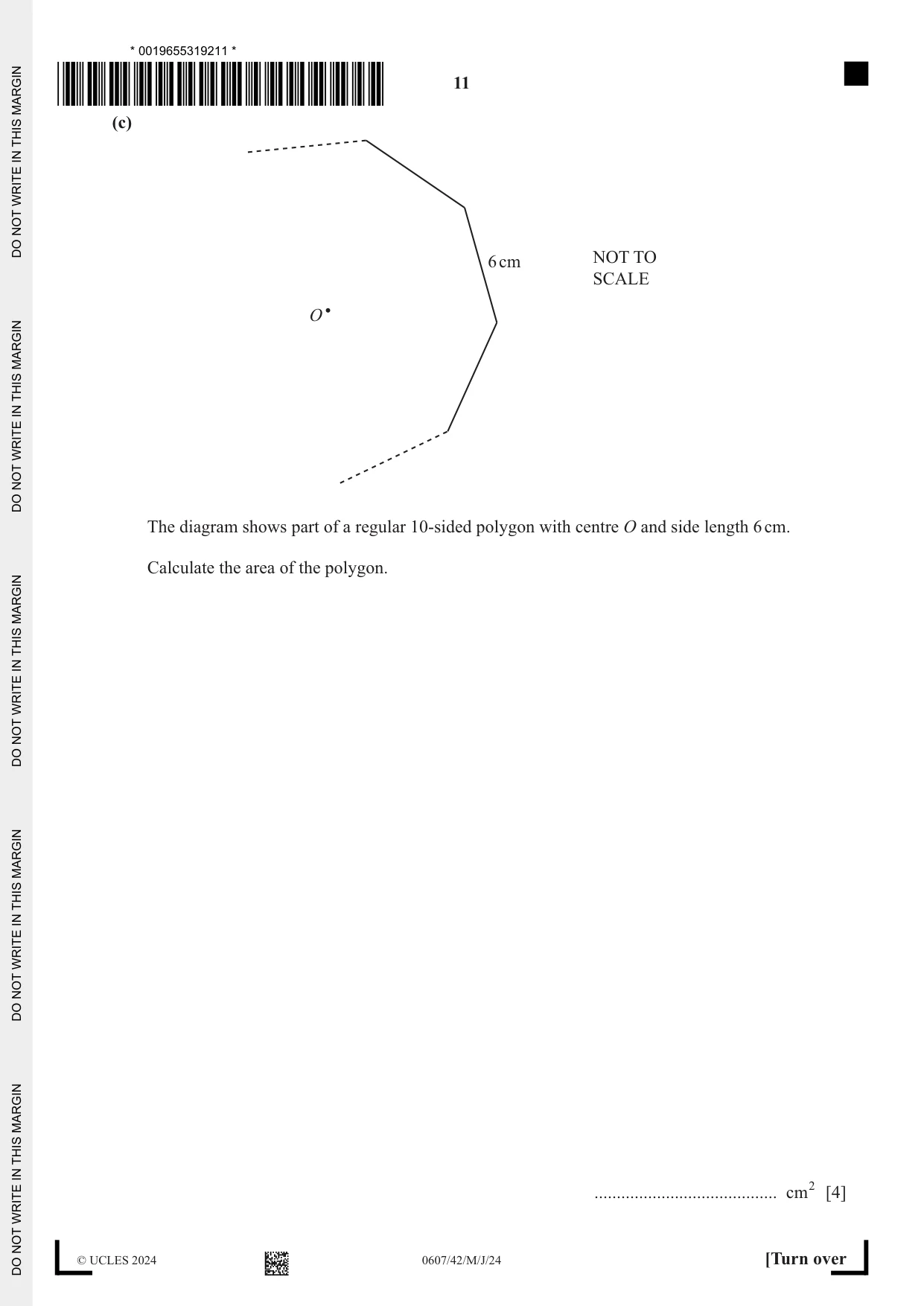
5 (a) Calculate the area of an equilateral triangle with side length 12 cm. ......................................... cm2 [2] (b) Calculate the area of a circle with circumference 60 cm. ......................................... cm2 [3] (c) 6 cm NOT TO SCALE O The diagram shows part of a regular 10-sided polygon with centre O and side length 6 cm. Calculate the area of the polygon. ......................................... cm2 [4]
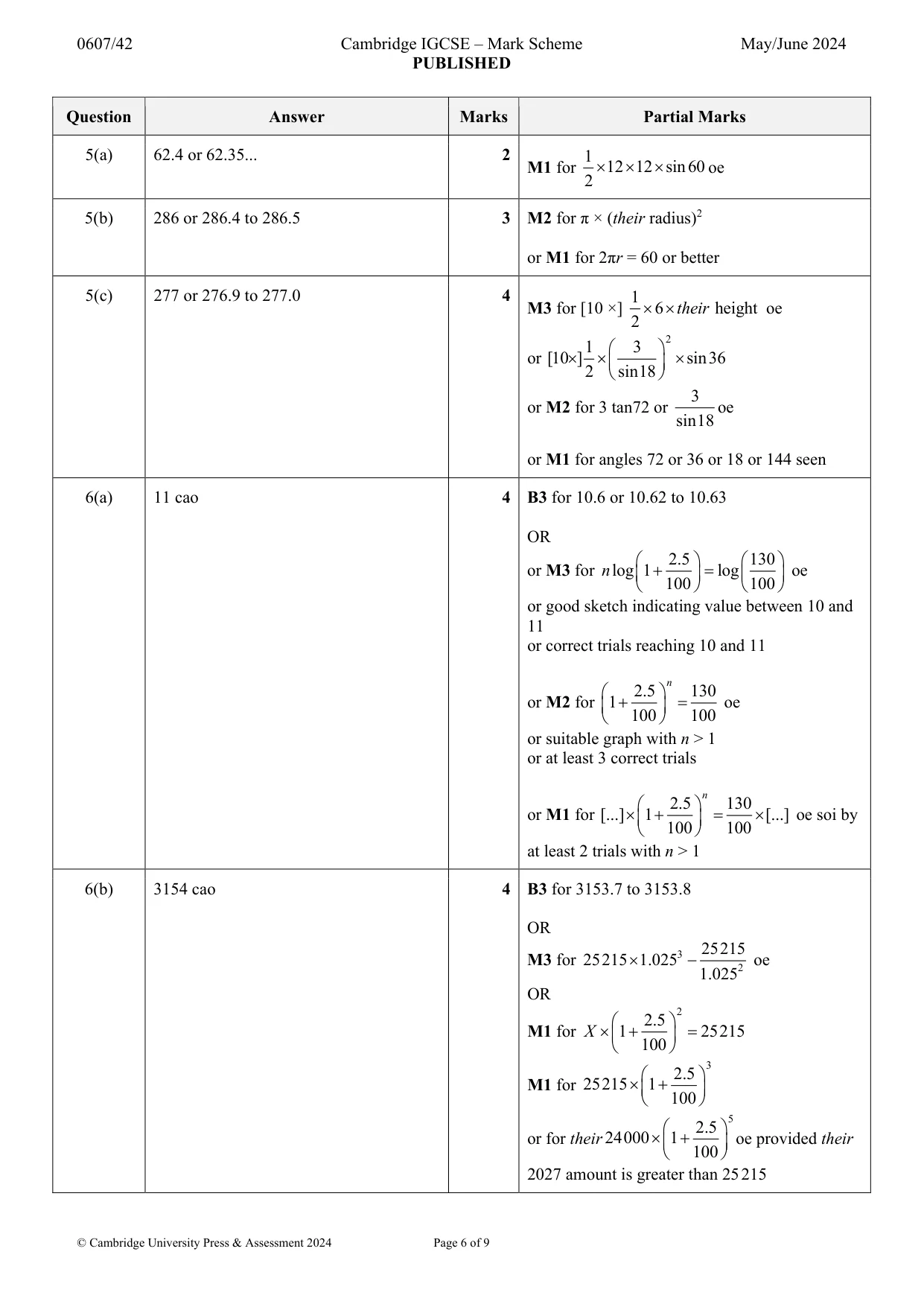
Mark scheme: 5(a) 62.4 or 62.35... 2 1 M1 for 12 12 sin60 oe 2 5(b) 286 or 286.4 to 286.5 3 M2 for π × (their radius)2 or M1 for 2πr = 60 or better 5(c) 277 or 276.9 to 277.0 4 1 M3 for [10 ×] their6 height oe 2 1 3 2 or [10] sin36 2 sin18 3 or M2 for 3 tan72 or oe sin18 or M1 for angles 72 or 36 or 18 or 144 seen
Q6 · Xavier started a new job in 2000
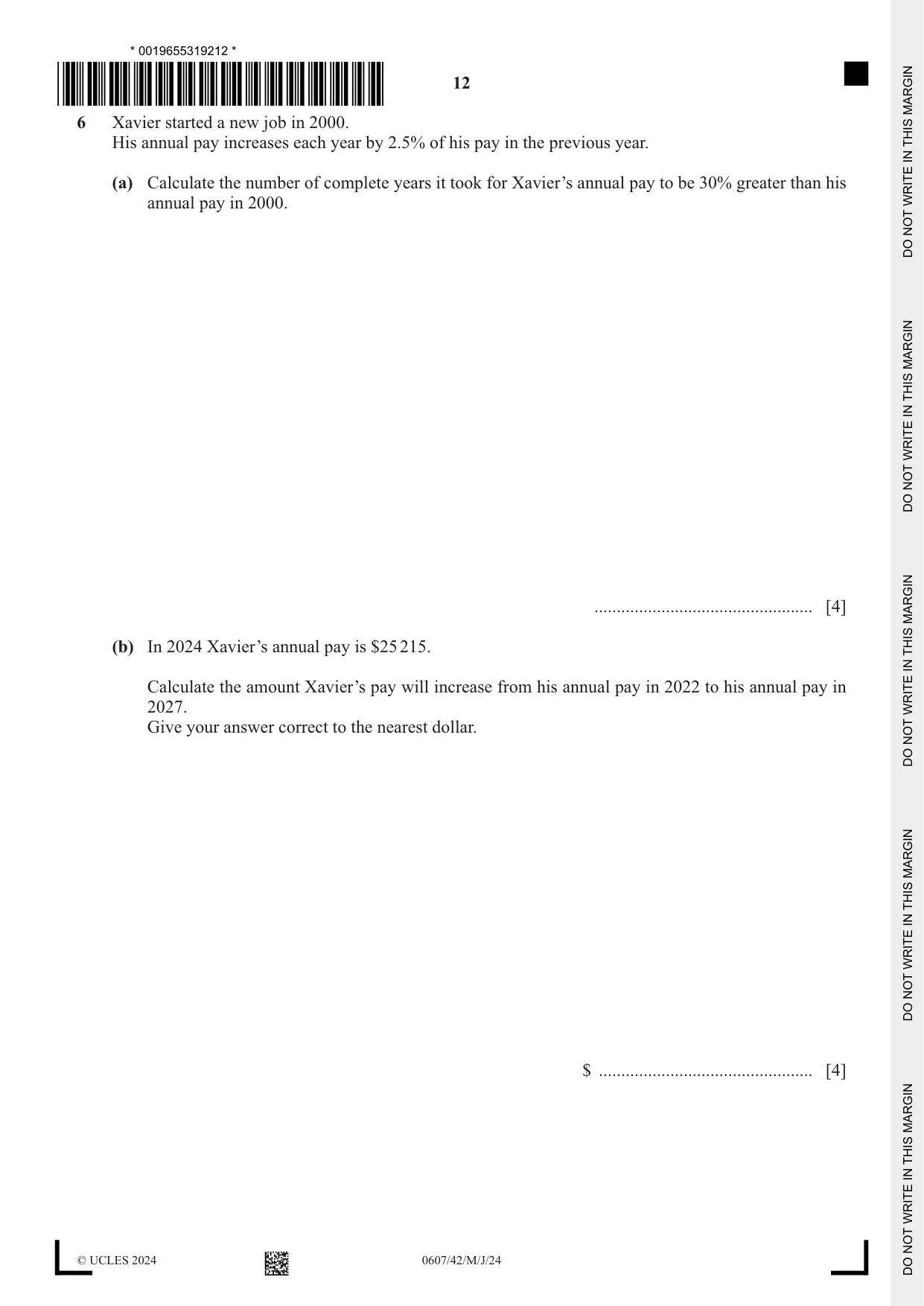
6 Xavier started a new job in 2000. His annual pay increases each year by 2.5% of his pay in the previous year. (a) Calculate the number of complete years it took for Xavier’s annual pay to be 30% greater than his annual pay in 2000. ................................................. [4] (b) In 2024 Xavier’s annual pay is $25 215. Calculate the amount Xavier’s pay will increase from his annual pay in 2022 to his annual pay in 2027. Give your answer correct to the nearest dollar. $ ................................................ [4]
Mark scheme: 6(a) 11 cao 4 B3 for 10.6 or 10.62 to 10.63 OR 2.5 130 or M3 for n log 1 log oe 100 100 or good sketch indicating value between 10 and 11 or correct trials reaching 10 and 11 2.5 n 130 or M2 for 1 oe 100 100 or suitable graph with n > 1 or at least 3 correct trials 2.5 n 130 or M1 for [...] 1 [...] oe soi by 100 100 at least 2 trials with n > 1 6(b) 3154 cao 4 B3 for 3153.7 to 3153.8 OR 3 25215 M3 for 25215 1.025 oe 1.025 2 OR 2.5 2 M1 for X 1 25215 100 2.5 3 M1 for 25215 1 100 2.5 5 or for their 24000 1 oe provided their 100 2027 amount is greater than 25 215
Q7 · Solve 63 = 8 ( 3 - 2 a)
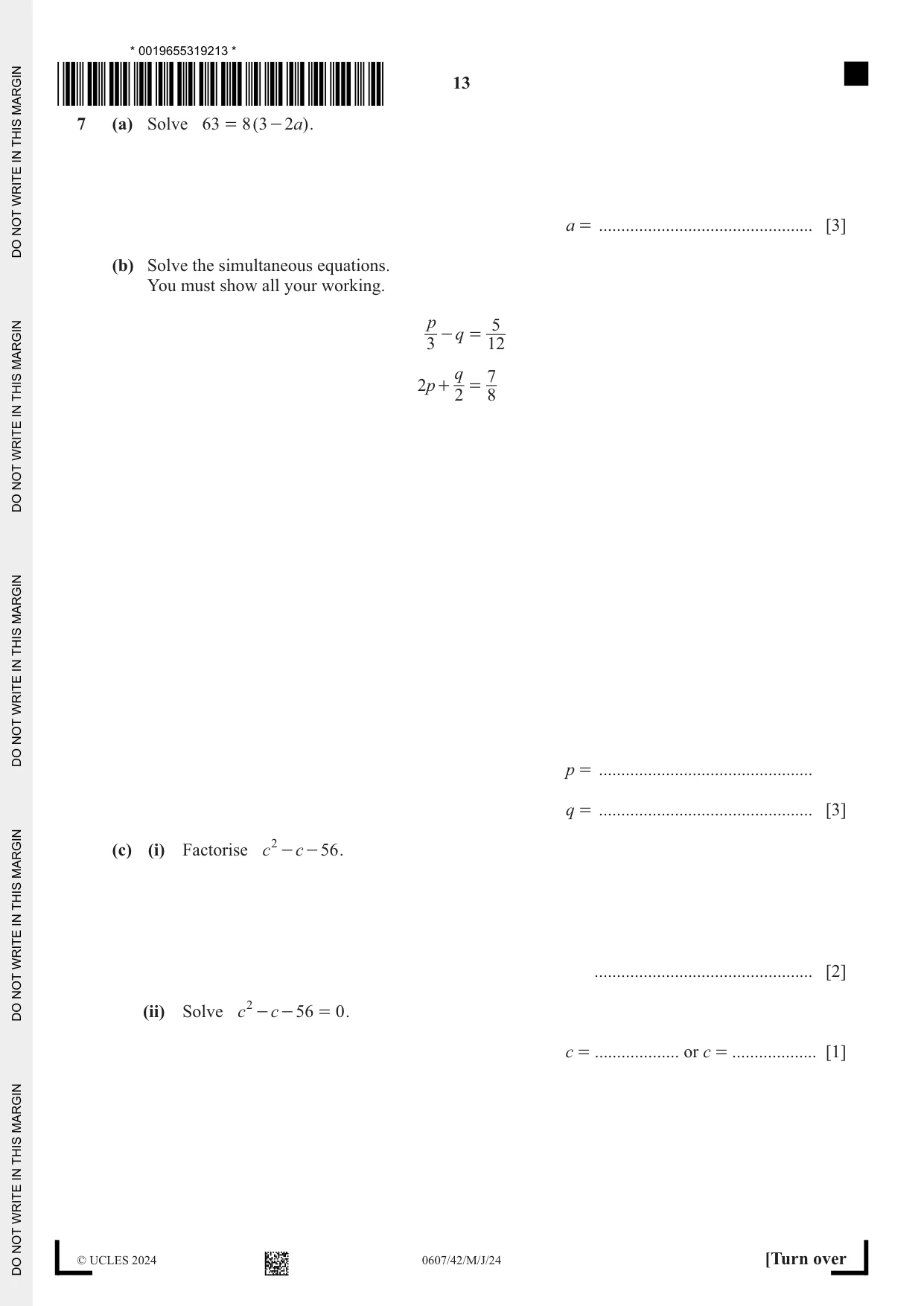
7 (a) Solve 63 = 8 ( 3 - 2 a) . a = ................................................ [3] (b) Solve the simultaneous equations. You must show all your working. p 5 - q = 3 12 q 7 2 p + = 2 8 p = ................................................ q = ................................................ [3] (c) (i) Factorise c 2 - c - 56 . ................................................. [2] (ii) Solve c 2 - c - 56 = 0 . c = ................... or c = ................... [1]
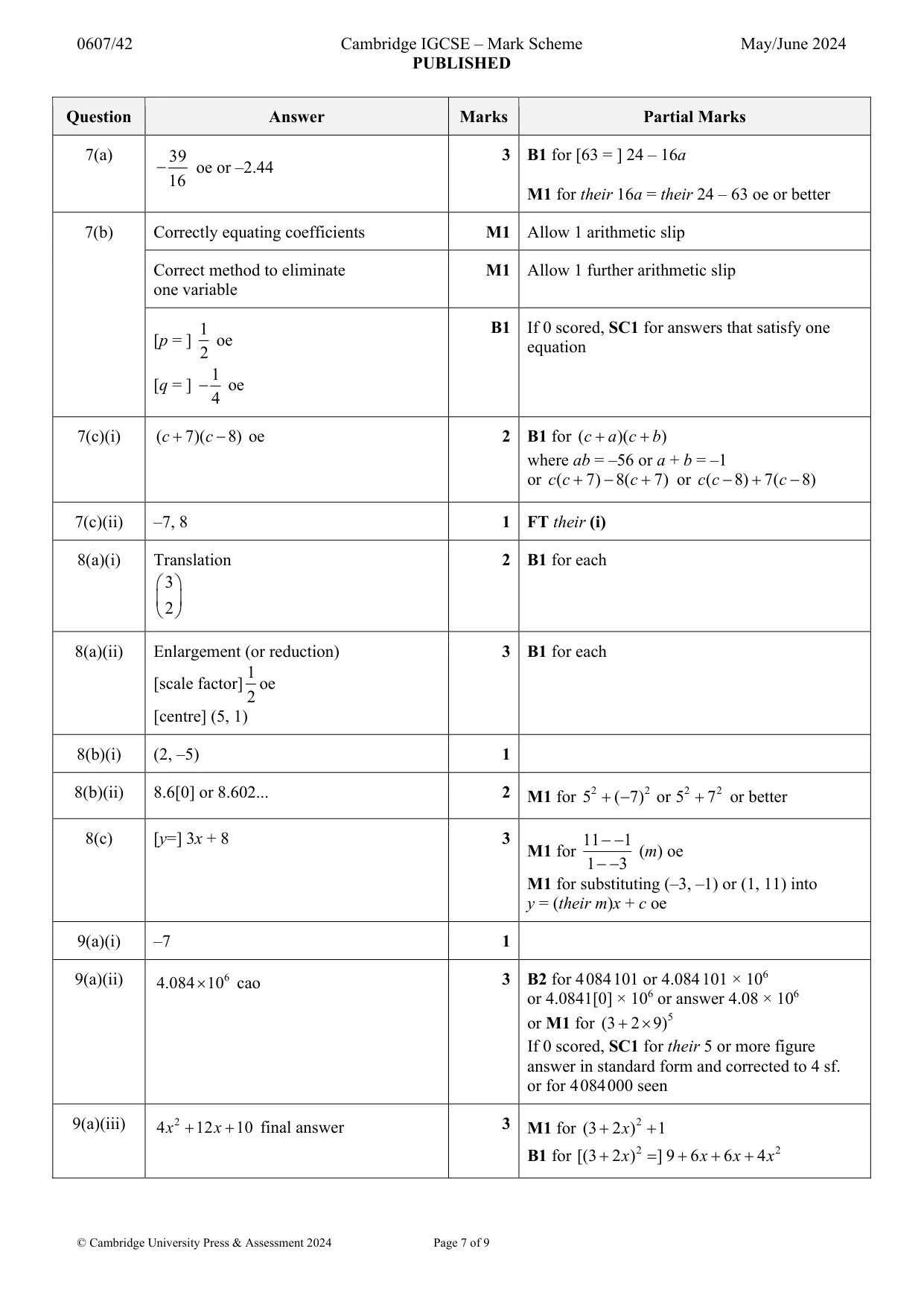
Mark scheme: 7(a) 39 3 B1 for [63 = ] 24 – 16a oe or –2.44 16 M1 for their 16a = their 24 – 63 oe or better 7(b) Correctly equating coefficients M1 Allow 1 arithmetic slip Correct method to eliminate M1 Allow 1 further arithmetic slip one variable 1 B1 If 0 scored, SC1 for answers that satisfy one [p = ] oe equation 2 1 [q = ] oe 4 7(c)(i) ( c 7)( c 8) oe 2 B1 for ( c a )( c b ) where ab = –56 or a + b = –1 or c ( c 7) 8( c 7) or c ( c 8) 7( c 8) 7(c)(ii) –7, 8 1 FT their (i)
Q8 · Y 6 5 4 A 3 2 T B 1 – 2 – 1 0 1 2 3 4 5 6 x Describe fully the single transformation that…
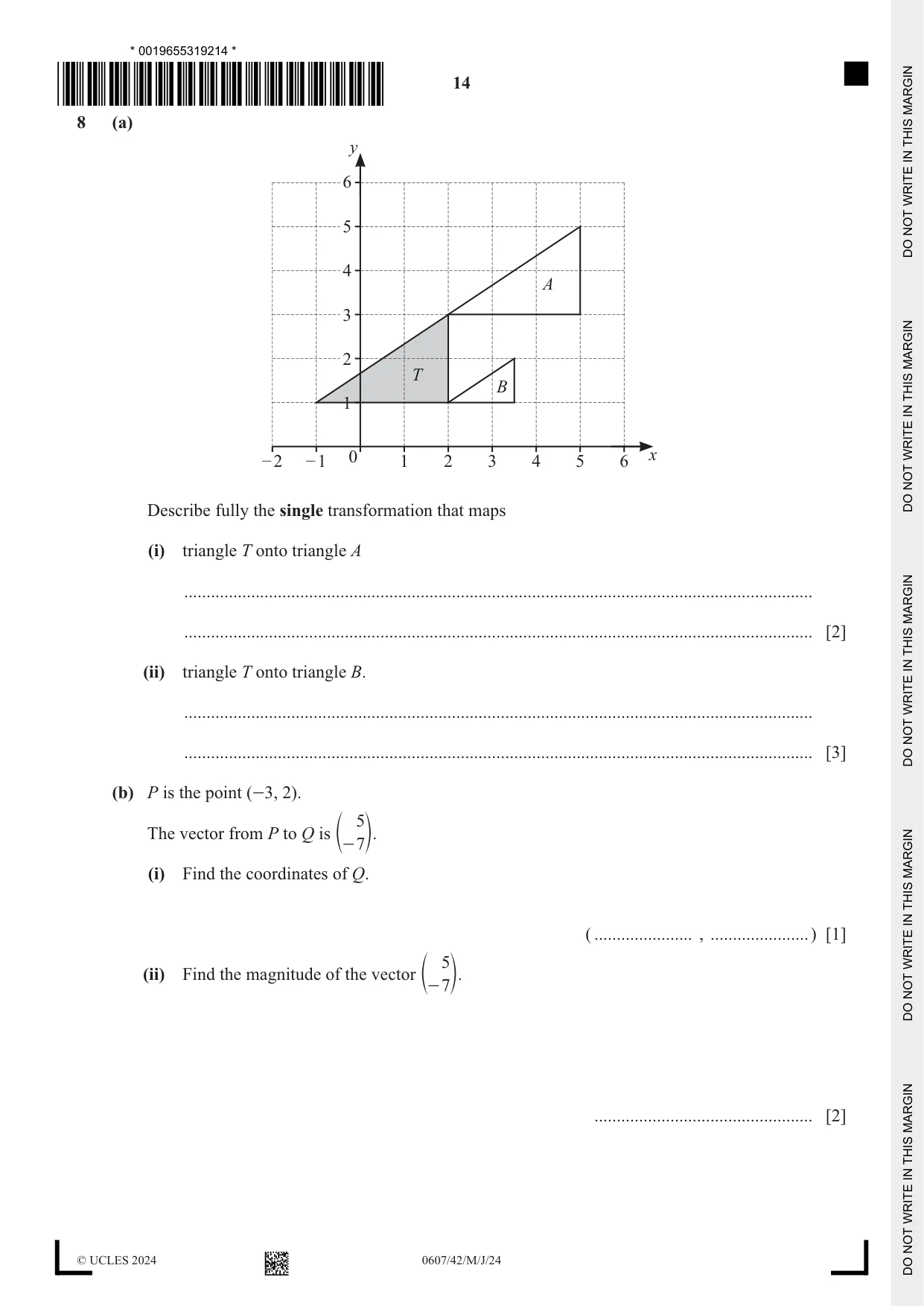
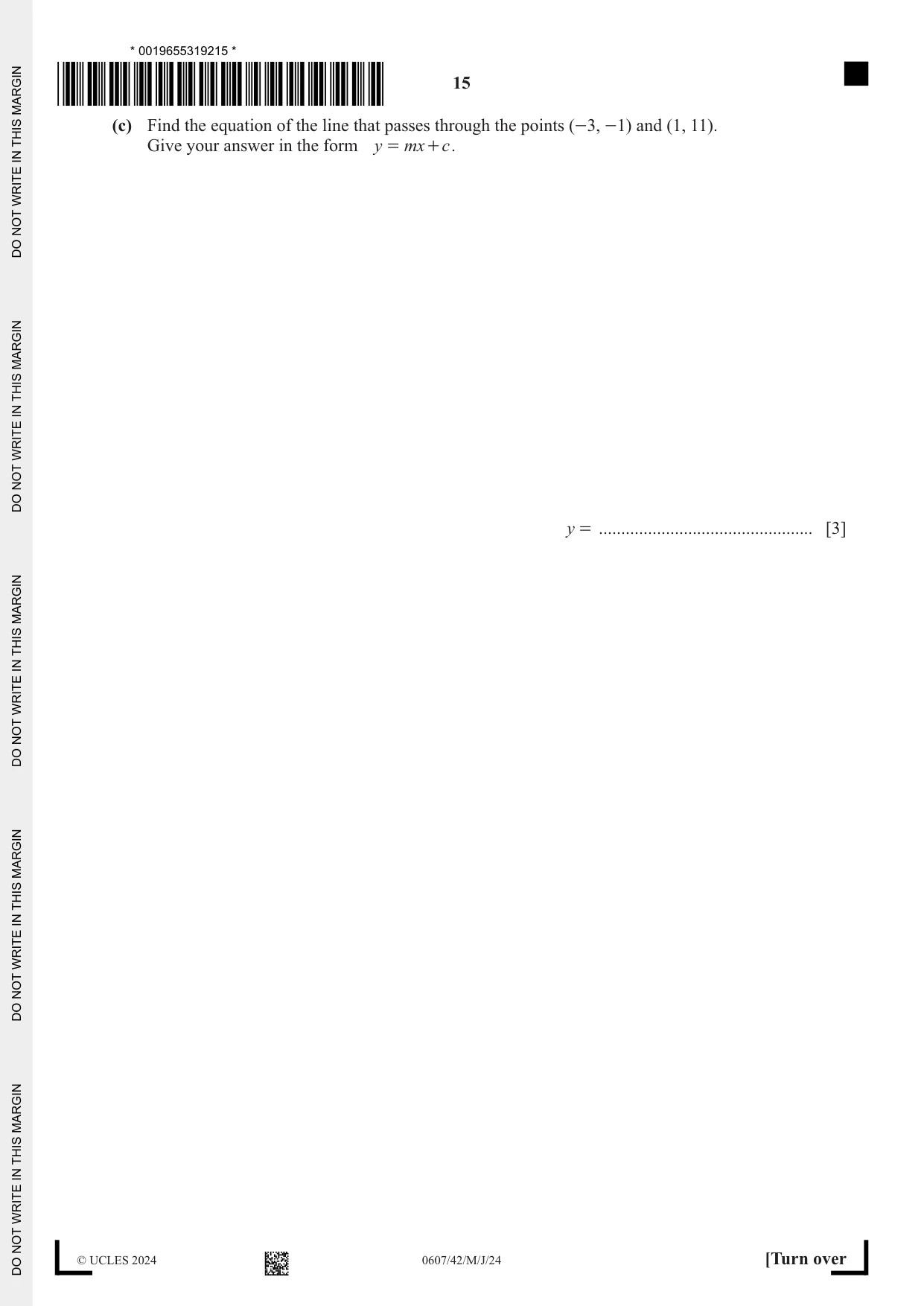
8 (a) y 6 5 4 A 3 2 T B 1 – 2 – 1 0 1 2 3 4 5 6 x Describe fully the single transformation that maps (i) triangle T onto triangle A ............................................................................................................................................. ............................................................................................................................................. [2] (ii) triangle T onto triangle B. ............................................................................................................................................. ............................................................................................................................................. [3] (b) P is the point (-3, 2). 5 The vector from P to Q is e o. - 7 (i) Find the coordinates of Q. ( ...................... , ...................... ) [1] 5 (ii) Find the magnitude of the vector e o. - 7 ................................................. [2] (c) Find the equation of the line that passes through the points (-3, -1) and (1, 11). Give your answer in the form y = mx + c . y = ................................................ [3]
Mark scheme: 8(a)(i) Translation 2 B1 for each 3 2 8(a)(ii) Enlargement (or reduction) 3 B1 for each 1 [scale factor] oe 2 [centre] (5, 1) 8(b)(i) (2, –5) 1 8(b)(ii) 8.6[0] or 8.602... 2 M1 for 5 2 ( 7) 2 or 5 2 7 2 or better 8(c) [y=] 3x + 8 3 11 1 M1 for (m) oe 1 3 M1 for substituting (–3, –1) or (1, 11) into y = (their m)x + c oe
Q9 · F ( )x = 3 + 2 x g ( )x = x 2 + 1 h ( )x = x 5 (i) Find f ( - 5 )
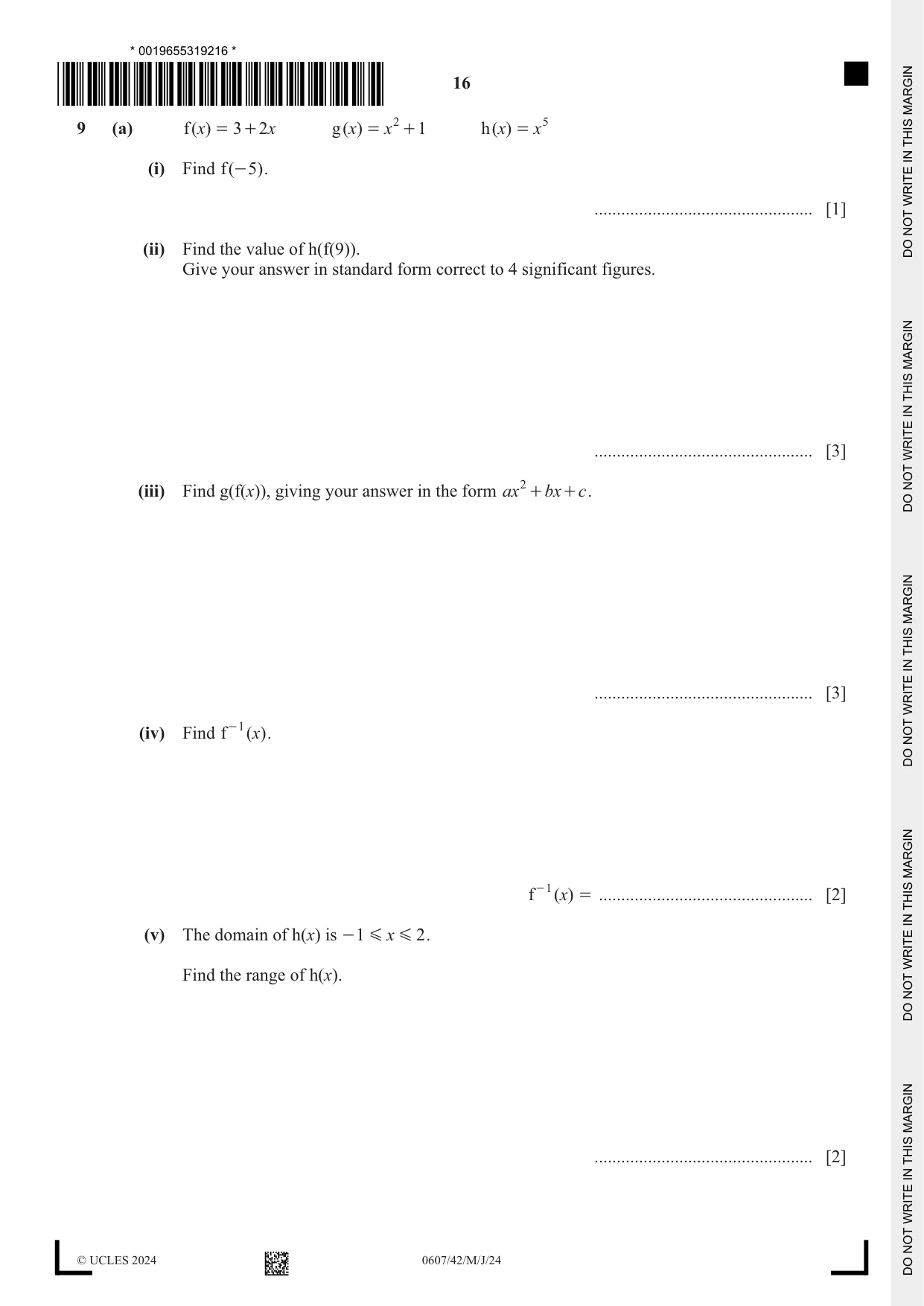
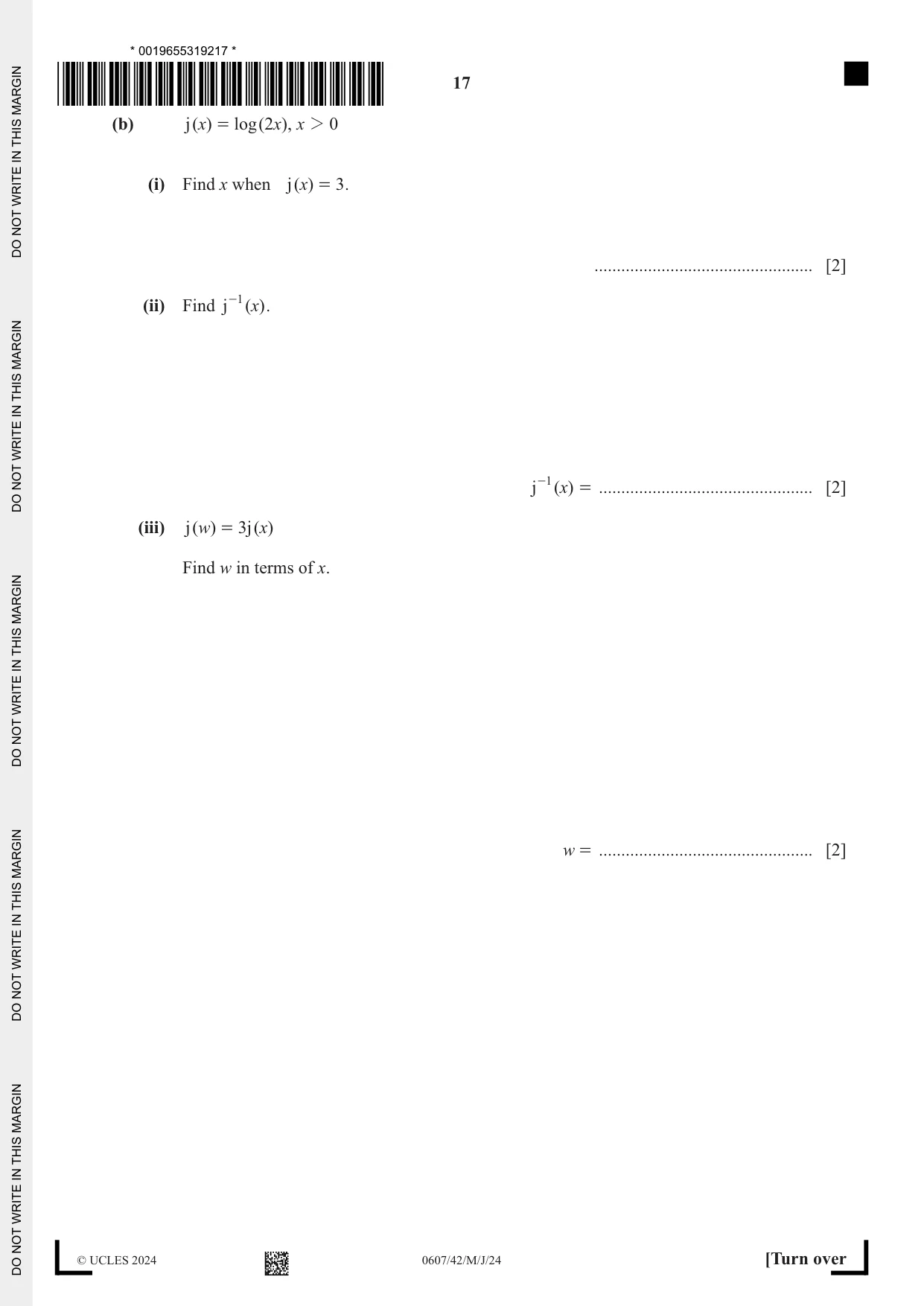
9 (a) f ( )x = 3 + 2 x g ( )x = x 2 + 1 h ( )x = x 5 (i) Find f ( - 5 ) . ................................................. [1] (ii) Find the value of h(f(9)). Give your answer in standard form correct to 4 significant figures. ................................................. [3] (iii) Find g(f(x)), giving your answer in the form ax 2 + bx + c . ................................................. [3] (iv) Find f - 1 ( )x . f - 1 ( )x = ................................................ [2] (v) The domain of h(x) is - 1 G x G 2 . Find the range of h(x). ................................................. [2] (b) j (x) = log (2x), x 2 0 (i) Find x when j ( )x = 3 . ................................................. [2] (ii) Find j -1 ( )x . j -1 ( )x = ................................................ [2] (iii) j ( w) = 3j ( x) Find w in terms of x. w = ................................................ [2]
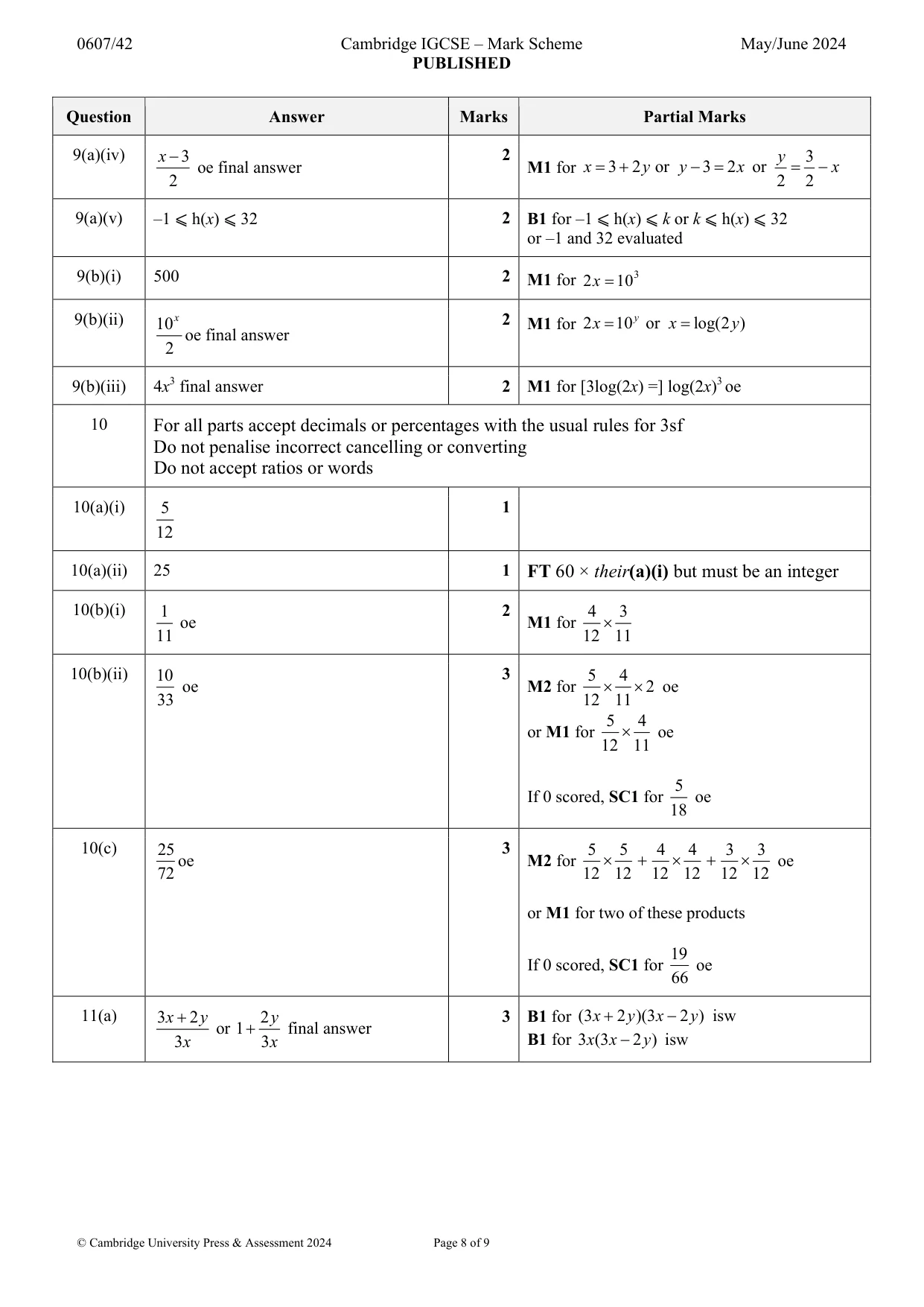
Mark scheme: 9(a)(i) –7 1 9(a)(ii) 4.084 10 6 cao 3 B2 for 4 084 101 or 4.084 101 × 106 or 4.0841[0] × 106 or answer 4.08 × 10⁶ or M1 for (3 2 9) 5 If 0 scored, SC1 for their 5 or more figure answer in standard form and corrected to 4 sf. or for 4 084 000 seen 9(a)(iii) 4 x 2 12 x 10 final answer 3 M1 for (3 2 x ) 2 1 B1 for [(3 2 x ) 2 ] 9 6 x 6 x 4 x 2 9(a)(iv) x 3 2 y 3 oe final answer M1 for x 3 2 y or y 3 2 x or x 2 2 2 9(a)(v) –1 ⩽ h(x) ⩽ 32 2 B1 for –1 ⩽ h(x) ⩽ k or k ⩽ h(x) ⩽ 32 or –1 and 32 evaluated 9(b)(i) 500 2 M1 for 2 x 10 3 9(b)(ii) 10 x 2 M1 for 2 x 10 y or x log(2 y ) oe final answer 2 9(b)(iii) 4x3 final answer 2 M1 for [3log(2x) =] log(2x)3 oe 10 For all parts accept decimals or percentages with the usual rules for 3sf Do not penalise incorrect cancelling or converting Do not accept ratios or words
Q10 · A bag contains 5 red balls, 4 blue balls and 3 green balls
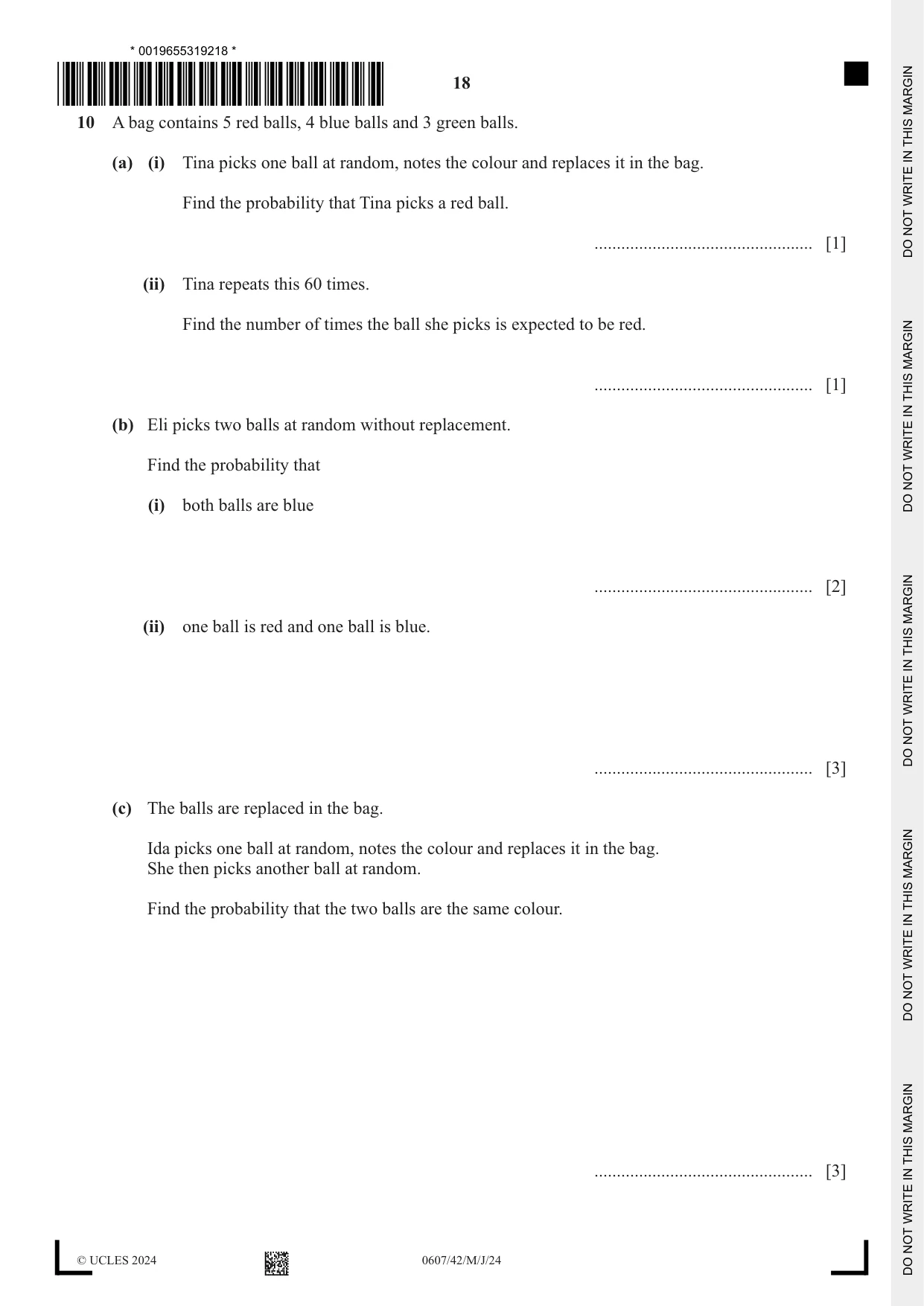
10 A bag contains 5 red balls, 4 blue balls and 3 green balls. (a) (i) Tina picks one ball at random, notes the colour and replaces it in the bag. Find the probability that Tina picks a red ball. ................................................. [1] (ii) Tina repeats this 60 times. Find the number of times the ball she picks is expected to be red. ................................................. [1] (b) Eli picks two balls at random without replacement. Find the probability that (i) both balls are blue ................................................. [2] (ii) one ball is red and one ball is blue. ................................................. [3] (c) The balls are replaced in the bag. Ida picks one ball at random, notes the colour and replaces it in the bag. She then picks another ball at random. Find the probability that the two balls are the same colour. ................................................. [3]
Mark scheme: 10(a)(i) 5 1 12 10(a)(ii) 25 1 FT 60 × their(a)(i) but must be an integer 10(b)(i) 1 2 4 3 oe M1 for 11 12 11 10(b)(ii) 10 3 5 4 oe M2 for 2 oe 33 12 11 5 4 or M1 for oe 12 11 5 If 0 scored, SC1 for oe 18 10(c) 25 3 5 5 4 4 3 3 oe M2 for oe 72 12 12 12 12 12 12 or M1 for two of these products 19 If 0 scored, SC1 for oe 66
Question 11
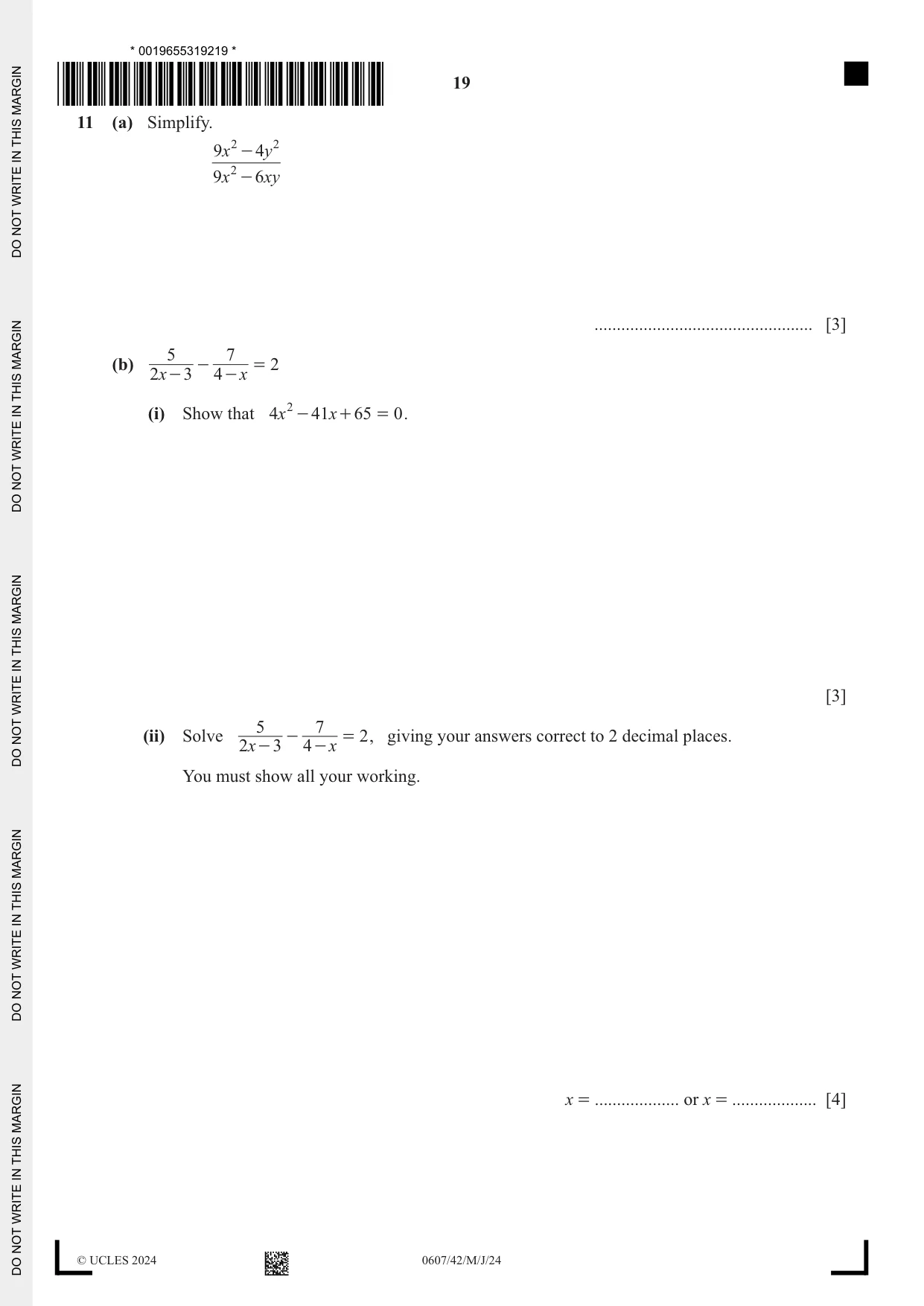
11 (a) Simplify. 9x 2 - 4y 2 9x 2 - 6xy ................................................. [3] 5 7 (b) - = 2 2x - 3 4 - x (i) Show that 4x 2 - 41x + 65 = 0 . [3] 5 7 (ii) Solve - = 2 , giving your answers correct to 2 decimal places. 2x - 3 4 - x You must show all your working. x = ................... or x = ................... [4]
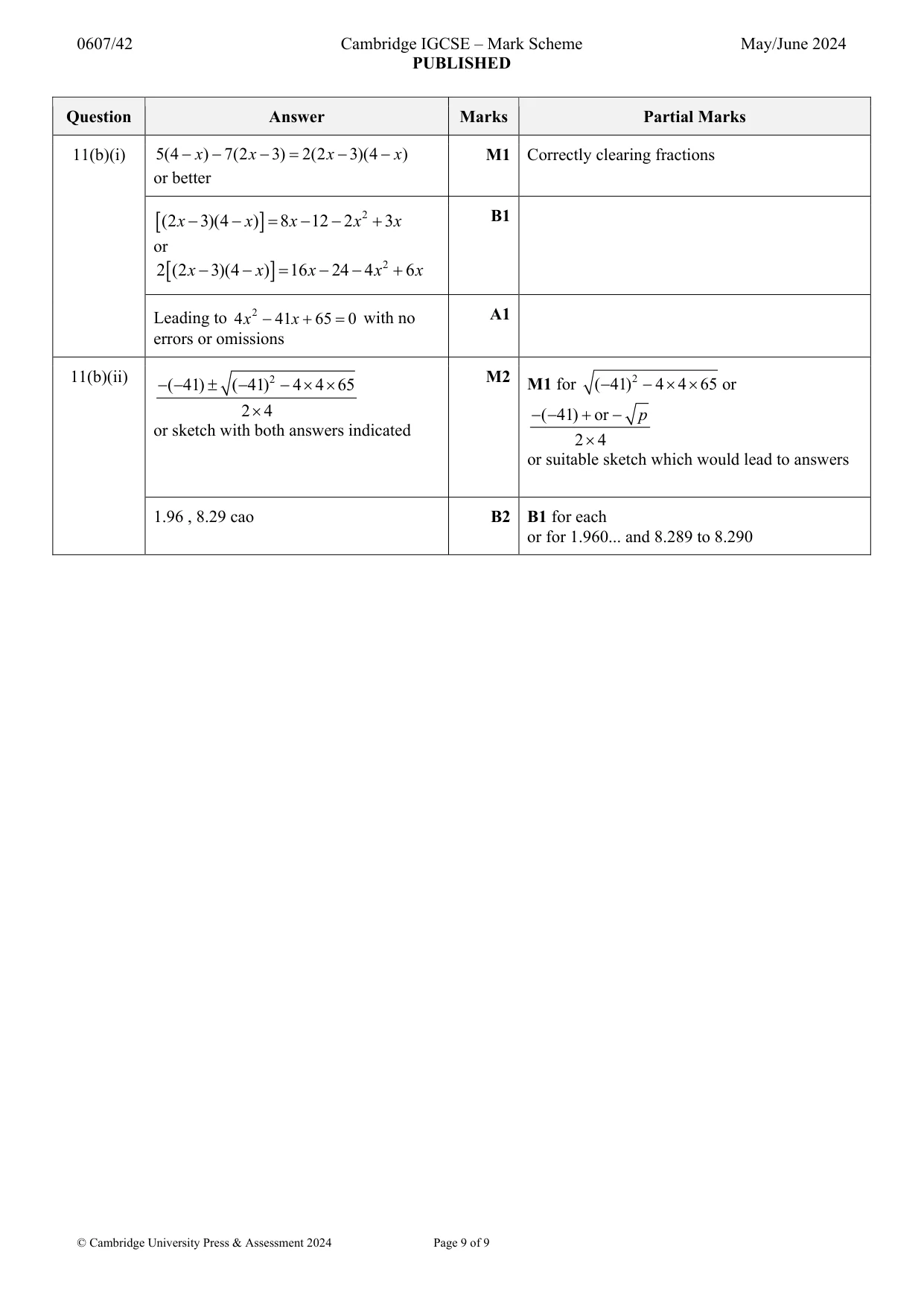
Mark scheme: 11(a) 3 x 2 y 2 y 3 B1 for (3 x 2 y )(3 x 2 y ) isw or 1 final answer 3 x 3 x B1 for 3 x (3 x 2 y ) isw 11(b)(i) 5(4 x ) 7(2 x 3) 2(2 x 3)(4 x ) M1 Correctly clearing fractions or better 2 3 x B1 (2 x 3)(4 x ) 8 x 12 2 x or 2 6 x 2 (2 x 3)(4 x ) 16 x 24 4 x Leading to 4 x 2 41x 65 0 with no A1 errors or omissions 11(b)(ii) 2 M2 2 ( 41) ( 41) 4 4 65 M1 for ( 41) 4 4 65 or 2 4 ( 41) or p or sketch with both answers indicated 2 4 or suitable sketch which would lead to answers 1.96 , 8.29 cao B2 B1 for each or for 1.960... and 8.289 to 8.290
What was in this paper
The subtopics covered by these 11 questions, and how many questions each got. Open one in a new tab to see every Cambridge question on it.
What you needed in this session
Cambridge’s own grade thresholds for 2024 May/June, Paper 4 · Variant 2. A higher threshold means an easier paper — the bar moves with how the cohort did.