Cambridge IGCSE Mathematics - International 0607 — 2016 May/June Paper 4 · Variant 1
0607/41/M/J/16 · 120 marks · ≈135 min
The question paper and its mark scheme, free to read here and free to download. This is Cambridge’s own paper, exactly as it was sat.
Question paper20 pages
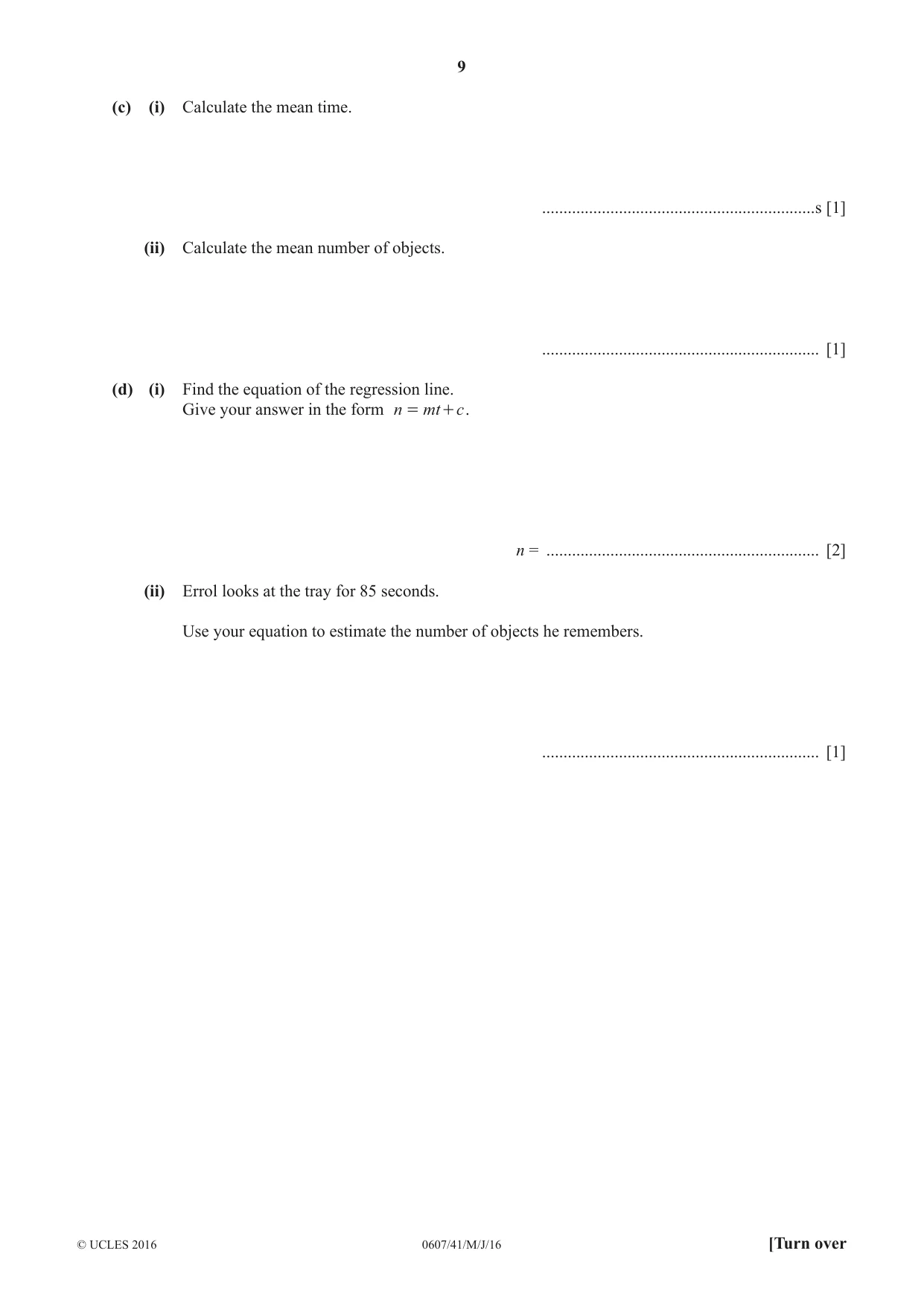
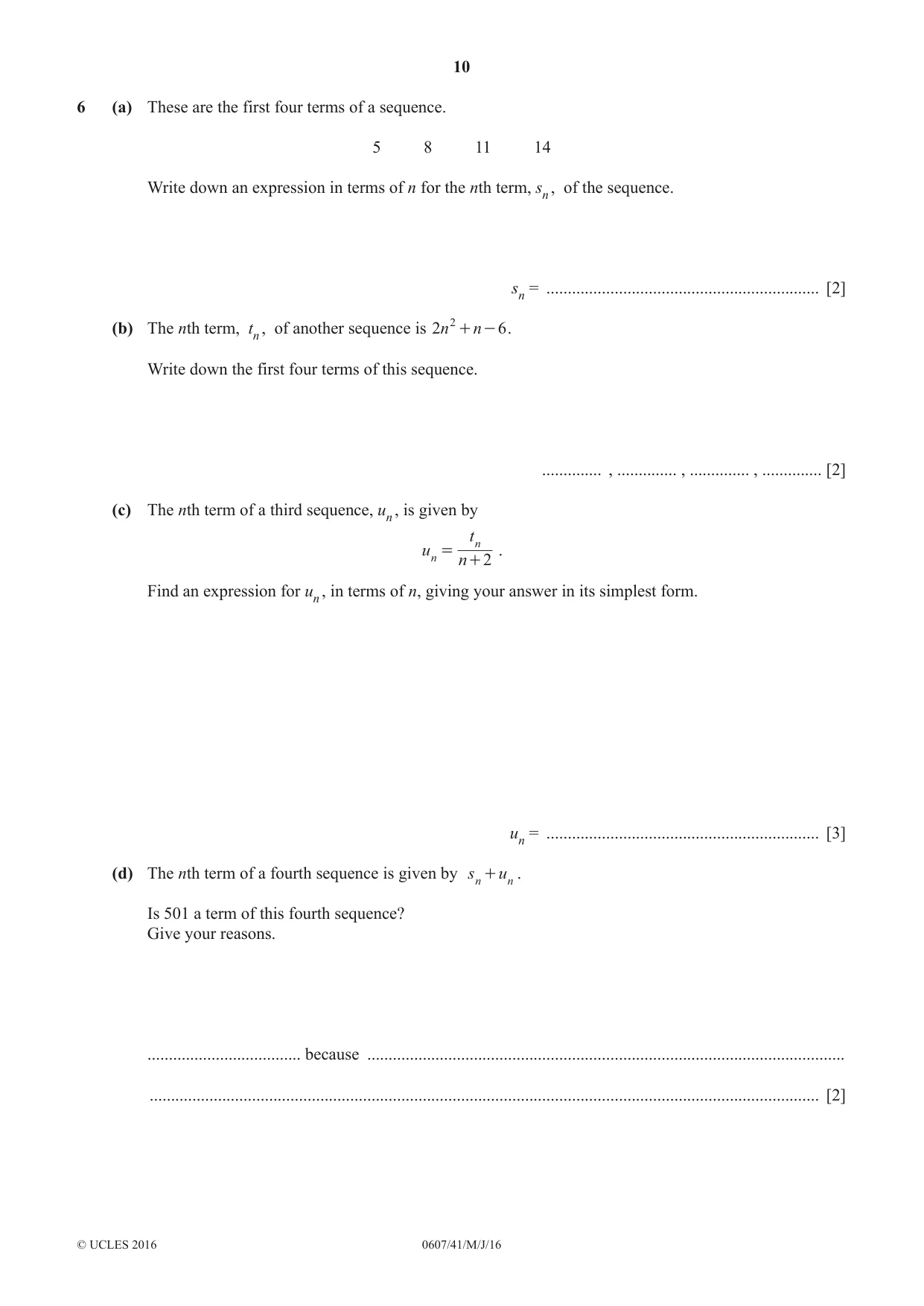
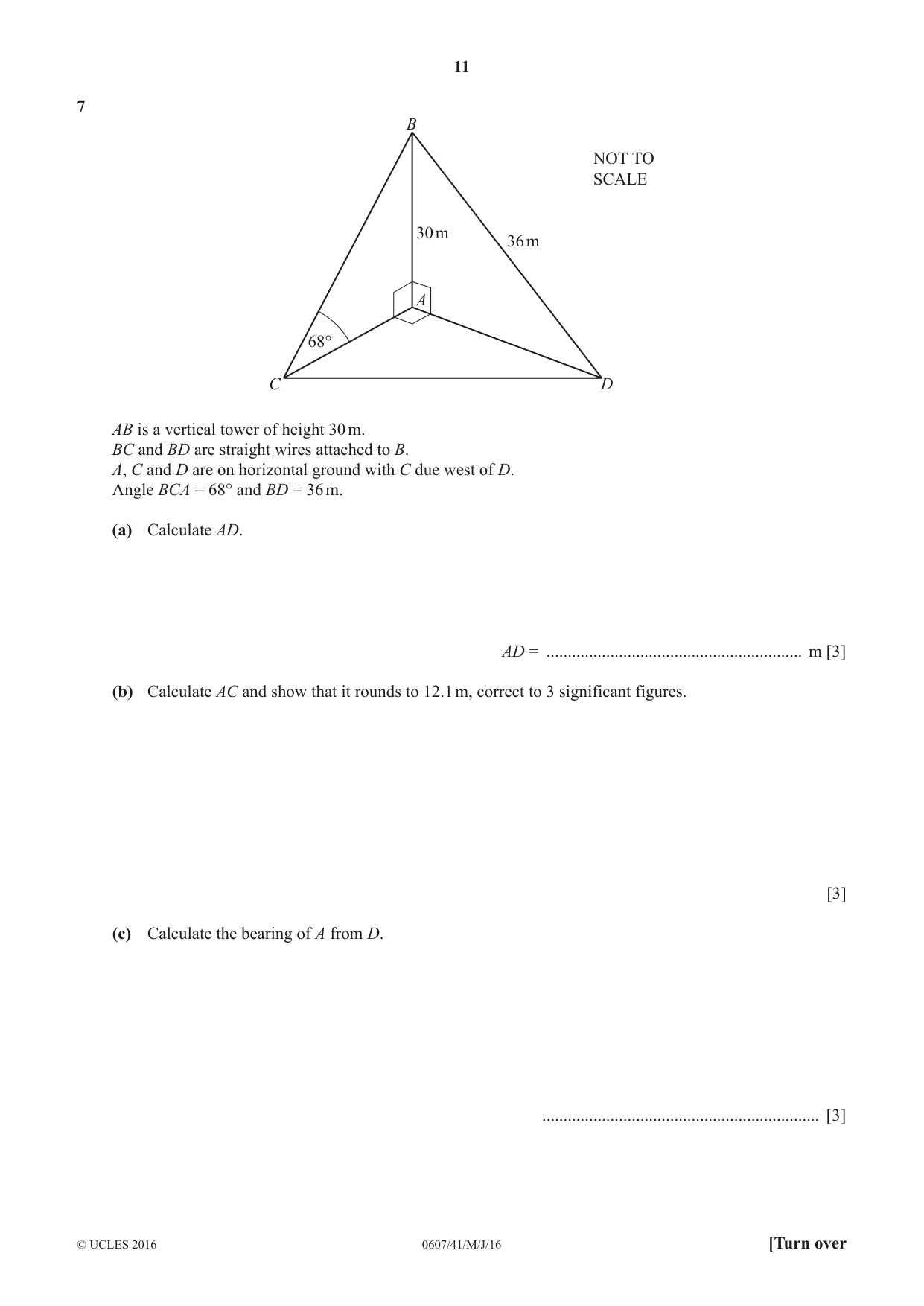
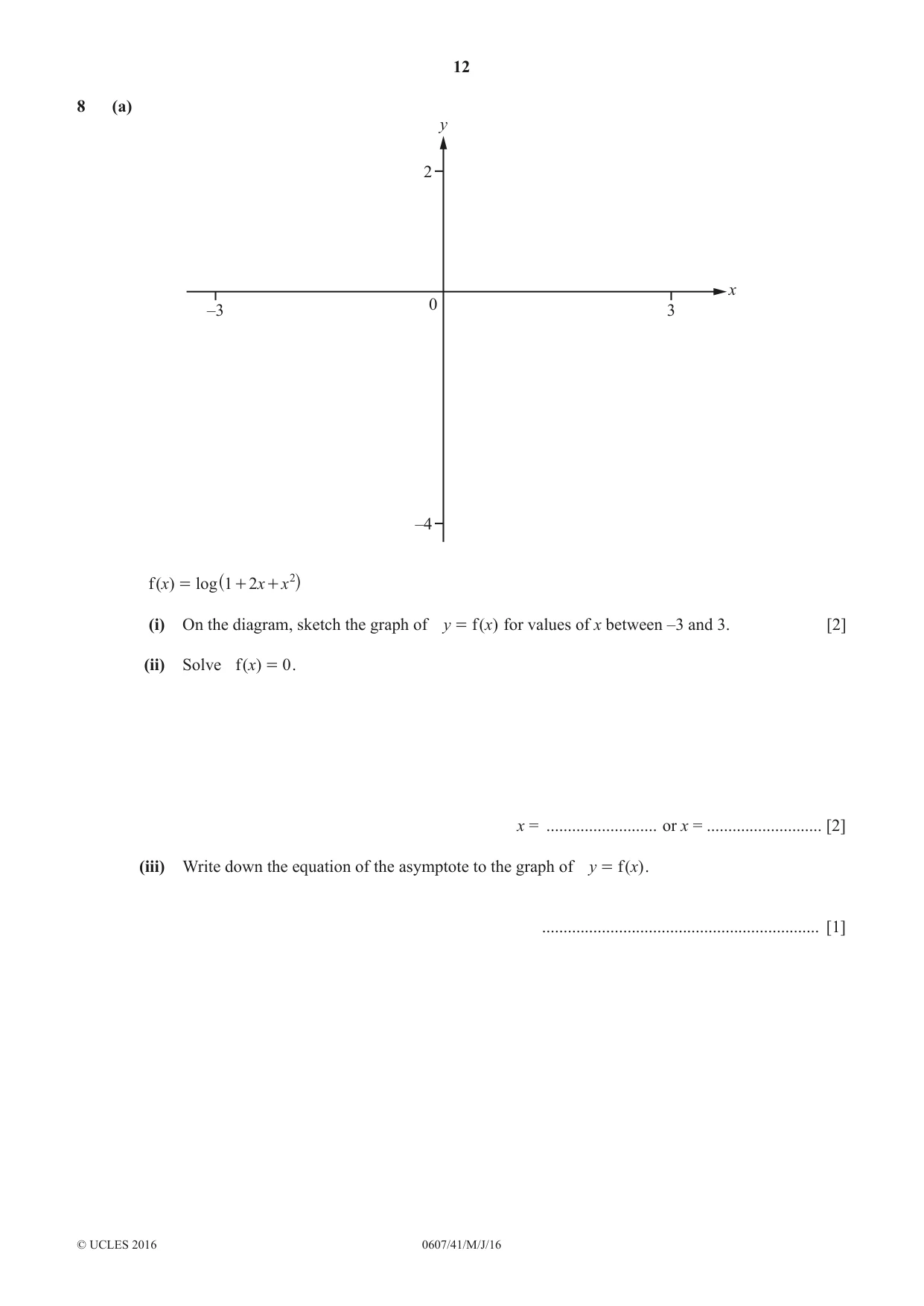
Mark scheme6 pages
Answers below. Sit the paper first if you are practising.
Paper as text
Question paper, page 1
This document consists of 20 printed pages. DC (KN/SG) 115864/3 © UCLES 2016 [Turn over Cambridge International Examinations Cambridge International General Certificate of Secondary Education * 8 3 9 8 4 2 2 7 1 6 * CAMBRIDGE INTERNATIONAL MATHEMATICS 0607/41 Paper 4 (Extended) May/June 2016 2 hours 15 minutes Candidates answer on the Question Paper. Additional Materials: Geometrical Instruments Graphics Calculator READ THESE INSTRUCTIONS FIRST Write your Centre number, candidate number and name on all the work you hand in. Write in dark blue or black pen. Do not use staples, paper clips, glue or correction fluid. You may use an HB pencil for any diagrams or graphs. DO NOT WRITE IN ANY BARCODES. Answer all the questions. Unless instructed otherwise, give your answers exactly or correct to three significant figures as appropriate. Answers in degrees should be given to one decimal place. For p, use your calculator value. You must show all the relevant working to gain full marks and you will be given marks for correct methods, including sketches, even if your answer is incorrect. The number of marks is given in brackets [ ] at the end of each question or part question. The total number of marks for this paper is 120.
Question paper, page 2
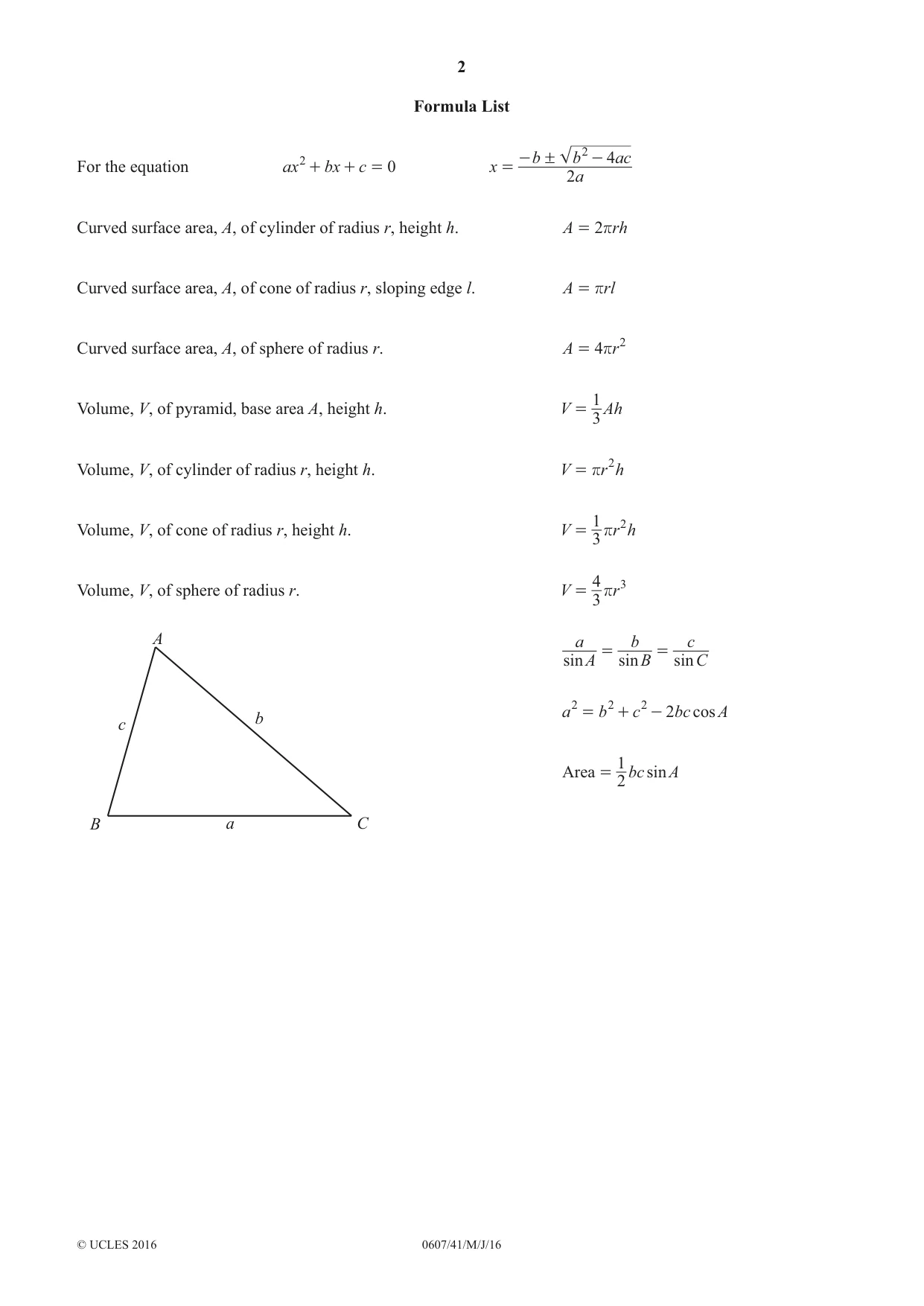
2 0607/41/M/J/16 © UCLES 2016 Formula List For the equation ax bx c 0 2 + + = x a b b ac 2 4 2 ! = - - Curved surface area, A, of cylinder of radius r, height h. r A rh 2 = Curved surface area, A, of cone of radius r, sloping edge l. r A rl = Curved surface area, A, of sphere of radius r. r A r 4 2 = Volume, V, of pyramid, base area A, height h. V Ah 3 1 = Volume, V, of cylinder of radius r, height h. r V r h 2 = Volume, V, of cone of radius r, height h. r V r h 3 1 2 = Volume, V, of sphere of radius r. r V r 3 4 3 = sin sin sin A a B b C c = = cos a b c bc A 2 2 2 2 = + - sin bc A 2 1 Area = A C B c b a
Question paper, page 3
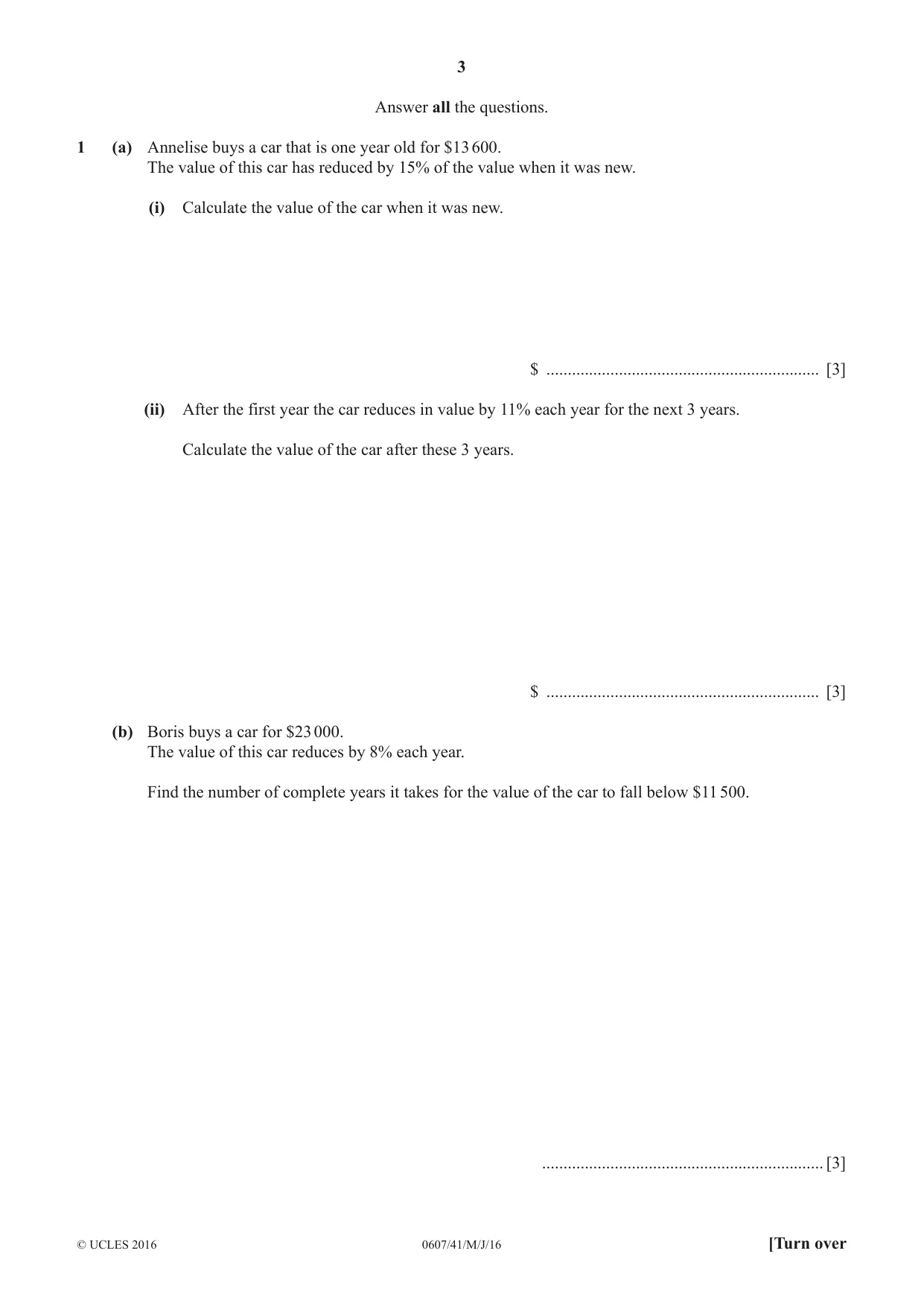
3 0607/41/M/J/16 © UCLES 2016 [Turn over Answer all the questions. 1 (a) Annelise buys a car that is one year old for $13 600. The value of this car has reduced by 15% of the value when it was new. (i) Calculate the value of the car when it was new. $ … [3] (ii) After the first year the car reduces in value by 11% each year for the next 3 years. Calculate the value of the car after these 3 years. $ … [3] (b) Boris buys a car for $23 000. The value of this car reduces by 8% each year. Find the number of complete years it takes for the value of the car to fall below $11 500. … [3]
Question paper, page 4
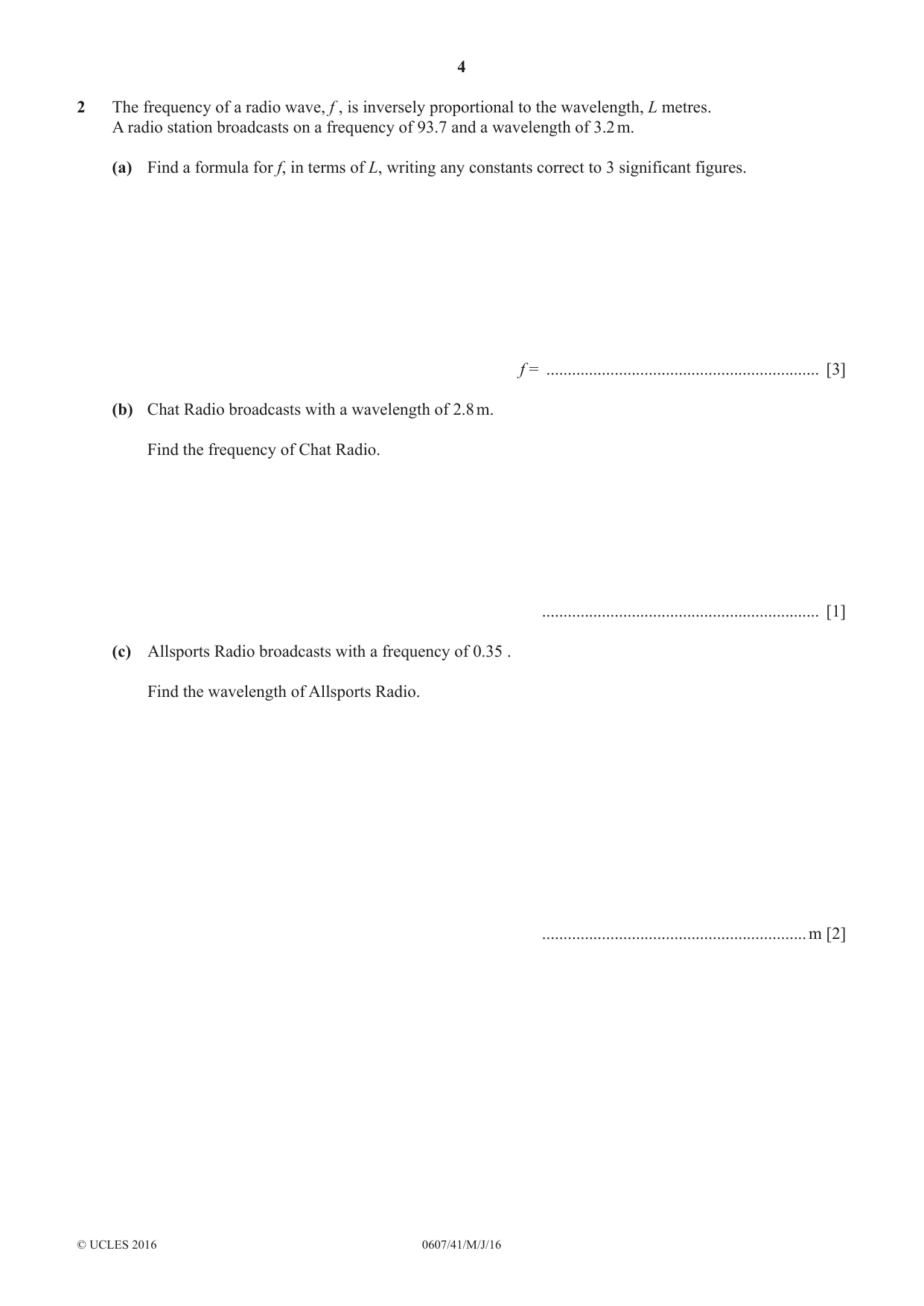
4 0607/41/M/J/16 © UCLES 2016 2 The frequency of a radio wave, f , is inversely proportional to the wavelength, L metres. A radio station broadcasts on a frequency of 93.7 and a wavelength of 3.2 m. (a) Find a formula for f, in terms of L, writing any constants correct to 3 significant figures. f = … [3] (b) Chat Radio broadcasts with a wavelength of 2.8 m. Find the frequency of Chat Radio. … [1] (c) Allsports Radio broadcasts with a frequency of 0.35 . Find the wavelength of Allsports Radio. …m [2]
Question paper, page 5
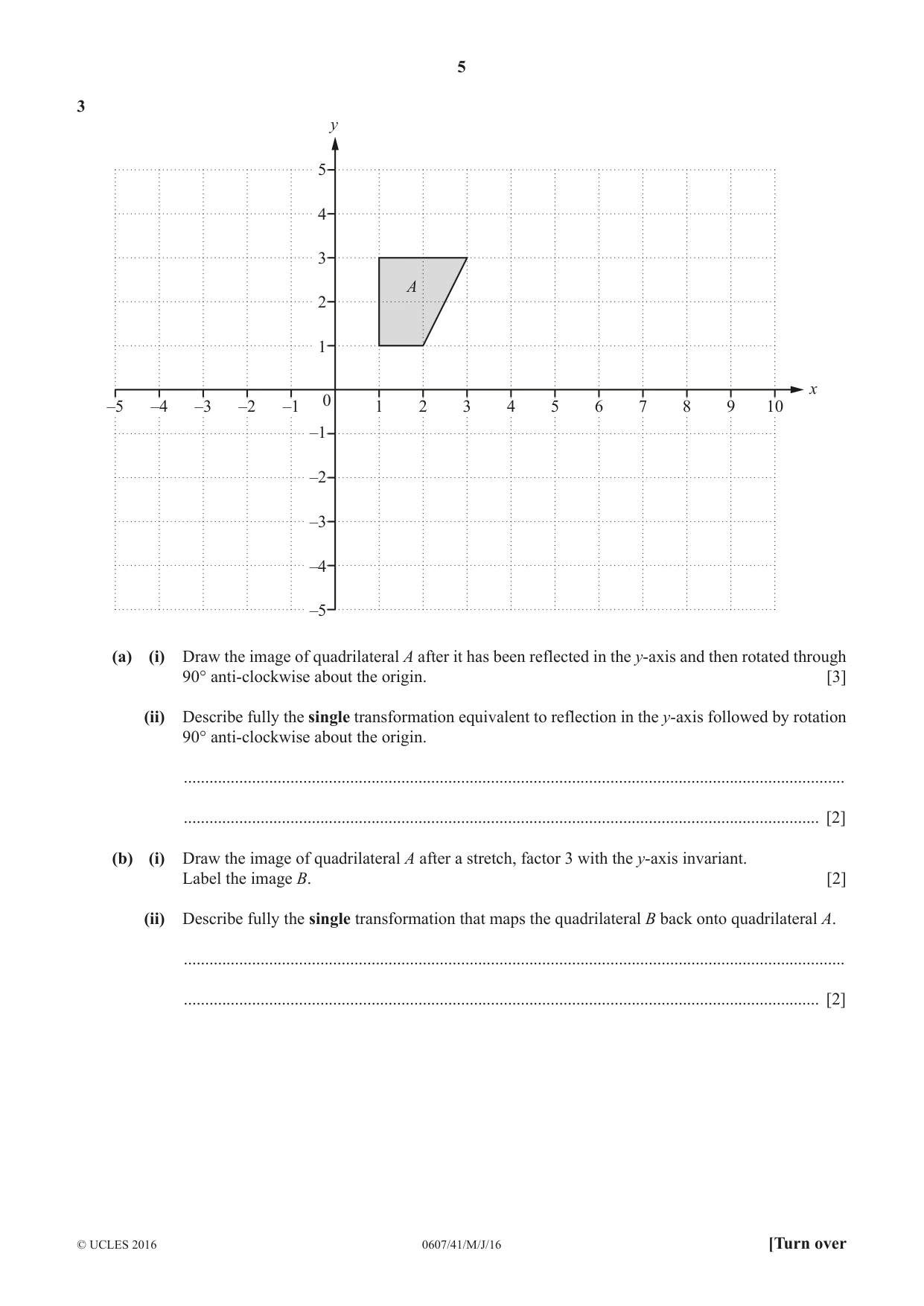
5 0607/41/M/J/16 © UCLES 2016 [Turn over 3 –1 1 0 2 3 4 5 –1 1 2 3 4 5 6 7 8 9 10 –2 –3 –4 –5 –2 –3 –4 –5 A y x (a) (i) Draw the image of quadrilateral A after it has been reflected in the y-axis and then rotated through 90° anti-clockwise about the origin. [3] (ii) Describe fully the single transformation equivalent to reflection in the y-axis followed by rotation 90° anti-clockwise about the origin. … … [2] (b) (i) Draw the image of quadrilateral A after a stretch, factor 3 with the y-axis invariant. Label the image B. [2] (ii) Describe fully the single transformation that maps the quadrilateral B back onto quadrilateral A. … … [2]
Question paper, page 6
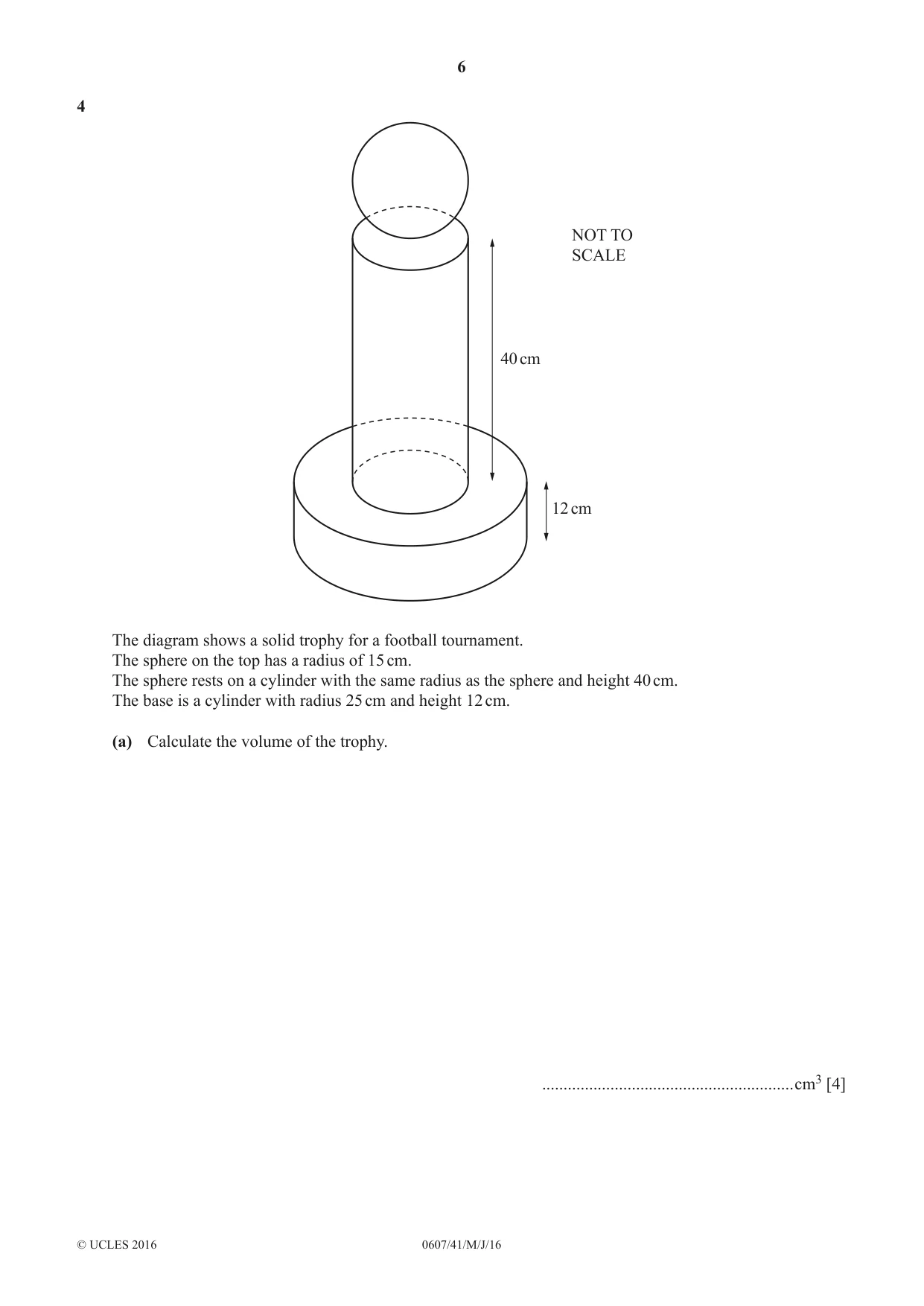
6 0607/41/M/J/16 © UCLES 2016 4 12 cm 40 cm NOT TO SCALE The diagram shows a solid trophy for a football tournament. The sphere on the top has a radius of 15 cm. The sphere rests on a cylinder with the same radius as the sphere and height 40 cm. The base is a cylinder with radius 25 cm and height 12 cm. (a) Calculate the volume of the trophy. …cm3 [4]
Question paper, page 7
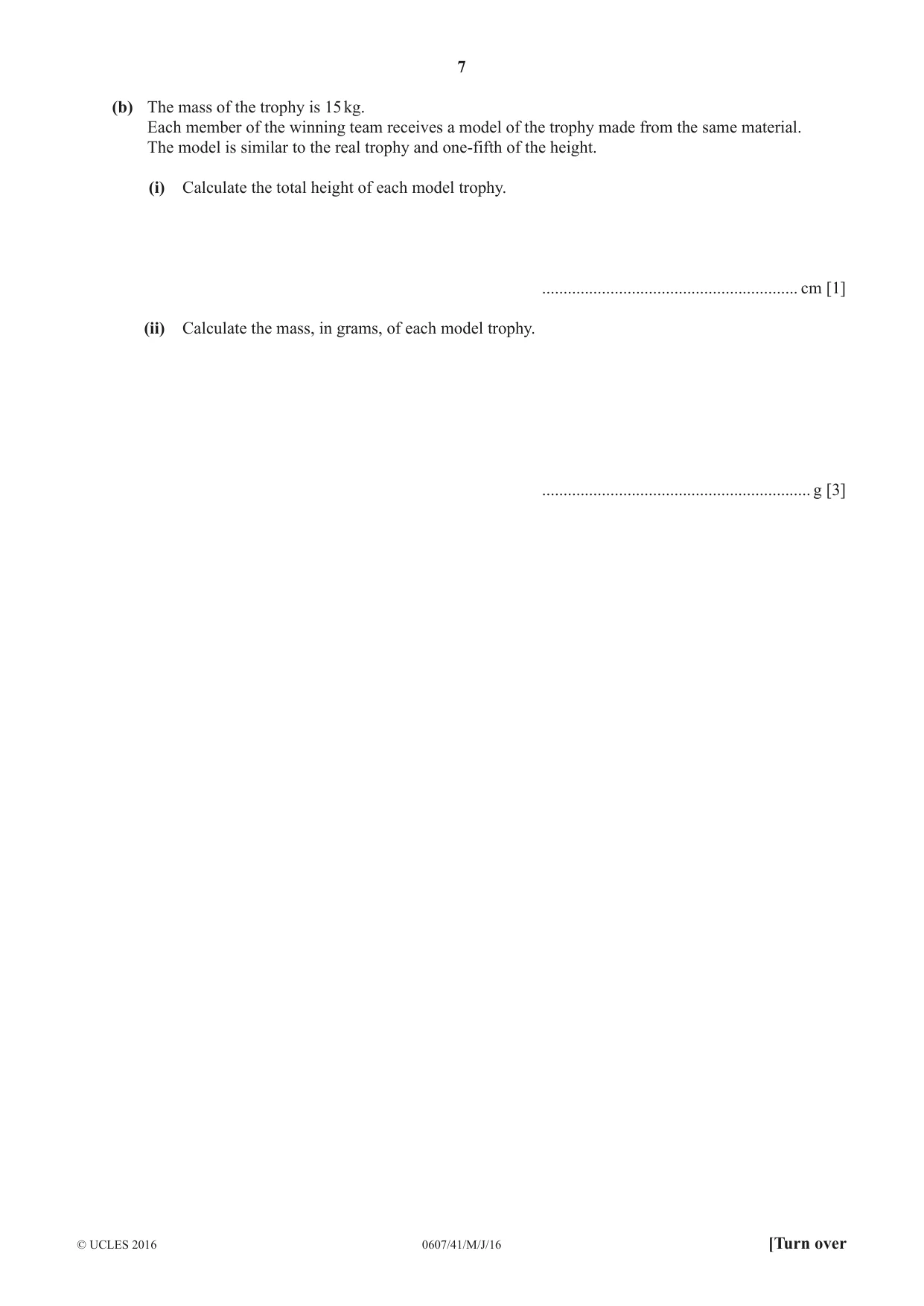
7 0607/41/M/J/16 © UCLES 2016 [Turn over (b) The mass of the trophy is 15 kg. Each member of the winning team receives a model of the trophy made from the same material. The model is similar to the real trophy and one-fifth of the height. (i) Calculate the total height of each model trophy. … cm [1] (ii) Calculate the mass, in grams, of each model trophy. … g [3]
Question paper, page 8
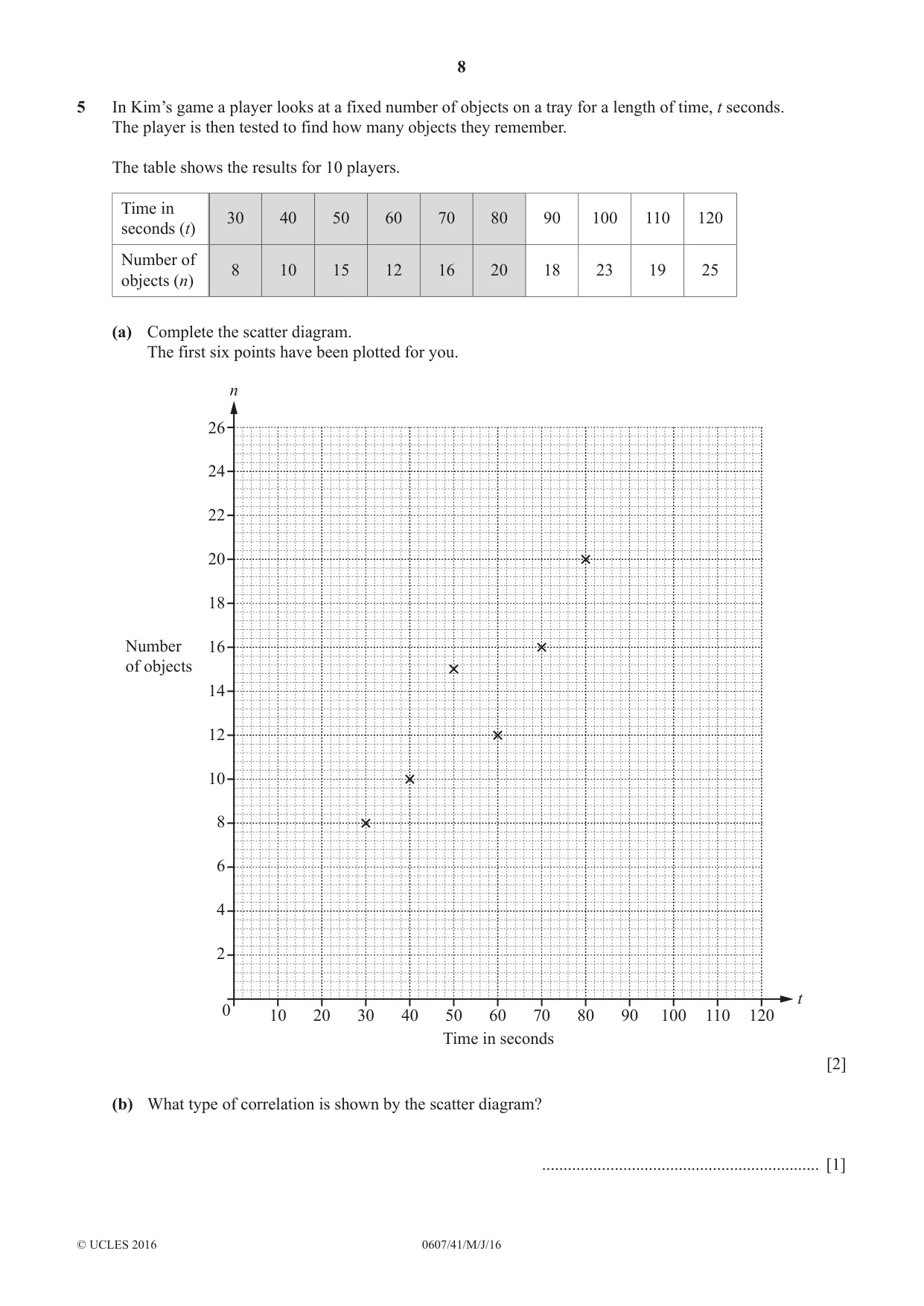
8 0607/41/M/J/16 © UCLES 2016 5 In Kim’s game a player looks at a fixed number of objects on a tray for a length of time, t seconds. The player is then tested to find how many objects they remember. The table shows the results for 10 players. Time in seconds (t) 30 40 50 60 70 80 90 100 110 120 Number of objects (n) 8 10 15 12 16 20 18 23 19 25 (a) Complete the scatter diagram. The first six points have been plotted for you. n 26 24 22 20 18 16 14 12 10 8 6 4 2 0 10 20 30 40 50 60 70 80 90 100 110 120 t Number of objects Time in seconds [2] (b) What type of correlation is shown by the scatter diagram? … [1]
Question paper, page 9
9 0607/41/M/J/16 © UCLES 2016 [Turn over (c) (i) Calculate the mean time. …s [1] (ii) Calculate the mean number of objects. … [1] (d) (i) Find the equation of the regression line. Give your answer in the form n mt c = + . n = … [2] (ii) Errol looks at the tray for 85 seconds. Use your equation to estimate the number of objects he remembers. … [1]
Question paper, page 10
10 0607/41/M/J/16 © UCLES 2016 6 (a) These are the first four terms of a sequence. 5 8 11 14 Write down an expression in terms of n for the nth term, sn , of the sequence. sn = … [2] (b) The nth term, tn , of another sequence is n n 2 6 2 - + . Write down the first four terms of this sequence. … , … , … , … [2] (c) The nth term of a third sequence, un , is given by u n t 2 n n = + . Find an expression for un , in terms of n, giving your answer in its simplest form. un = … [3] (d) The nth term of a fourth sequence is given by s u n n + . Is 501 a term of this fourth sequence? Give your reasons. … because … … [2]
Question paper, page 11
11 0607/41/M/J/16 © UCLES 2016 [Turn over 7 A 30 m 36 m NOT TO SCALE B C D 68° AB is a vertical tower of height 30 m. BC and BD are straight wires attached to B. A, C and D are on horizontal ground with C due west of D. Angle BCA = 68° and BD = 36 m. (a) Calculate AD. AD = … m [3] (b) Calculate AC and show that it rounds to 12.1 m, correct to 3 significant figures. [3] (c) Calculate the bearing of A from D. … [3]
Question paper, page 12
12 0607/41/M/J/16 © UCLES 2016 8 (a) 2 0 –4 –3 3 x y f( ) log x x x 1 2 2 = + + ^ h (i) On the diagram, sketch the graph of f( ) y x = for values of x between –3 and 3. [2] (ii) Solve f( )x 0 = . x = … or x = … [2] (iii) Write down the equation of the asymptote to the graph of f( ) y x = . … [1]
Question paper, page 13
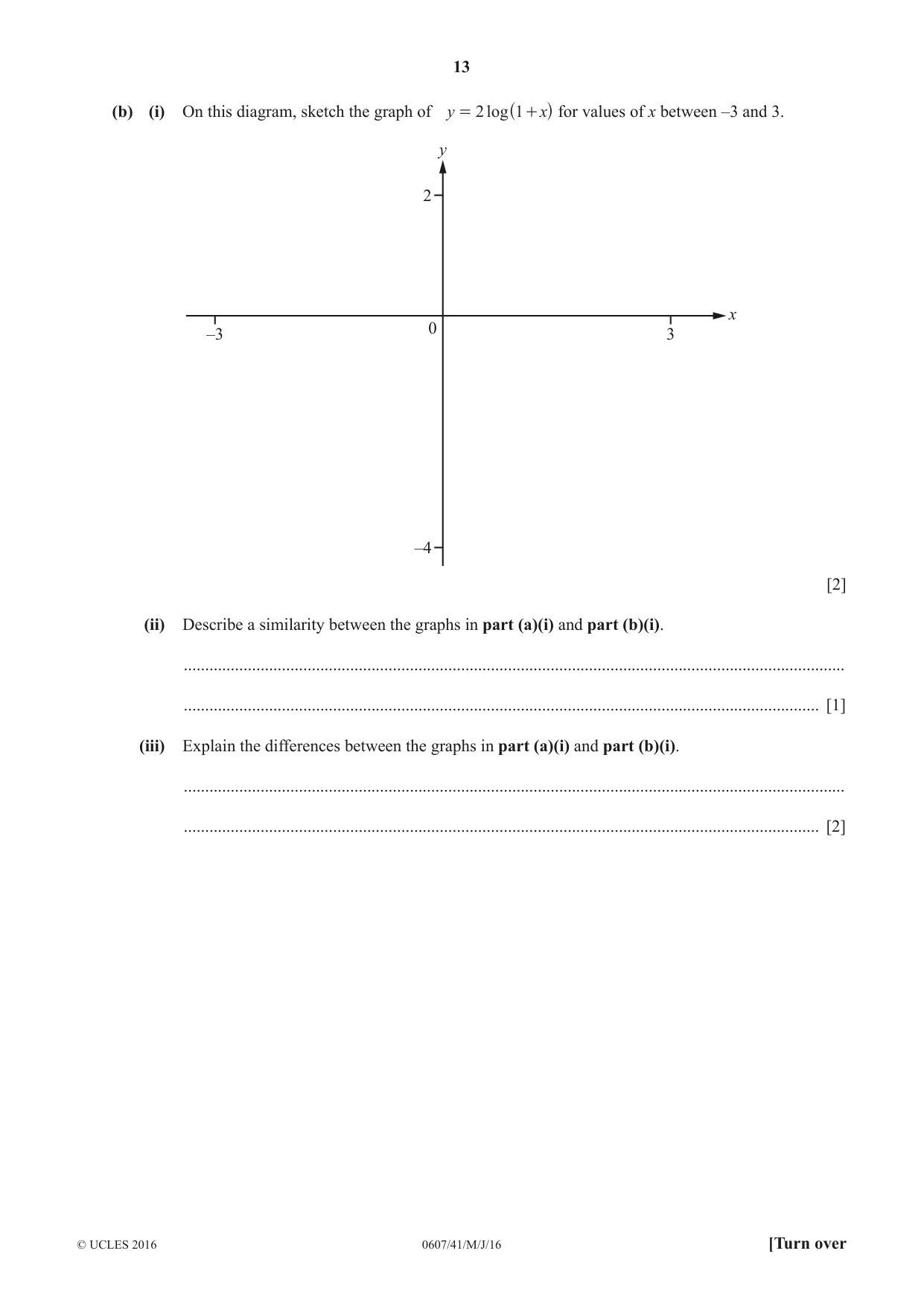
13 0607/41/M/J/16 © UCLES 2016 [Turn over (b) (i) On this diagram, sketch the graph of log y x 2 1 = + ^ h for values of x between –3 and 3. 2 0 –4 –3 3 x y [2] (ii) Describe a similarity between the graphs in part (a)(i) and part (b)(i). … … [1] (iii) Explain the differences between the graphs in part (a)(i) and part (b)(i). … … [2]
Question paper, page 14
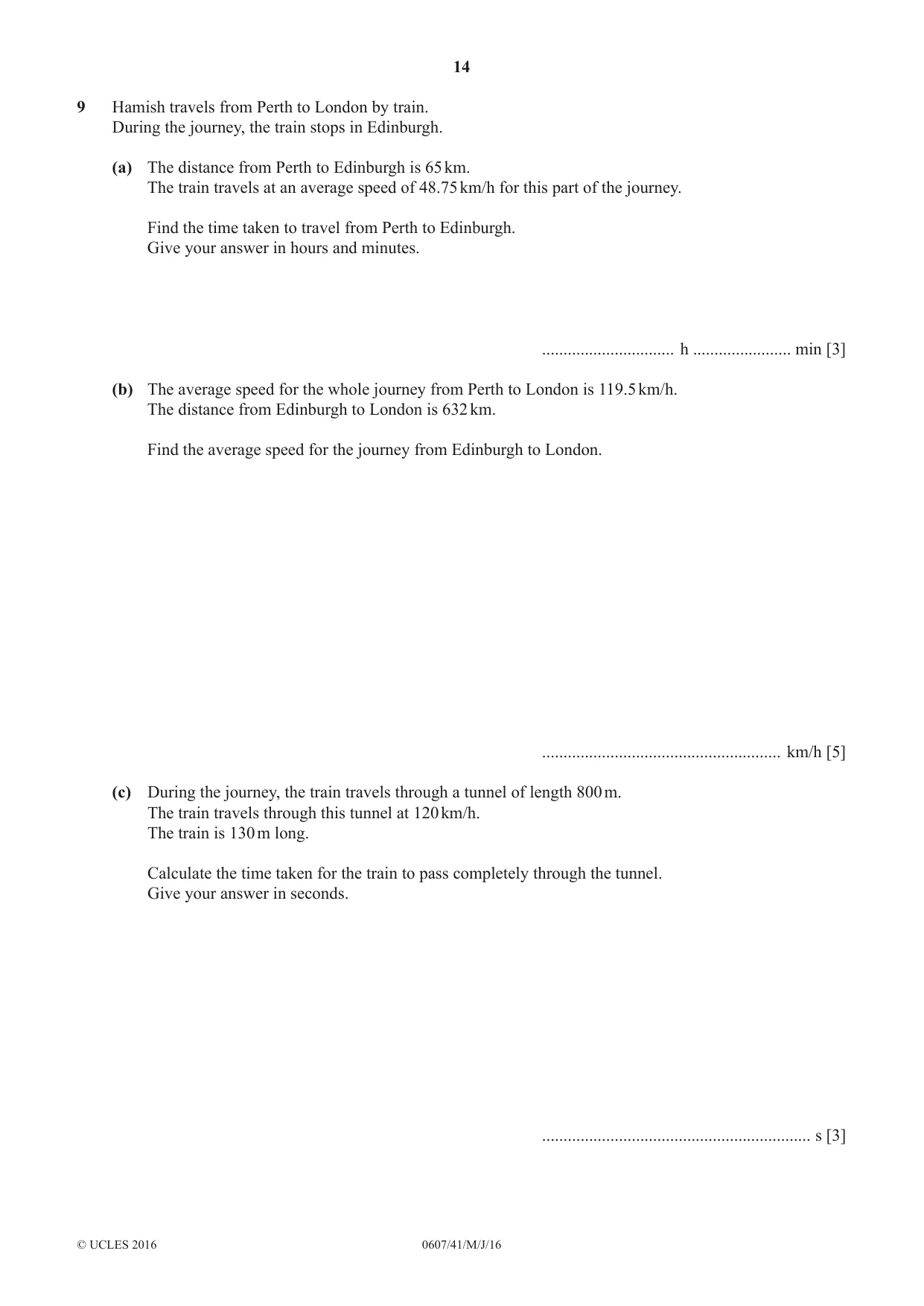
14 0607/41/M/J/16 © UCLES 2016 9 Hamish travels from Perth to London by train. During the journey, the train stops in Edinburgh. (a) The distance from Perth to Edinburgh is 65 km. The train travels at an average speed of 48.75 km/h for this part of the journey. Find the time taken to travel from Perth to Edinburgh. Give your answer in hours and minutes. … h … min [3] (b) The average speed for the whole journey from Perth to London is 119.5 km/h. The distance from Edinburgh to London is 632 km. Find the average speed for the journey from Edinburgh to London. … km/h [5] (c) During the journey, the train travels through a tunnel of length 800 m. The train travels through this tunnel at 120 km/h. The train is 130 m long. Calculate the time taken for the train to pass completely through the tunnel. Give your answer in seconds. … s [3]
Question paper, page 15
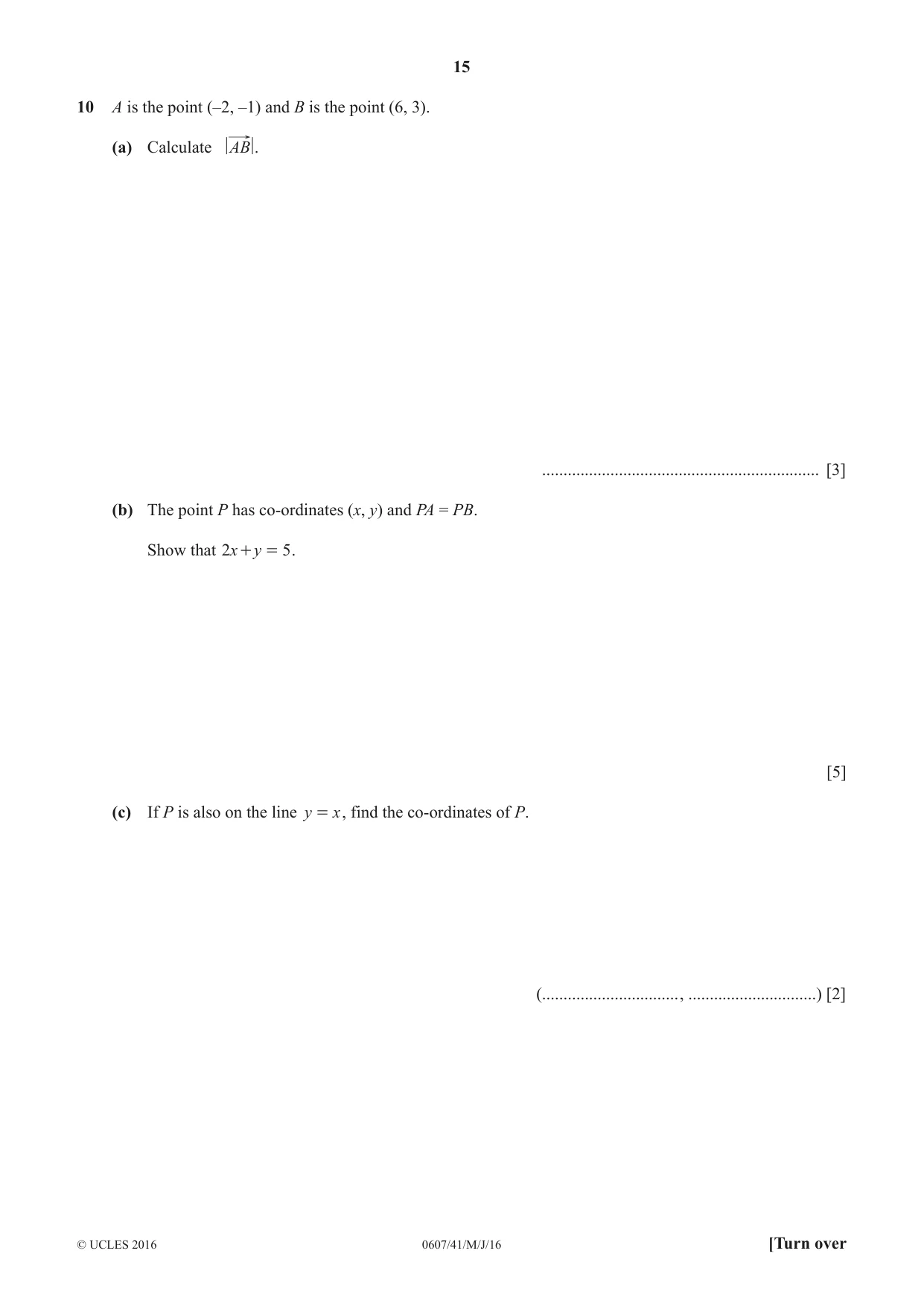
15 0607/41/M/J/16 © UCLES 2016 [Turn over 10 A is the point (–2, –1) and B is the point (6, 3). (a) Calculate AB . … [3] (b) The point P has co-ordinates (x, y) and PA = PB. Show that x y 2 5 + = . [5] (c) If P is also on the line y x = , find the co-ordinates of P. ( …, …) [2]
Question paper, page 16
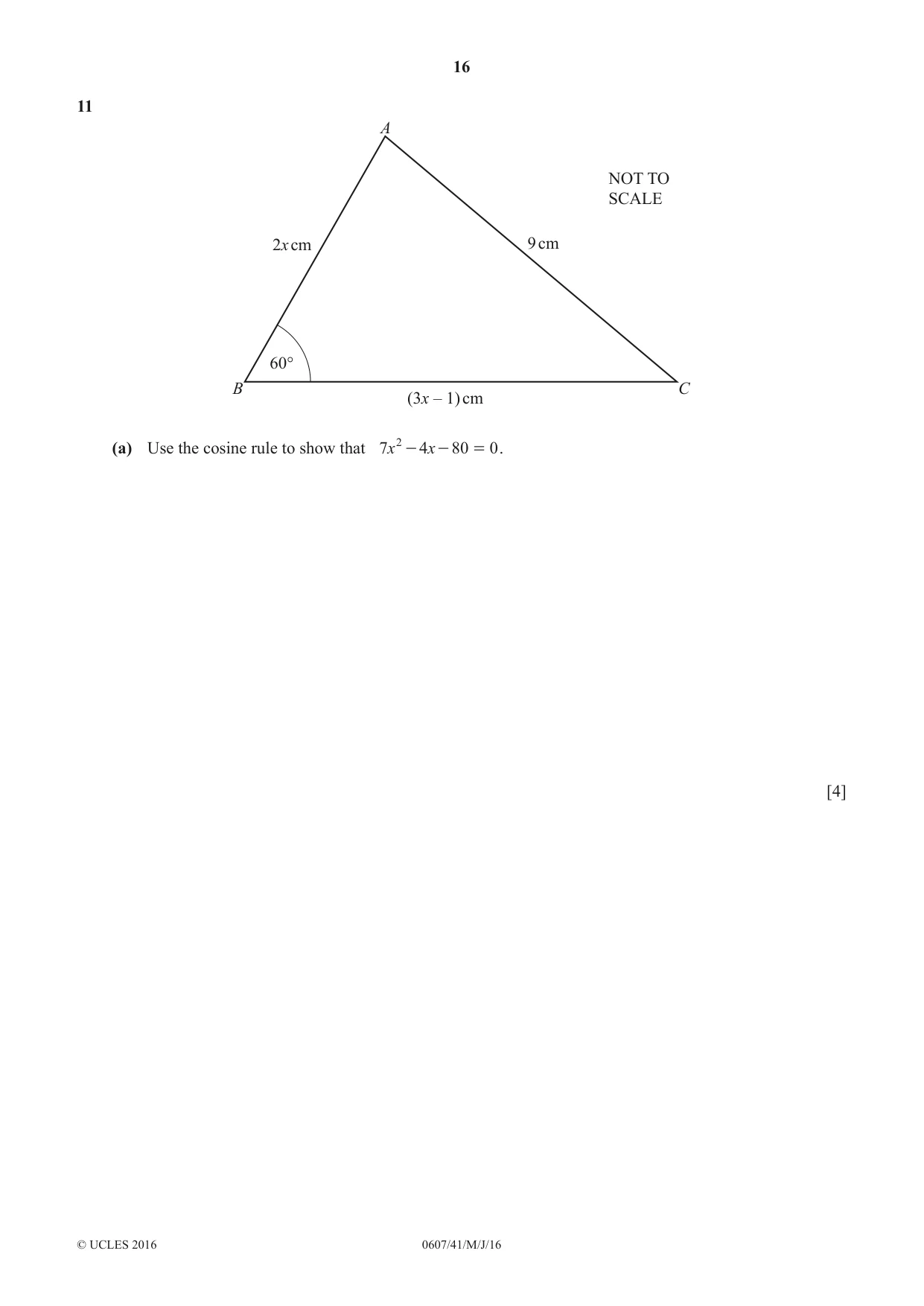
16 0607/41/M/J/16 © UCLES 2016 11 60° (3x – 1) cm 2x cm 9 cm A B C NOT TO SCALE (a) Use the cosine rule to show that x x 7 4 80 0 2 - - = . [4]
Question paper, page 17
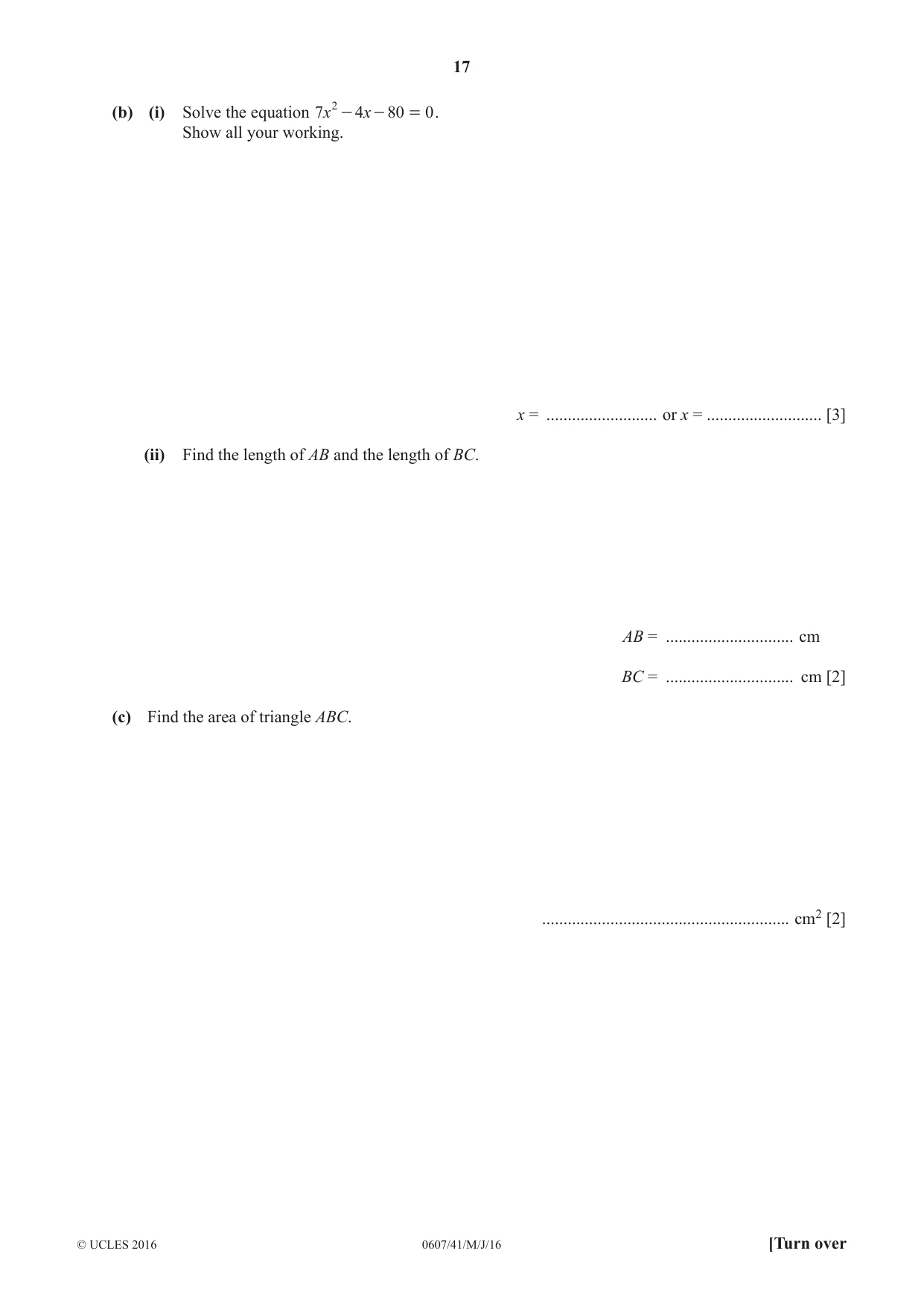
17 0607/41/M/J/16 © UCLES 2016 [Turn over (b) (i) Solve the equation x x 7 4 80 0 2 - - = . Show all your working. x = … or x = … [3] (ii) Find the length of AB and the length of BC. AB = … cm BC = … cm [2] (c) Find the area of triangle ABC. … cm2 [2]
Question paper, page 18
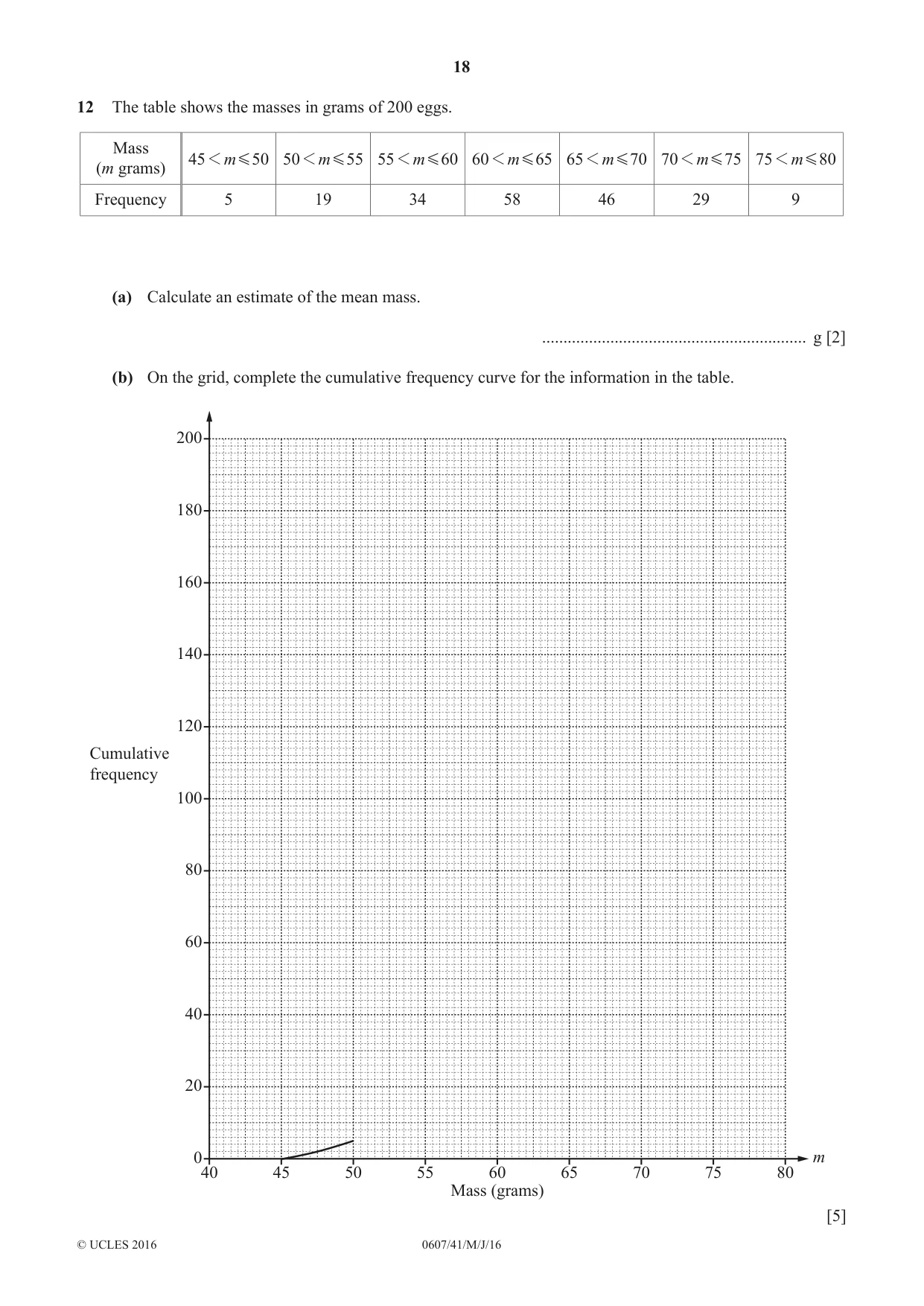
18 0607/41/M/J/16 © UCLES 2016 12 The table shows the masses in grams of 200 eggs. Mass (m grams) 45 1 m G 50 50 1 m G 55 55 1 m G 60 60 1 m G 65 65 1 m G 70 70 1 m G 75 75 1 m G 80 Frequency 5 19 34 58 46 29 9 (a) Calculate an estimate of the mean mass. … g [2] (b) On the grid, complete the cumulative frequency curve for the information in the table. 200 180 160 140 120 100 80 60 40 20 0 Cumulative frequency Mass (grams) 40 45 50 55 60 65 70 75 80 m [5]
Question paper, page 19
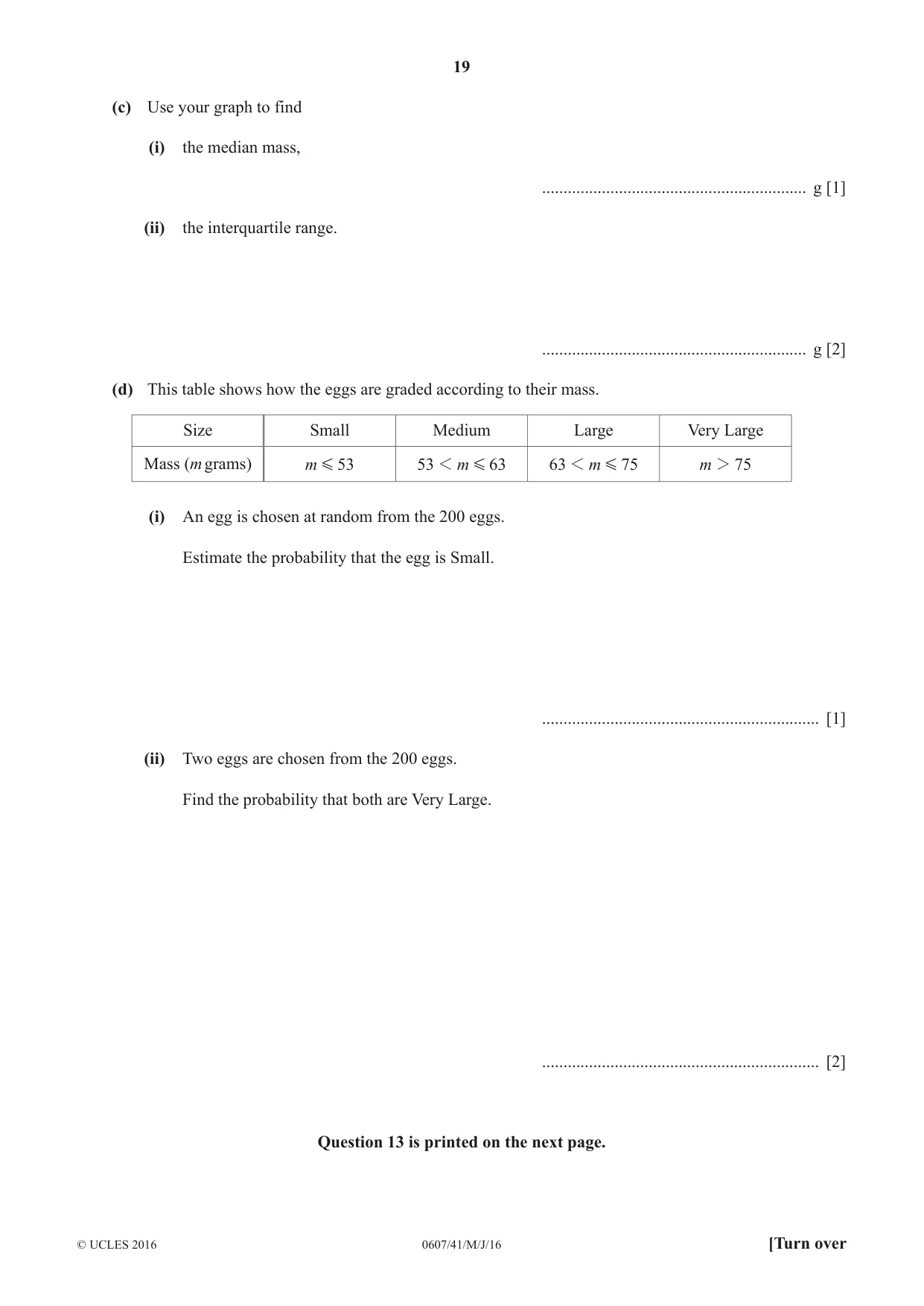
19 0607/41/M/J/16 © UCLES 2016 [Turn over (c) Use your graph to find (i) the median mass, … g [1] (ii) the interquartile range. … g [2] (d) This table shows how the eggs are graded according to their mass. Size Small Medium Large Very Large Mass (m grams) m G 53 53 1 m G 63 63 1 m G 75 m 2 75 (i) An egg is chosen at random from the 200 eggs. Estimate the probability that the egg is Small. … [1] (ii) Two eggs are chosen from the 200 eggs. Find the probability that both are Very Large. … [2] Question 13 is printed on the next page.
Question paper, page 20
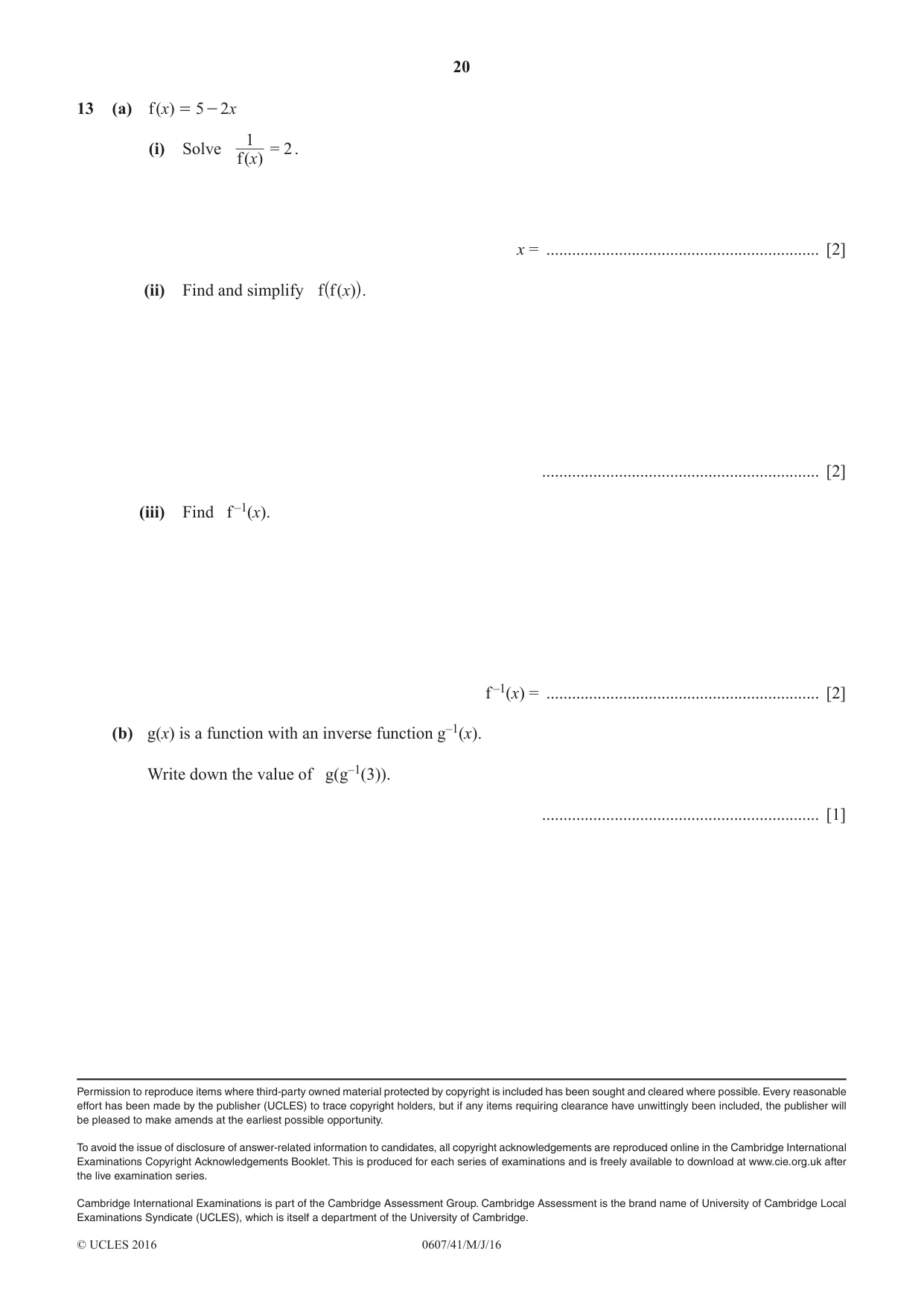
20 0607/41/M/J/16 © UCLES 2016 Permission to reproduce items where third-party owned material protected by copyright is included has been sought and cleared where possible. Every reasonable effort has been made by the publisher (UCLES) to trace copyright holders, but if any items requiring clearance have unwittingly been included, the publisher will be pleased to make amends at the earliest possible opportunity. To avoid the issue of disclosure of answer-related information to candidates, all copyright acknowledgements are reproduced online in the Cambridge International Examinations Copyright Acknowledgements Booklet. This is produced for each series of examinations and is freely available to download at www.cie.org.uk after the live examination series. Cambridge International Examinations is part of the Cambridge Assessment Group. Cambridge Assessment is the brand name of University of Cambridge Local Examinations Syndicate (UCLES), which is itself a department of the University of Cambridge. 13 (a) f( )x x 5 2 = - (i) Solve f( )x 1 = 2 . x = … [2] (ii) Find and simplify f f( )x ^ h. … [2] (iii) Find f –1(x). f –1(x) = … [2] (b) g(x) is a function with an inverse function g–1(x). Write down the value of g(g–1(3)). … [1]
Mark scheme, page 1
® IGCSE is the registered trademark of Cambridge International Examinations. This document consists of 6 printed pages. © UCLES 2016 [Turn over Cambridge International Examinations Cambridge International General Certificate of Secondary Education CAMBRIDGE INTERNATIONAL MATHEMATICS 0607/41 Paper 4 (Extended) May/June 2016 MARK SCHEME Maximum Mark: 120 Published This mark scheme is published as an aid to teachers and candidates, to indicate the requirements of the examination. It shows the basis on which Examiners were instructed to award marks. It does not indicate the details of the discussions that took place at an Examiners’ meeting before marking began, which would have considered the acceptability of alternative answers. Mark schemes should be read in conjunction with the question paper and the Principal Examiner Report for Teachers. Cambridge will not enter into discussions about these mark schemes. Cambridge is publishing the mark schemes for the May/June 2016 series for most Cambridge IGCSE®, Cambridge International A and AS Level components and some Cambridge O Level components.
Mark scheme, page 2
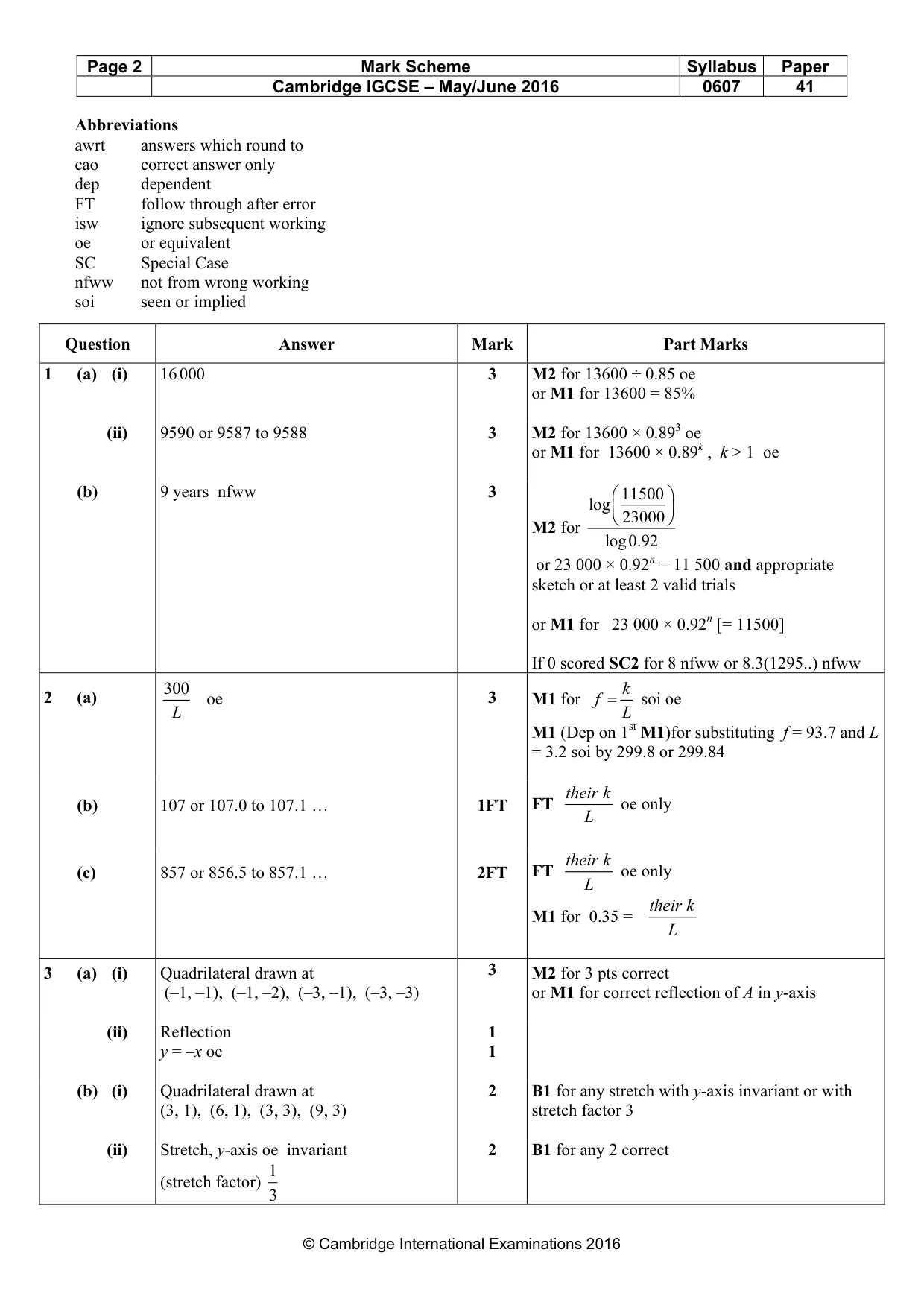
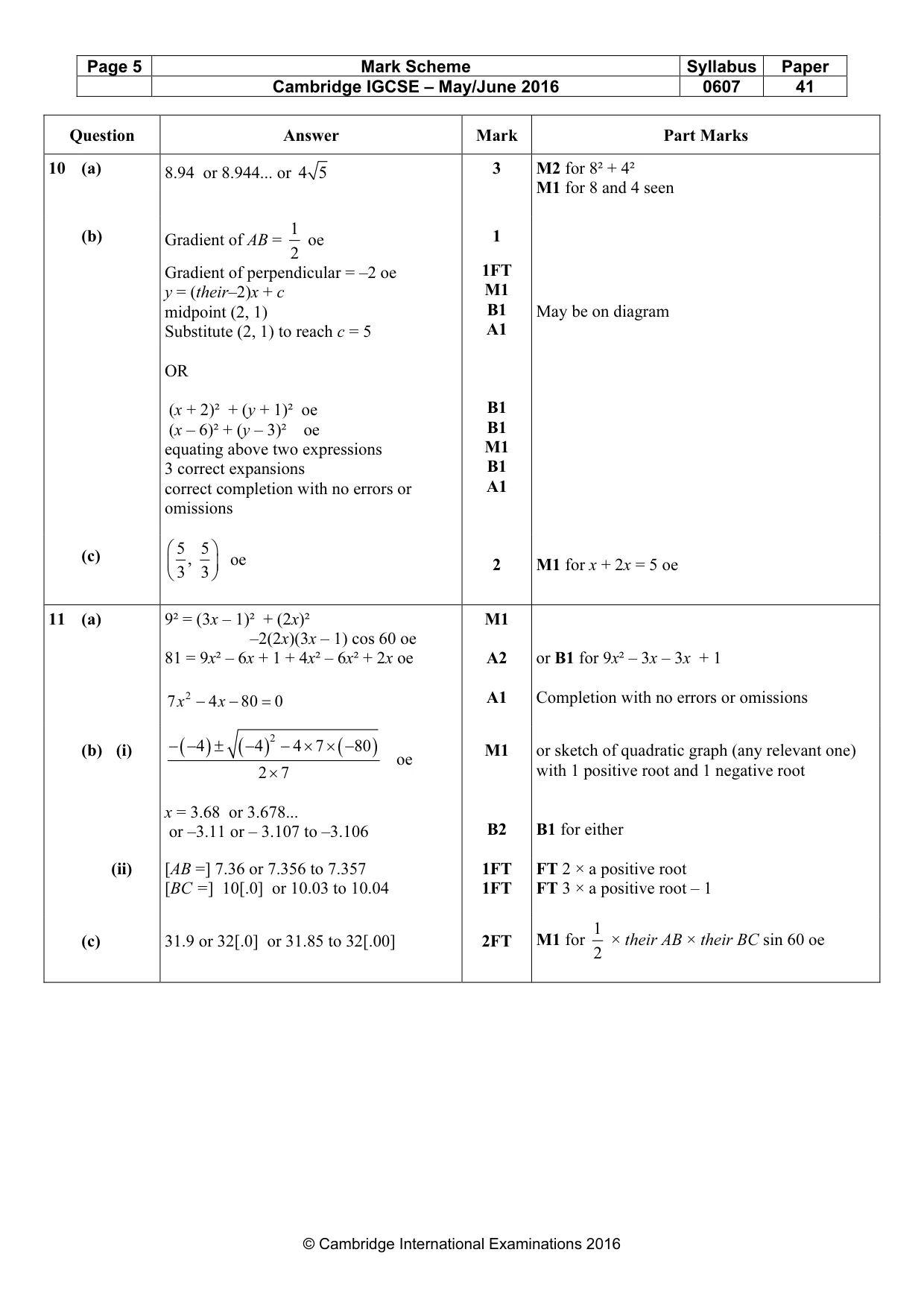
Page 2 Mark Scheme Syllabus Paper Cambridge IGCSE – May/June 2016 0607 41 © Cambridge International Examinations 2016 Abbreviations awrt answers which round to cao correct answer only dep dependent FT follow through after error isw ignore subsequent working oe or equivalent SC Special Case nfww not from wrong working soi seen or implied Question Answer Mark Part Marks 1 (a) (i) 16 000 3 M2 for 13600 ÷ 0.85 oe or M1 for 13600 = 85% (ii) 9590 or 9587 to 9588 3 M2 for 13600 × 0.893 oe or M1 for 13600 × 0.89k , k > 1 oe (b) 9 years nfww 3 M2 for 11500 log 23000 log0.92 or 23 000 × 0.92n = 11 500 and appropriate sketch or at least 2 valid trials or M1 for 23 000 × 0.92n [= 11500] If 0 scored SC2 for 8 nfww or 8.3(1295..) nfww 2 (a) 300 oe L 3 M1 for k f L = soi oe M1 (Dep on 1st M1)for substituting f = 93.7 and L = 3.2 soi by 299.8 or 299.84 (b) 107 or 107.0 to 107.1 … 1FT FT their k L oe only (c) 857 or 856.5 to 857.1 … 2FT FT their k L oe only M1 for 0.35 = their k L 3 (a) (i) Quadrilateral drawn at (–1, –1), (–1, –2), (–3, –1), (–3, –3) 3 M2 for 3 pts correct or M1 for correct reflection of A in y-axis (ii) Reflection y = –x oe 1 1 (b) (i) Quadrilateral drawn at (3, 1), (6, 1), (3, 3), (9, 3) 2 B1 for any stretch with y-axis invariant or with stretch factor 3 (ii) Stretch, y-axis oe invariant (stretch factor) 1 3 2 B1 for any 2 correct
Mark scheme, page 3
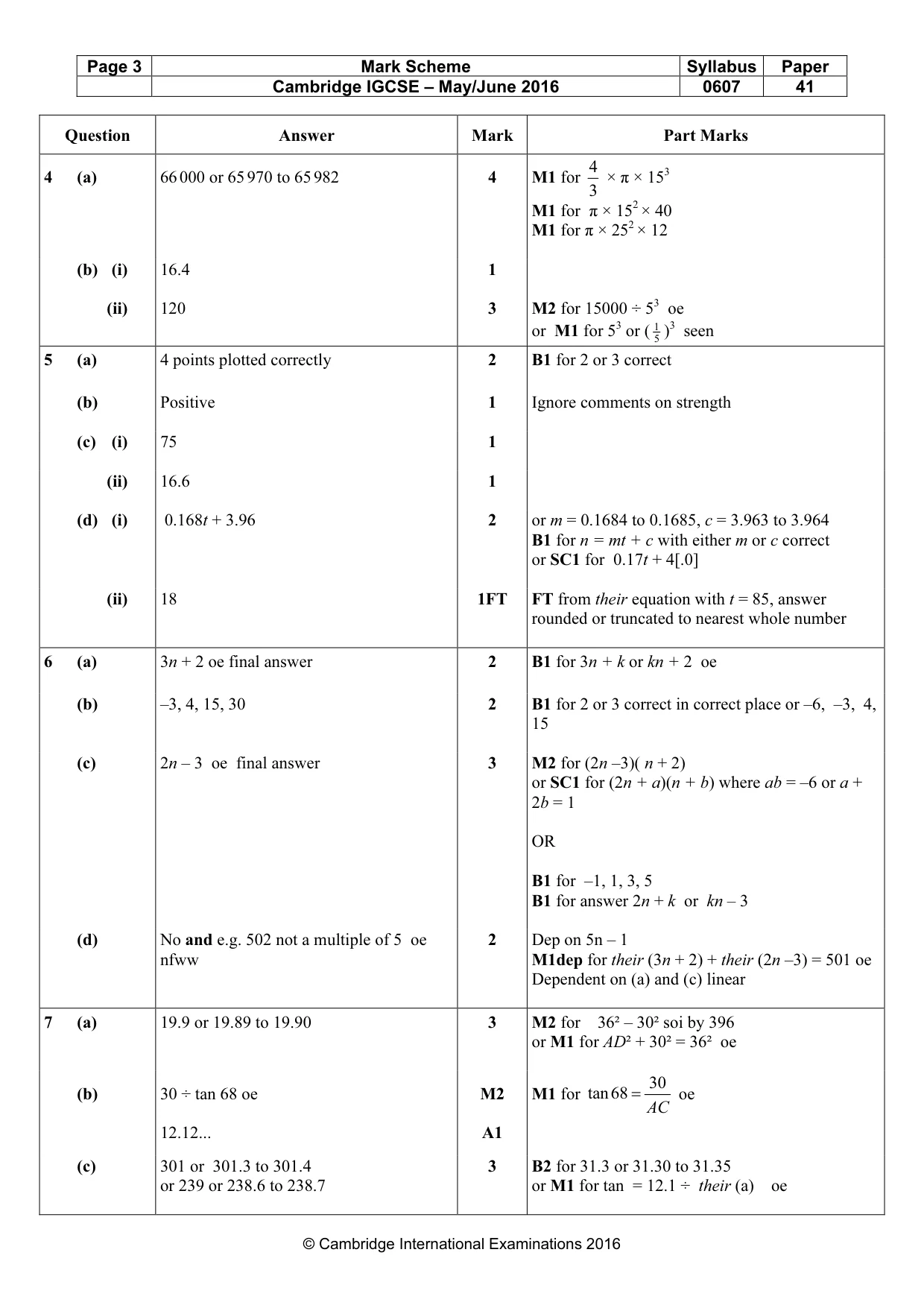
Page 3 Mark Scheme Syllabus Paper Cambridge IGCSE – May/June 2016 0607 41 © Cambridge International Examinations 2016 Question Answer Mark Part Marks 4 (a) 66 000 or 65 970 to 65 982 4 M1 for 4 3 × π × 153 M1 for π × 152 × 40 M1 for π × 252 × 12 (b) (i) 16.4 1 (ii) 120 3 M2 for 15000 ÷ 53 oe or M1 for 53 or ( 1 5 )3 seen 5 (a) 4 points plotted correctly 2 B1 for 2 or 3 correct (b) Positive 1 Ignore comments on strength (c) (i) 75 1 (ii) 16.6 1 (d) (i) 0.168t + 3.96 2 or m = 0.1684 to 0.1685, c = 3.963 to 3.964 B1 for n = mt + c with either m or c correct or SC1 for 0.17t + 4[.0] (ii) 18 1FT FT from their equation with t = 85, answer rounded or truncated to nearest whole number 6 (a) 3n + 2 oe final answer 2 B1 for 3n + k or kn + 2 oe (b) –3, 4, 15, 30 2 B1 for 2 or 3 correct in correct place or –6, –3, 4, 15 (c) 2n – 3 oe final answer 3 M2 for (2n –3)( n + 2) or SC1 for (2n + a)(n + b) where ab = –6 or a + 2b = 1 OR B1 for –1, 1, 3, 5 B1 for answer 2n + k or kn – 3 (d) No and e.g. 502 not a multiple of 5 oe nfww 2 Dep on 5n – 1 M1dep for their (3n + 2) + their (2n –3) = 501 oe Dependent on (a) and (c) linear 7 (a) 19.9 or 19.89 to 19.90 3 M2 for 36² – 30² soi by 396 or M1 for AD² + 30² = 36² oe (b) 30 ÷ tan 68 oe 12.12... M2 A1 M1 for 30 tan68 AC = oe (c) 301 or 301.3 to 301.4 or 239 or 238.6 to 238.7 3 B2 for 31.3 or 31.30 to 31.35 or M1 for tan = 12.1 ÷ their (a) oe
Mark scheme, page 4
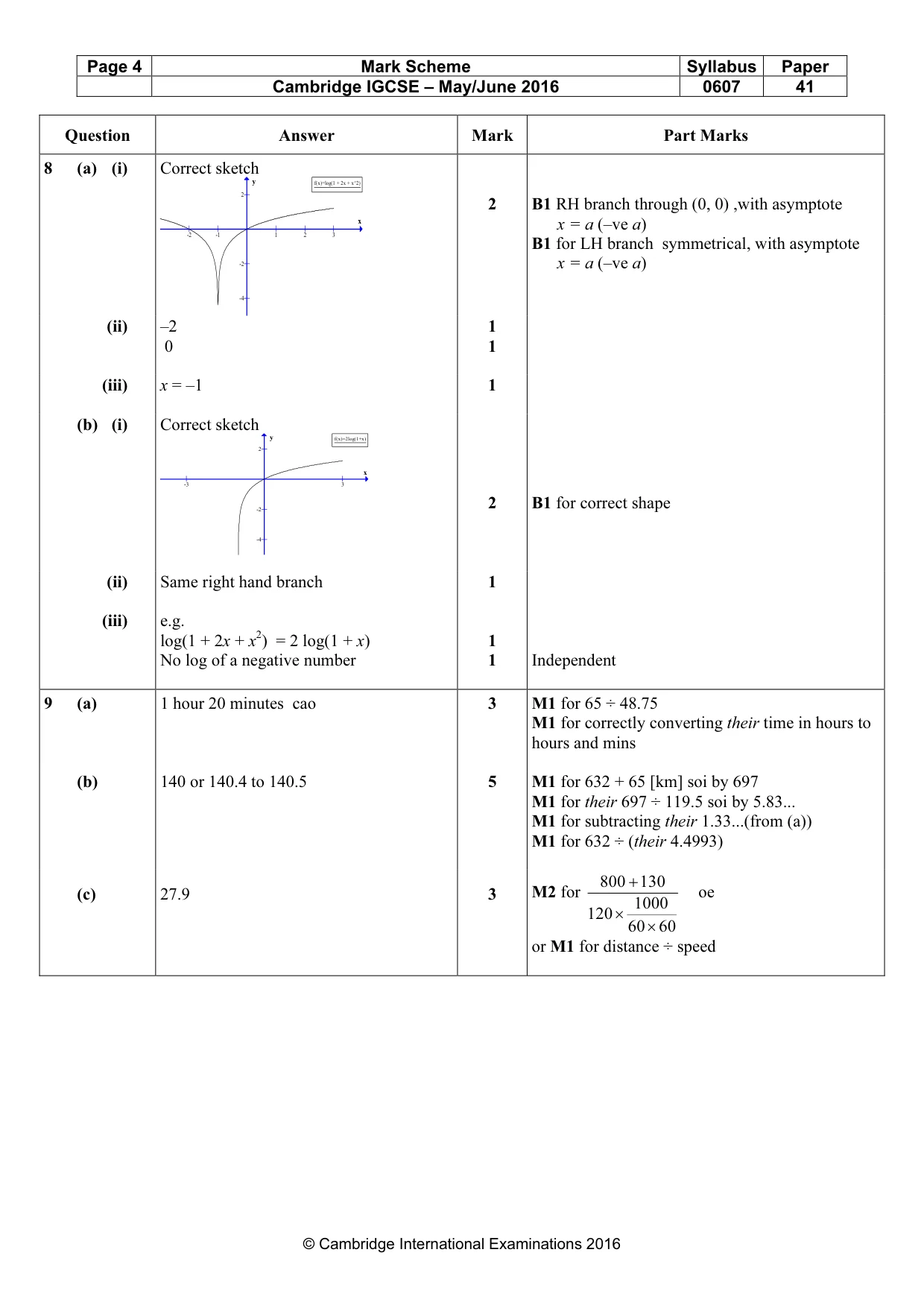
Page 4 Mark Scheme Syllabus Paper Cambridge IGCSE – May/June 2016 0607 41 © Cambridge International Examinations 2016 Question Answer Mark Part Marks 8 (a) (i) Correct sketch f(x)=log(1 + 2x + x^2) -2 -1 1 2 3 -4 -2 2 x y 2 B1 RH branch through (0, 0) ,with asymptote x = a (–ve a) B1 for LH branch symmetrical, with asymptote x = a (–ve a) (ii) –2 0 1 1 (iii) x = –1 1 (b) (i) Correct sketch f(x)=2log(1+x) -3 3 -4 -2 2 x y 2 B1 for correct shape (ii) Same right hand branch 1 (iii) e.g. log(1 + 2x + x2) = 2 log(1 + x) No log of a negative number 1 1 Independent 9 (a) 1 hour 20 minutes cao 3 M1 for 65 ÷ 48.75 M1 for correctly converting their time in hours to hours and mins (b) 140 or 140.4 to 140.5 5 M1 for 632 + 65 [km] soi by 697 M1 for their 697 ÷ 119.5 soi by 5.83... M1 for subtracting their 1.33...(from (a)) M1 for 632 ÷ (their 4.4993) (c) 27.9 3 M2 for 800 130 1000 120 60 60 + × × oe or M1 for distance ÷ speed
Mark scheme, page 5
Page 5 Mark Scheme Syllabus Paper Cambridge IGCSE – May/June 2016 0607 41 © Cambridge International Examinations 2016 Question Answer Mark Part Marks 10 (a) 8.94 or 8.944... or 4 5 3 M2 for 8² + 4² M1 for 8 and 4 seen (b) Gradient of AB = 1 2 oe Gradient of perpendicular = –2 oe y = (their–2)x + c midpoint (2, 1) Substitute (2, 1) to reach c = 5 OR (x + 2)² + (y + 1)² oe (x – 6)² + (y – 3)² oe equating above two expressions 3 correct expansions correct completion with no errors or omissions 1 1FT M1 B1 A1 B1 B1 M1 B1 A1 May be on diagram (c) 5 5 , 3 3 oe 2 M1 for x + 2x = 5 oe 11 (a) 9² = (3x – 1)² + (2x)² –2(2x)(3x – 1) cos 60 oe 81 = 9x² – 6x + 1 + 4x² – 6x² + 2x oe 2 7 4 80 0 x x − − = M1 A2 A1 or B1 for 9x² – 3x – 3x + 1 Completion with no errors or omissions (b) (i) ( ) ( ) ( ) 2 4 4 4 7 80 oe 2 7 −− ± − − × × − × x = 3.68 or 3.678... or –3.11 or – 3.107 to –3.106 M1 B2 or sketch of quadratic graph (any relevant one) with 1 positive root and 1 negative root B1 for either (ii) [AB =] 7.36 or 7.356 to 7.357 [BC =] 10[.0] or 10.03 to 10.04 1FT 1FT FT 2 × a positive root FT 3 × a positive root – 1 (c) 31.9 or 32[.0] or 31.85 to 32[.00] 2FT M1 for 1 2 × their AB × their BC sin 60 oe
Mark scheme, page 6
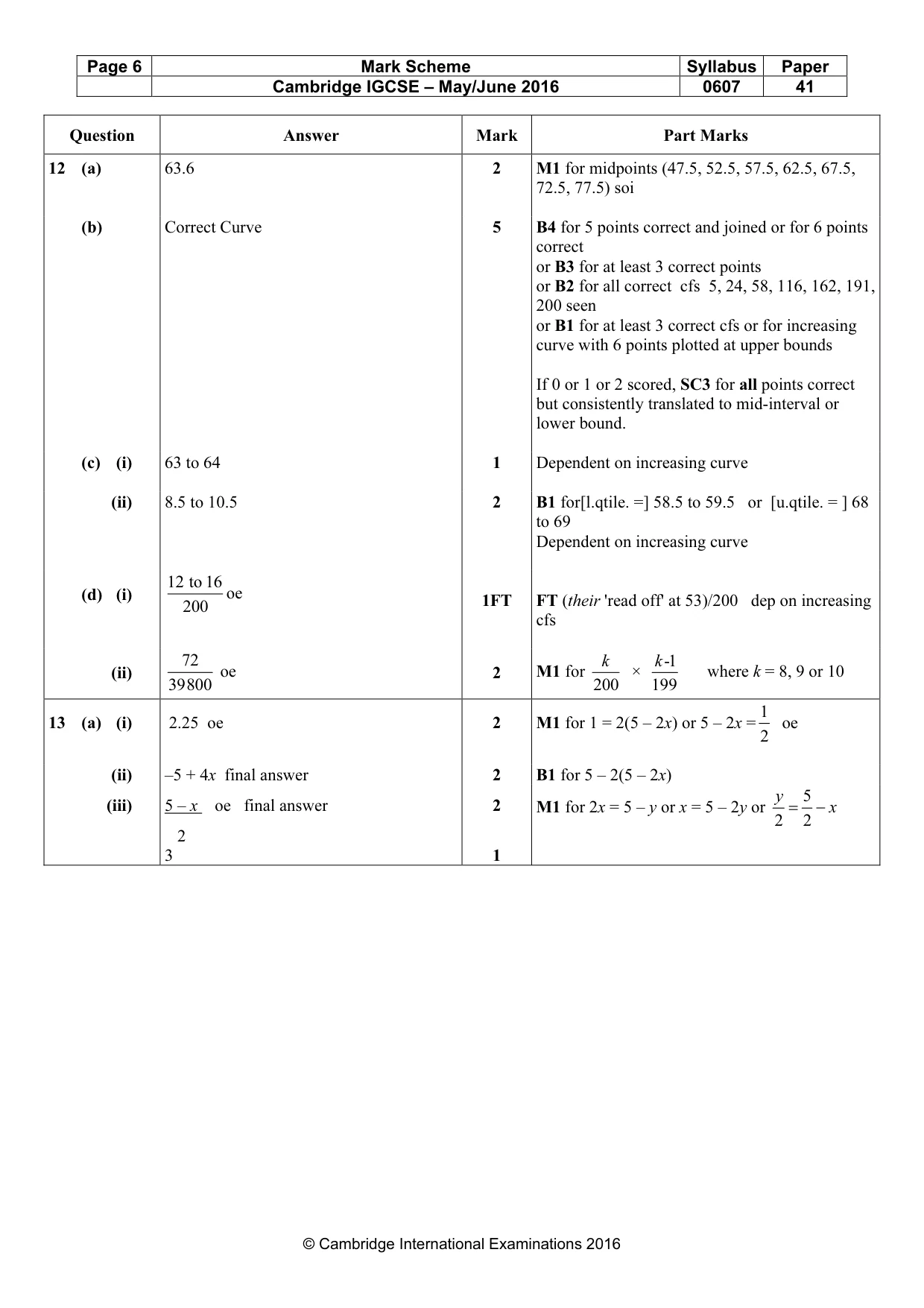
Page 6 Mark Scheme Syllabus Paper Cambridge IGCSE – May/June 2016 0607 41 © Cambridge International Examinations 2016 Question Answer Mark Part Marks 12 (a) 63.6 2 M1 for midpoints (47.5, 52.5, 57.5, 62.5, 67.5, 72.5, 77.5) soi (b) Correct Curve 5 B4 for 5 points correct and joined or for 6 points correct or B3 for at least 3 correct points or B2 for all correct cfs 5, 24, 58, 116, 162, 191, 200 seen or B1 for at least 3 correct cfs or for increasing curve with 6 points plotted at upper bounds If 0 or 1 or 2 scored, SC3 for all points correct but consistently translated to mid-interval or lower bound. (c) (i) 63 to 64 1 Dependent on increasing curve (ii) 8.5 to 10.5 2 B1 for[l.qtile. =] 58.5 to 59.5 or [u.qtile. = ] 68 to 69 Dependent on increasing curve (d) (i) 12 to 16 200 oe 1FT FT (their 'read off' at 53)/200 dep on increasing cfs (ii) 72 39800 oe 2 M1 for 200 k × -1 199 k where k = 8, 9 or 10 13 (a) (i) 2.25 oe 2 M1 for 1 = 2(5 – 2x) or 5 – 2x = 1 2 oe (ii) –5 + 4x final answer 2 B1 for 5 – 2(5 – 2x) (iii) 5 – x oe final answer 2 2 M1 for 2x = 5 – y or x = 5 – 2y or 5 2 2 y x = − 3 1
What you needed in this session
Cambridge’s own grade thresholds for 2016 May/June, Paper 4 · Variant 1. A higher threshold means an easier paper — the bar moves with how the cohort did.