Cambridge IGCSE Mathematics - International 0607 — 2016 May/June Paper 4 · Variant 2
0607/42/M/J/16 · 120 marks · ≈135 min
The question paper and its mark scheme, free to read here and free to download. This is Cambridge’s own paper, exactly as it was sat.
Question paper16 pages

Mark scheme6 pages
Answers below. Sit the paper first if you are practising.
Paper as text
Question paper, page 1
This document consists of 16 printed pages. DC (LK/SG) 114972/2 © UCLES 2016 [Turn over * 7 2 9 5 4 0 4 1 0 1 * CAMBRIDGE INTERNATIONAL MATHEMATICS 0607/42 Paper 4 (Extended) May/June 2016 2 hours 15 minutes Candidates answer on the Question Paper. Additional Materials: Geometrical Instruments Graphics Calculator READ THESE INSTRUCTIONS FIRST Write your Centre number, candidate number and name on all the work you hand in. Write in dark blue or black pen. Do not use staples, paper clips, glue or correction fluid. You may use an HB pencil for any diagrams or graphs. DO NOT WRITE IN ANY BARCODES. Answer all the questions. Unless instructed otherwise, give your answers exactly or correct to three significant figures as appropriate. Answers in degrees should be given to one decimal place. For π, use your calculator value. You must show all the relevant working to gain full marks and you will be given marks for correct methods, including sketches, even if your answer is incorrect. The number of marks is given in brackets [ ] at the end of each question or part question. The total number of marks for this paper is 120. Cambridge International Examinations Cambridge International General Certificate of Secondary Education
Question paper, page 2
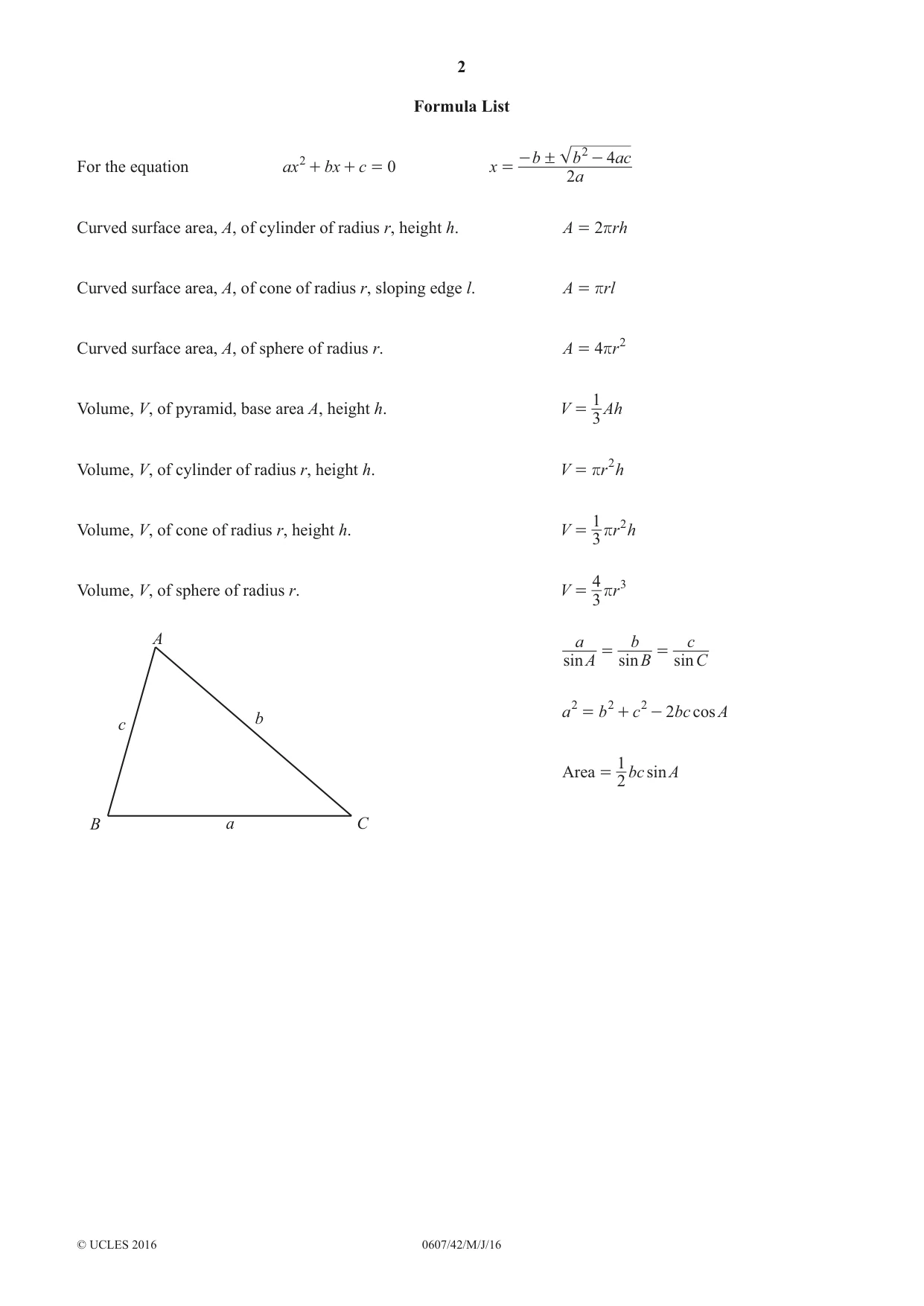
2 0607/42/M/J/16 © UCLES 2016 Formula List For the equation ax bx c 0 2 + + = x a b b ac 2 4 2 ! = - - Curved surface area, A, of cylinder of radius r, height h. r A rh 2 = Curved surface area, A, of cone of radius r, sloping edge l. r A rl = Curved surface area, A, of sphere of radius r. r A r 4 2 = Volume, V, of pyramid, base area A, height h. V Ah 3 1 = Volume, V, of cylinder of radius r, height h. r V r h 2 = Volume, V, of cone of radius r, height h. r V r h 3 1 2 = Volume, V, of sphere of radius r. r V r 3 4 3 = sin sin sin A a B b C c = = cos a b c bc A 2 2 2 2 = + - sin bc A 2 1 Area = A C B c b a
Question paper, page 3
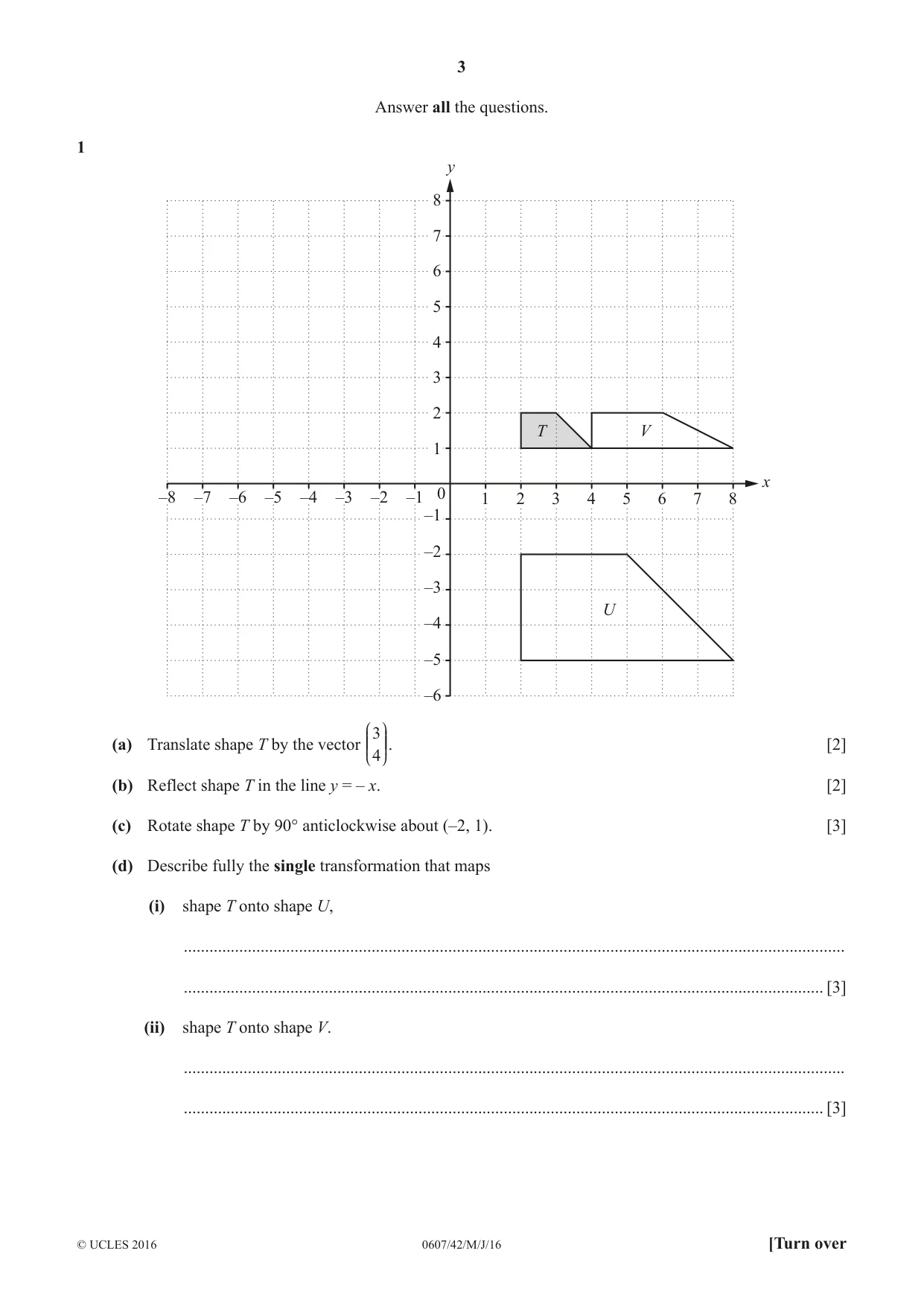
3 0607/42/M/J/16 © UCLES 2016 [Turn over Answer all the questions. 1 y x 8 7 6 5 4 3 2 1 0 –1 –2 –3 –4 –5 –6 –1 –2 –3 –4 –5 –6 –7 –8 8 7 6 5 4 3 2 1 T V U (a) Translate shape T by the vector 3 4 J L KK N P OO. [2] (b) Reflect shape T in the line y = – x. [2] (c) Rotate shape T by 90° anticlockwise about (–2, 1). [3] (d) Describe fully the single transformation that maps (i) shape T onto shape U, … … [3] (ii) shape T onto shape V. … … [3]
Question paper, page 4
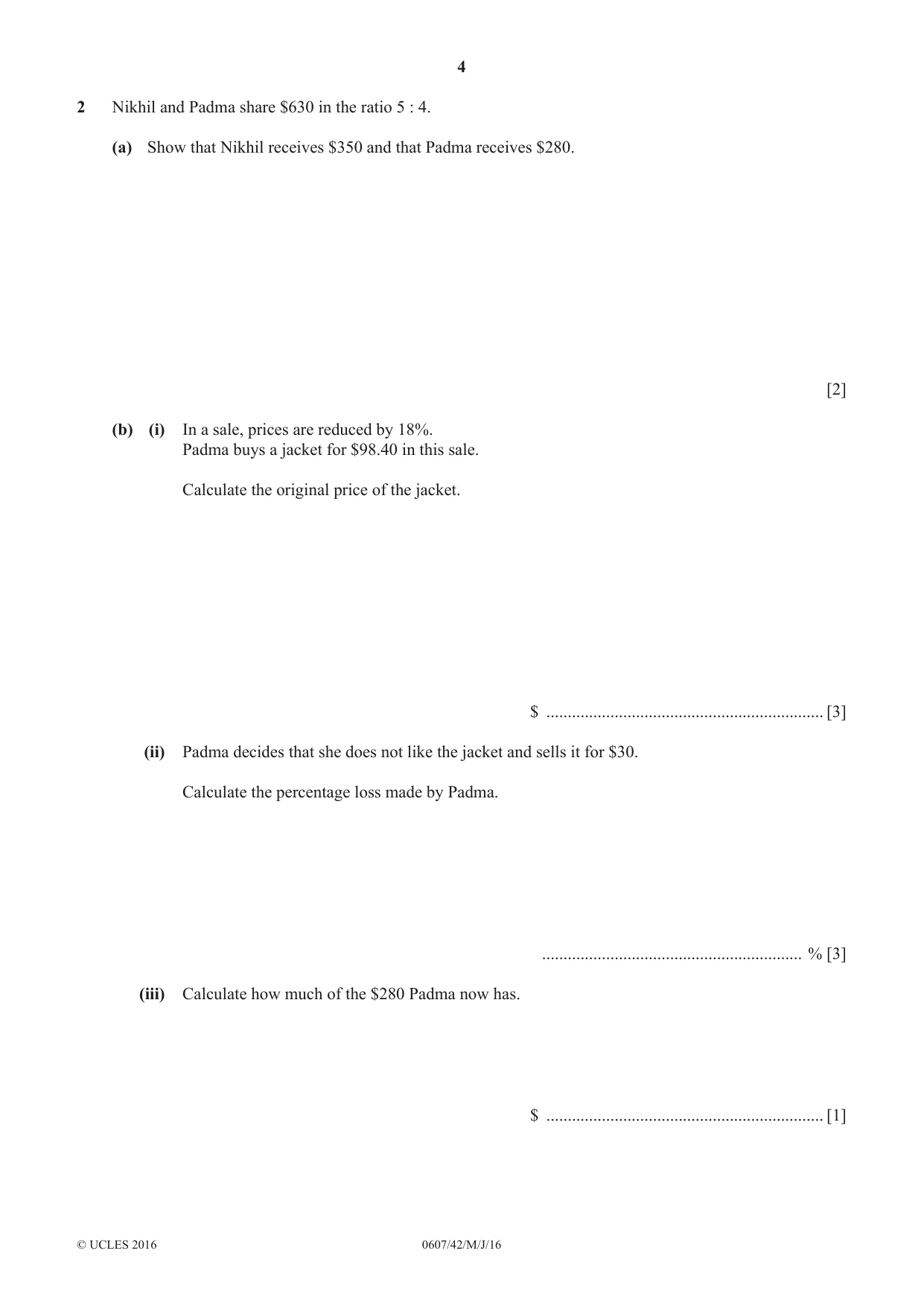
4 0607/42/M/J/16 © UCLES 2016 2 Nikhil and Padma share $630 in the ratio 5 : 4. (a) Show that Nikhil receives $350 and that Padma receives $280. [2] (b) (i) In a sale, prices are reduced by 18%. Padma buys a jacket for $98.40 in this sale. Calculate the original price of the jacket. $ … [3] (ii) Padma decides that she does not like the jacket and sells it for $30. Calculate the percentage loss made by Padma. … % [3] (iii) Calculate how much of the $280 Padma now has. $ … [1]
Question paper, page 5
5 0607/42/M/J/16 © UCLES 2016 [Turn over (iv) Padma invests $150 at a rate of 2% per year compound interest. Calculate the total value of this investment after 10 years. Give your answer correct to the nearest dollar. $ … [4] (c) On January 1st 2016, Nikhil invested all of his $350 at a rate of 0.15% per month compound interest. Find in which month and in which year Nikhil’s investment will first have a total value of at least $500. month … year … [5]
Question paper, page 6
6 0607/42/M/J/16 © UCLES 2016 3 (a) The cumulative frequency curve shows information about the average speeds of 200 cars on the same journey. 20 0 10 20 30 40 50 60 70 80 40 60 80 100 120 140 160 180 200 Cumulative frequency Average speed (km/h) (i) Find the median. … km/h [1] (ii) Find the inter-quartile range. … km/h [2] (iii) Find the number of cars with an average speed of more than 70 km/h. … [2] (b) A bus completes a journey in 2 h 24 min at an average speed of 50 km/h. A car completes the same journey in 1 h 45 min. Calculate the average speed of the car. … km/h [3]
Question paper, page 7
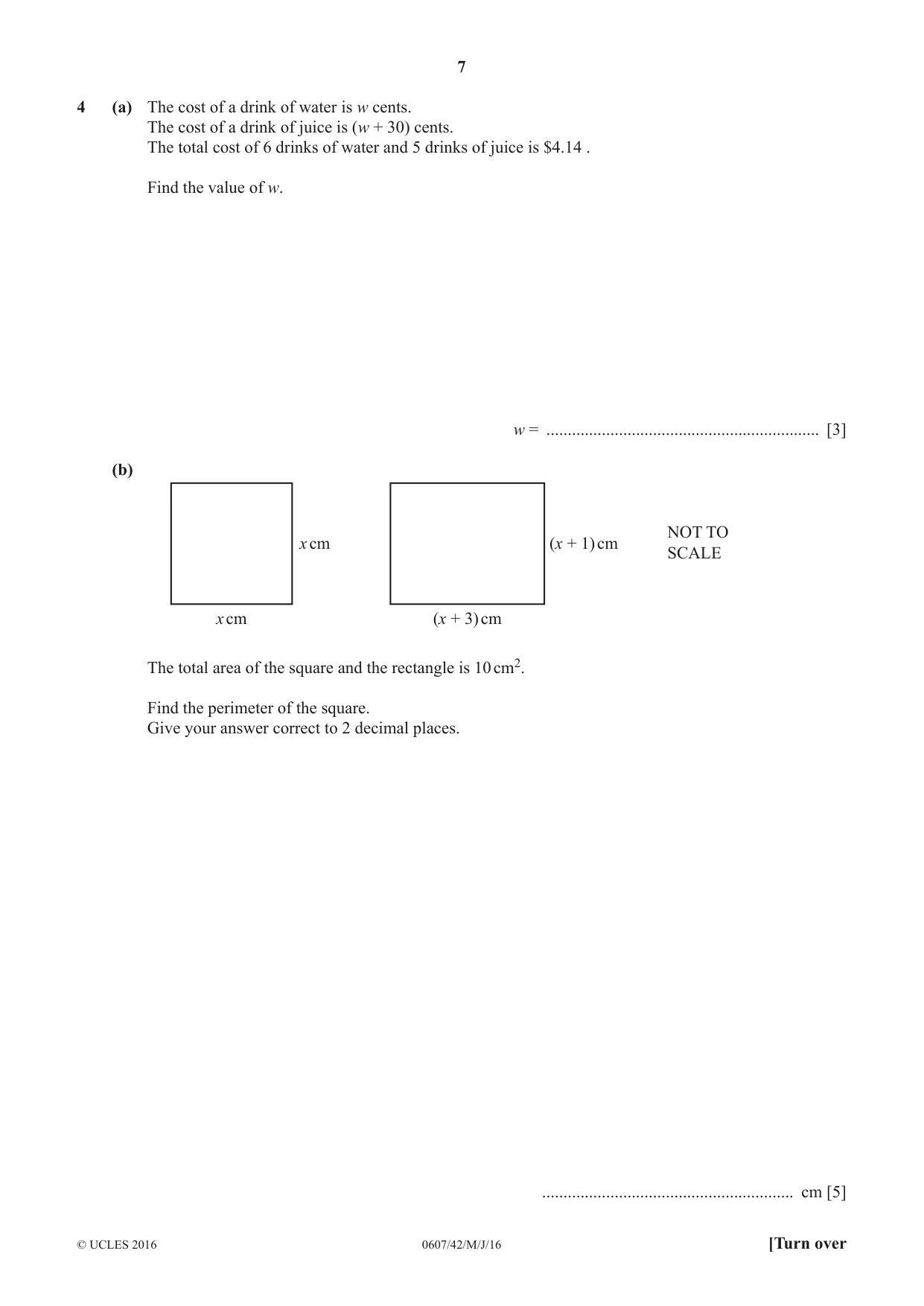
7 0607/42/M/J/16 © UCLES 2016 [Turn over 4 (a) The cost of a drink of water is w cents. The cost of a drink of juice is (w + 30) cents. The total cost of 6 drinks of water and 5 drinks of juice is $4.14 . Find the value of w. w = … [3] (b) x cm x cm (x + 3) cm (x + 1) cm NOT TO SCALE The total area of the square and the rectangle is 10 cm2. Find the perimeter of the square. Give your answer correct to 2 decimal places. … cm [5]
Question paper, page 8
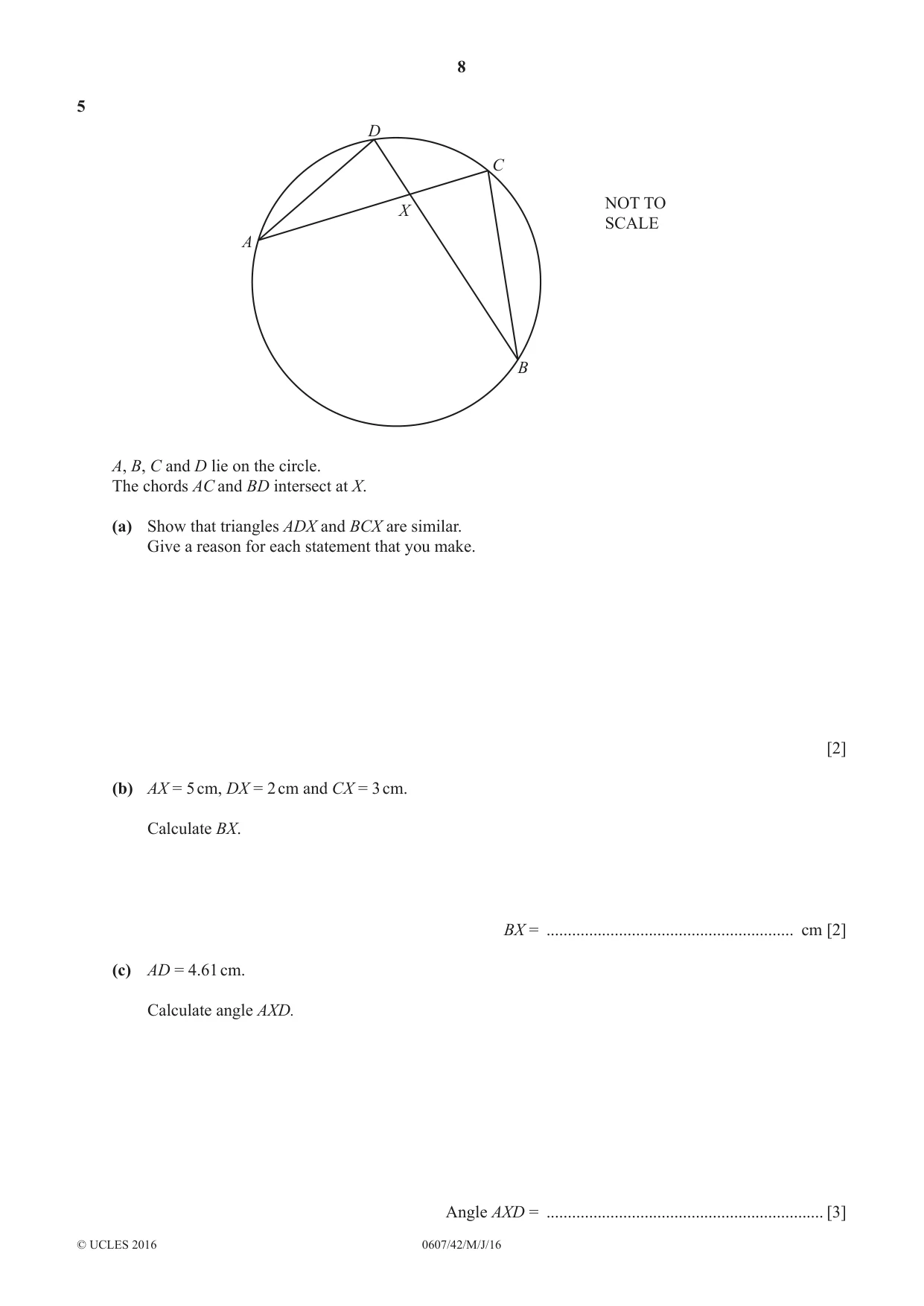
8 0607/42/M/J/16 © UCLES 2016 5 D X C B A NOT TO SCALE A, B, C and D lie on the circle. The chords AC and BD intersect at X. (a) Show that triangles ADX and BCX are similar. Give a reason for each statement that you make. [2] (b) AX = 5 cm, DX = 2 cm and CX = 3 cm. Calculate BX. BX = … cm [2] (c) AD = 4.61 cm. Calculate angle AXD. Angle AXD = … [3]
Question paper, page 9
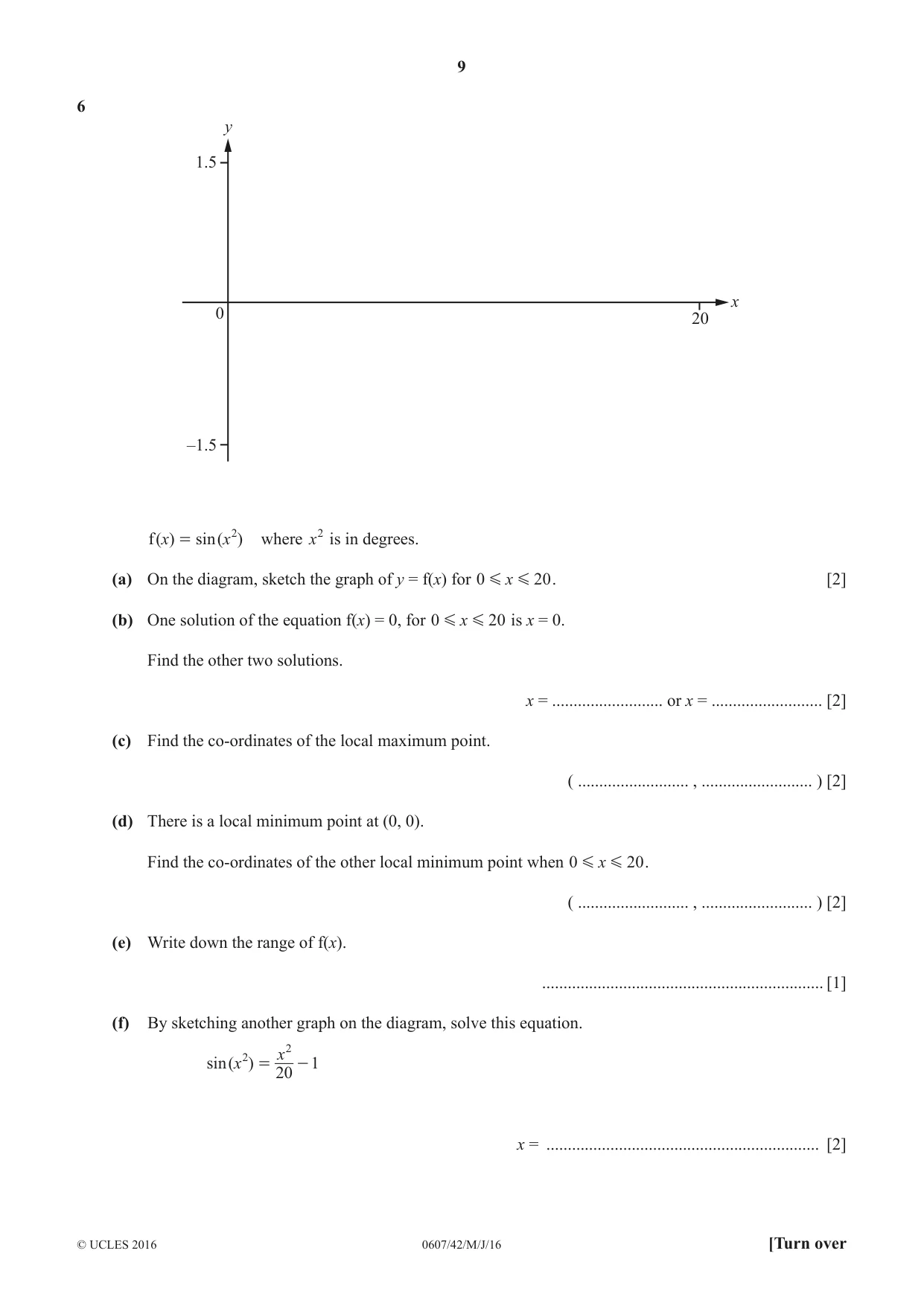
9 0607/42/M/J/16 © UCLES 2016 [Turn over 6 y x 20 1.5 0 –1.5 ( ) ( ) f sin x x2 = where x2 is in degrees. (a) On the diagram, sketch the graph of y = f(x) for x 0 20 G G . [2] (b) One solution of the equation f(x) = 0, for x 0 20 G G is x = 0. Find the other two solutions. x = … or x = … [2] (c) Find the co-ordinates of the local maximum point. ( … , … ) [2] (d) There is a local minimum point at (0, 0). Find the co-ordinates of the other local minimum point when x 0 20 G G . ( … , … ) [2] (e) Write down the range of f(x). … [1] (f) By sketching another graph on the diagram, solve this equation. ( ) sin x x 20 1 2 2 = - x = … [2]
Question paper, page 10
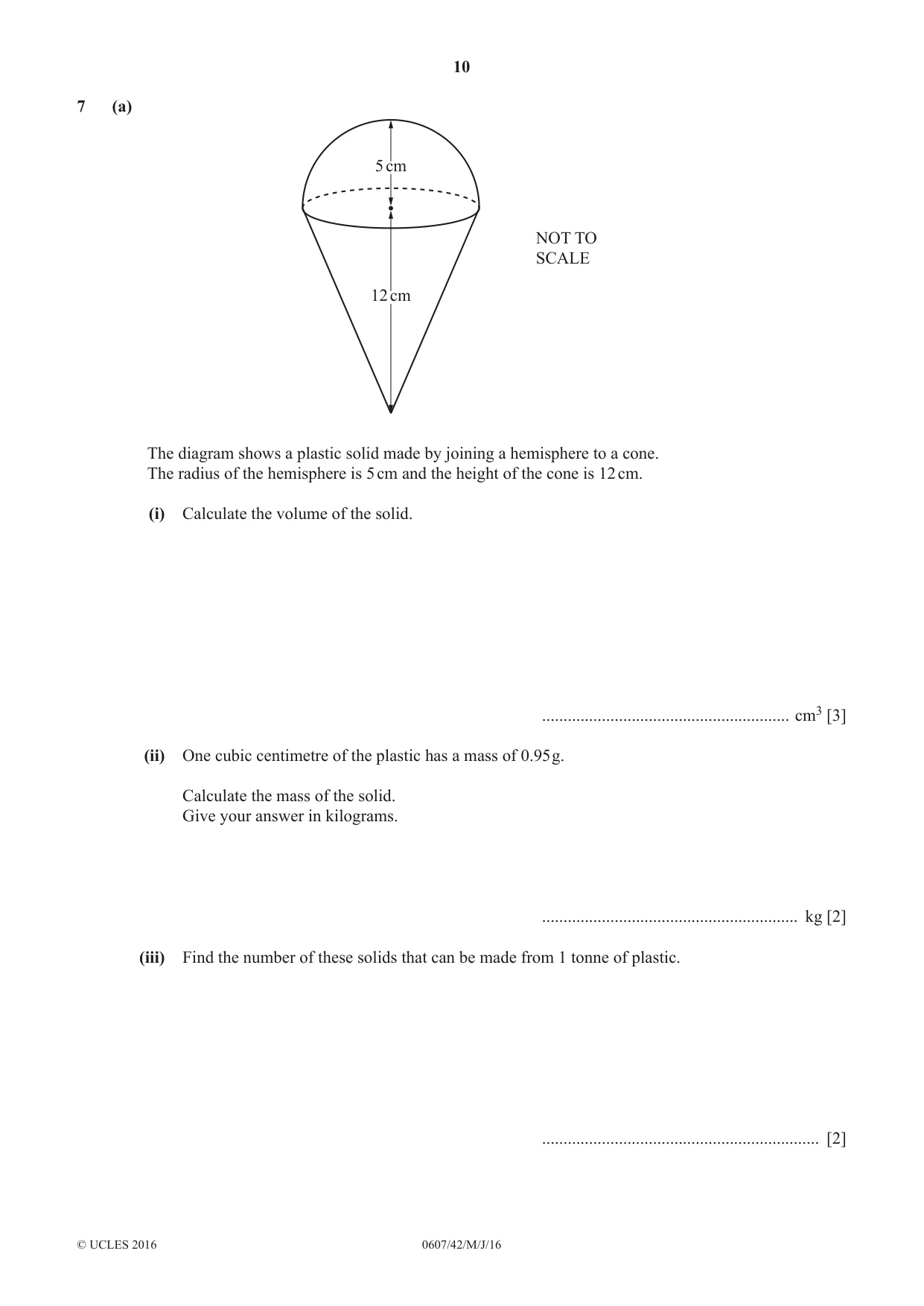
10 0607/42/M/J/16 © UCLES 2016 7 (a) 5 cm 12 cm NOT TO SCALE The diagram shows a plastic solid made by joining a hemisphere to a cone. The radius of the hemisphere is 5 cm and the height of the cone is 12 cm. (i) Calculate the volume of the solid. … cm3 [3] (ii) One cubic centimetre of the plastic has a mass of 0.95 g. Calculate the mass of the solid. Give your answer in kilograms. … kg [2] (iii) Find the number of these solids that can be made from 1 tonne of plastic. … [2]
Question paper, page 11
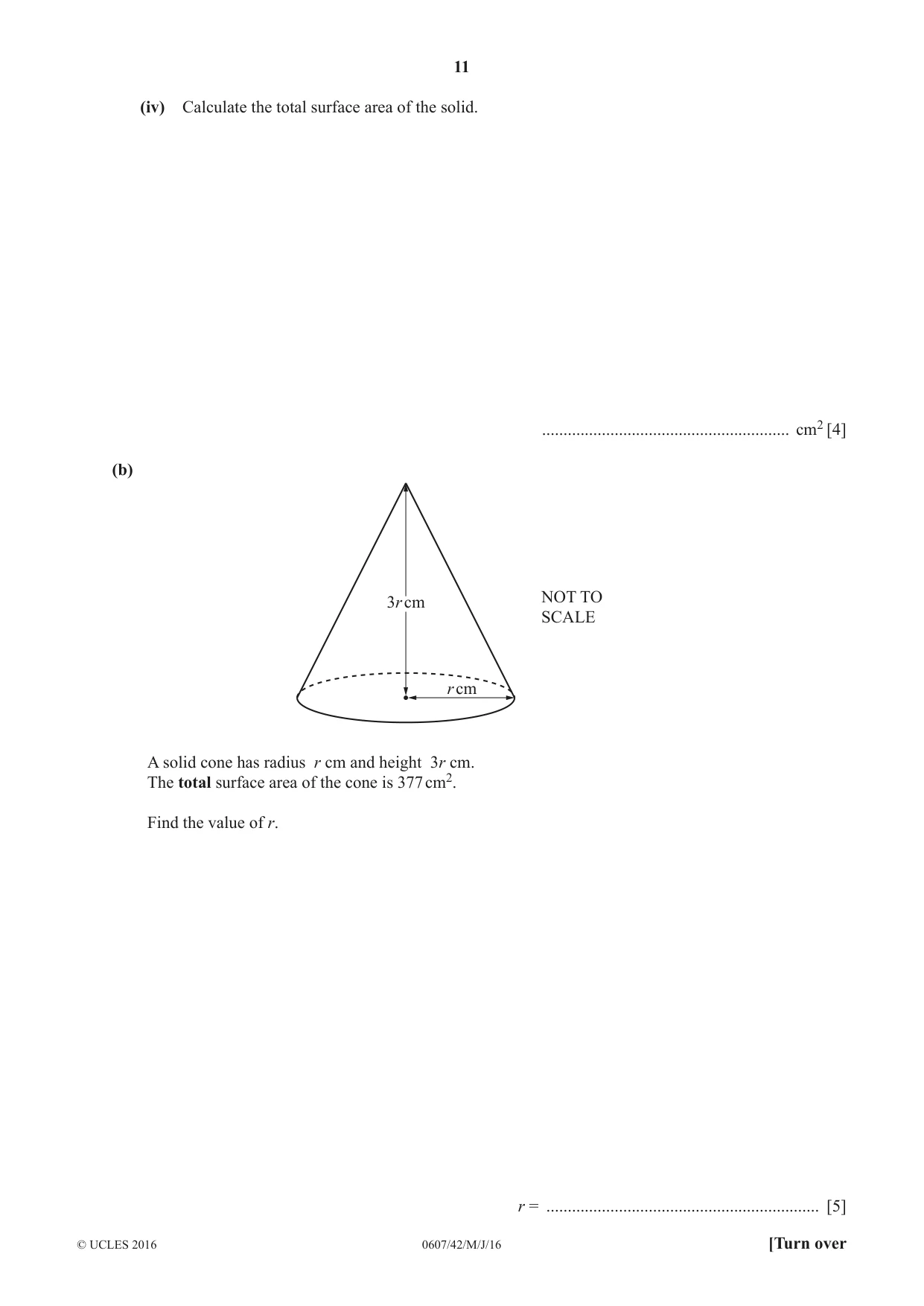
11 0607/42/M/J/16 © UCLES 2016 [Turn over (iv) Calculate the total surface area of the solid. … cm2 [4] (b) r cm 3r cm NOT TO SCALE A solid cone has radius r cm and height 3r cm. The total surface area of the cone is 377 cm2. Find the value of r. r = … [5]
Question paper, page 12
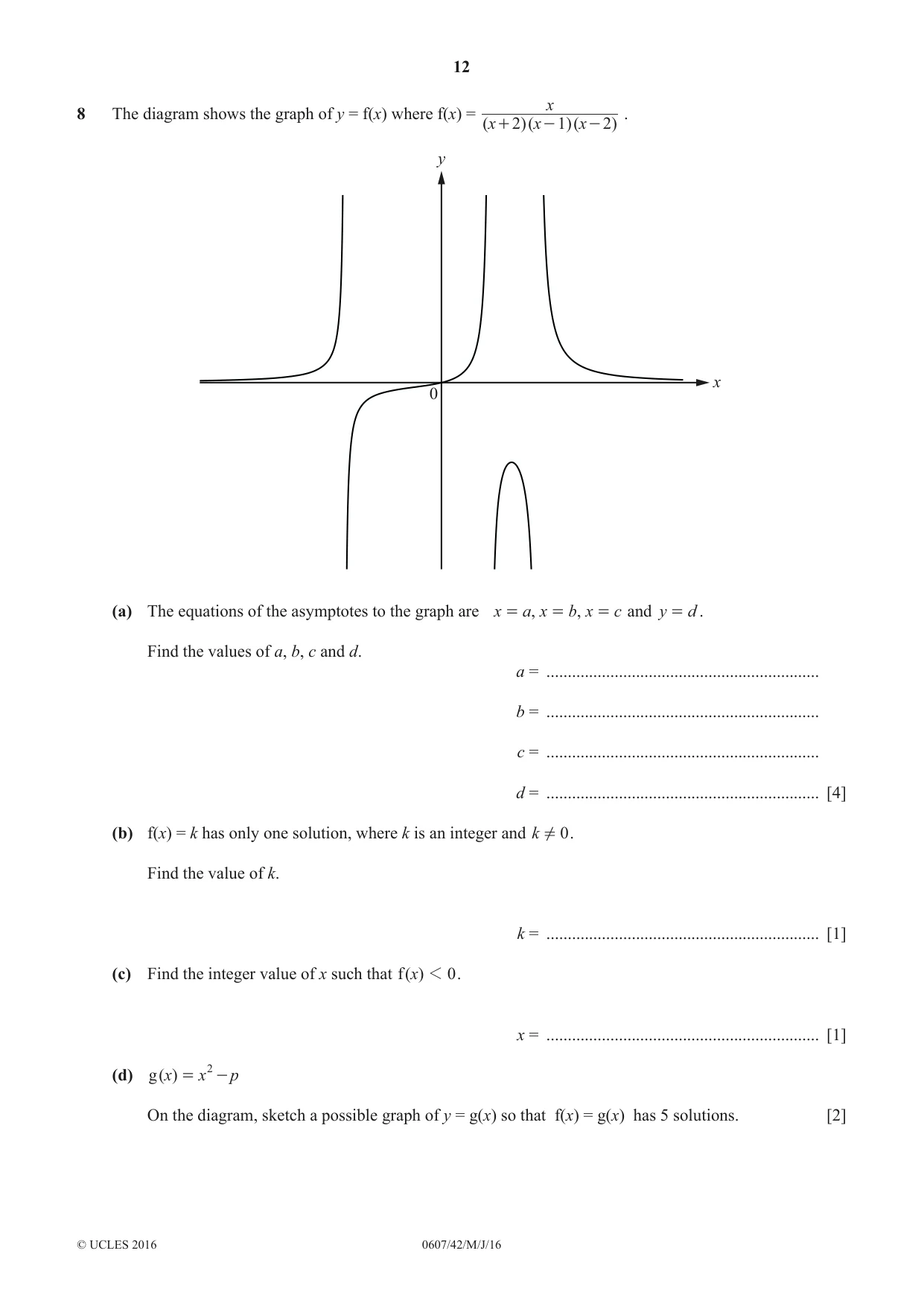
12 0607/42/M/J/16 © UCLES 2016 8 The diagram shows the graph of y = f(x) where f(x) = ( )( )( ) x x x x 2 1 2 + - - . y x 0 (a) The equations of the asymptotes to the graph are , , x a x b x c = = = and y d = . Find the values of a, b, c and d. a = … b = … c = … d = … [4] (b) f(x) = k has only one solution, where k is an integer and k 0 ! . Find the value of k. k = … [1] (c) Find the integer value of x such that ( )x 0 f 1 . x = … [1] (d) ( )x x p g 2 = - On the diagram, sketch a possible graph of y = g(x) so that f(x) = g(x) has 5 solutions. [2]
Question paper, page 13
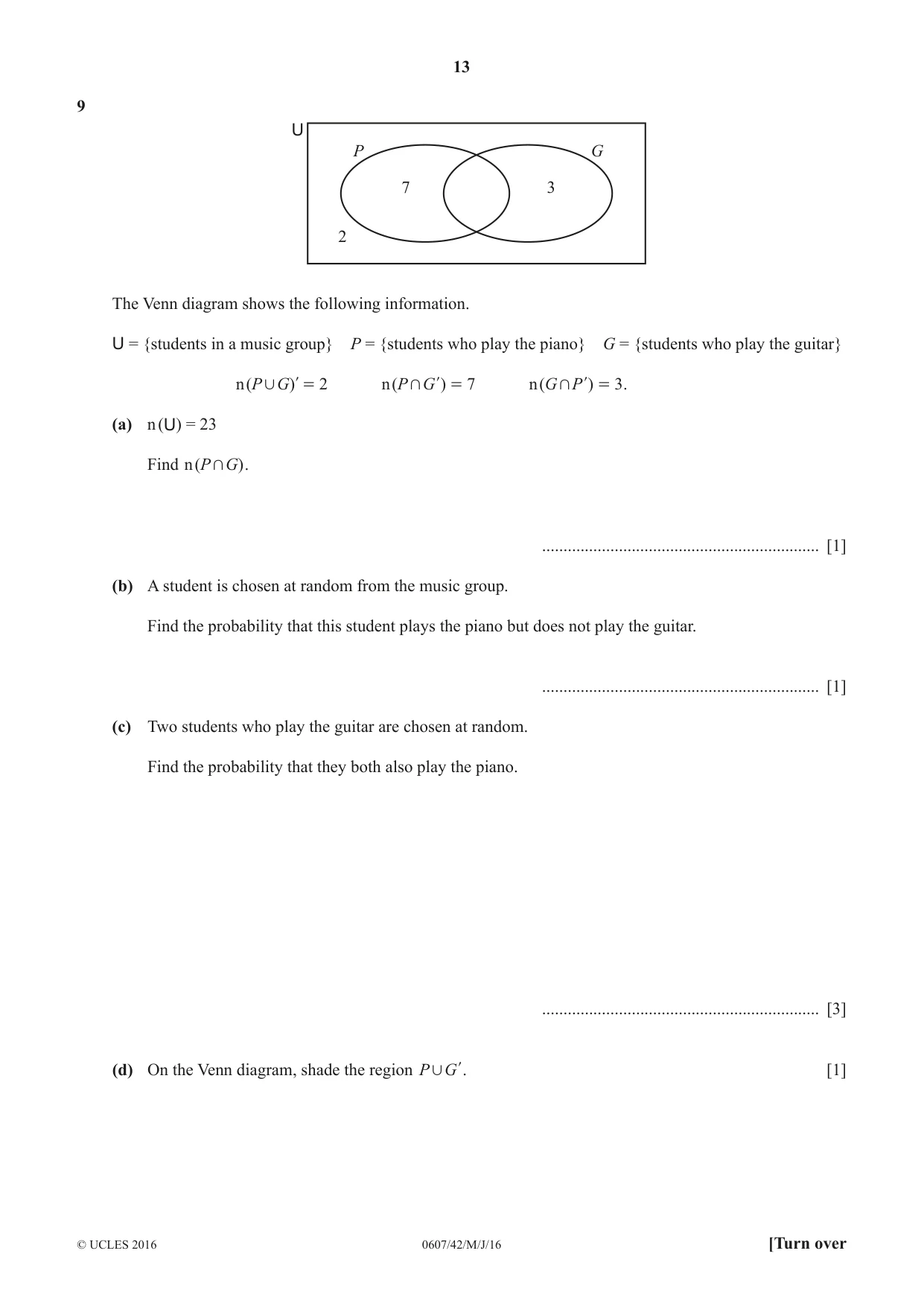
13 0607/42/M/J/16 © UCLES 2016 [Turn over 9 P G 7 3 2 U The Venn diagram shows the following information. U = {students in a music group} P = {students who play the piano} G = {students who play the guitar} ( ) n P G 2 , = l ( ) n P G 7 + = l ( ) n G P 3 + = l . (a) n (U) = 23 Find ( ) n P G + . … [1] (b) A student is chosen at random from the music group. Find the probability that this student plays the piano but does not play the guitar. … [1] (c) Two students who play the guitar are chosen at random. Find the probability that they both also play the piano. … [3] (d) On the Venn diagram, shade the region P G , l. [1]
Question paper, page 14
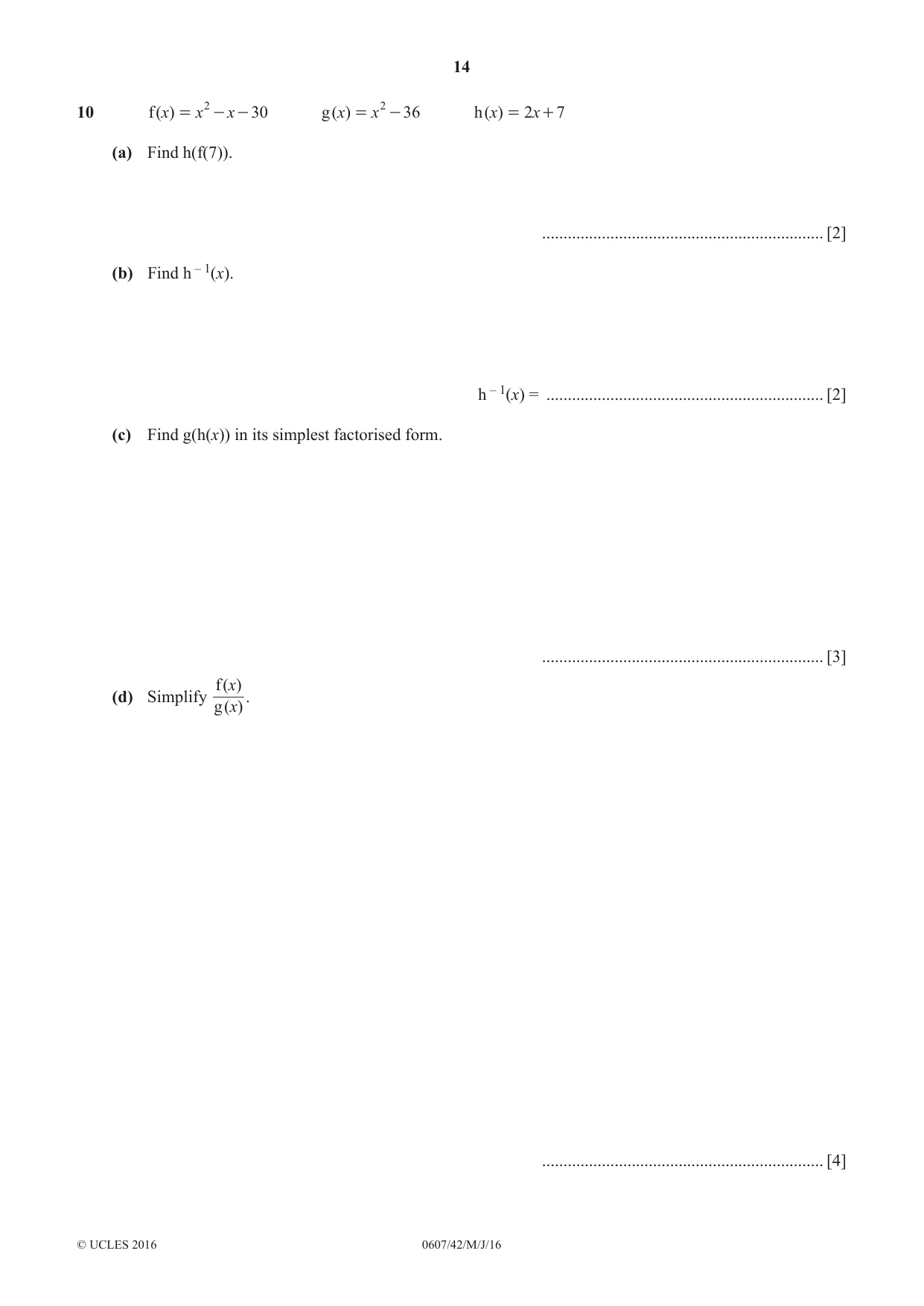
14 0607/42/M/J/16 © UCLES 2016 10 ( ) f x x x 30 2 = - - ( ) g x x 36 2 = - ( ) h x x 2 7 = + (a) Find h(f(7)). … [2] (b) Find h – 1(x). h – 1(x) = … [2] (c) Find g(h(x)) in its simplest factorised form. … [3] (d) Simplify ( ) ( ) g f x x . … [4]
Question paper, page 15
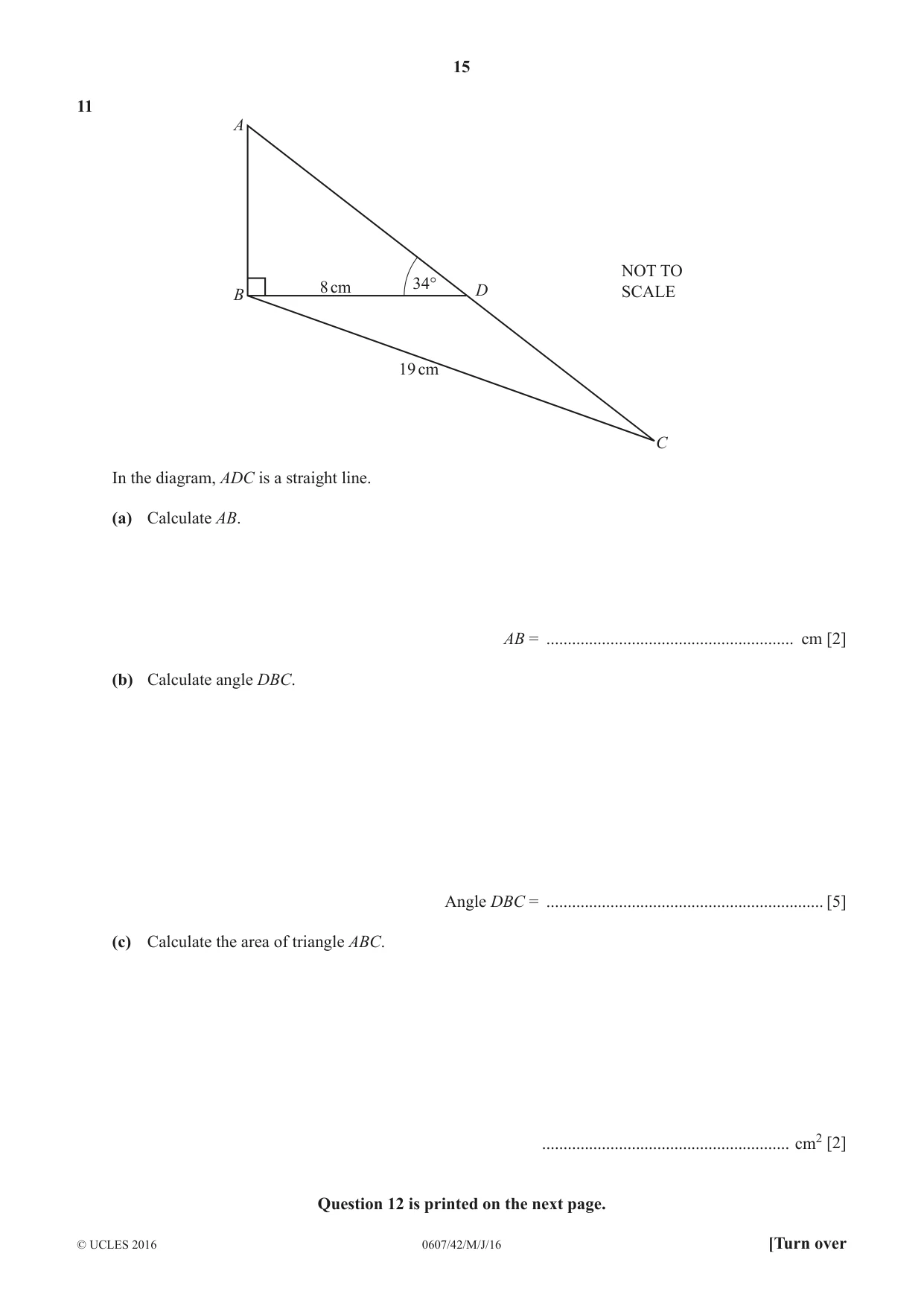
15 0607/42/M/J/16 © UCLES 2016 [Turn over 11 34° A B D C NOT TO SCALE 8 cm 19 cm In the diagram, ADC is a straight line. (a) Calculate AB. AB = … cm [2] (b) Calculate angle DBC. Angle DBC = … [5] (c) Calculate the area of triangle ABC. … cm2 [2] Question 12 is printed on the next page.
Question paper, page 16
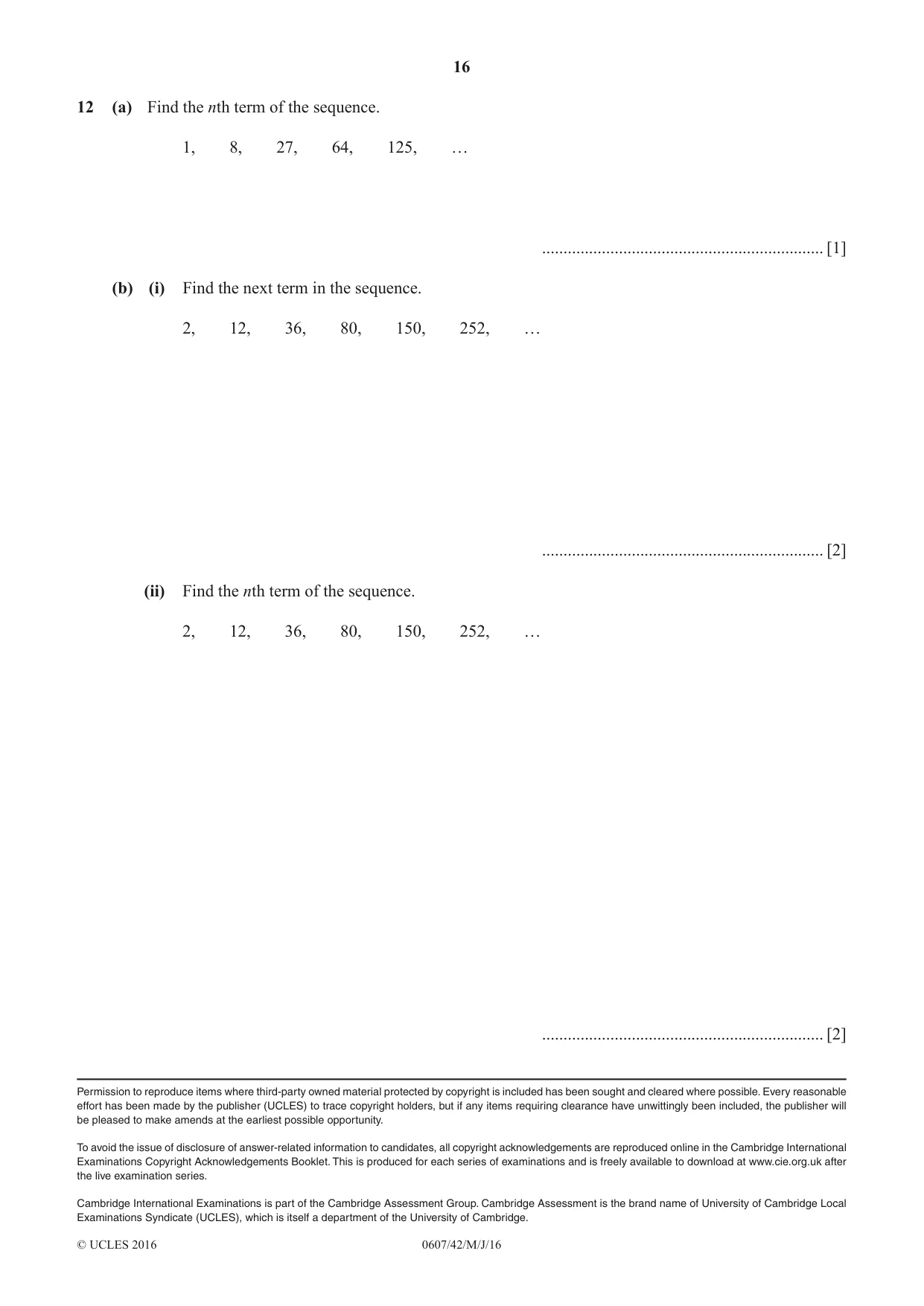
16 0607/42/M/J/16 © UCLES 2016 Permission to reproduce items where third-party owned material protected by copyright is included has been sought and cleared where possible. Every reasonable effort has been made by the publisher (UCLES) to trace copyright holders, but if any items requiring clearance have unwittingly been included, the publisher will be pleased to make amends at the earliest possible opportunity. To avoid the issue of disclosure of answer-related information to candidates, all copyright acknowledgements are reproduced online in the Cambridge International Examinations Copyright Acknowledgements Booklet. This is produced for each series of examinations and is freely available to download at www.cie.org.uk after the live examination series. Cambridge International Examinations is part of the Cambridge Assessment Group. Cambridge Assessment is the brand name of University of Cambridge Local Examinations Syndicate (UCLES), which is itself a department of the University of Cambridge. 12 (a) Find the nth term of the sequence. 1, 8, 27, 64, 125, … … [1] (b) (i) Find the next term in the sequence. 2, 12, 36, 80, 150, 252, … … [2] (ii) Find the nth term of the sequence. 2, 12, 36, 80, 150, 252, … … [2]
Mark scheme, page 1
® IGCSE is the registered trademark of Cambridge International Examinations. This document consists of 6 printed pages. © UCLES 2016 [Turn over Cambridge International Examinations Cambridge International General Certificate of Secondary Education CAMBRIDGE INTERNATIONAL MATHEMATICS 0607/42 Paper 4 (Extended) May/June 2016 MARK SCHEME Maximum Mark: 120 Published This mark scheme is published as an aid to teachers and candidates, to indicate the requirements of the examination. It shows the basis on which Examiners were instructed to award marks. It does not indicate the details of the discussions that took place at an Examiners’ meeting before marking began, which would have considered the acceptability of alternative answers. Mark schemes should be read in conjunction with the question paper and the Principal Examiner Report for Teachers. Cambridge will not enter into discussions about these mark schemes. Cambridge is publishing the mark schemes for the May/June 2016 series for most Cambridge IGCSE®, Cambridge International A and AS Level components and some Cambridge O Level components.
Mark scheme, page 2
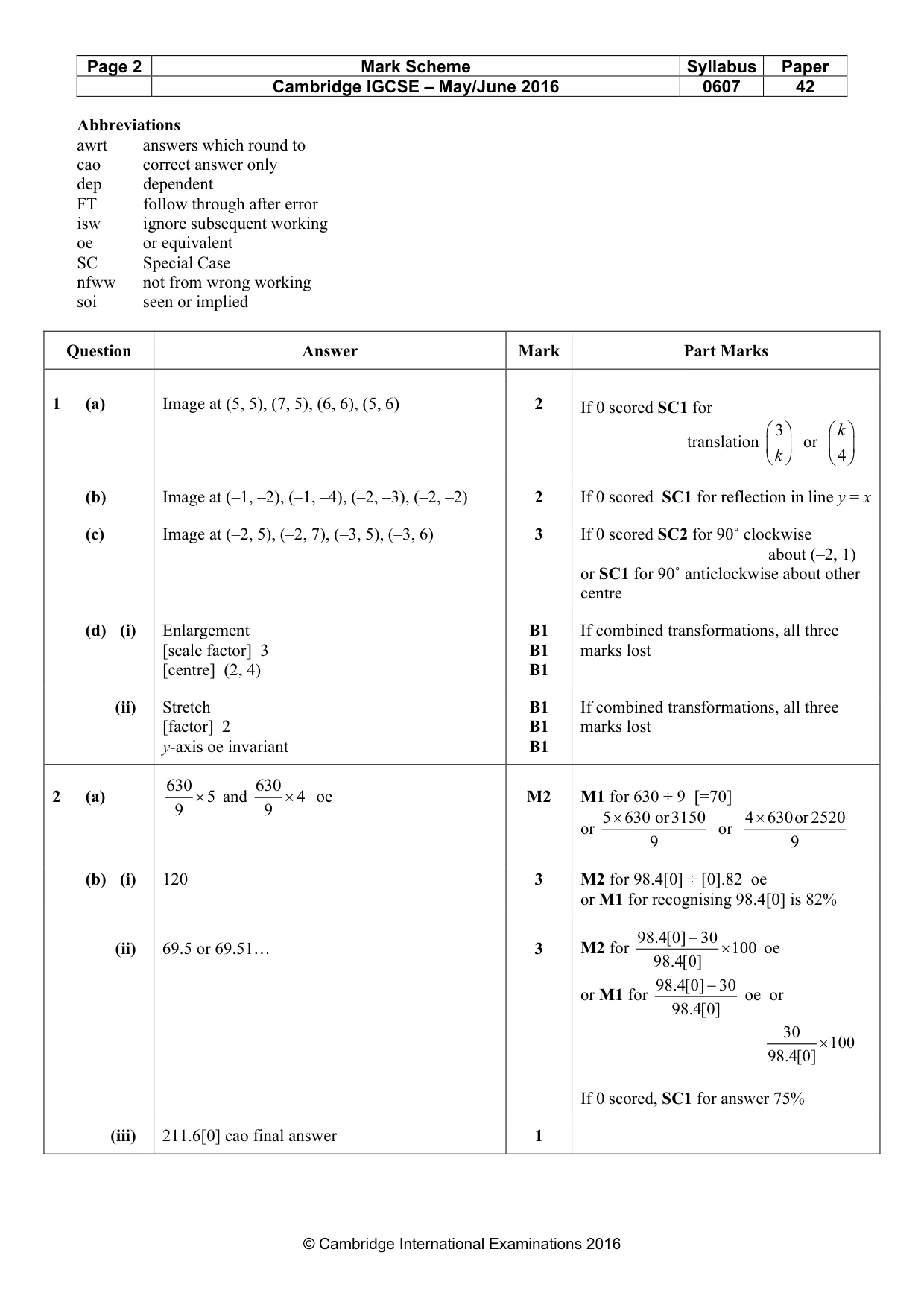
Page 2 Mark Scheme Syllabus Paper Cambridge IGCSE – May/June 2016 0607 42 © Cambridge International Examinations 2016 Abbreviations awrt answers which round to cao correct answer only dep dependent FT follow through after error isw ignore subsequent working oe or equivalent SC Special Case nfww not from wrong working soi seen or implied Question Answer Mark Part Marks 1 (a) Image at (5, 5), (7, 5), (6, 6), (5, 6) 2 If 0 scored SC1 for translation 3 k or 4 k (b) Image at (–1, –2), (–1, –4), (–2, –3), (–2, –2) 2 If 0 scored SC1 for reflection in line y = x (c) Image at (–2, 5), (–2, 7), (–3, 5), (–3, 6) 3 If 0 scored SC2 for 90˚ clockwise about (–2, 1) or SC1 for 90˚ anticlockwise about other centre (d) (i) Enlargement [scale factor] 3 [centre] (2, 4) B1 B1 B1 If combined transformations, all three marks lost (ii) Stretch [factor] 2 y-axis oe invariant B1 B1 B1 If combined transformations, all three marks lost 2 (a) 630 5 9 × and 630 4 9 × oe M2 M1 for 630 ÷ 9 [=70] or 5 630 or3150 9 × or 4 630or2520 9 × (b) (i) 120 3 M2 for 98.4[0] ÷ [0].82 oe or M1 for recognising 98.4[0] is 82% (ii) 69.5 or 69.51… 3 M2 for 98.4[0] 30 100 98.4[0] − × oe or M1 for 98.4[0] 30 98.4[0] − oe or 30 100 98.4[0] × If 0 scored, SC1 for answer 75% (iii) 211.6[0] cao final answer 1
Mark scheme, page 3
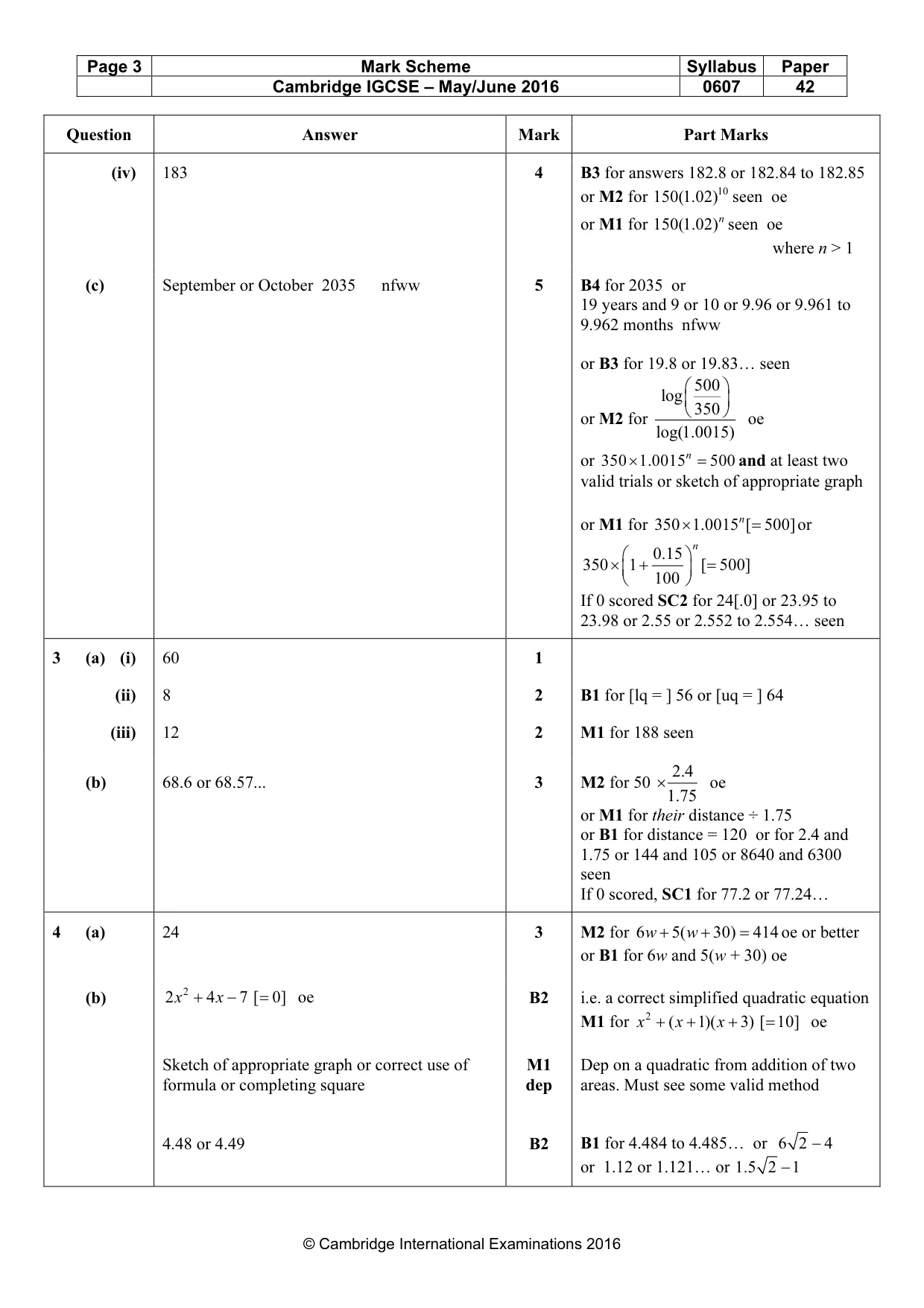
Page 3 Mark Scheme Syllabus Paper Cambridge IGCSE – May/June 2016 0607 42 © Cambridge International Examinations 2016 Question Answer Mark Part Marks (iv) 183 4 B3 for answers 182.8 or 182.84 to 182.85 or M2 for 10 150(1.02) seen oe or M1 for 150(1.02)n seen oe where n > 1 (c) September or October 2035 nfww 5 B4 for 2035 or 19 years and 9 or 10 or 9.96 or 9.961 to 9.962 months nfww or B3 for 19.8 or 19.83… seen or M2 for 500 log 350 log(1.0015) oe or 350 1.0015 500 n × = and at least two valid trials or sketch of appropriate graph or M1 for 350 1.0015 [ 500] n × = or 0.15 350 1 [ 500] 100 n × + = If 0 scored SC2 for 24[.0] or 23.95 to 23.98 or 2.55 or 2.552 to 2.554… seen 3 (a) (i) 60 1 (ii) 8 2 B1 for [lq = ] 56 or [uq = ] 64 (iii) 12 2 M1 for 188 seen (b) 68.6 or 68.57... 3 M2 for 50 2.4 1.75 × oe or M1 for their distance ÷ 1.75 or B1 for distance = 120 or for 2.4 and 1.75 or 144 and 105 or 8640 and 6300 seen If 0 scored, SC1 for 77.2 or 77.24… 4 (a) 24 3 M2 for 6 5( 30) 414 w w + + = oe or better or B1 for 6w and 5(w + 30) oe (b) 2 2 4 7 [ 0] x x + − = oe Sketch of appropriate graph or correct use of formula or completing square 4.48 or 4.49 B2 M1 dep B2 i.e. a correct simplified quadratic equation M1 for 2 ( 1)( 3) [ 10] x x x + + + = oe Dep on a quadratic from addition of two areas. Must see some valid method B1 for 4.484 to 4.485… or 6 2 4 − or 1.12 or 1.121… or 1.5 2 1 −
Mark scheme, page 4
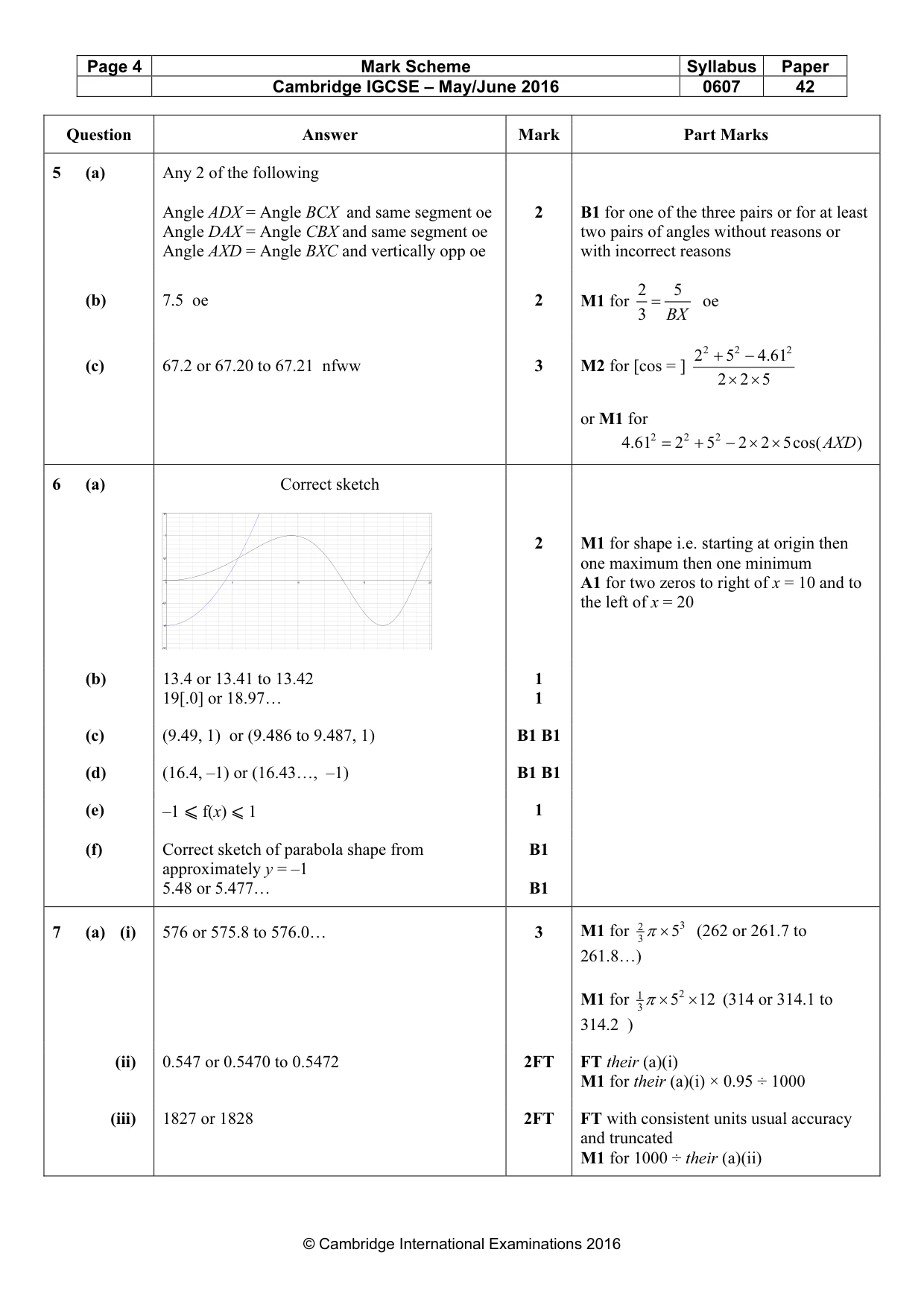
Page 4 Mark Scheme Syllabus Paper Cambridge IGCSE – May/June 2016 0607 42 © Cambridge International Examinations 2016 Question Answer Mark Part Marks 5 (a) Any 2 of the following Angle ADX = Angle BCX and same segment oe Angle DAX = Angle CBX and same segment oe Angle AXD = Angle BXC and vertically opp oe 2 B1 for one of the three pairs or for at least two pairs of angles without reasons or with incorrect reasons (b) 7.5 oe 2 M1 for 2 5 3 BX = oe (c) 67.2 or 67.20 to 67.21 nfww 3 M2 for [cos = ] 2 2 2 2 5 4.61 2 2 5 + − × × or M1 for 2 2 2 4.61 2 5 2 2 5cos( ) AXD = + − × × 6 (a) Correct sketch 2 M1 for shape i.e. starting at origin then one maximum then one minimum A1 for two zeros to right of x = 10 and to the left of x = 20 (b) 13.4 or 13.41 to 13.42 19[.0] or 18.97… 1 1 (c) (9.49, 1) or (9.486 to 9.487, 1) B1 B1 (d) (16.4, –1) or (16.43…, –1) B1 B1 (e) –1 ⩽ f(x) ⩽ 1 1 (f) Correct sketch of parabola shape from approximately y = –1 5.48 or 5.477… B1 B1 7 (a) (i) 576 or 575.8 to 576.0… 3 M1 for 3 2 3 5 π × (262 or 261.7 to 261.8…) M1 for 2 1 3 5 12 π × × (314 or 314.1 to 314.2 ) (ii) 0.547 or 0.5470 to 0.5472 2FT FT their (a)(i) M1 for their (a)(i) × 0.95 ÷ 1000 (iii) 1827 or 1828 2FT FT with consistent units usual accuracy and truncated M1 for 1000 ÷ their (a)(ii) 20 15 10 5 0 1.5 1 0.5 0 -0.5 -1 -1.5 20 15 10 5 0 1.5 1 0.5 0 -0.5 -1 -1.5 20 15 10 5 0 1.5 1 0.5 0 -0.5 -1 -1.5 20 15 10 5 0 1.5 1 0.5 0 -0.5 -1 -1.5
Mark scheme, page 5
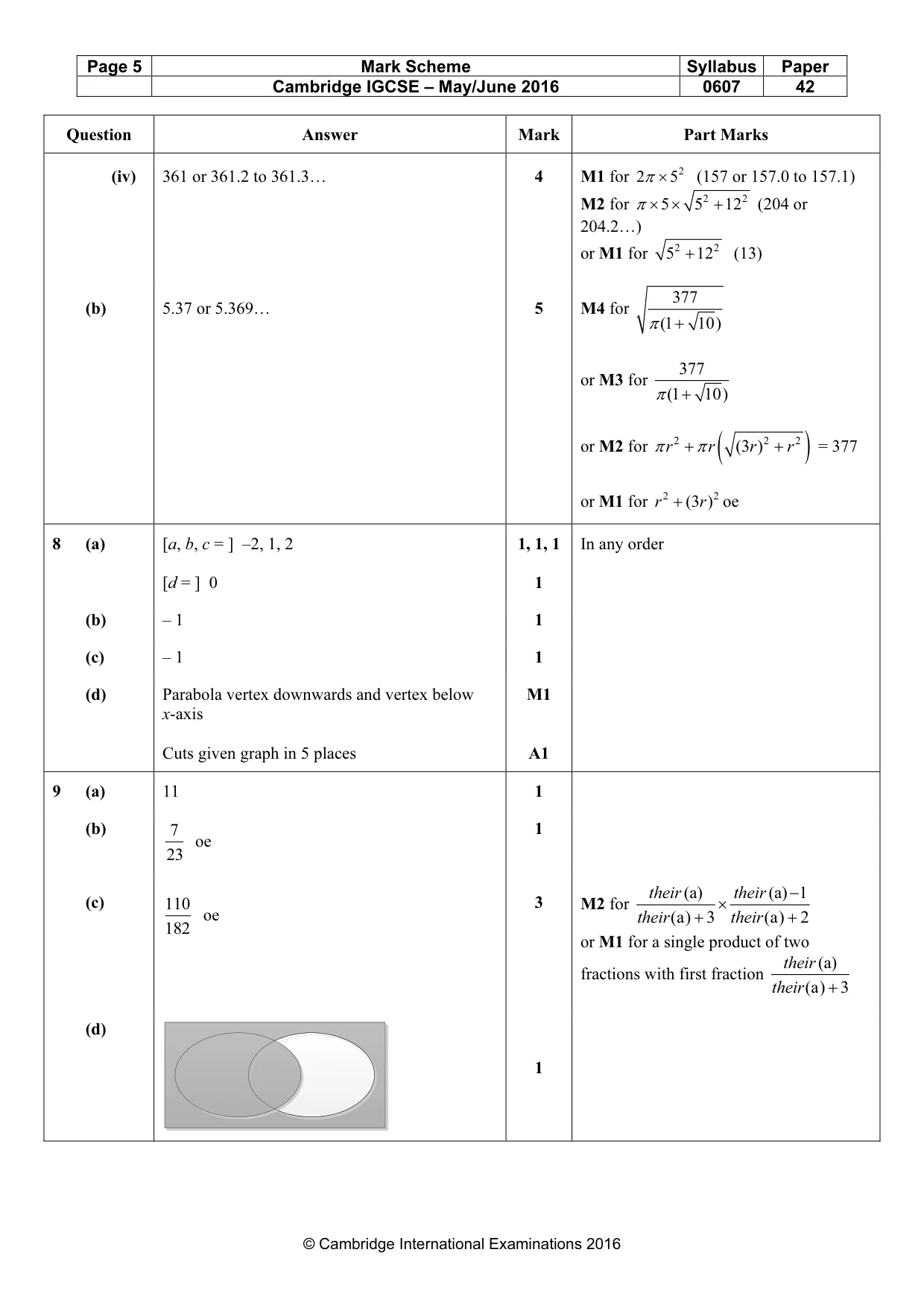
Page 5 Mark Scheme Syllabus Paper Cambridge IGCSE – May/June 2016 0607 42 © Cambridge International Examinations 2016 Question Answer Mark Part Marks (iv) 361 or 361.2 to 361.3… 4 M1 for 2 2 5 π × (157 or 157.0 to 157.1) M2 for 2 2 5 5 12 π × × + (204 or 204.2…) or M1 for 2 2 5 12 + (13) (b) 5.37 or 5.369… 5 M4 for 377 (1 10) π + or M3 for 377 (1 10) π + or M2 for ( ) 2 2 2 (3 ) r r r r π π + + = 377 or M1 for 2 2 (3 ) r r + oe 8 (a) [a, b, c = ] –2, 1, 2 [d = ] 0 1, 1, 1 1 In any order (b) – 1 1 (c) – 1 1 (d) Parabola vertex downwards and vertex below x-axis Cuts given graph in 5 places M1 A1 9 (a) 11 1 (b) 7 23 oe 1 (c) 110 182 oe 3 M2 for (a) (a) 1 (a) 3 (a) 2 their their their their − × + + or M1 for a single product of two fractions with first fraction (a) (a) 3 their their + (d) 1
Mark scheme, page 6
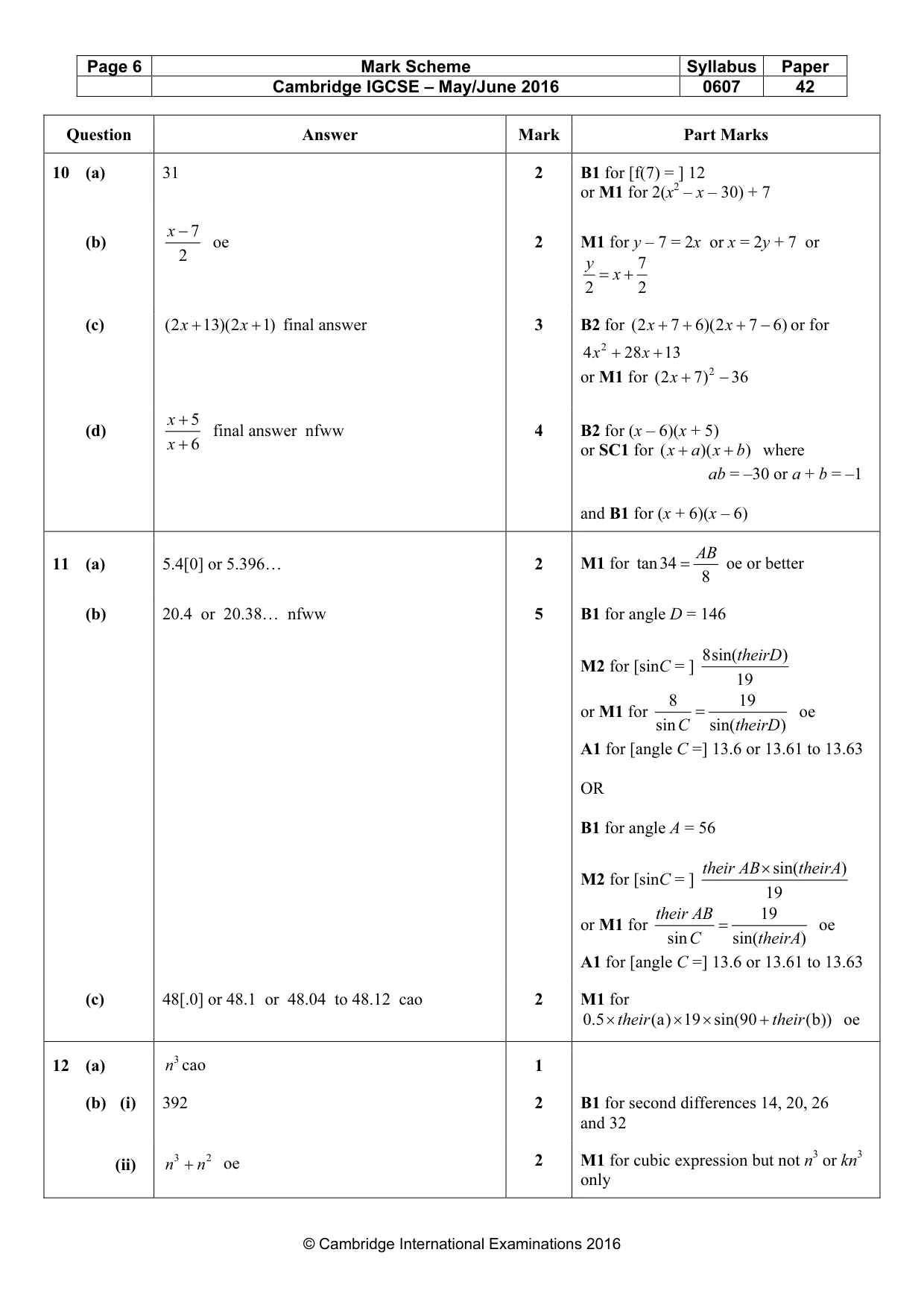
Page 6 Mark Scheme Syllabus Paper Cambridge IGCSE – May/June 2016 0607 42 © Cambridge International Examinations 2016 Question Answer Mark Part Marks 10 (a) 31 2 B1 for [f(7) = ] 12 or M1 for 2(x2 – x – 30) + 7 (b) 7 2 x − oe 2 M1 for y – 7 = 2x or x = 2y + 7 or 7 2 2 y x = + (c) (2 13)(2 1) x x + + final answer 3 B2 for (2 7 6)(2 7 6) x x + + + − or for 2 4 28 13 x x + + or M1 for 2 (2 7) 36 x + − (d) 5 6 x x + + final answer nfww 4 B2 for (x – 6)(x + 5) or SC1 for ( )( ) x a x b + + where ab = –30 or a + b = –1 and B1 for (x + 6)(x – 6) 11 (a) 5.4[0] or 5.396… 2 M1 for tan34 8 AB = oe or better (b) 20.4 or 20.38… nfww 5 B1 for angle D = 146 M2 for [sinC = ] 8sin( ) 19 theirD or M1 for 8 19 sin sin( ) C theirD = oe A1 for [angle C =] 13.6 or 13.61 to 13.63 OR B1 for angle A = 56 M2 for [sinC = ] sin( ) 19 their AB theirA × or M1 for 19 sin sin( ) their AB C theirA = oe A1 for [angle C =] 13.6 or 13.61 to 13.63 (c) 48[.0] or 48.1 or 48.04 to 48.12 cao 2 M1 for 0.5 (a) 19 sin(90 (b)) their their × × × + oe 12 (a) 3 n cao 1 (b) (i) 392 2 B1 for second differences 14, 20, 26 and 32 (ii) 3 2 n n + oe 2 M1 for cubic expression but not n3 or kn3 only
What you needed in this session
Cambridge’s own grade thresholds for 2016 May/June, Paper 4 · Variant 2. A higher threshold means an easier paper — the bar moves with how the cohort did.