Cambridge IGCSE Mathematics - International 0607 — 2013 May/June Paper 4 · Variant 1
0607/41/M/J/13 · 120 marks · ≈135 min
The question paper and its mark scheme, free to read here and free to download. This is Cambridge’s own paper, exactly as it was sat.
Question paper16 pages
Mark scheme7 pages
Answers below. Sit the paper first if you are practising.
Paper as text
Question paper, page 1
This document consists of 16 printed pages. IB13 06_0607_41/4RP © UCLES 2013 [Turn over *1170642332* For Examiner's Use UNIVERSITY OF CAMBRIDGE INTERNATIONAL EXAMINATIONS International General Certificate of Secondary Education CAMBRIDGE INTERNATIONAL MATHEMATICS 0607/41 Paper 4 (Extended) May/June 2013 2 hours 15 minutes Candidates answer on the Question Paper. Additional Materials: Geometrical Instruments Graphics Calculator READ THESE INSTRUCTIONS FIRST Write your Centre number, candidate number and name on all the work you hand in. Write in dark blue or black pen. Do not use staples, paper clips, highlighters, glue or correction fluid. You may use a pencil for any diagrams or graphs. DO NOT WRITE IN ANY BARCODES. Answer all the questions. Unless instructed otherwise, give your answers exactly or correct to three significant figures as appropriate. Answers in degrees should be given to one decimal place. For π, use your calculator value. You must show all the relevant working to gain full marks and you will be given marks for correct methods, including sketches, even if your answer is incorrect. The number of marks is given in brackets [ ] at the end of each question or part question. The total number of marks for this paper is 120. www.XtremePapers.com
Question paper, page 2
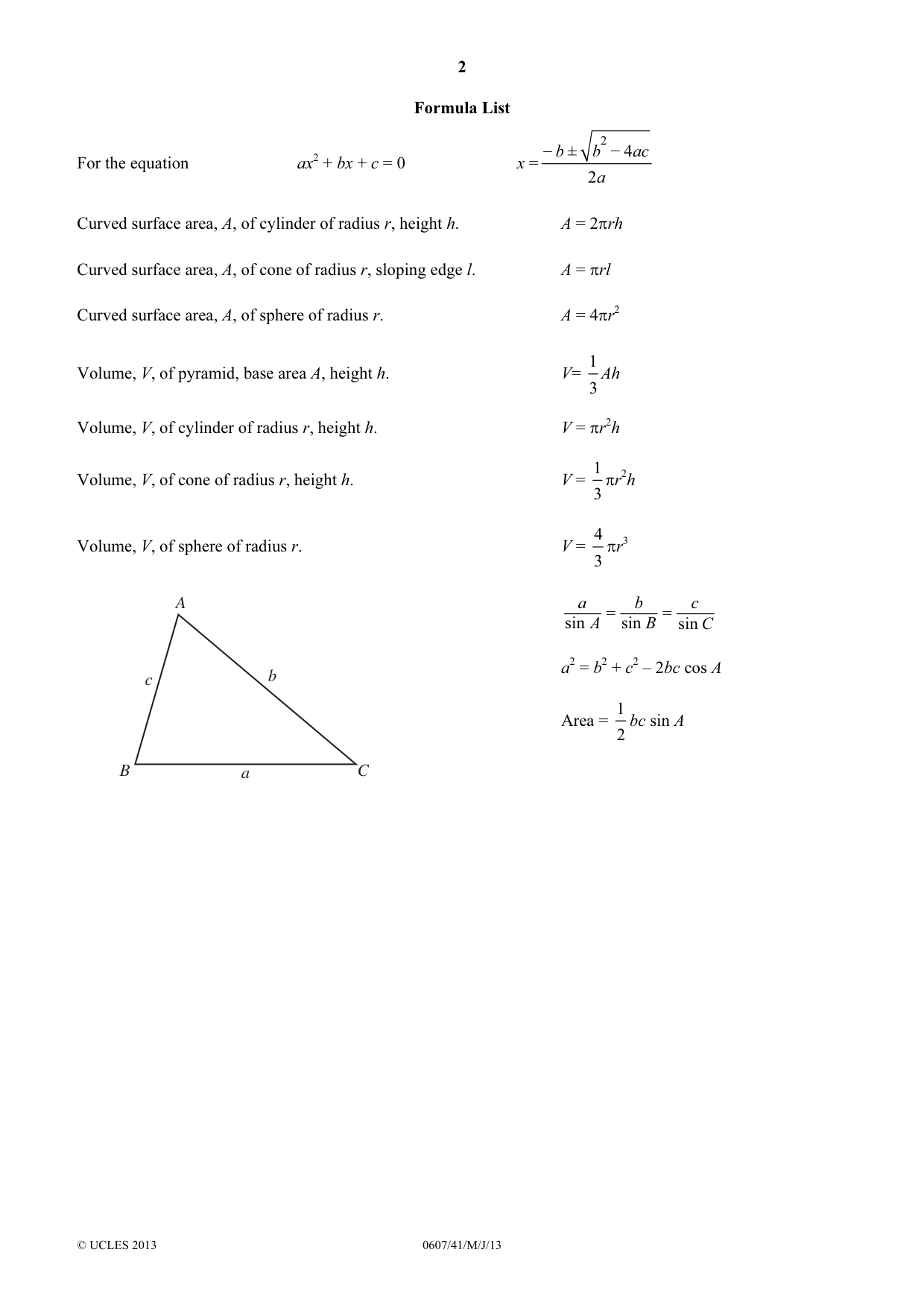
2 © UCLES 2013 0607/41/M/J/13 Formula List For the equation ax2 + bx + c = 0 x = 2 _ ± 4 2 _ b b ac a Curved surface area, A, of cylinder of radius r, height h. A = 2πrh Curved surface area, A, of cone of radius r, sloping edge l. A = πrl Curved surface area, A, of sphere of radius r. A = 4πr2 Volume, V, of pyramid, base area A, height h. V= 1 3 Ah Volume, V, of cylinder of radius r, height h. V = πr2h Volume, V, of cone of radius r, height h. V = 1 3 πr2h Volume, V, of sphere of radius r. V = 4 3 πr3 = = sin sin sin a b c A B C a2 = b2 + c2 – 2bc cos A Area = 1 2 bc sin A A a B C b c
Question paper, page 3
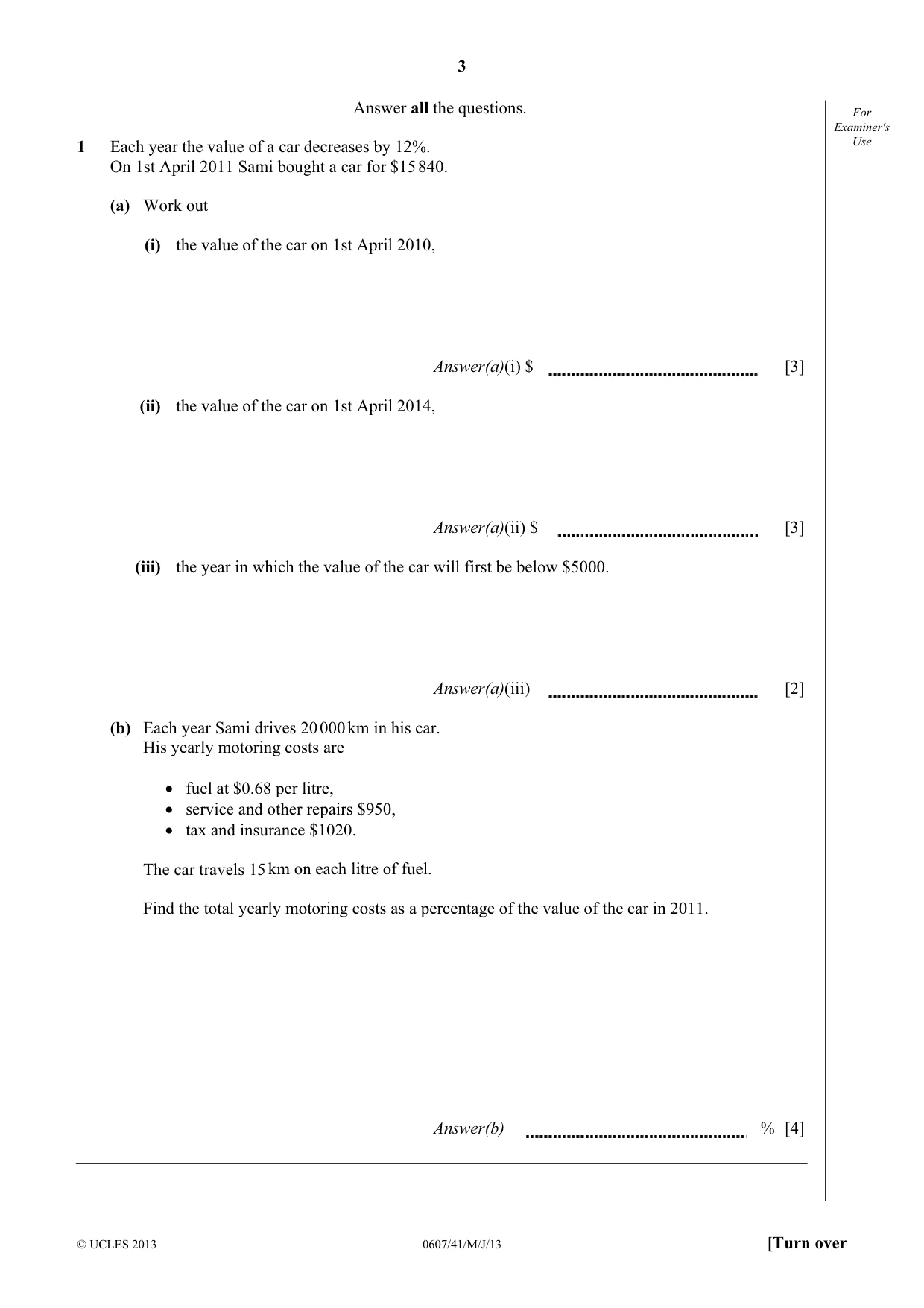
3 © UCLES 2013 0607/41/M/J/13 [Turn over For Examiner's Use Answer all the questions. 1 Each year the value of a car decreases by 12%. On 1st April 2011 Sami bought a car for $15 840. (a) Work out (i) the value of the car on 1st April 2010, Answer(a)(i) $ [3] (ii) the value of the car on 1st April 2014, Answer(a)(ii) $ [3] (iii) the year in which the value of the car will first be below $5000. Answer(a)(iii) [2] (b) Each year Sami drives 20 000 km in his car. His yearly motoring costs are • fuel at $0.68 per litre, • service and other repairs $950, • tax and insurance $1020. The car travels 15 km on each litre of fuel. Find the total yearly motoring costs as a percentage of the value of the car in 2011. Answer(b) % [4]
Question paper, page 4
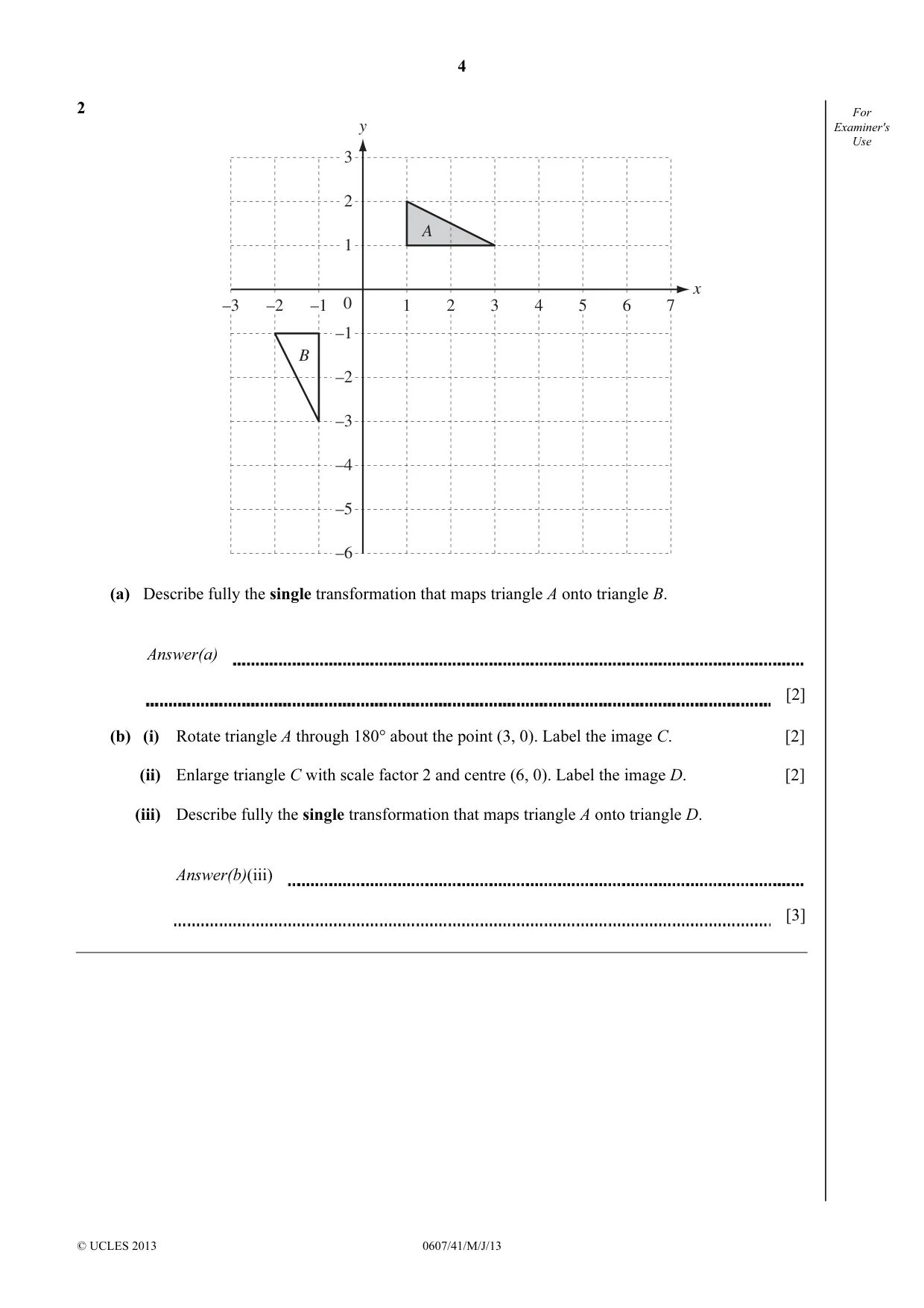
4 © UCLES 2013 0607/41/M/J/13 For Examiner's Use 2 A B y x 3 2 1 –1 –2 –3 –4 –5 –6 0 –1 1 2 3 4 5 6 7 –2 –3 (a) Describe fully the single transformation that maps triangle A onto triangle B. Answer(a) [2] (b) (i) Rotate triangle A through 180° about the point (3, 0). Label the image C. [2] (ii) Enlarge triangle C with scale factor 2 and centre (6, 0). Label the image D. [2] (iii) Describe fully the single transformation that maps triangle A onto triangle D. Answer(b)(iii) [3]
Question paper, page 5
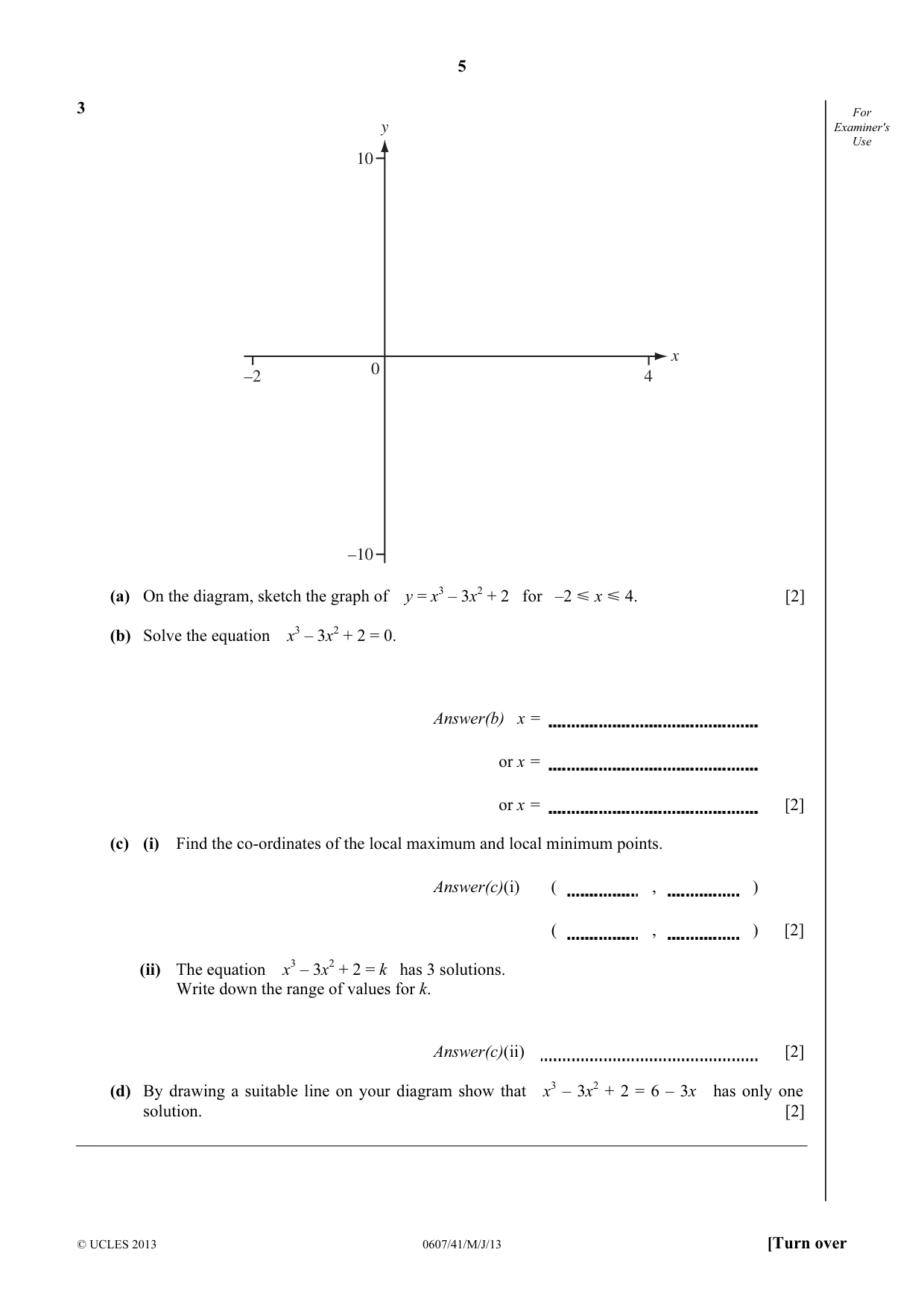
5 © UCLES 2013 0607/41/M/J/13 [Turn over For Examiner's Use 3 10 –10 –2 4 0 x y (a) On the diagram, sketch the graph of y = x3 – 3x2 + 2 for –2 Y x Y 4. [2] (b) Solve the equation x3 – 3x2 + 2 = 0. Answer(b) x = or x = or x = [2] (c) (i) Find the co-ordinates of the local maximum and local minimum points. Answer(c)(i) ( , ) ( , ) [2] (ii) The equation x3 – 3x2 + 2 = k has 3 solutions. Write down the range of values for k. Answer(c)(ii) [2] (d) By drawing a suitable line on your diagram show that x3 – 3x2 + 2 = 6 – 3x has only one solution. [2]
Question paper, page 6
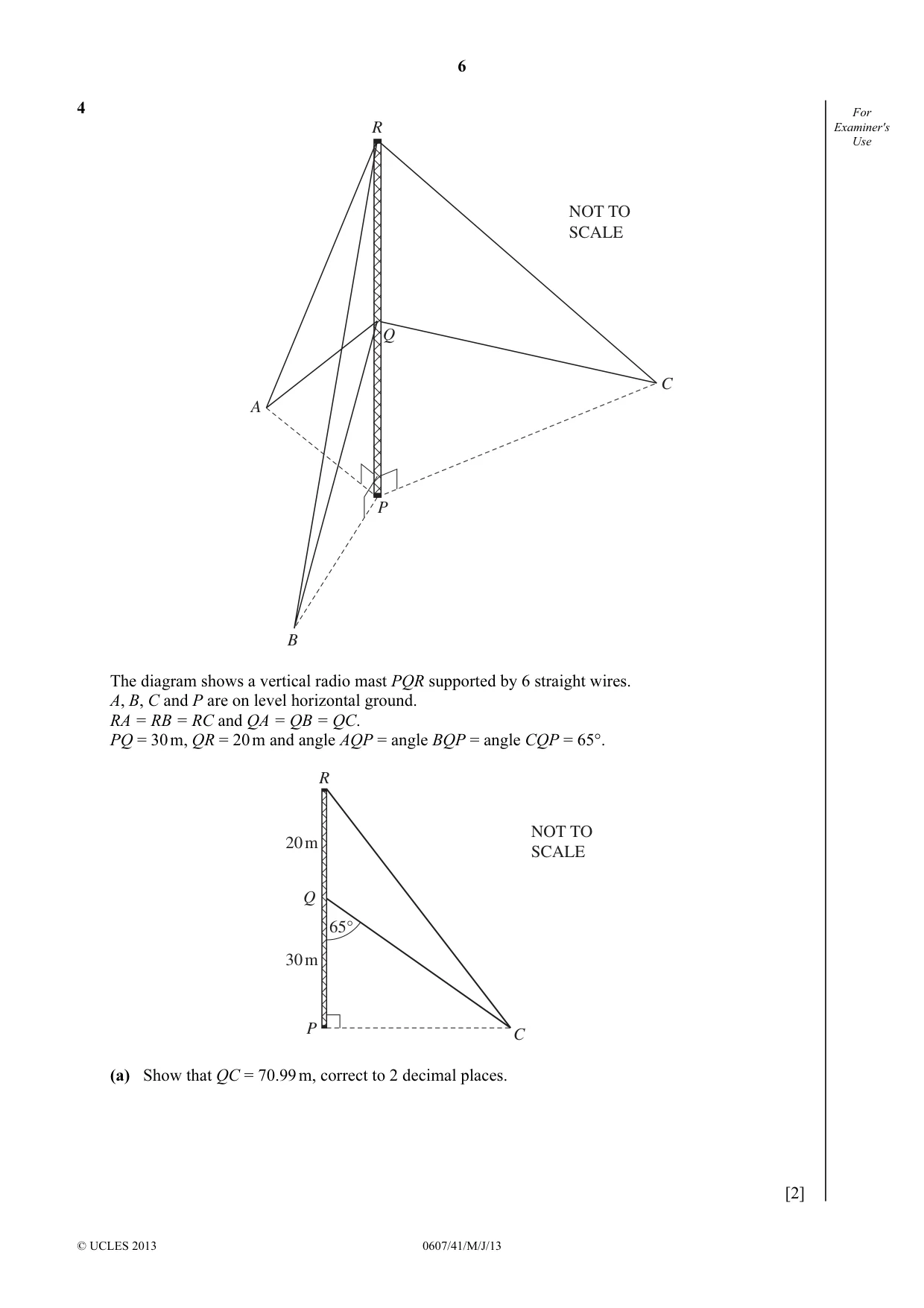
6 © UCLES 2013 0607/41/M/J/13 For Examiner's Use 4 R A C B P Q NOT TO SCALE The diagram shows a vertical radio mast PQR supported by 6 straight wires. A, B, C and P are on level horizontal ground. RA = RB = RC and QA = QB = QC. PQ = 30 m, QR = 20 m and angle AQP = angle BQP = angle CQP = 65°. R P C Q 65° 30 m 20 m NOT TO SCALE (a) Show that QC = 70.99 m, correct to 2 decimal places. [2]
Question paper, page 7
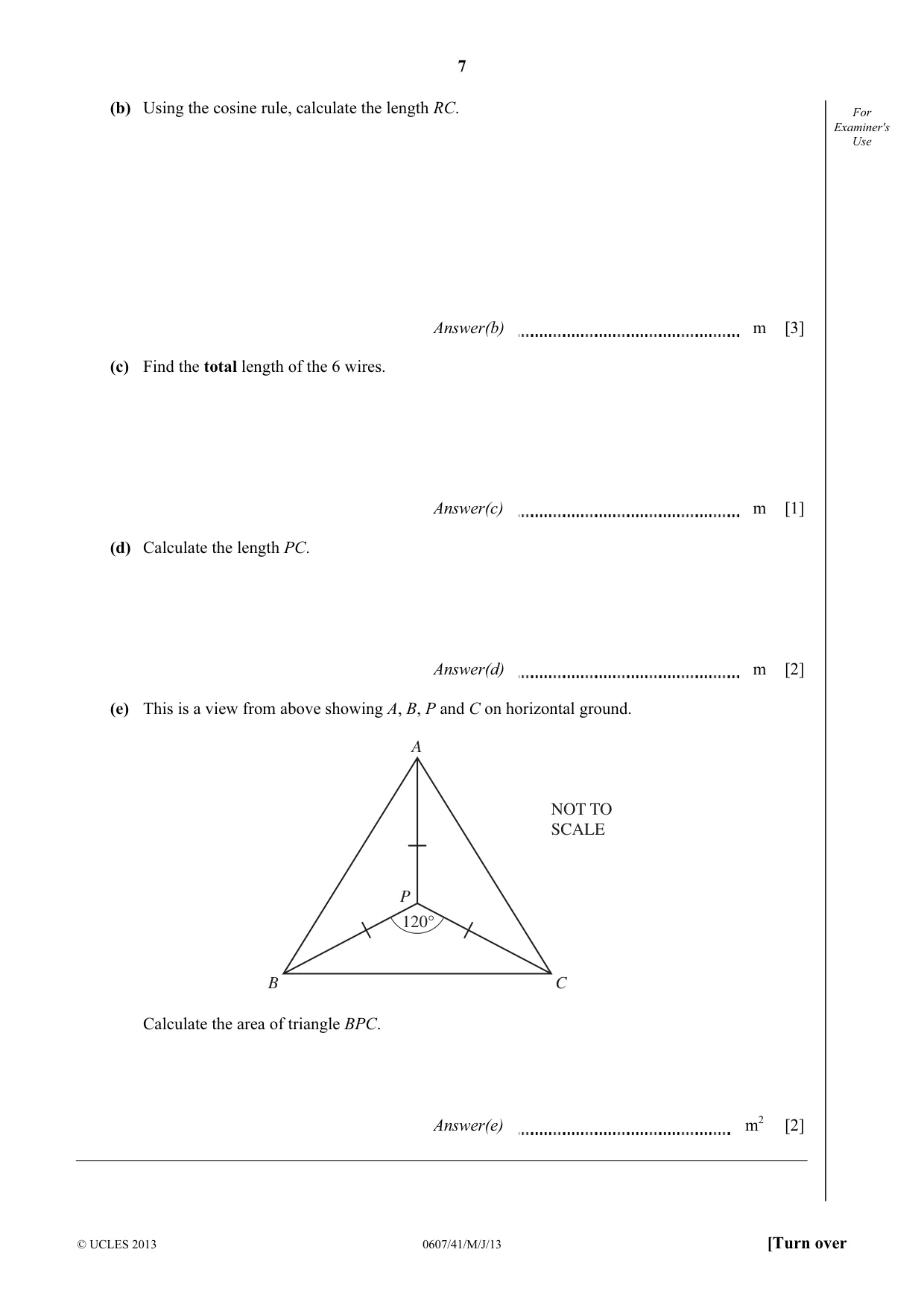
7 © UCLES 2013 0607/41/M/J/13 [Turn over For Examiner's Use (b) Using the cosine rule, calculate the length RC. Answer(b) m [3] (c) Find the total length of the 6 wires. Answer(c) m [1] (d) Calculate the length PC. Answer(d) m [2] (e) This is a view from above showing A, B, P and C on horizontal ground. 120° P NOT TO SCALE B C A Calculate the area of triangle BPC. Answer(e) m2 [2]
Question paper, page 8
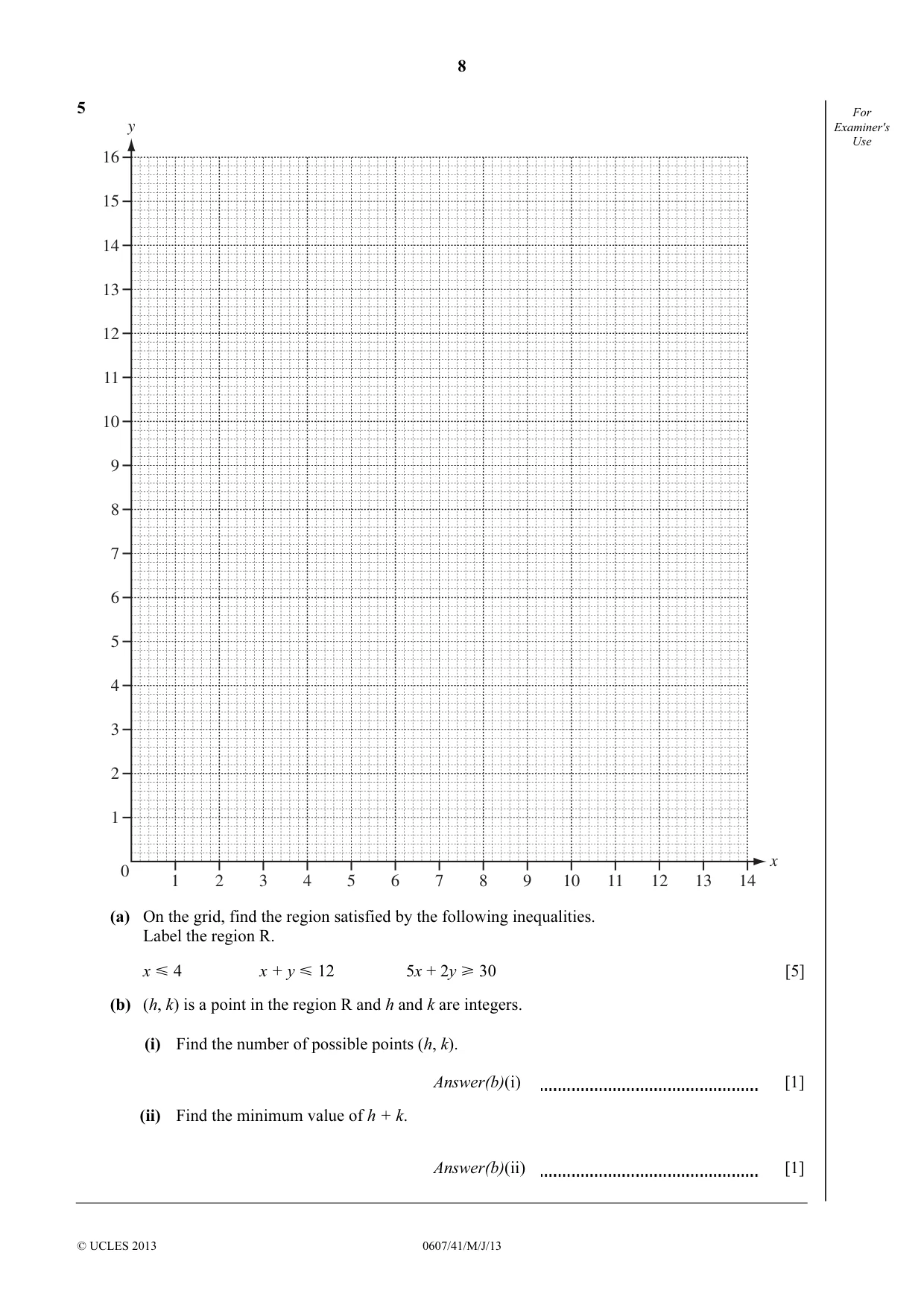
8 © UCLES 2013 0607/41/M/J/13 For Examiner's Use 5 16 15 14 13 12 11 10 9 8 7 6 5 4 3 2 1 1 2 3 4 5 6 7 8 9 10 11 12 13 14 0 y x (a) On the grid, find the region satisfied by the following inequalities. Label the region R. x Y 4 x + y Y 12 5x + 2y [ 30 [5] (b) (h, k) is a point in the region R and h and k are integers. (i) Find the number of possible points (h, k). Answer(b)(i) [1] (ii) Find the minimum value of h + k. Answer(b)(ii) [1]
Question paper, page 9
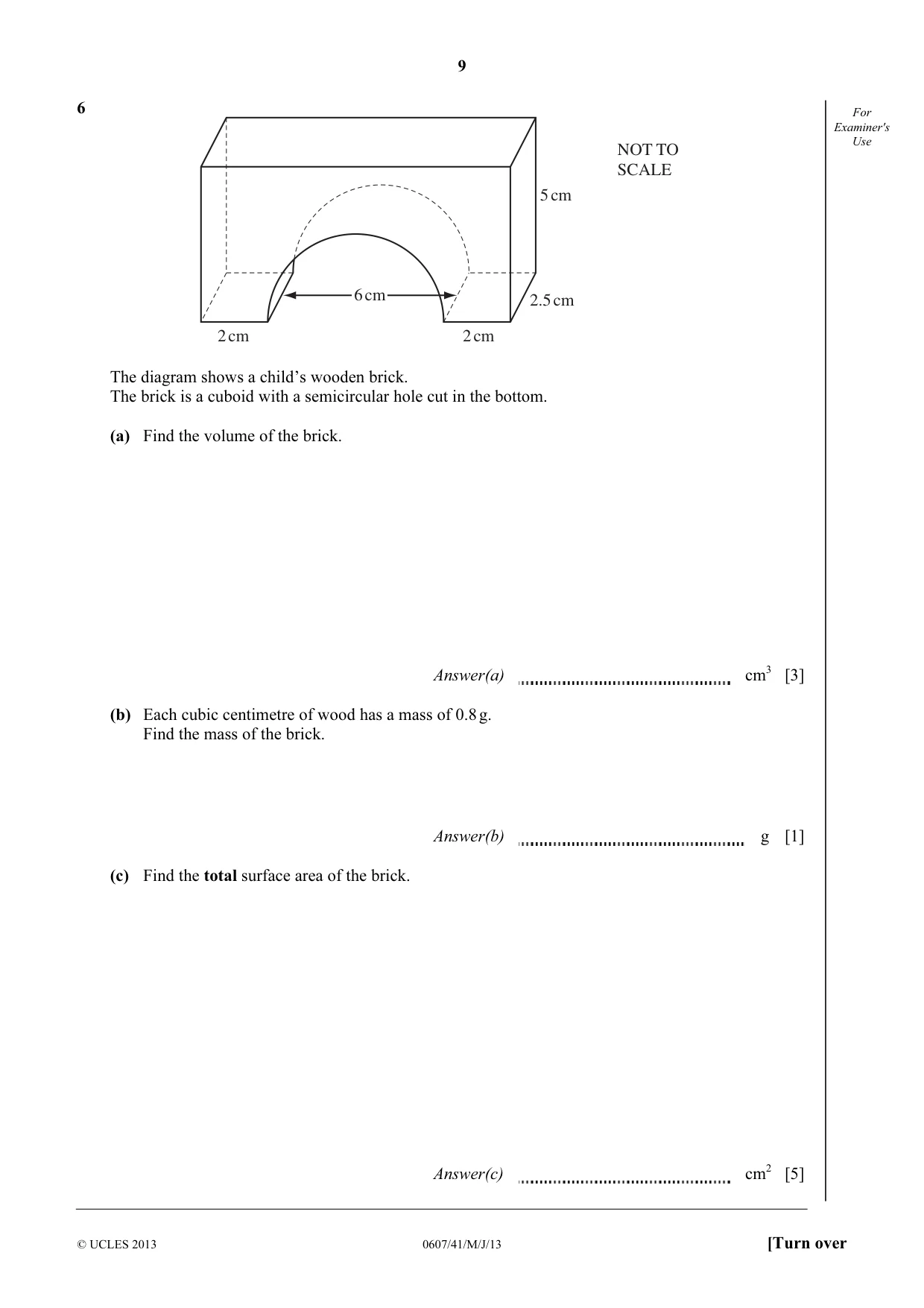
9 © UCLES 2013 0607/41/M/J/13 [Turn over For Examiner's Use 6 2 cm 2 cm 2.5 cm 5 cm 6 cm NOT TO SCALE The diagram shows a child’s wooden brick. The brick is a cuboid with a semicircular hole cut in the bottom. (a) Find the volume of the brick. Answer(a) cm3 [3] (b) Each cubic centimetre of wood has a mass of 0.8 g. Find the mass of the brick. Answer(b) g [1] (c) Find the total surface area of the brick. Answer(c) cm2 [5]
Question paper, page 10
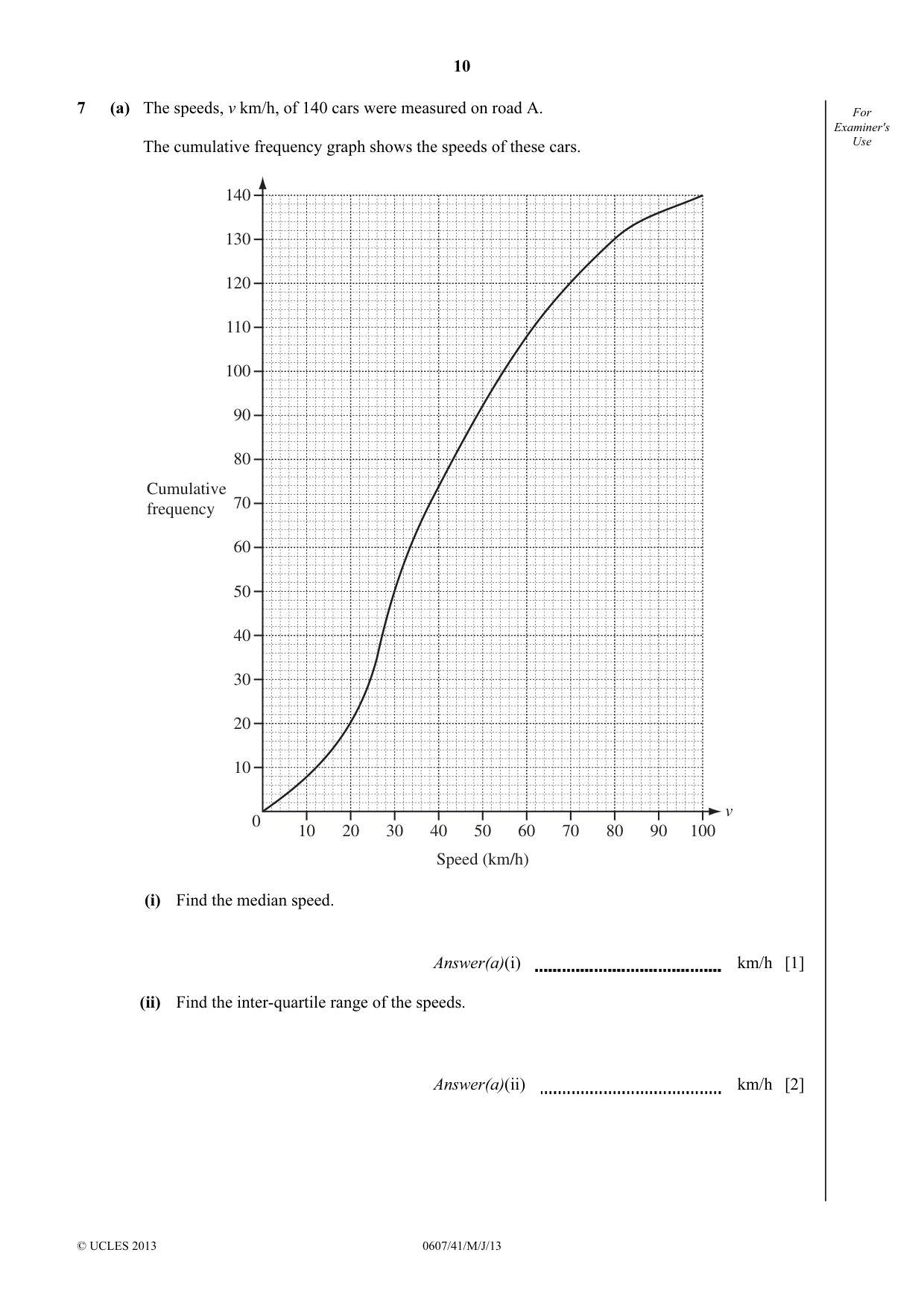
10 © UCLES 2013 0607/41/M/J/13 For Examiner's Use 7 (a) The speeds, v km/h, of 140 cars were measured on road A. The cumulative frequency graph shows the speeds of these cars. 140 130 120 110 100 90 80 70 60 50 40 30 20 10 10 20 30 40 50 Speed (km/h) Cumulative frequency 60 70 80 90 100 0 v (i) Find the median speed. Answer(a)(i) km/h [1] (ii) Find the inter-quartile range of the speeds. Answer(a)(ii) km/h [2]
Question paper, page 11
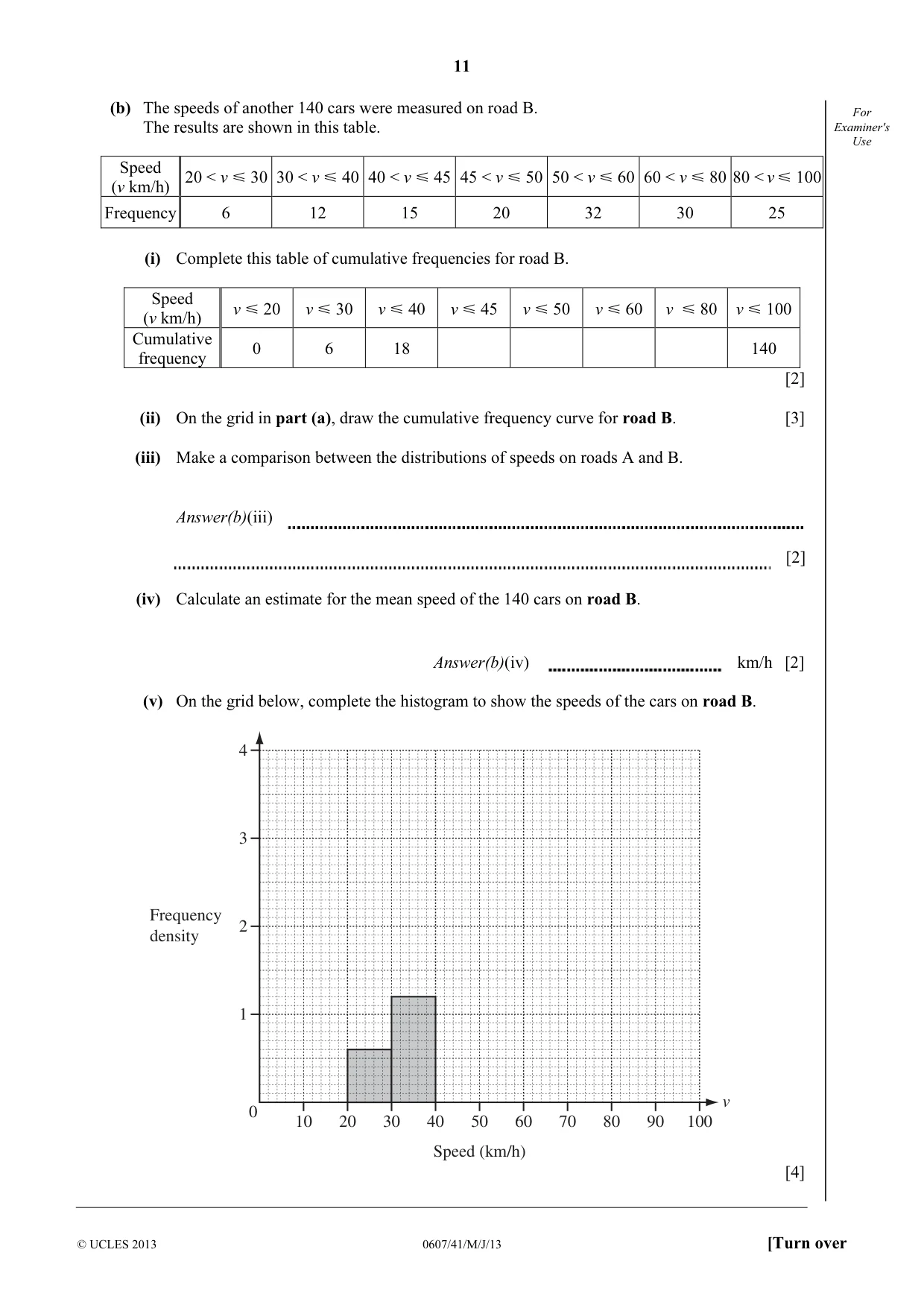
11 © UCLES 2013 0607/41/M/J/13 [Turn over For Examiner's Use (b) The speeds of another 140 cars were measured on road B. The results are shown in this table. Speed (v km/h) 20 < v Y 30 30 < v Y 40 40 < v Y 45 45 < v Y 50 50 < v Y 60 60 < v Y 80 80 < v Y 100 Frequency 6 12 15 20 32 30 25 (i) Complete this table of cumulative frequencies for road B. Speed (v km/h) v Y 20 v Y 30 v Y 40 v Y 45 v Y 50 v Y 60 v Y 80 v Y 100 Cumulative frequency 0 6 18 140 [2] (ii) On the grid in part (a), draw the cumulative frequency curve for road B. [3] (iii) Make a comparison between the distributions of speeds on roads A and B. Answer(b)(iii) [2] (iv) Calculate an estimate for the mean speed of the 140 cars on road B. Answer(b)(iv) km/h [2] (v) On the grid below, complete the histogram to show the speeds of the cars on road B. 4 3 2 1 10 20 30 40 50 Speed (km/h) Frequency density 60 70 80 90 100 0 v [4]
Question paper, page 12
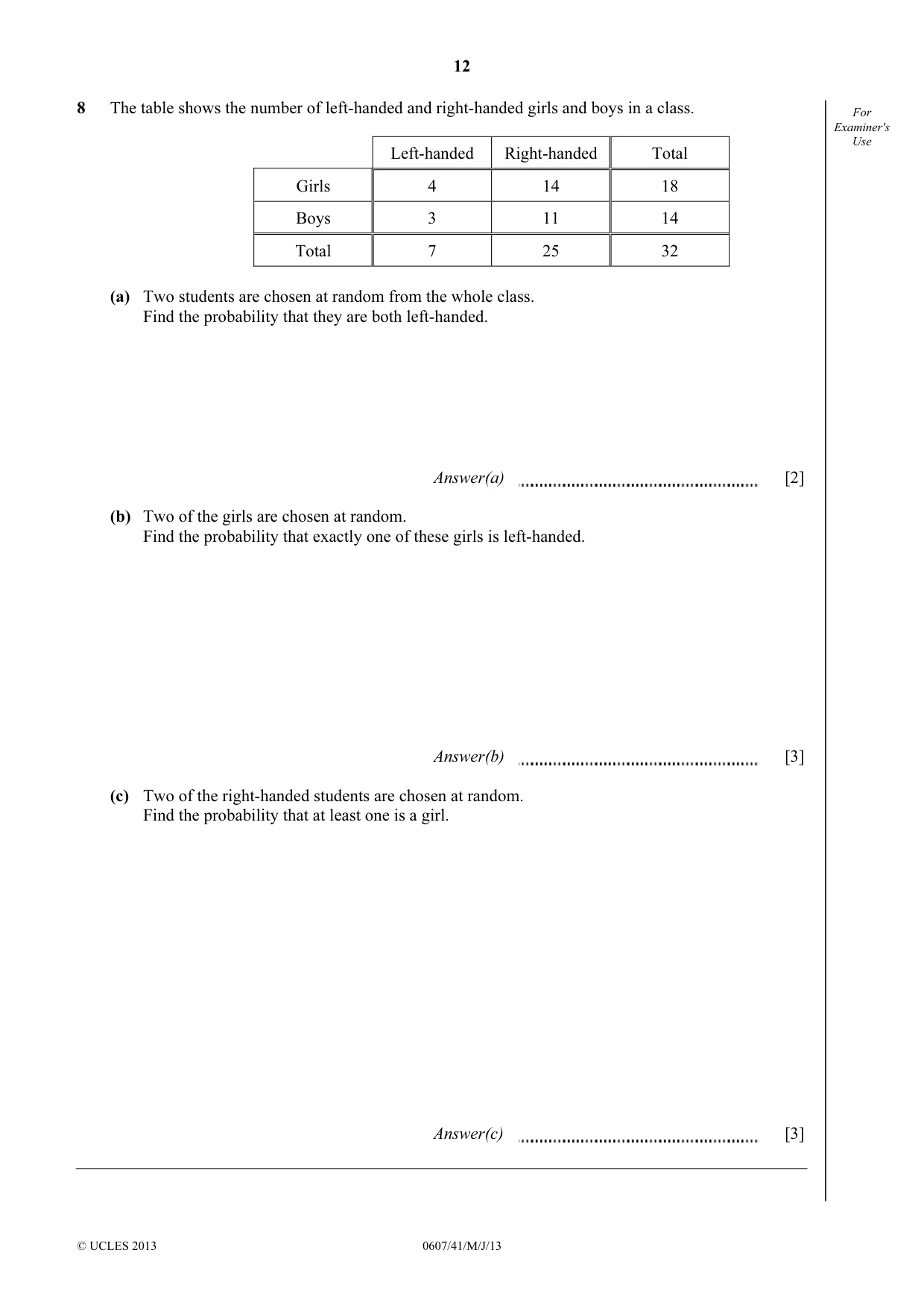
12 © UCLES 2013 0607/41/M/J/13 For Examiner's Use 8 The table shows the number of left-handed and right-handed girls and boys in a class. Left-handed Right-handed Total Girls 4 14 18 Boys 3 11 14 Total 7 25 32 (a) Two students are chosen at random from the whole class. Find the probability that they are both left-handed. Answer(a) [2] (b) Two of the girls are chosen at random. Find the probability that exactly one of these girls is left-handed. Answer(b) [3] (c) Two of the right-handed students are chosen at random. Find the probability that at least one is a girl. Answer(c) [3]
Question paper, page 13
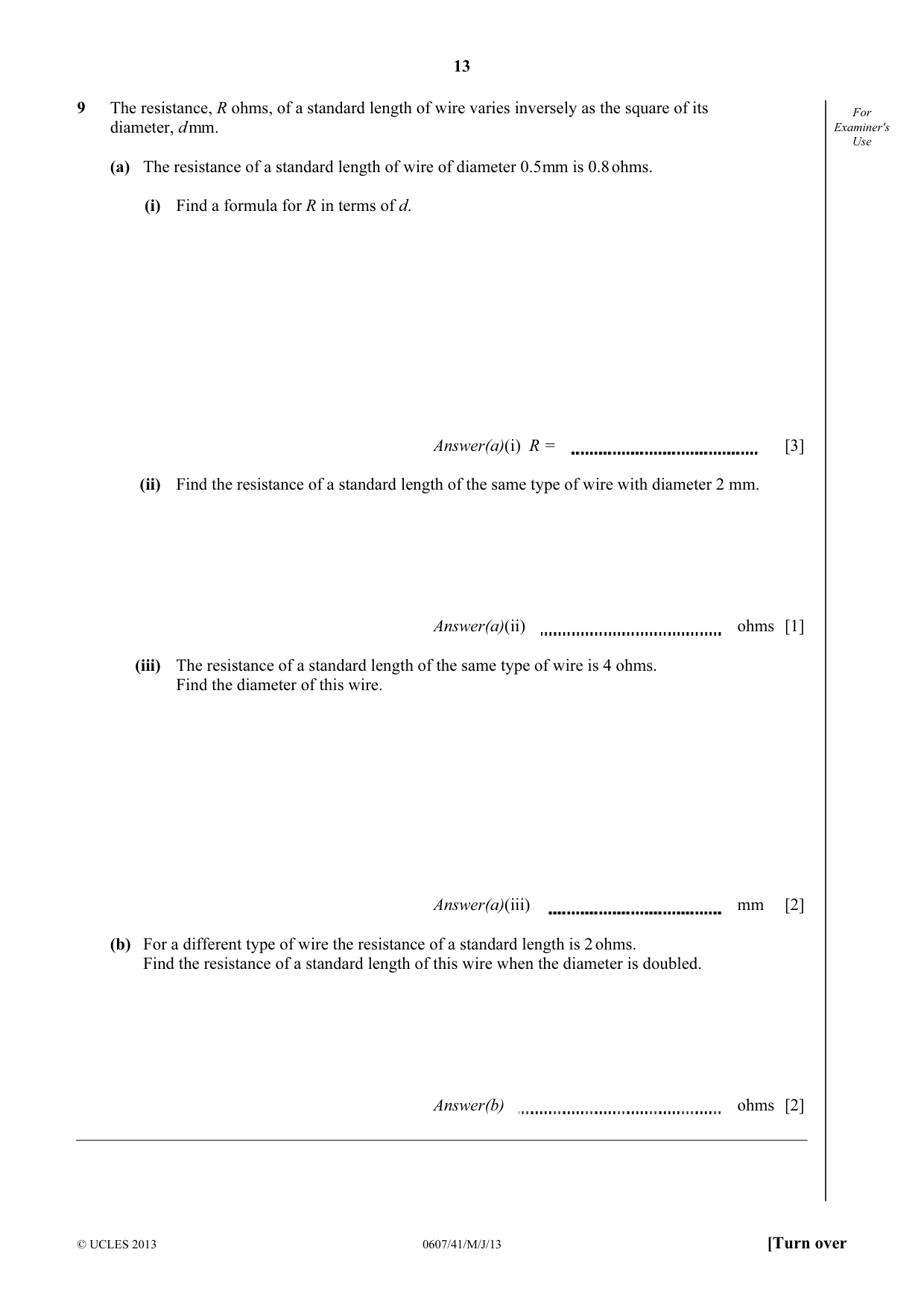
13 © UCLES 2013 0607/41/M/J/13 [Turn over For Examiner's Use 9 The resistance, R ohms, of a standard length of wire varies inversely as the square of its diameter, d mm. (a) The resistance of a standard length of wire of diameter 0.5 mm is 0.8 ohms. (i) Find a formula for R in terms of d. Answer(a)(i) R = [3] (ii) Find the resistance of a standard length of the same type of wire with diameter 2 mm. Answer(a)(ii) ohms [1] (iii) The resistance of a standard length of the same type of wire is 4 ohms. Find the diameter of this wire. Answer(a)(iii) mm [2] (b) For a different type of wire the resistance of a standard length is 2 ohms. Find the resistance of a standard length of this wire when the diameter is doubled. Answer(b) ohms [2]
Question paper, page 14
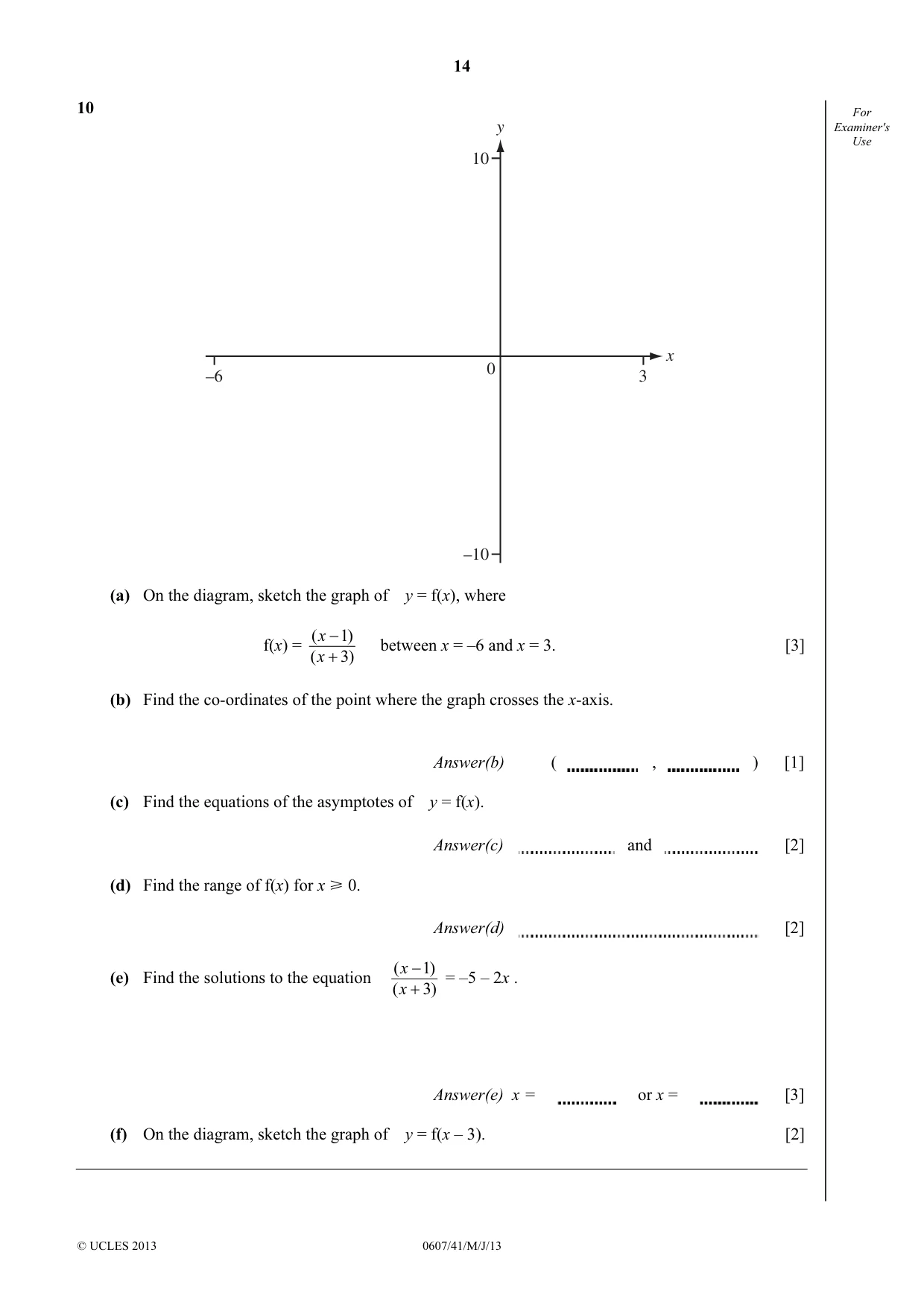
14 © UCLES 2013 0607/41/M/J/13 For Examiner's Use 10 10 –10 –6 3 0 x y (a) On the diagram, sketch the graph of y = f(x), where f(x) = ) 3 ( )1 ( + − x x between x = –6 and x = 3. [3] (b) Find the co-ordinates of the point where the graph crosses the x-axis. Answer(b) ( , ) [1] (c) Find the equations of the asymptotes of y = f(x). Answer(c) and [2] (d) Find the range of f(x) for x [ 0. Answer(d) [2] (e) Find the solutions to the equation ) 3 ( )1 ( + − x x = –5 – 2x . Answer(e) x = or x = [3] (f) On the diagram, sketch the graph of y = f(x – 3). [2]
Question paper, page 15
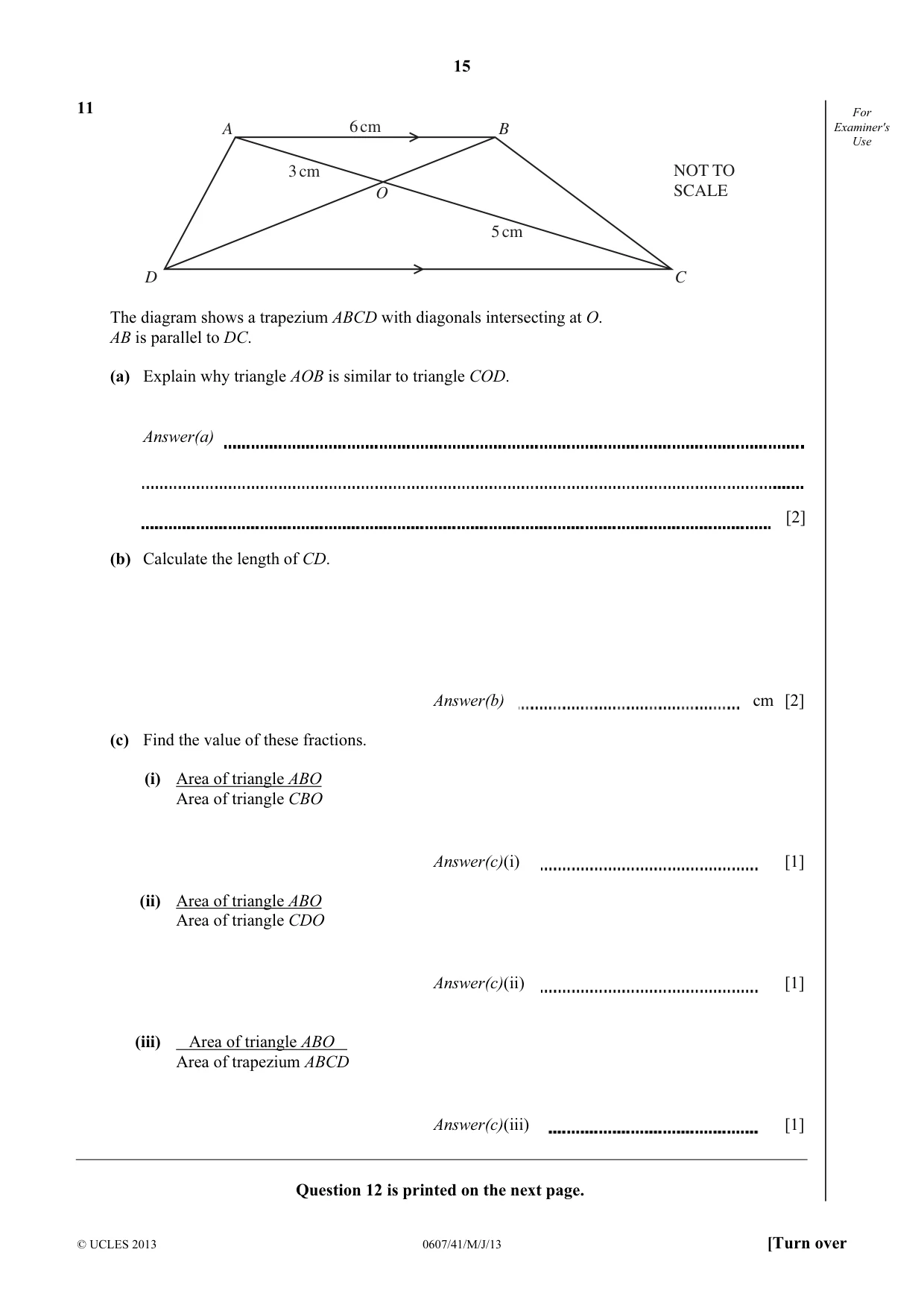
15 © UCLES 2013 0607/41/M/J/13 [Turn over For Examiner's Use 11 A B C D 3 cm 5 cm 6 cm O NOT TO SCALE The diagram shows a trapezium ABCD with diagonals intersecting at O. AB is parallel to DC. (a) Explain why triangle AOB is similar to triangle COD. Answer(a) [2] (b) Calculate the length of CD. Answer(b) cm [2] (c) Find the value of these fractions. (i) Area of triangle ABO Area of triangle CBO Answer(c)(i) [1] (ii) Area of triangle ABO Area of triangle CDO Answer(c)(ii) [1] (iii) Area of triangle ABO Area of trapezium ABCD Answer(c)(iii) [1] Question 12 is printed on the next page.
Question paper, page 16
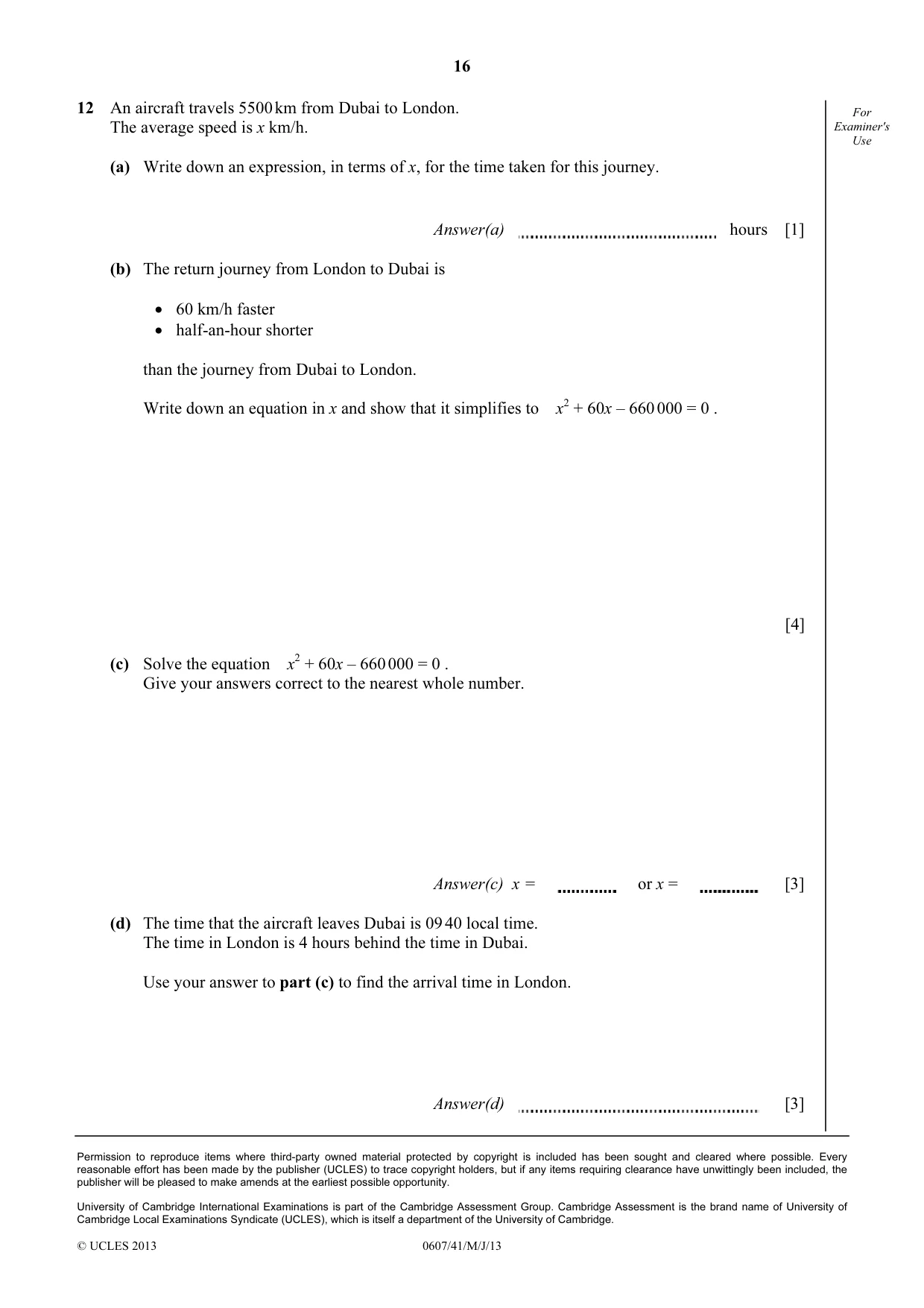
16 Permission to reproduce items where third-party owned material protected by copyright is included has been sought and cleared where possible. Every reasonable effort has been made by the publisher (UCLES) to trace copyright holders, but if any items requiring clearance have unwittingly been included, the publisher will be pleased to make amends at the earliest possible opportunity. University of Cambridge International Examinations is part of the Cambridge Assessment Group. Cambridge Assessment is the brand name of University of Cambridge Local Examinations Syndicate (UCLES), which is itself a department of the University of Cambridge. © UCLES 2013 0607/41/M/J/13 For Examiner's Use 12 An aircraft travels 5500 km from Dubai to London. The average speed is x km/h. (a) Write down an expression, in terms of x, for the time taken for this journey. Answer(a) hours [1] (b) The return journey from London to Dubai is • 60 km/h faster • half-an-hour shorter than the journey from Dubai to London. Write down an equation in x and show that it simplifies to x2 + 60x – 660 000 = 0 . [4] (c) Solve the equation x2 + 60x – 660 000 = 0 . Give your answers correct to the nearest whole number. Answer(c) x = or x = [3] (d) The time that the aircraft leaves Dubai is 09 40 local time. The time in London is 4 hours behind the time in Dubai. Use your answer to part (c) to find the arrival time in London. Answer(d) [3]
Mark scheme, page 1
CAMBRIDGE INTERNATIONAL EXAMINATIONS International General Certificate of Secondary Education MARK SCHEME for the May/June 2013 series 0607 CAMBRIDGE INTERNATIONAL MATHEMATICS 0607/41 Paper 4 (Extended), maximum raw mark 120 This mark scheme is published as an aid to teachers and candidates, to indicate the requirements of the examination. It shows the basis on which Examiners were instructed to award marks. It does not indicate the details of the discussions that took place at an Examiners’ meeting before marking began, which would have considered the acceptability of alternative answers. Mark schemes should be read in conjunction with the question paper and the Principal Examiner Report for Teachers. Cambridge will not enter into discussions about these mark schemes. Cambridge is publishing the mark schemes for the May/June 2013 series for most IGCSE, GCE Advanced Level and Advanced Subsidiary Level components and some Ordinary Level components. www.XtremePapers.com
Mark scheme, page 2
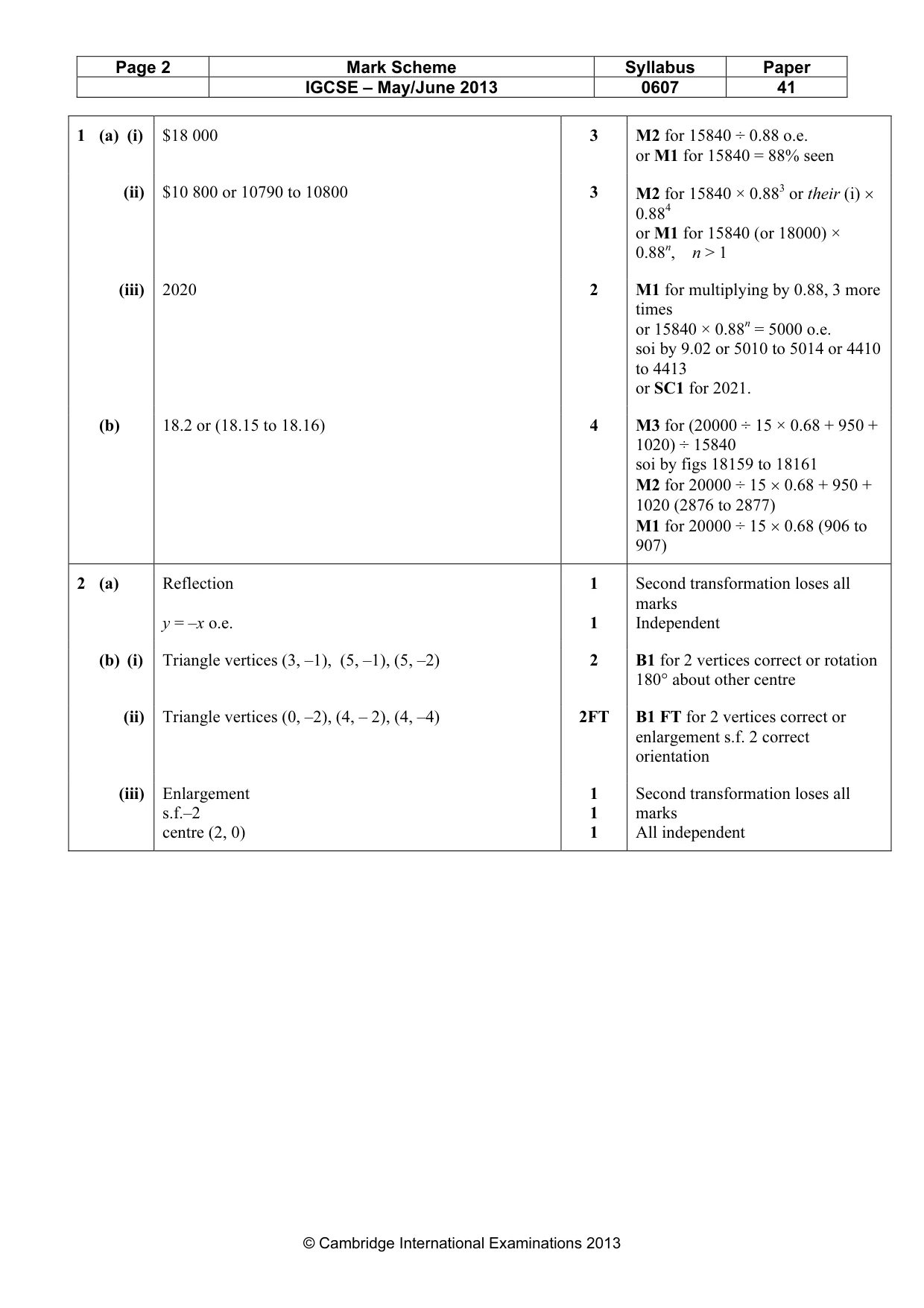
Page 2 Mark Scheme Syllabus Paper IGCSE – May/June 2013 0607 41 © Cambridge International Examinations 2013 1 (a) (i) $18 000 3 M2 for 15840 ÷ 0.88 o.e. or M1 for 15840 = 88% seen (ii) $10 800 or 10790 to 10800 3 M2 for 15840 × 0.883 or their (i) × 0.884 or M1 for 15840 (or 18000) × 0.88n, n > 1 (iii) 2020 2 M1 for multiplying by 0.88, 3 more times or 15840 × 0.88n = 5000 o.e. soi by 9.02 or 5010 to 5014 or 4410 to 4413 or SC1 for 2021. (b) 18.2 or (18.15 to 18.16) 4 M3 for (20000 ÷ 15 × 0.68 + 950 + 1020) ÷ 15840 soi by figs 18159 to 18161 M2 for 20000 ÷ 15 × 0.68 + 950 + 1020 (2876 to 2877) M1 for 20000 ÷ 15 × 0.68 (906 to 907) 2 (a) Reflection y = –x o.e. 1 1 Second transformation loses all marks Independent (b) (i) Triangle vertices (3, –1), (5, –1), (5, –2) 2 B1 for 2 vertices correct or rotation 180° about other centre (ii) Triangle vertices (0, –2), (4, – 2), (4, –4) 2FT B1 FT for 2 vertices correct or enlargement s.f. 2 correct orientation (iii) Enlargement s.f.–2 centre (2, 0) 1 1 1 Second transformation loses all marks All independent
Mark scheme, page 3
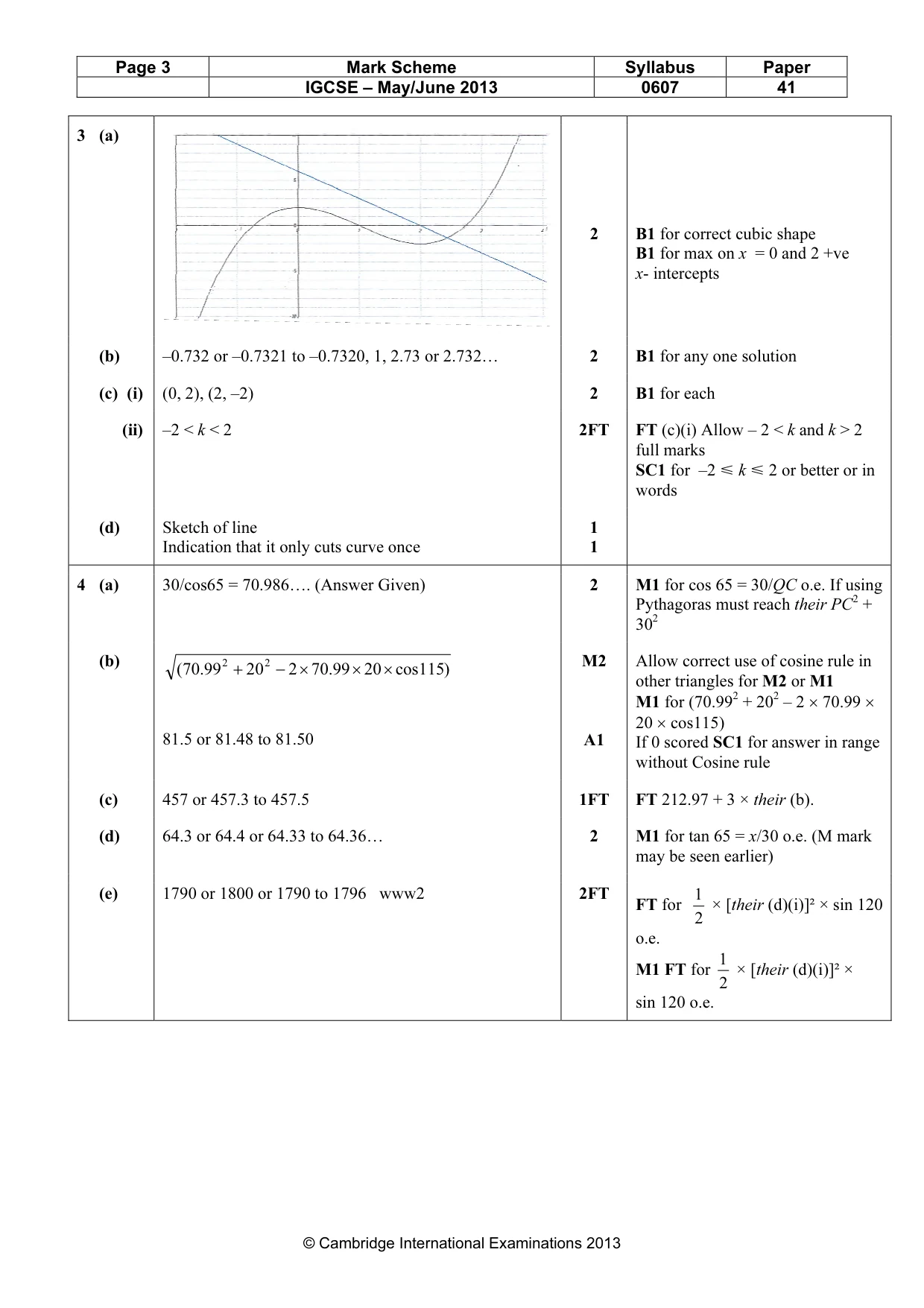
Page 3 Mark Scheme Syllabus Paper IGCSE – May/June 2013 0607 41 © Cambridge International Examinations 2013 3 (a) 2 B1 for correct cubic shape B1 for max on x = 0 and 2 +ve x- intercepts (b) –0.732 or –0.7321 to –0.7320, 1, 2.73 or 2.732… 2 B1 for any one solution (c) (i) (0, 2), (2, –2) 2 B1 for each (ii) –2 < k < 2 2FT FT (c)(i) Allow – 2 < k and k > 2 full marks SC1 for –2 Y k Y 2 or better or in words (d) Sketch of line Indication that it only cuts curve once 1 1 4 (a) 30/cos65 = 70.986…. (Answer Given) 2 M1 for cos 65 = 30/QC o.e. If using Pythagoras must reach their PC2 + 302 (b) ) 115 cos 20 99 . 70 2 20 99 . 70 ( 2 2 × × × − + 81.5 or 81.48 to 81.50 M2 A1 Allow correct use of cosine rule in other triangles for M2 or M1 M1 for (70.992 + 202 – 2 × 70.99 × 20 × cos115) If 0 scored SC1 for answer in range without Cosine rule (c) 457 or 457.3 to 457.5 1FT FT 212.97 + 3 × their (b). (d) 64.3 or 64.4 or 64.33 to 64.36… 2 M1 for tan 65 = x/30 o.e. (M mark may be seen earlier) (e) 1790 or 1800 or 1790 to 1796 www2 2FT FT for 2 1 × [their (d)(i)]² × sin 120 o.e. M1 FT for 2 1 × [their (d)(i)]² × sin 120 o.e.
Mark scheme, page 4
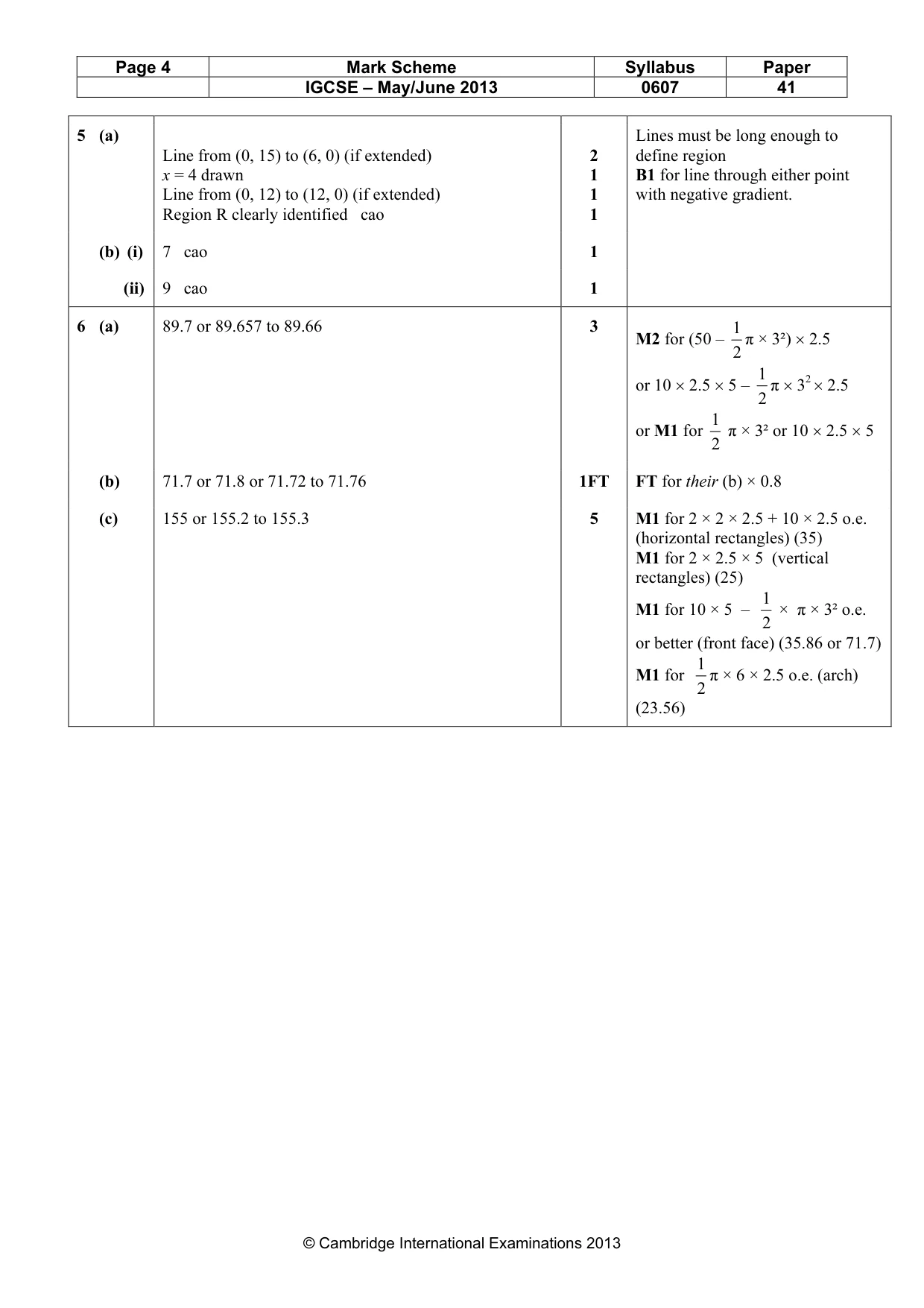
Page 4 Mark Scheme Syllabus Paper IGCSE – May/June 2013 0607 41 © Cambridge International Examinations 2013 5 (a) Line from (0, 15) to (6, 0) (if extended) x = 4 drawn Line from (0, 12) to (12, 0) (if extended) Region R clearly identified cao 2 1 1 1 Lines must be long enough to define region B1 for line through either point with negative gradient. (b) (i) 7 cao 1 (ii) 9 cao 1 6 (a) 89.7 or 89.657 to 89.66 3 M2 for (50 – 2 1 π × 3²) × 2.5 or 10 × 2.5 × 5 – 2 1 π × 32 × 2.5 or M1 for 2 1 π × 3² or 10 × 2.5 × 5 (b) 71.7 or 71.8 or 71.72 to 71.76 1FT FT for their (b) × 0.8 (c) 155 or 155.2 to 155.3 5 M1 for 2 × 2 × 2.5 + 10 × 2.5 o.e. (horizontal rectangles) (35) M1 for 2 × 2.5 × 5 (vertical rectangles) (25) M1 for 10 × 5 – 2 1 × π × 3² o.e. or better (front face) (35.86 or 71.7) M1 for 2 1 π × 6 × 2.5 o.e. (arch) (23.56)
Mark scheme, page 5
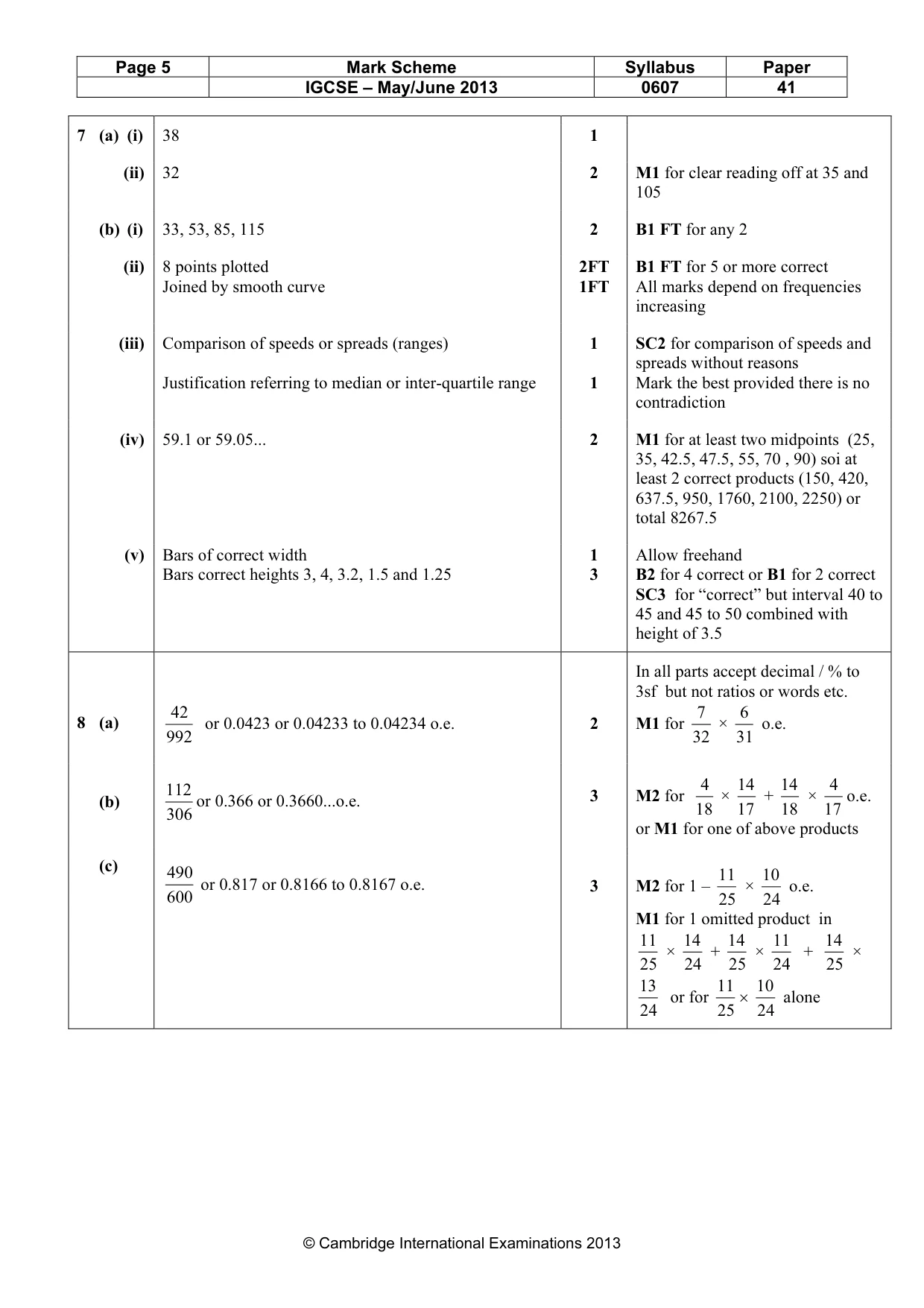
Page 5 Mark Scheme Syllabus Paper IGCSE – May/June 2013 0607 41 © Cambridge International Examinations 2013 7 (a) (i) 38 1 (ii) 32 2 M1 for clear reading off at 35 and 105 (b) (i) 33, 53, 85, 115 2 B1 FT for any 2 (ii) 8 points plotted Joined by smooth curve 2FT 1FT B1 FT for 5 or more correct All marks depend on frequencies increasing (iii) Comparison of speeds or spreads (ranges) Justification referring to median or inter-quartile range 1 1 SC2 for comparison of speeds and spreads without reasons Mark the best provided there is no contradiction (iv) 59.1 or 59.05... 2 M1 for at least two midpoints (25, 35, 42.5, 47.5, 55, 70 , 90) soi at least 2 correct products (150, 420, 637.5, 950, 1760, 2100, 2250) or total 8267.5 (v) Bars of correct width Bars correct heights 3, 4, 3.2, 1.5 and 1.25 1 3 Allow freehand B2 for 4 correct or B1 for 2 correct SC3 for “correct” but interval 40 to 45 and 45 to 50 combined with height of 3.5 8 (a) 992 42 or 0.0423 or 0.04233 to 0.04234 o.e. 2 In all parts accept decimal / % to 3sf but not ratios or words etc. M1 for 32 7 × 31 6 o.e. (b) 306 112 or 0.366 or 0.3660...o.e. 3 M2 for 18 4 × 17 14 + 18 14 × 17 4 o.e. or M1 for one of above products (c) 600 490 or 0.817 or 0.8166 to 0.8167 o.e. 3 M2 for 1 – 25 11 × 24 10 o.e. M1 for 1 omitted product in 25 11 × 24 14 + 25 14 × 24 11 + 25 14 × 24 13 or for 25 11 × 24 10 alone
Mark scheme, page 6
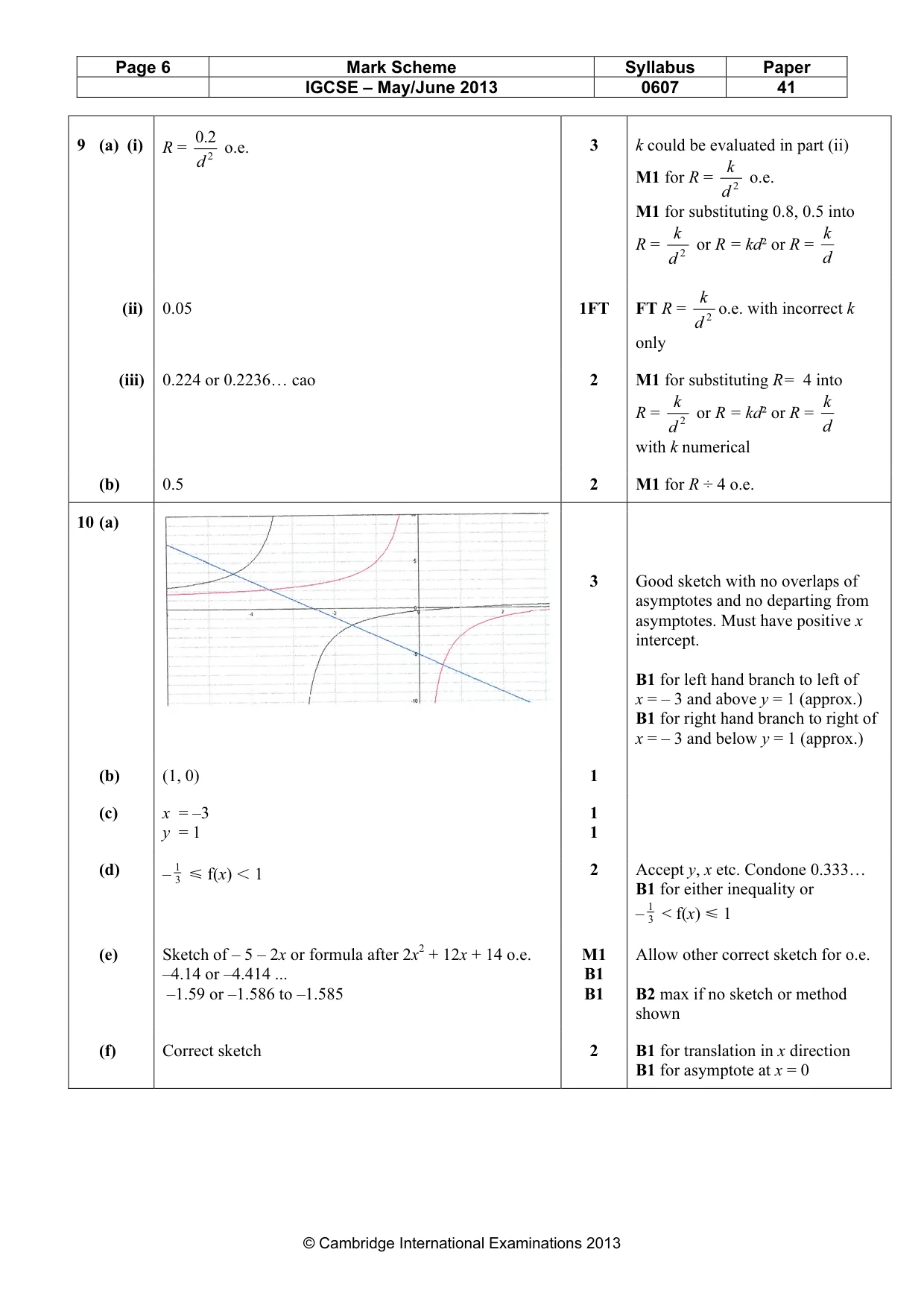
Page 6 Mark Scheme Syllabus Paper IGCSE – May/June 2013 0607 41 © Cambridge International Examinations 2013 9 (a) (i) R = 2 2.0 d o.e. 3 k could be evaluated in part (ii) M1 for R = 2 d k o.e. M1 for substituting 0.8, 0.5 into R = 2 d k or R = kd² or R = d k (ii) 0.05 1FT FT R = 2 d k o.e. with incorrect k only (iii) 0.224 or 0.2236… cao 2 M1 for substituting R= 4 into R = 2 d k or R = kd² or R = d k with k numerical (b) 0.5 2 M1 for R ÷ 4 o.e. 10 (a) 3 Good sketch with no overlaps of asymptotes and no departing from asymptotes. Must have positive x intercept. B1 for left hand branch to left of x = – 3 and above y = 1 (approx.) B1 for right hand branch to right of x = – 3 and below y = 1 (approx.) (b) (1, 0) 1 (c) x = –3 y = 1 1 1 (d) – 3 1 =Y=f(x) I 1 2 Accept y, x etc. Condone 0.333… B1 for either inequality or – 3 1 < f(x) Y 1 (e) Sketch of – 5 – 2x or formula after 2x2 + 12x + 14 o.e. –4.14 or –4.414 ... –1.59 or –1.586 to –1.585 M1 B1 B1 Allow other correct sketch for o.e. B2 max if no sketch or method shown (f) Correct sketch 2 B1 for translation in x direction B1 for asymptote at x = 0
Mark scheme, page 7
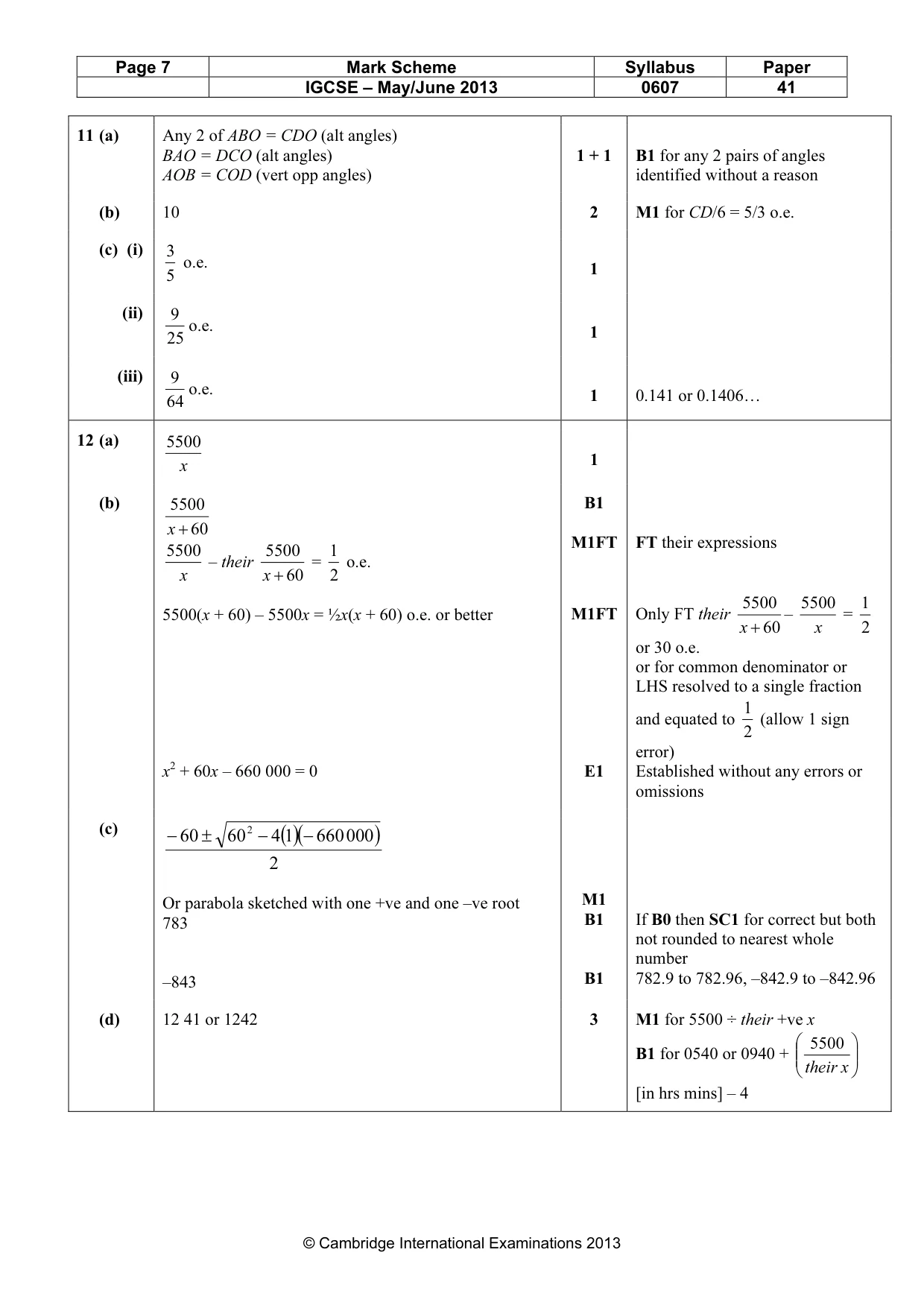
Page 7 Mark Scheme Syllabus Paper IGCSE – May/June 2013 0607 41 © Cambridge International Examinations 2013 11 (a) Any 2 of ABO = CDO (alt angles) BAO = DCO (alt angles) AOB = COD (vert opp angles) 1 + 1 B1 for any 2 pairs of angles identified without a reason (b) 10 2 M1 for CD/6 = 5/3 o.e. (c) (i) 5 3 o.e. 1 (ii) 25 9 o.e. 1 (iii) 64 9 o.e. 1 0.141 or 0.1406… 12 (a) x 5500 1 (b) 60 5500 + x x 5500 – their 60 5500 + x = 2 1 o.e. 5500(x + 60) – 5500x = ½x(x + 60) o.e. or better x2 + 60x – 660 000 = 0 B1 M1FT M1FT E1 FT their expressions Only FT their 60 5500 + x – x 5500 = 2 1 or 30 o.e. or for common denominator or LHS resolved to a single fraction and equated to 2 1 (allow 1 sign error) Established without any errors or omissions (c) ( )( ) 2 000 660 1 4 60 60 2 − − ± − Or parabola sketched with one +ve and one –ve root 783 –843 M1 B1 B1 If B0 then SC1 for correct but both not rounded to nearest whole number 782.9 to 782.96, –842.9 to –842.96 (d) 12 41 or 1242 3 M1 for 5500 ÷ their +ve x B1 for 0540 or 0940 + x their 5500 [in hrs mins] – 4
What you needed in this session
Cambridge’s own grade thresholds for 2013 May/June, Paper 4 · Variant 1. A higher threshold means an easier paper — the bar moves with how the cohort did.