Cambridge IGCSE Mathematics - International 0607 — 2013 May/June Paper 4 · Variant 3
0607/43/M/J/13 · 120 marks · ≈135 min
The question paper and its mark scheme, free to read here and free to download. This is Cambridge’s own paper, exactly as it was sat.
Question paper20 pages
Mark scheme6 pages
Answers below. Sit the paper first if you are practising.
Paper as text
Question paper, page 1
This document consists of 20 printed pages. IB13 06_0607_43/6RP © UCLES 2013 [Turn over *4434452004* For Examiner's Use UNIVERSITY OF CAMBRIDGE INTERNATIONAL EXAMINATIONS International General Certificate of Secondary Education CAMBRIDGE INTERNATIONAL MATHEMATICS 0607/43 Paper 4 (Extended) May/June 2013 2 hours 15 minutes Candidates answer on the Question Paper. Additional Materials: Geometrical Instruments Graphics Calculator READ THESE INSTRUCTIONS FIRST Write your Centre number, candidate number and name on all the work you hand in. Write in dark blue or black pen. Do not use staples, paper clips, highlighters, glue or correction fluid. You may use a pencil for any diagrams or graphs. DO NOT WRITE IN ANY BARCODES. Answer all the questions. Unless instructed otherwise, give your answers exactly or correct to three significant figures as appropriate. Answers in degrees should be given to one decimal place. For π, use your calculator value. You must show all the relevant working to gain full marks and you will be given marks for correct methods, including sketches, even if your answer is incorrect. The number of marks is given in brackets [ ] at the end of each question or part question. The total number of marks for this paper is 120. www.XtremePapers.com
Question paper, page 2
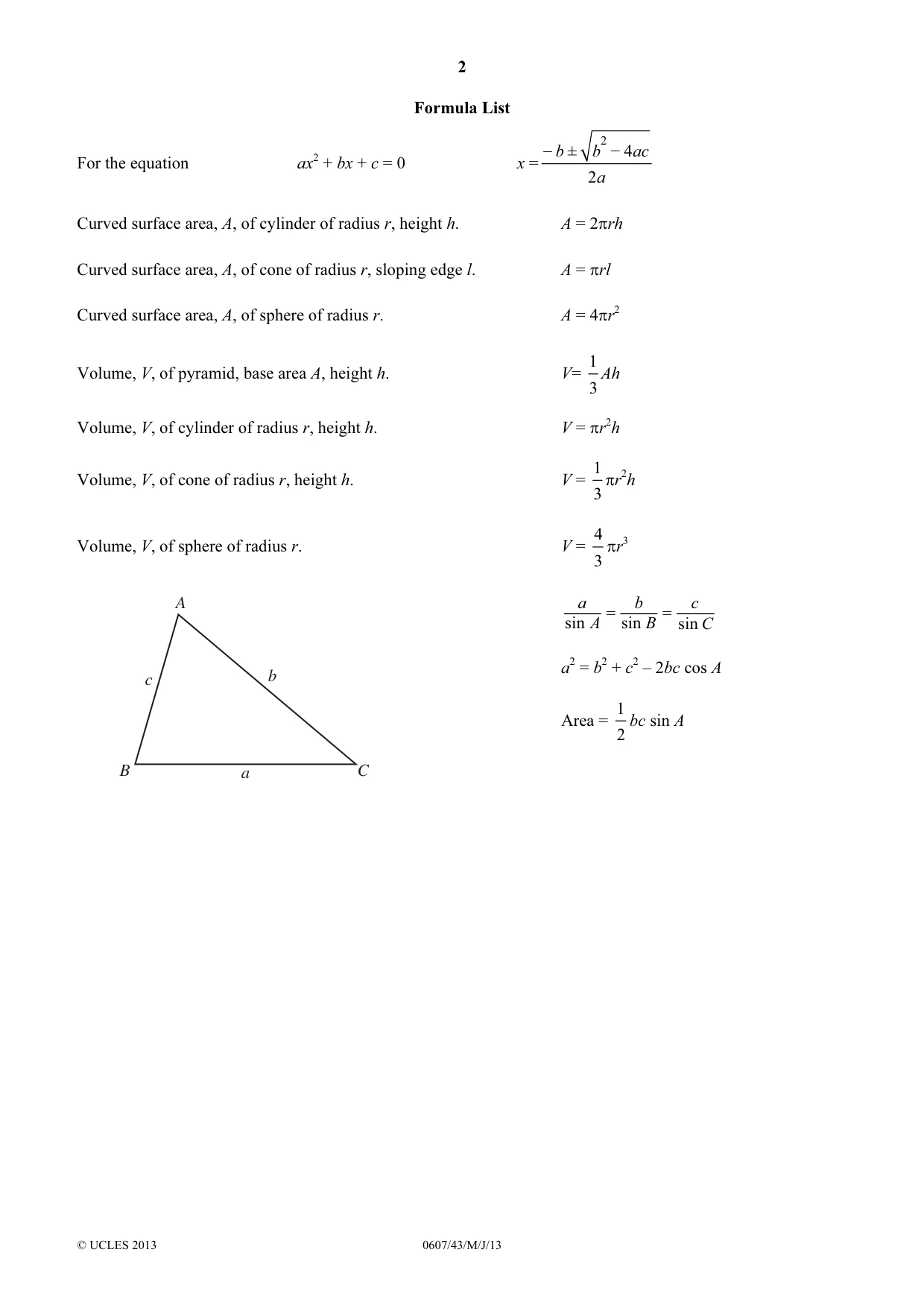
2 © UCLES 2013 0607/43/M/J/13 Formula List For the equation ax2 + bx + c = 0 x = 2 _ ± 4 2 _ b b ac a Curved surface area, A, of cylinder of radius r, height h. A = 2πrh Curved surface area, A, of cone of radius r, sloping edge l. A = πrl Curved surface area, A, of sphere of radius r. A = 4πr2 Volume, V, of pyramid, base area A, height h. V= 1 3 Ah Volume, V, of cylinder of radius r, height h. V = πr2h Volume, V, of cone of radius r, height h. V = 1 3 πr2h Volume, V, of sphere of radius r. V = 4 3 πr3 = = sin sin sin a b c A B C a2 = b2 + c2 – 2bc cos A Area = 1 2 bc sin A A a B C b c
Question paper, page 3
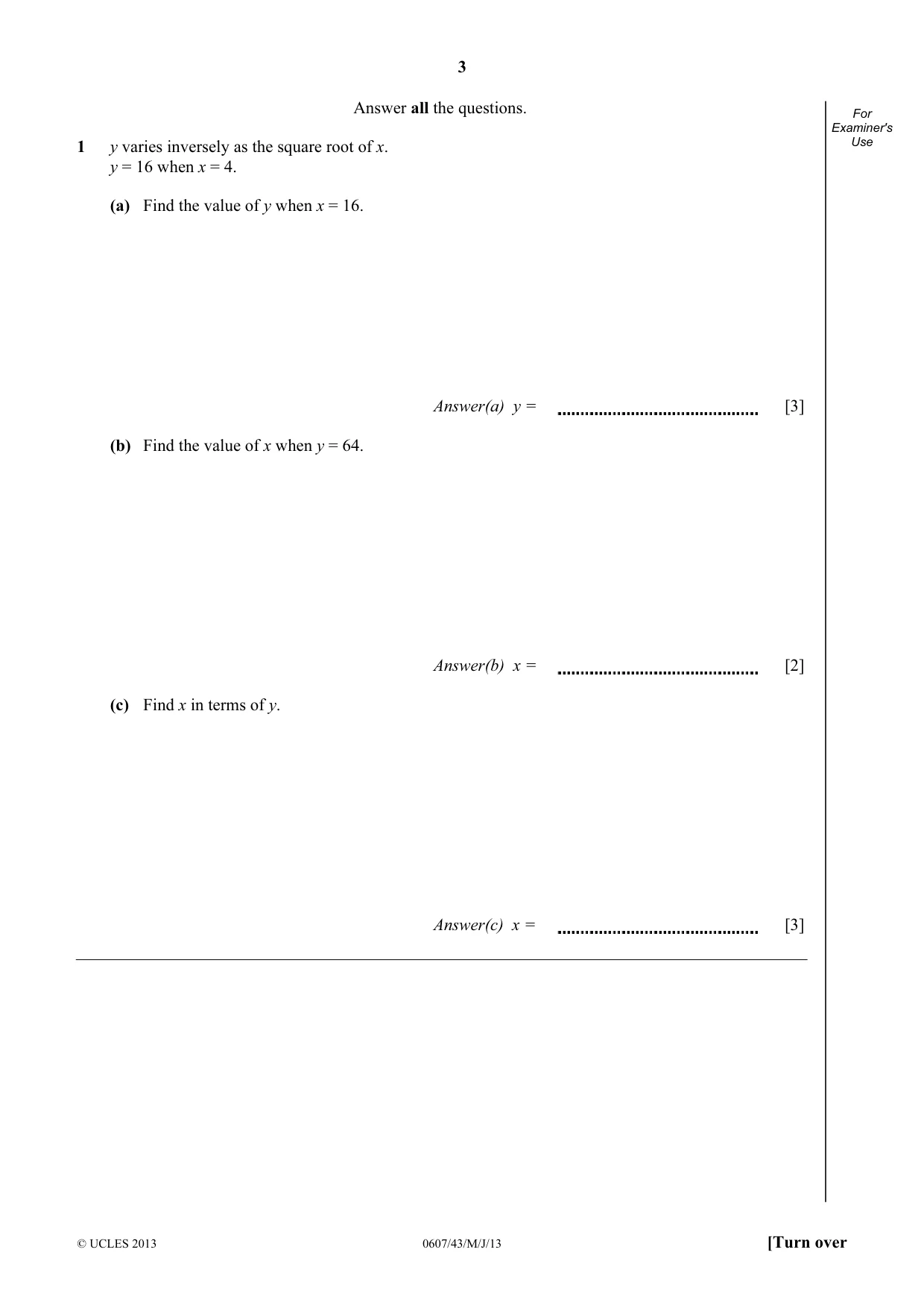
3 © UCLES 2013 0607/43/M/J/13 [Turn over For Examiner's Use Answer all the questions. 1 y varies inversely as the square root of x. y = 16 when x = 4. (a) Find the value of y when x = 16. Answer(a) y = [3] (b) Find the value of x when y = 64. Answer(b) x = [2] (c) Find x in terms of y. Answer(c) x = [3]
Question paper, page 4
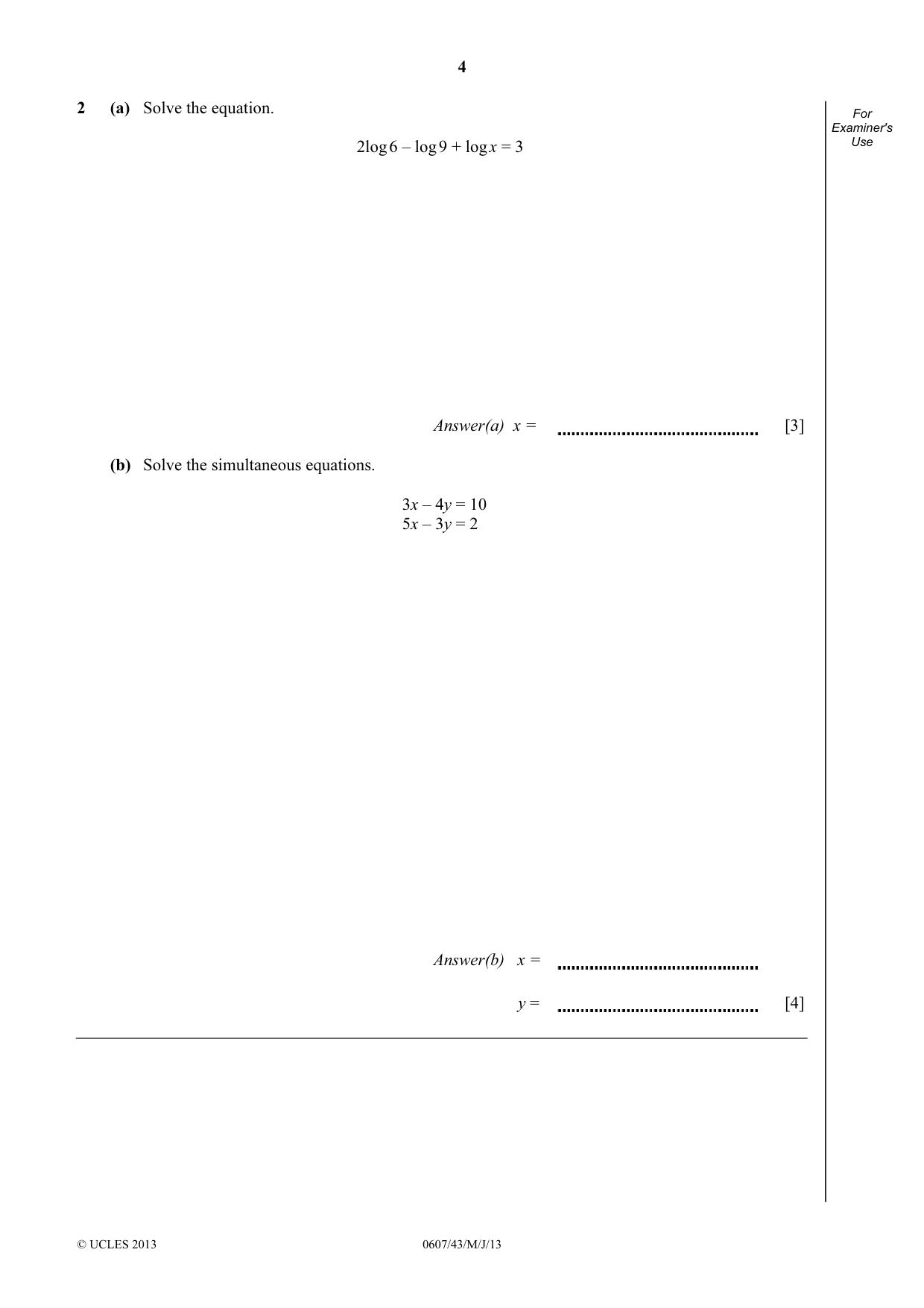
4 © UCLES 2013 0607/43/M/J/13 For Examiner's Use 2 (a) Solve the equation. 2log 6 – log 9 + log x = 3 Answer(a) x = [3] (b) Solve the simultaneous equations. 3x – 4y = 10 5x – 3y = 2 Answer(b) x = y = [4]
Question paper, page 5
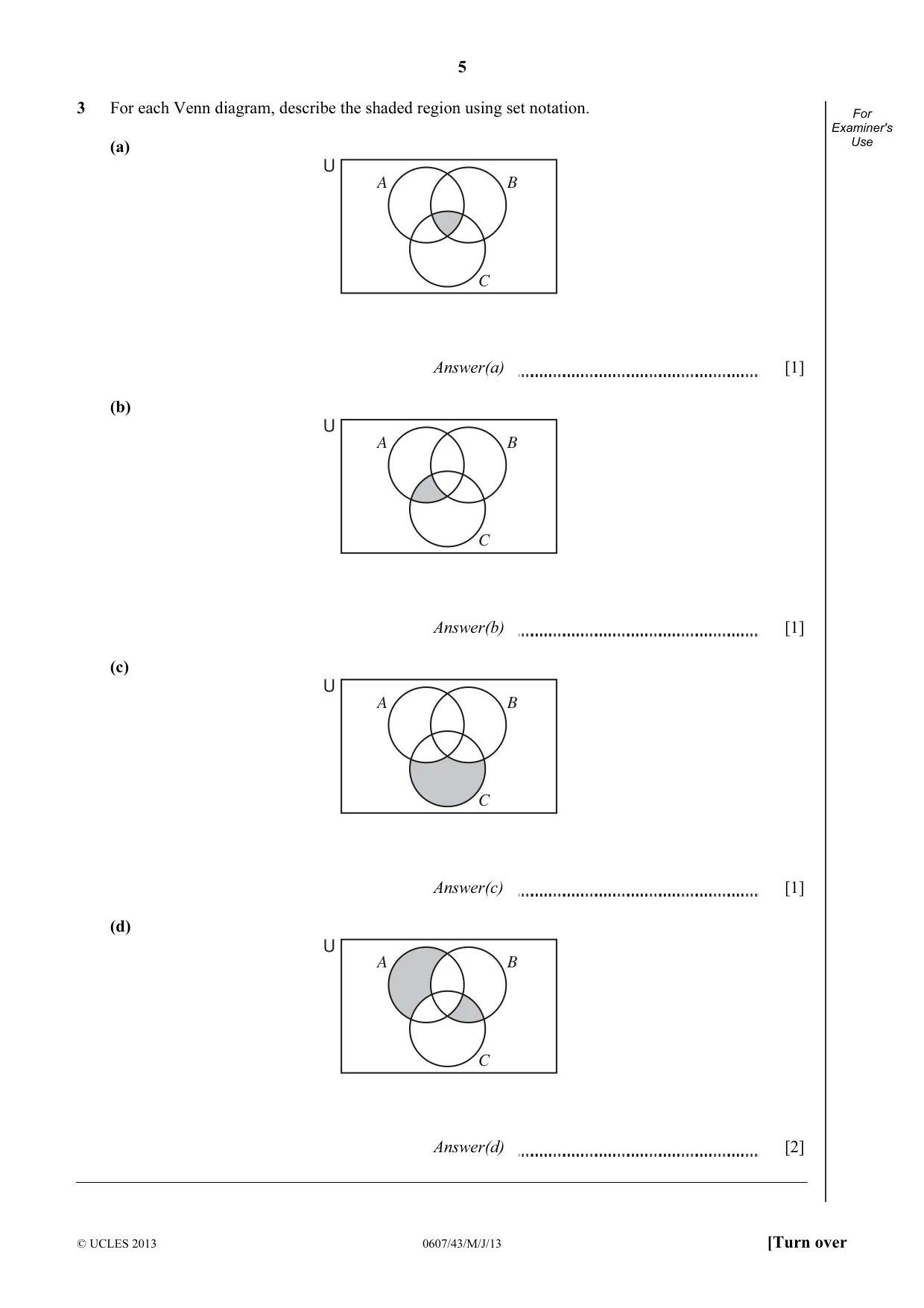
5 © UCLES 2013 0607/43/M/J/13 [Turn over For Examiner's Use 3 For each Venn diagram, describe the shaded region using set notation. (a) U A B C Answer(a) [1] (b) U A B C Answer(b) [1] (c) U A B C Answer(c) [1] (d) U A B C Answer(d) [2]
Question paper, page 6
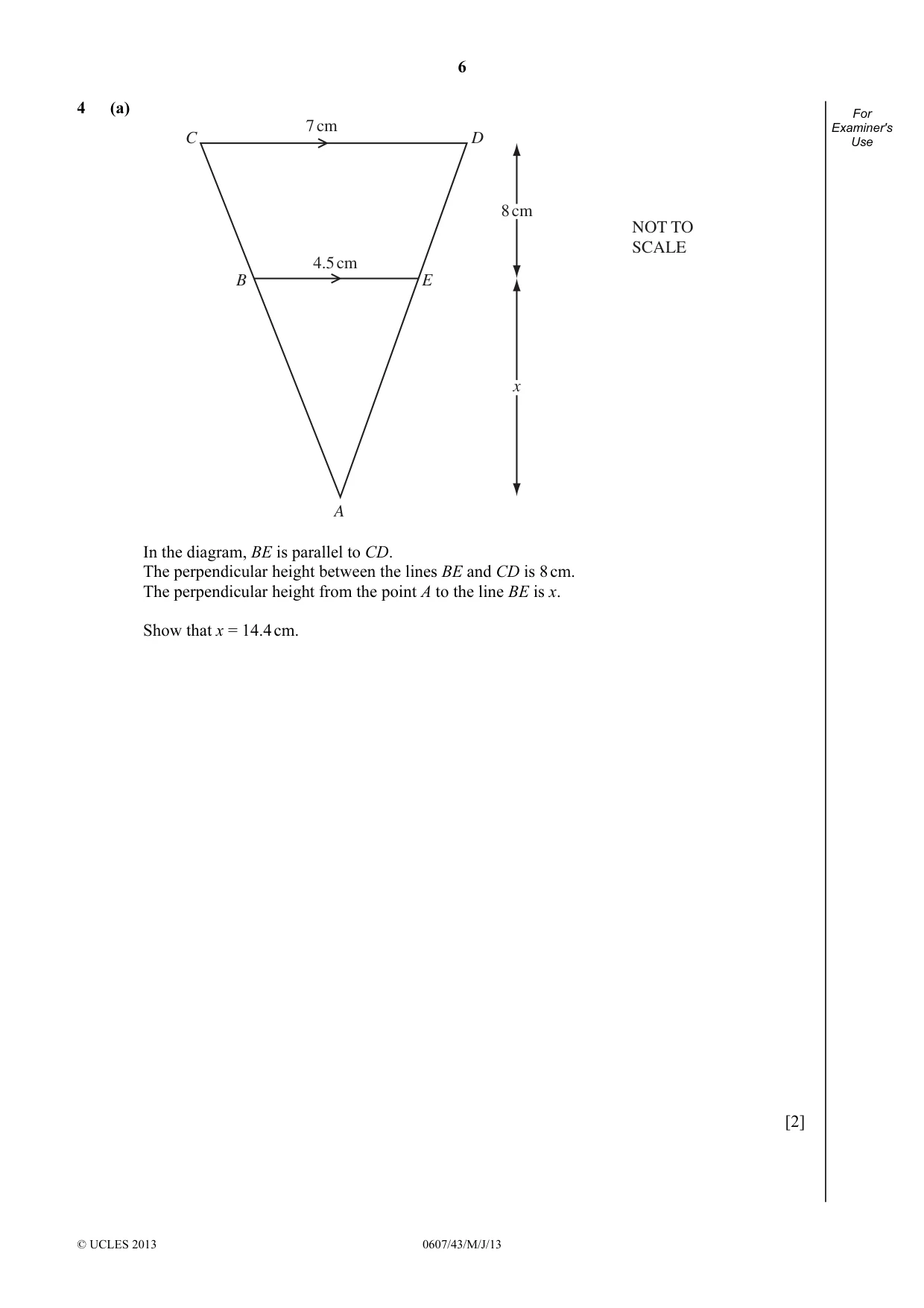
6 © UCLES 2013 0607/43/M/J/13 For Examiner's Use 4 (a) 7 cm 4.5 cm C D E B A x 8 cm NOT TO SCALE In the diagram, BE is parallel to CD. The perpendicular height between the lines BE and CD is 8 cm. The perpendicular height from the point A to the line BE is x. Show that x = 14.4 cm. [2]
Question paper, page 7
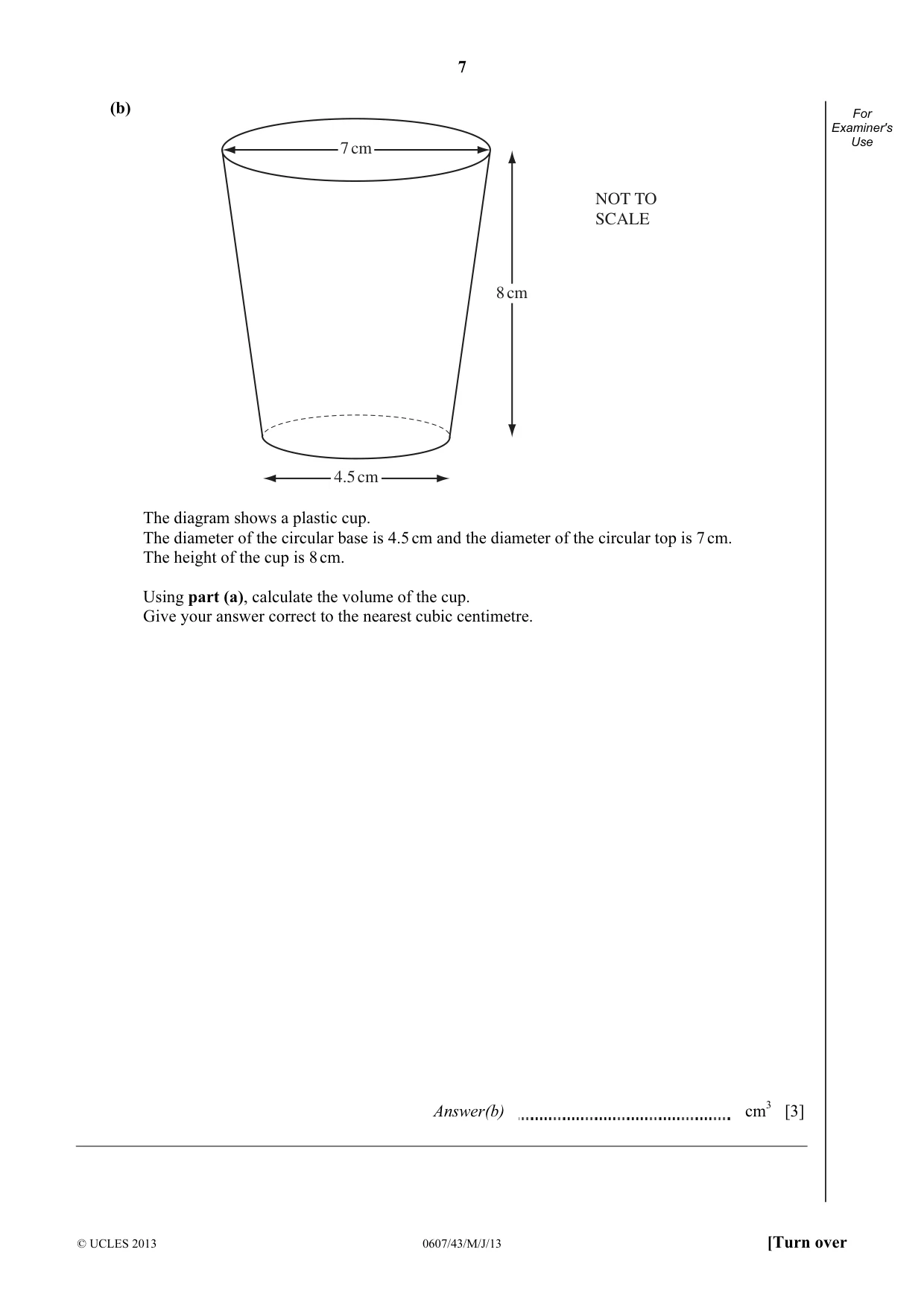
7 © UCLES 2013 0607/43/M/J/13 [Turn over For Examiner's Use (b) 7 cm 4.5 cm 8 cm NOT TO SCALE The diagram shows a plastic cup. The diameter of the circular base is 4.5 cm and the diameter of the circular top is 7 cm. The height of the cup is 8 cm. Using part (a), calculate the volume of the cup. Give your answer correct to the nearest cubic centimetre. Answer(b) cm3 [3]
Question paper, page 8
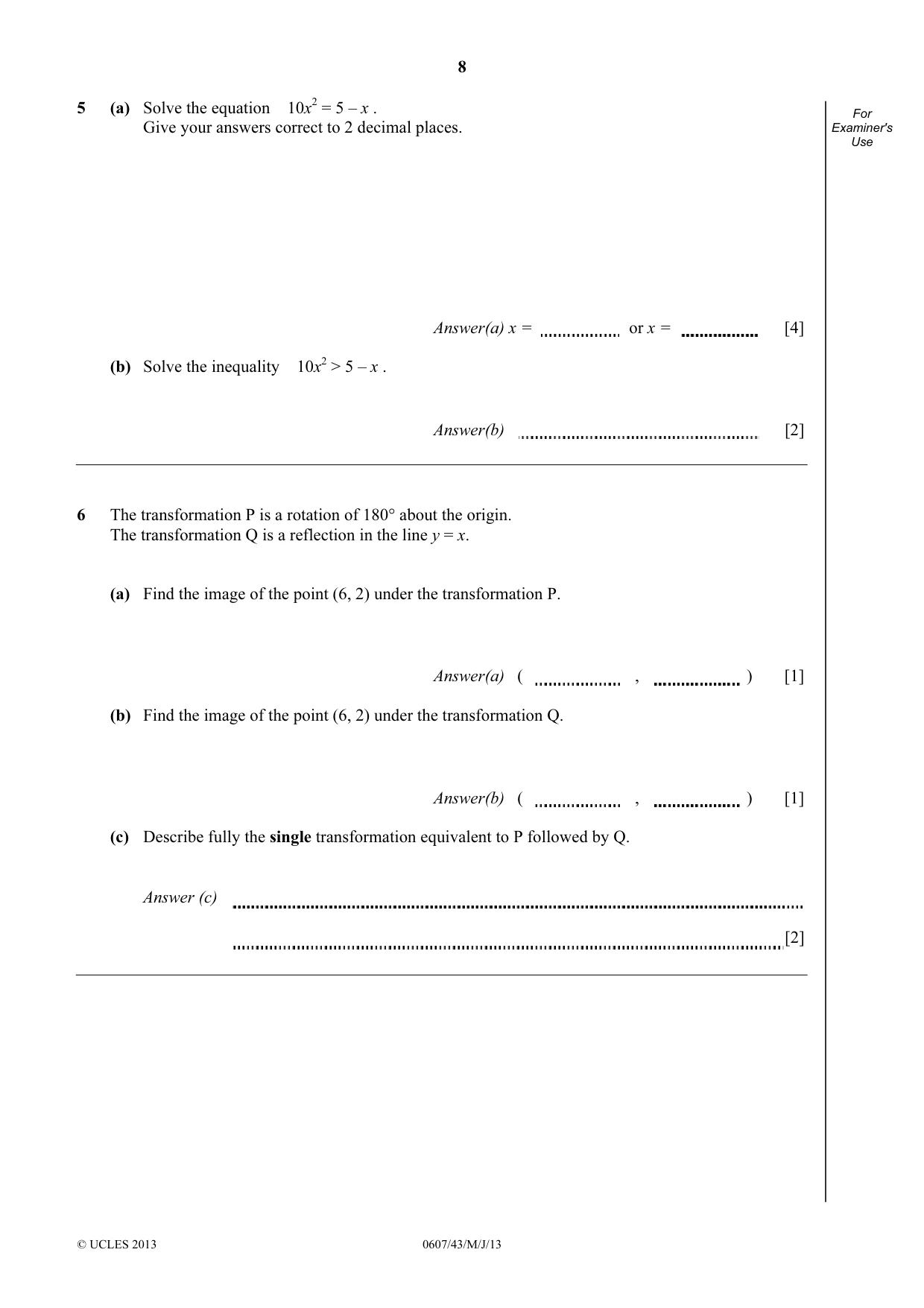
8 © UCLES 2013 0607/43/M/J/13 For Examiner's Use 5 (a) Solve the equation 10x2 = 5 – x . Give your answers correct to 2 decimal places. Answer(a) x = or x = [4] (b) Solve the inequality 10x2 > 5 – x . Answer(b) [2] 6 The transformation P is a rotation of 180° about the origin. The transformation Q is a reflection in the line y = x. (a) Find the image of the point (6, 2) under the transformation P. Answer(a) ( , ) [1] (b) Find the image of the point (6, 2) under the transformation Q. Answer(b) ( , ) [1] (c) Describe fully the single transformation equivalent to P followed by Q. Answer (c) [2]
Question paper, page 9
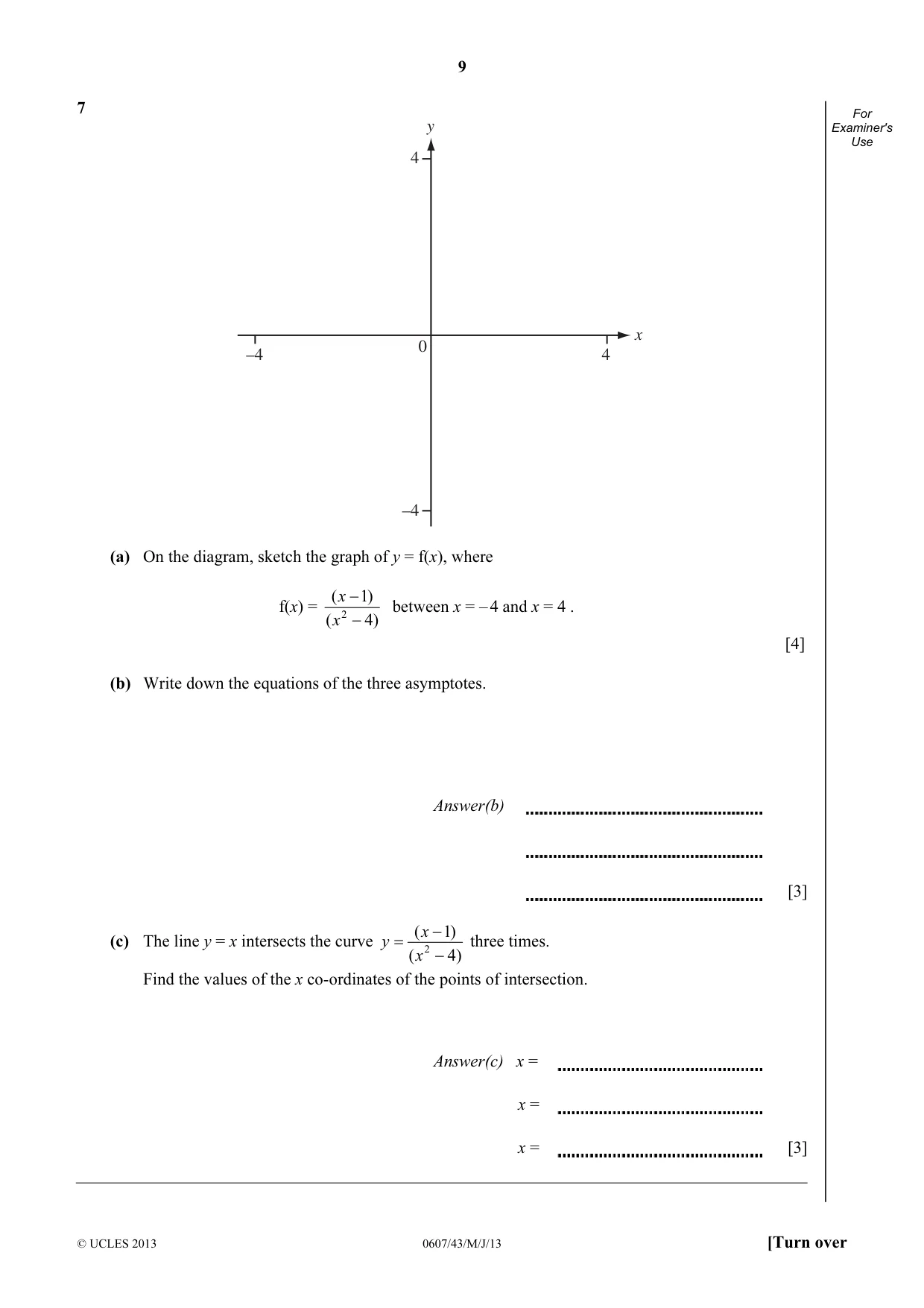
9 © UCLES 2013 0607/43/M/J/13 [Turn over For Examiner's Use 7 4 4 –4 –4 0 y x (a) On the diagram, sketch the graph of y = f(x), where f(x) = ) 4 ( )1 ( 2 − − x x between x = – 4 and x = 4 . [4] (b) Write down the equations of the three asymptotes. Answer(b) [3] (c) The line y = x intersects the curve ) 4 ( )1 ( 2 − − = x x y three times. Find the values of the x co-ordinates of the points of intersection. Answer(c) x = x = x = [3]
Question paper, page 10
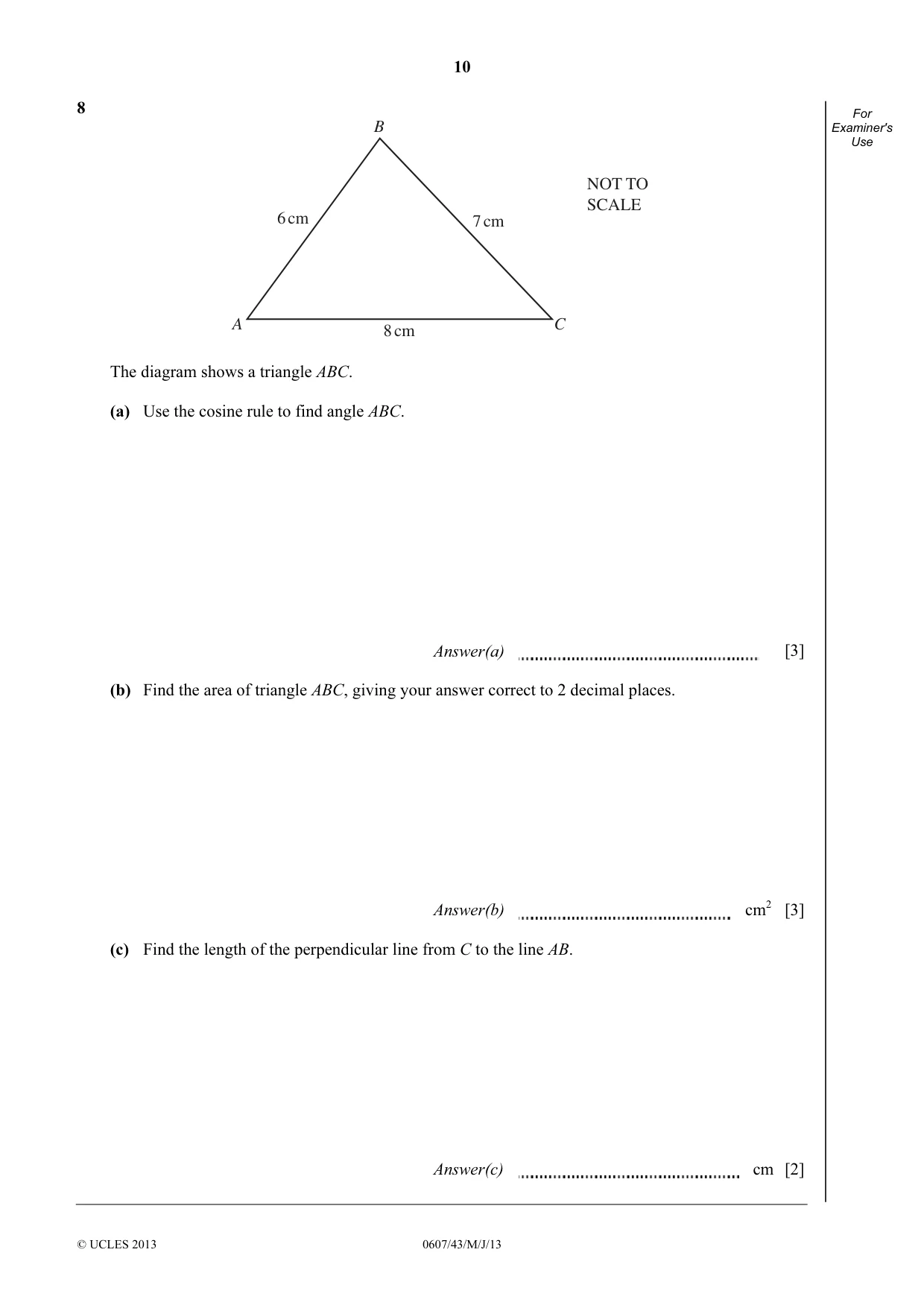
10 © UCLES 2013 0607/43/M/J/13 For Examiner's Use 8 B A C 8 cm 7 cm 6 cm NOT TO SCALE The diagram shows a triangle ABC. (a) Use the cosine rule to find angle ABC. Answer(a) [3] (b) Find the area of triangle ABC, giving your answer correct to 2 decimal places. Answer(b) cm2 [3] (c) Find the length of the perpendicular line from C to the line AB. Answer(c) cm [2]
Question paper, page 11
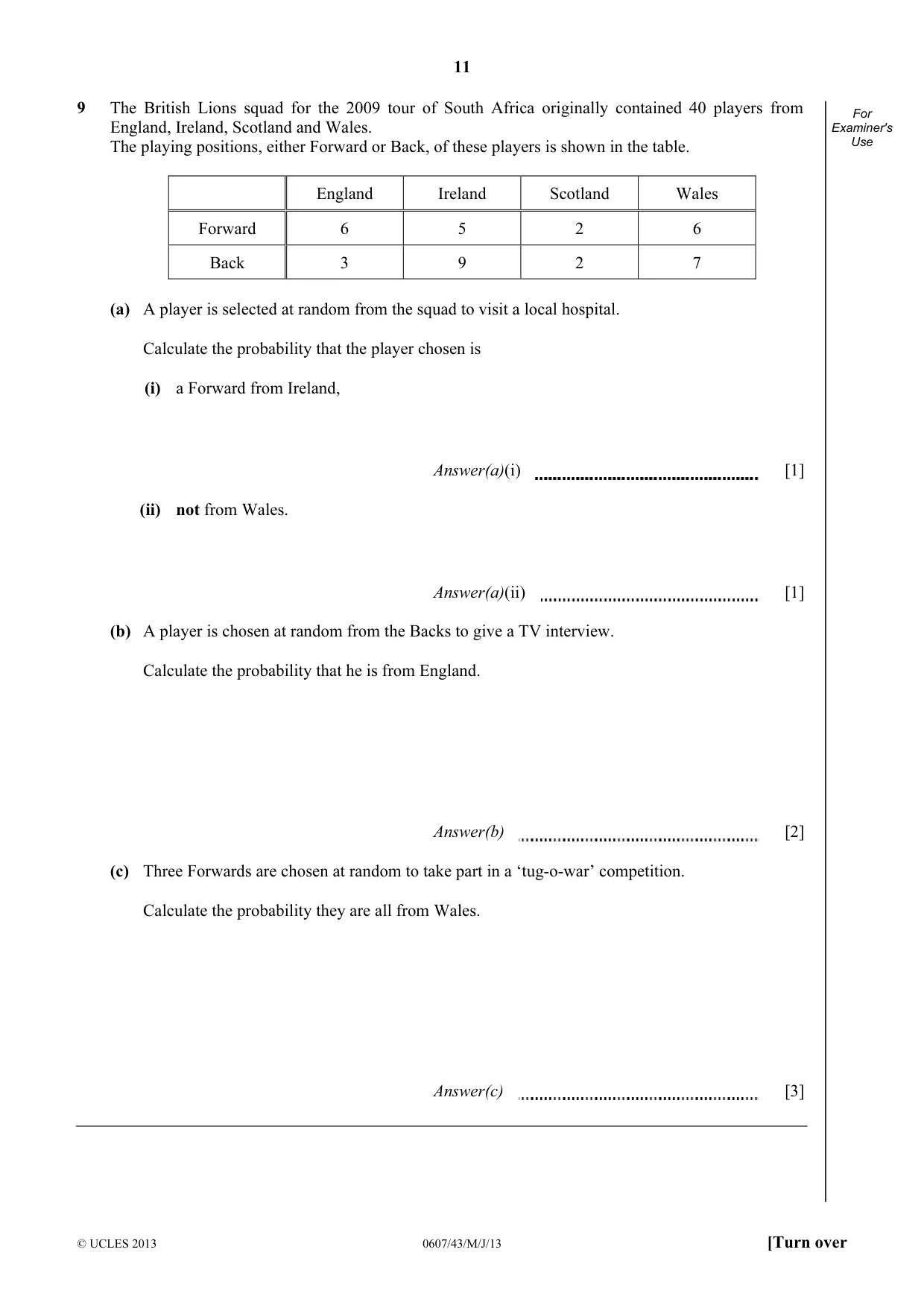
11 © UCLES 2013 0607/43/M/J/13 [Turn over For Examiner's Use 9 The British Lions squad for the 2009 tour of South Africa originally contained 40 players from England, Ireland, Scotland and Wales. The playing positions, either Forward or Back, of these players is shown in the table. England Ireland Scotland Wales Forward 6 5 2 6 Back 3 9 2 7 (a) A player is selected at random from the squad to visit a local hospital. Calculate the probability that the player chosen is (i) a Forward from Ireland, Answer(a)(i) [1] (ii) not from Wales. Answer(a)(ii) [1] (b) A player is chosen at random from the Backs to give a TV interview. Calculate the probability that he is from England. Answer(b) [2] (c) Three Forwards are chosen at random to take part in a ‘tug-o-war’ competition. Calculate the probability they are all from Wales. Answer(c) [3]
Question paper, page 12
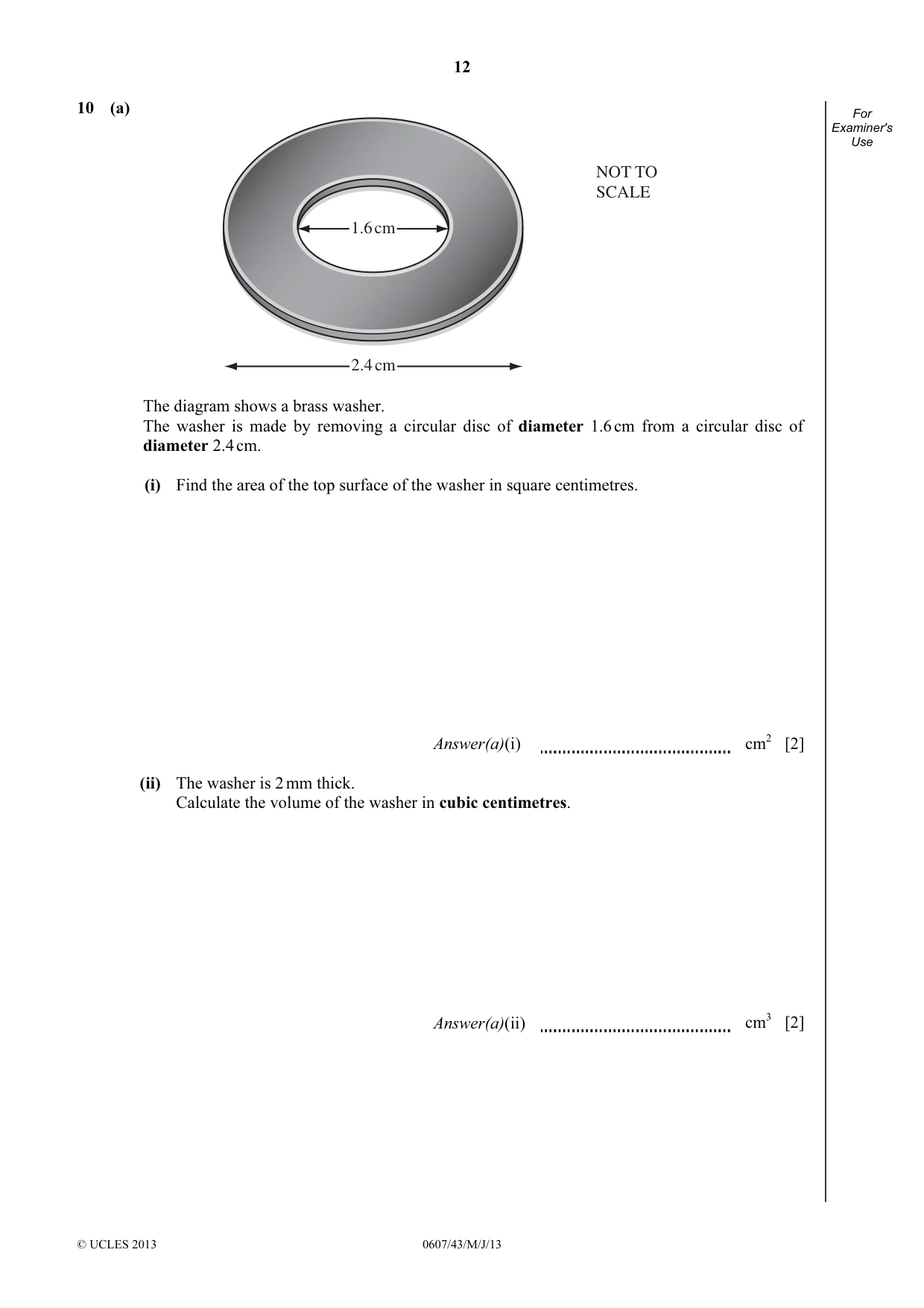
12 © UCLES 2013 0607/43/M/J/13 For Examiner's Use 10 (a) 1.6 cm 2.4 cm NOT TO SCALE The diagram shows a brass washer. The washer is made by removing a circular disc of diameter 1.6 cm from a circular disc of diameter 2.4 cm. (i) Find the area of the top surface of the washer in square centimetres. Answer(a)(i) cm2 [2] (ii) The washer is 2 mm thick. Calculate the volume of the washer in cubic centimetres. Answer(a)(ii) cm3 [2]
Question paper, page 13
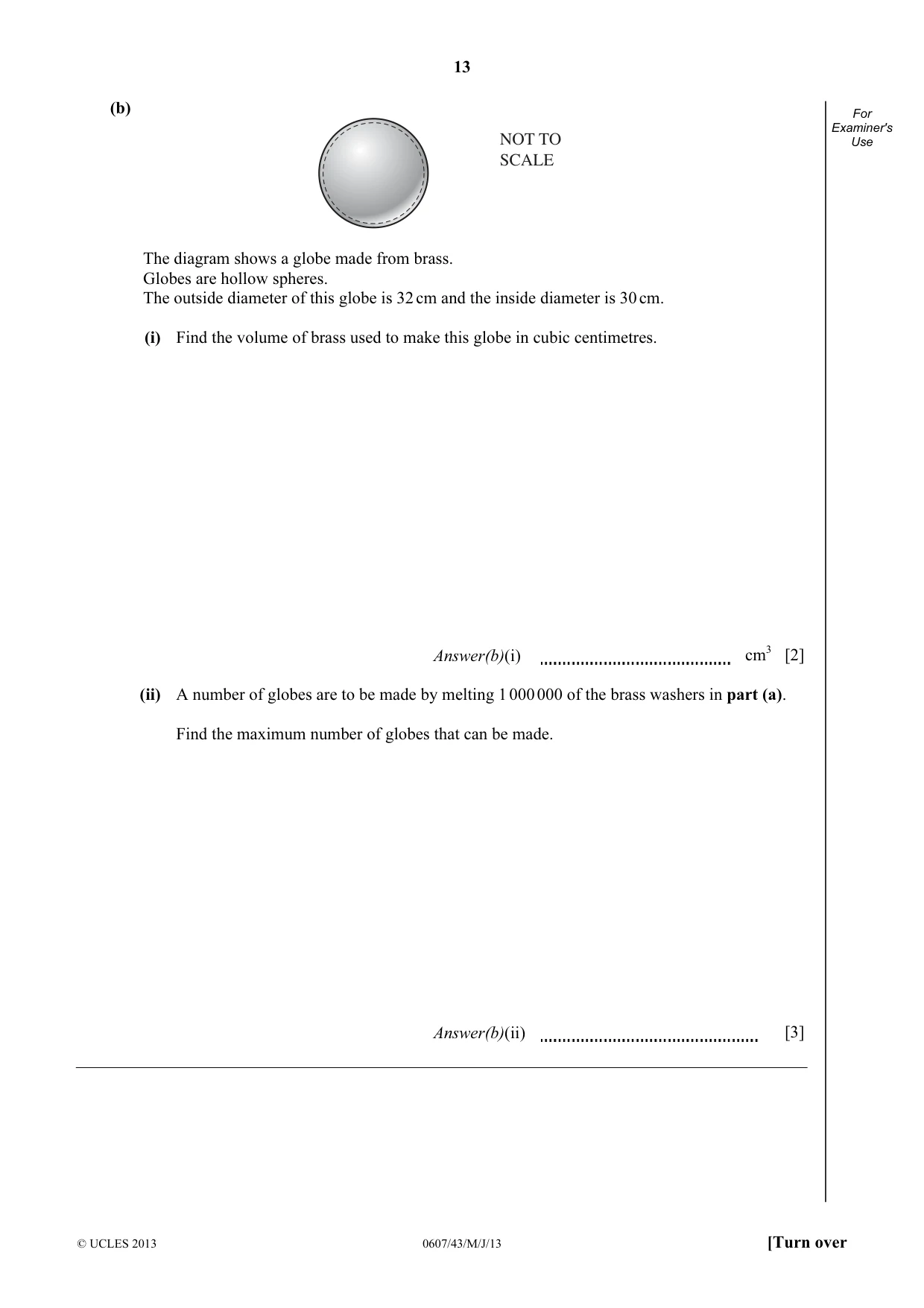
13 © UCLES 2013 0607/43/M/J/13 [Turn over For Examiner's Use (b) NOT TO SCALE The diagram shows a globe made from brass. Globes are hollow spheres. The outside diameter of this globe is 32 cm and the inside diameter is 30 cm. (i) Find the volume of brass used to make this globe in cubic centimetres. Answer(b)(i) cm3 [2] (ii) A number of globes are to be made by melting 1 000 000 of the brass washers in part (a). Find the maximum number of globes that can be made. Answer(b)(ii) [3]
Question paper, page 14
14 © UCLES 2013 0607/43/M/J/13 For Examiner's Use 11 Carlos delivers computers from a factory to a town that is 720 km away. When he drives at an average speed of x km/h the journey takes one hour longer than if he drives at (x +10) km/h. (a) Write down an equation in x and show that it simplifies to x2 + 10x – 7200 = 0 . [4] (b) (i) Factorise x2 + 10x – 7200. Answer(b)(i) [2] (ii) Solve the equation x2 + 10x – 7200 = 0 . Answer(b)(ii) x = or x = [1] (iii) Carlos drives the 720 km at x km/h. Work out the time of his journey. Answer(b)(iii) hours [1]
Question paper, page 15
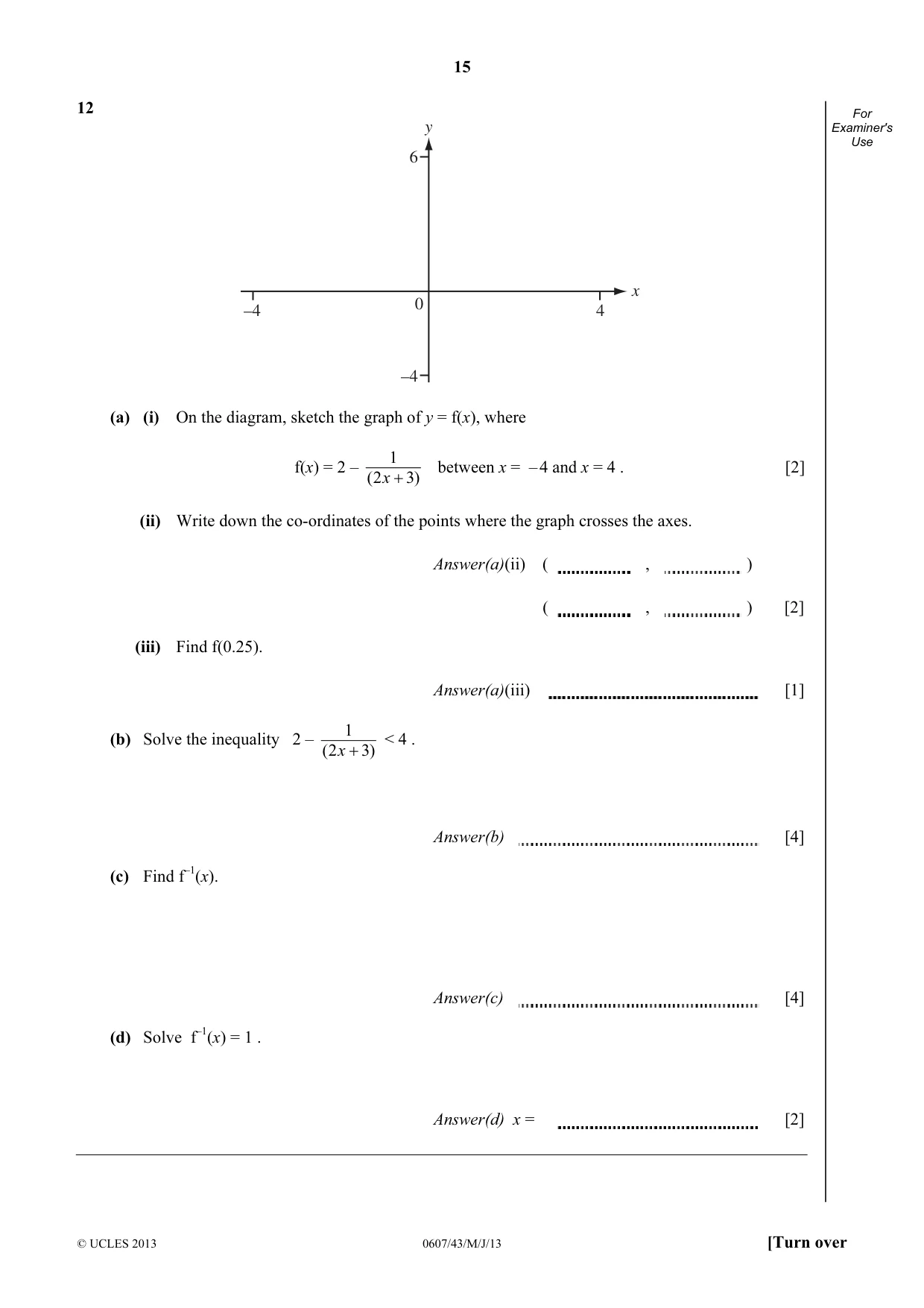
15 © UCLES 2013 0607/43/M/J/13 [Turn over For Examiner's Use 12 –4 –4 4 6 0 y x (a) (i) On the diagram, sketch the graph of y = f(x), where f(x) = 2 – )3 2 ( 1 + x between x = – 4 and x = 4 . [2] (ii) Write down the co-ordinates of the points where the graph crosses the axes. Answer(a)(ii) ( , ) ( , ) [2] (iii) Find f(0.25). Answer(a)(iii) [1] (b) Solve the inequality 2 – )3 2 ( 1 + x < 4 . Answer(b) [4] (c) Find f–1(x). Answer(c) [4] (d) Solve f–1(x) = 1 . Answer(d) x = [2]
Question paper, page 16
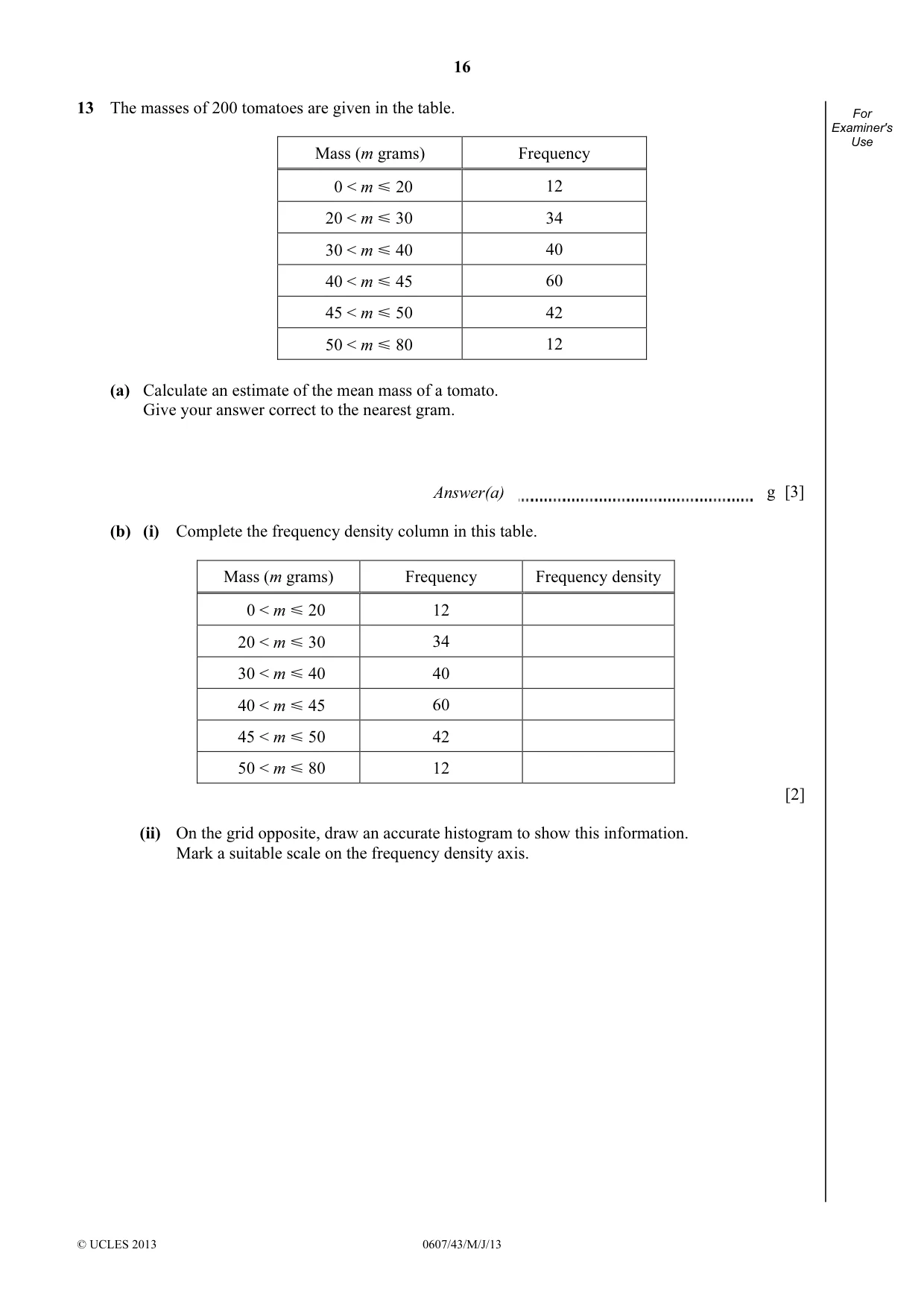
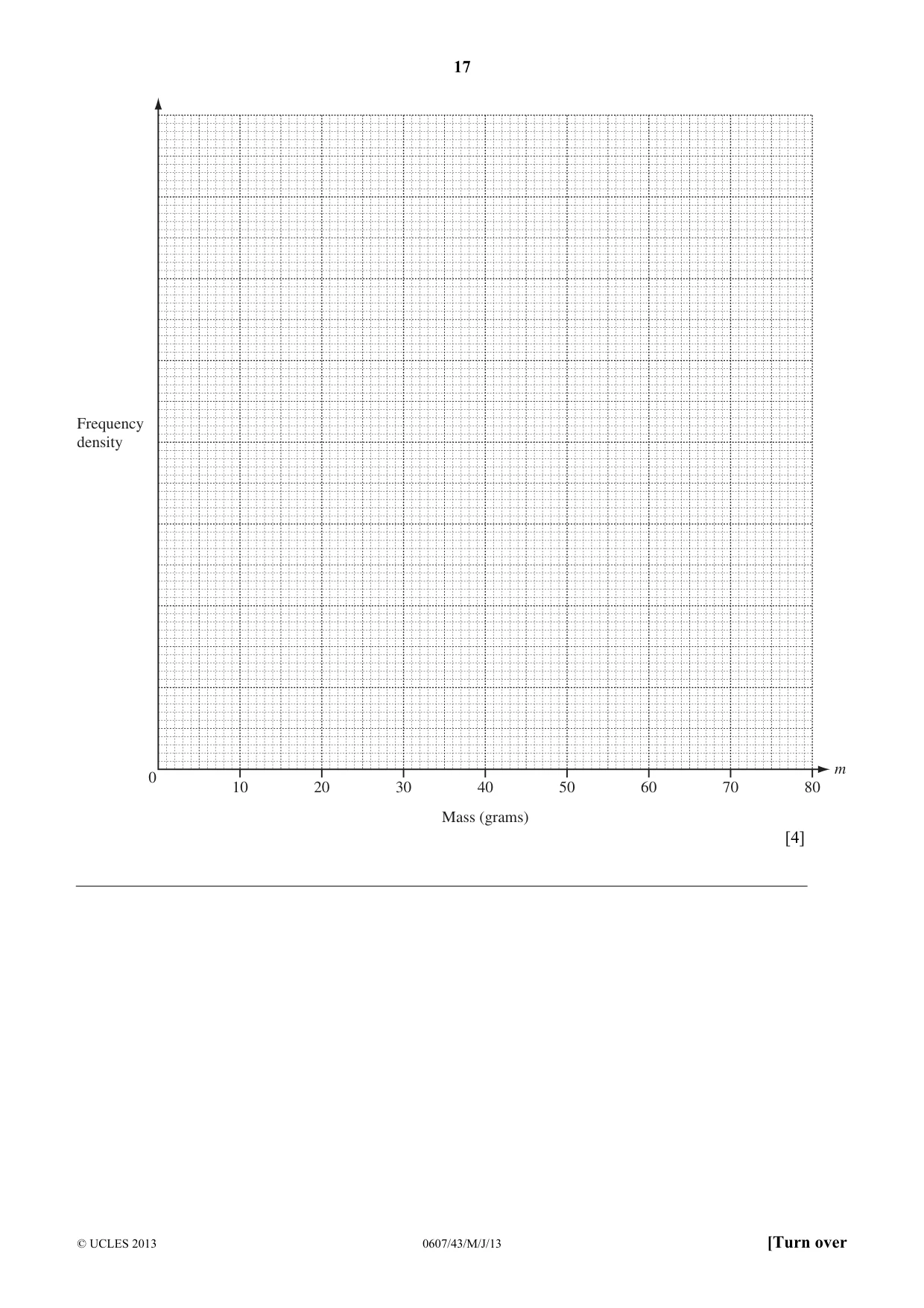
16 © UCLES 2013 0607/43/M/J/13 For Examiner's Use 13 The masses of 200 tomatoes are given in the table. Mass (m grams) Frequency 0 < m Y 20 12 20 < m Y 30 34 30 < m Y 40 40 40 < m Y 45 60 45 < m Y 50 42 50 < m Y 80 12 (a) Calculate an estimate of the mean mass of a tomato. Give your answer correct to the nearest gram. Answer(a) g [3] (b) (i) Complete the frequency density column in this table. Mass (m grams) Frequency Frequency density 0 < m Y 20 12 20 < m Y 30 34 30 < m Y 40 40 40 < m Y 45 60 45 < m Y 50 42 50 < m Y 80 12 [2] (ii) On the grid opposite, draw an accurate histogram to show this information. Mark a suitable scale on the frequency density axis.
Question paper, page 17
17 © UCLES 2013 0607/43/M/J/13 [Turn over Frequency density 10 20 30 40 Mass (grams) 50 60 70 80 0 m [4]
Question paper, page 18
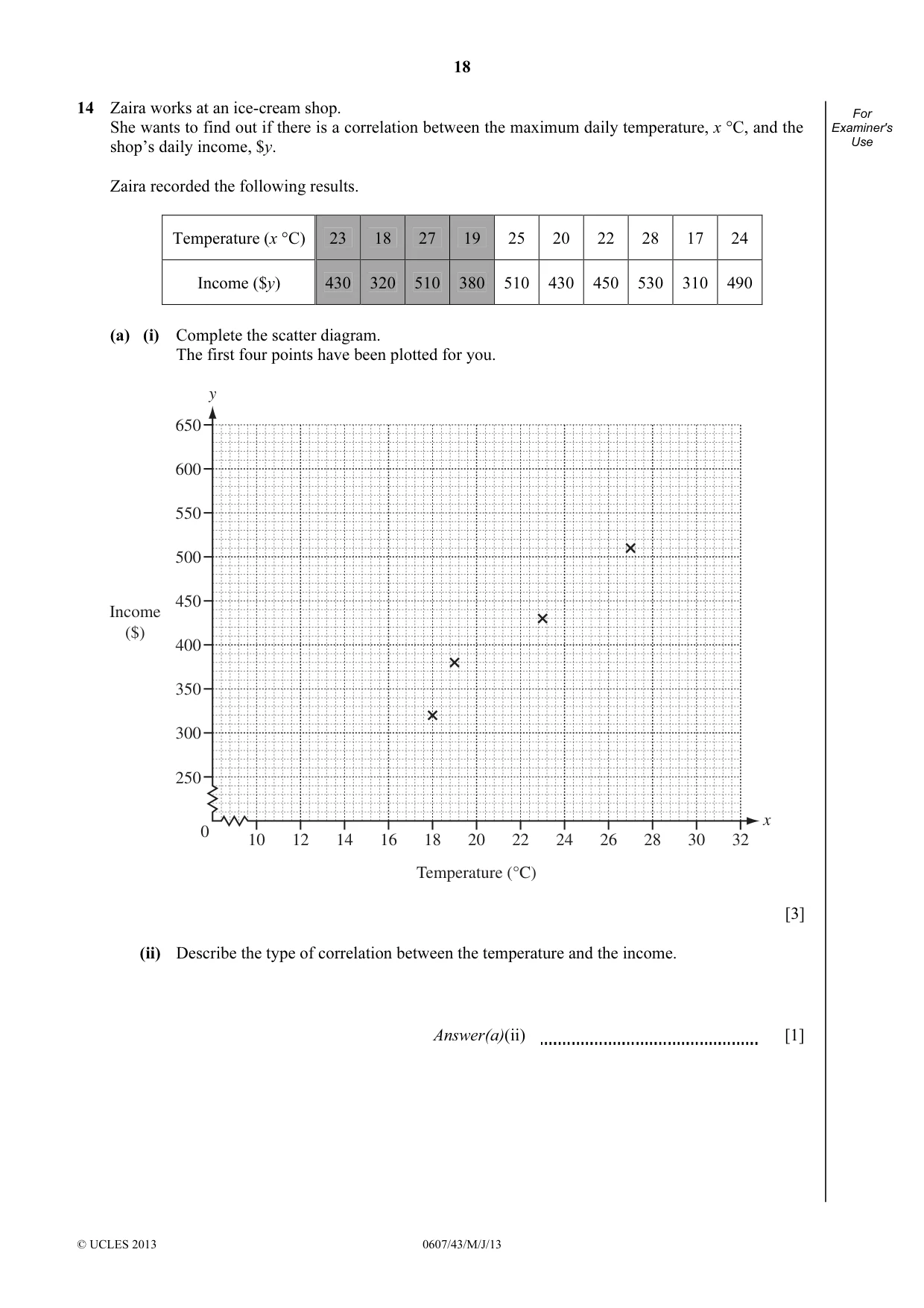
18 © UCLES 2013 0607/43/M/J/13 For Examiner's Use 14 Zaira works at an ice-cream shop. She wants to find out if there is a correlation between the maximum daily temperature, x °C, and the shop’s daily income, $y. Zaira recorded the following results. Temperature (x °C) 23 18 27 19 25 20 22 28 17 24 Income ($y) 430 320 510 380 510 430 450 530 310 490 (a) (i) Complete the scatter diagram. The first four points have been plotted for you. y x 10 12 14 16 18 20 Temperature (°C) 22 24 26 28 30 32 0 650 600 550 500 450 400 350 300 250 Income ($) [3] (ii) Describe the type of correlation between the temperature and the income. Answer(a)(ii) [1]
Question paper, page 19
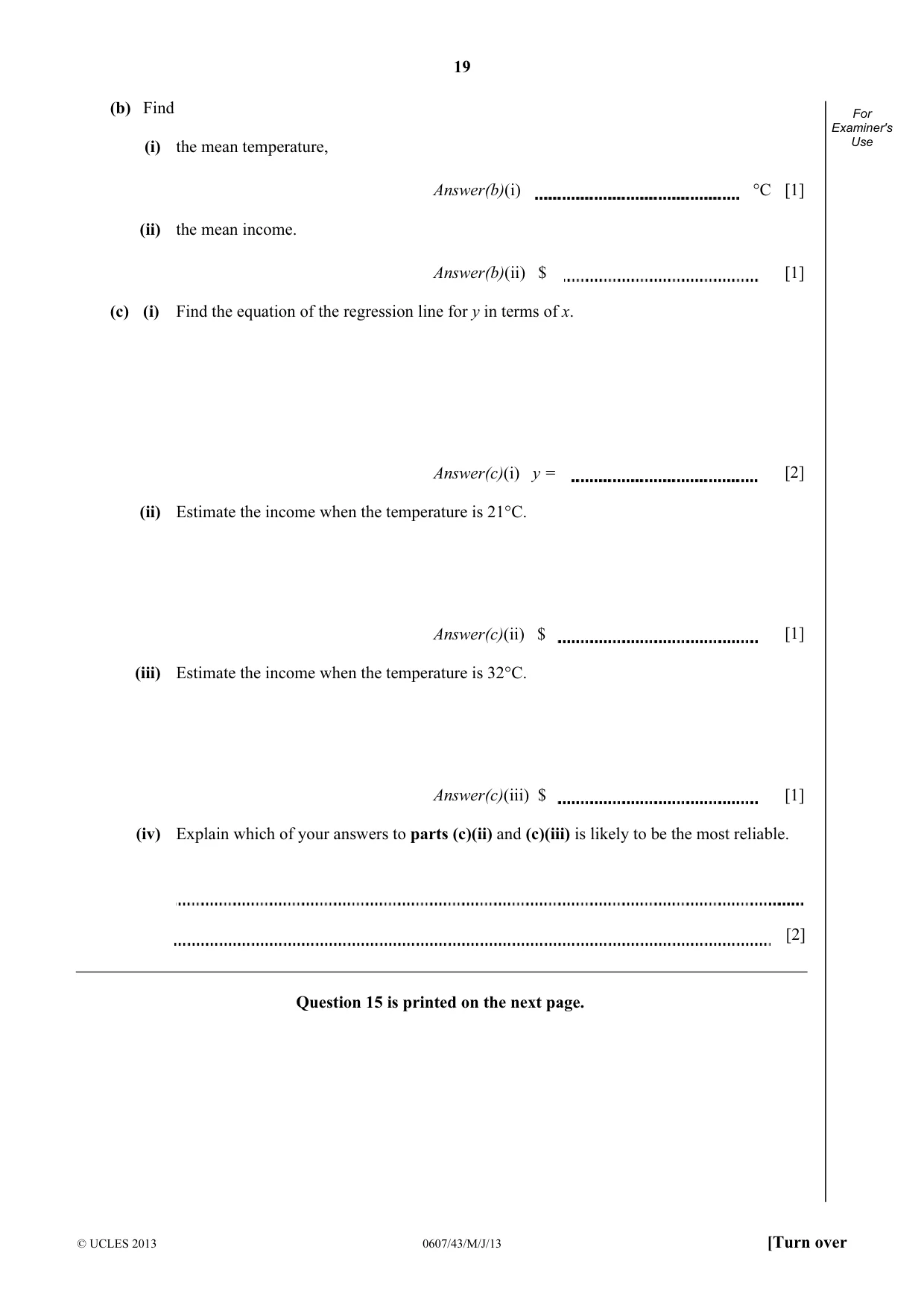
19 © UCLES 2013 0607/43/M/J/13 [Turn over For Examiner's Use (b) Find (i) the mean temperature, Answer(b)(i) °C [1] (ii) the mean income. Answer(b)(ii) $ [1] (c) (i) Find the equation of the regression line for y in terms of x. Answer(c)(i) y = [2] (ii) Estimate the income when the temperature is 21°C. Answer(c)(ii) $ [1] (iii) Estimate the income when the temperature is 32°C. Answer(c)(iii) $ [1] (iv) Explain which of your answers to parts (c)(ii) and (c)(iii) is likely to be the most reliable. [2] Question 15 is printed on the next page.
Question paper, page 20
20 Permission to reproduce items where third-party owned material protected by copyright is included has been sought and cleared where possible. Every reasonable effort has been made by the publisher (UCLES) to trace copyright holders, but if any items requiring clearance have unwittingly been included, the publisher will be pleased to make amends at the earliest possible opportunity. University of Cambridge International Examinations is part of the Cambridge Assessment Group. Cambridge Assessment is the brand name of University of Cambridge Local Examinations Syndicate (UCLES), which is itself a department of the University of Cambridge. © UCLES 2013 0607/43/M/J/13 For Examiner's Use 15 Find the next term and the nth term in each of the following sequences. (a) 6, 18, 54, 162, 486, … Answer(a) next term = nth term = [3] (b) –1, 1, 5, 11, 19, … Answer(b) next term = nth term = [4]
Mark scheme, page 1
CAMBRIDGE INTERNATIONAL EXAMINATIONS International General Certificate of Secondary Education MARK SCHEME for the May/June 2013 series 0607 CAMBRIDGE INTERNATIONAL MATHEMATICS 0607/43 Paper 4 (Extended), maximum raw mark 120 This mark scheme is published as an aid to teachers and candidates, to indicate the requirements of the examination. It shows the basis on which Examiners were instructed to award marks. It does not indicate the details of the discussions that took place at an Examiners’ meeting before marking began, which would have considered the acceptability of alternative answers. Mark schemes should be read in conjunction with the question paper and the Principal Examiner Report for Teachers. Cambridge will not enter into discussions about these mark schemes. Cambridge is publishing the mark schemes for the May/June 2013 series for most IGCSE, GCE Advanced Level and Advanced Subsidiary Level components and some Ordinary Level components. www.XtremePapers.com
Mark scheme, page 2
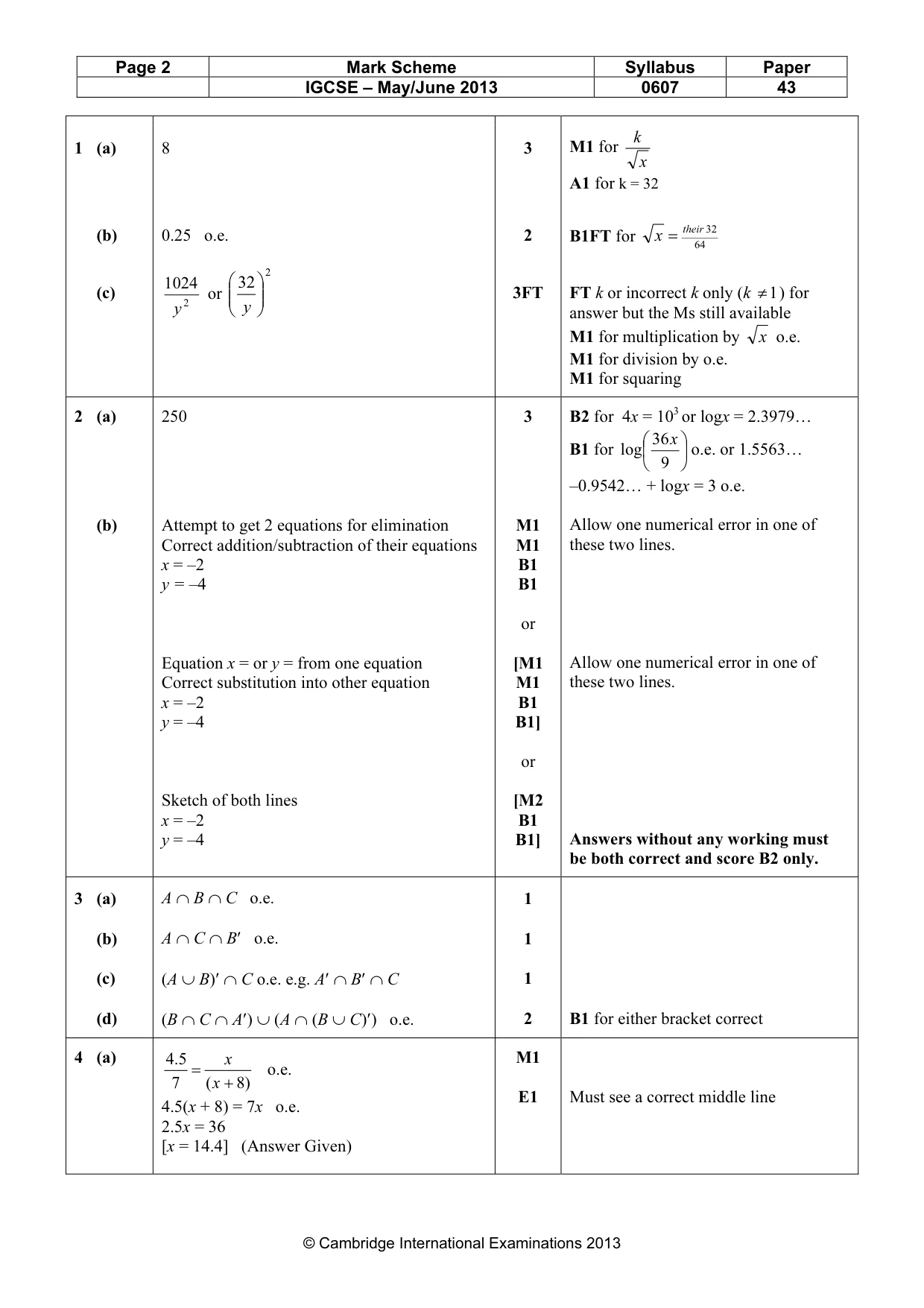
Page 2 Mark Scheme Syllabus Paper IGCSE – May/June 2013 0607 43 © Cambridge International Examinations 2013 1 (a) (b) (c) 8 0.25 o.e. 2 1024 y or 2 32 y 3 2 3FT M1 for x k A1 for k = 32 B1FT for 64 32 their x = FT k or incorrect k only (k 1 ≠) for answer but the Ms still available M1 for multiplication by x o.e. M1 for division by o.e. M1 for squaring 2 (a) (b) 250 Attempt to get 2 equations for elimination Correct addition/subtraction of their equations x = –2 y = –4 Equation x = or y = from one equation Correct substitution into other equation x = –2 y = –4 Sketch of both lines x = –2 y = –4 3 M1 M1 B1 B1 or [M1 M1 B1 B1] or [M2 B1 B1] B2 for 4x = 103 or logx = 2.3979… B1 for 9 36 log x o.e. or 1.5563… –0.9542… + logx = 3 o.e. Allow one numerical error in one of these two lines. Allow one numerical error in one of these two lines. Answers without any working must be both correct and score B2 only. 3 (a) (b) (c) (d) A ∩ B ∩ C o.e. A ∩ C ∩ B′ o.e. (A ∪ B)′ ∩ C o.e. e.g. A′ ∩ B′ ∩ C (B ∩ C ∩ A′) ∪ (A ∩ (B ∪ C)′) o.e. 1 1 1 2 B1 for either bracket correct 4 (a) ) 8 ( 7 5.4 + = x x o.e. 4.5(x + 8) = 7x o.e. 2.5x = 36 [x = 14.4] (Answer Given) M1 E1 Must see a correct middle line
Mark scheme, page 3
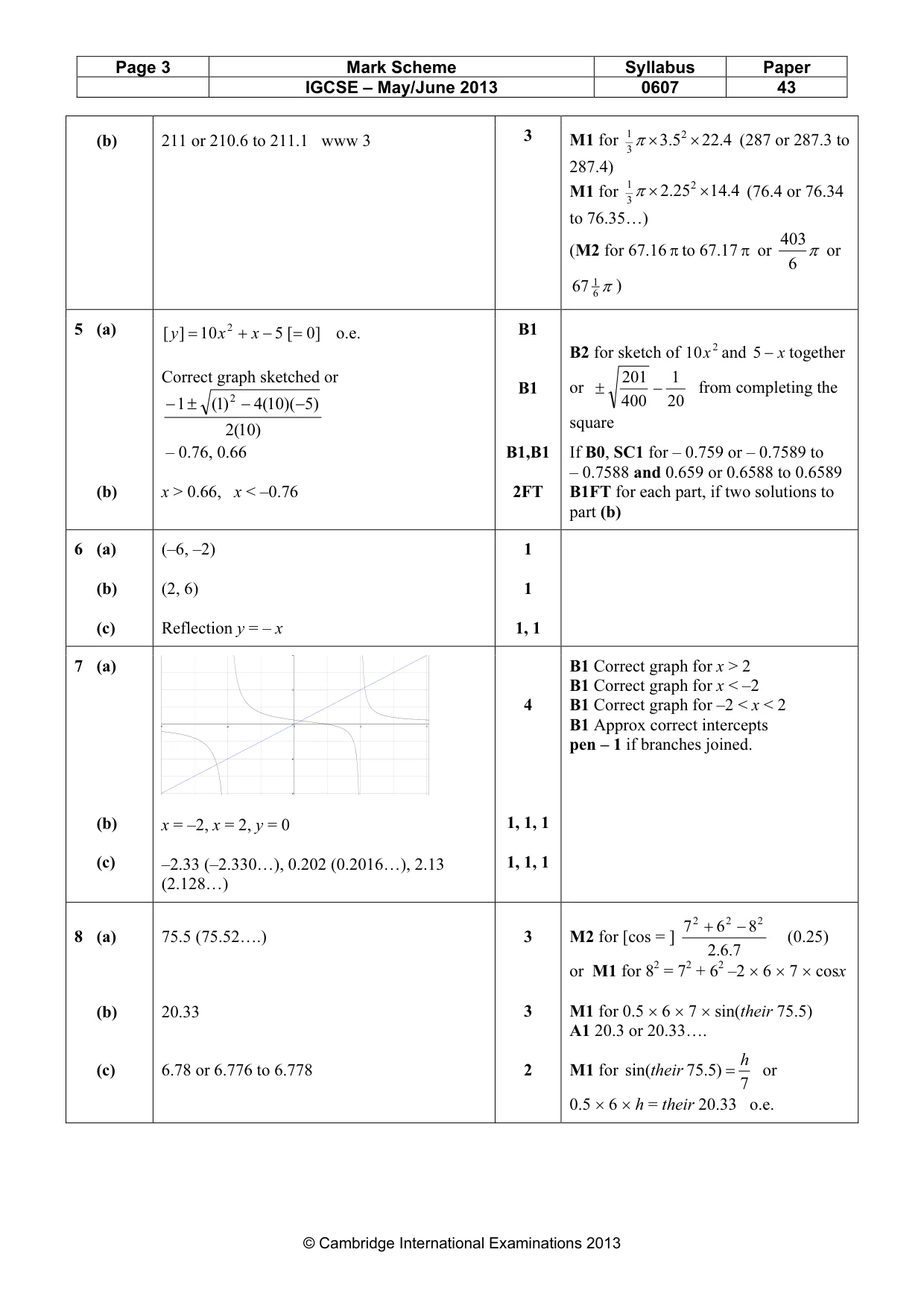
Page 3 Mark Scheme Syllabus Paper IGCSE – May/June 2013 0607 43 © Cambridge International Examinations 2013 (b) 211 or 210.6 to 211.1 www 3 3 M1 for 4. 22 5.3 2 3 1 × × π (287 or 287.3 to 287.4) M1 for 4. 14 25 .2 2 3 1 × × π (76.4 or 76.34 to 76.35…) (M2 for 67.16 π to 67.17 π or π 6 403 or π 6 1 67 ) 5 (a) (b) ] 0 [ 5 10 ] [ 2 = − + = x x y o.e. Correct graph sketched or ) 10 ( 2 ) 5 )( 10 ( 4 )1( 1 2 − − ± − – 0.76, 0.66 x > 0.66, x < –0.76 B1 B1 B1,B1 2FT B2 for sketch of 2 10x and x − 5 together or 20 1 400 201 − ± from completing the square If B0, SC1 for – 0.759 or – 0.7589 to – 0.7588 and 0.659 or 0.6588 to 0.6589 B1FT for each part, if two solutions to part (b) 6 (a) (b) (c) (–6, –2) (2, 6) Reflection y = – x 1 1 1, 1 7 (a) (b) (c) 4 2 0 -2 4 4 2 0 -2 -4 4 2 0 -2 4 4 2 0 -2 -4 4 2 0 -2 4 4 2 0 -2 -4 4 2 0 -2 4 4 2 0 -2 -4 x = –2, x = 2, y = 0 –2.33 (–2.330…), 0.202 (0.2016…), 2.13 (2.128…) 4 1, 1, 1 1, 1, 1 B1 Correct graph for x > 2 B1 Correct graph for x < –2 B1 Correct graph for –2 < x < 2 B1 Approx correct intercepts pen – 1 if branches joined. 8 (a) (b) (c) 75.5 (75.52….) 20.33 6.78 or 6.776 to 6.778 3 3 2 M2 for [cos = ] 7.6.2 8 6 7 2 2 2 − + (0.25) or M1 for 82 = 72 + 62 –2 × 6 × 7 × cosx M1 for 0.5 × 6 × 7 × sin(their 75.5) A1 20.3 or 20.33…. M1 for 7 ) 5. 75 sin( h their = or 0.5 × 6 × h = their 20.33 o.e.
Mark scheme, page 4
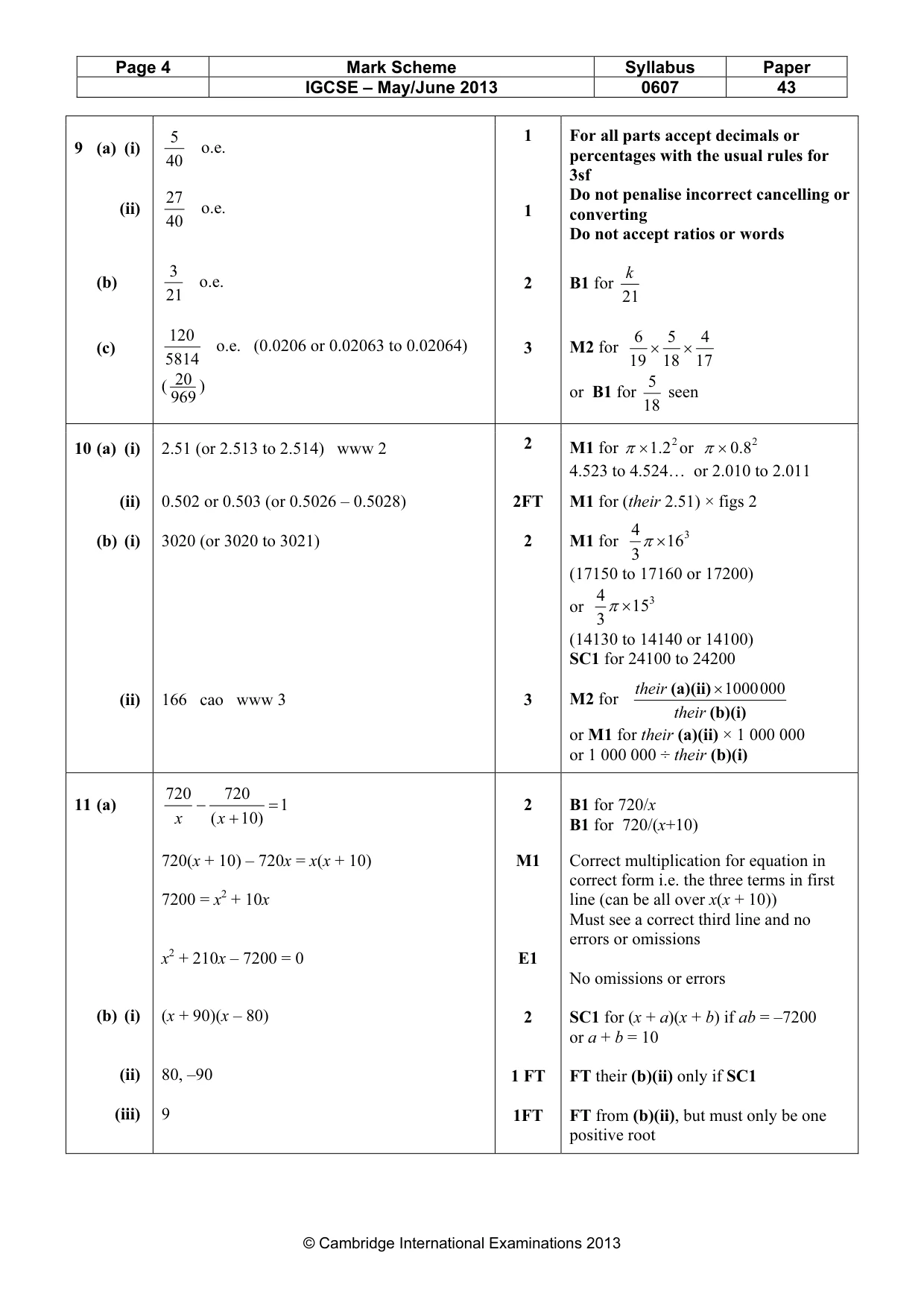
Page 4 Mark Scheme Syllabus Paper IGCSE – May/June 2013 0607 43 © Cambridge International Examinations 2013 9 (a) (i) (ii) (b) (c) 40 5 o.e. 40 27 o.e. 21 3 o.e. 5814 120 o.e. (0.0206 or 0.02063 to 0.02064) ( 969 20 ) 1 1 2 3 For all parts accept decimals or percentages with the usual rules for 3sf Do not penalise incorrect cancelling or converting Do not accept ratios or words B1 for 21 k M2 for 17 4 18 5 19 6 × × or B1 for 18 5 seen 10 (a) (i) (ii) (b) (i) (ii) 2.51 (or 2.513 to 2.514) www 2 0.502 or 0.503 (or 0.5026 – 0.5028) 3020 (or 3020 to 3021) 166 cao www 3 2 2FT 2 3 M1 for 2 2 8.0 or 2.1 × × π π 4.523 to 4.524… or 2.010 to 2.011 M1 for (their 2.51) × figs 2 M1 for 3 16 3 4 × π (17150 to 17160 or 17200) or 3 15 3 4 × π (14130 to 14140 or 14100) SC1 for 24100 to 24200 M2 for (b)(i) (a)(ii) 000 000 1 their their × or M1 for their (a)(ii) × 1 000 000 or 1 000 000 ÷ their (b)(i) 11 (a) (b) (i) (ii) (iii) 1 ) 10 ( 720 720 = + −x x 720(x + 10) – 720x = x(x + 10) 7200 = x2 + 10x x2 + 210x – 7200 = 0 (x + 90)(x – 80) 80, –90 9 2 M1 E1 2 1 FT 1FT B1 for 720/x B1 for 720/(x+10) Correct multiplication for equation in correct form i.e. the three terms in first line (can be all over x(x + 10)) Must see a correct third line and no errors or omissions No omissions or errors SC1 for (x + a)(x + b) if ab = –7200 or a + b = 10 FT their (b)(ii) only if SC1 FT from (b)(ii), but must only be one positive root
Mark scheme, page 5
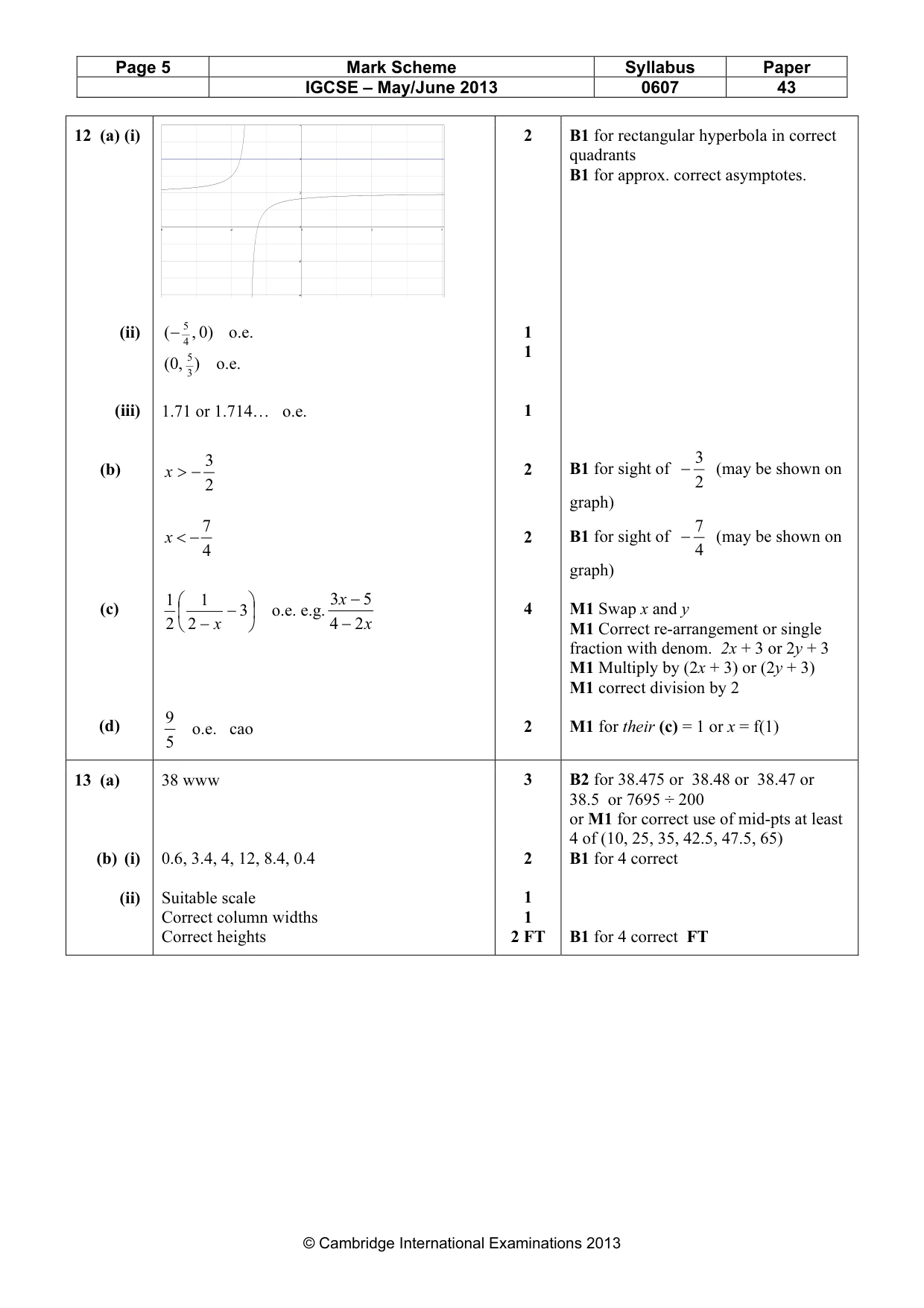
Page 5 Mark Scheme Syllabus Paper IGCSE – May/June 2013 0607 43 © Cambridge International Examinations 2013 12 (a) (i) (ii) (iii) (b) (c) (d) 4 2 0 -2 4 6 4 2 0 -2 -4 4 2 0 -2 4 6 4 2 0 -2 -4 4 2 0 -2 4 6 4 2 0 -2 -4 4 2 0 -2 4 6 4 2 0 -2 -4 ) 0 , ( 4 5 − o.e. ) ,0 ( 3 5 o.e. 1.71 or 1.714… o.e. 2 3 − > x 4 7 − < x − − 3 2 1 2 1 x o.e. e.g. x x 2 4 5 3 − − 5 9 o.e. cao 2 1 1 1 2 2 4 2 B1 for rectangular hyperbola in correct quadrants B1 for approx. correct asymptotes. B1 for sight of 2 3 − (may be shown on graph) B1 for sight of 4 7 − (may be shown on graph) M1 Swap x and y M1 Correct re-arrangement or single fraction with denom. 2x + 3 or 2y + 3 M1 Multiply by (2x + 3) or (2y + 3) M1 correct division by 2 M1 for their (c) = 1 or x = f(1) 13 (a) (b) (i) (ii) 38 www 0.6, 3.4, 4, 12, 8.4, 0.4 Suitable scale Correct column widths Correct heights 3 2 1 1 2 FT B2 for 38.475 or 38.48 or 38.47 or 38.5 or 7695 ÷ 200 or M1 for correct use of mid-pts at least 4 of (10, 25, 35, 42.5, 47.5, 65) B1 for 4 correct B1 for 4 correct FT
Mark scheme, page 6
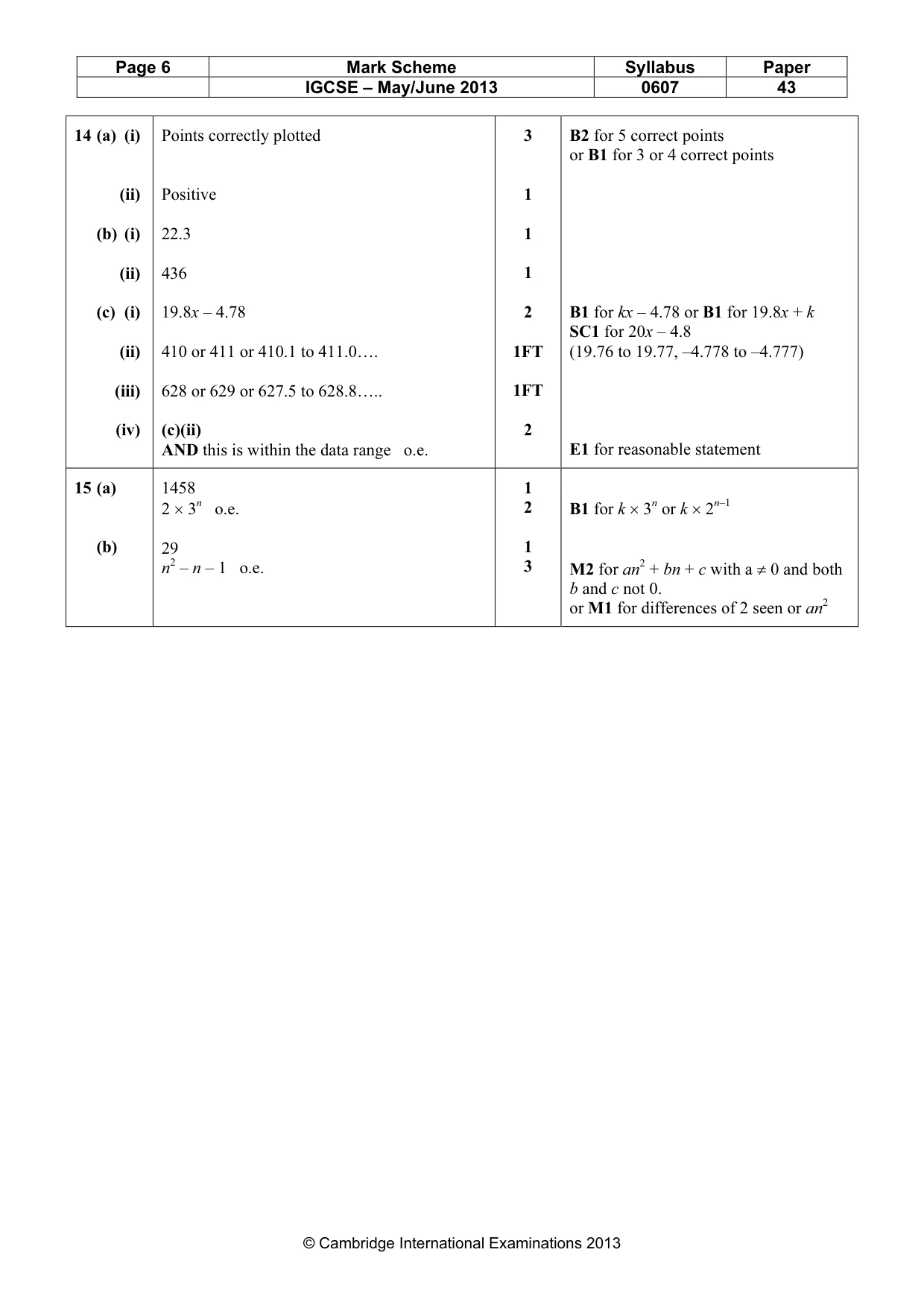
Page 6 Mark Scheme Syllabus Paper IGCSE – May/June 2013 0607 43 © Cambridge International Examinations 2013 14 (a) (i) (ii) (b) (i) (ii) (c) (i) (ii) (iii) (iv) Points correctly plotted Positive 22.3 436 19.8x – 4.78 410 or 411 or 410.1 to 411.0…. 628 or 629 or 627.5 to 628.8….. (c)(ii) AND this is within the data range o.e. 3 1 1 1 2 1FT 1FT 2 B2 for 5 correct points or B1 for 3 or 4 correct points B1 for kx – 4.78 or B1 for 19.8x + k SC1 for 20x – 4.8 (19.76 to 19.77, –4.778 to –4.777) E1 for reasonable statement 15 (a) (b) 1458 2 × 3n o.e. 29 n2 – n – 1 o.e. 1 2 1 3 B1 for k × 3n or k × 2n–1 M2 for an2 + bn + c with a ≠ 0 and both b and c not 0. or M1 for differences of 2 seen or an2
What you needed in this session
Cambridge’s own grade thresholds for 2013 May/June, Paper 4 · Variant 3. A higher threshold means an easier paper — the bar moves with how the cohort did.