Cambridge IGCSE Mathematics - International 0607 — 2012 May/June Paper 4 · Variant 1
0607/41/M/J/12 · 120 marks · ≈135 min
The question paper and its mark scheme, free to read here and free to download. This is Cambridge’s own paper, exactly as it was sat.
Question paper20 pages
Mark scheme7 pages
Answers below. Sit the paper first if you are practising.
Paper as text
Question paper, page 1
This document consists of 19 printed pages and 1 blank page. IB12 06_0607_41/4RP © UCLES 2012 [Turn over *2207603078* For Examiner's Use UNIVERSITY OF CAMBRIDGE INTERNATIONAL EXAMINATIONS International General Certificate of Secondary Education CAMBRIDGE INTERNATIONAL MATHEMATICS 0607/41 Paper 4 (Extended) May/June 2012 2 hours 15 minutes Candidates answer on the Question Paper Additional Materials: Geometrical Instruments Graphics Calculator READ THESE INSTRUCTIONS FIRST Write your Centre number, candidate number and name on all the work you hand in. Write in dark blue or black pen. Do not use staples, paper clips, highlighters, glue or correction fluid. You may use a pencil for any diagrams or graphs. DO NOT WRITE IN ANY BARCODES. Answer all the questions. Unless instructed otherwise, give your answers exactly or correct to three significant figures as appropriate. Answers in degrees should be given to one decimal place. For π, use your calculator value. You must show all the relevant working to gain full marks and you will be given marks for correct methods, including sketches, even if your answer is incorrect. The number of marks is given in brackets [ ] at the end of each question or part question. The total number of marks for this paper is 120. www.XtremePapers.com
Question paper, page 2
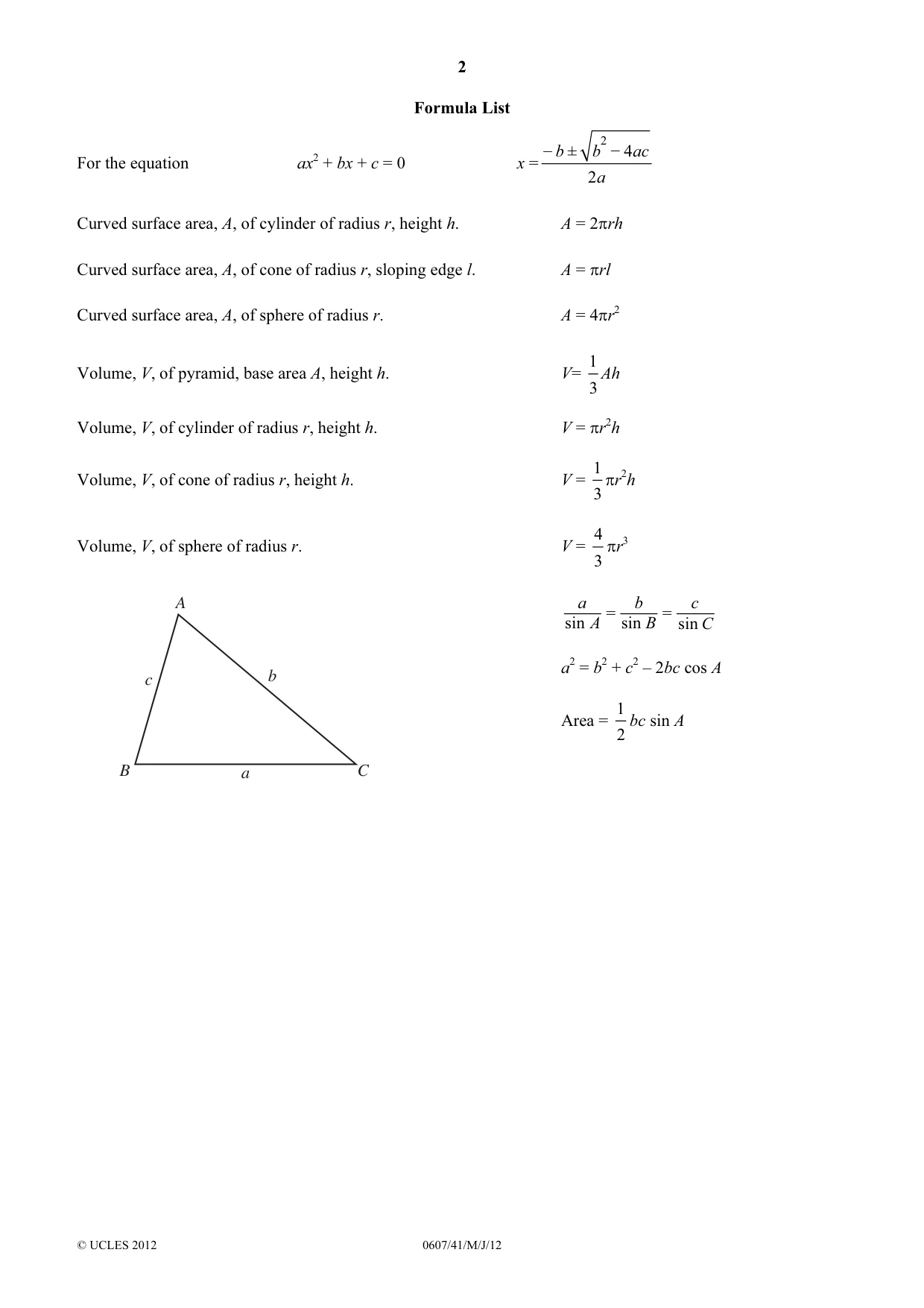
2 © UCLES 2012 0607/41/M/J/12 Formula List For the equation ax2 + bx + c = 0 x = 2 _ ± 4 2 _ b b ac a Curved surface area, A, of cylinder of radius r, height h. A = 2πrh Curved surface area, A, of cone of radius r, sloping edge l. A = πrl Curved surface area, A, of sphere of radius r. A = 4πr2 Volume, V, of pyramid, base area A, height h. V= 1 3 Ah Volume, V, of cylinder of radius r, height h. V = πr2h Volume, V, of cone of radius r, height h. V = 1 3 πr2h Volume, V, of sphere of radius r. V = 4 3 πr3 = = sin sin sin a b c A B C a2 = b2 + c2 – 2bc cos A Area = 1 2 bc sin A A a B C b c
Question paper, page 3
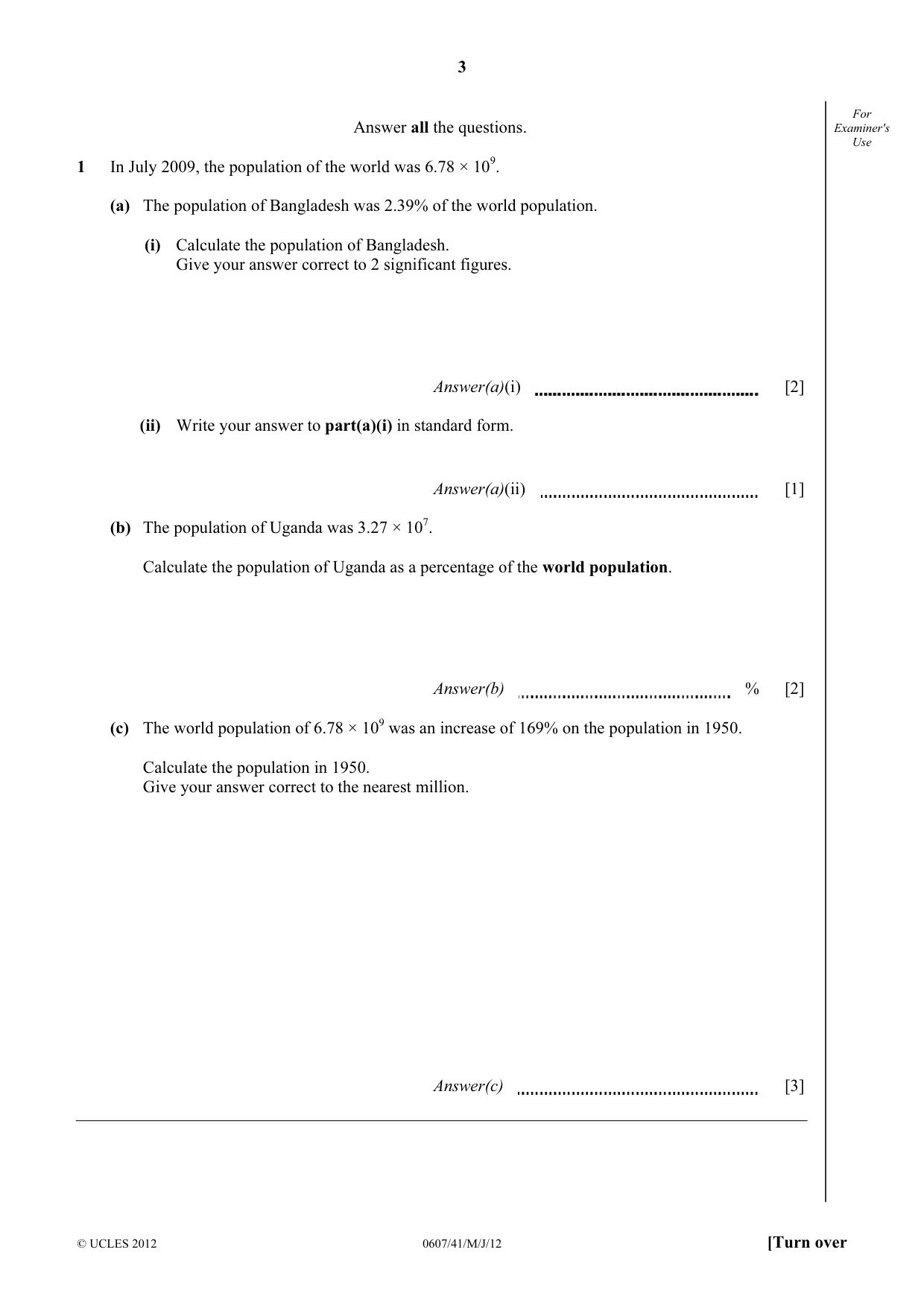
3 © UCLES 2012 0607/41/M/J/12 [Turn over For Examiner's Use Answer all the questions. 1 In July 2009, the population of the world was 6.78 × 10⁹. (a) The population of Bangladesh was 2.39% of the world population. (i) Calculate the population of Bangladesh. Give your answer correct to 2 significant figures. Answer(a)(i) [2] (ii) Write your answer to part(a)(i) in standard form. Answer(a)(ii) [1] (b) The population of Uganda was 3.27 × 10⁷. Calculate the population of Uganda as a percentage of the world population. Answer(b) % [2] (c) The world population of 6.78 × 10⁹ was an increase of 169% on the population in 1950. Calculate the population in 1950. Give your answer correct to the nearest million. Answer(c) [3]
Question paper, page 4
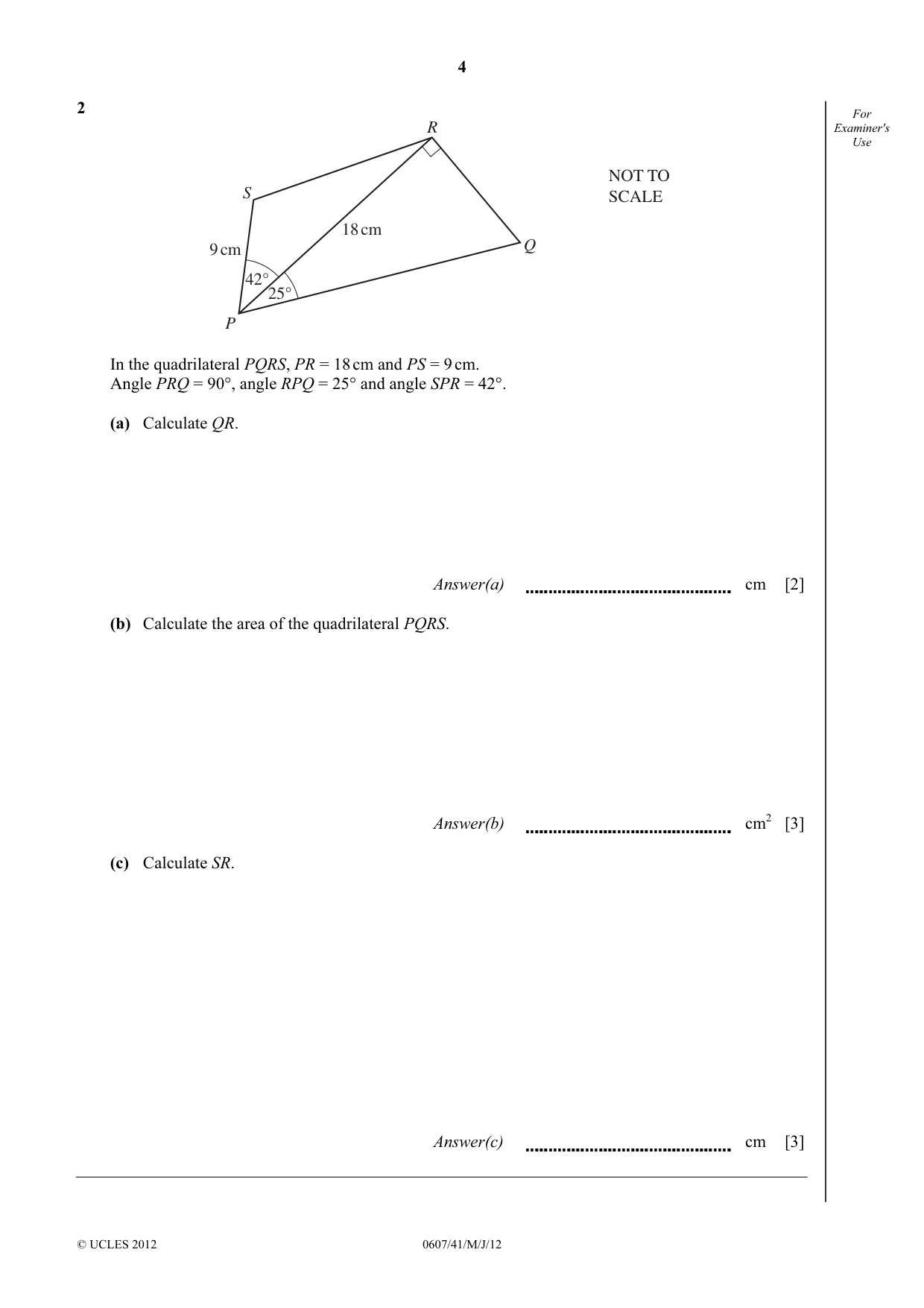
4 © UCLES 2012 0607/41/M/J/12 For Examiner's Use 2 42° 25° S R Q P 9 cm 18 cm NOT TO SCALE In the quadrilateral PQRS, PR = 18 cm and PS = 9 cm. Angle PRQ = 90°, angle RPQ = 25° and angle SPR = 42°. (a) Calculate QR. Answer(a) cm [2] (b) Calculate the area of the quadrilateral PQRS. Answer(b) cm2 [3] (c) Calculate SR. Answer(c) cm [3]
Question paper, page 5
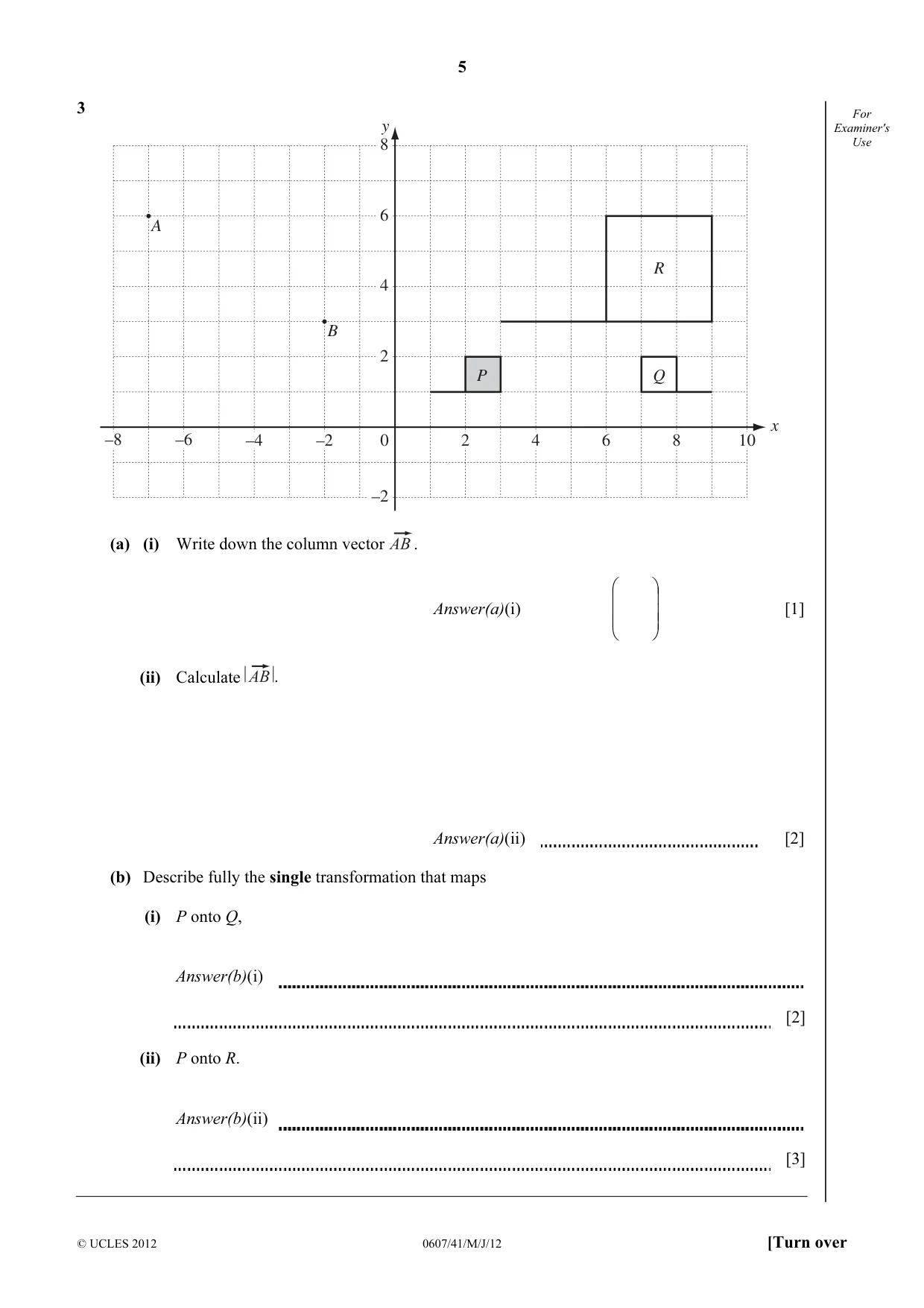
5 © UCLES 2012 0607/41/M/J/12 [Turn over For Examiner's Use 3 –6 –8 –4 –2 y x 0 2 4 6 8 10 8 6 4 2 –2 A B P Q R (a) (i) Write down the column vector . Answer(a)(i) [1] (ii) Calculate . Answer(a)(ii) [2] (b) Describe fully the single transformation that maps (i) P onto Q, Answer(b)(i) [2] (ii) P onto R. Answer(b)(ii) [3]
Question paper, page 6
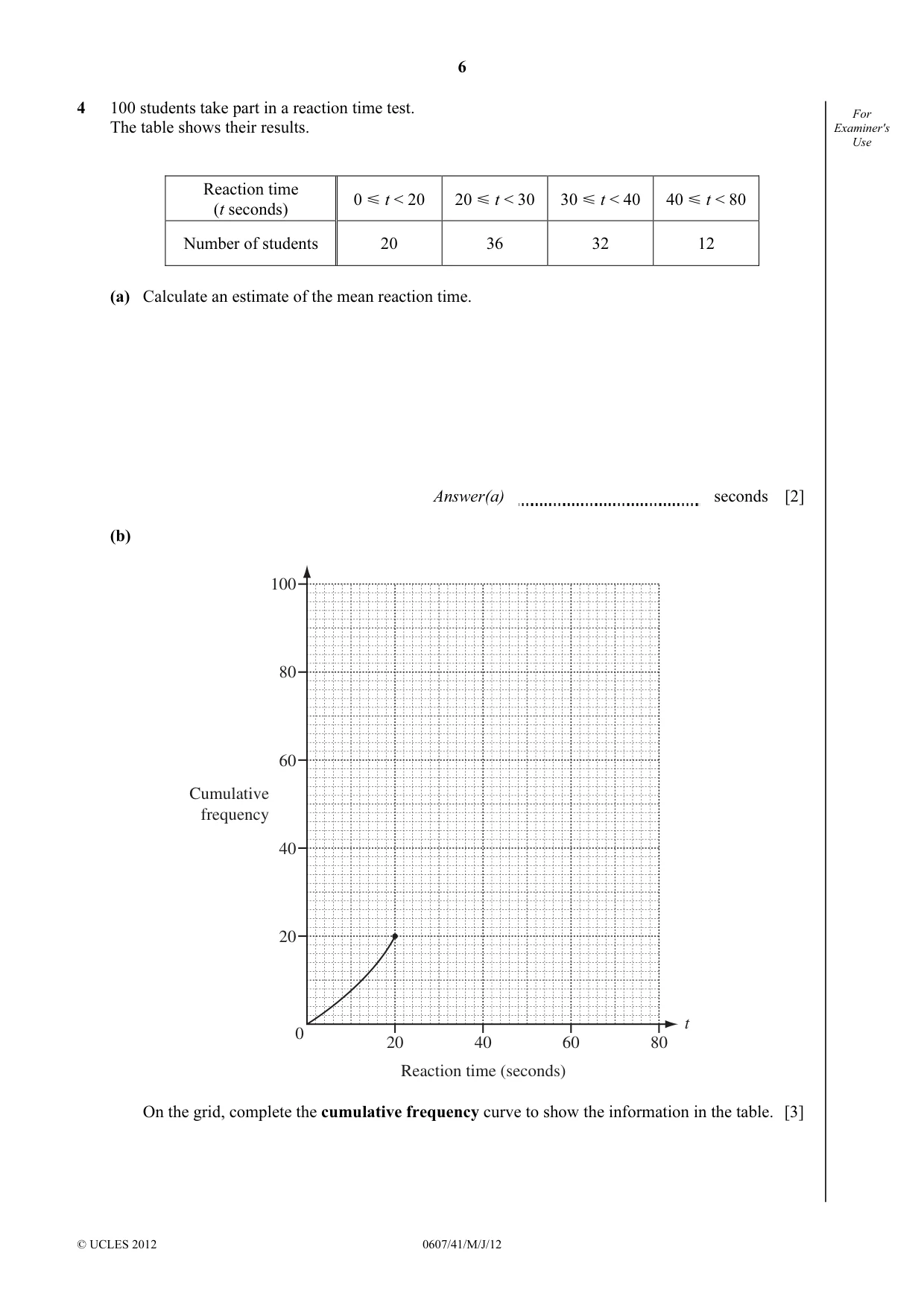
6 © UCLES 2012 0607/41/M/J/12 For Examiner's Use 4 100 students take part in a reaction time test. The table shows their results. Reaction time (t seconds) 0 Y t < 20 20 Y t < 30 30 Y t < 40 40 Y t < 80 Number of students 20 36 32 12 (a) Calculate an estimate of the mean reaction time. Answer(a) seconds [2] (b) 20 0 40 60 80 100 80 60 40 20 Cumulative frequency Reaction time (seconds) t On the grid, complete the cumulative frequency curve to show the information in the table. [3]
Question paper, page 7
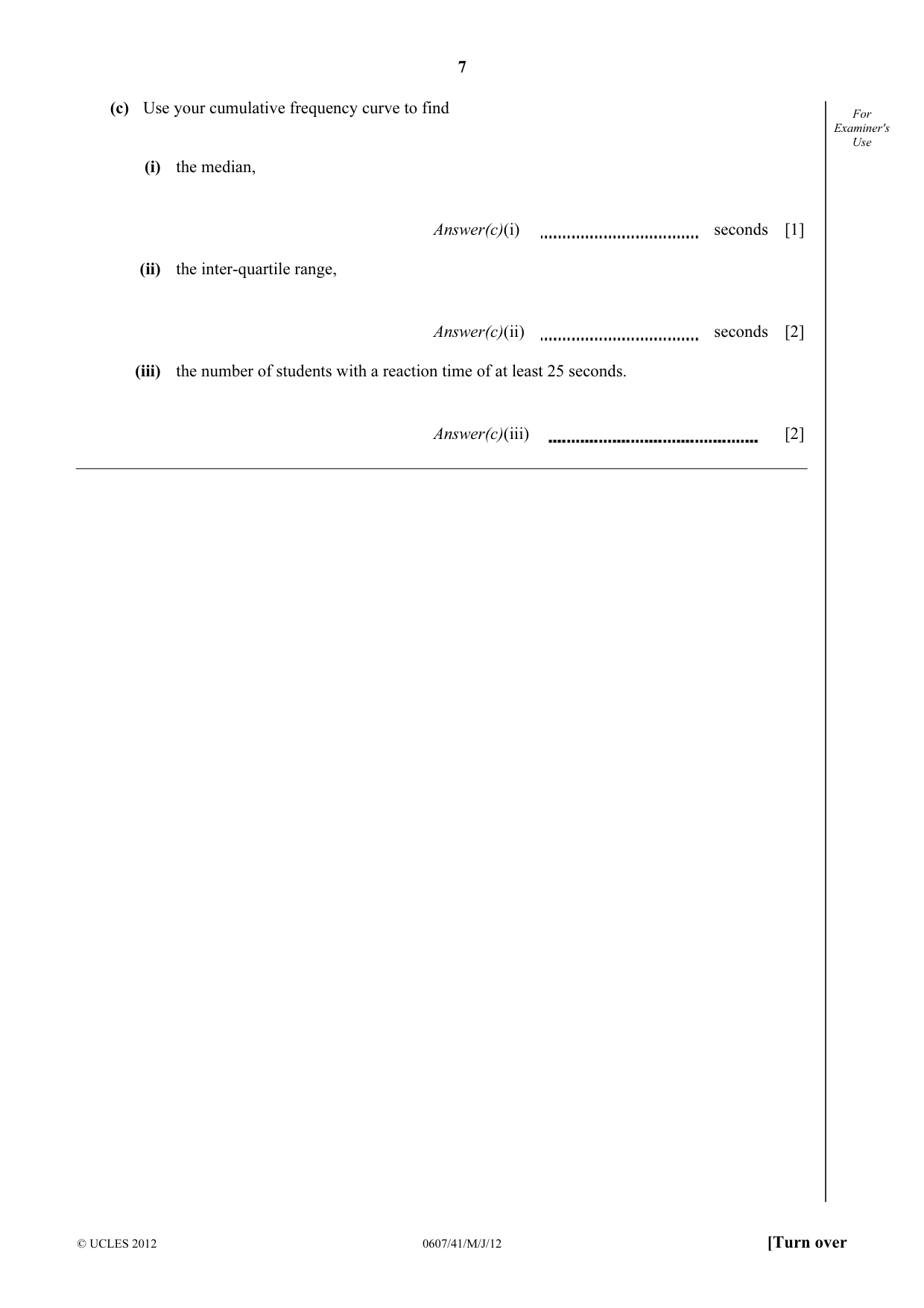
7 © UCLES 2012 0607/41/M/J/12 [Turn over For Examiner's Use (c) Use your cumulative frequency curve to find (i) the median, Answer(c)(i) seconds [1] (ii) the inter-quartile range, Answer(c)(ii) seconds [2] (iii) the number of students with a reaction time of at least 25 seconds. Answer(c)(iii) [2]
Question paper, page 8
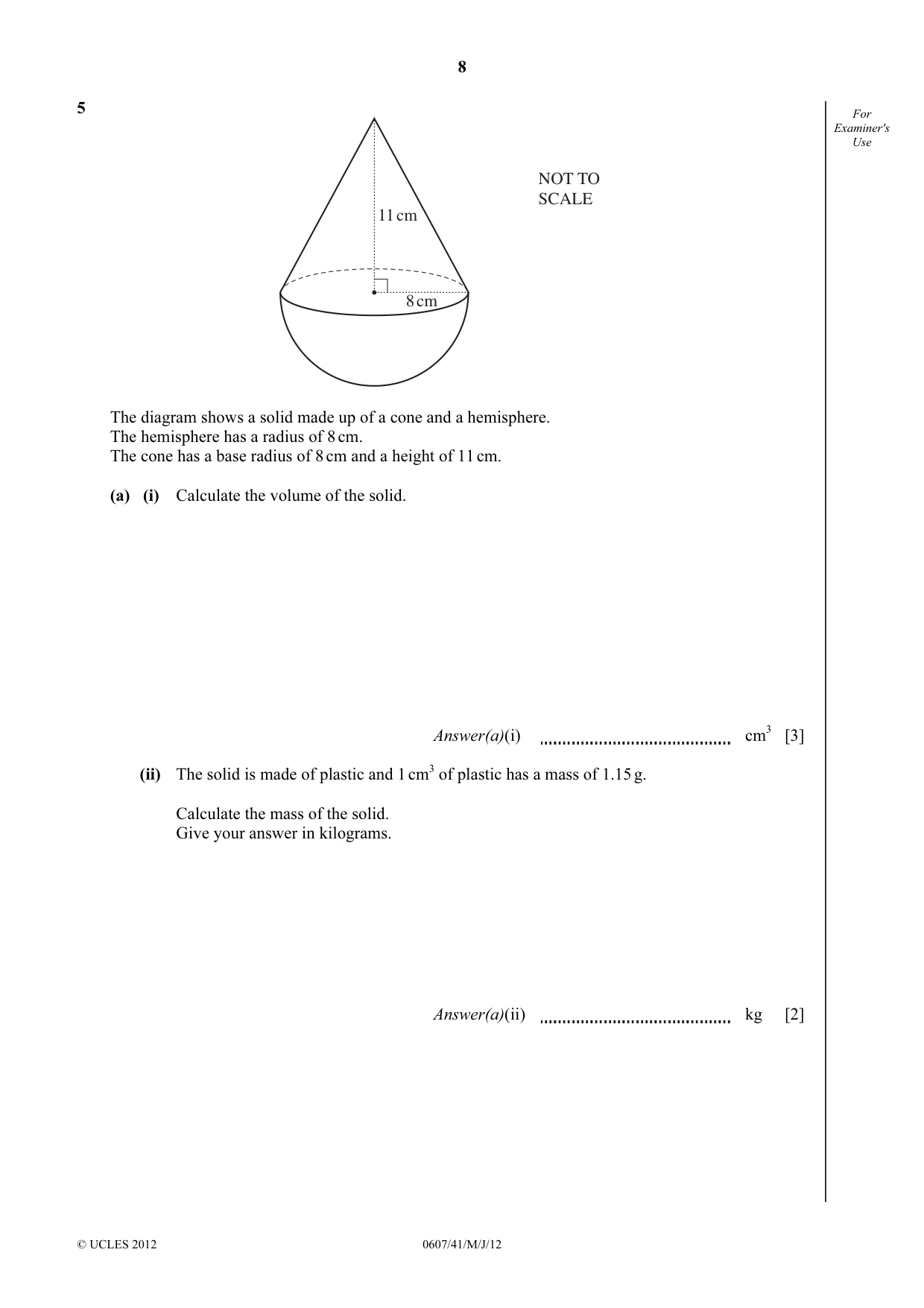
8 © UCLES 2012 0607/41/M/J/12 For Examiner's Use 5 11 cm 8 cm NOT TO SCALE The diagram shows a solid made up of a cone and a hemisphere. The hemisphere has a radius of 8 cm. The cone has a base radius of 8 cm and a height of 11 cm. (a) (i) Calculate the volume of the solid. Answer(a)(i) cm3 [3] (ii) The solid is made of plastic and 1 cm3 of plastic has a mass of 1.15 g. Calculate the mass of the solid. Give your answer in kilograms. Answer(a)(ii) kg [2]
Question paper, page 9
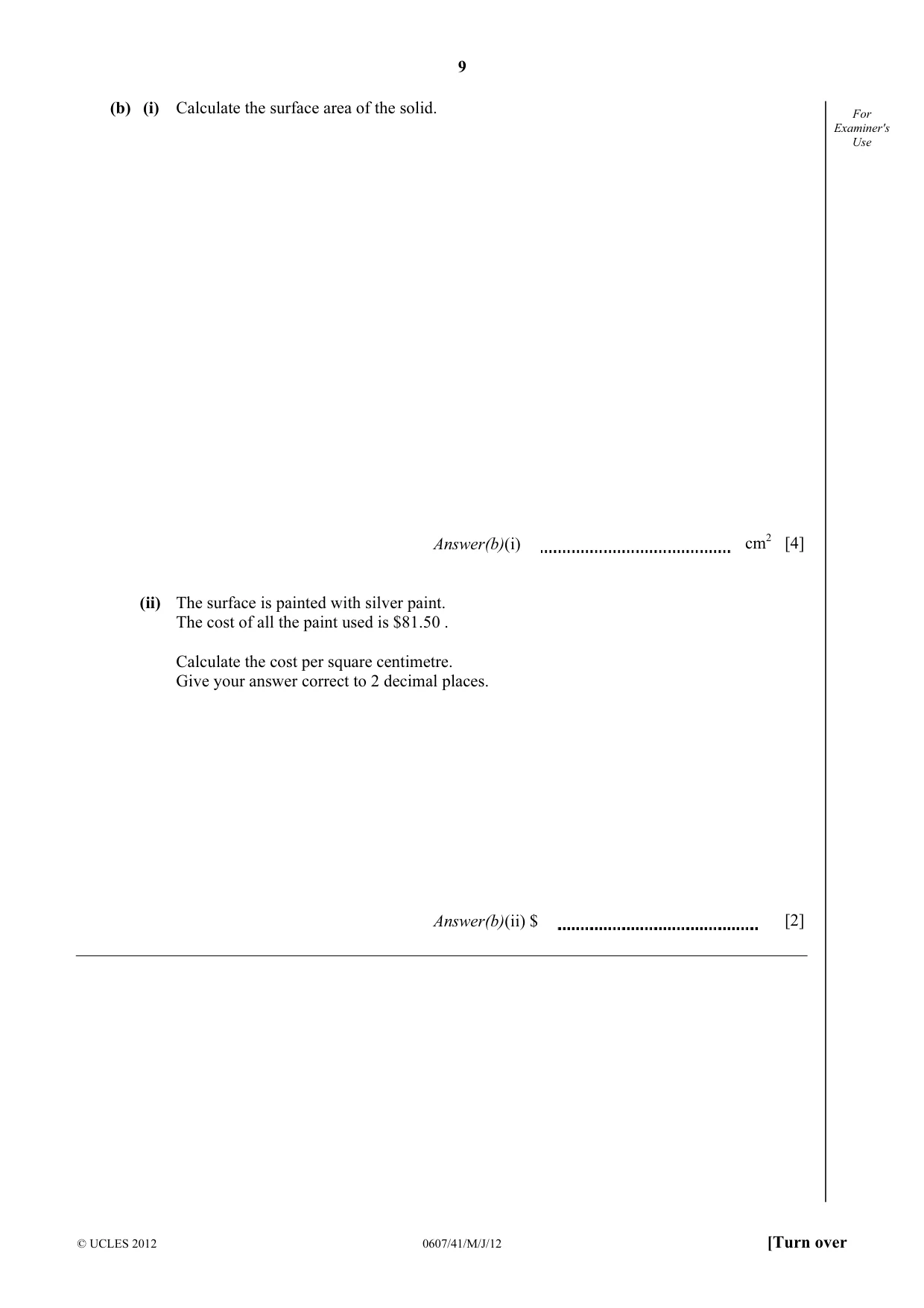
9 © UCLES 2012 0607/41/M/J/12 [Turn over For Examiner's Use (b) (i) Calculate the surface area of the solid. Answer(b)(i) cm2 [4] (ii) The surface is painted with silver paint. The cost of all the paint used is $81.50 . Calculate the cost per square centimetre. Give your answer correct to 2 decimal places. Answer(b)(ii) $ [2]
Question paper, page 10
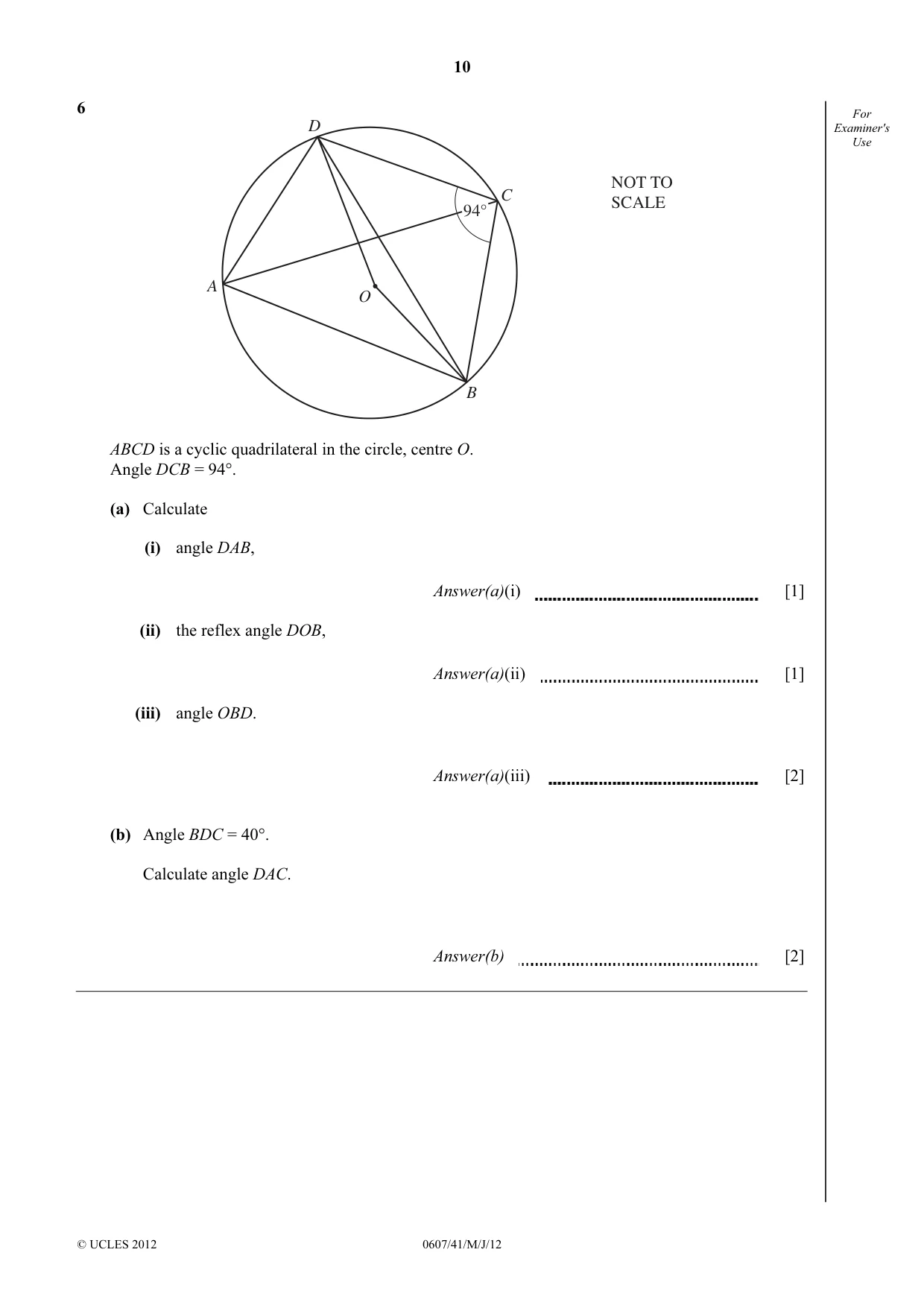
10 © UCLES 2012 0607/41/M/J/12 For Examiner's Use 6 94° D C B A O NOT TO SCALE ABCD is a cyclic quadrilateral in the circle, centre O. Angle DCB = 94°. (a) Calculate (i) angle DAB, Answer(a)(i) [1] (ii) the reflex angle DOB, Answer(a)(ii) [1] (iii) angle OBD. Answer(a)(iii) [2] (b) Angle BDC = 40°. Calculate angle DAC. Answer(b) [2]
Question paper, page 11
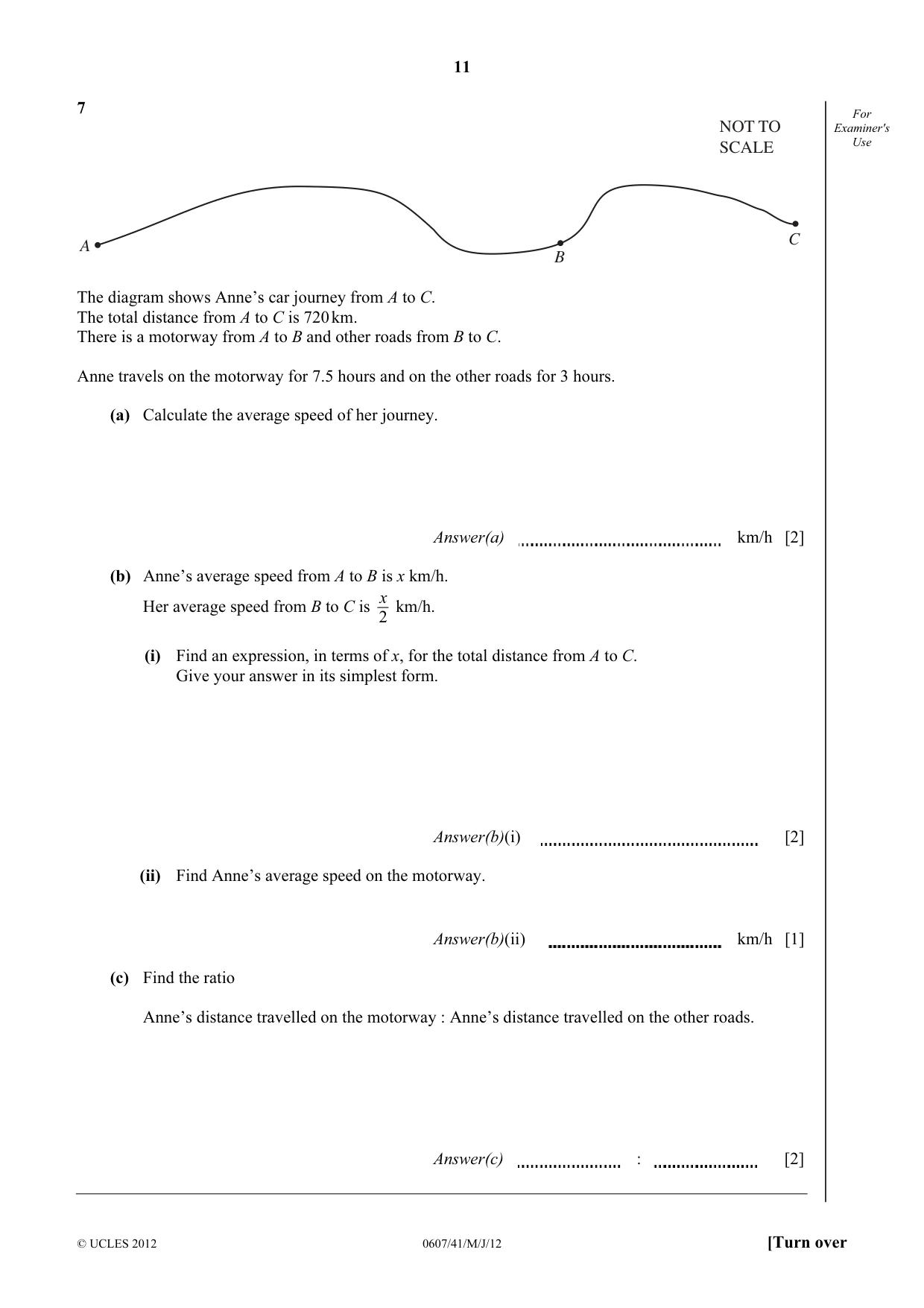
11 © UCLES 2012 0607/41/M/J/12 [Turn over For Examiner's Use 7 A B C NOT TO SCALE The diagram shows Anne’s car journey from A to C. The total distance from A to C is 720 km. There is a motorway from A to B and other roads from B to C. Anne travels on the motorway for 7.5 hours and on the other roads for 3 hours. (a) Calculate the average speed of her journey. Answer(a) km/h [2] (b) Anne’s average speed from A to B is x km/h. Her average speed from B to C is 2 x km/h. (i) Find an expression, in terms of x, for the total distance from A to C. Give your answer in its simplest form. Answer(b)(i) [2] (ii) Find Anne’s average speed on the motorway. Answer(b)(ii) km/h [1] (c) Find the ratio Anne’s distance travelled on the motorway : Anne’s distance travelled on the other roads. Answer(c) : [2]
Question paper, page 12
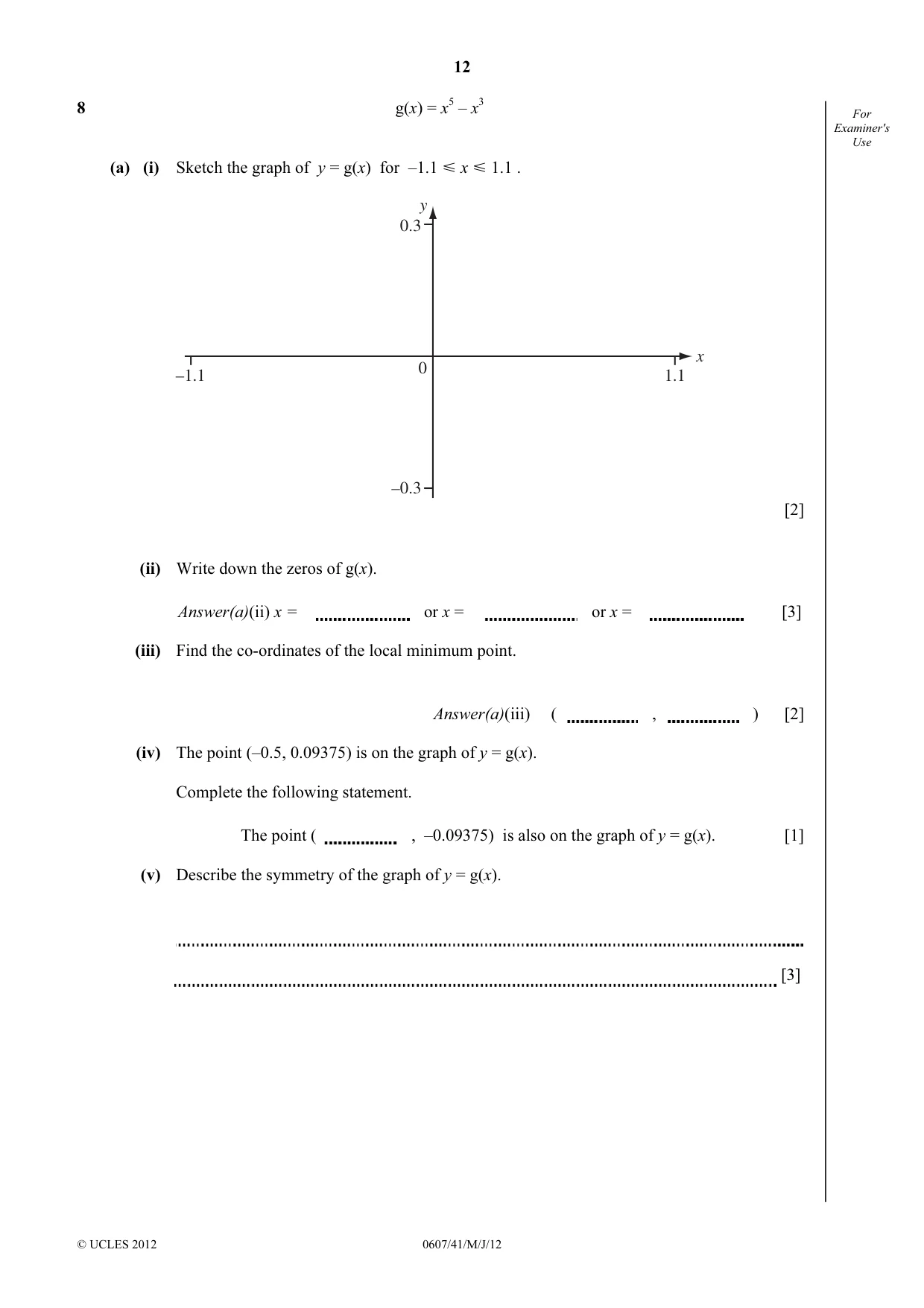
12 © UCLES 2012 0607/41/M/J/12 For Examiner's Use 8 g(x) = x5 – x3 (a) (i) Sketch the graph of y = g(x) for –1.1 Y x Y 1.1 . 0.3 –0.3 –1.1 1.1 0 y x [2] (ii) Write down the zeros of g(x). Answer(a)(ii) x = or x = or x = [3] (iii) Find the co-ordinates of the local minimum point. Answer(a)(iii) ( , ) [2] (iv) The point (–0.5, 0.09375) is on the graph of y = g(x). Complete the following statement. The point ( , –0.09375) is also on the graph of y = g(x). [1] (v) Describe the symmetry of the graph of y = g(x). [3]
Question paper, page 13
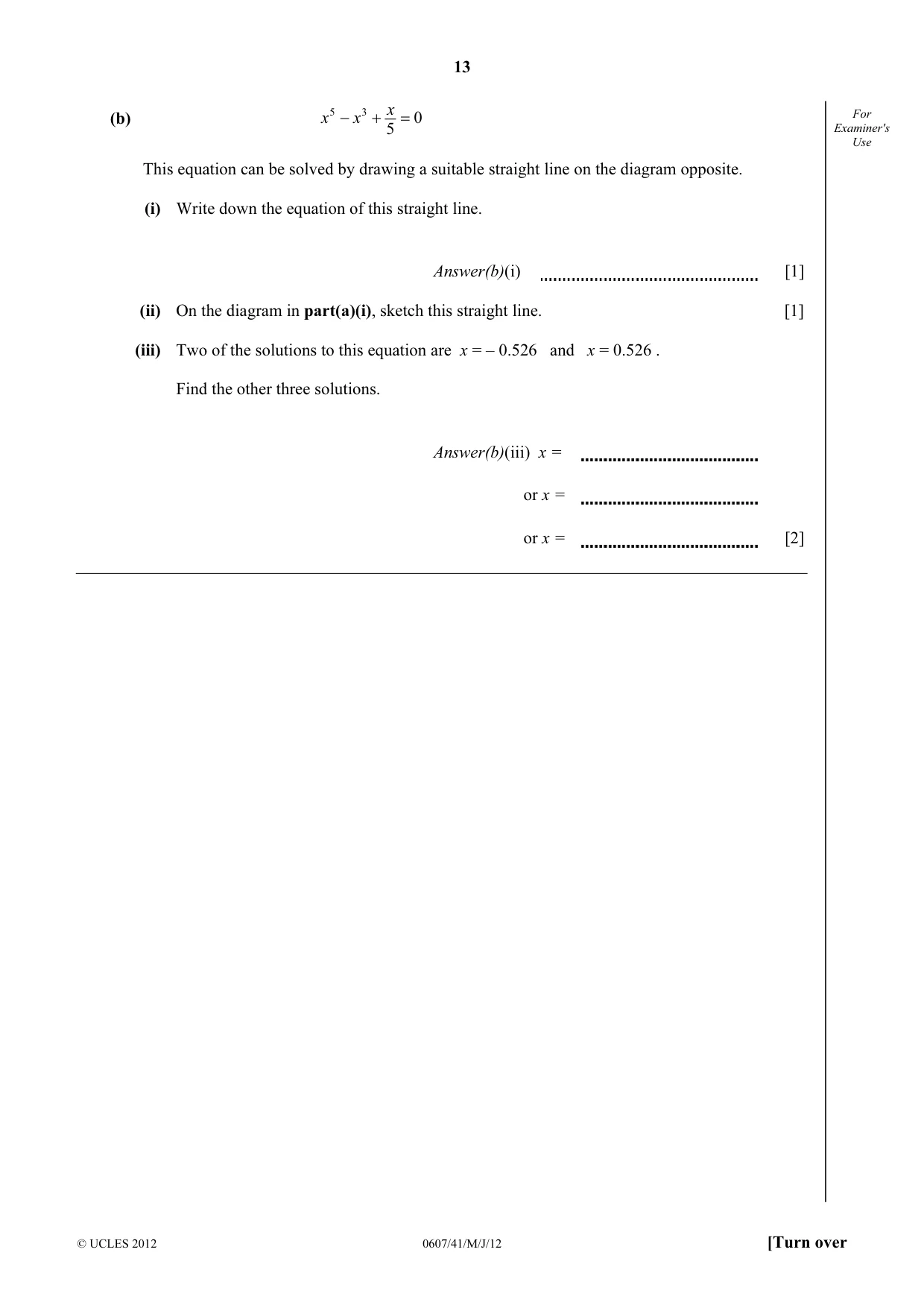
13 © UCLES 2012 0607/41/M/J/12 [Turn over For Examiner's Use (b) 0 5 3 5 = + − x x x This equation can be solved by drawing a suitable straight line on the diagram opposite. (i) Write down the equation of this straight line. Answer(b)(i) [1] (ii) On the diagram in part(a)(i), sketch this straight line. [1] (iii) Two of the solutions to this equation are x = – 0.526 and x = 0.526 . Find the other three solutions. Answer(b)(iii) x = or x = or x = [2]
Question paper, page 14
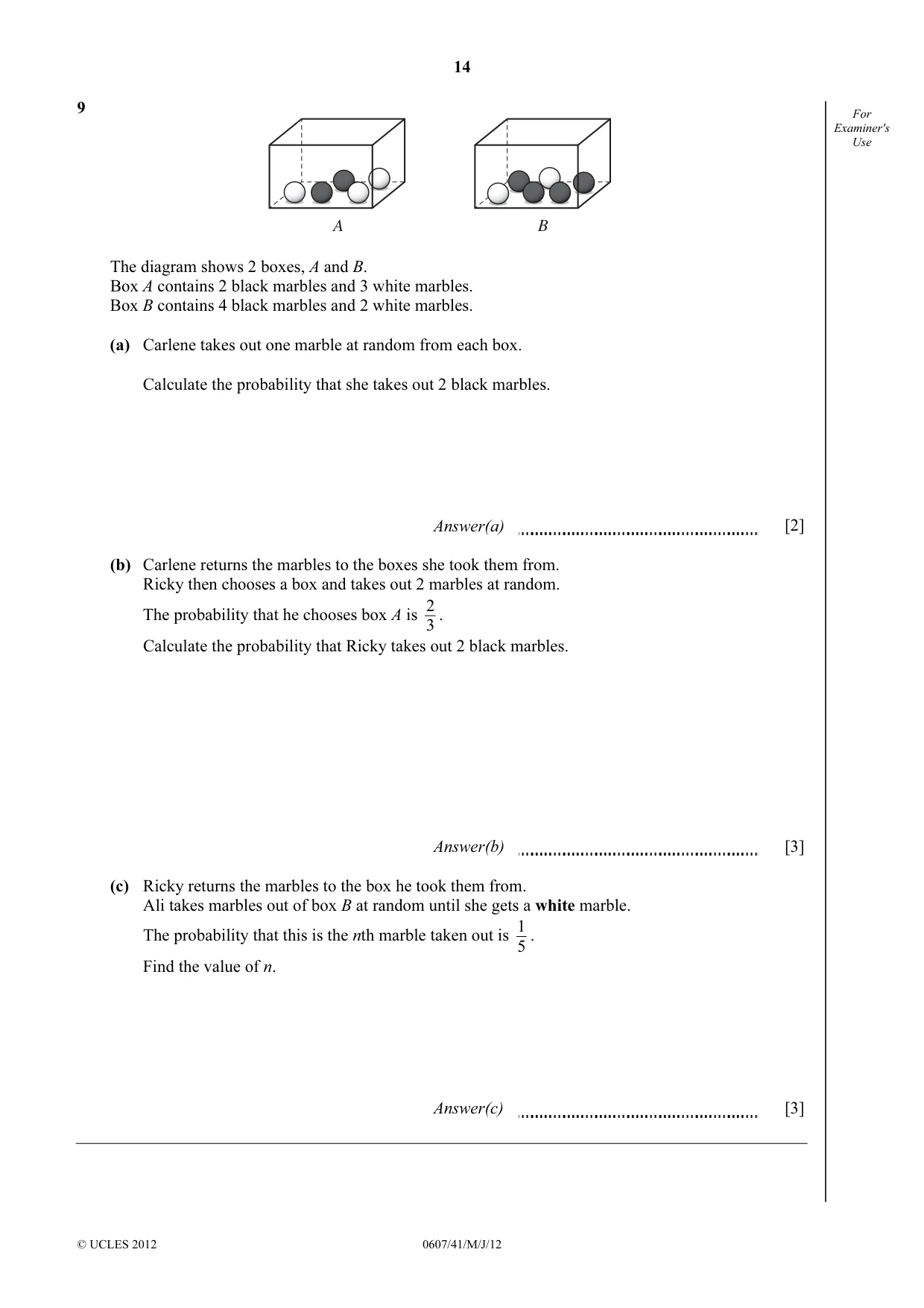
14 © UCLES 2012 0607/41/M/J/12 For Examiner's Use 9 A B The diagram shows 2 boxes, A and B. Box A contains 2 black marbles and 3 white marbles. Box B contains 4 black marbles and 2 white marbles. (a) Carlene takes out one marble at random from each box. Calculate the probability that she takes out 2 black marbles. Answer(a) [2] (b) Carlene returns the marbles to the boxes she took them from. Ricky then chooses a box and takes out 2 marbles at random. The probability that he chooses box A is 3 2 . Calculate the probability that Ricky takes out 2 black marbles. Answer(b) [3] (c) Ricky returns the marbles to the box he took them from. Ali takes marbles out of box B at random until she gets a white marble. The probability that this is the nth marble taken out is 5 1 . Find the value of n. Answer(c) [3]
Question paper, page 15
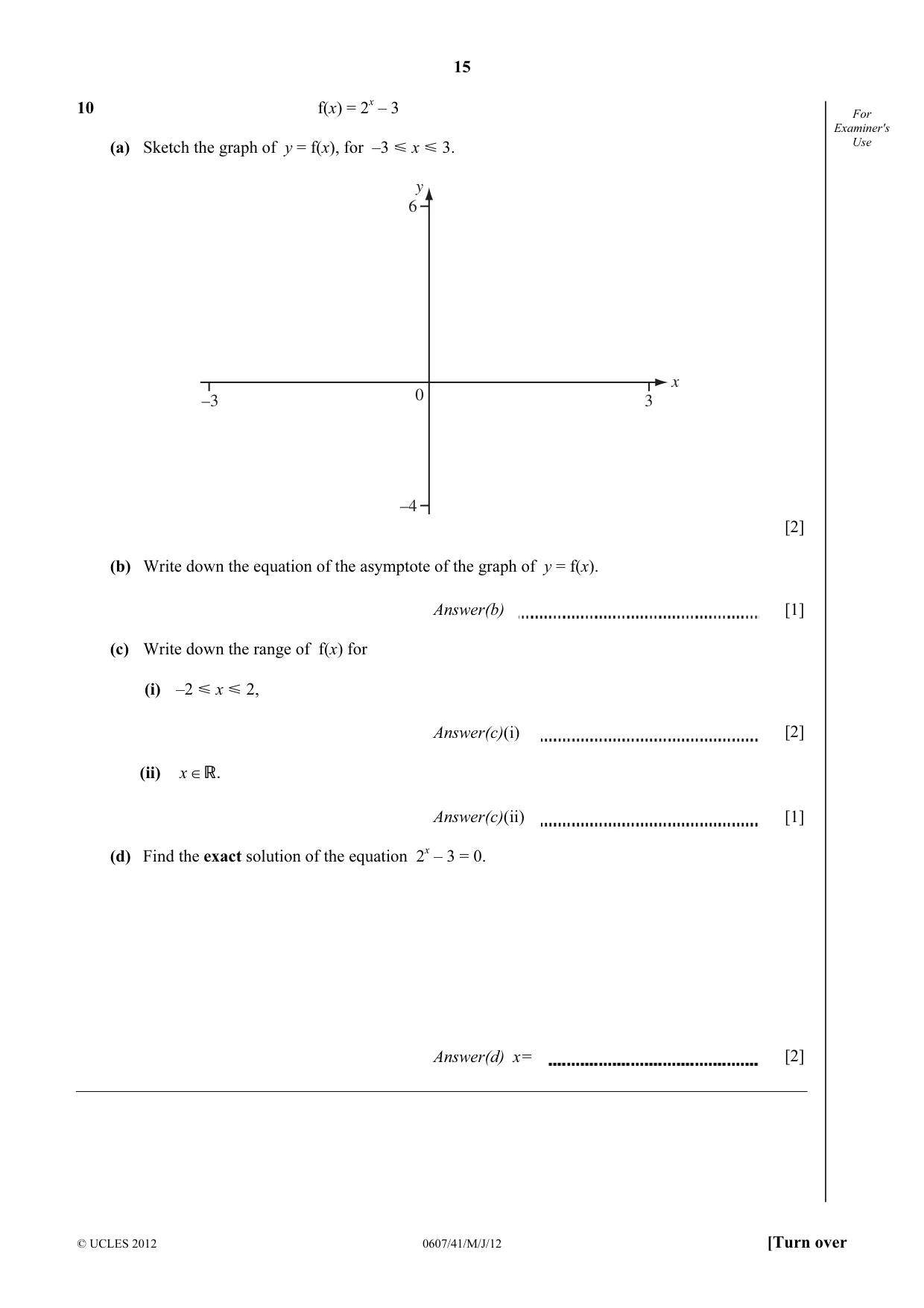
15 © UCLES 2012 0607/41/M/J/12 [Turn over For Examiner's Use 10 f(x) = 2x – 3 (a) Sketch the graph of y = f(x), for –3 Y x Y 3. y x 6 –4 –3 3 0 [2] (b) Write down the equation of the asymptote of the graph of y = f(x). Answer(b) [1] (c) Write down the range of f(x) for (i) –2 Y x Y 2, Answer(c)(i) [2] (ii) ∈ x o. Answer(c)(ii) [1] (d) Find the exact solution of the equation 2x – 3 = 0. Answer(d) x= [2]
Question paper, page 16
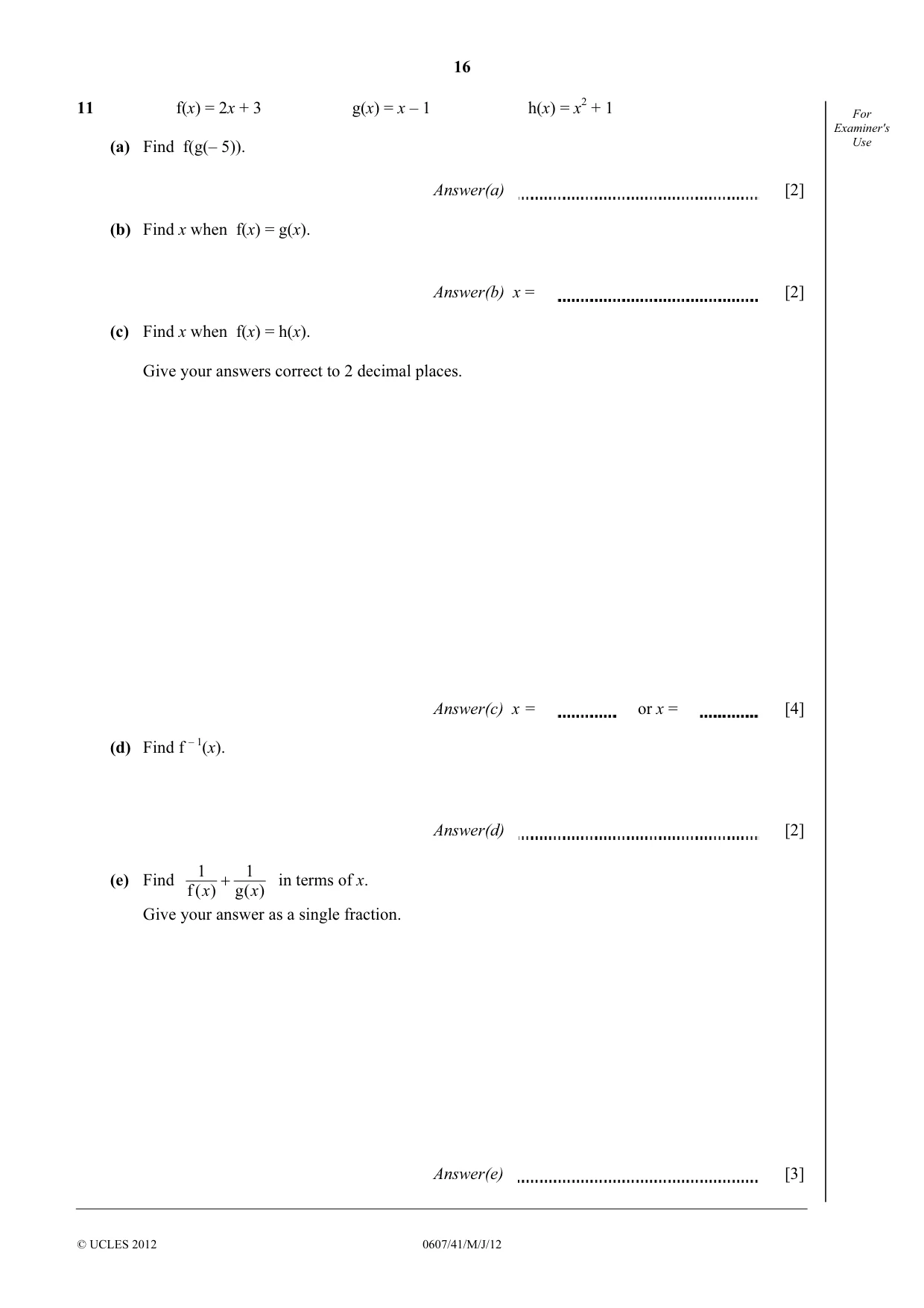
16 © UCLES 2012 0607/41/M/J/12 For Examiner's Use 11 f(x) = 2x + 3 g(x) = x – 1 h(x) = x2 + 1 (a) Find f(g(– 5)). Answer(a) [2] (b) Find x when f(x) = g(x). Answer(b) x = [2] (c) Find x when f(x) = h(x). Give your answers correct to 2 decimal places. Answer(c) x = or x = [4] (d) Find f – 1(x). Answer(d) [2] (e) Find ) ( g 1 ) ( f 1 x x + in terms of x. Give your answer as a single fraction. Answer(e) [3]
Question paper, page 17
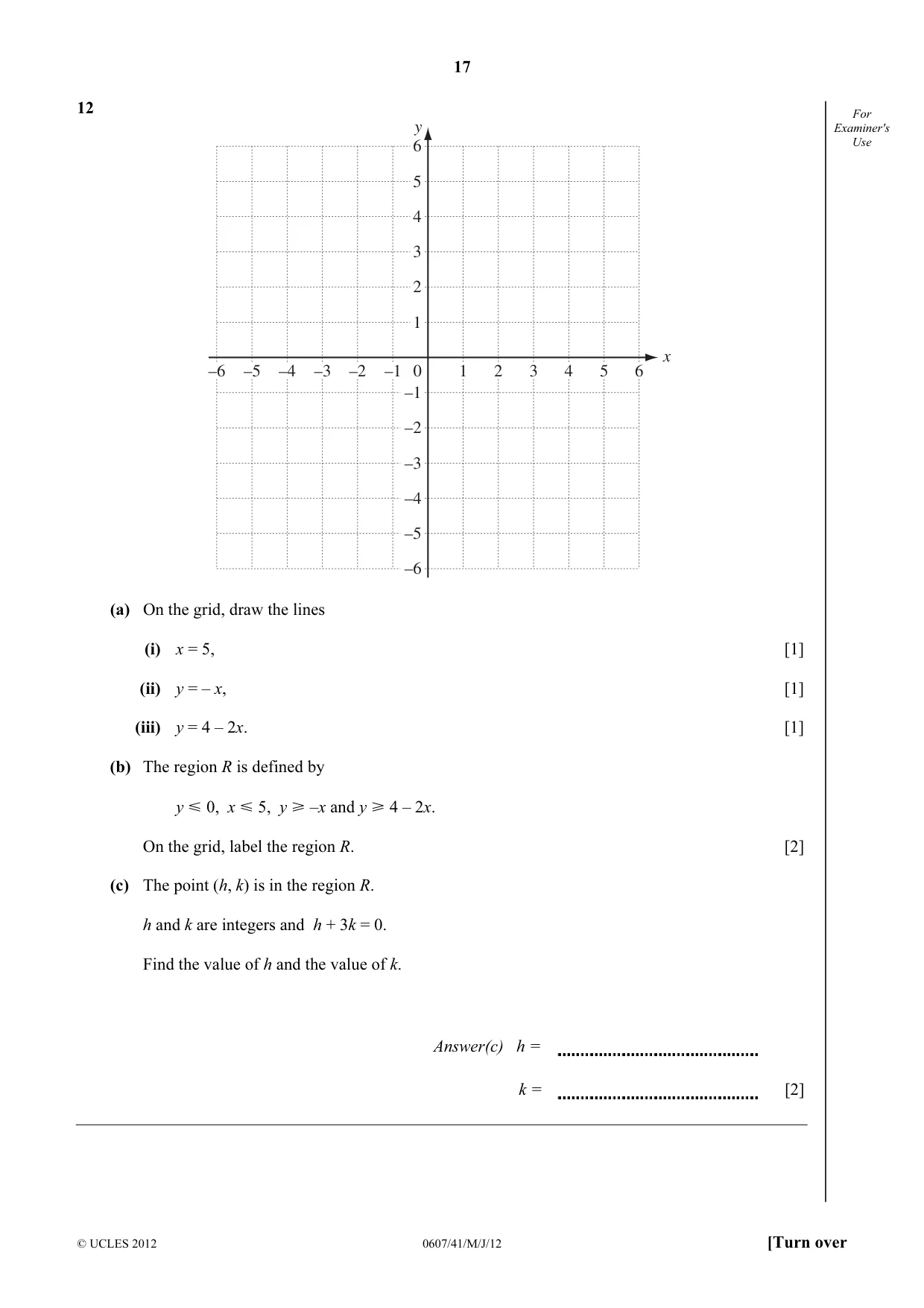
17 © UCLES 2012 0607/41/M/J/12 [Turn over For Examiner's Use 12 –6 –4 –2 –5 –3 –1 y x 0 2 4 6 1 3 5 6 5 4 3 2 1 –1 –2 –3 –4 –5 –6 (a) On the grid, draw the lines (i) x = 5, [1] (ii) y = – x, [1] (iii) y = 4 – 2x. [1] (b) The region R is defined by y Y 0, x Y 5, y [ –x and y [ 4 – 2x. On the grid, label the region R. [2] (c) The point (h, k) is in the region R. h and k are integers and h + 3k = 0. Find the value of h and the value of k. Answer(c) h = k = [2]
Question paper, page 18
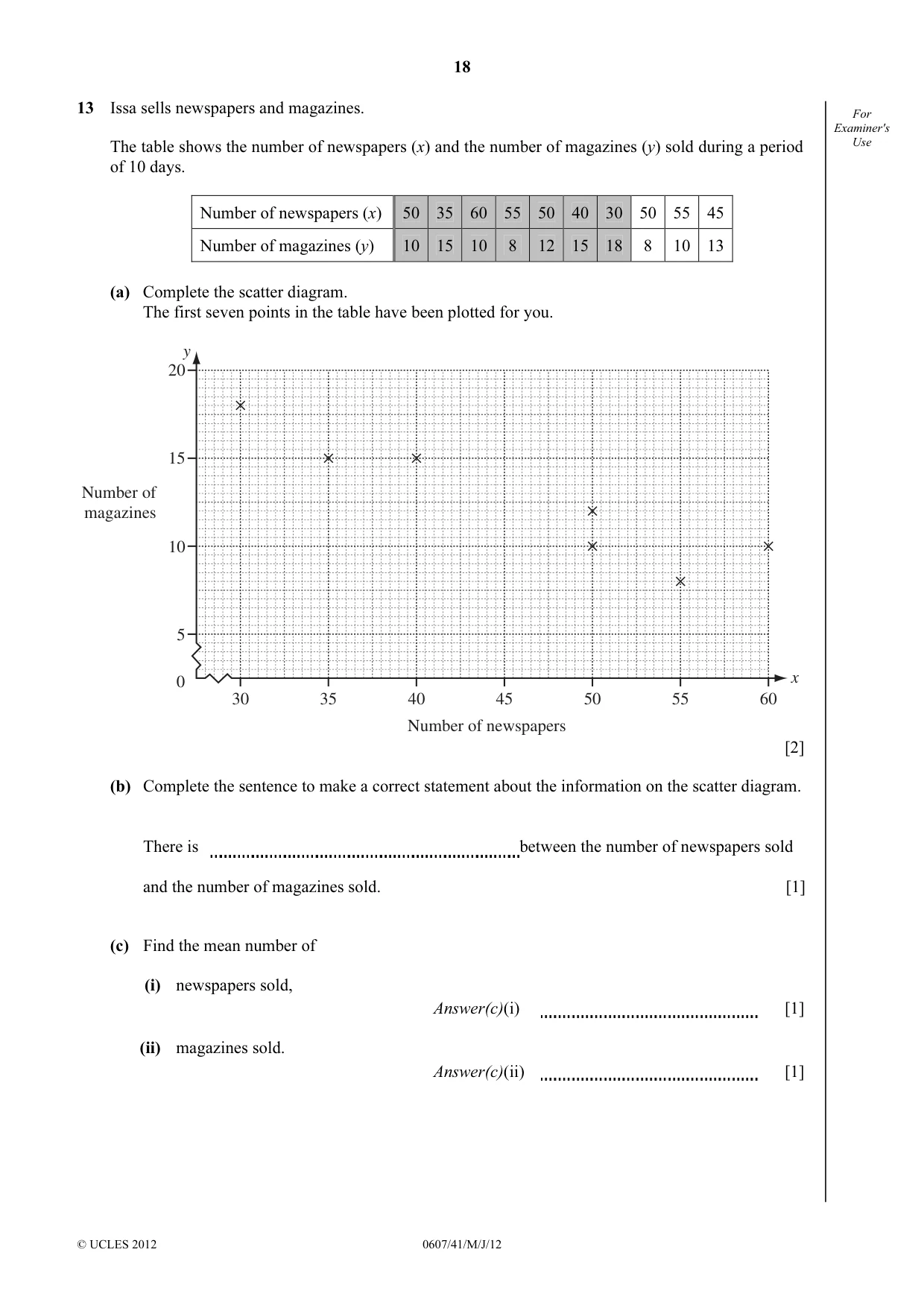
18 © UCLES 2012 0607/41/M/J/12 For Examiner's Use 13 Issa sells newspapers and magazines. The table shows the number of newspapers (x) and the number of magazines (y) sold during a period of 10 days. Number of newspapers (x) 50 35 60 55 50 40 30 50 55 45 Number of magazines (y) 10 15 10 8 12 15 18 8 10 13 (a) Complete the scatter diagram. The first seven points in the table have been plotted for you. y x 20 15 10 5 Number of magazines 30 0 35 40 45 50 55 60 Number of newspapers [2] (b) Complete the sentence to make a correct statement about the information on the scatter diagram. There is between the number of newspapers sold and the number of magazines sold. [1] (c) Find the mean number of (i) newspapers sold, Answer(c)(i) [1] (ii) magazines sold. Answer(c)(ii) [1]
Question paper, page 19
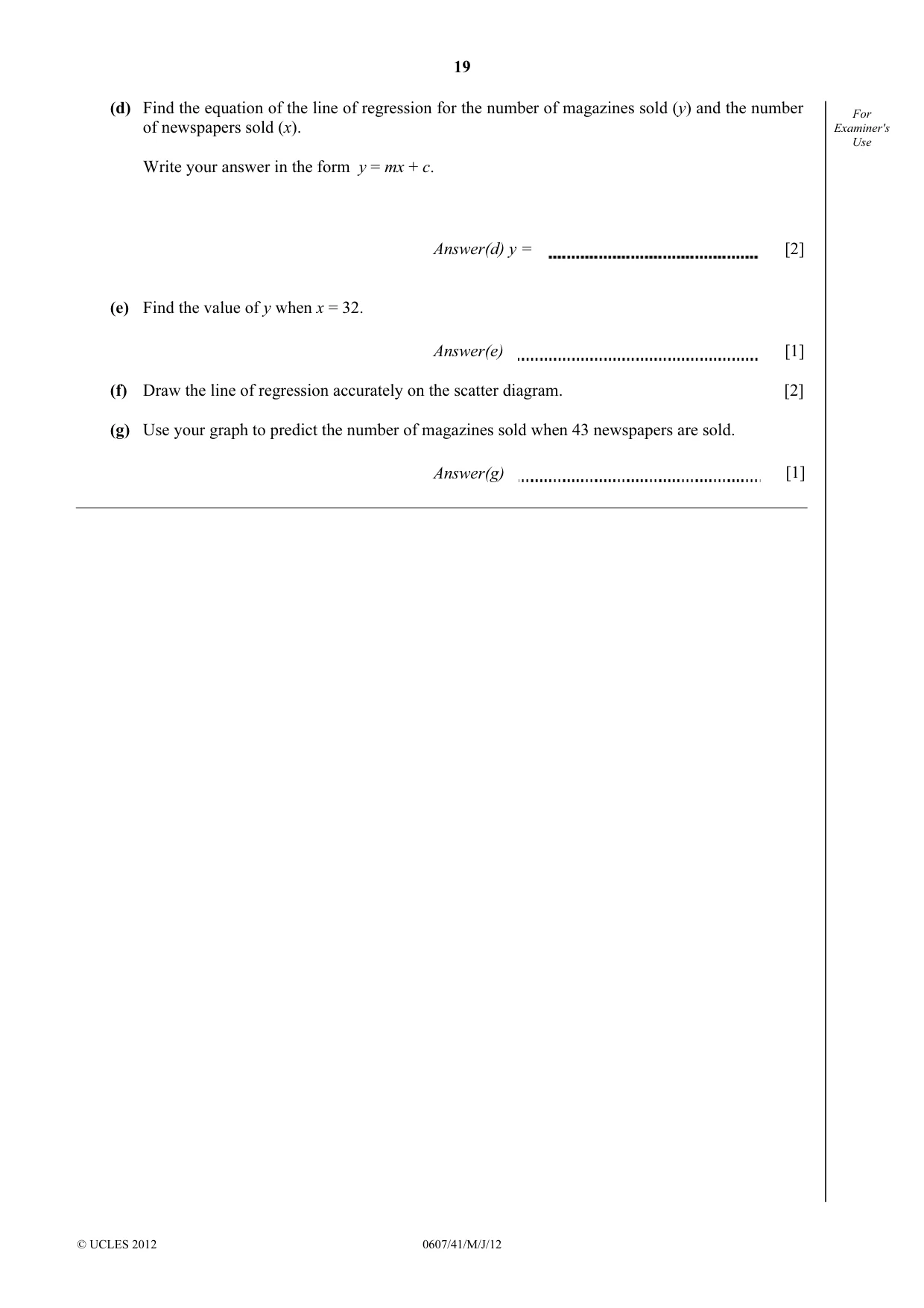
19 © UCLES 2012 0607/41/M/J/12 For Examiner's Use (d) Find the equation of the line of regression for the number of magazines sold (y) and the number of newspapers sold (x). Write your answer in the form y = mx + c. Answer(d) y = [2] (e) Find the value of y when x = 32. Answer(e) [1] (f) Draw the line of regression accurately on the scatter diagram. [2] (g) Use your graph to predict the number of magazines sold when 43 newspapers are sold. Answer(g) [1]
Question paper, page 20
20 Permission to reproduce items where third-party owned material protected by copyright is included has been sought and cleared where possible. Every reasonable effort has been made by the publisher (UCLES) to trace copyright holders, but if any items requiring clearance have unwittingly been included, the publisher will be pleased to make amends at the earliest possible opportunity. University of Cambridge International Examinations is part of the Cambridge Assessment Group. Cambridge Assessment is the brand name of University of Cambridge Local Examinations Syndicate (UCLES), which is itself a department of the University of Cambridge. © UCLES 2012 0607/41/M/J/12 BLANK PAGE
Mark scheme, page 1
UNIVERSITY OF CAMBRIDGE INTERNATIONAL EXAMINATIONS International General Certificate of Secondary Education MARK SCHEME for the May/June 2012 question paper for the guidance of teachers 0607 CAMBRIDGE INTERNATIONAL MATHEMATICS 0607/41 Paper 4 (Extended), maximum raw mark 120 This mark scheme is published as an aid to teachers and candidates, to indicate the requirements of the examination. It shows the basis on which Examiners were instructed to award marks. It does not indicate the details of the discussions that took place at an Examiners’ meeting before marking began, which would have considered the acceptability of alternative answers. Mark schemes must be read in conjunction with the question papers and the report on the examination. • Cambridge will not enter into discussions or correspondence in connection with these mark schemes. Cambridge is publishing the mark schemes for the May/June 2012 question papers for most IGCSE, GCE Advanced Level and Advanced Subsidiary Level syllabuses and some Ordinary Level syllabuses. www.XtremePapers.com
Mark scheme, page 2
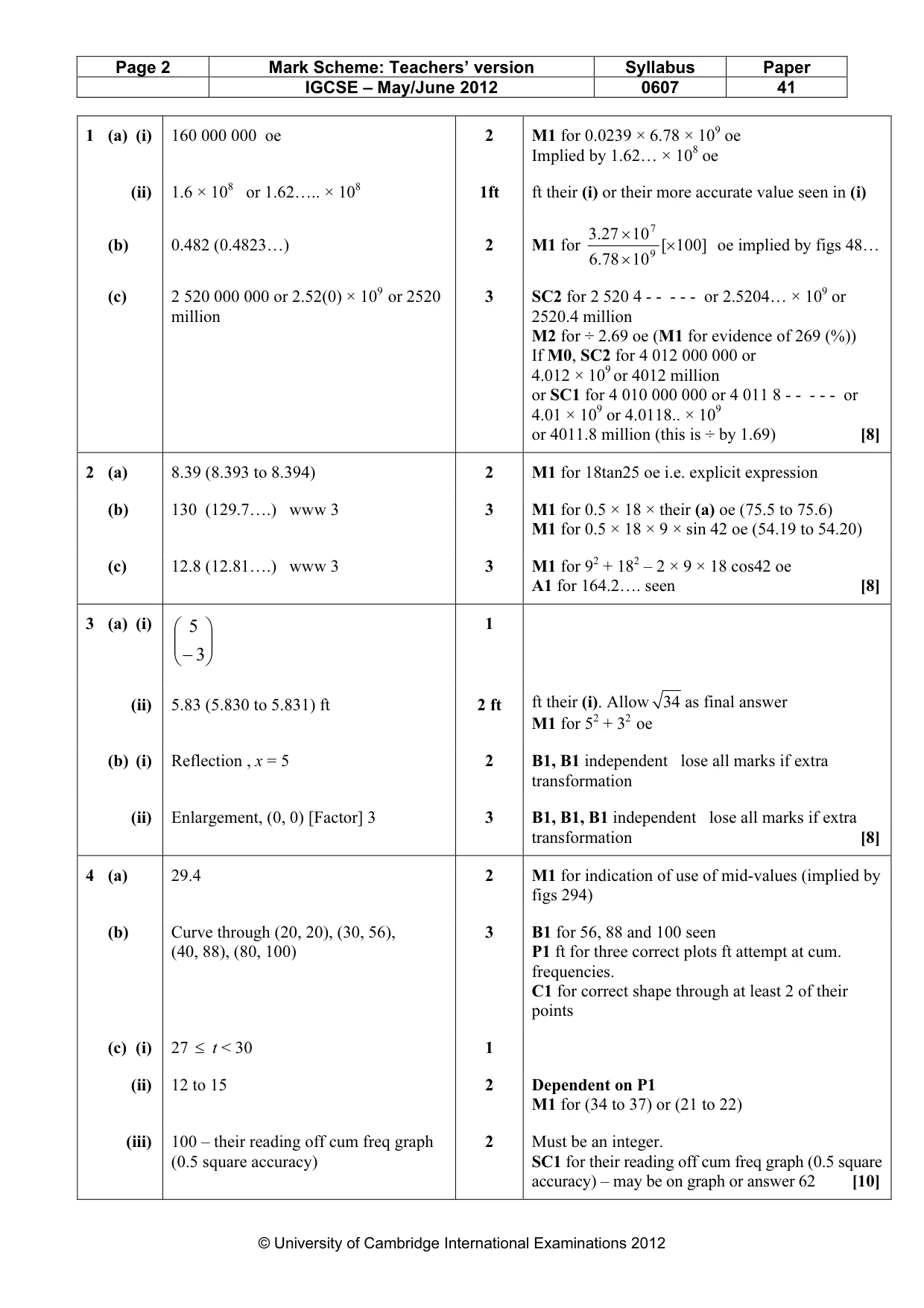
Page 2 Mark Scheme: Teachers’ version Syllabus Paper IGCSE – May/June 2012 0607 41 © University of Cambridge International Examinations 2012 1 (a) (i) 160 000 000 oe 2 M1 for 0.0239 × 6.78 × 109 oe Implied by 1.62… × 108 oe (ii) 1.6 × 10⁸ or 1.62….. × 108 1ft ft their (i) or their more accurate value seen in (i) (b) 0.482 (0.4823…) 2 M1 for ] 100 [ 10 78 .6 10 27 .3 9 7 × × × oe implied by figs 48… (c) 2 520 000 000 or 2.52(0) × 109 or 2520 million 3 SC2 for 2 520 4 - - - - - or 2.5204… × 109 or 2520.4 million M2 for ÷ 2.69 oe (M1 for evidence of 269 (%)) If M0, SC2 for 4 012 000 000 or 4.012 × 10⁹ or 4012 million or SC1 for 4 010 000 000 or 4 011 8 - - - - - or 4.01 × 10⁹ or 4.0118.. × 109 or 4011.8 million (this is ÷ by 1.69) [8] 2 (a) 8.39 (8.393 to 8.394) 2 M1 for 18tan25 oe i.e. explicit expression (b) 130 (129.7….) www 3 3 M1 for 0.5 × 18 × their (a) oe (75.5 to 75.6) M1 for 0.5 × 18 × 9 × sin 42 oe (54.19 to 54.20) (c) 12.8 (12.81….) www 3 3 M1 for 92 + 182 – 2 × 9 × 18 cos42 oe A1 for 164.2…. seen [8] 3 (a) (i) −3 5 1 (ii) 5.83 (5.830 to 5.831) ft 2 ft ft their (i). Allow 34 as final answer M1 for 52 + 32 oe (b) (i) Reflection , x = 5 2 B1, B1 independent lose all marks if extra transformation (ii) Enlargement, (0, 0) [Factor] 3 3 B1, B1, B1 independent lose all marks if extra transformation [8] 4 (a) 29.4 2 M1 for indication of use of mid-values (implied by figs 294) (b) Curve through (20, 20), (30, 56), (40, 88), (80, 100) 3 B1 for 56, 88 and 100 seen P1 ft for three correct plots ft attempt at cum. frequencies. C1 for correct shape through at least 2 of their points (c) (i) 27 ≤ t < 30 1 (ii) 12 to 15 2 Dependent on P1 M1 for (34 to 37) or (21 to 22) (iii) 100 – their reading off cum freq graph (0.5 square accuracy) 2 Must be an integer. SC1 for their reading off cum freq graph (0.5 square accuracy) – may be on graph or answer 62 [10]
Mark scheme, page 3
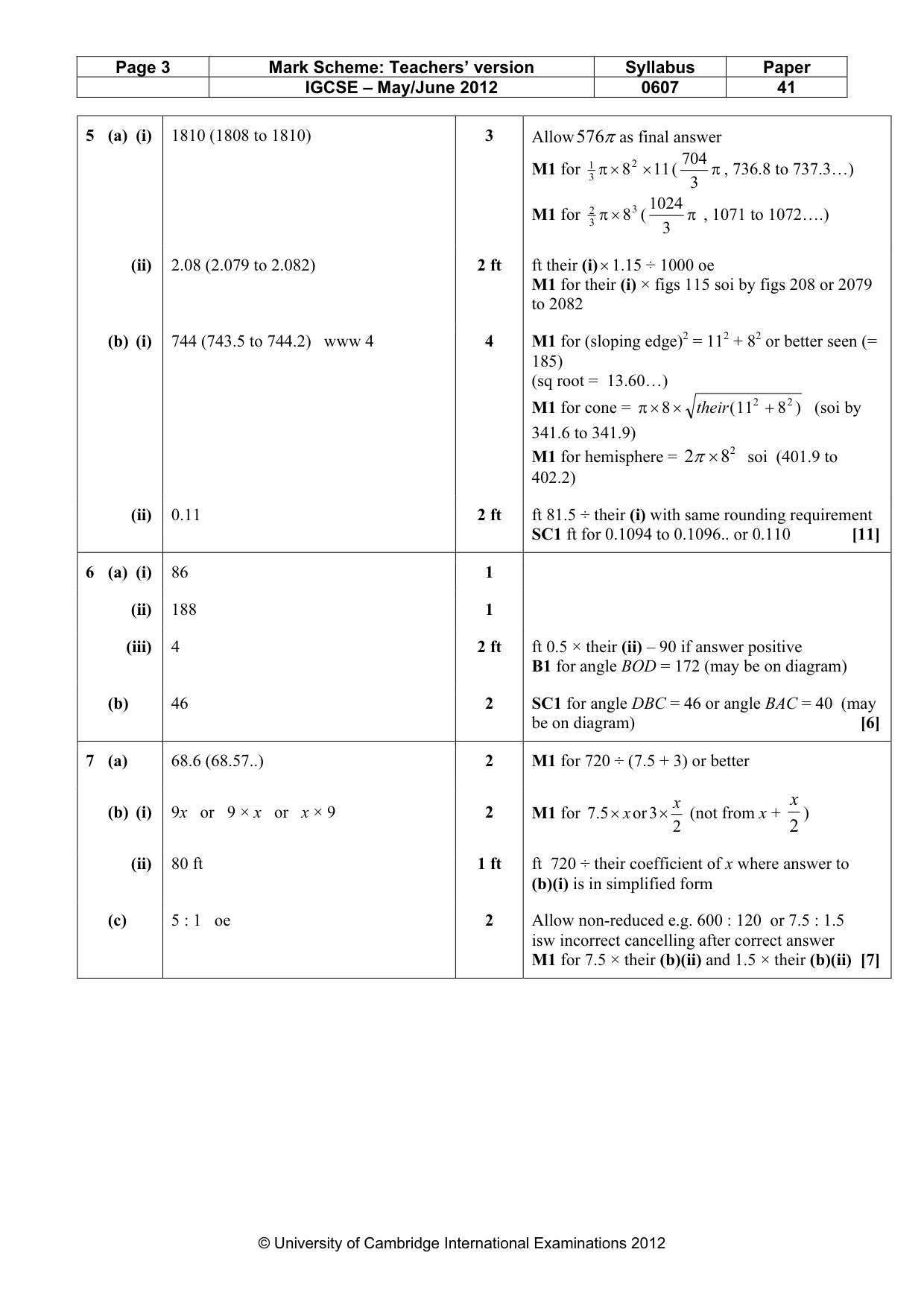
Page 3 Mark Scheme: Teachers’ version Syllabus Paper IGCSE – May/June 2012 0607 41 © University of Cambridge International Examinations 2012 5 (a) (i) 1810 (1808 to 1810) 3 Allow π 576 as final answer M1 for 11 82 3 1 × × π ( π 3 704 , 736.8 to 737.3…) M1 for 3 3 2 8 × π ( π 3 1024 , 1071 to 1072….) (ii) 2.08 (2.079 to 2.082) 2 ft ft their (i)× 1.15 ÷ 1000 oe M1 for their (i) × figs 115 soi by figs 208 or 2079 to 2082 (b) (i) 744 (743.5 to 744.2) www 4 4 M1 for (sloping edge)2 = 112 + 82 or better seen (= 185) (sq root = 13.60…) M1 for cone = ) 8 11 ( 8 2 2 + × × π their (soi by 341.6 to 341.9) M1 for hemisphere = 2 8 2 × π soi (401.9 to 402.2) (ii) 0.11 2 ft ft 81.5 ÷ their (i) with same rounding requirement SC1 ft for 0.1094 to 0.1096.. or 0.110 [11] 6 (a) (i) 86 1 (ii) 188 1 (iii) 4 2 ft ft 0.5 × their (ii) – 90 if answer positive B1 for angle BOD = 172 (may be on diagram) (b) 46 2 SC1 for angle DBC = 46 or angle BAC = 40 (may be on diagram) [6] 7 (a) 68.6 (68.57..) 2 M1 for 720 ÷ (7.5 + 3) or better (b) (i) 9x or 9 × x or x × 9 2 M1 for 7.5 or3 2 x x × × (not from x + 2 x ) (ii) 80 ft 1 ft ft 720 ÷ their coefficient of x where answer to (b)(i) is in simplified form (c) 5 : 1 oe 2 Allow non-reduced e.g. 600 : 120 or 7.5 : 1.5 isw incorrect cancelling after correct answer M1 for 7.5 × their (b)(ii) and 1.5 × their (b)(ii) [7]
Mark scheme, page 4
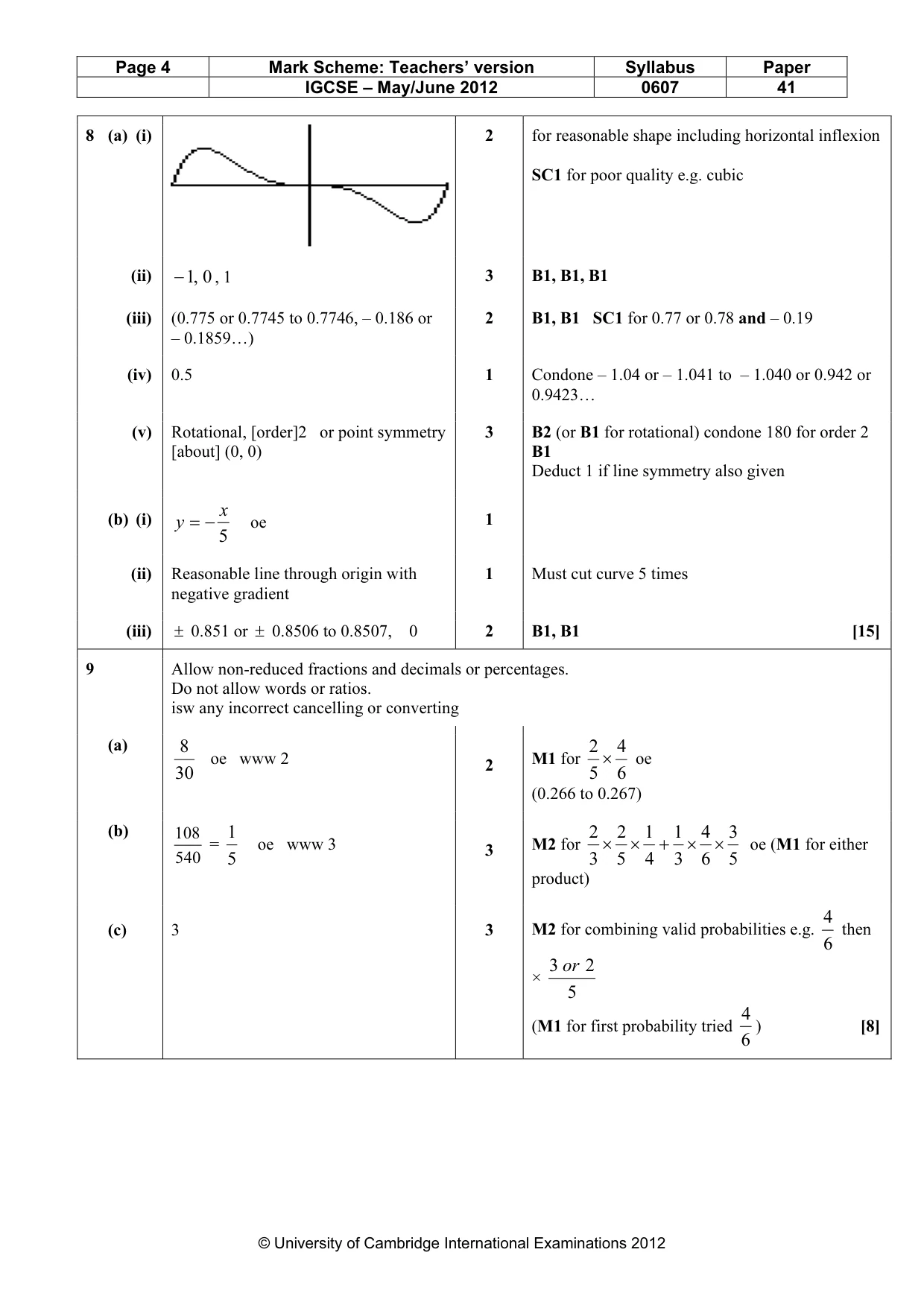
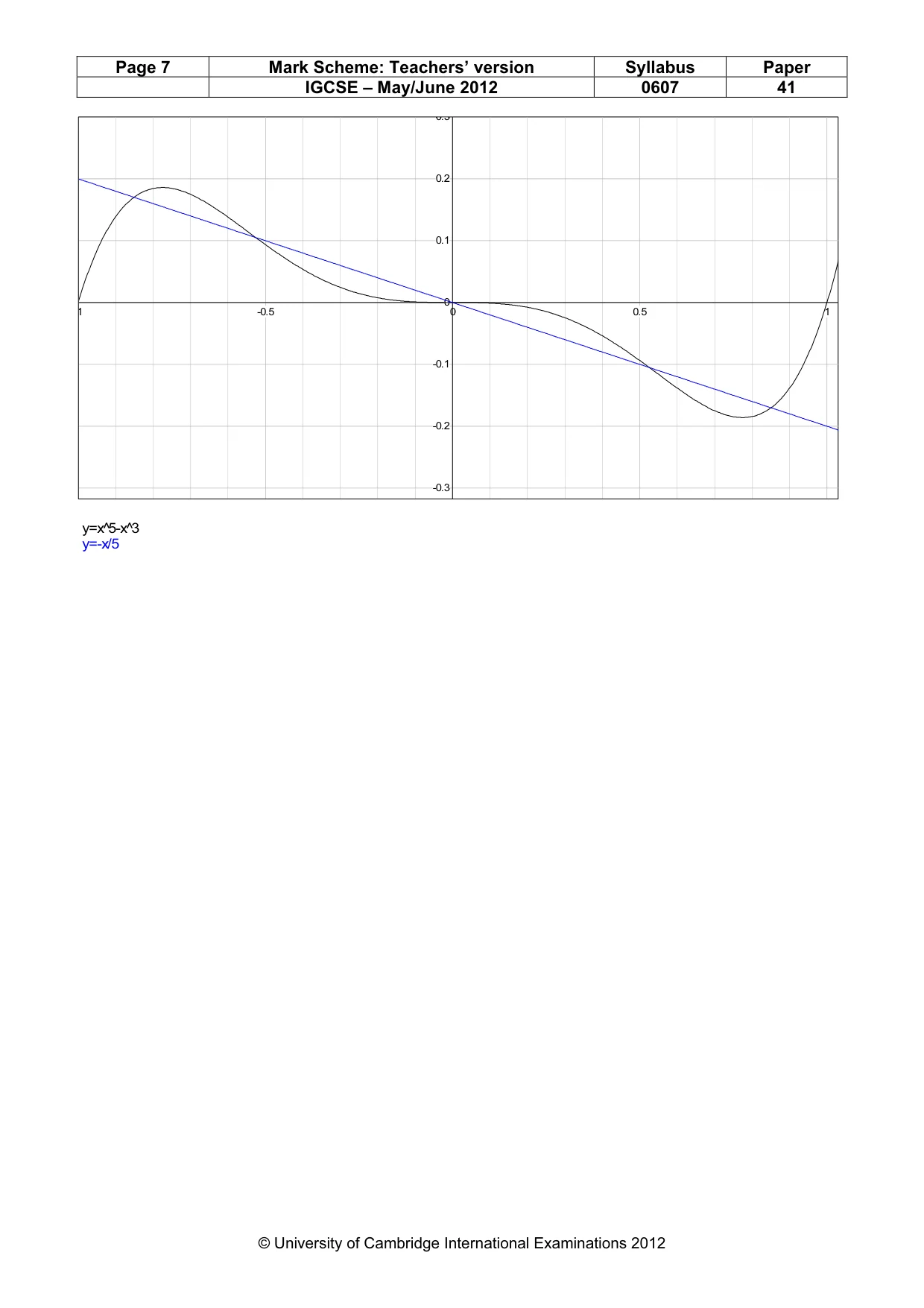
Page 4 Mark Scheme: Teachers’ version Syllabus Paper IGCSE – May/June 2012 0607 41 © University of Cambridge International Examinations 2012 8 (a) (i) 2 for reasonable shape including horizontal inflexion SC1 for poor quality e.g. cubic (ii) 0 ,1 − , 1 3 B1, B1, B1 (iii) (0.775 or 0.7745 to 0.7746, – 0.186 or – 0.1859…) 2 B1, B1 SC1 for 0.77 or 0.78 and – 0.19 (iv) 0.5 1 Condone – 1.04 or – 1.041 to – 1.040 or 0.942 or 0.9423… (v) Rotational, [order]2 or point symmetry [about] (0, 0) 3 B2 (or B1 for rotational) condone 180 for order 2 B1 Deduct 1 if line symmetry also given (b) (i) 5 x y − = oe 1 (ii) Reasonable line through origin with negative gradient 1 Must cut curve 5 times (iii) ± 0.851 or ± 0.8506 to 0.8507, 0 2 B1, B1 [15] 9 Allow non-reduced fractions and decimals or percentages. Do not allow words or ratios. isw any incorrect cancelling or converting (a) 30 8 oe www 2 2 M1 for 6 4 5 2 × oe (0.266 to 0.267) (b) 540 108 = 5 1 oe www 3 3 M2 for 5 3 6 4 3 1 4 1 5 2 3 2 × × + × × oe (M1 for either product) (c) 3 3 M2 for combining valid probabilities e.g. 6 4 then × 5 2 3 or (M1 for first probability tried 6 4 ) [8]
Mark scheme, page 5
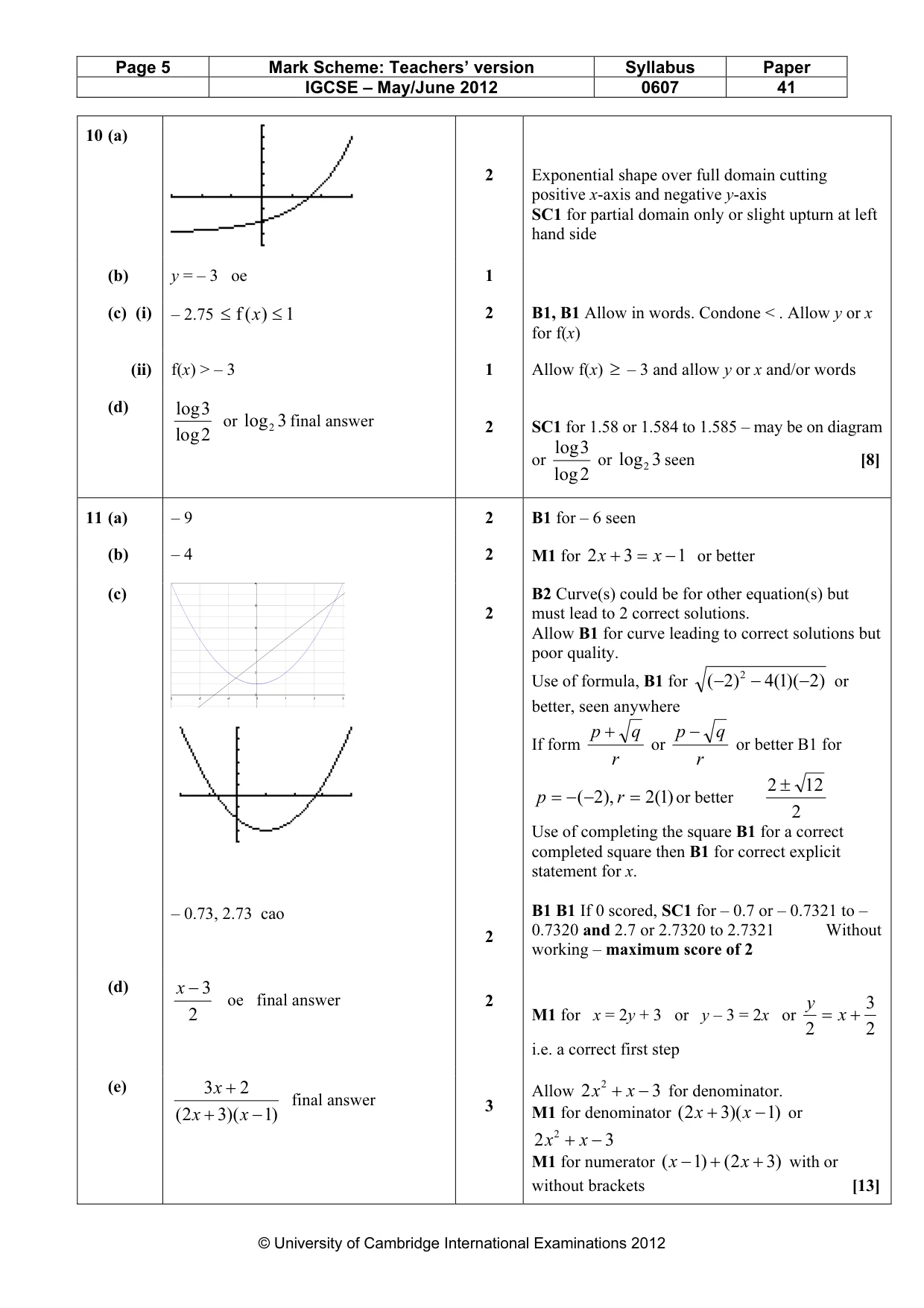
Page 5 Mark Scheme: Teachers’ version Syllabus Paper IGCSE – May/June 2012 0607 41 © University of Cambridge International Examinations 2012 10 (a) 2 Exponential shape over full domain cutting positive x-axis and negative y-axis SC1 for partial domain only or slight upturn at left hand side (b) y = – 3 oe 1 (c) (i) – 2.75 1 ) ( f ≤ ≤ x 2 B1, B1 Allow in words. Condone < . Allow y or x for f(x) (ii) f(x) > – 3 1 Allow f(x) ≥ – 3 and allow y or x and/or words (d) 2 log 3 log or 3 log2 final answer 2 SC1 for 1.58 or 1.584 to 1.585 – may be on diagram or 2 log 3 log or 3 log2 seen [8] 11 (a) – 9 2 B1 for – 6 seen (b) – 4 2 M1 for 1 3 2 − = + x x or better (c) 3 2 1 0 -1 -2 3 10 8 6 4 2 0 3 2 1 0 -1 -2 3 10 8 6 4 2 0 3 2 1 0 -1 -2 3 10 8 6 4 2 0 3 2 1 0 -1 -2 3 10 8 6 4 2 0 – 0.73, 2.73 cao 2 2 B2 Curve(s) could be for other equation(s) but must lead to 2 correct solutions. Allow B1 for curve leading to correct solutions but poor quality. Use of formula, B1 for ) 2 )( 1( 4 ) 2 ( 2 − − − or better, seen anywhere If form r q p + or r q p − or better B1 for )1( 2 ), 2 ( = − − = r p or better 2 12 2 ± Use of completing the square B1 for a correct completed square then B1 for correct explicit statement for x. B1 B1 If 0 scored, SC1 for – 0.7 or – 0.7321 to – 0.7320 and 2.7 or 2.7320 to 2.7321 Without working – maximum score of 2 (d) 2 3 − x oe final answer 2 M1 for x = 2y + 3 or y – 3 = 2x or 2 3 2 + = x y i.e. a correct first step (e) )1 )( 3 2 ( 2 3 − + + x x x final answer 3 Allow 3 2 2 − + x x for denominator. M1 for denominator )1 )( 3 2 ( − + x x or 3 2 2 − + x x M1 for numerator ) 3 2 ( )1 ( + + − x x with or without brackets [13]
Mark scheme, page 6
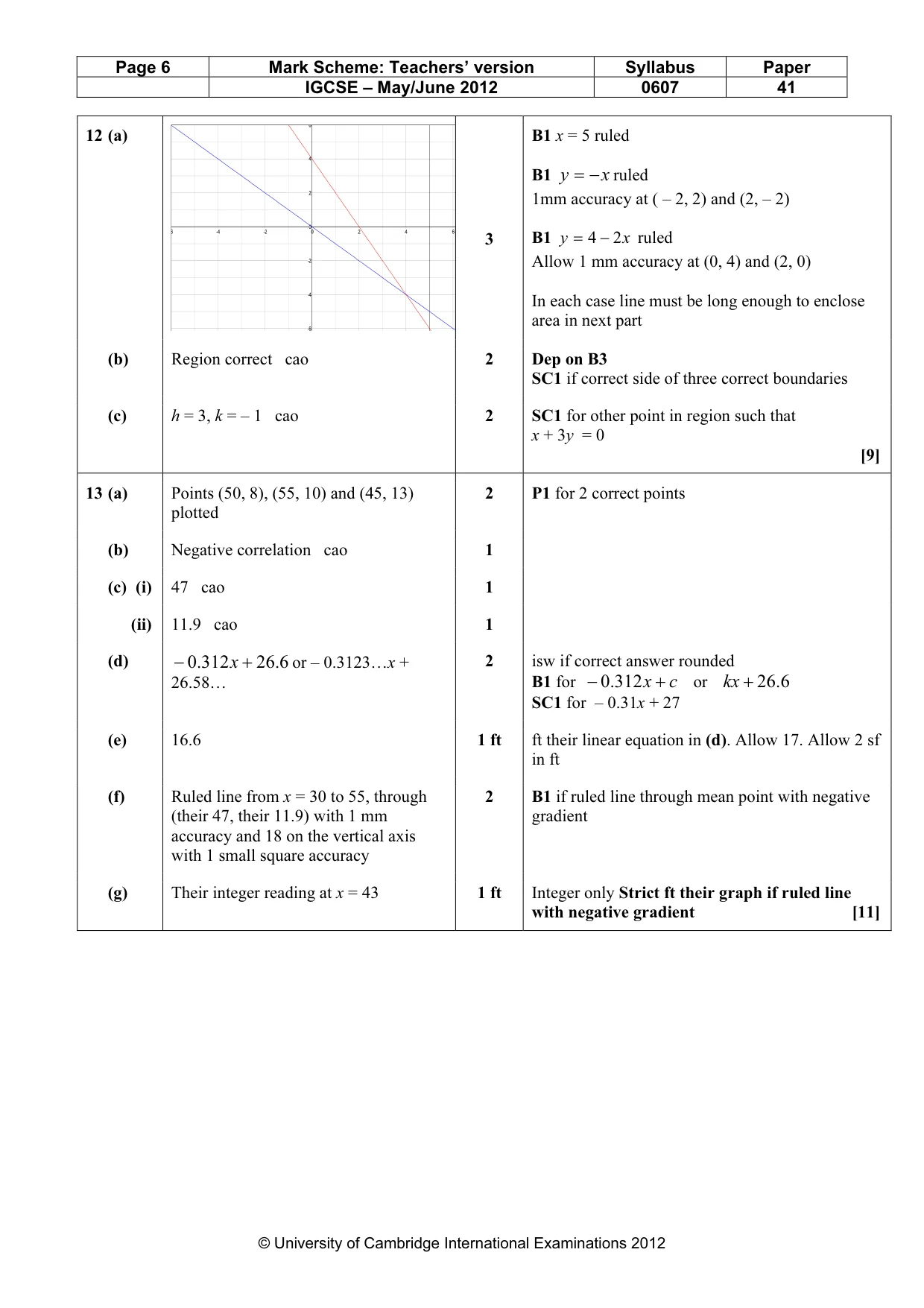
Page 6 Mark Scheme: Teachers’ version Syllabus Paper IGCSE – May/June 2012 0607 41 © University of Cambridge International Examinations 2012 12 (a) 6 4 2 0 -2 -4 6 6 4 2 0 -2 -4 -6 6 4 2 0 -2 -4 6 6 4 2 0 -2 -4 -6 6 4 2 0 -2 -4 6 6 4 2 0 -2 -4 -6 6 4 2 0 -2 -4 6 6 4 2 0 -2 -4 -6 3 B1 x = 5 ruled B1 x y − = ruled 1mm accuracy at ( – 2, 2) and (2, – 2) B1 x y 2 4 − = ruled Allow 1 mm accuracy at (0, 4) and (2, 0) In each case line must be long enough to enclose area in next part (b) Region correct cao 2 Dep on B3 SC1 if correct side of three correct boundaries (c) h = 3, k = – 1 cao 2 SC1 for other point in region such that x + 3y = 0 [9] 13 (a) Points (50, 8), (55, 10) and (45, 13) plotted 2 P1 for 2 correct points (b) Negative correlation cao 1 (c) (i) 47 cao 1 (ii) 11.9 cao 1 (d) 6. 26 312 .0 + − x or – 0.3123…x + 26.58… 2 isw if correct answer rounded B1 for c x + − 312 .0 or 6. 26 + kx SC1 for – 0.31x + 27 (e) 16.6 1 ft ft their linear equation in (d). Allow 17. Allow 2 sf in ft (f) Ruled line from x = 30 to 55, through (their 47, their 11.9) with 1 mm accuracy and 18 on the vertical axis with 1 small square accuracy 2 B1 if ruled line through mean point with negative gradient (g) Their integer reading at x = 43 1 ft Integer only Strict ft their graph if ruled line with negative gradient [11]
Mark scheme, page 7
Page 7 Mark Scheme: Teachers’ version Syllabus Paper IGCSE – May/June 2012 0607 41 © University of Cambridge International Examinations 2012 1 0.5 0 -0.5 1 0.3 0.2 0.1 0 -0.1 -0.2 -0.3 1 0.5 0 -0.5 1 0.3 0.2 0.1 0 -0.1 -0.2 -0.3 1 0.5 0 -0.5 1 0.3 0.2 0.1 0 -0.1 -0.2 -0.3 1 0.5 0 -0.5 1 0.3 0.2 0.1 0 -0.1 -0.2 -0.3 y=x^5-x^3 y=-x/5
What you needed in this session
Cambridge’s own grade thresholds for 2012 May/June, Paper 4 · Variant 1. A higher threshold means an easier paper — the bar moves with how the cohort did.