Cambridge IGCSE Mathematics - International 0607 — 2012 May/June Paper 4 · Variant 3
0607/43/M/J/12 · 120 marks · ≈135 min
The question paper and its mark scheme, free to read here and free to download. This is Cambridge’s own paper, exactly as it was sat.
Question paper20 pages
Mark scheme6 pages
Answers below. Sit the paper first if you are practising.
Paper as text
Question paper, page 1
This document consists of 20 printed pages. IB12 06_0607_43/FP © UCLES 2012 [Turn over *8967578522* For Examiner's Use UNIVERSITY OF CAMBRIDGE INTERNATIONAL EXAMINATIONS International General Certificate of Secondary Education CAMBRIDGE INTERNATIONAL MATHEMATICS 0607/43 Paper 4 (Extended) May/June 2012 2 hours 15 minutes Candidates answer on the Question Paper Additional Materials: Geometrical Instruments Graphics Calculator READ THESE INSTRUCTIONS FIRST Write your Centre number, candidate number and name on all the work you hand in. Write in dark blue or black pen. Do not use staples, paper clips, highlighters, glue or correction fluid. You may use a pencil for any diagrams or graphs. DO NOT WRITE IN ANY BARCODES. Answer all the questions. Unless instructed otherwise, give your answers exactly or correct to three significant figures as appropriate. Answers in degrees should be given to one decimal place. For π, use your calculator value. You must show all the relevant working to gain full marks and you will be given marks for correct methods, including sketches, even if your answer is incorrect. The number of marks is given in brackets [ ] at the end of each question or part question. The total number of marks for this paper is 120. www.XtremePapers.com
Question paper, page 2
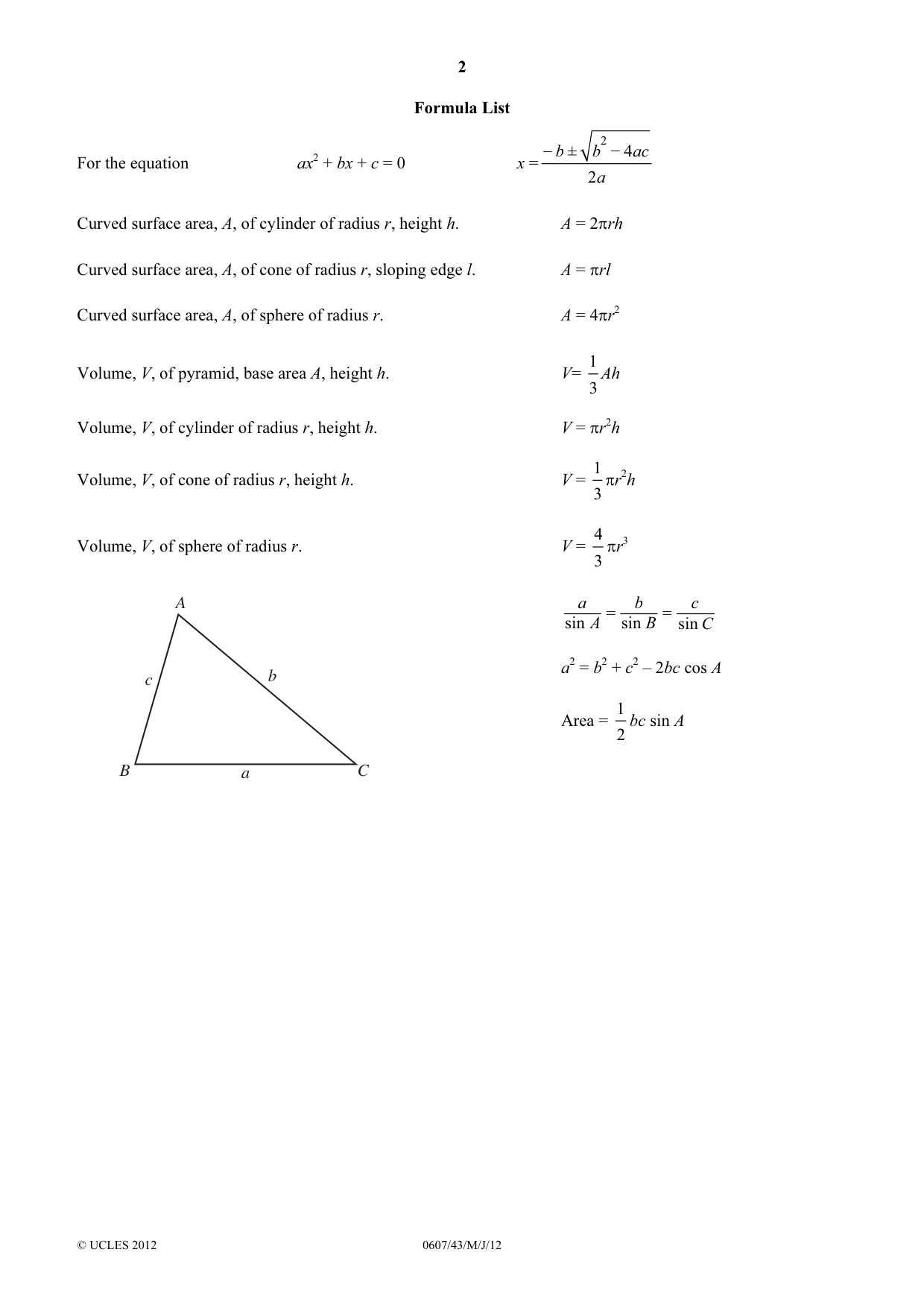
2 © UCLES 2012 0607/43/M/J/12 Formula List For the equation ax2 + bx + c = 0 x = 2 _ ± 4 2 _ b b ac a Curved surface area, A, of cylinder of radius r, height h. A = 2πrh Curved surface area, A, of cone of radius r, sloping edge l. A = πrl Curved surface area, A, of sphere of radius r. A = 4πr2 Volume, V, of pyramid, base area A, height h. V= 1 3 Ah Volume, V, of cylinder of radius r, height h. V = πr2h Volume, V, of cone of radius r, height h. V = 1 3 πr2h Volume, V, of sphere of radius r. V = 4 3 πr3 = = sin sin sin a b c A B C a2 = b2 + c2 – 2bc cos A Area = 1 2 bc sin A A a B C b c
Question paper, page 3
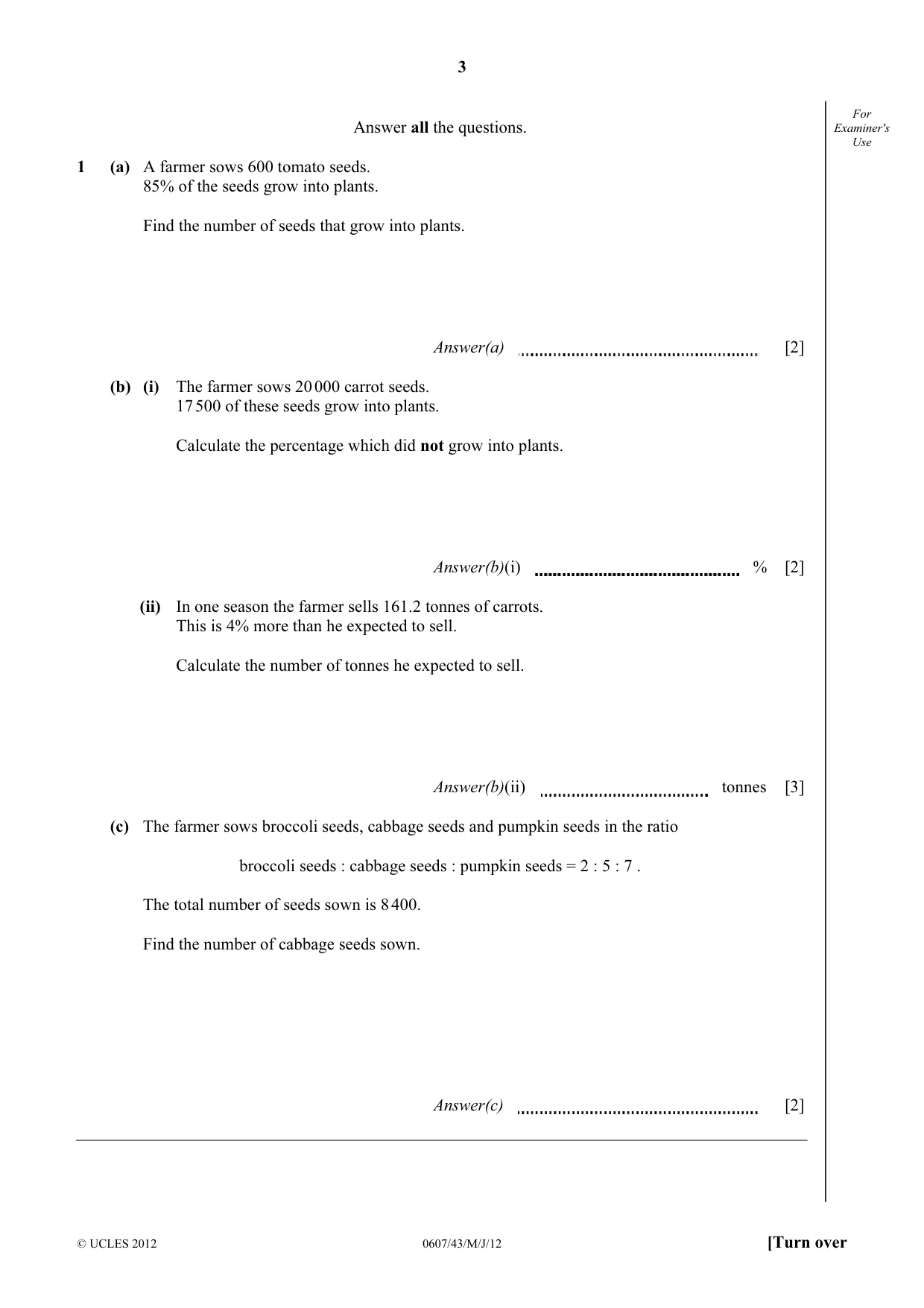
3 © UCLES 2012 0607/43/M/J/12 [Turn over For Examiner's Use Answer all the questions. 1 (a) A farmer sows 600 tomato seeds. 85% of the seeds grow into plants. Find the number of seeds that grow into plants. Answer(a) [2] (b) (i) The farmer sows 20 000 carrot seeds. 17 500 of these seeds grow into plants. Calculate the percentage which did not grow into plants. Answer(b)(i) % [2] (ii) In one season the farmer sells 161.2 tonnes of carrots. This is 4% more than he expected to sell. Calculate the number of tonnes he expected to sell. Answer(b)(ii) tonnes [3] (c) The farmer sows broccoli seeds, cabbage seeds and pumpkin seeds in the ratio broccoli seeds : cabbage seeds : pumpkin seeds = 2 : 5 : 7 . The total number of seeds sown is 8 400. Find the number of cabbage seeds sown. Answer(c) [2]
Question paper, page 4
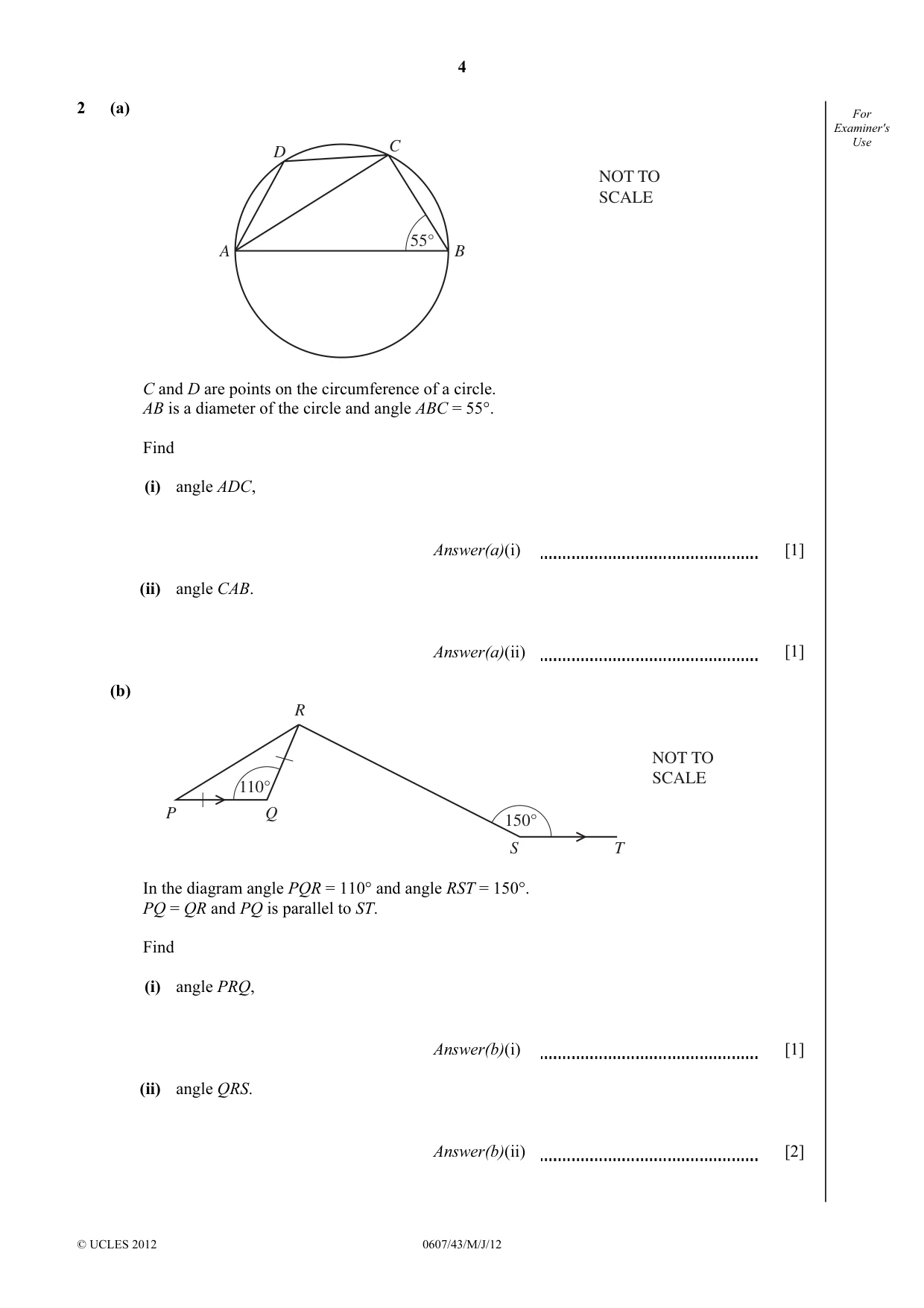
4 © UCLES 2012 0607/43/M/J/12 For Examiner's Use 2 (a) D A B C 55° NOT TO SCALE C and D are points on the circumference of a circle. AB is a diameter of the circle and angle ABC = 55°. Find (i) angle ADC, Answer(a)(i) [1] (ii) angle CAB. Answer(a)(ii) [1] (b) P Q R S T 150° 110° NOT TO SCALE In the diagram angle PQR = 110° and angle RST = 150°. PQ = QR and PQ is parallel to ST. Find (i) angle PRQ, Answer(b)(i) [1] (ii) angle QRS. Answer(b)(ii) [2]
Question paper, page 5
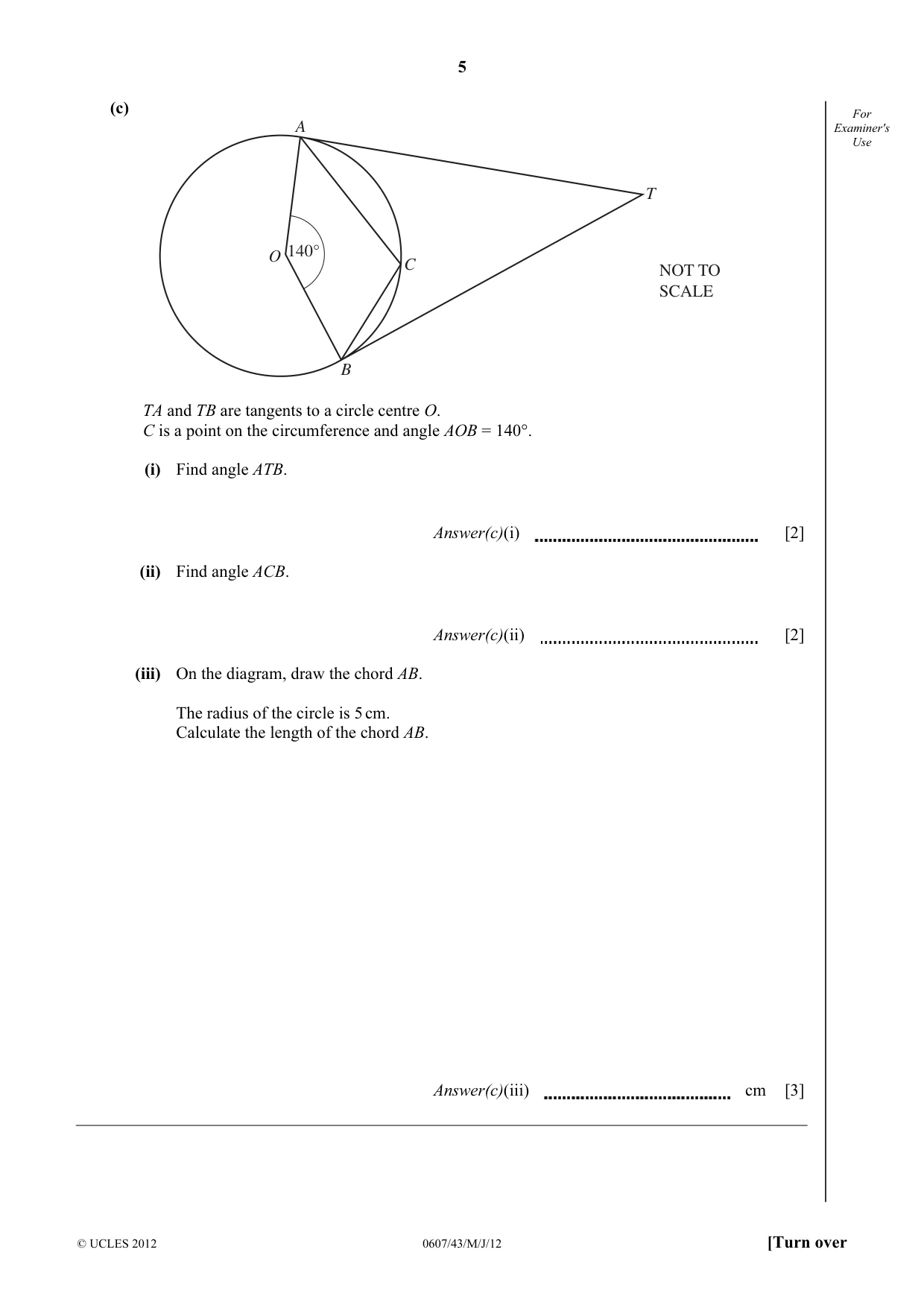
5 © UCLES 2012 0607/43/M/J/12 [Turn over For Examiner's Use (c) 140° O B A C T NOT TO SCALE TA and TB are tangents to a circle centre O. C is a point on the circumference and angle AOB = 140°. (i) Find angle ATB. Answer(c)(i) [2] (ii) Find angle ACB. Answer(c)(ii) [2] (iii) On the diagram, draw the chord AB. The radius of the circle is 5 cm. Calculate the length of the chord AB. Answer(c)(iii) cm [3]
Question paper, page 6
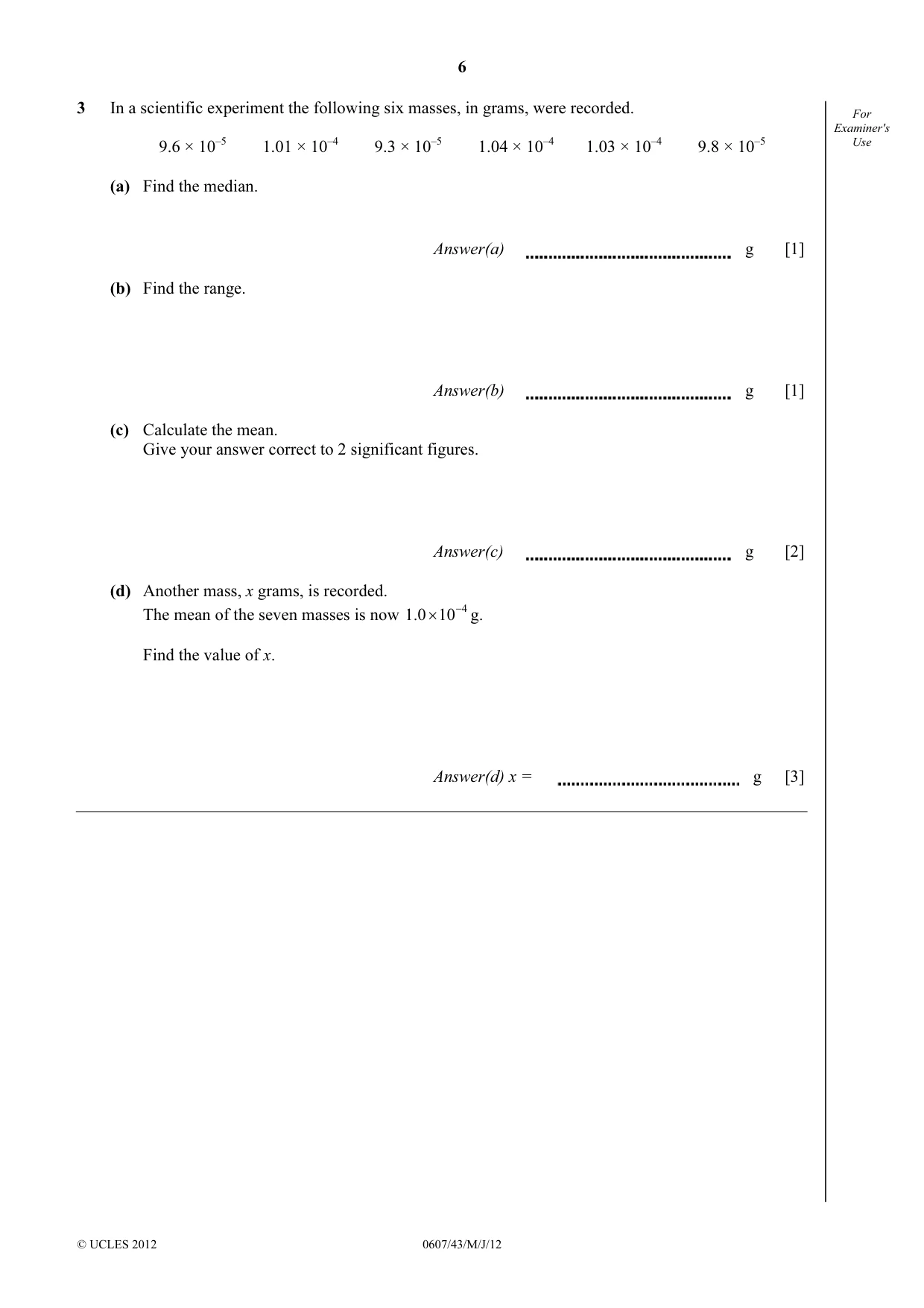
6 © UCLES 2012 0607/43/M/J/12 For Examiner's Use 3 In a scientific experiment the following six masses, in grams, were recorded. 9.6 × 10⁻⁵ 1.01 × 10⁻⁴ 9.3 × 10⁻⁵ 1.04 × 10⁻⁴ 1.03 × 10⁻⁴ 9.8 × 10⁻⁵ (a) Find the median. Answer(a) g [1] (b) Find the range. Answer(b) g [1] (c) Calculate the mean. Give your answer correct to 2 significant figures. Answer(c) g [2] (d) Another mass, x grams, is recorded. The mean of the seven masses is now 4 10 0.1 − × g. Find the value of x. Answer(d) x = g [3]
Question paper, page 7
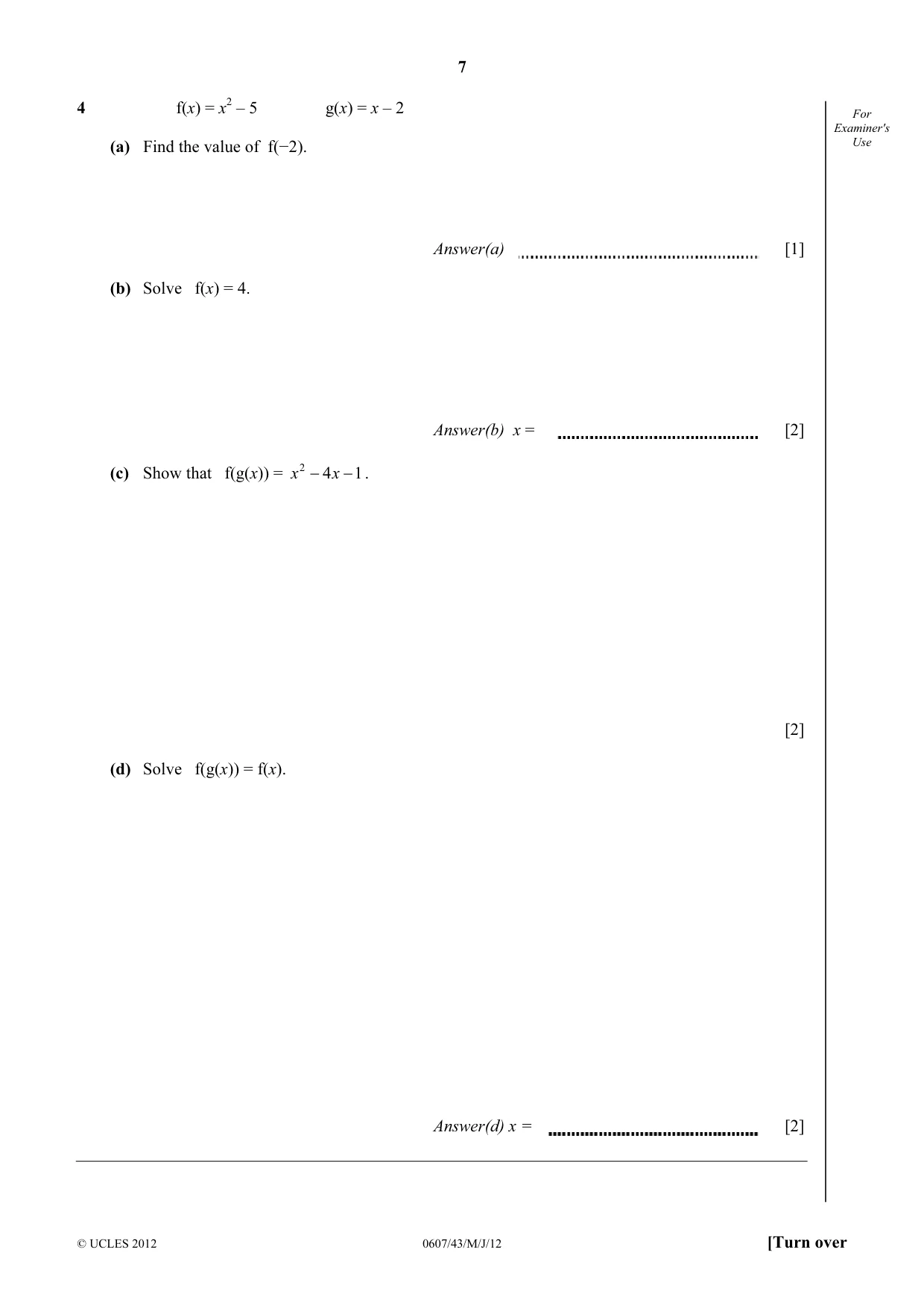
7 © UCLES 2012 0607/43/M/J/12 [Turn over For Examiner's Use 4 f(x) = x2 – 5 g(x) = x – 2 (a) Find the value of f(−2). Answer(a) [1] (b) Solve f(x) = 4. Answer(b) x = [2] (c) Show that f(g(x)) = 1 4 2 − −x x . [2] (d) Solve f(g(x)) = f(x). Answer(d) x = [2]
Question paper, page 8
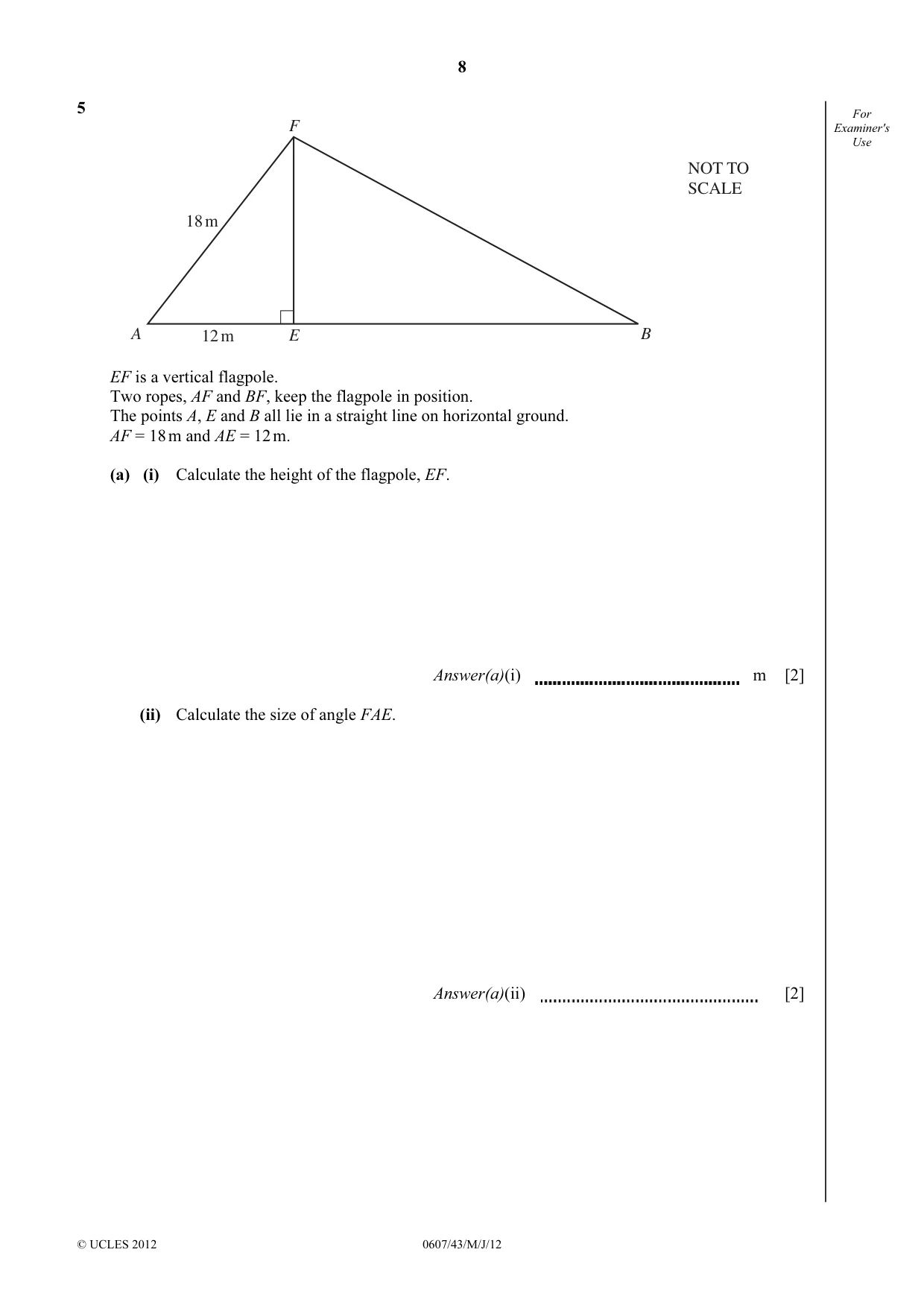
8 © UCLES 2012 0607/43/M/J/12 For Examiner's Use 5 F E A B 18 m 12 m NOT TO SCALE EF is a vertical flagpole. Two ropes, AF and BF, keep the flagpole in position. The points A, E and B all lie in a straight line on horizontal ground. AF = 18 m and AE = 12 m. (a) (i) Calculate the height of the flagpole, EF. Answer(a)(i) m [2] (ii) Calculate the size of angle FAE. Answer(a)(ii) [2]
Question paper, page 9
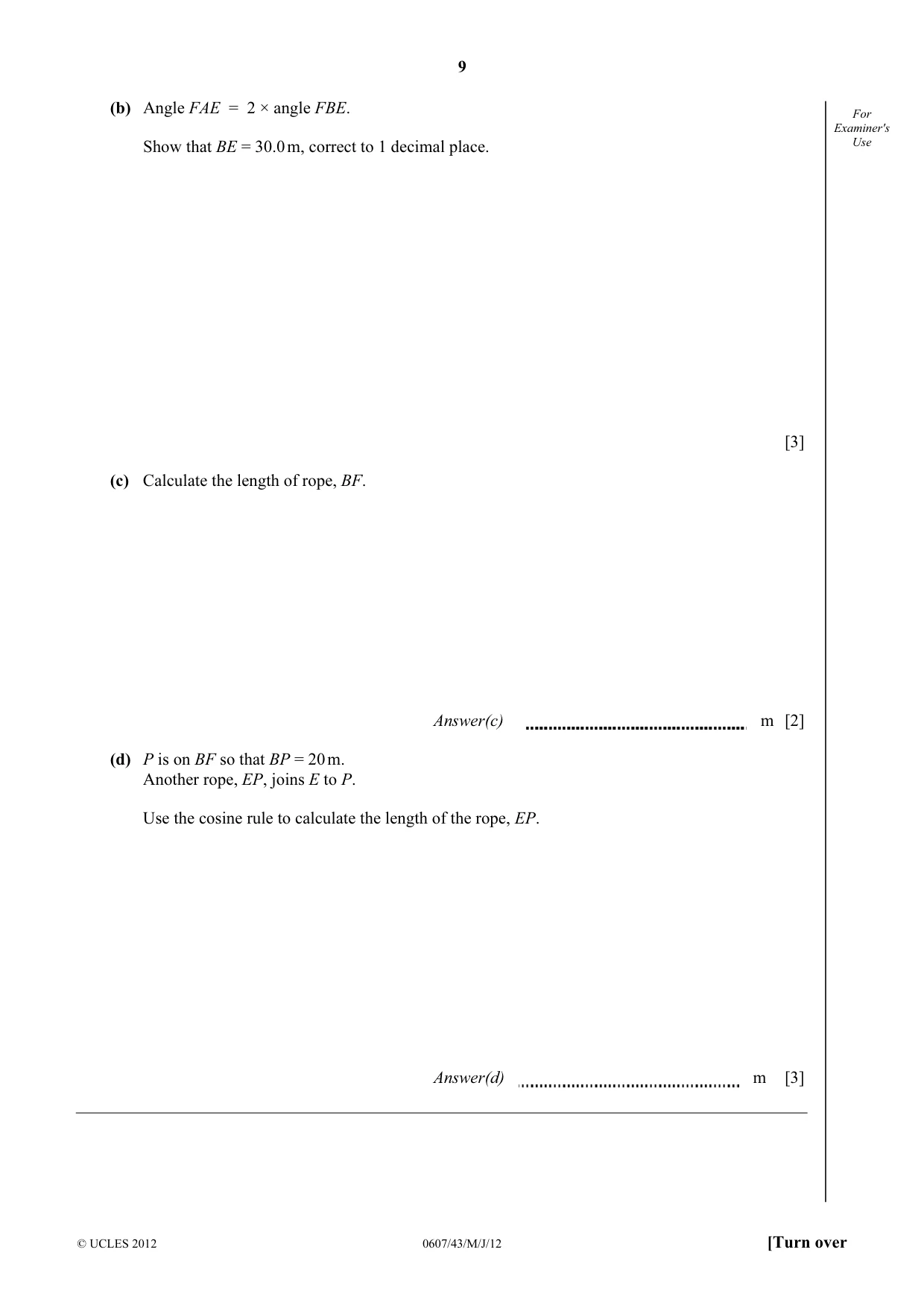
9 © UCLES 2012 0607/43/M/J/12 [Turn over For Examiner's Use (b) Angle FAE = 2 × angle FBE. Show that BE = 30.0 m, correct to 1 decimal place. [3] (c) Calculate the length of rope, BF. Answer(c) m [2] (d) P is on BF so that BP = 20 m. Another rope, EP, joins E to P. Use the cosine rule to calculate the length of the rope, EP. Answer(d) m [3]
Question paper, page 10
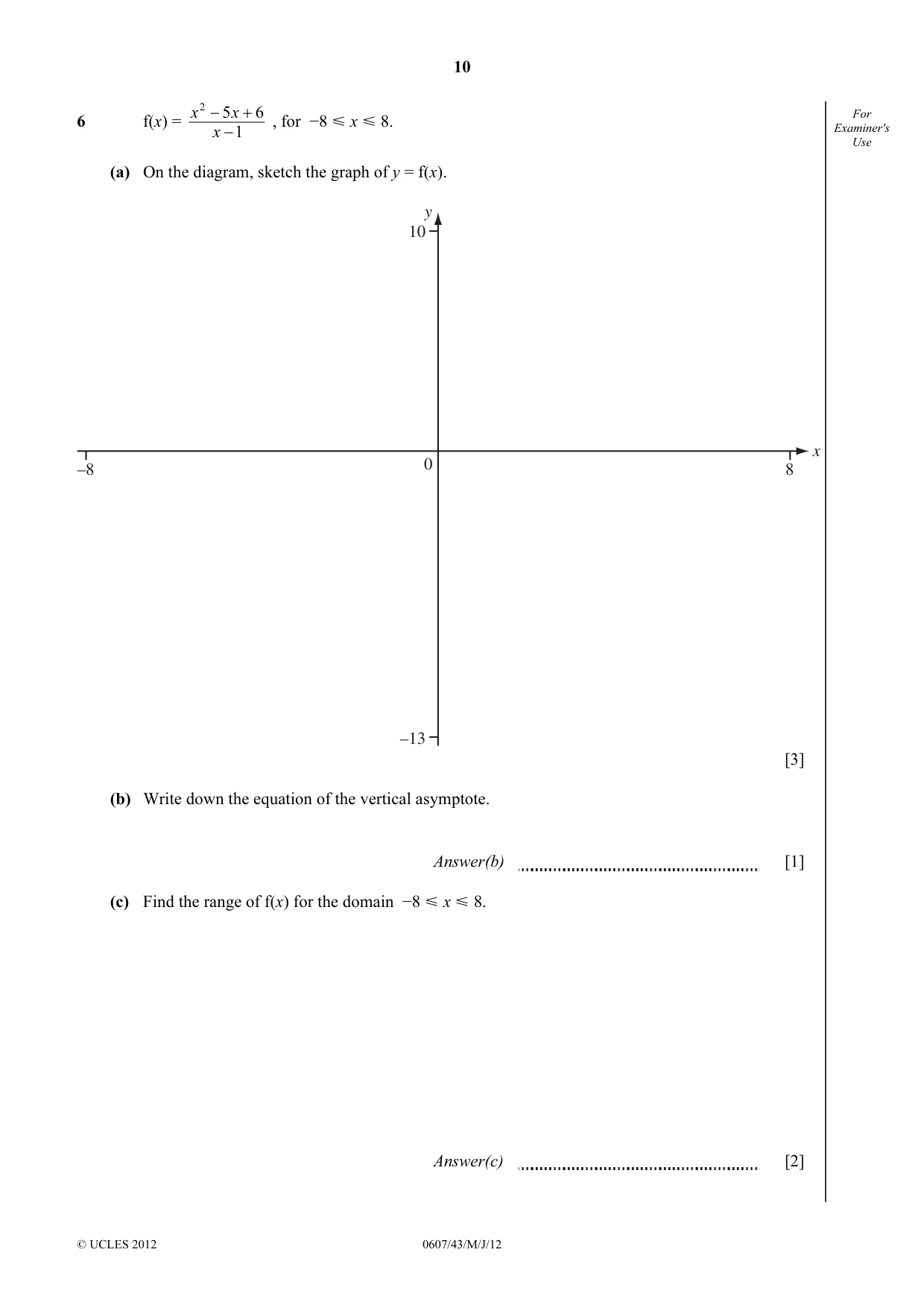
10 © UCLES 2012 0607/43/M/J/12 For Examiner's Use 6 f(x) = 1 6 5 2 − + − x x x , for −8 Y x Y 8. (a) On the diagram, sketch the graph of y = f(x). 10 –13 –8 8 0 y x [3] (b) Write down the equation of the vertical asymptote. Answer(b) [1] (c) Find the range of f(x) for the domain −8 Y x Y 8. Answer(c) [2]
Question paper, page 11
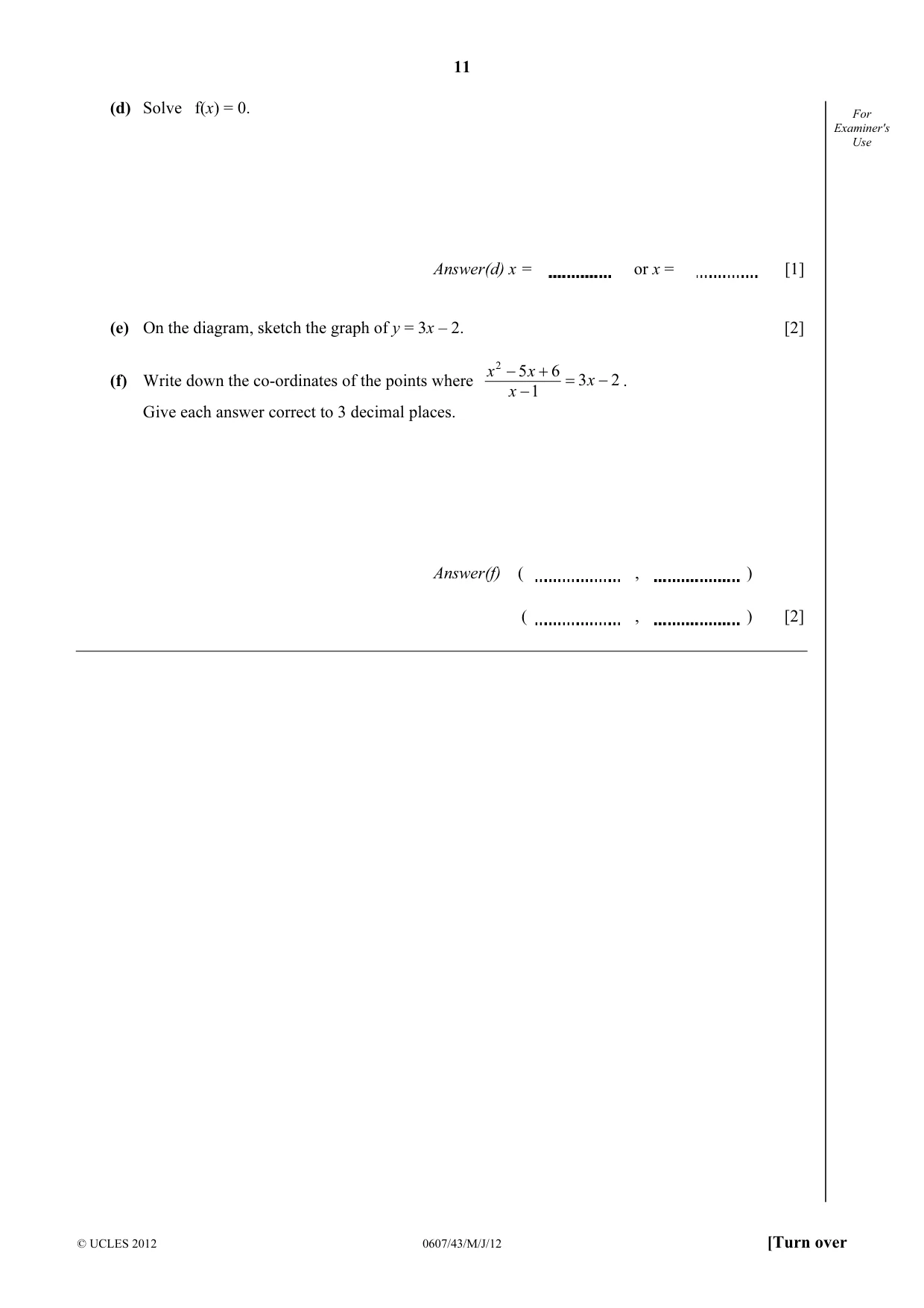
11 © UCLES 2012 0607/43/M/J/12 [Turn over For Examiner's Use (d) Solve f(x) = 0. Answer(d) x = or x = [1] (e) On the diagram, sketch the graph of y = 3x – 2. [2] (f) Write down the co-ordinates of the points where 2 3 1 6 5 2 − = − + − x x x x . Give each answer correct to 3 decimal places. Answer(f) ( , ) ( , ) [2]
Question paper, page 12
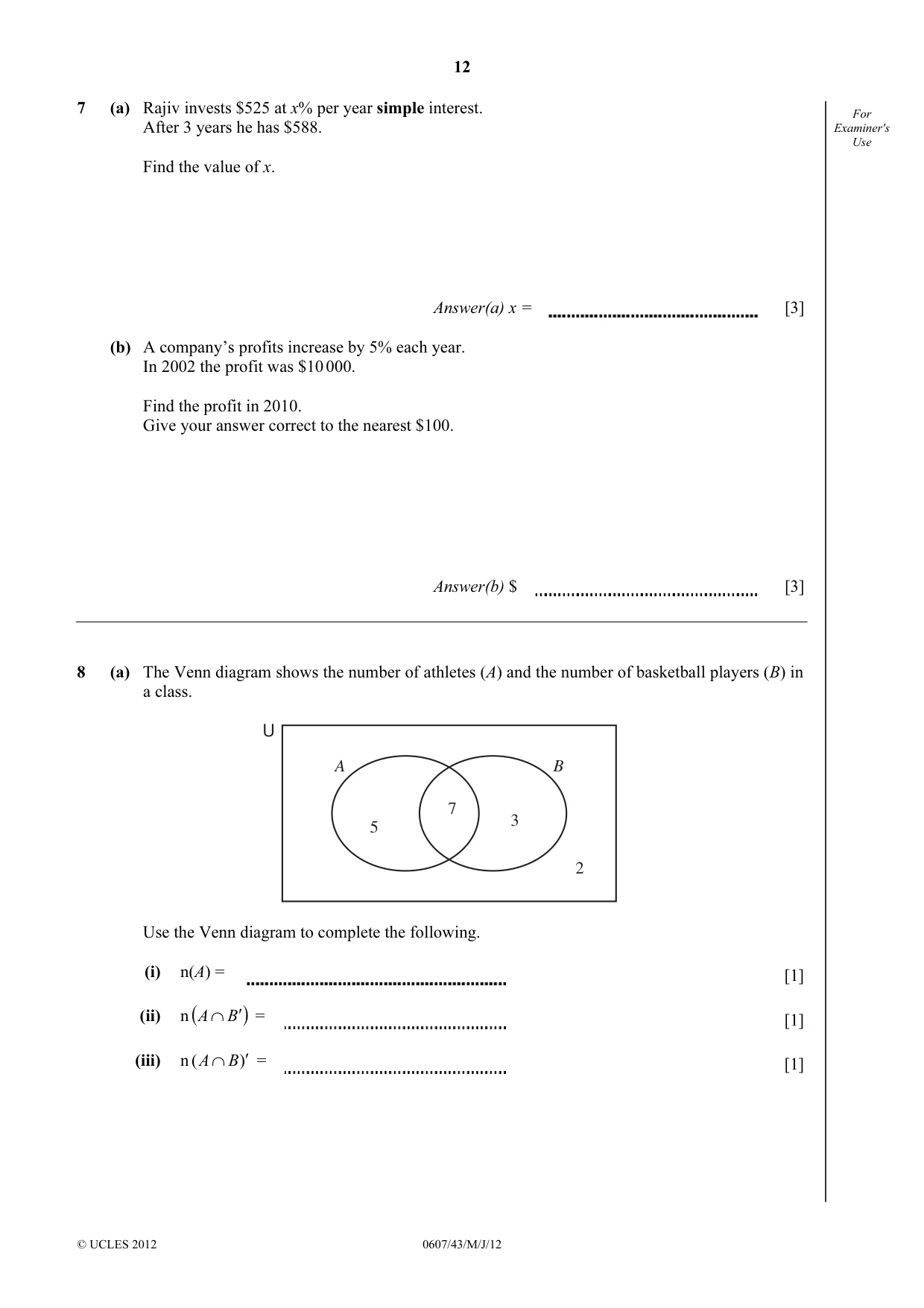
12 © UCLES 2012 0607/43/M/J/12 For Examiner's Use 7 (a) Rajiv invests $525 at x% per year simple interest. After 3 years he has $588. Find the value of x. Answer(a) x = [3] (b) A company’s profits increase by 5% each year. In 2002 the profit was $10 000. Find the profit in 2010. Give your answer correct to the nearest $100. Answer(b) $ [3] 8 (a) The Venn diagram shows the number of athletes (A) and the number of basketball players (B) in a class. U A B 5 7 3 2 Use the Venn diagram to complete the following. (i) n(A) = [1] (ii) n( ) B A ′ ∩ = [1] (iii) n ) ( ′ ∩B A = [1]
Question paper, page 13
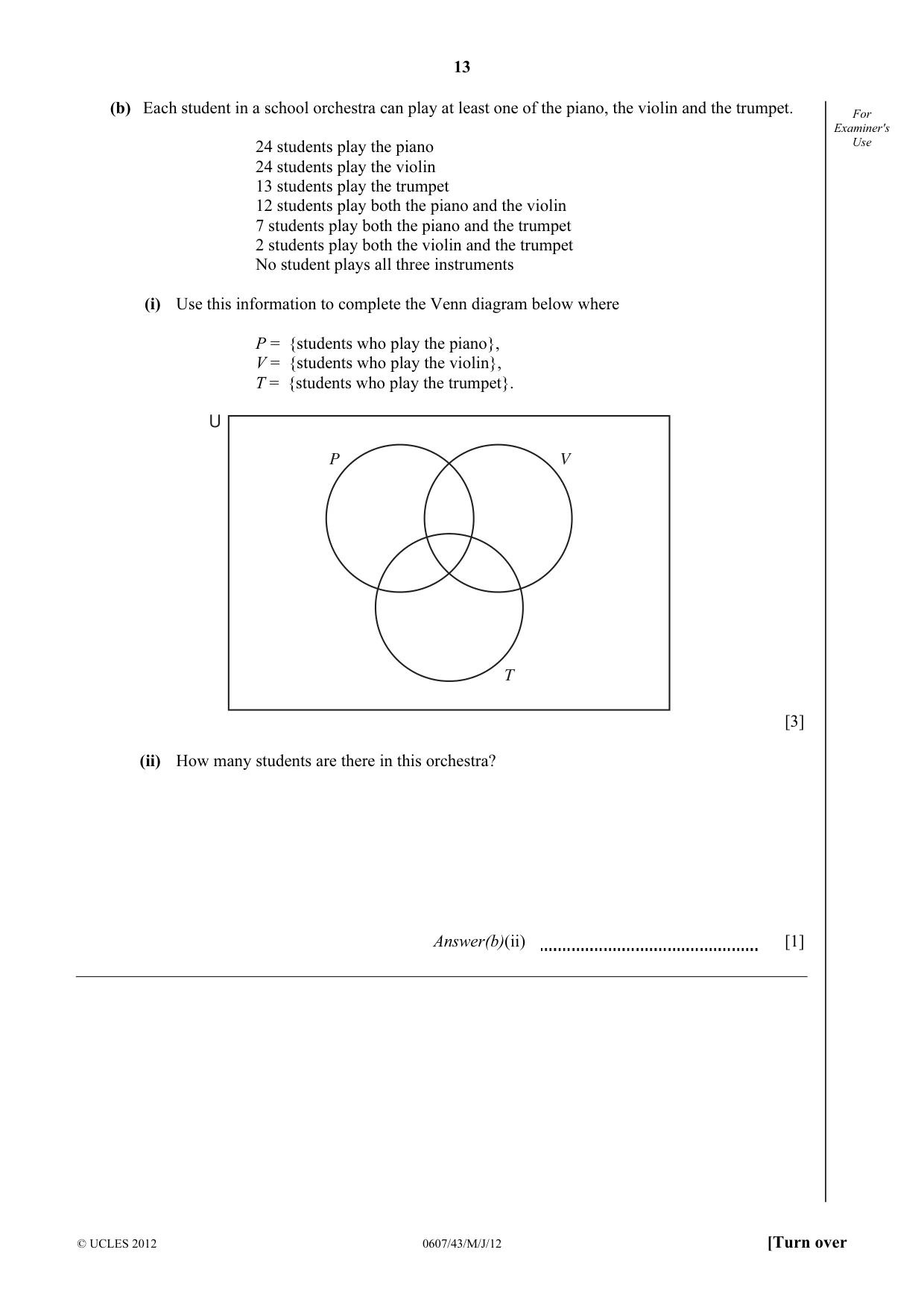
13 © UCLES 2012 0607/43/M/J/12 [Turn over For Examiner's Use (b) Each student in a school orchestra can play at least one of the piano, the violin and the trumpet. 24 students play the piano 24 students play the violin 13 students play the trumpet 12 students play both the piano and the violin 7 students play both the piano and the trumpet 2 students play both the violin and the trumpet No student plays all three instruments (i) Use this information to complete the Venn diagram below where P = {students who play the piano}, V = {students who play the violin}, T = {students who play the trumpet}. U P V T [3] (ii) How many students are there in this orchestra? Answer(b)(ii) [1]
Question paper, page 14
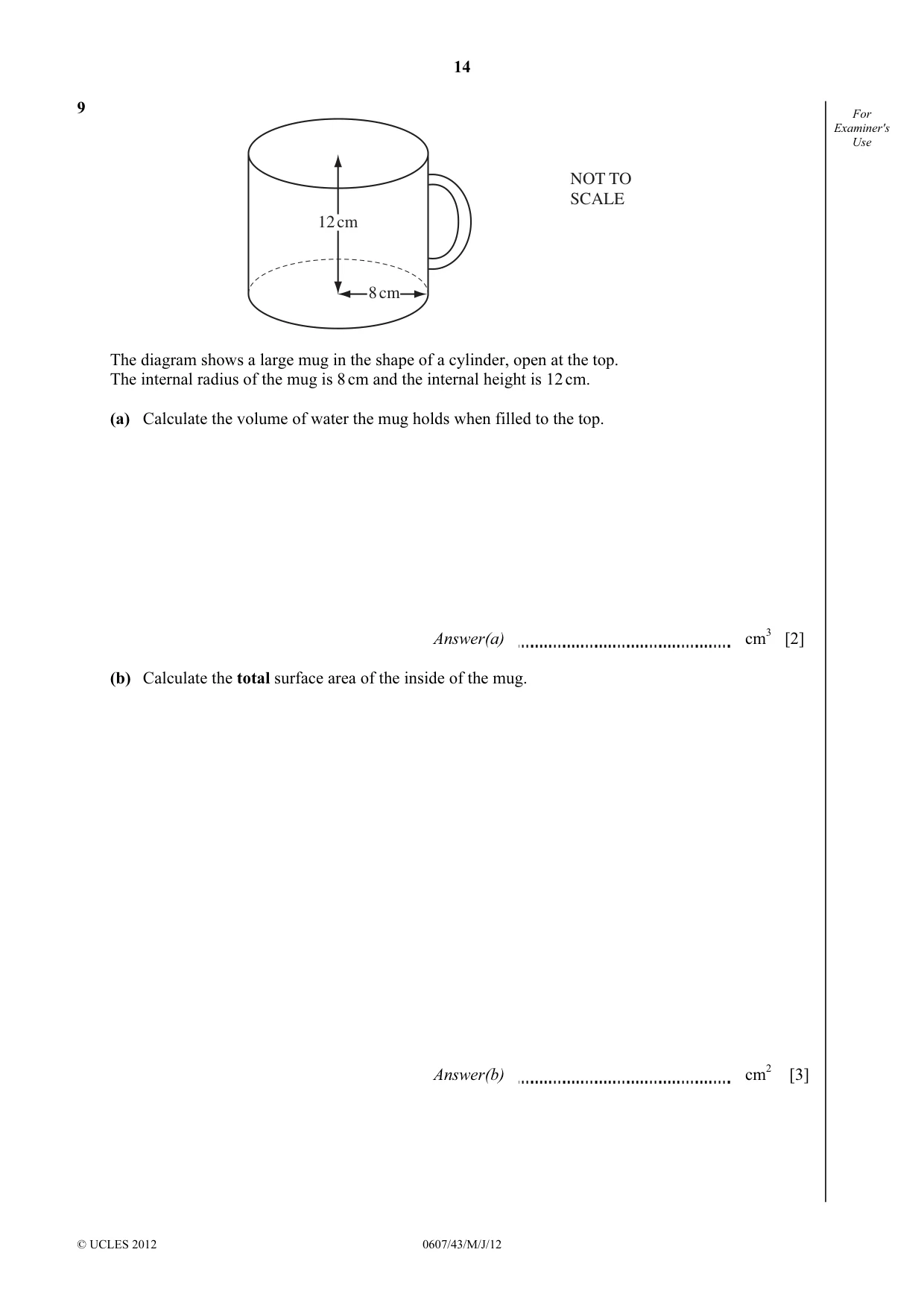
14 © UCLES 2012 0607/43/M/J/12 For Examiner's Use 9 8 cm 12 cm NOT TO SCALE The diagram shows a large mug in the shape of a cylinder, open at the top. The internal radius of the mug is 8 cm and the internal height is 12 cm. (a) Calculate the volume of water the mug holds when filled to the top. Answer(a) cm3 [2] (b) Calculate the total surface area of the inside of the mug. Answer(b) cm2 [3]
Question paper, page 15
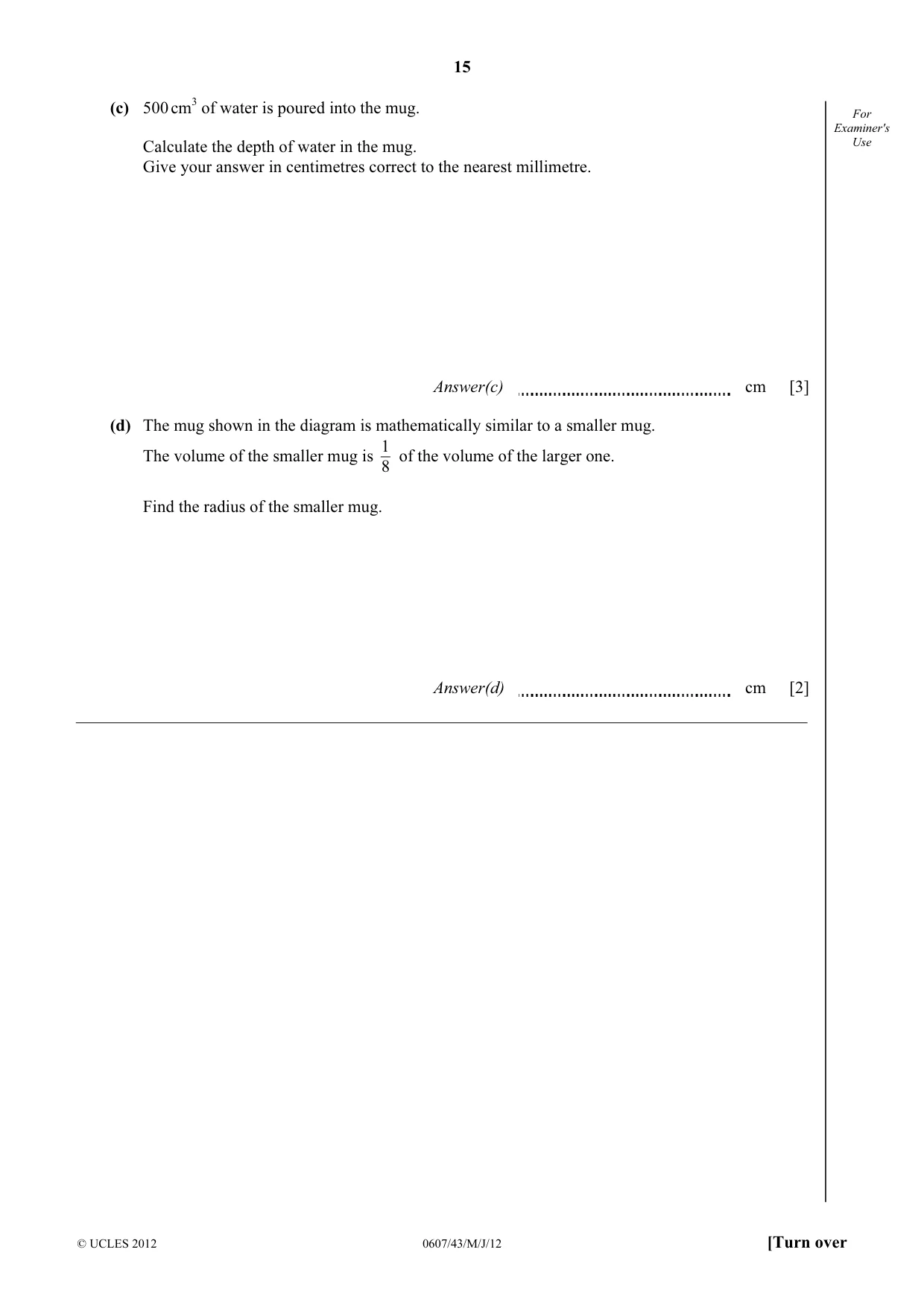
15 © UCLES 2012 0607/43/M/J/12 [Turn over For Examiner's Use (c) 500 cm3 of water is poured into the mug. Calculate the depth of water in the mug. Give your answer in centimetres correct to the nearest millimetre. Answer(c) cm [3] (d) The mug shown in the diagram is mathematically similar to a smaller mug. The volume of the smaller mug is 8 1 of the volume of the larger one. Find the radius of the smaller mug. Answer(d) cm [2]
Question paper, page 16
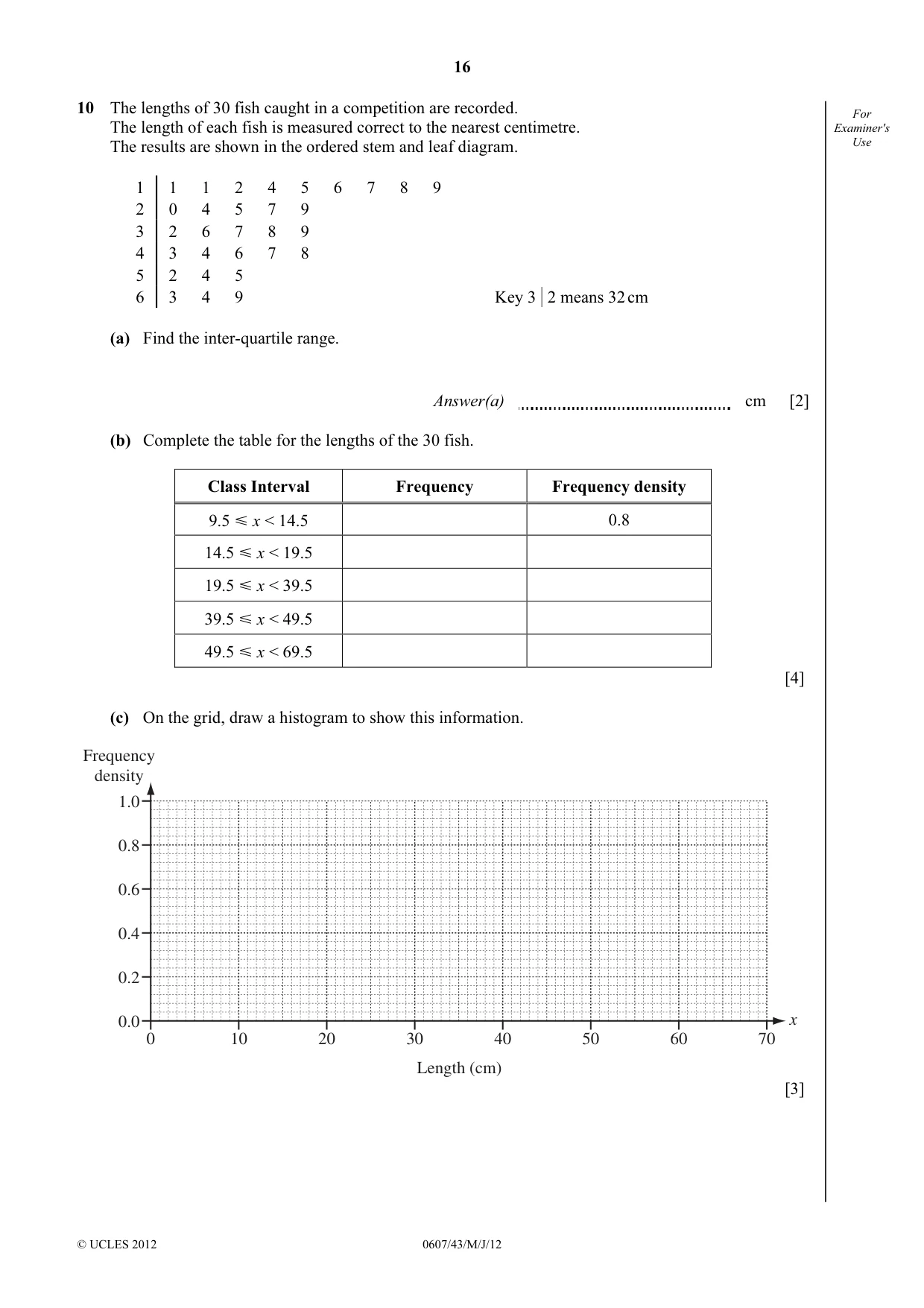
16 © UCLES 2012 0607/43/M/J/12 For Examiner's Use 10 The lengths of 30 fish caught in a competition are recorded. The length of each fish is measured correct to the nearest centimetre. The results are shown in the ordered stem and leaf diagram. 1 1 1 2 4 5 6 7 8 9 2 0 4 5 7 9 3 2 6 7 8 9 4 3 4 6 7 8 5 2 4 5 6 3 4 9 Key 3 F 2 means 32 cm (a) Find the inter-quartile range. Answer(a) cm [2] (b) Complete the table for the lengths of the 30 fish. Class Interval Frequency Frequency density 9.5 Y x < 14.5 0.8 14.5 Y x < 19.5 19.5 Y x < 39.5 39.5 Y x < 49.5 49.5 Y x < 69.5 [4] (c) On the grid, draw a histogram to show this information. 1.0 0.8 0.6 0.4 0.2 0.0 0 10 20 30 40 50 60 70 Frequency density Length (cm) x [3]
Question paper, page 17
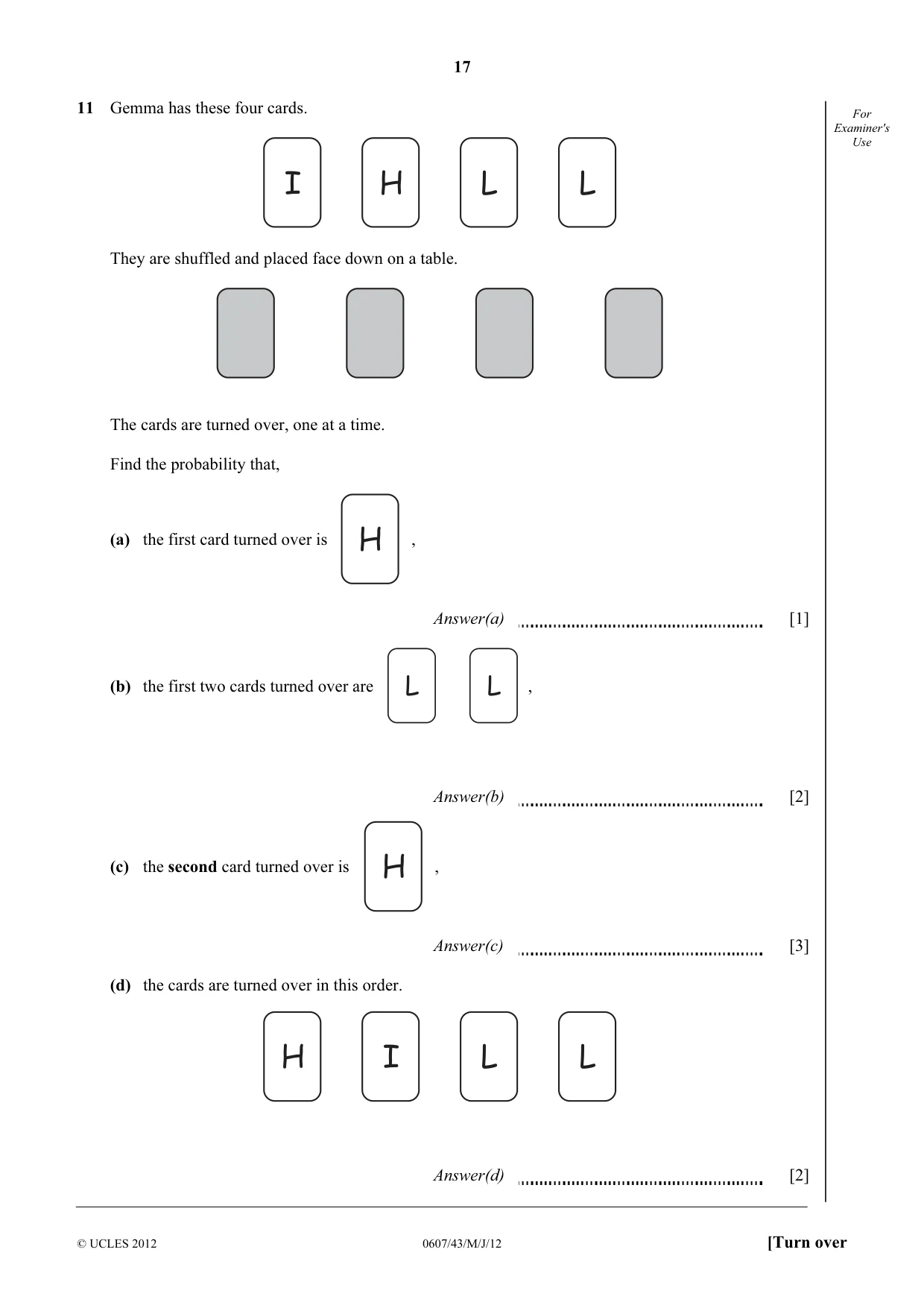
17 © UCLES 2012 0607/43/M/J/12 [Turn over For Examiner's Use 11 Gemma has these four cards. I H L L They are shuffled and placed face down on a table. The cards are turned over, one at a time. Find the probability that, (a) the first card turned over is H , Answer(a) [1] (b) the first two cards turned over are L L , Answer(b) [2] (c) the second card turned over is H , Answer(c) [3] (d) the cards are turned over in this order. H I L L Answer(d) [2]
Question paper, page 18
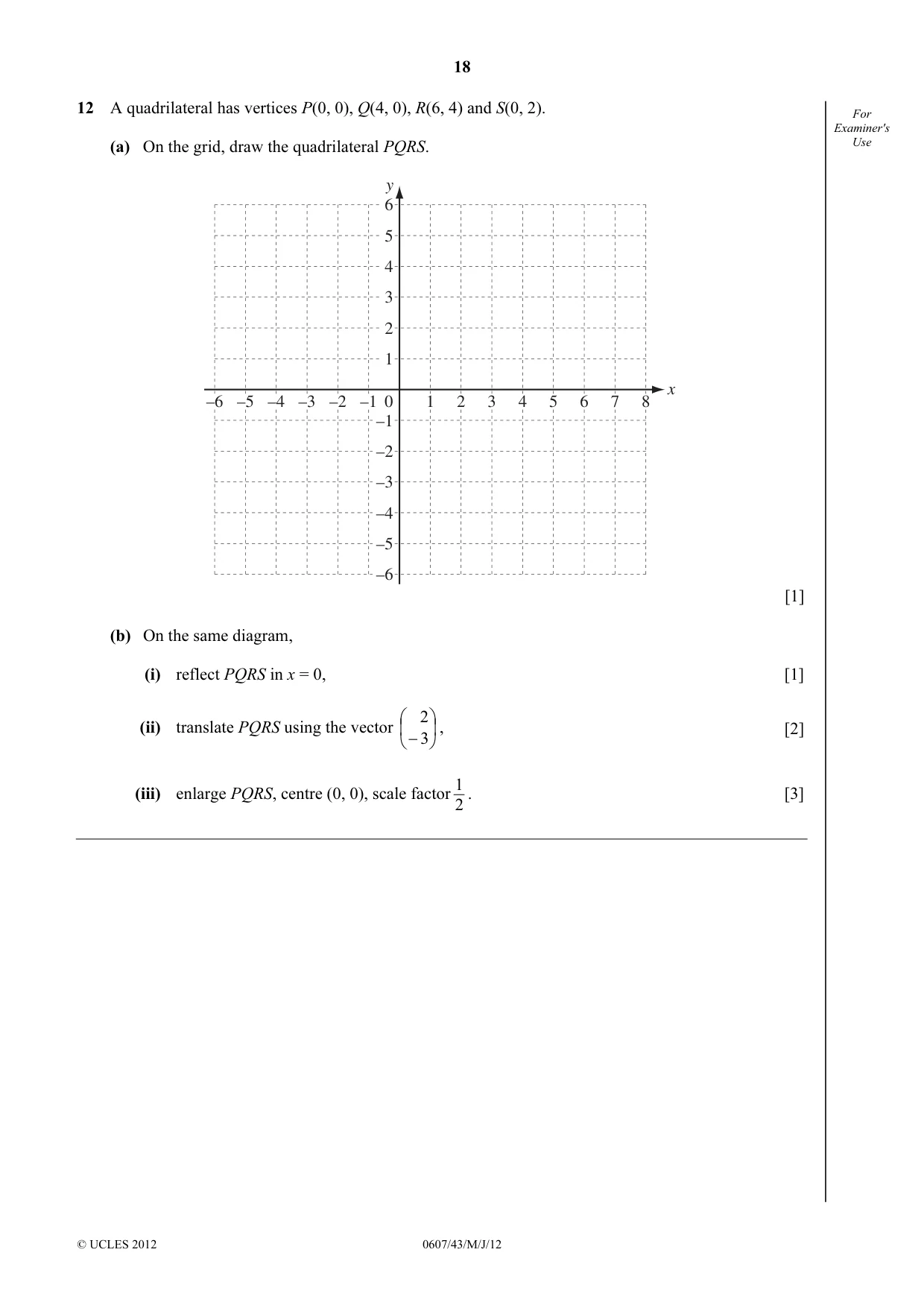
18 © UCLES 2012 0607/43/M/J/12 For Examiner's Use 12 A quadrilateral has vertices P(0, 0), Q(4, 0), R(6, 4) and S(0, 2). (a) On the grid, draw the quadrilateral PQRS. –6 –5 –4 –3 –2 –1 0 1 2 3 4 5 6 7 8 6 5 4 3 2 1 –1 –2 –3 –4 –5 –6 y x [1] (b) On the same diagram, (i) reflect PQRS in x = 0, [1] (ii) translate PQRS using the vector −3 2 , [2] (iii) enlarge PQRS, centre (0, 0), scale factor 2 1 . [3]
Question paper, page 19
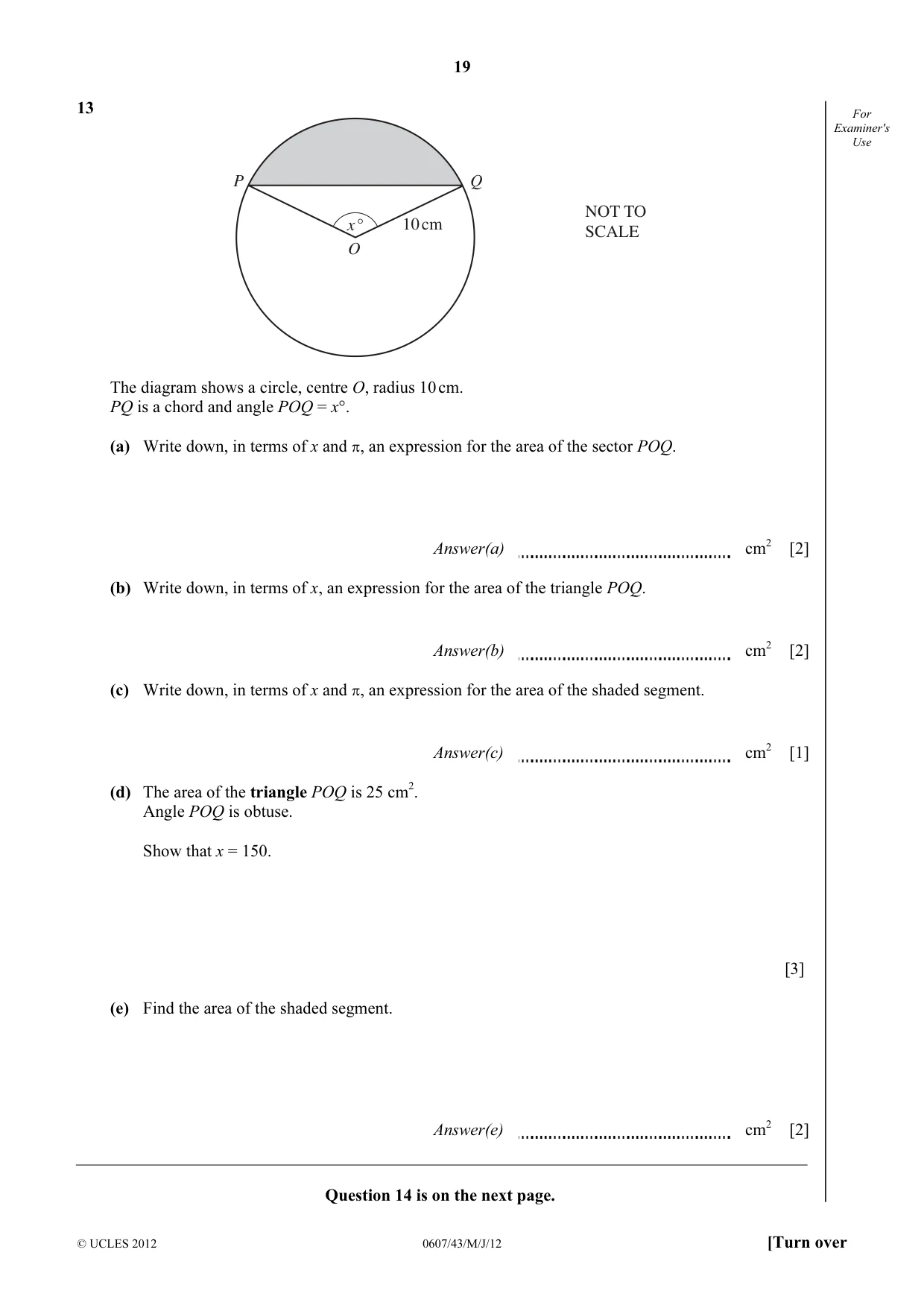
19 © UCLES 2012 0607/43/M/J/12 [Turn over For Examiner's Use 13 O P Q x ° 10 cm NOT TO SCALE The diagram shows a circle, centre O, radius 10 cm. PQ is a chord and angle POQ = x°. (a) Write down, in terms of x and π, an expression for the area of the sector POQ. Answer(a) cm2 [2] (b) Write down, in terms of x, an expression for the area of the triangle POQ. Answer(b) cm2 [2] (c) Write down, in terms of x and π, an expression for the area of the shaded segment. Answer(c) cm2 [1] (d) The area of the triangle POQ is 25 cm2. Angle POQ is obtuse. Show that x = 150. [3] (e) Find the area of the shaded segment. Answer(e) cm2 [2] Question 14 is on the next page.
Question paper, page 20
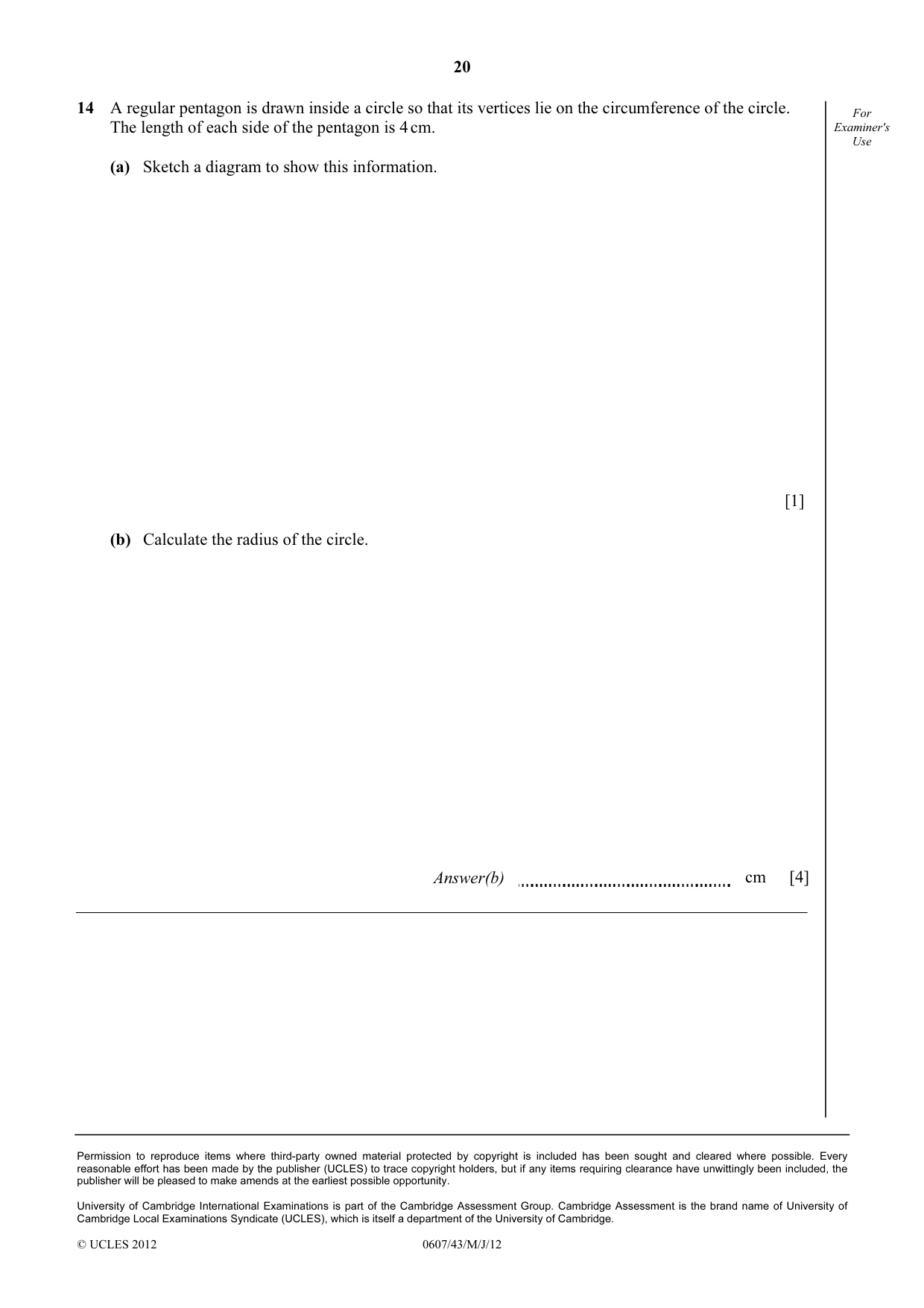
20 Permission to reproduce items where third-party owned material protected by copyright is included has been sought and cleared where possible. Every reasonable effort has been made by the publisher (UCLES) to trace copyright holders, but if any items requiring clearance have unwittingly been included, the publisher will be pleased to make amends at the earliest possible opportunity. University of Cambridge International Examinations is part of the Cambridge Assessment Group. Cambridge Assessment is the brand name of University of Cambridge Local Examinations Syndicate (UCLES), which is itself a department of the University of Cambridge. © UCLES 2012 0607/43/M/J/12 For Examiner's Use 14 A regular pentagon is drawn inside a circle so that its vertices lie on the circumference of the circle. The length of each side of the pentagon is 4 cm. (a) Sketch a diagram to show this information. [1] (b) Calculate the radius of the circle. Answer(b) cm [4]
Mark scheme, page 1
UNIVERSITY OF CAMBRIDGE INTERNATIONAL EXAMINATIONS International General Certificate of Secondary Education MARK SCHEME for the May/June 2012 question paper for the guidance of teachers 0607 CAMBRIDGE INTERNATIONAL MATHEMATICS 0607/43 Paper 4 (Extended), maximum raw mark 120 This mark scheme is published as an aid to teachers and candidates, to indicate the requirements of the examination. It shows the basis on which Examiners were instructed to award marks. It does not indicate the details of the discussions that took place at an Examiners’ meeting before marking began, which would have considered the acceptability of alternative answers. Mark schemes must be read in conjunction with the question papers and the report on the examination. • Cambridge will not enter into discussions or correspondence in connection with these mark schemes. Cambridge is publishing the mark schemes for the May/June 2012 question papers for most IGCSE, GCE Advanced Level and Advanced Subsidiary Level syllabuses and some Ordinary Level syllabuses. www.XtremePapers.com
Mark scheme, page 2
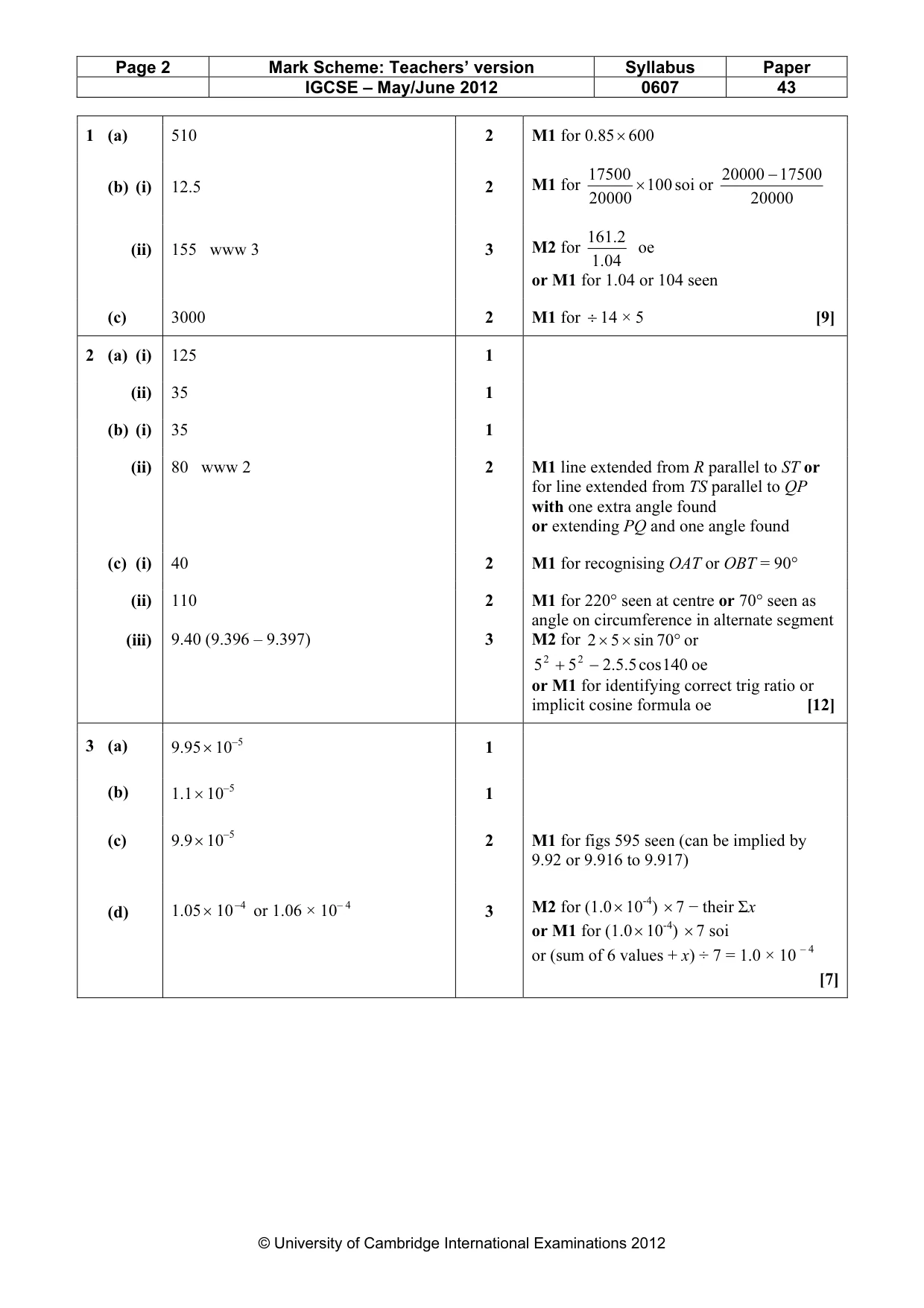
Page 2 Mark Scheme: Teachers’ version Syllabus Paper IGCSE – May/June 2012 0607 43 © University of Cambridge International Examinations 2012 1 (a) 510 2 M1 for 0.85× 600 (b) (i) 12.5 2 M1 for 100 20000 17500 × soi or 20000 17500 20000 − (ii) 155 www 3 3 M2 for 04 .1 2. 161 oe or M1 for 1.04 or 104 seen (c) 3000 2 M1 for ÷ 14 × 5 [9] 2 (a) (i) 125 1 (ii) 35 1 (b) (i) 35 1 (ii) 80 www 2 2 M1 line extended from R parallel to ST or for line extended from TS parallel to QP with one extra angle found or extending PQ and one angle found (c) (i) 40 2 M1 for recognising OAT or OBT = 90° (ii) (iii) 110 9.40 (9.396 – 9.397) 2 3 M1 for 220° seen at centre or 70° seen as angle on circumference in alternate segment M2 for ° × × 70 sin 5 2 or 140 cos 5.5.2 5 5 2 2 − + oe or M1 for identifying correct trig ratio or implicit cosine formula oe [12] 9.95× 10⁻⁵ 1 1.1× 10⁻⁵ 1 9.9× 10⁻⁵ 2 M1 for figs 595 seen (can be implied by 9.92 or 9.916 to 9.917) 3 (a) (b) (c) (d) 1.05× 4 10− or 1.06 × 10– 4 3 M2 for (1.0× 10-4) × 7 − their Σx or M1 for (1.0× 10-4) × 7 soi or (sum of 6 values + x) ÷ 7 = 1.0 × 10 – 4 [7]
Mark scheme, page 3
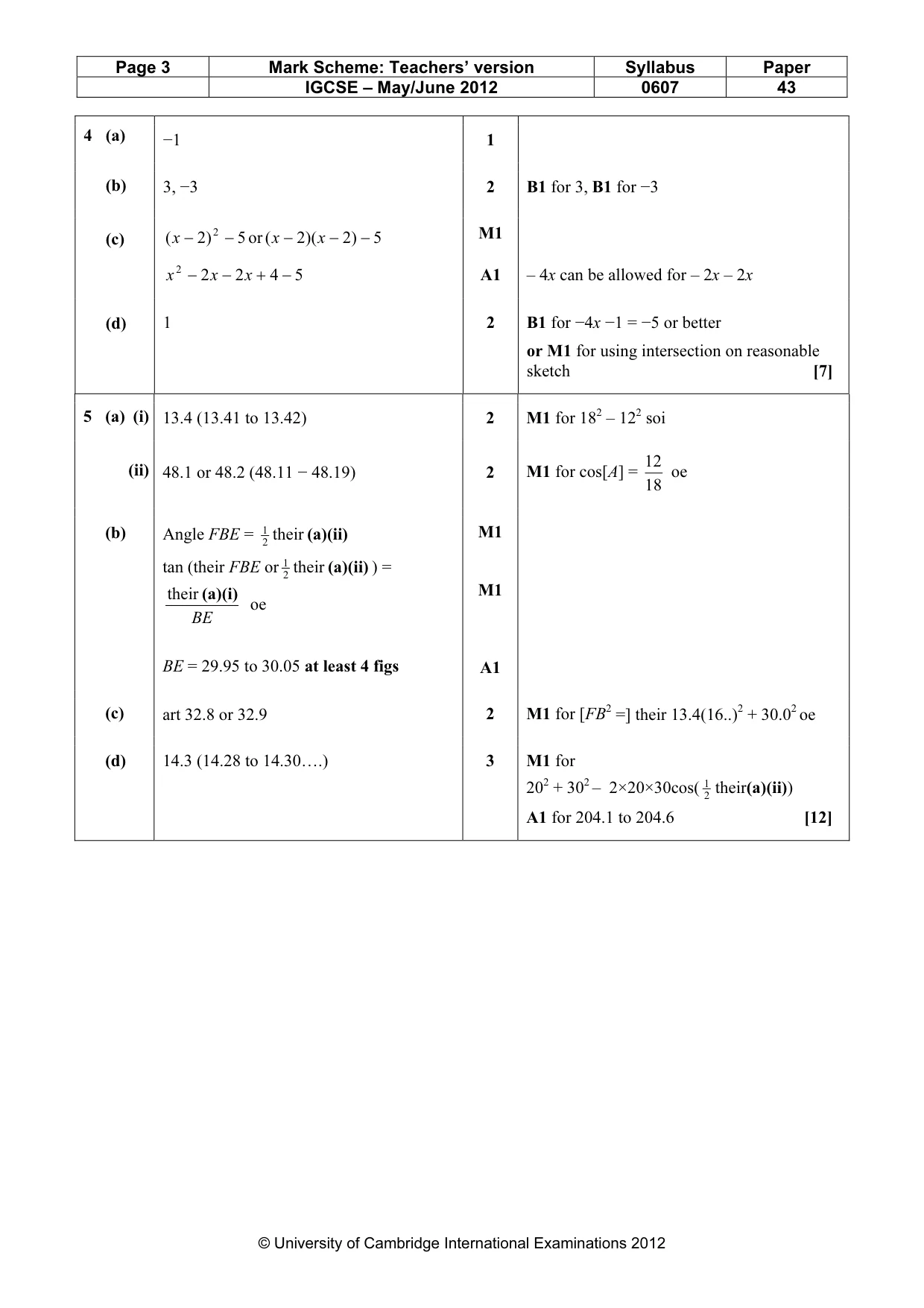
Page 3 Mark Scheme: Teachers’ version Syllabus Paper IGCSE – May/June 2012 0607 43 © University of Cambridge International Examinations 2012 −1 1 3, −3 2 B1 for 3, B1 for −3 5 ) 2 ( 2 − − x or 5 ) 2 )( 2 ( − − − x x 5 4 2 2 2 − + − − x x x M1 A1 – 4x can be allowed for – 2x – 2x 4 (a) (b) (c) (d) 1 2 B1 for −4x −1 = −5 or better or M1 for using intersection on reasonable sketch [7] 13.4 (13.41 to 13.42) 2 M1 for 182 – 122 soi 48.1 or 48.2 (48.11 − 48.19) 2 M1 for cos[A] = 18 12 oe Angle FBE = (a)(ii) their 2 1 tan (their FBE or (a)(ii) their 2 1 ) = BE (a)(i) their oe BE = 29.95 to 30.05 at least 4 figs M1 M1 A1 art 32.8 or 32.9 2 M1 for [FB2 =] their 13.4(16..)2 + 30.02 oe 5 (a) (i) (ii) (b) (c) (d) 14.3 (14.28 to 14.30….) 3 M1 for 202 + 302 – 2×20×30cos( 2 1 their(a)(ii)) A1 for 204.1 to 204.6 [12]
Mark scheme, page 4
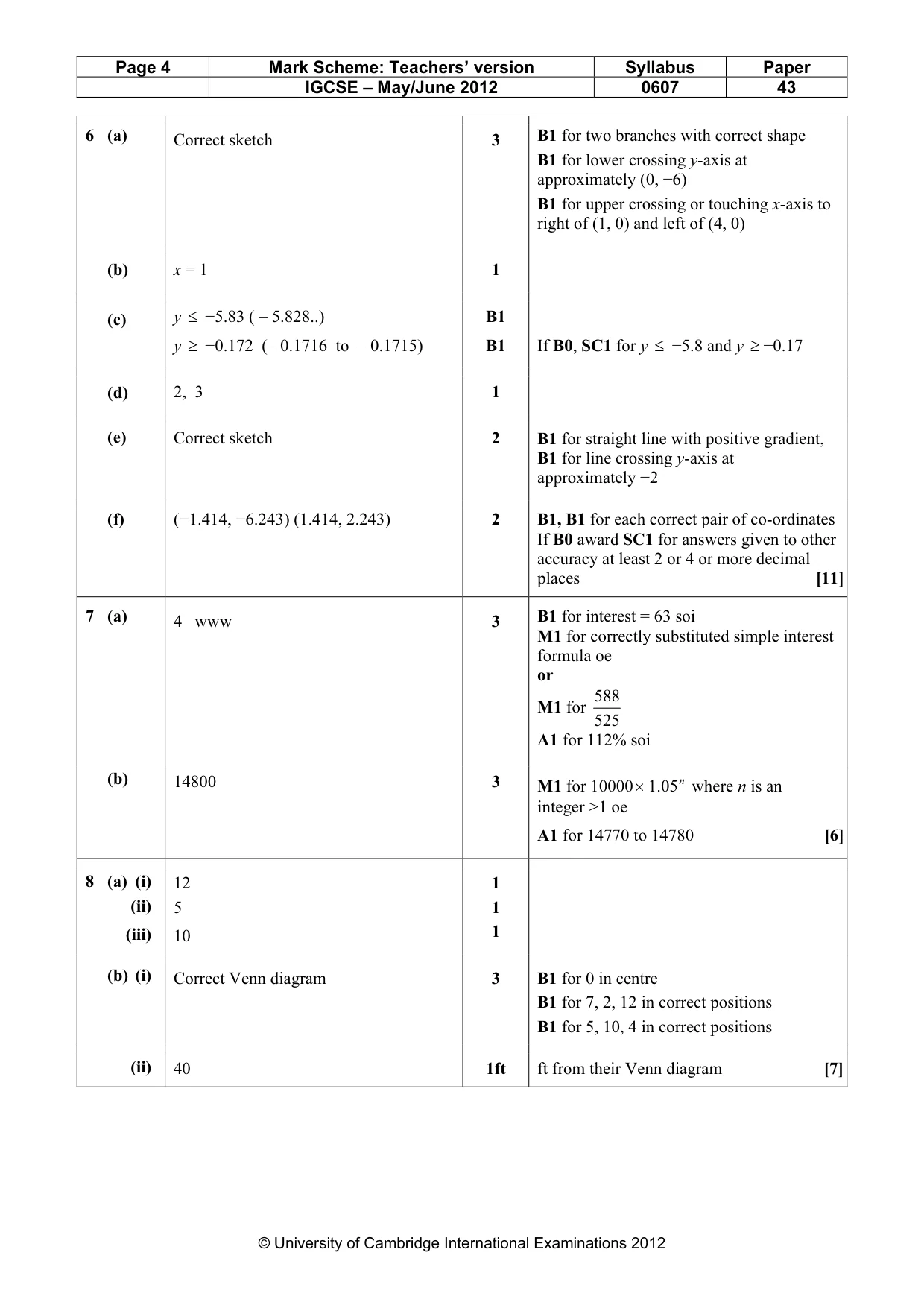
Page 4 Mark Scheme: Teachers’ version Syllabus Paper IGCSE – May/June 2012 0607 43 © University of Cambridge International Examinations 2012 Correct sketch 3 B1 for two branches with correct shape B1 for lower crossing y-axis at approximately (0, −6) B1 for upper crossing or touching x-axis to right of (1, 0) and left of (4, 0) x = 1 1 y ≤ −5.83 ( – 5.828..) y ≥ −0.172 (– 0.1716 to – 0.1715) B1 B1 If B0, SC1 for y ≤ −5.8 and y ≥−0.17 2, 3 1 Correct sketch 2 B1 for straight line with positive gradient, B1 for line crossing y-axis at approximately −2 6 (a) (b) (c) (d) (e) (f) (−1.414, −6.243) (1.414, 2.243) 2 B1, B1 for each correct pair of co-ordinates If B0 award SC1 for answers given to other accuracy at least 2 or 4 or more decimal places [11] 4 www 3 B1 for interest = 63 soi M1 for correctly substituted simple interest formula oe or M1 for 525 588 A1 for 112% soi 7 (a) (b) 14800 3 M1 for 10000× n 05 .1 where n is an integer >1 oe A1 for 14770 to 14780 [6] 12 5 10 1 1 1 Correct Venn diagram 3 B1 for 0 in centre B1 for 7, 2, 12 in correct positions B1 for 5, 10, 4 in correct positions 8 (a) (i) (ii) (iii) (b) (i) (ii) 40 1ft ft from their Venn diagram [7]
Mark scheme, page 5
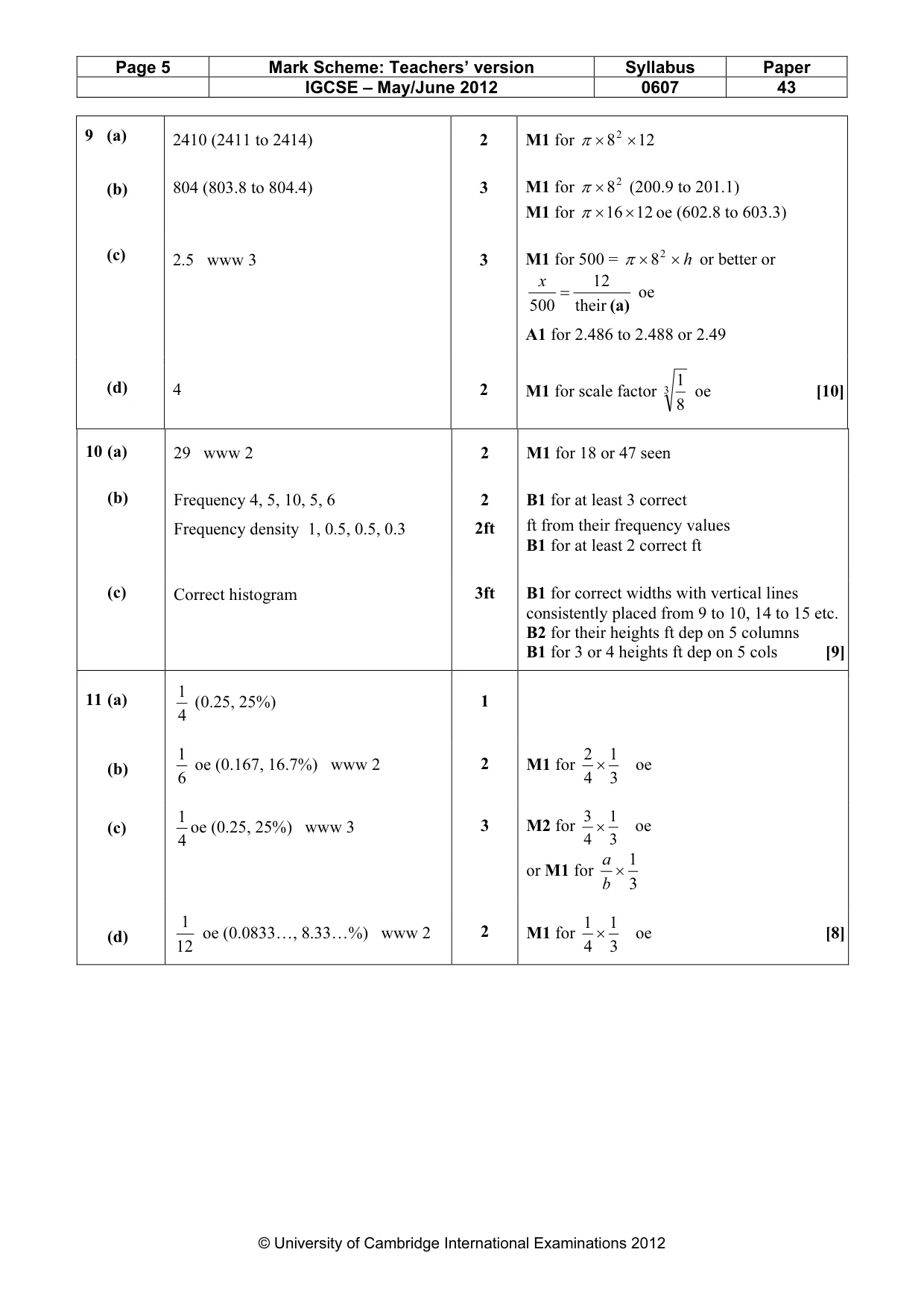
Page 5 Mark Scheme: Teachers’ version Syllabus Paper IGCSE – May/June 2012 0607 43 © University of Cambridge International Examinations 2012 2410 (2411 to 2414) 2 M1 for 12 82 × × π 9 (a) (b) 804 (803.8 to 804.4) 3 M1 for 2 8 × π (200.9 to 201.1) M1 for 12 16× × π oe (602.8 to 603.3) 2.5 www 3 3 M1 for 500 = h × × 2 8 π or better or (a) their 12 500 = x oe A1 for 2.486 to 2.488 or 2.49 (c) (d) 4 2 M1 for scale factor 3 8 1 oe [10] 29 www 2 2 M1 for 18 or 47 seen Frequency 4, 5, 10, 5, 6 Frequency density 1, 0.5, 0.5, 0.3 2 2ft B1 for at least 3 correct ft from their frequency values B1 for at least 2 correct ft 10 (a) (b) (c) Correct histogram 3ft B1 for correct widths with vertical lines consistently placed from 9 to 10, 14 to 15 etc. B2 for their heights ft dep on 5 columns B1 for 3 or 4 heights ft dep on 5 cols [9] 4 1 (0.25, 25%) 1 6 1 oe (0.167, 16.7%) www 2 2 M1 for 3 1 4 2 × oe 4 1 oe (0.25, 25%) www 3 3 M2 for 3 1 4 3 × oe or M1 for 3 1 × b a 11 (a) (b) (c) (d) 12 1 oe (0.0833…, 8.33…%) www 2 2 M1 for 3 1 4 1 × oe [8]
Mark scheme, page 6
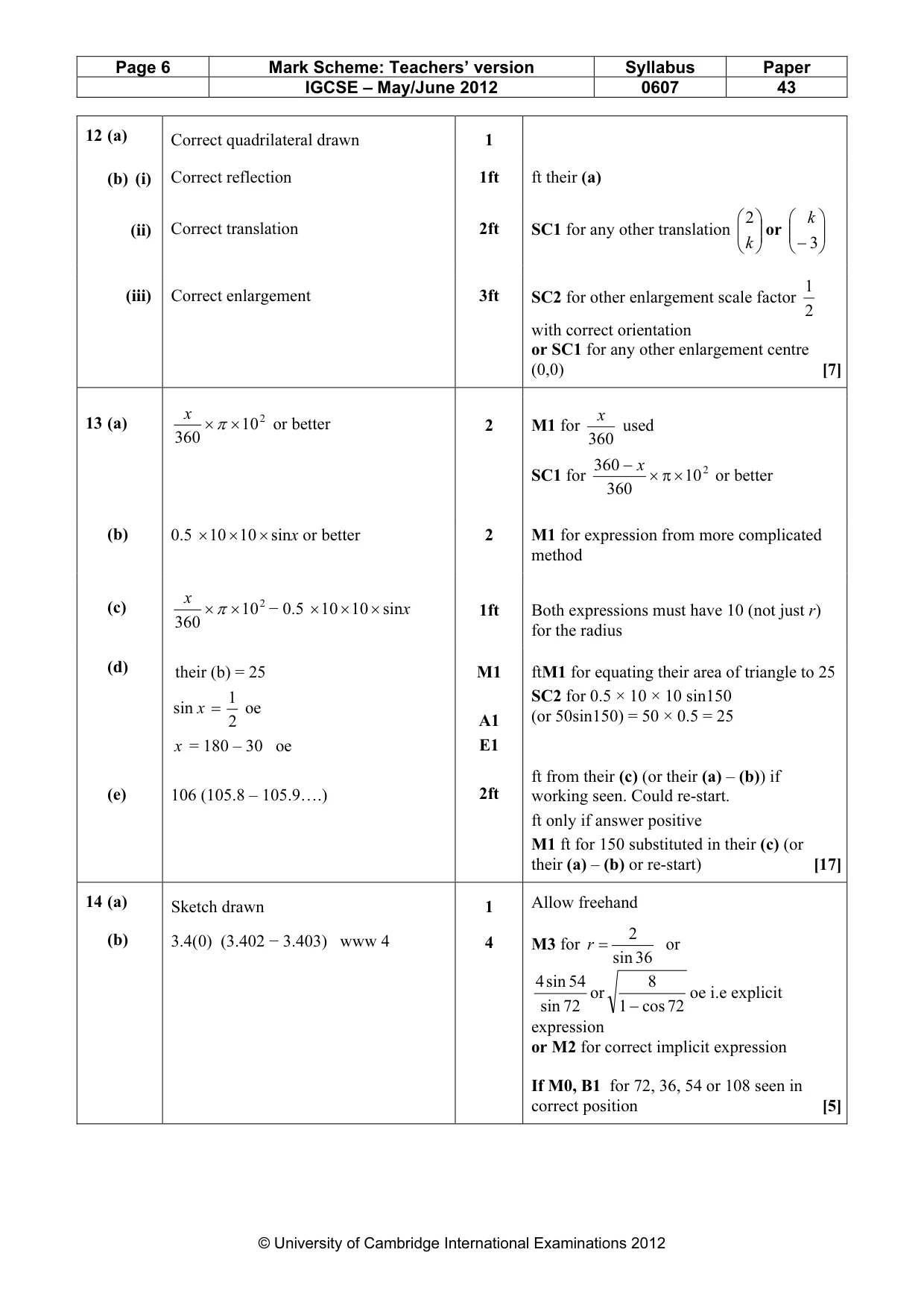
Page 6 Mark Scheme: Teachers’ version Syllabus Paper IGCSE – May/June 2012 0607 43 © University of Cambridge International Examinations 2012 Correct quadrilateral drawn 1 Correct reflection 1ft ft their (a) Correct translation 2ft SC1 for any other translation k 2 or −3 k 12 (a) (b) (i) (ii) (iii) Correct enlargement 3ft SC2 for other enlargement scale factor 2 1 with correct orientation or SC1 for any other enlargement centre (0,0) [7] 2 10 360 × ×π x or better 2 M1 for 360 x used SC1 for 2 10 360 360 × π × −x or better 0.5 × × × 10 10 sinx or better 2 M1 for expression from more complicated method 13 (a) (b) (c) 2 10 360 × ×π x − 0.5 × × × 10 10 sinx 1ft Both expressions must have 10 (not just r) for the radius (d) (e) their (b) = 25 2 1 sin = x oe x = 180 – 30 oe 106 (105.8 – 105.9….) M1 A1 E1 2ft ftM1 for equating their area of triangle to 25 SC2 for 0.5 × 10 × 10 sin150 (or 50sin150) = 50 × 0.5 = 25 ft from their (c) (or their (a) – (b)) if working seen. Could re-start. ft only if answer positive M1 ft for 150 substituted in their (c) (or their (a) – (b) or re-start) [17] 14 (a) (b) Sketch drawn 3.4(0) (3.402 − 3.403) www 4 1 4 Allow freehand M3 for 36 sin 2 = r or 72 sin 54 sin 4 or 72 cos 1 8 − oe i.e explicit expression or M2 for correct implicit expression If M0, B1 for 72, 36, 54 or 108 seen in correct position [5]
What you needed in this session
Cambridge’s own grade thresholds for 2012 May/June, Paper 4 · Variant 3. A higher threshold means an easier paper — the bar moves with how the cohort did.